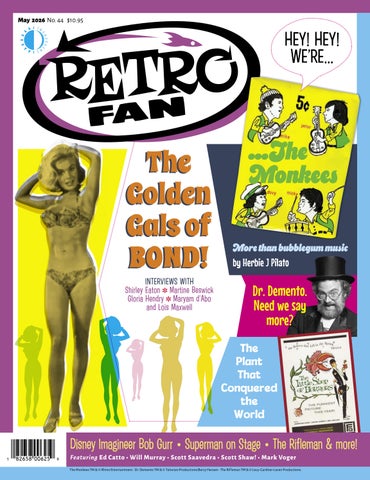
May 2026 No. 44 $10.95
HEY! HEY! WE’RE...
The Golden Gals of BOND!
INTERVIEWS WITH Shirley Eaton Martine Beswick Gloria Hendry Maryam d’Abo and Lois Maxwell
by Herbie J Pilato
Dr. Demento. Need we say more? The Plant That Conquered the World
Disney Imagineer Bob Gurr • Superman on Stage • The Rifleman & more! Featuring Ed Catto • Will Murray • Scott Saavedra • Scott Shaw! • Mark Voger
The Monkees TM & © Rhino Entertainment • Dr. Demento TM & © Talonian Productions/Barry Hansen • The Rifleman TM & © Levy-Gardner-Laven Productions.
58 32
The Crazy Cool Culture We Grew Up With
ISSUE #44 ✽ May 2026
Columns and Special Features 3
17
45
Voger’s Vault of Vintage Varieties Bond Girls
Scott Saavedra’s Secret Sanctum Disney Imagineer Bob Gurr
12
RetroAmusement Disney Dark Rides
17
RetroFashion Beatniks
27
Oddball World of Scott Shaw! The Little Shop of Horrors
32
Will Murray’s 20th Century Panopticon The Rifleman
35
Departments 2
53
RetroSpy The First James Bond
58
RetroTelevision The Monkees
45
60
RetroMemories More Monkees
69
RetroParody Dr. Demento
60
RetroBroadway It’s a Bird... It’s a Plane... It’s Superman!
69
77
35 3
Retrotorial
12
RetroFanmail
RetroFan™ issue 44, May 2026 (ISSN 2576-7224) is published bi-monthly by TwoMorrows Publishing, 10407 Bedfordtown Drive, Raleigh, NC 27614, USA.Phone: (919) 449-0344. Periodicals postage paid at Raleigh, NC. POSTMASTER: Send address changes to RetroFan, c/o TwoMorrows, 10407 Bedfordtown Drive, Raleigh, NC 27614. Ed Catto, Editor-in-Chief. John Morrow, Publisher. Editorial Office: RetroFan, c/o Ed Catto, Editor, 304 N. Hoopes Ave., Auburn, NY 13021. Email: retroed@twomorrows.com. Six-issue subscriptions: $80 Economy US, $121 International, $29 Digital Only. Please send subscription orders and funds to TwoMorrows, NOT to the editorial office. James Bond TM & © Eon Productions and Amazon MGM Studios • The Monkees TM & © Rhino Entertainment • Dr. Demento TM & © Talonian Productions/Barry Hansen • Superman TM & © DC Comics • Disneyland and all associated properties TM & © Disney • Little Shop of Horrors musical TM & © Howard Ashman & Alan Menken/MTI • Little Shop of Horrors 1986 film TM & © Warner Bros. Discovery • The Rifleman TM & © Levy-Gardner-Laven Productions. All characters are © their respective companies. All material © their creators unless otherwise noted. All editorial matter © 2025 Ed Catto and TwoMorrows. Printed in China. FIRST PRINTING.
53
BOND GIRLS
VOGER’S VAULT OF VINTAGE VARIETIES
Luciana Paluzzi Thunderball © Eon Productions & Amazon MGM Studios.
BY MARK VOGER Women’s liberation wasn’t a thing yet when the first James Bond movie, Dr. No (1962), debuted. In our (hopefully) enlightened present day, the concept of the “Bond girl”—and perhaps even that of superspy stud James Bond himself— seems anachronistic. But credible—albeit, drop-dead gorgeous—actresses such as Ursula Andress, Honor Blackman, Britt Ekland, and Halle Berry played characters with sometimes implausible names like Plenty O’Toole, Holly Goodhead, Molly Warmflash, and Pussy Galore who were allies, villains, double agents, or just willing subjects to 007’s seductive charms. The lavish, engaging Bond films have always been male fantasies masquerading as socio-politically tinged action films. And the actresses whose characters wanted to tryst with Bond—or kill him, or both—have themselves attained pop culture immortality.
lways a t o n if ( g in Always allur y), the ladies trustworth y 007 are a b encountered superspy film staple of the ries se
Shirley Eaton Goldfinger Martine Beswick From Russia with Love & Thunderball
Caroline Munro The Spy Who Loved Me
I’ve spoken with eight actresses who filled these roles. Their reflections follow, beginning with an icon of the Bond series who never makes the exalted list of Bond girls, but deserves to for her suggestive banter alone. Lois Maxwell appeared in more 007 movies—14 over a 23-year period— than any other player. LOIS MAXWELL Had Maxwell (1927–2007) chosen to play the putterwielding, pajama top-clad bimbo rather than the boss’s secretary, her first James Bond film may have been her last. Recalled the actress when we spoke in 1993: “They said, ‘We’re going to make this film, this James Bond film Dr. No (1962). We want to see you.’ They said, ‘You may have whichever part you like: Moneypenny or Sylvia — she was the one who sort of batted the golf ball down the corridor in James Bond’s flat. And she had to play the part in Bond’s pajama top! RETROFAN
May 2026
3
Voger’s Vault of Vintage Varieties
Maxwell said that for the most part, her services would be required for two days per Bond film. “They’d usually start a new film with the Moneypenny scenes, because the sets were already there at the studio,” Maxwell said. “It was always the same sets, the same pictures on the wall, the same picture of the Queen, the same desk and everything else. So it was easy to start the new crew with the Moneypenny scene, and it only usually involved two people, you see.” For the first 11 of her 14 Bond films, Maxwell played opposite Lee as M, Moneypenny’s boss. “He was a bit of a lush,” Maxwell revealed. “There were times when I practically had to hold him up and kick him when it was his time to say a line. He had a huge personality, really extraordinary. He played the piano well, too.” In 1967, Maxwell and Lee sent up their roles as Moneypenny and M in the Italian Bond spoof Operation Kid Brother, which starred Sean Connery’s brother Neil, who was a plasterer by trade. “That was rather fun,” Maxwell said. “I lived in Italy for a few years and made films there as well as in England. I Promotional photo of Lois Maxwell, forever Miss Moneyknew this Italian producer, and he came up with the idea of penny. making Operation Kid Brother. He went to Scotland and found Sean’s brother Neil, and took him to Italy. “Now, Neil was not an actor. A very nice chap, but certainly “Well, I’m not keen on golf, and I didn’t think I’d look right not an actor. He didn’t have Sean’s experience or talent. And the only way that they could sort of make the film work as a in Bond’s pajama top. So I said, ‘I would prefer to play Miss Bond spoof was if they had Bernard Lee and myself. Moneypenny, as long as you don’t put my hair in a bun and “To be honest, they offered us a great deal more money make me wear glasses and have a pencil over my ear and be that kind of a secretary. If I could give her a background, I’d than we’d ever been paid on the Bond films put together, so of course we jumped at the chance. We had a lovely time. like to play it.’ ” Wasn’t a great film, though.” Moneypenny didn’t wear a pencil over her ear in Dr. No, but rather her heart on her sleeve. Maxwell’s character played out an unrequited dalliance opposite three screen Bonds in brief, though key, scenes that sparkled with chemistry between the secret agent and the secretary. Bond and Moneypenny’s repartee was laced with subtle sexual innuendo, delivered with sophistication. The trademark Moneypenny scenes occurred at the beginning of each film, just before Bond was briefed on his top secret mission by M (Bernard Lee) and outfitted with the latest techno gadgetry by Q (Desmond Llewelyn). If the opinion of Bond’s creator, author Ian Fleming, can be taken into account, then Maxwell made the perfect Moneypenny. Fleming once paid the actress a lofty compliment—or was it a pass? “It was the wrap party for Dr. No, a wonderful party at the studio,” Maxwell recalled. “Ian came up to me and smiled away and said, ‘When I first wrote of Miss Moneypenny, I visualized her as a tall, elegant woman with very kissable lips.’ And he said, ‘You are precisely the Moneypenny I would have chosen, and you have the most kissable lips in the world.’ “And I do believe he was about to kiss me when at that moment, his wife (Ann Charteris) sort of jogged him and Sean Connery’s younger brother Neil (starred in Operation said, ‘Come along! Cubby’s waiting for us!’ and gave me a Kid Brother. He was joined by 007 film stalwarts Bernard Lee dirty look.” and Lois Maxwell. © United Artists. Courtesy of Heritage. 4
RETROFAN
May 2026
Voger’s Vault of Vintage Varieties
“Aliza Gur and I were sort of touted as new best friends. But we weren’t exactly best friends,” Beswick added with a sly look, “and so we really had a good fight. I’ll say no more.” As for working with Connery: “I found him to be great fun. We flirted and we teased and we laughed and made fun. His wife (Diane Cilento) was there and his kid (Jason) was there. It was just a really great time, a terrific time.” Beswick was also wowed by the production values of the films. “It was opulent,” she said. “It was exciting. It was really great. We were hot. How could we not be? We were, like, the biggest thing to happen in the world at that point in terms of film. So we were riding on a very high-energy situation.” SHIRLEY EATON In Goldfinger (1964), when Bond lets himself into the hotel suite of Auric Goldfinger (Gert Frobe), he finds a comely blonde clad in black bra and panties who is using binoculars and a microphone to help Goldfinger cheat at cards at an outdoor table. Bond disrupts the scam and interrogates the girl, Jill Masterson (Shirley Eaton), who tells him she is paid to be “seen” with Goldfinger. “Just seen?” Bond asks. “Just seen,” she replies. “I’m so glad,” Bond says suavely. An evening of lovemaking and Dom Perignon ’53 follows. But 007 later stumbles onto a scene as chilling as any in a horror film: Jill’s corpse painted gold as a warning to anyone Eaton graced the cover of Life magazine for her role in who would challenge the evil Goldfinger. Goldfinger. © Eon Productions & Amazon MGM Studios. Life British actress Eaton’s gleaming body remains the most © Bedford Media. memorable image from any Bond film. “You know, I was in Goldfinger for less than five minutes,” become an icon of the James Bond films, besides all the Eaton (born 1937) told me in 1998. “It’s awfully amazing, other films I’ve done. isn’t it, that 40 years later, nobody’s ever forgotten me. I’ve “Because I’d done 20 films before Goldfinger. But there was a real feeling of building between the first two James Bond films (Dr. No and From Russia With Love) and then Goldfinger, the third one. There was a tremendous feeling of excitement. Absolutely.” And yes, it was terribly uncomfortable being painted gold for the famous scene. “First, it was applied with brush, not spray. And the worst part about it was taking if off, not putting it on,” Eaton said with a laugh. The actress’ blood pressure was monitored throughout the ordeal. “There was a bit in front that wasn’t covered,” Eaton said, indicating her torso. Less uncomfortable for Eaton, one supposes, was the love scene with screen 007 Connery.
UA’s Music To Read James Bond By. The model is unknown, but she’s doing her best Shirley Eaton impersonation. Cover design by Frank Guana. © Amazon MGM Studios. Collectible courtesy of the Ed Catto collection. 6
RETROFAN
May 2026
Voger’s Vault of Vintage Varieties
Trivia alert: Munro also had a bit part in the non-Broccoli 007 movie Casino Royale (1967), a comedy starring Peter Sellers. TANYA ROBERTS The actress won fame on the “jiggle TV” classic Charlie’s Angels, [If you need more Charlie’s Angels, can I direct you to RetroFan#7? –RetroEd] and played Stacey Sutton opposite Moore in A View to a Kill. When we spoke in 2003, I asked Roberts if working in a Bond film seemed like being in a real-life Bond-style scenario—beautiful people in beautiful clothes in exotic locations saying clever things to one another, even offscreen. The only difference is, you’re not fighting or making love. “It’s funny that you should draw the comparison,” Roberts (1949–2021) said. “Because I’ve always said that (Charlie’s Angels producer) Aaron Spelling was the classiest and most generous producer I’ve ever worked for—except for my experience with Cubby Broccoli, who was just as generous. He gave us everything we could possibly want. It was just so first class. It was incredible. We stayed at the best hotels. When we’d have lunch, we’d actually have chefs with chef hats and linens and tablecloths and sterling silver flatware.” “But I think that’s part of the whole intrigue of the Bond thing. So in a sense, that was very cool of him to make the shooting the same way that it appeared in the film. It was a phenomenal experience. We traveled all over the world. We shot in four different countries. It was fabulous.” Bond purists sometimes accuse Moore of bringing too much humor to the role. What was Roberts’ opinion of Moore’s Bond? “I liked that he had the tongue in cheek,” she said. “It’s certainly the direction where it ended up, because I think everybody realized at one point that it’s way too good to be true. I mean, come on, it’s fantasy. The humor worked really well for me. I liked that.” MARYAM D’ABO Timothy Dalton’s short-lived tenure as Bond had a formidable, and utterly charming, defender in Maryam d’Abo, who played Kara Milovy in The Living Daylights (1987), first of the two Dalton Bond films. “Timothy made two Bond movies, and then made a choice that he wanted to stop making them,” d’Abo (born 1960) told me in 2002. “He went back to the essence of James Bond in Ian Fleming’s novels. That’s what he wanted, was to go back to the character with more humanity.” The Living Daylights was a happy experience for d’Abo, who wrote, produced and hosted the 2002 documentary Bond
(TOP) Tanya Roberts caught Roger Moore’s attention in A View to a Kill (1985), Moore’s final bow as Bond. (BOTTOM) Timothy Dalton and Maryam d’Abo were teamed in The Living Daylights (1987), Dalton’s first of two 007 films. © Eon Productions & Amazon MGM Studios. RETROFAN
May 2026
9
RETROSPY
BY ALAN J. PORTER Pop quiz—who was the first actor to portray James Bond on-screen? If you said Sean Connery, then I’m afraid you got it wrong. Eight years before Connery strode onto the silver screen as 007 in Dr. No, an American actor by the name of Barry Nelson was the first to personify Bond on screen. However, his debut wasn’t on the silver screen but on the small one—the TV screen to be precise. So how did that happen and why don’t we hear more about the first Bond? Even before any of his reading public got to read the first James Bond novel, his writer and creator, Ian Fleming was already thinking that his character belonged on screen. The problem was that he knew nothing about the film business and had few contacts in showbiz. Fleming eventually reached out to one of his connections through his day job as the Foreign Desk Manager at The Sunday Times newspaper. He cabled J.M. Ruddy, a correspondent for the Mercury news agency based in Hollywood, asking, “What sums do studios pay for not yet established writers?” As Casino Royale neared release it did start to attract some attention. Although according to his contract his publisher Jonathan Cape dealt with any film rights, the first indication of interest in a screen adaptation came via Fleming’s US literary agent, Curtis Brown. Brown had been approached, via his London office, by Associated British Pictures. Brown also received an approach from MCA in Hollywood. After some negotiation, Cape offered to split its contractual agent’s commission on either of the film deals with Brown 50/50. As he felt he had done all the work Brown refused the offer, and as a result, both opportunities slipped away. Brown however was more successful landing a TV deal. At this point, Bond’s TV rights
12
RETROFAN
May 2026
were separate and not covered by Fleming’s contract with Cape. In May 1954 Brown sold the rights for Casino Royale to CBS. CBS had initially offered a fee of $750 for the rights, but Fleming pushed back and asked for $1,000 and got it. Fleming’s feeling at this point was that any exposure for his character was better than none. THE AMERICAN BOND James Bond would make his screen debut in homes across the US with a one-hour live broadcast of an Americanized adaptation of Casino Royale shown as the third episode of CBS’s new Climax! TV show. The show followed the format of having a host introduce the show and provide any necessary background information to give the audience context for what they were about to watch. The broadcast show was an hour in length, but with time for the host’s introduction and the inevitable commercial breaks, this meant the actual storytelling time was limited to fifty minutes of screen time. The task of adapting the novel Casino Royale to meet that time scale, and to appeal to an American audience, fell to veteran screenwriters Charles Bennett and Antony Ellis. The combination of Bennett’s adaptation skills and Ellis’ radio and television adventure show background provided a balanced mix when it came to transferring the first adventure of Britain’s favorite secret agent to the screen. So one of the first things they did was make James Bond an American. From today’s perspective, this is often seen by Bond fans as almost sacrilegious, but when you consider it from a First US edition Casino Royale by Ian Fleming (Macmillan, 1954). © Ian Fleming Publications Ltd (IFPL). Courtesy ofWorthpoint.
RETROTELEVISION
The
The TV Show, The Band, The Mania dynamic of each Monkee personality also synergistically combined as one unit for the television “music-com,” as well as for the band. As Rafelson noted in 2016, The Monkees TV series was based on his own life and career as “an itinerant musician”. At the age of 18, he performed with two friends in Acapulco. “We did odd jobs we were ill-suited for, like taking tourists out in glass-bottomed boats, photographing impenetrable canyons… generally trying to pay for college.” He eventually began scripting television dramas in New York and was later “drafted by Hollywood.”
MONKEES LOGO RECREATION VIA 4VECTOR.COM
BY HERBIE J PILATO The Monkees originally aired Monday nights on NBC from 1966 to 1968, later added to the ABC and CBS Saturday daytime schedule. Television and music were never the same again. Created by Bob Rafelson and Bert Schneider, the ground-breaking, Emmy-winning mosaic of a “musical comedy” was an uncommon weekly halfhour hybrid of all-things-media that coincided with the popularity of the Beatles. Monkee members included Micky Dolenz, Michael ‘Mike’ Nesmith, Peter Tork, and Davy Jones. They became nearly as popular as the Beatles. Whereas the British-born Beatles forever altered mainstream music history, however, the Monkees managed not only to change the vast TV and lyrical landscape, but also added enough sparkle and delight to its horizon to cross all generations, timelines, and hemispheres. The
(LEFT TO RIGHT) The Monkees: Davy Jones, Michael Nesmith, Peter Tork, and Micky Dolenz. © Columbia/Sony original production. © Rhino Entertainment. RETROFAN
May 2026
17
retrotelevision
Mike Nesmith would ultimately bring to MTV as its first series concept years later). The Monkees TV series was also one of the first TV shows to break the proverbial fourth wall, as when “the actors would talk directly to the audience,” Rafelson explained. Raybert hired writers Paul Mazursky and Larry Tucker, who Rafelson described as “improvisational theatre graduates,” to pen the pilot, “Here Come the Monkees.” It was helmed by commercial director Mike Elliot. This initial episode introduced the show’s four dynamic leads, featured two songs, and swift camera cuts (a format that was retained throughout the run of the series). To audition actors, Rafelson placed a newspaper ad that read, simply, “Must come down for interview,” in person, and not be, as the straight-shooting Rafelson later (RIGHT TO LEFT) The stars clarified, “high on dope.” of the show David (Davy), While working for producer Daniel Melnick Several young thespians responded Mickey (Micky), Peter, and to the ad and were given screen-tests (That’s Entertainment, All That Jazz, Footloose) at Michael (Mike) all dressed and Jones, Dolenz, Nesmith, and Tork ABC in New York City in 1960, four years before up for this signed promo the Beatles debuted on The Ed Sullivan Show, were the chosen quartet. “What had photo. © Columbia/Sony Rafelson conceived a TV pilot about a folk-jazz endeared them to me,” Rafelson said, original production. group and their misadventures. “But no one “was how they told me to ‘screw-off’ in © Rhino Entertainment. wanted it,” he said. the tests.” That “and their autonomous Courtesy of Heritage. He subsequently partnered with Schneider personalities.” to form Raybert, an independent production Dolenz recalled, “They were looking company, which later expanded and changed its for actors — real actors — who could name to BBS, adding Steve Blauner as a producing partner. play instruments. There was a lot of improvisation and scene Within two years, there were numerous Oscar nominations work involved, in addition to the music. The auditions went and/or victories for feature film classics like Five Easy Pieces, on for a long time.” The Last Picture Show, Easy Rider, The King of Marvin Gardens, “I was an entertainer, actor, musician, singer, cast into the and the documentary Hearts and Minds. show, and I took direction,” Dolenz continued. “Any grade But circa 1965, Raybert shopped The Monkees pilot to director, writer, producer will cast people who will bring to Screen Gems, the successful TV arm of Columbia Pictures. the party more and [that] ‘something else.’ And that’s what The studio was “hardly encouraging,” Rafelson said, but I did… that’s what all four of us [Monkees] did. That’s why he and Schneider persuaded them to fund the pilot. By this they cast us… to bring something else to the party.” time, the Beatles were firmly rooted in the culture, eight Once the cast was set and the pilot was completed, years after Rafelson created the initial concept for what Screen Gems and NBC screened it for a test audience who, eventually became The Monkees television show. Or as he put it, “The Beatles’ popularity legitimized the concept.” The At the 1967 Emmy Awards the Monkees studio “had no input in the idea,” he continued, including (BACK ROW) have fun with (LEFT) Bert the casting. “We were free to do what we wanted. I knew Schneider and (RIGHT) Bob Rafelson. what I wanted because I had lived it.” In the gestation period, Raybert, Rafelson, and Schneider had discussed how they would approach working in television, which, as Rafelson said, had “no screen definition” at the time. “The images had no depth. [But I] was a film buff and had been influenced by the techniques of the French New Wave.” Consequently, certain inspired images would later surface on The Monkees, including what Rafelson described as “balloons with jokes attached to the actors’ mouths, and stop frames” (similar to comic strips in print, and a precursor to similar techniques later known as “Pop-up” graphics, which 18
RETROFAN
May 2026
RETROMEMORIES
In This Generation, In This Loving Time
A Look At The Life and Legacy of the Monkees BY TRISH CURTIN
Peter Tork, Micky Dolenz, are the Monkees, really?” Davy Jones, and Mike After a few years of rooting Nesmith in a hairy scene Almost 60 years ago on September 12, 1966, The Monkees around the internet for from their film Head (1968). hit television screens for the first time on NBC. We all episodes, interviews, and © Columbia/Sony original know what followed—two Emmy awards, four consecutive other discussions, I have production. © Rhino number one albums, and a world of Monkee Madness that found some semblance of Entertainment. would make them one of the biggest bands in the world, an answer to my question, even giving The Beatles a run for their money. Many people and l love them even more still remember their original run from 1966–1968, and even for what I’ve found. They more met them on MTV in 1986. Reruns sparked a 20-year were truly unlike any band before them, and they had to act reunion and another wave of Monkee Mania for the new like no other band in order to cross the threshold from fake generation—who would’ve thought the Monkees would have television “band” to a real, respected group. It’s this battle such a timeless message? for creative freedom that marked the end of their popularity, Flash forward to 2020—I know, not a good year, but but started something, in my opinion, much more genuine it’s where my story starts. My dad would often watch and more “Monkees” than anything before it, and it’s an MeTV when it was airing something he recognized from essential yet underrated part of the band’s image. The best place to start is, actually, the end. Well, sort his youth. One day we stumbled across a typical Monkees episode—Davy falls in love with a girl, Micky does one of his of. Quickly after The Monkees series started, it was clear famous impressions, Mike comes in with his dry humor, and that, even though half of them had previous experience Peter is oblivious to the whole thing. Despite the episode’s as musicians, this was not their band. It was NBC’s band, cookie-cutter storyline, I was instantly enamored by their and they were simply promoting it. Session musicians, on-stage chemistry and, of course, their sound. Even at 20, songwriters—everything was planned out in advance. Their their music made me feel like a little tennybopper again, first two albums, The Monkees and More of the Monkees, while obsessing like the first time I saw the Beatles’ 1964 perfordiverse in sound thanks to the songwriter power duo of mance of “This Boy”on The Ed Sullivan Show. Tommy Boyce and Bobby Hart, were not what the Monkees As I watched more Monkees episodes, I realized there was wanted to be. They had no control of their sound—they something unique about the group, but I couldn’t quite tell didn’t even know about the second album until after it was what it was. Their sound was distinct from pop groups of the released! More of the Monkees contains odds and ends from era—it varied at times from garage rock to proto-country their first recording sessions, and the cover photo was an rock, and even their television series evolved well past the image taken for a J.C. Penny photoshoot in early 1967. This cookie-cutter sitcom. I couldn’t help but ask myself, “who was a stab in the back to the band, and it especially angered RETROFAN
May 2026
27
retroMemories
Pisces, Capricorn, Aquarius, and Jones Ltd. album, (Colgems, 1967). © Columbia/Sony original production. © Rhino Entertainment. Courtesy of Worthpoint.
Mike Nesmith, who was already well into the process of gaining his moniker “the stubborn Texan.” As the story goes, upon learning about More of the Monkees, Nesmith cornered the band’s manager, Don Kirshner, and in a moment of rage punched a hole in the wall next to him, telling Kirshner, “that could have been your face!” Within the month, Kirschner was let go for breach of contact, and at last the Monkees were free—right? Cut to my favorite Monkees era: season 2 and beyond. Headquarters had been released that summer, and it was their first album with some semblance of creative freedom. Next was Pisces, Capricorn, Aquarius, and Jones Ltd., released November of 1967. It was their last number one album in their initial run, and my favorite by far. You can hear everyone’s individual style coming together in a way that harkens back to the Beatles’ Revolver released the year prior. Even though many of the songs on this album are not written by the band, they all stylistically match which band member is singing. Nesmith, with his twangy songs “Salesman” and “What Am I Doing Hangin’ ’Round?”; Jones with his theatrical tunes “Cuddly Toy”and “Hard To Believe”; Dolenz with his pop hit “Pleasant Valley Sunday” written by Carole King; and Tork, who previously has seldom sung lead, with his spoken word poem “Peter Percival Patterson’s Pet Pig Porky.” We’ll see more of Tork in the upcoming year, as he quickly became the biggest hippie in the group and helped the Monkees lean into their psychedelic side. Pisces is also the first of their albums to have the 28
RETROFAN
May 2026
newest electronic instrument, the Moog synthesizer, which Dolenz had bought in its initial run. Heading back to their show, season 2 of The Monkees holds some of my favorite episodes, ones that are written and produced by the band and actually say something. “Monkee Mayor,” “The Devil and Peter Tork,” and of course “Mijacgeo” a.k.a. “The Frodis Caper” are some of my top picks for various reasons. In “Monkee Mayor,” Mike runs for mayor and learns of a corrupt political system, “The Devil and Peter Tork” exposes television censorship, and “The Frodis Caper” is a metaphor for, well, I’ll let you figure that one out. Remember kids, Frodis is cool! “Mijacgeo” is a prime example of what the Monkees wanted to be and where their show was heading. Throughout the season, they picked up more psychedelic elements to appeal to the young hippies, which were a few
(ABOVE) An actual collection of Monkees. (LEFT) An actual Monkees collection. © Columbia/Sony original production. © Rhino Entertainment. Monkees photo courtesy of IMDb. Collection courtesy of Trisha Curtin. years older than their initial audience of teenyboppers. At the end of this episode, Tim Buckley appears as a special guest to play “Song To The Siren.” This is the only time a non-Monkee performed on their show, not counting their television special. Does that make Tim an honorary Monkee? He is in my heart, at least. This episode signifies what they wanted their show
RETROPARODY
BY ED CATTO
t. Back in nt by fas e w e r u s very last ars aired his ng his ty-five ye to if n F e ! m w e o W Dr. D een hosti of 2025, and has b half decades. , ld October o s r a d-a’s 84 ye r five-an fo show. He w ned. o h s ally plan ne tirical in a s ig r ly o d e il w hat h olling Sto wasn’t w nd regular R a s But this a w the Sly a n e ans viewing e r en h ly w b Barret H d ta no nge tor, most um Life. It all cha u t ib a t tr s n e o c gu lb y Stone a J, to be an on-air il st m r a fi F e is h th layed , by a D p d e e h it v n e in he was -FM. Wh ar crash, the DJ c les’ KPPC ed Los Ange ical song about a have pick to d r te ti n a e s song, a been dem e stuck, and he ust have said he m lar song. The nam cu that parti Demento. of that r. D ular part e g e r n show a s becam a , he w to his ow e d r e te a th u d m ra re else. Fro he soon g ot heard anywhe d n a , m a n ked gs progr scure son ento show was pic n b o h it w filled r. Dem , Hanse ansen’s D r, in 1978 By 1974, H ation. Soon afte by working with eal ndic up for sy his syndication d anization is g p u t d a e y th or stepp ne. Toda O d o o . W ia West s Med ned into s Cumulu hoolers tu to enjoy c s h known a ig h ly tion of ek not on A genera e each we o because they iv L t h ig N Saturday ic, but als f the current and mus r o ing o m u h portant the derstand n u n a ntally im ersae d o m a to s d r n e und be fu conv ow would morning was kind weeks’ sh te in the Monday o h s w ipa emento’s quation. To D r. D to partic d n chool. A written e tions at s d part of that un ongs, new ones con f rical s of the se p short o t the sati n u o c e s one ste r a ir w to e , s le th e b y a it be vor lidif peated fa nt wanting to so e r ft o d an tude ry for a s mandato e. tur social sta
The Doctor!
(THIS PAGE) Dr. Demento (1984). Photo by Martha Hartnett for the Los Angeles Times via the UCLA collection. Courtesy of Wikipedia. (THAT PAGE) “Weird Al” Yankovic poster. © “Weird Al” Yankovic. “Fish Heads” One side of a joint Osaka Popstar/Barnes & Barnes album celebrating Dr. Demento. “Fish Heads” © Barnes & Barnes. Wally Wingert at the 2025 WonderCon. Photo by Gage Skidmore. Courtesy of Wikipedia. 32
RETROFAN
May 2026
RETROBROADWAY
TRUTH, JUSTICE, AND THE AMERICAN MUSICAL The Broadway Adventure of
Superman BY LAURENCE MASLON It was one of those thrilling moments when pop culture swung—bam!—right into the mainstream. On March 11, 1966, newsstands, supermarkets, and subscribers alike were hit with the latest issue of Life magazine, the most popular weekly journal in America; there, exploding on the front cover, was the latest television phenomenon, Adam West (grinning—uncharacteristically—as if he were, well, batsh*t crazy) as Batman. But readers who ventured further into the world’s finest photo-journal would come across a full-color photograph of the Man of Steel (his first new photo in over a decade) zooming over Times Square and flying straight toward the reader; it was Bob Holiday, heroically stolid as the eponymous lead of the brand-new Broadway musical, “It’s a Bird...It’s a Plane...It’s Superman!” At the height of the pop era (or the “camp” era, if you were of a
more critical nature), there was indeed a full-scale Broadway musical based on the most famous and successful action character in American culture. The show’s trials, tribulations, and triumphs offer a unique perspective on that culture, as well as a once-in-a-lifetime intersection of two of its greatest contributions to the world: the comic book and the Broadway musical.
(LEFT) Superman’s debut, Action Comics #1 (June 1938). (ABOVE) Bob Holiday as Superman in the Broadway musical It’s a Bird... It’s a Plane... It’s Superman! © DC Comics. Photo digitally altered.
WHAT A LEADING SUPER-MAN As readers of RetroFan are no doubt already aware, Superman was the first among never quite equals. From the moment he burst forth onto the monochromatic world of the Depression in the spring of 1938, heaving a green Studebaker at some baggy-suited malefactors on the cover of Action Comics #1, he defined the mythos and the appeal of the superhero. Within months, there were dozens of 10-cent comic books featuring do-gooders in capes and tights; within a year, these new costumed adventurers were RETROFAN
May 2026
35
retrobroadway
Publicity photo of Superman and Lois Lane at an enormous ego trip (played by Patricia Marand. © DC Comics. underneath those tights Courtesy of supermanhomepage.com and cape. In the finale, Lois is captured by Sedgwick’s henchmen, but Superman rediscovers his sense of purpose, regains his confidence, saves the day, punishes the evildoers (his climactic number, full of flying effects and fisticuffs, is entitled “Pow! Bam! Zonk!”), and flies off to rescue Metropolis once again—this time, from an errant atomic missile. This witty scenario gently spoofed preoccupations of the early 1960s: celebrity culture, Cold War politics, middle-class gender conventions. The script was also fleshed out with some other pro forma musical comedy subplots: Lois, tired of being “hung up” on Superman (she’d rather have a guy, as the lyrics go, “with both feet on the ground”), entertains a romance with an exceedingly average lab technician who works for Sedgwick. Max Mencken’s long-suffering gal Friday, Sydney, also entertains a romance—this time with Clark Kent, who may well be a schlub but might have possibilities. Her song to Kent, “You’ve Got Possibilities,” in which she ironically hints that “underneath [his dull tie and collar] there’s something there” was the one tune which emerged from the show to break into the Hit Parade (barely), with eventual renditions by artists such as Peggy Lee and Matt Monro. still well-known and active in 1965. Max Mencken borrows Strouse and Adams’s score also hit the right subtly comic notes. The overture began with a thunderous martial fanfare the following characteristics from Winchell: they both have alliterative names; they were known to exploit their that would not have been out of place in the John Williams assistants; they were former vaudevillians; they were known playbook and employed Broadway soft-shoe tunes, groovy to destroy personalities in their gossip columns; they were rock ’n’ roll rhythms (“You knock us out when you say / ‘Up, up, and away!’ shriek some teenagers from Metropolis), and both vain, egotistical and vindictive; they were both fervent anti-Communists; and they both sucked up to J. Edgar doleful ballads (Lois croons, “Tell me please when will he / Learn it’s not some silly / Fly-by-night affair?”), all set to the Hoover. Max was even given a musical number that spoofed Winchell’s inimitable reportage style. Had the real Winchell Vegas-meets-Metropolis big band arrangements by Eddie and Superman inhabited the same multiverse, their rivalry Sauter (who had worked for Benny Goodman and Artie would have been galvanic (just think of, say, the rivalry Shaw.) between a president and a billionaire…). But, most of that sort of winking was catnip for the IN-JOKES FOR THE IN-CROWD Broadway types. “It’s a Bird...It’s a Plane...It’s Superman!” One of “It’s a Bird...It’s a Plane...It’s Superman!”’s biggest also had tons of Easter eggs for comic book fans (although in-joke’s was basing Superman’s gossip columnist antagthey weren’t called “Easter eggs” back then, of course). At onist on a real-life personality: Walter Winchell, who was the end of the show’s overture, Superman swoops down to foil a bank robbery and winds up sending the crooks in all directions, finally picking up and tossing their car off-stage—so the show sort of begins where Action Comics did as well. Halfway through the first act, Sedgwick comes to the Daily Planet, ostensibly to learn more about Superman’s background (why an incredibly intelligent scientist doesn’t already know this, I have no idea), and Lois Lane screens a documentary for him about Superman’s origins, beginning with the explosion of Krypton and his arrival on earth. (This movie-within-in-a-show has, alas, apparently The citizens of Metropolis get autographs from their favorite hero, Superman. © DC Comics. 38
RETROFAN
May 2026
SCOTT SAAVEDRA’S SECRET SANCTUM
THE CONSTANTLY CURIOUS BOB GURR A SoCal Hot Rodder in Walt Disney’s Court BY SCOTT SAAVEDRA
(TOP) Iconic Disneyland Monorail design and illustration by Bob Gurr. (ABOVE) Promotional art for the documentary about him, Bob Gurr, Living by Design (2024). The Retrofan interview covers much of what appears in this image except for the Matterhorn (Bob designed the Bobsleds). Disney material © Disney. Bob owns Bob. Living by Design © Laughing Place Inc.
If you don’t know who Robert “Bob” Henry Gurr is, you’ve been missing out on one of Walt Disney’s legendary Imagineer talents (he became an official Disney Legend in 2004). In our conversation he tells a story where luck and talent battle for supremacy. Born in Los Angeles on October 25, 1931, Bob grew up loving cars and planes. His youthful paper route included an animation legend. He planned to be a car designer but, suddenly and mysteriously, became part of the early days of Disneyland with his work on the Autopia cars. His general curiosity and desire to solve problems is pretty obvious in our conversation. But I believe that Bob’s interest in hot rods has driven (ahem, a pun) much of his larger success. Bob is a natural talker and, I’m sorry to say, much of our 2½–3 hour chat did not make it into this edited form which, as presented here, leans more toward his Disney years than his other adventures. I’m genuinely sorry we couldn’t include more. I talked to Bob Gurr on April 7, 2025 when he was 93. He’s now 94 and I’d do it again in a heartbeat. Editing was done for clarity and to get in as much as I could with no attempt to alter meaning. Bob is immediately curious about an aspect of our Zoom video interview…
RETROFAN
May 2026
45
Scott saavedra’s secret sanctum
Bob Gurr: Well, tell me how you did the format of your Zoom. You got two Panoramic screens side-by-side instead of all the little green boxes. RetroFan (Scott Saavedra): Oh, I have no idea, to be honest with you. This is the first time I’ve tried to use Zoom. BG: Oh, really? RF: Yeah. Is it okay if I call you Bob? BG: Yeah, you’re in trouble if you try to call me “Mr.” anything. RF: Okay, and I’m Scott. I’m not a Walt Disney expert or anything, and I have to admit, I didn’t know who you were. BG: How long ago did you not know who I was? RF: You did a radio interview with my brother Neil on KFI [640AM in Los Angeles]. BG: In October of [2023]. RF: That sounds about right. I thought it would be great if I could talk to you, so [Neil] got me in touch with Ernie [Alonzo of Fandom Productions, Bob’s agent]. HOT RODS RF: When did you become a hot rodder? BG: Well, right after World War II, I’m in high school and the very first car magazines were just starting up, and there was a guy by the name of Bob Petersen who, you know, became an empire of publications. He’s got the Peterson Automobile Museum in Los Angeles. All us school kids were very aware of cars. We knew about racing out in the desert at El Mirage; you know, you’d go out there and see how fast the car would go. If it didn’t handle well it flipped over and you died, you know, this kind of stuff. It was so exciting, the war is over, oh, we’re going to race around, and you never have a car if you’re a kid without modifying it. And through that era, I’m roughly 15, 16, 17. So that’s when it all started, when somebody says, “Oh yeah, Bob was an old hot rodder.” There’s a big difference between admiring hot rods 46
RETROFAN
May 2026
and being somebody doing something that is you’re going to get a ticket from a cop or you’re going to get hurt or you’re going to die. RF: Well, okay. Did you fall into the “get a ticket” category? BG: No, no, no. I fall in the category of observing the whole arena of it, but at the same time while I’m in high school, this would have been 1947. I’m presuming you know nothing about cars racing in America. RF: Well, I know it happened. But I’m not a car guy. I’m not an engineer. BG: That’s what I’m finding out. I love talking to people who are uninformed about cars and airplanes and do not know who the hell I am. I have a good time. CURIOSITY RF: So you’re very observant. It strikes me that to be a good Imagineer you have to be a good observer. BG: Yes. The main word when we talk about what makes a good Imagineer. I have to say well, what makes a good Walt Disney? Walt had a characteristic which simply is curiosity. Most of the people I knew in the early days of the Imagineers, when I
Wide-screen Zoom conversation: (TOP) Imagineer Bob Gurr and (ABOVE) the author in his office. started working at the studio in 1954, was you have an insatiable interest in anything at any time to the point of dropping what you’re doing in order to pursue this latest little new thing you want to pursue. It’s uncontrollable. When I would lecture at a local college in the city of Orange, Chapman University—I did that for a number of years. We’d talk about curiosity, and then it comes around. Well, Bob, you’re curious. Tell me what your day is like. I’m 93. I don’t need to be curious. I already did what I did. I’m just getting older and more wrinkly, but I pursue things the same way I did as a little kid. People will meet me and say, are you sure you’re 93? I don’t know how I’m supposed to act. But I notice people in their late 60s going into their 70s, they are duller than a brick on a couch. Mentally, they’re not expansively interested in everything around them in the entire world. And I am. That’s the difference. First Hot Rod magazine (Petersen Publishing, January 1948). © Hearst Autos, Inc. All Rights Reserved. Courtesy of Internet Archive.
RETROAMUSEMENT
es
id R k ar D ’s ey n is D of oy J ro The Ret
It almost seems like a Westworld spinoff, with over 120 animatronics in the initial Pirates ride. © Disney. Photo by Natalie Warren. Courtesy of Wikimedia Commons.
BY JIM BEARD Back when Walt Disney was dreaming up his ideas for a little “amusement park,” his outlook was to offer familiar types of attractions but always filtered through the lens of his own imagination. That meant something old, something new, something borrowed… and something dark. Walt didn’t create so-called “dark rides,” but he certainly popularized the concept and made it his own. That’s evident in the endurance of several such rides that still exist in the Disney parks to this day, and still pleasing guests as much as they always have after all these years. But what exactly is a “dark ride”? In essence, it’s a theme or amusement park attraction that operates as a generally slow excursion through multiple “scenes,” typically on a level field with no roller coaster-type thrills, and, most importantly, either entirely indoors or mostly so—to put it squarely, in the dark. And, if it’s a Disney dark ride, there’s a good chance there will be a song, too. The idea has its roots in the 19th century, when it was Snow White and her Adventures at Disneyland. © Disney. Courtesy of the Disney Fandom wiki.
sometimes called a “scenic railway.” Experiences such as the Tunnel of Love and the like grew from it. The concept seemed to gel at World Fairs, such as the A Trip to the Moon attraction for the 1901 Pan-American Exposition, The first patent for such a ride followed not long after. The whole lure is to immerse a rider in whatever story is being told through the ride and in doing so form a sort of emotional investment or attachment in what is being seen, heard, and, in some cases, smelled. Walt knew the concept was a standard, knew dark rides were expected, and made sure his new “Disneyland” would be no exception to that legacy. THE DAWN OF DISNEY DARK: THE FABULOUS FIFTIES The classic, now legendary Disneyland opened in Anaheim, California in 1955 with three dark rides that still operate to this day, albeit in different iterations as time has marched on. Still, no matter audiences’ ever-changing tastes and sensibilities, these attractions seem to be timeless in their appeal, despite being based on films (and source material) that are now quite mature in their dotage. The granddaddy—or perhaps grandmommy—of Disney dark rides has to be Snow White and Her Adventures, later named Snow White’s Scary Adventures, but known today in Disneyland as Snow White’s Enchanted Wish. Based on the 1937 animated feature that was already nearly two decades old when the park opened, it’s stood the test of time in its retelling of the heroine’s flight through a dark forest and into the hearts and diamond mines of the famous Seven Dwarfs. The ride was updated in 1983 to enrich its story with audio-animatronics—now a Disney staple—but it remains essentially the classic tale of a girl, a queen, an apple, and a happily-ever-after. RETROFAN
May 2026
53
retroamusement
1949’s The Adventures of Ichabod and Mr. Toad spawned the jaunty Mr. Toad’s Wild Ride attraction, one in which park guests jump in a jalopy and journey along with the excitable amphibian’s mad rush through the streets of London and the rich English countryside. It contains a rare note for Disney dark rides: scenes that aren’t present either in the film it’s based on, nor the original book. Interestingly, Walt’s initial ideas for the ride took the form of a roller coaster, reportedly, but cooler heads prevailed, and the Wild Ride was built to embrace Disneyland’s true mission statement of providing amusements for both children and adults. Mr. Toad also took his Ride to Florida’s Walt Disney World for its opening in 1971, and while it took many a guest on its short-but-sweet trip, that version closed in 1998 to make way for a certain silly old bear. The original in Disneyland, however, continues to ride on and on. Peter Pan’s Flight, the third of Disneyland’s trio of attractions that spring eternally, somewhat stretches the definition of dark rides in that it’s anything but level in its movements. In fact, true to its name, it lifts a rider up to fly. Peter Pan, the film was a mere two years old when Disneyland opened, but Walt was sure its appeal could be translated into a unique dark ride, and so it was. Having guests take seats in mini-sailing vessels attached to an overhead track, he diverted their attentions to what was happening all around them—and especially below—that the illusion of flight begins in the nursery and then soars over nighttime London and then on to Neverland. That became the focus, not how the ride vehicle was being moved along. Time and political correctness have pulled Peter and his chums through modifications and updates over the years, but the story the ride tells remains. Today, both California and Florida can boast of this enduring attraction, the only one of the three 1955 originals that still exists on both coasts. 1958’s Alice in Wonderland attraction has also had its changes over time. One early issue involved the odd situation that its Snow White sister ride also faced: a lead character who wasn’t originally present in the building. Walt’s original concept was to place the rider in the point-of-view 54
RETROFAN
May 2026
of Alice and Snow White, but as it turned out, guests couldn’t grasp the concept and demanded to know where the heroines were. The two young ladies eventually did make appearances in their respective dark rides, foiling Walt’s vision of the stories he was trying to tell, yet it all worked out just fine, and the Alice in Wonderland ride continues to tumble down rabbit holes and knock down living playing cards just as well as it has for the past several decades. Can a subma(ABOVE) Mr. Toad got rine dive into second billing in the movie murky waters and in this 1956 poster too. and still be (LEFT) Do you have to wait considered a true in the line when you are dark ride? Walt riding with Walt Disney? thought so, and Maybe Karen Pendleton, in 1959 launched as Alice, wondered about a fleet of crafts he that back in 1958. © Disney. called Submarine Poster courtesy of Heritage. Voyage. The subs Photo courtesy of the Lewis sped amateur Carroll Society of North aquanauts under America. the polar ice caps with a bevy of sea creatures—even some mermaids—to ogle at along the way. The attraction combined the classic dark ride feature of a boat with the immersive atmosphere Disney was cementing as a staple in the park to create a singular experience. Submarine Voyage went through perhaps more changes over time than any other Disney dark ride and in the present day represents the 2003 animated film Finding Nemo as the, what else, Finding Nemo Submarine Voyage.
(ABOVE) Concept sketch for Peter Pan’s Flght circa 1954, by Imagineer Bruce Bushman. © Disney. Courtesy of Van Eaton Galleries.
WE’RE NOT IN THE BOOK: THE SWASHBUCKLING SIXTIES The next decade of Disney dark rides brought a sense of adventure in the form of completely original attractions not beholden to books, films, or television shows. It was also a time where, going
THE ODDBALL WORLD OF SCOTT SHAW!
The Multiple Little Shops of Horrors
BY SCOTT SHAW! My memories as a “monster kid” are very special to this 74-year-old “mummified monster kid.” One of my favorites took place in 1961 at the State Theater on University Avenue in San Diego. It was during the summer, I was nine years old, and my mom dropped me off there to see an afternoon matinee featuring 1959’s Journey to the Center of the Earth with a “co-hit,” 1960’s The Little Shop of Horrors, which seemed like an intriguing title. I had no idea. Of course, I flipped out for Journey to the Center of the Earth, since I was very interested in paleontology. Then, after let’sall-go-to-the-lobby-and-the-restroom, I returned to my seat, eager to see what The Little Shop of Horrors was all about. As the film began—including cool illustrated title cards—it was clear that this black-and-white, flyblown production was the opposite of the pricy blockbuster Journey to the Center of the Earth, budget-wise. I looked around to see that most of those left in the audience from the previous flick had left the theater. I was there as one in a handful of viewers. But I was slowly noticing some things that were special about this cheap little film of horror... First, The Little Shop of Horrors wasn’t a mere horror movie, it was a Jewish, comedic, horror movie with a wacky giant plant!! I easily recognized that aspect of the movie because most of my friends were Jewish at the time and we all read Mad magazine, which was as Jewish humor as you could get. 60
RETROFAN
May 2026
(ABOVE) Feed I was also fascinated with Jackie Joseph Me! © Warner in the role of “Audrey Fluquard,” my Bros. Discovery. second innocent crush after puppeteer Sheri Lewis. It’s no wonder why this remains stuck in my brain. Roger William Corman (1926–2024) was an American film director, producer, and actor. Sometimes referred to as “The Pope of Pop Cinema,” “The Spiritual Godfather of the New Hollywood,” and “The King of Cult,” Corman was best known in the world of independent movies, with more than five hundred low-budget films that he produced or directed. Some of them, including A Bucket of Blood (1959), The Little Shop of Horrors (1960), X: The Man with the X-ray Eyes (1963), The Wild Angels (1966), and The Trip (1967) later attracted a cult following. In 1960, with the House of Usher, Corman ushered in his “Poe Cycle,” a series of films directed by Corman, loosely based on the stories of Edgar Allen Poe. Corman was the youngest filmmaker to have a retrospective at the Cinémathéque française, as well as in the British Film Institute and the Museum of Modern Art. He was also the co-founder of New World Pictures, the founder of New Concorde, and was a longtime member of the Academy of Motion Picture Arts and Sciences. In 2009, he was awarded an Academy Honorary Award. Although his movies certainly had some of the lowest budgets in Hollywood, Roger Corman taught many of his writers, actors, and directors training that proved to be valuable in achieving their successful careers.
the oddball world of scott shaw!
When Corman learned that the interior sets of his previous film, A Bucket of Blood, were still standing, Corman used the sets for a new film for two days, before they were broken down. He already had a concept for a private eye movie, with a cast that would have included Jonathan Haze, Jackie Joseph, Mel Welles, Jack Nicholson, and Nancy (The Beverly Hillbillies) Kulp. Later, Jackie recalled “at first they told me it was a detective movie; then, while I was flying back (to make the movie), I think they wrote a whole new movie, more in the horror genre. I think over a weekend they rewrote it.” One of Corman’s most talented screenwriters was Charles B. Griffith. However, according to Mel Welles, Roger wasn’t impressed by the mediocre ticket sales of Griffith’s A Bucket of Blood, which starred Dick Miller, and wasn’t interested in another horror comedy. But years later, Corman said that he was looking for another story similar to that of A Bucket of Blood because the development process was similar to that of the earlier film: “We tried a similar approach for The Little Shop of Horrors, dropping in and out of various downtown dives. We ended up at a place where Sally Kellerman (before she became a star) was working as a waitress, and as Chuck and I vied with each other, trying to top each other’s sardonic or subversive ideas, appealing to Sally as a referee, she sat down at the table with us, and the three of us worked out the rest of the story together.”
Poster to Roger Corman’s film, The Little Shop of Horrors (1960). The first screenplay Griffith wrote was “Cardula,” a Draculathemed story, but Corman nixed his pitch. Then Griffith supposedly came up with a screenplay titled “Gluttony,” in which the leading man was “a salad chef in a restaurant who would wind up cooking customers and stuff like that, you know? We couldn’t do that though because of the code at the time. So I said, ‘How about a man-eating plant?’, and Roger said, ‘Okay.’ By that time, we were both drunk.” Eventually, Griffith’s screenplay was written under the title, “The Passionate People Eater,” a rather obvious take on Sheb Wooley’s 1958 novelty hit, “The Purple People Eater.” For those of you who haven’t viewed the original The Little Shop of Horrors for a while, here’s a refresher: Skid Row’s rundown flower shop owner Gravis Mushnik can barely afford two employees, Audrey Fulquard and Seymour Krelborn. When Seymour gets in trouble with his boss, he distracts him with a description of a unique plant he’s grown from seeds he got from a “Japanese gardener over on Central Avenue.” Seymour also has a crush on Audrey, and names his newfound plant “Audrey Jr.” But once Mushnik sees Audrey Jr., he’s not impressed with the puny plant-life. Not until Seymour accidentally pricks his finger only to discover that Audrey Jr. also has a hunger for his blood. And
(LEFT) Dinner time for Audrey II, featuring Jonathan Haze and John Herman Shaner. (RIGHT) A 24-year-old Jack Nicholson as Wilbur Force in The Little Shop of Horrors film from 1960. RETROFAN
May 2026
61
WILL MURRAY’S 20TH CENTURY PANOPTICON
(LEFT) Johnny Crawford as Mark McCain had an authentic onscreen chemistry with Chuck Connors as Lucas McCain on The Rifleman. (RIGHT) McCain’s Winchester 1892 Carbine. © Levy-Gardner-Laven Productions. BY WILL MURRAY
and his boy—then if the threat is made against the boy’s life instead of the Rifleman, I dare anybody in television to say Back in the day, I watched herds of Western television that he should risk his son’s life in the interest of putting the shows. This was during the great TV cowboy stampede bad guys in place.” when so many oaters filled the airwaves it was impossible The script was revised to give McCain a customized to watch them all. Many preferred Gunsmoke or Bonanza, but Winchester whose enlarged cocking-lever ring was fitted The Rifleman is the only one I can still watch and rewatch with an adjustable set-screw that tripped the trigger rapid endlessly. fire, making him faster with his rifle than any pistolman. The Rifleman started with a rejected Gunsmoke script In what proved to be a fateful choice, Peckinpah decided focusing on John McCain, a famous shot with a pistol, who McCain should be a widower. blows into Dodge City for a turkey shoot, but is forced by Dick Powell offered the threats of violence to throw the contest. The downbeat role to James Whitmore, teleplay concludes with McCain riding out of town, his head who turned it down. hung in shame. John Anderson was also Sam Peckinpah thought it was the best thing he had ever considered. written and took it to Four Star’s Dick Powell, who steered Peckinpah patterned him to producers Arnold Laven, Arthur Gardner, and Jules McCain after a Madera Levy, who owned a concept called “The Rifleman.” County rancher from his “I got the idea for a TV series of a guy with just a rifle,” California youth. “I didn’t said Levy. “We developed it with another Hollywood writer, really know the man, but it didn’t work out. Sam had a short story called ‘Turkey but I knew all about him Shoot.’ We used it as the basis for the pilot.” and I’d watched him for “We loved the writing,” agreed Laven, “but not the ending. many years. He had such You just couldn’t get that sponsored in 1958. I don’t know if presence, such warmth. Writer/Director Sam you’d get it sponsored today, to tell you the truth—a guy who And when Chuck Connors Peckinpah thought his doesn’t have the courage of the West, to stand up for what is walked in to try out for the Gunsmoke episode, introright.” part, he was just right—he ducing the Rifleman, was Thinking of his son, Larry, Laven came up with a fitted that rancher like the best thing he’d ever solution. “If you inject a boy, give the Rifleman a son, and a glove. There was the written. He would leave give him a reason for being in the contest—say he wants to righteous anger and the during the first season, use the prize money for a downpayment on a ranch for him however. Courtesy of IMDb. enormous strength.” RETROFAN
May 2026
69
WILL MURRAY’S 20TH CENTURY PANOPTICON
favorite team, and Mr. Connors was always the character of the team.” The renamed Lucas McCain left Oklahoma after losing his wife to illness. Arriving in North Fork, New Mexico Territory, McCain enters a shooting contest with a cash prize. But a corrupt town official wants to rig the game so that a young gunman Vernon Tippert, played by Dennis Hopper, wins. McCain’s reputation as the crack-shot Rifleman preceded him. Subtle threats against Mark’s life force McCain to throw the contest. In the climax, the Rifleman for the first time strides into a showdown at the Last Chance saloon, spin-cocking his Winchester before unleashing a storm of lead, effectively freeing North Fork from corrupt control. YOU ENJOYED McCain is now free to buy aIFnearby ranch andTHIS settlePREVIEW, CLICK THE LINK TO ORDER THIS down. ISSUE IN PRINT OR DIGITAL FORMAT! THE ADVENTURES BEGIN The pilot first aired on Dick Powell’s Zane Grey Theatre on Chuck Connors debuts as Sam Keeler in the Gunsmoke March 7, 1958, as “The Sharpshooter.” An edited version episode, “The Preacher.” James Arnes starred as Marshall became the premiere episode of ABC’s The Rifleman, Matt Dillon. © Paramount Global. Photo courtesy of IMDb. debuting in the fall season, on September 30. In the second episode, the ranch is torched by neighboring cattle baron Oat Jackford and his boys, but McCain A former baseball player, Kevin “Chuck” Connors had turns the tables, forcing them to rebuild his home. Jackford been knocking around television, often playing heavies or would be a semi-recurring nuisance during the first season. buffoons in shows like The Adventures of Superman and Tales During that initial season, several supporting cast of Wells Fargo. [We chronicled Connors’ sports background in members coalesced around North Fork. Frank Sweeney, RetroFan #36.–RetroEd] bartender of the Long Chance saloon; Madera House hotel RETROFAN #44 With the rise of TV Westerns, he started losing parts. owner Eddie Halstead; blacksmith Golden GirlsNels of JamesSwenson; Bond (SHIRLEY Doc EATON, MARTINE BESWICK, GLORIA HENDRY, MARYAM d’ABO, and LOIS MAX“There were two things wrong with me,” he admitted. “I had Burrage; Judge Hanavan; banker John Hamilton; and the WELL), The Monkees, DOCTOR DEMENTO, The Little Shop of Horrors, and Professor LARRY MASLON tugs on the Broadway a crew cut, and I’d never been on a horse. I did something aging proprietress of the general store, Hattie Denton. Most Superman’s cape! Featuring columns by MARK VOGER, WILL about it. I let my hair grow while I shopped around for a of these characters would recur—not always played by theSCOTT MURRAY, SCOTT SAAVEDRA, ANDY MANGELS, SHAW! and more. horse.” same actor. (84-page FULL-COLOR magazine) $10.95 An appearance in a 1956 Gunsmoke episode, where The fourth episode, “The Marshall,” introduces (Digital Edition) $4.99 Connors squared off against another once-legendary peace officer Micah rangy six-footer, James Arness, in Torrance, played by Paul Fix. After one of the most violent fistfights in a bullet crippled his gun arm, he TV history, got him noticed. But his becomes a hopeless drunk. Lucas tries interactions with young Tommy Kirk in to rehabilitate Micah by putting him to Old Yeller earned him an audition. work on his ranch, but two old enemies “When I came in the producer come seeking revenge, during which picked up a rifle and heaved it at Lucas is wounded and Micah finishes me across the room,” Connors off his tormentors with the doubleremembered. “I grabbed it and started barrel shotgun that would become his to heave it back at him. He said, ‘I trademark. wanted to see how you handle the rifle.’ The episode closes with Micah I replied, ‘Nothing to it. Feels like a replacing murdered town marshal Fred Louisville slugger.’” Tomlinson, played by R. G. Armstrong, Former Mouseketeer Johnny who first appeared in the pilot but Crawford was cast as ten-year-old Mark declined to stay on. McCain. Fix was signed for only six episodes, “I was real scared when mom told but the veteran Western film actor me I was going to read to play the part fit in so well he became critical to The of Mr. Connors’ son in the show,” he Rifleman. Paul Fix as peace officer and mentor recalled. “I remembered him from After a production meeting about figure Micah Torrence. © Levy-Gardner- strengthening Fix’s character, Connors when he was the first baseman with Laven Productions. Courtesy of IMDb. the Los Angeles Angels. They were my came up with an idea that became https://twomorrows.com/index.php?main_page=product_info&cPath=98_152&products_id=1894
70
RETROFAN
May 2026