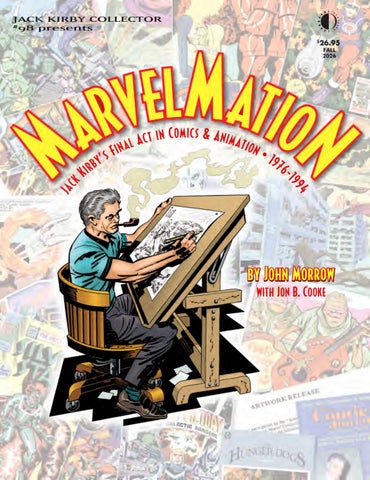
JACK
#98
KIRBY
COLLECTOR
presents $26.95 FALL
2026
Contents
Prologue......................................................4 Kirby in the Serpent’s Nest........................7 Marvel 1976–78, Take Two.......................35 Devil in the Details...................................84 A New (Satur)Day Dawns.........................97 Origins Of Thundarr The Barbarian.......107 1982: A Turning Point.............................121 The Second Biggest Fight of His Life....127 Jim Shooter on Jack Kirby.....................131 Kirby’s Very Animated ’80s Life.............141 Jack’s Final Acts....................................151 Epilogue..................................................157
WRITERS AND ARTISTS AGREEMENT AGREEMENT dated March 24, 1975 between, MARVEL COMICS GROUP (hereinafter called “Marvel”), and Jack Kirby (hereinafter called the “Writer”/”Artist”). WHEREAS the Writer/Artist is prominent in the field and both writes the text of comic book stories and draws complete through the pencil stage the art work for comic books Marvel is desirous of retaining Writer/Artist as a writer and artist for its magazines and writer/artist is willing to render such services on the terms and conditions hereinafter set forth. NOW, THEREFORE, in consideration of the premises and of the mutual promises and undertakings herein contained, and for other good and valuable considerations, the parties agree as follows: 1. ENGAGEMENT. Marvel hereby employs WRITER/ARTIST and WRITER/ARTIST hereby agrees to render services to Marvel, as a writer/artist for magazines heretofore and hereinafter published by Marvel. 2. TERM. (a) Initial Term. The term of the Agreement shall be for three years commencing May 1, 1975 and ending April 30, 1978 (sometimes referred to as the engagement year). (b) Renewal Terms. In the absence of notice to the contrary given by either party to the other not less than sixty (60) days prior to the expiration of the Initial Term hereof, this Agreement shall be automatically renewed for another three years on the same terms and conditions as those herein set forth. 3. COMPENSATION. (a) Basic Compensation. For all services to be performed for and provided to Marvel hereunder, Marvel shall pay WRITER/ ARTIST on a biweekly basis, a weekly salary of $1,100. For purposes of this Agreement, WRITER/ARTIST shall deliver to Marvel during the term of this Agreement thirteen (13) pages per week consisting of the written text and the finished penciled drawings. In this respect WRITER/ARTIST will make all changes and rewrite/redraw all Material as reasonably required by the Publisher of Marvel without charge (that is, rewrites/redrawings and changes shall not constitute pages for purposes of computing re fee payable hereunder. (b) Additional Compensation. In the event that it is mutually agreed to do additional pages beyond those stipulated in the proceeding paragraph the text and finished penciled drawings shall be paid for at the rate of $85.00 per page. Additional compensation shall be paid to WRITER/ARTIST forty-five (45) days after submission and acceptance of such material by Marvel. (c) Benefits. WRITER/ARTIST shall be eligible for all coverage or benefits under any plan or plans of health, hospitalization, life or other insurance available to other [employees crossed out and something handwritten in] of Marvel who are paid on a similar basis and who have a similar position. Furthermore, writer/artist shall be entitled to two (2) weeks paid vacation per annum. 4. (a) Conflict. During the period of this Agreement, WRITER/ARTIST will not engage directly or indirectly in any capacity in any business or activity which is competitive with Marvel, which could be detrimental to Marvel, or which may conflict with WRITER/ARTIST duties hereunder. (b) Editorial Stipulations. Selection as to the magazines or features written/drawn WRITER/ARTIST for Marvel, shall be determined by Marvel. (c) Extent of Service. WRITER/ARTIST agrees not to write and/or edit/draw any comic book or magazine material for anyone other than Marvel during the term of this Agreement without the prior written approval of Marvel. (d) Credits. WRITER/ARTIST shall be given credit, where appropriate in comics in which he is the sole writer/artist. 5. Publisher. In performing all services required hereunder, WRITER/ARTIST shall act under the direction of the Publisher of Marvel. WRITER/ARTIST shall consult with him on all matters touching upon editorial policies, in order to assure the efficiency and harmonious operation of Marvel and to meet with the Publisher of Marvel at regular intervals at Publisher’s request at Marvel’s offices in New York, New York. WRITER/ARTIST shall accept assignments from the Publisher of Marvel to write, edit, and/or draw all magazines presently published or hereafter published by Marvel and further agrees that he will make no commitments whatsoever (whether financial or otherwise) on behalf of Marvel without the prior written consent of the Publisher of Marvel. It is understood the writer/artist lives in California and, therefore, one trip per year will be at the writer/artist’s expense and all other trips when requested by Marvel shall be at its expense. 6. Termination. Nothing in this Agreement shall be construed to prevent Marvel from terminating WRITER’S/ARTISTS ‘S engagement hereunder at any time (a) because of his fraud, misappropriation, embezzlement, or the like, or (b) if he has become so disabled as to preclude him from rendering satisfactory services, or (c) if he shall have violated any provision of this Agreement, or (d) if WRITER/ ARTIST is unavailable, for whatever cause, for a continuous period of more than two months, or (e) if his work has not met the performance standards required by Marvel from other persons performing similar services for Marvel. In such event(s), except as provided in (b) above, all obligations of Marvel hereunder shall cease and WRITER/ARTIST shall be liable to Marvel for breach of this Agreement. 7. Rights to Material. WRITER/ARTIST grants to Marvel the sole and exclusive right to all Material delivered to Marvel hereunder including, but not limited to, (a) the exclusive right to secure copyright(s) in the Material in the United States, Canada, and throughout the world, (b) the magazine rights therein of every kind, (c) all film and dramatic rights of every kind, (d) all anthology, advertising and promotion rights therein, and (e) all reprint rights. The exclusive rights herein granted shall be Marvel’s property for the period of the copyright and any renewals thereof. 8. Originality of Material. WRITER/ARTIST represents that the Material written/drawn by him will be original and not heretofore published and that it will not infringe upon any statutory copyright, common law copyright or any other proprietary right. 9. Use of Name. Marvel shall at all times have the right to use WRITER’S/ARTIST’S name and likeness in connection with the sale, promotion and distribution of any magazines which include Material delivered to Marvel. 10. Series and Ideas. If any Material delivered hereunder is part of a series, the idea and the character or characters used therein shall constitute Marvel’s exclusive property for all times. 11. Additional Documents. WRITERS/ARTISTS shall, at Marvel’s expense, take such steps and execute and deliver such further documents from time to time as Marvel may request for the purpose of confirming the rights herein granted to Marvel. 12. Notices. Any notices required or permitted to be given under this Agreement shall be sufficient if in writing, and if sent by registered mail to his residence in the case of WRITER/ARTIST, or to Publisher, Marvel Comics Group at its principal office in the case of Marvel (with a copy to Secretary and Counsel, Cadence Industries Corporation, 21 Henderson Drive, West Caldwell, New Jersey 07006). _ 13. Waiver of Breach. The waiver by Marvel of a breach of any provision of this Agreement by the WRITER/ARTIST shall not operate or be construed as a waiver of any subsequent breach by the WRiTER/ARTIST. The waiver by the WRITER/ARTIST of a breach of any provisions of this Agreement by Marvel shall not operate or be construed as a waiver of any subsequent breach by Marvel. 14. Covenants. WRITER/ARTIST agrees that he shall not make and/or sign any other contract or agreement, written or oral, which shall be in conflict with the terms of this Agreement or prevent or hinder his performance hereunder for the length of this Agreement or any extension or renewal thereof, and further agrees that he has the full and unrestricted right to enter into this Agreement and deliver the Material hereunder. 15. Assignment. The rights and obligations of Marvel under this Agreement shall inure to the benefit of and shall be binding upon the successors and assigns of Marvel. 16. Entire Agreement. This instrument contains the entire Agreement of the parties. It may not be changed orally but only by an agreement in writing signed by the party against whom enforcement of any waiver, change, modification, extension, or discharge is sought. 17. Arbitration. Any claim, dispute or controversy arising out of or in connection with this Agreement or the breach thereof will be submitted by either party to arbitration in New York City before three arbitrators appointed by the American Arbitration Association. The arbitration will proceed under the rules of the Association then obtaining. The award of the arbitrators will be binding and conclusive on both parties, and will be rendered in such form that a judgment may be entered thereon in the highest court of any forum having jurisdiction. 18. Taxes. All taxes will be taken out of the writer/artist’s salary check by Marvel and paid to the government.
Jack Kirby’s 1975 Marvel Comics employment contract.
6
Kirby in the Serpent’s Nest by Jon B. Cooke “A guy will create a book, another will fill his book up with knock letters—he’s off in five months or three months, and the other guy guy’s got his shot.” Until now, Kirby has spoken in even tones. His voice quiet, firm. Now emotion breaks through. There is an anguished look in his eyes and a touch of bitterness in his voice as he says, “I see it as a serpent’s nest. And in a serpent’s nest, nothing can survive. Eventually, all the snakes kill each other. Eventually, they also kill whatever generated them.”
It was the last day of the convention (atypically for a comic con, on a Monday) when an unwitting legion of fans dedicated to the House of Ideas was ushered into a ballroom to come hear Stan “the Man” Lee and “Rascally” Roy Thomas discuss the history and future of Marvel’s “First Family.” In The Jack Kirby Collector #10 [April 1996], Nick Caputo shared a vivid recollection of the show’s closing event on that drizzly afternoon, as he described the Marvel publisher and his editor-in-chief on stage for the 3:30 p.m. panel, “Fantastic Four: The Success Story that Began the Marvel Age of Comics”:
Howard Zimmerman, “Kirby Takes on the Comics,” Comics Scene V. 1 #2 [March 1982].
“Jack’s Back!” n the realm of 1975
I
comics fandom, the announcement that Jack Kirby, the co-creator of the Marvel Universe who had quit the House of Ideas in anger five years before, had left DC Comics and was returning to the Marvel Comics Group, was monumental news. Of course, it would be the master showman, Stan Lee, Kirby’s collaborator on any number of stories at the company, who made the announcement. The venue: the first of only two Mighty Marvel Comicons. The date: March 24, 1975. The location: the Hotel Commodore [above, in its 1940s heyday], a midtown Manhattan hostelry located at the corner of seedy 42nd Street and ritzy Park Avenue. (This was the same establishment to be purchased the following year by a young man by the name of Donald J. Trump, an occurrence that, for better or worse, would first put the real estate entrepreneur into the public limelight.)
“As it was getting underway, Stan commented he had a special guest to announce. There, walking down the aisle in what seemed like a flash, was a man Lee proclaimed was Jack Kirby. The room exploded with thunderous applause and a standing ovation as Kirby made his way to the podium. It was a thrilling moment that remains in my memory even after all these years. “When Lee stated that Kirby would return to Marvel, there was a bustle of excitement and enthusiasm in the room, along with a barrage of questions about what books he would work on. Kirby’s answer was, ‘Whatever I do at Marvel, I can assure you that it’ll electrocute you in the mind!’ To which Lee, ever the linguist, corrected, ‘Electrify, Jack! Electrify!’” Referring to its own headline, “The King Returns,” Jim Steranko’s Mediascene #15 [September/October 1975] reported on the same happening a few months later. “Is there a comic freak alive who doesn’t know the meaning of that phrase or who hasn’t rallied to its message? It’s doubtful. Anyone who attended the Mighty Marvel Convention in March will have a difficult time forgetting one of the most auspicious moments in the history of comics: The announcement that Jack Kirby was returning to Marvel. Pandemonium broke loose. The end of the Second World War couldn’t have been greeted with more enthusiasm. Stan Lee himself broke the news while attending Marvelites roared, stomped, and shouted their approval, then settled down to glean every detail of the unexpected move. “The mob bristled with questions. Did Jack intend to resume
(top right) Stan Lee at the 1975 Marvel con. (above) Kirby at the Summer 1975 San Diego Comic-Con, a few months after the announcement he would be returning to Captain America with issue #193 (top).
7
his past on the FF series? Thor? Would he continue to both write and draw his books? What new characters were on the board? Who was slated to ink the King’s pencils? A Niagara of queries was forthcoming. Stan and Jack did their best to satisfy their audience’s demands, but it was clearly evident that the development was so fresh, final plans for Kirby had yet to be worked out.” A few hours before the presentation, Kirby had huddled with his former collaborator in the publisher’s office to sign a three-year contract with Marvel.* The “Writers and Artists Agreement” stipulated that, as “Writer/Artist,” Kirby would produce 13 pages per week “consisting of the written text and finished penciled drawings.” In return, the co-founder of the Marvel Age of Comics was to be paid a weekly salary of $1,100,** as well as receive two weeks of paid vacation per year and be eligible for the same company benefits available to other Marvel contributors “paid on a similar basis and who have a similar position.” Any additional work “beyond those stipulated” was set at $85 for each page. And, of course, the outfit would retain any and all rights to the material produced.
Five years after his unceremonious departure from the company and defection to the “Distinguished Competition,” the reinstatement of Kirby at Marvel would be press-stopping news to comic book fans and pros alike. And, ever the performative publicity hound, Lee had intended to keep the bombshell news a secret until his “unveiling” timed for the final hours of the company’s first solo convention. But, while few in the Bullpen were privy to this development, one Marvel stalwart chanced upon it while stepping into the publisher’s office, probably on March 18, the day the legendary creator first visited with Lee at that stage. At the 1997 Kirby Tribute Panel at the San Diego Comic-Con, staffer Marie Severin [below] revealed, with a chuckle, “I came up to the office and I saw Jack, and Stan put a page in front of my face and said, ‘You did not see any of this!’ And I said, ‘Okay, I did not see any of this,’ and I went out in the hall and yelled, ‘Kirby’s back!’” Those Kirby aficionados with no access to fanzines and zero acquaintances in the business had to wait until Summer to receive word, when Marvel titles cover-dated October hit the stands. Within the pages of the line’s books, the Bullpen Bulletins’ page trumpeted in a banner headline: “THE KING IS BACK! ’NUFF SAID!” Word came from “the Man” himself, as Lee gushed in his “Stan’s Soapbox” column:
* Naturally, negotiations for Kirby’s return had been in the works for some months prior to the signing, as during the previous Summer, the artist/writer’s son, Neal Kirby, had asked then-Marvel Editor-in-Chief Roy Thomas to meet with the Kirbys at the San Diego Comic-Con to see if the company would care to welcome the King’s return. ** $1,100 in 1975 dollars adjusted for inflation equals approximately $6,630 in 2026 dollars. (top) Captain America #192 featured a final-page teaser ad by Kirby, heralding his return in the following issue. The main panel art is by Frank Robbins. (right) Kirby had big shoes to fill, following writer Steve Englehart’s run on Cap, wherein Steve Rogers undergoes an identity crisis. Shown are Sal Buscema full-pagers from Captain America #176 (August 1974) and #180 (December 1974).
8
“This month’s news is too big to hold off for another minute! Jack Kirby is back! Ol’ King Kirby (and don’t forget, it was at Marvel that he got that sobriquet) has returned to the bosom of the blushin’ Bullpen! This is where his heart is—this is where it all started—and this is where one of the greatest talents in comics belongs.” During the “Big Reveal” at the Hotel Commodore, after describing his one-time collaborator’s forthcoming assignment on 2001: A Space Odyssey, Lee unleashed a second mind-blowing fusillade: Kirby was to become writer and artist on one of his most beloved—and most famous—creations. “Just to prove the master’s hand still hasn’t lost its touch,” Lee enthused, “he’ll be taking over the strip he started more than three decades ago—the one and only Captain America!” For Kirby fans (including this one) still smarting from DC’s abrupt cancellation a few years prior of his tragically unfinished Fourth World opus, the King’s return to his most quintessential character—the super-hero that first brought wide attention to the man’s kinetic art style and which, to many, represented the artist’s passion for the country’s ideals (and with a run timed to peak around the nation’s 200th birthday, no less!)—this news was nothing short of astounding. One Bullpenner who knew of Kirby’s return before the announcement—“through secret sources,” he confessed—was the then-current Captain America script writer, Jenny Blake Isabella (née Tony Isabella). “I spent a solid week planning a big Bicentennial epic that would’ve run eight issues,” Isabella said, “and then was told, after I’d turned in my third plot, ‘Jack’s coming back to the book,
Mediascene #15. TM &
© Supergraphics.
you’re off it.’” In 2013, before a San Diego audience of convention attendees, Isabella confessed about losing the writing gig: “I was not at all upset about that from the standpoint of, if you’re going to be knocked off a book... it should be by the creator of the book!” Around this time, Kirby consented to an interview with FOOM magazine #11, Marvel’s in-house pro-zine, where the creative juggernaut shared his enthusiasm. “Of course, I honestly think the reason I’m back is because I wanted to be back. I’m home,” he told Dave Simons. “And being among the people of Marvel is good ground to be on. They’re good people. They’re cooperative. We FOOM #11. TM & © Marvel Characters, Inc. share laughs; we share problems. Sharing is what I’m all about. I like to share and I find that’s easy to do at Marvel. I feel that whatever I do and put into the stories will be read sincerely by the readers and whatever comment I get will be sincere. I’m glad to be working at Marvel for that reason. I’m going to do the best I can, give the best stories I can, and always try to see what new dimensions can be thought of to make the strips better than they can be. I’ll do the best I can. If they read the books, I think they’ll enjoy them. I know Marvel’s readers enjoy all the books. I just hope to add my books to the list.” 9
In their article, “You Can’t Go Home Again,” in The Jack Kirby Collector #29 [August 2000], Mike Gartland and John Morrow raised a good point. “What Jack wanted, to put it frankly,” they explained, “was to be left alone to write and edit his own stories, and have no collaborators (in the storytelling sense) or tie-ins with other titles done by other people. (This shows how strongly Jack was determined to never again fall victim to losing credit for his concepts or creations—the hundreds of characters and/or ideas he gave Marvel in the 1960s, and was sometimes acknowledged for.)” They continued, “Once Jack returned to Marvel, several projects were discussed; the results of some are made clear in the books that were published. Captain America and the Black Panther were the only Marvel characters (co-created by Jack) that Kirby agreed to return to; everything else would be new concepts, unrelated to the then-current Marvel line. Although the new creations weren’t as noticeable, Captain America and Black Panther became somewhat conspicuous by the lack of involvement with the rest of Marvel. Not only would Jack keep them detached from Marvel continuity, but with the exception of the Red Skull, no established villains were used. The two heroes became involved in an action/adventure genre that could have showcased any action hero; it was entertaining and interesting, but weird to many Marvel fans.” Even before the first issue featuring his Captain America story arc hit the stands, there were rumblings among the Marvel editors, whose pleas for Kirby to integrate the ongoing company continuity into his books were going unheeded. Fans, who doubtless dreamed of the man bringing Fantastic Four and Thor to former glory, had early on perceived the man wasn’t so much up on the doings of the current Marvel Universe as perhaps other freelancers were. Back during the big Mighty Marvel Comicon announcement, the returning creator was quizzed by the audience about his familiarity with modern day Marvel. “Kirby’s knowledge of Marvel’s multitude of supermen, especially during the last five years, was admittedly wanting,” Mediascene reported. “When questioned about Howard the Duck, Kirby amusingly confessed his lack of recognition for the character, though some of the audience felt his comments were a lighthearted critical assessment.”
one of the people who wrote those letter columns. And, at Marvel, it depends on which person [in charge of letter cols] you ask and how they treated it. But Dave and I were sort of True Believers in the sense that we wouldn’t make up letters, so we would use real letters. And Dave went out of his way to find whatever possible positive letters there were regarding Kirby’s stuff, because the reaction was not favorable on a lot of his material. And you’ll hear people, they’ll say, ‘Oh, the Marvel editorial staff was just horrendous. And they would say all these nasty things about Kirby’s work and all that.’ “Well, it’s one of these things where the bigger picture is that we were likely, in our more sardonic moment, to pick apart everything we were publishing. It wasn’t any conspiracy against Jack Kirby. We would tease each other all the time. It was just in the spirit of fun. But if you just say, ‘Oh, wait a minute, look at this. Look what this says...’. And the problem was Jack was not interested in getting any help or advice from anyone on the Marvel staff at that point. And his art was great. I don’t think anyone ever put that down. His writing, on the other hand, could be all over the place. He might have great plots. It was really his scripting that could be very clunky at times.” Bill Mantlo, who had been scripting “fill-in” issues of the Marvel line-up during this period, years later expressed his longtime opinion of Kirby’s skills as writer in a letter of comment to The Comics Journal [#79, January 1983], an LOC titled, “Kirby Can’t Tell a Good Story.” Mantlo [at left, 1969] recalled: “When I was perhaps 13 or 14, I took a bus to Jack Kirby’s Long Island home and sat at the master’s feet in a basement decorated with enormous collages of the type Jack used to insert into the Fantastic Four as an indication that all space was about to fall on our heads. Surrounded by a TV set, stereo, coffee percolator, and the many and sundry tools of his trade, Jack would draw while regaling us True Believers with tales of the fabled Marvel Bullpen. We all had the MMMS record and listened again and again to their voices. “Point being, while I was sitting there one day watching Jack pencil a page of Thor, he whipped it off his drawing board and handMantlo (far right), as depicted by ed it to a friend of mine, an aspiring Kirby in Fantastic Four #85 (April artist. ‘What’s this?’ my awed com1969), matches his 1969 photo. panion asked. Jack’s only response was, ‘Stan would never accept it.’ “The page was a view of Asgard. All the elements of Jack’s studio, TV, stereo, percolator, and artist tools were there transmogrified into Asgardian architecture. It was, in short, a classic Kirby splash page. “But the page didn’t advance the story. What Jack knew then, and what he’s never understood since, in any of his visually stunning but lyrically lame independent and DC/Marvel projects where he’s been his own writer, is that Stan knew how to tell a good story and Jack didn’t. The story of Stan’s editorial hand was on the man even at his drawing board, invoking a kind of self-editing that virtually no Marvel or otherwise artist would understand in these days of, ‘Everything I draw, I get paid for.’ Stan may or may not have rejected the page. The point is that Jack rejected it in anticipation of Stan’s rejecting it, and thereby told the story by foregoing an exciting, though otherwise inessential visual. “Today, I’d give my right arm and work for free to script a story drawn by Jack, but I won’t read those he writes.”
Freelancer’s View Among the freelance artists to drop by Marvel during that
period to become concerned about Kirby’s treatment were John Byrne [below, from 1980] and Jim Starlin, two rabid and unabashed Kirby fans. During a discussion of one of the King’s final Marvel jobs during that era, Byrne noted on his Byrne Robotics online message board, “There is a rather telling bit of backstory to that What If? [#11]. It was done at a time when respect for Kirby was at something of a nadir at Marvel. The age of ‘Jack the Hack.’ Kirby, as some of you will doubtless recall, had a somewhat stilted writing style. He would often place bold words in the wrong place, and his public school education lingered in the way he placed slang and unconventional terms in quotation marks. “Since he was writer/editor on most of the books he did, this was pretty much left alone, though it 17
Alan Kupperberg [right] was then a young artist working in the industry during that period, and he surmised to Daniel Best in an interview many years later, “What if an editor at Marvel is a no-talent son-of-bitch with an axe to grind? And let’s say he feels he’s been ‘stuck’ with Jack Kirby, in the twilight of Kirby’s brilliant career, doing a regular book. And, out of sheer spite, this editor prints the letters that put the knock on Jack. But you’ve gotta believe that there were probably just as many or more letters that were pro-Jack. There’s always going to be someone who doesn’t like what you’re doing.” Mike Royer [right, from 1979], Kirby’s inker on his final five issues of Cap, shared in an accusatory Facebook post, “The general tone of most of the letters in Marvel Kirby books in the late 1970s, in particular, all seemed to follow the same theme: ‘The art is great, but the writing sucks!’ Bulls—! They stacked the letter pages with negative letters on purpose. I’m saying what it was: a concentrated/ orchestrated attempt to justify letting the incestuous fan boys take over the writing. I’ll say now what I said then: ‘Frack ’em!’ By and large, [they were] a conceited bunch of ‘wordsmiths’ who wanted to ride the shirttails of a creative genius who was better than all of them put together.” In an online forum some years back, Mark Evanier [right, mid–1970s] shared that the King’s poor treatment could come in the form of a phone call. “Jack’s feelings about this work (and his concern about his letters pages trashing him…) will perhaps make more sense if you know that there was at least one editorial staffer at Marvel at the time who was quite vocal in his dislike of Kirby writing, and who felt he should have the job of doing the dialogue. Jack told me that this guy would phone him up and say, ‘Well, your new issue of Captain America just arrived, Mr. Kirby, and the artwork is breathtaking, but everyone here in the office [a gross exaggeration] agrees that the writing is sh*t. Your books are all bombing, too. The only way you can save your career is to have one of us take over doing the dialogue.’ Or words to that effect.”
became a point of mockery at the office. Someone even dummied up a ‘Jack Kirby Learn to Write School’ poster, which had Kirby telling us how he would teach us how to use bold words improperly, and the like. “When the What If? came in, it was not a writer/editor job.* So it was decided that the ‘Kirbyism’ could be fixed—except on the dialogue he gave himself. It was thought terribly hilarious to leave the oddly placed bold words and quotation marks alone in Kirby’s own dialogue—which, of course, just made it stand out even more. “When I was told about this, my reaction was, ‘You’re not really gonna do this, are you?’ But, alas, they did.” *Technically, that particular issue actually did list Kirby as editor, with Roy Thomas credited as series editor. In relating that anecdote to me, Byrne lamented about the whole affair, “That’s not surprising, since the industry is notorious for not taking care of its own. We eat our young and abandon our old.” I asked Jim Starlin [left] if he recalled Kirby’s return to Marvel and he replied, “That was such a disheartening thing. I hadn’t been working up [any more] at Marvel at that point, and he had come back recently. I guess he didn’t want to do the old characters he had done, like Fantastic Four. He was doing things like Devil Dinosaur and Eternals. The editorial staff up at Marvel had no respect for what he was doing. I came into the office, and I remember being heartbroken, walking through this office. All these editors had things on their walls making fun of Jack’s books. They’d cut out things, saying ‘Stupidest Comic of the Year.’ It was all really tasteless and dumb, and terribly disrespectful to the guy who had created this company they were working for. The part that blew me away the most was that this entire editorial office was just littered with stuff disparaging the guy who founded the company these guys were working for. He created all the characters these guys were editing. It was a very strange period.” Years before he’d become a star artist with Swamp Thing, Stephen Bissette [below] had occasion to visit the company in the 1970s. “I can only imagine how demoralizing this must have been for Jack,” Bissette related on Facebook. “I was freelancing at Marvel around this time, and it was heartbreaking to see with one’s own eyes various photocopies of Kirby’s work posted around the offices with ‘satiric’ [written] over drawings and sarcastic written comments scrawled on them. The utter contempt for and jeering at Kirby’s work for the company was mortifying, and a stern lesson for a budding freelancer working to (maybe) get one’s foot in the door.”
TheWhether KirbyplacedKontroversy there by envious comic book scripters or not,
the most hurtful evidence of the Bullpen’s disrespect for Kirby was scattered among the letters of comment selected to be printed in the titles’ letter cols that accompanied the stories he wrote and drew, there for readers to peruse after reading the monthly/bi-monthly 18
improved from downreturn of Steve Englehart. right awful to only slightly “But on comes 1976. Jack Kirby writes Cap as if it was in the nauseating.” ’40s or ’50s. His writing... breaks away from everything Steve did to He added, “Really, make Cap realistic. All we see now is battle without sense or characfellas, Jack’s stories were ter development… Jack, quit writing Cap. I, for one, want Steve back. never more than very I’m sure Marveldom Assembled agrees.” (The letter col assembler good, and his art always said it was all a matter of taste.) has left something to be The Eternals #8 [February 1977]: This month’s assault on Kirby desired. But now he’s the writer in the letter cols continues with an extended, thoughtful regressed tremendously.” LOC (presented here in its entirety) by Vallard Eding, of Sunnyvale, Then, after predicting the California, who starts by saying he has “two areas of concern.” title passing into the great “First, I’d like to comment on an artist’s control over the beyond—“unless Kirby production of comics. In the past, both Steranko and Starlin have experiences a small mirproduced comics that they wrote as well as drew. But unlike Jack, acle”—Butler ends with, they did not have editorial control over their comics. My question Kirby from a 1976 FOOM magazine. “All I’ve read in the letters is, does one person’s complete control over a comic produce a betpages so far is praise. I know you’ve gotten criticizing letters. How ter comic? In the undergrounds, there are artist/writers like Rich about covering all general opinions, huh?” Corben who have created beautiful comics. But similar efforts by Then, to accommodate that Cheesehead, the nameless Bullpen above-ground comics and artists and writers have been disappointminion obliges “just to ing to me. Jack Kirby is foment a little furious the first artist at Marvel discussion” by printing that I am aware of who two more disparaghas nearly complete ing LOCs, with John control over his comMcGreevey, of No ics. I believe that Jack Address Given, saying has sacrificed valuable he wanted to cry after input and feedback in reading the “Madbomb” gaining his editorial saga. “I suppose it’s freedom. I feel that Jack fitting that the man who the writer and Jack the created Captain America artist lose something be allowed to destroy by working together at him, but I can’t let it the exclusion of anothgo unnoticed. Kirby’s er creative ‘sounding credentials as an artist board.’ I believe this are well-known; perhaps in spite of my respect too well-known since his for his Fourth World hero-worshipping fans series. But then, many have tolerated scripts of the ideas of that that would normally series had been develbe unacceptable in a oped over the years Marvel magazine… Does when Jack had still been Jack know how to write at Marvel (as deduced in the real world?” from many interviews In another fusillade, and articles concerning Jim Caple, of Longview, Mr. Kirby). I know that Washington, addressed many fans will disagree “Jack, Stan, Steve, Frank, with me, but once the Marv, etc.,” to demand honeymoon period is Kirby exit the series post over, I think that more haste. “Since you don’t readers will notice that print any criticism about the quality of Jack’s Jack,” he sniffed, “I recent work has been know this letter won’t be below par—for Jack. I printed, but it still has would like to see either to be said: I believe the a stronger outside Golden Age of Marvel editorial influence or a was about the mid– writer who could work 1960s. All the mags were with Jack’s plots. incredibly good, except “Secondly, the for Captain America…”. times have changed. Upon complaining of no Although Jack is deservcharacter development edly called the King, it and senseless battle, The Captain America #106 letters page. wasn’t until the 1960s Caple pined for the 23
Curiously, John Harrington of Everett, Massachusetts, commends Kirby the wordsmith but not the artist. “You are an excellent writer, Mr. Kirby, but I think Captain America should have a new artist. I read Eternals and appreciate your art there, and it just doesn’t belong in Captain America. Your writing, however, is perfect.” The Eternals #12 [June 1977]: Letter hack Mike Underwood responds to the Sunnyvale, Californian who wrote that long missive in #8. “By the way, I disagree with Vallard Eding who wants Jack to have a co-writer. No—a million times, no! Anyone else writing Eternals would ruin it because no one else can write Jack’s comics better than Jack can. I believe he gets enough input and feedback just from reading our letters. Anyway, keep up the spectacular work, Jack.” (This letter col hints of an upcoming guest appearance by a certain green-skinned individual, a mainstay of the Marvel Universe.)
March 22, 1977
2001: A Space Odyssey #7 [June 1977]: Berk Enwald returns to urge Kirby: “Please be careful in the telling of your stories… Jack, since you are both artist and writer, you may be leaving out some facts that should be noted because you know them already. With all the tasks in one set of hands, you lose the value of having meetings between minds. You lose the vital point of having to explain your ideas and of having someone else point out to you where they might not be clear.” Mike White, of Pensacola, Florida, whines, “Something has got to be done about 2001: A Space Odyssey! It has become boring! I never thought I’d hear myself say that about a Marvel comic, but it’s true. The one thing that makes it that way is the plot. There is no difference between issues. That is basically it… Let me say that 2001 is on a type of probation. For three more issues, I will continue to buy this book. If the plot does not change, I will no longer buy it. Don’t get me wrong, the Treasury was fantastic, so is the comic art-wise. The art is the best part of it, but the story is much the same from issue to issue.” (Marvel responds, “Jack Kirby is a king of ideas and the experience will be rewarding, we assure you.”) now is your scripting. Besides having a great deal of trouble manufacturing vaguely realistic dialogue (people don’t say things like, ‘We’ve got ideas, you’ve got ideas—so let’s trade and live.’ Nope, not even with-it Blacks), there have been far too many captions. Your strongest point is your art; take a cue from Stan Lee and let it tell the story. Comics are a visual medium and you’re an excellent artist— give your visuals a chance to stand out on their own. Let’s have a bit more dialogue in place of all those wordy, unnecessary captions. A lot of people already think you’re the greatest, Jack; prove it to the rest of us.” This is from John Libertine, Jr., of Hanover, Massachusetts: “Allow me to add my own comments to the great Kirby Kontroversy. I am pleased that Jack is back. I love his art. Only one thing…” Libertine then goes on to criticize the artist’s “nasty habit of drawing too many lines” and compares Kirby’s art from the 1960s. Defending Kirby’s writing in his retort to a critical missive in #207, J.F. Koelsch, of Marlborough, Connecticut, tells editor Goodwin: “Glancing at the letter column, I noticed that many readers
April 12, 1977
Captain America #211 [July 1977, above]: This letter col, too, starts with an editorial statement: “The raging deluge of letters regarding Jack’s treatment of the Living Legend of World War II— namely Cap—still surges unabated into the Bullpen offices. And, as usual, Marveldom Assembled is as diversified of opinion as the motley assortments of creative types who produce these monthly servings of comic art. Thus, once again, we present an accurate sampling of the stacks of somewhat outspoken critiques. Take it away, Cap commenters…!” Robert Morgan, of Edgewater, Maryland, starts off. “Dear Jack, I was not impressed by your return to Captain America. The meandering meaningless Madbomb series was just too long and got too far off the track to be interesting. Long, long stories have to be firmly plotted with each chapter progressing the story. Heroes just falling from one situation into another doesn’t work.” While acknowledging some improvement, he continues, “The biggest problem 27
reminded that Marvel Comics was almost single-handedly created in visuals by this man. He drew the very first Hulk story ever. It is a saddening disservice to Kirby and to those who enjoy his work. And I don’t care whether you want to keep the whole consistent with the way he’s drawn in his own title or not. You have no right to tamper with Kirby’s art.”
October 11, 1977
Captain America #217 [January 1978]: Carol Klutey, of Carmel, Indiana, mentions a desire for the return of characters absent during Kirby’s run, to which the responder weirdly responds to something she never explicitly wrote in her LOC: “’Twould appear you’ve not been exactly wild about the direction King Kirby has taken Cap for the past couple of years (though we get other letters, of course, lauding them to the skies, just to balance things out).” Julio Castillo, Jr., of Wayward, California, declares directly to Kirby, “I am breathlessly awaiting Rascally Roy’s writing, but I am protesting your leaving Captain America! You’re the only artist for Cap! I hope you’re not leaving Cap to do that Mister Machine comic you mentioned in 2001. Please stay on as Cap’s permanent artist; you’re the reason I buy Cap!” The response, presumably by onetime EIC Thomas himself, states, “And no one this side of Smilin’ Stan Lee himself is a bigger fan of the King than Roy Thomas, Julio. Only problem is, since his dramatic return to Marvel a couple of years back, Jack has expressed a desire both to draw and write (not to mention edit) any title he illustrates. Thus, it was his choice, and nobody else’s, to leave Captain America.” The issue’s final LOC, by Tobin M. Oaks, of San Antonio, Texas, writes to “Jack (King) Kirby”: “I’m glad you’re back and I hope it’s for good. I like the way you write and draw Cap’s stories. I also like how you brought Sharon Carter back. But I don’t like what you’ve done to Cap’s strength. You make him a little too weak sometimes. Make him the way Steve Englehart did…”.
October 18, 1977
Black Panther #7 [January 1978]: Yet again, the letter col starts off with an editorial blurb: “As ever, King Kirby’s latest lollapalooza has elicited an outburst of opinion quite possibly unequaled for its range of ardent admiration and/or disgruntled dismay. The balance this time is in favor of Jack’s titanic treatment of the Black Panther, a character he co-created with Smilin’ Stan Lee more than a decade ago.” Future comics editor Robin Snyder, of Bellingham, Washington, defends the King: “Gentlemen—There have been so many derogatory remarks made about Kirby’s handling of Captain America and the Black Panther that the letters page has become boring. Granted, Kirby has changed the two characters to suit his own ends, but so had the previous writers and editors. Both concepts were Kirby’s to begin with and when he left them, so did I. The only reason I bought them now is because Kirby is handling them. “I say leave him be to create his own visions. His ideas are quite different from your other writers and artists, perhaps better. The current storyline is quite interesting and enjoyable. It’s refreshing to see a hero who is strong and sure of himself. I wish the stories were a bit longer, but other than that, I’m satisfied.”
The Eternals #19 [January 1978]: Complaints continue about the robot Hulk. Then Pete Von X (no doubt Pete Von Sholly, sometime TwoMorrows contributor), makes a full-throated demand to respect Kirby’s art. “Dear Marvel, I want this drawn to the attention of all Kirby readers right now. Take a look at the Hulk’s face as illustrated on the cover of the Eternals #15. It’s been redrawn by John Romita. What’s the meaning of this??? Are you trying to tell us Jack doesn’t know how to draw the Hulk? You clowns ought to be
John Judge, of Clinton, Iowa, directly addresses Jack Kirby: “This strip, even more than Captain America, shows your weakness as a writer. To take Marvel’s first black character and depersonalize him so severely is criminal. So far, T’Challa has been a pawn of others, totally devoid of personality, black or otherwise. You over-write to distraction, filling every cranny with meaningless captions, which is especially ironic in this strip, since Don McGregor was guilty of the same. “But the letter column states we are to see each issue as a chapter in a larger storyline… Maybe so, but Jack’s stint at DC left the readers with a large number of unfinished sagas and I fear that the situation at Marvel won’t reverse itself. 2001 is a travesty, as we now are spoon-fed your ideas on ‘the meaning of it all.’ Captain America is Mr. Gung Ho in the battle of the month. Only The Eternals shows promise, but that could well be stifled since nothing can really be resolved, or the series will end due to its limited premise. “Perhaps the saddest is that the life has left your art. Three monthlies and a bi-monthly have taken their toll. We readers can say it until we’re blue in the face: you can plot, but let someone else script.” (Curiously, over three decades later, Judge would respond to a Scott Edelman blog posting, lamenting the LOC. “As one of those writers at the time,” he shared, “I was embarrassed when my letter was published in a Black Panther letter column… I wrote very few letters to Marvel. I know I was surprised to see it in print as it was
For the 1978 Marvel Spider-Man calendar, Kirby evoked his 1960s work with this depiction of the character’s first meeting with the Fantastic Four.
32
as negative as I remember it. I believe I ended with something like: ‘Let Kirby do the plotting, but please get someone else to script.’ It’s weird to think someone chose to print it for anything other than just as a rare dissenting opinion. I did generally enjoy his scripts on the Fourth World stuff.”)
June 20, 1978
Black Panther #11 [September 1978]: The letter col is pretty much entirely positive. Devil Dinosaur #6 [September 1978]: Another letter col of ecstatic comments.
December 20, 1977
June 1978
Black Panther #8 [March 1978]: Richard Roeder, of Pine Plains, New York, opens his missive: “I have two sets of adjective to describe the new Black Panther. First: ‘Terrific! Stunning! A new high in comic fantasy! Simply wonderful!’ Second, and just as sincerely, ‘Horrible! Repulsive. A complete destruction of a fantastic character! A terrible waste!’ “You see, I genuinely feel both ways about this magazine. On its own, as a new comic by Jack Kirby, the Black Panther is a truly fine effort. It’s one of Jack’s best works, focusing his many beliefs into the human form, combining fantasy and reality into a single medium that is both hard action and high adventure. However, it is a total opposite of what was so finely accomplished by Don McGregor and Billy Graham in Jungle Action.” He ends with, “It’s just a suggestion, but I’m dearly hoping that I can enjoy Jack’s work and still not lose the beauty that McGregor and Graham brought to the character.”
Machine Man #6 [September 1978]: No letter col.
July 18, 1978
Devil Dinosaur #7 [October 1978]: No letter col.
July ??, 1978
Machine Man #7 [October 1978]: No letter col.
August 11-13, 1978
Silver Surfer Graphic Novel pages are on display at the Atlanta Fantasy Fair, with Stan Lee as guest, and Marvel staffers making derogatory comments about Kirby’s work.
January 17, 1978
Devil Dinosaur #1 [April 1978]: No letter col.
January 24, 1978
Machine Man #1 [April 1978]: No letter col.
February 14, 1978
Black Panther #9 [May 1978]: No letter col. Devil Dinosaur #2 [May 1978]: No letter col.
February 21, 1978
Machine Man #2 [May 1978]: No letter col.
March 21, 1978
Devil Dinosaur #3 [June 1978]: No letter col.
March 28, 1978
Machine Man #3 [June 1978]: No letter col.
April 18, 1978
Black Panther #10 [July 1978]: No letter col. Devil Dinosaur #4 [July 1978]: No later col.
April 25, 1978
Machine Man #4 [July 1978]: No letter col.
May 16, 1978
Button handed out at the 1978 Atlanta Fantasy Fair, where Kirby’s Silver Surfer art was displayed.
Devil Dinosaur #5 [August 1978]: Pretty much, except for one rather trippy letter, the title’s first letter col is devoted to rave reviews.
May 24, 1978
Machine Man #5 [August 1978]: No letter col. 33
Marvel 1976–78, Take Two
7
A 50-year reassessment, by John Morrow
A
s Jack Kirby told us in 1976’s Eternals #1, the Space Gods will pass judgment on humanity 50 years hence. Since this book is being assembled in 2026, I’m scurrying to complete the following assessment of his 1976–78 Marvel comics in case the Celestials’ return comes to pass—because Kirby was usually uncannily accurate in his real-life predictions about mankind and the future. This era marked Kirby’s third and final stay at Marvel Comics (after starting at then-Timely Comics in the 1940s, and his heyday building the Marvel Universe in the 1960s). Before beginning work on this book, I hadn’t read most of that third wave of Kirby hangs out with friend and former Marvel Editor-in-Chief Jack’s Marvel Len Wein at the 1978 San Diego Comic-Con. comics since I purchased them off the stands in the 1970s. I adored all of Kirby’s just-prior DC Comics work, but that mid–1970s Marvel era largely found me, at the time, buying his books out of loyalty as much as (and in some cases, more than) enjoyment. Now, half a century later, I’ve reread Jack’s entire 1976–78 Marvel output, in the order each issue appeared, and am ready to offer my as-close-to-objective-as-possible reevaluation of the material—as well as to try discerning any behind-the-scenes goings on by comparing photocopies of Jack’s uninked/unlettered pencil pages, to the published books. To achieve this, I’ve started by imagining myself in Kirby’s 1976 position as a sexagenarian trying to create comics that a) appealed to the presumed 12–16 year old readership of the day (which I fit squarely into at the time), and b) would pass muster with Marvel staffers only slightly older than those readers. Being in my sixties now, with two kids of my own in their early twenties, 1 I can’t imagine entering their Gen-whatever
6
8
work environment without at 3 least getting some eye rolls from their contemporaries. I certainly wouldn’t want to know what they’d say about me while I’m not around. In that Bicentennial year, that’s exactly where Kirby found himself. Consider the age difference between an almost 60-year-old Jack Kirby, and the various Marvel office staffers and freelancers of the time (pictured here, roughly at the time of Jack’s Marvel tenure): 1) J im Salicrup (age 19) 2) S cott Edelman (age 21) 3) R oger Slifer (age 22, shown above) 4) R oger Stern (age 22) 5) M ark Gruenwald (age 23) (hired as assistant editor in January 1978) 6) D uffy Vohland (age 24) 7) D avid Anthony Kraft (age 24, shown above) 8) Gerry Conway (age 24) 9) Jenny Blake [then Tony] Isabella (age 25) 10) Bill Mantlo (age 25) 11) Chris Claremont (age 26) 12) Ralph Macchio (age 26) (before becoming Assistant Editor for Marvel Comics in 1977, he was a well known letter column presence, as early as FOOM #4 in 1973)
9 35
2
4
5
10
11
12
Even if you add two years to all those ages to account for how old they’d be by 1978 when Jack left Marvel, that’s a huge disparity, bound to cause creative tensions in a staff of less, shall we say, seasoned Bullpenners, some of whom felt they knew more about making great comics than the guy who actually created the characters they were working on. Even if you compare the ages of the various editors-in-chief when Jack started his tenure, you’ll note the discrepancy. Pictured at left, top to bottom:
Stan Lee and John Romita in the Marvel offices in 1978. Kirby’s cover for What If? #11 is on the wall.
• Jim Shooter (age 25 as assistant editor, then 27 at the time he assumed editorship-in-chief) • Len Wein (age 28—see previous page for photo) • Marv Wolfman (age 30) • Roy Thomas (age 36) • Archie Goodwin (age 39) • and of course, Stan Lee, publisher (age 54)
what consistent voice across the line. Jack, as his own editor, would write promotional blurbs on his cover pencil art, but his sensibilities were very different than that of a bunch of 20–30 somethings who’d grown up in the era of Civil Rights, Women’s Liberation, Watergate, and Stan Lee cover copy. While many of Kirby’s promotional blurbs were wonderfully and imaginatively written, they rarely fit the stereotypical Marvel “voice” of the time, and were almost always changed. Even if it weren’t already an open secret in fandom, it seemed crystal clear to me at the time that Kirby not only didn’t want to work on his past characters during this era at Marvel, he also didn’t want his new work to be part of the Marvel continuity he’d established in the 1960s. Much like how he’d taken on a mainstream DC Comics strip with Superman’s Pal, Jimmy Olsen in 1970 to counter-balance his original Fourth World strips, he agreed to return to the long-established Captain America series in 1976. But even though that comic was firmly rooted in Marvel’s (and his own) past, Jack at this point seemed to go out of his way to avoid tying it in to his previous work, until Marvel insisted later. The same went for Black Panther; it started completely devoid of direct links to T’Challa’s origins from Kirby’s 1960s Fantastic Four run (and more understandably, from Don McGregor’s tenure in Jungle Action just prior to Jack’s), and the character didn’t even make it home to Wakanda until halfway through Jack’s tenth issue. Even more telling, Kirby took measures to keep his new Eternals and 2001 strips taking place not just outside the Marvel Universe, but seemingly within our own reality, so he could expand on humanity’s many myths, and not ones he’d already created years before. He also, even more than at DC prior, further developed his own distinct voice in his dialogue. It was totally his, and I get why it was anathema to 1970s readers who were absorbing the writing of Don McGregor and Steve Englehart, among others working at Marvel at the time. I personally love his scripting as much as his plotting and artwork. I’m also someone who’d fallen in love with it years prior at DC, and was not exposed to Stan Lee’s patter until after I’d assimilated Jack’s into my psyche. If you grew up reading Stan’s verbiage (as most of those Marvel staffers during this period had), just as if you’d grown up only seeing Neal Adams’ artwork, Kirby’s comics would likely stop you dead in your tracks—yet I think that’s part of what makes most of this material so wonderful to read, and timeless. Seeing much of this for the first time in 50 years, I’ve gained a fresh appreciation for almost all of it, and I think it holds up as well, or
To state that Marvel Comics’ offices were anything less than chaotic in 1976 would be disingenuous. Following Stan Lee’s ascension to publisher, Roy Thomas had become editor-in-chief from 1972–74, followed by a brief stint by Len Wein, Marv Wolfman (through early 1976), and Gerry Conway (whose tenure lasted six weeks or less), before Archie Goodwin took over the post from April 1976 till the end of 1977, when Jim Shooter assumed the mantle. Though Kirby was listed as editor on his own series, whoever the EIC was at a given moment, was credited as “Consulting Editor” on the King’s titles, and did interject when they felt it was warranted. Generally, that “consulting” editorin-chief at the time would have final say on cover blurbs, to maintain a some-
36
better, than nearly everything else Marvel was putting out during those three years. However, that was definitely not a cool attitude to take at the time. The disdain for the founding fathers of Marvel in the fan press (for everyone except Stan Lee, it would seem), carried over to more than just Jack’s work. An example: reviewer Bryan Uhlenbrock, in Comics Feature #17 (June 1981), claims that Steve Ditko had “...proved himself to be a member of the Jack Kirby Memorial ‘Artists Who Can’t Write to Save Their Lives’ Club,’” due to his “fast-paced artwork and unreadable, nearly-embarrassing scripts.” To get a better sense of that era’s pervasive mentality about Kirby’s work among some comics professionals, here’s Bill Mantlo, interviewed in that same publication, elaborating on his views of comics writing and Kirby’s storytelling while he was working with Stan Lee, vs. solo: “I thought Jack Kirby was the ultimate storyteller, and the ultimate comics genius. I used to sit in his house in Long Island and watch him draw—with my mouth open—and that was great... and I think what happened with Jack, and the whole comic book mentality, is that people got tired. There was a limited [amount] of time in which to produce their material, and unlimited number of pages for the ever expanding number of books—people got tired of putting in top effort on their own initiative. That, I think, came to a head when Jack went to DC. This is the supreme storyteller suddenly deciding he’s going to ‘write his own,’ right? Prior to this, he had the idea, at least, that Stan Lee was sitting on top of him. Without ever seeing it, he knew that Stan Lee was going to say [what] was wrong. That was gone. “Jack was now, ‘DC has Kirby!’ He was going to write his own stuff—and the mistakes were horrible! They were like Comics Writing 101. Characters were introduced, then forgotten about. Situations were developed, then forgotten about. You lost all reason—I mean, there was no internal reason for what was going on in The New Gods, or The Forever People, or... there was some dim quest at the end of it, and another god, another irresolute ending, which in all books of that kind generally never come to fruition because the writer has run it into the ground before he’s gotten there. The book has been cancelled before he gets there. So all the faults that he knew Stan would oversee, Jack was putting into the book, and I think you see it very clearly in The Eternals. “Finally, when Jack comes back to Marvel, he puts a 300-foot character standing in Jamaica Bay or whatever the hell it is, and nobody notices. For ten issues, nobody says a word about this 300-foot giant. Like Jim [Shooter] says, ‘New Yorkers are willing to accept a lot,’ but come on! What happened with the writers and the artists is that they got brief shots at brilliant visuals or great concepts, and they forgot the totality of the story. Stan was a master of the totality—the greater visuals took second place. If there was one there that issue, great. If you could have the Silver Surfer, or the Watcher, or Galactus, great. If not, you told the story first, and the other stuff was icing on the cake. “Jack went for all the icing, and forgot the cake...” I take issue with much of what Mantlo said here, especially that Jack somehow wasn’t putting his full effort into the Fourth World series. Where Kirby was concerned, “writing” a comic involves much more than pre-planning the beginning, middle, and end of a story. Unlike Mantlo and most others of that generation, Kirby was a creator, not just a writer. He’d certainly “written” a plethora of stories prior to the Fourth World at DC, something Mantlo seems oblivious to. But Kirby was plotting, staging, drawing, and dialoguing all on his own in 1976, and it’s easy for the “writer” of individual issues of Micronauts or Ghost Rider to come in after the fact and pick apart the work of someone doing it by himself, and who was creating a new universe, and a new epic, in the process. The sum of Kirby’s work was more important than its individual pieces, whether that be his words, his images, or his thoughts. When you isolate your critique to just one aspect (in this case, the words lettered on the published page), that gives a false sense of the overall value of the material—great Kirby art doesn’t make a great story by itself, nor does poor Kirby dialogue make it a poor one. 37
(above and previous page) Though Kirby had set the artistic look of both Hulk and Thor at their conceptions, Marvel constantly altered his 1970s cover drawings, as shown here on Marvel SuperHeroes #54 and Thor #241.
May 1976
• Captain America #197: “The Rocks Are Burning” (17 pages) I’ve recounted in the past how this cover made my buddy Matt Turner and me laugh; if Cap is all alone, who exactly is he yelling to? It turns out the cover was altered by Marvel to add that somewhat ridiculous “—and I’ve got to stop them alone!” balloon, but whatever. This ends up being a pseudo-war comic, with the Army arriving to save the day. And the center panel on page 3 [left] is a show-stopping visual! Cheer Chadwick says at one point she doesn’t know who Cap and the Falcon are; really? Has she never seen the news? And General Fist is described as another “tiger” here. This is all Jack’s doing; no other real editorial changes are evident this issue. To date, this series has been a pretty good read. There’s been some occasional goofy dialogue, and hit-or-miss inking, but the story’s been substantial, and seems to be progressing to a climatic ending. Another Grade: B+ At this point, Jack is completing the first draft of his Silver Star movie screenplay, so he’s not putting all his eggs into the Marvel basket. I think that also shows us he didn’t have his feet firmly planted at Marvel, and was keeping his eyes on a future after his Marvel contract expired. • Invaders #6 cover (Washington Monument altered) [Roy Thomas, editor] • Marvel Triple Action #29 cover (left, villain redrawn, Wasp replaced) [Marv Wolfman, editor]
June 1976
• Captain America #198: “Captain America’s Love Story” (17 pages) This issue’s an interesting departure—a sort of intermission from the action, and shows Jack could still make actual romance stories at this point in his career. But as in previous issues, many characters inexplicably don’t recognize Cap on sight, and treat him like some kind of mysterious unknown guy they’ve never seen before, despite him walking around in a well known super-hero costume. Love interest Carol Harding (the daughter of the Madbomb creator) doesn’t know him, and Cap even says, “I can’t tell you who I am—”, though he’s standing there in his full Cap suit. Then inexplicably at the end of the story, she does recognize him as Cap. Unless Kirby was referring to Cap’s Steve Rogers identity (which doesn’t come across), it’s completely nonsensical, leading me to think Jack was tied up on other work (think 2001: A Space Odyssey Treasury Edition), and got a bit sloppy with his storytelling here. The cover is edited (for the better) by removing Falcon’s “No! No!” word balloon [right]. Page 15, panel 1 has Cap’s head awkwardly cropped off—something Jack wasn’t known to do previously. Occasional other odd croppings happen later, making me guess he was starting to have eyesight problems around this point. This Cap series especially would 42
Cap #198 two-page spread, both penciled and as published.
fall victim to an increasing number of large images and less detail in panels (there’s a lot of full-face close-ups of Cap and the Falcon throughout the run, which may also have been indicative of his waning interest level on this strip, and/or deadlines on others). The story has a melodramatic ending with Carol Harding weepily saying she’s about to die, which doesn’t pay off in the following issue. A solid Grade: B
• 2001: A Space Odyssey Treasury Special #1: “2001: A Space Odyssey” (70 pages) I hadn’t seen Stanley Kubrick’s 1968 film at the time I read Jack’s adaptation of it (it didn’t air on TV until February 13, 1977), but I was aware of it and its iconic theme song “Also sprach Zarathustra,” composed by Richard Strauss in 1896, and reworked into a hit pop song in 1973 (it won a Grammy Award the following year). Having viewed the film since, I only slightly remember details of it today, so I really should rewatch it at some point to examine how accurately Jack interpreted it (but hey, I’ve got to finish this book before the Celestials return, so no time now!). The film itself only left me sharp memories of a few of its scenes, whereas I vividly recalled many of Jack’s visuals before I reread the Treasury Edition for this book, so I 43
large page size. He makes great use of his collage skills, which are sadly very poorly reproduced. When Kirby does write, his expositional captions make this version—or at least Jack’s interpretation of it— much more understandable than the film, likely because he was very familiar with Clarke’s novel to begin with. I give this project a Grade: A+ [SIDENOTE: Kirby incorporated so many outer space and sci-fi plotlines into his 1970s Marvel work, everywhere from Eternals to even the unlikely Captain America strip. It can be seen as a product of its time, as UFOs were all the rage then. But this 2001 adaptation probably got the sci-fi ball rolling in his imagination.] • Avengers #148 cover [Marv Wolfman, editor] • Champions #6 cover (below, Kirby drew Angel in his original costume; it was redrawn to match his modern one) [Marv Wolfman, editor] • Fantastic Four #171 cover (pencils not available) [Roy Thomas, editor] think that says a lot about Kirby’s work and its staying power. This adaptation is well written—Jack seems really into it. He was a voracious sci-fi reader, so if he hadn’t read Arthur C. Clarke’s original 2001 novel prior to developing this adaptation of the film, he probably read (or re-read) it just then. It seems to have informed choices for his upcoming Eternals series, and maybe the later Devil Dinosaur comic as well. Moonwatcher the Man-Ape (so-named in the original novel) in the introductory sequence seems to be a logical inspiration (father, perhaps?) for Devil Dinosaur’s pal Moon-Boy. • Fantastic Four Annual #11 cover (Torch’s arm lowered, Sue and Maybe he was also what inspired Jack to create his unused 1973 Ben’s faces redrawn) [Roy Thomas, editor] concept The Ape. • Marvel Premiere #30 cover (Whizzer added, Jack Frost redrawn, Since the Monolith was supposedly left here four million years faces redrawn) [Roy Thomas, editor] ago, Jack probably asked himself, “Who left it?” His answer may well be the Celestials from the Eternals comics. Likewise, Machine July 1976 Man grew directly out of the 2001 • Captain America #199: “The Man regular series, so is it too much of Who Sold the United States” (17 a stretch to think Kirby viewed all pages) of his 1970s Marvel strips as someEven though Carol Harding how loosely interrelated? He vaguewas on the verge of death at the ly hinted at ties between his 1970s end of the previous issue (making DC Comics series (OMAC’s Buddy for a tear-jerker ending), in this Blank being Kamandi’s father, for issue she’s suddenly fine, with no instance), so that consideration indication she won’t be for the opens up some very interesting rablong run. I’m thinking Jack’s mind bit holes to dive into. was more focused on his upcomThe photo on the inside back ing Eternals epic—a new concept, (top) Collage schematic for, and (above) the final panel, of Jack’s 2001 adaptation. cover shows Jack with what looks rather than a return to an old like a partially-inked version of the character—at this point, rather two-page splash from Eternals #2, than Cap. which gives us some idea of his timThis issue’s cover is one of the ing. The changes to the final page best of the run. Page 3’s dialogue are interesting as well [right]. (“He’s a super-hero! SHIELD is This book seems tailor-made using super-heroes to smash our for Jack. Like the film (which is well set-up! What a rotten thing to over two hours long, but has no do!”) is some of the worst. But spoken dialogue in its first and last this issue’s two-page spread is half-hours), limited dialogue opens fantastic. up ample opportunities to make Up to now, Marv Wolfman this a visual spectacle, and Jack has been listed as “Consulting takes full advantage of that with the Editor” on the book, and any 44
Comics illustraitor Jack Kirby’s design (right) was accompanied by an explanatory letter: “It appears to me that man’s self image has always spoken far more truthfully about him than does his reality-figure. My version of the plaque would have revealed the exuberant, self-confident supervisions with which we’ve clothed ourselves since time immemorial. The comic strip super-heroes and heroines, in my belief, personify humanity’s innate idealism and drive. However, I would have included no further information than a rough image of the Earth and its one moon. I see no wisdom in the eagerness to be found and approached by any intelligence with the ability to accomplish it from any sector of space. In the meetings between ‘discoverers’ and ‘discoverees,’ history has always given the advantage to the finders. In the case of the Jupiter plaque, I feel that a tremendous issue was thoughtlessly taken out of the world forum by a few individuals who have marked a clear trail to our door. My point is, who
changes under him have been extremely subtle. An example: A page 9 balloon justifiably changed from “This’ll stop your lying tongue!!” to “This’ll still your lying tongue!!” A little heavier editing hand was probably in order to fix some of these last two issues’ inconsistencies, but kudos to Marv for letting Jack be Jack. I give it a Grade: A-
• Eternals #1: “Day of the Gods” (17 pages) Rumors that Jack’s new “Return of the Gods” series would be a continuation of the Fourth World series seem to never have been likely—for legal reasons, as well as the fact that “Return of the Gods” fits Eternals’ plot perfectly. Mediascene’s reporting of Kirby musing about the possibility of continuing New Gods at Marvel left many a fanzine writer engaging in wish fulfillment when they saw the original title for this series prior to publication. I don’t have access to Jack’s pencils for this issue, but the “Galaxy Plaque” of the Incas made me think of Jack’s involvement with NASA’s 1972 will come a-knocking—the Pioneer Plaque, and its purpose as an trader or the tiger?” object to be sent into space for future civilizations to discover and learn about us (Jack’s 1972 essay [above] shows he wanted it to serve as a warning not to come visit us). Kirby first touched on a similar concept in his 1960s Inhumans origins back-ups in Thor (that group was secluded under a dome in the Himalayan mountains, as opposed to the domed Eternals’ hideaway in the Andes Mountains), and well before Erich von Däniken penned his 1968 novel Chariots of the Gods?, which partially inspired Jack’s thinking on the Eternals. Some superb inking by John Verpoorten, no noticeable Marvel office editing, and an intriguing set-up (all without any super-hero trappings!) makes this a definite Grade: A+
The line “Who comes from space—friend or foe?” again follows what Jack’s said many times in interviews, and on his Pioneer Plaque essay. So much of his work during this era revolves around outer space and UFOs (no doubt due to the still lingering UFO craze from a couple of years prior). But that subject matter was an odd fit for Cap, who arguably needed more grounded stories (which were still to come). Yet, it’s a fun story, and a solid Grade: B
• Captain America Annual #3: “The Thing from the Black-Hole Star” (35 pages) Cap just happens to be a guest on a small town TV talk show, debating another guest about the existence of UFOs, and a local farmer calls in and asks for Cap’s help with a UFO siting on his property—or so Jack laboriously expounds after-the-fact, following an abrupt fourpage action-packed intro of Cap vs. an alien. It’s a weird opening to a non-stop action story, with a basic plot and a twist ending, but the “Light Year Sling” is pretty great here. On page 15, there’s a “tiger” again. The final published page references the Kree, Skrulls, Galactus, Thor, and the Watcher, in a complete rewriting of Jack’s intended dialogue for panels 3–5 [right]. This was obviously added by Marvel to tie the strip more into the company’s continuity. Jack just wanted to be left alone and for his books to be outside Marvel proper—so as “editor,” this would’ve undoubtedly annoyed him at the very least.
• Fantastic Four #172 cover (faces redrawn) [Roy Thomas, editor] • Invaders #7 cover (pencils not available) [Roy Thomas, editor] • Thor #249 cover (pencils not available) [Len Wein, editor]
45
page 8 where Jack forgot it, so I guess it evens out. All in all, I wish BWS had gotten to ink this entire project. This is the first time Jack depicted a scene referencing his earlier work on the character, and there are other small touches to key this to Marvel continuity, all implemented by Jack in his pencils: one child wearing a Thing t-shirt; “Mighty Marvel Was Here” on Cap’s astro-hero pin-up; and inside back cover cameos by Dr. Doom, the Red Skull, Batroc, and a Hydra agent, let us know Jack hadn’t completely forgotten his past with the company. Jack previously drew Ben Franklin on the cover of 48 Famous Americans, the circa 1947 giveaway for the J. C. Penney department store chain, so it’s interesting to see how similar Franklin looks here, despite Kirby’s style having evolved over the past 30 years. This was really more a series of historical vignettes than a story, but it’s nicely held together by the Mr. Buda plot device—so well done overall. It has a stirring patriotic ending and outstanding art. I give it a well-deserved Grade: A
pencils said “Mad, Mad Dimension,” the story’s title. The added blurbs by Marvel are a worthwhile commercial alteration, but by this point, I’d assume Jack wasn’t trying very hard on Cap cover copy, knowing it’d be edited or replaced entirely. The introductory caption was skillfully revised for clarity, changing from Jack’s version: “Did you ever hear of the Night People? Well, where have you been?—Certainly, not in town! What’s more, you probably missed the previous issue of this mag! (Which you must pick up immediately.) Listen, this weird crowd appears at midnight!—They loot the city at will, and disappear into—nowhere!—A place they call Zero Street!—A street which cannot be found! Now, get this!—The last items they took, were—Leila and the Falcon!—and
• Avengers #151 cover (Iron Man’s face altered) [Gerry Conway, editor] • Fantastic Four #174 cover (Reed’s face redrawn) [Roy Thomas, editor] • Invaders #8 cover (background figures reduced/ moved) [Roy Thomas, editor] • Iron Man #90 cover (Iron Man’s face redrawn) [Archie Goodwin, editor] • Marvel Two-in-One #19 cover (below, villain face redrawn) [Archie Goodwin, editor] • Marvel Twoin-One Annual #1 cover [Roy Thomas, editor] • Thor #251 cover (right, Thor’s hammer added) [Len Wein, editor]
October 1976
• Captain America #202: “Mad, Mad Dimension” (17 pages) Jack’s only cover copy on his 48
calls her “Carol” on Kirby’s pencil art throughout the issue. Marvel changes the next issue blurb from Jack’s title idea, “Terror Takes a Walk!!” to “Fear Comes Striding!” Agron may be physically strong, but he’s not a very powerful concept for a new villain (I’m in the dark about who or what he actually is at this point). Is Jack avoiding giving Marvel compelling new properties to mine? Another Grade: B • Eternals #6: “Gods and Men at City College” (17 pages) Such a gorgeous cover [see previous page]! It seems like Eternals is getting most of Jack’s creative energy at this point, and Royer’s inks are at their peak for this era. There’s fairly substantial changes to Jack’s introductory copy. Scattered minor text changes are evident, such as atop page 14, where Jack’s dialogue says, “Right! They tried to rip-off the city!” and Marvel published it as “Right! They tried to burn down the city.” Jack has Thena and Makarri seem surprised at the Deviant leader’s resemblance to their old adversary Kro, whom they assumed long dead [above]. This is the consistency issue Archie Goodwin was attempting to fix in issue #5, where Jack’s characters immediately recognized Kro. Goodwin must’ve had Jack’s pencils to #6 in-hand when editing #5 and saw the inconsistency, and attempted to rectify it. That’s what a good editor is supposed to do, without changing an author’s story or intent. The home office’s increasing desire to tie this book into the Marvel Universe is becoming evident here, and Jack acquiesces to an extent by adding the Thing’s face on page 16, while implying that in the Eternals universe (just like our own), the Thing is just a comic book character known to college students [right]. Marvel alters Jack’s dialogue to insinuate the character is (or at least could be) real there, and thus begins the battle of wills which will result in lots of frustration for Kirby. The final page has Jack actually referencing “SHIELD agents” in his first caption; oddly, Marvel removed the word SHIELD, but kept Jack’s reference to Nick Fury in the second panel, and modified the SHIELD radio response in the penultimate panel (but still referenced SHIELD). They also eliminated Jack’s final panel blurb: “Now, you’ll see what you’ve been waiting
for!!” And after a slow-burn since the start, the story is indeed picking up here. It’s generally well written, and extremely well drawn. I give it a solid Grade: A • 2001: A Space Odyssey #1: “Beast Killer” (17 pages) To give you some perspective on Jack’s production schedule, the first page xerox of this issue’s pencils says, “Mike: Inks due 6/18!” so Royer was inking it in June 1976, and it went on sale September 28. Thus, the rule of thumb is Jack was working on each issue roughly six months prior to its cover date, and it was on sale roughly two months before its cover date. That first page has some copy changes, which interestingly were implemented by Royer (the lettering definitely matches). I don’t know if Mike lettered Jack’s original scripting and Marvel had time to send it back to him for changes— that’s conceivable since this was a licensed title that might’ve required licensor approval. Many of Beast Killer’s spoken word balloons were changed to thought balloons (no doubt by Royer); it also happens later to astronaut Woodrow Decker. On page 4, he “batters his adversaries senseless…” instead of Jack’s description of how he “stamps his adversarys [sic] into screaming pulp!!” Jack wraps it up with two uncharacteristic nine-panel grid pages, and an unused last panel caption: “Want to be sent out of this world—again??? Look for the Monolith’s next Candidate!!” In a nutshell, this issue is well written, with great art and some minor text changes, but is more or less an abbreviated redux of Jack’s 2001 Treasury Edition. Grade: B+ • Avengers #154 cover [Gerry Conway, editor] • Defenders #42 cover (above, faces redrawn, Valkyrie changed) [Gerry Conway, editor] • Fantastic Four #177 cover [Roy Thomas, editor] 51
• Invaders #12 cover (Captain America’s face redrawn) [Roy Thomas, editor] • Iron Man #94 cover (pencils not available) [Gerry Conway, editor] • Nova #5 cover [Marv Wolfman and Archie Goodwin, editors] • Thor #255 cover (left, Thor and Sif heads redrawn) [Len Wein, editor]
the baddie, while it’s definitely his left that connects atop the following page. I think it’s unclear enough that it well could’ve been left alone, but I guess that’s what you pay an editor for? Sharon says danger is in Steve’s “pores” while Marvel modified it to “blood.” And two thugs (albeit from Central America) don’t recognize Captain America’s shield and costume. They call Cap one of those “new phenomenons,” changed to “super-heroes” by Marvel. Jack’s next-issue blurb copy: “Now, who in the world could that possibly be!!?? Don’t miss the drama! Don’t miss the action!… in the next slambang issue!!” was completely omitted. On September 19, 1976, right as Jack would’ve been drawing this issue, a promoter took out an ad in The New York Times, offering the Beatles $230 million for a one-time charity concert reunion. They didn’t accept the offer, but the publicity from it may have inspired Jack to make the Swine resemble John Lennon. (Jack had already depicted Paul McCartney a couple of months prior, on June 22, 1976, in a drawing of the band Wings being held aloft by Magneto.) The villain is well developed by story’s end. Grade: B+
• Weird Wonder Tales #20 cover [Roger Stern, editor]
February 1977
• Captain America #206: “Face to Face with the Swine” (17 pages) This kicks off with an unnecessary cover blurb added by Marvel, offering an alternate title: “Prison of Death” (and obscuring Jack’s art needlessly). The opening page blurb was also heavily, but skillfully, re-written. All in all, this is a pretty nice start to the new story arc, and the edits (with one big exception) offer small improvements. Kirby seems more engaged than with previous issues, and Cap’s girlfriend is even correctly named Sharon here, not Carol—but Leila is named Lila throughout [right], so Kirby might’ve been subconsciously thinking of the “Build-A-Friend” from OMAC #1 at DC Comics. Page 3 has a passing reference to the Red Skull by Jack, while his awkward original line, “We owe ourselves the basic ‘goodie kit’ for homecoming heroes! You dig?” was altered to “We owe ourselves a high old time as homecoming heroes!” Likewise, Falcon jokingly calling Cap a “white devil” was changed to simply “m’man.” And completely removed was the odd statement “—thinks it’s got pimples, or somethin’!” by the Falcon. [see above] Some of Leila’s dialogue also got cut on page 6. Jack’s geographical setting named Rio Morte gets changed to Rio De Muerte (a slightly more correct translation of “River of Death”). On page 8, there’s a real oddity. The final panel [right] was flopped for the printed issue, which impedes Jack’s intended flow in the pencils of leading the reader into the next page. The only logical reason I can come up with for why Marvel would’ve done that, is that Sam’s potentially (but not conclusively) about to use his right hand to punch
• Eternals #8: “The City of Toads” (17 pages) A crazy good cover illo, which was only lessened by Marvel’s added blurbs—they still didn’t understand that this wasn’t a typical super-hero comic, nor that Jack considered one character the “Reject” among the Deviants (they made it plural on the cover). Inside, Royer’s amazing title
54
lettering continues to impress, but minor word changes make me believe Mike was taking it upon himself to mildly edit Jack’s text in places for clarity. Jack states, “This was before the wheel!” while this month’s 2001 issue shows the creation of the wheel—a hint of how he saw his work tied together, or at least how it blended together under the crush of producing so many pages each month. In another solid romance comicsstyle page, the Kro/Thena relationship alludes to the mythological sinking of Atlantis when Athena’s warriors (with Zeus’ help) defeated Poseidon’s. The couple takes center stage as a new story arc begins (without presumed star Ikaris), and we see what the Deviants consider to be a “reject,” as well as a broadening of Sersi’s mischievous personality. Jack has “Carol” on the mind again, as “Carol Damian” is wisely changed to the correct “Margo Damian” by Marvel. One scene hits hard as the Deviants send their most misshapened members to their version of WWII Nazi concentration camp ovens to be cremated, and Tode callously proclaims, “Killing serves a practical purpose here!! It rids us of the unwanted!” It’s good, compelling stuff, that earns it Grade: A
(which originally aired June 1, 1968), but it’s interesting to see the way Kirby staged the storytelling differently than it appeared on television, while still telling the same story. In two ways, Jack was an obvious choice for this project. First, he’d recently successfully completed his adaptation of the film 2001: A Space Odyssey, so a TV adaptation would seem right up his alley. Secondly, he’d already done a take on the Prisoner TV series, back in 1969’s Fantastic Four #84–87 (which was directly inspired by the show), so he was well acquainted with the source material. I had never watched the TV series until I started working on this book, so was totally unfamiliar with it in the 1970s. Having now seen it, I recognize what excellent likenesses of star Patrick McGoohan Kirby drew (despite some ridiculously long arms for the character on the splash page), no doubt working from supplied photo reference. Kirby’s own writing mixes well with some verbatim dialogue from the actual show. While I’ve published all 17 pages across various issues of The Jack Kirby Collector, I recommend you seek out a copy of Titan Comics’ July 2018 The Prisoner Original Art Edition, which reprints Jack’s version in its entirety, as well as Gil Kane’s earlier unused adaptation. It presents a great overview of the sequencing of Mike Royer’s inking and lettering, showing how he’d jump around to ink panels on different pages at times instead of completing consecutive pages. And if you ever wondered what the actual published Prisoner #1 might’ve looked like, Sean Smailes mocked up the splash page [above] exactly as it might’ve been printed by Marvel. Once the entire TV series was adapted through its surreal final episode, was the plan for Jack to continue it with new adventures, like he did for 2001? We’ll never know, but based on this inaugural issue, I would’ve been intrigued to buy this comic, and would’ve stuck with it to its end. No cover art exists, but that doesn’t keep me from giving it a Grade: A
• 2001: A Space Odyssey #3: “Marak” (17 pages) A very faithful cover, from pencil to published inks. The opening sequence feels like it could have easily been Jack depicting a young Orion in New Gods #5 years earlier—such is the art and intensity of his dialogue. His two-page spreads have been stunning throughout this era, and this issue’s is no exception. The top panel on page 9 is Kirby at his cosmic finest, and the Monolith serves as a nice stand-in for the Source wall. A great page 15 full-pager wraps up part one, in an effort to break out from the repetition of previous issues. The series thus far reads likes a history lesson as much as an adventure. His cheeky blurb, “Don’t ‘stand up’ your date!! Invite her to read the next issue!!” in the final panel got omitted, but otherwise the published comic is faithful to what Jack put down in graphite. Grade: A• The Prisoner #1: “The Prisoner” (17 pages) This single unpublished issue was adapted by Kirby from the UK’s Prisoner television series in the Summer of 1976 (to be published in November 1976, with a February 1977 cover date). While Jack drew and scripted an entire 17-page issue, the project was cancelled before Mike Royer completed the lettering and inking. This issue more or less adapts the first half of the premiere TV episode “Arrival”
• Avengers #156 cover (Iron Man’s head redrawn) [Archie Goodwin, editor] • Defenders #44 cover (left, faces redrawn) [Gerry Conway, editor] • Ghost Rider #22 cover [Archie Goodwin, editor] • Iron Man #95 cover [Archie Goodwin, editor] 55
March 1977
• Black Panther #2: “The Six-Million Year Man” (17 pages) As on issue #1, Marvel again keeps a Gil Kane T’Challa figure in the cover’s corner box, and will for Jack’s entire run—it wasn’t a holdover from Jungle Action, and all of Kirby’s other titles had a Jack Kirby figure up there. Go figure. “Hatch-22” is a takeoff of the 1961 Joseph Heller novel Catch22, which was made into a film in 1970. It was a satire of war, set during WWII, so would likely have interested Jack enough to read or see it—but it hasn’t a thing to do with Kirby’s story here, other than the similarity in names. Story page 11, panel 2 has an obviously re-lettered panel (“What’s the meaning of all this twaddle?!” [above], clearly not lettered by Royer), but alas, pencil photocopies of this issue are missing, so we’ll likely never know what wonderfully wacky Kirby dialogue Marvel found objectionable. There’s good sci-fi at work here, but like Captain America, is this the best place for it? Hatch-22 is a decent enough villain, but this series has no real personality yet. Grade: B+
#207 US
Whitman
UK
[SPECIAL NOTE: Richard Kolkman has long insisted that the pages numbered 16–17 and serving as the centerfold of the issue, were printed out of order (with 17 on the left, and 16 on the right). I told him he was loopy, as my copy is numbered correctly, reads exactly as it was supposed to, and is precisely as Jack drew it in pencil. It turns out we were both right: we have identical US cover versions, but his is printed incorrectly, as is Jon B. Cooke’s copy. Additionally, there are two other printing variants (one sold by Western Publishing in ‘Whitman’ branded plastic bags, and a UK version). I’m trying to track down multiple copies of both of those to confirm (so far, I’ve found a Whitman version with the pages out of order), but it looks like one of these could be a rare variant as well, collectors!]
• Captain America #207: “The Tiger and the Swine” (17 pages) A slightly modified cover blurb and a redrawn Cap face lead off a tale (tail?) featuring a “Tiger” again, but at least Cap is up against an appropriate foe, politically speaking. Jack does an unusual twothirds, two-page spread (with continuity panels running along the top third of the spread), with another Nick Fury mention (left, even though Fury never appears throughout Jack’s run). There’s been so little editorial hanky-panky going on the last few months, that I’d assume Jack spoke to Archie Goodwin about going even easier on edits. That said, the art doesn’t show the same level of detail as his other, more personal books, sort of like how his DC Comics pencil work on Justice Inc. wasn’t at the level of Our Fighting Forces, or even Kamandi—though even somewhat simplified, Jack knocks out great images like page 14, panel 6 [below]. He’s cranking out solid, enjoyable stories for Cap, but doesn’t seem to feel he can inject anything groundbreaking (or perhaps didn’t want to, and risk losing connection to his creations the way he did by 1970). Page 13 has a couple of minor edits (removing “more palatable” from the end of panel 4’s caption, and changing “Choose between a log or a bullet!” to “Choose between work or a bullet” in panel 6), and the next-issue blurb changes “Epic size” to “Epic proportions,” but that’s about it. Kirby cleverly named the female protagonist Donna Maria (a twist on the popular Donny & Marie variety show that was on the air then), and for that bit of ingenuity alone, I give it a grade of: B+
• Eternals #9: “The Killing Machine” (17 pages) There’s faithful cover blurbs, and one very minor edit on the splash page caption, as Jack again refers to “seeds planted by celestial hands” in what could be seen as a nebulous tie to 2001’s “New Seed.” Page 10 and elsewhere have minor text edits. On page 11 [below], Jack’s text is flipped from “You hurt Karkas!—Why!!? You’re like them!!” to “You’re like them—you hurt Karkas! Why!?” Why, indeed, was this change needed? The Reject’s fight scenes have the raw intensity we saw during Orion’s battle against Kalibak in New Gods #8. Page 15 edits “The ensuing blow almost destroys the face of the guard!!!” to “The ensuing blow strikes like a hammer…”. Interestingly, it’s clearly still in Royer’s lettering, and since Mike was 3000 miles away from the Marvel offices, I have to assume he did a little editing here prior to sending it to New York (it seems unlikely Marvel would’ve sent art back to California just for a few lettering corrections). The Reject is described as a “stalking tiger” on this page as well. His bushy hair reminds me of that of Barry Alfonso, the visual inspiration for two earlier DC characters (Barri-Boy and Witchboy). We’re treated to views of Nezzar, Oneg, Hargen, and especially Eson in a dramatic full-pager. This is a fast-paced story with stellar art. Grade: A+ 56
wouldn’t be either. Things to ponder… The IBM Series/1 16-bit minicomputer was introduced in 1976, and soon found use in systems as varied as automobile assembly plants and department store cash registers. This dawning of a new computer age surely played a part in inspiring Jack for this character. A simplistically-inked cover kicks this one off (sorry, no cover pencils exist to determine if Jack drew it that way, or if inker John Verpoorten was rushed). Page 2, panel 4, wisely changes “We can’t stop him!” to “We can’t stop the thing!” which plays out in the next panel when Jack has the character say, “Don’t call me a thing! I’m not a thing!” Page 3 changes “Perhaps
August 1977
• Captain America #212: “The Face of a Hero: Yours” (17 pages) Taking a quick glance at this month’s covers [below], we’ve got the Red Skull, Magneto, the Hulk, and a super-hero/robot on 2001. This is the point of no turning back to what Jack had in mind early on—to be independent from Marvel continuity. Cap #212’s cover blurbs were completely changed by Marvel. “The FACE of a Hero!” became “The EYES of a Hero!” (’cause Cap gets blinded this issue, so the change makes some commercial sense). But Jack’s intent was that Hitler would return with “the face of a hero” (i.e. Cap’s face), and it wasn’t changed on page 1 (below; Jack had also used “Face” on last issue’s upcoming blurb), so I can see this causing Kirby some real annoyance. And Cap’s original cover proclamation by Jack: “I’ll find you, Red Skull! And when I
a machine wasn’t meant to think on its own!” to “Perhaps a computer wasn’t meant to think on its own!” But in addition to a couple of other small text edits, page 3’s final panel originally read, “I’ve decided to detonate the explosives we planted in each of our ‘Machine-Men’…”; Marvel changed “Machine-Men” to “robots.” X-51 would soon need a version of that unused nickname for him in his solo comic due to a licensing conflict. Page 4 changes the robot from a “him” to an “it.” And Jack had the bright glow envelop “the Man-Machine,” whereas Marvel changed it to “living computer.” But on page 5, Marvel kept it as “Men-Machines.” Page 6 shows some relatively minor (and unnecessary) text edits. Page 8 changes Aaron from “a machine that thinks like a man” to “a computer that thinks like a man.” Page 12 changes “man-machines” to “human computers.” Page 13 says “A computer’s answer” instead of Jack’s “A machine’s answer.” Page 15 changes “Meanwhile” to “Meantime,” and a few piddling other changes occur throughout, but nothing concerning. There’s an unused full-pager [left] which fits perfectly after page 8 but got jettisoned, so Kirby must’ve lost count while working on this issue. The rest features stellar art and writing as Jack explores what makes a machine human… or a human a machine… or… shoot, I’ll just wait for next issue to know for sure what Kirby’s up to. One thing’s for sure—he’s inspired here, more than in any 2001 issue since the Treasury Edition. Grade: A 65
do…!” (along with the Skull’s response: “It will be too late! Hah Ha!”) had plenty of dramatic impact without Marvel changing it. Also, “Featuring the Return of a Hated Enemy” was a nice addition that got omitted. I have to wonder if Kirby ever saw the 1968 TV movie They Saved Hitler’s Brain (an edited down version of the 1963 B-film The Madmen of Mandoras), often considered one of the worst films ever made. It may well have been an inspiration here, as Jack depicts some great, creepy Red Skull faces (err… skulls), and the expressions on story page 10, panel 5 are wild! The last panel on page 5 shows a substantial redraw of the Skull’s lower face (a much-needed improvement, likely by Royer). Alas, Donna Maria’s “voice” has lost its earlier timbre and accent, and is now generic. Arnim Zola and Hitler’s brain are dispatched by the end of page 3 (presumably both blown up, but it’s not 100% clear), and aren’t seen again. So the whole plot of combining Hitler’s brain with Cap’s face is over after only 3 pages; this is not Jack at his tightest storytelling, to be sure (and renders his story’s title rather moot). Kirby appears to be working at breakneck speed, relying on years of storytelling instinct to produce pages that vibrate with energy, continuity be damned. His depictions of Cap’s scarred, swollen eyes evoke the best of his war stories’ visualizations of soldiers’ injuries. It’s one big, massive battle, with a Grade of: B+
so much of Jack’s solo work), but it’s honestly not very skilled wordsmanship. An editorial attempt at maintaining continuity is on page 4, panel 5, where Kirby has Cap say, “I’ve taken risks before! Just stand by for trouble!” and Marvel changes it to “I’ve faced you before!* I’m well aware of what you can do!” (with a asterisked footnote referencing 1973’s Avengers #110–111, which Kirby almost certainly had never read). Page 6 changes: “And if Mister One has the highly developed E.S.P. powers that you claim—he must be the eighth wonder of the world!” becomes “And if Mister One has the highly developed mental powers that you claim—he must be some sort of mutant!” And: “He has the power to yank that watch from your wrist!” becomes “He can magnetically yank that watch from your wrist!” Page 8, panel 2 changes “Mutant Master” to “Homo Superior” (a term Jack originated in the 1960s, so fair enough). Panel 3 changes “If he returns as he promised, I’ll nail him for good!” to “Still, if he returns, we’d better be long gone!” Page 16 changes “hot flame” to “seering flame” (Jack knew better than to use such a simplistic adjective to describe fire—another sign he wasn’t engaged here). Marvel changed Shocker’s “Electrode-Touch” to “Electro-Touch.” Personally, I prefer “Electrode.” Maybe this should’ve been titled “Of Mice and Mutants” since Mister Two appears to be another take on Lennie from John Steinbeck’s novel (an inspiration Jack used back in Captain America #201), but Kirby adds the interesting twist of the two drifters being symbiotically linked. The use of Magneto may’ve been forced on him by Marvel to tie this to established continuity, but Kirby’s putting no more characterization into the villain than he will do on this month’s robotic Hulk appearance in Eternals. While Professor Xavier is briefly referenced by Cap on page 25, we don’t have a pencil photocopy to confirm whether Jack inserted that; I think it’s highly unlikely, and just a throwaway link added by Marvel, to a past that Jack has no interest in looking back on. Page 26 changes “Mutant Mobsters” to “Magneto’s Mutants.” Page 33, panel 3 [below] was completely rewritten by Marvel. Other smaller text changes are throughout, but it matters little. The last page hurriedly ends the story with a literal bang (and a figurative whimper)—mercifully, even. Grade: C-
• Captain America Annual #4: “The Great Mutant Massacre” (34 pages) “Cap fights the Magneto Mob for the smallest man in the world! Read ‘The Great Mutant Massacre!’” So proclaimed Jack’s cover notes [above], which were replaced by more typical Marvel hype. Giacoia’s credited with the cover inks, which seem rather heavy-handed for this usually finessed finisher. His brushwork seemed a better fit for Kirby’s late 1960s pencils, than this more cartoony 1970s work. Reportedly, Jack wanted out of his contract sometime around here, and was taking as many extra assignments as possible to fill his page quota. Perhaps this Annual is why Cap #212 looked so frenetically penciled—Kirby had 34 extra pages of Cap to knock out, and it’s far from his best work. The inking by John Verpoorten and John Tartaglione is sub-par, as is this very odd story, which feels even more rushed than Cap #212. The new Brotherhood of Evil Mutants—Peeper, Burner, Lifter, Slither, and Shocker—is entirely forgettable (once again, Jack’s not inclined to give Marvel any lasting new characters). Either Kirby was totally fed up and didn’t try very hard here, or someone not very skilled ghost-wrote this abomination. Jack’s future characterization of Magneto for the New Fantastic Four animated series was just as rudimentary, and this comic is probably the worst of Kirby’s 1970s Marvel output. We don’t have access to Jack’s pencils for the two-page spread, but clunky inking aside, it’s not his finest by a long shot. The numbering of his pencil photocopies for pages 4 and 5 are juxtaposed, but that’s just a clerical error. Page 4’s Cap dialogue changes from “You can bet your bees-wax that I’m going to stop it!” to “You can count on me trying to stop it!” These are the kind of eccentricities in Jack’s dialogue that give critics pause, and understandably so. We Kirby fans are forgiving of them (and they even add an odd charm at times for those of us who’ve absorbed 66
TM & © Universal Music Group
• Eternals #19: “The Pyramid” (17 pages) This cover of this final issue looks like an afterthought, with the main character turned away from the viewer, and a disposable one as the main focus. Again, Ikaris’ name is misspelled, and Marvel’s insistence on adding distracting word balloons lessens the impact even more. At least the cover dialogue made an attempt to evoke Jack’s intended copy from his pencils. As for Jack’s muse, look no further than the King Tut fever that was sweeping the US, as the exhibit The Treasures of Tutankhamun toured the country from 1976–1979 (Steve Martin famously performed his hit song named after the pharaoh on Saturday Night Live in April 1978). Inside this issue, page 5 has an inspired pyramid design [above], but that’s about it for originality. While the art is up to snuff and the dialogue is good, it’s a pretty uneventful ending to what started as a potentially epic series. Jack didn’t get the whole Eternals band back together for a sendoff, instead just spotlighting Ikaris and, briefly, one Space God. The last panel features Kirby’s typical walking-away panel that he often ended series with. Grade: B• Fantastic Four #190 cover (Namor’s head tilted) [Marv Wolfman, editor]
March 1978
• Black Panther #8: “Panthers or Pussycats?” (17 pages) At this point, Kirby was finishing work on the Silver Surfer Graphic Novel. Thus, in December 1977, only Eternals #18 was released, nothing at all in February 1978, and only this issue this month, but he was definitely getting more pages than that produced. While Marvel directly used Jack’s intended cover blurb, this is a prime example of how Kirby’s sensibilities sometimes didn’t fit the zeitgeist of the 1970s, and of the younger staffers there. Even Kirby’s consulting editor Archie Goodwin, who was widely respected within the industry, was still 20 years younger than Jack, while other writers and editors were 10–15 years younger than Goodwin. So the title “Panthers of Pussycats?” which even today makes me cringe 75
just a little, made perfect sense to a 60-yearold Kirby who’d enjoyed Tom Jones’ 1966 hit song “What’s New Pussycat?” Marvel opted for “Way of the Warrior!” on the cover, which much better fits the feel of Marvel’s other output of the time. If a twentysomething creator had his title changed by an older editor at the time, it would’ve been seen as par for the course. When an elder statesman of comics (who co-created most of the properties at the company) had his title changed by someone in their twenties, it would be deemed disrespectful and presumptuous at best, at least by a comics giant like Jack. This type of divide can contribute to the resentment Jack felt, although there’s no doubting the level of hostility aimed toward Kirby by some staffers at this point, regardless of the age gap. Title battles aside, this issue has one of the best two-page spreads of this era, and an opening sequence that evoked what made the Black Panther such a sensation when Kirby debuted him in Fantastic Four #52 (July 1966)! Kirby’s totally locked-in and his dialogue is spot-on, giving us an African battle ceremony full of action and pageantry. Word balloons on page 5, panels 2 and 4 [below] were rewritten by Marvel, apparently to tie in past continuity. The asterisked editorial notes in both those panels were almost certainly not added by Jack (I doubt he’d ever seen 1971’s Avengers #87, with its origin of T’Challa written by Roy Thomas), but were politely credited to him nonetheless. The art is a slight step up from some recent issues, so the pressure of the 100-page Silver Surfer book was likely over. This is a solid issue all around, with the introduction of some interesting family members for T’Challa, all with distinct personalities (and who I really disliked when I first read this as a kid, but now can better appreciate). Grade: A-
Devil in the Details A comparison of Royer’s inks to Marvel’s terrible printing
A
s a teenager, I was taken aback by how much worse Jack’s art looked in his 1970s Marvel comics, then it had just prior at DC Comics. Was Kirby really penciling worse, or had Mike Royer lost his magic touch with inking? It turns out neither was the case; the culprit was the awful paper and printing Marvel was using at the time. Check out these examples from Devil Dinosaur #5 showing close-ups of Royer’s original inks, Marvel’s photostatting of them, and the published comics pages. The amount of detail that was lost from Mike’s inking in the printing process is staggering.
84
Due to Kirby’s unfamiliarity with animation storyboarding techniques, director Lew Marshall had to take Kirby’s drawings and re-storyboard episodes. Here are examples of reworking “Medusa and the Inhumans” with dialogue by Stan Lee (which aired September 30, 1978), and “The Diamond of Doom” with story by Stan Lee and teleplay by Christy Marx (it aired October 7, 1978).
(next four spreads) Boards from the first episode “A Monster Among Us” and “The Menace of Magneto” (Lee dialogue, Sept. 9 and 16, 1978), “The Frightful Four” (story by Lee, teleplay by Bob Stitzel and Bob Johnson, Nov. 4, 1978), and “Blastaar, the Living Bomb Burst” (story by Roy Thomas, teleplay by Stan Lee, Dec. 16, 1978—the final episode).
96
A New (Satur)Day Dawns Kirby’s post-Marvel renaissance, examined by John Morrow
O
n April 30, 1978, when Kirby’s Marvel contract was up, he decided not to renew it. Just a couple months prior, The Comics Journal #39’s article titled “From Dinosaurs to Rockets: Kirby Strikes Out Again” had cemented his discontent with this Marvel tenure and fandom’s fickleness. But he wasn’t about to give up on the career he’d loved for so many decades; he’d just direct his talents elsewhere. Four months later, TCJ #41 ran a short piece entitled “Kirby Quits Comics,” [right] which gave the most basic details of Jack’s move into drawing for animation—a return to a field that he’d begun his career with in the late 1930s, working as an “in-betweener” on such cartoons at Popeye and Betty Boop. Jack’s new fledging animation career came about after friend and former assistant Mark Evanier, by then a successful TV and animation writer, learned that Hanna-Barbera was preparing to pitch a new Fantastic Four animated series to the television networks. Mark went to animation head Iwao Takamoto’s office and suggested they use Jack for the pitch drawings. Iwao assumed Kirby was still living in New York, but Mark informed him that Jack was comfortably settled in nearby Thousand Oaks, California, and offered up contact info. Thus, Jack got the job to do large Fantastic Four presentation drawings, which helped sell the show. Since the Human Torch had already been licensed to another
studio, Kirby designed a new robot character to take his place: Herbie (originally named Z-Z-123 or “Charlie”). At the same time, Lee Gunther was involved in developing a Doug Wildey-led Godzilla animated series for DePatie-Freleng Enterprises—a long-running studio co-founded by David H. DePatie and Warner Brothers legend Friz Freleng. After both shows were green-lit, a deal was somehow brokered to swap Godzilla and Fantastic Four between the two studios (possibly because Gunther was already making inroads toward his eventual co-founding of Marvel Productions’ Los Angeles studio in 1980, and wanted to keep the Marvel property in-house). Hanna-Barbera and DePatie-Freleng both offered Kirby work on their respective Saturday morning shows, but Jack chose DePatie-Freleng because his storyboarding work on the FF series would count toward his remaining page quota for Marvel needed to fulfill his 1975 contract. On the surface, storyboarding would seem tailor-made for Kirby, with his ability to quickly render exciting scenes over a long series of panels—sort of a hybrid between comic book and comic strips. But it wasn’t quite as simple as that. Stan Lee was on board to write the dialogue for the FF animated series, and assumed—just like on their comics work together—Jack would lay out the stories, pace them, and then Stan would dialogue them. But there is no “Marvel Method” in animation. Animated series are traditionally done by having the script written first, then actors’ dialogue recorded, and storyboarding done afterward to make it all fit within the episode’s time allotment. Especially in series with limited animation, the storyboarding goal was to keep things moving on-screen, with appropriate cuts to keep the story zipping along, while syncing with the already existing dialogue performances. Having Kirby draw the action first tossed that established way of animating on its head. For instance, Jack didn’t know animators’ technical terms and ways of pacing—if Reed Richards said something in a scene, would that take up one storyboard frame, or five? The result was Kirby storytelling art that, while beautifully rendered and paced in comic book/strip terms, was unworkable in animation, and thus unusable as Kirby presented it. Producer/director Lew Marshall was responsible for going in to re-board all of Jack’s storyboards [opposite page], using as many of Kirby’s visuals as he could, but rearranging them to fit the after-the-fact scripting and actors’ performances. Later episodes were dialogued by Roy Thomas in the same manner, and this awkward and time-consuming working process may’ve contributed to budget and time overruns that kept the series from lasting more than one season. 97
98
Origins Of Thundarr The Barbarian by Will Murray
I
n 1980, Ruby-Spears Enterprises was simultaneously developing three action shows for ABC’s Saturday morning lineup: Spider-Man, Daredevil—both based on Marvel Comics characters—and an original concept, Thundarr the Barbarian. The network decided that Spider-Man was overexposed and Daredevil was unknown outside of comics. An Avengers series, where the heroes were teamed up with cartoonish canines, was also considered and abandoned. They went with Thundarr, ironically the idea of former Marvel Comics scripter Steve Gerber [below], creator of Howard the Duck. “I was very familiar with the whole sword-and-sorcery genre,” Gerber explained, “from my work in comics, from having read a lot of the stuff on my own. It struck me that nothing even remotely like this had ever been done on television, and that alone made it an interesting area for a series proposal. Essentially, I took the idea of doing a barbarian series to Joe Ruby and he liked the concept. The network showed some interest in it, and we began to develop the show.” Producer Joe Ruby [left] recalled it differently. “I had gotten hold of some action/adventure magazines to see what was the latest in this arena. I noticed a story that Arnold Schwarzenegger was going to make a movie based on the Conan the Barbarian stories. Usually we waited until a movie was released to see how well it did, especially with kids, then we’d develop shows in that arena. But this time I decided to develop a show in the swords and sorcery arena a year before the movie came out. That way, if it worked, we’d have a show on the air at the same time as the movie. And hopefully our show would do as well as we thought the movie would do. “So, I pitched the idea to ABC’s Marilyn Olin and Judy Price at the Beverly Hills Hotel from a list of about fifteen ideas I had. Thundarr was pitched two ways––as a post-nuclear world, or a world destroyed by a natural disaster from space. We all agreed the first way wouldn’t be so good for kids.” A runaway rogue planet nearly colliding with Earth became the catalyst for catastrophe, eradicating civilization and hurling mankind back into a primitive state. The survivors of what was termed Old Earth lived in the desolation called New Earth. This solidified the concept. “Well, after getting the development deal,” continued Ruby, “I went about finding a development team of artists and a writer to work with me on the bible of the yet unnamed series. Alex Toth designed the three main characters (Jack Kirby later designed all the other characters after the series was sold), and Dave High designed the world they lived in. I considered two writers, and decided on Steve Gerber, who had done some scripts for us the year before. I wanted something different from what I called the ‘soft action/ adventure’ that was the mainstay of Saturday Morning. Gerber, a comic book writer, seemed the perfect fit. After that, we discussed a story idea of his, ‘The Secret of the Black Pearl,’ and he later wrote the pilot script.” The other writer was Mark Evanier, who scripted the opening
sequence, and one complete episode. He recalled the series’ genesis from his own perspective: “A bunch of us pitched in on its concept and I think the name ‘Thundarr’ came from me… but my pal Steve Gerber and the studio-head Joe Ruby had way more to do with the series than I did. Alex Toth did the initial designs of the three main characters. “ABC waffled, trying to decide between it and a few other submissions from other studios. An agent for Hanna-Barbera was trying to get me to commit to story-edit one of the shows his studio was pushing for that time slot. I told him I thought Thundarr would be selected and I’d kinda/sorta agreed that if it was, I’d write a third or so of the scripts for it. He told me I was making a big mistake.” Alex Toth abruptly quit after designing the core cast [below], creating a crisis in selling the series. “Joe Ruby decided that maybe more artwork would close the sale, but Alex Toth refused to draw another line for it or the studio,” explained Evanier. “Alex was one of the most brilliant artists who ever worked in animation or comic books, but he did not play well with others. Some of his many employers over the years treated him poorly and when they did, he would tell them to drop dead and leave him the hell alone. Some of his many employers over the years would treat him like a god and when they did, he would still find some reason to tell them to drop dead and leave him the hell alone.” Evanier did not have to ponder long over a replacement. He had worked with him in comics. “I recall I said, ‘Let’s get Jack Kirby.’ I knew Jack had recently at that point finished working for DePatie-Freleng on the Fantastic Four show. So we brought Jack in, and he did a bunch of big pieces of artwork [example at top right], most of which were inked by Alfredo 107
(below and throughout) Examples of Kirby’s pencil work for large presentation pieces, and the finished inked/colored versions. (bottom) Gemini/Janus, as designed by Kirby, was the only recurring villain in the Thundarr series.
Alcala—although Roz actually inked one or two of them. They were what closed the sale on the Thundarr show to ABC.” As a consequence, Ruby-Spears hired Jack Kirby, employing him for the rest of his career at a critical time in his life where he felt he no longer had any place in comic books. The sale was extremely clarifying to all concerned. “I was very pleased when the network chose Thundarr over both Daredevil and Spider-Man for that half-hour slot,” Steve Gerber stated. “The notion that Joe Ruby, Jack Kirby, and I could walk in with a totally original creation and win out over all these ‘pre-sold’ items was very gratifying—not the least because of the way Jack and I were treated in the past by Marvel.” Once the series moved into production, Kirby was directed to conceptualize elements intended to spark plot and character concepts. In other words, he was an idea factory, just as he had been at Marvel Comics and elsewhere. “I’m a producer-consultant with Ruby-Spears,” explained Kirby. “I’m involved with Thundarr, who was a character in the distant future, and who had problems arising from a disaster period. Man had to lift himself up again. And Thundarr actually represents humanity in that kind of situation. I think somewhere along the line we’ve done that maybe time and time again.” Kirby’s role was essentially that of visual designer. “I didn’t take part in the actual animation itself,” he clarified.
“I conceived the characters that were being animated.” “On the Thundarr show,” revealed Evanier, “they would just pay him to sit down and sketch villains and monsters and creatures and machines—then write stories around them or incorporate them somehow. In other words, they paid him to set the style.” While Kirby had not designed the main characters, every other character emerged from his facile pencil, according to Mark Evanier. “He mostly did sketches of the villain of the episode, the incidental characters, machines, whatever, and those drawings were frequently traced over by other artists to simplify them for animation purposes. But sometimes they were used directly.” One villain, named Gemini, was strongly reminiscent of Darkseid from The New Gods. Introduced in the first episode “The Secret of the Black Pearl” as an evil cyborg sorcerer, he was defeated, but returned in “Last Train to Doomsday,” going by the name of Janus. Gemini had a split personality that manifested when his helmet closed over his face and his neck rotated to reveal a second face and persona, one not aggressive, but equally evil. He was the only enemy of Thundarr to appear in two episodes. More than anyone, including Alex Toth, Jack Kirby established the unique look of Thundarr the Barbarian. “I was completely in awe of him,” Gerber admitted. “He has a totally visual mind. I have never seen anyone who matched him in comics or in any other visual medium…. Jack is unparalleled as a designer 108
out a throwaway idea or gag, he’d take it, turn it around, expand on it, and hand us back something that we ended up building an entire episode on. ‘Treasure of the Moks’ was one incident of that happening; he knocked out a few prop and locale sketches for another story that made us realize we had to do an entire episode set among the Moks.” The post-catastrophe future portrayed in Thundarr was similar to Kirby’s DC series, Kamandi, the Last Boy on Earth. So this was familiar territory to him. “The fact is that we all like to speculate on the future,” commented Kirby. “What will common, ordinary objects look like in 2446? What will New York City look like? For that matter, what will Steubenville, Ohio, look like? Thundarr has that touch of realism blended with fantasy that
make speculation so interesting. Thundarr has both the audience’s sympathy and he has in him things we identify with and admire, though we never get tested the way he does. I don’t know if we should be happy or sad at that.” Kirby’s powerful imagination was unleashed, and only occasionally did he need be reigned in. “On occasion we might have to change something that veered too specifically into Kamandi territory,” Dixon recalled, “but that was basically like telling Jack, ‘make ’em lizard guys instead of lion guys.’ Always a specific visual, never a basic idea.” Premiering on October 4, 1980, Thundarr the Barbarian was a combination of sword & sorcery and post-cataclysmic 110
the planet when it fell to Earth; Thundarr eventually acquires it and wields it against all comers.” Joe Ruby adds this: “While I don’t recall a ‘backstory’ episode, there was a Thundarr movie treatment written by Buzz Dixon where Ariel helped Thundarr and Ookla, who were slaves, escape from her evil wizard uncle, Sabian. In the story, Thundarr finds the Sunsword’s hilt in a mutant village, and the Sunsword springs to life only in his grasp.” Originally, the sword was conceived as a standard steel blade, but that idea ran afoul of network anti-violence rules. “We had to design a sword which was not a sharp object, which naturally led people to a laser sword,” Gerber explained. “However, that had already been done before, so we had to take it one step further to a lightning sword. The blade looks like a bolt of lightning.” The concept was a variation of sword & sorcery—sword and super-science! Not that ABC executives necessarily understood the distinction. “We had a lot of problems at first,” lamented Gerber, “because no one at the network really knew what sword & sorcery was. We
kept hearing things like, ‘Yes, we want it to be sword & sorcery–– just like Tarzan!’ And you just sort of stare blankly and ask them, ‘Where are the swords and where is the sorcery in Tarzan?’ They saw the superficial resemblance of the half-naked hero in the savage setting, and that was it.” “Conceptually,” revealed Joe Ruby, “I saw Thundarr as a super macho combination of Clint Eastwood and Charles Bronson who lived on a Planet of the Apes/barbarian world set in the future. His and Ookla’s characters were tongue-in-cheek. They’d go over the top in everything they did. For instance, if a band of mutant horsemen were charging our heroes, Ariel would implore them to get the hell out of there. But Thundarr would reply, ‘Why? There’s only 40 of them!’ In the case of Ookla, his extreme reactions to whatever riled him up were overplayed for comedy. Ariel was the steadying hand.” While Ruby came up with the core idea of a trio of comrades, it fell to Steve Gerber to flesh out those thin skeletons: “I knew what I wanted, 112
116
1982: A Turning Point Jack Kirby interviewed by Howard Zimmerman. Originally published in Comics Scene #2, March 1982, as “Kirby Takes on the Comics.” Reprinted with the permission of Howard Zimmerman. most and had frustrated him throughout his legendary career: the inequities built into the structure of the overground comic industry, and the in-fighting that results from of it. Kirby has been outspoken in his support of the movement to have the rights of the creative artists recognized by the comic publishers. And he has good reason. As the most successful and prolific creator in the history of comics, Kirby has suffered the most from the system which he considers grossly unfair and harmful to the very industry that it is designed to help. Though his creations have brought him much glory, the profits have always gone to his employers. Still, Kirby is now voluntarily drawing a book for free. It is Eclipse Enterprises’ Destroyer Duck. In fact, all of the people helping on this book are working for free. Duck is a fundraising enterprise to help writer Steve Gerber with his lawsuit against Marvel Comics. Gerber is suing Marvel for ownership of a character he created for them: Howard the Duck. Kirby is contributing his efforts for a variety of reasons. “I don’t know how it’s going to affect me,” he says. “I’ll certainly gain Steve’s friendship, I hope. Steve is a very original kind of guy. A man who can make something out of a duck like he did can come up with something important. I think Steve is a fine writer. “And even if it wasn’t Steve Gerber,” Kirby explains, “I would still do the same thing. Because I feel that change has to be made. The comics may not be important to me right now, but they are important. It’s important that all the media stay alive, so that the ordinary guy can get his chance, without having to pay some ugly price for what he wants to do. The industry could fight tooth and nail on that and it could continue, but the chance that it could change is the important thing in pursuing Gerber’s case.”
I
Photos by Sam Emerson.
spoke with Jack Kirby at his mountainside home in Thousand Oaks, California, where the Kirbys have lived for over a decade. Even before introductions were finished, Mrs. Kirby was directing us to the table for lunch. While we ate, Kirby told stories about growing up in Brooklyn during the Depression era. They were hard times, but Kirby has some fond memories—especially of the hundreds of gangster, adventure and romance films that he devoured, when he was not busy reading the Flash Gordon, Dick Tracy or Terry and the Pirates newspaper strips. I was there to do “The Kirby Story”: how he got started in the business, where he got all those wonderful ideas for Captain America, Fantastic Four and New Gods, some anecdotes about the comics industry and the people with whom he had worked, his personal philosophy and vision. We covered all of this territory, but another theme kept recurring. It is that which concerns Kirby
121
Another, more practical reason why Kirby is willing to contribute his time and artistic energy to the Duck book, is that he retains the rights to his work for the title and all of the original art will be returned. This is a rare thing in the overground comic industry, which Kirby feels will self-destruct unless the rules are changed.
so hot. And if you do it consistently, it becomes ‘a bad book.’ I haven’t seen anything like a bad book anywhere. I’ve seen a lot of guys trying. I’ve seen a lot of guys who’ll never get the chance to develop. And you can’t develop with two or three issues. You’ve got to give a man a chance to stay in there—either take his beating or succeed. And comics have not done that today. “A guy will create a book, another Kirby in 1982. Photo by Alan Light. will fill his book up with knock letters—he’s off in five months, or three months, and the other guy’s got his shot.” Until now Kirby has spoken in even tones, his voice quiet, firm. Now, emotion breaks through. There is an anguished look in his eyes and a touch of bitterness in his voice as he says, “I see it as a serpent’s nest. And in a serpent’s nest, nothing can survive. Eventually all the snakes kill each other. Eventually they’ll also kill whatever generated them. “When I said that Marvel or DC were really ads for toys, I meant it. They’ll give the staff the chance to develop, but not the
A Need For Restructuring “I feel the independent publishers are going to grow,” Kirby
says. “Only a fool can function under the old comics structure. Why should a man draw a good picture if they are going to give it to three other guys? Why should a man write a good story if the company keeps it? Why should a man even ink, when he’s not sure whether the company will take care of him or not?” Kirby views the overgrounds as “ads for toys. They don’t get sales, but they make awfully good looking ads for toys. They aren’t comics—they’re just an approach to a toy franchise. “We need a lot more innovation,” he says. “Under new structures, guys will get the incentive to do new things.” Kirby is currently doing Captain Victory for Pacific Comics, an up-and coming independent publishing house. “I’ve been working with a young inker, Mike Thibodeaux, on Captain Victory. He’s young, he’s good, and he wants to do comics,” Kirby says. “People are giving me breaks, I give other people breaks. I feel that Mike should have his. I’ve never turned anyone down in my life. I feel that if people cooperated with people instead of hindering them in some way, I think they would get the chance to develop into whatever they want to be, and there would never be any conflict. My religion is cooperation, not power. That’s why I’m so adamantly against the rigid structure of comics. “I cooperate with Pacific Comics and Pacific cooperates with me. It’s a good relationship, without conflict. It’s living proof that if you give the next guy a fair break, or cooperate with him, he’s going to help you. And it’s certainly not going to hurt the world.” Cooperation is something that Kirby feels he did not get during his last tenure at Marvel (1976–1978). When he is asked what changes he would institute were he in control of a comic company today, he speaks with the voice of experience. “I would institute the use of discipline and standards,” he says. But then he adds, “I would take the guys who I know are plotting and scheming to orchestrate the death of a book and fire them. I couldn’t blame them for impatience with another man, to get their shot at what he’s doing. I’m not against competition, but I’m against unfair competition. “The health of a comic book can be manipulated by the staff alone. You fill up a book with knock letters [negative criticisms in the letters pages]. The reader who picks up the book and reads all those knock letters knows that the book he’s reading... well, it’s not
Toy ad from Captain America #196, during Kirby’s run on the strip.
122
The Second Biggest Fight of His Life Kirby’s battle for credit, and the return of his original art, by John Morrow
A
fter those 1976–1978 years of ups and downs at Marvel, the future was finally looking bright for the final act of his career, in animation. And having survived combat during World War II, a few letterhacks throwing barbs his way was small potatoes indeed. But a dark cloud still hung over the Kirby household, as a fight for the return of Jack’s 1960s original Marvel Comics artwork was ensuing. In February 1980, Irene Vartanoff took a full inventory of what original art was stored in Marvel Comics’ warehouse, during the time Kirby was working on the Thundarr The Barbarian animated series. In the years since, other Marvel artists were getting their pages returned by signing a simple one-page form, but not Kirby. Due to his stature as a creator of most of the Marvel Universe (even if the public perception Marvel promoted was that Stan Lee did it all himself ), Kirby was singled out with hoops to jump through, just to receive the same treatment others were getting. Back in 1981, Kirby’s fight with Marvel Comics over the return of his original art had begun in earnest. A complicating issue was that Jack felt justifiably slighted in not receiving credit for his creations, both with Lee and without. Now no longer employed by the company, he felt free to voice his credit concerns in public, and to the company privately through an attorney. In the early 1980s, he was asked by his legal team to make some notes about his work for the company. According to Mark Evanier, Kirby dictated the notes to wife Roz before signing them. In addition to details of creation and credit, he touched on the circumstances that brought him and the company back together in their time of mutual need: “When I arrived at Marvel in 1959 [sic], it was closing shop that very afternoon, according to what was related to me by ‘Stan Lee.’
“The comic book dept. was another victim of the Dr. Wertham negative cycle + definitely was following in the wake of EC Comics, The Gaines Publishing House. “In order to keep working I suggested to ‘Stan Lee’ that to initiate a new line of ‘Super Heroes,’ he submit my ideas to Martin Goodman, the Publisher of Marvel. An August 21, 194 5 WWII self-portra it. “The line that I came up with was: “Fantastic Four, a team of super-heroes. “The Hulk, which was a spin-off of a single story I did for ‘Marvel’. “Spiderman grew from a different script called ‘The Silver Spider’ which was written by Joe Simon’s brother-in-law—Jack Oleck—who is now deceased. “Joe was out of the field at that time + I utilized the ‘Silver Spider’ script to create a single new character. This was given for development to Steve Ditko after I drew the first cover with the original costume.” Interestingly, Kirby states here that he drew the cover of Amazing Fantasy #15 with “the original costume,” meaning with his early Spiderman costume—if accurate, that means Ditko would’ve changed it to the published version when inking it. “Thor quickly followed + was fleshed out with the character of the original legend. “Sgt. Fury, a mixture of the ‘Dirty Dozen’. James Bond + my own war experiences became another successful book. “I created many costumes for new ‘Super Heroes’ such as Iron Man, Ant Man + created all related characters such as ‘Silver Surfer’, Galactus, The Inhumans + many more which are
Marvel’s inventory count only showed 668 Kirby pages on March 5, 1986, then an additional 617 pages were revealed on August 26, 1986.
127
Jim Shooter on Jack Kirby A 1999 interview by Jon B. Cooke
contact with Kirby? JIM: I never actually saw Jack in the office. My only experience with Jack was—this may sound very naive, which I was—I thought maybe I could make some extra money if I could do some freelance work, and the only real freelance work they had was art. As so many people who are untalented think, “Inking! That looks easy!” (laughter) So I asked about it, and was referred to Sol Brodsky. Sol had this stack of pages; it looked like a ream of penciled pages, almost all Jack’s. They were rejects; pages that, for some reason, Stan had him draw over. They’d give them away to fans that came to the office; no one thought twice about those things in those days. Sol gave me a Kirby page and a Gene Colan page and said, “Try out inking. Go ahead.” So I actually inked a Jack Kirby page; I was an art student in Pittsburgh, and I fancied that I could draw. I badly inked a page and brought it in as a sample, but Sol looked at it and said, “This page was rejected because it was cluttered and hard to read, and it’s still
(A note from editor John Morrow: When this interview was originally conducted in 1999, there were so many questionable remarks made by Jim, that I didn’t feel I could run it unedited, and instead chose to write an overview essay titled “Art vs. Commerce” for April 1999’s Jack Kirby Collector #24, incorporating verifiable statements by him. On May 16, 1999, Jim wrote me expressing his disappointment that the interview wasn’t run in its entirety, which I’m happy to finally do here. In the almost three decades since it took place, I now have a much clearer understanding of the legal back-and-forth between Marvel Comics and the Kirbys, and am incorporating editorial notes where I feel it’s needed to correct some of his misstatements. All “Editorial Notes” are by me, not interviewer Jon B. Cooke.) [James Shooter (1951–2025) did his first professional comics work at the age of thirteen, selling a Legion of Super-Heroes story to DC editor Mort Weisinger. By mail, he continued to write many of the fondly remembered early Legion stories as well as others for DC’s Superman family of books. In 1969 at age 18, he accepted a staff position at Marvel Comics, but after three weeks, the pressures of living in New York became too much, and he went back home to Pittsburgh. A return to freelance comics writing in the mid-’70s led to Jim being hired as second-in-command to a string of Marvel Editors-In-Chief, until he finally ascended to the position himself in 1978, bringing some long-needed stability to the company. His tenure there ushered in a period of unprecedented financial success for Marvel Comics, but not without numerous controversies springing up. Perhaps the most damaging to Marvel’s public image was their refusal to return Jack Kirby’s original art from the 1960s—a situation that was finally resolved shortly before Shooter’s dismissal from the company in April of 1987. Jim agreed to discuss this issue and others in this interview, which was conducted by phone on March 22, 1999, and copy-edited by Jim.]
(above) Jim Shooter as editor-in-chief, circa 1980. (left) Jim as Assistant Editor in Oct. 1976. You can see Kirby’s cover for Marvel Premiere #29 on the rack beside him, as well as some of the Bullpen inter-office gags and ephemera pinned up. Photo by Bill Mitchell. (below) The Fantastic Four page Shooter inked in 1969.
THE JACK KIRBY COLLECTOR: When did you first recognize Kirby’s art in comics? JIM SHOOTER: Back when he was doing the monster books in the 1950s. I thought they were great. The Kirby ones stood out. I’d never seen comics like that before. It made an impression on me. Jack’s, and Steve Ditko’s stuff, just made a tremendous impression. TJKC: During your short stay at Marvel in 1969, did you have any
131
work on one of these Marvel characters? I don’t own it, but look at that paycheck, and I get all these cool benefits!
no way we’re doing that, because it’s possible in court that Kirby’s lawyers will turn that into a tacit admission that they’re right, or that we’re doing that in response to him. In a strange way, his action prevented me from giving Sinnott, Buscema, and all these other guys their artwork back for quite a while, frankly. But I’d actually won that victory; I’d actually gotten the company past all this crap about it being an asset of the corporation. I’d gotten through the lawyers’ thick skulls that this is a smart business move I’m making. I’m increasing the compensation to the artists in a way that isn’t costing us anything! I finally got it through to them to look at it as a way of enticing people to come work for us; rewarding artists who worked for us. They were okay with that, but unfortunately the legal conflagration caused some delay on this. But it all came out all right eventually. Halfway through the Jack thing, I convinced them it’d be okay to return everyone’s but Jack’s. Finally they caved in on that point, and we began returning old art to Sinnott, Ditko, Colletta, and the rest. Eventually they did settle up with Jack, too, of course, and eventually he got his artwork back.
TJKC: But by the simple act of returning the artwork, weren’t you saying that the physical artwork belonged to the artist, to do with as they wished? JIM: No, that is completely wrong. The return of artwork was postulated as a gift. “We’re giving you this back as a commemoration of your participation in this process.”: That’s how they cover that. In your magazine, there are all kinds of people—Miller and other people—spouting self-serving misunderstandings of the law, pontificating about how there are tax issues, and how the companies are only buying the rights. Baloney! Trust me; the best trademark, copyright and intellectual property lawyers in the country, whom I worked closely with and was educated by, figured this stuff out. [Editor’s note: As a longtime professional in the advertising industry, dealing with illustrators and photographers, I can attest that Jim’s interpretation here—while it may have expressed Marvel’s official stance at the time—is incorrect. In lieu of a specific agreement to the contrary, the physical artwork belongs to the artist, and the purchaser is only buying whatever reproduction rights are spelled out in their agreement.] To me, as Marvel’s representative, I could see the legal side of it, and I knew that the letter of the law in this case is self-destructive. I was able to get some concessions: For instance, here’s an irony for you. I actually got them to concede to return the old artwork shortly before Jack’s first indications that he might be taking some legal action against Marvel. Because Jack was at least threatening to take legal action against Marvel, that actually prevented me from returning anyone’s artwork. [Editor’s note again: Jim’s phrasing here is misleading. Jack Kirby never took legal action of any kind against Marvel, including filing any lawsuits. The most concerning thing he did, from Marvel’s perspective, was an April 15, 1985 letter from attorney Paul Levine, which expressed a claim of ownership of the copyright renewal on some Marvel material he created.] The lawyers clamped down on that; they said there’s
TJKC: Do you remember the specifics of when you learned that Jack was threatening legal action against Marvel? [Editor’s note: Jack never actually threatened legal action, based on all the documentation I’ve seen, including materials Jim provided to me. Granted, those weren’t a complete set of documents Shooter had access to, just “ ...copies of the few relevant documents easily at hand” as he stated in his cover letter to me.] JIM: I had so much legal action going on around me at that time, I don’t remember. It was carried on with correspondence; it was discussed. There were rumors; for a while it was being discussed that Jack might try to file for renewal of the copyrights. I do remember a specific incident around 1980, where Jack’s lawyers sent a letter to Marvel. It seemed very innocent on the surface. It asked for an accounting of what art of Jack’s we had in our possession. It was a trap; it was phrased in a way that if we responded with a list of artwork, it was an admission that it was Jack’s. (laughs) Every time a letter went back and forth, little herds of lawyers would get together and parse every sentence. It drove me crazy.
TJKC: You had a relationship with Jack; you were his editor, and you knew Jack. Did you really get a feeling Jack was fighting for copyrights, or simply wanted his art back? JIM: It was all about the characters. They could’ve had the art back at any time by doing exactly what they eventualIn 1970, Martin Goodman’s “Magazine Management” prepared this agreely did. ment which promised to pay Jack the same amount Joe Simon had received in 1969 for giving up any claim to copyrights to Marvel. Jack eventually signed it in 1972, but Goodman has secretly paid Simon more, funneling it through Simon’s lawyer, so he wouldn’t have to pay Kirby as much.
135
TJKC: By signing the four-page agreement? [Editor’s note: The August 1984 four-page legal document from Marvel Comics, drafted especially for him (everyone else received the one-page form),
tried to get back to what Jack said, which is that this is really not the right forum to debate this. Then Roz got up and just yelled at me. “When’s Marvel gonna pay Jack back royalties on Captain America from the Forties?” and on and on. Roz was clearly emotional about this and I don’t blame her. She’s the one who really kind of gave me hell, and I didn’t really want to debate Jack’s wife! The whole thing deteriorated to the people on the podium saying nasty things about Marvel; it became sort of chaos. TJKC: In spite of all that went on, do you have any favorite memories of Kirby? JIM: When Jack’s work was terribly unpopular when I first started at Marvel, [the San Diego Comic-Con] used to do this thing where artists would do drawings on stage, and then auction them off to raise money for the con. I remember Jack Katz had set a minimum bid on his of $200, and somebody actually paid $200 for it. Then the auctioneer gets this wonderful, huge drawing of Captain America that Jack had been drawing live on stage, and the auctioneer looks at it and says, “Am I bid $5?” I was so offended; it just cut me like a knife. The auctioneer, like a lot of fans, didn’t like Jack’s work at that point, and that was his honest assessment of what somebody might pay for this. I offered him $200; I wasn’t a wealthy guy in those days, but I thought, “No way is this selling for less than what Jack Katz’s sold for.” This auctioneer got so excited that when other people started bidding against me, he wouldn’t let them! He said, “No, no, Jim Shooter wants this!” (laughter) So I bought it for $200, and Jack wrote a really nice inscription to me, and I still have it. It’s a prized possession. Here’s a better story: 1986, San Diego, after I met with Jack and sorted out the issue of credit. After that meeting—both Jack and Roz were there—I said, “Y’know Jack, we’re having our 25th anniversary party tonight. It would mean a lot to me if you would
Shooter, and people wondered, “Why is he doing this?” I was in a position where, unless I was willing to get out there and badmouth one of our founding fathers, or badmouth the people who were paying my checks, what could I do? I wasn’t willing to talk bad about Jack certainly, and I felt honor-bound to represent Marvel as best I could, even though I disagreed; not with the legality of their stance, but with the intelligence of it. It was just an idiotic position. I kept hoping I could work something out. TJKC: There was an incident reported at a San Diego Comic-Con [on August 2, 1985] where you and Jack had words. JIM: Jack and I didn’t have words; Roz and I had words. There was a panel; Jack was on the panel, with Marv Wolfman, Alan Moore, Frank Miller, Groth. [Editor’s note: Jim is confusing two panels held a year apart. This 1985 San Diego Comic-Con panel was held on Friday, August 2, 1985; panelists were Gary Groth, Jim Starlin, Greg Theakston, and Jack Kirby, with Frank Miller in attendance. Another panel was held a year later on Saturday, August 3, 1986, featuring Gary Groth, Frank Miller, Alan Moore, and Marv Wolfman.] The title of the panel was misleading; it didn’t tell you it was going to be an hour-long scathing diatribe against Marvel. I’m sitting in the audience listening, and it starts off with Gary Groth doing a scathing indictment of Marvel, and what bastards we are, and how we’re ripping Jack off. He gets done, and says, “Now I’d like to turn it over to Jack, who’ll tell you about how these horrible bastards are screwing him.” Jack gets up, and in the gentlest, sweetest way he says, “Well, yeah, there are some issues in dispute, but we’re working to resolve them. It’s really just between me and Marvel, and it’s really not to be discussed here, and we really appreciate everybody’s support and concern.” He went on like that for a while, then he sits down. Gary wasn’t going to let that lie, and he says, “If he’s not going to tell you, the rest of us will.” They sort of went down the panel, and each one did their contribution to the scathing diatribe against Marvel. Finally, after this goes on for a while, Frank—who was generally supportive of Kirby, but was also a friend of mine at that point— kind of felt like this was getting out of hand, and said, “Jim Shooter’s in the audience; let’s hear what he has to say.” He was trying to balance it a little; Frank had made what I thought were reasonable comments, generally supporting Jack. So I got up and said, “Listen, I heard this thing start with Jack saying he was going to work it out, and I know from my side that I would like nothing better.” I really
(top) August 29, 1985 letter from Marvel’s legal team, sent upon discovering the 1972 agreement in their files, which the Kirbys has apparently forgotten about. (above) The Kirby drawing Shooter bid on in San Diego, circa 1976.
139
Kirby’s Very Animated ’80s Life by John Morrow
W
hile Kirby was fighting for the return of his original art from Marvel, he continued working non-stop in the animation industry. Thundarr was the breakout hit of his 1980s career, but he also contributed to a wealth of other series, both for HannaBarbera and Ruby-Spears. With his speed and versatility, he could be called in for short stints to give already established Hanna-Barbera series a quick boost in imaginative character and prop design. Meanwhile, Ruby-Spears was a young, hungry studio, constantly pitching new concepts to the networks. We’re still learning about heretofore unknown work Kirby did, but here’s a list of some of the shows that were produced and aired, utilizing Kirby concept art:
of shacky little crap houses! It was Ruby-Spears, and I thought, “They’re not going to be able to pay me money or anything.” What I found out was that John deliberately chose that place and RubySpears had a new building like all the other animation studios. John had taken Cheech & Chong’s old offices! Anyway, I went in there and he gave me an assignment. Working there, it was just easier and easier for me; I had started doing some good stuff before that, but working there was my peak period. It may have had less to do with what they were doing, and more to do with my own development. I just feel that my own mediocre streak still has a little further to go. I just hope I live long enough.
COOKE: When you both were doing work for Ruby-Spears, did you • The World’s Greatest Super Friends (Hanna-Barbera, 1979–1980) see Jack at all? • Thundarr the Barbarian (Ruby-Spears, 1980–1981) KANE: Regularly. He wasn’t driving at that point any more, so Roz • Richie Rich/Scooby-Doo show (Ruby-Spears, 1980–1981) always came in with him. They’d come in once or twice a week to • Goldie Gold and Action Jack (Ruby-Spears, 1981) deliver an assignment and pick another one up. It was like a free• Space Stars, featuring “Herculoids,” “Space Ghost,” “Teen Force,” lance job, only he was on salary. When I got there, he and I were “Astro and the Space Mutts” and “Space Stars Finale” (Hannaboth working on presentation boards—20" x 30"—which for me Barbera, 1981–1982) was an experience, because I had never worked that size before. And • Mister T. (Ruby-Spears, 1983–1985) I would see Jack’s stuff come in. His penciling was very impressive; • Turbo Teen (Ruby-Spears, 1984) it was very black-&-white. But he would hand in six boards, and two • The Legendary Super Powers Show (Hanna-Barbera, 1984–1985) or three were just not up to his usual level—wheels would be out of • Super Powers Team: Galactic Guardians (Hanna-Barbera, 1985–1986) perspective, and little things you wouldn’t expect from Jack. Maybe • Chuck Norris’ Karate Commandos (Ruby-Spears, 1986) it was his eyesight or his age, I don’t know, but when he succeeded • Rambo (Ruby-Spears, 1986) it would be absolutely wonderful. In fact, I wanted to steal one of • Lazer Tag Academy (Ruby-Spears, the boards—they had all this stuff 1986–1987) standing around there that they • Centurions (Ruby-Spears, 1986– weren’t able to use, and I figured Gil Kane (left) did some 1987) that no one was going to miss one of outstanding work at RubySpears, as this example ’em! But I never got the opportunity Two of Kirby’s co-workers at demonstrates. to take one of his good pencils that Ruby-Spears remember both the was a homerun, right over the fence. man, and the working environment there, fondly.
Jim Woodring on Working with Jack Kirby
Gil Kane on Ruby-Spears
Interviewed by Jon B. Cooke for Jack Kirby Collector #21
Interviewed by James Romberger in December 2018
JON B. COOKE: During that time, you were working with John Dorman and Jim Woodring, and you mentioned to me that it was a very free and open atmosphere working at Ruby-Spears. GIL KANE: It was lovely; the best place I ever worked.
[Throughout most of the 1980s, Jim Woodring animated at Ruby-Spears, where comics legends Jack Kirby and Gil Kane both gave him professional advice, which came in handy once Woodring left the animation industry by the end of the decade.]
COOKE: That must have been a part of your excelling. KANE: I was already pretty good. John [Dorman, Ruby-Spears Art Director] called me up and asked me to meet him about some work. I hated working for Marvel, so I went over there and it was the most dismal studio I ever saw in my life! It was a bunch
JAMES ROMBERGER: As I mentioned to you at Comic Arts Brooklyn, here are some of the cards that Comic Images did in 1994 using some of Jack Kirby’s Ruby-Spears art—can you confirm that you inked and/or colored any of these? They are beautifully finished. JIM WOODRING: Of these I inked 141
and colored Lava Man and the one with the green house [right] (I think… it’s been over 30 years); in any event, I worked on both of them. Jack brought in these penciled drawings on half sheets of Crescent board. There was about half an ounce of graphite on each one; I think he used a soft lumber pencil and he bore down. I inked most of them, using a big sable brush and india ink, and lettered a lot of them, and colored maybe a fourth of them. ROMBERGER: Did you ink and color these other drawings for Power Planet? WOODRING: I think I inked, lettered and painted Tiger Shark [below]. It’s easier for me to remember the ones I painted than the ones I inked. ROMBERGER: It isn’t a small thing to say that besides your many other accomplishments, you turned out to be one of Kirby’s best inkers, and absolutely his best colorist ever. WOODRING: Thanks, but in all honesty, I have to say no, I was not the best colorist at Ruby-Spears to work on these things. Duncan Marjoribanks, for just one, put me in the shade. All of the people in John Dorman’s storyboard department were terrific artists. In fact, I begin to wonder if I really did paint that aquatic one with the beautifully-painted wave. I remember working on that, but it looks like someone else’s finesse. Diverse hands worked on many of these. The ones I painted were bold and garish… I’ll say that for them. As for inking them, it was simple: cover his pencils exactly. It was very crisp. In any event, I never dreamed that these things would ever be seen outside the studio or anticipated any scholarly interest in them, or I would have paid more attention to my work and perhaps tried to steal a few. But the only souvenir I have from those days is a Kirby pencil drawing of two insane-looking dobermans, like torpedoes on legs, that he drew for the Mr. T show. The scene was cut and I saved it from the wastebasket. But I worked and socialized with all these great artists, including Gil Kane, and never took anything but those dump-bound dogs. [This interview excerpt originally appeared in part at https://www.comicsbeat.com/interview-jim-woodring-on-working-with-jack-kirby-having-visions-and-making-comics/] While that 1994 Comic Images card set gave us a taste of some of the projects Kirby worked on, there’s a plethora of presentations that came close to production, or that were pitched and never went anywhere. Such is the life of an animation studio, and Ruby-Spears kept their staff working constantly to keep up with all the new ideas that were being developed, by Kirby and others. Here’s just a few of the ones Jack Kirby contributed to—a complete listing would be nearly impossible to compile: Heavily Developed Concepts Not Sold Or Produced: • Animal Hospital • Future Force • Power Planet • Roxie’s Raiders • Skanner Speculative Pitches For Well-Known Properties: • Arnold Schwarzenegger • Doc Savage • Hawkman • KISS • Mandrake the Magician • Planet of the Apes
• The Phantom • Thor • Tron • Wonder Woman Some Ideas That Seemingly Never Went Beyond A Few Concept Drawings: • Banzai Express • Black Tiger • Body Guards • Camo Corp • Cover Girls •D ingalings of Dumbo Street • Dinobots • Disguisers
• Dragonspies • E.S.Para-force • Gargoids • Heartbreak High • Kars • Micromites • Mighty Misfits • Monstroids • Parasites • Peace Patrol • Quasimodo • The Raven • Rogue Force • Time Angels • Video Rangers • Warriors of Illusion • Wheel Barons
That last category is woefully incomplete, as there are literally thousands of pieces of unpublished Kirby art, from small character drawings to giant concept boards, which remain mostly unseen outside the studios they were drawn for. Some were 100% Kirby creations, some done in collaboration with others. Some were inked and colored for presentation, while some remained in pure Kirby graphite. 142
Many were “liberated” by Ruby-Spears staffers, and though some may slowly come to the public eye in the future through auction house and eBay sales, it’s unknown how many are lost to time. But the sheer volume of Jack’s work in this field means we’ll be experiencing new examples of his creativity for years to come. Let’s look at just a few of the ones Kirby was involved with at Ruby-Spears.
Roxie’s’ brother Tommy, from the Roxie’s Raiders presentation.
148
The Raven, a “supernatural super-hero commanding the powers of darkness,” as indicated on an initial presentation board.
149
Jack’s Final Acts by John Morrow
W
hile his time in the animation industry was the capstone on his career, Kirby didn’t completely abandon the comic book field in the 1980s. Indeed, he was a vital part of it, up through the end of his life—and as usual for Kirby, it was filled with a number of interesting twists and turns. In Summer 1981, Jack was involved in a minor car accident, but it was then discovered that he had a life-threatening heart condition. Bypass surgery was required, and he missed the 1981 San Diego Comic-Con while he was recuperating at home—the only year of his life that he wasn’t able to attend the event. Roz and Jack didn’t want to publicly reveal his health situation, for fear that if Ruby-Spears learned of it, Kirby could lose not only his position there, but his much-needed health insurance. So they used the auto accident as a cover story for Jack’s absence. [SIDENOTE: That Fall, I heard a retailer at a small convention in my Alabama hometown say Kirby had lost two fingers in a car wreck, and that’s why he wasn’t at the San Diego Con. I don’t know how that rumor started, but it was patently false.] In Winter 1982, Kirby drew the one-shot Battle for a Three Dimensional World, which would have some unintended consequences. The line “Kirby: King of the Comics” was printed on the 3-D glasses that came with the comic. This was later misconstrued by comedian Johnny Carson when he used a pair of these glasses as a prop on The Tonight Show, and never having heard of a comedian (i.e. “comic”) named Jack Kirby, inadvertently insulted Kirby during his monologue on May 21, 1982. Through the intervention of Mark Evanier, Carson publicly apologized to Jack on-air two weeks later. After striking up a friendship with musician Frank Zappa in 1982, Jack was inspired to work up samples for a Valley Girl newspaper strip, inspired by Zappa’s hit single of the same name. The strip was never sold, however. In 1983, Kirby launched his final new original character, in the series Silver Star for Pacific Comics, which lasted six issues, ending in January 1984. Similarly, his Captain Victory series continued for 13 issues and one Special, also ending in January 1984. In 1983, at the request of publisher Richard Kyle, Kirby drew his autobiographical story “Street Code” [right]. Kyle’s 151
Kirby penciling the above poster art in 1981.
funding issues kept that all-pencil-art tale, about growing up in New York’s Lower East Side ghetto, unseen until 1990’s Argosy Vol. 3, #2. In 1984 and 1985, Kirby got a chance to finally wrap-up, and even continue, his 1970s “Fourth World” series for DC Comics. The 1985 Hunger Dogs Graphic Novel put an ending of sorts to the saga of the New Gods. The difference in his penciling quality is evident, between the original 23-page story “On The Road to Armaghetto”, and both the additional 40 pages added to Hunger Dogs, and the later-drawn 48-page new lead-in story “Even Gods Must Die!” that appeared in the New Gods #6 (Nov. 1984) reprint series.
Unlike Marvel Comics during the 1980s, DC Comics respected Kirby and his legacy at the company, and offered him profit participation in his past characters, and an opportunity to complete his unfinished Fourth World saga from the 1970s. (next page, top) Kirby’s redesign of Desaad, for use in the Super Powers toy line.
During that same period, two Super Powers mini-series—a five-issue one in 1984, and six issues in 1985, which became his final comic book series to see print—gave Kirby some profit participation by incorporating numerous Fourth World characters he had created for the company in the 1970s. These mini-series were published in tandem with the Kenner Super Powers toy line, for which Jack redesigned his characters in 1982 for use as toys (he’d gotten experience in designing toys based on animated series at Ruby-Spears). Once Kirby’s involvement with Destroyer Duck ended after its fifth issue (dated Dec. 1983), Kirby picked up numerous one-shot jobs during the 1980s. For Blue Ribbon Comics V2, #5 (Feb. 1984), he drew a cover featuring Archie Comics’ patriotic character The Shield. For the 400th issue of Superman (Oct. 1984), Jack provided a one-page pin-up of the iconic hero with NASA’s Space Shuttle. And for DC Comics’ Who’s Who series, he contributed a wealth of illustrations of his characters for that company, which saw print from 1985–1987. For DC Comics Presents #84 (Aug. 1985), Jack drew a 17-page story featuring Superman and the Challengers of the Unknown teaming up, at the request of friend and editor Julius Schwartz. Seven additional story pages, drawn earlier by Alex Toth and originally scheduled to appear in Adventure Comics #498 (April 1983), were incorporated with Jack’s new work. In appreciation of their support during his original art fight with Marvel Comics, Kirby drew three pin-up pages for Fantagraphics’ Anything Goes #2 (Dec. 1986), featuring Captain Victory and Silver Star. August 1986 saw the publication of Heroes Against Hunger, a benefit comic produced by DC Comics, featuring 152
nal art fight taking place at the time). From 1987–1988, for friend and inker Michael Thibodeaux, Kirby offered up some new and existing illustrations for Genesis West’s Last of the Viking Heroes series, and provided plots as well. A Captain Victory pin-up was done in 1988 for Ms. Tree #50. Kirby also drew one page of new art to complete an unpublished 1940s “Vagabond Prince” story for Pure Imagination’s Simon & Kirby Classics V1 (1987). By the late 1980s, Jack had retired due to a stroke and other health issues, but he returned for two final entries in the comics field— both cover illustrations. Secret Origins #19 (Oct. 1987) featured a Guardian figure, and finally, Action Comics #638 (Feb. 7, 1989) showcased a Demon image that may’ve been drawn earlier, around the time of Secret Origins #19. This was Kirby’s final work for DC, and both show a marked decline in his drawing ability brought about by his health challenges.
24 writer/artist teams, and with all proceeds going toward hunger relief in Africa. Kirby donated his penciling for a two-page sequence, scripted by Ed Hannigan and featuring Superman and Lex Luthor [below], whom he had recently used in his Super Powers mini-series. A similar Marvel Comics all-star benefit comics titled Heroes for Hope was released in December 1985, but Kirby was not a part of it (it’s doubtful anyone would’ve ask him to participate in light of the origi-
The Stan Lee Conundrum
On June 16, 1987, Jack finally received that small percentage of the estimated 13,000 pages he drew for Marvel Comics, putting a bittersweet close to the long-running fight. Even with that matter finally resolved, and as much as Kirby was enjoying a renaissance in popularity in comic book circles, the issue of credit with Stan Lee remained a nagging obstacle to his enjoyment, and a recurring topic in interviews during this time. “...the Marvel version is that the Marvel outfit will give credit to nobody except Stanley, see? Stanley’s one of the family, okay? And IF YOU ENJOYED THIS PREVIEW, CLICK THE LINK BELOW TOwho’ll accept it. he’s the kind of a guy “Stan Lee put his name all over the magazines. ‘Stan Lee presORDER THIS BOOK! ents’ and ‘Stan Lee this’ and ‘Stan Lee that.’ And there’s nothing you could do about it because he was the publisher’s cousin and if you wanted to sell, that’s how you sold.” December 4, 1987 (published January 22, 1988): UCLA Daily JACK KIRBY’S FINAL ACT IN COMICS & ANIMATION Bruin interview, conducted by Ben Schwartz.
MARVELMATION 1976-1994
by JOHN MORROW with JON B. COOKE
“Stan Lee is a charming guy to talk to. He can get along with anybody. But when I began asking for a little more credit, say, a writer credit, he cut the horse up fine and said it was ‘plotting.’ And no matter what I said, he was the publisher’s relative and Goodman was big on family. “This has to get you angry. ‘Take it or get out’ was the wall I faced. Where could I go with a mortgage and a family to feed? To advertising that I didn’t understand? To the pulps that were gone?” December 8, 1987: Village Voice interview
In the tradition of his past books KIRBY & LEE: STUF’ SAID and OLD GODS & NEW, JACK KIRBY COLLECTOR #98 explores the King’s final act in comics and animation, in this first-ever overview of that largely undocumented era by editor JOHN MORROW. Marvelmation examines the climax of Kirby’s storied life and career, from his return to Marvel Comics in 1976, through his lengthy stint in 1980s animation, up to his passing in 1994. This double-size book examines the the highs and lows of his 1970s Marvel output (Captain America, Black Panther, Machine Man, Eternals, 2001, and Devil Dinosaur), digging deep into the whys and wherefores of those creations. JON B. COOKE delves into the Marvel inter-office politics that threatened to squelch Kirby’s creativity, and led him to abandon mainstream comics to produce CAPTAIN VICTORY and SILVER STAR for Pacific Comics, thumb his nose at Marvel with DESTROYER DUCK, and make a triumphant return to DC Comics in 1984 with SUPER POWERS and THE HUNGER DOGS. JIM SHOOTER gives his take on Marvel’s side of the Kirby original art battle in a never-published interview, while unseen correspondence sheds new light on that painful episode in Jack’s life. Plus there’s extensive coverage of Jack’s animation career, from the 1978 Depatie-Freleng NEW FANTASTIC FOUR cartoon, to THUNDARR THE BARBARIAN and other Ruby-Spears projects, including a host of shows you never knew Kirby was involved with. Finally, it focuses on his years of retirement, sharing memories from fans, family, and friends who give us a better understanding of how he viewed his legacy, and the resolution of numerous unused concepts he left behind at TOPPS COMICS and elsewhere. It includes extensive art galleries of both comics pencil art and animation concepts, and heartwarming photos that provide a proper farewell to the King of Comics! (160-page COLOR SOFTCOVER) $27.95 • (LIMITED HARDCOVER EDITION) $36.95 • (Digital Edition) $14.99 ISBN: 978-1-60549-132-5 • https://twomorrows.com/index.php?main_page=product_info&cPath=98_57&products_id=1883
153
Over three different sessions in the Summer of 1989, Jack partic-