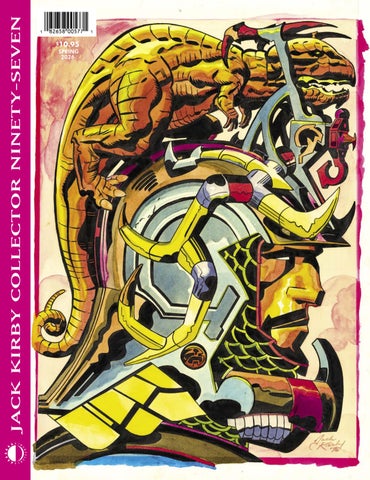
JACK KIRBY COLLECTOR NINETY-SEVEN $10.95
SPRING 2026
Contents
THE
TO BATTLE! OPENING SHOT . . . . . . . . . . . . . . . . 2 Jack’s uphill battle INNERVIEW. . . . . . . . . . . . . . . . . . . 3 Will Murray’s full 1989 interview with Jack
ISSUE #97, SPRING 2026
C o l l e c t o r
IDEA-TION. . . . . . . . . . . . . . . . . . . 18 was it Kirby’s creation or design? KIRBY KINETICS . . . . . . . . . . . . . . 25 slap leather with the Rawhide Kid GALLERY. . . . . . . . . . . . . . . . . . . . 28 big brothers (and sisters) stand up INCIDENTAL ICONOGRAPHY. . . . . 36 we set our eyes on Nick Fury GUN SLINGIN’ . . . . . . . . . . . . . . . . 38 the TWO Two-Gun Kids ROUND 2. . . . . . . . . . . . . . . . . . . . 46 the battling Kirbys’ days in court FOUNDATIONS. . . . . . . . . . . . . . . . 51 a rarely seen Simon & Kirby story KIRBY OBSCURA. . . . . . . . . . . . . . 64 dreaming of the Challs JACK F.A.Q.s. . . . . . . . . . . . . . . . . 66 the 2025 Kirby Tribute Panel from Comic-Con International, featuring Paul Levitz, Tom Brevoort, Patrick Reed, Paul Levine, Tracy and Jeremy Kirby, and moderator Mark Evanier COLLECTOR COMMENTS. . . . . . . . 78 Cover inks & color: JACK KIRBY (part of Jack’s “Tribes Trilogy”)
COPYRIGHTS: Atlas, Batman, Beautiful Dreamer, Big Barda, Brother Eye, Challengers of the Unknown, Darkseid, Demon, Forever People, Guardian, Infinity Man, Jimmy Olsen, Kamandi, Losers, Mad Harriet, Manhunter, Mark Moonrider, Martian Manhunter, Newsboy Legion, OMAC, Red Tornado, Serifan, Super Cycle, Super Powers, Superman TM & © DC Comics • Ant-Man, Astonishing, Avengers, Baron Von Strucker, Black Bolt, Black Musketeers, Black Panther, Boomerang, Captain America, Captain Britain, Daredevil, Devil Dinosaur, Dr. Doom, Fantastic Four, Forbush Man, Goliath, Gorgon, Hawkeye, Hela, Howling Commandos, Hulk, Hydra, Ikaris, Inhumans, Iron Man, Juggernaut, Mimic, Monster at my Window, Moonboy, Nick Fury, Plunderer, Pounder, Power Man, Quicksilver, Rawhide Kid, Rick Jones, Scarlet Witch, Sentinels, Sgt. Fury, Silver Surfer, SpiderMan, Swordsman, Thing, Thor, Two-Gun Kid, Tyrannus, X-Men TM & © Marvel Characters, Inc. • International Hero Team, Thundarr the Barbarian TM & © RubySpears Productions • The Shield/Pvt. Strong TM & © Archie Publications • “Buried Treasure Fraud”, Boys’ Ranch, Fighting American, Link Thorne, Speedboy TM & © Simon & Kirby Estates • Calpurnia, Captain Glory, Sigurd, Sky Masters of the Space Force, Tegujai Batir, The Horde, Tribes Trilogy TM & © Jack Kirby Estate • Captain Freedom, Liberty Lads TM & © Harvey Comics • Justice Inc. TM & © Conde Nast
Don’t STEAL our Digital Editions! C’mon citizen, DO THE RIGHT THING! A Mom & Pop publisher like us needs every sale just to survive! DON’T DOWNLOAD OR READ ILLEGAL COPIES ONLINE! Buy affordable, legal downloads only at
(above) Page 17 pencils from Atlas #1, which saw print in First Issue Special #1 (April 1975).
or through our Digital Storefront at
The Jack Kirby Collector, Vol. 32, No. 97, Spring 2026. Produced quarterly by and © TwoMorrows Publishing, 10407 Bedfordtown Drive, Raleigh, NC 27614, USA. 919-449-0344. John Morrow, Editor/Publisher. Single issues: $15 postpaid US ($19 elsewhere). Four-issue subscriptions: $56 Economy US, $85 International, $19 Digital. Editorial package © TwoMorrows Publishing, a division of TwoMorrows Inc. All characters are trademarks of their respective companies. All Kirby artwork is © Jack Kirby Estate unless otherwise noted. All editorial matter is © the respective authors. Views expressed here are those of the respective authors, and not necessarily those of TwoMorrows Publishing or the Jack Kirby Estate. First printing. PRINTED IN CHINA. ISSN 1932-6912
www.twomorrows.com www.comicshistory.org & DON’T SHARE THEM WITH FRIENDS OR POST THEM ONLINE. Help us keep producing great publications like this one!
1
Innerview
“ I’m Conditioned To Be a Storyteller”
Jack Kirby remembers: a 1989 interview by Will Murray, transcribed by Brian K. Morris
[In 1989, having interviewed Joe Simon on the imminent release of Marvel’s Fighting American hardcover compilation (left), I followed up by talking to Jack Kirby. Selected quotes from these interviews appeared in several Comics Scene articles on Fighting American and Captain America. While the full Simon interview later ran in Comic Book Marketplace, the complete Kirby transcript has never before seen print. Although this exchange is limited to Kirby’s patriotic heroes, he does reflect on his career in general. More importantly, it accurately reflects the indomitable spirit of Jack Kirby in the last years of his life. (Thanks to Brian K. Morris for the meticulous transcription.)] WILL MURRAY: When I was a kid back in the 1960s, and reading Marvel comics, I came across a coverless issue of Fighting American #3. I was fascinated by it. It was unlike the Marvel Comics, which I did enjoy and still do. There was an element of fun that was only in the earlier Marvel Comics.
the past year or so, the Communists have proven pretty ineffective. KIRBY: Sure, Americans never deviate from their own history. MURRAY: Yeah, that’s true. Take me back to 1953, ’54 when you and Joe Simon first sat down and came up with the Fighting American idea. How did the trend, the conversation go? Do you recall? KIRBY: Oh, the conversation was—well, the gist of it was, what was current? And that’s how we always worked. Captain America was a current product of its time and at that time, Hitler was in the news and the Nazis were in the news, Europe was being swallowed up, one country after another, and when were we getting into the war? There was a state of hysteria. Well, this was a similar frame except it never got that serious. But there was a state of hysteria about Communism and it was fostered by our own leaders. So we’d read about it in the papers every day and yet, well, we—I mean, just speaking for myself, [laughs] I’d had enough of that. I had enough of that stuff and I think everybody else did and it just never got rooted in the people to have caused any bad accidents or action or anything like that.
JACK KIRBY: Well, but the atmosphere at that time was very bleak for everybody, really, because it was right after the war and it was the early Fifties and we were just turning our attention to look for another enemy.
MURRAY: But in terms of sitting down with Joe Simon and kicking off the idea, let’s do—I guess you’d have to call it a recreation. KIRBY: When does it see our attitude reflected in the strip? MURRAY: Right. But in terms of actually creating the physical character, I mean, you didn’t have to go with a patriotic character, necessarily, to fight Communism. You could have gone with a standard super-hero.
MURRAY: Well, this was the McCarthy era and America was kind of in a panic. KIRBY: Well, of course, sure. MURRAY: And I wondered why in an atmosphere where everybody was looking for Reds under the beds, as it were, you decided to play the Commies as fun, inept villains?
KIRBY: But the patriotic character was us, see? MURRAY: In what sense?
KIRBY: Well, because I didn’t believe they were that serious a challenge; although the Communists, they had one stage and that was the streets. And I was brought up as a city boy and I’d seen Communist parades, and I’d seen union strikes, and all sorts of parades, and that’s what it looked like to me. And I think the average American never took them seriously and they never got a foothold here, not in a serious way. MURRAY: No, this is true. Well, you know history’s proven you right. In
KIRBY: I mean Fighting American, Speedboy, was always us, just as Captain America was always us. And it was us, looking out at what was taking place and therefore, we always get involved with the action. And the more we did in the case of Fighting American, the sillier it became. So we had a lot of fun with it.
Poster released in conjunction with the 1979 Jack Kirby Masterworks portfolio.
3
MURRAY: Mm-mm, but I mean in terms of the—oh, I suppose the mechanics of it, who first said, “Hey, let’s do a new kind of Captain America,” and who said, “Let’s change, let’s do this”? Who came up
heroes at the time, and the war itself had spent itself inside us and inside everybody else. And so we decided to do something different, and the field itself demanded it. The field itself demanded a satirical strip, something to laugh at and still be done very well. You know, it’s not easy to do satire. MURRAY: No, of course not. KIRBY: So we put our best foot forward and did the best we could. MURRAY: Now, did you ink yourself on these pages, or is that Simon on the Fighting American books? KIRBY: Oh, that would be Joe Simon. MURRAY: Okay, and did you collaborate on the writing, or did you trade off on the writing? KIRBY: No, circumstances would dictate that. MURRAY: Yeah, okay. So it was a total collaboration in the sense that it was the two of you just—. KIRBY: Yeah, because we were both responsible for the strip and that’s where the collaboration lies. MURRAY: When you first sat down and you had your first sketches of Fighting American, and your first idea of what it was going to be, and the format of the books... did you have to sit down with Joe and say, “All right, we’ve got to do things to make it not too close to Captain America,” or was that the idea? KIRBY: No. We wanted it to be Captain America. MURRAY: A-ha! KIRBY: Yeah, we wanted it to be Captain America, and Speedboy, we wanted him to be Bucky. And of course, Captain America was like our own trademark. MURRAY: Right, but you didn’t own him at that time.
with the name? How did you come up with the name? How did you kick it around, basically? You know, the process.
KIRBY: Oh, well, no, we didn’t. Ours were lowly creatures [Will chuckles] so everything was owned by the publishers.
KIRBY: Well, we’d kick it around. We did it jointly, you know.
MURRAY: So this is the way to have your Captain America and eat it too, so to speak.
MURRAY: Of course. KIRBY: And we kicked it around and we had to have the word “American” in it, you know. And “Fighting American” seemed like a perfect name to remember, and it was the kind of a name that had some punch in it, and it worked. And of course, Speedboy. Both of us contributed to all the characters, see? And we just had a lot of fun with it. You know, the character would be a kind of a nebulous— sometimes, it would begin with a word and it would just gather nebulous—.
KIRBY: Oh, but Fighting American was owned by Joe and myself.
MURRAY: That’s what I was getting at. Do you remember how it kicked off?
MURRAY: Oh, I didn’t know that.
MURRAY: Yeah, right. KIRBY: But yeah, this was our first venture as publishers, too. MURRAY: Oh, really? You were the publishers of this, of Headline Comics? KIRBY: Oh, yes. Yeah. Yeah, we published that. KIRBY: Oh, yes.
KIRBY: No. You know, when two guys are talking, say, “Hey, how about doing this?” or “How about doing that?” See? And we’d kick it around and find out if it was funny enough or strong enough to sell the issue—I mean, the magazine issue.
MURRAY: Oh, okay. So that was a real big step for you guys. KIRBY: Oh, yes. Just one second please. MURRAY: Sure.
MURRAY: Yeah, yeah. Now, who decided it would be a satirical strip? That seems not to have been a big part of the first issue. But with the second issue, it was the whole theme.
KIRBY: [speaks to Roz Kirby off-phone] Yes, so we called our publishing house Mainline Comics. [Editor’s note: Jack appears to be confusing “Mainline Publications”, his and Joe Simon’s 1954–1956 self-published comics company, with “Headline Publications Inc.,” a.k.a. Crestwood Publications, which under its imprint Prize Comics published Fighting American #1, also in 1954. Simon & Kirby packaged books for Prize.]
KIRBY: Well, that was my idea, but Joe agreed, finally. MURRAY: And what made you decide? Was it doing too many super-heroes over too long a period? “Hey, let’s play this one for laughs,” or, “Let’s use this for a—”.
MURRAY: Uh-huh, because the copy I have in front of me says “Headline.” I suppose it’s another name for it.
KIRBY: No, I’ll tell you, I think both of us had a bellyful of serious 4
KIRBY: Yeah.
Does he still interest you?
MURRAY: Oh, that brings me to an interesting question, that if you published it, then you cancelled it. And why would you cancel such a wonderful strip?
KIRBY: Well, he would be a lot of fun, but I, myself, I’m retired right now. MURRAY: Really? I thought you still worked for Ruby-Spears. Weren’t you in the animation—?
KIRBY: Well, then, the times were bad for all magazines, and one magazine was going out of business after another.
KIRBY: Oh, I’m sorry. I told you we had Mainline Publications, but it was really Headline Publications.
MURRAY: So it wasn’t necessarily Fighting American itself, it was the line.
MURRAY: Right. Yeah, that’s what my copy says, yeah.
KIRBY: No, it wasn’t Fighting American itself, it was just flagging capital, see?
KIRBY: Right. MURRAY: But you say you’re retired. The last I heard, you were still doing work for Ruby-Spears. Are you retired from that too?
MURRAY: I see. KIRBY: And everything was in flux. It was fluctuating and going up and down, and we just couldn’t exist in that kind of an atmosphere.
KIRBY: No, no, I wasn’t retired from that, but Ruby-Spears was a steady operation, see, and it was a steady routine. I’d bring in my conceptions and I’d go home, and I’d get paid, and it was a routine, as simple as that. So naturally, I didn’t knock it and I felt it was good for me.
MURRAY: Oh, that’s too bad. KIRBY: Now that went for the larger publishers too, you know. MURRAY: Mm-mm. Oh, yeah.
MURRAY: Well, no, my question was, are you completely retired in the sense of not doing any work at all?
KIRBY: So everybody was having trouble, so Fighting American wasn’t—our coffers weren’t overflowing. [laughs] We did the best we could.
KIRBY: Yes, I am. MURRAY: Oh, you are? I didn’t know that.
MURRAY: Well, yeah. Do you have any special memories of doing that run of books? Any stories that stick out in your mind as your favorite?
KIRBY: Yes. It’s been a long time. It’s been fifty years. MURRAY: [laughs] I know. I’ve been reading your work for about thirty of them.
KIRBY: Well, there’s “Super-Khakalovich,” and “Super-Khakalovich” to me—well, he was a stereotype, of course, and the Russians, to me, were always guys who—I mean, the average Russian, to me, was a guy who didn’t really possess much. In fact, the reason he fought Fighting American was he loved Fighting American’s underwear. [Will laughs] He loved good clothes and of course, he couldn’t get it in Russia, and even his costume was secondhand [Will laughs] so he felt humiliated. And it’s not that he disliked Fighting American; he just wanted his uniform [Will laughs] because it was made of better goods. MURRAY: When Fighting American was revived for that one issue in the ’60s for Harvey, how did that come about? There were a couple or three new stories in it that hadn’t appeared in the original run. Were those inventory stories left over from the original Fifties? KIRBY: Well, that’s going far back, but I think that’s so. MURRAY: You didn’t sit down in 1966 and do two or three new Fighting American stories for the new revival. KIRBY: No, Al Harvey was a friend of ours, you know, and we did the best we could with Al, and he tried to help us. MURRAY: Yeah, why did that last only one issue, the Harvey revival? KIRBY: Well, it’s because the publishers could easily see the handwriting on the wall and the handwriting was very, very shaky at the time. MURRAY: This is in, what, ’66, ’67? KIRBY: About ’66. MURRAY: Yeah, around that, I think. KIRBY: And it was only the comic books with a lot of capital behind them that could survive. And so, of course, that would be DC and Marvel and Al Harvey himself.
(previous page) Unused Harvey Fighting American #2 splash from 1966, likely originally done in 1955 for Fighting American #8. (above) Splash from Fighting American #6 (Feb. 1955).
MURRAY: If this Marvel Masterworks comes about in the sense of being very successful, would you consider reviving the character? 5
KIRBY: Well, I can only tell you that Captain America himself was something we did when we were very young, and in fact, Joe was just out of college and I was out of the Lower East Side. [laughs] And we both enjoyed doing Captain America and we just made it kind of a life-long progression. MURRAY: Would you say he’s your greatest creation? That’s a tricky question, but he’s your earliest big creation. KIRBY: Well, yeah, he was our big creation and he symbolized an entire period. And in fact, he symbolized things that lasted for many, many years. Like he’d say he went through all the heartaches and all the joy that that particular era symbolized. So yes, Captain America was very, very real. He was a real person. Bucky was real, and I can tell you that Joe and I are real. MURRAY: I can believe that. [mutual laughter] KIRBY: So the only trick that confronted us was the dialogue, and I think we did well on that. MURRAY: Mm-mm. So do you remember the actual creation of the character very well in terms of when you first sat down, and how you bounced the idea around, and how the germ grew into a character?
(above) Our Fighting Forces #151, page 9 pencils (Nov. 1974). (next page) The Guardian, from Roz’s sketchbook. That shield isn’t exactly aerodynamic for throwing, but it looks great!
MURRAY: Yeah, hmm. Let’s go back to before the war. I mean we’re getting close to it, we’re now at the 50th anniversary of the beginning of World War II and we’re going to be very close to the fiftieth anniversary of Captain America soon. I guess I should ask you about creating Captain America with Joe Simon. How did that character come about, and what do you remember of doing that first, what, ten issues that you did with him, I guess it was? 10
America and Bucky.
KIRBY: Well, the germ always grows. Well, we need a heroic character like—Superman was already in progress and super characters, the world was becoming aware that the super characters were; at least America was—that super characters were a new vogue, and Joe and I looked at it the same way, and we came up with super characters of our own, and Captain America happened to be it, Captain
MURRAY: Well, you make it sound simple, but actually, it was a pretty revolutionary concept and no one had grabbed the—. KIRBY: We thought it was a revolutionary concept and that’s the reason why we tackled it, because we felt that was what the day demanded. If you’re going to
them all the luck. MURRAY: For a guy who has been one of the giants of the field—and we can say that without any boastfulness at all—you’ve been kicked around a bit in the sense that— KIRBY: Oh, believe it! MURRAY:— you’ve been kicked around a bit, yet it never squashed your enthusiasm, at least as far as the work comes out, where another person, a lesser person, a less motivated person, whatever, would have—. I’m reminded of a story I heard at a convention a number of years ago—maybe you know this story, maybe you don’t—and the story goes like this: John Buscema was on a panel—he was talking about when he first went to work for Marvel, doing his super-heroes in the Sixties, late Sixties. And he said he was doing a Silver Surfer meets Thor story and he knocked himself out. He said he went to Norse mythology and he tried to do Asgard the way it might have really looked in the Norse version, and he tried to do Odin and Thor in a more naturalistic point of view, and he said he did 15
Idea-tion
What a Concept:
Was it Kirby’s Creation or Design?
by Richard Kolkman (inspired by a suggestion from Mark Evanier)
A (below) Joe Simon’s concept drawing for Captain America, next to his figurework (center) from the opening page of Captain America Comics #1 (March 1941).
fter a great idea had been sparked in Marvel’s “House of Ideas,” things had to get real. That meant a depiction by an artist, presented to a publisher, for possible launch in a title. Things had to be seen to make the publisher believe in their success. These concept presentations were the way things worked, on an idea’s path to the comic book spinner rack. For Kirby’s Marvel pantheon, it begins in 1940.
Captain America
Originally called “The Patriot” or “Super American” (according to Joe Simon), Timely Comics’ greatest success was brought to life by Joe Simon and Jack Kirby. Simon’s classic concept art (below, with triangular shield) was presented to publisher Martin Goodman. That concept sketch survives and famously appeared on the cover of the 1974 Comic Art Convention book. Kirby’s 1965 re-design [bottom right] didn’t get very far. It was to be an early incarnation of OMAC technology in red, white and blue. With the success of Marvel in the 1960s, and on the cusp of lucrative animation and merchandise deals, re-design was a non-starter. Timely’s shot across the bow—the cover of Captain America Comics #1 (March 1941)—was emblematic of where the USA was heading: straight into World War II.
18
Rawhide Kid
Since this was Lee and Kirby’s re-invention of Rawhide Kid, the cover of #17 (Aug. 1960) stands as possible concept art. Yes, it’s that good.
Fantastic Four
Here’s the Thing... in Fantastic Four #2 (Jan. 1962), a Thing pin-up [next page, top left] appears. This could very well be concept art, done prior to the title launching. After all, the Thing was the only original member of the Fantastic Four. Lee would not have needed concept art for new versions of Plastic Man, Human Torch, or Invisible Scarlet O’Neil—all familiar concepts. To show great strength, Kirby adds a twisted lamp post in the Thing’s hands. Kirby re-visited the Thing’s power in unused Merry Marvel Marching Society art inked by Marie Severin [next page, middle left]—this time, Ben has crushed a Yancy Street signpost. In a final variation on the same theme, unused Marvel mystery poster art by Kirby and Joe Sinnott was finally published in Marvel’s Greatest Comics #24 (Dec. 1969, next page, bottom). A 1964 model sheet of the Thing from many angles [next page, center] was published in the March 1965 issue of fanzine Fandoms Special #3. The origin of this model sheet is unknown, but I suspect it was to improve the art consistency by the multiple artists (Dick Ayers, George Roussos, Carl Burgos, Paul Reinman, Bob Powell, and Chic Stone) drawing the Thing and Human Torch in Strange Tales.
we’ll hit ’em with five.” The “magical outsider family” had its genesis in television’s The Munsters. Crystal is a stand-in for Marilyn (Munster)—two beautiful outsider girls.
None of the model heads can be traced to any issue of Marvel comics, except one: John Morrow found the bottom right expression very similar to the unused final panel of Fantastic Four #15, page 3 [right], which had a paste-up over it. How did it get inked on this model sheet? I’m convinced the rest of the pin-ups that appeared in Fantastic Four and their Annuals were not concept art. They match the contemporaneous inkers of the time.
Silver Surfer
Stan Lee remembers seeing the Surfer for the first time in story page panels—no concept art. However, the Frank Giacoia-inked cover to FF #50 [above] does have that certain something that screams, “concept art.” The Surfer cuts quite a figure.
Incredible Hulk
In his book Origins of Marvel Comics, Stan Lee relates he told Kirby the idea of a super powerful being who would be “attractive” and sympathetic to the readers,
The Inhumans
The splash page of Fantastic Four #44 (Gorgon) and the cover of FF #46 (Black Bolt) [top] could well have originated as concept art. As Kirby once said about his competition: “When they create one character, 19
RAWHIDE KID, WANTED DEAD OR ALIVE ack in a 2017 TJKC #72 article about Rawhide Kid, I noted that Jack Kirby would spend a good part of his leisure time watching TV. As a result, he would often be inspired by what he had seen there. In the instance I cited, it seemed pretty clear that Kirby was taking his cue from an episode of the Steve McQueen Western show Wanted Dead or Alive, called “The Kovak Affair”. I theorized that Kirby had based a portion of his story, “Shootout With Rock Rorick” on this episode. Over time, I have watched many more segments of that series and realized just how much the Kid’s persona was influenced by McQueen’s bounty hunter, Josh Randall. On careful study of the traits of the two characters, one of the first things that struck me was that Randall and the Kid were both wandering loners and would often begin their adventures by riding into a strange town. 1 It’s easy to see that Kirby based this panel from Rawhide Kid #32 on this frame from a Wanted Dead or Alive episode called “No Trail Back.” Look at the saddle bags at the back and the coiled rope at the front of the horse. Did Kirby photograph his TV screen as I did here, or did he just have a photographic memory? Notice also that the Kid’s hat is very similar to the style worn by Randall, as they are both flat topped with the sides of the brim folding up. Watching McQueen in action, you instantly realize that like the Kid, he is a relatively small man, probably around five foot eight, but is explosively powerful, acrobatic and lightning fast with his hands, his feet, and especially with a gun. He handles his horse with ease and confidence. McQueen was also an avid martial artist and a pupil of the legendary Bruce Lee. There are several scenes in the Wanted series that show him using Judo shoulder throws
B
1
very much like the one depicted here at the bottom tier of page 3 from Rawhide Kid #32. 2 McQueen’s explosive physicality must have been galvanizing for Kirby, activating his propensity to depict sequential action as he does in the bottom four panels of this page. McQueen’s character Randall and the Kid are both quiet men, generally minding their own business and avoiding trouble whenever possible. They are quick to respond when goaded to violence, and are sometimes called out by men anxious to prove that are faster on the draw. Randall and the Kid are both homeless and day-by-day sleep wherever they can find lodging, or outdoors if necessary. Wanted by the law, the Kid is an outcast and nearly always on the run. Randall, as a bounty hunter, is sometimes needed for his services, but generally not wanted in a social setting. He has many enemies and some of
2
25
Gallery
Big Brothers
Jack’s own brother David Kurtzberg was five years younger than Kirby, who has recounted having to stick up for David in neighborhood street fights. So it’s no stretch to think that sibling dynamic got conveyed in his comics work as well.
How Kirby depicted siblings looking out for one another, with commentary by Shane Foley
[left] Jimmy Olsen #143, page 1 (Nov. 1971): A spectacular page of Kirby Krackle. And Superman is on board here to help out Jimmy—like a protective big brother—in a truly weird Kirby storyline. Notice here we can see that Kirby roughly penciled in smoke outlines as it billows toward our heroes (yes, his penciling isn’t totally magical—he often does ‘construct’ things!). But then he chose to use his amazing Krackle technique to shade the darker areas. It’s wonderful this scan exists, because when we see the printed version, Kirby’s dot effect is lost, being heavily inked in a more usual way to ink smoke. (Vince Colletta, the inker, even enlarged the swirling smoke so he didn’t have to correct Supe’s ‘S’ symbol on his chest!) [right] Jimmy Olsen #147, page 6 (March 1972): The faithful Mike Royer inked this one, so no comments as above are needed. Even the at-the-timerequired ‘modification’ of Jimmy’s face is minimal. Here, Jimmy takes the lead of the Newsboys—like he’s their big brother! Artwise, I always find Kirby’s shadowing endlessly fascinating, like that in panel 1. Panel 2’s shading makes logical sense—a blackened corner of a room is a great way to highlight the face/head in front of it. But the halo effect in panel 1? That’s pure design by Kirby to embolden Jimmy’s figure. There’s not a patch of realism about it—but boy, does it work well.
28
An Eye for...
...an idea!
Incidental Iconography
An ongoing analysis of Kirby’s visual shorthand, and how he inadvertently used it to develop his characters, by Sean Kleefeld
T
ypically with this column, I take a look at a character that Jack designed and follow their visual evolution while Jack worked on them over time. You can often see a linear progression of the visual shorthand Jack used on them to discern how he saw the essence of their design. In a few cases, though, I’ve taken a look at characters that Jack not only designed, but had a chance to come back and redesign several years later. There was an opportunity to see how Jack might approach the character a second time, with the addition of some mileage on both Jack’s and the character’s parts. But in this installment, I’m looking at what I think is a unique instance where Jack had two designs for the same character running more or less simultaneously. Ostensibly, Sgt. Fury and His Howling Commandos came about from a bet between Stan Lee and Martin Goodman. Many of the newer Marvel titles were selling well and, while Goodman chalked this up to exciting adjectives in the
titles, Lee countered that it was in fact the talent behind the books. To prove it, he deliberately came up with a “bad” title (it was too long and didn’t have any of Goodman’s favorite adjectives) and made it a war book on top of that (a genre out of popular favor at the time), but had Jack work on it. Lee did seem to hedge his bet a bit by having the title crossover with their top-selling Fantastic Four with Mr. Fantastic appearing in Sgt. Fury #3 and Fury in FF #21, both showing up on newsstands at about the same time, and both having been worked on before they would have had even preliminary sales info on Sgt. Fury #1. The initial character design work is interesting here because, ultimately, the characters are all in the same army unit and would just all wear standard-issue fatigues just like Jack himself wore during WWII. Not surprisingly, Jack focused his efforts in differentiating the faces. Dum-Dum had a bushy mustache and wore a bowler, Izzy’s mustache was pencil-thin, Junior had freckles, Rebel switched between Confederate kepis (in issue #1) and slouch hats, Gabe was the only African-American, and Fury himself had a seemingly perpetual five-o’clock shadow. (Dino, while based loosely on Dean Martin, was largely identifiable by being the only one without any quickly identifiable visual characteristics.) Jack did give Fury a general “bruiser” type facial structure with a broad, flat nose and rough features, but in some of the instances where he’s clean-shaven, it indeed becomes difficult to distinguish him from any other generic officer. An interesting storytelling trick Jack developed with the series is that, despite the team all wearing essentially the same uniform, in each issue, he would quickly find ways that they might get disheveled in different ways. Torn sleeves, ripped pants, and such. What this would do is make a character (primarily Fury) more readily identifiable within that issue by way of how tattered their uniform was. It’s one of the few instances I’m aware of where Jack made a 36
Gun Slingin’
The Startling Saga of the by Wild Will Murray
(below) The Two-Gun Kid prior to Kirby’s involvement, shown here on the cover of Two-Gun Kid #1 (top, March 1948). The comic lasted 10 original issues (through Nov. 1949), then was brought back with #11 (Dec. 1953, shown below), but Kirby didn’t come on board until issue #58 (Feb. 1961, next page, top and bottom). (right) Gunsmoke Western #62, Jan. 1961.
D
uring the Summer of 1962, the burgeoning Marvel Comics universe began to coalesce in earnest. Added to the Fantastic Four and the Incredible Hulk were Spider-Man, Ant-Man and the spin-off Human Torch strip from The Fantastic Four. Iron Man would straggle out at the tail end of the year. Jack Kirby had a hand in every one of these features, even if he didn’t always draw their initial installments. Lost in the shuffle of the new expanding line of Marvel superheroes was a revival of Marvel’s oldest continuing Western hero, the TwoGun Kid. Just as Stan Lee and Jack Kirby had reimagined the Human Torch for Fantastic Four, they discarded the long-running version of the TwoGun Kid, replacing it with an entirely new incarnation sharing nothing in common with the original except his identifying name and the fact that he wore matched .45 Colt revolvers in his belt holsters. This was Kirby’s second brush with a cowboy character going by that name. Two-Gun Kid was launched in the early part of 1948, as Timely Comics’ first cowboy hero. He was really Clay Harder, and he belonged to the Hollywood singing cowboy tradition of Gene Autry and Roy Rogers. Originally a rootless cowpoke with no given name, the Kid would sing to himself as he rode along, proclaiming his footloose calling: “I ride alone thruout the West “From Dodge to Alamo! “I’m on the trail of owl hoots “That’s why my colts hang low!” Whenever the Kid blew into a 38
new cowtown, he either found trouble or it found him. Either way, he dealt with it with his twin Colts. He was said to be the fastest gun in the West—which would have been news to Kid Colt, who also held that title. Two-Gun Kid was cancelled at the end of 1949, but the title was revived in 1953, thereafter running almost continuously until 1961. The Two-Gun Kid’s origin was first revealed in issue #37, but his birth name was not revealed. This changed over time. By the latter Fifties, the legend was standardized. When his father was murdered, Clay Harder settled scores with the killers. Impressed by his gun-skill, the town sheriff praised him, telling the youth, “You’re a regular two-gun kid.” The name stuck, and he hit the trail, bound for nowhere except adventure. The feature went through a succession of artists and writers until, after the death of regular artist Joe Maneely, John Severin—working with writer-editor
TWO Two-Gun Kids Stan Lee—drew the feature for more than a year. At this point, the proto-Marvel comic books produced by publisher Martin Goodman were struggling. Kirby had recently rejoined the company and was focusing on the giant monster stories running in their fantasy titles like Strange Tales. A decision was made to revive the defunct Rawhide Kid, which had previously been drawn by Dick Ayers. As Ayers recalled, he received the assignment from Stan Lee and happened to mention it to Kirby. The next thing he knew, Ayers was reduced to being the inker, while Kirby drew the feature. Kirby’s reimagining of the Rawhide Kid made him a hot-tempered young firebrand bursting with energy and pent-up violence. The feature followed the formula that had made Kid Colt, Outlaw a long-running success and was later replicated in Spider-Man: The innocent and misunderstood teenager who finds himself on the wrong side of the law, a fugitive from injustice. Kirby may also have been inspired in part by Nick Adams’ portrayal of angry former Confederate soldier Johnny Yuma, the short-statured hero of the ABC TV show The Rebel. Predating the Fantastic Four by approximately a year, Kirby’s Rawhide Kid was an early Marvel success before the company had started calling itself Marvel.
Kirby’s Two-Gun #1
It must have been an immediate hit because by the time Kirby’s fourth issue rolled out, he had replaced Severin on Two-Gun Kid in his own book as well as the six-pagers then running in Gunsmoke Western. Jack was already familiar with the character, having drawn most of the title’s covers over the previous year. The first Kirby Two-Gun story to break into print appeared in Gunsmoke Western #62, January 1961, which hit newsstands a month before Kirby took over the title with Two-Gun Kid #58, February 1961. In “Six-Gun Showdown!” the Kid enters a saloon in time to witness an old man being tormented by a typical Jack Kirby bully. Recognizing the oldster as the former fast-draw Lightnin’ Jenks, whom the Kid had witnessed simultaneously gunning down two challengers with his matched Colts as a boy, he decides to stand up for the aging man who had inspired him to use his guns only to help others. If we go by the job number, V-21, it’s actually the first Two-Gun Kid tale Lee and Kirby produced as a team. Kirby’s first two-part Two-Gun Kid saga, “The Monster of Hidden Valley” from issue #58, might have been torn from the pages of Strange Tales. The Kid drifts into the town of Hidden Valley and learns there’s a monster in the hills. When he rides out to investigate, sure as shootin’, there is! After penetrating the stockade fence locals have erected to keep the monster contained, the Kid discovers it’s really a giant freak bison covered in elaborate hide to give it a prehistoric appearance. Only Jack Kirby could draw such a fabulous creature and unmask it as a common herd animal tricked out with rawhide frills. As drawn, the orange beast looks like Fin Fang Foom’s younger, earthbound brother. Only a lack of membranous wings kept it from looking like a classic dragon. For a backup story, Lee and Kirby recounted the Two39
Gun Kid’s origin for what must have been the fifth time since 1957. Most recently, Lee had retold the story twice in 1959, with two different artists. Perhaps he thought that the regular reader needed to have the Kid’s backstory repeatedly stressed to hold the audience’s attention. But just as likely is that in meeting the monthly deadlines, Lee simply assigned a fresh retelling of the origin to every new artist on the strip. That placed the heavy lifting on the artist’s shoulders, with Lee only having to supply dialogue in the pencil stage. The following month, in Gunsmoke Western #63, the Kid blunders into another saloon and tangles with a giant with a familiar name. The roughneck of “The Hands of the Hulk,” doesn’t have green skin, but he’s just as gigantic. When Hulk Hogan challenges the Kid to a man-to-man fistfight, he learns the error of his ways— the hard way. Strangely, this story has the same job number, V-89, as “The Monster of Hidden Valley,” which suggests it was originally intended for Kirby’s first issue, but replaced by the retold origin.
brute named Wolf Waco. Nothing unusual about tangling with yet another Western black hat, but this same character had appeared six months before in Rawhide Kid #18. That story was called “At the Mercy of Wolf Waco!” Kirby drew him virtually identically in both tales. In fact, the plots are virtually the same. Both footloose cowpokes are forced to join Wolf Waco’s gang and participate in robberies. The main difference is that the Two-Gun Kid had suffered burns to his hands, preventing him from drawing his guns and defending himself. Wolf Waco uses the threat of the hostage Kid’s presence and his fast-gun reputation to hold up a stage. Fleeing the town of Drygulch because he’s recognized as a wanted man, the Rawhide Kid fell in with Wolf Waco and his outlaw gang, and became a reluctant participant in a train robbery because Waco threatened to shoot him if he didn’t. The Kid was outnumbered. Otherwise, it would have been no contest. The Rawhide Kid was another one of Marvel’s Old West heroes who had the reputation of being the fastest draw west of the Rockies. This encounter might be seen as an early Marvel villain crossover, and
For Two-Gun Kid #59, the following issue, Lee and Kirby did something unusual and perhaps innovative. The Two-Gun Kid ran afoul of a heavy-faced bearded 40
The Battling Kirbys
Round 2
Two of the Kirby family’s major legal battles, recounted by John Morrow
(this page) Ads announcing the debut of Sky Masters of the Space Force, from papers in Shreveport, Louisiana (bottom); San Angelo, Texas (center); and (top) Honolulu, Hawaii.
(next page) Original art to the Jan. 24, 1959 strip by Kirby and Wally Wood.
N
o creator as influential and accomplished as Jack Kirby could navigate the waters of the comics business without hitting a potential legal tsunami sooner or later. For Jack, there were two major ones, and while he lost the first one, he eventually emerged triumphant in the second, if only posthumously.
The Sky Masters Case: 1959
On December 11, 1958, DC Comics editor Jack Schiff sued Jack Kirby for breach of contract over royalties for the Sky Masters newspaper strip, and Kirby counter-sued, claiming he was coerced into an agreement. Trial was held on October 16, 1959 and you can find an extensive account of the dispute in TJKC #16. No record of the full testimony from the trial exists, but on December 3, 1959, the final judgment of presiding Justice George J. Fanelli was announced in the New York Supreme Court in White Plains, as follows: Opinion of the New York Supreme Court Schiff v. Kirby In this action for a declaratory judgment, plaintiff seeks a determination declaring that defendant Kirby is obligated to account and pay him 4% of all proceeds received by Kirby from the exploitation by publication in daily and Sunday newspapers of the cartoon comic strip known as “Sky Masters” as well as a similar percentage received by Kirby from sources other than from said publication, and for other incidental relief. The parties to this litigation are men engaged in a substantial industry dealing, among other things, in the development, production and preparation of cartoon comics and comic strips. Plaintiff is an editor of National Comics, Inc., a magazine dealing primarily in the publication of cartoon comic books, and defendant Kirby is a freelance artist, who in 1957 and 1958, received (as an independent contractor) certain assignments from plaintiff in his capacity as an editor while acting on behalf of his corporate employer. It is plaintiff’s contention that in January 1958, one Harry Elmlark, general manager of the George Matthew Adams Service, a newspaper feature and cartoon syndicate, solicited plaintiff with the view of obtaining a cartoon strip for his syndicate dealing with the subject matter of space science fiction; that, while plaintiff’s employer indicated a disinterest in such a project, nevertheless, 46
plaintiff, as one of its editors, was authorized to undertake such a strip disconnected with his employment and as his individual project with the use of freelance writers and artists; that plaintiff communicated this information and inquiry to one David Wood, a freelance writer, who in turn contacted defendant Kirby; that at first all three men discussed the possibility of producing the strip as a joint venture upon a proportionate percentage basis in which plaintiff was to receive a 50% share, but later plaintiff, because of other commitments, withdrew from the enterprise and arranged an interview between Elmlark, Wood and Kirby upon the agreement that, if their work met with the approval of Elmlark and if they ultimately received a contract with his syndicate, then he, plaintiff, would be entitled to a percentage of the proceeds to be received in consideration of his bringing to their attention such business opportunity; that, upon Elmlark’s receiving some acceptances of the strip as prepared by Wood and Kirby, they entered into a temporary arrangement or binder with Elmlark’s syndicate; that later a dispute arose between Wood and Kirby as to their participation in the proceeds to be received which dispute was ultimately compromised by plaintiff and at which time it was orally agreed that plaintiff was to receive 4% of their share in the proceeds of the strip; that, on April 15, 1958, to memorialize said oral agreement, Kirby and Wood signed a notation, prepared by plaintiff, to the effect that he was to share in this comic strip to the extent of 4% of the total amount earned jointly therefrom by Wood and Kirby; that on May 13, 1958, a written agreement was entered into between Wood and Kirby, each of whom was then represented by his own attorney, wherein they agreed between themselves as to a distribution of the proceeds to be received, and in which agreement they again in two instances recognized and agreed that from the proceeds to be received from the exploitation of the “Sky Masters” strip, plaintiff was to receive 4% thereof for his said contact; that ultimately Wood and Kirby obtained a written contract with the syndicate (the George Matthew Adams Service) under date of May 14, 1958; and that, while Wood has been paying plaintiff the 4% of his proportionate share of the proceeds received by him from the syndicate, defendant Kirby has at all times refused to make any such payments. Defendant’s version of the transaction is at variance with
Foundations
Here’s a rarely-seen Simon & Kirby story from Justice Traps the Guilty #3 (April 1948): “Buried Treasure Fraud”. Art restoration and color by Christopher Fama.
51
OBSCURA
Barry Forshaw
A regular column focusing on Kirby’s least known work, by Barry Forshaw
Barry Forshaw is the author of Crime Fiction: A Reader’s Guide and American Noir (available from Amazon) and the editor of Crime Time (www.crimetime. co.uk); he lives in London.
(below) The cover of Astonishing #56 (Dec. 1956) by Joe Maneely.
piece and (let’s face it) no Kirby masterpiece, but admirers will feel the need to track it down if they don’t already have it.
LAST HURRAH FOR THE CHALLENGERS
Regular readers of this column will be used to the occasional mention of Jack Kirby’s impeccable work on a franchise he originated: DC’s classy Challengers of the Unknown, inked to perfection by one of the few illustrators who could be said to be in the same ballpark as Kirby when it came to artistic talent and influence: the troubled Wallace (or Wally) Wood. All good things must come to an end, and I can say—for the time being at least—that what follows is to be the last discussion (if not the last mention) of that glorious artistic collaboration. The final issue of the Challs’ magazine—before DC stalwart Bob Brown took over the artistic chores after Kirby’s falling out with DC—was issue #8 (June/July 1959), in which the sometime-leader of the quartet, Ace, is being dispatched into space in a pink bubble
DREAMING WITH KIRBY
Before Jack Kirby, Stan Lee, and the latter’s brother Larry Lieber began their seemingly endless series of giant monster comics for Atlas/ Marvel, the duo worked up to this ambitious undertaking with some more modest-sized (but nevertheless impressive) fantasy and SF tales, such as a minor gem to be found in Astonishing #56 (December 1956), “Afraid to Dream!” In some ways, the piece is a throwback to the inventive and accomplished little science fiction tales Kirby was providing for Harvey Comics not long before, and the whiskery style employed here is not unlike that he utilized in his more eccentric Black Magic days with ex-partner Joe Simon. In a psychiatrist’s office, a disheveled, unshaven man is describing his terror at falling asleep because of the nightmares that have been plaguing him. We are shown these nightmares, in which the protagonist, accoutered in a futuristic spacesuit, finds himself on a hostile alien planet. The reader is to discover that there is a reason for this, but the revelation does not appear till the final panel. What we do see among the various threats, however, are some strange visions—including a gigantic pair of menacing eyes surrounded by a yellow fleshy material—the kind of surreal image that would be turned out nineteen to the dozen before the big monster era. It’s a modest 64
Mark Evanier
JACK F.A.Q.s
A column answering Frequently Asked Questions about Kirby
Photo by Chris Ng.
2025 Kirby Tribute Panel
(throughout) Some of the Kirby originals on display at the Skirball Cultural Center, pictured atop the next page. (next page, center) Batman artist Jerry Robinson saved this 1942 Adventure Comics #73 original cover art from being thrown out. (below) Thundarr concept art.
[This panel was held at Comic-Con International: San Diego on July 27, 2025, featuring (back row, left to right) Paul Levitz, Tom Brevoort, Patrick Reed, Paul Levine, and (front row) moderator Mark Evanier, and Tracy and Jeremy Kirby. The transcript was copyedited by Mark Evanier and John Morrow.] MARK EVANIER: Good morning. Since this is the Jack Kirby Tribute Panel, I must be [pointing to his name placard] that guy, [laughter] and this is the panel I always look forward to because we get the classiest, smartest people at this panel. [laughter] People who are Jack Kirby fans. [applause] Our first topic of importance is going to be the
66
Jack Kirby Exhibit at the Skirball Center. How many people here have been to see it? [applause] Is that an amazing exhibit or is that an amazing exhibit? Yes, everybody’s happy. If you haven’t gone to see it, go to see it. We’ll talk about that in a minute [when] Patrick Reed, the curator joins us, but we’re not going to talk about the Fantastic Four movie because I haven’t seen it. [laughter] I don’t go to see those movies. I don’t go to the Marvel movies and such. I went to the first X-Men movie and I didn’t like it, and I would’ve walked out, except I was sitting next to Stan Lee at the screening. [laughter] I didn’t like the movie even before the end credits, and I really, really didn’t like the end credits because Jack Kirby’s name was in a flyspeck Bodoni [font]. It was the smallest credit you could imagine to have, and it made me very angry. I get angry once every six years maybe, and it’s never about anything that affects me personally, it’s always about other people, and I was just angry that Marvel Late 1930s political credited cartoon. Jack in this teensy little insignificant way—the caterer got better billing than he did. I don’t think the caterer helped create the X-Men. That is not the case anymore, and in the Fantastic Four movie, I assume Jack got good billing on that? [applause] I may eventually see it, but I don’t go to those—I went to see the Justice League movie, which they made some money on. They were charging people to get out of it. [laughter] But I liked Jack’s credit on the movie. That was the best part of it. Years ago I was friends with Jerry Siegel and a little bit with Joe Shuster, mostly with Jerry, and I used to sit in Jerry’s living room, hearing him alternately cry and get very angry at the way he’d been treated by DC Comics, and I just felt bad for this man who gave us one of those important characters in the history of fiction—not just comic books, but just American fiction—and when they made the movie with Christopher Reeve, that was the first time Jerry and Joe got proper credit. I saw this movie at the Writers Guild Theater. It was an advance screening, the movie was not in theaters yet. The Writers Guild Theater showed it, and when the credit came up “Created by Jerry Siegel and Joe Shuster,” the whole audience burst into applause—the whole audience full of writers—because they knew the significance of it. They may not have known fully, but they knew the battle that
how great Jack was. That was a magical night at the Skirball.
Photo Credit: Hughwa, Wikimedia Commons
EVANIER: It is really an amazing exhibit, intelligently presented. They didn’t just slap a bunch of things on the wall. It’s got a continuity, it’s got a storyline. And one of the interesting things about it is: obviously, it was full of people who loved Jack Kirby the whole evening, but there was an awful lot of people there who didn’t know who Jack was, because they were fans of the Skirball Museum and went to all the openings. I found myself sitting at a table explaining Jack Kirby to these people who really didn’t know who he was. They were there just because it was at the Skirball. Patrick, can you tell us how that exhibit came to be?
had been going on to get them credit. We are slowly getting our entire panel together. Now that Patrick [Reed] is here. We already polled the audience, and about half of them have been to the exhibit, and all of them love it.
REED: Well, I guess there are a number of ways to tell that story. I could say that it was...
TRACY KIRBY: Mark’s already on a roll, man.
EVANIER: Tell the one that gives you most of the credit. [laughter]
PATRICK REED: Amazing. Sorry, I apologize for, I thought, being on time. [laughter]
REED: Can I tell the one that gives Jack all of the credit? Because I like that one.
EVANIER: It’s okay, the panel hasn’t actually started yet. Anything with Jack doesn’t play by the rules. Any Kirby thing, you have to go the extra distance to start early. John Morrow, would you get over to the microphone for a second? I want you to join in this conversation. The Kirby exhibit at the Skirball Center made me very, very happy. I was in the hospital getting my gallbladder taken out, and I should not have gone to it that day. I should have stayed home and rested. But my girlfriend Gabriella dragged me there. [laughter] She cut my hair, picked out my clothes—and John, you flew in from North Carolina just for the exhibit, right?
EVANIER: I’ll take that one. REED: I mean, it’s the culmination of a lifelong dream, in that I knew the names Jack Kirby and probably George Lucas, Jim Henson, Paul McCartney, John Lennon from a very early age. I was lucky to be raised in a family of fans and a family that allowed me to understand that there were people who created the things that I loved. They did not spring fully-formed into the world. There were people who were creative, who were imaginative, who put together and came up with these stories, these songs, these whatever. So I knew the name Jack Kirby from literally the time I could read. And the thing about Jack’s work is the older you get, the more you understand the subtext, the more you find different things in it. But also if you are a four-year-old learning to read, the impact of the visuals is so strong, you react to them innately without any conscious—like, it just works. The way that it came together is the Skirball had hired myself and my colleague Rachel Pinnelas, who is here, to develop a series of exhibitions based around comics and comic culture. And we said, “Okay, if we’re going to develop a suite of shows, here are the things we’d like to address over the course of multiple exhibitions. We need to start with Jack Kirby. Let us
JOHN MORROW: Yeah, yes. EVANIER: And you rented a car and came and picked us up, and drove us to the exhibit. Were you as happy about that as I was? MORROW: Oh, it rivaled... seeing that exhibit and seeing it with you and everybody else who was there opening night, rivaled that first year I came out here with my six little issues of the Jack Kirby Collector at my very first Comic-Con booth, and the Kirby love that showed up at our booth. Everybody just congregating, talking about 67
[be] the first major American institution to do a career retrospective of an American comic book creator.” There have been Charles Schulz shows, there have been Tezuka shows and Miyazaki shows and Hergé shows, and thematic shows around the artform’s genesis, or Charles Hatfield’s incredible Kirby exhibition that was very focused on the Fourth World material. We said we want to do a career retrospective. We want to do it with Kirby. The Skirball has done [Leonard] Bernstein, they’ve done Maurice Sendak, they’ve done Kubrick. This is how we start. And they said, “That’s perfect. Yes.” And I don’t know if, as a freelancer yourself, you understand what it’s like when you get a few words into the pitch and they immediately accept it and you don’t have to keep going? [laughter]
articles, which of course means I get links to congressmen named Jack Kirby, [laughter] golfers named Jack Kirby, and things like that. But I get an awful lot of them; if you don’t believe that Jack Kirby is becoming famous, get a Google alert. Down at the far end, sitting next to Patrick, is the lawyer who represented Jack on a number of things, and the Kirby Estate. This is Mr. Paul Levine. [applause] PAUL LEVINE: So I’m sitting in my office and I get this email from this guy named Patrick Reed. I get emailed all the time from people who want to do something with Jack one way or another, and I get them and I forward them to Lisa Kirby, the daughter of Jack who runs the Estate—it’s actually called the Trust, but it doesn’t matter. I don’t think anything more of it. But this one: the Skirball? Ohh, finally, Jack is going to get his due... this is the perfect vehicle for enabling the public to understand and appreciate Jack’s significance. So I forwarded the email to Lisa. Jeremy [Kirby] and Patrick [Reed] went to town, and the end result is what you see at the Skirball. I would encourage every single person here to, not walk, but run to the Skirball and see the exhibit. REED: I would suggest probably driving, because you do not want to walk or run on the 405 [freeway]. [laughter] EVANIER: Okay now Paul, that’s the lawyer part of you speaking. Let’s talk about the human part of you reacting. Let’s talk about how you felt about the exhibit. You got a tour earlier in the day, right? LEVINE: Patrick gave my wife and me a private tour earlier that day. It’s overwhelming. So like you say, it tells a story, which most exhibits don’t. They just slap a bunch of artwork on the wall and leave it and go with that. But walking through the exhibit, you walk through Jack’s life from the early time to the end.
EVANIER: I wouldn’t know. [laughter] PAUL LEVITZ: Mark, that’s just because you never could stop talking about it... [laughter] REED: I mean, Jack Kirby sells itself; it’s the power, it’s the importance of the story. It is the person at the core of it, and they gave us the opportunity, and we just tried not to fumble it.
EVANIER: Okay. Umm... people named Kirby: [laughter] this is Jeremy Kirby and Tracy Kirby, ladies and gentlemen. [applause] Each of you tell me how you felt about that exhibit. By the way, that kind of turned into almost a Kirby family reunion that evening. How many people were there who were related to Jack?
EVANIER: For years, a lot of us suffered for Jack Kirby; not enough people know who Jack Kirby is. That is changing, people. He’s in every Fantastic Four movie press release, and I have my Google alerts set to find “Jack Kirby,” and all the time it sends me links to all the
TRACY: Well, it’s a small family. JEREMY KIRBY: It is small, but I mean, a lot, quite a bit. So almost
(above) Mark showed this circa 1969 photo of (l to r) Steve Sherman, Jack, and himself at the tribute panel.
(right) An example of the wide range of eras covered in the Skirball exhibit. Shown (l to r) are: 1) Star Spangled Comics #7 cover art (April 1942), which Jerry Robinson also saved from destruction. 2) A pin-up from Boys’ Ranch #2 (Dec. 1950), which includes Rand Hoppe’s personal fave, Wee Willie Weehawken (get’cher vittles, Rand!). 3) Tales to Astonish #34 splash page (Aug. 1962). 4) Fantastic Four #59 cover art (Feb. 1967). 5) Demon #16 cover (Jan. 1974).
68
(below) Kamandi #23 cover pencils (Nov. 1974), and the published cover on next page.
time. A very creative guy, and a person who was as devoted to Jack as anybody has ever been, and we miss Steve tremendously. [applause] I want to introduce the only member of the panel I haven’t introduced yet. This man is one of the senior editors of Marvel at the moment. I’m told by many people who read Marvel comics that the ones he edits are the only ones worth reading. [laughter] He’s also a very knowledgeable person about comic book history, and not always reflexively taking the company’s side as some of his predecessors were. He’s been busy a lot lately doing damage control because in case you haven’t heard about it, they found the name of Tony Stark all through the Epstein files. [laughter] Please welcome Mr. Tom Brevoort, ladies and gentlemen. [applause] Tom, we got you and Paul here for a reason, because you both...
YOU going ENJOYED THIS PREVIEW, TOM BREVOORT:IFWe’re to fight now? [laughter] CLICK THE LINK TO ORDER THIS LEVITZ: Wait ISSUE a minute. warned me about that. IN Nobody PRINT OR DIGITAL FORMAT! EVANIER: We’re going to fill a pool full of mud and let you guys wrestle, [laughter] but I’ll ask you the stock stupid question. When did you as a human being discover Jack Kirby’s work, and what impact did it have on you?
BREVOORT: I think the first Jack Kirby comic I read when I was about six years old and getting into comics, was an issue of Kamandi that I got in one of those supermarket “three bags.” I didn’t buy the three bag for the Kamandi issue. It was collateral in it. It was the issue that was all about finding the Watergate tapes, and I didn’t understand a word of it. [laughter] Jack’s work in the Seventies was perplexing to me as a young reader. I wanted very simple basic superhero stories,#97 and this KIRBY COLLECTOR BATTLE! Kirby’s Fourth World, stuffTOwas wildWarriors and and outpeaceniks there inand I didn’t Jack’s TWO Two-Gun Kids, WILL MURRAY interviewing Kirby understand it, but it was fascinating toSimon me. on the origins of Captain America, a never-reprinted & Kirby tale, Ithe Kirbys’ battlesDC overreader creator credit, MARK At the time, was a big ironically EVANIER’s 2025 Jack Kirby Tribute Panel from Comic-Con, plus: enough, would house If Kirbyand drew DC a character’s firstrun coverthese appearance, does ads that them his creation or design? Cover by Jack himself! that make would have eight covers in them, and (84-page FULL-COLOR magazine) $10.95 the Kirby covers always somehow (Digital Edition) $4.99 stood out, and were fascinating because they were so unlike everything else that was around them, either in the visuals obviously, but also in the text. I can still remember, “Die, bungling gnat!! You cost me a victory!!” as this huge whale goes to swallow Kamandi on the cover of a comic [Kamandi #23, Nov. 1974] that I didn’t read for 30 years after that. But I eventually got into Jack’s work more on the Marvel side. I eventually started to branch out and explore the Marvel comics, and one of the first things that I ended up getting were three consecutive issues of Marvel’s Greatest Comics, which in the ’70s reprinted the ’60s Fantastic Fours. And that was sort of the thing that unlocked the key to the whole Marvel experience for me, and got me diving deeper and deeper from there— Son of Origins of Marvel Comics, which was at least 50–60% Jack, and I found that even as I read the comics of the Seventies, I was much more attracted to the comics of the Sixties. Same thing’s kind of true with my DC experience, and Kirby is the linchpin to pretty much all of it—he’s the central brick at the foundation of everything that came later, and that is still true today at Marvel. All roads lead back to Kirby. https://twomorrows.com/index.php?main_page=product_info&cPath=98_57&products_id=1841
EVANIER: Tom has done a lot of scholarly pieces, and he has an excellent blog, which frequently touches on the subject of Jack Kirby. Can you tell them where they can find your blog? BREVOORT: My blog is at www.tombrevoort. com. It’s hard to remember, [laughter] and hard to find because nobody can spell my name right. It’s two O’s—two O’s is the key. But yeah, I’ve got a bunch of pieces there about various facets of comic history, and particularly early Marvel stuff, because I’m 72