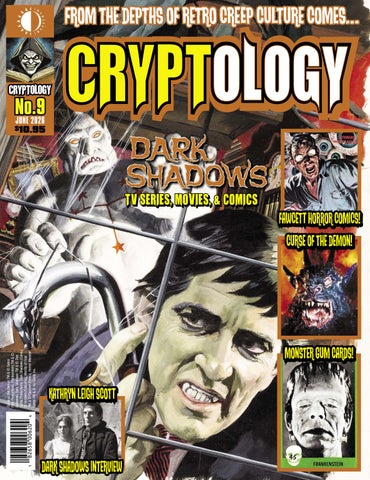
Curse of the Demon TM & © Sabre Film Productions, Frankenstein TM & © Universal, Dark Shadows TM & © Dan Curtis Productions, Dark Shadows (Comic) © Western Publishing, Worlds of Fear TM & © Fawcett Comics, Horror Monster Cards TM & © Nu Cards Inc.
FROM THE DEPTHS OF RETRO CREEP CULTURE COMES…
CRYPTOLOGY
No.9 JUNE 2026
$10.95
TV Series, Movies, & Comics
FAWCETT HORROR COMICS! CURSE OF THE DEMON!
MONSTER GUM CARDS!
KATHRYN LEIGH SCOTT
DARK SHADOWS INTERVIEW
Volume 1, Number 9 June 2026 EDITOR-IN-CHIEF Peter Normanton PUBLISHER John Morrow DESIGNER Michael Kronenberg EDITORIAL ILLUSTRATION Pete von Sholly
SPILLING MY GUTS: Editorial by The Cryptologist . . . . . . . . . . . . . . . . . . . . . . . . . . 2 AND NOW THE SCREAMING STARTS!: Letters to The Cryptologist. . . . . . . . . . . . 3
COVER ARTIST George Wilson, original art for Dark Shadows #11 (November 1971).
MONSTERS OF BLAXPLOITATION: Subgenre Horrors from the Supercool Seventies. . . . . . . . . . . . . . . . . . . . . . . . . . . . 4 For those in the know these hip movies were the quintessential cult films of the day
SPECIAL THANKS James Bacon • Michael Bonesteel Heritage Auctions • Barry Forshaw Steve Kronenberg • Tim Leese • Frank Motler • Will Murray • Mike Price • Kathryn Leigh Scott • Anthony Taylor • Dr. Jeff Thompson • Mark Voger • Tom Weaver
FORGOTTEN HORROR FILMS: A Big Hand for a Sinatra-Come Lately . . . . . . . . . . . 12 Rod Lauren could have been one of the great crooners; instead he chose a path that led to The Crawling Hand
Copyrights: Abby, Blacula, Dr. Black, Mr. Hyde, Scream Blacula Scream, Sugar Hill, The Thing with Two Heads TM & © American International Pictures • Night of the Cobra TM & © New World Pictures • Ganja and Hess (Double Possession) TM & © Kelly-Jordan Enterprises • Blackenstein TM & © Frisco Productions • Voodoo Black Exorcist TM & © Horizon Films • The House on Skull Mountain TM & © 20th Century Fox • Lord Shango TM & © Bryanston Pictures • Petey Wheatstraw TM & © Generation International Pictures • The Twilight People TM & © Dimension Pictures • MADtv TM & © The CW • The Beast Must Die TM & © Amicus Productions • If I Had a Girl TM & © RCA Victor • The Crawling Hand TM & © Joseph F. Robertson Productions • Haunt of Fear, The Crypt of Terror, Vault of Horror TM & © EC Comics • A Feature Presentation, Star Presentations TM & © Fox Comics • Adventures into Terror, Journey into Unknown Words, Marvel Tales TM & © Marvel Comics • Black Magic TM & © Headline Publications Inc. • The Beyond TM & © Ace Magazines • Jumbo Comics (UK) TM & © Locker • Senorita Rio TM & © Cartoon Books • Pep Comics, Sam Hill Private Detective TM & © Archie Comics • Hit Comics TM & © Quality Comics • Billy the Kid TM & © Toby Press • Crime Does Not Pay TM & © Lev Gleason Publications • Real Clue Crime Stories (UK) TM & © Streamline • Dark Shadows TM & © Dan Curtis Productions & Warner Bros. • House of Dark Shadows TM & © MGM • Minneapolis Star TM & © Star Tribune Company • The Great Gatsby TM & © Paramount Pictures • Brannigan TM & © United Artists • Dark Shadows (comic) TM & © Western • Barnabas Collins, Barnabas Vampire Van, The Werewolf models TM & © MPC • Dark Shadows syndicated strip TM & © NEA/Dan Curtis Productions • Dark Shadows: Book One (1992) TM & © Innovation • Dark Shadows (2011) TM & © Dynamite Entertainment • Leaf Spook Stories Cards aka Spook Theatre, Son of Spook Theatre Cards, The Munsters Cards TM & © Leaf Brands Inc. • Monster Laffs Midgee Cards, Outer Limits Cards, You’ll Die Laughing Funny Monsters Cards TM & © Topps • Horror Monsters (magazine) TM & © Charlton • Horror Monsters Cards TM & © Nu-Cards • Monster Magic Action Trading Cards TM & © Abby Finishing Corporation • The Addams Family Cards TM & © Donruss • Beware Terror Tales, Strange Stories From Another World, Strange Suspense Stories, Sweethearts, This Magazine is Haunted, Unknown World, Worlds Beyond, Worlds of Fear TM & © Fawcett Publications Inc. • Blood of the Vampire TM & © Tempean Films • Horrors of the Black Museum TM & © Anglo-Amalgamated, Carmel Productions, Merton Park Studios • Night of the Demon TM & © Sabre Film Production • Giant from the Unknown, She Demons TM & © Screencraft Enterprises • Frankenstein’s Daughter, Missile to the Moon TM & © Layton Film Productions Inc. • The Mummy TM & © Hammer Film Productions • Beware TM & © Youthful • Black Cat, Chamber of Chills, Tomb of Terror, Witches Tales TM & © Harvey Comics • Tales of Horror TM & © Toby • Strange Mysteries TM & © Superior
THE CALL OF THE VILE, PART 2: A Guide to Pre-Code Horror: 1950 . . . . . . . . . . 16 In 1950 EC Comics entered the world of horror; horror comics would never again be the same THE IRISH WAR ON COMICS BEGINS: The Committee of Evil Literature. . . . . . . 22 After years of turmoil Ireland became a Free State in 1922 but what of its comic books? LOVE AT FIRST BITE: Kathryn Leigh Scott on Horror’s Greatest Romance . . . . . . 28 Kathryn reminisces fondly on her time with Dark Shadows and that enigmatic vampire Barnabas Collins COLLINWOOD ILLUSTRATED: Dark Shadows in the Comics. . . . . . . . . . . . . . . . . . . . 36 The Dark Shadows comic books from Gold Key in 1969 to Dynamite Entertainment in the 21st century MONSTROUS GUM CARDS OF MY HORRIFIC CHILDHOOD: Monster Cards Galore . . . . . . . . . . . . . . . . . . . . . . . . . . . . . . . . . . . . . . . . . . . . . . . . 42 A selection of the many outrageous monster trading cards from 1959 to 1973 FAWCETT’S FRIGHTFUL AND FEARFUL COMIC COVERS: A Fawcett Creepy Cover Cavalcade. . . . . . . . . . . . . . . . . . . . . . . . . . . . . . . . . . . . . . 50 Just for a short while Captain Marvel stood side by side with the diabolical Doctor Death and his nefarious cohorts A GRUESOME TRIO: Three Key British Horror Films. . . . . . . . . . . . . . . . . . . . . . . . 58 With Blood of the Vampire, Horrors of the Black Museum, and Night of the Demon British cinema cast the darkest of shadows KILLER B’s: The Cunha Quartet . . . . . . . . . . . . . . . . . . . . . . . . . . . . . . . . . . . . . . . . . 65 Regular Cryptology department featuring selected horror and sci-fi B-movies HAMMER TIME: The Mummy. . . . . . . . . . . . . . . . . . . . . . . . . . . . . . . . . . . . . . . . . . . 72 Regular Cryptology department featuring selected Hammer Studios films HORROR COMICS EXCESS: Rat Infested Comics. . . . . . . . . . . . . . . . . . . . . . . . . . . 76 A catalog of atrocities from the crime and horror comics of the 1950s CRYPTOLOGY™ issue 9, June 2026 (ISSN 2997-416X) is published bi-monthly by TwoMorrows Publishing, 10407 Bedfordtown Drive, Raleigh, NC 27614, USA. Phone: (919) 449-0344. Periodicals Postage Paid at Raleigh, NC. POSTMASTER: Send address changes to Cryptology, c/o TwoMorrows, 10407 Bedfordtown Drive, Raleigh, NC 27614. Peter Normanton, Editor-in-Chief. John Morrow, Publisher. Editorial Office: CRYPTOLOGY, c/o Peter Normanton, Editor-in-Chief, 619 Whitworth Road, Lower Healey, Rochdale, Lancashire, OL12 0TB, England. Email Peter Normanton: peter.normanton@btinternet.com. Six-issue subscriptions: $8 Economy US, $121 International, $29 Digital. Please send subscription orders and funds to TwoMorrows, NOT to the editorial office. All editorial matter © 2026 TwoMorrows Publishing and Peter Normanton. Printed in China. FIRST PRINTING.
MONSTERS OF
laxploitation B by Mark Voger
Subgenre Horrors from the Supercool Seventies
F
olks who weren’t around when Shaft and Superfly ruled the cinema can have a hard time believing there also existed characters called Blacula and Blackenstein. Maybe you had to be there? The early 1970s saw the emergence of the so-called “blaxploitation” genre—supercool action flicks with Black protagonists. (Think Shaft, Superfly, Coffy, Black Caesar.) It wasn’t long before a subgenre reared its ugly head: the blaxploitation horror film. One of the first, and best, is Blacula starring William Marshall, a distinguished actor who has been called the stage’s greatest Othello. Blacula is simultaneously a monster movie and a blaxploitation movie, handily straddling two genres that have specific
4
cryptology NO. 9
requirements... and picky fan bases. The best of monster movies promise hideous makeups, eerie atmosphere and authentic scares. Blaxploitation movies are often typified by groovy threads, sweet rides, Afro hairstyles and a soul-ish, disco-ish soundtrack with wah-wah guitar and punchy horns. Disclosure: The following films may contain violence, nudity, gore, vulgarity and racial slurs—all things that blaxploitation enthusiasts are long accustomed to.
BLACULA (1972)
The heart of Blacula is Marshall as the titular bloodsucker. Marshall, it becomes immediately clear, is a Shakespearean actor, the kind of guy for whom they invented the word “thespian.” He’s got a commanding presence; a deep, resonant voice coupled with an imposing
William Marshall as the title bloodsucker in Blacula (1972). © American International Pictures
Vonetta McGee as Luva in Blacula (1972). © American International Pictures
Count Yorga, making Blacula—to borrow the parlance of the stature. (The actor was 6-foot-5, with broad shoulders and genre—the mack daddy of vampires. an unerring gaze.) Could so dignified an actor play a capedBlacula even hangs out at an LA nightclub. (His drink of and-fanged character named Blacula without descending into choice: A Bloody Mary.) The house band at the club is the Hues parody or self-loathing? Corporation which, two years later, had a #1 hit with “Rock the Marshall walked that precarious tightrope. He gamely did Boat.” monsterific stuff—fangs bared, eyes rolled back into his head— and he was every bit as suave as blaxploitation superstars Fred NIGHT OF THE COBRA WOMAN (1972) Williamson, Ron O’Neal or Richard Roundtree. During World War II, nurses Lena (Marlene Clark) and The prologue to William Crain’s film is a flashback to 1780 Francisca (Rosemarie Gil) seek a safe haven in the Philippines. Transylvania in which African prince Mamuwalde (Marshall) Lena is bitten by a cobra, while Francisca is raped and then shot and his wife Luva (Vonetta McGee) are the guests of Count by a Japanese soldier (Vic Diaz). Newly imbued with strange Dracula (Charles Macaulay). All parties exchange niceties— powers from the snakebite, Lena erases Francisca’s gunshot that is, until Mamuwalde broaches the purpose of his visit: wound. To abolish the slave trade in Europe. Dracula defends slavery, Andrew Meyer’s film then jumps to the present day, as lab hinting he’d like to buy Mamuwalde’s “delicious wife.” worker Joanna (Joy Bang) visits Lena’s jungle home in search “Sir, are you ill?” is Mamuwalde’s response. of snake venom for a formula. Lena appears as youthful as she “Oh, I meant no insult, prince,” says Dracula. “It is a did during the war. After Joanna is chased away, her boyfriend compliment for a man of my station to look with desire on one of your color.” Yep, Dracula is a bigot, which is key to Blacula’s cred as blaxploitation. Such films typically have an epithetspewing villain—often a corrupt politician or cop or mobster. Thus, in a single stroke, Blacula puts its twist on both genres. Dracula curses Mamuwalde with vampirism; renames him Blacula; seals him in a coffin; and locks Luva in a secret mausoleum to die alongside her husband. Blacula then borrows from the Barnabas Collins storyline in TV’s Dark Shadows, as Mamuwalde’s coffin is discovered and opened two centuries later. Set loose in contemporary Los Angeles, Blacula finds the reincarnation of his lost love, now named Tina (also played by McGee, natch). Blacula spends the night with Tina, and not to drink her blood, if you get my Marlene Clark as the title femme fatale in Night of the Cobra Woman (1972). © New World Pictures drift. This never happened for Dracula, Barnabas or
cryptology NO. 9
5
FORGOTTEN HORROR FILMS by Michael Price
A Big ‘Hand’ for a Sinatra-Come-Lately
R
od Lauren—the name flashed across the movie screen as I went bicycling past my neighborhood’s Sunset Drive–In Theater one evening in 1963 in Amarillo, Texas. The marquee heralded a new picture called The Crawling Hand. Yes, and wasn’t Rod Lauren the singer a junior-high girlfriend liked so well? The mush-crooner responsible for “If I Had a Girl” and “Young and Warm and Wonderful”—? So what was a big-time Sinatracome-lately doing in a picture called The Crawling Hand? I wondered the same thing when Lauren cropped up in The Black Zoo, later that year. And in Terrified… and in The Young Swingers… and so forth. Of course, a great deal can happen to a career in the short stretch between a hit record of 1960 and a rash of exploitation films in 1963. As another singer, Alan Price, would express such a situation: “Between today and yesterday is like a million years.” Rod Lauren, né Roger Strunk,
Rod Lauren’s wistful crooning in If I Had a Girl was a stellar moment in a somewhat checkered career. TM & © RCA Victor
straddled a barbed and jittery fence between the major leagues of popular music and the trenches of off-Hollywood sleazemongering—groomed by RCA Victor as a romantic crooner, then drawn to a seamier side of cinema in a struggle that played out in an alarmingly brief
span of years. Lauren found himself promoted during 1959–1960 in the same glamorized terms the big record label had applied to such lasting artists as Neil Sedaka (pop) and Mario Lanza (opera, popularized) and pianists Van Cliburn (mass-market masterworks) and Floyd Cramer (country-rock). Lauren charted but once, with a modest hit called “If I Had a Girl,” while delivering a respectable array of romantic ballads that went largely unnoticed. His less discriminating interest in acting landed some network television assignments (reflecting favorably upon RCA Victor) and a concentration of big-screen exploitation pictures that served merely to contradict the confident romanticism that his Victor handlers had sought. “I had no management, as such,” Lauren sought to explain in a 1967 interview, by which time his lot had been reduced to traveling engagements
Marta (Sirry Steffen) enjoys time with her medical student boyfriend Paul Lawrence played by Rod in teen monster maestro Herbert L. Strock’s The Crawling Hand. TM & © Joseph F. Robertson Productions.
12
cryptology NO. 9
THE CALL OF THE VILE A GUIDE TO THE PRE-CODE HORROR COMICS OF THE 1950s - PART 2 by Michael Bonesteel 1950: EC transforms the landscape
E
C Comics publisher Bill Gaines and his righthand man, artist/writer Al Feldstein, had been cranking out a mediocre crop of comics until they jumped on the nascent horror bandwagon. Jump on the bandwagon they may have done, but they inspired the gold rush of horror titles to come when they launched two new titles in April–May of 1950, The Crypt of Terror #17 (changed three issues later into Tales from the Crypt due to qualms by distributors) and The Vault of Horror #12. A month later, they added a third: The Haunt of Fear #15. This unusual numbering system, like those of many other comics publishers, came about because it was cheaper to retitle and change the content of a continuing comic line than it was to register a new comic as issue #1.
Johnny Craig returned to capture the menace of his cover for The Crypt of Terror #17. This image appears courtesy of Steve Kronenberg. TM & © EC Comics.
16
cryptology NO. 9
The alluring cover and interior pages for Star Presentations #3 Dr. Jekyll and Mr. Hyde came from Wally Wood, (TM & © Fox) following in the footsteps of Arnold Hicks’ version announcing Classic Comics #13. TM & © Gilberton.
Tarantula and Hyde
cryptology NO. 9
19
CALL OF THE VILE II
While not renowned for their horror output, Fox Feature Syndicate, an early purveyor of superhero and humor comics, produced a number of one-shots during the post-war period, including a couple of horror/ suspense numbers. In April 1950 it came out with A Feature Presentation #5: The Black Tarantula which contained an unsavory book-length yarn with full-page splash panels drawn by Ken Battefield portraying a warlock with the ability to transform himself into a giant tarantula, enslave beautiful women, and unleash demonic creatures from hell. With a tale of this ilk, Victor Fox could have made it as a horror publisher. The following month, they issued A Star Presentation #3: Dr. Jekyll & Mr. Hyde whose pencils have been attributed to Wallace Wood. As with the jobs Wood produced for Avon’s science fiction titles like Space Detective, his efforts on “Jekyll and Hyde” lacked the polish of his ensuing high-quality commissions for EC. Still, even slapdash Wood is miles beyond the typical sort of grindhouse dreck found in much pre-Code horror. Wood’s rendition compares quite favorably with Lou Cameron’s quintessential version for Classics Illustrated from 1943, although he did make Hyde more lascivious and took more than a few liberties in departing from Robert Louis Stevenson’s tale. In this lurid interpretation, Jekyll is not only a brilliant scientist but also a dedicated hedonist whose secret life is closer to that of Dorian Gray. Hence, experiencing Hyde’s evil side was more of a thrill for Jekyll than the gradual addiction implied in Stevenson’s original narration. Long time horror fans would have recognized Wood’s depiction of Hyde had more in common with that other transformation monster, the werewolf, than it does with Hyde’s more simian appearance in Cameron’s reading. This in turn, may have well been influenced by Fredric March’s Academy Award-winning portrayal of Jekyll and Hyde from 1931. Noting EC’s success with their new horror titles, Atlas’ Martin Goodman was quick to add more horror to its four-colored arsenal. Scholar Michael J. Vassallo (The Secret History of Marvel Comics) wrote in his blog: “…if [Goodman] sniffed a change in the newsstand air, all he did was shuffle the deck and deal out the cards again in a different pattern, hoping to get a better hand the second or third time.” Thus, Atlas debuted Journey into Unknown Worlds #36
The Irish War on Comics Begins by James Bacon
I
reland as a Free State was established in 1922 yet in so many ways was still divided. Partition may have been introduced on the island separating the new nation with a border, but deep political divisions remained, marked by a bloody Civil War that lasted until 1923. Despite the political turmoil, the state worked tirelessly to function as a democracy. Religion was still very important, as was identity, selfdetermination and finding a postcolonial Ireland that could achieve the aspirations of those who had driven the fight for independence. As this new era dawned, mention of obscene literature was noted in the Freeman’s Journal dated September 1923, just four months after the end of the Civil War: “An international conference met here today for the purpose of drawing up and signing a new international convention for the suppression of traffic in obscene literature.” Ireland at this time still adhered to the same obscenity laws as those laid down in the UK. Lenten Pastorals from the Catholic hierarchy in 1924 activated and motivated sentiment and “strove to stir the Catholic conscience and to awaken the people to a sense of duty by vigorous denunciation of the cross-Channel unclean press.” Mr. Kevin O’Higgins, Minister for Justice, heard from Fr. RS Devane and Fr. John Flanagan, who spoke directly to him. and received a deputation from the Irish Vigilance Association in May 1925.
The British version of Jumbo Comics contained reprints from the original Fiction House series. TM & © Locker
Kevin O’Higgins considered himself the most conservative-minded of revolutionaries; regrettably this wouldn’t be his savior.
Evil Literature
With the emotive headline “The Evil Literature Peril” in The Irish Independent, Mr. James Geoghegan, KC presented a paper on “The Spirit of Christ and the Press of Today” at the Catholic Truth Conference, putting forth methods to cease sales of “Poisonous Press.” This pernicious press was in fact the British
22
cryptology NO. 9
The extremely rare Senorita Rio was highly controversial in Ireland. TM & © Cartoon Art.
Sam Hill Private Eye #2, January 1951. TM & © Archie.
LOVE AT FIRST BITE
Kathryn Leigh Scott on horror’s greatest romance by Mark Voger
Barnabas (Frid) again transforms Maggie (Scott) into Josette in the theatrical film House of Dark Shadows (1970). © Metro Goldwyn Mayer
W
ho are the power couples of the horror film? Let’s see… there’s Erik and Christine (in Phantom of the Opera), the Frankenstein monster and his mate (in Bride of Frankenstein), Imhotep and Princess Anck-es-en-amon (in The Mummy). But those pairings were fleeting. No couple in the genre has clocked as many miles as Barnabas Collins and Josette du Pres, the reluctant vampire and his doomed bride, earnestly portrayed by Jonathan Frid and Kathryn Leigh Scott in the supernatural soap opera Dark Shadows (1966– 71). Their centuries-spanning romance played out in hundreds of TV episodes; in MGM’s hit movie House of Dark Shadows (1970); and in a novel based on the film. It is often said that you can see Humphrey
28
cryptology NO. 9
Bogart and Lauren Bacall falling in love before your eyes in their first film together, To Have and Have Not (1944). In the case of Frid and Scott, their chemistry in their first scene so impressed the creator of Dark Shadows, producer Dan Curtis, that it led to the sweeping love story that followed. “It was the most important and meaningful scene I’ve ever done,” Leigh (born 1943) told me in 2024. (I’ve spoken with the actress on four occasions since 1997, including a 2024 interview conducted expressly for Cryptology.) At the time, Scott was playing Maggie Evans, Actress-author Kathryn Leigh Scott in recent times. Scott is still remembered for two particular roles on the Gothic soap opera Dark Shadows: Maggie Evans and Josette du Pres. © Johnson Sarkissian, KathrynLeighScott.com
As a struggling actress, Scott worked as a “bunny” at the New York Playboy Club in Manhattan. Courtesy of Kathryn Leigh Scott
ACTING BUG
As the Sixties got groovier, Scott wore and posed in more contemporary fashions. The actress later used this as an autograph photo. © Warner Bros.
a waitress in the mysterious New England harbor town of Collinsport. Frid had only recently been introduced as Barnabas, the newest character on Dark Shadows. The viewers know that he is the original Barnabas, freed from a chained coffin after 175 years. But to the show’s surrounding characters, this Barnabas is a previously unknown cousin from England who has suddenly appeared on the doorstep of Collinwood, the mysterious mansion of the wealthy, troubled Collins clan. Recalled Scott of shooting the impactful scene: “Maggie Evans was getting ready to close the restaurant. She was putting on her coat and taking a last look around before closing up. Out of nowhere, she sees Barnabas, who she has never met. Instead of closing, she invites him in for coffee. “The two of them sit at a table, just talking. They were both outsiders; Maggie was an outsider, a girl from the wrong side of the tracks. Barnabas had recently arrived in Collinsport.” Sample dialogue from the scene: “One gets used to loneliness. It’s part of existence,” says Barnabas. “I suppose so, for some people,” says Maggie. She later tells him: “I don’t mind talking to strangers. I do it all day long.” He replies: “You’re very kind.” It’s quiet conversation with loud subtext. Continued Scott: “Jonathan and I had a rapport from that very moment. Dan Curtis saw chemistry in that scene.
Scott grew up as Marlene Kathryn Kringstad on a farm in Robbinsdale, Minnesota, which doesn’t necessarily sound like an ideal launching pad for an acting career. In Scott’s case, it was. “My parents were always doing amateur theatricals,” she recalled. “My father was Norwegian; he was an immigrant. My parents would do these little productions based on old parables, with humor. So I got a taste of what it was like at home. The seeds were always there. “When I was in second grade, I wrote a play about George Washington, giving all the good lines to Martha Washington, who I was playing. Something like 80 kids sat in an auditorium to watch this play that I wrote. I was only 8, but I got some of the costuming together. “I remember asking my second grade teacher: ‘Is it possible that we don’t have to follow this (the script)?’ In my 8-year-old brain, I was already thinking of improvisation. “I won a state acting award when I was a junior in high school. Everything revolved around sports at my high school; that was the most important thing. When I won that award, a boy wrestler came up to my locker and congratulated me. I didn’t think he even knew who I was! That kind of sealed it for me. I thought, “Wow, this is a way to get noticed.”” More accolades for Scott followed in Minnesota. But if she was going to conquer the acting world, she had to leave home.
EARLY DAYS
After attending the American Academy of Dramatic Arts in New York City on a scholarship, Scott did the classic “struggling actress” The Minneapolis Star covered the news when Scott landed a role on Dark Shadows. © Star Tribune Company
cryptology NO. 9
29
KATHRYN LEIGH SCOTT
I think that’s the reason he made me the first love interest for Barnabas.” In the storyline that evolved, Maggie is a dead ringer for Josette, Barnabas’ long lost love whose 18th-century portrait hangs in the Old House (a smaller, ill-kept mansion on the Collins estate). Barnabas sees Maggie as the reincarnation of Josette. Over time, he charms Maggie and presents her with an antique music box that once belonged to You-Know-Who. Where will it lead?
Collinwood Illustrated Dark Shadows in the Comics by Anthony Taylor
George Wilson’s ominous painting for the cover to Dark Shadows #10. TM & © Western.
O
cryptology NO. 9
37
DARK SHADOWS COMICS
n June 27, 1966 a new soap opera premiered on ABC that would turn the world of daytime television on it’s ear—Dark Shadows. Themed after the thenimmensely popular wave of Gothic romance paperback novels on every grocery and drug store spinner rack, producer Dan Curtis’ brainchild hit the ground… walking. Slowly. Initial ratings for the show were dismal. Concerned with the life of a governess moving to a small coastal village in Maine to look after the son of a wealthy but reclusive heiress, the show immediately mired itself into the tropes of its source material Gold Key’s Dark Shadows comic was introduced by a striking image of Barnabas and only began to create Collins in March 1969, while Joe Certa rendered the tale within. TM & © Western. an identity as it introduced rabid viewers. Dark Shadows was a smash hit. supernatural elements in order With the show now a ratings winner, to distinguish itself from its competition. On its last legs Curtis made the merchandising rights available to within a year and about to be canceled, Curtis decided licensors and was besieged by offers. He very much to throw caution to the wind and go all in—why not wanted to expand the story into the medium of comic introduce a vampire to Collinsport, Maine and see what books, but industry leaders DC and Marvel had clay feet; happens? they were unable to produce horror comics due to their It was like throwing gasoline onto a flickering match. pact of compliance with the Comics Code Authority, Barnabas Collins, as portrayed by Canadian which forbade stories featuring the living dead and other Shakespearean actor Jonathan Frid, was like no other such monsters. The authority had been created by comics vampire before him; cursed by scorned lover Angelique, publishers to police themselves after the senate hearings who was a witch, he was singularly concerned with called by Senator Estes Kefauver (D., Tennessee) brought trying to reverse his condition and reclaim his life… allegations that crime and horror comics encouraged a until he noticed that local waitress Maggie Evans was the wave of juvenile delinquency in the 1950s. The biggest reincarnation of his long lost love. Suffice it to say that loser in these hearings many distractions was EC Comics, whose followed, time travel extensive line of books ensued, it all gets in both genres essentially a bit complicated forced them out of the from there. comics business by the Within a year, implementation of the Jonathan Frid was new Authority’s codes. on the cover of Not all publishers every fan magazine subscribed to the on newsstands CCA rules—Western and was one of the Printing’s Dell and biggest stars on (after 1962) Gold Key television. Dark imprints eschewed Shadows was the Authority in favor attracting as many of self-policing. They as seven million were primarily known viewers every day, for producing licensed many of them teens who comics of Disney’s (and ran home from school to catch it every afternoon. other cartoon based) It was what would be called “water cooler The cover for issue #3 was noticeably lighter in television” in the 1990s; the previous day’s episode tone, unlike the contents, which were never Code characters, ignoring the edicts of the outside approved. TM & © Western. was dissected excitedly in schools and offices by
Monstrous Gum Cards of my Horrific Childhood by Will Murray
W
hen I was a little squirt of eight, I lived in a universe of monsters. They were everywhere: In the movies. On TV in various Creature Features. They had their own magazines, Famous Monsters of Filmland, Mad Monsters, Horror Monsters, and others. And of course, creepy creatures proliferated in comic books. My earliest memories of having spending money involved taking loose change down to a neighborhood five-and-dime store that was like a miniature Woolworths department store, in that it carried a little bit of everything. In a side corner stood a glass case containing rows of candy on display. Among the usual candy bars were trays of loose penny candies. Gumdrops. Bullseyes. Red and black licorice sticks. You’d surrender a nickel, point out five kinds of candy, and the owner or his wife would drop your choices into a little paper bag and hand it to you. I favored bullseyes and black licorice. At that massive counter, you could also find so-called gum cards. And that was where I first encountered the monster
trading cards that were starting to appear in that era of ubiquitous monsters. An illustrated cardboard display box was set on the top of the glass case next to the cash register. If you wanted to purchase a packet, you just reached up and pulled out one or two. A drawing of the Boris Karloff Frankenstein Monster decorated each wrapper.
Garish Wrappers
The garish orange-and-pink wrappers were labeled “Spook Theatre, starring Frankenstein and his friends,” but inside the series name appeared to be Spook Stories. I no longer remember clearly, but I suspect it was an older friend who once took me to see Gorgo in the local theater earlier that year who introduced me to monster cards. All were based on Universal movie stills from the previous three decades. The images were therefore all in black-andwhite. Unwrapping the waxed envelope revealed five different cards and a flat rectangle of pink bubble gum. These were the first things I ever collected, and may be the reason why my parents started giving me a weekly allowance of a buck. It was a lot less hassle to schedule a dollar than have me running to my mother for change every other day so I could rush around the corner to buy more candy and monster gum cards.
For many youngsters, the Leaf Spook Stories cards would be the perfect introduction to classic horror movies. TM & © Leaf Brands Inc.
42
cryptology NO. 9
Monster hobby cards were a gateway drug that would lead me to start collecting comic books later that year, which were also overpopulated with creatures, as well as assorted aliens and defunct dinosaurs.
Waiting to be Discovered
The gum-card pictures were exactly the same kind of stills then appearing in Famous Monsters of Filmland, a magazine I had yet to discover back in 1961: Frankenstein’s monster, Count Dracula, the Werewolf of London, The Mummy, the Wolfman, the Phantom of the Opera, and several others. Each one was captioned with a funny expression, apparently calculated to take the edge off the fact that several of the cards showed people being menaced, throttled, strangled, or otherwise abused. I cringe as I offer some choice examples. The famous scene of Frankenstein’s monster sitting by a pond with the little girl he ultimately hurls to her doom is captioned, “I’m in first grade too.” One card depicting the Creature from the Black Lagoon splashing around in the water says, “Last one in is a sissy!” While another one with the Creature has him saying, “Did you say fish for dinner—anyone I know?” Another card explicitly dates the set. A still shows a vampire resting in his coffin. The caption reads: “1961–I must have overslept a couple of years!” On the back of these pasteboards were brief jokes labeled Spook Stories, and that’s where that title collectors use comes from. Most collectors call the set Spook Stories where the wrappers clearly say Spook Theatre. The jokes on the back were corny beyond belief. Here is an example: 1st GHOST: We just had a baby. 2nd GHOST: Congratulations. Was it a ghoul or a boy? The word ghoul was invoked in many of these jokes for obvious reasons. So was spook. All of it constituted lame attempts at graveyard humor. These jokes were for some
reason titled and numbered as Spook Talk No. 17, or whatever. So that makes a third title attached to this set.
True Groaners
Even to a little kid, you would read these groaners once and turn your attention back to the captivating front image. Those trenchant captions at least resonated with the black-and-white images. Not that they were particularly inventive, either. A female vampire baring her fangs was captioned with a famous advertising phrase of the day, “Look ma, no cavities.” Another, showing a group surrounding a hanged man, read, “That boy could never keep his feet on the ground.” Yet another hanged man still read, “Tell your friend to quit hanging around.” I don’t know how they got away with those lines, but they did. Morbid and macabre humor, as well as bland banality, was a staple of monster trading card chuckles. I guess the parents of 1961 thought it was no worse than Mad magazine’s irreverence.
Pang of Nostalgia
My favorites cards were those involving the Creature from the Black Lagoon, and of those I was especially fascinated with the pair depicting the Gill-Man menacing Julie Adams in her elegant white bathing suit. I think that might have been the first time the female form impressed me as interesting, even though I was too young to do much with that impulse. But to this day, whenever I see stills from that photo sequence, I experience a sweet pang of nostalgia. I bought these collectible cards relentlessly and ended up with many duplicates, but I never did complete the set because the manufacturer, Leaf Brands, Inc., cannily under printed some of the 72 cards so that innocent little kids like me would keep buying packets, hoping in vain to accumulate a full set, which were numbered to both assist in our collecting and frustrate it, too.
cryptology NO. 9
43
MONSTER GUM CARDS
The captions and jokes presented on the back of these cards may have been corny, but they were designed to alleviate the scary content the kids really wanted to see. On the left, cards #1, #7, #22 and #66, and above, #59, #17 and #52. TM & © Leaf Brands Inc.
FAWCETT’S FRIGHTFUL and FEARFUL COMIC COVERS by Steve Kronenberg
ed the cett found me. w a F rd fo il na n 1919, W at bore his pact th e s u o h g ade an im publishin ediately m ptain Billy’s m im tt e c Faw of Ca blication u p ular e th h wit ously pop y into m r o n e n a g, p an Whiz-Ban at vaulted the com the r l th us to ente periodica tus. Anxio Fawcett ta s t, k e n k r a a r firsto ok m b ic m o c g aptain burgeonin e n d ar y C g e -l w o n e r u ar y debuted th hiz Comics #2 (Feb W ded, but Mar vel in ales explo ed off s ’s k o o b e c 1940). Th Superman soon fa d n her, a s li m b a u z Sh a Steel’s p f o n a M wcett when The s, sued Fa ic m o C l a n laiming DC-Natio gement, c in fr in t h ig rely a for copyr el w as me v r a M in that Capta
I
50
cryptology NO. 9
Superman clone. Fawcett defended the suit, stayed the course, and eventually jumped on the horror bandwagon created by the storied EC comic book line. Fawcett’s horror artists were no match for Bill Gaines’ stellar bullpen, but the company managed to craft some very respectable pre-Code horror books before slumping sales and DC-National’s successful lawsuit forced the closure of its comic book division in 1953 (some of Fawcett’s titles were sold to competitors like Charlton). Fawcett’s writers occasionally plunged horror fans into “The Beyond,” a misty alternate universe inhabited by supernatural creatures that entered our world to torment hapless humans. The cover art for Fawcett’s horror titles was especially arresting, the handiwork of three talented craftsmen: Sheldon Moldoff, Bernard Baily, and the multidimensional Norman Saunders.
When the horror boom overtook the comics market in the early 1950s, Moldoff approached EC’s Bill Gaines with an idea for a book entitled This Magazine is Haunted. According to Moldoff, Gaines contractually agreed to publish it, but later reneged on the deal and threatened to blacklist Moldoff if he took legal action. Moldoff licked his wounds and sold the title to Fawcett for “$100 and all the work I wanted.” He also claimed to be the one who convinced Gaines to begin publishing horror comics, accurately predicting the genre’s enormous popularity.
This Magazine is Haunted
This Magazine is Haunted became Fawcett’s premiere horror title and, arguably, its flagship book in the genre. Fearful of parental and Congressional backlash, the company refused to put its name on the covers of any of its horror comics. Moldoff was also ordered to craft his Sheldon Moldoff cover art in a subtler tone, eschewing Sheldon Moldoff (1920–2012) is the graphic grue and gore that marked one of the unsung heroes of comics EC’s product. Fawcett’s mandate didn’t illustration. He was mentored by blunt the impact and effectiveness comic book veteran and future Fawcett of Moldoff ’s style. His cover for This colleague Bernard Baily, who lived in Magazine is Haunted #1 (October 1951) depicts a terrified man opening the same Bronx apartment house as a coffin in the dark of night and gazing Moldoff and observed the budding at two skeletal hands. Moldoff employs artist drawing sidewalk chalk cartoons just enough illumination to set an of Popeye and Betty Boop. appropriate mood, while his eye for Moldoff soon created DC’s detail is exemplified by a backdrop of Hawkman, ghosted Bob Kane for Batman comics from 1953–1967, and gnarled trees and worn gravestones. His co-created Poison Ivy, Mr. Freeze, follow-up for Haunted #2 (December Batgirl, and Batwoman. He fashioned 1951) displays a distressed couple the cover for the now-iconic Flash stalked by a Frankensteinian zombie. Comics #1 (January 1940) and debuted Moldoff conjures a sense of impending doom by placing the shambling shape Hawkman in Flash #4 (April 1940). in the background, gradually advancing Moldoff admitted that his Hawkman toward the terrified duo. He delivers a was largely based on the same taste of Gothic horror for Haunted #3 character invented by Alex Raymond Sheldon was again on cover duties for This (February 1952): just as a dessicated for the Flash Gordon newspaper strips. Magazine is Haunted #5. TM & © Fawcett.
cryptology NO. 9
51
FAWCETT’S HORROR COVERS
Above, Sheldon Moldoff’s covers for This Magazine is Haunted #1 (Oct. ’51), #2 (Dec. ’51) and #4 (Apr. ’52) introduced Fawcett’s take on horror. Across the page, Norman Saunders’ ghastly image for Strange Stories From Another World #4 (Dec. ’52). TM & © Fawcett Publications.
A Gruesome Trio Three key British Horror Films by Barry Forshaw
I
f you’re reading this magazine, the chances are that you are a dedicated fan of horror films—and of course you will have your favorites. While the three British-made films I discuss below may not all be the finest in the genre (although I would argue that one of them is the most accomplished supernatural film ever made in the UK), they have a strong personal resonance for me. Two of the trio were talked about in the school playground when I was a boy, the gruesome nature of their descriptions relished by my fellow northern schoolboys (and, I must admit, me)—even though we hadn’t seen them. When I finally got to catch them, the two color films—despite their very different levels of achievement— certainly deliver the bloody goods, while the third, based on an M.R. James short story, boasted one of the most memorable monsters in the cinema of the macabre, although I didn’t know at the time that the director of the film resented the imposition of this creature by the producer. Let’s start with an imitation Hammer Film, the colorful Blood of the Vampire, directed by Henry Cass in 1958. The film is interesting in several ways. Firstly, it is a more genuinely
58
cryptology NO. 9
extreme film than the Hammer product it attempts to emulate; certain elements may be thrown in for mere grotesquerie (notably Victor Maddern’s deformed assistant to the evil Dr. Callistratus)—though his shaggy make-up (with one eye further down his face than the other) was well remembered by aficionados of the genre. And the film also gives viewers a rare chance to see the kind of performance that might have been central to the Gothic films of the 1950s, had actors of the Bela Lugosi school (as opposed to the more subtle playing of Peter Cushing and Christopher Lee) found employment in such fare. Donald Wolfit was perhaps one of the last great actormanagers, taking his productions of Shakespeare around the country (and managing the troop as well as directing). Although his performances in numerous films of this period are distinctive and memorable (including, for instance, Jack Clayton’s Room at the Top), his is old-school acting in which all gestures are writ large—and there is little attempt in Blood of the Vampire to adjust his specialty: broadly-drawn kind of performance to the more intimate demands of the camera. Having said that, taken on its own terms (and Wolfit would
KILLER B’s by Steve Kronenberg
THE CUNHA QUARTET
F
ans have been flooded photographic division, transferred with Blu-Ray box to its motion picture department, sets of low-budget and began helming newsreels and vintage horrors. But documentaries. When World War one that’s never been done, and II ended, he switched to making long overdue, is a collection industrial films, and was among dedicated to writer-directorthe first to shoot TV ads in Los cinematographer Richard E. Angeles. In the late Fifties, Cunha Cunha. Cunha made a lasting formed a partnership with Arthur contribution to the horror genre A. Jacobs, with whom Cunha with Giant from the Unknown, worked while photographing She Demons, Missile to the Moon, episodes of The Lone Ranger and Frankenstein’s Daughter, all TV series. Their friend Ralph released in 1958 and paired as Brooke convinced them to form separate drive-in double features. Screencraft Enterprises and cash Cunha was confined to shoestring in on the then-popular monster budgets, cheap sets, slapdash movie craze. From that notion scripts, and speed-of-light came Cunha’s first film, Giant from shooting schedules. Despite the the Unknown. expected critical barbs, his movies made money and displayed the professional craft, mixing penurious production values with linear plot lines, dramatic musical According to their interview flourishes, and offbeat camera with Tom Weaver, Cunha and angles. He never cheated on his Jacobs couldn’t afford to construct horrors: His movies delivered real a monster from scratch. Instead, monsters adorned with genuine they built Giant around the monster makeup. He filmed in resurrection of a titanic 500-yearblack-and-white, his work was old Conquistador warrior who tinged with a raw, edgy nastiness, awakens with a vicious attitude and his villains were lubricious, and proceeds to terrorize a small After lying dormant for almost 500 years, Vargas the Giant (Buddy Baer) northern California town. The lurid lunatics who seemed jumptitle role is played by towering started from the sleazy pulps of the makes a raging return. TM & © Screencraft Enterprises. ex-prizefighter Buddy Baer, who 1930s and ’40s. 1988). A videotaped portion of that also portrayed the Giant in Abbott and Despite Cunha’s affinity for the horror interview is reproduced as a bonus in Costello’s silly adaptation of Jack and genre, there has been precious little The Film Detective’s Blu-Ray release of the Beanstalk (1952). Cunha enlisted an written about him. Frankenstein’s Daughter. Cunha was born array of “B” genre vets to support Baer: The best Cunha reference to this day in Honolulu and quickly developed an Ed Kemmer, the heroic high school is a comprehensive interview conducted interest in photography and the arts. He teacher in 1958’s Earth vs. the Spider; by Tom Weaver, originally published in attended Los Angeles’ Arts Center School Morris Ankrum, the erstwhile military Fangoria magazine and later compiled in with aspirations of being a newsreel commander in such Fifties classics as his book Interviews with B Science Fiction cameraman. After the attack on Pearl Invaders from Mars (1953) and Earth and Horror Movie Makers (McFarland, Harbor, Cunha joined the Air Force’s
Giant from Unknown
cryptology NO. 9
65
HAMMER TIME by Tim Leese
T
The Mummy
he year 1959 found Hammer riding high on the recent success of a number of never-to-beforgotten horror films. The Curse Of Frankenstein (1957) and Dracula (The Horror of Dracula in the US, 1958) were the most notable of these, both performing extremely well in theaters on both sides of the Atlantic, elevating the company to the loftier echelons of worldwide horror cinema. Hammer’s first release during this year was their accomplished adaptation of Sir Arthur Conan Doyle’s The Hound of the Baskervilles, covered in our second issue. As you may recall, it was less well received by cinema audiences. Keen to re-establish the successful formula that had brought the company international acclaim, Hammer returned to the eerie domain established by Universal Pictures, the inspiration underlying their Dracula and Frankenstein films. This time Hammer looked to recreating the character featured in Universal’s 1932 terror The Mummy, directed by Karl Freund, starring Boris Karloff as the bandaged undead monster. Intriguingly. Hammer didn’t take their inspiration from Universal’s original presentation. Rather, the plot and characters were taken from two later Universal productions, The Mummy’s Hand (1940) and The Mummy’s Tomb (1942), with the climax owing much to 1944’s The Mummy’s Ghost. The latter two of these films feature horror legend Lon Chaney Jr. in the role of the rejuvenated mummy.
72
cryptology NO. 9
The Universal mummy quartet of the 1940s, the last of which was The Mummy’s Curse (1944), is generally regarded as being inferior to the classic of 1932. In their defense, they were created to be little more than B-movies, low budget support films to the main feature when cinemas often showed presentations as a double bill. Hammer spotted an opportunity to revamp the concept of the undead Egyptian monster, portraying it as a far more terrifying manifestation, more suited to the expectations of the horror audience of the day. Production duties were handled by Michael Carreras, the son of Hammer co-founder James Carreras. Michael
Carreras had already amassed a very impressive body of work in Hammer’s horror catalog, having produced Quatermass 2 (1956), The Curse of Frankenstein (1957), The Abominable Snowman (1957), and Dracula (1958). Over the next couple of decades he would work on many Hammer films to become widely regarded as one of the most important figures in the company’s heyday, spanning the 1950s through until the early 1970s. Terence Fisher was again the director of choice, and it was no surprise to see Jimmy Sangster handling the screenplay. With both men having worked with Carreras on the Frankenstein and
HAMMER TIME
That respect dissipated when Kharis was forced to endure mummification as punishment for his love for the Princess Ananka. TM & © Hammer Film Productions.
priestess of the god Karnak. Constructed almost 4,000 years ago, the Karnak Temple Complex is made up of an extensive mix of ruined temples, chapels and other similar buildings located in the vicinity Christopher Lee as Kharis stands proud, his imposing presence of Luxor in Egypt. It is commanding respect. TM & © Hammer Film Productions. considered to be one of the Dracula films, expectations for The largest religious structures Mummy were understandably high. ever created. Hammer used this as the Filming took place between February location for the burial of their fictional and April 1959 with the main cast princess. comprising of: A frustrated John Banning is • Peter Cushing - John Banning confined to base with a broken leg, • Christopher Lee - Kharis/The making it impossible for him to Mummy accompany his father and uncle when • Yvonne Furneaux - Isobel Banning/ they open the tomb. Just as his father Princess Ananka Stephen and Joseph Whemple are about • Eddie Byrne - Inspector Mulrooney to enter the tomb, they are confronted • Felix Aylmer - Stephen Banning • Raymond Huntley - Joseph Whemple • George Pastell - Mehemet Bey • Michael Ripper - Poacher • George Woodbridge - P.C. Blake • Harold Goodwin - Pat • Denis Shaw - Mike • Gerald Lawson - Irish customer • Willoughby Gray - Dr. Reilly • John Stuart - Coroner • David Browning - Police sergeant • Frank Sieman - Bill • Stanley Meadows - Attendant • Frank Singuineau - Head porter The tale commences in Egypt in 1895 where archaeologists John Banning, his father Stephen and his uncle Joseph Whemple believe they have located the lost tomb of Princess Ananka, high
by a mysterious Egyptian introduced as Mehemet Bey. He warns the two archaeologists of the peril they will unleash if they desecrate this timeworn place. Undeterred, the men cross the threshold into the burial chamber, where they find the long-lost sarcophagus of the sacred princess. Whemple rushes to break the news to John while Stephen Banning remains at the site. He begins exploring the tomb, where he finds an age-old parchment described as the Scroll of Life. As he attempts to decipher the scroll’s contents, the film cuts to the other members of the expedition just beyond the confines of the burial chamber. All they hear is Banning’s screams from within, spurring them to rush in to find him lying unresponsive on the floor. The story then moves on three
Roy Ashton’s talent as a makeup artist extraordinaire was brought to the fore in his design for Christopher Lee’s mummy. TM & © Hammer Film Productions.
cryptology NO. 9
73
HORROR COMICS EXCESS by Peter Normanton
Gnawing at Your Mind
The Pre-Code Rat
I
f you suffer with musophobia, maybe the next few pages are not for you. For those not in the know, musophobia is the morbid fear of rats and mice, an affliction blighting tens of thousands of people just like you or me. All it takes is one teeny-tiny mouse, and any one of these unfortunates will be instantaneously turned into a blithering wreck. For if just one of the little critters is seen darting about, then there could be more, and this could lead to wholesale infestation followed by contamination— and let’s not even contemplate the thought of them biting into your flesh
and the prospect of bubonic plague. Aaaargh! I bet you’re worried now, aren’t you? And so you should be, but the comic book publishers of the early 1950s had no such fears. In their desire to reap a tidy profit, they seized upon the irrationality of this vexing anxiety, willfully turning it into something of the most hideous nightmare. Probably the most shocking image to play upon this rat-infested fixation came from the team of Ed Goldfarb and Bob Baer on the cover they created for Youthful’s Beware #12, cover-dated August 1952. This fiendish pairing was only just beginning to make their mark in the cutthroat world of horror comics, but in their consummation of this diabolical presentation, they truly came of age, yet a palpable air of caution was exercised in their delivery of this excruciating episode. There was no blood and guts spilling forth from the page, nor was there any rendering of flesh; all Goldfarb and Baer did was sew the seeds, cunningly implanting an image in the reader’s mind as to the torment soon to ensue. As careful as they may have been, the garish use of color sought to exacerbate the horror on show, as this hapless fellow realized he was about to be eaten alive by this gathering swarm. The look of horror etched into his face gave the innocent bystander a pretty good idea as to the grisly outcome; only the most deranged would have wanted to sit through Ed Goldfarb and Bob Baer’s cover for Beware #12 served up a most unsavory feast. TM & © Youthful.
76
cryptology NO. 9
Witches Tales #13 threatened with a carnivorous rat in “The Torture Jar.” TM & © Harvey Comics.
HORROR COMICS EXCESS that which came next. I’d like to say the gang at Youthful avoided pouring on the agony, with a tale elaborating on this image owing to a gesture of this kind being in poor taste, but we know better, for the publishers of these craven comics
were hardly the most restrained. Better in this instance to leave it to the kiddies’ fevered imaginings.
Ravenous Rodent
That same month Lee Elias wowed the readers of Harvey’s Witches Tales #13 with a scene seemingly contrived in a mad scientist’s laboratory, the focus being on a pair of evil miscreants who were intent on inflicting a ravenous rodent on their shrunken captives. As with the cover to Beware #12, this spectacle steered clear of a bloodbath, preferring to let their readers envisage the unsavory aftermath, prior to artist Moe Marcus coupled with an unknown script writer revealing all in “The Torture Jar,” the tale of a race of grotesque creatures whose dominion extended over the many labyrinthine cave systems IF YOU THIS lyingENJOYED deep within thePREVIEW, earth. The CLICK THE LINK TO ORDER THIS on finale with the giant rat promised ISSUE IN PRINT OR DIGITAL FORMAT! the cover was indeed gruesome, but as this five-page narration reached its climax, an unexpected twist was thrown into the affray, one that gave the reader much to think upon. This Magazine is Haunted #2 shocked with a rodent A pest exterminator had infested descent into madness. TM & © Fawcett Pubs. previously found himself reduced in size in the Sheldon Moldoff embellished “The Weirdest Corpse of all Time” from the pages of This Magazine is Haunted #2 (December 1951). Fawcett didn’t go in forCRYPTOLOGY an abundance #9 of bloodthirsty KATHRYNsensationalism; LEIGH SCOTT recalls hertheirs time in Dark Shadows, was the the Cryptologist unearths old Dark Shadows comics and trading cleverly tales. cards, ourrealm history ofof pre-Code horror scripted comics continues, we uncover long forgotten Fawcett horror comics, rediscover those This narration brooded with an ghoulish 1970s Blaxploitation movies, and come face-to-face with Curseuncomfortable of the Demon and the sense chilling Night of the Eagle, of menace, plus classic B-movies and Hammer’s scary offspring! using each and every panel to build (84-page FULL-COLOR magazine) $10.95 (Digital Edition)obsession $4.99 upon this man’s with the slaughter of these creatures, before he too met with a most ghastly demise. This shrinking theme was used to similarly unnerving effect in Marvel Tales #116’s “Step into my Parlor” (July 1953), a tale rendered by Joe Sinnott, an artist better known for his craft as an inker. Here, a giant rat in need of a quick snack entered the proceedings when he shouldn’t have, in a room supposedly conceived as an optical illusion. Joe Sinnott proved himself a horror artist of fiendish From hereon, Harvey’s covers repute in Marvel Tales #116. TM & © Marvel Comics. would be the only ones to terrorize https://twomorrows.com/index.php?main_page=product_info&cPath=98_194&products_id=1901
“Cycle of Horror” from Chamber of Chills #16 left nothing to the imagination. TM & © Harvey Comics.
their readers with these infestations of predatory rodents. Again, Lee Elias was masterful in his intimation that something appalling was afoot in the frightful tableau he created for Chamber of Chills #16 (March 1953). It was the look of shock on the face of the man walking in on this repugnant scene that gave the game away, just before Al Eadeh’s brushstrokes set to detailing the depravity
cryptology NO. 9
77