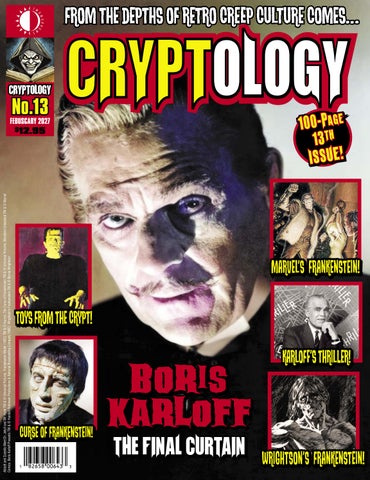
Abbott and Costello Meet Dr. Jekyll and Mr. Hyde TM & © Universal Pictures. Frankenstein Model (1962) TM & © Aurora. The Curse of Frankenstein TM & © Universal Pictures. Monsters Unleashed TM & © Marvel Comics. Boris Karloff Presents TM & © Hubbell Robinson Productions & National Broadcasting Company (NBC). Wrightson’s Frankenstein TM & © Bernie Wrightson
FROM THE DEPTHS OF RETRO CREEP CULTURE COMES…
CRYPTOLOGY
No.13
FEBUSCARY 2027
$12.95
CURSE OF FRANKENSTEIN!
1 0 0 - Pa g e 1 3T H ISSUE!
MARVEL’S FRANKENSTEIN!
TOYS FROM THE CRYPT!
Boris Karloff
the Final curtain KARLOFF’S THRILLER!
WRIGHTSON’S FRANKENSTEIN!
New from TwoMorrows!
COMIC BOOK CREATOR #45 COMIC BOOK CREATOR #47
ALTER EGO #202
ALTER EGO #203
RETROFAN #47
ARCHIE GOODWIN tribute issue, as we talk to friends and colleagues about the editor/writer supreme. Plus, MIKE KALUTA and ELAINE LEE discuss their Starstruck projects, SHAUN CLANCY investigates the life and art of HAL SEEGER (Batfink, Milton the Monster, Leave It to Binky), RICK ALTERGOTT interview Part One, and National Lampoon comics parodies by ADAMS, HEATH, and WINDSOR-SMITH!
It’s LARRY LIEBER—original co-writer of Thor, Ant-Man, and Iron Man, not to mention the Human Torch—as well as writer/artist of Rawhide Kid! One of the most important scripters of the Silver (and Marvel) Ages of Comics gets a full-issue retrospective conducted by JESSE SIMON (JOE SIMON’s grandson), with art by JACK KIRBY, DON HECK, and others. Plus FCA, Mr. Monster’s Comic Crypt, and more!
Golden Age careers of FRANK TEMERSON and RAE HERMAN, featuring Cat-Man and Kitten, Green Hornet, Captains Aero and Fearless, Miss Victory—and awesome art by CHARLES QUINLAN, JACK KIRBY, L.B. COLE, JOE KUBERT, SYD SHORES, BOB POWELL, BERNIE KRIGSTEIN, et al. Plus FCA and Mr. Monster in his Comic Crypt (with MICHAEL T. GILBERT)! Cover by QUINLAN! Edited by ROY THOMAS.
MARK VOGER takes us back to Gilligan’s Island, check out Weird Toys with SCOTT SAAVERDA, take a drive down 77 Sunset Strip with WILL MURRAY, and then from Beautiful Downtown Burbank: it’s LaughIn’s GARY OWENS! Plus a look back at Chariots of the Gods, and its effect on the pop culture we grew up with! Featuring columns by ANDY MANGELS, SCOTT SHAW!, AARON SULTAN and more.
(84-page FULL-COLOR magazine) $10.95 (Digital Edition) $4.99 • Now shipping!
(84-page FULL-COLOR magazine) $10.95 (Digital Edition) $4.99 • Now shipping!
(84-page FULL-COLOR magazine) $10.95 (Digital Edition) $4.99 • Now shipping!
(84-page FULL-COLOR magazine) $10.95 (Digital Edition) $4.99 • Now shipping!
(84-page FULL-COLOR magazine) $10.95 (Digital Edition) $4.99 • Now shipping!
All characters TM & © their respective owners.
GENE COLAN showcase with TOM FIELD, Gene’s 75th birthday celebration from Comic-Con 2001, MARK WHEATLEY spotlights former boss MYRON FASS’ Heavy Metal rip-off GASM, JON B. COOKE’s visit to defunct comics publisher CROSSGEN, CAROL LAY interview, more with JOE HILL, SHAUN CLANCY’s look at HILLMAN PERIODICALS (publisher of Crime Does Not Pay and Airboy), HEMBECK, and more!
RETROFAN #48
TV Bat-Villains actor interviews, Scooby Doo’s canine career, the films of MICHAEL J. FOX, Florida’s strangest attractions, the Oddball World of HUNTER S. THOMPSON, RICK GOLDSCHMIDT with another TV Christmas Special memory, and more topnotch retro-writing by HERBIE J PILATO, ANDY MANGELS, MARK VOGER, WILL MURRAY, DON VAUGHN, and more! Edited by ED CATTO! (84-page FULL-COLOR magazine) $10.95 (Digital Edition) $4.99 • Now shipping!
MARVELMATION
Tribute to NEAL ADAMS, with the best features on Neal from long sold-out issues, including: a tour of Adams’ Continuity Studios! NEAL and DENNY O’NEIL discussing their Green Lantern/Green Arrow work! Adams on the evolution of Ms. Mystic! Plus Superman-centric and Batman-centric interviews with Neal! There’s Adams art galore, including rare and unseen work, all behind an UNUSED 1960s ADAMS COVER! Featuring issues edited by MICHAEL EURY.
(160-page COLOR paperback) $25.95 (Digital Edition) $9.99 • Now shipping!
(100-page FULL-COLOR magazine) $12.95 (Digital Edition) $5.99 • Now shipping!
NEW SUBSCRIPTION RATES Print subs get free digital editions!
2027
BACK ISSUE ANNUAL #1
KIRBY COLLECTOR #98 examines Kirby’s final act in comics & animation (19761994) in a DOUBLE-SIZE BOOK! From his return to Marvel Comics, through his lengthy stint in animation, up to his passing in 1994, MARVELMATION looks at the highs and lows (and inter-office politics) of his 1970s Marvel era, and what led him to THUNDARR, CAPTAIN VICTORY, SILVER STAR, DESTROYER DUCK, SUPER POWERS, and HUNGER DOGS!
ECONOMY US
Poly mailer, backing board
Alter Ego (Four print issues) Back Issue (Eight print issues) Comic Book Creator (Six print issues) Cryptology (Six print issues) Jack Kirby Collector (Four print issues) RetroFan (Six print issues)
$56 $112 $84 $84 $56 $84
PREMIUM US
BACK ISSUE #171
BACK ISSUE #172
THE SHOOTER ERA! Jim Shooter as writer (Secret Wars, Avengers, Star Brand) and comics created during his time as Marvel’s editor in chief (Moonshadow, the death of Phoenix, and Roger Stern’s Spider-Man). Featuring MIKE ZECK, JOHN BEATTY, J.M. DeMATTEIS, JON J. MUTH, CHRIS CLAREMONT, JOHN BYRNE, ROGER STERN, JOHN ROMITA JR., and others. Cover by MIKE ZECK and JOHN BEATTY!
BIG BAD ISSUE! Lex Luthor, Dormammu, Royal Flush Gang, Scorpion, Killer Frost, Juggernaut, and a new feature examining misguided attempts at character creation—our first subject is the Ten-Eyed Man! Featuring ROY THOMAS, STEVE ENGLEHART, GERRY CONWAY, PAUL LEVITZ, RON FRENZ, MARV WOLFMAN, JOHN BYRNE, PAT BRODERICK, and others. Cover by FRANK BRUNNER!
(84-page FULL-COLOR magazine) $10.95 (Digital Edition) $4.99 • Now shipping!
(84-page FULL-COLOR magazine) $10.95 (Digital Edition) $4.99 • Ships Jan. 2027
Rigid mailer
Includes €3 duty
EU/UK
OTHER NON-US
DIGITAL ONLY
$71 $142 $107 $107 $71 $107
$99 $198 $149 $149 $99 $149
$85 $170 $128 $128 $85 $128
$19 $39 $29 $29 $19 $29
TwoMorrows. The Future of Pop History. TwoMorrows Publishing • 10407 Bedfordtown Drive • Raleigh, NC 27614 USA
No duties
No print issue
Phone: 919-449-0344 E-mail: store@twomorrows.com Web: www.twomorrows.com Don’t miss exclusive sales, limited editions, and new releases! Sign up for our mailing list:
https://groups.io/g/twomorrows
Download our NEW Free 2026 Catalog of available books and back issues! https://www.twomorrows.com/media/TwoMorrowsCatalog.pdf
Volume 1, Number 13 Febuscary 2027 EDITOR-IN-CHIEF Peter Normanton PUBLISHER John Morrow DESIGNER Michael Kronenberg EDITORIAL ILLUSTRATION Pete von Sholly COVER Boris Karloff in Abbott and Costello Meet Dr. Jekyll and Mr. Hyde TM & © Universal Pictures SPECIAL THANKS Michael Bonesteel Barry Forshaw Peter Gallagher Phil Guinozzo Heritage Auctions Steve Kronenberg Tim Leese Val Mayerik Will Murray Ryan Vandergriff Don Vaughan Mark Voger Tom Weaver Joshua Winchester The Name of the Game, Thriller TM & © NBC Television • Route 66 TM & © Lancer Productions Limited, Edling Productions, Sony Pictures Television • A Comedy of Terrors, Bikini Beach, Black Sabbath, Curse of the Crimson Altar, Die Monster Die, Ghost in the Invisible Bikini, The Raven, The Terror TM & © American International Pictures • Shindig TM & © ABC Television • How the Grinch Stole Christmas! TM & © Dr. Seuss Enterprises • The Sorcerers TM & © Tigon Films • Mad Monster Party? TM & © Embassy Pictures, Rankin Bass Productions • Targets TM & © Paramount Pictures • A.1. Steak Sauce TV commercial TM & © A.1. Steak Sauce • Fantasmagoriana (1812 edition) TM & © F. Schoell • Frankenstein; Or, The Modern Prometheus (1823 edition) TM & © G & WB Whittaker • Frankenstein; Or, The Modern Prometheus (1831 edition) TM & © Colburn and Bentley • The Rime of the Ancient Mariner (1878 edition) TM & © Harper & Brothers Publishers • Paradise Lost (1827 edition) TM & © Septimus Prowett • Monument du Monstre de Frankenstein TM & © KLAT • Adventures into Fear, Avengers, Creatures on the Loose, Fantastic Four, The Frankenstein Monster, Frankenstein (Book and Plates 1983), The Incredible Hulk, Journey into Mystery, Marvel Tales, Menace, Monsters Unleashed TM & © Marvel Comics • Frankenstein Portfolio 1977, 1978 TM & © Tyrannosaurus Press • Portfolio of Fantasy 1978 TM & © Archival Press Inc. • Frankenstein Portfolio 1980 TM & © Les Editions Du Triton • The Lost Frankenstein Pages TM & © Apple Press • Classic Comics TM & © Gilberton • The Monster Times TM & © The Monster Times Publishing Co. • Eerie TM & © Warren Magazines • Frankenstein (1931), Bride of Frankenstein, House of Frankenstein, Son of Frankenstein, The Wolf Man TM & © Universal Pictures • Frankenstein Poster 1972 TM & © Warren Magazines • Funny Valentines Cards, You’ll Die Laughing Cards TM & © Topps • Zacherle’s Monster Gallery 1963 TM & © Elektra • Growing Up With Monsters: My Times at Universal Studios in Rhymes TM & © Bear ManorMedia. • Dracula’s Greatest Hits 1964 TM & © RCA Victor • Sick TM & © Crestwood Publications • Haunt of Fear, Mad, Vault of Horror TM & © EC Comics • Frankenstein 1910 TM & © Edison Manufacturing Co. • Batman TM & © DC Comics • Frankenstein (1962), Frankenstein's Flivver (1964), Gigantic Frankenstein (1964), Bride of Frankenstein (1965) Models TM & © Aurora • Frankenstein (2026), Toho Frankenstein Models TM & © X-Plus • Frankenstein Model (1997) TM & © Sideshow Collectibles • Frankenstein, The Bride of Frankenstein Models (2000s) TM & © Moebius • Curse of Frankenstein Model TM & © Forbidden Zone • Godzilla TM & © Toho Co. Ltd. • The Beast of Yucca Flats TM & © Cardoza-Francis Productions • The Amazing Colossal Man TM & © American International Pictures • Corridors of Blood, The Haunted Strangler TM & © Amalgamated Productions • The Curse of Frankenstein TM & © Hammer Films • Atomic Thunderbolt TM & © Regor Company • Weird Comics TM & © Fox • Black Cat Mystery TM & © Harvey Comics • Beware TM & © Trojan Magazines • Shocking Mystery Cases TM & © Star Publications
SPILLING MY GUTS: Editorial by the Cryptologist. . . . . . . . . . . . . . . . . . . . . . . . . . . 2 AND NOW THE SCREAMING STARTS!: Letters to the Cryptologist. . . . . . . . . . . . 3 KARLOFF IN THE SIXTIES: Frantic Last Lap for the OG of Monsters . . . . . . . . . . . . 4 With over 40 years onscreen experience Boris Karloff’s career was far from over as a new decade dawned BIRTH OF A MONSTER: The Coming of Mary Shelley’s Frankenstein . . . . . . . . . . . . 12 The scientific and supernatural inspiration behind Mary Shelley’s momentous novel DISSECTING WRIGHTSON’S FRANKENSTEIN: The Definitive Depiction of the Modern Prometheus . . . . . . . . . . . . . . . . . . . . . . . . 18 Bernie Wrightson’s vision defied logic yet became synonymous with one of literature’s most tragic figures FRANKENSTEIN TAKES A BRIDE: The Bride of Frankenstein. . . . . . . . . . . . . . . . . 30 Having set the benchmark for horror in 1931, James Whale returned with a new Gothic masterpiece JACK DAVIS’ FRANKENSTEIN: A Monstrous Caricature. . . . . . . . . . . . . . . . . . . . . 36 Frankenstein’s creation frightened the young Jack to death but he soon found himself drawn in EDISON’S FRANKENSTEIN: The Monster’s Screen Debut . . . . . . . . . . . . . . . . . . . . . 40 Probably the most weird, mystifying, and fascinating scene ever shown on film HOUSE OF FRANKENSTEIN PART 2: Marking 80 Fun and Spooky Years . . . . . . . 44 The fascinating tale behind Universal’s horror extravaganza to end all horror extravaganzas concludes FRANKENSTEIN ASSEMBLY REQUIRED: A Monster Kid’s Dream Come True . . . 56 From Aurora in 1962 to X-Plus in the 21st century, these Frankenstein creations continue to come to life MAN OR MONSTER?: The Legend of the Hulk . . . . . . . . . . . . . . . . . . . . . . . . . . . . 60 Stan Lee and Jack Kirby reminisce on the Universal monsters and the part they played in the origin of the Hulk TERROR ON THE TUBE: Boris Karloff’s Thriller . . . . . . . . . . . . . . . . . . . . . . . . . . . . 68 A sampling of some of Thriller’s creepiest episodes BRINGING THE MONSTER TO A MODERN WORLD: Val Mayerik on Frankenstein. . . . . . . . . . . . . . . . . . . . . . . . . . . . . . . . . . . . . . . . . . . . 74 Val Mayerik recalls his early days with Marvel working on Man-Thing, Monsters Unleashed, and The Frankenstein Monster KILLER B’S: “B” Is for Boris. . . . . . . . . . . . . . . . . . . . . . . . . . . . . . . . . . . . . . . . . . . . . 82 Regular Cryptology department featuring selected horror and sci-fi B-movies HAMMER TIME: The Curse of Frankenstein. . . . . . . . . . . . . . . . . . . . . . . . . . . . . . . 86 Regular Cryptology department featuring selected Hammer Studios films HORROR COMICS EXCESS: The Monster Makers. . . . . . . . . . . . . . . . . . . . . . . . . . 92 A catalog of atrocities from the crime and horror comics of the 1950s CRYPTOLOGY™ issue 13, February 2027 (ISSN 2997-416X) is published bi-monthly by TwoMorrows Publishing, 10407 Bedfordtown Drive, Raleigh, NC 27614, USA. Phone: (919) 449-0344. Periodicals Postage Paid at Raleigh, NC. POSTMASTER: Send address changes to Cryptology, c/o TwoMorrows, 10407 Bedfordtown Drive, Raleigh, NC 27614. Peter Normanton, Editor-in-Chief. John Morrow, Publisher. Editorial Office: CRYPTOLOGY, c/o Peter Normanton, Editor-in-Chief, 619 Whitworth Road, Lower Healey, Rochdale, Lancashire, OL12 0TB, England. Email Peter Normanton: peter.normanton@btinternet.com. Six-issue subscriptions: $84 Economy US, $149 EU/UK, $128 other non-US, $29 Digital. Please send subscription orders and funds to TwoMorrows, NOT to the editorial office. All editorial matter © 2027 TwoMorrows Publishing and Peter Normanton. Printed in China. FIRST PRINTING.
FRANTIC LAST LAP for the OG of MONSTERS by Mark Voger
Bogdanovich, Mario Bava, Roger Corman, Daniel Haller, and Michael Reeves. There was also the matter of the actor’s declining health and mobility. By the end, Karloff had one lung, emphysema, and wore leg braces to offset crippling arthritis. Still, he maintained an unbowed will to practice his craft, even at times from a wheelchair. There he was, joking about “monsters with long hair” on Shindig!... singing in Rankin-Bass animation... meeting the beach party gang in Bikini Beach... wearing drag in The Girl from U.N.C.L.E.... among more serious work. Karloff went to dark places in Bava’s Black Sabbath (1964) as a vampire who preys on his own family, in Reeves’ The Sorcerers (1967) as a destitute senior adrift in a sea of mod youth, and Bogdanovich’s Targets (1968) as a horror star who retires because his movies can no longer compete with the violent contemporary world. The actor’s body of work in 1960s film and television ran the gamut from horror (of course) to comedy, animation, the superspy genre, even a “mondo” movie. And Karloff trotted the globe in pursuit of his art, filming in Italy (twice), England (three times), Spain, and, needless to say, Los Angeles. It was a frantic last lap—as if, having tasted success, he was still determined to outrun that cement truck.
1960–1962
Karloff as a dusty zombie in “The Incredible Doktor Markeson” episode of Thriller (1960–62), which the actor also hosted. © NBC Television
D
uring the 1930s, Boris Karloff graduated from a guy who drove a cement truck between acting gigs, to a bona fide movie star with a nice spread in Coldwater Canyon. This status bump was courtesy of his unforgettable portrayal of the monster in James Whale’s 1931 Frankenstein, which the actor imbued with childish innocence, painful longing, and rage. Karloff—who appeared in about 150 films over a 50-year career—made most of his classics in the Thirties: Frankenstein, The Mummy, The Old Dark House, The Black Cat, The Bride of Frankenstein, Son of Frankenstein. But the actor, born William Henry Pratt (1887–1969) in Dulwich, London, gave some of his most poignant performances during his final decade, when he had a lifetime of movie acting behind him. For one thing, Karloff was a septuagenarian collaborating with younger talent, and the interplay that occurred between generations was palpable. An actor who was directed by oldschoolers Howard Hawks, John Ford, Michael Curtiz, Cecil B. DeMille, and Whale now found himself working with Peter
The actor had been away from the big screen since the lamentable black-&-white Frankenstein 1970 (1958). Around this time, he had been diagnosed with emphysema, and relocated to England with his sixth (and final) wife, Evie. On American television, weird anthology series like One Step Beyond and The Twilight Zone were attracting audiences. Karloff kicked off the decade by signing on as host of NBC’s Thriller, an anthology which upped the actor’s visibility at a fortuitous moment. The horror genre was in the midst of a revitalization due
Peter Lorre, Boris, and Lon Chaney Jr. turned up in Route 66’s Halloween special as their monstrous former selves. TM & © Lancer Prod Ltd, Sony.
cryptology NO. 13 5
Karloff as addled shut-in Baron Von Leppe in Corman’s infamous patch-quilt Gothic horror The Terror. © American International Pictures
debate whether a new horror-themed TV show should focus on contemporary sci-fi or good old-fashioned monsters.
1963
Movie poster for Roger Corman’s The Raven (1962) starring Karloff, Vincent Price, and Peter Lorre. © American International Pictures
to the ongoing Monster Craze, a trend begun in the late Fifties. For two seasons, a genteel, suited Karloff introduced episodes amid snappy jagged-line graphics and a jazzy theme with shrill horns and frenzied bongos. Thriller provided work for Karloff ’s fellow horror players like Henry Daniell (whom Karloff taunted in The Body Snatcher), John Carradine (from whose heart Karloff extracted a wooden stake in House of Frankenstein), and Otto Kruger (who faced the title she-fiend in Dracula’s Daughter). Karloff himself “guest starred” in five episodes of Thriller. The best remembered is “The Incredible Doktor Markesan” (1962), in which he played a rare (for him) zombie. “Markesan” was directed by Robert Florey, who was no stranger to horror; Florey directed Bela Lugosi in Murders in the Rue Morgue (1932), and was once favored by Universal to helm Frankenstein. In 1961, Karloff reprised his Broadway role of Jonathan Brewster—the escapee who “looks like Boris Karloff ”—in Arsenic and Old Lace, on a TV special for Hallmark Hall of Fame. In 1962, the TV series Route 66 presented its Halloween episode, “Lizard’s Leg and Owlet’s Wing.” Imagine, an hour-long prime-time series casting Karloff, Peter Lorre, and Lon Chaney Jr., dressing them up like their old monster characters. (Except for Lorre, who simply wore a top hat and cape. What’d you expect, a reprise of child killer Hans Beckert from Fritz Lang’s 1931 M?) Even better, the three actors played themselves, meeting up to
6
cryptology NO. 13
Karloff ’s return to the big screen after nearly five years was a worthy occasion: American International Pictures’ horror comedy The Raven directed by Corman. This beautifully mounted production teamed Karloff with two of his old comrades-in-horror, Vincent Price and Lorre. Unassuming sorcerer Dr. Craven (Price) has two reasons to confront a competitor, the nefarious Dr. Scarabus (Karloff). For one thing, Scarabus transformed their fellow wizard Dr. Bedlo (Lorre) into a raven. For another, as we saw last issue, Scarabus has apparently lured away Craven’s wife Lenore (Hammer heroine Hazel Court). The whimsical, FX-enhanced duel between Karloff and Price deserves a spot in both actors’ clip reels. The young hero (and improbable son of Lorre) is played by a relatively unknown actor, Jack Nicholson, then 26. Nicholson rejoined Karloff in Corman’s infamous followup, The Terror. “What you see, lieutenant, are the remains of a noble house. Relics... ghosts of past glories,” says addled shut-in Baron Von Leppe (Karloff) to French lieutenant Andre Duvalier (Nicholson), as they stroll through the cavernous castle set from The Raven. The characters were little more than walking cliches. The The movie poster for Corman’s The Terror exploits actors, however, Karloff’s image and name for all they’re worth. © were unwittingly American International Pictures
Birth of a Monster The Coming of Mary Shelley’s Frankenstein by Peter Gallagher
I
t was a dark and stormy night, but then they all were. This was 1816, the infamous “Year Without a Summer,” as Mount Tambora’s eruption the previous year continued to wreak havoc over the northern hemisphere. Strange weather. Cooling temperatures. Crop failures. Famine. Death in the tens, perhaps hundreds of thousands. And, an unusual by-product, the birth of a monster. The date is June 16, the scene Villa Diodati near the shores of Lake Geneva. In an oft told story, superstar poet Lord Byron entertains his guests, up-and-coming fellow poet Percy Bysshe Shelley, his lover Mary Godwin (soon to be Shelley, but to avoid confusion I refer to her throughout by her first name), her stepsister Claire Claremont, and Byron’s personal physician John Polidori. Forced indoors by the “wet, ungenial summer,” the group amused themselves by reading Fantasmagoriana, an anthology of German ghost stories, which inspired Byron to suggest they each write a similar tale of terror. Thus was launched literature’s most legendary writing competition. Claremont and the celebrated poets soon bombed out, although Byron did scratch together something rather
charitably entitled A Fragment. Polidori used this as his springboard to produce The Vampyre (published 1819), the first modern vampire story and a precursor of Bram Stoker’s Dracula (1897). Mary of course trounced them all, expanding her story about “a pale student of the unhallowed arts” and his “hideous phantasm of a man” into Frankenstein. Byron’s literary gauntlet was clearly the catalyst, but what other influences helped birth Mary Shelley’s immortal monster?
Science over the Supernatural
Ghosts may have set the ball rolling, but science was more Mary’s guide than the supernatural. She lived in a time dubbed “The Age of Wonder” by Richard Holmes, the great biographer of the Romantic period. The Montgolfier brothers took to the air. Edward Jenner created the smallpox vaccine. Alessandro Volta developed the electric battery. George Stephenson invented the steam locomotive. James Blundell performed the first successful blood transfusion. As Dr. Pretorius might say, it was “a new world of gods and monsters.” Case in point, Giovani Aldini, a would-be real life
Artist and architect William Purser captured the haunting beauty of Villa Diodati located next to Lake Geneva in Cologny, Switzerland in 1833, some years after Mary Shelley had stayed there in 1816 during “The Year Without a Summer.”
12
cryptology NO. 13
Frankenstein. His uncle was Luigi Galvini, who had used electricity to set disembodied frogs’ legs dancing in the 1790s. At Newgate Prison in 1803, Aldini went a step further, sending electricity coursing through the body of freshly executed murderer George Forster. The Newgate Calendar reports what happened next: “On the first application of the process to the face, the jaws of the deceased criminal began to quiver, and the adjoining muscles were horribly contorted, and one eye was actually opened. In the subsequent part of the process the right hand was raised and clenched, and the legs and thighs were set in motion.” Galvanism was a known topic of discussion at Villa Diodati, and it is perhaps what Victor Frankenstein refers to when he talks of infusing “a spark of being” into his creature. Even more inspirational was Humphrey Davy, a frequent visitor to the home of William Godwin, Mary’s father. In his 1812 pamphlet Elements of Chemical Philosophy, Davy wrote that the new field of chemistry had granted the chemist “powers which may be almost called creative; which have enabled him to modify and change the beings surrounding him, and by his experiments to interrogate nature with power, not simply as a scholar, passive and seeking only to understand her operations, but rather as a master, active with his own instruments.” In other words, Davy was a proponent of interventionist science, i.e., science that actively seeks to change how nature works, as opposed to descriptive science, which settles for analyzing its workings. In Frankenstein, fiction had its first scientific interventionist. Fantasmagoriana, galvanism, Davy. Topics of conversation at rain-washed Diodati that were to influence the writing of Frankenstein. But on July 18, two nights after the ghost story challenge, the fireside talk turned to a subject far closer to home, the eight-day-old baby that haunted Mary’s dreams. Mary and Shelley had their son with them in Geneva, William, born January that year. But their first child was a little girl, Clara, born February 22, 1815, who died just over a week later. The devastated young mother’s journal entry for March 19 reads, “Dream that my little baby came to life again, that it had only been cold & that we rubbed it by the fire & it lived… I awake and find no baby.” Mary never referred to Clara in her diary again, but was she nightly attempting to rub her lost girl back to life? Was Frankenstein a form of wish fulfillment?
The collection of German ghost stories in Fantasmagoriana would inspire both Mary and Lord Byron. TM & © F. Schoell.
Shelley, and Claremont traveled to the Mer de Glace, a valley glacier on the northern slopes of the Mont Blanc massif. In her diary she called it “the most desolate place in the world.” In the novel it is where Frankenstein meets his Creature, and where the latter demands a mate. The Mer de Glace likely also informed the Arctic scenes that bookend Frankenstein, although another source for these could be Mary’s extended stays with the Baxter family outside Dundee, Scotland, in 1812 and 1814. Dundee was then a major whaling port, so it is no leap to imagine tales of whaling ships ploughing the northern seas fascinating the young teenager. In her introduction to the 1831 edition of Frankenstein, Mary acknowledged the impact of her time in Dundee: “It was beneath the trees of the grounds belonging to our house, or on the bleak sides of the woodless mountains near, that my true compositions, the airy flights of my imagination, were born and fostered.” Samuel Taylor Coleridge’s The Rime of the Ancient Mariner is another source for the Arctic scenes, with all its talk of “ice, mast high” that “cracked and growled, roared and howled.” An eight-year-old Mary heard the poet recite his epic at her father’s house, clearly she revisited it while writing Frankenstein as both Victor and Captain Walton make reference to it.
Inspiring Landscapes
Geneva, the city in which Mary conceived her novel, is itself a significant setting in the book. The Frankensteins are Genevese; Victor’s brother William is murdered in the city’s Plainpalais area; and the hotel Victor and Elizabeth stay in on their wedding night is in Cologny, the location of Villa Diodati. In a nice touch, the storm Mary describes when Victor
Desolation
On June 22, the weather improved, allowing Shelley and Byron set off on a weeklong excursion around Lake Geneva, seeking places associated with the philosopher JeanJacques Rousseau. Mary began Frankenstein, and as we shall see, Rousseau would prove to be another inspiration, but for now our attention turns to locations that stimulated Mary’s writing. On July 25, 1816, the budding author,
Sir Humphry Davy’s (above) theorizing would stimulate Mary’s imagining as she scribed Frankenstein; or the Modern Prometheus, later reprinted in 1823. TM & © G & WB Whittaker.
cryptology NO. 13
13
Frankenstein DISSECTING WRIGHTSON’S by Michael Bonesteel
W
hen comics artist Bernie Wrightson (1948–2017) that by the time the artist was finishing Frankenstein he felt it was at his peak during the 1970s and ’80s, he was “silly” and “ridiculous,” “defies all logic,” and he was “sick of took on several of the greatest horror authors it.” Furthermore in that same interview, regarding the The Edgar of the 19th and 20th centuries. He produced Allan Poe Portfolio, his series of oil painting reproductions from masterful renditions of Edgar Allan Poe’s “The Black Cat” 1976 inspired by the author’s short stories, he confessed: “I don’t (Creepy #62, May 1974), and H.P. Lovecraft’s “Cool Air” (Creepy think I’d ever read him again.” Possibly the only horror writer #113, Nov. 1979), then from 1976 to 1983 made it his mission to to gain Wrightson’s unqualified endorsement was Stephen deliver the definitive depiction of Mary Wollstonecraft Shelley’s King, with whom he worked on a comic book adaptation of immortal Frankenstein; or, the Modern Prometheus (1818). Creepshow in 1982, as well as several later undertakings. As for Suffice it to say that no artist has ever, or probably will ever, Lovecraft, Wrightson “had a hard time with the language” and come closer to bringing Shelley’s words to life than Wrightson. found him “a little too ponderous.” Indeed, he imbued that apocryphal phrase “It’s alive!” from Lovecraft, incidentally, was rather complimentary about James Whale’s 1931 Frankenstein Shelley’s Frankenstein in his with new meaning in that his essay on “Supernatural Horror in visual interpretations breathed Literature” (1926–1927): “Some fresh sentience into Shelley’s of the scenes in Frankenstein are saga with so much passion and unforgettable, as when the newly enlivened her prose with such animated monster enters its vitality that it’s unlikely they’ll creator’s room, parts the curtains ever be surpassed. Consequently, of his bed, and gazes at him in any examination of Wrightson’s the yellow moonlight with watery Frankenstein can never be eyes—“if eyes they may be called.” postmortem. It revives on the […] It has the true touch of cosmic page with each renewed viewing. fear…” Wrightson’s impression of As the co-creator of DC that event has never been equalled Comics’ Swamp Thing, as well as and remains one of his most a succession of fabulous covers memorable works of art within and interior pages for House of an already monumental body of Mystery, House of Secrets, and work. He may have burned out The Unexpected, Wrightson is toiling on Frankenstein for so revered today as one of the best many years, but it was more than among the then-emerging crop fitting that Wrightson—arguably of Bronze Age comics artists. the greatest horror comics artist However, for seven years in his of the late 20th century—embrace this seminal mother of all modern free time between regular jobs he science fiction and horror. It was labored over more than seventy his destiny. It was fate. pen-and-ink Frankenstein Brief aside: Is Frankenstein drawings as an unpaid personal science fiction or horror? It’s an project. old debate that will not be resolved Notwithstanding his here, but a few salient quotes accomplishment, it’s sobering might be helpful. Writing in to learn from Gary Groth’s Trillion Year Spree: The History of interview with Wrightson in The Above the Frankenstein in Bed print, “...his eyes, if eyes they may be called, were fixed on me.” TM & © Marvel Comics. Science Fiction (1986), Brian Aldiss Comics Journal #76 (Oct. 1982)
cryptology NO. 13
19
set aside. The first unused illustration takes place in a cemetery with Victor up to his neck in a newly dug grave (without the hint of a hunchbacked Fritz or Igor in sight!) captioned “...with unrelaxed and breathless eagerness, I pursued nature to her hiding places.” In the novel, this quote continues: “Who shall conceive the horrors of my secret toil as I dabbled among the unhallowed damps of the grave […] I collected bones from charnel houses […] The dissecting room and the slaughter-house furnished many of my materials…” A lantern illuminates his graverobbing in the upper quadrant of the composition while an almost impossibly foreshortened stone stairway leads up a hill to the grave-site through a tangle of overgrown foliage occupying the lower three-quarters. The perplexing and the obsessive attention to detail is practically surreal. Even more puzzling is the granite bench in the upper right corner which appears to have a spectral woman’s reclining figure holding a book sculpted into it. It is understandable why this illustration was not used, and yet for all its high strangeness it is no less a masterpiece. In another rejected piece titled, “…I began the creation of a human being,” Victor bends over his patchwork corpse and inexplicably pulls thick strands or cords of something attached to the creature’s torso. It’s a fine drawing of an elaborate laboratory scene (which would substantiate Victor’s use of science), but Wrightson would soon outdo himself on that account in a double-paged horizontal work to be discussed shortly. A third drawing
“Sometimes, on the very brink of certainty, I failed…” appeared in the third portfolio from 1980. TM & © Les Editions Du Triton.
that did make the final cut is called, “To examine the causes of life we must first have recourse to death.” A lantern once again irradiates the space, but this time Victor is holding it over a lifeless corpse. From clerestory windows slanted shafts of light stream down upon the magnificent scene. A sinister statue of a hooded figure overlooks the proceedings, as shadowy entities lurk in the murky recesses of the cathedral-like ceiling overhead. These indistinct beings may be related to the satyrs cavorting within the title page illustration at the very beginning of the novel and the amended version for the frontispiece of his 1977 Frankenstein portfolio— suggesting necromantic and perhaps demonic forces may have been at work as Victor played God. From the very beginning artistic license has played a role in the illustrating of Frankenstein. As we saw a few pages ago, the first portrait of the creature was Theodore von Holst’s frontispiece to the third edition of Frankenstein in 1831, engraved by William Chevalier. Even in this initial interpretation, the artist took liberties with the chamber in which Victor conducted his experiments by including objects not specifically mentioned in the novel, such as a bell jar, chemical flasks, and possibly even a set of Galvanic electrodes. The creature itself is oddly represented with a curiously off-kilter, dislocated head planted on its shoulders. Subsequent iterations appeared, including stage and screen enactments, but it took a full century before a satisfying likeness of the creature would appear and that was, of course, when Universal Pictures’ make-up
cryptology NO. 13
21
WRIGHTSON'S FRANKENSTEIN
A shaft of light penetrates the darkness: “To examine the causes of life we must first have recourse to death.” TM & © Marvel Comics.
FRANKENSTEIN TAKES A BRIDE by Barry Forshaw
30
cryptology NO. 13
I
n the 1930s, perhaps the most celebrated talents in horror cinema—actor Boris Karloff and director James Whale—were at the forefront of the exodus of British acting and directing talent to the USA, creating a specifically English vision in American cinema in their classic adaptations Frankenstein (1931) and The Bride of Frankenstein (1935), the latter with English actress Elsa Lanchester playing Frankenstein’s creator Mary Shelley—as well as the electricallycoiffured bride of the creature. The narrative of Victor Frankenstein’s creation of life has (in the 21st century) lost its shocking power in a secular age, so the notion of a man playing God and creating life no longer has the blasphemous charge that it would have had for Mary Shelley’s original readers. What made the story that Shelley created particularly disturbing was not just the usurping of the creator’s role by a man, but the basic materials utilized by Frankenstein, the gruesome stitched-together remnants of mortuaries. The book’s first appearance in three volumes in 1818 was not at all well received. But tut-tutting moral condemnations of works of art often have a corollary (as true today as it was in the 19th century); they inspire a keen interest in their target audience, hungry for the transgressive and the forbidden.
The British are coming
considered filming Shelley’s novel, with the talented director Robert Florey (later to make the deliriously inventive Beast with Five Fingers) in the frame—long lost screen tests had even been made with Bela Lugosi as the monster in make-up which apparently owed something to the Paul Wegener version of The Golem). But the Florey/Lugosi Frankenstein was not to be—an impeccable Englishman of iconoclastic manner stepped into the frame to create (more than Browning’s Dracula) the first great universal Gothic film with this extremely free adaptation of Shelley’s novel. Whale had made his mark with two muchacclaimed films, a 1930 adaptation of R.C. Sherriff ’s anti-war play Journey’s End and the more workaday Waterloo Bridge (1931, which, significantly, starred Mae Clarke as a prostitute— the director was subsequently to cast her as Frankenstein’s endangered fiancée in his Shelley adaptation).
Gallows humor
James Whale came to America as one of the many European talents early US cinema was beginning to collect (and domesticate); his sophisticated manner (and homosexuality) were regarded as aspects of the “otherness” that distinguished these “exotic” foreign talents from US directors. What was not immediately apparent was his pitch-black sense of comedy. To modern audiences, the opening scenes of Frankenstein (with its outré components: Grave-robbing, a grotesquely scarred hunchback, the driven Frankenstein hiding behind headstones) are now clearly infused with a delicious gallows humor (literally so, when the hunchbacked assistant, Fritz, played by Dwight Frye, cuts down a body from a gibbet). And there is the lovely moment when the disheveled Fritz carefully adjusts his sock before scuttling up a staircase). None of this wry underlay provided by Whale would have been immediately apparent to the film’s original audiences, who would have focused on the macabre atmosphere, and who would never before have seen such scenes so redolent with horror. This judicious balance of irony and dread was new in this nascent genre, demonstrating how Whale was ahead of his time.
Shelly’s cinematic legacy has proved enduring—far more people have seen actors from Karloff to Christopher Lee and beyond incarnating the creature than have ever read the novel. “It’s alive! It’s alive!” gasps the English actor Colin Clive, working himself into a paroxysm over the twitching, scarred body of the patchwork corpse he has reanimated. It’s a seismic moment in several senses, freezing the derisory laughter it might prompt in an age of more subtle performances. An analysis of the English influence on the first important wave of adaptations of Gothic literature in Hollywood in the 1930s is obliged to concentrate on the achievements of the massively influential James Whale, director of the seminal Frankenstein and several key movies of the genre (sometime informed by his irreverent gay sensibility). Later British-made adaptations (e.g. from the Hammer studios) were both reactions to and departures from the earlier films, with certain elements (including copious bloodletting) moved from the periphery to center stage, but Whale (and his cadre of the British talent) set the gold standard. Even before the completion of Bram Stoker’s Dracula, The obsessed Henry Frankenstein foolishly plays with a Universal Studios had science beyond his comprehension. TM & © Universal.
Away from the camera, Jack Pierce took charge as he gave life to the monster. TM & © Universal Pictures.
cryptology NO. 13
31
JACK DAVIS’
FRANKENSTEIN D
by Will Murray
uring the monster craze of the late 1950s that lasted into the 1970s, the work of cartoonist Jack Davis was ubiquitous. His gruesome caricatures could be found on the covers of a wide range of periodicals—monster magazines; satire titles like Mad, Sick, and Cracked; as well as in comic books and on product boxes and posters. Prominent in many of Davis’ classic but comical images was Frankenstein’s monster, depicted in these portrayals as Boris Karloff ’s interpretation wearing the memorable Jack Pierce makeup, often adorned with the heavy bearskin vest Karloff wore in Son of Frankenstein. “I loved Frankenstein,” Davis once admitted. “That scared the hell out of me and I loved that. It was just so great.” His love of Universal’s enduring adaptation showed in his artistic choices. Even in group shots, which included his interpretations of Dracula, the Wolfman, and sundry other cinematic creatures, Frankenstein’s monster was always present and often prominent. Davis drew the concept character sketches for the 1967 Rankin-Bass film, Mad Monster Party?, which included humorous versions of all of the great Universal monsters. Boris Karloff voiced Baron Boris von Frankenstein. It was the last Frankensteinian project the famed actor did, and the only time Davis’ distinctive interpretations were brought to 3-D life. The Frankenstein monster in this film was called “Fang.” But Davis was not merely a fan of the Universal Frankenstein films, he obviously loved Mary Shelley’s original novel. For, contrary to many artistic interpretations which gave the monster grotesque greenish or grayish skin, in keeping with Shelley’s vision, he invariably colored the not-always-gentle giant a faithful yellow. The accompanying gallery of Jack Davis Frankenstein images are a tribute to both the artist and his towering One of Jack’s many sketches of Mary Shelley’s creation. inspiration.
36
cryptology NO. 13
It was every Monster Kid’s dream to own Jack’s whopping six-foot Frankenstein poster. TM & © Warren Magazines.
Jack returned to horror in 1959, picking up many new fans with the You’ll Die Laughing series of cards, on show here are cards #35, 65, and 19. TM & © Topps.
Zacherle’s Monster Gallery record first appeared in 1963, but for some inexplicable reason never hit the charts. TM & © Elektra. This didn’t stop Jack from continuing to caricature more of Universal’s creations.
Carla Laemmle’s reminisce Growing Up With Monsters: My Times at Universal Studios in Rhymes saw Jack team up with Hermann Mejia. TM & © Bear Manor Media.
cryptology NO. 13
37
PART 2
Marks 80 Fun and Spooky Years by Ryan Vandergriff 44
cryptology NO. 13
Frankenstein’s creation (Glenn Strange) was soon to find himself a victim of the machinations of the nefarious Dr. Niemann. TM & © Universal Pictures.
dignified Universal continuity not afforded to poor Count Dracula.
What Could Possibly Go Wrong?
Quickly thawing the two bruisers from their icy tombs (what could possibly go wrong, right?) Niemann strikes up a deal with the now very human Larry Talbot. Brushing off the whole “deals with the devil” bit as a lot of bunk, Talbot and the doctor strike up an agreement which will see his newfound benefactor swap his brain into a normal body free of any werewolf curse in exchange for helping him locate the fabled lost notes of Dr. Frankenstein. Not wanting to be left high and dry and now very much in love with Ilonka, who herself has become moony towards poor Larry, Daniel implores Niemann to transfer his brain into that of Talbot’s body. Love triangles rarely get more strange than the one conceived for House of Frankenstein, that’s for sure. And at the center of this “perfect storm” is none other than the “Mad Doctor” himself, Dr. Gustav Niemann, who wants nothing less than unleashing the Monster for the sake of revenge. Strange bedfellows necessity makes, at least in a 1944 monster movie. The Mad Doctor devises a plan to kidnap those who he feels have wronged him in the past. The ultimate goal? To take the brains of his enemies then place them into the bodies of the Monster and the Wolf Man, thus dooming them to a tragic existence. Niemann is successful, in part, thanks to the help from love-struck Daniel who has already attempted to warn
46
cryptology NO. 13
off Ilonka from Larry Talbot by revealing the doomed man’s werewolf curse. Things go from bad to worse when the full moon precipitates the Wolf Man’s reappearance, resulting in a death and, as is tradition by this time, sending the nearby townspeople into fits of apoplexy, torches, pitchforks, and all. House of Frankenstein reaches its tragic, if not inevitable, conclusion when Ilonka shoots and kills the Wolf Man, but not before she is mortally wounded, adding an underline to the old bromide of “love hurts.” Meanwhile, with the death of Ilonka, Daniel loses what’s left of his marbles and attacks Niemann, blaming him for his proposed paramour’s death. A revived Monster comes to the doctor’s defense, throwing the hunchback out of a window before carrying Niemann towards the marshes, the irate villagers hot on their heels. Before the townsfolk can get their own hands dirty, a conveniently placed swath of quicksand makes quick work of the tragic Monster and Dr. Niemann, swallowing them both, seemingly destroying Frankenstein’s cursed legacy once and for all. Now came the time to cast what was an ambitious movie saddled with a bargain-basement budget.
Passing the Torch
Universal’s big coup was Boris Karloff, who much to their delight had returned to the studio which had helped make him into a star (and who, in turn, gave the studio some of their highest grossing pictures during his tenure as the Frankenstein Monster)
FRANKENSTEIN ASSEMBLY REQUIRED by Phil Guinozzo
I
n January of 1962, the lives of all Monster Kids were irreversibly and forever changed. The good folks from the Aurora Plastics Corporation attended the annual HIAA (Hobby Industry Association of America) Convention in Chicago. There, they displayed their latest model kits for the approval of potential distributors. In a move that was considered daring by the hobby industry, Aurora unveiled their latest creation: The Frankenstein Monster! Standing ten inches tall in all of his glory, the Monster lurched forward on his creator’s grave, arms outstretched in an effort to seize his next terrified victim! The distributors attending the expo were not impressed. It wasn’t until the last day of the event when the industry participants were encouraged to bring their families that an unexpected twist occurred: A couple of kids, who could have chosen from any number of cool toys, were irresistibly drawn to the Frankenstein kit. They were Fred and Glenn Davis, the sons of Chicago distributor Al Davis. Stunned by this, a duo of distributors from California placed a couple of orders for the kits, and the rest is history. The first monster model was born, and just like Victor Frankenstein’s patchwork creation, assembly was required! The Aurora Frankenstein model, featuring the likeness of Boris Karloff from The Bride of Frankenstein (1935), was originally released in the classic “long box” and molded in gray plastic. The box art was painted by the renowned American artist James Bama, already famous for his depictions of the old West and Native American culture. In 1969, it was reissued in Aurora’s Frightening Lightning series featuring separate glow-in-the-dark pieces. Also packaged in the “long box,” Bama’s box art was modified to showcase the glow parts. Later that same year, the “square box” was released, and by 1972, gone was the Frightening Lightning insignia, replaced by a circular green “Glows in the Dark” emblem. Over the years, the iconic Aurora Frankenstein kit was reissued multiple times by Monogram (molded in translucent orange plastic under the Luminators label), Revell, and Polar Lights.
Dutiful Monster Kid
Back in ’72, when I first purchased the Aurora Frankenstein model, there was an insert included
56
cryptology NO. 13
In skilled hands, 1962’s Aurora Frankenstein kit and the Bride of Frankenstein from 1965, could be transformed into these striking creations. TM & © Aurora.
in the box, a coupon that enabled me to send away for a free copy of Famous Monsters of Filmland magazine. I was nine years old at the time, and had never heard of such a publication. Like the dutiful Monster Kid that I was (and Both issued in 1964, the Gigantic Frankenstein model was the still am!), I gambled a stamp, perfect Christmas present, while the hot rod-styled Frankenstein and 4–6 weeks later I received Flivver kit was an unusual entry in this series. TM & © Aurora. my very first issue of the iconic scale, and included two sets of legs and movable arms. It periodical, but that’s fodder for was molded once again in gray plastic and fitted nicely another article! on the operating table from The Pain Parlor kit. Aurora wasn’t finished with Frankenstein; Aurora’s fourth outing with the Frankenstein Monster there was still plenty of mileage left to go with was part of their Monsters of the Mary Shelley’s literary character. Movies series at 1/12 scale in 1975. 1964 saw the initial release of This kit featured Frankenstein in Aurora’s Gigantic Frankenstein an action pose, snarling with one kit, affectionately known as “Big foot on a rock and brandishing a Frankie.” Standing almost two feet wooden club, poised to attack a high and with movable arms, this lynch mob of angry villagers. This kit was a cartoonish caricature of kit was molded in black plastic and the Karloff image, chained by the originally included “Glow in the neck to a large slab of tombstone. Dark Features.” This was Aurora’s largest model kit It’s only fair to include Aurora’s and sold for the unheard of price of Bride of Frankenstein kit from $4.98! Again, James Bama painted 1965, featuring the likeness of Elsa the box art. The plastic was molded Lanchester bound upon an operating in several colors, including black, table, the base adorned with copper, and both light and dark electrical and chemistry equipment. gray. This kit also included three This kit was 1/11 scale, molded in small bottles of paint, red, blue and gray plastic and with box art by yellow. As an interesting factoid, James Bama. When later reissued the Gigantic Frankenstein kit was by Polar Lights, clear plastic for the originally conceived as a toy figure, When Aurora released their “Glows in the Dark” the Frankenstein laboratory glassware was added. not a model kit, by Marvin Glass, monster just had to be there. TM & © Aurora. No one can accuse Aurora of not creator of the popular children’s having a sense of humor, as made game Mouse Trap. evident by their Monstermobile series from 1964. Frankenstein’s Aurora’s third excursion into the Frankenstein Monster Flivver, a hot rod car kit driven by our favorite flat-top monster was as a character for their now-infamous Monster Scenes was a 1/12 scale kit, also molded in gray plastic and later reissued series of model kits from 1971. These kits were intended to be by Polar Lights. Ever the multi-tasker, Frankenstein drives while played with, and the bases fit simultaneously playing with a yo-yo! Once again, James together to form a delightful Bama created the box art. horror diorama. Upon the boxes read, “Mix ’Em and In 1971 Frankenstein formed part of the Match ’Em… Rated X… Monster Scenes before making it to the Monsters of the Movies. TM & © Aurora. For Excitement.” In the Monster Scenes Universe, the Frankenstein Monster was created by Dr. Deadly who, along with the sadistic assistance of Vampirella, used Frankenstein to kidnap The Victim to be tortured in such accessory kits as The Pendulum and The Hanging Cage. The Monster Scenes Frankenstein model was a snap-together kit, 1/13
cryptology NO. 13
57
THE LEGEND OF the
T
MAN OR MONSTER? by Will Murray
he Incredible Hulk was born in the early 1960s in the pages of his own Marvel Comics magazine. He was a creature of the Atomic Age, a time when nuclear-bomb tests were routinely conducted. But his roots reached back before that to a more innocent era. An era of monsters.
According to his creators, writer/editor Stan Lee and artist Jack Kirby, the Hulk was inspired by their childhood memories of watching the classic horror movies of the 1930s, principally Universal’s production of Frankenstein and Paramount’s Dr. Jekyll and Mr. Hyde, starring Fredric March, both released in 1931.
Stan Lee and Jack Kirby’s Jekyll and Hyde creation, the Incredible Hulk, exploded onto the comic book scene in the early months of 1962 in his own short-lived title, with Jack Kirby providing more than a helping hand. TM & © Marvel Comics.
60
cryptology NO. 13
“When I developed Hulk,” Lee once recounted, “what I was thinking of was Dr. Jekyll and Mr. Hyde, and the Frankenstein movie. In Frankenstein, I always thought the monster was the good guy—my sympathies were with him rather than with the nutty mob chasing him around with torches. So I always thought there’d be a lot of pathos in a good monster, who looked horrible and who everybody thought was a menace, despite his being good on the inside. But not to be too much like Frankenstein, I threw in the Jekyll and Hyde angle—Banner changes into the monster.”
To the comic-mad kids of 1962 the Hulk was something new, but his origins date back to Frankenstein (1931, TM & © Universal Pictures) as well as Dr. Jekyll and Mr. Hyde (1931, TM & © Paramount Pictures).
emerges. And the hunt for the Hulk resumes. Like Frankenstein’s monster, he was persecuted for simply being different.
Hybrids
The hybrid concept was not something Lee and Kirby dredged up from their shared Depression-era childhoods of Atomic Genesis Saturday matinee showings. Starting in the late 1950s, the old Although they often disagreed about who created which Universal monster movies were being rerun on the new medium characters, both men were on the same page as far as the genesis of television. Baby Boomers were entranced by them. In 1961, of the Hulk was concerned. His roots were in horror. The the Aurora Plastics Company released their Frankenstein Atomic Age was simply the setting. model kit, based on the Boris Karloff film with Jack Pierce’s In his debut issue, cover-dated May 1962, physicist Dr. Bruce brutish makeup and design. It sold phenomenally. As we saw in Banner is caught in the blast of his own Gamma-bomb, when he Cryptology #7, other Universal-inspired monster kits followed. rushes from a protective bunker to rescue a teenager, Rick Jones, Monsters were immensely popular in that era. Film studios who unwittingly drives onto the New Mexico test site. were producing a new generation of fantastic features like Pushing the boy into a ditch, Banner has no time to jump Godzilla and Gorgo. in after him and The creative writer/ is subjected to an artist pair produced intense burst of new creatures in the gamma radiation pages of Strange Tales, when detonation Tales to Astonish and occurs. Initially, the other Marvel titles scientist seems to be every month. suffering from no “To affect a more than shock, but change, ” Kirby that night he sets off explained, “I a geiger counter and combined monsters transforms into a with human brutish but confused characteristics. They monster who goes became a part of the on a destructive human way of life, rampage. and in doing so, the With the dawn, monsters became the creature the acceptable to man. An military dubs the evolution of monster Hulk has turned back and man took place.” to a bewildered Bruce Lee had recently Banner. But with each The Hulk’s origin (TM & © Marvel Comics) placed him alongside Godzilla (TM & © Toho Co. Ltd.) as started The Fantastic sunset, the Hulk reanother of this generation’s atomic monsters, but he was so much more than that.
cryptology NO. 13
61
When Steve Ditko inked Jack Kirby’s cover and story pages for The Incredible Hulk #2 (July 1962), Bruce Banner’s monstrous alter ego was revealed as the unsung hero. TM & © Marvel Comics.
Four with Jack Kirby. One of the heroic quartet was astronaut Ben Grimm, whom cosmic rays had permanently mutated into an orange dinosaur-skinned man-monster call the Thing.
Less Than Perfect
whom the whole human race is always trying to hunt and destroy, but he’s really a good guy. Then, to give it an extra degree of interest, I figured instead of just a monster, we’ll borrow a concept from Jekyll and Hyde and let it be a man who turns into a monster unwillingly, who must spend his life trying to cure himself of his rather unique affliction. “It wasn’t Dr. Frankenstein who was the hero to me. I can hardly remember him now. But the monster, Boris Karloff, he’s the one who turned me on! “I knew I was onto something. I decided to create a monster, and to make him the hero. But he couldn’t just be all bad. There had to be a twist, some reason for the reader to like him, to sympathize with him, to want him to triumph. And that’s when something else I remembered from the past came in handy. “That something else was Dr. Jekyll and Mr. Hyde. Remember the story? The good doctor can’t stop himself from turning into the monstrous Mr. Hyde. It was the gimmick I needed.” “He was patterned visually on Frankenstein, and his mood swings were supposed to be like Dr. Jekyll and Mr. Hyde,” seconded Kirby. “We wanted to illustrate that this was a human being who, by no fault of his own, had developed super-human characteristics. He wasn’t an old-time villain.” “We would use the concept of the Frankenstein monster, but update it,” Stan Lee elaborated. “Our hero would be a scientist, transformed into a raging behemoth by a nuclear accident. And—since I was willing to borrow from Frankenstein, I decided I might as well borrow from Dr. Jekyll and Mr. Hyde as well—our protagonist would constantly change from his normal identity to his super-human alter-ego and back.”
“It was patently apparent that the Thing was the most popular character in the Fantastic Four,” remembered Lee, “and quite possibly in the entire comic book field. Not only did the readers like him best, but he grabbed me, too. For a long time I’d been aware of the fact that people were more likely to favor someone who was less than perfect—someone with feet of clay with whom they could identify. It’s a safe bet that you remember Quasimodo, but how easily can you name any of the heroic, handsomer, more glamorous characters in The Hunchback of Notre Dame? The more I dwelled upon the Thing’s popularity, the more I realized that everyone likes a mixed-up, misunderstood monster-type marauder, so long as we know that beneath the grotesque surface there beats a heart as noble and pure as a driven comic-book creator! “With the Hulk,” continued Lee, “I just wanted to create a lovable monster—almost like the Thing, but more so. I always loved Dr. Jekyll and Mr. Hyde, and I always loved the Frankenstein monster. I always felt the Frankenstein monster was really the good guy. I’m talking about the movie, not Mary Shelley’s story. In the movie, Frankenstein’s monster didn’t really want to hurt anybody. He just wanted to be left alone, and everybody was hounding him and hunting him… those idiot policemen always chasing him with those torches. Fantastic Four #3 (March 1962) was an instant hit “I figured, why don’t we create a monster with comic book readers. TM & © Marvel Comics.
62
cryptology NO. 13
Misunderstood
“The Hulk was misunderstood by people,” agreed Kirby. “He was a schizophrenic. I was updating Dr. Jekyll and Mr. Hyde. Bruce Banner was a physicist. He was no longer a doctor.” “I thought it might give me more story flexibility if he could change back and forth, in and out of monster mode,” added Lee. “Why couldn’t a monster have a secret identity?” Secret identity was a stretch. Whenever Banner transformed, the Hulk couldn’t control his own strength and forgot his human identity completely. “The Hulk was Frankenstein,” Kirby insisted. “Frankenstein can rip up the place, and the Hulk could never remember who he formerly was.” Kirby was alluding to the fact that Frankenstein’s monster was assembled from corpse parts and then given a diseased brain that did not originally reside in his skull
TERROR ON THE TUBE Boris Karloff’s
“I
by Steve Kronenberg
think the title leaves the series wide open to be based on melodrama, not violence or shock. They’ll be stories about people in ordinary surroundings, and something happens to them.” That was how Boris Karloff described his new NBC anthology series Thriller just before its debut on September 11, 1960. At that time, Karloff was riding high. His vintage horror films had found a new audience among TVaddicted Baby Boomers and his face (with and without makeup) adorned the many monster magazines that flooded newsstands and hobby shops. With television fueling American pop culture, it only made sense for horror’s most ubiquitous hero to host a weekly collection of small screen scarefests. As a TV emcee, Karloff was preceded by Alfred Hitchcock, whose Alfred Hitchcock Presents appeared on both NBC and CBS. Hitchcock also directed a few of his series’ episodes; likewise, Thriller offered Karloff the opportunity to introduce each story and star in a handful of them. When Thriller premiered, those who worshiped Karloff
68
cryptology NO. 13
were “thrilled” with the show’s potential as a showcase for televised Gothic horror. But things got off to a shaky start. Under producer Fletcher Markle, the early episodes focused on espionage and noirish crime dramas, a bad fit for Karloff ’s status as horror’s premier bogeyman. Ratings and critical response took a nosedive, so executive producer Hubbell Robinson ordered some changes. Markle was quickly replaced by Maxwell Shane, who continued cranking out crime stories until he, too, was supplanted by veteran producer William Frye. Frye knew what Karloff fans really wanted, and he delivered. In Monsters from the Vault #33 (2014), Tom Weaver interviewed Jo Swerling Jr., who coordinated deals with the show’s writers, kept an eye on the series’ $100,000-per-episode budget, and wrote all of Karloff ’s ominous introductions for each installment (the interview is now contained in Weaver’s book Creature Feature Creators: Conversations With Genre Greats of the 1940s–1970s [McFarland, 2025].) Swerling remembered that both Revue-Universal Studios and NBC “were
extremely unhappy with the show because Karloff wasn’t... Karloff.” Markle had him “...acting like a professional kind of nice chap... If you’re gonna hire Boris Karloff, you should use him like Boris Karloff and not like a professor!” “We’ve got Boris Karloff,” Frye said. “We can’t do the Frankenstein Monster, but we certainly can do that kind of material.” He and associate producer Doug Benton knew that the show needed to be juiced with some Gothic Grand Guignol, and Benton had an idea. He arranged to purchase an entire run of the legendary horror pulp Weird Tales from Famous Monsters of Filmland editor Forrest J Ackerman. Ackerman agreed to the deal, with the understanding that Benton would re-sell the collection back to him at a premium. When the boxed pulps were delivered to Universal’s Revue Studios, Frye wondered what they were. “That’s Thriller!” Benton replied. Indeed, the show’s most macabre entries were pulled from the pulpy pages of Weird Tales. Frye, Benton, and Swerling turned Thriller on its head, and horror became its metier, which included a drastic change in Karloff ’s appearance for his prologues to each show. “We darkened his hair,” recalled Swerling, “and made him behave much more ominously. Act more like Boris Karloff.”
Charged with composing Karloff ’s intros for each Thriller segment, Swerling was inspired by James Allardice, who wrote the preambles spoken by Alfred Hitchcock for the director’s own anthology series (it was Swerling who created Boris’ tagline for the show: “As sure as my name is Boris Karloff, this is a Thriller!”) Swerling also served as Karloff ’s concierge, escorting him to and from the studio when he’d fly in to Hollywood from his London home to record a lead-in or star in a Thriller episode. Karloff ’s stateside sojourns would last two or three weeks, with he and Swerling recording about three intros a day. “I was responsible for Boris as well as the introductions,” Swerling said. In an interview with Tom Weaver published in Weaver’s book Monsters, Mutants, and Heavenly Creatures (Midnight Marquee Press, 1996), Benton recalled poring through each issue of Weird Tales before he and Frye would select the right stories for adaptation. “We started tracking down the writers and getting the rights to the stories,” Benton told Weaver. “We were paying, I don’t know, $1250, $1500 for the rights to the stories—about three to five times what writers like August Derleth got when his work was first published.” He and Frye conscripted notable writers and directors like Donald S. Sanford, Robert Bloch, John Brahm, Ida Lupino, Robert Florey, Herschel Daugherty, and John Newland, all of whom enjoyed working on Thriller. But no one enjoyed it more than Boris Karloff. “Boris, I’ve never seen you without a smile on your face!” Benton once told him. “Dear boy, I’m 75 years old,” Karloff responded, “and I love what I’m doing! It’s Heaven! Heaven!” (Karloff confided to Benton his fear that his lisp would destroy his movie career with the advent of sound. Little did Boris know!) Benton also recalled the harness Karloff wore to straighten his severely impaired back and leg. “It had a big elastic band that went down around his instep,” he told Weaver. “That rubber band kept the pants leg straight and people couldn’t see the
With the interest in his old horror movies and the debut of Thriller in Sept. 1960, Boris Karloff was riding the crest of a wave. TM & © NBC Television.
NBC went to town in publicizing their new series and its celebrated host, who was firmly back in demand. TM & © NBC Television.
cryptology NO. 13
69
Bringing the Monster to a Modern World by Joshua Winchester
Val Mayerik on Frankenstein
A
Years after the comic book’s demise, Val returned to embellish the Frankenstein creation. TM & © Marvel.
74
cryptology NO. 13
s we learned earlier in this issue, when Mary Shelley first penned Frankenstein; or, the Modern Prometheus in 1816, it was at the suggestion of Lord Byron to see who could come up with the most chilling ghost story. How could she or Byron have predicated that upon its publication in 1818, its popularity would soar to the point where both Victor Frankenstein and his Monster would become household names, to be adapted for various forms of media destined to reach an ever-expanding audience? One of those adaptations came in the pages of a comic book. While the Monster has been bounced around in comics since the 1940s, one of the more interesting and, dare I say, intriguing portrayals came about in the mid-1970s at Marvel Comics. The venerated House of Ideas, known for its stirring superhero stories, was taking the plunge into the horror genre, having already made waves with such characters as the Werewolf by Night, Dracula, and Man-Thing a few years earlier. Val Mayerik, an artist who is best known as the co-creator of Howard the Duck, worked on the Marvel Frankenstein series for the later issues of its run, putting his artistic brilliance to the Monster and the world around it. I was fortunate to have the opportunity to speak with Val about how he got his start in comics, his time at Marvel leading up to and during the work on The Frankenstein Monster, as well as his thoughts on the impact of the novel and a few of his favorite movie adaptations.
Josh Winchester: How did you first get into comics, and were there any specific books or creators who helped light the spark that led to your working in the industry? Val Mayerik: Well, my first inspiration in comics were artists, a lot of the Spanish artists that worked for the Warren publications, Creepy and Eerie. I love that black-&-white line work, and in fact, early on, I tried to emulate it. I was living in Youngstown, Ohio and wondering about my future, because I was an art major in a useless art department. It was a pathetic, wretched art department, and getting a degree there would have amounted to nothing. I discovered through the grapevine, actually, a woman in my painting class who lived in East Liverpool, Ohio at the time Dan Adkins was living there. Dan Adkins being the inker, penciler, etc, who did a lot of work at DC and Marvel. So I went down to see him with my portfolio, and began working with him in his studio. Craig Russell was also working there with him. Craig lived in a smaller town near East Liverpool, and he was looking to get into comics as well. We worked with Dan for a few months, and he then submitted our work to Roy Thomas. We took a Greyhound bus to New York and went to the Marvel offices, and we were in, that was it.
was certainly a way to learn the craft, if nothing else. And Dan kind of wanted to repeat that, although he couldn’t do it on the skill level that Wally Wood did.
JW: Dan gets you in the door at Marvel, and you’re bouncing around. I’ve read a little bit about your work, but I’d love to hear from your perspective, what was it like being there working at Marvel at that point in time when the industry was taking another shift from what it was in the 1960s, when guys like Steve Ditko and Jack Kirby were around, into the newer development of the 1970s. VM: Well, I wasn’t living in New York yet at the time; I was freelancing from Ohio. When I did move to New York, I did get up to the offices a little more often. This was definitely a time of change, a change of direction and transition. But it wasn’t an upheaval, with people worried, “Oh my gosh, a Thongor’s appearance in Creatures on the Loose #22, change is upon us.” It was more like, showcased some of Val’s earliest work. TM & © Marvel. “Oh, there’s some new stuff happening. And there’s this Barry Smith guy, and then there’s, Mike Kaluta and Bernie Wrightson. And they’re doing some really interesting work,” and they were. Because of the quality of the work, they were welcomed. Roy Thomas championed Barry Smith, and DC Comics did the best they could to promote Bernie’s work, JW: That is so amazing, and I and rightfully so. Those guys appreciate the fact Dan did that were very talented. for you guys, advocating for Craig and I felt like we were you at a point where you were part of this, but I didn’t feel looking to break into comics. any indication I was supposed Even at that point in the to follow a particular protocol history of the industry, there these guys were doing, you wasn’t as much quote, unquote, know, and ask for a specific formalized structure as there kind of work. I was just asking is by today’s standards. That’s for the kind of work that I really wonderful. wanted to do. Ultimately I VM: Yeah. I don’t know how wanted to do Conan. But when people get the attention of Barry Smith left Conan, and publishers these days. Dan John Buscema took over, I actually had been an assistant realized I wasn’t in a position for Wally Wood in Wally Wood’s yet to compete with Buscema. studio, so, yeah, you’re right. So that was the end of that. There was a structure, but not So that’s why I think Roy necessarily a structured protocol gave me “Thongor.” So I did in which one would get into “Thongor” for a while. What it comics. However, being the came down to is I really had no When Thongor was no more, Val was the ideal choice as the artist for Manassistant to an established artist interest in super-heroes. Right Thing beginning with Adventures into Fear #13 (Apr. 1973). TM & © Marvel.
cryptology NO. 13
75
JW: You and Steve Gerber, you’re working together on “Man-Thing.” And then six issues later, you guys introduce Howard the Duck. So who came up with the idea of Howard first? You did the illustrations and Gerber was the script man. But it had to have been more like a Stan and Jack situation, right? Or like a Stan and Steve situation in terms of, like sitting down and coming up with the idea of, hey, let’s create a duck to run around with Man-Thing. Let’s call him Howard, and he’s going to be a chain smoking guy in a suit jacket. VM: Even that description is excessive to compare, and Steve had very little to say. Man-Thing had this ability to open up portals into other dimensions. He had some, some sort of psycho-dynamic capability for doing that. And this portal was open in which creatures and beings from other planets, other dimensions, other times, came forward. There was a Gandalf kind of a magician guy. There was a Red Sonja kind of barbarian babe type. There was another barbarian warrior who was kind of Conan-like, and Steve would describe who these guys were, pretty much, only to the extent that I just did. And he said, there’s also a duck. He’s a walking, talking duck. It’s not like, “Don’t draw Donald Duck,” but make it look like something if you walk down the street you wouldn’t see a duck that looked exactly like a duck that you would see on a farm. He would have human qualities, some humanlike features or exaggerated features and that’s all he said. He did say he’d have a little suit coat on, or a little jacket. Something that made it look like he was behaving in a more human realm. And that’s all he said. Really, it was just a couple of sentences in Steve’s plot, because back in those days, Marvel did the Marvel style: we set up a plot, three or four pages, and there were no panel breakdowns. The first iteration of the duck that I drew is the one Marvel okayed, and that remained pretty much the All it took was a couple of sentences in Steve Gerber’s script then Howard the Duck came standard for forever. Today that would take ten meetings to be in the pages of Adventures into Fear #19 (December 1973). TM & © Marvel Comics. of who knows how many groups of people discussing now comic books are completely identified with super-heroes, whether Howard was a politically correct character or and the super-heroes have now taken over the movie screen and whatever. Back then Steve described it, I drew it, and that was the TV screen. Back then, super-heroes were just a comic book the end of that. And it was published. fancy. They weren’t seriously considered at all in terms of literary entities. And I had no interest in super-heroes. But again, like I JW: And the rest, as they say, is history, and it’s some pretty said, I was really impressed with some of the line work and the fantastic history. So you’re working with Steve on “Manreally nice work that a lot of the European artists were doing for Thing” and you guys create Howard. How on earth did the Warren publications. That’s really where I wanted to be. you go from working with Steve to end up working on The JW: Although we are here to focus on your time on The Frankenstein Monster series, you did the Thongor book, and then you started working on “Man-Thing” for Adventure into Fear, taking over the artwork in issue #13. That was April of 1973 so Man-Thing had already been around for a little bit at this point. How did you get attached to working on the ManThing book? Because one leads to the other. In this case, from my understanding, it’s like a sequence of events. VM: Yeah, I don’t really recall. I wasn’t looking to work on “ManThing.” “Thongor” was cancelled, and I wanted to keep busy. I guess it was Roy who suggested I go on to “Man-Thing,” which is when Steve Gerber was writing it.
76
cryptology NO. 13
Frankenstein Monster series? Because by the time you were attached to that book with issue #13, it had already been out for a while. VM: You have to understand that comic books did not have the so-called cultural significance then that they have now. So had I known that this stuff was going to occur, where there would be huge comic book conventions and movies and so forth, adaptations of characters, I probably would have taken notes and remembered all of what went on. But if memory serves me correctly, I think I was in New York, but I still wasn’t living there, I was going to the offices to turn in some work and see what was going on. There I met Doug Moench at the Marvel offices, and he and I hit it off.
2027
TwoMorrows News Today DON NEWTON: DRAWING WITH POWER
• TwoMorrows now co-publishes HOGAN’S ALLEY (but order only through comics shops, not direct)! • ALTER EGO is now quarterly, while ROY THOMAS finishes writing his autobiography series!
All characters and properties TM & © their respective owners.
DON NEWTON got his start on the Phantom at Charlton Comics before making his mark at DC Comics on Aquaman, the New Gods, Batman, and the Shazam! comic in 1978, featuring his childhood favorite character Captain Marvel. His love of bodybuilding brought a knowledge of human anatomy to the strips he drew, imbuing his characters with a sense of strength and dynamism few could match. But his death in 1984 at just 49 years old, tragically cut short an artistic career that was yet to reach its peak. Now for the first time, this COLOR HARDCOVER pays tribute to the Bronze Age fanfavorite artist. Written by JAY WILLSON and CHRIS IRVING, it includes a comprehensive overview of Newton’s life and career, personal anecdotes and tributes, plus private photos and a wealth of unseen work by the artist. With a new cover collaboration by DON NEWTON and JOE RUBINSTEIN! (160-page COLOR HARDCOVER) $37.95 (Digital Edition) $13.99 • SHIPS APRIL 2027
COMIC BOOK CREATOR #52: INSIDE THE MIGHTY MARVEL BULLPEN
Our third annual double-size issue goes inside the mighty Marvel Bullpen, courtesy of LES DANIELS’ uncut interviews from his 1992 book Marvel: Five Fabulous Decades Of The World’s Greatest Comics. It features STAN LEE, ROY THOMAS, ARCHIE GOODWIN, GERRY CONWAY, LEN WEIN, JIM SHOOTER, MARK GRUENWALD, TOM DeFALCO, LOUISE SIMONSON, JIM SALICRUP, STEVE GERBER, CHRIS CLAREMONT, JOHN ROMITA, JOHN BUSCEMA, DON HECK, GENE COLAN, WALTER SIMONSON, TODD McFARLANE, JOE SIMON and more! Plus Les discusses THE MAD PECK and the real reason his Marvel history book was published! And of course, HEMBECK! (160-page COLOR SOFTCOVER) $26.95 • (Digital Edition) $9.99 • SHIPS OCT. 2027 (counts as two subscription issues)
LIMITED HARDCOVER
ONLY 300 COPIES! THE JACK KIRBY COLLECTOR #98 examines Kirby’s final act in comics & animation (1976–1994), now in a double-size LIMITED HARDCOVER EDITION, from his return to Marvel Comics, through his lengthy stint in animation, up to his passing in 1994! (160-page COLOR HARDCOVER) $36.95 (Digital Edition) $14.99 • Now shipping!
the impact JACK KIRBY made as a storyteller, artist, and human being. Coinciding with JACK KIRBY COLLECTOR #100, JON B. COOKE and JOHN MORROW discuss the meaning of Kirby and his legacy! Also: BRENDAN McCARTHY on early work with BRETT EWINS and PETER MILLIGAN, ’Mazing Man discussion with STEPHEN DeSTEFANO and BOB ROZAKIS, and more!
conducts a career-spanning interview, including his work as editor of Amazing Heroes, DC editor and fan-favorite scripter on The Flash, Captain America, Kingdom Come with artist ALEX ROSS, and more! Plus, the history of FANTACO, Wimmen’s Comix’s BECKY WILSON, the never-published JOE KUBERT-edited Savage World, PAT OLLIFFE, and more!
EEDEN on early work at DC Comics including “Green Arrow” and co-creation of the ground-breaking Thriller series, Heavy Metal contributions, and others. Plus JOE SIMON’s Harvey Comics “Thriller” line, ’70s comics writer LARK RUSSELL, PETER POPLASKI, ROBERT KANIGHER and DICK ARNOLD (son of Quality Comics’ “Busy” Arnold) interviews, and more!
(100-page FULL-COLOR magazine) $12.95 (Digital Edition) $4.99 • Ships June 2027
(84-page FULL-COLOR magazine) $10.95 (Digital Edition) $4.99 • Ships August 2027
(84-page FULL-COLOR magazine) $10.95 (Digital Edition) $4.99 • Ships Dec. 2027
NEW SUBSCRIPTION RATES
2027
Print subs get free digital editions!
ECONOMY US
Poly mailer, backing board
Alter Ego (Four print issues) Back Issue (Eight print issues) Comic Book Creator (Six print issues) Cryptology (Six print issues) Jack Kirby Collector (Four print issues) RetroFan (Six print issues)
$56 $112 $84 $84 $56 $84
PREMIUM US
AMERICAN COMIC BOOK CHRONICLES: FULL SET GET THE FULL SET, COVERING COMICS HISTORY FROM THE 1940s TO THE 1990s! You get all 8 HARDCOVER VOLUMES ($377.60 cover price, 2168 pages) as a set at a new low price, with digital editions included! Or order the full set of digital editions separately. (All 8 FULL-COLOR HARDCOVERS) $200 (Digital Editions) $127.99 (No substitutions, price is for a full set only)
Rigid mailer
Includes €3 duty
EU/UK
OTHER NON-US
DIGITAL ONLY
$71 $142 $107 $107 $71 $107
$99 $198 $149 $149 $99 $149
$85 $170 $128 $128 $85 $128
$19 $39 $29 $29 $19 $29
TwoMorrows. The Future of Pop History. TwoMorrows Publishing • 10407 Bedfordtown Drive • Raleigh, NC 27614 USA
Duties not included
No print issue
Phone: 919-449-0344 E-mail: store@twomorrows.com Web: www.twomorrows.com Sign up for our mailing list:
https://groups.io/g/twomorrows
Free 2027 Digital Catalog! https://www.twomorrows.com/media/TwoMorrowsCatalog.pdf
PRINTED IN CHINA
COMIC BOOK CREATOR #50 COMIC BOOK CREATOR #51 COMIC BOOK CREATOR #53 MARVELMATION BONUS-SIZE 100-PAGE ISSUE! Top pros on MARK WAID SPOTLIGHT! JOE McCABE Black Lightning co-creator TREVOR VON
ALTER EGO #204
ALTER EGO #205
ALTER EGO #206
ALTER EGO #207
ALTER EGO #208
Golden Age super-heroes of HARVEY COMICS! The Black Cat, Captain Freedom, Shock Gibson, and many more halfforgotten greats! With art by SIMON & KIRBY, LEE ELIAS, ERNIE SCHROEDER, BOB FUJITANI, JOE KUBERT, BILL DRAUT, AL AVISON, and more! Plus FCA (Fawcett Collectors of America) and MICHAEL T. GILBERT in Mr. Monster’s Comic Crypt! Cover by ALEX SCHOMBURG!
Fabulous females of the Silver Age Marvel Bullpen! JEAN THOMAS (Spidey Super Stories, Night Nurse, Werewolf by Night), LINDA FITE (Claws of the Cat, Marvel Girl), SUSAN LOEB (the typewriter behind many a lovelorn letter-answer), plus behind-thescenes secrets from the Marvel of the late ‘60s early ‘70s! With FCA, and MICHAEL T. GILBERT in Mr. Monster’s Comic Crypt! Cover by JOHN ROMITA SR.!
FAWCETT COLLECTORS OF AMERICA celebration of Don Newton’s Captain Marvel/”Shazam!” of the 1970s by JAY WILLSON (co-author of DON NEWTON: DRAWING WITH POWER). Plus JIM HOLDEN explores “The Secret Origins of the Marvel Comics Group” (with art by KIRBY, DITKO, MANEELY, EVERETT, BURGOS), MICHAEL T. GILBERT in Mr. Monster’s Comic Crypt, and more!
HARRY LUCEY remembered by RICHARD RUBENFELD as the Golden Age artist of Archie Andrews and his Riverdale Gang, as well as The Hangman, Madame Satan, Fireball, The Wizard, Magno the Magnetic Man, Lash Lightning, and Sam Hill, Private Eye. Plus: P.C. HAMERLINCK’s FCA and MICHAEL T. GILBERT’s (and Mr. Monster’s) Comic Crypt—and more! Cover by HARRY LUCEY and JOE RUBINSTEIN.
The two Marvel careers of artist SAM KWESKIN, interviewed by RICHARD J. ARNDT, covering his notorious pre-Code comics, pulp mags and war art, and early 1970s work on Daredevil, Sub-Mariner, and Doctor Strange! With art by BILL EVERETT, DON PERLIN, SYD SHORES, FRANK GIACOIA, and others. Plus FCA, MICHAEL T. GIBERT in Mr. Monster’s Comic Crypt, and more!
(84-page FULL-COLOR magazine) $10.95 (Digital Edition) $4.99 • Ships Spring 2027
(84-page FULL-COLOR magazine) $10.95 (Digital Edition) $4.99 • Summer 2027
(84-page FULL-COLOR magazine) $10.95 (Digital Edition) $4.99 • Ships Fall 2027
(84-page FULL-COLOR magazine) $10.95 (Digital Edition) $4.99 • Winter 2028
(84-page FULL-COLOR magazine) $10.95 (Digital Edition) $4.99 • Ships Spring 2028
BACK ISSUE #176
BACK ISSUE #177
UNLIKELY HEROES! John Constantine (in a TO THE STARS! Marvel’s original Star crossover with Cryptology #14 this month), Wars run, Space Family Robinson, Close New Mutants’ Warlock, The Nocturnals, Encounters, Starhawk, Desaad, Dalgoda, Creature Commandos, Gargoyle, Fashion in Twilight, and Halo Jones. With ARCHIE Action, and Coyote. With ALAN MOORE, GOODWIN, WALTER SIMONSON, ROY THOMAS, JACK KIRBY, STEVE GERBER, AL STEVE BISSETTE, RICK VEITCH, J.M. MILGROM, ALAN MOORE, IAN GIBSON, DeMATTEIS, CHRIS CLAREMONT, BILL HOWARD CHAYKIN, JOSÉ LUIS GARCÍA- SIENKIEWICZ, DANIEL BRERETON, DON LÓPEZ, and others. RON WILSON/FRANK PERLIN, STEVE ENGLEHART, MARSHALL ROGERS, & more. Cover by GLENN FABRY! GIACOIA cover! Edited by ROGER ASH.
BACK ISSUE #173
BACK ISSUE #174
LET’S FLY! Soar with histories of Hawkgirl, The Vulture, Bumblebee, Darkhawk, Dawnstar, Banshee, and The Crow. Featuring TONY ISABELLA, RICHARD HOWELL, GERRY CONWAY, ERIK LARSEN, PAUL LEVITZ, JAMES SHERMAN, BOB ROZAKIS, MARV WOLFMAN, ROY THOMAS, JOHN BYRNE, JAMES O’BARR, DANNY FINGEROTH, MIKE MANLEY, and others. WALTER SIMONSON cover!
GERRY CONWAY TRIBUTE ISSUE, spotlighting his most important contributions to comics. Conway’s Kirby Konnections at DC Comics, his many co-creations, pivotal runs on Spider-Man and Batman, and much more. Examines his work with PAUL LEVITZ, DON NEWTON, JIM APARO, GENE COLAN, JOHN ROMITA, ROSS ANDRU, SAL BUSCEMA, TOM DeFALCO, and others. Cover by GIL KANE.
PURPLE ISSUE! No purple prose here—just hero/villain histories of The Purple Man, the Inhumans’ Medusa, Clea, Shrinking Violet, Grape Ape, Baron Zemo, and more! Spotlighting the work of ROY THOMAS, STEVE ENGLEHART, GENE COLAN, PAUL SMITH, GIL KANE, FRANK MILLER, HERB TRIMPE, GEORGE PÉREZ, STAN LEE, JACK KIRBY, and others. Clea cover by MICHAEL GOLDEN.
(84-page FULL-COLOR magazine) $10.95 (Digital Edition) $4.99 • Ships Feb. 2027
(84-page FULL-COLOR magazine) $10.95 (Digital Edition) $4.99 • Ships March 2027
(84-page FULL-COLOR magazine) $10.95 (Digital Edition) $4.99 • Ships May 2027
(84-page FULL-COLOR magazine) $10.95 (Digital Edition) $4.99 • Ships June 2027
(84-page FULL-COLOR magazine) $10.95 (Digital Edition) $4.99 • Ships July 2027
BACK ISSUE #178
BACK ISSUE #179
BACK ISSUE #175
BACK ISSUE #180
COMIC BOOK CREATOR #48 COMIC BOOK CREATOR #49
TAKING CARE OF BUSINESS! Spotlighting post-Crisis Lex Luthor, Maxwell Lord, Morgan Edge, the Cadmus Project, Damage Control, Green Lantern Corps, and other Bronze Age movers & shakers. With work by JOHN BYRNE, MARV WOLFMAN, JERRY ORDWAY, DWAYNE McDUFFIE, ERNIE COLÓN, RON FRENZ, KEITH GIFFEN, J.M. DeMATTEIS, KEVIN MAGUIRE, and others. JACK KIRBY cover!
NEED FOR SPEED! Zoom into the future past of the Reverse-Flash and his many variants, Quicksilver, Speed Racer, Alpha Flight’s Northstar and Aurora, XS, and more super-speedy characters. Featuring the fast, furious work by CARY BATES, IRV NOVICK, GERRY CONWAY, ROY THOMAS, SAL BUSCEMA, JOHN BYRNE, LEN STRAZEWSKI, JOE PHILLIPS, and others. NICK CARDY cover.
MAGICAL MYSTICAL TOUR spotlighting conjuring characters! Dr. Fate, the Scarlet Witch, the White Witch, Agatha Harkness, Klarion the Witchboy, the Enchantress, and more from J.M. DeMATTEIS, SHAWN McMANUS, GEORGE PÉREZ, JOHN BYRNE, ROY THOMAS, E. NELSON BRIDWELL, CURT SWAN, PAUL LEVITZ, KEITH GIFFEN, and others. Cover by WALTER SIMONSON.
Spotlight on BRENT ANDERSON, from early success with Ka-Zar and X-Men: God Loves, Man Kills, to Astro City collaborator (with KURT BUSIEK and ALEX ROSS)! Also: Warren writer BRUCE BEZAIRE, more with RICK ALTERGOTT, SHAUN CLANCY on the history of the American Comics Group, the Filipino comics of NESTOR REDONDO and ALFREDO ALCALA, and more! Edited by JON B. COOKE.
AL WILLIAMSON spotlight, as GREG BIGA talks with the artist’s peers and prodigies! Also: BRUCE CHRISLIP about the Mini Comics Revolution, STU SCHWARTZBERG looks at the ’60s/’70s Marvel Bullpen, KEN GALE on the Fandom Fireballs softball team, EDMUND TRUEMAN explores the Congolese Comics scene, Golden Age comics team BURTON & RUTH GELLER, and more!
(84-page FULL-COLOR magazine) $10.95 (Digital Edition) $4.99 • Ships Sept. 2027
(84-page FULL-COLOR magazine) $10.95 (Digital Edition) $4.99 • Ships Nov. 2027
(84-page FULL-COLOR magazine) $10.95 (Digital Edition) $4.99 • Ships Jan. 2028
(84-page FULL-COLOR magazine) $10.95 (Digital Edition) $4.99 • Ships Feb. 2027
(84-page FULL-COLOR magazine) $10.95 (Digital Edition) $4.99 • Ships April 2027
CRYPTOLOGY #14
CRYPTOLOGY #15
CRYPTOLOGY #16
CRYPTOLOGY #17
CRYPTOLOGY #18
EDDIE CAMPBELL discusses From Hell, GLENN FABRY on Hellblazer (in a crossover with Back Issue #174 this month), LUCIO FULCI’s The Gates of Hell film trilogy, STEVE BISSETTE’s Taboo anthology, Marvel’s Son of Satan, The Exorcist and The Entity, ROGER CORMAN’s The Little Shop of Horrors and Bucket of Blood, the Blood Island ’60s Filipino fright films, and more of Hammer’s horrors!
Rockers ALICE COOPER, OZZY OSBOURNE, TONY IOMMI, and GENE SIMMONS share their love of horror (plus COOPER and KISS comics), JOHN CARPENTER’s Prince of Darkness, cult shocker Deathline, more pre-Code horror comics and “Horror Comics Excess”, the horror in Star Wars, horror artist EDWARD GOREY, creepy B-movies, and eerie creations from Hammer Films!
WEREWOLF ISSUE! LON CHANEY JR.’s 1940s Inner Sanctum mysteries, JOHN LANDIS’ UCLA Film and Television archive, Landis’ American Werewolf in London, WARREN ZEVON’s hit song “Werewolves of London,” Fiction House’s Werewolf Hunter and other comics werewolves (including Marvel’s Werewolf by Night), Hammer’s Curse of the Werewolf, and more. Awooooh!
BASIL WOLVERTON’s most hideous creations in comics, Barcelona-born artist SUSPIRIA interviewed, pre-Code horror comics, forgotten horror Motel Hell, DARIO ARGENTO’s 1977 film Suspiria, Amicus’ run of horrors, films Day of the Triffids and From Hell It Came, and creepy jigsaw puzzles! All this and more from the Cryptologist, and editor PETER NORMANTON.
The creations of, and comments by, RAY HARRYHAUSEN; Godzilla on the big screen, radio, and in comic books; Gorgo’s starring role in both film and his STEVE DITKOillustrated comic; One Million Years BC and BERT I. GORDON’s infamous giants; plenty of monster-sized toys; plus JACK KIRBY’s outrageous comic book monsters from the Atlas/Marvel monster years will have you fin-fang-fooming in fear!
(84-page FULL-COLOR magazine) $10.95 (Digital Edition) $4.99 • Ships March 2027
(84-page FULL-COLOR magazine) $10.95 (Digital Edition) $4.99 • Ships May 2027
(84-page FULL-COLOR magazine) $10.95 (Digital Edition) $4.99 • Ships July 2027
(84-page FULL-COLOR magazine) $10.95 (Digital Edition) $4.99 • Ships Sept. 2027
(84-page FULL-COLOR magazine) $10.95 (Digital Edition) $4.99 • Ships Nov. 2027
RETROFAN #49
RETROFAN #50
RETROFAN #51
RETROFAN #52
RETROFAN #53
ROBERT WAGNER in his ’60s classic It Takes a Thief, That Girl MARLO THOMAS, Scooby-Doo Part Two, pink cereal milk-maker the Pink Panther, Sea Monkeys, and relive reading Kids, Dynamite and Smash magazines of yesteryear! Featuring ANDY MANGELS, HERBIE J PILATO, KEITH MANZELLA, WILL MURRAY, AARON SULTAN, JON B. COOKE, JACK URSO, and more.
100-PAGE blockbuster issue, featuring our 50 favorite moments in Pop Culture History! MARILYN MONROE, MARLON BRANDO, ELVIS, 60 years of STAR TREK, the FLINTSTONES, LAND OF THE LOST, DARK SHADOWS, and more, by HERBIE J PILATO, KITTY KESTERMAN, ANDY MANGELS, MARK VOGER, JIM BEARD, AARON SULTAN, DAVE MADDOX, and editor ED CATTO.
WILL MURRAY on ROBERT CONRAD’s Black Sheep Squadron, Part Two of our Hanna-Barbera deep-dive by SCOTT SHAW! (spotlighting Hong Kong Phooey), LUCILLE BALL in Here’s Lucy, Ticonderoga’s Star Trek Original Series Tour, the Tipsy Talk Show, Flintstones’ Pebbles cereal, and more with HERBIE J PILATO, ANDY MANGELS, KEITH MANZELLA, AARON SULTAN, and editor ED CATTO.
MARK VOGER on DONNA DOUGLAS’s career from The Twilight Zone to the Beverly Hillbillies, spotlight on Dark Shadows Fandom, ANDY MANGELS celebrates Josie and the Pussycats, the history of Columbia House music offers, Dr. Seuss, Super Sugar Crisp cereal, and a spotlight on Adam-12! Retro-goodness from JIM BEARD, KELLIE GORMLY, SCOTT SHAW!, AARON SULTAN, and editor ED CATTO.
BOB GREENBERGER rounds up Wild Women of the West, from BARBARA STANWYCK to RAQUEL WELCH! MARK VOGER looks at “SPANKY” McFARLAND’s career, SCOTT SHAW! covers JAMES GARNER as Maverick, TROY RILEY talks to My Three Sons’ TINA COLE, ROBERT JESCHONEK thumbs thru vintage Christmas Catalogs, and more from HERBIE J PILATO, ANDY MANGELS, and ED CATTO.
(84-page FULL-COLOR magazine) $10.95 (Digital Edition) $4.99 • Ships Feb. 2027
(100-page FULL-COLOR magazine) $12.95 (Digital Edition) $5.99 • Ships April 2027
(84-page FULL-COLOR magazine) $10.95 (Digital Edition) $4.99 • Ships June 2027
(84-page FULL-COLOR magazine) $10.95 (Digital Edition) $4.99 • Ships Aug. 2027
(84-page FULL-COLOR magazine) $10.95 (Digital Edition) $4.99 • Ships Oct. 2027
RETROFAN #54
KIRBY COLLECTOR #99
KIRBY COLLECTOR #100 KIRBY COLLECTOR #101 KIRBY COLLECTOR #102
MIKE PINGEL’s massive Charlie’s Angels collection and HERBIE J PILATO’s history of that show! Plus DONNY OSMOND from heartthrob to Broadway star, ROBERT JESCHONEK examines the Hippie movement, JAMES BLISH’s Star Trek novels, SCOTT SHAW! on TEX AVERY and his zany cartoons, and more from LAURENCE MASLON, MARK VOGER, ANDY MANGELS, and editor ED CATTO.
WARTIME issue, featuring Super-Soldiers, Sheriffs, and Sergeants! How Jack borrowed from HUGO PRATT for “The Losers,” Kirby’s overlooked Western work (with scripts for SIMON & KIRBY’S Prize Western comics), Captain America’s Golden Age stories compared to their Silver Age retellings, JOE SIMON interview, a never-reprinted Simon & Kirby story, plus MARK EVANIER, a gritty pencil art gallery, and more!
100-page KIRBY ETERNAL anniversary issue with the most comprehensive Kirby info ever compiled! Detailed listing of all Kirby art we’ve published (including his pencil photocopies), repros of every Kirby sketch we’ve discovered, updated list of Kirby interviews, index of every article since #1, plus rare and unseen Kirby art! With a cover inked by MARK BUCKINGHAM, it'll stand the test of time for Kirby exploration!
PEACETIME ISSUE! Why the Forever People always ran from a fight, scripts for SIMON & KIRBY’s romance comics, soothing Kirby collages and animation ideas, and the most loving relationships between his characters. Also, SERGIO ARAGONÉS interviews MARK EVANIER, a never-reprinted Simon & Kirby story, the 2026 Wondercon Kirby panel (a favorite of TJKC editor JOHN MORROW), a pencil art gallery, and more!
KIRBY’S COUNTER CULTURE! How the hippie movement affected Jack’s work, from Thor to the Fourth World! TOM KRAFT, RAND HOPPE, MARK EVANIER, and JOHN MORROW examine Jack’s Speak-Out Series titles, Kirby’s collaboration with PETER MAX, how surfers and Vietnam played into Jack’s ideas, short-take Kirby interviews, a never-reprinted Simon & Kirby story, pencil art gallery, and more!
(84-page FULL-COLOR magazine) $10.95 (Digital Edition) $4.99 • Ships Dec. 2027
(84-page FULL-COLOR magazine) $10.95 (Digital Edition) $4.99 • Ships Spring 2027
(100-page FULL-COLOR magazine) $12.95 (Digital Edition) $5.99 • Summer 2027
(84-page FULL-COLOR magazine) $10.95 (Digital Edition) $4.99 • Ships Fall 2027
(84-page FULL-COLOR magazine) $10.95 (Digital Edition) $4.99 • Ships Winter 2028
KILLER B’s by Steve Kronenberg
The Haunted Strangler (1958)
Boris Karloff never took a break. But as the ’40s flowed into the ’50s, horror fans wanted their idol to scare up some scares. Karloff ’s marquee value was assured with Universal Pictures when he shared top billing with the studio’s favorite comedy team in Abbott and Costello Meet the Killer, Boris Karloff (1949). But he was merely a sinister red herring in that match-up. Universal kept him on the payroll with benign supporting roles in the Gothic melodramas The Strange Door (1951) and The Black Castle (1952). The closest Karloff came to the horror genre in the mid-’50s was his turn as the demented doctor in the flaccidly unfunny Abbott and Costello Meet Dr. Jekyll and Mr. Hyde (1953). Otherwise, his time was occupied on the theatrical stage, but where were the scares? Then in 1957, monster mavens were rewarded: Karloff ’s classic films were resurrected on television for millions to savor. Along with Bela Lugosi and Lon Chaney Jr., Boris’ name became synonymous with onscreen spookery. But by 1957, Lugosi was dead and Chaney’s alcoholism confined him to
82
cryptology NO. 13
starring roles in low-budget genre vehicles or supporting parts in A-list pictures such as High Noon (1952) and The Defiant Ones (1958). Karloff tried to jump-start his film career with mediocrities like Voodoo Island (1957) and Frankenstein 1970 (1958). Enter producer Richard Gordon, the real hero of this tale. Gordon was a lifelong Karloff fan who knew exactly what the actor and his acolytes needed to mark the King’s return to the genre he loved best. Gordon and his brother Alex (who helped found AmericanInternational Pictures) immigrated from London to the states in the late 1940s. Richard relocated to New York and formed Gordon Films, importing and distributing European pictures to the US before deciding to produce his own product. The Gordon brothers worked with Lugosi on the farcical Mother Riley Meets the Vampire (1952), but Richard’s career as a producer took off when he
interviewed Karloff in the early ’50s and continued to stay in touch with him. When Gordon told Karloff about his new production company, the actor sent him a story entitled “Stranglehold.” It was written by Jan Read specifically with Karloff in mind, but Gordon immediately decided to convert it into his first solo production. Gordon and Karloff were joined by screenwriter and co-producer John Croydon, who had sharpened his skills working as a production assistant on Karloff ’s The Ghoul (1933) and on the legendary portmanteau Dead of Night (1945). Croydon adapted Read’s story for the big screen, though he’s inexplicably billed as John C. Cooper. The movie was released in the UK as Grip of the Strangler and retitled for stateside audiences as The Haunted Strangler. With it, Richard Gordon officially returned Boris Karloff to the horror genre with a quality production worthy of his star’s considerable talent. Karloff plays James Rankin, a writer
Once possessed by the serial killer The Haymarket Strangler, James Rankin (Boris Karloff) embarks on a murderous spree, with an unexpected twisted outcome. TM & © Amalgamated Productions.
KILLER B’s modulated work, reminiscent of Boris’ adept at tempering gossamer touch in his classic thrillers of those tantrums the ’30s and ’40s. with tenderness Both Gordon and director Robert Day when he interacts fondly recollected working with Karloff with his devoted on Strangler. Gordon especially recalled wife Barbara one scene in which Rankin strangles a (Elizabeth Allan) girl in a dance hall and then jumps from and daughter Lucy a balcony onto the stage below. Gordon (Diane Aubrey). planned to use a double, but the 70-yearStrangler’s key old Karloff insisted on trying the stunt scene occurs when himself. “Well, he persisted and finally Rankin unearths persuaded me that he should at least Styles’ body. be allowed to try to do it, and he did in Karloff ’s expressive fact do it!” Gordon told Tom Weaver. eyes nervously dart Unfortunately, Karloff lost his balance through the dark when he landed, forcing Gordon to graveyard, his face reshoot the scene with a stunt man. “But lined with anxiety. After exhuming the body of Edward Styles, Rankin discovers the knife hidden that was Karloff ’s attitude of complete When he grips the in the coffin, with cataclysmic consequences. TM & © Amalgamated Productions. professionalism,” Gordon said. “(He) was knife, we marvel at willing to extend himself to do whatever his ability to warp investigating the 1860 execution of he could to make it a good film.” his body and slowly morph from man to Edward Styles, convicted of being a Karloff ’s physicality was matched by monster. He punctuates the preternatural serial killer known as the Haymarket his ingenuity. Strangler’s budget precluded portrayal with eerie, staccato breaths Strangler. Convinced that Styles was elaborate makeup effects for Rankin’s sucked through his distorted mouth. wrongly accused, Rankin learns that transformation scenes. Day and Croydon When Rankin snaps out of “Strangler” the murders may have been committed couldn’t conjure any ideas of their own, mode to return to normal, Karloff ’s by a Dr. Tennant, who conducted the but Boris saved the day. “He turned his performance becomes more nuanced; autopsies of Styles and all five of the back and seemed to be remolding his his body and eyes betray weariness, Strangler’s victims. Rankin also discovers features,” Croydon recalled. “When he confusion and desperation as he struggles that Tennant may have buried a knife swung back, we were stunned.” Karloff to sort out his identity. It’s superbly (scalpel?) in Styles’ coffin. Rankin exhumes Styles’ body, finds the knife, holds it, to become presumably possessed by the Strangler’s spirit. His body uncontrollably contorts, his face becomes distorted, and he literally transforms into the Haymarket Strangler before embarking on a merciless killing spree. Rankin eventually learns the startling truth behind his macabre transformation. The Haunted Strangler represents the first time Karloff actually played a monster in his post-Frankenstein film career (stuntman Eddie Parker wore the creature makeup in Abbott and Costello Meet Dr. Jekyll and Mr. Hyde.) It’s also one of his most sympathetic and nuanced portrayals, imbued with terror and tragedy, embodying the psychological and physical torture of Jekyll-Hyde duality. As Rankin, Boris is affable yet obsessed with proving Styles’ innocence. When he confronts skeptical police superintendent Burk (Anthony Dawson) with his theories, an enraged Rankin reveals his dark side. “How dare you disparage my Who needed makeup when Boris could mold his own features? TM & © Amalgamated Productions. opinions!” he shouts. Yet Karloff is equally
cryptology NO. 13
83
HAMMER TIME by Tim Leese
The Curse of Frankenstein
T
he early 1950s saw a considerable rise in the ownership of home television sets. The downside of this was a sharp decline in cinema audiences, but companies such as Hammer Film Productions were always on the lookout for a new exciting product to boost falling box office receipts. Having already ventured into the world of science fiction and horror with The Four-Sided Triangle and Spaceways (both released in 1953), they followed with the successful big screen adaptation of the BBC science fiction sensation The Quatermass Xperiment (1955) before releasing X the Unknown (1956). As discussed in Cryptology #10, the Quatermass film was given an X certificate by the British Board of Film Censorship, which at the time meant only people aged 16 years and over would get to see it. Although restrictive in one sense, the executives at Hammer realized such adult themed thrillers could be a major draw for their audience, thus the decision was made to explore this area further. The guiding light became those venerated entries into horror produced by Universal Pictures during the 1930s, in particular
86
cryptology NO. 13
We’ve just seen Boris Karloff’s obsessed portrayals, now it’s the turn of Peter Cushing in the starring role as Victor Frankenstein. The shot of his suspended creation (Christopher Lee) would have shocked in its day. TM & © Hammer.
HORROR COMICS EXCESS by Peter Normanton
The Monster Makers W
hen the bizarre science used in the molding of Frankenstein-styled monsters began to work its way into the comic books of the early 1950s, the monster kids were exposed to a terror beyond their most fevered imagining, long before Universal’s presentation of the blighted creature was ever laid before their eyes. So often the emphasis in this flea-pit of the four-colored macabre was on the grisly, but to their credit certain comic book publishers did pay respect to the pitiful existence of these miserable souls. Let’s not forget these were horror comics, so for the most part the fiendish brains behind these stories were hell-bent on scaring the living daylights out of
their readers, as every once in a while they cast their eyes on Universal’s immensely successful Frankenstein franchise. The equipment scattered around Joe Simon’s Dr. Mortal cover for Weird Comics #3, dated June 1940, has a slight glimmer of the apparatus assembled in Victor Frankenstein’s laboratory almost a decade before in James Whale’s revered version of Frankenstein. This was later intensified in Professor Josiah Rhonne’s place of experimentation adorning the splash page of the one and only appearance of The Atomic Thunderbolt in February 1946, rendered in typically splendid fashion by Mort Lawrence while he was in the employ of Jerry Iger. Mort was yet to cultivate the intricate detail that characterized his horror stories for Atlas, but on this showing established himself as an artist with an eye for design, a design that may well have caught the attention of many of the film studios of the day looking to create their own mad scientist’s laboratory. Just a couple of years later horror finally found a place on the stand when ACG released Adventures into the Unknown. With its fifth issue the company introduced “The Spirit of Frankenstein,” a series owing more to the B-movies of these years rather than Universal’s past masterpieces. We will hold this saga back for a later Joe Simon’s cover to Weird Comics #3 revealed one of comic books’ earliest monster makers. TM & © Fox.
92
cryptology NO. 13
Mort Lawrence’s futuristic laboratory design for Atomic Thunderbolt #1. TM & © Regor Co.
date, along with Prize’s long running Frankenstein title, as they need more space to do them the justice they both deserve. However soon after, Atlas saw fit to revive the Frankenstein creation in Marvel Tales #96, cover-dated June 1950. With their sights set on adding to their readership they went out to shock, unleashing a Syd Shores greentinged monster terrorizing a rather comely damsel in distress, with a cover blurb screaming out “The Return of the Monster.” With the turn of the page, an uneasy sense of foreboding loomed over this tale’s opening panels, illustrated by Gene Colan, in a style somewhat
HORROR COMICS EXCESS
Marvel Tales #96 gave the reader one of Syd Shores’ monstrous creations. TM & © Marvel.
subdued by comparison to that which would soon follow. Even if the young writer at the heart of this dark episode hadn’t made his way to this remote part of Bavaria, nothing was going to stop a pair of ne’er-do-well scientists in their foolish scheme to resurrect Frankenstein’s creation. In true comic book style it wasn’t long before they learned the error of their ways, for the pathos underlying Boris Karloff ’s portrayal of the maligned creature had been upstaged by an uncontrollable rage so destructive no man could have survived its onslaught. In due course this unquenchable lust for slaughter would prove the monstrosity’s downfall.
Haunt of Fear #17 (3) played host to “The Monster Maker.” TM & © EC Comics.
Returning to the story, the unhinged genius that gave birth to the wretch in this tale was the disgraced Dr. John Ravenscar, who met his end chasing his newborn, whose strange child-like smile suggested a desire to go out into the world to experience as much of life as he
Lunatic Laboratory
Within months of Haunt of Fear’s debut, Ghastly Graham Ingels embellished a laboratory of truly diabolical concept. “Monster Maker” was to make Haunt of Fear’s third appearance, numbered #17 (September–October 1950), an issue to remember, elevating Graham’s stature as the rising star in this irreverent breed of comic books. Some of these panels could have been lifted straight from a blueprint for one of Universal’s lunatic laboratories, as could the crumbling castle where this story took place.
A rampaging colossus terrorized the cover of Black Cat Mystery #36. TM & © Harvey.
possibly could. For all we know, he’s still out there. IF YOU ENJOYED THIS Menace #7’s “Your Name Is PREVIEW, CLICK THE LINK TO ORDER Frankenstein” from September 1953, THIS ISSUE IN PRINT OR DIGITAL FORMAT! scripted by Stan Lee with Joe Maneely at his side tasked with illustrating this harrowing narration, conceded what would have befallen this sad misunderstood creature when he ventured into the world of man. Having faced nothing but hostility in his short time away from the mire, this luckless fellow resigned himself to sinking once more into the comforting embrace of this oozing morass. For those who had driven him back to this place, it was a moment of stark CRYPTOLOGY #13 realization, for it waslauding notBORIS he who was 100-PAGE HORRORFEST, KARLOFF and the FRANKENSTEIN monster! Karloff’s later films, his well-rememthe monster. bered Thriller series, part two of our celebration of 1944’s House of Frankenstein, origins ofnot ol’ Frankie, and most The same could be said of gruesome appearances in the cinema and beyond. Plus an interview with JohnMarvel Lapham, who an aabounding Comics’ artist VALhad MAYERIK, selection of infamous model kits, BERNIE WRIGHTSON’s Frankenstein, and more! affection for the creature of his design (100-page FULL-COLOR magazine) $12.95 in Black Cat Mystery of the (Digital#36’s Edition) “Battle $5.99 Monsters” from June 1952. This wasn’t entirely evident in Warren Kremer’s cover, which chose to exploit the monstrous aspects of this behemoth, in a moment that could have so easily been scooped from Universal. As the story unfolded it became clear the fracas staged on the cover was of Lapham’s own making as he furthered his experimentation, unleashing creatures with evil in mind. Thankfully “Bigman,” https://twomorrows.com/index.php?main_page=product_info&cPath=98_194&products_id=1935
Stan Lee returned to the pathos in Mary Shelley’s creation in Menace #7. TM & © Marvel Comics.
cryptology NO. 13
93