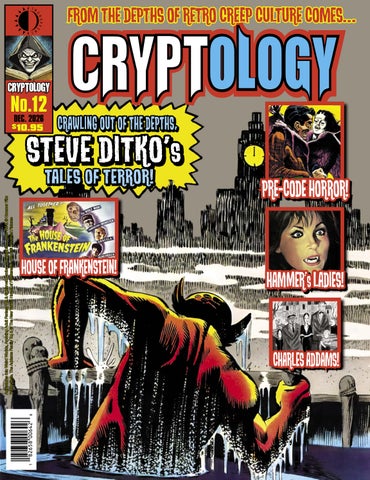
Adventures into Weird Worlds, Amazing Adult Fantasy TM & © Marvel Comics. The Vampire Lovers TM & © Hammer Film Productions. The Addams Family TM & © The New Yorker. House of Frankenstein TM & © Universal Pictures
FROM THE DEPTHS OF RETRO CREEP CULTURE COMES…
CRYPTOLOGY
No.12
$ 10.95
DEC. 2026
STEVE DITKO’s CRAWLING OUT OF THE DEPTHS,
TALES OF TERROR!
HOUSE OF FRANKENSTEIN!
PRE-CODE HORROR!
HAMMER’s LADIES!
CHARLES ADDAMS!
Volume 1, Number 12 December 2026 EDITOR-IN-CHIEF Peter Normanton PUBLISHER John Morrow DESIGNER Michael Kronenberg EDITORIAL ILLUSTRATION Pete von Sholly COVER ARTIST Steve Ditko’s cover for Amazing Fantasy #13 from June 1962 SPECIAL THANKS David Bertolino • Michael Bonesteel Castle Books • Barry Forshaw • Peter Gallagher • Headpress • Heritage Auctions • Steve Kronenberg • Tim Leese Will Murray • Mike Price •Steve Roth Brinke Stevens • Anthony Taylor • Ryan Vandergriff • Don Vaughan • Mark Voger Pete Von Sholly • Tom Weaver Charlton Premiere, Strange Suspense Stories, The Many of Ghosts of Doctor Graves, The Thing TM & © Charlton Comics • Adventures into Weird Worlds, Amazing Adult Fantasy, Captain America’s Weird Tales, Doctor Strange, Journey into Mystery, Mystery Tales, Mystic, Spellbound, Strange Tales, Uncanny Tales, World of Fantasy TM & © Marvel Comics • Creepy, Eerie, Famous Films TM & © Warren Magazines • Witzend TM & © The Wonderful Publishing Company • Mr. A TM & © Comic Art Publishers/Steve Ditko • Appointment With Fear TM & © Moviestore Entertainment • Black Friday, House of Frankenstein, Man Made Monster, Tarantula, Psycho III, The Mad Ghoul, The Mummy’s Hand, The Pearl of Death, The Wolf Man, Weird Woman TM & © Universal Pictures • MR James Ghost Stories of an Antiquary, More Ghost Stories of an Antiquary, The Five Jars TM & © Edward Arnold • Whistle and I’ll Come to You (1968), The Stalls of Barchester, Lost Hearts, The Treasure of Abbot Thomas, The Ash Tree, The Signalman, Stigma, The Ice House, Schalken the Painter TM & © BBC Enterprises Ltd. • Attack of the Giant Leeches, It Conquered the World, The Masque of the Red Death, The Premature Burial, The Raven, The Undead TM & © American International Pictures • Carnival TM & © General Film Distributors • Ghost Ship TM & © Anglo-Amalgamated Film Distributors • Devil Girl From Mars TM & © British Lion Films • Countess Dracula, Dr. Jekyll and Sister Hyde, Dracula Prince of Darkness, The Curse of Frankenstein, The Gorgon, The Man Who Could Cheat Death, The Vampire Lovers TM & © Hammer Films • Dr. Blood’s Coffin TM & © United Artists • Alfred Hitchcock Presents TM & © Revue Studios • The Mad Monster TM & © Producers Releasing Corporation • Teenage Monster TM & © Marquette Productions Limited • The Alligator People TM & © Associated Producers (API) • Daughter of Dr. Jekyll TM & © Film Venturers • The Giant Claw TM & © Clover • I Married a Monster From Outer Space TM & © Paramount Pictures • The Disembodied, The Hypnotic Eye TM & © Allied Artists Pictures • Attack of the 50 Foot Woman TM & © Woolner Brothers Pictures • The Slumber Party Massacre TM & © Santa Fe Productions • Slave Girls From Beyond Infinity. TM & © Beyond Infinity/Titan Productions • Haunting Fear, Hybrid TM & © American Independent Productions • Monsterland TM & © Movieland Publishing Inc. • Scream Queens TM & © Market Square Productions Inc. • This Is Spinal Tap TM & © Spinal Tap Productions • Nightmare Sisters TM & © Cinema Home Video Productions • Jonny Quest TM & © Comico • 3-D Seduction of the Innocent, Airboy, Twisted Tales Eclipse Graphic Album TM & © Eclipse • Weird Tales (1984) TM & © The Bellerophon Network Inc. • Sorority Babes in the Slimeball Bowl-O-Rama 2 TM & © Candy Bar Productions/Full Moon Features • Spider Baby TM & © SoCal Cinema Studios • The Rocketeer Adventures (2011) TM & © IDW • Brinke of Destruction TM & © High Top • Sensation Comics TM & © DC Comics • Beware Terror Tales, Strange Stories From Another World, Strange Suspense Stories, Unknown World, Worlds of Fear TM & © Fawcett Publications Inc. • The Thing TM & © Charlton Comics • Startling Terror Tales TM & © Star Publications • Out of the Night, Skeleton Hand TM & © American Comics Group • Weird Tales of the Future, Weird Mysteries TM & © Stanley P. Morse • City of the Living Dead, Secret Diary of Eerie Adventures, The Dead Who Walk, The Phantom Witch Doctor, Witchcraft TM & © Avon Publications Inc. • Beware, Chilling Tales TM & © Youthful • The Addams Family cartoons TM & © The Tee & Charles Addams Foundation • Drawn and Quartered TM & © Random House • Creature Comforts, Homebodies, Monster Rally TM & © Simon & Schuster • The Beyond, Web of Mystery TM & © Ace Magazines • Adventures into Darkness, Out of the Shadows, The Unseen TM & © Pines • • Journey into Fear TM & © Superior
SPILLING MY GUTS: Editorial by The Cryptologist . . . . . . . . . . . . . . . . . . . . . . . . . . 2 AND NOW THE SCREAMING STARTS!: Letters to The Cryptologist. . . . . . . . . . . . 3 DITKO’S DEPICTIONS OF EXTRA-DIMENSIONAL DREAD: An Excursion into the Surreal. . . . . . . . . . . . . . . . . . . . . . . . . . . . . . . . . . . . . . . . . . . . . 4 Prior to embellishing Doctor Strange, Steve Ditko had already been sojourning amid these hallucinatory realms FORGOTTEN HORROR FILMS: An Often-Missed Appointment With Fear . . . . . . . . 14 The mythology of the ancient past weaves its way into an obscure movie from the 1980s HOUSE OF FRANKENSTEIN, PART 1: Marking 80 Fun and Spooky Years. . . . . . . 18 New York City’s Rialto Theater gets to host a Universal horror extravaganza like no other SEASON’S CREEPINGS: The BBC’s Ghost Story for Christmas Films of the 1970s . . . . . . . . . . . . . . . . . . . . . . . . . . . . . . . . . . . . . . . . . . . 28 A time when the seasonal ghost story came to the small screen HAZEL COURT: The Hammer Heroine Who Faced Horrors on Both Sides of the Pond . . . . . . . . . . . . . . . . . . . . . . . . . . . . . . . . . . . . . . 34 An incredibly versatile actress who relished her time working in these classic horror movies KILLER B’s: Dressed for Distress. . . . . . . . . . . . . . . . . . . . . . . . . . . . . . . . . . . . . . . . . . . 42 Regular Cryptology department featuring selected horror and sci-fi B-movies BRINKE STEVENS: Confessions of a Scream Queen . . . . . . . . . . . . . . . . . . . . . . . . 50 One of the most intelligent Scream Queens of her generation talks candidly about her time making horror movies A HAMMER QUARTET: Four Leading Ladies . . . . . . . . . . . . . . . . . . . . . . . . . . . . . . 58 Hammer horror at its most captivating from Hazel Court, Barbara Shelly, Martine Beswick, and Ingrid Pitt THE CALL OF THE VILE, PART 5: A Guide to Pre-Code Horror: 1952, The Endless Onslaught. . . . . . . . . . . . . . . . . . . . . . . . . . . . . . . . . . . . . . . . . . . 63 It’s 1952 and the horror comic has as good as taken over the newsstand CHARLES ADDAMS: The Father of the First Family of Freakishness . . . . . . . . . . . 69 A return to the macabre cartoons of this fantastic fictioneer HAMMER TIME: Dracula, Prince of Darkness. . . . . . . . . . . . . . . . . . . . . . . . . . . . . . 72 Regular Cryptology department featuring selected Hammer Studios films HORROR COMICS EXCESS: The Vampiress . . . . . . . . . . . . . . . . . . . . . . . . . . . . . . . 76 A catalog of atrocities from the crime and horror comics of the 1950s CRYPTOLOGY™ issue 12, December 2026 (ISSN 2997-416X) is published bi-monthly by TwoMorrows Publishing, 10407 Bedfordtown Drive, Raleigh, NC 27614, USA. Phone: (919) 449-0344. Periodicals Postage Paid at Raleigh, NC. POSTMASTER: Send address changes to Cryptology, c/o TwoMorrows, 10407 Bedfordtown Drive, Raleigh, NC 27614. Peter Normanton, Editor-in-Chief. John Morrow, Publisher. Editorial Office: CRYPTOLOGY, c/o Peter Normanton, Editor-in-Chief, 619 Whitworth Road, Lower Healey, Rochdale, Lancashire, OL12 0TB, England. Email Peter Normanton: peter.normanton@btinternet.com. Six-issue subscriptions: $80 Economy US, $142 EU/UK, $121 other non-US countries, $29 Digital. Please send subscription orders to TwoMorrows, NOT to the editorial office. All editorial matter © 2026 TwoMorrows Publishing and Peter Normanton. Printed in China. FIRST PRINTING.
DITKO’S DEPICTIONS OF EXTRA-DIMENSIONAL DREAD
by Michael Bonesteel 4
cryptology NO. 12
T
Strange Suspense Stories #32 (May 1957) unveiled Steve’s he Marvel Universe was extra-dimensional imaginings. TM & © Charlton Comics. barely a solar system when I first began reading comics back in the mid-1950s. The colorful, revolutionary Marvel superheroes created by Jack Kirby, Stan Lee, Don Heck, Larry Lieber, and Steve Ditko were still years away. And because DC’s recycled Silver Age super-heroes didn’t grab me, Dr. Strange stories infamously assumed the I became an avid collector of use of psychotropic drugs had spawned the the late ’50s-early ’60s Atlas hallucinatory terrain. They had not. The annals of (Marvel) monster titles: Strange Ditko’s alternative realities stretch from his early Tales, Tales to Astonish, Tales tales for Charlton, through his mid-career work of Suspense, and Journey into at Atlas and Warren, and on into his later projects Mystery. The Kirby covers for DC and several independent publishers. and lead stories were fun, but Any number of devices might trigger such those five-page excursions into cosmic phenomenon in a Ditko story: Books of fantasy/horror by Steve Ditko forbidden knowledge. Enchanted objects. Timesoon became my main reason travel experiments. States of hypnotic trance. for buying them. They were Lucid dreamworlds. Out-of-body and death haunting, poignant, and often a experiences. Even that old chestnut: The Faustian deal with the bit disturbing. They still are. devil. Once within those unearthly realms, the unsuspecting Kirby and Ditko each had distinctive and compelling styles, seeker would often encounter preternatural beings attempting but no one could capture dark psychological foreboding like to invade our reality, intent on wreaking annihilation. Ditko’s Ditko. There was an underlying mood of melancholy in much work with Charlton and Atlas during the late 1950s and early of what he did, regardless of who collaborated with him on the 1960s was especially rife with supernatural odysseys into the plots or composed the dialogue. Could this have been because unknown. In “A World of His Own” (Strange Suspense Stories he almost died from tuberculosis at the age of 27 in 1954? The #32, May 1957), written by Jack Oleck, Hendrix the chauffeur depth and gravity achieved through his overhears his wealthy employer’s daughter tell her father about inimitable idiosyncratic expression was unforgettable. He was also particularly accomplished at portraying extreme emotions like panic and fear with conviction. P. Craig Russell observed that Kirby, Wallace Wood, Neal Adams, and others spawned entire schools of imitators, however: “No one tries to draw like Steve Ditko. It can’t be done” (“Ditko Is Ditko,” The Art of Steve Ditko edited by Craig Yoe). Russell expanded on the artist’s uniqueness in his introduction to Marvel Masters of Suspense, Vol. 2, when he wrote Ditko’s “weird otherworldly design [was] so peculiarly his own as to come to be known as ‘Ditkoesque’ […] There is a genuine terror or Strange Tales perhaps simple uneasiness that fills these drawings that I #67 (TM & © believe comes from a naked simplicity that only Ditko and Marvel Comics) and Eerie #7 a few others have ever mastered.” (TM & © Warren One of the more fascinating sidebars to Ditko’s art Magazines) was his predilection for interpreting extra-dimensional presented their takes on George realms as surrealistic mindscapes containing bizarre Langelaan’s psychedelic configurations. Many early readers of Ditko’s “The Fly.”
cryptology NO. 12 5
Ditko took a different tack in two Atlas stories penned most probably by Stan Lee or Larry Lieber. Both “The Threat from the 5th Dimension!” (Strange Tales #69, June 1959) and “The Doorway to Nowhere!” (Tales to Astonish #35, Sept. 1962) characterize figures in other dimensions as flat, two-dimensional forms, as if they were anthropomorphized playing cards from Alice’s Adventures in Wonderland. Such fledgling conceptions of parallel realities would morph considerably for Ditko within a few years.
Ditkoesque Time Machinations
Several stories Ditko drew for Atlas explored the implications of time travel. For “The Clock Strikes Never!” (World of Fantasy #18, June 1959), he relied on schematic diagrams and the figure of Father Time, as well as a frequently revisited image of the human body free-falling through space. “I Took a In the same month, June 1959, Strange Tales #69 and World of Fantasy #18, saw Steve treading Journey into Fear!” (Journey into Mystery #63, Dec. ever further into these mind-bending realms. TM & © Marvel. 1960) features one of Ditko’s most iconic opening splash pages: through riven and ruptured blue magically entering a recently acquired modernist painting and sheets of elastic material, an ominous yellow and green hooded bringing back precious gems. Hendrix sneaks into the artwork figure reminiscent of his previous Father Time looms over an and plucks some bright jewels hanging like fruit in the gloomy orange man spellbound with fear. (Author’s note: Identifications of void, but when he tries to return to the real world, the entryway color in this article refer to the original comics whenever possible, has disappeared. Seems his boss got worried about his daughter’s but please be aware that there are often discrepancies between these activities, so while Hendrix was within the canvas, repainted it and contemporary recolored reprints.) The figure is apparently black, inadvertently sealing off the chauffeur’s exit. Oops. symbolic, for he never reappears in this tale about a man who A year after The Fly (1958) co-starring Vincent Price after activating a time machine, tumbles through darkness into screened in movie theaters, “Trapped Between Two Worlds!” the past. A twist ending reveals that this entire episode takes place appeared in Strange Tales #67 (Feb. 1959). The Fly was based in his mind. Probable writer Lee ends with, “What is time?? What upon George Langelaan’s 1957 short story, popularizing the is reality?? Who knows???” To beginner philosophy buffs, this idea of matter teleportation long before Scotty beamed anyone would simply be Metaphysics 101, but to a 13-year-old kid like aboard the Starship Enterprise, but the unidentified writer of me, it was stone deep. “Trapped Between Two Worlds!” promptly picked up on the In his introduction to Yoe’s The Art of Steve Ditko, Lee idea. Ditko does discussed “the short, five-page filler strips that Steve and I did not try to show the together. These were placed in any of our comics that had a few protagonist’s body extra pages to fill. They disintegrating “into a consisted of odd fantasy million particles” and tales that I’d dream up then reintegrating, with O. Henry-type but instead shows it endings. All I had to fully intact, hurtling do was give Steve a via waves of energy one-line description of across the universe the plot and he’d be off to a distant galaxy. and running […] those Incidentally, Ditko unique strips led to a and writer Archie series of comics I called Goodwin would Amazing Adult Fantasy later produce (AAF) which contained a story called those brief, surprise “Fly!” (Eerie #7, ending fantasy tales Jan. 1967) in an issue after issue.” Lee, entirely different of course, like many context. pre and post-Comics His striking splash Code horror strip page for Journey into writers, swiped the O. Mystery #63 (Dec. Henry ending approach Amazing Adult Fantasy #8 threatened with an 1960). TM & © Marvel. extra-dimensional monster. TM & © Marvel. from EC Comics
6
cryptology NO. 12
Yet another unholy tome unleashed its spell in Creepy #10’s celebrated “Collector’s Edition” from Aug. 1966. TM & © Warren.
cryptology NO. 12
9
STEVE DITKO
marvelous” (“Toasting Absent Heroes,” Comic Book Artist #9, June 16, 2000). For “Collector’s Edition!” (Creepy #10, Aug. 1966), Dread Dormammu!” (Strange Tales #127, Dec. 1964) and Ditko indulged in a meticulously detailed pen-and-ink “A Nameless Land, A Timeless Time!” (Strange Tales #133, crosshatching that lent considerable clarity and precision June 1965), Strange delves deeper into the “Dark Dimension” to the proceedings. In Goodwin’s story, obsessive book with ever more complex arrangements of roller coaster-like aficionado Mr. Danforth covets 18th century artist/poet/ pathways and interlocking tunnels. He finally reaches the philosopher-turned-satanist Marquis Lemode’s rare and summit of his far-flung cosmic journey in “If Eternity Should obscure manuscript Dark Visions which features the Fail!” (Strange Tales #138, Nov. 1965) where he encounters author’s precognitive visions of the future. There are no the anthropomorphic figure of Eternity itself. excursions into outer realms here, but fiendish Lovecraftian entities seem to bleed into Danforth’s reality. As he “A Catalog Raisonne of the Formless” peruses Dark Visions, its bewitched illustrations reveal— French philosopher and novelist Tristan Garcia’s impossibly—recent episodes from his own 20th century erudite essay “Doctor Strange: A Hero of the Mind” (www. life. In the penultimate page-wide horizontal panel, Ditko urbanomic.com/document/doctor-strange/) described slashes five scenes into V-shaped segments of sequential Strange’s out-of-body forays as “something like a catalog time in which the protagonist foresees the approach of his raisonné of the formless. We might say that Ditko and Lee own death in the very next, and final, panel. sought to catalog all possible modes Following his stint with Warren, of appearance of the formless, the which we’ll return to shortly, malleable, the vague, the almost…” Ditko fell back on his most reliable Although Ditko left Marvel in publisher, Charlton, where he again 1966 to work for a year with Warren collaborated with writer Skeates on a horror magazines Creepy and Eerie, run of stories for The Many Ghosts of he did not leave his engagements Doctor Graves (TMGoDG). “Routine” with the inter-dimensional far (TMGoDG #7, July 1968) narrated in behind. Nor did he abandon the the second person (“you”), involves a archetype of the Necronomicon-ical seeker in search of The Book of Power, magnum opus. He collaborated with a “mystical text containing the most writer Archie Goodwin to develop powerful incantations imaginable. ” fifteen gothic-noir yarns in rich tones The protagonist opens an entryway of black-&-white and gray—some into the inconceivable which looks of them drawn in pen-and-ink, but suspiciously like Dr. Strange’s othermost executed in ink wash with a dimensional realities. Unfortunately, brush. Swamp Thing and Watchmen once “you” have crossed over into wordsmith Alan Moore disclosed that parallel world where the Power in an interview with Jon B. Cooke resides, your memory of having done that “My favorite Steve Ditko work so is erased, and you are forced to was the stuff he did for Warren, repeat your actions over and over for ‘Collector’s Edition.’ He was using all time. Eternity revealed himself to the good Doctor in wash and gray tones, and that was Strange Tales #138. TM & © Marvel Comics. Ditko revisited the otherworlds
“Return to the Nightmare World” from Strange Tales #116 (Jan. ’64) pictured an unnerving surrealism. TM & © Marvel Comics.
FORGOTTEN HORROR FILMS by Michael Price
AN OFTEN-MISSED “APPOINTMENT WITH FEAR”
T
here is a vague but crucial distinction between Forgotten Horrors and forgettable horrors, and certain enthusiasts would appear to consider Ramzi Thomas’ Appointment with Fear (1985) so forgettable as to prove itself memorable. I remember it primarily as the film that introduced me to a promising actress named Deborah Voorhees—however prematurely, from the insurmountable distance between the projected image and my seat in a movie-industry screening room. Bear with me, and I’ll try to explain. Now, Deborah Voorhees owns a modern-day distinction as the versatile creator of a Friday the 13th valedictory film called 13 Fanboy (2021). The credential is the result of a diligent process of reinvention that she had undertaken in rebelling against “scream queen” typecasting. Deborah retrenched in journalism and as a teacher before heading into a self-starter career as a screenwriter and at length as a producerdirector. Weblog postings abound on Appointment with Fear, an obscure-inits-day oddity: Such fan-notices are of course too late in coming to exert much effect upon the careers of the film’s most hopefully ambitious players, Mike Goméz and Deborah Sue Voorhees. The prevailing tone of the Web-chat blurbs is that of people who feel relieved to have slogged through a viewing and want to warn others not to go there. Not that the film is all that readily available, nowadays, in any event. There is, too, a popular tendency to carp about the “Alan Smithee” pseudonymous director credit—more a debit than a credit, really, and a stationary target for the cheap-shot snipers. There
14
cryptology NO. 12
appears a disappointed response to the film’s comparative lack of such visceral shock value as had distinguished a watershed independent picture of 1985, Stuart Gordon’s Re-Animator. More fairly, there is an inclination to decry a disjointed narrative structure in Appointment with Fear.
Meriting Rediscovery
I maintain, nonetheless, that Appointment with Fear deserves a rediscovery. It is nowhere near as wretched as the Medved-come-latelies of the fan-playing-critic sector would have it. And an ill-deserved bad reputation is worse than being forgotten outright. The co-author and actual director, Ramzi Thomas, brought more to the table—and to the cutting room—than Galaxy International Releasing would allow to come together in the final
editing. So it seems worthwhile to consider Appointment with Fear in light of remarks made by Thomas at a time when he thought the version he had handled would be the version to see release. “I’ve always been fascinated with the mythology of Attis,” Thomas told me during the Summer of 1985 as his first directing assignment lurched toward its appointment with butchery. “I mean, that godly sense of life-in-death, death-in-life—whatever you might call the phenomenon—that embraces the belief that dreams are a reality in their own right, an extension of the dreamer, constituting actual experiences that occur in some reality beyond wakefulness. “Attis was known by many names: Osiris in ancient Egypt and Adonis in Greece and Tammuz among the Babylonian imperialist forces, but his constant function was as a totem of that life-beyond-life that dreams were believed to represent. One version of the myth requires Attis to choose between dying, and slaying his own offspring, as part of a ritual involving a bountiful harvest.
Ritual Sacrifice
“This is the crux of Appointment with Fear,” Thomas added. “I have overlapped the present with the past to create a thin line of surrealism— the modern-day mansion setting, for example, that captures the majestic spaciousness of an ancient temple. And the ritualistic sacrificial dance sequence, as choreographed and staged by a modernistic dance troupe.” All of which sounds more like the stuff of highfalutin’ Art Cinema than grist for the low-budget exploitation
Marks 80 Fun and Spooky Years by Ryan Vandergriff 18
cryptology NO. 12
O
Street Scene 1944
n Friday, December 15, 1944, Universal Pictures’ House of Frankenstein made its world premiere at the Rialto Theatre in New York City. Located smack-dab in the far-famed Theater District of Manhattan at 1481 Broadway at the northwest crossway of Seventh Avenue and 42nd Street, this second and smaller iteration of the Rialto (594-seats versus the cavernous 1,960 seater of the defunct original), still had enough magic and fairy dust to go around for any moviegoers wanting to catch this unlikeliest of yuletide offerings from Hollywood in that particular and tumultuous war-torn year. Of course, the Rialto wasn’t the only venerable NYC mainstay weaving its wintry alchemy among young and old alike on that midDecember date. All along Broadway’s impressive fourteen mile stretch, early-bird holiday shoppers bustled to and fro, bracing themselves against a chilly 25 degrees, though it was at least clear skies with a moderate wind. Macy’s on 34th Street and Broadway offered one-stop holiday shopping for pre-and postmoviegoers. For those wanting to grab a quick bite or drink after a movie at the Rialto, Childs Restaurant and Bar at 1485 Broadway with its distinctive red and gold bar with a black and gold dining room offered up just that. Omnipresent among this consumer Valhalla that premiere morning were the Christmas carols and tunes of the day, fostering among young and old alike a sense of Christmas spirit. But for all intents and purposes for those intrepid souls in attendance at the premiere 8:30 a.m. showing of House of Frankenstein, the real Christmas music that day kept time to the inimitable stylings of composers Hans J. Salter, Paul Dessau and Charles Previn, whose eerie music score for this heretofore unheard of “monster rally” would be a highlight. Those first attendees were a hearty bunch indeed: The sun had only risen at 8:13 that morning, meaning that the earliest crowd for the
picture had stealthily made their way to the Rialto while it was still very much dark, perhaps the perfect atmospheric start for the latest misadventures of Dracula, the Wolf Man and Frankenstein’s Monster. Of all the movie palaces in New York City, the Rialto was perhaps the most appropriate for Universal to premiere House Of Frankenstein. When its predecessor and namesake had closed its doors for the last time in May of 1935, it went out with a bang and a veritable howl at the full moon with another Universal horror film, The Werewolf of London. Of the new Rialto, which was located at the exact spot as the original, a manager of the theater said that this specific venue looked to quench the “ancient and unquenchable male thirst for mystery, menace and manslaughter.” Prophecy fulfilled, the Rialto garnered a reputation among movie buffs of the era as being the place to not only catch the heavy-handed melodramas of the day, but also to take in endless showings of scary films, if you were so inclined.
“To a new world of gods and monsters!”
With sensational advertising of this kind, even at this cold time of year, the crowds were impelled to come out in their droves for this scary feature. TM & © Universal Pictures.
When Universal Pictures under the sure and guiding hand of Carl Laemmle Jr. first dipped their toes into the world of ghosts and monsters—after a brief yet successful run with progenitors The Hunchback of Notre Dame and The Phantom of the Opera in 1923 and 1925 respectively—with the one-two punch of 1931’s Dracula and Frankenstein, the world at large needed bloodthirsty vampires with regal top hats and reanimated misunderstood giants more than ever. With the catastrophic failure of the stock market in 1929, America sank into the Great Depression and saw very little light for a staggering ten years. For anyone who could manage to scrape together enough dough to see a motion picture, it had better
cryptology NO. 12
19
The Frankenstein monster and the Wolf Man (Lon Chaney Jr.) battle it out in a staged publicity shot. TM & © Universal Pictures.
Navy Air Service perpetrated a surprise attack on the American naval base in Pearl Harbor, plunging a formerly war-weary nation headfirst into the fires of World War II. Within days of the attack, both Italy and Germany had declared war on the US. For better or for worse, America was now officially in the war, and nothing would ever be the same again. Bolstered by the surprise success of The Wolf Man, a newly repurposed wartime Universal quickly commissioned even more scary monster flicks, with Larry Talbot’s mouthpiece, scriptwriter Curt Siodmak, the anointed Golden Child and wordsmith of nearly all things fog-shrouded and cobweb festooned at Universal, serving as its resident expert (two notable exception to this hard-and-fast “rule” was director Earle C. Kenton’s ’42 spookster Ghost of Frankenstein scripted by W. Scott Darling from a story by Eric Taylor and Arthur Lubin’s 1943 technicolor remake of Phantom of the Opera; hey, even the herculean writing prowess of Curt Siodmak needed to rest every once and a while, right?). Prior to introducing American audiences at-large to wolfsbane and cautionary and catchy slogans like “Whoever is bitten by a werewolf and lives becomes a werewolf himself,” Siodmak had already sharpened his bloody pen quill with a spate of Universal fright flicks such as the aforementioned two Invisible Man sequels from 1940, Black Friday, and Monogram Pictures’ The Ape. What’s more, Siodmak had excellent references when it came to his spooky credentials, not the least of which was a small background part with his wife in the 1927 Fritz Lang science fiction masterpiece Metropolis. Now, taking that brass ring and running with it, the Dresden, Germany-born writer was setting his sights on an Indian Summer, or second Golden Age, for Universal horror films. Reasoning that if one monster could mesmerize audiences into turning out on opening night, Universal quickly concocted a plan to team up two of their ghoulies into one feature motion picture. With the Wolf Man originally meant to precede Frankenstein on the movie marquee (seniority eventually won out), Curt Siodmak set to work creating a peculiar sort of
shoehorned into a budget-conscious variation which was more kid friendly and Saturday matinee-oriented. Frugality was the rule of the day under Cowdin’s rule, a course that would color the remainder of the classic monster output, with the exceptions being 1941’s The Wolf Man and 1948’s monster swan song, Abbott and Costello Meet Frankenstein (the latter being a product of the 1946 merger between International Pictures and Universal, resulting in Universal International). With their lot now cast alongside B pictures, westerns and action serials, the cadre of Universal’s ghoulies next emerged in 1939’s Son of Frankenstein, Karloff ’s final big screen outing as the Monster. The Mummy and The Invisible Man were next on the revival circuit, trudging into movie houses with no less than three releases in 1940 with The Mummy’s Hand, The Invisible Man Returns and The Invisible Woman. With low budgets practically assuring a big return, this second-half of the original Golden Age of Universal monster movies was officially underway, with George Waggner and Curt Siodmak’s The Wolf Man marking a high water moment in this second gasp of creative output. On December 7, 1941, two days before the official release date of The Wolf Man, the United States was confronted with an unthinkable and horrific act which all but dwarfed the onscreen menace of Universal’s beloved monsters: The Imperial Japanese The ferocious onslaught continues, making for a publicity man’s dream. TM & © Universal Pictures.
22
cryptology NO. 12
HAZEL COURT ORIGINAL HAMMER HEROINE FACED HORRORS ON BOTH SIDES OF THE POND by Mark Voger
T
he first in a long line of Hammer Films heroines, Hazel Court found herself cast in some of the most lavish, literate horror films of the 1950s and ’60s. Most aficionados will agree that The Curse of Frankenstein (1957) and The Masque of the Red Death (1964) are two of the period’s best, and that The Man Who Could Cheat Death (1959), Dr. Blood’s Coffin (1961), Premature Burial (1962) and The Raven (1963) are no slouches, either. Court graced these films and others with her proper English manner and classical acting background—not to mention her huge azure eyes and attractive build, setting the bar high for the many Hammer heroines that would follow. The actress held her own opposite five icons of the horror film—Peter Cushing, Christopher Lee, Vincent Price, Boris Karloff and Peter Lorre—and was once directed by Alfred Hitchcock. I interviewed Birmingham native Court (1926-2008) by telephone in 1996, and spoke with the actress again in person later that year.
EARLY ACCOLADES
Court made her film debut at age 18 in Champagne Charlie (1944). Only two
Hazel, as Lenore, in Roger Corman’s comedy-horror The Raven. TM & © American International Pictures.
34
cryptology NO. 12
Still only a child, she appeared as May in Carnival. TM & © General Film Distributors.
had all the fun as Nyah, a Martian with the looks and sensibility of a dominatrix. Nyah and her boxy robot terrorize the Bonney Charlie, an inn on the Scottish moors with a well-stocked bar. I would call Devil Girl From Mars a very good bad movie. “My God, yes,” Court said when I broached the subject. “I’m told that film has played somewhere every day in the world. It is the most played film ever. This funny little film that was the beginning of it all. Someone told me that (Steven) Spielberg saw that and he got lots of ideas from it. We have to see it. It must be funny these days. I’m sure it’s hysterical. A great comedy now, I would think.”
THE CURSE OF FRANKENSTEIN Hazel emotes in Ghost Ship, a film inspired by the Grand Guignol stage production L'Angoisse (Anxiety). TM & © Anglo-Amalgamated Film Distrib.
years later, she received eighth billing as May, the mobilitychallenged younger sister of dancer Jenny (Sally Gray) in Stanley Haynes’ Carnival (1946), a drama set against the backdrop of the sometimes seamy entertainment world. Court received accolades, not to mention a British Critics Award, for her portrayal in Carnival. By this time, Court’s filmography was ramping up. “I had made a lot of Rank (Organisation) films,” the actress recalled. “I was under contract to Rank.” Two movies from the period were harbingers of Court’s prominence in genre fare. The first was Vernon Sewell’s talky Ghost Ship (1952) costarring her first husband Dermot Walsh, telling of a couple who buy a ship that may or may not be haunted. (Small World Dept.: Sewell went on to direct Lee and Karloff in The Crimson Cult, and Cushing in The Blood Beast Terror, both in 1968 for Tigon British Film Productions.) The second genre harbinger for Court was David MacDonald’s Devil Girl From Mars (1954), in which she played a heroine while Patricia Laffan
Hazel, no doubt relieved she’s not wearing the alien costume worn by Patricia Laffan in Devil Girl From Mars (1954). TM & © British Lion Films.
Meanwhile, Hammer Films was about to make horror history. Founded in 1934, the venerable British studio released more than 150 films through until the late Seventies. In something of a foreshadowing, Hammer’s second film, and the earliest one that survives, was Denison Clift’s Mystery of the Marie Celeste (1935) featuring Dracula star Bela Lugosi. By the middle 1950s, the idea of retelling the Frankenstein story was somewhat of a gamble, as Gothic horror had gone out of fashion in the wake of movies about giant insects, flying saucers and bulbous aliens. It was through her association with the Rank Organisation that Court won the role of Elizabeth, cousin and wife of Victor Frankenstein (Cushing). “The Curse of Frankenstein was the first horror film I was involved in,” she said. Directed by Terrence Fisher, the first of Hammer Films’
Above, from the left, Victor (Peter Cushing), Elizabeth (Hazel Court) and Paul (Robert Urquhart) in The Curse of Frankenstein. TM & © Hammer.
cryptology NO. 112 35
KILLER B’s by Steve Kronenberg
DRESSED FOR DISTRESS S cream Q ueens of the B’ s
J
ust what is a scream queen? Is it an actress who screams her way through a 90-minute monster mash? Or is it one who elicits screams from others? Or is it both? Maybe we simply know a scream queen when we see one. What we do know is that scream queens have been a mainstay in horror cinema, and their evolution is best displayed in movies made fast and on the cheap—the kind of grindhouse fodder that emerged in the 1940s and soon dominated the 1950s.
Nagel appearing in several of his experimental films before beginning in features as a dancer. Her striking beauty and smoky voice made her a natural as a leading lady, but she never rose above B-movie status. In 1936, she married fellow actor Ross Alexander who was tormented by his closeted homosexuality coupled with an unlikely obsession with Bette Davis. When he committed suicide a year after their ANNE NAGEL (1915-1966) wedding, Nagel spiraled into June (Anne Nagel) at the mercy of the deranged Dr. Rigas (Lionel Arguably the first “B” scream queen, Atwill) in Man Made Monster. TM & © Universal Pictures. depression and alcoholism. Anne Nagel was raised as a devoutly Ernest Sovac. Sovac transplants the dying Following a second abusive religious Bostonian who aspired to Cannon’s brain into Kingsley’s skull, but marriage and a botched appendectomy become a nun before her work as a also needs Sunny to provide information that rendered her infertile, her film part-time model took a turn toward about a fortune hidden by Cannon, career ended in 1950. Liver cancer Hollywood. Her stepfather, a Technicolor whose brain now controls Kingsley’s claimed a penniless Anne Nagel on July technician and director, worked for mind, body, and physical appearance. 6, 1966. She was only 50 years old. Poverty Row’s Tiffany Studios, with Nagel even gets to warble a tune during Despite her personal a night club appearance before deciding demons, Nagel to split the loot with Cannon’s rival, delivered superior work uncharacteristically played by Lugosi. in all of her “B” horrors. Nagel’s approach is subtle and subdued. In Universal’s Boris When the “new” Red Cannon confronts Karloff-Bela Lugosi her, she’s understandably confused. opus Black Friday Her face gradually betrays puzzlement, (1940), she’s Sunny, the then suspicion, and finally terror when chanteuse sweetheart of Kingsley/Cannon strangles her for gangster Red Cannon betraying him. (Her scream was dubbed (Stanley Ridges). by castmate Anne Gwynne.) It’s a deft During a shootout, and skillful performance. Cannon’s car collides Nagel screamed for sure in Universal’s with Professor George Man Made Monster (1941). She’s June Kingsley (also played Lawrence, the object of the obsessive by Ridges), the close Bela Lugosi discusses his extensive stamp collection with Anne while Dr. Rigas (Lionel Atwill), who seeks filming Black Friday in 1940. TM & © Universal Pictures. friend of Karloff ’s Dr.
42
cryptology NO. 12
KILLER B’s
The Mad Monster starred George Zucco and Anne Nagel. TM & © Producers Releasing Co.
to experiment on carnival oddity “Dynamo” Dan McCormick (Lon Chaney Jr.), transforming him into an electrically charged superhuman. Rigas then abducts June, ties her to an operating table, then wonders what it would be like to turn the voltage up on a woman. McCormick saves her and, in classic monster movie fashion, carries her prostrate form into the night. Nagel’s June is smart and sensitive, attuned to Atwill’s madman, Chaney’s naive dupe, and to the insanity engulfing everyone in sight. Nagel essays the same blend of sensitivity and fear in PRC’s The Mad Monster (1942) as Lenora Cameron, daughter of Dr. Lorenzo Cameron (George Zucco). Cameron is determined to aid the war effort by creating an army of scientifically controlled werewolves, beginning with his slowwitted handyman Petro (Glenn Strange). Nagel’s interplay with Strange is marked by tenderness and empathy, and he responds with simple-minded kindness. Her independent streak emerges when she angrily confronts Zucco about his cruelty to Strange and the cold shoulder he gives to her boyish paramour (Johnny Downs). Ironically, this Poverty Row production may represent Nagel’s most fully realized portrayal of a “B” scream queen.
Peggy Moran (1918-2002)
Though she appeared in only two low-budget horrors, Peggy Moran earns a “B+” as a genre scream queen. Born Mary Jeanette Moran in Clinton, Iowa, she was the daughter of famed
tells heroic Steve Banning (Dick Foran) how to destroy the mummified menace while tied to a sacrificial altar, awaiting the amorous advances of high priest Andoheb (George Zucco). She initially distrusts Banning and his Brooklyn buddy Babe Jenson (Wallace Ford), even threatening them with a prop gun when she thinks they’ve duped her doddering dad (Cecil Kellaway). “I never met Tom Tyler without his makeup,” she told Tom Weaver and Michael and John Brunas in their book Universal Horrors (McFarland Second Edition, 2007). “So far as I was concerned he was the Mummy! When he picked me up and started carrying me around, I had the eeriest feeling!” Leggy Peggy reunited with Dick Foran in Horror Island (1941), another Universal “B” thriller about a group of treasure hunters stalked by a murderous “Phantom.” She’s typically poised, vivacious, and feisty as Wendy Creighton, making merry with Foran while being menaced by the film’s resident murderer. And she still manages a scream or two when confronted by Foy Van Dolsen’s furtive “Phantom.” Though her memories of the movie were dim, she told Weaver and the Brunas brothers that “most of my pictures I felt they raced through!” She recalled Horror Island as especially horrific. “I remember going home and being so exhausted I couldn’t eat dinner. My mother would rub my back, and I would start crying just from being so exhausted.” Ah, the travails of a “B” scream queen.
pin-up artist Earl Moran. She adopted her nickname “Peggy,” becoming an actress when a psychic predicted fame and fortune for her. She signed with Universal, toiling in the studio’s “B” unit, where she met and married director Henry Koster. (Conrad Veidt was best man at their wedding.) Their marital bliss ended with his death in 1988, but Peggy remained a vibrant resident of Camarillo, California, active in church and civic affairs while attending classic film conventions. Horror fans adored her, and she was invited to attend the premiere of Universal’s The Mummy Returns in 2001. Tragically, she was killed in an automobile accident only one day after her 84th birthday. Moran is the memorable Marta Solvani in The Mummy’s Hand (1940), the first entry in Universal’s “Kharis” series. It remains her best-known and bestloved role, and that’s understandable. Marta is wily and willful, but she gets the opportunity to emit some bloodchilling screams when she’s climactically carried off by Kharis Archaeologists Dick Foran and Wallace Ford exchange banter with (Tom Tyler). She also Peggy Moran in The Mummy’s Hand. TM & © Universal Pictures.
cryptology NO. 12
43
BRINKE STEVENS CONFESSIONS OF A SCREAM QUEEN By Don Vaughan
B
rinke Stevens is one of the most iconic scream queens of the past 40 years—but her life almost took an entirely different turn. In college, she received a Master’s degree in Marine Biology, but jobs in the field were limited, and Brinke was unable to put her degree to use. She married artist Dave Stevens of The Rocketeer fame (they divorced two years later, but remained close friends) and started modeling professionally, which led to her being cast as Linda Dawn Grant in The Slumber Party Massacre (1982). It was an opportunity that would change her life forever. “I watched The Slumber Party Massacre on the big screen at a grindhouse in Los Angeles, and I thought, wow, I really can act,”
50
cryptology NO. 12
Brinke revealed to Cryptology. “That’s when I decided I can do this.” The Slumber Party Massacre was more than 255 movies ago. Whereas many actors find their careers on the fade as they grow older, Brinke remains as busy today as she did during her heyday in the 1980s and ’90s, when she made a slew of wildly popular exploitation movies such as Slave Girls from Beyond Infinity (1987), Sorority Babes in the Slimeball Bowl-A-Rama (1988), Nightmare Sisters (1988), and Grandmother’s House (1989). Through these and other films, Brinke found herself at the center of a wild cultural phenomenon: The birth of the Scream Queen. Many women coveted the title, but only a handful
a personal connection with our fans, and that certainly helped our careers,” Brinke says. “A lot of horror icons are male, starting with Boris Karloff and Bela Lugosi, on to modern icons such as Freddy Krueger and Jason Vorhees. But they wore masks, whereas we were out there just being beautiful, sexy women—no masks on us! So, we were real fan favorites.” There are, of course, numerous challenges to being a scream queen in independent films, where luxury by necessity often gives way to budget. Actors are frequently required to wear uncomfortable makeup, and many low-budget films are shot literally in the middle of nowhere, with none of the The Slumber Party Massacre proved to be a life changing moment for Brinke, (TM & © Santa Fe Productions) leading traditional amenities. to such films as The Most Dangerous Game-inspired Slave Girls From Beyond Infinity. TM & © Beyond Infinity/Titan. Brinke recalls a film she made in proved worthy. Among those who also saw their stars rise the wilds outside of Portland, Oregon, in which she was literally rapidly during this period were Michelle Bauer and Linnea drenched in stage blood during the filming of her character’s Quigley, who appeared with Brinke in several movies, including death scene. “It was wintertime and we were in the cold in the Scream Queen Hot Tub Party (1991) and Nightmare Sisters. The Oregon woods, ” she reports. “At one point they threw an entire titillating trio developed an abiding friendship that continues to bucket of blood on me. The director said, ‘That’s a cut on that this day. scene. Let’s move on, ’ and they all left. I was covered in blood, “One of the things that helped us was that we were all good freezing, and I couldn’t walk back into the house in which we actresses,” Brinke observes. “A lot of the bimbo types that were were shooting because the blood would track everywhere. just doing nudity couldn’t act; it was all about being a body. Finally, someone got me a robe and we went into the mud But the three of us could really act, and we had very different room, and I kind of hosed myself off. Young filmmakers often personalities. I was what they called the thinking man’s scream don’t think about stuff like that, how uncomfortable it can be for queen, Michelle was the sexy one, and Linnea was the punk the actors.” rocker. We were easy to work with, and pretty much let the On another film shoot in rural Illinois, Brinke had to filmmakers do whatever they wanted with us in terms of gore deal with a young, out-of-control crew that made the entire and nudity. We were very cooperative with indie directors experience a nightmare. “The kids were rowdy,” she recalls. like Fred Olen Ray and David DeCoteau, and as a result we “They were playing pranks like shoving toilet paper down the developed a great reputation.”
IN THE BEGINNING
The concept of the scream queen dates back to 1933, when Fay Wray shrieked her way across Skull Island in King Kong. “Later there was Jamie Lee Curtis in Halloween (1978),” Brinke notes, “but she did not embrace the scream queen label. She wanted to be an actress. Then something changed in the 1980s, when we were turning out all of these B movies. We liked the title of scream queen because it defined the era. A lot of women wanted to be called scream queens. They may have made only one movie, but they were like, ‘I’m a scream queen!’ It was a desired moniker in the 1980s.” Unlike most mainstream actors, who tend to avoid the public, Brinke and her fellow scream queens went out of their way to make themselves available to their fans. They were promoted heavily in magazines such as Scream Queens Illustrated, Femme Fatales, Scream Beat, and Draculina; appeared on trading cards; started their own fan clubs; and attended conventions where they sold autographed photos and posed for pix. “We became well-liked in the industry and had
The Slumber Party Massacre may have been conceived as a parody of the then popular slasher movie, but for Brinke’s character Linda, it was no joke. TM & © Santa Fe Prod.
cryptology NO. 12
51
A Hammer Quartet FOUR LEADING LADIES by Barry Forshaw
I
f you’re reading this magazine, there is a pretty good chance that you are an admirer of Hammer Films, Britain’s leading bijou film studio, and the company that redefined the horror film in this country (bagging a Queen’s Award for Industry in the process, despite their shocking fare). Hammer lovers will be well aware that much of the company’s success was down to its talented behindthe-camera personnel (such as director Terence Fisher), and the two principal standard bearers among the stars were the male actors Peter Cushing and Christopher Lee. But let’s not overlook the actresses who played an important role in adding to the luster of the company. Right from the very beginning of Hammer’s inauguration of the horror genre, there was a notable awareness of the box-office clout of female sexuality (with a generous exposure of cleavage) which added to the appeal of the films. So it’s worth taking a look at a quartet of the talented and strikingly attractive women who contributed to Hammer Films over the company’s glowing period as a market leader.
The Bride of Frankenstein: Hazel Court
In the same way that Eunice Gayson is fondly remembered as the first Bond girl, Hazel Court did similar duty in Terence Fisher’s The Curse of Frankenstein (1957) as the first Hammer heroine, Elizabeth, bride-to-be of The Baron (although Valerie Gaunt as the luckless serving girl Justine is the first Hammer victim, murdered by the monster). Given the somber warnings Court’s character receives from Frankenstein’s assistant Paul Krempe—and the fact that she is actually living in a house in which Frankenstein is conducting his arcane experiments—she perhaps seems either a little naive or a tad incurious, but (unlike Barbara Shelley in later Hammer films) her role is largely decorative, with her prominently displayed figure accentuated in the film’s posters. Hazel Court was once again to lend her luminous presence to another memorable (if compromised) Hammer film, again directed by Fisher: The Man Who Could Cheat Death (1959). Her role here does not call for any heavy-duty histrionics and is perhaps most memorable for something which is not in British release prints of the film—a topless shot of the actress posing for Anton Diffring’s age-defying anti-hero. Hammer never expected the sequence to be shown in the then-prudish UK, but as of 2016 it finally can be seen in a restored Blu-ray. Hammer fans like nothing better than seeing scenes that the censor tried to deny us, even if we have to wait decades for such delights.
He’s behind you! Elizabeth (Hazel Court) is stalked by Frankenstein’s wretched creation in Curse of Frankenstein. TM & © Hammer Films.
Unleashed sexuality: Barbara Shelley
Apart from a dead man’s throat being cut and a stream of blood pouring down on the ashes which have been spread below, one celebrated Hammer film had another scene that was shocking in a different way. The murdered man’s wife—a somewhat inhibited and, dare I say, frigid Victorian bluestocking is transformed into a ravening,
58
cryptology NO. 12
In The Man Who Could Cheat Death, Janine Dubios (Hazel Court) discovers the horrible truth about “perpetual life.” TM & © Hammer.
as in The Gorgon. Shelley’s reined-in, self-conscious character in this film is (as contemporary viewers of the film no doubt guessed) capable of transforming herself into the snake-headed monstrosity whose gaze can transform her victims into stone, and viewers— then and now—might speculate on how much more effective the film’s tentative mythological charge might have been had the actress herself been permitted to play the eponymous Gorgon (the part was in fact played—to no great effect—by the actress Prudence Hyman); the fact that the creature’s face is merely that of a middleaged woman with sinister lighting and a head full of As Helen Kent in Dracula, Prince of Darkness, Barbara Shelley is transformed into a lustful vampire. TM & © Hammer. immobile plastic snakes might be compensated sexually insatiable predator, her buttoned-up, body-concealing for, had we been allowed to see Shelley as Megaera. All of this clothes replaced by a revealing sheer gown that does much to hardly makes up for the fact that Hammer’s most accomplished emphasize her cleavage. Scenes of implied vampiric lesbianism, actress, Shelley, isn’t really given enough to get her teeth into reminiscent of Coleridge’s “Christabel,” soon follow, but her (but to some degree that is dictated by the narrative, which has newfound liberation is brought to a violent end in an act of to withhold certain facts). ecclesiastical murder consummated by the pounding of a hammer and stake. And the recipient of all this disturbing behavior? The actress who perhaps above all others deserves the sobriquet “The First Lady of Hammer:” Barbara Shelley. This spectacle had audiences on the very edge of their seats in Terence Fisher’s 1966 film Dracula, Prince of Darkness—the first official sequel to Hammer Film’s original revival of Bram Stoker’s bloodthirsty patrician. Modern audiences may have become accustomed to more excessive moments of bloodletting, but this film still carries a considerable charge in the 21st century, not least for Barbara Shelley’s performance. In her, the film has one key asset apart from Christopher Lee—an actor lending to her role (as always for Hammer) a plausible inner life that granted a flesh and blood reality to her crinolined, corset-wearing heroine. In most of their films, Hammer’s head honchos Michael Carreras and Anthony Hinds were canny enough to promote the pretty, innocuous blondes who invariably served as juvenile-leads-for-the-menacing, but both men were also well aware that an actress of Shelley’s caliber was required for key female roles, such
Carla (Barbara Shelley) hides a dark secret cursed by The Gorgon. TM & © Hammer Films.
cryptology NO. 12
59
THE CALL OF THE VILE A GUIDE TO THE PRE-CODE HORROR COMICS OF THE 1950s - PART 5 THE ENDLESS ONSLAUGHT by Michael Bonesteel
T
he proliferation of horror comics continued unabated throughout 1952. In an aborted attempt to bolster House of Mystery’s move toward horror, National Comics Publications converted its Wonder Woman superhero vehicle, Sensation Comics, into a horror/fantasy/ mystery anthology with issue #107 (Jan.-Feb. 1952), altering the title to Sensation Mystery with issue #110, before it bowed out
with issue #116 (July-Aug. 1953). DC’s rival of many years Timely, now Atlas, went several steps further, adding five more horror titles to their schedule in 1952: Adventures into Weird Worlds in January; (Stories to Hold You) Spellbound and Mystery Tales in March; then Journey into Mystery along with Uncanny Tales in June. Joe Maneely continued to be the most valuable player in these early Atlas titles— note his outstanding work on “Ghost in the House!” for Adventures Into Weird Worlds #11 (Oct. 1952). After several years in the Marvel/Atlas bullpen, Russ Heath was emerging as another eminent artist. An early horror contribution, “The Vampire Strikes” (Mystery Tales #3, June 1952) is definitely worth a mention. Atlas was without doubt an ambitious enterprise, placing itself alongside the likes of DC and EC. It tried all it could to attract the best artists (even if it couldn’t pay the best rates), many of whom were very much underappreciated. Among them was the little-known artist Harry Anderson, who would contribute beautifully expressive line work in Uncanny Tales #7’s “Kill, Clown, Kill!” that surely ranked him on a par with Maneely.
The Afterlife
With the success of This Magazine Is Haunted in Alex Toth’s Jack-in-the Box cover for Sensation Comics #107. TM & © DC Comics.
cryptology NO. 12
63
During 1952, Atlas’ portfolio of terror expanded with the premieres of Adventures into Weird Worlds, with a cover by Joe Maneely; Spellbound, chillingly embellished by Sol Brodsky; Mystery Tales, whose cover art is yet to be identified; and Journey into Mystery, rendered by Russ Heath. TM & © Marvel Comics.
1951, Fawcett expanded their supernatural line over the course of 1952, adding Worlds of Fear in January, Beware! Terror Tales in May, Strange Suspense Stories plus the one-shot Unknown World in June; and last if not least, Strange Stories from Another World in August. Horror comics scholars point to a unifying and recurrent theme in all of Fawcett’s horror titles referred to as the “Beyond.” The Beyond was a realm in the afterlife from which demons, vampires, ghosts, rotting corpses, witches, harpies, dragons, and other supernatural beings loomed to torment the living. Before working on EC’s horror, war, and crime comics, George Evans was one of Fawcett’s top illustrators; he considered his work for the latter as the finest of his career. It was only when Fawcett were forced to close its comics division in 1954, he went over to EC on the advice of cohort Al Williamson. Two of Evans’ figures on page 7 of “The Metamorphosis of the Gkmloooms” in Worlds of Fear #3 (March 1952) were later recycled as two full-page ads for its sister publications. One of these was Beware! Terror Tales, which sported many unusual covers by the highly original Bernard Baily. The splash page from the lead story for its first issue, “Ghost Hounds of Trelawney,” shocked with an unnerving closeup of a grimacing face by the peerless Bob Powell. Strange Suspense Stories ran for five issues under Fawcett
and for another seven under Charlton, after they acquired the title with issue #16 (Jan.-Feb. 1954), adhering to the numbering system of the original Fawcett title. Initially under the new management, Strange Suspense Stories leaned more towards crime stories rather than the customary horror, but by issue #18 (May 1954), the creative team at Charlton were nudging the stories deeper into the supernatural. Young penciler Steve Ditko and scripter Joe Gill were chief among those leading this title into this dark realm. Ditko’s electrocution scene for the cover to issue #19 (July 1954) remains one of the most powerful of the entire era. Fawcett’s Unknown World #1 (June 1952) with its Norman Saunders cover painting and an opening story, “Sea of the Dead,” delineated by Sheldon Moldoff and Ed Moline, could be considered a one-shot, but morphed into Strange Stories from Another World for the four issues that followed until the company’s unfortunate demise. These issues also displayed terrifying cover paintings from Saunders, along with a compelling selection of stories rendered by Moldoff, Bob McCarty, and Ed Waldman. Fawcett got out of the comics game in 1954, before returning in 1969, with kids’ titles such as Dennis the Menace through until 1980.
Bargain Basement
When it came to bargain basement publishing, no one
Atlas’ incursion into horror continued with Uncanny Tales (TM & © Marvel Comics) courtesy of a Sol Brodsky cover, presaging Ed Wood’s Plan 9 From Outer Space from 1957. Fawcett also turned to the macabre with Worlds of Fear #2, Beware Terror Tales #1 and Strange Suspense Stories #1. TM & © Fawcett Pubs Inc.
64
cryptology NO. 12
HAMMER TIME by Tim Leese
DRACULA
PRINCE OF DARKNESS
I
n 1958, Hammer had introduced their impressive take on Dracula (Horror of Dracula in the US) to horror cinema, bringing them massive acclaim from critics and audiences alike. Eager to cash in on the success of the film, the studio looked to begin working on a sequel as quickly as they possibly could. Christopher Lee’s portrayal of Bram Stoker’s infamous vampire had made him
an icon of the horror genre, but much to Hammer’s frustration, he refused to agree to play the Count in a second film. This was primarily down to his fear of being typecast at a time when he was seeking to expand his acting career and move into different roles. Hammer approached Lee several times without success, but still determined to keep the vampire theme running, they released Brides of Dracula
Although he didn’t utter a single word, Dracula was indeed The Prince of Darkness. TM & © Hammer.
72
cryptology NO. 12
in 1960. As mentioned in Cryptology #3, despite referencing the Count in the title and bringing back Peter Cushing as Professor Van Helsing, this vampire was a minion by the name of Baron Meinster, a mere disciple of Dracula. Three years later Hammer’s Kiss of the Vampire went to cinemas across the globe, this time omitting the name Dracula and the character altogether. At a later date we will take a much needed look at one of Hammer’s more overlooked ventures into the world of the undead, a film you will find is well worth spending some time with. Whilst Hammer had enjoyed a steady and prolific period over the first half of the decade, by 1965 they were desperate for another big box office hit, hoping to emulate the success of both Curse of Frankenstein (1957) and Dracula (1958). The senior echelons at Hammer recognized the only guaranteed way of achieving this was by having Christopher Lee reprise his role as Dracula. With this in mind, they embarked on an aggressive campaign to pressure him into appearing in a sequel to the 1958 classic. Lee has stated in several interviews that Hammer effectively blackmailed him, claiming the company’s finances were in such a precarious state many of his former colleagues would be put out of work unless he appeared in the next Dracula outing. He finally relented,
HORROR COMICS EXCESS by Peter Normanton
S
The Vampiress America’s Weird Tales #75, from February 1950, where one of the earliest of the preCode horror vampiresses first sought to deceive. With Captain America nowhere in sight, a tale going back three centuries was related to a young couple touring Spain, telling of the desirous Delores whose cunning blinded her husband the Duke Fernando de Toledano before leading him to his death. Rendered in the Marvel house style of the period, these eight pages were hardly gratuitous, but could be considered an aperitif for the oncoming steamy bloodlust.
During the early years of the horror comic’s meteoric rise, the sensuous vampire was very much the domain of Ace Comics, a company not readily associated with the debauchery of these years. Web of Mystery #9’s “Vampire Bride” was referenced in Cryptology #7, an unusually provocative tale for this particular publisher, although the company’s fraternization with the vampiress can be traced back to the The Beyond #2’s “The Mystery of Lunablanca” (January 1951), rendered by Maurice Gutwirth and George Appel. Adorned in a skintight black outfit, this creature reveled in a display of sheer unadulterated malice, terrorizing a tale imbued with a curious lesbian undercurrent, although it is highly unlikely such intimacy would have been discernible to the younger readers of the day. Later that year The Beyond #5 presented the Countess Elyra, who styled herself in a slinky black number for “Big Top Nightmare.” In those hours following the sun’s descent below the horizon, she became a most cruel temptress. Her appearance, conceived on the drawing board of Lin Streeter, Captain America’s Weird Tales #75 played host to an enticing vampiress in “The Bat” as early as Feb. 1950, (TM & © Marvel bore a remarkable Comics) then The Beyond followed suit in its second issue with “The Mystery of Lunablanca” (Jan. 1951). TM & © Ace Magazines.
o much of this issue has portrayed the heroines of these creepy films at the mercy of those of nefarious intent, but in the comic books of the early 1950s it was every bit as likely it was they who were sinking their teeth into their unsuspecting victims. What follows is but a selection of the tales where the vampiress honed her feminine guile to seize upon that which she desired. Femme fatales had been commonplace in comic books long before the horror comic usurped the newsstand, but it was “The Bat” in the pages of Captain
76
cryptology NO. 12
HORROR COMICS EXCESS resemblance to the foul creature mentioned in The Beyond #2. The same could be said of Lydia, who made her vampiric presence felt a few months later in The Beyond #8’s “Daughters of Doom,” dated January 1952. No effort was made to disguise her pernicious cravings, as she IF YOU ENJOYED THIS PREVIEW, invoked her hypnotic CLICK THE LINK TO ORDER gaze to come betweenTHIS ISSUE IN PRINT OR DIGITAL FORMAT! her sister and the man she loved. Thankfully on this occasion true love won out; for this unwholesome menage a trois to have ended any other way would surely have promptly cast these vile comics into the fiery pit. There’s a suggestion The Beyond #5 presented a charming seductress in “Big Top Nightmare” (July 1951, TM & © Ace Magazines), while Strange Ace regular Lou Stories From Another World #5’s “Vampire’s Daughter” took the reader to a Hollywood film set. (Feb. ‘53 TM & © Fawcett) Cameron penciled CRYPTOLOGY #12 theart,encounter with a of 1944’s STEVE DITKO’s horror Part One of a celebration House of Frankenstein, leading ladies of horror (HAZEL COURT, vampire BRINKE STEVENS,rather BARBARA chic SHELLEY, MARTINE BESWICK, and INGRID PITT),in theThe creepyBeyond creations of #9’s CHARLES ADDAMS, more of our spinetingling foray into “The pre-CodeVampire horror comics,of Hammer the horror film treasures, and more! Edited by PETER NORMANTON. Opera,” first seen in (84-page FULL-COLOR magazine) $10.95 March 1952.$4.99 Here, (Digital Edition) a vampire residing deep in the bowels of the Paris Opera House, is substituted for the phantom in Gaston Leroux’s novel from 1910. As with those of this vampire persuasion encountered before in The Beyond, she too is arrayed in a body hugging black ensemble, finished off with a pair of leathern wings. When in human form she uses her enchantment to beguile the men who enter her company, her unbridled sexuality permeating The vampiress returned in The Beyond #8’s “Daughters of Doom” (Jan. ’52) and #9’s “The Vampire of the Opera” (Mar. ’52). TM & each and every one © Ace Magazines. https://twomorrows.com/index.php?main_page=product_info&cPath=98_194&products_id=1932
cryptology NO. 12
77