MOVIE STARS’✭ HORROR EXCURSIONS WHEN MATINEE IDOLS TOIL in TERROR
By Mark Voger
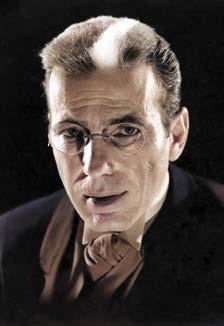
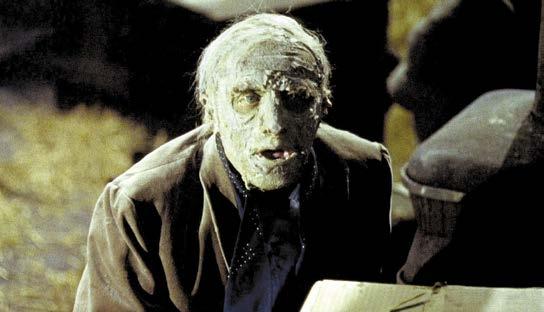
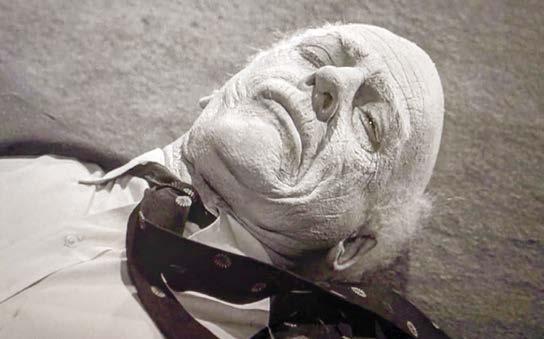
Have you ever seen Spencer Tracy as Mr. Hyde? Or Ray Milland as half of a two-headed monster? Or Humphrey Bogart as a reanimated corpse in search of blood? It raises the question: What would possess a bona fide, big-deal movie star to make a... a... horror film?
Conventional wisdom once had it that horror films are lowbrow entertainment for lowbrow audiences. (We now know better.) And yet, there have been occasions during Hollywood’s golden age when mainstream movie stars deigned to appear in such films. When they did, they usually fell into five categories. Drum roll, please…
#1. Literary precedent:
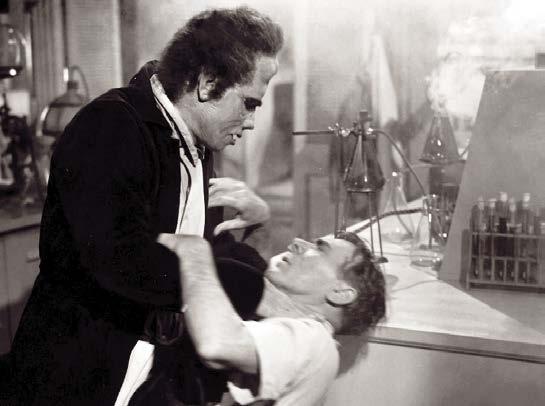
If a horror film is based on classic literature, movie stars get a pass. Classic literature, after all, is classy stuff. Take The Strange Case of Dr. Jekyll and Mr. Hyde, the 1886 novella by Robert Louis Stevenson which examines the dual nature of man. Three big names starred in consecutive adaptations: John Barrymore (in 1920), Fredric March (in 1931) and Tracy (in 1941).
#2.
Early dues paying:
If an actor was destined to become a star, but in the meantime desperate to pay the rent, she or he might reluctantly accept a role in a horror film. Such films became— pun intended—skeletons in their closets. The most jaw-dropping example is Bogart in The Return of Dr. X (1939). In real life, Bogie referred to it as “this stinking picture.”
#3. Late career slump:
Milland, a fine actor and an
Oscar winner, once recounted a recurring complaint among his contemporaries: That there were no more roles for them. But, Milland countered, said colleagues still expected to play leading men. Not Milland. He simply wanted to practice his craft. So he made, for instance, The Thing With Two Heads (1972) opposite football star Rosie Grier. And I do mean “opposite”—directly opposite. (Grier played the other head.)
#4. Bandwagon movies:
Over the years, certain big-budget, big-studio genre films have attracted A-list players. (Mind you, buzz and bucks are no guarantee of quality.) It becomes a bandwagon effect. Three that spring to mind are Rosemary’s Baby (1968), Planet of the Apes (1968) and The Omen (1976).
#5. Horror stars at heart:
Not many players fit this category. I can only think of three: Charles Laughton, Claude Rains and Peter Lorre. These actors simultaneously exist in two cinematic worlds. They are best known for their work in mainstream films, yet we monster nerds still claim them as our own.
There are a number of pertinent micro-categories. I won’t go down the rabbit hole, but I feel a duty to name-check the so-called “hagsploitation” subgenre. (These are horror movies that provided starring roles for actresses of a certain age such as Bette Davis, Joan Crawford, Olivia de Havilland, Debbie Reynolds, and Shelley Winters.) Hagsploitation is such a storied, fascinating
subgenre unto itself that honestly, it deserves its own deep-dive article in the pages of Cryptology. And I have no doubt that day will come.
DOCTOR, DOCTOR
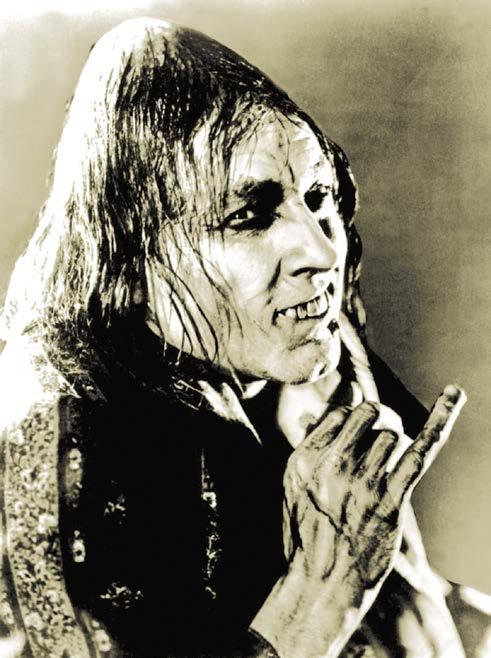
In John S. Robertson’s 1920 Dr. Jekyll and Mr. Hyde, John Barrymore was likely the first established movie star to play a horror character, making him something of a pioneer. During this, the silent era, the hard-drinking Lothario of the Barrymore acting dynasty also starred in such films as Sherlock Holmes (1922) and Beau Brummel (1924), and was considered the greatest Hamlet of his time.
In Jekyll and Hyde, the “Great Profile” (as publicists called Barrymore) plays an eerie transformation sequence that set the tone for many to follow. He throws his head back, huffs and puffs, and reappears in garish makeup with stringy hair. Barrymore wears pointy extensions on his fingers that lend an Expressionistic feel to the sequence.
Fredric March is a revelation in the dual role in Rouben Mamoulian’s 1931 remake. In fact, March won an Oscar in the
part—the first horror characterization to snag the big prize.
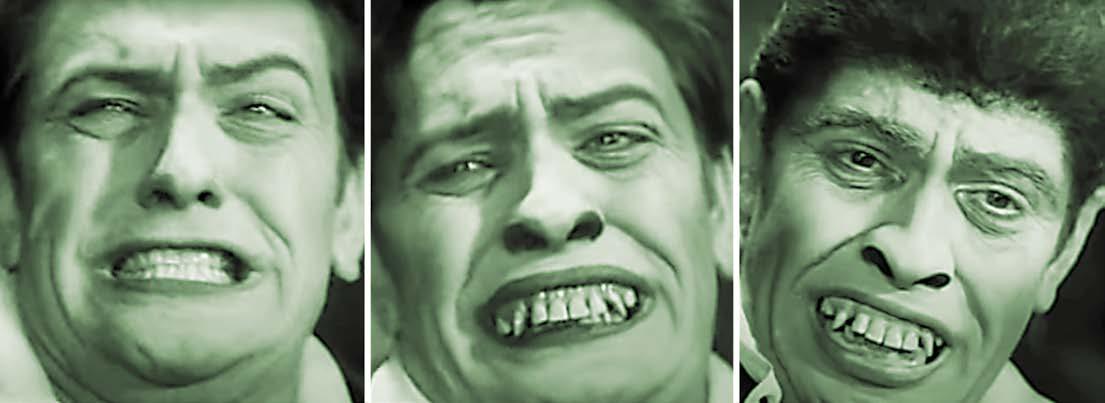
His spellbinding transformation into Hyde is no time-lapse job, as Lon Chaney Jr. would later do in The Wolf Man (1941) and its sequels. The idea here was to do the transformation “live” on screen using lighting and stage tricks. The use of colored lighting filters—less detectable on black-&-white film— made painted makeup suddenly appear as if by magic. A mirror trick is employed like stagecraft on film. The “mirror” is actually an artfully framed glass shape cut into the wall.
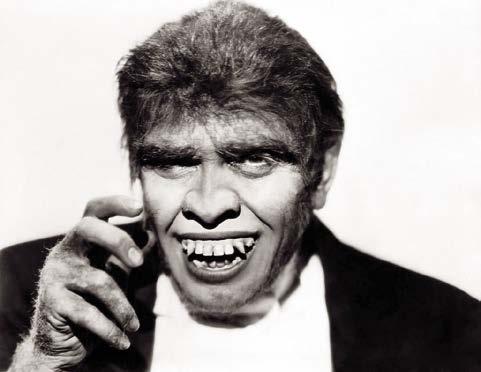
It should be noted that the Hyde design (by Wally Westmore) is quite monster-y. The makeup really goes there, to a degree far beyond those of Barrymore and Spencer Tracy. The nose is broader, the face furrier, the teeth a mess of snaggletooth fangs.
March’s acting is the cherry on top. His Hyde is an often violent thrill-seeker who terrorizes the music halls of fogshrouded 19th-century London in the wee hours. He turns a singer, Champagne Ivy (Miriam Hopkins), into his lover and prisoner. (This is clearly a pre-Code film.) Honestly, Mamoulian’s Jekyll and Hyde is one of the best horror films of the Thirties, a decade with a lot of competition.
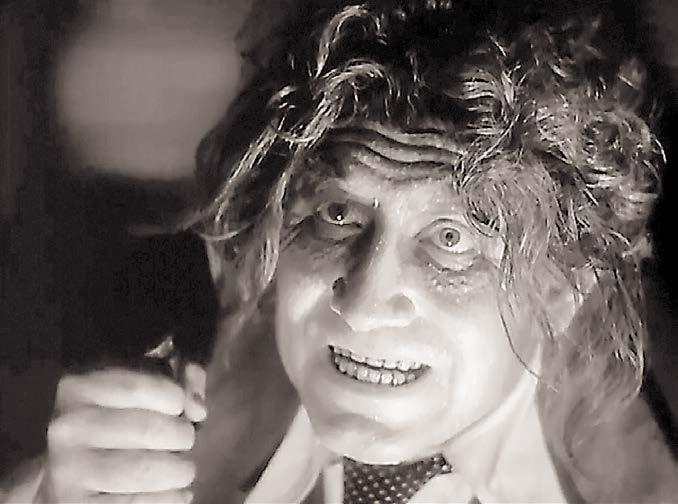
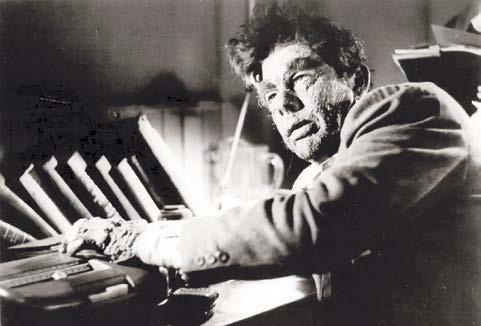
Alas, Tracy’s version pales in comparison to his predecessors. The actor seems miscast as Jekyll in Victor Fleming’s film. His Hyde makeup amounts to bushy eyebrows and a perm-grimace. But there is one notable tidbit concerning the production. Tracy’s co-star Ingrid Bergman was assigned the role of Beatrix, Jekyll’s fiancée. Instead, she insisted on playing Ivy, the brassy barmaid who is abused by Hyde. So Bergman counts as yet another big star drawn to the horror genre, as does Lana Turner, who ended up playing Beatrix.
MONSTER NERD HEROES
Another Oscar winner, Charles Laughton, attracted audience sympathy while wearing distended prosthetics as the tragic, deformed bell-ringer Quasimodo in William Dieterle’s The Hunchback of Notre Dame (1939). It’s a remake of the 1923 film starring Lon Chaney Sr., based on Victor Hugo’s 1482 novel about class, religion and man’s inhumanity to man.
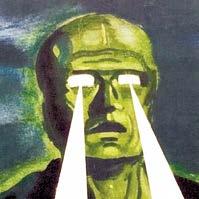
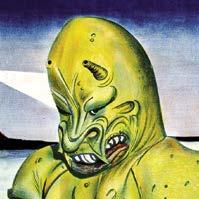
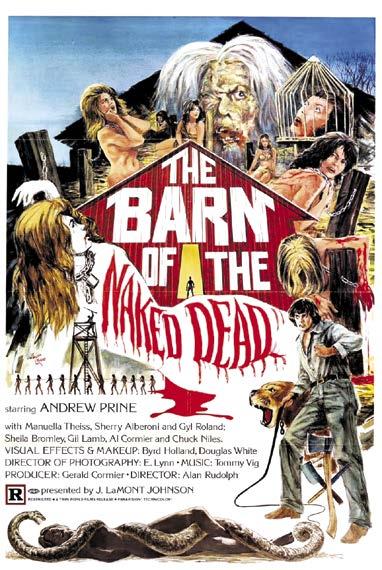
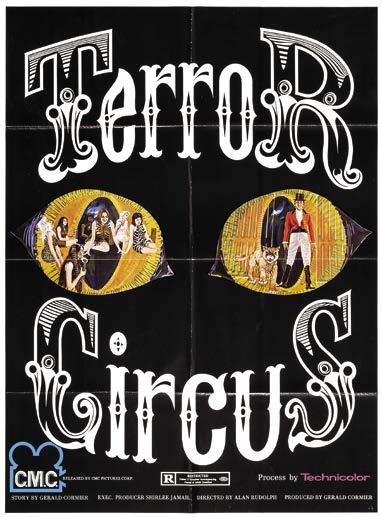
Closing the Barn Door after the Naked Dead Have Escaped
John Frankenheimer’s late-inlife Reindeer Games (2000) is not what one might call prime Frankenheimer—merely a conventional crime thriller, distinguished by a bracing heavyartillery set-piece. Somebody once reasoned that Alan Rudolph, one of the most offbeat of the modernistic film noir directors, might have lent an edge that is lacking in Frankenheimer’s approach, but they never let poor Rudolph join in any Reindeer Games.
So there is one movie that is decidedly not the work of Alan Rudolph. Another, if one takes Rudolph’s word for it, is the conspicuously edgier and utterly unconventional The Barn of the Naked Dead (1973)—also known by the bigscreen name of Nightmare Circus and circulated on video as Terror Circus. Though technically a proxy title concocted for a reissue of 1975-1976, The Barn of the Naked Dead packs a memorably absurdist ring that renders its other billings irrelevant.
I was backtracking over Rudolph’s career as a screenwriter and director one day in 1988, while visiting with him at a festive preview event at Dallas’ USA Film Festival. The big deal of the moment was The Moderns, Rudolph’s artsier-than-thou drama about an expatriate American artist (Keith Carradine) at large in Paris during the 1920s. The interview was progressing well, retracing a path back through the bizarre neo-noir Trouble in Mind (1985) and the cattlemutilation shocker Endangered Species (1982) and the stalker melodrama Remember My Name (1978)—until I, in all due film-scholar earnestness, brought up The Barn of the Naked Dead.
“What?!” replied Rudolph. “Where’d you come up with a title like that?”
“Uh, well,” I answered, “Andrew Prine mentioned working with you on it, kind of making things up as it went along. And Robert Altman has cited it as one of the pictures that had brought you to his attention. Maybe you’d remember it under another title, like Nightmare Circus—? One of your earlier pictures, and, uh…”
“I don’t make ‘pictures,’” answered Rudolph. “I make films. And I certainly never would have had anything to do with any nonsense called Nightmare Circus, much less any Barn of the Naked Dead.”
The oxygen was draining noticeably from the room, and so I sought less suffocating altitudes — such as the apprenticeship with the master filmmaker Altman, their collaborative screenplay for 1976’s Buffalo Bill and the Indians, Rudolph’s graduation to acclaim as a solo director, and of course the Southwestern US premiere of The Moderns and its tremendous appeal to the film-snob elite. And so much for The Barn of the Naked Dead, anyhow. Or perhaps not. Whether acknowledged or denied, this peculiar exercise in revulsion and rage called The Barn of the Naked Dead remains a transitional picture—film, I mean to say—in a career of escalating brilliance and all due self-aggrandizement. (The late historian Ephraim Katz appears to have been the first critical observer to trace Barn’s writer-director pseudonym, Gerald Cormier, to Rudolph.)
“It’s a gut-wrencher, is what it is,” star player Andrew Prine had told me during the early 1980s. The busy actor (his career dates from 1953) characterized Barn as “nothing much more than a way of marking time
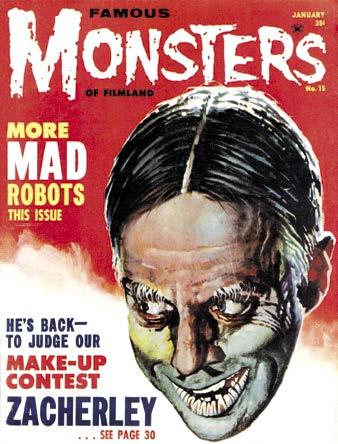
Like Stephen King, Steven Spielberg, George Lucas, and countless other boomers besotted with the Universal horror film revival on TVs across America. He might have caught John Zacherle playing “cool ghoul” horror host “Zacherley” who on Oct. 7, 1957, ushered in those vintage horror flicks on WCAU’s Shock Theater. Adams would have been around 16 years old. His daughter, Kristine Stone, wrote in an email that she could not remember her father mentioning anything about seeing his first horror movies, however: “I do know that my dad loved Universal monsters and I’m sure he found a way to see them.”
In the introduction to Neal Adams Monsters (Vanguard Productions, 2003), Adams’ tribute to Universal monsterdom, he wrote: “I confess, I am a secret monster lover. When I was a kid, probably like most of you, I loved monsters.” Authorhistorian J. David Spurlock, who worked with Adams on many projects including Neal Adams Monsters, reported, “I don’t specifically recall Neal mentioning Zacherle, who was a friend of (Famous Monsters of Filmland magazine cover artist) Basil Gogos, but Neal had great respect for Basil and called him ‘a REAL artist,’ so Neal was obviously familiar
with FM.” Regarding seeing any of the Universal horror relaunches at movie houses prior to that, Spurlock noted that, “Neal caught some theater revivals— likely including Halloween-season revivals—and I know Neal saw the Abbott & Costello monster films NEW in first release at the theater.”
Adams was also at the right place and time to read those gloriously grisly pre-Code horror comics in their first full flowering of evil in the early 1950s, but again it’s uncertain as to precisely what he read. Speaking with Jon B. Cooke in Jack Kirby Collector #17 (Nov. 1997), Adams said, “In those days there were Fan Addicts for EC, but I was just a reader of comic books, a reader of comic strips, and went to the movies. My mother didn’t keep me from comic books, so I guess I was something of a collector, but not a big one. I certainly did read comics. […] I was a big fan of Supersnipe. And Captain Marvel, Superman, Batman. There’s hardly a comic book you can bring up that I don’t remember reading, because when we were kids, we traded comic books. That’s how I got to read all the comic books. Powerhouse Pepper and all these oddball comics were traded back and forth. Even if it wasn’t the greatest comic, we read it. That’s pretty much the way things happened until I was ten or twelve years old.”
At some point EC Comics and Mad made a considerable impression on him. “Neal Adams told me that Al Williamson’s EC art was a big influence on him,” wrote Cryptology’s very own designer Michael Kronenberg on his CollectedEditions.com site (#6, Aug. 27, 2008). Adam’s son-in-law Peter Stone recalled: “Neal had been a fan of Woody (Wallace Wood) since “Superduperman!” from 1952’s fourth issue of Mad magazine. So, Woody had to be the magic of Sky Masters and Challengers [of the Unknown], right? Neal had turned me on to early Mad magazine, and by that, I mean the stunning art of Wally Wood, Jack Davis, Will Elder and John Severin along with the stellar, legendary humor writing of Harvey Kurtzman” (posted in Dan Greenfield’s 13th Dimension, The Neal Adams Chronicles, Aug. 28, 2023).
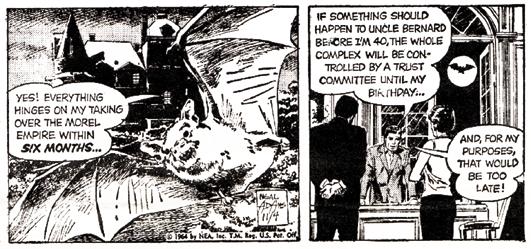
A chiaroscuro precursor to the moody foreboding that would characterize Adams’ later horror efforts was already percolating through two panels from Adams’ Nov. 4, 1964, black-&-white daily comic Ben Casey, a newspaper strip based upon the mainstream television series. The two scenes featured
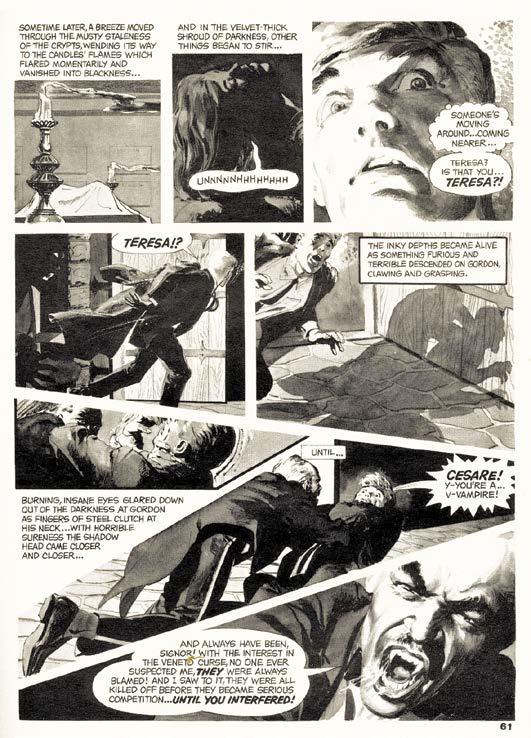
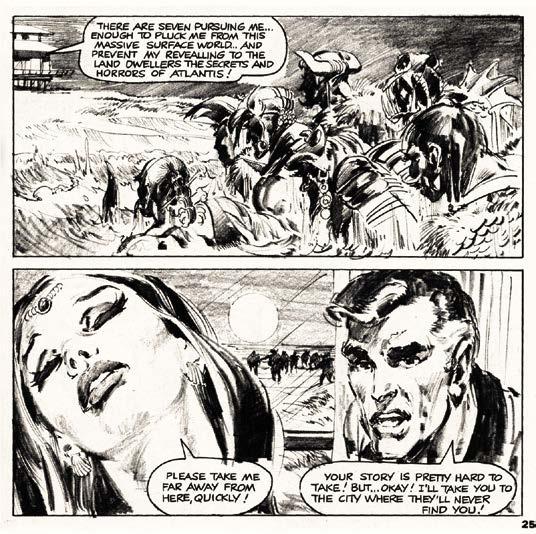
an anatomically accurate, yet creepy bat set against an old Gothic mansion and full moon. Within a few years, he would embark upon a long association with Famous Monsters of Filmland publisher James Warren’s three flagship horror comic magazines: Creepy, Eerie, and Vampirella. Partnering with writer Archie Goodwin on “Curse of the Vampire” Creepy #14, April, 1967), he contributed velvety, atmospheric ink washes within asymmetrical panel frames that signaled his signature experimental approach to comics page design. Before the year was out, Adams illustrated two more Goodwin tales for Eerie #9 (May 1967) and Creepy #15 (June 1967). A few years later he returned to draw “Goddess from the Sea” by Don Glut for the debut issue of Warren’s Vampirella (Sept. 1969). In this yarn, a beautiful maiden from Atlantis seeks help from an artist living in a beach-side cottage. She’s trying to escape from her repressive species, but is dragged back into the sea by Atlantean warriors who have tracked her down. They initially look like human savages, but when back in the water, they morph into humanoid reptiles—except for the Goddess who remains a voluptuous woman. I asked author Glut if the Atlantean transformation was his idea, and he replied in an email that he couldn’t remember much about it, but added: “I suspect that was Neal’s idea, because the Goddess looks human. However, Neal did enrich the story by making the man an artist,
anthology Tower of Shadows #2 (Nov. 1969), to reveal a rather silly-looking primordial blob that lives on sound vibrations. When it attacks two hippies, they manage to elude it by keeping silent until the unresolved ending. Even with Stan Lee’s editing, it’s not Adams’ best effort in the script department.
Drac is back with more monster mashups
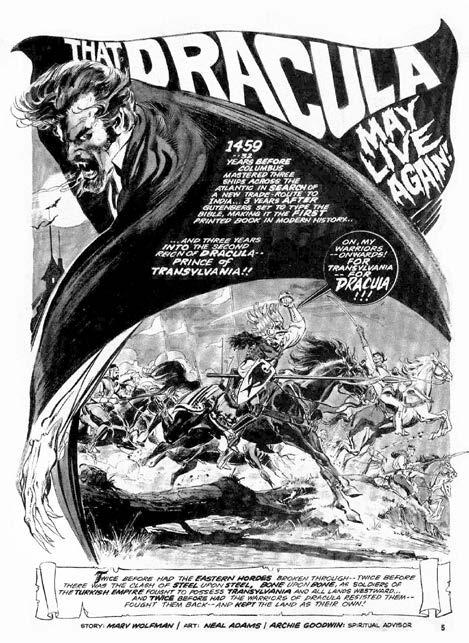
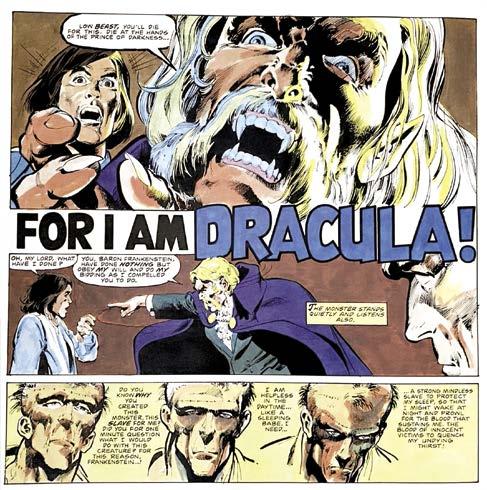
The Bronze Age treatment of Dracula chronicled by Adams and writer Marv Wolfman for Marvel’s “That Dracula May Live Again!” in Dracula Lives! #2 (1973) was a black-&-white masterpiece set in the 15th century. Had it been extended into a longer run, it might have done for Dracula what Bernie Wrightson did for Frankenstein’s monster; giving the iconic character the epic treatment he so deserved. Gene Colan who, if truth be told, did create a powerful and substantial sequential art Dracula for the ages, made Dracula self-absorbed, severe, and savage, and it is Colan and Wolfman’s definitive interpretation for Marvel’s The Tomb of Dracula that will be remembered. By contrast, Adams’ Dracula as Byronic matinee idol was conventionally handsome in a male model sort of way (as most of Adams’ heroes tended to be), but was neither as original nor effective as Colan’s brutal depiction. Nevertheless,
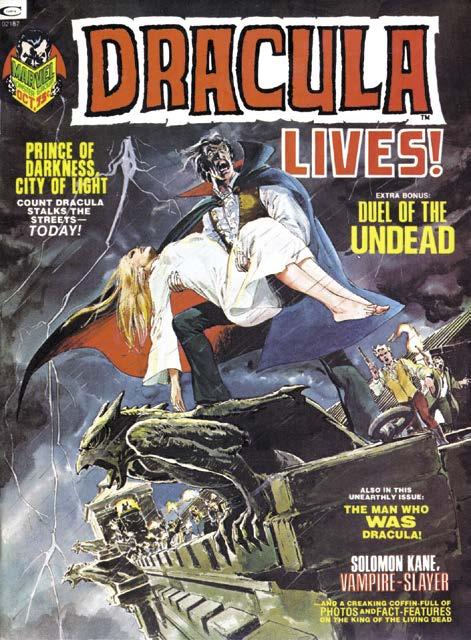
Adams’ versatile and superior artistry was in other respects more daring, exacting, and polished. He painted a magnificent cover for the next issue, Dracula Lives! #3 (Oct. 1973), one which he later claimed in Neal Adams Monsters was his favorite Dracula cover, but unfortunately, he wasn’t to contribute any further interior stories. Too bad Adams and Wolfman didn’t do a series of historic Dracula tales that could have been
assembled later as a graphic novel, as Dick Giordano and Roy Thomas did in 2010 with their vintage Dracula Lives! material. But as Adams explained to Arlen Schumer in Comic Book Artist #3 (1998), exerting oneself on such projects was just too impractical: “The truth is, for me to do a job like this and to do it in wash, and to finish and ink it, was a loss. I don’t know what I was paid for these pages but it couldn’t have been much. And for me to sit down, lay it out, pencil it, have it lettered and brought back to me, ink it, and then to lay washes on it, is an awful lot of work. Normally, you’d give this to an inker and you take your check and go away. This is a lot of work for one guy to do, so I really did it for Marv and to do a Marvel Dracula story, and once done I’d better get back to doing easier-to-do stories so I can make a living.”
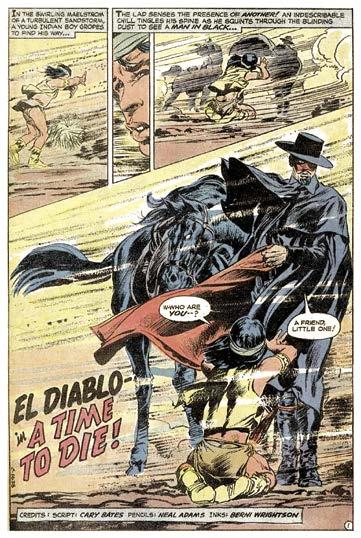
Meanwhile back at the DC ranch in 1972, All-Star Western transformed itself into Weird Western with Adams having a brief tenure illustrating a few Cary (Superman) Bates stories featuring Lazarus Lane, a.k.a. El Diablo. According to the origin of this character, a cowboy (Lane) is struck by lightning and rescued by Native American shaman Wise Owl, but remains paralyzed. While Lane’s body lies helplessly inert, his astral spirit—à la Doctor Strange—travels out-of-body as El Diablo and adventures ensue. But is
El Diablo a manifestation of Lane’s inner spirit, or is he possessed by a satanic demon? Only in the mildest sense can this series, based on a rather tenuous supernatural premise, be considered horror. Regardless, as a Zorro knock-off, the El Diablo alter ego looked great.
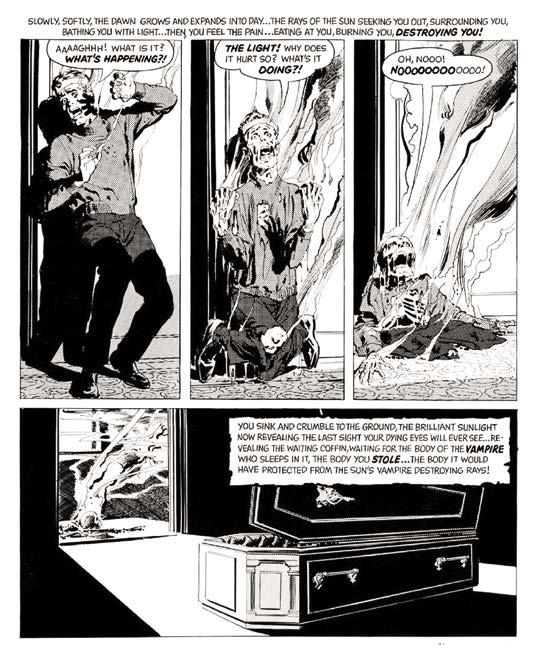
Neal Adams Monsters began in 1975 as a 16-page booklet accompanying Power Records’ long-playing vinyl spoken-word kids’ record titled A Story of Dracula, the Wolfman, and Frankenstein. Adams wrote and penciled the comic while Giordano and Terry Austin inked. It was reissued in 1982 by Parade Records as a two-LP set called House of Terror! which we will save for a later date. Adams’ own imprint, Continuity Comics, serialized the story alone in Echo of Futurepast from 1984 to 1986. Finally in 2003, Vanguard Productions published a 46-page expanded and computer-recolored version of the story with additional Adams material. His later rendition of the Frankenstein monster looks curiously like Uncle Creepy from his “The Terror Beyond Time” in Creepy #15 (June, 1967). All four incarnations are fascinating evolutionary artifacts.
In his introduction to Neal Adams Monsters, the artist shared his low opinion of the various Universal monster movie sequels: “I’d always felt they’d missed the boat. They didn’t do the one final movie. You know. The one where the monsters all battle. They did do one Frankenstein Meets the Wolfman. But things were going downhill by then and, horribly, they didn’t get Karloff for the monster, but Bela Lugosi with his chubby cheeks played him poorly, and Lon Chaney Jr. was a marginal Wolfman at best.” So, he came up with a new exposition on the Universal monster mythology. “The story that brought all three of these characters together must, I thought, be simplicity Itself. Connecting Dracula and the Werewolf was easy. Gypsies, pentagram, Dracula holds sway over gypsies, got it. But Dracula and the monster? Then it hit me. When is Dracula most vulnerable? What fear does he have during the day that he doesn’t have at night? And there it was: the connection.” Think what you will about Adams’ monster mashup, his representation of a
female werewolf was a nice touch.
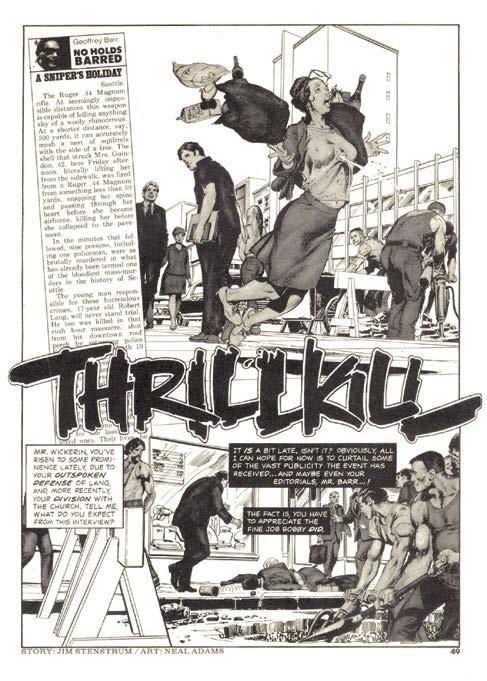
Before Adams largely turned away from mainstream comics in the 1980s, he rendered one rather remarkable horror parable for Creepy #75 entitled “Thrillkill” (Nov. 1975). Written by Jim Stenstrum, “Thrillkill” is real-life horror of the kind that has come to dominate horror films in the 21st century. It grew out of the splatter film/torture porn phenomenon that emphasized psycho killers and graphic gore over supernatural monsters and paranormal happenings. Adams and Stenstrum were way ahead of their time in delving into the mind of a mass murderer. It is narrated by the perpetrator’s longtime friend and despite some questionable armchair psychology, has a somewhat compassionate tone that anticipates Derf Backderf’s 2012 graphic memoir My Friend Dahmer. Compassionate in the sense that family and society are deemed equally culpable in the creation of this modern monster. As always, Adams’ adaptability in taking horror to new places is on full display.
Neal Adams’ accomplishments in the horror genre have yet to receive the widespread acclaim of his superhero oeuvre. Perhaps now is the time to give them their due. m
MICHAEL BONESTEEL is a mouldering monsterkid and has written about horror and science fiction comics for Filmfax magazine and the book Alien Invasions! The History of Aliens in Pop Culture (IDW, 2020). Formerly, he was an adjunct professor of comics art history at the School of the Art Institute of Chicago.
professor from marrying his daughter when he discovers the man has lived for thousands of years. Ironically, not long after this episode was aired, Charles Beaumont began to suffer from a rare form of advanced aging. He died at the age of 38 from Alzheimer’s disease.
the Muertos discover the fire, they panic and run back to the monastery only to see the effects of the flowers’ fumes negated by their excitement. Neal Adams portrays the couple running, as panel-by-panel they age 100 years, dying before our eyes, to thereupon fall into the open graves seen at the beginning of this tale.
The theme of attaining immortality and the frightening cost that comes with it has been explored so many times before. One of the most famous stories of eternal youth gone wrong is Oscar Wilde’s novel The Picture of Dorian Gray, adapted by MGM in 1945, starring Hurd Hatfield and George Sanders. It tells the story of Dorian Gray, a handsome young man, who having sat for a magnificent portrait of himself, finds vanity gets the better of him. As he ages and becomes progressively morally corrupt, it is the once proud portrait that reflects the darkened nature of his debauchery, while he remains ever youthful. Over time, the painting transforms to portray a hideous monster, as those close to Gray become suspicious of his eternal youth.
Possibly the most underrated movie on the pitfalls of eternal life was Hammer Films’ The Man Who Could Cheat Death (1959), starring Anton Diffring and directed by Terence Fisher. The story unfolds as Dr. Georges Bonnet (Diffring) discovers he can live forever through periodic gland transplants from young, healthy victims leading to a terrifying finale very similar to the fate endured by the Muertos.
In one of the The Twilight Zone’s finest episodes the subject of immortality again manifested itself in “Long Live Walter Jameson” (Season One, Episode 24, original air date 3/18/60). Penned by the brilliant writer Charles Beaumont, it starred Kevin McCarthy as Walter Jameson. Here, a father forbids a history
DR. JEKYLL AND MR. BAT
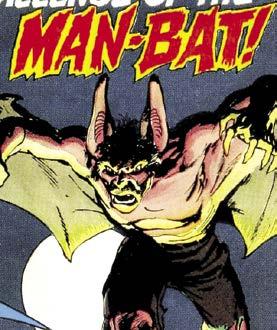
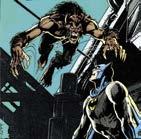
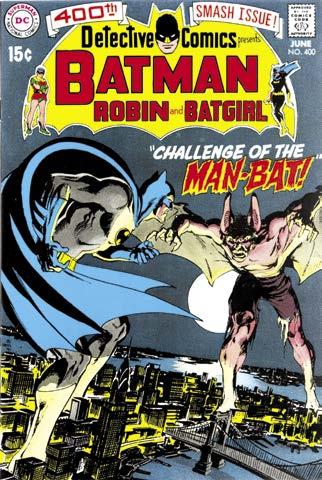
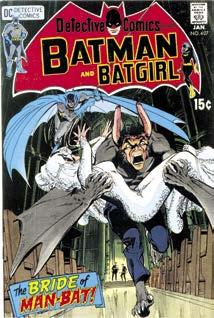
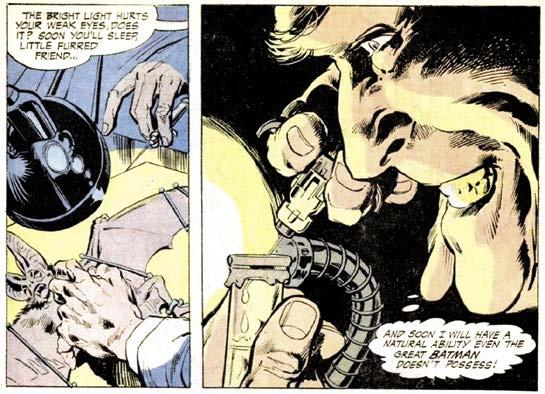
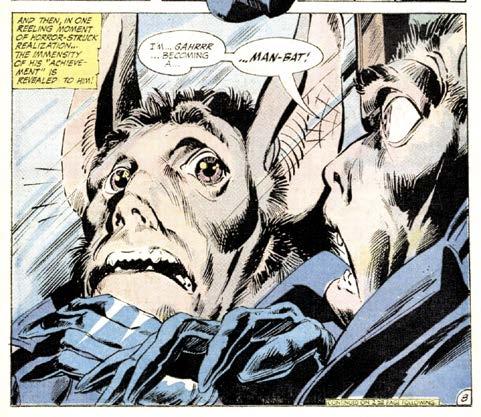
The first major addition to Batman’s rogues’ gallery in the Bronze Age was the monstrous Man-Bat. Created by Frank Robbins and Neal Adams, he made his first appearance in Detective Comics #400 (June 1970). Bat researcher Kirk Langstrom desires to attain the powers of the bats he studies to enable him to “have a natural ability even the great Batman doesn’t possess!” By taking doses of gland-extract from the bats, Langstrom begins to develop super-sensitive hearing along with their natural sonar, allowing him to navigate in darkness. Inevitably, there are side effects resulting in Langstrom acquiring the physical attributes of a giant bat—a Man-Bat. He now needs
to discover an antidote. In his debut, Man-Bat fights alongside Batman, foiling a gang of would-be thieves at the museum where Langstrom works, yet he blames Batman for his condition, telling him, “It was your inspiration… your great fight against criminals of the night—that brought this on me!”
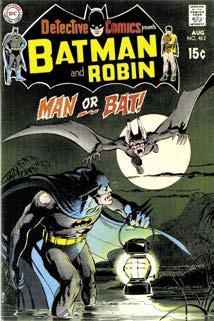
In future issues, Man-Bat’s mutation would continue both physically and psychologically. In Detective Comics #402 (Aug. 1970), “Man or Bat?,” we find Langstrom working feverishly to put together the ingredients for an
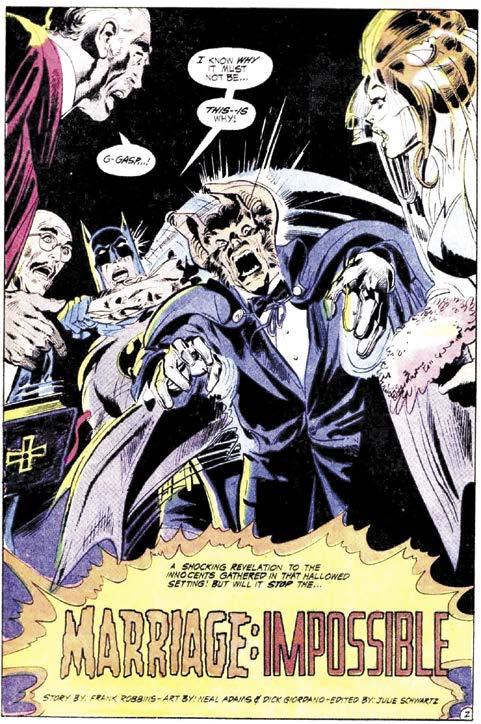
antidote, but to no avail. His transformation has become such, he has evolved giant batwings, making it possible for him to fly. However, all the time he is losing his humanity, thinking and becoming more like a bat. The story continues in Detective Comics #407 (Jan. 1971), “Marriage: Impossible.” Now completely deranged, Man-Bat has kidnapped his fiancée Francine. To prove her love, she permits him to inject her with the bat-serum—changing her into She-Bat. Batman refuses to be thwarted; using the Batcave’s advanced lab equipment, he develops an antidote, which after a violent encounter with the bat-couple sees them return to their human forms.
Neal Adams thought up and wrote a synopsis for a Man-Bat story, intending to present it to Julius Schwartz. “I had been thinking about how I was going to approach Julie because I didn’t want this Man-Bat story changed and ruined,” Adams recollects. He found his opportune moment when a story meeting between Schwartz and writer Frank Robbins proved fruitless. When Schwartz asked Adams for ideas, he presented his Man-Bat pitch.
Adams was able to convince Schwartz to use his idea, but the story had to be written by Robbins.
Man-Bat’s most recognizable influence is Robert Louis Stevenson’s Dr. Jekyll and Mr. Hyde.
Like Jekyll, Langstrom develops an elixir that will transform him for the betterment of man, but the experiment goes badly wrong, transforming him into a hideous monstrosity. The cream of the film adaptations
Fans of horror comics, especially those now-slowly disintegrating tomes from the halcyon days of the pre-Code years, are remembered fondly; not only for their stories, but also for the never-ending spectacle of gut-wrenching covers depicting blood-sucking vampires, flesh-rending werewolves, half-rotted walking corpses and the like.
While we can still be mesmerized by the tales of murder, mayhem and revenge, it’s the covers that really gets our blood pumping. EC Comics are naturally on top of the heap with their unique—and dare I say sophisticated— style of gruesome images rendered by the remarkable talents of Graham Ingels, Jack Davis, Johnny Craig, et al, but competing titles from a host of other publishers aimed to outdo them with decapitated and exploding heads, torn and burning flesh, and worse. Never mind the quality of the stories; it was the covers that were intended to divest a kid of his hard-earned dime.
Today, there is a robust collector’s market for the dreadful things, particularly the ones featuring the aforementioned covers (most of them are being peddled in sealed clamshell cases, so you can’t read the
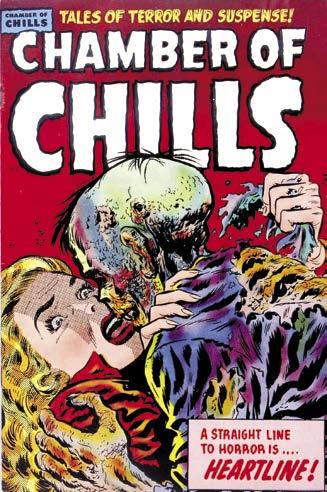
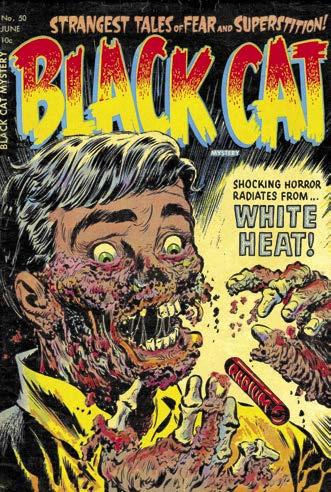
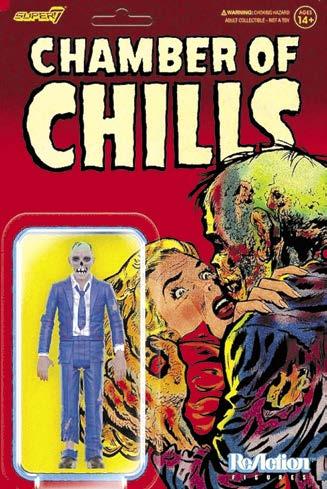
stories anyway!). For example, Harvey’s Chamber of Chills #23 with the notorious “zombie kiss” cover sold at auction in 2023 for $22,800, and Lee Elias’ original cover art for Harvey’s Black Cat Mystery Comics #50 sold in 2024 for $840,000! Prices like this make owning one of these bygone treasures out of reach for most fans. Fortunately, many pre-Code horror comics are now in the public domain and are being “remastered” and reprinted in more affordable editions. Still, there’s nothing like holding an original in your fervent, trembling hands, is there? Lucky for us, there’s another, considerably less expensive way to own just a little part of these memories, with an emphasis on “little” here.
Merchandise such as action figures, bobbleheads, and other, similar collectible products are a hot commodity lately, and one company in particular has come up with an idea that will thrill fans of vintage horror comic books.
Founded in 2001 by Brian Flynn and based in San Francisco, Super7 has been supplying happy customers with licensed minifigures of their favorite personalities from TV, movies, rock ’n’ roll, and more. They also carry a line of horror figures that include Universal
But wait—that’s not all! If you visit their website (super7.com), you’ll be astounded to find lurking among the many choices a selection of these diminutive figures based on pre-Code horror comic covers! Kudos to the genius who thought that up!
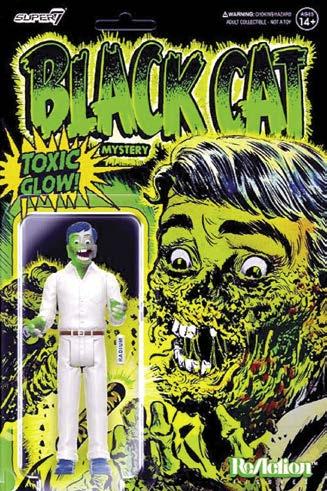
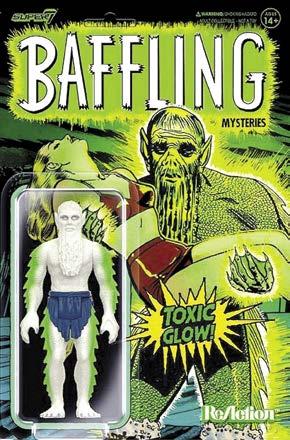
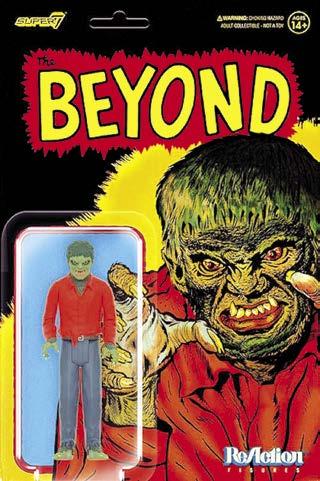
Part of Super7’s “ReAction” line, each articulated figure is 3.75" tall and made from injected plastic. The figure is then blisterpacked on a backing card that measures 9 x 6 x 1". An added bonus is the card has an image of the comic cover from which the character appeared, making it an overall great-looking package. A few of them are even available with eerie glow-in-the-dark “Toxic Glow” material. Each figure retails for $20-25.
Here’s the run-down on availability at the time of this writing:
SEAWEED MONSTER
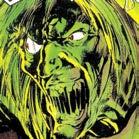
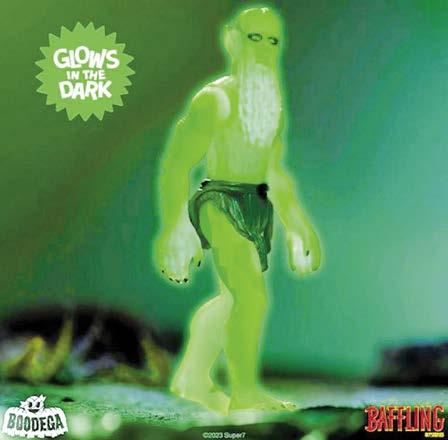
Looking like a tangle of algae and fish skin on two legs is the underwater dweller Super7 calls “Seaweed Monster.” The scaly humanoid hails from the cover of Baffling Mysteries #7 (March 1952) published by Ace Magazines, and is seen carrying a swooning blond bathing beauty, a trope used in countless horror comics and movies. What makes the image a little eerie, though, is that “Weed” is carrying her out to sea instead of back to the shore. This now-familiar scenario was played out in films such as Creature from the Black Lagoon and Curse of the Faceless Man
The art is by Frank Giusto (a.k.a. “Ace Baker”) from the interior story “Terror from the Tides,” illustrated by Mike Sekowsky. Instead of the dangling seaweed from his chin we see on the cover, in the story it’s drawn and colored to look like a white beard instead! Notice also the black shadowing on his thighs in an apparent rare case of pre-Code self-censorship. It does beg the
question, though: Does Seaweed Man really need a swimsuit?
Apparently a little bashful themselves, Super7 has opted to clothe their figure in a modest loincloth to make him “suit”able for all ages. The Seaweed Monster also comes in a “Toxic Glow” bioluminescent version.
VORACIOUS WEREWOLF
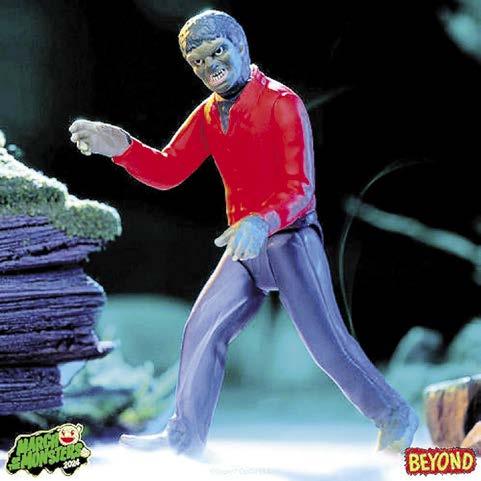
Waiting to dig its claws into its next victim is Super7’s “Voracious Werewolf” from the cover of Ace’s The Beyond #1 (November 1950). The art is attributed to Warren Kremer, who originally drew a preliminary sketch of the image for the cover of their unpublished second issue of Challenge of the Unknown. The cover illustrates the interior lead story, “The Werewolf Strikes” with art by Frank Giusto.
Super7’s figure is a recreation of the menacing lycanthrope, replete with blood-red shirt, sharp claws and obligatory hairy face and chest.
RADIUM MAN
Don’t try this at home, folks. If you happen to come across a cylinder marked “Radium,” for heaven’s sake, don’t open it! While technically it takes some time for the effects of a radiation burn to begin appearing, this hapless fellow must have received a mega-dose as seen on the cover of Black Cat Mystery Comics #50 (June 1954) by horror artist extraordinaire, Lee Elias.
With issue #30, Black Cat Comics starring the titular, slinkysuited super-heroine morphed into Black Cat Mystery Comics, a full-fledged horror title. Although the first few issues were a bit tepid, when it hit its stride, it became one of the most reviled comics that Dr. Fredric Wertham ever had the displeasure to lay his beady eyes on.
The cover story in this issue, “White Heat” is penciled by Joe Certa with inks from the brushes of John Belfi. Certa’s art is
RA GUIDE TO THE PRE-CODE HORROR COMICS OF THE 1950 s - PART 3
HORROR
by Michael Bonesteel
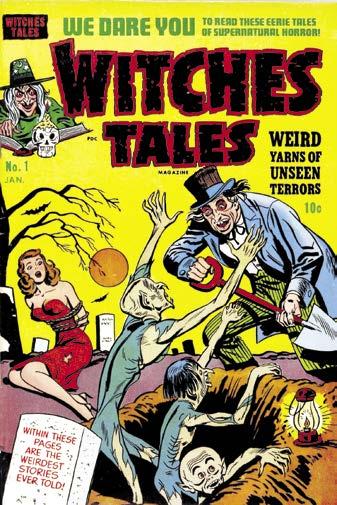
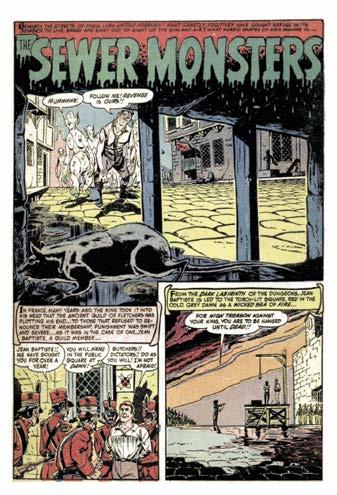
eadying themselves for the landslide of horror titles soon to cascade across magazine racks and newsstands across America in 1951, Harvey Comics’ Witches Tales #1 (Jan. 1951) drew first blood in January of that year. The inside front cover not only offers a black-&-white illustrated table of contents, but a preface entitled “The Witch’s Warning” by a snickering old hag hostess. In July’s issue #4, comics veteran Bob Powell penciled his breakout horror story, “The Sewer Monsters,” his unique and ambitious style fairly jumping off the pages.
Other important artists who drew for Witches Tales included Rudy Palais and Howard Nostrand. Palais, who got his start painting movie posters for both Warner Brothers and Columbia Pictures, rendered comics in a style clearly reflecting the influence of Graham Ingels. Quoted by Greg Sadowski in his milestone survey, Four Color Fear: Forgotten Horror Comics of the 1950s (2010), Palais recounted that he would “add things to punch up the drama” and “exaggerate things as I felt necessary to add mood to the story.” As with tales like “Scarecrow’s Revenge!” (Witches Tales #14, Sept. 1952) and “Art for Death’s Sake” (Witches Tales #15, Oct. 1952), where he amplified the drops of sweat dripping from the faces “to emphasize the stress that the characters were going through.”
Nostrand’s regular “Mother Mongoose’s Nursery Crimes” series owed a lot to Jack Davis. But in comics, to paraphrase Oscar Wilde, swiping is the sincerest form of flattery, granting the reader the benefit of these influences. In Sadowski’s Four Color Fear, we are told that Harvey editor Sid Jacobson “fostered a friendly rivalry among his artists” and “openly encouraged his staff to mimic EC artists.” Harvey would soon add three more titles to spice up its horror line-up, two of which we will get to shortly.
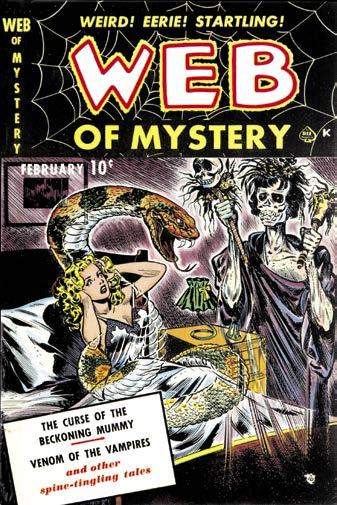
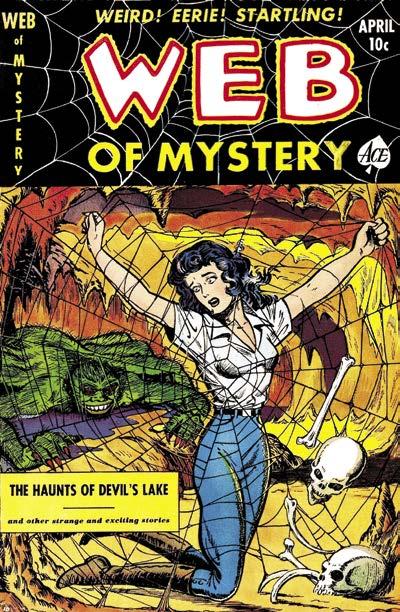
Ace Magazines unveiled Web of Mystery’s debut in February 1951. As with its sister title, The Beyond, Web of Mystery showcased some outstanding work from Lou Cameron in its
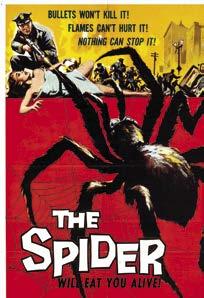
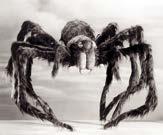
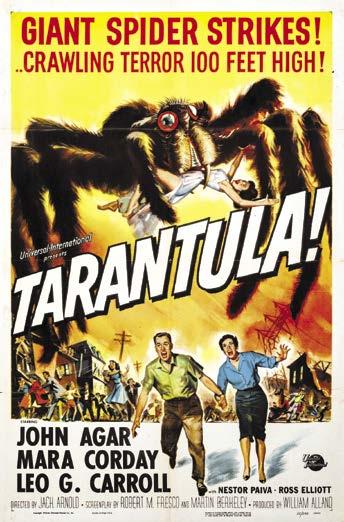
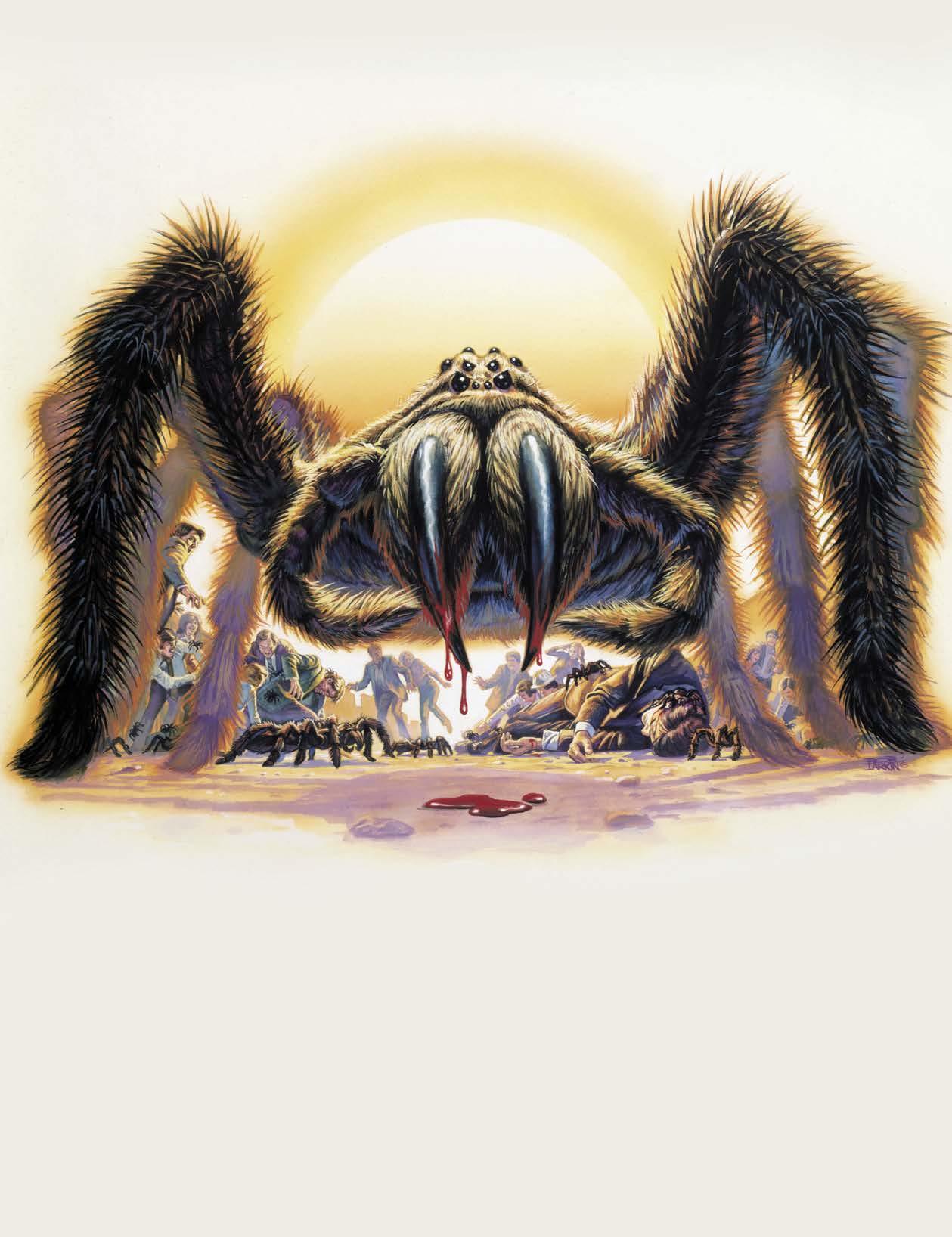
Forget about Killer Bees. We’re talking spiders. Arachnophobes have a reason to be jittery. Of all arthropods, spiders are probably the creepiest: The black bulbous body; the hairy tentacular legs; the multiple eyes; the gaping jaws. After the giant ants in Them! (1954) smashed through Los Angeles—and the box office—it only made sense to unleash super-sized spiders on moviegoers. Even before the release of Them!, outsize arachnids appeared in such films as Dr. Jekyll and Mr. Hyde (1920), The Thief of Baghdad (1940), Mesa of Lost Women and Cat-Women of the Moon (both 1953). The most notorious giant spider was the one that never made it to theaters, forever consigned to history as part of the lost spider pit sequence in King Kong (1933). But with Tarantula (1955), Universal became the first studio to center an entire film around a gigantic spider.
Though it has the trappings of a “B” film, Tarantula actually top-ended a double bill alongside Running Wild, a juvenile delinquent opus starring Mamie Van Doren. Tarantula was directed by Jack Arnold, fresh off his triumph with Creature from the Black Lagoon (1954). In addition to the titular terror, it features
three human monsters bearing some impressive makeup by Bud Westmore. The storyline, co-written by Robert M. Fresco, was adapted from Fresco’s own teleplay for an early 1955 episode of television’s Science Fiction Theatre entitled “No Food for Thought,” about a scientist seeking to develop an artificial nutrient to cure world hunger. Arnold liked Fresco’s scenario and told him it might make a good movie. “But you gotta put a monster in it,” Arnold told him. In the wake of Them!’s success, Fresco suggested a giant spider. Arnold embraced the idea and proceeded to hijack a cowriting credit for Tarantula’s screenplay, even though Fresco told film historian Tom Weaver that Arnold “never wrote a word.” Arnold then handed Fresco’s script to his friend Martin Berkeley, a hack who merely re-wrote some of Fresco’s dialogue and stole additional co-writing credit. In his book Universal Terrors, 1951-1955 (McFarland, 2017), Weaver reveals the scripting accolades belong to Fresco alone.
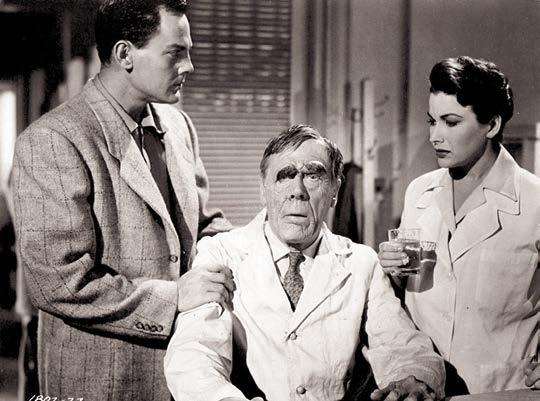
Filmed in California’s sunbaked Apple Valley, Tarantula opens with a pre-credit sequence focusing on a monstrously deformed man (stuntman Eddie Parker) wandering through a silent desert landscape before collapsing and dying. He’s identified by the local sheriff (Nestor Paiva), Dr. Matt Hastings (John Agar), and Prof. Gerald Deemer
(Leo G. Carroll) as Eric Jacobs, a former assistant to Deemer who fell victim to the distorting disease acromegalia (the preferred scientific term is “acromegaly”). Jacobs’ horrifying condition is the result of exposure to Deemer’s secret experiments with a radioactive growth nutrient intended to enlarge the world’s food supply. Instead, it causes uncontrollable growth in animals, proven by Deemer’s menagerie of mutated creatures, including an enormous tarantula. Another of Deemer’s monstrous victims, Paul Lund (also played by Parker), breaks into the professor’s lab, vengefully injects him with his own deadly formula, accidentally
The 1960s was very much an experimental period for American horror cinema, with many filmmakers, especially those at the start of their careers, deeply influenced by Italian giallo, Spanish horror, British thrillers, and more. The major studios produced their share of notable horror films over the decade, but there was also a place—especially at the drive-in—for more low-budget fright fare. Anyone with a movie camera and a script, it seemed, could get a seat at the table.
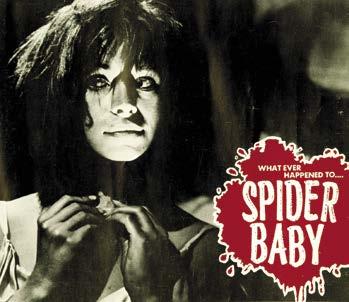
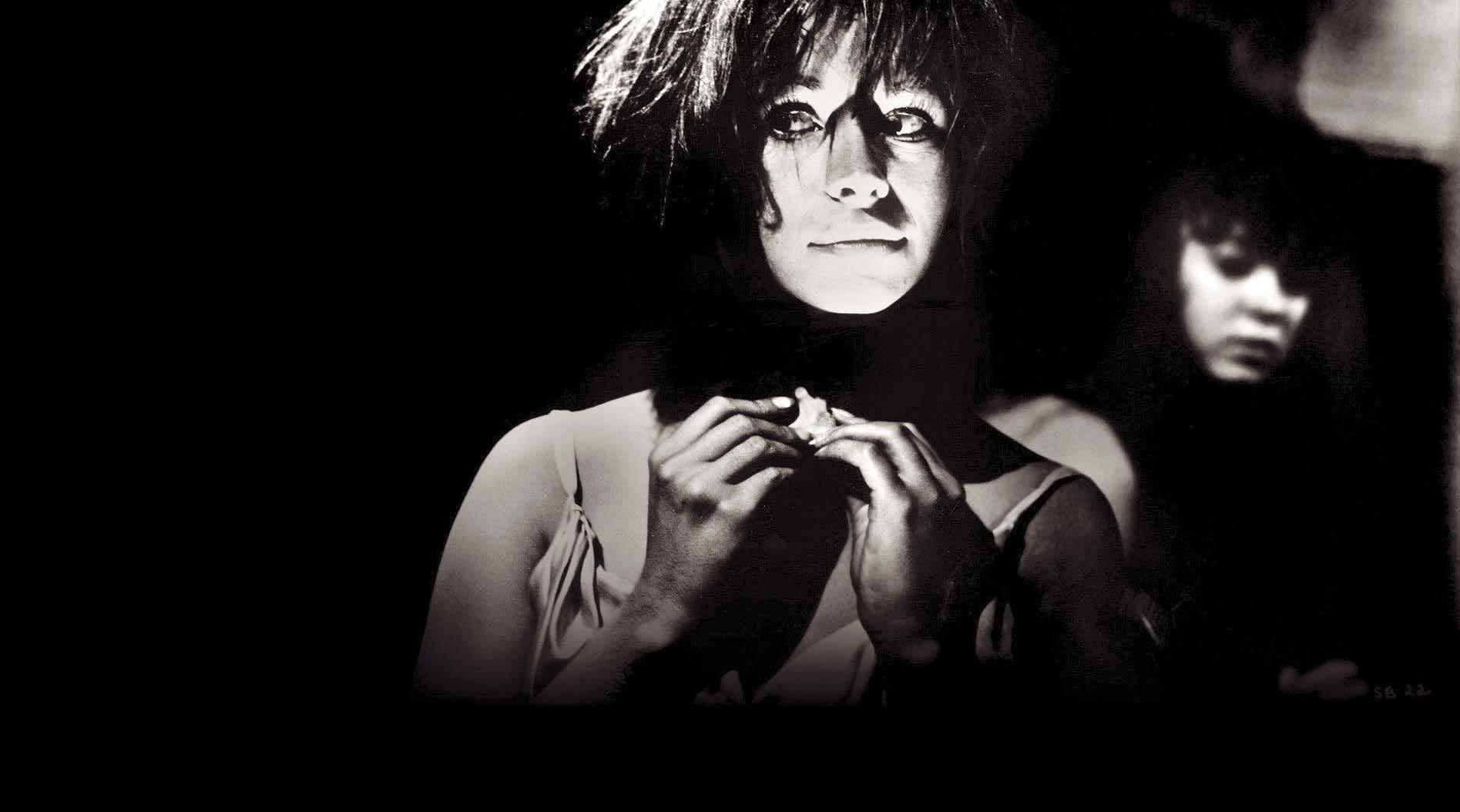
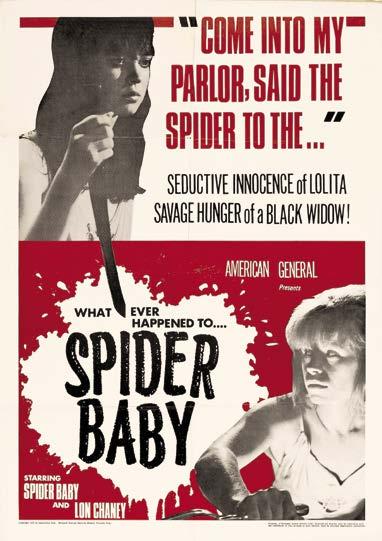
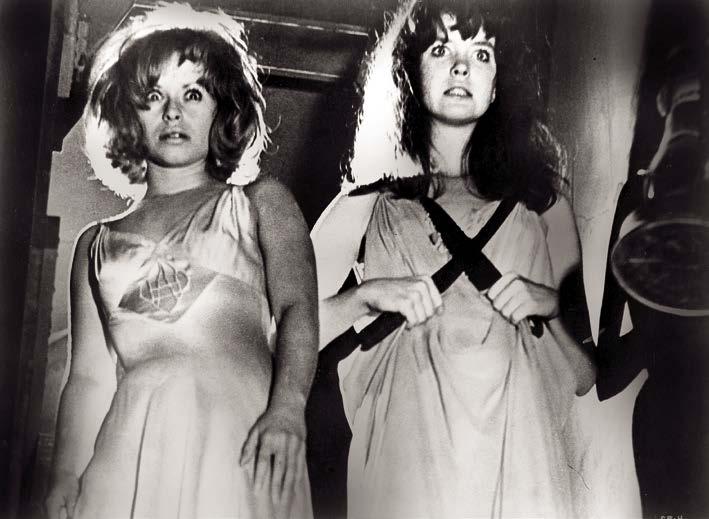
Aspiring filmmaker Jack Hill was among the many drawn to this big tent, and in 1964 managed to scrape together $60,000 to make a low-budget horror film originally titled Cannibal Orgy, but later retitled Spider Baby, or The Maddest Story Ever Told. When finally released in December 1967, Spider Baby proved to be a genuine shocker, revealing a family afflicted by a bizarre genetic disorder known as Merrye Syndrome that causes its children to regress in disturbing and violent ways once they reach puberty.
Spider Baby came about through a chance meeting between private investigator Karl Schanzer, real estate contractors Gil Lasky and Paul Monka. Schanzer worked as an actor around his private investigator gig, when he mentioned this to Lasky and
Monka, their ears pricked up. Their dream, they told Schanzer, was to produce movies and they had some money to spend.
Bloodbath
Hill recalled Lasky and Monka because they attended UCLA the same time he did. “They always wanted to get into the movie business,” Hill told Paul Parla and Charles P. Mitchell in the October/November 1998 issue of Filmfax. “They had been reading many, many scripts and hadn’t found one they liked. So, Karl Schanzer showed them my story. It was just an outline, and they liked it. They took a look at the footage I shot on Bloodbath (released in 1966, though filmed years earlier) and agreed to have me write the full script and finance the picture.”
As for the story, Hill couldn’t remember a specific inspiration. “It just came to me and the macabre humor was the central part of the vision,” he recalled to Filmfax. “I called it Cannibal Orgy, or The Maddest Story Ever Told. There was a huge epic production called The Greatest Story Ever Told (1965), so it was a take-off on that. I wanted to come up with the most outrageous title I could think of. Spider Baby came much later as a title. It wasn’t my title, but it was a stroke of genius.”
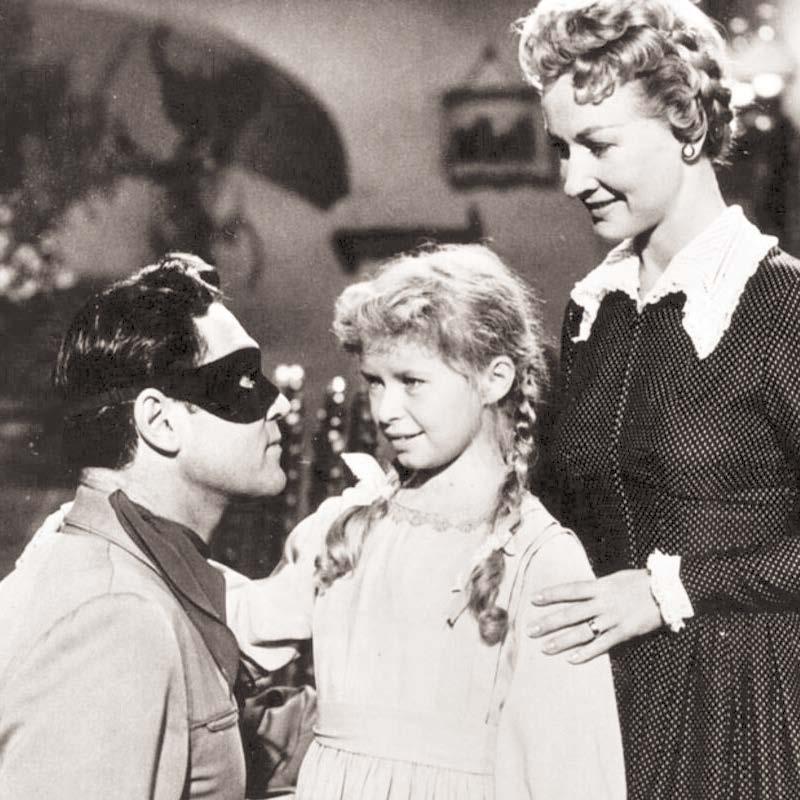
With financing in place, casting followed. Beverly Washburn was 21 years old when she was approached in a Ralph’s grocery store by Bart Patton, the film’s assistant director and production manager. After following her up and down a few aisles, Patton approached Beverly and asked if she was an actress, because she looked familiar. It was an amusing question, because Beverly was a veteran performer by then, with scores of television appearances and numerous film roles to her credit, including Superman and the Mole-Men (1951), The Greatest Show on Earth (1952), Shane (1953), The Lone Ranger (1956), and Old Yeller (1957).
“After introducing himself and reassuring me that he wasn’t stalking me, Bart told me about a movie they were making called Cannibal Orgy and suggested I might be right for one of the children,” Beverly revealed to Cryptology. “It was bizarre because actors don’t usually get cast this way, plus the title of the movie scared me, so I was thinking, ‘I don’t think so.’ Then he told me that the movie would star Lon Chaney, Jr., and gave me a number for my agent to call, which made it seem more legitimate.”
Real Deal
Beverly called her agent the next day to see if Cannibal Orgy was the real deal, and was told that it was. But she would have to audition if she wanted to be in it. In traditional Hollywood fashion, the audition turned out to be a cattle call, with Beverly showing up to find nearly 30 actresses vying for the roles of Virginia and Elizabeth Merrye.
“We were brought in two at a time to read for Jack Hill and Bart Patton, who was married to actress Mary Mitchel, who played Anne Morris in the film,” Beverly recalls. “When I read, they let the other girl go, but asked me to stay. Then another couple of girls
would read. I was there for a few hours, and was very relieved that each time I was asked to stay.”
Until she wasn’t. Later in the afternoon, Beverly was also let go, returning home with a feeling in her gut she hadn’t made the cut. “I was disappointed because as an actor you always hope you get the role, and this seemed like such a fun and quirky show and a far cry from anything I had done before,” Beverly says. “Plus, it would be so much fun to work with Lon Chaney.”
To assuage Beverly’s disappointment, her mother suggested they travel to San Francisco to see singer Jack Jones, who was one of Beverly’s favorite entertainers. This was long before cell phones, so Beverly’s sister, Dorothy, was the family contact at home in case anyone needed to reach Beverly regarding work.
Last issue it was rats and mice scurrying through the dark of night; now it's the turn of the itsy-bitsy spider, although on this sampling these arachnids could hardly be described as itsy-bitsy. Decades before the horror comic books and the B-movies of the ’50s set about inflicting the terror of these eight-legged monstrosities on a thrill-seeking public, every once in a while the pulp magazines seized their moment to scare the living daylights out of their readers by unleashing one of these deathdealing creatures.
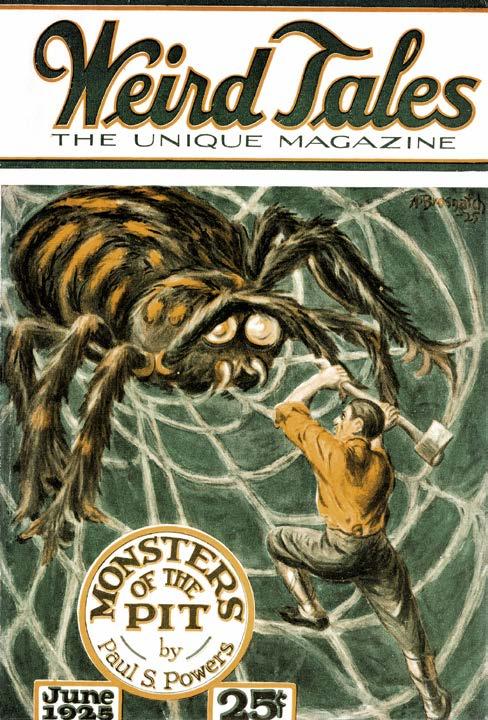
As early as June 1925, Andrew Brosnatch stepped into the darkest recesses of his imagination to render a giant-size arachnid nightmare for the cover to Weird Tales, illustrating the horror in Paul S. Powers’ “Monsters of the Pit.” Andrew, born André Brosnac, Jr. would become the magazine’s first regular artist when newly appointed editor Farnsworth Wright was tasked with revitalizing its flagging fortunes. In
his stay of just a year, Andrew would leave an indelible mark.
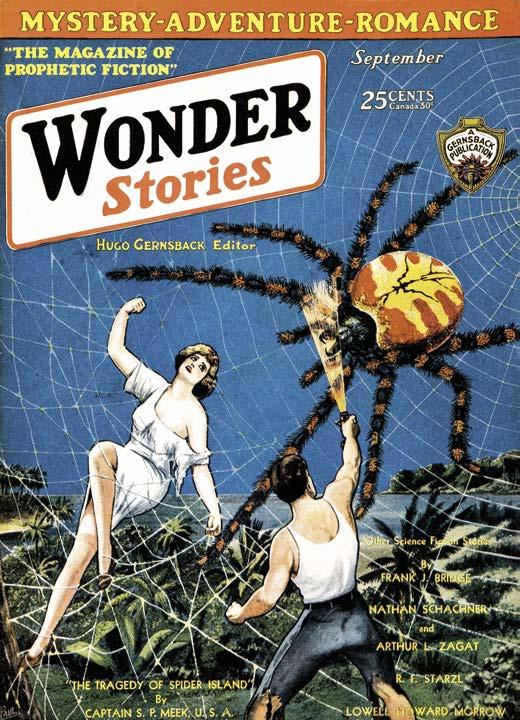
As the popularity of these horror and fantasy pulps soared, Frank Paul also explored this frightful eventuality, this time with a shrieking damsel in distress thrown in for good measure on the cover to Wonder Stories #4, dated September 1930. Captain SP Meek’s “The Tragedy of Spider Island” would have held its readers entranced for the duration, but could it live up to the drama in Frank’s sensational painting?
On the cover to Popular Detective, June 1935, proclaiming Robert Wallace’s tale “The Sinister Doctor Wong,” an obviously venomous spider was on the loose, exacerbating the foul nature of this nefarious individual. While the cover artist isn’t credited, it may well have come from the drawing board of Earle K. Bergey, as it was later ingeniously reworked for Strange Stories #7, February 1940, which does reference his artistry. Rudolph Belarski
One thing you have to say about spider cinema: It’s an equal opportunity art form. Big, small, short, tall—when it comes to wreaking havoc, no one size fits all. The small and medium-sized buggers cluster together and bite their way through their victims. Giants can overrun a shopping mall and one colossal creature can destroy a city and climb a skyscraper. Like the shark in Jaws (1975), they’re silent, sinister, insatiable, and as terrifying as they are fascinating. Every monster movie maven is a closeted arachnologist, so it’s time to peek through the web and cocoon ourselves in some spidery scares.
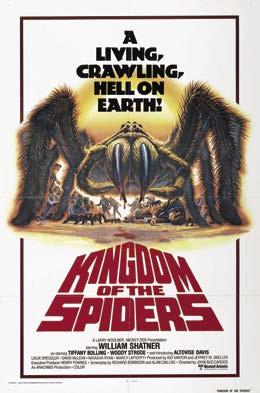
Kingdom of the Spiders (1977)
It’s arguably the first of the post-Jaws eco-terror films to depict a mass spider attack on a small town. Directed by B-movie vet John “Bud” Cardos and co-written by producer Igo Kantor and actor-writer Alan Caillou, Kingdom of the Spiders
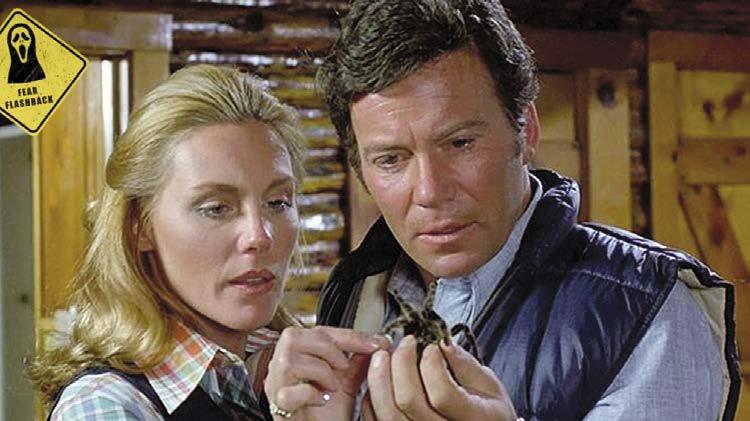
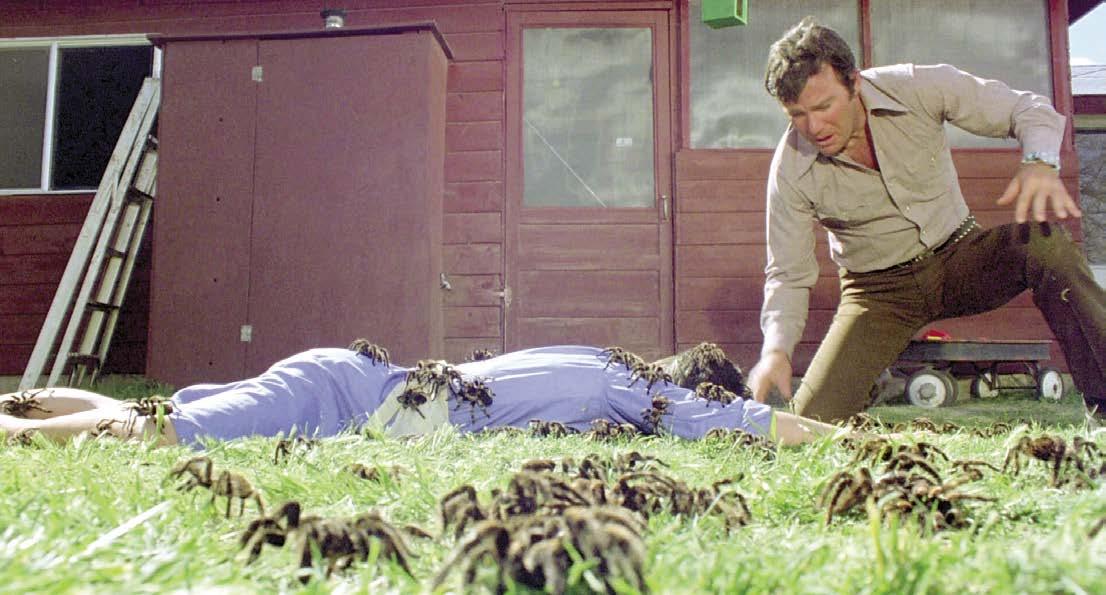
delivers a hoard of hungry tarantulas victimizing humans and wildlife in Camp Verde, Arizona after pesticides eradicate their regular food supply. The creatures converge on everyone and everything from cattle to kids. Chaos and claustrophobia ensue when they terrorize the town and then trap veterinarian Robert “Rack” Hansen (William Shatner), arachnologist Diane Ashley (Tiffany Bolling), and Hansen’s daughter Linda (Natasha Ryan) inside a cabin. The movie wraps up with a gut-punch ending both downbeat and disturbing, described by Dread Central as “one of the best horror endings of the century.”
The cast is well up to the task of tangling with the tarantoterror. Shatner displays rare and remarkable restraint as the film’s putative hero, seducing science-minded Tiffany Bolling while fending off the arach-attacks. He generates some genuine gravitas and believability, proving he can underplay it when he wants to. According to Cardos, Shatner’s agent advised him not to enter the Kingdom. Instead, Shatner fired his agent and
dove in. But he was forced to conquer his own arachnophobia, disgusted at “the thought of those thousands of tiny legs running all over my body.” He admitted to being an “out and out coward when it came to spiders of any kind.”
With the help of spider wrangler Jim Brockett, Shatner became acclimated to his creepy costars, even allowing Brockett to drop dozens of the furry fiends on him during one especially cringeworthy scene. “I had an idea for the shot and the director used it in the picture,” Shatner recalled. “What I did was stick this big tarantula on my face with spirit gum. Then I fell into the shot just as I hit my camera mark.” Unfortunately, the spirit gum proved unreliable, forcing him to shoot the scene six times.
Tiffany Bolling is winsome and winning as Kingdom’s resident academic, educating us about the ways and wonders of spider behavior, reminiscent of Edmund Gwenn’s entomological exegeses in Them! (1954). Unlike Shatner, Bolling easily took to her spidery supporting players. Early in the film, she finds a tarantula in her hotel room, picks it up, pets it, even talks to it. “I treated the spider like a little kid,” she said. Bolling also praised the film’s ecocentric theme.
Kingdom is enhanced by the presence of Woody Strode and Altovise Davis (wife of Sammy Davis Jr.) as husbandand-wife farmers whose cattle are the first to be victimized by the arachnoarmy. Strode’s stoic stature is balanced by a sensitive and sympathetic performance from Davis. Both actors complement each other, sharing concern and confusion when they find their prized livestock mutilated by the insatiable invaders.
Kingdom’s screenplay was sourced from Bernhardt J. Hurwood’s same-named novel then sketched out by Kantor before Cardos recruited revisions from Richard Robinson and Alan Caillou. The ecological angle adds an interesting touch and the scenario pays tribute to a number of influences. Scenes of humans fending off spider-strewn home invasions are reminiscent of The Birds (1963), Night of the Living Dead (1968), and “The Zanti Misfits,” a
In 1953 the British Broadcasting Corporation (BBC) released The Quatermass Experiment, a six-part science fiction television series noted by many commentators as a pivotal drama essential to the shaping of the modern-day television series.
Written specifically for an adult audience, this drama used a science fiction theme, while playing on the post war fear of invasion, only this time it came from creatures from another world. The show was a huge success and can be seen as an early example of “event” television, where the public houses and streets would empty as people rushed
home to watch the next nerve-wracking installment. By the final episode the program was attracting an audience of around five million people in the UK, an astonishing number at the time of release.
The series was created by British screenwriter Nigel Kneale, who is widely regarded as one of the UK’s greatest script writers. Kneale later wrote two sequels for the BBC: Quatermass 2 (1955) and Quatermass and the Pit (1958).
Hammer producer Anthony Hinds was an avid viewer of the series, he immediately saw the possibility of presenting it on the big screen. Soon after the final episode, State of Emergency, Hinds approached the BBC with an offer to acquire the rights to the script. The Corporation eventually sold Hammer the film rights for a £500 advance. With Kneale being on the BBC payroll, his script was owned by the corporation, so consequently he didn’t benefit financially from this sale of the rights. This was understandably a source of great annoyance to Kneale, prompting him to negotiate appreciably more favorable terms for
any future productions.
Soon after its screening on television there were a number of film companies interested in adapting the Quatermass series for cinema, but they held back for fear the film would attract an “X Certificate.” This form of film certification was introduced by the British Board of Film Censors (BBFC) in 1951 setting forth a film of this nature was only suitable for people of 16 years and over. This was subsequently increased to 18 years and over in 1982.
The X certification was off-putting for some production companies owing to it having a detrimental effect on potential audience numbers and ultimately the film’s box office receipts. Hammer, however, had no such reservations, wholeheartedly embracing the script’s adult themed horror-oriented angle. They even went as far as changing the spelling to The Quatermass Xperiment just to underline the point.
Anthony Hinds was the obvious choice for the role as producer, with British scriptwriter and director Val Guest being offered the director’s chair. Guest had no previous experience in horror films, making him initially reluctant to accept the offer as he had a dislike of science fiction. Apparently his wife, actress Yolande Donlan, persuaded him to take on the film. We should be grateful to Yolande, for Guest went on to direct Quatermass 2 (1957) and The Abominable Snowman (1957), both with screenplays written by Nigel Kneale.
Four years later, despite his aversion to science fiction, Guest also directed the
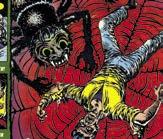
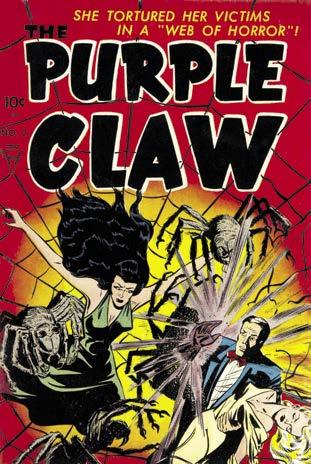
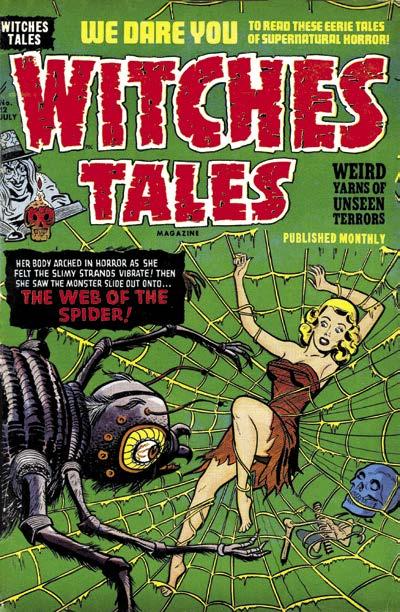
Just a few pages ago, we were subjected to this unnerving arachnid breed weaving their webs across the pulsating covers of the once popular pulp magazines. When the sales of these publications began to slip following the advent of the four-colored comic book, these eight-legged fiends turned their attention elsewhere. It wasn’t long before they had found a home in the horror comics of the early ’50s, which turned out to be the perfect breeding ground for their diabolical pursuits.
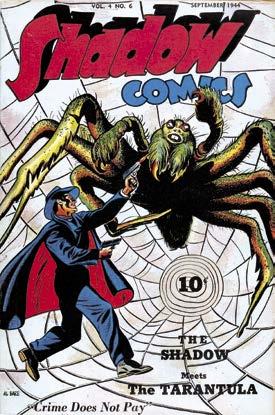
Several years prior to the horror comic commencing its reign of terror, a giant spider made its presence felt on Al Bare’s cover to Shadow Comics Vol. 4, #6 (September 1944), the foreboding prelude to the Walter Gibson scripted “The Shadow Meets the Tarantula.” Arachnophobes can rest easy, for there were no giant spiders within; in fact, it was a little disappointing to see the Shadow had been called upon to deal with an utterly warped individual constructing enormous cobwebs in a remote mountainous region,
his sole purpose being the ensnaring of passing aircraft. I am sure you will agree, an encounter with the spider shown on the cover would have been the order of the day. As we saw back in Cryptology #2, every once in a while Shadow Comics wasn’t averse to deceiving with a fear-filled cover, but rarely did the dread in these contents come up to expectation.
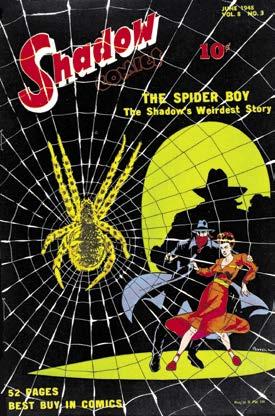
These horror orientated covers were increasingly in evidence during Bob Powell’s tenure on Shadow Comics’ covers. Viewed in their entirety, his designs can now be considered precursors to the horror boom of the early 1950s, their tenor becoming darker by the month, leading to his “Spider Boy” cover for Vol. 8 #3 (June 1948), a tale referenced in Cryptology #7. This adaptation from a Shadow radio play from November 1945 stands as one of the creepiest of the run, Bob’s artistry lending it an unsettling milieu steeped in the noiresque.
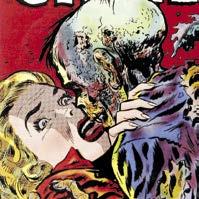
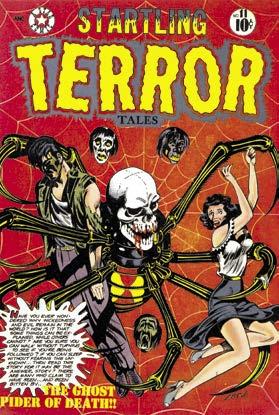
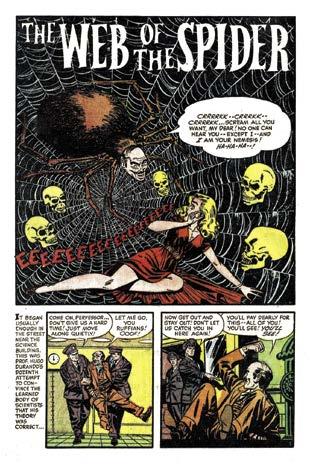
one-off appearance in Fox Feature Syndicate’s all too brief foray into horror A Feature Presentation #5 (April 1950), mentioned just last issue, had his devious artifice reprinted in Startling Terror Tales #11 (July 1952), as “The Ghost Spider of Death.” Leonard Brandt Cole’s cover, a grotesquely shocking affair quite in keeping with the comics of this era, almost leapt off the page, placing a terrified girl in the direst
of peril alongside her mortified male companion. This hideous creation, so typical of LB Cole’s imagining, used the deathly skull motif to egregious effect, no doubt drawing in a bounty of horror enthusiasts, only to have them turn the page to a story many of them may have only recently come across. Despite this minor shortcoming, this issue still rates very highly on the list of spider connoisseurs’ must-have comic books.
IF YOU ENJOYED THIS PREVIEW, CLICK THE LINK TO ORDER THIS ISSUE IN PRINT OR DIGITAL FORMAT!
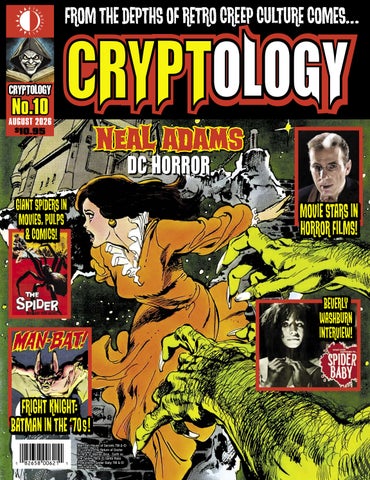
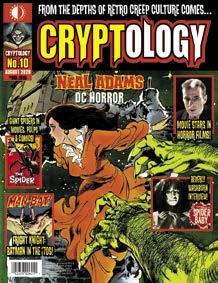
NEAL ADAMS’ horror comics, Batman’s encounters with the macabre, surprising horror movie actors (including HUMPHREY BOGART), Spiderbaby’s BEVERLY WASHBURN discusses her time in horror, and how spiders terrorized cinema screens, comic books and the pulps. Plus, more lurid paperback covers, your regular dose of B-movie horror masterpieces, and another selection from the Hammer archive! (84-page FULL-COLOR magazine) $10.95 (Digital Edition) $4.99 https://twomorrows.com/index.php?main_page=product_info&cPath=98_194&products_id=1899
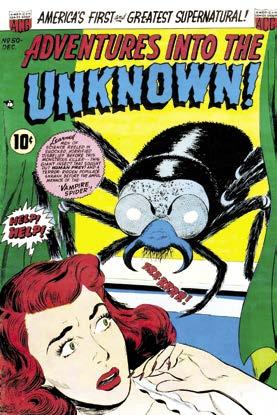
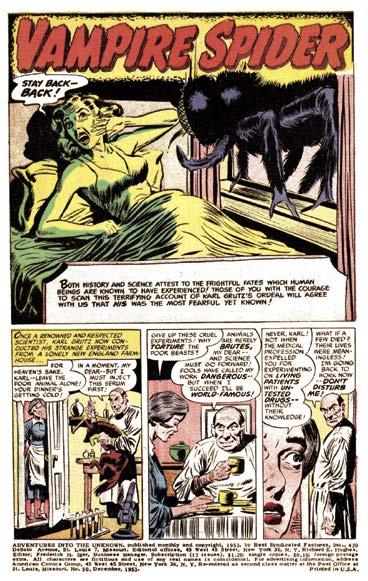
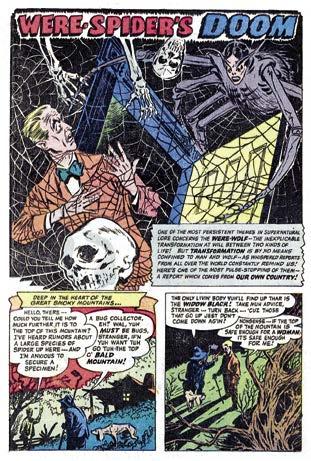
That same month, Ken Bald thrust one of these hapless girls before an advancing skull-headed spider for his cover to Adventures into the Unknown #33. Ken would have avoided emulating the excess in LB Cole’s graphic imagery; that wasn’t the way at ACG, but this young lady desperately needed a chivalrous fellow to flex his muscles, or this wasn’t going to end well. The following year another of these vile creatures crept onto the cover of Adventures into the Unknown #50 (December 1953), one of Ken’s last for this title. As evidenced here, the “Vampire Spider” definitely had its fangs set on this poor girl, but Bob McCarthy’s chilling rendition of this beast, created from an experiment gone wrong, was infinitely more terrifying.