$10.95
in the USA
No. 47, January 2027
Epic Illustrated TM & © Marvel Characters, Inc.
A TwoMorrows Publication
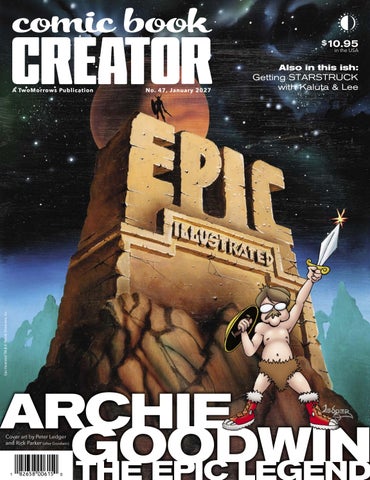
ARCHIE GOODWIN Cover art by Peter Ledger and Rick Parker (after Goodwin)
January 2027 • The Archie Goodwin Issue • Number 47 ARCHIE GOODWIN Portrait by KEN MEYER, JR. ©2027 Ken Meyer, Jr.
About Our Cover Painting by PETER LEDGER Cartoon by RICK PARKER Cartoon Colors by GLENN WHITMORE
T A
B
L
E
O
F
C
O
N
T
E
N
T
S
Ye Ed’s Rant: Hailing historian-hero John A. Lent and mourning a landmark’s closing...... 2 COMICS CHATTER The Altergott Alternative: The first part of our interview with the best underrated alt cartoonist you need to learn everything about, Rick Altergott of Doofus infamy!........... 3 Once Upon Long Ago: Steve Thompson on men’s magazines’ Pussycat of S.C.O.R.E...... 11 Joe Hill House Comics: Glen Cadigan concludes his three-part chat with the scribe...... 12 Ten Questions: Rachelle, Rachelle! Darrick Patrick quizzes the artist Rosenberg!............ 18 Incoming: More mini looks! Standing up for Alcala! Terry Austin on Pat Broderick!......... 19
Epic Comics TM & © Marvel Characters, Inc.
C.I. Clancy: Shaun learns about Leave It to Binky, G.I. Jane, and Batfink’s Hal Seeger...... 22 Starstruck!: From stage to comics page, all about Elaine Lee and M.W. Kaluta’s classic... 24 Argentine Report: Move over, Herbie! Pablo Stadelman on speeding racer Fitito.......... 35 The Lampoon Look: Mark Simonson on the design and comics of National Lampoon... 36 Comics in the Library: Richard Arndt on Archie Goodwin and the Terrifying Trio............ 40 Hembeck’s Dateline: Detective Fred Hembeck hunts for the man called Goodwin........ 41 Above: Peter Ledger’s painting was used as a back cover ad for Marvel Super Special #11–13 [June–Oct. ’79] promoting the impending debut of Marvel’s Epic Illustrated. Inset is (slightly altered) Rick Parker’s Archie Goodwin caricature, from Marvel Age #15 [June ’84] cover.
Don’t STEAL our Digital Editions! C’mon citizen, DO THE RIGHT THING! A Mom & Pop publisher like us needs every sale just to survive! DON’T DOWNLOAD OR READ ILLEGAL COPIES ONLINE! Buy affordable, legal downloads only at
www.twomorrows.com or through our Digital Storefront at
www.comicshistory.org & DON’T SHARE THEM WITH FRIENDS OR POST THEM ONLINE. Help us keep producing great publications like this one!
Archie Goodwin: An Epic Creator Christopher Irving regales us with the epic legend of the great writer and editor — some say the greatest comic book editor of all time! — who left a legacy of excellence wherever he worked, whether Warren, Marvel, or DC Comics. Along with an in-depth bio of the Oklahoma native and overview of his achievements up to the Epic era, some friends share their memories for the man known as the “Nicest Guy in Comics” ......... 42 BACK MATTER Creators at the Con: Kendall Whitehouse’s portraits of Baltimore Comic-Con 2025....... 78 Coming Attractions: The confessions of Astro City artist supreme Brent Anderson......... 79 A Picture Is Worth A Thousand Words: Tom Ziuko recalls his friend Carl Gafford......... 80 Oops!: While it’s really no biggie, in our last (super-biggie) ish, I called CBC #45, “the second of our hybrid magazine-slash-books,” when I certainly do know better, given CBC #2 [Aug. ’13] was our double-size “Joe Kubert: A Tribute to the Creator and Mentor” special and #6 [Dec. ’14] “Swampmen: Muck-Monsters of the Comics” a 192page effort. Suffice to say, we’ll release double-size CBC specials annually, the next being one devoted entirely to the Marvel Bullpen, with dozens(!) of unpublished interviews… More on our plans for that extravaganza very soon! Right: The great Archie Goodwin waits in the wings before speaking at a comic book convention, circa 1995. Please note: Some images in this issue were enhanced by digital software. Comic Book Creator™ is published bi-monthly by TwoMorrows Publishing, 10407 Bedfordtown Dr., Raleigh, NC 27614 USA. Phone: (919) 449-0344. Jon B. Cooke, editor. John Morrow, publisher. Comic Book Creator editorial offices: P.O. Box 601, West Kingston, RI 02892 USA. E-mail: jonbcooke@aol.com. Send subscription funds to TwoMorrows, NOT to the editorial offices. Six-issue subscriptions: $84 US, $149 EU/UK, $128 other non-US, $29 Digital. All characters are © their respective copyright owners. All material © their creators unless otherwise noted. All editorial matter ©2027 Jon B. Cooke/TwoMorrows. Comic Book Creator is a TM of Jon B. Cooke/TwoMorrows. ISSN 2330-2437. Printed in China. FIRST PRINTING.
TM & © DC Comics.
COMIC BOOK CREATOR is a proud joint production of Jon B. Cooke/TwoMorrows
THE MAIN EVENT
WILL MURRAY, PAT OLIPHANT, GLORIA STEINEM, and MARJANE SATRAPI
up front
The Altergott Alternative Audio recorder in hand, Ye Ed. takes a road trip with underrated alt cartoonist Rick Altergott CBC: Did you have siblings? [Interviewer intro: Upfront confession — pretty much ever Rick: Yes, I’ve got two sissince Frederick Henry Altergott, Jr., a.k.a. Rick Altergott, he ters, one older, one younger, of “Doofus” fame from the pages of Peter Bagge’s Hate, and Pam and Allison. his cartoonist wife, Ariel Bordeaux, moved to Rhode Island CBC: Are they creative around the turn of the century, I’ve been pals with the affable at all? and accessible cartoonist. When I taught at RISD, I invited Rick: My little sister the couple to speak to the class. Rick participated in my is creative. She’s kind of Book of Weirdo and collaborated with writing chum Charles omnivorous. She’s actually Schneider to do a story for my Slow Death Zero anthology, talented in a lot of things like and we’ve always been mutually supportive of one another’s printmaking and pottery, and ventures. A few years back, around Halloween, we drove loves to take pictures. Let’s together to visit Worcester, Massachusetts, comic shop That’s say she’s the more creative of Entertainment and I interviewed him on the way and back. the two. Here’s part one of that chat! — JBC] CBC: But you’re the one who made a living at it. Comic Book Creator: It’s October 22, 2022, we’re Rick: Well, if you could call going to Worcester and I’m with Rick Altergott, one of my this living, right? [laughter] favorite cartoonists. Where is your last name derived from? No, I received a lot of encourRick Altergott: It’s German. I’m Irish/German. agement and early success CBC: When were you born? with drawing that kept me at Rick: May 16th, 1961, Taurus. Born in Delaware. it. I had good art instruction from good art teachers. I CBC: What’d your dad do? went to a high school that Rick: He was a lawyer, but he worked at a bank before was actually a private school that. He had a military career in the Marine Corps and then the Naval Academy. Then he became a lawyer doing a lot of because my mother taught there as a kindergarten teacher. So all three of us children got to go to a very nice, promireal estate work at a law firm in Wilmington. So that’s what nent, private school in Wilmington. his vocation was. CBC: Are both your parents from Delaware? CBC: Was he a World War II veteran? Rick: Yes. Well, my mother is from Newark, Delaware, and Rick: No, he was actually peace-time, active in the ’50s. my dad is actually from Wisconsin. They met because he was a student at the University of Delaware, and then the Naval Academy placed him on the East Coast, either in nearby Annapolis or some other place in Wilmington. CBC: So your upbringing was pretty much suburban? Rick: It started out that way, but we moved into the city of Wilmington when I was about nine years old. In the ’60s, there was a lot of unrest in Wilmington. They even had the National Guard called out because of riots and stuff. CBC: Racial strife? Rick: I think it was a lot of that. Probably more than anything else. But there were also incentives for people to move into the city and buy very cheap housing. A form of homesteading, I guess, and my dad, in real estate later on, was part of that helping to bring people back into the city instead of the opposite direction. So we bought a house not in downtown, but in a pretty nice neighborhood of
Photo by Chris Anthony Diaz. Color by Graham Wilcox. Doofus, Henry Hotchkiss TM & © Rick Altergott.
Conducted by JON B. COOKE
COMIC BOOK CREATOR • January 2027 • #47
Above: XXX
Above: Rick Altergott in a portrait by Chris Anthony Diaz, taken at the 2011 MOCCA Festival. Inset left: Rick freelance gig. Below: Doofus and Henry Hotchkiss.
3
Above: The Ballantine paperbacks reprinting Harvey Kurtzman’s MAD comics made a strong impact on Rick. Inset right: There’s a heavy Mort Drucker (seen in self-caricature inset below) influence Rick infused into his work in his school’s humor magazine, The Rag, which included this Waltons parody. Below: Rick in a splattered smock during art class in day school.
CBC: How was elementary school? Did you make like-minded friends? Rick: Yeah, I had a couple of really good friends, which was nice because I kept those same friends almost to this day. I have a lot of friends. And now I’m reaching an age where some of them are gone. It’s really sad. One of my best friends died when we were both 25. And that was jarring. He had Hodgkin’s disease and it wasn’t as treatable as it is nowadays. But anyway, yeah, I had the same friends growing up from second grade. I started at this school called Tower Hill, a pretty prestigious place. Good education. I went to high school with Dr. Oz, though he was a grade above. His younger sister was in my class, though, so I remember one time playing spin the bottle in the basement of their house as a teen. And we were on the wrestling team, but I was JV and he was varsity. CBC: When did you discover comics? Rick: Well, the friends I was telling you about…? They had a couple of comics in their house and then, before we moved to Wilmington, my parents were best friends with neighbors across the street, and the dad had copies of MAD comics reprint paperbacks and some Pogo collections, too. My parents were way too square to have anything like that in the house. The dad was kind of a beatnik character. (He’s still alive today and a really neat guy, although he must be almost 100!) And his two daughters were really into pop culture. They had copies of some of the first MAD issues I ever saw and they were really into stuff that was really popular in the ’70s. But you asked about comics specifically: I don’t know exactly when I discovered them. I never really was into the
#47 • January 2027 • COMIC BOOK CREATOR
The MAD Reader TM & © E.C. Publications, Inc. “The Waldorfs” © Rick Altergott. Caricature © the estate of Mort Walker. Photo courtesy of Rick Altergott.
4
Wilmington, and my dad would walk downtown to work every morning… I think they bought the house for $30,000, in 1968. When we did move into the city proper, around that time there was lots of little places — candy stores, tobacco shops — that sold comics within 10 or so blocks of where our house was. So I developed a little circuit when I was a little older. I bought a lot of comics when they were 20¢ apiece, five for a dollar, so I’d go to three or four different locations every month to find comics that appealed to me. CBC: What was the most important purchase you made as a kid? Rick: Probably, as I really got into it, MAD magazine, though not as early as a lot of other people my age. It was 1971 or ’72 when I first saw a couple issues. And then, after that, I would purchase every one and developed a kind of radar about when the new issue would be on the stand. CBC: Do you remember the middle finger issue? Rick: Oh yeah! I bought that one for sure, for sure. CBC: Did your parents see you bringing MAD into the house? Rick: No, I had to hide the comics from them. Our house had a little bulkhead in the back where you could open the door and I’d walk home from the school and passed the Smoke Shop on the way… That was the name of the place, too, the Smoke Shop!… It’s not there anymore, but I’d buy the new issue. I did make some other purchases. I was buying Heavy Metal when that started coming out… sometimes The National Lampoon and Cracked, and other comics, which I’d sneak in the house. I’d open the bulkhead door, put the comics there, and then, later on, I’d go down into the basement and pick them up as discreetly as possible. I did have a mother who actually took the comics and ripped them up in front of me one time because my school grades were not good. In my case, that story actually happened! So that R. Crumb poster…? The one with the mom tearing up her kid’s comics…? I lived that. [laughter] And I didn’t want her seeing some of them, too! I was starting to get Heavy Metal and the racy stuff. This was later on. And those were not cheap to buy either! I didn’t want my mom mutilating any more of my comics! I think she ripped up the second issue of Crazy, and that was, like, 40¢! Not cheap. Comics at 20¢ was a lot! You had a lot of purchasing power back then. CBC: Did you get an allowance when you were young? Rick: No, not really. CBC: So how did you get money to buy comics? Rick: I don’t know! I did start working as a dishwasher when I was 16, but earlier I did some babysitting and stuff like that, though I never had a paper route or lawn cutting business. I probably did things here and there to make some money, but I didn’t have a standard allowance. Not that I remember anyway.
the hillström chronicles
Hill Comics are Good Comics
Writer Joe Hill on his titular comics line, the Gaiman controversy, and “dropping the bear”
could tell a scary story, I could tell a story of social concern about race in America, I could tell a funny story that dwells [Introduction: In the first two installments of our three-part on ideas about children and how they play pretend. In that interview with Eisner Award-winner and New York Times sense, Sandman was a landmark that Gabe and I were able bestselling author Joe Hill, we discussed his influences, to use to orient ourselves to the kind of stories we wanted including the E.C. Comics he discovered through his father, to tell. But the other thing is, at some point I was thinking Stephen King (yes, that Stephen King), breaking into comics about Sandman, I was thinking about the great stories set via his prose work outside of comics, and what went into in Hell, the stories where Lucifer gives away the key to Hell making his signature series, Locke & Key. to Morpheus, and then Morpheus is stuck holding the key [Our third and final interview installment ventures into and has to figure out what to do with it. I remember joking his foray over to DC Comics where he launched his own line with [IDW editor] Chris [Ryall] and Gabe, “What if that key is — Hill House Comics — as well the crossover between Locke made out of Whispering Iron? Wouldn’t that be funny?” & Key and the Sandman universe. Also addressed is the Neil At some point I was approached by Mark Doyle of DC Gaiman controversy (with a follow-up statement submitted about doing some comics for him, and I floated him the post-interview by Hill), the industry’s future, and the future idea of taking Locke & Key and having it cross over into the of Hill’s comic book career. Conducted via Zoom on Sept. 12, Sandman universe. I floated him that idea of, “What if the 2024, thanks to Chris Ryall for facilitating the Q&A. — G.C.] key to Hell was made out of Whispering Iron?” and I said, “Do you think Neil would go for that?” and he said, “There’s Glen Gadigan: If Locke & Key is done for now, that one way to find out.” And Neil thought it sounded pretty cool means the last issues were the crossover with Sandman. How and signed off on it. On that basis, we were able to work out did that come about? a story that was set in the past that tied into the very first Joe Hill: It had been in the works for a long time. When couple issues of Sandman. I wanted to do something where I came back to comics as a college student, the comics I we would be able to meet all the great Vertigo characters, came back to were Sandman, because it was such a great so not just the characters from Sandman, but also Etrigan, horror comic and I had loved Alan Moore’s Swamp Thing. the Demon… in an early draft we managed to get in Swamp Somehow I picked up that Neil was a protégé of Alan. Thing, but he fell out of it because it didn’t quite work. [Locke & Key artist] Gabe But part of it was supposed to be that it was an adventure [Rodriguez] loved Sandman, through that whole Vertigo universe, and it would be fun to too. We all did. Almost play there, to open a door from the world of Locke & Key into every comic book writer of Sandman, and it turned out pretty well. my generation who does Glen: Usually, when there’s a crossover, the crossover is somewhat mature fantasy pretty disposable. It either takes place on an alternate Earth Below: A snapshot of Ivan Katz, grew up on Sandman, and or it’s out of continuity. But this had relevance to Locke & Key. the son of Jack Katz, from 2011. Sandman taught us how to Joe: It was fun to write a story set in the past, specifically do Locke & Key. about Mary Locke, who had already turned up in a couple The thing about one-shots. It was also interesting [because], as a reader, I Sandman is the guiding read a lot of historical fiction. It’s true that most of what I metaphor was dreams, write is horror, but a lot of what I read is historical fiction, and through the avenue and I’ve always wanted to try my hand at that because I’m of exploring dreams, Neil sort of haunted by that phrase of Faulkner’s [“The past is Gaiman could tell any kind never dead. It’s not even past.”] Comic books have given me of story he wanted to tell. So a safe space to play around with historical fiction without he could tell a horror story, too much risk. So I was able to write about World War I in … he could tell a comedy, he In Pale Battalions Go… and tie the larger story into the grief could tell a sweet fantasy, and loss of so many young men on Flanders Fields. I was and I realized that I could able to reflect upon that in the context of a larger Locke & use the keys the same way. Key story. And, by the same token, I did a story [“Sea Dogs”] That every key had a differabout the American Revolution for Hill House which is about ent power, and would offer how we won the Revolutionary War by deploying weredifferent opportunities to my wolves against the British Navy. So I’ve been able to scratch characters, and that through my itch a little bit there. the metaphor of the keys I In any event, going back to the tie-in, it was important
Below: Hill House Comics logo. Bottom: Joe Hill in 2025. Photo by Colleen Sturtevant.
#47 • January 2027 • COMIC BOOK CREATOR
Hill House Comics TM DC Comics. Photo of Joe Hill at 2025 Tribeca Film Festival. Courtesy of photographer Colleen Sturtevant and Wikimedia Commons.
12
Conducted by GLEN CADIGAN
incoming
Max Kudos for Mini Looks Plus Joe Frank weighs in and we hear from one of Pat Broderick’s former artistic collaborators [Seems like every time one of my appeals for letters o’ comment is sent off to press — as happened with CBC #45 — a deluge of missives follows, rendering moot my request! The e-mail box has been active as of late, with too many to fit in this ish, but we’ll endeavor to catch up! — Ye Ed.]
Cynicalman TM & © Matt Feazell. Captain Spaz TM & © Sam Henderson and Robert Weiss.
Bob Pfeffer I just wanted to drop you a note to let you know how much I am enjoying Comic Book Creator. I love that, while still focusing on “name” creators, you’re also highlighting some more obscure and underground artists every issue. I feel I am pretty well-versed in comic book history, but every single issue you cover someone or something new to me. As a small press/self-publisher from many years back, I particularly have been enjoying the coverage of smaller pressers from back in the day like Bruce Chrislip, Michael Dowers, and especially the three-parter on Steve Willis. There are a few more that I think might deserve a bit of coverage that I would like to recommend: Matt Feazell has influenced me and many, many other small press creators with this DYI attitude and promotion of mini comics over the years. He has had an amazing long run as a comic creator, from starting in underground comics (Anarchy Comics #3) to his Not Available Comics (Cynicalman) to Zot, Disney Adventures, etc. He was recently awarded the Transformative Work award at CXC 2025. Sam Henderson was a fellow high school comic creator when I was publishing with my pal, Randy Paske. He and Bobby Weiss put out Captain Spaz and it was simply the funniest thing I had ever read. Sam has gone on to a long career with other comics (Magic Whistle) and animation (SpongeBob) work and is still putting out some of the funniest comics around. Keep up the good work.
artists. So, “new” work I wasn’t expecting at this late date. Sadly, it seemed limited and satirical rather than an honest tryout for something of lasting importance. True, Esquire wasn’t publishing comics. The direct market was still years away and terms still favored the publishers. But it could have lead to self-published work, if any had faith in the process, so early on. Certainly, Ralph Reese, the onetime Wood assistant, could have worked up concepts for witzend. Or he, Wrightson, Smith and Jones could have instigated new players for National Lampoon, to which they all eventually contributed. Alan Weiss noted the assignment “...came and went, and nothing happened...” If so, was there anything substantial offered to merit praise or continuing interest? Liked part one of your conversation with Shary Flenniken, probably because I recall her “Trots and Bonnie” strip in National Lampoon. I didn’t stick around long enough to see her issues as editor. So, curious to see what she has to say about that next time. “The Justice Society and Me” was great fun. Terse, but nostalgic, relatable joy with someone at the dawn of his collecting experience. Loved the unseen (by me) Neal Adams cover to Deathstroke #15. I could identify some but hardly all. I see Siegel and Shuster, Infantino, Giordano, O’Neil, Goodwin, and Schwartz. Do any of these covers come with an identification chart as did Neal’s Superman Vs. Muhummad Ali? Do any of your more DC-oriented readers know more? I nearly always enjoy Fred Hembeck. This time was twice as fun. Not only did we get nine Marvel heroes, done in his pleasing style, but a look at the short-lived Harvey heroes of the mid-’60s. Aside from Fighting American, I know very little about them.
This page: Boy, it was great to receive a letter from Steve Willis, who thanked me for CBC’s look at the cartoonist over three issues, and he offered, “Please feel free to draw on me (pun intended) as a resource” for future coverage of the mini comics! I’ll certainly do that, Morty Man! In his missive on this page, Bob Pfeffer fails to mention his imprint name, High School Comics, so check out an interview with him at: https://poopsheetfoundation. com/index.php/history-articles/ 17-bob-pfeffer-hsc-interview? Covers here include Matt Feazell’s Cynicalman and “America’s only super-hero,” Captain Spaz by Sam Henderson and Bob Weiss!
[After my editorial last ish, it’s nice to have the mail pick up. Thanks for the great suggestions, Bob! I will indeed keep up the “mini coverage”! Keep ye eyes peeled! — Ye Ed.]
Joe Frank An overabundance of eclectic material, this issue [CBC 42]. Luckily, some of it connected. Especially intriguing was “Heroes of the Seventies,” introduced by Esquire. I’d never even heard of the project, so a welcome surprise. Better still, I was interested in four of the six COMIC BOOK CREATOR • January 2027 • #47
19
starry eyed storytelling
Lee & Kaluta’s Starstruck
It’s a play! A graphic novel! A comic book series! An RPG! But what is this Starstruck really? by JON B. COOKE
Above: Playbill from the first performance of Starstruck, in April, 1980. Inset right: Remastered Michael Wm. Kaluta illustration originally used as cover for the Epic graphic novel. This version was used for a T-shirt design. Below: Official title for the November 1984 release was Marvel Graphic Novel #13 — Starstruck. Art by MWK.
* This writer produced a thoroughly exhaustive look at that Stuart Gordon/Lenny Kleinfeld play in the pages of Comic Book Creator #10 [Fall ’15]. Just like Starstruck and itself inspired by Kirby and Ditko’s Marvel comics, Warp was another stage production that prompted its own comic series. 24
* The 1968 AIA Guide to New York quipped of the eatery, located on the corner of Broadway and W. 92nd Street, “The books are real and in abundance, but hardly worth filching. The atmosphere they create, however, is friendly… [with a] sometimes overly boisterous bar.” (The Gay Insider USA [’72] tour guide joyfully proclaimed, “That bar is gay!”) The establishment permanently closed sometime in the ’80s.
#47 • January 2027 • COMIC BOOK CREATOR
Starstruck TM & ©Elaine Lee and Michael Wm. Kaluta.
“Starstruck,” Tym Stevens writes in his brief history of the subject, “was also created during the exploding late ’70s/early ’80s N.Y.C. scene, whose Do-ItYourself spirit ignited the first punk bands of CBGB, the no wave and post-punk aftermath, the dawn of hip hop, the splicing of mutant disco, and a bristling indie film movement. As part of this hybrid scene, which propelled itself, Starstruck the play was as D.I.Y. with its wicked and absurdist humor, its sets and costumes collaged from street throwaways, and its upending of all conventions.” As much as the Organic Theatre science fiction stage trilogy Warp* was, in its own way, representative of the decade prior, so too was Starstruck, a production that would inspire a comics franchise, reflected — as Stevens rightly explains — the wild side of the era from which it emerged, the 1980s. Still, Elaine Lee, who wrote the self-described “space opera” (with help from her sister and a now ex-husband), shares that the idea for the show technically began in 1979. A refugee to New York City from Wilson, North Carolina, Lee was acting in The Doctors, a TV soap opera, playing troubled nursemaid Mildred Trumble (a role that snagged her an Emmy nomination!) and, meanwhile, she established a theatrical company, Wild Hair Productions. The first play the (mostly female) ensemble performed was called Brief Cases, about women in therapy, and the second was Contamination
of the Kokomo Lounge, speculating on the lives of Freeport, Texas, womenfolk if the men in town all died in an industrial accident. That comedy(!) contained, Lee said to me, “A little tiny bit of sci-fi in it, so it started to head that way.” “That way,” of course, was the path to their third stage show, which an unkempt Lee was researching with sister and fellow Wild Hair trouper Susan Norfleet Lee. While the two sat in the Upper West Side’s Library Restaurant,* a certain illustrator seated at a nearby table took notice. It was October, 1979. Years later, Michael William Kaluta recalled to me, “I was sitting in a neighborhood restaurant one afternoon, drinking coffee and drawing pictures over in a corner, and I saw two women with big stacks of magazines and books on their table and I recognized the covers of a couple of the books and they’re all science fiction. One was on robots. I went to myself, ‘You’d be a fool not to go over there and say something because you have an “in” here.’ “They were very pleasant, attractive women. Had I seen them in their regular, going-out-in-the-day makeup, I would have been very intimidated because they were both really, really beautiful. But they were wearing no makeup because they were in dress rehearsals for a play they were doing. So they were both basically fresh-washed, hair pulled back, sloppy, comfortable clothes, which made them accessible. So I wasn’t intimidated.” Elaine chuckled to recall the Lee sisters’ condition as the siblings pored over copies of Starlog when this affable stranger approached. “We were looking how to do props and things for the play,” she said of the science-fiction movie magazine issues spread out on the tabletop, “so I was looking for inspiration. I can’t even believe Michael came up to us because we were doing all this work and nobody had on makeup or washed their hair. I probably had on a baseball cap over my hair.” MWK offered, “I said, ‘Uh, hi. You girls like science fiction?’ One of them said, ‘Well, we’re writing a science fiction play.’ I said, ‘Well, that’s great. I draw science fiction.’ Elaine took my name and phone number and said, ‘Well,
Starstruck TM & ©Elaine Lee and Michael Wm. Kaluta.
maybe I’ll get in touch with you to perhaps do a poster or something.’ I said, ‘That’s cool. That’d be great.’ So off I went. And, as I found out later, the conversation continued at their table. One or the other said, with an eye-roll, ‘Sure! I’ll bet he draws! He probably drives a cab and does these little prison tattoo drawings of girls with big t*ts and space guns! “It happened that Elaine, in researching for the play, would go over to West Side Comics and look at the posters they had there. One was from The Studio book, ‘The Fate of Dollies Lost In Dreams,’ with the bed flying up in the air and the little doll falling out of it, which had been on the back cover of Heavy Metal. And she went, ‘Oh, I loved that!’ And she realized, ‘It’s by the taxi driver!’ and remembered that she’d loved my work. So she gave me a call.” Lee, who can cited the month of her putting two and two together at West Side Comics as December, ’79, said, “At the time we met him, I think that we had finished Brief Cases, were running the Kokomo Lounge play, and planning Starstruck. We did these plays really close together.” So, after encountering MWK’s “Lost Dollies” poster, “I called him and said I’d give him comps [tickets] to the [Kokomo Lounge] play, and then I went over to his apartment and saw all the other stuff he had done. But we hit it off right away. We have a similar sense of humor. We’re both…” She hesitated and laughed, explaining “Oh boy! We both tend to think when the phone rings, it’s bad! We have that in common, and we have a similar sense of humor that’s kind of based on that silly dread.” MWK continued, “She invited me to see the [Kokomo Lounge] play. I went and it was brilliant, absolutely brilliant. Elaine and Susan were the main leads. It was a very dark comedy and it was so polished, so funny, and the place was packed, and it was a riot! After the show, the women said, ‘We know your work, we love your work, could you do us a poster?’ I said yes and that led onto many other things because the Starstruck is an ensemble play. There’s no real star… everybody has their moment on stage. Everybody.
Above: Young Bernie Bubnis in his teenage years, when he scribed the “Spotlight on the Pros” series. Below: Comicollector #14 [Feb. ’64], which included Bernie’s circa 1962 interview with Jack Kirby, a Q-&-A that helped launch his “Spotlight on the Pros” series.
“They had people to do lighting and the sets and this and the other thing, but they needed a poster. So I thought about it and thought about it, and went, ‘Well, the play is all about all these different people, so they all have to be on the poster.’ You can’t just put one or two people on the poster because that’s now that the play is about, so I designed a fairly complex poster. I did representations of all the characters looking like the actual actors and actresses. And, as I’m doing that, I said, ‘You know, I can’t just draw the actors. They have to be in costume.’ They said, ‘Well, we don’t have anyone to do the costumes right now. We had somebody, but they went to Las Vegas to work on three or four productions, and so they’re just not available. Would you like to design the costumes?’ So I designed the costumes.” With a chuckle, he continued, “And then, one time I went in, but no one would make eye contact with me.
COMIC BOOK CREATOR • January 2027 • #47
25
Above: Archie Goodwin and Elaine in Starstruck #1. Previous page: MWK art for the play and cover illo for The Comics Journal #103 [Nov. ’85].
* Lee said that, while Michael designed the helmets, “Charles built them and they were incredible! He also glued very many Galactic Girl Guide faces and lots of skin to the walls of Verloona’s ship.”
STAGESTRUCK IN HELL’S KITCHEN Starstruck: A Space Opera debuted Off-Off-Broadway, on April 16, 1980, at the N.E.T.W.O.R.K. Theater, in Hell’s Kitchen, and it lasted for a mandated limited run, closing on May 10. “Because no one was getting paid,” MWK explained, “it’s what was called [an Actors’ Equity union] ‘pilot project,’ which meant 16 performances only. If you went more than that, you had to pay them scale.” He added with a laugh, “Which was, at least, $250 an hour… something like that.”* He exclaimed, “There was no money! We spent everything on extra thumbtacks and hot glue, Christmas lights, and all that other kind of stuff. Nobody had any dough… I donated, like, two or three video machines, along with money. Everybody shared material and also helped build things. So it’s a big team effort, it was very fun.” In Heavy Metal’s article that included promoting a Starstruck play revival in its May ’83 issue, Steven Maloff wrote (quoting Lee), “By April 1980, the cast and crew were not ready to spring Starstruck on theatergoers, but they did. ‘The set was being built right up until people starting coming in. At 7:45, the stage manager was on stage, drying Verloona’s throne with a hair dryer. We really had our dress rehearsal a week after we opened.’” Published in Media Showcase #5 [Mar. ’81], journalist Steve Ringgenberg waxed rhapsodic when he reported on his visit to New York City’s West Side for an interview with MWK: “Backstage at the Network Theater, it is half-an-hour * Lee recalled, “Not exactly true. We had to pay the Equity actors a little bit. I thought it was unfair not to pay the others, as well. So we did. But it basically paid their travel and expenses.”
26
#47 • January 2027 • COMIC BOOK CREATOR
Starstruck TM & © Elaine Lee & Michael Wm. Kaluta. Group photo by Dale Place.
Below: Front row: Martha Lee (choreographer), Karen Stillwell (Erotica Ann), Charles Vess (helmets, set sculpture). Middle row: Neal Ashmun (Rah El Rex), Kathy Gerber (Bronwyn). Back row: Elaine Lee (Galatia 9), Susan Lee (Brucilla, the Muscle), Michael William Kaluta (set, costume design).
I’m thinking, ‘Huh, what’s going on? This is weird.’ So eventually, they all sat down, they’re all looking at me, and they confessed, ‘Well, our set designer just got a job designing another production, so we don’t have a set designer any more. Would you design our sets for us?’” Artist Charles Vess, who shared an apartment with MWK starting in 1976, was enlisted to assist the production* — “Charlie helped immensely,” MWK declared — but it was the Shadow artist who spent the majority of time working on the costuming and stage design. “I got to dress all the sets,” MWK said, “which took a heck of a long time, but I had everybody tasked to pick up stuff out of the trash; to all the women (and there are lots of them), I said, ‘If you wear those L’eggs egg stockings, save the L’eggs eggs for me.’ ‘Why?’ I said, ‘They’re shiny and they’re weird looking.
They’re round.’ ‘Oh, okay.’ I said, ‘Disposable razors, I want all of them!”… I had them give me all these things… Ice cube trays… I said, ‘Once you stand back, and they’re painted silver with a few rivets on them, so no one will know it’s an ice cube tray anymore. It’ll just be a real interesting shape because of the way the light hits it.’ And that’s what it turned out to be. We had these Hot Wheels tracks, made an entire thing for the android, her own console… I spent a lot of time down at Canal Street, where all the junk stores were at the time.” Asked if he had been smitten with Lee, MWK exclaimed, “Oh, I was smitten with all of them! There were 12 women in this acting troupe, which they called Wild Hair. But I was really knocked out by Elaine’s genius. She was writing partners with other folks, but the play I had seen by her and her sister, it was so stunning, so damn professional… And the thing that I loved and admired about Starstruck was that it was a comedy. “But, while it could have been like a MAD magazine parody, with characters whose names were close enough to Star Wars characters to make fun of them, but Starstruck wasn’t like that. It made fun of a lot of the tropes and memes of the sci-fi movies but, at the same time, it was a valid SF story of its own. It referenced a lot of other stuff. If you recognized it, you’d go, ‘Oh, right, that’s from Queen of Outer Space.’ It wasn’t anything necessarily directly from it, but it was a reference. The fact that Starstruck’s evil queen of outer space had high heels was a giveaway that she’s an echo of evil space queen Zsa Zsa Gabor.”
Archie Goodwin
For many, the creative drive, kindness, and accomplishments of this gentle man with a trademark bushy mustache has elevated Archie Goodwin to legendary, even heroic status. Learning the ropes in the 1960s, alongside his comics heroes at upstart Warren Publishing and revolutionizing comics storytelling with DC’s “Manhunter” and Heavy Metal’s adaptation of Alien in the ’70s led Archie to set the standard for creator-owned comics as editor of the innovative Epic line at Marvel in the ’80s. His intimate understanding of every aspect of the creative process, along with deep friendships with creators, established Archie as the Tiffany of editors, that made working for DC Comics under his thoughtful direction attractive to independent creators of the ’90s, a decade from which he, sadly, did not emerge. He was a remarkable individual and had a remarkable story. It’s one of those things that we could all learn something about.” “Very smart, in a laid back kind of way,” was how Louise Simonson described Archie to Jon B. Cooke. “A quirky combination of quiet and wildly funny. He could be any number of things depending on the appropriateness of the circumstances. He had a very wry sense of humor, and wasn’t above taking a pratfall to get a laugh. He was self-deprecating and not at all full of himself, not at all thinking that he was God’s gift to anything, which I think was sort of too bad, because he was such a talented man. I don’t know if he really appreciated his own talent as completely as other people appreciated it… Archie was a real Renaissance guy, an all-arounder — talented as an artist, a writer, an editor.” Even in the process of writing this extensive essay, not a single negative thing about Archie came up. The challenge in writing about someone so noted for kindness and incredible talent is to write a piece that doesn’t overwhelmingly delve into becoming a fawning appreciation. Rick Veitch said how Archie was “the most perfectly named person in comics. You know: Archie Goodwin.” That’s the legacy Archie Goodwin left behind. The rest of us…? Well, we should be so lucky.
by Christopher Irving (with an assist by Jon B. Cooke] 42
#47 • January 2027 • COMIC BOOK CREATOR
Self-caricature by Archie Goodwin. © Marvel Characters, Inc.
First Epic Illustrated and then Epic Comics set a standard for a major publisher to support creator-owned comics, reflecting a regard for the form also seen in Heavy Metal magazine. The difference is Epic had a not-so secret weapon in Archie Goodwin as editor of the line. In the 28 years since his death, which occurred on March 1, 1998, I’ve still never heard a bad thing said about Archie Goodwin. Ever. Not on the record. Not off the record. When I talked with Howard Chaykin about Archie, the writer/artist stated in his usual direct manner: “No, you will never hear anyone say a bad thing about Archie.” “Archie was a very kind man,” scribe Christopher Priest said. “In this business, you make a lot of enemies and can’t help it. There are people I run into today who go ‘You were a real asshole,’ and I don’t know who these people are or remember what I did to them. These people are still, as we speak, holding a grudge. I’ve never met anyone — not a freelancer or a staffer — who ever held a grudge against Archie or had anything negative to say about Archie. If you think about it, it’s remarkable… Archie had a way of comporting himself. I can’t explain it. I’m way too neurotic; I flail and make enemies. Shooter made enemies. Anyone in this business does, because that’s how the business works. “Archie was universally admired and respected, and we took him seriously. When he talked in that soft tone of his, we never talked over him, we didn’t shout him down, and when he started talking, we shut the hell up and listened to what he had to say.
Above: Baby Archie Lee Goodwin with parents Marvin and Flora (Shoemaker). Below: The Will Rogers Middle and High School was posthumously built in Tulsa, Oklahoma, after the nationally beloved humorist tragically died in a 1935 plane crash. Archie was a graduate of the class of 1955. Archie credits his art teacher Hortense Bateholts as a supporter.
career path was solidified: “‘When I was 13 or 14, I got it in my head then that, ‘Why couldn’t I work in comics?’” Archie told Steve Ringgenberg. A “ham” during drama and theater classes, Archie was also an aspiring cartoonist who thrived through the support of his friends and high school art teacher. His dream was to make it east to New York City and study at the School of Visual Arts, where his pal Paul Davis had been accepted, but his father had other plans, demanding he attend Oklahoma University upon graduating high school in 1955. Balking at the school’s philosophy towards abstract expressionism, Archie’s protest took a quieter form than most, flunking out by late November; he would declare in 1956 that, “They couldn’t flunk me; I quit!” After Archie passed away, Davis told Tulsa World, “He didn’t even finish his first semester there. We met up when we were visiting home during Christmas break, and when it was over, he took the bus back to New York with me.” Archie’s wife, Anne T. Murphy, recalled to Cooke, “He talked about the fact that he never had wanted to do anything else — and he had to battle his father to do it, just like a lot of people in comics. As far as his father was concerned, you couldn’t make a living doing it. He had also had to battle his father to go to art school and was made to put in several months at the University of Oklahoma first. He came home at Thanksgiving and simply told his father he was never going back, he was going to New York. His mother was supportive, but his father never stopped arguing the issue. Archie had also taken care to make sure he wasn’t really passing his classes. “He was determined to do what he wanted and his father was determined that he wasn’t going to — but, truthfully, Archie was right, because what would he do in Oklahoma? His father had no real idea what he should do; his father just knew what he didn’t want Archie to do. His father was a truck driver and then a gas station owner, and finally had a tire retreading place. Archie worked in the gas station for a half-year when they couldn’t pay to send him back to the School of Visual Arts. I think his father wanted him to stay in Oklahoma and be like a normal person, only he wasn’t sure what he meant by ‘normal.’” HOOHAH! In the meantime, Davis, who remained a lifelong pal and would himself establish a career as renowned illustrator and graphic designer, attended SVA with newly enrolled Archie, who was now working in the city to support himself and pay for his studies in the next semester. Archie was in New York during a period when the comic book industry was floundering, having recently suffered the slings and arrows of Dr. Fredric Wertham’s anti-comics campaign and the KeFauver Senate Subcommittee hearings that accused comics of contributing to juvenile delinquency. When EC publisher William M. Gaines testified before the senators on April 21–22, 1954, his good intentions crashed and burned before a national audience on live television. That meltdown contributed to the creation of the Comics Code Authority, a self-censoring body that reviewed comics and whose ultimate goals included, more or less, a drive to force EC out of business by banning horror and crime
#47 • January 2027 • COMIC BOOK CREATOR
Family portrait courtesy of Seth Goodwin.
44
OKIE DAYS Archie Lee Goodwin was born, in Kansas City, Missouri, on September 8, 1937, as the nation was entering the tail end of the Great Depression and Action Comics #1 was still half-ayear away from hitting the newsstand. By the time he reached junior high age, around 1952, the Goodwins moved to Tulsa, Oklahoma, when his father became a partner in a trucking company. Attending high school, Archie was struck by the racial segregation prevalent there as opposed to his earlier childhood in Kansas and Missouri. Named for the iconic American humorist, Will Rogers High School has a stunning art deco facade and was built in 1939 through the Works Progress Administration to further accommodate the bustling city’s growth. When the school banned the forming of any secret clubs, Archie and his friends, Paul Davis, Don Lindmark, and Russell Myers formed the clandestine Cartoonists Club, which was mostly an excuse to hang out at the local Owl Drugstore and flip through the latest comics on sale. They were also encouraged by beloved art teacher Hortense Bateholts, who gave them space and encouragement to explore art in her classroom. At that point, super-heroes were mostly dead, with other genres taking over the rack space — particularly crime and horror. EC Comics’ infamous and lauded line of horror books — Tales from the Crypt, Vault of Horror, and Haunt of Fear — were in full swing through Archie’s high school years, as were the Carl Barks Donald Duck and Uncle Scrooge comics of Dell’s Walt Disney line. Archie claimed to have discovered both EC and a desire to cartoon in the ninth grade, as he and his friends created their own comics and characters, and he would never deviate from pursuing that impulse. The “Artist Profiles” in the ECs made him realize that, yes, human beings make comics and, then and there, his
High school portrait courtesy of Seth Goodwin. Goodwin in Gaines office photo by Larry Ivie and courtesy of Sandy Plunkett.
5’ 6” with “an uncombed, unshorn mop of straight hair that perhaps, if washed, might be blond.” His encounter with the empty EC offices was a prologue to meeting one of his EC heroes, through Ivie, who brought Al Williamson around to meet his friends in September of that year. Archie truly had no idea who he was meeting, admitting to Ringgenberg: “So, a little bit later, [Larry] drops up with this guy and he says ‘Hello, Artie, this is Al.’ I figure this guy’s a comics fan, ‘Let’s kid around with him a little.’ I said, [sarcastically] ‘Oh, Williamson?’ And he said ‘Yes.’ And I went, ‘oublublub.’” The affable Archie hit it off with affable Al, and, from then on, the two regularly went to the movies together. “He wasn’t shy, but a little aloof, though not in a bad way,” Williamson recalled, “He was a gentleman and it took a little while — we saw each other and always had a good time — but, little by little, we really got to know each other and we became very, very good friends.” genres. The industry had, as Archie told Ringgenberg, “pretty To Archie, his visit to EC and burgeoning friendship with well been beaten to its knees, maybe even to its waist.” Williamson must have provided a glimpse of his achieving Archie remained a dedicated EC fan, even carrying his EC a goal to work professionally in comics. He was singularly Fan Addict membership card in his wallet well in the 1970s, driven towards a career in the field, according to Squa Tront so it’s no surprise he began writing and sending cartoons to editor John Benson, who said Archie was “a fan who always Hoohah!, an EC fanzine edited by Ron Parker. Described by thought he was going to become a professional.” Bill Schelly, Hoohah! was “the last EC fanzine begun while the publisher was in the comic book business,” a mimeoREDBOOK AND MARY PERKINS graphed, stapled effort with a reported circulation of 44. But the dream didn’t materialize immediately after leaving Shortly after his arrival in the Big Apple, Archie connect- SVA, in 1958, as Archie could no longer afford the tuition. ed with comics fan extraordinaire and fellow SVA student Still, the school did lead him to his first job, in the art departLarry Ivie (likely through Paul), and the trio embarked on ment of Redbook, the popular women’s magazine published a sacred journey to their shared Mecca — the offices of EC by Hearst Publishing. It was there that Archie was stuck, in Comics, in midtown Manhattan, on the seventh floor at 225 his role as a junior art director, with the task of turning down Lafayette Street. At that time, EC would have still been well an artist anxious to have his drawings of shoes published in into the Harvey Kurtzman era of satirical magazine MAD, the magazine — no less than Andy Warhol. while the ill-fated “New Direction” titles, like M.D. and Piracy, Anne told Cooke, “Archie went out to look at the portfolio and “Picto-Fiction” like Crime Illustrated were coming off — as a courtesy and to tell Andy they couldn’t use him because or about to go on — the presses. they had no shoe pieces coming up. Archie, fresh out of art The lads let themselves into the EC offices to find it devoid of staff as: “It was apparent that a round of mags had just been sent out and everyone was taking a breather before going through the cycle again. Hung about the office were original pen and inks, paintings, and drawings by various EC artists.” Archie even snuck into Bill Gaines’s office and sat at the big man’s desk, posing for a photo taken by Larry, before they were run out by a secretary. (A print of the snapshot, which prominently displayed the publisher’s desk sign of “No Smoking,” had scratched-in cartoon add-ons, including an ashtray overflowing with butts, smoke wafting in the air, and cigarette dangling from Archie’s mouth.) Non-smoker Archie wrote how they were “politely ushered out with the cries of breaking-and-entering ringing in our ears.” Archie described himself in the pages of Hoohah! as having “such an exaggerated sense of politeness that you will decide he is either poking fun at you, or is an unforgivable nitwit and boor. You will probably be right,” and a short COMIC BOOK CREATOR • January 2027 • #47
Above: Right to left, the president, Archie Goodwin, and V.P., Paul Davis, of the Will Rogers High School “Artists, Incorporated” club, its purpose, according to the 1955 Lariat yearbook, “to encourage creative art.” Inset left: Archie Lee Goodwin’s senior portrait. Below: In 2015, Goodwin was inducted in his high school’s Hall of Fame, which referred to him as “the undisputed King of Comic Books”! Bottom: That’s Archie sitting at the desk of EC publisher Bill Gaines Not the scratched-in smoking related gags. Photo snapped by Goodwin’s NYC pal, Larry Ivie.
45
MARVEL FIRST-TIMER And so Archie left Warren, a publisher whose line he spearheaded and ushered to greatness as writer and editor, and he ventured into the freelance world, writing the Secret
WARREN EXODUS Things took at turn at Warren around 1967, as the publisher struggled financially, leaving Archie in a bind. With the page rate being reduced, was he to side with the creators or with Jim Warren? Archie made the only decision he could: “Archie always identified with creators even while representing management,” Anne told Cooke. “Warren wasn’t paying on time; the artists, who trusted Archie, were asking for assurance Archie couldn’t really offer; and Archie 52
#47 • January 2027 • COMIC BOOK CREATOR
“Creepy Fan Club” TM & © New Comic Company, LLC. Iron Man, Tales of Suspense TM & © Marvel Characters, Inc.
Above: Note photo of Archie taken at same tea party seen on previous page seen here on the bio page in Creepy #14 [Apr. ’67]. Inset right: Splash of Archie’s first Marvel story, in Tales of Suspense #99 [Mar. ’68]. Below: Gene Colan and Frank Giacoia’s cover of that same issue.
story was to have him shot from the rice paddies… Whoever looked at it who was judging books for the PXs thought that it was the ‘good guys’ who had shot him. And was offended. I don’t know if that’s actually true, but at least that’s what Warren said caused the books to be knocked out of PXs.” Despite it being cancelled with the fourth issue, Blazing Combat cemented the notion that Archie was a creative force to be reckoned with. Warren recalled to Cooke, “[The cancellation] broke Archie’s heart, but not because we published a magazine that didn’t make it (that happens every day), but because of the reason it didn’t make it. They didn’t like the message, so they killed the messenger. It was censorship of the worst kind. I hated it, but I had to swallow it. In Blazing Combat, I believe Archie did his finest work — everyone did.” However humble, Archie was in agreement with his old boss. “Certainly Blazing Combat was, I think, if not a — it probably wasn’t a publishing success, but it was definitely, at least among my comic book peers, an artistic success.”
felt caught in the middle because he wasn’t getting any solid explanations to pass along to the artists. Archie was uncomfortable stringing them along; Russ Jones would have been the man for that. Of course, Warren survived for quite a while after that and I have no idea what the financial problems were.” By mid-1967, Archie resigned from Warren. Former DC publisher Paul Levitz observed, “Archie found a path there to bring in a lot of not only guys who used to work for EC, but people whose work looked like it fit with that pseudo-EC quality level that was being done there. And you see the moment Archie leaves, the quality on Creepy and Eerie diminishes radically.” A lesson Archie carried through from his Warren days was to trust the talent and not get in their way — the quintessential virtue of the Goodwin approach to editing — something modeled by Warren himself in trusting his editor. “One thing he had liked at Warren was the autonomy,” Anne reflected. “I have the impression one of the things Warren did very right was not to intrude too much into the editor’s decisions. Certainly things were checked with Warren, but he didn’t hang over Archie’s shoulder. Jim left Archie to do what he did best and trusted him. So, on the one hand, Jim thought he had everyone’s number, and was very often wrong but, on the other hand, one of his very good qualities was not intruding: If you get someone who does what he does well, then just let him do it, and intrude only if you have to. Archie left the first time when he felt caught in the middle between Jim’s financial problems and being comfortable with what he told the creators.”
Hulk; Nick Fury, Agent of SHIELD;* Sgt. Fury; Chamber of Darkness; and even The Rawhide Kid. Yet, despite the steady (if uninspiring) assignments, that first Marvel foray didn’t endure as, by 1970, Jim Warren enticed Archie back to write the lead character of his new title, Vampirella, and serve as an associate editor for that mag and Creepy (though not credited as such in Eerie).
Above: Splash page for Archie’s Vampirella story in #9 [Jan. ’71], where he devised a new origin story for the bloodsucking character.
Below: Along with Georg Tuska, Roy Thomas, and John Romita, Sr., Archie created Luke Cage, Hero for Hire. This Romita detail is from the Hero for Hire #1 [June ’72] cover.
* “ U.F.M.” in Star Spangled War Stories #170 [June ’73] was drawn by newcomer Walter Simonson, a futuristic war story so impressive, Boudreau and Simonson were green-lighted for a sequel, “Return” [SSWS #180, June ’74]. #47 • January 2027 • COMIC BOOK CREATOR
Vampirella TM & ©DFI. Luke Cage, Hero for Hire TM & © Marvel Characters, Inc.
DC FIRST-TIMER In 1972, Archie left his freelance gig at Marvel for a staff position at the “Distinguished Competition” across town, DC Comics, where publisher Carmine Infantino had been taking note of the man’s fruitful career and likely recognized Archie’s considerable editorial abilities were being underutilized (all probably at the suggestion of onetime Warren WARREN REDUX I/ story editor and close Infantino confidant Joe Orlando, now MARVEL REDUX I shepherding DC’s “mystery” line). The offer was for Archie to Archie’s first return to take over editing a handful of war titles and the publisher’s Warren lasted a mere eight namesake title, the one that gave the company its initials. months, though, in that Archie told Cooke, “I think I maybe suffered from a short time, he nurtured the talents attention span a little bit, so I could do something for a of writers Don McGregor and year or two, but then I began feeling the itch to move on. I Doug Moench (to name but always find new offers tempting. It’s great if you’re doing two), scripted the definitive something that you really, really like, but it’s also great to origin of Vampirella, and somehow have something shiny and new waved in front of produced a nine-page memo at the publisher’s request, a your face, too. document foretelling the publisher’s mid-’70s renaissance. “While I had been doing freelance writing for Marvel, I “If the books should be about anything,” he wrote, got the offer from [Infantino] to take over three of their war advocating for a broader approach than replicating EC, “it’s books that Joe Kubert had been editing. Since [Kubert] was probably the old Weird Tales [pulp anthology]. EC could taking on Tarzan and a couple of other [Edgar Rice Burhave four stories of more or less the same type, but with roughs-related] projects, he didn’t want to continue working seven per issue, we should have more diversity. Weird Tales full-time on those. I had been away from editing — and away would have horror by [H.P.] Lovecraft, sword & sorcery by from war comics — since I did Blazing Combat at Warren, so it [Robert E.] Howard, and occasional science-fiction by [Frank was a tempting new opportunity.” Belknap] Long. Creepy, Eerie, and Vampirella should have The new DC editor took over writing chores on the two pretty much the same combination… The bulk of our stories continuing features in G.I. Combat (“The Haunted Tank”) and will still be of the twist-ending variety, but I think we should Star Spangled War Stories (“The Unknown Soldier”), though start trying others which don’t necessarily depend on a trick upon becoming too busy with another title foisted upon ending, but do evoke a definite mood of horror and the him, Archie chose Frank Robbins as writer of the latter. The supernatural… In the future, we’ll probably lead feature in his other war book, Our Fighting Forces, “The also experiment with longer stories, so that Losers,” was written by Robert Kanigher. And, while the tales more complex themes can be developed, he wrote for his books were entertaining efforts, Archie’s war and perhaps occasionally try stories using titles truly excelled due to his selection of back-up features, continuing where, in just the few pages allotted, both old masters and characters.” young Turks were given an opportunity to shine. Marvel There was the masterful “Burma Sky,” drawn to perwelcomed fection by Alex Toth; the ground-breaking “Toro” by Sam back Glanzman, and multitudinous items by a murderer’s row of artists supreme: Tom Sutton, Gil Kane, Frank Thorne, Howard * Archie told Chaykin, Gray Morrow, George Evans, Ken Barr, Sid Check, Ringgenberg that Vincent Alcazar, and Ric Estrada. Plus, of particular note were Aparo was supposed to be the title’s regular artist, but “what I found was that the two connected science fiction stories* by writer Gerry Jim is one of the precision artists. He does a Boudreau and a recent Rhode Island School of Design grad page a day, he pencils, inks, and letters a who would figure prominently in Archie’s next assignment page a day. He only commits himself to at DC — as well as in the man’s life thereafter! enough work so that he always has that “After doing the war books for about half a year,” Archie page to do. But he also doesn’t like to be caught without pages to do. What I found was after working on a couple of stories was that I could never get my writing schedule to match his drawing schedule.”
54
Archie in 1971, first as scripter for Fantastic Four and on a short-but-gloriously-sweet run of The Incredible Hulk (which included the memorable return of Ant-Man), as well as a couple of issues of Tomb of Dracula. Most importantly, during this brief spell, Archie co-created Luke Cage, the African-American star of Hero for Hire, which he wrote for the initial four issues.
All TM & © DC Comics.
told Cooke, “Carmine Infantino, the editorial director, said that [DC editor] Julie Schwartz was going to do Strange Sports Stories again and wanted to give up one of his books, and it was Detective [Comics]. Of all the DC characters, Batman was probably the one that I liked best, so I jumped at the chance to do something with Batman.” GOTTERDAMMERUNG The title had also been in a sales slump, recently reduced to bi-monthly frequency, but Archie was undeterred. “These are not bad circumstances in which to inherit a title, contrary to how it may sound,” Archie revealed in his introduction for the collection, Manhunter: The Complete Saga [’79]. “One is encouraged to tinker, to tamper, and to try new things rather than preserving the status quo; if anything improves, you’re a hero; if nothing works out, well… the book wasn’t selling that well anyway. To demolish any possible suspense: I didn’t become a hero. There was no turnaround in Detective’s sales. But there was, as they say in show business, some artistic success. ‘Manhunter’ was responsible for most of it.” Archie noted his love of the 1940s Joe Simon and Jack Kirby crimefighter Manhunter, in Adventure Comics, along with influences from martial arts movies and manga (in part, no doubt, from Archie’s catching samurai films with other creators on movie nights). Simonson was asked by his newly acquired pal to help conceive a series. “[Archie] wanted to run a new feature (or featurette) in the back of Detective Comics that was not antithetical to Batman, because he was still a good guy, but the opposite,” the artist explained. “Where Batman was dark, and the city, urban settings, were nighttime, and there was empty-handed combat. This was going to be a world stage,
this was going to be a brighter costume. The guy was going to be armed with whatever we could figure out what to give him, and have a much bigger stage to play on than Batman would normally have been in. So, that’s how ‘Manhunter’ came about. I designed the costume. Archie sat closely with the young artist on the first installments, and the joint effort organically morphed into becoming even more of a collaboration. “I would see Archie and would hang out in the office, and I began kibitzing on the plots for ‘Manhunter,’” Simonson recalled. “I couldn’t tell you what issue, somewhere in the middle of the run. I did not have a lot to do with it, but we discussed the plots, we worked them out, and probably he worked them out and let me kind of kibitz. Then he would type it up and give it to me, and then we began working Marvel style, which means he gave me the plot, I’d go home, I’d break it down, do the pencils, and give him the pages, and he would write the script from the pages I gave him.” Besides the seamless teaming of two of mainstream comics most innovative talents, ‘Manhunter’ proved a game changer in the comics industry. First, it was a finite series which — spoiler alert! — boasted a finale that culminated in the death of the feature’s lead character. Gerard Jones and Will Jacobs related in The Comic Book Heroes that it was also a harbinger of the next stage of evolution for American comics poised to arrive in the next decade. “The end of the series was sad to see,” they wrote, “but it was wholly satisfying. This was no ongoing series, recycling its own stories or running out of steam when its creators left or got bored. It was a self-contained serial, with a big finish guest-starring Batman and it pointed the way to a new structure for comic book storytelling. It was the genre version of the ‘graphic novel’… that devoutly-to-bewished consummation of the comic book form.” (Also important to mention is the brilliant work Archie was putting into the front section of Detective Comics featuring the Caped Crusader, with stand-alone stories written (mostly) by the editor and respectively drawn by an amazing array of artists: the aforementioned Toth, Sal Amendola, Howard Chaykin, and inimitable Jim Aparo, all behind great covers by Neal Adams, Michael W. Kaluta, and Aparo. This non-continuity approach would serve
COMIC BOOK CREATOR • January 2027 • #47
Above: Inked sketch of Manhunter by Walter Simonson, from 2004. Inset left: Splash page from backup in Star Spangled War Stories #180 [June ’74], art by Simonson. Below: House ad promoting writer and artist, from 1983.
55
Above: Archie got to again work with his friend, artist Steve Ditko, during the brief run of Atlas/Seaboard’s Spider-Man knock-off, The Destructor… well, the first three issues, anyway! Above is the cover to #1 [Feb. ’75], penciled by Larry Lieber and inked by the legendary Wally Wood (who also inked Ditko on the interiors of #1 and 2).
WARREN NO MORE Before “Manhunter” reached its epic climax in Archie Goodwin’s final issue of Detective Comics, the writer/editor pondered that overture, an invitation to return yet again to serve in the Warren empire, as the publisher had implemented Archie’s memo suggestions and, as a result, emerged out of the financial dol56
drums. For example, in contrast to Creepy, companion mag Eerie showcased continuing characters — e.g., The Spook, Dax the Warrior, Hunter, etc. — often with finite story arcs, all tailor-made for potential collections. But as he was dropped into an environment which already had a capable editor, Bill Dubay, tensions immediately arose. Dubay told Cooke, “At one point, Archie came in to edit Creepy and Vampirella. We were expanding and Jim saw the intense workload I’d taken on, so he hired Archie back to head up the two magazines. I guess he and Archie didn’t communicate clearly because, after two weeks, Archie stormed into Jim’s office complaining about having to answer to me as his senior editor. He was probably right about that. I mean, this was the editor who launched these magazines, and certainly someone I admired — put in the position of having to answer to me. It made us both uncomfortable.” Asked for details about Archie coming back, Warren told Cooke, “If an Archie Goodwin says he would like to come back, you don’t ask why. He was probably restless and, when I bumped into him, I saw he wasn’t happy doing what he was doing. So I grabbed Archie back with us; but I did it in the wrong way — and it turned sour. Nineteen seventy-four was a very heady year for me… What I should have done was to make Archie ‘editor emeritus,’ given him an executive suite somewhere, and let him develop a new magazine…or bring back Blazing Combat.” Warren continued, “Here’s Archie, who was the father and creator of everything good in Warren comics, sitting in a minor position; and here’s Bill DuBay, sitting in a position he earned, over Archie — and it’s like putting two brothers together when the room is not big enough. One of them had to go, because I’m sure both of them looked at each other and each saw danger and a threat to his own security — and I had created this awful situation, which was horribly unfair to both of these outstanding men. What was I thinking at the time?” Anne explained to Cooke, “The second time Archie left [Warren was] over a misunderstanding about autonomy and who was in charge of what. In that case, Jim probably thought he knew Archie and his response to the situation and, in fact, didn’t.” Then, asked if, overall, Archie held fond memories of his Warren days, she shared, “Yes, although he wasn’t thrilled with the six-week episode in the ’70s as editor of Creepy and Vampirella that worked out badly or with feeling caught in the middle earlier on. He was very proud of much of the Warren work. When he was doing it and all went smoothly, he was happy — even with occasional minor hassles — just being able to set the whole tone and feel it was very much his creation editorially. In that respect, yes, he did.” ARCHIE & WALT As if to balm the injured pride he endured at Warren — something he would rarely talk about to interviewers — Archie was the recipient of two consecutive “Best Writer (Dramatic Division)” Shazam Awards, bestowed by the Academy of Comic Book Arts in 1973 and ’74, and he and Simonson shared three “Best Story” awards for “Manhunter” in those same two years. (For his sake, the artist shared an “Outstanding New Talent” prize at the ’73 ceremony.)
#47 • January 2027 • COMIC BOOK CREATOR
The Destructor TM & © the respective copyright holder. Illustration ©Walter Simonson.
Below: Walter Simonson rendered this tribute piece for the cover of Comic Book Profiles Presents Archie Goodwin [’99].
as template for the Legends of the Dark Knight series he would edit a few years after his 1989 return to DC.) In the final analysis, Simonson’s teaming with Archie was nothing less than seismic. “It was one of the most formative experiences I had in comics was working with Archie,” he said. “I’ve worked with some great writers, including my own wife [Louise Jones Simonson], who was also an editor — a great editor, one of the greatest editors, I think (no bias here) — but I don’t know that I have worked with anybody where we were more in sync, and I don’t know why. That’s just the way it happens. You just never know.” “Archie just took comics seriously, and his writing was not whimsical,” Christopher Priest noted. “It wasn’t like a lot of comics today are too self-aware and the comics have this heightened sense of reality where nothing pops because everything is absurd. Everything’s larger than life.” Asked why he left DC on that first go-around, Archie told Cooke he had received a tempting job offer from another publisher. “At the same time, I also felt that DC was falling behind in terms of giving back original artwork to the creators. Marvel began doing it, Warren began doing it, most other companies started doing it and we could not get DC to return people’s original artwork — they insisted on keeping it. So it began making it harder to work with a lot of the better artists and again, being a thing I felt uncomfortable about — if I was getting an offer from someplace else where they would give back the original artwork which I felt should go back to the artist then I certainly felt more comfortable about going in that situation.”
Alien TM & © Twentieth Century Fox Film Corporation. Big Apple Comix TM & © the estate of Flo Steinberg. “Peep Shows” © the estate of Archie Goodwin.
Recently, the once starving artist reminisced about how generous the Goodwins were to him. “I couldn’t cook then. I can’t cook now, and so I ate a lot of Hamburger Helper, and goodness knows what else. I’m sure I had a really unbalanced diet. And, after we began working together, we became good friends, and he was inviting me back to his apartment. He and his wife Anne had an apartment on Broadway and 56th Street, on, like, the fifth floor, on the corner. An apartment you would kill for now. And it was nice. So he lived there with Anne and their two kids,* and he had me over for dinner, maybe about once a week. It’s probably the only time I got fed real food, and Anne was very kind.” Simonson continued, “I said that, outside my parents, I owed more to Archie and Anne than I owed to anybody. And, in Archie and Anne’s case, that’s because Archie gave me my start in comics, really, by feeding me these little stories, and then gave me ‘Manhunter’… Then, when ‘Manhunter’ was over, all the elders knew who I was. We won a bunch of awards… I never had to look for work again. That really established me. I was offered work from then on and it just made an enormous difference in my professional career. I owe that to Archie.” Through the Goodwins, Simonson also met future wife Louise Jones, who would become [in at least Ye Ed.’s opinion!] the second greatest editor in the history of Warren Publications, where she corralled perhaps the finest roster of American comic book artists working in ’70s comics — Neal Adams, Toth, Richard Corben, Russ Heath, Bernie Wrightson, John Severin, and so many more — to produce excellent art. In a few short years, Simonson and Archie would work together a few more times, creating the comic book adaptation of the films Close Encounters of the Third Kind [June ’78] (for Marvel) and Alien (for the publishers of Heavy Metal magazine). Alien: The Illustrated Story [’79] is regarded as among the best film adaptations in comics, as the pair manage to convey the claustrophobia, horror, and quiet tension of the Ridley Scott “Gothic sci-fi” film. Thus, after only three full collaborations together, the pair cemented themselves as an iconic creative duo.** ATLAS/SEABOARD Archie’s next port of call, this time as freelancer, was to berth at the short-lived Atlas/Seaboard, in late 1974, where he teamed again with Simonson, this time for an 11-page
samurai tale, as well as script The Destructor #1–3 drawn by Steve Ditko and wrote the exploits of “Sgt. Stryker’s Death Squad,” in Savage Combat Tales. What the writer may not have been aware of was, in a fit of anger, no less than Stan Lee instructed his second-in-command to target Archie specifically with a directive to stop recruiting for the competition — which had not only swiped the look-&-feel of the Marvel brand, but raided its freelance pool, as well. Roy Thomas, then Marvel’s editor-in-chief, told Cooke, “When Archie Goodwin was working at Atlas, it was ‘Archie who?’ at Marvel back then. I was authorized [by Lee] to tell [Archie] that, if he tried stealing any more of our people (which was making a strong statement, but that’s using the vernacular of the time), Archie wasn’t going to work for Marvel again later on. He was the only person who was singled out. It was a moment of pique in Stan’s case, and it was kind of ignored. I don’t think I ever told it to Archie and, if I did, not very seriously, because I knew it would die down. I guess Archie got identified with calling a couple of people later on, and, for some reason, that became more personal with Stan, because Archie had worked there at Marvel, than it was with, say, [Atlas/Seaboard editors] Larry [Lieber] or Jeff Rovin.” Archie told Daniels, “[Atlas/Seaboard] was a bad [idea]. Back then, it was before the direct sales market, I think it was a bad time to try to get books on the newsstand. And, literally, within a six-month period…[Atlas/Seaboard] just started, it seems like, a jillion titles and I think there just wasn’t the distribution system to really get the stuff out.” (Whether the then-available Archie was considered for the editor’s job at Atlas/Seaboard, Rovin speculated to
Above: Archie and Simonson’s Alien adaptation spent six weeks on the New York Times Bestseller list in 1979. Below: Archie contributed the two-page “Peep Shows” strip for Flo Steinberg’s Big Apple Comix [Sept. ’75] one-shot.
* Daughter Jennifer was born in the late 1960s and son Seth in the early ’70s, according to Al Williamson’s wife, Cori. ** The Goodwin/Simonson graphic novel also made history as the first comic book to make the New York Times bestseller list. Recalling the book stayed on the list for “about six weeks,” the artist recently revealed that, alas, the twosome did not share in any riches generated. “Archie and I were paid a flat fee per page,” Simonson confided, “so there were no royalties.” COMIC BOOK CREATOR • January 2027 • #47
57
Above: Photo of a Marvel panel at the1982 San Diego Comic-Con. From left is Jim Shooter, Steve Englehart, Archie, Mary Jo Duffy, and Carol Kalish. Pic by Alan Light.
Below: The epic start of Epic Illustrated sported a cover painting by no less than Frank Frazetta.
EPIC IN THE MAKING According to Jim Shooter, the origin of Epic Illustrated, the Heavy Metal/Métal Hurlant wannabe that lasted for 34 issues between Spring ’80–Feb. ’86, was “a project initiated during Archie’s time [as Marvel editor-in-chief], a color magazine intended to feature creator-owned material with the working title, Odyssey.” “Well, I remember, while I was editor-in-chief,” Archie told Daniels, “the guys who put out Métal Hurlant in France came over to see Stan and to try to talk him into doing an American edition of it. And Stan very much liked the idea, but he said it would cost too much, the way things are set up now to talk management into backing it. And of course, they eventually went to National Lampoon and Heavy Metal grew out of that. But this was something Stan said he always wanted to do, the idea of the expensive [slick] comic book. “And certainly, as Heavy Metal got successful and the direct sales market opened up, it made Marvel rethink the 62
#47 • January 2027 • COMIC BOOK CREATOR
Photo courtesy of Alan Light. Epic Illustrated TM & ©Marvel Characters, Inc. Art © the estate of Frank Frazetta.
with Archie is just wonderful. We tried our best, I worked hard, and it was fun to do. It was nice to be working with something that everybody knew. Archie wrote such a good story, and really got the feeling of the movies. I never had any trouble with Archie’s scripts… and we did a lot of work together in comics. It was always great working with Arch… He was just the greatest guy, with a great sense of humor, and very talented. He was just the best.” Recent Kubert School grad Rick Veitch came on as a letterer on the strip and the Empire Strikes Back adaptation, where he found the work formative. He explained, “I was lettering Archie’s scripts, and Al was on the phone to Archie all the time. You know, they’re goombahs going back forever, so it was really learning how to write comics just by lettering put the stills in chronological order, breaking them down, section by section. Then I start writing the script, which, if I’m Archie’s stuff. He’s got a lot of neat little tricks, and the way working with Al, I’ll do thumbnails, a little page like this and he is able to boil down complex ideas into very simple, break it down into panels and do very rough little drawings. punchy sentences. I really liked that kind of writing, and I tried to assimilate it into the stuff I was writing. And I actually write in the dialogue then too, with little “They were both big Star Wars fans, but they were always balloons… So, essentially, what I wind up with is looking at griping, because they couldn’t get what they needed out of the stills, and doing panels, and pull out several stills that I Lucasfilm, because Al, especially, is a reference artist, and so think might fit a particular panel or something. I try, with Al, he wanted photographs of, like, everything. And, especially to do pages that are five panels or less.” with the second movie, there was stuff that [the studio] Williamson gushed about their process. “Working wouldn’t give them. When I was lettering, all he had for the [AT-AT] walkers were these two little Polaroids of the model. We didn’t have the [Ralph] McQuarrie paintings. None of it. They were because they wanted to keep it under wraps and also Yoda. He had nothing to go on from for Yoda, so if you look at the first printings of those Star Wars comics, Yoda is from an imaginary description that Archie had to come up with.” Through his deal with Shooter, Archie retained his job at Marvel as freelance editor, but was also able to keep writing the Star Wars comic strip as a side gig. His editorial responsibilities soon shifted to something more in line with the innovative editor’s ability to work with independent creators. During this period, yet another science fiction comic strip Archie scribed was when he replaced strip co-creator Ron Goulart on Starhawks, giving him another chance to work with artist chum Gil Kane. Arriving on the feature in April ’79, he remained as writer until moving on in ’80.
Almuric TM & ©the estate of Robert E. Howard. Almuric art © Tim Conrad. Elric TM & © Michael Moorcock. Elric art © P. Craig Russell.
idea of doing something like that. Once you had the direct sales market, you at least had some place where, if nothing else, you could guarantee yourself a certain number of sales, enough to give you a base to gamble with. I would say that it was certainly one of the things very favorable to Jim [Shooter]’s success. The direct market really got started then. When I was editor-in-chief, the circulation people were sort of interested in it but, at the same time, were sort of fending [off] a bit with [direct market distributor] Phil Seuling. I guess they probably wanted to control the whole thing. And Phil, that would be the last thing he would have wanted.” Ralph Macchio, who joined Marvel as an assistant editor in ’77, gave an insider’s view of the Epic beginnings. “Stan Lee wanted to expand our publishing, and he wanted to go in different directions with different things; that’s why they tried that Spider-Man black-&-white magazine, at one point. Well, he wanted to compete with Métal Hurlant or Heavy Metal. So he came in one day and he sat down with [special projects editor] Rick Marschall (because, at that point, I was working with Rick), and Jim was editor-in-chief, and they talked about coming up with a magazine that would feature all of the top guys that weren’t doing regular comics. Rick Marschall, who had connections outside of mainstream comics with other people, said, ‘This could be a fantastic magazine.’ He managed to get Frank Frazetta to do the cover for the first issue, which was almost unheard of to get Frazetta to do that.” In 2018, Marschall told the Comics, Beer & Sci-Fi podcast, “I was hired by Stan at Marvel and first worked on the magazine line. So we did movie adaptations, including The Hulk, which was a TV hit then, and stuff like that. And I had worked previously in the newspaper strip business and had a lot of contact with European cartoonists and magazines. “Stan wanted to do a Marvel version of Heavy Metal, so that was the vision for the magazine. He gave [the assignment] to me and I scouted some artists from Europe and also in the U.S., and was able to [develop a] creators’ rights contract, [determining] ownership of the property. So there were a lot of breakthroughs, including the printing methods, the color work, and all like that. So that’s how Epic started.” But, even before the first issue was sent off to press, he continued, “I had conflicts with Shooter… and he said something to me one day that actually made it impossible for me to work another day. He said, ‘You’re fired.’ Anyway, so I did a few issues of Epic and then a lot of stuff that kept appearing when Archie Goodwin became editor that I commissioned or edited [and] kept appearing. So [Epic Illustrated] was kind of my baby and I was very proud of the way it went.” About the name change from Odyssey: Marschall, a comic strip historian and past newspaper feature editor, had learned that as many as seven other magazines utilized the Odyssey name prompting him instead to rename the forthcoming high-end comics mag, Epic Illustrated. Curiously, Shooter, who had used wiles and (his words) an “epic deception” to entice Archie to take the reins of Epic Illustrated, hadn’t known it was Marschall who scored the Frazetta cover for #1: “I don’t think anyone but Archie could have done what he did with Epic,” he shared in a blogpost. “No way I could have. The Frazetta cover, for instance. I probably could never have gotten past Frazetta’s wife and
gatekeeper, Ellie. Archie was well known to the stars and legends. If stars and legends who weren’t actively working for Marvel had heard of me at all, to them I was a former DC writer who was Marvel’s new, whip-cracking, Blue-Meanie E-I-C. Everybody loved Archie. I ranked between Mussolini and Torquemada on the popularity scale. He did a magnificent job, and I’m proud to have filled in some of the potholes in front of him on the way.” Of course, Archie, ever a champion of creator’s rights, was an absolutely inspired choice to guide a magazine with contents containing mostly creator-owned material. Archie’s cache was in his relationship with creators — as well as the reputation achieved through his time at Warren as an editor, and his groundbreaking work on ‘Manhunter’ — established him as a creative force in the industry. His approach as Epic Illustrated editor — which started in Oct. ’79 — was diplomatic and generous, granting creators final say given the creator-owned nature of the work. Artist Mark Wheatley captured a glimpse of Archie compiling the first issue, when the young artist stopped by with his portfolio looking for work, as he related in his remembrance for Comic Book Profiles. “When Marvel announced the impending release of their adult comic book, Epic Illustrated, I made an appointment to see the editor and headed in to show my portfolio. When I made my appointment, Epic’s editor was Rick Marschall. On the day I found myself in the Marvel offices, I was greeted by Archie Goodwin. He explained that Marschall had moved on and he was taking over. He was still attempting to put his office into order. “I remember him hovering around the room, going from one stack of paper to another pile of comic art, inspecting the pages and sighing in a hopeless way that told me he didn’t want to be dealing with these leftovers from a previous editor. He moved a pile into a drawer and brushed his hands as if to be rid of the things and said, ‘You only get one chance to start a
COMIC BOOK CREATOR • January 2027 • #47
Above: Early serials in Epic Illustrated included Roy Thomas and Tim Conrad’s adaptation of Robert E. Howard’s Almuric, which ran for four issues in #2–5. This is purported to be an unused cover illustration for Epic, though a margin note indicates it was to be a cover for something called Warrior of the Lost Planet #1. Below: Panel from P. Craig Russell’s bravura adaptation, with Roy Thomas writing, of Michael Moorcock’s Dreaming City. From Epic Illustrated #3 [Fall ’80].
63
Above: Writer Doug Moench and artist Paul Gulacy produced two mini-series featuring Six from Sirius. This poster promoted the second arc. Below: The most ambitious — and likely most important — Epic Comics series was the 38-volume English translation of Akira by Katsuhiro Otomo produced between ’88–’95.
“Archiegrams,” editorials with a humorous self-caricature, the editor’s cartoonish avatar. “When we started doing the Epic Comics, it seemed like sort of a natural way of identifying the Epic Comics by the Archie Goodwin editorials,” Archie revealed to Zimmerman. “Mostly, my concerns are the lofty picking and choosing of the projects. But to maintain an editorial identity for Epic and to give me a little work to do I keep on doing the Archie Goodwin editorial drawings. That way I don’t feel totally worthless after I’ve picked a project.” “Archie was the mascot of Epic, right?” Chichester said, crediting the Archiegrams as the line’s inadvertent branding. “You know, that’s the reason anybody wanted to work with Epic, was to work with Archie Goodwin, not to work with me, Margaret Clark, or even Jo Duffy (to some extent). He was the magnet and he was the draw. “It was just Archie being the Epic character that people could associate with, and then he could comment on the books, and be that voice of it. Sometimes those art tutorials were self-effacing, about ‘Look, I’m late on my deadlines again,’ or ‘Where do I get my ideas from?’ But, sometimes, they were just really fun introductions to the book. Rather than having to dive deep into what Alien Legion was, you had Archie as Sarigar, with a little snake tail or something like that, easing you into that world in a fun way that maybe broadened your sense of what comics were. There was that sense of ‘a comic has to be this.’” Archie is dressed in a suit of armor and a snake costume in this Alien Legion #2 plug for Epic’s other title, Dreadstar. The joke: “In the interest of showing what tolerant good sports we Marvel editors can be, I usually appear in some silly, story-related costume to provide a cheap laugh. Fortunately, Carl Potts and Laurie Sutton (see the masthead) have assured me that Alien Legion will take a much more dignified editorial approach. Unfortunately, they didn’t tell me that until after the zipper stuck on this @#*!!*# leotard!” There was an honesty about the Archiegrams that were balanced with his own self-deprecation: he was a cartoon avatar who would never talk down to the audience. For the third issue of Cary Bates and Keith Giffen’s Video Jack, Archie (looking grown up in a purple turtleneck sweater) introduces himself while untangling himself from absurdly long shoe laces: “Hello, boys and girls. Welcome to Uncle Archie’s Place. Today my place looks like an Epic comic editorial, doesn’t it? Can you say editorial, boys and girls? Well, it looks that way because we’re about to visit an Epic comic called Video Jack. It’s all about a young man who can move in alternate realities based on television shows. Can you say alternate reality? You know, some boys and girls have noticed we’re late. That’s because Video Jack’s creators, Mr. Cary Bates and Mr. Keith Giffen had some deadline problems. Can you say deadline, boys and girls? Due to circumstances beyond their control, Cary and Keith claimed, they needed more time to finish this issue for our visit. Uncle Archie finally told them: ‘You’ve had enough time, Mr. Comic Creators. As soon as I finish being a proper role model by showing the boys and girls how I tie my shoes… We’re going in.’” Archie achieves much in this one paragraph: He establishes satire in line with the book itself by parodying Mr. Rogers’ Neighborhood; he describes the premise of the book for new readers; the creators are introduced, along-
#47 • January 2027 • COMIC BOOK CREATOR
Six from Sirius 2 TM & ©Doug Moench & Paul Gulacy. Akira TM & © Kodansha Ltd.
70
ARCHIEGRAMS Writer Peter David gave as good a physical description of the man as any in his Comics Buyer’s Guide remembrance: “For those of you who never met him (which I assume to be most of you), he was of moderate height, with sandy brown hair, glasses and an ever-present moustache. He had an amazing, ubiquitous self-portrait caricature that he rendered for a variety of purposes, and what was most impressive about it was how, with a few simple lines, he was able to capture himself. Simple, clean lines that portrayed a whimsical attitude. That was Archie. “The thing that was the most memorable about him, and which you never forgot if you heard it, was his voice. Very soft-spoken, with an air of perpetual amusement about him, a voice that sounded faintly twangy and just a bit reedy, and he always paused a moment just before speaking as if making sure that he was going to choose just the right words. “He was part of what is easily a dying breed in this industry: a gentleman. He seemed to genuinely enjoy what he was doing at all times, even when he was overworked. At those times when his workload or deadlines made him impatient, he was even impatient in a polite manner, as if he regretted that he had to give you short shrift over something even as he was doing it. He reminded you of your favorite high school English teacher.” Archie told Ringgenberg, “The thing I really like about Epic is that it isn’t really one thing. It’s constant variety. We may run one continuity thing for a long time, but we can also fill out the issue with a number of other things, and although it’s got to be either fantasy or science fiction, that is such a broad loop that I don’t really feel like it’s doing the same material over and over again.” A memorable Epic Comics feature was the
side a good-natured ribbing for the delay; and he cements himself as the “boss” in a way that hilariously contradicts his position as a Mr. Rogers type.
ployees who were not full-fledged editorial. He took assistant Greg Wright under his wing OFFICE ENCOUNTERS and exposed him to the Even though Epic Comics was its own separate part of inner workings of a great Marvel editorial, it didn’t stop Archie from engaging with the comic book story. “I got to rest of the bullpen, either through counsel or humor. In the go to plot conferences and case of Christopher Priest, even a young intern felt seen by everything, so my opinion IF YOU ENJOYED THIS PREVIEW, the senior editor. was always listened to, CLICK THE LINK TO ORDER THIS “Marvel was in those days, a very small office, which whether that he’d ever ISSUE IN PRINT OR DIGITAL FORMAT! means you pass the same people 10, maybe 15, times a utilized it or not, it’s a day, so Archie had, like, some clever line for all 10 or 15 whole other thing,” Wright times that I would pass him in the hallway,” Priest recalled. said. “He was very generous in “It was always a fresh Archie Goodwin quip. So I was really allowing me in on the process impressed by that. I was 17, you know…” when I wasn’t anybody, you know? I couldn’t tell the difference between letterers or inkers or anything, and he spent the time, when he had the time, showing me and Above: Pressed by interviewer Les teaching me and explaining what worked here and what Daniels to name his favorite Epic didn’t work there. He was incredibly generous creatively. If Comics series, Archie chose Moonyou wanted to spitball story ideas, he was very generous: shadow by J.M. DeMatteis and Jon he’d just give you ideas, let you know what it was without J. Muth, a 12-issue run published in any quid pro quo.” ’85–’87. Inset left: Another visually Mark Chiarello, fated to become DC editor/art director, COMIC BOOK CREATOR #47 spectacular Epic series was was just out of Pratt Institute when his friends urged him ARCHIE GOODWIN tribute issue, as we talkElektra: to friends and colleagues about the editor/writer supreme. Plus, MIKE KALUTA Assassin [eight issues, ’86–’87] by to look for work at Marvel. He told Cooke, “Kent [Williams] and ELAINE LEE discuss their Starstruck projects, SHAUN CLANCY investigates the life andBill artSienkiewicz. of HAL SEEGER (Batfink, Frank Miller and and George [Pratt] starting doing a lot of comic book work. Milton the Monster, Leave It to Binky), RICK ALTERGOTT was both writer interview PartBelow: One, andSienkiewicz National Lampoon comics parodies by Of all the people I went to college with, I was the big comic ADAMS, HEATH, and WINDSOR-SMITH! and artist on his wild four-issue Epic book fan. Kent and George would say, ‘Man, you should try (84-page FULL-COLOR magazine) $10.95 Toasters (Digital Edition)[’88], $4.99ostensibly to get a job at Marvel in editorial.’ Kent had become friends series, Stray with Archie and Jo Duffy at Epic because he was doing work a murder mystery, but also a chance for the artist to indulge in his outfor them, so he introduced me. There was an opening, I landish approaches to comic art. interviewed with Carl Potts as his assistant. Carl decided not to hire me, but Archie was walking down the hall and said, ’I’ll hire ya! I need somebody.’ So I ended up becoming Archie’s assistant.” Chiarello mused, “You know, after someone dies, you hear these wonderful tales about how much of a genius this guy was or how phenomenally funny so-andAnnie Nocenti, who began as Shooter’s assistant in 1982 so was. Archie is the only guy and soon rose the editorial ranks, revealed, “Marvel back who that’s all true about. then was like you were in an incubator, and nobody officially He was the most honest, taught you anything. You were just expected to keep your perceptive and remarkable eyes open and learn, so you had the resources all right there person I’ve ever met. He was in the bullpen for everything. also the funniest freakin’ “Archie was the guy that, if you had a problem with plot guy in the galaxy. Everything mechanics, you’d go to Archie’s office and talk to him for a good you hear or read about while, and he’s incredibly generous and witty. If you had a Archie Goodwin is true.” story that was a caper, and suddenly you realize that you’d He added, “He was the painted yourself into a corner, or your writer had, (because I weirdest mixture of a suwas an editor-writer), and you couldn’t think of a clever way per-intelligent guy who was that wasn’t stupid and obvious to get out of the corner, like, a complete nerd, who also punching through a wall. And Archie was the master of plot happened to have this great mechanics.” sense of humor, was one of Archie even dispensed his knowledge to Marvel emthe great writers — one of the
Moonshadow TM & © J.M. DeMatteis & Jon J. Muth. Elektra: Assassin TM & ©Marvel Characters, Inc. Stray Toasters TM & ©Bill Sienkiewicz.
https://twomorrows.com/index.php?main_page=product_info&cPath=98_132&products_id=1891
COMIC BOOK CREATOR • January 2027 • #47
71