Readers

Ye Ed’s Rant: Going loco for LOCs and lamenting the lack thereof sent to this mag 2
The Way of Lay: Cartoonist Carol Lay gives us the skinny on her eclectic , varied career in comics, comix, alt-comics, comic strips, and an occasional detour to Hollywood 3
Oh! Gasm: Mark Wheatley and others tell about Myron Fass’s Heavy Metal knock-off ..... 12
Katz’s Kingdom: The conclusion of Ted Jalbert’s chat with graphic novelist Jack Katz 16
Once Upon Long Ago: Steve Thompson remembers his Cincinnati area comic shows 25
Ten Questions: Bob McLeod on his tenacious drive and more with Darrick Patrick 26
Clancy Investigates: Chat with the Hillman publisher’s son and a brush with the F.B.I.
The Hillström Chronicles: Part two of Glen Cadigan’s interview with writer Joe Hill
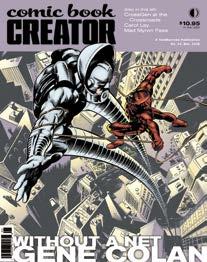
Shooting Star: Ye Ed.’s 2003 visit to CrossGen just before the company’s epic fall
Argentine Report: Our South American pal tracks the art of blazing Enrique Alcatena 42 Comics in the Library: Richard Arndt on Enola Holmes, The Okay Witch, and Fish Girl 46
Hembeck’s Dateline: Fred marvels at the Kurtzmanification of DC’s trinity of-heroes .... 47
Shadow Man: Gene Colan — A 100th Birthday Celebration
A century ago, on September 1, 1926, Eugene Jules Colan was born and he grew to become among the greatest comic book artists of all time. In honor of the masterful creator, we present a transcript of his 75th surprise birthday celebration held at the 2001 San Diego Comic-Con, with moderator Mark Evanier, and guests John Romita, Marie Severin, John Buscema, Don McGregor, and Marv Wolfman. Plus Tom Field, author of Secrets in the Shadows, the Colan biography, shares memories of Gene, as does fan and patron of the artist Chris Lambert in his remembrance ...................... 48
Creators at the Con: Traveling back to NYCC 2011 to see some now departed friends .... 78
Coming Attractions: Take off to the Great White North — remembering Darwyn Cooke 79
A Picture Is Worth A Thousand Words: The great pairing of Gene Colan and Tom Z 80
Crikey!: How that erroneous Alan Moore description of John Constantine being called “London-wide” got by me and our proofreader in CBC #43, I haven’t a bloody clue. We all know that, in actuality, the bloke is a rather slim character who is, as his Brit creator actually put it, “London-wise.”
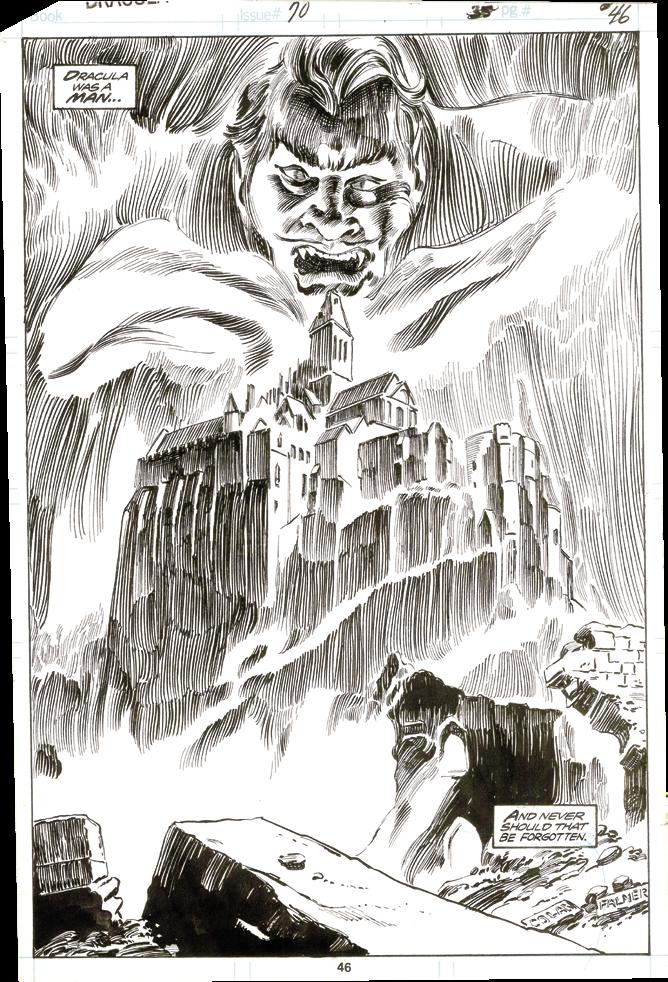
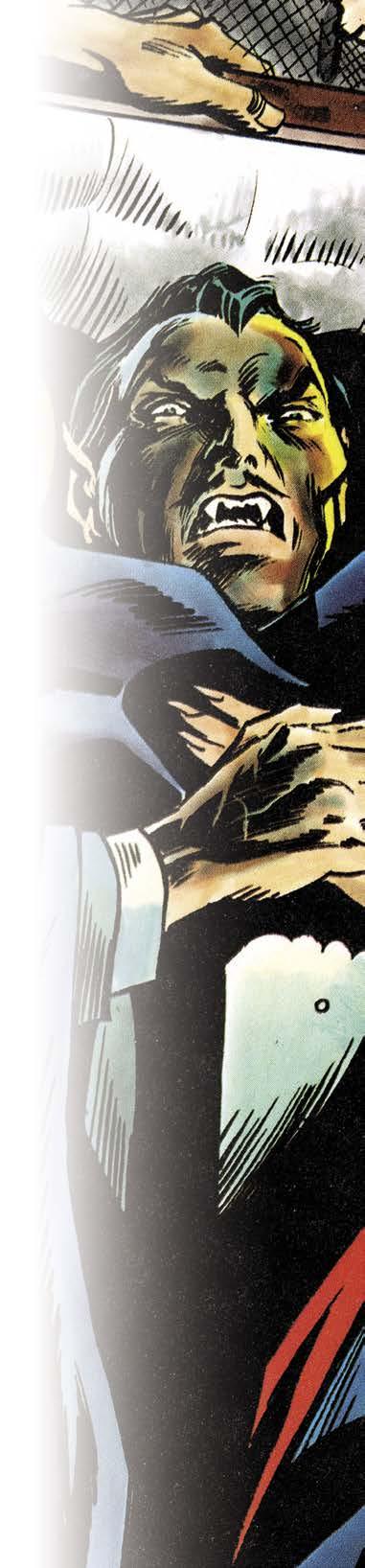
Right: Detail from Gene Colan’s illustration of the Transylvanian vampire nobleman in the 1977 Marvel Memory Album Calendar, sporting inks by the Dean’s greatest embellisher, Tom Palmer. Courtesy of Chris Ryall.
Please note: Some images in this issue were enhanced by digital software.

by JON B. COOKE
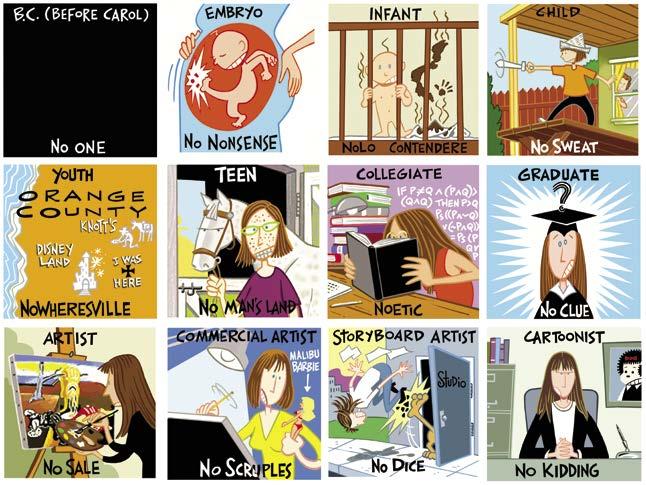
The puzzle of Carol Lay — why isn’t the cartoonist more widely known and celebrated? — has long been baffling to me. I mean, geez, she’s been doing everything, everywhere, for, like, forever! Starting out in the business lettering for Marvel, she moved on to doing layouts for Hanna-Barbera animation, inking funny animal stuff for Western, dipping into undergrounds, storyboarding in Hollywood, having her own alt comics title, snagging a weekly comic strip, freelancing magazine work for the slicks and big name clients, writing a super-hero novel(!), and, most recently, producing her own graphic novels. With my encountering her name in so many diverse places, I had to learn more about the California-born and L.A.-based artist.
Comics didn’t become a thing for Carol until college, when she attended UCLA. She told Kent Worcester in The Comics Journal [#213, June ’99], “I got into the school as an art major and it was a great experience. But it started out kind of explosively. In my first couple of weeks, there I discovered sex, drugs, ZAP Comix, and Frank Zappa. This was 1970 and I instantly turned into a hippie because it was fun. I copied drawings by Neon Park and Robert Crumb. But ZAP Comix really blew me away.”
Disenchanted with the pretentious fine arts scene, Carol told me, she graduated from the university, and attended a community college, “Just to learn how to use mechanical pens, and French curves, and all the stuff that you need to make a living as a commercial artist. They don’t teach that at UCLA, where it’s all fine art, history, and politicking, which actually turned me off on wanting to be an artist.”
Carol landed an $80-a-week gig, drawing random items for Yellow Pages ads — “It was a great job,” she said to Worcester — and then, recruited by her mom, a first-grade teacher, she illustrated a series of flash cards. “And that was so much fun,” she told me, “it brought me back to the basics of drawing, which is a cartoon. And, what I also loved about it was, it was pragmatic. It had a use. Whereas fine art, it’s just too fancy for me. I’m just not that kind of person.
“Anyway, I did these number cartoons, submitted them to an educational products company, and they sat on it for a few months and then gave me a gentle rejection. But that sort of brought me back to earth. And I was hanging around a science fiction store called A Change of Hobbit, in Westwood Village. And I met someone who gave me a crash course in comics. So… I was instantly fascinated. I just loved the combination of story and art. It’s way more fascinating to me than just art or just story. So the two together are a very unique puzzle that I get to create and then solve. So I was really bad for a number of years, but I got my foot in the door… And just sort of climbed the ladder and made some friends along the way that helped me do that.”
“Some friends along the way” included a bunch of comic book pros she met at an Orange County comic convention in the mid-’70s, among them Mark Evanier. “I think Mark spotted my potential right away,” she told me. (In his introduction to a Lay collection, Strip Joint [’98], Evanier said, “Her sketchbook looked like 18 illustrators (no two of them from the same planet) had jammed to fill up pages.”) Animation, comedy, and comics writer Evanier became, she said, “Sort of a work angel for me for decades. It’s, like, I would be broke and need a job, and he’d say, ‘Well, I bet you could do storyboards. Here’s a script, here’s a sample, go do this.’ And I did it, learned it, got a job. And so, part of the reason I have so much breadth, is that I needed to feed myself. It’s like I wasn’t taught how to be a cartoonist; I had to figure it out as I went along. So I took odd jobs wherever they came up, like I worked for Mattel or I did storyboards for commercials or animation or live action films, whatever would pay the bills.

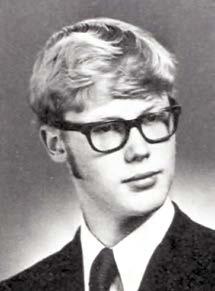
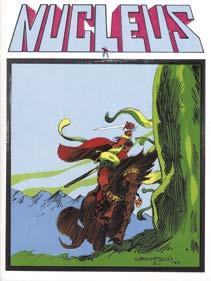
Above: Mark Wheatley during his fanzine days. Below: That publication was Nucleus (#8 with Bernie Wrightson cover). Inset
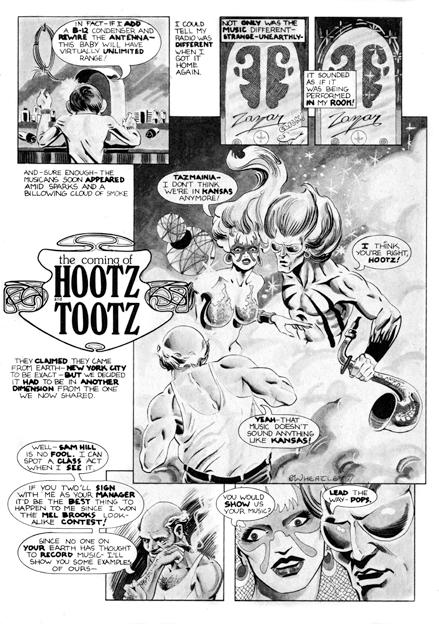
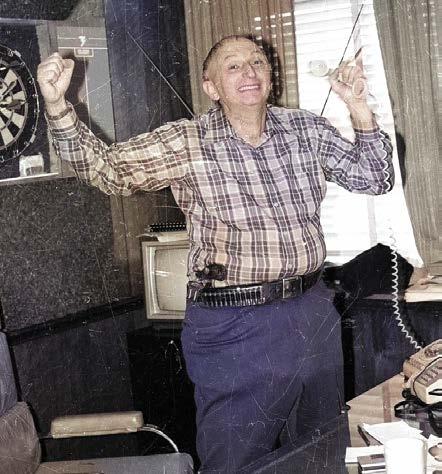
right: Before he helped launch Gasm, Wheatley produced a comics feature for Rock magazine, “Hootz and Tootz.” Bottom: Countrywide publisher Myron Fass, himself.
by JON B. COOKE
And, lo, so it was that The Man, in his generous and glorious benevolence, decreed the young artist should go forth and journey to the Great City and be granted entrance to the fabled House of Ideas. Thus, would begin the lad’s ascent to creative greatness. Or something like that, if not exactly.
That “young artist” is today the creative juggernaut who founded Insight Studios Group, Mark Wheatley, an artist/ writer/editor who still retains the same stubborn tenacity and relentless ambition he had displayed since childhood. An early example of that drive was the time his parents seized the kid’s comics and young Mark, in an indignant response to such grave injustice, started drawing his own.
That stick-to-it-iveness continued into his teen years, when he discovered comics fandom and connected with Gary Groth, then publishing Fantastic Fanzine. “And he didn’t particularly want to publish the first drawings I was sending him (and they were pretty bad, so I don’t blame him),” Wheatley told me. “But I decided, once again in that defiant mood, to start publishing my own fanzines so that I could get my stuff in print. And I did.”
And, enrolled at the Virgina Commonwealth University, the young man attained vast publication production experience, and he also made a suggestion to the dean for Stan Lee, Marvel’s big kahuna, to come and lecture at the school about comics. Of course, Wheatley enticed the comics legend to check out his portfolio, and Lee told him to drop by the Manhattan bullpen and meet art director John Romita.
Alas, while Romita confirmed the grad’s talents were considerable, the times, they were tough. DC’s implosion was imminent and Charlton had shut down its comics line, and Marvel wasn’t hiring. “So I went over and I saw my buddy, John Workman — who I had published in my fanzine — at DC Comics, and he gave me the name of Countrywide Publishing and said, ‘They probably will give you some illustration work.’ So I went down there and they did.”
[’11]), former Pre-Code horror comic book artist Myron Fass. The first thing to know about the man is that he was wildly successful, sometimes publishing as many as 50 different titles every year.
MYRON THE MADMAN
Countrywide Publications, Inc., was owned by “a gunwielding lunatic Jew from Brooklyn — the ‘demon god of pulp magazines’” (as described in Dirty! Dirty! Dirty!: Of Playboys, Pigs, and Penthouse Paupers
To prove his worth to a Village Voice writer, Fass pointed to his office door. Mark Jacobson observed, “On it, in plain view — just so the peons know who they’re dealing with — is a Dun and Bradstreet report saying Myron’s Countrywide Publications grossed $25 million last year; this year, Myron says, the gross will double. In fact, Myron is presently the single largest ‘multi-title’ newsstand publisher in the country.”
The second thing to realize about Fass is that his behavior was usually beyond the pale. There was the time he pistol-whipped* his partner, Stanley Harris, in view of the entire staff. Plus the man would say anything. Jacobson wrote, “Myron is at least as shrewd as he is crude. Talking to him is fun. He’s like a good-copy machine. He can’t resist saying certain things he knows he shouldn’t say. But it’s exhausting, too. A conversation with Myron is like a visit to a sadistic dentist who keeps probing with different kinds of abuse until he finds the one wound that’s tender. Then he rams the high-speed drill in there and leans on it.”
*Fass — who joined up with Carl Burgos to take on the Marvel Comics Group with a short-lived comics line, M.F. Enterprises, with the “Let’s Split!” version of Captain Marvel — always had a Colt .45 pistol holstered to his hip and wasn’t shy about waving it around the office.
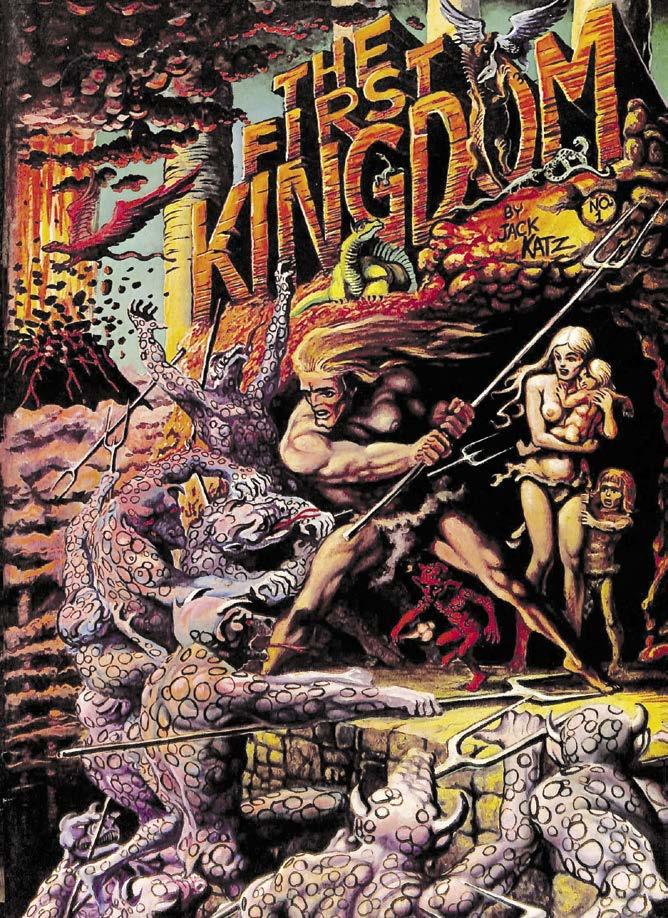
Below: Cover for the first printing of The First Kingdom #1 [July ’74], which sported Larry Todd’s paints over Jack Katz’s line art. Todd’s work was replaced for the 1975 reprint. Publisher Bud Plant explained, “Jack decided he did not like the fact his inks pretty much disappeared under Larry’s work, so we did a new pen-&-ink plus [standard] color for the next editions.” This was the first chapter of Katz’s magnum opus, which concluded with #24 [’86].
Conducted by TED JALBERT
[Introduction: The first portion of this interview covered Jack Katz’s early days in Brooklyn, break into comics, and painting career. The Q+A was conducted over several sessions, between mid-2019 to early ’21. Jack passed away in 2025. His son, Ivan, was interviewed in CBC #43. — T.J.]
Ted Jalbert: You continued to paint until 1969. What made you return to comics?
Jack Katz: My son, Ivan, showed me some of the stuff that was being made…. black-&-white comics, stuff like that, and again I got the bug, one more time. And I decided
I wanted to get back, and I made up samples and immediately at Marvel, the god that existed (Stan Lee), accepted my work immediately. It was evident that I had the talent. I did a number of things at Marvel, I did a number of things at DC.
I got back in the business and, until 1973, I was doing comics again, until finally I just put the idea of working for anybody else out of my mind. I wrote a lot of stories during this period, and I completed many stories which were never published. I did a lot of romance stuff…Young romance, old romance! I got to know Bill Everett, who did the Sub-Mariner, and we became extremely good friends. And so, Bill said, “I’d like to ink your stuff.” Because he loved my drawing, you know! Bill Everett saved my life. I hitchhiked from Berkeley to New York. Bill Everett’s place was on 40th Street, right next to the New York Public Library. And that’s how Bill and I got to know each other.
Jim Steranko was very, very important in a certain sense. I saw how he was trying to handle some of the stuff for Marvel, and I figured out that maybe this is a way to go, that I might be able to actually do my own thing… by working within the companies, see, like a sneak. But it didn’t work out.
Ted: You returned to Marvel in 1969.
Jack: And then I also did another story at the same time, at Marvel, it was a frantic time. And when I did that Sub Mariner story, I had him kidnapped by aliens from another planet. Well, Stan went up the wall. With me he was always up the wall, I’m telling you ! It’s a miracle I didn’t give him gall stones or something! He says “Jack, you can’t do this with my characters!” And so, he gave the 20-pager over to Marie Severin, and she took about 12 pages out of it and changed the whole damn thing. And Marie was very good, she was a mechanic, a very good mechanic. All of these people are really very good.
Also, I got a job at Skywald, in which I was doing all the premium work there. But Skywald was terribly under-financed. Everybody was trying to find a guiding light to help them. And they did for a while…
Ted: How did you connect with Skywald?
Jack: They knew about me, so it was very easy to get work. Sol Brodsky called me. He said to me, “Jack, stop trying to please Stan Lee. Do me a favor, come over to us. You can do anything you want. Carte blanche, whatever you want to do!” But Sol was as clever as they come… So, the first thing, I go over, the first day, I had severed my relationship with DC, I go over there, and he says “Jack, you know what? We need a new kind of Tarzan! “I said “What?!” He says “Yeah, you like Hal Foster….” So, I did three issues of Zangar [Jungle Adventures]. But I said “Sol, you said I could do my own things!” So, he gave me a chance in the black-&-whites.
So, in Zangar, it was still germinating issues of what were coming up to the surface… was The First Kingdom. In fact,
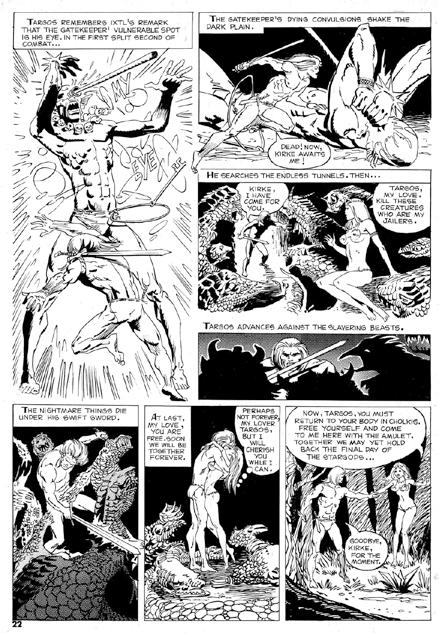
in the black-&-white that I did for Warren, in “Targos,” I was starting to outline The First Kingdom… The third book that I did with Zangar is the beginning of The First Kingdom. It was a test situation and, of course, it was extremely original, and they didn’t like the idea that I wrote it. Skywald was under-financed. So, what they did, they sent me out to the provinces. It was the last time that I came out to California, and I stayed.
Ted: Skywald sent you to California ?
Jack: Yeah, they wanted me to see how the distribution was going.
Ted: You did a few romance stories in the early 1970s. How did you feel about working on these romance stories?
Jack: Well, it was a relief to me, because it was close to reality. I tried my best to accommodate all the people who were involved. I was always falling in love. The enspellment [sic] was always better than the disenchantment. It took me about three–six hours to pencil a page. I was living in Oakland when I drew these stories.
Ted: How did you like working with Dorothy Woolfolk, the romance editor at DC Comics?
Jack: She fell in love with my work. Oh my god, and I was going through this divorce at that time. And she just loved my stuff. Dorothy was a very sensitive young lady really, and I never realized how hungry she was for good artwork. She knew my stuff, she had seen it. She was very… concerned. “Jack, remember to do this. And remember to do that.” She was very good person.
There were some people who should never have been editors. She had a heart, which is the worst thing in the world, because she picked me up when everybody else
[said], “Oh Jack Katz, it’s gonna take a year for him to do a page!” She stressed one area of the story or another one. The one she gave me, which I hated and I realized she was right, eventually, was about this girl who was taller than all the boys (“Too Tall to Love”) and they were making fun of her.
Ted: You also did the “Targos” story for Warren Publishing, which was a precursor to The First Kingdom.
Jack: You betcha! There’s The First Kingdom again… I was telescoping all these ideas together…
Ted: Galactic Prime was a newspaper comic strip you did with author Tom Scortia.
Jack: In 1978, I drew the Galactic Prime comic strip, which ran for seven weeks in a local newspaper. I was always drawing. It was written by Tom Scortia, who said we should do a science fiction thing. So I did seven weeks for the Independent-Gazette, in Berkeley. It was about this young man whose teacher is actually a captain aboard a starship. And it was very carefully illustrated. But something happened with Tom. They started to do computerized witchcraft and all kinds of stuff… so I dropped out. I told them I can’t do this
The
for
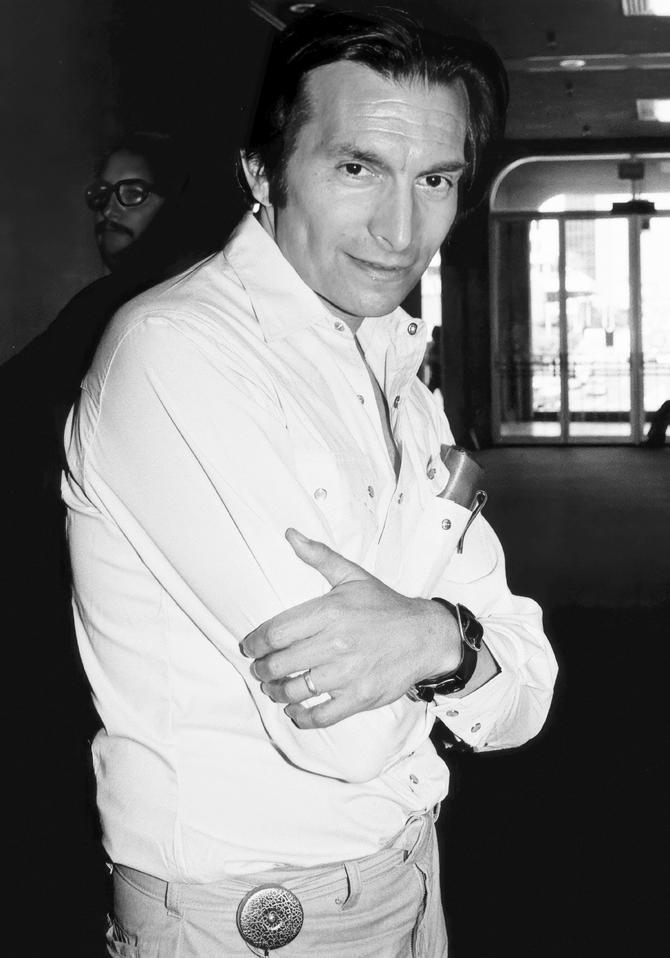
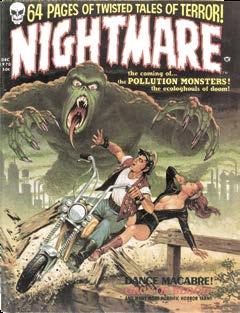
at the 1980 San Diego Comic-Con. Inset left: Page from Katz’s singular story for Warren Publications, “Targos” [Creepy #45, May ’72]. Below: Katz’s work appeared in Nightmare #1 [Dec. ’70].
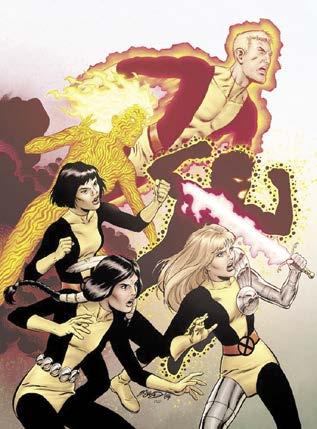
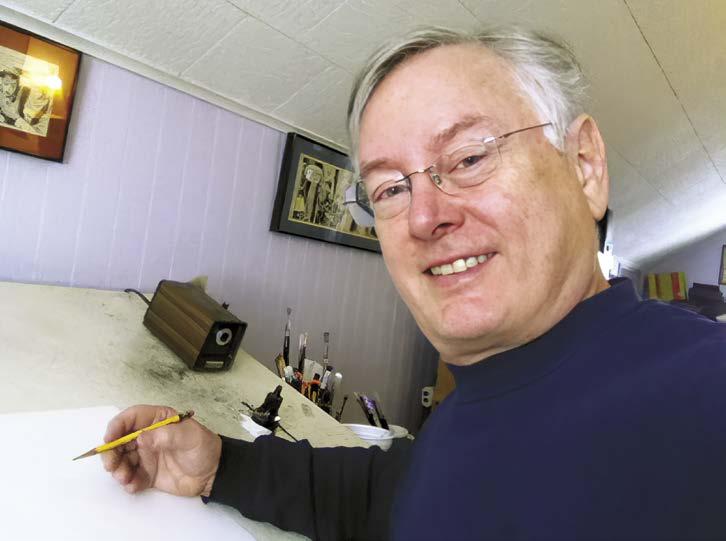
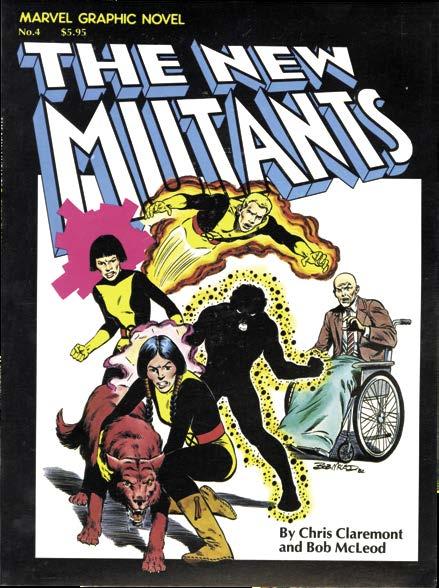
Inset right: Among the major breaks in Bob McLeod’s professional career was the success of his creation with writer Chris Claremont, The New Mutants. Marvel Graphic Novel #4 [Oct. ’82] featured the team’s first appearance. In the past, the artist has remarked that initial work on the series was frustrating because he could not keep up the pace on the regular series as both penciler and inker. Below: In 2009, the artist drew this rendition of the team. Bottom: The artist himself in his Pennsylvania studio.
by DARRICK PATRICK
[Bob McLeod is a Florida-born artist and inker who is best known for co-creating The New Mutants with writer Chris Claremont. He has worked on titles such as The Incredible Hulk, Detective Comics, Conan the Barbarian, Wonder Woman, Star Wars, Action Comics, Wolverine, The Twilight Zone, Crazy magazine, Howard the Duck, etc. One of my personal favorite batches of his work is the inking of Mike Zeck’s pencils across the Spider-Man titles for Fearful Symmetry: Kraven’s Last Hunt, in 1987. Bob received the Joe Sinnott Hall of Fame Award, at the Inkwell Awards Ceremony, in 2018.— D.P.]
Darrick Patrick: What was the journey that led you to a career as an illustrator?
Bob McLeod: I decided when I was five years old that I wanted to be a cartoonist when I grew up. I was generally known as the best artist in my schools from first through 12th grades. In my early teens, I tried to get a job as an assistant to Fred Lasswell, a local comic strip artist who drew the Snuffy Smith strip, but was rejected. I drew cartoons for my high school and college newspapers, but I quit college and art school because they didn’t teach cartooning. At age 19, I submitted a comic book story and art to Warren Publications, but was rejected. At age 21, I wrote, hand-lettered and did the art for 36 strips of a comic strip about a private detective I called “Tom Nosey” and submitted it to King Features,
but was rejected. At age 23, I sold my car to finance a trip to New York City to attempt to start my career. I went to Marvel Comics and was rejected. I went to DC Comics and the art director told me I needed to go back to school and learn how to draw. Instead, I kept drawing samples and eventually showed them to Neal Adams, who called Marvel and got me a job in their production department doing lettering corrections. I worked my way up to doing art corrections and, about six months later, started getting inking jobs. After a couple of years, I had trouble getting more inking work, so I moved back to my hometown and did advertising art for a year. I then moved back to N.Y.C. and restarted my comics career. First at Gold Key, then again at Marvel and DC. Three years later, I got my first penciling job at Marvel, and my career really took off from there.
Darrick: Who are some of the people that greatly influenced you while growing up?
Bob: My parents always supported my art ambitions, even when I was repeatedly getting rejections. I have to credit them as my biggest influences. They gave me a strong work ethic and confidence in myself. My high school humanities teacher and my art teacher both praised my talent and encouraged my artistic ambitions.
Darrick: Do you have any words of advice for other individuals looking to make a career with their artistic abilities?
Bob: I would advise them to have confidence in themselves when facing rejection and persevere. Learn from your failures and study hard to be the best you can be. It isn’t
A snapshot of the Golden Age publisher as well as the G-Men effo rt to investigate his mags
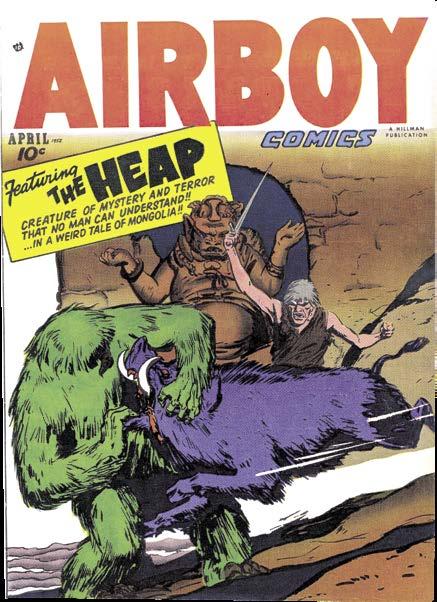
Below: Natch, Hillman Periodicals is probably best remembered for the Airboy [V9 #3, Apr. ’52] co-star and swamp critter, The Heap!
by SHAUN CLANCY with JON B. COOKE
Anyone with a modicum of knowledge regarding the origins of American comic book publishing would think it no surprise that Alexander Lester Hillman [1900–68], publisher of Golden Age comics house Hillman Periodicals, started off in the publishing business by producing rather sensational material. First it was books, among them Woman for Sale and Here is My Body; and then came prurient “confession” magazines, including Real Story and Crime Detective. In 1938, he established Hillman Periodicals and, by ’40, he jumped into the lucrative comic book game.
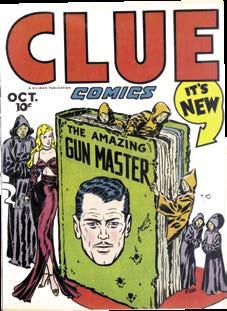
Below: Joe Simon relates an amusing anecdote about a visit to Hillman editor Ed Cronin’s office in his memoir, The Comic Book Makers, which involves the gun-hating Gun Master character. Cover [#10, Oct. ’46] drawn by Fred Kida.
After a couple of alsorans, Hillman hit pay dirt with Air Fighters Comics, which soon enough became Airboy, the imprint’s longestlasting series. The latter, of course, spawned The Heap, the fearsome four-color monster that established the weird swamp creature genre which culminated with Swamp Thing and Man-Thing. (It’s worth noting that the team of Joe Simon and Jack Kirby did a few assignments for the company before they left and found success over at Prize by creating the romance comic.)
Intrepid Shaun Clancy went in search of information about the company’s owner and its comic book line, so he had a chat with Hillman’s youngest son, in the spring of 2012. During their talk, Alex revealed he’d been adopted and hadn’t spoken much to his father about his business before the latter died in ’68, when Alex was seven. But he did later learn of his father’s considerable achievements.
Of his dad’s start, Alex recalled hearing, “I know my father worked for a broadcasting company… and I think [his subsequent career] stems from that. He made the first radio broadcast out of Shanghai — out of China! In 1926!… From then, he was in broadcasting and I think he got into publishing not long after, so he would have been in his 20s, at the point. He met my mother and they were married in ‘32… My mother’s family was involved in the record industry. Her father started Okeh Records, Columbia Records,
and a whole bunch of things. They signed on Satchmo… Louie Armstrong!”
Though he heard little about the comics division of Hillman Periodicals, an outfit renowned for its editors, which included Herb Rogoff and especially Ed Cronin, “The one I knew the best was Sidney Carroll,” the younger Alex said. “He wrote the movie, The Hustler, with Jackie Gleason…? And he did some other things, as well, and became a screenwriter. Bill Stone was one of my father’s photographers and he did that big spread on Madonna before Madonna was famous — it ended up in Penthouse or something…?”
Before and after the patriarch’s retirement in 1961 as a publishing mogul, he and wife Rita were celebrated patrons of New York City’s modern art scene having, over the decades, amassed an impressive collection of French impressionist work. And, after père Alex’s 1968 passing from cirrhosis, Rita delved into philanthropic efforts, which included her donating a portion of the $17 million received from an auctioned Picasso painting to establish a nursing scholars program. In 2007, she passed away, at age 95.
Doubtless, the most remembered Hillman magazine is Pageant, a digest-size general interest publication that launched in 1944, best known in comics circles for prompting the reformatting of MAD comics into a magazine-size affair, leading to phenomenally beneficial results for both editor Harvey Kurtzman and E.C. Publications.
Interestingly, Alex the younger revealed one of his father’s abiding interests was of the political persuasion. “He published Barry Goldwater’s The Conscience of a Conservative [’60]… I knew more about his political career: what he did after World War II, with the Marshall Plan… He never fought, but he did a lot of work with the U.S. State Department during World War II, like, as Truman’s advisor and, after the war, he oversaw the Italian elections and he had a private consult with the Pope.”
Alex opined, “I would say he was an old-style conservative, not what you see today in the Republican Party. He was of a mindset that government [should be small and] shouldn’t get in other people’s business. He would be of the mindset, like, if somebody wanted to marry his duck, so be it… So that was sort of my father’s thinking.”
His parents, he said, “They knew [U.S. Senator] Joe McCarthy. They were at his wedding! They felt that he was kind of a patsy to others. I think that they really looked down on what was going on… I don’t know what extent McCarthyism was having on my father’s business, but I don’t think it was a personal thing, because my father was a really die-hard American kind of person. So I doubt there was any issue there, having been with the State Department, and all that.”
Whether the elder Alex’s political leanings were appreciated by the U.S. Department of Justice can only be guessed, but known with certainty is the fact he had endured repeat-
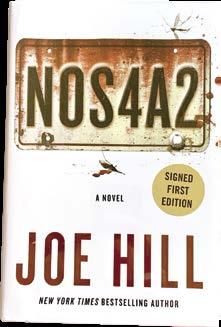
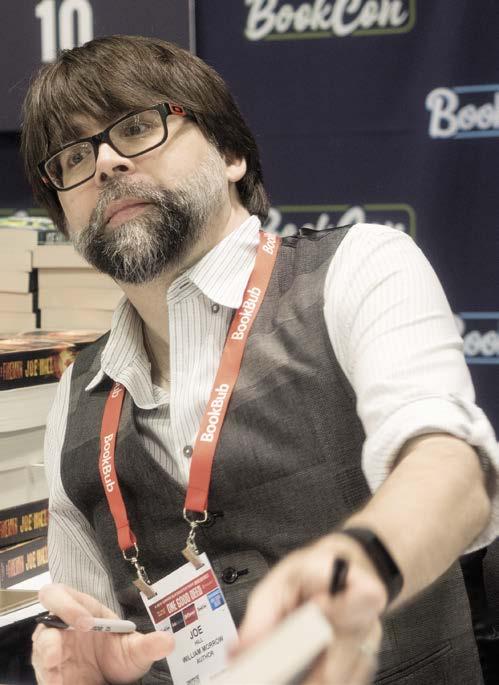
Above: Urged on by many — including his famous father, Stephen King — the author Joe Hill extracted a huge sequence from the manuscript of NOS4A2 [’13] and that formed the basis of comic-book saga Wraith’s prologue. Below: Hill signing copies of (among others) his post-apocalyptic novel, The Fireman, at the 2019 BookCon, held at the Jacob Javits Convention Center, in Manhattan.
Conducted by GLEN CADIGAN
[Previously, in part one of our interview with Joe Hill, we covered his growing up as a comic-book fan and struggles that Joe had while trying to make it as a professional author. In the following middle portion, we discuss his creative process, what makes for a good horror story, and dig into the world of Locke & Key, including its future prospects. And, skipping an issue, stay tuned for the concluding portion in CBC #47, which will cover Joe’s “Hill House Comics” imprint for DC, as well as a crossover between L&K and the Sandman universe! The entire interview was conducted via Zoom in September, 2024 (with thanks to Chris Ryall for facilitating the conversation). — G.C.]
Glen Cadigan: When you get an idea for a story, how do you know whether it’s a comic book story or a prose story?
Joe Hill: Well, I always just know. I know right from the start. I’m either seeing it as a series of panels or I’m not, in which case, it’s a prose story. I have never written a comic that I thought should have actually been a novel or a short story. I have a couple times written stuff as prose, and then realized afterwards it should have been a comic book. One example of that would be when I turned in the second draft of NOS4A2. It was a fairly long book and, in the second half of the book, there was a long section that gave us Charlie Manx’s backstory.
it.” My American editor looked at it, said she loved the book. She thought it slowed down at the Charlie Manx backstory, we ought to cut 50 pages out of it. And I thought, “F*ck all of ya! I’m gonna cut the whole thing out!”
And I cut the whole backstory right out of the novel. I thought, “No one needs to know anything about the shark’s childhood in Jaws, so I’m just taking all of this out.” But I still thought that stuff about Charlie Manx before he turned into a monster was pretty good. I still thought it was a pretty exciting and interesting story, it just had no place in the novel. It was just sitting there on my desk, and I think, at some point, maybe [editor] Chris [Ryall] said, “Is there any way to do a comic book set in the universe of NOS4A2?”
So Charlie Manx is the villain of NOS4A2, this man who has been driving the back roads of America for a hundred years, and he stayed young by draining the spirit from children. And I told his whole backstory in this, almost like an enclosed novella within NOS4A2
And then, when my dad [author Stephen King] read the book, he said, “Joe, it’s a great book. I think that the action slows down when you tell Charlie Manx’s backstory, and I think you oughta cut 30 pages out of that.” And then my English editor read it, and she said, “Joe, NOS4A2 is a great book. I love it. I think things slow down when we tell Charlie Manx’s backstory. I think you ought to cut 40 pages out of
And I thought, “I wonder if I can tell that story here.” And, it turned out, I could. I think the whole enclosed novella that told Charlie Manx’s backstory was 90 pages long in the original manuscript, but I was able to tell the whole story, on the page, in the comic book, in 26 pages. I think the whole issue is 26 pages long, and then that becomes the prologue to Wraith Charlie Manx has this place. He feeds off children, and when he’s done with them, they’re creepy little monsters and he dumps them in this place that’s not really in our world, this dark inversion of Peter Pan’s Neverland called Christmasland. And the plot of Wraith is basically Con Air in Christmasland. Five escaped felons wind up in Christmasland together and have to fight their way out. So that’s the majority of the story.
It’s very comic book friendly. There’s a lot of action. Christmasland is a place where surreal things are possible, and so you get a lot of really surreal, strange imagery. There’s a lot of gross-out humor. At one point, there’s a two-page spread that shows an ice maze, and that ice maze is basically Where’s Waldo? Which was so much fun for C.P. [Wilson] to draw. I’m sure his hand just about fell off, but it’s an awesome two-page spread. So, I guess, sometimes I’ve gotten it wrong in terms of writing prose but, a lot of times, I just know. I have the idea and I think, “That would make a great comic.” Or “That’s a short story.”
Oh, I know how I know: if the story is fundamentally visual, if the story is uniquely visual, so that the reader will want to see it, then it’s probably best as a comic book. I think that all my books and stories, I want them to feel cinematic. I want them to feel visual, but some stories will so clearly benefit from being illustrated by Gabriel Rodriguez, or being illustrated by Stuart Immonen, I can just say, “Oh, no, no, no, no. I’ve got to do this as a comic.”
Glen: What did you bring with you from prose over to the comic book world?
Joe: With the comic books and my prose, and then also the screenwriting, I found that the skills you build in one
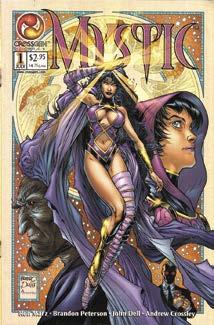
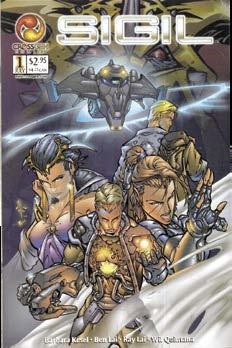
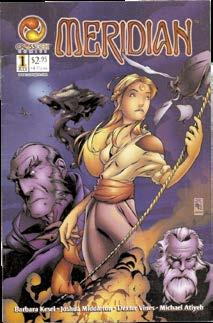
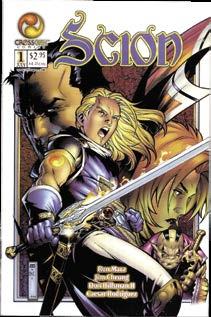
Inset right: Mark Alessi sold his software services company, he told the Chicago Tribune, for “less than $100 million and more than $10 million,” and he subsequently launched CrossGeneration Comics, outside Tampa, Florida. Below: His four initial releases, all based in the shared “Sigilverse,” each lasting over 40 issues. Bottom: Aerial photo with arrow indicating the Oldsmar comic book factory.
by JON B. COOKE
“Freefall.” That’s the word The Comics Journal used to characterize the CrossGen of a month or so after I visited the Tampa area comics company, on April 14, 2003. But I had little sense of the financial turmoil it was beginning to endure when I stepped into the remarkable environs of Mark Albert Alessi’s 13,500 square-foot comic book factory.
While my mid-morning appointment to tour the sprawling facility and interview its maverick owner didn’t dispel my skepticism about the publisher’s formula to succeed, I can still recall being massively impressed with the whole “all-in-one” aspect (well, “all” but printing and distribution), something the mainstream comics world hadn’t seen since Charlton Comics closed its doors over a decade before.
Michael Dean, in his TCJ investigation of CrossGen, best described the “corporate headquarters, gallery of comic art, and creative design studio,” as I witnessed it upon arrival in the otherwise unassuming industrial/office park: “Entering the glass doors at the front entrance of the building, one first encounters a reception area, management offices, a conference room, and a computer room complete with its own web server. Pieces of original art from Alessi’s collection adorn the walls. Just past the computer room is an internal production facility for printing and scanning functions. Though CrossGen comics are printed at Quebecor, the company is capable of printing and binding its own sample comics onsite. A corridor to the left leads to an area that would qualify as living quarters, including a small ‘cafeteria’ (with refrigerator and microwave), a game room (with foosball table and video game systems), a bunk room (for employee naps), showers, and locker room dressing areas.

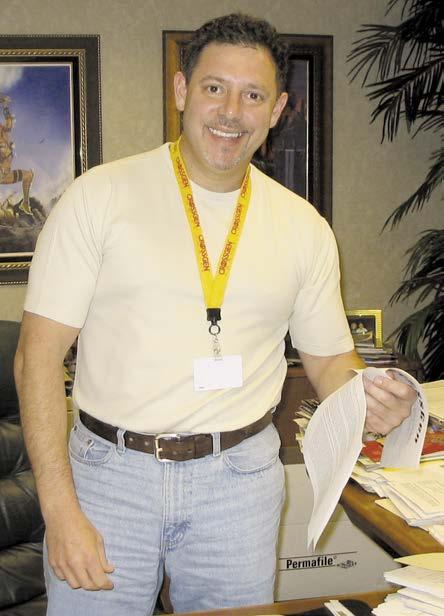
“A corridor to the right leads to administrative production and creative staff management offices. In between is the massive bullpen area, a courtyard-like central hub divided into large ‘quads,’ where artists and writers work at cubicle workstations. While the rest of the building has ninefoot ceilings, the quads have seven-foot cubicle walls and a 12-foot ceiling. Each quad holds workspace for a title’s team of creators, including penciler, inker, and colorist, as well as a central conference area where the art team can confer with each other and the title’s writer. Few publishing companies have gotten their start in the comics business at such an elaborately designed ground floor.”
Most impressive to me (who feels ambiance plays a large part in making for a creative environment) was the comfortably dim lighting* in the centralized, carpeted bullpen — I got a feeling that here was the heart of the company — with the acoustics nicely subdued, accompanied by soft glows emanating from colorist computer screens in their cubicles. There was no glaring fluorescent lighting, no loud factory floor clamoring, no assembly line vibe here.
As he led me about the premises, my host/tour guide, facility manager John Smith, was amiable and he answered my questions engagingly enough, though I did feel a little hurried. He bragged that there was $2.5 million worth * CrossGen facility manager John Smith informed me, “The colorists leave the lights off here for [computer screen] calibration rates.”

of comic book art gracing the entire facility (though a newspaper article cited $1.5 million value that combined Allesi’s comic book collection on the premises along with the art), which includ ed pieces by Frank Frazetta, Jim Steranko, Al Williamson, Roy Krenkel, Jack Kirby, Bernie Wrightson, Dave Stevens, Barry Windsor-Smith, and Wallace Wood, to name only a portion. Smith discussed the CrossGen Premier Retailer program, its regular outreach to keep Hollywood abreast of its comics, and he opted to throw me some numbers. I was informed CrossGen was currently employing 92 people and was also planning to expand its already considerable size and acquire an additional 10,500 square-feet next door for management, as well as in-house pencilers and inkers who, I was told, needed brighter lighting to work.
Joining the tour was Michelle Pugliese, freelance coordinator, and she explained CrossGen’s creator-owned imprint Code 6 and the CGE sister brand focusing on licensed titles. She said Code 6 was named for Florida Highway Patrol signal code indicating an “escaped prisoner,” equating comics pros busting from the confines of the Big Two to join with the publisher to develop creator-owned properties, where, she explained, ”We are acting as a publishing agent.”
Pugliese also introduced me to artists Jeff Johnson, Rick Maygar, and I met, in person for the first time — the dude I had initially reached out to ask about visiting the outfit — Butch Guice, whose work graced my favorite CrossGen title, Ruse. The freelance coordinator then explained the 4/1 equation for their monthly books — a schedule of four issues produced by an in-house art team and then one fill-in completed by freelancers, and the cycle then begins anew.
Armed with my new digital camera, I snapped a photo of Pugliese posing with the first issue of then new CGE/Code 6 title, Brian Pulido’s Lady Death: A Medieval Tale, featuring a less buxom protagonist in a revamp which, Wizard reported, “jettisons the T&A and Heaven/Hell metaphysics of previous series in favor of high fantasy and historical fiction.”
(Before its demise, CrossGen would partner not only with Pulido, but also with Don Bluth, John Carpenter, Mattel Toys, R.A. Salvatore, Rob Zombie, and Chris Gossett (of The Red Star) producing licensed comics in joint ventures.)
Before Smith and Pugliese returned to their own daily routines, I was palmed off on Bill Rosemann, marketing director, who detailed CrossGen’s intent to create comics of international appeal. (Ain’t It Cool News relayed that, in 2002, the CrossGen line was translated in eight different languages and published in at least 15 other countries.)
“Everything was designed with the notion of spreading our heroes to the entire world,” he said. “And so we came up with stories that aren’t dictated by, say, just American ideals.”
And the stories were composed specifically to appeal to
all ages — across generations, as the company name indicates — with special emphasis on luring female readers. AICN reported in 2002, “CrossGeneration Comics has set unprecedented sales records for a new start-up comics publisher by debuting nine releases on the comic book industry distributor’s Top 100 sales list. Since then they have grown into the comic industry’s fifth largest publisher…”
Rosemann explained its efforts to seek new readers in the digital world with its “Comics on the Web” initiative, offering library access to its digitized comics for $2 a month; the compact convenience of its Traveler format trade paperbacks; and the company’s “Bridges” push to promote comics in classrooms to aid with student reading comprehension.
With that, I was ushered into Mark Alessi’s office, the walls of which sported more provocative and less-generalaudience framed artwork than that seen in the hallways. The publisher, who shook my hand and looked me over with his characteristic intense gaze, was in a friendly if also no-nonsense mood, and I started asking chronological questions. “I’m originally from Connecticut,” he replied, “although I was born in Massachusetts, and most of my background is in technology. Getting out of school, I went to work for IBM and I stayed in technology for 27 years and I got into this particular role because I’m crazy… certifiable.”
About his introduction to comics, he related, “Well, I was pretty fortunate. My mother taught me to read when I was like three, so, by the time I was in kindergarten, I was reading the Hardy Boys and Tom Swift novels, and my cousin, Gina, introduced me to comics in the probably early ’60s, when the real Marvel comics were coming out — Fantastic Four, Amazing Spider-Man, etc., and I fell in love with them, and I’ve always loved comics since.”
To my later regret, I would only recently learn of cousin Gina Villa’s prominence in the publisher’s origin myth, never mind the fact she was likely, at that very moment, sitting in an adjacent office, second only to her cousin in the corporate hierarchy as CrossGen’s chief operating officer.
Villa, some three years older than her cousin, did indeed acquaint Alessi with the House
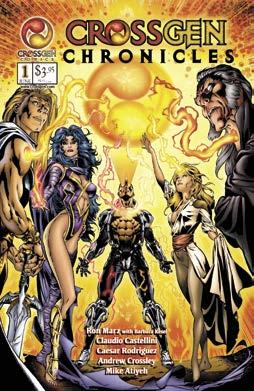
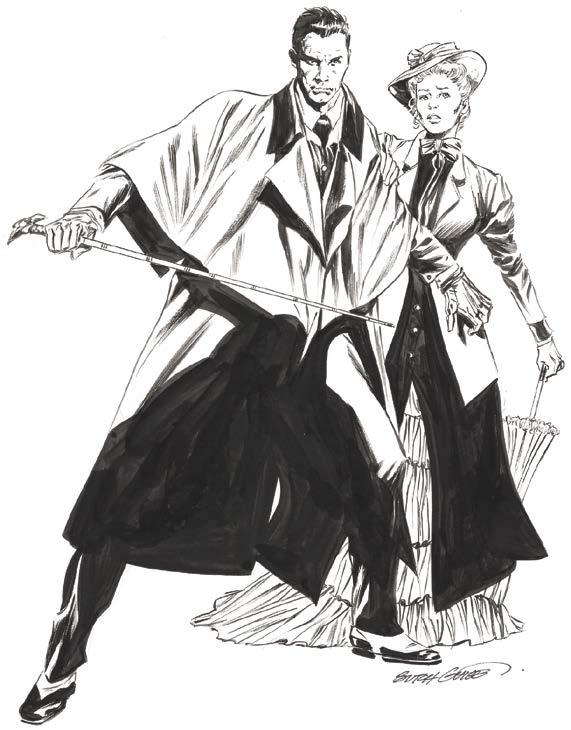
Above: The first issue of quarterly CrossGen Chronicles [June ’00] preceded the initial four monthly titles. Cover by Claudio Castellini. Inset left: CrossGen logo. F.Y.I.: in 2000, the publisher was recipient of the Diamond Gem Awards for “Comic Book Publisher of the Year (Under 5% Market Share)” and “New Publisher of the Year.” Below: Simon Archard and Emma Bishop, the stars of Ruse Commission by Butch Guice.
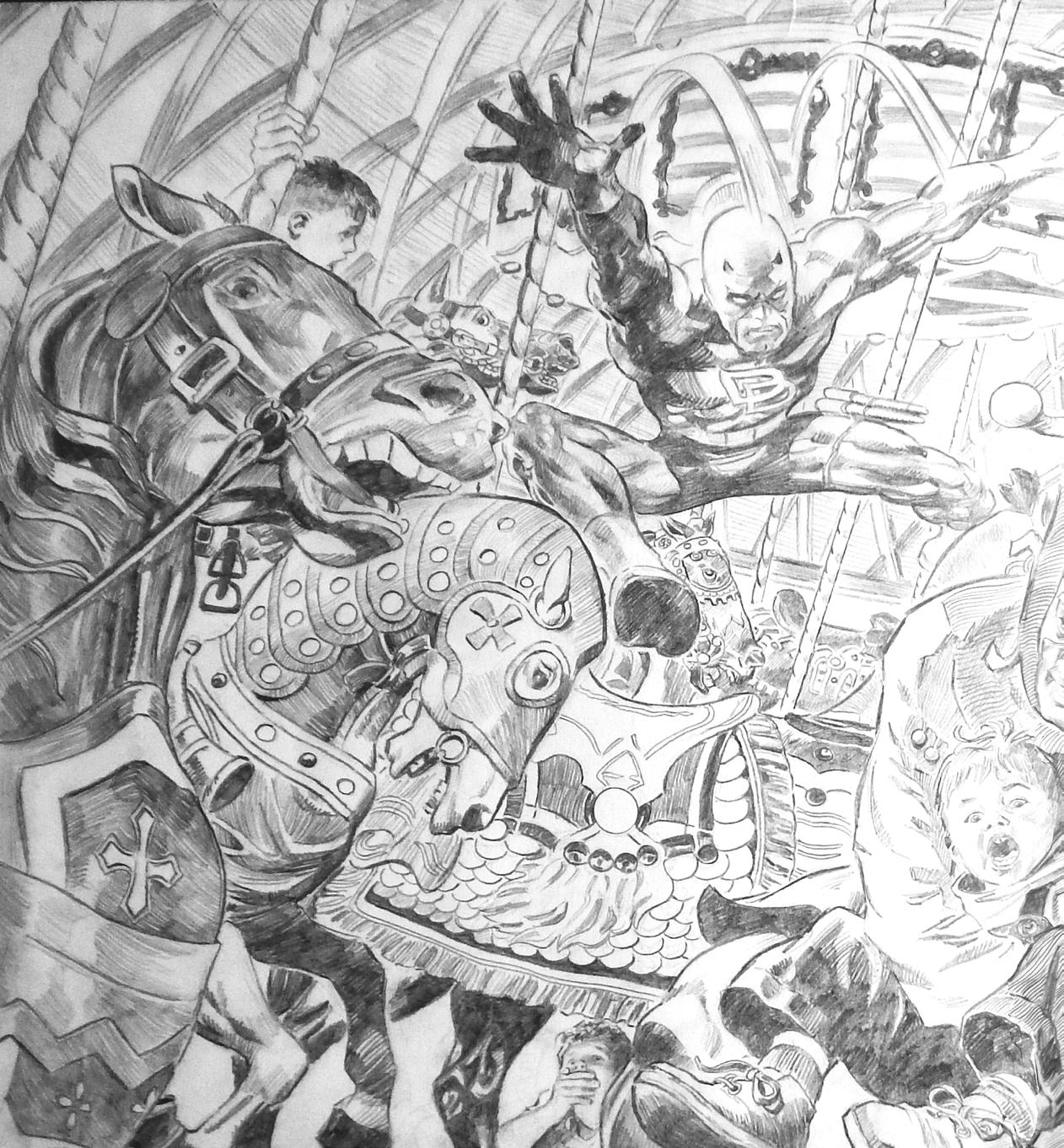
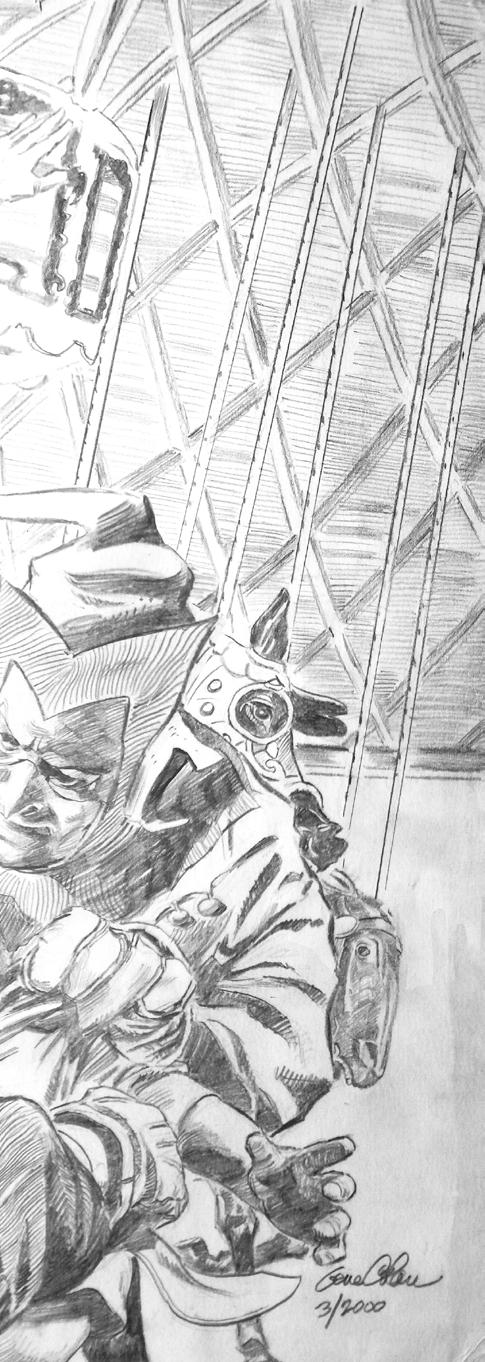
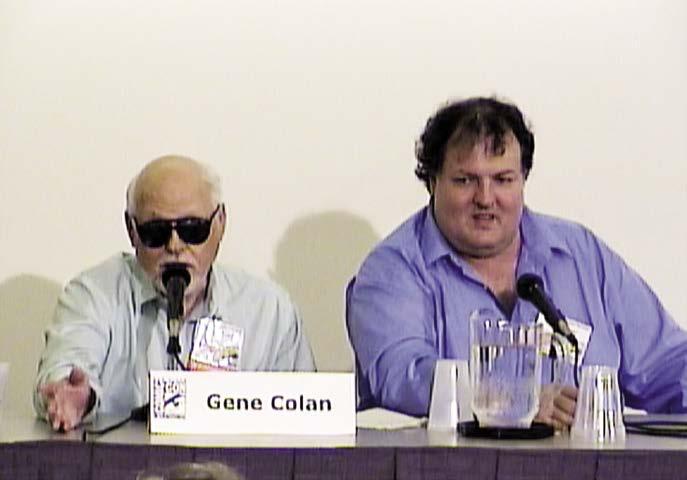
CBC ’s Gene Colan tribute begins with a transcript of the 2001 San Diego Comic-Con surprise party panel celebrating the artist supreme’s 75th birthday. Moderated by Mark Evanier, the panel guest-stars John Romita, John Buscema, Marie Severin, Marv Wolfman, and Don McGregor, comics stalwarts all, present to honor their friend, “Gentleman Gene”!
The proceedings were immortalized by videographer and über comic book fan Marc Svensson, a friend of Gene and avid collector of the artist’s work. A contributing CBC editor who videotaped many dozens of SDCC panels over the decades, Marc went above and beyond with this effort (to our eternal gratitude), no doubt fueled by his love for Eugene Jules Colan [Sept. 1, 1926–June 23, 2011].
[Setting the scene: Gene is misled to believe he is on a panel, moderated by Mark E., devoted to discussing various art supplies — specifically erasers, believe it or not! — and is, unlike absolutely everyone else gathering in that room, completely unaware for what was coming. Seated in the audience is Gene’s wife, Adrienne, who helped plan the surprise.]
Mark Evanier: Well, anyway, I’m going to start this [while waiting] for our other panelists. The idea here was to talk about art techniques, in particular the use of erasers, and I suppose that that’s one of the things we don’t think too much about. Over the years, the tech-
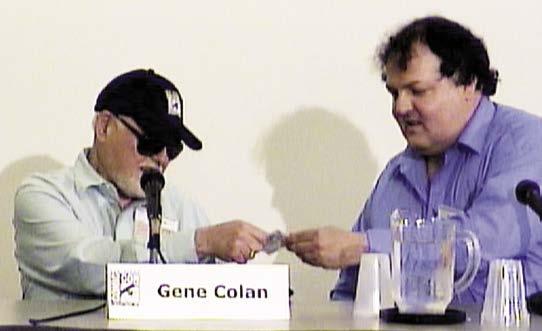
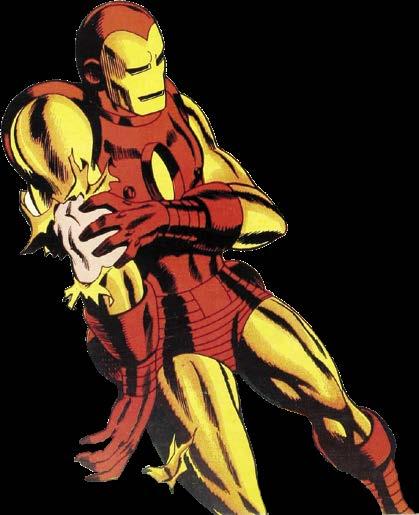
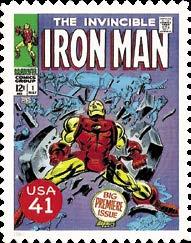
This page: Top is Mark Evanier checking Gene Colan’s ID. Below is detail of Tales of Suspense #79 [July ’66], pencils by Gene, inks by Jack Abel. Bottom is Iron Man postage stamp [’07] and Gene, Mark Evanier, and John Romita.
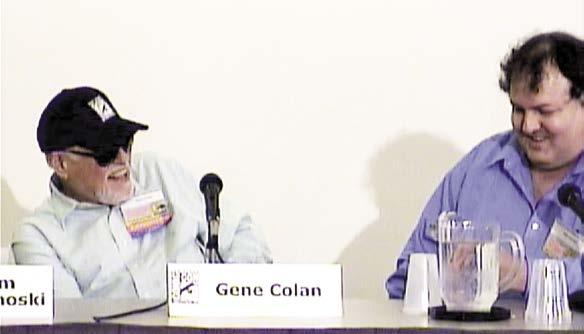
nology of erasers has improved greatly. [Addressing Gene Colan] And you’ve been doing this… what… 25 years? And, in that time, have you been using a lot of erasers? What erasers do you tend to use?
People are trying to suppress their laughter. Gene begins to answer very seriously.
Gene: Anything I can get. Usually a kneaded eraser. It looks like clay. It’s usually a little square piece eraser. Very handy… Takes off the top coating of the graphite.
Mark: And now how long have you been doing comics?
Gene: Well, I spoke to John yesterday, John Buscema, and I thought I started in ’46 and he says no, it was ’48, so I take his word for it, so 1948. [laughter]
Mark: Okay: in 1948, [you] would’ve been what…?
About 15 years old?
Gene: Oh no, I was born in ’26.
Mark: ’Twenty-six?
Gene: Yeah, ’26.
Mark: ’Twenty-six. That means… No, that’s not possible. Exactly. [In that] case would be 75 this year. You’re not 75 years old.
Gene: September, I’ll be 75.
In September: 75.
Mark: [To audience] How many people believe that? No, I don’t think so. No. You got your driver’s license?
Gene: Yeah.
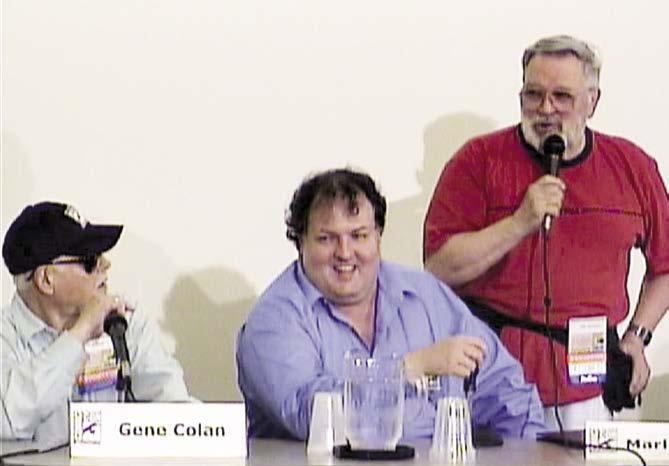
[Gene takes out his wallet and hands his driver’s license to Mark. Various comments and laughter can be heard in the audience – including “Is he carding him?” and “He is carding him!” Mark takes the license and looks at it.]
Mark: This is inked by Vince Colleta! [raucous laughter] I am sorry. I apologize. [to audience] The man’s going to be 75. Let’s screw this whole panel and let’s have a party for Gene Colan! Come on!
[Crowd erupts in applause and a cake with lit candles is brought in from the right hand side of the panel, and the entire room stands and sings “happy birthday” to Gene. Cake is placed in front of Gene Colan, who proceeds to blow out the candles while everyone sings and claps.]
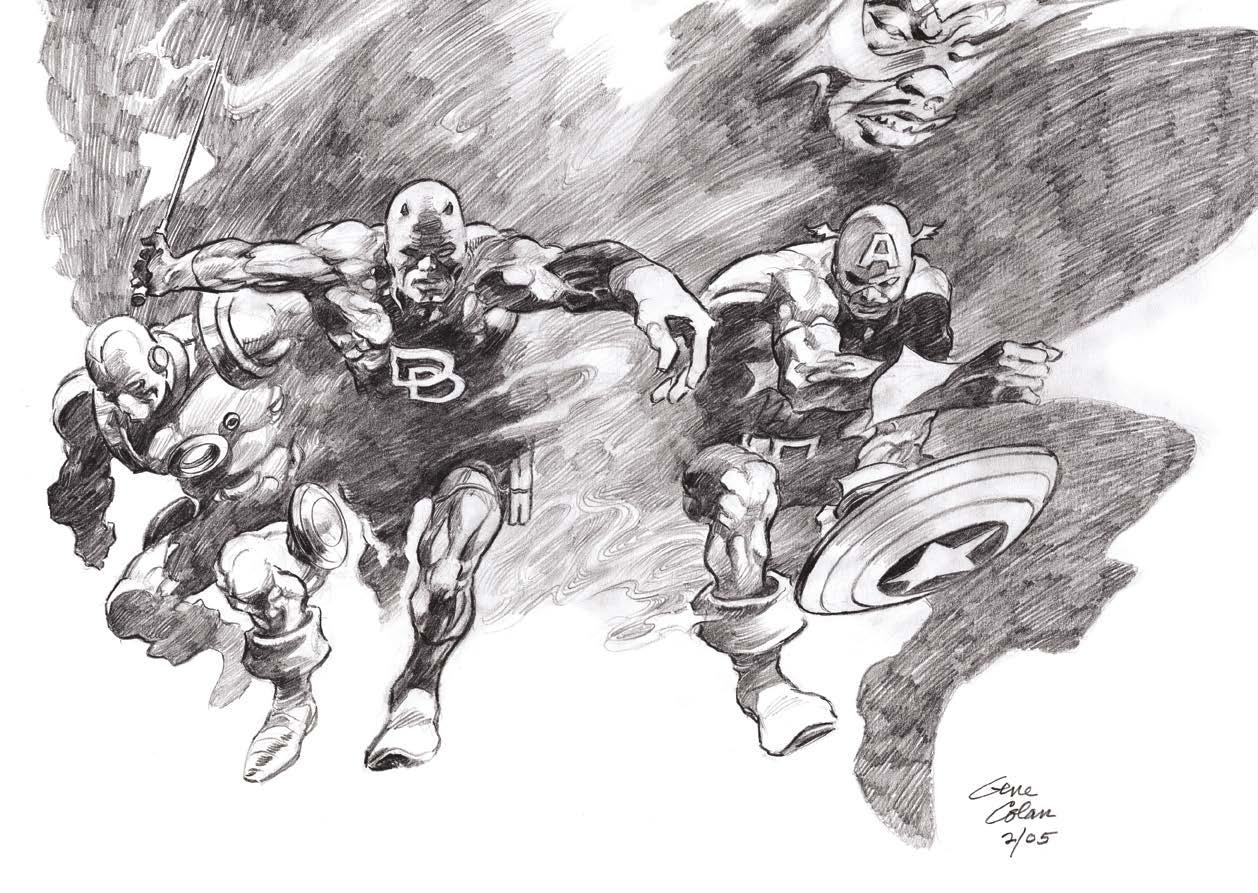
Mark: For those of you who can’t see the cake, it is a wonderful rendition of a self-portrait Gene did several years ago and he is surrounded by Daredevil and Iron Man and Howard the Duck — and Dracula is wearing a party hat — and we will be showing this cake around and passing pieces out… probably very small pieces… to this crowd. [turns to Gene] You are the only person this convention that did not know about this. [to audience] And we would also like to thank Adrienne Colan who kept this from him. [applause as Mark addresses Gene] This panel is about you and your work and we’re going to have some of the people who know you and love you and worked with you come up and talk about your work. Have a seat and we’re going to talk about Gene Colan for a while here. But, first, let these people take your picture. [Mark motions for people to come up on the stage] Mark: Don, want to come up? Marie, come on.
Don McGregor: [Jokingly] No! Gene is by himself on this one! Gene, you’re by yourself!
Mark: This is Mr. Don McGregor. And this is Marie Severin! Mark Wolfman and John Buscema!
[Much talking, applause, and chaos as people come to the stage to take group pictures. Eventually the cake is moved to the side, and everyone takes a seat on the panel.]
Mark: Come on up! Have a seat! [indicating bogus names on panelist cards] These people do not exist! John [Romita] is about to leave us, but he wants to say a few words before he goes.
John Romita: When Colan and I were [at] Marvel in the ’50s, I was horrified when they closed the comic industry down to the bone and I was out of work. I was lucky I ended up with DC. They paid me for eight years to fake the romance stuff. But Colan had been through that before. Same thing with John Buscema. December 1947, they were
in the Marvel bullpen, and it got shut down just like that. They pulled the rug out from under. So, in 1967, this is the third decade, Marvel was booming. Colan comes up, they asked him to do some books. I think it was “Iron Man,” I’m not sure. He comes to me and he says, “I don’t know if I want to trust this industry again. They pulled the rug out for him to me twice.” He said, “In ’47, I’m working, I’m paying my bills. Bang! I’m out of work. In ’57, they did the same thing to me.” He says, “It’s ’67 now, how can I trust them?” I said, “I dunno.” [looks at Gene] Gene, I think, right? Remember? Yeah, a lot of us went into advertising and illustration and a lot of guys scrounged around.
Gene: A lot of us stopped.
John Buscema: A lot of us stopped…
John R.: A lot of us stopped and all I could tell ’em was that it felt different this time and I said, “Give it a chance. Maybe we’ll get by ’67 without having it blow up in our face.” I think it was good advice, Gene, because I think, from then on, you showed the world what the hell you can do and we all are better off because of it. [applause, as John R. shakes Gene’s hand and departs room]
Mark: [Places microphone before John Buscema] Do you want to say a few words?
John B.: I said enough before! [laughter]
Mark: Okay. Alright, let’s ask Marie. Can we get a mic down there? Marie, talk a little bit about this man here.
Marie Severin: Which one? [laughter] That little one on the end? [indicates Don McGregor] That twerp? [laughter]
Mark: There was a period of time at Marvel where Marie’s main function was drawing insulting caricatures of Don McGregor.
Marie: It was so easy! [laughter] I want to wish Gene, one of the nicest guys in the industry, a happy birthday. And I met Gene when we both had brown hair — and all of it. Anyway, I was at E.C. [Comics], at the time. They had colorist and runner and everything, windows, whatever they wanted. And for some reason I had to bring something over to this guy, Gene Colan, and he was so cute. I could see him, he was adorable and it was very… I always liked his work. I never saw that much of him because all the guys would come in and just deliver work and run out. It wasn’t like the later bullpens, where people hung out… big lunches and stuff like that. But anyway, I knew the name and then I got to know him at Marvel and [he was] always a gentleman and one of the good guys! Happy birthday, Gene! [applause]
Mark: [Addressing Don]
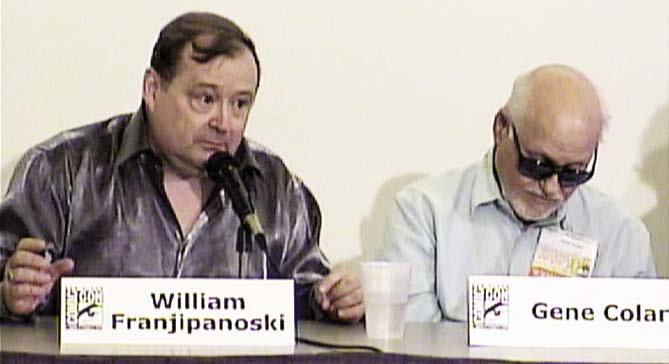
Why don’t you take this? Take this microphone. Tell us about the first moment when somebody said, “Oh, your story’s going to be drawn by Gene Colan.”
Marie: In four volumes or less! [laughter]
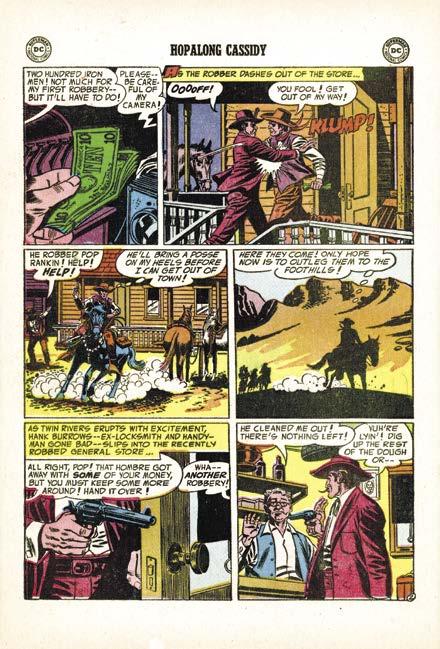
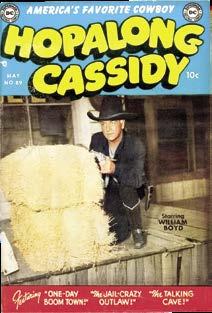
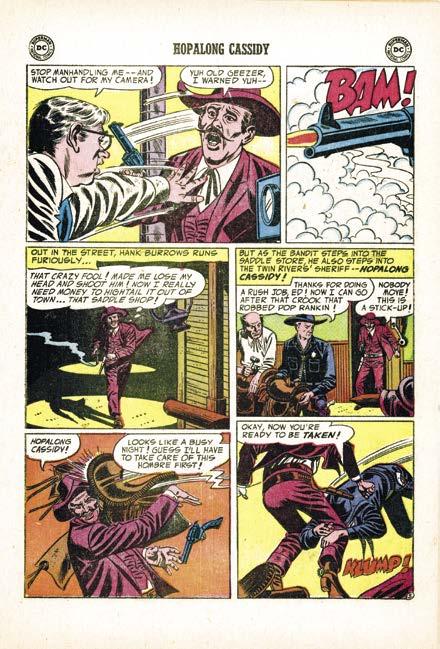
Don: You know, many people who know my work know I’m a big Hopalong Cassidy fan. People who know Gene’s work, going back, know that one of the first books that he did at DC was Hopalong Cassidy. So I was really aware of Gene’s work for a long, long time — and Gene doesn’t really get this…he doesn’t understand it… but, to me, Gene was one of my heroes. I loved him. I knew his name. I didn’t know what he looked like. I didn’t know him personally, but it’s like a movie star that you see or a TV actor that you see, and you say, “Oh, I really like what this person’s projects.” And I loved what Gene did. The kid that grew up in the state of Rhode Island had no idea that one day he would have the privilege of working with Gene Colan. I say this to Gene now and he goes: “What the hell are you talking about, Don?”
Damned anime.
splash pages like big time with those issues with Daredevil, really fantastic. Thank you.
Gene: Thank you.
Marie: Tar-Tag did some baseball. He’s a great sports fan and he did some baseball comic books with Joe Sinnott, and I don’t know who the publisher was. But I went to high school with Tar-Tag’s wife, so I know him. And then I worked in Marvel, in the same studio with him, for a year. He’s a delightful man. He, too, loves music while he works, and it does set a lovely pace. He loves the fine stuff. Very high tone. Anyway, music is wonderful, Gene, and it’s really… it’s so soothing. I think coloring is the music for comics! You know?
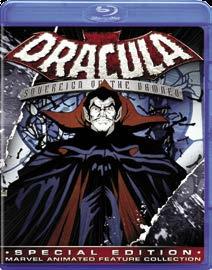
Marv: For those of you who think they’ve seen all of Gene’s work or a lot of it: if you can find (and God knows if you can) the animated Tomb of Dracula movie that was made in Japan. It’s an adaptation of the last two-year storyline Gene and I did in Tomb of Dracula, and it’s absolutely authentic. All the art in there was definitely taken from Gene. They didn’t just take the storyline… the angles, the shots, the visual look of the entire movie is the same as if Gene had storyboarded it himself, because they really were dedicated to following what he had done and it’s a very different looking animated film because of that. It’s very dark, very moody, very spooky, and, if you can find it, there are some videotapes available in different places. Take a look because it’s a beautiful, beautiful job.
Audience Member: [Possibly Adrienne] Did they copy your scripts, Marv?
Marv: It’s identical. The only character they removed from the last two-year story was Blade and, otherwise, it’s exactly the story Gene and I did. No changes. The entire marriage of Dracula to the death of Dracula in the very last issue.
Audience Member: Just a follow-up, actually, on what Marv was saying about filmmaking. I’m a filmmaker to this day and I owe it to Gene, basically, [who] inspired me from being a youngster. I have one anecdote and that’s when
SVENSSON NOTES: The anime Marv is referring to is the 1980 Japanese feature-length film Dracula: Sovereign of the Damned. It is now available to watch for free online. Reviews of this movie are not as favorable as Marv Wolfman’s praise, but there are a few sections where Gene’s wonderful art is channeled well. Having watched parts of it, perhaps the movie would be better in Japanese with English subtitles!
my mom brought me some comics when I was about four and I was sick in bed. And she bought me a pile of DCs and then a couple of Marvels, and I guess I was reading a little bit about that point, but she said, “Why aren’t you looking at all the colorful ones?” She was showing me all the DC ones. She said; “These are so dark.” I said one word: “Yeah!” [laughter, applause]
Mark: I guess two more [questions]. Over there…
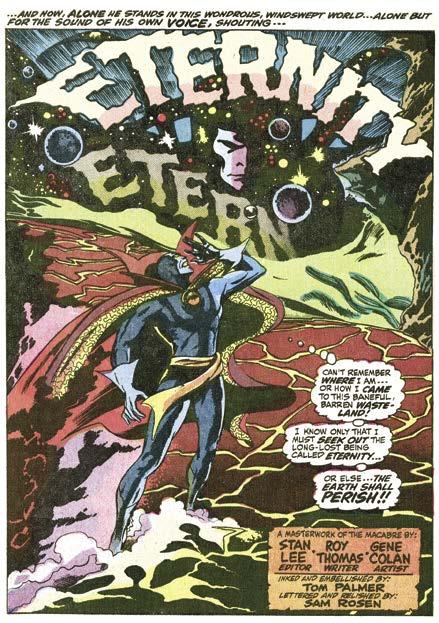
Audience Member: I’d like to thank you for your work on Doctor Strange. My favorite issue is Doctor Strange #10, where you are depicting Eternity and the shadows in those pages suck the light out the room. They are amazing pages. Thank you very much. Thank you.
SVENSSON NOTES: Doctor Strange [V.2] #10, cover date Oct. ’75, released July 8, ’75, was not the first time Gene had drawn Stephen Strange and Eternity together. He also rendered them both in Doctor Strange [V.1] #180, cover-dated May ’69, released Feb. 4, ’69. In these issues, Gene, with wonderful inks by Tom Palmer, produced some truly stunning and innovative art. Steve Ditko had developed a startlingly original way to depict interacting spells and other worldly dimensions during his creation of these characters, and perhaps this precedent allowed Gene the freedom he needed to see this work in print. Doctor Strange #180 starts off with a customary splash page, but the next two pages look very much like splash pages as well. Gene has removed the gutters from the page. There would “normally” be two panels on page 2 and three panels on page 3. Gene’s creative approach, one that he would continue to develop, enhanced what turns out to be a dreamscape created by Nightmare. (These are all Ditko characters, but Gene does not try and imitate Ditko’s brilliant art. Gene makes his own brilliant art.)
Audience Member: Good afternoon. The issues I remember best that impressed me most were two issues of Son of Satan that had to do what a young girl that had been possessed and that her family was all involved, and it was just so dark and creepy that it was like… please! The shivers could get going. Thank you very much for all your wonderful work and more to come, I hope!
Mark: One of the things that I just wanted… I find it interesting… is when Gene would take over a Marvel book that had been draw by someone else. He would suddenly be drawing these characters in angles they’d never been in before. Because, you know, Mr. Kirby drew characters pretty much straight on, three-quarters… He didn’t do a lot of down shots or up shots as Gene has done. And I was wondering, it struck me, like, when you did Doctor Strange, that you were taking these design that Ditko had made. It looked very fine from one angle and doing Strange… since then… It was… I was… I’m not sure if I liked it completely, but I just thought it fascinating. I said, “My God, this skill that must be necessary to interpret… You know… The animation”… We have these dumb model sheets with the characters front view and side view, and there are artists who can’t do anything with that. I guess I was just impressed with
SVENSSON NOTES: Those two “Son of Satan” issues were lead features in Marvel Spotlight #18 (released July 16, ’74, cover-dated Oct. ’74) and #19 (released Sept. 17, ’74, cover-dated Dec., 1974). It was the demon Allatou who first possessed Mellissa Manners in these issues. Mellissa was not the only person possessed by Alltou in the second part of this story, as she could switch bodies quickly in mid-battle.
the ability to take these characters and give them a three-dimensional feel in shading and density, and a lot of times, things they had not had before.
Audience Member: Three-D Cleo!
Mark: The three-dimensional Cleo. It’s another horny drawing you did. [laughter] That’s right. Anybody else? Microphone’s on this side? Alright, this gentleman, let’s have the gentleman in the far back go to the way back. In the back. He has had his hand out in the last row for a long time. And we’ll wrap this up in a minute with a few closing comments from various people here.
Audience Member: Sir, Gene, besides “Brother, Take My Hand,” one of the most powerful images you ever did was that Iron Man #1 cover. Maybe it was because it was 1968. I don’t know if you did it by design, but it just seemed to capture the whole movement of when I was growing up. What we were going through, that we would… it’s like the gentleman said earlier, it’s, like, black people love you. It’s like we were all going to break free and move forward. I love that cover and thank you very much!
Gene: Thank you. [applause]
Mark: Anyone on the dais have anything they want to add to all this?
Marie: I do.
Mark: Okay, Marie’s going to add something.
Marie: I think you didn’t know that so many people owe you, Gene Colan, money. [laughter] I paid him back.
Mark: Right? Don, you want to add anything just before we adjourn?
life, you can bleed onto that paper. You can care all you want. You can give it everything you’ve got. It’s going to lie there. And when you get the chance to work with a Gene Colan and you first see that artwork, and you first hold it in your hands and you see that he’s not just taking what you’ve done, but he’s gone beyond it. He’s captured the humanity of those characters. Just the individual little body language, just the expression of those faces, the backgrounds — all of it — the place, the feeling, the ambiance that you wanted from there. Gene, I just thank you for all of those years. I thank you for your friendship over those years and I’m just glad we had a chance to do those books we’ve done together. Thanks, Gene. Fabulous.
Mark: By the way of closing, let me just say that one of the things that always impresses me about certain people from this business is that, artists, up until fairly recently, were paid by the page, and it generally didn’t matter that much how wonderful the page was. You got the same page rate. And an awful lot of artists — and Gene is a perfect example — could have done a lot less than that and still made the same income. In fact, he probably could’ve done a lot less and made more money. We’ve been bad mouthing Vince Coletta here off and on.
Don: God, I’m looking at Marie. She’s looking at me. Yikes. Mark: She’s planning three more caricatures. (laughter)
Don: I’ll take ‘em. Just one thing. Gene, it’s been one of the great privileges of my life to know you, to work with you. There are a lot of downsides in this business, but one of the upsides is having the chance to work with an artist like Gene Colan… And I hear writers talk about, “Oh… I did this, and I did this, and I did that.” But if you don’t have an artist to bring it to
*”Brother, Take My Hand” is the title to the story in Daredevil #47, released on Oct. 10, ’68, and cover-dated Dec. ’68. — M.S.
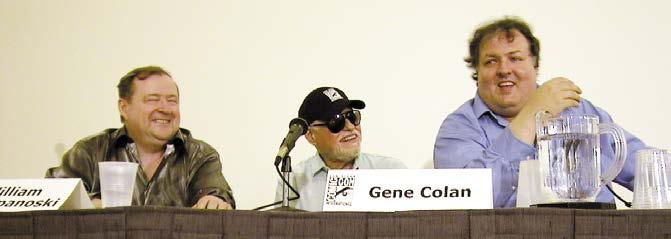
Above: Splash, Doctor Strange #180 [May ’69] by Gene (pencils), and Tom Palmer (inks). Below: Don, Gene, and Mark, all smiles on the panel.
Don: Sorry, we’re all dying in the next season of The Sopranos. [laughter]
Mark: Anyway, but Vince was a guy who felt he was giving comics [back] what they paid him for and he was not necessarily wrong about that. I think that people like Gene and, of course, Jack Kirby and Steve Ditko and John [Buscema? Romita?], and all these artists, and Marie… I think they gave the industry an awful lot more than they were paid for… but what they were doing was that they were giving it to us
They may not have been conscious of the fact that there was… I believe that, in their hearts, all these terrific artists always knew that there was somebody someplace out there whose life would be a little different if they spent an extra half-hour on that page, or erased that bad panel and did a better job. I don’t believe, as Mr. Buscema was saying on our talk earlier today, that you’re always trying to keep your job. I think there’s always something a little higher cost. Nobody really got into comics because they thought there was a lot of money in it. Nobody ever really got into comics until Todd McFarlane came along, you could be wealthy doing this type thing. God knows, because there was a certain pride in craft and a certain satisfaction. And, God knows, Gene, over the years, through some of the rottenness comics in the world, not because of him, but because they were lousy premises or weak, weak scripts. They were given the bad inkers. They were put in… colored in differently and put on the cheapest possible printing. And yet, still, that magic came through. And I would like to, at this point, thank Gene, not only just for sitting here and putting up with this little fan, and for being a good sport about it, but also for a lifetime of enormously wonderful work. [to audience] You join me and thank Mr. Gene Colan! [standing ovation] Gene: Thank you! I want to say just one word on behalf of my wife. I swear to you, I wouldn’t be here today if it weren’t for her. I really would not.
Mark: In a week, we’ll do this again. [laughter] Transcript, photos ©2001, 2026
by Tom Field
I miss the phone calls.
Gene Colan loved to talk on the phone and, after we met in 1998 and became friends over the course of ’99, he would call me frequently over the next decade-plus. And, every time I picked up, it’d be the same opening line. “Hi, it’s Gene. Hey, what movies have you seen?”
No surprise, Gene loved film. From the time he was terrified at age five, seeing the original Frankenstein on the big screen, in 1931, to the last decade of his life, when he was able to see his characters, Blade, Daredevil, and Iron Man, brought to cinematic life, Gene couldn’t get enough of movies. Horror, war, Westerns — especially Westerns — Gene was purely in love with the medium. As a kid, he’d walk around his parents’ home with a box camera, framing scenes like he was a movie director. As a key Marvel artist in the 1960s and ’70s, he would pace his stories like he was storyboarding a movie. In his semi-retirement, he collected films. Studied them. And talked about them with everyone in his circle.
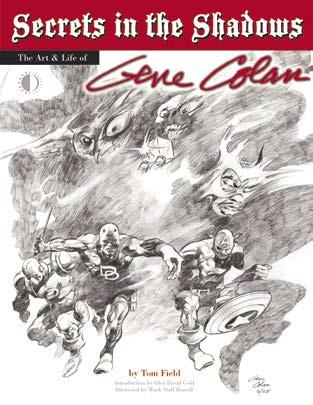
What was Gene’s favorite film? It’s like asking who was his favorite inker. The answer sometimes varied. (Mostly, he started with “Tom Palmer,” by the way, but in his final years he was delighted with the work of young artist and friend Dave Gutierrez.) You can’t deny the influence of the original Frankenstein, which inspired him to be one of the all-time greatest horror comics artists. He was big on Gary Cooper and High
Noon. He loved Treasure of the Sierra Madre and often quoted the famous line about “steenking badges.” It’s a Wonderful Life was on his short list, and he frequently told me “You’re my Clarence” – a reference to the angel who guided Jimmy Stewart’s spiritual journey. But I only ever knew of one film that moved him to get a vanity license plate: Gregory Peck’s To Kill a Mockingbird. If you saw MKNGBRD on the road in the 1990s, you knew it was the Colans. The attorney Atticus Finch stood for a lot that Gene admired in the best of people.
So, we’d start those phone calls with movies, and then we’d go on to talk about family, comics, the news — everything. Well, except sports. Gene didn’t much follow sports. But everything else, he watched, studied the nuance and looked for ways to express it in his art. This, to me, is why Gene was such a master of capturing human expression. Because he studied it endlessly. Same with objects. If he wanted to draw a gun, he didn’t just look up a photo of a gun — he went down to the local police station and asked to see one.
Let’s stop, too, and acknowledge what an honor it was to receive these calls. Comics journalist, author, historian — call me what you will, but foremost I’m a comics fan. I was born about the time The Avengers and X-Men debuted in 1963, and, by the time I learned to read, in 1968, Marvel was my favorite brand of comics, and Gene Colan’s was one of the distinct art
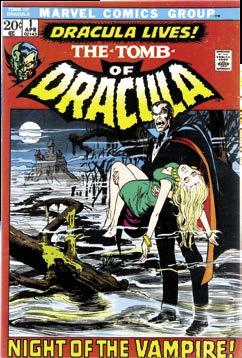
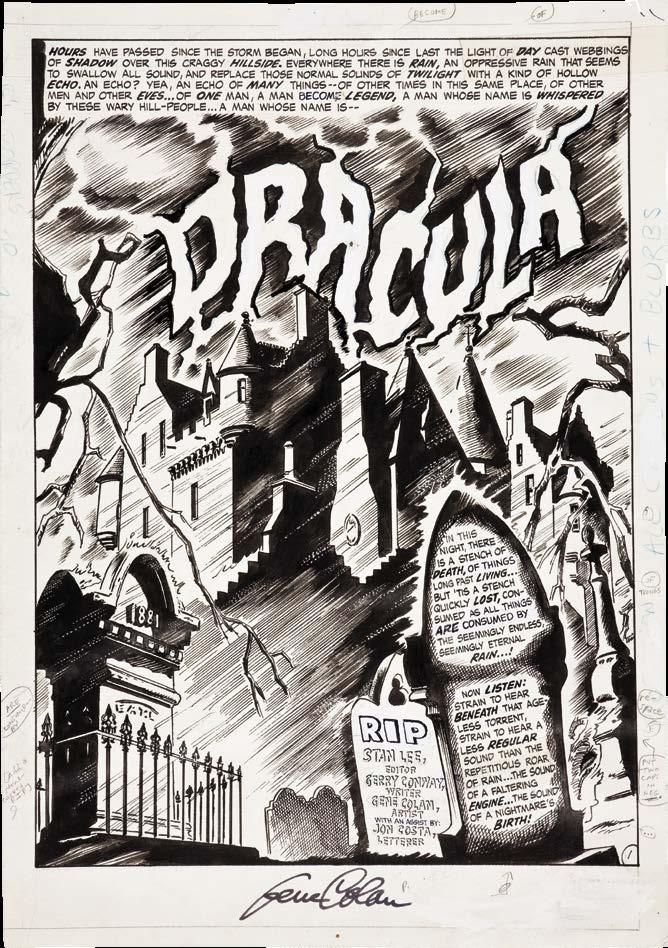
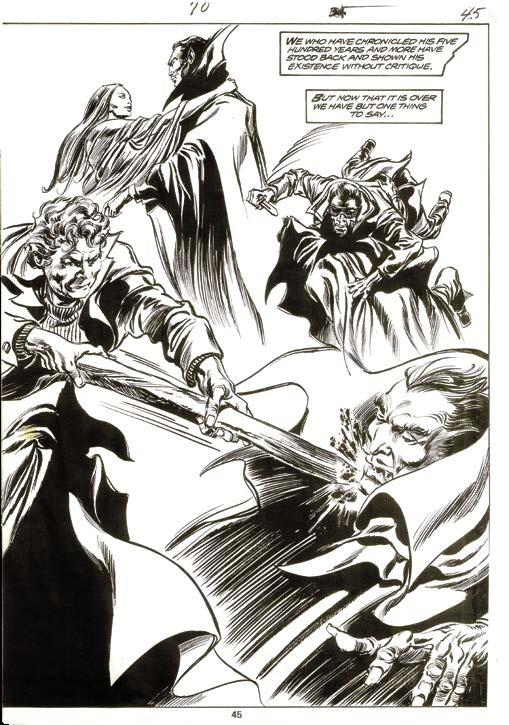
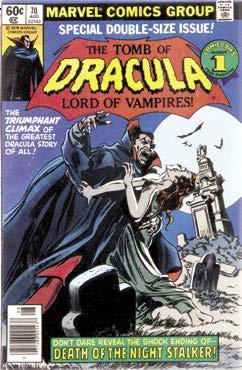
This page: Among the most consistently excellent comics of the 1970s, certainly by a single creative team, was Tomb of Dracula by Wolfman, Colan, and Palmer. Below is splash of #1 [Apr. ’72].
who we had dinner with last night! Sara Karloff — Boris Karloff’s daughter! She wants me to draw a biography of her dad!” The project never came to be, but Gene was honored to meet the daughter of the man whose monster inspired his career.
Gene stayed as busy as he wanted to in his final 20 years of life. He drew the occasional piece for Marvel and DC — I recall a DD anniversary story, as well as a Wonder Woman back-up for DC’s Stan Lee’s Just Imagine line. He also drew a Spider adventure with Don McGregor, a Tales of the Slayer story for Dark Horse’s Buffy comics, and even a horror tale for the Bongo Simpsons line. He kept a steady stream of commissions on his drawing board as well. In Gene’s own words, “I’m busier today than on my best day in comics.”
With that business came acclaim. In 2005, at the same Comic-Con where Secrets debuted (alongside the film, Borat, by the way), Gene was inducted into the Will Eisner Comic Book Hall of Fame. He was blown away.
In 2008, at the start of an art exhibition organized by Glen David Gold and Andrew Farago of the Cartoon Art
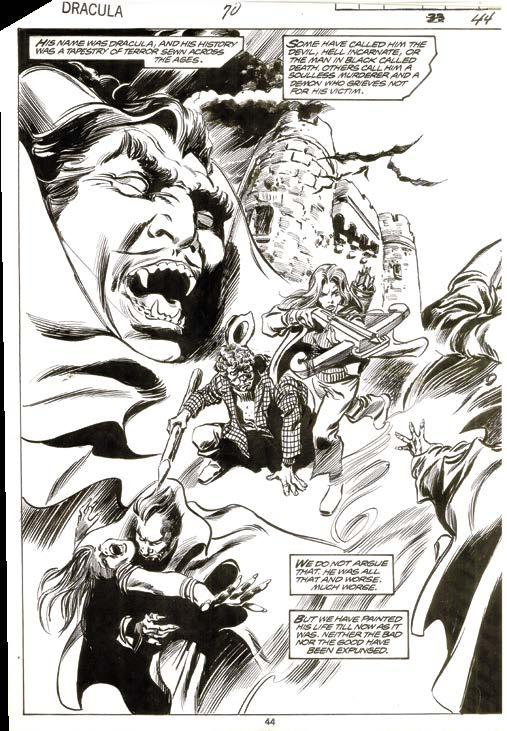
Museum, in San Francisco, the Colans traveled west and were honored to see Gene awarded a Sparky Award (named after Peanuts creator Charles Schulz). Writer Steve Englehart and artist Steve Leialoha were present to participate in the ceremony, and Stan Lee sent along a special video tribute. A bunch of us fans were privileged to join Adrienne and Gene for an Asian dinner nearby the museum that night. I’m not sure I ever saw the Colans beam so brightly.
At the time of the 2008 honor, Gene was at work on a one-shot Captain America story that he believed was going to be a Marvel Annual. Instead, it got held for a year or so, then included amidst the Civil War crossover as a single issue of Cap — #601. It was a beautiful Captain America tale set in WW II and featuring a vampire villain. How could it go wrong? The story was reproduced entirely from Gene’s pencils, published in two editions — one color, the other black-&-white — and ended up winning a 2010 Eisner Award for “Best Single Issue.” Given that Gene first drew Cap for Timely in the 1940s, I believe he has the distinction of being the only artist to draw the character across a span of seven decades — 1940s to 2000s.
Sadly, Gene’s career and life ended soon after.
By 2010, the Colans had moved from Vermont to Florida and then back to New York, and their health declined. So, frankly, did their close relationship with fans. Facebook and other social media had exploded, making Yahoo Groups messages boards seem like such a yesterday thing. Members came and went, and the tone of discussion in 2010 was nothing like that of 2000. The congeniality and familiarity diminished. The fans posted less frequently, and the Colans’
presence matched the pace. Ultimately, as Adrienne and Gene each succumbed increasingly to their ailments, their participation was limited, and then after their personal business was made public online — to no one’s benefit — it led to the collapse of the once mighty fan base behind the Yahoo Group.
Then came the unexpected news that Adrienne had died suddenly at her home, on June 21, 2010.
Almost exactly one year later, Gene followed her.
I attended Gene’s memorial service in New Jersey, alongside some stalwart fans and some of Gene’s peers and collaborators, including Don McGregor, Walt Simonson, Lee Weeks, and Tom Palmer.
Because of my work on Secrets, I was interviewed by the New York Times when they covered Gene’s passing. I also was asked to write an obituary for The Comics Journal. In it, I quoted a reflection Gene once shared with me:
“I still find it almost impossible to believe that there are people who are so interested in comics, and in what I’ve done,” Colan said, in 2005. “There are so many artists out there that are just as good — some even better. For me, it’s a ride that didn’t enter my mind would ever happen. I just got into the business as a way of entertaining.”
walked up to the house and peeked in the window. He even broke federal laws by rifling through Cooper’s mailbox and noting his specific address. When he got home, he penned a fan letter to Cooper and promptly got a response: “To Gene Colan, best wishes, Gary Cooper.” Later, when Gene drew Captain America, he was inspired by Gary Cooper. “He summed up what a man should be like. Everything he appeared to stand for on the surface sent a clear message about integrity.” You absolutely could say the same for Gene.
Being the Fan – As a young film fan, Gene was enamored of character actor Mark Lawrence, who played the heavy in films such as I am the Law and This Gun for Hire. “He played one part: Always the gangster,” Gene said. Late in his own career, collecting old movies at a Comic-Con, Gene stumbled upon a dealer who not only knew of Lawrence, but had his phone number. The dealer shared it with Gene, who subsequently called Lawrence and had a great fanboy experience, expressing his admiration for the actor’s work and hearing about Lawrence’s retirement
When I think about Gene — when I dream about him — three stories come to mind:
Stalking Gary Cooper — In 1939, when Gene was 13, he accompanied his parents on a trip to California, and somehow he’d learned generally where his favorite actor, Gary Cooper, lived. He begged his parents to drive through Beverly Hills to find the home and park outside. Gene