A TwoMorrows Publication
No. 4 4, July 2026
Also in this ish:
Robert Kanigher: ‘R.K. in the U.K.’
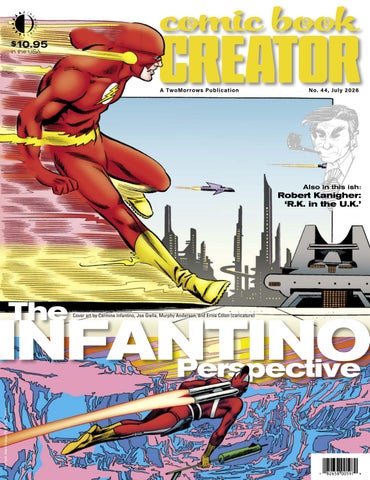
The Flash, Adam Strange TM & © DC Comics.
Cover art by Carmine Infantino, Joe Giella, Murphy Anderson, and Ernie Cólon (caricature)
July 2026 • The Carmine infantino Issue • Number 44 CARMINE INFANTINO Portrait by KEN MEYER, JR.
©2026 Ken Meyer, Jr.
About Our Cover Pencils by CARMINE INFANTINO Inks by JOE GIELLA & MURPHY ANDERSON Kanigher caricature by
ERNIE COLÓN Colors by GLENN WHITMORE
T A
B
L
E
O
F
C
O
N
T
E
N
T
S
Ye Ed’s Rant: Sorry this, sorry that… Sigh. Ye Ed. is unapologetic about apologizing......... 2 COMICS CHATTER The Dreams of Joe Hill: In part one, the Locke & Key scribe shared with Glen Cadigan about growing up a King, being a part of Creepshow, and starting a writing career....... 3 Katz’s Kingdom: Part one of Ted Jalbert’s convo with graphic novelist Jack Katz............. 10 Once Upon Long Ago: Steve Thompson fondly recalls his debut as letter hack!............. 17 Ten Questions: Darrick Patrick quizzes artist David Mack about Kabuki and more........... 18 Aurora’s Monster Man: Dave Cockrum interview by Anthony Taylor on model work...... 20 Incoming: Is Jack Kirby’s artwork fascistic? A CBC reader calls ‘em fightin’ words!............ 22
The Flash, Adam Strange TM & © DC Comics
R.K. in the U.K.: Q+A with the legendary writer/editor, Robert Kanigher, in 1989.......... 24 Spotlight on the Pros: Bernie Bubnis about his early ’60s visits with comics greats...... 31 Argentine Report: Our Man in South America shares about the series, The Eternaut...... 40 Comics in the Library: Richard Arndt on Wrinkle, Heidi, and Green-Gabled Anne.......... 44 Hembeck’s Dateline: Fred releases the hounds with his classic cover pastiche!............. 45 Above: We cheated a wee bit in the top portion, which originally depicted Reverse Flash in The Flash #147 [Sept. ’64], but we had Glenn Whitmore color Carmine Infantino and Joe Giella’s art as the Barry Allen version. (Thanks to Marc Svensson!) Bottom is detail from Mystery in Space #81 [Feb. ’63], Infantino pencils, Murphy Anderson inks. (Thanks to Dave Armstrong!)
Don’t STEAL our Digital Editions! C’mon citizen, DO THE RIGHT THING! A Mom & Pop publisher like us needs every sale just to survive! DON’T DOWNLOAD OR READ ILLEGAL COPIES ONLINE! Buy affordable, legal downloads only at
www.twomorrows.com or through our Digital Storefront at
www.comicshistory.org & DON’T SHARE THEM WITH FRIENDS OR POST THEM ONLINE. Help us keep producing great publications like this one!
Rouge Enfant: Carmine Infantino in Perspective Embellished with a short essay by Ye Ed. about the often stellar achievements and sometimes curious decision-making of artist and one-time DC publisher, our feature showcase is a wonderful and entertaining radio interview conducted in 2000 by “Nuff Said” hosts Ken Gale and Ed Menja. Accompanied by Carmine’s agent and publisher J. David Spurlock, the talk captures the artist in a jovial, chatty mood.......... 46 BACK MATTER Creators at the Con: Whitehouse gets all double-visioned with “Doppelgängers”!........ 78 Coming Attractions: “Gentleman” Gene Colan makes an entrance come September.... 79 A Picture Is Worth A Thousand Words: Infantino, Ziuko, and a girl from Krypton!...... 80 Ulp!: A coupla issues back, we ran a half-page devoted to Ken Meyer, Jr., our esteemed color portrait artist, and, under his pic, we ran a caption that was in error. Ken hails from Santa Ana, California, okay? That was my bad, Ken. Oh, and I egregiously misspelled the great Gil Kane’s name on Tom Ziuko’s page in CBC #41. Good lord! Right: Detail from Carmine Infantino’s cover of DC Special #1 [Dec. ’68] featuring Batman and Rouge Enfant! Please note: Some images in this issue were enhanced by digital software. Comic Book Creator™ is published bi-monthly by TwoMorrows Publishing, 10407 Bedfordtown Dr., Raleigh, NC 27614 USA. Phone: (919) 449-0344. Jon B. Cooke, editor. John Morrow, publisher. Comic Book Creator editorial offices: P.O. Box 601, West Kingston, RI 02892 USA. E-mail: jonbcooke@aol.com. Send subscription funds to TwoMorrows, NOT to the editorial offices. Six-issue subscriptions: $80 US, $103 International, $29 Digital. All characters are © their respective copyright owners. All material © their creators unless otherwise noted. All editorial matter ©2027 Jon B. Cooke/ TwoMorrows. Comic Book Creator is a TM of Jon B. Cooke/TwoMorrows. ISSN 2330-2437. Printed in China. FIRST PRINTING.
TM & © DC Comics.
COMIC BOOK CREATOR is a proud joint production of Jon B. Cooke/TwoMorrows
THE MAIN EVENT
JOE MENO, my friend and brother TwoMorrows editor
up front
The Dreams of Joe Hill In the first of Glen Cadigan’s three-part interview, the writer shares the key to his success Conducted by GLEN CADIGAN
Locke & Key TM & © Joe Hill and IDW Publishing. Photos courtesy of Joe Hill. Bottom photo by Maggie Levin.
[To the world at large, Joe Hill is a #1 New York Times best-selling author of books that include Heart-Shaped Box, NOS4A2, and the recently released King Sorrow. His short story, “The Black Phone,” was adapted to film (where it also spawned a sequel), and is but one of many Hill-penned tales that have found their way from page to screen. That list includes his seven-volume comic book series, Locke & Key, which ran for three seasons on Netflix, and for which he received the Eisner Award for “Best Writer,” in 2011. [As this interview will show, Hill was less a novelist dabbling in comics and more a struggling comic book writer who made it big in the world of books. It was conducted via Zoom on September 12, 2024, and thanks go to L&K editor (and former IDW bigwig) Chris Ryall for setting it all up. — G.C.] Glen Cadigan: Let’s start with the secret origin of Joe Hill. What are some of your earliest comic book memories? Joe Hill: The first book that I really connected with emotionally was a comic book that was actually a trade paperback: Bring on the Bad Guys [’76]. The cover said, “by Stan Lee,” because Stan had a tendency to forget about his collaborators, but I loved and obsessed over that book. Then later, I also got Son of Origins [of Marvel Comics, ’75] in the same format. I liked the heroes, but I loved the bad guys. The Abomination fascinated me, and I even liked that word, the way it felt in my mouth. So I connected with comic books in a fairly intense way at a pretty young age. That would have been five or six or something, and I remained, basically, a comic-book guy. I became a comic-book guy with a comicbook imagination. I was the kind of guy who started bagging his comics at 13, 14-years-old. My brother and I have 14 boxes of comics up in Bangor, Maine. That’s our shared collection and it’s kind of stuck there. He lives in New York now and I live in New Hampshire, and we have this collection that’s in our parents’ house. We’ve never really known what to do with it because to split it up would mean arguing about who bought what and who collected what. We both have different memories about who led the way on this series or that. I know that I bought The X-Men. Not to monologue at you, but when I was in high school, I fell pretty hard for the X-Men run [by] Claremont, right through “The Dark Phoenix COMIC BOOK CREATOR • July 2026 • #44
Saga,” and so that was sort of my grail, collecting that whole series. Glen: So you didn’t read it as it came out? Joe: I didn’t. It was already over by the time I started collecting it. Glen: You mentioned Bring on the Bad Guys. As an author, do you find the villains more interesting than the heroes? Joe: In my own work, I try not to let them be more interesting than the heroes. Someone — I can’t remember who; maybe it was C.S. Lewis, might’ve been G.K. Chesterton — said that fictional evil is romantic and thrilling, and fictional good is boring and predictable. And, in real life, evil is banal and sickening, and good is thrilling and surprising. I’ve always tried to have the work reflect how I feel about the real world, which is that, in the real world, good is thrilling and often unexpected and evil is tawdry and pathetic, and sort of stomach-turning. Nevertheless, a lot of times it can be really fun to write the bad guys. It wasn’t in a comic book, but I knew
Above: Young Joseph Hillström King suited up for a Maine winter. Determined to forge a path by his own merits, 13-year-old Joe adopted the pen name, Joe Hill. Inset left: The cover of Locke & Key #1 [Feb. ’08] by Gabriel Rodriguez. Below: Portrait of the writer snapped by Maggie Levin for The Black Phone publicity.
3
This page: Clockwise from above is Jack Kamen’s cover art for the Creepshow comics adaptation [’82], featuring the likeness of the future Joe Hill; the lad appearing in the movie; and Joe with his father, novelist Stephen King.
#44 • July 2026 • COMIC BOOK CREATOR
Creepshow TM & © Taurua Entertainment. Photo courtesy of Joe Hill.
4
than a traditional comic book; it has big blocks of text in it, and I think that works pretty well. Glen: How old were you when you discovered EC Comics? Joe: Pretty young, which sounds strange, since the heyday of EC was in the 1950s and I was born in 1972. I started with Bring on the Bad Guys, but, in some ways, Tales from the Crypt was my gateway drug. I started reading those, I want to say when I was about ten years old. The backstory on how I wound up reading Tales from the Crypt requires some explaining: my dad loved the EC horror comics of the 1950s. Tales from the Crypt, Vault of Horror… he loved those books. And so did George Romero, the director of Dawn of the Dead and Night of the Living Dead. And George Romero and my father were friends, and had wanted to do a movie together for a while. They decided to do a movie that would be a tribute to the horror comics of their childhood. So my dad wrote it, George Romero directed it — my dad acted in it, as well. Creepshow, which came out in 1982 when I would have been ten, was filmed in ‘81. And for some silly reason, they stuck me in the film. So I’m the little boy named Billy at the beginning of the movie, and the end of the movie, who is obsessed with horror comics, when I was working on my third novel, NOS4A2, that I had a and his father throws out his comics. Billy takes his revenge tiger by the tail. I knew that because Charlie Manx was such on dear old dad with a voodoo doll that he ordered from the back page of one of these comic books. The eight days a fascinating bad guy; it was so much fun to listen to what I spent on the set of Creepshow was a pretty formative he had to say. Glen: It was so much fun that you gave him his own comic experience for me. Creepshow is a movie about being in love with comic book mini-series. books, and specifically about being in love with horror Joe: I did, with C.P. Wilson III, whose vision of Christmascomics. There was a hardcover reprint of the entire run of EC land, and of Charlie Manx, Comics, not just Tales from the Crypt and Vault of Horror, but was so grotesque and so Two-Fisted Tales, their war comics, their science fiction comdelightful. It’s a little bit like ics… there was even one slim hardcover that was Tales of if Bill Watterson decided Psychotherapy, which, boy, there’s a comic book that I’m just to draw a horror comic. I sure reeled in a huge fan base. And my dad went out and actually did a couple issues bought the whole box set. It would make sense if my father of Wraith that I think are bought them before he wrote the movie — if he picked them maybe some of my best up for research — but I actually feel like he bought them after work as a comic book writer. Creepshow came out. One tells Charlie Manx’s So he had all those books on the shelf of his office, and, origin story, and then one not long after Creepshow, I began reading them. My partells the story of a con man ents, who were children of the ’60s, they seemed to feel like who sold Charlie his Wraith. if you wanted to read something, you must be old enough I think those two stories to read it. And they were the same way about films. I mean, I work as a really interesting watched a lot of stuff when I was ten or 11 that, later when I pair of bookends. The final became a parent myself, I would not have wanted my ten- or story in the collection is 11-year-old to watch, but my parents were of the mind that more like an illustrated story
katz’s kingdom
The Many Lives of Jack Katz
Ted Jalbert shares his interview with the pioneering comic book artist and graphic novelist Conducted by TED JALBERT
Above: Cover for the first printing of The First Kingdom #1 [July ’74], which sported Larry Todd’s paints over Jack Katz’s line art. Todd’s work was replaced for the 1975 reprint. Inset right: Katz and first wife Gloria in 1951. Below: Splash page for Katz’s first professional job as comic book artist, “Commandos of the Devil Dogs,” Captain Aero Comics V4 #2 [Aug. ’44]. Inks are by no less than this issue’s spotlighted creator, Carmine Infantino!
Below: A snapshot of Ivan Katz, the son of Jack Katz, from 2011.
EARLY DAYS Ted Jalbert: Jack, can you tell us about the beginning. Where were you born? 10
Jack Katz: I was born in 1927, in Borough Park, Brooklyn. My father was extremely handsome; he looked almost identical to Ronald Coleman. He later worked as a messenger in New York. He was very thorough. He was insane about education and words. He always had his nose in a book and he was always writing these notes, he was addicted to words… it meant something to him. I’ve been drawing since I was almost two years old and, for the most part, it was on the walls… and, because of that, we had to move twice, because I couldn’t stop drawing. And I drew figures at that time — don’t ask me how, don’t ask me why — it’s either a gift or a curse. It either comes from an imagination or an abomination. However, that’s what it is. As you know, I lived in the reference department [of the library], and I saw for the first time these friezes, and here was the Battle of Hastings on this long scale, and it showed a horse on its side… and the soldiers with the crosses and stuff like that, and I said “Gee, this an extended way of doing this.” And I went nuts, because everything I was trying to realize, Hal Foster was doing… I said, “My God, this is a genius!” I still consider him the best of all of us. There’s something about what he did, he was… in music, you would call it Beethoven or something like that. He did something that was unusual… And he brought to life the animals… One day, my father brings home some fish, and wrapped around the fish is the Sunday [comics] supplement, and #44 • July 2026 • COMIC BOOK CREATOR
The First Kingdom TM & © the estate of Jack Katz. Photo courtesy of Ivan Katz.
[Introduction: I first discovered Jack Katz’s work in 1977, when I saw his First Kingdom books advertised in various comic magazines of the time. The full-page illustrations were amazing, and showed a real obsessive talent. This work really stood out from all the super-hero comics I was reading. I was shocked to later learn that Jack was actually an “old guy” who had been working in comics since the 1940s. After I moved to California in 1996, I noticed the artist was a regular guest at local comic book conventions in the San Francisco area. When I first met Jack in 2016 at the S.F. Comic Con, he showed photos of his oil paintings he had done, paintings very different from his comic book work, yet they also had a consistent and unique style. I interviewed Jack at his home in California in June 2019, which led to a second Q&A, and we quickly developed a friendship as he saw my appreciation for his work and history. [Jack was a very fortunate artist in that he benefited from the support of local friends in California, Brian Miller, Deanna Hovarth, and Cindy Mosca, who were checking in on him every week, helping with his grocery shopping, and taking him to the movies and comic conventions. In October 2020, these friends of Jack helped organized a one-man exhibit of his work in Berkeley, California. [The comics creator was also fortunate to have the support of third wife Caroline Gold, who enabled him to complete his magnum opus, The First Kingdom. Caroline supported Jack through their 28 years of marriage, and continued to support him even after the marriage ended. She gave Jack space to draw, paint, teach, and explore his singular ideas. In February 2025, Caroline gifted The First Kingdom original art to Rice University, in Houston, Texas. [This interview was conducted over several sessions, from June 2019 to February 2021. We are featuring this interview as a follow-up to the interview we featured with Jack’s son, Ivan Katz, in the last issue of CBC. — T.J.]
Prince Valiant TM & © Hearst Holdings, Inc.
guess what…? There it is! Hal Foster’s Tarzan! And it shows all these boxes and stuff and I said “My God, this is the way to do it!” Everything I tried to realize, Hal was able to do. And I remember that first page: it shows this woman pilot who took a magnifying glass and started a fire… After Flash Gordon came out in 1936, I went nuts and I said, “Somehow, someway, I have got to find a way to bring this unbelievable idea”… three Earth people on another planet, an alien world. Alex Raymond started Flash Gordon. I liked it but the drawing was not quite up to the power of Tarzan. In fact, nobody’s been able to outdo Hal Foster. Ted: You were influenced by Hal Foster. Did you copy Hal Foster at home when you were young? Jack: I never copied. I can’t do that on another person’s work, but I let them inspire me. And the way he managed to negotiate his drawings… sometimes I would see the pencils underneath, and I would change it to support the very super-quintessence of what he was trying to do. So, okay, this was good. And I had in the background Fernand Cormon, Pierre Auguste Cot… Dean Cornwell was also was a very important influence to me; he was such a good artist. Early Anton Otto Fischer, Dan Smith, Mead Schaffer, Norman Rockwell… When I went to the museums, there were three artists that I was so paralyzed with, so far as their ability. It’s unlike any of the artists that people talk about. One of them was Fernand Cormon, the other is Jules Bastien-Lepage, and an artist who did an incredible painting “The Storm,“ His name is Pierre Auguste Cot. Ted: How did living in Brooklyn influence you? Jack: Brooklyn was an amazing place during the time I lived there, because it had opportunities that I never really took advantage of. Nevertheless, there was the Brooklyn Museum. I also went through a lot of hell there. One of the schools I was put in was extremely tough. It was a very rough school. They wouldn’t bother me too much because I was a good drawer. I was a tough kid, and you had to be. You had to join gangs… I was in some pretty bad fights. Yet I, whenever I could… [on] whatever bags my father brought with food in, I would go on the floor and draw. It’s replication. Why brag about things…? It does no good. And I’ll never write about it, going into detail, because you’re only honoring kids that became brutes.
a look, you know, and the teacher would say “Excuse me?” And he says, “It’s amazin’!” In other words, you’re amazing! And the teacher says, “I don’t understand.” And then he goes to the class, “It’s amazin’ !” So the teacher says “You might have to go to the principal.” And so, he said, “You take me there and I’ll meet you after school!” And he meant it! And I said to him, “If you hit him, you’re gonna hurt your art hand.” He says “Yeah, I know…” So, meanwhile, they sent us to a special school for children who had abilities to draw, and there was one girl, and she did a portrait of me, and it was so good. They were so good, those kids, they were artists. Well, two of them ended up as lawyers, too, and one I think became a judge, so it was a grab bag.
SCHOOL OF INDUSTRIAL ARTS Ted: You went to the School of Industrial Arts in Manhattan, and began drawing comics in 1942…? Jack: I spent very few days there. I was rather sickly still. I was either sick or I was at the museum. My lunch was white bread with jelly. Once in a while, if I got paid, I would go to the automat, and then I would have cherry pie à la mode. I wasn’t motivated to go to any school because, by that time, I had my own little dictionary [and] I was already writing into journals. Ted: How did you do at the School of Industrial Arts? Jack: I got 30s and 20s [percentages] in all the classes, except for my painting class. That teacher’s name was Howard Simon. He was an extremely gentle painter, and JUNIOR HIGH SCHOOL IN BROOKLYN he gave me something nobody else ever gave me. He gave My junior high school, that so-called prison camp, it was the me a 95% in Art. The most he ever gave anybody was a 65. toughest school I’d ever seen. The kids there… look, two He said, “This kid really is going to be one of the greatest!” guys ended up in the electric chair! I mean it was tough! I He introduced me to Edwin Dickinson at the Art Students also went through a lot of hell there. One of the schools I League. And that’s what helped to carry me over and get a was put in was extremely tough. It was a very rough school. diploma, which I know I didn’t deserve (and I didn’t even They wouldn’t bother me too much… I was a tough kid and want.) I didn’t want to go to these schools of lower learning you had to be. You had to join gangs… and repeat the same thing over and over again. Somewhere in Brooklyn, somewhere in a nightmare…. Ted: Who were some of your classmates at SIA? There was one kid, Vincent Isgro, he was very dangerous, but Jack: Alex Toth, Pete Morisi, Carmine Infantino… and he was one of the best artists I had ever seen, so we used Alfonso Green, he worked at Quality at that time. Quality to hang around together. He had a very limited vocabulary Comics was located on the top floor, right next to the Chrysand he had a hatred of teachers. I mean, I don’t know what ler building, and Fred Guardineer was there. Oh, there were it was… So, when the teacher would be talking, he’d take so many of the better artists… Lou Fine was there. COMIC BOOK CREATOR • July 2026 • #44
Above: The artist posted this on his Jack Katz-Artist Facebook page in Dec. 2014. Note the circus theme of his painting, a subject which, he explained to Ted Jalbert, he utilized to focus on human anatomy. Below: Prince Valiant by Hal Foster, an artist (and comic strip) Katz held in tremendous esteem.
11
darrick patrick’s ten questions
David Mack, Magic Man
In 2007, the multi-talented comics creator shared about Kabuki and turning garbage into gold of wooden blocks and empty boxes. I’d make castles and vehicles and robots. I began drawing and painting details [For this issue, I’m shooting back into the past almost 20 on them and also drawing little people to interact with my years ago to share my first interview with a comic book constructs. All my life, I had made things: stories, sculptures, creator. Instead of updating the introduction, I’m going to paintings, drawings. And I had a great passion for learning let this one stand as it did back in 2007: David Mack is a and doing. As a child, I even made puppets and put on professional artist/writer who has done work for titles such puppet shows. I fancied myself as a magician and did magic as Daredevil, Alias, Se7en, Avengers, Swamp Thing, White shows with my homemade top hat, cape, and wand. I loved Tiger, Jinx, Grendel, Transmetropolitan, Red Sonja, NYC everything and wasn’t really interested in specializing. Mech, and many others. He may be most well-known for his At a certain point of high school, teachers like you to fit work on his personal title called Kabuki. David has released your interests and passions into a box that you can at least his first children’s book, called The Shy Creatures, and has major in, but I wasn’t comfortable with the idea of only plans to continue with this medium. A film documenting the doing one thing to the exclusion of others. When I was 16, most in-depth interview ever conducted with David Mack, I was applying for a university scholarship for art. A teacher called The Alchemy of Art, was made available by Hero Video suggested that I put together a portfolio showing ten differProductions and has recently won multiple awards ent forms of media that I worked on. Mack has also illustrated and designed jazz and rock I had photography, sculpture, oil painting, watercolor, albums for both American and Japanese labels (including charcoal, etc. For the tenth piece, I decided that I really wantwork for Paul McCartney), painted Tori Amos for her RAINN ed to do something that dealt with the nature of time and benefit calendars, designed toys and packaging for compasequence. I loved film and I loved books, and the personal nies in Hong Kong, animation art for MTV, ad campaigns for nature of books, and I also loved to read comic books. So I SAKURA art materials, written and designed video games for decided that for the tenth example of my work that I would film director John Woo and Electronic Arts, and contributed make a comic. And I did. the artwork for Dr. Arun Ghandi’s essay on the “Culture of I wrote, illustrated, and lettered a 55-page book for Non-Violence.” David released a series of art books, as well, my scholarship submission. In the process of doing that, I called Reflections, that include sketches, figure drawings, realized that the medium of comic books are a format that step by step art processes, paintings, and much more. — D.P.] I could integrate all other mediums into. I realized that comics were the medium I could work in because they had Darrick Patrick: no limitations, and they included and encompassed aspects What was the path that led of every other medium. you to being a professional Darrick: Who were some of your major influences as you artist and writer? were growing up? David Mack: I’ve just David: My mother was my biggest artistic inspiration. made things all my life The skills that she taught me as an infant are skills that I in a variety of media. My use each and every day of my life — in work and out of work. mother probably had the Also, some of my closest friends: Brian Michael Bendis, Andy biggest impact on that, as Lee, and Mike Oeming, who are artists that I grew up with she was encouraging of the in the last 15 years. We worked together quite closely in things I did as a youngster. our very formative years and learned much from each other. She always had a variety They are friends that I learned quite a lot from about art and of media around for me to storytelling very early on. They have been quite inspirational make things out of. She was to me over the years as artists, writers, and friends. Frank a first-grade teacher, so there Miller, Will Eisner, and Alan Moore are creators that I learned was no shortage of scissors, from when newly discovering comics as a medium. markers, crayons, clay, tape, Darrick: You might just be most known for your work and staplers for me to make on Kabuki. For those who are unfamiliar with this continual things with and construct project, how would you describe the book to possible things out of empty boxes. new readers? I suppose I began David: The first volume, Kabuki: Circle of Blood, is kind of working three-dimensionally a crime/espionage story. It was me doing a kind of updated at first. With Play-Doh and version of a George Orwell 1984 type of story where the clay, and building things out media has become a mouthpiece for corporations and by DARRICK PATRICK
Above: Portrait of David Mack, photographed by Linda Costa. Opposite page: At top is Darrick Patrick and his interview subject, David Mack, in a photo snapped by no less than Bill Sienkiewicz! Below that pic is Ye Ed’s fave Mack Daredevil cover, #17 [June ’01]. Bottom is detail from Mack’s DD print. Below: Mack’s cover art for The Complete Kabuki: 30th Anniversary Edition [’25].
#44 • July 2026 • COMIC BOOK CREATOR
Kabuki TM & ©David Mack.
18
aurora man
Designing a Better Monster
Chatting with the legendary comic book artist, Dave Cockrum, about his Aurora Model Kit art pattern disappeared before Aurora sold out to Monogram; somebody stole a whole bunch of patterns from the vault. I [When Dave Cockrum passed away in 2006, the comic world was supposed to get a few as gifts, the Creature and Rodan, lost a giant. Though best known for his work revamping but they were taken before I got them. Marvel’s X-Men series — co-creating many of the characAnthony: What did you work on after the dinosaurs? ters that made it to the movie screen in the X-films, Dave: I did a set of science fiction characters and a time including Nightcrawler, Storm, and Mystique machine that would link them to the “Prehistoric Scenes” — Dave’s first breakthrough in comics was a line. It never got off the paper, but they liked it. It might similar re-imagining for DC’s Legion of have been a little too ambitious for them, at the time. I got Super-Heroes book in the early ’70s. involved with the Comic Scenes line and it turned out to be Less well known is that Dave designed all re-issues, although I had concepted several new figures. and created box art for many I did a Phantom kit, and Dick Giordano designed a Flash Aurora model kits in the midGordon and Ming kit. It was really a beautiful sculpture; 1970s, including many of the the two of them were dueling with swords and Ming was creatures from the company’s stepping back and off balance. It was wonderful. I did the “Monsters of the Movies” box art for the Superboy model, and instructions for five or line. I originally spoke with six of the kits. In a way, I was involved in all of the kits; some Dave about his Aurora friends and I had formed a company called Graphic Features, work in 1995.— A.T.] and we were producing all the art for the Comic Scenes kits. We hired Dick Giordano, Neal Adams, Gil Kane, and others Anthony Taylor: to illustrate the boxes and instructions. Unfortunately, we How did you get started couldn’t agree on projects and the company folded. with Aurora? Anthony: Tell me about the “Monsters of the Movies” Dave Cockrum: A friend designs you did for Aurora. of mine was a good friend of Dave: The concept was that they were going to give Andy Yanchus, who was a project manager at Aurora. The you alternate heads for all those monsters. You could have three of us all turned up at one of the actor’s head sticking out of the Phil Seuling’s big comic cons in New suit, and the monster heads would York, in 1972, when I was penciling be a separate piece. That didn’t last The Legion of Super-Heroes for DC. long, because no one thought that Andy had a table selling old Aurora anyone would build the kit with the kits (for scandalously low prices) and alternate pieces. So I designed the my friend introduced us. He liked last Frankenstein they did, the one my work and we started talking and, running from off-camera villagers, after a while, he asked if I would be and the swimming Creature from the interested in designing model kits. I Black Lagoon. I also did Rodan and was, as I had built models all my life. Ghidrah, the last two kits produced for He invited me to come out to Long the line, but there was a mess of other Island and meet with the people at ones that got to the pattern stage. Aurora. They had just decided to add a There was the Metaluna Mutant [from Tyrannosaurus Rex to their “Prehistoric This Island Earth], and Gort [from The Scenes,” so I went home and did a Day the Earth Stood Still]. Gort was three-view drawing of a T-Rex. They standing on the saucer’s ramp, with a looked at it; they bought it. clear red plastic beam melting a rifle Anthony: Was that the only kit in the hands of a kneeling soldier. I you designed for the prehistoric line? did Godzilla attacking the Tokyo Tower, Dave: No, I also did a Stegosaurus and that pattern was made. in the same scale and it was humongous. It was the first diAnthony: Who sculpted the kits that you designed nosaur in the line that wasn’t a straight-ahead static pose, it for Aurora? was reacting to a danger off of its rear right quarter, its head Dave: It was one of two guys, Bill Lemon (who passed was turning back around and the tail was swinging. The pat- away in 1994) or Ray Meyers. Those were Aurora’s two tern was actually made, but the kit was never produced. The primary sculptors. Bill Lemon, in my opinion, was the best. If by ANTHONY TAYLOR
Above: Dave Cockrum’s design for the mid-’70s Creature from the Black Lagoon model kit produced by Aurora. Inset right: Packaging artwork. Below: A gorgeous example of a finished model kit
#44 • July 2026 • COMIC BOOK CREATOR
The Creature from the Black Lagoon TM & © Universal Studios, Inc.
20
r.k . in the u.k.
The Visceral Mr. Kanigher
A rare conversation with the prestigious (and sometimes wildly eccentric) comic book scribe Conducted by STEVE WHITAKER & TIM BATEMAN
Above: The souvenir book of the 1989 U.K. Comic Art Convention featured a cover by John Bolton. UKCAC was the annual show, held in London, which Robert Kanigher attended during his yearly holiday in the British capital. From the late ’80s to the early ’90s UKCAC shows, U.K. comics fan Tim Bateman would engage in on-stage repartee with the legendary editor/writer. Below: Joe Kubert’s lively portrait of his longtime collaborator was used as cover art for The Comics Journal #85 [Oct. ’83].
Robert Kanigher: As I say, I hate to research because I can invent much more reasonably, but I researched [the debacle]… I knew the names of every crewman. I knew the names of their ships, their planes. I knew that the secret mission, the surprise strike, which started in North Africa, but known by the Germans. I knew that the intelligence was at fault. It was at fault because there was a previous flight over the [PloieŞti] oil fields, which was never touched. Why? Because they didn’t bomb the damn thing! And there were only a couple of planes. So they thought it was likely guarded, and it was the most heavily guarded place in the world, more heavily guarded than Berlin. So I knew the names of the captain called Tyler, the gunners, engineers navigators, the nicknames of their ships, their wives’ names. I knew who would immediately crash into the sea. I knew what was waiting for them. The heaviest concentration of flak, flak on railroad trains… squadrons of German fighters, Bulgarian fighters, all along the way, was a gauntlet. There were * What R.K. is referring to here regarding “bovine” remains a mystery.
#44 • July 2026 • COMIC BOOK CREATOR
All characters TM & © DC Comics. TCJ cover art © the estate of Joe Kubert.
24
[Editor’s Note: The following interview with veteran DC Comics editor and writer Robert Kanigher [1915–2002] was conducted on October 16, 1989, the first of two sessions (see note at interview’s end), while Mr. K was vacationing in England. Asking the questions were two longtime British comic book fans, colorist Steve Whitaker [1955–2008] and writer Tim Bateman [1961– 2018]. Frank Plowright shared a wee bit o’ background: “Robert Kanigher used to come along to the UK Comic Art Convention every year. He told us it coincided with his annual September holiday in London, although I suspect that may have been true the first time, but he arranged the dates thereafter. He delighted in embarrassing 1990s’ DC by being entirely off-message. Tim was similarly prodigiously intelligent and eccentric, and their annual [UKCAC] stage interviews were delightful sparring matches.” The transcript begins amid Kanigher discussing Operation Tidal Wave, a flawed Allied bombing mission against the Nazis over Romania during World War II. — Y.E.]
more [Distinguished Service Crosses] handed out there [on one day] than any other. There was one pilot, another pilot, another ship watching [Tyler], who described his plane as a mile-long acetylene torch, completely aflame, streaming flames for one mile long and it kept on. Dropped his bombs and crashed. I knew the names, I knew how they would die, where they would die on their way there, over the target, on their way back when they thought they were safe. I was so sick when I was finished, I would never write a story like that again. I had too much knowledge… too much. I could do nothing. I was writing it, but I was watching it. Tim Bateman: It was out there instead of in here. Robert: And every damn plane, when I write a story, my underwear is wet because I’m writing with… I’m a visceral writer, I’m an instinctual writer. Of course, I’ve learned a lot, but essentially I’m a writer. This is the real end of [Sgt.] Rock, which either I’ll do it… Tim: Then we’ll turn this off… [Pauses recorder.] Robert: I’ll write it. I have directed… I probably won’t be allowed to direct, but I will have as much input as is possible for a writer to have. There is one writer, who wrote the one where Cher won the Oscar [Moonstruck, 1987], and [screenwriter John Patrick Shanley] writes finished scripts, and you either take it without changing a word or you don’t, and he takes the chance of it being rejected. He doesn’t get an advance or anything like that. Steve Whitaker: It’s a bit of a rarity in Hollywood, I would imagine. Robert: Yes, and he does good stuff. Steve: A bit like Ayn Rand [writing the script] on The Fountainhead [film, ’49]. It’s a strange film as a result. Robert: The script that DC bought, called “The Last Dog Tag,” is an ending of Rock and Easy, and yet it is left up in the air, too. But the ending that I’ve always known would happen is this, and now you can turn [the recorder] off. [Recorder is paused.] Tim: You are talking to [Fantasy Advertiser contributor] Graeme Bassett now, aren’t you? Robert: Doesn’t he know what “bovine” means?* Steve: I think he does. Yeah, Graeme does know what bovine means. Robert: How can he call Rock “cow-like”? Steve: [Whispers] I don’t know. Robert: Like how can anyone called Rock be called “cowlike”? How can anyone who existed [at DC] there 28 years be called bovine? Why bovine? That’s ridiculous! It’s like — Steve: I think it’s rather odd not to actually make it obvious why, but I remember being puzzled by it. Robert: It was ridiculous. And I am in The World Encyclopedia of Comics [’76], so it’s half-a-column on one page,
Sgt. Rock TM & © DC Comics.
half on the other page. So my name right on top, it’s very impressive. [laughter] Steve: [Encyclopedia editor] Maurice Horn… a rather questionable book… Robert: There are many, many, many errors. He left out the Metal Men completely. But what he completely failed to understand was that he called the Enemy Ace, “a good guy on the wrong side,” completely misunderstanding that I was telling it from the German side, that the Americans, the British, and the French were the enemy. He was on the right side, not the wrong side! Steve: It was about the ethics of war almost, wasn’t it? The emotional ethics. Robert: It was about a German. It was as if I was a German… Steve: Who else could he be fighting for? Robert: But he said he was a good guy on the wrong side, completely failing the whole point. Just as Bassett completely failed to understand. I’m going to write… eventually, because it intrigues me to write. [shuffles papers] This is “Rosebud.” [Evidently presenting Graeme Bassett’s “Creator Overview” article in Fantasy Advertiser #107, Oct. ’88.] The best thing about the article — and very clever — is the title [“Looking for Robert’s Rosebud” ]. That’s what drew me to it. Let’s see… Oh, he thinks that this story about drunk driving, Steel Sterling [#4, Jan. ’84]… First of all, the Daily News gave it this — The Sunday News, which is a very powerful paper — this was in the Sunday edition. [Evidently shows a Daily News clipping headlined, “A sterling crusade against drunks.”] Second, it was lauded by Washington, D.C., not by a little mother’s company [Mothers Against Drunk Driving?]. Thirdly, he almost — but didn’t get — what I was driving at. First of all, this was also, a whole page was done in the Westchester paper. [Archie Comics executives Richard] Goldwater and [Michael] Silberkleit were in there. No one knew what I was doing. I don’t even know whether [Sterling Steel editor] Robin [Snyder] knew about it. Maybe he did, but that’s all he knew. I also designed the covers, the cover that I designed, the cover that you see here — Tim: Which is a super-hero type cover. Robert: — is not my cover. Can you see it? Steve: Yeah, I know. I’ve read the book and know the cover. Robert: Can you see it? Steve: We’re both familiar with that issue. Robert: The cover that I designed, the car is smashed up against the pole or a tree. The driver is slumped forward, dead. The teenage girl sitting next to him is halfway through the windshield, decapitated. Her head is still on, but she has been decapitated. That was my cover. The first thing, Goldwater or Silberkleit, whichever one of the two publishers, who claimed it was their idea to do such an important story… They knew about it because of the cover. They got hysterical. [taps cover] And this is their cover, not my cover. Now, Graeme, he said all the faults and all the pluses… He didn’t know what he was talking about… He was attracted because I had one of the teenagers who accompanied Steel COMIC BOOK CREATOR • July 2026 • #44
on this journey throughout America, drank too much beer and ran a chicken race — that is, two cars, side by side, running down [the road] — and killed a young boy, a teenager like himself. And [Bassett] ends there. He says that was the only novel thing. That wasn’t it at all. The driver appeared before the judge. The judge’s sentence was that he was to take the place, in the home of the parents of the dead boy, to do everything that the dead boy would’ve done… to live in his room, to sleep in his bed, to endure the accusations, silent or aloud. Steve: That’s a Greek judgment, isn’t it? Tim: Sisyphus… Steve: Well, I dunno about Sisyphus… Robert: The tears, the loss… That is the sentence! And that’s what he completely missed. That is what was unique, I think, for me. There is… Years ago, it was my idea, which no one acted on, that teenagers who were getting into trouble (inspired by [actors James] Cagney and [Edward G.] Robinson and the rest) were to be taken to Sing-Sing [Penitentiary] to watch an actual electrocution. They were to see that the show doesn’t start out all over again — with the electrocuted man alive and getting up from the chair, in perfect condition, and starting his crime career again — but that he was well and truly scorched, but no one listened. Steve: It’s rather like… what’s that [movie]… Double Indemnity [’44]…?
Above: Robert Kanigher appeared on the television game show, To Tell the Truth, appearing as the Wonder Woman editor/writer on episode #1414, taped on Nov. 21, 1972. (Spoiler: R.K. was correctly identified by the panelists.) Below: In this interview, Kanigher is responding to British fan Graeme Bassett’s one-pager in Fantasy Advertiser #107 [Oct. ’88], though where he found Bassett’s “bovine” comment is unknown to us.
25
26
man’s sister, the harpy… I can’t remember what her name is…. You have situations with her, you have situations where any woman he comes near, you have the same sort of situation where they’re these sort of… goddesses almost. There’s a similar situation with Sgt. Rock and the Iron Major’s…. Robert: What about the nurse? The nurse wasn’t… Steve: There’s another situation where he skied down a mountain side and a grateful German girl says, “But you’re Rittmeister von Hammer, aren’t you? Germany needs you. We all support you.” And he just skis off and says, “Oh, thank you very much.” It was very sort of chaste, strange situation. Robert: No, it’s not that; it’s the way he would act. Actually, I made it… Steve: These women are very idealized and they sort of seem to have a very almost goddess-like function. They’re very sort of unreal, in a way. And perhaps you are actually backing up what you’ve already said about Kubert’s women. You actually… when you write them for him, you write these unreal women… Robert: But he does it with all women. Steve: Yeah, but how many women are there in Sgt. Rock? Robert: No, no. He does other stuff. Look at his other stuff. They don’t know… they still don’t know… that I write a sto—… I dunno, maybe 10 years ago, I wrote a story of incest and they were unaware of it. The entire field was unaware of it. Why? Because I wrote it as grand opera. It’s all there except I didn’t put them in the electric chair. But all you have to do is read it. The emotions expressed are not normal. Steve: This is the Viking Prince thing, isn’t it? Robert: You’re very good. Steve: Jon and his sister, who you sort of conveniently invented for that series, in fact… [chuckles] Robert: Yes. But, see, you’re making a mistake and it’s a
Steel Sterling TM & © Archie Comic Publications, Inc. The Viking Prince TM & © DC Comics.
Above and right: All the way to Merry olde England, Robert K. carried a clipping of the Daily News article of Feb. 5, 1984, which reported on an anti-drunk driving story R.K. wrote for Archie Publications. “License to Kill,” drawn by the late, great Eduardo Barreto, appeared in Steel Sterling #4 [Jan. ’84], though that ish (originally intended for Shield – Steel Sterling) initially sported a cover by Alan Weiss (pencils) and Rudy Nebres (inks), seen here in color. R.K. explains that the Archie publishers balked at publishing the cover, replacing it instead with interior art, as seen above. Inset right: Splash from The Brave and the Bold #16 [Mar. ’58], with art by the incomparable Joe Kubert.
When they were putting the film Double Indemnity together, the original ending that they wrote for it was Fred MacMurray being put in a gas chamber and gassed and you see him die! And they changed it. They sort of took a soft option, so that they could have a performance from Edward G. Robinson and MacMurray at the end of the thing. Tim: He gets shot. Steve: That’s what I mean. They have this thing with…”Why did you do it?” “I did it because…uhh.” Then a flat ending instead of the whole thing where they actually had the gas chamber built and they filmed it all and everything and then didn’t use it… Robert: But I think it would’ve been an anticlimax because… execution… Cagney, first of all, already did it. When Patrick O’Brien pleaded with him, because he was going to go in very jauntily, very cockily, and he would be an inspiration to the Dead End Kids. And he wanted him to start with… Tim: What film is it? Robert: I think it’s Angels with Dirty Wings, but I’m not sure… Steve: Angels with Dirty Faces [’38]. Robert: And so he started to scream, he turned chicken for the boys… The fact that MacMurray, he couldn’t make it, that was enough. You didn’t have to see [the execution] because you knew what happened. [Conversation sidetracks discussing novelists Raymon Chandler and James M. Cain.] Steve: That’s quite a good lead into something. I was going to say earlier on about, you were talking about “Enemy Ace” and working with Joe Kubert and stuff like that. And you also said earlier on how Kubert’s women are these idealized sort of… Robert: They are! Because he doesn’t know how to draw women! Steve: Well, something I’ve noticed in the way that perhaps the way you work, perhaps the way you write for Kubert, I don’t know, is that…particularly in “Enemy Ace,” which is a very sort of grand romance, if you like… Robert: It’s poetic. Steve: Yeah, the women in it. But people like the Hang-
#44 • July 2026 • COMIC BOOK CREATOR
spotlight on the pros
Bubnis Visits the Legends Brash young Bernie Bubnis meets the comic-book professionals and survives to tell all! action in such a stupendous style must be a giant. Well, one day this year, my lifelong ambition to visit and [Editor’ note: Way back in the ’00s — or was it late ’90s…? talk with Mr. Kirby was finally realized. Contrary to all the — Mike Friedrich was enormously generous to send me his different images I had previously etched in my mind of what incredible and valuable collection of 1960s fanzines for my Jack would look like, I found a short little man puffing cigar research. And, in the pages of various early issues of Rocket’s smoke in my face with a consistency of a blast furnace. But Blast/Comicollector (sort-of the Comics Buyers Guide of that let me state here that Jack displayed such an honest attitude decade), amid the copious ad pages, I found a short series of and general niceness to me that I still look upon the great articles titled, “Spotlight on the Pros,” by Bernie Bubnis. Back Jack Kirby as a giant, an even bigger one. then, I made a copy of his entertaining account visiting editor We conversed for quite some time and the following Bill Harris at Gold Key and, upon encountering it again last are some random comments I managed to jot down year, I asked for Bernie’s email from my brother editor, Roy while talking: Thomas, and struck an acquaintance with the ever-friendly, Q. What was the first comics feature you worked on? self-effacing Mr. Bubnis, who gave his permission for me to A. Well, that would be “Diary of Doctor Haywood,” in Wow! run the entire series in this ish, as well as kindly add his own comics put out by Iger and Eisner — about ’38 or ’39. insightful commentary. Thank you, B.B. — Ye Ed.] Q. Who gave you your first start in comics? A. Everybody! [And then a short chuckle] IT STARTED WITH THE KING Q. Which hero did you most enjoy working on? We 1960s New York kids had gold in our pockets. Not only A. Captain America, of course. I like experimenting with were the major comic book publishers located in New York stresses of motion on the human anatomy. City, but some of their employees lived in the suburbs of Q. What art institution did you attend and how old were you Long Island. Eager fans like me, who also lived in their when you entered the business? neighborhoods, found the comic book industry was an easy A. I never took lessons. I agonizingly self-taught. I was 18 target for us to pester and annoy. Hence, my series titled, when I got my start in comics. “Spotlight on the Pros,” was born. Q. How did the idea of Captain America first develop? It is difficult to pinpoint exact dates of creation. I know A. Ideas can never be traced to any one source. They are an early effort was a question-and-answer with Jack Kirby, tossed back and forth between people until the decisionconducted at his home studio, on Long Island. I wasn’t makers step in and happy with the results because it seemed surrounded by choose what they think is barbed wire. I wanted to paint a better picture that wasn’t a success formula. restricted by only Q-&-A. We had talked about his DC series, Q. What do you think of the Challengers of the Unknown, and how many times I reread current upswing in comic each of these comics. He seemed surprised that I could book fandom? enjoy a “team” story. Well, coupled with his “jump-off-theA. If the influence of comic page” artwork (with Wallace Wood inks) and the non-stop fandom proves benefiaction sequences, they never really resembled other DC cial to the comics — I’m features. He also gave me a few of his Sky Masters newspaa rooter. Fans keep the per strip originals and took me to lunch. I promised myself prose on their toes and to start giving more background to future efforts. After its that surely can’t hurt the completion, I was disappointed and just shelved it. I later comic magazines. requested some art from Biljo White, who was then the Q. Would you be willing editor of Comicollector. This Kirby piece wound up in that to attend a comic book fanzine [#14, Feb. ’64].* fan convention if the proposed one is carried AN INTERVIEW WITH JACK KIRBY through in ’64? (Bernie Bubnis, E. Farmingdale, N.Y.) A. If I got past the sergeantFor years, I’ve collected the old Simon-Kirby comic at-arms without being books, just to see what new positions Jack would stretch his thrown out, I’d be happy heroes into next. After a short time, my admiration for him to attend. [I told that to turned to outright hero worship. Anyone who could express George Pacinda himself would carry him up to the * Bernie believes the interview was actually conducted in 1962.
Photo courtesy of Bernie Bubnis. Comicollector TM & © the respective copyright holder and courtesy of J. Ballmann. The Human Torch TM & © Marvel Characters, Inc.
by BERNIE BUBNIS
COMIC BOOK CREATOR • July 2026 • #44
Above: Young Bernie Bubnis in his teenage years, when he scribed the “Spotlight on the Pros” series. Below: Comicollector #14 [Feb. ’64], which included Bernie’s circa 1962 interview with Jack Kirby, a Q-&-A that helped launch his “Spotlight on the Pros” series.
31
32
Nah, the kid ran across the street and dragged his father from a neighbor’s yard. At first, I thought Joe was going to frown upon the whole incident, but with his personality was completely different. It’s almost impossible to put on paper exactly how nice he was about me invading his privacy. He wore a big smile and THE NICEST JOE clothes that were right in the style with the latest fads. He’s a My visits to these comic book professionals were almost young guy and rather nice-looking. He invited me up to his always by appointments made in advance. For some reason, studio so we could talk a while. I was in Joe Giella’s neighborhood on Long Island and (I His studio was spotless and the atmosphere clean guess) took a big chance. I was not even sure he would and undisturbed by noise. He showed me the latest thing make a good subject for an article. No one answering my from The Flash he had set about to ink. When I asked if he knocks on his front door should have been reason enough wouldn’t mind penciling a few stories, he replied he would to just drive away. Thanks to his kids, they found him next never be satisfied with what appeared in comics. He referred door, and I was prepared to have him too angry with me to to Infantino as one of the “speed merchants.” He [Joe] could sit for an interview. But he never questioned my awkward never do pencils because it would take him too long. He timing and we had a pleasant talk. You would think I was an would never be satisfied with the plain old job — it had to be important visitor and not some kid asking questions about perfect. his career. Well, #1 was soon in the bag, with the series He then went over to a drawer and came back with some officially starting with Rocket’s Blast #24 [Nov. ’63]: examples of his own work he had done for some religious magazines in the southwest. He pointed out how one page Spotlight on the Pros — This Month: Joe Giella utilized a child and his son’s teacher posing for some panels. I entered a neighborhood which seemed free from exHe considered this work onto the order of being illustrations cess litter or trash cluttered and that it would never be done in comics unless more time about, and what appeared was provided. He then went over to another drawer and he to be a fairly new housing took out some original panels for the Flash Gordon daily development on Long comic strip he used to ink. He showed me one panel that Island. On the porch, I was had been drawn by four different men and then told me to greeted by what, at the time, compare it with what I saw in comics. The comic strip looked appeared to be six or seven great with every little detailed included. I saw exactly what kids. I knocked on this door, he meant. but no answer greeted me I asked him where he got his start. Believe it or not, ol’ from within. Suddenly, one Stan Lee gave it to him. Joe was only 16 at the time and of the children ran around he had beat his head against the door of just about every to the side of the house, and editor in the business. Finally, he came to Lee and failed informed his mother that again, hearing the same old line: you’re too young; you’ve someone was here to see got no experience.” So he lashed out at Stan with a, “How “Daddy.” They searched the the hell do you expect me to get experience if no one gives house, but he wasn’t about. me a job?” Late, Stan called back and gave him the job. He So did they send me away? mentioned one of his earliest strips was Mighty Mouse. head table if he attended.] To wind up a perfectly amazing talk with Jack, he took me completely by surprise and took me out for lunch. I left his house knowing that I had just visited the greatest super-hero of all time — Jack Kirby.
#44 • July 2026 • COMIC BOOK CREATOR
Rocket’s Blast Comicollector TM & © the respective copyright holder. The Web TM & © Archie Comic Publications, Inc. Batman TM & © DC Comics.
Top, this and next page: The covers of Rocket’s Blast and Rocket’s Blast – Comicollector (the fanzines merged with RB #29 [Apr. ’64]) that featured installments of Bernie’s “Spotlight on the Pros” column. Below: We wonder if the reference to “religious magazines in the southwest,” might actually pertain to Joe Giella’s gig drawing comics pages for Picture Stories of Favorite Hymns [’65], though the publishing company was actually located in Cincinnati, Ohio. Bottom: Undated pic of Joe Giella presenting a Batman comic strip.
: CARMINE INFANTINO
46
#44 • July 2026 • COMIC BOOK CREATOR
Photos © and courtesy of Greg Preston. Adam Strange TM & © DC Comics.
Continued on pg. 48.
All characters TM & © DC Comics. Photos © and courtesy of Greg Preston.
[Editor’s note: Carmine Infantino was interviewed for the Nuff Said radio show with Ken Gale and Ed Menja over a four-hour period (broadcast in portions on Aug. 1, 8, and 15, 2000) combined here into a single, edited transcript. The artist is joined by David Spurlock, his agent and publisher of The Amazing World of Carmine Infantino (an autobiography which yours truly designed and did some editorial consulting on). Thanks to David Donovan, Ken Gale, and Edina Menja. — Ye Ed.] Ken Gale: Anybody who’s read comics in the last, say, 50 years, there’s a good chance you read some comics by Carmine Infantino, whether you look at the credits or not. [To Carmine] I guess most well-known for The Flash, in the ’60s, right…? Carmine Infantino: Pretty much. Ken: Boy, we could just spend the next 50 minutes to
[recite] a list of what you’ve done… [laughs] We see Batman, from ’64 to about… what? ’68? Carmine: To ’68. Then I stopped drawing entirely and became editor, then publisher, then president, and then gone… Ken: Let’s see… “The Human Torch” for Timely, which became Marvel. Carmine: Oh yeah, that’s right. I did that many years ago, “The Human Torch.” Ken: Spy Smasher for Fawcett, the folks who did Captain Marvel. Carmine: Yeah, and the very first thing I think I ever did was a thing called “Jack Frost.” That was for Timely. Ken: And did Frank Giacoia create Jack Frost? Carmine: No, no, no. That was a script. Joe Simon was the editor at that time, and Frank and I did it. Only I was the inker and Frank was the penciler,
MAN OF TWO WORLDS
COMIC BOOK CREATOR • July 2026 • #44
47
Perspective
I’ve never actually attempted a precise accounting, but I reckon that “daring and different” period produced more concepts and characters for DC than any other comparable timespan in the company’s history. (I’m still of a mind that the the silver screen potential of Kirby’s Fourth World hasn’t even been scratched as of yet, ever ripe for adapting into the greatest comic book-inspired movie franchise of all time. Just sayin’…) And all of this was under the encouragement and direction of Carmine Infantino. But, as with any endeavor, there were personality clashes, axes that apparently needed grinding, and debilitating shortcomings plaguing some within the ambitious undertaking, and Infantino, a Brooklyn-born, streetsmart Italian bachelor, was certainly responsible for a fair share of tension in the office. And mainstream comics were, after all, a business that demanded profits and DC was not only losing ground to the “House of Ideas,” but also suffering a dwindling readership and ever-vanishing newsstands. Somewhere along the way, something happened during Infantino’s time as editorial director/publisher. Books were not given an adequate chance (in my estimation) to find a readership, often cancelled after a few issues, never mind deteriorating relations with some top creators. A sense of paranoia seemed to take hold, no doubt in part because Marvel had became top-seller under his watch. Pressure to generate profits by Steve Ross & Co. upstairs had to be intense. But, man, in any number of ways, Infantino sure did try. Ever ready to take a reporter’s questions, he pushed Green Lantern/ Green Arrow and the infusion of relevancy in comics. He promoted the return of Captain Marvel, helped midwife the Superman movie, and recruited young talent. And he pioneered new formats for comics — palm-sized digests and tabloid-size treasuries, mass-market paperbacks and hardcover collections… But all this valiant effort just wasn’t enough. In a 1989 interview — part of which is printed in this issue — DC editor/writer Robert Kanigher said he saw the writing on the wall early on regarding the publisher’s relations with Warner executives. “When Carmine had a conference and he ordered ‘sangwiches,’ [spelled] S-A-N-G, I knew that, when he met the higher-ups, he had to go,” the former DC editor told Steve Whitaker and Tim Bateman. “You can’t order ‘sangwiches’ and be publisher and president of the company.” Kanigher later added, “And he came down on Friday and was told to clear out by the end of the day, clear out his desk. That’s how much warning he was getting. He never showed his face at DC again. He continued working, but he sent his work in by messenger.” Indeed, Infantino never set foot into DC again. There might be something to the notion that the man, lacking a MBA or country club membership, didn’t fit in with corporate culture of ’70s’ America despite wanting so very hard to remain a part of it. In the late ’90s, when I sat in his Manhattan East Side apartment, in a pristine bachelor’s pad that seemed frozen in tasteful early ’60s modern decor, he expressed immense pride in his achievements as publisher, as well as tremendous resentment at the circumstances of his dismissal and defensiveness regarding some decisions he made. As tough as he projected to be on the surface, I saw a sensitive artist perpetually within, an observation I’ve never forgotten.
Page 46: The vignette of Adam Strange, rendered by Carmine Infantino (pencils) and Murphy Anderson (inks) was taken from the classic Mystery in Space #82 [Mar. ’63]. Previous page: The Flash #170 [May ’67] detail is penciled by Infantino and inked by Anderson, who also both rendered the tiny detail from Mystery in Space #75 [May ’62], which guest-starred the Justice League of America. (For whatever reason, Ye Ed.’s young mind was blown with the cross-over, when it was reprinted in Strange Adventures #235 [Apr. ’72]. Good stuff! 48
#44 • July 2026 • COMIC BOOK CREATOR
DC Special TM & © DC Comics. Courtesy of John Morrow.
I’ve entitled this “Main Event” section, “Carmine Infantino: Man of Two Worlds,” because there was virtually no overlap between his two distinct careers — that of a freelance artist and of a publishing executive — though the transition from in-house cover designer to editorial director was a little of both. His artistry, of course, was remarkable to behold, probably best seen in his work for editor Julius Schwartz, whether The Flash, “Adam Strange,” “Space Museum,” and “Strange Sports Stories,” and especially — as Neal Adams would often opine — in those too infrequent occasions when he inked his own work, such as in “The Elongated Man” and “Detective Chimp.” There’s been no better artist to draw the adventures of The Flash because no one could denote speed as well as he did, and no one can touch his renditions of the romantic, exotic adventures of Adam Strange and Alanna he so beautifully depicted in the pages of Mystery in Space. (And the sensuous inks of Murphy Anderson only made the yarns all the more compelling.) I think it was Joe Kubert who first told me that Infantino had sold all of his drawing material, including art table and swipe files, after becoming the boss at DC, an act which has eternally baffled me. How could so accomplished and visionary an artist simply leave that all behind, opting to devote himself utterly and completely to his new career as company executive? It was, of course, an indication he believed his status at DC Comics was assured, but he was so bloody good as a comic book artist…! (Of course he did continue designing covers and render the odd promotional piece — as well as co-create “The Human Target” in Action Comics, so he wasn’t totally out of the game.) But he was, as were many of his peers, a product of the Great Depression, where poverty prevented Infantino from pursuing a career as an architect, and among the few avenues open for a talented, New York City-based artist was the burgeoning realm of comic books. As luck would have it, not only was he among a generation of fabulously talented peers, which included Kubert and Alex Toth, but he blossomed (along with those two mentioned) under the tutelage of one of comics’ greatest talents, Sheldon Mayer, then creatively directing Max Gaines’ All-American Comics. While I don’t believe I ever asked Infantino directly, I’ve always mused over the possibility Mayer (who actively consulted with the company during Infantino’s managerial years) was an influence on the editorial director’s gathering of artists to become editors during that glorious epoch. According to Dick Giordano, it was Mayer who first pegged him, then an editor at Charlton Comics, as a solid candidate to join Infantino’s stable — in my humble opinion a brilliant suggestion that yielded truly creative riches. During the first years of his tenure, Infantino — tasked with staving off Marvel Comics’ onslaught to dominate the market — infused the line with wonderfully enthusiastic books. Bat Lash, Anthro, Stanley and His Monster, “Firehair,” Witching Hour, Hot Wheels, House of Mystery, Beware the Creeper, Aquaman, “Deadman,” the respective revampings of Superman, Batman, and Wonder Woman, and much more, were glorious achievements, testaments to his initial instinct to put artists in charge of the DC line-up.
“Meet Carmine Infantino” © DC Comics, courtesy of John Morrow. “Nuff Said” photo courtesy of Michelle Vladich.
at the very beginning, and then things reversed somehow along the way. He was a tremendous inker, by the way. He was one of my favorite inkers. He did a lot of my stuff at DC, most of it, in fact. And then of course, he went over to [Marvel] and he [inked] a lot of Jack Kirby’s work and so on and so forth. David Spurlock: They were both in high school, at that time. Ken: Let’s see… there was “The Heap” and there’s Air Boy and there’s “Adam Strange,” and there’s Spider-Woman… Carmine: I wrote “The Heap: and I wrote many Air Boys too. I wrote and drew “The Heap,” thanks to [Hillman editor] Ed Cronin. He pushed me. He was the one that made me write. He insisted I write, and thankfully I did learn to write under his supervision. Ken: Sheldon Mayer, who was, I think, one of the most important people in the entire history of comics… Carmine: I think so too. I agree with you. Ken: I really have elaborated on that several times… when somebody asked him, of all his accomplishments, which are quite a few, what was his proudest accomplishment, his answer was Carmine Infantino. Carmine: I appreciate that. He was a genius. I thought he was genius, and he was my mentor, he really was. There was a story… Can I tell the story…? Ken: Oh, absolutely! Carmine: I think it’s a beaut. The first time Frank Giacoia and I went up to see him, we went to DC Comics and a guy named Eddie Eisenberg said, “We can’t use you here, because we just produce Superman and Batman. Go down the hall. There’s All-American Comics there. There’s a guy named Sheldon Mayer. Let him look at your work.” And we did. We went down there and we were ushered into Shelly’s office, and we sat there and he’s looking at our work and looking at our work, not saying a word, and all of a sudden the door opens behind us and we hear,”En garde!” And we look around, there’s little Irwin Hasen with a T-square in his hand. Shelly drops our artwork, picks up his T-square, and they start dueling around the room, up back and forth, over the desk, over chairs. Shelly stabs him in the heart. They stop, they kiss. Irwin walks out of the room. Shelly goes back to looking at the artwork, and we thought they were a bunch of nuts. And, all of a sudden, that was my introduction to Shelly… and Irwin, actually. Ken: And what did he say to you? Carmine: He looked at our artwork and he said to us both, he said, “I could hire you now, but I think you should go back to school for a year or so.” Ken: He also asked you if your fathers were working?
COMIC BOOK CREATOR • July 2026 • #44
Carmine: Yes, and I said, my father was working, but it was the Depression. He wasn’t making that kind of money. My father was a plumber and, in those days, the work was very sporadic, here and there. So it was difficult. Ken: Was this during the war? Carmine: It was before the war. And Sheldon said, “I still think you should go back to learn, study. Come back in a year and I promise I’ll give you a job.” Frank didn’t take him up on it. Frank went over to Timely and began working over there, and I took the year off and I came back and, to the day I went up — and he had it marked in his calendar — it was unbelievable. He says, “Yeah, I remember. He says, “Here, it’s marked. You got it. You start working for me.” And I did. Ken: And he said, “If you were to go to another company and take work, they’ll give you work as an inker, but you guys are both going to be top-notch pencilers.” He said, “Both of you were better than I was at your age.” Carmine: You would know more about my life than I do, I think. Ken: Well, I mean, I talked to Shelly about you… well, I talked to Shelly about everybody. Carmine: That’s true. That’s what he did say. But he wanted me to pencil, and somehow, Frank did mostly inking then. Ken: Well, he said that, if you were to start working right away at your age, at that level of quality, you wouldn’t improve to the level that you would if you studied for a year and started penciling. Carmine: Yeah, we would’ve been clones. That’s what we have become. So he said, “I’d really prefer it. I know you need the money — I know that — but I’m asking you to go back and do this.
Above: This biographical sketch was included in DC Special #1, a debut number entirely dedicated to the art of Carmine Infantino, then the newly installed editorial director. The uppercase editorial commentary was by Julius Schwartz. Opposite page: Infantino — who could boast two nicknames, “Rouge Enfant” and “CINFA” — penciled and inked the cover of aforementioned DC Special #1 [Dec. ’68]. The ish contained a “choice collection” of stories illustrated by the man, each which feature an introductory sentence or two written by the artist. Inset left: Ken Gale (left) and Ed Menja, hosts of the “Nuff Said” radio show. Below: The great Sheldon Mayer.
49
Above: Ye Ed. had the honor of designing and adding material to The Amazing World of Carmine Infantino [’01], and this scan of a 14-year-old Carmine was found in the archives. Inset right: An early Infantino gig penciled for All-American Comics editor Sheldon Mayer was illustrating the “Johnny Thunder” strip. This splash from Flash Comics #86 [Aug. ’47] was inked by Joe Giella. Below: Sparkling Stars #4 [Sept. ’44] featured “Hell’s Angels,” penciled by Infantino and inked by Milt Cohen. Note “Carmilt” on the splash panel.
already gotten started in ’48. Carmine: Yeah. He started on Gaines though. And there were, of course, the crime comics with Biro and Wood. You remember those? And that kind of could put the kibosh on the whole industry, and they were murdered for a long time. In fact… Ken: Were you worried about your career? Carmine: Oh, sure! There was a point when DC called us all in and said they were going to have to give page [rate] cuts. It’s either that or close down the place. So I believe they took $3 a page off our page rates and were able to continue. We still didn’t know how long, because then they tried science fiction, romance. What else did they try every day…? Ken: Westerns, war comics… Carmine: Right, war comics… And nothing worked, absolutely nothing worked. The sales weren’t there… the only thing holding the company together was Superman and Batman, at that time. Superman especially; that was selling fairly well. And even that, that slipped quite a bit. It [was] gone from a million down to about a half-a-million. David: Well, Superman, Batman, and Wonder Woman were the only super-hero titles that still had their own books. Carmine: That’s true. And then I got a call one day from Julie [Schwartz] to come in. “We’re going to try something else.” And I went in. I didn’t know what the heck it was. Bob Kanigher had written a script called “The Flash,” and I said, “Oh, God, we’re going to do this thing again…?” And he said it wasn’t the old Flash. “It’s a new Flash that we’re creating.” And he told me to go home and create the costume from him, but [Kanigher designed] the cover, the first cover of “The Flash” [Showcase #4, Oct. ’56]. I know the story’s gone around that I did. It was not me, it was Bob who laid out the cover and I created the uniform. We did issue one in Showcase. Am I right, Dave? David: But you did the drawing [on the cover]. He came up with the idea to use the film strip [as background motif]. #44 • July 2026 • COMIC BOOK CREATOR
Johnny Thunder, Black Canary TM & © DC Comics. “Hell’s Angels” TM & © the respective copyright holder.
50
Suffer a little bit.” And I did. Ken: He thought you should finish school. Carmine: And my father especially, he said I have to finish school. In fact, I had gotten an offer from Al Capp, at one point, and I was 16, I believe. He wanted me to come up to Boston and do help working on Li’l Abner, and I think it was $400 a week, enormous money in those days. And my father said, “No way!” And he needed the money! He said, “No way, you’re going to finish school… If you’re that good, the job will be there when you graduate. “ And he was right. Ken: [Chuckles] And that’s true. I know Shelly was proud of the fact that you followed his advice and you were even better than he thought you were going to be. Carmine: Yeah, he was very happy when I came back, but he started me very slowly. Thank God, in those days, they had 64-page books and they could put you on a back feature where you could grow and learn. And it was I, [Joe] Kubert, Alex [Toth], and Frank, of course. We all went there at the same time and we’re all working there. He began giving us all work. I think I began a thing. [To David] What was it, Dave, “The Ghost Patrol”? Do you remember? David: Yeah, I think it was “The Ghost Patrol.” Carmine: Yeah, that was it, that’s what I started with. And from there, I believe I did “Johnny Thunder,” but not the “Johnny Thunder” that became a Western later. Ken: The one with a genie. Carmine: That’s the one. And Black Canary began in that strip, actually. I only know that because, just recently, we were putting out a new book on Black Canary at DC, and I did the prologue for them on that, so I saw all the copies of it. After “The Black Canary,” I believe it was the old Flash, the Jay Garrick Flash, and then that I did for a number of years. Lee Elias did it, too, for quite a while. Lee was there, and there was a number of other people that did it, I believe. David: You also did some of the Golden Age “Green Lantern.” Carmine: Yes, and some of those, right. And then the comics kind of die. I think that was when the Kefauver [anti-comics movement] began, the problems with all the comics. Ken: Well, Green Lantern was cancelled in, I think, 1949 and Kefauver started up in the early ’50s. Carmine: Well, he really started in on [William] Gaines. Ken: But Wertham had
Above: Penciler Infantino and inker Murphy Anderson’s pinup of the Dynamic Duo was used for The Tales of the Batman [’14] volume entirely dedicated to the Batman stories drawn by CINFA. Inset right: Infantino’s Batman #194 [Aug. ’67] cover took liberties with the title’s logo! Inks by Anderson. Below: Sketch by C.I. of his co-creation.
David: Man. Julie’s the ultimate decision on that. He’s still got logs of who wrote and who drew everything. Carmine: But didn’t he do Elongated Man too? Ken: John Broome wrote “Elongated Man” in The Flash, but Gardner Fox wrote him in Detective Comics. Carmine: So you know more about him than I did. But John’s scripts were beautiful, very simple and right to the point. Julie rarely touched his writing, but with Gardner Fox, he did heavy editing, very heavy editing, but they had some kind of relationship going. It worked for many years. Julie was a tough editor, a very tough editor. I told you I had worked with him for, I believe, at that point, almost 20 years. And one day I went in with a story I was really proud of, I worked my heart out on it. I said, “What do you think? Do you like it?” [chuckles] He looked at me and said, “Did you get paid?” “Yeah.” He said, “Well, that’s enough.” And I never asked him again. Ken: Julie Schwartz is never one to compliment somebody to their face. Behind their back… Oh, boy, would he compliment people, but never to their face. Carmine: But he was very fair to work with. Very fair. I enjoyed it. Ken: What makes a good editor? Carmine: A good story… Creating good visuals for you. A guy who can do that… And the script that works… Ken: What’s the editor’s role in that? Carmine: Oh, he sits with the writer and he develops… Well, we worked a very unusual fashion. I would create the covers first, all the Flash covers, and he creates stories around them, and we found it worked very easily that way. Instead of the usual way, which was do a story and then try to pull a cover out of it somehow. So he and I tried to reverse. I’d create a group of covers, Flash, Batman, “Adam
All TM & © DC Comics.
54
week?” He says, “Nope. Today, he wants to see you.” So I came in and we both went in Irwin’s office and he said, “The Batman [titles are] dying. I give you and Julie six months to turn it around. If you don’t do it, it’s over. The book is dead.” And we started and I took the character… Now, I did the covers, Detective Comics and Batman. [Bob] Kane was still doing the Batman insides. He wasn’t doing [the art], [Sheldon] Moldoff was doing this stuff for him, you know that. And I did the Detective Comics, but the Detective Comics seemed to spurt ahead like crazy. And the Batman was moving up, too. There was no question about it. I think we had [brought] it up from about a 30% sale to, if I’m not mistaken, 45, 46%. But the real shot was when the thing hit TV, and then the thing went crazy. So we were only in the beginning of something. We didn’t create the real hullabaloo. But that’s the story about that. Ken: Now, were you the one who put the circle around [the chest bat symbol on Batman’s costume]? Carmine: That was Julie’s idea, not mine. David: It was Julie’s idea, but Carmine did it. But Carmine changed the cowl a bit. Ken: Well, every artist changed the cowl. Nobody left that cowl alone! Carmine: They sharpened up the ears and the nose. David: He redesigned the Batmobile. It was his version of the Batmobile that they used as the model for the TV show. Carmine: That’s true. That’s true. David: And then they called Julie and said, “We need a new female character for the TV show.” Because they couldn’t have… Catwoman was so popular, but they couldn’t have her in every episode. And so Julie calls Carmine and they came up with Batgirl. Carmine: Spurlock knows more about me than I do, frankly. Ken: Well, yeah, that’s why we’re here. For you, it was all those years ago. For us, it’s sort of more recent, in a strange sort of way. Well, of all the different things you did, what was your favorite genre to draw? Carmine: “Detective Chimp.” That was my favorite. We discussed that. I think [writer] John [Broome] was an important part of that thing. That was the reason. John was a wonderful writer — I think a great writer — and, as I told you, he bled over every word, but the quality showed, and he was terrific in that. Didn’t he do “Space Museum,” too? He’d write some of those. I thought so. And “Elongated Man.”
#44 • July 2026 • COMIC BOOK CREATOR
All TM & © DC Comics. “Detective Chimp” panel detail courtesy of Marc Svensson.
Strange,” and then he’d create stories around ’em, and it worked beautifully. Ken: Well, Julie came from science fiction [pulps], and they did ‘em that way. They would get a cover, they would buy artwork, and then… Carmine: This I do know: we did it that way, he and I worked that way. I know the other editors didn’t work that way. I know Boltinoff didn’t work that way. David: Julie never did that at DC until he did it with Carmine, because they found out that anytime Carmine would do a cover, the book would sell better. So Julie started this idea of Carmine coming up with cover ideas and then building the story, the inside story, around Carmine’s idea. Ken: Well, I guess most of… especially the early ’40s, the covers and inside stories never had anything to do with each other… Carmine: No relationship whatsoever… Ken: Absolutely nothing. Carmine: And they were dull, you remember? They’re very dull. Ken: But they were usually poses. Carmine: Poses, yeah. They’re very much like the pulps. Remember how the pulps were? They put a character with a heroic pose on it and that’d be it. Ken: Well, [comics were the] immediate descendant from the pulps, so I guess it makes sense. Carmine: I tried using cliffhangers to arrest the eye and it worked. We always did well with the covers. That’s how I got the job as art director, because of my covers. And then it went from there. Ken: Now, who’s the one who decided to make you the art director? Carmine: It was Irwin Donenfeld. Donenfeld spoke to [DC owner Jack] Liebowitz. What happened was… David: The two of them were the owners of DC, Donenfeld and Liebowitz.* Carmine: I asked for a raise, because that was during the Batman craze. I believe I was getting $18,000 a year. I was the top man up there and [chuckles] I asked for some more money. They said, “No, we can’t afford it.” They were making tons of money. David: He was doing the advertising art, and they were paying him comic book rates for all the advertising art. Carmine: You remember all those great posters? I did those for [regular] page rates. And so I said, “To hell with that,” and I called Stan [Lee] up. Stan and I were friends for years. We’ve been friends. I said, “Stan, can you make me an offer?” He said, “Absolutely. I’ll give you $5,000 more right away.” So I said, “I think I’ll go.” And I told Donenfeld, “I’m going.” David: This was about ’66. Carmine: Yeah, and I went home. I don’t think I finished the story even. Schwartz and… who’s the inker?… [The inker] had to come up and pick up the story. I didn’t want to do it, even finish the story from him. I’m so angry with him. * When the company went public in 1961, Irwin’s father, Harry, became majority shareholder, though he became incapacitated and subsequently died in 1965, leaving Liebowitz as majority shareholder. That said, it is inaccurate to call Irwin a co-owner before his 1968 ouster by the incoming corporate regime.
COMIC BOOK CREATOR • July 2026 • #44
And I got a call then from Liebowitz. I didn’t know Irwin had spoken to him. And he called me up and he said, “I want to have lunch with you before you go.” Because I had left the office. So I went and met him for lunch and a lot of small talk went on and he says, “Irwin tells me he needs an art director. Do you want the job?” [chuckles] I said, “Not particularly.” He says, “The company’s in big trouble here.” DC was getting killed by Marvel at the time… David: With the exception of Batman. Batman was the top-selling book. But other than that, this would be late ’66. Other than that, the Marvel books were really coming on strong. Carmine: And we knew because we had the same distributor that was handling Marvel’s books. So they were getting creamed. So I remember the only thing I remember him saying was, “What’s the matter? You’re afraid of a challenge?” And I guess that did it. [Kan laughs] I said, “I’ll be in tomorrow. We’ll start.” So I called Stan and told him that I’m not coming. He said he understood and that was it. David: But one of his main duties when they made him art director was basically to design all the covers. About 85–90%. Carmine: Irwin said, “You’re going to do all the
This page: Many fans of the artist prefer Infantino’s inks over his own pencils to that of other inkers, particularly on his two features “Elongated Man” and “Detective Chimp.” That said, neither of these illos feature his own inks! Above is from Who’s Who in the DC Universe #7 [Feb. ’91], inks by Bart Sears. Below is a detail from Rex the Wonder Dog #4 [Aug. ’52], inks by Sy Barry.
55
All TM & © DC Comics.
the stands with DC books, and they literally pushed them off the stands. In ’75, Marvel began to do the same to us. They began flooding. They produced I think 100 some odd titles. They were out to push us off the stands. So I wasn’t going to let that happen. I didn’t want to lose my space, so I matched them book for book. Everybody took a beating with that one. So when the time came, crunch-time from upstairs, they wondered, “How come you lost so much money?” I told them why. I said, “I had to protect my space.” Well, they didn’t agree with me. I did it and I would do it again. They weren’t happy with that answer, but I think that would’ve been the right thing to do. I thought it was at the time… The year before, though, we had made close to a million dollars just in publishing. We had done so well. But, of course, [Marvel] tried to knock us off and that’s the only way you could combat it… Ken: In ’74, I think that’s when DC went up to 52 pages…? Carmine: Yeah, we put out 100-page books, too, at that point. That’s another interesting thing. We put that book out with no ads. We figured this has got to work for 50¢. And we put it out and all of a sudden numbers came in, they were terrible and we couldn’t figure it. What the hell went wrong? And then when the finals come in, there were 10 points up
and it was still late at that point. So there was a big hit. David: So it was a big hit, but it was a sleeper hit. It caught on kind of slowly. But you had to schedule a year’s worth of publishing in advance. Carmine: You schedule everything a year ahead. David: So when they got the early figures, they looked so bad, they dropped the titles and, by the time they had the final figures, it was too late to pick ‘em back up. Ken: So all those 100-page reprint books, that’s what happened to ’em? David: Yeah, they were actually big hits, but that’s why they didn’t continue it. It was kind of a clerical era in the COMIC BOOK CREATOR • July 2026 • #44
distribution. Ken: Well, I also know that [Marvel publisher] Martin Goodman raised the percentage he gave to the distributor while lowering the price. Carmine: He dropped the price at 20¢ and he gave them 50% off. He creamed us with that one. David: It was a dirty trick. Ken: Well, it’s a dirty trick… Carmine: It was business. Ken: But it also has hurt the industry ever since. Carmine: That’s right. Ken: Because that 10% that he gave away, which was 4¢, a lot of money is quite a bit more than 4¢ now… Carmine: We were selling a 20¢, 25¢ book with 40% off. They were really making more money on ours. But that 50% thing is really what [the retailers] wanted. And they threw our books right off the racks. Ken: They had been making 10¢ on yours and 8¢ on theirs, and then he gave them 50%, and now they’re making 10¢ on a 20¢ book. And [the distributors are] going, “Well, we’ll go with that.” So that forced you to cut all the extra pages. Carmine: We were getting killed. So we had to. He really hurt the business. He was great at that. He was a businessman. You got to give him credit for that… I think the comic business now has got to go through some evolutionary period to survive. And whether it does or not, I don’t know. But if it doesn’t, I think we’ve seen the end of it. I honestly believe that. Ken: What kind of evolution? Carmine: It’s got to grow into something else. It’s got to become something else. It’s just got to change. It’s like… Ken: What? I mean, what does it have to change to? David: We don’t know. That’s what we have to find out. Ken: I mean, does it have to not be publishing? Is the internet the secret?
This page: Clockwise from top is Infantino looking over production material for Famous First Edition #1 [May ’74]; “Human Target” panel, Action Comics #419 [Dec. ’72], inks by Giordano; and Amazing World of DC Comics #8 [Oct. ’75], cover pencils and inks by CINFA.
67
Carmine: I think publishing is going to be the back end of the horse. Ed: The next Showcase #4 hasn’t come out yet. Carmine: It’s not publishing. It’s got to move away from publishing. David: That’s exactly right. Back then, they had no idea what was coming next and they never imagined it would be super-heroes again, and it revitalized itself. Carmine: I don’t think it’s publishing though. I think it’s got to go another direction… There’s lots of changes coming with the computer now. If you seen what they can do out in California, you wouldn’t believe it. When I was out there, Barbera asked me to draw a figure and I drew the figure and they took that figure. They made it turn, walk, move back and forth, go around… Scared the living hell out of me! But that’s the kind of changes that are coming. You got live action… David: But there is something wonderful about holding a book in your hand. Carmine: I don’t see it… I think once you got movement like you see in Tarzan, the [1999] animated film. Incredible movement, the movement they did in that thing, it’s just incredible. And once you got that, you can’t go back to this anymore. Not for a youngster. Anyway, I think they lost that whole audience. The youngsters now grow up on video games and, from video games, they go to the internet or to TV. And they’re certainly not buying books. That’s a personal opinion. Years ago, kids began with Walt Disney. You remember that? And from Walt Disney, they went to Archie and from Archie, then they went to Superman. Ed: I started out with Harveys, and then I started reading Batman and Superman, and then, when Marvel came out, I started reading those, too. Carmine: There’s no way for a kid to start now. Nowhere. So I think that’s going to be the death knell. I hope I’m wrong. Ken: Well, I hope so too, because, when I was a kid, if comics die, prose books are going to die with it because they don’t move at all… [Conversation continues for a spell regarding the state of the business in 2000.] Carmine: I think the attention span of the audience is very limited. I asked somebody who’s in broadcasting, about the great shows on TV — Studio One, Playhouse 90 — “What happened to them? Why don’t they ever bring ‘em back?” He said, “You can’t hold the audience with them anymore. That’s out. That’s why these little sitcoms, the only things that sell.” It’s a shame. Those are great shows. Ken: Well, if people want to sit for an hour-and-a-half, they’ll go to a movie. Carmine: They don’t want to think. Nobody wants to think… Ken: We haven’t even talked about your newspaper strip stuff, right? Carmine: Dave knows more about them than I do. Ken: Well, you did the Batman strip… Carmine: I did that. Ken: …in the ’60s and in the ’80s, right? Carmine: I did both, yes, I did them. But the one in the ’60s, I did it for a 68
few weeks and then Donenfeld said, “No, no, no, he can’t do those anymore. IF YOU ENJOYED THIS PREVIEW, He’s got to do covers. We can’t wasteCLICK him onTHE the newspaper strip.” THIS LINK TO ORDER David: He was doing all the Batman, all the covers. He was overworked. ISSUE IN PRINT OR DIGITAL FORMAT! And, in fact, you told him something had to go. And then he made the decision. Carmine: I went to him. It was the strip. I just can’t keep it going. And he said, “Well, it’s the strip.” I said, “I want to do the strip.” He says, “No, you don’t.” And that was the end of that. David: He had always wanted to be a newspaper strip artist. Ken: That was the cliché of the ’40s, everybody who did comics wanted to do the strips. Carmine: My buddy, Irwin Hasen, he had his strip, Dondi. Ken: Which you helped him on…? Carmine: Yeah, I did a little help on the first couple of weeks of that thing. And he had Dondi. I didn’t have a strip, I couldn’t get a strip. I COMIC BOOK CREATOR #44 tried many times. I tried. CARMINE INFANTINO radio interview by KEN GALE and ED David: Carmine was very active the National SociMENJE, JONwith B. COOKE on Carmine’sCartoonist stint as DC editorial ROBERT KANIGHER’s 1989 conversation ety, and he said he thoughtdirector/publisher, they only allowed the comic book artists with STEVE WHITAKER and TIM BATEMAN, Part One of TED JALBERT’s interview with JACK KATZ, DAVE COCKRUM’s in there to take their dues money. Aurora model kit pamphlets, GLEN CADIGAN’s interview with Carmine: That’s true. horror comics writer JOE HILL, and more! FULL-COLORstrip magazine) $10.95 David: It was really for(84-page the newspaper guys. Al(Digital Edition) $4.99 though they did start giving awards for comic book artists, and he won it many years ago, in 1958. I think Wally Wood won the year before. Ken: So why’d you go back to Batman in the ’80s, in the newspapers? Carmine: They asked me. DC asked me, Joe asked me would I do the strip again for them, because it was hot again after the film come out, remember? So I said, “Sure, I’ll do it.” It was a terribly written strip. Awful, awful. And it lasted, I think a year or two. Ken: And what’s the difference between drawing a strip versus drawing a comic book? Carmine: A strip usually breaks down to about six pages of [comic book] artwork a week. So it’s a lot easier to do, I felt, a week than doing regular pages. So, in about three days, I was done with the week’s work. Ken: With three panels a day, how does that come to six pages? Carmine: Three times six is 18, right? And then, on Sunday, you did 10 to 12 panels. Figure it out. You got about six pages, maybe five pages. Depends how many you want to put on the page. [chuckles] Ken: So what kind of discipline do you have to bring to comic strips? Carmine: You need discipline for any comic strips or comic books. The discipline is be able to sit there for 10 to 12 hours a day to do your work. That’s the real discipline. And when no one’s sitting over you, that’s really tough when you think about it. It could be a nice sunny day, but you’re in the dark room working by yourself. I would work all night long sometimes, because it’d be easier because I knew everyone was sleeping and they couldn’t be out there enjoying themselves. So it was okay to work. But my hours were from 10:00 in the morning ’til about 2:00 the next morning. And for that, I did two pages a day. Never more than that. I would stop at 2:00. David: Now, earlier on, before the big Batman boom in ’66 — you were https://twomorrows.com/index.php?main_page=product_info&cPath=98_132&products_id=1852
#44 • July 2026 • COMIC BOOK CREATOR