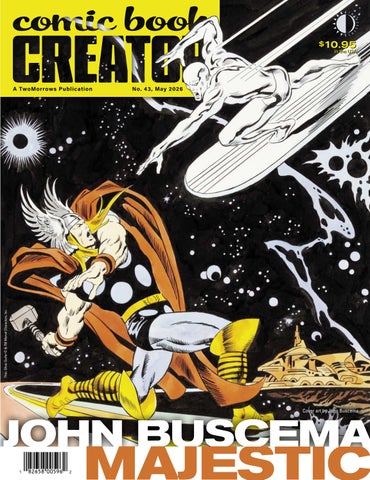
No. 4 3, May 2026
Thor, Silver Surfer © & TM Marvel Characters, Inc.
A TwoMorrows Publication
Cover art by John Buscema
JOHN BUSCEMA Portrait by KEN MEYER, JR. ©2026 Ken Meyer, Jr.
May 2026 • The John Buscema Issue • Number 43
About Our Cover
T A
Art & Colors by JOHN BUSCEMA
Ye Ed’s Rant: Does an amazing discovery in Mad Peck’s vault mean a book is coming?..... 2
B
L
E
O
F
C
O
N
T
E
N
T
S
COMICS CHATTER It’s About Moore & Les: A charming Q+A with Alan Moore conducted by Les Daniels .... 3
Thor, Silver Surfer TM & © Marvel Characters, Inc.
Katz’s Kingdom: Ivan Katz, son of Jack, on his relationship with the graphic novelist....... 8 Once Upon Long Ago: Steve Thompson about his “comics route” back in the day.......... 15 Ten Questions: Darick Robertson on life with The Boys and the work that gratifies......... 16 Clancy Investigates: Shaun looks at Eastern Color Printing, first printer of comics......... 17 The Flenniken Files: Part two of our 2002 interview with Shary Flenniken about lessons learned from the Air Pirates collective and her days at National Lampoon ...... 20 Above: This hand-colored recreation of the Silver Surfer #4 [Feb. ’69] cover, all rendered by big John Buscema, depicts an issue that was to have profound consequences for the Marvel stalwart, as you’ll find out about in Ye Ed.’s interview with the man featured in full this issue. The piece (ever so slightly revised here) was offered for sale on Heritage in 2016, one of a number of recreations of the same cover that have been auctioned off over the years, but apparently the only one sporting the artist’s own watercolor hues.
Don’t STEAL our Digital Editions! C’mon citizen, DO THE RIGHT THING! A Mom & Pop publisher like us needs every sale just to survive! DON’T DOWNLOAD OR READ ILLEGAL COPIES ONLINE! Buy affordable, legal downloads only at
www.twomorrows.com or through our Digital Storefront at
www.comicshistory.org & DON’T SHARE THEM WITH FRIENDS OR POST THEM ONLINE. Help us keep producing great publications like this one!
Wrong Turn: A look at the tragedies that silenced Marvel Comics stalwart Bill Mantlo.... 40 Incoming: It’s the Joe Frank show as our faithful correspondent shares his views............ 42 Comics in the Library: Richard Arndt on Brenna Thummler and 1½ of her Sheets......... 46 Hembeck’s Dateline: Fred looks at the Martian hunter man, Killraven, and crew .......... 47 THE MAIN EVENT All Hail Big John Buscema! In four separate interviews, including his blockbuster 1997 confessional with Ye Ed, the reluctant comics superstar candidly discusses his life in the American comic book scene, frustrations during the Marvel age of comics, joys of drawing the exploits of a certain Barbarian from Cimmeria and dislike of the super-hero genre, and time as art instructor of a new generation of comics pros with his Comic Book Workshop ....... 48 BACK MATTER Creators at the Con: Kendall Whitehouse’s pix of the independence of Philly Expo!...... 78 Coming Attractions: Speeding your way in July: Rouge Enfant — Carmine Infantino!.... 79 A Picture Is Worth A Thousand Words: Charles Vess conjures up Hellblazer............... 80 Mea culpa: Why Ye Ed. thought he could include a section devoted to John Buscema’s comics workshop in this already-bursting issue is beyond my comprehension and my apologies to Shaun Clancy and all of “Buscema’s Boys” for the woeful miscalculation. CBC will eventually feature an article on the former students, if that’s any consolation. Plus, for yet another time, our Bazooka Joe piece didn’t make the cut, so we’ll have to stick it in some other ish. Right: Awesome and iconic full-pager by John Buscema featuring The Vision, from The Avengers #58 [Nov. ’68], a scene that confirmed the story title, “Even an Android Can Cry”! Inks by George Klein. Comic Book Creator™ is published bi-monthly by TwoMorrows Publishing, 10407 Bedfordtown Dr., Raleigh, NC 27614 USA. Phone: (919) 449-0344. Jon B. Cooke, editor. John Morrow, publisher. Comic Book Creator editorial offices: P.O. Box 601, West Kingston, RI 02892 USA. E-mail: jonbcooke@aol.com. Send subscription funds to TwoMorrows, NOT to the editorial offices. Four-issue subscriptions: $53 US, $78 International, $19 Digital. All characters are © their respective copyright owners. All material © their creators unless otherwise noted. All editorial matter ©2026 Jon B. Cooke/ TwoMorrows. Comic Book Creator is a TM of Jon B. Cooke/TwoMorrows. ISSN 2330-2437. Printed in China. FIRST PRINTING.
TM & © Marvel Characters, Inc.
COMIC BOOK CREATOR is a proud joint production of Jon B. Cooke/TwoMorrows
Ric Estrada: Steven Fears interviews the versatile artist on his love and war comics......... 31
up front
It’s About Moore & Les
An interview with legendary writer Alan Moore conducted by late comics historian Les Daniels life. And I don’t expect you to believe this... [The amazing find discussed in the editorial (opposite) yield- Les: I don’t know where ed, among many other treasures, this charming conversation you’re coming from here, between two superior wordsmiths — Brit author Alan Moore is this before or after you and Yank Les Daniels, historian and horror writer — among started writing him? my all-time favorite scribes. Conducted in January, 1995, this Alan: This is after I was interview was for the DC Comics: Sixty Years of the World’s writing him. After I had Favorite Comic Book Heroes history published later that written John Constantine as year — there was a separate Q+A about Swamp Thing — with a character, I bumped into this session focusing on John Constantine/Hellblazer and him. Which was — I know Watchmen, with some talk regarding Moore’s Jack the this doesn’t make any sense, Ripper graphic novel, From Hell, then still in progress. — Y.E.] and I mean, I wouldn’t believe it if I was listening Les Daniels: This is a minor consideration. If you feel to it. you have nothing to say on this subject, feel free to say noth- Les: I have strange ing. John Constantine: does that spark any sort of comment stories in my life, too. I’m from you? I mean, are you sort of interested in the fact that not immune to the world he emerged on his own? Is that sort of annoying or boring? of strange stories. Alan Moore: Well, John Constantine’s still one of my Alan: Well, this is the favorite characters and, in some ways, he’s one of the ones only one I’ve ever had. I’ll I most regret DC owning. The way the character came about presume that other people was that Steve [Bissette] and John [Totleben], in the list of have them occasionally, things that they wrote me in those early letters detailing as well. But moments when the bottom drops out of your stories that they might like to draw in the future. One of the reality. And I was sitting in a sandwich bar, upstairs, somenotes that they made was that they’d like me to introduce a where in London — Westminster. And up the stairs came character that looked like Sting. Now I know that in the revi- John Constantine. It wasn’t Sting. It wasn’t somebody who sionist history of DC as dictated by their legal department, looked a bit like John Constantine. It was John Constantine. John Constantine doesn’t look like Sting and has never He’d got the same clothes. He’d got a suit on beneath a looked like Sting. But take it from me, he looked like Sting. trench coat. The only difference was that he had a rucksack Les: Steve told me the same thing. He said, “We started on his back. Which, again, somehow made it more realistic drawing Sting in the background.” That’s about how he because it fitted with the character. He got to the top of the described it. stairs, and I was gaping at him thinking, “Jesus Christ, that Alan: That’s it! He was in one of the early issues. Sudden- looks just like John Constantine,” at which point he turned ly Sting turns up in the background. And under that sort around, stared into my eyes, smiled, nodded (knowingly) of pressure I could only give in gracefully and make him a regular character. The whole idea of John Constantine was taking two unusual elements and juxtaposing them. I mean most comic book occultists are very po-faced. They take in archaic language and issue portentous statements. Les: Upper class, right? Alan: Yeah. Absolutely. The Doctor Strange/Sargon the Sorcerer kind of guys. And most of the occultists that I know live in bed-sits or squats or sort of… you know. I mean, they’re street-level. And so, I thought it would be interesting to see that reflected. To get somebody who’s basically very street-wise, London-wide boy. Who just happens to be upright in the field of the occult. And, like I say, it’s a character that’s sort of… he’s very dear to me. That I have a strange relationship with him in some respects in that — I know this is going to sound completely mental, but I did actually meet him once. Which was one of the eeriest experiences of my
Superman TM & © DC Comics. Les Daniels photo by Will Hart.
Conducted by LES DANIELS
COMIC BOOK CREATOR • May 2026 • #43
Above: After his Marvel: Five Fabulous Decades of the World’s Greatest Comics [’91] was published, DC approached author Les Daniels to write their official history, DC Comics: Sixty Years of the World’s Favorite Comic Book Heroes [’95]. Cover art by José Luis García López. This interview was conducted for the DC book in January, 1995. Below: Photos of Les and Alan Moore.
3
katz’s kingdom
Son of Jack: Ivan Katz
A conversation with the offspring of the pioneering graphic novelist of First Kingdom, Jack Katz Conducted by TED JALBERT
Above: Ted Jalbert, administrator of the Art of Jack Katz Facebook page, contributed an interview with Katz for The Unseen Jack Katz [’21], published by artist Liam Sharp
Inset right: Katz in 1980 working on his First Kingdom graphic novel.
Below: A snapshot of Ivan Katz, the son of Jack Katz, from 2011.
Ted Jalbert: Can you share some memories of living with Jack and his painting he did every day? Ivan Katz: To start with, as a child, I never 8
thought of Jack as a comic book artist. When I was growing up, there were a couple of comic books around the house. I remember one was called Unseen, and on the cover was a female vampire about to bite the neck of this terrified man. There was another story in another comic book called “Moon Madness,” where a guy turns into a werewolf. I knew that he had done those, but I didn’t know that he was or had been a comic book artist. With a few exceptions, my earliest memories begin at age two and are continuous thereafter. I knew Jack as a fine artist. He was a painter. Jack painted in oils. He painted every day. Our basement apartment smelled like turpentine and linseed oil. He used a restricted set of pigments composed of primary colors and black-&-white. He told me he could achieve any color using those paints only. He used titanium white. I don’t remember what black he used, but cerulean blue, cadmium yellow, and alizarine crimson. Grumbacher Paints. That was his basic palette. He mixed all his colors from those. He used other colors such as burnt umber, burnt sienna, and some other primaries, but that was basically it. No greens, oranges, or purples. He painted with sable brushes on canvas. This being the pre-staple era, he stretched his own canvases and secured the canvas to the frame’s stretchers with tacks. He winced after hitting his thumb with a hammer as he was holding the tack, with regularity. He was frustrated by his inability to generate a lot of buzz or awareness of his work and was contemptuous of popular artists of that era. Contemporaries such as Andy Warhol, Roy Lichtenstein, and Jackson Pollock, all those guys; he thought they were phonies and that their work was crap. To be valued as an artist by Jack, it helped to already be dead. Michelangelo and Rembrandt were okay. De Kooning, not so much. He was always judgmental and vocal regarding his opinions, but I think, at least on this topic, there was #43 • May 2026 • COMIC BOOK CREATOR
Ivan Katz photo courtesy of Ivan Katz.
[Introduction: I originally met the artist, Jack Katz, in 2016, at the San Francisco Comic Convention. Jack had a table there and was selling signed copies of his First Kingdom books. I later wanted to do an video interview with Jack, but it turned out that contacting him was a little challenging. By 2019, I was finally able to meet up with the man at his home in California, and it turned out to be a whirlwind experience. My two-hour video interview with Jack will be published over the next two issues of CBC. In 2020, Liam Sharp asked me to do another interview with Jack for the excellent Unseen Jack Katz. So I went back to Jack’s apartment and that had its own challenges. The new interview was completed in April, 2021, and the book was released in September of that year. Like a few other people in Jack’s orbit, I was drawn into his world with his natural storytelling ability. And because Jack was in his 90s, he was a bit needy. When he saw I was willing to help out, he soon was calling me every day. Jack and I developed a sort of friendship from 2019–23. I would visit him regularly, take him to lunch, to his favorite diner, or even to a favorite organic grocery store. Jack was highly opinionated and he could talk about anything. However, when it came to discussing his own family, Jack was a mystery. Jack did not want to discuss his family and when he did, I was never sure I was getting the whole story… and so I was patient. Eventually, after getting to know Jack and his oldest daughter, Beth, I was finally contacted by Jack’s oldest son, Ivan, who had been out of touch with his father for years, but he remained a big fan of Jack’s work. Ivan had saved some of Jack’s old sketchbooks from the early 1960s and he scanned them for with me. After Jack passed away at 97, last year, I got to know his son better and I realized we needed to hear Ivan’s story. He was a young boy when Jack dropped out of comics, and it was Ivan who inspired his father to return to the industry, in 1969. This interview was conducted on June 7, 2025, via phone. The transcript was edited by Ivan. — T.J.]
an element of envy of the celebrity the more popular artists enjoyed. He was a figurative artist exclusively. People were the medium through which he expressed beauty, grotesquerie, narrative, symbolism and metaphor. He would claim proudly that he had studied anatomy for eight years and could name every bone, foramen, suture, and muscle in the human body. However, figurative art, in general, was not popular during that era. Abstract art, op-art, and pop-art were at the zenith of their popularity. Critics, gallery owners and the public in general frowned upon images of people. They considered the subject matter dated and sought artists they felt were original and ground-breaking. I remember visitors coming over to our house, women in particular, trying to sit with their backs to as much of his art, which adorned our walls, as they could. They were uncomfortable with the nudity. It took him a long time, but he finally did get exposure in one group show, and then a one-man show at the Panoras gallery. It was uptown [New York City], right off Madison Avenue and considered a prestigious venue. So that’s how I knew him. Until he separated from my mother, he painted. He also drew. He drew all the time. When he wasn’t painting, he was drawing. When he wasn’t drawing, he was reading and he did a lot of reading. All three of these activities were accompanied by music. Predominately late 19th to mid-20th century symphonic or chamber music. Mostly the drawings were sketches of people. He sketched my mom, my sister, and me a lot. We were readily available. It was his habit to draw us, preferably
COMIC BOOK CREATOR • May 2026 • #43
when we were either sitting very still or sleeping. He was fond of drawing Gloria, my mother, while she was reading. I remember how she held her carriage erect. Her posture was impeccable. He’d frequently sketch Beth and I when we were sleeping or when Beth had her thumb in her mouth or me with my pacifier in mine. He said it was the only time we would stay still. He also sketched old men on park benches or various people sitting captive on the subway. He was very good at quick sketches of people, preferably without their knowledge. For income, he taught drawing and painting, either out of the house or at a YMHA [Young Men’s Hebrew Association] to small groups or one-on-ones. Sometimes, he had me model for them. At four and five years of age, I had a really hard time staying still. My attention would wander, I’d lose my focus. My motor control was, as yet, immature. My father would growl at me to, “Be still.” That would refocus me. Other times, he let me sit in and paint along with the rest of the class. And so that’s how I knew him. He worked all the time and found raising his children and other domestic activities unwelcome distractions. He painted. He read. He listened. He taught. Jack would use me and, to a lesser degree, my sister as models for painting or sketching. I remember one instance when I’d been recruited to pose for him, as he roughed in a composition with charcoal on a blank canvas. That’s how he worked. He’d lay out a composition in charcoal, roughly sketching it in, before applying the first layer of oil paint. This usually involved refining compositional outlines and areas of shadow on figures using oils in the darker colors. Then the flesh tones followed by secondary light and finally, glazing. In this instance, he had me raise my arms so that they were parallel to the floor, and throw my head all the way back with my mouth as wide open as I could get it, as if I were singing to the heavens. It wasn’t wide enough. “Wider!” he shouted. “Okay, now hold that, just like that.” I don’t know for how long I held that pose. It felt like a long time. My eyes were tearing. Eventually he told me I could relax. I couldn’t close my mouth! My jaw was locked in that position. I started crying in earnest. He came over and shut my mouth. My jaw was sore for a week. Funny now. He used the living room as his studio. The walls were covered with his paintings or stacked against a wall. There
Above: Katz’s gruesome cover for The Unseen #10 [May ’53], published by Pines Publications. Inset left: Ivan recalled this Unseen #7 [Nov. ’52] werewolf story drawn by his father. Below: Perhaps it was this issue of The Unseen [#14, Apr. ’54] that young Ivan, today remembering the female figure as a vampire. Cover art believed to be by Mike Sekowsky (pencils), with inks by Mike Peppe.
9
comics investigator clancy
Eastern’s Colorful Printing Intrepid comics historian Shaun Clancy travels to Waterbury, Conn., to find Famous Funnies Pape clearly recalled the mid-’50s downturn in Up until 2015 or so, every year I would drive across the comics, a period during country in the summer to travel between Seattle and Boston, which Famous Funnies endoften stopping to visit comic-book people, usually folks ed. Mentioning a publisher who had never or rarely been interviewed. In 2013, after whose comics Eastern Color interviewing the man by phone a year before, I went to the printed, he said, “One of our Waterbury, Connecticut, offices of the city’s Republican-Ameri- New York customers commitcan newspaper, to keep my appointment with publisher ted suicide by jumping out William James Pape, grandson of the founder of Eastern of his office window.” Of the Color Printing Company, William Jamieson Pape [1873– collapse, Pape added, “I was 1961]. It was late in the afternoon, about 90 minutes before in college and in the Navy the end of the workday, but he didn’t rush me. when the industry blew up, The newspaperman — Pape was said to chafe whenever but my dad told me that he anyone referred to him as a “journalist” — was obviously knew something was going proud of his family’s history in connection with the birth wrong when the returns of American comics and, in that phone chat, he kindly were coming back before answered questions and allowed access to amazing artifacts the issues hit the stands.” he had in the archives. He told me, “Eastern Color started as When I suggested that a subsidiary of the Republican-American, which was a daily the nation’s concern over and Sunday newspaper. The Pape family were the major kids reading violent material shareholders of both the newspaper and Eastern Color.” was a factor, Pape added, “I Born in 1931, Pape, who worked for Eastern between think it was partly that and 1959–63, after discharge from the U.S. Navy, explained the the advent of television. We company’s roots. “They were printing Sunday comic sections got out of the comic book mostly for newspapers on the East coast and they were print- business about that time ing circulars for Sears and Roebuck. They got into the circular and concentrated on the circular business. We did a lot of printing business in the 1930s.” things with Sears & Roebuck.” He continued, “Eastern Color got into the comic-book business in the early ’30s with Famous Funnies, which had MEANWHILE, DOWNRIVER IN DERBY… comic strips Buck Rogers, Dickie Dare, etc. and were sort The publisher was amused when I naturally asked about of a mish-mash of Sunday comics put together and stuck the comic book firm situated down the Naugatuck River, in a comic book. We owned Famous Funnies, but we also in Derby. Did he know the founders of Charlton Comics, printed comic bodies [interiors] for Western Printing and John Santangelo and Ed Levy? Pape let out a laugh and Lithographing.* We had a number of customers who had his answer alluded to the company’s disreputable reputatheir own titles that we printed books for. We did the bodies tion. “Yes! I’ll tell you a funny story about those guys: Levy for them and shipped them to Curtiss-Way up in Connecticut ended up in the New Haven County sheriff’s jail. The sheriff and they printed the glossy covers and did the stitching and [J. Edward Slavin] had a sort of a boy’s camp and Levy talked binding [trimming, folding, and stapling].” the sheriff into going into publishing comic books with Famous Funnies, of course, is considered by many to be Santangelo promoting this boy’s camp. One day, the sheriff the very first true regularly published American comic book came to [Republican-American general manager James title, lasting between 1934–55 with 218 issues, all under H.] Darcey to ask his opinion on why he wasn’t making any the Eastern Color imprint. Pape, a very nice guy who let me money with these comic books. Darcey asked him who he look through anything I wanted, showed me the hardbound was publishing comics with and he said, ‘Santangelo and volumes of the Famous Funnies run, complete except for Levy!’” With that, we both laughed. volume four, which Pape told me had been pilfered decades Interestingly, Pape revealed, his newspaper had won before from the office by some employee. acclaim for covering the Waterbury city hall scandal that put
Famous Funnies TM & © the respective copyright holder.
by SHAUN CLANCY with Jon B. Cooke
Top: The celebratory 100th anniversary cover for Famous Funnies [Nov. ’42], with art by Ben Thompson. Above: Undated shot of William James Pape, newspaperman. Below: Indicia of Famous Funnies #100, which mentions the Waterbury outfit.
* Western long had the contract to package Dell Comics until that association ended in 1962 and Western launched its own line, Gold Key Comics.
COMIC BOOK CREATOR • May 2026 • #43
17
the flenniken files
Shary’s National Exposure
The second part of our 2002 interview with National Lampoon cartoonist Shary Flenniken Conducted by JON B. COOKE [Editor's Note: Last ish, in this previously unpublished 2002 interview, Shary Flenniken regaled us about her upbringing as daughter of a wanna-be cartoonist/military lifer, becoming a rebellious, runaway teen, and discussed her time as a member of the notorious Air Pirates collective, where she received a crash course in cartooning by her cohorts, Dan O’Neill and company. We pick up the discussion regarding her finding a regular gig at National Lampoon, with her Trots and Bonnie strip. — Y.E.]
Comic Book Creator: This seems like a really fast process: from 1970–72 is when you started contributing to the National Lampoon, right?
* National Lampoon’s Lemmings was a 1973 stage performance that satirized mass conformity among rock fans in a pseudo-Woodstock show that ended with everyone running off to commit mass suicide. 20
#43 • May 2026 • COMIC BOOK CREATOR
National Lampoon TM & © NL Operations, LLC. Trots and Bonnie TM & © Shary Flenniken. Simpleton courtesy of John Kelly.
Shary Flenniken: Yeah. CBC: Twenty-four months! Shary: Well, we didn’t have other jobs. [laughs] We didn’t need them, we were just living this stuff. CBC: What did you want to do? Did you want to get paying gigs? Shary: You have to remember that I was still giving my body to the cause. I was still essentially suicidal at that point, which made me totally relate to this enterprise against Disney. It really was like lemmings, the fact that Lampoon did Lemmings*… we were total lemmings, we were going to rush over the Disney cliff, we’re going to rush over the cliff, and fling ourselves at what we perceive as the enemy, you know? So I was just really flinging myself at things. CBC: Was it becoming increasingly apparent that you, in fact, were not going to die, that life did go on? Did you have a moment of, “I have to make a career,” or something like that? Shary: I think what was really critical about my life around that time was that I got married to Bobby [London], I just became really afraid of flying. I think what that was, was my subconscious accepting the fact that I really didn’t want to die. And being married was kind of the positive move that was saying, “This is worthwhile, and I have a responsibility to somebody else.” I’m sure he didn’t see it that way, but I was totally that way. CBC: And to yourself? You had a responsibility to yourself? Shary: I hardly ever think that way, but I guess. No, I thought of him, because watching that documentary about Altamont in the Rolling Stones… CBC: What, Gimme Shelter? Shary: Yeah. That was really pivotal to me when they took the guy who was stabbed away to the hospital in a helicopter and his girlfriend got left on the ground. And my thought, “I don’t want to be that person on the ground.” When you’re married, they let you go in the helicopter. And here we are, in this really life-threatening, dangerous battle… which we thought, at the time. That’s how we felt at the time. I want to be with my husband really, in love. I don’t want to be left on the ground because I’m not legally attached to him. CBC: Can you, in a nutshell… what was Air Pirates? To the uninitiated… Shary: Oh, no! You’re asking an awful lot of me! In a sense it was like a… I’m not really familiar with the old guilds, the way… it was sort of like a guild, because it was an alliance that was predicated on sharing skills and teaching skills. And part of that was becoming aware of your position in history, going in both directions. Where you were
Photo courtesy of and © Chris Anthony Diaz. Trots and Bonnie TM & © Shary Flenniken.
coming from and what you were going to affect. And giving you the skills to be as powerful as you could be… and a reason. All that stuff. Little cartoon ideologies. We were very much into sharing skills with other oppressed peoples. And I think there was a feeling that, in those guys helping me, they were helping all women. And it was something that they could do, to help the next woman help the next woman help the next woman to become stronger and more powerful. And we had people, we had Native Americans with us. We were trying to teach as many people as we could to pick up the torch. CBC: And what was the political act of the Air Pirates comic itself? Shary: Well, you’ll get a lot of different opinions on that. Dan [O’Neill] says that his motive was just getting his syndicated characters back… One of Bobby’s positions there, as I see it, he was like Dan’s lieutenant, and he would translate Dan’s ideology, which was very much like what you see from the comic strip, really wild and imaginative…? Bobby would translate that literally into… because, you know I said he was very articulate about cartooning and humor, into things that we could relate to and understand. Dan’s ideas, his imagination is fantastic, and a lot of times when you talk to him, you need to go, “Okay, what are you actually saying? Are you saying this or are you saying that?” (He still talks like that.) He’ll go, “Gold! Gold is the focus for everything. Gold is the reason for everything.” And I’m going, “Well, what do you mean? I thought oil was?” And then he will have to come down to earth and explain the whole thing. And he doesn’t necessarily ever want to come down to earth with you. [laughs] He wants to remain on that plane. So Bobby translated a lot of what we were doing with Disney into things that I guess were easier to absorb, which is to say, read [Richard] Schickel’s book, The Disney Version [The Life, Times, Art, and Commerce of Walt Disney, ’68], and Disney has the patent on the spy satellites and stuff like that. The Disney Corporation is way more hooked into the military-industrial complex than we realized. Basically, the idea was that Disney had this self-professed image of innocence and delightfulness, in the form of Mickey Mouse and all these wonderful characters. And there was this other book about this, too [How to Read Donald Duck: Imperialist Ideology in the Disney Comic, ’71], where we’re exporting Disney as we’re exporting Coca-Cola. It’s just one more front for American business, which is one more front for American COMIC BOOK CREATOR • May 2026 • #43
Above: The only photo found of France Herron was on the cover of Gang Busters #10 [July ’49]. Below: Showcase #1 [Apr. ’56] cover by John Prentice. Late fan artist Xum Yukinori created this faux DC Who’s Who piece featuring Fireman Frank Farrell.
control of other countries. It’s really clear to this day that we do now, I think. I still believe it. That was the idea of using their own characters. I think if I had been in charge of that crew, I would have done less sex and more politics, but then I don’t think it would have sold as well or been as fun. But, at the time, sexual repression was as ubiquitous and important a battle to fight as any other political thing. Now, it’s a done deal, it’s not a big battle anymore. Although it still is in some areas, some very Christian areas. CBC: So it was putting the Disney characters having sex and things like that, right? What was it, fundamentally, what did Disney take offense to? Shary: Well, what I heard — and people disagree with it — is that the only thing Disney took offense to was that they had to protect their characters in order to license them, and it was that simple. It had nothing to do with anything we were saying or anything else. And everything else was sort of just making their case. If you invent a comic character and you license it to other people, you have to protect it… You know, it’s just like Xerox and Kleenex. They’ll come after you in the same sense that they came after the Air Pirates. The Air Pirates don’t like
Above: Shary Flenniken poses at the Short Run Comix & Art Festival 2022 in a photo by Chris Anthony Diaz. Opposite page: Shary’s covers for NatLamp [Oct. ’78] and Seattle’s Simpleton #3 [Spr. ’76]. Below: The cartoonist’s signature strip was collected in 2021 by New York Review Comics. Say what you will, her strips rank with Gahan Wilson’s as the best in the mag.
21
done it all dept.
Ric Estrada: Love and War The comic book artist knew almost everyone — even Hemingway!—as Steven Fears learns Conducted by STEVEN FEARS
Falling in Love, Blitzkrieg TM & © DC Comics. Photo by Seth Estrada. Blitzkrieg detail courtesy of Steven Kro.
[I had the privilege of meeting Ricardo Leon Estrada [b.1928] and lovely wife Loretta during Comic-Con International 2000, when he was a guest of the con and the Big Five War Collectors, where he also attended their annual banquet. I had long admired his art and was hoping to one day meet and tell him Well, I got that chance and arranged an interview to find out more about his many interests. What was revealed, as we spoke, was his rich background and constant evolution as an artist since he started developing his talents. But what is also important to consider is the depth of that talent and the anchor he had in his faith and family. He was who he was because of his character. His art was an extension of his genuineness as a person, as he was consistently exploring new ideas, ever moving and pushing his abilities to new heights. He was also one of the nicest people to be in the comics industry. From working for Harvey Kurtzman to DC, doing such things as romance, mystery, Wonder Woman, and the war books, he was always working, always improving, and always entertaining us, the readers. I hope you will enjoy reading this interview as much as I enjoyed talking to Mr. Estrada. What a great guy he truly was. This interview was conducted in 2000 and previously
COMIC BOOK CREATOR • May 2026 • #43
published in a small CD magazine for a tiny audience. Unfortunately, for all of us, Ric passed away on May 1, 2009. He left a wonderful body of work for all of us to still enjoy. I miss his smile and his warm greetings whenever we saw each other in San Diego. — S.F.] Steven Fears: I’ll start with the traditional first question: where and when were you born? Ric Estrada: I was born in Havana, Cuba, on February 26, 1928. Steven: What was it like growing up in Cuba? Ric: Tropical heat, blue skies, white clouds, flash showers in the summers, Gulf Stream breezes all year round, heavy traffic, non-stop music from a million radios, lots of big and little revolutions, shootings, bombs, a happy childhood in general, playing cops ‘n’ robbers, tag, hopscotch, flying kites, going to the beach, going to the movies, but scared of the various revolutions. That was my childhood.” Steven: That covered several of my questions, but my next question is how long did you live in Cuba? Ric: Until the age of 19, and then I moved to New York. Steven: And you’ve been in the United States ever since? Ric: Yes, except for six years in Europe and the Middle East, and one year in Mexico. Steven: What were some of your early artistic influences? Ric: The Jungle Book by Rudyard Kipling, which my mother read to me as a child; the Tarzan stories which my mother also read to me; The Folk Stories of the World, which I read when I learned how to read; The Wonderful Adventures of Nils by Selma Lagerlof, a Swedish writer — that influenced me a lot — about a little child who traveled all over by riding on the back of a goose, and who was shrunk into a small size, and that give me the desire to travel and see the world; and I also saw a lot of movies on Saturdays. Steven: What were some of your favorites? Ric: Oh, the serials, the adventure movies, the Westerns; detective and mystery movies; The Lone Ranger, Dick Tracy, Green Hornet, Black Spider, and The Shadow. I also loved the comics in the Sunday pages: Tarzan, Tim Tyler’s Luck, Flash Gordon, Terry and the Pirates, and Captain Easy. I read them over and over. Every Sunday they would come in, and I would sit there for two or three hours reading them.
Top: Photo of the artist by his son Seth. Above: Detail from Estrada’s story in Blitzkrieg #3 [June ’76]. Inset: Estrada cover for Falling in Love #99 [May ’68]. Below: Cover of The Wonderful Adventures of Nils [’22] by Selma Lagerlof.
31
Above: “Bunker” page drawn by Estrada over Kurtzman layouts. From Two-Fisted Tales #30 [Dec. ’52]. Estrada splash from Falling in Love #137 [Oct. ’72]. Inset top: Cintio Vitier, who helped refine Estrada’s art appreciation. Inset bottom: Landon School ad.
poet, and who showed me prints by Picasso and got me interested in modern art. Cintio would ask me, “Who will last longer, Picasso or your Terry and the Pirates?” I’ve never quite been able to answer that since Caniff’s creation is as much a landmark in popular art as Picasso is in painting. I began to look at Picasso, Matisse, and Braque; the Impressionists like Monet, Toulouse-Lautrec, and Degas. I loved Lautrec’s linear style, a big influence. My mother and father gave me a book on Frans Hals, the Flemish painter, which I still own. And my mother, a school teacher and poetess, wrote little notes on the margins about success and trying hard and pursuing one’s dream—inspirational thoughts. That book became like another bible to me. I treasure it. Then my father gave me Figure Drawing for All Its Worth by Andrew Loomis, one of the classics on drawing. I’ve had that book since about age fourteen. I copied many of the figures and learned a lot about human anatomy. Those are my early influences. Steven: I understand that you were encouraged by Ernest Hemingway to come to the United States. Could you tell me a little about that? Ric: Ernest Hemingway was a friend of my uncle, Sergio Carbo, a famous Cuban journalist. They knew and admired each other and their war exploits. My uncle, you see, had been in the Revolution of ’33 and had been a fighter as Hemingway had been in three wars… Hemingway and Uncle Sergio were comparing war scars as they looked at my sketchbook. Hemingway’s wife, Mary Welsh, said that the figures I drew reminded her of the soldiers that she had seen as a combat correspondent during World War II… She and Hemingway encouraged me to pursue my career. Then, through Hemingway’s connections with the U.S. Consulate in Havana, I was able to cut much of the red tape to come to the U.S.A. On the day I departed, my Uncle Sergio and his dear wife, Clara, put $2,000 in my hand — a fortune in those days — and wished me Godspeed. I was incredibly blessed to have such a generous family and a friend like Hemingway. My parents were highly educated, but poor. My uncle and aunt were also educated, but rich and very, very generous. Steven: And this was around 1947 or ’48? Ric: It was about 1947. I met Hemingway in about 1946 or 1947. It was the beginning of a very nice friendship. A few years later, when they were filming The Old Man and the Sea, off Cojimar Bay, outside of Havana, I went back to Cuba for a short visit and participated in the filming from one of the boats. I watched Hemingway in action and also the cameraman. It was a great experience. I also got royally seasick. I was about 25 or so at this time, and Hemingway said I had
#43 • May 2026 • COMIC BOOK CREATOR
“Bunker” TM & © William M. Gaines, Agent, Inc. “Too Smart to Love” TM & © DC Comics.
32
Steven: What were some of your favorite comic strips? Ric: Well, my favorites were Prince Valiant, Tarzan, Mickey Mouse, Terry and the Pirates, and Captain Easy. I not only read and re-read them, but I studied their styles, lines, and techniques. No one could draw beautiful girls like Roy Crane or Alex Raymond; action like Milton Caniff; humor like Harriman’s Krazy Kat; realism like Harold Foster. I studied them all. Steven: When did you first become interested in art or even cartooning? Ric: Very early; I must have been three or four. Steven: Probably the Sunday funnies influence? Ric: There was a little boy who lived next door who had a “copy book,” and he would copy the funnies. He drew a character per page, and I began to imitate him and got myself a copy book. I copied the comics, one page per character, and that’s what got me started. I also love Will Eisner’s The Spirit. No one could tell a story with more mood. But that came later. I often wonder what happened to that little boy next door. Did he become a cartoonist? I owe him my beginnings. Steven: At what age did you get serious about developing your artistic interests? Ric: Serious? From my very earliest memories, when I was about then years old, my parents sent for the Landon School of Cartooning Correspondence Course, from Cleveland, Ohio. That’s the same course taken by Milton Caniff, creator of Terry and the Pirates. And Bill Mauldin, the war cartoonist. And also Roy Crane. As I met other cartoonists in New York, the Landon Course was popular among many. Steven: Were there any painters, or other fine artists, who influenced you? Ric: I had a friend, older than me, his name was Cintio Vitier, who later became a well-known Cuban
wrong turn
The Boisterous One Lives
After a horrific 1992 traffic accident, writer Bill Mantlo has been bedridden all his days since by JON B. COOKE
Above: Bill Mantlo’s senior portrait from the 1969 Prism yearbook, for New York’s Art and Design High School. Inset right: in the ’10s, bedridden Bill Mantlo smiled for the camera while displaying a Hulk Omnibus volume featuring his Incredible Hulk #271 [May ’82] story — yes, for real, this is the actual title — “Now, Somewhere in the Black Holes of Sirius Major There Lived a Young Boy Name of Rocket Raccoon.” Below: Mantlo on his ten-speed posing with his infant daughter Corinna, seen in baby carriage, at bottom, in 1980.
was 12 when she witnessed a dramatic change in her father’s condition at that time. “When they were moving him from one bed to the other in the Manhattan hospital, I was there. They were picking him up on the sheet and the nurses said, ‘One, two…’ to swing him over to the transport bed, and my dad just opened his eyes and said, ‘Three!’ And that was the first word he spoke since the accident and it was amazing!” (Mantlo’s permanent condition was diagnosed as a “closed head brain injury,” in which the skull and membrane remain intact despite trauma to the brain.) Since then, the tragedy has been compounded due to ruthless treatment by the health insurance provider and there also were issues within Mantlo’s family that took a toll. But, to its credit, there was — though not without prodding! — recognition from Marvel regarding the writer’s co-creation of Rocket Raccoon, a character used in the Guardians of the Galaxy film trilogy, and there was also the short-lived TV series, Cloak & Dagger, all reportedly accompanied by helpful checks from Disney. Plus, in 2017, the CW made use of his Invasion! concept in a super-hero TV crossover event. Corinna became her father’s legal guardian in 2020, after Mantlo’s brother passed away, and the House of Ideas money (none of which goes to the family and entirely to his care, she insists) has been very helpful. “After Guardians of the Galaxy, my dad, for the first time, got some substantial money from Marvel, however those funds are in a supplemental care trust, and can only be used for supplements to his care.” The funds have gone to hiring three “amazing” aides who attend to him full-time. * Coffin’s piece, originally a cover story published in National In 1985, before he was permanently on the outs at Underwriters Life & Health the House of Ideas, Bill Mantlo was asked by a young Kurt Magazine, Vol. 115, #21 [Nov. 7, Busiek how was he able to be so prolific. The writer replied 2011], can still be found online in that Marvel Age interview, “I don’t know, I’ve been doing at https://www.thinkadvisor. it for a long time. I’m very disciplined. I get up in the morncom/2011/11/07/tragic-tale/. #43 • May 2026 • COMIC BOOK CREATOR
The Hulk, Rocket Raccoon TM & © Marvel Characters, Inc. Photos courtesy of Corinna Mantlo.
40
I didn’t read a lot of William Timothy Mantlo’s work when he was a prolific mainstay at Marvel Comics in the ’70s and ’80s, but I do recall being impressed with his Cloak and Dagger, enough to call myself a fan and avidly buy the duo’s comics. I also reckoned Rocket Racoon’s name was clever wordplay with that Beatles’ song title, plus I had a weird affection for his Woodgod, a Satyr-like character so strange and so offbeat, I thought it very cool indeed. And, while I wasn’t much interested in the toy tie-ins Micronauts and Rom he wrote, I knew some extolled the titles as fun stuff. Yet, somehow I hadn’t learned of the tragedy that befell the scribe decades prior until stumbling across a stunning account found while surfing the internet. Bill Coffin’s “A Tragic Tale,” posted two days before Mantlo’s 60th birthday, related the following under a subheading, “Hit and Run”: “On Friday, July 17, 1992, Bill left work early for the weekend, and made his usual three-mile rollerblade journey through [Bronx] traffic to his apartment near Morningside Park. Just four blocks from home, a car came around a corner and hit Bill. The left side of Bill’s head impacted the windshield. He rolled across the hood of the car, and the right side of his head impacted the pavement. The driver never stopped and was never identified. “The accident jostled Bill’s head so violently that his brain squashed against the inside of his skull, and his brain stem severed. This did not paralyze him, but it would make it very difficult for Bill’s body — particularly his extremities — to accurately receive and process electrical messages from his brain. “Bill spent the next two weeks in a coma at Saint Luke’s hospital in midtown Manhattan, after which he remained in critical care for another two months. During this time, he was still on a ventilator and a feeding tube, as his brain was too damaged to tell his body how to swallow or breathe.” Bill’s daughter, Corinna,
All characters TM & © Marvel Characters, Inc.
Colors by Glenn Whitmore
Four Interviews with magnificent illustrator and comic book artist JOHN BUSCEMA [1927–2002]
American comic fans of a certain type from a specific time have their favorite John Buscema eras, when the artist first made an impact and his work was recognized as something beyond the Marvel house-style, not just a knock-off of Jack Kirby’s approach. For me, it was his late 1960s art on The Avengers, when he was inked by the underrated George Klein. I perceived there was a compelling
REGAL MAJESTY to his elegant figures, imbued with expressions evoking a certain Shakespearean quality, if you will, that could be, as needed, either achingly tender or possessing an untethered ferocity… I just loved it. So imagine my surprise to hear the man’s “dese and dose” Brooklyn accent when first we spoke in 1997, but the interview revealed a sensitive yet earthy man contrasting the drama infused in his work. ¶ For this tribute, we’ve gathered a quartet of interviews, one in the form of a narrative and the fourth being the aforementioned conversation I conducted, a Q-&-A I will never forget. So, in our salute to the artist, let’s start this celebration with the interview from The Art of John Buscema by Sal Quartuccio and Bob Keenan…
BIG JOHN: 1978
than he was worth, but he was grateful for the work. His first story was the seven-pager entitled, “They Had Robbed Lincoln’s Grave,” a dubious start for [Introduction to The Art of John Buscema: As a young man, John one who would later create such classics of his own. decided he wanted to be a contender. Boxing was a love as great as art for [After a year-and-a-half, Timely disbanded the staff and everyone either him. He and his brother, Sal, would train at the old Stillman’s gym across the worked freelance or left. John stayed on for another six months, but finally street from the original Madison Square Garden. It was there, however, that left Timely. Seeing comics were on their way out, he worked odd jobs until John decided to be an artist. After working out, he would do little watercolors he was drafted for the Korean War. Having had an ulcer since he was 14, he of the boxers. Nothing special, just for his own amusement. The word got was unable to serve. This fact took five months for the Army to find out. John around and, pretty soon, John was doing full portraits of fighters, champs, received his honorable discharge after much red tape. and would-be contenders at $125 each. John realized he could make more [John married in 1953 to his wife, Delores. In 1955, they had their first money with his hands than with his fists. child, Dianne, in 1956. Much to John’s relief, he landed a very good job in [John Buscema was born December 11th, 1927, in Brooklyn, New York. advertising. The traveling from Long Island to Manhattan every day was a Even as a child, John showed a tremendous interest for art, especially the art grind, but well worth the effort. he found in the funnies. Copying such notables as Hal Foster, Alex Raymond, [In 1966, Stan Lee tracked down John and invited him back to Marvel. It and all the other great illustrators, John soon became enthralled with the seemed comics were in a much better shape than when John had left. With world of art. the chance to do more illustration work and cutting his commuting down to [Attending the High School of Art and Design, he began to seriously train zero in order to be with his family, John agreed. As they say, the rest really is for his chosen profession. Later, John would go to the Pratt Institute at night history. John’s work for Silver Surfer, The Avengers, The Fantastic Four, Thor, while still going to Art and Design during the day. His first professional work and Conan has made the Marvel Comics Group the success it is. When you was four gag cartoons he did for the now defunct Hobo News. He received a talk about drawing comics or drawing the “Marvel way,” you’re really just dollar apiece for them and was extremely gratified to get it. trying to be more like John Buscema. For a man who started his life wanting [For the next few years, John would go from job to job, painting murals, to be a boxer, a contender, it can truly be said, the gentleman is a champ! signs, any odd job that required art. Then, in 1948, John got a job at Timely [To John, his lovely life wife, Delores, and their two children, Diane and Comics from a nice young man who worked there named Stan Lee. Stan gave John Jr., we thank them for allowing us into their home. This book was a John a staff job working for $75 a week. To John’s mind, this was $75 more labor of love and respect. — Sal Quartuccio and Bob Keenan.] 50
#43 • May 2026 • COMIC BOOK CREATOR
Conan TM & © Conan International Properties, LLC. All other characters TM & © Marvel Characters, Inc.
Sal Quartuccio/Bob Keenan: When did you become interested in art? John Buscema: When I remember as a kid, the thing that would drive me up the wall was that I couldn’t draw Popeye. I loved Popeye. I would get the daily paper and I just couldn’t draw him. I did it over and over until it was coming out of my ears. I think I was seven- or eight-years-old at the time and I couldn’t draw a Popeye. I don’t know if I could draw him today. [laughter] Sal/Bob: Why did you get into comics? John: You know, comics were supposed to be a temporary thing. I never wanted to be in comics. I wanted to be an illustrator. I never had the training to be an illustrator, so I took what I thought was the easiest job I could find, which was comics. I found out differently. It wasn’t that easy. It’s a tough job and it was only supposed to be for a year or two. I was supposed to go back to art school, only I never did go back to art school, and I stayed in comics until comics almost folded up. I think it was the middle ’50s and that’s when I left… I left… I was out. [laughter] I couldn’t find a job and I went into advertising. Sal/Bob: And so, the advertising went from the middle ’50s to the middle ’60s? John: And then Stan called me up… he denies it. He said I went there, but he called me up. In fact, Sol Brodsky called also. They had traced me down to this studio I was working at. I had space there and I was freelancing. [Stan] asked me if I’d be interested in going back to comics. Now, I’ll tell you one of the reasons I went back into comics: I had to comCOMIC BOOK CREATOR • May 2026 • #43
mute every day from here in Long Island to New York, which was three hours, door to door, which was six hours a day. Now, I knew when I was doing comics, I didn’t have to travel at all. I worked at home, so that was one of the real big determining factors of my getting back into comics again, plus the fact I had seen the comics were doing well again. They weren’t on the verge of disaster as when I had left them. Sal/Bob: When you first came back to Marvel in the ’60s, what was the first book you worked on? John: It was “Nick Fury, Agent of S.H.I.E.L.D.,” and I didn’t pencil it. Jack Kirby broke it down and that’s how much confidence Stan had in me. He had Jack Kirby break down the job and I penciled over it and re-pencilled the whole thing. I erased every panel and redrew it because I couldn’t draw like Kirby and it came out pathetic. I think John Tartaglione or someone like that inked it. I believe it was him. The name seems to stand out in my mind. That was the very first job and the second was “The Hulk.” Sal/Bob: Do you think the Marvel style of synopsis — art and [then] dialogue — is better than working straight from a script? John: Definitely. That’s the best way to work. That’s the only way to work. I will not work from a script. A lot of young writers at Marvel will give me a detailed, outlined script. I work with them once — I will not work with them again! Because I want something to work with. I don’t want to be strait-jacketed into a corner and told how many panels I have to work with, and what they’re doing in each panel. I love the freedom that Marvel gives us with the synopsis.
SALVATORE QUARTUCCIO ( Sal Q ): Born in 1952 in Manhattan, N.Y.C. Early years in Queens and then Brooklyn, and raised on comic books, jell bars, bubble gum cards, and chocolate egg creams! That’s the life! Attended my first convention, the 1969 NY Comic Con, spent all my money on back issues of Witzend, and that began the notion of being a fanzine publisher. Fifty+ years publishing thousands of products: comics, art books, portfolios, T-shirts, posters, card sets, prints, buttons, pins, and on and on. Gradually retiring with my adorable wife Ruth. Rocketed to Brooklyn by his parents from a dying planet, BOB KEENAN has been the design and production person at SQP Art Books since its inception in 1973. Learning the art of promotion from studiously absorbing “Stan’s Soapbox” as a child, he’s been the company’s public voice when marketing the full line of SQP’s fantasy and pin-up art books. Thanks to the miracle of the interwebs, he can maintain these duties to the New Jersey-based concern while living large live in sunny (and occasionally engulfed in flames) Los Angeles. He is sliding into his golden years in remarkably good heath and relative sanity. 51
I’ve looked at the work of the old-timers and I’m not as impressed anymore. In fact, I see a lot of things they did, they could have improved upon. I see things now that leave me cold. I’m not impressed with anything in comics today. The only thing in recent times that I was impressed with but not really floored by was Tarzan by Joe Kubert. I think it was one of the best comics produced of all times. I admire the guy. I think he’s fantastic. I really do, but that’s it. Maybe I’m too close to comics. Sal/Bob: Did you ever try your hand at writing? John: I would never write! I don’t like writing! I can’t even spell. [laughter] I just don’t like writing. I’d like to plot stories and to leave the dialogue to the writer. I don’t want to write… I know it’s enough for me to sit down and write a letter. Sal/Bob: How instrumental are you in plotting, scripting, and final realization of a story? John: Well, it depends on the story. I’m adapting a Conan story from one of the books Howard wrote. I follow that pretty close. I love to follow it as close as I can. I wish I had more panels to be able to follow every single step. He creates a visual picture in my mind that I don’t have enough panels to convey. When Roy Thomas hands me a plot, I have a lot of leeway. Roy gives me the most essential parts and then leaves quite a bit up to me. Sal/Bob: Why did you start your own comic arts school? John: There were so many people, over the years, asking me and other people in the field for advice. You’d get letters from kids writing to Marvel and they’d forward them to me all saying, “John, is there a school I could go to?” And they’d send me samples to critique, so I thought it would be a good idea to start a school. I had approached a few other artists in the field and they were interested, but they never went ahead with it. They didn’t think they could keep up with it. Neither did I, what with my having to go into the city every day from Long Island, but I thought, “What the hell. Let me try it.” I figured, “Let’s give it a stab and see what happens. The first year of the school, 1975, was a big success. Sal/Bob: Where did you get these students? John: I put a two-inch ad in Marvel comics — one time! And I got thousands of responses. At least 2,500, from that one ad. I still get letters from an ad I put in that long ago. I got six of them just today, but getting back to the school, I just didn’t have the time to continue it. It was a big hassle with the employees. It ended in 1977. Sal/Bob: Were their any graduates from the course who are working in comics today? John: Oh, sure. There’s Bob Hall, assistant editor up at Marvel — he draws, as well. And there’s Juan Ortiz, who is working for DC Comics. There’s another kid in the field, [though] I’m not sure I can take credit for, Bruce Patterson. He was never in my classes, he’d just show for an hour and then leave, so I don’t think I can take too much credit for him. [laughter] Then there are one or two youngsters working as assistants to other artists. I think these students, out of the initial 28 guys, isn’t too bad for an average. Sal/Bob: Who is your favorite inker? John: If you want to talk about ink, I think, for me — for my work — my brother Sal does the best job, because we’ve work together for so many
Pages 48–49: On left, John Buscema’s pin-up in Marvel Treasury Edition #3 [’74], colored by Glenn Whitmore. On right, undated photo of the artist, courtesy of Shaun Clancy. Previous page: Production art, cover of The Art of John Buscema [’78]. Above: Cover of same. Next page: Buscema’s original cover art for Conan the Barbarian #124 [July ’81]. 52
#43 • May 2026 • COMIC BOOK CREATOR
Conan TM & © Conan International Properties, LLC. All other characters TM & © Marvel Characters, Inc.
That’s the best way. Sal/Bob: Where do you see comics going? John: [Long pause, then laughter] If they don’t do something soon, it’s going to go down the drain, as far as I’m concerned. I think maybe I’m too close to it, but they had their “golden” days. They haven’t changed. I think, if anything, they’ve deteriorated. Except the Conan character. That’s the only thing, I think, is really good, really interesting in comics today. Sal/Bob: Do you think comics have improved at all over the years? John: In certain respects, it has. I think for example, today we do things that, years ago, we would never do. From what I can remember of the ’40s and the ’50s, there weren’t as many good draftsmen as there are today. Although there were great guys back then, like Lou Fine and Joe Kubert, but I think today you’ve got a hell of a lot of talent. The only thing is, they don’t have any place to develop like we did. Now, we would get into comics in those days and latch onto an illustrator. I happened to like Albert Dorne. Albert Dorne was one of the real exciting illustrators. He had a comic style — I loved his stuff! And I used to try and draw like him. Robert Fawcett, another great illustrator. I loved Alex Raymond and Hal Foster! All the different draftsmen. Today, the young people coming along don’t have the illustrators to look up to that we did, the great talents. Today, all they have to look up to is me and people like me; which, to me, is second-rate or at least second-hand to the great artists we looked up to. They don’t have the scope that we did. We had dozens and dozens of illustrators that we could pick from. Norman Rockwell to Albert Dorne, which is quite a run. They don’t. All they have is comics. Who do they have to look up to? Sal/Bob: Do you think one of the recent improvements in comics today is Marvel’s try for full offset color rather than traditional flat comic color? They used this process on your Conan and black-&-white book. John: I saw the originals that Marie Severin had colored. They were beautiful! The [printed] book was a disaster! The colors were washed out — even the ink lines were lost! I think it was approached in the wrong way. I think they should have used a different paper for printing. I think they should have used a different technique for inking. I think they should have simplified the inking and concentrated on the coloring or vice versa. Simple coloring and a lot of detail in the inking, but not both. Sal/Bob: So you think the process has a ways to go? John: I think they’re in the experimental stage right now. I think if they do it the right way, it can be a bang up job. I know I saw some work in Europe that is close to what Marvel wants to do, full color paintings with ink lines around them. Sal/Bob: Who is your favorite comic artist? John: I’ll tell you, I’m at the point where I’m not impressed with anyone anymore. I was always looking for the good draftsmanship. Later on, I was interested in the storytelling aspect of comics. I think Hal Foster is perhaps the best storyteller in comics, as was Milton Caniff. A lot of guys, like Roy Crane — all great. I did admire them, but now that I’m older, I’ve been in it for so many years, I can see things they didn’t see before. I have the experience now. I have all the books of the collected works of Raymond and of Hal Foster, and
Conan TM & © Conan International Properties, LLC.
years. He knows my style, he works the way I work. He puts a line down the way I do, so he can ink me like no one else can. Sal remains closest to my originals. Not that he traces, mind you, but he retains the drawing without killing it! Sal/Bob: Is there anyone else in your family who is interested in art? John: My daughter, who has a lot of talent, but she doesn’t have the patience for art. I tried to help her, give her some instruction, but she’s very impatient. Besides her, there really isn’t anyone else in my family who draws. Sal/Bob: Did DC Comics ever approach you to become one of their artists? John: Once, they did. Carmine Infantino called me at one time. He asked me if I’d be interested in working for DC. I said I would, but I couldn’t, because I was working for Marvel and didn’t want to split myself working for two companies. I’d prefer working for one outlet at a time. Sal/Bob: If you had decided to work for DC, are there any characters there that you would’ve enjoyed working on? John: I can’t say that I would’ve liked to work on any characters at DC, because the only two that I’m really familiar with are Superman and Batman. I don’t know any of the other characters at DC. I don’t read comics, DCs or Marvels. I don’t like comics! [laughter] The people up at the office send me copies of the Marvel books. I have thousands piled up in my art room. My son has them. He saves them. I’m not familiar at all with what a DC is doing. Sal/Bob: Which characters do you enjoy doing the most? John: Conan! Conan is my favorite character. In fact, I recently asked Roy Thomas… or rather, I told Marvel and Roy, I’d like to do Conan exclusively. It’s the only project in comics that I’ve ever done that I really enjoy! Because he is not one of these guys who flies or can drill himself into the ground headfirst, or anything like that! To me, Conan is real! I can actually do things with this body, move him in certain ways that I can understand. I cannot understand a guy flying through a building or somebody stretching himself around a lamppost and making himself into a pretzel — I can’t relate to that, I don’t enjoy that, I hate it with a passion. I hated doing The Avengers and I hate doing any super-hero! [laughter] I told everybody up at Marvel. I love doing Conan. He’s my kind of guy. Sal/Bob: He’s a regular kind of guy. [laughter] John: He’s more than a regular kind of guy! He’s the kind of guy I’ve always wanted to draw — for years! Even more than Tarzan. I thought that Tarzan would be a thing I enjoy doing, but I didn’t. They held me back. They wanted Tarzan drawn slim, the way he was drawn for years. Not like Conan. Conan is huge, like a bodybuilder! But I had to slim Tarzan down. Otherwise, I would’ve drawn him like Conan. Sal/Bob: What character did you dislike having to do? John: Like I said before, the super-heroes. However, I don’t mind Thor as much. As a matter of fact, I’m doing Thor now. Thor, I enjoy more than the others. But, when it comes to The Avengers, or the Hulk, or the Fantastic Four or anything like that…they’re just a pain in the ass. Sal/Bob: What is your relationship with Stan Lee? John: He’s the boss and I’m the penciler. [laughter] What can I tell you? Do you mean is it a pleasant relationship? Sal/Bob: Well, do you enjoy working with him? COMIC BOOK CREATOR • May 2026 • #43
John: Well, I’ll tell you something — Sal/Bob: That’s it, John. Get it off your chest. [laughter] John: No, I’ll give it to you straight. When I was working with Stan, we worked on Silver Surfer, Thor, and the Fantastic Four; of all the writers I’ve ever worked with, Stan gave me the least amount of plot! But he gave it to me in such a way that I enjoyed working with him. I loved working on stories with Stan more than anything else then. Today, I enjoy working with Roy, which is why I stick with him. Roy and I have been working together since The Avengers, which is about 10 years now. I know what Roy wants and Roy knows what I want, so we work hand in glove. As a matter of fact, I started with Roy, then worked with Stan and back with Roy, but I loved working with Stan when he was writing. It was an enjoyable period. Outside of that, I’ll occasionally see him. It’s very rare at that. I usually talk to him on the phone. My relationship with Stan is good. No problems. Sal/Bob: How did you get involved with How to Draw Comics the Marvel Way book? John: I had talked to Stan about two years ago about my doing a book. He suggested that we collaborate — no, I didn’t even say collaborate. I just said I wanted to do a book. Stan had said he, too, was thinking about doing a book and that someday we’d get together and do it. Time went on and nothing ever happened. In the meantime, Stan had started doing a series of books for Simon and Schuster and I started my art school. At the time, I suppose Stan decided, “Well, now’s the time to do an art book for Simon and Schuster!” And I suppose it was the logical choice for me to do the book because I had the art school. I had the experience of teaching, which came in a very handy, by the way. I used a lot of my lessons in class as lessons in the book. I would make notes about my class… and that’s really how the book came about. Sal/Bob: If you had the time and the money, is there anything John Buscema would really like to do? John: Oh, geez, that’s a dream! I would just like to get a canvas and paint all the time! To go out and see a forest, or a landscape, or a person, and just paint. I’m so tired of working from memory. I would love to use models to use real things and paint them or draw them. Anything I felt like drawing them or anytime I felt like drawing them, it would probably be more hours than I do it now. When I’m finished working, I’m usually back in the studio, after dinner, doing illustrations like those that are being used in this book. I love to draw! I could draw all day, 24 hours! On the weekends, I’m drawing. I don’t work on the weekends. I just draw. I really like to just paint and draw whenever I felt like it. Sal/Bob: If this fantasy of doing whatever you wanted was restricted just to comics, what would you like to do? John: I would love to do Conan… I just love Conan… I don’t know if I’ve made that clear. [laughter] Sal/Bob: I think we’ve got the idea you like Conan. John: I love Conan. I love doing historical things. I love to do King Arthur, but I would like to do it not six panels to a page, or four, but one or two panels with no word balloons, the way Hal Foster did it. It doesn’t interfere with the picture. Just stick the copy on the bottom out of the way — or no copy at all! [laughter] — and spend time on a panel. Do research on the costume and pick out a little bit from this period and a little bit from that period, and 53
This page: How To Draw Comics the Marvel Way [’78] was initially inspired by Stan Lee’s visit to John’s Comic Book Workshop as guest lecturer, whereafter he asked the artist for the two of them to produce a “how to” book. As can be ascertained by John’s cover rough below, the title of How to Draw Comic Book Super-Heroes had been considered. Ye Ed.’s 2004 Fireside edition indicated it was the 34th printing. Atria has been publishing the book since 2019, with at least three printings to date.
Sal/Bob: How is it working on the Marvel/DC Wizard of Oz book? John: There’s a funny story about that. I did that entire book from memory. There were no stills available from the movie and all Marvel had given me were stills of Dorothy, the Lion, Scarecrow, etc. I had seen the movie about two years before, and several times before that, and retained a good amount. If there were parts in the book that didn’t look right, that’s when my memory wasn’t there. Roy had seen the movie prior to his writing of the script and he called me up, and I would relate my versions of the movie, and Roy would correct me and tell me if it was out of sequence. And I’d say I was right about 95% of the time. Sal/Bob: There was no initial script from which you could work? John: No, there was nothing! I did the whole story on my own, which annoyed Roy. I have a fantastic memory, visually. Visually, I can remember many details. If I see a movie and I like it, two years later I can remember it, every damn detail from the beginning to the end. Sal/Bob: What’s the entire story about the Conan [strip]? John: First of all, I don’t know who approached who. There’s a syndicate in the Midwest and I don’t know if they approach Marvel or Marvel approached them. I have a feeling the syndicate approach Marvel. They started with Spider-Man, then Howard the Duck, and then started looking for more characters, so Conan came up and that’s how I got involved with it. I understand they’re going to syndicate the Hulk. They’re very interested in syndicating a lot of the super-heroes. Sal/Bob: Did they automatically choose you? John: Well, I’m on Conan. I suppose if someone else was working on Conan, he’d get it, but I got it because I’m the major artist on it. Sal/Bob: Will you be doing the pencils and inks? John: Yes, I’m in complete control of the artwork. Roy is writing, of course. Sal/Bob: What’s your feeling about conventions? John: I think they’re alright. I think there’s too many of them, but I enjoy them. I think they’re overdoing it, coming out with five or six a year. Sal/Bob: And that’s only in New York. John: Really? I don’t know. I only go to one a year. I’ll be going to the San Diego Convention this year and that’s it. I try to hold it down to one a year. Actually, it’d be my second convention since I was at one in France, in January. See, I’m already breaking my rule. Sal/Bob: Could you tell us about that convention in France? John: Well, I was invited to go. I wasn’t their first choice either. Their first choice was Hal Foster, but he’s too old to do any traveling. Their second choice was Charles Schultz of Peanuts, and I was their third choice. The reason for that is because the Silver Surfer is such a popular thing over there. They’d wish we’d turn out more Silver Surfers so they wouldn’t have to keep reprinting them. I was amazed at how popular comics are over there. It’s treated more like a fine art. I was in a museum there and one of the rooms had a comic art collection of originals. They had no foreigners, just French comic art, and there were some really beautiful pieces there. At their conventions, unlike ours, they have psychol#43 • May 2026 • COMIC BOOK CREATOR
How to Draw Comics the Marvel Way, characters TM & © Marvel Characters, Inc.
54
put it together and originate a new costume. If a period I’m working on doesn’t exist. For example, in Conan, I don’t think I’ve given it as much as I should. I feel guilty about it. I’d love to do more research in swords and costuming, but what I do mainly is breakdowns and what the hell can you do in breakdowns? You can’t do much, except give an indication as to what you want. Sal/Bob: You do breakdowns for everything? The Conan series, the Conan black-&whites, Tarzan, and Thor? John: Everything. It’s all breakdowns except the covers. Those are finished pencils, but they look like the breakdowns after the inker gets through with them. Sal/Bob: Then you enjoy doing paintings, like the early Savage Sword of Conan covers? John: Oh, that was a disaster. The second one I did was a disaster. Both of them, they were bad. I wish that they were destroyed. I wish they had never been printed. Sal/Bob: Would you ever want the chance to do another cover painting? John: Yes, but they don’t pay enough, so I’m not even going to try. [laughter] Sal/Bob: Maybe Marvel will get some hints from this interview. John: I’ve told them. I don’t give them hints. I tell them! They don’t pay enough! Sal/Bob: What other interests besides artwork do you have? John: I’m not really a sports enthusiast as far as being a fan. I’m not that crazy about baseball. I used to be a bug for the Dodgers when they were in Brooklyn. This was before you guys even knew there was a Dodgers. [laughter] When they left Brooklyn, I think it was then that I lost interest in the game. As a fan, I love the Jets when they were just coming up with Joe Namath and when they won the championship. After that, I lost interest in football. I love boxing! I think Muhammad Ali is a bum, contrary to universal opinion. I don’t think the guy ever learned to box! Sal/Bob: So in other words, we won’t be seeing a Conan versus Muhammad Ali book in the near future. John: Not as far as I’m concerned, no! [laughter]
Conan the Barbarian TM & ©Conan Properties International LLC. All other characters TM & ©Marvel Characters, Inc.
bring all the new books into the office, place them on a table in the foyer, and no one could touch them. Today, you get every book in creation — you get them from DC, you get them from Marvel, you get them from the other publishers. I’m piled with books from all the publishers. In those days you couldn’t touch them, you had to go out and buy the book if you wanted it, so that’s what I did — I went out and bought my first book! Alan: Were you penciling and inking? John: I was just penciling. I was with Marvel, Timely, for about a year-and-a-half, and then they put everyone out on freelance. I freelanced and then I started moving to other companies. I worked for small outfits — one was Our Publications (which was later known as Orbit). I worked for Western Printing (which was Dell). Alan: Anything for EC? John: No. DC. Alan: Harvey? John: I might have, but I don’t remember. I worked for several small outfits, and I don’t remember the names or what I did at those places. Alan: And did you specialize in any particular field? John: No, it was anything. Science fiction, Western, crime, romance… Alan: Three-D? John: No, I never did a 3-D book. But they had a large variety of stories in them. Not today. Today, it’s just super-heroes. In those days, you could do almost anything. It was very interesting. I enjoyed it. Alan: What about film adaptations? John: Yes, I did a hell of a lot of those in the early ’50s for Western Printing. I did the one with Tony Curtis and Kirk Douglas, The Vikings, with Ernest Borgnine as the father. I did Helen of Troy, I did one with Victor Mature. I did quite a few. Also classics adaptations — I did work on the book, The Count of Monte Cristo. Alan: Did you work on anybody else’s super-heroes, like the DC ones in the ’50s? John: No. In fact I went up to DC at a very bad period — they told me they couldn’t use me, they had just enough work for the people that they employed. It was a bad period in comics. Marvel had nothing — they had just a few books each month and they had the guys working on them. I think Don Heck was one of the guys that they employed. I’m not sure if Jack Kirby was doing anything for them. All I know is that Stan said, “John, we don’t have that much work, and I’m sorry I can’t give you any.” That was ’58, I think. That’s when I went out into another field. I went into advertising. I was fortunate in getting into a very large studio, loaded with talent, great illustrators. It was a wonderful period of my life. I learned how to paint. I did a lot of things: I did paperback covers, layouts, editorial illustration, textbook illustrations, all kinds of stuff. I enjoyed it a lot. Alan: That was from ’58 to...? John: ’Sixty-six. It was a very difficult life. Advertising was a cyclical thing, where you worked maybe six or seven months and then you sat on your hands for the rest of the year. So, those few months that you worked, you made a year’s salary, but you were never home. I was never home: my son was born in 1964, and for his first year, I don’t reCOMIC BOOK CREATOR • May 2026 • #43
member my son, I never saw him. Really! That’s the truth! I would get home and he would be asleep, I would leave and he would be asleep. The weekends would come around and I could go home, but I’d be working. I started out on salary for about a year-and-a-half. Then I left and I went freelancing, but I had space in the city, and you had to be available to the client. When that client approached the studio for a job, you had to be there for that client. He may not give you anything for a whole week — and then, on the weekend, you’d get loaded with work. I worked for a client for two years on a freelance basis; I missed one deadline and never got another account, and it wasn’t my fault, I was snowbound. He lost the account because I was late with the job and he never gave me another job. It was a real cutthroat business. Today, the studio system, as I used to know it (we used to work for all the agencies), doesn’t exist, because a lot of the work is being done in-house, for example: TV storyboards. Alan: What prompted you to get back into comics? John: There was a situation. I lived in the suburbs, I was commuting by train and it was a three-hour trip into the city, door to door, and then three hours back. I just couldn’t continue that way — I did it for six years, then I started commuting by car, [which] was a bit better but not that much better. My wife and I had planned “Well, we’ve had it — I just
Above: From left is John, Don Heck, and Joe Sinnott at the 1974 New York Comic Art Convention, held over July 4th weekend at Manhattan’s Hotel Commodore.
Below: John’s pencils for the 1975 Mighty Marvel Comicon poster, which was inked by Joe Sinnott. That show was also located at the Commodore Hotel, which would close the following year and be reborn as the Grand Hyatt.
63
Above: Unfinished commission by John. Date on the piece is May, 1989. Below: “Conan at 55” self-caricature by John, drawn for Terry Austin. Bottom: Subby #8 [Dec. ’68] cover, by John and Dan Adkins (inks).
https://twomorrows.com/index.php?main_page=product_info&cPath=98_132&products_id=1850
64
#43 • May 2026 • COMIC BOOK CREATOR
Conan the Barbarian TM & © Conan Properties International LLC. Silver Surfer, Sub-Mariner, Thing TM & © Marvel Characters, Inc. Commission courtesy of Mike Arnold. Self-caricature courtesy of Terry Austin. Pencil artwork © the estate of John Buscema.
Above: XXX
don’t want to do this commutI would have made it plastic — as if anyone could tell the ing.” My wife was upset because difference! “You’re the only guy who ever mentioned that.” she never saw me, I didn’t see [laughter] the kids, she was rearing up Alan: Is The Silver Surfer one of your favorites? two children without me. I said, John: Yes, I enjoyed doing The Silver Surfer, because it “Look, the only solution is, let’s had a hell of a lot of freedom, especially in the first couple of get rid of the house, and we’ll books. Stan more or less gave me a rough outline of what he move closer in to the city.” wanted, and I took it from there and developed the books. Just about that time, I got But then, as I say, the sales were going down and he was a call from Marvel. Sol Brodsky, getting more and more control over the story plot. We got to the production manager, called a point where Stan would give me a plot over the phone and and I went up there. I was afraid, he’d say “What do you think, John?” I’d say, “Okay, Stan,” or I didn’t want to leave what I had; “Gee, Stan, I don’t think that’s going to work,” and we’d work I had a very good situation, I had it over the phone. It got to a point where it just had to stop clients. They made me a fabu— it wasn’t going anywhere. I feel strongly that the public lous offer. Stan said, “What do wasn’t prepared for a book like that. you earn?” And gave me a better Alan: You also took over Fantastic Four and Thor. offer. It was a very difficult deci- John: Jack Kirby left and I took the Fantastic Four and sion. I said, “I will do the books, Thor. It was a real black period for Marvel — Stan called me but I’m not going to leave my in and said, “Jack left and we want you to take over these job.” So I kept commuting, but books.” You’re following Jack Kirby, man… that’s a rough it was such a hassle that finally I situation. But he felt I could do it and the books survived, realized that they were serious, they didn’t die. Let me tell you something: everything I’ve they had plenty of work and I done, I haven’t seen. I don’t know what the hell it looks like, dropped the advertising. I didn’t I don’t want to know what it looks like, I couldn’t care what want to move back into the city — I wanted to stay out where I’ve done… .[laughs] I am. I love it out there, it was very rural at thatIFtime andENJOYED a Alan: you don’t have a collection of your work at home? YOU THISSo PREVIEW, CLICK THEI LINK TO ORDER great place to bring up kids. (This is Long Island.) Anyway, John: I have THIS a couple of things that I saved. The Silver IN PRINT DIGITAL FORMAT! went into the comics, and I’ve been happyISSUE ever since. That OR Surfers have been gone for years. Now, I understand they’re started in ’66. worth quite a bit of money with people collecting them, but, Alan: And you’ve worked for Marvel ever since? at the time, I couldn’t care less. Maybe because I’ve been in John: I’ve worked for Marvel ever since, and only Marvel. it for so long, but I have no interest in…. I haven’t done anything for anyone else. Alan: Is it fair to say that you look at it as simply your nineAlan: What was the first book you did on your return? to- five job? John: One of the first books I did was “Nick Fury, Agent John: That’s it, that’s it. It’s a job that keeps me out of of S.H.I.E.L.D.” [in Strange Tales]. After that, I did a “Hulk” debt, and that’s the only thing I look at it as. [in Tales to Astonish] and, after that, I don’t remember what Alan: Do you do painting or something like that for I worked on. It was a short time after I was there that they relaxation? put me on The Avengers, and I worked with Roy Thomas for John: I wish I could. I wish I had the time for that. But quite a while on that. when you’re working from 7:30 or 8:00 in the morning, Alan: How did you get onto The Silver Surfer? and I don’t take a long lunch break, I work straight through, COMIC BOOKI have CREATOR John: [The Avengers] was very popular, doing very well, a bite,#43 I take off maybe 20-30 minutes, then I’ll have Informative conversation with “Big” JOHN BUSCEMA and a biographical essay about the Marvel legend by JON B. COOKE, nap later in the afternoon, and and Stan came up with the idea of doing a large book on the another 15to 20-minute including an awesome art gallery. Plus we share about the life Silver Surfer. Books were, I think, a dime at the andofthis then I workofright five. That’s it. After that, I don’t have andtime tragic fate BILL MANTLO (co-creator Rocketuntil Raccoon and Cloak and Dagger), inside comics printer Eastern Color was a 25¢ book — which was outrageously expensive, but he — or the desire — to do anything really, I become Printing by SHAUN CLANCY,the moreenergy with SHARY FLENNIKEN, chatAvengers with RIC ESTRADA, said it would be successful. He took me off The and and amore! blob, okay? [chuckles] Until the next day, when I start the (84-page FULL-COLOR magazine) $10.95 I started with The Silver Surfer. I did 16 issues and Jack Kirby(Digital Edition) whole$4.99 routine all over. did the last one; it was a desperation move on Stan’s part, Alan: So what do you do for relaxation? Are you into trying to resuscitate the book, but the character was never theatrical productions? popular with the public. Today, it’s one of the better books up John: No, no, no, no. No way, no how — but I’ve been at Marvel, but, at the time, I guess they weren’t prepared for it. teaching. It’s a workshop I got involved with last year. Alan: Why did you change your style of drawing the Surfer Jack Beal, a very well known painter in America, has this himself? workshop, and I applied for his class. He called me up and John: Can I tell you what happened? When Stan gave said “Are you John Buscema who wrote How to Draw Comics me The Silver Surfer, I assumed this guy was coated with the Marvel Way?” I said “Yes, I am.” He said, “I want you to silver. I assumed everybody would assume that, right? Well, teach,” which was a shock to me. So I took a stab at it and last Stan wasn’t happy. He said, “It’s not silver, John, it’s a white year I taught design (this is not for comics, by the way). This plastic Styrofoam covering.” [laughter] It wasn’t my idea! The year I taught anatomy, which I enjoyed. It’s sort of a vacation book started off like a house on fire, and each issue sold less, and I love to teach. I’ll probably do it for maybe another couless and less. Stan was nitpicking, you know? I said “Stan, ple of years. At the moment, that’s what I’m doing outside okay, fine.” I wish he had told me this from the beginning, of comics.