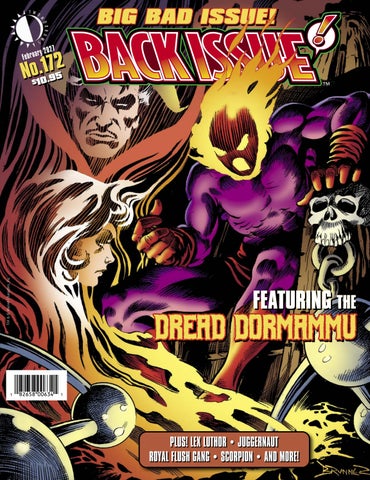
BIG BAD ISSUE! ar Febru
y 202
7
2 7 1 . o N 10.95
TM & © Marvel Characters, Inc.
$
™
FEATURING the
DREAD DORMAMMU
PLUS! LEX LUTHOR • JUGGERNAUT ROYAL FLUSH GANG • SCORPION • AND MORE!
2027
TwoMorrows News Today DON NEWTON: DRAWING WITH POWER
• TwoMorrows now co-publishes HOGAN’S ALLEY (but order only through comics shops, not direct)! • ALTER EGO is now quarterly, while ROY THOMAS finishes writing his autobiography series!
All characters and properties TM & © their respective owners.
DON NEWTON got his start on the Phantom at Charlton Comics before making his mark at DC Comics on Aquaman, the New Gods, Batman, and the Shazam! comic in 1978, featuring his childhood favorite character Captain Marvel. His love of bodybuilding brought a knowledge of human anatomy to the strips he drew, imbuing his characters with a sense of strength and dynamism few could match. But his death in 1984 at just 49 years old, tragically cut short an artistic career that was yet to reach its peak. Now for the first time, this COLOR HARDCOVER pays tribute to the Bronze Age fanfavorite artist. Written by JAY WILLSON and CHRIS IRVING, it includes a comprehensive overview of Newton’s life and career, personal anecdotes and tributes, plus private photos and a wealth of unseen work by the artist. With a new cover collaboration by DON NEWTON and JOE RUBINSTEIN! (160-page COLOR HARDCOVER) $37.95 (Digital Edition) $13.99 • SHIPS APRIL 2027
COMIC BOOK CREATOR #52: INSIDE THE MIGHTY MARVEL BULLPEN
Our third annual double-size issue goes inside the mighty Marvel Bullpen, courtesy of LES DANIELS’ uncut interviews from his 1992 book Marvel: Five Fabulous Decades Of The World’s Greatest Comics. It features STAN LEE, ROY THOMAS, ARCHIE GOODWIN, GERRY CONWAY, LEN WEIN, JIM SHOOTER, MARK GRUENWALD, TOM DeFALCO, LOUISE SIMONSON, JIM SALICRUP, STEVE GERBER, CHRIS CLAREMONT, JOHN ROMITA, JOHN BUSCEMA, DON HECK, GENE COLAN, WALTER SIMONSON, TODD McFARLANE, JOE SIMON and more! Plus Les discusses THE MAD PECK and the real reason his Marvel history book was published! And of course, HEMBECK! (160-page COLOR SOFTCOVER) $26.95 • (Digital Edition) $9.99 • SHIPS OCT. 2027 (counts as two subscription issues)
COMIC BOOK CREATOR #50 COMIC BOOK CREATOR #51 COMIC BOOK CREATOR #53 MARVELMATION BONUS-SIZE 100-PAGE ISSUE! Top pros on MARK WAID SPOTLIGHT! JOE McCABE Black Lightning co-creator TREVOR VON LIMITED HARDCOVER
ONLY 300 COPIES! THE JACK KIRBY COLLECTOR #98 examines Kirby’s final act in comics & animation (1976–1994), now in a double-size LIMITED HARDCOVER EDITION, from his return to Marvel Comics, through his lengthy stint in animation, up to his passing in 1994! (160-page COLOR HARDCOVER) $36.95 (Digital Edition) $14.99 • Now shipping!
the impact JACK KIRBY made as a storyteller, artist, and human being. Coinciding with JACK KIRBY COLLECTOR #100, JON B. COOKE and JOHN MORROW discuss the meaning of Kirby and his legacy! Also: BRENDAN McCARTHY on early work with BRETT EWINS and PETER MILLIGAN, ’Mazing Man discussion with STEPHEN DeSTEFANO and BOB ROZAKIS, and more!
conducts a career-spanning interview, including his work as editor of Amazing Heroes, DC editor and fan-favorite scripter on The Flash, Captain America, Kingdom Come with artist ALEX ROSS, and more! Plus, the history of FANTACO, Wimmen’s Comix’s BECKY WILSON, the never-published JOE KUBERT-edited Savage World, PAT OLLIFFE, and more! GIL KANE cover.
EEDEN on early work at DC Comics including “Green Arrow” and co-creation of the ground-breaking Thriller series, Heavy Metal contributions, and others. Plus JOE SIMON’s Harvey Comics “Thriller” line, ’70s comics writer LARK RUSSELL, PETER POPLASKI, ROBERT KANIGHER and DICK ARNOLD (son of Quality Comics’ “Busy” Arnold) interviews, and more!
(100-page FULL-COLOR magazine) $12.95 (Digital Edition) $4.99 • Ships June 2027
(84-page FULL-COLOR magazine) $10.95 (Digital Edition) $4.99 • Ships August 2027
(84-page FULL-COLOR magazine) $10.95 (Digital Edition) $4.99 • Ships Dec. 2027
NEW SUBSCRIPTION RATES
2027
Print subs get free digital editions!
ECONOMY US
Poly mailer, backing board
Alter Ego (Four print issues) Back Issue (Eight print issues) Comic Book Creator (Six print issues) Cryptology (Six print issues) Jack Kirby Collector (Four print issues) RetroFan (Six print issues)
$56 $112 $84 $84 $56 $84
PREMIUM US
AMERICAN COMIC BOOK CHRONICLES: FULL SET GET THE FULL SET, COVERING COMICS HISTORY FROM THE 1940s TO THE 1990s! You get all 8 HARDCOVER VOLUMES ($377.60 cover price, 2168 pages) as a set at a new low price, with digital editions included! Or order the full set of digital editions separately. (All 8 FULL-COLOR HARDCOVERS) $200 (Digital Editions) $127.99 (No substitutions, price is for a full set only)
Rigid mailer
Includes €3 duty
EU/UK
OTHER NON-US
DIGITAL ONLY
$71 $142 $107 $107 $71 $107
$99 $198 $149 $149 $99 $149
$85 $170 $128 $128 $85 $128
$19 $39 $29 $29 $19 $29
TwoMorrows. The Future of Pop History. TwoMorrows Publishing • 10407 Bedfordtown Drive • Raleigh, NC 27614 USA
Duties not included
No print issue
Phone: 919-449-0344 E-mail: store@twomorrows.com Web: www.twomorrows.com Sign up for our mailing list:
https://groups.io/g/twomorrows
Free 2027 Digital Catalog! https://www.twomorrows.com/media/TwoMorrowsCatalog.pdf
Volume 1, Number 172 February 2027 EDITOR-IN-CHIEF Roger Ash PUBLISHER John Morrow
Comics’ Bronze Age and Beyond!
DESIGNER Rich Fowlks EDITOR EMERITUS Michael Eury COVER ARTIST Frank Brunner (Originally published as the back cover to Marvel Treasury Edition #6. Original art scan courtesy of Heritage Auctions.) COVER DESIGNER Michael Kronenberg COVER COLORIST Glenn Whitmore PROOFREADER Kevin Sharp SPECIAL THANKS Brian Martin Dan Abnett Matt Merante Cary Bates David Michelinie Paul Burns Al Milgrom Mike Carlin Fabian Nicieza Gerry Conway Bob Rozakis Tom DeFalco Doug Smith Steve Englehart Elizabeth M. Smith Austin Gorton Roy Thomas Grand Comics John Wells Database Heritage Auctions Joshua Winchester Marv Wolfman Dan Jurgens Doug Zawisza Karl Kesel Paul Kupperberg Erik Larsen Elliot S. Maggin
Don’t STEAL our Digital Editions! C’mon citizen, DO THE RIGHT THING! A Mom & Pop publisher like us needs every sale just to survive! DON’T DOWNLOAD OR READ ILLEGAL COPIES ONLINE! Buy affordable, legal downloads only at
www.twomorrows.com or through our Digital Storefront at
www.comicshistory.org & DON’T SHARE THEM WITH FRIENDS OR POST THEM ONLINE. Help us keep producing great publications like this one!
BACKSEAT DRIVER: Editorial by Roger Ash . . . . . . . . . . . . . . . . . . . . . . . . . . . . . . . . . . 2 BRING ON THE BAD GUYS: The Evolution of the Pre-Crisis Lex Luthor . . . . . . . . . . . . 3 An examination of Superman’s greatest foe BRING ON THE BAD GUYS: Scorpion: This Might Sting. . . . . . . . . . . . . . . . . . . . . . . 21 Spider-Man’s long running opponent BRING ON THE BAD GUYS: The Royal Flush Gang . . . . . . . . . . . . . . . . . . . . . . . . . . . 29 They’re not playing with a full deck BRING ON THE BAD GUYS: Hello Darkness, My Old Friend . . . . . . . . . . . . . . . . . . . . 35 Dare to discover the dread Dormammu BRING ON THE BAD GUYS: The Cold Heart of a Killer Frost . . . . . . . . . . . . . . . . . . . 47 Meet all three versions of this frosty menace BRING ON THE BAD GUYS: The Riddle of the Sphinx. . . . . . . . . . . . . . . . . . . . . . . . . 57 The villain doomed to live his life over again BRING ON THE BAD GUYS: Juggernaut: Blue Collar Super-Villain. . . . . . . . . . . . . . . 67 Charles Xavier better look out. His stepbrother is on the way BACK to the Drawing Board: The Ten-Eyed Man. . . . . . . . . . . . . . . . . . . . . . . . . . . . . 76 A very strange Batman villain Back Talk. . . . . . . . . . . . . . . . . . . . . . . . . . . . . . . . . . . . . . . . . . . . . . . . . . . . . . . . . . . . 78 BACK ISSUE™ issue 172, February 2027 (ISSN 1932-6904) is published monthly (except Jan., March, May, and Nov.) by TwoMorrows Publishing, 10407 Bedfordtown Drive, Raleigh, NC 27614, USA. Phone: (919) 449-0344. Periodicals postage paid at Raleigh, NC. POSTMASTER: Send address changes to Back Issue, c/o TwoMorrows, 10407 Bedfordtown Drive, Raleigh, NC 27614. Michael Eury, Editor Emeritus. Roger Ash, Editor-In-Chief. John Morrow, Publisher. Editorial Office: BACK ISSUE, c/o Roger Ash, Editor, 2715 Birchwood Pass, Apt. 7, Cross Plains, WI 53528. Email: rogerash@hotmail.com. Eight-issue subscriptions: $112 Economy US, $198 EU/UK, $170 other non-US countries, $39 Digital. Please send subscription orders and funds to TwoMorrows, NOT to the editorial office. Cover artwork by Frank Brunner. TM & © Marvel Characters, Inc. All Rights Reserved. All editorial matter © TwoMorrows and Roger Ash. Printed in China. FIRST PRINTING
The Big Bad Issue • BACK ISSUE • 1
by J o h n
Wells
In the days when Superman was a boy, another figure stepped forth to join the fight for justice. His identity hidden by a red mask and yellow costume, the tech-based Amazing Man quickly won the adoration of the citizens of Hadley and any skepticism expressed by Superboy was dismissed as professional jealousy. In fact, the Boy of Steel’s doubts were well founded and he soon produced evidence that Amazing Man had been playing a long game aimed at looting the entire community. Unmasked and sent to prison, the bald so-called hero shook his fist at his captor. “When I get out, you’ll have reason to regret this,” he swore. “As sure as my name is Luthor!” Wait…what?!! If young readers of mid-1957’s Superboy #59 (Sep. 1957) were shocked to read the origin of the Superman/Luthor feud, imagine the reaction of later generations familiar with very different accounts of that formative rivalry. There had been many forks in the road on the way to the Luthor of the Bronze Age and beyond, but it started with writer Jerry Siegel and artist Joe Shuster. For Clark Kent, the story began in Europe, where he and fellow war correspondent Lois Lane had been dispatched to cover the country of Toran’s invasion of neighboring Galonia (Action Comics #22, March 1940). Behind the scenes, Kent learned in Action #23, a mysterious weapons broker called Luthor aimed to “engulf the entire continent in bloody warfare” and eventually pit the nations of the world against each other. Armed with advanced technology that included holograms and a fearsome green death-ray, Luthor stood before Superman with a mop of red hair and a crimson robe to match. “Just an ordinary man,” he purred, “but with the brain of a supergenius. With scientific miracles at my fingertips, I’m preparing to make myself supreme master of th’ world.” The Man of Steel was unimpressed, tearing into the villain’s dirigible complex and sending the airship to a fiery end on the fields below. “And that’s th’ end of Luthor,” Superman declared to Lois. It was not. Moving to the United States, Luthor made his continued presence known by triggering earthquakes in Metropolis in Superman #4 (Feb. 1940). By the time Luthor went down in a plane crash (Superman #5), there wasn’t much doubt that he’d be back. The surprises were where…and in what form. Superman’s massive popularity had quickly translated to a spin-off comic strip and it was there that Luthor resurfaced on November 15, 1940. Although he still communicated with Superman using holographic imagery as he had previously, the villain seemed to have aged dramatically virtually overnight. He wasn’t just bald but sunken-cheeked and dressed in a side-button white surgical smock. Luthor resembled no character so much as the Ultra-Humanite, a Superman nemesis who appeared half a dozen times (starting in Action #13) before Luthor came along. Fans would later theorize that Luthor’s sudden hair loss was an art reference error: One of Joe Shuster’s assistants looked at a bald underling in an earlier tale and assumed it was Luthor. It’s quite plausible but the point of reference was more likely the earlier mad doctor. Notably, the November 22, 1940 comic strip referred to Luthor as “the evil ultra-scientist.” Paging through early issues of Action Comics for reference, the assistant would have seen multiple pages featuring the evil
Lex Luthor was completely in his element when he appeared in the 1978 DC Super-Heroes Poster Book. TM & © DC Comics.
The Big Bad Issue • BACK ISSUE • 3
scientist named Ultra and could easily have leapt to an incorrect conclusion. Coincidentally, the earliest piece of Luthor merchandising—part of a 1940 Superman paper doll set— consisted of a cut-out of the red-haired, robed villain on the same sheet as the wheelchair-bound Ultra. In any event, Luthor’s hairless skull became a signature feature of the villain in the comic books from March 1941’s Superman #10 going forward. An early highlight was 1942’s Action #47 and Superman #17, wherein Luthor’s acquisition of the Powerstone enabled him to match the Man of Tomorrow in pure physical strength. As the 1940s rolled into the 1950s, Luthor shed his penchant for robes and doctor’s smocks in favor of a suit and tie. He also gained weight, with artist Wayne Boring in particular rendering him with a double chin. In a period when most of Superman’s recurring adversaries were comical tricksters, Luthor took things seriously. He formed an alliance with the Prankster twice—joined by Mr. Mxyztplk the first time (1950’s Action #151) and Toyman the second (1954’s Superman #88)—but generally aspired to more than merely humiliating the Man of Tomorrow. Luthor wanted him dead, even synthesizing artificial kryptonite a scant nine months after Superman learned that the real thing could kill him (1950’s Action #141). Luthor (played by Lyle Talbot) also created synthetic kryptonite—and a precursor to the Phantom Zone—in the 1950 movie serial Atom Man vs. Superman. Remarkably, the villain bypassed the 1940s radio show and the 1950s TV series. His television debut finally came in 1966’s animated New Adventures of Superman. By the start of 1960, twenty years after his debut, Luthor could boast 61 comic book appearances to date and even more in the newspaper strip. He could afford to relax his wardrobe going forward, switching from three-piece suits to prison grays in the new decade, exemplified by the Superman feature’s de facto top artist Curt Swan. Between issues on sale in January 1960 and December 1969, the Man of Steel’s greatest foe made an astonishing 103 comic book appearances, including an “All-Luthor Issue” (Superman #168)! That number doesn’t include reprints such as those in 80-Page Giant #11’s Luthor compendium in 1965. Scheduled to be featured in both January 1968’s Jerry Lewis #105 and Jimmy Olsen #109, Luthor’s appearance on the former’s cover was lyle talbot disguised at the last minute with facial hair. One can speculate that there were fears of oversaturation. The villain’s ascendance stemmed in part from a fateful decision by Mort Weisinger that coincided with Luthor’s 20th anniversary. In March 1960’s Adventure Comics #271, the Superman line’s editor struck Jerry Coleman and John Sikela’s 1957 Amazing Man origin from the record in favor of a new one. Fittingly, “How Luthor Met Superboy” was written by their creator Jerry Siegel. Joined by artist Al Plastino, Siegel documented the fast friendship of the teenage Superman and a newcomer to Smallville who was a scientific prodigy. Enthusiastically building
(top) An early Lex appearance in Action Comics #47. Art by John Sikela. Lex’s persona evolved from businessman (2nd row) in Superman #17, art by Joe Shuster and John Sikela, to (3rd row) mad scientist in Action Comics #141, art by Bob Oksner, and (5th row) Action Comics #151, art by Stan Kaye. (bottom left) Lex was reworked in the artwork for (bottom right) Jerry Lewis #105’s cover. Art by Wayne Boring and Stan Kaye. TM & © DC Comics.
4 • BACK ISSUE • The Big Bad Issue
His first full story was an imaginary tale in 1967’s World’s Finest #167, positing a world with Lex Luthor as Superman and Clark Kent as Batman. The last comics with Weisinger’s editorial byline (1970’s Superman #230-231) also featured a Bates alternate history with a variation of Lex as the Man of Steel. The final major Luthor story on Weisinger’s watch was a late 1969 Leo Dorfman/Win Mortimer/Jack Abel two-parter (Adventure Comics #387-388) that revisited Lex’s sister Lena Thorul. Unseen since her 1964 wedding (Action #317), Lena was now the mother of a blond toddler named Val Colby who received mysterious gifts each year on his birthday. This time, it was a space jewel that endowed the boy with psychokinetic powers. Uncle Lex was only too happy to exploit his nephew. Once the abilities conked out, Luthor handed the boy off to Supergirl while telling Val that he lied about being his uncle. Even now, he was protecting Lena from the family secret. Luthor had no such concerns about his college-age niece Nasthalthia, who emerged out of the blue in July 1970’s Adventure Comics #397. As part of the post-Weisinger shake-up, editor/writer/penciler Mike Sekowsky gave Supergirl a Luthor all her own and enrolled Nasty at Stanhope University alongside Linda Danvers. The newcomer aspired to unmask the Girl of Steel—with Linda her prime suspect—but she never succeeded. Uncle Lex popped in for a second visit in issue #401 but Nasty otherwise played things solo in the supporting cast through her last appearance in Adventure #424 (1972). Continuity-conscious assistant editor E. Nelson Bridwell knew that Lex’s niece didn’t jibe with established history so he revised the family tree in Adventure #401’s letter column. “Luthor does have an older sister, one who married a European gentleman and has been living abroad. Lena Colby is unaware of this sister’s existence because her parents disapproved of their daughter’s early marriage and had no communication with her when they were killed in an accident.” A more egregious error in the Murray Boltinoff-edited Superboy #159 (July 1969) had the Teen of Steel fighting an adult Luthor! Writer Frank Robbins and penciler Bob Brown’s subsequent Luthor stories in issues #166, and 169 (1970) properly depicted the villain as a teen himself. All three tales used the same broad formula of having Luthor’s involvement revealed in the climax after appearing in disguise for most of the plot. Leo Dorfman followed suit in issue #177 (1971), where Luthor posed as an alien invader. Cary Bates (with Curt Swan and Murphy Anderson) continued that pattern in the Boltinoff-edited Action #407 (Oct. 1971). In this case, Lex played the tech-savvy crony of a drug-running pilot who accidentally discovered the location of Superman’s arctic sanctum. The fact that “Slesar” could pick the locks of the Fortress of Solitude was a big clue that he wasn’t a common hood. The unmasked Luthor had no interest in looting the place. He was there to plant an anti-matter fusion bomb primed to activate when Superman opened the door. “More than anything else,” he emphasized, “I want him and his Fortress annihilated!” The Man of Steel got rid of the device, of course, but he was incredulous that Lex was willing to be a suicide bomber. “Do you hate me that much?” “You know the answer to that, Superman.” Two months later, in Superman #248, Luthor’s obsession seemingly wiped out the human race. Drawing on primal matter from the cosmos, Lex formed a hulking starfield he called the Galactic Golem. The parasitic entity craved stellar energy so Luthor funneled a portion into an unwitting Superman and put a huge target on his back. A clash of titans ensued and the Man of Steel desperately tapped the Golem’s own energy to temporarily shift all of humanity to another dimensional plane. Unaware of what had happened, a guilt-ridden Lex wound up joining forces with Superman to lure the Golem away from Earth. When it was over and Earth’s people returned, Luthor’s relief was palpable.
(top left) Superman #167 has teams Lex with Brainiac. Cover by Swan and Klein. (top right) Even Lex’s relatives are criminals! Adventure Comics #387, cover by Swan and Anderson. (bottom) Lex invades the Fortress of Solitude in Action Comics #407, art by Swan and Anderson. Original art scan courtesy of Heritage Auctions (www.ha.com). TM & © DC Comics.
The Big Bad Issue • BACK ISSUE • 7
(top) Luthor came to animation in the 1966 New Adventures of Superman. (middle) Lex got action figures from Mego. (bottom) Luthor’s model sheet from Challenge of the Superfriends. TM & © DC Comics.
10 • BACK ISSUE • The Big Bad Issue
of Doom on 1978’s Saturday morning cartoon Challenge of the Super Friends. “Turned out the licensors liked it,” Maggin tells BI, “but I didn’t much. I liked the mechanical lizard suit that we used later even less. I was always partial to the gray prison fatigues. I don’t even think Lex much like dressing up like a costumed villain. Reminded him too much of all the costumed freaks in the Justice League.” Meanwhile, Maggin reconsidered Luthor’s Lair for Superman #282. The villain now occupied a sunny midtown penthouse in Metropolis with a well-compensated staff. Running the operation like a thriving business, he promised team members they would be “paid triple-time for the period they spend in prison. Never let it be said that Lex Luthor’s an unfair employer.” As Maggin wrote in 1978’s Superman: Last Son of Krypton, it was “the highest paid staff in organized crime.” Luthor’s business faced a hostile takeover in January 1975’s Superman #286, where the Parasite mimicked Lex’s voice and general authority to plunder the villain’s arsenal. It fell to a snarky Lex and a delirious Superman to save the embattled Metropolis. With victory assured, Luthor dosed the fallen hero with a potion to revive him. “That will get you back in shape, but not before I take off. I want no one to beat you but me! “I liked the Parasite story,” Maggin declares. “I started writing it in the subway on the trip home. I always looked for excuses for Supes and Luthor to put a temporary hold on the cutthroat enmity. It lets them interact more and gives them more room for the snark. I think if I were writing the series today, I’d have Superman send some snark back. Or maybe he’d just think of witticisms and not toss them around out loud. Thought balloons have fallen into some disuse lately, but I think it’d be fun to have Superman think of a few choice putdowns in any given situation and not use them because he considers it beneath him.” Asked about his approach to Luthor, Maggin considers “the most influential stories—that is, the ones that most stick in my mind—are ‘The Death of Superman’ (the real one; the imaginary story from 1961) and ‘How Luthor Met Superboy’ from Adventure Comics in 1960.” The latter was reprinted in July 1975’s Limited Collectors’ Edition #C-39, neatly pivoting into Maggin’s next Luthor tale (with Swan and Bob Oksner) a few weeks later in Superman #292. Framed with a destructive present-day clash, the plot flashed back to a reevaluation of the original Lex/Superboy feud. In Maggin’s account, the pre-accident Lex had been no choirboy. Rather, he was impish, cocky, and prideful, qualities that all played into his reaction to losing his hair and having his experiment go south. “I loved ‘The Luthor Nobody Knows,’” Maggin states. “I’d been mulling over a story like that for a long time before I wrote it. When people ask me what I’d have done with Superman if I had continued to write the comic, I always say I’d do more to develop the relationship between Superman and Lex—both in terms of their history
by M
att Merante
“A man who studieth revenge keeps his own wounds green” —Sir Francis Bacon Scorpions have been powerful cultural totems for millennia. In the Zodiac, Scorpio is known as the eighth symbol from the constellation Scorpius. Zeus rewarded the scorpion by casting its visage among the stars after it stung Orion to death. Egyptian mythology holds the scorpion in high regard as a symbol of empowerment and rebirth. Aesop’s tale The Scorpion and the Frog explores the unrelenting nature of biological imperatives. And in the animal kingdom, a scorpion is a successful predatory arachnid, using brute force and deadly venom to hunt and survive for over 400 million years. Stan Lee and Steve Ditko combined both myth and nature to construct Mac Gargan, the Scorpion, who has pursued Spider-Man and J. Jonah Jameson for quite some time since being introduced in Amazing SpiderMan #19-20 (Dec. 1964-Jan. 1965). With his bright green costume, lethal prehensile tail, and countless suit upgrades, he perpetually stalks his prey after an experiment gone awry. Gargan never intended to be “The Scorpion” permanently but is forever tainted by a process he signed up for. This paradox makes the Scorpion a unique and nearly tragic figure. However, that is only the surface story. Mac Gargan is not simply a hybrid human/scorpion driven mad by genetic tampering. He is a vessel of pure unadulterated hate. The Scorpion is the living embodiment of J. Jonah Jameson’s fear and resentment towards Spider-Man, manifested in a cybernetic super-suit of insanity. He’s the Frankenstein’s monster of the Spiderverse, forever lamenting his creation while wanting vengeance on the estranged father that bore him. But what happens when one is primarily driven by hate? Will Mac Gargan ever find what he is seeking, or did his transformation reveal an innate nature that was already present? Let’s crack open this exoskeleton and see what the Scorpion can teach us about rebirth, revenge, and recursion!
The Scorpion crashes the original Clone Saga. Amazing Spider-Man #145 cover by Gil Kane and John Romita. (inset) The Scorpion makes his dynamic debut in Amazing Spider-Man #20. Cover by Steve Ditko. TM & © Marvel Characters, Inc.
The Big Bad Issue • BACK ISSUE • 21
SCORPLING SPONSORSHIP
From the very start, Daily Bugle publisher J. Jonah Jameson hated Spider-Man. His distaste was so pervasive that he paid a middling private investigator to undergo an experimental process in ASM #20 (Jan. 1965) to defeat Spidey–a process that drove the subject, Mac Gargan, insane. Jameson created a nemesis that would hate him and Spider-Man in equal measure. How did this come to be and why did private gumshoe Mac Gargan agree to drink untested mutated scorpion juice? Well, it came down to a fairly common motivator: money. As Mac stated himself, “I’m getting $10,000 also for my part in this… and I’d do anything for that kind of dough!” Adjusted for inflation, that’s about $103,000 today. Still, getting paid six figures to gain scorpion-like strength and endurance while losing one’s sanity seems a bit short-sighted. Dr. Farely Stillwell, who accepted a bribe to test black science on a human, also had a scorpion suit with a cybernetic tail on hand. Gargan was corrupted by his newfound powers. He soon robbed a bank after tossing Spider-Man around like a ragdoll. The morally mercurial Dr. Stilwell tried to deliver a cure to Gargan after realizing his formula was problematic. Declining, Scorpion used his tail to fatally knock him off the side of a building. Mac went from being a mediocre PI to a robbing, murdering, maniacal monster in less than 48 hours! Jameson soon realized the consequences of his actions. “It’s all my fault…just to satisfy my own personal hatred I tried to destroy Spider-Man! And, in so doing, I’ve unleashed a far worse menace upon the world!” Spider-Man outmaneuvered the stronger, slower Scorpion by tearing off his tail and knocking him out cold. Jameson would have a brief respite, but nine months later the menacing Scorpion would return. In ASM #29 (Oct. 1965), Scorpion escaped prison after the guards provided him with his costume for psychological comfort (hopefully they were relieved of their duties). He headed straight for the Daily Bugle to directly confront Jameson while tail-smashing every desk and file cabinet the company owned. After a long battle amongst the NYC skyline, Spidey created “web-bolas” to stifle Gargan. He then outlasted him in an underwater scuffle with his incredible lung capacity! Who knew spiders could hold their breath longer than scorpions? Again, Jonah was the target here, and he selfishly kept his role in Gargan’s origin story to himself. But folks were becoming suspicious.
CLONING AROUND
(top left) Less than a year later, the Scorpion is back in ASM #29. art by Steve Ditko. (top right) Spidey wasn’t the only hero to feel the Scorpion’s sting. Captain America #122 cover by Gene Colan and Joe Sinnott. (bottom) The Scorpion and Spider-Man go toe-to-to in ASM #29, art by Ditko. Original art scan courtesy of Heritage Auctions (www.ha.com). TM & © Marvel Characters, Inc.
22 • BACK ISSUE • The Big Bad Issue
Peter Parker and J. Jonah Jameson were not the only ones to cross paths with the Scorpion and his tail. Captain America had the pleasure of deflecting caudal strikes with his shield in Captain America #122 (Feb. 1970), saving Agent Thirteen. They met again in Captain American #151-152 (Apr.-May 1972), this time in a tag-team match: Cap and Falcon versus Scorpion and Mr. Hyde. The Scorpion would reappear in ASM #145-146 (June-July 1975), by Gerry Conway and Ross Andru. In the midst of the “return” of Gwen Stacy, Gargan showed up to make another bank withdrawal after again being released for good behavior. These two arch-arachnids quickly faced off in a construction zone with Scorpion knocking an emotionally distraught Spidey into a concrete mixing vat. Believing he’d defeated Spider-Man once and for all, an overzealous Scorpy decided to test his abilities against the world of organized crime?! After being chased away by mafia bullets, he encountered the Jackal who saw a mutual benefit in combining forces. The Jackal used Scorpion as a tool for his machinations, much like Jonah did years ago. He aimed Gargan at a hospitalized Aunt May in order to smoke Spider-Man out. Peter Parker was visiting with Aunt May at the time of Scorpion’s intrusion, and after a quick change he drew Gargan away, pummeling him thoroughly. The battle concluded with Spider-Man slugging him off the top of the Chrysler Building! The Scorpion was
A Royal Flush is incredibly rare when playing poker. Unless it’s in the movies, then it is pretty much the easiest hand for the hero to get. But in comics, the Royal Flush Gang has perennially been one of those middle of the pack villain groups that gets trotted out fairly regularly, but very, very seldom are they a real threat. The RFG had a joker in their deck though, as this group was quite frequently portrayed as under the sway of a more major league antagonist, and part of a larger plan. With that in mind, we’ll put on our dealer’s visor, do a little fancy shuffling, and more than a few times deal from the bottom of the deck as we examine the career of these pasteboard purveyors of plunder.
CUT THE DECK
by B
rian Martin
The card themed crooks would first come to the table in a pair of 1960s issues of Justice League of America (love those go-go checks!). First in issue #43 (Mar. 1966) then to be dealt with again in issue #54 (June 1967). Both were the creations of writer Gardner Fox and penciler Mike Sekowsky. Bernard Sachs and Sid Greene were the respective inkers. Beginning life garbed in the suit clubs, the initial conflict features the group’s leader discovering a force called Stellaration which he charges various playing cards with to achieve various effects (taken from actual cartomancy) when directed against a foe. The five of diamonds gives bad news, the four of diamonds means betrayal, etc. The JLA finally discovers the source of the Royal powers and charges up team mascot Snapper Carr to offset the effects, dressing him as a joker—a white and red garbed one with bells so as not to confuse him with the Joker, we presume. Upon defeat, the Flushers (hmm, might need a better nickname) are shown to be led by frequent League antagonist Amos Fortune. Thus, the trend of being someone’s gang started very early. For their return engagement, a bit of a change in tactics was called for as the Gang first battle the JLA dressed as the historical inspirations for various cards in a deck. Still powered by the same energy, the RFG still meets defeat at the hands of the Justice League. The group were shuffled into the deck and did not emerge until Martin Pasko wrote, and Irv Novick and Tex Blaisdell illustrated issue #5 (Jan.-Feb. 1976) of The Joker where the predictable conflict between the group and the titular villain occurred. More apt after the climax of the first Gang appearance of course. A new Ace has taken over and even switched the group’s suit to spades. The symbology of the various cards is still a weapon used by the gang, a holdover to their Fortunate origins. The Joker manages to resist these weapons however, indicating they are based on the power of suggestion, something his insane mind is not affected by. Joker uses a couple of simple string gimmicks to tie up the entire group for the police—not a high point in Gang history. Just a final Bronze Age tidbit for everyone. The plot of the issue revolves around a set of paintings. But during the course of the story, Joker reveals his real name and the fact that his grandfather painted those works and splashed experimental paint in his face turning his skin white. I don’t know how many of these sorts of tales turned up in the Bronze Age, but this one can definitely be counted as a Clown Prince concoction.
Stylish artwork from the cover of Justice League of America #203 by George Pérez and Dick Giordano. TM & © DC Comics.
The Big Bad Issue • BACK ISSUE • 29
VINTAGE CARDS The Royal Flush Gang was not the first card themed deck of villains. Debuting in Captain Marvel Jr. #7 (May 1943) were the Ace, King, Queen, and Jack of crime. Dressed more based on their nomenclature than anything card based, they certainly had a previous claim to the schtick. Someone should have dealt them a ten, though.
Not long after, a single Gang member broke away from the pack. Secret Society of Super Villains #2 (July-Aug. 1976) featured the new member Hi-Jack. Gerry Conway, David Kraft, Pablo Marcos, and Bob Smith were the creative team who inducted him and he played a fairly substantial role in this issue and the next. Unfortunately, early in issue #4 he was dispatched to limbo by the Wizard. He would not remain there though, as Conway wrote the tale that showed him residing in prison in JLA #167 (June 1979). The Jack was back in the gang for their clash with Wonder Woman in issue #256 of her title the same month. Different sources claim this is the same Jack and that it is not. Maybe just from a different suit?
DEALER’S CHOICE
The idea for the grouping appeared to be too good to let go however, and the concept, with new players recruited for the various cards, made their return in grand fashion in JLA #203 (June 1982). Gerry Conway scribed the story for Don Heck and Romeo Tanghal to illustrate over this and the next two issues. At the end of the first instalment, we are once again aware that the Royals (that’s a little better) are being used. The Ace this time is a robot who reports to a mysterious master over a view screen. The Gang attacks the JLA and puts some members into a coma with something called Z-Radiation that is slowly stealing their minds. Turns out the puppet master this time is Hector Hammond, who needs the brain power to end his long paralysis. The tale had a twist as the Jack in this deck turns over a new card and assists the JLA, not keen on serving a robot, and the disembodied Hammond suffering his final defeat at the “hands” of the equally spectral silent half of Firestorm, Professor Martin Stein.
THE ACE OF SPADES
(top left) The Royal Flush Gang make their debut in Justice League of America #43. Cover by Mike Sekowsky and Murphy Anderson. (top right) The RFG would go after anyone. Wonder Woman #256 cover by José Delbo and Vince Colletta. (bottom) Meeting the Joker seems natural for the RFG. Joker #5 art by Irv Novick and Tex Blaisdell. Original art scan courtesy of Heritage Auctions (www.ha.com). TM & © DC Comics.
30 • BACK ISSUE • The Big Bad Issue
The Royal Flush Gang would not appear again until after Crisis on Infinite Earths reorganized the DC Universe. But their return showed that some things never change. Justice League #4 (Aug. 1987) was by the legendary team of Keith Giffen, J. M. DeMatteis, Kevin Maguire, and Al Gordon. The JL had not quite segued into full “Bwa-ha-ha” mode on the title yet, so this issue was still a very serious deal; plus, it brought Booster Gold into the mix, possibly responsible for changing the direction of the group for the foreseeable future. The RFG attacks the JL just as Booster is leaving a meeting after berating Max Lord for trying to foist him on the group. Black Canary vocally wonders why the Royals would attack, but Booster finds them first and beats them quite easily. Until their new Ace shows up. An extremely powerful robot, it tosses the group around until the team of Booster and Blue Beetle manage to defeat it and Booster is welcomed onto the team. Though we suspect it at the time, we later find out the card themed cads were hired by Lord to make Gold look good and get him on the team. Just another case of them carrying out someone else’s agenda.
by P a u l
Burns
Kevin Nowlan’s rendition of Dormammu. (inset) Dormammu makes the cover of Bring on the Bad Guys. Art by John Romita. TM & © Marvel Characters, Inc.
It’s fitting this article is under the Bring on the Bad Guys banner, as the 1976 book of the same name was the first time I encountered Dormammu. There he is, menacingly sharing the cover with Doctor Doom, Mephisto, Red Skull, Loki, Green Goblin, and Abomination. Forty-nine years later, those Bad Guys gather together in individual issues of a connecting miniseries, giving Dormammu his first ever solo title. I guess Marvel finally gave the devil his due. Dormammu is first mentioned in Strange Tales #115 (Dec. 1963). The Ancient One, under attack by former student Mordo, utters an incantation to repel the black magic: “I summon the powers of the Vishanti! By the spell of the Dread Dormammu, in the name of the all-seeing Agamotto…all thy powers I summon.” A few panels later, Mordo is seen calling upon the unseen Dread One for more power: “Let the force of your power descend upon my enemy! Let him feel your fatal touch! I beseech you, Dormammu!” Strange himself invokes Dormammu’s name in Strange Tales #116 (Jan. 1964) and with Mordo back to calling on “all the dread powers of the mighty Dormammu” in the following issue, it was inevitable readers would eventually see the mysterious deity. Interviewed in Mike Conroy’s 500 Comicbook Villains (2004), Stan Lee admitted the name Dormammu sparked intrigue among the readers of Doctor Strange. “It seems there was something about that nutty name, Dormammu, that was keeping Doc’s devoted disciples awake at nights trying to figure out who Dormammu was,” Lee explained. “I knew I was in big trouble. I had made up the name–now I had to dream up a character to go with the name.” Enter artist and Dormammu co-creator Steve Ditko. “He gave the demonic DD…a visage totally different from any villain I had ever seen in comics before,” Lee stated. “He gave him a face which was not a face, a head which is more than a head!” Ditko’s design of a nightmarishly screaming, featureless face surrounded by flame provides a truly demonic presence to torment the newly established Master of the Mystic Arts. But on the upside, Dormammu’s debut also introduced Strange to the love of his life. Lee, at his alliterative best, introduces Strange’s newest bad guy with the title “The Domain of the Dread Dormammu” in Strange Tales #126 (Nov. 1964). Ditko’s art blew away Steve Englehart, as he explains to BI: “What appeals to me is the splash page, look at that thing. That is a Marvel Comic with everything that entails, announcing The Dread Dormammu! Starting right here, I’m all-in on whoever Dormammu turns out to be. (I have often told how comic art sucked me into comics, with writing coming out of left field, and here’s what I’m talking about. I flat out love everything about this page, including Artie Simek’s The Dread Dormammu!) And it’s just as well, because the Dread One in his origin story is a run-of-themill bad guy, spouting standard supervillain lines. But Ditko threw in a mysterious white-haired girl, and that required, over time, a ‘fleshing out’ of the family dynamics in the Dark Dimension. So, by the time I wanted to write him, Dormammu had come to live up to his lettering.” The Big Bad Issue • BACK ISSUE • 35
(left) Doctor Strange descends into the realm of Dormammu. Strange Tales #126 art by Steve Ditko. (right) Dormammu squares off against Eternity in this astounding image by Ditko from Strange Tales #146. TM & © Marvel Characters, Inc.
The Ancient One sends his disciple into Dormammu’s “Dark Realm” after a messenger delivers a warning of the Dread One’s intention to arrive on Earth. Ditko’s brilliance shines as he depicts the psychedelically bewildering confusion of the Dark Domain, along with its bizarre defenders. As Strange combats these obstacles, he is observed by the aforementioned “mysterious white-haired girl,” urging him to go back. Enter Clea, the later revealed niece of the Dread Dormammu, who fails to dissuade Strange meeting the ruler of the Dark Domain. Strange Tales #127 (Dec. 1964) pretty much does what it says on the title. “Duel With the Dread Dormammu” sees Clea explain to Strange if he defeats Dormammu, the barrier protecting the Dark Dimension will fall and her people will be slain by the Mindless Ones. Strange ignores Clea’s plea, telling her he is sworn to protect the Earth. During Strange and Dormammu’s mystical battle, the barrier weakens and the Mindless Ones enter the Dark Dimension. Strange adds his power to Dormammu’s to repair the barrier, thus ending the enmity between them. Strange’s reward is Dormammu’s vow to not invade Earth, and a promise not to harm Clea. When Strange returns to Earth, a rejuvenated Ancient One bestows a new red cape and amulet to him.
36 • BACK ISSUE • The Big Bad Issue
Duty-bound to that pesky vow, Dormammu nonetheless casts a large, demonic shadow over Strange Tales #130-141 (Mar. 1965-Feb. 1966) using his servant Mordo to do his bidding, imbuing him with greater powers to challenge Strange and the Ancient One. The sprawling saga has Dormammu pulling Mordo’s strings, ordering him to pursue Strange around the world. Strange realizes even his formidable powers may not be enough to defeat Dormammu and plunders the Ancient One’s mind to learn the location of the omnipotent Eternity, who refuses to augment Strange’s power, insisting the mage will stop the Dread One with wisdom alone. Dormammu, frustrated by Mordo’s incompetence, sends him, Strange, and the Ancient One to another dimension, where he is free to deal with Strange himself, engaging him in combat before an audience of dimensional rulers, with the fate of Earth and other dimensions hanging in the balance. The rules of the contest preclude the use of magic and demonic power; instead, the weapons of choice are the somewhat underwhelming “Pincers of Power.” With dimensions at stake, it is curious both parties agree to rely on seemingly limiting conditions, but it does allow Steve Ditko to illustrate a beautifully balletic battle.
(top left) Dan Adkins’ simple but effective cover to Doctor Strange #173. (bottom) A stunning Dormammu from Doctor Strange #173 by Gene Colan. (top right) Dormammu is featured on the cover of Avengers UK Weekly #66 by Arvell Jones and Aubrey Bradford. TM & © Marvel Characters, Inc.
38 • BACK ISSUE • The Big Bad Issue
Thomas returns to Dormammu in Doctor Strange #171 (Aug. 1968). Tom Palmer beautifully illustrates Strange’s continuing search for the missing Clea with a psychedelically grandiose landscape rivaling Ditko’s. Palmer spoke to The Comics Journal in 2015: “My first job was penciling a Doctor Strange issue, which was written by Roy Thomas. Outside of those couple of penciled pages for Wally Wood this was the first comic book penciling I had ever done and it must have shown. Dan Adkins did a tremendous job inking the issue making me and the book look quite professional.” Doctor Strange #172 (Sep. 1968) sees the return of Gene Colan on art, with Palmer inking. “When I returned to pencil another issue I was told they had a new penciler and would I like to ink him? I had done enough inking for advertising art so I took the opportunity and inked that next Doctor Strange issue,” Palmer explained. “The new penciler was Gene Colan and it was the beginning of a wonderful relationship both personal and professional. I worked hard on that first inking assignment and did everything I could to turn his illustrative pencils into inked line art for printing. I soon learned that Gene penciled quite differently than other pencilers using graded pencil tones to render form and shadow and not strictly pencil lines. I enjoyed the challenge. Marvel must have liked what I had done and I was asked to return for the next issue.” Thomas also comments on Colan’s art: “The first casualty of Colan’s debut was all those Daliesque other dimensional dreamworlds Ditko had fabricated. Gene didn’t think that way and didn’t mean to waste time trying. His nether realms consisted mostly of swirling smoke and nebulous backgrounds. Gene brought an unaccustomed realism to Doctor Strange, which changed the feel of the stories and was reflected in my writing. Tom Palmer enhanced that.” In Doctor Strange #172, Dormammu holds Clea and Strange’s friend, Victoria Bentley, captive as he recounts his battle with Eternity, which resulted in his expulsion into the Realm Unknown, there to be reunited with Clea, ironically banished by the Ancient One for her own protection. Strange battles to save both Clea and Bentley. Dormammu transports Umar to his side, and they, along with the Mindless Ones, approach the Doorway to Dimensions, but Strange bars their way. Dan Adkins’ cover to Doctor Strange #173 (Oct. 1968) is simple, but powerful. Dormammu’s fearsome visage looms behind the seemingly lifeless form of Strange. Gene Colan’s interior art continues to boggle both eyes and mind, particularly on page three, with his display of Dormammu’s fiery power. Clea transports her and Bentley away from the realm, where they empower Umar into freeing Strange from Dormammu’s energy chains. The mage then sends the Dread One through to Earth’s dimension, which is the undoing of Dormammu. As the Dread One loses power, Strange reminds him of his sacred vow to not attack Earth. By breaking it, Dormammu brings about a curse that depletes his powers. Strange uses the Winds of Watoomb to sweep Dormammu back to his Dark Dimension. Strange, flowery as ever, realizes this won’t be the last time he will encounter his foe: “Dormammu shall never rest till he has drunk deep from the cup of vengeance.” In Marvel Feature #2 (Mar. 1972) Dormammu’s disciples perform an occult ritual to summon him to Earth. The issue is beautifully illustrated by Ross Andru. “He was a longtime favorite of mine,” Thomas explains. “The other young writers (Conway, Wolfman, Wein) and I always valued Ross Andru more than Stan did. I loved working with him because he was a good storyteller.” The Defenders reluctantly reunite to battle the Dread One. Separated from his body, Strange’s astral form floats helplessly as Clea summons Sub-Mariner and the Hulk. Dormammu’s disciples intend their master to inhabit the inert body of Strange.
by D o u g
Zawisza
Just as every snowflake is different yet composed of the same base ingredient–frozen water–each of the three Killer Frosts is different yet retains a heart as cold as her villainous name. From Crystal Frost to Louise Lincoln to Caitlin Snow, these frigid femme fatales have given the Nuclear Men known as Firestorm a run for their money. Their levels of action stemming from their icy vendettas vary, sometimes even shading towards the side of (snow?) angels, but none of the Killer Frosts would exist if not for Martin Stein, Ronnie Raymond, Jason Rusch, or some amalgamation of Nuclear Men known as Firestorm. But mostly Martin Stein. More on that– a lot more–later. Keep reading. (You can read more about Firestorm in BACK ISSUE #112, the Nuclear Issue.) One of the most recognizable and persistent foes from Firestorm’s surprisingly deep gallery of rogues, Killer Frost frequently leads with her icy heart, futilely seeking the warmth of relationships as a chilling parallel to her ability to drain the warmth from the bodies of victims. Each Frost has anchored the various volumes of Firestorm’s solo series, building their collective reputation like children might assemble a snowman following a blizzard. Pour yourself a cup of cocoa–or a taller, cold drink–and settle in for this spotlight on the glacial gal from Firestorm’s adventures–all three of them!
INTRODUCING THE ICE PRINCESS
“Wrong, Martin! Crystal Frost is dead, killed by your rejection! And the instant she died, Killer Frost was born!” Thus begins a more modern Ice Age brought on by Killer Frost, particularly, Killer Frost the first in the pages of Firestorm #3 (June 1978). The precedent is set: rather than being born from flame like a phoenix, each Killer Frost sheds her humanity through a death event, reborn as a calculating, crystal-cold killer. “Kiss Not the Lips of Killer Frost” was written by Gerry Conway, drawn by Al Milgrom, inked by Bob McLeod, lettered by Ben Oda, colored by Mario Sen, and edited by Jack C. Harris. Firestorm #3 is the keystone of what became the flame-headed hero’s first five-issue series, which was cut short by the infamous DC Implosion. Interviewed specifically for this article shortly before his passing, Gerry Conway confirmed that his intent was to introduce a new villain in each issue, laying the foundation
Killer Frost is here to freeze a fiery heart in Fury of Firestorm #20. Cover by Rafael Kayanan and Dick Giordano. (inset) Killer Frost debuts in Firestorm #3. Cover by Al Milgrom. TM & © DC Comics.
The Big Bad Issue • BACK ISSUE • 47
Killer Frost makes her explosive first appearance in Firestorm #3. Art by Al Milgrom and Bob McLeod. TM & © DC Comics.
Ice versus fire. It makes sense, even beyond the obvious aspects of it.” Continuing on, Conway shared, “She’s an interesting person. She’s much older than Ronnie, and as a result, there’s an interesting dynamic playing off of the older woman versus the younger man. So that’s fun. She was a peer of Martin Stein’s, right?” Former student turned peer, it was Crystal Frost’s work–inspired by her one-time professor Martin Stein–that led her to design the Arcticbased Mohole One. Scientists gathered to devise a method to use heat from the Earth’s core to provide new energy. [Writer’s note: this comic was crafted between the 1973 oil crisis and the 1979 energy crisis, highlighting the creative team’s sci-fi science/pseudo-science leanings.] The Arctic was chosen for the natural cold it would provide, but Martin Stein had developed the critical component to make Crystal Frost’s ThermaFrost refrigeration unit successful: his experimental condenser. Stein’s arrival gave Frost the opportunity to feel seen, to be treated equally beyond the misogynistic Mohole-based scientists who she felt dismissed by, and to realize her greatest career triumph. And maybe even cash in on the schoolgirl crush she had on Stein. After all, Frost was certain Stein not only saw her as an equal, but perhaps even a love interest. Crystal Frost could not have been more wrong. Stein objectively denied any romantic interest, and crushed Frost’s hopes completely. So much so that in a fit of rage, she stormed into the ThermaFrost, accidentally bumping the automatically locking door which–you guessed it–trapped Frost in her own device, subject to the cooling power of -1000° Centigrade (or four times the temperature of absolute zero–hey, it’s 1970s pseudo-science). Killer Frost emerged a being completely crystallized from extreme exposure and dressed like a prom queen from the East Arctic Plateau. Regarding the name, Firestorm and Killer Frost co-creator Al Milgrom recalled, “I said, ‘Well, if she’s a bad guy, maybe she should be, like, a killer frost or killing frost. Like, you know, the kind of frost that kills a farmer’s planted stuff out in the fields.’ And they liked that, and they went with it, so we named her Killer for an impressive Rogues’ Gallery Frost. And, of course, arguably, in my for Firestorm. long and storied career, one of my “I like creating characters. longest lasting characters.” Let’s put that out there,” Conway Asked about her outfit, Milgrom told this interviewer. “And I love said, “An icy character was nothing the idea of a Rogues’ Gallery. My new at DC. They had about 12 of intention was to create a new villain them. I think they once did a story every issue, just build that up as where they had a bunch of them it worked out. You know, I didn’t team-up together... Killer Frost have that opportunity entirely, but was really just the latest addition al milgrom I think that was a good group of in a long line. My thought for her TM & © Marvel. supervillains.” was that I designed her a very icy, Beneficiaries of Conway’s intent to craft new chill-looking almost a ball gown kind of thing. characters, the grander DC Universe would And it was made up of sort of diamondy-looking draw upon what Conway, Milgrom, and company ice shards. So, the dress was flowy and icy, and established in the first volume of Firestorm for she had her hair done up with pearls [in] an almost five decades. upswept hairdo and all this stuff. And I think she Conway added, “It seems so obvious to me that had long sleeves, so as she drifted along on her a character like Killer Frost would be used more little ice pathways, the sleeves, and the bottom of frequently than she is. Yeah, you know, she looks the gown would sort of billow out behind her, to great. There’s a perfect villain tie-in for Firestorm. help the illusion of motion.”
48 • BACK ISSUE • The Big Bad Issue
RIDDLE ME THIS …
by D
oug Smith
Among Marvel’s roster of cosmic heavyweights, the Sphinx remains one of the most intriguing mysteries-a character whose history is as sprawling as the universe he keeps trying to reshape. Inspired by the famous challenge of mythology’s Sphinx, the riddle of Marvel’s Sphinx can be posed simply as: “Who is the Sphinx?” The answer begins in The Man Called Nova series. Starting in issues #2 and #3 (Oct.–Nov. 1976), readers learn of a character only referred to as “The Dreaded One” by three of Nova’s supervillains the Condor, Powerhouse, and Diamondhead. The mystery grows and in TMCN #6 (Feb. 1977), we are introduced to the one who the Terrible Trio feared. He is known as the Sphinx! The intimidating man consults with his mystical companion Sayge. This hooded character has the ability to show others their fates which, in the case of the Sphinx, causes immense fear. Sayge also reminds the Sphinx how his existence will continue until he finds the answer to one special question. In issue #7 (Mar. 1977), the Condor reveals to Nova how the Sphinx’s story began 5,000 years ago in the court of Egypt’s pharaoh Ramses. The Sphinx had once been the pharaoh’s chief wizard until the arrival of the prophet Moses. After losing his serpent battle with Moses, the wizard was exiled to wander the desert. After 90 years, he discovered a hidden temple and the powerful Ka Stone inside of it. The gem commanded the wizard to place it on his forehead to become the Sphinx! The Sphinx’s creator, Marv Wolfman, recalls the genesis of his character, “I don’t fully remember but I think I was watching the movie The Ten Commandments and while seeing the part where the Egyptian sorcerer tossed his staff and it turned into a snake. Moses did the same. But his snake was more powerful and it destroyed the sorcerer’s. I’d seen that scene many times but it suddenly struck me that the Egyptian had power, too. Just not enough to fight Moses. I started to think about this and realized with his power he could be a biblical super-villain.”
The Sphinx goes after the Fantastic Four! Cover by Dave Cockrum, Keith Pollard, and Joe Sinnott. (inset) Nova battles the Sphinx on the cover of issue #11. Art by Rich Buckler and Frank Giacoia. TM & © Marvel Characters, Inc.
The Big Bad Issue • BACK ISSUE • 57
(top) The Sphinx decides to let Nova live at the end of TMCN #11. Art by Sal Buscema and Frank Giacoia. (bottom) The Sphinx takes on the FF in Fantastic Four Annual #12. Art by Keith Pollard and Bob Wiacek. (inset) The Sphinx is back and causing more trouble in Nova #24, cover by Carmine Infantino and Joe Rubinstein. TM & © Marvel Characters, Inc. The first story arc of the Sphinx comes to a conclusion in TMCN #10 and #11 (June–July 1977). During an attack by the Terrible Trio and Nova, the commanding Egyptian continues his quest to search every mind he can in the hope someone has the answer he seeks. The Sphinx has grown tired of immortality and wants to learn how to end his life despite the Ka Stone’s power. During the fight, the Sphinx learns that Nova himself contains the answer he seeks but it is hidden inside his mind as a result of his powers! However, he cannot get the information without destroying Nova first. The Sphinx suppresses Rich Rider’s access to his Nova powers hoping he can find a way to extract the knowledge he desperately needs. He fails, and following an epic battle, the Sphinx leaves the defeated Nova alive but swears he’ll find a way to get the knowledge later. The Sphinx expands his search for his desired knowledge in Fantastic Four Annual #12 (Nov. 1977). He made an alliance with an Inhuman named Thraxon and they rebuilt the damaged Great Refuge into a fortress. One of the large buildings in the rebuilt city is revealed to be a giant space vehicle powered by the captured Inhumans, built by Thraxon, and designed by the Sphinx! The spaceship launches itself into space and eventually into Earth orbit. The Sphinx intends to use the amplified power of Black Bolt to assimilate every mind on Earth in his quest to discover the knowledge to end his existence. Later, Black Bolt engages in a brutal battle with the Sphinx. Black Bolt defeats his foe and the Sphinx is hurled a light year into deep space. The next chapter of the Sphinx’s story takes place in a crossover between TMCN and the FF. The Fantastic Four’s portion of the crossover begins in #202 (Jan. 1979) with the cybernetic villain Quasimodo. After stealing a rocket ship from the super quartet, Quasimodo detects the Nova Prime Starship in orbit. The Sphinx later scans the cyborg’s mind and learns of Nova’s ship and its link to Xandar’s Living Computers. The Sphinx next appears in TMCN #23–25 (Jan.–May 1979) as he pirates the starship and, along with a group of super powered characters, pilots the ship back to the four-domed world of Xandar. The immortal Egyptian’s story continues in FF #206, #208-213 (May, July-Dec. 1979). Once on Xandar, the Sphinx invades the Living Computers of Xandar and absorbs its knowledge and energy. The now-gigantic Sphinx no longer desires death. His new goal is to conquer the Earth! The now-insane Sphinx makes his way to Earth and remakes Egypt to appear as it had thousands of years 58 • BACK ISSUE • The Big Bad Issue
CRYPTOLOGY #13
CRYPTOLOGY #14
CRYPTOLOGY #15
CRYPTOLOGY #16
CRYPTOLOGY #17
100-PAGE HORRORFEST, lauding BORIS KARLOFF and the FRANKENSTEIN monster! Karloff’s later films, his well-remembered Thriller seriesm part two of our celebration of 1944’s House of Frankenstein, origins of ol’ Frankie, and most gruesome appearances in the cinema and beyond. Plus an interview with Marvel Comics’ artist VAL MAYERIK, a selection of infamous model kits, BERNIE WRIGHTSON’s Frankenstein, and more!
EDDIE CAMPBELL discusses From Hell, GLENN FABRY on Hellblazer (in a crossover with Back Issue #174 this month), LUCIO FULCI’s The Gates of Hell film trilogy, STEVE BISSETTE’s Taboo anthology, Marvel’s Son of Satan, The Exorcist and The Entity, ROGER CORMAN’s The Little Shop of Horrors and Bucket of Blood, the Blood Island ’60s Filipino fright films, and more of Hammer’s horrors!
Rockers ALICE COOPER, OZZY OSBOURNE, TONY IOMMI, and GENE SIMMONS share their love of horror (plus COOPER and KISS comics), JOHN CARPENTER’s Prince of Darkness, cult shocker Deathline, more pre-Code horror comics and “Horror Comics Excess”, the horror in Star Wars, horror artist EDWARD GOREY, creepy B-movies, and eerie creations from Hammer Films!
WEREWOLF ISSUE! LON CHANEY JR.’s 1940s Inner Sanctum mysteries, JOHN LANDIS’ UCLA Film and Television archive, Landis’ American Werewolf in London, WARREN ZEVON’s hit song “Werewolves of London,” Fiction House’s Werewolf Hunter and other comics werewolves (including Marvel’s Werewolf by Night), Hammer’s Curse of the Werewolf, and more. Awooooh!
BASIL WOLVERTON’s most hideous creations in comics, Barcelona-born artist SUSPIRIA interviewed, pre-Code horror comics, forgotten horror Motel Hell, DARIO ARGENTO’s 1977 film Suspiria, Amicus’ run of horrors, films Day of the Triffids and From Hell It Came, and creepy jigsaw puzzles! All this and more from the Cryptologist, and editor PETER NORMANTON.
(100-page FULL-COLOR magazine) $12.95 (Digital Edition) $5.99 • Now shipping!
(84-page FULL-COLOR magazine) $10.95 (Digital Edition) $4.99 • Ships March 2027
(84-page FULL-COLOR magazine) $10.95 (Digital Edition) $4.99 • Ships May 2027
(84-page FULL-COLOR magazine) $10.95 (Digital Edition) $4.99 • Ships July 2027
(84-page FULL-COLOR magazine) $10.95 (Digital Edition) $4.99 • Ships Sept. 2027
RETROFAN #48
RETROFAN #49
RETROFAN #50
RETROFAN #51
RETROFAN #52
TV Bat-Villains actor interviews, Scooby Doo’s canine career, the films of MICHAEL J. FOX, Florida’s strangest attractions, the Oddball World of HUNTER S. THOMPSON, RICK GOLDSCHMIDT with another TV Christmas Special memory, and more topnotch retro-writing by HERBIE J PILATO, ANDY MANGELS, MARK VOGER, WILL MURRAY, DON VAUGHN, and more! Edited by ED CATTO!
ROBERT WAGNER in his ’60s classic It Takes a Thief, That Girl MARLO THOMAS, Scooby-Doo Part Two, pink cereal milk-maker the Pink Panther, Sea Monkeys, and relive reading Kids, Dynamite and Smash magazines of yesteryear! Featuring ANDY MANGELS, HERBIE J PILATO, KEITH MANZELLA, WILL MURRAY, AARON SULTAN, JON B. COOKE, JACK URSO, and more.
100-PAGE blockbuster issue, featuring our 50 favorite moments in Pop Culture History! MARILYN MONROE, MARLON BRANDO, ELVIS, 60 years of STAR TREK, the FLINTSTONES, LAND OF THE LOST, DARK SHADOWS, and more, by HERBIE J PILATO, KITTY KESTERMAN, ANDY MANGELS, MARK VOGER, JIM BEARD, AARON SULTAN, DAVE MADDOX, and editor ED CATTO.
WILL MURRAY on ROBERT CONRAD’s Black Sheep Squadron, Part Two of our Hanna-Barbera deep-dive by SCOTT SHAW! (spotlighting Hong Kong Phooey), LUCILLE BALL in Here’s Lucy, Ticonderoga’s Star Trek Original Series Tour, the Tipsy Talk Show, Flintstones’ Pebbles cereal, and more with HERBIE J PILATO, ANDY MANGELS, KEITH MANZELLA, AARON SULTAN, and editor ED CATTO.
MARK VOGER on DONNA DOUGLAS’s career from The Twilight Zone to the Beverly Hillbillies, spotlight on Dark Shadows Fandom, ANDY MANGELS celebrates Josie and the Pussycats, the history of Columbia House music offers, Dr. Seuss, Super Sugar Crisp cereal, and a spotlight on Adam-12! Retro-goodness from JIM BEARD, KELLIE GORMLY, SCOTT SHAW!, AARON SULTAN, and editor ED CATTO.
(84-page FULL-COLOR magazine) $10.95 (Digital Edition) $4.99 • Now shipping!
(84-page FULL-COLOR magazine) $10.95 (Digital Edition) $4.99 • Ships Feb. 2027
(100-page FULL-COLOR magazine) $12.95 (Digital Edition) $5.99 • Ships April 2027
(84-page FULL-COLOR magazine) $10.95 (Digital Edition) $4.99 • Ships June 2027
(84-page FULL-COLOR magazine) $10.95 (Digital Edition) $4.99 • Ships Aug. 2027
RETROFAN #53
KIRBY COLLECTOR #99
KIRBY COLLECTOR #100 KIRBY COLLECTOR #101 BACK ISSUE ANNUAL #1
BOB GREENBERGER rounds up Wild Women of the West, from BARBARA STANWYCK to RAQUEL WELCH! MARK VOGER looks at “SPANKY” McFARLAND’s career, SCOTT SHAW! covers JAMES GARNER as Maverick, TROY RILEY talks to My Three Sons’ TINA COLE, ROBERT JESCHONEK thumbs thru vintage Christmas Catalogs, and more from HERBIE J PILATO, ANDY MANGELS, and ED CATTO.
WARTIME issue, featuring Super-Soldiers, Sheriffs, and Sergeants! How Jack borrowed from HUGO PRATT for “The Losers,” Kirby’s overlooked Western work (with scripts for SIMON & KIRBY’S Prize Western comics), Captain America’s Golden Age stories compared to their Silver Age retellings, JOE SIMON interview, a never-reprinted Simon & Kirby story, plus MARK EVANIER, a gritty pencil art gallery, and more!
100-page KIRBY ETERNAL anniversary issue with the most comprehensive Kirby info ever compiled! Detailed listing of all Kirby art we’ve published (including his pencil photocopies), repros of every Kirby sketch we’ve discovered, updated list of Kirby interviews, index of every article since #1, plus rare and unseen Kirby art! With a cover inked by MARK BUCKINGHAM, it'll stand the test of time for Kirby exploration!
PEACETIME ISSUE! Why the Forever People always ran from a fight, scripts for SIMON & KIRBY’s romance comics, soothing Kirby collages and animation ideas, and the most loving relationships between his characters. Also, SERGIO ARAGONÉS interviews MARK EVANIER, a never-reprinted Simon & Kirby story, the 2026 Wondercon Kirby panel (a favorite of TJKC editor JOHN MORROW), a pencil art gallery, and more!
(84-page FULL-COLOR magazine) $10.95 (Digital Edition) $4.99 • Ships Oct. 2027
(84-page FULL-COLOR magazine) $10.95 (Digital Edition) $4.99 • Ships Spring 2027
(100-page FULL-COLOR magazine) $12.95 (Digital Edition) $5.99 • Summer 2027
(84-page FULL-COLOR magazine) $10.95 (Digital Edition) $4.99 • Ships Fall 2027
Tribute to NEAL ADAMS, with the best features on Neal from long sold-out issues, including: a tour of Adams’ Continuity Studios! NEAL and DENNY O’NEIL discussing their Green Lantern/Green Arrow work! Adams on the evolution of Ms. Mystic! Plus Superman-centric and Batman-centric interviews with Neal! There’s Adams art galore, including rare and unseen work, all behind an UNUSED 1960s ADAMS COVER! Featuring issues edited by MICHAEL EURY. (100-page FULL-COLOR magazine) $12.95 (Digital Edition) $5.99 • Now shipping!
BACK ISSUE #173
BACK ISSUE #174
BACK ISSUE #175
BACK ISSUE #176
BACK ISSUE #177
TO THE STARS! Marvel’s original Star Wars run, Space Family Robinson, Close Encounters, Starhawk, Desaad, Dalgoda, Twilight, and Halo Jones. With ARCHIE GOODWIN, WALTER SIMONSON, ROY THOMAS, JACK KIRBY, STEVE GERBER, AL MILGROM, ALAN MOORE, IAN GIBSON, HOWARD CHAYKIN, JOSÉ LUIS GARCÍALÓPEZ, and others. RON WILSON/FRANK GIACOIA cover! Edited by ROGER ASH.
UNLIKELY HEROES! John Constantine (in a crossover with Cryptology #14 this month), New Mutants’ Warlock, The Nocturnals, Creature Commandos, Gargoyle, Fashion in Action, and Coyote. With ALAN MOORE, STEVE BISSETTE, RICK VEITCH, J.M. DeMATTEIS, CHRIS CLAREMONT, BILL SIENKIEWICZ, DANIEL BRERETON, DON PERLIN, STEVE ENGLEHART, MARSHALL ROGERS, & more. Cover by GLENN FABRY!
LET’S FLY! Soar with histories of Hawkgirl, The Vulture, Bumblebee, Darkhawk, Dawnstar, Banshee, and The Crow. Featuring TONY ISABELLA, RICHARD HOWELL, GERRY CONWAY, ERIK LARSEN, PAUL LEVITZ, JAMES SHERMAN, BOB ROZAKIS, MARV WOLFMAN, ROY THOMAS, JOHN BYRNE, JAMES O’BARR, DANNY FINGEROTH, MIKE MANLEY, and others. WALTER SIMONSON cover!
GERRY CONWAY TRIBUTE ISSUE, spotlighting his most important contributions to comics. Conway’s Kirby Konnections at DC Comics, his many co-creations, pivotal runs on Spider-Man and Batman, and much more. Examines his work with PAUL LEVITZ, DON NEWTON, JIM APARO, GENE COLAN, JOHN ROMITA, ROSS ANDRU, SAL BUSCEMA, TOM DeFALCO, and others. Cover by GIL KANE.
PURPLE ISSUE! No purple prose here—just hero/villain histories of The Purple Man, the Inhumans’ Medusa, Clea, Shrinking Violet, Grape Ape, Baron Zemo, and more! Spotlighting the work of ROY THOMAS, STEVE ENGLEHART, GENE COLAN, PAUL SMITH, GIL KANE, FRANK MILLER, HERB TRIMPE, GEORGE PÉREZ, STAN LEE, JACK KIRBY, and others. Clea cover by MICHAEL GOLDEN.
(84-page FULL-COLOR magazine) $10.95 (Digital Edition) $4.99 • Ships Feb. 2027
(84-page FULL-COLOR magazine) $10.95 (Digital Edition) $4.99 • Ships March 2027
(84-page FULL-COLOR magazine) $10.95 (Digital Edition) $4.99 • Ships May 2027
(84-page FULL-COLOR magazine) $10.95 (Digital Edition) $4.99 • Ships June 2027
(84-page FULL-COLOR magazine) $10.95 (Digital Edition) $4.99 • Ships July 2027
BACK ISSUE #178
BACK ISSUE #179
COMIC BOOK CREATOR #47 COMIC BOOK CREATOR #48 COMIC BOOK CREATOR #49
NEED FOR SPEED! Zoom into the future past of the Reverse-Flash and his many variants, Quicksilver, Speed Racer, Alpha Flight’s Northstar and Aurora, XS, and more super-speedy characters. Featuring the fast, furious work by CARY BATES, IRV NOVICK, GERRY CONWAY, ROY THOMAS, SAL BUSCEMA, JOHN BYRNE, LEN STRAZEWSKI, JOE PHILLIPS, and others. NICK CARDY cover.
ARCHIE GOODWIN tribute issue, as we talk to friends and colleagues about the editor/writer supreme. Plus, MIKE KALUTA and ELAINE LEE discuss their Starstruck projects, SHAUN CLANCY investigates the life and art of HAL SEEGER (Batfink, Milton the Monster, Leave It to Binky), RICK ALTERGOTT interview Part One, and National Lampoon comics parodies by ADAMS, HEATH, and WINDSOR-SMITH!
Spotlight on BRENT ANDERSON, from early success with Ka-Zar and X-Men: God Loves, Man Kills, to Astro City collaborator (with KURT BUSIEK and ALEX ROSS)! Also: Warren writer BRUCE BEZAIRE, more with RICK ALTERGOTT, SHAUN CLANCY on the history of the American Comics Group, the Filipino comics of NESTOR REDONDO and ALFREDO ALCALA, and more! Edited by JON B. COOKE.
AL WILLIAMSON spotlight, as GREG BIGA talks with the artist’s peers and prodigies! Also: BRUCE CHRISLIP about the Mini Comics Revolution, STU SCHWARTZBERG looks at the ’60s/’70s Marvel Bullpen, KEN GALE on the Fandom Fireballs softball team, EDMUND TRUEMAN explores the Congolese Comics scene, Golden Age comics team BURTON & RUTH GELLER, and more!
(84-page FULL-COLOR magazine) $10.95 (Digital Edition) $4.99 • Ships Sept. 2027
(84-page FULL-COLOR magazine) $10.95 (Digital Edition) $4.99 • Ships Nov. 2027
(84-page FULL-COLOR magazine) $10.95 (Digital Edition) $4.99 • Now shipping!
(84-page FULL-COLOR magazine) $10.95 (Digital Edition) $4.99 • Ships Feb. 2027
(84-page FULL-COLOR magazine) $10.95 (Digital Edition) $4.99 • Ships April 2027
PRINTED IN CHINA
TAKING CARE OF BUSINESS! Spotlighting post-Crisis Lex Luthor, Maxwell Lord, Morgan Edge, the Cadmus Project, Damage Control, Green Lantern Corps, and other Bronze Age movers & shakers. With work by JOHN BYRNE, MARV WOLFMAN, JERRY ORDWAY, DWAYNE McDUFFIE, ERNIE COLÓN, RON FRENZ, KEITH GIFFEN, J.M. DeMATTEIS, KEVIN MAGUIRE, and others. JACK KIRBY cover!
TwoMorrows. The Future of Comics History.
ALTER EGO #203
ALTER EGO #204
ALTER EGO #205
ALTER EGO #206
Golden Age careers of FRANK TEMERSON and RAE HERMAN, featuring Cat-Man and Kitten, Green Hornet, Captains Aero and Fearless, Miss Victory—and awesome art by CHARLES QUINLAN, JACK KIRBY, L.B. COLE, JOE KUBERT, SYD SHORES, BOB POWELL, BERNIE KRIGSTEIN, et al. Plus FCA and Mr. Monster in his Comic Crypt (with MICHAEL T. GILBERT)! Cover by QUINLAN! Edited by ROY THOMAS.
Golden Age super-heroes of HARVEY COMICS! The Black Cat, Captain Freedom, Shock Gibson, and many more half-forgotten greats! With art by SIMON & KIRBY, LEE ELIAS, ERNIE SCHROEDER, BOB FUJITANI, JOE KUBERT, BILL DRAUT, AL AVISON, and more! Plus FCA (Fawcett Collectors of America) and MICHAEL T. GILBERT in Mr. Monster’s Comic Crypt! Cover by ALEX SCHOMBURG!
Fabulous females of the Silver Age Marvel Bullpen! JEAN THOMAS (Spidey Super Stories, Night Nurse, Werewolf by Night), LINDA FITE (Claws of the Cat, Marvel Girl), SUSAN LOEB (the typewriter behind many a lovelorn letter-answer), plus behind-thescenes secrets from the Marvel of the late ‘60s early ‘70s! With FCA, and MICHAEL T. GILBERT in Mr. Monster’s Comic Crypt! Cover by JOHN ROMITA SR.!
FAWCETT COLLECTORS OF AMERICA celebration of Don Newton’s Captain Marvel/”Shazam!” of the 1970s by JAY WILLSON (co-author of DON NEWTON: DRAWING WITH POWER). Plus JIM HOLDEN explores “The Secret Origins of the Marvel Comics Group” (with art by KIRBY, DITKO, MANEELY, EVERETT, BURGOS), MICHAEL T. GILBERT in Mr. Monster’s Comic Crypt, and more!
(84-page FULL-COLOR magazine) $10.95 (Digital Edition) $4.99 • Now shipping!
(84-page FULL-COLOR magazine) $10.95 (Digital Edition) $4.99 • Ships Spring 2027
(84-page FULL-COLOR magazine) $10.95 (Digital Edition) $4.99 • Summer 2027
(84-page FULL-COLOR magazine) $10.95 (Digital Edition) $4.99 • Ships Fall 2027
TwoMorrows Publishing 10407 Bedfordtown Drive Raleigh, NC 27614 USA 919-449-0344 E-mail:
store@twomorrows.com
Order at twomorrows.com
by A u s t i n
Gorton
Juggernaut is the second-to-last of the classic X-Men villains to be introduced in Stan Lee and Jack Kirby’s inaugural run on X-Men. And outside of Magneto and the Sentinels, he has proven to be the most long-lasting and impactful of that initial sinister coterie. But in contrast to Magneto (who, especially in his early goings, is characterized by the grandiose megalomania typical of Silver Age Big Bads) and the Sentinels (who exist as physical representations of anti-mutant prejudice) Juggernaut, right from the outset, is presented as something different. He is a villain driven not by a desire for world domination or personal ideology, but simply to get revenge on the person he hates the most: his stepbrother Charles Xavier. In introducing Juggernaut as a villain driven by a more personal, down-to-Earth motivation, Lee and Kirby not only offer a contrast to the villains of the time but set a template for the character’s future appearances. Throughout Juggernaut’s long publication history, that initial resentment-fueled desire for revenge gradually expands to define Juggernaut as a villain of the people, so to speak, a villain you might be comfortable sharing a beer with, despite his massive, mystically sourced power. Again and again, Juggernaut turns up in stories where his villainy is driven not by complex plots or grandiose ambition, but relatable desires: revenge on a hated family member (or a hated family member’s superhero students), robbing a bank to line his own pockets, or busting his long-time friend and partner out of jail. In fact, long before he makes his peace with Xavier and actually joins the X-Men, some of the most memorable Juggernaut stories don’t even feature him as a villain. With that in mind, let’s take a closer look at the long career of the unstoppable Juggernaut, and how he cemented his place as a relatable villain.
THE LONG AND WINDING ROAD
Juggernaut makes his first appearance in the final panels of X-Men #12 (May 1965) by Stan Lee, Jack Kirby, and Alex Toth, the climax to an issue which is a masterclass in building tension. All throughout the comic, Professor X directs his students, the X-Men, in an increasingly desperate defense of their mansion headquarters against an unseen, seemingly unstoppable foe who draws ever closer as Xavier simultaneously reveals the tragic origin of the enmity between he and his stepbrother, Cain Marko, and Cain’s transformation into the Juggernaut now attacking them. In X-Men #13 (Sep. 1965) Juggernaut is ultimately defeated following an assist from the guest-starring Human Torch in the manner which will come to be definitive: the removal of his helmet, leaving him
The cover says it all. Art by John Romita Jr. and Al Milgrom. TM & © Marvel Characters, Inc.
The Big Bad Issue • BACK ISSUE • 67
vulnerable to the vast mental powers of his stepbrother. It represents the first proper two-part X-Men story (while earlier issues would feature plot threads carrying over from one issue to the next, X-Men #12 & #13 represents the first time a full story begins in one issue and concludes in the next), a suitable tribute to the massive power of the Juggernaut. While that issue ends with Juggernaut being handed off to the authorities, in X-Men #32 (May 1967), it turns out Xavier is keeping him sedated and locked in his basement as he searches for a means to remove Juggernaut’s power. Woken by the villainous organization Factor Three, Juggernaut fights his way past the X-Men in an effort to meet up with his would-be benefactors. By then, Stan Lee had left the series in the hands of Roy Thomas, and the return of Juggernaut in X-Men #32 marks the first time Thomas brings back one of the classic Lee/Kirby villains in the series. When asked via email why he turned to Juggernaut first, ahead of all the other introductory X-Men villains, he said, “I chose the Juggernaut, I suspect, because he was so powerful that he could give all five (or six, counting Xavier) of the X-Men a hard fight and have a good chance at winning. Juggernaut instantly turns the young mutants into underdogs, and that’s a good starting point for a battle.” Sure enough, as in his first appearance, Juggernaut’s defeat in X-Men #33 (June 1967) is predicated on an assist from an outside superhero. In this case, the X-Men reach out to Doctor Strange, who aids them in exiling Juggernaut to the Crimson Cosmos (source of the Crimson Gem of Cyttorak which grants him his massive power) before he can unite with Factor Three. In doing so, Thomas establishes a status quo of sorts for the next ten years of Juggernaut stories, which generally involve him either trying to escape imprisonment in one extradimensional realm or another, or getting out briefly, only to get sent back by the end of the story. Thus, when Juggernaut next returns, in X-Men #46 (July 1968), he escapes the Crimson Cosmos via an automated device left running by Professor X, only to discover that Professor X has seemingly died and the X-Men are on the verge of going roy thomas their separate ways. Spotting the © Luigi Novi / Wikimedia Commons. headstone of Xavier (don’t worry, he gets better), Juggernaut cries out, “I’ve been cheated…robbed of the revenge I exist for!” Returned to the Crimson Cosmos by story’s end, Juggernaut next appears in Doctor Strange #182 (Sept. 1969) in which he teams up with Nightmare
(top) The Juggernaut makes his pulse pounding debut in X-Men #12. Cover by Jack Kirby and Frank Giacoia. (bottom left) Juggernaut is back and causing more trouble in X-Men #32. Cover by Werner Roth and John Tartaglione. (bottom right) Juggernaut isn’t just a thorn in the side of the X-Men. Doctor Strange #182 cover by Gene Colan and Tom Palmer. TM & © Marvel Characters, Inc.
68 • BACK ISSUE • The Big Bad Issue
(left) The new X-Men face the Juggernaut. X-Men #102 art by Dave Cockrum and Sam Grainger. Original art scan courtesy of Heritage Auctions (www.ha.com). (right) Juggernaut ends the fight to save his friend. X-Men #103. TM & © Marvel Characters, Inc.
For a long time after this, it is rare for Juggernaut to appear without Black Tom. In SpiderWoman #37 (Apr. 1981) the pair are joined by Black Tom’s “niece,” the young mutant Siryn. Actually the daughter of Banshee, Siryn had been raised by Black Tom and reluctantly pressed into criminal activities by her “uncle.” Though the intervention of the X-Men eventually help Siryn cut ties with Tom and Juggernaut (leading to a reunion with her father), for a short time the trio operated as a kind of twisted My Two Dads-style family—something which will come up again in later Juggernaut stories. Juggernaut’s connection to Black Tom is also showcased in a story involving a different spiderthemed character. In Marvel Team-Up #150 (Feb. 1985), the final issue of the long-running series, Juggernaut tracks down a second gem of Cyttorak, not to increase his own power, but to allow him to share his power with Black Tom as a birthday present for his friend. The ensuing rampage of the two Juggernauts, with Black Tom struggling to control the massive power that has become second nature to Cain, eventually draws the attention of both Spider-Man and the X-Men. In the end, Black Tom rejects the power, Juggernaut hurls the second gem into outer space, and importantly, the entire plot never deepens beyond “Juggernaut trying to give his partner a birthday present.”
70 • BACK ISSUE • The Big Bad Issue
“NOTHING CAN STOP THE JUGGERNAUT!”
Of course, Marvel Team-Up #150 isn’t the most notable Juggernaut/Spider-Man encounter. That can be found in Amazing Spider-Man #229–230 (June–July 1982), a standout installment of the highly regarded run from writer Roger Stern and artist John Romita Jr. It is, understandably, remembered principally as a showcase for Spider-Man’s creativity and determination as he refuses to give up in the face of the raw power of Juggernaut, ultimately finding a way to win the day despite being physically outmatched. Echoing Roy Thomas, Roger Stern said in Comic Creators on Spider-Man that he “wanted Spider-Man to fight someone who posed a real physical threat. It had to be someone who could pound the living daylights out of him, someone that Spider-Man couldn’t possibly beat. I don’t know why but I just thought of Juggernaut. After all, his power is that he can’t be stopped, so what if Spider-Man has to find a way to stop him and all the other heroes are out of town?” Yet even here, the circumstances which draw Juggernaut into conflict with Spider-Man are consistent with his previous portrayals. Hoping to get a leg up in future crimes, Black Tom sends Juggernaut to retrieve Madame Web, a precognitive quasi-ally of Spider-Man, in the hopes of convincing her to use her abilities to help them. Once again, the Black Tom/Juggernaut partnership is focused
Over the course of 80-plus years of history, there have been a lot of characters created for comic books that give people pause when they show up. Whether it was heroes or villains or even supporting characters, these are individuals who, when appearing on the printed page for readers to see for the first time, it is more than likely readers were left scratching their heads and thinking out loud, “Who on Earth thought this was a good idea?” And so, we are kicking off a new feature entitled “BACK to the Drawing Board”, wherein we will dig deep on these storied yet stupendously silly characters. To kick things off, it’s none other than one of the true bottom-rung bad guys from Batman’s Rogues’ Gallery: the Ten-Eyed Man. First appearing in Batman #226 (Nov. 1970), the character was created by the powerhouse team of Frank Robbins and Irv Novick. For those who dig deep into their comic book history memory banks, those names stand out as titans. Robbins, in addition to his tenure on the adventure strip Johnny Hazard, was a celebrated artist whose works even appeared in the Whitney Museum. Novick found his footing in the Golden Age at MLJ Publications (now Archie Comics) as the original artist for the Shield and the Hangman. So how is it that two absolutely dynamite creative personalities—who, during the late 1960s, helped redefine Batman— could have considered a villain whose superpower is 360-degree vision a viable foe for the Dark Knight? On paper, he sounds like a perfectly decent villain with a tactical advantage. The drawback, however, lies in exactly where that power comes from. To understand, let us draw back the veil of time to 1970. Comics were entering a new phase. Horror titles were in the works for the Big Two and Batman was undergoing a metamorphosis to return to his Gothic roots after the campy “Biff! Bam! Pow!” era of the 1966 TV series. Philip Reardon was an ex-Special Forces operative who received an honorable discharge from Vietnam after a grenade fragment left him with a scar between his eyes, earning him the moniker “ThreeIFEyed YOUReardon.” ENJOYEDInTHIS PREVIEW, civilian life, he became a CLICK THE LINK TO THIS night watchman whoORDER ran afoul of a criminal ISSUE IN PRINT OR duty DIGITAL gang while on one FORMAT! evening. After a blow to the head blurred his vision, Reardon mistook Batman for a crook. In the ensuing struggle, explosives went off that permanently burned Reardon’s retinas. Enter the “Drawing Board” moment: An ophthalmologist performed experimental surgery that connected Reardon’s optic nerves to the sensory cells in his fingertips. Blaming Batman for his condition, Reardon embarked on a revenge campaign that sent him down the path of villainy. Let that sink in: he “sees” through his fingers. While this sounds effective for a lookout, the practical application is a nightmare. In the internal logic of the Bronze Age, Reardon now had particularly sensitive hands. Throwing a punch—the bread and butter of a Gotham villain—would be the equivalent of BACK ISSUE #172 someone punching you directly in the eyeball. BIG BAD ISSUE! Lex Luthor, Dormammu, Royal Flush Gang, In researching this minor figure, one finds his defeats were Scorpion, Killer Frost, Juggernaut, and a new feature examludicrous his origin. Infirst his debut, Batman simply used his ining as misguided attempts atas character creation—our subject is the Ten-Eyed Man! Featuring ROY THOMAS, STEVE In his second appearance, the cape to “blind” the villain’s hands. ENGLEHART, GERRY CONWAY, PAUL LEVITZ, RON FRENZ, World’s Detective defeated him by... making him touch MARV WOLFMAN,Greatest JOHN BYRNE, PAT BRODERICK, and others. Cover byItFRANK BRUNNER! mud. wasn’t exactly a clash of the titans. (84-page FULL-COLOR magazine) $10.95 (Digital Edition) $4.99
76 • BACK ISSUE • The Big Bad Issue
https://twomorrows.com/index.php?main_page=product_info&cPath=98_54&products_id=1924
by J o s h u a
Winchester
The Ten-Eyed Man debuts in Batman #226. Art by Irv Novick and Dick Giordano. (inset) Neal Adams contributes the cover for his first appearance. TM & © DC Comics.