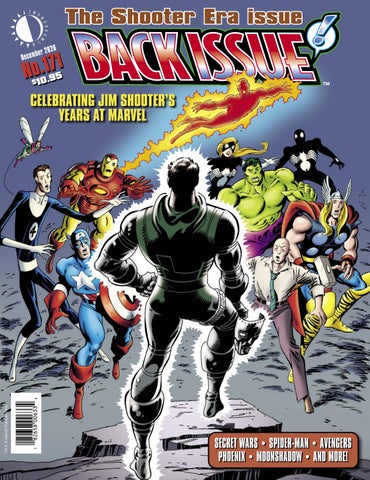
The Shooter Era issue ber Decem
2026
1 7 1 . o N 10.95 $
™
TM & © Marvel Characters, Inc.
CELEBRATING JIM SHOOTER’S YEARS AT MARVEL
SECRET WARS • SPIDER-MAN • AVENGERS PHOENIX • MOONSHADOW • AND MORE!
Volume 1, Number 171 December 2026 EDITOR-IN-CHIEF Roger Ash PUBLISHER John Morrow
Comics’ Bronze Age and Beyond!
DESIGNER Rich Fowlks EDITOR EMERITUS Michael Eury COVER ARTIST Mike Zeck and John Beatty (Originally published as the cover to Marvel Super-Heroes Secret Wars #11. Thanks to Cory Sedlmeier for the scan.) COVER DESIGNER Michael Kronenberg PROOFREADER Kevin Sharp SPECIAL THANKS Cary Bates Jim Salicrup Charlie Boatner Bill Sienkewicz John Bua Roger Stern Dewey Cassell Dan Tandarich Tom DeFalco Roy Thomas J.M. DeMatteis Jim Thompson Alex Grand Alan Weiss Grand Comics Database Bob Hall Heritage Auctions JayJay Jackson Robert Jeschonek John Kirk Christopher Larochelle Ed Lute Ron Marz Jon J. Muth Joe Norton Tom Powers Joe Rubinstein
Don’t STEAL our Digital Editions! C’mon citizen, DO THE RIGHT THING! A Mom & Pop publisher like us needs every sale just to survive! DON’T DOWNLOAD OR READ ILLEGAL COPIES ONLINE! Buy affordable, legal downloads only at
www.twomorrows.com or through our Digital Storefront at
www.comicshistory.org & DON’T SHARE THEM WITH FRIENDS OR POST THEM ONLINE. Help us keep producing great publications like this one!
BACKSEAT DRIVER: Editorial by Roger Ash . . . . . . . . . . . . . . . . . . . . . . . . . . . . . . . . . . 2 OFF MY CHEST: Jim Shooter: Large Mammal . . . . . . . . . . . . . . . . . . . . . . . . . . . . . . . . 3 Jim Shooter, the man FLASHBACK: Jim Shooter & Marvel Super Heroes Secret Wars . . . . . . . . . . . . . . . . . . . . . 5 The series that defined the Shooter Era BRING ON THE BAD GUYS: The Dark Phoenix Saga . . . . . . . . . . . . . . . . . . . . . . . . . . 17 The tragic tale of Jean Grey FLASHBACK: Korvacs and Tigras and Pyms, Oh My!—Shooter’s Avengers . . . . . . . . . 27 Shooter assembles some astonishing tales PRO2PRO: Pop! Poof! Ping! Revisiting Moonshadow . . . . . . . . . . . . . . . . . . . . . . . . . . 39 J.M. DeMatteis and Jon J. Muth recall their classic series FLASHBACK: A Brief History Of Frankie Raye/Nova . . . . . . . . . . . . . . . . . . . . . . . . . . . 49 From hero to herald INTERVIEW: Spinning a Spectacularly Amazing Web: Roger Stern’s Spider-Man . . . 57 A deep dive into this acclaimed run FLASHBACK: Star Brand: The Star Of Jim Shooter’s New Universe . . . . . . . . . . . . . . . 71 Shooter’s finale at Marvel WHAT THE?!: Short Stuff About Shooter . . . . . . . . . . . . . . . . . . . . . . . . . . . . . . . . . . . 79 A fond remembrance
BACK ISSUE™ issue 171, December 2026 (ISSN 1932-6904) is published monthly (except Jan., March, May, and Nov.) by TwoMorrows Publishing, 10407 Bedfordtown Drive, Raleigh, NC 27614, USA. Phone: (919) 449-0344. Periodicals postage paid at Raleigh, NC. POSTMASTER: Send address changes to Back Issue, c/o TwoMorrows, 10407 Bedfordtown Drive, Raleigh, NC 27614. Michael Eury, Editor Emeritus. Roger Ash, Editor-In-Chief. John Morrow, Publisher. Editorial Office: BACK ISSUE, c/o Roger Ash, Editor, 2715 Birchwood Pass, Apt. 7, Cross Plains, WI 53528. Email: rogerash@ hotmail.com. Eight-issue subscriptions: $108 Economy US, $189 EU/UK, $161 other non-US countries, $39 Digital. Please send subscription orders and funds to TwoMorrows, NOT to the editorial office. Cover artwork by Mike Zeck and John Beatty. TM & © Marvel Characters, Inc. All Rights Reserved. All editorial matter © TwoMorrows and Roger Ash. Printed in China. FIRST PRINTING
The Shooter Era Issue • BACK ISSUE • 1
by J a
yJay Jackson
Jim and JayJay at a comic store signing in Pittsburgh. All photos are courtesy of the author.
I recall the day that Jim first walked into the boardroom of Chase North America bank to discuss buying Marvel Comics. Jim and I were friends. The kind of buddies who hang out a lot and talk on the phone constantly. It didn’t seem real to me that my friend was thinking of buying Marvel. Of course, I knew he’d been the editor-in-chief for years and I’d heard all his crazy stories of the business side of the comics industry, but buying Marvel?! Who does that? Apparently Jim felt the same way. After that first intense meeting he related his insecurities about sitting down at the conference table with all these men and noticing they were all wearing the same Ivy League college rings. A club that Jim, a high school graduate from Pittsburgh PA and the son of a struggling steel worker, was most definitely not a part of. I think almost everyone knows the story of how Jim started creating comics around the age of 12, teaching himself and submitting his ideas after a year or so. His family was desperate for money and his paper route wasn’t cutting it. But he had the bravado to try to do something impossible. And he pulled it off. DC Comics hired him to write comics. So, when faced with a room of rich elites, all those years later, he did what he always did, he put on a brave front. That first meeting went well. He impressed them enough that they agreed to have more meetings. And they eventually backed him to the tune of $80 million. (Spoiler: It was a rigged game and he lost.) Jim told me once, only once, that he had to stand in front of his bathroom mirror in his tiny studio apartment and psych himself up for these meetings trying to overcome his self-doubt. I pictured that scene from How to Succeed in Business Without Really Trying where J. Pierpont Finch sings to himself in the bathroom mirror to get ready for a big meeting. Jim used to sing
show tunes and I would frequently ask him to sing that song, “I Believe in You,” because it was forever linked with him in my mind. Also, because it’s a great song and he sang it well. But Jim had to remind himself that he belonged because he felt like a perpetual outsider, someone who would never, could never, be a part of that high finance world. I wonder if he felt like a part of any world. I think he felt like an outsider in almost every situation. We had that in common. But I realized something back then. Those banker guys might have been the cart, loaded with everything, but that cart doesn’t go without something to pull it. Yeah, I know I just compared Jim to a horse. He was actually a creative force with a lifetime of knowledge and wisdom. And he was willing to share everything he had learned. He was almost desperate to share it. He created the Marvel Try-Out Book and he came up with his storytelling lecture in the ‘90s and toured conventions with it in the hopes that it would inspire new generations of comics creators. I was an ambitious kid. In kindergarten I decided I would become an artist and started getting very serious about my art. Around the age of 12 I added writing to that goal, and I soon thought of combining the two as comics and started working on my own stories. I can’t even imagine what my life would have been because when I was 25 I met Jim, much the way the Colorado River met the Hoover Dam. I had all this ambition and yearning and Jim taught me the tools to focus it and make it real. Though at first he was just working and letting me watch. We were hanging out a lot when we were both working at Marvel and he was writing Secret Wars in the evenings. I think it reminded him of his bitter high school days when he would come home tired and have to start work writing comics. There were times in his teen years when things got pretty bad and he was struggling. He was going through a bit of that with Secret The Shooter Era Issue • BACK ISSUE • 3
by J o
hn Kirk
You probably have all of this maxiseries in your long boxes, in your closet, if not the omnibus on your shelf. Of course, I’m talking about one of the most heralded and remembered titles in comics history-and arguably Jim Shooter’s greatest success: The Marvel Super Heroes Secret Wars. And in order to appreciate the landscape of Secret Wars, it’s important to understand Jim Shooter, because ultimately the series was a microcosm of the sum of his experiences, his history, his education in the comics world, and the way he ran Marvel during his tenure as editor-in-chief. Shooter’s mindset towards any of his projects, including MSHSW was rooted in his financially challenged upbringing and applied to the way he managed Marvel Comics from 1978 to 1987. It wasn’t an enlightened perspective of management and in his personal memoirs, he referred to it as “righting the ship,” implying that the ship was off course. MSHSW, midpoint in this Herculean task, was instrumental in accomplishing corporate success for Marvel Comics in this time. He possessed a perfectionist’s attention to quality, heightened awareness of the comics jim shooter industry, and he felt there was a lot of work that © Luigi Novi / Wikimedia Commons. needed to be done at Marvel, and only he could do it. He rarely shared his thinking with the majority of his colleagues or peers, and appearing inflexible also didn’t win him a lot of allies. He had his own agenda and his own set of ethics, even if that wasn’t apparent to those around him, but he believed he tried to do the thing that was best, regardless of the impact it had on others and that did not earn him any friends. His strict adherence to detail over dates was a work style tempered by an uncompromising need to revise creators’ work. “Stan used to do that all the time,” Joe Rubinstein told BI in an interview. “What was the difference?” He was simple, direct, and he could be frustrating to the people he directed with his insistence on perfection, constant changes, and demanding nature. He came by this honestly. His disadvantaged childhood, his brutal lessons in the comics industry, and an intuitive eye for quality and innovation all combined in making him the editor-in-chief he became. If you speak with any of Jim Shooter’s friends, they will unanimously agree that he tried to do the right thing. Though there was a fair share of others who celebrated his departure from Marvel Comics, while he loved comics and comic creators, he always put the company first. He learned the comics industry the hard way. He himself became hard, unrelenting, and abrasive, but he loved comics and enjoyed producing them for fans. He enjoyed being challenged by talent, fought for talent, and he had a respect for talent, even when the talent didn’t respect him, and in that history and tumultuous, stress-ridden process lay the success of how MSHSW was created.
THE PRODIGY YEARS–“I WAS A TEENAGE COMIC WRITER”
Get ready to rumble! It’s Marvel Super Heroes Secret Wars #1, autographed by Jim Shooter. Cover by Mike Zeck and John Beatty. Image courtesy of Heritage Auctions (www.ha.com). TM & © Marvel Characters, Inc.
The environment of Jim Shooter’s “boy genius” childhood was punctuated by the presence of two destabilizing influences: poverty and alcoholism. Though it’s common knowledge that Jim was a comics prodigy and sold his first comic story at the impressionable age of 13, it was a feat that never got the acclaim it deserved, overshadowed by his family’s poverty. In an interview at Toronto’s Fan Expo Secret Wars panel in 2016, Shooter shared this with me: “My family were broke. I was a kid. I couldn’t help my family by getting a job in a steel mill. A paper route wasn’t The Shooter Era Issue • BACK ISSUE • 5
(top) The heroes arrive and are mighty confused. Marvel Super-Heroes Secret Wars #1 art by Zeck and Beatty. (bottom) Ya can’t beat a good scrap. Issue #2 art by Zeck and Beatty. (inset) Shooter begins his career as a comics writer in Adventure Comics #346. Cover by Curt Swan and George Klein. Secret Wars TM & © Marvel Characters, Inc. Legion of Super-Heroes TM & © DC Comics.
6 • BACK ISSUE • The Shooter Era Issue
available. So, I was at a doctor’s appointment. I saw a pile of comics on the table. It occurred to me that I could do that.” Shooter was a bright child. He was skilled in language arts, and he described experiences of being a success in school. His teachers were surprised at his facility with language. When he discovered comics, they weren’t just an escape though; they were a means to an end. It was something in which he could utilize his prodigy level talent and perhaps exploit. Shooter’s father, Ken, worked in a steel mill. He was also an alcoholic and while Shooter didn’t like to talk about his childhood and family, it was clear that the combination of a low-paying job and alcoholism had an effect on the way he grew up. From Shooter’s own memoirs, he remembers discovering comics in those years of financial hardship. “It seemed that all my life, lack of money had oppressed my family. We always seemed to be on the brink of financial oblivion. Struggling. Hanging by a thread. Wolves at the door.” Reading comics from the ages of 8 to 13 was an on-and-off again luxury for Shooter. It was a learning period, and comics weren’t often widely available, but he was aware, even at that young age, of the story structure. Money was always an obstacle to prevent his further education as a child and also always on his mind. It’s sad when a child has an awareness of their own socio-economic status. Shooter recounted this on his blog: “Two things prevented me from getting (back) into comics up to my earlobes right then–first, my family, always in hard times, had fallen into even harder times, and there simply was no money for such things, and second, those whatchacall’ems– Marvel Comics? They were impossible to find around Bethel Park, Pennsylvania in those early days. How Bruno’s Barbershop acquired one remains a mystery.” Shooter wound up reading more comics after that doctor’s visit when he landed in a hospital room recovering from a surgical procedure for a hernia as a kid that his family could barely afford. He couldn’t afford the comics either so during that time he had access to a great many. He maximized that opportunity and, in that time, his talent for story composition emerged as he described at jimshooter.com: “During the summer of 1964, I spent a week in Pittsburgh’s Mercy Hospital where I had minor surgery and a major revelation. There were lots of comic books lying around in that kids’ ward, and I had lots of time to read. There were Archies, Harveys, Dells, Charltons, Nationals–and Marvels!” As he spent his time in the hospital, Shooter didn’t just read the comics, he studied them. “At age thirteen, I was ready to write a comic book. I had desperately sought copies of Marvel Comics–borrowed, traded for, or managed to scrape up twelve cents to buy. I studied them.
Analyzed them. Read till I knew them by heart. So, I wrote and was insulted. He was the joke of the office–the “boy-genius” drew, as best I could, a story of the Legion of Super-Heroes starring who wrote Legion of Super-Heroes and his success was paraded Superboy, for National’s Adventure Comics and sent it off.” by Weisinger in front of the adult peers the teenaged Shooter It worked. It caught the attention of Mort Weisinger at DC, worked with, alienating him from them. Shooter was a wunderwho, unaware that he was a teenager, invited Shooter kind, but he was also isolated and lonely, thanks to Weisingto talk about the submission. He surprised Mort with er’s instructional and management style. the response of asking if his mother, Elenor, could Joe Rubinstein had a less diplomatic take on come as well. Weisinger. Speaking about Shooter’s formative It was this education that formed the basis years under the DC editor, he conveyed, “Mort for Shooter’s knowledge of how comics worked Weisinger was notorious for being a scumbag.” and how MSHSW would be shaped. “He was a horrible human being. He was In Shooter’s favor, his love of comics and his always guilting Jim that he wasn’t worthy and career aspirations were also supported by the that he was a charity case.” presence of his mother. The measure of a Weisinger would continue this abusive editorial supportive parent, even one, in times of challenge practice during Shooter’s early years writing for and hardship is invaluable, but Ellie Shooter’s DC. This was his apprenticeship, seasoned by support was severely limited given both poverty mistreatment and negativity. Shooter was told and her husband’s alcoholism. Fortunately for by Weisinger that he was “retarded” or called joe rubinstein Shooter, it was enough to give him his break. other hateful epithets. Gage Skidmore. He received permission to continue to write “Mort would call me every Thursday night, for National Publications (DC Comics) and for Mort Weisinger. right after the Batman TV show, to go over whatever I’d delivered The education he received from Weisinger was widespread that week. He’d call me other times, too, whenever, but Thursand painful. He learned almost every aspect of the business day night was our regularly scheduled call. The calls mostly conclose-hand and empirically, as described in his online blog. sisted of him bellowing at me. ‘You f*cking moron! Learn to spell! “Soon after, school ended for the year, and almost a year What the hell is this character holding? Is that supposed to be a after I’d written the first Legion story DC bought. Fresh out gun? It looks like a carrot! These layouts have to be clear, retard!’ of ninth grade, I was off from home in Pittsburgh to New When you’re 14 and the big, important man upon whom your York City to spend a week in DC’s offices learning more about comics production—things like coloring and inking that are hard to explain over the phone. “So, I spent a fair amount of time in DC’s offices, meeting with Mort (Mort Weisinger) and other DC people—Jack Adler, who gave me an education with regard to art production, coloring, and printing; Carmine Infantino, who discussed cover design with me, Tatjana Wood—I think—regarding coloring, George Klein—I think—explaining inking. And lots more. E. Nelson Bridwell, who was Mort’s assistant, of course. Lots of other people, especially people who worked in the office. I think I met everyone who worked in the office. Not so many freelancers. I attended several general editorial meetings. I learned a lot.” Weisinger was infamous for shooting down ideas and invasively replacing work with his own storyline ideas. He was a cruel boss and though he knew the business well, he treated his employees harshly. Though Shooter was on record for praising Weisinger’s writing style and admittedly abusive style of management, he criticized his inflexibility. He remembered this from his blog: “Mort’s rules always worked, story-mechanics-wise. Easy, idiotproof, safe. Trying things that explored the frontiers beyond the confines of Mort’s rules was tricky—fraught with opportunities to fail—but if you were daring, if you had the necessary depth of understanding and the skills, you could do wonderful things.” MSHSW was a successful but simple storyline. It was idiotproof in a way. Its essence was to take a bunch of heroes and villains, place them on a battlefield with headquarters and battle vehicles and let them go full-bore at each other. This validated and demonstrated Shooter’s basic rule under Weisinger: “I shut up and listened.” As much as he enjoyed hearing challenges to his perspective, this became the default he had for his writers. Shooter’s education was reinforced with as much negative conditioning as one could stomach. If he made a mistake, he
Spidey takes on the X-Men on the cover of issue #3. Art by Zeck. Original art scan courtesy of Heritage Auctions (www.ha.com). TM & © Marvel Characters, Inc.
The Shooter Era Issue • BACK ISSUE • 7
“I feel he changed the medium. He was a fascinating Doug Moench, and Rick Marschall. These would be his collabguy. His years at Marvel were some of the most explosive, orators working on Moon Knight and other titles in the future. creative years ever. He knew it. We all knew it; lightening It was enough to dazzle Sienkiewicz, but he also admitted in a bottle. He loved the medium and he loved to us that as he grew to know more about Shooter, he creators as much as he might have passionately understood him better. disagreed with them. Those who stood up to “Jim gets a lot of bad press for his editorial him for their choices, beliefs, and creative position and his mandates. He definitely had an commitments and convictions got respect. ethos and p.o.v. of how things should be done Sometimes free from animus, sometimes storytelling wise. As we became friendlier over grudgingly.” time, I came to learn-and understand-that Jim Likewise, Rubinstein had this to share was the breadwinner for his family in PA (a state about Shooter’s commitment to the medium we had in common, as well as Polish roots); writing and to creators’ rights. comics at 15 years of age or thereabouts. He “There were a lot of egos, a lot of prima talks about how he’s treated by the older guys donnas. Jim had to deal with all of them. But like Weisinger, how he’s dismissed, ridiculed, he fought for creators and for the right thing, and belittled while also being given immense bill sienkiewicz as he saw it. Once, they did a Labyrinth comic responsibility in the scripting and idea arena. © Luigi Novi / Wikimedia Commons. book–John Buscema, I think–and they wanted Jim came by his comics and narrative worldto put out a coloring book. When Jim asked how they were view honestly; via typically being subjected to ‘abuse of the doing this, they said that they were just going to use xeroxes golden goose’ by older, grizzled, jaded, ‘50s era businessmen of John Buscema’s pencils and that they didn’t need to pay and higher-ups. I later learned a lot of these guys whose names anyone. He said, ‘Yeah, I only knew from the you do. You have to pay comics’ credits were John Buscema because real pieces of work; some you are using his work.’ were-as I was later told-alYou know, he hired John so real pieces of sh*t to go do a seminar on The push and pull, love how to draw comics. It and hate, accolades and was free for anyone who dismissal thing he exwanted to attend. But perienced has to f*ck Shooter was willing to pay with your head as a kid, for anyone who wanted with your self esteem and to advance in comics.” perception of how the Bill Sienkewicz shared world works; on top of this about his experithat weight is the insecuence with the Work for rity of being an incredibly Hire Contract–the same tall teenager with a pockagreement that was in marked face. We bonded force for MSHSW, giving over our less-than-ideal the artists all the work they childhoods. I respected wanted, and more. Jim. Respected his p.o.v. “Shooter takes me and the fact that he had a back into his office and vision for comics in general says, ‘Look, I can offer you and for Marvel specifically. all the work you want— He took me under his but you have to sign a wing; he took an interest in work made for hire conmy progress, a decidedly tract.’ He briefly explains mixed blessing.” what that is. I’m two Shooter also believed weeks into being 20 years in knowing the job. Joe old, naïve, and excited, so Rubinstein remembered I hear the first part of Jim’s how Shooter would credit pitch, and my adrenaline Weisinger for knowing starts to really spike; and every facet of the comics though I don’t really fully industry that most editors understand the magnitude wouldn’t know about. of the WMFH contract, He knew about delivery. I quickly respond, ’Where He knew about costs on do I sign?’” paper and sundries. He Shooter flooded Sienknew about timelines and kiewicz with meeting schedules and how to names like Ralph Macchio, ensure that people were producing quality work in whatever their job was. “I asked him, ‘Given that you’re an intelligent guy: how do Behold, the face of Doom. Secret Wars issue #11. you know all this sh*t?’ He answered: ‘Mort.’ Mort showed Art by Zeck and Beatty. him everything that he needed to know about the business. It was one thing to know how to be an editor or a writer TM & © Marvel Characters, Inc. 14 • BACK ISSUE • The Shooter Era Issue
by C
The X-Men are unlike a lot of the other superteams in comics. If you make your way through longboxes of, say, Avengers or Justice League, you’ll read some fun stories and might come to see the overall framework as that of some kind of high-octane workplace drama. The X-Men are different down to their DNA—theirs is a story of found family and intense bonds. With a series that’s built on that kind of foundation, “The Dark Phoenix Saga” is absolutely harrowing, since it’s asking questions like this: what would you do if someone in your family became dangerous to others? How far would you go to protect this person, and if you did…would you be in the right?
hristopher Larochelle
ENTER: THE PHOENIX!
[above] John Byrne and Terry Austin’s cover tribute to issue #56 by Neal Adams [left]. TM & © Marvel Characters, Inc.
“The Dark Phoenix Saga” is a triumph of comics storytelling in part because of how all of the pieces fit together over the course of many issues of the X-Men title (later gaining an official “Marvel Title Adjective”—Uncanny—by issue #114). Today, you can easily pick up a trade paperback reprint of the Saga that will start you off with Uncanny X-Men #129 (Jan. 1980), but simply diving in at that point would be a mistake, since the seeds for what happens later begin to be planted as far back as #100. The final pages of X-Men #100 (Aug. 1976) show the team in a dire situation, needing to get home from the clutches of madman Steven Lang aboard a S.H.I.E.L.D. space station and only having a banged-up space shuttle. Besides that, a solar flare is nearby. Passengers will be safe and sequestered, but someone has to pilot the shuttle. It’s in these pages that the hero’s journey of Jean Grey takes some huge steps forward. Writer Chris Claremont and artist Dave Cockrum had major plans for the character, wanting to completely transform her away from how she had already been portrayed in dozens of issues of X-Men. In all of those comics, Jean had never had a moment as “big” as this. The X-Men’s ally, scientist Peter Corbeau, warns that “one of you might survive the flare, but you can’t pilot the shuttle. We need someone who can do both, and there’s no such animal.” Jean’s simple, direct answer: “Wrong, Mr. Corbeau…I can do both.” There are attempts to talk her out of it, but Jean telepathically absorbs Corbeau’s piloting knowledge and gives a protesting Cyclops a little telepathic knockout. It’s more dangerous than anything she’s done before, and the X-Men have to trust that things will work out. In X-Men #101 (Oct. 1976), Jean’s gamble pays off…though she is missing during the X-Men’s emergency water landing for long enough that everyone is in a panic. Just then, blasting out of the water comes the redheaded heroine, adorned in a new costume of green and gold: “Hear me, X-Men! No longer am I the woman you knew! I am fire! And life incarnate! Now and forever—I am Phoenix!” This seems like a huge change, but both the characters
The Shooter Era Issue • BACK ISSUE • 17
(top) Phoenix makes her dynamic debut in X-Men #101. Cover by Dave Cockrum. (bottom) Phoenix goes toeto-toe with Firelord. X-Men #105 art by Dave Cockrum and Bob Layton. TM & © Marvel Characters, Inc.
in the story and the readers of X-Men would have to wait to better understand just what happened to Jean Grey. X-Men #102 (Dec. 1976) features Jean on about half a page of the story. She’s continuing to recuperate at the hospital she was admitted to in the previous issue. Things seem pretty normal until Jean is alone with her roommate, Misty Knight. Jean’s face falls into dramatic shadow and letterer John Costanza contributes a double-lined, somewhat jagged word balloon to convey a haunting line: “…how would you feel if you’d…died, then brought yourself back to life?” Continuing to trace the early appearances of Phoenix, Jean’s plot line is entirely ignored in X-Men #103 and she hardly appears in #104 but has at least left the hospital. X-Men #105 (June 1977) is titled “Phoenix Unleashed!” with a story that certainly lives up to its name. Jean and Misty Knight are entertaining Jean’s parents and Charles Xavier at their apartment when Lilandra of the Shi’Ar arrives. Firelord is right behind her, declaring that he seeks to bring Lilandra and Xavier with him. Responding, Jean’s face again transforms into darkness and her word balloons suggest a gravelly tone (Tom Orzechowski continues and further expands on the idea initiated earlier by Costanza). During the battle with Firelord, Jean’s thoughts convey her dangerous new state: “I don’t believe this! I’m…flying! And…there’s power surging through my body I never even dreamed existed!” and “My power—it’s hitting me like a drug. I’ve never felt such…ecstasy! God in heaven, what have I become?” The X-Men head into space again to help Lilandra, and there are a few “behind the scenes” things to note. First, X-Men #106 halts everything, as an inventory issue is explained as a flashback. #107 would be the last issue penciled by Dave Cockrum before the arrival of John Byrne in #108, and it seems easy to say that Phoenix’s co-creator hardly got to begin working with the character that he and Claremont had revolutionized. In Byrne’s first issue, Phoenix’s massive powers are shown off, as she prevents all of reality from collapsing due to the trouble with the M’Kraan crystal…no small feat! The “personnel change” on X-Men’s art duties was extremely significant to Phoenix’s overall story arc. Speaking to Peter Sanderson in X-Men Companion Volume One (Fantagraphics, 1982), Chris Claremont shared that “the Phoenix that Dave and I created was not the Phoenix that John and I evolved her into. Doing a ‘What If?’ scenario, if Dave and I had stayed together, the Phoenix story would not have happened as it did, and I think if Louise [Jones] had been the editor from the very beginning, the Phoenix story would not have happened as it did.” Peter Sanderson was the author of another source of insight in an article for Comics Feature #4 entitled The Many Alternate Fates of the Phoenix. John Byrne is quoted here as feeling that the cosmic power now wielded by Jean Grey made it so that “the X-Men had become guest stars in their own book.”
PHOENIX PUSHED ASIDE
Coming back to Earth after an incredible display of power, Phoenix begins to become pushed to the sidelines in X-Men. Jean isn’t seen in costume again for several issues. In #110, we get more glimpses into her thoughts, in which she acknowledges the grave danger she finds herself in: “I—I’m scared! I never wanted Phoenix’ power—and yet, using it feels so…good—I’m not sure I can handle it. What’s the saying…? ‘Power corrupts, and absolute power corrupts absolutely.’ I’m lost inside and no one can help me find my way.” X-Men #112 shows Phoenix going to toe-totoe in a solo battle against Magneto as her teammates are 18 • BACK ISSUE • The Shooter Era Issue
by D a n
Ta n d a r i c h
Jim Shooter’s work on Avengers first appears in issue #151. Cover by Jack Kirby and Dan Adkins. TM & © Marvel Characters Inc.
And there came a day when Jim Shooter found himself writing The Avengers! On that day, Shooter was determined to fight the foes every writer must overcome: the Dreaded Deadline Doom and unclear storytelling. Add his name to the ranks alongside Captain America, Scarlet Witch, Iron Man, Vision, Thor, Wasp, Yellowjacket, Beast, Hawkeye, Black Panther, Wonder Man, Moondragon, Ms. Marvel, and Tigra. Heed the call, then— for now, BACK ISSUE presents Jim Shooter on The Avengers! Shooter had two distinct eras on The Avengers from #151, 156, 158-168, 170-177, and then #211-217, 219-220, plus assorted plots in-between. Scripting work on some issues was provided by David Michelinie, Bill Mantlo, Steven Grant, and Alan Zelenetz. George Pérez, John Byrne, and Roger Stern provided plot points as well. In both of Shooter’s runs on Earth’s Mightiest Heroes, behind-the-scenes chaos seems to have spurred him into his role as writer. Back in 1976, Steve Englehart held the writing reins on The Avengers, but something happened in issue #150 when all-new material was replaced with a partial reprint. Avengers #151 (Sept. 1976) featured writing credits by Gerry Conway, Jim Shooter, and Englehart. According to the Wonder Man: Cooler Than Superman website (2017), Shooter stated that his first issue on the Avengers was actually #150, as Gerry Conway asked him to write the dialogue overnight due to Englehart’s lateness. However, Shooter’s dialogue was later replaced by Englehart’s, once it arrived at Marvel. Shooter said, “In my opinion, mine was better, though I was winging it without even a copy of the plot.” We all know the main characters like Captain America, Iron Man, and Thor, but Shooter focused on characters without their own titles on his first run. Henry (Hank) Pym was one of these characters, along with Janet Van Dyne. One of Marvel’s earliest characters, Hank started his crime-fighting career as Ant-Man, and it was in this guise that he first joined the Avengers as one of its original members. Janet Van Dyne, the Wasp, heiress and fashion designer, known for her many original costumes, started as Ant-Man’s partner, and was also an original Avenger, even naming the team. Hank and Jan have been romantically linked since their early days as crime-fighting partners and eventually marry. Hank’s career and the Avengers’ history are deeply connected. Hank has changed superhero identities many times, morphing from Ant-Man to Giant-Man, possibly because he felt inadequate as a hero alongside powerhouses like Iron Man, Thor, and the Hulk. Hank later changed his name to Goliath. Retreating into his lab, Hank wanted to prove himself and eventually created Ultron, an indestructible robot that could think on its own. But Ultron soon turned on his creator and wanted to destroy mankind. Originally, Hank’s identity as Yellowjacket occurred because of a mental breakdown in the form of schizophrenia. But he got better and returned to the Avengers. Hank had a history of mental imbalance, having previous breakdowns in Tales to Astonish #44 (June 1963), Avengers #59-60 (Dec. 1968-Jan. 1969), and Avengers #161162 (July-Aug. 1977). In his introduction to the Avengers Marvel Masterworks Volume 15 (2015), Steve Englehart wrote, “So Yellowjacket is super-sensitive to the Wasp. It’s the relationship they’ve always had, and the relationship which sums up why he never became a hero like the other originals…including the Wasp. He’s a beta in an alpha world. (If you were to believe in his reality… you might attribute that to his original desire to become the size of an ant, rather than a giant.) However you get there, his constant attempts to be more than he felt comfortable being are not doing him any good.” The Shooter Era Issue • BACK ISSUE • 27
(top) Jim Shooter’s picture from FOOM #17 from the time when he was first writing The Avengers. (bottom) Shooter even drew the Avengers in Super Villain Team-Up #9. Inks by Sal Trapani. TM & © Marvel Characters Inc.
28 • BACK ISSUE • The Shooter Era Issue
Before Shooter completely took over the writing reins on The Avengers, he illustrated the team in Super-Villain Team-Up #9 (Dec. 1976) in his first Marvel art job, ably assisted by Sal Trapani and written by Bill Mantlo. Shooter was an associate editor at the time and helped out where needed. Simon Williams, Wonder Man, made his first appearance in Avengers #9 (Oct. 1964) and “died” in the same issue. Wonder Man had super strength and invincibility. When Shooter started writing the book, the mystery of Wonder Man’s resurrection had just begun. Even though his strength rivaled Thor’s, Wonder Man would suffer from bouts of inadequacy and fear of dying (again). He couldn’t decide whether he wanted to be a superhero. When the synthozoid Avenger Vision debuted, it was revealed that his creator, Ultron, used Wonder Man’s brain patterns as his template. Shooter wasted no time on The Avengers as he added the new villain Graviton with artist Sal Buscema to the team’s rogues’ gallery and brought back a new and improved Count Nefaria with artist John Byrne. The Department of inFOOMation from Foom #16 (Dec. 1976) revealed more about Shooter’s thoughts on Simon Williams, Wonder Man. “He is going to fill a much needed role of balancing the fact that Thor stood alone on a power level above the rest of the Avengers. In a way, he’s a kind of Superman. Since his character is so blank at the moment, it’s going to be a challenge to evolve his personality from scratch.” During “The Trial!” in the pages of Avengers #160 (June 1977), the brother of Wonder Man, the villainous Grim Reaper, wants the final verdict on who his real brother is, the man returned from the dead and who claims to be Simon Williams or the android Vision whose brain patterns are based on those of his dead brother, Simon Williams. The Vision states, “Perhaps…if Wonder Man has stepped beyond humanity…He and I are the true brothers!” Just as Wonder Man is beginning to find his new identity, Henry Pym (Ant-Man, Giant-Man, Goliath, Yellowjacket) is losing his in the pages of Avengers #161 (July 1977) in a storyline that goes through Shooter’s first run on the title and into his second run years later. A mind-controlled Henry Pym, as Ant-Man, goes on the attack, successfully taking down the team. Janet Van Dyne (Pym) explains, “It’s been…building for a long time…and I’m afraid his mind…has finally snapped.” Pym created the indestructible robot Ultron, and the villain considers Pym his “father.” Although Henry Pym was already experiencing bouts of inadequacy, Ultron pushed Pym’s mental state even further down the line. Shooter doubled as writer and colorist on this issue, demonstrating that he pitched in where needed to get the job done. Shooter added family drama in the form of the original character, the Bride of Ultron, later named Jocasta, mixing it up with Henry Pym, Janet Van Dyne, and Ultron. The “son” of Pym wanted a bride and used the life essence of his “father’s” wife, the Wasp, to be the “soul.” Ms. Marvel, Carol Danvers, started making appearances with the team. She was Marvel’s “modern feminist super-heroine,” complete with the powers of strength, flight, and a seventh-sense to warn her of danger. Foom #17 (Mar. 1977) revealed more of Shooter’s thoughts behind the stories, some of which
materialized and some which did not. “Expect a development with a certain very large-sized black character [Black Goliath/Bill Foster] who used to live on the West Coast. His costume is being redesigned by Ed Hannigan. There are going to be Avengers coming and going all over the place, and there will be steps back to the formal roster they had once. I actually intended to reveal the secret of Wonder Man’s return all at once in issue #160, but George Pérez, who co-plotted it, broke it down differently than I expected, and so the secrets will be coming out little by little, instead. One of the things that really impressed me about Marvel when I wasn’t working in comics…is best exemplified by the Kree/Skrull War: a sequence of books…that stand alone. And each book in the sequence also stands alone as a story—which is, of course, ideal. George Pérez has half of a master plan to do a one-year epic, twelve issues. His half of the plan is that he wants to draw everybody in the whole Marvel system, and my half of the plan is to come up with the plot!” Avengers #167 (Jan. 1978) kicked off that master plan, officially known as the Korvac Saga. George Pérez and Pablo Marcos supercharged the art for “Tomorrow Dies Today!” featuring not only the regular Avengers team but guest stars the Guardians of the Galaxy, Nick Fury, and Nighthawk. “Once, he was called Korvac, the Machine Man, and as such he was the evil nemesis of the Guardians of the Galaxy, who pursued him from the 31st century across time to our era. He eluded pursuit…a bizarre twist of fate transformed him into the essence of knowledge and power. [His] stated goal is ownership of the universe, which he claims is his by right,” reads the splash page of Avengers #177 (Nov. 1978). An idea that did not materialize right away was a crossover with Ghost Rider; a title Shooter was also writing at this time. In FOOM #18 (June 1977), Shooter reveals, “There will be a crossover with The Avengers and Ghost Rider. There will be a new villain (with the working name Infernus); it all ties in with an earlier issue of Thor [Journey into Mystery #120 (Sept. 1965)], when Thor repaired his hammer in Pittsburgh and a sliver of Uru metal from the hammer fell off. The sliver will be instrumental in the villain’s creation. The Avengers will be summoned to Pittsburgh to face the villain.” Later, David Michelinie used this idea for Avengers #192-193 (Mar.-Apr. 1979), but without Ghost Rider. He would show up later in Shooter’s run. Shooter established an enduring friendship between the Beast and Wonder Man, two characters who were both struggling with their identities and how they fit in on a team like the Avengers. Again, from the Wonder Man: Cooler Than Superman website, Shooter explained, “I thought a comedian like the Beast would naturally gravitate to a classic straight character like Simon Williams, and vice versa. They’re both bright and intellectual. I had fun playing them off against each other.” Wonder Man would get his red safari jacket costume during Shooter’s run in Avengers #167 (Jan. 1978). In Modern Masters Volume 2: George Pérez by Eric Nolen-Weathington (2003), Pérez commented on the outfit. “The idea I was going for, and I don’t know if it was my idea or the writer’s suggestion, was a Doc Savage type of approach to the character, where he wouldn’t look quite as super-heroic with the spandex and everything. Just trying to make him the reluctant super-hero.” During the Korvac saga, Shooter added a subplot with special agent of the National Security Council, Henry Peter Gyrich. The Avengers’ priority status was in jeopardy after Count Nefaria attacked Avengers Mansion. Gyrich ranted, “Iron Man, I strolled into this place thru a twelve-foot hole in the south wall! It wasn’t difficult then to subdue your butler and gain access to everything in this entire building—including your records, virtually tons of sophisticated, classified hardware—and your computers which are tied in to the U.S. security network!” On his blog, www.JimShooter.com, in 2011, Shooter explained that “Gyrich…was supposed to be a tough, strict security guy who cleaned up the Avengers’ sloppy operation, ultimately the best friend they ever had, though he happened to come along at an inconvenient
(top left) Shooter’s first full issue of Avengers over a Gerry Conway plot. Cover by Jack Kirby and Al Milgrom. (bottom) Wonder Man loomed large in Shooter’s Avengers. #158 cover by Jack Kirby, John Romita, and Joe Sinnott. Original art scan courtesy of Heritage Auctions (www.ha.com). (top right) Your brother is Wonder Man. Or Vision. Which is it, Grim Reaper? Comics are confusing. Avengers #160 cover by George Pérez and Pablo Marcos. TM & © Marvel Characters Inc.
The Shooter Era Issue • BACK ISSUE • 29
From its sprawling, multilayered narrative to the watercolor artwork that captured its fantastical imagery, Moonshadow made an unprecedented splash as a 12-issue maxiseries under the Epic banner at Marvel in the mid-1980s. In so many ways, this picaresque tale perfectly expressed the vision of writer J.M. DeMatteis, from earthy hedonism to elevated spirituality, always with rich streaks of humor and pathos. As the protagonist, Moon, travels the universe on a coming-of-age journey like no other, he faces and comes to understand the true nature of war, commerce, crime, sexuality, religion, friendship, family, and more. These discoveries are informed by his traveling companion Ira, a bowler-wearing, cigarsmoking, fur-covered id who never met a depravity he didn’t embrace. More than 40 years later, this unique graphic novel continues to delight and inspire new readers. Looking back at their groundbreaking creation, DeMatteis and illustrator Jon J. Muth share their insights into its development and legacy. They explore both surface and subtext; discuss literary and pop culture influences; retrace their techniques for collaboration; and reconsider the Vertigo sequel, Farewell, Moonshadow. They also talk about the continued popularity of the work and where it might lead them in times to come. If you’ve always wondered how Moonshadow was born, what it all means, and how it relates to the lives of its creators—or if you j.M. Dematteis have yet to discover this rich and monumental “journey to awakening” Federico Vinci. —this is the interview for you.
THE BEGINNING
ROBERT JESCHONEK: What can you tell us about the genesis of Moonshadow? J.M. DEMATTEIS: Keep in mind that this was a long time ago and memory is a tricky thing. Much like Old Moonshadow, I can’t swear this is exactly how it all played out, but it’s the way I remember it. The idea for Moonshadow was one I started playing with years jon j. muth before I ever got into comics. It Stuart Ramson. was called Stardust at the time and had a more playful, cynical-but-compassionate, Kurt Vonnegut feeling to it. It was also more of a cosmic superhero adventure in the Jack Kirby-
by R o b e r t
Jeschonek
interview conducted February 2026
The story begins. Jon J. Muth’s cover to Moonshadow #1 from the DC/Vertigo reprint of the series. Original art scan courtesy of Heritage Auctions (www.ha.com). TM & © J.M. DeMatteis and Jon J. Muth.
The Shooter Era Issue • BACK ISSUE • 39
(top) An example of Muth’s two image cover from Moonshadow #1. (bottom) Moon’s father boots him from the zoo in issue #1. TM & © J.M. DeMatteis and Jon J. Muth.
40 • BACK ISSUE • The Shooter Era Issue
Jim Starlin mode. I kept playing with the idea for years (in fact, when I sent some writing samples to DC way back in 1977 when I was trying to break into the business, Stardust was one of them) until it took its final form. I can’t really say where the seeds of the idea came from, but it had a life of its own from the start, as all my favorite stories do. I think Moonshadow wrote me more than I wrote it! JESCHONEK: How long did the project gestate before you began to commit it to written form? DEMATTEIS: I suspect the idea started percolating around the same time that I wrote that sample script, so I probably started playing with it in written form soon after the idea emerged. JESCHONEK: What role did Archie Goodwin play in developing the project? DEMATTEIS: A little more history first: Before the series got to Epic, I’d pitched it to Karen Berger at DC. I’d been exclusive to Marvel for a few years and Len Wein and Dick Giordano invited me to come back to DC, where I’d started my career. If memory serves, they offered me Justice League and Swamp Thing (some guy named Alan Moore ended up getting the gig after I turned it down. Whatever happened to him?) and I pitched Moonshadow. Karen loved it and wanted to do it. She even had an artist in mind: a new guy named Dave Gibbons (whatever happened to him?). In the end, I decided to stay at Marvel and pitched it to editor-in-chief Jim Shooter who, wisely, said: “That’s an Epic Comic. Take it to Archie.” Archie Goodwin was a wonderful writer/editor and, just as important, one of the nicest guys in comics. He welcomed me to Epic and, once Jon came aboard, he and his team (Laurie Sutton, Margaret Clarke, and Dan Chichester) gave us all the creative room, and enthusiastic support, we needed to tell our tale in exactly the way we wanted to. It was a joy working with Archie, with all of the Epic team. JESCHONEK: How and when did Jon enter the picture? DEMATTEIS: I was looking around for an artist and shared my original outline with my friend Dan Green who, in turn, shared it with his friend Jon J. Muth. I remember getting together with Jon at my house— we all lived in the same area—and being so impressed not just with his art, but his insights and intelligence. We clicked right from the start and so began a great collaboration and a cherished friendship. JESCHONEK: Was Jon always the first choice as artist on this project? DEMATTEIS: I seem to recall thinking of other artists, more traditional comic book artists, but I’m not sure if I ever pitched it to anyone. I have a very vague memory—and it may not be correct!—of talking to Mike Zeck about it. Of course, Moon would have been a very different story with another artist—but, as I said, stories have lives of their own, they’re in control, not us, and the story knew that Jon was the absolute perfect artist to bring Moonshadow to life. JON J. MUTH: I thought of other writers too. Chaucer, Milton, and Shakespeare weren’t available, so I went with J.M. JESCHONEK: J.M., what made you realize Jon would be the perfect illustrator for this story? DEMATTEIS: I know the exact moment. Jon was at my house, I think we were meeting for the first time, and he brought some sketches inspired by my outline. “These,” I said, “look very Dickensian.” “Well, yeah,” he said, “that’s what you wrote, right?” And it was!
by J o e
Norton
Since the birth of the Marvel Universe, the Fantastic Four has always given comic readers the most memorable cast of supporting characters. Doctor Doom and Black Panther are some of the faces that made their debut within those pages and are still resonant today. While the first one hundred issues of Fantastic Four are widely considered the blueprint of the industry we all love, the memorable characters did not stop appearing in the pages when Stan Lee and Jack Kirby left the book. In fact, a second wave of Marvel creators left their mark as well and no character burned as intensely as Frankie Raye’s Nova. Originally introduced by Roy Thomas as a love interest for Johnny Storm, Frankie Raye looked like just another pretty face in a long list of the Human Torch’s girlfriends. But it was clear that Frankie’s story could not be contained in a typical romantic B plot. A few years later in John Byrne’s historical run, she became a fully-fledged, albeit derivative, hero. And then in a nod to a groundbreaking FF story, Nova became the herald of the Fantastic Four’s most epic supporting character, Galactus. It was in that role that Nova’s intensity shone brightest. Her time as Galactus’ herald would give her the most important role in the Marvel Universe. Or would it? Join BACK ISSUE as we endure bad dates, fly the skies, and witness galaxies dying. Watch Nova as she shines briefly and brightly in the Marvel Universe.
A NEW FLAME
One of the reasons that the Fantastic Four, both the characters and the flagship Marvel title (and arguably of the industry), remained roy thomas popular through the mid ’70s was the book’s consistent tone and quality. Wunderkind writer © Luigi Novi / Wikimedia Commons. Roy Thomas took over after Lee left Fantastic Four, and while he steered into standard tropes and characterizations of the genre, he kept the book bursting with excitement and energy. For the entirety of the Fantastic Four’s history, Johnny Storm had been shown to have a roll call of girlfriends. At this time in Johnny’s life, readers had seen him dating Dorrie Evans, a member of the Inhuman Royal family, Crystal, and less memorably, blue-skinned Valeria of the Fifth Dimension (the place, not the musical group). He was licking his wounds from that fling with Valeria when readers met Frankie Raye in FF #164 (Nov. 1975). In a recent interview for BI, Roy Thomas was hard pressed to recall Frankie as anything but a romantic interest for Johnny but did give some insight into her origin. Thomas tells BI, “I chose the name ‘Frankie Raye’ because of the earlier ‘Frankie Ray’ pseudonym used at Marvel by [classic Marvel Bullpen inker] Frank Giacoia.” A closer reading of Frankie’s introduction, rendered by a young artist in his very early work named George Pérez, paired with Thomas’ knowledge and love of Marvel history, her debut looks remarkably familiar to another red-headed love interest in Amazing Spider-Man. Watch Johnny’s surprise as he opens the door and sees a glowing and gorgeous red haired Frankie and the reader had to consider that Thomas and Pérez were referencing Mary Jane Watson’s “ Jackpot” introduction to Peter Parker several years prior. As expected, the first date with Frankie (a United Nations interpreter by trade) was a disaster, interrupted by an attack from the Crusader, a revised Marvel Boy, another Thomas nod to Marvel’s deep history. Johnny was attempting to keep his Nova is born in FF #244. Cover by John Byrne. secret identity from Frankie but that failed and the reader briefly saw Frankie startled by the Torch’s “Flame On” transformation. TM & © Marvel Characters, Inc. The Shooter Era Issue • BACK ISSUE • 49
But it was more than surprise when in FF #171 (June 1976), readers saw Frankie’s reaction to Johnny’s flame with her anguish captioned as “this has all happened before” as he flies out her window to face Gorr, the Golden Gorilla (not Thomas’ finest character work). Fantastic Four #181 (Apr. 1977) had Frankie break it off with Johnny when she simply admitted, “I can’t stand fire!” a seeming deal breaker for dating the Human Torch. Frankie’s last appearance (for a while at least) was issue #191 (Feb. 1978) when Johnny left her waiting at her door as he flew yet again to face the dangers of the Plunderer. At this point in her history, it is hard to see Frankie Raye as anything more than the long-suffering girlfriend plot device. But her stars were about to change as John Byrne began his historical run.
A NEW STAR
(top) Frankie Raye debuts in Fantastic Four #164. Art by George Pérez and Joe Sinnott. (bottom) Not being able to stand fire seems like a deal breaker for dating the Human Torch. FF #181 art by Ron Wilson and Joe Sinnott. TM & © Marvel Characters, Inc.
50 • BACK ISSUE • The Shooter Era Issue
John Byrne had just come off one of the most transformative runs of comics history when he left Uncanny X-Men with Chris Claremont and took over full creative control of the Fantastic Four with issue #232 (July 1981). Byrne’s time on the book re-invigorated classic characters like Diablo and the Puppetmaster, doubled down on the menace of Doctor Doom, and in FF #237 (Dec. 1981) brought back Frankie Raye. We met her again in the most dramatic way possible when she dropped her robe and revealed something off panel to Johnny, only hinted at in Roy Thomas’ era. FF #238 (Jan. 1982) has one of Byrne’s most iconic covers of the ‘80s that draws direct attention to Frankie Raye’s “Startling Secret.” Inside readers were treated to one of the more convoluted origins stories, even to seasoned readers. Johnny listened as Frankie revealed her innermost secrets. Frankie’s stepfather, Thomas Raye, was actually Professor Phineas Horton, the creator of the World War 2 Invader, the android Human Torch. As a teenager, while helping an increasingly crazed Horton, Frankie was covered in chemical fire which caused her to transform into a flaming torchlike figure. Fearing for her safety and sanity, Horton gave her a costume of special properties to harness the flame, brainwashed her into forgetting the fire all together and implanting an aversion to fire as well. Meeting Johnny triggered Frankie’s dormant fire compulsion (and fear) and now she revealed all to Johnny. Byrne’s depiction of Frankie in her monochromatic costume was only slightly less impressive than her debut fully engulfed in flame, recalling the Human Torch look but maintaining her own style. After a playful chase flying through Manhattan skies, Frankie was examined by Reed Richards in the Baxter Building’s laboratories and readers were tantalized by Byrne with a possible “Fantastic Five.” The newly fire-powered Frankie spent a brief time adventuring with the Fantastic Four. Contributing immediately as a hero, she faced mysterious aliens with Ben’s Aunt Petunia (#239), battled Quicksilver (#240), and fought against ancient Roman robots alongside the Black Panther (#241) Frankie also made a cameo in Marvel’s first miniseries, Contest of Champions (June 1981). All of this excitement was typical Fantastic Four fare and Frankie was now firmly in place as a member of Marvel’s first family. That stability was threatened by the arrival of Terrax the Tamer, a former herald of Galactus. It was in this storyline that Frankie Raye’s true destiny was revealed.
FRANKIE GOES SUPER NOVA
In Fantastic Four #242 (May 1982), Terrax appeared riding into town on an asteroid, involving the group (plus Frankie) in a plot against an ailing Galactus. Depicted in Byrne’s usual clean and focused art style, this three-part story is the definition of a mini epic with Manhattan’s World Trade Center being cast out into space by Terrax and appearances by Spider-Man, the Avengers, and “a whole slew” (according to the promotional material) of Marvel’s finest heroes. Byrne was always a master of visual storytelling and the grandeur of Kirby matched with his own fluid pencils made this a thrilling and tense showdown with Galactus. In FF #243 (June 1982), Terrax explained that he wanted the Fantastic Four’s help in breaking free from Galactus’ control. Terrax revealed that Galactus was weaker than ever and could be defeated by the combined strength of Terrax and the Four. FF #244 (July 1982) was told in a flashback as an emotionally wrecked Johnny Storm recalled the previous night’s events to Frankie’s roommate Julie Angel. Galactus was too weak to survive beyond the encounter with the collected heroes and had planned to consume Earth immediately. Here, Frankie Raye stepped into the spotlight. Taking a page from the Silver Surfer’s memorable sacrifice told back in Silver Surfer #1 (Aug. 1968), Frankie volunteered to serve as Galactus’ herald in order to spare Earth. Initially, Galactus was hesitant because he was too weak to give Frankie the full set of powers. Frankie demonstrated her true character in this exchange as she explained to the Devourer of Worlds that she was already imbued with fire abilities (not so with previous heralds). All the failing Galactus had to do was augment her already considerable strengths with the star spanning “Power Cosmic” and thus Nova was born.
(left) Frankie has something to show Johnny. Take a wild guess. (right) If this is what you guessed, congratulations! FF #237 and 238 art by John Byrne. TM & © Marvel Characters, Inc.
John Byrne remembered Frankie’s transformation to Nova on his wide-ranging Byrnerobotics blog in February of 2006: “Nova was more of an extrapolation than an actual act of ‘creation.’ Frankie Raye already existed and had a mysterious ‘fear of fire.’ When I took on the FF my choice was to abandon her or build on what little we knew. I opted for the latter. Then, as I did my stories designed to restore Galactus to his former place in the pantheon, the idea of Frankie becoming his newest herald seemed a natural.” He continued on that point in July of 2010, “The way storylines assemble themselves in my head is complicated. I usually like to just let characters bump into each other, kind of in free fall, until threads start to weave themselves together. When I have enough of those, I think ‘This is a Doctor Doom story’ or ‘This is a Galactus story.’ In the case of Nova, I wanted to move Frankie out of the story, and Galactus needed a new herald, but the two did not begin as the same thing. They just sort of drifted into the same plot thread and one day I saw what I needed.” Byrne clearly embraced Frankie’s physical transformation into Nova: part Human Torch, part Silver Surfer, all in full ‘80s chromatic glory and the artwork rendered it gorgeously. Frankie took the name of Nova and flew off into the galaxy leaving a broken-hearted Johnny, the rest of the Fantastic Four, and a thankful Earth behind. But Nova’s adventures had just begun. The Shooter Era Issue • BACK ISSUE • 51
While Spider-Man in the early 1980s enjoyed a steady readership, it is the arrival of Roger Stern on Peter Parker: The Spectacular Spider-Man with issue #43 (June 1980) where reader excitement began to catalyze in recognition of his inherent understanding of this complex web-spinning superhero and his supporting cast of characters. This successful run led to Stern assuming the reins of the flagship title, Amazing Spider-Man, with issue #224 (Jan. 1982), treating us to an empathetic new take on the Vulture. From crafting a brutal-yet-thoughtful battle with the Juggernaut in Amazing Spider-Man #229-230 (June-July 1982), to debuting the brilliant Hobgoblin character in issue #238 (Mar. 1983), and giving us one of the most powerful Spider-Man stories ever— “The Kid Who Collects Spider-Man!”—in issue #248 (Jan. 1984), Stern revitalized and refined the character, setting a secure foundation for his Marvel renaissance through the remainder of the decade. Wishing to learn more about the creation of these classic tales, I contacted this Spider-Man writing legend via email, which resulted in this rewarding conversation:
by T
om Powers
TOM POWERS: While growing up, Roger, how did reading Spider-Man as a teenager shape your professional approach to writing the character? ROGER STERN: Amazing Spider-Man wasn’t the first Marvel Comic that I bought, but it was certainly the series that I followed most avidly. I’d never seen anything quite like Spider-Man. First, there was the way he moved, bounding over rooftops and hanging upside down from a web. And then, there was the way his stories were always told with a bit of wit. Spider-Man, as well as Peter Parker, has a distinct way of speaking… a unique voice, if you will. When I eventually got a chance to write stories about him—after reading Amazing Spider-Man for about fourteen years—I already knew how he should sound. roger stern POWERS: Your tenure as writer of Peter Parker: Andrew Fuld Frazier. The Spectacular Spider-Man essentially begins with issue #43. I find this debut issue to be significant for two reasons: 1) It offers a rarity in Spider-Man comics, a female villain in the form of the fashion-centered Belladonna. 2) Roderick Kingsley is first introduced. What did you enjoy about bringing these characters to the Spider-Man mythos, who are also featured in PPSSM #47-48 (Oct.-Nov. 1980)? STERN: Aside from the Black Cat—and Princess Python, back during Steve Ditko’s tenure—Spider-Man really hadn’t any female villains to call his own. I’m not sure why I came up with Belladonna, other than I had been rereading a lot of Will Eisner’s Spirit stories around that time. And Kingsley was mainly there to give her a motivation, at least, at first. He later became much more.
Roger Stern begins his run on Peter Parker: The Spectacular Spider-Man #43. Cover by John Byrne and Joe Rubinstein. TM & © Marvel Characters, Inc.
POWERS: A month later, Amazing Spider-Man #206 (July 1980) was published with your script that smoothly closes out several of Marv Wolfman’s plotlines from previous issues of ASM. Moreover, with PPSSM #45 (Aug. 1981), you also conclude a two-part story that was written by Wolfman (and co-plotted by Steve Leialoha). How did you approach working on these issues? STERN: Interesting story behind that. Around the time that I was wrapping up the script for Spectacular #43, I was also lending Denny O’Neil a hand, by compiling letters pages for Amazing. So, when I stopped by his office to deliver some work, I asked about the title for issue #206, to make sure its letters page ran with the correct issue. Denny told me that the title was “In Love and War,” and I said that was the title for issue #205 (June 1980), which had wrapped up the previous Black Cat story. But when I asked the title of his first issue, he said, “It’s ‘Mesmero’s Revenge!’—but my first issue is #207 (Aug. 1980).” And that’s when we realized that there was no issue #206! The Shooter Era Issue • BACK ISSUE • 57
(left) Roderick Kingsley is menaced by Madam Belladonna in issue #43. He would play a major role in Spider-Man’s future. Art by Mike Zeck and Steve Mitchell. (right) Amazing Spider-Man #206. The issue that almost wasn’t. Cover by Al Milgrom. TM & © Marvel Characters, Inc.
Amid all the confusion of an editorial reorganization, an entire issue had been overlooked. And Denny couldn’t just move up his first issue because a major storyline still had to be resolved. There’d been a running subplot wherein Daily Bugle publisher J. Jonah Jameson had been acting irrationally. Jameson had been hospitalized and then had gone missing. But he needed to be back and in full command of his faculties by Denny’s first issue. We needed to clear up that subplot, and fast. So, Denny and I sat down and quickly worked out a story for the missing Amazing #206. Denny didn’t have time to write it, so I wrote up the plot. But we needed a penciler, and all of the regular Spider-artists were tied up. Luckily, John Byrne was able to fit a rush job into his schedule, so I read the plot to him over the phone. (No Internet in those days.) We all managed to produce a complete story for Amazing Spider-Man #206 in about two weeks. Even better, the readers actually liked it. (I went into all this in more detail in my introduction to the Spider-Man by Roger Stern omnibus; it went into a second printing if you missed it the first time around.) Of course, no good deed goes unpunished. Writing that issue of Amazing put me behind schedule on Spectacular. But luckily, sitting in the Spider-Office art files was the first part of an unfinished two-part story started by Marv Wolfman and Steve Leialoha. So, with Denny’s kind permission, I copyedited that story to fit it into our ongoing continuity, and within a few weeks, it became Spectacular Spider-Man #44 (July 1980). And while issue #44 was going through production, I devised a plot for Spectacular #45 that wrapped things up.
58 • BACK ISSUE • The Shooter Era Issue
POWERS: The ending of that issue, where the Vulture despairs over the death of his nephew Malachi (which occurred earlier in the issue), lamenting that he has lost his only living relative, hits hard. What inspired you to present a more empathetic side to the Vulture? STERN: At the time, I was just delighted to get a chance to write a story with the Vulture, who was my all-time favorite Spider-Man villain. I got to tell more of his story later, in Amazing Spider-Man. POWERS: Several months later, PPSSM #50 (Jan. 1981) shows you making an alteration to Spider-Man history by revealing the aliens who worked with the Tinkerer back in Amazing Spider-Man #2 (May 1963) were, in actuality, Mysterio’s henchmen. Why did you wish to craft this revisionist change to the aliens’ origin story? STERN: I always agreed with Len Wein that extraterrestrials really don’t fit all that well into Spider-Man’s corner of the Marvel Universe. Len, as you may recall, revealed in Amazing Spider-Man #160 (Sept. 1976) that the Tinkerer had never been an alien being. And I thought, “What if the other aliens in ASM issue #2 weren’t extraterrestrials either?” Of course, you’d need some great special effects to make everyone think they were aliens. And who’s better at effects than Mysterio? It made for a fun couple of issues, and it gave the pre-Mysterio Quentin Beck a little added motivation in his antipathy towards Spider-Man. POWERS: The next month, PPSSM #51 (Feb. 1981) presents this astounding moment when the typically meek Debra Whitman, who is the secretary for Peter’s graduate department at Empire State
to have any kind of serious relationship with Felicia, he had to convince her to go straight.
(left) One way to get rid of a pesky Spider-Man. ASM #229 art by John Romita Jr. and Jim Mooney. (right) Spider-Man battles Will O’ the Wisp and the transformed Tarantula in ASM #235. Art by Romita Jr. and Frank Giacoia. Original art scan courtesy of Heritage Auctions (www.ha.com). TM & © Marvel Characters, Inc.
POWERS: What was your inspiration behind the two-part all-time classic “Nothing Can Stop the Juggernaut!” that runs in Amazing Spider-Man #229-30? STERN: That’s one of those stories that just came to me one morning. “Nothing Can Stop the Juggernaut!” was already sort of the guy’s catchphrase, and I suspect that the story was born from a desire to give Spider-Man some bigger physical challenges. I know that J.R. wanted a chance to cut loose and draw some big, tough characters. And, boy, did he ever! Fourteen pages into issue #229, John gave me four panels of the Juggernaut walking through the side of a building, just to scrape Spider-Man off his back. After that, I knew that J.R. could draw pretty much anything. POWERS: Speaking of John Romita Jr., your collaboration with him over your two-year stint on Amazing Spider-Man is quite iconic as you bring out the best in each other as writer and illustrator. What did you appreciate about this classic collaboration? STERN: John Romita Jr. is—hands down—a great storyteller and a wonderful artist. No matter what crazy thing I asked him to draw, he did it and
62 • BACK ISSUE • The Shooter Era Issue
made it look great. And he got better with every consecutive issue! I owe John so much. We worked together on Amazing Spider-Man for just two years, but they were some of the most fulfilling years of my career. POWERS: At the end of issue #229, an enraged Spider-Man is determined to bring down the Juggernaut after he nearly kills Madame Web. Why was it vital to remind readers of this selfless side of their hero, who, at the same time, is a bit out of control when he sacrifices a tanker truck in his attempt to defeat the Juggernaut, who is clearly out of his power range? STERN: That’s just who Spider-Man is. With great power comes great responsibility, after all. Plus, he was desperately trying to stop someone who supposedly couldn’t be stopped, without getting himself killed in the process. Incidentally, I’d already figured out how the Juggernaut could get out of the fix he finds himself in at issue’s end. What I didn’t know was that it would be twentyeight years and almost four-hundred issues before I got a chance to follow up on that idea. POWERS: In Amazing Spider-Man #231-32 (Aug.-Sept. 1982), you present an interesting story in which Spider-Man is forced to protect the villainous Cobra, whom you previously featured in
During his time has Marvel editor-in-chief, Jim Shooter drove the company to creative heights not seen since Stan Lee, Jack Kirby, and the rest of the Bullpen ran the show in the 1960s. Shooter’s creative endeavors included the development of multiple best-selling miniseries (Wolverine, Hercules, Falcon), the creation of company-wide crossovers (Marvel Super Heroes Secret Wars), and some of the most beloved Marvel runs ever (Chris Claremont’s Uncanny X-Men, John Byrne’s Fantastic Four, Walter Simonson’s Thor). Behind the scenes he helped to get royalties for creators and kept the books running on schedule. However, unlike the myth of King Midas, not everything Shooter touched turned to gold. In fact, he was responsible for one of Marvel’s biggest failures with the New Universe. This new line of books was developed to celebrate Marvel Comics’ 25th anniversary. Beyond spearheading the line, Shooter even wrote one of the titles–Star Brand. Come along as BACK ISSUE pays a visit to the New Universe to see the power of the Star Brand. by E d
Lute
Star Brand makes its mighty debut. Cover by John Romita Jr. and Tom Palmer. TM & © Marvel Characters, Inc.
THE NEW UNIVERSE
Before looking at Star Brand, we need to take a short look at the New Universe as well. For a more comprehensive examination of this line, please check out BACK ISSUE #34. Stan Lee and company wanted Marvel to reflect reality as much as they could with superheroes and villains all over the place. The Marvel Universe stories were set in real-world locations, not made-up cities. The characters had similar problems to everyday people. All of these things worked in a world where gods walked alongside monsters and aliens. These things made the Marvel Universe a truly magical place to visit. However, Shooter wanted the New Universe to be even more like “the world outside your window” making these comics more realistic than ever before or in other words “what if superheroes existed in the real world?” With that in mind, the line dealt with how a world would change if there were super powered beings in it. With the New Universe, Shooter limited and in some cases even excluded the wondrous elements such as gods and magic that permeated the MU. Furthermore, the stories were told in real-time with one month taking place between each issue. The Earth of the New Universe was identical to our world until a white light bathed the planet leading to superpowers in some people. This was dubbed the White Event and would be the impetus for the characters gaining powers in the New Universe. According to Shooter, in a 1999 email exchange with fan Nathan Cheever, “It was the same blinding whiteness that swept Marvel Earth at the end of Secret Wars II, though that would have never been explicitly revealed. The theory is that it was an event of such magnitude in the Marvel Universe that it created a ‘New Universe’ very much like our own, or, in fact, changed our own irrevocably, into a New Universe.” Eight New Universe titles including Star Brand, DP 7, Justice, Kickers, Inc., Spitfire and the Troubleshooters, Mark Hazzard: Merc, Nightmask, and Psi-Force hit the stands in 1986. Since the New Universe was supposed to be a huge event to celebrate the 25th anniversary of the Marvel Universe, Shooter was given a budget to develop and promote this new line. In an interview on Comic Book Historians, Shooter disclosed,” Well, about two weeks after that meeting where the whole budget and everything was approved, [Marvel President Jim] Galton calls me up to his office. He says, ‘That budget, how much of it have you spent?’ I said, ‘I don’t know, about 10,000 bucks or something like that.’ He said, ‘Don’t spend another penny. I don’t want to spend another nickel on this.’ I said, ‘You mean you don’t want us to do it?’ He said, ‘No, you just have to do it The Shooter Era Issue • BACK ISSUE • 71
(left) An early house ad for the New Universe. (right) The New Universe made the cover of Marvel Age. Art by Ron Frenz and Brett Breeding. TM © Marvel Characters, Inc.
on staff.’ [This was] because they had just decided that were great, but basically the artists that we to sell the company. They didn’t want to invest got just couldn’t get any other work that week and a penny in anything.” In 1986, Marvel’s a few good ones. We had a couple of guys owners Cadence Industries sold the that turned out to be good, but they comic book publisher to New World were new at the time. Whilce Portacio, Pictures. but he was really brand new, and Shooter continued, “So if you Mark Texeria. He also started out look at the credits, who did the and he wasn’t fully developed yet. work, me, Archie Goodwin, and So, we had some good guys who mostly assistant editors because grew up later.” they’re the only ones who would However, this wasn’t exactly just stay after work and help me for what happened. According to free. So, you would see a lot of asthen-Marvel Executive Editor (and sistant editors names. They were future editor-in-chief) Tom DeFalco, pretty good, but we didn’t have “Shooter’s official story was any guaranteed royalties. We had that the budget got cut. I’m not tom defalco no special rates. We had nothing so sure about that. I’m unaware Hildy DeFalco. like that. If I had been able to have of the budget getting cut or that budget and get good artists and do good anything like that. I know that there was a big promotion and stuff. I mean, Archie was a hero. He rollout. They spent a lot of money sending people created a bunch of stuff and he wrote some stories to conventions and coming up with special IF of YOU ENJOYED displays and all sorts other thingsTHIS and PREVIEW, t-shirts CLICK THE LINK TO ORDER THIS and that other stuff. Probably the biggest rollout ISSUE IN PRINT OR DIGITAL FORMAT! we had up until that time. That’s what the budget was for. Shooter’s often said that the budget got cut and as a result things were late, he was desperate to get people. I’m not so sure that any of that was really true.” No matter what the story was, the New Universe hit the racks with the first two titles (Star Brand and Spitfire and the Troubleshooters) cover dated October 1986. Even with the big rollout, the line wasn’t a success with half of the titles canceled a year later and the entire line itself being shelved by 1989. One of the more high-profile books due to its creative team was Star Brand.
BACK ISSUE #171
THE SHOOTER ERA! Jim Shooter as writer (Secret Wars, Avengers, Star Brand) and comics created during his time as Marvel’s editor in chief (Moonshadow, the death of Phoenix, and Roger Stern’s Spider-Man). Featuring MIKE ZECK, JOHN BEATTY, J.M. DeMATTEIS, JON J. MUTH, CHRIS CLAREMONT, JOHN BYRNE, ROGER STERN, JOHN ROMITA JR., and others. Cover by MIKE ZECK and JOHN BEATTY! (84-page FULL-COLOR magazine) $10.95 (Digital Edition) $4.99 https://twomorrows.com/index.php?main_page=product_info&cPath=98_54&products_id=1923
72 • BACK ISSUE • The Shooter Era Issue