
EDITOR-IN-CHIEF
Roger
PUBLISHER
PROOFREADER Kevin
SPECIAL
Mike
Craig
Jonathan
Paul
Ed
Steve
Klaus
BACK ISSUE™ issue 170, October 2026 (ISSN 1932-6904) is published monthly (except Jan., March, May, and Nov.) by TwoMorrows Publishing, 10407 Bedfordtown Drive, Raleigh, NC 27614, USA. Phone: (919) 449-0344. Periodicals postage paid at Raleigh, NC. POSTMASTER: Send address changes to Back Issue, c/o TwoMorrows, 10407 Bedfordtown Drive, Raleigh, NC 27614
Michael Eury, Editor Emeritus. Roger Ash, Editor-In-Chief. John Morrow, Publisher. Editorial Office: BACK ISSUE, c/o Roger Ash, Editor, 2715 Birchwood Pass, Apt. 7, Cross Plains, WI 53528. Email: rogerash@ hotmail.com. Eight-issue subscriptions: $108 Economy US, $161 International, $39 Digital. Please send subscription orders and funds to TwoMorrows, NOT to the editorial office. Cover artwork by Matt Wagner. TM & © DC Comics. All Rights Reserved. All editorial matter © TwoMorrows and Roger Ash, except Prince Street News © Karl Heitmueller Jr. Printed in China. FIRST PRINTING
by Brian Martin
Depending on where you first encountered Doctor Light you probably either thought he was a villain of epic stature, or a minor annoyance to the average superhero. His story had almost as many variants as there are types of light bulbs. Arthur Light’s criminal career would vary from almost burnt out, to klieg light strength. So, join us if you will, as we fiddle with the dimmer control in the examination of his shining career.
BLINDED BY THE LIGHT
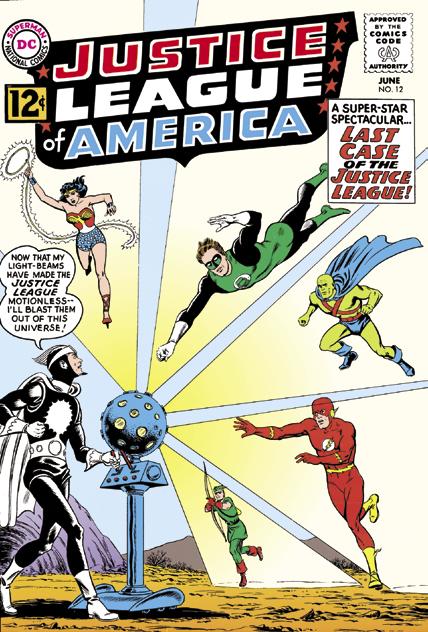
The good Doctor debuted in Justice League of America #12 (June 1962) in a story written by Gardner Fox and illustrated by Mike Sekowsky and Bernard Sachs. As was the norm at the time, the tale was provocatively titled, “The Last Case of the Justice League!” The title comes into play as mascot Snapper Carr is summoned to JLA headquarters by the villainous Doctor Light to scribe a document with the aforementioned title. He then proceeds to tell Snapper how he teleported the individual team members to various planets that would counteract their specific powers. This story would feature an early use of a common superhero plot device, as Superman and Batman are suspicious of the
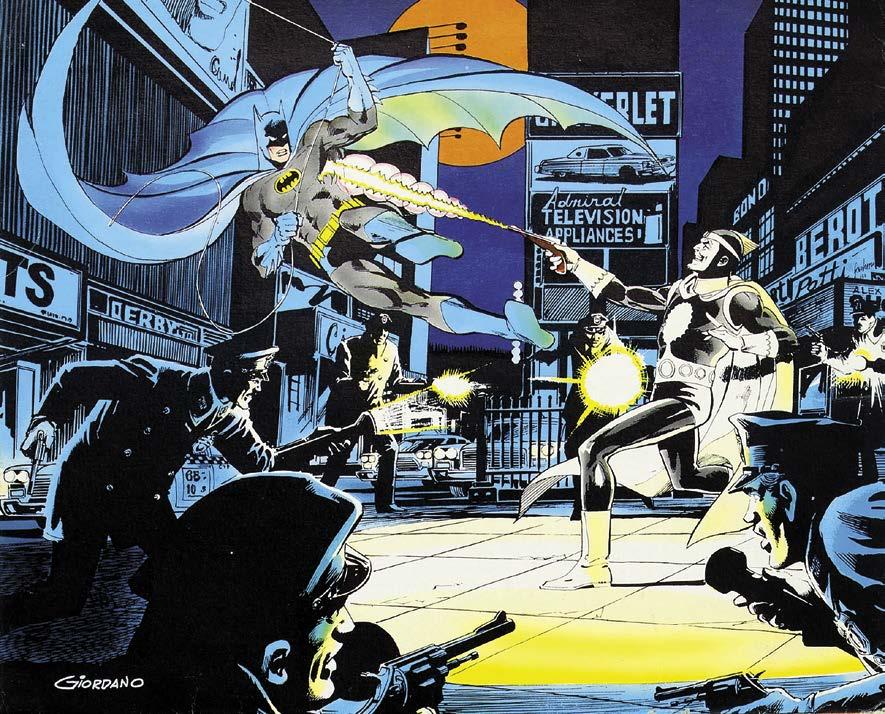
Dick Giordano created this stunning image of Doctor Light battling Batman for a 1978 calendar.
summons that gather the JLA and proceed to switch identities, thus having each trapped by the scheme meant for the other. Freeing all the members, they then track down Light as he attempts to build a trophy room of light related artifacts. The various battles reveal a few devices that would become SOP for Doctor Light. Weapons that are based on light but are really all sorts of different things. He would use hard light objects, later on Hate Light, Magnetic Light, pretty much anything the plot required, just with the appellation Light added to it.
As well as allowing three different teams to battle the effulgent antagonist, he creates solid mirages of himself, a tactic that would often reappear.
The JLA is of course victorious, and Snapper reveals he was not worried by the title of the paper Light was having him compose as when he dated it he noticed it was… the 1st of April.
All in all, this was a scintillating debut for the character as he baffled and battled the team for an entire issue. Surely he would be a challenging foe battling the team for a long, long time.
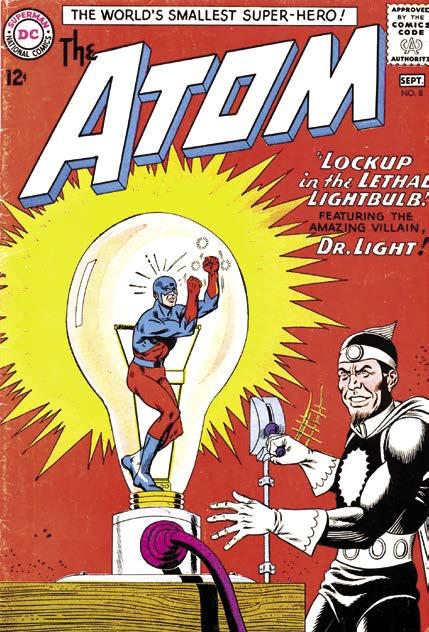
(left) The first appearance of Doctor Light in Justice League of America #12. Cover by Murphy Anderson. (right) The Atom #8, the comic that would haunt Doctor Light’s career. Cover by Gil Kane and Murphy Anderson.
Comics.
THE SHAPE OF THINGS TO COME
Or maybe not. Immediately after that, the luminous lawbreaker would return in The Atom #8 (Aug./Sept. 1963) by Fox, Gil Kane, and Murphy Anderson. Now just to state up front, I am as big a Ray Palmer booster as there is, but this guy had almost beaten the Justice League, and the Atom takes him down in 15 pages. Thus does the pattern begin.
Things did not improve as Fox, Kane and Sid Greene pitted him against Green Lantern in issue #33 (Dec. 1964) of his title for 12 pages, then he returned in Flash #171 (June 1967), where Fox and Greene teamed with penciller Carmine Infantino to at least give him a full issue before he tasted defeat. These issues do shine a little light on the villain’s motivations as he proclaimed he has decided to destroy the Justice Leaguers individually rather than as a team. That motivation will persist for a little while at least.
NOT THE BRIGHTEST BULB IN THE ARRAY
After these starring roles, the good Doctor joined the roster of reliable DC villains to be pulled out when a known foe was needed, or for background in crowd scenes. JLA’s #61 and 65 (March and Sept. 1968, respectively) would use the character this way, and since the latter of those was the last issue Gardner Fox would write, it seemed, for a while at least, that no other writer would go to see this particular Doctor.
Len Wein would change that when he teamed up with artists Dick Dillin and Joe Giella to craft World’s Finest #207 (Nov. 1971). At this time WF was experimenting with teaming Superman up with different co-stars each issue (as detailed by BI editor-emeritus Michael Eury in his Team-Up Companion published by TwoMorrows), but this one was a callback to when the Darknight Detective appeared alongside him every issue. The phosphorescent felon does not appear until the eighteenth page but is the driving force behind the plot and even branches out into using magic against the duo, albeit a light-based form of prestidigitation.
Cary Bates, along with artists Irv Novick and Dick Giordano then utilized Light in a 13-page battle with Flash in issue #223
(Sept./Oct. ‘73) of his title wherein a bit of a pattern began to emerge, as it was more than halfway through this tale before Doctor Light is revealed as the driving force behind the plot.
After this appearance, it was finally time for the Lighted one to reassert himself as a major contender by again taking on the entire Justice League.
LIGHT IN THE TUNNEL
Justice League of America #122 (Sept. 1975) was the first place I ever encountered Doctor Light and was, in fact, one of the first comic books I ever remember buying and reading! (No wonder I wanted to write an article about him!)
Writer Martin Pasko, along with artists Dick Dillin and Frank McLaughlin, crafted a JLA Casebook story. This format was used at the time to fill in knowledge that had been glossed over in the group’s history. This one told the story of why the JLA members revealed their secret identities to each other. The instigator of that event was Doctor Light.
Disguising himself as a giant ice creature, Light is taken to Superman’s fortress after the JLA defeats him. This is intentional however as Doc then proceeds with his plan to use an element known as Amnesium to scramble the heroes’ minds so that they confused their real identities. Green Lantern thinks his civilian identity is Barry Allen, and so forth. The tale highlights the menace that Doctor Light could provide as his light weapons and his creation of realistic mirages are integral to the plot.
Also showcased was writer Pasko’s knowledge of JLA history, as Light perpetrates this scheme precisely because, as we mentioned, our heroes defeated him that very first time with an identity switch. Adding to the continuity, there is also the fact that Amnesium had been used back in JLA #19 (May 1963) to cause the members to forget each other’s civilian identities after learning them in the course of a case.
Suffice to say, the JLA is triumphant again, but not before enduring a chase through the fortress where exploding mirages, Hate Light, and Kryptonite Light underscore that the Doctor
PRISON SPOTLIGHT

“Ten reasons to buy Suicide Squad in 1989.” Ads with that banner appeared in February 1989 DC comics with Doctor Light featured as one of the ten. Light had already contacted the Squad in issue #19 (Nov. 1988) of their title after that letter he wrote. It would not be until #24 (Feb. 1989) that he would become an active participant though.
That same month, in Secret Origins #37, Light would get a post-Crisis origin courtesy of Craig Boldman, Mike Parobeck, and Ken Branch. Writer Boldman says he got this assignment because,
him, so I felt I needed to work with it. My solution was to portray him as a man who was living with a great overarching fear, which continually hobbled him.” The ghost of that partner we mentioned, Jacob by name, would haunt him for the next little while. Boldman tells BI , “I was glad to see the ‘ghost’ angle followed up on. I’m flattered when another writer picks up the baton and am always interested in seeing where it leads.”
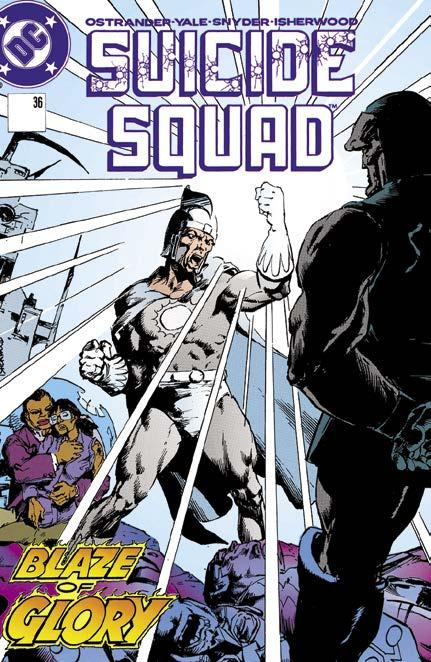
(left) Doctor Light joins the Suicide Squad. Issue #24 art by Luke McDonnell and Karl Kesel. (right) Doctor Light vs. Darkseid. This isn’t going to end well. Suicide Squad #36 cover by Geof Isherwood. TM & © DC Comics.
“Mark Waid and I broke into writing for DC at just about the same time, and Mark liked my work. He got on staff at DC as an editor and was open to my ideas for Secret Origins. On a rare visit to New York, I visited Mark. He knew my heart was in the Silver Age, and between us we settled on Doctor Light.”
This origin keeps the current characterization, giving us a Light who is a budding inventor who purloins his partner’s weapons (and the Doctor Light sobriquet!) after selling him out to a rival and accidentally causing his death after discovering his nascent heroic career. “I introduced the idea of a previous Doctor Light, a fledgling superhero, because the name struck me more as a heroic one. ‘Light’ has always carried positive connotations,” says Boldman.
“Doctor Light’s reputation as a failure was understandable, but I felt a bit harsh. He became known as the villain that couldn’t beat anybody,” reveals Boldman. “By the time I got my hands on the character, that stench of defeat permeated
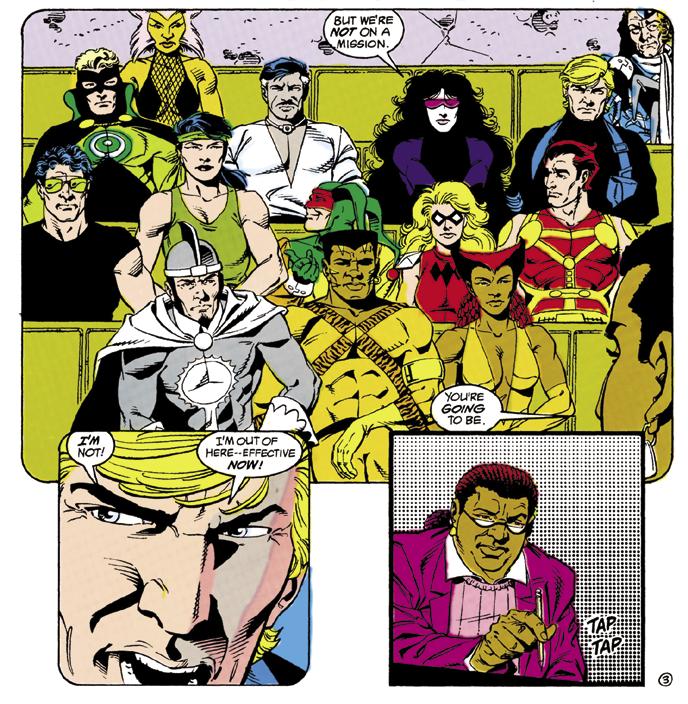
Since there was already an origin story for Light, “That story struck me more as an ‘untold chapter’ than as an origin. It could be reconciled with my version if necessary,” says Boldman.
Back in the Suicide Squad , Light’s tenure was fairly uneventful, with a noted aversion for battling children, and portraying him as the milksop he had become, despite the fact that he kills Sparkler (a teenager) of the Force of July in #27 (May 1989). That is, until he himself was killed.
Issue #36 (Dec. 1989) was a culmination of a thread that John Ostrander had been weaving almost since the start of the series. The previous few issues brought team members to Apokolips, and as this issue begins, the ghost of Jacob convinces Light that he should make a heroic stand against Darkseid’s legions. It does not go well. Co-plotted by Ostrander’s wife Kim Yale, and illustrated by John K. Snyder and Geof Isherwood, Doc is dispatched in… um, two panels, and is now condemned to a ghostly existence alongside Jacob. The writing team was not done with the Doc yet, bringing him back in SS #52 (Apr.1991) in a light-hearted tale illustrated by Jim Fern and Bob Campanella where a demon named…Mister Biff returns Light to life.
by Jonathan Brown
In Star Trek V: The Final Frontier, Captain James T. Kirk asked a nefarious space alien, “What does God need with a starship?” The being was posing as the Almighty and had lured other characters to the edges so that it could steal the USS Enterprise In realizing that this “God” seemed limited and in need of a mode of travel, Captain Kirk used the question to tease out the true identity of this creature. Surely a being of infinite power and knowledge could go wherever it pleased. In posing this question, the space alien is revealed to not be God, but a villain. In the years preceding this film’s release, Marvel creators and fans asked a similar question about the comic Thor: Why does a god need a Doctor? Why does a god need a secret identity?
Long before Thor strode across galaxies and timelines as the cosmic champion we know today, he lived behind the blue eyes of a mortal doctor. Donald Blake was once as integral to the Thor mythos as Steve Rogers is to Captain America or Bruce Banner to the Hulk. He was Thor’s disguise, yes, but he was also his conscience, his grounding, his lesson, his burden, and sometimes, his victim. Today, Blake is an Easter Egg in Odinson’s first MCU outing, a little-known concept to contemporary readers. He is often remembered only as a relic of the Silver Age discussed at conventions, comic shops, and in Facebook groups. But in truth, he is a far richer part of the Norse gods’ Marvel legacy. To trace Donald Blake’s history is to trace the evolution of Marvel Comics itself. He is the man behind the god. The man forgotten, reimagined, erased, resurrected, corrupted, and reinterpreted across six decades. The man who once carried the soul of the thunder.
Stan Lee, Larry Lieber, and Jack Kirby introduced Donald Blake in Journey Into Mystery #83 in 1962. They were breaking the world and causing a Big Bang that would provide the foundation for the shared continuity we would come to see as a universe. Fantastic Four and Hulk had already launched the Marvel Age, and a new house style was forming, one where heroes carried emotional burdens alongside superpowers. Blake’s debut exemplified this vision. He was a frail, thoughtful physician with a limp, a quiet man who approached life with compassion and caution. Finding Mjolnir transformed him into Thor, but the dramatic tension didn’t come from the transformation itself. It came from the question: what does a god learn by living as a man?
Silver Age secret identities were common, but Blake was unusual. Rather than hiding a hero’s power, Blake’s mortal limitations shaped Thor’s character. Blake was all too human; Thor needed humanity. The early issues are full of scenes that show Blake hesitating, wrestling with ethics, worrying about Jane Foster, or arguing with himself about whether the world needs Thor or the
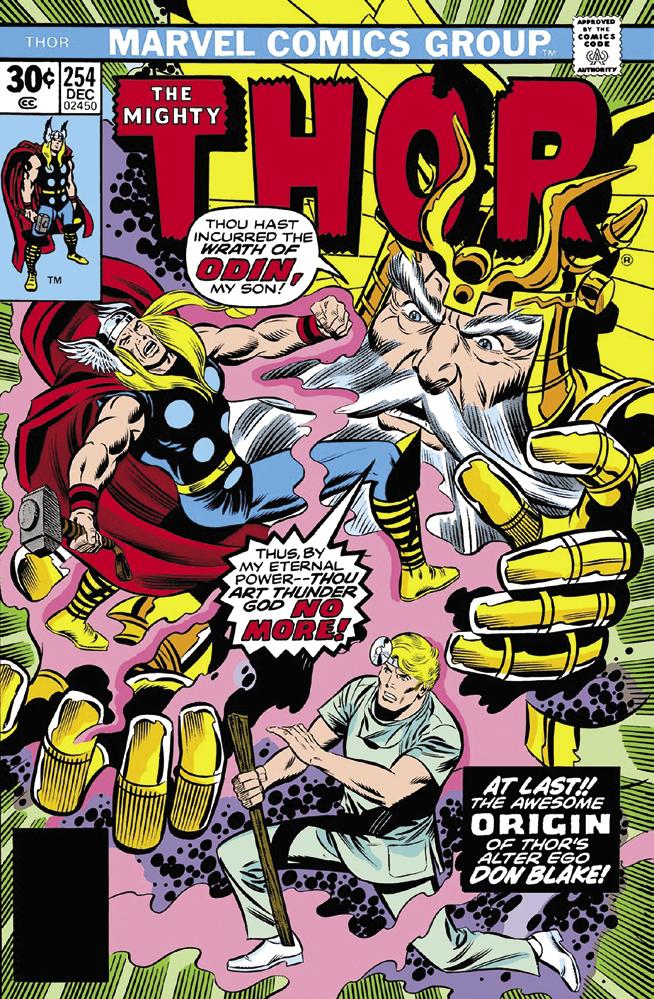
Thor #254 reprints #159 under a wonderful new cover by Rich Buckler and Joe Sinnott.
TM & © Marvel Characters, Inc.
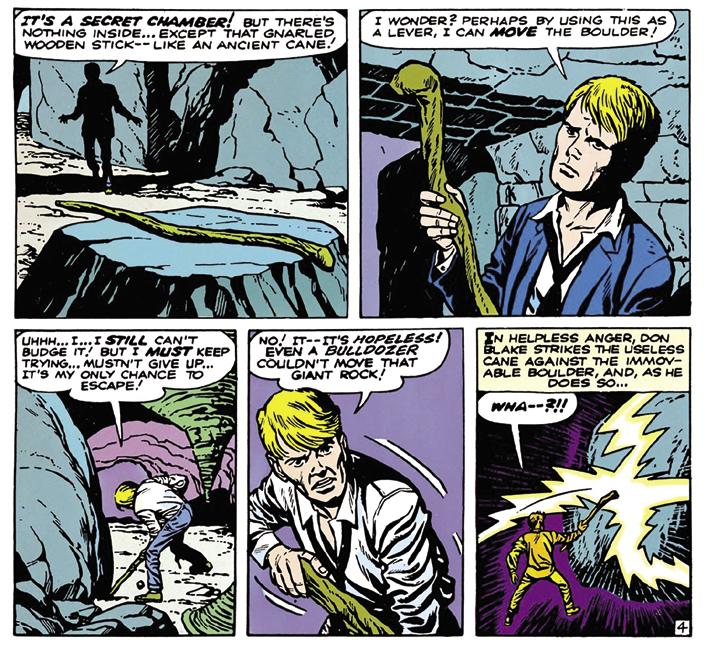
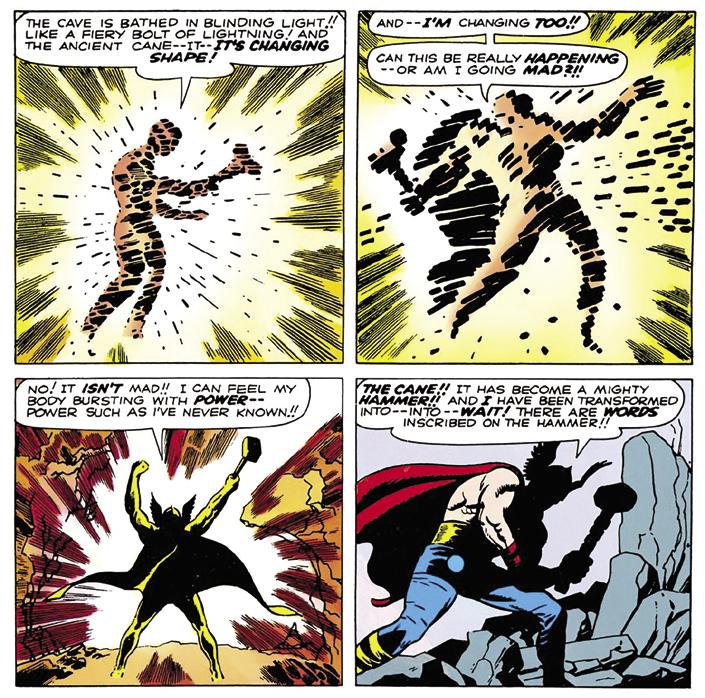
Dr. Donald Blake makes a fateful discovery in Journey Into Mystery #83. Art by Jack Kirby and Joe Sinnott. TM & © Marvel Characters, Inc.
gentle hand of a doctor. In these early years, Blake has the quiet sadness of someone who sees wonders beyond reach, who is capable of greatness he cannot fully grasp without sacrificing the life he has built.
But everything changed in 1968, when Kirby and Lee produced Thor #159, and detonated a continuity bomb that continues to reverberate: Donald Blake was not real. He had never been a child, never been a student, never lived a life before Thor’s exile. He was an enchantment, a persona crafted by Odin to teach Thor humility.
With this revelation, Blake shifted from character to symbol. He became the incarnation of a divine lesson. Thor’s human life was not quite his own—it was a narrative of reformation designed by his cosmic father. The issue remains one of the most philosophically ambitious of the Silver Age, and it reframed Blake for every subsequent writer.
Yet Blake’s fictional origins did nothing to diminish the emotional weight he carried in the decade that followed. Marvel entered the Bronze Age in the early 1970s, a period marked by deeper psychological storytelling, experimentation, and social relevance. Writer Gerry Conway, who took over Thor during that period, inherited not just a superhero but a metaphysical paradox: a divine being posing as a man who never existed.
In a 2022 interview at Terrificon published by Conskipper, Conway recalled how he began writing the series: “Stan gave up Thor, and Roy didn’t want to write Thor, so I began writing Thor.” His entry was almost casual, but the results were anything but. Conway leaned into the psychological duels inside Blake’s mind. If Stan Lee revealed Blake was imaginary, Conway wrote him as someone who felt painfully honest. Conway often portrayed Blake as a man torn between identities, wandering through emotional landscapes where certainty was impossible. In these stories, Blake struggles not only with love for Jane Foster, for Earth, but with belonging. He performs surgeries with trembling care, only to be wrenched away by forces of destiny. He wonders if his affections are his own or borrowed from the god inside him. In one memorable issue, Blake’s self-doubt nearly cripples him more than his physical impairment ever had. Conway approached Blake like a man awakening from a dream he cannot test, living a life with roots that might dissolve if pulled on too hard.
The tension Conway explored captured Marvel’s shifting tone. The world was growing more complex, and so were its heroes. Secret identities were no longer simple disguises; they were battlegrounds of psyche and soul. Blake’s humanity grounded Thor during this era, even as cosmic threats escalated. Yet this deepening complexity also revealed the strain in the dual-identity structure. Thor was being pulled upward into myth, while Blake was pushing downward into human vulnerability. Something had to give.
That “something” arrived in 1983, when Walter Simonson took over Thor with issue
#337, delivering what many regard as the ultimate run in the character’s history. Simonson approached the book with infectious creative energy, cosmic imagination, and a commitment to revitalizing the series from top to bottom. And one of his first decisions was simple but seismic: Donald Blake had to go. In a later interview with Comic Book Resources for their “Dialogue with Walt Simonson” series, Simonson described the decision with characteristic understatement. He explained that removing Blake “achieved a couple of things,” noting only that the change allowed the story to move in new directions. But the magnitude of that shift cannot be overstated.
Simonson’s removal of Blake liberated Thor from the constraints of mortal life. No longer tied to hospital rooms or earthly romance, Thor could now inhabit the full scale of Norse mythology. Under Simonson’s pen, the book became an operatic epic: the arrival of Beta Ray Bill, the forging of Stormbreaker, Loki’s schemes, apocalyptic visions of Ragnarok. Each of these stories thrived because Thor was finally free to be a god without apology.
And yet, in Blake’s absence, a subtle emptiness emerged. Thor was powerful, noble, mythic— but he was no longer human. The emotional counterweight that once grounded him had vanished. Simonson compensated with brilliance, but the silhouette of Blake lingered on the horizon like a ghost.
As the 1980s progressed, the fate of Donald Blake took an even stranger turn behind the scenes. Marvel underwent significant editorial shifts under Editor-in-Chief Jim Shooter. Shooter was an ambitious, sometimes controversial figure with a vision for a more streamlined Universe. At one point, Shooter spearheaded a massive reboot concept called “Marvel’s Big Bang,” intended to reimagine characters from scratch. Years later, writer Doug Moench, who was present during these discussions, recalled in fan forums and retrospective conversations that Shooter’s plan would have killed off Donald Blake entirely. Not retired, not reimagined—killed.
Moench remembered that in the reboot, Thor would have been a mantle accessible to anyone who found his magical walking stick. Instead of a doctor, the mortal identity might have been “a plumber or whatever.” The casual phrasing underscores how disposable Blake was in the late 1980s. What had once been Thor’s humanity was now an abandoned storytelling device, a remnant of a bygone era.
The reboot never happened. Shooter left Marvel, and Big Bang collapsed. Blake survived by accident more than design. Yet the proposal revealed how precarious his existence had become.
Then came the 1990s and early 2000s, a period of reinvention, grim realism, and blockbuster event storytelling. Thor himself went through
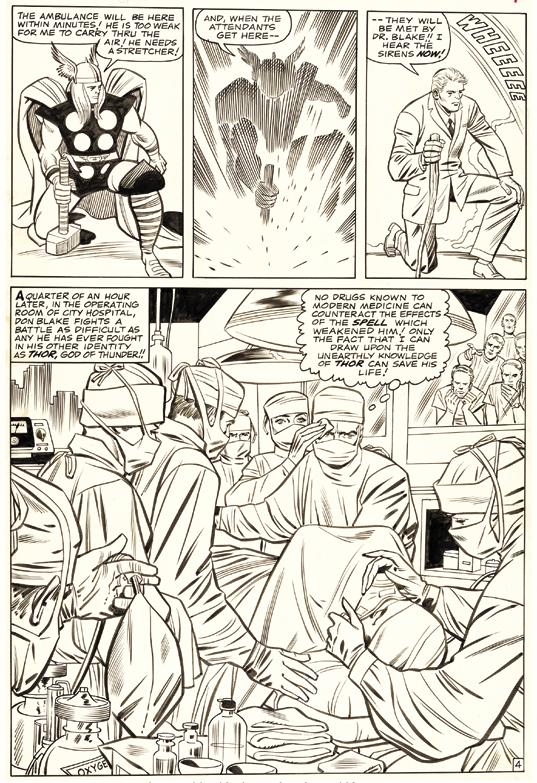
(left) Dr. Donald Blake in action in Journey Into Mystery #108. Art by Jack Kirby and Chic Stone. Original art scan courtesy of Heritage Auctions (www.ha.com). (right) The splash page of Thor #159 asks an extremely important question. Art by Kirby and Vince Colletta.
TM & © Marvel Characters, Inc.
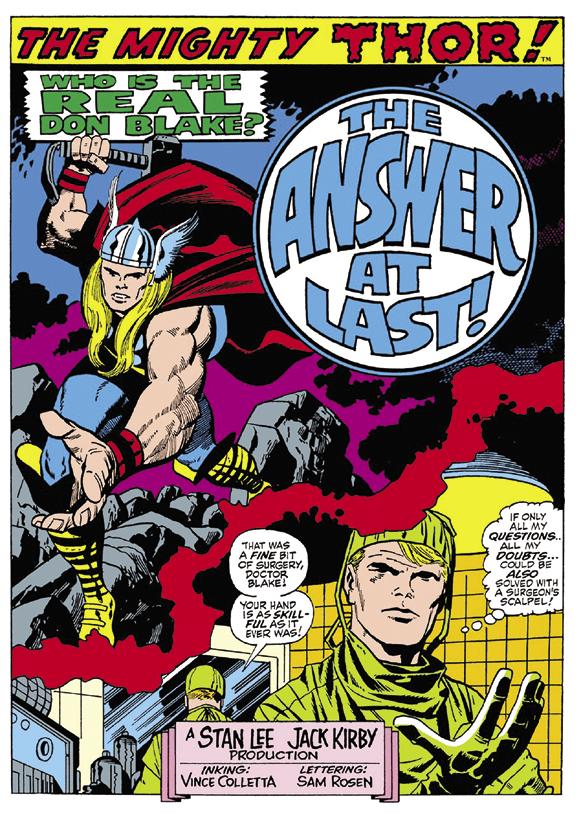
by Marc Buxton
THE GOLDEN AGE
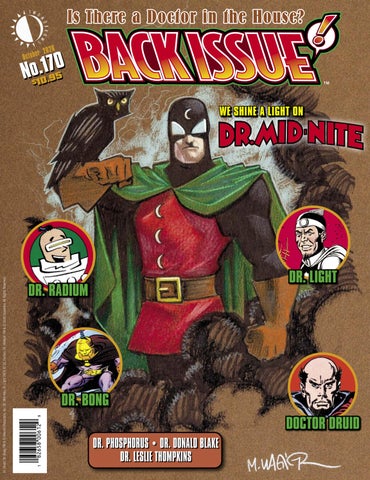
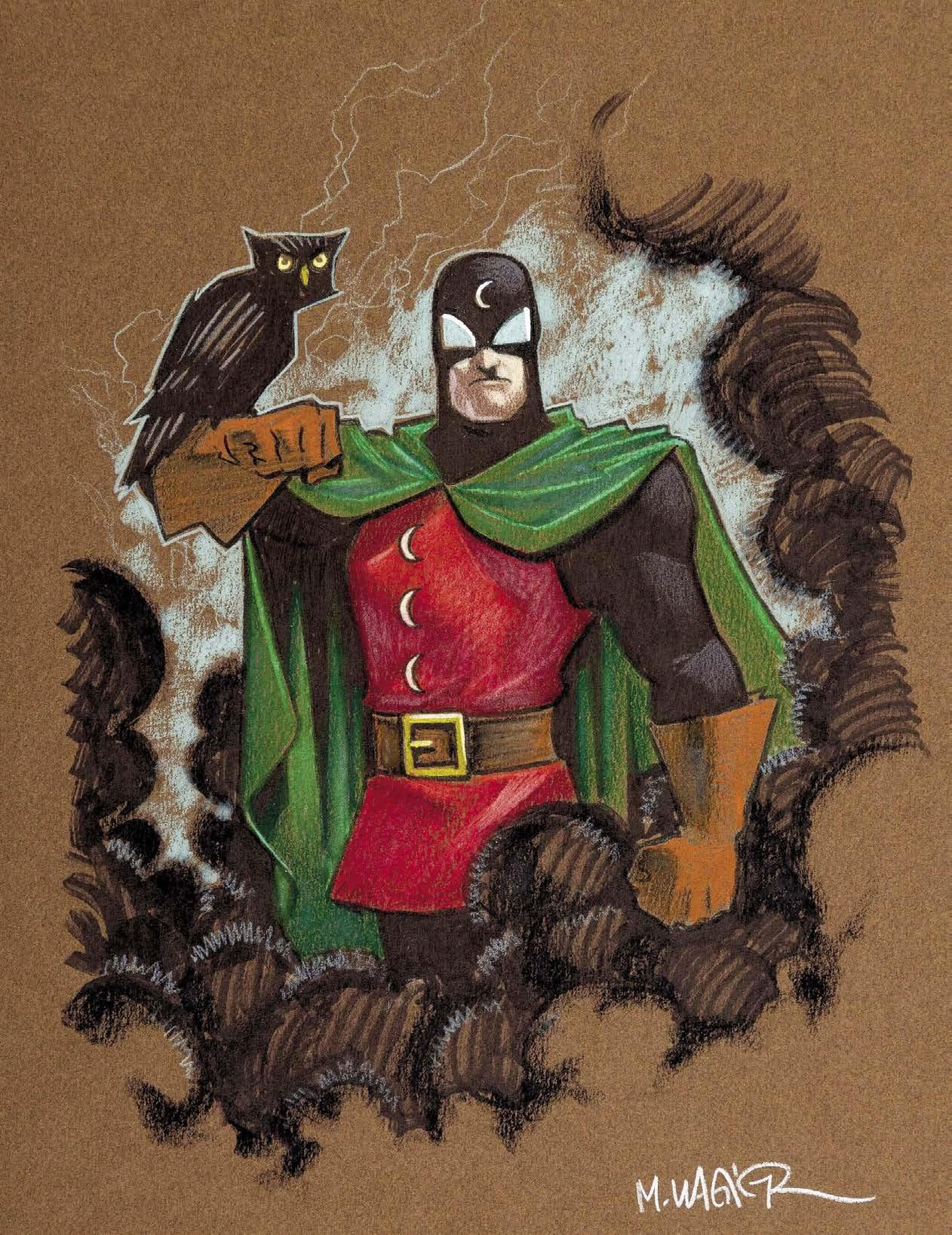
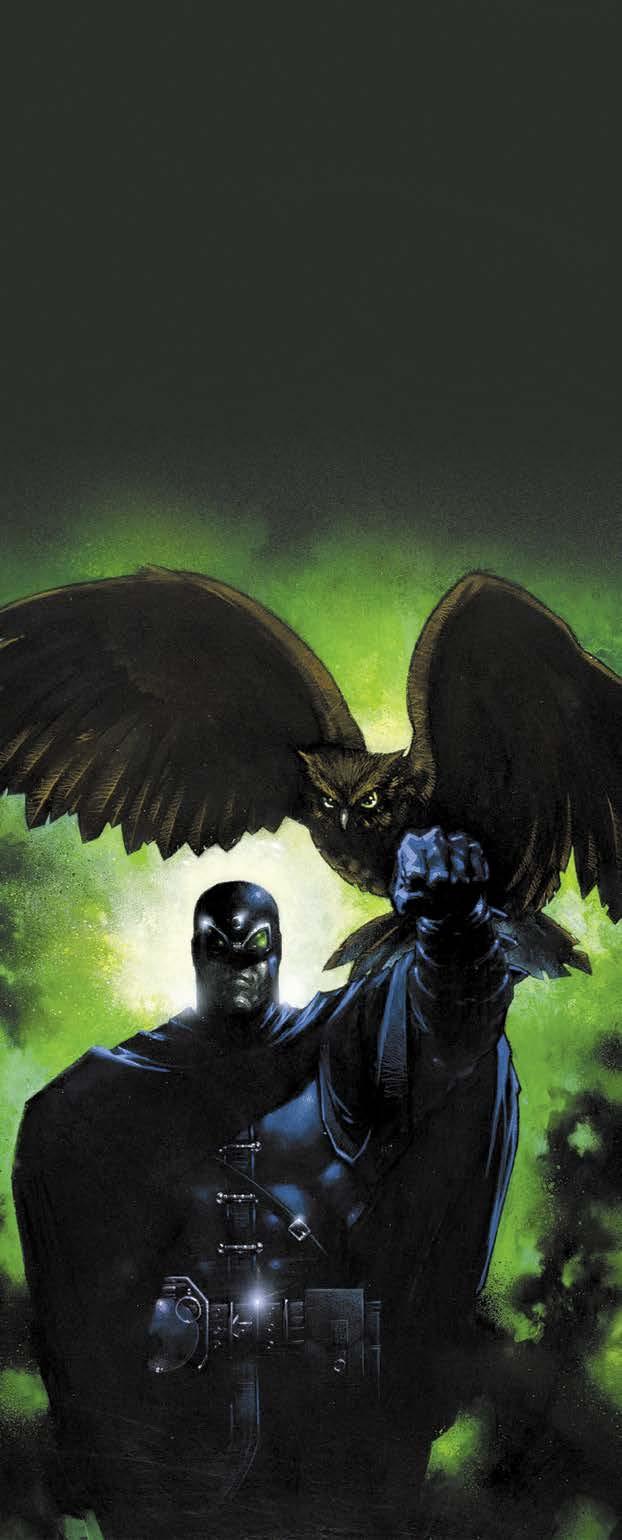
Doctor Mid-Nite first appeared in All-American Comics #25 (April 1941) and was created by Charles Reizenstein and Stanley Josephs Aschmeier. Also known as Charles McNider, the hero will always be remembered as the first comic book superhero with a physical handicap. After a mob hit, McNider was left blind… or so it seemed. McNider found he could see in total darkness. After creating a costume and some darkness themed offensive weapons, Doctor Mid-Nite was born. Why the hyphen and strange spelling, you ask? According to champion of all things Golden Age Roy Thomas, “I assume the original was spelled that way because of the more famous Captain Midnight... I don’t know if the Quality character Midnight [see sidebar at the end] preceded Doc or not.”
Hyphen or not, Doctor Mid-Nite was the very first differently abled superhero. Some even speculate that Mid-Nite was an inspiration to Marvel’s Daredevil, the most famous blind costumed hero. Thomas discounts this speculation. He tells BACK ISSUE , “I can’t imagine that he was. Stan was apparently told to revive the Lev Gleason Daredevil, and he and/or Bill Everett came up with the blindness thing. (I believe Bill’s daughter Wendy or one of his other kids is legally blind, and Bill thought it came from that...) but Stan was perfectly capable of coming up with the blindness thing.”
Doctor Mid-Nite soon develops his signature blackout bombs, kind of reverse flashbangs where with a sudden explosion, an area is plunged into total darkness. He also takes an animal sidekick in Hooty the owl. Doctor Mid-Nite joins the Justice Society of America in All-Star Comics #8 (Jan. 1942), and stays on as a consistent member of the team until the end of the JSA’s run in the early ‘50s. Doctor Mid-Nite also had a long run in in All-American Comics as he became a constant in the Golden Age, even if he was rarely featured. Thomas recalls, “So far as I know, the only member of the JSA who in the Golden Age was never on a single comic cover besides All-Star (Even the Atom appeared in a group shot on the cover of the Big All-American Comic Book.)”
THE SILVER AGE
When the Golden Agers made their comeback starting in “The Flash of Two Worlds,” (Sept. 1961), the JSAers slowly trickled back into DC continuity, but Doctor Mid-Nite was never given a Silver Age tryout or a legacy counterpart. McNider did make his Silver Age debut in “The Flash of Two Worlds” in a brief cameo with the rest of the Justice Society. He would have his first major Silver Age appearance with the second JLA/JSA team up in Justice League of America #29-30 (Aug.-Sept. 1964) as the two squads of heroes fight the Crime Syndicate of Earth-3. For the rest of the Silver Age, Doctor Mid-Nite would be a frequent member of the JLA/JSA annual meet ups, but Mid-Nite was rarely featured in most of the action. But even in these brief bursts, he stood out. With his unique costume, his quiet demeanor, and his cool abilities, the good Doctor was always a Silver Age treat. But it seemed DC was not that interested in increasing his presence. And as the Silver Age turned into the Bronze Age, despite the swashbuckling potential of the character, Charles McNider would fade further into the background.
John K. Snyder III’s outstanding cover art for Doctor Mid-Nite #1.
by Ed Lute
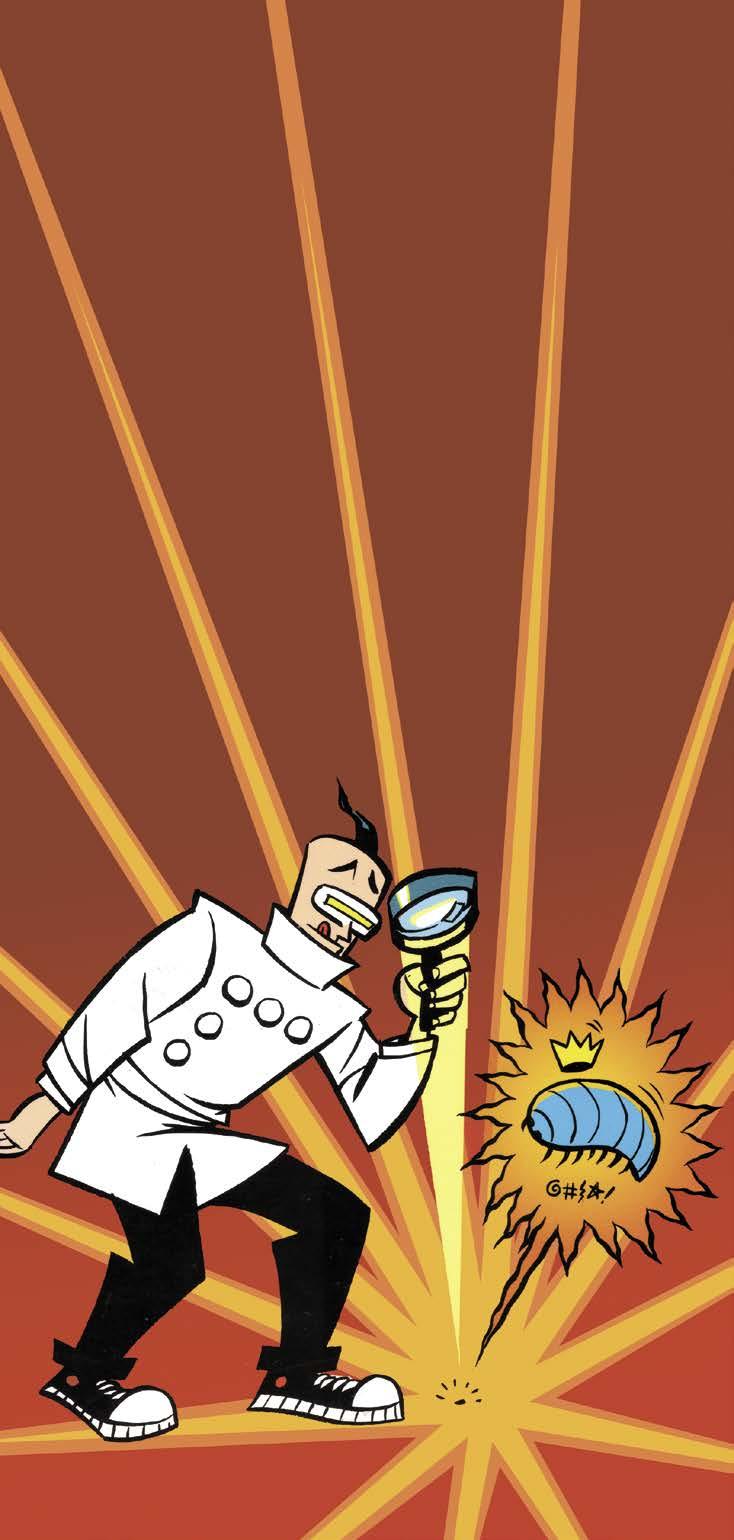
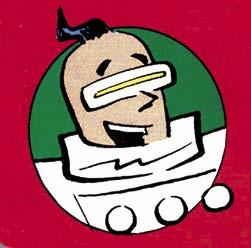
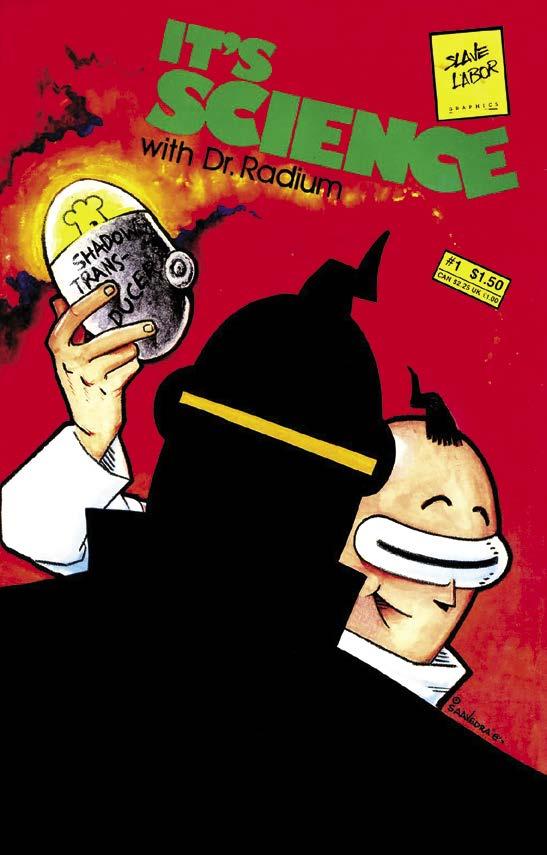
Welcome to the weird and wacky world of science, Dr. Radium style! In the future, the last scientist Dr. Radium, his beleaguered assistant Roy, and the time displaced Penny explored science with reckless abandon. The original It’s Science with Dr. Radium series, published by Slave Labor Graphics, ran for seven issues (cover dated Sept. 1986-March 1988). However, readers also got more of the anomalous scientist and his companions in several one-shots including the 1989 It’s Science with Dr. Radium Special and Dr. Radium and the Gizmos of Boola Boola! (Jan. 1992) as well as another ongoing, Dr. Radium, Man of Science, which lasted for five issues (cover dated Oct. 1992–Jan. 1995). Behind every story was creator, writer, and artist Scott Saavedra.
BACK ISSUE’s exclusive interview with Saavedra explores the creation of this idiosyncratic character, the comics themselves, and the current status of the character. So, come along, kiddies, because science class is in session as we revisit one of the quirkiest comics of the 1980s and 1990s.
ED LUTE: Thank you for agreeing to be interviewed today.
SCOTT SAAVEDRA: You’re welcome. I have to tell you that I was very surprised by your request. It’s been a few years for me since I did Dr. Radium. I can’t remember the last time I talked about these comics. I wasn’t even sure if anyone even remembered him. [Laughs] It’s just weird. I get more people coming out of the woodwork about a little magazine I did called Comic Book Heaven
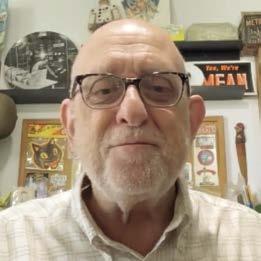
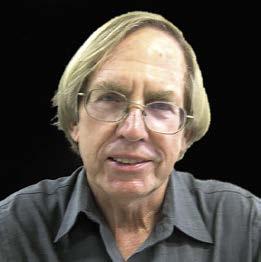
LUTE : BACK ISSUE does theme issues, and It’s Science with Dr. Radium was one of the assignments for the Doctor issue. Since I liked the series, I jumped at the chance to pitch for it. I was happy that I got the assignment.
SAAVEDRA: Great! That’s my earliest work, so I have mixed feelings about it. It was the stuff I started with, and I can see all my mistakes. I don’t tend to look back at it too often. I’m always more interested in moving forward. [Editor’s note: Among many other accomplishments, Scott is now the graphic designer for Back Issue’s sister publication RetroFan , also from TwoMorrows Publishing.]
LUTE: Let’s start at the beginning. Where did the idea for Dr. Radium come from?
SAAVEDRA: The publisher of Slave Labor Graphics [SLG] Dan Vado and I had a mutual acquaintance. I didn’t know Dan. But I was told by someone I knew, who knew that I liked comics and wanted to do them someday, that he knew a comic shop
Art from the first The Dr. Radium Collection from SLG. All art in the article by Scott Saavedra unless otherwise noted.
TM & © 20th Century Fox.
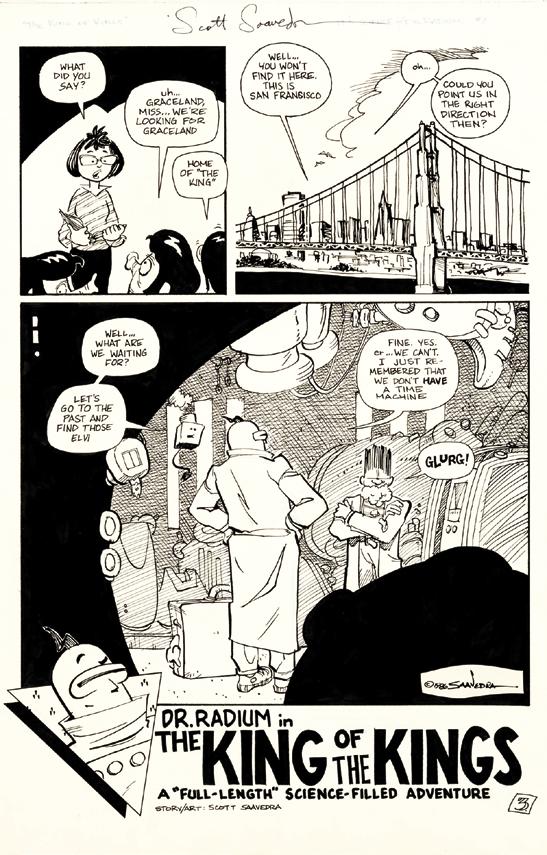
(left) The experiment begins in It’s Science with Dr. Radium #1! (right) The Elvi appear and we meet Dr. Radium in the initial story. Original art scan courtesy of Heritage Auctions (www.ha.com).
guy who is publishing comics. I think Dan had published one comic at that point. I was 26 at the time. There was this black-and-white boom in comics. I got in there early enough to rise a little by the end of it.
After I heard there was this guy who was going to publish comics, I sat down and did a couple of sample pages. What I wanted to do was come up with a topic that was full enough to capture any kind of story I wanted to do. So, I thought I would draw something about a scientist in the perfect world of tomorrow, and I thought that the perfect world of tomorrow probably doesn’t need scientists because they know everything. [Laughs] That was kind of my hook for where the humor might be.
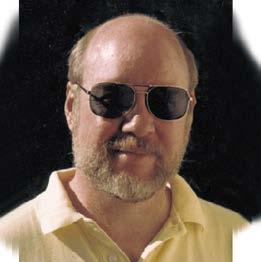
I came up with the character just fiddling around in a sketchbook and took the two pages to Dan, and he looked them over. He said “Yeah, I’ll publish you.” The book didn’t come out until later that year, but I immediately quit my job at Macy’s selling shoes. I haven’t looked back, although I don’t do comics anymore per se.
I’ve always been a graphic artist/graphic designer, or what we used to call when I was in high school a commercial artist. So, I’m kind of
graphic handyman. That’s how I always saw myself even though at the time I was looking to do comic books. I wanted to write and draw them.
So, Dan green lit the character and the comic called It’s Science with Dr. Radium . And then I realized (and this was a really horrible realization to have) that I didn’t know what I was doing. [Laughs] I wrote two funny pages, but I didn’t know how to write a story. That turned out to be a source of frustration for me over the years that I worked on the character.
Even though he published the comics, Dan wasn’t quite so sure of me at first. He eventually had faith in me, and we got to be good friends. He was the best man at my wedding, and I’m godfather to his first son, so our relationship picked up after that. That was scary, though, not really knowing what I was doing. It took me a while to kind of fake it, which is what I felt that I was doing.
When I referenced earlier that I find it difficult to look at those early comics is that I just didn’t know. I had no confidence in what I was doing and yet it did develop a small following so that surprised me. For a couple of years that was pretty good.
(left) Dr. Phosphorus makes demands of Dr. Bell. Detective Comics #469. Art by Walter Simonson and Al Milgrom. (right)
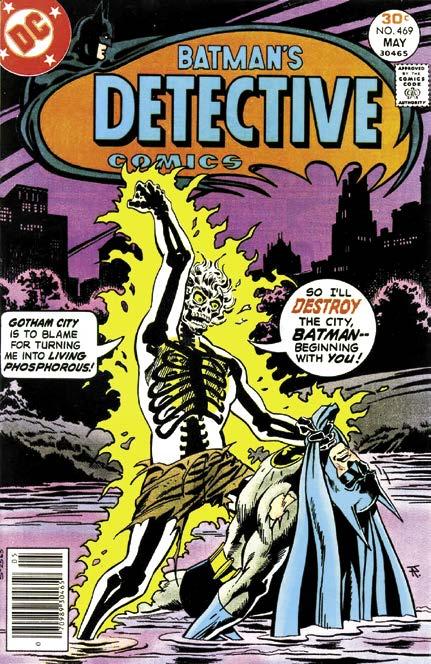
Dr. Phosphorus makes his first appearance on the cover of Detective Comics #469. Art by Jim Aparo.
quickly wraps his fists in his cape and is able to stagger the villain, but both figures have fallen into the water with Dr. Phosphorus holding our hero in a burning death grip. Fortunately, the water neutralizes some of his radiation and Batman is able to break his grip. The villain declares that he cannot kill Batman now as it is their first encounter and the thrill of the game would end too soon. With that, he flees as the Batman recovers, leaving the story on a cliffhanger, but it was followed by a 6-page treatment titled “The Origin of Dr. Phosphorus,” delivered by the same creative team.
The dramatic first page begins with Dr. Phosphorus greeting Dr. Bell at his apartment on the outdoor balcony. This apparently
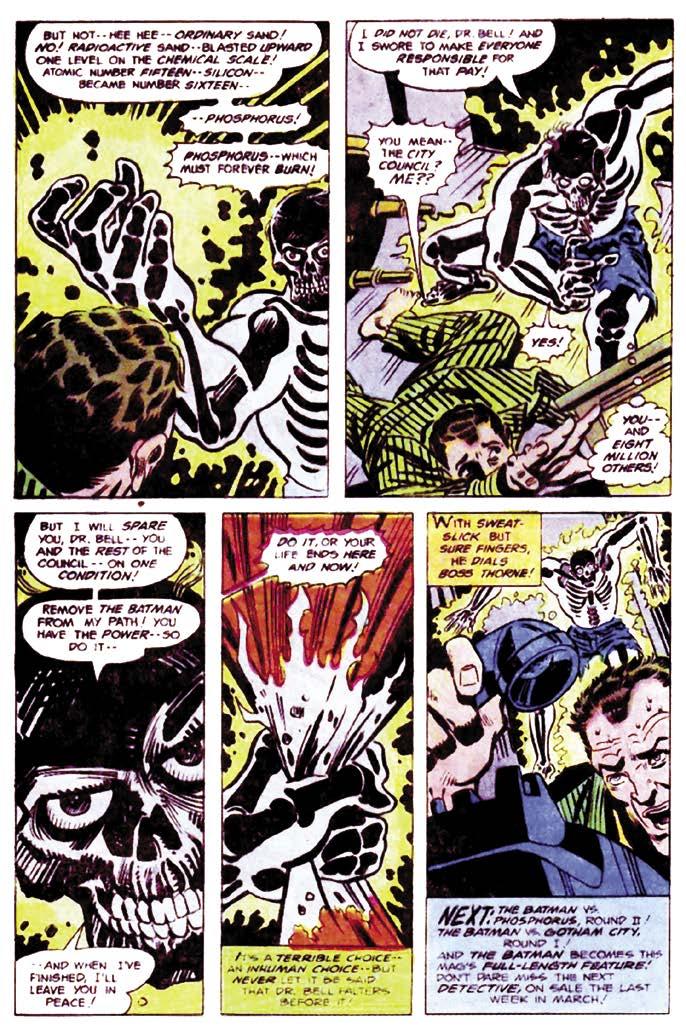
happens after the earlier encounter with Batman. Bell seems to recognize him from what had transpired earlier, perhaps from the news and, as Phosphorus advances, he reveals that he is Bell’s former colleague, Dr. Sartorius. Bell exclaims that Sartorius is dead. A flashback reveals both Bell and Sartorius were members of the exclusive Tobacconist’s Club, populated by the most powerful figures in Gotham City. Dr. Sartorius was admitted by virtue of his successful Park Avenue practice and his association with Dr. Bell at Gotham General Hospital. Sartorius then met the city council chairman, Boss Rupert Thorne. Sartorius was looking for a tax shelter and Thorne alludes to a potential tax haven that might be just the ticket. Thorne holds a document citing a report on a nuclear power plant. He offers “advice” to Sartorius to invest in the plant, to which the good doctor quickly agrees.
Sartorius sinks his savings into the plant, but politics being what it is, the citizens balk. A ballot fails and so the project is moved to an offshore platform. With dwindling funding, corners are cut on the facility. Sartorius visits to check on his investment. He is alone and things appear to be in order until he sees sparks that indicate the reactor core is cracking open.
He flees in desperation, diving behind a wall of sandbags, but an explosion follows, driving “five million slivers of red-hot sand” throughout his body. The sand, it turns out, is radioactive
continued on page 43
by Paul Burns
It is unlikely Doctor Druid will ever win any popularity contests. Indeed, he often tops polls of Worst Ever Avenger. What may not be known about him is he is Marvel Comics’ first Silver Age superhero, predating the Fantastic Four by five months. From that viewpoint it can be argued he deserves more respect than he gets. This article will attempt to show Druid at least has a fascinating history (along with three surnames—and the first of those is Droom!).
Doctor Anthony Droom debuted in Amazing Adventures #1 (June 1961) in “I Am The Fantastic Dr. Droom!” by Stan Lee, Jack Kirby, and Steve Ditko.
Droom travels to the Himalayas to treat a dying Tibetan Lama. After he walks over hot coals and faces a lion/ape creature, the Lama appoints Droom his successor, problematically transforming him into an Asian man. He promises to teach Droom black magic and the ways of mysticism.
Droom’s adventures continue in Amazing Adventures #2-4 and 6 (July-Sept. and Nov.1961), with him telepathically thwarting various alien invasions across economical five-page strips. But that is where Droom’s saga ends. Almost.
“I always liked [Doctor Droom], but I forgot about him,” Stan Lee admitted in Alter Ego #104 (Aug. 2011).
“It was a one-shot thing. And one day while we were trying to think of some new heroes, I thought I’d like to bring back a magician.”
That character would be a renamed Dr. Strange (from Steve Ditko’s creation, Mr. Strange). Lee influenced Ditko to adapt Droom’s origin for the Sorcerer Supreme. We will later discover that Droom and Strange’s origins are fundamentally linked way beyond Lee’s reluctance to let a good concept go to waste.
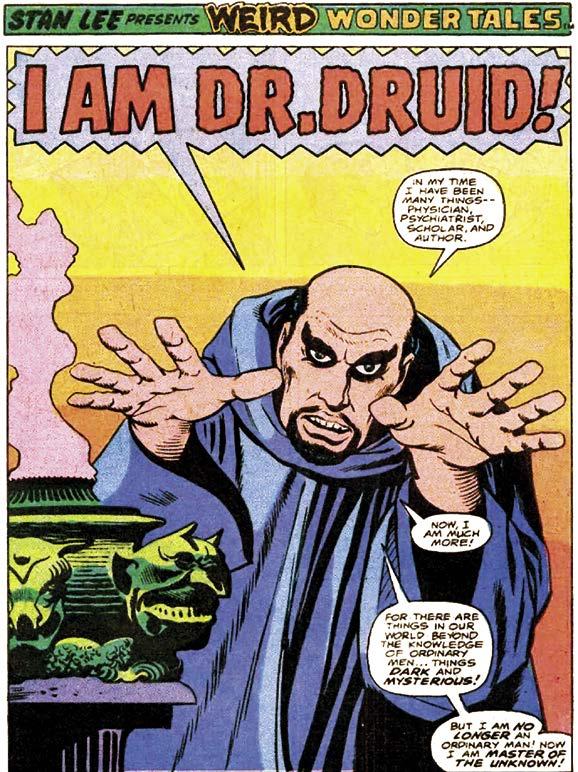
Anthony Droom languished in limbo until 1974, when Giant-Size Man-Thing #3 reprints the Doctor Droom story from Amazing Adventures #6, with a significant alteration: Editor Len Wein changed the name Droom to Druid in all but one panel of the story. Two years later, Roger Stern was selecting stories for reprint title Weird Wonder Tales, as he explained to Jarrod Buttery in BACK ISSUE #86 (Feb. 2016): “I was always looking for stories for the mystery/monster books that hadn’t already been reprinted. I noticed that a short series of ‘Dr. Droom’ stories had appeared in early issues of Amazing Adventures. But I thought the name ‘Dr. Droom’ might be a problem… it sounded a little too much like Dr. Doom. I didn’t know it at the time, but during Len’s tenure as editor, the sole non-Kirby Droom story-it was drawn by Paul Reinman-had been reprinted, in Giant-Size ManThing #3, with Droom re-lettered as ‘Druid’.”
Stern realized that wasn’t the only change that had to be made: “So I followed through, rewriting the origin story to remove a bit of unintended racism, and re-established him as Dr. Druid. Then, John Tartaglione touched up Druid’s appearance, sprucing up his beard and giving him a more consistent look.”
Weird Wonder Tales #19 (Dec. 1976) sees the full debut of Doctor Druid. Jack Kirby and John Ver -
John Byrne and John Tartaglione’s new splash page for Weird Wonder Tales #22
TM & © Marvel Characters, Inc.
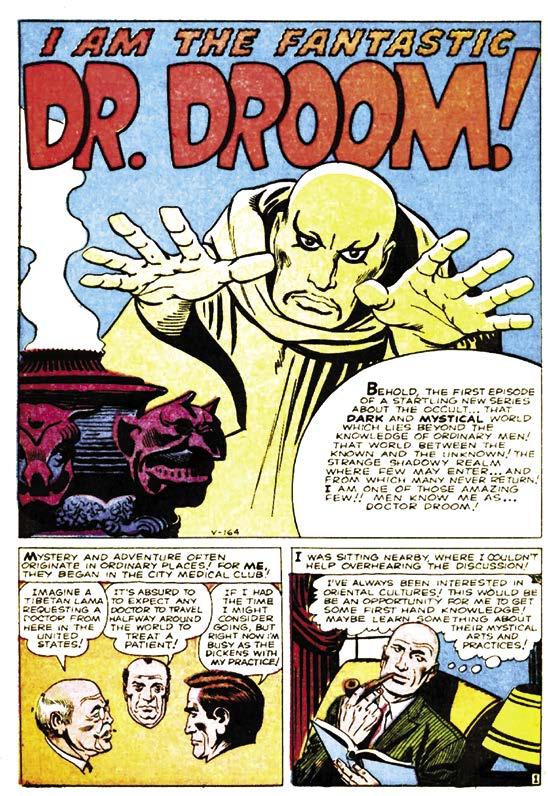
(left) The splash page for the first Doctor Droom story. Amazing Adventures #1 art by Jack Kirby and Steve Ditko. (right) John Tartaglione’s corrections to the splash page of Weird Wonder Tales #19. (bottom) Jack Kirby and John Verpoorten put Doctor Druid on the cover of Weird Wonder Tales #19.
TM & © Marvel Characters, Inc.
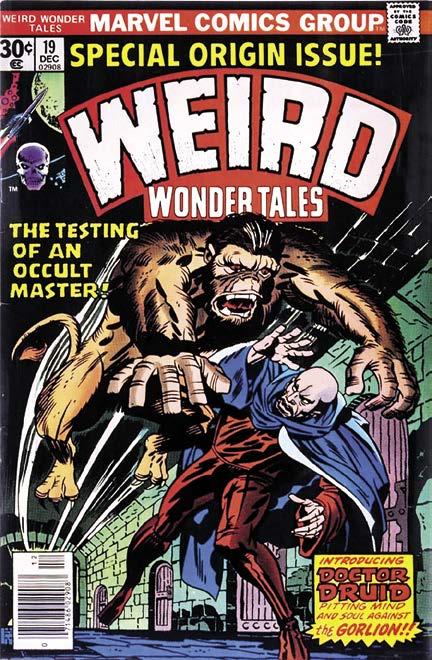
poorten’s cover depicts Druid’s new Kirby designed red costume and blue cloak, with the “new” hero facing the monstrous Gorlion. The issue reprints Amazing Adventures #1 with the obvious title change “I Am Dr. Druid” and altered dialogue by Larry Lieber.
Weird Wonder Tales #19-22 (Dec. 1976-May 1977) reprints other Amazing Adventures Droom strips with altered art by Tartaglione and lettering by Jim Novak. The exception being issue #21, which reprints Tales to Astonish #12 (Oct 1960).
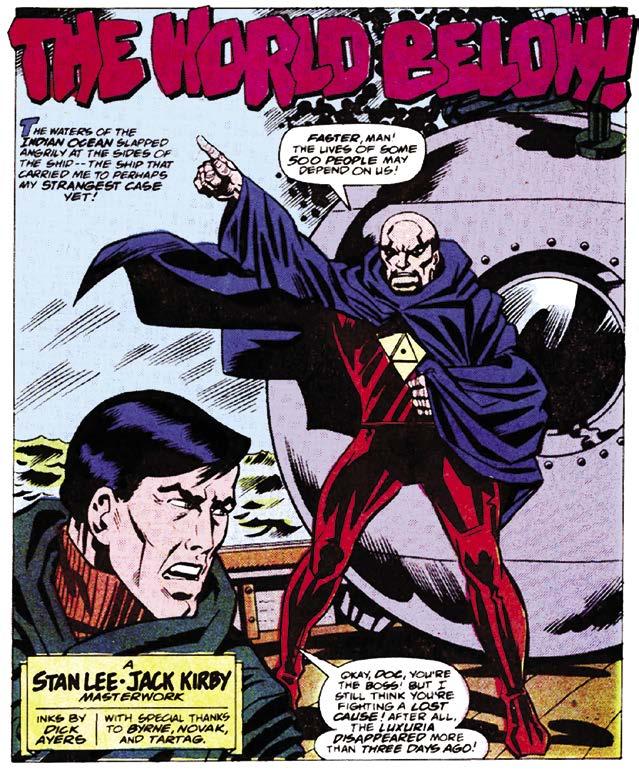
“I Discovered Gorgilla! The Monster of Midnight Mountain” did not originally feature Droom at all. The altered strip has Doctor Druid in place of a blond monster hunter called Scotty. Druid is also inserted as the ‘host’ for WWT’s back-ups, furthering the intention of him being the star of the whole title. A new John Byrne illustrated splash page is inserted in Weird Wonder Tales #22 (May 1977) which reprints Amazing Adventure #2’s “The World Below.” This final issue of the series features a superb Dave Cockrum and Ernie Chan cover, and a column by Archie Goodwin lamenting the demise of the title.
Druid next materializes in the pages of The Incredible Hulk #210 (April 1977) by Len Wein and Sal Buscema. Wein was apparently “so tickled with what I’d done that he decided to guest-star Dr. Druid in Incredible Hulk,” according to Stern.
Druid and the Hulk team up to thwart the world conquering plans of the Maha Yogi. UK
by Ed Catto
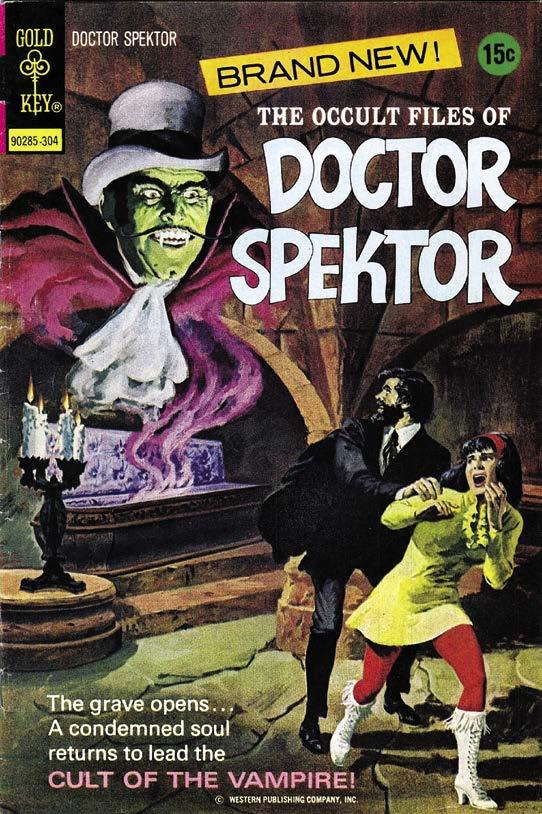
Readers in 1972 weren’t expecting—and probably weren’t ready for— one of the sneakiest comics ever. This was a series that adorned itself with familiar trappings borrowed from countless monster movies: vampires, mummies, Frankenstein’s monster, wide-eyed women in peril, and a ubiquitous horror host narrating the tales. The hero was a little bit of Sherlock Holmes and a little bit of Van Helsing. But with the first (official) issue, writer Don Glut and artist Jesse Santos—like clever magicians—pulled the most amazing switcheroos:
The unconventional hero would find goodness within the villain and help him find a better path!
The hero was just an ordinary man—no superpowers—who instead had a thirst for knowledge and a graduate degree.
While Marvel was building an elaborately interconnected universe, Doctor Spektor was worldbuilding one his own—a patchwork crazy quilt of original concepts and inter-company crossovers—all right under the nose of the editor.
The female lead, and the rich, nuanced supporting cast were fresh, fascinating, and ethnically diverse.
It’s high time for a look at the groundbreaking comic series that no one was ready for, or could fully appreciate, at the time: Don Glut’s and Jesse Santos’ The Occult Files of Doctor Spektor.
SOMETHING WICKEDLY GOOD THIS WAY COMES
It all seemed almost too “grown-up” for a horror comic. The hero was a snappy dresser, but he didn’t wear a superhero costume. He lived in a fancy mansion that had no secret cave. Dr. Spektor drove a Bentley, instead of a comic book Spektormobile. He eventually lived with his secretary girlfriend, Lakota Rainflower. And they politely socialize with another couple. There was a level of sophistication brought to the proceedings, but make no mistake— each adventure was infused with excitement and suspense.
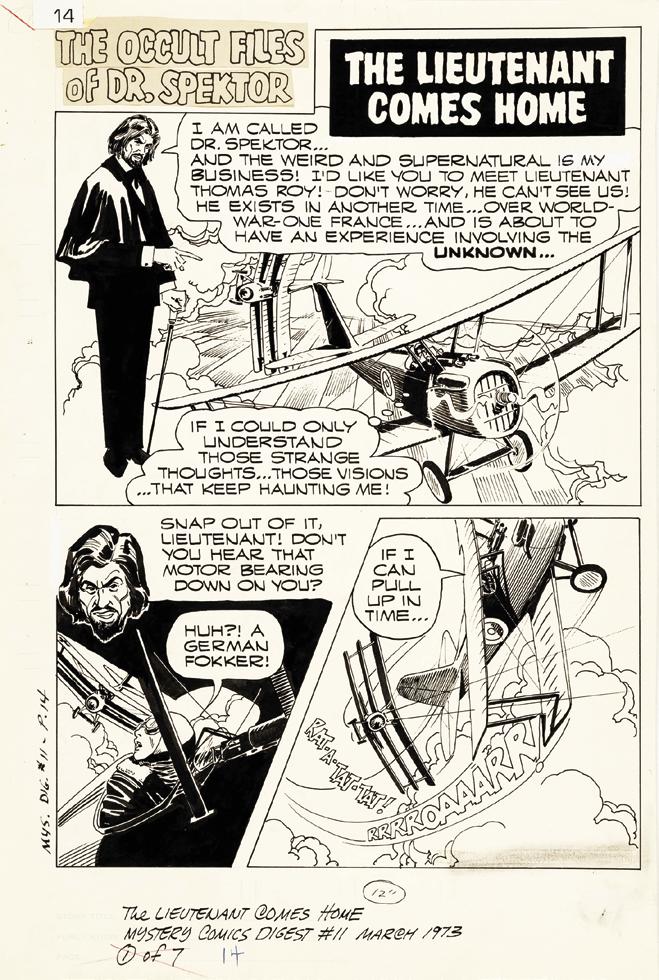
Dr. Spektor was created by Don Glut and Dan Spiegle, although Jesse Santos quickly stepped in to draw the ongoing series.
Don Glut is a writer, musician, and filmmaker who was recently awarded the 2025 Bill Finger Award for Excellence in Comic Book Writing. His writing is tight and clever. He comes across like a filmmaker with big ideas, but a modest budget, and somehow manages to exceed expectations, bringing concepts alive in a grand manner. And as readers soon found out, the Universal monster movies, and especially their crossovers, were a big influence on Don and his writing.
Jesse Santos, a Filippino artist, had solid skills but always surprised readers with his offbeat layouts, creative renderings, and unexpected illustrative choices. “Well, first of all, Jesse was basically a portrait artist,” Don Glut remembered in a recent conversation with BACK ISSUE. “That’s what he loved to do. He got all these expressions on people. Expressions they never saw in comic book art. And I asked him, ‘How do you get those realistic expressions?’ And he said, ‘I stand in front of a mirror. And I make those expressions, and then I copy them.’ I said, ‘What about the women?’ ‘Yeah, them too!’, he said.”
IT ALMOST DIDN’T GET PUBLISHED
Doctor Spektor was initially just another horror host narrating creepy stories from notes that he had ostensibly pulled out of his “files.” This harkens back to a grand tradition of so many radio dramas ( Inner Sanctum, The Hermit’s Cave , etc.)
Doctor Spektor and Lakota are menaced by a vampire on the cover of the first issue. Art by George Wilson. TM & © Random House, Inc. All rights reserved.
and spooky comics ( Tales from the Crypt, Haunt of Fear, etc.). His short stories first appeared in Gold Key’s Mystery Digest Comics. Soon, the green light was given to start his own comic series. It was supposed to be in the mold of this publisher’s other narrated short story comics like Boris Karloff Presents or The Twilight Zone (where Rod Serling supposedly introduced each story). Writer Don Glut had other ideas.
“When I did the first Doctor Spektor book, it almost never got published,” says Glut. “What they thought I was bringing in was another book of him introducing the story as a host character. Instead, I brought in a 25-page story of him having an adventure as a character. And the editor looked at me like, ‘That’s not what we wanted, you know?’ And it almost didn’t get published. But since the work had been done, and the editor had to admit it was a good story, it was published.”
WORLD BUILDING AND A SHARED UNIVERSE
Back in the early ‘70s, Marvel was the publisher with tight continuity (we never used the term “shared universe” back then) and DC kind of had it also. Every fan knew it. Doctor Spektor creator and writer Don Glut knew it too.
“I’ve always admired the continuity in the Edgar Rice Burroughs stories and the H.P. Lovecraft stories,” explains Glut. “They had a profound impact on me, and also the Marvel comics, and then later the DC comics. So, I started out with the attitude, or the intellectual conceit, whatever you want to call it, that all of my stories took place in the same universe. Regardless of what everybody else was doing with their characters, my characters all existed in the same universe, and over the decades.”
“The [Gold Key] editors were absolutely clueless as to what DC and Marvel were doing. I would come in there, and they would have a big stack of comics, because Marvel and DC would send them the books. They were just given to me without the editors ever looking at them. They had no idea what continuity meant. They didn’t know what a fanzine meant, they thought a fanzine was a fan. You know, like, somebody went to a convention was a fanzine.”
The subversive charm of The Occult Files of Doctor Spektor can be seen in how a credible world was built so quickly. The series is ostensibly about Doctor Spektor, an occultist, and his beautiful secretary/girlfriend, Lakota, as they investigate creepy mysteries and solve them all in one issue!
“They [Gold Key editors and management] didn’t know you could cross over characters. I would have loved to have brought in Turok or
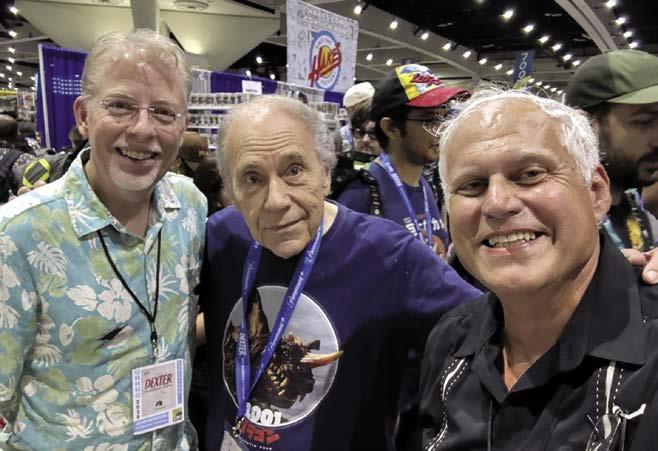
(top) John Morrow, Don Glut, and Ed Catto. Photo by Ed Catto. (bottom) A Dan Spiegle Doctor Spektor story page from Mystery Comics Digest #11. Original art scan courtesy of Heritage Auctions (www.ha.com).
TM & © Random House, Inc. All rights reserved.
by Robert Jeschonek
Did you know Batman had another mother after the death of Martha Wayne? It only took until 1987 for her to appear on the scene in that role.
It’s true! In Detective Comics #574 (May 1987), we learned that a woman named Leslie Thompkins had once been Bruce Wayne’s foster mother. In that same story, titled “…My Beginning…and My Probable End,” writer Mike W. Barr revealed lots of other details about Leslie, establishing her as a vital character in the Batman mythos, one with inextricable ties to the Wayne family.
But that wasn’t the first time Leslie appeared in the pages of a Batman story. She’d gotten her start eleven years earlier, in a tale written by the legendary comics scribe Denny O’Neil.
THE MOTHER THERESA OF GOTHAM CITY “I’m Leslie Thompkins. Come with me. I’ll…I’ll do what I can.”
Those words, spoken to young Bruce in the aftermath of his parents’ murders, were the start of a beautiful friendship. As Batman remembered years later, “In all the world, there was nothing… nothing except the warmth of her arms and the comfort of her soothing words…”
This touching moment was captured by O’Neil in Leslie’s origin story, “There Is No Hope in Crime Alley!” in Detective Comics #457 (March 1976). For the first time, readers learned that Batman paid annual visits to Leslie in Crime Alley—aka Park Row—on the anniversary of the deaths of his mother and father. He never explained this in full to Leslie, however, saying only that the visits were, “a memorial…a reminder of who I am!... Of my beginning…and my probable end!”
Though Leslie remembered meeting Bruce as a child, she didn’t connect that memory to his presence as the adult Batman. The long-ago incident had as powerful an impact on her as it had on him, though. “I once saw a hideous thing—a child whose parents were murdered in front of his eyes! I’ve never forgotten the lad! I’ve devoted my life to doing what I can to prevent such tragedy!”
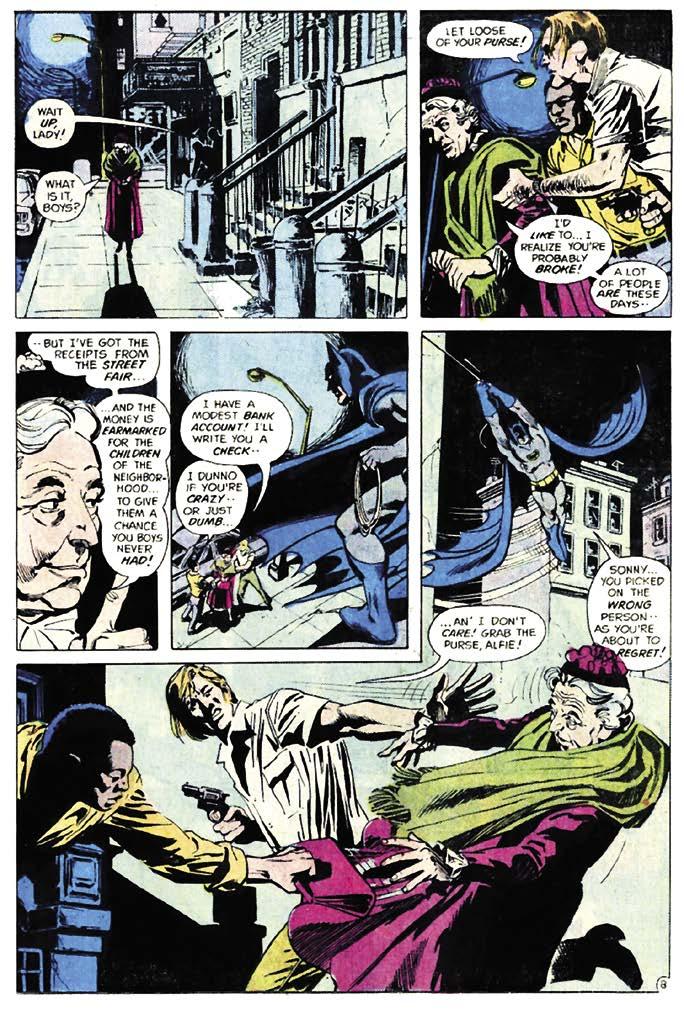
Given the history between them and the good Leslie did, Batman felt a deep affection and admiration for her…though the feeling wasn’t entirely mutual. In her origin story, Leslie ended up begging him to stop beating on a thug and said she lived for the time when he and his kind would be unnecessary.
Batman didn’t let the elderly Good Samaritan’s comments get in the way of his respect for her, though. “I’ve heard there’s no hope in Crime Alley, Miss Thompkins—that’s wrong! You…and those like you…you’re the hope of Crime Alley—maybe the only hope our tormented civilization has left.”
High praise, indeed, from a rage-driven vigilante on a never-ending campaign against crime. Leslie reminded him of a path not taken, a kinder, gentler response to tragedy than the ceaseless application of brutality against those who dare inflict it.
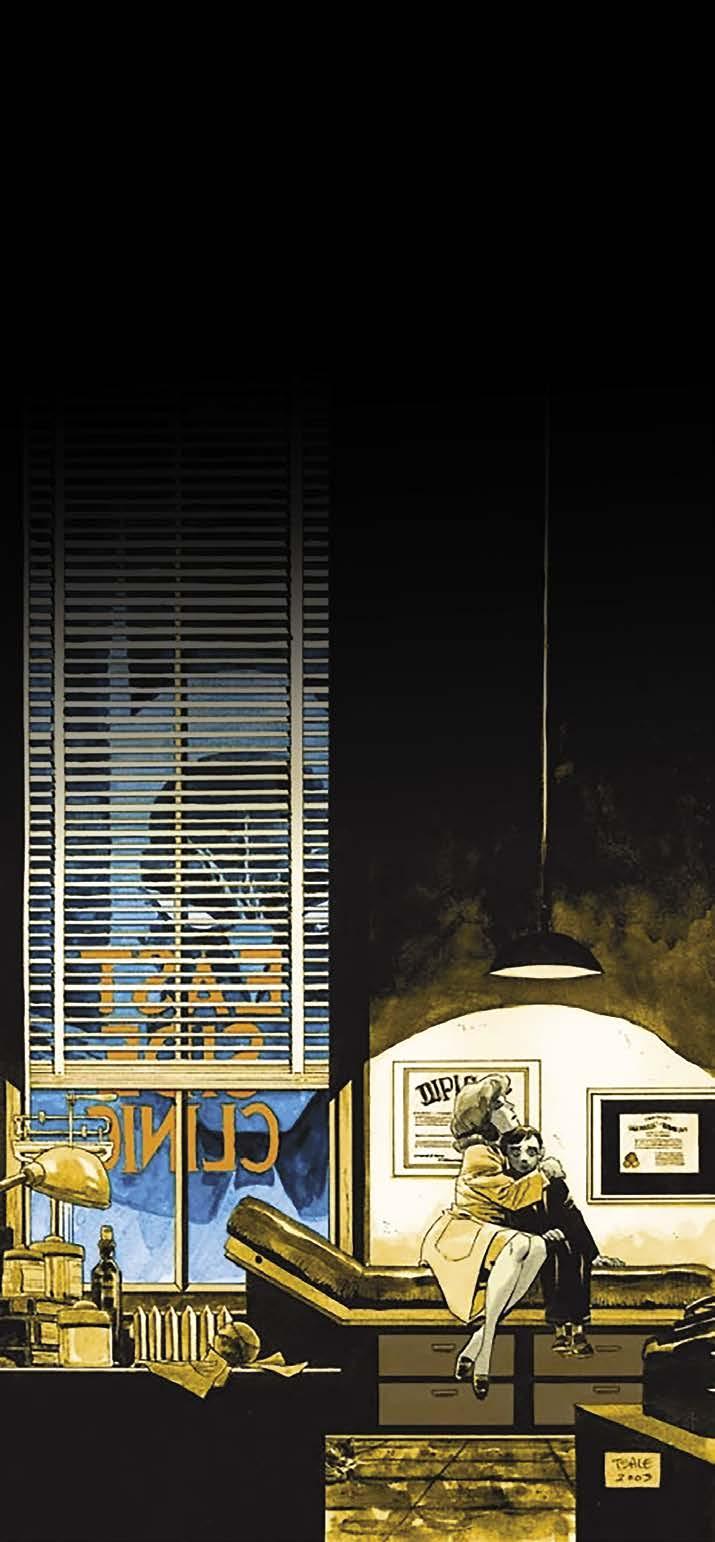
A rare cover appearance by Leslie Thompkins. Detective Comics #791 cover art by Tim Sale. TM & © DC Comics.
Leslie Thompkins debuts in Detective Comics #457.
Those thugs picked the wrong person the rob. Art by Dick Giordano.
Instead of taking the law into her own hands and meting out justice with physical force, she had embraced the way of peace. She had become a kind of Mother Theresa of Crime Alley, fighting the darkness by exemplifying the light.
As much as her non-violent approach impressed Batman, however, and the memory of her comfort and care dulled the edge of the bleak anniversary of his parents’ deaths, Bruce wasn’t about to hang up his cape and cowl. He kept up his crimefighting ways…and eventually, Leslie got sucked into the chaos that swirled around him and nearly died in the process.
Which would have been a terrible thing, considering she had not yet gotten the new backstory that would make her not only Batman’s foster mother but a full-fledged medical doctor and butt-kicking pacifist. Barr’s reinvention of Leslie was yet to come.
Assuming she survived the menace of Batman’s opposite number, the Wrath.
VICTIMIZED BUT NOT WRATHFUL
When a saintly old woman who lived a life dedicated to peace and good works had a gun pointed at her head by a maniac, would it change her point of view?
In the case of Leslie Thompkins, the answer was a resounding cry of disapproval. “More violence! Won’t there ever be an end to it?”
Years after her first appearance and years before her reboot by Barr, Leslie was taken hostage by the Wrath in Batman Special #1 (1984). Though this tale, “…The Player on the Other Side,” was also written by Barr, he portrayed Leslie as O’Neil had intended—as elderly, good-hearted resident of Crime Alley, dedicated to helping others.
“I liked the Leslie Thompkins character from her original appearance in Detective Comics, and I thought the character could be used in other stories,” Barr tells BACK ISSUE . He chose not to update her, though, because at the time, he was only thinking about the needs of that one story and didn’t know he’d be writing the character again in the future.
Barr didn’t let that stop him from putting Leslie through her paces, though. He placed her in extreme jeopardy as the Wrath used her to draw Batman and Commissioner Gordon into the line of fire, seeking revenge for the death of his criminal parents (on the same night, coincidentally, when Bruce Wayne’s family was killed). In the end, the Wrath was defeated and literally went up in flames, ensuring Leslie’s survival…though this demonstration of might making right didn’t change her convictions one iota. “I live for the time when no one will die from crime or injustice…when you and your kind are unnecessary,” she told Batman.
After which, she set about comforting the Wrath’s shell-shocked girlfriend just as she had once comforted young Bruce Wayne, almost word for word. “That’s right , dear, let it out… I’m Leslie Thompkins. Please, come with me …I’ll do what I can. ”
Once again, the frail old woman—who’d been a victim of violence herself in the hands of the Wrath—had made a difference in the life of someone victimized by an abuser. She followed a pattern laid down in her first appearance by O’Neil…but that pattern was going to change.
In a few short years, Leslie would reappear brandishing a baseball bat while charging after the perpetrator of a break-in at the medical clinic she directed (a perpetrator who turned out to be Batman, who was bringing in the badly injured Robin, Jason Todd).
So much for the withered pacifist in her shabby dress, old-fashioned hat, and shawl.
PAGING DOCTOR THOMPKINS
With one pivotal comic—the aforementioned Detective Comics #574 (May 1987)—Leslie Thompkins changed dramatically. In just 22 pages, her character took on surprising new layers, all while preserving the philosophical core that had defined her for so long.
Reconsidering Leslie for that story, Barr realized the original character had limited dramatic possibilities. “I decided to change the character because I believed she could better serve the
There’s an old saying in comics: A hero is only as good as his or her villains. The biggest of the biggies— Batman or Spider-Man, for example—have foes so memorable, like Venom or the Joker, they can support their own comics and even movies.
So where does that leave a relatively ordinary hero like, say, Howard the Duck? For the first 14 issues of his classic 1970s series, Howard battled one-off villains like the Space Turnip, Le Beaver, and Winky Man, scourge of the downtown New York art scene. One might even say that Howard’s real nemeses in these issues were the kind we learned about in high school English class, because the conflicts in those tales and beyond stemmed as much from society and himself as from the lightweight costumed heavies he encountered.
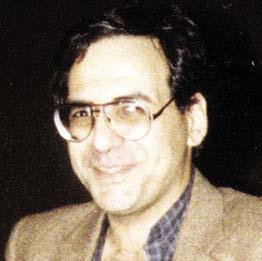
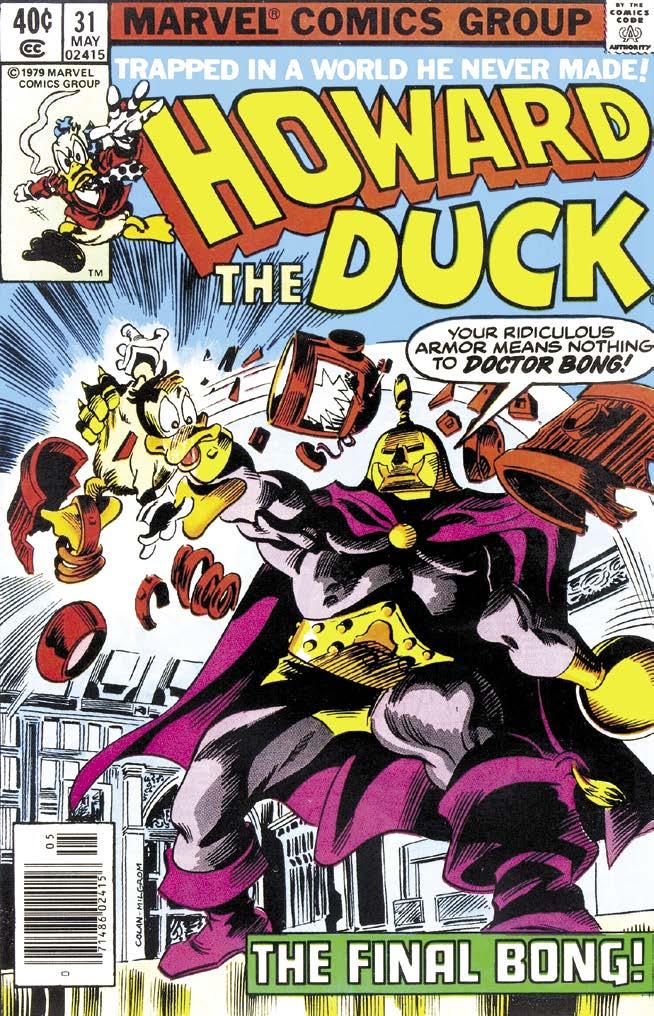
That all changed with Howard the Duck #15 and the introduction of Dr. Bong, Howard’s greatest, and most persistent, foe.
As writer Steve Gerber, Howard’s co-creator, told The Comics Journal in 1978, Dr. Bong was the result of “an attempt to create a villain for Howard of the stature of Dr. Doom or the Red Skull, someone we could bring back periodically.”
Klaus Janson, who joined the creative team on Howard the Duck with issue #15 as inker, says, “I thought Dr. Bong was just crazy! Steve would often write things that would poke fun at Marvel, and Dr. Bong was part of that, I think. Steve was cut from the same cloth as Bill Mantlo or Keith Giffen. He had the ability to look at a subject from outside and understand it and satirize it.”
Dr. Bong was a blend of absurd elements from comics and elsewhere. As Gerber explained in that same 1978 interview, the name came from a fan letter sent to Kiss frontman Gene Simmons, which invited the demonic bass player to “come over to the house. We’ll have some good music, some good wine and some bonging.” Gerber, who had just written Kiss into Howard the Duck #12–13 (in which the band materialized from the mind of a possessed Winda Wester), happened to see that letter at Simmons’ apartment, where they had been planning the upcoming Marvel Super Special #1 (Sept. 1977), in which Kiss would face off against Dr. Doom.
Gerber and Simmons undoubtedly had a pretty good idea what “bonging” might mean—this was the 1970s, after all—and the word stuck in Gerber’s mind. Meanwhile, in July 1977, a new
Howard battles Dr. Bong in the final issue of his first series. Cover by Gene Colan and Al Milgrom.
TM & © Marvel Characters, Inc.
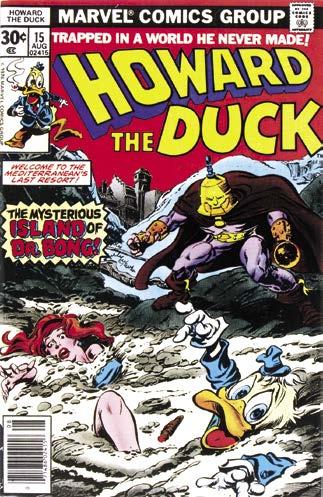
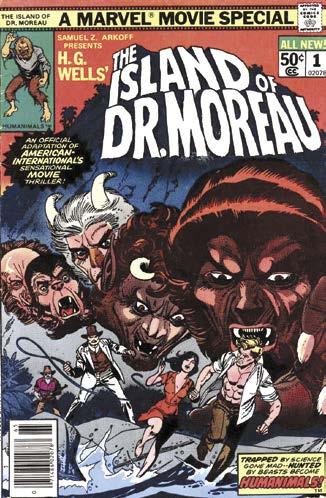
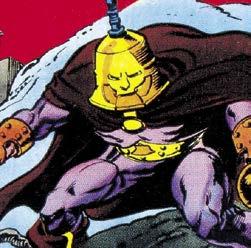
movie adaptation of the H.G. Wells science fiction novel The Island of Dr. Moreau starring Burt Lancaster and Michael York hit theaters, with Marvel publishing an official comics adaptation by writer Doug Moench and artists Larry Hama and Jess Jodloman. Seeing that comic in progress in the Marvel offices might have reminded Gerber of Marvel’s own answer to Dr. Moreau: the High Evolutionary, who first appeared in The Mighty Thor #133 (Nov. 1966). Gerber took this idea-inprogress to Marvel staff artist Marie Severin, who sketched out a villain with a bell-shaped helmet, a clapper for a hand, buccaneer boots, and a flowing cape.
IF YOU ENJOYED THIS PREVIEW, CLICK THE LINK TO ORDER THIS ISSUE IN PRINT OR DIGITAL FORMAT!
S
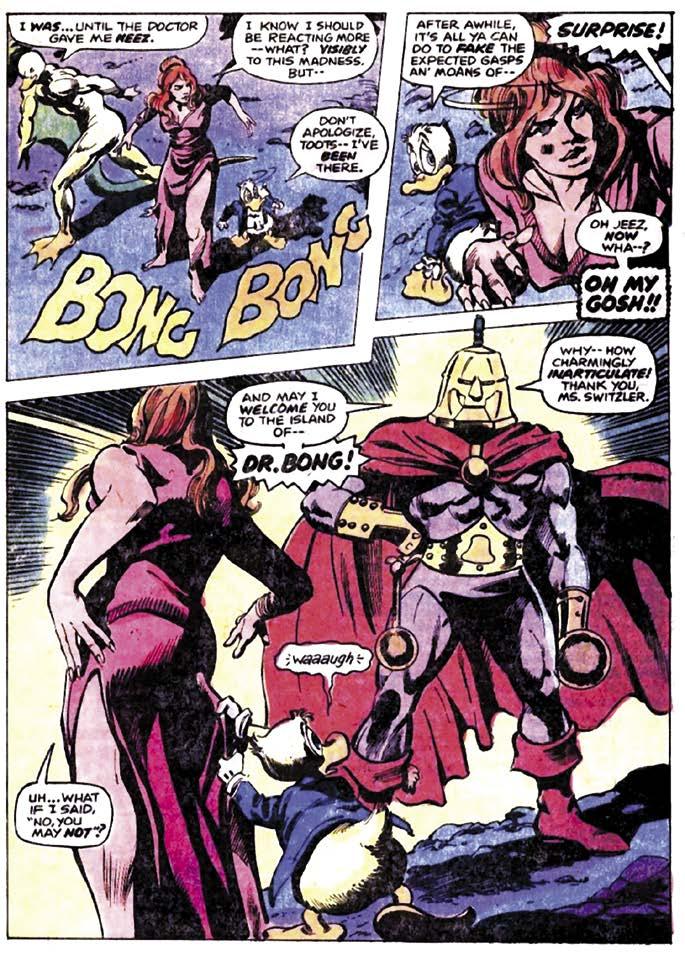
Dr. Bong made his debut in Howard the Duck #15 (Aug. 1977) in a story that directly spins out of Howard the Duck Annual #1 (June 1977), in which Howard, his companion Beverly Switzler, and their friends Winda Wester and Paul Same embarked on a cruise home from the Middle Eastern nation of Bagmom on the S.S. Damned. After several strange onboard events, Howard and Beverly were whisked away by a concrete swan, only to be deposited on the shores of a mysterious island where they were greeted by the equally mysterious Dr. Bong.
Sharp-eyed readers might have noticed that something was up with this so-called Dr. Bong. HTD #15 he greets Beverly by name, hinting at a prior acquaintance with her.
BACK ISSUE #170
A
After the unexpected interlude of HTD #16 (Sept. 1977)—the infamous “all essay” issue, still arguably the strangest comic ever published by Marvel—the tale of Dr. Bong continued in issue #17, as Howard refused to engage with this new foe. This gave Dr. Bong the opportunity to demonstrate his power: By ringing his own helmet he froze Howard in his tracks. With Howard knocked unconscious, Dr. Bong gave Beverly a tour of his castle, with the clear intent of impressing her.
(84-page FULL-COLOR magazine) $10.95 (Digital Edition) $4.99 https://twomorrows.com/index.php?main_page=product_info&cPath=98_54&products_id=1884
As Dr. Bong explained, he was born Lester Verde, physically inept and bullied by others— until he discovered that his skill as a writer could help him wreak vengeance on those who wronged him. A college journalism class taught him that innuendo was more powerful than facts; a life-drawing class where Beverly was the model resulted in her rejecting his clumsy advances and souring him on women and his peer group. Not long after that, Lester lost his left hand in an onstage accident during a rock concert that included a working guillotine, which seemingly started his transformation to outright villainy. (His origin story abruptly ended there, never to be revisited.)
(top left) Dr. Bong’s first appearance echoes a possible inspiration. Art by Gene Colan and Tom Palmer. (top right) Could Dr. Moreau have inspired Dr. Bong? Art by Gil Kane. (bottom) An interior page from Howard the Duck #15 introducing the resounding Dr. Bong. TM & © Marvel Characters, Inc.