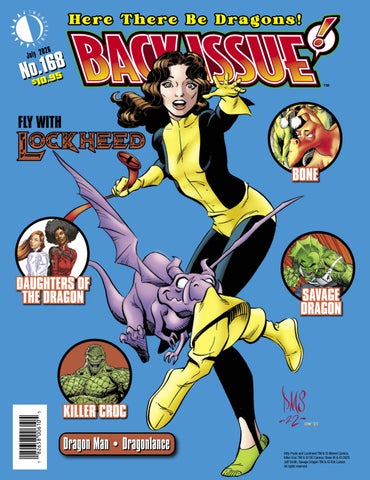
He r e T he r e B e D r a g o ns ! 2026
8 6 1 . No .95 July
$ 10
™
FLY WITH
ockheed L
DAUGHTERS OF THE DRAGON
BONE
SAVAGE DRAGON
KILLER CROC Dragon Man • Dragonlance
Kitty Pryde and Lockheed TM & © Marvel Comics. Killer Croc TM & © DC Comics. Bone ® & © 2025 Jeff Smith. Savage Dragon TM & © Erik Larsen. All rights reserved
Volume 1, Number 168 July 2026 EDITOR-IN-CHIEF Roger Ash PUBLISHER John Morrow
Comics’ Bronze Age and Beyond!
DESIGNER Rich Fowlks EDITOR EMERITUS Michael Eury COVER ARTIST Paul Smith (Thank you to Jason D’Ambrosio for the scan.) COVER COLORIST Glenn Whitmore COVER DESIGNER Michael Kronenberg PROOFREADER Kevin Sharp SPECIAL THANKS Terry Austin Paul Burns Marc Buxton Gerry Conway Steve Englehart Grand Comics Database Heritage Auctions Jenny Blake Isabella Dan Jurgens Barbara Kesel John Kirk Paul Kupperberg James Heath Lantz Erik Larsen Ed Lute Jed MacKay Dan Mishkin Amanda Powers Ron Randall Jeff Smith Joshua Winchester
Don’t STEAL our Digital Editions! C’mon citizen, DO THE RIGHT THING! A Mom & Pop publisher like us needs every sale just to survive! DON’T DOWNLOAD OR READ ILLEGAL COPIES ONLINE! Buy affordable, legal downloads only at
www.twomorrows.com or through our Digital Storefront at
www.comicshistory.org & DON’T SHARE THEM WITH FRIENDS OR POST THEM ONLINE. Help us keep producing great publications like this one!
BACKSEAT DRIVER: Editorial by Roger Ash . . . . . . . . . . . . . . . . . . . . . . . . . . . . . . . . . . 2 BRING ON THE BAD GUYS: How to Train Your Dragon Man . . . . . . . . . . . . . . . . . . . . 3 Is he really bad, or simply a pawn? BEYOND CAPES: DragonLance: Here There Be Dragons . . . . . . . . . . . . . . . . . . . . . . . 11 TSR teams with DC for adventure FLASHBACK: The Curious and Complex Chronicle of Lockheed the Dragon. . . . . . . 21 He’s more than Kitty Pryde’s pet INTERVIEW: Erik Larsen on Savage Dragon . . . . . . . . . . . . . . . . . . . . . . . . . . . . . . . . . 33 Erik Larsen discusses his famous creation Terry’s Toons. . . . . . . . . . . . . . . . . . . . . . . . . . . . . . . . . . . . . . . . . . . . . . . . . . . . . . . . . 43 Terry Austin brings you a team-up you never expected BRING ON THE BAD GUYS: Killer Instinct: The Waylon Jones Story. . . . . . . . . . . . . . 45 Killer Croc steps into the spotlight INTERVIEW: The Brilliance of Bone. . . . . . . . . . . . . . . . . . . . . . . . . . . . . . . . . . . . . . . . 55 An interview with Jeff Smith FLASHBACK: Marvel’s Two-Headed Dragon: Daughters of the Dragon. . . . . . . . . . . 69 Two ladies you don’t want to cross Back Talk. . . . . . . . . . . . . . . . . . . . . . . . . . . . . . . . . . . . . . . . . . . . . . . . . . . . . . . . . . . . 79 BACK ISSUE™ issue 168, July 2026 (ISSN 1932-6904) is published monthly (except Jan., March, May, and Nov.) by TwoMorrows Publishing, 10407 Bedfordtown Drive, Raleigh, NC 27614, USA. Phone: (919) 449-0344. Periodicals postage paid at Raleigh, NC. POSTMASTER: Send address changes to Back Issue, c/o TwoMorrows, 10407 Bedfordtown Drive, Raleigh, NC 27614. Michael Eury, Editor Emeritus. Roger Ash, Editor-In-Chief. John Morrow, Publisher. Editorial Office: BACK ISSUE, c/o Roger Ash, Editor, 2715 Birchwood Pass, Apt. 7, Cross Plains, WI 53528. Email: rogerash@ hotmail.com. Eight-issue subscriptions: $108 Economy US, $161 International, $39 Digital. Please send subscription orders and funds to TwoMorrows, NOT to the editorial office. Cover artwork by Paul Smith. TM & © Marvel Characters, Inc. All Rights Reserved. All editorial matter © TwoMorrows and Roger Ash, except Terry’s Toons © Terry Austin. Printed in China. FIRST PRINTING
Here There Be Dragons Issue Issue • BACK ISSUE • 1
Stan Lee and Jack Kirby have a rich history of creating monsters. From the 1950s through to the early 1960s, their frightening creations appear in such titles as Journey Into Mystery, Tales To Astonish, and Tales of Suspense. An insight into Lee’s preoccupation with mythical creatures was highlighted in a “Stan’s Soapbox” column, printed in UK newspaper, The Guardian, in 2018: “When we were kids, we all loved to read fairy tales. Fairy tales are all about things bigger than life: giants, witches, trolls, dinosaurs, and dragons and all sorts of imaginative things. Then you get a bit older and you stop reading fairy tales, but you never outgrow your love of them.” Strange Tales #89 (Oct. 1961) debuts Lee and Kirby’s most famous dragon creation: Fin Fang Foom. This talkative monster inspired a humanoid, mute version of a dragon four years later in the pages of The World’s Greatest Comic Magazine. Dragon Man debuts in the pages of Fantastic Four #35 (Feb. 1965). State University’s Professor Gregson Gilbert constructs the lifeless android, while FF nemesis Diablo uses a potion to bring it to life, sending it to attack the Fantastic Four. The creature flies, has great strength, and breathes fire. Dragon Man is antagonistic to the male members of the team, but is charmed by Sue Storm, responsive to her kindness. This is the start of Dragon Man’s romantic attachment to Sue, a characteristic he develops with other female characters, too. Dragon Man turns on Diablo and the two disappear under ice at the issue’s conclusion. Reed hopes it’s the last they see of Dragon Man, but Sue feels pity for the monster. This writer shares Sue’s sympathy for Dragon Man. As will be shown in this article, Dragon Man has a long history of being manipulated, used, and beaten down in the service of villainous masterminds. For years he existed as nothing more than a convenient punching bag. The splash page of Fantastic Four #44 (Nov. 1965) is the first time Dragon Man is described as “ever-delightful.” The android emerges from the ground to be entranced by the Inhuman, Medusa. He defends her against Gorgon, who is intent on returning her to the Great Refuge. In FF #46 (Jan. 1966) the mysterious Inhuman hunter, the Seeker, captures Dragon Man, but releases him when he determines he isn’t an Inhuman. While Reed and Sue remain in the Great Refuge, Johnny and Ben battle Dragon Man in New York in FF #47 (Feb. 1966). After the Torch defeats him, Reed turns
by P a u l
Burns
Dragon Man as he appears in The Official Handbook of the Marvel Universe #4. Art by Paul Smith. TM & © Marvel Characters, Inc.
Here There Be Dragons Issue • BACK ISSUE • 3
(left) Dragon Man’s first appearance in Fantastic Four #35. Art by Jack Kirby and Chic Stone. Original art scan courtesy of Heritage Auctions (www.ha.com). (right) Dragon Man goes to college on the cover of Fantastic Four #35. Art by Jack Kirby and Dick Ayers. TM & © Marvel Characters, Inc.
Dragon Man over to the authorities for examination on a desert isle. Dragon Man is delivered to Hank Pym by crate in Avengers #41 (June 1967). Pym becomes his legal guardian and tells wife Jan he hopes to learn “what makes him tick.” Unfortunately, Diablo isn’t far behind and revives Dragon Man. What follows is an epic battle between Dragon Man and Goliath, beautifully illustrated by John Buscema, who begins penciling Avengers with this issue. In Avengers #42 (Feb. 1967), Diablo reveals to Goliath he has made an army of Dragon Men but is unable to give them life. He forces Pym into helping him recreate his potion, threatening Janet Pym’s life. Poor Dragon Man faces another beating, this time from Hercules, before he is unceremoniously dumped into lava by the Olympian. Roy Thomas and Marie Severin bring Dragon Man to the surface in Sub-Mariner #15 (July 1969). He is reunited with creator Gregson, who is being tricked into helping Dr. Dorcas, seeking revenge on Namor. The Sea King finds Dragon Man standing
4 • BACK ISSUE • Here There Be Dragons Issue
guard over the captive Dorma and attacks him. Namor literally puts Dragon Man on ice by throwing him into a temperature-controlled railroad car and drenching him in gallons of water. A strangely talkative Dragon Man appears in FF #100 (July 1970) as part of the Puppet Master’s android army of Fantastic Four villains to attack the team. It’s a different story 200 issues later when Puppet Master uses the real Dragon Man to stop The Mad Thinker and Wizard ruining his stepdaughter Alicia’s wedding to Johnny Storm in FF #300 (Mar. 1987) This writer first encountered (and became a fan of) Dragon Man in the UK weekly, The Complete Fantastic Four #2 in 1977. It contained a reprint of the Gerry Conway-scripted Fantastic Four #134 (May 1973). John Buscema’s incredible cover, depicting Dragon Man holding Sue Richards (very King Kong/Fay Wray), made the issue pop off the shelves (British readers would have to wait until issue #3 of Complete FF a week later to enjoy that cover). Dragon Man was always a visual treat, never more so than on page ten of FF #134 with his full-page dramatic reveal through flames. It’s a powerful and beautiful illustration by Buscema. Conway had taken over FF writing duties from Roy Thomas one issue earlier and he had been waiting for the opportunity, as he explains in the foreword to FF Masterworks Vol. 13: “As it was for Roy, having a chance to script the adventures of the Fantastic Four was something of a dream come true, but for me (unlike Roy) it was the fulfilment of a childhood dream.” The FF face the return of Gregory Gideon (last seen in FF #34) who uses Dragon Man to capture Sue and lure the rest of the FF into a trap. Conway explains his choice to use Dragon Man and Gideon:
by M a r c
Buxton
The quest begins in DragonLance #1. Cover by Ron Randall. TM & © Wizards of the Coast LLC.
‘Twas the year 1988, adventurers, and when it came to the world of DC Comics, it is not a stretch to say, superheroes ruled. In the past, DC Comics experimented with many new heroes who wielded sword and axe. Heroes such Claw the Unconquered, Beowulf, Hercules Unbound, and the one breakthrough fantasy hit to land at DC: Warlord. The ‘80s saw some fantasy sparks with Arion, Lord of Atlantis, Conqueror of the Barren Earth, and Amethyst, Princess of Gemworld. But most DC fantasies failed to capture lasting success. In the heady days of the late Bronze Age, that did not stop DC from trying, because elsewhere fantasy was as hot as ever. Fans of a certain age will remember sitting in basements, rolling up characters, slaying orcs, and encountering those grandest to beasts: dragons, as Dungeons & Dragons defined a generation. Adding to the worlds of D&D, the company TSR began searching for new RPG worlds and new gaming ideas. In 1984, Margaret Weis, newly named editor for TSR’s new novel and book department, a unique venture that would soon etch DragonLance into literary fantasy history, and Tracy Hickman, a game designer with a few published TSR adventures stored in his quiver, began work on DragonLance and the world of Krynn. Hickman and his wife Laura were inspired to write a series of new adventures that would tell a single story, a serialized adventure where players would end with a cliffhanger so role-players would be eager to purchase the next chapter. Thus, DragonLance and the setting of Krynn were born. In March of ’84, TSR published Hickman’s first module Dragons of Despair. Unlike the amorphous, ever present classic D&D, DragonLance and its roll out would be a full-on marketing blitz, with rule books, modules, art books, miniatures, and for the first time, novels. Yes, it was the novels that would make the World of Krynn a fantasy staple for decades to come. Another, unnamed writer was tapped to head the DragonLance novels, but after Weis and Hickman disliked the manuscript, the two intrepid creators wrote Dragons of Autumn Twilight, and the rest is history. The core idea behind DragonLance is a world without hope where a small band of ordinary heroes would bring light to a despairing world. Weis and Hickman introduced gamers and readers to the Heroes of the Lance. Tanis Half-Elven, a brooding ranger who lived in two worlds and was accepted by none; Sturm Brightblade, a noble and pompous knight; Raistlin Majere, a mysterious and complex character; Caramon Majere, Raistlin’s brother and protector; Flint Fireforge, a gruff but sensitive dwarf; Goldmoon, a kindly female cleric who was the symbol of hope for a broken word; Riverwind, Goldmoon’s protector and betrothed; and the Kender Tasselhoff Burrfoot, the comedic heart of DragonLance and master thief. These heroes had to survive and try to
Here There Be Dragons Issue • BACK ISSUE • 11
(left) Riva Silvercrown and Sturm Brightblade in action from the first issue. Art by Ron Randall and Randy Elliott. (right) Riva has a bad night. DragonLance #3 cover by Randall. TM & © Wizards of the Coast LLC.
save their world as dragons returned to Krynn along with a conflict that could plunge the world into eternal darkness. The authors introduced a rich and detailed past to the world of Krynn, and it was with that history other authors stepped in. DragonLance was such a literary hit that a huge series of adventures were published alongside Weis and Hickman’s core novels. More books and games soon followed, along with a video game, and soon, comics, as DC Comics threw down the gauntlet and entered the complex skies of Krynn.
AD&DC
Editor Barbara Kesel related how the DC and D&D union began, “A box of Ral Partha figures showed up at DC,” Kesel told BACK ISSUE. “I saw them in Dick Giordano’s office, and I said, ‘Oh, you’ve got gaming miniatures there.’ They had a query from TSR about doing comic stuff. And so, I had the head of marketing drop into my office and say, ‘We understand you understand this gaming thing?’ And I said, ‘Yes, I speak geek.’” After about a year of development between DC, Kesel, and TSR, the initial rollout began and consisted of Advanced barbara kesel Dungeons & Dragons, Forgotten Realms, the sci-fi laden Gammarauders, and yes, adventurers, DragonLance. The books, particularly the three direct Dungeons & Dragons adaptations, including DragonLance, would be moderate hits. In the first year of the licensing arrangement, some of the TSR books outsold Wonder Woman and a few other DC mainstays. It seems there were indeed many gamers who crossed over into the world of comics, and the partnership seemed healthy. To bring Weis and Hickman’s world to life, DC and TSR turned to a writer who was no stranger to fantasy. Writer Dan Mishkin had recently completed a run on his co-creation Amethyst: Princess of Gemworld, another high fantasy, Dungeons & Dragons adjacent concept. Kesel, Mishkin’s editor on both DragonLance and Advanced Dungeons of Dragons, fondly recalls how she picked the creator of Amethyst as the
12 • BACK ISSUE • Here There Be Dragons Issue
main writer on the DC D&D books. “I chose him because he’s one of my favorite human beings, and we were talking about working on a project together during that time. And there’s some people you just know are going to give it their all to do a good solid job.” Mishkin was not a seasoned role-player. He revealed to BACK ISSUE that, “When it first came out, I was just finishing college and by the time it gained traction, I was trying to establish a comic book writing career and raise children.” But Mishkin was no stranger to high adventure and fantasy, so he was comfortable with playing in the DragonLance sandbox, particularly after he got to experience Weis and Hickman’s novels. “I was given the books to read and liked them very much,” Mishkin recalls. “And as someone who was never a big fan of Star Wars, I was impressed by the fact that the books did what I considered a much better job of bringing together a group of unrelated characters and making them the hinge point of momentous events.” Joining Mishkin in the world of DragonLance was artist Ron Randall. Like Mishkin, Randall had a legacy of fantasy comics for DC with Conqueror of the Barren Earth (1985) which Randall created with writer Gary Cohn. Randall recalls getting the gig on DragonLance, “Well, at that time I’d been away from DC for a while, but I guess they still remembered me. Dan might remember this more clearly, but when they were putting together the TSR books, someone, maybe it was Laurie Sutton, who’d been my editor on the Barren Earth series that I’d done with Gary Cohn, might have suggested me.” Editor Kesel recalls why Randall was chosen to visually bring DragonLance to life. “I chose Ron Randall for the series dan mishkin because Ron’s style has a strong naturalistic quality to it,” Kesel said. “So, you could do the weaponry and things and make them look real as opposed to like, you know, kind of weird, plastic, and all that. The same strengths that made him not my first-choice artist for a superhero book made him perfect for this one.” Randall’s detailed linework and pacing were perfect for a world as huge as Krynn, and, unlike Mishkin, Randall was a devotee to the myriad worlds of TSR and Dungeons & Dragons. “Oh, I’d played D&D from its earliest days,” Randall told BACK ISSUE. “When I was at the Kubert School and after (late ‘70’s/early ‘80s), I played some more with some of my fellow Kubies. Playing D&D with a bunch of cartoonists was a blast.” Most of the early story arcs of DragonLance would feature some of Weis and Hickman’s familiar creations, but they would be in supporting roles to the original creations done at DC. Early on, DC and TSR had a perfect roleplaying to comic synergy that would last until behind the scenes squabbles would derail the adventures. But these were things beyond the scope of Mishkin and Randall who began the TSR/DC era with DragonLance #1 (1988). When this issue was published, it had been a
(top) In a book called DragonLance, there better be dragons. Though Riva probably wishes that there weren’t. From issue #4, art by Ron Randall and Randy Elliott. (bottom) Kalthanan takes center stage on the cover of DragonLance #5. Art by Mike Collins and Randall. (inset) Randall’s cover to DragonLance #4. TM & © Wizards of the Coast LLC.
Here There Be Dragons Issue • BACK ISSUE • 13
Gather all ye ‘round from far and near, As we learn about a faithful friend. Believe it or not, a dragon, from a dream wouldst appear As a companion to one of the X-Men. Lockheed, was he named, though not of this earth. Discovered in space by one Kitty Pryde, Defended her he did, and proved his worth, When alone she nearly died. Returned with her, when danger passed And he became an erstwhile animal chum. Together many adventures they amassed, In various titles of Comic-dom! But Lockheed proved more than just a pet. A bodyguard, a scholar, and even a covert mole. Also, a jealous lover, to his regret. Lockheed indeed played many roles. But this dragon evolved too little. In storytelling he could reach new heights. From a background character, trapped in drivel, Denied to be a major character in his own right. As such, this article will need, A detailed look, filled with curiosity, In chronicling his many identities And his story in all its complexity! Gather all ye ‘round from far and near, As we learn about a faithful friend. Believe it or not, a dragon, from a dream wouldst appear As a companion to one of the X-Men.
Lockheed (and Kitty) joins Excalibur. Pin-up from Excalibur #2 by Alan Davis and Paul Neary. TM & © Marvel Characters, Inc.
by J o
hn Kirk Here There Be Dragons Issue • BACK ISSUE • 21
(left) Lockheed from “Kitty’s Fairy Tale” in Uncanny X-Men #153. Art by Dave Cockrum and Joe Rubinstein. (right) Lockheed on the cover of that issue, also by Cockrum and Rubinstein. TM & © Marvel Characters, Inc.
If you were a teen and a fan of The Uncanny X-Men in the 1980s, you might have had a crush on Kitty Pryde. Computer whiz, girl-next-door looks, and completely nerdy, she pretty much checked all the boxes. Who wouldn’t have had a crush on her? But as if she needed anything else to make her cool, she also had a pet dragon. Lockheed the Dragon was a formidable character with a mysterious background for a good amount of his existence, making his presence more of a bonus to Kitty than about his own story. Trapped in his “fifth business” status, Lockheed was denied the chance to take on a more active character identity of his own. In his diminished role, readers accepted him as Kitty’s pet, forgetting that he was an intelligent alien with an array of abilities and experience, and sublimated for the sake of taking Kitty under his wing–no pun intended. As we look at his history, we’ll look at his growth and take the time to evaluate when fans appreciated him most.
22 • BACK ISSUE • Here There Be Dragons Issue
THE DREAM PET FOR THE ESSENTIAL DREAM GIRL
Lockheed first manifested as a dream concept. Chris Claremont introduced Lockheed as a full-sized dragon in “Kitty’s Fairy Tale” (Uncanny X-Men #153 [Jan. 1982]), an actual character to add to the fantasy team in her story. More specifically, he was to be a companion to Kitty Pryde. Essentially though, even in this stage, Lockheed was meant to be just an accessory. It just made sense that a character spawned from the imagination of a young Kitty Pryde should be one that represented the extreme range of fantasy. Up to this point we’d seen Kitty wearing an Elfquest T-shirt, playing Dungeons & Dragons, and indulging in video games at the local arcades in Westchester. Kitty was a true 1980s nerd in every sense and the fact that she had a dragon just made her even cooler to that audience. It also tracked that Lockheed should have a poetic introduction with his early first incarnation as the Dragon companion to Pirate Kitty in Uncanny X-Men #153. But Lockheed was more than just a loyal companion to the then youngest X-Man, but a character who had the potential for development heralded by this first appearance. In this issue, Kitty needed to tell Illyana Rasputin (before her imprisonment in Limbo) a bedtime story. Kitty’s story used exaggerated caricatures of her teammates as the basis for the characters in her fantasy story to great comic effect. The mansion was mostly demolished, and the team was at a low ebb, trying to repair and rebuild. It’s a major touchstone for X-Men fans; not just for the introduction of Lockheed, but one that was fun, lighthearted, and a positive tone for a book that normally tackled dark themes including exclusion and racism. There was laughter and it came at a time when the X-Men need it.
Lockheed’s job is to transport Pirate Kitty and her companion, Peter, aka Colossus, on their many adventures. Drawn by the late Dave Cockrum, Lockheed speaks with an Irish accent and also bears characteristics of the X-Men’s modified Lockheed SR-71 Blackbird with the wing fins and superstructure. So, though this is the dragon’s first appearance, we also can see the inspiration for the fantasy version comes from technology sources that would also endear Kitty to her audience. After all, given that a good portion of her audience would have known the film, The Neverending Story, that Kitty knew how to pilot her SR-71 would have driven her nerd fans nuts. From these origins, Lockheed was simply a dream that later came true for Kitty, and one that readers benefited from in future issues.
THE SIDEKICK
Kitty takes on more of an active membership by the time the X-Men are kidnapped by the Brood, and their bodies are implanted with alien embryos. In the double-sized Uncanny X-Men #166 (Feb. 1983), they determined to give the Brood fair payback for what has been done to them, written by Chris Claremont, and drawn by the incredible Paul Smith. Kitty and her teammates descend on the surface of the Brood’s Sleazeworld to release
the soul of one of the Acanti, a star-faring race the Brood hunts and enslaves for space travel. In doing so, they accept that there is no way to remove the implants. It is, effectively, a suicide mission. While in the catacombs of the city, Kitty is surrounded by the Brood hunters who wish to take her back to the Queen and hatch the implanted embryo. Paul Smith’s dramatic depiction of Lockheed is exciting and entertaining. With five frames, not only do we see the Brood dispatched by a fearsome beast, but when the flames and smoke settle, the terrifying Lockheed is revealed to be the rescuer and smaller than he appeared. Both a joke and an escape, Lockheed’s introduction is interrupted by the discovery of the soul of the Acanti, a revered place of great spiritual power that is able to purge the unclean embryos and heal the X-Men. When they are transported to the Starjammers’ vessel, and escape the Brood’s planet, Kitty misses the dragon and as readers, we feel her disappointment. Of course, this X-Men adventure is not done, as they realize that the last embryo, a royal one at that, must have been implanted in Professor Xavier. Their task is now to destroy the embryo who lives within him. After they manage to resolve this problem, Kitty is invited to study with the New Mutants leading to Issue #168 (Apr. 1983), the famous “Professor Xavier is a
(left) The Lockheed we know and love first appears in Uncanny X-Men #166. Art by Paul Smith and Bob Wiacek. (right) We learn that Lockheed has followed Kitty home in Uncanny X-Men #168. Art by Smith and Wiacek. TM & © Marvel Characters, Inc.
Here There Be Dragons Issue • BACK ISSUE • 23
THE ALIENABLE TRUTH ABOUT LOCKHEED
The thing about Lockheed is that he has always been an alien. Though he looks like the common perception of a terrestrial, mythological species, he isn’t. After the revelation of Lockheed’s sophisticated technological knowledge and advanced nature, his alien intelligence, his empathic powers, and the fact that he has a sense of devotion to Kitty Pryde, very little is done with this character. Which is a crime as Lockheed was trapped in a cage of untapped storylines that really were never exploited. Then, there is Joss Whedon’s Astonishing X-Men. When the aliens of Breakworld intend on destroying the Earth, as one of their prophecies reveals, it will destroy the X-Men. They find themselves involved in a cosmic adventure that takes them to the far corners of space. This involves the members of S.W.O.R.D. (Sentient World Observation and Response Department) who, like their S.H.I.E.L.D. counterparts, are responsible for protecting the world from extra-terrestrial threats. Lockheed’s alien nature makes him an ideal candidate for this storyline. We discover that he is an information mole for S.W.O.R.D. in issues #17 (Nov. 2006) and #19 (Feb. 2007), keeping tabs on the X-Men for them. When it is fully revealed in front of Kitty in issue #22 (Oct. 2007), much to the dragon’s palpable embarrassment and shame, it is heartbreaking to Kitty. Kitty’s expression as drawn by the incomparable and late John Cassaday reveals the full depth of the betrayal. Yet for such a major story development, it only features in a few pages. It was a cruel break in their relationship, especially when Agent Brand commanded Kitty to “stop simpering at him” when she asked
how he was. The realization that Lockheed was of an advanced alien species who Agent Brand and S.W.O.R.D. were helping to alleviate his home world issues was an added shock to the revelation that her companion of years kept such a secret from her. While it was given minor service, it was still another major development in not just how Kitty viewed her companion, but how readers did. Joss Whedon’s Astonishing X-Men was a masterpiece that brought clarity and understanding to the X-Men franchise and also imparted some of this into Lockheed. No longer was he the cute little dragon; he was a patriot to his planet–yes, to the peers who had exiled him to Earth. But Lockheed’s emotional ties to Kitty run deep. When she sacrificed herself to phase a giant missile launched from Breakworld at the Earth through the planet, Kitty doomed herself with no hope of survival.
(left) Lockheed is put on trial by “The Flock” in Excalibur #40. Cover by Dave Hoover. (right) Our hero pilots the spaceship when the actual pilot falls asleep. Dave Hoover, Harry Candelario, and Tim Dzon art. Original art scan courtesy of Heritage Auctions (www.ha.com). TM & © Marvel Characters, Inc.
Here There Be Dragons Issue • BACK ISSUE • 29
When it comes to comic books, nothing is off the table in terms of characters. Audiences have seen it all, from overly muscular Men of Steel to Friendly Neighborhood Web-Slingers to a quartet of Ninja Turtles with some serious attitude. Even beings as fantastic as those from mythology have made it onto the printed, penciled and lavishly colored page. Whether it is witches, wizards, goblins, kobolds, or the gods of ancient cultures; all have been reworked, revamped, and extensively rewritten over the years to suit the ever-changing tastes of comic book readers. Yet where dragons are concerned, those great beasts of lore and legend, sometimes the changes come in new forms. One such change is found within the creative mind of Erik Larsen. We all know Larsen and the many positions he has held over the years; publisher, CFO, one of the founders of beloved indie comics giant Image Comics. Yet there are two titles Larsen has continually upheld throughout his career, writer and artist. And it is through these two roles that one of comics most enduring, epic heroes has continued, Savage Dragon. I was fortunate to have the opportunity to speak with Larsen about Savage Dragon, his origin, various adventures, and a deep dive into some of the standout moments erik larsen across the character’s vast history. © Luigi Novi / Wikimedia Commons.
JOSHUA WINCHESTER: Let’s start at the very beginning. What were some of the comics that pulled you into this world as a child, and how old were you when you first started getting interested in writing/drawing them? ERIK LARSEN: My dad bought comics when he was a kid. So, my first exposure was his Golden Age comic book collection. After that it was a stack of Silver Age comics we scored at a used bookstore—mostly DC books—Batman and Superman. I went for the 80-page giants because it was the most bang for the buck. When I started getting new comics it was in the ‘70s. The Incredible Hulk #156 was my gateway drug. And my brother brought home a short stack of Hulk comics that he got at school. He gave them to me in exchange for doing
by J o s h u a
Winchester
The Savage Dragon as most readers first met him on the cover of his first Image comic. Unless otherwise noted, all art with this article is by Erik Larsen. (inset) Larsen’s “gateway drug,” Incredible Hulk #156. Cover by Herb Trimpe. Savage Dragon TM & © Erik Larsen. Hulk TM & © Marvel Characters, Inc.
Here There Be Dragons Issue • BACK ISSUE • 33
(left) The Dragon, as well as a couple other Erik Larsen creations, on the cover of Graphic Fantasy #1. (right) The Dragon battles Vanguard on the cover of Megaton #2. TM & © Erik Larsen.
the dishes for a couple weeks. I started drawing my own comics in 1972 or so. I would fold a piece of 8½ x 11 paper in half and just go at it. I was a nine-years-old and I’ve been at it ever since. WINCHESTER: Who were some of the creatives that sparked your desire to create your own characters growing up? LARSEN: I didn’t know the names at the time. The Batman and Superman stuff was uncredited. Likely Dick Sprang and Jerry Robinson were in that mix. The Marvel books had credits at least and Herb Trimpe was an early favorite. I discovered Jack Kirby over at DC doing Mister Miracle, Kamandi, and The Demon, and that stuff blew my mind. But I had all kinds of favorites and the more I looked, the more names I’d add to that list. Walter Simonson was doing these cool Manhunter backups in Detective Comics and I loved that. I was exposed to Joe Staton and John Byrne early on in the pages of E-Man. Their work was very raw. E-Man seemed very homemade in a way. It wasn’t as slick and professional as the Marvel and DC books. But I was buying anything and everything. Whatever I could get my hands on. WINCHESTER: Where did the idea for Dragon come from? Was he inspired by anything you read during your childhood? LARSEN: The Dragon came right out of Dick Sprang Batman comics, only instead of those bat ears he had a fin. He had a utility belt, and he had a cape and he drove a car that was reminiscent of Speed Racer’s. He kept evolving over the years. I went through a few variations. Eventually he became a guy who transformed into the Dragon, but I didn’t have much interest in telling stories about his secret identity, so I pulled the character into two guys and Dragon became a greenskinned character with a fin on his head. WINCHESTER: When you first created the character as ‘Paul Dragon’ in Graphic Fantasy #1 (June 1982), he comes across as a working stiff sort of character, an everyday individual who just wants a quiet life with his daughter now that he is “retired” from being a superhero.
LARSEN: That was me basically following up on ten years’ worth of unpublished comics drawn on 8½ x 11 paper. That story continued the adventure that I had set in motion. It was the culmination of everything that had come before. WINCHESTER: In that first appearance, ‘Paul’ is based out of Chicago. Why did you choose the Windy City, instead of New York, LA, or even someplace down south like Miami? LARSEN: When I was a youngster, I’d originally had the Dragon in San Francisco, which was a city I had at least visited with my family once. But I migrated the character to Chicago after a couple years. I thought New York had been done to death and Chicago had something of a mystique with all of the gangster stuff from back in the day. Plus, I knew Dick Tracy was set there, and I was a big fan of Dick Tracy. As a kid, I had never heard of Miami and Los Angeles didn’t excite me in any way. WINCHESTER: Jumping ahead to the late ‘80s, Savage Dragon shows up in Megaton #2 as the head of the S.O.S. and is active as a superhero again. What made you decide to pull him back into superheroing again? LARSEN: I had two trains of thought here. One was that I regretted killing off Dragon’s wife and I could just pretend her death never happened, that Dragon never retired to raise his daughter away from the chaos at the S.O.S. and carry on from there or—or that the Megaton stories took place prior to Graphic Fantasy. At the end of the day, I wanted the Dragon to tackle Vanguard, and it made more sense for him to do that if he was part of a government super team than as a single dad raising his daughter. WINCHESTER: Between the late ‘80s and early ‘90s, did you ever think you’d return to a character you’d developed at the start of your career? LARSEN: That was always the plan. My thought was always to return to doing the Dragon. But I thought, once I start doing this book on the regular—I’m going to continue until the end of my career.
34 • BACK ISSUE • Here There Be Dragons Issue
WINCHESTER: Let’s focus on the revival of the character. It’s 1992, and you and the rest of the founders of Image Comics have struck out on your own. What inspired you to dust off Savage Dragon and make him one of Image’s brand-new kickoff titles? LARSEN: The Dragon was what I had. I’d toyed with the thought of doing SuperPatriot since I’d just designed that costume for a Marvel pitch and I wanted to get it in print ASAP, but I quickly dismissed that idea. I had a million ideas for the Dragon and not so much with SuperPatriot. My only hesitation was that I wasn’t sure that I should start a book that I’d promised myself I’d do for the duration. I wasn’t sure I wanted to start the end of my career just then, but there was really no choice. WINCHESTER: In that first initial run, you establish Dragon as being a person of serious principles (the moment where he squares off against Officer Howard Niseman being a prime example). Why is that? LARSEN: The Howard Niseman stuff was actually a bit added in the first Savage Dragon trade paperback. We had planned to do a benefit book called Operation: Urban Storm following the
(left) Savage Dragon mixes it up with the Teenage Mutant Ninja Turtles. (right) Someone’s in trouble. Original art scans courtesy of Heritage Auctions (www.ha.com). (inset) SuperPatriot almost got the nod. Savage Dragon for the win. Savage Dragon and SuperPatriot TM & © Erik Larsen. Teenage Mutant Ninja Turtles TM & © Viacom International Inc.
riots in LA after the Rodney King verdict and that was very much about police brutality and whatnot. Pretty heavy-handed, in retrospect. In any case, that benefit book failed to materialize when some of my Image partners couldn’t get their sh*t together, so I ran it in that first collection, which took the initial Savage Dragon miniseries and expanded on it. Savage Dragon is supposed to be the good guy, so having him be highly principled seemed the way to go. I recall this coming up on the cartoon. Savage Dragon was in the lobby of the Daily Voice and there was a sculpture of R. Richard Richards, the publisher, and the writer wanted to have Dragon flick his nose off or something and I said, “No, no. Dragon would absolutely not deliberately destroy somebody’s private property—at most he’d disrespectfully plop a hat on his head or something.” He was very much by the book. WINCHESTER: After the first series wrapped up, Dragon continues as a police officer, and eventually he is loaned out to the NYPD and runs into the Teenage Mutant Ninja Turtles in issue #2. Can you fill me in on how this crossover came about? LARSEN: I’d made friends with fellow cartoonist Michael Dooney some years ago and I’d wanted to do something with him. We were pen pals for a number of years. He had bought Graphic Fantasy through
Here There Be Dragons Issue • BACK ISSUE • 35
Waylon Jones, better known as Killer Croc, went from sideshow freak and mob enforcer to tragic figure throughout his appearances in Detective Comics, Batman, and related titles in the DC Universe. Waylon has gone through a number of changes in the hands of various creators. BACK ISSUE will look at Killer Croc’s journey from a scaly bruiser to reptilian sewer dweller with so much inner turmoil. Read these pages with caution, comics fans, because Killer Croc bites.
KILLER HISTORY
As we walk through the hallowed halls of Arkham Asylum, let’s take a look at Killer Croc’s journey through the DC Universe. In a year that brought us the final episode of M*A*S*H, David Cronenberg’s film Videodrome and the only time music by J a icons James Brown, Michael Jackson, and Prince mes Heath Lantz would ever be on stage together, Gerry Conway, Gene Colan, Tony DeZuniga, Don Newton, and Alfredo Alcala debuted Killer Croc, then known only as Croc, in the pages of Detective Comics #523 and Batman #357 (Feb.-Mar. 1983) when both titles starring the Dark Knight began crossing over with one another. Gerry Conway took time out of his busy schedule to discuss creating Killer Croc with BACK ISSUE. “When I started writing Batman,” he began, “I had to kind of choose where I was gerry conway going to settle on the character. Was he a kind of the Gotham knight, a crimefighter, or a detective? Which version did I want to use? As a longtime fan, I wanted to emphasize his street level adventures.” Conway continued, “Most of his villains are almost intellectual characters. You have the Joker who is a terrific character, but his baseline is tricks. The Penguin, while I did use him, was a bit absurd for my run. I had brought back Golden Age villains Hugo Strange and the Monk, but I wanted to create a character who would challenge Batman physically and at the same time push him into an area where he would have some major disadvantages. He is a guy who zooms around the street in the car and also goes from rooftop to rooftop. He’s an elevated character who operates best at the ground level. With Croc, my first thought was, ‘Let’s put Batman in a place that he’s not familiar with, put him underground in the tunnels under Gotham City.’ “I was a fan of a French heist film with some scenes set under a city. I don’t know if I can be more specific. There was also The Third Man which had Orson Welles in the tunnels under Paris. That was a visual image that I embraced. I built up a character who would be appropriate in that environment. I was a fan of Dick Tracy as well. Chester Gould always had these distinctive, deformed, most incredible characters as the enemies of Tracy. I liked that, and I thought that would work well with Batman. I think that was the original impulse for the creation of all those original villains by Jerry Robinson and Bill Finger.” Conway told BACK ISSUE how Croc got his name and the character’s back story. “The thing I tried to do with Croc was make him an interesting character on his own. When I was growing up in New York, there were always stories of alligators in the sewers. Unfortunately, the name alligator is just too long Killer Croc makes a bold claim on the cover of Batman and too specific to the Florida Everglades, but Croc was short and immediately brought to mind someone living in the #359. Art by Ed Hannigan and Dick Giordano. subterranean sewer system. I thought of Croc as a character. TM & © DC Comics
Here There Be Dragons Issue • BACK ISSUE • 45
(left) Killer Croc rises in the sewers on the cover of Detective Comics #525. Art by Ed Hannigan and Dick Giordano. (right) Killer Croc tosses Batman like a ragdoll in Batman #359. Art by Dan Jurgens and Dick Giordano. Original art scan courtesy of Heritage Auctions (www.ha.com). TM & © DC Comics
From there I built his visual appearance and wrote a backstory as being a deformed kid growing up being abused and hunted, retreating into the sewers as an escape from reality and from the unpleasant life that he was living. Then he turns to crime. He wonders how else he is going to make money if he’s living in a sewer. Eventually, Croc becomes an extremely important figure in the crime world. That’s pretty much how I developed him and his story.” Gerry Conway has had mixed feelings on how Killer Croc has been handled by other creative teams and media. While he understands that Croc is an important addition to Batman’s rogues gallery, he feels that many have veered away from a mere gangster with a rare skin condition in favor of a more crocodilian villain. Some creators have brought Killer Croc back to his criminal underworld roots. Yet, that tends to go away to make room for the more beastly aspects of the character. Gerry Conway confirmed his feelings about Killer Croc with BACK ISSUE. “It’s true I have mixed feelings about Croc’s development as a more monster character,” he stated. “But generally, those feelings are positive. I do wish Batman had more down-to-earth villains in the original Croc mold, and I’m tired of the cycling roster of Joker, Two-Face, et al. That said, Killer Croc has become my major contribution to the Batman universe, and how could I not be grateful for that?” Conway continued, “I will say I really approve his reinvention as a sainted monster. I think that started in the Batman: The Animated Series. The Batman: Arkham video games have done well with Croc because he’s really the perfect visual character for the medium, and consoles like the PlayStation take advantage of that perfectly.” The artists involved with Killer Croc’s creation had different styles. Yet, their work on Batman and Detective Comics complemented each other, and the inkers gave each panel the look needed for the atmosphere of a colorful and dark voyage to Gotham City like what Neal Adams started in the late ‘60s and early ‘70s. Even Curt Swan and Dan Jurgens, best known for their work on Superman, made their clean line work fit perfectly into Killer Croc’s plot to become the greatest crime lord in Gotham. Dan Jurgens discussed his artwork in Detective Comics #525 and Batman #359 and his thoughts on Killer Croc with BACK ISSUE. “It was a long, long time ago, but a couple of things stand out,” he began. “I was still very, very new. I think I had only done a couple issues of Warlord at that point—maybe three—but I was slowly getting more comfortable with the process. One of the things I definitely remember is that the writer, Gerry Conway, had part of the story taking place in the circus. I hadn’t ever drawn a circus in my life and trying to figure that out was an immediate obstacle. It certainly slowed me down and the deadline, which was already tighter than I might have wished, became a bit tougher to deal with. Despite that, it was a fun gig! It was great fun to be drawing Batman and be part of the more prominent DCU, rather than the much smaller Warlord universe.” Jurgens continued, “One of the biggest problems I had was trying to figure out what Killer Croc actually looked like. As I recall, I had a sketch that Ed Hannigan had done for Detective Comics #525’s cover. It showed the back of Killer Croc—not the front. I believe that’s about all I had for reference. I asked about the rest of the character’s look and was told, ‘Scales all over, just like the back.’ They sent me the pencils to Detective Comics #523, which didn’t have much on Croc at all. I think Don Newton was drawing #524 at the exact same time I was doing #525. And Curt Swan was drawing Batman #358 at the time as well. We were there because Don Newton was going to skip ahead to draw
46 • BACK ISSUE • Here There Be Dragons Issue
The celebrated creative team of Alan Grant and Norm Breyfogle crafted a comic that was more than a hero versus villain conflict in Batman #471’s “Requiem For A Killer.” Sure, there is a brief fight between Croc and Batman, but that happens because Batman believes that Waylon is too dangerous not to be placed back into Arkham Asylum. Waylon feels like his home has been invaded as he did in Gerry Conway’s Croc saga. He also thought his new family was in danger. The latter fact was true, for Batman warned them that Gotham City was going to close and flood the tunnels they occupy. Killer Croc saves them from the oncoming deluge of water, supposedly sacrificing himself in the process. This leads the Caped Crusader to believe there’s more to Waylon Jones than the rage fueled bruiser he had encountered in the past. Living in the sewers shows Waylon Jones’ forced isolation from humanity can be interpreted as an effort to distance himself from his own humanity. Yet, he finds everything the boy within him had longed for since he lived in the Florida projects upon meeting Aunt Marcy’s group. The psychological scars from the abuse, neglect, and even poverty of Waylon’s childhood are some things the original Killer Croc have in common with his Post-Crisis counterpart. There is still the child within Waylon that longs for a family that loves him and friends who don’t tease or bully him for his skin condition. That child is hidden by the beast who revels in his actions which, looking deeply into his psyche, are a means of lashing out at those who hurt him. Is Waylon Jones more human than animal? Well, perhaps the more accurate question would be the following: is Waylon Jones
more human than monster? Animals only act violently when defending their group, family, or territory. There are times when Jones does that, but he tends to let his more bestial side that serves as a defense mechanism stay on the surface. His reptilian visage makes him feared by many, and Killer Croc uses that to his advantage, even if it means being more brutal than he should be. Other things that both Waylons use to their advantage is the Gotham City underworld’s vices. This is especially true of the need for power and money and believing that only the strong survive in Gotham. Waylon sees his enemies as prey in the darkest jungle of them all, and the weak will die by his hands if need be. They only stand in his way of becoming the king of Gotham’s criminal empires. Waylon’s mindset stems yet again from his upbringing. He had to prove to others and himself he could live through his tormented childhood.
WHEN A KNIGHT FALLS
The late ‘80s to the early-to-mid ‘90s saw DC Comics taking greater chances with their more iconic characters. Jason Todd/ Robin and Superman had died, and Batman was being put through the ringer by new villain Bane in the “Knightfall” saga that ran through multiple Bat-titles. As stated before, the Pre-Crisis Killer Croc is very similar to Bane. The major difference between the two baddies is Croc wanted to kill Batman, whereas Bane wanted to break his body and spirit, which could be considered as a fate much worse than death by the Dark Knight. One of the issues leading into “Knightfall,” Batman #489, brings Waylon Jones back from the dead as a delusional Croc creates chaos in Gotham’s homeless community while he piques Bane’s curiosity. Bruce Wayne is exhausted, and Tim Drake, the then current Robin, must train Jean-Paul Valley to act like Batman. Croc’s survival from the flood shown in his previous appearance came with a price. His mind is forcing him to relive all his nightmares and torments. The audience gets to look inside the broken mind of what would otherwise seem like a second-string nemesis. The hallucinations created by Waylon’s trauma cause him to go on a rampage that nearly kills the novice Batman. Bane intervenes by beating Croc to a pulp and breaking his arms. Waylon was then returned to Arkham Asylum with one thought on his mind: revenge against Bane. Croc gets his rematch with Bane in Detective Comics #660 (May 1993). Their clash in the sewers causes a flood that nearly drowns Robin. Bane later explains in Batman #494 that Croc was taken away by the current of sewer waters during their bout. Chuck Dixon gave each character a distinct voice throughout his run as writer on various Bat-comics. His take on Killer Croc was one of understandable brutality. It takes what previous scribes had done before while adding Dixon’s unique touches that give Waylon a humanity that shows beyond the surface of an antagonist perceived to be a monster. Dixon would do this with a vast majority of the baddies he wrote from Marvel’s Killer Shrike to DC’s Darkseid. A majority of Dixon’s Detective Comics scripts were drawn by Graham Nolan. However, Jim Balent provided art for #660.
Kelley Jones and John Beatty’s stylish take on Killer Croc in Batman #522. Original art scan courtesy of Heritage Auctions (www.ha.com). (inset) Swamp Thing joins Batman’s battle against Killer Croc. TM & © DC Comics
50 • BACK ISSUE • Here There Be Dragons Issue
conducted and transcribed by
Amanda Powers
Since 1991, readers have been enjoying the many stories that add “flesh” to Jeff Smith’s world of epic fantasy, Bone. Indeed, his characters stand in opposition to social norms whereas they would have been the ones who were relegated to the roles of layabouts, jesters, and villains in traditional fairytales. For example, little Fone Bone from Boneville grows into a capable hero while his new friend Thorn is both a tomboy peasant and royal princess. His fellow Bone cousins, Smiley Bone, a friendly jester, and Phoney Bone, who starts off as a boorish bully, respectively rise to achieve personhood through their ordeals and commitment to their unlikely leader’s quest. Then, there’s Gran’ma Ben, a woman in her later years who would have been the witch jealously oppressing her stepdaughter. Instead, she is a physically powerful, graceful, and wise protector who helps advance the plot of Bone by both keeping and taking part in unraveling the mystery that is Thorn. Moreover, toothed and scaly, the unlikely good doer known as the Great Red Dragon always seems to know when he is needed as a protector, while Bartleby, a fluffy and innocent rat cub, befriends the cousins and eventually brings them to safety instead of offering them plague. Through such layered characterizations, Smith is clearly sharing complex perspectives of emotions and societal norms with a universal appeal to readers of all ages. Out of the desire to learn more about his amazing creative jeff smith process behind Bone, I conducted © Larry D. Moore / Wikimedia Commons. a one-on-one interview with the maestro himself to dive into the deepest parts of his storytelling process continuously inherent in this glorious long-form work… AMANDA POWERS: Jeff, what formative stories during your childhood and adolescence influenced the creation of the Thorn college newspaper strips, which would lay the creative baseline for Bone? JEFF SMITH: My first experience with comics was when my father would read to me from the Sunday newspaper. My favorite was Peanuts for sure. I went on to like all kinds of comics, whether they were from newspapers or comic books. I like Archie and Casper. Comics as an art form attracted me almost immediately, and I never stopped reading them. I made up Fone Bone and the Bone cousins between the ages of five and nine. In the fourth grade, one of the girls in my class brought me one of her father’s Pogo books. I was mesmerized! The drawings were as good as anything I’d seen in a Disney movie; the pages were filled with hilarious talking swamp animals! It was the thickest comic book I had ever held! This was the beginning of wanting to create a Peanuts or Pogo-like book with Fone Bone. This was in elementary school when my favorite comics had funny animals like Donald Duck and Bugs Bunny,
Meet the Bone cousins Fone, Phoney, and Smiley on the cover to Bone #1. All art by Jeff Smith unless otherwise noted. TM & © Jeff Smith.
Here There Be Dragons Issue • BACK ISSUE • 55
(top) Thorn, featured an early version of Smith’s Bone story published in Ohio State University’s Lantern student newspaper. (bottom left) Gran’ma Ben and Lucius on the cover of Bone #6. (bottom right) Thorn as a child surrounded by dragons, issue #8. TM & © Jeff Smith.
but then it was in middle school that I began to discover fantasy. I saw the Frank Frazetta paintings on the Conan books, where you’ve got these muscular men, sexy women, horrible monsters, and big snowy mountains. It was during my junior year of high school, in the summer of 1977, that Heavy Metal magazine came out. It was a French comics magazine featuring some of the world’s greatest fantasy artists such as Moebius and Bilal. That same year I read The Lord of the Rings and saw the first Star Wars film. When I look back at some of my drawings from that period, Fone Bone was suddenly running around carrying a sword! This young woman then appears in a scantily clad Princess Leia or Frazetta-type skimpy costume. But I never gave up the funny animals—I never gave up the Bones. I just wanted to incorporate them into a new kind of a story. I attended The Ohio State University, where they had a student newspaper called The Lantern that ran five days a week. I didn’t really go to college to get a specific degree; I just went to draw in the newspaper. By doing that for three years, I came up with this cache of characters, and I learned how to pace a joke. I learned about the timing—how to time panel-to-panel movement. After four years, I almost had enough credits to be a sophomore, so it was time to go. Once I left the university, I sent my college strips to syndicates because I wanted to make Bone a newspaper comic strip. In order to do that, you had to be accepted by a newspaper syndicate who would then sell your comic to newspapers all over the country. The downside is that they would own your property, which is something I didn’t want to do. Walt Kelly, who did Pogo, owned the copyright to his intellectual property. And if that’s what my hero does, then that’s what I’m going to do! Of course, that didn’t go over too well with the syndicates, but they absolutely kept me drawing for two more years. They would make little inane suggestions that I didn’t want to do, and I just felt like they were trying to wear me down. Eventually, I stopped taking their phone calls or responding in any way. POWERS: Can you speak to how you feel about the physical delivery of your strips from the original newsprint to the collected edition of Thorn? SMITH: I hadn’t looked at the original strips in forty years! I donated the artwork to Ohio State’s Billy Ireland Cartoon Library & Museum. When we were planning our Kickstarter, I needed to access the files to scan them—I was surprised by how good they actually were. The foundation of the unfinished Bone story was there, with the Rat Creatures and the Great Red Dragon, but now the strips were together in continuity, which helps to tie the feature together. Not to mention, they’re now printed larger and on better paper than the original newsprint. POWERS: What unique traits and characteristics did you possess as a child and as an artist that you feel shaped the collected Thorn strips and Bone? SMITH: I just loved to draw. I needed to draw. I loved comedy, and I studied MAD magazine and Looney Tunes. Even as a child, I paid attention to how humor worked and how it was constructed. POWERS: Since there is a noticeable difference between your early years as an illustrator to the present, how did your artistic choices evolve regarding your complex background details and character line work?
56 • BACK ISSUE • Here There Be Dragons Issue
were some that had wings. I tried to mix them up. I don’t know why the Red Dragon became a giant Christmas donkey. I didn’t do it on purpose; that’s just how he came out. The fact that he had human arms and hands [laughs] was because he just needed them for the expression. I had a big Labrador back then. His name was Commander, and he sat around with his front paws crossed. At first, the Red Dragon was kind of a crazy, dangerous enemy dragon in my drawings. Then, he became more like my dog Commander and started becoming a friend and protector. POWERS: Could you please share more about how you bravely embarked on the mission to self-publish Bone. How gritty were you? SMITH: It was a gritty… experience. [laughs] I’m very proud of Bone, and it would not have been what it is if it had gone to the newspapers. The first two to three years, I didn’t really know what was going to happen. As I mentioned, I had started an animation company, and we had to sell ourselves to advertising agencies. We had to keep records, and we had to do accounting, hire people, and pay them. I was at it for about seven years until I started Bone. When I decided I wanted to get into the comics, I knew how to run a business. I knew how to fill out paperwork to get the name of a company and to make it real. Vi was doing it with me. Although she had a full-time job, she was doing the books for me at night. That still allowed me enough freedom to write, draw, and promote the comics. POWERS: You had mentioned that fans influence how you look at your characters. How does their perspective impact how you approach writing and drawing? SMITH: I was annoyed by things like flashbacks and balloons when reading comics. I just have certain rules like, “I’m not going to draw any flashbacks.” So, when I first was planning out the story for Bone, I thought, “Well, I will eventually get to a point where Fone Bone explains where they came from, and I will do a flashback to draw Boneville.” When I got to that point, I’d been out at shows for two or three years where people were already telling me what they thought Boneville would look like—there were great giant anthills or crystalline houses. Everybody has their own Boneville, so I decided that I’m not going to draw Boneville. If I draw it, I’ll make it small. I got to the part of the story where Fone Bone had to explain why they got run out of there, but I just had him explain it to Gran’ma Ben while they’re getting the cow cart out. In that moment, they talk about the balloon. I always thought the idea of the balloon was funny—just because. Only Phoney Bone would have a balloon of himself made! [laughs]
POWERS: And do you pencil under your inked lines? SMITH: Oh! Amanda, I always pencil first—with a non-photo blue pencil so there is no need to erase the pencil lines after inking. That’s a trick I had learned from Lucy Caswell. She’s the one who founded the Billy Ireland Cartoon Library & Museum to which I donated the entirety of Bone. I used to go there at lunch; I’d never seen original comic strip art before college. I work on 2-ply Bristol Plate board, which is very high-grade. I also use ink and a Number One Sable Hair watercolor paintbrush. POWERS: In the early issues of Bone, the cousins split up for quite a long time over the first winter. Why was it important to separate them before you brought them back together? SMITH: The best way to get the characters moving forward was having them split up. We are with Fone Bone, who is the main character, who kind of shares the main character billing with Thorn. He has to find his cousins, which was sort of my plan for the first arc. That allows Fone to meet Thorn, the Red Dragon, the Rat Creatures, and kind of be aware of this creepy Hooded One who is controlling the Rat Creatures. Finally, Gran’ma Ben, Thorn, and Fone Bone all get to the town, and the cousins reunite. They were separated to allow the light to shine on Fone Bone. It also let him meet Thorn before he had to keep moving deeper into the story. Then, the next thing was the cow race. My original notes said that Phoney works up another scam, and he’s going to get in trouble, and that will get them stuck in the Valley. Thorn just said one time, “Oh, my crazy old Gran’ma, she races cows,” which was just my memory of this crazy old lady I once saw chasing cows. I had no intention of making a cow race. [laughs] But suddenly, the book really started to sell. In the scope of a year, it blew up, and with that came all this fan mail. They couldn’t wait to see Gran’ma Ben in the cow race. And I thought, “There’s no cow race. What are you talking about?
POWERS: Could you please talk about your lettering for Bone? SMITH: In the first issue of Bone and in the Thorn comics, I hand-lettered every single balloon. If I misjudged the amount of space that I could letter, I could get into trouble. I had to squeeze the letters smaller and smaller before I could get to the edge of the panel, or I had to start going up. Throughout Thorn and the first six issues of Bone, they were all hand lettered. By that point, Vi got tired of hearing me cuss in the next room whenever I’d have to white out the lettering to start over. She found some kind of a fontography software and had me write out the alphabet, once in a normal size and once in bold. I made my own numbers, question marks, and exclamation points. She ran it through the program. Starting with issue #7 (Dec. 1992), I was able to type my font in. I never had to letter again, except for the sound effect “Bams.”
An original sketch by Jeff Smith. Original art scan courtesy of Heritage Auctions (www.ha.com). TM & © Jeff Smith. Here There Be Dragons Issue • BACK ISSUE • 59
by E d
Lute
For most of the 20th Century, the entertainment industry in the United States was focused on white males while (with few exceptions) overlooking other cultures. This focus began to change during the latter part of the century with more movies and television shows bringing much needed diversity. This shift not only included people from various cultures but also shifts in how women were viewed as well. Comic books were an integral part of these shifts that would have lasting impacts on our culture. These changes brought an influx of different cultures and races to readers that helped to bring a more real-world variety to the comic page. From comic books’ beginnings, most superheroes were males with even the few female superheroes seen as little more than damsels in distress. However, during the Bronze Age, the changes that began to permeate entertainment in general began to make inroads into the four-color world as well. Although Marvel introduced the Black Panther during the 1960s, it wasn’t until the 1970s that more characters of color and from a variety of backgrounds were brought to your local comic book rack such as the African American Luke Cage who made his dynamic debut in his self-titled series in 1972, and Sam Wilson, co-headlining Captain America and the Falcon. However, the House of Ideas wasn’t done helping to bring social relevance to readers during that decade as the publisher introduced two powerful minority females with Colleen Wing and Misty Knight—the Daughters of the Dragon. BACK ISSUE explores this two-headed dragon with an examination of these two characters, why their pairing was groundbreaking, and just what they bring to Marvel’s stable of characters.
WINGING IT
In Marvel Premiere #19 (Nov. 1974) writer Doug Moench and artist Larry Hama gave us Japanese American Colleen Wing. This was very progressive for the time because she was a female and a minority. While depictions of Japanese had changed since the racist portrayals that permeated the comic books during World War II and after, it was still not common to see a Japanese character during this time. Although Moench and Hama introduced the world to Colleen, it wasn’t until writer Chris Claremont and artist Pat Broderick (and then John Byrne) came onto the book that she started to become the character that readers would come to know. Issues #21 and #22 (Mar.–June 1975) gave readers the first signs that Colleen was more than she appeared to be. She showcased her martial arts skills making Danny Rand (Iron Fist) remark to himself, “You are beginning to accept the fact that women here are not the frail carefully-tended flowers of K’un-Lun.” Claremont (as evidenced in his work on the Uncanny X-Men) was never one to shy away from writing about powerful female characters and it showed here. Colleen
Misty Knight and Colleen Wing stand behind (or rather, in front of) their body of work as the Daughters of the Dragon. Art by John Byrne. TM & © Marvel Characters, Inc.
Here There Be Dragons Issue • BACK ISSUE • 69
(left) Iron Fist meets Colleen Wing in Marvel Premiere #19. Art by Larry Hama and Dick Giordano. (right) Colleen makes it onto the cover of Marvel Premiere #21. Art by Gil Kane and Tom Palmer. TM & © Marvel Characters, Inc.
was trained as a samurai who could hold her own PLAY MISTY FOR ME against dangerous adversaries. She was definitely It seems that the “Iron Fist” feature in Marvel not the damsel in distress that many female Premiere was the place to introduce new comic book characters were portrayed groundbreaking characters with Mercedes as and wasn’t going to take a back“Misty” Knight making her debut in seat to any man. In Marvel Premiere issue #21 (Mar. 1975), after being #24 (Sept. 1975), Danny had an mentioned in the previous issue as a issue with sparring with Colleen. roommate and partner of Colleen. He stated, “You don’t understand, Writer Tony Isabella and artist Arvell you’re a girl, and men aren’t Jones were the creative team. supposed to fight girls.” Colleen’s Isabella (now known as Jenny response told us so much about Blake) spoke with BACK ISSUE about her character, “One, I’m a woman, Knight’s creation. She reveals, “Misty not a girl, and two, people fight Knight’s creation is easily the people. Sex doesn’t enter into most uncomplicated creation of it.” She was a woman of the my career. I’d agreed to write at jenny blake isabella progressive 1970s and showed least three issues of Iron Fist and Facebook. that women could hold their own wrap up the current storyline. I against men. Although she lost this match, she found I hated writing the character and especially gave Danny a run for his money. those stupid second-person captions: ‘You are YOU ENJOYED Iron Fist and youIFare eating a hot THIS dog, PREVIEW, which does THE LINK TO ORDER THIS not taste like dogCLICK at all.’ ISSUE OR DIGITAL “My solution wasINtoPRINT give Danny some FORMAT! partner to talk to, though I hadn’t yet figured out who. I went to see [the 1974 movie] Black Belt Jones with some of the young Black artists I was working with. Arvell Jones and Ron Wilson and others. The movie wasn’t very good, but I was taken by Gloria Hendry’s ass-kicking martial artist. “I decided then and there that she was what I needed. My concept was a kind of bratty older sister-type who would frequently call out Danny on being naive. After the movie was over, since Arvell was going to be drawing my three issues, I told him my plans and named the character Misty Knight, which was a name I had come up with years earlier. He asked if it was Misty with a ‘Y’ or
BACK ISSUE #168
HERE THERE BE DRAGONS! Killer Croc, Savage Dragon, Lockheed, Bone, Daughters of the Dragon, and more. Featuring the work of JEFF SMITH, ERIK LARSEN, GERRY CONWAY, CHRIS CLAREMONT, ALAN DAVIS, CHUCK DIXON, DAN MISHKIN, RON RANDALL, LOUISE SIMONSON, JUNE BRIGMAN, and others. With a Lockheed and Kitty Pryde cover by PAUL SMITH! (84-page FULL-COLOR magazine) $10.95 (Digital Edition) $4.99 https://twomorrows.com/index.php?main_page=product_info&cPath=98_54&products_id=1885
70 • BACK ISSUE • Here There Be Dragons Issue