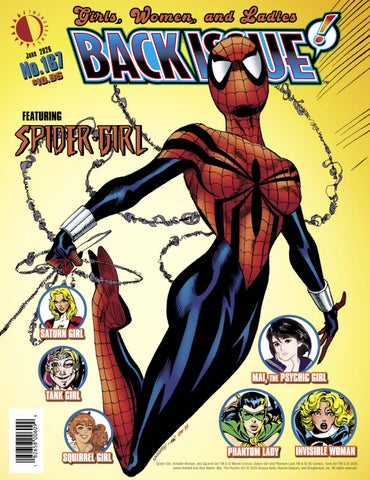
Girls, Women, and Ladies 2026
7 6 1 . No .95 June
$ 10
™
FEATURING
SATURN GIRL
MAI, the PSYCHIC GIRL TANK GIRL
SQUIRREL GIRL
PHANTOM LADY
INVISIBLE WOMAN
Spider-Girl, Invisible Woman, and Squirrel Girl TM & © Marvel Comics. Saturn Girl and Phantom Lady TM & © DC Comics. Tank Girl TM & © 2025 Jamie Hewlett and Alan Martin. Mai, The Psychic Girl © 2025 Kazuya Kudo, Ryoichi Ikegami, and Shogakukan, Inc. All rights reserved.
Volume 1, Number 167 June 2026 EDITOR-IN-CHIEF Roger Ash
Comics’ Bronze Age and Beyond!
PUBLISHER John Morrow DESIGNER Rich Fowlks EDITOR EMERITUS Michael Eury COVER ARTISTS Pat Olliffe and Al Williamson (Originally appeared as a variant cover to Spider-Girl #2. Original art scan courtesy of Heritage Auctions.) COVER COLORIST Glenn Whitmore COVER DESIGNER Michael Kronenberg PROOFREADER Kevin Sharp SPECIAL THANKS Chuck Austen James Robinson Cary Bates Philip Schweier Jarrod Buttery Roy Thomas Gerry Conway Mark Waid Tom DeFalco Steven Wilber Ron Frenz Stephan Friedt Grand Comics Database Robert Greenberger Mike Grell Heritage Auctions Paul Levitz Ed Lute Alissa Marmol-Cernat Will Murray Pat Olliffe Tom Peyer
Don’t STEAL our Digital Editions! C’mon citizen, DO THE RIGHT THING! A Mom & Pop publisher like us needs every sale just to survive! DON’T DOWNLOAD OR READ ILLEGAL COPIES ONLINE! Buy affordable, legal downloads only at
www.twomorrows.com or through our Digital Storefront at
www.comicshistory.org & DON’T SHARE THEM WITH FRIENDS OR POST THEM ONLINE. Help us keep producing great publications like this one!
BACKSEAT DRIVER: Editorial by Roger Ash . . . . . . . . . . . . . . . . . . . . . . . . . . . . . . . . . . 2 FLASHBACK: Saturn Girl: First Lady of the Legion . . . . . . . . . . . . . . . . . . . . . . . . . . . . . 3 A look at one of the Legion’s founders FLASHBACK: Squirrel Girl: Nuttin’ But A Good Time . . . . . . . . . . . . . . . . . . . . . . . . . . 13 The beginnings of squirrel power BEYOND CAPES: Mai the Psychic Girl . . . . . . . . . . . . . . . . . . . . . . . . . . . . . . . . . . . . . . 23 One of the first manga to come to America Prince Street News . . . . . . . . . . . . . . . . . . . . . . . . . . . . . . . . . . . . . . . . . . . . . . . . . . . . 30 Girl, You’ll Be a Woman Soon PRO2PRO: The Amazing, Sensational, and Spectacular Spider-Girl . . . . . . . . . . . . . . 33 Tom DeFalco, Ron Frenz, and Pat Olliffe discuss Spider-Girl FLASHBACK: Phantom Lady . . . . . . . . . . . . . . . . . . . . . . . . . . . . . . . . . . . . . . . . . . . . . 43 The twisted history of Phantom Lady BEYOND CAPES: Tank Girl: A Counterculture Icon . . . . . . . . . . . . . . . . . . . . . . . . . . . 53 Chaos in Australia FLASHBACK: Invisible Woman: Marvel’s First Lady . . . . . . . . . . . . . . . . . . . . . . . . . . . 61 The hero who holds the Fantastic Four together Back Talk . . . . . . . . . . . . . . . . . . . . . . . . . . . . . . . . . . . . . . . . . . . . . . . . . . . . . . . . . . . . 77 BACK ISSUE™ issue 167, June 2026 (ISSN 1932-6904) is published monthly (except Jan., March, May, and Nov.) by TwoMorrows Publishing, 10407 Bedfordtown Drive, Raleigh, NC 27614, USA. Phone: (919) 449-0344. Periodicals postage paid at Raleigh, NC. POSTMASTER: Send address changes to Back Issue, c/o TwoMorrows, 10407 Bedfordtown Drive, Raleigh, NC 27614. Michael Eury, Editor Emeritus. Roger Ash, Editor-In-Chief. John Morrow, Publisher. Editorial Office: BACK ISSUE, c/o Roger Ash, Editor, 2715 Birchwood Pass, Apt. 7, Cross Plains, WI 53528. Email: rogerash@ hotmail.com. Eight-issue subscriptions: $108 Economy US, $161 International, $39 Digital. Please send subscription orders and funds to TwoMorrows, NOT to the editorial office. Cover artwork by Pat Olliffe and Al Williamson. TM & © Marvel Character, Inc. All Rights Reserved. All editorial matter © TwoMorrows and Roger Ash, except Prince Street News © Karl Heitmueller Jr. Printed in China. FIRST PRINTING
Girls, Women, and Ladies Issue • BACK ISSUE • 1
The Legion of Super-Heroes (LSH) has been a perennial favorite of DC Comics fandom. Being Superman-adjacent, it’s closely tied to the publisher’s flagship character, but being set 1,000 years in the future, it maintains its own continuity. And of all the Legionnaires to pass through the doors of Nolan Plaza, few compare to its longtime leading lady, Saturn Girl.
1960s by P h i l i p
Schweier
In the late 1950s, Superboy was the star of Adventure Comics. Issue #247 (April 1958) featured the first appearance of the Legion in a story written by Otto Binder and drawn by Al Plastino. The Boy of Steel is perplexed when a trio of teenagers individually call him out on his secret identity. They soon reveal themselves to be superheroes of the 30th Century–Saturn Girl, Cosmic Boy, and Lightning Lad. For the first and perhaps only time, Saturn Girl sports a yellow, black, and green costume. The three teens have journeyed through time to recruit Superboy for their club, though his initiation isn’t without some hazing. Cary Bates, who would write Legion tales in the early 1970s, recalls the Legion’s first appearance making a big impression on him. “The idea of super-powered teenagers from the future coming to Smallville to meet Superboy and award him membership into their club was not only a great premise for a story in 1958,” he says, “but it would prove to lay the future foundation for an entire sub-genre of DC Comics. Kudos to Otto Binder and (editor) Mort Weisinger for being ahead of their time.” The Legion returned in a Supergirl story published in Action Comics #267 (Aug. 1960). Saturn Girl’s costume was completely redesigned, introducing the classic red and white color scheme. While later costumes deviated from these colors, it remains a palette that most artists have turned to when creating a new costume for her. It consisted of a red unitard with matching skirt, and white accents, including boots. A Saturn symbol adorned a white field that ran from her collar, tapering down to her belt buckle. Saturn Girl wore this costume throughout the 1960s, with minor variations, depending on the artist. DC Comics (then known as National Periodical Publications) continued to develop the LSH feature, adding new members. Arguably, Legion abilities can be divided into different categories. Saturn Girl is one of the few whose gift lies within; the ability to channel mental abilities in some form, rather than powers based on physical might (Ultra Boy or Mon-El) or metamorphosis (Duo Damsel or Colossal Boy), for example. Saturn Girl and Lightning Lad became personally involved, a romance that served as a frequent story element. The Legion also grew in popularity, leading to sporadic appearances in both Adventure Comics and Superboy’s own title. Tom Peyer, who would write Legion adventures in 1990s, was eight years old when he chose Adventure Comics #300 (Sept. 1962) from his local spinner rack. “I’d seen them already, in Superboy stories,” he explains. “I must admit I was initially a
All these cover appearances are giving Saturn Girl a splitting headache! Art by Jeff Moy and W.C. Cacari from Legion of Super Heroes Secret Files #1. (inset) The world’s first glimpse of Saturn Girl was on the cover of Adventure Comics #247. Art by Curt Swan and Stan Kaye. TM & © DC Comics.
Girls, Women, and Ladies Issue • BACK ISSUE • 3
(top) Saturn Girl shows off her mental abilities in her first appearance, Adventure Comics #247. Art by Al Plastino. (bottom) Saturn Girl gets her classic costume in Action Comics #267. Art by Jim Mooney. (inset) The Legion becomes a regular part of Adventure Comics in issue #300, and Saturn Girl is right there with them. Art by Curt Swan and George Klein. TM & © DC Comics.
4 • BACK ISSUE • Girls, Women, and Ladies Issue
little annoyed with them for replacing ‘Tales of the Bizarro World’ in the back of Adventure, but that wore off quickly.” In Adventure Comics #304, (Jan. 1963), Saturn Girl uses telepathy to influence her teammates into electing her leader, enabling her to ground the other Legionnaires. However, Lightning Lad defies her orders and dies defending Earth. It was later revealed she’d intercepted a warning that a Legionnaire would be killed in action. To prevent this, Saturn Girl was prepared to sacrifice herself. Even though her election came about under false pretenses, it was allowed to stand because of Saturn Girl’s truly heroic motivation. By Adventure Comics #312 (Sept. 1963), the Legion had graduated to the title’s lead feature. Most of these stories were written by Edmond Hamilton and drawn by John Forte. In “The Super Sacrifice of the Legionnaires,” Saturn Girl is prepared to sacrifice herself once more to resurrect Lightning Lad, but instead, Proty, Chameleon Boy’s shapeshifting pet, takes her place to return Lightning Lad to life. Paul Levitz, who wrote the Legion’s adventures throughout the 1970s and ‘80s, was an early fan of the Legion. “Adventure Comics #304 and 312 were formative for me, and they established Saturn Girl as the most distinctive of the women in the LSH, and probably the strongest willed Legionnaire,” he says. “I’ve always thought she was one of the most important members, not just as a founder, but for her combination of intelligence and steel-determination.” Saturn Girl continued to prove herself worthy of her role as Legion leader, earning a second term the following year (Adventure Comics #323, Aug. 1964). The Adventure Comics masthead now included, “featuring Superboy and the Legion of SuperHeroes.” The former star of the title was now an ensemble player, his solo adventures in Smallville replaced by collaborations in the 30th Century. The origin of the Legion was finally revealed in Superboy #147 (May/June 1968). Perhaps because no other Legionnaires were identified in the Legion’s inaugural appearance, Saturn Girl, Cosmic Boy, and Lightning Lad were established as the Legion’s founding members. Writer E. Nelson Bridwell and artist Pete Costanza revealed how Saturn Girl was born Imra Ardeen on Titan, Saturn’s largest moon, where she and her fellow inhabitants all possess telepathic abilities. Leaving home to apply for the Science Police, she encounters two other teens–Rokk Krinn and Garth Ranzz–aboard the spacecraft bound for Earth. Imra’s telepathy reveals a plot to assassinate a fellow passenger, which they foil using super-human abilities. It so happens the rescued passenger is billionaire R.J. Brande, who offers to bankroll them as superheroes. Inspired by the legacy of Superman’s adventures as a youngster, they form the Legion of Super-Heroes, recruiting super-powered teens from across the galaxy.
by E
Most comic book fill-in stories are just that-stories that were produced to make sure that a comic book was still published when a regular creative team couldn’t hit a deadline. These stories, while many times good, were usually just place holders until the creators could get back on schedule and the regular storyline back on track; the stories didn’t usually introduce memorable characters. However, that’s just what happened with an Iron Man fill-in story that, while never used for the regular Iron Man book, appeared in Marvel Comics’ anthology series Marvel Super-Heroes. The story introduced the character of Squirrel Girl to the world. Squirrel Girl made just one appearance during the BACK ISSUE era, then all but vanished from the comic book world before coming back even stronger and more popular in the next century. Squirrel Girl is now a very marketable character for Marvel, appearing not only in her own comic book but also in animated form, in several prose novels, and even an action figure. This is the story of a girl with the awesome powers of a squirrel and how she used them to conquer the comic book world.
d Lute
THE COMING OF…SQUIRREL GIRL
Doreen Green aka Squirrel Girl made her debut in Marvel Super-Heroes #8 aka Marvel Super-Heroes Winter Special (Winter 1991) by writer Will Murray and artist Steve Ditko. In the story, Squirrel Girl tried to capture Iron Man to prove her worth to him. She wanted to show him that she had the skills to be a legitimate superhero. Squirrel Girl told Iron Man that he’s her favorite Avenger. Furthermore, she wanted to be his partner. Iron Man dismissed Squirrel Girl telling her he works alone and that she’s too young (she’s only fifteen years old). However, the armored Avenger ended up needing Squirrel Girl’s help against one of Marvels’ most deadly and feared villains-Dr. Doom. Squirrel Girl was able to defeat Doom and rescue Iron Man with the help of some of her furry friends. The story was written by Squirrel Girl’s co-creator Murray. He tells BI, “I don’t remember what came first, the idea of pitting Iron Man against Dr. Doom, or using the story to introduce Squirrel Girl. But that fact that those two armored characters never clashed during my formative reading always disappointed me. So, Doom would be my antagonist.”
Say hi to Squirrel Girl. From Marvel Super-Heroes #8. Art by Steve Ditko. (inset) Squirrel Girl by Erica Henderson. TM & © Marvel Characters, Inc.
Girls, Women, and Ladies Issue • BACK ISSUE • 13
(left) The dynamic teaming of Iron Man and... Squirrel Girl? (right) Squirrel Girl displays the array of superpowers at her disposal. Art by Steve Ditko. TM & © Marvel Characters, Inc.
Murray had been working on Marvel’s comic When my editor, Howard Mackie, asked me to book adaptation of The Destroyer pulp novel script a fill-in issue of Iron Man, I wanted to take series. The book series, which started in 1971 it back to 1962-64. I was thinking specifically of with new stories still being published today, was Fantastic Four #11 [Feb 1963], which introduced originally written by Warren Murphy and Richard the Impossible Man, a humorously offbeat Sapir. Murray took over writing the book series in character Stan Lee banned from returning after he read the fan mail. Older readers loved 1988. Probably the best-known adaptation him, but the kids hated him.” of the books was the 1985 movie Comics are a collaborative medium Remo Williams: The Adventure Begins. that require a writer and an artist Marvel’s black-and-white magato complete a story. Enter legendary zine-sized series ran for nine comic book artist Steve Ditko. issues from 1989–1990. “I believe Steve was drawing The Iron Man story itself, as backup stories for The Destroyer well as the character of Squirrel black-and-white magazine before Girl, has the feel of a Silver Age he agreed to draw this Iron Man Marvel Comics tale. This was story. I’m not a hundred percent intentional on Murray’s part. He certain though. But we had recalls, “I hadn’t written comics begun talking by phone, and I professionally before. But I grew was privileged to visit his studio up on Marvel and DC in the will murray from time to time. We got along 1960s. And I had a fondness for © Drobertpowell / Wikimedia Commons. fairly well. the formative 1962-64 era when “Anyway, Steve worked from a full script Marvel didn’t always take itself seriously. Grim and gritty was the prevailing tone when I started on ‘The Coming of… Squirrel Girl.’ Everything scripting [Marvel’s] The Destroyer in 1989, a was there, including the dialogue. I tend to series infamous for its black humor. So, I had no write dialogue-driven comic scripts, with problem with that tone, but I felt that some of minimal description and stage direction and no the fun had gone out of the Marvel Universe. page divisions. Steve broke it down beautifully.
14 • BACK ISSUE • Girls, Women, and Ladies Issue
And all I had to do was plug in the dialogue, occasionally changing or cutting something to fit his page breakdown.” Ditko was one of the founders of the Marvel Universe with his work on the Amazing Spider-Man and Doctor Strange with writer Stan Lee, so you would think it would be a shoo-in for his inclusion as artist of the story. However, that wasn’t the case. According to Murray, “I had to lobby my editor for Ditko to get the assignment, and I pushed for him to ink it, too. Nobody else inked Steve Ditko better than Ditko himself. When Steve got the assignment, I asked him to ink up a storm to show Marvel that he still had his artistic chops. At that point, they were tending to assign different inkers to him, some great and some terrible. His work was considered old-fashioned. He was over 60 at that point. “We hoped that this might lead to a resurgence of Steve Ditko stories at Marvel, but I think this was one of the last things he did that was full length, maybe the last. He penciled and inked an Iron Man five-pager for the 1990 Iron Man Annual, and I’d like to think the Squirrel Girl story led to that assignment. He did do some other shorter things, then drifted away from Marvel for good. It’s unfortunate. He’s one of the most brilliant comic book artists of his or any other generation. I often thought of him as the smartest artist in comics.” Ditko’s distinctive art style was the perfect fit for this story that was a callback to Marvel’s Silver Age roots. If you didn’t look at the cover of the issue and just looked at this story, you might think you had been transported back to 1963. Murray concurs, “I agree with you. But Steve came aboard after the original artist bowed out. When Howard [Mackie] asked me to do the Iron Man issue, he paired me with an artist named Tom Morgan, who had illustrated one of my Destroyer stories. Tom and I got on the phone, and he pitched me an idea for an issue of Iron Man that would have been action from start to finish. Iron Man investigates an old castle and is attacked by mechanized suits of medieval armor. No doubt it would have made a great fill-in issue but would have reduced me as a writer to simply filling in the word balloons and captions. As a novelist, I wanted to set the stage. I used to say that in comics the writer conceives the story, but the artist tells it for him. This would have been the opposite. “This was my first crack at a Marvel superhero, and I wanted to make my mark. I don’t remember the sequence of events, but I subsequently pitched the concept of Squirrel Girl to Howard Mackie. As I recall, he was less than enthusiastic. Some arm twisting ensued, followed by my trade trademark phrase, ‘Trust me. I can make this work.’ “I don’t know if Tom Morgan ever saw my script, but after it was turned in, Howard told me that Tom was too busy to work on it. That’s when I requested Steve Ditko. More editorial gulping and authorial arm twisting followed. Fortunately, I prevailed. That’s no reflection on Tom Morgan’s artistic abilities. He would have done an excellent job. His style would have been a perfect fit for Squirrel Girl. Maybe she would have looked more like Peter Pan than what Ditko delivered! But I’m glad it worked out this way. I got to work with one
of my childhood faves, and on a character he had re-designed back in 1964. That was a real thrill. In fact, I would call it a career highlight. And I say that with almost eighty books and novels behind me! “Steve was a consummate professional. I was excited to see his pencils. And thrilled to see his inked pages colored and in print when ‘The Coming of…Squirrel Girl’ straggled out over a year after I created her. I love the fact that Dr. Doom was the villain because I vividly remembered Amazing Spider-Man #5 [Oct 1963], with Steve’s first take on the character. “Sure, Steve grumbled about certain things. And I would probably have liked to have seen a more elaborate costume, but the goofy outfit he came up with was realistic for a 15-year-old superheroine just starting out. “The mere fact that Steve drew that introductory story gave it a cache it might otherwise never had. Squirrel Girl has been called the last Silver Age
Did we forget to mention that Doctor Doom is in this story? So did Squirrel Girl! TM & © Marvel Characters, Inc.
Girls, Women, and Ladies Issue • BACK ISSUE • 15
by R o b e r t
Greenberger
The Japanese invasion began on September 7, 1963. Americans woke up that Sunday morning and found an animated series on NBC featuring a robot child having some marvelous adventures. The fluid animation was far from the limited animation that became standard for Saturday morning television. Osamu Tezuka’s Astro Boy had traveled around the world. He arrived in America, the first of many anime series to share space with original domestic children’s fare and British Supermarionation offerings. It took until 1987 before manga formed an entirely new front on the encroachment. Eclipse Comics, formed by Dean and Jan Mullaney in the late 1970s, had already pioneered new art forms, expanding what could be done with graphic storytelling, beginning with Don McGregor and Marshall Rogers’ Detectives, Inc. They continued to explore different genres and formats as they launched their comic book company, becoming one of the first independent publishers of the Bronze Age. In the mid-1980s, Mullaney and editor-in-chief cat yronwode (also his wife at the time) began exploring international comics to bring to American readers. They quickly settled on the Japanese manga market and the publishing behemoth Shôgakukan, Inc. The company was best known for its Shônen Sunday, a weekly publication since March 17, 1959. By the 1980s, the title was known for its quality storytelling and limited run serials, which by edict would last no more than 40 volumes. When Mai debuted in Japan, it stood out as the rare story featuring a female protagonist for a male-dominated audience. The 53 installments ran from March 20, 1985, to April 2, 1986, written by Kazuya Kudô and illustrated by the prolific Ryoichi Ikegami. Little is known about 86-yearold Kudô, who may be best known for Gogol 13, while Ikegami began his career in 1966 at 17, later illustrating Japan’s version of Spider-Man in 1970-71, and today, at 80, continues by illustrating Trillion Game. In 1986, Viz Media, LLC was formed in San Francisco and began representing manga to international publishers. The company started off modestly, licensing manga, but it has grown to become an empire that covers print and multimedia worldwide. “Two years went by, and Eclipse began to negotiate with Shôgakukan, Inc. for the right to publish Japanese comics in English,” explained James D. Hudnall in Area 88, one of the Viz titles to come to America. “A co-publishing deal was struck, and they immediately began looking for a person to polish the translations.” Hudnall, thanks to his ESPers work for Eclipse, got Area 88 and Mai to polish.
Manga comes to America. Mai the Psychic Girl #1 cover by Ryoichi Ikegami. © Kazuya Kudo/Ryoichi Ikegami/Shogakukan, Inc. TM Viz Communications, Inc.
Girls, Women, and Ladies Issue • BACK ISSUE • 23
(left) Mai’s powers on display in issue #1. (right) Is that Ming the Merciless? Art by Ryoichi Ikegami. © Kazuya Kudo/Ryoichi Ikegami Shogakukan, Inc. TM Viz Communications, Inc.
Eclipse initially licensed Mai, Area 88, and The Legend of Kamui, with the psychic teen leading the way. Unlike the American manga we’re familiar with today, the stories were in traditional American comic-size, 32-page format, printed in black-andwhite, reading left to right. Since the chapters varied in length, throughout the 53-issue run, the page count ranged from 32 to 40 pages. Once the film arrived at Eclipse’s Guerneville, CA offices, production artists reconfigured the art to fit the dimensions, which sometimes required flipping artwork or extending art so the left-toright reading was comfortable. Once Hudnall polished the writing, it was lettered by Wayne Truman and Bill Pearson. To mimic the frequency of Japanese publishing, the manga from Eclipse was initially released biweekly, with the final issues of some titles switching to monthly. Still, when the first book arrived, cover dated May 19, 1987, audiences weren’t sure what to make of the book or the second issue’s speedy arrival. It certainly posed a unique challenge to direct sales shops, which would be ordering twice the number of issues before sales could determine demand. This was a roll of the dice for the publisher and retailers alike. The choice of Mai to introduce American readers to Japanese storytelling was inspired.
24 • BACK ISSUE • Girls, Women, and Ladies Issue
First, she’s a cute, 14-year-old girl who happens to have inherited telepathic powers. They could relate because this was like the X-Men’s Jean Grey, someone they already knew. The other consideration was that Viz and Shônen Sunday saw the series as a good middle ground between manga and comic books. Ikegami’s illustrative style was close enough to American comics, while his page construction and storytelling were distinctly Japanese. Ikegami conceived Mai and told Animerica, “I talked with my editor at Shônen Sunday before taking the idea to Kudô. The original idea was to base the character on the Buddhist figure known as ‘Miruko’ or ‘Maitreya,’ a Bodhisattva supposed to come to Earth as a savior three billion years in the future. By mistake, he comes to present-day Earth. He also comes as a girl.” They were also influenced by Stephen King’s 1980 bestseller Firestarter, which was adapted in 1984 as a feature film starring Drew Barrymore. The series arrived, and readers took notice with the first two issues receiving second printings to satisfy demand, something unusual at the time. In The Superhero Book: The Ultimate Encyclopedia of Comic-Book Icons and Hollywood Heroes, writers Gina Misiroglu and David Roach noted that it avoided many superhero cliches and successfully introduced manga to an audience largely
Spider-Man is arguably Marvel Comics’ most famous character. Conceived by Stan Lee and Steve Ditko, high school student Peter Parker is bitten by a radioactive spider. From there, he goes on to have a very long, exciting, and tumultuous super heroic career that helped spawn more exciting characters who shared in the Web-Head’s long legacy. But none shares that legacy so close as his daughter from an alternate future. Spinning out of a major SpiderMan storyline, “The Clone Saga,” Peter and his wife, Mary Jane, are expecting their first child. The tom defalco newborn is kidnapped and the Hildy DeFalco. would-be parents believe their daughter stillborn, a scheme enacted by Spider-Man’s archfoe, Norman Osborn, the Green Goblin. In current continuity, the story of the baby is brushed aside for potentially more exciting developments. However, one of the architects of the “Clone Saga,” writer Tom DeFalco, realized that a daughter of Marvel’s flagship hero came rife with possibilities. Thus, a Spider-Girl was created, faced with similar problems as her ron frenz famous father, but dealing with Facebook. them in her own inimitable style. It shouldn’t be a surprise to any comic book reader that DeFalco would be the brains behind May “Mayday” Parker. Before having a storied career as a writer at Marvel Comics, Tom started at Archie, before moving on to Charlton and DC Comics. The writer would graduate to become Marvel Comics’ Editor-In-Chief. Besides the writer of Spider-Girl, Tom DeFalco is best known for his applauded runs on Fantastic Four, The Mighty Thor, and The Amazing patrick olliffe Spider-Man. DeFalco would be Instagram. joined on Spider-Girl by two frequent collaborators, Ron Frenz and Pat Olliffe. Ron Frenz readily admits he wanted to be a comic book artist from a young age. Before breaking into the comics field, Frenz worked in animation and would eventually hold the position for six months while simultaneously penciling for Marvel. Frenz and DeFalco became fast friends while working on Spider-Man and then later, Thor. Together they created the popular team the New Warriors.
by S t e v e n
Wilber
Our heroine, from the cover of Spider-Girl #0. Art by Ron Frenz and Pat Olliffe. TM & © Marvel Characters, Inc.
Girls, Women, and Ladies Issue • BACK ISSUE • 33
Spider-Girl and her parents, Peter and Mary Jane, from Spectacular Spider-Girl #4. Art by Ron Frenz and Sal Buscema. Original art scan courtesy of Heritage Auctions (www.ha.com). TM & © Marvel Characters, Inc.
Frenz was instrumental in bringing aboard artist Pat Olliffe who he met at the same animation studio. Olliffe, also a comics fan, met DeFalco through Frenz, doing backup stories in Thor. Beforehand, Olliffe was working for Malibu Comics. Besides Spider-Girl, Olliffe’s notable works include Warlock and the Infinity Watch, Untold Tales of Spider-Man, and more. One early afternoon in mid-February, BACK ISSUE sat down with all three creators to discuss their involvement with Spider-Girl, a series that ran for nearly a decade and was followed by multiple miniseries, one-shots, and short stories. BACK ISSUE: What was the genesis of Mayday Parker and her cast leading to her first appearance in What If #105? TOM DEFALCO: There was a period of time where I was working on this thing called “The Clone
Saga.” During the course of this, we discovered that Mary Jane was pregnant. Now—for a lot of the time during the clone “sucker” —I was not having a good time on the project. Too many people were trying to direct it. This was a time at Marvel where Marketing kept sticking its head in. I’d turn in a plot for a one issue story and Marketing would read it, like it, and say, “Wait a minute, this should be a four-issue story!” Making me think, “How the heck do I make this thing into four issues?” Every once in a while, when I was bored or unhappy, working on that stuff … I’d think about how Peter and Mary Jane were going to have a baby. We had decided it was going to be a little girl, and I could imagine her having adventures with her dad somewhere along the line. At some point, they took me off of the Spider-Man books and they assigned me to do What If...?. So, I had to come up with What If...? ideas and I thought, “Well, yeah. I might as well do that Spider-Girl story.” I called up Ron, because whenever I think of Spidey, I always think of Ron. Well, Spider-Man. Now, when I think of Spider-Girl, I think of Pat. [Laughter] Ron said to me, “Spider-Girl? Why don’t we just call her Spider-Woman?” And I said to him, “Yeah, no. That name has the stink of death on it.” Because by then, there’d been like four or five spider-women. BACK ISSUE: Only a year later John Byrne and Howard Mackie introduced their own teenage spider heroine, Mattie Franklin, the third SpiderWoman. (A fourth, Charlotte Whitter, came immediately after.) Was that frustrating? It could be looked at as though they were possibly trying to steal the spotlight from Mayday. DEFALCO: As for Mattie, Araña, and all the other copies—a few creative people believed that Mayday’s success was solely based on the word “spider” in her name. They believed they could all create characters that would be even more popular. We didn’t look at their efforts as competition, but they did. That’s the biz! Ron and I got to talking and you know, the cast for Mayday kind of came together. We started talking about the personality of the main character, then the other characters kind of created themselves. Somehow, at the end of the process, there was a story. RON FRENZ: Tom, you’re so humble. [Laughter] Tom’s a total pro. It was a fun assignment, because it was kind of like a reunion and a homecoming for us, with Pete and Mary Jane. Tom talks about the other characters writing themselves anytime you’re going to structure a story. Every character should say something about the lead character and have a different dynamic with the lead. This is what we were interested in pursuing with Mayday, that she was equal parts Mary Jane and Pete, and that, unlike Peter, who was an outcast, she’s so popular that she has friends that are nerds and jocks. She feels divided when she’s with her nerd friends because she has to defend her jock friends (or not), and when she’s with her jock friends she’s defending her nerd friends. So, she feels very divided. And in finding out about her legacy from Peter… she finds a way through by becoming Spider-Girl.
34 • BACK ISSUE • Girls, Women, and Ladies Issue
Their original idea was they wanted us to put three comic books in a bag to sell in Walmart. We were only supposed to do six issues of each title. They were gonna put them on fancy paper and charge twice the amount of money of a comic at that time. And I said, “You know these are for your younger readers, right?” The sales guy said, “No, no, no. Trust us. We know what we’re doing.” I remember I walked out of the meeting. They had a new sales guy in charge. He says, “Oh, he’ll come around.” The other guys looking around who kind of knew me, said, “No, he won’t.” Ultimately we got to do our three titles the way we wanted. BACK ISSUE: Was it difficult writing and penciling a predominantly teen cast (with then) current lingo and fashions? FRENZ: We never worried about current lingo and fashion. Well, fashion, but lingo? Tom’s not a big lingo guy because things come and go. He’s old enough, ancient actually, [wide grin] that he has a much longer-term view of what makes a comic timeless, and playing into fads is not. OLLIFFE: We had to pay attention to a certain extent, not to date it too much, and had some awareness of what kids were wearing and that kind of thing. DEFALCO: When we originally set up the MC2 world, we figured this was fifteen years in the future. I remember when Ron and I were talking, he asked, “What do you think people could be wearing in the future? I said, “What they’re wearing now, jeans and t-shirts.” One of the major criticisms we’d gotten when the MC2 universe came out was, “Where are the flying cars?” We started the MC2 in 1998. So, New Year’s Day, 2013, I get a call from Mr. Frenz, “Where’s my freaking flying car?!” [Laughter]
(top) May hangs around in Pat Olliffe and Al Williamson’s cover to Spider-Girl #53. Original art scan courtesy of Heritage Auctions (www.ha.com). (bottom row) A sampling of Ron Frenz’s lovely covers in the Spider-Girl run. TM & © Marvel Characters, Inc.
Girls, Women, and Ladies Issue • BACK ISSUE • 37
by A l i s s a
Marmol-Cernat
The odds are you know Phantom Lady. You’ve been reading comics for a while now, if you’ve as much as glanced at anything to do with the All-Star Squadron or the Justice Society of America, you know Phantom Lady. Maybe not by name, maybe not even by reputation, but the green-andyellow-clad bombshell is hard to forget once you’ve caught a glimpse of her. Phantom Lady isn’t just one of the most visually striking female superheroes to have ever graced the hallowed newsprint of Golden Age comics but also the subject of an especially long and troubled publication history. As we take the long way around on this overview of the character, we’ll delve into the role Phantom Lady played in comic book history as a whole and the women who have worn the mantle alongside the iconic Sandra Knight.
BEHIND EVERY GREAT WOMAN…
A Mel Ramos color screenprint of Phantom Lady, printed in 1990 after the original 1963 drawing. (inset) Our first glimpse of Phantom Lady on the cover of Police Comics #1. Art by Gill Fox. Original art scan courtesy of Heritage Auctions (www.ha.com).
…is a tumultuous beginning. Or so it would seem to have been the case for our heroine. Phantom Lady first appeared in Police Comics #1 (Aug. 1941) published by Quality Comics, debuting alongside the likes of Plastic Man, the Human Bomb, and Firebrand; all later acquired by DC Comics along with the entirety of Quality’s catalogue, and finding various degrees of success over the years. “The society columns record the activities of Sandra Knight, debutante daughter of Senator Henry Knight… no one suspects that frivolous Sandra is also the Phantom Lady, whose battles against spies and public enemies constantly make the headlines,” reads the title page of Phantom Lady’s first adventure. For the longest time, there would be nothing more to find out–in more ways than one. Not only had Phantom Lady’s debut foregone an origin and made it clear that it was not her first outing under her superheroic moniker by any means, but there was no writer credited. In fact, the page only bears cartoonist Arthur Peddy’s signature, and whether he’s the man wholly responsible for the Lady of the hour can only really be approached as mere speculation. What is, however, clear is that Phantom Lady is a product of the Eisner & Iger Studio, and a prime example of the kind of work done by the period’s foremost comic book packager–an outsourcing service that would
Girls, Women, and Ladies Issue • BACK ISSUE • 43
(left) Arthur Peddy’s splash page for the first Phantom Lady story in Police Comics #1. (right) Joe Kubert draws Phantom Lady in Police Comics #14.
produce comics by commission for the publishers of the 1930s and ‘40s, a now bygone phenomenon. If that first story was standard superhero fare for the era, Sandra saving her father from an assassination attempt and gaining a taste for adventuring in the process, Phantom Lady’s look was anything but. In the hands of Arthur Peddy, Sandra Knight arrived on the scene in a yellow one-piece bathing suit with a green cape and matching boots. She was a sight to see, and she had the brains and power to live up to it–especially armed with her “black light projector,” which allowed her to become invisible at a moment’s notice. Occasionally assisted by her fiancé, Don Borden of the Secret Service, Phantom Lady lasted a grand total of twenty-three issues in Police Comics. After Peddy departed with issue #13 (Nov. 1942), a teenage Joe Kubert took over art duties for a spell. He was succeeded by Frank Borth in issue #17 (Mar. 1943), which also marked the debut of a slight redesign of Phantom Lady’s costume; she was now sporting a plunging neckline and heeled boots. Posed against the silhouette of a black cat in the title page of Borth’s premiere issue, Sandra Knight looked like she’d made it. Peddy’s art was expressive but not especially dynamic; he’d made Sandra poised and polished but hadn’t quite managed to sell readers on her being the kind of woman who took up crime-fighting in a swimsuit. Kubert had followed suit–competent, although still juvenile. Borth’s Phantom Lady had it all, she
44 • BACK ISSUE • Girls, Women, and Ladies Issue
was every bit the socialite who’d heard the call of justice and answered. Alas, it wasn’t to be. Arthur Peddy returned for Phantom Lady’s second-to-last Police Comics appearance in issue #22 (Sept. 1943), and Rudy Palais briefly took the helm for her very final story. As far as Quality Comics was concerned, though, Sandra was practically done for. She found a starring role in one last adventure in Feature Comics #69-71 (July-Sept. 1943), an unusual crossover with Spider Widow and the Raven in the days when such things were far from common. It was, indeed, the only crossover Quality would ever publish. For four years, it seemed like the world had seen the last of Phantom Lady. However, the wheels were still spinning behind the scenes. With the character no longer being published by Quality Comics, Iger Studio–now operated solely by Jerry Iger, Will Eisner having famously departed to focus on The Spirit, a weekly feature at the time– seemingly sold the rights to Fox Feature Syndicate; a move that would later cause significant confusion over the ownership of the copyright. In August 1947, Fox’s take on Phantom Lady hit the stands, and Sandra Knight took on the mantle for the second time that decade. The feature had undergone some changes though; to begin with, it was now a self-titled solo. Phantom Lady #13, the first issue of the Fox Feature Syndicate version, had actually taken up the numbering from the seldom-remembered humor
Instead, I wanted to capture that independent free-spirit sort of female that you’d see in romantic comedies of that time–heiresses who did as they pleased and got into scrapes and antics. Like Carole Lombard in My Man Godfrey, or [Katharine] Hepburn in Bringing Up Baby. Irene Dunne too, in The Awful Truth. Tying that to New York cocktail society at that time and the soirees and galas to support the war effort, filled with the rich, bored, young looking for fun and adventure. Even after the closure of the Federal Theatre Project New Deal Program under the Works Progress Administration (WPA) there were still earnest playwrights writing about the working-class struggle, and I tried to reference CARRYING THE BANNER that too. I wanted her to be a Past the Golden Age associations, bit more of a realist, however, the Phantom Lady mantle has not too zany. She goes on that been used by three other women: adventure for the money she’d Delilah ‘Dee’ Tyler, Stormy Knight, get to buy war bonds. Even in and Jennifer Knight. The latter two her Golden Age stories she comes were products of Infinite Crisis across as a strong, independent and The New 52, and despite woman, not some ditz or merebeing effective reinventions of chuck austen ly a crime-fighting pinup, so I the concept with no real relation wanted to get some of that feel Gage Skidmore / Wikimedia Commons. to Sandra Knight, they make across. I definitely wanted to give the sense that I respected the character. There’s for compelling characters in their own right. nothing wrong with being sexy, but I wanted to However, it’s Dee Tyler that really stands out give an intelligent integrity at the same time. I among the trio, and for good reason too. Created by Len Strazewski and Chuck Austen wanted the costume to make sense, not apoloand first appearing in Action Comics Weekly #636 gize or get into explaining that choice overly.” If that is the highlight of Sandra Knight’s long (Jan. 1989), Dee is the daughter of the U.S. Attorney career, if Starman #44 understands and embodies General and like the original Phantom Lady, she all that had come before and all she had meant joins the ranks by rescuing her father. In fact, and represented, then it certainly isn’t the end of she’d been trained by Sandra Knight and gifted her original costume and equipment, closely Phantom Lady’s legacy.
(left) A stunning Phantom Lady by Kevin Nowlan graces the cover of Action Comics Weekly #639. (right) Phantom Lady in the heat of battle from Action Comics Weekly #638. Art by Chuck Austen and Gary Martin. TM & © DC Comics.
Girls, Women, and Ladies Issue • BACK ISSUE • 51
by S t e p h a n
Friedt
Tank Girl in all her glory by Jamie Hewlett. (inset) Tank Girl’s first appearance, on the cover of Deadline #1. Tank Girl TM & © Jamie Hewlett, Alan Martin, and Deadline Publications, Ltd.
Girls, Women, and Ladies Issue • BACK ISSUE • 53
“NOTHING IS IMPOSSIBLE IF YOU’RE INSANE ENOUGH.” (left) A page from Tank Girl’s first appearance in Deadline #1. Art by Jamie Hewlett. Original art scan courtesy of Heritage Auctions (www.ha.com). (right) That Aussie’s back on the cover of Deadline #4. Tank Girl TM & © Jamie Hewlett, Alan Martin, and Deadline Publications, Ltd.
–Tank Girl
Tank Girl made her debut in 1988 in the British anthology book, Deadline. In this punk art influenced series, the young lady Rebecca Buck, born “Fonzie Rebecca Buckler” wanders around post-apocalyptic Australia in her tank that doubles as her motor home. She is first introduced as an agent of a mysterious organization, but as retribution for missteps on her part, she is marked an outlaw for her drug use and sexual deviations with her mutant kangaroo boyfriend, Booga. The creation of writer Alan Martin and artist Jamie Hewlett, she’s been written primarily by Martin, but also by Alan Grant (Judge Dredd, Batman) and Peter Milligan (Human Target, X-Static). The list of artists who have illustrated her adventures has grown over the years and includes Jamie Hewlett, Philip Bond, Glyn Dillon, Ashley Wood, Warwick Johnson-Cadwell, Jim Mahfood, Brett Parson, Jonathan Edwards, Craig
Knowles, Rufus Dayglo, Andy Pritchett, and Mike McMahon. The series revolves around a cast of characters. Tank Girl: A tank driver and a bounty hunter. She is prone to random acts of sex and violence, hair dyeing, flatulence, nose picking, vomiting, spitting, and more than occasional drunkenness. Tank Girl wears cut-off T-shirts or simply a bra, along with shorts and plenty of earrings and necklaces. Her natural hair color appears to be blonde, though she has appeared in many different hairstyles. Booga: A mutated kangaroo, formerly a successful toy designer of “products Santa would’ve sacrificed a reindeer for,” and presently Tank Girl’s devoted boyfriend. Three talking stuffed animals: Camp Koala (a stitchy, brown, gay, koala-shaped stuffed toy), Squeaky toy rat (a squeaky toy rat), and Mr. Precocious (a “small Shakespearean mutant” who looks a bit like a mini bipedal pink elephant). Stevie: Tank Girl’s ex-boyfriend and a wild-haired blond Aboriginal man who owns a convenience store and chain-smokes. Barney: Busted out of a mental hospital by Tank Girl, she is more or less insane. Sub Girl:. A friend of Tank Girl’s since childhood, she pilots a submarine. Jet Girl: A talented mechanic who flies a jet. Boat Girl: You got it…she drove a boat.
BEGINNINGS
The British comics magazine Deadline ran from 1988 through 1995. Featuring comic strips and written articles primarily geared towards a mature audience, it was the result of the collaboration between 2000 AD artists, Brett Ewins and Steve Dillon. It grew out of an earlier
54 • BACK ISSUE • Girls, Women, and Ladies Issue
BACK ISSUE #158 (Apr. 2025) featured a quitegood retrospective of Mr Fantastic, leader of the Fantastic Four, and one of Marvel’s most significant characters. Yet beside him, for over 60 years, has stood the person who keeps Reed Richards in check.
THE MARVEL AGE BEGINS
by J a
rrod Buttery
As previously noted, the first page of Fantastic Four #1 (Nov. 1961) introduces us to Reed Richards, Ben Grimm, Susan Storm, and her brother, Johnny Storm. One by one, Stan Lee and Jack Kirby present our stars, starting with Sue. Page two has Susan Storm enjoying tea when a flare appears in the sky, spelling out the words: ‘The Fantastic Four.’ Fading from sight, Sue muses, “So it has happened at last! I must be true to my vow! There can be no turning back! It is time for the world to meet… The Invisible Girl!” As the fantastical foursome assembles, we flash back to one of comics’ great origin stories: Dr. Reed Richards has built a starship. Pilot Ben Grimm is worried about cosmic rays. But Sue declares, “Ben, we’ve got to take that chance… unless we want the commies to beat us to it! I… I never thought that you would be a coward!” Sue has spoken. She joins the flight, telling Reed, “I’m your fiancée! Where you go, I go!” The ship blasts off. Our quartet is bombarded by cosmic rays. They crash back to Earth. One by one, they find themselves with more power than any humans have ever possessed. The Invisible Girl, the Human Torch, the Thing, and Mr. Fantastic vow to use their powers to help mankind—and from that moment on, the world would never again be the same! Interviewed in Comics Scene 2000 #1 (May 2000), Stan Lee recalled: “I liked Plastic Man. That’s a great power, and nobody was using it. So I gave Reed Richards Plastic Man’s power. The Human Torch I always felt had been a great character. We weren’t using him. So I brought him back. As for the Invisible Girl, she’s a girl so I don’t want her to be strong. I don’t want her to be Wonder Woman and punch people. So what power should she have? I figured, ‘Gee, what if she’s invisible?’ I knew there had been invisible people. There was The Invisible Man, the movie with Claude Rains. All I was trying to do was think of four powers that were totally different.” The website Web of Stories presents online video interviews. Amongst those, Lee describes Sue Storm and how he aimed to buck the clichés: “Instead of the obligatory female who always has to be rescued, and doesn’t know who the hero really is, she was the hero’s fiancée. She knew who
Susan Storm by Mick Austin for a poster included with Fantastic Four #488, published by Marvel UK, 1982. Original art scan courtesy of Heritage Auctions (www.ha.com). TM & © Marvel Characters, Inc.
Girls, Women, and Ladies Issue • BACK ISSUE • 61
Sue Storm in action in Fantastic Four #1. Art by Jack Kirby and George Klein. TM & © Marvel Characters, Inc.
he was—they all knew who they were—and she also had a superpower that was as good as anyone else’s, so she was a fighting member of the team.” Reprinted in various publications, Lee’s original synopsis for Fantastic Four #1 was discussed by Roy Thomas in Alter Ego Vol. 2, #2 (Summer 1998). The synopsis is headed “July ‘61 Schedule” and commences with “Story #1. Introduction. ‘Meet the Fantastic Four’. This story is told in 2 chapters. Chapter one is 6 pages long. Chapter 2 is 5 pages.” Stan lists his four main characters, including: SUSAN STORM (Invisible Girl) She is Reed’s girl friend (sic). She’s an actress. Beautiful, glamorous. After describing the spaceflight and crashlanding, Lee writes, “Suddenly, they can’t see Susan. But they know she’s there! They can HEAR her. They realize she has become invisible. She can not become visible again. Later, she will buy a mask with a face like the one she had and she will have to wear that mask in order to be seen. Her clothes of course can be seen, so it is only her flesh that is invisible. When she takes her clothes off, she
62 • BACK ISSUE • Girls, Women, and Ladies Issue
is completely invisible. (I hope this won’t seem too sexy in art work. Better talk to me about it, Jack— maybe we’ll change this gimmick somewhat.)” Thomas explains that he asked Lee about the synopsis: “Since the 11 pages allotted for the first part had become 13—with the flashback-origin squeezed into a mere five—I’d asked if Jack had added the action-packed 8-page intro on his own; it shows Reed summoning his three comrades with a signal in the sky, to which they respond in ways that reveal their powers to the reader. Stan said that might have been Jack’s idea, or his own later suggestion; he didn’t remember, after so many years, though he tended towards giving Jack the credit. “Surprisingly, Susan Storm was originally intended to be a beautiful, glamorous ‘actress.’ Stan suspects that, since the page-count given to the actual origin had been more than cut in half, and nothing in Jack’s pencils overtly indicated an acting career, he probably dropped that notion when writing the dialogue. (Jack’s artwork would have supported scripting Sue as either actress or simply ‘the girlfriend.’) “Re the idea of Sue remaining permanently invisible and having to wear a humanoid face-mask to be seen—well, Stan’s note at the end of that paragraph indicates he was already re-thinking that bit; he asked Jack to talk with him about it because ‘maybe we’ll change that gimmick somewhat.’ Since the writer/editor and artist probably discussed this point before Jack started drawing, any number of other changes—including the notion of starting with a multi-page action sequence—may have been suggested then, as well, by either man. In any event, Sue gained control of her invisibility almost at once.” Indeed, in the aforementioned five-page originflashback, after the crash-landing, Sue is the first one to demonstrate her newfound abilities. Subtly—but importantly—Sue’s flight-suit turns invisible and
FAN MAIL
Tom DeFalco’s book Comics Creators on Fantastic Four (Titan Books, 2005) interviewed Stan Lee (amongst others). Lee explains: “After Fantastic Four #1 came out, something new happened. We started getting fan mail. We had never gotten fan mail before Fantastic Four. I mean, maybe we’d get a letter from a kid complaining because there was a page missing in a book he had bought. Even letters like that would thrill us because they indicated that somebody was reading the books. Suddenly, with Fantastic Four, we
The Invisible Girl by Mike Manley. Original art scan courtesy of Heritage Auctions (www.ha.com). (inset) Comic Creators on Fantastic Four. Art by Mike Wieringo. TM & © Marvel Characters, Inc.
64 • BACK ISSUE • Girls, Women, and Ladies Issue
got real fan mail that was talking about the stories and artwork. It was wonderful!” “Fantastic 4 Fan Page” first appeared in issue #3. The very first letter was from future professional comics artist Alan Weiss! The letters page in issue #6 contained comments regarding issue #4, but also the following: “DEAR EDITOR: It’s the greatest! But I think Sue Storm ought to be thrown out. She never does anything.” An editorial reply states: “Well, this is the first anti-Invisible Girl letter we’ve received! What do the REST of you fans think?” An editorial update in the letters page in issue #10 (Jan. 1963) states: “Some issues back a reader suggested eliminating the Invisible Girl from FF. You fans were definite in your reaction. Eight letters favoured dropping Sue Storm, BUT 639 demanded that she remain one of the team!” Lee and Kirby chose to address this directly in issue #11 (Feb. 1963). In “A Visit with the Fantastic Four” our heroes read fan mail and reminisce about their backstories. Sue specifically says, “I… I hadn’t wanted to mention it, Reed, but I’ve gotten some letters lately—some disturbing letters! A number of readers have said that I don’t contribute enough to you… you’d be—better off without me! And perhaps they’re… right!” Understandably, Reed and Ben hit the roof, prompting Reed to remind everyone that the most important person in the world to Abraham Lincoln was his mother: “She didn’t help him fight the Civil War! She didn’t split rails for him! She didn’t battle with his enemies!” However, “All that he was… all that he ever hoped to be… he owed to her.” Somewhat cheered, Sue is quickly overjoyed to discover that the others have organized a surprise birthday cake for her. In his introduction to Marvel Masterworks: The Fantastic Four Vol. 2, Lee writes about that issue: “But the main point concerned Sue Storm. Once and for all, I wanted to show how essential she was to the team. It was important for our readers to realize she wasn’t merely a ‘token’ female as some of the fan mail had suggested.” In the letters page for issue #11, in answer to a fan question, we are told: “Mr. Fantastic and Ben Grimm are both in their late thirties, having graduated college when they were very young. Sue Storm is in her twenties, and Johnny was just seventeen. (We can’t tell Sue’s EXACT age because, being a female, she’d never talk to us again!)” Cheeky and sexist—but another sign of the times. Sue is in bondage again—this time on the cover of Fantastic Four #14 (May 1963)—as she is kidnapped by the Sub-Mariner, who is being mind-controlled by the Puppet Master. Via the machinations of the Mad Thinker—in issue #15 (June 1963)—Sue is given the opportunity to star
(top) Sue becomes the Invisible Woman in #284, by Byrne. (bottom) Sue gets an interesting new costume in issue #371. Art by Paul Ryan and Danny Bulanadi. TM & © Marvel Characters, Inc.
Dracula (!) to obtain the amulet. The miniseries ends with Sue moving to California to pursue acting. One could extrapolate that this early adventure changed her focus to archaeology. It’s difficult to compress nearly 65 years of history into a few pages but we should mention a few other points. When Reed was presumed dead (again) in Fantastic Four #381 (Oct. 1993), Sue automatically assumed leadership of the FF—for over two years (our time). Prior to that, the “Infinity War” crossover pitted many of our heroes against their evil counterparts—and the Malice personality resurfaced in issue #369 (Oct. 1992). Sue absorbs Malice into her own psyche and instantly starts acting more aggressively. Two issues later, Sue debuts a new costume, which raised a few eyebrows. Tom DeFalco was scripting the series and co-plotting with artist Paul Ryan. In DeFalco’s book, Ryan recalls Sue’s ‘special’ costume: “Oh, yeah. She was taken over by the Malice persona and that had affected her mind. You wanted a costume that would visually reflect the change in personality. If you look at the FF costume she wore, that very brief one, it has the same elements as the original Malice costume. It has the long sleeves and the high boots, with bare legs and a cut-out in the abdomen area.” When asked, “What do you see as the core idea of Fantastic Four?” all of the interviewees in DeFalco’s book replied, “Family.” Most of them touched on the quartet of mom, dad, kid brother, and grumpy uncle.
PERFECT STORM
IF YOU ENJOYED THIS PREVIEW,
In Fantastic Four (Vol. 3) #49 (Jan. 2002), tellsTO Sue: “ThatTHIS baby CLICKFranklin THE LINK ORDER you said was lost wasn’t lost at all. I went back…OR I saved her, FORMAT! sent her ISSUE IN PRINT DIGITAL someplace else…” and suddenly, Sue is heavily pregnant. In Fantastic Four (Vol. 3) #54 (June 2002), Sue gives birth to her daughter. Reed is trapped elsewhere and so Doctor Doom assists in the difficult—but successful—birth. Sue agrees to Doom naming the child Valeria. Mark Waid and Mike Wieringo produced a highly regarded run on Fantastic Four. Amongst the many gems is a gentle moment between Reed and Sue in FF (Vol. 3) #62 (Dec. 2002). Sue asks Reed to remind her how she can see him while he is invisible. Reed explains, “Ordinary retinas register objects using reflected light. Your retinas also interpolate shapes based on reflected cosmic rays always present in the atmosphere. Optically, they bypass your rods and cones, which is why I’m not in color.” Waid later wrote the 2019 Invisible Woman miniseries—the first time Sue had been given a starring vehicle. In issue #4 (Dec. 2019) Sue is temporarily blinded by a villain named Vetivier, who#167 (incorrectly) BACK ISSUE GIRLS, Sue WOMEN, AND LADIES! Squirrel what Girl, Invisible Woman, believes this will render her helpless. muses, “Here’s Vetivier Phantom Lady, Saturn Girl, and others. Featuring DITKO, isn’t taking into account: My entire optic structure, nerves MOENCH, BYRNE, WAID, LEVITZ, THOMAS,and CHUCKall, is AUSTEN, ALAN MARTIN, JAMIE HEWLETT, KUDO, unique. Ordinary retinas register objects using reflected light.KAZUYA But mine RYOICHI IKEGAMI, and more. Plus, a Spider-Girl Pro2Pro also interpolate shapes based on reflected rays, which permeate interview withcosmic TOM DeFALCO, RON FRENZ, and PAT OLLIFFE! Covermy by OLLIFFE AL WILLIAMSON. or anything the atmosphere. It’s how I can see ownandforce-fields, else you’d call ‘invisible’. By that same principle, if I concentrate (84-page FULL-COLOR magazine) $10.95 hard (Digital Edition) $4.99people.” As enough, I don’t need light to ‘read’ contours… shapes… https://twomorrows.com/index.php?main_page=product_info&cPath=98_54&products_id=1888 she concentrates, the silhouettes of her captors come into form and Sue lashes out! Despite earlier books mentioning that Sue cannot ‘see’ her force-constructs, here it definitively states that she can. In DeFalco’s book, Waid reminds us that, “Sue had the responsibility of raising Johnny. I think that during the day Sue would help Johnny with his homework and be the perfect big sister/mom to him, never once shirking her responsibilities, but on the occasions where she could come out to play, so to speak, the kids her age called her Stormy. She was a different person in front of them: a hot, funny, adventurous, and daring individual! Instead of internalizing any anger or resentment, her way of coping was to just have fun whenever she 74 • BACK ISSUE • Girls, Women, and Ladies Issue