Roy Thomas’ Catastrophic Comics Fanzine
K
S
CAT-MAN, FRANK TEMERSON, & RAE HERMAN
$10.95 In the USA
TURE REPORT! N E V D A C T IO N A T S , FA G No. 203 N I L L I Winter R H T 2027 S ’ T S O H FEATURING THE AMAZING ART OF: ON-G CHARLES QUINLAN • L.B. COLE JACK KIRBY • JOE KUBERT SYD SHORES • BOB POWELL BERNIE KRIGSTEIN & MORE!!
Art © the respective copyright holders.
M AR
L CAR
THE NINE LIVES OF
2027
TwoMorrows News Today DON NEWTON: DRAWING WITH POWER
• TwoMorrows now co-publishes HOGAN’S ALLEY (but order only through comics shops, not direct)! • ALTER EGO is now quarterly, while ROY THOMAS finishes writing his autobiography series!
All characters and properties TM & © their respective owners.
DON NEWTON got his start on the Phantom at Charlton Comics before making his mark at DC Comics on Aquaman, the New Gods, Batman, and the Shazam! comic in 1978, featuring his childhood favorite character Captain Marvel. His love of bodybuilding brought a knowledge of human anatomy to the strips he drew, imbuing his characters with a sense of strength and dynamism few could match. But his death in 1984 at just 49 years old, tragically cut short an artistic career that was yet to reach its peak. Now for the first time, this COLOR HARDCOVER pays tribute to the Bronze Age fanfavorite artist. Written by JAY WILLSON and CHRIS IRVING, it includes a comprehensive overview of Newton’s life and career, personal anecdotes and tributes, plus private photos and a wealth of unseen work by the artist. With a new cover collaboration by DON NEWTON and JOE RUBINSTEIN! (160-page COLOR HARDCOVER) $37.95 (Digital Edition) $13.99 • SHIPS APRIL 2027
COMIC BOOK CREATOR #52: INSIDE THE MIGHTY MARVEL BULLPEN
Our third annual double-size issue goes inside the mighty Marvel Bullpen, courtesy of LES DANIELS’ uncut interviews from his 1992 book Marvel: Five Fabulous Decades Of The World’s Greatest Comics. It features STAN LEE, ROY THOMAS, ARCHIE GOODWIN, GERRY CONWAY, LEN WEIN, JIM SHOOTER, MARK GRUENWALD, TOM DeFALCO, LOUISE SIMONSON, JIM SALICRUP, STEVE GERBER, CHRIS CLAREMONT, JOHN ROMITA, JOHN BUSCEMA, DON HECK, GENE COLAN, WALTER SIMONSON, TODD McFARLANE, JOE SIMON and more! Plus Les discusses THE MAD PECK and the real reason his Marvel history book was published! And of course, HEMBECK! (160-page COLOR SOFTCOVER) $26.95 • (Digital Edition) $9.99 • SHIPS OCT. 2027 (counts as two subscription issues)
COMIC BOOK CREATOR #50 COMIC BOOK CREATOR #51 COMIC BOOK CREATOR #53 MARVELMATION BONUS-SIZE 100-PAGE ISSUE! Top pros on MARK WAID SPOTLIGHT! JOE McCABE Black Lightning co-creator TREVOR VON LIMITED HARDCOVER
ONLY 300 COPIES! THE JACK KIRBY COLLECTOR #98 examines Kirby’s final act in comics & animation (1976–1994), now in a double-size LIMITED HARDCOVER EDITION, from his return to Marvel Comics, through his lengthy stint in animation, up to his passing in 1994! (160-page COLOR HARDCOVER) $36.95 (Digital Edition) $14.99 • Now shipping!
the impact JACK KIRBY made as a storyteller, artist, and human being. Coinciding with JACK KIRBY COLLECTOR #100, JON B. COOKE and JOHN MORROW discuss the meaning of Kirby and his legacy! Also: BRENDAN McCARTHY on early work with BRETT EWINS and PETER MILLIGAN, ’Mazing Man discussion with STEPHEN DeSTEFANO and BOB ROZAKIS, and more!
conducts a career-spanning interview, including his work as editor of Amazing Heroes, DC editor and fan-favorite scripter on The Flash, Captain America, Kingdom Come with artist ALEX ROSS, and more! Plus, the history of FANTACO, Wimmen’s Comix’s BECKY WILSON, the never-published JOE KUBERT-edited Savage World, PAT OLLIFFE, and more! GIL KANE cover.
EEDEN on early work at DC Comics including “Green Arrow” and co-creation of the ground-breaking Thriller series, Heavy Metal contributions, and others. Plus JOE SIMON’s Harvey Comics “Thriller” line, ’70s comics writer LARK RUSSELL, PETER POPLASKI, ROBERT KANIGHER and DICK ARNOLD (son of Quality Comics’ “Busy” Arnold) interviews, and more!
(100-page FULL-COLOR magazine) $12.95 (Digital Edition) $4.99 • Ships June 2027
(84-page FULL-COLOR magazine) $10.95 (Digital Edition) $4.99 • Ships August 2027
(84-page FULL-COLOR magazine) $10.95 (Digital Edition) $4.99 • Ships Dec. 2027
NEW SUBSCRIPTION RATES
2027
Print subs get free digital editions!
ECONOMY US
Poly mailer, backing board
Alter Ego (Four print issues) Back Issue (Eight print issues) Comic Book Creator (Six print issues) Cryptology (Six print issues) Jack Kirby Collector (Four print issues) RetroFan (Six print issues)
$56 $112 $84 $84 $56 $84
PREMIUM US
AMERICAN COMIC BOOK CHRONICLES: FULL SET GET THE FULL SET, COVERING COMICS HISTORY FROM THE 1940s TO THE 1990s! You get all 8 HARDCOVER VOLUMES ($377.60 cover price, 2168 pages) as a set at a new low price, with digital editions included! Or order the full set of digital editions separately. (All 8 FULL-COLOR HARDCOVERS) $200 (Digital Editions) $127.99 (No substitutions, price is for a full set only)
Rigid mailer
Includes €3 duty
EU/UK
OTHER NON-US
DIGITAL ONLY
$71 $142 $107 $107 $71 $107
$99 $198 $149 $149 $99 $149
$85 $170 $128 $128 $85 $128
$19 $39 $29 $29 $19 $29
TwoMorrows. The Future of Pop History. TwoMorrows Publishing • 10407 Bedfordtown Drive • Raleigh, NC 27614 USA
Duties not included
No print issue
Phone: 919-449-0344 E-mail: store@twomorrows.com Web: www.twomorrows.com Sign up for our mailing list:
https://groups.io/g/twomorrows
Free 2027 Digital Catalog! https://www.twomorrows.com/media/TwoMorrowsCatalog.pdf
Vol. 3, No. 203/Winter 2027 Editor
Roy Thomas
Associate Editor Jim Amash
Design & Layout
Christopher Day
Consulting Editor John Morrow
FCA Editor
P.C. Hamerlinck J.T. Go (Associate Editor) Mark Lewis (Cover Coordinator)
Comic Crypt Editor
Michael T. Gilbert
Editorial Honor Roll
Jerry G. Bails (founder) Ronn Foss, Biljo White Mike Friedrich, Bill Schelly
Proofreader
William J. Dowlding
Cover Artist
Don’t STEAL our Digital Editions! C’mon citizen, DO THE RIGHT THING! A Mom & Pop publisher like us needs every sale just to survive! DON’T DOWNLOAD OR READ ILLEGAL COPIES ONLINE! Buy affordable, legal downloads only at
www.twomorrows.com or through our Digital Storefront at
www.comicshistory.org & DON’T SHARE THEM WITH FRIENDS OR POST THEM ONLINE. Help us keep producing great publications like this one!
Charles R. Quinlan
Cover Colorist & Restorer Chris Fama
With Special Thanks to:
Jim Kealy Heidi Amash Jean-Marc Lofficier Sal Amendola Peggy Louocks Terry Austin Mark Luebke BettyHarper.com Dan Makara (website) Will Murray Bernie Bubnis Jana Parker Mike Burkey Barry Pearl Mark CarlsonJohn Powell Ghost pulpartists.com Shaun Clancy (website) John Cimino Matthew Reynolds Comic Book Plus Buz Rice (website) James Rosen Pierre Comtois Rose Rummel-Eury Joe Frank David Saunders Benito Gallego Bryan R. Stroud Janice Gilbert Darcy Sullivan Grand Comics Tenth Letter of the Database Alphabet (blog) (website) ThePulp.net Daniel Herman (website) Robert Higgerson Dann Thomas Alex Jay William B. Jones, Jr. Sharon Karibian
This issue is dedicated to the memory of
Sam Kieth & Gerry Conway
Contents Writer/Editorial: Three For The Road . . . . . . . . . . . . . . . . . . . 2 The 9 Lives Of Cat-Man, Frank Temerson, & Rae Herman . . 3 Mark Carlson-Ghost’s stupendous study of Ultem, Et-Es-Go, Helnit, Continental, Orbit—and probably one or two other publishing companies we’ve forgotten!
Mr. Monster’s Comic Crypt! The Comic Zone! (Part 4) . . . . 55 Michael T. Gilbert on his childhood discovery of EC Comics.
Tributes To Sam Kieth & Gerry Conway . . . . . . . . . . . . . . . . 63 re: [correspondents, comments, & corrections] . . . . . . . . . . 67 Fawcett Collectors Of America #261 . . . . . . . . . . . . . . . . . . 73 P.C. Hamerlinck shines the spotlight on artist/art director Len Leone.
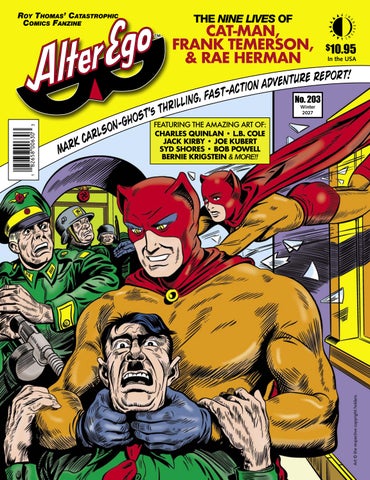
On Our Cover: While Irwin Hasen drew the Temerson-launched Cat-Man first, and artist L.B. Cole is perhaps the artist most identified with that costumed hero in the minds of many aficionados of comic art, it was Charles R. Quinlan who illustrated (and apparently often wrote, as well) most of the adventures of that red-caped feline fury. Thus, we decided a Quinlan cover was the most appropriate for this issue of Alter Ego, and author Mark Carlson-Ghost suggested this one, in which Cat-Man follows up on Captain America’s famous slugging of Adolf Hitler 2½ years earlier. This art appeared on the cover of Et-Es-Go’s Cat-Man Comics Vol. 27, #7, a.k.a. #20 (Oct. 1943), and was restored and recolored by Chris Fama. [TM & © the respective trademark & copyright holders.] Above: Speaking of L.B. Cole—and how could we not, in this issue?—there was just something about his inkline that made the illustrations all but leap off the page, without the benefit of Day-Glo or the like. Here is one of his most effective covers for Continental’s Suspense Comics—#8 (June 1945). You’ll run into plenty more in this issue! Courtesy of the Grand Comics Database. [TM & © the respective trademark & copyright holders.] Alter EgoTM issue 203, Winter 2027 (ISSN 1932-6890) is published quarterly by TwoMorrows Publishing, 10407 Bedfordtown Drive, Raleigh, NC 27614, USA. Phone: (919) 449-0344. Periodicals postage paid at Raleigh, NC. POSTMASTER: Send address changes to Alter Ego, c/o TwoMorrows, 10407 Bedfordtown Drive, Raleigh, NC 27614. Roy Thomas, Editor. John Morrow, Publisher. Alter Ego Editorial Offices: 32 Bluebird Trail, St. Matthews, SC 29135, USA. Fax: (803) 826-6501; e-mail: roydann@ntinet.com. Send subscription funds to TwoMorrows, NOT to the editorial offices. Four-issue subscriptions: $56 Economy US, $71 Premium US, $99 in the EU/UK, $85 other non-US countries, $19 Digital Only. All characters are © their respective companies. All material ©their creators unless otherwise noted. All editorial matter © Roy Thomas. Alter Ego is a TM of Roy & Dann Thomas. FCA is a TM of P.C. Hamerlinck. Printed in China. FIRST PRINTING.
The Nine Lives Of CAT-MAN, FRANK TEMERSON, & RAE HERMAN
3
by Mark Carlson-Ghost
E
Frank Z. Temerson
Rae Herman
veryone knows the lore that cats have nine lives. Even so, in 1940, it was a stroke of genius to create a super-hero who was blessed with same. Truth to tell, Cat-Man has had a remarkably varied presence in comicbooks in all his iterations. Nine, in fact, depending on how you count them. So, too, the earliest publishers associated with the character: Frank Temerson and Rae Herman. For all of his reportedly shady dealings in the industry, Frank Temerson has largely remained in the background of other people’s stories. Just try counting the number of different publishing ventures he was involved in. And he had nearly as many careers! Did he really have ties to the underworld, or was he just a small-time opportunist?
necessarily interwoven with those of Cat-Man, the hero they both shepherded into print. One caveat: Along the way, several unanswerable questions will arise, accompanied by measured speculation. If only Temerson and Herman had lived long enough to answer those questions for us!
Frank Temerson’s Origin Story
Temerson, Herman, & Cat-Man 1944 head shots of publishers Frank Z. Temerson & Rae Herman bookend Charles Quinlan’s cover for Cat-Man. Vol. 1, #8, a.k.a. #3 (July 1941). Thanks to David Saunders & Jim Kealy for the photos, and to the Grand Comics Database for the cover image. [Cat-Man TM & © the respective trademark & copyright holders.]
As for Ms. Herman, arguably the first woman publisher of comicbooks, her story takes many shapes. A young woman making her way in the world with determination as Temerson’s right hand. The fictional hero’s girlfriend who bears her name. The boss who runs a thriving enterprise. The male romance counselor she pretends to be. The puzzle is that Ruth Rae Herman (it seems like she spelled her name nine different ways) was all of that and more. This is the first attempt at a full-throated account of Frank Temerson and Rae Herman’s publishing careers. Their stories are
Frank Z. Temerson’s publishing ventures in the comicbook industry can seem scattershot. But an exploration of his publishing efforts in other media reveals him to be an ongoing—albeit small— player in the broader world of screen magazines, comicbooks, and titillating publications, as were Alex Hillman, Harry Donenfeld, and the Fawcett brothers.
According to David Saunders’ excellent Pulp Artists website, Temerson was born in Poland in 1890 to a Jewish family, the youngest of three children at that point. They came to the United States the following year. Four more siblings followed, including three younger sisters, Esther, Goldie, and Ethel. The family appears to have valued education. Frank’s older brother became a doctor and Frank an attorney. Key to understanding Temerson as a publisher was his long-standing friendship and business ties to Isaac Wise Ullman
4
Ultem, Et-Es-Go, Helnit, Continental, Orbit, & MORE!!
and the influential Ullman family. The connection may have begun with the dry goods business in Birmingham, Alabama, which Isaac and Frank’s fathers established. Isaac’s father, Samuel Ullman, was known locally for founding the city’s first synagogue and serving as a lay rabbi until the small Jewish community could afford a real one. As it happened, Isaac Ullman had connections with the Isaac Wise Ullman fledgling film industry. In 1907, in Frank Temerson’s longtime association with various colleagues, business associate. Thanks to Jim he supplied moving pictures to Kealy for locating the photo. nickeloldeons and burlesque houses, began a film import business in 1909, dabbled in manufacturing films, and in 1910 got in legal trouble for related copyright infringement. In the meantime, Temerson was pursuing his law degree. As an adult, he was on the short side, only five foot, five inches tall, stout, and prematurely balding. In August 1914, he passed Alabama’s state bar association and obtained his license to practice law (“Fifteen Permitted to Hang Out Shingle,” Birmingham Post-Herald, 8-15-1914, p. 11). Before long. he’d become the assistant city attorney of Birmingham. But Temerson’s career was interrupted by his overseas service in World War I. Upon the soldier’s return to the States, the direction of his life took a decided turn. The war may have changed him. From that point on, there is a decidedly restless quality to Temerson’s pursuits.
looked promising until November, when a local paper reported that financial and construction interests in the city nixed the deal, claiming that the plans of Temerson’s group “represented an obstruction to progress in other similar projects here” (Charlotte News, 11-6-1930, p. 5). Whatever the specifics behind the veiled details, the collapse of the deal—which the paper claimed would have been one of the largest for the state in recent history—was a significant setback for Temerson. By 1932 he was back in Birmingham licking his wounds and reconnecting with Isaac Ullman, but not for long. Once again moved by idealistic notions, the two men launched Psychology, a self-improvement magazine, under the imprint of Inspirational Publications. The first issue featured an article lauding the strength of will demonstrated by Franklin D. Roosevelt. Meanwhile, Ullman’s involvement in the film industry persisted. By 1930 Hubbard-Ullman Publishing Corp. began a new magazine, Broadway & Hollywood Movies. Frank Temerson joined that enterprise the same year. A corporate name change to Brookwood reflected Ullman and Temerson’s roots in the Birmingham neighborhood of the same name. In 1934, I.W. Ullman is listed as president of the enterprise, with Walter W. Hubbard as vice-president, and their NYC address as 1450 Broadway. But by August, Hubbard had been replaced by Temerson as VP and Ullman’s maternal nephew Maurice Rosenfield was now advertising manager. That same year, Movie Humor magazine was launched by an entity called Ultem Publications, its corporate moniker comprised of the first syllables of the two men’s last names. Its format was
The first joint publishing venture of Ullman and Temerson appears to be a 1920 collection of Samuel Ullman’s writings, including his observation that youth was not defined by age, but rather “a matter of the will, a quality of the imagination, a vigor of the emotions.” But Temerson also traveled the country, purchasing dry goods for the family store. A move to New York City cemented a variety of business connections, some potentially unsavory. By May of 1930, Temerson led an influential consortium of New York business interests in seeking a building permit for a 200-room hotel in Charlotte, North Carolina, a structure that would also house a 2500-seat theatre. Things
Hooray For Hollywood! The covers of two of the earliest magazines from Isaac Ullman: Broadway and Hollywood Movies for May 1931—and Movie Humor for Aug. 1934. Frank Temerson joined the company that published the former only after an issue or three of B&HM had seen print, but was along for the ride from the start on Movie Humor. The latter’s front cover was painted by George Quaintance, as “Geo. Quintana.” Courtesy of David Saunders & his invaluable pulpartists.com website. [© the respective copyright holders.]
The Nine Lives Of Cat-Man, Frank Temerson, & Rae Herman
7
cover date of October 1939. Its lead feature was the super-hero “’Shock’ Gibson.” Ownership of Speed was identified as falling on the Ullman family side of the ledger, with Maurice Ullman Rosenfield—Isaac Ullman’s maternal nephew—listed as publisher, co-owner, and editor. That said, such ownership statements were often just vague indicators of familial ownership, with the actual financial interest represented by an unnamed senior family member.
Bob Powell as a student at Pratt Institute in 1936, three years before he drew the accompanying cover. Courtesy of John Powell, via Michael T. Gilbert.
and some comics under various new corporation names. Brookwood Publishing is one of these.” The article concludes that the “new corporations continue at 381 Fourth Avenue” (p. 37). The first new comic published by Brookwood was Speed Comics, with a
Two More For The Storm Ullman and Temerson’s next two four-color ventures— officially issued this time by Tem Publishing, Inc.—were Crash Comics Adventures #1 (May 1940) and Whirlwind Comics #1 (June 1940), showcasing heroes Strong Man and Cyclone. The cover artist of the former is unidentified; the other is credited to Bert Whitman. Courtesy of the GCD. [TM & © the respective trademark & copyright holders.]
The initial effort, Speed Comics, also featured the strongest line-up of characters. The lead hero was “Shock” Gibson, a.k.a. “the Human Dynamo.” To quote the story narrative, “Charles Gibson, a young man with a hobby of experimenting with chemical and electric forces, was at work in his laboratory one night when the place was struck by a terrific bolt of lightning. The chemicals spilled over him and at the same time he received the full force of the lightning through his body.” Sound familiar? After the accident, Gibson “became suddenly all powerful, endowed with an almost unbelievable strength and energy.” Gibson could also project electric current to shock his opponents, blast through obstacles, or propel himself through the air. In these early appearances, “Shock” wore red tights with yellow gloves, boots, belt, and centurion-style helmet. He repowered up by strapping himself into his own personal electric chair!
Put On Some Speed! The cover of Ultem’s Speed Comics #1 (Oct. 1939), which introduced the super-hero Shock Gibson a little more than a year after Superman had hurled his first flivver on the cover of Action Comics #1 and the comics-publishing world caught “super-hero fever.” Art by Bob Powell, who drew a couple of stories inside—but not the lead hero. Courtesy of the GCD. [TM & © the respective trademark & copyright holders.]
The next two titles to be issued by the two men (and advertised together in house ads with Speed) were Crash Comics Adventures, published by Tem Publishing, Inc. with a May 1940 cover date, and Whirlwind Comics by Nita, with a cover date of June. Nita was short for Anita, one of Temerson’s nieces.
Bert Whitman Photo courtesy of Davis Saunders & pulpartists.com
German villains were the order of the day. Baron Von Kampf was “a mad genius who plans to dominate the world,” animating zombies who talked backwards his specialty. Von Kampf appeared five times, in Speed Comics
The Nine Lives Of Cat-Man, Frank Temerson, & Rae Herman
11
’41). The title was still owned by Temerson but was now ostensibly published by a new entity, Helnit Publications, named after two of his nieces, Helen and Anita. As further evidence of the direct continuity between Tem and Helnit, the initial contract signed by Temerson to publish a comicbook featuring “The Green Hornet” listed Tem as the publisher but was revised to specify Helnit. And it’s this radio connection that may have brought Temerson and Rae Herman together.
Ruth Rae Herman’s Background Details concerning Ruth Rae Herman’s early life continue to be scant. The accounts of David Saunders and another Internet historian named Alex Jay both supply key details regarding her. Jay corrects some seeming errors, but Saunders’ research remains foundational. Herman’s parents were Jewish immigrants, born in Poland. Her father worked as a tailor in Brooklyn. Ruth Rae, which is her given name, had four older siblings who worked in offices in clerical or bookkeeping positions. Rae and her twin brother George were the youngest, born on May 25th, 1920. And that’s all that can reliably be reported regarding her and her family until the 1940 census, when her job is listed as a clerk for an unnamed New York radio producer. It is also worth noting that she gave her name in the 1940 census as Rae R. Herman. Nor would that be the only such change. When she first applied for Social Security benefits, she did so as Ray Herman, Ray being the spelling she preferred.
Cat In A Hot 10¢ Comic Charles M. Quinlan’s cover for Cat-Man Comics V1#6 (a.k.a. #1), cover-dated May 1941. The beginning of a new era, discarding the previous “jungle look.” Courtesy of the GCD. [TM & © the respective trademark & copyright holders.]
in each of his first two adventures, but is resurrected by a mystical appearance of his fierce protectress. Crash Comics was canceled with its fifth issue. Cat-Man wouldn’t return in print for six months. He resumed his third life in the retitled Cat-Man Comics #6 (May
Hail, Hail, The Gang’s All Here! No sense delaying it any longer! Here’s a group photo of a number of the key players in this issue’s tale, including publishers Frank Z. Temerson (third man standing, from left) and Ruth Rae (Ray) Herman (seated at right)… as well as several artists mentioned in the course of this piece, including (at far right) Charles R. Quinlan, the re-defining artist of “Cat-Man.” David Saunders of pulpartists.com feels the pic was most likely taken in 1944 in the offices of Continental Magazines; some years back, he and the late Hames Ware worked to establish the identities of those pictured. Thanks to David Saunders & Jim Kealy.
Within the next year, Saunders has Herman beginning work for Temerson as his clerical assistant. The young woman was clearly intelligent and motivated. She was also quite attractive, more than one of the male artists taking notice. More importantly, comicbook historian Greg Sadowski observes that she was “by all accounts a warm and generous woman (p. 221). Temerson and Herman appear to have quickly forged a productive working relationship. Despite their age difference, the two had a good deal in common. Both were raised in Jewish immigrant families from Poland; both were hard-working and ambitious. Some have suggested Herman may have been Temerson’s girlfriend, despite the wide gulf in ages. This seems unlikely, for
The Nine Lives Of Cat-Man, Frank Temerson, & Rae Herman
19
and boys as his copilots. He does have well-drawn stories, though, most often by Charles Quinlan and likely written by him as well. He will also have some interesting villains, including the beautiful Blue Falcon (issues 2 and 10); the Black Baron—cruel Nazi pilot (issues 8 and 9); Death Mask, a Japanese pilot who wears a… well, you guess; and the Japanese Sandman, who flies a plane that can emit sleeping gas. Certainly more colorful, in costume at least, was The Flagman—decked out in the requisite red, white, and blue. And he has a Bucky-like junior partner named Rusty. Like most Temerson heroes, he has no exceptional powers, just athletic ability and fast fists. Like other Ulmer and Willner creations, he lacked an origin story but did have an arch-enemy, the raven-haired Nazi beauty, Baroness Hartlesse (issues 5 and 6). Meanwhile, The Deacon’s pal Mickey and Rusty as the Pals of Freedom (along with two other boys, Spec and Peanuts) fight the Crimson Hood—whose hood sports a white swastika—on two occasion (issues 2 and 3). It is worth noting that early issues of Cat-Man and Captain Aero continued to sport text features by “Ull Man,” almost certainly an unspecified Ullman relation, just as Green Hornet Comics had. Meanwhile, Cat-Man Comics continued to refine its look and lineup. With its fifth issue, dated December 1941, a new costumed hero was introduced—The Hood. Another Allen Ulmer/Ray
A Flag On The Play Variously spelled “Flag-Man” and “Flagman,” this ersatz Captain America (and his pseudo-Bucky, Rusty) debuted in Captain Aero #1, courtesy of the team of Allen Ulmer (writer) and Ray Willner (artist). Scan courtesy of Comic Book Plus. [TM & © the respective trademark & copyright holders.]
strength and being at least partially impervious to harm, she was also able to summon her plane via a device in her “multi-purpose belt." Whoever wrote these stories seemed to have ancestry on the brain. While standing at the tomb of the Unknown Soldier, Citizen Smith—who is oblivious to his origins—is greeted by the ghost of the former, who informs Smith that he’s his father. He, too, was willing to help Smith out whenever he might need it. Closing out the line-up was Mr. Miracle. After attempting suicide by jumping off a bridge, the unnamed fellow is rescued by a scientist and subsequently used as a guinea pig. Exposure to a powerful mind ray grants him the power to create matter out of nothing just by willing it. Even so, all he manages to muster for a costume is a gray hood and cape that he wears over his suit. The Captain Fearless title only lasted two issues. Temerson’s next attempt, Captain Aero Comics, showed somewhat more promise. Ironically, though, Aero was the least interesting hero featured in the new title. Also known as Agent X-3, Aero’s original identity was never given by co-creators Ulmer and Willner. Nor does he have any unique motivations, other than his sense of patriotism and desire to do right. Captain Aero doesn’t even have a steady sidekick, just a revolving door of young men
The Boy In “The Hood” Would you believe that writer Ulmer and artist Willner introduced yet another super-hero strip in Cat-Man #5 (Dec. 1941)—namely, “The Hood”! Courtesy of Comic Book Plus. [TM & © trademark & copyright holders.]
20
Ultem, Et-Es-Go, Helnit, Continental, Orbit, & MORE!!
Willner co-creation, The Hood at least had a secret identity, Major Craig Williams, and the power of flight. That ability was forgotten after two adventures and he became just another of the title’s generic, if colorfully attired heroes. And he was visually interesting, with a loose blue hood that covered his entire face. The rest of his uniform consisted of form-fitting yellow tights with blue boots and cape and red trunks and gloves. As for Cat-Man himself, the hero soldiered on. But once the “nine lives” aspect was dropped, there was less to make the character stand out from the crowd. The feature needed something new to set it off from other super-heroes, who were a dime a half dozen in most comicbooks of the period. And Temerson and Quinlin found it. They introduced a kid sidekick, which of course was nothing new. But this kid sidekick was a girl!
Cat-Man Takes On A Kitten David Merrywether encountered young Katie Conn in Cat-Man Comics #10, the fifth issue in the new format, cover-dated December 1940. The girl’s parents were circus acrobats who were killed in
a train crash. The heroic lieutenant rescues her from the abuse of a crooked uncle who forced Katie to assist him in his criminal activities. Her own acrobatic skills help Cat-Man in busting up a spy ring. By the end of that first adventure, she shows up in a matching costume of her own making. “I’m not Katie anymore,” she proudly declares. “I’m the Kitten! Chief assistant to the Cat-Man. Meow-w-w!” She takes to calling the hero “Uncle David” from the start. It seems possible that Temerson suggested the innovation. Helnit was named after his nieces, after all, and here was a young heroine who called Cat-Man "uncle." A heroic uncle with a heroic niece would have appealed to Temerson, whoever originated the idea. Surely Helen and Anita got a kick out of it. In the very next issue, Merrywether has already adopted Katie, revealed his secret identity to her, and—most remarkably of all— handed her a loaded revolver! “Here, strap this on. You might need it. I never carry one!” “Wow!” Katie exclaims, excited. (She never actually used it, so far as the author knows.) The relationship between the Kitten and her Uncle David was unique in comicbooks. By 1941, the industry awash with superheroes of every stripe and flavor, that was saying a lot! What wasn’t new was Frank Temerson’s money troubles. The second issue featuring Kitten wasn’t even published by the
Just Kitten Around! Katherine Conn (soon to be known as “The Kitten”) wasn’t shown on Quinlan’s cover for Helnit’s Cat-Man Comics, Vol. 1 #10, a.k.a. #5 (Dec. 1941)—but she made her dramatic debut inside as the rebellious pawn of an evil uncle—and, wouldn’t you know, she turned out to be a trained acrobat, to boot (shades of Robin the Boy Wonder, not to mention Toro!). By story’s end, she had become Cat-Man’s partner. Art by Quinlan. Courtesy of the GCD. [TM & © the respective trademark & copyright holders.]
The Nine Lives Of Cat-Man, Frank Temerson, & Rae Herman
21
interests. “It was the purpose of these agreements that all the rights, privileges, and benefits attaching to the publishing enterprises were to be returned to the original proprietors or their legal successors and assigns and that the Holyoke Publishing Company’s proprietorship of the enterprises in 1942 was temporary only, and for the sole purpose of enabling it to obtain sufficient profits from the publications to pay off debts previously incurred by the Temerson and Fox interests…” (Federal Register, 4-4-1945, p. 3608).
The Holyoke Interim Holyoke’s only role in the legal ruling was to provide the printing for and pick up profits from the three comicbooks as Temerson and Fox slowly worked off his debt. The editorial powers remained the same as before at Cat-Man and Captain Aero Comics, with Charles Quinlan continuing as editor and Temerson serving in an oversight role. Quinlan was listed as Blue Beetle’s editor as well, even though only Cat-Man and Captain Aero maintained continuity of editorial address. Artist Joe Kubert, in an interview with Gary Groth in The
The Kitten & Holyoke Take Charge By Cat-Man VI#11 (Jan. 1942), The Kitten was leaping into action alongside her mentor (and adopted father)—but officially under a new interim publisher, Holyoke. Cover by Quinlan. Courtesy of the GCD. [TM & © the respective trademark & copyright holders.]
cash-strapped attorney. This time the courts got involved.
In Fiscal Hot Water Yet Again Despite Cat-Man Comics proving to be a commercial success, past fiscal mismanagement on Temerson’s part continued to plague him. It may have been efforts to pay off the legal settlement with Vamos Color Printing that led him to fall into debt with Holyoke Magazine Press, which was printing his comicbooks. Like Vamos, Holyoke took legal action. A retrospective summary of the financial arrangement that followed from that action appeared in the Federal Register of doings by the War Production Board. It details how Holyoke Press simultaneously handled a similar issue with another publisher with a troubled record: Victor Fox. The summary is printed below: “During 1942, and prior thereto, [Frank Z.] Temerson and [Victor A.] Fox, or corporations which they control, were indebted to Holyoke Magazine Press, an unincorporated association owned and controlled by the same interests which own and control the Holyoke Publishing Company, Inc. Cat-Man, Captain Aero and Blue Beetle magazines were published during 1942 over the imprint of Holyoke Publishing Company, Inc., pursuant to several agreements between Holyoke Publishing Company and the Temerson and Fox
“Little Leaders” Splash page of the first “Little Leaders” story, starring The Deacon’s boy pal Mickey and Cat-Man’s Kitten, from Holyoke’s Cat-Man Comics #8 (March 1942). Art by Quinlan; scripter unknown. Simon & Kirby, of course, had led the way in this area with their Young Allies at Timely. Courtesy of Comic Book Plus. [TM & © the respective trademark & copyright holders.]
The Nine Lives Of Cat-Man, Frank Temerson, & Rae Herman
he displays an unhealthy relationship with his adopted daughter, Lenore, who has been hypnotized into being his loyal underling. Macabre threatens to influence a kidnapped Kitten in the same way. At one point, exposed to deadly Z-rays, he even briefly develops a touch of death. Doctor Macabre bedeviled Cat-Man in every issue from #28 through #32, proving to be one of the memorable villains of the Golden Age. A final, definitive confrontation between the two adversaries was promised for issue #33, which sadly was never published.
33
The “New Look” Cat-Man The first two “Cat-Man” stories illustrated by the great Bob Fujitani (for #27 & 28) saw an adjusted backstory—and the introduction of Dr. Macabre, who would serve as antagonist for five issues in a row. Scripter uncertain. Courtesy of Comic Book Plus. [TM & © the respective trademark & copyright holders.]
Bob Fujitani Later in life.
strip called Hepcats. The July 1945 issue of The Editor & Publisher Syndicate Directory announced the prospective availability of the new strip to be distributed by A.F.S. Little apparently came of Hepcats, as nothing more is known about the strip or even the full name of the syndicate.
Herman Strikes Out On Her Own
For Herman, however, another opportunity had fallen in her lap. In March of that year, Rural Home’s Lindsay Baird was arrested for the unauthorized use of paper during wartime. The resulting collapse of Rural Home left a considerable amount of prepared content with no viable publisher. PDC president Manheimer appears to have tasked 24-year-old Herman to see that the second issues of Patches, Taffy, Eagle, and Mask all saw print so that he could distribute them during this highly profitable period. Herman, it must be emphasized, was the one who saw to this, not Cole.
Rae Herman may also have read the writing on the wall, but saw an opportunity in it. She was far from inactive during the earlier hiatus in publishing in late 1944/early 1945, gearing up to operate independently. A blurb in the January 10, 1945, edition of The New York Times noted that "Ray Ruth Herman" had leased space for an “art and publishing business” at 1819 Broadway. This address had long been used by Isaac Ullman and will be the one associated with Herman’s subsequent enterprises.
And Herman successfully saw to it that these comics, and the first two issues of a new title named Toytown, all saw print later that year. Patches #2 was literally published by “Ray” Herman herself. The publication of Taffy #2 was attributed to Samuel Herman, her brother. Toytown’s second issue was credited to B. Antin, her sisterin-law. The second issue of Mask Comics, which reintroduced “The Black Raider” to readers, was printed with its indicia blacked out— no publisher listed at all!
Another six-month delay occurred between Cat-Man Comics #30 and #31. With the end of the war, profits in the industry were collapsing rapidly. One foot already out the door, Frank Temerson was looking for a way out.
During this respite Herman may also have worked on a comic
One last new title, Power Comics, also appears to have been
The Nine Lives Of Cat-Man, Frank Temerson, & Rae Herman
41
The description of one man wanted for murder included the following identifying info: “Build: medium. Peculiarities: soft voice, flat feet, slightly bow-legged. Noticeable tendency to raise chin as if to loosen collar when he’s nervous.” While Wanted might remind its readers that “the wanted are always caught,” these stories raised the possibility that outcome might not always be the case. The caution that readers shouldn’t approach these armed and dangerous men if spotted lent the comic a chilling reality. While Herman’s entry into the world of crime comics marked the end of her focus on progressive teen humor, the publication of Wanted now squarely placed her in a new set of crosshairs.
Herman & The First Comics Code Rae Herman was one of several publishers who recognized early on the need to take positive action in response to the growing number of comicbook critics and their concern over the violence in crime comics in particular. The first issue of Wanted was coverdated Sept.-Oct. 1947. The first public notice of the “newly formed” Association of Comics Magazine Publishers appeared in April 1948. The Association’s primary purpose was to quell concerns over
Wanted: A Comics Code! Mort Leav, as per usual, supplied the cover of Wanted Comics #20 (May 1949), the premier issue to carry the star-shaped symbol of the first Comics Code. He also provided the art for the lead story (below, right; scripted by William Woolfolk). Courtesy of Comic Book Plus. [TM & © the respective trademark & copyright holders.]
Herman’s Power Comics, the narrator deemed fun enough to keep as a regular fixture in the new comic. Wiser heads—likely Rae Herman’s—decided that having Satan explicitly identified as the narrator in subsequent issues was a bridge too far. Nonetheless, the artwork early on suggested otherwise. Several early stories have him spouting off naked in the midst of hellfire!
William Woolfolk at a Christmas party in 1952. Courtesy of Shaun Clancy & the late Roy Ald.
The stories themselves were well-crafted, the writers unafraid to tackle controversial themes and content. Wanted included more than the usual amount of stories featuring illegal drug use. Another interesting (and original) aspect of Wanted was added with issue #12 (March 1948). Instead of showing captured criminals, every cover now featured realistic drawings of the faces of actual crooks currently on the run with their names and a bold promise: “$100.00 reward will be paid by Wanted Comics for information leading to the capture of these criminals!” Inside, brief stories rendered their criminal activities.
55
(Above:) Russ Cochran as depicted by his friend, Frank Frazetta. [© Frazetta Estate.]
56
Mr. Monster's Comic Crypt!
The Comic Zone (Part 4)
M
by Michael T. Gilbert y late Grandma Nurock got me hooked on comics at age seven, when she gave me a copy of Superman’s Pal Jimmy Olsen. We know what that started!
Volunteer work at a Bronx hospital gave Gram access to comics in the children’s ward. She’d always have some waiting for me when the family would visit. I never knew if she’d bring kiddie comics like Casper the Friendly Ghost, Sad Sack, Walt Disney’s Comics & Stories, Hot Stuff, or more meaty fare such as Detective Comics, Mystery in Space, Kid Colt Outlaw, Superman, and Strange Tales. My one complaint was that the comics were screened for content, so as not to disturb the kiddies. Which meant that pre-Code comics didn’t make the cut. The one exception to this was the occasional older Classics Illustrated. But they were safe, mother-approved “educational” comics. Yawn! As a result, I never got to experience the forbidden joys of EC comics as a kid. No Weird Science. No Mad comicbooks or Vault of Horror. Oh, the humanity!!
An Exceptional Comic! There was one exception, however. That was the time Gram gave me a tattered coverless comic featuring a parody of the Alley Oop comic strip. It had no indicia, so I had no idea what comic this was. But it sure seemed old. A tagline inside the splash panel read: “Humor in a varicose vein.” I didn’t place it at the time, but it sounded strangely familiar. A couple of years later if finally dawned on me. Mom would drop me off at the book section of Klein’s Department Store, while she shopped. I’d wait, reading Kurtzman’s racy Jungle Book, the Bernstein Bears collections, and Mad paperbacks. Those first paperbacks reprinted early-’50s Kurtzman comics, featuring super-hero parodies of Superman, Batman, and the Blackhawks. I’m sure I’m not the only kid who thought that Wally Wood’s Mad versions were better than the real thing. One day I noticed a familiar tagline on one of the paperbacks: “Humor in a jugular vein!” I was only ten at the time, but my comic history genes were already hopping. Clearly my coverless comic with its “Humor in a varicose vein” tagline had some connection to Mad. But what? I’d later discover that my comic was Panic #8 (April 1955), EC’s own knockoff of Kurtzman’s Mad (and Harvey was mad about that!). My issue was also the very last pre-Code issue of Panic. And my very first EC!
EC For Me, See? Around 1958, Dad got me my first Mad magazine when I was sick. I loved it, but my EC addiction kicked into high gear in 1965. I’d completed a large trade with a comicbook pal and wound up with a glorious stack of unread DC, Marvel, Charlton, and ACG comics. To seal the trade, he also tossed in a couple of paperbacks. I didn’t pay much attention to them at first, so they stayed on the bottom of that magnificent to-be-read pile. The books were two Ballantine paperbacks: Tales from the Crypt (Dec. 1964) and Tales of the Incredible (March 1965), reprinting EC
Oops-y Davis! (Above:) “Irving Oops” by writer Jack Mendelsohn & artist Bill Elder, from Panic #8 (April 1955). (Right:) Jack Davis’ cover to The Mad Reader. First edition was dated November 1954. [TM & © William M. Gaines Agent, Inc.]
stories from the distant past. Of course, back then the “distant past” meant a decade earlier. Time is very different when you’re fourteen. That fueled my lifelong love affair with Entertaining Comics. Both paperbacks sported gorgeous paintings by former EC alumnus Frank Frazetta. Inside was reprinted work by the greatest cartoonists in the field. The Tales from the Crypt volume boasted “Ghastly” Graham Ingels, comic’s premier terror master. Historical horror? Reed Crandall’s delicate line-work was perfect. Al Feldstein and Jack Davis excelled at in-your-face fear, while those preferring a more understated approach had Johnny Craig and George Evans. And then there was Tales of the Incredible.
Simply Incredible! Tales of the Incredible certainly lived up to its name. The art and stories were incredible! Al Williamson’s delicate, ethereal art was magical. And then there was Wally Wood. I’d loved his work in Mad magazine and Marvel’s new Daredevil comic, but Wood’s amazingly detailed ‘50s-era art stunned me. And, oh, those sexy girls! Wood cited one of the book’s reprints, “Spawn of Mars,” as his favorite EC story. I can see why. The stories (mostly plotted by publisher Bill Gaines and
New for 2027
CRYPTOLOGY #17
CRYPTOLOGY #13
CRYPTOLOGY #14
CRYPTOLOGY #15
CRYPTOLOGY #16
100-PAGE HORRORFEST, lauding BORIS KARLOFF and the FRANKENSTEIN monster! Karloff’s later films, his well-remembered Thriller seriesm part two of our celebration of 1944’s House of Frankenstein, origins of ol’ Frankie, and most gruesome appearances in the cinema and beyond. Plus an interview with Marvel Comics’ artist VAL MAYERIK, a selection of infamous model kits, BERNIE WRIGHTSON’s Frankenstein, and more!
EDDIE CAMPBELL discusses From Hell, GLENN FABRY on Hellblazer (in a crossover with Back Issue #174 this month), LUCIO FULCI’s The Gates of Hell film trilogy, STEVE BISSETTE’s Taboo anthology, Marvel’s Son of Satan, The Exorcist and The Entity, ROGER CORMAN’s The Little Shop of Horrors and Bucket of Blood, the Blood Island ’60s Filipino fright films, and more of Hammer’s horrors!
Rockers ALICE COOPER, OZZY OSBOURNE, TONY IOMMI, and GENE SIMMONS share their love of horror (plus COOPER and KISS comics), JOHN CARPENTER’s Prince of Darkness, cult shocker Deathline, more pre-Code horror comics and “Horror Comics Excess”, the horror in Star Wars, horror artist EDWARD GOREY, creepy B-movies, and eerie creations from Hammer Films!
WEREWOLF ISSUE! LON CHANEY JR.’s 1940s Inner Sanctum mysteries, JOHN LANDIS’ UCLA Film and Television archive, Landis’ American Werewolf in London, WARREN ZEVON’s hit song “Werewolves of London,” Fiction House’s Werewolf Hunter and other comics werewolves (including Marvel’s Werewolf by Night), Hammer’s Curse of the Werewolf, and more. Awooooh!
(100-page FULL-COLOR magazine) $12.95 (Digital Edition) $5.99 • Now shipping!
(84-page FULL-COLOR magazine) $10.95 (Digital Edition) $4.99 • Ships March 2027
(84-page FULL-COLOR magazine) $10.95 (Digital Edition) $4.99 • Ships May 2027
(84-page FULL-COLOR magazine) $10.95 (Digital Edition) $4.99 • Ships July 2027
RETROFAN #48
RETROFAN #49
RETROFAN #50
RETROFAN #51
BASIL WOLVERTON’s most hideous creations in comics, Barcelona-born artist SUSPIRIA interviewed, pre-Code horror comics, forgotten horror Motel Hell, DARIO ARGENTO’s 1977 film Suspiria, Amicus’ run of horrors, films Day of the Triffids and From Hell It Came, and creepy jigsaw puzzles! All this and more from the Cryptologist, and editor PETER NORMANTON.
TV Bat-Villains actor interviews, Scooby Doo’s canine career, the films of MICHAEL J. FOX, Florida’s strangest attractions, the Oddball World of HUNTER S. THOMPSON, RICK GOLDSCHMIDT with another TV Christmas Special memory, and more topnotch retro-writing by HERBIE J PILATO, ANDY MANGELS, MARK VOGER, WILL MURRAY, DON VAUGHN, and more! Edited by ED CATTO!
ROBERT WAGNER in his ’60s classic It Takes a Thief, That Girl MARLO THOMAS, Scooby-Doo Part Two, pink cereal milk-maker the Pink Panther, Sea Monkeys, and relive reading Kids, Dynamite and Smash magazines of yesteryear! Featuring ANDY MANGELS, HERBIE J PILATO, KEITH MANZELLA, WILL MURRAY, AARON SULTAN, JON B. COOKE, JACK URSO, and more.
100-PAGE blockbuster issue, featuring our 50 favorite moments in Pop Culture History! MARILYN MONROE, MARLON BRANDO, ELVIS, 60 years of STAR TREK, the FLINTSTONES, LAND OF THE LOST, DARK SHADOWS, and more, by HERBIE J PILATO, KITTY KESTERMAN, ANDY MANGELS, MARK VOGER, JIM BEARD, AARON SULTAN, DAVE MADDOX, and editor ED CATTO.
WILL MURRAY on ROBERT CONRAD’s Black Sheep Squadron, Part Two of our Hanna-Barbera deep-dive by SCOTT SHAW! (spotlighting Hong Kong Phooey), LUCILLE BALL in Here’s Lucy, Ticonderoga’s Star Trek Original Series Tour, the Tipsy Talk Show, Flintstones’ Pebbles cereal, and more with HERBIE J PILATO, ANDY MANGELS, KEITH MANZELLA, AARON SULTAN, and editor ED CATTO.
(84-page FULL-COLOR magazine) $10.95 (Digital Edition) $4.99 • Ships Sept. 2027
(84-page FULL-COLOR magazine) $10.95 (Digital Edition) $4.99 • Now shipping!
(84-page FULL-COLOR magazine) $10.95 (Digital Edition) $4.99 • Ships Feb. 2027
(100-page FULL-COLOR magazine) $12.95 (Digital Edition) $5.99 • Ships April 2027
(84-page FULL-COLOR magazine) $10.95 (Digital Edition) $4.99 • Ships June 2027
RETROFAN #52
RETROFAN #53
KIRBY COLLECTOR #99
KIRBY COLLECTOR #100 KIRBY COLLECTOR #101
MARK VOGER on DONNA DOUGLAS’s career from The Twilight Zone to the Beverly Hillbillies, spotlight on Dark Shadows Fandom, ANDY MANGELS celebrates Josie and the Pussycats, the history of Columbia House music offers, Dr. Seuss, Super Sugar Crisp cereal, and a spotlight on Adam-12! Retro-goodness from JIM BEARD, KELLIE GORMLY, SCOTT SHAW!, AARON SULTAN, and editor ED CATTO.
BOB GREENBERGER rounds up Wild Women of the West, from BARBARA STANWYCK to RAQUEL WELCH! MARK VOGER looks at “SPANKY” McFARLAND’s career, SCOTT SHAW! covers JAMES GARNER as Maverick, TROY RILEY talks to My Three Sons’ TINA COLE, ROBERT JESCHONEK thumbs thru vintage Christmas Catalogs, and more from HERBIE J PILATO, ANDY MANGELS, and ED CATTO.
WARTIME issue, featuring Super-Soldiers, Sheriffs, and Sergeants! How Jack borrowed from HUGO PRATT for “The Losers,” Kirby’s overlooked Western work (with scripts for SIMON & KIRBY’S Prize Western comics), Captain America’s Golden Age stories compared to their Silver Age retellings, JOE SIMON interview, a never-reprinted Simon & Kirby story, plus MARK EVANIER, a gritty pencil art gallery, and more!
100-page KIRBY ETERNAL anniversary issue with the most comprehensive Kirby info ever compiled! Detailed listing of all Kirby art we’ve published (including his pencil photocopies), repros of every Kirby sketch we’ve discovered, updated list of Kirby interviews, index of every article since #1, plus rare and unseen Kirby art! With a cover inked by MARK BUCKINGHAM, it'll stand the test of time for Kirby exploration!
PEACETIME ISSUE! Why the Forever People always ran from a fight, scripts for SIMON & KIRBY’s romance comics, soothing Kirby collages and animation ideas, and the most loving relationships between his characters. Also, SERGIO ARAGONÉS interviews MARK EVANIER, a never-reprinted Simon & Kirby story, the 2026 Wondercon Kirby panel (a favorite of TJKC editor JOHN MORROW), a pencil art gallery, and more!
(84-page FULL-COLOR magazine) $10.95 (Digital Edition) $4.99 • Ships Aug. 2027
(84-page FULL-COLOR magazine) $10.95 (Digital Edition) $4.99 • Ships Oct. 2027
(84-page FULL-COLOR magazine) $10.95 (Digital Edition) $4.99 • Ships Spring 2027
(100-page FULL-COLOR magazine) $12.95 (Digital Edition) $5.99 • Summer 2027
(84-page FULL-COLOR magazine) $10.95 (Digital Edition) $4.99 • Ships Fall 2027
BACK ISSUE ANNUAL #1
Tribute to NEAL ADAMS, with the best features on Neal from long sold-out issues, including: a tour of Adams’ Continuity Studios! NEAL and DENNY O’NEIL discussing their Green Lantern/Green Arrow work! Adams on the evolution of Ms. Mystic! Plus Superman-centric and Batman-centric interviews with Neal! There’s Adams art galore, including rare and unseen work, all behind an UNUSED 1960s ADAMS COVER! Featuring issues edited by MICHAEL EURY. (100-page FULL-COLOR magazine) $12.95 (Digital Edition) $5.99 • Now shipping!
BACK ISSUE #176
BACK ISSUE #172
BACK ISSUE #173
BACK ISSUE #174
BACK ISSUE #175
BIG BAD ISSUE! Lex Luthor, Dormammu, Royal Flush Gang, Scorpion, Killer Frost, Juggernaut, and a new feature examining misguided attempts at character creation—our first subject is the Ten-Eyed Man! Featuring ROY THOMAS, STEVE ENGLEHART, GERRY CONWAY, PAUL LEVITZ, RON FRENZ, MARV WOLFMAN, JOHN BYRNE, PAT BRODERICK, and others. Cover by FRANK BRUNNER!
TO THE STARS! Marvel’s original Star Wars run, Space Family Robinson, Close Encounters, Starhawk, Desaad, Dalgoda, Twilight, and Halo Jones. With ARCHIE GOODWIN, WALTER SIMONSON, ROY THOMAS, JACK KIRBY, STEVE GERBER, AL MILGROM, ALAN MOORE, IAN GIBSON, HOWARD CHAYKIN, JOSÉ LUIS GARCÍALÓPEZ, and others. RON WILSON/FRANK GIACOIA cover! Edited by ROGER ASH.
UNLIKELY HEROES! John Constantine (in a crossover with Cryptology #14 this month), New Mutants’ Warlock, The Nocturnals, Creature Commandos, Gargoyle, Fashion in Action, and Coyote. With ALAN MOORE, STEVE BISSETTE, RICK VEITCH, J.M. DeMATTEIS, CHRIS CLAREMONT, BILL SIENKIEWICZ, DANIEL BRERETON, DON PERLIN, STEVE ENGLEHART, MARSHALL ROGERS, & more. Cover by GLENN FABRY!
LET’S FLY! Soar with histories of Hawkgirl, The Vulture, Bumblebee, Darkhawk, Dawnstar, Banshee, and The Crow. Featuring TONY ISABELLA, RICHARD HOWELL, GERRY CONWAY, ERIK LARSEN, PAUL LEVITZ, JAMES SHERMAN, BOB ROZAKIS, MARV WOLFMAN, ROY THOMAS, JOHN BYRNE, JAMES O’BARR, DANNY FINGEROTH, MIKE MANLEY, and others. WALTER SIMONSON cover!
(84-page FULL-COLOR magazine) $10.95 (Digital Edition) $4.99 • Now shipping!
(84-page FULL-COLOR magazine) $10.95 (Digital Edition) $4.99 • Ships Feb. 2027
(84-page FULL-COLOR magazine) $10.95 (Digital Edition) $4.99 • Ships March 2027
(84-page FULL-COLOR magazine) $10.95 (Digital Edition) $4.99 • Ships May 2027
BACK ISSUE #177
BACK ISSUE #178
BACK ISSUE #179
COMIC BOOK CREATOR #47
PURPLE ISSUE! No purple prose here—just hero/villain histories of The Purple Man, the Inhumans’ Medusa, Clea, Shrinking Violet, Grape Ape, Baron Zemo, and more! Spotlighting the work of ROY THOMAS, STEVE ENGLEHART, GENE COLAN, PAUL SMITH, GIL KANE, FRANK MILLER, HERB TRIMPE, GEORGE PÉREZ, STAN LEE, JACK KIRBY, and others. Clea cover by MICHAEL GOLDEN.
TAKING CARE OF BUSINESS! Spotlighting post-Crisis Lex Luthor, Maxwell Lord, Morgan Edge, the Cadmus Project, Damage Control, Green Lantern Corps, and other Bronze Age movers & shakers. With work by JOHN BYRNE, MARV WOLFMAN, JERRY ORDWAY, DWAYNE McDUFFIE, ERNIE COLÓN, RON FRENZ, KEITH GIFFEN, J.M. DeMATTEIS, KEVIN MAGUIRE, and others. JACK KIRBY cover!
NEED FOR SPEED! Zoom into the future past of the Reverse-Flash and his many variants, Quicksilver, Speed Racer, Alpha Flight’s Northstar and Aurora, XS, and more super-speedy characters. Featuring the fast, furious work by CARY BATES, IRV NOVICK, GERRY CONWAY, ROY THOMAS, SAL BUSCEMA, JOHN BYRNE, LEN STRAZEWSKI, JOE PHILLIPS, and others. NICK CARDY cover.
ARCHIE GOODWIN tribute issue, as we talk to friends and colleagues about the editor/writer supreme. Plus, MIKE KALUTA and ELAINE LEE discuss their Starstruck projects, SHAUN CLANCY investigates the life and art of HAL SEEGER (Batfink, Milton the Monster, Leave It to Binky), RICK ALTERGOTT interview Part One, and National Lampoon comics parodies by ADAMS, HEATH, and WINDSOR-SMITH!
(84-page FULL-COLOR magazine) $10.95 (Digital Edition) $4.99 • Ships June 2027
(84-page FULL-COLOR magazine) $10.95 (Digital Edition) $4.99 • Ships July 2027
(84-page FULL-COLOR magazine) $10.95 (Digital Edition) $4.99 • Ships Sept. 2027
(84-page FULL-COLOR magazine) $10.95 (Digital Edition) $4.99 • Ships Nov. 2027
(84-page FULL-COLOR magazine) $10.95 (Digital Edition) $4.99 • Now shipping!
PRINTED IN CHINA
GERRY CONWAY TRIBUTE ISSUE, spotlighting his most important contributions to comics. Conway’s Kirby Konnections at DC Comics, his many co-creations, pivotal runs on Spider-Man and Batman, and much more. Examines his work with PAUL LEVITZ, DON NEWTON, JIM APARO, GENE COLAN, JOHN ROMITA, ROSS ANDRU, SAL BUSCEMA, TOM DeFALCO, and others. Cover by GIL KANE.
TwoMorrows. The Future of Comics History.
COMIC BOOK CREATOR #48 COMIC BOOK CREATOR #49
ALTER EGO #205
ALTER EGO #206
Spotlight on BRENT ANDERSON, from early success with Ka-Zar and X-Men: God Loves, Man Kills, to Astro City collaborator (with KURT BUSIEK and ALEX ROSS)! Also: Warren writer BRUCE BEZAIRE, more with RICK ALTERGOTT, SHAUN CLANCY on the history of the American Comics Group, the Filipino comics of NESTOR REDONDO and ALFREDO ALCALA, and more! Edited by JON B. COOKE.
AL WILLIAMSON spotlight, as GREG BIGA talks with the artist’s peers and prodigies! Also: BRUCE CHRISLIP about the Mini Comics Revolution, STU SCHWARTZBERG looks at the ’60s/’70s Marvel Bullpen, KEN GALE on the Fandom Fireballs softball team, EDMUND TRUEMAN explores the Congolese Comics scene, Golden Age comics team BURTON & RUTH GELLER, and more!
Fabulous females of the Silver Age Marvel Bullpen! JEAN THOMAS (Spidey Super Stories, Night Nurse, Werewolf by Night), LINDA FITE (Claws of the Cat, Marvel Girl), SUSAN LOEB (the typewriter behind many a lovelorn letter-answer), plus behind-thescenes secrets from the Marvel of the late ‘60s early ‘70s! With FCA, and MICHAEL T. GILBERT in Mr. Monster’s Comic Crypt! Cover by JOHN ROMITA SR.!
FAWCETT COLLECTORS OF AMERICA celebration of Don Newton’s Captain Marvel/”Shazam!” of the 1970s by JAY WILLSON (co-author of DON NEWTON: DRAWING WITH POWER). Plus JIM HOLDEN explores “The Secret Origins of the Marvel Comics Group” (with art by KIRBY, DITKO, MANEELY, EVERETT, BURGOS), MICHAEL T. GILBERT in Mr. Monster’s Comic Crypt, and more!
(84-page FULL-COLOR magazine) $10.95 (Digital Edition) $4.99 • Ships Feb. 2027
(84-page FULL-COLOR magazine) $10.95 (Digital Edition) $4.99 • Ships April 2027
(84-page FULL-COLOR magazine) $10.95 (Digital Edition) $4.99 • Summer 2027
(84-page FULL-COLOR magazine) $10.95 (Digital Edition) $4.99 • Ships Fall 2027
TwoMorrows Publishing 10407 Bedfordtown Drive Raleigh, NC 27614 USA 919-449-0344 E-mail:
store@twomorrows.com
Order at twomorrows.com
74 74
The Life Of LEN LEONE
Letterer, Art Editor, Art Director by P. C. Hamerlinck
F
Beginnings
awcett Publications would become the impetus force that propelled Len Leone’s triumphant walk of life in the world of publishing. Leonard Patrick Leone was born on March 11, 1924, in Brooklyn, New York. He was the son of Patrick J. Leone and Domenica Lemoyne Purpura, who had married in Brooklyn on May 21, 1923. Young Leonard’s childhood was marked early by loss. He was only three years old when his father died on August 27, 1927. By 1930, Leonard, his mother, and his younger brother were living in the Brooklyn household of his maternal grandparents, Joseph and Vincencia Purpura. A decade later, the family were still in Brooklyn, but at a different residence; Leone’s maternal grandmother took care of him and his little brother while their mother worked full-time as a stenographer. After attending high school, Leone signed up for World War II draft registration on June 30, 1942. The physical description on his draft card listed him at five feet, ten inches tall, weighing in at 143 pounds, and with blue eyes and blond hair. At the time he registered for the draft, Leone was briefly employed at the Shipman Studio in Manhattan—his first step into the commercial art world; he cut mats, ran errands, and began learning the business. Soon afterward, after interviewing with art director Al Allard for a production artist position, Len moved over to Fawcett Publications—the company that gave him connection to the comicbook field.
The Man Behind The Man Behind The Cover Len Leone handling lettering and art corrections to pages in Fawcett’s comics department circa late-1940s. In later years he specifically remembered working on such top series as Captain Marvel Adventures—represented here by issue #100 (Sept. 1949), with cover art by C.C. Beck. [Shazam hero & Billy Batson TM & © DC Comics.]
The Fawcett Years (1942-1950) Fawcett Publications was home to the legendary Captain Billy’s Whiz Bang, major magazines such as True Confessions and Mechanix Illustrated, and top-selling comicbooks including Whiz Comics and Captain Marvel Adventures. Len Leone was in the comics department at Fawcett for only a short time before the attack on Pearl Harbor and America’s entry into World War II altered the course of his young life. Leone initially joined the U.S. Army and served in the Army Air Forces for three years as a combat radio operator, becoming highly skilled in Morse code. After his discharge at the end of the war, he returned to Fawcett as one of their comicbook letterers—a group that also included Al Jetter, Charlotte Jetter, Martin De Muth, Angelo Grasso, and Ben Oda. Robert Laughlin, who worked with Leone in the comics department during the post-war years, later recalled their job duties in a 1984 issue of FCA & ME, Too (later reprinted in the 2001 book Fawcett Companion—The Best of FCA): “Leonard and I were just doing menial jobs, such as making changes in word balloons. We did contents pages and advertisements—like those for the Captain Marvel Club—but it was all layout and paste-up work, with no original artwork created. Those ads were all done on a freelance basis. Lettering stories was
The Life Of Len Leone
75
or Emilio Squeglio and having you believe that you were drunk. Do you recall that? LEONE: I remember Roy. No, he never hypnotized me. SC: Which other editors at Fawcett do you recall? LEONE: Rod Reed was chief comics editor when I first started there—wonderful fellow. I was friends with Ginny Provisiero; both
Turn On The Fawcett! The oft-reproduced photo of Fawcett’s comics department team in 1947 garbed in Captain Marvel sweatshirts and ready to produce more great comicbooks at 67 West 44th Street. (Left to right:) Bob Laughlin, Roy Ald, Ginny Provisiero, Edna Hagen, Kay Woods, Len Leone, Wendell Crowley, Elinor Mendelsohn, Will Lieberson.
our main task. The editors were always making changes in the copy.” Leone himself later gave additional details about his Fawcett years (1942-50) during a June 16, 2010, phone conversation with Shaun Clancy (transcribed by Rose Rummel-Eury): SHAUN CLANCY: Do you remember art director Al Allard? LEN LEONE: Yes. Al was the one who hired me on staff to make corrections to the comics pages. SC: Do you remember editor Roy Ald? He once told me that at one of the Fawcett Christmas parties he recalled hypnotizing either you
Greasing The Magic Lightning Beside lettering and handling art corrections in the comics department, Len Leone—along with Bob Laughlin—was tasked to design all of the various house ads that appeared in the comics, like the one at left from 1945 which had the Marvel Family peddling Fawcett’s Mechanix Illustrated magazine … and the 1949 advertisement (at top of page) recruiting more Captain Marvel Club members (which utilized 1943 C.C. Beck artwork from Chapter 1 of “The Monster Society of Evil”). In addition, Leone—and later Laughlin— handled all of the table of contents pages in Fawcett comicbooks; shown directly above is the contents page from The Marvel Family #7 (Dec. 1946). [Shazam heroes TM & © DC Comics.]
76
Fawcett Collectors Of America
IF YOU ENJOYED THIS PREVIEW, CLICK THE LINK TO ORDER THIS ISSUE IN PRINT OR DIGITAL FORMAT!
Captains Courageous In addition to the previously mentioned Captain Marvel Adventures, in later years Len Leone specifically remembered working on these top Fawcett titles: Captain Marvel Jr. (depicted is #53, Sept. 47; art by Bud Thompson)… The Marvel Family (#21, Mar. 1948; art by C.C. Beck)… and Captain Midnight (#47, Dec. 1946; art by Leonard Frank). [Shazam heroes TM & © DC Comics; Captain Midnight TM & © the respective copyright holders.]
[she] and Mercedes Shull were very nice (and pretty). There was also Edna Hagen, Barbara Herman, and Kay Woods. Of course, I knew Will Lieberson quite well—he was our main comics editor… and Ralph Daigh was the executive editor, who was in charge of everyone and was very active and instrumental in the operations. SC: What about Wendell Crowley? LEONE: Oh, yes, I knew Wendell very well and I liked him. Such a nice man… and a very tall fellow! SC: I heard Wendell was an avid collector of comics. LEONE: He was! He was collecting them while he worked there. SC: Did you ever collect comics yourself? LEONE: Not really. I saved some for a short time, until my interest began to wane, then decided to stop accumulating them. I just became completely bored with comics.
ALTER EGO #203
Golden Age careers of FRANK TEMERSON and RAE HERMAN, featuring Cat-Man and Kitten, Green Hornet, Captains Aero and Fearless, Miss Victory—and awesome art by CHARLES QUINLAN, JACK KIRBY, L.B. COLE, JOE KUBERT, SYD SHORES, BOB POWELL, BERNIE KRIGSTEIN, et al. Plus FCA and Mr. Monster in his Comic Crypt (with MICHAEL T. GILBERT)! Cover by QUINLAN! Edited by ROY THOMAS. (84-page FULL-COLOR magazine) $10.95 (Digital Edition) $4.99 https://twomorrows.com/index.php?main_page=product_info&cPath=98_55&products_id=1917