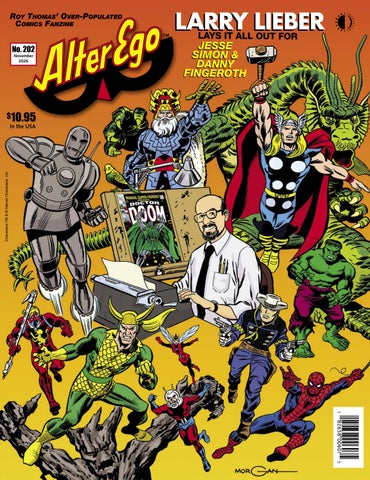
The Co-Creator Of Thor, Ant-Man, & Iron Man Speaks Out
Interview Conducted & Transcribed by Jesse Simon & Danny Fingeroth
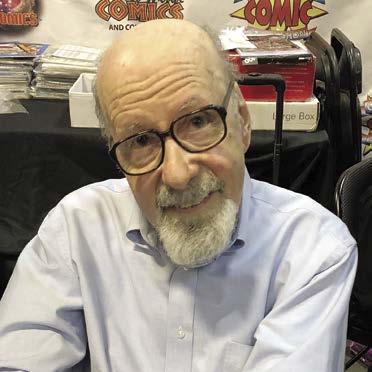
INTERVIEWERS’ INTRO: Larry Lieber was a founding member of the original Marvel Bullpen, where, with his brother Stan Lee and such artists as Jack Kirby, Don Heck, and Joe Sinnott, he co-created Iron Man, Thor, Ant-Man—and Groot. Larry also wrote and drew countless adventures of The Rawhide Kid, drew the Amazing Spider-Man newspaper comic strip for 32 years, and served as an editor both at Atlas/ Seaboard and in Marvel’s British Division. He recently self-published his debut prose novel, Chirps, and is working on his next book.
On June 2, 2025, Larry spoke with his one-time assistant, Danny Fingeroth, and Jesse Simon, grandson of Captain America co-creator Joe Simon, about his life and career, both in and out of comics.
DANNY FINGEROTH: Larry, I know that the reason you’re coming out from behind your shield of privacy is because you’ve written a novel called Chirps that you want people to know about, enjoy, and buy. But maybe we should start by talking about your career and how it led up to Chirps, which is your first novel at age 93—an amazing accomplishment.
What most people know you for is your work in comics. You had a unique perspective because you were related to the founder of Timely/ Marvel Comics. What are your earliest memories of going up to the office?
LARRY LIEBER: Well, when I was a child, I went there just once. My uncle Robert Solomon, who worked there, took me to the office, which was located downtown—in the McGraw-Hill Building.
“Larrupin’ Larry”
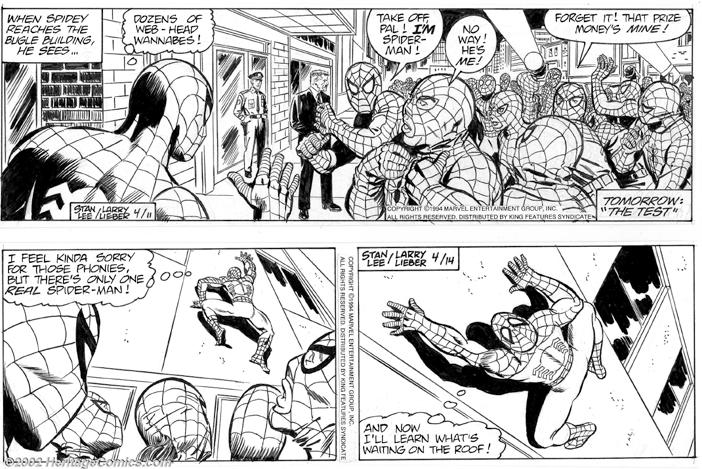
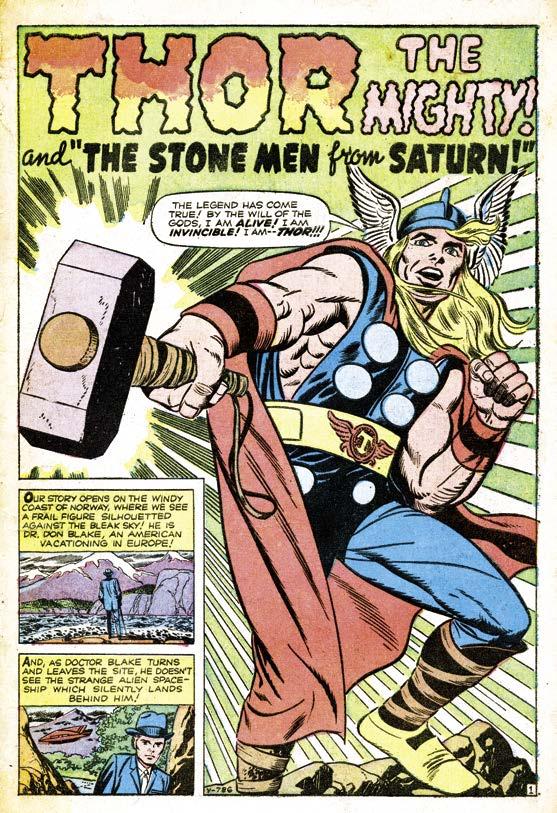
That’s what Stan Lee often alliteratively called his younger brother in the Marvel Bullpen Pages, because of Larry’s long stint as scribe and penciler of Rawhide Kid—but among his most important work, beyond doubt, was writing the script (from Stan’s plot) for the very first, Kirby-penciled “Thor” adventure, in Journey into Mystery #83 (Aug. 1962)—and a long, lonnng run penciling the daily Amazing Spider-Man newspaper strip, as per these two Stan-scripted dailies for April 11, 1994. Inks by Frank Giacoia. “Thor” art scan courtesy of Cory Sedlmeier. [Page & dailies TM & © Marvel Characters, Inc.]
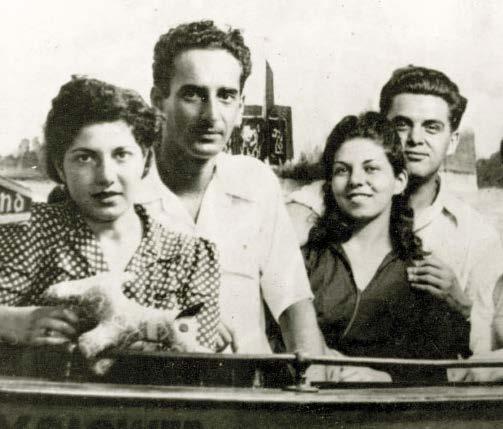
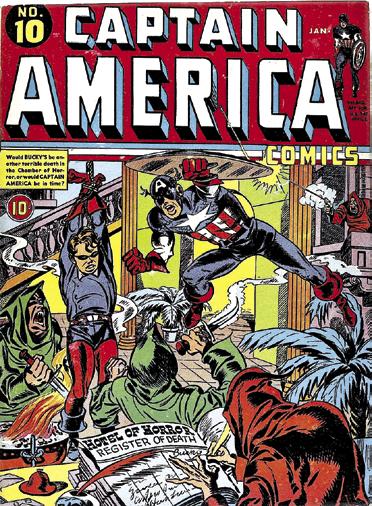
Joe Simon & Jack Kirby seen left to right with their wives (Harriet and Roz) in what may be the only known photo of the pair from their original Timely days in 1940-41. It first appeared in Greg Theakston’s fanzine Pure Imagination #2. S&K’s final issue of Captain America Comics before they split for potentially greener pastures at DC was #10 (Jan. 1942), whose cover was reportedly
I remember walking among the desks, and there was a drawing table. Jack Kirby was drawing there. Robbie introduced me to Jack, and I don’t remember what we said, but Jack Kirby drew a picture of Captain America and Bucky for me. Joe Simon, his partner, who was nearby, came over and they both signed it and gave it to me. And that’s all I can recall.
DF: Did you know who they were? Was it a big thing to you that those guys signed the drawing?
LIEBER: I imagine so, since I’d been reading Captain America and I saw the credits. I was also familiar with Timely’s other comicbook characters, which were drawn and written by different people.
I can remember the names—Carl Burgos and Bill Everett—the Human Torch and the Sub-Mariner. But this was Captain America, and there was a war in Europe and there was an advertisement in the comics for Cap’s Sentinels of Liberty [fan club]. And if you sent in a dime, you could get a little pin that was shaped like Captain America’s shield, and a membership card. I became a Sentinel of Liberty. And I’ve been thinking, now that practically a century has passed, we ought to have Sentinels of Liberty again. We need somebody to watch our liberties, and Captain America isn’t around.
DF: Was this before your brother started working there? Was he Simon and Kirby’s assistant?
LIEBER: I don’t know. Because of the nine-year difference in our ages, I didn’t know much about Stan’s situation.
I have only one childhood recollection of going someplace
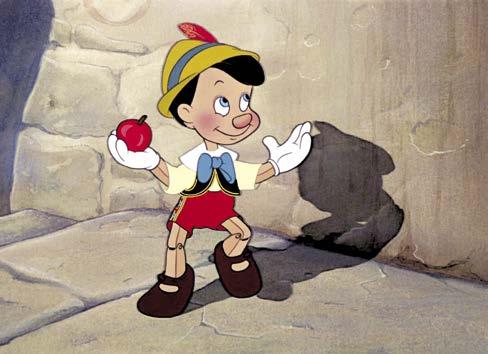
with Stan. He took me downtown to see Pinocchio. The movie was playing at Radio City Music Hall, and I remember they had, in the seat in front of you, a little light. And if you pressed it, you could read your program. It was a wonderful experience, being with Stan, watching Pinocchio, and probably getting frightened when Pinocchio gets swallowed by the whale.
JESSE SIMON: Do you remember if Stan used to play a small flute or some kind of musical instrument in the office in those days?
LIEBER: I don’t know about the office, but sometimes he did at home.
JS: My grandfather [Joe Simon] said that drove Jack absolutely nuts.
DF: Yeah, but it wasn’t a flute. It was something else: an ocarina.
LIEBER: I think you’re right.
DF: The ocarina is shaped differently than a flute.
LIEBER: He might have had different instruments at different times. But I’m pretty sure he had an ocarina.
DF: Did you always have comics around the house?
LIEBER: No.
DF: But you read them as a kid?
LIEBER: Sure, just like the other kids did, who weren’t related to the publisher [Martin Goodman].
DF: Which were your favorite characters?
LIEBER: I didn’t have a favorite. But I was impressed with Captain America. Maybe it was the Sentinels of Liberty thing.
DF: Did you get a lot of free comics?
LIEBER: No, not at that time.
DF: You were a kid when Stan went into the service. When was that?
LIEBER: I think sometime in 1942. I don’t remember whether he volunteered or was drafted.
DF: He said he volunteered.
LIEBER: Well, I have no knowledge of it being otherwise.
penciled by Kirby and inked by Simon. [Cap cover TM & © Marvel Characters, Inc.]
Band Of Brothers
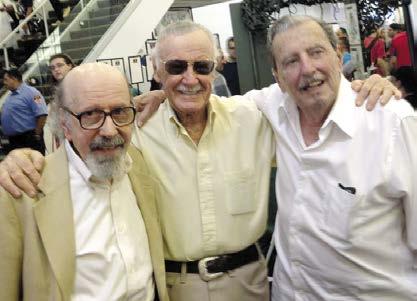
(Left to right:) Larry Lieber, Stan Lee, and artist Ken Bald at a Wizard World con in 2013—some 73 years after Stan took his kid brother to see the then-new Walt Disney animated film Pinocchio. [Pinocchio TM & © Disney.]
JS: [Stan] was a playwright with [children’s literature humorist] Dr. Seuss.
LIEBER: I didn’t know that. I think I remember him telling me afterwards that he had worked in the same outfit with [novelist] William Saroyan.
I used to know the places where he was stationed that we’d send letters to, or from where his letters had been sent. I seem to remember a camp in New Jersey… Fort Monmouth. I believe there was another camp down South as well.
DF: Your initial interest was art. When did you start drawing?
LIEBER: I liked drawing in high school. Maybe I started a little before that. I don’t remember exactly. But one thing I do recall: how I came to draw with my left hand.
I’m right-handed. I favor my right hand in all activities except writing and drawing. The reason for those exceptions is that as a child, I saw Stan write with his left hand and I imitated him. Even though I was, and still am, right-handed, I used my left hand to learn to write.
DF: And you even draw with your left hand?
LIEBER: Yes.
DF: So, though naturally right-handed, you trained yourself to be a lefty?
LIEBER: Much to my regret. You know, the way a hand moves— your right hand moves naturally with the direction of the letters. If you watch somebody write with their left hand, they gotta turn—twist their hand around unnaturally. Not only that, but they end up smearing what they just wrote. Unless you’re a Talmudic scholar and you write from right to left, you smear it. So all my life, I was smearing my writing, and my drawings also. I used to draw with a piece of paper under my hand to avoid smearing what I was working on.
DF: Anyway, when did you start drawing? And what?
LIEBER: Well, I don’t know exactly, but I liked drawing as a youngster and hoped to be an artist when I grew up. I remember having the desire to be a fine artist. But I knew that most fine artists don’t earn much of a living. I could end up starving in a garret.
So I figured I’d first try to become a commercial artist. At that time I was a fan of illustrators more than comic artists. I remember that The Saturday Evening Post, for instance, alternated their covers. One week they’d have a Norman Rockwell illustration for their cover. The next week, it was John Falter, and the third week, Stevan Dohanos.
I followed the illustrators. I liked Noel Sickles. He painted with colored inks, and he had been in comics years before. I also liked the
newspaper comic strips—you know, the work of Milton Caniff and, like most kids, Dick Tracy and the humor strips.
JS: Now, as far as Caniff, did you read Terry and the Pirates or Steve Canyon?
LIEBER: It was Terry and the Pirates at that time. Steve Canyon came later.
But as for my career in illustration, it never really got off the ground. I had wanted to go to the High School of Music and Art because, as the name implies, I felt I could learn art there. I applied to that school. I did some drawings, I submitted them, and I was turned down. I was surprised because I knew I drew better than anybody else in my junior high school class.
My mother came to my school and she asked them: “How come Larry was rejected?” They said, “Mrs. Lieber, his attendance is poor.” This was not true, but I used to talk a lot in class, and maybe the teacher was annoyed at me and this was her way of retaliating.
But in those days you didn’t protest. You could ask a question—and that was it. Nobody demanded; you had no rights. The teacher’s word was everything. So I couldn’t attend Music and
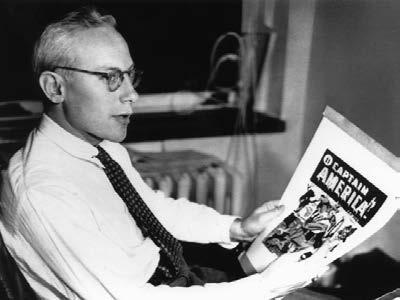
Martin Goodman
Larry’s and Stan’s uncle-by-marriage, who owned Timely Comics and a passel of other magazines. This photo, taken in 1941, shows him with a cover proof for Captain America Comics #11, the first post-Simon-&Kirby issue. Courtesy of Drew Friedman.
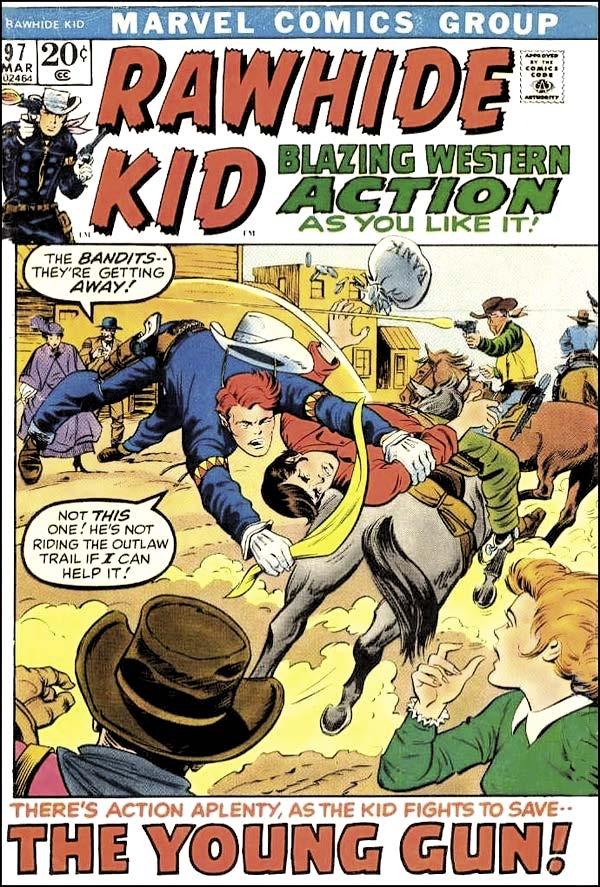
“The Left-Handed Gun”
The above was the title of a vintage Western movie starring Paul Newman as Billy the Kid (yes!)—but it also fits Larry Lieber, who drew many a Rawhide Kid cover or story with his left hand, even though he’s mostly right-handed. This cover for RK #97 (March 1972) was inked by Bill Everett. Courtesy of Nick Caputo. [TM & © Marvel Characters, Inc.]
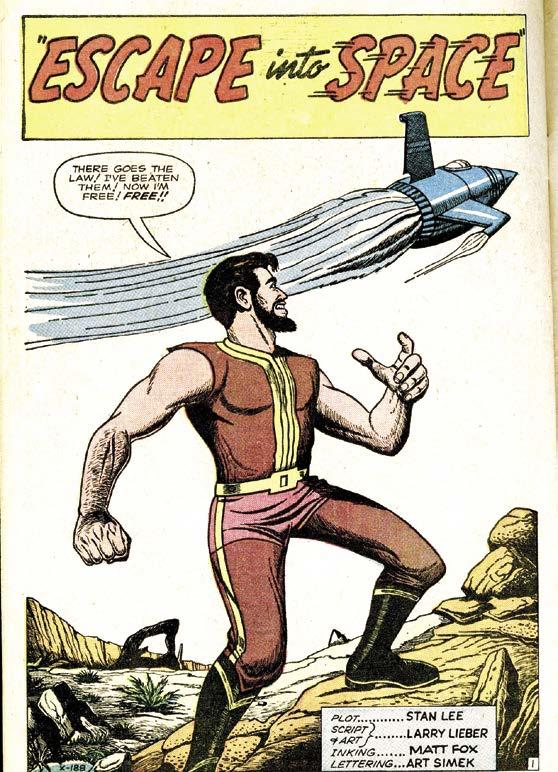
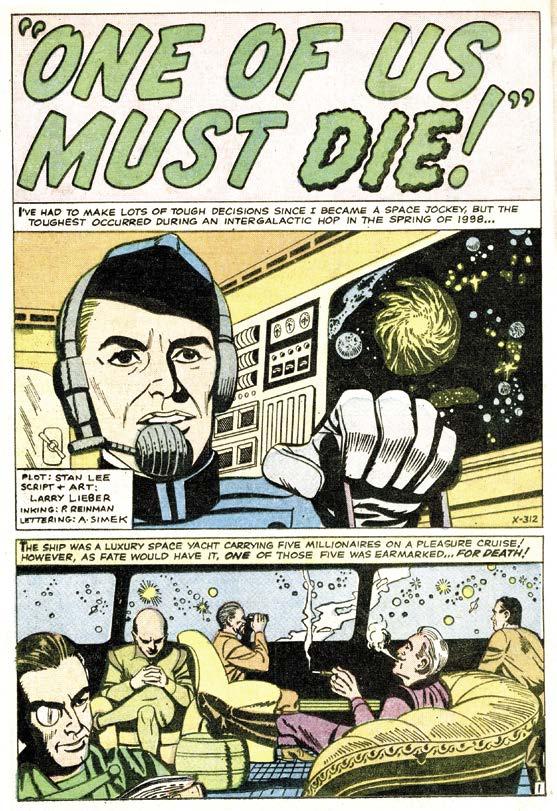
Tales Of [Space] Suspense
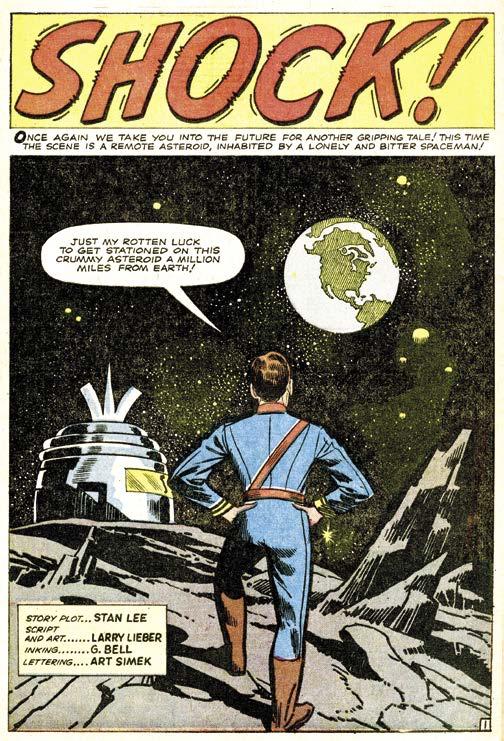
Larry wrote and penciled any number of 4- or 5-page backup stories for Marvel, including this science-fictional trio for Tales of Suspense #42, 44, & 47 (June, Aug., and Nov. 1963), with three different inkers… respectively, Matt Fox (primarily known as a book illustrator), Paul Reinman, and George Roussos (moonlighting for Goodman’s company as “George Bell”). Larry also scribed a number of backup yarns that were fully drawn by Fox, Reinman, Sol Brodsky, and others. Courtesy of Barry Pearl. [TM & © Marvel Characters, Inc.]
approaching Earth, that it didn’t have to be a large panel—it’s not that interesting. But in panel three, if the aliens are coming out of the spaceship with drawn guns and people are fleeing in horror—I would instruct the artist, “Please play up panel three.”
JS: So this is before the so-called “Marvel Method” came into play?
LIEBER: Absolutely.
DF: There was no “Marvel Method” at this time, was there?
LIEBER: No. The “Marvel Method” came later on when Stan wrote his stories by working them out with the artists, and writing the dialogue and captions only after the artists had broken down— laid out—the stories. Stan felt that suiting the writing to the art produced a better product than suiting the art to the writing. But I always wrote a full script, with panel descriptions and dialogue and captions given to the artist before he had to draw a line.
JS: Did you know who would draw your stories before you wrote them?
LIEBER: Only when I had to mail the finished script to the artist. At other times, when I turned in my finished script to the office, I
“I Am Groot!”
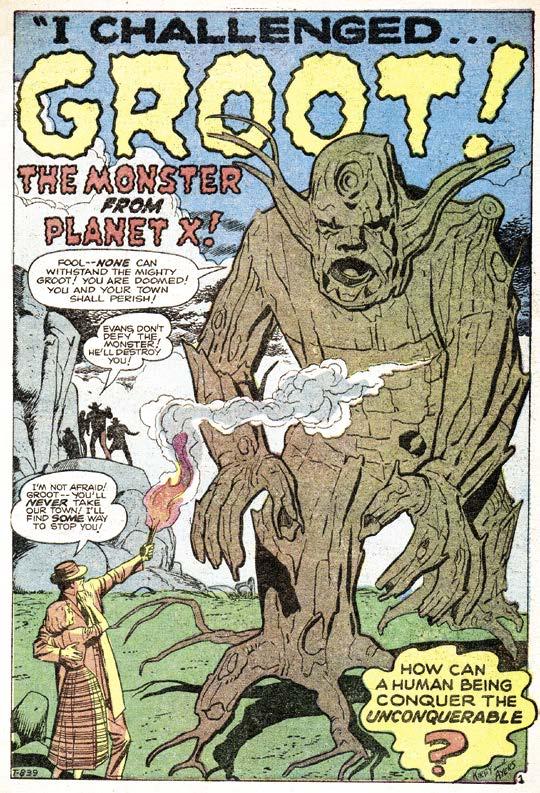
While it’s seldom 100% clear whether Larry or Stan wrote the final script for the post-Atlas “giant monster” stories, Larry is clear that he performed the honors for the 7-pager “I Challenged… Groot! The Monster from Planet X!” for Tales to Astonish #13 (Nov. 1960). Pencils by Jack Kirby; inks by Dick Ayers. The three-word greeting quoted in our above heading, which became famous via the Guardians of the Galaxy films, pops up in an interior panel… and was subsequently used by Stan in writing the cover text. (Incidentally, Groot’s plan of Earth-conquest is foiled when a scientist unleashes a gaggle of termites on the alien invader—and the little buggers do their work in record time!) To read the whole story, seek out the hardcover Marvel Masterworks: Tales to Astonish, Vol. 2—or the 1990 trade-paperback collection Monster Masterworks. Courtesy of Nick Caputo. [TM & © Marvel Characters, Inc.]
sometimes didn’t know who it would be sent to. And I didn’t really care. My concern was only in doing as well as I could on this artistic assembly line, for what I was being paid.
JS: But would you keep in mind, “Okay, Steve Ditko’s drawing this—I’ll do it a certain way”?
LIEBER: Well, I never worked with Steve Ditko, but I would write the same for everybody. I didn’t want to take anything for granted. Jack Kirby was our best artist. But I wrote for him the same way I wrote for the others, except maybe I gave Jack more leeway—I knew he was so good, and I didn’t want to ruffle his feathers. So I probably didn’t say, “Play up panel...”
DF: This is before the super-heroes, when you and Stan were the only two
The King-To-Be
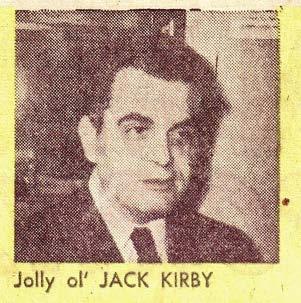
From Marvel Tales Annual #1 (1964). [© Marvel Characters, Inc.]
writers?
LIEBER: As far as I know. Now, before me, he might have occasionally given a plot synopsis to somebody else to flesh out, but I believe he said that he had been writing all these stories himself— and now he was giving some to me.
JS: When you started writing these scripts, did Stan ever show you one of the scripts that he wrote, so that way you could have reference to see how he would do it?
LIEBER: He probably did at the beginning. But later on he just went over my scripts. I remember him telling me things like, “These captions, they’re too long.” Or maybe, referring to the dialogue, he’d say, “Even if this were written beautifully —which it isn’t, because you’re just learning—it’s too wordy. Readers don’t want to read this much. If they did, they’d buy a novel.”
“Fin Fang Foom”
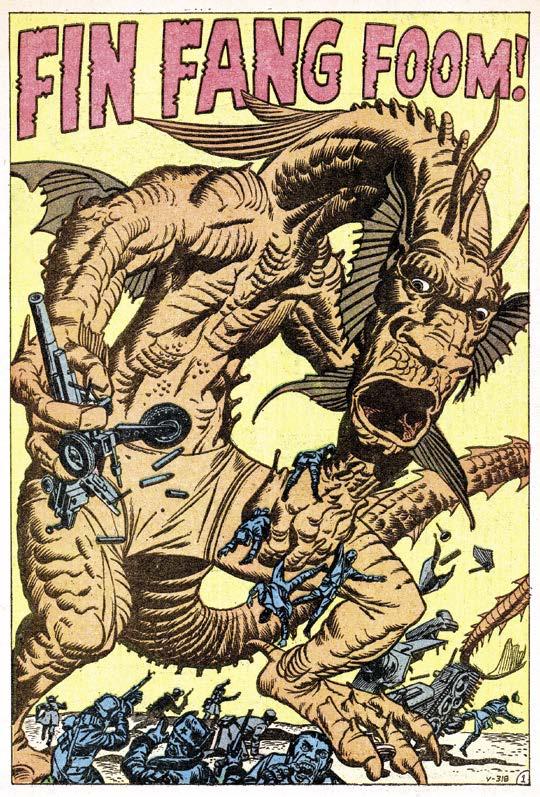
While Stan Lee long ago revealed the precise inspiration and evolution of the name of the talking Godzilloid who threatened mankind in Strange Tales #89 (Oct. 1961), it was quite possibly Larry Lieber who wrote the actual script from his sibling’s plot—only weeks before The Fantastic Four #1 made its debut and everything began to change . Pencils by Kirby; inks by Ayers. Courtesy of Nick Caputo. [TM & © Marvel Characters, Inc.]
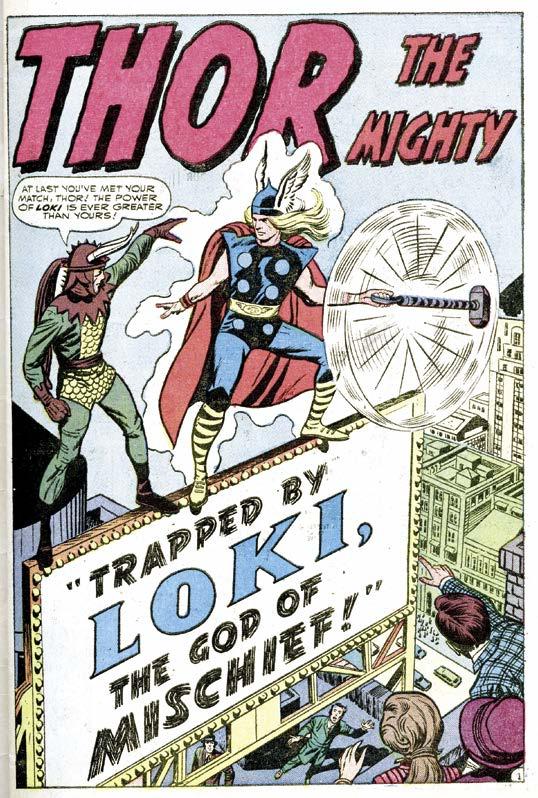
Looks Like Thunder!
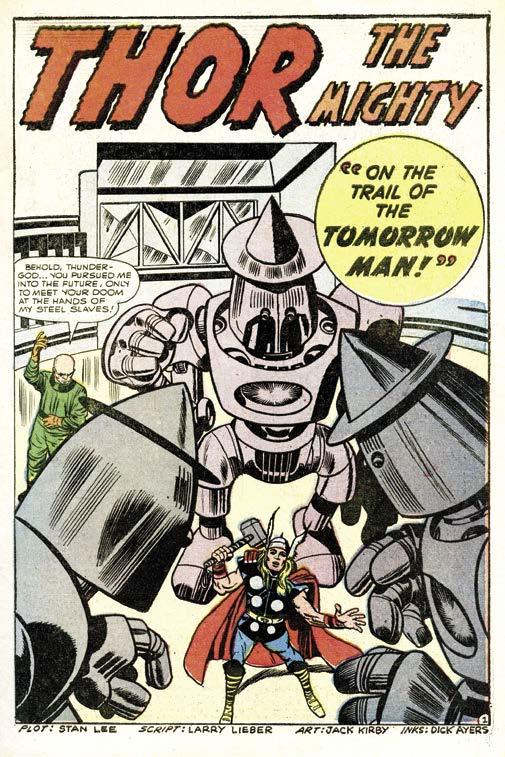
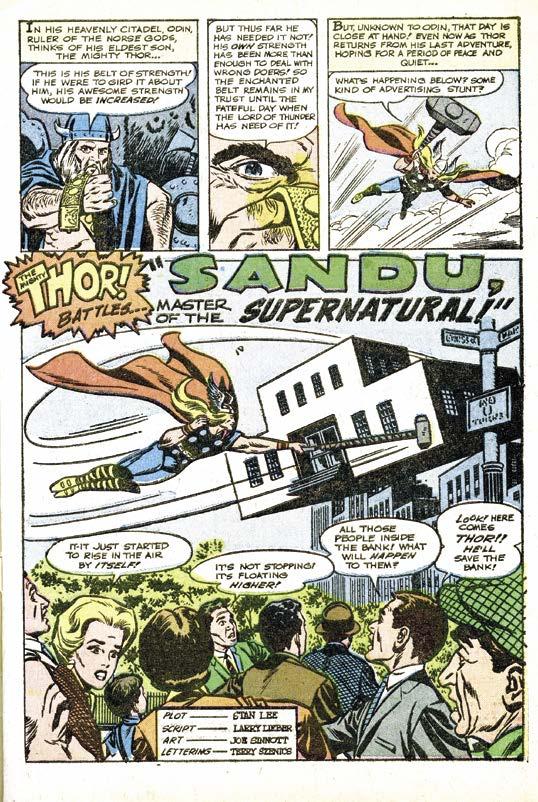
(Clockwise from above:) Three Larry Lieber “Thor” splash pages of moment, all courtesy of Barry Pearl.
Journey into Mystery #85 (Oct. 1962) introduced Loki as Thor’s adopted brother and mortal enemy. (Odin came along in #86.) Stan and Larry played a bit fast and loose with Norse mythology, but all in the interests of a good comicbook story. Art by Jack Kirby & Dick Ayers.
Issue #86 (Nov. ’62) saw the first credits on a “Thor” story—for Stan Lee (“story”), Larry Lieber (“script”), Jack Kirby (“art” = pencils), & Dick Ayers (“inks”).
And #91 was both Larry’s first team-up with Joe Sinnott as full artist—and, by coincidence, his own finale as “Thor” scripter before Stan assumed full reins. [TM & © Marvel Characters, Inc.]
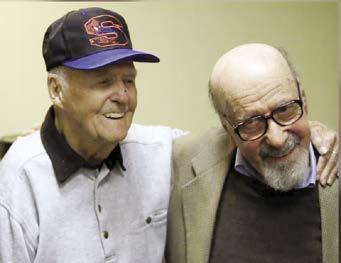
Sinnott & Lieber
Joe and Larry at a con in later years. Courtesy of Jim Kealy.
And because Stan wanted to keep it short, I learned to write concisely, which isn’t easy. I remember him telling me the story about Abraham Lincoln, who wrote a letter to somebody, and in the letter he said, “I would have sent you a telegram, but I didn’t have the time.” Meaning, to get it short takes more time than to just ramble on.
JS: And you mainly communicated with Stan, not with Jack too much?
LIEBER: Oh, with Jack almost not at all. Once, when he was in the office, Stan said to him, “Jack, Larry is so slow at drawing. Could you show him how to draw fast, the way you do it?” And Jack drew a page for me to demonstrate how he worked. But the figures that he drew were just simplified shapes.
So I said to him, “Gee, Jack, is it that simple? What about anatomy?” And he said, “Larry, if I had to worry about anatomy, I couldn’t get my pages out.”
DF: Now, about your writing, did you try to develop your own writing style?
LIEBER: No. When Stan was writing the monster stories, he wrote them in a plain, straightforward manner which I liked. But when he started writing the super-heroes, Stan’s writing took on his personality. He “spoke” to the reader with clever and often humorous dialogue. And I believe that played a big part in the success of those new super-hero comics. But that was not the way I wanted to write.
DF: Because you didn’t want to be seen as just copying Stan?
LIEBER: Right. Then he offered me The Rawhide Kid and said, “Western stories, whether they’re very good or not so good, they sell the same. So I won’t even edit your scripts.” And when he added, “Remember, you don’t have to write like me. Just do the best you can in your own way,” I accepted happily.
DF: Do you have any memory of writing the first “Thor” story or the first “Iron Man” story, or was it just another job? Did they stand out to you in retrospect in any way?
LIEBER: No, it was just another job. We didn’t know it would become so successful. Though I did feel that Thor’s hammer couldn’t be just a normal hammer. So I gave the metal it was made of a name: Uru. And, of course, I had to give the super-hero characters their civilian names. Stan always liked the names I gave the characters in my stories.
I often got those names from MerriamWebster’s Collegiate Dictionary. In the back of the dictionary, there’s a section with geographical names and another with biographical names. I would look through both sections. Henry Pym—I found "Pym" in the biographical section. I don’t recall if his first name was Henry–but “Henry Pym” sounded like a scientist to me.
DF: When you were writing the super-hero stories, what did you use as a model? In other words, you’d been writing monster stories and cowboy stories. How did you figure out what a super-hero does? Did you read old “Superman” stories?
LIEBER: Well, I got the story plot from Stan. So for the first “Thor” story, it said something like, “A guy with a limp and a cane, a doctor, is walking somewhere in the Himalayas, when suddenly an alien spaceship appears, and he flees for his life and runs into a cave.”
JS: Now, you’re getting all these plots from Stan. My question is, when you’re doing the monster books and you’re starting to get used to them, was there a point when Stan said, “We’re going to give the super-heroes a try. I’ll still give you the plot and you’ll still write them, but we’re going to be going down this avenue now to see if it works.” Because Tales of Suspense, for instance, was all monsters, and then all of a sudden you have Iron Man in it.
LIEBER: Well, it was a different kind of a story.
JS: But he didn’t alert you, “Oh, this one’s going to be more super-hero style, less monster style.”
LIEBER: He wouldn’t need to tell me that. I would know from the plot. I would know that Iron Man was not a monster. He was an American industrialist who was highly skilled, intelligent, and attractive. And he had a bad heart, and he had to make a special suit. When I wrote the monster books, I didn’t have only monsters. The monster had to play off human beings. So Anthony Stark wasn’t beyond my reach.
DF: Interesting point. The monster stories always had a human hero. So you used that structure in the super-hero stuff? Leaving A Carbon-Copy Footprint
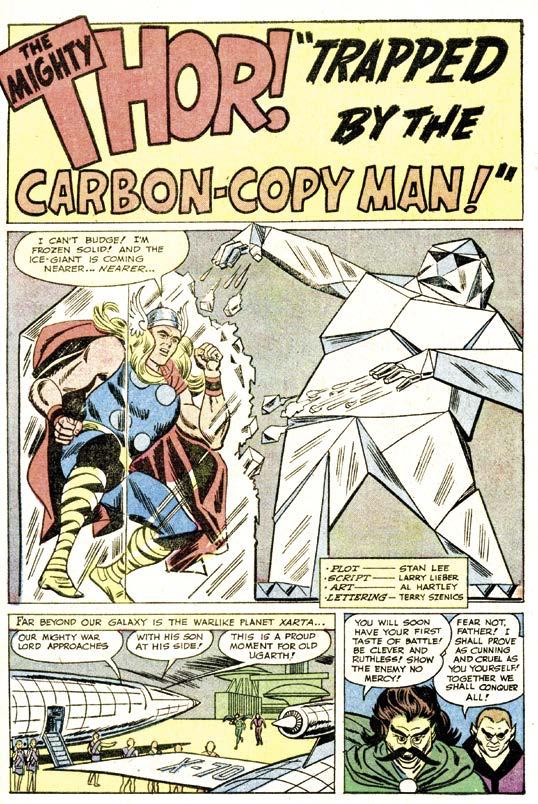
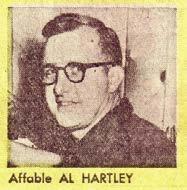
Perhaps the greatest mismatch in early Marvel history was having Al Hartley draw the “Thor” saga in Journey into Mystery #90 (March 1963). Hartley, while a talented artist, was best suited to romantic humor such as Patsy and Hedy. Plot by Lee; script by Lieber. Courtesy of Barry Pearl. [TM & © Marvel Characters, Inc.]
Photo from Marvel Tales Annual #1 (1964).
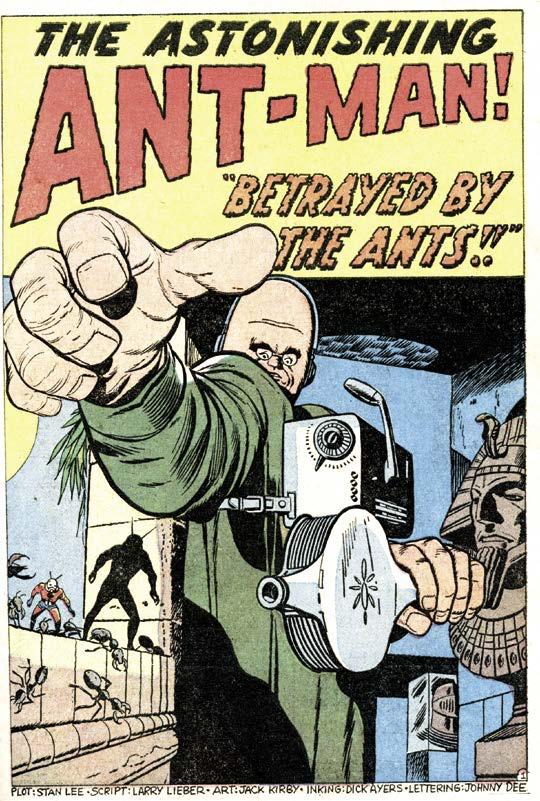
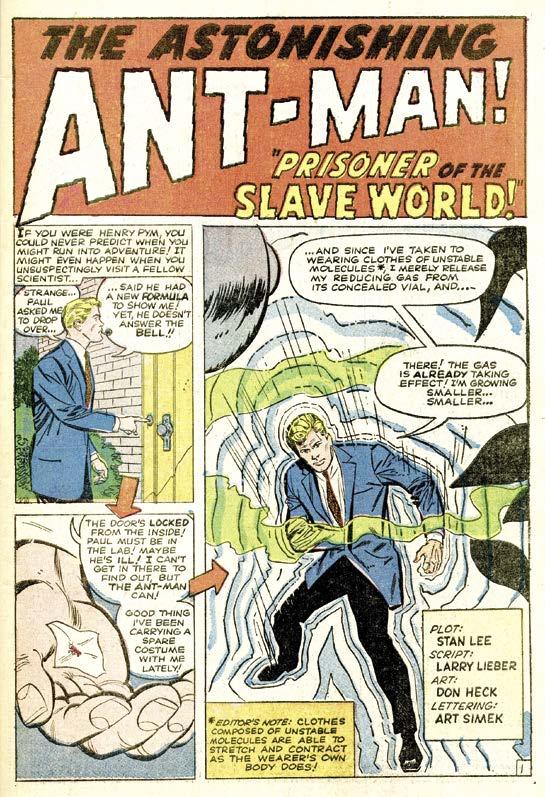
Some People Draw Flies—Kirby & Heck Drew Ants!
LIEBER: I got the structure from the plot. “Donald Blake becomes Thor, he defeats the bad guys, and, at the end he says, ‘Now I’m Thor!’” I just flesh it out and put in the dialogue and write the captions and lay it all out, while deciding what parts to play up.
DF: Did you think back to the comics you read as a kid—the super-hero stories at all?
LIEBER: No, I thought of all the movies I had seen with heroes and villains—Westerns, gangster movies, and so on.
DF: So, for you, the fact that the heroes had super-powers was not that important?
LIEBER: Well, if you tell me the super-power, I can incorporate that. If you tell me a guy is flying, I can describe him doing that. I have an imagination. I‘ve no problem with super-heroes.
Also, remember, I had something physical to look at. I had Kirby’s designs. If I were writing “Thor,” I would think about the difference between Thor and Superman. Superman could fly. Thor didn’t actually fly. He hurled his hammer and hung on to the strap.
JS: So, later on, when these characters started recurring and you had to
write an issue—for example, the Spider-Man Annual about Peter Parker’s parents—and it features The Red Skull and all these other characters—how did you keep track of the characters’ past appearances and storylines that other writers and artists did?
LIEBER: I didn’t keep track. I would have had to ask somebody or make up my own story.
DF: There’s a humorous story that Marie Severin drew about you, Romita, and Stan plotting that annual. I have a feeling that may have been based on a real meeting.
LIEBER: Maybe, I don’t know. I know that, years later, Jim Shooter had been doing plots for Stan’s stories for the Spider-Man newspaper strip. And he was stopping that, and they asked me to do it. And I did it. I remember sitting in the office with Stan and John Romita, the three of us discussing the plot from which I had just drawn a storyboard. We bounced ideas off each other—John Romita, Stan, and myself,
DF: So before you drew the Spider-Man strip, you were helping plot it?
The first “credits” page on an “Ant-Man” story appeared in Tales to Astonish #38 (Dec. 1962), which introduced the villainous Egghead, with art by Kirby & Ayers—
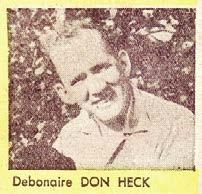
—while, with TTA #41 (March 1963), full-art chores were turned over to Don Heck as Kirby got busier with a monthly Fantastic Four, et al. Courtesy of Barry Pearl. [TM & © Marvel Characters, Inc.]
From Marvel Tales Annual #1 (1964).
Maybe He Should’ve Been Knocked Down By An Iron Curtain?
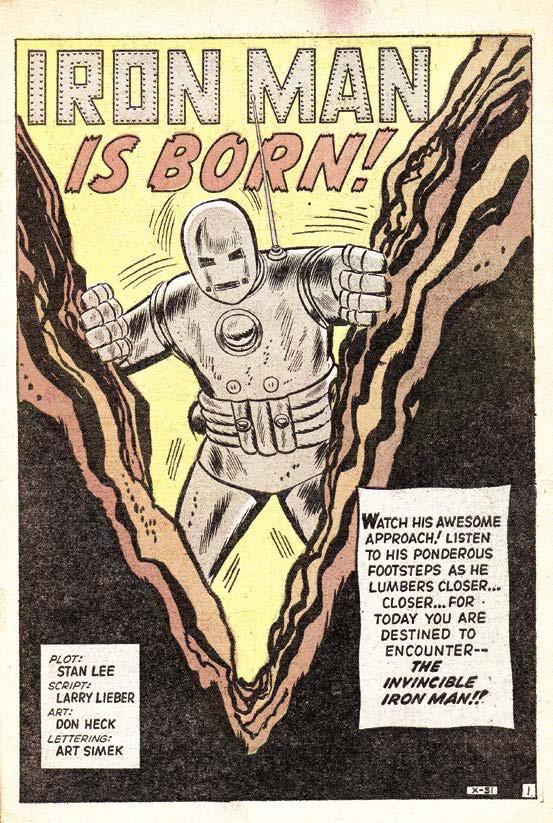
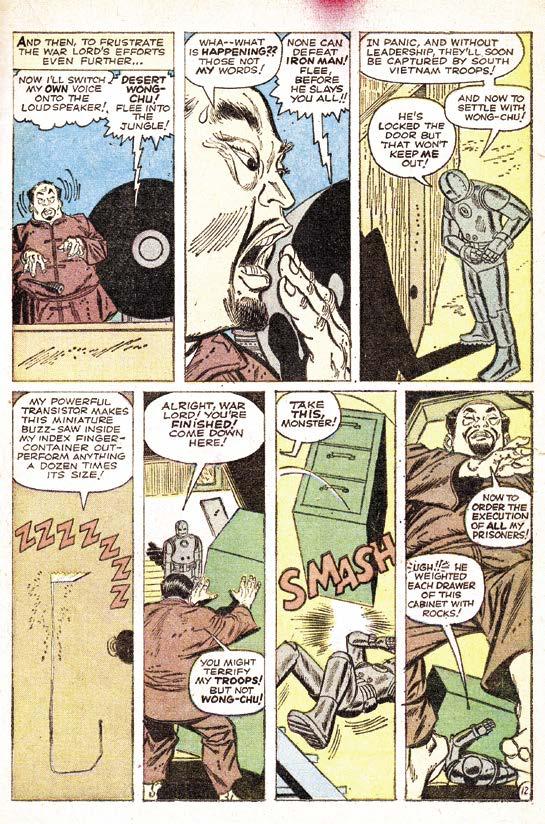
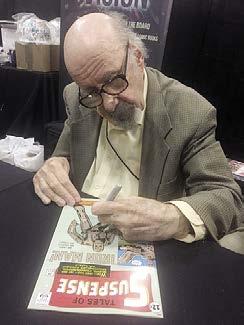
The “Iron Man” yarns in Tales of Suspense sported credits from the get-go in issue #39 (March 1963)—for Stan, Larry, & artist Don Heck. But it turned out this would be Larry’s sole credit on the feature. Rumor has long had it that publisher Martin Goodman was unhappy with the fact that Ol’ Shellhead got knocked down at one point by a mere (though rocksweighted!) filing cabinet—but who knows if that was in Stan’s plot as well as the final script? Just as likely, Larry was more than willing to leave the super-heroes behind and concentrate on the Westerns, especially Rawhide Kid—although he was happy years later to sign copies of TOS #39, as per the accompanying photo . Courtesy of Nick Caputo & Cory Sedlmeier. [TM & © Marvel Characters, Inc.]
LIEBER: Yes.
DF: Back to the early super-heroes. You established the characters by doing the scripts for the debuts of Thor, Iron Man, and Ant-Man. But then you moved on to other things. Did you realize you didn’t like super-heroes so much and you’d rather do The Rawhide Kid?
LIEBER: I think so. Yes, I would have preferred The Rawhide Kid to a super-hero strip—because it was more realistic. Cowboys actually existed in the Old West. But there haven’t been super-heroes anywhere at any time. And I prefer writing that’s not so removed from reality.
Even my novel Chirps, about a bird who can speak and think, is more realistic than a super-hero story. Because it’s easier to accept in terms of the characters’ personalities. I go for realism more than for the super-hero story. Also, I prefer to do my own thing, and Rawhide Kid had given me that opportunity.
In those early days, I learned a lot from Stan about the basics
of writing. He was a very good teacher—diligent and caring. I remember him telling me something—he said he wasn’t a good speller, “but I know what I can’t spell, and so I look the word up.” He would never hand you something with words spelled wrong.
He was a hard worker, and he cared about the stuff that he wrote. When he used the “Marvel style,” he would look at the art, and he might see a character in the background and realize that he could enrich the story with an appropriate word balloon coming from that character—and he was right. He actually did, I believe, create a better product. If you have an artist who was good—like Jack Kirby, say—he will lay the scenes out well, he will tell the story well. Jack knew how to invent costumes and machinery and so on. He was very creative.
The New Kid On The Block
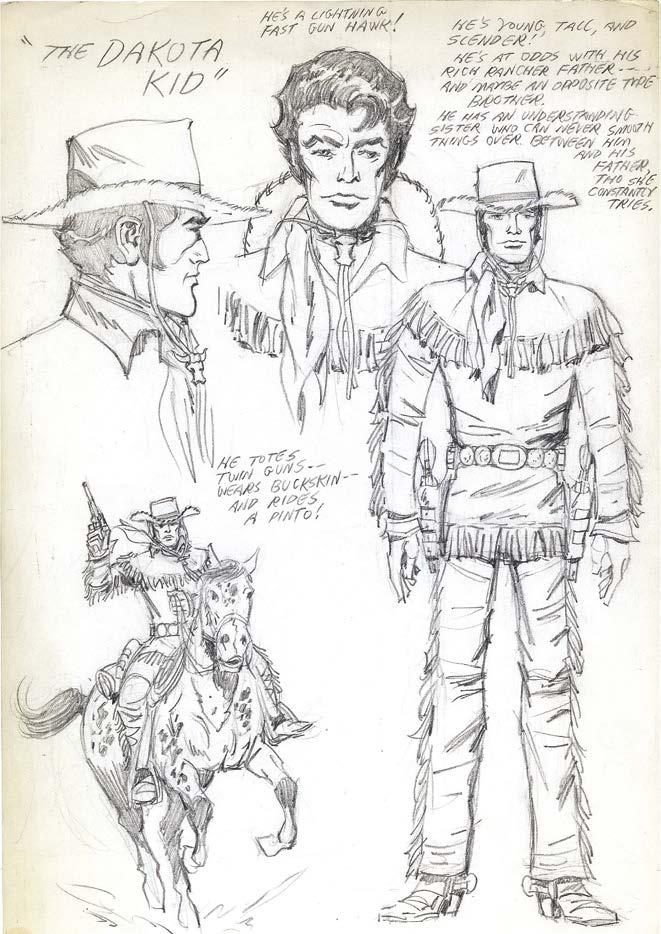
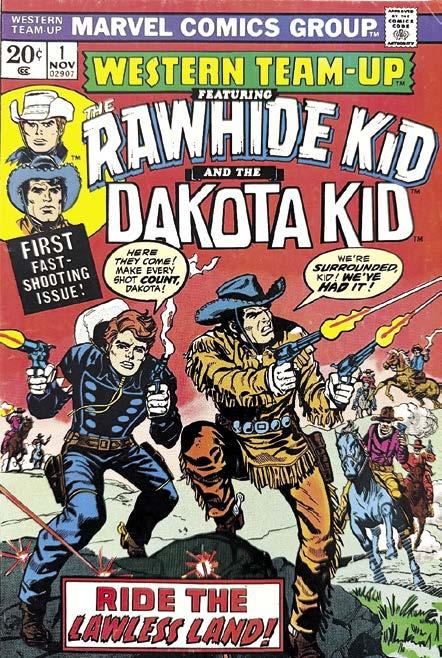
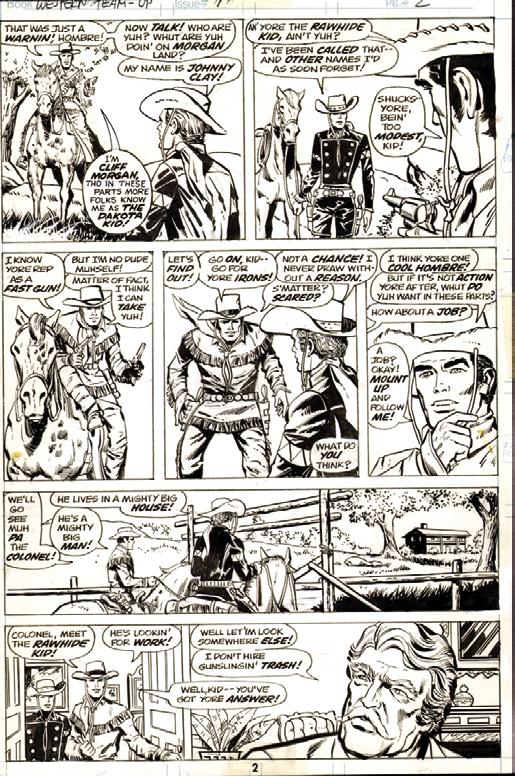
One of the more unexpected comics Stan Lee dreamed up in the months after his promotion to president and publisher of Marvel Comics was Western Team-Up #1 (Nov. 1973), for which Larry wrote and penciled an encounter between The Rawhide Kid and a brand new gunslinger, The Dakota Kid—for whom Larry also did the concept art above, which we retrieved from an online auction site. Why a new gunhawk and not Kid Colt or Two-Gun Kid or even the sagebrush Ghost Rider? Beats us—but apparently Stan thought better of the idea even before he saw any sales figures, since there was no second issue. Nice cover, and interior page at right, though… inked by Vince Colletta, with some touching-up by John Romita. Cover scan courtesy of the GCD; interior page thanks to Mike Burkey. [TM & © Marvel Characters, Inc.]
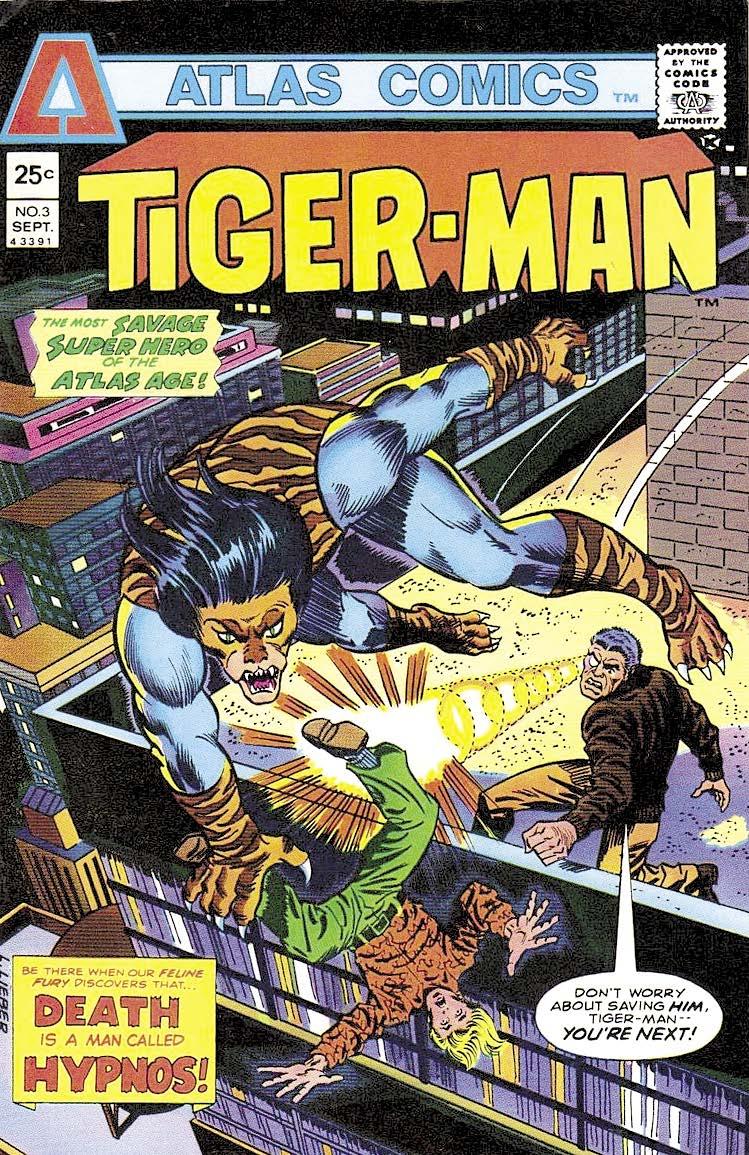
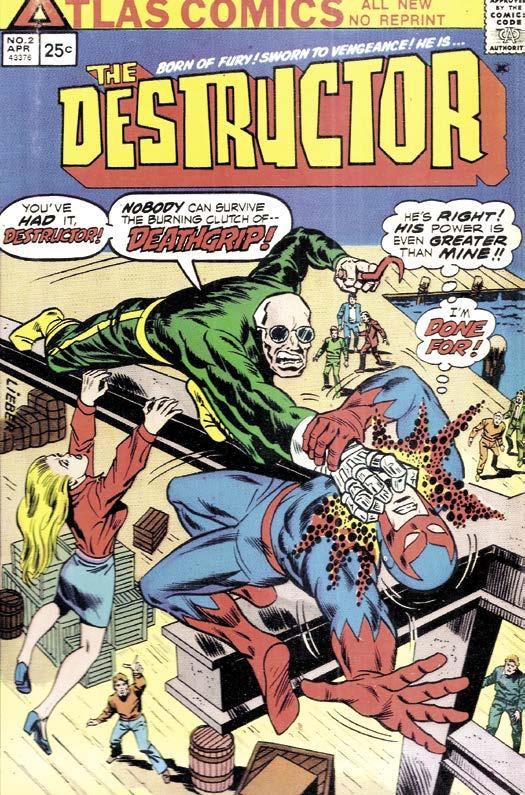
Even while editing Atlas/Seaboard’s comics in 1975, Larry penciled a few covers, including: Tiger-Man #3 (Sept. 1975)—The Destructor #2 (April ’75)—and Savage Combat Tales #2 (April 1975), which starred “Sgt. Stryker’s Death Squad” (scan courtesy of Bob Bailey). Other scans courtesy of the GCD. All inking by Frank Giacoia. [TM & © Atlas/Seaboard or successors in interest.]
Sadly, things did not work out well. Martin lost money. Rovin quit, and all his mags came to me—the color comics and the black&-white magazines. But it was too late. The company had lost too much to get back on its feet. At this point, I had the distinct displeasure of having to take work away from people and lower their rates.
DF: So Seaboard goes bust, and you end up back at Marvel as editor of the British department. How did that come about?
LIEBER: Stan offered it to me. He said, “Why don’t you come back and work for us? I’ve got a job opening in the British department. You’ll be working with reprints that we send to England.”
DF: Besides the reprints, they gave you some new material, too—notably Captain Britain
LIEBER: Well, that was still part of the British department’s output. It was nothing much.
DF: That’s when I met you, and you hired me to be your assistant. And what I remember is that, while we were sharing an office, you started working on the Hulk newspaper strip.
LIEBER: At some point, because the Spider-Man strip was doing so
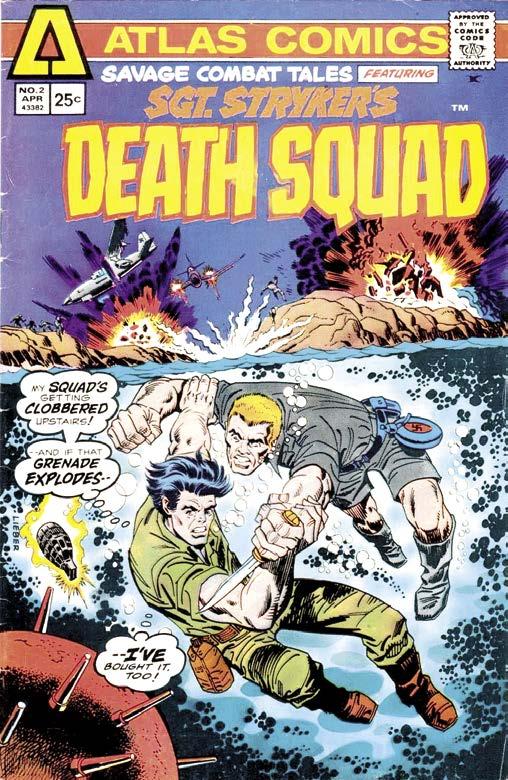
This Means War!
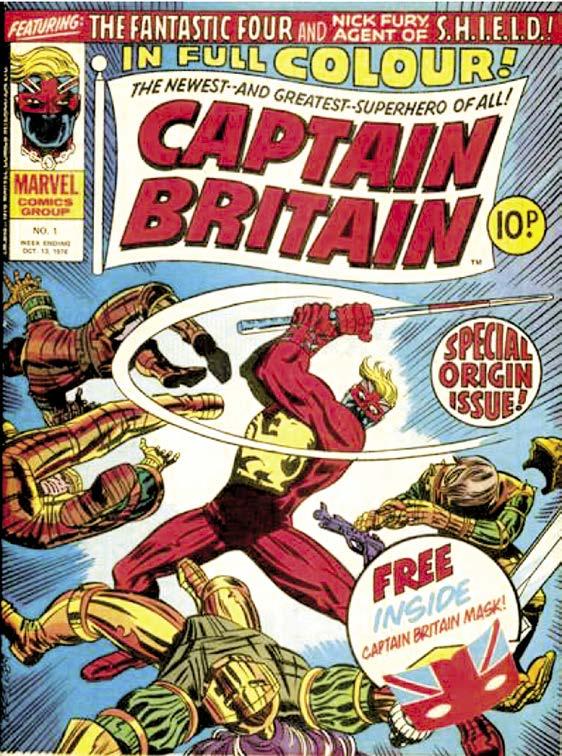
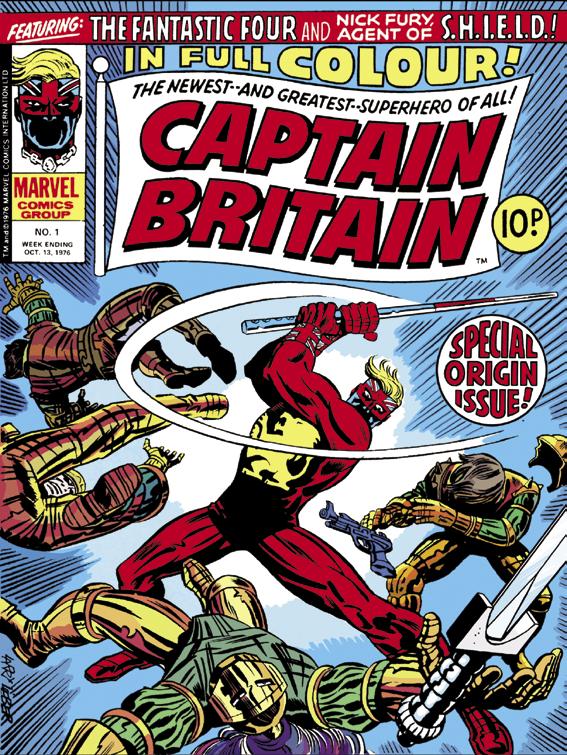
Captain Britain Rules The Waves—And The Wicked! Because gimmicks and giveaways were so important in comics packaged especially for Great Britain, the cover of the first issue of Marvel UK’s Captain Britain (dated Oct. 12, 1976) had two versions: one with, and one without, an ad for a “free Captain Britain mask inside!” Cover art by Larry Lieber & Frank Giacoia. Courtesy of Robert Menzies. [TM & © Marvel Characters, Inc.]
well, Stan said he wanted to try putting The Hulk into syndication. He would write The Hulk, I would pencil it, and Frank Giacoia would ink it.
So we did it. And later on, when the strip wasn’t faring that well, Stan said, “Larry, I’ll let you write, as well as draw, The Hulk.” And so, once again, for a few years, I was writing and drawing the same comic strip—making up my own plots and cast of supporting characters. One story was about a washed-up prizefighter with a beautiful fashion-model daughter. Another was a werewolf story set in the deep South. The sheriff looked like Walter Matthau. A third story had three women—a martial arts expert, a mud wrestler, and a cowgirl with a rich father—who had joined together to track down and capture our incredible Hulk.
I really enjoyed doing those stories. But all things have to end…
DF: So The Hulk strip was discontinued…
LIEBER: Eventually it was, and then I worked for [Marvel editorin-chief] Jim Shooter. And after that, I may have done some covers, and I did some “Spider-Man” stories.
DF: You did some “Spider-Man” stories for me, when I was editing the
LIEBER: I had drawn some Spider-Man Sunday pages. Then they were trying to find an artist on the daily Spider-Man. Romita had left the strip and Fred Kida was doing it, and Fred wanted to stop. Maybe he didn’t need to work anymore. So he quit, and Dan Barry did it for a while.
But finally Stan said to me, “Larry, how about you try?” Now, I had tried the dailies previously and had been too slow. But this time, when I tried, I could get it out on time.
DF: You were penciling it, but not inking it?
LIEBER: Right. I wasn’t inking it, and Stan liked the pencils.
DF: You were doing full pencils?
LIEBER: Full pencils, oh yeah. And at a certain point, I decided, “I want to ink the pencils myself.”
But [prior to that] I had to learn to ink. I hadn’t inked since I was a kid starting out, and that had been simple teenage stuff. So I asked Stan Goldberg, “How do I go about inking this newspaper strip?” And he told me which pens to use. Then I had to practice— to control the pen. I studied the inking of the best newspaper strip artists, especially Stan Drake, whose artwork I admired the most. I put in a lot of hours, until finally, when I was ready, I started inking my own pencils.
Because my pencils were so tight, so finished, inking them [continued on p. 30]
Spider-Man line. But how did you end up drawing the Spider-Man newspaper strip?
By The Numbers: Marvel Vs. DC
Atlas/Marvel’s Collapse & Subsequent Underdog Battle With National/DC On American Newsstands, 1953-1973
by Jim Holden
Afirst installment of “By the Numbers” appeared in the FCA section of Alter Ego #198, and detailed the newsstand battle in the 1940s and early 1950s between National Comics (today known as DC Comics) and Fawcett Publications. That article was based on circulation statements submitted by American comicbook publishers to the Audit Bureau of Circulations (the “ABC”), which are now available online at the Circulating American Magazines Project [https://sites.lib.jmu.edu/circulating/ about-this-project/about-the-abc-data]. The Project’s databases include summaries of ABC statements certified by National, Timely/Atlas/Marvel, Fawcett, Archie, Harvey, and smaller publishers including Lev Gleason, Standard, Street & Smith, and American Comics Group.
To recap a few points from the previous installment, National Comics sold more comics in the 1940s than any other publisher filing ABC statements. In the early ’40s Fawcett was a peer competitor, but in the latter half of the decade National pulled ahead. National’s sales in January 1948 were in excess of 8 million, while Fawcett’s sales that month were around 5 million. Next came Timely (the future Atlas and Marvel), with sales that month of around 4.3 million, followed (surprisingly!) by Standard (a.k.a. at various times Nedor and Pines) with sales around 2.7 million, Harvey with sales around 2.1 million, and Archie with sales around 2 million. “Dell/Western” comics probably had higher sales than some of these publishers, but that firm (actually Western Publishing, with Dell as its distributor) didn’t file ABC statements.
1953
To begin this installment, let’s jump ahead to January 1953. Among publishers reporting sales to the ABC, National sat on top with sales that month of around 7 million. Timely— now generally known as Atlas (which was actually the name of its self-owned distributor)—was not far behind, with combined sales for January and February totaling about 12.4 million, for a monthly average of 6.2 million. Fawcett, on its last legs, was well behind those two, reporting sales of about 2.9 million in December 1952, its last month of submitting reports to the ABC. Harvey came next with January sales of about 2.2 million, then Archie with sales of about 1.7 million. Sales by Harvey and Archie remained about where they had been in 1948, but Timely/Atlas had emerged from the middle tier of publishers and was nipping at National’s heels.
Two For The Money…
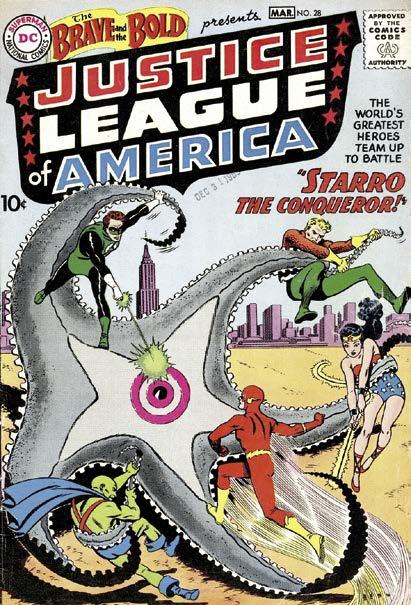
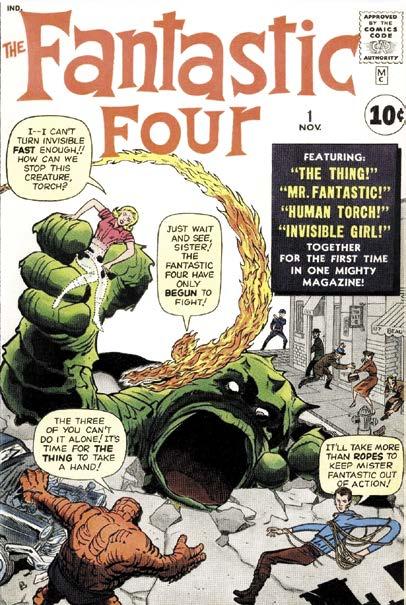
While Superman, Amazing Spider-Man, and various other comicbook series all played their part in the two-decade “war” ’twixt DC and Marvel that is chronicled in Jim Holden’s study, perhaps the “flagships” of the struggle can be summed up in the former’s The Brave and the Bold #28 (Feb.-March 1960), with its introductory “Justice League of America” cover by Mike Sekowsky & Murphy Anderson—and the latter’s Fantastic Four #1 (Nov. 1961) cover by Jack Kirby & George Klein. Courtesy of the Grand Comics Database. [B&B cover TM & © DC Comics; FF #1 cover TM & © Marvel Characters, Inc.]
What about Dell/Western, which didn’t file ABC statements?
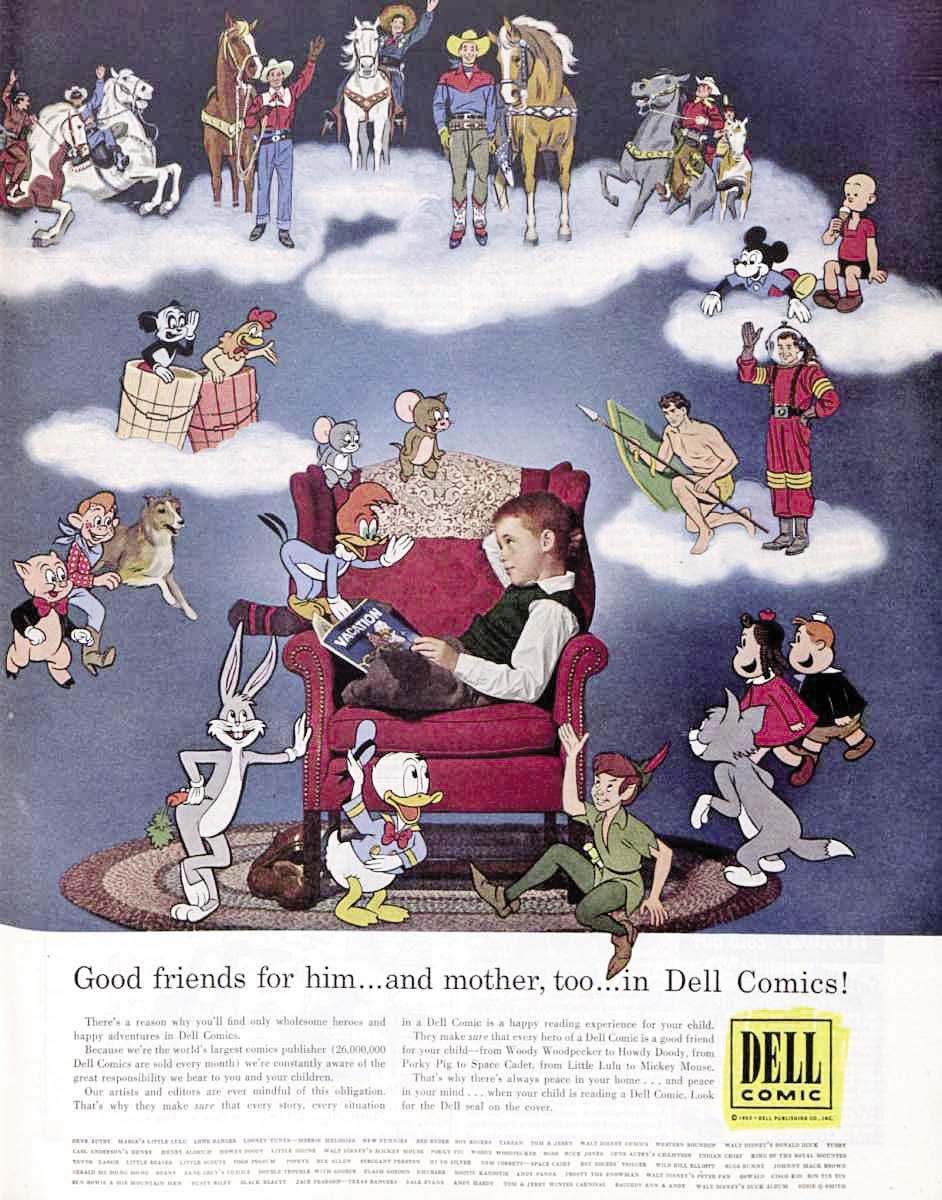
In the midst of Dr. Fredric Wertham’s anti-comics crusade, that company, which was commonly known by the public simply as “Dell” in those days because of the symbol in the upper left corner of its covers, ran a full-page color ad in the January 10, 1953, edition of The Saturday Evening Post assuring parents: “[T]here’s a reason why you’ll find only wholesome heroes and happy adventures in Dell Comics. Because we’re the world’s largest comics publisher (26,000,000 Dell Comics are sold every month), we’re constantly aware of the great responsibility we bear to you and your children.”
Comics & Stories
ad
Twenty-six million comics per month! Dell/Western’s circulation dwarfed all other publishers. One Dell title alone, Walt Disney’s Comics and Stories, had a circulation approaching 3 million copies, more than the entire lines of the mid-tier publishers. Dell declined dramatically in the 1960s after the demise (in 1962) of its partnership with Western Printing, but Dell/Western was the undisputed comicbook sales leader on newsstands during the 1950s.
This article focuses on the newsstand competition between National/DC and Atlas (later Marvel) during the 1950s, 1960s, and early 1970s. The Circulating American Magazine Project has ABC statements for both publishers through the end of 1972, with only a few months missing. The statements list the aggregate sales of each company’s entire line of comics, rather than the sales of individual titles. However, the Comichron website lists sales figures for some 1960s-era titles taken from the Statements of Ownership and Circulation that sometimes appeared in
comicbooks in order to maintain second-class mailing privileges with the U.S. Post Office. Few readers read them at the time, although some of the more obsessive readers, including myself in my early teens, scrutinized them to see how a particular title was doing.
There is an important preliminary point regarding the ABC statements filed by Atlas in the 1950s and Marvel in the 1960s (in both cases interacting with the ABC as the “Marvel Comic Group”). Most
The Best… And The Brightest
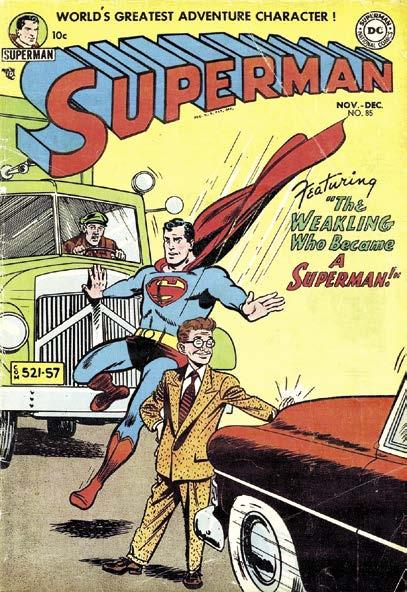
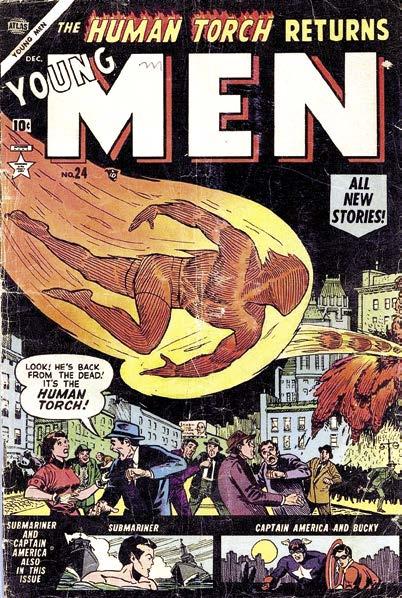
For their last covers of 1953, there could hardly have been a greater contrast between that of Superman #85 (Nov.-Dec.), one of the top-selling comicbooks in the world… and Young Men #24 (Dec.), with which Martin Goodman was trying to re-establish his “big three” World War II super-heroes after four years in limbo. Covers by Winslow Mortimer & Carl Burgos, respectively. Courtesy of the GCD. [Superman cover TM & © DC Comics; Young Men cover TM & © Marvel Characters, Inc.]
Dell/Western’s
Dell/Western comics
from the Jan. 10, 1953, issue of The Saturday Evening Post, then in its heyday as one of the most popular magazines in the U.S. Courtesy of Jim Holden. [TM & © the respective trademark & copyright holders.]
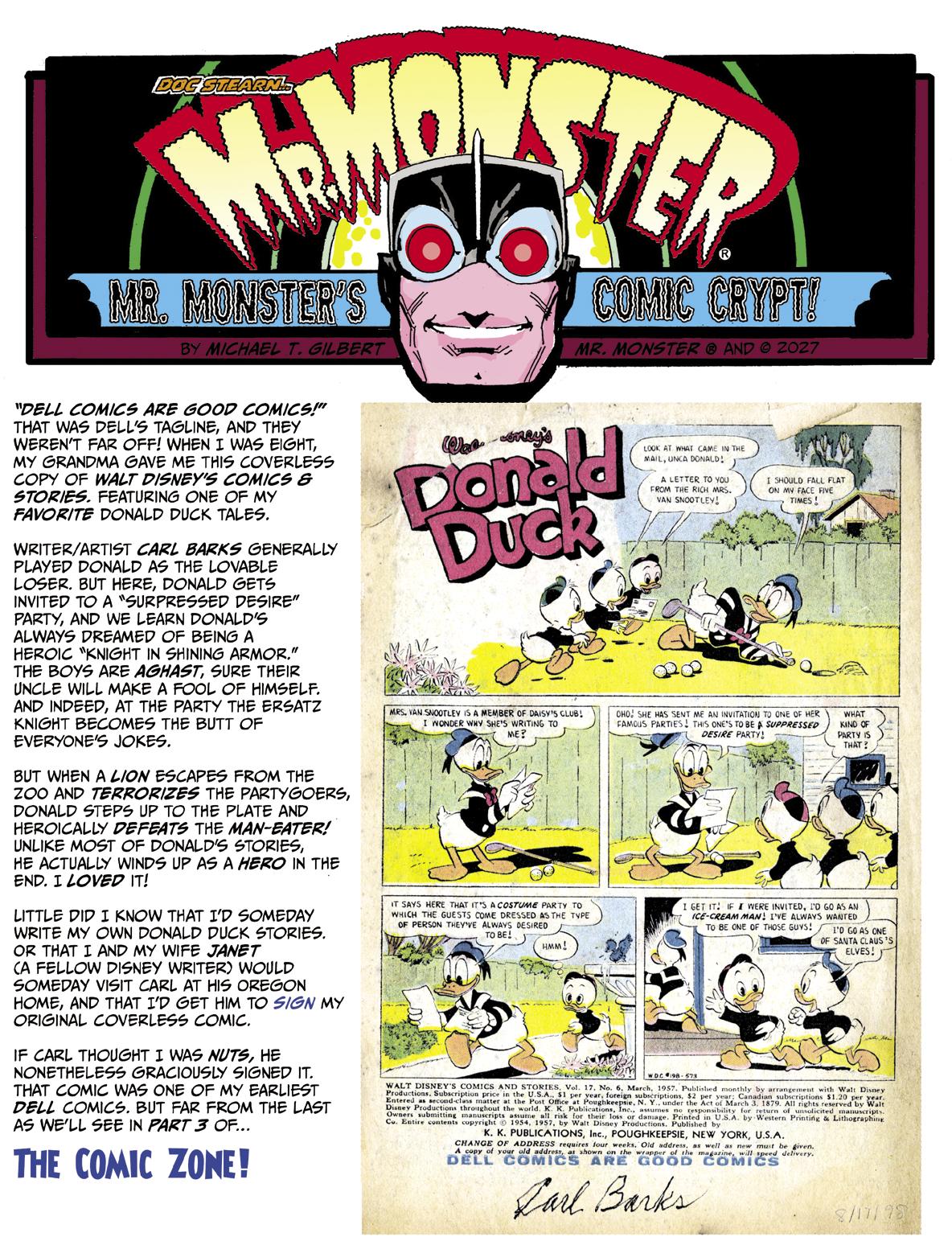
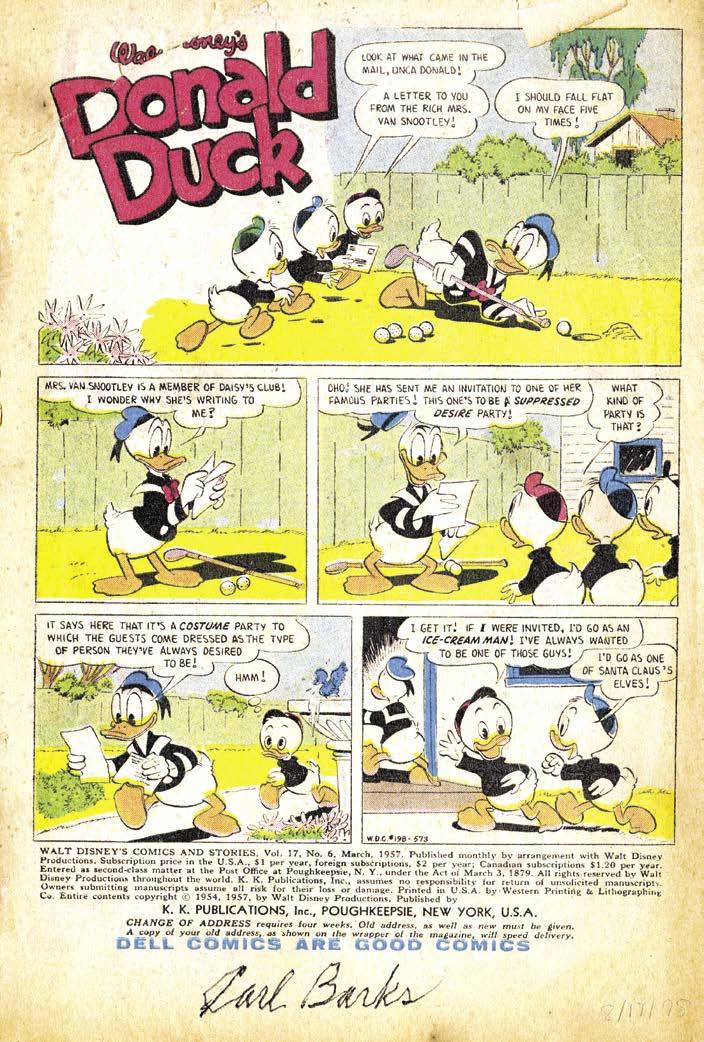
(Right:) Walt Disney's Comics & Stories v17 #6 (March 1957). Art by Carl Barks. [© Disney]
The Comic Zone (Part 3)
by Michael T. Gilbert
Most fans fondly remember their first comicbook. In the previous two “Comic Zone” installments, your humble scribe described his youthful love affair with both Marvel and DC. We’re talking late ‘50s, so I missed out on the brief Atlas-era heroes revival. But I did get in on the ground floor with the Marvel heroes, as well as their earlier monster comics. These were primarily created by my personal “Big Three,” Stan Lee, Jack Kirby, and Steve Ditko (with ample help by Larry Lieber, Dick Ayers, Don Heck, and others).
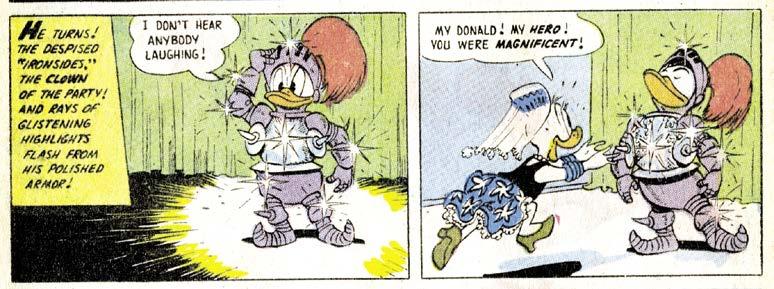
“Knight
At DC this young kid was first smitten by ‘50s-era tales of Superman and Batman. J’onn J’onzz, Green Arrow, Aquaman, Flash, and Green Lantern soon followed. DC’s mystery and sci-fi books also drew me in, chief among them Strange Adventures, Mystery in Space, House of Secrets, and My Greatest Adventure.
But… Dell?
But Dell? Well, honestly, they were strictly third-tier for me as a kid. While I enjoyed the Duck adventures in Walt Disney’s Comics & Stories and Little Lulu and Tubby comics, funny animals (and funny kids) weren’t my faves. Super-heroes, horror, and sci-fi were this kid’s meat and potatoes!
Still, there were some Dells that did interest me. I recall Grandma giving me several Tarzan comics, as written by Gaylord DuBois and illustrated by Jesse Marsh. Marsh’s drawings were staid, but for some reason the stories engaged me, possibly because I was a big fan of the Johnny Weissmuller Tarzan movies. Dell’s Western and movie comics did little for me. But, as I grew a little older, some of their comics intrigued me.
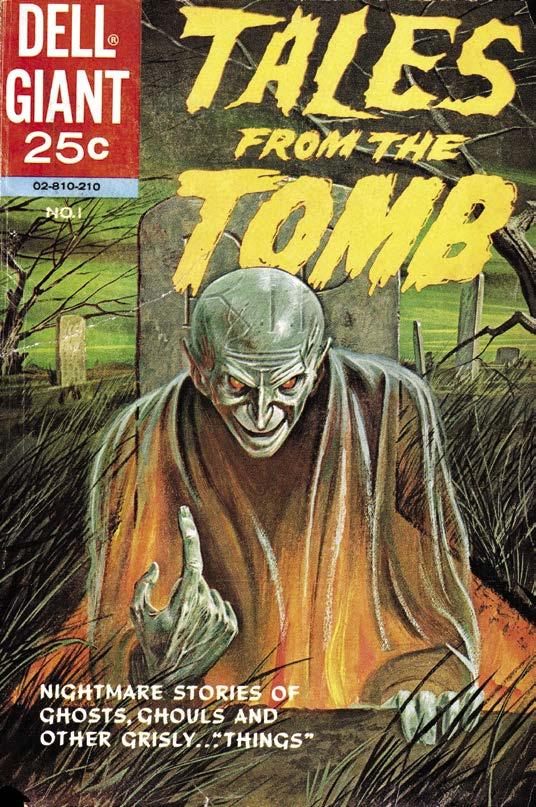
Tales from the Tomb was one such title. It was a real oddity for Dell, a double-sized horror comic from this squeaky-clean publisher. In fact, they were so clean (and such a sales powerhouse) that they never signed up with the Comics Code. As a result, they could publish horror that, in 1962, would have been censored from any other comicbook company, with the exception of Classics Illustrated publisher Gilberton, another non-signer.
The comic was edited by L.B. Cole, no stranger to horror comics. He’d contributed art and covers to many in the pre-Code era titles. Cole tapped John Stanley to write the stories, and it was an inspired choice. Stanley was legendary for his scripts and art for Little Lulu. His spooky “Witch Hazel” stories in that comic showcased his taste for the weird.
In both the one-shot Dell Giant Tales from the Tomb and the first issue of its continuing sister title Ghost Stories, Stanley told subtle tales of horror. No mere EC-style eyeball-gouging for him!
Stories like “Mr. Green Must Be Fed!” displayed a more subtle kind of horror. Here, a kindly landlady rents a room to a young man. But he soon discovers that a small throw rug next to his bed is a portal to a dimension where a green monster lurks, waiting to drag him under and gobble him down! It’s a chilling, understated tale, ably illustrated by Frank Springer, and perfect for its intended audience of young boys.
Equally disturbing was “The Monster of Dread End,” another Stanley classic, from Ghost Stories #1 (Sept. 1962). Here, a giant serpentine creature (with clawed talons!), hundreds of feet long, lurks in the sewers beneath the city. At night the creature reaches into kids’ windows, grabs them, and sucks their juices, leaving
In Shining Armor!”
One of Gilbert’s favorite “Donald Duck” stories as a kid. From Walt Disney’s Comics & Stories, Vol. 17, #6 (March 1957). Story and art by Carl Barks. [TM & © Disney.]
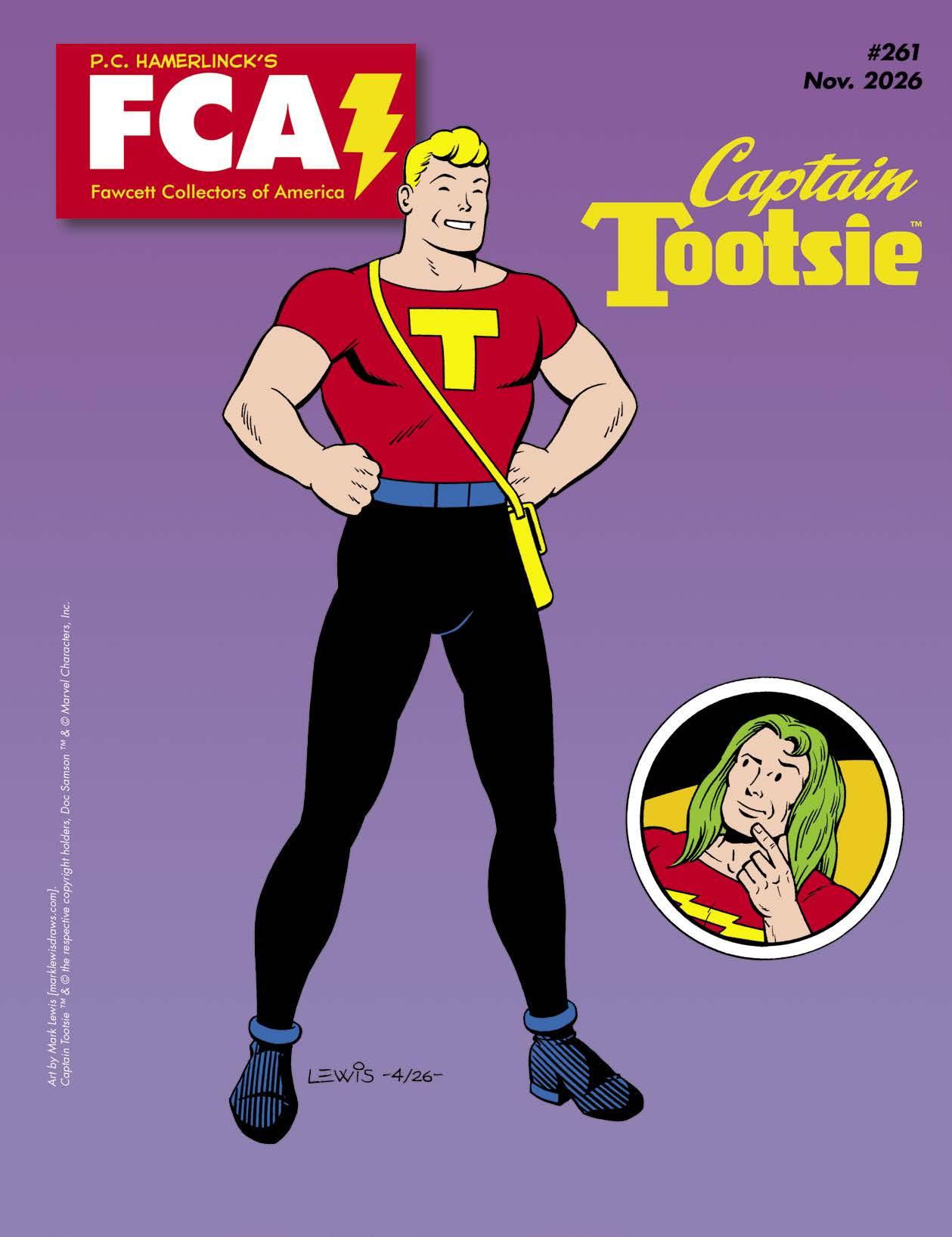
HOORAH FOR CAPTAIN TOOTSIE!
C .C . BECK’s Advertising Comic Strip Hero
by P. C. Hamerlinck
Something Chewy Going On
The advertisements found within yellowing old comicbooks were occasionally as unforgettable as the books’ own starring characters.
Predominantly directed towards impressionable young minds, these often-sensationalized ads promising the moon effectively sold thousands upon thousands of body-building courses, X-ray specs, sea-monkeys, acne creams, and, of course, candy.
Tootsie Rolls, founded in 1896, were as popular as ever during the 1940s. The chewy chocolates were even included in U.S. soldiers’ rations during World War II. (And, in the following decade, during the Korean War, not only were Tootsie Rolls a morale-boosting ration for the U.S. Marines—they also cleverly used the candy for emergency repairs to their equipment!) In 1943, to further increase sales, the company had launched an advertising
Tootsie-ing His Own Horn
campaign concerning the formation of a heroic character/mascot/ pitch-man to peddle their product—in a format that would appeal to comics readers.
Toot, Toot, Tootsie—Hello!
Artist C.C. Beck reminisced about producing a new hero for
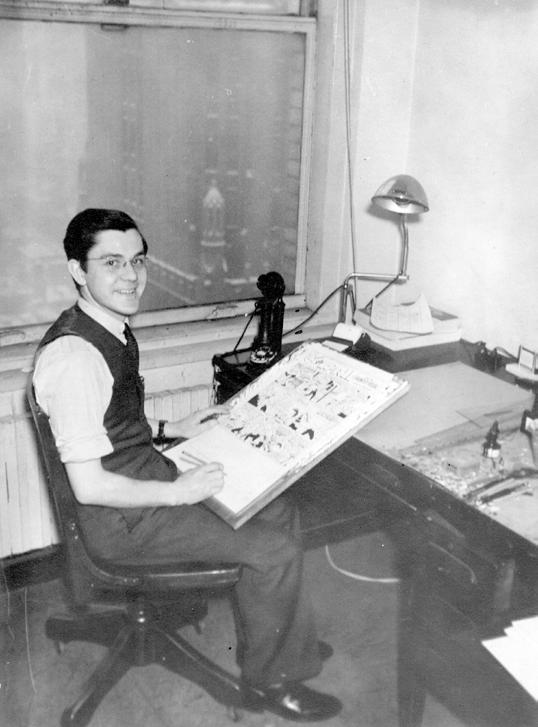
(Left:) A magnificent photograph from the Golden Age of C.C. Beck at his studio on Broadway and 40th Street, NYC. On the artist’s drawing board is the “Captain Tootsie and the Haunted House!” ad which saw print in the summer of 1944. Beck’s gleaming smile was perhaps due to the sweet wage he received for the Tootsie Roll account. The picture was scanned by the FCA editor directly from Beck’s personal photo album.
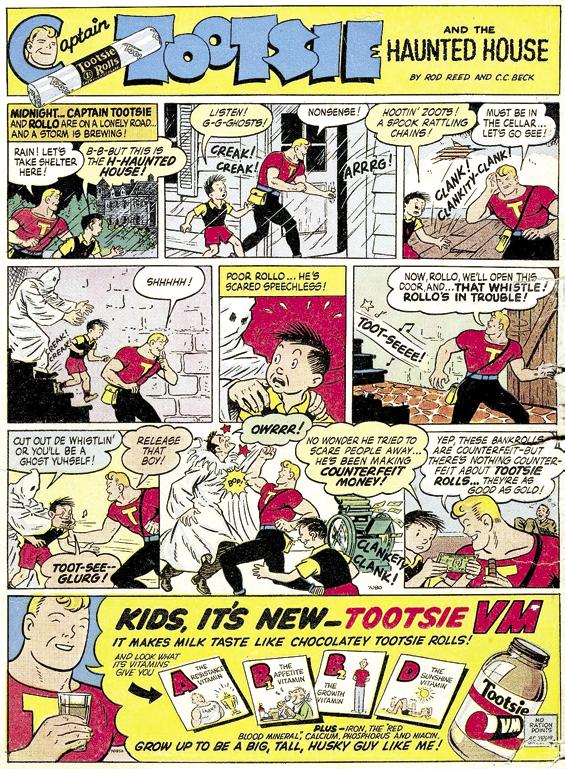
(Above:) “Captain Tootsie and the Haunted House!” (Aug. 1944) by artist Beck and writer Rod Reed. [TM & © the respective trademark & copyright holders.]
the world of advertising in a letter to Ron Goulart, dated October 31, 1981:
At the time one of the big New York ad agencies had been handling the Tootsie Rolls account before it was put in my hands. I definitely created Captain Tootsie’s physical appearance—a sort of blond version of Captain Marvel.
I worked directly with a woman from Tootsie Rolls on each of the ads. She seemed to be a member of the family that owned the company. The early scripts were written by Rod Reed, and then I wrote the rest of them myself. Pete Costanza assisted me on the strips for a while. The pay was good—two to three hundred dollars a page, which was an enormous sum in those days when comic book artists were lucky to get ten dollars a page.
Beck produced over thirty ads for Tootsie Roll from 1943 to 1949 from his studio located on Broadway and 40th Street in New York City, which he had opened in late 1941 upon Fawcett art director Al Allard’s suggestion; a second Beck-Costanza Studio opened in Englewood, New Jersey, in 1944. (For the complete story on Beck-Costanza’s other non-Fawcett work, see Alter Ego #187.)
Beck’s widely circulated “Captain Tootsie” comic strip ads were on a burgeoning “roll”—appearing regularly in multiple comicbook titles (via full-page ads and truncated quarter-page ads) as well as in newspapers nationwide (via reformatted full strips in Sunday comics sections and compact black-&-white ads in daily editions). [See near end of article for a sampling of the ads mentioned in this paragraph.]
While primarily seen in comicbooks published by Fawcett (including Captain Marvel Adventures, Whiz Comics, The Marvel Family, Captain Marvel Jr., Master Comics, Mary Marvel, Hoppy the Marvel Bunny, Fawcett’s Funny Animals, Captain Midnight, Don Winslow of the Navy, Nyoka the Jungle Girl, et al.) and DC Comics (including Superman, Action Comics, World’s Finest Comics, Superboy, All-Star Comics, Wonder Woman, Sensation Comics, Comic Cavalcade, Green Lantern, Adventure Comics, Batman, Detective Comics, etc.), “Captain Tootsie” ads were also found in titles published by Quality, Archie, Harvey, Timely/Marvel, Lev Gleason, Novelty Press, and others. Roy Thomas remembers feeling back then that the ads looked a bit as if Captain Marvel had donned a blond wig and snuck into other publishers’ magazines.
More Secret Legion Origins… And Cavities
Former Fawcett writer and executive comics editor Rod Reed was able to shed additional light on the creation of Captain Tootsie in a letter to Beck, dated November 19, 1981:
I remember at the developing stage of the strip we sat around a table
with some advertising people from the McCann-Erickson agency and everybody was straining a brain trying to think up a name for our hero when Mr. Beck said, “Why not call him Captain Tootsie?”
So simple and so perfect and something I would not have thought of if I was still sitting at that table.
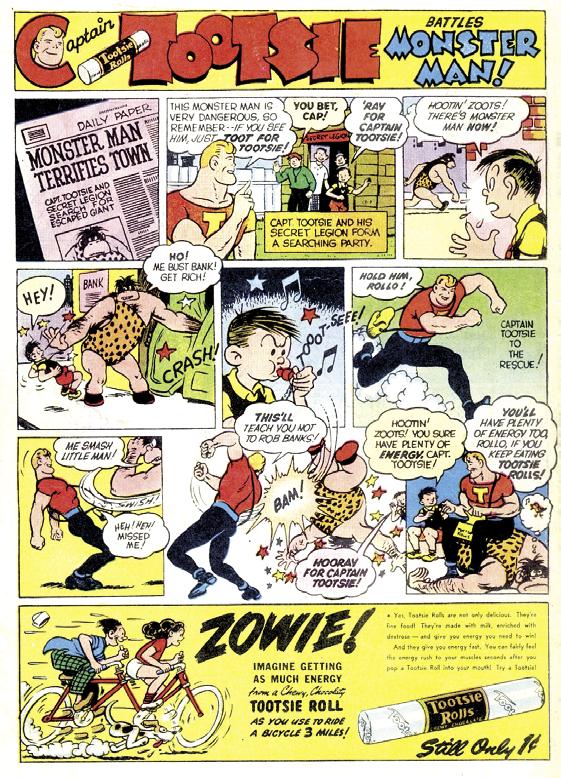
I believe I named his sidekick “Rollo” and invented the whistle (the “Tootsie Tooter”) that went “TOOOOOOT-SEEE!”
I recently found a proof of one of the Captain Tootsie ads in which a pair of dumb crooks decide to steal diamonds by throwing a brick through a store window. The words GREAT JEWEL is prominent on the window. The sound of shattering glass brings our heroes hurrying to apprehend the malefactors. Then we learn it was not really a gem store at all but the Great Jewel Candy Company. It provided a splendid opportunity to urge kids to buy Tootsie Rolls. Aren’t we ashamed to have contributed so strongly to tooth decay?
Shortly after writing to Beck, Reed shared with the FCA editor during their brief correspondence the aforementioned ad proof that he had recently found [“Captain Tootsie and the Great Jewel Robbery!” - Dec. 1943, Reed and Beck’s second CT ad]. Reed revealed to PCH that they were given full creative freedom by Tootsie Roll, and that the Reed-Beck team always split the earnings from the ads fifty-fifty.
(84-page FULL-COLOR magazine) $10.95 (Digital Edition) $4.99
https://twomorrows.com/index.php?main_page=product_info&cPath=98_55&products_id=1890
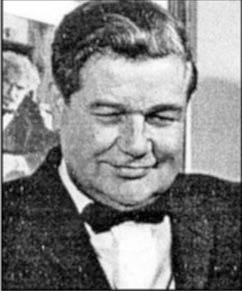
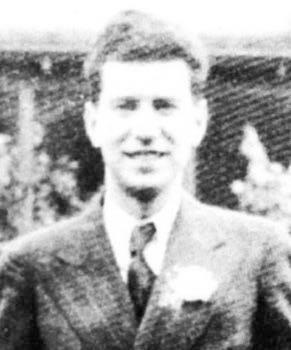
Rod Reed Pete Costanza
The Birth Of An Icon
“Captain Tootsie Battles Monster Man!” (Aug. 1943)—the introductory “Captain Tootsie” ad by writer Rod Reed and artist C.C. Beck. [TM & © the respective trademark & copyright holders.]
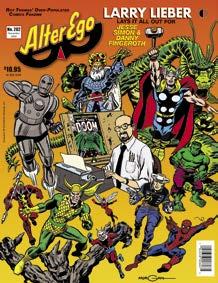
ALTER EGO #202
It’s LARRY LIEBER—original co-writer of Thor, Ant-Man, and Iron Man, not to mention the Human Torch—as well as writer/ artist of Rawhide Kid! One of the most important scripters of the Silver (and Marvel) Ages of Comics gets a full-issue retrospective conducted by JESSE SIMON (JOE SIMON’s grandson), with art by JACK KIRBY, DON HECK, and others. Plus FCA, Mr. Monster’s Comic Crypt, and more!