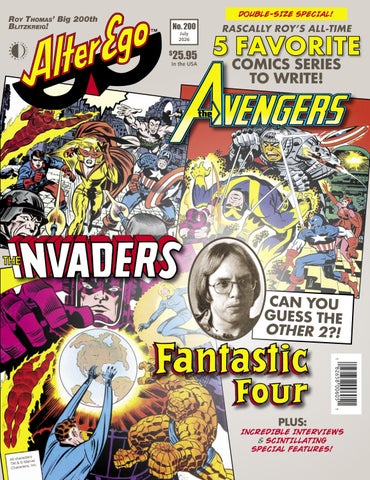
DOUBLE-SIZE SPECIAL!
Roy Thomas’ Big 200th Blitzkreig!
No. 200 July 2026
$
25.95
In the USA
RASCALLY ROY’S ALL-TIME
5 FAVORITE COMICS SERIES TO WRITE!
THE
CAN YOU GUESS THE OTHER 2?!
PLUS:
INCREDIBLE INTERVIEWS & SCINTILLATING SPECIAL FEATURES! ters All charac vel Mar TM & © s, Inc. Character
Vol. 3, No. 200/July 2026 Editor
Roy Thomas
Associate Editor Jim Amash
Design & Layout
Christopher Day
Consulting Editor John Morrow
FCA Editor
P.C. Hamerlinck J.T. Go (Associate Editor) Mark Lewis (Cover Coordinator)
Comic Crypt Editor
Michael T. Gilbert
Editorial Honor Roll
Jerry G. Bails (founder) Ronn Foss, Biljo White Mike Friedrich, Bill Schelly
Proofreader
William J. Dowlding
Cover Artist
Jack Kirby (penciler) with various inkers
Cover Colorist
the original colorists
With Special Thanks to: Heidi Amash Pedro Angosto Ger Apeldoorn Richard J. Arndt Jean Bails Josh Baker Diego Bernard Jenny Blake Bernie Bubnis Jarrod Buttery John Caputo Nick Caputo Dewey Cassell Joe Cicala John Cimino Shaun Clancy Comic Book Plus (website) Pierre Comtois John Cornell Phil Couto Ray Cuthbert Theresa R. Davidson S.E. Dogaru Jean-Michel Ferragatti Michael Finn Shane Foley Richard Fowlks Joe Frank Brendon Fraim Brian Fraim Benito Gallego Bambos Georgiou
Janet Gilbert Grand Comics Database (website) Dan Hagen George Hagenauer John Joshua Dale Kinney Estate of Jack Kirby Todd Klein Bob Layton Ron Marz Robert Menzies Mike Mikulovsky Bill Mitchell Barry Pearl Barry Reese Buz Rico Joe Rubinstein Randy Sargent Richard Seetoo George Sellas Kirk Spencer Frank Squillace Marc Steiner Marc Svensson Dann Thomas John Trumbull Tom Vincent Kelly Walton Cind Ward Munch Week Jeff Wong Cat Yronwode Larry Zdeb
This issue is dedicated to the memory of
Bill Schelly
who was there 200 issues ago
Contents Writer/Editorial: “Five Favorite Features” . . . . . . . . . . . . . . . . 2 Roy Thomas’ cosmic countdown of the comics he’s most loved to write over the decades!
#5 – FANTASTIC FOUR . . . . . . . . . . . . . . . . . . . . . . . . . . . . . . . 3 #4 – THE INVADERS . . . . . . . . . . . . . . . . . . . . . . . . . . . . . . . . 20 #3 – THE AVENGERS . . . . . . . . . . . . . . . . . . . . . . . . . . . . . . . 39 #2 – CONAN THE BARBARIAN . . . . . . . . . . . . . . . . . . . . . . . 60 #1 – ALL-STAR SQUADRON . . . . . . . . . . . . . . . . . . . . . . . . . 76 Mr. Monster’s Comic Crypt! The Comic Zone (Part 1) . . . . 89 Michael T. Gilbert recounts his favorite DC Comics stories from his early years.
9 Conversations With The Cast & Crew Of Alter Ego . . . . . 99 Richard J. Arndt artfully interviews John Morrow, Jim Amash, Michael T. Gilbert, P.C. Hamerlinck, Chris Day, Shane Foley, William Dowlding, John Cimino—& himself!
re: [correspondence, comments, & corrections] . . . . . . . . 142 FCA [Fawcett Collectors Of America] #258 . . . . . . . . . . . . 149 P.C. Hamerlinck does a deep dig into the rise of Fawcett Publications.
On Our Cover: Sometimes an A/E cover comes together fast and easy, even when we figured that coming up with the right concept and images would be like pulling teeth. When Roy mentioned he’d like to showcase scenes from Fantastic Four, The Invaders, and The Avengers (since the other two of his “five favorite” comics to write weren’t Marvel-owned so couldn’t be featured on the same cover with the preceding threesome of mags), our peerless publisher John Morrow suggested a trio of images by the King himself—Jack Kirby. The covers of FF #173 (Aug. 1976) & Invaders #12 (Jan. 1977) were naturals—but Jack had never drawn an Avengers cover (let alone an interior page) during Roy’s 70-issue run. But voila! John came up with Jack’s cover for Marvel Triple Action #29 (Aug. 1976)), which had reprinted Avengers #37… and everything fell into place. Inks respectively by Joe Sinnott, Joe Sinnott, & Dan Adkins. [Art TM & © Marvel Characters, Inc.] Above: The last “All-Star Squadron” yarn that DC invited Roy Thomas to write was a 10-page story in All-Star Comics 80-Page Giant #1 (Sept. 1999)—yep, last century! It spotlighted the foursome depicted in these two panels—plus Donar the Teutonic thunder god, as drawn by Kevin Sharpe & Jason Baumgartner. Oh, well, who knows—maybe before this century’s over, Roy will get another shot at scripting his favorite feature…! [TM & © DC Comics.] Alter EgoTM issue 200, July 2026 (ISSN 1932-6890) is published bi-monthly by TwoMorrows Publishing, 10407 Bedfordtown Drive, Raleigh, NC 27614, USA. Phone: (919) 449-0344. Periodicals postage paid at Raleigh, NC. POSTMASTER: Send address changes to Alter Ego, c/o TwoMorrows, 10407 Bedfordtown Drive, Raleigh, NC 27614. Roy Thomas, Editor. John Morrow, Publisher. Alter Ego Editorial Offices: 32 Bluebird Trail, St. Matthews, SC 29135, USA. Fax: (803) 826-6501; e-mail: roydann@ntinet.com. Send subscription funds to TwoMorrows, NOT to the editorial offices. Six-issue subscriptions: $80 US, $121 Elsewhere, $29 Digital Only. All characters are © their respective companies. All material ©their creators unless otherwise noted. All editorial matter © Roy Thomas. Alter Ego is a TM of Roy & Dann Thomas. FCA is a TM of P.C. Hamerlinck. Printed in China. FIRST PRINTING.
3
A Special 200th Issue Overview!
RASCALLY ROY THOMAS’
5 FAVORITE COMICBOOKS TO WRITE! An Awesome Overview by The Boy Himself
I
#5 – FANTASTIC FOUR
really wanted to become the second person to write Marvel’s Fantastic Four. Can you doubt it?
After all, FF had become one of my favorite comics on the day I first spotted it at Metro News store in Cape Girardeau, Missouri, in early August of 1961… ...and Ben Grimm, whom writer/editor Stan Lee would refer to playfully as the ever-lovin’, blue-eyed Thing, would become and forever remain my favorite among all the myriad of heroes spawned by what soon became Marvel Comics. Spider-Man… the Hulk… even characters I myself co-created such as the Silver Age Vision… none of them ever eclipsed Aunt Petunia’s rock-bodied nephew. Between them, whichever man came up with the original idea (and that battle will probably rage on forever), Stan as editor and scripter and Jack Kirby as pencil-artist and co-plotter, had together conceived as perfect a grouping of miraculous misfits as ever bum-rushed a Kong-sized monstrosity on a comicbook cover. I jumped on the prospective bandwagon at once, banging out a two-page review (if it can be dignified by that term) of FF #1 that was, before month’s end, published in the first issue of Dr. Jerry Bails’ new ad-fanzine The Comicollector. Alas, however, my fervent desire to be the person to whom Stan tossed the FF baton when it became time to relinquish it—was not to be fulfilled. In 1971, when Stan stood aside for four months from the scribing of FF, Amazing Spider-Man, and Thor so that he could co-write a film screenplay with the acclaimed French New Wave director Alain Resnais, I thought my chance had come. When he told me that others would have to handle the script chores of those three remaining Lee-written features for the next four issues, I instantly piped up that I wanted to take over the FF for that interim. Kirby may have left the previous year for DC, but Big John Buscema had proved an ample replacement— insofar as anyone could ever hope to fill the FF boots of the departed King.
Fantastic! (Above:) The John Buscema/Joe Sinnott cover of Fantastic Four #119 (Feb. 1972), which guest-starred The Black Panther—er, excuse us, we should’ve said The Black Leopard. The story inside was the first “FF” saga Roy ever scripted—but, of course, he wrote the cover copy as well. Courtesy of the Grand Comics Database. [TM & © Marvel Characters, Inc.] (Left:) The closest Roy T. ever got to cosplaying as one of the FF occurred when his first wife Jeanie wore the unisex “FF” outfit that Marvel had once had made for a NYC parade and later gifted to Roy. That’s the Rascally One in the Spidey costume from the same not-quite-occasion. The photo was taken at one of the fabled Rutland, Vermont, Halloween parades and was first seen in the fanzine Comic Crusader #8 (1969). Photo by Richard Fowlks.
4
Rascally Roy's 5 Favorite Comicbooks To Write
Rudyarda, Here We Come! The splash page of FF #119, by the same Thomas/Buscema/Sinnott team—and a scene of the Torch and the Thing doing the rounds in “Rudyarda,” a stand-in for South Africa whose name was, as you probably already guessed, derived from that of Rudyard Kipling. After all, there once was a country in Africa called Rhodesia after Cecil Rhodes, right? Courtesy of Barry Pearl. [TM & © Marvel Characters, Inc.]
Stan, however, had other ideas. He knew, as well as I did, that—especially with my having increased editorial duties as well while he was pursuing his cinematic muse—I could handle only one additional monthly mag— —and he had decided he wanted me to write Amazing Spider-Man, from issues #101 through 104. What Stan wanted, Stan got… without any feckless crying from his loyal associate editor… so I teamed up with artist Gil Kane on the company’s best-selling title, and had a blast co-creating Morbius the Living Vampire for two issues, and sending Peter Parker and friends off on a film expedition to Ka-Zar’s sub-Antarctic Savage Land for the remaining two… …and Archie Goodwin took over the writing reins of FF #115-118. (And did a perfectly fine job of it, too.) After that, things get a bit fuzzy in my memory. I’ve no recollection, for instance, of how or why I wound up scripting Fantastic Four #119—with Stan taking a fifth month in a row
John Buscema & Joe Sinnott From the 1969 Fantastic Four Annual
off from his FF run, while he picked Spider-Man back up with #105. All that counts, I suppose, is that I was ready, willing, and (I hope) able to oblige. Months before, I had come up with the idea for an 8-page “Black Panther” tale to fill out The Avengers #94, which was supposed to be the second-in-a-row of our company-wide 48-pagers priced at a hefty 25¢ as the new industry standard. Stan had suggested I approach volatile artist Alex Toth to draw it, which I did—with unhappy non-results that I’ve no space to go into here. Suffice it to say that I soon shelved the Panther idea and got John Buscema to draw a segment of that “Kree-Skrull War” issue instead. That left the Panther idea still floating around in my head when Stan abruptly asked me to spell him on FF for an additional month (I think Archie was feeling a bit over-extended by that point)… and I gave him back an elated yes, of course.
5
#5 – Fantastic Four
Signs Of The Times (Above:) Partway through FF #119, T’Challa points out one of his least favorite sites in Rudyarda—and (at right), on the story’s final page, Ben Grimm displays his own visceral reaction to same. Script by RT; art by Buscema & Sinnott. Courtesy of Barry Pearl. [TM & © Marvel Characters, Inc.]
The story I’d had in mind for Toth turned out to work out far better as a full-bore Fantastic Four #119 (Feb. 1972) guest-starring T’Challa (very briefly re-calibrated, by Stan’s edict, as the Black Leopard). Set in the fictitious nation of Rudyarda—a stand-in for apartheid South Africa—it caused a minor ripple in comics circles as one of the earlier four-color stories to examine that vile racist system, even if through the lens of super-hero fantasy. With Buscema the Elder as my co-crusader, I’m kind of proud of that little story, especially its final panel, with its echoes of the restroom and drinking-fountain segregation which was only finally coming to an end in the American South itself. Stan returned to writing FF for what I suppose he expected would be another lengthy run—although I suspect that, during this time, he was also beginning to negotiate secretly with Marvel’s conglomerate owner Perfect Film & Chemical (soon to be rebranded
“The Way It Began!” (Far left:) Roy launched his first real run on Fantastic Four with #126 (Sept. 1972), around the time he became Marvel’s editor-in-chief under new president & publisher Stan Lee. He used the first issue mostly to re-tell the group’s decadeold origin, and to introduce a new look for the flaming Human Torch. Art by John Buscema & Joe Sinnott. Courtesy of the GCD. (Left:) Ere long, that issue’s story was dramatized old-time-radio style by Power Records, using the #126 cover—except that a number of line details dropped out of the Torch’s figure. Thanks to Jarrod Buttery. [TM & © Marvel Characters, Inc.]
20
RASCALLY ROY THOMAS’ 5 FAVORITE COMICBOOKS TO WRITE!
T
#4 – THE INVADERS
he Invaders was definitely my favorite among the titles and concepts I made up for Marvel—ever.
That’s partly because I had always had something of an interest in the history of the Second World War, which was ending just as I was vaguely becoming aware that it was going on… and partly because, between 1945 and 1949, and again from late 1953 to 1955, I loved reading the exploits of The Human Torch, the Sub-Mariner, and (admittedly to a slightly lesser degree) Captain America, and had always wanted to see the three of them together in a story. (I’m still at a loss for how I somehow seem to have missed both All Winners Comics #19 & #21, which had sported the only two vintage adventures ever of the All Winners Squad that included those three, plus their kid sidekicks, Miss America, and The Whizzer.) So, when I stepped down (or, in another sense, was kicked off the ledge) as editor-in-chief at the end of August 1974, it seemed the most natural thing in the world for me to suggest to Stan a WWII assemblage of Timely’s 1940s “Big Three” as one of the new titles I would handle under my new writer/editor contract. I wanted books like the Conan, Kull, and Red Sonja titles, which would keep me free from ongoing Marvel continuity, since I didn’t want to have to deal with my twin successors, Len Wein and Marv Wolfman (however much I liked and respected them personally), or with other writers, over conflicts guest-starring Spider-Man or some such. (What If…? was the other concept I quickly presented to Stan as a vehicle for myself, although it took a bit longer to get launched, and I soon decided I didn’t really want to write all those alternate-dimension stories after all.) Even though he himself probably wouldn’t have started a series set in the past, Stan was amenable to the idea of the WWII super-heroes, since the three leads might draw in some coin as a sort of 1940s Avengers. Which is more or less how I presented it to him. Then came the kicker. “What do you want to call it?” he asked. “The Invaders,” I shot back. Stan thought a moment. Then: “I like that name!” And the series was approved by my usually esteemed mentor/publisher. And well he should have liked the name! After all, I had swiped it from him. As I’ve recounted before: A few years earlier, on the heels of that book-length Hulk/Sub-Mariner battle in one of the last anthology issues of Tales to Astonish, Stan had toyed ever so briefly with the notion of “permanently” co-starring Namor and Ol’
The Times, They Are A-Changing! (Left:) The Frank Robbins/John Romita cover of GiantSize Invaders #1 (June 1975), courtesy of the GCD. (Below:) For the cover of the huge Invaders Omnibus in 2021, Marvel removed the swastika, lest it prove a turn-off to some consumers or retailers. The more than 1000 pages of stories inside, however, were left unaltered, since they are historical artifacts. Weirdly, the writing credits on the title page within are listed as “Roy Thomas & Don Glut with Ed Summer & Co”—an oddity (as well as a downright error), since Roy’s late NYC friend Ed Summer never did any scripting for the series. Roy wonders if maybe he snuck Ed in a credit somewhere for a general story idea? [TM & © Marvel Characters, Inc.]
Greenskin in TTA… and calling them as a team “The Invaders.” He might even have gone ahead with his whim, except that just two months later Subby, the Hulk, and Marvel’s four other anthology series were all spun off into their own solo titles. From 1968 to 1974, Stan never mentioned his “Invaders” concept again. For my part, I never ever brought up to Stan the subject of where I’d gotten the name I proposed for my new comic. Who knows? It might’ve made him think I was devious or something. Anyway, someone (Len? Marv? other?) suggested Frank Robbins as the penciler, since that well-respected writer/artist of the comic strip Johnny Hazard (and of recent “Batman” stories for DC) was looking for work as the world of newspaper comics contracted gradually, meaning many of them were less lucrative than they once had been—adventure strips in particular. I always wondered if, because Frank had a style of figure-drawing that didn’t lend itself especially well to drawing Marvel action heroes, someone may have foisted him off on me because they didn’t want to be pushed to use him elsewhere… but maybe I’m just being paranoid. In any event,
21
#4 – The Invaders
because I knew that Frank Robbins (like his resident #1 fan, art director John Romita) had been strongly influenced by the great Milt Caniff of Terry and the Pirates and Steve Canyon fame, I accepted the choice without any pushback.
Frank Robbins
Still, I suspected from the start that some readers would find Frank’s action figures a bit “rubbery” compared to those of Kirby, Romita, and Buscema. Thus, since Frank only wished to pencil, not ink, I decided I would team him up with an inker who would make his work more closely resemble (I hoped) that of the above-named Marvel stalwarts.
hard at work on his long-running Johnny Hazard comic strip.
I chose Vince Colletta, who had begun his Marvel action career inking Gene Colan on “Sub-Mariner” and had become quite popular as the inker for years of Thor.
When Ol’ Frank, Frank Robbins Comes Bob-Bob-Bobbin’ Along Frank Robbins’ “Batman” splash page from Detective Comics #426 (Aug. 1972). He wrote this one as well as drawing it. Thanks to Michael T. Gilbert. [TM & © DC Comics.]
The combination may have not pleased Frank that much (he never said)… but it did placate the readers. In a little while, I’ll tell you how I know. Stan, as publisher, originally started the book off as another of our ongoing breed of 48-pagers as opposed to 32-pagers (not counting covers), so I wrote out a synopsis for a 30-page origin for what was titled Giant-Size Invaders #1. Partly as a humorous wink at the title, I did indeed have Frank draw for the cover Godzilla-size figures of the three main heroes and sidekicks Bucky and Toro advancing on Adolf Hitler’s “Fortress Europa,” which Romita fixed up a bit here and there when he inked. I filled up the back part of the issue with a reprint of one of the early-’40s “Sub-Mariner” stories of which we had found proofs somewhere or other, probably in what passed for Marvel’s “warehouse.”
Swingtime For Hitler The Invaders square off with Adolf Hitler on the splash page of Giant-Size Invaders #1. Script by Roy Thomas; pencils by Frank Robbins; inks by Vince Colletta. Courtesy of Barry Pearl. [TM & © Marvel Characters, Inc.]
The lead story itself provided a way to get the five heroes together not long after the attack on Pearl Harbor, and to introduce a new Nazi villain: Master Man. (That had been the name of an early Fawcett imitator of Superman that DC apparently pressured out of existence, but it seemed to fit a representative of Germany’s alleged “master race” even better.)
Vince Colletta
And I rung in British prime minister Winston Churchill both to give The Invaders
22
Rascally Roy's 5 Favorite Comicbooks To Write
story of “The Ring of the Nebulas” into a two-parter… behind a stunning cover of aerial battle by Romita. I got two #1’s instead of one… not a bad deal, all things considered.
Bill Everett in a 1939 photo, taken around the same time he created the Sub-Mariner— and Centaur hero Amazing-Man.
I did wince at some of those rubbery figures of Frank’s in the pencils… as did Romita, his fan, who professed not to understand why he didn’t manage to get a bit closer to what Marvel wanted. However, the Colletta inks covered up some of those artistic “sins,” even if Frank himself (whom I barely knew, except now over the phone from Los Angeles) probably figured his artwork was being watered down. Well, maybe it was… but there was commercial method in my madness.
And, due to his romance-comic background, Vinnie made the Robbins women look even more beautiful. One thing I absolutely loved about Frank Robbins’ art was its authenticity. As a newspaper adventure artist since WWII, he knew (and loved) the history of that period. Thus, his characters’ clothes (including military uniforms) and hairstyles, their automobiles and airplanes and submarines and the like, were always “spot-on,” as the English say. I don’t believe I ever had to send Frank a single piece of reference on the period… a distinct difference from what I'd find in dealing with other artists on similar material.
“Deep-Sea Blitzkrieg” This 20-page tale of Prince Namor from Sub-Mariner #1 (Spring 1941) filled out the back 40% storywise of GSI #1. Story & art by Bill Everett. [TM & © Marvel Characters, Inc.]
their official team name (with a clear pedigree) and to place the series in actual time, since Churchill did indeed rush over to the White House in late December of 1941 to confer with U.S. President Franklin D. Roosevelt, now that the two were official allies against the Third Reich, Fascist Italy, and Imperial Japan. The mag’s title, in some ways, dictated at least part of its direction. A group called The Invaders needed to be an attack squad (in the spirit of The Avengers), not a more protective one (as suggested, for example, by naming another cabal The Defenders). That meant I was likely going to have to push Cap and crew into overseas battle against the Axis, probably based at least parttime in Great Britain, rather than defending the U.S. Home Front. Would that approach work over the long haul, with an audience that was certainly far more interested in America than in what happened across the Atlantis and Pacific? I’d find out. Giant-Size Invaders only lasted one issue, however, before Stan decided to change its status to a regular-sized monthly book. Well, I didn’t mind that much. After all, extra-length comics often didn’t sell as well as the normal now-25¢ ones (think Silver Surfer and the enlarged Not Brand Echh)—and The Invaders was basically a new concept, which would have to fight for its place in the four-color sun. I believe I had already begun GSI #2 by the time of the downsizing, but it was easy to turn my Wagnerian-opera-inspired
Over the issues to come, I established a pattern I liked with the villains. Mainly, I tended to treat some of them as the Marvel dopplegängers of DC Comics’ heroes… except for Master Man, who was more a takeoff on Captain America than anything at DC. Thus I came up with Nazi nasties like U-Man (more a response to Aquaman than to Sub-Mariner)… Baron Blood (a bit like Batman… but, being a vampire, probably more influenced by Harvey Kurtzman & Wally Wood’s parody “Batboy & Rubin” back in Mad #8)... Blue Bullet (Fawcett’s and now DC’s Bulletman)… Warrior Woman (Wonder Woman)… The Scarlet Scarab (Charlton’s Blue Beetle—who would soon be a DC character). And then there were The Crusaders, “heroes” who turned out to be Nazi The “Nietschean Nightmare” agents, each one at least a Master Man—the antagonist who first partial nod to a hero once brought Cap, Namor, and the Torch together published by the Quality (to do battle with him)—was a sort of Nazi Comics Group. version of Captain America, and likewise I tossed in at least one other Marvel evil
created via a chemical process. Script by RT, art by Robbins & Colletta. Courtesy of Barry Pearl. [TM & © Marvel Characters, Inc.]
39
RASCALLY ROY THOMAS’ 5 FAVORITE COMICBOOKS TO WRITE!
T
#3 – THE AVENGERS
his one’s going to be a wee bit different.
Roy T. & Friends
You see, way back in Alter Ego #13 (March 2002), in a partially Avengers-centered issue, I scribbled a piece I called “Avengers Is Mine!,” which covered my career as the second-ever scripter of The Avengers from #35 through #50… which of course was still 53 issues away from being complete, even discounting an Avengers Annual or two in there.
(Right:) Roy poses with the license plate for the Thomases’ new self-driving Tesla, which they’ve nicknamed “Ultron.” See p. 47 for the story behind this pic taken by Dann Thomas. For a photo of interviewer Shane Foley, see p. 122.
Even since 2012, A/E’s now official “maskot” artist—Australia’s own Shane Foley—has been bombarding me (well, he sent an e-mail from time to time) with requests that I complete that study. And so I've meant to do—for a quarter of a century now.
(Below:) The splash page of The Avengers #35 (Dec. 1966), the first issue scripted by Roy—though from a Stan Lee plot fleshed out by artist Don Heck. Courtesy of Barry Pearl. [TM & © Marvel Characters, Inc.]
A couple of years back, Shane and I finally met in person at the Supanova Con in Brisbane, Australia… and I promised him that, if he’d send me a list of questions about that later bunch of Avengers issues, I’d answer them in print sometime. And so I’ve decided, out of a combination of deadline desperation (perhaps compounded by a hint of intellectual laziness) to treat his 2024 questionnaire as a sort of “interview” and respond as best I could. I probably had to delete a query or three, or this thing would’ve extended into A/E #201, but I hope it’ll tell much of what anybody might care to know about my 70-issues-plusannuals-plus-the-odd-fill-in run on The Avengers. And we’re off…. SHANE FOLEY: As of #50, you’d effectively cleared out the membership [by having Hercules depart]. You’ve said many times that you were often plotting by the seat of your pants, issue by issue—but was there some long-range plan here, such as making way for the Panther and The Vision? You said in Comic Book Artist #2 that Stan had ordered the departure of Captain America: Did he want perhaps a total membership shake-up? You’ve said an android Vision was Stan’s directive. Was bringing in the Panther also a Stan directive? At this point, were you toying with the idea of bringing Black Knight into membership, or was he always to be a mysterious ‘background’ character (which I thought worked very well indeed)? ROY THOMAS: Whew! Was that only one question, Shane? I’ll make it simple: I don’t think either Stan or I was thinking in terms of a big “membership shakeup,” but we did want to move characters in and out from time to time. The only real disagreement we had was my desire to keep Cap, Iron Man, and Thor in on a full-time basis, and I didn’t achieve that until a bit after #50. (And I don’t specifically recall if Stan decided Hercules should leave the group, or if that was my decision. Probably his, which was fine Dashin’ Donnie Heck by me. After all, he was only a stand-in had drawn the great till I could get Thor back, as far as I was majority of Avengers since concerned.) Lee & Kirby launched the title. From Marvel Tales Annual #2 (1964). [TM & © Marvel Characters, Inc.]
Actually, Stan didn’t want an “android Vision” in the group… he just
wanted an android as the newest member. It was I who made the newbie an android with the name and look of the 1940s Kirby hero from Marvel Mystery Comics, and Stan let me get away with it. He wasn’t wild about the old Vision, either in name or concept. The Panther (with the “Black” temporarily removed from his name) was definitely Stan’s “suggestion” as an Avenger. And I never had a strong thought about whether I wanted my Black Knight “in” or “out”… but he’d always be around and available. SF: With #51, what was the rationale to change Goliath’s colors? To get
40
Rascally Roy's 5 Favorite Comicbooks To Write
back to Giant Man’s colors or to a more dynamic scheme? (I thought the color scheme intro-ed here of red and blue with the yellow trims was the best! Loved the tweaked headgear that started in #46, too.) But with coloring being one of the last things done, how on Earth did that note on page 1 ("we know we colored him wrong on the over”) get there? Wouldn’t that have had to be lettered long before coloring? And if the change was seen as a good move, why keep the old colors on the cover?) Was this an example of you “sneaking” Thor and Iron Man back in, hoping Stan wouldn’t object? Or was he fine with the idea? THOMAS: Yes, I sorta sneaked ’em back in—and he quickly made me take them out again. I could use them only as occasional guest stars. As to the note about the cover coloring, I’ve no memory of how that happened, so I won’t speculate. SF: #52—Was the thinking on changing the Panther—dropping “Black” and showing his face—entirely to do with the Black Panthers group? Was the open face purely to show he was a black African character? Yet, only two months later, in #54, you were happy to call him “Black Panther” again; then after only four months, by #56, the full mask was back and so all the changes were undone. What changed? THOMAS: Stan’s mind. He loved the name “Black Panther,” but didn’t want it confused with the controversial movement. The brief “Black Leopard” period was part and parcel of that, too. He also went back and forth on whether to have a full face-mask or something less on T’Challa, for the reason you suggest.
Big Colors! The John Buscema/Joe Sinnott cover of Avengers #51 (April 1968) displayed Goliath, the once-and-future Giant-Man, is his recently familiar purpleand-yellow garb… while, within, he was suddenly dressed out in red-andpurple. Pretty much the only explanation for the note at bottom left of the latter is that that issue’s cover had been irrevocably colored way earlier than usual! Interior inks by George Tuska. Courtesy of the GCD & Barry Pearl, respectively. [TM & © Marvel Characters, Inc.]
…So Shall Ye Reap! (Left:) The cover of Avengers #52 (May 1968) spotlighted both the Panther and spankingnew villain The Grim Reaper, courtesy of John Buscema (pencil & ink!). Roy isn’t sure about the cover, but all 20 interior pages had been penciled by Big John with T’Challa sporting a full face-mask à la his previous appearances—but, at the last minute, Stan had someone (inker Vince Colletta?) change the drawings to show the bottom half of his face. T’Challa’s, we mean, not Stan's—or Vinnie’s. Courtesy of the GCD. (Right:) When it came time for all or part of that story to be reprinted by Marvel UK (which actually operated out of the Marvel offices in NYC), Ron Wilson did the penciling honors for that division’s Avengers #71 (Jan. 25, 1975). Inker uncertain. Courtesy of Shane Foley. [TM & © Marvel Characters, Inc.]
43
#3 – The Avengers
New Avengers For Old! (Left:) The timetossed 1968 Avengers invade the sanctum of the 1963 gang—and let somebody else worry about the fact that Captain America, Hank Pym, and the Wasp are in both groups! Layouts by Don Heck; finished pencils by Werner Roth; inks by Vince Colleta; script by Roy T. Thanks to Barry Pearl. [TM & © Marvel Characters, Inc.]
Terminator 2 used it. Multiverse themes with multiple versions of characters are now overused in the extreme! Aaarrgghh!) THOMAS: I suppose Julie Schwartz’s Earth-Two was the general inspiration for that tale in which new Avengers fought old, although it had a different feel to it. And yes, I think multiverses eventually got very much overused. But if I do one, I can hardly deny someone else’s right to do the same. SF: In #57 & 58? If you’d had your way and been able to bring in the original Simon & Kirby Vision instead, would you have kept his Spectre-like powers? If so, The Avengers
…And Your Young Men Shall See Visions (Below left:) The Golden Age Vision’s dramatic debut in Marvel Mystery Comics #13 (Nov. 1940) pre-dated even Captain America Comics #1. Kirby is known to be the major artist; it’s unknown if Joe Simon participated, since there’s no familiar “Simon & Kirby” byline. Scripter also uncertain. His real name in his alien dimension, by the way, was Aarkus the Destroyer… although maybe that last part was just a nickname. Reproduced from the lovingly restored hardcover Marvel Masterworks: Golden Age Marvel Comics, Vol. 4. (Below right:) John Buscema certainly saw a photocopy or some such of that earlier splash, which perhaps influenced (or perhaps did not) when it came time for him to pencil the cover of Avengers #57 (Oct. 1968), surely one of the most celebrated covers of the latter ’60s. There’s controversy over whether the inks are by George Klein or by Buscema himself; Roy’s money is on Klein. Courtesy of the GCD. [TM & © Marvel Characters, Inc.]
60
RASCALLY ROY THOMAS’ 5 FAVORITE COMICBOOKS TO WRITE!
#2 – CONAN THE BARBARIAN C ome to think of it, this segment is going to be a bit different, too—just in a different way.
First of all, although the title above might seem to refer primarily—or even solely—to the color Marvel comic that I helped launch in 1970 and which I was writing a second time around when it was canceled in 1994, I pretty much count Conan the Barbarian and its other offshoots, particularly the 1975-born Savage Sword of Conan, as one title. That also includes mags with titles like King Conan, Conan the Savage, and Conan the Adventurer. That’s how I saw them in my mind, from first to last. Another difference is the fact that I’ll be skipping the light fantastic over most of the mags’ history, which I feel I’ve documented everywhere from in the comics themselves to the series of introductions I was privileged to write for Marvel’s wonderful omnibus volumes beginning in 2018 (and which been been reprinted recently in omnibi published by Heroic Signatures/Titan Books), as well as in numerous other introductions and interviews, including to some small extent in Alter Ego. Surely all A/Eficionados know by now that it was Marvel’s letter-scribing readers who bombarded editor Stan Lee with requests, nay, demands to see a sword-and-sorcery hero licensed from paperbacks… …that, after two or three months of an abortive attempt to license Stan’s top choice, Lin Carter’s hero Thongor (due more to his name than to anything else), I wound up impulsively writing to Glenn Lord, literary agent for the Robert E. Howard estate, and that we worked out a deal virtually overnight… …that I became the scripter of Conan the Barbarian mainly because I had offered the estate one-third more of a license fee per issue than publisher Martin Goodman had authorized me to do, so that I figured I needed to be able to make up the difference, if I had to, by not vouchering a few pages of each issue (something I couldn’t very well ask another writer to do)… ….that I tapped Barry Smith, then ensconced over in London’s
A Pair Of Conan & Red Sonja Re-creations (Above:) Roy and Dann as Conan and Sonja at a party in Halloween, circa 1979-80. The next year, they went to another shindig with Roy garbed as Sonja, Dann as Conan—but, mysteriously, Dann says there are no photos available from that one. (Left:) Some years back, Iron Man artist Bob Layton drew his own version of the cover of Conan the Barbarian #24 (March 1973), an homage to the vintage art of Barry Smith. Thanks to an anonymous donor from the Internet. [TM & © Heroic Signatures, LLC.]
East End, as penciler mainly because Stan’s and my top choice, John Buscema, was deemed too expensive by the publisher… …and that, after a strong first-issue start, Conan declined in sales issue by issue through #7, until it was actually removed from the schedule for one day before I made a special plea to Stan… …and that, starting with #8, and due probably to cover "suggestions" by Stan, the comic then began an ascent that led it, by the middle of the decade, to being one of Marvel’s best-selling comics and leading to the Cimmerian fronting his own extra-size black-&-white magazine (mostly comics, but laced with REH-related articles), The Savage Sword of Conan… …with Conan the Barbarian enduring for 275 issues, and Savage Sword for 235, the latter by far the most successful Marvel black-&white ever, and one of the longest runs of any U.S. b&w mag. See? Remember? I told you that you knew all that already. My various intros and interviews over the years also deal with a number of things that are especially noteworthy about Conan the Barbarian:
61
#2 – Conan The Barbarian
The Once & Future Barbarian (Left:) The bookends to Roy T.’s first, decade-long go-round on Conan the Barbarian: the covers of issues #1 (Oct. 1970) and #115 (Oct. 1980). Okay, so the former is the Australian edition of #1 (since we printed the U.S. one as recently as A/E #194); it’s still the illo penciled by Barry Smith and inked by John Verpoorten; the latter is by John Buscema & Ernie Chan. Roy recalls being particularly repulsed by the large paid plug for “Toys ‘R’ Us” that was the secondlargest bit of text on the latter cover. Courtesy of the Kirk Spencer & the GCD. [TM & © Heroic Signatures, LLC.]
What A Difference 3½ Years Made! (Below left:) The Conan-like (but also Thongor-like, Kull-like, Brak-like, etc.) barbarian Starr the Slayer made his one (and it was meant to be the only) appearance in Marvel’s Chamber of Darkness #4 (April 1970). Script by Roy Thomas; art by Barry Smith. [TM & © Marvel Characters, Inc.] (Below right:) Barry’s beautifully designed splash page for his and Roy’s two-issue adaptation of Robert E. Howard’s novella “Red Nails,” from Savage Tales #2 (Oct. 1973). Both scans courtesy of Barry Pearl. The giant-size “artist’s edition” of this work, which features the many marginal notes written by both editor/scripter and artist during its preparation, is by far Roy’s favorite of any of the many “artist’s editions” floating around. [TM & © Heroic Signatures, LLC.]
Barry Smith
62
Rascally Roy's 5 Favorite Comicbooks To Write
Its accidental Marvel precursor story, which I assigned Barry Smith to draw, introducing a character called Starr the Slayer, whom the young Englishman would use as an early visual template for Conan only six months later (but which was never intended as more than a stand-alone yarn with a twist ending in one of Marvel’s “mystery” titles)… Barry’s on-and-off history with Conan, so that his run in Barbarian was interrupted by two issues penciled by Gil Kane—and how he was eventually succeeded by Big John B., with the result that the color comic, already growing strongly in popularity, was pushed into the Hyborian Age stratosphere… …“Red Nails,” the Barry Smith artistic tour-de-force which many consider the height of his art, and a comics landmark… …the three-year story arc that fleshed out the events of REH’s tale “Queen of the Black Coast,” which Joe Rogan and Quentin Tarantino, on the former’s interview show, called one of the best runs of comicbook issues ever done (even if they attributed it to myself and “Gary Conway”)…
But the real question for this anniversary issue, I suppose, is why the Conan comics rank as high as second on my list of all-time favorite comicbooks to write, when I was clearly so invested in The Avengers and The Invaders in particular, and when Fantastic Four had been my fave Marvel title to read ever since its debut in 1961. Conan just kind of snuck up on me, I suppose. I’ve often related how, when I picked up a copy of the paperback Conan the Adventurer in a NYC Second Avenue bookstore in 1966, I was grabbed mostly by the Frank Frazetta cover and the mention of “Atlantis” on the back cover—and how I put the book on my shelf, largely unread, after perusing the first few pages of “The People of the Black Circle,” because I had been expecting something a bit more like Edgar Rice Burroughs’ John Carter of Mars stories. Over the next few years, however, as I continued to pick up the new Conan paperbacks, mostly by habit, I eventually did read them on their own terms—and I discovered that Robert E. Howard was a
…and how, when I again became the writer of Barbarian in 1990, exactly ten years after I’d left it, I made it ambiguously clear that I was going to ignore anything that had happened in the mag during the intervening decade, if I felt it clashed with my vision of Howard’s rough-hewn hero. (I ended up acknowledging two bad-guys from that period, and pretty much nothing else.)
What’s In A Name? (Left:) One of Howard’s most memorable Conan scenes, as rendered by Barry Smith and inker Sal Buscema in CTB #11 (Nov. 1971), “Rogues in the House.” Courtesy of Barry Pearl. [TM & © Heroic Signatures, LLC.] (Right:) Although no one can say for sure if the warrior above is Conan or someone else, here’s a decidedly Conanesque illustration par excellence by Barry Windsor-Smith, as it appeared on a 2025 Comic Link catalog. (Roy is happy to refer here to Barry by his chosen last name “Windsor-Smith.” However, in the first half of the 1970s when the two of them were working together on Conan and various Marvel properties, he was still “Barry Smith”— nothing wrong with that name—so that’s how he’s generally referred to in this piece. [Art © Barry Windsor-Smith.]
76
RASCALLY ROY THOMAS’ 5 FAVORITE COMICBOOKS TO WRITE!
#1 – ALL-STAR SQUADRON A ll-Star Squadron has always been a bit of a mystery to people who follow my professional career (that must be about a half-dozen folks in all), because not only did I have my greatest and most enduring success during my first fifteen years (1965-1980) at Marvel Comics… but also because the comic I call for short Squadron (for obvious reasons) probably sold less well, over-all, than The Invaders and certainly less well than my issues of Fantastic Four, The Avengers, and Conan the Barbarian.
But we’re talking about “favorites” here—not “best,” let alone “best-selling.” It’s hardly a secret that the comics concept I have always loved most, from the age of four or so, is the Golden Age All-Star Comics, which from the early 1940s through the turn of 1951 related the adventures of the Justice Society of America. In my extreme youth, the only titles that came close were the first 23 issues of the color Mad and Dell/ Western’s Pogo Possum… with honorable mention to DC’s late-40s Flash Comics, which each month supplied me with solo stories of four of the seven JSAers (The Flash, The Atom, Johnny Thunder [later, Black Canary], and my beloved Hawkman, especially when drawn by Joe Kubert). So, in 1980, when my dissatisfaction with the reign of editor-in-chief Jim Shooter at Marvel grew strong enough that I felt I just had to get out, and Paul Levitz and others helped smooth my way to switching to a writing contract for DC Comics, it was the Justice Society, first and foremost, that I wanted to script when I made the jump. Or was it? After all, the 1976-plus revival of All-Star Comics launched by my friend Gerry Conway (and which, actually, had been my suggestion to him of a comic to do after he left Marvel for DC) had only recently wound down, after All-Star itself had gone under and the “JSA” had become merely a feature in the extra-length Adventure Comics. If I brought back the Justice boys in 1980-81, I’d be re-reviving a group that had failed only a year or so before… and, while I’d have done that if DC had willed it, I thought it might be time to try something both old and new. And so, with the consent of publisher Jenette Kahn, et al., I
Roy The Boy & All-Star Roy’s first appearance in major media occurred in spring 1965, not long before he moved to New York City, and was in the form of an interview by a popular columnist for the St. Louis Post-Dispatch, based on his fan activities. He was photographed in Fox High School, Arnold, Missouri, where he taught English—and holding one of his collection of All-Star Comics rather than a copy of Alter Ego. The full interview has seen print in his recent autobio volume Roy Thomas: A Life in Four Color 1940-1966. [© the respective copyright holders.] A decade and a half later, he and DC Comics launched the first issue of All-Star Squadron (Sept. 1981), with its splendid cover by Rich Buckler, inked by Dick Giordano. [TM & © DC Comics.]
developed a brand new title for them: All-Star Squadron. Funny the trick a person’s memory can play on them. For a while, I felt a bit guilty about that title. After all, hadn’t Gerry often called the 1970s JSAers “the All-Star Squad” or, more often, “the All-Star Super-Squad”? There was even an official logo for the latter. What I didn’t recall—until I ran across one of my own old letters to Jerry Bails a bit later—was that it was I who, in ’76, had suggested the name “All-Star Squad” to Gerry. Not to take anything away from my old friend and early-’80s screenwriting partner; after all, what he did with both JSA and Squad was definitely his own brainchild: bringing in the grown-up Robin and his own creation Power Girl, along with the Star-Spangled Kid, to give his All-Star Comics a more youthful orientation. So, in the fall of 1980, I sold the DC powers-that-were on letting me launch All-Star Squadron, a comic that was the DC equivalent (and then some!) to the Invaders notion I had concocted over at Marvel: a World War II gathering of the comics company’s great
78
Rascally Roy's 5 Favorite Comicbooks To Write
A Starting Lineup RT’s three collaborators on the earliest issues of All-Star Squadron (l. to r.): Rich Buckler, penciler—seen here in a 1981 photo taken for Galaxia magazine… Jerry Ordway, inker—with a Golden Age Flash commission drawing at a 2017 con (photo courtesy of John Cimino)… …Len Wein, editor, who assembled the art team and oversaw the series’ first 18 issues—in a circa-1981 photo. [Photos © the respective copyright holders.]
heroes, battling the Axis in all-new adventures that were rooted in a combination of the actual history of that conflagration—and the stories of those super-heroes that had been published during that era. The resulting comic was the stronger of the two launches I had at DC in early 1981—although the other mag, the Conan-influenced Arak, Son of Thunder, did all right for a while, too. DC lined up a good team to work with me. Rich Buckler, whom I had introduced into The Avengers during my last few months on that title, would be the penciler. And Len Wein, who had succeeded me in 1974 as editor of Marvel’s color comics before drifting back to DC, would be my editor—with the proviso, an unofficial agreement between DC and myself, that Len would basically let me fully control the story content of the comic. The only misgiving I had was when I learned that the inker of Rich’s pencils would be a newcomer I had never heard of—some kid named Jerry Ordway. Still, as soon as I saw his work, I totally concurred in their choice. Over the next couple of years, I would come to realize that he was the best of the several good choices DC’s upper echelon had made re the mag. I realized right away that I had problems with All-Star Squadron that I had never had with its Marvel forebear. Potent as The Human Torch, Captain America, Sub-Mariner, and the other 1940s Timely/Marvel heroes were, there was never a chance that they could have overwhelmed the German and/or Japanese military by sheer dint of their super-powers. The situation with the DC heroes was quite different. The Spectre alone had been created by Jerry Siegel to be so powerful as to virtually dwarf his previous co-creation, a guy named Superman. Sure, the writers and editors had reined Spec in a bit after a couple of years, but
“One Minute Later”—And Quite A Bit Closer The Buckler/ Giordano cover of All-Star Squadron #1 has inspired numerous homages— including this “One Minute Later” take commissioned by collector Michael Finn, with art by pro Joe Rubinstein. [Heroes TM & © DC Comics.]
he was still the most unstoppable comics hero ever. And that was before you got to Dr. Fate (the early version, anyway), and Green Lantern—with godlike characters like Wonder Woman, Starman, and a couple of others backing them up. To keep Spectre and his ilk from ending WWII about three pages into All-Star Squadron #1 by roasting Hitler, Mussolini, and Tojo just by pointing his little finger at them, I resorted to a couple
80
Rascally Roy's 5 Favorite Comicbooks To Write
One early aspect I felt a bit uneasy about was the Quality heroes. DC had purchased them in the mid-’50s when “Busy” Arnold’s big little company had gone out of business, so it was tempting to add Phantom Lady (the early version, before Fox and then Ajax/Farrell got hold of a different version of her). Only thing is, I quickly decided Phantom Lady was too weak a character to interest me, so she dropped by the wayside. I was a bit happier with Plastic Man, one of the greatest super-hero concepts of all time, especially when done by his creator Jack Cole—but before long, I just decided I was happier utilizing mostly the DC heroes, so guys like Plas, Blackhawk, Doll Man, etc., went on the back burner. One exception—in a sense, anyway—was Firebrand.
“The Great Race” Comics fan/historian Dan Hagen put together this montage that shows the front (of the wraparound) cover of Comic Cavalcade #1 (Winter 1942) and the panels from the “All-Star Squadron” preview insert in Justice League of America #193 (Aug. 1981) that utilized that scene—a race between Wonder Woman, The Flash, and Green Lantern—to launch the 1981 series. The CC cover is by Frank Harry, the ’81 panels by Rich Buckler & Jerry Ordway. Script for the latter by Roy T., of course. [TM & © DC Comics.]
of handy tools: the legendary Spear of Destiny (which writer Steve Englehart had brought to DC in a “mystery” story and which Paul Levitz, as a writer, had later tied to the JSA mythos—and the Holy Grail, a cup reinterpreted (as various writers on the occult have done) as a Grailstone. Each of those artifacts was so powerful that I could use the Spear of Destiny to keep the Squadron from invading Adolf Hitler’s Fortress Europa (composed of the Third Reich and Occupied Europe), while the Grail would keep them out of Japan’s Greater East Asia Co-Prosperity Sphere. Wielded by a masked Axis figure known as The Dragon King, the two super-relics did the job, and allowed me to keep the All-Stars mostly on the Home Front (= the U.S.)… which I figured was where most readers would like to see their adventures take place anyway. That formula worked for a while. Also, to keep the JSA a bit more in the background, I decided to initially play up only three of its members (Hawkman, Dr. Mid-Nite, and The Atom, for purely personal reasons). That would leave me free to bring in other 1940s DC heroes who Look! Up In The December 1941 might easily have become Sky! JSAers, if DC’s editors had Roy used the splash page of All-Star wanted them to be: guys like Squadron #1 to showcase his favorite The Shining Knight, Johnny JSAer (and Squadder), Hawkman. Art Quick, Robotman—and by Rich Buckler & “Jeremiah” Ordway. Liberty Belle, who really A bit anachronistically, and a bit didn’t pop up till 1943 but inconsistently, Roy usually—but not who was easy to back-date always—insisted that the mag’s artists a bit because I needed more draw the Feathered Fury’s helmet/mask as it had been depicted by Joe Kubert circa female Squadders. 1946. [TM & © DC Comics.]
Firebrand had been launched as the lead hero in Quality’s Police Comics in 1941, but, despite lush artwork by Reed Crandall, he turned out to be not much of a character. I don’t think his see-through shirt helped him all that much. But I loved the name— and the idea of “fire,” even if the original Firebrand didn’t really do anything but punch crooks and spies—so I invented a female Firebrand, similarly attired (though with amendments to that
89
(Above:) Curt Swan's cover to Superman #130 (July 1959). [© DC Comics]
90
Mr. Monster's Comic Crypt!
Comic Zone! (Part 1)
I
by Michael T. Gilbert
t recently occurred to me that Alter Ego was fast approaching its 200th issue. That kind of floored me. 200 issues over 27 years! And “Mr. Monster’s Comic Crypt” had been in each issue of the magazine you’re currently reading. Naturally, I wanted to do something special to mark the occasion. But what? Then it hit me. We all have stories about how we got our favorite comic, or traded for some four-color rarity when we were kids. In some cases, someone’s dad bought them a stack of comics during a long vacation drive. For others, an older teenage cousin gave away a box of Golden Age comics they’d outgrown (suckers!). And, if nothing else, there always the requisite “my mom threw my comics out” story (I’ve got one of those, too!). At my advanced age, I still love the comics of my youth. I’m sure you do, too. That’s why I wanted to share a few thoughts about why those four-color wonders were so important to me, then and now. The problem is, once I start talking comics, I never shut up. So, I figured I’d better start now and continue our four-color nostalgia trip in Alter Ego #201. You’ll note this column is devoted to DC, since they published many of the earliest comics in my collection. Don’t worry, though, we’ll be getting into really early Marvels and such next issue, with other companies to follow. But first, let’s start with…
Michael T.’s First! (Right:) Superman’s Pal, Jimmy Olsen #25 (Dec. 1957). Art by Curt Swan & Stan Kaye. [© DC Comics.]
Superman’s Pal, Jimmy Olsen #25 (Dec. 1957) As I’ve related in the past, Jimmy Olsen #25 was my first comicbook. I was about six at the time, and just learning to read. Mom and her mom, Grandma Nurock, tried to get me to try some children’s books. But Dick and Jane just weren’t my thing. Finally, in desperation, Gram went to her closet and pulled out that fateful Jimmy Olsen comic. I was still dubious, but she sweetened the deal by promising me some candy if I’d read it. Well, I did, and from that moment I was hopelessly in love. Whenever mom and I visited her Bronx apartment afterward, I would beg her for more. And more! And MORE!!! Luckily, Gram’s volunteer work at Montefiore Hospital’s children’s ward gave her easy access to a continuing flow of donated comics, some of which she was able to… uh… borrow. Gram passed away in 1977, but lived long enough to see my first comicbooks. One amusing memory: While she recovered in a hospital after an operation, I gave her a copy of my newly printed underground comic Amazing Adult Fantasies. It had a cool sci-fi cover, which she proudly showed to the nurses. “My grandson did this!” Only later did she notice that my comic also sported a second flip cover—one that was strictly X-rated. Oy! Sorry about that! But to be fair, Gram, you started it all…
Hot Breath (Right:) Superman’s Pal, Jimmy Olsen #33 (Dec. 1958). Art by Swan & Kaye. [© DC Comics.]
9 Conversations With The Staff & Crew Of Alter Ego O
99
A Brief Introduction By Editor Roy Thomas
kay, so the first half of this 200th issue of Alter Ego was pretty much about yours truly—a look at my five favorite comics titles to write, as illustrated by some of comics finest artists. But, as I know and you surely suspect, I hardly put this magazine together by my lonesome, either.
From the beginning in 1961, even with far fewer pages and produced on a spirit duplicator device, it wasn’t quite a solo performance. A/E’s fantastic founder, Dr. Jerry Bails, listed me as some sort of co-editor in his earliest issues, mostly because I contributed a fair percentage of their contents. The closest A/E ever came to being a one-man show was the two issues (#5 & 6) that artist Ronn Foss pulled off in 1963-64. (L. to r.:) Roy T., Bill Schelly, and Jerry Bails at Chicago Fandom Reunion, Chicago 1997. Courtesy of Jean Bails.
Nowadays, even though we work from the four or more corners of the globe (including various points in the U.S., and even Australia— with help from various other ports of call at one time or another—it takes a dedicated little crew to put the magazine together every two months.
So I decided Alter Ego #200 would be the perfect place to give everybody his/her due—nine main names, plus several spouses who doubtless prove indispensable from time to time, plus a couple of other guys who certainly contribute their share. That’s the “Staff & Crew” referred to above. Of course, there are a few others, as well:
…and then there was Bill Schelly. Bill hopped aboard in the first issue of Volume 3, to begin chronicling what he persisted in calling “comic fandom” (no “s” on the end of the first word), and he was a presence in the great majority of issues until taken by his final illness a few years back… all while also churning out a series of excellent comicbook biographies, most notably the one on Harvey Kurtzman, which stands head and shoulders above most efforts in the field, pro or “amateur.” That’s why this issue is dedicated to him. Bill Schelly is still, and will always be, a part of Alter Ego.
Jon B. Cooke, besides jump-starting A/E the second time by inviting “Volume 2” to be part of his late-’90s Comic Book Artist magazine, was the first of this mag’s “design & layout” gurus, or whatever specifically we call them at any given time…
The one person I particularly wish I could have got to sit still for an interview by Richard Arndt, as nine others did, is my wife Dann. Although not a comics fan, or even much of a reader of Alter Ego, she is more help than I generally realize or deserve… mostly by taking the occasional necessary photo, since I’m not particularly skilled in that area. Alas, however, up till now, Dann has not deigned to grant an interview either to me or to Richard… but one of these days…!
Rob Smentek was the first of the two main proofreaders who’ve pored over the text and art of issues full of esoteric comments and illustrations… Golden Age Fawcett artist Marc Swayze was a regular part of FCA for years, and both P.C. Hamerlinck and I wish he could’ve gone on being so forever…
Dann Thomas.
Meanwhile, let’s take a look at the nine worthies Richard did manage to corral and record… including himself….
100
9 Conversations With The Staff & Crew Of Alter Ego (Part 1)
JOHN MORROW Publisher & Consulting Editor
I
Conducted & Transcribed by Richard J. Arndt
NTERVIEWER’S NOTE: John Morrow is the co-publisher of TwoMorrows Publishing. It debuted in 1994, with the publication of The Jack Kirby Collector, at the time a black&-white photocopied ’zine of only 16 pages, much of which were dedicated to presenting rare or previously unprinted Kirby artwork, both inked and uninked. It also featured articles by both Morrow and fellow Kirby collectors. By 1996, color covers and better paper arrived, and soon the page count expanded. In 1998, a second comics history magazine—Comic Book Artist—debuted, edited by Jon B. Cooke. Also in that magazine, beginning with its first issue, longtime comicbook professional Roy Thomas would revive his (and others’) 1960s comics history fanzine Alter Ego, at first as the flip side of CBA (for its first five issues). By 1999, Alter Ego was re-launched as a stand-alone comics-history publication… with John Morrow listed as “consulting editor” as well as co-publisher, along with his wife and partner Pam.
John & Pamela Morrow looking decidedly formal, but clearly having fun. One source of John’s pleasure since 1994 has been his magazine The Jack Kirby Collector, which became the flagship of what is now the TwoMorrows Publishing mini-empire in September of that year, and celebrated Kirby's 100th birthday with a special book Kirby100 in 2017. Cover art in both cases by the King, of course. [Marvel heroes TM & © Marvel Characters, Inc.; other art © Estate of Jack Kirby.]
RICHARD ARNDT: John, how did you get associated with Roy Thomas to begin with? JOHN MORROW: Well, I had published a number of issues of the Jack Kirby Collector when I got some faxes—computers and e-mail were still some years in the future—from Roy Thomas. Now, Roy faxed a lot, and I would get these six- and seven-page faxes on the old flimsy, thermal gray fax paper. He was basically noting TJKC’s efforts to promote Jack Kirby and his history and he would offer suggestions, things like that. I was both flattered and somewhat amazed that Roy Thomas was making the effort to contact me. Our working together just sort of evolved from there. We corresponded quite a bit, but we didn’t actually start working together until Roy started doing the flip-version of Alter Ego, which took up the last quarter of Comic Book Artist for that title’s first five issues. Both Jon Cooke, that magazine’s editor, and I have differing versions of how Roy began doing those flip issues. CBA was definitely Jon’s magazine. Jon recalls me suggesting the idea, and then contacting Roy. I don’t remember that. I thought that Jon contacted Roy, but Jon may have a better memory than me of exactly how that came about. If I’m to take credit for it, then so be it.
Anyways, it worked out great, and after five issues as a flip magazine, I was considering expanding our publishing line and decided to see if Roy would be interested in doing a full-scale magazine—a quarterly to start off with—of Alter Ego. Roy was all in favor of doing just that. I don’t think he was retiring or anything from actually writing comics, because Roy has never retired, but I think by 1999 he’d cut back a lot on scripting commercial comicbooks. We hit the ground running on the full-size A/E in 1999 and it did extremely well. RA: I’ve always had the opinion that he really enjoys doing this kind of magazine. His enthusiasm doesn’t seem to flag.
106
9 Conversations With The Staff & Crew Of Alter Ego (Part 2)
JIM AMASH Associate Editor
I
Interview Conducted & Transcribed by Richard J. Arndt
NTERVIEWER’S INTRO: Jim Amash was born in 1960. He spent nine years as the manager of comics shop Acme Comics before becoming a comicbook creator, penciling and inking numerous books for such companies as Archie, Marvel, & more. He is also a notorious punster on Facebook. This interview was conducted Aug. 22, 2025. RICHARD J. ARNDT: We’re talking today with Jim Amash. Welcome, Jim. Now, before we get started, as a person whose last name is often mispronounced, how do you pronounce your last name? JIM AMASH: It’s pronounced “Amish,” like the religion and culture. It’s usually mispronounced “A-Mash,” which is incorrect. RA: Another mystery solved! Now, why did you stop doing the interviews for A/E? Because you were really good! AMASH: You know, I asked Roy if you could do this interview. I knew you would do a good job. Did you know that I recommended you to take over the lengthy interviews when I left? I’d read some of the interviews that you had done. RA: I did not know that until this minute. Thank you! That’s a nice thing to do for someone who at the time was barely in the business. AMASH: At that point, I was telling Roy that I was done. I was overworked and was also really tired of being plagiarized. For example, in one month, I’d discovered three different instances of my work for TwoMorrows being plagiarized. One guy took almost all of one of my interviews and presented it as his work. It’s tough suing someone, because there’s not enough money in it to make it worth your while. Most people know how to do this correctly and professionally: If you use someone else’s work, you use footnotes. If it’s a direct quote, you put the source right after the quote. This is not hard to do. People should know what "fair use" is, and not to go beyond it. I just got tired of being an unpaid research assistant to those who didn’t want to do the work themselves. When I talk about overwork, it’s that I was doing more interviews and being an associate editor for Alter Ego. I was doing finishes on over 100 pages a month for Archie Comics. I was working 16-hour days, seven days a week without a break. I just
Jim & Heidi Amash juxtaposed with the cover of Alter Ego, Vol. 3, #11 (Nov. 2001), the first issue in which an Amash interview appeared—featuring cartoonist WWII-era Timely/ Marvel editor Vince Fago. Montage cover figures by Carl Burgos (Human Torch), Fred Bell (Captain America), and Carl Pfeufer (Sub-Mariner). [Heroes TM & © Marvel Characters, Inc.]
couldn’t keep up the pace. RA: Which Archie comics were you doing? AMASH: All of them, at one time or another. I was working on Sonic the Hedgehog, which I worked on for 21 years, although I was mostly doing finishes on Archie stories, and something had to go. I enjoyed what I did for the magazine, so it wasn’t an easy decision to make. And Roy stepped up for me every time there was a problem. RA: I’ll say this for Roy. Once he tests you to see what you can do, he seems to have absolute faith that you will do the right thing, because he’s never complained about anything I’ve turned in to him. He cut one segment of the first long piece I wrote for him—from the Comics Code piece—but it was for space in the issue. The piece was just too long. Had to be pruned. Now, how did you originally get acquainted with TwoMorrows? AMASH: I used to do comic conventions when I was working at Acme Comics, which was a comics shop. We called the conventions “AcmeCons.” We even had Jack Kirby as a guest one year. John Morrow was a big Kirby fan, and when he came into the shop, he was very interested in talking about Kirby, whom we talked about a lot. That’s how I met John. I didn’t see him again for another seven or eight years. At that time he was just a customer to me. Years later, I found out that he was starting The Jack Kirby Collector. I got hold of his first issue, then I got in touch with him to see if I could write some articles for the magazine because I knew Kirby so well. Since the magazine was non-profit, I did the work for free. Like Steranko wrote in The History of Comics, “Without Jack Kirby, there might not be any history to write about.” And I agree with that. I don’t think there’s ever been a man in the history of the
112
9 Conversations With The Staff & Crew Of Alter Ego (Part 3)
MICHAEL T. GILBERT “Comic Crypt” Editor
Interview Conducted & Transcribed by Richard J. Arndt
I
NTERVIEWER’S INTRO: Michael Gilbert began his professional comicbook career in 1976 with a short story featuring his own creation—The Wraith—in Quack #1 (July 1976). His work has also appeared in his own self-published comic, New Platz Comics, and in such titles as Star*Reach, Imagine, American Splendor, Bizarre Sex, Gates of Eden, Vanguard Illustrated, Anything Goes, Dark Horse Presents, Rip Off Comics, Heavy Metal, Negative Burn, Streetwise, and Bart Simpson, as well as long runs on his own self-created character Mr. Monster, adaptations of the Michael Moorcock’s Elric novels and stories, and work for such DC titles as Showcase ’94, Secret Origins, Superman, and Batman, and a very lengthy run writing stories for the various Donald Duck & Family titles for the Euro publisher Egmont. This interview was conducted in July 2025.
Michael & Janet Gilbert at a Pittsburgh con in June 2023—and the cover that Michael & the late Ray “3-D” Zone drew for Mr. Monster’s Triple-Threat 3-D special in July 1993. [TM & © Michael T. Gilbert.]
RICHARD J. ARNDT: Michael! It’s good to talk with you again! MICHAEL T. GILBERT: I feel the same way, Richard! What would you like to know? RA: Well, first, how did you get involved with Alter Ego? Was it right from the start of the revival in the flip-book back section of Jon B. Cooke’s Comic Book Artist? GILBERT: Well, my first big break in comics was doing Michael Moorcock’s Elric, first for Marvel’s Epic line and then for Pacific and First Comics. I did that series of adaptations, working with P. Craig Russell and George Freeman on the art, while Roy Thomas wrote the scripts. It was working with Roy on those titles that eventually led to my working with Roy on Alter Ego with my comics history segment “Mr. Monster’s Comic Crypt!" I was living in Eugene, Oregon, back in 1998, when my wife was looking through the library card catalog and noticed that the library had the Gardner Fox collection. I was immediately intrigued by that. Gardner had created or co-created the original Flash and Hawkman and much, much more. He’d donated his papers and some early Action Comics to the library and I very much wanted to see them. Among the donation items was a box filled with fan letters that had been sent to Gardner over the years, and one of those letters was a letter written in 1960 or so from Roy Thomas, done long before he’d become a professional comicbook writer himself. I made copies of those letters and sent them to Roy. Roy looked through the letters and then asked me if I’d like to do an article focused on those letters. I said “OK” and wrote up an article. I hadn’t known at that point that TwoMorrows Publishing was about to revive a version of the 1960s Alter Ego, this time in the back of Comic Book Artist. Just by coincidence, I had happened to send in the letters at the same time that Roy was working on the first
installment of that 30-page back-up version of A/E. I wrote up a couple of issues’ worth, but hadn’t been expecting to be doing a continuing segment. It was just a couple of pieces on the Thomas-Fox letters. Then Roy asked me to do a cover for one of the issues, so I did a flip-cover for Comic Book Artist #4, which featured Mr. Monster, which had him going down a spooky staircase and a sign that said “Mr. Monster’s Comic Crypt”. That
116
9 Conversations With The Staff & Crew Of Alter Ego (Part 4)
P.C. HAMERLINCK FCA Editor
I
Interview Conducted & Transcribed by Richard J. Arndt
NTERVIEWER’S INTRO: P.C. Hamerlinck has been the editor of the Fawcett Collectors of America [FCA] for six solo issues in the 1990s and as a separate section of Alter Ego magazine, for 200 issues. He is also the editor of The Fawcett Companion: The Best of FCA (2001). This interview was conducted on Dec. 27, 2025. RICHARD J. ARNDT: Can you give us a brief background of your interest in comics, especially the Fawcett line? P.C. HAMERLINCK: One of my earliest memories found me sprawled out on our family- room floor applying Silly Putty to the Sunday comics section of The Minneapolis Star and Tribune and “stretching” panels from Batman with Robin the Boy Wonder. It was 1966 and I was four years old. There always seemed to be a variety of humor comicbooks around our house. I eventually stumbled upon my brothers’ stack of Mad comics/magazines/paperbacks. I was fascinated with “Batboy and Reuben” (Mad #8), but stood in awe of “Superduperman” (Mad #4). In 2016, when I congratulated my friend Bill Schelly the day after he had won an Eisner Award for his magnum opus, Harvey Kurtzman: The Man Who Created MAD and Revolutionized Humor in America, I let him know, much to his surprise, that I had first encountered Captain Marbles [in that Mad story from #4) before I came across Captain Marvel himself!
P.C. Hamerlinck & Jennifer T. Go The editor of the self-contained FCA [Fawcett Collectors of America] in each issue of Alter Ego, and his wife (and associate editor) Jen—juxtaposed with what P.C. says was, surprisingly, his first-ever exposure to the original Captain Marvel: the parody “Captain Marbles” in the “Superduperrman!” yarn in Mad #4 (April-May 1953), as scripted by Harvey Kurtzman and drawn by Wally Wood. Ironically, that story appeared just as Fawcett was on the verge of shutting down its entire comicbook line after losing its copyright lawsuit with DC Comics a couple of years earlier. [Panels TM & © E.C. Publications.]
By the time I had plowed through public library copies of All in Color for a Dime (1970)—specifically the chapters by Richard Lupoff (“The Big Red Cheese”) and Roy Thomas (“Captain Billy’s WhizGang”)—along with the second volume of The Steranko History of Comics (1972)—I had become a discerning ten-year-old ready for the original Captain Marvel’s revival later that year…but it would be the reprinted Fawcett tales that proved to be far more engaging and charming than the new stories. My parents were encouraging of my burgeoning Fawcett fervor as I dove deeper into the books. By the time I was a teen, I had embarked on an 11-year correspondence/ friendship with C.C. Beck. RA: How did your Fawcett feature come about, and how did it get published in Roy Thomas’ third version of Alter Ego? HAMERLINCK: Established in 1973, the Fawcett Collectors of America newsletter had been sitting dormant for several years. Beck himself had been the publications’ editor during the early 1980s. The release of DC’s first volume of the The Shazam! Archives in 1992 got me thinking again about Fawcett… Beck… and FCA— and, contrary to what I was being told, I genuinely believed there was much more to tell of the Fawcett story. After receiving blessings from FCA founder Bernie McCarty and its most recent editor, Bill Harper, I took over the project and self-published a half-dozen issues. My mailing list consisted of many familiar names of comicdom, all now departed, except for one: Roy Thomas. I gladly accepted two contributions from Roy, formatted into a
column he titled “Second-Hand Leaks from a First Class Fawcett.” I designed its column header, which depicted a water faucet with a lightning bolt coming out of it. When Alter Ego, Vol. 2, broke off from Jon B. Cooke’s Comic Book Artist to become a solo magazine, Roy invited FCA to be a part of Alter Ego, Vol. 3, and here we all are today, 200 issues later. While admittedly not every issue is a home run, there have been numerous highlights over the years, such as presenting a significant portion of C.C. Beck’s writings that I’ve been entrusted with from his estate. They are personally important works to me, and I hope readers have found C.C.’s colorful comments and honesty always compelling, thought-provoking and entertaining. Equally important was my close alliance with artist Marc
121
9 Conversations With The Staff & Crew Of Alter Ego (Part 5)
CHRIS DAY
I
Interview Conducted & Transcribed by Richard J. Arndt
NTERVIEWER’S INTRO: Chris Day is the graphic designer for Alter Ego, Vol. 3. In addition to that, he has been a librarian with a Master’s Degree since 2006, and is currently working at the University of Nevada/Las Vegas in Las Vegas. He also has degrees in Theater Arts and in Graphic Design and for a number of years was a theatre actor in Chicago. This interview was conducted Aug. 8, 2025. RICHARD J. ARNDT: Can you tell us what you do on Alter Ego, Chris? CHRIS DAY: I’m the graphic designer for the magazine. RA: For those of us who don’t know, including myself, what does that actually entail? DAY: Roy will give me the text for all of the articles, along with the art that he’s picked out for each article, while letting me know where he wants the various art to appear. Then I take all of that and use a desktop app to put everything together with the text and artwork complementing each other. Roy lets me know that this article should take up this much space—we have this many ads to place, and so on. It’s up to me to get everything together and decide the art actually ends up being on the right page. My job is to make the magazine readable and attractive. RA: How long have you been working with Roy and TwoMorrows on A/E? DAY: I’ve been working with TwoMorrows since A/E #9. I started either in 2000 or early 2001. I know I was working for them in early
2001, but I don’t really know the exact date. I think a consistent look for a magazine is important for its longevity. When I Chris Day realized that #200 A recent photo , taken since he moved to was coming up, it Las Vegas. really dawned on me that the magazine had been going for quite a while now. I’ve built up an array of things to help the magazine look consistent. I have templates that I use. Roy picks good artwork to use. It’s definitely a combination of talents to make it a good-looking magazine. RA: I’ve selected or matched some of the artwork from time to time that appeared in articles or interviews of mine and I've always been interested and happy with how good it looks. I’d think to myself “I did a really good job selecting that art.” But it really looks as good as it does because you know how to make that artwork pop on the page. And the art is always coordinated well with the text. If there’s a particular point being made in the text, the artwork chosen for that page often helps the reader understand exactly what the text is talking about. When I was young there were many books where the text was talking about something on page 33 and the artwork illustrating the comments would be on page 51. That has decreased a lot since designers began working with computers, but it is still something you have to pay attention to because, to me, it is a very noticeable and irritating error. How difficult is that for you to do? DAY: It depends. There’s almost, for most issues, what I call an editing down process. Sometimes, Roy’s hoping to put too much art in versus how much text there is. You don’t want to cram too much into the page. Often the first draft that we exchange will be three or four or five pages too
Putting It Together In a case like the title montage at left from Alter Ego #16, Roy would have received the photo and two pieces of art from P.C. Hamerlinck, along with a preliminary version of the accompanying caption… which he might or might not have rewritten slightly, then sent on to Chris, plus a description along these lines: [CHRIS: JUXTAPOSE “AE16 FCA Beck – Captain Marvel illo” & “AE16 FCA Binder brothers photo” & “AE16 FCA – Binder, Jack – Mary Marvel illo.] This was a fairly simple montage. Others can be considerably more complicated. [Shazam heroes TM & © DC Comics.]
125
9 Conversations With The Staff & Crew Of Alter Ego (Part 6)
SHANE FOLEY Maskot Maker!
I
Conducted & Transcribed by Richard J. Arndt
INTERVIEWER’S INTRODUCTION: Shane Foley was born in Portland, in Victoria, Australia, in 1957, but spent most of his growing years in Maroochydore in Queensland, following his family’s 1966 move there. Over the years he’s contributed to a lot of advertising work, church newsletters, and children’s stories. Since the early 1990s, he’s worked on such Australian comics as Southern Aurora Presents, Dark Nebula, and Australian War Stories, but most of his time currently is doing spot illustrations and the occasional cover for Alter Ego and Jack Kirby Collector, as well as doing covers and writing/ drawing stories for Frew Publications, the Australian publisher of The Phantom—“the world’s first ever costumed super-hero”!
Shane Foley & Roy T. at a 2024 comic convention in Brisbane, Australia… and (below) Shane’s “maskot” illo for Alter Ego #118, which caricatured Roy with his 1980s-’91 beloved toco toucan Cyrano— and trumpeter hornbill Barbra. Colors by Randy Sargent. [Alter Ego hero TM & © Roy & Dann Thomas – designed by Ron Harris; other art © Shane Foley.]
RICHARD J. ARNDT: Hi, Shane. It’s nice to interview my first Australian! Where do you live in Australia?
SHANE FOLEY: I’ve lived for the past 34 years in Bundaberg in Queensland. It’s nice—a big country town that has most of the benefits of a big city without the traffic and chaos.
The Phantom Menace
RA: How did you get involved with comics?
(Left:) One of the numerous stories of the American comics hero The Phantom that Shane has drawn over the years—this particular one, from 2022. In fact, one of the nights in 2024 that Roy & Dann Thomas were in Brisbane, Shane was honored for his work at a Phantom banquet! [TM & © King Features Syndicate.]
FOLEY: When I was about seven years old, I found a copy of The Phantom. In Australia, the Phantom comic is legendary—everyone has read it or has family who’s read it. The Australian version has been running non-stop since 1948 and has just passed issue 2000. When
131
9 Conversations With The Staff & Crew Of Alter Ego (Part 7)
WILLIAM DOWLDING Proofreader
I
Interview Conducted & Transcribed by Richard J. Arndt
INTERVIEWER’S INTRO: William (Bill) Dowlding is the long-time proofreader for Alter Ego. He started his career as a sports editor of his high school newspaper, then moved to his local newspaper, where he worked for pay. He was soon writing music reviews and also wrote a lot of stories for various newspapers in the Midwest. Beginning in 1984 he worked at the Milwaukee Journal Sentinel as a copy editor, continuing with that for 27 years. He was also the author of the wonderful 1989 reference book Beatlesongs—one of the best early reference books to chronicle their actual history and recordings. It is still in print today. He has been the main proofreader for Alter Ego for the past decade and a half. This interview was conducted Sept. 5, 2025.
William J. Dowlding (Or, as we call him: “Bill.”) He’s paired here with the cover of his well-respected 1989 book Beatlesongs— and if you can’t guess what the subject of that tome was, Richard Arndt will fill you in in his “Interviewer’s intro.” [Cover © the respective copyright holders.]
RICHARD J. ARNDT: Thanks for agreeing to the interview, Bill! WILLIAM DOWLDING: I definitely am behind the scenes in the work I do for Alter Ego. I am the one and only proofreader. So, every two months, I get the copy in the mail for the current issue of A/E and I go through the proofs page by page and draw little lines around things and question things that should be more clearly presented for readers… Essentially, I’m another pair of eyes
on the magazine before it’s sent to the printer for publishing, after Roy has done all of his stuff. I send the proofs to Roy and he goes through all my corrections and chooses whatever ones he would like to utilize. RA: How long have you been doing this? DOWLDING: I’ve been doing it for a long time. About 14, 15 years. During certain parts of that time there have been other proofreaders. Most of the time, however, it’s just been me.
The Proof(reading) Is In The Pudding! Alter Ego was, admittedly, a bit late to the races in listing its proofreaders in the up-front masthead… not least perhaps because at that time one of them was publisher John Morrow, before he got way too busy to pore over every word of every issue. Our first (and only) credited “Proofreader” for a year or so was Ron Smentek, beginning with issue #99. He, like Roy, would proof the mag as soon as layout guru Chris Day had put it together—and Bill Dowlding was soon added to proof it very close to publishing time, to catch any glitches that had gone unnoticed till that point. When Ron departed, Bill became the “early” proofreader—and somehow John and Roy have never gotten around to hiring another “eleventh-hour” one. [Marvel heroes on A/E cover TM & © Marvel Characters, Inc.; Buck Rogers & Wilma Deering TM & © The Dille Family Trust; other art © Estate of George Tuska.]
134
9 Conversations With The Staff & Crew Of Alter Ego (Part 8)
RICHARD J. ARNDT Chief Interviewer
I
Interview Conducted & Transcribed by Richard J. Arndt—With Himself
INTERVIEWER’S INTRO: Richard J. Arndt was born on Sept. 9, 1956, in Big Rapids, Michigan. The first comicbook that he actually remembers reading and understanding was a Wyatt Earp issue illustrated by Dick Ayers. The day he figured out that the “tails” on the word and thought balloons were aimed at the people who were supposed to be saying or thinking the words inside those balloons was a moment of revelation! From that instant on, he was a comicbook lover. His career as a comics historian started in 2003 when he conducted his first interview with Al Hewetson, one-time editor of the Skywald black-&-white horror magazines. Since then, he’s done somewhere in the neighborhood of 100 interviews, many of which have appeared in such titles as Spooky, Alter Ego, Back Issue, Comic Book Creator, From the Tomb, and Cryptology. He’s also published several books on comics history, including Horror Comics in Black and White: A History and Catalog, 1964-2004 (2013), Star*Reach Companion (2013), Our Artists at War (co-authored with Steve Fears, 2021), and the Eisner Award-nominated American Comic Book Chronicles: 1945-1949 (co-authored by Kurt Mitchell, Keith Dallas, and John Wells, 2024). This interview was conducted with himself on Aug. 31, 2025. RICHARD J. ARNDT: What led to your entry into writing comics history books, articles, and interviews? RICHARD J. ARNDT: I got started almost by accident. In the spring of 2003, a small used bookstore/magazine shop in Salt Lake City that I’d begun frequently visiting when I went to the big city had a back room with a dirty glass window on the door. Looking through that window, I saw shelves stacked with piles of comics. I asked the storeowner about it, and he said his brother had conducted a comic shop from that room until his death in 1985. It had been locked up ever since. “Treasure trove!” I thought, and asked if I could take a look at the comics and buy anything I found that I liked. After gaining entry, I discovered a whole two stacks of file-copy Warren black-&-white horror magazines from 1965-1967 (all the Frazetta cover issues and some of the Gray Morrow and Joe Orlando cover issues). There was also a healthy collection of 1970-1972 Skywald b&w horror magazines, with covers by Boris Vallejo and Jeff Jones, among others. All the top copies on those stacks were drowning under 18-years of desert dust. I liked the magazines, especially the Skywald books, so much so that I looked to the Grand Comics Database for more info on them. Alas, they didn’t have much at the time, and some of what they had was completely incorrect. I contacted them and asked if I could contribute proper and accurate credits from the issues that
Richard J. Arndt eyeing a copy of Horror Comics in Black and White, his study of the black-&white non-Comics Code horror titles published in the mid-1960s and after by Warren, Skywald, Marvel, et al. [Cover art © the respective copyright holders.]
I had. They said sure, so I did. I later updated the various Warren titles for that website as well. During this same period, I approached Michael Karpus at www.enjolrasworld.com, an annotation and credits website (not updated since 2017 but still up on the Internet!) to see if I could publish more of my own checklists/annotations there. They, too, said yes. Within a couple of weeks, Maelo Cintron, an artist (one of the good ones) who’d worked on the Skywald titles, contacted me and asked if I knew how to contact Al Hewetson, the second and last Skywald editor. I didn’t, but I told him I’d put him in touch with Mr. Hewetson if he ever contacted me. Within a week and a half, Hewetson did contact me, asking if I knew how to contact with Maelo Cintron! Hewetson was so happy I could do that that we began to do two-three e-mail exchanges every week from late August 2003 to Jan. 6, 2004, when, apparently within minutes of our last e-mail, Mr. Hewetson had his fatal heart attack at the computer. During those exchanges, Al shared his own checklist of the Skywald titles, which greatly fleshed out my own, and which I promptly merged with my checklist to present on enjolrasworld.com. He also, quite graciously, in September of 2003, agreed to be the first person that I interviewed. I didn’t have the faintest idea of what I was doing, but he was very generous with his time. That effort gave me the idea to flesh out the enjolrasworld checklists with interviews with comics’ creators whenever I could. All of these were done online, since I didn’t know any other way at the time to do such interviews. One of the interviews I lucked into was an interview with Barbara Leigh, an actress in film, TV shows,
138
9 Conversations With The Staff & Crew Of Alter Ego (Part 9)
JOHN CIMINO Media Manager & Troubleshooter
I
Interview Conducted & Transcribed by Richard J. Arndt
INTERVIEWER’S INTRO: John Cimino has been a friend and aide to Roy Thomas for more than a decade now, and is officially his media manager. As such, he has also been an informal advisor—a sort of “minister without portfolio”—to Roy on Alter Ego for the past few years, as well as providing the occasional article and the more-than-occasional photo. This interview was conducted Aug. 5, 2025. RICHARD J. ARNDT: Thanks for agreeing to this interview, John. How did you get involved with Roy and Alter Ego in the first place? JOHN CIMINO: I started working for TwoMorrows in 2013. I was writing for Back Issue, so I had a lot of correspondence with Roy, because he gave me a lot of e-mails—creator-contact e-mails—in case I had to talk with them about things. I got to know Roy pretty well in that way.
It's Always Fair Weather… (Above:) John reunited two old comics-pro friends and colleagues at the Heroes Comic Convention in Charlotte, North Carolina, in June 2025. Here, Jessica (John’s lovely and lively new bride) and John flank Gerry Conway and Roy Thomas—just before the boys began signing a slew of autographs. (Left:) During the early 1970s, Gerry was a Marvel writer when Roy was the company’s associate editor, then editor-in-chief… while during the first half of the 1980s the two of them worked together on several projects for DC Comics—including the mini-sized Swordquest comic produced by Atari when the latter was a force in early videogaming (and was, like DC, owned by Warner). Art by George Pérez & Dick Giordano. [TM & © Atari or successors in interest.]
I was also a comics dealer, working with some of the smaller artists, some starting out, but nobody in the really big leagues. I had a friend who was starting a convention show, and he asked me if I thought I could get Roy to do his show. I had a pretty good connection through corresponding with him, so I brought him in 2015 to this show. We hit it off right out of the park. Roy asked me if we could do this sort of thing again. I said, “You got it!” So I’ve been with Roy for a full decade at this point. I’ve been his media manager, doing his shows, also his publicist. I oversee his interviews, handle the media outlets for him. We just did a Rolling Stone interview yesterday. I consider him my best friend. We live "right up the street" from each other. He got me to move down to South Carolina. We go all over the world together. Since I was writing stuff for Back Issue, Jack Kirby Collector, and Retrofan, Roy asked me if I’d do some work for Alter Ego. Of course, I said, “Hell, yeah!” So I started doing articles for A/E and “top 10” lists for best story, and that sort of thing. In fact, I just did a “top 12” list for #194. I’ve been working with Roy through a lot of stuff, going through the wringer and everything—through the Wolverine stuff, the Spider-Man/Ben Cooper costume stuff. We’ve really been tied at the hip in a lot of ways since 2015. We really are the best of friends. He’s going to be my best man at my [formal] wedding next year. RA: Well, that’s nice. Congratulations! CIMINO: I want to throw this out there. What he did for my daughter, on the A/E issue with Gil Kane, was, he hired my daughter to draw him, when she was eleven years old, and he mentioned that she was the youngest artist to ever appear in A/E. We did a show with Roy and Jim Shooter, and Shooter mentioned that she had beat his record for turning pro in a comicbook. Roy’s been great to me and my family.
151
The Rise of Fawcett Publications A Deeper Dig Into Fawcett’s History
I
by P. C. Hamerlinck
NTRODUCTION… AND A WORD FROM MANAGEMENT: Fawcett Publications, Inc., was a publishing powerhouse, but their dynasty was far more friendly and relaxed than most business empires. Their deep-rooted ways of fostering a more congenial work environment was affirmed by Captain Billy’s eldest son, president W. H. Fawcett, Jr., in the February 1948 edition of the company’s employee handbook, The Fawcett Guide: Virtually everyone connected with Fawcett knows that we are an informal company. We feel that working is more fun and more productive if people enjoy it. We don’t feel there has ever been any line of demarcation in this company between “managers” and “employees.” We don’t think there ever will be, because we like to think that our company operates on a “function” and not a “rank” basis. What a person does is always important here—his or her title, of itself, is not. We are a young organization in that we feel most of our progress is still ahead of us. We feel that the future holds wonderful opportunities for all of us—as a group. There are almost twenty-two hundred of us associated together in a very interesting and vital business—that of magazine publishing, printing, and distribution. Even if our number should increase to twenty-two thousand, the management hopes that our feeling will always be mutual—one of mutual confidence, mutual satisfaction and mutual progress.
Captain Billy’s Adventures The luxurious penthouse floor of Fawcett Publications’ New York City office, located at 67 West 44th Street, was where their personable vice-president Roger Fawcett worked five days a week. Roger began to write a history of his family and the company in 1970, but he did not get very far with the project due to a long battle with cancer—to which he finally succumbed in 1979, two years after Fawcett had been sold to CBS. The following is what he was able to put down on paper, detailing his famed father’s escapades …
If Ever A Whiz There Was… Fawcett Publications’ Whiz Comics #44 (July 1943), with its glorious flag-waving wartime cover by C.C. Beck & Pete Costanza. The “Whiz” title was, of course, derived from the title of Captain Billy’s Whiz Bang, the company’s very first periodical. [Shazam hero TM & © DC Comics.]
his flow of life was always to have a great time. His parents, Maria B. Neilson and Dr. John Fawcett, gave birth to eight children—six boys and two girls, of which Wilford was the third born. John W. Fawcett, the firstborn, was a newspaper reporter for the Chicago Tribune when, at the age of 30, he was killed in an automobile crash. The second born, Gordon, only lived for two years. Roscoe, the fourth born, later ran the publishing business from 1923 to 1936 for his older brother Wilford while he’d be away on an African safari or at sea for months going around the world. The fifth and sixth children were the two girls, Margaret and Eva. Margaret begot two girls and Eva two sons and one girl. Clarence Fawcett was the only child that didn’t match up. All the others had successful careers. He was a streetcar motorman in Portland, Oregon.
The story of this company is the story of its founder, and the story does not start with the publication of the first Fawcett magazine— Whiz Bang—in September of 1919.
Harvey Fawcett, the youngest and very smart—maybe a little too smart for his own good—became my father’s business manager until my old man found him taking a dollar commission for each ton of paper purchased. He was fired. Harvey then successfully published a magazine, The Calgary Eye Opener.
On April 27, 1885, Wilford Hamilton Fawcett was born in Brantford, Ontario, Canada. His was to be a life of fantastic pleasure. Not that it didn’t have a moment here and there of interruption, but
My youngest son, Tom, asked me recently if his grandfather Wilford was a genius. I answered no, but he was brilliant. I also told him that his great-grandfather, Dr. John, was a near genius if not one.
IF YOU ENJOYED THIS PREVIEW, FCA [Fawcett Collectors Of America]
152
CLICK THE LINK TO ORDER THIS ISSUE IN PRINT OR DIGITAL FORMAT!
people ever knew him as Wilford, but millions were to hear of him and know him as Captain Billy. In no time at all, the young soldier was on the way by ship to Mindanao, Philippines. The war lasted almost two years, but Private Wilford Fawcett was discharged six months early after the kris of a Moro tribesman severely wounded his right knee that became infected, and the curing of same was beyond the ability of the army doctors who advised amputation. He was also uncomfortable due to a bad case of dysentery. The year was 1900. Wilford left the Philippines by ship to San Francisco, determined to have a last fling before the infection proved fatal. He had $5,000 cash comfortably in his pocket. This as a result, when off duty, of making moonshine up in the hills to be easily sold to his fellow ALTER EGO #200 soldiers. DOUBLE-SIZE ISSUE, as editor ROY THOMAS details his five favorite all-time comics series to write (ALL-STAR SQUADRON,
CONANlanding THE BARBARIAN, AVENGERS, THE After in SanTHEFrancisco he INVADERS, journeyed around the South and FANTASTIC FOUR), with surprise interviews by RICHARD and finally in BUSCEMAS, New Orleans, Louisiana. ARNDT, landed and art by the WINDSOR-SMITH, GIL While shooting the bull KANE, ORDWAY, PÉREZ,he HECK, COLAN,a country doctor a few in a bar one night,BUCKLER, it wasROBBINS, suggested contact plus FCA, MR. MONSTER, and more! miles out of the city. It was said that the man had great success with (160-page FULL-COLOR magazine) $25.95 infections using mostly variety of herbs. Of course Wilford would (DigitalaEdition) $9.99 https://twomorrows.com/index.php?main_page=product_info&cPath=98_55&products_id=1882 try anything and, sure enough, in a few treatments over two weeks he was fully cured. By this time, however, most of his $5,000 had been used up. Wilford decided to hitchhike for home in North Dakota. It took him about five days and he arrived home during the night, afraid to confront his father. Wilford spent the evening on the haystack in the family barn.
As morning arrived, he saw his brother, Roscoe, outside and motioned him to the barn. After interrogation, Roscoe convinced his older brother that their father had long forgiven him and was actually somewhat proud of one who would join the army at such a tender age. So, the reunion was joyfully made.
Roger & Roscoe Roger Fawcett (on left) and his little brother Roscoe watch Fawcett magazines fly off a newsstand in 1938. The following year, they would see their debut of Whiz Comics soar along with them.
He not only was a doctor of medicine (who incidentally had delivered me into this world), he commandeered the first steamship on the Red River of the North, from Winnipeg, Manitoba, to Fargo, North Dakota. Dr. John was also superintendent of all schools in Winnipeg for several years. Dr. John had on the drawing board an airplane before the Wright Brothers, but a trip to England failed to secure the needed financing. Perhaps his most memorable undertaking was organizing 150 men to travel over land to Alaska from Ontario during the Gold Rush, but it was doomed to failure. About two-thirds of the way, the caravan encountered forty degrees below zero weather, heavy snows, and hurricane winds. Before the expedition retraced their steps, 25 men were already lost; another 30 died before reaching their Ontario homes. In keeping with his flamboyant personality, Wilford Fawcett ran away from his Grand Forks, North Dakota, home at the age of 16 to enlist in the N.A. Army which was then involved in the Philippine Insurrection. He had to lie about his age as the requirements were 18 years. Few
That fall, Wilford returned to finish high school and became a standout football player in Grand Forks. He was a 180 lb. halfback who led the team to the North Dakota State Championship. Moving to Minneapolis, Minnesota, Wilford Fawcett became an eighty-dollar-a-month railway mail clerk. In 1906 he married Viva Claire Meyers from Hawarden, Iowa; both were 21 years old. The marriage produced five children—Marion and Wilford, Jr. (twins), Roger, Gordon, and Roscoe in that order. Their union lasted twelve years, and Wilford had two more marriages; Viva, no more. The children lived with their mother nine months of the year and with their father during the three months of summer. Wilford’s salary was not enough to support his family so he looked about for night work. He had never written for publication or worked on a newspaper, but the romance of the printed word had always appealed to him and through his youth and hitch in the army he had continued to read avidly, anything that came to hand. Many of his army friends had urged him to become a writer because of his skill as a storyteller, and because of his hobby of writing down in longhand all the jokes and anecdotes that appealed to his lively sense of humor. It was quite natural then that he should apply for work on the night copy desk of the Minneapolis Tribune, that he should represent himself as experienced in the work, and that he should do his job so well that no one suspected him inexperienced. [sic]
“Captain Billy” Fawcett in a 1935 newspaper photo.
He continued his railway mail clerk job until he was promoted to reporter, when he devoted himself full time to making a name for himself in the Twin Cities as a newspaper man. His reputation spread and he became city editor on the Winnipeg Free Press in Canada, where his father, John Fawcett, had been a doctor and school superintendent before moving to North Dakota.