Roy Thomas’ Family Comics Fanzine
AND REFEREE A
SHAZAM!
Shazam characters TM & © DC Comics
FAMILY FEUD
$10.95 In the USA
No. 199 May 2026
The C.C. BECKJULIUS SCHWARTZ WAR of the ’70s by P.C. Hamerlinck
Vol. 3, No. 199/May 2026 Editor
Roy Thomas
Associate Editor Jim Amash
Design & Layout
Christopher Day
Consulting Editor John Morrow
FCA Editor
P.C. Hamerlinck J.T. Go (Associate Editor) Mark Lewis (Cover Coordinator)
Comic Crypt Editor
Michael T. Gilbert
Editorial Honor Roll
Jerry G. Bails (founder) Ronn Foss, Biljo White Mike Friedrich, Bill Schelly
Proofreader
Contents
Cover Artist C.C. Beck
Writer/Editorial: A Comics-Style Countdown . . . . . . . . . . . . . 2 FCA [Fawcett Collectors Of America] #257 . . . . . . . . . . . . . . 3
Glenn Whitmore
The Great 1970s Shazam! War . . . . . . . . . . . . . . . . . . . . . . . . 4
William J. Dowlding
P.C. Hamerlinck presents a double helping of Fawcett facts, photos, & fun.
Cover Colorist
With Special Thanks to: Heidi Amash Richard J. Arndt Jean Bails Phil Beracha Dominic Bongo Ken Bruzenak John Cimino Shaun Clancy Jim Engel Shane Foley Joe Frank Stephan A. Friedt Janet Gilbert Grand Comics Database (website) Jacqueline Haun Robert Higgerson Jim Kealy Doug Kelly
Erik Larsen Alan Light Jean-Marc Lofficier Pam Lowry Jim Ludwig Bruce Mohrhard Patrick Moreau National Galleries of Scotland Mike Phoenix Pinterest (website) Mark Seifert Wayne Smith Bryan D. Stroud Dann Thomas Dr. Michael J. Vassallo
C.C. Beck’s Highly Flammable Days With DC--& Editor Julius Schwartz.
Captain Marvel’s Co-Creator In Court . . . . . . . . . . . . . . . . . 26 Twin Testimonies by Fawcett editor & writer Bill Parker—1944 & 1948.
Mr. Monster’s Comic Crypt! Ken Bruzenak… Caliph Of Calligraphy! . . . . . . . . . . . . . . . 41 Michael T. Gilbert shines the spotlight on a major pro letterer.
Tributes to Andy Mushynsky, Peter David, & Guy H. Lillian III . . 49 re: [correspondence, comments, & corrections] . . . . . . . . .53 “We Were Called The Comicbook Capital Of The World— And We Were!” . . . . . . . . . . . . . . . . . . . . . . . . . . . . . . . . . . . 58
Pam Lowry Talks About Her Two Decades Working for World Color/Spartan Printing.
Spartan Printing, Comicbooks, & The Magical Past . . . . . . 74 Rob Higgerson’s brief memoir about his days as a “Spartan kid” brat.
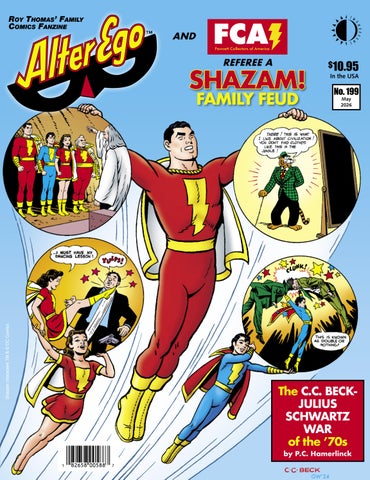
On Our Cover: As detailed on p. 17, DC editor Julius Schwartz—annoyed by all the disagreements he had had with the Shazam! artist—told C.C. Beck a fabrication about the original art to the cover of Shazam! #8 (Dec. 1973) being lost. Beck quickly drew another one (whether or not he was paid extra for it is not clear) and never knew he had been lied to. The “lost” cover, which of course was never lost at all, has been utilized as the cover of this issue of Alter Ego—while the published cover can be seen on p. 17. Thanks to Erik Larsen & P.C. Hamerlinck. [Shazam heroes & related characters TM & © DC Comics.] Above: This panel from Whiz Comics #4 (May 1940) features an early version of a theme manifested in many early “Captain Marvel” stories: a splash panel that spells out what the mystic word “Shazam” stands for, letter by letter—plus his relationship to Billy Batson, boy radio reporter. Script by Bill Parker; art by C.C. Beck. [Shazam hero & Billy Batson TM & © DC Comics.]
This issue is dedicated to the memory of
Andy Mushynsky, Peter David, & Guy H. Lillian III
Alter EgoTM issue 199, May 2026 (ISSN 1932-6890) is published bi-monthly by TwoMorrows Publishing, 10407 Bedfordtown Drive, Raleigh, NC 27614, USA. Phone: (919) 449-0344. Periodicals postage paid at Raleigh, NC. POSTMASTER: Send address changes to Alter Ego, c/o TwoMorrows, 10407 Bedfordtown Drive, Raleigh, NC 27614. Roy Thomas, Editor. John Morrow, Publisher. Alter Ego Editorial Offices: 32 Bluebird Trail, St. Matthews, SC 29135, USA. Fax: (803) 826-6501; e-mail: roydann@ntinet.com. Send subscription funds to TwoMorrows, NOT to the editorial offices. Six-issue subscriptions: $80 US, $121 Elsewhere, $29 Digital Only. All characters are © their respective companies. All material ©their creators unless otherwise noted. All editorial matter © Roy Thomas. Alter Ego is a TM of Roy & Dann Thomas. FCA is a TM of P.C. Hamerlinck. Printed in China. FIRST PRINTING.
4
The Great 1970s SHAZAM! War Combustible Correspondence From C.C. BECK’s Highly Flammable Days With DC
O
by P. C. Hamerlinck
il and water. Gym and pizza. Cats and dogs. Fire and gasoline. C.C. Beck and Julius Schwartz. In one corner: co-creator and chief artist of one of the largest-selling characters during the Golden Age of Comics… and, in the other corner: acclaimed editor recognized as one of the chief architects of the Silver Age of Comics. Two inventive and obstinate individuals. Two men who shouldn’t have worked together. When word began to spread in 1972 that DC Comics was reviving the original Captain Marvel, many nostalgia-fueled fans wondered if the publisher would be able to recapture the essence and distinction of Fawcett’s famed hero, given their ignominious reputation for taking great characters and sometimes making clumsy decisions with them. Further fan uncertainty unfurled when the selection of editor for the upcoming periodical was established. The unconvinced were concerned that Julius Schwartz’s past triumphs had primarily been as a science-fiction editor—which included some of his Golden Age super-hero revivals done in sci-fi formats that differed considerably from the original versions of those characters. Nonetheless, after Mort Weisinger’s retirement, Schwartz became senior editor and was given proprietorship to their top heroes (Batman, then Superman), so Julie handling Captain Marvel, bolstered by his track record of successfully dusting off yesterday’s super-heroes, seemed like a well-reasoned choice by the publisher. (DC’s selection for the book’s lead writer—socially relevant
A Pair Of “Main Events” (Above, left to right:) Artist C.C. Beck and editor Julius Schwartz at the offices of National Periodical Publications (DC Comics), 909 Third Avenue, New York City, December 1972. Even in those early months of Shazam!, the tensions between the two had already manifested themselves somewhat. (Left:) Still, on December 14 of that year, the fans’ wait at least was over—and Shazam! #1, cover-dated Feb. ’73, was released—with Superman introducing Captain Marvel to fervent fans. Superman figure by Nick Cardy/Superman face by Murphy Anderson; other art by C.C. Beck. [Cover TM & © DC Comics.]
story-scripter Denny O’Neil—was actually more disconcerting to some comicbook followers than the Schwartz-editor decision.) Alternatively, DC having called on C.C. Beck caused a more favorable reaction with fandom. The admired artist was initially glad to be back drawing Captain Marvel, and was mostly satisfied with his arrangement with DC; but—as the following missives from his old files indicate—it didn’t take long for the Beck-Schwartz collaboration to show signs of caving in: BECK LETTER TO JULIE SCHWARTZ – OCT. 28, 1972: Here’s the 8-pager laid out and lettered [“The Wizard of Phonograph Hill” - Shazam! #3]. It is at this point that one can see whether things are going to work out or not, and I have a feeling that they aren’t. For that reason I’m sending everything for your consideration before going further. You may say, “Why didn’t C.C. ask me before inking and lettering, at least?” But I won’t mind re-lettering whole pages if necessary, as I feel that the only way to see a story is going to look like is to see it lettered. This is perhaps different from the way most artists work, as some of them think lettering is unimportant and a big bore and far
Combustible Correspondence From C.C. Beck’s Highly Flammable Days With DC
With One Magic Pencil… Two preliminary pencil cover sketches by C.C. Beck: (Above:) Beck signed (with a 1972 date) this unused suggestion for the cover of DC’s Shazam! #1. (Right:) An un-utilized sketch for a 1980s cover of the Overstreet Comic Book Pr ice Guide, more or less imagining what the cover of Whiz Comics #156 (Aug. 1953) might have looked like. Courtesy of Dominic Bongo & Heritage Art Auctions. (Below:) Unfortunately for Shazamophiles, the final issue of Fawcett’s Whiz Comics was #155 (dated June ’53), with its main cover art by Beck plus inset art from interior stories. Courtesy of the Grand Comics Database. [Shazam hero TM & © DC Comics.]
5
6
The Great 1970s Shazam! War
New Lamps For Old Writer Denny O’Neil (left) had remembered Captain Marvel from his youth-and reacquainted himself with the Big Red Cheese by reading a stack of Fawcett comics over a weekend in 1972 after editor Julie Schwartz enlisted him to be one of the writers of the new Shazam! comicbook. Elliot S. Maggin (right), another writer selected by Schwartz for the Shazam! series, read the same pile of Fawcett books to familiarize himself with the character… but did studying the old Fawcetts really help either writer?
beneath their dignity to bother with. In fact, I’m convinced that many of them never even read the copy. As long as we have time, let’s get this story to work a little better. The following notes explain what changes I have made so far, mostly in the interests of keeping the action flowing smoothly without jumps and abrupt scene changes—but I’m not sure I’ve done the right things everywhere. Between you and [Elliot] Maggin, perhaps you can rewrite the last couple of pages to work better. I’ll cheerfully redo them completely if necessary.
and firing a giant gun. With Julie’s consent, I changed it to Mr. Mind riding in a Dixie cup, suspended beneath a toy balloon and firing a tiny gun made from an old 30-caliber shell casing. It’s very funny. DC has given me the authority to change scripts as I see fit to keep the stories in the old style. We take slight digs at hippies, rock music, and mod clothes by making Billy Batson and Captain Marvel with their 1940s attitudes just slightly confused and bewildered in the 70s. In O’Neil’s “A Switch In Time” [Shazam! #3] Billy bought a turtleneck sweater, bell bottom pants and a snappy jacket and goes to a teen dance, hoping to meet kids of his own age, but everyone there are [sic] in jeans, T-shirts, and hip huggers. The music is thumping and the dancing is completely beyond Billy’s Arthur Murray-style, so he asks old Shazam to make his real age 34. Billy is delighted, but then when he says “Shazam!” Captain Marvel is only 14 years old. Even Otto Binder never came up with a story like this! All references to modern culture are merely incidental; the stories themselves are timeless. They could’ve taken place in 1942, but by taking place in 1973 they are even better. Towards the end of the year, Beck still had some say with Schwartz in maintaining the “Captain Marvel style” to the scripts, and remained hopeful about Shazam! and its editor: BECK LETTER TO JOHN G. PIERCE – DEC. 5, 1972: Originally Captain Marvel only had the powers listed on Shazam’s chart; later on he gained other powers at Fawcett’s [continued on p. 10]
Beck proceeded to list for Schwartz many changes on all eight pages of the story (surprisingly, the majority of them actually made it into the published book), then concluded his letter: This whole story is very funny… but I think we’ve got ourselves up a tall tree with no way to get down at the end. About a month later—with a little over two weeks before the imminent release of Shazam! #1— in correspondence with comics fan John G. Pierce, Beck gave the impression that everything was going smoothly with DC and Schwartz: BECK LETTER TO JOHN G. PIERCE – NOV. 27, 1972: So far and I have drawn six stories. They are excellent and quite in the old humorous/lighthearted style. Elliot Maggin is writing them also and he has a great approach. He wrote one about a boy named Sunny Sparkle [“The Nicest Guy in the World”]. Everything took place within just a few blocks with no earth-shaking events at all. Both writers [O’Neil and Maggin] keep putting in super events—the sort of ridiculous things that Superman does, but between editor Julie Schwartz and myself we manage to throw out most of them and put in something better. For example, in a story which will appear in the second issue [“The Astonishing Arch Enemy”], Mr. Mind was supposed to be shown riding in a giant helicopter
All That Sparkles… Initially, C.C. Beck was intrigued by Elliot Maggin’s character Sunny Sparkle—“The Nicest Guy in the World” (Shazam! #2)—but readers both old and new needed something more exciting from Captain Marvel’s new adventures. [TM & © DC Comics.]
16
The Great 1970s Shazam! War
No Longer At DC’s “Beck & Call” With Elliot Maggin’s “Invasion of the Salad Men” (Shazam! #10) and “The Incredible Cape-Man” (Shazam! #11), Beck decided enough was enough. (“Salad Men” art by Bob Oksner; “Cape-Man” art by Kurt Schaffenberger.) [Shazam hero TM & © DC Comics.]
little less with Beck. Of course, C.C. had misgivings about the new format… in addition to being quite appalled by an Elliot Maggin script he had just received: BECK LETTER TO JULIE SCHWARTZ – JUNE 1, 1973: I’m sorry to hear that you’re planning to have other artists do part of the Shazam! pages. I have no objection to their joining in, as one guy can’t do it all, but I do object strongly to a totally different style of illustrating in different stories. To the reader, Captain Marvel and his friends are real, with their own personal traits, and too obvious a change in style makes him say, “What the heck is wrong? Everybody looks different!” He hardly ever says “Ah, a new artist! My, isn’t he good! (Or lousy.)” If Charlie Brown were to appear suddenly as a real little boy with Snoopy drawn by some animal expert, I’m sure he’d lose all his readers. Or if Prince Valiant started appearing in drawings made by an artist from MAD comics, he might be more interesting but he wouldn’t be Prince Valiant. When Captain Marvel Jr. or Mary appear in their own magazines the effect may not be so bad, but in the same magazine it’s very confusing. The [Limited] Collectors’ Edition [#C-21] could get away with this because it’s a collection of reprints from various sources. But if you start putting in new stories by me and one by another artist in the same issue of Shazam! the reader will be as confused as he would be watching Archie Bunker when all of a sudden different actors takes the parts, the settings change, and the dialog is supplied by writers from Hee Haw. The overall style should be the same, no matter how many artists and writers are involved. It would be easy for me to lay out, letter and draw the highlights of three or four stories a month, letting other
artists finish the pages. I could save a lot of time by not drawing backgrounds, incidental characters, and settings which anyone could draw. How about it? Maggin’s latest story [“Invasion of the Salad Men”] is awful. It’s complete tripe. However, tripe makes a very tasty dish when prepared and served properly. I have done a rewrite which I enclose, along with some rough pencil sketches. The thing that was wrong with Maggin’s story was that no part of it was believable, so I made it all a broadcast by Billy, starting right from his first seeing the flying saucer and not believing it himself. As a story told to a young audience who can believe or not as they choose (they do), we can get away with anything; as a story told to readers of Shazam! we couldn’t. Also, this doesn’t involve Marvel in deceiving people as in the original script. If you can use my rewrite and pencils, turn them over to another artist to complete and send me your new stories. I won’t charge for what I’ve done so far but will have to later. Beck vented about DC to fan artist Don Newton and, since Schwartz was bringing in other artists on Shazam!, C.C. had hoped he could add the aspiring super-hero artist to the book as his assistant: BECK LETTER TO DON NEWTON – JUNE 2, 1973: I just heard from Julius Schwartz that they want to put me on a two-stories-per-month schedule with another artist doing a third (no more reprints). Along with his letter came the worst script I’ve ever seen for me to do. It was all full of pointless jokes, bad puns, crowds of people running around—everything that DC Comics are known for. I rewrote the story in Captain Marvel style and laid it out and
26
Captain Marvel’s Co-Creator In Court Twin Testimonies By Fawcett Editor BILL PARKER – 1944 & 1948 by Shaun Clancy Edited by P. C. Hamerlinck
A
UTHOR’S INTRODUCTION: William Lee Parker is known as the co-creator of one of the most successful comicbook characters of all time—the original Captain Marvel—but very little has ever been written about him. There have been two noteworthy articles previously about Parker, the first being P.C. Hamerlinck’s “Major Parker,” published in Alter Ego #23 (2003), which revealed details about Parker’s background and life, supported by correspondence the FCA editor received over the years from artist C.C. Beck and writer/ editor/historian Jerry DeFuccio. A subsequent article by Brian Cremins titled “A Leader of Men” (Alter Ego #131, 2015) provided some insights into Parker’s 1948 testimony from the National vs. Fawcett litigation. With the kind assistance of attorney Wayne Smith, I was able to obtain the complete transcripts of both Bill Parker’s 1944 and 1948 court testimonies from the lawsuit which helped immensely in answering questions surrounding the creation of Captain Marvel, as well as filling in holes related to Parker’s background. Additional help was supplied by Jacqueline Haun of the Bunn Library at the Lawrenceville School in Lawrenceville, New Jersey; there was also assistance from Mark Seifert. The following article is my attempt at combining information from both previously-published FCA articles along with my own research. —SC
Secret Origins John Scott Parker (1873-1940) and Alice Lee Parker (18741952) were married in 1901, and they had six children: John Scott Parker Jr. (1906-1989), William (‘Bill’) Lee Parker (Sept. 9, 1911–Jan. 31, 1963), Priscilla Stump Parker (1905-1968), Alice Lee Parker (1903-1999), Mary Allerton/Vansant Parker (19191992), and Sarah Griffith Lee (1904-1908). The Parkers lived at 1 East Kirk Street, Chevy Chase, Maryland. John Parker was born in Tuscaloosa, Alabama, attended the University of Alabama, and graduated with a law degree from New York University in 1897. During the years he practiced corporate law, John Parker published several books on corporations and was the editor-in-chief of Corporation Manual. Bill Parker was born in East Orange, New Jersey, and resided at 5 East 88th Street, Apt. 2B, in New York City at the time of his death in 1963. The Parker family had moved from East Orange, New Jersey, to Chevy Chase, Maryland, in 1927. Bill attended the Ridgefield School before transferring to Lawrenceville High School in Lawrenceville, NJ, from 1927-1929, where he was part of the school’s press club and where he was already writing stories. From there he went on to the class of 1933 at Princeton University, where he was
A Whiz-Bang Beginning Bill Lee Parker in 1933, as a Princeton University graduate—the closest photograph we could find (in terms of age) to the 1939 era when he was one of three main forgers of the destiny of what became the first issue of Whiz Comics… …and the house ad that introduced all the Whiz Comics characters created by Bill Parker (under editorial director Ralph Daigh’s direction and with his input). It ran in various Fawcett slick magazines in late 1939. Artwork by C.C. Beck, who’d add a third illustrious party to that list. [Shazam hero, Spy Smasher, Ibis the Invincible, Golden Arrow, et al., TM & © DC Comics.]
Captain Marvel’s Co-Creator In Court
Two Boys Named William This boy named Bill would one day create a character named Billy who had a handy little magic word … and the comic panels by Bill Parker & C.C. Beck are from the end of the “Captain Marvel” story in Whiz Comics #2 (actually the first issue). [Billy Batson TM & © DC Comics.]
also a member of the school’s press club and where he obtained a Bachelor of Arts Degree and majored in English Literature. (His older brother, John, had also graduated from Princeton, in 1928.)
1944 Testimony The following is Bill Parker’s 1944 testimony given in the National vs. Fawcett copyright infringement lawsuit, giving us firsthand personal information and details on the creation of Captain Marvel. [NOTE: Court transcripts have been condensed in order to flow more smoothly.] BILL PARKER: After college I was first employed at the New York Herald Tribune in the fall of 1933. I was a copyreader on the sports staff for about three or four months, and then I transferred into what was called the “education department” of the circulation department. My job was to promote an interest and to increase the sales of The New York Herald Tribune in the elementary, junior, and senior high schools of New Jersey, New York, and Connecticut. My duties, most of the time, [consisted of] giving short lectures in the schools to the school children on the subject of the making of a newspaper. I illustrated those talks with actual exhibits from the Herald Tribune. The New York Herald Tribune had a Sunday New Daigh Dawning comics section, and the children were interested in A 1945 photo of Ralph comics more than in any other part of the newspaper, so I Daigh, Fawcett’s editorial generally took along an exhibit showing how the comics director—who, in a section of the Herald Tribune was prepared and published. very real sense, should perhaps be considered After I left the Herald Tribune, I went to work at Literary a co-creator of Captain Digest from April 1936 until the magazine was sold in June Marvel and his universe. of 1937.
27
41
(Above:) Ken lettered this page from Dark Horse Presents Vol. 2 #35 (April 2014). Gilbert did the rest. [© MTG] (Right:) Ken Bruzenak in 2022. [© Bruzenak]
42
Mr. Monster’s Comic Crypt!
Ken Bruzenak… The Caliph of Calligraphy!
I
by Michael T. Gilbert
t was a fateful day in 1983 when I gave Ken Bruzenak a call. Pacific Comics’ editor Dave Scroggy had just given me the go-ahead to put together my first “Mr. Monster” story for their Vanguard Illustrated anthology—and I was in the process of building my creative team. I’d already gotten the okay from Bill Loebs, who agreed to do the finishes, with me providing scripts, layouts, and coloring. But who would do the letters? My goal was to create a fully-integrated comic strip, the kind that Will Eisner had perfected with The Spirit. Eisner had Abe Kanegson performing inspired lettering gymnastics for him. But who of that caliber could I find thirty years later? Then inspiration hit. I had been marveling at the lettering in
Positively Electrifying! (Above:) Gilbert designed this page, brilliantly executed by Bruzenak for Eclipse’s Mr. Monster #1 (Jan. 1985). Art by Gilbert & Loebs. [TM & © MTG.]
Howard Chaykin’s new American Flagg title for First Comics. The lettering, credited to someone named Ken Bruzenak, was incredibly original. The work, highly detailed, sleek, and sophisticated, was perfect for Chaykin’s futuristic anti-hero. The problem was, I needed someone to do spooky gothic lettering and weird retro logos. Could this sci-fi guy pull that off? Still, I figured if he could do something as challenging as what he did on Flagg, he might be versatile enough to provide the kind of eerie lettering “Mr. Monster” required. So, I got his number and gave him a call.
Put A Ring On It…
In The Beginning Was The Logo (Above:) Ken’s official “Mr. Monster” logo first appeared in Eclipse’s Mr. Monster #1 (Jan. 1985). It was inspired by Fred Kelly’s 1947 logo for the Golden Age Mr. Monster. Art by Gilbert. [TM & © MTG.]
I gave Ken a ring and we started chatting about what I hoped to do with “Mr. Monster.” It was a fun call, and I discovered that Ken had sharpened his skills in the salt mines of Jim Steranko’s studio. There, he’d helped produce Steranko’s Comic Scene/Media Scene/Prevue, as well as his History of Comics and other projects. Ken also did research for those projects, and plenty of slave labor on Jim’s home. And to think, it all seemed so glamorous at first! At the end of our call, Ken agreed to letter my story.
58
The Spartan Chronicles – Part I
“We Were Called The Comicbook Capital Of The World— And We Were!” PAM LOWRY Talks About Working for Spartan Printing & World Color Press—For More Than Two Decades
A/E
Interview Conducted & Transcribed by Richard J. Arndt
EDITOR’S INTRODUCTION: From the 1960s to the 1990s, the Spartan Printing Plant in Sparta, Illinois—a part of World Color Press—printed the output of nearly every professional comicbook company. Yet, relatively little has been printed about the firm, its workers, and its processes. Nearly two decades ago, I was attending a comics convention in Cape Girardeau, Missouri—my home county—and going for a pizza with a smallish group of friends and family. To my amazement, I discovered that one of the attendees—Pam Lowry—was not only the sister-in-law of one-time Marvel writer Gary Friedrich (co-creator of Ghost Rider, et al.)—but had also worked for years for Spartan Printing. The sibling of his wife Jean, Pam was a bit reluctant to be interviewed for Alter Ego, since she knew little about the comics themselves… but naturally I assured her that that made little difference in her case. It was the printing plant itself, and those who worked there, who were of interest. It took some years to get things together, but eventually the estimable Richard Arndt interviewed her—and her son Robert Higgerson has provided a few additional informational tidbits of his own, in a short piece which follows….
Magazineland USA That’s what World Color called the 28-page color comicbook/magazine it produced on its own in mid-1977, timed with a celebration that honored the plant’s opening on June 18, 1948. The comic was drawn (and perhaps written or co-written?) by the famous Joe Kubert School of Comic Art in Dover, NJ—under the supervision of (and obviously with contributions by) the late great artist Joe himself. Not only did this cover depict the stars of mags produced by the various comics companies—several of their characters took part in the action inside, as well, as seen on ensuing pages. Thanks to Bruce Mohrhard, Mike Phoenix, Robert Higgerson, & P.C. Hamerlinck for the various images from this magazine scattered through this section. [TM & © the respective trademark & copyright holders, including DC Comics; Marvel Characters, Inc.; Archie Comic Group; Harvey; Edgar Rice Burroughs, Inc.; et al.]
Pam Lowry in a recent photo take by son Robert Higgerson.
60
Pam Lowry Talks About Working For Spartan Printing & World Color Press
RICHARD J. ARNDT: When did you go to work at Spartan Printing? PAM LOWRY: I started July 7, 1969, and I stayed there until June of 1978. So, some nine years. I actually stayed with World Color Press, the controlling company, for many years after that, but I moved to another business location in another town. World Color Press was expanding rather quickly in the 1970s. The magazines that were printed in Sparta focused on comicbooks, which used, at the time, mostly pulp paper. Eventually, World Color began opening other locations, to print other types of publications. I moved as the company grew, staying with them for a total of 23, 24 years. I was with them a long time. RA: What besides comicbooks did Spartan actually print? LOWRY: I should give you a little history of Spartan Printing. They started in the comicbook business in the late 1940s, although they’d been doing Sunday comic strip sheets for many years before that. They were primarily using letter presses, which was, at that time, how comics were printed. They eventually branched out and, frankly, a lot of the magazines they printed, outside of comics, bordered on pornography. Honestly! Some of the magazines were just sleazy. In fact, I never thought I’d ever be working in a factory like that, number one. But I needed the money and they paid very well. It was a union job. The only other jobs in the town at that time were working in the coal mines. Women worked in the bindery. The job was hot, dirty—really, the only good thing about it was the pay and the friendships you made there. Everybody was all in this together, working there. We worked hard and developed really good relationships with each other. I still stay in touch with people I worked with there. RA: When you mentioned bindery, is that the part of publishing involved with putting the stapes in? LOWRY: That’s the part of the publishing where the magazine or
comic is put together. There were the printing presses which printed out the pages, and then the section where I worked, which is where bindery was done. The pages were put into a machine where the pages were collated. Then they were stapled, or sometimes glued, together. People call them staples, but we always referred to them as wires, because they came on a long spool of wire. The wires, of course, hold the comicbook together. Than the collected comic would come down a conveyor belt, the cover would be put on it, and then we ladies would put them together in bundles of fifty. RA: In the 1970s, I worked briefly for an outfit that brought the weekly magazines to various stores—mom & pop stores, supermarkets, drug stores—all the places that magazines, including comics, sold in those days. The comics always came in bundles, like you described, with another long piece of wire or string wrapped around the bundle to hold them together. I always bought my own comics from the center of the bundles, because the top and bottom copies were usually damaged by the strapping, particularly when that long piece of wire was used. LOWRY: We never put wire around them. That may have been something the actual distributor did. We never put anything on the comics or magazines to damage them. I don’t remember using wire. We used string or, later on, plastic strappings. RA: In Michigan in 1974 it was wire or string. As you said, that was likely something the distributor or the shipper did for ease in transportation and delivery. The top comic in such a wired bundle would almost always show damage. String makes more sense, though, as it wouldn’t have caused anywhere near as much damage as that wire did. LOWRY: Well, of course, the top and bottom comic would always be the most likely to be damaged in transit, regardless of which was used. We used to stack bundles numbering around 300 copies in large bags, actually sacks, folded the top of the sack over, stapled it shut and slide it down a conveyor belt to the shipping department, which handled it from there. That’s how we handled them, generally. Sometimes they were stacked on a pallet, but generally they were bagged. RA: Honestly, whether string or wire, that never did as much damage to a comic as Marvel’s subscription service folding the comics vertically to mail them
The Founding Father Ros Messing, Sr., “owner and founder of World Color Printing Co.”—and the building that housed the first company that specialized in printing comics. Messing is holding a copy of 1935’s New Fun #1, the first regularly published comicbook to feature all-new material. New Fun was the start of what eventually became DC Comics. These images are from the Magazineland USA magazine; the first relates the founding of the company in the early 1930s. [TM & © the respective trademark & copyright holders.]
“We Were Called The Comicbook Capital Of The World—And We Were!”
61
their comics. I don’t actually recall comics being folded in half, though. RA: As far as I know, that situation was exclusive to Marvel, although I didn’t subscribe to any DC comics at the time. [A/E EDITOR’S NOTE: At least in the early 1950s, when I had a subscription to All-Star Comics/All Star Western, DC’s subscription copies were mailed out exactly the same way.] This would have been 1978-1979, when I was living in rural Idaho. Not a hotbed of comicbook subscribers there, I suspect. After a year or so, I discovered that Boise had a comic shop where I could buy comics flat, reserve titles (and ask for ones they weren’t currently selling to add to my reserved titles), get advance notice on what was coming out, and receive a discount if I ordered enough titles during any given month. LOWRY: To be honest, if it was a subscription comicbook—somebody paid for that—I worked in that area for a long time and handled the mail and we made certain it was flat-wrapped. When they put the mailing label on the shipping envelope, which was open-ended, the comics, enclosed in the sleeve, would go through a machine that sort of half-folded them in the process, but it wasn’t a permanent fold. They left Sparta flat. Perhaps the post office folded them. But I guess they may have started out, sort of folded in half, although they shouldn’t have been delivered that way! RA: Well, if that’s the case, it might not have even been post office policy but something done at a mail-carrier’s discretion. To make more room in his bag, he or she may have folded the comics along that crease, figuring that kids were unlikely to squawk
From Editor To Engraving On pp. 5 & 6 of Magazineland USA, images of plant executive Jim Broderick showed how comics were put together first by editor, writer, and artist (with Superman making an amusing cameo, and some Swamp Thing panels shown)—then how the plant in Sparta, Illinois, initiated the process of turning pages of original art and story into finished comicbooks ready for distribution. [Superman & Swamp Thing TM & © DC Comics; other material TM & © the respective trademark & copyright holders.]
to you. Nothing says pride in your product like folding it in half to fit inside a thin brown paper mailing envelope—same kind of paper used in butcher paper for sandwiches from delis—and sending it through the U.S. mail that way. [laughs] Were they sent to the distributor after your factory work, or to the publisher? LOWRY: They were sent to distributors. Some comicbooks were handled by a subscription service, but there weren’t really that many subscriptions at the time. At least for the comics. I’m sure the situation you just described was one of the reasons for that. The other types of magazines, there’d be more that people— adults—subscribed to. I think most comicbook readers went into the stores for
74
The Spartan Chronicles – Part II
Spartan Printing, Comicbooks, & The Magical Past
A Brief Memoir of World Color Press by Robert Higgerson
M
y name is Robert Higgerson, and I am Pam Lowry’s oldest son and a nephew of the late Gary Friedrich. I grew up in Sparta, Illinois, during the period spanning from the hot, sweltering summer of 1966 to the late spring of 1978. I was constantly surrounded by comicbooks and similar illustrated
Robert Higgerson (in a recent photo)—juxtaposed with what he labeled an “Image for the Engraving of a Stereotype Plate” (made from the original Michael W. Kaluta art)—along with the panel from the aforementioned Magazineland USA magazine that explains what “stereo” means in this context. Photo & cover image scan courtesy of Rob H. [Comic page TM & © the respective trademark & copyright holders.]
A Brief Memoir Of World Color Press
75
For me, both the comicbook and the comic magazine were much more than forms of entertainment expedient for passing the time; they were also road maps to other possible worlds, worlds containing an extraordinary degree of goodness, as well as evil, heroism, morality, and baneful intentions; worlds sporting superhuman feats and strange magic; worlds with denizens who were frightening and monstrous, unusually beautiful, unimaginatively powerful, God-forsakenly devilish, holy, super-intelligent, animalistic, larger-than-life, and, sometimes, simply inexplicable. The ancient Greeks and Romans had their gods and goddesses, and I had mine. For that matter, the summit of Mount Olympus was no more than a few standard miles from where I lived, and it was even in viewing distance: all I had to do was walk across the backyard, cut over to South Oak Street, and then walk up a gradual slope on West Third, all of which could be done in no more than a couple of brief minutes, and there it was, just within sight. On that summit sat the manufacturing facility officially referred to as Spartan Printing, located in Sparta, Illinois. The length of the building structure that was once utilized by Spartan Printing extends across most of South Dickey Street, and the very front of the building is sandwiched between East 2nd and East 4th Streets. (Locally it was referred to by the colloquialism “the Comic Book Plant.”)
“Vampirella, Vampirella, Night And Day it’s Vampirella…” Clearly, Enrich Torres’ cover for Warren Publications’ Vampirella #27 (Sept. 1973) made a powerful impression on young Rob H. [TM & © The New Comic Company.]
periodicals for years, as new materials came into our home on a quite frequent basis. Many other children and teenagers in the locale were surrounded by the very same type of literature as well, and for the very same reason: they had parents or relatives who were employed at Spartan Printing, a subdivision of the corporation known as World Color Press. I was not, however, a passive observer of the presence of all that sort of literature that came into my home; rather, I obsessively immersed myself into the world of the illustrated periodical, particularly those that fall into the categories of the super-hero, horror, weird fantasy, science-fiction, fantasy martial arts, etc. Whereas others were satisfied to share the same physical space with such periodicals with an attitude of indifference, I actively collected them: I would read and reread certain issues multiple times, I would occasionally put them on display, and I even treated them as if they were sacred documents. I was unapologetically addicted to comicbooks, and I yearned for them on a daily basis.
Moreover, both of my parents were employed at Spartan Printing: my mother in the Bindery, the department where the pages were collated and bound together to form a complete paper book, and my father in various press room departments. My father, Robert Lee Higgerson (1941-2021), who was born in Sparta, IL, began his employment at Spartan Printing in 1966 (when the price for a standard-size comicbook was only twelve cents a copy) and he worked there until 1977. My mother, Pamela Louise Lowry (b. 1946), began her career at Spartan Printing in the summer of 1969 and continued working there until May of 1978.
My parents were both blue-collar employees who worked quite often, and they worked “physically,” day in and day out, twelve months out of the year. Moreover, according to documented information provided by World Color Press about the average amount of printed paper that was produced per hour at Spartan Printing, as well as information concerning bindery output (much of which can be found in a periodical produced by Spartan Printing intended to celebrate the company’s historical and financial success), a mathematically conservative estimation entails that by the end of a forty-hour-work week, each one of my parents had already handled quite literally hundreds of thousands of subsections of comicbooks or some other type of illustrated periodical. I mentioned the year 1969, especially important to me for the reason that it was the manufacturing and publishing birth-year of Warren Publishing’s title Vampirella. The first issue of Vampirella had been assigned the publication date of September 1969, and in all great likelihood copies of that issue were manufactured right around the time that my mother began her employment at Spartan Printing. Vampirella is a marvelous creature and arguably Forrest
76
YOUPastENJOYED THIS PREVIEW, Spartan Printing, Comicbooks, & The IF Magical
J. Ackerman’s greatest creation. She first came into our home when I was only seven years old, not from a store, a newsstand, or out of the mailbox, but straight from Spartan Printing, in issue #27. I was directly introduced to the character Vampirella by my mother, and along with Will Eisner’s The Spirit, The Amazing Spider-Man of Stan Lee and Steve Ditko, and Jack Kirby’s Kamandi, Vampirella haunted the house. To understand what it must have been like to work in one of the manufacturing departments at Spartan Printing, one must
CLICK THE LINK TO ORDER THIS ISSUE IN PRINT OR DIGITAL FORMAT!
realize that back in the ’60s and most of the ’70s, the processes of printing, paper-coloring, photographing, and transferring an image drawn on a panel in, say, New York City, to a medium where it would be duplicated countless times onto paper, involved neither the use of digital electronic components capable of approximating today’s efficiency nor desktop computers, signals emitted from satellites, Microsoft software, the Internet, and so on. In comparison to today’s printing technology, the processes of printing and printing-preparation that were used at Spartan Printing were much more time-consuming and mechanical in nature. In order to appreciate this matter, it is useful to bear in mind, as a comparative example, that in the 1960s and ’70s, an enormous number of color television ALTER EGO systems #199 were these rather large, P.C. HAMERLINCK reveals the secret—often bitter—earbulky devices that were operationally ly-1970s combat by correspondence between SHAZAM! artist dependent on very warm, glowing, (and Captain Marvel co-creator) C.C. BECK and DC editor JULIUS SCHWARTZ! It’ll take more than one magic word to glass vacuum tubes, not the transistor. avoid a head-on collision between these two titanic talents! Plus Back inT. GILBERT those days, the concept of FCA (Fawcett Collectors of America), MICHAEL in Mr. Monster’s Comic Crypt, and more! “small, electronic digital device” was (84-page FULL-COLOR magazine) $10.95 significantly more theoretical than (Digital Edition) $4.99 concrete and real. https://twomorrows.com/index.php?main_page=product_info&cPath=98_55&products_id=1833 It should be mentioned in connection with all of this that contact in the manufacturing environment between the workers and comicbooks (or their individual subsections) often took the form of a rather demanding and unfriendly interaction. Many stacks of comicbooks were rather heavy, and the process of repetitively displacing them in one manner or another could leave the unconditioned muscles of the novice fatigued by the end of the day. The solvents used to dissolve the inks could easily blister and burn the skin, and the careless handling of paper often produced stinging lacerations. Pressmen, paperboys, and flyboys often left the facility with their uniforms or t-shirts permanently stained with ink, and workers in the bindery often endured scratches and scrapes.
And If The Yellow Kid Had Ever Ditched That Hearst Guy… Magazineland USA threw in a bit of vintage history and already-old photos amid its comics pages. [TM & © the respective trademark & copyright holders.]
Concerning the presence of the suffix “boy” in two of the above appellations, it should be noted that in the 1960s and ’70s, the printing press machines at Spartan Printing, unlike the equipment in the Bindery and certain other departments, were staffed and operated exclusively by males (as I have always suspected, and a phone conversation with my father was all it took to quickly corroborate this belief). A paperboy was a guy who was a member of the crew assigned to work on the back end of a printing press, with the responsibility of providing it with paper and keeping the feed continuous. A flyboy, on the other hand, worked on the front end of a printing press, with the primary