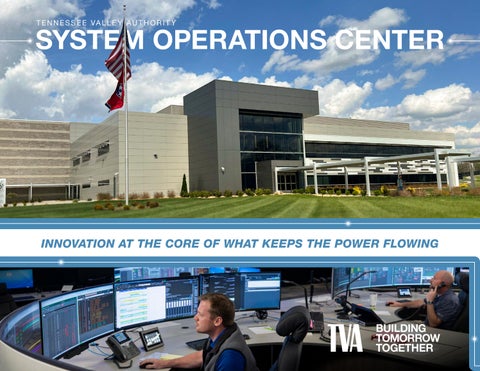
T E N N E S S E E VA L L E Y A U T H O R I T Y
SYSTEM OPERATIONS CENTER
INNOVATION AT THE CORE OF WHAT KEEPS THE POWER FLOWING
At the center of it all If TVA’s generating plants are the heart of power production, the SOC is the brain. It acts as the transmission grid’s central nervous system, responding to events in real-time to keep power flowing, whatever the demand. The Tennessee Valley Authority (TVA) has a big responsibility. It ensures that the 10 million people in its seven-state region have power 24 hours a day, 365 days a year. Its System Operations Center (SOC), one of the most-advanced power command and control centers in the country, will play a significant role in helping TVA meet that mission. The secure complex, built on 166 acres in Georgetown, Meigs County, Tennessee, far exceeds industry standards. It became fully operational in 2026.
The SOC strengthens TVA’s ability to stay ahead of energy-sector challenges – from increased power demand, to more sophisticated threats to the grid, to the growing interdependence of transmission, distribution networks and off-grid resources coming onto the system. Innovative technology at the SOC strengthens TVA’s ability to efficiently dispatch TVA’s generation assets and it enables operators to react more quickly to disturbances on the system. Layered security, redundant systems and hardened structures protect the complex from weather and man-made threats. The SOC houses a team of highlytrained system operators, engineers, gas and hydro dispatch coordinators, and support staff who ensure the safe, reliable and economic delivery of TVA power to customers across the region.
2
TENNESSEE VALLEY AUTHORITY
The path to integrated power Want a glimpse into TVA’s ongoing commitment to technological advancement? Look no further than its path to today’s SOC.
Load coordinators balanced the power supply with demand, and when power adjustments were needed at any given plant, the computer issued orders through a 101-foot-high microwave tower outside the building.
During its first 41 years of operation, TVA managed power at individual locations. Each power plant and substation controlled its own power, and the sites and headquarters coordinated via telephone, telegraph and radio networks.
In 1999, TVA opened an even more modern facility – the System Operations Center in downtown Chattanooga. There, new technology further improved system integration and operators’ ability to visualize the full power system.
In 1974, TVA opened its Regional Operations Center (ROC), where more advanced technology provided integrated communications and real-time monitoring for the entire power system.
An analog system depicted real-time information about the entire grid on a static map board with LED lights that indicated the status of key power system
equipment. Other screens showed power usage, which operators used to adjust the mix of power supply to meet customer demand. Today, the new SOC uses a fully digital system that provides operators with more visualization and faster communications, which improves response times. The system also allows for the integration of new technologies as they are developed. Beginning in 2025 and continuing into 2026, TVA embarked on the intensive process of transferring operations from the Chattanooga facility to the new SOC in Georgetown.
The load-control center’s main computer monitored reports sent electronically by sensors throughout the TVA power system.
“This grid is strong. It’s stout. And I feel safer knowing this is here.” – Hugh Gardner, 93, retired power supply manager for TVA, while on a tour of the new SOC
TENNESSEE VALLEY AUTHORITY
3
Transitioning to new SOC Standing up the new SOC as its own entity was years in the making. The task was monumental. Construction began in March 2020, and the facility achieved operational occupancy in June 2024. TVA conducted critical testing of all technology at the
site and in the field from spring 2025 through spring 2026. Every substation was validated against the new energy management system, requiring staff to confirm hundreds of thousands of data points across nearly 600 substations. TVA’s compliance team produced hundreds of pages of detailed documentation to demonstrate to
regulators that TVA could operate the power system safely, reliably and compliantly throughout the transition and beyond. After all data was authenticated and the system was fully verified, the teams conducted months of parallel operations before the new SOC assumed control.
Protecting the grid The 100,000-square-foot SOC, with its 10-inch thick concrete walls, is a standalone facility with layers of physical and digital security. The building’s high-level security features help TVA maintain a reliable, resilient power system and grid. The structure’s design provides electromagnetic pulse protection. Redundant electrical, mechanical and communications systems limit downtime and increase reliability. The secure facility allows system operators to restore the system in a very secure environment. The features offer maximum grid security and network resiliency that exceed anticipated North American Electric Reliability Corporation (NERC) requirements. 4
TENNESSEE VALLEY AUTHORITY
TVA conducted rigorous benchmarking and research to ensure the SOC and the new energy management system provide TVA with a flexible and responsive system needed for the changing power system of the future.
Everyone benefits Every person who lives and works in TVA’s seven-state service area will benefit from TVA’s investment in the SOC. The SOC enhances TVA’s power reliability and resilience and ensures that TVA will continue to deliver safe, efficient energy. People sometimes ask: What is the difference between reliability and resilience. Reliability refers to TVA’s ability to minimize outages on its system. Resilience refers to TVA’s ability to withstand, recover from and adapt to disruptions. At the SOC, redundant hardware and software systems ensure operations continue even if a component fails. New technologies offer enhanced, realtime visibility that provides operators with better information, thus enabling them to detect disturbances more quickly. Ultimately, that means less interruptions for end-users. Advanced capabilities at the SOC enable TVA to more efficiently dispatch TVA’s generation assets, which results in cost savings for customers.
All of TVA’s conventional hydro plants and some of its gas plants are remotely controlled from the SOC, with onsite backup support as needed. This allows TVA to react quickly to needs on the power system – turning generating units off and on based on system needs. With all of these improvements and additions, TVA power is more robust. And everyone in TVA’s service area wins.
In a changing utility landscape, the new technology incorporated in the System Operations Center will allow TVA to continue its record of 99.999% reliability for many years to come.
TENNESSEE VALLEY AUTHORITY
5
Advanced technology to power the future TVA conducted rigorous benchmarking and research to ensure the SOC and new energy management system would provide TVA with a flexible and responsive system that could adapt to changes in the power industry – today, and well into the future. The SOC is one of the nation’s mostadvanced power command and control centers, with tools and technology that provide TVA with more precise, real-time information that leads to a more timely and effective response to daily events on the system. From meteorology feeds to a live look at every generating plant and substation across the service area, the SOC has its eyes on the pulse of the Tennessee Valley region.
System operators are able to overlay weather information and determine precisely when and where a storm might affect transmission infrastructure. This enables crews to get a jump on restoring power in the event of disruptions.
TVA’s grid on an uninterrupted screen and to easily monitor power flow on the lines and voltage at the substations. Together, these features protect the power system and grid, and they improve TVA’s ability to respond quickly to adverse incidents that might impact operations.
The video walls allow transmission operators to view all four quadrants of I
L
. K
M
I
S
S
O
U
R
E
N
T
U
C
K
Y V
I
I
R
G
I
N
I
A
Video walls One of the most unique features of the center is an advanced video graphic system that enables operators to visualize the power system across TVA’s service territory. The wall for transmission operators – more than 123 feet long and 13½ feet tall – is the largest display. The center also features other expansive video walls and displays that support TVA operations, from dispatching power to ensuring grid reliability even beyond TVA’s boundaries. 6
TENNESSEE VALLEY AUTHORITY
T
A R K .
E
N
N
E
S
S
E
E
G M
I
S
S
I
S
S
I
P
P
E
O
R
G
I
C
N O R T H A R O L I N
A
C
S O U T H A R O L I N
A
A
I
A
L
A
B
A
M
A
Legend State Line
TVA Coal-Fired Plant
Water
TVA Nuclear Plant
Power Service Area
TVA Combined Cycle Plant
TVA Watershed
TVA Combustion Turbine Plant
TVA Hydroelectric Dam
TVA Pumped Storage Plant
TVA Non-Power Dam Sept. 2025
0
20
40
60 mi.
N
“Whatever’s happening, they can see it in one instant. From an operator point of view, they’ll be able to react quicker during an outage and restore power quicker to the customer.” –Josh Shultz, general manager, Transmission Operations
TENNESSEE VALLEY AUTHORITY
7
Energy management system The new energy management system (EMS) is a critical component of operations at the SOC and across the TVA system. The EMS provides improved visualization, which enhances monitoring capabilities and results in more accurate and efficient assessments. The EMS is a state-of-the-art digital system, a substantial upgrade from the previous EMS, which included a combination of analog and digital capabilities. The new digital system has higher capacity and speed for communications with the TVA grid and for inputs from monitoring equipment. Operators use the Supervisory Control and Data Acquisition (SCADA) system to monitor and control breakers and switches in the field. The system has the capability to integrate data sources from devices such as phasor measurement units and asset monitoring sensors. The EMS provides flexibility as more distributed energy resources are added to the system.
8
TENNESSEE VALLEY AUTHORITY
“We are gaining efficiencies from this new EMS system in terms of ease of use and being able to more efficiently dispatch TVA’s generation assets, which will result in cost savings for our customers.” –Shannon Brown, manager, TVA Balancing Authority
High-fidelity training simulator In the SOC, a high-fidelity training simulator replicates the new energy management system that operators use to control and operate TVA’s power system. The simulator reproduces high-stakes scenarios that provide immersive training experiences and challenge operators to make quick, accurate decisions in a simulated learning environment. The simulator room has video walls and applications that mirror the actual control room, and it fosters an environment in which employees can develop and refine their responses under pressure but without consequences.
System conditions change quickly, and simulator training gives operators the preparation they need to respond rapidly and knowledgeably when there are disturbances on the actual system.
“The simulator is a very valuable part of our training package. We may have handled a real-time situation well, but during simulations we can look for new and better ways to handle situations.” –Joel Wise, manager, NERC Regulatory and Operations Training Group
TENNESSEE VALLEY AUTHORITY
9
Employees are the heart of SOC TVA employees with impeccable credentials and extensive expertise work at the SOC. Together, they help ensure TVA provides reliable, affordable power around the clock. System operators in the Balancing Authority are responsible for aligning TVA’s electricity output with customers’ demand for power. They dispatch power from all generation assets – nuclear, coal, gas and renewables. The advanced technology at the SOC helps them know in real-time what sources are available and at the lowest cost. Operators in Transmission Operations manage TVA’s grid. They protect TVA employees who work on the power system, and they are the initial point of contact for local power companies if power needs to be restored during an event.
In every 12-hour shift, system operators turn on and off roughly 7,000 to 10,000 megawatts of electricity – enough to power up to 5.8 million average homes.
Coordinators in Reliability Operations analyze power demand in real-time and for the next day and coordinate power needs with entities beyond TVA’s service territory. They use the SOC as their backup center, working day to day from TVA’s Regional Operations Center – which serves as the official backup center to the SOC. Every year, Balancing Authority,
10
TENNESSEE VALLEY AUTHORITY
Transmission Operations, and Reliability Operations operators together run drill scenarios in the simulator room to practice responding to everything from cyberattacks to extreme weather events to a total system blackout. The Emergency Preparedness and Response team helps plan these training exercises, which assure that the specialists have practiced the communication and work that would be necessary during a real-life situation. Technology experts play a critical role in ensuring that software and hardware runs smoothly at the SOC, and they evaluate new technologies to provide continual upgrades to the systems. TVA specialists who work with telecommunications and the computer network and servers ensure the reliable, secure and compliant operation of TVA’s control center infrastructure by maintaining data transport, managing critical operational tools, meeting NERC requirements and sustaining the technologies that underpin Transmission Operations & Power Supply.
“You cannot get complacent in the job. It may look like a video game on that screen, but you can’t lose track of the importance of what you’re doing. Behind the screens are people relying on you.” –Chuck Nance, coordinator, Reliability Operations
TENNESSEE VALLEY AUTHORITY
11
We can’t do it alone At TVA, preparedness and safety are paramount, and coordinated communications and emergency exercises with outside partners serve as vital tools. TVA’s Emergency Preparedness and Response department collaborates with local power company partners as well as emergency services organizations near the SOC to stay on the cutting edge of readiness. TVA and utilities across the region share emergency preparedness information to bolster grid stability. TVA also conducts training exercises with local emergency services such as Meigs County Emergency Services Fire & Rescue and Bradley County Fire & Rescue to familiarize personnel with the layout of the SOC while testing
400 W. Summit Hill Drive | Knoxville, TN 37902
2026-216450 0626
12
TENNESSEE VALLEY AUTHORITY
communication and coordination between agencies. The exercises help improve readiness, both for TVA and for the emergency services organizations. Evaluation and discussion after exercises help the partners refine protocols and enhance inter-agency communication. TVA and its partners prepare for any emergency that might arise, and in doing so, together they help ensure power reliability and resilience for those who live and work in the Tennessee Valley region.
“Without proper cooperation or collaboration, we wouldn’t have knowledge of the facilities. We know this is a high priority infrastructure, and it’s our job to help protect it. For TVA to put their faith and trust in us means a lot. A lot of folks don’t realize the responsibility we have and also the impact TVA has. TVA knows to look outside the gate to their communities.” –Tony Finnell, Emergency Services Director of Meigs County