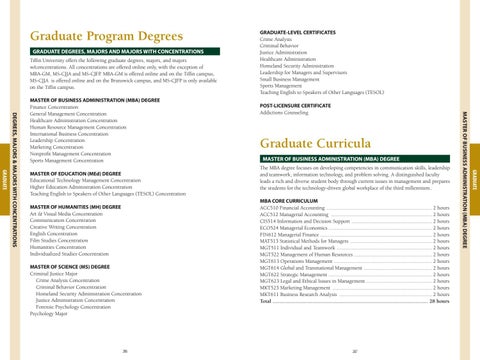
Graduate Program Degrees GRADUATE DEGREES, MAJORS AND MAJORS WITH CONCENTRATIONS Tiffin University offers the following graduate degrees, majors, and majors w/concentrations. All concentrations are offered online only, with the exception of MBA-GM, MS-CJJA and MS-CJFP. MBA-GM is offered online and on the Tiffin campus, MS-CJJA is offered online and on the Brunswick campus, and MS-CJFP is only available on the Tiffin campus.
MASTER OF HUMANITIES (MH) DEGREE Art & Visual Media Concentration Communication Concentration Creative Writing Concentration English Concentration Film Studies Concentration Humanities Concentration Individualized Studies Concentration MASTER OF SCIENCE (MS) DEGREE Criminal Justice Major Crime Analysis Concentration Criminal Behavior Concentration Homeland Security Administration Concentration Justice Administration Concentration Forensic Psychology Concentration Psychology Major
286
Graduate Curricula MASTER OF BUSINESS ADMINISTRATION (MBA) DEGREE The MBA degree focuses on developing competencies in communication skills, leadership and teamwork, information technology, and problem solving. A distinguished faculty leads a rich and diverse student body through current issues in management and prepares the students for the technology-driven global workplace of the third millennium.. MBA CORE CURRICULUM ACC510 Financial Accounting .............................................................................. 2 hours ACC512 Managerial Accounting ........................................................................... 2 hours CIS514 Information and Decision Support . .......................................................... 2 hours ECO524 Managerial Economics............................................................................. 2 hours FIN612 Managerial Finance................................................................................... 2 hours MAT513 Statistical Methods for Managers . ........................................................... 2 hours MGT511 Individual and Teamwork ...................................................................... 2 hours MGT522 Management of Human Resources . ........................................................ 2 hours MGT613 Operations Management......................................................................... 2 hours MGT614 Global and Transnational Management . ................................................. 2 hours MGT622 Strategic Management............................................................................. 2 hours MGT623 Legal and Ethical Issues in Management.................................................. 2 hours MKT523 Marketing Management .......................................................................... 2 hours MKT611 Business Research Analysis ..................................................................... 2 hours Total .............................................................................................................. 28 hours
287
GRADUATE
MASTER OF EDUCATION (MEd) DEGREE Educational Technology Management Concentration Higher Education Administration Concentration Teaching English to Speakers of Other Languages (TESOL) Concentration
POST-LICENSURE CERTIFICATE Addictions Counseling
MASTER OF BUSINESS ADMINISTRATION (MBA) DEGREE
GRADUATE
DEGREES, MAJORS & MAJORS WITH CONCENTRATIONS
MASTER OF BUSINESS ADMINISTRATION (MBA) DEGREE Finance Concentration General Management Concentration Healthcare Administration Concentration Human Resource Management Concentration International Business Concentration Leadership Concentration Marketing Concentration Nonprofit Management Concentration Sports Management Concentration
GRADUATE-LEVEL CERTIFICATES Crime Analysis Criminal Behavior Justice Administration Healthcare Administration Homeland Security Administration Leadership for Managers and Supervisors Small Business Management Sports Management Teaching English to Speakers of Other Languages (TESOL)
In addition to the core curriculum, each candidate must also complete one of the concentrations listed below.
CONCENTRATION: FINANCE The finance concentration enables the student to build upon the solid foundation from the course work in the MBA program and provides students with greater exposure to economic and financial business practices. The finance courses will provide an opportunity for students to learn about local, national and international economies in cooperating and competing markets. Students will explore performance of stocks, bonds, commodities, and other types of investments. The degree prepares students to work in the field of financial management either independently or with a corporation, bank, securities firm, nonprofit organization, or an investment agency.
CONCENTRATION: GENERAL MANAGEMENT
MGT531 Leadership & Influence .......................................................................... 2 hours MGT621 Organization Analysis & Design.............................................................. 2 hours MGT624 Industry & Competitive Analysis ........................................................... 2 hours One of the following:.............................................................................................. 2 hours MGT670 Internship or Any course taught in any other concentration (Prerequisites may apply) Total ................................................................................................................ 8 hours
HCA540 Managing Healthcare Systems . ............................................................... 2 hours HCA552 Current Issues in Healthcare Administration............................................ 2 hours HCA633 Healthcare Finance and Process Management ......................................... 2 hours HCA642 Healthcare Policy, Law, and Ethics .......................................................... 2 hours Total ................................................................................................................ 8 hours
CONCENTRATION: HUMAN RESOURCE MANAGEMENT The MBA with a Human Resource Management concentration enables the student to integrate the knowledge and skills gained from the core coursework for the MBA degree in order to address the issues and challenges faced by today’s human resource management professional. Students will benefit from exposure to theories and applications involved in acquiring and developing talented employees, managing the ongoing employer/employee relationship, and providing competitive advantages through strategic human resource policies and practices. MGT603 Negotiations & Conflict Management...................................................... 2 hours MGT625 Human Resource Planning & Talent Acquisition .................................... 2 hours MGT626 Talent Development & Performance Management .................................. 2 hours MGT627 Strategic Human Resource Management . ............................................... 2 hours Total ................................................................................................................ 8 hours
CONCENTRATION: INTERNATIONAL BUSINESS The MBA with an International Business concentration enables the student to build upon the solid foundation from the core coursework in the MBA program and provides students with the knowledge and capability necessary to function effectively as managers in today’s competitive and globalized economies. The courses in the IB concentration will give the students an opportunity to learn about the functioning of the international economy and how multinational firms of all sizes, both governmental and nongovernmental working in a variety of cultural and political/legal environments, interact with it. The courses will also allow students to learn about international trade theories and agreements, global financial markets and the financial skills required for effective management of companies engaged in international business with an emphasis on international financial management. MGT621 Organizational Analysis and Design......................................................... 2 hours ECO626 International Trade and Investment......................................................... 2 hours FIN616 International Financial Management......................................................... 2 hours MKT628 Global Marketing Management . ............................................................. 2 hours Total ................................................................................................................ 8 hours
288
289
GRADUATE
The concentration is designed for a mid-career manager interested in moving into general management from functional or operational management. That is, these employees have had successful careers in marketing, accounting, human resources, or line operations, but now wish to move into positions of authority that span many different function (i.e., general management). To do this, they need to understand, in a coherent conceptual way, the processes and interactions that connect the various pieces in a well-functioning organization.
The Healthcare Administration concentration is a concentration designed for working professionals employed in the areas of education, childcare, social services, healthcare and business. The curriculum will focus on management systems, decision-making tools, new technologies, financial management, and referral systems as well as current issues in healthcare law and ethics.
MASTER OF BUSINESS ADMINISTRATION (MBA) DEGREE
GRADUATE
MASTER OF BUSINESS ADMINISTRATION (MBA) DEGREE
FIN616 International Financial Management......................................................... 2 hours FIN624 Financial Markets and Institutions ........................................................... 2 hours FIN625 Investment Analysis ................................................................................. 2 hours FIN626 Emerging Markets Finance ....................................................................... 2 hours Total ................................................................................................................ 8 hours
CONCENTRATION: HEALTHCARE ADMINISTRATION
CONCENTRATION: LEADERSHIP
CONCENTRATION: SPORTS MANAGEMENT
The Leadership concentration is for individuals focusing on moving up the organizational ladder into new supervisor roles, middle management, or upper-managerial positions. The program is designed for the working professional across a range of professions including education, healthcare, social services, church, government, law enforcement, and business. The program centers upon those characteristics that develop and promote leadership. Within the leadership framework, the program stresses decision-making and managerial skills.
CONCENTRATION: MARKETING
MKT525 Information Systems for Marketing.......................................................... 2 hours MKT622 Strategic Brand Management................................................................... 2 hours MKT628 Global Marketing Management . ............................................................. 2 hours MKT630 Marketing Field Analysis......................................................................... 2 hours Total ................................................................................................................ 8 hours
CONCENTRATION: NONPROFIT MANAGEMENT Increasing competition among MBA graduates has led to the need for specialization and expertise to increase competitive advantage. Tiffin’s MBA degree consists of a comprehensive core and specialized concentrations. The newest addition to TU’s options is the Nonprofit Management concentration that includes specialized focus on the requirements of leaders in the nonprofit industry. Both business and government sectors acknowledge that nonprofit leadership is the fastest growing industry. Completing a concentration in Nonprofit Management will provide detailed education and training in the areas of leadership, governance, financial management and accounting, stakeholder management and community relations.
MASTER OF EDUCATION (MEd) DEGREE Tiffin University’s Master of Education program exists to help people interested in a variety of educational fields gain a graduate-level degree to help them advance in their careers. The Higher Education Administration concentration helps those interested in working in non-academic roles better understand how higher education works from a variety of perspectives. The Educational Technology Management concentration is for those who want to become IT educational leaders or coordinators in K-12, higher education, or corporate settings. The TESOL concentration supports any professional who deals with non-English speaking immigrants and who need special help in adapting to learning and working in a second language. This program does not lead to licensure. CORE CURRICULUM EDU532 Diversity In Education............................................................................. 2 hours EDU536 Philosophy of Education ......................................................................... 2 hours EDU547 Technology for Educators......................................................................... 2 hours EDU552 Educational Leadership . ......................................................................... 2 hours EDU572 World History of Education .................................................................... 2 hours EDU611 Psychology of Learning ........................................................................... 2 hours EDU615 Ethical & Legal Issues in Education ........................................................ 2 hours Total .................................................................................................................... 14 hours RESEARCH EDU541/510 Educational Research........................................................................ 2 hours EDU680 Capstone Seminar ................................................................................... 2 hours Total ................................................................................................................ 4 hours
NPM515 Principles of Nonprofit Management....................................................... 2 hours NPM525 Governance & Stakeholder Management in Nonprofit Organizations...... 2 hours NPM612 Financial Management and Fund Development in Nonprofits................. 2 hours NPM625 Program Management and Strategic Planning in Nonprofits.................... 2 hours Total ................................................................................................................ 8 hours 290
291
GRADUATE
The MBA with a Marketing concentration enables the student to build upon the solid foundation from the core coursework for the MBA degree and provides students with the advanced knowledge in marketing products and services. Students will explore the practices and techniques commonly used to increase exposure and market positions. Challenges and benefits in negotiating sponsorships and endorsement deals allow the students to develop competencies to potentially maximize revenue for organizations and individuals. Students will also be exposed to marketing in an international arena.
SRM532 Communication and Fund Raising in Sports ........................................... 2 hours SRM534 Business Strategies in Sport ..................................................................... 2 hours SRM537 Personnel Management in Sport . ............................................................ 2 hours SRM670 Sport Mentorship .................................................................................... 2 hours Total ................................................................................................................ 8 hours
MASTER OF EDUCATION (MEd) DEGREE
GRADUATE
MASTER OF BUSINESS ADMINISTRATION (MBA) DEGREE
MGT531 Leadership & Influence .......................................................................... 2 hours MGT603 Negotiations & Conflict Resolution ........................................................ 2 hours MGT618 Organizational Leadership and Group Performance ............................... 2 hours MGT620 Leading Organizational Change . ............................................................ 2 hours Total ................................................................................................................ 8 hours
The Sports Management concentration is one of just a handful of programs in the U.S. offered entirely online. T.U.’s program is designed to maximize convenience while providing the necessary structure to enhance students’ marketability and to improve their business skills. Faculty are prepared to help students make connections with a growing network of alumni working in sports or with the extensive list of sport industry contact that have professional relationships with our faculty.
CONCENTRATION: EDUCATIONAL TECHNOLOGY MANAGEMENT EDU586 Instructional Design Principles ............................................................... 2 hours EDU591 Learning Management Systems................................................................ 2 hours EDU605 Game Based Learning and Analytics......................................................... 2 hours EDU619 Challenges in the Use of Technology in Education .................................. 2 hours EDU625 Functions of Web Based Apps in Education............................................. 2 hours EDU637 Legal and Regulatory Issues in the Use of Educational Technologies........ 2 hours Total .............................................................................................................. 12 hours
CONCENTRATION: HIGHER EDUCATION ADMINISTRATION
EDU512 TESOL Foundations: Language Acquisition Theory................................. 2 hours EDU 522 Cultural Contexts in TESOL................................................................... 2 hours EDU 525 Linguistics 1: Grammar Structure & Syntax............................................ 2 hours EDU 526 Linguistics 2: Phonology......................................................................... 2 hours EDU 610 TESOL Instructional Methods................................................................. 2 hours EDU 620 Language Learning Assessment............................................................... 2 hours Total .............................................................................................................. 12 hours
ART & VISUAL MEDIA (ART) The concentration in Art and Visual Media guides students through both the western tradition and contemporary film and graphics with courses such as Women in Art, Cult and Independent Film, and History of Photography. The academic study of art and visual media at Tiffin University promotes visual literacy and gives students tools to interpret and evaluate visual media in all of its forms: websites, film, television, paintings, drawings, and sculpture. This concentration also supports those interested in teaching art at the high school or community college levels with courses such as Teaching College Art. COMMUNICATION (COM) The concentration in Communication leads students through the history and practice of media, communication, and related technology from ancient times to the digital age. Courses such as Philosophy of Communication, Politics and the News, Transmedia Storytelling, New Media, and Cybercultures and Issues in Cyberspace navigate students through the political, legal, and social ramifications of twenty-first century media practices. CREATIVE WRITING (ENG) Students in the Creative Writing concentration can discover new talents in courses teaching them to write novels, short stories, poetry, creative non-fiction, screenplays, and young adult fiction. Combining the academic study of creative prose, poetry, and performance writing with hands-on experience producing it, this program both deepens student understanding of the human creative process and expands their use of it. The Capstone Project is required for this concentration. ENGLISH: LITERATURE AND WRITING (ENG) The concentration in English allows students to explore both canonical and contemporary literature from around the world in courses such as The Culture and Literature of Modernity, Ethnic Voices, and Literary Theory. Our very popular creative writing courses in the short story, the novel, creative nonfiction, screenwriting, and poetry help students develop unexplored creative potential, while courses such as Teaching College English support those who wish to teach at the high school or community college level.
292
293
GRADUATE
CONCENTRATION: TEACHING ENGLISH TO SPEAKERS OF OTHER LANGUAGES (TESOL)
Tiffin University’s Master of Humanities program invites students to explore creative and conceptual expressions of the human condition in all of its forms from antiquity to the present. Students may choose from several expertly designed concentrations in Art & Visual Media, Communication, Creative Writing, English, or Film Studies. While no degree by itself can guarantee either eligibility to teach or professional certification or licensure, our concentrations support those who wish to teach at the high school or community college levels while engaging the imagination of those who wish to grow in their knowledge of these fields. Students are also given ample opportunity to develop their own creativity through creative writing courses in the novel, short story, creative nonfiction, screenwriting, and poetry. The Master of Humanities program welcomes students seeking to take an adventure of the mind that engages the most imaginative forms of human expression and their own intellectual and creative potentials.
MASTER OF HUMANITIES (MH) DEGREE
GRADUATE
MASTER OF EDUCATION (MEd) DEGREE
EDU585 Student Enrollment and Retention .......................................................... 2 hours EDU590 Assessment and Student Learning............................................................ 2 hours EDU624 Crisis Prevention and Intervention in Education...................................... 2 hours EDU640 Higher Education Finance and Budgeting ............................................... 2 hours Two of the following:.............................................................................................. 4 hours EDU520 Issues in Student Affairs EDU635 Human Resource Management in Educational Organizations EDU642 Higher Education Athletic and Sports Management. Total .............................................................................................................. 12 hours
MASTER OF HUMANITIES (MH) DEGREE
FILM STUDIES (ART) The Film Studies concentration guides students through an in-depth exploration of significant film from the early days of Hollywood to contemporary world cinema in courses such as Cult and Independent Film, Classic Hollywood Cinema, World Cinema, and Documentary Film. Our Film Censorship course examines social issues related to the dissemination of film, and students also have the opportunity to experience writing for film first hand with our Screenwriting course. Master of Humanities: Interdisciplinary Core ................................................ 9 hours Total Semester hours for the Concentration ................................................ 18 hours Capstone or Exam............................................................................................ 3 hours Total .............................................................................................................. 30 hours
CONCENTRATION: ART AND VISUAL MEDIA Choose six of the following 3-credit courses ART515 Teaching College Art ART524 Creativity and Its Development ART525 History of Photography ART530 Cult and Independent Film ART533 Film Censorship ART534 Third Cinema ART535 Classic Hollywood Cinema ART561 Survey of Western Art History ART562 Film Theory ART563 Art and Culture of the Graphic Novel ART624 Women in Art COM532 Documentary Film Total .............................................................................................................. 18 hours
294
CONCENTRATION: CREATIVE WRITING Capstone project HUM680 is required for the Creative Writing Concentration. Choose six of the following 3-credit courses. At least three must be selected from: ENG515 Teaching College English ENG541 Creative Writing: Short Story ENG542 Creative Writing: The Novel ENG543 Creative Writing: Poetry ENG544 Creative Writing: Genre Writing ENG545 Creative Writing: Performance Writing ART524 Creativity and its Development ENG531 Studies in Genre Fiction ENG570 Ethic Voices, Poetry ENG583 Poetics of Western Drama Total .............................................................................................................. 18 hours
CONCENTRATION: ENGLISH Choose six of the following 3-credit courses ENG515 Teaching College English ENG530 The Culture and Literature of Modernity ENG531 Studies in Genre Fiction ENG541 Creative Writing: Short Story ENG542 Creative Writing: The Novel ENG543 Creative Writing: Poetry ENG544 Creative Writing: Genre Writing ENG545 Creative Writing: Performance Writing ENG570 Ethnic Voices, Poetry ENG571 Women in Literature ENG583 Poetics of Western Drama Total ............................................................................................................. 18 hours
295
GRADUATE
CAPSTONE OR EXAM OPTION HUM680 Capstone Project or HUM681 Comprehensive Exam.............................. 3 hours Total ............................................................................................................... 3 hours
Choose six of the following 3-credit courses COM520 Philosophy of Communication COM522 Logic, Reasoning, and Persuasion COM531 Transmedia Storytelling COM532 Documentary Film COM580 Politics and the News COM625 Philosophers and Philosophies of the Axial Age COM630 Issues in Cyberspace COM631 New Media Total .............................................................................................................. 18 hours
MASTER OF HUMANITIES (MH) DEGREE
GRADUATE
MASTER OF HUMANITIES (MH) DEGREE
MASTER OF HUMANITIES: INTERDISCIPLINARY CORE ART623 Aesthetics................................................................................................. 3 hours ENG564 Literary Theory . ..................................................................................... 3 hours HUM510 Introduction to Graduate Humanities .................................................... 3 hours Total ............................................................................................................... 9 hours
CONCENTRATION: COMMUNICATION
CONCENTRATION: FILM STUDIES
MAJOR: CRIMINAL JUSTICE
CONCENTRATION: HUMANITIES HUM531 Studies in History................................................................................... 3 hours HUM532 Studies in Philosophy............................................................................. 3 hours HUM533 Studies in Human, Political, and Social Sciences . .................................. 3 hours One ART course .................................................................................................... 3 hours One COM course .................................................................................................. 3 hours One ENG course ................................................................................................... 3 hours Total .............................................................................................................. 18 hours
The student will develop a proposed program of study while enrolled in HUM510. The proposal must be approved by the Chair of Graduate Humanities and the Dean of Arts and Sciences. Total ............................................................................................................. 18 hours
MASTER OF SCIENCE (MS) DEGREE The highlights of the MS curriculum are an interdisciplinary curriculum, an experienced and accomplished faculty, the latest thinking in the field, and professional development. A Master of Science (MS) degree assembles practitioners from the various components of the criminal justice system. The diversity in background and experience provides synergy in the classroom. The MS faculty contribute their expertise and professional experience to the educational experience.
296
The completion of 30 semester hours of course work is required to receive a Master of Science in Criminal Justice degree with a concentration in Crime Analysis. The first semester will provide the student with a theoretical overview of crime analysis, statistical applications, and contemporary issues in Justice Administration. The second semester covers computer applications in crime analysis and investigation, the criminal intelligence process, and research design. The third semester explores legal and ethical issues, the use of geographic information systems, and the design and implementation of a crime analysis project. JUS510 Contemporary Criminal Justice: Issues and Trends ................................... 3 hours JUS515 Research Design and Analysis ................................................................... 3 hours JUS520 Statistical Applications in Criminal Justice . .............................................. 3 hours JUS525 Legal and Ethical Issues in Criminal Justice............................................... 3 hours JUS630, 631, 632 Pro-seminar (1 credit each)........................................................ 3 hours ENF512 Theories of Crime Analysis . .................................................................... 3 hours ENF532 Computer Applications in Crime Analysis, Community Policing, and Investigation............................................................. 3 hours ENF612 Criminal Intelligence ............................................................................... 3 hours ENF622 Geographic Information Systems: Applications in Criminal Justice ......... 3 hours ENF627 Crime Analysis Project.............................................................................. 3 hours Total .............................................................................................................. 30 hours
CONCENTRATION: CRIMINAL BEHAVIOR The completion of 33 semester hours of course work is required for the MS degree with a concentration in Criminal Behavior. It is offered in a 3-semester format if taken fulltime. The emphasis of the Criminal Behavior concentration is to provide students with a specific area of expertise in the psychological causes of crime. JUS510 Contemporary Criminal Justice: Issues and Trends ................................... 3 hours JUS515 Research Design and Analysis ................................................................... 3 hours JUS520 Statistical Applications in Criminal Justice . .............................................. 3 hours JUS525 Legal and Ethical Issues in Criminal Justice............................................... 3 hours JUS630, 631, 632 Pro-seminar (1 credit each)........................................................ 3 hours PSY512 Introduction to Forensic Psychology......................................................... 3 hours PSY548 Mental Health Law ................................................................................... 3 hours PSY552 Criminogenic Psychopathology................................................................. 3 hours PSY615 Drug Abuse and Society ........................................................................... 3 hours PSY626 Advanced Psych Assessment Theory.......................................................... 3 hours PSY636 Cultural Competence in Professional Practice............................................ 3 hours Total ............................................................................................................. 33 hours
297
GRADUATE
CONCENTRATION: INDIVIDUALIZED STUDIES
CONCENTRATION: CRIME ANALYSIS
MASTER OF SCIENCE (MS) DEGREE
GRADUATE
MASTER OF HUMANITIES (MH) DEGREE / MASTER OF SCIENCE (MS) DEGREE
ART562 Film Theory . .......................................................................................... 3 hours Choose five of the following 3-credit courses ...................................................... 15 hours ART515 Teaching College Art ART530 Cult and Independent Film COM532 Documentary Film ART533 Film Censorship ART534 Third Cinema ART535 Classic Hollywood Cinema Total .............................................................................................................. 18 hours
CONCENTRATION: FORENSIC PSYCHOLOGY
PSY511 Psychology and Law ................................................................................. 3 hours PSY515 Research Design and Analysis in Forensic Psychology .............................. 4 hours PSY520 Statistical Applications in Forensic Psychology ......................................... 4 hours PSY525 Victimology............................................................................................... 3 hours PSY530 Legal and Ethical Issues in Forensic Psychology ....................................... 3 hours PSY547 Mental Health Law in Forensic Psychology . ............................................. 3 hours PSY551 Psychopathology and Criminal Behavior................................................... 3 hours PSY613 Professional Seminar in Advanced Clinical and Experimental Forensic Psychology . .................................................................. 3 hours PSY614 Substance Abuse........................................................................................ 3 hours PSY620 Sex Crimes and Paraphilias ...................................................................... 3 hours PSY625 Applied Advanced Psychological Assessment ........................................... 4 hours PSY637 Forensic Counseling ................................................................................. 3 hours One of the following: Intersession PSY630 Lifestyles and Career Development OR PSY635 Cultural Competence in Professional Practice OR Thesis: PSY640 Thesis .................................................................................................. 3 hours PSY640-1 Thesis Extension (if needed)................................................................1 hour Total ........................................................................................................ 42-43 hours
The course work of 30 hours is divided into 3 courses each semester if full-time. The first semester will provide the student with perspectives in human resource management, statistical applications, and contemporary issues in Justice Administration. The second semester explores legal and ethical issues, policy formation and analysis, and research and analysis. The final semester covers law and management practices, administrative theory, and the design and analysis of educational programs and training sessions. JUS510 Contemporary Criminal Justice: Issues and Trends ................................... 3 hours JUS520 Statistical Applications in Criminal Justice................................................. 3 hours JUS531 Human Resource & Personnel Management in Criminal Justice - Law & Theory....................................................................... 3 hours JUS515 Research Design and Analysis ................................................................... 3 hours JUS525 Legal and Ethical Issues in Criminal Justice............................................... 3 hours JUS532 Human Resource & Personnel Management in Criminal Justice - Application............................................................................ 3 hours JUS610 Justice Administration Policy Formulation & Analysis............................... 3 hours JUS612 Strategic Planning, Cooperation & Coordination....................................... 3 hours JUS618 Budget & Finance for Criminal Justice Administrators.............................. 3 hours JUS635 Leadership & Practical Application in Criminal Justice.............................. 3 hours Total .............................................................................................................. 30 hours
298
299
GRADUATE
JUS510 Contemporary Criminal Justice: Issues and Trends .......................................3 hours JUS515 Research Design and Analysis ........................................................................3 hours JUS520 Statistical Applications in Criminal Justice . ...................................................3 hours JUS526 Legal and Ethical Issues in Homeland Security...............................................3 hours JUS630, 631, 632 Pro-seminar (1 credit each).............................................................3 hours ENF535 Administration of Strategic and Actionable Intelligence ...............................3 hours ENF540 Continental United States (CONUS): Border/Transportation Security ..........3 hours ENF645 CONUS: Counter-Terrorism .........................................................................3 hours ENF650 Critical Infrastructure Protection ..................................................................3 hours ENF660 Response: Natural Catastrophic Events – Emergency Preparedness .............3 hours Total .............................................................................................................. 30 hours
UNDERGRADUATE
The Forensic Psychology concentration requires 42-43 credits and is offered in a 4-semester format with a thesis or Intersession and, if needed, a thesis extension. The Forensic Psychology concentration is designed for students interested in examining the relationship between psychology and the criminal justice system. The program is primarily research based and will prepare students for careers in the criminal justice system and/or mental health service agencies.
MASTER OF SCIENCE (MS) DEGREE
MASTER OF SCIENCE (MS) DEGREE
GRADUATE
The completion of 30 semester hours of course work is required for the MS degree with a concentration in Homeland Security Administration, offered in a 3-semester format if taken full-time. The emphasis of the Homeland Security Administration concentration is to provide students with a specific area of expertise for criminal justice personnel. Students will develop their cognitive skills for application, analysis, synthesis, and evaluation of the significant data and materials this course of study will provide to them.
CONCENTRATION: JUSTICE ADMINISTRATION
GENERAL INFORMATION
CONCENTRATION: HOMELAND SECURITY ADMINISTRATION
CRIME ANALYSIS CERTIFICATE
MAJOR: PSYCHOLOGY
This certificate provides students with a theoretical overview of crime analysis, the criminal intelligence process, the use of geographic information systems and contemporary issues in Justice Administration.
PSY521 Statistical Procedures I............................................................................... 2 hours PSY522 Statistical Procedures II............................................................................. 2 hours PSY533 Research Design and Analysis I.................................................................. 2 hours PSY534 Research Design and Analysis II................................................................ 2 hours PSY541 History and Systems of Psychology............................................................ 3 hours PSY543 Developmental Psychology........................................................................ 3 hours PSY545 Advanced Theories of Personality.............................................................. 3 hours PSY546 Psychopathology....................................................................................... 3 hours PSY611 Professional Issues I: Law and Ethics......................................................... 2 hours PSY612 Professional Issues II: Cross Cultural Issues in Psychology........................ 2 hours PSY621 Social Psychology...................................................................................... 3 hours PSY622 Cognitive Psychology................................................................................ 3 hours PSY631 Neuropsychology...................................................................................... 3 hours PSY641 Capstone Research I.................................................................................. 2 hours PSY642 Capstone Research II................................................................................. 2 hours Total ............................................................................................................. 37 hours
ENF512 Theories of Crime Analysis . .................................................................... 3 hours ENF532 Computer Applications in Crime Analysis ............................................... 3 hours ENF612 Criminal Intelligence ............................................................................... 3 hours ENF622 Geographic Information Systems: Applications in CJ................................ 3 hours ENF627 Crime Analysis Field Project . .................................................................. 3 hours Total .............................................................................................................. 15 hours
Tiffin University certificate programs are designed for working professionals who wish to enhance their professional knowledge, skills, and leadership abilities. This practical, flexible and learner-centered curriculum is offered completely online with no residency requirement. Mid-career professionals, traditional and non-traditional students may find certificate programs particularly valuable for: • Exploring a new professional path or career • Staying current with industry trends, strategies, philosophies, and knowledge • Justifying a promotion • Continuing lifelong learning goals • Complimenting a formal course of academic study with practical training and skills Courses completed toward graduate certificates may be applied to Tiffin University’s graduate degrees. All graduate-level certificates are only available in the online format, except Addictions Counseling, which is only available on the Tiffin Campus.
300
This certificate provides learners with expertise in the psychological causes of crime. Students will develop knowledge and expertise in crisis intervention, counseling, psychopathology, personality assessment, and research methods. PSY512 Introduction to Forensic Psychology......................................................... 3 hours PSY547 Mental Health Law ................................................................................... 3 hours PSY552 Criminogenic Psychopathology................................................................. 3 hours PSY615 Drug Abuse & Society .............................................................................. 3 hours PSY626 Advanced Psych Assessment Behavior ...................................................... 3 hours PSY636 Cultural Competence in Professional Practice............................................ 3 hours Total ............................................................................................................. 18 hours
HEALTHCARE ADMINISTRATION CERTIFICATE This certificate is designed for working professionals employed in the areas of education, childcare, social services, healthcare, and business. The curriculum will focus on management systems, decision-making tools, new technologies, financial management, referral systems as well as current issues in health law and ethics. MGT522 Management of Human Resource ........................................................... 2 hours HCA540 Managing Healthcare Systems . ............................................................... 2 hours HCA552 Current Issues in Healthcare Administration............................................ 2 hours MGT613 Operations Management ........................................................................ 2 hours HCA633 Healthcare Finance and Process Management ......................................... 2 hours HCA642 Healthcare Policy, Law and Ethics . ......................................................... 2 hours Total .............................................................................................................. 12 hours
301
GRADUATE
GRADUATE-LEVEL CERTIFICATES
CRIMINAL BEHAVIOR CERTIFICATE
GRADUATE-LEVEL CERTIFICATES
GRADUATE
MASTER OF SCIENCE (MS) DEGREE / GRADUATE-LEVEL CERTIFICATES
Tiffin course work of 37 hours is divided into 4 courses each semester if full-time. The MS in Psychology is focused on scientific/experimental psychology and not counseling/ clinical psychology, and does not lead to licensure of any kind.
HOMELAND SECURITY ADMINISTRATION CERTIFICATE This certificate provides learners with cognitive skills for application, analysis, synthesis and evaluation of data needed for criminal justice personnel. ENF535 Administration of Strategic & Actionable Intelligence.............................. 3 hours ENF540 Continental United States (CONUS): Border/Transportation Security .............................................................................. 3 hours ENF645 CONUS: Counter-Terrorism .................................................................... 3 hours ENF650 Critical Infrastructure Protection ............................................................. 3 hours ENF660 Response: Natural Catastrophic Events Emergency Preparedness ....................................................................................... 3 hours Total .............................................................................................................. 15 hours
JUSTICE ADMINISTRATION CERTIFICATE
LEADERSHIP FOR MANAGERS AND SUPERVISORS CERTIFICATE This certificate helps individuals focus on moving up the organizational ladder into new supervisory roles, middle management, or upper-managerial positions. The curriculum centers upon those characteristics that develop and promote leadership and stress decision-making and managerial skills. MGT511 Individual & Teamwork ......................................................................... 2 hours MGT531 Leadership & Influence .......................................................................... 2 hours MGT603 Negotiations & Conflict Resolution ........................................................ 2 hours MGT618 Organizational Leadership and Group Performance ............................... 2 hours MGT620 Leading Organizational Change . ............................................................ 2 hours MGT623 Legal and Ethical Issues in Management.................................................. 2 hours Total ............................................................................................................. 12 hours
302
ACC510 Financial Accounting............................................................................... 2 hours MGT511 Individual & Teamwork ......................................................................... 2 hours CIS514 Information & Decision Support .............................................................. 2 hours MGT522 Management of Human Resource ........................................................... 2 hours MKT523 Marketing Management .......................................................................... 2 hours MGT623 Legal and Ethical Issues in Management.................................................. 2 hours Total .............................................................................................................. 12 hours
SPORTS MANAGEMENT CERTIFICATE This certificate is designed to be convenient while providing the structure necessary to enhance your marketability and improve your business skills. We are prepared to help you make connections with a growing network of alumni working in sports or with the extensive list of sport industry contact that have professional relationships with our faculty. MGT511 Individual & Teamwork ...........................................................................2 hours MGT623 Legal and Ethical Issues in Management . .................................................2 hours SRM532 Communication and Fundraising in Sport ................................................2 hours SRM534 Business Strategies in Sport .......................................................................2 hours SRM537 Personnel Management in Sport . ..............................................................2 hours SRM670 Sport Mentorship ......................................................................................2 hours Total .............................................................................................................. 12 hours
TEACHING ENGLISH TO SPEAKERS OF OTHER LANGUAGES (TESOL) CERTIFICATE The certificate any professional who must deal with the non-English speaking immigrants working in corporations or enrolling in U.S. educational organizations who need special help in adapting to learning and working in a second language. EDU 512 TESOL Foundations: Language Acquisition Theory...................................... 2 hours EDU 522 Cultural Contexts in TESOL......................................................................... 2 hours EDU 525 Linguistics 1: Grammar Structure & Syntax.................................................. 2 hours EDU 526 Linguistics 2: Phonology............................................................................... 2 hours EDU 610 TESOL Instructional Methods....................................................................... 2 hours EDU 620 Language Learning Assessment..................................................................... 2 hours Total .....................................................................................................................12 hours
303
GRADUATE
JUS531 Human Resource & Personnel Management in Criminal Justice - Law & Theory....................................................................... 3 hours JUS532 Human Resource & Personnel Management in Criminal Justice - Application ........................................................................... 3 hours JUS610 Justice Administration Policy Formulation & Analysis . ............................ 3 hours JUS612 Strategic Planning, Cooperation & Coordination ..................................... 3 hours JUS618 Budget & Finance for Criminal Justice Administrators ............................. 3 hours JUS635 Leadership & Practical Application in Criminal Justice . ........................... 3 hours Total ............................................................................................................. 18 hours
This certificate helps learners obtain practical business knowledge in marketing, accounting, and management to successfully achieve their personal and professional goals. The program focuses on developing competencies in communication skills, leadership, and problem solving.
GRADUATE-LEVEL CERTIFICATES
GRADUATE
GRADUATE-LEVEL CERTIFICATES
This certificate provides learners with perspectives in human resource management, policy formation and analysis, law and management practices and administrative theory.
SMALL BUSINESS MANAGEMENT CERTIFICATE
ADDICTIONS COUNSELING: POST-LICENSURE CERTIFICATE
ADDICTIONS COUNSELING: POST-LICENSURE CERTIFICATE Geared to meet the requirements of LCDC II: Licensed Chemical Dependency Counselor II in Ohio or LCDC III: Licensed Chemical Dependency Counselor III CSL510 Addiction Theory & Practice ......................................................................... 3 hours CSL520 Counseling Procedures: Strategies with Addicted & Disordered Populations . ......................................................................................... 3 hours CSL525 Group Process & Techniques: Working with Addicted and Disordered Population ...................................................................... 3 hours CSL535 Assessment & Diagnosis of Addictive & Behavioral Health Problems . .......... 3 hours CSL540 Prevention, Intervention, and Treatment Planning in Addictions . ................. 3 hours CSL545 Theory and Practice of Relationship Counseling in Addictions & Behavioral Health . ............................................................................ 3 hours Total ............................................................................................................. 18 hours
ENG501* Introduction to Graduate Writing* (3 cr. hours) Prerequisite: Bachelor’s Degree and University placement Cannot be used to fulfill graduation requirements. This course emphasizes writing style and academic tone appropriate for graduate level writing, skills such as thesis development and argumentation, and documentation in the MLA and APA formats.
MASTER OF BUSINESS ADMINISTRATION (MBA) DEGREE *MGT505 and MGT506 cannot be used to fulfill graduation requirements. Students required to take these courses may need to attend additional semesters to meet graduation requirements. MGT505* Fundamentals of Business Enterprise* (2 cr. hours) Students must receive a ‘B’ or better in order to move on in graduate program. Cannot be used to fulfill graduation requirements. This course is the first step in a well-planned learning agenda that prepares students in understanding the basic tenets of the business environment. Students will be exposed to common professional components within the Tiffin University MBA program including business policy, business ethics, legal issues, globalization, marketing, and management (Organizational Behavior, Human Resources and Operation Management). MGT506* Fundamentals of Quantitative Business Methods* (2 cr. hours) Students must receive a ‘B’ or better in order to move on in graduate program. Cannot be used to fulfill graduation requirements. This class is for MBA students whose undergraduate studies and/or experience need to be supplemented by an additional course in the quantitative skills necessary to be successful in the Tiffin University MBA program. The course provides an overview of accounting, economics, finance, information systems and statistics. ACC510 Financial Accounting (2 cr. hours) This course will focus on the principles underlying the development and use of financial statements with emphasis on business applications. ACC512 Managerial Accounting (2 cr. hours) Prerequisite: ACC510 This course builds on the students’ knowledge of accounting concepts. The focus is on evaluation and use of accounting data for internal planning, control, and decisionmaking.
304
305
GRADUATE
GRADUATE
GRADUATE-LEVEL CERTIFICATES
Tiffin University’s professional certificate in Addictions Counseling is designed for returning or existing professional students (those with at least a Bachelor’s degree in a behavioral science). The certificate curriculum begins with a basic level, which is where many students are likely to start.
Graduate Course Descriptions
COURSE DESCRIPTIONS: MASTER OF BUSINESS ADMINISTRATION (MBA) DEGREE
The goal of the graduate Addictions Certificates are to equip its students with the skills, knowledge, and attitudes which will enable them to function well in the demanding and ever-changing world of the criminal justice and/or behavioral health professions. This mission is closely aligned with that of Tiffin University’s mission to offer quality, professionally focused, learning-centered graduate programs and life-long learning opportunities to prepare for successful careers and for productive and satisfying lives of excellence, leadership and service. The faculty’s goal is to provide high quality training programs grounded in self-evaluation and improvement with the intention to remain responsive to the changing requirements of a dynamic and pluralistic society. The curriculum also aims to develop the knowledge, attitudes, and skills necessary in working successfully with chemically involved individuals and families across a broad range of settings.
GENERAL INFORMATION
MASTER OF BUSINESS ADMINISTRATION (MBA) DEGREE (continued)
ECO524 Managerial Economics (2 cr. hours) Prerequisite: MAT513 This course builds on basic concepts of microeconomics, and places an emphasis on the firm’s use of limited information in an uncertain environment. A global perspective is stressed.
FIN612 Managerial Finance (2 cr. hours) Prerequisite: ACC512 Financial decision making addressing the structure of capital, its cost, availability, and selection, along with management of cash flows and distributions are the focus of this course.
306
FIN625 Investment Analysis (2 cr. hours) Prerequisite: FIN612 This class examines the investment process. Students will learn how to put together a portfolio and understand and interpret news about the financial markets. It will discuss different types of securities (bonds, stocks, mutual funds, derivatives) and how they are combined to form a portfolio. It includes background information relative to these securities. This information includes topics such as types of markets, placing orders, and what interpreting stock indices represent. FIN626 Emerging Markets Finance (2 cr. hours) Prerequisites: ECO524 and FIN612 This course deals with investment issues that are unique to emerging economies since they are likely to afford significant growth opportunities for global investors. The course will provide a framework for understanding the international financial environment including markets, systems and institutions and will focus on challenges confronting firms that compete in the global marketplace. An array of issues relevant to firms operating on the global stage, including analyzing international opportunities; developing foreign entry, growth and pricing strategies; financing business operations; and leveraging resources and capabilities internationally will be discussed. We will discuss techniques that will enhance investment decision-making by future managers in emerging markets. 307
GRADUATE
GRADUATE
ECO626 International Trade and Investment (2 cr. hours) Prerequisites: ECO524 Overview of the dynamic economic, ethical, cultural, legal, and political issues that affect operations in the global arena. Discussion of various trade theories, trade barriers, and trade agreements. Examination of the external environment for trade and investment - the course seeks to equip future business leaders to exploit opportunities presented by selling to global markets instead of a single national market and adding value by locating different aspects of the value chain in countries where they can be performed most efficiently based upon differences in wage rates and national resource endowments. The course will allow students to understand the structural economic factors that govern locational benefits, government policies that encourage/discourage the integration of national economies with the global economy, and the risks of the global macroeconomic environment. It will also help them cope with the challenges posed by globalization (the increase in potential competition) by studying different modes of entry into emerging markets.
FIN624 Financial Markets and Institutions (2 cr. hours) Prerequisites: ECO524 and FIN612 This class introduces students to the institutions and markets that form the worldwide economic system of trading financial and real assets. The course will cover concepts of financial theory, institutional detail, regulations, and the history of the financial markets. Students will be exposed to legal, ethical, technological, and global issues facing financial managers, financial markets, and the financial assets traded in these markets. The course is designed to provide an overview of the financial world, the financial assets that are traded, and the people who participate in the financial markets.
COURSE DESCRIPTIONS: MASTER OF BUSINESS ADMINISTRATION (MBA) DEGREE
UNDERGRADUATE
COURSE DESCRIPTIONS: MASTER OF BUSINESS ADMINISTRATION (MBA) DEGREE
CIS514 Information and Decision Support (2 cr. hours) This course reviews basic information technology and systems, discusses the importance of data, information and knowledge management in organizations, the role these play in obtaining and maintaining competitive advantages, the use of e-commerce nationally, internationally and globally and the impact of the digital divide on an increasingly global economy, the formation and appraisal of sound information systems, and issues of cyber crime and cyber ethics.
FIN616 International Financial Management (2 cr. hours) Prerequisite: FIN612 Structure and operation of global financial markets: The international monetary system, global banking, eurocurrency markets, global securities markets, foreign exchange markets, emerging capital markets, and global portfolio management. Financial skills required for effective management of companies engaged in international business with an emphasis on international financial management - extension of closed economy financial management techniques to the global market environment. Topics include balance of payments and exchange rate determination, the hedging of exchange rate risk, multinational capital budgeting, political risk management, taxation, the corporate management of short-term and long-term assets and liabilities and financing the global operations of firms.
MASTER OF BUSINESS ADMINISTRATION (MBA) DEGREE (continued)
HCA552 Current Issues in Healthcare Administration (2 cr. hours) The course is designed to expose students to significant current issues that impact the healthcare professional. Topic areas will include healthcare industry-specific marketing, technology, finance, human resource management, the political environment, healthcare management culture and other current issues as they relate to the healthcare administrator. Topics will vary as changes to the industry environment dictate.
MGT511 Individual and Teamwork (2 cr. hours) The focus of this class is on understanding individual behavior in organizations and on becoming a more successful team member. Problem solving through improved communication and effective management of individual and group processes is studied and practiced. MGT522 Management of Human Resources (2 cr. hours) The focus of this course is the human side of enterprise. The sub-functions of human resource management, diversity in the workplace, rights of the individual, and the various legal and ethical issues in the area are addressed. MGT531 Leadership and Influence (2 cr. hours) Course focus will be on learning to make a difference as a leader. Discussion and utilization of practical principles of leadership with an emphasis on integrating theory and practice are included. Students will work to create a model and set of related perspectives about how one can become a better leader of one’s self as well as the organization. MGT603 Negotiations & Conflict Resolution (2 cr. hours) The course explores the nature and steps in negotiation strategies for conflict/dispute resolution, labor/management relations and mediation. In addition, the student evaluates interpersonal skills in order to achieve positive outcomes.
308
309
GRADUATE
HCA633 Healthcare Finance and Process Management (2 cr. hours) Prerequisite: MGT613 This course is designed to educate students regarding the complex and volatile aspects of healthcare financial management and how these aspects affect the processes associated with provide healthcare services in a variety of healthcare settings. Topics address organizational behavior while focusing on wage and benefit factors, operating revenue by payer sources, healthcare tax status information, managing capital, capitation and fee-for-service reimbursement, healthcare reform regulatory requirements related to reimbursement for all sectors in the industry, capital and financial budgeting and forecasting, managing inventory, strategic planning, and healthcare ratio analysis. Students investigate the application of financial management to an industry where reimbursement from payers has declined for over a decade while the demand for technologically advanced and expensive healthcare services will soon meet a breaking point. The social justice issues of quality, access, and cost for healthcare services is examined within the reality of available funds to provide such services.
MAT513 Statistical Methods for Managers (2 cr. hours) This course provides an in-depth coverage of descriptive and inferential statistics. Students learn how to interpret statistical analysis and how to use statistical techniques in managerial problem solving.
COURSE DESCRIPTIONS: MASTER OF BUSINESS ADMINISTRATION (MBA) DEGREE
GRADUATE
COURSE DESCRIPTIONS: MASTER OF BUSINESS ADMINISTRATION (MBA) DEGREE
HCA540 Managing Healthcare Systems (2 cr. hours) Prerequisite: MGT522 This course is a comprehensive approach to the multitude of organizations and flow management systems for managing healthcare. Students explore the historical context, social implications, evolution and current state of healthcare services in America. Topics include the types of managed care organizations, provider payment plans, utilization control, negotiations, underwriting and rate setting, and managing efficient and effective organizational structures. The course also addresses marketing and information systems (both onsite and web-based) for business operations and management decision making in the industry.
HCA642 Healthcare Policy, Law, and Ethics (2 cr. hours) This capstone course will require students to examine general healthcare administration issues within a framework of legislative issues and their impact on healthcare systems in the United States. Special emphasis will focus on the changes in federal governmental regulations and their impact on quality and financial administrative issues. Through the case study approach involving politics, policy, regulatory environments, economics and ethics, students will critically analyze issues for both healthcare providers and organizations related to corporate governance, personal choice, and regulatory compliance. Topics will include applied ethics, conflicts of interest, and allocation of scarce resources, FDA regulations, confidentiality, payment policies, patient rights, data security, professional liability, and global competition.
MASTER OF BUSINESS ADMINISTRATION (MBA) DEGREE (continued)
MGT614 Global and Transnational Management (2 cr. hours) This course deals with the management of multinational enterprises and managing in a global economy. Building on the interdisciplinary knowledge gained throughout the program, this course deals with cross-cultural issues, sociopolitical and economic concerns, and international strategic management.
MGT623 Legal and Ethical Issues in Management (2 cr. hours) The ethical and legal issues facing managers in the public and private sectors are the focus of this course. Current issues, regulations, trade practices, and liability will be discussed.
CONTACT INFORMATION
MGT620 Leading Organizational Change (2 cr. hours) This course moves from the theory to the practical applications of leadership and organizational behavior. An analysis of the management of innovation and change in organizations; the technical, economic, and social dynamics associated with the change process; and the role of the leader as a change agent. Case studies of organizations undergoing change, and biographies of leaders and change agents, are examined. Students will analyze each phase of the consulting process (i.e., contracting and role negotiation, assessment and diagnosis, action planning, implementation and evaluation).
ACADEMIC CALENDAR
MGT621 Organizational Analysis and Design (2 cr. hours) Prerequisite: 16 hours of previous graduate coursework The examination of organizations in terms of patterns in design and operation through topics including organizational-environment interface, structure, technology, and sociotechnical systems and culture are the basis for this course.
310
MGT624 Industry and Competitive Analysis (2 cr. hours) Prerequisite: MGT622 This course studies strategic management at the industry level. It examines the key result areas and the driving forces in specific industries, for example, automobile industry in the US, or soft drink industry in Europe. The course will cover the regional, US, and global markets and industries. MGT625 Human Resource Planning & Talent Acquisition (2 cr. hours) Prerequisite: MGT522 This course focuses on workforce planning, recruitment, and selection as tools for facilitating the achievement of organizational goals. Topics covered include short- and long-term human resource planning, job analysis, internal and external recruitment processes, selection tools, and organizational entry/socialization. MGT626 Talent Development & Performance Management (2 cr. hours) Prerequisite: MGT522 This course centers on retaining and developing employees and aligning their performance with organizational goals. Topics include performance appraisal and feedback; compensation, benefits and total rewards; training and development; and human resource information systems (HRIS). MGT627 Strategic Human Resource Management (2 cr. hours) Prerequisite: MGT522, MGT625, MGT626 This course explores the use of human resource strategies and practices in creating and sustaining competitive advantage for the organization. Topics include measurement of HR outcomes and their impact on the bottom line; HR and organizational strategy; HR and globalization; and HR’s role in other strategic management decisions.
311
GRADUATE
MGT618 Organizational Leadership and Group Performance (2 cr. hours) An analysis of organizational leadership and the practice of leading and managing corporations and small businesses and nonprofit associations or governmental agencies. The intellectual, psychological, political, and social sources of leadership are studied for their theoretical foundation and practical application. The concepts of transformational and transactional leadership are continually examined and students are encouraged to develop their leadership skills through case analysis, role development, and research projects.
COURSE DESCRIPTIONS: MASTER OF BUSINESS ADMINISTRATION (MBA) DEGREE
GRADUATE
COURSE DESCRIPTIONS: MASTER OF BUSINESS ADMINISTRATION (MBA) DEGREE
MGT613 Operations Management (2 cr. hours) The management of operations in manufacturing and service sectors is the topic of this course. The course builds on a foundation laid by Decision Modeling for Managers. Operations Management and its relationships to the other managerial functions in the organization will also be covered.
MGT622 Strategic Management (2 cr. hours) Prerequisite: FIN612 Strategic Management is required as a capstone course in the MBA curriculum because it involves the most sophisticated and comprehensive approach to the process of organizational management. Key elements to the understanding of strategic management are: Internal organizational analysis, analysis of the external environment, and directing a successful fit between the organization and its environment.
MASTER OF BUSINESS ADMINISTRATION (MBA) DEGREE (continued)
MGT690 Special Topics (2 cr. hours) The global, cultural, economic, legal, and competitive environment of business is constantly changing, therefore the MBA curriculum also includes a class that focuses on a topic that is especially relevant at the time the MBA cohort is preparing to graduate. Past examples include events such as the impact of potential terrorism on business or ethics in the wake of the Enron and other financial scandals that were timely and focused on that moment in time.
MKT525 Information Systems for Marketing (2 cr. hours) Prerequisite: MKT523 This course provides students with the key concepts and tools to turn raw data and information into useful marketing intelligence. Students will examine new and existing technologies for data mining and market information access to assist in strategic decisionmaking. The course will provide an understanding of the role of integrated marketing communications in the overall marketing program and its contribution to marketing strategy. MKT611 Business Research Analysis (2 cr. hours) Prerequisite: MAT513, MKT523 This course focuses on research methods and tools used by decision makers in organizations. Topics to be covered will include the scientific method, primary and secondary data, research design, reliability and validity, sampling frames, and applied statistics that are required to make organization decisions. The student will analyze information generated for and by the organization.
312
MKT630 Marketing Field Analysis (2 cr. hours) Prerequisite: 24 hours of MBA course work The objective of this course is to develop analytical skills in the formulation and implementation of market driven strategies for selected products and/or services. Students will create a portfolio of their MBA Marketing activities in addition to any professional experience. NPM515 Principles of Nonprofit Management (2 cr. hours) This course will explore the foundations of nonprofit management and leadership. The course will analyze concepts surrounding program creation and grant writing, human resources, marketing, operational requirements and basic leadership. The course will help students understand the multi-faceted requirements of nonprofit leaders and the requirements of organizational effectiveness, building capacity and sustainability and evaluation. NPM525 Governance & Stakeholder Management in Nonprofit Organizations (2 cr. hours) This course will cover the responsibilities of nonprofit board governance and the variety of stakeholders that impact nonprofit organizations. Learners will explore policies, procedures, public attitudes, contemporary legal and regulatory issues and ethical behaviors facing nonprofit organizations. The course will explore the requirements of nonprofit governance and executive leadership including the influence and how ethics affect perceptions of excellence from volunteers to fiscal responsibility including the differences between US nonprofit groups and international organizations.
313
GRADUATE
MKT523 Marketing Management (2 cr. hours) This course examines the role of the marketing function of firms participating in both consumer and business markets, with emphasis on tactical and operating decisions and decision-making processes. Areas studied include market and customer analysis, market segmentation, and marketing mix tactics and implementation.
MKT628 Global Marketing Management (2 cr. hours) Prerequisite: MKT523 This course will focus on the application of marketing principles in the globalized markets of the 21st Century. The combination of global free trade philosophies with local market conditions present an array of opportunities and concerns that need to be understood and managed throughout the world. The course will emphasize the global nature of these decisions and their impact on the management of products, services, brands and new market development.
COURSE DESCRIPTIONS: MASTER OF BUSINESS ADMINISTRATION (MBA) DEGREE
GRADUATE
COURSE DESCRIPTIONS: MASTER OF BUSINESS ADMINISTRATION (MBA) DEGREE
MGT670 Business Administration Internship (2 cr. hours) Prerequisite: 20 hours of MBA coursework, 3.0 cumulative GPA, permission of the Dean and completion of internship application This internship provides students with the opportunity to undertake professional level employment that leverages their first year MBA studies and supports their career objectives while earning credits toward their degree. A minimum of 200 hours will be spent with the employer and supervised by a member of the business faculty.
MKT622 Strategic Brand Management (2 cr. hours) Course will address the strategic importance of branding and will focus on the design and implementation of marketing programs and activities to build, measure, and manage brand equity. It addresses 3 important questions: (1) How do you build brand equity? (2) How can brand equity be measured? (3) How do you capitalize on brand equity to expand your business?
MASTER OF BUSINESS ADMINISTRATION (MBA) DEGREE (continued)
NPM625 Program Management and Strategic Planning in Nonprofits (2 cr. hours) Prerequisite: NPM515 The goal of this course will be to understand the marketing, communication and program pieces of nonprofit organizations. The course will develop insight into culture and requirements to making nonprofit organizations successful. Data driven design and analysis will lead to the course will explore the elements of marketing, communication and program management in nonprofits.
SRM534 Business Strategies in Sport (2 cr. hours) The case study approach will be used in a critical analysis of business concepts related to decision making, leadership, ethics, communication, marketing, sponsorship, budgeting, policy development, public relations and fundraising in the sport industry. SRM537 Personnel Management in Sport (2 cr. hours) This course provides a study of the principles of personnel management including recruiting, staffing, development of human resources, maintaining a favorable work environment, compensation administration, benefits, security, and system appraisal as they apply to sport agencies. The course emphasizes the value of diversity and inclusion in human resource practices of sport organizations.
314
EDU512 TESOL Foundations: Principles of Second Language Acquisition (2 cr. hours) This course is designed to introduce educators to a variety of topics that will better familiarize them with the discipline of second language acquisition. Topics covered in this course will include an understanding of the second language acquisition process, an overview of past and current theory and research, an examination of cultural characteristics, and discourse on the various issues relevant to second language learners in the classroom. EDU520 Issues in Student Affairs (2 cr. hours) All colleges and universities center around students. This course focuses on issues that students face on campus, as well as issues that colleges and universities face as they try to help students live and learn in a higher education context. Topics include philosophies of student affairs, student success, organization, problems, and future directions of student affairs. EDU522 Cultural Contexts in TESOL (2 cr. hours) Prerequisite: EDU 512 This course focuses on the importance of cultural awareness as it pertains to the communication and learning process. In this global society, intercultural communication is increasingly significant in order to effectively teach, learn, and work in diverse environments. This course provides TESOL instructors with classroom techniques that help students overcome cultural challenges and foster intercultural awareness. This course requires TESOL students to reflect upon their own cultural identity, as well as develop a broad appreciation and understanding of different cultural issues relevant to English language instruction.
315
GRADUATE
SRM532 Communication and Fund Raising in Sport (2 cr. hours) Students will recognize communication as integral to the management, marketing, and operational goals of sport organizations at all levels. Students will also recognize the needs of professional and volunteer fundraisers in an exploration of the tools, tips, and techniques used to fundraise through solicitation, events, and grants common in the sports industry.
MASTER OF EDUCATION (MEd) DEGREE
COURSE DESCRIPTIONS: MASTER OF EDUCATION (MEd) DEGREE
GRADUATE
COURSE DESCRIPTIONS: MASTER OF BUSINESS ADMINISTRATION (MBA) DEGREE
NPM612 Financial Management and Fund Development in Nonprofits (2 cr. hours) Prerequisites: ACC512 and FIN612 This course will introduce concepts of accounting and finance specifically relational to nonprofit organizations including record keeping, financial statements, financial structures of nonprofits and management control. Foundations for fund development and fundraising will be addressed including grant writing techniques and requirements. The course will provide understanding on how to use effective strategies for nonprofit leaders to balance multi-level requirements while maintaining financial success and sustainability.
SRM670 Sport Mentorship (2 cr. hours) Students are required to participate in 200 contact hours documented in a daily log, and weekly journal blog report. The mentorship cannot be under the current scope of responsibilities of an organization in which the student/employee is assigned. To enroll in the mentorship, students must complete an online application and have completed a minimum of 12 hours of MBA classes with a minimum GPA of 3.0. The mentorship experience is tailored to specific needs and interests of the student. A mentorship is a professional field experience under the direction of an approved mentor defined as a trusted counselor, tutor, or coach who serves as an on-site supervisor. Organizational work plans, personal development assessments, and career management activities will supplement experiential requirements.
MASTER OF EDUCATION (MEd) DEGREE (continued) EDU525 Linguistics I: Grammar Structure & Syntax (2 cr. hours) Prerequisite: EDU512 This course provides a broad study of grammar and sentence structure; how words are formed to create meaningful thoughts. There is a specific emphasis on identifying areas of difficulty for second language learners and addressing how English varies from other spoken languages. Students will identify and implement best practices for teaching ELLs in order to maximize comprehension of English grammar and encourage proper usage.
EDU536 Philosophy of Education (2 cr. hours) Examines philosophical issues in educational theory and practice while considering influential work by classical and contemporary educational theorists. EDU538 Information Literacy for Educators (2 cr. hours) An introduction to information literacy: the ability to locate, evaluate and use information. Participants will learn techniques to improve their own and their students’ research skills and will learn methods of infusing information literacy into their curricula. Information issues and their effects on society and education will also be discussed. EDU541 Educational Research (2 cr. hours) Introduces methods of research in education; emphasizes research strategies and analysis of descriptive and judgmental information for selecting, planning, and evaluating research problems; uses library resources, data gathering, and writing a research proposal.
316
EDU552 Educational Leadership (2 cr. hours) Emphasizes the philosophical, social, and political aspects of educational leadership; examines research on best practices in developing and adapting curriculum to impact positively students with disabilities; examines the varying models that support curriculum and instructional approaches with the aim of preparing educators for curricular leadership roles within their own school settings. EDU572 World History of Education (2 cr. hours) Surveys education from ancient Judaic schools to major contemporary education developments; emphasizes institutional developments and cultural events that have accompanied them; reviews historical background of contemporary theory, practice, and reform. EDU585 Student Enrollment and Retention (2 cr. hours) This course covers a systematic set of activities designed to enable educational institutions to exert more influence over their student enrollments, ways to attract and retain a pool of students based on the goals of the educational organization in selectivity in enrollment practices. The student will learn the procedures involved in the application process, methods of marketing the university and programs to attract applicants to the university. The course will also cover predictive models. The course will focus on undergraduate enrollment, covers both graduate and professional school enrollment. Students learn the roles involved in admissions and retention of students through academic, social and athletic integration. 317
GRADUATE
EDU532 Diversity in Education (2 cr. hours) This course provides understanding of cultural, ethnic, economic, gender, and racial differences and similarities in American society; focuses on educational organizations implementing successful strategies of working successfully with the needs of diverse students to insure high quality educational outcomes.
EDU550 Special Needs Learners (2 cr. hours) Develops a curriculum rationale, philosophy, and skills in curriculum analysis; reviews selection, development, and adaptation of curricula, instructional plans, and materials fitting the goals of the school and the needs of exceptional learners in special and regular classrooms; emphasizes psychological, sociological, educational, philosophical, and ethical aspects of children and families with special needs (including gifted and talented). Covers such topics as legislative, assessment, and programming issues; risk indicators and risk assessment; tools and instruments for informal assessment; and interpreting standardized observational measures.
COURSE DESCRIPTIONS: MASTER OF EDUCATION (MEd) DEGREE
GRADUATE
COURSE DESCRIPTIONS: MASTER OF EDUCATION (MEd) DEGREE
EDU526 Linguistics II: Phonology (2 cr. hours) Prerequisite: EDU512 This course provides a comprehensive study of sound systems and structures from a variety of languages, specifically English. Students will develop a thorough understanding of the International Phonetic Alphabet through increased mastery of the phonetic transcription of speech sounds used in languages of the world. Students will be able to identify areas of pronunciation difficulty, as well as familiarize and practice pedagogical techniques that assist students with English language acquisition.
EDU547 Technology for Educators (2 cr. hours) This graduate level course will extend students’ competence with advanced applications commonly found in educational settings; emphasize evaluation, utilization, and collaboration with digital communication tools’ integration of microcomputer hardware and software, database, and word processing uses across the educational curriculum and administrative support programs. This course will begin with a self-evaluation of the student’s own proficiency with diverse technologies, while keeping in focus the National Education Technology Standards for Teachers.
MASTER OF EDUCATION (MEd) DEGREE (continued) EDU586 Instructional Design Principles (2 cr. hours) This course covers the process of instruction through the analysis of learning needs and systematic development of learning materials. The course covers how technology and multimedia can be used as tools to enhance instruction, and to enhance the assessment of the learning process.
EDU605 Game Based Learning and Analytics (2 cr. hours) Digital game-based learning (DGBL) is an instructional method that incorporates educational content and learning principles into digital games. The student will learn to identify the components of quality digital games, integration of DGBL with other types of learning curriculum, designing DGBL, and using DGBL with special needs learners. EDU610 TESOL Methodology: Instructional Practices for English Language Learners (2 cr. hours) Prerequisites: EDU525 and EDU526 This course provides an overview of various teaching methodologies associated with instructing English language learners of different age levels within any content area. Students will be exposed to a wide variety of instructional strategies and techniques and will learn how to organize a classroom and a curriculum with lessons that are properly differentiated and adapted for ELLs.
318
EDU615 Ethical & Legal Issues in Education (2 cr. hours) Develops knowledge, skills, and attitudes essential for making responsible professional decisions based on legal and ethical principles relevant to curriculum, students, liability, and finance. Emphasis on case studies related to curriculum and instruction. EDU617 Current Practices in Classroom Behavior & Management (2 cr. hours) Analyzes and interprets data, design, and evaluation of behavioral treatment interventions related to the principles of applied behavior analysis; examines ways in which the classroom environment and set-up impact behavior; and examines ways in which special needs students may be better integrated into the inclusion setting. EDU619 Challenges in the Use of Technology in Education (2 cr. hours) This course discusses and analyzes the challenges facing educators in implementing technological advancements in technology In order to increase efficiency and efficacy in learning. Perspectives of educational challenges from the student, teacher, facilitator and administrator are covered. EDU620 TESOL Assessment: Principles and Design Prerequisites: EDU610 This course explores the topic of assessment as it applies to the English language learner. This will involve an examination of assessment purposes, types, and alternatives, looking specifically at how these relate to the stages of the language acquisition process and the development of the four language domains. In addition, current issues and approaches for ELL assessment will be explored.
319
GRADUATE
EDU591 Learning Management Systems (2 cr. hours) Educators must successfully add to current curriculum by using learning management systems, with the goal of teaching students not only curriculum content, but also how to use technology to complete tasks necessary to the skills of all future employees. This course reviews the student perspective in learning, using learning managements systems inside and outside the classroom, using learning managements systems for students with special abilities and/or disabilities, and using learning management systems for total online learning within both educational organizations and in educational arms of other organizations.
EDU613 Current Trends in Curriculum and Instruction (2 cr. hours) Debates major curricular movements, principles of curriculum development, and recent trends including content area and national and state standards (specifically the Ohio Standards); considers recent theoretical and research developments related to classroom, current practices and innovations in educative process, and classroom tools including use of the internet and Ohio Link.
COURSE DESCRIPTIONS: MASTER OF EDUCATION (MEd) DEGREE
GRADUATE
COURSE DESCRIPTIONS: MASTER OF EDUCATION (MEd) DEGREE
EDU590 Assessment and Student Learning (2 cr. hours) This course introduces how to develop assessment programs to support student learning. Higher education administrators will need to understand assessment techniques. In addition, the student will learn how to employ the applicable assessment strategies to insure that the goals of the organization are ultimately attained. The student will learn to identify evidence and use this evidence for assessment of and improvement of program objectives. This course will contain assignments that will guide the student in performing effective, high quality assessment and program evaluations.
EDU611 Psychology of Learning (2 cr. hours) Presents various concepts of the nature of the individual and learning; considers psychological and sociological development of these concepts; evaluates basic premises and implicit assumptions; examines the variety of ways people learn and numerous issues that affect learning.
MASTER OF EDUCATION (MEd) DEGREE (continued)
EDU635 Human Resource Management in Educational Organizations (2 cr. hours) This course focuses on the organizational systems and activities that colleges and universities can use to create effective management of both faculty and staff employees. Topics included in this course include information systems and management of employee information, strategic planning for organizational needs and productivity, human resource processes, legal regulation and unionism and collective bargaining. EDU637 Legal and Regulatory Issues in the Use of Educational Technologies (2 cr. hours) This course covers the legal framework that facilitates or constrains the use of technology for learning objectives. Legal principles covered include understanding academic freedom, fair use and copyright in technology; the Digital Millennium Copyright Act (DMCA) and its integration with Higher Ed Reauthorization Act, the TEACH Act, FERPA considerations in security and privacy, CFAA, international law, and regulation and conflict of laws.
320
EDU643 Educational Measurements (2 cr. hours) Refines test construction, item analysis, and statistics for test scores. Introduces sampling and probability; linear correlation and regression; tests of significance and effect size; reliability, validity, and measures of central tendency. EDU654 Analysis of Common Core Standards (2 cr. hours) Examines current research and trends in teaching and learning according to common standards set forth by the State Department of Education. Assignments and projects can be individualized allowing students to focus on particular licensure grade levels. EDU680 Capstone Seminar (2 cr. hours) This course is drawn from all courses in the TU graduate program as well as individual professional development credentials they may have completed during the degree program. Students will organize presentations around their individual themes. Each student will include a summative paper that explains how the degree program has changed his/her knowledge and helped prepare for a career, or complete a capstone experience.
321
GRADUATE
EDU625 Functions of Web Based Apps in Education (2 cr. hours) This course guides educators in transforming curriculum and courses through using web sources and applications. The course covers construction of curriculum delivery using apps. Both open web source apps and open source materials through app delivery are covered. The course will cover newly developed apps that can be used to support educational objectives.
EDU642 Higher Education Athletic and Sports Management (2 cr. hours) This course focuses on a general understanding of the administration of athletic programs in higher education. Topics covered include the legal and ethical aspects in athletic department management, recruitment, educational support programs for athletes, media communication, promotion, finance, and event management.
COURSE DESCRIPTIONS: MASTER OF EDUCATION (MEd) DEGREE
GRADUATE
COURSE DESCRIPTIONS: MASTER OF EDUCATION (MEd) DEGREE
EDU624 Crisis Prevention and Intervention in Education (2 cr. hours) This course will cover effective institutional management of crises impacting students and the stability of the educational organization. The curriculum covers an overview of the types of threats and hazards facing higher educational institutions. The student will learn traditional crises models of response, but also identify models of prevention. Identification of risk factors impacting organizational security will be covered, including student and employee mental health issues, alcohol and other drug use, and campus violence. Students will learn to structure systems to manage immediate emergency situations, and use assessment tools to identify changes in processes to enable strengthened safety structures. Students will learn to engage with the community and law enforcement to prevent and manage campus crises.
EDU640 Higher Education Finance and Budgeting (2 cr. hours) This course focuses on the language and processes in budget development and management. A study of budgeting models for public and private organizations. This course includes the factors involved in implementing institutional budgets. Application to case studies.
MASTER OF HUMANITIES (MH) DEGREE
ART525 History of Photography (3 cr. hours) This course surveys topics in the history and cultural uses of photography in Europe and the US in the 20th and 21st centuries. Starting with the origins of photography in Enlightenment and early Industrial Revolution Europe, students examine the role of the daguerreotype in the US, and photography’s role within war, western expansion, and social Darwinism. There will be discussions on the establishment of elite art organizations in Europe and the US by the 1890s concurrent with the flood of mass consumer photography and commercial production. The course will then examine major developments and uses of photography such as magazine journalism, advertising and fashion, and social documentary as well as photographic practices linked to art movements like constructivism, surrealism, documentary realism, and formalism. It will conclude with a look at the more contemporary postmodern practices, which foreground the question of photography’s social and psychic operations. Special attention will be paid to the interrelations among photography’s diverse cultural uses and the terms in which debates about the medium’s unstable art status have played out.
322
ART534 Third Cinema (3 cr. hours) This course surveys the history and theory of what is currently understood as “Third Cinema.” This course will concentrate on films and filmmakers from Africa, Latin America (Central and South America), the Indian Subcontinent, the Middle East, East and Southeast Asia, and Turkey. “Third Cinema” can be thought of in a number of ways, and its definition, like the world, is changing rapidly. Therefore, part of the task of this course is to critically and thoughtfully negotiate the slippery terrain of what “Third Cinema” might be. Briefly, broadly, and as a starting point, Third Cinema can be thought of as cinema produced in what is sometimes referred to as the “Third World”: films that are politically or socially conscious (though not always) from these regions and countries; and/or a type of cinema from these regions or countries that is neither a Hollywood style entertainment cinema (“first cinema”) or European style Art Cinema (“second cinema”). Film clips and images will be available for viewing on the course site, but members of the class may be required to view some full-length feature films on their own. These films are readily available in the United States for purchase, rental on DVD, or rental through an online streaming service such as provided by Netflix and Blockbuster. If some titles are not available to some students, alternative titles will be offered. ART535 Classic Hollywood Cinema (3 cr. hours) This course explores the popular reception, historical and technological advents, and narrative, aesthetic and cultural aspects of the “Golden Age” of cinema as it developed in the United States. The time period is roughly 1929-1945, though some consider it to extend through 1950 and even 1960. Film clips and images will be available for viewing on the course site, but members of the class may be required to view some full-length feature films on their own. These films are readily available in the United States for purchase, rental on DVD, or rental through an online streaming service such as provided by Netflix and Blockbuster. If some titles are not available to some students, alternative titles will be offered. 323
GRADUATE
ART524 Creativity and Its Development (3 cr. hours) This course is a study of how artists, writers, composers, and scientists develop creativity and how to generate new ideas, considered from psychological, educational, and artistic points of view. Readings from psychologists, philosophers, artists, and student contributions will help examine this broadly defined field. In this seminar-style course, the creative process will be examined from various angles. Students will participate in the analysis of theories of creativity, experiments in their own creative processes, and through examination of the work of other artists. This course investigates artistic decision-making by involving students in the creative process and examining the psychology, sociology, and biology of creation. A combination of independent study and seminar, students design, research, and produce artistic work focused on their individual interest within the arts; collectively, the students examine the nature of creativity and art. Students analyze artistic choice by examining works of art, researching and discussing the artist and his/ her context, and participating in workshops with visiting teaching artists.
ART533 Film Censorships (3 cr. hours) This course focuses on social and cultural aspects of film censorship while in its examination of key issues and events in the history of film censorship in the United States. Film clips and images will be available for viewing on the course site, but members of the class may be required to view several full-length feature films on their own. These films are readily available in the United States for purchase, rental on DVD, or rental through an online streaming service such as provided by Netflix and Blockbuster. If some titles are not available to some students, alternative titles will be offered.
COURSE DESCRIPTIONS: MASTER OF HUMANITIES (MH) DEGREE
GRADUATE
COURSE DESCRIPTIONS: MASTER OF HUMANITIES (MH) DEGREE
ART515 Teaching College Art (3 cr. hours) This course investigates the practical issues and challenges of teaching art in a college setting, including teaching studio art, art appreciation, and art history. Students will learn to develop effective syllabi, identify and articulate learning objectives, design effective projects, teach with artifacts and objects, facilitate engaging discussions, and methods of assessment in the arts and the critique process. Students will develop a portfolio that includes a teaching philosophy, syllabi, and sample lesson plans. Problem solving on the individual and group level will be stressed. Note: This course will require several scheduled Live Chat sessions.
ART530 Cult and Independent Film (3 cr. hours) This course examines various cult films and the cult film phenomenon. From the definition (or designation) of “cult” to the unusual yet vital role in society this nongenre fills, the cult film does not fit into traditional critical rhetoric. Instead, by being a marginalized area of film, the cult film and the audiences of this phenomenon deconstruct mainstream film entertainment and analysis.
MASTER OF HUMANITIES (MH) DEGREE (continued) ART561 Survey of Western Art History (3 cr. hours) This course is an introduction to the art of the West from prehistory to the present. Works will be studied within their historical, religious, political, economic, aesthetic, and social contexts. Methodologies of the discipline of art history will be explored, as well as primary source texts from the cultures in which these works were created.
ART623 Aesthetics (3 cr. hours) This required core course provides students with an overview of aesthetics as it embraces a philosophy of art, beauty, and taste and investigates the ways in which humans create, experience, and evaluate the fine arts. Class discussions will focus on artistic masterpieces from a number of disciplines including music, drama, literature, painting, and sculpture. Throughout the course, students will analyze readings that explore philosophical issues and historical problems of various theoretical approaches to art and will include discussions on the nature and function of the artist, the intrinsic significance of an artistic object, and the concepts of aesthetic value, experience, attitude, and criticism. An emphasis will be placed on developing a personalized philosophy of art.
324
COM522 Logic, Reasoning, and Persuasion (3 cr. hours) This course studies the development of reasoning and formal logic and its relationship to persuasion and argumentation. It provides an overview of logical thinking, distinguishing rational inquiry from mythological inquiry and regulative thinking from associative thinking. Students will learn to articulate logical thinking or reasoning as a process of making logical argument and will discuss 3 basic modes of reasoning in persuasion and argumentation: deduction, induction, and abduction, explaining their practical applications in the studies of humanities. Students will also be introduced to possible world semantics and thought experiments, which help participants to build logical foundations for developing rational, independent, critical, and creative thinking.
325
GRADUATE
ART563 Art and Culture of the Graphic Novel (3 cr. hours) This course will examine the form of the graphic novel and its critical and cultural impact. Comics and graphic novels have a significant influence on American popular culture but have only recently received serious scholarly attention. This course will explore the history of the graphic novel, some of the theories surrounding image-text sequential art, and the different uses of the graphic novel as a form of storytelling. We will examine the graphic novel as an art form, and analyze the role of the comic and graphic novel in American culture. Particular attention will be paid to the superhero genre, as well as to the contemporary trend of autobiographical and literary graphic novels and an investigation of graphic novels worldwide.
COM520 Philosophy of Communication (3 cr. hours) This course is a survey of the genealogy of communication and how communication creates shared experiences between people. Through a collection of readings, students will examine how and why society thinks about communication the way it does. Philosophy of Communication is generally concerned with analytical, theoretical and political issues that cross different discipline boundaries. It explores how people live their lives and deal with the conflicts that are inevitable whenever communication occurs in a society, whether in person, in groups, electronically or through the mass media. Throughout the course, students are exposed to the broader study of the field and how it relates to contemporary philosophical arguments, positions and concerns. By studying the historical and social contexts for communication, students will come to understand and appreciate how meaning is created through human interaction, more about themselves and how they relate to others.
COURSE DESCRIPTIONS: MASTER OF HUMANITIES (MH) DEGREE
GRADUATE
COURSE DESCRIPTIONS: MASTER OF HUMANITIES (MH) DEGREE
ART562 Film Theory (3 cr. hours) This course is required for all students in the Film Concentration. This course will explore the development of ways of thinking, talking, and writing about film in a manner that goes beyond movie reviews or personal evaluations. Students will engage film theory from early classic theory to contemporary forms of film analysis. Film clips and images will be available for viewing on the course site, but members of the class may be required to view some full-length feature films on their own. These films are readily available in the United States for purchase, rental on DVD, or rental through an online streaming service such as provided by Netflix and Blockbuster. If some titles are not available to some students, alternative titles will be offered. This course is required for all students in the Film Concentration.
ART624 Women and Art (3 cr. hours) Art history as a discipline has expanded over the last thirty years to move beyond formalism and connoisseurship to include divergent perspectives in theory and visual culture. Feminism provides a framework to examine the intersections of race, gender, and sexuality to challenge the idea of art history as a unified discourse. This course will examine the impact of women on the arts in 3 ways. It will examine the theories of feminism, race, gender, and sexuality and explore how these theories are expressed in the visual arts. The course will also survey the lives and contributions of women artists from the Renaissance to the present, and the shifts in the portrayals of women, and criticism of female artists over that time period.
MASTER OF HUMANITIES (MH) DEGREE (continued)
COM580 Politics and the News (3 cr. hours) Prerequisite: Completion of 12 hours in the Master of Humanities program This course will critically analyze how the news media influenced public discussion of political and social issues in the 20th and 21st centuries, as well as examine how these issues were debated in the news. Drawing on readings from political science, communications, and history, students will also examine how political powers in mass democracies use the news media as a mechanism of persuasion and social control. COM625 Philosophers and Philosophies of the Axial Age (3 cr. hours) This course will examine the axial age, a period in history from 800 BC to 200 BC which, according to German philosopher Karl Jaspers, was a time when common precepts in philosophical principles appeared in China, India, the Middle East and the West. Jaspers saw this time as pivotal in human evolution in that the philosophical and spiritual principles emerging throughout these regions seeded the world’s major religions and contemporary philosophical beliefs: Confucianism and Taoism in China, Hinduism and Buddhism in India, philosophical rationalism in Greece, and monotheism in Israel that formed the basis of Rabbinic Judaism, Christianity, and Islam. This was also a time of great violence and brutality, to which the axial sages spoke and uniformly called on people to be compassionate and ethical in their relations with others. The idea of the Golden Rule ‘do unto others as you would like done to yourself‘ became a universal cornerstone of religious and philosophical teaching. 326
COM631 New Media (3 cr. hours) This course examines the origins and evolution of new media and its social, cultural, legal, and political implications. From social media such as Facebook and Twitter, to blogging, Wikipedia, YouTube, smart phones and tablets, online and new media are changing our culture and society in significant ways. As media technologies evolve, they are producing new contexts for engagement and raising important questions related to issues such as identity, community, civility, privacy and freedom of expression. How people relate to each other in this electronic environment is changing our culture and society in ways we are just now beginning to understand. Through a series of readings, online explorations, discussions, interactions and writing assignments, students will come to understand the characteristics and implications of new media and their impact on our society. ENG515 Teaching College English (3 cr. hours) This course will investigate both theoretical and practical issues related to teaching First-Year composition. Topics will include developing effective syllabi, identifying and articulating learning objectives, designing effective writing assignments, assessing college writing, understanding and creating rubrics, and developing an effective critique process. Students will develop a portfolio that includes a teaching philosophy, syllabi, and sample lesson plans. The final assignment will be the development of a syllabus with a paper explaining the rationale for that syllabus in terms of pedagogical goals for the course and best teaching practices. ENG530 The Culture and Literature of Modernity (3 cr. hours) Readings in cultural and literary identity: 1880-1920. Coming after Karl Marx, Charles Darwin, and Sigmund Freud, the style and traditions of literature, music, dance, and art took on a new reality that shattered old artistic conventions. The course will examine the novels of Virginia Woolf and James Joyce, the music of Igor Stravinsky and American jazz artists, the art of the cubists, the dance forms of Isadora Duncan and the evolution of modernism.
327
GRADUATE
COM532 Documentary Film (3 cr. hours) Documentary films have emerged as a popular medium for non-fiction storytelling. This course will give a conceptual overview of the form, strategies, and conventions of documentary films and videos. We will screen historical and contemporary documentaries to examine questions of defining the genre, ethical dilemmas, the debate over objectivity, and the ways that documentaries can stimulate critical thinking about the construction of our social world. Students will need to join a movie subscription service to gain timely access to the films for each week. Please note that it will be very difficult to access these films outside of the U.S., and so students living internationally are advised to check on the accessibility of the films before registering for this course.
COURSE DESCRIPTIONS: MASTER OF HUMANITIES (MH) DEGREE
GRADUATE
COURSE DESCRIPTIONS: MASTER OF HUMANITIES (MH) DEGREE
COM531 Transmedia Storytelling (3 cr. hours) Transmedia storytelling engages audiences across media multi-dimensionally. Students learn to provide critical information, back story, and details of an ongoing narrative through multiple media means such as comic books, films, television programs, web content, mobile content, social networks, and games, creating a more expansive and immersive experience for the audience. The course examines the role and structure of narrative in audience engagement and who dynamic new trends in media content development impact consumers. Students will analyze case studies, and upon completion of this course, evaluate and develop a transmedia story-strategy.
COM630 Issues in Cyberspace (3 cr. hours) This course explores some of the social, cultural, legal and political issues associated with the evolution of the online world or Cyberspace. From its origins as a government sponsored communications network, the Internet has evolved to become the center of information society. This course examines the boundaries of online behavior and freedom of expression when it comes to issues such as privacy, piracy, copyright, anonymity, libel, cyberbullying, indecency, and social networking just to mention a few. Topics are covered through a series of readings, reflections, exploration of web sites, online exchanges and writing assignments that look at how the issues evolved and the different ways of addressing them.
MASTER OF HUMANITIES (MH) DEGREE (continued) ENG531 Studies in Genre Fiction (3 cr. hours) Prerequisite: HUM510 This course critically examines a variety of forms of genre fiction, including but not limited to science fiction and fantasy literature, gothic and horror fiction, young adult fiction, children’s literature, and romance and western literature. The characteristics, limits, and boundaries of genre will be explored along with a consideration of these literatures from theoretical and sociological perspectives.
ENG543 Creative Writing Workshop: Poetry (3 cr. hours) The Creative Writing Workshops are writing courses in the tradition of the classic writer’s workshop with the advantage of being online. Students will write and criticize their own and each other’s material in light of critical study of the writing of poetry. ENG544 Creative Writing: Genre Writing (3 cr. hours) This creative writing course guides students through the methods of writing a variety of genre fictions, including but not limited to young adult fiction, children’s literature, and creative nonfiction. The structure and conventions of a variety of forms of genre fiction will be studied along with mood, tone, point of view, and setting. This course will emphasize publication conventions and the writing of marketable work. ENG545 Creative Writing: Performance Writing (3 cr. hours) This course develops skills in the art and craft of telling stories through performance media such as films and plays. Through writing scenes, scripts for short films, and tightly focused writing exercises, students will learn correct screenplay format, develop a “feel” for screenwriting style, enhance their powers of description, their skills in writing dialogue and action, and in constructing scenes and plot. The overarching emphasis is on learning how to translate mental moving images (the film or play that the writer sees in his or her head and all it encompasses or evokes), to words on the page in a way that those words create approximately the same moving images in the reader’s mind. 328
ENG563 Survey of World Literature (3 cr. hours) Survey of World Literature focuses primarily on significant texts in World Literature from antiquity to the twentieth century in a variety of genres, including but not limited to mythology, creation stories, poetry, drama, short stories, and novels. Authors and works may include, but are not limited to, Gilgamesh, continental European literature, literature from the Spanish Americas, Caribbean literature, Middle Eastern and Indian literature, African literature, Chicano/a literature, and Asian literature. Authors may include but are not limited to Homer, Virgil, Dante, Ibsen, Beckett, Dostoevsky, Tolstoy, Chekov, Paz, Borges, Marquez, Allende, Rushdie, V.S. Naipaul, Derek Walcott, Shani Mooto, Sushako Endo, Murakami, Amy Tan, Chinua Achebe, and others. ENG564 Literary Theory(3 cr. hours) Prerequisite: HUM510, ART623 This course studies selected texts and figures important to the history of textual interpretation from the classical era to the twentieth century, including works by Plato, Aristotle, Dante, Dryden, Wordsworth, Arnold, Nietzsche, and others, and contemporary approaches such as Marxist, psychological, structuralist, post-structuralist and postmodernist, feminist, postcolonial, and cultural studies. Contemporary theorists such as Jacques Derrida, Donna Haraway, Jean Baudrillard, Michael Foucault, and JeanFrancois Lyotard will be studied and their central concepts applied to literary texts. Students will learn to consider multiple interpretations of a text and learn to examine the assumptions underlying a variety of interpretive strategies. Students will also explore the interrelationships between writer, reader, and text. 329
GRADUATE
ENG542 Creative Writing Workshop: The Novel (3 cr. hours) The Creative Writing Workshops are writing courses in the tradition of the classic writer’s workshop with the advantage of being online. Students will write and criticize their own and each other’s material in light of critical study of the writing of a novel.
ENG562 Survey of American Literature (3 cr. hours) This course surveys canonical texts in American literature from the Native American period to the present in a variety of genres, including but not limited to poetry, drama, short stories, and novels. Authors and works may include, but are not limited to, early Native American literature, literature from the period of Spanish colonization, British colonial-era literature, nineteenth-century literature, American modernism, sixties literature, and contemporary American literature. Authors and movements may include Bradstreet, Freneau, Emerson, Thoreau, Whitman, Twain, Cooper, Hawthorne, Melville, Eliot, Pound, H.D., Djuna Barnes, Salinger, Updike, Pynchon, Oates, Erdrich, Dillard, literature of the Puritan era, Transcendentalism, Realism, the Harlem Renaissance, Modernism, the Beat Poets, and 60s literature.
COURSE DESCRIPTIONS: MASTER OF HUMANITIES (MH) DEGREE
GRADUATE
COURSE DESCRIPTIONS: MASTER OF HUMANITIES (MH) DEGREE
ENG541 Creative Writing Workshop: Short Story (3 cr. hours) The Creative Writing Workshops are writing courses in the tradition of the classic writer’s workshop with the advantage of being online. Students will write and criticize their own and each other’s material in light of critical study of the writing of short fiction.
ENG561 Survey of British Literature (3 cr. hours) This course surveys canonical texts in British literature from Beowulf to the twentieth century in a variety of genres, including but not limited to poetry, drama, short stories, novels, utopian literature, and manifestos. Authors and works may include, but are not limited to, Beowulf, Sir Gawain and the Green Knight, Chaucer, Sydney, Shakespeare, Dryden, Milton, Pope, Swift, Wollstonecraft, the Romantics, Austen, Dickens, the Brontës, the Brownings, the Rossettis, Wilde, and the Modernists.
MASTER OF HUMANITIES (MH) DEGREE (continued) ENG570 Ethnic Voices: Poetry (3 cr. hours) Ethnic Voices: Poetry will examine the contributions of ethnic poets in the United States by closely analyzing various texts written by Asian Americans, African and Caribbean Americans, and Hispanic Americans. The course will focus upon a variety of issues and themes such as immigration, migration, exile, oppression, spirituality, storytelling, identity, self-representation, culture, and history. Major voices will be studied along with emerging writers. Multicultural literary theory and cultural criticism will be used to analyze the texts.
HUM510 Introduction to Graduate Humanities (3 cr. hours) This course orients students to humanities as a field of study, reviews graduate level writing and MLA documentation style, and reviews research methods. Students will also receive initial instruction in the use of various technologies needed to participate in Tiffin University’s online programs, including but not limited to Moodle, Word, discussion boards, live chats, Turnitin.com, etc. HUM531 Studies in History (3 cr. hours) This course engages students in historical studies, including but not limited to medieval and early modern British history, restoration to Twentieth-century British history, the history of Africans in the Americas, and other topics.
330
HUM680 Capstone Project (3 cr. hours) Prerequisite: Completion of at least 21 hours of graduate level coursework This course, co-taught by two faculty members, is available for students who wish to complete their course of study with a capstone project. HUM681 Comprehensive Exams (3 cr. hours) This course, co-taught by two faculty members, is available to students who wish to complete their course of study at Tiffin University with a comprehensive exam. Due to the nature of this course, because it culminates in a two-week timed exam, students cannot take a grade of ‘I’ under any circumstance. Students may withdraw, if necessary, and retake the course when able.
MASTER OF SCIENCE (MS) DEGREE CSL510 Introduction to Addiction Theory and Practice (3 cr. hours) This course is designed to examine the etiology, risk factors, and treatment of alcoholism and other addictions. Focus will include historical and research foundations with the understanding of the trans-disciplinary foundations of the substance abuse theory and professional practice. CSL520 Counseling Procedures and Strategies with Addicted and Disordered Populations (3 cr. hours) This course is designed to provide the student with knowledge and experience in therapeutic factors, techniques, methods, and basic skills relative to effective counseling. Specific focus will include an introduction to the practice of individual counseling with the micro-skills approach (Ivey). Students will demonstrate competence with basic counseling theory and skills through simulated counseling sessions. Counseling skills and intervention strategies will be practiced through in-class exercises.
331
GRADUATE
ENG583 Poetics of Western Drama (3 cr. hours) Prerequisite: Completion of 12 hours in the MH program Readings from ancient dramatic works including those of Sophocles, Euripides, Aeschylus, and Aristophanes. Exploration of the unique nature and continuing significance of Greek tragedy and Greek theater in the drama of Aeschylus, Sophocles, and Euripides. All discussion will stem from Aristotle’s Poetics as the basis for western dramatic traditions and conventions. Topics of study from the texts will include such issues as the tragic voice, the role of women, the nature of heroism, human beings’ relationship to the divine, and the role of the fate in human affairs.
HUM533 Studies in Social, Human and Political Sciences (3 cr. hours) This course engages students in social and human sciences in the fields of psychology, sociology, political science, and anthropology, including but not limited to development of government systems and social practice: How people behave and why.
COURSE DESCRIPTIONS: MASTER OF SCIENCE (MS) DEGREE
GRADUATE
COURSE DESCRIPTIONS: MASTER OF HUMANITIES (MH) DEGREE
ENG571 Women in Literature (3 cr. hours) This course examines perceptions of women and their roles in society as represented in a variety of genres of literature from different time periods and cultures. The course offers a number of works by significant American and European women authors as well as literature about women or in which the situation and position of women forms a major aspect of the text. This course also requires that students explore a variety of significant literary critical and theoretical approaches and articles about women in literature.
HUM532 Studies in Philosophy (3 cr. hours) This course engages students in philosophical studies, including but not limited to culture and identity; mythologies in human experience; the history and philosophy of scientific exploration; and atheism, agnosticism, and skepticism.
MASTER OF SCIENCE (MS) DEGREE (continued) CSL525 Group Process and Techniques Working with Addicted and Disordered Populations (3 cr. hours) This course addresses the patterns and dynamics of groups in a treatment and growth process. Focus includes group counseling, structure, types, stages, development, leadership, therapeutic factors, the impact of groups on the individual and larger systems. Effective group facilitation skills and techniques used to address diversity issues and special population needs are addressed.
CSL545 Theory and Practice of Relationship Counseling in Addictions and Behavioral Health (3 cr. hours) An introduction to the family as a dynamic relationship system focusing on the effects of addiction pertaining to family roles, rules, and behavior patterns. In this course, students will gain a broad background in the marriage and family intervention and counseling techniques in the treatment of addiction and other behavioral health concerns. ENF512 Theories of Crime Analysis (3 cr. hours) The course covers the three types of crime analysis. The focus of the class is an overview of the theory behind the crime analysis process and an outline of some of the major issues crime analysts and crime analysis units must face. Emphasis will be placed on the examination of how research supports the use of crime analysis theory to enhance the productivity of police departments.
332
ENF540 Continental United States (CONUS): Border/Transportation Security (3 cr. hours) This course provides a student with an in-depth analysis of issues that concern the protection of the borders of the United States, and U.S. policies regarding the safety of the U.S. transportation system. Additionally, the course analyzes the changes in security arrangements from pre to post 9-11 policies, relative to border and transportation security, with a synthesis of the impact of the formation of the U.S. Department of Homeland Security, on the issues concerning internal CONUS security relative to these two security concerns. ENF612 Criminal Intelligence (3 cr. hours) Prerequisite: ENF512 Course is focused on the criminal intelligence process as a whole. This process defines problems, data collection and storage, data analysis and dissemination for action to be taken by appropriate personnel. Students will learn to consider relationships between individuals, between individuals and organizations and between organizations in developing pertinent analysis. Class will utilize both inductive and deductive logic.
333
GRADUATE
CSL540 Prevention, Intervention, and Treatment Planning in Addictions (3 cr. hours) This course will cover models of prevention and intervention of psychoactive substance use, abuse and dependence. Provides significant opportunity for case conceptualization and hands-on practice in treatment planning documentation and ethical decisionmaking.
ENF535 Administration of Strategic and Actionable Intelligence (3 cr. hours) This course will analyze the definition and functions of intelligence in a law enforcement environment. Students will analyze the utilization of criminal and non-criminal intelligence by law enforcement personnel developing responses to a potential or real terrorist threat. The flow of information from raw data to actionable or strategic intelligence will be analyzed. A comprehensive analysis will be conducted regarding military and law enforcement intelligence, with an analysis of significant similarities and differences between the two methodologies and data collection. A case study exercise will involve a synthesis of collecting facts, analyzing the facts that are discovered, discriminating between strategic and actionable intelligence, and then preparing a briefing report for senior operational staff of a law enforcement agency.
COURSE DESCRIPTIONS: MASTER OF SCIENCE (MS) DEGREE
COURSE DESCRIPTIONS: MASTER OF SCIENCE (MS) DEGREE
GRADUATE
CSL535 Assessment and Diagnosis of Addictive and Behavioral Health Problems (3 cr. hours) Examines the diagnostic criteria for substance use disorders as well as a number of other major mental health disorders often seen as co-occurring in substance abusing populations. Provides a systematic approach to screening, assessment, and diagnosis of addictive and behavioral health problems with individuals and families in order to determine the most appropriate initial course of action given the client’s needs, characteristics and available resources. Provides significant opportunity for hands-on practice in documentation and ethical decision-making required for counselors and therapists.
ENF532 Computer Applications in Crime Analysis, Community Policing, and Investigations (3 cr. hours) Prerequisite: ENF512 The focus of the class is a study of the crime analysis process through the utilization of applications software (Microsoft Office). The student will develop an understanding of the usefulness of the software and see how each component is applicable to crime analysis. Work will be collected, analyzed and presented through all aspects of the applications software, individually and in combination.
MASTER OF SCIENCE (MS) DEGREE (continued) ENF622 Geographic Information Systems: Applications in Criminal Justice (3 cr. hours) Prerequisite: ENF532; There will be a lab fee associated with this course. The focus of the class is to provide an overview of Geographic Information Systems (GIS) and the techniques used in the study of criminal justice. This class will cover some of the major concepts that can aid law enforcement in becoming more efficient in the decisionmaking process in the areas of tactical, strategic, and operational functions. The course will focus on both the theoretical work, which will give a fundamental grounding in the work of environmental criminologists, and in practical application, giving students an understanding of how GIS is applied in law enforcement.
ENF650 Critical Infrastructure Protection (3 cr. hours) This course analyzes the infrastructure of CONUS with particular attention to transportation, medical, electronic, education, agriculture, electrical, water & sewer, banking and others. Each of these critical features will be analyzed to determine potential areas of vulnerability to threats, as well as potential counter-measures that can be utilized to neutralize the vulnerabilities. Students will conduct an evaluation of a selected infrastructure and prepare a vulnerability study and protective response plan for a chosen infrastructure.
334
JUS515 Research Design and Analysis (3 cr. hours) Examines various research design models applied to the study of crime, and agency administration issues. The course concludes a discussion of the philosophy of scientific inquiry, the discovery and conceptualization of research questions (descriptive, relational, and casual), the operalization of project concepts and variables, conduct of the study, data analysis, formulating conclusions, and generalization of findings. This course will allow students to analyze various research designs such as historical, legal, action, quasiexperimental, experimental, content analysis, polling, meta-analysis, data mining, citation analysis, policy analysis, investigative reporting, action research, comparative method, observer, participant-observer, micro history, ethnography, oral history, symbolism, photographic analysis, geographic information systems, program evaluation, evaluation, survey research, and other designs and methods. Students will also read and practice policy decisions from report research. JUS520 Statistical Applications in Criminal Justice (3 cr. hours) Explores and applies practical statistical methods to the relevant work of criminal justice agents, managers, and executives. The course will focus on statistical methods to prepare students to be intelligent consumers of reported research, to apply appropriate statistical analysis to various types of research designs, to report criminal justice agency performance results, and to identify and use various criminal justice statistical data sources in print and electronic form.
335
GRADUATE
ENF645 Continental United States (CONUS): Counter-Terrorism (3 cr. hours) This course is designed to provide contemporary documents and readings to students that concern the evolution of counterterrorism in the United States since the early 1990’s. Particular attention will be given to the evolution of United States policy as explained by policy makers affected by the September 11, 2001 attack against the United States. Additionally, materials that concern Presidential Directives, the Commission on National Security, the FISA Act, a discussion concerning various U.S. national strategies, and the effect of law enforcement on counterterrorism will be discussed.
JUS510 Contemporary Criminal Justice: Issues and Trends (3 cr. hours) Provides a contemporary overview of the criminal justice system with a focus on current trends, major crime problems and statistics, crime control issues, the nature and causes of crime, justice agencies and personnel, key decision-making by justice agents, and the changing features of the American legal system and criminal justice agency management which impact the quality of service to community residents.
COURSE DESCRIPTIONS: MASTER OF SCIENCE (MS) DEGREE
GRADUATE
COURSE DESCRIPTIONS: MASTER OF SCIENCE (MS) DEGREE
ENF627 Crime Analysis Project (3 cr. hours) Capstone course utilizing the skills for other analysis courses, the student will work with an instructor to develop a crime analysis project. This project will describe a defined problem, set parameters for solving the problem, select tools and options for choosing a correct path for solving the problem. The project does not necessarily have to involve crime analysis but it must approach a significant problem that any police department might experience. To be taken in the last semester.
ENF660 Response: Natural Catastrophic Events-Emergency Preparedness (3 cr. hours) This course will provide the student with an analysis of the history of U.S. disasters and their consequences on the citizens who experienced them. Public policy concerning relief efforts will be analyzed. Agency roles will be examined to determine their role in catastrophic events. Critical elements in catastrophic event plans will be analyzed. Students will also conduct analysis of common factors affecting response.
MASTER OF SCIENCE (MS) DEGREE (continued) JUS525 Legal and Ethical Issues in Criminal Justice (3 cr. hours) The course examines ethical systems/models and their application to the multitude of criminal procedure, ethical, and civil liability issues in criminal justice such as substantive/procedural justice, legal paternalism, moral paternalism, punishment of the mentally ill/juveniles/white collar criminals, authority, power, discretion, duty, discrimination, gratuities, on-duty use of drugs/alcohol, graft, sexual harassment, excessive/deadly force, undercover work, media, investigation/interrogation, loyalty/ whistle-blowing, professionalism, and corruption.
JUS532 Human Resource & Personnel Management in Criminal Justice Application (3 cr. hours) Provides a thorough examination and application of the administration and substance of the human resource functions in criminal justice agencies which includes sound principles of personnel management, employment and civil service law, the setting and background for human resource administration, the recruitment of personnel, employment testing methods and issues, the selection process, job analysis and position classification, fair employment practices, promotion, transfer, discharge, performance evaluation, the discipline process, training and education, worker motivation and job satisfaction, and wage and salary administration.
336
JUS618 Budget and Finance for Criminal Justice Administrators (3 cr. hours) Sound financial practices are crucial to managing increasingly scarce funds in criminal justice organizations. Students in this course will examine finance and budgeting concepts, policies, and practices related to criminal justice organizations as well as the fiscal climate within which they operate. The purpose of this course is to introduce students to the intricacies of budgeting and related areas of fiscal administration, including line item budget format, financial forecasting, performance budgeting, budget development, budget implementation, internal controls, and cost analysis. Students will read, analyze and create budgets, financial statements, and reports. JUS630 Pro-Seminar in Criminal Justice I (1 cr. hour) The Pro-Seminar in Criminal Justice is designed to provide graduate students in criminal justice the opportunity to hear, interact with, and critique the ideas of major executives, managers, leaders, and scholars in criminology, law, and criminal justice. Presentations of two featured speakers will be done primarily online or in-person at designated locations. Students are required to critique the ideas and commentary of leaders in criminology, law, criminal justice, and/or related fields.
337
GRADUATE
JUS531 Human Resource & Personnel Management in Criminal Justice Law & Theory (3 cr. hours) Provides a background of law and theory of the administration and substance of the human resource functions in criminal justice agencies which includes sound principles of personnel management, employment and civil service law, the setting and background for human resource administration, the recruitment of personnel, employment testing methods and issues, the selection process, job analysis and position classification, fair employment practices, promotion, transfer, discharge, performance evaluation, the discipline process, training and education, worker motivation and job satisfaction, and wage and salary administration.
JUS612 Strategic Planning, Cooperation & Coordination (3 cr. hours) In an increasingly complex world, leaders and administrators in criminal justice agencies need skills that will enable them to successfully prepare and use a strategic plan. Students in this course will address the fundamentals of strategic planning: what it is, why it is important, how it is done, who should be involved, and why many organizations struggle with it. The focus will be on community and interagency strategic planning because a successful strategic plan for a criminal justice agency is firmly rooted in community needs and priorities. The concepts of cooperation, coordination, and collaboration will be used to address alignment of people, resources, and processes to the agency mission, vision and purpose of the organization.
COURSE DESCRIPTIONS: MASTER OF SCIENCE (MS) DEGREE
COURSE DESCRIPTIONS: MASTER OF SCIENCE (MS) DEGREE
GRADUATE
JUS526 Legal and Ethical Issues in Homeland Security (3 cr. hours) This course will begin with an examination of the Common law, Constitutional and other legal framework of the separate branches of government having shared national security powers. Then, the focus will shift to the legalities and ethics relevant to organizing for counterterrorism, investigating terrorism and other national security threats, consequence management, and trying international terrorists in an effort to fight terrorists and international criminals. Finally, the course will examine the law and ethics surrounding public access to national security information and restraining leaks of that information in an effort to protect same.
JUS610 Justice Administration Policy Formulation & Analysis (3 cr. hours) Details the research and planning process leading to the formulation of policy to guide criminal justice agencies and practitioners, including the introduction and practice of skills necessary to evaluate the effectiveness of policy in police, court, and corrections agencies. Participants research, develop, and evaluate policies that affect criminal justice practice.
MASTER OF SCIENCE (MS) DEGREE (continued) JUS631 Pro-Seminar in Criminal Justice II (1 cr. hour) The Pro-seminar in Criminal Justice is designed to provide graduate students in criminal justice the opportunity to hear, interact with, and critique the ideas of major executives, managers, leaders, and scholars in criminology, law, and criminal justice. Presentations of two featured speakers will be done primarily online or in-person at designated locations. Students are required to critique the ideas and commentary of leaders in criminology, law, criminal justice, and/or related fields.
*PSY501 Professional Practices in Psychology (3 cr. hours) Cannot be used to fulfill graduation requirements This course will introduce students to professional socialization into the field of psychology. Students will critically examine the methods, problems, critical thinking styles, as well as the career opportunities, in the field of psychology. Students will participate in the debates on topics of current concern in contemporary psychology. Students will also practice the writing style of the American Psychological Association with the development of the required knowledge and skills needed for the advanced study of psychology.
338
PSY515 Research Design and Analysis in Forensic Psychology (4 cr. hours) Prerequisite: PSY511 or PSY520 Students in this course will receive an in-depth examination of the application, construction and design of research as it applies to Forensic Psychology. Content includes discussion of philosophy of science, reliability, validity, questionnaire construction, sampling, and a variety of research designs commonly found in Forensic Psychology research. Each student would be responsible for designing and implementing an original, empirical research project. PSY520 Statistical Applications in Forensic Psychology (4 cr. hours) Students in this course explore the principles and application of statistical models and techniques that are of value in the criminal justice system. All types of social science statistical uses will be explored from descriptive to inferential, to sophisticated statistical measurement. Particular emphasis will be placed on the application of statistical techniques to research in Forensic Psychology and criminal justice. PSY521 Statistical Procedures I (2 cr. hours) This course provides a foundation on the basic principles of statistics. Students will focus on methods of summarizing and describing data and will be introduced to the concepts of inferential statistics and hypothesis testing. The course provides an introduction to the use of electronic statistical software such as Microsoft Excel and SPSS. PSY522 Statistical Procedures II (2 cr. hours) Prerequisite: PSY521 This course explores and applies practical statistical methods to the relevant work of psychologists as well as social service and mental health professionals, managers, and executives. We will focus on statistical methods to prepare you to be intelligent consumers of reported research, to apply appropriate statistical analysis to various types of research designs, to report agency performance results, and to identify and use various statistical data sources in print and electronic form. 339
GRADUATE
JUS635 Leadership & Practical Application in Justice Administration (3 cr. hours) This course is intended to provide students the opportunity to expand their ability to enact the knowledge and learning acquired in the courses leading up to this course. The purpose is to demonstrate critical thinking, research, and inquiry skills to produce a capstone project. The capstone project will synthesize and integrate previous Justice Administration course content to complete a capstone practical application as related to the student’s professional experience. The capstone project will require a proposedway-forward recommendation that reflects the policy interests and needs of the criminal justice community. The goal is to support the degree objectives of the graduate program. In addition, course content will include a strong leadership focus in criminal justice that practitioners require to promote criminal justice initiatives and direction.
PSY512 Introduction to Forensic Psychology (3 cr. hours) The class is designed to present students with a broad overview of the field of Forensic Psychology. The course will explore the various applications of theories and research in psychology to aspects of the criminal justice system.
COURSE DESCRIPTIONS: MASTER OF SCIENCE (MS) DEGREE
GRADUATE
COURSE DESCRIPTIONS: MASTER OF SCIENCE (MS) DEGREE
JUS632 Pro-Seminar in Criminal Justice III (1 cr. hour) The Pro-seminar in Criminal Justice is designed to provide graduate students in criminal justice the opportunity to hear, interact with, and critique the ideas of major executives, managers, leaders, and scholars in criminology, law, and criminal justice. Presentations of two featured speakers will be done primarily online or in-person at designated locations. Students are required to critique the ideas and commentary of leaders in criminology, law, criminal justice, and/or related fields.
PSY511 Psychology and Law (3 cr. hours) This class examines the theoretical and empirical bases for the field of forensic psychology. Students will explore how psychologist interacts with offenders, victims, and criminal justice agencies. Topics will also include the role of psychologist in mental health law and family law.
MASTER OF SCIENCE (MS) DEGREE (continued) PSY525 Victimology (3 cr. hours) This course will cover the broad views of the study of victims at the social, legal, individual, and psychological level. The course is designed to broaden the understanding of victims. The student will be given the history of how victims have been treated over time, how the interface of victim-offender dynamics has changed in the criminal justice system, how society treats victims, and the psychological processes, services, and therapeutic remedies that are available for victims. Various types of victims/crimes will be covered. Legislative and social movements geared at advancing public awareness for victims will be discussed.
PSY534 Research Design and Analysis II (2 cr. hours) Prerequisite: PSY533 Research Design and Analysis II is meant to continue from PSY 533, Research Design and Analysis I. Upon IRB approval of the proposal written in PSY533, students are to conduct, analyze, write, and present their own original empirical research. Students should be able to apply correct statistical techniques to their data and draw scientifically valid findings. Students will be encouraged to present their research at regional or national conferences, or to seek publication in scholarly journals. Finally, students should be able to create additional research that will answer questions empirically in the field, at their place of employment, or to create professional programming.
340
PSY545 Advanced Theories of Personality (3 cr. hours) This course will critically examine the research in historical, contemporary, and emerging theories regarding personality formation and development. The methods of measuring personality will also be addressed. Students will develop an integrated and advanced theory of personality. PSY546 Psychopathology (3 cr. hours) This course will provide an overview of the history of psychopathology as well as current views and approaches to psychopathology. Behavioral, developmental, biological/ neurological, and social/cultural aspects of psychopathology will be examined as will the theories of the etiologies of psychopathology. The role of assessment and diagnosis tools, the DSM and its framework as well as the ICD system, and treatment approaches, including psychopharmacology, will be considered. PSY547 Mental Health Law in Forensic Psychology (3 cr. hours) Prerequisite: PSY530 This course will introduce students to the psych-legal issues in mental health law. The course will study the needs and rights of individuals with mental illness and mental retardation, the delivery of mental health services, the regulation of mental health professions, and the concerns of society for persons with mental disability. Other topics to be considered include competence, commitment, the right to treatment, the Americans with Disability Act, restraint and treatment issues, advanced psychiatric directives and natural supports in the community
341
GRADUATE
PSY533 Research Design and Analysis I (2 cr. hours) Research Design and Analysis I is an introduction to research. The student will learn the basics of research methods and the language by which research is conducted in various disciplines around the world. Students will be introduced to basic concepts in research and learn the conceptual basis for the application of statistical techniques (the joining of statistics to research concept). Students will develop a working hypothesis, derived from an empirical theory to create their own original empirical research. Students will learn to transform that idea into a measurable research design. Students will learn ethical guidelines and measurement construction for their research. Students will write an IRB proposal and submit it for approval.
PSY543 Developmental Psychology (3 cr. hours) This course takes a life span approach in studying human development from conception through death. Students will examine the physical, cognitive, social, and emotional growth in the human being. Emphasis will be on exploring and describing human growth and development in terms of cultural and ecological systems as supported by relevant peer reviewed data.
COURSE DESCRIPTIONS: MASTER OF SCIENCE (MS) DEGREE
COURSE DESCRIPTIONS: MASTER OF SCIENCE (MS) DEGREE
GRADUATE
PSY530 Legal and Ethical Issues in Forensic Psychology (3 cr. hours) Prerequisite: PSY511 Forensic Psychologists encounter ethical conflicts when called upon to function in the criminal justice system. This course will focus on various ethical, legal, and professional controversies and dilemmas. Analysis and resolution of these controversies and dilemmas will be explored. Topics include the psychologist-examinee relationship, the retaining party-examiner relationship, legal limits on confidentiality, the psychologist as expert witness, forensic psychology records, etc.
PSY541 History and Systems of Psychology (3 cr. hours) This graduate level course will explore and describe the historical and systemic foundations of psychology through the lenses of philosophy, literature, medicine, and art in a lecture/seminar format. Emphasis will be placed on exploring views from other cultures and how the history of psychology continues to influence the field today. Students will engage in online debates, conduct historical research, and present findings in a manner supported by the American Psychological Association’s Publication Manual.
MASTER OF SCIENCE (MS) DEGREE (continued) PSY548 Mental Health Law in Criminal Behavior (3 cr. hours) This course will introduce students to the psych-legal issues in mental health law. The course will study the needs and rights of individuals with mental illness and mental retardation, the delivery of mental health services, the regulation of mental health professions, and the concerns of society for persons with mental disability. Other topics to be considered include competence, commitment, the right to treatment, the Americans with Disability Act, restraint and treatment issues, advanced psychiatric directives and natural supports in the community.
PSY611 Professional Issues I: Law and Ethics (2 cr. hours) This graduate level course will explore and describe how legal and ethical considerations develop in psychology and the helping professions; how practitioners respond to these issues; and consequences of such decisions. Emphasis will be placed on the American Psychological Association’s Code of Ethics, the Ohio Revised Code, and best practices in the helping professions as supported by peer reviewed data.
342
PSY614 Substance Abuse (3 cr. hours) Prerequisite: PSY551 Examines the types of abusable substances, the symptomology, etiology, and treatment of substance abuse. The relationship of substance abuse to criminal behavior and emotional functioning are examined. Regulation, prevention strategies, and treatment strategies are examined. The entire spectrum of substance abuse is examined. PSY615 Drug Abuse and Society (3 cr. hours) This course covers information regarding drug abuse and society, more specifically; it examines the social, legal, economic, and psychological effect of drugs on individual behavior as well as the impact on society as a whole. This is a very comprehensive area, and the course will be reading/writing intensive. This course examines the various types of drugs, their dynamics of use, abuse, addiction, and recovery. A historical view of drug use, and legal and social responses are covered. Current trends in crime and drug control are examined, including the connection between drugs and crime, the illicit drug industry, law enforcement, drug courts, legalization, and decriminalization. Additionally, prevention, diagnosis, and treatment of drug abuse are also covered.
343
GRADUATE
PSY552 Criminogenic Psychopathology (3 cr. hours) Prerequisite: PSY512 This course explores the link between psychopathology and criminal behavior. Students in the class will review research on the relationship between psychological disorders and criminal violence. The class explores the various historical trends of forensic views on the role of mental illness on interpersonal and criminal violence.
PSY613 Professional Seminar in Advanced Clinical and Experimental Forensic Psychology (3 cr. hours) Prerequisites: PSY515 and PSY530 This course provides an in-depth examination of the areas of Advanced Clinical and Experimental Forensic Psychology. Students will conduct analyses of contemporary topics in these two areas as they impact the criminal justice system. The course would include both intensive small group analysis, as well as individual examination of topics.
COURSE DESCRIPTIONS: MASTER OF SCIENCE (MS) DEGREE
GRADUATE
COURSE DESCRIPTIONS: MASTER OF SCIENCE (MS) DEGREE
PSY551 Psychopathology and Criminal Behavior (3 cr. hours) Prerequisite: PSY511 This course explores the link between psychological disorders and different types of criminal behavior. It will provide an in-depth examination of the etiology, symptomology, and dynamics involved in personality deviation and emotional disorder. Disorders from DSM-IV will be covered. Psychological assessment using the DSM-IV and intensive case material will be used.
PSY612 Professional Issues II: Cross Cultural Issues in Psychology (2 cr. hours) Prerequisites: PSY541, PSY546, and PSY611 This course will provide a comparative overview of cultural aspects and effects and their impact on human psychology. It will examine psychological diversity and the links between cultural norms and behavior. It will also review the ways in which particular aspects of human thoughts, feelings, and behaviors are influenced by social and cultural forces. In addition, this course will focus on the cultural influences that shape the personality, identity development, mental health, wellness, and pathology, and helpseeking practices and access and barriers to treatment. Cross-cultural research practices in the field of psychology will be presented and discussed.
MASTER OF SCIENCE (MS) DEGREE (continued)
PSY622 Cognitive Psychology (3 cr. hours) This course is an in-depth study of the key areas of cognitive psychology, a sub-discipline of psychology, which examines the mental processes that underlie human thought and behavior such as perception, attention, representation, memory, reasoning, language, and expertise. PSY625 Applied Advanced Psychological Assessment (4 cr. hours) Prerequisite: PSY551 This course will explore the various assessment instruments used in clinical and forensic psychology that assess individuals. It will address the psychological factors to be assessed, clinical tools, interviews, projective tests, TAT, WISC-R, and other psychological tools. The course will review the gamut of approaches to assessment and treatment. Goal evaluation (of offender/victim/client) will be discussed. Goal plans (evaluation of the entire context/course of treatment) will be examined. Concepts such as the therapeutic alliance, transference, resistance, clarification and confrontation, interpretation, and termination will be covered.
344
PSY631 Neuropsychology (3 cr. hours) This course covers knowledge of neuropsychology, a branch of psychology that concerns itself with relationships between the brain, nervous system, cognition, affect, and behavior. This course is designed to provide a student with an in-depth overview of the field neuropsychology with special emphasis on behavioral impairments. PSY635 Cultural Competence in Professional Practice in Forensic Psychology (3 cr. hours) Prerequisite: PSY530 Students will work to increase awareness of and appreciation for cultural differences. The course will require that participants consider and examine their own values, attitudes and biases; reflect upon personal life experiences that have contributed to their understanding of differences and diverse cultures; examine how mental health/forensic issues are viewed in the context of the value systems embraced by different cultures; apply analysis to understand organizational barriers that interfere with providing culturally competent services; develop an action plan for addressing culturally competent services in agencies.
345
GRADUATE
PSY621 Social Psychology (3 cr. hours) This course is intended to provide a graduate level survey of the content, theories, research paradigms, and findings of the field of social psychology. After completing this course, students will understand the types of questions social psychologists address and the current state of knowledge in the field. The class will be conducted in a lecture/ discussion format.
PSY630 Lifestyles and Career Development (3 cr. hours) Holistically explores the interrelationships among personality, lifestyle, career choice and career development, and considers the ethical implications of these issues, especially as a person’s career affects the lives of other people. Participants will be involved in a variety of individual and group experiences designed to raise and promote a personal commitment to self-awareness and an understanding of how this affects lifestyle and career development.
COURSE DESCRIPTIONS: MASTER OF SCIENCE (MS) DEGREE
GRADUATE
COURSE DESCRIPTIONS: MASTER OF SCIENCE (MS) DEGREE
PSY620 Sex Crimes and Paraphilias (3 cr. hours) Prerequisite: PSY547 This course explores the wide net that the term sex crime casts. In exploring the many different types of sex crimes that exist, detailed focus will be placed on the typology and etiology of the offenders who commit these various crimes and the effect that these crimes have on their victims. The legal system has put in place many policies governing sex offenders based upon an underlying assumption that sex offenders pose a greater risk to society than other types of criminals. We will discuss the various legal issues that surround sex offenders and explore empirical research to determine if this underlying assumption is valid. Topics of treatment effectiveness, therapeutic jurisprudence, and the challenges of managing sex offenders in the community will also be discussed.
PSY626 Advanced Psychological Assessment Theory (3 cr. hours) Prerequisite: PSY552 This course will explore the various assessment instruments used in clinical and forensic psychology that assess individuals. It will address the psychological factors to be assessed, clinical tools, interviews, projective tests, TAT, WISC-R, and other psychological tools. The course will review the gamut of approaches to assessment and treatment. Goal evaluation (of offender/victim/client) will be discussed. Goal plans (evaluation of the entire context/course of treatment) will be examined. Concepts such as the therapeutic alliance, transference, resistance, clarification and confrontation, interpretation, and termination will be covered.
MASTER OF SCIENCE (MS) DEGREE (continued)
PSY640 Thesis (3 cr. hours) Prerequisite: PSY515; Students must register for this course in their 4th semester. In order to register for the Thesis, students must not have received a final grade lower than a ‘B’ in any of their courses. Students who have received a final grade in any course lower than a ‘B’ should register for the Intercession. Thesis is an original, empirical research project. The student will work closely with an advisor, producing a work corresponding to the guidelines of the Publication Manual of the American Psychological Association the Tiffin University School of Criminal Justice and Social Sciences. Students must register for this course in their 4th semester. PSY640-1 Thesis Extension (1 cr. hour) Prerequisite: PSY640 This course is the final semester that a student is given to complete their thesis. The thesis is an original, empirical research project. The student will work closely with an advisor, producing a work corresponding to the guidelines of the Publication Manual of the American Psychological Association and the Tiffin University School of Criminal Justice and Social Sciences.
346
347
GRADUATE
PSY637 Forensic Counseling (3 cr. hours) Prerequisite: PSY625 This course will cover the theories and practice strategies involved in counseling juvenile and adult offenders. Emphasis is on the evaluation and the development of effective models and treatment oriented interventions for counseling clients in a correctional or community environment. Focus is on development of effective knowledge and skills in working with legally involved and court committed adult and juvenile offenders.
PSY642 Capstone Research II (2 cr. hours) Prerequisite: PSY641 The goal of the Capstone Research courses are to help psychology graduate students synthesize the knowledge, skills, and understanding that they have gained through their psychology courses, and to apply their skills and acquired knowledge in carrying out a research project consistent with the standards in the field. Students will implement the research plan as proposed in Capstone I. This will include ethical data gathering (as approved by faculty and where appropriate IRB) in a chosen and approved proposal topic consistent with the field. The topic should be based on a meaningful integration of the student’s course of study to date. Communication and interpretation of the results will be required.
COURSE DESCRIPTIONS: MASTER OF SCIENCE (MS) DEGREE
GRADUATE
COURSE DESCRIPTIONS: MASTER OF SCIENCE (MS) DEGREE
PSY636 Cultural Competence in Professional Practice (3 cr. hours) Prerequisite: JUS525 Students will work to increase awareness of and appreciation for cultural differences. The course will require that participants consider and examine their own values, attitudes and biases; reflect upon personal life experiences that have contributed to their understanding of differences and diverse cultures; examine how mental health/forensic issues are viewed in the context of the value systems embraced by different cultures; apply analysis to understand organizational barriers that interfere with providing culturally competent services; develop an action plan for addressing culturally competent services in agencies, create a culturally competent agency.
PSY641 Capstone Research I (2 cr. hours) The goal of the Capstone Research courses are to help psychology graduate students synthesize the knowledge, skills, and understanding that they have gained through their psychology courses, and to apply their skills and acquired knowledge in carrying out a research project consistent with the standards in the field. Capstone I: Students will design a research project and complete a documented literature review for proposed research project. Projects must demonstrate explicitly, through scholarship consistent with the field and should be based on a meaningful integration of the student’s course of study to date. This course is a completion of a project research proposal.