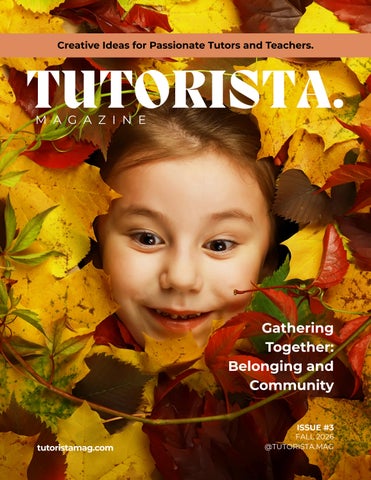
Creative Ideas for Passionate Tutors and Teachers.
TUTORISTA. M A G A Z I N E
Gathering Together: Belonging and Community ISSUE #3
tutoristamag.com
FALL 2026 @TUTORISTA.MAG
! ! L L L L A A F F HEELLLLOO H as
r e h t e g o t e m o c o t A season . s e i t i n u m m o c g n i w o r g d n a , g n i learn
tamag.com www.tutoris
elonging, b f o n io t a r ue, a celeb s is ll a f r u o hat bring t s e Welcome to c n ie r e p sensory ex d n a , y it n u gazine! a comm M a t is r o t u njoy your T E . e f li o t g learnin
ag @tutorista.m
AFFILIATE
Stop enduring discomfort and start feeling the difference of true ergonomics with Sunaofe. What began as a small workshop was rooted in a big idea: furniture should protect the person using it. Sunaofe is dedicated to crafting safe, healthy, and intelligent workspaces. So now, feel the support you deserve. SUNAOFE.COM A Magazine of Creative Ideas | For Passionate Tutors & Teachers
TUTORISTA MAG 4
A note from the editor Dear Reader, Welcome to the fall issue of Tutorista Magazine! Well on our way to another creative school year. We are excited to bring you an issue filled with curated articles and practical tips to support and inspire your teaching or tutoring practice. Whether you call the season fall or autumn, whether you experience the changing foliage in your corner of the world or not, we want to celebrate with you as we gather in gratitude and harvest both small and big wins in the classroom and beyond! Read about the power of student-led communities (p.20), learn how to build digital gatherings that foster real connections (p.30), and feel inspired by the honest and in-depth conversation we had with expert tutor and author, Mrs. Melissa Oshungbure. I invite you to follow us on Instagram @tutorista.mag. There, you can share your thoughts, comments, questions, and topic suggestions, and nominate a fellow tutor or teacher for a featured interview. “Autumn is a second spring when every leaf is a flower.” Albert Camus
gabriela t. Editor-in-Chief 5 TUTORISTA MAG
SEPTEMBER 2026
Table of Contents
STORYTELLING BY LARNTERN LIGHT LITERACY SPOTLIGHT
15
Belonging as a Learning Outcome
20
Student-Led Communities
27
From Classroom to Community
30
Digital Gatherings, Real Connections
33
Cozy Corners: Inspired by Fall
23
Meassuring and Nurturing Community in the Classroom
Redifining What It Means to Belong
How Schools Can Design Spaces that Invite Gathering and Connection
Building School Community in Hybrid or Online Spaces
Design a Sensory-Friendly Space for Neurodiverse Learners
Mindful in the Harvest Season Fall-themed Sensory Mindfulness for Educators
FEATURED INTERVIEW: SUPERCHARGE EDUCATION WITH MRS. OSH
In Every Issue
12
Our Favorite Things
25
STEAM Corner
38
On the Bookshelf
51
Seasonal Mood Board
53
The Crafty Teacher
Resources, Tools and Sites We Are Currently Loving
Turning Fall Projects into Rich Sensory Learning Experiences
Recommended Books and Print Materials for Literacy-based Learning
Inspiration from the Season's Colors, Scents, Sounds, and Textures.
Cool Ideas, Fun Recipes, and Materials for Multisensory Learning
AFFILIATE
Custom apparel and vibrant products that elevate your school spirit and unify your team! . Bringing people together is possible when we have a clear vision and shared values, and when we elevate our team with Vivid Customs’ hats, t-shirts, hoodies, sweatshirts, and more! VIVIDCUSTOMS.COM A Magazine of Creative Ideas | For Passionate Tutors & Teachers
TUTORISTA MAG 8
Tutorista. TUTORISTAMAG.COM
Publisher
GT & Co. Publishing Editor-in-Chief
Gabriela T. Contributing Editor
Daniela T. Comic Page Designer
Alexander G. Featured Interview Melissa Oshungbure
Open Call for Submissions Contact tutoristamag@gmail.com www.tutoristamag.com @tutorista.mag
To learn more about Tutorista Magazine visit:
tutoristamag.com Tutorista Magazine is published quarterly. Opinions in articles or advertisements do not necessarily reflect the publisher's opinion. Tutorista Magazine is not responsible for omissions or information misrepresented to the magazine. Advertisers and their agencies assume all liability for advertising content. No part of this publication can be reproduced or transmitted without permission in writing from the publisher.
AFFILIATE
Seeking a flawless complexion, soothing skincare, or effective anti-aging solutions? MISSHA has you covered. Thoughtfully formulated with potent ingredients to deliver visible results and nourish your skin from within. MISSHA is dedicated to making skincare accessible and effective for all. MISSHAUS.COM A Magazine of Creative Ideas | For Passionate Tutors & Teachers
TUTORISTA MAG 10
Correspondence
We would love to hear from you! This section of the magazine will spotlight your thoughts, comments, questions, and feedback. We'd also love to see pictures of your tutoring space, classroom, homeschool setup, and recent student-led projects (STEAM and beyond!). Send your email correspondence to: tutoristamag@gmail.com Can't wait to read your letter!
Team Tutorista Please make sure you send only pictures, images/photos you have taken yourself, or have a license/copyright to divulge. If there are others in your photos/images (especially children/students), please make sure you have their parents' or guardians' consent, as we might share these on our social media channels. Thank you!
SEPTEMBER 2026
TUTORISTA MAG 11
Our Favorite Things SEPTEMBER 2026
Student Treasures
Supercharge Workbooks
Student Treasures book publishing
Written by Melissa Oshungbure, the
kits provide teachers and schools
Mission and Supercharge series
with a free hands-on writing activity
moves beyond traditional
that motivates students to write and
workbook practice. These carefully
inspires them to learn by turning their
designed books explore
stories into professionally bound
English through history, science,
books. Bring their stories to life!
geography, and real-world contexts.
Tiny Land Affiliate
BrainPOP Affiliate
A tiny world crafted for small hands
Make your live or online tutoring
and creative brains. Tiny Land offers
sessions fun, engaging, and ultimately
endless opportunities for pretend-
successful with BrainPOP's digital
play and play-based learning!
resources. TUTORISTA MAG 12
AFFILIATE
Organize your life, set meaningful goals, plan for success, reflect, & record your gratitude! Gratitude Journals and Planners that help you build happier moments and more productive days! Browse Intelligent Change's bestselling collections by scanning the QR Code. INTELLIGENTCHANGE.COM A Magazine of Creative Ideas | For Passionate Tutors & Teachers
TUTORISTA MAG 13
Subscribe to Tutorista Mag. Today!
NEVER MISS AN ISSUE! All digital issues right in your inbox. Receive special offers and first dibs on seasonal giveaways!
VISIT US ONLINE Sign up and join the insiders. Behind-the-scenes content. Read anytime, anywhere.
TUTORISTAMAG.COM
14 TURORISTA MAG
SEPTEMBER 2026
Belonging as a Learning Outcome. IMAGES PROVIDED BY CANVA PHOTOGRAPHY ASSETS. ARTICLE BY GABRIELA T.
Meassuring & Nurturing Community in the Classroom. Belonging is often treated as a soft value in
That idea matters because schools tend
education, something nice to have after
to give more weight to what is easiest to
the real work of reading, writing, math, and
measure. Test scores, attendance, and
problem-solving is done. But for teachers
grades tell part of the story, but they
and students, across all grade levels,
do not reveal whether students feel
belonging is at the core of a thriving
welcome
learning community.
questions, or recover from mistakes.
Belonging is part of the conditions that
A classroom can look "successful” on
make learning possible. When students
paper and still leave some students
feel seen, safe, and connected in the
feeling invisible, and teachers drained
classroom,
and uninspired. It can also be chaotic in
they
are
more
likely
to
enough
to
speak,
ask
participate, take risks, and stay engaged.
ways that mask a deep lack of trust.
In that sense, belonging should be
So if education is supposed to prepare
understood not just as a school climate
students
goal, but as a learning outcome.
persevere, then teachers and other
to
think,
collaborate,
and
school leaders need to pay attention to the emotional and social environment where learning takes place.
15 TUTORISTA MAG
SEPTEMBER 2026
Belonging is more than a warm feeling. In the classroom, it looks like being known by
Challenge Accepted
name, having ideas taken seriously, and
The challenge is that belonging is
seeing social backgrounds and cultures
difficult to measure with the same
reflected in the curriculum and daily
precision as a test score. It is relational,
routines.
subjective, and shaped by context.
It shows up when a teacher notices who is
A student may feel comfortable in one
speaking and who is silent, who works well
class and alienated in another, even
with others, who thrives on working alone,
within the same school. For that reason,
and who would like to join in but needs the
schools that take belonging seriously
skills and support to grow in confidence.
often use multiple forms of evidence and connect them to action:
It appears in small moments: a greeting at
Student surveys can reveal whether
the door, a discussion protocol that makes
learners
space for disagreement, a group project
included.
that depends on everyone’s contribution,
Attendance patterns may suggest
timely and clear feedback that encourages
whether
reflection and revision rather than shutting
present.
a student down.
Discipline data can show where
feel
respected
students
want
and
to
be
exclusion is happening. These details may seem minor, but together
Focus groups and interviews can
they show students whether their presence,
add the nuance that numbers alone
ideas, and contributions matter.
miss. No single metric is enough, but together these strategies for gathering information
can
help
schools
see
patterns they might otherwise ignore and respond accordingly. Belonging is part of the conditions that make learning possible.
SEPTEMBER 2026
TUTORISTA MAG 16
The strongest classrooms do not wait
Cultural awareness and responsiveness
for a survey to build community. They
also play a major role. Students are more
create it intentionally.
likely to feel they belong when classroom materials, examples, and protocols do not
Teachers can start class with brief check-
assume a single way of speaking, thinking,
ins that invite students to share how they
or living.
are coming in that day. They can rotate discussion roles so participation is not
That does not mean lowering expectations.
dominated by the same voices.
It means broadening the definition of who is already inside the classroom and being
They can use cooperative tasks that
impacted and inspired by the lesson.
require genuine interdependence instead of dividing labor into disconnected
In
pieces. They can also build in student
meaningful connections with the subject
choice, because belonging grows when
matter
students have some ownership over
experiences in what they study, school
how they learn.
feels less like an institution built around
this
way, and
when
students
recognize
their
make own
them and more like a space where they Most importantly, teachers can make
can grow and which they can help shape.
room for repairing trust after conflict. A classroom community is not one where nobody disagrees; it is one where disagreement does not lead to exclusion.
SEPTEMBER 2026
“The strongest classrooms do not wait for a survey to build community. They create it intentionally.”
TUTORISTA MAG 17
Schools have to be careful not to turn belonging
into
another
compliance
metric. If administrators ask students to rate their sense of community but never change
classroom
practice,
measurement becomes hollow. If belonging data are used to rank teachers or punish schools, people may become defensive rather than reflective. The goal is not to reduce community to a score. The goal is to use evidence to strengthen relationships, remove barriers, and make schools more humane. In the end, belonging may be one of the clearest signs that learning is happening in a meaningful way. Students who feel connected are more likely to stretch themselves, recover from setbacks, and enrich the intellectual life of the classroom. That is not separate from achievement; it is part of what achievement depends on. So if schools want deeper learning, they should
stop
treating
belonging
as
something that may happen by default and start treating it as something worth measuring, nurturing, and protecting. SEPTEMBER 2026
TUTORISTA MAG 18
AFFILIATE
Smart and stylish. Everything you love about a paper calendar, now digital! Artful Agenda was made with intention and with creatives like you in mind. This practical tool will help you plan daily, weekly, and monthly for success. Start your free trial today by scanning the QR Code. ARTFULAGENDA.COM A Magazine of Creative Ideas | For Passionate Tutors & Teachers
TUTORISTA MAG 19
Student-Led Communities Redefining What It Means to Belong. BY GABRIELA T. | IMAGES PROVIDED BY CANVA PHOTO ASSETS
Walk through any school campus, and
Traditionally, belonging in schools has
you will find more than classrooms and
been framed through institutional lenses:
lecture halls. You will find communities of
enrollment, attendance, or participation
identity, purpose, and connection—many
in officially sanctioned programs.
of them built not by administrators, but by students themselves.
Student-led communities challenge this top-down definition. They create spaces
Clubs, councils, and coalitions
where belonging is not assigned—it is
have quietly become some of the
actively constructed, negotiated, and felt.
most influential forces shaping how young people experience belonging. 20 TUTORISTA MAG
SEPTEMBER 2026
Clubs, Councils & Coalitions Clubs are often the most visible form of student
leadership.
From
cultural
organizations to robotics and programming teams, they give students a shared purpose beyond academics. What makes them transformative is not just the activity, but the autonomy. Students decide what matters, how meetings are run, and what goals to pursue. This ownership leads to deeper emotional investment. A student who may feel unseen, insecure, or overwhelmed in a classroom can
become
a
leader,
organizer,
or
innovator within a club.
You can belong through shared purpose. Coalitions represent perhaps the most dynamic form of student-led community. Unlike clubs, which often center around a
Councils, such as student government or
single interest, coalitions bring together
advisory boards, take this a step further by
diverse
bridging
challenges.
the
gap
between
students,
groups
to
address
shared
institutional power, and decision-making. Whether advocating for mental health When councils are genuinely empowered—
resources,
scaffolding
initiatives,
or
not just symbolic—they allow students to
sustainability efforts, coalitions depend
shape policies, advocate for peers, and
on collaboration across differences. In
influence the direction of their schools.
doing so, they redefine belonging as wider rather than narrower.
This participatory role turns belonging from passive inclusion into active involvement.
You do not need to fit a single aspect of
Students are no longer just members of a
your identity—you can belong through
school; they help shape its evolution.
shared purpose.
21 TUTORISTA MAG
SEPTEMBER 2026
What's the Goal?
In an era where many young people
Student-led
led communities offer a clear alternative.
communities
decentralize
authority and validate lived experience. They allow students to define their own path rather than conform to pre-existing structures. This is particularly important for those who have felt they do not "fit in.”
report feeling disconnected, student-
They remind us that belonging is not a fixed condition but an ongoing process —one that thrives when students are trusted to lead.
In this way, when students create their
As schools look toward the future, the
own spaces, they are not just seeking
question is no longer whether student
inclusion; they are being proactive and
voices matter. It is how much space,
building inclusion with purpose.
resources, guidance, and trust we are
The impact extends beyond the school environment. Students who participate in these
communities
leadership,
develop
skills
communication,
willing to give them to lead and shape the community itself.
in and
collaboration. More
importantly,
they
learn
that
Belonging is not a fixed condition but an ongoing others—it is something they can build, process, one that thrives when cultivate, and extend to others. students are trusted to lead. belonging is not something granted by
22 TUTORISTA MAG
SEPTEMBER 2026
Mindfulness in the Harvest Season 5 Practical Ways Tutors and Teachers Can Cultivate Mindfulness and Manage Stress This Fall. TEAM TUTORISTA | IMAGES PROVIDED BY CANVA PHOTOPGRAPHY ASSETS
As fall begins, educators often face a surge of responsibilities—new students, shifting routines, and increasing academic demands. This season can be energizing, but it can also become overwhelming without intentional strategies to stay balanced. Cultivating mindfulness is not about eliminating stress entirely, but about managing it in ways that support both well-being and effectiveness in the classroom.
1. Start the Day with a Grounding Routine.
2. Build Micro-Breaks into Your Schedule.
Beginning your morning with even a
Fall schedules often become tightly
few minutes of intentional stillness can
packed, leaving little room to reset
set the tone for the rest of your day.
between sessions or classes. As a
This might include deep breathing,
result, short breaks—just two to five
light stretching, or simply sitting quietly
minutes—can
before checking emails or lesson plans.
mental fatigue.
For example, a tutor might spend five
Use these moments to step away from
minutes focusing on slow, steady
screens, hydrate, or take a brief walk.
breaths before their first session,
In turn, these pauses help prevent
helping
burnout and improve focus when you
them
feel
centered
present rather than rushed.
SEPTEMBER 2026
and
significantly
reduce
return to teaching.
TUTORISTA MAG 23
3. Set Realistic Expectations. The pressure to meet academic
4. Create a Calm Teaching Environment.
goals, support every student, and
Your
stay
environment plays a key role in
organized
can
quickly
physical
and
management.
emotional
escalate. In response, mindfulness
stress
Even
small
involves recognizing limits and
adjustments—such as decluttering
adjusting expectations accordingly.
your workspace, using natural light, or incorporating calming music—can
Instead of aiming for perfection in
make a noticeable difference.
every lesson, focus on progress and connection. For instance, if a
A
calm
session doesn’t go exactly as
benefits you but also helps students
planned, reflect on what worked
feel more relaxed and receptive. As
rather than dwelling on what didn’t.
a
result,
environment
it
creates
not
a
only
positive
feedback loop in your sessions.
5. Practice End-of-Day Reflection. Closing
your
day
with
a
brief
By integrating these small, intentional
reflection can help you process
practices into your routine, you can
experiences and release lingering
navigate the demands of the fall
stress. For example, this could be as
season with greater clarity and
simple as noting one success, one
resilience. In this way, mindfulness is
challenge, and one thing you’re grateful for. A teacher might write down a moment when a student showed
not an added task—it is a supportive framework that helps you show up as your best self for both your students and yourself.
improvement, reinforcing a sense of purpose and accomplishment despite a busy day.
SEPTEMBER 2026
TUTORISTA MAG 24
STEAM CORNER
BY TEAM TUTORISTA
INSPIRATION FOR FALL STEAM PROJECTS As the fall season arrives with colorful leaves and cooler weather, it creates
Sensory Leaf Chromatography & Texture Sorting.
the perfect opportunity to engage
This activity combines the science of
students in hands-on STEAM learning. Fall-themed projects can connect science, technology, engineering, art, and math to real-world seasonal changes
while
keeping
students
curious and creative.
Here
are
three
color
separation
with
rich
tactile
exploration. Science & Art: Children perform a simple
leaf
experiment
chromatography
using
fall
leaves,
rubbing alcohol, and coffee filters to separate pigments (chlorophyll,
fall-themed
carotenoids, anthocyanins). Sensory Component: Before the
STEAM project ideas designed
experiment, sort leaves by texture
specifically for sensory learning
(smooth, rough, waxy, veiny), color,
that blend tactile exploration
and size. Use magnifying glasses to
with core STEAM concepts.
explore leaf veins and surfaces.
Each
textured leaf collage using the
project
integrates
multiple
STEAM disciplines while prioritizing sensory engagement through touch,
After the experiment, create a separated pigments and actual leaves glued onto cardstock.
smell, sight, and even taste.
Math & Engineering: Measure and
These projects are perfect for young
or create patterns with sorted
learners classrooms!
or
sensory-focused
record leaf dimensions, count veins, leaves. Engineer a simple leaf press using wooden blocks and heavy books. What's Chromatography? It’s a fun laboratory method used to separate a mixture into its different parts.
25
AUTUMN LEAVES AND PUMPKINS, PLEASE... Pumpkin Spice Sensory Slime & Decay Investigation.
Apple Oxidation Taste Test & Sensory Bin.
A multi-sensory project that explores
This
chemistry, biology, and tactile play.
through the senses of taste, touch, and
Science:
Investigate
how
project
explores
chemistry
smell.
pumpkins decompose over time
Science:
by
carved
oxidation experiment by slicing
pumpkin daily, recording changes
apples and treating them with
in texture, smell, and appearance.
different substances (lemon juice,
Simultaneously,
water, vinegar, honey) to observe
observing
a
small
make
pumpkin
Conduct
an
apple
spice-scented slime using glue,
which prevents browning best.
baking soda, contact solution, and
Sensory Component: Create an
autumn
apple-themed sensory bin filled
spices
(cinnamon,
nutmeg, pumpkin pie spice).
with dried apple slices and berries,
Sensory Component: The slime
cinnamon sticks, wooden spoons,
provides tactile feedback with its
and apple figurines. Freeze apple
stretchy, gooey texture, while the
chunks overnight, then let children
spices add a strong olfactory
crush and squeeze them in a
element. Add googly eyes, orange
Ziploc bag to make fresh apple
food coloring, or small pumpkin-
juice, engaging touch and taste.
shaped beads for visual and tactile
Art & Math: Use apple halves as
variety.
stamps to create symmetrical art
Engineering & Math: Design and
patterns.
build a small pumpkin catapult or
different apple varieties, graph
pulley system to launch mini-
results, and compare sizes and
pumpkins
or
weights.
measuring
distances
candy
corn,
Count
seeds
from
launched
and angles used. References and suggested websites: hustleandhomeschool.com | lindsayfocus.com
26
From Classroom to Community Designing Spaces that Invite Gathering and Connection. BY GABRIELA T. | IMAGES PROVIDED BY CANVA PHOTOGRAPHY ASSETS
Schools are more than places of
Equally important is flexibility. Traditional
instruction; they are social ecosystems
classrooms with fixed desks facing forward
where relationships shape learning.
send a clear message: sit still and work alone. In contrast, movable furniture, soft
To foster connection, schools must
seating, and modular layouts signal that
intentionally design spaces that invite
collaboration is welcome.
students, teachers, and staff to gather, linger, and interact.
Schools can introduce lightweight tables, stackable chairs, and lounge areas that can
Yet many campuses are still designed
be reconfigured for group work or informal
like factories—efficient, controlled, and
gatherings.
isolating. Thoughtful spatial design
adding a few couches or café-style tables—
can transform a campus from a series
can shift how students use a space.
Even
small
changes—like
of rooms into a vibrant community. At the heart of connection is visibility. Spaces that allow people to see one another naturally encourage interaction. Open commons and wide corridors create a sense of shared experience rather than separation. Building incorporate
on
this,
schools
can
“learning
streets”
with
“Movable furniture, soft seating, and modular layouts signal that collaboration is welcome.”
natural light, seating, and flexible areas where students can pause between classes. When people feel seen, they are more likely to engage. 27 TUTORISTA MAG
SEPTEMBER 2026
Comfort also plays a powerful role in encouraging connection. Hard chairs, poor airflow, harsh overhead lighting, and sterile environments discourage lingering, while warm, inviting spaces draw people in. Natural elements such as plants, wood textures, and ample daylight can make a significant difference. Schools might also consider acoustics: overly noisy spaces can be overwhelming, while thoughtfully designed soundscapes support conversation. Together, these details create an environment that invites people to stay, and staying is the first step toward connecting. Another key strategy is creating intentional “in-between” spaces. Not all meaningful interactions happen in classrooms. Areas like courtyards, stair landings, libraries, and entryways can be designed as social hubs. For example, a wide staircase with built-in seating can double as a gathering spot. Similarly, outdoor spaces with shade, benches, and Wi-Fi access can encourage students to spend time together beyond structured activities.
“Not all meaningful interactions happen in classrooms. Courtyards, stair landings, libraries, and entryways can be designed as social hubs.”
These transitional areas often become the heartbeat of a school. SEPTEMBER 2026
TUTORISTA MAG 28
Desing for Connection Inclusivity should guide every design decision. Spaces must feel welcoming to all students, not just the most outgoing. Providing a variety of environments—quiet corners, small group zones, and larger communal areas—ensures that different personalities and needs are respected. In addition, clear signage, accessible layouts, and culturally responsive design elements help students feel that they belong. Finally, schools should involve students, teachers, and staff in the design process. The people who use a space every day have valuable insights into what works and what does not. Simple steps like surveys, student design teams, or pilot spaces can lead to more effective and meaningful outcomes. As a result, when all users have a voice in shaping their environment, they are more likely to take ownership of it. Designing for connection is not about grand renovations alone. It is about small, intentional choices that prioritize human interaction. Schools can create environments where
“When all users have a voice in shaping their environment, they are more likely to take ownership of it.”
connection is not forced, but naturally unfolds by making spaces visible, flexible, comfortable, and inclusive.
SEPTEMBER 2026
TUTORISTA MAG 29
Digital Gatherings, Real Connections Building School Community in Hybrid and Online Spaces. BY GABRIELA T. | IMAGES PROVIDED BY CANVA PHOTOGRAPHY ASSETS
As classrooms extend beyond physical walls, educators face a pressing challenge: cultivating a strong sense of community when students are dispersed across screens, time zones, and varying learning environments. Hybrid and online education offer flexibility and accessibility, but they can also create emotional distance. Building a vibrant school community in these spaces is essential for student engagement, well-being, and academic success. At the heart of any school community is connection. In traditional settings, these bonds often form organically through
shared
conversations,
routines, and
hallway
extracurricular
activities. In digital environments, however, connection must be intentionally designed. To support both academic and social interaction,
teachers
and
school
leaders need to prioritize structured opportunities. Simple practices such as opening virtual classes with informal check-ins or dedicating time for peer discussions can
help
humanize
experience. 30 TUTORISTA MAG
the
online
Hybrid and online education offer flexibility and accessibility, but they can also create emotional distance. SEPTEMBER 2026
Consistency
Voice
Consistency also plays a critical role.
Equally important is student voice. In
When students know what to expect
hybrid and online settings, giving
—whether
through
predictable
students opportunities to contribute
schedules,
clear
communication
ideas, lead discussions, or collaborate
channels, or regular feedback—they
on projects fosters ownership and
feel more secure and connected. To
inclusion.
mirror the shared experiences that
discussion boards, collaborative
define a traditional school culture,
documents, and breakout rooms
establish rituals such as weekly
can empower students to interact
announcements, virtual assemblies,
more
or recognition ceremonies. These
participation from those who might
moments create a sense of belonging
feel hesitant in face-to-face settings.
and reinforce collective identity, even
As students feel heard and valued,
when students are physically apart.
community naturally strengthens.
Access
Beyond the classroom, schools can
Teachers must also be mindful of
foster community by reimagining
equity and access. Not all students experience online learning in the same way; differences in technology, home environments, and support systems can affect participation. To build
community,
empathy
are
flexibility
essential.
and
Offering
multiple ways to engage—such as live sessions, recorded content, and asynchronous
discussions—ensures
Digital
tools
freely,
extracurricular
such
as
encouraging
activities.
Virtual
clubs, online competitions, and digital events allow students to pursue shared interests and build relationships
outside
academic
settings. Even informal spaces, such as moderated
chat
groups
or
virtual lounges, can recreate the social aspects of school life that students deeply value.
that all students have a pathway to connect.
Additionally,
proactive
outreach to students who may be disengaged helps maintain inclusivity.
32 TUTORISTA MAG 31
SEPTEMBER 2026
Be Intentional Ultimately, building community in hybrid and online spaces demands intentionality, creativity, and a commitment to connection. Although the medium may differ, the goal remains the same: to create an environment where students feel seen, supported, and part of something larger than themselves. When schools succeed in this effort, they transform digital platforms into meaningful communities that nurture both learning and belonging.
Although the medium may differ, the goal remains the same: to create an environment where students feel seen, supported, and part of something larger than themselves.
32 TUTORISTA MAG
SEPTEMBER 2026
5 Tips for Designing a Fall-Inspired Sensory-Friendly Space
TEAM TUTORISTA | IMAGES BY CANVA PHOTOGRAPHY ASSETS
As the crisp air and warm colors of fall arrive, classrooms and learning spaces often shift to reflect the season. For neurodiverse learners, these changes can be both engaging and overwhelming. Thoughtful design can create an environment that captures the cozy spirit of autumn while remaining calm, predictable, and supportive. Here are five practical tips to help you build a sensory-friendly space that balances seasonal charm with accessibility.
1. Choose Calm, Muted Fall Colors.
2. Incorporate Natural Textures Thoughtfully.
Traditional
palettes—burnt
Fall is the perfect time to introduce
orange, mustard yellow, and deep
natural materials like faux leaves, soft
red—can be visually stimulating.
flannel fabrics, and textured cushions.
Instead, opt for softer, muted tones
These can provide comforting tactile
like sage green, warm beige, dusty
experiences, but moderation is key.
orange, and soft browns. These
Offer a designated sensory corner with
colors still reflect the season while
items such as soft blankets, smooth
reducing visual overload. Use them
wooden objects, or fabric swatches so
on bulletin boards, rugs, and
learners can engage when they choose
seating areas rather than bright
rather
wall-to-wall décor.
constant stimuli.
fall
SEPTEMBER 2026
than
being
surrounded
by
TUTORISTA MAG 33
3. Create Cozy, LowStimulation Retreat Areas.
4. Use Seasonal Scents with Caution.
Design a small “autumn nook”
Fall scents like cinnamon, apple, or
where students can self-regulate.
pumpkin spice can enhance the
Use soft lighting (like warm LED
atmosphere,
lamps instead of harsh overhead
overwhelm
lights), neutral-colored bean bags,
learners. If you include scent, keep it
and simple fall accents such as a
subtle and optional—such as a lightly
single pumpkin or leaf garland.
scented object in a controlled area
Keep this space uncluttered and
rather than diffusing it throughout
predictable so it feels safe rather
the room. Always ensure there is a
than distracting.
scent-free space available.
but
they
may
sensory-sensitive
5. Maintain Structure with Seasonal Flexibility.
Designing a sensory-friendly
While adding fall decorations, keep
space
the
overall
layout
consistent.
for
balance:
fall
is
about
capturing
the
Neurodiverse learners benefit from
warmth and richness of the
predictable environments, so avoid
season
rearranging furniture too frequently.
comfort, predictability, and
Instead, integrate seasonal elements
choice.
into existing structures—swap out
design, you can create an
covers, rotate wall visuals, or update
environment
learning materials with fall themes
learner feels both inspired
without
and at ease.
disrupting
the
room’s
while With
prioritizing intentional
where
every
organization.
SEPTEMBER 2026
TUTORISTA MAG 34
Storytelling by Lantern Light Multisensory Literacy Centers for Shorter Fall Days
ARTICLE BY GABRIELA T. | IMAGES PROVIDED BY CANVA PHOTOGRAPHY ASSETS
As fall days grow shorter and shadows
At the heart of this approach is intentional
stretch earlier across the classroom floor,
ambiance, beginning with the lighting.
educators have a unique opportunity to reimagine literacy spaces.
Swapping harsh overhead lights for soft lanterns or warm string lights immediately
The season naturally invites a quieter,
alters the tone of a classroom. That gentle
more reflective atmosphere that can
glow signals a transition from routine
sharpen storytelling focus.
instruction to something more intimate and imaginative.
By designing multisensory literacy centers that harness the fall mood, teachers can
Battery-operated lanterns, flickering LED
make
candles, or projected “firelight” visuals can
reading
and
writing
immersive and memorable.
feel
more
create a safe, cozy environment where stories feel alive.
35 TUTORISTA MAG
SEPTEMBER 2026
From there, multisensory engagement
Sound also plays a powerful role in this
becomes key. Literacy centers should
multisensory experience.
invite students to interact with text in more than a visual way.
Gentle background audio—rustling leaves, distant wind, or soft instrumental music—
Consider incorporating tactile materials
can enhance focus and imagination without
such as textured story mats, felt
overwhelming students.
characters, or natural elements like pinecones and leaves.
For storytelling activities, teachers might introduce simple sound-making tools, such
A reading corner might include soft
as small drums or chimes, allowing students
blankets and cushions, while a writing
to create their own auditory backdrops as
station could offer scented markers or
they narrate or act out stories.
paper infused with subtle fall/autumn fragrances, such as cinnamon or apple.
Creativity thrives when students feel ownership
These
sensory
cues
deepen
comprehension by anchoring stories in
over
their
environment.
Encourage them to contribute to the setup of literacy centers.
physical experience. They might design lantern covers with cutout shapes that cast patterned shadows, or build miniature “story worlds” using craft materials. These contributions not only personalize the space but also foster a deeper connection to the narratives it explores.
SEPTEMBER 2026
TUTORISTA MAG 36
Importantly,
these
centers
should
remain flexible and inclusive so the experience stays welcoming.
For example, three rotating stations might include: “Lantern Library” for cozy reading. “Story Builder’s Table” with tactile and
Offer
a
range
of
activities
to
visual prompts.
accommodate different learning styles
“Sound & Story Stage” where students
and comfort levels.
perform short narratives with ambient effects.
Some
students
may
prefer
quiet,
independent reading under a lantern’s
Each
station
combines
senses
while
maintaining a clear literacy focus.
glow, while others may gravitate toward collaborative storytelling or dramatic
As daylight fades earlier each afternoon,
play.
these thoughtfully designed spaces can turn a seasonal challenge into a powerful
Rotating center themes—such as “forest
teaching tool.
tales,” “harvest myths,” or “mystery nights”—can keep the experience fresh
Storytelling by lantern light invites students
and engaging throughout the season.
to slow down, engage deeply, and discover the magic of language in a setting that feels both comforting and inspiring.
SEPTEMBER 2026
TUTORISTA MAG 37
On the bookshelf
World Cup Dreams!
Finding Your Authentic Self
Learn about Pelé and his journey to
Movement is life! Encourage your
become an icon of soccer, or "fútbol,”
young reader and curious child to let
around the world. Feel inspired to
out her authentic self and find the
dream big and work hard to
movement to free her energy and her
accomplish your goals!
creativity.
Baby Book with a Beat
Empathy Builds Friendships
A Latin music-inspired book to make
Making new friends is a challenge.
your bedtime a celebration. Let's
This story invites us to put aside our
dance to the joyful rhythm of salsa all
fears and extend an act of kindness
the way to bed and sweet dreams.
that might change someone's day.
A Magazine of Ideas | For Passionate Tutors & Teachers
TUTORISTA MAG 38
Spotlight Your Classroom Take us on a tour! We would love to spotlight your creativity and innovative ideas...
Tag us in a pic of your classroom, tutoring space, or homeschooling room!
... and the way you are curating a space that promotes curiosity, autonomy, discovery, learning, collaboration, and growth.
@tutorista.mag
Featured Interview SUPERCHARGE! AN INTERVIEW WITH MELISSA OSHUNGBURE (MRS. OSH) IMAGES PROVIDED BY CANVA PHOTOGRAPHY ASSETS | PROFILE PHOTO PROVIDED BY MRS. OSH
“Do not undervalue yourself. You have years of training, knowledge and experience, and you should be proud of that.” We're pleased to introduce Melissa Oshungbure, a passionate tutor, published author, content creator, and entrepreneur. Her love of teaching and learning, creativity, and commitment to her students' academic success are a source of inspiration for new and experienced tutors alike. Mrs. Osh is a contributor to Tutorista Mag and shares practical tips and resources on her website and social media feeds. We hope you enjoy this open and honest conversation, and encourage you to visit Mrs. Osh Tutors and follow @mrsoshtutors for muchappreciated doses of inspiration. 40 TUTORISTA MAG
SEPTEMBER 2026
Q: Can you share how you became a tutor and the key moments that shaped your path? I had wanted to teach since childhood, but I always felt there could be value in it being my second career rather than my first. After graduating from the University of Manchester, I moved into publishing, ultimately enjoying the roles of both publisher and managing editor. I see great value in having another career before teaching: on a practical level, it allowed me to build a nest egg, but more significantly, it enabled me to bring experience from beyond an institutional academic environment into the classroom. There are many efficiencies and creative approaches from the corporate world that could benefit education and help us to “make the boat go faster”*. I retrained through the Schools Direct program, effectively learning on the job while spending one day each week at college. I loved it: the environment, the students and the sheer joy it brought to my everyday life. However, as many teachers do, I soon realized that bureaucracy frequently prevented us from making the boat go faster! I persevered, but after around five years I knew I would be happier working more closely with children than a traditional school setting would allow. Surviving breast cancer during my teacher-training year had also made me reassess my priorities. I wanted a healthier, more sustainable working life: one that allowed me to give children my best without sacrificing my own wellbeing. I had developed wonderful relationships with many parents at the school where I taught, so I took a leap of faith and trusted that tutoring would work out. It did: within a month, my timetable was full, and I have continued to grow from there over the past four years.
*Ben Hunt-Davis and Harriet Beveridge’s book, Will It Make the Boat Go Faster? OlympicWinning Strategies for Everyday Success.
SEPTEMBER 2026
TUTORISTA MAG 41
Q: What is your teaching philosophy, and how does it appear in your tutoring sessions? In one word: care. This begins with the very first parent inquiry. I often talk at length with prospective parents, whether or not I have a space available, because I genuinely care about children’s happiness and want to help families find the right support. My own childhood was not always a safe or happy one, and that experience has made me a staunch advocate for every child’s right to feel secure, to be authentically themselves, and to find joy in learning. In every session, I begin with a conversation before there is any mention of work: “How are you today? How was your week? Did you do anything fun?” Sometimes it might be: “You don’t seem quite yourself today - is everything okay?” A child who knows that an adult is genuinely interested in them and their wellbeing is much more likely to trust that adult, listen to them and feel relaxed enough to learn. However, care does not mean lowering expectations. It means understanding a child well enough to offer the right challenge, in the right way, at the right moment. I want children to feel safe enough to make mistakes while still discovering that they are capable of far more than they might initially believe. I also believe that valuable learning does not always look like a conventional lesson. Through creative workshops and themed holiday programs, I bring English and math into engineering challenges, baking, filmmaking, art, and collaborative problem-solving. Children often make their greatest progress when they are so absorbed in an experience that they temporarily forget they are ‘doing work’.
SEPTEMBER 2026
TUTORISTA MAG 42
Q: What motivates you to keep tutoring, and what impact do you hope to have on your students' lives? My motivation comes from a deep sense that this is the work I am meant to do. It goes beyond passion: I know I am where I should be, doing what I am supposed to do. Of course, running and growing a tutoring business has its demanding moments, but there has not been a single point at which I have regretted making the move. I still look forward to teaching, creating resources, and finding new ways to help a child overcome something they once believed they could not do. For me, it is Maslow’s self-actualization in practice. How many people can honestly say that they have found work that gives them such a strong sense of purpose? I feel incredibly fortunate to have found my calling. The impact I hope to have reaches far beyond examination results. I want children to leave me knowing that difficulty is not the same as inability, that mistakes are part of learning and that their ideas are worth sharing. If they become more confident, curious and willing to tackle the unfamiliar, that will remain valuable long after they have forgotten the individual questions we once worked through together.
SEPTEMBER 2026
TUTORISTA MAG 43
Q: How do you adapt your approach to students with different learning styles, confidence levels, or backgrounds? This is an area in which I am constantly learning myself. The adage that ‘every child is different’ is golden. There may be commonalities among children, but the combination of their needs, backgrounds, confidence, curiosity, adaptability, learning preferences, and personalities is entirely unique. I know all my students individually, and I have no desire to expand my business to the point at which I would no longer be able to say that. That connection is what drives me. In practice, adapting might mean using counters or diagrams for a child who needs to see a mathematical concept, turning vocabulary revision into a game for a reluctant learner, allowing additional thinking time before asking for an answer, or gradually removing scaffolding as a child’s confidence develops. One child may thrive on competition while another needs the reassurance of working collaboratively. Some children enjoy writing; others reveal far more understanding through discussion, puzzles or practical activities. I routinely read articles and books, and research areas that pique my interest or where I can see that a child needs additional support. I regard my own continual learning as one of the foundations of my job. It is also important for teachers and tutors to remember what it feels like not to have the answers, and to experience that discomfort ourselves occasionally. It reminds us of the bravery children show every day. It is easy to become blind to the stress a child may experience when faced with a challenge that is slightly too great, particularly when they are working in front of their peers.
SEPTEMBER 2026
TUTORISTA MAG 44
Q: Can you describe a particularly challenging student or situation and how you handled it, both instructionally and emotionally? I worked with two students who were facing the same significant barrier: their knowledge of times tables. One was a girl in Year 4 and the other a boy in Year 5. It did not seem to matter whether we practiced with resources or without them, by rote or more creatively - the facts simply did not stick, and every lesson felt like a repeat of the week before. It was heartbreaking to see their frustration, and I knew I needed to find a better way rather than continuing to present the same material in slightly different forms. I researched extensively, read articles, and listened to experts discussing cognitive approaches to learning. I came across several concepts and pieces of research that rang true, then combined what I had learned into a different model and tested it. That model eventually grew into an eight-week program combining play-based learning, visualization, writing by hand, repetition and carefully planned revision even down to the particular combinations of times-table facts children learn together. On a personal level, it was hugely rewarding to create something in which I had genuine confidence. More importantly, it worked for both children. The joy of seeing them finally able to access the broader mathematics curriculum was immense. Their parents were understandably delighted too. I have since developed the approach into a program that parents can use at home: Time Tables Program for Parents
SEPTEMBER 2026
TUTORISTA MAG 45
Q: How do you define and measure success in your tutoring work—for yourself and for your students? Success depends entirely on the child. The most obvious example is an 11+ student receiving an offer - and perhaps a scholarship - from their chosen school. Those are wonderful moments, and I am immensely proud of the work that leads to them. However, I take just as much pride in a child who leaves me having developed greater confidence and curiosity about learning. I measure progress through assessment scores, school feedback, and examination outcomes where appropriate, but I also look for quieter evidence: a child volunteering an answer, attempting a difficult question without fear, recognizing and correcting their own mistakes, explaining their reasoning, or beginning to read and learn independently. For one child, success might be a scholarship. For another, it might be entering a session without anxiety, writing a full paragraph for the first time, or saying, “That was hard, but I’m going to try again.” I do not see my role simply as helping children to pass examinations at the age of ten or eleven. Despite only tutoring up to Year 6, I see my role as preparing children to become lifelong learners. I want to help build a future generation of open and creative thinkers: young people who can solve problems, consider different perspectives and discover what gives their own lives meaning and happiness.
SEPTEMBER 2026
TUTORISTA MAG 46
Q: What skills or areas of your practice are you currently trying to improve, and how are you working on them? One area I am currently developing is educational leadership. I have recently expanded into dedicated premises and, as part of that growth, begun working with assistants. This has required me to think carefully about how I articulate teaching practices that have become instinctive after years of experience. As my overarching goal is to support young people towards productive and fulfilling lives, I have deliberately prioritized offering opportunities to talented students and recent graduates. I have two teenagers myself and, through them, appreciate how difficult it can be to gain meaningful work experience - or paid employment - without already having experience. My assistants are academically able, enthusiastic young people who have recently been through the education system themselves. What they are still developing is the skill of sharing that knowledge effectively with younger children. I am therefore creating a structured training program covering effective questioning, the use of visual and practical resources, recognizing misconceptions, building confidence, and knowing when to offer support and when to step back. Teaching is not simply about knowing an answer; it is about helping a child uncover and understand that answer for themselves. Developing these young people into confident educators while ensuring that every child continues to receive high-quality support is an exciting new stage in my own professional development.
SEPTEMBER 2026
TUTORISTA MAG 47
Q: Tell us about the Mission and Supercharge Workbook series. How did this project come about, and what has been the most challenging aspect of selfpublishing? A large part of my English tuition involves comprehension in one form or another, encompassing vocabulary, inference, retrieval, and literary techniques. So many existing workbooks and resources rely on children reading a piece of text and writing answers to questions. Even highly motivated children can quickly groan or switch off when faced with such a repetitive approach. I enjoyed crosswords as a child and began experimenting with using them as a comprehension tool. They were remarkably successful with my students - to the point that the children began asking to do them. The texts remain challenging and rich in vocabulary, but children do not always need to write lengthy answers to develop their inference and retrieval skills. The crossword format also gives children immediate feedback. They quickly realize if an answer is wrong because it will not fit, or if they have spelled a word incorrectly because it prevents another answer from working. This encourages them to identify and correct their own errors rather than relying on an adult to mark every response. My first book, Mission Comprehension, grew from a collection of those activities. From there, I created Mission Vocabulary, which takes an immersive, puzzle-based approach to learning more than 200 words at 11+ standard. The Supercharge series was designed to help children practice stretching their English and mathematics skills alongside creative projects, critical thinking, personal development, and problem-solving. Across all the books, the aim is the same: to retain genuine academic challenge while replacing repetitive practice with puzzles, creativity, discovery and purposeful play.
SEPTEMBER 2026
TUTORISTA MAG 48
The most challenging aspect of self-publishing has undoubtedly been promotion. My husband has taken care of the technical side of navigating Amazon KDP’s requirements, so I am fortunate in that respect. The greater challenge is finding effective ways to reach the teachers, tutors, home educators, parents, and children who would benefit from the books.
Q: On the other hand, what has been the most rewarding outcome from this publishing project, and the greatest surprise? Publishing a book had been a lifelong goal - and I now have five, with many more in the pipeline. Hearing from teachers, tutors, home educators and parents about how my workbooks have motivated children to engage more deeply with learning - and, crucially, to enjoy it - has been hugely rewarding. There is something very special about knowing that an activity created at my desk is being used by a child I may never meet. The greatest surprise has been seeing where the books have led. I have been invited to consult and deliver workshops for parents and professional development for teachers in a range of schools. I have also been interviewed by the BBC and featured in a growing number of magazines. What began as an idea to help my own students has developed into an opportunity to influence learning far beyond my tutoring room. That has encouraged me to think more ambitiously about how my experience and ideas might support not only children, but also their families and other educators.
SEPTEMBER 2026
TUTORISTA MAG 49
Q: What advice do you have for aspiring tutors? First, believe in the value of what you bring. Teachers can sometimes emerge from the education system feeling that their expertise is less valuable than it truly is, but a skilled educator who makes a child feel seen, capable, and excited to learn is gold dust - and families recognize that. Do not undervalue yourself. You have years of training, knowledge, and experience, and you should be proud of that. Remember that tutoring is both a vocation and a business. Charge in a way that reflects your expertise, think strategically about individual and group provision, and create a model that supports your own life as well as your students. We all have bills to pay, so there is no shame in building a business that is both educationally valuable and financially sustainable. Care deeply, but maintain clear professional boundaries. Most anxious or demanding parents simply need reassurance, honest communication, and a thoughtful plan. On the rare occasion that a working relationship no longer feels respectful, it is acceptable to recognize that another tutor may be a better fit. Above all, remain curious. Keep learning, experimenting and listening closely to the children in front of you. You do not need to imitate another tutor’s model or have everything perfectly planned before you begin. Build a practice that reflects your own strengths, personality and values. If children leave your sessions standing a little taller, believing more strongly in themselves and feeling more curious about the world, you are doing work that may remain with them for the rest of their lives.
Thank you so much to Mrs. Osh for her time and insights! Please visit her website, mrsoshtutors.co.uk, for more information about her services and publications, and follow her social media for inspiring content @mrsoshtutors SEPTEMBER 2026
TUTORISTA MAG 50
Fall Mood Board
Set up a fall-themed outdoor theater and organize a series of puppet shows with your students' help. You could also design a fall-themed backdrop and perform short versions of classic or contemporary plays with a seasonal twist.
Ask students to gather fallen leaves, pinecones, and twigs, and use them for a variety of crafting projects during the week. For inspiration, check out the Crafty Teacher section on page 53 of this issue!
As the temperature outside starts to cool, bring nature in. Aware of your students' sensory sensibilities, enjoy the colors, scents, and textures of the Fall season.
Set a time to journal about your small wins, the seasonal changes, the projects you have planned, and the vision you have for a successful school year.
A Magazine of Creative Ideas | For Passionate Tutors & Teachers
TUTORISTA MAG 51
AFFILIATE
LightMap App! An innovative AI platform to take your ideas and productivity to the next level. Study smarter, enhance your creativity, and revolutionize your knowledge management. Check out LightMap App products by clicking the link below or scanning the QR Code. LIGHTMAP.APP A Magazine of Creative Ideas | For Passionate Tutors & Teachers
TUTORISTA MAG 52
The Crafty Teacher
TEAM TUTORISTA | IMAGES BY CANVA PHOTOGRAPHY ASSETS
RECYCLE, REUSE, REPURPOSE, REIMAGINE, AND REMAKE. Fallen leaves, fallen branches, and dried berries and pinecones make the perfect autumn craft that also incorporates fine motor skills through tracing, cutting, rolling, and folding. Let's go out into nature, enjoy the crisp air, scavenge for a variety of materials, and make an umbrella-fall bouquet!
Materials: What you'll need A piece of cardboard. Construction paper. Black and brown markers. Glue. Scissors. Red tissue paper.
Steps: What to do
Roll small scraps of red tissue paper to create the look of wild berries. This will add color and texture to your project! 5.Glue the fan's sides and bottom to
1.Gather the items you found:
the cardboard or construction
leaves, twigs, dried berries,
paper base, leaving a pocket to fill
pinecones, etc.
with leaves.
2.Take your piece of construction
6.With the black marker, draw the
paper or cardboard to use as a
umbrella handle and the tip. (You
base for your project.
may use black construction paper
3.Take a piece of construction paper and fold it as a fan. 4.Pinch the fan at the bottom. Add a little glue or staple to secure it. 53 TUTORISTA MAG
for this step if available). 7.Fill the pocket with the leaves, twigs, and pieces of pinecones you collected! SEPTEMBER 2026
@tutorista.mag
Spring Issue #1
Flip through our digital pages for FREE!
Write for us!
Calling all #tutors and #teachers
Lessons & Lattes Comic
A comic that celebrates the joy of teaching
Summer Issue #2
FREE inspiration for all seasons!
A Magazine of Creative Ideas | For Passionate Tutors & Teachers
TUTORISTA MAG 54
Become a contributor Today!
WRITE FOR US! Share your ideas, insights, creativity, and expertise with fellow tutors and teachers. Share positive and inspiring wins from the education trenches.
VISIT US ONLINE Access behind-the-scenes content. Join the Tutorista Mag insiders. Share your comments and feedback. Submit your correspondence.
TUTORISTAMAG.COM 55 TUTORISTA MAG
SEPTEMBER 2026
Lessons & Lattes
A pinch of cinnamon
Lessons & Lattes
A pinch of cinnamon
RESOURCES
Ready to set your child up for success? Join the education revolution! Find recommendations for the best creative tools, printables, apps, online support, and more by browsing our ever-growing catalog of resources and community providers. TUTORISTAMAG.COM/RESOURCES A Magazine of Creative Ideas | For Passionate Tutors & Teachers
TUTORISTA MAG 58
BLOG
Visit the Tutorista Mag blog for article insights & more! Dive deeper into each issue of Tutorista Mag. Visit the blog's archives for additional content and behind-the-scenes insights from our editor and the Tutorista team!
TUTORISTAMAG.COM/BLOG-ARCHIVES A Magazine of Creative Ideas | For Passionate Tutors & Teachers
TUTORISTA MAG 59
Tutorista.
FOR TUTORS & TEACHERS A magazine of creative ideas, inspiration, and resources for educators; tutors, teachers, and homeschooling parents.
TUTORISTAMAG.COM