A PUBLIC ATION O F T U RT LE S U RV I VA L A LLI A N CE
TURTLE SURVIVAL 2026
Marc Dupuis-Desormeaux holds a juvenile Ploughshare Tortoise (Astrochelys yniphora) hatched in 2020 by Turtle Survival Alliance Madagascar.
A
s I write this, I’m in Madagascar, at Turtle Survival Alliance’s (TSA) Community Outreach Center in Androy, where I’ve just witnessed something extraordinary. Fifty students in grades one through seven performed a play about protecting the local tortoise, the sokake, or Radiated Tortoise (Astrochelys radiata), before an audience of more than 200 community members, parents, teachers, and staff. The children transformed themselves into tortoises, poachers carrying sacks, police officers sporting cardboard badges and hats, sisal farmers, a decidedly rotund judge, and TSA staff and veterinarians. Their story brought to life the realities of poverty-driven poaching, the loss of biodiversity, and the loneliness of tortoises left behind when their companions are taken. It also showed the power of collective action: community members alerting the gendarmes (local authorities), poachers being caught, and people coming together to protect a species they share their home with. Watching these children tell that story was deeply moving and a reminder of what community-led conservation can achieve. Here in the Androy region, that means supporting education and creating sustainable livelihoods.
In conservation,
Marc Dupuis-Desormeaux President and CEO
Hery Lova Razafimamonjiraibe
Dear Friends and Fellow Conservationists,
Conservation is as much about people as it is about wildlife, and that connection runs through every story in this issue of Turtle Survival. From returning confiscated Red-footed Tortoises (Chelonoidis carbonarius) to the wild in Colombia, to following fluorescent trails to uncover the habitats hatchling turtles need to survive in Belize, to a decade of research revealing a remarkable urban population of Alligator Snapping Turtles (Macrochelys temminckii), conservation efforts are advancing our understanding of the challenges turtles face. In Alabama, scientists and local landowners are also working together to protect the remaining populations of the critically endangered Flattened Musk Turtle (Sternotherus depressus), demonstrating a species’ survival can depend on the stewardship of an entire watershed. Closer to home, our Turtle Survival Center in South Carolina cares for more than 800 turtles and tortoises and functions as a genetic ark for some of the world’s most threatened species. Through our growing “Turtle School” program, we’re sharing decades of expertise in animal care, research, and conservation with professionals who will carry this work forward. Different species, different landscapes, different challenges. Yet each story reminds us that saving turtles is not something we can accomplish alone. It takes scientists asking difficult questions, conservationists working in challenging conditions, communities protecting the landscapes they call home, and partners willing to invest in solutions that may take decades to realize. And, it takes folks like you who help raise awareness and make this work possible. I hope the stories in these pages leave you as inspired as I am by the people, partnerships, and possibilities shaping how we safeguard turtles from extinction.
TABLE OF CONTENTS Stories from the Field 2
The Paradox of the Morrocoyo
8
Finding the Signal
14
Local Roots, Lasting Impact
20
Urban Giants
26
The Glow of Discovery
32
A Legacy Etched in Stone
News & Announcements 38
Behler Turtle Conservation Award 2026
40
Pritchard Turtle Conservation Awards 2026
42
Annual Symposium on the Conservation and Biology of Tortoises and Freshwater Turtles
44
Acknowledgments
Elena Duran
An Indochinese Box Turtle (Cuora galbinifrons) at the Turtle Survival Center.
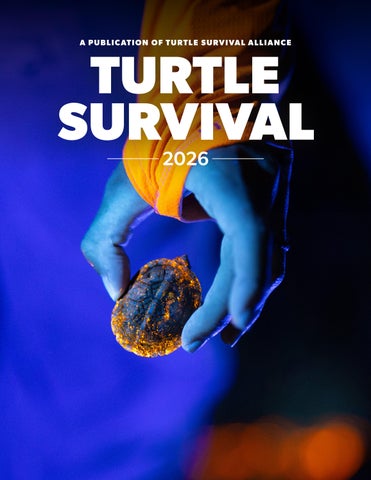
About the Cover: A collaborative study involving Turtle Survival Alliance and its partners is investigating the movements of wild turtle hatchlings at the Belize Foundation for Research and Environmental Education’s (BFREE) Privately Protected Area using animal-safe fluorescent powder and ultraviolet light. Photo: Brian Johnson
T U R T L E S U R V I VA L 2 0 2 6 | T U R T L E S U R V I VA L . O R G | 1
COLOMBIA
The Paradox of the Morrocoyo The path from captivity to wild recovery for Red-footed Tortoises begins in Colombia
2 | T U R T L E S U R V I VA L . O R G | T U R T L E S U R V I VA L 2 0 2 6
Gutter Credit
“U
h, Makayla, there’s a tortoise in your yard.” While watching a presentation at the 24th Annual Symposium on the Conservation and Biology of Tortoises and Freshwater Turtles in Guadalajara, Mexico, I received a call from my sister, Ella, who was at my home in Florida. She was letting my dogs out while I was away. I stepped out of the room to answer. “Is it one of mine?” I asked. “I think so.” She texted me a picture. Sure enough, one of the female Red-footed Tortoises (Chelonoidis carbonarius) I had rescued a few years earlier was wandering the yard. When I took the tortoise in, she and her sister, affectionately known as “the girls,” were about 7 years old. Now about 10, they’re still very young for a species that can live for more than 75 years. While my sister and I tried to figure out how the tortoise had escaped, I spotted Germán Forero-Medina, Science and Conservation Director, and Marjorie Pinzón, Lead Turtle Researcher, across the hall from where I stood. I regularly work with both through my role as Turtle Survival Alliance’s (TSA) Field Conservation Manager. Fittingly, Marjorie and Germán work for Wildlife Conservation Society (WCS) Colombia, TSA’s in-country partner in our Red-footed Tortoise reintroduction efforts. Then my sister noticed something else: the other tortoise was missing, too. I helped her track down the second escapee, and we returned to inspecting the fence to figure out how the girls had gotten out. Once both tortoises were safely back in their habitat and their escape route was secured, I swapped stories with Germán and Marjorie about the antics of the species we affectionately call “red-foots.” In Colombia, where they are known as morrocoyos, that shared affection takes on an even greater significance as they work to give confiscated tortoises a second chance in the wild. Red-footed Tortoises, aptly named for the red scales found on the forelimbs of some populations, are curious and engaging animals whose colorful scales can range
Orlando Ferias / WCS Colombia
In late 2025, Corporación para el Desarrollo Sostenible de La Mojana y el San Jorge (CORPOMOJANA), with support from Wildlife Conservation Society (WCS) Colombia and Turtle Survival Alliance (TSA), released 20 Red-footed Tortoises (Chelonoidis carbonarius) fitted with radio transmitters into La Carranchina Natural Reserve, marking the first scientifically formulated reintroduction of the species in Colombia.
T U R T L E S U R V I VA L 2 0 2 6 | T U R T L E S U R V I VA L . O R G | 3
4 | T U R T L E S U R V I VA L . O R G | T U R T L E S U R V I VA L 2 0 2 6
presents a striking paradox for a species facing substantial pressures in the wild. Red-footed Tortoises may be readily available in human care, but their availability does not reflect the challenges facing their wild counterparts. Thankfully, conservation programs are working to protect Red-footed Tortoises in parts of their range. In Colombia, TSA and its partner WCS Colombia are working with the regional environmental authority Corporación para el Desarrollo Sostenible de La Mojana y el San Jorge (CORPOMOJANA) to support the reintroduction of confiscated tortoises. Work like theirs gives me hope that the species will persist despite the pressures they face. In late 2025, they introduced 20 confiscated Red-footed Tortoises into La Carranchina Natural Reserve, a restored landscape in Sucre, Colombia, that is being managed to recover native habitats and wildlife. Each individual received genetic screening to ensure it matched with local populations, along with health testing to ensure suitability for reintroduction and to prevent the introduction of new diseases.
Makayla Peppin-Sherwood
from red to orange and yellow. These traits, combined with the tortoises’ historically abundant populations, have long made them a target of the pet trade, which poses a threat to the species across its range. Today, wildlife laws in several countries within the tortoise’s natural range regulate or prohibit its unauthorized collection and trade. In Colombia, however, the primary threats include widespread deforestation, habitat conversion for agriculture and livestock, and collection for local consumption and personal pets. These pressures have contributed to the species being listed as Vulnerable nationally, while its global IUCN Red List assessment has been elevated to Endangered (in press). There is no shortage of Red-footed Tortoises in captivity. Around the world, captive-bred animals are available through breeders, while others end up in rescue and adoption programs after being relinquished by their owners. A quick look at an online reptile marketplace in the United States can turn up a dozen or more Red-footed Tortoises for sale at any given time. Yet that abundance in captivity
Laura Jaimes; Marjorie Pinzón / both courtesy of WCS Colombia
Clockwise from top left: Although commonly kept as pets around the world, Red-footed Tortoises (Chelonoidis carbonarius), like these two rescued by Turtle Survival Alliance’s Field Conservation Operations Manager, Makayla Peppin-Sherwood, are now classified as Endangered (in press) in the wild; Marjorie Pinzón, Lead Turtle Researcher at WCS Colombia, attaches a transmitter to the shell of a tortoise; Researchers use radio telemetry to track tortoises following their release.
As part of TSA’s standard reintroduction practice, the tortoises were placed in soft-release enclosures encompassing forest, savanna, and wetland habitats before being released into the surrounding reserve. This gradual transition gives the tortoises time to acclimate to their new surroundings and establish site fidelity, meaning a tendency to remain in and return to the area where they were introduced. Reintroducing tortoises into their native landscape can help bolster local populations and reduce the species’ risk of extinction in the wild. By ensuring confiscated tortoises genetically “match” the tortoises at the selected reintroduction site, conservationists can also help maintain the genetic integrity of local populations. But reintroduction is about more than the animals themselves. Tortoises are known as “ecosystem engineers” because they influence the habitats around them. They disperse seeds, shape vegetation (as I have seen firsthand in my own tortoise habitat, where hibiscus plants mysteriously lose all their leaves at tortoise height), influence plant community dynamics, and their waste acts as a natural fertilizer. Returning tortoises to the landscape helps restore these ecological functions. La Carranchina Natural Reserve has been the focus of extensive conservation and restoration since 2019, when TSA, Rainforest Trust, and Wildlife Conservation Society (WCS) acquired land in San Benito Abad, Sucre, to establish the reserve. Ongoing restoration has focused on upland and riparian vegetation and the rehabilitation and creation of wetlands. In 2024, WCS acquired additional land, nearly doubling the reserve’s size, and La Carranchina was designated a Key Biodiversity Area through a collaboration among TSA, Rainforest Trust, WCS, the Alexander von Humboldt Biological Resources Research Institute, and the KBA Regional Focal Point for Latin America. The reintroduction of the tortoises is part of that larger effort to restore both wildlife and the ecological functions they provide. TSA also supports monitoring, health assessments,
T U R T L E S U R V I VA L 2 0 2 6 | T U R T L E S U R V I VA L . O R G | 5
and long-term management to help ensure the success of the reintroduced population. That work is informed by TSA’s Conservation Genetics program, led by Natalia Gallego-García, which is conducting the most comprehensive genetic assessment of the species to date. By examining genetic variation across the Red-footed Tortoise’s range, the project is helping identify distinct lineages and important conservation units, information that can help guide decisions about where individual tortoises can be appropriately reintroduced, including in areas such as La Carranchina Natural Reserve. Following the initial release and some technical challenges with tracking equipment, the team can now monitor all 20 tortoises. The early results are encouraging. They’ve even been observed mating, a promising sign that they are acclimating to their surroundings. “Seeing the tortoises explore and become more independent in their new environment has been incredibly rewarding,” Marjorie said. “Some have stayed close to their release sites, while others have been much more adventurous, even venturing beyond the boundaries of the reserve and keeping our monitoring team on their toes! They are already establishing their preferred areas and selecting specific plants to feed on.” Each tortoise is affixed with a tracking device. Whenever one leaves a designated geofence, or virtual boundary, the team receives a ping, allowing them to quickly locate the animal and return it to the safety of the reserve. “These animals are intelligent and resilient, and it’s wonderful to see them behaving more and more like wild tortoises,” she continued. I don’t know how, but it seems Red-footed Tortoises have a knack for finding the one spot they aren’t supposed to go. Unfortunately for my tortoises, a return to the wild will never be possible. But thanks to the work of TSA, WCS, and our partners, other Red-footed Tortoises have a chance to return to the wild in their native range. As the team prepares
6 | T U R T L E S U R V I VA L . O R G | T U R T L E S U R V I VA L 2 0 2 6
Courtesy of CORPOMOJANA; Gustavo García; Orlando Ferias / WCS Colombia
Counterclockwise from top left: The team from CORPOMOJANA and the WCS Colombia/TSA turtle program prepares to release the first group of Red-footed Tortoises (Chelonoidis carbonarius) in Colombia; The reintroduction site at La Carranchina Natural Reserve provides tropical dry forest and savanna habitat for the tortoises; A Red-footed Tortoise peers through the savanna grass at the reintroduction site; Red-footed Tortoises feed on fruit in their soft-release habitat as they acclimate to their new environment.
Yeiner Vega / WCS Colombia
for the next reintroduction, I find myself thinking about the impact these individuals could have on their species. The data collected from these reintroductions will help inform a national reintroduction strategy for Red-footed Tortoises in Colombia. “This pilot program is laying the foundation for a new chapter in the conservation of the species in Colombia,” says Germán. “By developing and testing the protocols needed for safe reintroduction and population reinforcement, we aim to enable future releases across the country, transforming the thousands of confiscated tortoises that currently enter the wildlife rescue system into an opportunity to recover and strengthen wild populations.” For my two red-foots, the story will always end with a secure enclosure, a familiar yard, and the occasional reminder that no fence is quite escape-proof. For the tortoises at La Carranchina Natural Reserve, however, the story is very
different. They were given something my tortoises cannot have: a chance to return to the landscape where their species evolved and to once again play their part in the ecosystems that sustain them. I never expected a tortoise escaping from my yard to lead to a story about reintroduction. But perhaps that is what I love about Red-footed Tortoises. They have a way of getting your attention. And in Colombia, that attention is helping turn confiscated tortoises into an opportunity to restore wild populations, one morrocoyo at a time. Contributors, Interviewees, & Editors (listed alphabetically by last name): Elena Duran, Germán Forero-Medina, Natalia Gallego-García, Jordan Gray, Samantha Nottingham, Makayla Peppin-Sherwood, and Marjorie Pinzón.
T U R T L E S U R V I VA L 2 0 2 6 | T U R T L E S U R V I VA L . O R G | 7
T U R T L E S U R V I VA L C E N T E R
Finding the Signal At Turtle School, hands-on learning connects animal care with wild conservation
8 | T U R T L E S U R V I VA L . O R G | T U R T L E S U R V I VA L 2 0 2 6
Kurt Buhlmann, a senior research associate at the University of Georgia’s Savannah River Ecology Laboratory, instructs participants in the basics of radio telemetry during the Chelonian Biology, Conservation, and Management Course, affectionately known as “Turtle School,” hosted at Turtle Survival Alliance’s Turtle Survival Center.
Vanessa Ambas
K
urt Buhlmann raised the Yagi antenna and slowly moved it from side to side, demonstrating how the equipment could pick up the signal from a hidden turtle. In the afternoon sun, the polished metal caught the light as a group of roughly 20 participants gathered around him. For most of the participants, this was new territory. Gathered at the Turtle Research Station at Turtle Survival Alliance’s (TSA) Turtle Survival Center (TSC), they were learning how researchers locate turtles that cannot be seen. This exercise was not simply about learning how to operate equipment. It was about exposing participants to the realities of fieldwork and making the connection between the turtles they care for in captivity and the animals they ultimately hope to see thriving in the wild. On this September day, Kurt Buhlmann, a Senior Research Associate, and Tracey Tuberville, a Senior Research Scientist, both at the University of Georgia’s Savannah River Ecology Laboratory, were among the instructors leading the Chelonian Biology, Conservation, and Management Course. They had hidden two shells from deceased turtles, each fitted with a radio transmitter, in the surrounding woods, roughly 75 and 150 yards (69 and 137 meters) from the research station. The exercise was designed to give the participants a taste of what radio telemetry can be like in the field. “The two shells were special Wood Turtles (Glyptemys insculpta) from another conservation project, and it felt good to have them still contributing to conservation through education,” said Kurt. Kurt showed them how to hold the antenna and tune the receiver. The signal came in as intermittent beeps. The participants learned to use its volume to narrow down where the transmitter was located. “Sometimes people are holding it way up in the air,” Kurt explained. “That turtle isn’t up in a tree. It’s out somewhere a hundred yards from you at eye level. But when you get to it, you want to be pointing it toward the ground.” When participants had trouble determining the direction, Kurt suggested breaking the search into four cardinal directions. Point the antenna north and wait for a beep. Then east, south, and west. Compare the strength of the
T U R T L E S U R V I VA L 2 0 2 6 | T U R T L E S U R V I VA L . O R G | 9
“I enjoy working with professionals who are in the trenches trying to make a difference for turtle conservation,” Tracey said. That connection between turtles in human care and their lives in the wild is at the heart of the Chelonian Biology, Conservation, and Management Course, known affectionately as “Turtle School.” The course grew from something TSA had been hearing for years: institutions caring for turtles wanted to learn from the organization’s experience. After years of working with some of the world’s most threatened chelonians (turtles and
From left: Participants of the 2026 Chelonian Biology, Conservation, and Management Course, held at Turtle Survival Alliance’s Turtle Survival Center in Cross, South Carolina; A course participant guides a male Sulawesi Forest Turtle (Leucocephalon yuwonoi) into the enclosure of a female during the breeding encounters laboratory.
Kirstyn Cardwell
four signals, eliminate the weaker directions, and begin narrowing the search. The group also learned how two people can work together to locate a turtle. Each person follows the strongest signal from a different direction, creating imaginary lines that eventually intersect. “Where those lines cross is likely where the turtle is. If the lines are still parallel, then you obviously need to keep going farther,” Kurt explained. But even then, the participants were not finished. Kurt reminded them that finding a strong signal does not necessarily mean they had found the turtle they were tracking. A transmitter affixed to another turtle could be nearby, producing a deceptively strong signal. “For attendees who are raising these animals in captivity for head-starting programs, getting them out on the landscape and then seeing how well they do is the kicker,” Kurt said. For Tracey, the value of the course also extends beyond the skills participants gain in the classroom and the field.
1 0 | T U R T L E S U R V I VA L . O R G | T U R T L E S U R V I VA L 2 0 2 6
population, with genetic diversity considered when founding animals are selected and breeding plans are developed. But the TSC was never intended to be only a place for turtles. It became a place for people, too. Animal care practitioners began coming to the TSC to learn from staff with decades of combined experience caring for turtles and advancing their conservation. Zoos, aquariums, nature preserves, and other institutions wanted to better understand how to manage their own chelonian collections, and TSA saw an opportunity to share that knowledge more broadly. Over the course of the week, participants learn about chelonian biology and conservation, husbandry and reproduction, enclosure and facility design, health, enrichment, breeding-program management, and conservation messaging. Just as importantly, they learn how those disciplines connect to conservation beyond the walls of a zoo, aquarium, or conservation center. “It’s a highly diverse program. We cover everything from evolution and global diversity to husbandry, fieldwork, pol-
Elena Duran
tortoises), TSA had developed expertise not only in breeding and husbandry, but also in connecting those efforts to conservation in the wild. In 2023, that knowledge became the foundation for Turtle School, a hands-on course designed to help people working with turtles strengthen their skills in human care while better understanding the conservation challenges these animals face in the wild. At the center of that expertise is the Turtle Survival Center, TSA’s hub for conservation breeding, animal care, research, and education. When the TSC opened in 2013, its purpose was urgent: to provide a lifeline for species disappearing from the wild. TSA began establishing genetically diverse assurance colonies of highly imperiled turtles and tortoises, creating populations that could help safeguard against extinction and, when conditions permit, potentially contribute to future conservation efforts in their native ranges. Thirteen years later, the TSC is home to more than 800 turtle residents representing species of significant conservation concern. Each animal is part of a carefully managed
T U R T L E S U R V I VA L 2 0 2 6 | T U R T L E S U R V I VA L . O R G | 1 1
1 2 | T U R T L E S U R V I VA L . O R G | T U R T L E S U R V I VA L 2 0 2 6
From left: Bourret’s Box Turtle (Cuora bourreti) is one of more than 25 endangered turtle and tortoise species maintained at Turtle Survival Alliance’s Turtle Survival Center (TSC); TSC Lead Chelonian Keeper AJ Fetterman weighs a Yellow-bellied Slider (Trachemys scripta scripta) at the Center’s Turtle Research Station; A Spotted Pond Turtle (Geoclemys hamiltonii) basks in one of the eight managed ponds on the TSC property; Kurt Buhlmann instructs a participant on tuning a receiver during the radio telemetry demonstration.
challenges that can arise in the animals they work with. Outside the buildings, the TSC property itself became part of the classroom. Participants set traps to capture and document local wildlife, learning about the animals and ecosystems surrounding the Center. In 2025, those opportunities expanded with the addition of the Turtle Research Station, located on the edge of the Center’s extensive wetlands. From the research station, participants can study native
Elena Duran; Vanessa Ambas
icy, law, and society,” said Cris Hagen, TSC Director of Animal Management and Collections. “There’s a lot of ground covered throughout the week, not just animal care.” Under the guidance of the Association of Zoos and Aquariums (AZA) Chelonian Advisory Group, the course provides practical knowledge and skills for people working directly with chelonians in zoos, aquariums, conservation programs, and research settings. The 2026 session was the fourth Turtle School since the course began in fall 2023 and its most attended, with 19 participants. While the core curriculum remains consistent, the TSC itself continues to expand the possibilities for hands-on learning. “We try to emphasize hands-on experience. With a group of 16 to 20 people, you can interact much more than you could with a group of 100. The small-group setting really makes a difference,” Cris said. The arrival of Dr. Shane Boylan as the TSC’s veterinarian in July 2025 added a new dimension to the course. Participants engaged in a necropsy lab led by the veterinarian responsible for the medical care of the Center’s chelonian residents, giving them a firsthand look at the health
Vanessa Ambas (2)
turtles living on the property and gain experience observing animals in the wild. The radio telemetry exercise led by Kurt and Tracey was one example of how the course is expanding beyond the traditional boundaries of classroom learning. “The TSA’s Turtle School was intensive, but I loved every minute!,” said Lindsey Lewis, Ambassador Animal Care Specialist II at the Tennessee Aquarium. “The experience I gained in plumbing, diet planning, and lighting/heating was especially valuable and will improve the welfare of the turtles currently in my care. I’m confident that the relationships I built with other students and our instructors will serve me throughout my career.” For the participants, Turtle School offers an opportunity to expand their experience beyond the day-to-day care of turtles and learn the field skills needed to study and conserve them in the wild. For the TSC, it means the facility itself can serve as part of the classroom, from its resident turtles and veterinary facilities to the wetlands and wildlife beyond its enclosures. “We’re very proud of the course and how it improves every year, from the structure of the talks and the over-
all organization,” said Clint Doak, Director of the Turtle Survival Center. “The lecturers are increasingly comfortable with the format, but they also find it incredibly rewarding to come together with like-minded people.” And on this September afternoon, that classroom extended into the woods. The participants followed the beeps, compared signals, changed direction, and learned to question their first assumptions. Somewhere beneath the leaves, a transmitter was waiting for them to find it. As Turtle School looks toward its fifth session in 2027, TSA will continue building on what makes the program distinctive: bringing together expertise in husbandry, veterinary care, research, and conservation in one place, and giving participants the opportunity to put that knowledge into practice alongside professionals working at the forefront of chelonian care and conservation. Contributors, Interviewees, & Editors (listed alphabetically by last name): Kurt Buhlmann, Clinton Doak, Elena Duran, Jordan Gray, Cris Hagen, Lindsey Lewis, Samantha Nottingham, and Tracey Tuberville.
T U R T L E S U R V I VA L 2 0 2 6 | T U R T L E S U R V I VA L . O R G | 1 3
Local Roots, Lasting Impact Community development and tortoise conservation grow together at the Community Outreach Center
“I
n the past, when the rain did not fall, we simply stopped farming and ate the fruit of raketa mena to survive. We hated it.” For Liliazoe, a member of the Rene Miray Hevetse cooperative in Madagascar, raketa mena, the Malagasy name for the fruit of the invasive Prickly Pear Cactus (Opuntia stricta), commonly referred to as Opuntia, was once a food of last resort. When drought left families with few other options, it helped them survive. Today, thanks to the Community Outreach Center (COC) in the Androy region of southern Madagascar, that same fruit represents possibility. Southern Madagascar is the country’s most arid region, where unpredictable rainfall and prolonged drought can make agriculture difficult and leave families vulnerable when crops fail. At the same time, invasive Opuntia has spread across parts of the landscape, competing with native vegetation. For communities in Androy, the cactus presents both a challenge and an opportunity, as its fruit and other parts of the plant can be transformed into useful products. “Now, with machines and the processing methods we have learned at the COC, we see it differently: as a threat
we must keep in check, but also as something we can turn into jam, pickles, soap, and flour. We eat the jams during the lean season, and we also sell them. Together, the different products bring us a lot of income,” says Madiosoa Monique, a member of the Rene Miray Hevetse cooperative. The transformation of Opuntia reflects the larger purpose of the COC: creating opportunities for local communities while supporting the long-term protection of the landscapes where tortoises live. Built by Turtle Survival Alliance (TSA), the center is located within the Ala Mahavelo Forest, a largely intact tract of Madagascar’s distinctive spiny forest managed by TSA for tortoise conservation through an agreement with the four communities that make up the Ala Mahavelo Association. Just across the road, also within the Ala Mahavelo Forest, TSA’s Tortoise Conservation Center cares for thousands of confiscated Radiated Tortoises (Astrochelys radiata) awaiting their return to the wild. These tortoises are part of TSA’s broader Confiscation to Reintroduction strategy, which includes appropriate care, rehabilitation, health assessments, and disease screening before animals are returned to suitable habitat. But reintroducing tortoises is only part of conservation. Their long-term survival depends on protecting the landscapes where they live and maintaining relationships with the communities alongside them. Those communities help protect forests, patrol and monitor habitat, and serve as a first line of defense against poaching. Ensuring that conservation also benefits the people who live alongside these animals is therefore essential to an effective, lasting strategy. Since construction began in 2018, the COC has grown into a place where community members can gather, exchange knowledge, develop skills, and explore ways to improve their livelihoods. Its programs range from processing invasive plants into marketable products to developing new approaches to agriculture and restoring native vegetation. The Rene Miray Hevetse cooperative offers one example of what this approach can achieve. After TSA introduced members to soap and jam making through a workshop at the COC, they turned those skills into a growing business, producing hundreds of jars of jam and bars of soap each month.
From left: Through its plant nursery, the Community Outreach Center (COC) helps restore native forest vegetation by growing and planting thousands of seedlings, supporting both local livelihoods and long-term landscape conservation; Children participate in a fun activity at EPP Bereny, near Turtle Survival Alliance’s (TSA) Tortoise Conservation Center in the Ala Mahavelo Forest. The school is one of many primary schools TSA has built in southern Madagascar to support education and community engagement.
1 4 | T U R T L E S U R V I VA L . O R G | T U R T L E S U R V I VA L 2 0 2 6
Courtesy of TSA Madagascar
M A DAG AS C A R
Gutter Credit
T U R T L E S U R V I VA L 2 0 2 6 | T U R T L E S U R V I VA L . O R G | 1 5
Gutter Credit
1 6 | T U R T L E S U R V I VA L . O R G | T U R T L E S U R V I VA L 2 0 2 6
Courtesy of TSA Madagascar
Clockwise from left: A Radiated Tortoise (Astrochelys radiata) enjoys a meal of locally sourced plants at Turtle Survival Alliance’s Tortoise Conservation Center in southern Madagascar; Community members turn invasive Opuntia cactus into biochar, a charcoal-like material that improves soil health and helps retain water in the dry environment of southern Madagascar; Liliazoe, a member of the Rene Miray Hevetse cooperative in Madagascar, is one of hundreds of community members learning alternative livelihood practices through the Community Outreach Center (COC); The Ala Mahavelo Association’s members drive the success of the COC plant nursery.
“TSA created jobs for us, which helps us survive every day,” says Liliazoe. The COC also hosts workshops on converting Opuntia into biochar, providing another way to make use of the invasive plant. Biochar is a charcoal-like material produced by heating plant material with little or no oxygen. When added to soil, it can help improve soil quality and retain moisture, an especially valuable benefit in the arid environment of southern Madagascar. Other livelihood activities extend beyond Opuntia. In partnership with the Madagascar Biodiversity Center (MBC), TSA is introducing community members to Black Soldier Fly (Hermetia illucens) farming, an approach that transforms locally available organic waste into valuable resources. Black Soldier Fly larvae provide protein-rich feed for poultry, while the residual material, known as frass, can be used as an organic fertilizer to improve soil fertility and crop production. Through technical support and community training, the partnership aims to help families reduce agricultural costs, improve food production, and develop additional livelihood opportunities. Together, these initiatives provide opportunities to develop practical skills and make productive use of locally available resources. The knowledge gained at the COC does not stay there, either. Community members can apply what they have learned in their gardens, businesses, families, and villages, extending the benefits beyond those who participate directly in training. “Now, we will also teach the other members and share our knowledge in our communities,” says Liliazoe. That willingness to share knowledge is central to the COC’s broader vision. The Center can provide initial training, equipment, and support, but its long-term value also depends on what community members do with those resources and skills themselves. “We can even teach others how to build their own business, as trainers, the way we did,” shares Madiosoa. The same emphasis on local participation extends to the forest itself. Gérand Rasolonomenjanahary, a plant nursery manager at the COC and a member of the local community, describes how the nursery grew from a desire to help
T U R T L E S U R V I VA L 2 0 2 6 | T U R T L E S U R V I VA L . O R G | 1 7
1 8 | T U R T L E S U R V I VA L . O R G | T U R T L E S U R V I VA L 2 0 2 6
“In the past, many parents did not consider education a priority. Today, they understand its value and encourage their children to go to school,” says Gérand. In 2025, TSA invested in educator training and conducted an environmental education course for primary school teachers from both schools. Because of the distance, teachers from Malaintsatroke stayed at the COC for the full three days of training, taking advantage of the lodging TSA has developed there. Two experienced educators in science and conservation provided hands-on experience and guidance in implementing a structured curriculum designed to foster environmental awareness among students. The training illustrates another role the COC can play: bringing people together to develop skills and exchange knowledge that they can carry back to their own communities. Its facilities also offer opportunities to build connections beyond the immediate area, including with visitors who want to learn about Androy and its conservation work. Ecotourism is one avenue TSA and its partners see for expanding those opportunities. By welcoming visitors to the region, the COC could help create economic opportunities while introducing more people to the area’s culture,
Courtesy of TSA Madagascar
restore the forest. “We wanted to create a nursery with TSA at the COC so that we could produce native seedlings ourselves and restore the forest that was degraded in the past,” says Gérand. Through the nursery, the COC connects community involvement with the restoration of native vegetation, reinforcing the relationship between local livelihoods and the protection of the landscape. The forest provides habitat for tortoises, and its long-term protection depends in part on the people who live alongside it. That connection between knowledge, opportunity, and conservation also extends into the classroom. In recent years, TSA has built two primary schools in communities connected to its conservation efforts. One is in Bereny, a community in the Ala Mahavelo Association and just 15 minutes from the COC. The other is in Malaintsatroke, the community adjacent to the protected forest where TSA released its first 1,000 Radiated Tortoises in 2021, about a three-hour drive from the COC. In addition to managing the plant nursery, Gérand teaches at the school in Bereny. He has seen a change in how families view education and its value for the next generation.
Courtesy of TSA Madagascar
From left: At the Community Outreach Center, community members learn to transform invasive Opuntia cactus into a variety of useful products, including pickles, jam, soap, and biochar; Community members gather for a hands-on lesson in making jam from cactus fruit.
communities, and conservation efforts. “The COC is also a place to welcome visitors,” explains Rija Raoelijaona, COC Manager. “Its buildings and bungalows stand in a remote and wild environment, and that is what makes the experience unique. When people stay here, they discover Androy, meet the community, and see how conservation and local life go hand in hand.” The Center’s future depends in part on becoming a destination where visitors can experience the region firsthand. Rija sees this as an opportunity not only to showcase Androy but also to help young people envision a future in their own communities. “We want visitors to leave with a different image of the region, and we want our young people to see that they can build a future in tourism right here, at home,” says Rija. For Liliazoe, welcoming visitors is already a source of
pride and a chance to share what the community has accomplished. “When visitors come, we are proud to show them what we do: our gardens, our soaps and jams, and the nursery. They ask us questions, and we explain how we live and what we have learned. It is a new way for us to share our culture and our work.” The COC is still evolving. Some programs are well established, while others are just beginning. TSA and local cooperatives continue to refine products, improve presentation, and explore new markets. Across these efforts, the goal is to create opportunities for local people while strengthening the partnerships that underpin long-term conservation. In southern Madagascar, the future of people and tortoises is deeply connected. At the COC, that future is being built together. Contributors, Interviewees, & Editors (listed alphabetically by last name): Elena Duran, Jordan Gray, Liliazoe, Madiosoa Monique, Samantha Nottingham, Rija Raoelijaona, Tahina Rasolofoherisoa, Gérand Rasolonomenjanahary, and Hery Lova Razafimamonjiraibe.
T U R T L E S U R V I VA L 2 0 2 6 | T U R T L E S U R V I VA L . O R G | 1 9
A decade of research has cataloged numerous juvenile Alligator Snapping Turtles (Macrochelys temminckii), providing evidence of a reproductively successful population.
2 0 | T U R T L E S U R V I VA L . O R G | T U R T L E S U R V I VA L 2 0 2 6
U N I T E D S TAT E S
Urban Giants A decade of research reveals an unexpected refuge for North America’s largest freshwater turtle
Chase Gravatt
W
arm, early autumn rains sweep across the Katy Prairie, a vast coastal prairie along the Gulf Coast of what is now Texas. Water gathers in wetlands, shallow depressions, and swales before flowing into Willow Fork and Cane Island Branch. Where they converge, the headwaters of a large, muddy bayou begin to take shape. It’s 1816. Spanish maps called the waterway Río Cíbolo, or “Buffalo River,” after the bison that roamed the surrounding prairie. In 1830, Stephen F. Austin had the map redrawn in English, translating the name as “Buffalo Bayou.” Buffalo Bayou in 1816 would have looked very different from the waterway that winds through the city that sits there today. Tall prairie grasses stretched toward the horizon, broken by wetlands and stands of trees along wetter drainage corridors. After heavy rains, water spread across the prairie and gathered into the bayou. Within that landscape, the largest freshwater turtle in North America, the Alligator Snapping Turtle (Macrochelys temminckii), likely moved through the deeper waters and slow-moving reaches of Buffalo Bayou and its tributaries in abundance. That landscape would not last. By 2016, Buffalo Bayou looked nothing like it had 200 years earlier. It now wound through the City of Houston. Suburban neighborhoods, industrial complexes, golf courses, groomed public parks, and skyscrapers hugged its shores. Houston, now the fourth-largest metropolitan area in the United States, had grown into a sprawling city of millions. Few would have expected North America’s largest freshwater turtle to survive in such a heavily developed landscape. By that point, the species, an icon of Gulf-draining waterways, was considered extirpated, or no longer present, from the bayou. But personal accounts from kayakers, fishermen, naturalists, and everyday parkgoers suggested otherwise. In October 2016, Eric Munscher, the leader of Turtle Survival Alliance’s (TSA) Volunteer Science program and a Regional Scientist with TSA conservation partner SWCA Environmental Consultants, was conducting a survey of the reptiles and amphibians of Memorial Park, a 1,500-acre
T U R T L E S U R V I VA L 2 0 2 6 | T U R T L E S U R V I VA L . O R G | 2 1
2 2 | T U R T L E S U R V I VA L . O R G | T U R T L E S U R V I VA L 2 0 2 6
From left: Houston, Texas, the fourth-largest metropolitan area in the United States, is home to an unexpected refuge for Alligator Snapping Turtles (Macrochelys temminckii); Logan Pendarvis of the Houston Zoo weighs an Alligator Snapping Turtle on the banks of its muddy habitat.
plate. It’s now quadrupled in size,” said Eric. The new turtle offered further evidence of what that first survey had set out to determine: Alligator Snapping Turtles were not only still living in Buffalo Bayou, they were there in far greater numbers than anyone suspected. The Alligator Snapping Turtle can exceed 200 pounds (91 kg) and potentially live for well over a century. Its massive, ridged shell and powerful jaws give it a prehistoric appearance, but its strangest adaptation may be its wormlike tongue lure, which attracts fish within striking distance. It spends most of its life beneath the surface of slow-moving waterways, rarely venturing onto land. Those same characteristics later made the species vulnerable to human expansion and exploitation. Agriculture, dredging, channelization, dams, pollution, and urban development altered its waterways, while industrial-scale commercial harvest intensified in the 1960s and 1970s. Because they grow slowly and mature late, populations can be slow to recover when adults are removed or habitat is
Adobe Stock; Lillie Stockseth
(607-ha) expanse along Buffalo Bayou. With the possibility that Alligator Snapping Turtles, then under federal review for protection under the U.S. Endangered Species Act, might persist in the bayou, Eric and TSA’s Jordan Gray set out to find them. They placed several large, double-throated hoop traps, baited with fresh fish, in a bend of the waterway that appeared to offer suitable habita As evening fell, the traps were ready. Alligator Snapping Turtles are largely nocturnal, spending much of the night moving along the bottoms of rivers, bayous, and other waterways in search of prey or carrion. By dawn, they would know whether the species survived in Buffalo Bayou. The water offered no visibility, but the traps told a story of their own. They had shifted from where the researchers had set them, as though something heavy had pulled them downward. When Eric and Jordan hauled up the first trap, they found not one but two Alligator Snapping Turtles. That moment would set in motion a decade of discovery. On an autumn Sunday morning ten years later, Eric, Chase Gravatt of SWCA Environmental Consultants, and Lillie Stockseth of the Houston Zoo pulled the 167th unique Alligator Snapping Turtle recorded by the project team from a trap. They also captured two previously cataloged individuals, one first recorded nearly a decade ago and not seen since. “At the time, it was a juvenile, about the size of a dinner
Gutter Credit
T U R T L E S U R V I VA L 2 0 2 6 | T U R T L E S U R V I VA L . O R G | 2 3
2 4 | T U R T L E S U R V I VA L . O R G | T U R T L E S U R V I VA L 2 0 2 6
Counterclockwise from right: Eric Munscher’s youngest son is the third of his children to accompany him on Alligator Snapping Turtle (Macrochelys temminckii) surveys in Houston, Texas; Chase Gravatt (left) and Eric Munscher, both of SWCA Environmental Consultants, set a large hoop trap in Buffalo Bayou; The large, bulbous head and powerful jaws of Alligator Snapping Turtles have earned them the nickname “loggerhead” in parts of their range, as seen in this male.
for the illegal wildlife trade, turtles living in the middle of Houston may have been comparatively inaccessible to collectors. The same urban landscape that transformed their habitat may therefore have inadvertently shielded some turtles from one of the species’ most damaging pressures. That resilience extends beyond human threats. The turtles have also weathered some of the most dramatic forces an urban river can unleash. “We’ve had some really significant flood events, including Hurricane Harvey in 2017, and we haven’t seen the kind of population-level impact one might expect,” Eric says. “These turtles are incredibly resilient.” TSA’s research has also revealed how these ancient reptiles use an urban river. In a three-year radio-telemetry study, researchers fitted 10 turtles with transmitters and tracked their movements through the bayou. Males tended to remain within relatively small areas, rarely venturing far from their core habitat. Females moved considerably more, with some traveling several miles over relatively short periods. Those movements connected the aquatic habitat of the bayou with the land along its banks, where females must eventually leave the water to reproduce. That connection would prove to be one of the project’s most important discoveries. In 2022, Eric documented a female climbing a steep bank to lay her eggs, providing the first published record of Alligator Snapping Turtle nesting in an urban habitat. Subsequent work has shown that females use riparian areas, the land along the water’s edge, for nesting, with nesting locations averaging only about 80 feet (24 m) from the high-water mark. For a species that spends almost its entire life in the water, the narrow strip of land along the bayou is just as important as the water itself. These discoveries have implications far beyond scientific research. They are also helping TSA advocate for the protection of the habitat these turtles need to survive. The importance of that habitat became especially clear in 2020 and 2021, when proposals intended to reduce flood risk raised the possibility of substantially altering Buffalo Bayou. Based on its findings, TSA submitted a formal letter to the U.S. Army Corps of Engineers and Harris County Flood Control District warning of the potential ecological consequences and urging them not to move forward
From top: Brandi Giles; Chase Gravatt
degraded. Across much of the species’ range, populations declined or disappeared altogether. Buffalo Bayou appeared to be one of those places. Our research findings suggest otherwise. “When we started this project, I think we expected to find a remnant population hanging on in an urban environment,” Eric says. “What we found was something very different. This is one of the densest populations of Alligator Snapping Turtles we know of anywhere in their range.” The number of individuals cataloged, including numerous large adults, provides evidence of a breeding population that has persisted here for generations. TSA’s researchers believe that the population’s unusual density and abundance of large adults may be partly explained by an unexpected benefit of its urban setting: Buffalo Bayou may have served as a refuge from the harvesting that severely affected populations elsewhere. As rural populations were depleted by harvest and, later in some places, poaching
Lillie Stockseth
with channelization. Thanks in part to TSA’s research and advocacy, the agencies withdrew the proposal and began evaluating other flood-management alternatives. By then, the project had grown far beyond the question that prompted those first traps. Researchers were documenting how the turtles moved, where they nested, how they responded to floods, and what threats they faced in one of America’s largest metropolitan areas. The work has produced 14 scientific publications, including four major research papers and 10 shorter species notes, with a comprehensive review of the decade’s findings underway. The picture that has emerged is one of both resilience and vulnerability. TSA’s research suggests that the turtles have high survivorship and that even major flood events have little apparent impact on the population. But surviving a flood is not the same thing as being safe from the quieter, persistent pressures of an urban watershed. Today, fishing is regarded as the most persistent threat facing the turtles in Buffalo Bayou. Lost or discarded hooks, weights, and fishing line can ensnare turtles or be swallowed when turtles take baited hooks intended for fish. Numerous dead turtles have been found as a result of drowning caused by this threat. Ten years after researchers first set those traps in the gathering darkness of an October evening, Buffalo Bayou
has become something more than a place where an apparently vanished species was rediscovered. It is now the best-studied population of Alligator Snapping Turtles in their range, and a demonstration of what can persist when a river retains enough of its ecological character to sustain one of North America’s most extraordinary reptiles. The open coastal prairie of 1816 has given way to roads, neighborhoods, businesses, and skyscrapers. Yet beneath the waters of Buffalo Bayou, one of North America’s most extraordinary turtles continues to survive against the odds. Ten years of TSA research have transformed what we know about this remarkable population and demonstrated why protecting its habitat matters. As Houston continues to grow, TSA’s task for the next decade is clear: build on these discoveries, address emerging threats, and help ensure that the Alligator Snapping Turtle has a place in that future, too. Protecting this population means preserving a piece of Houston’s natural heritage that has endured for centuries, long before the city took shape around it. Contributors, Interviewees, & Editors (listed alphabetically by last name): Elena Duran, Jordan Gray, Eric Munscher, Samantha Nottingham, and Andrew Walde.
T U R T L E S U R V I VA L 2 0 2 6 | T U R T L E S U R V I VA L . O R G | 2 5
Brian Johnson
2 6 | T U R T L E S U R V I VA L . O R G | T U R T L E S U R V I VA L 2 0 2 6
BELIZE
The Glow of Discovery Fluorescent powder reveals the hidden journeys of hatchling turtles in Belize
I
Animal-safe fluorescent powder glows brightly on a young Tabasco Mud Turtle (Kinosternon acutum) under ultraviolet light during a collaborative study at the Belize Foundation for Research and Environmental Education’s (BFREE) Privately Protected Area, located in the foothills of the Maya Mountains.
t is pitch black in the Belizean jungle. A narrow dirt road cuts through the forest, its surface still wet from the rain. On either side, massive trees, vines, and thick vegetation disappear into the darkness. The air is humid, and the night is filled with the sounds of insects, frogs, and mammals. It is anything but quiet. Jessica Henry, an environmental scientist with Turtle Survival Alliance (TSA) conservation partner SWCA Environmental Consultants (SWCA), and her fellow researchers walk to a set of GPS coordinates using handheld flashlights and headlamps to navigate the road. When they reach the spot, they switch off the lights and let their eyes adjust to the darkness. Then they turn on an ultraviolet flashlight and begin scanning the ground. They are looking for a tiny trail of fluorescent powder left behind by an animal no bigger than a coin: a hatchling turtle. “It’s like you’re looking for treasure,” Jessica said. “You’re out there in the middle of nowhere, surrounded by all this nature, and you’re trying to find these tiny turtles.” The treasure hunt is part of a study aimed at answering a deceptively simple question: Where do baby turtles go? Under the UV light, fluorescent powder glows against the dark forest floor, revealing where a hatchling has traveled since researchers last saw it. Sometimes the trail is easy to follow. Other times, the glowing flecks become so faint that the researchers wonder if they have lost it, only to find that the trail continues. One hatchling Tabasco Mud Turtle (Kinosternon acutum) traveled 61 feet (~19 m) in a single day. For an animal barely an inch long, it was a remarkable distance. The trail eventually petered out, and the researchers never found the turtle itself. But the glowing flecks had revealed something they otherwise could not have seen: where a tiny turtle had gone. “Obviously that one was moving. It had places to be,” Jessica said, laughing. The work was part of a two-year study with TSA conservation partner Belize Foundation for Research and Environmental Education (BFREE) that grew out of a larger research effort beginning in 2021. TSA’s Volunteer Science program began working with
T U R T L E S U R V I VA L 2 0 2 6 | T U R T L E S U R V I VA L . O R G | 2 7
2 8 | T U R T L E S U R V I VA L . O R G | T U R T L E S U R V I VA L 2 0 2 6
“You don’t really see them too often and you can’t always track them with radio telemetry methods because they’re too small,” Jessica said. That lack of information matters. How and where a hatchling moves can be critical to its survival. As soon as it emerges from its nest, it enters a world where being seen can be deadly. Vulnerable to predators and environmental stressors, a hatchling has to quickly find places where it can find food, water, and, most importantly, shelter. If researchers could observe those movements, they could begin to understand what young turtles needed from their surroundings and where they might be most vulnerable. That information could help conservationists identify threats and design projects that protect or restore the habitats hatchlings depend on. The challenge was getting the data in the first place. Jessica and the other researchers found most of their
Brian Johnson
BFREE to identify and quantify the species, abundance, and demographics of freshwater turtles inhabiting BFREE’s 1,153-acre (467-ha) biological field station and reserve in the foothills of the Maya Mountains. The work is part of a 10-year effort to better understand the turtles living in and around the reserve. To date, the research has documented all eight turtle species that naturally occur in the area. Each July, roughly ten volunteer and professional scientists perform extensive surveys over a 10-day period to gather annual data for this effort. For two years, Jessica was one of those ten. While the ongoing population study had primarily documented adult turtles, much less was known about hatchlings. They were small, secretive, and difficult to find, and traditional methods of tracking turtles are not always practical for animals so young.
Jessica Henry
From left: Veterinarian and project scientist Emma Welker locates a hatchling after following its fluorescent trail through the jungle. Studies like this can help researchers identify the types of habitat hatchling turtles seek out; Hatchlings coated in animal-safe fluorescent powder leave glowing trails that researchers can follow in the dark using ultraviolet flashlights.
hatchlings almost by accident. While trapping adult turtles, they would sometimes encounter tiny turtles along the reserve’s dirt roads, particularly after a good rainfall. Water collected in temporary pools on the road, creating what seemed like insignificant puddles but were, for the hatchlings, useful patches of habitat. The researchers recorded the exact location of each turtle with a GPS unit, applied animal-safe fluorescent powder to its body, and released it where it had been found. Later, after dark, they returned to search for the glowing trail. Jessica initially wondered how well the technique would work on aquatic turtles. Fluorescent powders had been used successfully in studies of other small animals, including snakes, but frequent rainfall and the turtles’ close association with water seemed likely to wash the powder away. “I was worried about the amount of rainfall and how aquatic these turtles are,” Jessica said. “I thought it would just wash off really quickly, but surprisingly, it worked pretty well.” Over the course of the study, researchers tracked 47 hatchlings representing five species: Central American Snapping Turtle (Chelydra rossignonii), Narrow-bridged Musk Turtle (Claudius angustatus), Tabasco Mud Turtle, White-lipped Mud Turtle (Kinosternon leucostomum), and Eastern Central American Slider (Trachemys venusta). The fluorescent powder did not provide an indefinite record. It generally lasted for about 40 hours, and heavy rain or immersion in water could erase the trail. But within that window, it offered something researchers had rarely been able to see so clearly: the movements of a turtle during one of the most vulnerable periods of its life. And those movements varied considerably. Some hatchlings barely moved at all, while others traveled surprisingly long distances. As Jessica put it, “There was a wide array of movements.” The researchers also began to see patterns in where the hatchlings were spending their time. In general, the habitats used by hatchlings appeared to correspond with those used by adults of the same species. Most of the hatchlings were found in or near water, while a smaller number occurred in more upland or savanna-like areas.
But the temporary pools along BFREE’s roads emerged as one of the study’s most important findings. “Definitely the huge importance of ephemeral water bodies,” Jessica said. The study offered evidence that hatchling turtles were using these ephemeral, or temporary, waters in substantial numbers. For Jessica, that observation reinforced something she had encountered in her wetland work outside of turtle research: habitats that may appear minor or temporary play an important role in an ecosystem. “They’re just as important as the permanent wetlands,” she said. That matters beyond the turtles themselves. Protecting a species means protecting the places and conditions that support it at every stage of its life. A conservation project focused only on the obvious features of a landscape, such as a permanent river or mature forest, could
T U R T L E S U R V I VA L 2 0 2 6 | T U R T L E S U R V I VA L . O R G | 2 9
3 0 | T U R T L E S U R V I VA L . O R G | T U R T L E S U R V I VA L 2 0 2 6
Clockwise from left: Brian Johnson (2); Jessica Henry
overlook the smaller and more temporary habitats that young animals require to survive. The fluorescent powder technique is not a perfect solution. Its short duration limits how long researchers can follow an individual, and Jessica hopes future work can explore ways to extend the tracking period without requiring researchers to handle the turtles repeatedly. But this initial experiment was key to learning what the next step in this research could be. A tangential study currently underway at BFREE is investigating longer tracking periods and could reveal additional patterns in how young turtles move through their environments. The work has already moved beyond the forest floor at BFREE. In 2025, Jessica and her co-authors published their findings in the online journal Herpetology Notes under the title “The use of fluorescent powdered pigments as a tracking technique for hatchling turtles in Belize.” Their study was one of more than 35 scientific manuscripts produced by TSA researchers that year, reflecting how fieldwork across the organization’s conservation programs contributes to a growing body of knowledge about turtles. That progression, from finding a tiny turtle on a muddy road to documenting its movements, is an important part of conservation science. Field observations can reveal details that would otherwise remain invisible, while the knowledge gained from them can help researchers ask better questions, guide future studies, and inform conservation strategies. For Jessica, the experience became as important as the data itself. “I found that being around the fellow TSA people and their knowledge and their passion about turtles, it definitely wore off on me,” she said. “It was really exciting to just feel the passion in the air about these turtles.” The feeling is fitting for a study built around following something almost invisible. A hatchling disappears into the landscape, and for a time, there is no obvious sign of where it has gone. Then, under an ultraviolet light in the darkness, a few fluorescent flecks appear on the forest floor, tracing a path through the habitat. For researchers, that faint trail is more than evidence of where a turtle has been. It is a way of beginning to understand what a hatchling needs from the landscape, the places it depends on, and the obstacles it must overcome before it ever becomes the adult turtle scientists know so well. And for the turtles, every one of those tiny journeys matters.
Clockwise from left: A trail of fluorescent powder glows under ultraviolet light, revealing a hatchling turtle’s path across the forest floor; This hatchling Central American Snapping Turtle (Chelydra rossignonii) is one of five freshwater turtle species studied using fluorescent powder at the Belize Foundation for Research and Environmental Education’s (BFREE) Privately Protected Area; Researchers gently coat hatchlings, like this Tabasco Mud Turtle (Kinosternon acutum), in animal-safe fluorescent powder during the day, allowing them to track the turtles’ movements through the jungle at night.
Contributors, Interviewees, & Editors (listed alphabetically by last name): Elena Duran, Jordan Gray, Jessica Henry, Samantha Nottingham, and Makayla Peppin-Sherwood.
T U R T L E S U R V I VA L 2 0 2 6 | T U R T L E S U R V I VA L . O R G | 3 1
DEPRESSUS
A Legacy Etched in Stone Hidden in Alabama’s rocky crevices, a rare turtle clings to survival
3 2 | T U R T L E S U R V I VA L . O R G | T U R T L E S U R V I VA L 2 0 2 6
Butterflies likely gather moisture and dissolved minerals from the shell of a Flattened Musk Turtle (Sternotherus depressus), a species endemic to Alabama that is listed as Threatened under the U.S. Endangered Species Act and classified as Critically Endangered on the IUCN Red List.
Gutter Jim Godwin Credit
T
he story of the Flattened Musk Turtle (Sternotherus depressus) is a story of Alabama itself, one of great sorrow and joy. It is one carved into ancient rocks, written in the riverbank’s sand, and embodied by a species stubbornly holding on in the only place it has ever known. The river these turtles call home is fittingly named the Black Warrior, after Chief Tuskaloosa, who resisted Spanish conquistador Hernando de Soto’s expedition through what is now Alabama in the 16th century. Once upon a time, you could gaze into any number of the tributaries that feed the Black Warrior and watch the riverbed seemingly come alive with hundreds of these turtles. Decades of mining, sedimentation, pollution, and dams—agents of destruction—have since decimated their populations, leaving a landscape of scars marked by ever-shrinking pockets of Flattened Musk Turtles. The Flattened Musk Turtle is endemic to Alabama, and concern over its survival is hardly new. The state began designating the species as imperiled in 1976. More than a decade later, in 1987, it was listed as threatened under the U.S. Endangered Species Act. In 2011, the IUCN Red List classified it as Critically Endangered. Today, the species is a high priority for Turtle Survival Alliance (TSA) and our partners in Alabama. There are still places where the Flattened Musk Turtle’s story is not over. In the high headwaters of the Black Warrior, cool creek waters lap against giant sandstone boulders that line banks shaded by tall hemlock trees. Turtles move through the water, emerging from deep rock crevices that help conceal them. Their golden-rimmed eyes search the streambed for something to eat as their flat, mahogany sahells move from rock to rock. “It’s kind of a magical place ... like you’ve stepped back in time,” says Joseph “Joe” Jenkins, a Research Associate of the Alabama Natural Heritage Program and the Auburn University Museum of Natural History. For Jenkins, this world first appeared almost by accident. As an undergraduate at Auburn University, he had never worked with turtles. Then Jim Godwin of the Alabama Natural Heritage Program offered him a summer job studying Flattened Musk Turtles in northwest Alabama.
T U R T L E S U R V I VA L 2 0 2 6 | T U R T L E S U R V I VA L . O R G | 3 3
3 4 | T U R T L E S U R V I VA L . O R G | T U R T L E S U R V I VA L 2 0 2 6
unsuitable for Flattened Musk Turtles, while also fragmenting populations and separating turtles that had once occupied connected stretches of stream. For years, however, the full extent of the decline was difficult to see. Jenkins and Godwin have worked hard to protect the few remaining populations where the species could still be found. In those few remaining strongholds, it was easy to believe the species was doing well. Yet beyond them, the story was far different. In 2018, Jenkins conducted surveys outside of these protected streams and only found a handful of turtles where there once were hundreds. That was when the scale of the decline became clear. “Oh my gosh,” Jenkins remembers. “This species is doing really, really bad.” Today, Jenkins and Godwin continue that work through surveys supported by a TSA grant to Auburn University, helping researchers better understand where Flattened Musk Turtles persist and how their populations are faring. Across the drainage, another chapter of the Flattened
Grover Brown
What began as an undergraduate summer project became the foundation of a career that has now spanned more than a decade. But as Jenkins came to know these turtles and the streams they inhabited, he also came to understand how profoundly those landscapes had changed. For generations, the streams of the Black Warrior drainage were isolated from many of the changes transforming the rest of the state. Then came coal. Strip mining transformed watersheds and degraded water quality. Sediment poured into streams, filling the rocky crevices the turtles depended on. The damage did not stop when mining declined. Urban development disturbed soil, and resulting runoff further increased sedimentation of the turtles’ rocky home. Expanding agricultural production brought enormous quantities of chicken waste. Nutrients from this waste can fuel algal blooms, altering aquatic communities and reducing the abundance of snails and other invertebrates on which the turtles depend. Dams brought another kind of change. They transformed flowing river habitat into deeper impoundments
Top down: Courtesy of Jim Godwin; Jim Godwin
Clockwise from left: The Flattened Musk Turtle (Sternotherus depressus) has a distinctly flat carapace, an evolutionary adaptation that allows it to shelter in narrow crevices among rocks in the rivers and streams it inhabits; Jim Godwin, Zoologist with the Alabama Natural Heritage Program, has conducted fieldwork on the Flattened Musk Turtle for 15 years; A Flattened Musk Turtle fitted with a radio transmitter to help researchers better understand the species’ movements and habitat use.
Musk Turtle’s story was beginning. High canyon walls corral waterfalls across a large section of river. Here buttressed tupelo trees replace hemlocks and cast long shadows against towering cliff faces. In places, the river remains wild and difficult to reach. Much of this landscape had not been thoroughly surveyed in decades. Dr. Grover Brown arrived at Jacksonville State University excited in part because of the university’s proximity to the Black Warrior drainage. Having completed his Ph.D. on musk turtles, he was particularly interested in a portion of the watershed where Flattened Musk Turtles had not been documented for years and were thought to be extirpated, or locally extinct. “I’m stepping out of the creek, heading back to my car,” Brown recalled, “and I look down, and there is a hatchling basking in the sunlight between my legs.” The discovery was more than a lucky encounter. Brown used the discovery as a starting point for a broader investigation. Because previous genetic studies had failed to locate turtles from the drainage, he sought to determine what genetic diversity these surviving animals might represent. That work brought Seamus O’Brien into the project, first as a master’s student and eventually as a researcher pursuing his Ph.D. Together, they returned to the landscape, and rather than simply revisiting the locations where turtles had historically been found, they began reading the landscape itself, searching places where the species had not been documented for decades. The approach paid off. They found turtles in multiple locations, collected genetic material, and established longterm capture-mark-recapture sites, allowing them to track individual turtles over time and better understand population trends. For the first time in four decades there was a glimmer of hope, but this success did not come easily. “The work can be painfully slow,” says O’Brien. “Researchers can spend more than 20 hours searching before seeing a single turtle.” Such difficulty is an important part of understanding what the new discoveries mean. Finding a population does not mean that the species is abundant or secure.
T U R T L E S U R V I VA L 2 0 2 6 | T U R T L E S U R V I VA L . O R G | 3 5
3 6 | T U R T L E S U R V I VA L . O R G | T U R T L E S U R V I VA L 2 0 2 6
landowners to invite them onto properties where turtles can be found reliably. For researchers accustomed to thinking about conservation in terms of population estimates, genetics, and habitat measurements, it was a reminder that the fate of the turtles may be decided through much more ordinary interactions. Water quality, and ultimately the health of turtle habitats, depends on the daily actions of thousands of landowners. “The future of Flattened Musk Turtles is a future of private landowners being able to manage their land,” O’Brien said. That represents a profound change from the era of the original surveys. Conservation is no longer simply a matter of finding turtles, it is also a matter of helping the people who live alongside those streams understand how their land management decisions can help protect them. But the need for that protection has become more urgent. Flattened Musk Turtles are increasingly sought by private collectors, adding the pressure of poaching to populations already reduced to fragments of their former
Seamus O’Brien (3)
The genetic work added another layer to the discovery. Samples collected from the drainage revealed that its turtles constitute a distinct population, with genetic characteristics important to the species’ long-term conservation. “Populations that were once written off may hold genetic diversity that could prove important to the species’ future,” Brown says. The samples will also contribute to a reference genome for the species, providing a genetic blueprint that can support future research and conservation efforts. The genome is being developed by TSA’s Conservation Genetics program as part of the Reference Genomes and Atlas of Turtle Genomes for Conservation projects, in collaboration with the University of California, Los Angeles. But the more they search, the more obvious another part of the conservation equation becomes. People are part of the landscape, too. As O’Brien described it, building relationships with the community has meant years of porch conversations, visits, shared meals, and outreach events. The researchers have woven themselves into the fabric of the communities around the river, and those relationships have led
From left: The Flattened Musk Turtle (Sternotherus depressus) is endemic to the cool, rocky, free-flowing waters of the upper Black Warrior River system in north-central Alabama; Seamus O’Brien of Jacksonville State University uses calipers to measure the shell depth of juvenile Flattened Musk Turtle; Grover Brown of Jacksonville State University finds a Flattened Musk Turtle during a field survey.
range. The animals that survived decades of habitat degradation are being removed from the very streams where they have managed to persist. Addressing that threat will require stronger efforts to prevent illegal collection and protect remaining populations. For Jenkins and Godwin, the current moment is both difficult and encouraging. For years, they felt largely alone in drawing attention to the turtle’s decline. But that is changing. Increasingly, the species has become a flagship for watershed restoration, and momentum is building around a species that had spent decades largely out of the spotlight.
That progress offers hope, but the need remains immense. Hundreds of miles of degraded habitat remain, and restoration has only begun to address the scale of the problem. Riparian forests must be restored, sediment and nutrients kept out of streams, and the rocky, flowing habitat on which the turtles depend protected. “Let’s just hope we’re not too late,” Godwin said. “There’s still potential to turn [this turtle’s story] around, but it’s going to take a lot of effort, work, and money.” And, most importantly, people who care. The story of the Flattened Musk Turtle is therefore more than the story of a turtle. It is a story written into the Black Warrior itself: a record of what Alabama’s rivers and people have endured, what has been lost, and what might still be saved. Contributors, Interviewees, & Editors (listed alphabetically by last name): Grover Brown, Elena Duran, Jim Godwin, Jordan Gray, Joseph Jenkins, Samantha Nottingham, and Seamus O’Brien.
T U R T L E S U R V I VA L 2 0 2 6 | T U R T L E S U R V I VA L . O R G | 3 7
2026 Behler Turtle Conservation Winner Prestigious Award Honors Sabine Schoppe by ANDERS G.J. RHODIN
3 8 | T U R T L E S U R V I VA L . O R G | T U R T L E S U R V I VA L 2 0 2 6
D
r. Sabine Schoppe was a German conservation biologist whose career spanned more than three decades of wildlife research and conservation in the Philippines. After earning her Ph.D. in Biology from Justus Liebig University in Giessen, Germany, she moved to the Philippines in 1995, where she combined scientific research with practical conservation action. Her early work included ornithological surveys and community-based coastal resource management in the Visayas region of the central Philippines, helping to shape her collaborative approach to biodiversity conservation.
Courtesy of Katala Foundation, Inc.
In 1999, Sabine joined the State Polytechnic College of Palawan (now Western Philippines University) as Guest Professor of Aquatic and Marine Biology. During her sixyear tenure, she strengthened research capacity, established lasting partnerships, and introduced freshwater turtle conservation into the university’s curriculum. She also served as Adjunct Professor at the College of Fisheries and Aquatic Sciences and as Associate Editor of The Palawan Scientist. As a co-founder of the Philippine-based NGO, Katala Foundation, Inc., Sabine initially supported the Philippine Cockatoo Conservation Program, which had already gained international recognition for reversing the decline of the critically endangered Philippine Cockatoo (Cacatua haematuropygia) through habitat protection, nest guarding, and community engagement. Inspired by the success of her co-founders, she initiated the Philippine/Palawan Freshwater Turtle Conservation Program in 2007 and the Philippine/Palawan Pangolin Conservation Program in 2008, focusing on two of the Philippines’ most threatened endemic species: the critically endangered Palawan Forest Turtle (Siebenrockiella leytensis) and the Philippine Pangolin (Manis culionensis). Under her leadership, these programs achieved several conservation milestones, including the establishment of the first protected area for the Palawan Forest Turtle and the world’s first successful conservation breeding of the species. Through partnerships with Turtle Conservancy and Rainforest Trust, critical habitats were also secured to protect important wild populations. In 2015, Sabine led the response to what became the world’s largest confiscation of a critically endangered freshwater turtle species. More than 4,000 turtles, including 3,831 Palawan Forest Turtles, were seized from the illegal wildlife trade in a single operation. Working with veterinarians and conservation specialists from around the world, including teams from Turtle Survival Alliance and Turtle Conservancy, she helped rehabilitate and return thousands of turtles to the wild while establishing one of Asia’s few large-scale post-release monitoring programs for a freshwater turtle. In recognition of these efforts, she was honored with the 2015 Andrew Sabin Award for Excellence in Chelonian Conservation, presented in partnership with Turtle Conservancy. Sabine’s selection for the 2026 Behler Turtle Conservation Award recognized her as one of the Philippines’ foremost conservationists and a global leader in turtle conservation. Her career demonstrated how scientific research, species conservation, wildlife law enforcement, and community stewardship can work together to protect some of the world’s most threatened species and ecosystems. Tragically, Sabine became seriously ill around the time
Left and right: Sabine Schoppe (1963–2026) with Palawan Forest Turtles (Siebenrockiella leytensis) in the field on Palawan Island, Philippines.
of her selection for the award and was medically unable to travel to the Annual Symposium to receive it. The award was accepted on her behalf by Diverlie Dela Cruz Acosta, her longtime conservation associate in Palawan. Only about six weeks after the award ceremony, Sabine passed away peacefully at her childhood home in Germany at the age of 63, far too young. Our turtle conservation and biology community mourns her loss deeply and will miss her infectious enthusiasm for her work and her lasting impact on the survival of the Palawan Forest Turtle. We honor and celebrate her remarkable legacy, her lifelong contributions to conservation, and a life well-lived. Her spirit will remain with us.
T U R T L E S U R V I VA L 2 0 2 6 | T U R T L E S U R V I VA L . O R G | 3 9
Oscar A. Flores-Villela
2026 Pritchard Turtle Conservation Winners Recognizing Lifetime Achievements: Oscar Flores-Villela, Sue Carstairs, Jim Harding, and Frank Slavens by ANDERS G.J. RHODIN, RICK HUDSON, PETER PAUL VAN DIJK, ANDREW D. WALDE, AND VIVIAN P. PÁEZ
T
he Pritchard Turtle Conservation Lifetime Achievement Awards honor older or retired, later-career individuals who have made significant contributions to turtle conservation and biology. The awards are based on open community nominations, with final selections made by the Behler/Pritchard Award Committee. The following individuals were honored in 2026.
Oscar A. Flores-Villela Oscar Flores-Villela, a native of Mexico, has served as curator of the Herpetology Collection at the School of Sciences (Facultad de Ciencias) in Mexico City for more than 35 years and has more recently worked at the Institute of Biology (Instituto de Biología) at the National Autonomous University of Mexico (Universidad Nacional Autónoma de México, UNAM). He has authored numerous papers on reptile systematics, conservation, and biology, as well
4 0 | T U R T L E S U R V I VA L . O R G | T U R T L E S U R V I VA L 2 0 2 6
Sue J. Carstairs
as publications addressing turtle biology, nomenclature, sex determination, and conservation. Along with Miriam Benabib, he co-authored the chapters on turtles for volume 2 of The Mexican Herpetofauna, a forthcoming major work to be published by Cornell University Press. Earlier in his career, he conducted extensive fieldwork on Mexican turtles, including collaborations with Richard (Dick) Vogt. FloresVillela is one of the founders of the Mexican Society of Herpetology and has taught biogeography, systematics, and herpetology at UNAM and other universities in Mexico and the United States, including the Universidad Autónoma del Estado de Morelos, the Universidad Autónoma del Estado de Hidalgo, Brigham Young University, and the University of Texas at Arlington. He is honored for his outstanding leadership and contributions to herpetology and chelonian biology in Mexico, as well as his longstanding service as curator of the Herpetology Collection at the Facultad de Ciencias in Mexico City.
Sue J. Carstairs Sue Carstairs is a wildlife veterinarian whose lifelong goal has been to combine veterinary medicine with conservation. After working at numerous shelters and wildlife hospitals, she became executive and medical director of the Kawartha Turtle Trauma Centre in 2009. During this time, she also worked as a college professor and veterinarian at other wildlife centres. Over the years, the Centre evolved into the Ontario Turtle Conservation Centre, adopting a multifaceted approach to conservation that includes a turtle hospital, a headstarting program, education and outreach, and field research. The goal was not only to care for the thousands of turtles admitted to the hospital each year, but also to prevent their injuries in the first place. In 2020,
James H. Harding
Sue was awarded the Order of Ontario in recognition of her conservation work. In 2022, she led a capital campaign and served as project manager for the construction of a new, purpose-built facility, completed in 2025, enabling the Centre’s programs to continue to grow. Although she will retire as executive director in 2026, Sue plans to remain involved in the organization’s work at a more balanced pace. She is honored for her outstanding, longstanding contributions to veterinary care and turtle conservation in Canada, as well as her leadership as executive director of the Ontario Turtle Conservation Centre.
James H. Harding Jim Harding has studied and advocated for Michigan’s herpetofauna since early childhood. In 1969, while pursuing undergraduate and graduate studies at Michigan State University (MSU), he initiated long-term research on the biology of the Wood Turtle (Glyptemys insculpta), a species that was then poorly understood. Research on this population continues today. His additional projects have included long-term studies of Blanding’s Turtles (Emydoidea blandingii) and Eastern Box Turtles (Terrapene carolina carolina). Recognizing the vulnerability of turtle populations to exploitation, he helped draft and advocate for protective state regulations that were ultimately enacted in 1988. Harding served as a wildlife specialist and instructor at MSU for many years and taught the university’s undergraduate herpetology course from 1997 until his retirement in 2019. He has authored or co-authored three books on Michigan’s herpetofauna, as well as a more comprehensive volume on the herpetofauna of the Great Lakes region. In retirement, he continues to advise and mentor students and researchers studying the region’s turtles and
Frank Slavens
other reptiles and amphibians, while advocating publicly and politically for their conservation. He is honored for his outstanding lifetime contributions to long-term population research, conservation advocacy, and university teaching focused on Michigan’s threatened turtles, particularly Wood and Blanding’s turtles.
Frank Slavens Frank Slavens served as curator of reptiles at Woodland Park Zoo in Seattle, Washington, from 1984 to 2001 and has been a board member of Turtle Survival Alliance since 2005. He has a longstanding interest in the captive breeding of reptiles and amphibians and has compiled and published several editions of An Inventory of Breeding and Longevity Records in Captivity. The final edition, produced with his wife, Kate, included information from more than 300 collections worldwide. Frank and Kate have also collaborated with the Washington Department of Fish & Wildlife and Woodland Park Zoo on the Western Pond Turtle Recovery Program, which includes breeding Western Pond Turtles (Actinemys marmorata) at the zoo and monitoring females in the wild to collect hatchlings for a headstarting program. In 1990, Washington was home to two small, viable Western Pond Turtle populations, with an estimated total of 150 individuals. Today, the state has at least three viable populations and an estimated 1,600 turtles. Frank and Kate’s efforts to eradicate invasive bullfrogs from Western Pond Turtle habitats have contributed significantly to this recovery. Frank is honored for his outstanding lifetime contributions to the captive care and breeding of reptiles and amphibians, as well as his longstanding commitment to restoring threatened Western Pond Turtle populations in Washington.
T U R T L E S U R V I VA L 2 0 2 6 | T U R T L E S U R V I VA L . O R G | 4 1
The Annual Symposium on the Conservation and Biology of Tortoises and Freshwater Turtles Cohosted by Turtle Survival Alliance and the IUCN SSC Tortoise and Freshwater Turtle Specialist Group
T
he 24th annual gathering, cohosted with the Guadalajara Zoo, took place August 3–6, 2026. Marking a historic milestone as the first Annual Symposium held outside the United States, the event brought the global chelonian research and conservation community together around the theme ¡Que vivan las tortugas! (“Long live the turtles!”). Together, we celebrated progress, strengthened connections across Latin America and the Caribbean and beyond, and forged new partnerships for the future.
—VALERIA ESCALERA SÁNCHEZ, FACULTAD DE ESTUDIOS SUPERIORES IZTACALA, UNIVERSIDAD NACIONAL AUTÓNOMA DE MÉXICO
4 2 | T U R T L E S U R V I VA L . O R G | T U R T L E S U R V I VA L 2 0 2 6
Gutter Credit
“The Annual Symposium was a chance to show the hard work and passion that I’ve had for turtles since I was a kid. I felt embraced by the TSA community, and I’m hoping to attend again in the years to come. This event, without a doubt, was a first step to getting involved in turtle research and conservation.”
THE 2026 ANNUAL SYMPOSIUM BY THE NUMBERS
213
115
102
84
TOTAL ATTENDEES
FIRST-TIME ATTENDEES
TRAVEL GRANTS DISTRIBUTED
ORAL PRESENTATIONS GIVEN
40
19
POSTER PRESENTATIONS DISPLAYED
COUNTRIES REPRESENTED
Ricardo Acosta; Eduardo Reyes Grajales; Samantha Nottingham
Join us in 2027 Celebrating a quarter century of science, research, and conservation The 25th Annual Symposium on the Conservation and Biology of Tortoises and Freshwater Turtles will be held July 26–30, 2027, in Jacksonville, Florida, USA. Our partner, Jacksonville Zoo and Botanical Gardens, will cohost the event as our presenting sponsor.
Jacksonville Zoo and Botanical Gardens
Learn How You Can Attend: T U R T L E S U R V I VA L 2 0 2 6 | T U R T L E S U R V I VA L . O R G | 4 3
Act Now For Their Survival. More than half of all turtle species are threatened with extinction. For more than 200 million years, turtles have survived. Now, human activity is pushing them toward extinction at an alarming rate. When turtles disappear, the ecosystems that depend on them suffer, too. Turtle Survival Alliance is fighting to prevent these extinctions—protecting endangered species through sciencebased conservation and giving turtles a future in the wild.
Extinction Is Forever. Your Action Matters Now.
SCAN HERE TO DONATE TODAY Turtle Survival Alliance supports local researcher Carlos Mauricio Delgado Martínez in studying threats to the Yucatan Box Turtle (Terrapene yucatana), including road mortality, in Mexico’s state of Campeche on the Yucatán Peninsula.
@TurtleSurvival turtlesurvival.org
Jordan Gray
Questions? Contact us at development@turtlesurvival.org.
Acknowledgments Support for the featured programs and projects was secured, in whole or in part, during the 2026 calendar year with contributions from the following funding and implementing partners (listed alphabetically): The Paradox of the Morrocoyo Anonymous, Corporación para el Desarrollo Sostenible de La Mojana y el San Jorge (CORPOMOJANA), EarthRanger, Gregory Family Charitable Fund, Mrs. Jacqueline B. Mars, Walter Sedgwick, Wildlife Conservation Society Colombia, Wildlife Protection Solutions Finding the Signal Alan and Patricia Koval Foundation, Anonymous, Association of Zoos and Aquariums Chelonian Advisory Group (AZA ChAG), Felburn Foundation, Gregory Family Charitable Fund, Mike Penko, Samuel Freeman Charitable Trust, Turtle Back Zoo, Turtle Survival Alliance Canada, Wildlife Conservation Society Canada, William H. Donner Foundation Local Roots, Lasting Impact Aktionsgemeinschaft Artenschutz e.V. (AGA), Ala Mahavelo Association, Androy Regional Government, Anonymous, Association of Zoos and Aquariums Saving Animals from Extinction (AZA SAFE) Radiated Tortoise Program, Bavarian State Ministry, Centre Technique Agroécologique du Sud (CTAS), Char2Cool, Cincinnati Zoo and Botanical Garden, Columbus Zoo and Aquarium, David and Jean Hutchison, Direction Régionale de l’Environnement et du Développement Durable (DREDD) Androy, Foundation Segré, École Primaire Publique Bereny, École Primaire Publique Malaintsatroke, Global Environment Facility, Gregory Family Charitable Fund, Happy Hollow Park and Zoo, Hempel Foundation, Madagascar Biodiversity Center, Mark Barone, Nashville Zoo at Grassmere, Rene Miray Hevetse Cooperative, Riverbanks Zoo & Garden, San Diego Zoo Wildlife Alliance, Seacology, The Arthur L. and Elaine V. Johnson Foundation, William and Kathleen Holmstrom, William H. Donner Foundation Urban Giants Houston Parks and Recreation Department, South Bow, SWCA Environmental Consultants, Texas Parks and Wildlife Department The Glow of Discovery Anonymous, Belize Foundation for Research and Environmental Education (BFREE), David and Carlos Mauricio Delgado Martínez
Jean Hutchison, Dennler Family Fund, Gregory Family Charitable Fund, SWCA Environmental Consultants, Wildlife Conservation Society Canada Citation: Henry, J., J. Deneau, P. Gibbons, M. Skibsted, B. Hall, T. Pop, Z.A. Siders, A.D. Walde, & E. Munscher. 2025. The Use of Fluorescent Powdered Pigments as a Tracking Technique for Hatchling Turtles in Belize. Herpetology Notes 18: 455–462. A Legacy Etched in Stone Alabama Department of Conservation and Natural Resources, Alabama Natural Heritage Program, Auburn University, Black Warrior River Keeper, Gregory Family Charitable Fund, Jacksonville State University, United States Fish and Wildlife Service, United States Forest Service
The bright glow of animal-safe fluorescent powder reveals the movements of a turtle hatchling in Belize. Photo by Brian Johnson
turtlesurvival.org