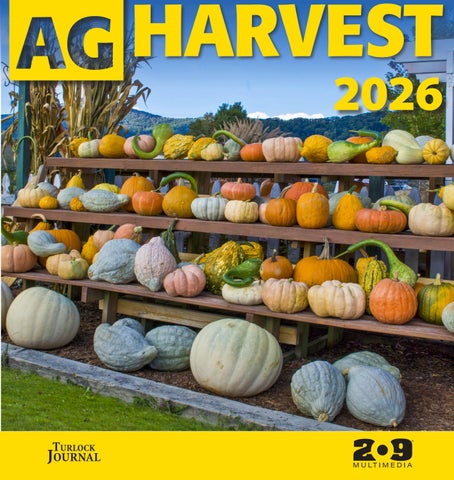
HARVEST
2026
N O S D N HA ING N R LEA
Agriculture comes alive at the TUSD Farm! This year, our OnTrack Adult Transitions students celebrated a record-breaking fruit harvest for district cafeterias, while our Summer Interns mastered hands-on farm management and irrigation repair. Together with our Child Nutrition Department and local partners, the TUSD Farm continues to connect students, families, and our community through nutrition and agricultural education. Contact Us 209.350.206.4031 EXT. 62031
OCTOBER 2026
2 AG HARVEST
influencing senior lifestyles
OCTOBER 2026
3 AG HARVEST
AG HARVEST C O N T E N T S
STANISLAUS COUNTY AG SNAPSHOT . . . . . . . . . . . . 5 STANISLAUS COUNTY TOP CROPS. . . . . . . . . . . . . . . 6 GARTON TRACTOR . . . . . . . . . . . . . . . . . . . . . . . . . . 8 TURLOCK UNIFIED SCHOOL DISTRICT FARM . . . . . . . . 9 MODESTO JUNIOR COLLEGE ENGINEERING. . . . . . 10 CALIFORNIA DISTRICT 4 DAIRY PRINCESS. . . . . . . . . 11 ALMOND HULLS AS A FOOD INGREDIENT. . . . . . . . 12 MERCED COLLEGE’S AGTEC PROGRAM . . . . . . . . . . 13 THE JEWEL OF AUTUMN . . . . . . . . . . . . . . . . . . . . . 14 CALIFORNIA SPECIALTY CROPS. . . . . . . . . . . . . . . . . 15 PUBLISHER/OWNER Hank Vander Veen EDITOR Kristina Hacker ART DIRECTOR Harold L. George GRAPHIC DESIGNER Sharon Hoffman
ADVERTISING Beth Flanagan Charles Webber WRITERS AND PHOTOGRAPHERS Kristina Hacker Chris Correa Joe Cortez
To advertise in the next special section contact the advertising department at (209) 634-9141.
121 S. Center St. 2nd Floor • Turlock, CA 95380
©Copyright 2020. This 209 Multimedia publication All rights reserved. Reproduction in whole or in part of any text, photograph or illustration without written permission from the publisher of this 209 Multimedia publication is strictly prohibited. The opinions expressed in this 209 Multimedia publication are those of the authors and do not necessarily reflect the views of 209 Multimedia management or owner. This 209 Multimedia publication assumes no responsibility and makes no recommendation for claims made by advertisers and shall not be liable for any damages incurred.
OCTOBER 2026
4 AG HARVEST
Stanislaus County agriculture snapshot A look around the county: NORTH Oakdale, Riverbank, Knights Ferry
NORTHEAST Hickman, Waterford, Turlock Lake
WESTSIDE Riverbank, Modesto, Salida
Turlock, Ceres, Hughson
EASTSIDE Empire, Oakdale, Waterford
SOUTHWEST Patterson
SOUTH Keyes, Ceres, Hatch
OCTOBER 2026
SOUTHEAST Newman
5 AG HARVEST
Almonds soar in value to claim top crop in Stanislaus County Leaders: Increase in ag production doesn’t account for farmers’ rising costs BY JOE CORTEZ Turlock Journal
Almond production in Stanislaus County soared last year, gaining more than 25 percent in value as it remained the No. 1 crop in the county, according to the 2025 agricultural report released Tuesday. Overall, total gross agricultural production in the county was valued at more than $3.3 billion, up $176 million – 6 percent – from the prior year. That’s far off the county’s record of $4.4 billion in 2024, when milk and nut prices were particularly robust. “This increase follows trends we’re seeing not only across California, but also across the nation,” said Linda Pinfold, the county’s agricultural commissioner. “Please don’t misinterpret these values as profit or loss because they absolutely do not account for production costs or the incredibly important economic multipliers for our economy. These are simply farmgate values for prices received at the point of initial sale and prior to any downstream handling or distribution.” District 4 Supervisor Terry Withrow stressed the point that a positive ag report doesn’t translate into profits for farmers. “I had a phone call a couple days ago from a client who was spending $20,000 a week in diesel and now is spending $40,000 a week in diesel,” said Withrow, an accountant who also grows almonds and grapes. “So, you just look at what that does to your margins. It’s great the prices are up. That helps, but I don’t know if it compensates for the increases in costs.” The total value of almonds for 2025 was about $1.04 billion – up about 26 percent from 2024’s total of $824.2 million – and exceeds the $1 billion plateau for the first time since 2021. Milk was the No. 2 commodity in the county with a value of $676.3 million, down about 10 percent from last year’s total of $754.6 million. As recently as 2022, milk value was 40 percent higher at $1.13 billion. Almonds and milk, with a combined value of $1.7 billion, account for 52 per-
Journal file photo
The total value of almonds for 2025 was about $1.04 billion – up about 26 percent from 2024’s total of $824.2 million – and exceeds the $1 billion plateau for the first time since 2021.
Stanislaus County Top Crops of 2025 1.
Almonds — $1.04 billion
2.
Milk — $676 million
3.
Poultry — $272 million
4.
Cattle and Calves — $246 million
5.
Fruit and Nut Nursery — $123 million
6.
Silage — $120 million
7.
Walnuts — $99 million
8.
Pollination — $66 million
9.
Melons — $51 million
10. Tomatoes — $46 million
OCTOBER 2026
6 AG HARVEST
cent of the county’s entire ag output. “It’s great to see the uptick after a few down years,” said District 2 Supervisor Vito Chiesa, who represents Turlock and is also an almond and walnut farmer. “The ag industry might not carry the heft that it did 30 or 40 years ago, but the most successful businesses in our region are based around ag. It’s pretty amazing.” Rounding out the top 10 commodities were poultry ($272 million, down $19 million from the previous year), cattle and calves ($246 million, up $38 million), fruit and nut/nursery ($123 million, up $12 million), silage ($120 million, up $12 million), walnuts ($99 million, up $11 million), pollination ($66 million, down $12 million), melons ($51 million, up $15 million), tomatoes ($46 million, down $14 million). Eggs were bounced from the top 10 after a precipitous 70 percent decline in value, going from $47.1 million in 2024 to $14.1 million in 2025. Pinfold said a big factor in the decline for eggs was the continued effects of avian influenza that carried over from 2024 into 2025. “It was really a tough situation,” said Pinfold. “With dairy, the animals can be treated. But when it gets into the poultry, those birds have to be … the term is ‘depopulated.’ It means morbidity for them.” The state requires all 58 counties to estimate their annual farm income. Not all counties have released their 2025 reports, but Tulare County has come in at $9.1 billion, while Kern County has reported a figure of $8.9 billion. Fresno, which topped the state last year at $9 billion, figures to exceed that figure for 2025. San Joaquin County ($3.356 billion) edged Stanislaus County ($3.326 billion) by about $20 million – less than 1 percent of total value. All told, the eight-county San Joaquin Valley region (Stanislaus, San Joaquin, Merced, Madera, Fresno, Kings, Tulare, and Kern counties) accounted for close to $50 billion in ag production during 2025.
OCTOBER 2026
7 AG HARVEST
Garton Tractor continues family tradition of service BY KRISTINA HACKER Turlock Journal
While the technology has changed, Garton Tractor’s commitment to serving the needs of the region’s farmers hasn’t changed. Garton Tractor Inc. started in Turlock in 1954, when Bud Garton purchased his father-in-law’s tractor shop, Cornforth Tractor Co. Originally, Garton Tractor was called Center Street home, opening its first two locations downtown. Today, however, the third and only Turlock Garton location sits just off Golden State Boulevard near West Tuolumne Road, where it’s serviced
the surrounding ag community since opening in 1969. The Garton family continues to oversee operations at the store. Bill first began working at the store in 1979, he said, after graduating from the University of the Pacific. Bill said that the main change in the tractor business over the past four decades has been technology. “And the farming industry’s changed to larger farms along with larger dealerships. The family-owned farms are the bread and butter of our business.”
There are 12 Garton Tractor locations total throughout California, with shops in not only Turlock but Fairfield, Merced, Modesto, Newman, Santa Rosa, Stockton, Tulare, Ukiah, Woodland, Fresno and Madera as well. From utility vehicles and construction equipment to compact, and low-profile high horsepower tractors, Garton now offers a vast multitude of options for local farmers when it comes to tending to their crops, with several different brands to choose from like New Holland, Kubota, Hitachi, Oxbo and Takeuchi. Over 235
Photos contributed
Garton family archives.
OCTOBER 2026
8 AG HARVEST
employees work across the company’s 12 different locations, providing services from simple oil changes to complex mechanical repairs and precision farming. Through the changing times and technology, Turlock has always remained the company’s home. “Our slogan is ‘quality people, quality products’ and that summarizes our business. We want quality people to work here. We provide quality equipment, parts and service to ensure customer satisfaction. The customer is the most important part of our business,” said Bill.
TUSD Farm cultivates hands-on learning, community connections BY KRISTINA HACKER Turlock Journal
Since its opening in 2013, the Turlock Unified School District’s farm has grown from an empty dirt field to an operational farm with opportunities for agricultural learning for students from elementary to high school and beyond. This year, OnTrack Adult Transitions students celebrated a record-breaking fruit harvest for district cafeterias, while summer interns mastered hands-on farm management and irrigation repair. Students from the On Track program — which provides life-skills for young adults
with special needs —picked over 1,000 pounds of pluots from the TUSD Farm and delivered them to campuses across the district for students to enjoy during lunchtime. The farm hosts Wednesday Workshops, where agricultural students and local FFA chapter members can explore agricultural industries and gain hands-on career experience. Earlier this month, students learned about custom applications and farm management techniques from Wilson Farming. Past workshops have covered topics like the floral industry (hosted by Fresh Ideas), fruit harvesting maturity standards, stone fruit variations, winter garden planter prepara-
tion and animal science. Earlier this month, Farm Manager Hali Hallock visited elementary classrooms to talk about and show examples of the pumpkin life cycle. Hallock also shares a “Harvest of the Month” from the farm for classroom ag education. It includes the produce item of focus, a poster, small activities for various grade levels and a meet the grower video. All of these items are courtesy of CA Ag In The Classroom. October was "All about Apples." Every spring, the farm hosts an open house for students and their families. And
first grade classes from across the district visit the farm year-round for study field trips. “The TUSD Farm is a K-12 site that provides opportunities for students to apply their academics through hands-on learning combining science, math, and language arts. Between study trips, workshops, internships, SAE projects for high school ag programs, and more, then TUSD Farm offers a multitude of agricultural education experiences making learning exciting for all students,” said Farm Manager Hali Hallock.
Photos courtesy of TUSD
LEFT: TUSD OnTrack Adult Transitions students picked a record-breaking fruit harvest for district students to enjoy with their lunches; CENTER: TUSD Farm summer interns learned hands-on farm management and irrigation repair; RIGHT: Students and staff man the TUSD Farm booth at the Farm to School and Food Expo, educating the public about everything the TUSD Farm has to offer.
OCTOBER 2021
9 AG HARVEST
New engineering program at MJC showcases smart farming BY VIVIENNE AGUILAR
CV Journalism Collaborative
At Modesto Junior College, engineering students don’t fear AI – instead, they are taught that, without their human creativity, it’s not a very powerful tool. Paloma Ramirez, a second year mechanical engineering student and member of MJC’s Math Engineering and Science Achievement (MESA) program, plans to see just how far her creativity can take her. At 25-years-old, she spent months last spring balancing a full-time job, a full class schedule at MJC and a 15-week engineering course. The latter, in particular, helped her plug into a network of people planning to change the future of industrial agriculture in the San Joaquin Valley. “It sounds hard and impossible, but if you really set your mind to completing something, accomplishing something,” she said, “it’s not really that hard. The potential and your determination is what really gets you through it.” The new 15-week course called Ignite EmTech Futures is a partnership between the local junior college, nonprofits and agricultural technology innovators. Fifteen students completed the first cohort this round. Taught by Modesto-based company IO SCADA, the course uses an open source technology called Inductive Automation Ignition to build smart-farm models. IO designs and sells supervisory control and data acquisitions (SCADA) – technology that helps industries track data and control equipment in real-time. Inductive, similarly provides the tools for farm owners and manufacturing companies. A smart farm can be remotely monitored and controlled, which can allow farmers to better utilize water and energy. IO SCADA and Inductive deal with digital communication across agricultural and manufacturing industries. Both groups invest in education to ensure the technology is accessible for people hoping to enter the field. Students learned about Industry 4.0, also known as the fourth industrial revolution, and used its concepts to code and wire a
VIVIENNE AGUILAR / CVJC
A model farm that can be controlled remotely by computers is on display during Ignite EmTech Futures program’s Demo Day on June 10.
functional small-scale smart farm. Windmills and waterpumps were hooked up to a “digital twin” that mimicked all the components and sensors on the physical boards within the models students learned how to code through Inductive’s software. During their presentations, each group spoke about the ways they can see these kinds of systems being used on actual farms in the region. “The more people use the software, the more that it’s going to become a tool for creative and curious people,” said Julio Ruiz Velasco, founder and president of IO SCADA. “You give them the tools and you let them create,” In the last year, MESA and Beam Circular, a Modesto-based nonprofit dedicated
to creating sustainable agriculture jobs in the Central Valley, have worked alongside industry partners to make this goal a reality. Last summer, Modestans were invited to see the results of some of their work at the inaugural Ignite EmTech Futures Demo Day. Modesto Vice Mayor and District 5 Councilman Jeremiah Williams presented the students who completed the course with a special recognition from the city. Several groups of industrial agriculture technology investors are betting on a group of hardworking scholars to bring about the future of the agricultural workforce in the San Joaquin Valley. “These machines, without you, they’re nothing. Just piles of electronics. You guys give life to these machines, and you guys
OCTOBER 2026 10 AG HARVEST
give intelligence to these machines…. It’s your intelligence that you transfer to these machines with your code,” Ruiz Velasco said. As the students learned the technology, Ruiz Velasco said he was impressed by the dedication and creativity of the students. That included Ramirez, who was offered an internship at the company after completing the program. “I mean, the potential (this technology) has is just absurd,” Ramirez said. “It really is set to the imagination… If you really set your mind to creating something new, you can get anything from that.” Ramirez hopes to transfer to UC Davis or UC Merced and potentially start her own business with the skill she’s gained in engineering, coding, and ag tech.
New Dair y Princess crowned
Jaelyn Amabile of Los Banos selected as District 4 ambassador STAFF REPORTS Turlock Journal
Jaelyn Amabile of Los Banos was selected as the 2026 Dairy Princess for the California Milk Advisory Board’s District 4. The contest was held on June 18 in Turlock. Jaelyn will represent District 4, which includes Alameda, Alpine, Amador, Calaveras, Contra Costa, El Dorado, Mariposa, Merced, Monterey, Sacramento, San Benito, San Francisco, San Joaquin, San Mateo, Santa Clara, Santa Cruz, Stanislaus, Tuolumne and Yolo counties. As Dairy Princess, she will play a key role in meeting CMAB’s community relations objectives. Jaelyn is the daughter of John and Marisa Amabile. She will be a senior at Los Banos High School and plans to attend California State University, Fresno or Cal Poly, San Luis Obispo to major in Agricultural Education. Jaelyn is an active member of the Los Banos Future Farmers of America where she is on the dairy judging team
and shows dairy cattle. She is on the Los Banos varsity golf team, Associated Student Body, and has served as class Treasurer. Crowned Alternate Dairy Princess was Allison Marchy. She is the daughter of John and Sarah Marchy and will be a senior at Modesto High School. She has shown dairy cattle at the Stanislaus County Fair and is a member of the Modesto Future Farmers of America dairy cattle judging team. Allison is on the varsity girls’ basketball team, varsity softball team, and has served as news anchor for the Modesto High School student news. After graduation, she plans to pursue a degree in Animal Science/Genetics. Jaelyn and Allison’s duties as District 4 Dairy Princess and Alternate include speaking on behalf of the California dairy industry to various audiences throughout the year. As Dairy Princess and Alternate, Jaelyn and Allison will attend a professional development training week
focused on presentation skills, advocating for the California dairy industry, leadership, and business etiquette. California is the nation’s leading milk producer, and makes more butter, ice cream, and nonfat dry milk than any other state. California is the second-largest producer of cheese and yogurt. The California Milk Advisory Board is an instrumentality of the California Department of Food and Agriculture and is funded by the state’s dairy farm families who lead the nation in sustainable dairy farming practices. With a vision to nourish the world with the wholesome goodness of Real California Milk, the CMAB’s programs focus on increasing demand for California’s sustainable dairy products in the state, across the U.S. and around the world. Photo contributed Connect with the CMAB at RealCaliforAlternate Dairy Princess Allison niaMilk.com, Facebook, YouTube, Tik Tok, Marchy and District 4 Dairy Princess Jaelyn Amabile pose for a picture. Instagram, X and Pinterest.
24 HOUR EMERGENCY SERVICE AVAILABLE!
LOCALLY OWNED, FAMILY OPERATED
Residential • Commercial & Industrial
Plumbing Services OUR SERVICES INCLUDE:
Over 30 years of experience!
Sinks • Drains • Faucets • Septic Tanks & Sewer Lines Grease Traps • Floor Drains • Toilets • Water Heaters Backflow Prevention • Hydro-Jetting • Preventative Maintenance Inspection • Gas & Water Pipelines Repair Re-Piping Storm Water Treatment • Lift Station Maintenance SWTD Filter Replacements and MORE!
209-581-0480 • CSLB #875920 4425 Farm Supply Drive, Ceres, CA 95307 office@ateeplesinc.com www.ateeplesplumbing.com
OCTOBER 2026 11 AG HARVEST
Almond hulls being tested for use as food ingredient BY TIM HEARDEN AgAlert
An independent review panel’s designation of almond hull powder as generally safe for human consumption represents a “major milestone” that opens the door for its use as an ingredient in granola, cereals, baked goods and other foods, a researcher at the Almond Board of California said. The panel finalized its findings this past spring after reviewing a more than 180-page dossier covering how almond hull powder is made, how much people might eat and what happens when they do. Toxicology, genotoxicity and environmental containment exposure assessments found no safety concerns at intended use levels, the almond board announced in May. The findings, which were submitted to the U.S. Food and Drug Administration, could be “transformational for the industry” in that they create a pathway for continuous innovation and value creation from a resource that has historically been used primarily for livestock feed, said Guangwei Huang, the almond board’s associate director of food research and technology. Huang said the GRAS confirmation—with GRAS standing for generally recognized as safe—marks a significant breakthrough and could pave the way for “an entirely new ingredient platform for the almond industry.” Although much of the current attention is focused on almond hull powder, he emphasized that it should be viewed as only the first ingredient form to be developed, characterized and tested. “The more significant implication is that GRAS creates a regulatory and commercial foundation for innovation across a broader range of almond hull-derived ingredients,” he said in an email. The GRAS designation represents a key turning point for a sector that resolved nearly a decade ago to seek more uses for harvest waste materials that were discarded or, in the case of almond hulls, used to feed livestock. Hulls make up about half the almond fruit by weight but deliver relatively modest returns to growers, as their demand is tied closely to dairy and feed markets, the almond board said. A biomass working group was formed in 2017 to explore new applications for almond coproducts, and its members saw strong potential
Photos courtesy of the Almond Board of California
The Almond Board of California formed a biomass working group in 2017 to identify potential uses for almond hulls and shells, left, to eliminate postharvest waste. The group saw strong potential in almond hulls, with hull powder, right, being explored as a food ingredient. The U.S. Food and Drug Administration has designated the byproduct as generally safe for human consumption.
for hulls because of their high fiber content, natural sugars, phytochemicals, minerals and processing versatility. For food innovation, almond hulls have several advantages, Huang noted. They are generated in large, stable and predictable volumes every year, providing a reliable supply of an agricultural raw material that some other emerging ingredients lack, he said. This makes hulls especially attractive to food manufacturers, he added. “It has potential,” said Dave Thiel, general manager of the Turlock-based Cortez Growers Association, which has been working with the almond board to perfect a cleaning system for hulls. Though it’s in the testing phase, he noted how almond hull powder is making its way into granola, with about 10% of the crunchy clusters containing hull powder. “I just ate some, and it’s pretty darn good,” Thiel said, “so the potential for that market is there for almond hulls.” Most existing hulling and shelling operations lack the capacity to clean almond hulls sufficiently for use in human food, which requires the material to be pasteurized, Thiel said. “The whole point behind our system here is
to remove any foreign material that dairymen wouldn’t want to see in their feed trough,” he said. However, commercializing almond hulls wouldn’t require building an entirely new infrastructure, Huang said. Much of the existing harvesting, handling and processing equipment can be upgraded or adapted to produce food-grade ingredients safely and efficiently, he added. “Looking ahead, relatively simple changes in postharvest logistics and material-handling practices could allow almond hulls to be managed from the outset as a high-quality agricultural raw material intended for food uses rather than as a feed co-product,” he said. Huang compares hulls’ potential for success to that of the cocoa industry. The cocoa bean isn’t marketed as a single ingredient. Over time, innovation and market development led to multiple ingredient streams, including chocolate liquor, cocoa powder and cocoa butter, each serving a different function and supporting distinct product categories and value chains, he said. “Similarly, almond hulls are a complex agricultural resource that may yield multiple ingredient forms with different nutritional, functional and commercial properties,” Huang
OCTOBER 2026 12 AG HARVEST
said. “Almond hull powder is the first step, not necessarily the final destination.” Huang was part of an international team of scientists who published a 2024 paper in the National Institutes of Health’s National Library of Medicine examining the suitability of almond hull material as a novel food ingredient. No evidence of toxicity or mutagenicity—the ability to cause genetic mutations in cells—was observed in tests in doses likely to be present in foods, the scientific team found. From an economic perspective, the opportunity for almond hulls could be substantial, as their use in food could transform them from a low-value byproduct into a “portfolio of highervalue food ingredients” that helps the industry maximize value from every part of the almond crop while promoting sustainability, Huang said. One advantage that almond hulls offer is that by adding just 10% or more of the powder to a product, it can qualify for a new third-party “upcycled” certification, the almond board said. The designation checks a box for consumers concerned about food waste. Daniel Kurzrock, founder and CEO of Upcycled Foods Inc., said achieving GRAS status is an important step for innovative ingredients seeking acceptance from prospective customers, as companies are unlikely to invest time and money developing products around an ingredient in which regulatory approval remains uncertain. The Berkeley-based company is a business-to-business ingredient supplier and product development partner, according to its website. The GRAS confirmation provides food companies, ingredient manufacturers and researchers with the confidence to invest in product development, Huang said. The scientist said he sees the designation not simply as approval of a single ingredient but as “the opening of a new food ingredient industry opportunity built around almond co-products.” He said the pace of adoption will depend on demand and how quickly companies can bring products to market. More importantly, he said, the development could create new uses for almond hulls. “In that sense, it has the potential to be transformational for the industry,” Huang said.
— Courtesy of the California Farm Bureau
Ag program aims to upskill farmworkers BY MANOLA SECAIRA AgAlert
On a hot September afternoon, Ana Muñoz drove a tractor for the first time. Following her instructor’s direction, she took a seat in the tractor with some apprehension. She was only a month into Merced College’s Agricultural Technology and Education Collaborative, or AgTEC, program, which aims to help farmworkers like herself advance their agricultural skillset to meet the sector’s changing needs. This was her first in-person workshop. But with 12 years of farmworking experience under her belt, Muñoz is no stranger to agriculture. “I’ve always loved working outside on a farm,” she said in Spanish. She’d long been interested in learning the new skills required to expand into other agricultural work—namely, driving tractors and operating other agricultural equipment. She said she’d gotten the gist of how to operate them by watching other people do it over the years. What was missing was the hands-on practice and training. But even with her experience, she said she’s found it difficult to get those opportunities or otherwise move up the ladder in her job. “At work, they told me that I couldn’t do much because I was more useful showing new workers how to harvest sweet potatoes and all that,” she said. “So, I never made my dream a reality.” That changed earlier this year when she received a flyer about the AgTEC program while picking up her kids from daycare. Merced College is one of six colleges in the Central Valley offering AgTEC courses. The program, launched in late 2024, aims to equip students with the knowledge and skills needed to thrive amid agriculture’s evolving technologies and needs. While it’s open to students of all backgrounds, it’s particularly oriented toward farmworkers interested in expanding their agricultural skills. AgTEC is one part of a larger “Farms Food Future,” or F3, Central Valley initiative funded by a $65 million federal
MANOLA SECAIRA/AgAlert
Ana Muñoz receives instruction on how to drive a tractor from Merced College professor Karl Montague, who teaches the Agricultural Technology and Education Collaborative, or AgTEC, program, which aims to help farmworkers advance their agricultural skills.
grant awarded in 2022. From its start, the program has seen more than 800 enrolled students and about 150 graduates spread across the participating colleges. Karen Aceves, AgTEC’s regional director, said faculty at participating colleges developed the curriculum based on a survey of about 11,000 farmworkers who were asked what they needed and wanted in an agricultural development program designed with them in mind. Aceves said the program can help fill a need in the changing world of agriculture while retaining workers already in the industry. “We don’t know where our industry is going,” Aceves said. “We need someone who’s adaptable and can adapt to those changes.” The program is free, with workshops and materials accessible for English and Spanish speakers. In-person workshop schedules are often tailored to farmworker schedules. “If you offer night classes, if you offer child care, if you do it hybrid—which are all the components that we have in our
certificate program—then people are much more likely to participate in education,” Aceves said. The classes cover hands-on skills such as driving agricultural vehicles and using power tools, as well as agricultural software and digital literacy basics, including professional email etiquette and file sharing. Leigh Bernacchi, director of agricultural innovation at Merced College, said digital literacy skills could help in seeking opportunities outside agriculture if a student wishes to explore. “Those basic skills help you access so much in society,” she said. “It opens a bunch of doors.” Bernacchi said offering this training to farmworkers also gives them an opportunity to move up and potentially apply for higher-paying positions. “This curriculum lets a person not just do the task at hand but be the long-term farm staff, lets you be an essential team member, lets you be the person that they choose to keep on year-round,” Bernacchi said.
OCTOBER 2026 13 AG HARVEST
Aceves said more colleges have expressed interest in adopting the program, with three already signed on to launch their own AgTEC programs next spring. She said she hopes to give students the option to continue their education toward an associate or bachelor’s degree. The demand is there, she said, recalling one student of the program who is going through it a third time. “This is the only program that’s available to him, and he wants to keep learning,” she said. Back at the workshop, student Muñoz said she was initially nervous about driving the tractor. But she quickly felt more at ease, thanks in part to her experience driving a manual transmission. She said she’s eager to return to more classes. Rosa Nuna, a fellow student, has been working the fields for 26 years. Like Muñoz, she loves agricultural work. She learned about AgTEC through her employer, who handed out flyers to her and other workers. Her curiosity about learning how to grow her own plants drew her to the program. She said she hopes to one day open her own rose greenhouse. “That’s why I became interested in learning about the land, how it’s cultivated and how to use the necessary tools to work it,” Nuna said in Spanish. Homer Duran, another student, had worked with agricultural vehicles before his first AgTEC class. But he welcomed the chance to better understand the equipment he uses, especially given his limited access to training. “I want to improve and understand so I’m not learning on the go,” he said in Spanish. “That would make me more comfortable doing it.” Muñoz said she hopes to graduate from the program in December and keep moving up, with aspirations of becoming a crew leader or supervisor. “If I get that chance after I get my certificate, I’ll try to advance, both for myself and to give my kids a better life,” she said. “I want them to be proud of their mom.”
— Courtesy of the California Farm Bureau
The jewel of autumn BY KRISTINA HACKER Turlock Journal
Over 8,000 years ago, the pomegranate became one of the first cultivated fruits. During its history, pomegranates have been symbols of prosperity, hope, and abundance in every part of the world. The tree was introduced into California by Spanish settlers in 1769. It is one of the most flavorful fall fruits, while also being high in antioxidants, potassium, vitamin C, and a great source of fiber. The glistening red jewels inside, called arils, are full of nutritious sweet-tart juice surrounding a small white crunchy seed. You can eat the whole arils including the fiber-rich seeds, or spit out the seeds if you prefer.
You can eat the fresh arils, juice them, and cook with them, just like any other fruit. They also are used for traditional decorations or centerpieces during the holidays so they are a feast for the eyes, as well. Those looking to pick up a few pomegranates this season can find it right off the tree at Riverdance Farms in Livingston. The organic farm located off the Merced River is known for its you-pick blueberry and cherry fields, but in late fall pomegranates are the main draw. Riverdance also has Fuyu persimmons and pecans available in late fall for picking. You pick at Riverdance Farms is by appointment only. Call (209) 761-0081 to make an appointment. For more information, visit riverdancefarms.com.
POMEGRANATE CREPES WITH ROASTED VEGETABLES PREP TIME 1 hour
COOK TIME 20 minutes
INGREDIENTS:
SERVINGS 8
DIRECTIONS:
CREPES 1 cup all-purpose flour 1 1/2 cups milk 2 large eggs 1 tablespoon olive oil 1/4 cup Parmesan cheese
CREPES: In a bowl or food processor, combine flour, milk, eggs, olive oil and beat until well combined. Stir in Parmesan cheese. Heat a small 6" skillet or crepe pan, and grease it lightly. Add 3 tablespoons of batter, and tilt the pan to spread. Brown on one side only, and remove it to a towel-covered sheet pan. Set aside (can be made and refrigerated a day ahead).
R O A S T E D V E G E TA B L E S 1 cup pomegranate arils 1 Japanese eggplant, sliced lengthwise 2 inches long, 1/4-inch thick 1 zucchini, sliced lengthwise 2 inches long, 1/4-inch thick 1 yellow squash, sliced lengthwise 2 inches long, 1/4-inch thick 1 red or yellow bell pepper, sliced lengthwise 1/4-inch thick 1 red onion, sliced 1/4-inch thick 1 teaspoon salt 1/4 teaspoon black pepper 2 tablespoons olive oil 2 tablespoons basil, shredded
R O A S T E D V E G E TA B L E S : Pre-heat oven to 400°F. Prepare walnut sauce according to instructions below. Set aside. On a foil-covered sheet pan, mix all vegetables with oil, salt, and black pepper. Bake for 30 to 45 minutes. Remove from the oven, and cool in the pan. Sprinkle with fresh basil and 1 cup arils, toss together, and set aside. To fill crepes, place crepes on a flat surface, and divide the roasted vegetables amongst the crepes. Fold crepes over, and roll to close. Place seam-side down in a 9" x 13" casserole dish. Cover each with a teaspoon of walnut sauce. Bake for 20 minutes, then remove from the oven. Sprinkle with remaining arils before serving.
WA L N U T S AU C E 1/2 cup pomegranate arils 1/2 cup toasted walnuts, chopped 1 teaspoon salt 1/4 teaspoon coarse ground black pepper 1 cup heavy cream 2 tablespoons basil, shredded (garnish)
WA L N U T S AU C E: Heat a skillet, and toast walnuts. Cook and stir until fragrant. Add salt, pepper, and heavy cream, and cook until hot. When ready to serve, spoon the sauce over the crepes, and sprinkle them with 1/2 cup arils and basil.
OCTOBER 2026 14 AG HARVEST
California agriculture leads the nation in funding for specialty crops The U.S. Department of Agriculture (USDA) has announced funding for the 2026 Specialty Crop Block Grant Program (SCBGP). California received $28.9 million out of approximately $86.6 million awarded nationwide. The SCBGP provides grants to state departments of agriculture to fund projects that enhance the competitiveness of specialty crops, defined as fruits, vegetables, tree nuts, dried fruits, horticulture, and nursery crops (including floriculture). The California Department of Food and Agriculture (CDFA) will fund 60 projects. “California’s Specialty Crop Block Grant Program continues to deliver tremendous value for our farmers, communities, and consumers,” said CDFA Secretary Karen Ross. “As one of the nation’s largest recipients, we see firsthand how this funding drives innovation across our food system— from strengthening school nutrition and expanding consumer markets to advancing
research that improves food safety. These investments also help us build a more climate resilient and equitable future for all Californians.” The Buy California Marketing Agreement was awarded $3 million to establish the Growing CA GROWN Gold campaign by designing and implementing educational programs and marketing promotions to increase awareness and consumption of California Grown specialty commodities. This multi-platform digital campaign is designed to generate strong support from the retail and food service trade, as well as the agritourism industry, to increase consumer demand for California specialty crops and specialty crop products. Among the environmental stewardship and conservation projects funded, the California Polytechnic State University, San Luis Obispo, was awarded $497,404.00 to integrate robotics and artificial intelligence into a mobile robotic platform with custom robotic
arms designed for table grape harvesting. The SCBGP Additional Assistance Program provides a process through which organizations supporting limited-resource California farmers and communities can participate and successfully implement their SCBGP projects. Among the five projects awarded this year, Black Thumb Farm, a non-profit organization, will receive $249,993.00 to support the Kinfolk Kitchen: Cooking with Specialty Crops project, which aims to host 20 community workshops on seasonal consumption of specialty crops that are affordable and locally grown, providing a variety of specialty crops directly from Los Angeles urban farms. Through cooking workshops, the community will be provided with information about local urban farms where they can purchase specialty crops. The Pauma Band of Mission Indians, a Tribal Government, will receive $249,858.00 to address drought, declining groundwater, inefficient irrigation, and poor soil health
OCTOBER 2026 15 AG HARVEST
affecting specialty crop production in Pauma Valley and surrounding areas. Other projects focus on increasing sales of specialty crops by leveraging the unique qualities of specialty crops grown in California; increasing consumption by expanding the specialty crop consumer market, improving availability, and providing nutritional education for consumers; investing in training for growers, producers, and operators to address current and future challenges; and conducting research on conservation and environmental outcomes, pest control and disease, and organic and sustainable production practices. In addition, CDFA continued its partnership with the Center for Produce Safety in the evaluation and recommendation of food safety related projects. These projects represent an ongoing effort to address food safety practices and minimize outbreaks of foodborne illness with proactive research.
Family owned and operated since 1954.
1-877-Tractor
GartonTractor.com Quality People Quality Products®
Our mission is, “To consistently provide our customers with an experience that exceeds their needs in Sales, Service, Parts, and Rentals with Quality People, Products, and Facilities.”