Turf Matters




ICL Turf & Landscape UK & Ireland has appointed of Gavin Kinsella as Technical Area Sales Manager – South East.
Gavin brings more than 35 years of experience in golf course management, estate management and sportsturf operations, with a strong background in agronomy, leadership and sustainable turf management.
He joins ICL from Moor Park Golf Club, where he served as Courses and Estate Manager, overseeing a 36-hole facility, practice areas, tennis courts, estate landscaping and a 24-person team.
Prior to this, he held the same role at Royal Mid-Surrey Golf Club for almost 18 years, managing a broad range of course, estate and environmental responsibilities.
Earlier in his career, Gavin worked with The European Tour as an Agronomy Advisor, supporting tournament venues and course preparation, alongside previous greenkeeping and golf course management roles in the UK, Europe and the United States. His professional qualifications include
BIGGA Master Greenkeeper status and an HND/FdSc in Turfgrass Science and SportsTurf Management.
“Having worked in golf course and estate management throughout my career, I understand the technical and operational challenges turf professionals face,” said Gavin.
“ICL is well respected across the industry for the strength of its products and technical support, and I’m looking forward to supporting customers and distributors across the South East.”
Andrew Pledger, Sales & Business Development Manager – UK South, welcomed Gavin to the business.
“We are pleased to welcome Gavin to ICL. His experience across golf course management, estate operations and agronomy gives him a strong understanding of the needs of our customers. He will be a valuable addition to the UK South team and will help strengthen the support we provide across the region.”
Gavin will work closely with distributors and turf managers
throughout the South East, providing technical guidance and support across ICL’s turf and landscape portfolio. n www.iclgrowingsolutions.com






More John Deere dealers have signed the Armed Forces Covenant in support of service leavers who can resettle into roles within the agriculture and turf industries.
At a ceremony held at the National Transition Event at Silverstone Circuit, Hunt Forest Group and Ripon Farm Services added their names to the covenant, which had already been adopted by Ben Burgess and Tallis Amos Group, as well as John Deere itself.
Signatories pledge to ensure that those who serve, or have served, in the armed forces, and their families, are treated fairly and should face no disadvantage compared to other citizens in the provision of public and commercial services.
The move complements John Deere’s Military Hiring Programme, which offers service leavers new

career opportunities to work on some of the world’s most advanced machinery used by farmers and turf professionals.

Members of the armed forces have been identified as ideal candidates to bring their unique skill sets and experience to technician roles within UK and Ireland dealerships.
Those who enrol in the programme are given free, tailored training and are supported to fill vacancies within the dealership network.
“We are passionate about finding a way to give back to those who have served our country,” said Allan Cochran, John Deere Branch
Training Manager. “The armed forces produce people who are highly skilled, motivated and extremely competent, and many already have the engineering skills needed to become qualified technicians.
“It’s the perfect fit for John Deere – we are able to play our part in supporting those resettling following careers in the armed forces while also attracting a different pool of people into the business.”
Interested service members and exservice members can learn more and fill out a contact card by visiting .
After making contact, they will be put in touch with an individual from the John Deere network who has resettled following a career in the armed forces to discuss all potential options.
n www.deere.com/JDMHP
STIHL has unveiled their ASA 140 high-performance, batteryoperated pruning shears.
The ASA 140’s blade follows finger movement to its control lever, only closing as far as the lever is pressed for precise, progressive cutting. In addition, the opening width of its blade can be adjusted to different gauges in two stages. This allows users to increase working speed when cutting thin branches.
Powered by a 36 V lithiumion battery, the shears deliver
enough power for an entire working day, the equivalent of more than 9,000 cuts. With a handle that fits comfortably in the hands of both right- and left-handed users, the ASA 140 has been built to provide an optimal user experience.

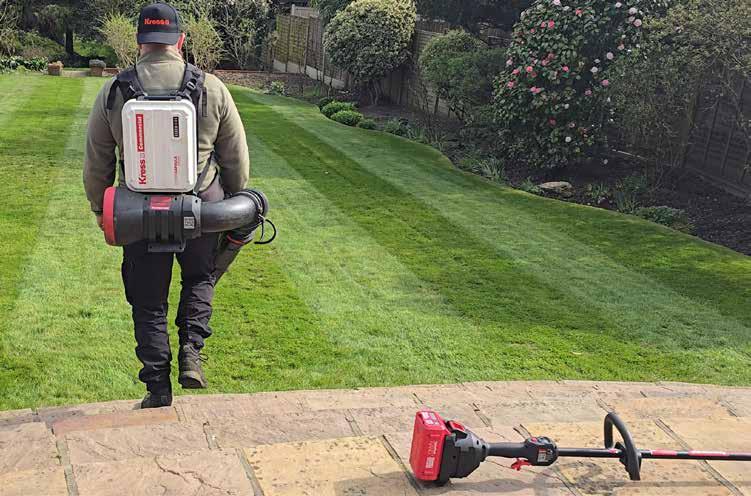
For Mike Day, owner of Mike Day Garden Maintenance, consistency is everything. Running a thriving business across Hertfordshire and North London, he and his team rely on equipment that can perform day in, day out without compromise.
That’s exactly why every van in their fleet now runs exclusively on Kress commercial tools.
“We’ve got the whole range. Strimmers, hedge trimmers, blowers, chainsaws, everything that Kress make, we use day in and day out. We’ve even got their 20V small hand saws and secateurs, which we use pretty much every day.”
It’s a setup that has evolved over time, but one that now gives Mike and his team complete confidence across every job, from routine maintenance to full garden renovations.
“We’ve tried a lot of different brands in the past. But we’ve ended up going all in with Kress. Every other battery product we had used in the past, we’ve sold. We’re one brand now and that’s something we wouldn’t have been able to do before.”
A key part of that confidence comes down to performance. Across the entire handheld range, Mike says the Kress tools deliver more than enough power for both everyday tasks and more demanding work.
“We’ve genuinely tried to find their
limit, and we’ve never been able to find it,” he admitted.
“There’s just an abundance of power. Even when we’re doing full garden renovations and putting the tools through really demanding loads, they always outperform your expectations.”
For Mike and his team, the mostused tools are the grass strimmers, particularly the latest lightweight model with the motor positioned at the head.
“It’s slightly less powerful than the bigger machines, but for what we do, it’s perfect. Most of our work is regular maintenance, so we don’t need huge power. What we want is something lightweight and easy for us to use all day.”
Weight and balance are where the Kress tools really stand out.
“That strimmer is about 2.5kg, and even with a battery on, you’re only up to around three-and-a-half, maybe four kilos. That’s the weight of a lot of other machines without a battery and that is why my team prefer using the lighter kit.”
The same thinking applies across the range, including hedge trimming. Mike highlights the articulating long-reach hedge trimmer as a particular standout.
“We use the smaller articulating long reach, and it’s brilliant. It’s really well balanced, and the blade speed is right up there – 3400 to 4000 cuts per minute. I honestly can’t think of
anything I’d improve on it.”
While performance and comfort are key, it’s the battery system that continues to set Kress apart according to Mike.
“It always comes back to the batteries and the infrastructure. They charge quicker than you can deplete them. You’re never waiting around.”
Rapid charging has completely changed how the team works throughout the day.
“With other brands, once a battery was at zero percent, it was basically out of action. You’d throw it in the van and grab another one.
“But with Kress, you stick it on the CyberTank or a charger, and 10, 15, 20 minutes later, it’s back in use. That makes a massive difference to a garden maintenance company such as ourselves.”
Even in extreme conditions, the system has proven its reliability.
“We’ve used them in minus eight degrees and up to nearly 40 degrees last summer, and they’ve never missed a beat. The batteries just keep going.”
Durability over time has also stood out, with minimal degradation even after years of use.
“I’m still running the same batteries from 2022, and they’ve barely lost any capacity. That’s important because a lot of brands don’t last like that.”
n www.kress.com/en-gb
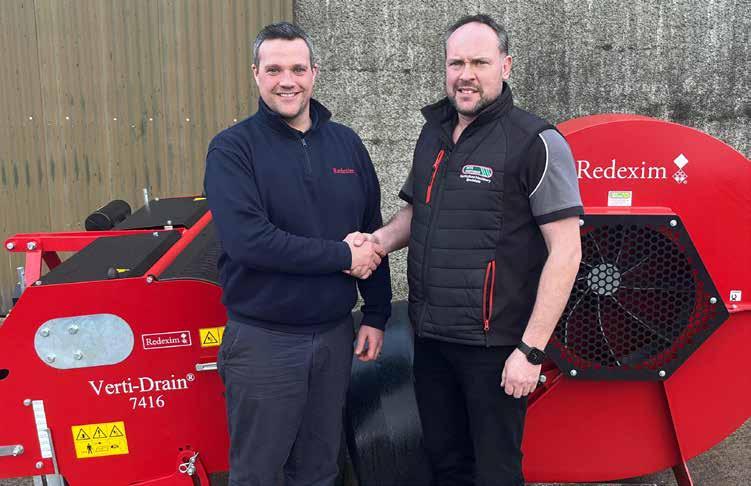
Redexim UK has strengthened its presence in Northern Ireland with the appointment of Keys Brothers as its official partner for the region.
Based in Hillsborough, Keys Brothers is a well-established family business with more than 25 years’ experience in the industry. With a strong reputation for customer service and technical expertise, the company supports customers across Northern Ireland with dedicated sales specialists, product demonstrators and a highly mobile team of field service technicians.
The new partnership forms part of Redexim’s wider UK growth strategy, ensuring that customers throughout Northern Ireland benefit from enhanced access to its industry-leading range of turf maintenance machinery and specialist equipment.
Redexim has built a global reputation for innovation and durability. Known for pioneering products such as the Verti-Drain, the company continues to develop
advanced solutions designed to improve surface performance across sports turf, golf, landscaping and amenity sectors worldwide.
Allen Whellans, Regional Manager for the North at Redexim UK, said the appointment reflects the company’s commitment to aligning with forwardthinking partners.
“We were at a point where Redexim’s going one way and we need to be aligned with partners in areas that are pushing forward. It’s quite clear to see that Keys Brothers is that partner.”
Under the new agreement, Keys Brothers will operate across the entirety of Northern Ireland, providing full sales, service and support for the Redexim range.
“It’s the whole of Northern Ireland,” Allen confirmed. “It’s part of the wider strategy for Redexim as we continue to grow the brand. Whilst we continue to push and grow in the UK and globally, we need to align with partners that are also looking to do that.”
A key strength of Keys Brothers
lies in its proactive approach to customer engagement. With sales representatives and technicians operating on the road, the team is highly visible and accessible to customers throughout the region.
“They’re very active, and they’re out and about,” Allen added. “We want partners to be out and in front of the customer, and they have lots of touchpoints with customers that we didn’t previously have.”
Commenting on the partnership, Andy Keys, Director of Keys Brothers, said that it was a perfect fit the company as it sat really well alongside the rest of their product range.
“We know the Redexim range is going to strike a chord with our customers. They’re looking for quality, dependable machinery that does exactly what it’s designed to do, and that’s what this brand is known for. We’re really pleased to be bringing it on board and confident it’ll be a great addition for us and for our customers.”
n www.redexim.com/uk/
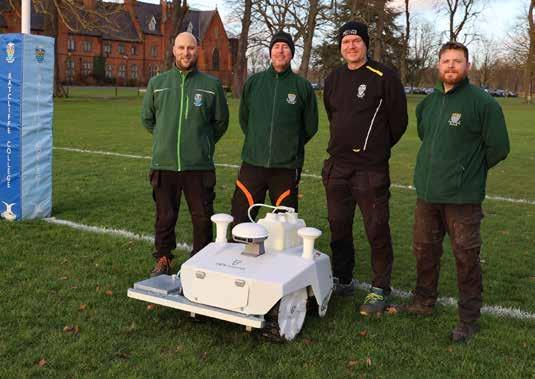
Ratcliffe College, in Leicestershire, is home to an impressive range of sporting facilities, supporting rugby, cricket, football, hockey and athletics across its expansive campus.
Keeping those surfaces matchready is the responsibility of Chris Moody, Head of Grounds, and his small but highly skilled team. Over the past year, the introduction of the PaintMaster Pro RLM01 Robotic Line Marker, supplied by Agrovista Amenity, has delivered a significant improvement in efficiency, consistency and presentation across the site.
“I’ve been in the industry a long time and a line-marking robot has been on my mind for a good few
“IT’S HELPING US DELIVER CONSISTENCY AND QUALITY ACROSS THE WHOLE SITE, AND THAT’S EXACTLY WHAT WE AIM FOR HERE AT
years. When I first started at Ratcliffe, it was something I raised as a real opportunity for us. As the technology has advanced over the last five or six years, it just made more and more sense to revisit it,” said Chris.
Responsible for nine rugby surfaces, six grass cricket areas, nets, two full-size artificial hockey pitches, a four-lane 400m track and a range of football pitches, Chris and his team of four manage a demanding programme of activity all year round.
Traditionally, the school used external contractors to carry out initial robotic markings at the start of each term before the grounds team took over for weekly over-marking and maintenance.
“That system worked, but it only got us so far. We wanted more flexibility and greater consistency. That’s when we decided to properly assess our own robotic line marker.”
After researching the market, speaking with other schools and arranging demonstrations, the PaintMaster Pro RLM01 stood out as the clear choice.
“The PaintMaster Pro ticked a lot of boxes for us – including the finance options, which are important in an educational environment. But
what really sold it to me was the full package: the machine itself, the userfriendly tablet, the size of the paint tank, and the support network behind it,” said Chris.
“The people who already had one couldn’t speak highly enough of it –and now I understand why.”
The PaintMaster Pro is a smart, GPS-guided robotic line marker that delivers centimetre-accurate results on a variety of sports surfaces. Using dual industrial-grade GNSS positioning and a local base station, it produces straight, consistent lines every time.
For more challenging environments, such as areas surrounded by trees or buildings, an optional laser kit ensures reliable performance where GPS may struggle. A 0.5 kWh battery enables marking of up to eight full-size pitches on a single charge, while the 1 kWh upgrade doubles that capacity.
“There’s no complicated setup. Once the aerial and base points are in place, everything is controlled through the tablet. Getting the base points for our first pitch took about 15 to 20 minutes, and in a day we had the whole site mapped and saved.
“Now those pitches are always stored in the system, ready to go. We could take the robot out of the shed and have a full-size pitch marked in around 90 minutes, perfectly to our exact dimensions.”
For the team, the biggest benefit has been the time saved and the flexibility it brings. “It frees us up to improve other areas of the site. We can work on another pitch while the robot is marking the first one.”
Beyond the machine itself, Chris has been impressed with the support from Agrovista Amenity and XDC.
“The backup has been brilliant. They even set up a WhatsApp group so if we have a question or need a tweak, it’s dealt with straight away. The software is always being updated and improved based on user feedback. In terms of customer service, it’s second to none.”
“We don’t see it as replacing skills – it’s enhancing what we do. It’s helping us deliver consistency and quality across the whole site, and that’s exactly what we aim for here at Ratcliffe College.”
n amenity.agrovista.co.uk



Replay Maintenance is stepping up its game in the natural turf sector with a new three-year supply agreement with Origin Amenity Solutions, reinforcing its commitment to delivering highperformance sports surfaces across an expanding portfolio of sites.
The agreement is a key part of Replay’s wider strategy to grow its Natural Turf Division.
Following a structured selection process, the partnership provides both stability and flexibility, giving Replay the confidence to plan for growth while maintaining consistent standards on every pitch. In its first year, the company expects to service over 100 natural turf surfaces, with ambitious expansion anticipated in the years ahead.
Under the deal, Replay secures a reliable supply of core OAS products,
including perennial ryegrass seed mixtures, controlled-release fertilisers, herbicides, and specialist inputs designed specifically for professional sports turf. But the agreement goes beyond the basics.
Embedded technical and agronomic support means Replay teams have access to soil analysis, laboratory testing, application planning tools, seasonal guidance, and ongoing technical advice, ensuring every decision is backed by data and best-practice insight.
Commenting on the partnership, Phil Dewhurst, Regional Sales Director at Origin Amenity Solutions, said that they were proud to have won the contract with Replay Maintenance.
“Together we will build a strong partnership to supply and deliver our trusted products to improve the
quality and performance on newly renovated natural turf surfaces.”
Service and performance are central to the partnership. The framework incorporates clear delivery commitments, regular performance monitoring, and annual commercial reviews, helping Replay maintain quality, reliability, and operational accountability as the division grows.
Matt Bartle, Group Head of Commercial Strategy at Replay Maintenance, believes the partnership will play an important role in supporting the company’s ambitions in the natural turf market.
“This partnership with Origin Amenity marks an important step forward. At our core, we’re committed to raising standards across all sports pitches.” n www.replaymaintenance.co.uk
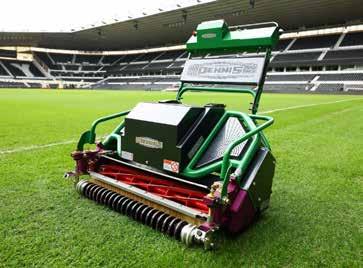
Adedicated, battery-powered finishing mower using the latest lithium-ion battery technology, the Dennis ES-34SL, is perfect for use on stadium pitches and training grounds in professional sports like football, rugby, hockey and baseball.
It is also ideal for use on squares and outfields in cricket, as well as at schools, universities and other municipal facilities.
On a single charge, the new battery mower can cut for up to 10 hours –equivalent to 40 kilometres – with its rapid, two-hour recharge costing as little as £1.58. Its ultra-low noise and vibration technology, meanwhile, allows for operation near areas of play without disturbance, improves operator health and safety, and is perfect for schools and universities where noise disturbance is of paramount importance.
At around 50 kg lighter than Dennis’ existing ES-860 battery mower, the ES-34SL is ideal for daily
use and minimising soil compaction. The combination of reduced weight, reduced rear roller diameter, click adjustable Weile roller and intermediate grooming brush, allows for greater ease of use and control over the final finish, which serves to produce the flawless stripes that Dennis’ product range is renowned for.
The mower’s clip rate can be defined by the user to suit their specific surface and preferences and, once set, remains consistent, even if the machine speed is adjusted or a colleague takes over.
“We are delighted to be launching the ES-34SL professional battery mower, which we’ve developed in response to direct feedback from grounds professionals,” said Megan Oliver, Managing Director at Dennis Mowers.
“In addition to the popular features in our range, our challenge was to design a lightweight machine that
helped to reduce soil compaction and was therefore suitable for everyday use, while still delivering the flawless presentation stripes relied upon for match days.”
n dennisuk.com
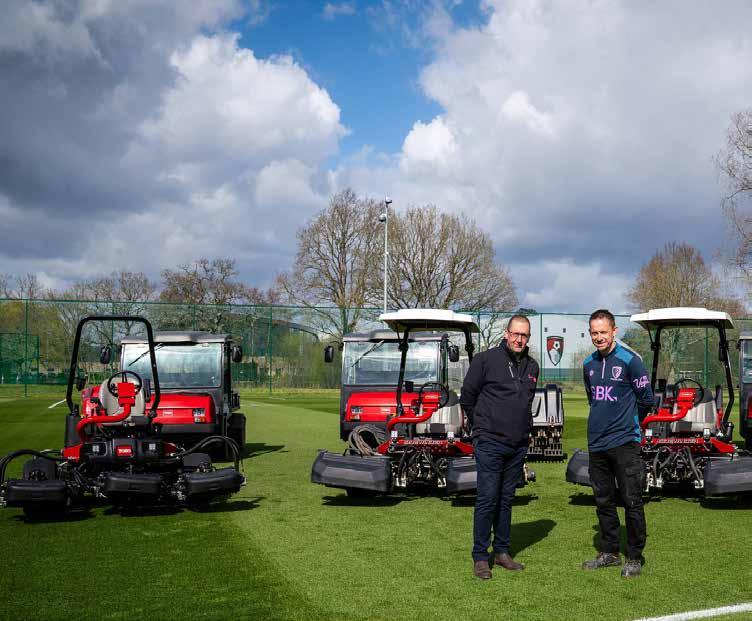
As the first team moves into AFC Bournemouth’s new training complex at Canford Magna, a new fleet of Toro machinery arrives to look after the first four pitches to be built.
The machinery choices by Head of Grounds Ian Lucas are strategically made on how to cut more efficiently according to European regulations and meet the Premier League standards in
“BEING
place for all pitches.
“The products we chose come with adjustments to match the width of cut to the pitches exactly. The Toro Reelmaster 3100 with SideWinder, which is usually a mower favoured by golf clubs for cutting around bunkers and obstacles, allows us to mow as efficiently as possible with no overlap,” explained Ian.
“It’s a machine also favoured by other premier football clubs. I visited other training centres and saw how other clubs had fitted a wider arm kit on the SideWinder but without the wider front units meaning they could cut 30 inches across instead of 26. That meant they the cutting width worked better with the required striping pattern within the dimensions of the pitch.”
The patented SideWinder technology brings more benefits than that to the football pitch though.
“Being able to use the SideWinder cutting unit from left to right brings a more even weight distribution
eliminating wear marks,” said Ian.
Also ably assisting Ian and his team of 11 looking after the 57-acre training grounds are Toro’s Workman HDX utility vehicles with cabs for improved operator comfort and a Toro Reelmaster 3550 for its light footprint and turf-friendly tyres.
“The Workmans have a big cargo bed which is perfect for the development stage of the project we’re in – it can easily cope with the amount of grass we need to move and the attachments we load it up with like the tipper trailer.”
This will be followed up with another machinery order in the new year as the next four pitches for the £36 million Performance Centre open.
“We’re ready for that. I’ve already chosen the Toro machines I want and submitted the lists. I’ve been using Toro for around 15 years, so I know how good it is, especially with the back-up and support of Reesink, our local dealer D J Scott and our mobile mechanic Lee Read.”


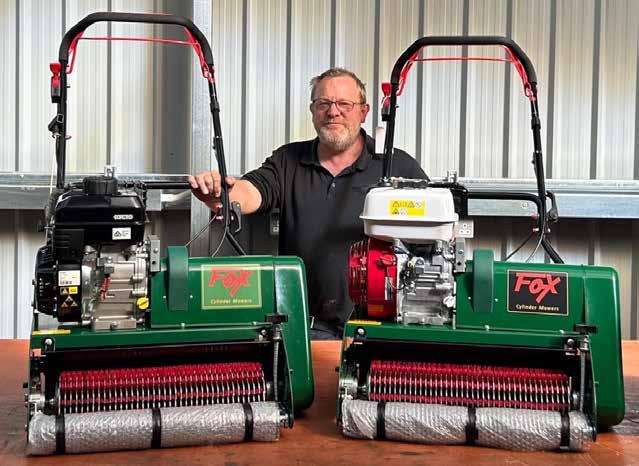
Scott MacCallum catches up with Andrew Fox, whose cylinder mowers have been gracing cricket pitches and bowling greens for the past decade
Through time the concept of the little guy beating the big guy has always been a romantic notion. But think about it. If Goliath hadn’t taken one in the eye from David, would we ever have heard of either of them?
Would we then ever have had a decent analogy to make for the little man overcoming the odds and triumphing over a giant? I can’t think of one.
Through time the concept of the little guy beating the big guy has always been a romantic notion. But think about it. If Goliath hadn’t taken one in the eye from David and, instead, given him a good thumping, would we ever have heard of either of them?
Would we then ever have had a decent analogy to make for the little man overcoming the odds and triumphing over a giant? I can’t think of one.
Except there is Andrew Fox, who has been defying the odds for a decade now. He’s been building cylinder mowers which more than hold their own when matched against any of those built by the bigger manufacturers in the industry.
Andrew is a keen cricketer and volunteer groundsman of 40 years standing when, a new chapter in his professional life was due to begin and he found that he had time on his hands to indulge his passion.
It had actually started in 1984, at the age of 11 at the family home in Somerset, when Andrew dismantled a brand new Atco 20 inch cylinder mower, reassembled it and then went on to cut a cricket wicket on the front lawn.
The hobby carried on through adult life. “I would take old Atco cylinder mowers, refurbish, improve then sell them on to cash stricken cricket clubs, making just a few bob,” recalled Andrew.
All the time he was gaining an appreciation of the work that goes into building a quality cylinder mower and, more importantly, where he felt improvements could be made to what is one of the most recognisable of all every day inventions.
It led him to a decision to start building his own mowers, and over last 10 years Fox Cylinder Mowers has built a quantity, each individually numbered,
and gracing cricket pitches and bowling greens for as far afield as Glasgow and Northern Ireland.
With an attention to detail and a no comprise attitude to quality Andrew began from the back of his garage, a facility which has only recently been replaced by custom built workshop, twice the size of the original.
While you often hear of the advantages of economies of scale, which often are the undoing of the “little guy”, Andrew has found that the opposite can be the case and it is interesting to listen to him when talking about a product used to secure the cylinder.
“It’s basically a grip nut which holds the cylinder at its level and I wanted to improve the quality. So I researched a replacement and I am now using what’s known as a Aero Nut, which is used in the aviation industry by NASA and
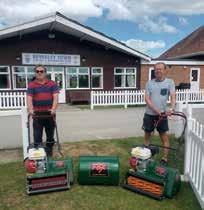
Boeing. “It’s designed in a completely different way to a regular nut and is used in areas of extreme vibration or heat.
“I’ve now adopted it and use it in two areas on the machine,” explained Andrew.
And so to the bit about being the antidote to economies of scale.
“It’s a minuscule increase in cost. Instead of being around 20p for the regular nut, it’s £1.20,” he said.
Now to Andrew that doesn’t represent a huge rise in his costs, but to a larger company they would see a nut costing six times more and many would be looking to swap a more expensive unit for a cheaper one rather than the reverse.
“What you are getting is something which in not only considerably more reliable but will also last at least 10 times longer. That’s great for clubs as many are volunteer-run where reliability is paramount. .
Having reached his 10 year milestone Andrew, is now assisted in the workshop by fellow cricketer and lifelong friend Andrew “Cookie” Cook and together they produce a good number of machines every year.
With the more recently added Verticutter, there is now a range of six models – two levels of petrol mowers – the higher-end Black Edition and the entry Green Edition – plus a Black electric battery version of the mower.
The verticutter is something about which Andrew is particularly proud.
“It is genuinely revolutionary and market leading. The Verticutter is brush assisted has blades which are only ten millimeters apart, against the industry standard of 12 to 15 millimeters.
“In conjunction with a 100 year old brush manufacturer from England, we
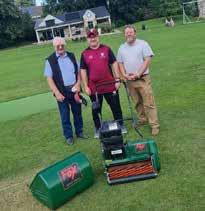
designed spacers complete with brush clusters. What these do is sit just in front of the blade and protrude slightly, so that they aid the verticutting by lifting the lateral grass, a nanosecond before the cutter.
“It’s just absolutely phenomenal,” said Andrew, who also uses two millimeter stainless steel discs which do not bend.
“To give you some idea, the number of bristles in each cluster on each spacer, multiplied across the reel and multiplied again by the rpm result in 400,000 brush strokes a second,” said Andrew, proving without a shadow of a doubt, that British ingenuity, whether that be in the form of an eccentric inventor or otherwise, is alive and kicking.
When I spoke with Andrew a few years ago he told me that he personally serviced every one of his mowers, and not only that, he would collect them, take them back to the workshop before delivering them back to their owners.
He couldn’t possibly still be doing that, could he?
“I still hand deliver each new machine and demonstrate it, irrespective of where it is in the UK, but I have now bought a van and employ a part- timer to collect them. The procedure is that I encourage everybody to book in a service by the end of September and then we look at the logistics and the most effective way of collecting a batch of mowers at the same time.
“Our claim is that we return them in‘as new’ condition – it’s not just a change of oil and a wipe over with an oily rag. We go through them with a fine tooth comb.”
Fox Mowers have always used Honda engines on his Black Edition machines and Andrew is a huge Honda fan.
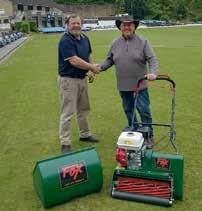
“Honda engines are just fantastically engineered. They are superb. As soon as you confirm we use a Honda engine, people immediately take you seriously.
“So I turned to Honda when I decided to produce an electric mower,” said Andrew. “I spoke to them about it and they had an They had an electric package -electric motor, battery and chargerthat is fantastically engineered.”
But Andrew had a small concern.
“The Head of Engines and the Head of Sales said that they wanted to come down and visit me.I said that was fine, but pointed out that they’d be coming to my house, and this was before the new workshop had been built. They said not to worry as they liked to work with people with my drive, enthusiasm and commitment.”
As it turned out Andrew’s home comforts proved to the liking of the two high flying Honda executives.
“They came down and we got on very well. We bolted the electric motor onto a machine, went out and tested it on the cricket pitch. They then took measurements for vibration and noise etc. and sent it off to the European Honda engine headquarters, in Belgium.
“It came back approved. So now it’s a Honda approved machine and carries Honda’s two year warranty!”
A decade on, every one of the Fox machines is still in existence and working well.
“Number one is just outside Yeovil and I’ve told them that when they want to sell it I am buying it back!”
Andrew has no desire to build the company any bigger than he has. His production line will remain himself and “Cookie” and he enjoys his life, happy being the little guy working alongside the Goliaths.
Faced with frequent heavy rainfall, and nearly 70 wash-out prone bunkers, South Staffordshire Golf Club has invested in the long-term playability and maintenance of the course with a programme of bunker improvements.
After thorough research, the team at South Staffs decided on a trial with industry leading erosion management specialists EcoBunker and its proprietary EcoTec bunker liner.
“Whenever we get heavy rainfall 50% of our bunkers get washed out and it takes us several days to get the course back in good condition,” said Mark Guy, Course Director.
“We needed a solution that drained well, held sand in place and reduced contamination. After a lot of research we settled on the EcoTec liner and we’re delighted with the results.”
To test the effectiveness of the EcoTec liner, the team installed three different options on the course. In one bunker they installed pipe drainage, hardcore and two layers of sand, in another simply hardcore and sand, and in the three bunkers surrounding the 18th green they installed pipe drainage and the EcoTec™ liner.
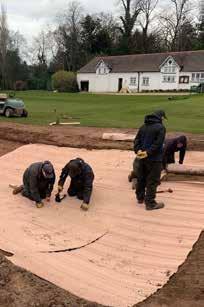
“The results have been quite clear. While drainage has improved in all cases, the EcoTec bunkers are now virtually maintenance free. They’re holding sand incredibly well, sand
contamination has been eliminated and the amount of sand we are using has reduced dramatically,” continued Mark.
“Drainage and wash-out were the main presenting issues, but in addition to performing brilliantly on those fronts, we are seeing many benefits including freeing up time to focus on other areas of the course.”
The team were also impressed with the simple installation and the longterm cost savings from being able to take on future projects themselves.
“One of the deciding factors was that we could easily fit the liner ourselves,” concluded Mark. “Richard from EcoBunker came and trained the team on the first bunker and then we took over from there. It was such a simple process that the team picked up with ease. We’re now planning on upgrading the bunkers on the second and look forward to reaping the benefits for our maintenance team and keeping our members on course, whatever the weather.”
n www.ecobunker.co.uk
With three successful Hamilton Racecourse editions under their belt the pressure was on to make The Scots Turf Show 2026 the best yet.
No-one felt the stress of this responsibility more than Alan Thomson and Richard Heywood, whose inspiration the reconstituted Scots Turf Show had been.
Well, either Alan nor Richard should have worried. The Scots Turf Show 2026 was by all measure the best yet with more exhibitors than in any of the previous years and over 800 visitors, another record. Oh, and the sun shone
throughout which was a significant bonus, and step up, from 2025.
When it came to exhibitors everything was covered from heavy machinery, hand tools, through to fertilisers and chemicals, seed, robots and PPE equipment, while the wellattended education programme was delivered by experts in their respective fields.
It was a remarkable achievement for a Show which, as a test event three years before, attracted a small number of companies and 170 visitors. That was enough to give encouragement to Alan
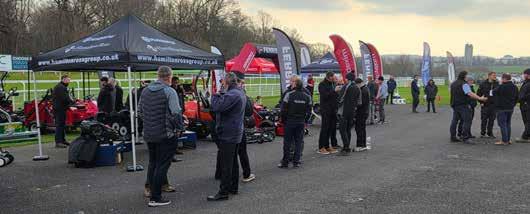
and Richard but the pace of progress over the intervening years has taken them by surprise.
It is all the more laudable because Alan, for SISIS Pitches, and Richard, for Campey Turfcare, organised the event in their spare time – their full time employment always taking priority.
“Over the last few months, I think we’ve seen each other more than our own wives,” joked Alan, after the close of this year’s event.
As to the future, the guys are open minded.
“We don’t really know what the future holds for The Scots Turf Show and there will be discussions with the 12 companies who were in at the start with us,” said Richard.
“I think that it’s important that we try and keep things fresh and what we can’t keep doing is rehashing the show again and again. So that is what we will be looking at,” he added.
What will emerge in 2027 will be of interest to many, particularly north of the border. One thing is sure, however, with the drive and vision of Alan and Richard, it will be well worth penning the date in the diary. n www.scotsturfshow.com


At Henllys Golf Club, managing water through the wetter months is a constant priority. With water running off the surrounding hills and into the course, excess moisture can quickly affect surface performance, particularly on the greens.
This year, however, the club has come through winter in a strong position, with the SISIS Rotorake TM1000 and Multislit playing an important role in keeping conditions under control and preparing surfaces for spring.
For Head Greenkeeper Cefyn Owen, the TM1000 has become an essential part of the maintenance programme.
“We’ve been using the TM1000 on our greens for over 8 years now and it’s been a real game-changer for controlling thatch,” explained Cefyn.
“Our greens are firmer, healthier and drainage has improved, members are noticing the difference. We get a lot of water running off the hills surrounding the course, so when it’s wet the course can really struggle.
“The TM1000’s contra-rotating reel and floating unit give precise scarifying without scalping and with five interchangeable reels, we can scarify, aerate, verticut and brush efficiently. Tractor-mounted and easy to use, it saves time, covers large areas and the depth of cultivation can be easily adapted without tools.”
By reducing thatch levels, the TM1000 helps improve surface firmness and encourages better movement of water through the profile.
That has been particularly valuable over winter, when periods of heavy rain can leave greens saturated and vulnerable.
Now, as April showers continue to test courses across the country, Henllys is seeing the benefit of work carried out earlier in the season.
Used alongside the SISIS Multislit, the TM1000 has helped the club create a more effective water management approach. While the TM1000 has tackled thatch and improved surface condition, the Multislit has supported aeration and water infiltration, helping the team manage moisture levels more effectively and maintain playability.
Using the two machines in tandem has allowed Henllys not only to cope better through winter, but also to enter spring with cleaner, firmer and healthier greens.
“Before using the TM1000, our greens were far too wet and waterlogged, and we even lost members because of it,” Cefyn recalls. “Now, with the TM1000, the Multislit, and careful maintenance, the members are genuinely happy and returning to enjoy the course. It’s made a huge difference.”
Cefyn also highlights the practical
advantages of the TM1000 in day-today use, particularly when time and efficiency matter.
“The hydraulic tipping kit makes emptying the box simple – we don’t have to leave the tractor seat, which saves us time and makes the job much easier and more importantly, safer,” says Cefyn.
For courses dealing with seasonal moisture pressure, Henllys Golf Club shows how the right maintenance strategy, supported by the right equipment, can make a significant difference. In the TM1000, the team has a machine that does far more than remove thatch: it helps build the conditions needed to manage water on greens effectively through winter, and move confidently into spring.
“OUR


The new Hunter MCC Controller has officially launched in the UK, introducing a powerful and scalable irrigation control solution designed for large-scale projects.
Available from KAR UK, the MCC brings wireless, wide-area coverage and advanced flow management to the commercial irrigation market.
Designed to expand the limits of irrigation control, the MCC delivers wireless, wide-area coverage for large-scale projects while maintaining affordability. Positioned as a medium commercial controller, it bridges the gap between high-end performance and practical value, making it ideal for expansive landscapes, sports facilities, commercial estates and public-sector sites.
At its core, the MCC combines the powerful brain and operating features of the ACC2 Controller with the proven, reliable internal components of the ICC2 Controller. The result is a versatile and cost-effective controller capable of managing between 8 and 108 stations offering flexibility across a

wide range of site requirements.
One of the MCC’s standout features is its ability to support multiple output types simultaneously. Users can command conventional outputs, EZDS two-wire decoders and Wireless Valve Links all from the same controller. This hybrid capability allows contractors to expand or adapt existing systems without the need for disruptive infrastructure changes which is a significant advantage on retrofit projects or evolving sites.
Advanced flow management and monitoring are central to the MCC’s design. The controller supports up to three flow sensor inputs, enabling

precise monitoring across multiple flow zones. It can operate up to eight stations simultaneously, along with up to three pump or master valve outputs, delivering robust hydraulic control for complex irrigation networks.
The MCC also offers a menudriven, multi-language interface that simplifies programming and daily operation. Whether used as a standalone controller or integrated into a connected network, it provides full functionality and streamlined control for large, demanding sites.
For those seeking centralised management, the MCC uses the same communication modules as the ACC2, enabling cloud-based control via the Centralus Irrigation Management Platform, as well as compatibility with Hunter 360 Software and other SCADA or automation systems.
With its combination of scalability, wireless flexibility, advanced flow monitoring and competitive pricing, the new Hunter MCC Controller represents a significant step forward in commercial irrigation control.




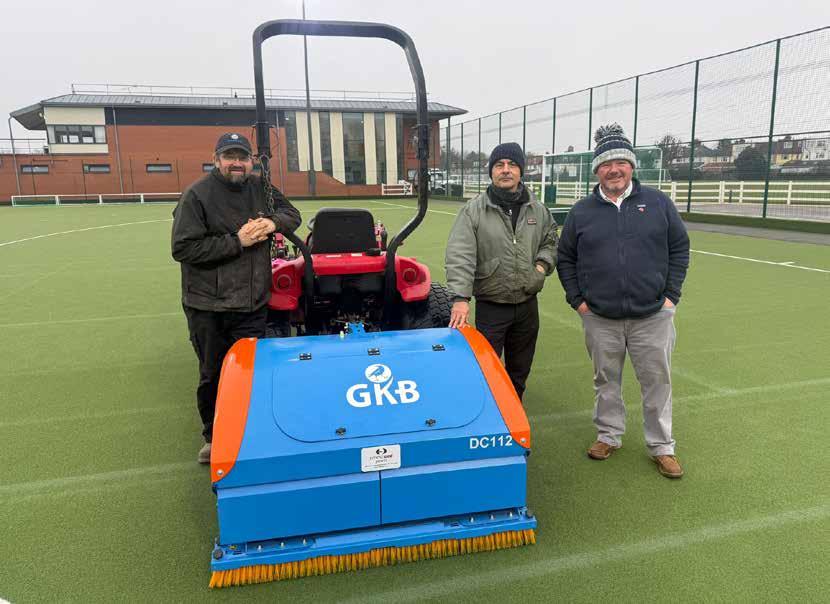
The search for a modern, efficient solution to synthetic surface cleaning was a short one for Miguel Pimenta of King’s College School in Wimbledon, after seeing the GKB Deep Clean at SALTEX 2025.
In just a few short weeks since its delivery, the Deep-Clean has ‘transformed’ the school’s artificial maintenance, bringing speed and consistency to pitch cleaning and performance.
Nationally and internationally recognised for excellence in education, King’s sets high expectations across the board – including the standards they employ for maintaining the school’s extensive grounds and sports facilities.
With their previous artificial cleaner at the end of its working life, Miguel attended SALTEX in the hunt for a replacement and quickly identified the new GKB Deep Clean as the perfect fit. Following discussions with local dealer
Ernest Doe, the purchase was finalised and the impact was immediate.
“The Deep-Clean has completely transformed the way we maintain our synthetic turf pitches,” explained Head Groundsman Miguel.
A key advantage has been the machine’s speed and simplicity of operation.
“Within a couple of minutes, we can have the machine hitched up and ready to go. The adjustable front wheels also make it incredibly straightforward to adjust the working depth on the fly, without the need for tools, which saves us a lot of time on busy maintenance days,” he said. “The brush and vibrating screen system lifts the infill and removes debris far more effectively than anything we’ve used before, with a range of screen types to choose from which means the unit can always be perfectly configured whatever the conditions.
“The suction unit also does a great job capturing dust and lightweight contaminants, leaving the surface cleaner and more consistent.”
Recently redeveloped, Miguel saw the new GKB Deep Clean on its debut UK outing in November. Available in three working widths and designed to work with various infill types, this next generation cleaner sieves, separates and collects debris and microplastics returning clean granules back into the pitch and leaving a clean and safe surface that’s ready for play.
“What I appreciate most is the build quality. It’s clear that GKB designed this with real grounds teams in mind. The machine is robust, reliable and fast, and the collection container and dust bag system make disposal straightforward,” said Miguel.
“For us, the Deep Clean has delivered exactly what we needed – speed, simplicity and excellent results.”

Replay Maintenance has announced a series of new and expanded partnerships with County Football Associations across England, reinforcing its commitment to raising standards in grassroots football facilities.
Leading the latest developments is a new strategic partnership with Lincolnshire FA, alongside expanded collaborations with Derbyshire FA and Nottinghamshire FA, and new agreements with Cambridgeshire FA and Huntingdonshire FA.
The newly confirmed partnership with Lincolnshire FA will see Replay Maintenance deliver specialist maintenance services and technical support across both natural grass and synthetic playing surfaces throughout the county.
Clubs and facilities will benefit from expert guidance and practical support, helping them maintain pitches to the highest possible standards and ensuring surfaces remain safe, reliable and fit for purpose all year round.
“We are both delighted and proud to be partnering with Replay Maintenance to help broaden the support available to clubs and facility providers across Lincolnshire,” said Jake Park, Head of Football Development at Lincolnshire FA.
“IMPROVING GRASS PITCH QUALITY IS A KEY PRIORITY FOR US, AND THIS ADDED EXPERTISE WILL GIVE DERBYSHIRE CLUBS EVEN GREATER SUPPORT.”

“We know that pitch quality is one of the biggest challenges facing grassroots football, so working with a trusted and experienced specialist like Replay Maintenance will help ensure that investment in both natural and artificial pitches delivers the greatest possible benefit for the game locally.”
Replay Maintenance has also strengthened its established partnerships with Derbyshire FA and Nottinghamshire FA through the introduction of its Natural Turf Division.
This enhanced offering enables Replay to provide a fully integrated service across both artificial and natural surfaces, supporting the FAs in their drive to improve pitch quality and deliver against key performance targets.
As part of the expanded support, clubs across both counties can access free site assessments for artificial pitches, as well as expert guidance and contracting services for natural turf projects, particularly those applying to the Football Foundation’s Grass Pitch Maintenance Fund.
“Improving grass pitch quality is a key priority for us, and this added expertise will give Derbyshire clubs even greater support. It’s another positive step in helping our grassroots game grow on better, safer surfaces,” explained Tom Crabtree, Senior Facilities & Partnerships Officer at Derbyshire FA.
David Whyatt, Facilities & Investment Lead at Nottinghamshire FA, added that for him good quality pitches are essential to players’ experience and development at every level.
“By extending their expertise across both artificial and natural surfaces, Replay can provide our clubs and facilities with valuable support and help us continue to raise standards.”
Further extending its footprint, Replay Maintenance has also announced new strategic partnerships with Cambridgeshire FA and Huntingdonshire FA.
These agreements will deliver a comprehensive package of maintenance services, technical expertise and tailored support to clubs across both counties, with a focus on improving pitch performance, safety and longevity.
“This partnership brings a clear focus on improving the quality and sustainability of grass pitches. Replay Maintenance will deliver expert inspections, practical advice and tailored maintenance plans, giving clubs the guidance they need to make lasting improvements,” said Katie Critchley, Football Development Manager at Cambridgeshire FA.
Brett Fairholm, Chief Operating Officer at Huntingdonshire FA, added that maintaining safe, high-quality artificial and grass playing surfaces was vital for stabilising and growing participation across grassroots football.
“This partnership gives our clubs access to guidance, practical support and valuable learning opportunities from the experts.”
Together, these partnerships highlight Replay Maintenance’s growing role in supporting County FAs and their affiliated clubs, ensuring that playing surfaces across the country are maintained to the highest possible standards.
By combining specialist expertise with a collaborative, FA-led approach, Replay is helping to protect vital community assets, improve player experience and support the long-term sustainability of grassroots football.


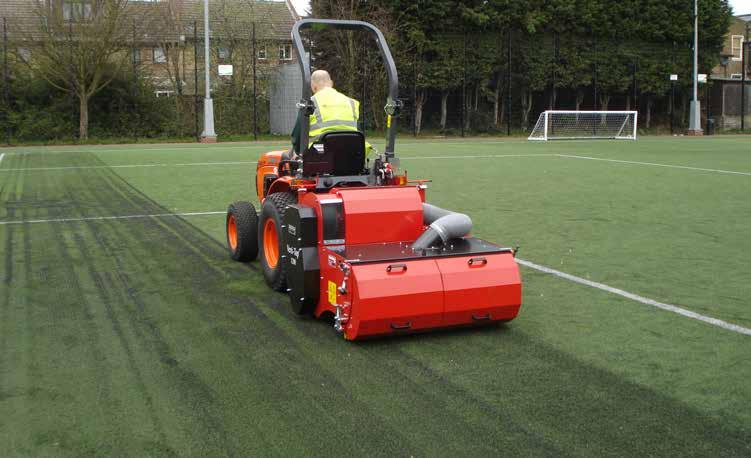
For years, the industry was sold a dream: the “maintenance-free” synthetic pitch. However, as any seasoned grounds manager knows, longevity and performance are born from the shed, not just the carpet. Turf Matters sits down with the experts at Redexim to explore why mechanical intervention is the heartbeat of a safe and durable synthetic surface.
Synthetic turf has revolutionised the sporting landscape, offering an all-weather, high-usage alternative to natural grass that keeps the “green aesthetic” year-round. From elite training centres to independent schools, the demand for 3G and sand-dressed surfaces has never been higher. Yet, the misconception that these surfaces
require little to no care remains a persistent challenge for the industry.
“The importance of synthetic turf maintenance is often overlooked,” explained Paul Langford, Director of Commercial Operations at Redexim UK.
“Proper and correct maintenance isn’t just about aesthetics; it extends the carpet’s lifespan, improves playability, and, crucially, reduces the risk of player injury.”
One of the primary enemies of a synthetic surface is compaction. As infill material whether rubber, sand, or organic is subjected to heavy footfall, it settles and compacts. This doesn’t just result in a “fast” and unforgiving pitch; it significantly increases the G-max (impact) rating, leading to a higher likelihood of player fatigue and lowerlimb injuries.
Redexim’s solution to this is a rigorous program of brushing and decompaction. Regular brushing keeps the turf fibres upright, preventing
the “matting” effect that leads to an inconsistent playing surface. Tools like the Redexim Combi-Groom or the Verti-Broom are engineered to lift the pile while redistributing infill, ensuring the surface remains resilient.
While a quick sweep might remove surface litter, it’s the microscopic contaminants such as dust, skin cells, and broken-down infill that pose the real threat to drainage and hygiene.
“Accumulated debris can compromise the safety of the playing surface,” noted Paul.
To combat this, the Verti-Top has become the industry benchmark. Using a sophisticated brush and sieve mechanism, the Verti-Top lifts the infill, separates the contaminants, and returns the cleaned material back to the surface. A vacuum system then collects the “fines” and dust, ensuring the pitch isn’t just clean, but healthy for the athletes using it.
Infill levels are never static. Wind, rain, and the soles of players’ boots
constantly redistribute material, often leaving “hollows” in high-traffic areas like goal mouths or centre circles.
Maintaining the correct infill depth is critical. Paul highlights that low infill levels expose the carpet backing to UV damage and mechanical wear, leading to premature aging of the pitch. To take the guesswork out of the process, professionals are increasingly turning to tools like the Infill Thickness Tester, allowing for precise monitoring and targeted replenishment.
When it comes to the heavy lifting of infill application, machines like the Rink 1010 or 1210 ensure an even, metered distribution that manual spreading simply cannot match.
Even with the best weekly care, there comes a time when a surface requires a “deep clean” or full renovation. As a pitch ages, infill can become so contaminated that drainage ceases, leading to pooling water and moss growth.
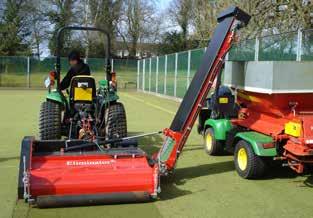
This is where specialised equipment like The Eliminator comes into play. By using a powered brush to extract infill and a conveyor system to remove it, grounds managers can effectively “reset” a pitch, removing old, degraded material to make way for fresh infill which can add years of life to a

significant capital investment. As environmental regulations around microplastics and infill materials evolve, the need for mechanical precision has never been greater. Whether you are managing a local authority MUGA or a Premier League training ground, the philosophy remains the same: a synthetic pitch
is only as good as the machinery maintained to look after it.
In the words of Paul.
“Our mission is to exceed customer expectations by ensuring synthetic turf remains a durable, high-performance, and safe playing surface for years to come.”
n www.redexim.com/


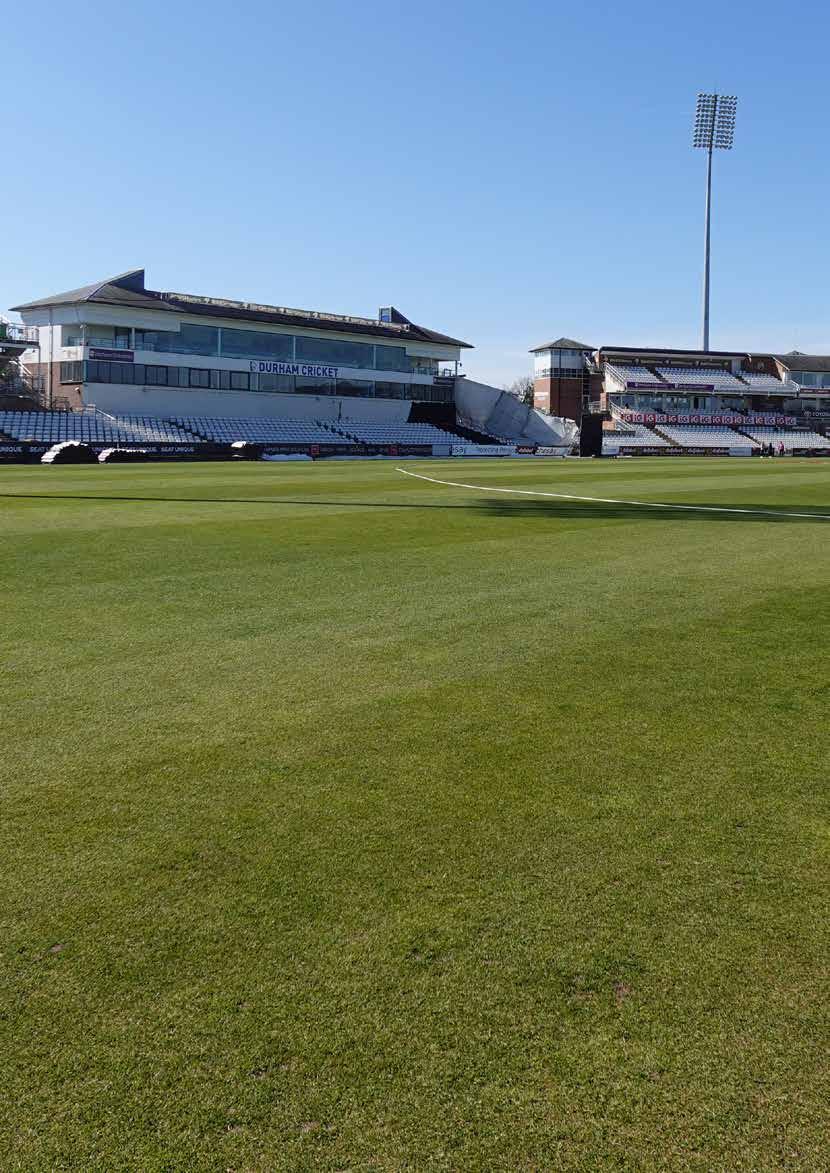
By complete chance, Scott MacCallum visited the Riverside Stadium a couple of days after one of the most momentous matches in the history of Durham County Cricket Club. He met the man perfectly suited to dealing with the highs and lows of professional groundsmanship.
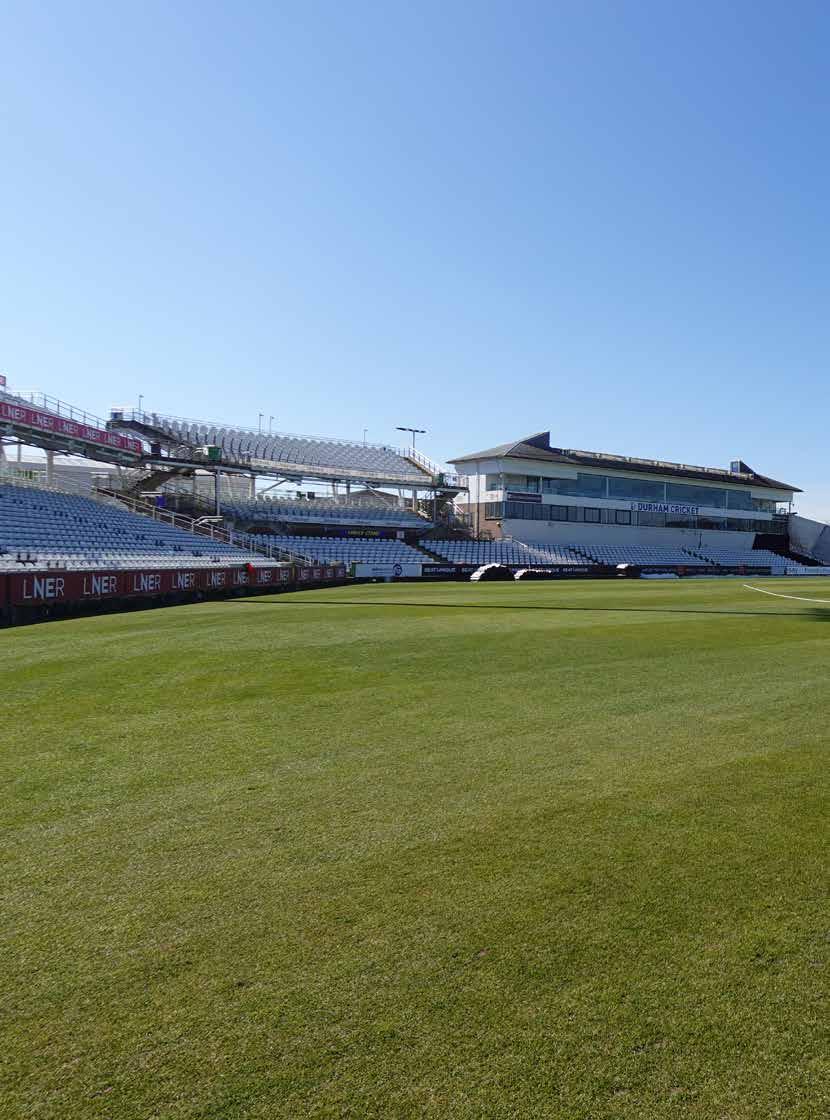
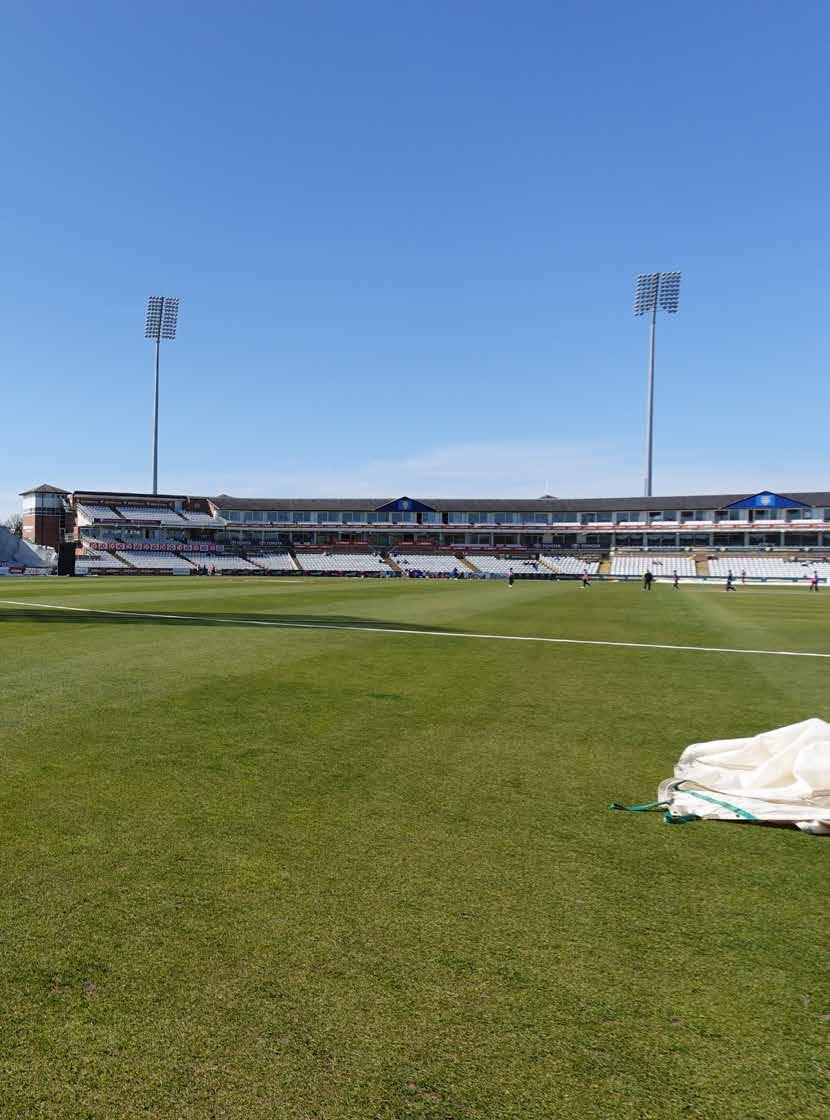
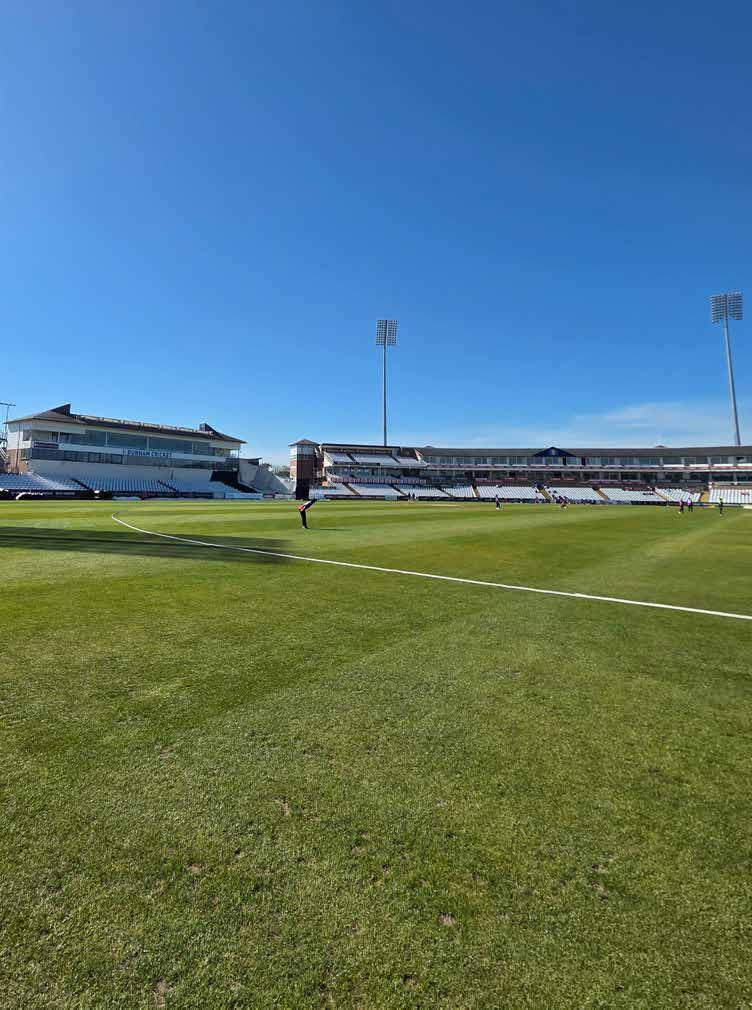
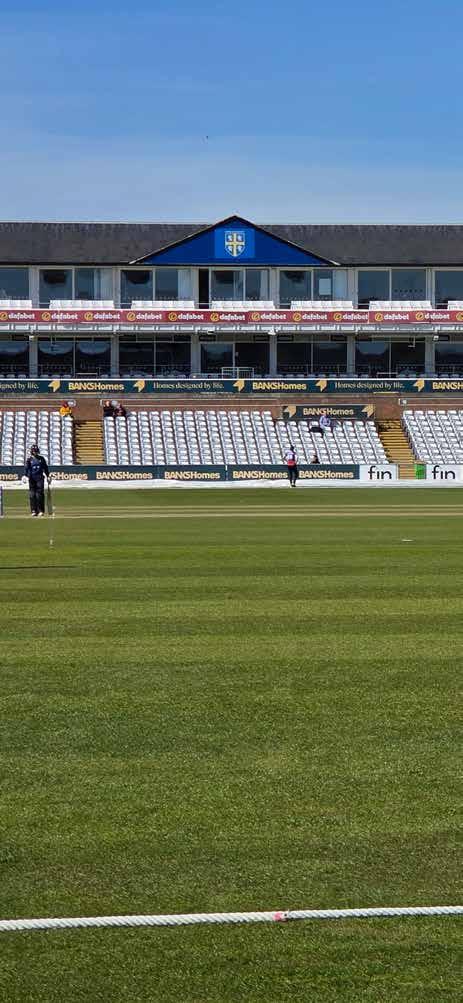
It’s 10am on the first Tuesday after Easter at an extremely sunny and warm Riverside Stadium, in Chester-leStreet, and Vic Demain, Head Groundsman, is there to greet me – his usual relaxed and friendly self.
However, a mere 48 hours earlier, during the first four-day game of the new season against Kent, things had been markedly different. And it was all down to Storm Dave.
day of Vic’s career. “The first two days were fine and we had got well into the match,” recalled Vic.
“We knew that there was a threat of some weather coming in and there was actually an amber wind warning for Saturday night, but that wasn’t particularly unusual as we have a lot of wind up here.
when I opened my bedroom curtains I saw that the standard rose in the front garden had snapped in half. So that was a bad start.”
Not really knowing what to expect but fearing that it would be something unpleasant Vic walked through a little cut in the grandstands so that he could take a look.
In his long career as a volunteer groundsman, a professional groundsman and now Head Groundsman at a Test venue for the past 11 years, thanks to Dave, the Sunday had been the most traumatic
“We’ve had storms come in before and come out of them pretty much unscathed. But this was excessive,” said Vic, of the 70mph-plus winds which hammered the area in the early hours on Sunday morning – a level which is officially classified as Violent Storm Force.
“I knew it was going to be bad, as could hear it through the night, and
“Before we left on the Saturday evening we had completely covered the square and put as many pins into the ground sheets as we could, as well as adding as many weighted bags as we could lay our hands on.”
However, even having seen the fate of his poor rose, it couldn’t have prepared him for the scene that faced him as he looked out over the outfield.
“THE SHEET THAT WAS ATTACHED AT THE PAVILION END OF THE GROUND WOULD HAVE BEEN THE FIRST ONE THAT BLEW OFF BECAUSE THE WIND WAS COMING IN FROM THE SOUTHWEST. THE WIND GOT UNDER IT, CURLED IT UP AND EVERYTHING WENT. IN A WAY IT ACTED LIKE A SAIL.”
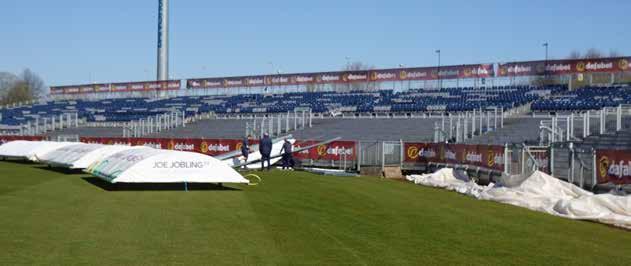
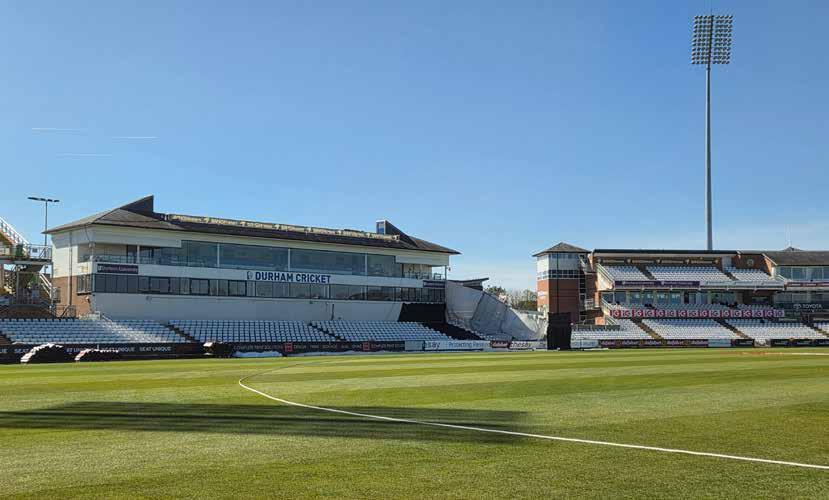
“Everything had disappeared off the ground. It has just gone. One of the roll-on covers had blown all the way to the east side of the ground, and another had actually flipped over and flown into the stand. The scaffolding at the far end of the ground was completely ruined,” said Vic explaining that the regular practice was to secure it by tying it the sight screens.
“There was just damage everywhere,” he said reflecting on the carnage that faced him.
With the match at the half way stage, and with Durham holding the edge, the fact that the pitch had been left to the vagaries of the accompanying rain meant that there was no chance of any play on the Sunday, even if Vic and his team had been able to make the ground safe.
“In a way we got unlucky because what had happened was that we had put the roll on covers on the pitch itself, and then attached the ground sheets on either side.
“The sheet that was attached at the pavilion end of the ground would have been the first one that blew off because the wind was coming in from the southwest. The wind got under it, curled it up and everything went. In a way it acted like a sail.
“In pulling that sheet off, all the water that had collected was deposited on one end of the pitch.”
Vic and his team worked their socks off to make the ground, and pitch, safe and it is quite remarkable, and a tribute to all involved, that the match
wasn’t abandoned and the final day of play went ahead.
“Luckily, the wind wasn’t as strong on Sunday, but there was still a good breeze which dried the top off. It was still touch and go whether we were going to be able to play on Monday but as it turned out the pitch didn’t offer any assistance to either side,” said Vic.
“However, having lost the day there wasn’t time for Durham to force a win and the match ended in a draw.”
As is increasingly common, the armchair experts, fueled by the font of knowledge that is the internet, were out in force. Vic’s thick skin came to his protection when he read that if only he and his team had taken advice from some of the staff at the bigger grounds in the country they would have been able to cope a lot better.
“When you have to deal with something like Storm Dave you just
VIC HAS ADAPTED WELL TO LIFE IN THE NORTH EAST, AND HAS BECOME A LOVER OF THE AREA’S COUNTRYSIDE AND COASTLINE
wish people were a little bit more understanding. This person seemed to be implying that, because we lost a day’s play, there must be a reason, and that reason was because the ground staff weren’t good enough.
“In fact, the opposite is the case and if it hadn’t been for the wonderful work of the team no play would have been possible and the match would have been abandoned.”
The other side of the coin was also on full display, however, and from a source much closer to home.
“On Sunday afternoon, I got a phone call from Gary (Barwell) at Edgbaston, who also had a game going on. He said, ‘Look Vic, I’ve seen what’s happened and if you need it, I’m more than happy to send one of my lads up with some spare sheeting – whatever you need to help you out. I know it’s three hours in a van, but we’ll do it’,” said Vic, on the comradeship that exists within the groundsmanship fraternity.
That camaraderie was also evident with Vic’s tribute to Lords Grounds Manager, Karl McDermott, on being named the GMA Grounds Manager of the Year in March – an accolade that was afforded to Vic himself in 2017, when he became the first cricket Grounds Manager to be honoured.
“I was really pleased for Karl because his story is similar to mine. I started as a volunteer groundsman and worked my way up, while Karl came over from Ireland, and also
worked his way up to where he is now.
“Not only has he continued the work that Mick Hunt did for 50 years, at what I believe is the best cricket ground in the world, he has taken it to the next level with some of the new techniques that he has introduced.
“He has also done fantastic things for cricket groundsmanship as a whole and has been great in promoting the industry,” said Vic, with a warmth which gave the comments all the greater meaning.
Being a southerner Vic has adapted well to life in the north east, and has become a lover of the area’s countryside and coastline during his time at the most northerly test match ground in the world.
“When I think about growing grass, which is essentially what we’re trying to do, here we are in early April and it still hasn’t started growing yet. If I run a mower across the square, it takes nothing off. Whereas down south it’ll be growing well by now.
“Indeed, if I go down south in mid February the daffodils are already out. It’ll be three weeks later before the daffodils come out here. To me that is a good indicator of the growing conditions – three weeks behind.”
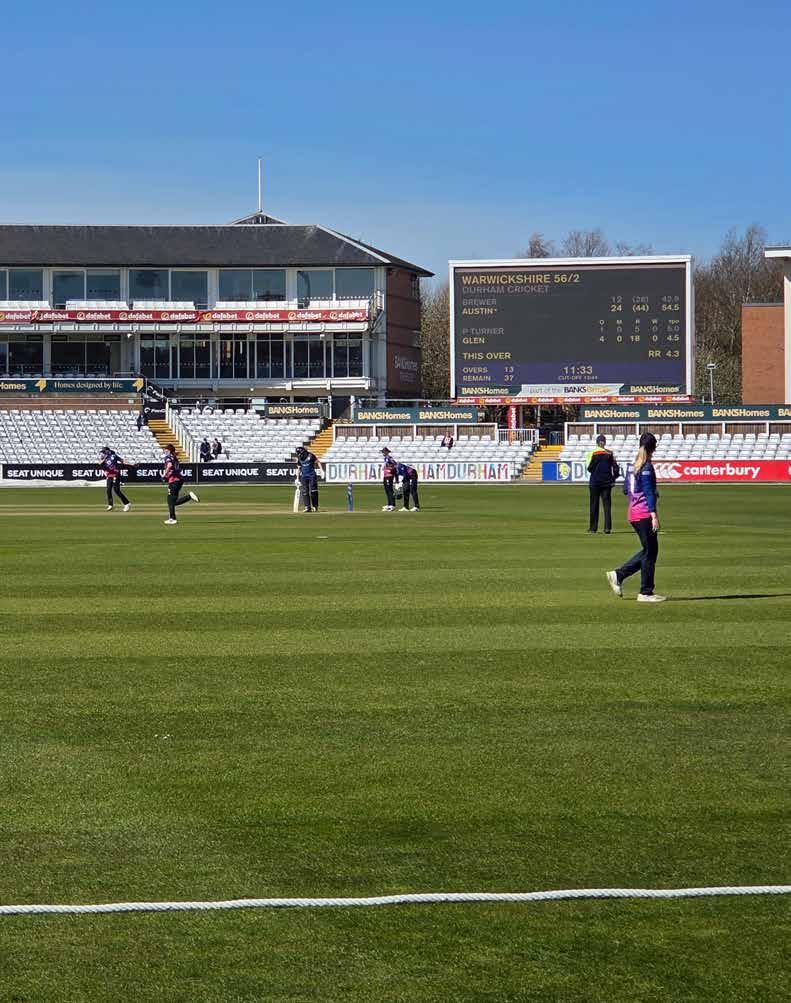
As I gaze out on the pitch from the vantage point of the scorer’s box there is a women’s friendly between Durham and Warwickshire underway and the pitch and outfield look immaculate –even taking into account the traumas of the previous few days.
I compliment Vic, but what does my layman’s opinion matter?
“To be honest, it still looks a little yellow to me,” was his more critical view.
Vic has some interesting views on one of the perpetual headaches that impacts all groundsmanship and greenkeeping – poor pay and attracting younger people into the industry.
“You try to persuade a 16 or 17 year old who might be considering this industry. I’ll say to him, ‘I want you to think about this. If we’ve got a four day game starting on Saturday, you’ll be working full days on Saturday, Sunday, Monday and Tuesday. Then, the next Friday, we might have a Twenty20 match, which means an eight o’clock in the morning start, through to ten o’clock at night.’ Well, it’s Friday night, he’s a young lad and he really wants to be down the pub with his mates.”
In a major difference to golf greenkeeping, when many good players see greenkeeping as a great
way of involving themselves in the game, with opportunities to play once the work has been finished, cricket is the opposite.
“The number of people that I’ve interviewed and they say to me that they are really keen on cricketperhaps they play for the county under 17s. I have to ask them how they’d feel about not playing on a Saturday or Sunday because they’d be working. I’d need them to work and they’d want to be playing. It’s not possible to do both.”
It keeps a long list of potential cricket groundsman away from the career.
The advent of women’s professional cricket – Durham was selected as a Tier 1 professional team from 2025 – has increased the workload on the Durham team, while talks are on-going about the possibility of the Riverside also hosting 100 cricket.
“All this extra cricket that we’ve got now with the women, and the juniors joining the men, and we’ve got no extra pitches. It means that the pitches
are having to be repaired and brought back for reuse a lot more than they ever used to.”
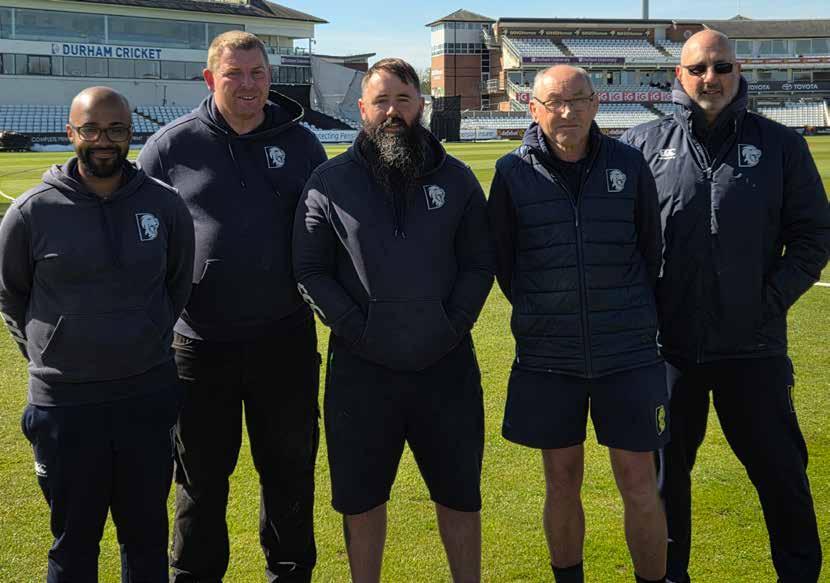
Vic is delighted with the team he has at his disposal. He has his Deputy Head Groundsman Mark Patterson, who also looks after the Nursery Ground; Ben Hall, Barry Boustead and John Bland with Barry and John both joined Vic from nearby Durham School, within the last five years.
“We’ve also got a young lad coming over from Australia in a couple of weeks time. He was with us last season for the summer and we’re delighted that he’s coming back. He works in Perth on the major Test grounds. So, it means that we’ll be five full time and one seasonal for this year.”
Hopefully they won’t be visited by any more Storm Daves over the coming season and that all the stress and excitement can be limited to that one Sunday in the opening game of the season.
I know Vic and the team certainly hope so.

Maintaining top-flight playing surfaces across a large, multiuse facility demands more than just quality turfcare equipment – it requires absolute reliability, operational efficiency and a consistently high standard of finish.
For The Vale Resort, Baroness has become an increasingly important part of that equation, with the recent delivery of four LM551 fairway mowers adding to the finesse delivered by four LM331 surrounds mowers already at the venue.
Recognised as one of Wales’ most prestigious resorts, the site nestled among the Vale of Glamorgan countryside has undergone significant expansion over the years.
Within the 650-acre private estate is a hotel, health and racquets club used by leisure members and six football and rugby pitches, for training by the
FAW and WRU. Under the longstanding involvement of Head Greenkeeper Mike Bevan, the golf element has grown from a modest nine-hole layout into two 18hole championship courses, maintained by a team of 12 greenkeepers.
“We try to limit the sharing of equipment between departments as, when you get a break in the weather, it tends to be the same machines that are in demand site-wide” explained Noel Werner, Golf Manager at the Vale Resort.
“This drove a conscious decision to invest in equipment that is dedicated for golf. In exploring the options with the support of Geraint Richards at GJR Machinery, the quality of cut from Baroness stood out immediately,” he said. “We purchased four LM331 mowers in 2022 which are used daily during the main growing season on banks, tee and green surrounds and other peripheral
areas. These mowers tick a lot of boxes –not just the quality of cut they deliver and the fact they stay on cut incredibly well, but from a maintenance and servicing perspective everything is super simple to work on,” added Noel.
“Their reliable performance is invaluable to us as such a busy resort where downtime just isn’t an option.”
Building on the success of the LM331s, the club expanded its Baroness fleet further in October 2025 with the purchase of four LM551 mowers for the fairways. While winter conditions have limited their usage to date, expectations are high for the season ahead.
“The whole team are really looking forward to getting them out when new season growth arrives. Based on our experience, we’re confident they’ll deliver the same precision, consistency and reliability on the fairways.”


Over the past four seasons, Brora Golf Club has used its ISEKI TG 6495 as a platform for sustained growth. As play has increased and infrastructure has expanded, the tractor has become central to scaling operations, maintaining standards and strengthening the club’s long-term development plans.
Set against the dramatic coastline of the north of Scotland, Brora is widely regarded as one of the country’s most distinctive links courses. With increasing numbers of golfers travelling to the Highlands, pressure on key playing surfaces has intensified, particularly on high-traffic tees.
“As we get busier, we’re having to make our tees bigger to accommodate so much more golf,” explained Course Manager James MacBeth.
“We needed to get more machinery, and the Iseki was a big part of that.”
For James, a tractor is a long-term operational investment expected to deliver 10 to 15 years of continuous work. That expectation has been met through versatility and year-round capability.
During the main season, the TG 6495 supports spraying operations and fills top dressers, helping the team maintain presentation standards as demand rises. In winter, it becomes central to renovation and improvement works.
“The versatility is the main reason we got the TG 6495, and the power and front lift capacity are really important in that.
“We use it for spraying and filling up top dressers. But in the winter, it’s used for bunker work, moving bridges and whatever else we need it for. It’s very
busy in the winter, so it’s a piece of kit that’s used all year round,” he revealed.
“That size and power were exactly what we were looking for, so we can use it for multiple tasks. If we ever need to get bigger verti-drains on the back, we can do that, and that’s important over a long period of time.”
The tractor’s reliability has underpinned that growth. “The tractor is four years old now, and it’s been very reliable so far. It’s always done everything we need it to do.”
That consistency has also created capacity beyond the golf course itself. As activity and revenue have increased, Brora has been able to invest time and expertise back into the village, with the TG 6495 playing a practical role.
“As we’re growing as a club and taking in a bit more money, we can expand

“WE USE IT FOR SPRAYING AND FILLING UP TOP DRESSERS. BUT IN THE WINTER, IT’S USED FOR BUNKER WORK, MOVING BRIDGES AND WHATEVER ELSE WE NEED IT FOR.”

and help the community. We solid tine, overseed and top dress the bowling green, and I look after the football pitch at Brora Rangers as well. Anything we can do within the village that we can
help with, the club are really keen to do that.”
With growth continuing and future development in mind, the TG 6495 provides Brora Golf Club with the power,
flexibility and reliability required for the next phase. It is not simply supporting today’s workload, but giving the club the operational confidence to keep evolving in the years ahead.

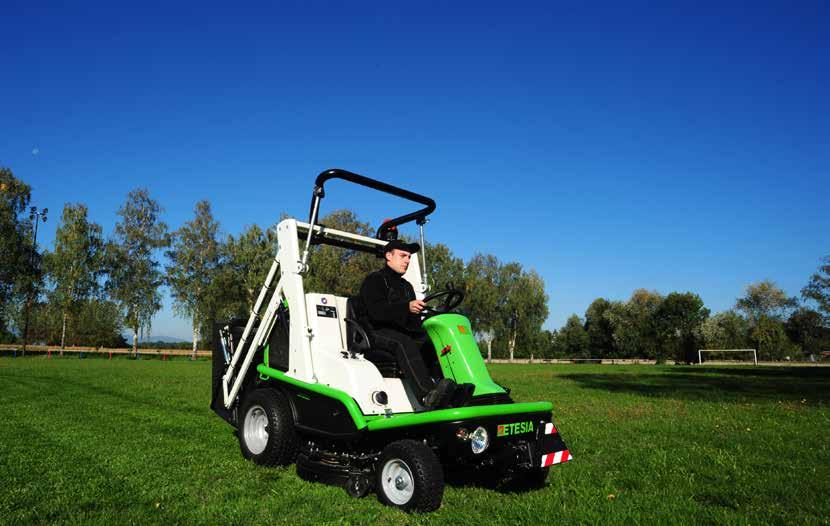
As the 2026 cutting season arrives, landscape and amenity professionals are facing the perennial challenge of balancing rising operational costs with the need for impeccable turf presentation.
Etesia UK has responded to this pressure with a strategic move, announcing unprecedented savings of over £8,000 on the Hydro 124 range. This price reduction aims to make premium, high-output machinery more accessible to contractors and local authorities looking to upgrade their fleets before the spring growth begins.
At the pinnacle of the Etesia range sits the Hydro 124DX, a machine that has redefined expectations for rideon mowers in the professional sector. Unlike traditional mowers that adapt a collection system to an existing tractor frame, Etesia’s philosophy is “cutting first.”
The 124DX is designed around a patented direct rear-ejection system that eliminates the need for noisy, powerhungry turbines.
The technical specifications of the H124DX make it a formidable workhorse:
• Power and Traction: Equipped with a 25HP Lombardini 3-cylinder diesel engine and a permanent 4-wheel drive system, the DX model offers superior stability on slopes and maintains traction in boggy, waterlogged conditions where other mowers might skid or stall.
THE MACHINES ARE SO EFFECTIVE IN ADVERSE WEATHER THAT THEY CAN “CUT AND COLLECT IN TWO INCHES OF WATER” WITHOUT CLOGGING
• Cutting Efficiency: Featuring a 124cm cutting width with two counter-rotating blades, it boasts a theoretical output of up to 19,000 m²/h.
• High-Lift Emptying: The 600-litre grass box can be emptied at any height up to 1.8 metres directly from the operator’s seat, allowing for easy tipping into skips or trailers.
The real-world utility of the Hydro 124
series is best illustrated by its longevity and performance in extreme conditions. For many end-users, the ability to cut and collect in the wet is the deciding factor.
Derrick Robertson, a Landscape Yard and Machinery Manager, highlights the user-centric design
“In particular, our operatives like the hydrostatic and hi-lift features which, with only two levers and no confusing buttons, is very easy to use. You can tell this is a premium piece of kit; even in wet conditions, it still sucks all the grass clippings up.”
Similarly, long-term reliability is a hallmark of the brand. Some users, like the Joseph Rowntree Housing Trust, have noted that the machines are so effective in adverse weather that they can “cut and collect in two inches of water” without clogging – a feat that keeps maintenance schedules on track during unpredictable British springs.
Beyond just mowing, the H124DX is a multi-functional power unit. With an optional front PTO and attachments like snow blades, sweepers, and scarifiers, it transitions from a mower to a all-yearround maintenance tool, ensuring a high return on investment throughout the year.With the current price reductions in effect for the 2026 season, there has never been a better time to invest in a machine that promises to reduce downtime and deliver a “World Apart” performance in any weather. n www.etesia.co.uk

There’s a quiet revolution happening in grounds maintenance and the Toro Groundsmaster e3300 sits at the centre of it.
For years, outfront rotary mowers have formed an essential and central role in a grounds mowing fleet, favoured for their excellent visibility, precise control, and ability to manoeuvre effortlessly around obstacles.
With the cutting deck positioned ahead of the operator, they allow for a clean, accurate finish in complex
environments such as parks, campuses, and landscaped areas, reducing the need for follow-up trimming and improving overall efficiency.
Traditionally these mowers have had petrol or diesel engines and in environments where machines are used for long periods or in close proximity to the public, this can impact both operator comfort and air quality as well as limiting productivity.
That’s where electric power is changing the game eliminating emissions while
delivering the quiet, precise performance these machines are known for. The Toro Groundsmaster e3300 outfront rotary mower doesn’t just cut the grass, it redefines what a professional mower can feel like to use.
Grounds professionals are facing new pressures: tighter environmental regulations, stricter noise restrictions, and rising fuel costs. And this is where the e3300 ticks all the boxes.
Instead of diesel, it runs on Toro’s HyperCell lithium-ion battery system.


That shift alone changes the equation. There’s no fuel storage or oil changes and there are fewer moving parts; just charge, operate, repeat.
Over time, that translates into lower running costs and less downtime, but the real appeal isn’t just financial, it’s operational freedom, as Jon Cole, Divisional Business Manager for Reesink Turfcare, distributor of Toro turfcare machinery, explained.
“For a mower famed for its productivity and rightly so, it went against the grain to be limited when it came to when and where the machine could be used at certain points of the day,” said Jon. “Mowing a public park at dawn without disturbing nearby residents, or maintaining a university campus between lectures is made possible with the e3300. It’s not just quieter, it’s discreet – and that makes it more productive than ever.”
Electric mowers are not new any more, they’ve been revolutionising the turfcare game for some time. What is new – and newsworthy – is one that genuinely replaces a diesel workhorse without compromise.
Its Smart Power system in the Groundsmaster e3300 quietly manages blade speed, responding automatically to changing grass conditions. Hit a thick, damp patch, and instead of bogging down, the mower adapts. There’s no frantic adjustment from the operator, just a consistent, even cut.
Then there’s the out-front deck, a signature of Toro’s Groundsmaster range. It places the cutting unit ahead of the operator, offering a clear, unobstructed view. This might sound like a small detail, but in practice, it transforms precision. Edging around trees, benches, or tight landscaping features becomes more intuitive and less time-consuming.
Traction is another area where the e3300 impresses. With CrossTrax allwheel drive, it feels planted even on
slopes or damp ground. Where some machines hesitate or slip, this one keeps moving with confidence.
“While the technology is advanced, it’s not intimidating. The onboard InfoCentre display gives operators real-time feedback – battery levels, performance data, diagnostics – without being overwhelming,” said Jon.
Spend a full day on the e3300, and the differences become more than just technical, they are physical.
The first thing you feel is the absence of vibration and noise. Without a diesel engine rumbling beneath, the experience is calmer and less fatiguing. It’s possible to hear what’s happening and have a conversation. The job feels less like enduring and more like working with it.
Starting the mower is almost anticlimactic – a situation often described in independent machinery tests. There’s no ignition, no warm-up, simply turn it on and it’s ready. That immediacy carries through the entire experience: responsive controls, smooth acceleration, and a steady, predictable cutting performance.
Jon says, “The out-front deck comes into its own during detailed work. The visibility of the deck provided from the operator’s seat is exceptional, helping prevent mistakes and cutting down on the need for follow-up trimming, saving both time and effort.”
Handling is equally reassuring. Whether navigating open turf or tighter spaces, the machine feels balanced and controlled even on uneven ground.
Maintenance, too, feels less like a chore. The tilt-up deck allows easy access for cleaning and blade servicing, and with no engine to service, the routine workload drops noticeably. For teams managing multiple machines, that reduction in maintenance complexity can be a significant advantage.
Of course, switching to electric introduces a new way of thinking. Battery
management becomes part of the workflow. Operators need to be aware of charge levels and plan accordingly. The e3300 addresses this with sufficient capacity for a full day’s work in most conditions, along with a reserve feature to ensure you’re never stranded mid-job, but it does require a shift in mindset, from refuelling on the go to planning charging cycles.
For many, the shift is already happening and for those that embrace it, the benefits quickly outweigh the adjustment.
The Toro Groundsmaster e3300 isn’t just another piece of equipment, it’s an indication of where the industry is heading. It proves that sustainability and performance don’t have to be at odds. You can have power without noise, productivity without emissions, and reliability without the maintenance burden of traditional engines.
For customers weighing their next investment, the question isn’t just “What mower should we buy?” it’s “What kind of operation do we want to run?”
If the answer includes efficiency, environmental responsibility, and a better day-to-day experience for operators, the e3300 makes a strong, convincing case.
And perhaps its most impressive feature of all? After a few hours in the seat, the silence stops feeling unusual –and starts feeling essential. n reesinkturfcare.co.uk
IT’S NOT JUST QUIETER, IT’S DISCREET – AND THAT MAKES IT EVEN MORE PRODUCTIVE THAN EVER.”
Gareth Hagan, Owner of Windsor Holiday Park, knows the importance of creating a strong first impression for his guests. That’s why, when it comes to the maintenance of the lawned areas of the site – nestled just outside of Newcastle, County Downnothing less than a ‘bowling green’ finish is acceptable.
Delivering that, alongside significant efficiency and safety benefits and so much more is a ZD1211 from Kubota.
Windsor Holiday Park is proudly a fivestar, AA Gold-rated resort, family owned and operated by Gareth, his wife and two children. The commitment to quality extends well beyond hospitality – it’s evident in every blade of grass across their seven-acre site.
“The presentation of the grounds is what creates either the right or wrong first impression of someone’s holiday which is why we put so much emphasis on this being perfect,” he explained.
“I’ve grown up in the industry and was
familiar with Kubota, so turned to Laird Grass Machinery when we needed to replace our previous mower. The team at Laird are absolutely first-class. They knew exactly what we needed and, while we knew the specification of the ZD1211 was going to be spot on, its performance has truly exceeded all expectations,” said Gareth.
“We’ve cut our mowing time by 50%. The productivity of this machine is outstanding, and we can navigate between the statics and glamping pods with such ease that the whole job can be done in just half a day in good weather.”
The manoeuvrability of the ZD1211 has also made the day-to-day work much safer and simpler.
“Before, we had to reverse in and out of pitches, which isn’t ideal with guests and children moving around. Now, we can turn on the spot, so we’re always forward facing with full line of sight.”
From Kubota’s recently expanded Zero-Turn mower range, the ZD1211
prioritises efficiency with a 60” cutting width and hydraulic-lift deck. Its suspension seat means greater comfort and less operator fatigue – something Gareth and his team of wardens appreciate.
“Gone are the days of sore backs… The seat is like nothing else on the market, you could literally have it in your living room!”
To reduce the transportation of clippings around the site, Gareth opted to equip the ZD1211 with Kubota’s mulching kit.
“We don’t have capacity to lift grass so this keeps both the site clean and the guests happy. We’ve now used the ZD1211 for two seasons and the machine continues to impress. The presentation is consistently where we need it to be, the comments we’ve had from guests are incredibly positive and the back up support we’ve had from Laird is second to none – it just ticks every box.”
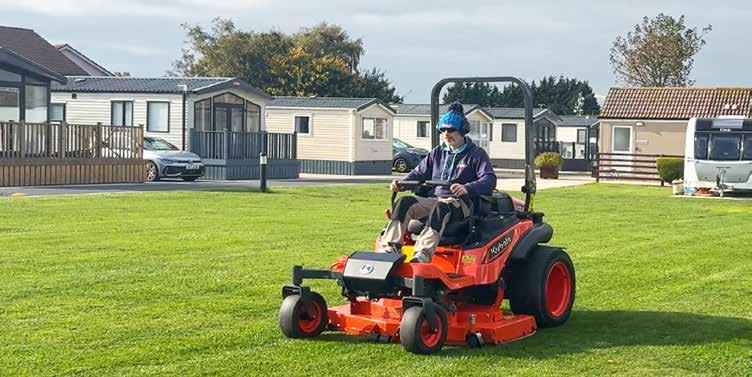

The Worcestershire Golf Club was established in 1879. Current Chairman of BIGGA, Steve Lloyd, has been Course Manager since October 2014. He has a team of nine, including a full time machinery maintenance technician.
The Worcestershire acquired a Ventrac package in 2023 after a comprehensive demonstration from Price Turfcare’s team. The multiple attachments, low ground pressure and traction capabilities were attributes Steve was attracted to on the predominantly heavy clay based course, where grass grows quickly.
The need to mow in all conditions is key to keeping ahead of the grass growth on the busy, private members course.
“We bought the Ventrac to try and do more than one thing with the power unit. A machine dedicated to one task is becoming more and more difficult to justify to the club.”
It dovetailed with plans to try and keep the golf course more accessible by putting more and more pathways around.
“We’ve looked at all sorts of surfaces. Without spending telephone numbers on products, we’ve gone with gravel paths. With the Ventrac Power Rake, if we do get a little bit of washout on paths, we can send somebody out quickly in the
morning before play begins. It’s quite user friendly, not as difficult, slow or disruptive a 360 digger,” added Steve.
“We also bought a Contour Deck at the same time. We’ve got another dedicated rough machine but it [the Contour Deck] just gave us flexibility again in heavy spring growth. We can send a guy out there just to stay on top of those things. We’ve also found it useful in and around bunker and tee-box banks.”
Steve and his team have found the wide footprint of the Ventrac, compared to a dedicated machine, invaluable on some of the steeper areas of the course.
The 30 degree slope capability of the Ventrac has allowed the team to mow tee banks that were “just too severe for a conventional mower. In the past they were infrequently mowed or left but started to become quite weedy and untidy,” said Steve.

“Certainly around the car park and clubhouse and higher presentation areas, the Ventrac with the Contour Deck gives us the ability to keep those areas clean, tidy and trimmed on a weekly basis. Previously we’d use trimmers or hand mowers. It’s gone from hours to minutes with a Ventrac!”
Sometime after buying the 4520 tractor Steve saw the need to improve the first-cut trim around the fairways.
“We do two 25mm cuts around the fairways. Looking at a dedicated machine to do that job twice a week for three or four hours was looking very expensive. We ended up buying the cylinder units to go on the front of the Ventrac, making better use of that power unit. That versatility is great and cost about £35,000 less” [than a dedicated machine].
Steve mentioned that the the last 60 yards on the 2nd fairway was a severe hill up to a tabletop green.
“Previously that would be cut at 50mm with a rough mower once a week. Now
we’re cutting that with the Ventrac cylinder mower at 25mm two or, three times a week to really improve that approach. Other machines in the past
just wouldn’t have been able to get up there and do that job.” The outcome is improved aesthetics and playability n www.priceturfcare.com
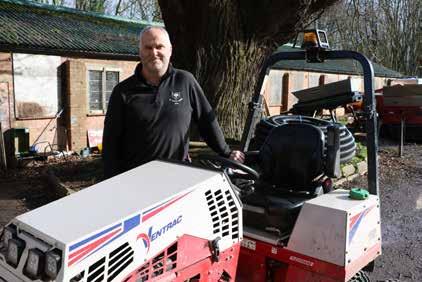





The summer period presents a unique set of disease management challenges for sports turf. Elevated temperatures, increased humidity, intense wear, and irrigation stress create ideal conditions for a range of fungal and physiological turf diseases.
For golf greens and football stadia alike, the consequences of poor disease control during summer can be severe loss of turf quality, reduced playability, and costly renovation work.
Even with the most diligent adherence to best cultural and mechanical practices, high disease pressure can still lead to visible symptoms and the need to intervene directly with remedial action, although this may require the use of fungicide, the presence of disease may not always need chemical intervention.
Fortunately, the sports turf industry in the UK does indeed continue to benefit from a wide range of amenity fungicides and although – with the loss of products with eradicant potential – it may be fair to point out the options are not quite as wide ranging as they once were. Nevertheless, with a more considered approach, such as the utilisation of tank mix fungicide combinations, combined with the ready availability of nutrients and biostimulants, prevention and outcomes after a disease outbreak, can be much improved when compared to using proprietary fungicide products alone.
During the summer, turfgrass plants are often under significant stress due to high soil and air temperatures, reduced root depth and oxygen availability, increased wear from play and maintenance operations, drought stress or excessive irrigation, nutrient imbalances, particularly low nitrogen.
Joe Kinder, of Agrovista, details those diseases most likely in the summer months and how to protect or minimise damage

Stressed turf is far more susceptible to opportunistic pathogens, many of which thrive under warm, humid conditions.
Anthracnose is one of the most destructive summer diseases on golf greens, particularly on Poa annua. It typically develops during periods of heat stress and low nitrogen availability. Symptoms include yellowing and thinning of turf, basal rot leading to plant death and under magnification the presence of black fungal structures. Control strategies include maintaining adequate nitrogen levels through light, frequent application. Avoidance of excessive drought stress and this would typically involve the use of wetting agent. The reduction of mechanical stress where possible and improvement to surface compaction by aeration.
Should fungicide be required, Instrata Elite, for example, with its combination of two active ingredients,
mixed with phosphite was proven to be highly effective at controlling the foliar blight stage and initiating recovery of anthracnose disease under independent trial conditions.
Dollar spot certainly once considered a more common summer disease on closely mown turf in the south of the country is now seen to be more widespread. It thrives in warm days, cool nights and prolonged leaf wetness. Typical symptoms include small, circular straw-coloured patches with white mycelium visible in early morning dew.
Control strategies include maintaining balanced fertility, especially nitrogen, reduced leaf wetness by improving airflow and irrigation timing, the removal of dew and once more, if necessary, the use of a preventative fungicide programme. Again though, independent trials demonstrated a mix of two fungicides, Maxtima and Insignia but this time

combined with the plant growth regulation Attraxor and Greenlawnger TR, a green pigment, demonstrated significantly improved efficacy and longevity compared to using the two fungicides in isolation.
Microdochium patch, although traditionally associated with cool, wet conditions can persist into the summer, particularly on golf greens under stress. Contributing factors include compacted, poorly drained surfaces, excessive shade and humidity and turf weakened by heat stress.
Control strategies typically involve improving air movement and surface drainage, minimising prolonged leaf wetness, maintaining a steady growth through balanced nutrition and fungicide protection, especially where historical pressure is high.
Indeed, as Microdochoim patch is usually the most common disease likely to occur throughout the year, extensive independent trials have been undertaken and consistently proven

the benefits of tank mixing active ingredients, nutrients, biostimulants and adjuvants or a combination of all three.
In this regard, attention is drawn to the independent trial mixing Heritage (azoxystrobin) with Go Green Plus a unique complexed iron with the mix improving Heritage performance by over 50%. Arguably, similar performance could be achieved with other iron-based products, but it nevertheless focusses attention on how to achieve the best outcome from fungicide use, especially when disease is already prevalent.
The trial began when the presence of disease was already over 15% coverage placing even greater pressure on the performance of the mix.
Rapid blight has become increasingly problematic on football pitches, particularly in stadia environments. Symptoms include rapid decline and dieback, patches of turf failing despite adequate moisture and is most severe during hot weather.
The key risk factors are high salinity in irrigation water or soils, elevated summer temperatures and stress. Control strategies include regular monitoring of soil and water salinity, the reduction of salts from the rootzone and the use of preventative fungicide applications during periods of high risk. Rapid blight management relies heavily on cultural practices alongside chemical control.
Gray leaf spot is an aggressive summer disease primarily affecting perennial ryegrass and is increasingly being reported on football pitches and
training grounds. Once established, gray leaf spot can cause significant turf loss in a short timeframe.
Symptoms include small gray or brown lesions with dark borders, rapid turf collapse under warm, humid conditions, fast spread during periods of intense rainfall or irrigation. Control involves avoidance of excessive nitrogen during high-risk periods, improvement to airflow and reduction of canopy humidity, a reduction in the duration of leaf wetness and the application of fungicides.
Brown leaf spot is an extremely common occurrence on sports turf and is associated with many fungi genera. Typically, affected tissue appears to be discoloured yellow from the tip downwards with a reddish to brown border separating the affected and healthy tissue.
An outbreak of leaf spot disease is favoured under warm humid conditions, but it can be found throughout the year and under a range of temperatures, especially when the grass is wet and under stress. In most turf situations it will not lead to serious damage and maybe tolerated rather than treated, although in a stadia environment where presentation is highly scrutinised, treatment and prevention is usually required. In this regard, the only UK labelled fungicide for the treatment of brown leaf spot is Medallion (Fludioxinil), although looking further afield, such as the USA, many of the same UK approved fungicides and active ingredients have label approval for brown leaf spot control. Anthracnose, left and top of opposite page

In the world of professional turf management, the ground beneath our feet is shifting.
What once seemed like a predictable seasonal cycle has been replaced by a volatile cocktail of environmental and operational pressures. From the scorching droughts of record-breaking summers to the relentless intensity of equally recordbreaking rainfall, the demands placed on a sward have never been higher. At DSV Eurograss, they recognise that the “business as usual” approach to seed selection is no longer an option.
As we navigate 2026, the research into seed and turf development has transcended simple aesthetics; it is now the critical foundation for the industry’s survival and sustainability.
Climate change is no longer a distant threat – it is an everyday operational hurdle. For turf managers, this manifests as extreme temperature fluctuations and increasingly restrictive water usage regulations.
The traditional “cool-season” grasses that have long been the backbone of UK and European sports turf are being pushed to their physiological limits. The research at DSV focuses on genotypic
variation – the genetic “blueprint” that allows certain cultivars to thrive where others fail. Their breeding programs are specifically targeting drought tolerance, not just through surface-level survival, but through deep rooting characteristics. By selecting for “smart roots”, plants that can strategically adjust their water uptake from deeper soil profiles during dry spells, they are helping groundstaff maintain highquality surfaces with significantly fewer irrigation inputs.
Warmer, more humid autumns and winters have invited a new guest list of pathogens to our pitches and fairways. Diseases like Dollar Spot and Gray Leaf Spot, once considered “continental” problems, are now common in more temperate climates.
The traditional reliance on chemical interventions is under pressure from both a regulatory and environmental standpoint. The DSV development pipeline prioritises genetic disease resistance. Varieties like the newly ranked Flanell and Euromagic aren’t just chosen for their wear tolerance; they are bred to be naturally robust against the fungi that thrive in these changing weather patterns.
By building resistance directly into the seed’s DNA, DSV provide the first line of defence, reducing the need for costly, carbon-heavy applications.
While the climate changes, the expectations of players and spectators remain at an all time high.
Modern multi-use stadia and academic facilities require turf that can withstand “increased usage” from the relentless pounding of feet and equipment, often under low-light conditions or beneath retractable roofs. DSV’s PRO range is a testament to this research. It features diploid perennial ryegrasses that offer – rapid germination; exceptional sward density and genetic colour.
A data-driven future means that the importance of independent testing has never been greater. DSV are proud that their varieties now occupy top positions on the BSPB Turfgrass Seed rankings. The rankings table is the one everyone wants to top. Our recent results prove that our breeding material is now the best in these trials, but the real victory is seeing these grasses perform in the face of a changing environment.
– Sam Horner, DSV Seeds.
The Kress Mega 600 KR238E represents a significant step forward in robotic mowing for professional sports surfaces. Developed specifically for large and demanding turf areas, this flagship model from the Kress Master Series delivers consistent, highquality results while helping grounds teams manage time and resources more effectively.
For many sports turf professionals, maintaining presentation standards across multiple pitches can be a constant challenge. The Mega 600 has been designed to meet that demand head on, offering an autonomous solution capable of working continuously to keep surfaces in peak condition.
At the centre of its performance is a 620 mm cutting deck with an integrated roller. Combined with high-speed blades operating at 3,800 rpm, the mower produces strong, defined striping that mirrors the finish of traditional cylinder machines.
The result is a professional look that
enhances the visual quality of sports pitches, with stripes ranging from three to six metres wide.
What sets the Mega 600 apart is its ability to achieve this finish without manual input. Operating overnight, it can cover up to 22,000 m² in just 12 hours, delivering a consistent cut across large areas. Over a 48 hour period, this increases to as much as 88,000 m², making it well suited to multi-pitch sites and large sports facilities.
Accuracy is another key strength. Using centimetre-level RTK satellite positioning, the mower follows precise, parallel mowing lines without the need for boundary wires. This ensures a clean, uniform finish across the entire surface while reducing the time typically spent setting up and adjusting patterns.
For sports pitches, where surface quality directly affects play, this level of precision is essential. The Mega 600 is capable of cutting down to 10 mm with superb accuracy, allowing grounds teams to maintain the tight, consistent
finish required for high-level sport.
Efficiency extends beyond cutting performance. The mower features fast charging cycles of around 30 minutes, along with a nearest-dock return function that keeps downtime to a minimum. Its quiet electric operation means it can work overnight without causing disruption, allowing pitches to be prepared and ready for use each morning.
This flexibility gives grounds teams greater control over their maintenance schedules. Mowing can take place outside of training sessions and match play, freeing up valuable time during the day for other essential tasks. There are also clear environmental and cost benefits. As a fully electric machine, the Mega 600 produces zero emissions during operation and significantly reduces noise compared to traditional equipment. The removal of fuel use not only lowers running costs but also supports the increasing focus on sustainability across the sector.


As a busy multi-sport facility, resilience of surfaces at Bristol University isn’t a luxury – it’s a necessity. Helping Grounds Manager Matt Carroll deliver consistent, high-quality pitches for winter and summer sports are mixtures from the Johnsons Sports Seed range, producing performance he and his team of four can rely on season after season.
Matt has been with the University for over 20 years, stepping into the Grounds Manager role three years ago which sees him in charge of 38 acres of grounds, natural and artificial surfaces used heavily by university teams and the local community.
“We accommodate a lot of sport –demand is through the roof!” said Matt.
“We don’t get much in the way of renovation or turnaround windows so the surfaces need to be resilient, recover quickly and, of course, look good.”
For close to a decade, delivering all of those qualities have been mixtures from the Johnsons Sports Seed range.
“We’ve used various mixes over the years but have recently found a combination of J Premier Pitch on our winter sports pitches and two of the cricket outfields, and J Premier Wicket on the squares delivers the reliability we need,” he explained.
“We rely heavily on overseeding, often only having a matter of a few weeks when the sporting season changes and with Johnsons, the establishment and uptake we’ve had has been outstanding. Knowing you can get those results in a short timeframe makes a huge difference,” he said.
“Not only that but the colour is vivid year-round and they can stand up to the challenge of back-to back play.”
Reinforcing the quality of Bristol’s pitches, the venue was proudly chosen as a training venue for 2025 Women’s Rugby World Cup.
“We were delighted to host the Canadian national team. It was full on but really showcased the best of our surfaces and the products we’re using.”
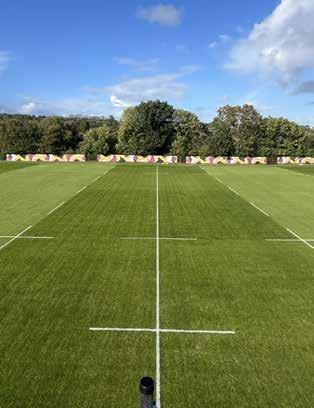

Managing one of the busiest multi-sport facilities on the south coast is no small task – especially in a region increasingly defined by prolonged dry spells and intense seasonal wear.
At Bournemouth University, Grounds Manager Alex McCombie relies on proven seed performance and trusted technical support to keep standards high across a hugely demanding site.
Alex has been in the post for four years, overseeing an extensive sports complex that includes eight football pitches, three rugby pitches, cricket squares and outfields, hockey pitches, a 3G surface and extensive surrounding landscapes.
While the facilities serve students, around 75% of usage comes from the wider community, with Bournemouth Rugby Club, Bournemouth Sports Football Club and Bournemouth Cricket Club all calling the site home.
“We’re a university, but we’re also a massive community campus,” explained Alex.
“We’ve got fixtures midweek and weekends, and on some days, we’ll have multiple matches on the same pitch. We’re talking around 5,000 users every week, so wear tolerance
and recovery are absolutely critical.”
Situated on an extremely free-draining site, Bournemouth University benefits from excellent winter playability – but summer conditions are increasingly challenging.
“From Easter through to October we hardly had any rain at all,” he said.
“That’s great in winter, but in summer it puts huge stress on the grass. We need something with genuine drought tolerance that can also stand up to relentless wear.”
That need led Alex to MM Tetra Sport, a specialist overseeding mixture consisting of tetraploid ryegrasses, designed specifically for high-quality sports turf.
“Tetra Sport has been a bit of a nobrainer for us. It establishes quickly, it wears well, and it stood up incredibly well during a brutal summer. I was genuinely impressed.”
The mixture delivers fast germination, rapid sward establishment, and excellent winter and summer colour, while offering high disease resistance and strong wear tolerance. The inclusion of new, highly rated cultivars, exclusive to the MM range, has been particularly important at Bournemouth University, where pitches see continuous use.
Alex even took the unusual step of overseeding a rugby pitch in December.
“Soil temperatures here stay fairly good, and we usually have a short break after the last fixture before Christmas,” he explained.
“We drilled Tetra Sport in just before that break, and it came through really nicely. The results exceeded my
expectations.” For cricket renovations and repairs, Alex turns to MM50, widely regarded as the leading mixture for end-of-season renovation work and mid-season repairs.
“We’ve used MM50 on our cricket squares for a couple of years now and had superb results. The density we get is excellent, and it recovers really quickly from play.”
MM50 contains a blend of fine-leaved ryegrasses, producing an extremely hard-wearing, dense surface, and is treated with Headstart GOLD to support faster establishment and stronger early growth.
“We don’t tend to spray for disease at all. We’re lucky, but disease pressure is minimal.
“The square we renovated with MM50 played probably the best it ever has last season, and the feedback from the cricket club has been very positive.”
Beyond product performance, Alex highlights the importance of strong relationships and reliable technical support – something he has found consistently with MM Seed.
“I’ve used MM Seed for years and had a long-standing relationship with Matt Gresty. Matt’s absolutely superb – always on hand with advice, and he’s even helped put together specialist mixes specifically for our site.”
That bespoke approach proved invaluable following the university’s large annual rugby festival, where tailored mixtures were required to accelerate recovery across heavily worn areas.
n www.mm-seeds.co.uk

The Team Sprayers Demount Pro Sprayer has been developed with one clear objective: to give turf professionals complete flexibility without compromising on performance.
Designed to mount and demount quickly from a wide range of utility vehicles, it offers a practical, costeffective solution for contractors and ground care teams.
Precision application is at the heart of the Demount Pro. Its advanced spray control system ensures accurate, consistent coverage, helping operators apply products efficiently while
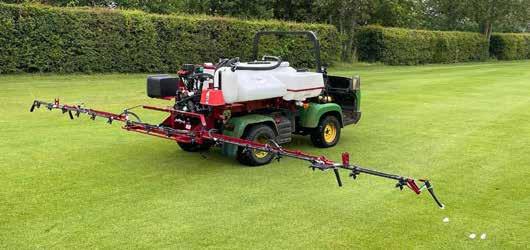
minimising waste, an essential factor in modern, responsible turf care.
Whether maintaining sports pitches, golf courses or amenity areas, the system supports best practice in both performance and environmental stewardship.
Ease of use is another key advantage. Intuitive controls and a streamlined layout allow operators to adjust settings quickly, even during operation. The robust build quality, synonymous with Team Sprayers, ensures reliability in demanding conditions, reducing
downtime and keeping maintenance straightforward.
The Demount Pro comes with the choice of a 400, 600 or 800 litre tank sizes; manual or folding booms as well as the option of covered boom systems to minimise spray drift.
For organisations looking to maximise equipment use, the Demount Pro offers true versatility; transforming a standard vehicle into a highperformance sprayer when needed. In today’s evolving turf care landscape, it represents a smart, efficient investment.



Sheffield Wednesday’s stadium presents a challenging environment for turf, with significant shade and limited use of supplementary lighting. Alongside this, the pitch sees consistent use from first team and under-21 fixtures, as well as training sessions.
“Our biggest challenge is a very old, heavily shaded stadium with limited use of lighting rigs,” explained Head Groundsman Lee Jackson, pictured above.
“Maintaining grass cover through the season is never straightforward.”
As part of a partial rebuild ahead of the 2025 season, ProSelect 1 Premium Pitch, a perennial ryegrass mixture designed for high-wear sports pitches, was used for renovation and overseeding.
“I’ve used ProSelect 1 for close to 10 years and have always trusted how it performs, so I had no hesitation using it again, even in a completely different environment,” Lee explains.
Establishment proved difficult initially due to high temperatures during summer 2025 and the nature of the rebuild.
“The early grow-in was tough because of the heat, but once it got going the coverage
developed faster than I’ve seen for a number of years.”
Following establishment, the pitch was subjected to sustained use, particularly between December and February.
“We had eight first team games and ten training sessions on the pitch during that period, and we’re around 10% up on usage compared to last season,” revealed Lee.
Despite this, grass cover has been maintained through the winter months.
“We’ve kept more grass cover than many expected through that period, and recovery after use has been strong, especially considering the environment.”
Presentation and surface consistency have also improved across the season, supported by relatively low disease pressure.
“There’s been a noticeable improvement overall, and that’s been recognised by players and staff who have been here a number of years,” added Lee.
For Lee, performance in this type of environment is the real measure.
“If you can get grass growing and maintain it in this kind of stadium, with limited lighting, it shows its value as part of the overall pitch management programme.” n www.icl-growingsolutions. com
Operating across a diverse mix of natural and synthetic surfaces, Cutting Edge Grounds Maintenance has built its reputation on delivering effective, practical solutions for sports turf and grounds maintenance.
From schools and grassroots football to rugby, cricket, athletics and synthetic facilities, the business takes a truly all-round approach – and Redexim equipment plays a key role in that strategy.
“We’re a full grounds maintenance company – it’s not just one area. We look after natural and synthetic surfaces across schools, grassroots sports clubs, rugby clubs, athletics clubs and cricket clubs. The majority of our work is schools, but we really do cover everything,” explained Managing Director Josh Blackburn.
That variety of sites and surfaces has led Cutting Edge to invest in a range of Redexim machinery, with the Verti-Quake® 2516 and Verti-Top® 1800 proving to be standout assets.
Having operated the Verti-Quake 2516 for around a year, Josh says it has become an essential part of his aeration programmes, particularly on heavy clay soils where surface drainage is often the limiting factor.
“A lot of our land is clay-based, and people really struggle with drainage. Traditional deep-tine aeration does a great job of cracking the ground eight, ten, 12 inches down, but on its own it doesn’t always address surface water movement. That’s where the VertiQuake really comes into its own.”
The Verti-Quake addresses this challenge through linear decompaction of the upper soil profile, allowing water to move away from the surface more effectively.
“With the Verti-Quake, you’re creating that linear drainage. You’re getting water off the top surface, through the soil profile and away, while your Verti-Drain holes are still doing their job underneath. Together, you’ve got a solid pocket of drainage.
“It works really well hand-in-hand with the Redexim Verti-Drain. If
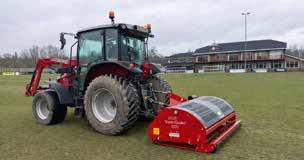
you’re doing four aeration treatments a year and you mix in a Verti-Quake, you’ll see a huge difference in your soils.” Cutting Edge uses the VertiQuake across private schools, football pitches, clubs and open spaces, particularly on winter sports pitches where playability is critical.
“We look after Yarm Private School, and the improvement there has been massive. This year, the only time they had a game called off was when it snowed. They’ve had fixtures every week – not one game lost to waterlogging.”
n www.redexim.com/uk/
Hunt Forest Group has strengthened its Pro Turf and Grounds Care offering with the appointment of Wiedenmann as a new franchise.
The partnership was officially launched at HFG’s recent Technology Demonstration Day held at Thruxton Circuit, where customers were able to see Wiedenmann equipment showcased alongside a wide range of professional turf and grounds care machinery.
HFG is one of the South’s leading machinery dealerships, supplying and supporting equipment across agriculture, turf, grounds care and construction sectors. The business has built a strong reputation for customer service, technical expertise and investment in people and facilities.
HFG’s dedicated turf department supports a wide range of professional
and amenity customers, with specialist knowledge across golf, sports facilities, estates and grounds maintenance contractors. The addition of Wiedenmann further enhances the group’s turf portfolio, allowing customers to access premium machinery alongside trusted local support.
The Wiedenmann franchise will be supported across HDG’s branch network in Hampshire, Wiltshire, Dorset, Somerset and on the Isle of Wight, ensuring customers have convenient access to sales advice, parts and service engineers.
“I’m really pleased that HFG is on board. I’ve seen first-hand how proactive the team is with their customers, and I’m confident this will be a strong and productive partnership,” said Mike James, Wiedenmann UK’s National Sales

Manager. “Wiedenmann is a highly respected brand within the professional turf and grounds care market, and we are pleased to be able to represent them. This partnership allows us to offer our customers another premium solution, supported by the levels of service and parts backup they expect from Hunt Forest Group,” said Ed Smales, Turf and Construction Sales Director at HFG. n huntforest.com/brand/ wiedenmann/
Acommon problem facing building companies, contractors and landscapers on completion of a development is compaction.
This can be caused by the movement of traffic and materials across the ground to buildings under construction, which leaves areas prone to waterlogging.
Groundwork, laying topsoil and grassing or turfing areas, may be on clay and that has the same effect with the presence of large tracts of standing water. Newly laid gardens, grassed and play areas in particular become susceptible, with compaction occurring far deeper than normal aerating will alleviate. Deep penetration aeration is the solution, but what lies beneath the grass and to what depth is aeration needed?
Terrain Aeration has been treating such problems for over 25 years and
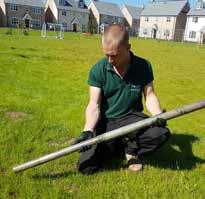
work regularly with construction companies to provide a long-term solution.
The Terrain Aeration Terralift machines penetrate the ground to a depth of one metre, releasing a blast of compressed air which fractures and relieves the compacted soil, creating permanent aeration and drainage.
However, before carrying out the aeration, it is often necessary on old site layouts to determine what lies beneath and Terrain Aeration takes a core sample using their specialist machinery. The plastic sleeve which slides out of the metal casing reveals what the soil is like, from the topsoil down to the structure beneath. The
soil cores are taken to one metre depth can also be a good indicator of where oil and diesel spillages have penetrated and how deep. The Terralift can then deal with the oil-bioremediation using specialist products in the area down to one metre depth.
Penetrating deep into the ground, hard areas may be encountered, such as flint and solid building material. The Terralift probe is designed to break through the solid layers, employing a JCB hammer incorporated as part of the machine. Once the hard materials have been penetrated, the compressed air blast released creates fractures and fissures.
These are injected with dried seaweed as part of the process, keeping, in this case, the clay seen in the core sample open and allowing surface water to drain quickly down one metre and naturally percolating away.
What was once was a waterlogged area is transformed into a healthy soil structure with good root zone. Of course, not all compacted ground will have the same strata, but the Terrain Aeration process is used to treat all types of waterlogging, from small gardens to parks, public spaces and sports pitches to bowling greens. n www.terrainaeration.co.uk



































Kick for a Cause, Perennial’s fun and informal five-aside football tournament is returning in 2026, raising vital funds to support people facing challenges in horticulture.
Taking place on Sunday 31 May at Fulham FC’s training ground in Surrey, the tournament is designed specifically for grounds people. It promises a relaxed, enjoyable day that combines a bit of friendly competition with the chance to connect with others across the industry.
Whether you’re a regular fivea-side player or just fancy dusting off your boots, the day is all about getting involved, having a laugh, and supporting a great cause. After showcasing your skills on the pitch, players and supporters will be invited to enjoy pizza and refreshments – the perfect way to unwind, share stories, and celebrate everyone’s efforts.
The tournament was the brainchild of the Grounds Team at Fulham FC in 2025 as a way to create something that gives back to the profession, while promoting the support available to those working within it.
Deputy Head of Grounds at Fulham, Stan Hayden, commented: “As grounds people, we’re used to working as part of a team, often behind the scenes, so it’s great to bring everyone together in a different environment. Kick for a Cause is about more than just football – it’s about supporting each other and raising awareness of the incredible work Perennial does for people in our industry. If we can have a great day, raise some money, and encourage even one person to reach out for support when they need it, then it’s been a success.”
Senior Groundsman at Fulham FC, Jordan Newman commented “By hosting the event at Fulham’s training ground, we’re able to offer a unique opportunity for fellow grounds professionals to step onto a top-class facility and enjoy the game from the other side.”
Perennial is the UK’s only charity dedicated to supporting people who work in grounds management and all sectors of the horticulture industry. For many it’s a vital safety net – offering practical, emotional and financial support when it’s needed most.
For an industry that takes such pride in maintaining the nation’s green spaces and sports grounds, Perennial exists to make sure the people behind that work are equally cared for.
As a charity, Perennial relies on fundraising and industry support to continue delivering these essential services. Events like Kick for a Cause play a crucial role in enabling that work to continue.

While there will no doubt be plenty of competitive spirit on display, Kick for a Cause is about far more than results.
It’s an opportunity to step away from the day-to-day pressures of the job, spend time with colleagues and build connections. Events like this also help raise awareness of the support that’s available through Perennial –something that people may not realise they can access until they need it.
“Last year we entered a team into the five-a-side tournament at Fulham FC’s training ground – what an unforgettable experience! Incredibly well organised, fantastic facilities, and a unique chance to play on a Premier League club’s pitch. Great fun from start to finish,” said Neville Stein, Horticulture Business Consultant.
Grounds teams from football clubs and organisations across the country are invited to sign up and take part in this year’s tournament.
Event details:
• Date: Sunday 31 May 2026
• Time: 11am – 3pm
• Location: Fulham FC Training Ground, Motspur Park, Surrey, KT3 6PT
Team format: Teams of up to ten players (five-a-side with five substitutes).
Once you’ve assembled your team, secure your place by registering online perennial.org.uk/five-a-side. Entry fee:
£300 per team – that’s the equivalent of just £30 per player for a full squad Spaces are expected to fill quickly, so early registration is encouraged to avoid missing out.
If you’d like to come and cheer on your team for just £25 per person, contact Perennial’s event team 01372 384043 or email events@perennial. org.uk
We’re also pleased to welcome grounds care experts ICL as supporting partners for the 2026 event. Their backing helps ensure the tournament runs smoothly and maximises the funds raised for Perennial’s vital work.
Aimee Davey from ICL’s Marketing Communications Manager said: “We’re pleased to support Perennial and their Kick for a Cause initiative. It’s a fantastic opportunity to promote wellbeing through sport and make a positive impact in the process.”
Kick for a Cause is shaping up to be a standout event in the grounds management calendar – a day that combines sport, networking and fundraising in a way that truly reflects the spirit of the industry.
Whether you’re playing, supporting, or simply spreading the word, your involvement helps ensure Perennial can continue to be there for those who need it.
So, gather together your teammates, lace up your boots and get ready to take to the pitch – all for a really great cause!