






As I sit here writing my remarks for the 75th edition of Turf Matters I think back to the very first issue, which we brought to you at the beginning of 2014.
The last two months have been a nightmare for many people in certain parts of the country and my heart goes out to everyone dealing with the aftermath of unprecedented flooding and devastating erosion.
The best case scenario for many is months of temporary living. For others, lives will never return to what they were.
I was, and remain, indebted to Alan Ferguson, who at the time was the Head of Grounds at the FA’s St George’s Park and who very kindly gave up some of his time to a magazine title with no back catalogue but, instead, bucketfuls of ambition.
While the fate of sports grounds and golf clubs might seem inconsequential in the face of such hardship, we at Turf Matters have a particular empathy with everyone who has seen years of agronomic husbandry literally washed away in the space of a few weeks.
On our notable landmark, I’d love to thank Alan again, but he is rather tied up at the moment in his role as Senior Pitch Management Manager for FIFA and the 2026 Canada, Mexico and USA World Cup. His monumental task has been to ensure quality and consistency of playing surface across those three countries; 12 climates; four different time-zones; various “non-soccer” primary functions – some stadiums with roofs and some without – and spread over 1,750 miles north to south.

It must be hoped that banks – the financial institutions, not the things which edge overflown rivers – take an understanding approach to sporting facilities which have been unable to service loans as a result of them being unplayable and so unable to bring in revenue.
As we have seen with the recent Winter Olympics, sport has such a galvanising effect on society and can be the catalyst for so much good, that it is imperative sporting facilities are not forgotten when the promised assistance is being allocated.
On the issue of improving sporting facilities, we have been invited by Briggs & Stratton to become involved in its Pitch to Win competition, which provides a £3,000 makeover for what is judged to be the Under 18s football pitch in most need – find out more on pages 16-17. I am on the judging panel and visits will be made to a shortlist of deserving pitches soon. We will be looking not so much at the DESSO but the desperate!
From my vantage point, in front of the telly, it’s clear that Alan and his team have worked miracles. Every pitch has been immaculate and a credit to the grounds teams as well as all the companies within our industry who have helped to make it such a success.
I’m pretty sure both Alan and I will be sitting with our feet up by the time the 150th Turf Matters comes out and hopefully we’ll both be able to do so with some satisfaction.
Scott MacCallum
On a final note, I am thrilled by the reception that the first issue of Turf Matters received. Many people have taken time to say how much they liked the look of the magazine and how they enjoyed the articles. We’re all pleased you found it to your liking and we will work hard to maintain the high standards. Thank you all very much.
Scott MacCallum, Editor


Distributed every two months to sports turf professionals, local authorities and buyers of turfcare machinery and products.
Editor: Scott MacCallum scott@turfmatters.co.uk
Editor: Scott MacCallum scott@turfmatters.co.uk
Design/Production Editor: Tim Moat tim@timmoat.co.uk
Design and Production Editor: Tim Moat tim@turfmatters.co.uk
Sales Executive: Marie Anderson marie@turfmatters.co.uk
Sales Manager: Pauline Thompson
Contributor: Susan Lindsay
To advertise in Turf Matters, call Pauline on 07720 055676 or email pauline@turfmatters.co.uk
To advertise in Turf Matters, email marie@turfmatters.co.uk
To subscribe, go to www.turfmatters.co.uk
Turf Matters is published by Straight Down the Middle Communications Ltd.
Turf Matters is published by Straight Down the Middle Communications Ltd.
All material © Turf Matters magazine 2026 Winner of awards including Best Writing and Best Design in the Turf & Ornamental Communicators Association (TOCA) Awards 2019-2025
All material © Turf Matters magazine 2014. No part of this publication may be reproduced in any form whatsoever, either for sale or not, without the written permission of the publisher. Information contained in Turf Matters is published in good faith and every effort has been made to ensure its accuracy. Turf Matters can accept no responsibility for any error or misrepresentation. All liability for loss, disappointment, negligence or other damage caused by reliance on information contained in Turf Matters or in the event of any bankruptcy or liquidation or cessation of trade of any company, individual or firm mentioned is hereby excluded.
Printed by Warners Midlands PLC.
No part of this publication may be reproduced in any form whatsoever, either for sale or not, without the written permission of the publisher. Information contained in Turf Matters is published in good faith and every effort has been made to ensure its accuracy. Turf Matters can accept no responsibility for any error or misrepresentation. All liability for loss, disappointment, negligence or other damage caused by reliance on information contained in Turf Matters or in the event of any bankruptcy or liquidation or cessation of trade of any company, individual or firm mentioned is hereby excluded. Printed by Warners Midlands PLC.
Jason Booth is the man to succeed Geoff Webb as CEO of the GMA.

Jason brings more than 12 years’ experience within GMA, during which he has held a range of senior roles and made a significant contribution to the organisation’s development. His deep understanding of GMA’s work and membership places him in a strong position to lead the organisation
As part of the transition Geoff will remain in post until March 2027, with Jason formally assuming the role in April 2027. This approach will ensure continuity and stability while supporting a smooth leadership handover.
Martyn Ward,
Chair of the Board for the GMA, said that they were delighted to appoint Jason as the Association’s next CEO.
“He brings a wealth of experience, a strong track record of leadership, and a deep understanding of both our organisation and the needs of our members. The Board is confident he is the right person to lead GMA forward,” said Martyn.
“I would also like to take this opportunity to thank Geoff for his continued leadership and his commitment to ensuring a seamless transition.”
Commenting on his appointment, Jason said that he was incredibly proud to be stepping into the role of CEO at GMA.
“Having spent the past 12 years here, this is a very meaningful moment for me. The GMA, our members and the wider grounds management sector is something I care deeply about.
GroundsFest has expanded its partnership with BALI, which will see the organisation again become the exclusive sponsor of The Landscape Zone at GroundsFest 2026.
The strengthened relationship marks another significant step forward for GroundsFest as it continues to bring together every corner of the grounds management, landscaping and outdoor industries through a fresh, inclusive and engaging event experience.
As part of the partnership, BALI will have a major presence throughout the show, including sponsorship of The Landscape Zone and a seminar theatre. Working closely with HortWeek, BALI will help deliver a seminar programme packed with expert insight, industry discussion and valuable educational content for visitors.
In addition, BALI will host its own stand within The Landscape Zone, alongside a dedicated podcast area where some of the landscaping industry’s leading figures will
be interviewed across the twoday event. The podcast feature is expected to provide visitors with unique insight into key industry topics, trends and challenges, while also shining a spotlight on the people helping to shape the future of landscaping.
The partnership will also extend into GroundsFest’s popular live music festival, which takes place on the evening of the first day of the show. BALI will host its own dedicated festival area, offering members the opportunity to continue networking in a relaxed and enjoyable setting with food, drinks, live music, bumper cars and entertainment.
GroundsFest Event Director Christopher Bassett explained that they saw a natural alignment with BALI.
“There’s a shared commitment to raising standards, supporting professionals and strengthening the future of the landscaping and wider grounds sector. BALI’s proactive, forward-thinking work mirrors
“Over the last decade, I’ve had the privilege of working with colleagues and getting to know many of our members, and those experiences have shaped how I see the organisation and its future.
“Supporting our members will continue to be at the heart of everything we do. I look forward to building on our strong foundations and working together to deliver even greater value in the years ahead.”
Geoff added that it had been a privilege to serve as CEO of the GMA and to work with such a dedicated team and engaged membership.
“I’m proud of what we’ve achieved together and confident that, in Jason, the organisation has a leader who understands its values, its strengths and its future potential. I look forward to supporting a smooth transition in the months ahead.” n Interview with Geoff Webb: Pages 16, 17, 19.
what we’re trying to achieve with GroundsFest. We’re excited about the additional value this partnership will bring to both exhibitors and visitors.”
“GroundsFest has quickly become one of the most important events in the industry calendar,” said BALI’s Head of Marketing and Communications Rosie Sayers.
“Its strong commitment to supporting and collaborating with the landscaping industry closely reflects BALI’s own values, which makes this continued partnership such a natural and exciting fit for us.”
GroundsFest 2026 will once again bring together professionals from across landscaping, grounds management, local authority, sports turf, estate management and related sectors for two days of hands-on demonstrations, live entertainment, networking and industry-leading exhibitors.
GroundsFest 2026 takes place on 16 and 17 September at Stoneleigh Park, Warwickshire. Visitor registration is free and now open. n www.groundsfest.com
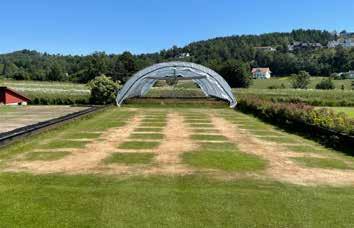
Independent research carried out at the NIBIO Turfgrass Research Center in Norway has highlighted ICL’s H2Pro TriSmart and Syngenta’s Qualibra among seven commercially available soil surfactant technologies evaluated under prolonged drought conditions.
The work forms part of the STERFfunded FAIR WATER II project, supported by The R&A Golf Course 2030 initiative and the German Greenkeepers Association, investigating practical drought management and water-use strategies for golf course fairways across Northern Europe.
During the severe 2024 drought period, untreated plots required 116 mm of irrigation water to maintain the intervention threshold, compared with 90 mm for plots treated with H2Pro TriSmart. This represented a statistically significant 22% reduction in irrigation water use versus untreated turf.
Alongside lower water use, H2Pro
TriSmart maintained strong turf quality, green grass cover, and soil moisture performance throughout the drought period, with the trial paper describing it as delivering the “best all-round performance” under the conditions tested.
Within the same controlled rainout shelter trials at the NIBIO Turfgrass Research Center Landvik in Norway, Syngenta’s Qualibra was recognised for providing the “best overall visual appearance after prolonged drought”.
As golf courses continue to face increasing pressure around water availability, irrigation costs, and prolonged dry periods, the FAIR WATER II project is also assessing approaches including thatch management, deep aeration, and the use of brackish or recycled irrigation water.
Dr Andy Owen, International Technical Manager for ICL, said that Independent trial work like FAIR WATER
II provides valuable practical insight into how different technologies perform under prolonged drought stress.
“It is encouraging to see H2Pro TriSmart recognised for reducing irrigation water requirement while maintaining turf performance, alongside the visual turf quality delivered through Qualibra.” n www.icl-growingsolutions.com




Agrovista Amenity insecticide, Lanzarta, has now received full registration approval for both forest nursery and in-forest use, providing forestry professionals with a complete two-stage strategy for controlling large pine weevil.
Lanzarta is an insecticide specifically developed for the control of large pine weevil, one of the most destructive pests affecting UK forestry.
The pest can cause significant damage to newly planted conifer trees,
particularly pine and spruce, during the first five years after planting or restocking.
Adult beetles feed on the bark of young trees, often girdling the stem and ultimately killing the plant. On heavily affected sites, between 50% and 100% of newly planted conifers can be destroyed.
The new approval allows Lanzarta to be used both as a nursery pretreatment and as a post-transplant forest application, delivering flexible and long-lasting protection throughout the establishment phase of young trees.
In nurseries, treatments are applied in a closed cabinet, helping to protect saplings during their most vulnerable stage. Once transplanted into the forest, supplementary applications can be made using handheld equipment such as knapsack sprayers to target later-emerging weevil generations.
Trees can be treated once in the nursery and up to two times in their final planted positions, with a maximum of three applications per plant.
Lanzarta contains 190g/l chlorantraniliprole, a Group 28 insecticide which controls large pine
weevil following ingestion of the active substance. The quick-drying SC liquid formulation binds strongly to tree bark, helping to prevent rain wash-off while ensuring residual, long-lasting protection.
The approval is particularly significant for the UK forestry sector, where Sitka spruce remains highly susceptible to large pine weevil damage. With approximately 35 million Sitka spruce trees planted annually, accounting for around 50% of the UK’s £2 billion forestry industry, effective protection during establishment is critical.
By reducing losses from weevil damage, Lanzarta can help lower restocking costs, improve establishment success, and support the development of healthier, more consistent woodland stands.
Lanzarta is approved for use in ornamental plant production, including forest nurseries, as well as commercial forestry, amenity woodland, conservation areas, and landscaping projects, giving growers and forestry managers a robust new tool in the fight against large pine weevil.
n amenity.agrovista.co.uk


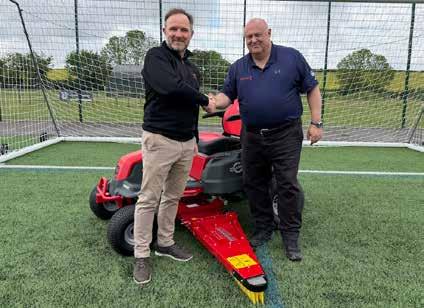
A decade-long working relationship between Replay Maintenance and Redexim UK has evolved into an exciting new partnership - one that promises to raise the bar for artificial pitch maintenance across the UK and beyond.
The collaboration sees Replay Maintenance become the premier UK distributor for Redexim’s synthetic turf machinery, including the all-new RTC-E, an electric version of Redexim’s trusted RTC inhouse maintenance unit.
“We’ve been working closely with Redexim on an informal basis for over ten years,” explained Nick Harris, Managing Director at Replay Maintenance.
“We’ve built strong relationships with the team, and as our own business has grown and developed, it just made sense to formalise that partnership - particularly around synthetic turf machinery, where we’re well placed to lead distribution and provide specialist guidance.”
Replay Maintenance is a specialist in synthetic sports surface care, servicing over 1,000 synthetic facilities annually and offering nationwide expertise in maintaining 3G, 4G, and other artificial pitches. Redexim, meanwhile, is a globally respected name in turf maintenance technology, known for its robust engineering, innovation, and commitment to quality.
“Redexim’s machines are reliable, easy to maintain, and built to do the job properly. They’ve got a core
range that works incredibly well, and they continue to invest in R&D to improve and expand what they offer,” explained Nick
The first major development under the new partnership is the launch of the Redexim RTC-E – a fully electric ride-on maintenance unit designed specifically for in-house use on synthetic pitches.
Retaining the popular features of the original petrol-driven RTCincluding its fold-out drag brushes and compact design - the RTC-E adds a new layer of convenience, sustainability, and compliance with modern environmental goals.
What makes the partnership work
is Replay’s deep understanding of synthetic surfaces and Redexim’s reputation for producing highquality, reliable equipment.
“Replay Maintenance bring unmatched knowledge of synthetic sports surfaces, and we’re excited to work with them as our premier UK distributor for this specialist machinery range,” said Paul Langford, Director of Commercial Operations for Redexim UK.
“Their technical expertise and direct access to a wide customer base make them the perfect partner as we continue to innovate and grow our offering in the artificial turf market.” n www.replaymaintenance.co.uk
Waterscapes, the UK specialist in commercial irrigation systems and water feature maintenance, has published new guidance for facilities managers, estates teams, and budget holders on judging when smart irrigation technology pays for itself.
Written by Managing Director Paul Jeffery, the guidance separates the four technologies usually sold under the smart irrigation label: weatherbased controllers, flow monitoring, soil
moisture sensors, and remote access.
It sets out where each earns its cost on a commercial site, and argues that most sites need some of the technology rather than all of it.
According to the guidance, the largest saving on most sites comes from correcting schedule drift, where programmes set in spring no longer match summer demand. Fault detection follows, with flow monitoring identifying leaks in days rather than
the weeks a conventional system can take, converting excavation and replanting jobs into small repairs.
“Usually, the controller is the cheapest component on the system and the one costing the most money,” said Jeffery.
“A schedule that has drifted out of season can be putting out 30% or 40% more water than the planting needs. Weather-based control tends to claw that back within the first season.” n www.waterscapes.co.uk
BIGGA has announced the ten shortlisted for the Toro Student Greenkeeper of the Year Awards 2026.
The nominees, split between the Student Greenkeeper of the Year and Young Student Greenkeeper of the Year categories, represent golf clubs and colleges from across the country.
Launched in 1989, the awards, sponsored by Toro and Reesink Turfcare, have long recognised and rewarded some of the most promising talents in the industry, with many finalists going on to enjoy stellar careers.
The 2026 awards will take place at Rockliffe Hall in County Durham in September, when the finalists will compete in a series of challenges designed to test their technical knowledge and passion for the greenkeeping profession.
BIGGA’s Head of Professional Development Deb Burnett said that the awards continue to showcase the
breadth of talent coming through the greenkeeping industry, and that this year’s finalists were another outstanding group. The victor in the Young category will also enjoy a one-week placement and the US visit, along with a trip to Continue to Learn at BTME.
The runners-up in each category will also receive generous prizes, as will the people who endorse the winners.
• Ruth Etches, First Assistant greenkeeper at Trentham Golf Club and student at Myerscough College
• Nick McEley, Deputy Head Course Manager at Milngavie Golf Club and student at GOSTA Training
• Jake Rose, Assistant greenkeeper at Alwoodley Golf Club and student at Myerscough College
• Toby Smith, Deputy Course Manager at Redlibbets Golf Club and student at Hadlow College
• Ben Young, Head Greenkeeper at Morpeth Golf Club and student at Myerscough College.
• Finn Cluett, Apprentice greenkeeper at Aspley Guise Golf Club and student at Oaklands College
• Lottie Fosten, Assistant greenkeeper at Wentworth Golf Club and student at Myerscough College
• Archie Raynham, Apprentice greenkeeper at Essendon Country Club and student at Oaklands
• Tyler Rogers, Apprentice greenkeeper at Taymouth Golf Club Ltd and student at Askham Bryan College
• Sam Wells, Apprentice greenkeeper at Isle Purbeck Golf Club and student at Myerscough College.
Kress UK has strengthened its commercial team with three major appointments.
Alex Thorneycroft Taylor joins as Business Development Manager, bringing with him more than two decades of experience in precision technology, customer support, and business development.
David Timms is the new Commercial Business Manager – South, while

Stuart Wharam is the new Commercial Business Manager for the North, strengthening the company’s commitment to the golf and sports turf sectors across the country..
Alex’s career began in 1999 working with GPS technology during its early adoption within the agricultural sector.
Since then, he has built extensive experience across multiple industries, developing a strong understanding of how technology can help businesses improve efficiency, productivity, and sustainability.


In his new position with Kress UK, Alex will be responsible for supporting and developing the company’s dealer network across the South East, while helping to drive new business
opportunities and showcase Kress’s growing portfolio of autonomous and battery-powered technologies.
David will be responsible for supporting and developing Kress’s dealer network across the south of the UK, while also working directly with customers through demonstrations, consultations and business development activities. His territory stretches from Cornwall to Kent and northwards into the Midlands and Mid Wales.
With around 15 years of industry experience, Stuart brings extensive knowledge of the professional groundscare and machinery market to the role.
He began his career at a machinery dealership in East Yorkshire before spending eight and a half years with STIHL, prior to joining Kress UK.
In his new role, Stuart will focus on supporting golf courses, sports venues and commercial customers throughout a territory stretching from Lincolnshire across North Wales, throughout the North of England and Scotland. n www.kress.com/en-gb/




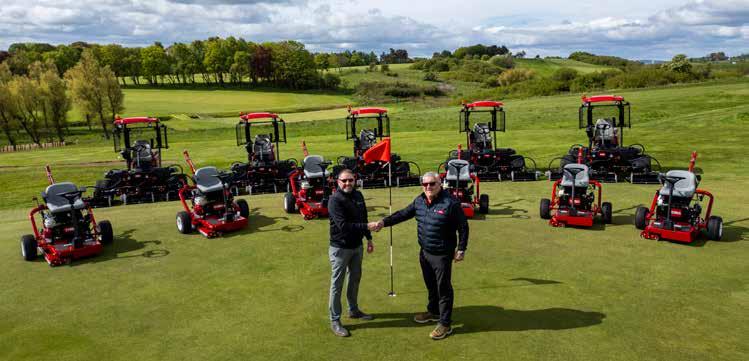
Reesink Turfcare, the distributor of Toro turf maintenance equipment in the UK, has supplied a significant package of machinery to Fife Golf Trust as part of a £2.4 million fleet investment programme designed to modernise operations across its seven golf courses.
The investment forms part of a comprehensive renewal of the Trust’s ageing machinery fleet, helping to improve reliability, reduce downtime and support long-term sustainability objectives. Toro was awarded approximately 25 percent of the overall machinery contract following a competitive public tender process.
“This was a robust procurement process. The decision was made through public tender and competitive evaluation, with contracts awarded on merit,” said David Gray, Golf Courses Manager of Fife Golf Trust.
“The procurement process was designed to ensure transparency, compliance and value for money, with detailed specifications developed for each individual machine.”
Involved in the order are five Toro Reelmaster 5010-H hybrid fairway mowers, six Toro GreensPro 1260 greens rollers and a Toro Workman HDX-D utility vehicle with ProPass spreader.
“A key part of the strategy was to invest in the cleanest and most
efficient equipment available, which aligns closely with our sustainability objectives. We are committed to managing our courses sensitively and finding the right balance so that both golf and nature can thrive together,” explained David.
About the specific machinery, David added that the hybrid Reelmaster mower was the best option on the market to ensure that they continued to reduce emissions.
“We’ve run Toro fairway mowers for over 10 years so this approach tied in well. Similarly with the Workman and ProPass, this was a direct replacement for one that we are familiar with.
While the greens rollers are new to us, the affordability, reliability and performance of the machines will ensure this is a good investment.”
Fife Golf Trust’s operating model is unique within Scottish golf. While partner clubs remain separate entities, the Trust focuses solely on course maintenance and management, overseeing seven venues with a team of 23 greenkeepers across approximately 550 hectares of land.
“Our teams consistently produce fantastic course conditions that we are proud of,” confirmed David.
“This investment will help ensure we can continue delivering high standards while keeping golf affordable and accessible for local communities.”
For Reesink Turfcare, the project demonstrates the value of matching the right equipment to the needs of large-scale golf operations says John Rankin, Area Sales Manager for Reesink Scotland.
“We are delighted that Toro equipment was selected as part of this significant investment programme,” said John.
“The competitive tender process made the outcome a strong endorsement of Toro’s ability to meet the performance, value and sustainability criteria required by a modern golf operation. We look forward to supporting Fife Golf Trust and its teams as they continue to deliver high-quality playing conditions.”
“THIS ENSURES WE CAN CONTINUE DELIVERING HIGH STANDARDS WHILE KEEPING GOLF AFFORDABLE AND ACCESSIBLE FOR LOCAL COMMUNITIES.”

Scott MacCallum chats with outgoing GMA CEO Geoff Webb and looks at some of the landmarks of his time in the role… and what he might have done as an alternative!
Sometimes you can look back at a decision made much earlier in your life and pat yourself on the back for getting something right.
Geoff Webb can reflect on 21 years as CEO of the GMA, formerly the IOG, with a huge degree of satisfaction. However, had he continued on his original path he might have been looking back at a three month spell as coach to Emma Raducanu!
Geoff recently announced that he would be standing down from his role at the GMA having taken the helm in 2005 and, a few weeks later, Jason Booth was unveiled as his successor.
We all live in a world where time flies by and we started our chat by recalling our first meeting, in the IOG offices in Milton Keynes, where I was a member of a small group of press invited to meet the new boss.
He had arrived in the role having spent the previous few years in sports management involved in developing indoor tennis facilities and then the Football Foundation, with his degree in Recreational Management from Sheffield University offering the foundation for his future career.
Prior to that he had been a tennis coach working in both the UK and the United States. It wasn’t so much a lack of talent that held him back from being the Andy Murray of his time, but more a lack of stature.
“I was too short. I was good at doubles, but singles used to make me run too much. I was better coaching than playing,” he admitted.
Looking back to our first meeting, and pondering the question of what his goals and aspirations where at that time, his reply was …
“I can’t answer that question. My memory doesn’t go back that far!”
It’s the kind of answer you get from
someone you’ve known and been around for over two decades. It did, however, eventually elicit a more serious answer.
“I don’t think I knew what I was doing when you all came to see me. I was just trying to gather what the GMA (IOG at the time) was about; what BIGGA was about and what the industry was about. I know I took some time over that.”
What he was to learn about his new organisation was that all its eggs were in the trade show basket with SALTEX, and that there wasn’t really a thought as to where they sat in the overall landscape sector.
“The main leisure departments were starting to disappear and being subsumed into general council departments and the role of grounds management generally was on a steady decline and not being prioritised. So, I felt it was important to study what the impact of sector actually had.”
One of Geoff’s first moves, therefore, was to commission a study into the industry and where the GMA sat within it.
“That’s where Dave Carpenter came
WHAT HE WAS TO LEARN ABOUT HIS NEW ORGANISATION WAS THAT ALL ITS EGGS WERE IN THE TRADE SHOW BASKET WITH SALTEX, AND THAT THERE WASN’T REALLY A THOUGHT AS TO WHERE THEY SAT IN THE OVERALL LANDSCAPE SECTOR.
in. He was a researcher in the leisure world and such was his importance to the organisation he was later to become Chair of the GMA Board. He undertook what I think is one of the most significant pieces of work we ever did, our first real body of research. It was called ‘Groundsmanship: A Hidden Profession’.
“The clue is in the title there. And what that did was build foundations in terms of understanding the landscape of the sector and then working back from that to see where the disconnects were,” explained Geoff.
In those days, the IOG didn’t have a relationship with any of the sports bodies so, in the early 2000s, they started to put facility strategies together covering the major sports.
“What I had noticed, even when you looked to cricket or rugby or football, is the maintenance element of a facility strategy just wasn’t there. It was all about building the clubhouse, it was about the changing facilities, but it stopped, when it reached pitch level, literally.
“So, we pitched for the pitch. Probably the biggest advancement came through working with cricket, which at that time was leading the way in knowledge of our sector. Doors began to be slowly opened. We had to be persuasive and we had to be respectful.”
What it led to was the introduction of the Pitch Advisory Service which has run for the past 10 years.
“We were able to persuade people high enough up the chain to invest in our sector. That is what we did with Bruce Cruse, then National Funding and Facilities Manager for the ECB.
“I remember, it was a big cricket pitch
advisors’ day in a hotel in Oxfordshire, and we completed the deal over dinner and shook hands on it. That led directly to the birth of the Pitch Advisory Service, which includes football, cricket and both codes of rugby.
“It has been a fantastically successful programme over the years, involving the assessment of over 15,000 pitches,” said Geoff, adding that it all contributed to the opening of eyes to the relevance of the sector.
Two of the major milestones during Geoff’s tenure were the move of SALTEX from Windsor Racecourse, to the NEC in Birmingham, and the change of the name from the IOG to GMA.
There was a particular set of circumstances which acted as the catalyst to the move to the midlands.
“Back in 2012 the Olympics came to town at Windsor, which was being used for the rowing regatta on the Thames, and that caused us quite a problem because suddenly the Olympic movement had ownership of Windsor as a site.
“They wanted to build a bridge from the side of the racecourse that we used for the show and that meant moving physically the footprint of SALTEX.
“We had to go to our exhibitors and say that we needed to move them, which didn’t go down well with some.
“It also came with the double whammy of another year of really bad weather. I think we probably had about 1,500 people turn up in the heavy rain and it really was a case of the archetypal tumbleweed blowing across the site.”
Pushed into making a decision that was always on the horizon they carried out a great deal of research into the pros and cons of what would be a dramatic change involving not only moving to a different location, but a different time of year, length of show and to an indoor venue. Only then was the final decision made.
“We were getting a lot of people coming to us saying they didn’t want the risk of an outdoor show, partly because of weather. I also think times were changing overall and that, being a three-day show, the last day was getting increasingly difficult.



put the profession on the map.
“We know that NEC has pros and cons, as with every venue in this country. I’ve probably looked at just about all of them, as alternatives, but what The NEC offered you was that stepping stone to professionalism and being taken seriously as an industry.”
On the change of name.
“We didn’t do this lightly either. We studied the market and one of the things that we looked at when we got feedback was that some people equated the word “institution“ to a Victorian asylum.
“If you also think about it, it also disenfranchised 50% of our population The Grounds Management Association is gender neutral. We’ve done a lot of work around workforce development equality into the industry. Why wouldn’t you go after the wider demographic to actually encourage more people to take up roles in the industry?
“We’ve gone up from roughly 4%, when we started looking at this, to 10% for female representation. There is also a long way to go when you look at ethnicity in the industry,
“But what we’ve got to do is be openminded and broaden our horizons to make sure that everybody feels engaged and welcome regardless of background, regardless of gender.
“It’s a great industry to be a part of, And I think you see some really good examples of people out there who are pioneering that aspect of getting people interested.
What would Geoff say the biggest differences are between the IOG of 2005 that he joined and the GMA of 2026? “Well, it’s definitely bigger. We’ve got more staff. The board took a decision a few years back to invest in staff to enable us to grow in different directions. We have also moved from branches and regions to become more centralised.
“Likewise, our Next Gen group can come into our board meetings and talk to the board directly. They are strategising and looking at things from a younger person’s perspective so you get a fresh input.”
The Board itself is now much more commercial than it was 21 years ago when it was confined to people from within the industry.
“Now it’s built on boardroom expertise that you need, be that accountancy, be that strategy, be that marketing. All of those things.”
The next question came in two
parts. What has given you the greatest frustration during your time in office? The second part was what’s giving you the most pride?
“Frustration. This job comes with worry, so I believe the industry needs to think about how it can help each other more. You can get silos in the industry, but when it comes to the important issues, we’ve got to circle our wagons as an industry, because we all agree on quite a lot of the issues that impact the industry.
“I’ve always been an advocate of talking to anybody, whether that’s BIGGA or BALI or all these other different associations around us. Generally, we have a lot in common,” he said.
“As for pride, I am not very good at this because I am quite a harsh selfcritic, But I do believe that pride comes from seeing the people who have come through the organisation doing wellyou know, whether they’re in it at the moment or they’ve moved on to other jobs.
Because I started out as a coach, I always look at business as a way of how I used to encourage somebody to hit a backhand which is the most technical stroke in tennis. And if I can get that analogy into, you know, helping people through business have a good backhand, then I am quite happy to develop that.
Covid also had a huge impact on the GMA. “That was a big challenge for everybody. We spotted it coming earlier as I remember going to a seminar in London where they had a guru talking about the possible impact of a pandemic. He had a chart which showed the impact of a spike that might last three weeks and what the impact would be if it lasted three months.
“As we know, it went on for about two years, and the impact was much, much worse than anyone could have predicted.
“It was a tough balancing act through that period but the fact that we came out with the success that we did when everything opened again was a really proud moment.
“I just commend all the team that worked on that behind the scenes because that was as major achievement.”
There could also have been another major change in the sector landscape if a certain decision had been signed off by both parties around 15 years ago. It was very likely that Geoff would have been the CEO of a combined organisation had GMA and BIGGA agreed to merge.
“Our board had signed it off, but it was some members of the BIGGA Board who backed out so it never happened,” said Geoff, of an agreement which would have seen a single combined annual show to incorporate the needs of the general turf maintenance and golf sectors.
Going forward, Geoff will not be disappearing. There is too much tread left on those tyres for that.
“I will be continuing as an independent consultant and I hope to be in and around the industry in various guises. It’s a case of watch this space.
“Before that I’m planning a break with a bit of travel, and hopefully come back refreshed and ready to see where life takes me from there.”
Who knows, it might mean some more time back on the tennis court. After all, it’s more than likely that Emma will be on the look out for another new coach soon!
“COVID WAS A TOUGH BALANCING ACT… BUT THE FACT THAT WE CAME OUT WITH THE SUCCESS THAT WE DID WHEN EVERYTHING OPENED AGAIN WAS A REALLY PROUD MOMENT.”

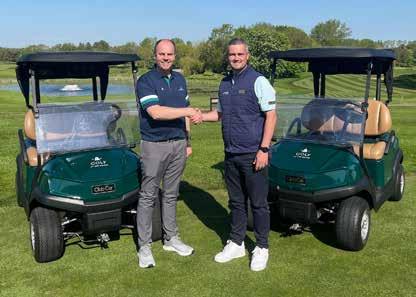
Club Car, global industry-leading manufacturer of small-wheel, zero-emissions electric vehicles, has extended its long-term relationship with The Belfry Hotel & Resort.
The prestigious English resort has received 40 new Club Car Tempo golf vehicles to complement the 80-strong fleet used across its three courses.
“We’ve seen an immediate difference,” said Tom Hughes, The Belfry’s Head of Golf.
“A real benefit of these new cars is the lithium battery. The ability to not only have 120 buggies but to be able to double-rent them on busy days is a real game changer.
“The new dash design is excellent. The little additions and improvements, such as having a slot to stand your phone in, make a real difference to the golfer.
“Having worked with Club Car for over 25 years, we know we can trust the vehicles. The after-sales service is brilliant, and knowing we can guarantee the quality our customers
expect is one of the reasons we continue to choose Club Car.”
The Club Car Tempo delivers outstanding hill-climbing power and acceleration, and has many
customisable options including colour, seats, storage, wheels and programmable drive modes to maximise performance. n www.clubcar.com
SIS Pitches’ advanced sports pitch technology has been in action on football’s biggest global stage this summer, contributing to highperformance playing surfaces across nine of the 16 host stadiums at the 2026 World Cup in the United States, Canada and Mexico, including the venue for the final.
This summer’s tournament saw 48 teams compete across a diverse range of climates and venues in the three host
“THIS BUILDS ON TWO DECADES OF INVOLVEMENT IN THE WORLD CUP WHICH FIRST SAW SIS PITCHES’ TECHNOLOGY USED AT THE 2006 TOURNAMENT IN GERMANY”
nations. SIS Pitches’ technology played a crucial role in maintaining consistent, world-class playing conditions throughout the tournament, despite the potential for extreme weather and the demands of an expanded fixture schedule.
The UK-headquartered sports pitches specialist contributed different combinations of its SIS Grass Hybrid reinforced turf system, and subsurface drainage and aeration systems to nine of the host venues, one of which had its full pitch constructed by the company last summer.
This builds on two decades of involvement in the World Cup which first saw SIS Pitches’ technology used at the 2006 tournament in Germany and has been featured more recently in both Russia and Qatar.
SIS Grass Hybrid is in action at stadiums in San Francisco, Miami, Kansas City, Toronto, Monterrey and host for the final, the New York New Jersey Stadium. The hybrid system sees synthetic fibres stitched into the surface across the entire field to provide increased durability enhanced root growth. This will help
each hybrid pitch recover and perform consistently across different climates and grass types.
SIS Pitches’ DrainTalent system has being used in Guadalajara, Seattle and Vancouver. Importantly the system provides vacuum drainage to extract quickly excess water from the pitch in storm conditions to avoid delays or disruption to play.
“Seeing our technology present at nine of the 16 stadiums being used this summer has been a huge moment for SIS Pitches and a reflection of the reputation it has around the globe,” said Ivo Lamot, CEO at SIS Pitches.
“Having been involved in the previous two tournaments in Russia and Qatar, we understand how important it is that our technology works alongside that of other partners to ensure each pitch system performs as intended.
“For this tournament in particular, expert grounds teams and the best companies in the industry came together to transform multi-use NFL and MLS venues into high-quality hybrid surfaces for the world’s best players.”




Scott MacCallum made the trip over the Holland to visit SGL and see where the birth of grow lights took place. He came away smelling of roses.

ack in the late 1990s, following the emergence of many superb all-enclosed stadia, we got used to the sight of pitches not living up to their new surroundings. They were tearing up following sliding tackles or completely folding up under the pressure of scrums. Indeed, it was often being built into maintenance budgets that the pitches would be relaid at least twice a season.
It dawned on people, not the groundsmen I hasten to add, that it is exceedingly difficult to grow grass under such circumstances. The main purpose of a stadium – to host turf-based sporting events – had not being considered in the rush to ensure sufficient corporate boxes and the requirement to have as many commercial opportunities to offer sponsors as possible. It seems remarkable but was unfortunately true.
Many of the finest agronomic brains on the planet were testing shade resistant grass varieties or looking into the logistics of moving pitches in and
out of the stadia themselves.
Around the same time Nico van Vuuren, a rose grower based an hour and a half out of Amsterdam, was walking past one of his massive greenhouses when he noticed that the grass just outside was growing far better than that slightly further away.
This puzzled him until he realised that it must be down to the lighting that was inside the greenhouse helping to boost the growth of his roses.
He was quoted as saying: “How could it be that I was able to grow thousands of roses a day even during the dark Dutch winters, but the grass in soccer stadiums struggling
to survive?” He was soon to come to his conclusion. And so, in 1997, SGL was formed. Initially in a very small way. The first employee, fresh out of university, was Frank van Beusekom, who was told that the job may not amount to anything as it was very much the early days and Nico’s hunch might not prove to be accurate or indeed financially viable.
“Nico decided to turn it into a company, and he hired me. I was just a business student looking for a part time job at the time, so I didn’t mind when Nico told me it could fail within six months, because I don’t know whether it would work either,” recalled
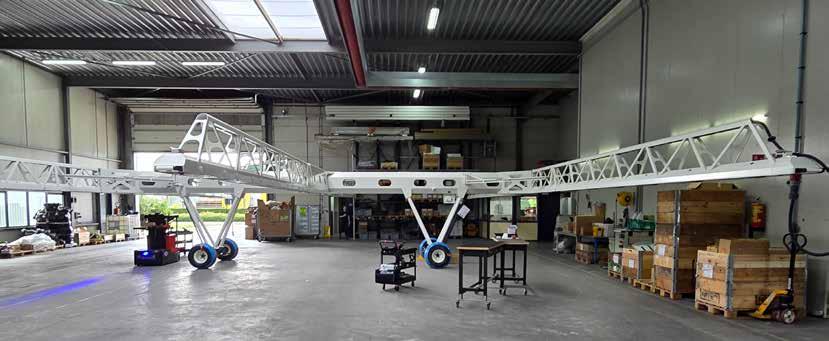
Frank. Shoot forward 29 years and Frank is now Managing Director, the company has over 90 staff, it has grow lights in over 650 stadiums and venues, on six continents and embraces 12 different sports.
Those grow lights have developed to the extent that they have moved on from the initial HPS bulbs to LED which brings increased efficiency while it has been established that different coloured bulbs each bring their own qualities.
For example, red light is most effective for photosynthesis, while a small amount of blue supports root development. So, the SGL Signature Spectrum is 95% red and 5% blue and this is recommended to 90% to 95% of customers.
Research into LED started in 2010 and by 2021 it was matching HPS quality but with greater efficiency and, as of 2026, no orders have been taken for HPS based lighting rigs, in
BUT THE COMPANY IS NOW SO MUCH MORE THAN GROW LIGHTS. DATA MONITORING, DISEASE MANAGEMENT AND PITCH PERFORMANCE TESTING HAS BEEN ADDED TO SGL’S SERVICES.
two years But the company is now so much more than grow lights. Data monitoring, disease management and pitch performance testing has been added to SGL’s services. They have a team of agronomic experts on hand to support grounds teams worldwide, as part of the SGL ecosystem.
The development of robots delivering light based sustenance to target areas of pitches or on golf courses is well advanced and research into adding sensors or brushes to the robots – but not cutting units – is being carried out.
Our visit not only took in SGL, but also gicom, the metal fabrication company an hour away, which constructs all the lighting rigs which are subsequently shipped all around the world.
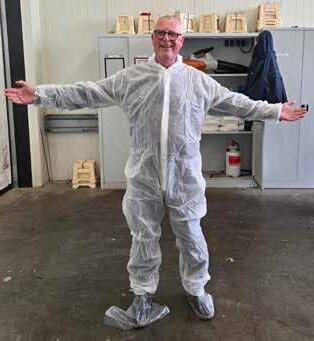
We also have the opportunity to visit Porta Nova, which sits close to the SGL HQ where it all began and Nico’s greenhouses and rose growing company. With 750,000 roses in one giant greenhouse at any one time , and three greenhouses in total, growing 70 million roses a year, it is an astonishing facility. The factory-style rose selection and packaging facility it is also remarkable – the sight of thousands of roses travelling down conveyor belts matched only by the magnificent smell.
The previous night we had dined in a fantastic, and historic, Amsterdam restaurant, where we sat at an old table on chairs which carried small plaques noting the names of the notable who had once sat on them.
Alongside me had been a chair once enjoyed by Bruce Springsteen, Mick Jagger and David Cameron. Opposite me had once been Vera Lynne, while I was sitting exactly where Henry Ford had enjoyed a meal.
I say this because Henry was famous for saying that you could have one of his cars in any colour you liked, so long as it was black. In the rose facility, they had once also produced white roses, but now it is a case of you could have any colour you liked, so long as it is red.
But with roses, what better colour could there be?
Getting back to the lighting rigs. Fittingly the first trials were held in 2002 at The Stadium of Light, the home ground to Sunderland Football Club in the north east of England, and two years later PSV Eindhoven became SGL’s first customer whose manager at the time, the legendary Guus Hiddink, declared that “top players deserve a top pitch”.
Four years later Arsenal, under Arsene Wenger, followed and the SGL
client list was beginning to take on a prestige look.
Since then that list has expanded, but not lost that quality, and over 650 customers rely on the lighting rigs and turf solutions provided by SGL. Indeed they have been on every FIFA World Cup finals pitch since 2010, including the 16 venues (in 12 different climates) of the 2026 USA, Canada and Mexico event.
The difficulty in 2026 is that half of the stadiums have transitioned from artificial to natural turf and eight out of the 16 have roofs. All the time same standards were expected for every match.
I came away having witnessed how one man’s intuition in an industry far away from that of giant modern stadiums has grown into a not just a single solution in the shape of grow lights, but much more more.
My thanks to SGL for opening their doors to us and for showing us such wonderful Dutch hospitality.




‘I’ll
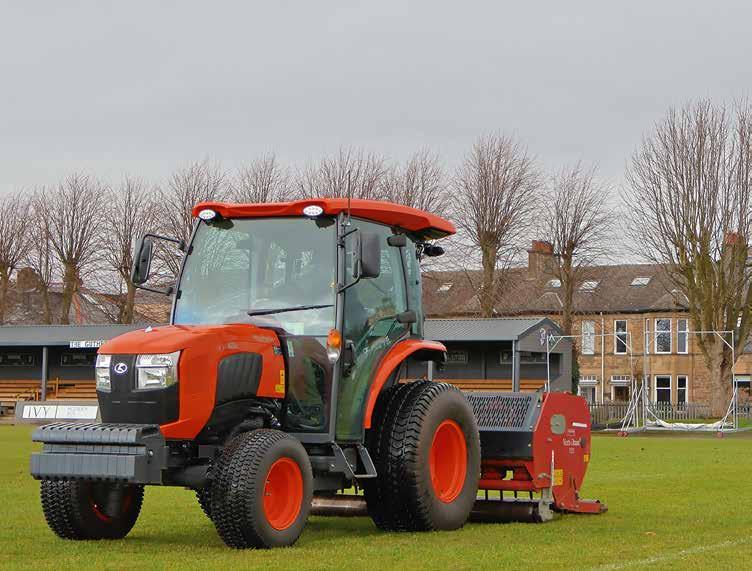
Since Robert Cheape joined The Glasgow Academy in 1985, the school and accompanying sports grounds have expanded significantly.
His tenure as Head Groundsman has been underpinned by a longstanding partnership with dealers, Hamilton Ross Group, and much of the success he has attributed to the reliability and versatility delivered by Kubota tractors in use at the grounds for over 30 years.
Founded in 1845, The Glasgow Academy is the oldest continuously fully independent school in Glasgow, now providing a private coeducational day school for 1700 pupils. The school is renowned for its sporting prowess – with rugby and hockey played by both the students and Glasgow Accies Sports club in the winter months, then switching to primarily cricket, tennis and athletics during the summer.
Working alongside Robert on the maintenance of the natural turf and artificial surfaces is a busy team of six, with three of the staff having over 120 years of service between them.
“With sport played daily, we rely heavily on having the right, reliable
equipment to produce pitches that can withstand the pressure of constant wear,” said Robert.
For more than three decades, powering that maintenance operation has been Kubota.
“In the shed we have a Kubota B1550 from the early 1990s which still runs and is used for lighter jobs around the sites, a B2650 and, more recently, we added an L2622 to the fleet.
“While we can see the improvements and things like the controls and operator-friendliness has moved on they’re still, fundamentally, well-built, comfortable, reliable workhorses. For that reason, I’ll never use anything else,” he added.
The L2622 delivered in August 2025 brings increased power and productivity, featuring a 61hp stage-V diesel engine and the highest rear lift capacity in its class.
“With time of the essence, we found we were relying on larger, more power-hungry implements and the L2622 has proven the perfect partner for implements such as our VertiDrain – which we’re increasingly relying on with the more regular
periods of prolonged and heavy rainfall.”
“We also run a Kubota RTV-X1110 which is another reliable runaround, towing smaller equipment and getting people and tools around the sites quickly and safely.”
Reliability for Robert extends beyond the machines themselves, with Kubota he also has the added peace of mind of first-class dealer support from the team at Hamilton Ross Group.
“I’ve dealt with Paul Denholm since 1990 and the school’s relationship with Hamilton’s began even before that! We just know that if we need anything, from a simple advice call or a service visit, that they’ll be there to look after us. That sort of service goes a long way.”
THREE OF THE STAFF HAVING OVER 120 YEARS OF SERVICE BETWEEN THEM
Available from KAR UK, the MCC Renovation season at Leyland Golf Club has delivered impressive results following the investment in a V-Strong from GKB Machines.
Installed in February 2026 by Balmers GM, the club’s first in-house scarifier quickly proved its worth surpassing the expectations of Head Greenkeeper John Edge – enabling him and the team to cover significantly more ground, with even better results, than ever previously achieved.
John has been at the 18-hole parkland course for the last two years, joining the club in its celebratory centenary year. Looking to deliver the consistent playing conditions expected by the 600 members, John immediately reviewed the maintenance and renovation programme, swiftly bringing in a contractor to give the greens a kick-start in the spring of 2024.
“I’ve used various makes and models of scarifier previously, but this contractor came in with the GKB V-Strong and it blew me away,” said John.
“Firstly, the speed at which it covered the greens was seriously impressive. But it wasn’t just speed, it was the fact that it simultaneously picked up so well. It got the job done efficiently and

effectively and left the greens clean and ready for play almost immediately.”
Featuring GKB’s unique CombiRotor and heavy-duty steel blades, the V-Strong makes light work of scarifying golf greens and other sports surfaces – removing lateral growth and organic matter to depths of up to 40mm. After two further visits from the contractor, John was sold on having a V-Strong in his own machinery armoury.
“The results spoke for themselves, and the General Manager and Chairman were both on board with us making the investment. We also received fantastic support from Dan
Whalley and Andrew Meeks, at Balmers, who got the team primed and ready for the upcoming renovation window.”
And it’s fair to say, the anticipation was matched by impressive in-field performance!
“We renovated all 18 greens at the start of April and, due to the speed of operation with the V-Strong, we actually managed to do all the approaches as well – getting the whole lot scarified in one day. We found we didn’t need to follow the machine with blowers because the pick-up was so good and, within a week, all the renovated areas were back in play. We knew the machine was good, but it truly did exceed our expectations,” John explained.
“Having our own machine will give us the flexibility to conduct scarification more frequently, and in the optimum windows for recovery –no longer limited by cost or contractor availability. We can spend a bit of time educating the team on the reasons why we scarify and transfer those benefits to other areas, such as the approaches, which we’ve previously not had the resources to scarify.”
“There’s no doubt in our minds that, with this machine, we’ll quickly reap the benefits in terms of both plant health and player satisfaction.”
Founded in 1887, Coventry Golf Club is a prestigious parkland course set within 140 acres of scenic Warwickshire countryside.
Known for its fast-growing grass on clay-based soil, Course Manager Joel Chappell needed a mower that could keep up with the demanding
maintenance schedule. “Our previous rough mowers were costly to maintain and couldn’t handle the workload,” Joel explained. “With how fast the rough grows, we’re mowing almost daily – so reliability and efficiency were critical.”
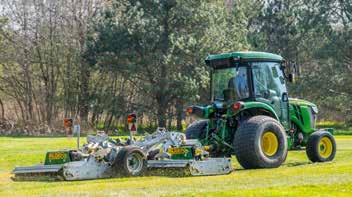
After thorough research, Joel’s team selected the Major Contoura MJ76-360, replacing their aging equipment.
“Last season we spent £13,000 just to keep a rough mower running. For £60,000, we got a new Contoura, plus a tractor. It made financial sense.”
Cutting the rough at 45mm, Joel praised the mower’s ease of adjustment and productivity.
“The Contoura gives a clean, sharp cut across all grass types. We mow at seven to eight mph and cover around ten acres an hour.”
Key features of the Contoura include a 3.6m cutting width, pivoting decks and full-width rollers for professional
striping. The robust gearbox driveline ensures consistent power.
“We looked at other models, but belt-driven mowers just didn’t offer the same dependability we get with the Contoura’s driveline,” he added.
Durability was another key factor. Built from Strenx™ 700MC highstrength steel and hot-dip galvanised for rust protection, the Contoura comes with a three-year warranty.
“We mow near trees and hazards, so we need something tough. The galvanised finish gives us peace of mind.”
The smooth buying process and fast two-week delivery from local dealer Farol sealed the deal. “It ticks all the boxes with its solid build, great cutting and excellent reliability. Choosing the Contoura was absolutely the right decision,” Joel concluded.
n www.major-equipment.com


From earthmoving and tree care to landscaping and turf management, balancing the many demands of maintaining outdoor spaces can be a constant challenge for grounds care workers.
With increasing pressure to deliver standards of maintenance with a limited number of helping hands, having dependable, versatile machinery has become essential in modern grounds maintenance.
To carry out grounds care jobs more easily, faster and more productively, grounds keepers, landscapers and maintenance professionals have increasingly invested in a machine that can tackle many tasks – the compact multifunctional loader.
A compact multifunctional loader is a highly-manoeuvrable piece of
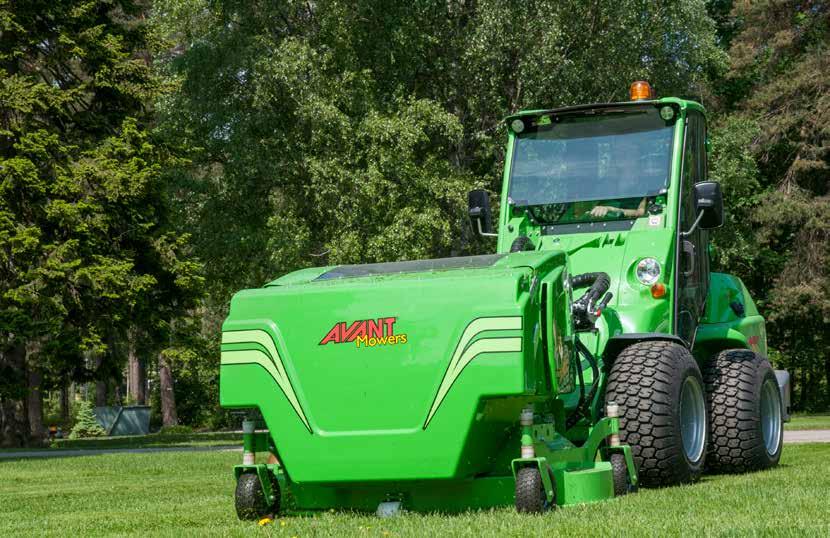
WITH OVER 200 ATTACHMENTS TAILORED TO ALMOST ANY TASK, AVANT LOADERS HAVE BECOME A STRONG CHOICE FOR VERSATILITY.
machinery that acts as an all-in-one tool for a wide range of tasks.
Compact in size but impressive in power, multifunctional loaders feature quick-attach hydraulic connectors, allowing a machine’s attachment and function to be seamlessly interchanged throughout a working day.
As pioneers of the compact multifunctional loader, Avant Tecno have been helping transform the day-to-day operation of grounds care professionals since 1991.
Avant Tecno are the Finnishbased manufacturer of compact multifunctional loaders, operating in more than 70 countries worldwide.
Present in the UK since 1994, Avant have supplied over 6,000 loaders to businesses across Britain and Ireland.
Today, Avant’s nationwide network of over 20 dealers provides grounds care professionals with access to machinery renowned for its flexibility, build quality and class-leading efficiency.
With over 200 attachments tailored to almost any task, Avant loaders have become a strong choice for versatility. Their unique multi-connector system makes fitting and removing attachments a one-person job.
Attachments can help with tasks including:
• Earthmoving
• Lawn care and mowing
• Hedge and tree maintenance
• Digging and excavating
• Site cleaning and sweeping
• Material handling and lifting.
As a result, Avant loaders are widely used across the UK for maintaining green spaces, sports pitches, golf courses, estates, parks and commercial properties.
Sustainability has not only become a key responsibility for UK businesses but an economic necessity.
To meet these sustainability challenges, Avant Tecno have been investing huge amounts of time, money and expertise in delivering sustainable solutions which not only reduce energy use but increase operational benefits.
Avant’s electric range includes the established e500-series and the new e700-series, delivering performance comparable to diesel-powered alternatives but without engine emissions and with significantly reduced noise levels.
As their latest addition to the electric fleet, the e700-series raises performance to a new level, blending the latest sustainable technology with the ruggedness and versatility the brand has become synonymous with.
The e700 sits alongside Avant’s conventionally-powered 700-series – their second largest model of multifunctional loaders, aimed at professionals who need a compact but capable companion.

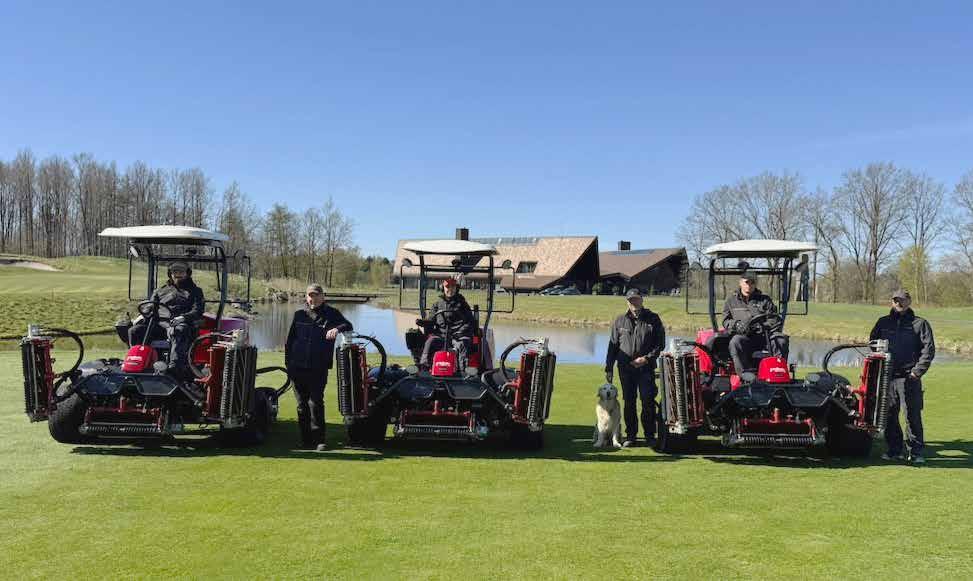
After more than two decades at The Scandinavian Golf Club, Course Manager Russell Anderson knows exactly what is needed from the team and their equipment to maintain renowned high standards across two 18-hole courses.
High on their machinery ‘musthaves’ are reliability and consistency which, when the time came to replace their existing mower fleet, prompted the purchase of four LM551B fairway mowers from Baroness.
As the only golf destination in continental Europe with both courses ranked among the Top 50, expectations at the Danish venue are great and the presentation and playability achieved by Russell and his team of 18 is nothing short of world-class.
After years of purchasing equipment in package deals, the club decided it was time to change tact and open the door to all manufacturers - what followed was extensive research and testing for new fairway mowers.
“We invited all major brands to come in and demonstrate some options
and we looked at various aspects including cut performance, build quality, operator comfort, maintenance demands and the dealer support” explained Russell.
“The liking for the LM551B’s from Baroness was universal, including a big thumbs up from my mechanic which was a big factor in us making our decision to purchase four mowers which were delivered in early April 2026.
“Both the build quality and cut quality is superb. We knew this is what Baroness was renowned for, but still, it has been impressive to see this first hand. The LM551B’s cut all the fairways on one course each day and leave an immaculately clean finish after every pass to the admiration of the operators and players alike.”
Ticking the box for cut quality, the investment has also addressed previous issues with downtime and costly repairs.
“The simplicity and robustness of the Baroness mowers really stood out, there’s just less to go wrong which means more time in the field and
less time costing us money in the workshop.”
“We must also praise the patience and support from Lasse Lindholm at dealers Lindholm Maskiner. The decision took quite a number of months and Lasse never put pressure on us and always took the time to answer any extra questions we had,” Russell added.
In addition to the four mowers, the club also took delivery of a Baroness FS900 sweeper for post-renovation clean-up, which has also quickly left a lasting impression! “This is another fantastic, productive piece of equipment, we’ve been extremely happy with it.”
For Russell, the move to Baroness has delivered exactly what The Scandinavian Golf Club was searching for: premium cut quality, dependable performance, happier mechanics and lower long-term maintenance concerns.
“Changing brands always comes with an element of trepidation but opting for the Baroness machines has been a very positive experience for us all round.”




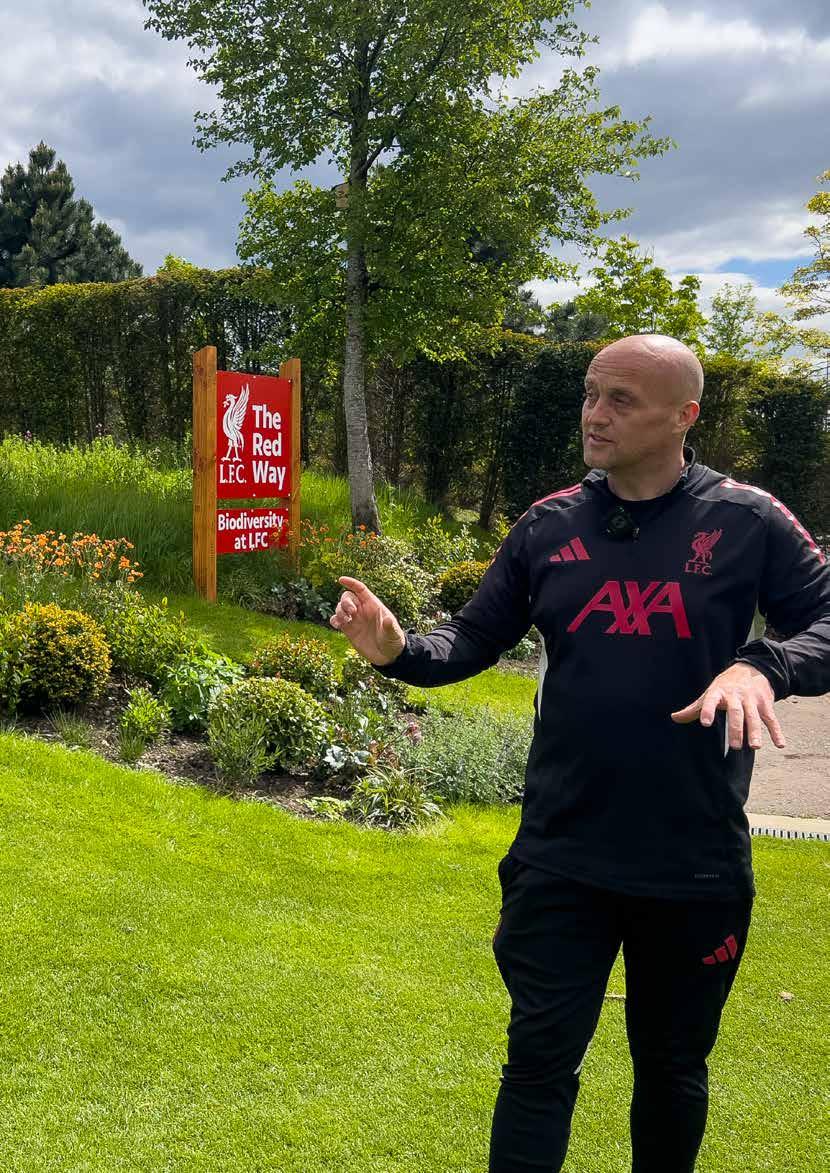
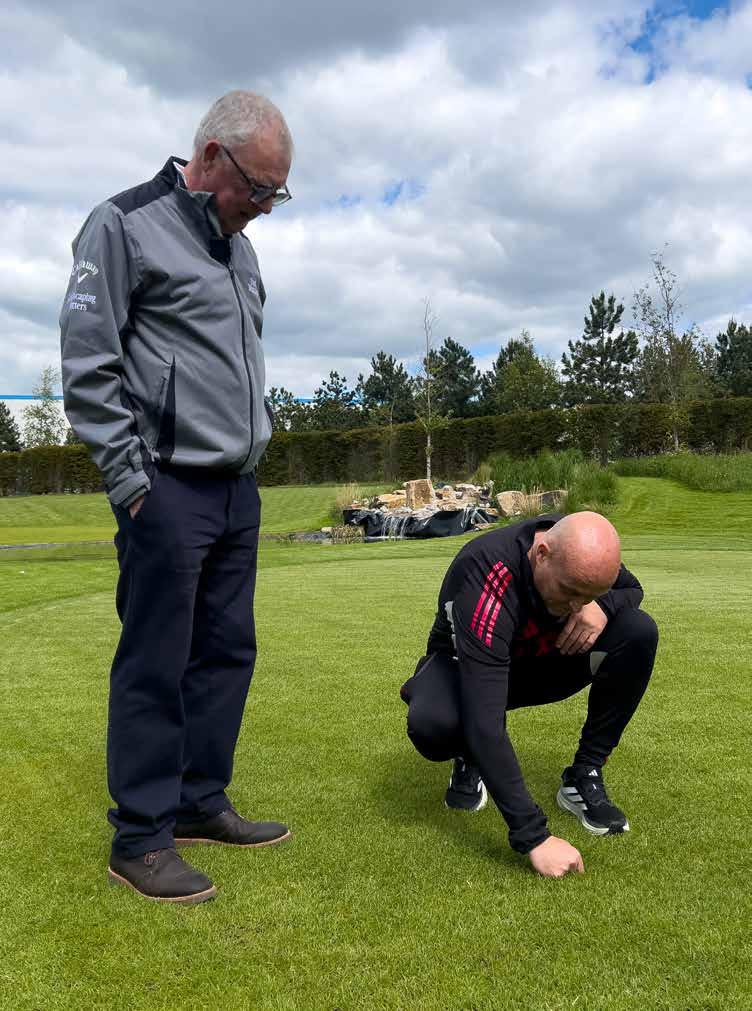
Scott MacCallum was afforded the opportunity to visit the AXA Training Centre, Liverpool FC’s training base in the company of Director of Grounds, Warren Scott. What he found was quite remarkable…
IT IS FAIR TO SAY THAT FOR WARREN AND IS TEAM THE JOB HAS MOVED A LONG WAY FROM MERELY CUTTING GRASS, MARKING OUT PITCHES AND ERECTING GOAL POSTS. THE RANGE OF WORK THAT THE GROUNDS TEAM
CARRIES OUT WOULD AMAZE ANY
Irecently enjoyed a visit where, among other things, we talked about the planting of over 1,000 trees, the acquisition of bee hives, an allotment, wild flower meadows and aspirations to be full carbon neutral by 2040.
You’d probably expect me to say that I’d been to one of the Royal Parks, or a grand estate somewhere in middle England, or perhaps a particularly progressive golf club.
So, what would you think if I told you that it was a Premier League training ground? But not just any training ground. This was, at the time of the visit if not the time of writing, the reigning Champions – Liverpool FC, and their award-winning AXA Training Centre.
MANAGER FROM A PREVIOUS GENERATION t
Director of Grounds, Warren Scott and his amazing team, have turned the Centre, in the Kirkby district of the city, into a sanctuary for all sorts of flora and fauna, while at the same time providing the Liverpool players with a day-to-day workplace that is a pleasure to attend.
They also collected the GMA’s Environmental and Sustainability Award at the recent ceremony at Edgbaston Cricket Ground.
It is fair to say that for Warren and is team the job has moved a long way from merely cutting grass, marking out pitches and erecting goal posts.
The range of work that the grounds team now carries out would amaze any football grounds manager from a previous generation. That said, all of
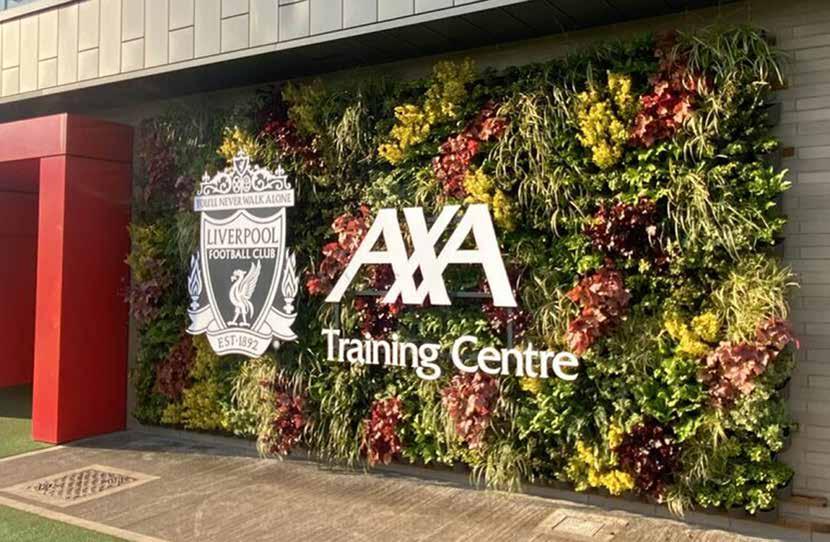
the tasks, whether it be maintaining the living wall outside of the main building – see photograph above – to looking after the tricky par-3 golf hole, are there for the greater good and to benefit mindfulness of players and staff alike.
And, important to note, the core purpose of a training centre which is to provide quality surfaces for multimillion pound players train on every day has never been forgotten. Indeed, quality has risen while at the same time, through a detailed data driven approach to turf maintenance, the costs have halved in the six years since the AXA opened.
“That comes from figures taken from our last year at Melwood and even takes into account for inflation,”
revealed Warren, talking about the previous training centre a few miles away and which is now home to the Liverpool Women’s team and academy.
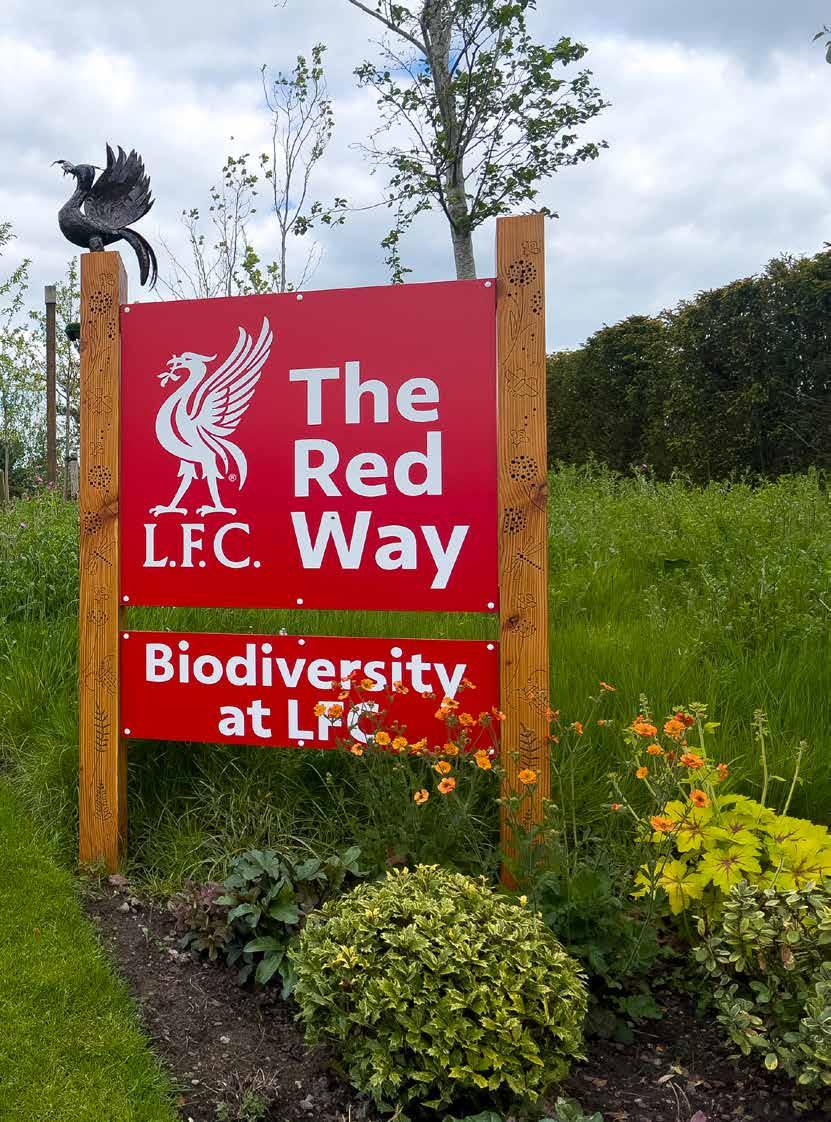
The drive to be more sustainable and eco-friendly is not just the preserve of Warren and the team. It is part of The Red Way which was launched in January 2021 as a way of tying together the good work across the entire club and providing a benchmark to measure and demonstrate progress.
There are six objectives within The Red Way, covering not just environmental sustainability but also cover improving working environments and building relationships within the local community.
“This gives us clear aims for what we want to achieve. And we are committed to continual improvement. This is why we use an external verification system – ISO20121 – to hold us to account. We are the first major European football club to hold this certification,” said Warren.
Warren is a real driving force for a large part of the work that has been carried out. But it was not always such. While not having to be dragged kicking and screaming into a more diverse approach, he does admit that in the early days he was much more focussed on the pitch than the other areas that are now such an important element of the AXA.
“I love it all now and see the importance of everything that we do and it is great for the team that there is so much variety in the daily work that we do.”
The Liverpool grounds team is substantial, given the size of the facilities they maintain. Even the AXA itself is split into two, with the first team on one side of the site and the academy on the other.
There are 10 staff on the first team side and 11 on the academy side, seven at the women’s training ground. Then there are five at Anfield itself and one at St Helen’s Park, where the women play their matches.
Jurgen Klopp was the manager when the AXA was being developed and built and he was very keen to include Paddle courts and for everyone on the Liverpool staff, including himself and players, to play.
“We used to have a beach volleyball court as well,” said Warren, who is particularly proud of the golf hole the team has built in the last couple of years.
“Although it’s only 90 yards long it is a tough hole. There is a pond in front of the green and it does catch a
JUST BEHIND THE TEE IS A WILD FLOWER MEADOW AND THEIR ORCHARD, WHICH INCLUDES A SELECTION OF TREE VARIETIES.
lot of balls. So far there has been one hole-in-one, but he was playing on his own so there were no witnesses!” said Warren, adding that they are currently considering where best to add a bunker to add to the difficulty.
Having been afforded the chance to replicate the hole-in-one I’d also rather there had been no witnesses to my feeble efforts.
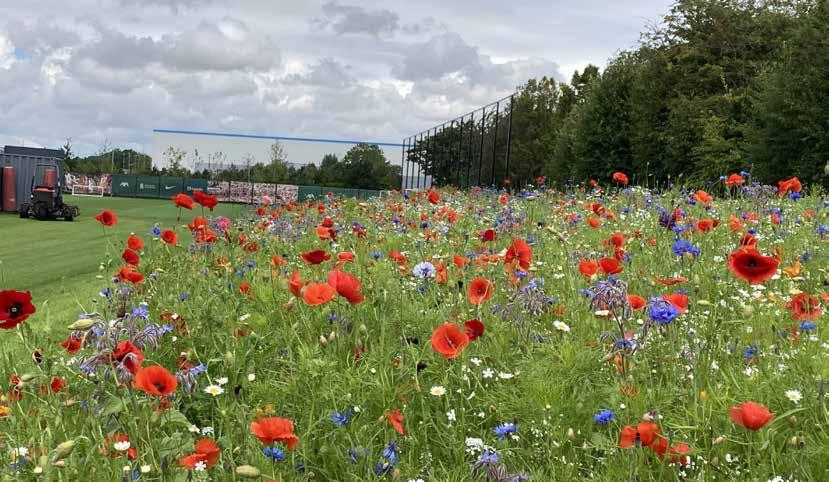
Just behind the tee is a wild flower meadow and their orchard, which includes a selection of tree varieties.
“We have apple, cooking apples, plum, pear, and cherry and it will be about five or six years until they’re fully taken and we start to produce large amounts of fruit. Ultimately, we’d like to produce our own cider.”
They are going to bring the club bees down from their allotments to pollinate the fruit trees.
“We’ve now got 12 trained beekeepers in the club,” explained Warren, as we drove around the site in a buggy which originally carried the numberplate “Klopp One”.
“It was donated by one of our suppliers but Jurgen always preferred to walk rather than go in his buggy so it is now ‘Groundsman One’.”
“There are not too many differences in the sports. It’s about looking after grass after all, and there’s a lot of similarities in how we maintain it and what we’re analysing.
That said there is still a place for the good old experience and intuition, and Warren is very adept with his cultured right foot.
“I kick every bit of grass I come across because it tells me how it’s going to play – how much nutrient in the leaf. If it tears easily, I know it’s too soft and I would need to see how many nutrients are in it. It also tells me If there is a lot of organic matter.”
But when it came to data collection it produced a welcome biproduct – it saved money!
“What we found was, if you analyse the leaf tissue enough, some of the times we were found we had to reduce inputs because we had already had too much in the plant. That’s where we were able to make reductions and save some money.
“We are also using less fungicide which is another saving. You have to be extremely open-minded as to what’s possible and what might not be.
“I’ll always ask questions. It’s not that I don’t believe people, it’s just I think as an industry we can be influenced by the person who is selling you a bag of fertiliser and you end up putting on more than you need.
“If you use data, together with your own experience you can avoid falling into those traps,” said Warren, who credits much of his success to his first boss when he started at the Liverpool Academy.
“Neil Holden was a former England Rugby League player. He was very much ahead of his time and 30% of what I do today is what learned from him.” With players now multi million pound assets and injury something that can cost a club trophies or titles,
“YOU
there is a great deal of pressure on grounds teams to provide surfaces which are to the liking of the coaches and medical teams.
“I have found over the years that the best thing is just be honest with them because as soon as you say that it’s not hard or it’s not soft you’ve opened yourself up.
“What, we do is provide the coaches and medical teams with the data and let them decide what they want, rather than have us make those decisions.”
But despite everything perfection is something that is not always achievable.
“You can’t make pitches perfect all year round. The weather controls a lot of what you can or can’t do and it’s not always possible to get out and work on them.”
With such a big team, communication is vitally important and there are monthly management meetings as well as regular weekly workshops with all the teams.
“That’s the opportunity for them
OF WHAT YOU CAN OR CAN’T DO…”
to suggest their ideas which are then brought in to the managers’ meeting. We discuss them all and depending on what budget we’ve got we make the decision on whether to implement them. Some of the best ideas come from the younger members of the team which is great.”
One of the other major features of the AXA Training Centre is the living wall which sits on the side of the main building.
“People absolutely love it. There are 872 plants in the wall and each one is in its own pot and they are watered by a pipe which runs straight up to the top and waters them all at the same time.”
One of the benefits of moving to a new facility is that you can influence how things are done and this is very much the case with the on-site AXA Maintenance Facility.
“It was built just exactly how we wanted it. We sat down with the developers and explained what we needed and how we’d like it to be. For
example you need an area for fertiliser storage. That was a big one. We didn’t really want that in the building where all the machines were going to be stored so we have fertiliser and chemical storage outside.
Looking forward Warren is relaxed.
“I’m not big on targets because things change regularly. I’ve never been, I’m not into KPIs. All I say is we’ve got a big enough team and we just keep coming up with ideas , and being better year on year. We using our data to look at what we did one year and how we might improve for the next.”
The AXA Training Centre is a remarkable place and a far cry from a changing room and a few wind swept natural pitches which acted as the training facilities for so many teams just a few years ago and are still in place for quite a few now.
Warren and his team do a remarkable job of looking after such a special place while at the same time acquired a whole new set of skills.

For nearly seven decades, White Horse Contractors has built a reputation rooted in expertise, innovation, and trusted partnerships. Established in 1957 in the Vale of the White Horse in Oxfordshire, the company has evolved from its foundations in soil and water engineering into one of the UK’s leading specialists in sports turf construction and hybrid surface technology.
Throughout its history, White Horse Contractors has remained committed to a simple principle: Understanding clients’ individual requirements and delivering bespoke solutions designed around their needs. That approach has enabled the business to consistently excel within its traditional heartland of agricultural drainage and irrigation while successfully applying its specialist knowledge across the sports, leisure, amenity, and environmental sectors.
The company entered a new chapter in March 2019 following its acquisition and incorporation into The Slatter Group. Since then, White Horse Contractors has continued to strengthen its position within the sports turf industry, embracing innovation and expanding its capabilities for an increasingly demanding market.
As elite sport continues to demand higher-performing and more resilient playing surfaces, hybrid technology has become a game changer. White Horse Contractors has established itself at the forefront of this evolution, constructing and installing next-generation hybrid surfaces for clients across the sporting spectrum.
Working alongside specialist partner GrassMaster Solutions, which brings more than 25 years of experience in hybrid turf technology, the company has delivered projects for some of the country’s most recognised sporting organisations.
Professional football clubs including Tottenham Hotspur FC, AFC Bournemouth, Portsmouth FC, Queens Park Rangers FC, Charlton Athletic FC and Millwall FC have all benefited from White Horse Contractors’ expertise in creating high-performance stadium and training ground surfaces designed to withstand the demands of elite sport.
The company’s expertise has also made a significant impact within rugby union. One notable project saw White Horse Contractors reconstruct The Stoop, home of Harlequins, introducing a hybrid playing surface for the first time in the club’s history. The result was a more consistent and durable surface capable of maintaining performance standards throughout the season.

Importantly, White Horse Contractors’ involvement does not end once a surface is installed. The business has developed extensive expertise in the renovation and maintenance of hybrid playing systems during the off-season, supporting clubs including Luton Town FC, Watford FC, Portsmouth FC, Brighton & Hove Albion FC, Bath Rugby, and Harlequins in preserving surface quality year after year.
Hybrid technology is no longer reserved solely for professional sport. White Horse Contractors and GrassMaster Solutions have played an important role in introducing elite-level performance surfaces into the independent school sector.
In 2021, Whitgift School became the first public school in the UK to install a hybrid rugby pitch, marking a significant milestone for educational sports facilities. Building on that success, the partnership introduced its first hybrid cricket squares in spring 2024 at another leading independent school in London, helping bring new levels of durability and consistency to cricket surfaces.
The relationship with Whitgift continued in 2025, with White Horse Contractors
returning to construct a hybrid football pitch. As the technology evolves, the company continues to explore opportunities across additional sports where enhanced durability and greater playing consistency can deliver long-term benefits.
White Horse Contractors’ experience extends across a diverse portfolio of flagship sports projects throughout the UK. From the Alexander Stadium, which hosted the Commonwealth Games, to professional football clubs, polo venues, and leading educational institutions including Guards Polo Club, Eton College, and Whitgift School, the company has consistently delivered high-profile projects with precision and professionalism.
Operating within the often-unforgiving constraints of sporting calendars requires careful planning, flexibility, and efficiency. Managing deadlines, budgets, and seasonal demands has become a core strength of the business and a key factor in the long-term success of its clients.
Continued investment has been central to White Horse Contractors’ growth strategy. The company has developed a modern fleet of specialist plant and equipment specifically designed for both natural and hybrid sports turf construction and renovation.
Supported by a highly skilled and professionally qualified workforce, White Horse Contractors has also established itself as an industry pioneer in machinery development, designing specialist equipment that reduces waste and minimises environmental impact while improving operational efficiency.
So what defines the ideal project partner from conception through to completion? For White Horse Contractors, the answer lies in collaboration. Whether supporting elite professional clubs, amateur sports organisations, local authorities, independent schools, or private clients, the company focuses on developing tailored solutions that transform individual visions into reality. It is a philosophy that has shaped the business for almost 70 years and one that continues to underpin every project delivered today.
Constructed with Integrity is more than a company motto – it is the principle that continues to drive White Horse Contractors forward.
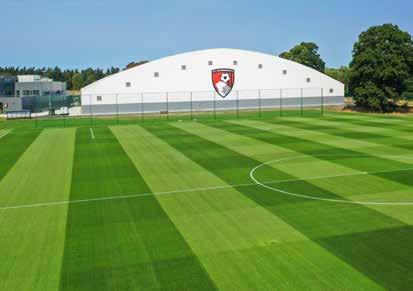
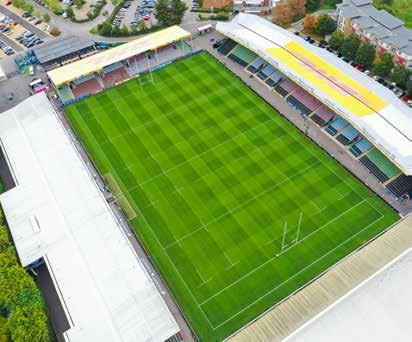


Maintaining high-quality natural grass tennis courts is no easy task, particularly when they are expected to withstand weeks of intensive play during a packed summer schedule.
At Rye Lawn Tennis Club in East Sussex, Head Groundsman Adam Stunt has spent the past 16 years ensuring the club’s eight grass courts remain among the finest in the region and MM50 grass seed plays a key role in that success.
Founded in 1922, Rye Lawn Tennis Club boasts a diverse range of facilities, including eight grass courts, three artificial clay courts, two padel courts, squash courts, a croquet lawn and a gym. However, it is the club’s renowned grass courts that continue to attract praise from players and visitors alike.
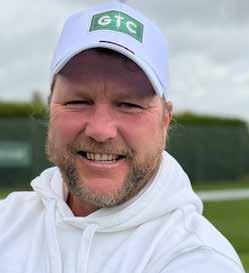
According to Adam, the transformation in the quality of the playing surfaces began around 15 years ago when the courts were laser levelled and a greater emphasis was placed on court preparation and maintenance.
“The club has always hosted a major open tournament at the end of the summer,” he said. “Years ago, some of the feedback from players wasn’t particularly great because they were playing at clubs with higher-quality surfaces. Since the courts were laser levelled and more focus was put on maintenance, that has completely changed. Most people who play here now feel the
standard of the grass courts is right up there.”
Central to that maintenance programme is MM50, a specialist perennial ryegrass mixture.
“It’s what we’ve used for the entire time I’ve been here,” said Adam. “It’s something that we massively respect and rely on because of the quality of the seed and the results that we get year after year.”
MM50 delivers a fine-textured, hardwearing sward with excellent shoot density, close-mowing tolerance and rapid recovery from wear. The mixture is treated with Headstart® GOLD, helping to promote fast establishment and strong early growth.
For Adam, the speed of germination remains one of the product’s standout features. “That is something that’s always amazed me,” he said. “The speed at which germination happens is unbelievable. The quickest I’ve had over the years is about five days from seed going in. Obviously that’s not full growth, but you’re definitely seeing it sprouting. It’s something we really can’t fault.”
Each autumn, following the playing season, Rye Lawn Tennis Club undertakes a comprehensive renovation programme across all eight courts. Depending on conditions and requirements, this may involve fraise mowing or more intensive Koro renovation work to remove accumulated thatch and organic matter before reseeding.
Adam’s maintenance programme continues throughout the winter with regular mowing and nutrition applications to maintain plant health. As spring arrives, Adam carries out a further overseeding programme using MM50 to ensure maximum density heading into the
playing season. “When weather allows, usually around the middle of April, we’ll overseed again at a lighter rate, apply a light top dressing and some fertiliser, and then let it come through before the season starts.”
The demands placed on the courts are significant. During the club’s annual open tournament and associated tennis festival, all eight courts can be in constant use from morning until evening for several consecutive weeks.
“During our busiest period, all eight courts can be in play from 9.30 in the morning until 8 o’clock at night,” said Adam. “That’s during our three-day open tournament, but it’s followed by junior events and club tournaments, so for two or three weeks they are absolutely hammered. By the end of it, they definitely look like they need a rest.”
Despite the intense wear, MM50 continues to deliver the durability and recovery required to maintain standards.
The club purchases its seed through Fine Turf and, given his experience with the product, Adam has no hesitation in recommending it to other tennis clubs.
“I would definitely recommend MM50 to anyone involved in tennis. For us, the system isn’t broken, so we’re not trying to fix it. The perennial ryegrass works perfectly because of its hardiness, wear tolerance and ability to cope with close mowing. We wouldn’t use anything else.”
With rapid establishment, exceptional wear tolerance and proven performance under tournament conditions, MM50 continues to provide Rye Lawn Tennis Club with the consistency and reliability needed to produce championship-quality grass courts year after year.
n www.mm-seeds.co.uk
Golf course overseeding is one of the most important practices in modern turf management. It repairs wear from foot traffic and drought, maintains density, and improves grass variety, all while enhancing the appearance of the course or playing surface. Golf course overseeding, like overseeding in other environments, is, at its core, about encouraging good seedto-soil contact that will ensure proper growth.
Depending on climate and region, many courses need to manage the transition between warm-season and cool-season grasses.
Overseeding golf courses also means overseeding on varied topography. Greens and tees differ from fairways in the intensity and magnitude of the operation. Overseeding golf course fairways, tees, and greens ensures that they remain green, resilient, and playable during periods of stress and when grasses enter their dormant periods.
At its simplest, overseeding is the process of introducing new grass seed into existing turf without removing the base, encouraging seed-to-soil contact that promotes growth. For golf course overseeding, this brings the benefits we expect from the seeding process:
• Increases turf density, filling in thin areas and reducing bare ground
• Repairs damage from traffic, drought, and disease
• Improves grass variety, strengthening resistance to pests, disease, and stress
• Enhances appearance, keeping turf lush and uniform.
The foundation of every overseeding program is good seed-to-soil contact. Preparation through close mowing or scalping, light vertical mowing, aeration, and the removal or mulching of debris ensures that seed can germinate quickly and establish evenly.
On golf courses that use warm-season grasses like bermudagrass or zoysiagrass, the turf naturally turns brown and goes dormant when the weather cools. To keep the course green and playable, superintendents plant cool-season grasses directly into the warm-season turf.
The cool-season grasses, usually perennial ryegrass, grow quickly and provide fresh green cover during the colder months.
The timing is very important. Coolseason grasses establish best when daytime air temperatures range from 80–85°F (27–29°C) and nighttime temperatures hover around 55°F (13°C). When conditions are too warm, these grasses often struggle to take root effectively. The timing window can shift slightly earlier or later depending on local conditions.
By planting at this time, the cool-season grass has the best chance to establish while the warm-season grass is slowing down but not yet fully dormant. This creates a smooth handover, keeping the course green and functional all year.
Turf managers today face shifting realities. The transition zone, regions where both warm- and cool-season grasses coexist, is expanding. Variable weather and irrigation challenges mean that more courses are embracing warmseason bases like bermudagrass.
Now, more places are finding that overseeding is evolving from an occasional practice used to handle stress factors into a yearly necessity that transforms their course. Advances in seed technology such as tetraploid ryegrasses with improved salt tolerance and winter survival offer superintendents new tools to adapt. Expect more changes in
available seed, technology, and cultural practices as the need for golf course overseeding continues to expand.
Golf course overseeding provides winter playability but also creates spring challenges. Dense ryegrass can overshade bermudagrass, compete for water and nutrients, and persist longer than desired in cool or wet conditions. This slows spring recovery.
Superintendents must balance the need for strong winter turf with the importance of allowing warm-season grasses to re-establish in spring. Careful seeding rates and management are essential to avoid weed infestations or clumps of dead ryegrass.
Greens and tees are high-priority playing surfaces and require the most careful overseeding practices. Because ball roll on greens depends on smoothness and uniform density, overseeding must be done with precision. A lower seeding rate is usually applied compared with other surfaces since too much seed can disrupt ball speed and surface quality.
Preparation often includes close mowing, light vertical mowing, and debris removal to open the canopy and ensure strong seed-to-soil contact. On greens, disc or slit seeders are often preferred because they place seed deeper and promote uniform germination with minimal surface disruption.


At Centurion Club in St Albans, Course Manager Andy Garland knows every inch of the golf course because he helped build it from the ground up. Today, as the club continues to host some of the biggest events in professional golf, Andy relies on Eurograss Dual Use grass seed mixture to help maintain consistent playing surfaces throughout the year in increasingly challenging weather conditions.
Andy joined the club in 2006 during the construction phase and has remained at the heart of the venue ever since, overseeing its development into one of the UK’s most recognised tournament golf destinations.
“We spent the best part of five years shaping it, designing it, topsoiling it and growing it from seed,” he said.
“I’ve walked every mile here and every part of the course; I know it like
the back of my hand.”
Andy leads a team of 12 full-time greenkeepers, with numbers doubling during tournament preparation weeks. Managing a modern, in-demand venue means constantly adapting to evolving weather patterns and changing turf pressures; something that has also influenced his approach to grass seed selection.
career, you probably wouldn’t have a mower out from November until
Course Manager Andy Garland
April,” he said. “Now we’re mowing all year round because of the mild weather. We get a month’s rainfall in a day and then go months without rain.” As a result, drought tolerance,

“We’re still using similar colour and grasses that can cope with being cut lower and pressure.” That

search for improved performance led Andy to trial the Eurograss Dual Use mixture, supplied through Turfcare and recommended partly due to its strong STRI rankings.
Initially introduced for repairs and divoting work on tees and fairways, the results quickly caught Andy’s attention.
“I was very pleased with Dual Use and how it worked,” he said. “It helped recover divots quicker and even in droughty conditions on non-irrigated areas.”
Eurograss Dual Use is a hardwearing amenity grass seed mixture designed for areas that need to look good while coping with regular use and changing weather conditions.
Combining high-quality perennial ryegrasses with strong creeping red fescues, it delivers excellent wear tolerance, strong recovery and impressive drought resilience.
Following the initial success, Andy
expanded its use across the golf course as part of Centurion’s wider overseeding programme.
“We overseed twice a year, normally about four-and-a-half tonnes in the spring and the same again in the autumn,” he said. “Now we use it wallto-wall on tees, fairways, aprons, collars and even semi-rough areas.”
One particular overseeding programme in spring 2025 reinforced Andy’s confidence in the mixture.
“We had a very dry spring after overseeding,” he explained. “What really sold the Eurograss seed to me was when we finally got some water down on the drill runs four-to-six weeks later, the strike rate was really impressive.
“The plant, once it had germinated, was very tolerant to droughty conditions and it performed very well.”
Andy has also been impressed with the seed’s cold germination capabilities
during autumn and winter use.
“We divot all year round using the product,” he said. “Even through winter, if you get a two-week window of mild weather, you can see the grass striking and germinating again.
“It ticks every box for me in regard to drought tolerance, wear tolerance and cold germination.”
For Andy, consistency and reliability are critical when purchasing between eight and nine tonnes of seed annually.
“When you’re buying that amount of seed, you need confidence in what you’re putting out there,” he said.
“I’ve seen competitors germinate, but nowhere near as well as the Eurograss products I’ve used.
“As a greenkeeper, that’s all you can ask for. You know every bag is going to work and that’s one less thing you’ve got to worry about when managing a golf course.” n www.dsv-uk.co.uk



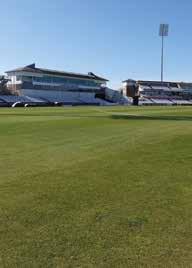



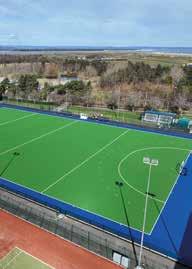



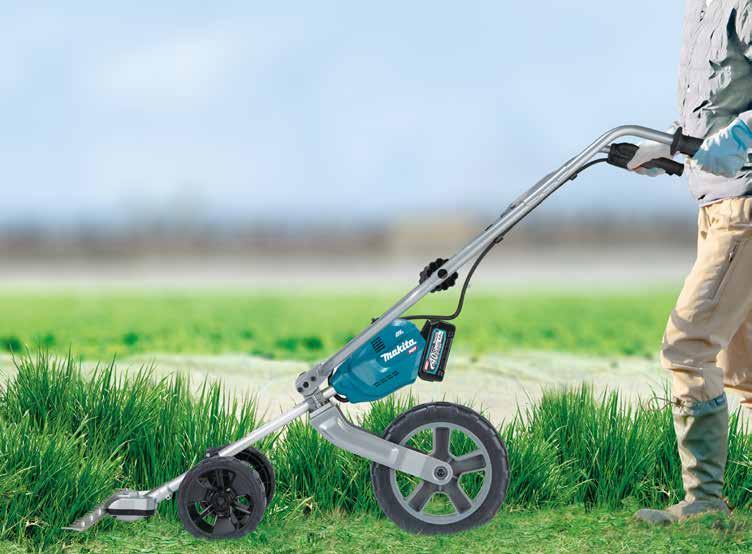
Built around the high output 40VMax battery system, Makita’s XGT range of cordless Outdoor Power Equipment is designed specifically for demanding gardening and landscaping tasks.
Created to handle heavy duty workloads, such as cutting dense overgrowth or maintaining large gardens, the range delivers high performance power, durability and professional grade efficiency in a single platform.
Featuring cordless garden tools such as chainsaws, lawn mowers, brush cutters, line trimmers, hedge trimmers and more, including a full range of XGT construction power tools, the range delivers longer runtimes and maximum torque without the vibrations, noise and emissions of petrol tools, making it an ideal modern cordless solution for garden care.
For tougher tasks, the XGT 40VMax battery can be combined with another 40VMax battery to deliver an outstanding 80V power output on specific 80VMax machines. As a result, many of the XGT tools can match the performance of petrol-powered or corded equivalents but with the additional freedom and benefits of cordless tools.
For remote on-site charging of multiple
batteries, the BCC01 Battery Charging Case is also available for professionals using multiple cordless tools from across the platform. With high capacity, it has been designed to hold up to eight batteries, charging four of them simultaneously.
The remaining batteries are then charged sequentially by the “switch charge” feature to ensure minimal downtime on site.
New to the range is the UG001G 40VMax XGT Ground Trimmer which makes grass cutting easy and effortless with a simple push. With a self-standing, three-wheel design to ensure stability, the tool provides an effective cutting width of 500mm. In addition, to help make the task as hassle-free as possible, the ground trimmer features tool-less cutting height adjustment from the minimum 25mm up to the maximum 105mm with a handy, one-touch locking lever.
The three-wheel ground trimmer stands on its own, which is crucial to help reduce holding effort and user fatigue during extended periods of work. The large rear tyre also ensures it can move smoothly on uneven ground as well as making it easier to turn. During operation, users will also benefit from tool-less cutting height and handle
height adjustment. With a soft start as well as constant speed control, the UG001G has been designed with a single sided, T-shaped hedge trimmer style blade, which sits at a 90-degree angle to the shaft. This makes effective cutting possible without having to swing a blade from side to side, simply by pushing the ground trimmer along with minimal effort. With an impressive performance – it achieves between 3000-4000 cutting strokes per minute.
Additional advantages include that the UG001G is cordless, having a significant impact on freedom of movement and removal of trip hazards. Powered by a 40V XGT® Li-Ion battery, it offers an approximate, continuous runtime on full charge of two hours 40 minutes on low mode, and 1 hour 30 minutes on high mode, making it an ideal option for tackling large areas of grass, sports fields, field ridges, roadsides and riverbanks. Finally, Makita is running a redemption offer across its XGT range. Until September 30, customers can claim a free BL4040F battery for every £390 (excluding VAT) spent on qualifying XGT batteries, chargers, power source kits and machines.
n www.makitauk.com/redemptions n www.makitauk.com.
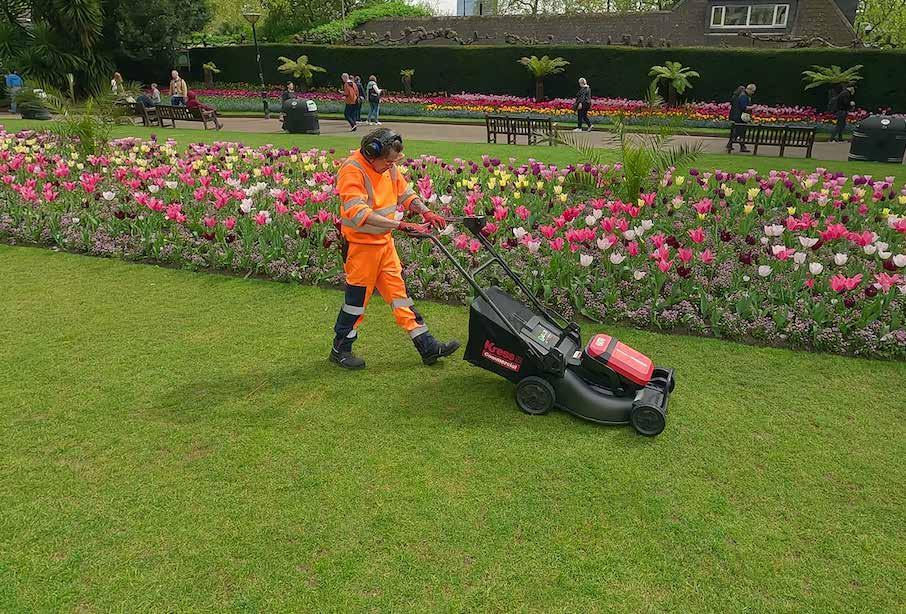
Krinkels UK has reinforced its commitment to sustainable grounds maintenance with a major investment in a fleet of Kress commercial battery powered equipment, supporting the upkeep of parks, open spaces across Westminster.
The new fleet, including mowers, blowers and brushcutters, was delivered to the company’s base at Victoria Embankment Gardens. The setting provided a striking backdrop for a milestone moment, as operatives were introduced to the new equipment through live demonstrations and handson training sessions covering both the machinery and the Kress app system.
Krinkels UK holds a major contract with Westminster City Council, making performance, reliability and efficiency essential across all operations. For Assistant Operations Director Steve Morris, the investment reflects both day-to-day operational needs and a clear long-term plan.
“Wherever possible, our instinct is to move towards electric equipment,” he explained.
“That said, we have to be realistic about what we’re delivering on the ground. We need to know that any solution can meet our contractual commitments, whether that’s power, battery life, and the practicality of
carrying enough batteries for a full day’s work, and ultimately whether it represents value for money for our customers.
“It’s important to us that we deliver a high-quality service, but also that we do so in the most environmentally responsible way possible,” continued Steve. “This is a significant initial investment, but when viewed over the long term, it makes sense. It’s not just a financial investment, we’re investing in the future of the environment, and in the wellbeing of the public and our teams.”
“Westminster is a particularly important step,” he added.
“Operating in the heart of London brings additional responsibilities, and there is a clear ambition to move towards fully electric operations as part of wider air quality improvements. This sits alongside broader goals around greening, biodiversity net gain, and the development of connected green corridors in response to the climate emergency.”
Built for professional use, the Kress commercial range delivers the power required for demanding urban environments, alongside long run times and fast charging that help keep downtime to a minimum.
The consistent performance across the range ensures teams can work
efficiently throughout the day, while low noise levels and reduced vibration improve operator comfort. In addition, the Kress app system provides valuable insight into battery performance and equipment usage, helping teams plan more effectively and get the most from their fleet.
Ian Harwood, Sales Director at Groundserv, the supplying dealer, has seen growing demand for highperformance battery solutions.
“We carry out demonstrations for a wide range of customers and people often say they’ve trialled other battery powered brands that haven’t quite ticked every box,” he said. “With Kress, it’s the combination of battery charging times, reduced downtime and the power of the machines that really stands out.”
For Kress UK, seeing its equipment in action across one of the capital’s most iconic landscapes is a proud moment.
“It’s amazing, a real privilege,” said Vince Jenkins, National Account Manager at Kress UK.
“We’ve worked with Krinkels for around two years, supporting that transition from petrol to battery. Westminster is a prestigious and beautiful location, so to see the Kress fleet in operation here for the 2026 season is fantastic. It’s been a pleasure working together.”
n www.kress.com/en-gb/




Pellenc, the pioneer in professional battery-powered tools, has released the Rasion 3 Easy, a professional-grade 60cm self-propelled mower, designed to redefine the balance between heavy-duty performance and whisper-quiet operation.
As urban environments increasingly demand reduced noise and zero emissions, the new Rasion mower provides a powerful solution for contractors and municipal teams. Engineered for high-frequency use, this mower combines a massive 60cm cutting width with a surprisingly light frame, weighing in at just 28 kgs.
The Rasion3 is built for the complexities of modern landscaping, featuring a unique zero-turn radius system and front caster wheels that can be unlocked for 360° agility or locked for precision stability when working on slopes.
To handle diverse terrain and varying grass lengths, Pellenc has expanded
the cutting height range to include new 85/95 mm settings. This allows for precise, selective mowing in demanding conditions without sacrificing the efficiency of the high-performance dualblade system.
Despite its lightweight design, the Rasion 3 is heavy-duty in every sense. Key features include:
Reinforced Protection: Side and front bumpers protect the caster wheels and chassis.
Hardened Components: A reinforced blade support and collection bin ensure longevity in harsh environments.
All-Weather Reliability: Equipped with waterproof wheels for consistent traction and performance in damp conditions.
Operation is as quiet as it is productive. With a maximum sound power level of just 95 dB, the Rasion 3 allows professionals to work in noisesensitive areas such as hospitals, schools, and residential zones without disturbing the public or requiring hearing protection

for the operator. When paired with the ULiB 1500 battery, the mower delivers industry-leading range, capable of maintaining up to 1.3 acres (5,400 m²) or providing up to five hours of continuous mowing on a single charge.
Pellenc battery-powered equipment is distributed exclusively in the UK and Ireland by Etesia UK. n www.etesia.co.uk/pellenc

Iwas lucky enough to attend the Borders Book Festival, in Melrose, recently and one of the speakers was Alan Titchmarsh. As you would expect he proved to be a wonderfully entertaining guest and covered all aspects of his life and career, from his early days as a gardener through to his television and radio presenting and novel-writing.
He is, however, at his core a gardener and he talked about his much-publicised move to a smaller house and garden –smaller by his standards at least – and the reasons behind it.
He mentioned that his new home – the greenhouse was due to be completed while he was in the Borders – was in the same village as his grandchildren, but also that he and his wife were thinking ahead to a time when he would be unable to work as hard as his bigger garden required so much effort.
He must be relieved and delighted therefore that so many companies are producing regular gardening implements which are now battery powered, thus taking much of the strain from the work and enabling longer, more productive, periods in the garden, even for those who are well into their three score and ten.
One such piece of kit is the Stihl Powered Secateurs which I have had on test.
The ASA140 battery-powered model are the latest addition to STIHL’s AP System range of tools. Designed for professional users in viticulture, landscaping, and tree care, it offers fast, precise pruning making it ideal for work and maintenance in vineyards and on large properties.
There is also the Stihl ASA20 10.8v Cordless Pruner Secateurs which are designed for more domestic use and keen gardeners which don’t have the harness and large capacity battery but are totally hand held.
These are designed for pruning trees, bushes, shrubs and plants around the garden.
But I was furnished with the professional version and I must admit I did feel professional when I was kitted out in the harness, to which the battery and the secateur holster are attached.
With the weight of the 36-volt lithiumion battery, taken comfortably by the harness, it allows all energy to be diverted into the task in hand and to that end the secateurs are a revelation.
If you have any doubt that they will cope with a particular thickness of cut you are rarely left disappointed. The power within the blades copes with
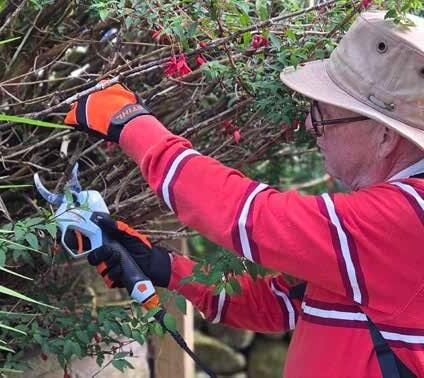
anything up to 45 millimetres – that’s close to two inches in old money – and you can fly through a task at a speed you could only dream of with manuallyoperated secateurs.
To change the cutting width just select the desired blade spacing on the task. If you want to change to full blade spacing for thicker branches, double-click on the gear lever. Then, double-click and hold down to close the blades.
One element of the secateurs is particularly pleasing and that is how they blades interact with the trigger. Stop the trigger halfway and the blades will also stop halfway. It’s called a progressive cut. That gives real peace of mind from a safety perspective.
The ASA140 is IPX4 rated, meaning, that should Mr Titchmarsh want to work on in his new garden in the rain, they can be used in all weather conditions.
As for battery running time, the ASA140 will give a massive 9,000 cuts from one full battery, more than enough for a full professional working day. I must admit that I left most of those 9,000 in
the tank, but was still able to leave my mark on the garden. The ASA140’s come in a sturdy box which makes transporting easy to wherever they are required.
The ASA20 version for more domestic use offers 2,000 snips from the small battery which fits into the end of the secateur’s grip. An enthusiastic amateur pruner is unlikely to run out of juice in a single day’s useage.
I do believe that the new generation of battery powered garden implements give gardeners of all generations a new lease of life while the professional tools speed up the work of grounds teams across the country.
Me? I’m just waiting for the battery powered spade, which would save me much sweat and tears.
The Stihl ASA140 battery-powered cordless secateurs are £859 for the tool kit alone with £30 for the holster and approximately £130 for the battery.
The Stihl ASA 20 battery-powered cordless secateurs are £214, including two batteries and a charger.
n www.stihl.co.uk


At Origin Amenity Solutions building long-term relationships with facilities is just as important as supplying the right products. That partnership approach is on full display at Cromer Lawn Tennis & Squash Association, where Groundsman and General Manager Matthew Jordan relies on OAS as the club’s sole supplier of grass seed, nutritional products and line marking paint to maintain 10 busy grass courts through an intensive playing season.
Cromer LTA is a bustling multisport and community venue, offering accessible facilities and coaching for a range of racket sports together with supporting local groups including yoga, chess and running clubs.
With around 500 members including 120 juniors, the facilities are open yearround – with the grass courts hosting the brunt of the action between midApril and the end of September.
“For us, maintaining consistently high-quality playing surfaces is essential and it’s something that
is much more achievable with the reliable results we achieve with an OAS programme” explained Matthew.
“It’s something that we’ve developed over a number of years, working closely alongside our OAS Area Sales Representative Mark Keysell to establish the right products and gather the practical guidance we need to make informed decisions. We have budgets to work to and really appreciate that Mark respects this and structures a plan that delivers both value and long-term results.”
Keeping the courts fit for daily play in addition to a packed tournament schedule which includes a British Tour event, county championships and junior and senior tournaments begins with the right grass seed, and for that Matthew opts for R9 100% dwarf ryegrass.
“This hard-wearing mix is ideal for tennis. After a fairly heavy renovation, we sow R9 at the conclusion of the grass court season and let this establish throughout October.”
Matthew then turns his attention
to a winter nutrition programme consisting of Multigreen 15-0-22 to maintain plant health through the colder months before kickstarting spring growth in February with an application of Cold Start Boost-R 115-5.
“This product really get’s the grass moving, enabling us to gradually lower the heights and increase the frequency of mowing to get us down to 8-10mm when the season starts,” he added.
Supporting performance during the busiest periods is H-Cote 22-3-8, which forms part of a wider site programme which includes selective weed controls, Enclean hard surface biocide and TriCure granular.
For Matthew and the team, having one trusted supplier simplifies operations and provides confidence throughout the year.
“It’s now at the point where this programme is tried and tested, but it’s great to have Mark on hand with help, advice and guidance when needed.
“It’s thanks to this partnership that our grass courts are as good as they are.”


David Snowden, MD of Agronomic Services Ltd, talks with Scott MacCallum about thatch and discusses Thatchbuster’
thatch management.
One of the principal reasons that thatch builds up is due to the excessive overfeeding of nitrogen. This is one of the most common causes on intensively managed turf. With insufficient aeration there is a failure to create air exchange within the profile.
This reduces microbial activity and organic matter breakdown. Another reason we see the build-up of thatch is when little, or no, top dressing is carried out. Without regular sand top dressing, organic matter accumulates rather than being diluted.
Other factors that lead to thatch build-up can be watering, where playing surfaces remain too wet, encouraging shallow rooting and excessive organic matter production. Heavy traffic from golfers’ machinery and maintenance equipment can create compaction, once more reducing pore space and oxygen availability.
Finally, when clippings are removed inconsistently and scarification practises
are not carried out regularly, thatch can build up.
Signs to look for are soft, spongy surfaces, reduced firmness and ball roll, an increase in disease pressure, poor water infiltration as well as shallow rooting. All are all signs that thatch is building up.
There are many physical practices that we can carry out to improve the oxygen movement into the rootzone. For example, using solid, hollow or needle tines, hollow coring, scarification and verti-cutting. All these practices have varied benefits, each of which works towards the management of thatch.
At Agronomic Services we promote the use of Ninja tines as this provides an aeration practice without disruption to play. This is a significant advantage for golf course managers and in particular,
resort golf where course closure for aeration is nearly impossible.
Top dressing after aeration or scarification dilutes organic matter over time and has some benefits including increasing firmness and improving drainage. This can maintain a consistent rootzone.
We use a product called Thatchbuster OMG!!! (Organic Matter Gone) which is tried and tested for many years showing excellent results for our course managers. This product contains active cellulose-degrading enzymes which accelerate the breakdown of organic matter within the turf profile, helping convert accumulated thatch into plantavailable nutrients.
Thatchbuster supports a healthier rootzone, improved nutrient cycling and firmer playing services.
For even better results we use this in conjunction with Oxy-Rush.



You feel the dampness in the air and know that autumn is on the way. Moisture sits on the surface for longer each morning, lingers through the day and persists overnight. Light levels are falling, night-time temperatures are dropping and growth begins to slow.
For many greenkeepers, this is the point where thoughts turn to disease. Yet disease pressure rarely arrives overnight. By the time the first signs of anthracnose or microdochium patch appear, conditions have often been moving in their favour for weeks.
That gradual shift is easy to miss because it doesn’t happen all at once.
A little more moisture remains on the surface each morning. Recovery becomes slightly slower. Drying conditions become less reliable. Individually, none of these changes seems particularly significant. Together, however, they begin to alter the balance between the turf and the disease.
This is why successful autumn disease management is often less about reacting to outbreaks and more about recognising when conditions are beginning to change.
As autumn progresses, one of the biggest changes is often how long moisture remains on the leaf. Dew hangs around for longer, surfaces stay damp well into the day and opportunities for natural drying become less frequent. At the same time, the plant’s ability to recover from stress
naturally begins to slow. Individually these changes may seem minor, but together they create conditions that increasingly favour disease whilst making it harder for the turf to withstand the pressures of the season.
Experienced greenkeepers know that some of the biggest gains come not from responding once disease is visible, but from influencing the conditions that encourage it in the first place. Managing surface moisture, maintaining turf condition and reducing stress may not always be the most obvious interventions, but they can have a significant influence on how the season unfolds.
The Turf Defence approach is built around this principle. By combining Greenmaster Liquid Effect Iron with H2Pro FlowSmart penetrant surfactant, the aim is to influence conditions before disease pressure reaches its peak.
Greenmaster Liquid Effect Iron helps maintain turf condition and colour as growth naturally slows, whilst H2Pro FlowSmart encourages water movement through the soil profile and helps reduce the amount of moisture that remains close to the surface. The programme itself is straightforward, but the objective is important.
Rather than focusing solely on the disease, it focuses on creating conditions that are less favourable for disease development whilst helping the turf remain more consistent through challenging periods.
Of course, no autumn programme exists in isolation. Good nutrition, aeration, airflow management and, where appropriate, fungicide applications all have an important role to play. No surfactant and iron programme will prevent disease under sustained pressure, but influencing conditions before problems develop can often help reduce the severity of the challenge later in the season.
On the course, the benefits are often seen in subtle ways rather than dramatic ones. Surfaces remain more consistent, moisture is managed more effectively and the turf is better prepared to cope with periods of increased pressure. Those small differences can become increasingly valuable as weather windows narrow and opportunities for intervention become less predictable.
The best autumn disease programmes are rarely built around a single product. More often, they are built around recognising when conditions are beginning to shift and taking action before disease gains momentum. By the time pressure becomes obvious, the opportunity to make simple adjustments has often already passed.
So when you feel the dampness in the air, consider it an early warning sign. Autumn disease management starts long before the first patch appears.
To find out more about the ICL Turf Defence programme, visit the ICL website or contact your local ICL Area Sales Manager or distributor.


Rubber crumb infill – the umbrella category for materials such as StyreneButadiene Rubber (SBR), Ethylene Propylene Diene Monomer (EPDM), and Thermoplastic Elastomer (TPE) – has been a mainstay of synthetic football, rugby, and multiuse pitches for longer than many have been in the industry.
The material has long been the most popular infill option for these pitches – and for good reason – boasting excellent shock absorption, durability, and playability at a cost-effective price point.
Despite this, its role and reputation in professional sport is one of the hottest topics for discussion in the industry, though the side on which readers stand has now been rendered a moot point. As part of a wider move to restrict the use of microplastics across a number of product categories, the sale of rubber crumb infill is set to be outlawed across all EU member states from October 17, 2031 onwards.
While this ban does not apply to non-member states, like the UK, it’s important to recognise the effect that this will have on global supply chains, which are more interconnected and interdependent than ever.
The feeling from many in the industry – myself included – is that regardless of whether a strict ban on
rubber crumb is imposed in the UK, we are likely to see a de facto phaseout of the material as supply from the continent wanes.
“But what does this mean for fields already using rubber crumb?” I hear you ask. The good news is that the use and maintenance of fields already using rubber crumb will be permitted after this date. Grounds people will
even be able to top-up their fields with existing rubber crumb stocks, provided they can prove the material was purchased before the cutoff date if necessary.
The bad news is that this is not an effective long-term strategy. While stockpiling is certainly an option, the average 3G pitch is topped up with between one and five tonnes of
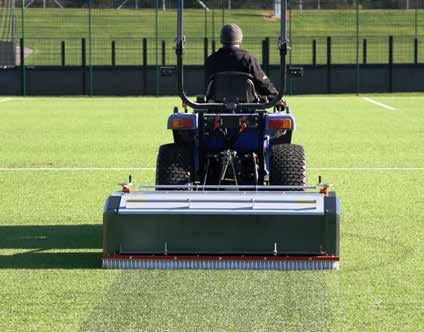
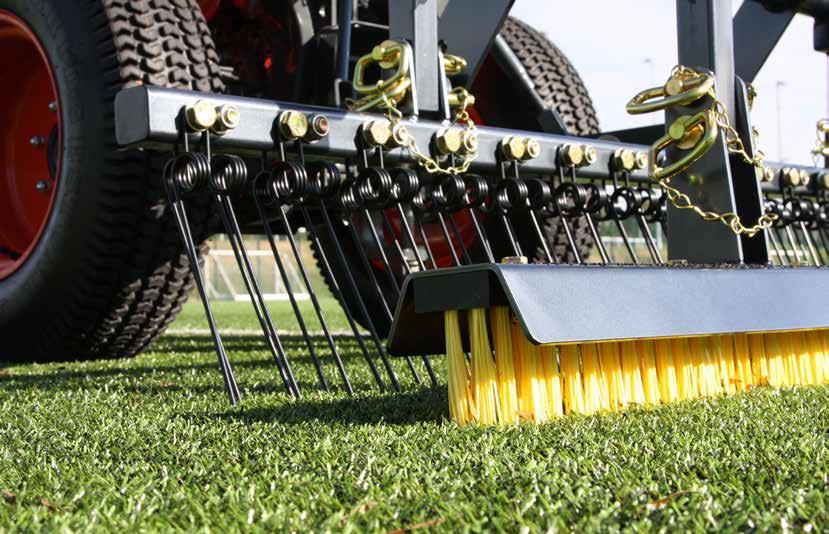
rubber crumb every year, meaning this strategy will quickly run aground. Regardless of whether grounds people live and work in the UK or EU, now is the time to assess current stocks and begin planning for the transition.
Fortunately, new environmentally friendly infills are entering the market every year. From rice husks, wood chip, and coconut fibre through to cork, olive pits and walnut shells, grounds people will certainly be able to find a new material that fits the needs of their field.
However, it’s important to recognise that while every effort has been made to find alternatives that can replicate the performance of rubber crumb, finding a like-for-like replacement is nigh on impossible. While both rubber and natural infills serve the same purpose, there are some broad performance differences to be aware of before buying:
• Durability – as organic matter is prone to do, natural infills will break down over time. This means that more frequent top-ups will likely be necessary, particularly for high-use pitches.
• Moisture retention – unlike rubber crumb, many natural infills will soak up moisture, putting them at risk of microbial growth, freezethaw damage, or compaction once dried.
• Migration risk – by and large, natural infills are much lighter than their rubber crumb counterparts, meaning that more material may be lost through play, and during periods of heavy winds.
There are also unique performance differences between different types of natural infill, with each suited to different sports, climates, and levels of play. For instance, cork is excellent at regulating heat, but can freeze in cold temperatures, making it the better choice for pitches in warmer regions. Other factors, such as durability, cost and shock absorption, can also vary from infill to infill. For this reason, consulting both the original turf manufacturer and infill supplier for guidance on selection is essential when looking to make the changeover from rubber crumb.
This bring us to the question – what does synthetic turf maintenance look like in the post-rubber crumb era? To the relief of grounds people, the broad strokes of maintenance look very much the same, with initial tests with SISIS equipment showing that both current equipment and techniques remain just as effective as ever.
However, it should be noted that this is not necessarily true of other manufacturers, and there is still more research to be done in this area. Moreover, while the general process
remains the same, some steps now demand more time, attention, and consideration to ensure that the inherent traits of natural infills are being catered to. With that out of the way, here are six steps to success for maintaining a synthetic turf pitch using natural infill:
1. Visual inspection and sweeping – first and foremost, walk the pitch on foot to identify any litter or detritus. The removal of these before proceeding with later maintenance steps is essential to avoiding damage to both the pitch itself and maintenance t
THERE ARE ALSO
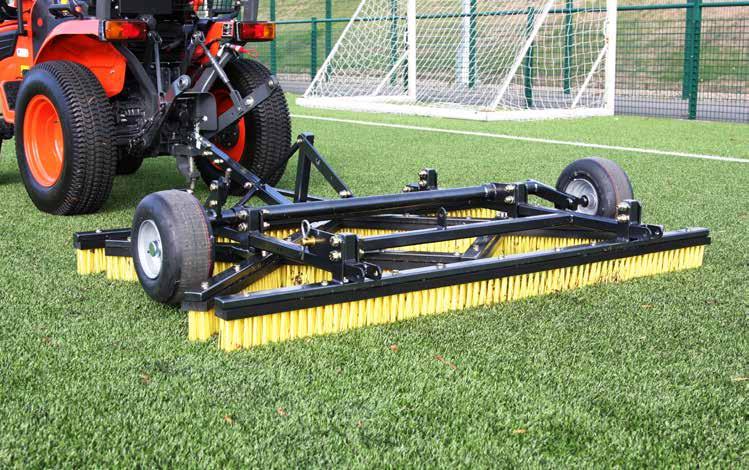
equipment. While this can be done by hand, using a tractor-mounted sweeper such as the Litamina 1200 is the most efficient approach here, with the sweeper collecting debris such as leaves, twigs, and litter, while allowing infill to fall back through. With the surface clear, walk the pitch again, looking for frayed seams or lifted edges, and repair as necessary. This task should be completed weekly.
2. Light brushing – the surface can now be brushed using hand tools, or again more efficiently using tractormounted tools such as the Syn-Pro
Triangular Brush. Try to engage in the opposite direction to the pile as much as possible – this helps to stand it up, while taking different routes each time helps minimise fibre lean. This task should be completed weekly.
3. Topping up infill – measure infill depth across the pitch to assess where top-ups are necessary, and then action with a spreader or top dresser such as the Powaspred. Due to the breakdown of natural infills, greater top-ups will likely be necessary, particularly around high-traffic areas such as the goal mouth, penalty spot, and corners. This task should be completed monthly.
4. Power brushing – with fresh infill on the field, more aggressive brushing can be undertaken using an OSCA 3 or similar. This step is crucial for natural infills, as it agitates the upper infill layer to reduce compaction, while also reducing the risk of microbial growth. This task should be completed monthly.
5. Infill decompaction – using purpose-made rakes or tines, decompact the infill, taking care to do so only after power brushing to avoid driving contaminants into the pile. This loosens the infill without the risk of damaging backing or seams, which is essential due to the greater compaction of natural infills. This task should be completed monthly.
6. Deep cleaning – the final step is to conduct a deep clean of the pitch, which is best carried out in dry but fair conditions, such as the spring or autumn. Here, specialist equipment, like the SVR 1500, raises infill through an airstream system, stripping out dust particles and contaminants before evenly brushing the cleaned material back into the pile. This is the most effective method of removing bacterial threats and reducing dust build-up with natural infills. This task should be completed annually, or every six months if possible.
As outlined, while maintenance regimes may look similar at first glance, each step now contains new levels of nuance which may only become apparent during the process itself. The onus on getting maintenance right is also greater than ever, with the risk of microbial growth, infill breakdown, and compaction all increased.
For the best guidance, it’s always wise to speak to the original turf manufacturer, alongside your infill provider, to identify the best approach for your specific field, infill, and climate. Regardless of these differences, groundspeople can rest assured that their existing SISIS maintenance equipment will still be up to the task, and that no substantial new investments will be necessary to adjust to the post-rubber crumb era.



































Perennial’s Kick for a Cause football tournament returned at the end of May, raising nearly £4,000 to support people facing challenges in horticulture, including grounds teams.
The event brought together seven five-a-side teams for a day of friendly competition at Fulham FC’s training ground in Surrey and provided a unique opportunity for turf and grounds specialists to step onto a topclass facility and enjoy the game from the other side.
The Knickerbocker Glorys - the grounds team from Fulham FC Training Ground, were joined by teams from Consolidate Turf, Grange Travel, ICL, Litchfield & Fox, London Lawn Turf and Neville Stein Horticultural Business Consultancy.
Stan Hayden, Deputy Head of Grounds at Fulham FC Training Ground, said: “We’re proud to host this event. This is about more than just football; it’s about supporting each other and raising awareness of the incredible work Perennial does. If just one person reaches out for support, this event has been a success.”
After a series of closely contested matches, ICL All Stars faced hosts The Knickerbocker Glorys in the final. A dramatic goal in the closing seconds secured a 1-0 victory for the All Stars.
Aimee Davey, Marketing Communications Manager for ICL Turf & Landscape UK & Ireland, said: “Perennial provides invaluable support to people working across horticulture and landscaping, often during some of the most challenging periods of their lives. We are proud

to support a charity that delivers practical help and guidance to those who need it most. The Kick for a Cause tournament was a fantastic example of our industries coming together to support an important cause, and we were delighted to be involved.”
Following the presentation of winners’ and runners-up medals, players and supporters celebrated with pizza and refreshments after a day of football in the sunshine.
New for this year were the Golden Boot and Golden Hands awards, recognising the tournament’s top scorer and goalkeeper. Both honours were claimed by members of the ICL All Stars squad.
Chief Executive of Perennial, Jamie Gault commented: “We’re delighted to have raised nearly £4,000 through this event. This helps support the delivery of our services and also helps raise Perennial’s profile – the only UK Charity to support all those in horticulture. Thank you to those who supported Perennial through taking part, sponsorship and promotion of this fun, annual event.
“Don’t forget the charity is here to support you, whether you need help with a specific issue or are facing one of life’s bigger challenges, Perennial is here for you.”
Perennial would like to specifically thank Stan Hayden and the team at Fulham FC Training Ground for hosting and helping to make the event possible, event sponsor ICL, and raffle prize donors Banstead Downs Golf Club, Denbies Wine Estate, Turf Matters, Fulham FC, Ken Myers and Sussex Seed Balls.
n Find out more about the range of services Perennial offer at perennial.org.uk or call our helpline 0800 093 8543.