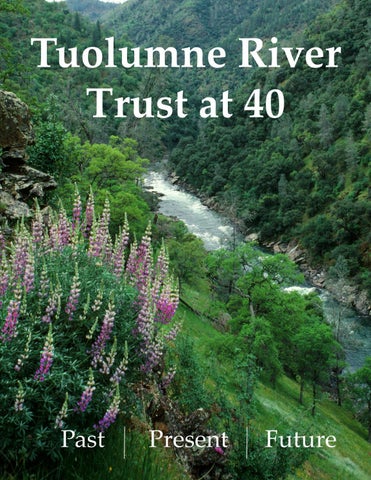
Tuolumne River Trust at 40
Past
Present
Future
Table of Contents
Chapter One I N T RODUCTI O N PAGES 4-21
Chapter Three
Chapter Two ADVOCACY
E D UCATI O N
PAGES 2 -35
PAGES 36- 9
2
There are QR codes throughout this publication! Whenever you spot one, you can scan it using your smart phone to learn more.
Chapter Five
Chapter Four RE S T ORATI O N
LOOKI N G FORWARD
PAGES 40-51
PAGES 52- 3
3
Chapter One: Introduction
Tuolumne Meadows
4
Geography and Diversity of Landscapes T he T uo l um ne i s a w o r l d cl a s s river th a t w in d s th ro u gh s o me o f th e mo s t i co ni c l a nds ca pes i n t he w o rld . Over it’ s 162- mile jo u rn ey, th e Tu o lu mn e i s t he l i f ebl o o d o f di v er s e co mmu n ities fro m th e S ierra to th e S ea .
The River begins its 149-mile journey in Yosemite National Park atop Mt.
slopes of the Sierra Nevada over
Grand Canyon of the Tuolumne, the
through the Stanislaus National
million people.
5
SIERRA NEVADA
CENTRAL VALLEY
BAY AREA
Sierra Nevada TheTuolumnewatershed,locatedintheSierraNevada,includesundammed,wildtributariesRowing through sculpted granite canyons, verdant meadows that host diverse wildlife, and expansive mixed conifer forests. The headwater forests are an integral part of a complex hydrologic system, which river health and wildlife habitats depend on. Forests provide clean water and sequester carbon, but are now threatenedbypastandcurrentcatastrophicwildQres,pests,andyearsofdrought.n2013,theRimFire foretold a story of exponential change and disturbance. At the time, the Rim Fire was by far the largest wildQreinthehistoryoftheSierra,whichhassadlybeensurpassedbymultipledevastatingwildQr throughout the range in recent years. The Rim Fire contributed as much carbon to the atmosphere as isproducedbyover2.5millioncarsinayear.Post-QreerosiondegradedthenormallyclearTuolumne River, while the most severely burned areas experienced extreme tree mortality rates and seed bank loss. Forestshavestruggledtonaturallyregeneratewithoutreforestationandrestorationeort the River’s headwater forests is of the utmost importance in order to help maintain a healthy watershed.
Central Valley Flowing out of the golden foothills, the Tuolumne meanders through the San Joaquin Valley where some oftheregionsoldestValleyOaksarchfromitsbanks.HealthyRoodplainsandriverchannelsprovide criticalhabitatforyoungChinooksalmonandSteelheadtrout;thesameQshthatarerearedinth waterscontinuetheirjourneyouttotheSanFranciscoBay,wheretheywillspendthemajorityofth adultlifeinthePaciQcOceanbeforeswimmingbackupstreamtospawn.Aftersalmonspawn,theydie, decay, and contribute their nutrients back to the river and surrounding land, continuing the circle of life. nthispartofthewatershed,about20,acresoffarmlandisirrigatedwithwaterfromtheTuolumne. About46%oftheTuolumnesnaturalRowisdivertedfromtheRivernearDonPedroDamandusedto grow food that is consumed both locally and abroad. Ensuring that there is enough water left in the River beneQtsnotonlytheenvironment,butalsoourdiverseandculturallyrichlocalcommunities.
Bay Area AftertheTuolumnehasprovidedallofthesebeneQtstooureconomiesandcommunities,itjoinsthe SanJoaquinRiverandRowsintotheSanFranciscoBayDelta,thelargestestuaryonthewestcoastof theAmericas,producinganexplosionofbiologicaldiversity.nadditiontosalmonandSteelhead,aric assortmentofwildlifeandplantsdependontheTuolumnesRowintheDelta,includingDeltasmelt, sturgeon,andRocksofwaterfowlandshorebirds.AstheTuolumneandotherriversintheCentral Valleyhavesueredinrecentyearsduetochronicallypoorwaterquality,sohastheDelta,withmany Delta-dependentQshandwildlifepopulationsonthebrinkofextinction.BringingtheDeltabackto healthrequiresadequateinRow,whichcontinuestobechallengedbyclimatechangeandpoorwater managementandpolicy.AdvocatingforwaterpolicythatbeneQtsbothhumansandtheenvironmentis vital to the future of our State and region.
7
Environmental Stewards Throughout History T RT f it s int o a lo nge r hi s t o r y o f e n v i r o n m e n t a l i s m i n t h e U n i t e d S t a t e s . I t w a s buil t o n t he a c t iv is m a n d p r a c t i c e o f t h o s e w h o p r e c e d e d u s . W e a r e g ra t e f ul t o t ho s e w ho pa v e d t h e w a y. W e a r e a l s o g r a t e f u l f o r t h o s e w h o , d e s pi t e m i ll e nni a o f la nd s t e w a r d s h i p a n d c a r e , a r e o f t e n l e f t o u t o f t h e s t o r y : t he I nd i g e n o u s p e o p l e o f C a l i f o r n i a .
The dramatic mountains, old-growth conifer and riparian forests, quiet pools, sweeping vistas, and roaring rapids of the Tuolumne Watershed inspired the conservation movement as we know it today. Long before John Muir set foot in the Sierra, the watershed was and (continues to be) stewarded by bands of the Miwok, Ahwahneechee, Ohlone, and Yokuts peoples.
The creation of the National Parks System led to the preservation of some of the most biodiverse and iconic landscapes in the world – landscapes that may have otherwise been industrialized for resource extraction
With the help of the Sierra Club, Yosemite became a National Park in of “pure wildness”
Since Euro-Americans colonized California, the Tuolumne River has
1
and where “no 1
This sentiment led to a global conservation movement that has focused its attention on the idea of “pristine wilderness” and excludes all other concerns, including the concerns and wellbeing of the people who have
environmental preservation and construction of O’Shaughnessy Dam on the Tuolumne River in the Hetch Hetchy Valley, Muir founded the Sierra Club. Meanwhile, the two oldest irrigation districts in California, the Turlock Irrigation District and the Modesto Irrigation District, were created to dam and divert water from the Tuolumne River to provide irrigation water to nearby farmland.
The establishment of “public” wilderness also led to the continued forced removal of the indigenous populations who have inhabited the
8
South Fork of the Tuolumne River Photo by Byron Krempl
“ T h e st r at e gy t o c on s e rve b i od i ve rs i t y t h r o u gh n at io nal p ark s h as d i s p l ac e d man y t e n s o f t hou s an d s of i n d i g e n ou s par k r e sid e n ts , t ra n s f orm i n g t h e m in t o co n serva t i on -re f u g e e s . ” – F e rgu s M acKay an d Emi l y Car u so
The Ahwahneechee are a branch of the southern Miwok. Beginning in 185 , the Ahwahneechee people experienced many violent, state-sanctioned removals. The Qrst white visitors to Yosemite were part of the Mariposa Battalion, a militia paid by the California government to 2 stop ndian raids on trading posts. ( 4 The Mariposa Battalion invaded Ahwahneechee communities, burned down homes, and killed dozens of people. For more than a decade afterward, the land between the Merced and Tuolumne Rivers remained under military occupation and eventually became a park by order of President Roosevelt, with the assistance of John Muir.3 We do not often hear about the terrible events behind the formation of Yosemite National Park, nor about the Ahwahneechee communities who kept these landscapes healthy in the Qrst place.
10
The forced removal of the Ahwahneechee communities from the Sierra Nevada forests contributed to a rapid decline in tree health and biodiversity.4 ndigenous peoples have known what forest managers and conservationists failed to realize until faced with catastrophic wildQres and climate change. ndigenous cultural burning was a critical function in maintaining the balance of the ecosystem. ncorporating the wisdom and traditional knowledge of the original stewards of the land is key to building resilience back into our ecosystems.5 TRT acknowledges this violent history of colonialism in the Tuolumne Watershed and we acknowledge the native people who have lived and continue to live on and steward these lands. As we move to right our relationship with these communities, we strive to listen to and elevate the voices of native peoples and others whose voices have been excluded from discussions of environmental conservation. We are grateful to the bands of the Miwok, Ahwahneechee, Ohlone, and Yokuts Tribes who continue to steward their ancestral lands today, and aim to honor their autonomy and knowledge in our stewardship work now and in the future.
DeerCreekintheTuolumneWatershed PhotosbyByronKrempl
11
Diversity, Equity, Inclusion, and Access: Our Vision & Values In working to protect and restore the Tuolumne River, the Tuolumne River Trust strives to sustain the health and diversity of both the biological and human ecosystems along the River, from its origins in the Sierra Nevada, through the San Joaquin Valley, and out to the San Francisco Bay.
We seek to be particularly attentive to, and inclusive of, those communities that have historically been excluded
We seek to actively engage with those who currently live near or depend on the River, and we work to proactively understand evolving community needs, and to respond with creative, equitable, inclusive, and sustainable
We hold deep gratitude and reverence for the Indigenous people who have long been and remain stewards of their ancestral homelands, including bands of the Miwok, the Ohlone, the Yokuts, and tribes we have not named. 6
We also recognize the importance of the communities where we work and to which each team member, stakeholder, and partner can bring
We seek to support a mutually River and the diverse communities we serve, recognizing that the health of each is critical to the health of the others.
As we look to our next forty years, we pledge to contribute to a thriving and sustainable river ecosystem and surrounding communities through our education, advocacy, and restoration work, and to welcome participation by
We strive to create systems through which all people and communities provides: its healthy forests, opportunities, clean drinking water, and food production.
We acknowledge that we may not have captured the fullness of the Indigenous communities that have inhabited and stewarded the Tuolumne River Watershed currently and historically. We welcome feedback on how we can represent this more accurately.
12
Photo by Don Briggs
PhotosbyDonBriggs
14
How it All Began Recreationisattheheartofouroriginstory.TRTcameintobeingaftertheQghtto save the Stanislaus River from being dammed was lost. Sincethelate1960s,the Tuolumne had similarly been targeted for dams by the City of San Francisco. A group of rafters, kayakers, anglers, family camp supporters and other advocates knew that the Tuolumne was worth saving, so they began to build a broad coalition of support thatwouldultimatelyendupwith83milesoftheRiverdesignatedasWild&Scenicby CongressonSeptember28,194.
What is a “Wild & Scenic River”?
CongressenactedtheWildandScenicRiversAct(WSRA)in1968,declaringitthe “policy of the United States that certain selected rivers of the Nation which, with their immediate environments, possess outstandingly remarkable scenic, recreational, geologic,Qshandwildlife,historic,cultural,orothersimilarvalues,shallbepres infree-Rowingcondition,andthattheyandtheirimmediateenvironmentsshallbe protectedforthebeneQtandenjoymentofpresentandfuture7generations.( The Act is notable for encouraging river management that crosses political boundaries and promotes public participation in developing goals for river protection. California hasapproximately189,45milesofriver,ofwhich,2,0milesaredesignatedasWild &Scenic1%ofthestatesrivermiles.
Winning Wild & Scenic Protection
The successful campaign to save California’s Tuolumne River through the Wild and Scenic Rivers Act has been described as the greatest victory in the history of the Wild and Scenic Rivers system and one of the greatest conservation achievements of the century. The e ort was the result of hard work and the assembly of unlikely allies from commercial whitewater outQtters, private boaters, and anglers, to busine and politically diverse proponents in Congress. The permanent protection of the River under the National Wild and Scenic Rivers System was the culmination of sixteen years of diligence, persistence, and struggle.
Our origins are rooted in advocacy that ultimately secured a section of the River from further development. We now enjoy the beneQts of that labor on whitewater trips, Qshing, hiking, and other activities. As the needs of our communities and th environment continue to evolve due to competing demands and climate pressure, our advocacy has also evolved, shaping our work into the present day. To learn more about our current advocacy work, visit page 2 .
15
1968
SanFranciscoannouncedtheClaveyWardsFerryProject,aproposalto construct up to 4 dams on the Tuolumne, Clavey, North Fork Tuolumne, and South Fork Tuolumne Rivers, primarily for hydroelectric power.
1969
OnaRatrocknearLumsdenBridge,theSierraClubestablishedataskforce named the Tuolumne River Conference. Their goal was to gain protection for theTuolumneRiverundertheFederalWild&ScenicRiversAct,whichhad beensignedintolawtheprioryearbyPresidentJohnson.
TuolumneRiverOutQtters&GuidesCongressionalTrip-July20,1984.
1979
TheStanislausNationalForestcompletedtheWild&ScenicRivereligibility study, which favored protection over dams and determined that the TuolumneRiveriseligible(fordesignationasaWildandScenicRiver, creating a strong basis for protection. As required under the Wild and Scenic Riversact,thedeterminationinitiatedathree-yearbanondevelopment while Congress considered the report’s recommendations.
1981
With less than one year of Wild and Scenic study protection remaining, a diverse group of Tuolumne lovers joined together to create the Tuolumne RiverTrust,thenknownastheTuolumneRiverPreservationTrust.
1982
TheWildandScenicStudyprotectionfortheT(expired.SanFrancisco Chamberlain speaking to promote andtheModestoandTurlockrrigationDistrictsrecommittedtoRichard theClavey the Wild and Scenic campaign. WardsFerrydam-buildingprojectirregardlessofpublicopposition.
1983
8 TheT(wasnamedthemostendangeredriverinthecountry. ( TRT inspired a highly successful media campaign and generated letters from diverseinterestssupportingtheT(tofreshmanSenatorPeteWilson-more than any other issue before Congress. Senator Wilson’s support came on top ofsupportfromSenatorAlanCranstonandCongressmanRickLehmanand wasconsideredtheQnalsupportneededtomakeitspassagepossible.
1984
After16yearsoforganizing,CongressapprovedWild&Scenicstatusforthe Tuolumne, and Ronald Reagan signed it into law. Victory had been won! DonMoyerandBarbaraBoxerraftingthe Tuolumne as a part of the Wild and Scenic campaign. PhotossourcedfromtheTRTArchive
16
John Amodio, TRT’s first Executive Director, testifying in favor of Wild and Scenic Status on the Tuolumne River
17
18
Throughout our 40 year history, we have worked to connect the dots between education, advocacy, and restoration in three key regions of the watershed. Our team continues to grow, and we are committed to our mission, vision, and values:
Mission We protect and restore the Tuolumne River and its watershed for present and future generations.
Vision We seek a healthy and vibrant river that is: Teeming with fish and wildlife Safe for drinking, swimming and fishing Welcoming for recreation Held in trust as a refuge for our children and grandchildren
19
As the only organization working in the entire Tuolumne River watershed, our success is due in part to our ability to cross rural and urban water interests and link the entire watershed from the Sierra to the San Francisco Bay. Our work to protect and restore the River is rooted in the communities that depend on it.
Photo by Byron Krempl
Why a Watershed-Wide Approach?
We work across the watershed because each region is inextricably connected to the other. Forest healthdetermineswaterqualitydownstream.FlowsinthelowerRiveraectkeystonespecieslike salmon, which provide nutrients for soil that grows food in the valley, driving a thriving economy. WhenRoodplainsarehealthy,homesandcommunitiesarebetterprotectedagainstRoodsand drought. When parks provide green space and recreation opportunities, people connect more deeply to their surroundings, sparking an interest in advocating for policies that will protect these landscapes. Our communities are only as healthy as the environment they inhabit. We are working to build a collective vision that brings more balance and resilience to this remarkable watershed. Our education, advocacy, restoration, and recreation programs in three key regions of the watershed support communities, ecosystems, and economies that thrive.
Central Valley: Sierra Nevada: The lower River boasts an We are working to restore abundance of richness: meadows, forests, and Roodplains,openspaceand landscapes that have been decimatedbywildQreandare parks, ample recreation susceptibletofutureQre.By opportunities, and fertile ground for innovative water building resilience back into management. Our work in the land, we are investing in this region is focused on future generations’ ability to building stronger community enjoythesamebeneQtswe connections to the river, have: clean water, play, the educating youth, providing wonder of walking through families with recreation cathedral forests, and so much opportunities, and building more. We are also investing grassroots power that drives in the communities adjacent innovative policymaking. We to the forest that rely on it for restoreRoodplains,build economic prosperity, jobs, and newparks,oerrecreation tourism. opportunities, and tackle some of the most pressing environmental justice issues in partnership with the residents of riverside communities where we work.
20
Bay Area: We advocate for policies thatimproveRowsonthe Tuolumne,whichhavefarreachingeectsonthegreater Bay-Deltaecosystem.These decades-longproceedings, such as the State Water QualityControlBoardsBayDeltaPlan,theFederalEnergy Regulatory Commission’s licensing of two key dams on the River, in addition to water useezciencyandsmartwater management throughout the BayArea,aectthepresent and future health of the watershed. Educating the public about the importance of healthy river ecosystems and advocating for innovative water policy to support those systems are at the forefront of our work in this region.
Photo by Don Briggs
21
Chapter Two: Advocacy
Photo by Don Briggs
22
Why Advocacy Matters C a l i f o r ni a w a t er a nd en viro n men ta l p o licy is co mp lex; co mp etin g i nt er es t s , l a w s ui t s , a nt i q u a ted la w s , a n d in gra in ed p ra ctices in h ib it pr o g r es s i v e m a na g ement o n th e T u o lu mn e. We’ ve b een w o rkin g o n p o licy i s s ues s i nce o ur i ncept i o n 40 yea rs a go , a n d h a ve n o p la n s to s to p .
Through policy proceedings and decision-making at the federal, state, and local level, we are working to
While in many cases, environmental and habitat conditions in the watershed can be improved through physical restoration projects, such as forest restoration,
upon the river and watershed over the past 170 years. Our goals are to improve habitat conditions for
restoration, this approach alone
and Steelhead populations that are on the brink of extinction, revive meadows and streams, restore forest health, and improve parks and park access so that all may enjoy the beauty and wonder of the Tuolumne River.
River’s health. In some cases, the federal, state, and local agencies’ management of the River must be changed, and thus the rules that guide these agencies’ management must be changed. We engage in rules through grassroots organizing and advocacy.
23
Water Policy and River Protection Protecting the River from dams and diversions, using water wisely so there is more available for the environment, and improving how existing dams are operated so that river Rows better mimic natural conditions has been the core of our advocacy.
We looked to the Wild & Scenic Rivers Act as a policy tool to protect not only the Tuolumne, but also the Clavey River in the mid-1990s, one of the Tuolumne’s largest tributaries. It is one of the last undammed rivers in the Sierra Nevada, and supports a unique rainbow trout population whose native genetics are still intact. It is also a refuge for many other important species. Following immediately on the heels of the Tuolumne Wild and Scenic victory, the Turlock Irrigation District (TID) announced its plans to build a hydropower project on the Clavey River. Through years of diligent work, TRT and our partner, the Clavey River Preservation Coalition, focused on the poor economics of the proposal, convincing the Turlock Irrigation District to drop the project in 1994. Our unfinished business is to gain full Congressional Wild and Scenic River protection for the Clavey. This type of activism is what keeps wild places wild.
The Tuolumne River salmon That proceeding led to a modest population was at one time the increase in the amount of water largest in the San Joaquin Valley, released from the dam downstream hosting over 10 , Qsh on their for the beneQt of the environment annual migration to spawn in the as well as a commitment from the River. Dams and water diversions Turlock and Modesto Irrigation seriously diminished access to Districts to implement habitat spawning grounds and the supply of restoration projects. While habitat abundant, cold water that the Qsh restoration alone does not restore rely on for their survival. In recent salmon populations, when coupled years, the population has been as with adequate Rows, conditions low as a few hundred Qsh returningare more conducive to supporting to spawn. To reverse this, TRT got salmon. We continue to build on involved in improving the salmon e orts to increase Rows through and Steelhead trout populations our e orts to improve water use through a review of the federal ezciency in all areas served by hydropower license for the Don Tuolumne River Water so that more Pedro Dam in the mid-1990s. water may be released to beneQt Qsh, wildlife, and people.
24
1984
TheTuolumneRiverwasdesignatedaWild&ScenicRiverbyCongress.mmediatelyfollowingthis victory,theTurlockrrigationDistrictannouncedtheClaveyRiverProject,aplantobuildu on the Clavey River and other tributaries.
1994
TheProposedClaveyRiverhydroelectricprojectwasshelvedduetoenvironmentalandecon considerations
1995
TheSanFranciscoPublicUtilitiesCommission(SFPUC)andModestoandTurlockrrigationDistri (MD/TD)enteredaSettlementAgreementwithTRTandotherpartiestohelprestorethefall-run Chinooksalmonpopulation.Priortothis,TRTfocusedonriverprotectionandstoppingprojec that were harmful to the environment. After the Settlement Agreement, we began to focus on river restorationandQxingpastharm,beginninganewphaseinourscopeofwork.
2006
TRTstoppedtheSFPUCproposaltobuilda4thwaterpipelinefromtheTuolumneRiverthatwould have diverted more water from the Tuolumne.
2008
TRTconvincedtheSFPUCnottopursueplanstodivertanadditional25Mgallonsofwaterperday fromtheRiverandfocusonwaterezciencyinstead.
2012
TRTdemonstratedboatabilityoftheRiveruptoLaGrangeDam,leadingFERCtorequireMD/TDto applyforahydropowerlicenseforthedam,adecisionsubsequentlyupheldbytheDCCircuitCour Appealsin2015.Thisdecisionwillhelpbringoperationsandmanagementofthedam,builtin1893, up-to-datewithcurrentenvironmentallawsandregulations.
2018
AsaresultofTRTsadvocacyandgrassrootsorganizing,waterdemandintheBayAreadecreasedb 24%from208levelsaftertheSFPUCimproveditswateruseezciencyandconservationinitiatives.
2018
TRTandouralliesbuiltthescientiQcandpoliticalcaseforincreasedwaterreleasesonth andotherSanJoaquinValleyriversleadingtheSWRCBtovote4-1toincreasemandatoryRow requirementsontheTuolumneto40%oftheRiversnaturalRowbetweenFebruaryandJune. Currently,only20%isrequiredtobereleasedonaverage.Asofprinting,wearestilladvocatingfo implementationoftheStateWaterBoardplan.
25
Current River Protection Initiatives
Confluence of the Tuolumne and Clavey Rivers Photo by Don Briggs
As we a dvocate fo r rive r p rote ction, our current overarching g oal is to improve salm o n a nd St eelhe ad p o pu latio ns and h abitat conditions for other fish and wildlife in the lo w e r T uolumne Rive r. Th is is don e thro ug h two key initiatives: Let it Flow, which is focused o n improving flo w s on the Tu o lu m ne River and Use it Wisely, focused on policies that sup p o r t wise water use.
Let it Flow:
Currently, only about 20% of the Rivers natural Row, on average, is released from Don Pedro Our primary venues for this work are the federal and La Grange Dams. Salmon populations will relicensing of Don Pedro and La Grange dams meaningfully improve only through habitat and the States Bay Delta Water Quality Control restoration coupled with increased Rows. Habitat Plan update. These parallel processes represent a once-in-a-generation opportunity to bring restoration without improvements to Row simply wont work - restored Roodplains wont inundate dam operations up to date with contemporary as frequently or widely as they should, water environmental laws and policies. Through these temperatures will remain too high, and predators regulatory proceedings we are advocating for will continue to thrive. We continue to advocate for restoration of rearing and migratory habitat in the complete package of both Row and non-Row( the Rivers Roodplains and channel and improved Row releases into the lower Tuolumne River.measures as an integrated approach to restoring the River’s health.
26
Use it Wisely:
demand are outdated. Local water sources have not been thoroughly evaluated. Waste water n addition to focusing on policies that support remains an underutilized opportunity. We seek to Row improvements on the Tuolumne, we are ensure more accurate tools are used for future advocating for better water management policies, demand projections so that the SFPUC does not including increased water use ezciency, recycling, place undue pressure on the Tuolumne River. and groundwater recharge and storage. By using Advance-puriQed recycled water could put waste water more wisely, we will increase our Rexibility water to let water Row in the River while maintaining a to beneQcial use; groundwater recharge and conjunctive use can take advantage of extreme healthy economy. As the population and economy wet years when an abundance of water allows of the Bay Area grow and climate change impacts for storing more water in the ground to be used weather patterns, it is more important than ever during dry times. These are just a few of the many for those areas that receive Tuolumne River solutions available to us that can propel us into a water to evaluate strategies that have previously sustainable water future. received little attention. Old ways of forecasting
Main Fork of the Tuolumne River Photo by Don Briggs
27
Community Organizing “ P a r k s a r e lungs o f t he c i t y— t h e y b r i n g l i f e t o u r b a n s p a c e , a l l o w i n g pe o pl e o ppo r t uni t ie s f o r p l a y , p h ys i c a l a c t i vi t y , r e c r e a t i o n , s o c i a l i nt e r a c t i o ns , a nd pe r s o na l a n d s p i r i t u a l g r o w t h . ” – E w e l i n a M . S w i e r a d If pa r k s a r e t he l ungs o f a c i t y, t h e n p a r k s a l s o d e t e r m i n e t h e h e a l t h o f th e pe o pl e w ho li v e t he r e . W e c o u l d a l s o s a y t h a t c i t i e s w i t h m o r e g r e e n spa c e s a nd pa r k s ha v e he a l t h i e r r e s i d e n t s w h o e n j o y a h i g h e r q u a l i t y o f l if e . Unf o r t una t e l y , m a ny c i t i e s d o n o t h a ve p a r k s a n d g r e e n s p a c e s t h a t are easily accessible to everyone.
their family, to taking a quiet walk or bike ride, to paddling a canoe on 9
To do that, we needed to work with the
28
Youth fishing on the lower Tuolumne in Modesto
Having equitable access to the outdoors offers members of our communities the chance to combat social isolation, maintain physical and emotional health, establish healthy habits, and participate in stewardship activities that protect and restore the environment.
Having equitable access to the outdoors offers members of our communities the chance to combat social isolation, maintain physical and emotional health, establish healthy habits, and participate in stewardship activities that protect and restore the environment. here is much evidence that demonstrates the relationship between urban green spaces par s and public health. his is why we wor with the city of odesto, tanislaus ounty, community partners, and residents to build grassroots
political power to advocate for these spaces, safer parks, and recreation opportunities. Over the past ten years, our strategies for engaging residents have evolved, but our goal has remained the same: to improve the health and safety of the River and riverside parks for people and the environment through educating, organizing, training and mobilizing community members to take an active role in creating spaces that improve their health, well-being, and quality of life.
29
Adopt-Our-River Metrics
2008
TRTLaunchedtheRiversideNeighborhoodsProgram in Modesto’s Airport Neighborhood to support engagement from a broader range of stakeholders.
2010
npartnershipwithlocalleaders,TRThelpedfound Charlas Communitarias and the Airport Neighborhood Collaborative to create forums for residents to discuss neighborhood issues, identify solutions, and bring those solutions totheirlocalelectedozcials.
568
TonsofGarbage Removed
1,250 Shopping Carts Removed
2011
TRT and our community partners led an initiative to improve lighting in the Airport Neighborhood to both improve neighborhood safety and reduce barriers toparkaccess,whichresultedin40newstreetlights installed in areas leading to the park.
2012
1,647
2018
2,895
TRT and our community partners improved sidewalks in the Airport Neighborhood, which improves pedestrian safety and access to the TuolumneRiverRegionalPark.
TRTkicked-otheAdopt-Our-Riverprogramtoremove litter and trash in and along the River in Modesto.
Tires Removed
Hypodermic Needles Safely Recycled
2019
TRTlaunchedtheSafeRoutestoParksinitiativeto improve access to river parks in the Airport Neighborhood.
3,900
BatteriesSafely Recycled
30
Current Community Organizing Initiatives As we advocate for the River, community organizing is a key step to building political support for our goals. Our present work in Modesto focuses on engaging youth and residents in community decision-making to support vibrant parks, equitable park access, and recreational opportunities. Our youth leadership initiative aims to increase spending from the City of Modesto and Stanislaus County for parks and youth recreation programs. We are working to engage the West Modesto community in planning a new park that will be part of the Tuolumne River Regional Park in the neighborhood. More information about this project can be found in the Floodplains and Parks section on page 42.
Organizing for Systemic Change
Youth Voices
Investment in parks and green spaces are critical for the health of our neighborhoods,
of riverside communities to better serve them. For over a decade, we have built a multigenerational coalition of leaders from riverside communities, community-based organizations, public agencies, and other stakeholders to drive forward initiatives that improve the health, safety, and amenities of riverside neighborhoods. These initiatives include working alongside partners to have sidewalks built, bike lanes constructed, and better access to parks. Working in collaboration with students from Santa Clara University, we collected data that informs community input on Modesto’s General Plan. We’re currently partnering with UCLA to build a Community Dashboard for the Airport Neighborhood so they can use it for future community development projects. The Community Dashboard will collect data that residents can use to establish their policy platforms when advocating for access to parks and nature. We are working with our partners towards systemic change via policy platforms from the outdoor spaces in their neighborhood.
31
Forest Policy 2008
Our Qrst foray into broader watershed and forest management began in the early 20 s TRT led the Clavey River Ecosystem Project and stemmed from our earlier campaign to to complete the Clavey River Watershed protect the Clavey River from a hydroelectric Assessment, a technical document assessing project. Working collaboratively with other ecological conditions and providing interested parties, we completed a watershed restoration options for improving the health assessment and a watershed action plan for of the watershed. the Clavey River. n addition to many protective and restorative actions, the assessment and plan recommended restoring forested areas with thinning and prescribed Qre to improve TRT joined the newly created forest the ecological health of the Tuolumne’s collaborative called Yosemite Stanislaus wonderful mixed conifer forests. The reports Solutions, intent on preventing a largealso recognized the poor condition of the scale, high severity wildQre in the Stanislaus watershed’s meadows and recommended National Forest and Yosemite National Park. actions to improve their health. Sadly, we were outpaced by poor forest health when the Rim Fire burned in 2013. TRT joined the nascent Yosemite Stanislaus Solutions (YSS) forest collaborative, a diverse group that includes environmentalists, loggers, recreational users, representatives from the As a member of the YSS Leadership Tuolumne Band of Miwuk, and others. The Team, TRT helped YSS negotiate a broadly purpose of the collaborative was to prevent supported Rim Fire salvage logging plan that a large-scale high-severity wildQre from reduced the proposed amount of salvage incinerating the region’s forest, which TRT and logging to less than 1/3 of what was originally others recognized to be in a highly vulnerable proposed by the Forest Service, which and unstable condition due to extremely high provided greater environmental protection. vegetation density resulting from over 10 years of Qre suppression and other poor land management decisions.
2010
2014
2016
Sometimes it hurts to be right, and our prediction of a catastrophic wildQre proved true when the Rim Fire erupted near the conRuence of the Tuolumne and Clavey Rivers in 2013. t ultimately burned 257,0 acres of the Tuolumne Watershed, at the time the largest Qre on record in the Sierra Nevada, a record that has sadly been surpassed numerous times since.
32
With YSS, TRT negotiated a broadly supported reforestation plan for the Rim Fire area which included new reforestation approaches not typically applied on Forest Service-managed land, such as a FounderStand( approach, which have a much lighter touch on the landscape.
33
Grand Canyon of the Tuolumne Photo by Byron Krempl
34
National Civilian Community Corps – one of our key restoration partners
Current Forest Policy Initiatives R e s t o r a t io n o f o ur f o r e s t s w i l l o n l y b e p o s s i b l e t h r o u g h p o l i c y c h a n g e s . A k e y f o c us o f o ur pr e s e nt w o r k i s t o a c t i v e l y i m p r o v e f o r e s t e c o s ys t e m he a lt h i n t he T uo lu m n e R i v e r a n d a d j o i n i n g w a t e r s h e d s .
We have taken on this task by working with the YS collaborative to accelerate the pace and scale of restoration work while increasing funding that supports restoration across landscapes and watershed boundaries. We do this by connecting with key funders and shepherding project proposals through funding processes. TRT serves as the on-the-ground project manager for these funded projects that are supported by YS. We are also working with the Stanislaus National Forest to create a framework that will accelerate the planning process for large landscape areas to shorten the timeline for completing environmentally-compliant projects.
In the last several years, thousands of acres of Stanislaus National Forest land has been treated, with thousands of acres of additional fuel reduction, forest and meadow health, and restoration work targeted (and largely funded) for completion over the next decade. We are excited to be part of the solution! Another focus is helping the State to align with local community needs
printing, YS has approximately $200M worth of restoration work ready to go. The current practice of competing for grants with other communities that are trying to do the same thing
As demonstrated by the many largeconsuming, and a waste of resources. We are hopeful that we can help
throughout California, there is great urgency to restore forest health.
approach to supporting YS and other forest collaboratives throughout the State.
recognized YS collaborative, we’ve been addressing and reducing the hurdles that slow project implementation.
35
Chapter Three: Education
“From personal development and leadership training to lessons on environmental justice, I admire the different aspects of this program. I loved attending the conference in Visalia because I was able to see the different careers focusing on 36 we did as a group because I experienced environmentalism. I also liked the outings my community more deeply by meeting new faces and seeing new areas.” 36our Activ8 program – Dalia Maravilla on
Connecting Kids to Nature There are few things more powerful than passing on the magic of nature to future generations. Education plays a critical role in creating leaders, present and future, who understand the importance of building resilience throughout the watershed. We support youth who are inspired to tackle the challenges we face in protecting the watershed amid a changing climate.
We cultivate the next generation of river stewards through our multifaceted education programs. Using a combination of classroom education and experiential learning at sites along the River, we build environmental literacy in the leaders of tomorrow.
The Tuolumne provides an abundance of recreation opportunities throughout the watershed. For the adventure-seekers, the Wild & Scenic section boasts Class IV and V rapids, often referred to as the “champagne of whitewater.” The headwaters forests are known the world over for world-class
Our philosophy on education goes beyond the formal to incorporate recreation and leadership life skills. We view recreation as a key driver in building leadership and teaching youth and families how to responsibly enjoy the abundance of nature in their backyard. Youth who have participated in our recreation programs discover new skills, develop their own leadership style, and learn about environmental justice issues they can take action on in their community.
climbing, and sightseeing. The lower River
opportunities. For information about our recreation programs, scan the QR code. Connecting people to the outdoors has public health, deeper relationship to the natural world, and opportunities for learning and personal growth. We will continue to work at the nexus of education, recreation, and environmental justice in
Throughout our 40-year history, we’ve kept our origin story close at heart, continuing to and protection from the Sierra through the joy of outdoor exploration and recreation.
37
Chapter Four: Education
38
Youth preparing to paddle on the Tuolumne River
Watershed Education Programs That’s the Tuolumne in My Tap
The Tuolumne River Adventure Club (TRAC)
Trekking the Tuolumne
Headwaters Education
Youth who have the opportunity to understand and experience the outdoors can become better environmental stewards and advocates. We recognize and restore special places like the Tuolumne Watershed, and we believe we have a duty to help cultivate their leadership and personal growth through education, recreation, and hands-on learning.
39
Chapter Four: Restoration
A volunteer plants a pine sapling Photo by Shanley Mitchell
40 40
Revitalizing Degraded Landscapes W e w o r k co l l a bo ra tively a n d in co a litio n s to res to re m o r e th a n w e co u ld o n o u r o w n .
Through various collaboratives, we build broad-based and diverse support to restore habitat, improve forest health, and build new parks and trails. The Tuolumne River Coalition was key to developing a vision for the lower River called “The Lower Tuolumne River Parkway: A Framework for the Future.” The Clavey River Ecosystem Project developed the Clavey Watershed Assessment and the Clavey Watershed Action Plan. The Yosemite Stanislaus Solutions is leading the way to build a foundation for forest and meadow restoration in the upper watershed. The Bay Area Water Stewards have been critical to demonstrating broad support for progressive water policies.
Ultimately, restoration is about
41
Floodplains and Parks I f t hey are fu nction in g pro pe rly, flo odplains along the lower Tuolumne R iver are impor t a n t rearing habitat fo r baby salm o n before they make their journey out to the sea. Howev e r , many a re cut off from th e rive r channel by levees and lower flow releases. To address t h a t , we a re remo ving le ve e s and re bu ilding floodplains that inundate more frequently. Bey o n d ha bit a t , flo od plains are also gre at places to build river parks. Coupling habitat restora t i o n a nd pa rk de ve lop m e nt is o ne in novation that allows us to better mimic natural cycles a n d p rovid e additional community benefits.
2005
As a member of the Tuolumne River Coalition, TRT led the groups e orts to create a vision for the lower Tuolumne River, which envisioned a mosaic of 20 habitat restoration and park projects along the 52-mile stretch of river from La Grange to the San Joaquin River. This document has been a blueprint for our and others e orts for the past 16 years and has led to new parks in Waterford, Ceres, and Modesto. To date, 14 projects have been completed, 3 are inprogress, and 3 remain to be completed.
2006
TRT led e orts to acquire and restore Roodplain and riparian habitat at the 240-acre Big Bend Project.
2012
TRT led a partnership to acquire the Dos Rios Ranch, 1,60 acres of Roodplain at the conRuence of the Tuolumne and San Joaquin Rivers.
2018
Working in partnership with the City of Modesto, TRT removed the deadly Dennett Dam from the Tuolumne River, improving habitat, recreation, and aesthetics of the site.
San Joaquin River National Wildlife Refuge
42
Key Victories Dennett Dam
Dos Rios
n 2 0 1 8 , after over a decade of work, Dennett n 2012, TRT led e orts to permanently Dam was Qnally removed from the lower protect the Dos Rios Ranch when our project Tuolumne River in Modesto, California. This collaborator, River Partners, purchased the marks a milestone! Now, over 5 2 miles of river property and TRT acquired a conservation Row is unimpeded from La Grange to the San easement. This was followed in similar fashion Joaquin River. Dennett Dam was built in the 2 years later with the protection of the adjacent 1 9 3 0 s to create a recreational lake on the River, 5 0 - acre property. The 2 , 1 0 acre ranch is but failed within a few years of its construction. located at the conRuence of the Tuolumne ts deadly remains had blocked safe boating, and San Joaquin Rivers. The Ranch includes interrupted Qsh migration, and killed a number six miles of riverfront property and is adjacent of people from drowning in its deadly hydraulics. to the existing San Joaquin River National For years, despite all this, nobody would step- up Wildlife Refuge. When complete, the project will to remove the dam until TRT led e orts to do so. e ectively increase the size of the Refuge by more than 1 0 % . This project will contribute to the largest contiguous riparian habitat restoration initiative in California.
Current Projects Tuolumne River Regional Park
La Grange Floodplain Restoration
Carpenter Road Project
n the town of La Grange, we are spearheading e orts to build a new 20 -acre park and habitat The Carpenter Road portion of the TRRP is restoration project. Through this project, we currently a 75-acre vacant Qeld. We are bringing are improving Roodplain and spawning habitat this Roodplain back to health by improving the for salmon and Steelhead and riparian forests surrounding riparian forest, purifying stormwater for wildlife. We are building new recreational runo , and reducing the amount of pollution that facilities at a place that is currently a vacant enters the Tuolumne. This project will reduce the Qeld, revitalizing the region with better access risk of Rooding for adjacent neighborhoods, most to recreation and open space. This new park will of which are underserved communities of color. anchor the western end of the Tuolumne River n addition to the ecological beneQts of Roodplain Parkway and create a regional amenity where restoration, we will construct recreational people can enjoy the Tuolumne River. amenities such as trails, river overlooks, and Qshing platforms that residents can enjoy.
43
Forests and Meadows
Jawbone Ridge Photo by Byron Krempl
44
Forests are more connected to our water systems than they may seem. They are vital for ensuring healthy rivers and wildlife habitats.
Forests a ect the water cycle by slowing snowmelt, evaporation, and runo . Layers of the forest canopy, branches, and roots can even store and release water vapor, which contributes to rainfall. And of course, forests are the earth’s best tool for capturing and sequestering carbon, so long as they are healthy. Found among the extensive mixed conifer forests of the upper watershed, meadows serve as natural sponges, collecting and Qltering rainfall and snowmelt and releasing it slowly into streams and rivers. Meadows are also an incredibly important habitat for many species found in the Sierra Nevada. When forests and meadows are healthy, the entire landscape is more resilient to the changing climate.
2010
TRT leads the Clavey collaborative in developing the Clavey River Action Plan, a list of priority projects to pursue in the watershed.
2014
TRT completes plans for restoration of four meadows in the Clavey Watershed (WolQn, WolQn North, Lower Fahey, and 2N55).
2016-2020
TRT completes restoration of 24 meadows and 10 springs across 160 acres in the Rim Fire footprint on behalf of the YSS collaborative.
2019
TRT completes our Qrst forest restoration project on 1,0 acres.
Thompson Meadow after restoration Photo by Julia Stephens
46
Meadows Building on over 7 years of restoration of over 30 meadows in the watershed, we are currently planning and designing restoration work in four meadows, totalling 67 acres.
Thompson Meadow is a model of success. Working with meadow restoration contractors, TRT implemented work in this 15-acre wetland that Qlled a large gully to raise the water table of the meadow, stabilized erosion in the stream channel, and re-opened a debris-clogged overRow channel within the Cottonwood Creek Roodplain. The TRT crew constructed a fence to protect the Thompson Meadow bank along Cottonwood Creek and the bottom of the restored tributary mouth, and also spread native seed and wood straw mulch. Meadows are ecological hotspots that are critical for water quality, wildlife habitat, plant diversity, soil carbon storage, watershed health and so much more, which is why we continue to prioritize restoring these vital habitats.
47
13,638 acres of ecological forest restoration
1,300+ acres of prescribed burn prep
30+ meadows restored (totaling 267 acres)
Thousands of volunteers to make it possible
48
-
Current Forest Restoration Projects T RT i s m a na g i ng s ev er a l l a rge- s ca le fo res t res to ra tio n p ro jects to ta lin g a bo ut 8 , 0 0 0 a cr es i n t he hea d w a ters regio n . T h e p ro jects a re d es ign ed to r es t o r e ba l a nce t o eco s y s t ems b y retu rn in g h ea lth y fire to th e la n d s ca p e, t hi nni ng o ut s ev er el y o v er s to cked fo res t s ta n d s , a n d refo res tin g a rea s in t he Ri m F i r e f o o tp rin t th a t b u rn ed a t a h igh s everity.
We are working to ensure that ecosystem function, including habitat
We are also designing restoration treatments on meadows in the Rim Fire
of balance, with thousands of acres of burn scar preventing wildlife migration, this burn scar through strategic reforestation and forest health treatments in partnership with the Yosemite Stanislaus Solutions collaborative, Tuolumne
49
Photos by Seth Connolly
Fire Recovery The Granite Reforestation Project is just one example of a nearly complete reforestation project within the footprint of the 2013 Rim Fire. Reforestation is more than just planting trees. t includes site preparation, seed sourcing, tree planting, and survival exams.
The Granite Reforestation Project, a 407
leaving gaps to create “early seral habitat”
acre landscape, had two “prescriptions”,
or shrub, brush, and Qeld, for wildlife to
or reforestation strategies, that were
forage and move through. By applying both
negotiated between the YS Collaborative
strategies to this project area, we were able
and the Stanislaus National Forest. One
to plant over 73,0 trees, which will grow
treatment, the 12’x12’ planting strategy,
into healthy and stable forests. Follow up
was designed to restore forest cover by
treatments, including the reintroduction
focusing on getting enough seedlings on
of prescribed Qre, will help ensure these
the landscape to regrow a forest. The other
trees see maximum survival and provide
strategy, the “Founder’s Stand” approach,
ecosystem beneQts such as snowpack
focuses on creating a “landscape mosaic”
retention, wildlife habitat, camping
with clumps of trees across the landscape
opportunities, and water Qltration.
which will grow into forest stands, while
50
Reducing Catastrophic Fires The Cedar Ridge Fuels Reduction Project is a key project designed to protect the Wildland Urban nterface (WU ).
Meadow restoration
Strategic restoration actions will increase the climate resilience of this important
Rim Fire burn scar
landscape. We’re treating 2,300 acres of WUI through the Cedar Ridge Project as a part of a large-landscape restoration
The WUI is the blurred line where a
strategy. This landscape hasn’t yet seen the
community stops and forest begins. It’s
impact of megaQre, and we hope to keep it
not a crisp, clear line, but it’s an important
that way. By prioritizing project areas, we’re
one. f a Qre breaks out in a community, it can cross the WU boundary and wreak
able to work to control risk by increasing
havoc on the forests these communities
forest health. Were locked in a race
is a top priority. By treating the WUI, we’re
out (and Qre will break out, from lightning
against time, trying to accomplish enough love. Similarly, if a Qre starts in the forest, restoration activities that when a Qre breaks protecting communities from devastation able to increase forest health around
strike, campQre, or some other factor), we
and the people who enjoy it.
health rather than causing devastation and
see it behave as a healthy Qre, burning at communities and decrease risk of megaQre, low intensity and increasing ecosystem which would negatively impact the forest burning thousands (or tens of thousands) of acres of habitat.
51
Looking Forward As we look to the future, it is impossible to ignore the daunting realities of climate change and the uncertainty it brings to our lives. With drought, floods, catastrophic wildfires, environmental injustices, economic disparities, and the continued threat of Covid-19, California’s environment and communities will face many challenges in the years to come.
Despite these challenges, one thing is certain: we will continue working to ensure that the Tuo River watershed is protected, restored, and resilient. To do this, we will focus our e orts on enga our communities to take grassroots action, protecting the places and values most important to us, and reviving the irreplaceable landscapes we love. Whether through political advocacy, Roodpla meadow restoration, river clean-ups, trail maintenance, community organizing, education program park planning, or reforestation, we will keep stewarding a healthier watershed that has a chance to withstand the uncertainties of the future.
As we imagine the future, we picture you in it. As of writing, with an approximately $1.5 million operating budget, we have raised over $25 million to restore the health of the River and watershed over the next 3-5 years. This means that every dollar you donate is leveraged 25x over!
Through our education programs, we will continue supporting future generations of environmental stewards and activists. As we advocate for better water policies, we are moving into a future where political powers understand that we are not above and outside the natural world, but part of it. Through our strategic restoration projects, we will build resilience and balance back into the watershed’s ecosystems. We will continue to be at the forefront of regional work to increase the pace and scale of restoration for forests, floodplains, and par s.
Help us continue our decades-long legacy of restoring and protecting the Tuolumne River watershed so that our communities, ecosystems, and economies can thrive. When you invest in the future of the watershed by donating today, you are helping write the next 40+ years of history. With your help, we can meet the challenges of tomorrow, today. Thank you for your support. We couldn’t do this without you.
We will continue organizing recreation opportunities to give children and adults the chance to experience the joy that comes from exploring the sweeping vistas, rolling hills, and roaring rapids of the Tuolumne Watershed.
52
53
Photo by Byron Krempl
Acknowledgements First, we’d like to acknowledge all of the people who have worked to help protect and restore the Tuolumne River in the
who have rolled up their sleeves to testify, write letters, sit in long meetings,
river ecology, and so many other actions that have led to important conservation
We’d like to acknowledge that there victories and accomplishments of ahead to document and speak the truth in their research, comments, and testimony despite strong pressure not
you! Second, we’d like to thank all of
Thank you for investing in this vision. Together, we can build resilience back into the watershed so that it may be enjoyed for generations to come. These achievements are your achievements. Finally, we’d like to extend a heartfelt thank you to all who contributed their time, energy, and knowledge to this publication. It has been a wonderful journey to listen, learn, read, and speak to you about the many great stories from TRT’s history. It is impossible to encapsulate the entire body of knowledge and stories that this community holds in a single publication. We did our best to tell the most complete story we could, and we apologize for any omission. It is this community that has sustained Tuolumne River Trust over 4 decades, and we know that it will be this community of river-lovers, boaters, foresters, policymakers, donors, friends, (and women!), farmers, families, and youth who will sustain this work well into the future. We look forward to continuing to grow alongside you.
Acronyms
Endnotes
BIPOC
Environmental Stewards Throughout History
DEIA
2:
FERC MID/TID SFPUC SWRCB TRRP TRT
1:
3
4:
5:
Our Vision & Values: Diversity, Equity, Inclusion, and Access 6:
What is a Wild and Scenic River? 7:
WUI
8:
YSS
Community Organizing 9:
Confluence of the Tuolumne and Clavey Rivers Photo by Don Briggs
56