Vol. 26 No. 06 | Feb-Mar, 2026










Vol. 26 No. 06 | Feb-Mar, 2026
Leading supplier of consumables, components, assemblies and new and used paper machinery. We represent well-known manufacturers in the pulp and paper industry who are known for their quality and reliable products. This enables us to provide cost effective solutions to the pulp & paper industry.






16. TNPL Broadens Its Sustainability-Driven Portfolio
20. Trident Group Strengthens Paper Portfolio...
24. Finquest Determined to Carry Forward BILT’s...
28. KRecycling Expands Into Thermal and Coated Paper
32. MLM Expands Pan-India Presence, Eyes Pharma Sector...
34. Bhola Ram Group Strengthens Paper Portfolio...
38. Fibertec Turns the Page with 100 TPD Mill in Punjab...









80. RSGBL Acquires Cargill India’s Davangere Asset...
83. MillMind™: JMC Paper Tech’s AI-Led Platform...
86. Scan Machineries Visions Growth in Packaging...
88. Abirami Pumps on Energy Efficiency, Innovation and...
90. Amit Paper Consultants and Engineers Bags...
92. Krofta-Heron Partnership Drives Next-Gen Water...
95. Lineomatic Unveils NextGenFolio-Size Ream...
97. Wolkem India Launches New Coating-Grade and Filler...
99. Sidhu Engineering Works’ RoboCleaner...
101. Roto Pumps Launches New Range of Pumping...
103. Clyde Industries: SMART Boiler Cleaning and...
105. KPL International Introduces PFASFree...
108. Ashoka Rolls LLP on Advanced Roller Technologies...
110. ST Macchine Strengthening Paper Quality...
111. Prem Engineering Tackles Industry Monopoly...
113. PPI Pumps Driving Energy Efficiency in the Paper Mills
114. Eintec Brings European Technology Expertise to India
115. Forbes Marshall on Driving Energy Efficiency...
117. Partnership between TKM Group and Foresight Tech...







52. Chandpur Paper Builds Scale with Specialty Focus...
58. APP Strengthens Its Valueadded Portfolio with...
64. Pakka Scales Up Food Packaging Segment; Focusing..
68. Premiumisation over Volume: Star Paper’s
70. Aryan Paper Mills Aligns Kraft Strategy with Evolving...
72. Paswara Papers Bets on Lightweighting, Import...
74. Apollo Papers’ MultiPronged Investment Strategy...
78. Shree Krishna Paper Mills Invests in Chemical-Free...



Tamil Nadu Newsprint and Papers Limited (TNPL) is known for its strong focus on sustainability. Paper Mart interviews Mr. Yogesh Gupta, Executive Director (Marketing), Tamil Nadu Newsprint and Papers Limited, on its sustainability-driven operations anchored, recent efforts to recalibrate its product mix across writing and printing and packaging board, and entry into the tissue paper segment.
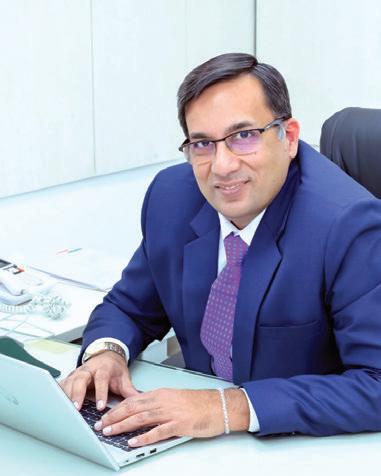
Mr. Yogesh Gupta, Executive Director (Marketing), Tamil Nadu Newsprint and Papers Limited
Paper Mart: Sustainability has long been central to TNPL’s philosophy. How does the company approach sustainability in terms of raw materials, water, energy and environmental compliance?
Yogesh Gupta: In the Indian context, paper is often not treated as a favored commodity. As an industry, we must constantly explain that we are not cutting forests, but producing paper using the greenest possible resources. As a responsible company, it is our duty to manufacture products that are sustainable and fully compliant. Under this philosophy, TNPL has reached new milestones in FY 2024-25.
We are one of India’s leading green companies, having expanded our plantation footprint to over 3.06 lakh acres. We have significantly reduced water consumption, maintaining one of the lowest global benchmarks for integrated mills. Our 169.12 MW wind and solar initiatives continue to reduce our carbon footprint.
We draw water responsibly, using it with the lowest possible consumption, and return treated water to irrigate 1,700 acres of local farmland. We remain conscious of our responsibilities, as seen in our FSC-certified plantation sources. Sustainability is a continuous process for us, not a one-time activity, but an ongoing program that will continue.
PM: From an operational standpoint, what challenges is the paper industry currently facing, and how is TNPL navigating this phase?
YG: The paper industry is currently navigating a period of significant structural strain. In FY 2024-25,
the unrelenting surge of low-priced imports, particularly from ASEAN countries and China, remained our primary challenge. This influx has suppressed domestic realisations despite our stable operational performance. Recent GST changes—particularly the 18% levy on paper and boards—have created cost pressure. Since paper for notebook production is taxed at 0% GST, input tax credit remains unutilized, leading either to margin erosion or price escalation.
While policy support in the packaging board segment has provided some relief, it has not been sufficient to counter the sharp rise in input costs, especially wood prices. To navigate this, TNPL is focusing on what we can control: manufacturing discipline and cost optimization. We reached a record production of 6.14 lakhs MT this year, leveraging our high capacity utilization to mitigate these external pressures. We continue to represent our case to the government regarding import duties and taxation asymmetries. Overall, while the industry remains under pressure, we are managing the situation through operational agility and a shift toward high-value segments like copier paper.
PM: With changing market dynamics, how has TNPL been reworking its product mix across writing and printing papers, copier grades and packaging board?
YG: Given changing market dynamics, TNPL has actively reworked its product mix over the last three to four years, achieving record production in FY 2024-25.
In writing and printing papers, we have introduced new products with better bulk, particularly for the notebook segment. In copier paper, we have strengthened our premium category with brands like Copy Crown and New Spectrum, improving opacity, brightness, and bulk to make them more user-friendly.
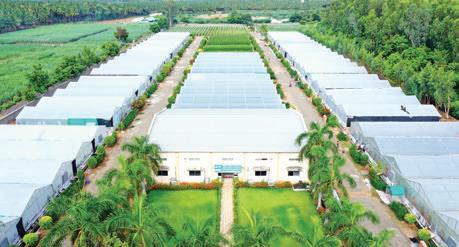
In the packaging board, we are optimizing our mix to align with market requirements while improving margins. A significant shift in our strategy is the progress on our 100 TPD tissue paper facility, which will diversify our portfolio into high-growth hygiene segments. This is not just about volume, but about evolving our product mix to ensure TNPL remains future-ready and resilient in a competitive landscape.
PM: TNPL has recently entered the tissue paper segment. Could you share details on the project, timeline and the thinking behind this diversification?
YG: Our entry into the tissue paper segment is a strategic move to diversify our portfolio into highgrowth hygiene markets. The installation of our 100 TPD (34,000 TPA) tissue machine at Unit II in Mondipatti is currently underway. We expect to launch this product line in the early of 2026–27, with April 2026 being the likely start for commercial operations. With increasing urbanization, higher hygiene awareness, and institutional demand, tissue represents a structurally growing category compared to the relatively mature writing and printing segment.
The machine is a state-of-theart ANDRITZ PrimeLine™ S 2000, sourced from one of the world’s leading manufacturers. We are quite optimistic about this segment; it
aligns perfectly with our vision of being a future-ready, sustainable brand. By entering the hygiene sector, we are building resilience against the volatility in traditional writing and printing paper markets.
PM: What will be the capacity and fiber base for the tissue operation, and how do you view the growth potential of this segment in India?
YG: The new tissue machine at Unit II will have a capacity of approximately 34,000 tonnes per annum. Crucially, the production will be based on virgin fiber, utilizing our own high-quality hardwood pulp. This ensures a premium product that meets the hygiene standards today’s consumers demand.
We view the growth potential as exceptional. The tissue segment is currently one of the fastest-growing categories in the Indian paper industry, with a CAGR of around 14–15 percent. Despite this, there remains a significant gap in the domestic availability of high-quality, virgin-grade tissue paper. Being strategically located in the southern region—a primary consumption hub—provides us with a distinct logistical advantage. We see this as a robust opportunity to capitalize on evolving lifestyle trends and the increasing focus on health and hygiene across the country.
PM: How do you see the balance
between domestic sales and exports for tissue, especially in the initial years?
YG: At present, our primary focus will be on the domestic market. As we enter this new segment with our Unit II expansion, our priority is to stabilize operations and establish a strong presence within the highgrowth Indian hygiene sector. We want to ensure that our capacity first addresses the quality gap in the domestic supply chain.
Given our strategic location in the South, we are well-positioned to serve major domestic consumption hubs efficiently. However, we have designed the project with global standards in mind. Once we have optimized our product mix and achieved consistent operational benchmarks, we will leverage our existing export networks—which currently span over 30 countries—to evaluate international opportunities. Wherever synergies emerge with global demand, we will gradually scale our export footprint, but for the initial years, the domestic opportunity remains our most compelling driver for growth.
PM: Looking across different paper segments, which one do you see as the most promising going forward?
YG: If we broadly classify the
industry into writing and printing, packaging board, and tissue, TNPL is strategically present across the most resilient categories. Looking ahead, packaging board remains the most promising segment for long-term growth. Our multilayer double coated board plant at Unit II continued to be a significant driver of our performance, catering to the booming e-commerce and healthcare sectors.
Despite the challenge of increasing international capacities and import pressures, the fundamental shift away from single-use plastics ensures this segment offers immense potential. While writing and printing remains our core—achieving a record 4.25 Lakh MT production this year—the scalability of packaging boards and the high margins of tissue are where we see the future. Ultimately, a balanced, multi-product portfolio is what will allow TNPL to sustain its leadership.
PM: TNPL has a wide domestic and international presence. How are you strengthening your market footprint, particularly in underserved and tier-2 markets?
YG: TNPL has covered over 60 international markets and maintains a robust pan-India presence. While our distribution network is expansive, we are now focused on deepening penetration in previously underserved regions.
We are aggressively expanding into tier-2 markets, where we see immense growth potential for our premium copier brands like Copy Crown. By leveraging our strengthened supply chain and digital stockist management, we aim for a more granular reach. While our network covers most of India, significant scope remains for deeper, localized penetration to sustain our market leadership.
PM: Any closing thoughts?
YG: We are optimistic that the paper industry will emerge from this current challenging cycle stronger and more resilient. It is important to remember that this sector is a massive engine for rural empowerment; at TNPL alone, our activities support a workforce of thousands and provide a sustainable livelihood to over 40,000 farmers through our plantation schemes.
As we move toward a “Future-Ready” TNPL, our focus remains on the circular economy. With the upcoming launch of our tissue paper facility and our record-breaking production levels this year, we are proving that growth and sustainability can go hand-inhand. We are hopeful that with the right policy support and continued operational excellence, much better times lie ahead for the entire Indian paper sector.
Trident Group, with the philosophy of “staying ahead of the market”, is focusing on technological upgrades and sustainability. The company has recently announced an investment of INR 2,000 crore in its paper and textile businesses. Trident has developed a new range of copier paper and maplitho with unique properties. By collaborating with leading technology providers, the company continues to stay ahead of the competition. Mr. Rajnish Kumar Gera, CEO – Paper & Energy, Trident Group, shares insights into the company’s sustainability initiatives and how it is breaking myths about paper through responsible manufacturing.
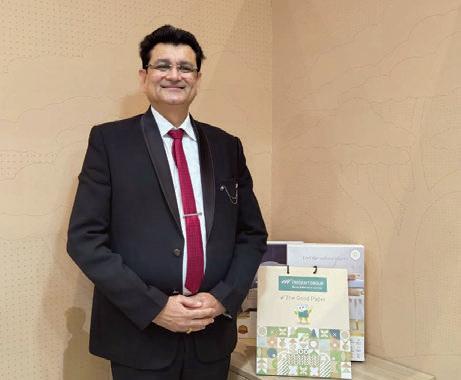
Mr. Rajnish Kumar Gera, CEO – Paper & Energy, Trident Group
Paper Mart: Can you tell us about your new product range, copier and maplitho? What inspired its creation?
Rajnish Kumar Gera: The philosophy of Trident Group is to stay ahead of the market. With data and feedback from the market, we have developed a new range of copier paper and maplitho paper with quality required for specific applications. Some of our maplitho papers- diamond line, gold line, titanium line, and super line, are extensively used in printing and publishing houses. Its versatility and high-quality finish makes it a preferred choice for various printing needs, ensuring crisp and vibrant results every time.
PM: Trident has announced a major investment recently. Could you tell us more about it?
RKG: Our Chairman Emeritus, Mr. Rajinder Gupta, has announced an investment of INR 2,000 crore. Paper is an important part of this investment, alongside textiles. A significant share will go toward strengthening our paper business, helping us stay ahead in the market.
The focus is on technological upgrades and sustainability. This includes reducing steam, power, and water consumption, increas-







Our Chairman Emeritus, Mr. Rajinder Gupta, has announced an investment of INR 2,000 crore. Paper is an important part of this investment, alongside textiles. A significant share will go toward strengthening our paper business, helping us stay ahead in the market.
ing automation digital controls, and upgrading and rebuilding our paper machines. All these initiatives aim to enhance sustainability and product quality.
PM: What kind of technology partners does Trident work with?
RKG: We have always believed in adopting state-of-the-art technology. Currently, our pulp mill is with Valmet, and our paper machine is from Allimand, France. We consistently collaborate with the best global technology partners.
PM: There are several myths around sustainability in paper manufacturing. How does Trident address them?
RKG: Trident has always initiated its manufacturing processes sustainably. We use wheat straw, which is a highly sustainable raw material, and focus on reducing water, steam, and power consumption while recycling most of the water. We aim to
break the myth that paper is not environmentally friendly. We aim to create awareness that the paper is made sustainably and hence our tagline “the good paper.”
PM: How do you view the current state of the Indian paper industry? What, according to you, are challenges and opportunities?
RKG: The paper industry is going through a tough time with global uncertainties and rising imports. So ups and downs are inevitable. What matters is an organisation’s strength and process capability to withstand these challenges. Trident is well-equipped and supported by strong business associates to navigate this phase.
One major challenge is increased imports, which put pressure on market prices. On top of it, there is a huge increase in raw material prices, which makes it difficult for the mills to sustain their margins.
Companies that focus on reducing manufacturing costs, building a trusted brand, and emphasizing sustainability will survive and grow.
I would also like to add that there are a lot of opportunities and headway available for us, and with the kind of quality, brand, and serviceability that Trident has, we see a very good potential to grow in the paper market.
One major challenge is increased imports, which put pressure on market prices. On top of it there is a huge increase in raw material prices, which makes it difficult for the mills to sustain their margins.
The focus is on technological upgrades and sustainability. This includes reducing steam, power, and water consumption, increasing automation and digital controls, and upgrading and rebuilding our paper machines.

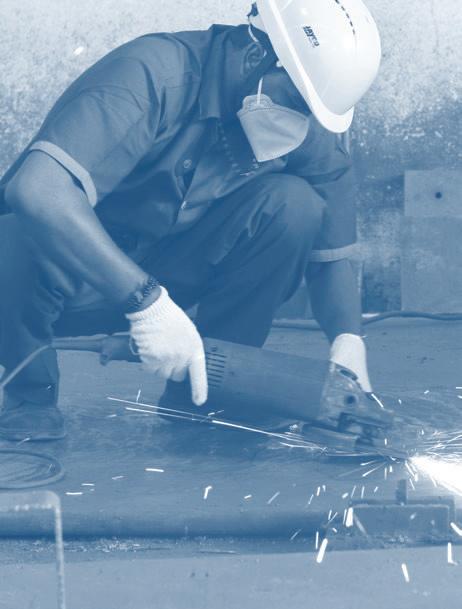
Ballarpur Industries (BILT) has transitioned from a legal-and-creditor phase to an operating-and-execution phase. In an exclusive interaction with Paper Mart, Mr. Hardik Patel, Managing Director, Finquest Group, says Yamunanagar is central to BILT’s turnaround, with emphasis on predictable operations, consistent delivery, and restoring market confidence. He adds that for Finquest, BILT is a marquee investment, a legacy brand with deep history and significant potential, showcasing that established industrial institutions can be rebuilt with the right intent and execution.
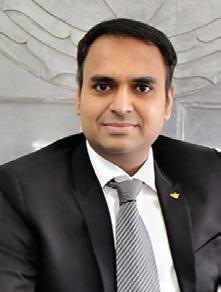
Mr. Hardik Patel, Managing Director, Finquest Group
Paper Mart: From IBC filing to reopening in Yamunanagar, how would you summarise the mill’s transition in one narrative, and what does it signify for the company today?
Hardik Patel: In simple terms, we have transitioned from a legal-andcreditor phase to an operating-andexecution phase. The IBC process is demanding. It is not merely about resolving claims; it resets the organisation entirely.
For BILT, the real challenge was not only navigating courts and creditors, but restarting operations in a manner that restored confidence across stakeholders. Yamunanagar may not be the largest mill by capacity, but it has always been recognised for quality. It was the birthplace of premium grades such as executive bonds, and that legacy reflects what the mill can deliver when run with discipline. The reopening therefore marks a clear shift: ‘BILT is no longer a legacy name – it is an active, operating manufacturer once again.’
PM: With Yamunanagar now operational, how do you define BILT’s current business priorities: stability, selective growth, or scale? Please explain.
HP: Stability comes first, followed by selective growth. In any turnaround, the temptation is to pursue scale quickly. However, without a stable base, consistent output, disciplined quality, reliable supply, and tight working capital, scale can undermine progress rather than strengthen it.
Our current focus is straightforward: ‘operate predictably, deliver consistently, and rebuild market confidence.’ Once that foundation is secure, growth becomes both meaningful and sustainable.
PM: What is the strategic role of the Yamunanagar unit within BILT’s overall production and market positioning over the next two to three years?
HP: Yamunanagar is central to BILT’s turnaround. Over the next two to three years, its role is to serve as the benchmark for consistency and quality. While it may not be a capacity leader, its historic strength has been premium-grade production, and that is what we want the market to experience again. If Yamunanagar performs consistently, the broader turnaround gains credibility. Strategically, it is our anchor for trust, discipline, and long-term rebuilding.




PM: How is Finquest approaching capital deployment at BILT? Are current investments focused more on maximising existing assets or on selective upgrades to strengthen future competitiveness?
HP: Our approach is resolute and disciplined. In the initial phase, the priority is to stabilise operations and maximise performance from existing assets. Capex is being undertaken selectively, not through large, frontloaded expansion.
PM: Every investment is tested against a simple principle. Does it materially improve returns?
HP: If an upgrade enhances reliability, reduces downtime, improves quality, or strengthens energy efficiency, it is justified. We will not invest for scale alone. Capital allocation must strengthen competitiveness while preserving financial control.
PM: What internal metrics or milestones will you use to judge whether the turnaround is firmly on track, beyond top line growth?
HP: Topline growth is visible, but it doesn’t indicate if a turnaround is real. A genuine turnaround is reflected in stable, disruption-free operations, repeatable quality that drives customer reorders, disciplined working capital management, strong unit economics and contribution margins, cash generation and liquidity control, and structural cost improvements, particularly in energy, yield, and wastage. When a business becomes predictable and controllable, the turnaround is real. That is the phase we are focused on achieving.
PM:How do you see BILT aligning itself with emerging industry imperatives such as sustainability, fiber security, energy efficiency, and regulatory compliance?
HP: Sustainability, fiber security, energy efficiency, compliancethese are no longer optional considerations; they are fundamental to long-term competitiveness. Our approach is practical: fiber discipline, efficiency, and compliance are embedded into operational decisionmaking rather than treated as separate initiatives.
Even at Yamunanagar, a mill with a deep legacy, we are applying a modern operating lens: improving efficiency, compliance, and responsibility while preserving its core strength in quality.
PM: In a market that is becoming increasingly competitive and cost-sensitive, what will differentiate BILT from other domestic paper producers in the next phase?
HP: In the next phase, reliability will be as important as price. Customers value consistency, stable quality, dependable supply, and a partner they can plan around.
BILT’s differentiation will be driven by: quality-led positioning rooted in Yamunanagar’s heritage, operational discipline and predictability, targeted upgrades that strengthen performance, and a long-term perspective rather than short-term volume chasing. We are not focused on being the least priced supplier, we are focused on being reliable and respected.
PM: In five years, what should
the industry associate with the name ‘Ballarpur Industries’ once again?
HP: Five years from now, BILT should stand for credibility, quality, and professional execution. Not just nostalgia and legacy, but the industry should simply say: “BILT is back, and it is run with discipline.” A brand associated with strong manufacturing culture, sound governance, and products the market trusts.
PM: Finally, what does the revival of BILT mean for Finquest as a group, financially and philosophically?
HP: For Finquest, BILT is a marquee investment. It is a brand with deep history and significant potential.
Financially, value creation is important, but not through short-term extraction. Our objective is to build value steadily through disciplined operations. Philosophically, the revival carries equal weight. Restarting a mill with nearly a century of history requires patience, responsibility, and longterm commitment.
For us, BILT’s revival is not only about returns, it is about demonstrating that legacy industrial institutions can be rebuilt properly, with intent and execution.
The reopening therefore marks a clear shift: BILT is no longer a legacy name – it is an active, operating manufacturer once again.
Yamunanagar may not be the largest mill by capacity, but it has always been recognised for quality. It was the birthplace of premium grades such as executive bonds, and that legacy reflects what the mill can deliver when run with discipline.
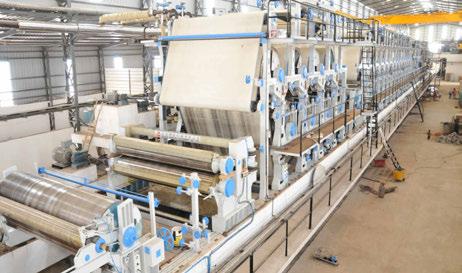
KRecycling Private Limited, a Gurugram-based paper products company, has entered a new phase of growth with the commissioning of a state-of-the-art coating facility in Ludhiana, Punjab. The investment marks the company’s expansion into thermal paper, sublimation paper, C1S chromo paper and greaseproof grades, supported by high-speed coating technology, in-house chemical formulation capabilities and stringent quality control systems. In this exclusive interview with Paper Mart, Mr. Amanbir Singh Sethi, Director & Mr. Sanjeev Khullar, CEO, KRecycling Private Limited, shares insights on the new plant’s capacity, technology differentiation, quality focus, regulatory outlook and the company’s strategy to build a strong B2B presence in domestic and export markets.
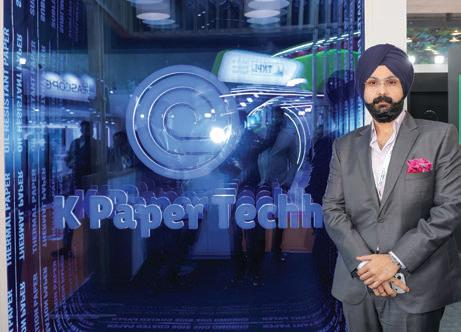
Mr. Amanbir Singh Sethi, Director, KRecycling Private Limited
Paper Mart: Please tell us about your new venture and the product segments you are addressing through this investment.
Amanbir Singh Sethi: We have started a new coating plant, a fullfledged coating unit in Ludhiana, Punjab.Through this facility, we are manufacturing and supplying coated products such as thermal paper, sublimation paper and C1S chromo paper to the market.
PM: What is the installed capacity of the new coating plant? When did you start commercial production?
ABS: The plant has a per-day capacity of 40 tonnes, which translates to around 1,200 tonnes per month. Commercial production at the facility commenced in April 2025.
PM: Which markets are you currently supplying to, and how do you see exports shaping up in the near to medium term?
Sanjeev Khullar: At present, our primary focus is on the Indian market, with supplies spanning regions from Bangalore and Mumbai to Kolkata and North India. We have



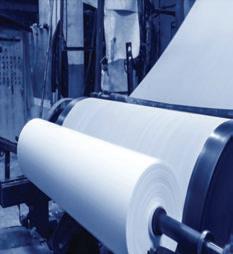


We are a company that started almost two decades ago with a vision to provide practical and long lasting solutions to the burgeoning paper industry in India by creating a fusion of chemistry applications and local industry environment and requirements.
Internal Sizing & Surface Sizing
Retention and Drainage
Dry Strength Resin
Paper Machine Deformer and DE-AERATION
Surface Additives
Felt Cleaning and Conditioning Program
Microbiological & Deposit Control Program
Wet Strength Resin
Stickies Control program
Deinking chemicals
Enzymes
Starch(Native, Modified cationic/oxidized)
Coating thickener
Coating lubricant
Dispersants
Antisclants
Flocculants
Coagulants
Pulp mill Cooking-aid
Pulp mill Wash-aid
Odor control
We are supplying across India, from Bangalore to Mumbai, Kolkata and North India. We have also started exporting to markets like Sri Lanka. We are targeting markets such as the UAE, Saudi Arabia, Sri Lanka and possibly some African markets.
also started exporting to Sri Lanka and are actively targeting markets such as the UAE, Saudi Arabia, Sri Lanka and select African countries.
PM: What proportion of production do you expect to export?
SK: Initially, we expect exports to account for around 20–25 percent of our production. For now, the domestic market remains our main focus.
PM: Could you highlight the key technology features of the coating line you have installed and how it differentiates you from existing players?
SK: We have invested in a state-ofthe-art coating machine sourced from China, operating at a speed of 400 metres per minute. Most coating plants in India operate at around 200 metres per minute, so this gives us a significant productivity advantage.
In addition, our in-house chemical kitchen allows us to develop formulations comparable to international standards. The line has two coating units—a pre-coat followed by a thermal coat— ensuring superior thermal paper quality. Online calendaring further enhances smoothness, bulk and matte finish. We benchmark our products against high-quality grades from Korea and China.
PM: In products like thermal
paper, chemistry and quality control are critical. How have you strengthened your capabilities in this area?
SK: We have onboarded a professional team with extensive experience in thermal paper manufacturing. A dedicated laboratory equipped with advanced testing instruments has been set up to monitor parameters such as particle size and image density. Testing is carried out at three stages—during coating, during rewinding and before packing. Printouts are retained to ensure print quality stability, which is the most critical performance parameter in thermal paper. Material is released to the market only after meeting strict quality benchmarks.
PM: Thermal paper can be a volatile segment, influenced by imports and base paper availability. How do you view the current market dynamics, particularly with regard to regulation?
SK: A lot depends on imported thermal paper coming into India. There are not many large coating players in this segment domestically. We believe that BIS standards should be implemented for thermal paper, and that low-priced stocklot imports should be restricted. Moreover, rupee depreciation will also make imports non-viable in coming times.
We have already taken this up with the Government of India. Once BIS is imposed on thermal paper, the market will see more fair play, and lowcost stock-lot imports will reduce.
PM: What is your outlook for the thermal paper market over the next few years?
SK: The market is generally very good. Thermal paper is used everywhere today, from e-commerce, ticketing, petrol pumps to cinemas and labels. We see a growth rate of about 5–7 percent over the next 7–10 years, which is why we invested in this plant.
PM: Beyond thermal paper, you mentioned that the machine allows you to manufacture multiple coated products. Could
The market is generally very good. Thermal paper is used everywhere today, from e-commerce, ticketing, petrol pumps to cinemas and labels. We see a growth rate of about 5–7 percent over the next 7–10 years, which is why we invested in this plant.
you elaborate on this product basket?
SK: This is a multi-product coating machine. Apart from thermal paper, we are also producing C1S chromo paper for pouch manufacturing, as well as greaseproof OGR paper. We are not dependent on a single product.
We can carry out different types of coating and offer a broad product basket. That is why we are looking to build strong customer relationships.
PM: What are the key applications for C1S chromo paper, and how are you approaching collaborations with brands and converters?
SK: The primary application is pouch making. It is also used for gumming sheets and label manufacturing. While there is competition from stock-lot material, we are already tied up with some large companies and
trials are going on. We will be manufacturing for them, though we are not disclosing names at this stage.
PM: You also spoke about greaseproof OGR paper. What differentiates your offering in this segment, particularly for food-grade applications?
SK: Our greaseproof OGR paper is used for sandwich and burger wrapping. It has a kit value of 7+ and is PFAS-free. Many manufacturers use cheaper PFAS-based chemicals that do not meet food-grade standards. Our product is food-grade approved, and we are deliberately targeting niche, higher-quality segments rather than competing in low-quality markets.
PM: Which players do you benchmark against in terms of quality, and what kind of base paper do you use?
SK: We benchmark ourselves against
A-grade export-quality products. Virgin-grade base paper is used for coating, and all chemicals employed are PFAS-free to ensure safety and compliance.
PM: Would you like to share any final thoughts?
SK: We are now looking to build a strong customer base. The plant is running well, and quality is being closely monitored. We believe we can emerge as a significant player in the thermal and C1S chromo segments.
At present, we supply finished thermal paper mainly to POS manufacturers and converters in India, supplying jumbo rolls on a B2B basis. We are not entering smallroll manufacturing for the Indian market, as that would place us in competition with our customers. For now, we are focused on supplying jumbo rolls to converters only.






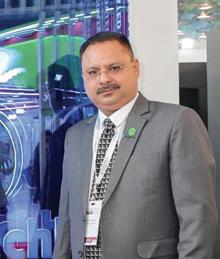
MLM Group is strengthening its footprint in India while exploring new value-added applications. The company shared its plans for pharma-grade Microcrystalline Cellulose (MCC) production from pulp, alongside its ongoing innovations in packaging and technical paper. In an exclusive interview with Paper Mart, Mr. Chirag Jain, Founder & Director – MSIL, MLM India, shared that the company is also expanding its pan-India warehousing network, addressing logistics and supply chain efficiency. Currently, the group has warehouses in Delhi, Mumbai, and Gujarat, with plans to add facilities in South and East India. The company anticipates robust growth in packaging paper, corrugation, and technical grades, while keeping an eye on geopolitical and global trade challenges that could impact supply chains.

Mr. Chirag Jain, Founder & Director – MSIL, MLM India
Paper Mart: Are there any specific innovations in the pipeline that you would like to share?
Chirag Jain: Yes, we are venturing into pharma applications. We are planning a plant for Microcrystalline Cellulose (MCC) made from pulp. This product has potential applications in pharma, cosmetics, and other industries. This is one of our key focus areas for forward integration and value addition.
PM: What opportunities do you see in the Indian paper industry over the next five years?
CJ: The opportunities depend on the sector. Packaging, corrugation, and technical grades are growing 10–15% per year. E-commerce, food packaging, and both primary and secondary packaging are driving demand. India is also a net importer of pulp, so we are bullish on virgin fiber imports and the pulp sector.
PM: What strategies are you employing to expand your market presence domestically and internationally?
CJ: Domestically, we are expanding
warehouses across India. Currently, we have warehouses in Delhi3,000–4,000 tonnes capacity, Mumbai- 10,000 tonnes capacity, also our largest warehouse and Gujarat- 5,000 tonnes capacity. We are now planning warehouses in South India and East India. This panIndia distribution allows us to serve customers efficiently, from small orders to large-scale requirements, with services like splitting, rewinding, cutting, and sheeting.
PM: What supply chain issues have you observed recently?
CJ: Most supply chain issues come from geopolitical disturbances, like sanctions, transport disruptions (e.g., Red Sea incidents), or tariff wars. For virgin fiber products, there are currently no major challenges. Some constraints exist in the recycled/ waste segment, as the EU prefers to consume local waste internally.
PM: How do you foresee the Indian paper and packaging industry over the next 5–10 years?
CJ: I’m not very bullish on writing, printing, or publication paper. Howev-
er, packaging paper, boards, and technical paper are growing at 10–12% annually, making it a sustainable business. Consolidation is happening among converters and traders. Traders and converters will evolve in two ways: they will either specialize in niche markets or focus on volume business. Creativity will also play a major role–traders and converters who innovate in product applications or packaging solutions will sustain and grow, while those who rely purely on volume may face challenges. Overall, the market is set for structural changes and strategic evolution across both packaging and trading segments.
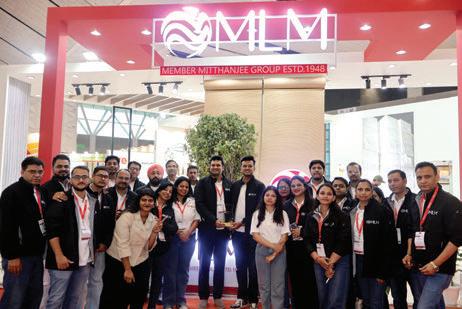
Rooted in the 90-year Mitthanjee legacy, MLM India Limited, established in 1948, is a leading importer and indentor of paper, paperboard, pulp, and newsprint—championing trusted global paper trade across generations.



The Bhola Ram Group, a diversified manufacturing conglomerate has emerged as a significant player in India’s paper industry through strategic acquisitions, disciplined operations, and focus on quality. Entering the paper sector in 2013, the Group today operates large integrated paper and power facilities with a combined capacity of 600–650 tonnes per day paper, catering to both writing & printing and kraft paper segments. In an exclusive interaction with Paper Mart, Mr. Harsh Goyanka, Managing Director, Bhola Ram Group, shares insights into the company’s 100% debt-free business model, commitment to consistent quality and sustainability, ongoing INR 30 crore capex expansion, export ambitions, and his perspective on the current challenges and long-term outlook of the Indian paper industry.

Mr. Harsh Goyanka, Managing Director, Bhola Ram Group
Paper Mart: To begin with, could you introduce the Bhola Ram Group and its entry into the paper industry? What is your current production capacity?
Harsh Goyanka: The Bhola Ram Group is a diversified manufacturing group with major exposure in iron and steel. We entered the paper industry in 2013 through the acquisition of Vishnu Vishal Paper Mills Pvt. Ltd., which is now known as Bhola Ram Papers & Power Pvt. Ltd. – Unit 1 (RR Unit).
In 2019, we acquired the Moradabad plant through the banks by acquiring Shakumbhari Straw Products Limited, which became Unit 2 of Bhola Ram Papers & Power Pvt. Ltd. This unit has three paper machines and a 12 MW captive power plant. The plant had been closed for nearly 10 years and required extensive revamping due to deterioration and theft. After two years of hard work, all three machines were recommissioned, and production restarted in September 2021.
Today, we are among the leading paper companies in India, with a
total production capacity of around 600–650 tonnes per day. This includes approximately 200 tonnes of writing and printing paper and 350–400 tonnes of kraft paper.
PM: What would you describe as your company’s key USP?
HG: Our biggest USP is that we are a 100% debt-free company. We have zero bank term loans and no working capital borrowings, which gives us complete operational freedom. Without financial pressure, we can focus on market development, quality, and customer satisfaction rather than forced sales.
Our second USP is our holistic approach to quality and service. I personally conduct monthly reviews with sales and production teams to ensure zero customer complaints. Quality consistency and customer satisfaction are non-negotiable for us.
PM: How do you ensure consistent quality in your products?
HG: Quality depends largely on raw material consistency. We follow a

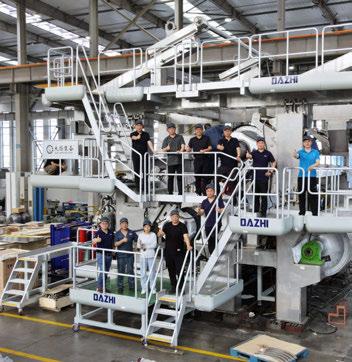
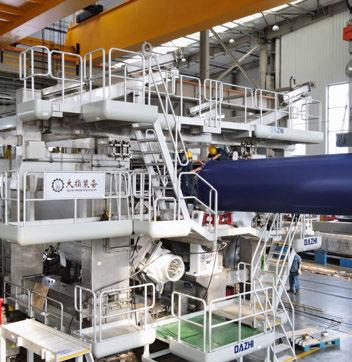
Our latest 3rd Generation Shoe Press—designed to deliver higher efficiency, enhanced dewatering performance, and unmatched reliability—is now ready to be shipped to APP Indonesia’s Tjiwi Kimia PM3.
In addition, we’re proud to announce a repeat order from APP for a full PM6 rebuild, once again featuring our trusted Integra®-Shoe Press. This order reflects APP’s strong confidence in Dazhi’s innovative technology and expert execution.”
Our biggest USP is that we are a 100% debt-free company. We have zero bank term loans and no working capital borrowings, which gives us complete operational freedom.
fixed raw material mix, ensuring minimal shade variation and uniform finish. Since our recycled raw material base is stable, the final product quality remains consistent, resulting in negligible complaints and high customer satisfaction.
PM: What grades and brightness levels do you manufacture?
HG: Up to 85 brightness, we manufacture paper using 100% recycled fiber without pulp. For 90 and 92 brightness grades, we use imported hardwood and softwood pulp, mainly sourced from the USA and occasionally the UK, depending on market conditions.
PM: Could you share details about your domestic and export markets?
HG: Domestically, our products are sold across India, from Kashmir to Kanyakumari. Internationally, we are new entrants, having started exports 3–4 months ago. Following this exhibition, we have received strong enquiries, particularly from Africa, the Middle East, and parts of Europe. Given our strong logistics experience, especially through our steel exports and proximity to Dahej Port, exports will not be a challenge for us.
PM: Sustainability is a major focus today. How does Bhola Ram Group address it?
HG: Sustainability comes naturally when policies are consistent. At our facilities, paper up to 85% brightness
is 100% recycled, ensuring no tree cutting. We collect waste paper, process it, and convert it into finished products. Our company is also FSC certified, reinforcing our commitment to responsible sourcing and sustainability.
PM: Are there any major capex or expansion plans underway?
HG: Yes. We are making a INR 30 crore capex investment in PM3, one of the best machines in India for writing, printing, and copier grades. This project will be completed by March 2026, increasing PM3 production by around 25%.
Additionally, at our Moradabad unit, we are planning to convert PM1 kraft paper machine into a writing and printing machine, further strengthening our portfolio.
PM: Are you collaborating with any machine suppliers for these projects?
HG: Yes. PM3 is being upgraded by Servall Engineering, and the delivery is scheduled by March 2026. We are also in discussions for further collaborations as part of our expansion roadmap.
PM: What challenges do you currently face as a manufacturer?
HG: Dollar fluctuation is one of the biggest challenges, as we import a significant quantity of waste paper and pulp. Currency volatility directly impacts raw material costs. Despite
this, our strategy is simple: maintain consistent quality, balance imported and domestic raw materials, and ensure fair pricing so both customers and the mill remain profitable.
PM: How do you view the current paper industry scenario? What is your message to the market?
HG: The paper industry has been going through a challenging phase since April 2022, and recovery has been slow. This affects not just manufacturers but also employment, government revenue, and the overall value chain. However, good and bad cycles are part of any industry. We believe this phase will also pass.
Bhola Ram Group remains deeply committed to quality, customer satisfaction, and continuous improvement. We welcome feedback, invest in R&D, and adapt to market needs. The market has already recognised our quality, and we assure our customers that we will continue delivering the best products with consistency and integrity.
Dollar fluctuation is one of the biggest challenges, as we import a significant quantity of waste paper and pulp. Currency volatility directly impacts raw material costs.
We are making a INR 30 crore capex investment in PM3, one of the best machines in India for writing, printing, and copier grades.








Fibertec CEO Mr. JP Narain has entered a new phase in his professional journey, making a strategic transition from project consultancy to core manufacturing. As part of a carefully structured growth plan, he has taken over the 100 TPD Sambhu Board mill in Punjab through a newly incorporated entity, Bioprima Pvt. Ltd., and is currently leading a comprehensive operational overhaul ahead of its restart. The revived plant will initially focus on high-GSM kraft paper catering to industrial and packaging applications, while embedding strong green manufacturing practices such as recycled fiber utilization, zero liquid discharge (ZLD), and a significant shift toward renewable energy. In an exclusive interaction with Paper Mart, Mr. JP Narain, CEO, Fibertec, shares insights into the acquisition, sustainability roadmap, operational strategy, and his perspective on the evolving paper market.

Paper Mart: Please tell us about your new venture—how it was conceptualized, how it evolved, and where it stands today?
JP Narain: This venture is part of a well-thought-out transition plan. While it may appear new, the journey has been gradual. After my tenure at Century, I began with pulp trading and later moved into project and business transformation advisory—work that I continue to undertake. However, advisory assignments are cyclical by nature. I had always intended to move into manufacturing when the right opportunity emerged.
Approximately six months ago, that opportunity materialized. We identified and acquired the asset formerly known as Sambhu Board, a 100 TPD mill. After detailed negotiations, we structured the acquisition by forming a new company—Bioprima Pvt. Ltd.—which acquired all assets of the earlier entity. We retained 52% equity, while the former promoter holds 48% in the new company. Importantly, all legacy liabilities were cleared, enabling us to take over operations with a clean balance sheet.
Currently, we are undertaking a
comprehensive overhaul of the plant and expect to commence production around mid-May 2026.
PM: Could you elaborate on the asset—land, machinery, and infrastructure?
JPN: The asset has strong fundamentals. The main paper machine is in reasonably good condition. However, critical areas such as the boiler, effluent treatment plant (ETP), and pulping section require complete modernization.
We are installing a new boiler and leveraging the Punjab Government’s Prali Boiler Scheme, which promotes the use of agricultural residue as fuel. Simultaneously, we are upgrading wastewater treatment and water management systems to enhance sustainability and compliance.
Energy efficiency is a core focus. While certain components will be newly installed, others are being refurbished for optimal performance. The shed and structural infrastructure are sound, requiring only minor upgrades.
PM: You have consistently emphasized green manufacturing. What initiatives

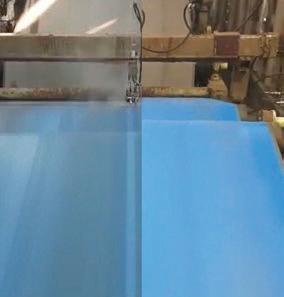


All liabilities of the old company were cleared, and we took over operations with a clean balance sheet. Production is expected to commence by mid-May 2026.
rather than pure commodity markets.
PM: What is your long-term vision for this venture?
are planned in this direction?
JPN: Sustainability is foundational to our operations. We are already operating on recycled fiber, and this will remain central to our model.
On the energy front, we are working toward replacing nearly 60% of fossil or thermal energy with renewable sources, including a planned solar installation. This is our first major sustainability initiative.
Secondly, we are designing the plant to operate on a zero liquid discharge (ZLD) framework. We are also evaluating fiber reconfiguration strategies to enhance product strength and performance, though this remains under consideration.
PM: What products will you focus on, and which markets are you targeting initially?
JPN: Our initial product portfolio will comprise high-GSM kraft paper ranging from 200 GSM to 450 GSM. We also plan to manufacture high-BF kraft paper in the 35–50 BF range.
The primary focus will be on industrial customers and packaging applications, including segments where paper can effectively substitute alternative materials. The strategy is to position ourselves in value-added industrial applications
JPN: At present, this is a relatively small operation, but the facility has expansion potential. Over time, we intend to move toward specialtygrade products. This could involve enhancing strength parameters, modifying fiber configurations, or reengineering product characteristics to shift from basic commodity grades to specialty offerings. While this roadmap is still under evaluation, the long-term objective is clear—value creation through differentiation.
PM: You are known for driving operational efficiencies. What will be your focus areas here?
JPN: From day one, the plant will operate on a lean manufacturing philosophy. Automation will be integrated wherever feasible, with optimized manpower deployment.
Energy and water efficiency are non-negotiable priorities. We are implementing highly efficient, largely automated systems to ensure the lowest possible cost of conversion while maintaining best-in-class quality standards. Operational discipline, technological integration, and cost competitiveness will define our manufacturing model.
PM: How do you assess the current industry scenario and the outlook ahead?
JPN: The global paper industry is operating in a highly competitive and structurally evolving environment. Comparing current conditions with previous peak cycles can be misleading. In my view, what we are witnessing today is the “new
normal,” influenced significantly by geopolitical shifts.
Localized production strategies across nations and China’s excess capacity have altered global trade flows. Chinese overproduction and lower domestic consumption have resulted in aggressive exports, affecting markets previously served by Indian manufacturers. Exports that once stood at 5–6 million tonnes have declined substantially.
This oversupply exerts downward pressure on pricing and compresses margins across the supply chain. Until geopolitical uncertainties ease—which remains unpredictable—the market is unlikely to witness a sharp rebound. The path forward lies in efficiency, cost leadership, and quality excellence.
PM: Any final message for the industry?
JPN: This venture marks a transition phase in my journey and, at present, is modest in scale relative to the broader industry. However, it is strategically aligned with a larger vision. I intend to pursue bigger and more impactful initiatives in the future. When the time comes, the market will see that evolution clearly. My focus remains on building something stronger, more efficient, and future-ready.
We are planning to manufacture high-GSM kraft paper ranging from 200 GSM to 450 GSM, along with high-BF grades from 35 to 50 BF.
Lean manufacturing, high automation, energy efficiency, and water optimization will be embedded from day one—without compromise.


From Commodity Corrugation to Engineered Substrate



IIndia’s containerboard sector is being reshaped as fibre volatility tightens margins and import competition limits pricing flexibility. Lightweighting expectations are raising the bar on performance. Paper Mart presents a focused examination of this structural shift.
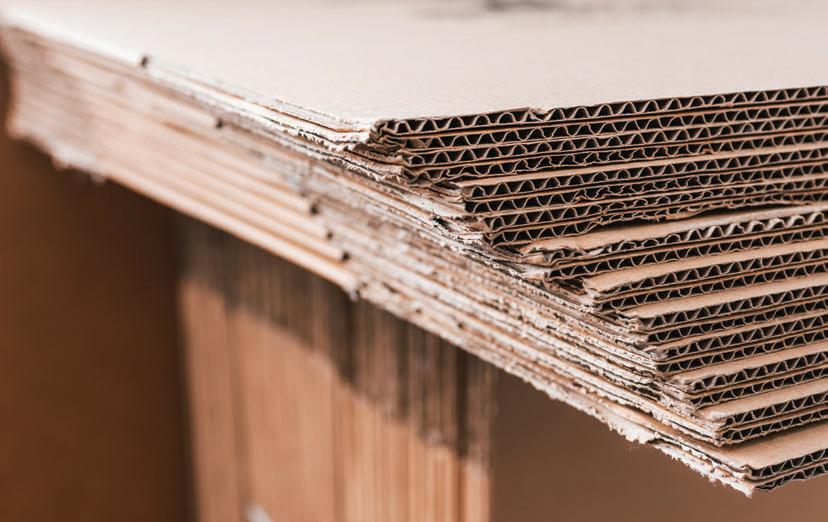
ndia’s containerboard, commonly known as “kraft paper,” segment has been traditionally viewed through a narrow lens: fragmented supply and intense price competition. It has also been characterised by volume-led expansion. These characterisations still capture part of the reality. However, what converters require and how customers evaluate performance are beginning to change the way mills compete.
The most visible indicator of this change is the way performance is now measured. Corrugators are increasingly evaluating substrate quality through Short-span Compression Test (SCT), Edge Crush Test (ECT), Ring Crush Test (RCT), moisture profile uniformity and runnability on high-speed lines, rather than relying predominantly on Burst Factor (BF). As Mihir Shah, Director, Aryan Paper Mills, observes, “We are witnessing a clear shift from the end-user perspective, where performance evaluation is moving away from traditional BF toward parameters such as Short-span Compression Test (SCT) and Edge Crush Test (ECT).”
Moreover, this change is closely linked to investment in modern corrugation plants. As machine speeds increase and handling becomes more automated, even small variations in the sheet become less acceptable. In such an environment, inconsistent formation or uneven moisture profiles directly affect conversion efficiency and box performance. Substrate reliability under operational stress becomes as important as nominal strength values.
This shift in performance expectations also makes it important to clarify the terminology used in the segment. Kraft is a pulping process that produces strong fibres through chemical treatment. Containerboard is the functional category derived from either virgin or recycled fibre and includes kraftliner, testliner and fluting medium. Kraftliner typically serves as the outer facing layer of corrugated board, contributing to stacking strength and compression resistance. Testliner, usually made from recycled fibre, provides costeffective facing solutions for lighter applications, while fluting medium forms the corrugated core that distributes load. The performance of a corrugated box depends not only on fibre strength but also on sheet formation and moisture balance. Compatibility with machine speeds is also essential.
Lightweighting has intensified this technical orientation. Customers increasingly seek lower GSM grades without compromising compression performance. Achieving that balance requires improved fibre blending, refining precision and tighter process control. Apollo Papers notes rising expectations for uniform strength, precise GSM and dimensional stability in e-commerce and FMCG packaging applications. Aryan emphasises reel build-up consistency and moisture uniformity for highspeed corrugation lines.
Taken together, the shift in performance metrics, the rise of lightweighting and the modernisation of conversion infrastructure indicate that kraftbased containerboard is being evaluated less as bulk paper supply and more as an engineered substrate within an integrated packaging system. The competitive variable is no longer grammage alone, but consistency under increasingly demanding operational conditions.
It is important to note that much of what is commercially referred to in India as “kraft paper” consists of recycled-fibre linerboard and fluting medium used in corrugation, rather than exclusively virgin kraftliner produced through chemical sulphate pulping. In functional terms, these grades fall under containerboard, even if trade terminology suggests otherwise. Accordingly, unless stated otherwise, “kraft” in this story refers to containerboard used in corrugated packaging, encompassing both linerboard and fluting medium.
While performance expectations at the substrate level are becoming more demanding, demand for kraft packaging, or containerboard, continues to expand across multiple segments of the economy. This growth reflects evolving consumption patterns and distribution systems.
India’s kraft paper market (roughly 11 million tonnes in 2024) is projected to grow at ~7.2% annually to exceed 21 million tonnes by 2033, underpinned by rising demand for recyclable and durable packaging across retail, logistics and industrial applications.
E-commerce remains one of the most significant demand drivers. Online retail depends on transitready corrugated packaging capable
of withstanding extended logistics chains and variable handling conditions. The corrugated boxes segment itself is forecast to reach USD 18–23 billion by the mid2030s as e-commerce and FMCG continue to drive parcel and protective packaging volumes. “E-commerce has emerged as the single biggest growth driver for kraft paper demand in recent years,” says Madhukar Mishra, Managing Director, Star Paper Mills. The expansion of direct-to-consumer delivery models has increased the volume of secondary and tertiary packaging required for safe product movement.
FMCG and organised retail continue to reinforce this trend. Dinesh Haripara, MD, Apollo Papers, notes that packaging has emerged as the fastest-growing segment within the paper industry, supported by expanding consumption across FMCG, food & beverage and pharmaceutical sectors. As product portfolios diversify and distribution networks widen, corrugated packaging requirements expand correspondingly.
Food processing and agricultural logistics represent an additional growth vector. The movement toward organised supply chains for fresh produce requires boxes that balance strength, ventilation and cost efficiency. Mihir Shah, Director, Aryan Paper Mills, anticipates sustained demand growth in this area, stating, “We foresee a significant demand upswing in fresh produce boxes, which will be an important growth segment in the coming years.” This reflects broader changes in farm-to-market integration and export-oriented packaging standards.
Industrial and automobile sectors also contribute to corrugated demand. Deept Agarwal, Director, Paswara Papers links growth momentum to Make in India




initiatives and expansion across FMCG, automobile and food processing sectors. As domestic manufacturing scales, protective packaging requirements increase in parallel.
Beyond sectoral demand, regulatory and consumer shifts are influencing material preference. Efforts to reduce single-use plastics and the implementation of extended producer responsibility (EPR) frameworks have strengthened the position of paper-based packaging. Corrugated formats are increasingly seen as compatible with circular economy objectives, supporting their wider adoption across retail and distribution.
Demand expansion, therefore, is multi-sectoral and infrastructurelinked. Kraft-based containerboard now supports a logistics-intensive economy where packaging functions not merely as protection but as a structural component of distribution systems. However, expanding demand operates within economic constraints. Growth does not eliminate volatility in fibre
sourcing, energy cost or pricing discipline. It instead raises the stakes for operational efficiency and competitive differentiation.
India’s kraft and containerboard landscape includes large integrated producers such as ITC Paperboards, JK Paper, West Coast Paper Mills, TNPL and Century Pulp & Paper, which influence scale economics and national pricing benchmarks. Recycled-fibre leaders like Emami Paper and N R Agarwal, alongside mid-sized players such as Star, Paswara, Apollo, Aryan, and Bhola Ram shape regional supply dynamics and grade evolution.
Despite steady demand expansion, the Indian kraft segment operates under layered constraints that complicate margin stability and long-term planning.
The first and most visible stress is pricing pressure. While tonnage demand remains healthy, pricing power is constrained. Global
uncertainty, along with tariff changes and uneven policy implementation, has affected packaging grades across segments. Naynesh Pasari, CEO, Shree Krishna Paper Mills, articulates the prevailing sentiment candidly: “Today, the paper mills are in a survival mode, hence reduction of cost is the focus area where major investments are going on.” This statement reflects not pessimism but realism. Volume growth does not automatically shield mills from input inflation or import competition.
Imports from ASEAN and China exert persistent discipline on domestic pricing. Apollo Paper acknowledges the competitive influence of lower-cost imports. Dinesh Haripara observes, “Cheaper imports, particularly from ASEAN and China, exert pricing pressure and reduce flexibility to fully pass on cost increases to the market.” Pricing, therefore, becomes a negotiation between cost structure and competitive elasticity rather than a function of demand alone.
Beneath pricing volatility lies the deeper issue of fibre insecurity.

India remains structurally fibredeficient. Domestic recovery rates for wastepaper remain below optimal levels, and supply chain inefficiencies affect collection quality. Consequently, the industry depends significantly on imported recovered fibre and, in some cases, virgin pulp.
The diversity of fibre models across mills reflects the absence of a structurally secure domestic fibre base. Even mills operating on virgin pulp remain exposed to wood cost cycles and plantation economics. This model reduces dependence on global wastepaper markets but introduces exposure to wood economics and plantation management cycles.
Aryan Paper Mills has established partnerships with major US wastepaper balers and benefits from proximity to ports, enhancing logistical flexibility. Paswara prioritises high-quality DSOCC imports from the United States, phasing out mixed waste streams to maintain consistent strength characteristics. Yet currency risk remains embedded in this model. As Deept Agarwal, Director, Paswara Papers Limited, notes, “While the global price of DSOCC remains relatively stable between USD 160–200, the primary risk is INR devaluation, which inflates our landing costs”.
Inventory buffers and supplier diversification reduce short-term volatility but do not eliminate exposure. Apollo balances domestic recovered fibre with strategic imports of wastepaper and virgin pulp. Across all models, however, fibre is continuously managed rather than structurally secured. Volatility is reduced, not eliminated.
For many mid-sized recycled-fibre mills, currency volatility remains a direct operating risk. As Harsh Goyanka, Managing Director, Bhola Ram Group, notes, “Dollar
fluctuation is one of the biggest challenges, as we import a significant quantity of waste paper and pulp. Any sharp movement in exchange rates immediately impacts our raw material cost.” In a fibre-deficient market, such exposure narrows pricing flexibility and reinforces the need for disciplined procurement and inventory management.
Energy adds another layer of structural vulnerability. Power and fuel constitute a significant portion of finished paper cost. Operating margins are directly affected by fuel and coal costs, with environmental compliance adding further pressure. Mills reliant on thermal energy face both cost unpredictability and regulatory tightening. Shree Krishna Paper Mills points to power and fuel as significant cost pressures, while Aryan Paper Mills notes that wastepaper and energy remain key cost drivers requiring policy support.
Energy volatility directly affects cost per tonne, pricing flexibility and long-term capital planning. Unlike fibre, which may be diversified geographically, energy infrastructure demands capital-intensive transitions.
Taken together, pricing constraints, fibre dependency and energy volatility form the structural stress architecture of the Indian kraft segment. Demand growth exists. But growth operates within a constrained economic envelope.
Faced with these layered pressures, producers are not responding uniformly. Instead, the industry is stratifying into differentiated strategic models.
Star Paper has consciously positioned itself at the premium end of the kraft spectrum, avoiding participation in lower-end grades. Its strategy emphasises quality
differentiation rather than volumeled expansion. As Madhukar Mishra explains, “As India’s economy expands and customer requirements become more sophisticated, Star Paper intends to deepen its focus on premium grades rather than chase volume-led growth”. This approach aims to insulate margins through performance-driven positioning rather than price competition.
Paswara Papers is increasing its emphasis on kraftliner as part of an import substitution strategy. Its current 60:40 kraft-to-kraftliner split is expected to evolve toward liner-led growth over the next five years. “Over the next five years, we anticipate kraftliner taking more dominant shares as we focus on import substitution,” says Deept Agarwal. This strategy seeks to replace imported high-performance liner with domestically engineered alternatives, leveraging both scale and technology.
Aryan Paper Mills represents a technology-intensive model focused on process optimisation. It has invested in critical process upgrades to ensure consistent sheet formation and reliable corrugation performance. “We have installed Kadant stock preparation systems, Valmet headboxes and a Bellmer shoe press,” says Mihir Shah. The objective is not merely to produce paper, but to produce performancecompatible substrate.
Apollo Papers adopts a multipronged approach combining automation and digital quality controls, along with fibre optimisation and renewable energy investments. “We have already made a major investment in a solar power plant, expected to be commissioned by April 2026, which will significantly reduce our energy costs and dependence on grid power,” says Dinesh Haripara. Its strategy emphasises enhanced speciality grades and balanced

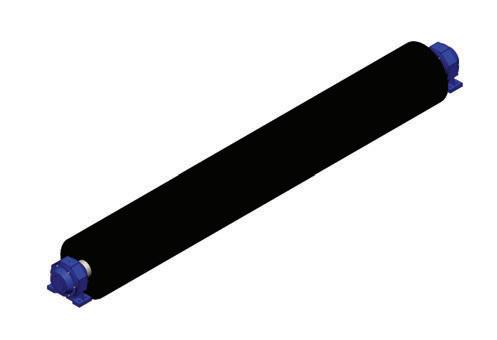
domestic-export positioning. This model seeks resilience through operational efficiency and portfolio differentiation.
Shree Krishna Paper Mills emphasises disciplined cost management while investing selectively in product differentiation such as Packmate, positioned as India’s first chemicalfree paper. In a market experiencing oversupply in certain segments, survival requires cost compression and careful capital allocation.
At the technical level, lightweighting has become central to competitive positioning. Customers demand lower GSM grades without sacrificing compression strength. Paswara highlights the aggressive market push toward lightweighting while maintaining performance metrics. Aryan stresses reel buildup and moisture uniformity as critical for high-speed corrugation compatibility. Apollo emphasises dimensional stability and compression resistance.
Lightweighting requires more than grammage reduction. It demands improved fibre blending and tighter refining control. It also requires better sheet formation and more consistent quality assurance. Value creation now shifts from tonnage supply to structural engineering.
Capital allocation patterns also reveal structural adaptation. Apollo’s investment in solar energy, Paswara’s transition toward RDFbased waste-to-energy systems, Star Paper’s exploration of renewable energy and captive cogeneration, and Shree Krishna’s chemical-free production initiative collectively demonstrate that sustainability is embedded in cost strategy. As Dinesh Haripara succinctly states, “Sustainability is no longer a ‘niceto-have’ — it’s now central to both investment decisions and customer expectations in the Indian paper
and packaging industry.”
Globally, producers are expanding their presence in packaging board segments in response to structural demand shifts. As Anil Kumar Sharma, Head Product Research and Development, Asia Pulp & Paper, notes, “We are strengthening our presence across packaging grades, especially into brown paper portfolios in response to the strong growth in packaging boards.” Such expansion reflects the broader momentum behind fibre-based packaging as demand continues to diversify across applications.”
Strategic response, therefore, is not homogenous expansion but differentiated recalibration across fibre, energy, technology and portfolio mix.
The coming decade will not be defined by capacity alone, but by overall capability. Mills that can manage fibre risks, improve energy efficiency, maintain process consistency and produce lighter yet reliable grades will be better positioned to compete.
Sunil Shah, Managing Director, Aryan Paper Mills, encapsulates this succinctly: “The key will be mastering lightweighting while maintaining high RCT values and ensuring excellent runnability on modern corrugation lines.” That statement captures the essence of the capability test ahead.
Fibre sourcing will need to become more stable and structured rather than relying on short-term adjustments. Energy systems will also have to shift toward more sustainable and cost-efficient options over time. Consistent quality will depend increasingly on machine capability and better process monitoring. At the same time,
mills will need to balance domestic opportunities with a selective presence in export markets.
India’s kraft packaging sector continues to grow, with the nature of competition changing alongside it. Mills are placing greater emphasis on consistent performance rather than volume alone. Fibre sourcing is becoming more disciplined, and energy choices are receiving closer attention. The focus is gradually moving toward reliability, efficiency and long-term competitiveness.
In that sense, kraft in India is no longer simply brown paper feeding corrugation lines. It is evolving into an engineered substrate serving a logistics-intensive, sustainabilityconditioned economy. The industry’s future will depend not just on expansion, but on how effectively producers secure fibre, manage energy costs, use technology and maintain cost discipline in their operations.
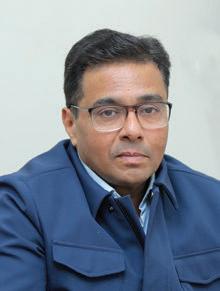
Chandpur Paper has steadily evolved from a small-scale producer into a specialty-focused paper manufacturer catering to high-performance packaging and industrial applications. In an exclusive interview with Paper Mart, Mr. Amit Mittal, Founder & MD, Chandpur Paper, outlines the company’s growth journey, highlighting capacity expansion, advanced machine configurations, and a shift toward value-added grades such as MG poster and chromo C1S. He also discusses customer-led innovation, technology investments, quality systems, and Chandpur Paper’s strong emphasis on sustainability, efficiency, and customised paper solutions for evolving packaging needs.
Paper Mart: Could you outline Chandpur Paper’s current annual production capacity, machine configuration, and the key grades you manufacture, such as MG poster paper and chromo C1S?
Amit Mittal: Chandpur Paper currently operates with an annual production capacity of approximately 40,000 metric tonnes. The facility is equipped with two paper machines supported by three offline coating stations, allowing flexibility across base paper and coated grades.
Our core product portfolio includes MG poster paper and chromo paper (C1S), which cater to a wide range of packaging, labelling, and industrial applications.
PM: How has your production capacity evolved since inception, and what strategic, market, or customer-led factors are driving your recent expansions? Are there any demand or application trends you are closely tracking?
AM: Since inception, Chandpur Paper has undergone a significant transformation in both scale and product complexity. We began
operations with a monthly capacity of around 600 MT, focused on lower-value paper grades. Today, our manufacturing capacity exceeds 3,000 MT per month, with a clear emphasis on high-value, specialised paper products.
This evolution has been driven by a combination of customer-led demand for higher performance substrates, strategic investments in advanced manufacturing infrastructure, and continuous technology upgrades in collaboration with internationally reputed technology partners. We closely track application trends in flexible packaging, barrier coatings, and specialty wrapping solutions.
PM: Which end-use industries and applications form your core customer base today, and how is the mix between packaging, labelling, and specialty applications evolving?
AM: Our core customer base spans flexible packaging and industrial coating applications, including soap wrapping, barrier-coated papers, food wrapping, and related specialty uses.



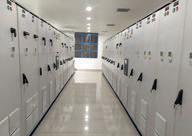
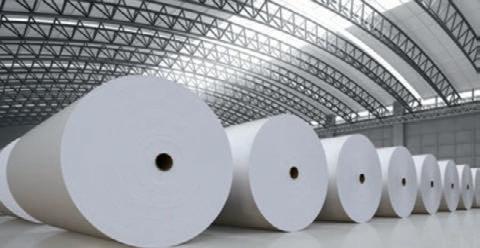




As packaging requirements continue to evolve, we actively work with customers to develop customised paper solutions aligned with changing functional, regulatory, and performance expectations. The application mix is gradually shifting toward higher-performance and specialty grades, reflecting broader industry trends.
PM: What quality certifications, testing protocols, and process controls are in place to ensure consistency, traceability, and compliance with customer and regulatory requirements?
AM: We are ISO 9001 certified, reflecting our commitment to robust quality management systems. In addition, we operate in-house quality testing laboratories supported by a central control centre that continuously monitors key process parameters. This integrated setup ensures process stability, consistent product quality, full traceability, and compliance with both customer specifications and regulatory requirements.
PM: How do you manage raw material sourcing, including fiber selection and supplier partnerships, and what role does recycled content play in balancing quality, sustainability, and cost efficiency?
AM: We source high-quality fiber from reputed domestic and international suppliers, with a strong focus on consistency and reliability. Advanced fiber preparation technologies and controlled processing allow us to ensure careful treatment of fiber to maintain its strength characteristics, enabling performance levels comparable to virgin-fiber grades.
Recycled fiber plays a strategic role in balancing quality, sustainability, and cost efficiency, without compromising on end-use performance.
PM: Can you share insights into recent technology upgrades, automation initiatives, or equipment enhancements that have improved productivity,
energy efficiency, or product performance?
AM: Chandpur Paper has made continuous investments in modern manufacturing technologies to enhance productivity, energy efficiency, and quality consistency. Key upgrades include a DCS controlled Voith Fiberline, Toscotec Yankee Cylinders, and a doubledilution headbox with automatic CDprofile control by ST Macchine.
In addition, several core processes have been upgraded with automatic control systems, enabling better efficiency and quality consistency.
Key upgrades include a DCS controlled Voith Fiberline, Toscotec Yankee Cylinders, and a doubledilution headbox with automatic CD-profile control by ST Macchine.
Our core customer base spans flexible packaging and industrial coating applications, including soap wrapping, barrier-coated papers, food wrapping, and related specialty uses.


PM: As sustainability becomes central to packaging decisions, how is Chandpur Paper innovating in materials, processes, or product design to meet evolving environmental regulations and customer expectations?
AM: Sustainability is an integral part
of Chandpur Paper’s manufacturing philosophy. We focus on responsible fiber sourcing, efficient resource utilisation, and process optimisation to reduce environmental impact. Continuous improvements in energy efficiency, water management, and waste reduction are supported by modern automation and process controls.
Our product development approach increasingly prioritises functional papers that support recyclable and sustainable packaging formats, helping customers meet evolving regulatory and environmental expectations.
We began operations with a monthly capacity of around 600 MT, focused on lower-value paper grades. Today, our manufacturing capacity exceeds 3,000 MT per month, with a clear emphasis on high-value, specialised paper products.
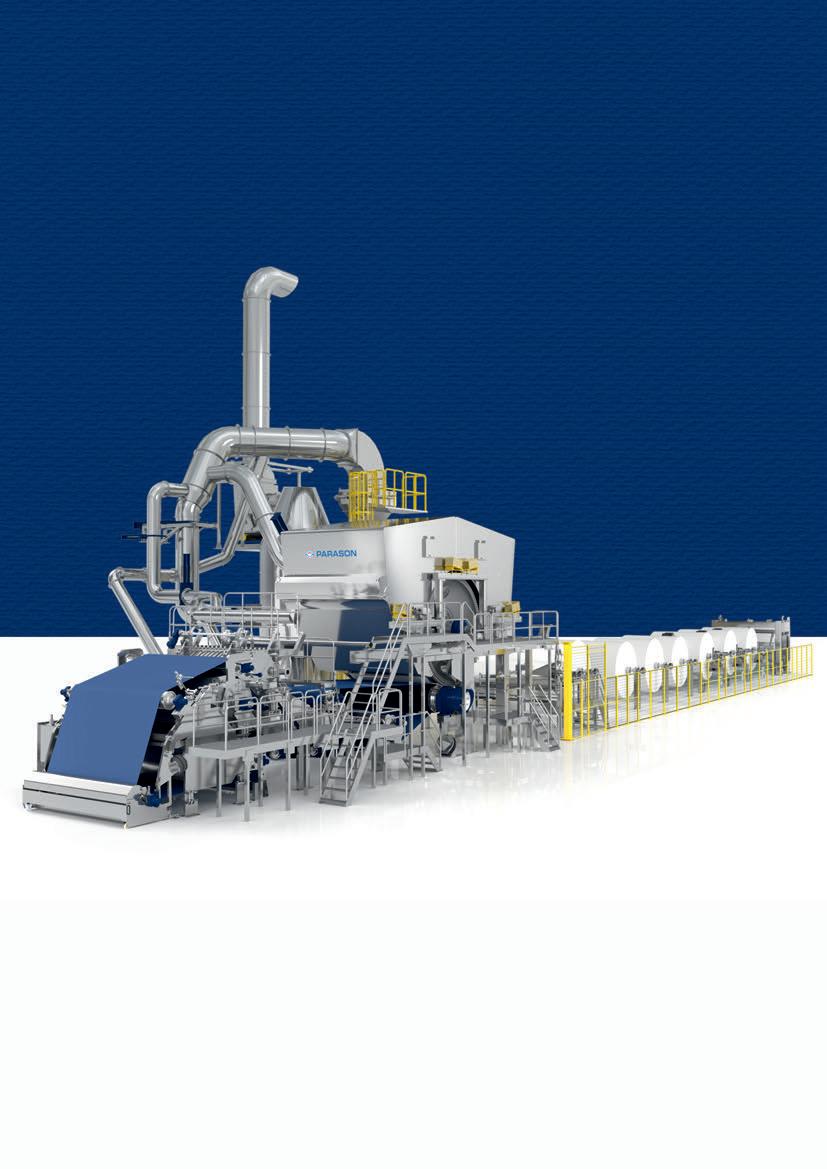
ANDRITZ has officially commenced installation of TNPL’s new tissue machine at the Unit II mill in Mondipatti, Tamil Nadu.
Jan 14, 2026
The installation of Tamil Nadu Newsprint and Papers Limited’s (TNPL) tissue machine (TM5) at its Unit II facility has officially commenced, marking its entry into the tissue paper segment. The project is being executed in partnership with ANDRITZ, which is supplying the machine and related technologies, strengthening the long-standing collaboration between the two companies.

Alliance International successfully commissions a film sizer at Vishal Papers, Patiala, strengthening paper finishing capabilities and operational efficiency nationwide operations.
Feb 9, 2026
Alliance International has successfully commissioned a film sizer at Vishal Papers’ facility in Patiala, marking another milestone in enhancing advanced paper processing capabilities. The commissioning was completed in close coordination with the Vishal Papers team, ensuring smooth installation and operational readiness.
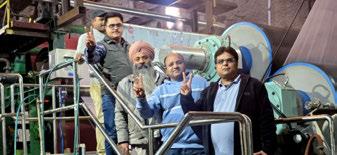











In an exclusive interaction with Paper Mart, Mr. Anil Kumar Sharma, Head Product Research and Development, and Ms. Lina Lim, Head of Product Marketing and Management of Coated Products, APP Group, highlighted the company’s significant expansion in value-added products such as tissue paper, packaging paper and packaging boards, and plans to enter thermal paper grade. Further strengthening its growth roadmap, the company is investing in a new paper machine and a barrier-coating plant, both scheduled for commissioning in 2026. These strategic investments reinforce APP’s position in the paper industry and underscore its long-term growth vision.
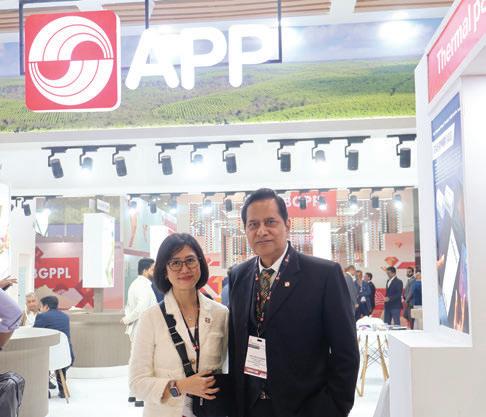
Ms. Lina Lim, Head of Product Marketing and Management of Coated Products, Mr. Anil Kumar Sharma, Head Product Research and Development, APP Group
Paper Mart: What are the recent developments happening at APP Group?
Anil Kumar Sharma: I will mainly focus on APP Indonesia. We are currently in an expansion phase, with growth across selected product varieties, particularly in value-added segments. We are strengthening our presence across packaging grades, especially into brown paper portfolios in response to the strong growth in packaging boards, while simultaneously strengthening our white packaging segment. For this, the packaging machine for brown paper has already been installed and is running successfully.
We are also coming up with a major investment in a new white industrial board machine with a capacity exceeding 1 million tonnes, which is scheduled to commence operations in the first quarter of 2026.
In parallel, we are actively investing in plastic substitution initiatives. As part of this strategy, we are developing our own barrier coating solutions and undertaking focused R&D efforts in packaging. We have recently invested in a specialized


We are developing our own in-house technology for the chemicals required to produce products such as bio-boards. Our objective is to integrate paper, chemicals, and coating technology within our own ecosystem.
coating plant dedicated to producing barrier-coated board, with a capacity of around 1 million TPA. This facility is expected to be commissioned by the end of 2026, most likely in the fourth quarter of 2026.
Thermal paper is another new segment we are entering. We met with some key customers at the event, communicating to them the details of our expansion roadmap and the new product offerings that they can expect from us, going forward.
PM: What new opportunities are you exploring, particularly in the tissue paper converting segment?
AKS: We are planning expansion into tissue paper converting, and discussions are currently underway. We are evaluating the possibility of extending tissue converting facilities here in India, while closely seeing the growth opportunities in the Indian market.
PM: The market has its ups and downs. How do you assess the current state of the industry— both domestically and globally and how do you overcome its challenges?
Lina Lim: The challenge between domestic players and international suppliers is always there. The key lies in balancing demand between imported and domestic supply in
a way that it allows the industry to grow sustainably. Our focus is on finding that right balance, so that all players can grow and remain competitive.
PM: Recently supply chains have been affected due to various geopolitical issues. How are you going to overcome these challenges?
LL: This is not a challenge unique to us, it is something the entire industry is experiencing. The key lies in balancing the portfolio by identifying which segments offer stronger profitability, even as geopolitical complexities increase. This requires disciplined planning and a deeper understanding of market dynamics. With the right insights, we are executing our supply chain management more effectively and plan to make even better and more informed decisions in the future.
PM: What is the role of innovation and technology in meeting the evolving demands of the customers and making the products cost-effective?
AKS: Innovation and technology are critical to meeting evolving customer demands and ensuring long-term competitiveness.
As traditional paper applications decline, innovation enables us to move beyond conventional products into new, higher-value applications.
Our focus is on using technology to optimize materials, processes, and product design so we can deliver solutions that are fit-for-purpose and aligned with changing market needs.
At the same time, we are investing in in-house capabilities across chemicals, coatings, and engineered board solutions. By integrating these elements within our own ecosystem, we gain greater control over quality, performance, and speed to market.
This integrated, innovation-led approach allows us to respond more effectively to customer requirements while delivering consistent, highquality products for the market.
PM: AI is a very critical aspect for automation in the industry. What are your thoughts on it?
AKS: APP has made an effort moving towards Industry 4.0 a few years back, and now we are integrating AI-driven systems to enhance automation, minimise human error, and significantly improve operational efficiency. We are working closely with multiple technical consultants on this initiative and have already implemented several steps across our operations for smooth, consistent, and more reliable processes.
PM: What role does sustainability play in product development and operations?
At APP, sustainability is a core strategic priority. And as a result, all product developments are aligned towards sustainability, and this will continue to be a defining focus of our innovation efforts.
We want to continue being a socially and environmentally responsible company. We want to produce paper which is good for the environment while consistently meeting customer expectations.
AKS: Sustainability is certainly a priority for us. When we talk about biodegradable solutions, we are not limited to boards but are addressing the paper side as well, across both higher and lower GSM grades, while ensuring the products remain truly sustainable.
For bio-board in particular, we evaluate four key parameters: cost, quality, runnability, and certification. Certification must come from reputed, globally recognized institutions. Without this validation, claims of biodegradability or compostability can be misleading. For instance, a product may be recyclable, but that does not mean that it is necessarily compostable, hence there is a need for credible certification.
Additionally, awareness around sustainability is increasing worldwide, including in markets like India. Customers and brand owners are increasingly focused on reducing plastic usage. Globally, one of the most important innovations today is finding effective and scalable substitutes for plastic through sustainable solutions. Fiber-based materials present a strong opportunity in this domain, as cellulose can be modified to deliver similar characteristics that of plastics. That being said, it is not easy to substitute plastic and requires continuous innovation.
We have already commissioned a coating plant dedicated to producing bio-board, and these
products are being supplied globally for applications such as cup stock and lunch boxes. This phase served as a valuable learning experience, and now, we are moving towards a much larger-scale investment.
At APP, sustainability is a core strategic priority, and as a result, all product developments are aligned towards sustainability and environmental responsibility, and this will continue to be a defining focus of our innovation efforts.
PM: Different regions have varying compliance standards. How does APP ensure compliance across different geographies?
AKS: At APP Group, we manage compliance across different geographies by applying a single global standards framework while adapting to local regulatory requirements.
All operations and suppliers must meet APP’s global policies on legality, sustainability, labour, and environmental management. At the same time, local compliance and legal teams ensure that countryspecific laws and regulations are fully met, and where local standards are higher, those take precedence.
This is supported by regular internal and third-party audits, certification systems, and ongoing monitoring to ensure consistency. Compliance is reinforced through training, clear accountability, and escalation mechanisms, allowing APP to
operate responsibly across diverse markets while meeting customer and regulatory expectations.
PM: What is your vision for the future?
AKS: As one of the larger market players in the industry, we want to continue being a socially and environmentally responsible company. We want to produce paper which is good for the environment while consistently meeting customer expectations. This is evident with the launch of Regenesis – APP’s sustainability platform to deliver our renewed overarching ambition for a sustainable future - in September 2025.
We also want to build long-term relationships with our customers, and have a global presence, ensuring that we remain close to the customers. Our focus is on bringing together quality, cost efficiency, and customer value, and for this, innovation is the key enabler that must remain as the core of our strategy, going forward.
APP launched Regenesis – APP’s sustainability platform to deliver our renewed overarching ambition for a sustainable future - in September 2025.
Pakka is investing INR 750 crore in Project Jagriti in India and INR 3,000 crore in Project Kawok in Central America. In an exclusive interaction with Paper Mart, Mr. Ved Krishna, Managing Director, Pakka Limited, shared that the company is scaling up its food packaging segment, focusing on flexible packaging and expanding its bagasse-based, value-added products. In the coming months, the company will also introduce delivery and takeaway containers, further accelerating the shift toward compostable solutions. Looking ahead, the company plans to invest in R&D to develop innovative, commercially viable solutions, reimagining the future of the packaging segment.
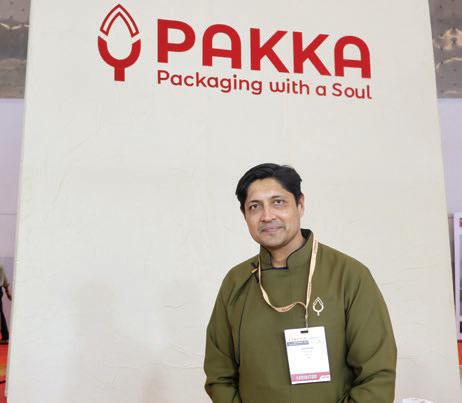
Paper Mart: What are the latest developments and innovations happening in your company? Ved Krishna: Our focus is on transforming the food packaging space by shifting toward compostable and more earthfriendly materials. One of the key focus areas has been flexible packaging, for instance, multilayered products used for packaging potato chips, chocolates, and crackers. We are working to evolve these solutions that are commercially available, developing and reimagining it for the future.
In addition to it, we are coming with major launches over the next couple of months. We are launching delivery and takeaway containers, which will significantly accelerate the shift toward compostable solutions. In parallel, we are also expanding our portfolio of food packaging materials. Our responsibility is to ensure that our products perform consistently and deliver clear value to the customer. If we fail to do that, challenges inevitably arise, and if we succeed, the opportunities in the segment will continue to expand.
We are coming with major launches over the next couple of months. We are launching delivery and takeaway containers, which will significantly accelerate the shift toward compostable solutions. In parallel, we are also expanding our portfolio of food packaging materials.
PM: You have announced two projects-Project Jagriti and Project Kawok. Can you tell us about these projects in detail?
VK: We are currently developing two major projects focused on flexible packaging solutions. In India, we are setting up a 40,000-tonne facility under Project Jagriti with an investment of approximately INR 750 crore, scheduled for commissioning around June this year. Alongside this, we are coming up with Project Kawok in Central America. The 150,000-tonne Guatemala facility comprises an investment of about INR 3,000 crore. The first phase of the Guatemala facility
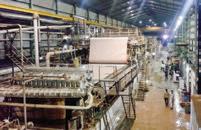

is expected to be commissioned toward the end of this year, around October–November, with the subsequent phase coming on board approximately a year later.
PM: Which machine manufacturers have you partnered with for your ongoing projects?
VK: Our main machinery supplier is Allimand, a French company known for its specialization in the products and processes. They are a highly focused technology provider for specialized applications. While there were several competing suppliers, we chose Allimand as our primary machinery part-
ner as our equipment supports their core machine, and we work closely with Allimand to co-develop products and processes with them.
PM: How do you see the current market scenario in the paper industry?
VK: It is undoubtedly a challenging time right now, but the essence of entrepreneurship is that you cannot blame anyone else. Ultimately, we decide what products we make, the costs at which we manufacture them, and how effectively we serve our customers. As packers, we consciously avoid blaming market conditions. We believe that the
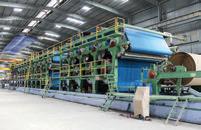


The first phase of the Guatemala facility is expected to be commissioned toward the end of this year, around October–November, with the subsequent phase coming on board approximately a year later.
onus lies with us: what we create, sell and the quality of products we bring to market, all of this is within our control. We believe in taking responsibility rather than blaming the market.
PM: How do you view the distinction between biodegradable and compostable materials, and how important is sustainability in driving customer adoption?
VK: Compostable and biodegradable materials are closely related. All compostable materials are biodegradable, but not all biodegradable materials are compostable. Biodegradation simply means that microbes break the material down, whereas compostability implies that it breaks down in a way that is beneficial and converts into compost. However, our role is not to preach this distinction to the customer. Our primary responsibility is to create value. If we deliver a better-performing product with clear value, customers
will naturally adopt it. Expecting adoption of products purely because it is more sustainably produced does not work in practice. It is always about creating meaningful value for the customers.
PM: How do you ensure quality products amid price competitiveness in the market?
VK: Quality is a non-negotiable asset for us. Regardless of pricing pressure or even short-term losses, we would never compromise on quality because we believe it delivers longterm value. It is our responsibility as a company and team to deliver highquality products. While volatility is a reality in the current market, our position in a specialised segment differentiates us from commodity players, resulting in relatively lower volatility. We also work with longterm customer arrangements with many of our customers contracts lasting a year without break—which further protects us from market fluctuations. As reflected in our financials, our performance has
remained fairly stable over the years, and our future plans are pretty clear.
PM: What are your future plans for the next 5-10 years?
VK: Our objective is to transform the food packaging and food service space, and we believe scale is the only way to achieve that. We are scaling through multiple approaches. One is by expanding what we know, that is, using sugarcane residue, or bagasse to manufacture value-added products. At the same time, we are pursuing an asset-light strategy. We source our facilities for both paper-based and molded fiber products, selectively to other producers and thereby broadening our product grades.
We also invest in R&D and innovation. Our focus is on different product disciplines and processes to evolve new solutions and bring further growth. Our ambition is bold: to grow nearly 20x over the next four to five years. It is a big, audacious goal, and our journey will define how far we go in this direction.
Our focus is on transforming the food packaging space by shifting toward compostable and more earth-friendly materials.


India’s kraft paper segment is undergoing a structural shift, with premiumisation, fiber security and cost efficiency emerging as critical success factors. In an exclusive interview with Paper Mart, Mr. Madhukar Mishra, Managing Director, Star Paper Mills Limited, shares how the company is positioning itself at the premium end of the kraft spectrum. He discusses demand drivers such as e-commerce, long-term fiber strategy through social forestry, energy cost challenges, focus on quality and efficiency, and the steps required for Indian kraft producers to remain competitive amid rising imports and pricing pressure.
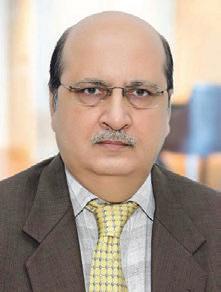
Mr. Madhukar Mishra, Managing Director, Star Paper Mills Limited
Paper Mart: How would you characterise the scale and product mix of your kraft paper and kraftliner business today? How do you see this portfolio evolving over the next few years?
Madhukar Mishra: Kraft paper and kraftliner together form the largest segment of India’s paper industry. However, Star Paper operates at the premium end of this spectrum and does not participate in lowerend kraftliner grades. The company is well recognised for the quality and performance of its high-end kraft products. As India’s economy expands and customer requirements become more sophisticated, Star Paper intends to deepen its focus on premium grades rather than chase volume-led growth.
PM: What factors are currently driving demand for kraft paper in India? Are there specific enduse segments shaping the next phase of growth?
MM: E-commerce has emerged as the single biggest growth driver for kraft paper demand in recent years. Alongside this, rising consumption
levels are leading to higher demand for shipping containers, which further supports kraft paper usage. We expect both these trends to remain strong and continue driving demand over the next few years.
PM: Fiber security remains a recurring concern for the Indian paper industry. How are you approaching long-term access to virgin pulp, and how do you manage quality and price volatility?
MM: Star Paper is a completely virgin pulp-based mill. Anticipating wood resource constraints early, we invested heavily in social forestry more than two decades ago. Today, we facilitate the plantation of significantly more trees annually than our consumption requirements. Price volatility in pulp is largely driven by external global factors and remains beyond industry control. Expanding fiber supply is the only meaningful mitigation. Recent government notifications enabling leasing of forest land could offer a long-term solution, provided they translate into economically viable captive plantations.
Our core customer base spans flexible packaging and industrial coating applications, including soap wrapping, barrier-coated papers, food wrapping, and related specialty uses.
Our immediate investment focus is on improving operational efficiency, enhancing product quality and reducing costs.
PM: What are the key cost pressures you face today, and how are you addressing them?
MM: Cost pressures vary across companies based on product mix and location. For Star Paper, energy cost is a major challenge due to our distance from coal mining regions. To mitigate this, we are actively exploring renewable energy options and enhancing captive cogeneration capacity to improve energy efficiency and cost competitiveness.
PM: How are customer expectations evolving, particularly around performance, consistency and lightweighting?
MM: Lightweighting has been a long-standing trend and is expected
to continue as customers focus on reducing their own costs. Additionally, rising competition and increasing imports have made customers more demanding across all aspects of the supplier relationship, including quality consistency, reliability and service levels.
PM: Where are you currently directing investments— capacity expansion, efficiency, sustainability, or elsewhere? What is guiding these decisions?
MM: Our immediate investment focus is on improving operational efficiency, enhancing product quality and reducing costs. These priorities are essential to maintain competitiveness in a challenging market environment.
PM: Sustainability is becoming central to business decisions. How is this influencing your investments and customer engagement?
MM: Sustainability has long been embedded in our operations through sustained wood regeneration initiatives that ensure long-term fiber availability. In addition, we are increasingly evaluating renewable
energy solutions to reduce our environmental footprint and align with evolving customer expectations.
PM: Looking ahead, what will Indian kraft and containerboard producers need to get right over the next decade to stay competitive?
MM: Consistent improvement in product quality will be critical for long-term success. At the same time, sustained pressure from imports and pricing competition will require producers to maintain a sharp focus on cost management and operational efficiency.
As India’s economy expands and customer requirements become more sophisticated, Star Paper intends to deepen its focus on premium grades rather than chase volume-led growth.
⬗ Kraft Paper Grades Manufactured by your Company: Absorbent Kraft, Kraft Plain, Star Atlas, High Strength Kraft Grades, Masking Paper, Ribbed Kraft, SS Kraft Plain, SS Kraft Titan, and other specialised kraft grades.
⬗ Kraft Paper Manufacturing Capacity and Mill Location: 75,000 MTPA (switchable between kraft, writing/printing, and other grades). Located in Saharanpur, Uttar Pradesh.
⬗ Actual Kraft Paper Produced in the year 2024–25: ~40,000 MTPA.
India’s kraft paper and containerboard market is rapidly evolving, with corrugators shifting focus from traditional BF to performance metrics such as SCT and ECT, alongside increasing emphasis on lightweighting and runnability. In an exclusive interview with Paper Mart, Mr. Mihir Shah, Director, and Mr. Sunil Shah, Managing Director, Aryan Paper Mills, explain how the company is responding to these shifts through technology-led investments, including advanced Kadant stock preparation systems, Valmet headboxes and Bellmer shoe press installations. They discuss key demand drivers, fiber security through global wastepaper sourcing, export learnings from serving over 15 international markets, and the critical capabilities Indian recyclers must build to remain competitive.
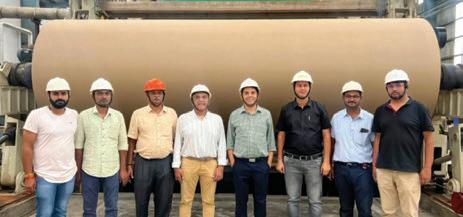
Paper Mart: If we look at your kraft paper and kraftliner business today, how would you characterise its scale and mix? How do you see that portfolio evolving over the next few years?
Mihir Shah: We are witnessing a clear shift from the end-user perspective, where performance evaluation is moving away from traditional BF toward parameters such as Short-span Compression Test (SCT) and Edge Crush Test (ECT). Corrugated box plants are making significant investments in highspeed and advanced equipment, and paper mills must rise to meet these evolving requirements.
PM: What’s driving demand in India right now? Are there particular segments that stand out, and which ones will shape the next phase of growth?
Sunil Shah: Demand has remained steady across key segments, with electronics, FMCG and e-commerce continuing to be strong growth drivers. In addition, we foresee a significant demand upswing in fresh produce boxes, which will be an important growth segment in the coming years.
We foresee a significant demand upswing in fresh produce boxes, which will be an important growth segment in the coming years.
We have installed Kadant stock preparation systems, Valmet headboxes and a Bellmer shoe press.
PM: Fiber security is a recurring concern in India. How are you approaching long-term access to wastepaper and managing quality and price volatility?
MS: We have established partnerships with some of the largest wastepaper balers in the United States. Additionally, our proximity to two ports within 120 kilometres gives us logistical flexibility, enhances competitiveness and allows us to work with multiple shipping lines, thereby reducing supply-side risks.
PM: What are the biggest cost pressures you are dealing with today, and how are Indian recyclers responding to remain competitive?
SS: Wastepaper and energy continue to be the primary cost drivers for recyclers. To address this, the industry requires long-term government support, particularly with regard to assured coal allocation, to maintain cost stability and competitiveness.
PM: From your conversations with customers, how are expectations evolving, particularly around performance, consistency and lightweighting?
MS: Performance and consistency have become non-negotiable. Since we export to more than 15 countries, we have gained valuable learnings by competing with international players. Factors such as reel build-up, uniform moisture profile and runnability on high-speed corrugation lines are critical, especially as lightweighting becomes more prevalent.
PM: Where are you directing investments currently—capacity, efficiency, sustainability or
technology—and what is guiding these decisions?
MS: Our investments are firmly focused on technology and process efficiency. We have installed Kadant stock preparation systems, Valmet headboxes and a Bellmer shoe press. These technologies enable us to deliver paper with superior uniformity, consistency and performance.
PM: Over the next decade, what will Indian kraft and containerboard producers need to get right to stay ahead?
SS: The key will be mastering lightweighting while maintaining high RCT values and ensuring excellent runnability on modern corrugation lines.
We have established partnerships with some of the largest wastepaper balers in the United States.
⬗ Kraft Paper Grades Manufactured by your Company: Kraft paper grades ranging from 20 BF to 40 BF, catering to a wide range of corrugated packaging applications.
⬗ Kraft Paper Manufacturing Capacity: 12,000 tonnes per month. Production
Veteran pulp and paper executive Ajay Gupta appointed CEO of Vishal Papertech India Ltd, bringing decades of industry leadership. Jan 22, 2026
Ajay Gupta, an experienced strategic business leader in the pulp & paper sector, has officially assumed the role of Chief Executive Officer at Vishal Papertech India Ltd.
Mr. Gupta’s extensive career includes tenure as Ex Director Business at Servall, Executive Director at Trident Ltd, CEO of OPIL, among others, underscoring his deep operational and leadership expertise across major industry players.

Mr. Gupta announced the development on LinkedIn, marking a significant milestone in his professional journey and signaling continued growth ambitions for Vishal Papertech India Ltd.
Mr. Ajay Gupta, CEO, Vishal Papertech India Ltd
Paswara Papers Limited is reshaping its kraft paper and kraftliner portfolio to align with India’s evolving packaging landscape. With a clear pivot toward high-performance kraftliner, lightweight grades, and energy decarbonization, the company is positioning itself at the intersection of import substitution and sustainability. In an exclusive interaction with Paper Mart, Mr. Deept Agarwal, Director, Paswara Papers Limited, shares how demand from e-commerce, FMCG, and food processing, along with investments in RDF-based energy and low-GSM capacity, are guiding Paswara Papers’ next phase of growth.

Mr. Deept Agarwal, Director, Paswara Papers Limited,
Paper Mart: If we look at your kraft paper and kraftliner business today, how would you characterise its scale and mix? How do you see that portfolio evolving over the next few years?
Deept Agarwal: Currently, our business maintains a 60:40 split between kraft paper and kraftliner. However, we are strategically pivoting toward a higher-growth mix. Over the next five years, we anticipate kraftliner taking more dominant shares we focus on import substitution. By scaling domestic production of high-performance liners, we aim to meet the rising demand for premium packaging in India’s e-commerce and FMCG sectors, reducing the industry’s reliance on foreign imports.
PM: What’s driving demand in India right now? Are there particular segments that stand out, and which ones do you think will shape the next phase of growth?
DA: The ‘Make in India’ initiative is the primary driver of current packaging demand, with the FMCG,
e-commerce, and automobile sectors leading the charge. Looking ahead, we expect the food processing industry to define the next growth phase. As the market shifts toward sustainable alternatives to singleuse plastics, the demand for highquality, food-grade paper packaging will grow substantially, becoming a cornerstone of our future portfolio.
PM: Fiber security is a recurring concern in India. How are you thinking about long-term access to virgin pulp and/or wastepaper, and what are you doing to reduce exposure to quality and price volatility?
DA: Fiber security is a constant challenge. To ensure premium strength, we have prioritized importing DSOCC from the USA while phasing out ‘Hard Mix’ and mixed waste to maintain quality standards. While the global price of DSOCC remains relatively stable between USD 160–200, the primary risk is INR devaluation, which inflates our landing costs. We are managing this volatility through tighter sourcing cycles and a focus on highyield, high-quality feedstock to offset currency-driven cost increases.
Over the next five years, we anticipate kraftliner taking more dominant shares and we focus on import substitution. By scaling domestic production of high-performance liners, we aim to meet the rising demand for premium packaging in India’s e-commerce and FMCG sectors, reducing the industry’s reliance on foreign imports.
PM: What are the biggest cost pressures you’re dealing with today: whether it’s raw materials, energy, logistics, or compliance? How are Indian producers responding to stay competitive?
DA: Energy and compliance are our primary cost drivers. With fuel costing reaching INR 4,500 PMT of finished paper, traditional fuels are no longer economically or environmentally viable under strict CPCB standards. To remain competitive, we are investing heavily in waste-to-energy boilers and transitioning to RDF (Refuse-Derived Fuel). This shift allows us to lower operational costs while ensuring full regulatory compliance through sustainable manufacturing practices.
PM: From your conversations with customers, how are expectations evolving in India, especially around performance, consistency, and lightweighting?
DA: The market is aggressively pursuing lightweighting, with a clear demand to move from highGSM to lower-GSM grades without compromising Burst Factor (BF). This trend is driven by the need to reduce material while meeting sustainability goals. For us, the challenge and opportunity lie in providing highstrength, low-basis-weight products that perform consistently on modern, automated packaging lines.
PM: Where are you really choosing to invest right now? Capacity, efficiency, sustainability, or something else? What’s guiding those decisions?
DA: Our current investment strategy focuses on expanding low-GSM kraft capacity and energy decarbonization. We are scaling production of lightweight, high-performance grades to meet evolving market needs. Simultaneously, we are transitioning to waste-to-energy boilers and adopting international best practices by utilizing RDF. This pivot away from fossil fuels significantly reduces our energy costs while ensuring our growth remains sustainable and fully aligned with CPCB standards.
PM: Sustainability is becoming a much bigger part of the conversation in India. How is that changing the way you think about investments and customer relationships?
DA: Sustainability is pivoting our investments toward wasteto-energy boilers and circular economy practices to eliminate fossil fuel reliance. We are strengthening customer relationships by providing low-GSM, highstrength alternatives that help brands meet plastic reduction goals. Ultimately, we are moving beyond being a supplier to becoming a strategic partner in our customers’ decarbonization journeys.
⬗ Kraft Paper Grades Manufactured: Medium Paper, Test Liner, Kraft Paper
Our current investment strategy focuses on expanding low-GSM kraft capacity and energy decarbonization. We are scaling production of lightweight, highperformance grades to meet evolving market needs. Simultaneously, we are transitioning to waste-toenergy boilers and adopting international best practices by utilizing RDF.
PM: Over the next decade, what do you think Indian kraft and containerboard producers will need to get right in order to stay ahead?
DA: To stay ahead, Indian producers must invest in highspeed, automated machinery to maximize output and ensure consistent product quality. Success depends on improving energy efficiency by transitioning to waste-to-energy systems to drastically lower operational costs. Finally, manufacturers must master lightweighting and highstrength engineering to meet the evolving demands of a sustainable, cost-conscious market.
⬗ Kraft Paper Manufacturing Capacity and Mill location: 160,000 MTPA, Mill located in Meerut
⬗ Actual Kraft Paper Produced in the year 2024-25: 1,48,000 MTPA
In an exclusive interaction with Paper Mart, Mr. Dinesh Haripara, Managing Director, Apollo Papers LLP, shares that the company’s investment strategy is multi-pronged, driven by long-term market demand, cost efficiency, and sustainability goals. The company plans to expand and modernise its production lines to cater to the growing demand for packaging and speciality grades, focusing on efficiency through automation, process optimisation, and digital quality control systems to boost productivity, reduce waste, and ensure consistent product performance.

Paper Mart: If we look at your kraft paper and kraft liner business today, how would you characterise its scale and mix? How do you see that portfolio evolving over the next few years?
Dinesh Haripara: Today, our kraft paper and kraft liner business is a key growth engine with a wellbalanced portfolio that serves both standard and specialty packaging needs.
We have scaled capacity to support a wide spectrum of customers— from heavy-duty industrial users to converters seeking higherperformance liners and kraft grades. Our product mix combines highstrength kraft liner and versatile kraft paper grades, ensuring reliability for domestic markets while also meeting stringent quality expectations in select export segments.
Looking ahead, we see our portfolio evolving in three clear ways: enhanced speciality grades, sustainable solutions, and balanced market focus.
We are increasing our focus on
higher value, performance-driven products that address evolving customer requirements. Moreover, we are putting greater emphasis on recyclable, eco-friendly offerings that support circular economy goals and finally we continue to strengthen our domestic demand complementing it with strategic export growth. In summary, we are moving toward a more differentiated, sustainabilityoriented portfolio that aligns with long-term industry trends and customer needs.
PM: What’s driving demand in India right now? Are there particular segments that stand out, and which ones do you think will shape the next phase of growth?
DH: Demand in India today is being driven strongly by the packaging segment, with kraft paper, kraft liner, and paperboard at the forefront of growth. Packaging has emerged as the largest and fastestgrowing segment within the paper industry, supported by expanding consumption across key end-use sectors.
We see three core demand drivers:
Rapid growth of e-commerce and logistics: The ongoing boom in online retail and quick delivery services continues to fuel demand for robust, transit-ready packaging solutions such as corrugated boxes and kraft-based materials—essential for protecting products through complex supply chains.
FMCG, food & beverage, and retail expansion: Consumer goods, packaged foods, pharmaceuticals, and organised retail remain major growth engines. These sectors require a mix of sustainable, highperformance packaging formats, and this demand trajectory is expected to strengthen as consumption patterns evolve.
Sustainability and regulatory push: Government measures to reduce single-use plastics and corporate commitments to environmental goals are accelerating the adoption of recyclable, paper-based alternatives. This is broadening demand from traditional industrial uses to higher-value, eco-friendly applications.
Looking ahead, sustainable packaging formats, higher-value speciality grades, and solutions tailored to e-commerce and FMCG logistics are likely to shape the next phase of growth, firmly anchoring India’s paper industry as a key partner to expanding domestic demand and export competitiveness.
PM: Fiber security is a recurring concern in India. How are you thinking about long-term access to virgin pulp and/or wastepaper, and what are you doing to reduce exposure to
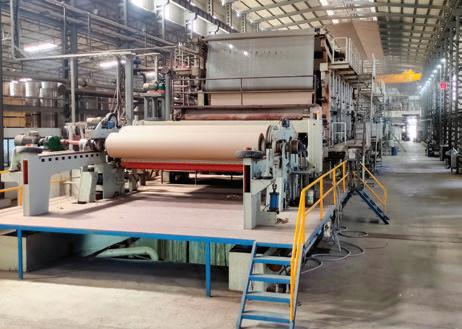
quality and price volatility?
DH: Fiber security is a long-term strategic focus for our industry because India remains fiber-deficient and heavily relies on imports of waste paper and pulp to meet demand.
Domestic recovery rates for recovered fiber are still below their full potential, and supply chain inefficiencies mean mills often need to supplement (DIVERT) with imported fiber to maintain quality and continuity.
To address this, we are taking a multi-pronged approach: We are diversifying supply, balancing domestic recovered paper with strategic imports of both wastepaper and virgin pulp to reduce exposure to price swings and shortfalls.
We are also strengthening our domestic recovery. We are working with partners to improve wastepaper collection, sorting and enhancing quality, which helps lower our
reliance on volatile global markets.
We are optimising fiber blends and technology, investing in processing upgrades and fiber mix so we can use a broader range of raw materials without compromising product performance.
We are also ensuring risk-aware procurement by disciplining our inventory planning and contractual strategies to help us smooth cost volatility in global fiber markets.
Together, these steps help us secure a reliable, cost-efficient fiber base while improving resilience to market volatility and supporting long-term growth.
PM: What are the biggest cost pressures you’re dealing with today — whether it’s raw materials, energy, logistics, or compliance? How are Indian producers responding to stay competitive?
DH: Today, Indian paper producers
Indian buyers are no longer just price-driven; they are looking for technically robust, consistent and lightweight paper solutions that help them achieve their performance, cost and sustainability objectives.
are navigating multiple cost pressures that are shaping industry economics:
High and volatile costs for fiber (raw material), especially imported wastepaper and pulp, remain the single largest cost component. Supply disruptions and freight volatility have pushed wastepaper and pulp prices higher, squeezing margins.
Further, energy costs, particularly coal and power, have risen significantly, increasing production expenses. Domestic mills often rely on thermal energy, and recent regulatory changes around captive power and fuel usage add to cost pressures.
Rising freight and transportation expenses, driven by global shipping challenges and higher fuel prices, add further cost burdens for both inbound raw materials and outbound finished products.
Stricter environmental and emission norms necessitate investments in cleaner technologies and sustainable operations, which is adding to capital and operating costs. And finally, cheaper imports, particularly from ASEAN and China, exert pricing pressure and reduce flexibility to fully pass on cost increases to the market.
To stay competitive, many mills are optimising operations and cost structures by phased price adjustments on finished products, partially offsetting input cost inflation while balancing demand sensitivity. The mills are also strengthening its supply chains and procurement planning to manage raw-material volatility and logistics costs more efficiently.
They are investing in energy efficiency and cleaner technologies to lower long-term operating costs and comply with stricter norms, and
We are optimising fiber blends and technology, investing in processing upgrades and fiber mix so we can use a broader range of raw materials without compromising product performance.
focusing on value-added segments where quality and performance can command better realisations and absorb cost pressures more sustainably. Together, these measures are helping Indian paper producers protect margins, maintain competitiveness, and continue investing in future growth.
PM: From your conversations with customers, how are expectations evolving in India, especially around performance, consistency, and lightweighting?
DH: Customer expectations in India are evolving rapidly as brands and converters seek packaging that delivers higher performance, consistent quality, and greater sustainability.
For performance & consistency across segments, customers now demand uniform strength, precise GSM, dimensional stability and reliable moisture and compression resistance, especially for e-commerce, FMCG and food packaging where product protection is critical. This push for consistency is driving investments in tighter process controls and quality assurance across the supply chain.
There’s a clear trend toward lighter, stronger paper and board grades that reduce material use, logistics costs and environmental impact without sacrificing performance. Advanced designs and higher-strength substrates enable brands to optimise
packaging structures and improve overall sustainability profiles.
Further, customers are increasingly prioritising recyclable, eco-friendly materials, aligning with regulatory shifts away from plastics and rising consumer environmental consciousness. This expectation extends to functional performance such as barrier properties and printability while remaining compatible with circular economy goals.
In short, Indian buyers are no longer just price-driven; they are looking for technically robust, consistent and lightweight paper solutions that help them achieve their performance, cost and sustainability objectives.
PM: Where are you really choosing to invest right now — capacity, efficiency, sustainability, or something else? What’s guiding those decisions? DH: Our investment strategy today is multi-pronged and guided by longterm market demand, cost efficiency, and sustainability commitments.
Our key focus is on energy savings and cleaner operations. We have already made a major investment in a solar power plant, expected to be commissioned by April 2026, which will significantly reduce our energy costs and dependence on grid power. This project strengthens cost competitiveness while supporting our environmental goals. Renewable energy investments like solar energy can lower long-term energy costs and reduce carbon footprint — a benefit recognised across paper mills globally.
We continue to expand and modernise production lines to meet growing demand in packaging and speciality grades, ensuring we stay aligned with customer needs.
We are focusing on efficiency & technology by investing in automation, process optimisation and digital
quality controls to enhance productivity, reduce waste and support consistent product performance.
Alongside energy projects and technology upgrades, we also ensure resource optimisation. We’re investing in water efficiency and smarter supply-chain practices to improve overall sustainability and resilience.
What guides these decisions is a clear business imperative: to build capacity where demand is growing, lowering cost through better efficiency, and meeting increasing customer and regulatory expectations around sustainability.
PM: Sustainability is becoming a much bigger part of the conversation in India. How is that changing the way you think about investments and customer relationships?
DH: Sustainability is no longer a “nice-to-have” — it’s now central to both investment decisions and customer expectations in the Indian paper and packaging industry.
Across the sector, there is a strong shift toward eco-friendly, circular solutions supported by government initiatives and rising market demand for greener packaging alternatives.
Nearly three-quarters of India’s paper production already comes from recovered and recycled fiber, and sustainability is increasingly embedded in industry growth narratives. This evolution is influencing our business in clear ways such as investment focus, product development, and customer engagement.
We’re prioritising projects that reduce environmental impact, such as energy-efficient technologies, renewable energy (solar installations), water-use reduction and recycling infrastructure. These investments not only align with regulatory and ESG expectations,
but also enhance long-term cost efficiency and risk management.
There’s increasing demand from customers — from FMCG brands to e-commerce players — for recyclable, lightweight and sustainable packaging solutions. This is shaping our R&D efforts and portfolio strategy to deliver products that meet both functional performance and environmental goals.
Sustainability has become a shared value with our customers. They are seeking partners who can deliver consistent quality while helping them reduce lifecycle impacts, comply with circular economy standards, and enhance brand reputation. This is deepening collaboration and longterm relationships.
In essence, sustainability is reshaping how we invest, innovate and partner with customers, moving beyond compliance toward value creation across the entire value chain.
PM: Over the next decade, what do you think Indian kraft and containerboard producers will need to get right in order to stay ahead?
DH: To stay ahead over the next decade, Indian kraft and containerboard producers will need to focus on four core areas that reflect both market realities and long-term industry trends:
Innovating and Differentiating Products: Producers must move beyond commodity grades and develop higher-value, performancedriven offerings such as highstrength, moisture-resistant and lightweight materials that meet evolving converter and brand expectations. This includes investing in process technology and quality controls to deliver consistent performance at scale.
Deepening Sustainability and Circularity: With sustainability
increasingly central to customer choices and regulatory frameworks, the industry must accelerate ecofriendly production, increased recycled content and improved recyclability. Aligning with national and global sustainability missions will not only meet customer demands but also open up premium segments. India’s packaging sector is investing in sustainable solutions and circular economy principles, supporting long-term growth.
Strengthening Supply Chains and Costs: Raw material security, logistics resilience and cost management will remain key. Producers should continue to optimize fiber sourcing, improve domestic wastepaper recovery infrastructure, and enhance logistics efficiency to manage volatility and protect margins in the face of fluctuating inputs and import competition.
Embracing Advanced Technologies: Digitisation, smart manufacturing and new packaging technologies (e.g., smart labels, advanced coatings) will help boost efficiency, reduce waste and create differentiated offerings that improve customer value and brand trust.
In essence, product innovation, sustainability leadership, efficient supply chains and technological excellence will define who succeeds in India’s kraft and containerboard industry over the next decade.
To sum it up, the Indian kraft and containerboard sector is poised for continued strong growth as packaging becomes an increasingly vital part of the economy, driven by booming demand across FMCG, e-commerce and sustainable solutions. With innovation, quality focus and strategic investments, we are confident in our ability to support customers and contribute to the industry’s future success.
In an exclusive interaction with Paper Mart, Mr. Naynesh Pasari, CEO, Shree Krishna Paper Mills, shares that the company has made significant investments in ‘Packmate’, India’s first chemical-free paper. He further emphasises the importance of adopting advanced technologies to reduce water consumption and strengthen effluent treatment processes, reinforcing the company’s commitment to sustainable and responsible paper manufacturing.

Paper Mart: If we look at your kraft paper and kraftliner business today, how would you characterise its scale and mix? How do you see that portfolio evolving over the next few years?
Naynesh Pasari: We see that in India and globally, the finished paper has an excessive supply. The prices which used to be 3 years ago, cannot continue in current times keeping in consideration the growth of input costs. I only see further competition in kraft paper segments.
PM: What’s driving demand in India right now? Are there particular segments that stand out, and which ones do you think will shape the next phase of growth?
NP: The demand is very variable now. Everything has become unpredictable due to global uncertainty and tariffs. One should understand that the segments that should have been ideally growing- such as paper bags and packaging grades, are not growing due to weak government policy and weaker execution.
PM: Fiber security is a recurring concern in India. How are you thinking about long-term access to virgin pulp and/or wastepaper, and what are you
doing to reduce exposure to quality and price volatility?
NP: To ensure fiber security, honestly there is no other way than to increase the number of suppliers and keep at least 3 months inventory. By keeping stock inventory and expanding our supplier network, we can ensure uninterrupted access to virgin pulp and reduce exposure to price volatility or quality degradation.
PM: What are the biggest cost pressures you’re dealing with today: whether it’s raw materials, energy, logistics, or compliance? How are Indian producers responding to stay competitive?
NP: Power and fuel are the biggest concerns, impacting manufacturing cost and in turn profit margins.
PM: From your conversations with customers, how are expectations evolving in India, especially around performance, consistency, and lightweighting?
NP: International customers still have concerns about Indian manufacturers, whereas Indian customers are knowledgeable now and hence look for mills with deeper understanding of the paper.
PM: Where are you really choosing to invest right now? Capacity, efficiency,
sustainability, or something else? What’s guiding those decisions?
NP: Today, the paper mills are in a survival mode, hence reduction of cost is the focus area where major investments are going on.
PM: Sustainability is becoming a much bigger part of the conversation in India. How is
that changing the way you think about investments and customer relationships?
NP: We have invested heavily on packmate – India’s first chemical free paper. We feel Indian consumers have to get mature in the way they perceive paper and look for sustainable paper before they make a decision.
PM: Over the next decade, what do you think Indian kraft and containerboard producers will need to get right in order to stay ahead?
NP: In order to stay ahead of the curve, Indian kraft and containerboard producers must adapt technologies to reduce water consumption and must invest in better ETP.
⬗ Kraft Paper Grades Manufactured by your Company: High Strength Kraft, Color Kraft, Unbleached Brown Kraft (Food grade)
⬗ Kraft Paper Manufacturing Capacity and Mill locations: Keshwana, Rajasthan
Naini Papers’ PM3 delivered its highest production and dispatch volumes since commissioning, highlighting strong operational discipline and effective crossfunctional collaboration.
Feb 2, 2026
Naini Papers has recorded its highest-ever production and dispatch figures on PM3 since the machine’s commissioning, marking a key operational milestone. The achievement reflects strong cross-functional collaboration, disciplined execution, and consistent focus on performance goals.
The company said the momentum from PM3’s improved throughput and stability sets a positive trajectory for further

Parason and Indian Institute of Technology, Roorkee have developed the’ Parason Lab Prototyping Machine’ for further advancement in the molded fiber space, driving new product development, market-ready solutions, and sustainable packaging alternatives
Feb 03, 2026
Parason and Indian Institute of Technology, Roorkee (IIT Roorkee) is advancing in molded fiber innovation. The two innovation and technology hubs have developed the Parason Lab Prototyping Machine for further advancement in the molded fiber space. This venture will lead to significant growth in the molded fiber business — driving new product development, market-ready solutions, and sustainable packaging alternatives. Parason will actively support molded fiber product development to fulfill market requirements and sustainability goals.
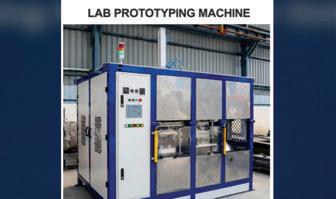
Riddhi Siddhi Gluco Biols Limited has made a strategic re-entry into the starch and sweeteners segment by signing an agreement to acquire Cargill India’s corn wetmilling assets in Davangere. In an exclusive interaction with Paper Mart, Mr. Siddharth Chowdhary, Executive Director, Riddhi Siddhi Gluco Biols Ltd (RSGBL), says this acquisition has strengthened the company’s presence in the Indian starch industry, enhancing its ability to serve the paper sector with advanced starch-based solutions.

Mr. Siddharth Chowdhary, Executive Director, Riddhi Siddhi Gluco Biols Ltd (RSGBL)
Paper Mart: Can you tell us about the journey of Riddhi Siddhi Gluco Biols Ltd. (RSGBL), along with the company’s history, evolution, and gradual product portfolio diversification? Siddharth Chowdhary: Established in 1990, Riddhi Siddhi Gluco Biols Ltd. (RSGBL) was founded to address India’s growing demand for starch and value-added derivatives. The company scaled rapidly into a distinguished agro-based specialty processing enterprise, serving food, pharmaceutical, paper, textile, and industrial sectors. By 2007, the company had emerged as India’s largest starch manufacturer, with a strong global footprint and over 25 percent market share.
Over time, RSGBL has evolved into a diversified enterprise with sustainability being integral to its growth philosophy. The company makes focused investments in renewable energy and other sustainable, value-accretive initiatives that create long-term value for farmers, customers, communities, and shareholders.
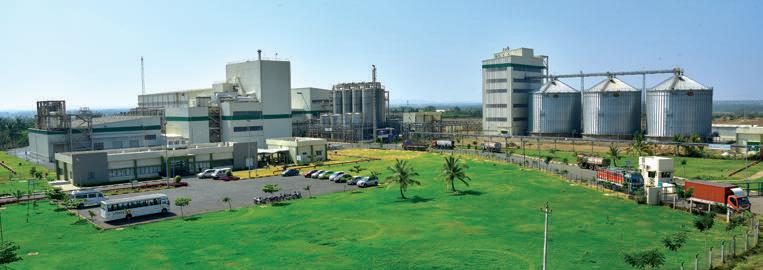
RSGBL’s journey has been defined by innovation, resilience, and bold decision-making, underpinned by a strong commitment to building sustainable businesses and creating long-term impact across industries.
PM: RSGBL has signed an Asset Purchase Agreement (APA) to acquire the assets of Cargill India’s Starch & Sweeteners business. What is the long-term growth vision behind this move?
SC: The acquisition represents RSGBL’s strategic re-entry into the starch and sweeteners segment, which continues to be a core, high-growth area globally. The long-term vision is to build scale, enhance backward integration, and expand our presence in starch and value-added ingredients that serve food, pharmaceutical, paper, and industrial markets.
The Davangere state-of-the-art facility provides a readily operational, high-quality asset base, enabling us to accelerate growth, improve supply chain efficiencies, and create a strong platform for future capacity expansion and product innovation.
PM: How do you support India’s pulp and paper industry? Tell us about your clientele. Are there any plans to expand your footprint internationally?
SC: RSGBL has been a long-standing and trusted partner to India’s pulp
and paper industry, supplying starch-based ingredient solutions that enhance strength, surface properties, and process efficiency across writing & printing, packaging, and specialty paper grades. We work closely with leading paper manufacturers, supporting them through consistent quality, technical expertise, customized solutions, and reliable supply.
As RSGBL expands its footprint in the Indian starch industry through the acquisition of Cargill India’s corn wet-milling assets in Davangere, it unlocks greater scope and scale to serve the paper industry with advanced starch-based ingredient solutions more efficiently. Globally, the paper industry is the largest nonfood consumer of starch, where it is a critical, high-volume additive used to improve paper strength, surface quality, and production efficiency.
Exports from India are already a part of our business across product categories. As we scale manufacturing capabilities, we see further opportunities to expand our global presence, particularly across Asia, the Middle East, and Africa.
PM: What are the challenges in the starch business and what are your business strategies to overcome them?
SC: The starch business is capitalintensive and sensitive to factors
We are the largest producers of paper-grade starch and also offer the largest range of modified starches in India with a portfolio of over 15 variants catering to the specialised needs of paper manufacturers.
such as raw material availability, energy costs, and market volatility. Ensuring consistency in quality while managing cost pressures is a key challenge.
Our strategy is built around scale, diversified sourcing, operational efficiency, with a strong focus and deliberate shift towards valueadded derivatives instead of pure commodity offerings. For instance, we are the largest producers of paper-grade starch and also offer the largest range of modified starches in India with a portfolio of over 15 variants catering to the specialised needs of paper manufacturers.
We believe investments in diversified products, integrated manufacturing, technology upgrades, and long-term supplier relationships help us remain competitive and resilient across cycles.
Exports from India are already a part of our business across product categories. As we scale manufacturing capabilities, we see further opportunities to expand our global presence, particularly across Asia, the Middle East, and Africa.
PM: How do you ensure that sustainability remains central to your company’s operations?
SC: Sustainability is integral to RSGBL’s growth philosophy and operational framework. We focus on energy efficiency, increased use of renewable energy, responsible water management, and waste-to-value initiatives across our facilities.
At the Davangere unit as well, sustainability will be a key priority, aligned with our broader sustainability commitments as we intend to operate the plant through 100% renewable energy resources. We believe responsible manufacturing is essential for longterm competitiveness, resilience, and stakeholder value creation.
PM: What are your plans for stability and profitability amid the disruptions in supply chain and trade volatility?
SC: Our approach is built around diversification across raw-material sourcing, finished products, customer segments, and geographies, which helps mitigate risks arising from supply chain disruptions or trade volatility. Strong execution discipline, cost control, operational efficiencies, and a focus on skillful domestic sourcing further support stability.
By serving multiple end-use sectors such as food, pharmaceuticals, paper, and industrial applications, we are better positioned to maintain steady growth even in uncertain global environments.
PM: What are your future plans in the next 5-10 years?
SC: Over the next 5 to 10 years, RSGBL aims to significantly scale its core ingredient businesses, with starch and derivatives playing a central role. Our focus will be on
capacity expansion, development of higher-value products and derivatives, and strengthening our export presence.
Alongside growth, we will continue to invest in sustainability, advanced technology, and operational excellence to build a purpose-led enterprise rooted in creating long-term value for farmers, customers, employees, communities, and stakeholders.
At the Davangere unit, sustainability will be a key priority, aligned with our broader sustainability commitments to operate the plant through 100% renewable energy resources.
JK Paper’s Board of Directors has approved the setting up of a hybrid renewable power plant comprising solar and wind power, that will contribute to the company’s sustainability and carbon footprint reduction goals. It is expected to be commissioned in the third quarter of FY 2027-28. Feb 05, 2026
JK Paper’s Board of Directors has approved the setting up of a hybrid renewable power plant comprising solar and wind power. The proposed Hybrid Power Project is a strategic step towards enhancing the Company’s green energy and sustainability.
It is expected to reduce dependence on coal based power, provide economical energy cost and mitigate volatility, strengthen long-term energy security, and contribute meaningfully to the company’s sustainability and carbon footprint reduction goals.

The project is estimated to cost approx. INR 500 crore and will be financed through a mix of internal accruals and borrowings. It is expected to be commissioned in the third quarter of FY 2027-28.
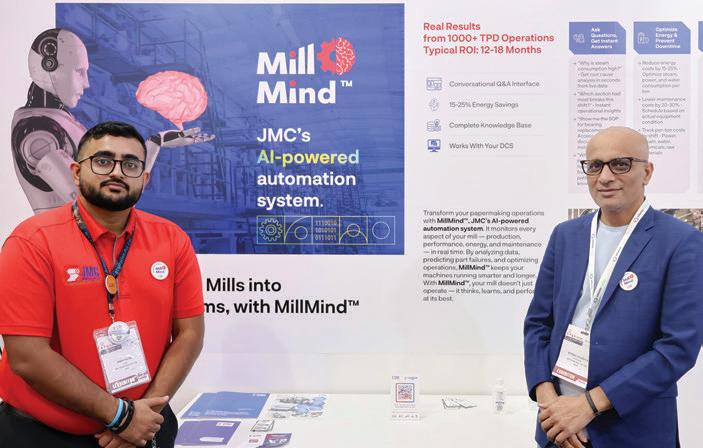
JMC Paper Tech Pvt Ltd has unveiled MillMind, an AI-driven mill intelligence platform designed to transform how paper mills monitor, analyse, and optimise operations. In an exclusive interaction with Paper Mart, Mr. Sneh Patel, Chief Operating Officer, and Mr. Ritesh Vajariya, AI Advisor, JMC Paper Tech Pvt Ltd, explained that MillMind integrates production data, costs, energy consumption, and analytics into a single, user-friendly system that works alongside existing ERP and DCS setups. The platform has already secured its first international order from Modern Laminates Ltd, Uganda, underscoring strong market acceptance. JMC has also strengthened its global footprint through a technical partnership with Kawanoe Zoki Co. Ltd. of Japan, further reinforcing its technology-led growth strategy.
Paper Mart: To start with, please introduce MillMind.
Sneh Patel: MillMind is JMC’s innovation in mill intelligence, developed to give mill owners, operators, and maintenance teams complete visibility into their operations. The platform brings together day-to-day production data, costs, expenses, and analytics into a single, easy-to-use system. It is designed as a continuously evolving solution that grows as more customer insights are incorporated, making mill performance easier to monitor and understand over time.
PM: What was the inspiration behind developing MillMind?
Ritesh Vajariya: At JMC, we visit a large number of mills across India and globally. During these visits, we consistently observed common challenges, daily reporting issues, lack of visibility, and difficulty in accessing actionable information. By listening closely to these pain points, we realised there was an opportunity to create a solution that not only addresses operational challenges but also helps owners visualise and understand their mill performance in a far more effective way.
PM: What kind of investment went into developing this platform?
SP: The investment was not primarily financial but intellectual. We focused first on understanding mill business processes in depth and then identifying where technology could add value. Instead of imposing technology on operations, we worked backward from real operational needs. While the product development itself took less time, the research phase required significant effort.
PM: How long was the development journey?
RV: The journey has been ongoing for about six months, starting around June–July 2025. Importantly, research and development will never
stop. As we continue interacting with customers, new insights keep emerging, leading to additional features and improvements.
PM: Is MillMind a standard product or can it be customised?
SP: MillMind is 100% customized to customer requirements. It is not a modular, one-size-fits-all solution. No two mills are identical–automation levels, DCS availability, and operational setups vary significantly, especially in markets like India. The system is therefore built around what each mill already has and what the customer wants to achieve.
PM: What types of mills can use MillMind?
SP: MillMind is suitable for all types of mills, highly automated mills in Europe or the US, as well as mills with minimal automation in developing markets. It works alongside existing ERP and DCS systems and provides a level of operational visibility that those systems typically do not offer.
PM: What differentiates MillMind from existing automation solutions?
RV: MillMind does not automate or control machines. Instead, it sits on top of existing automation systems, using the data they already generate and presenting it in a more meaningful, visual, and decisionfriendly way. It acts as a unifying layer that enhances understanding for owners, operators, and maintenance teams.
JMC has recently entered into a technical partnership with Kawanoe Zoki Co. Ltd., a Japanbased tissue paper machine manufacturer.
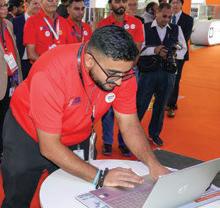
PM: Can you explain the main components of the software in simple terms?
RV: MillMind consists of several key components:
Chat Interface: Similar in concept to ChatGPT, this allows users to ask questions in natural language. It currently supports multiple languages, including English, Hindi, Spanish, and Japanese. Users can ask mill-specific questions such as monthly production figures, and the system generates accurate reports within seconds.
Document Q&A System: Mills can upload SOPs, manuals, and supplier documents. The system reviews these documents and allows operators and maintenance personnel to quickly retrieve specifications– such as bearings, materials of construction, or equipment details– without manually searching through files.
Cost Analytics Dashboard: Designed primarily for owners, this module provides insights into production, losses, energy consumption, raw material usage, downtime, and cost breakdowns by mill section. It enables short-term and long-term analysis to identify inefficiencies and cost overruns.
Live Mill Dashboards: For mills connected through DCS, MillMind provides real-time data and analysis for pulp mills, recycle mills, and paper machines. Owners can access live operational data from anywhere in the world, including on mobile devices.
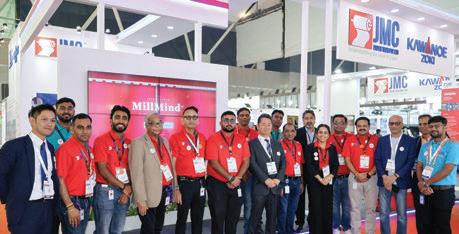
PM: Can you tell us about the Japanese collaboration you mentioned?
SP: JMC has recently entered into a technical partnership with Kawanoe Zoki Co. Ltd., a Japan-based tissue paper machine manufacturer. Under this collaboration, Kawanoe Zoki will supply critical components, while JMC will provide non-critical components to deliver cost-effective
The strongest marketing driver is visibility and cost savings. Based on early analysis, mills can achieve 18–20% cost savings after implementing MillMind.
tissue paper machine solutions for the Indian market. Kawanoe Zoki has nearly 240 installations worldwide, and approximately 80% of tissue paper used in Japan is produced on their machines.
PM: What is the current market response to MillMind?
RV: The response has been extremely positive. Many industry professionals have stated that they have not seen a system like this before. Customers are eager to provide inputs and collaborate on further improvements. We have already received our first order from Modern Laminates Ltd., Uganda, which is a strong validation of the platform.
PM: How do you address concerns about AI errors and user training?
SP: AI operates in the background
The platform brings together day-to-day production data, costs, expenses, and analytics into a single, easy-to-use system.
of MillMind. Users interact with the system through simple questions and dashboards. If an error is identified, users can provide feedback directly within the system, allowing continuous improvement. Initial training requirements are minimal and focus mainly on data entry and system usage during implementation.
PM: How will MillMind be marketed, and what value does it offer owners?
RV: The strongest marketing driver is visibility and cost savings. Based on early analysis, mills can achieve 18–20% cost savings after implementing MillMind. By establishing performance baselines for specific grades and operating conditions, owners can quickly identify deviations, optimise processes, and maintain consistent efficiency. The system continues to learn over time and proactively highlights areas requiring attention.
MillMind does not automate or control machines. Instead, it sits on top of existing automation systems, using the data they already generate and presenting it in a more meaningful, visual, and decision-friendly way.
Scan Machineries highlighted its capabilities as a complete paper machine manufacturer, offering robust solutions from headbox to winder, backed by strong engineering expertise and global project execution. In an exclusive interaction with Paper Mart, Mr. Aashish Nargunam, Director, Scan Machineries Private Limited, shared that both Allimand, our European partner and Scan Machineries is jointly executing an advanced specialty paper machine project for Pakka Limited. The company is witnessing strong momentum in paper grades such as packaging and paperboard, tissue, kraft, in value-added specialty papers, alongside a growing preference among mills for Indian-manufactured equipment along with high value European technology and components.
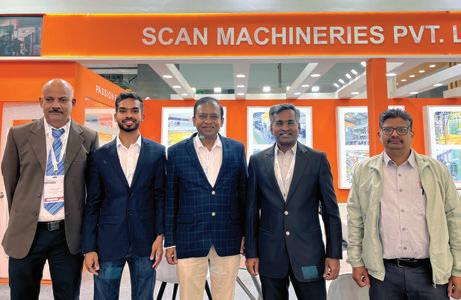
Paper Mart: You are working on a specialty paper machine project for Pakka Limited. Could you elaborate on this partnership?
Aashish Nargunam: Since 1850, our European partner, Allimand has been a global leader in design and manufacturing of high value added paper, board and fiber mat machines. For the new specialty paper machine project of Pakka Limited, both Allimand and Scan Machineries are jointly executing the complete paper machine project, covering right from the headbox to the pope reeler. Our European partner is supplying all the major critical components and the overall project engineering and execution. Scan Machineries is manufacturing and supplying all the machine frames, rolls, auxillaries and the complete pope reeler, which features an automatic spool loading and transfer system. This approach enables us both to combine advanced European technology with efficient local man-
Allimand, our European partner and Scan Machineries are jointly executing a complete paper machine project for Pakka Limited, covering from the headbox to the pope reel.
ufacturing to deliver a cost-effective, high-performance solution.
PM: How does Scan Machineries approach turnkey paper mill projects to deliver end-to-end solutions?
AN: We follow a one-stop solution provider approach for our paper mill turnkey solution. Our turnkey approach starts with understanding the types of paper grade the customer intends to manufacture, the width of paper to be produced and the availability of raw materials in that specific region, which varies from country to country. Based on these critical factors, we finalize the machine configuration, process flow, and the stock preparation. Our team handles both the basic and complete detailed engineering including civil, pipeline and electrical drawings. Auxiliaries such as ETPs, boilers, power, water, and steam requirements are also
engineered and sized to plant’s capacity. Once manufacturing is complete, our team manages installation and commissioning to ensure smooth start-up and guaranteeing optimal performance for our clients.
PM: Are there any new developments or innovations you are working on to serve the industry better?
AN: There are specific machinery components we are working on. These developments are still under progress, and will be launched in the market soon.
PM: What key trends and challenges do you observe in the paper industry today?
AN: One of the major trends we see in the market is growth in packaging and paperboard, tissue, kraft and in value added specialty papers such as medical grades, thermal papers, barrier papers and flexible packaging papers. Additionally, many Indian paper mills are increasingly inclined to source machinery from Indian manufacturers along with high value European technology and components and for their aftermarket local support. To support this shift, we are working towards designing and manufacturing equipment that enables us to offer more comprehensive solutions.
PM: How do you view the role of automation and AI in paper mill operations?
AN: Automation and AI are increasingly important for process optimization and preventive maintenance. By collecting historical data across the mill, AI can help bridge the gap between enterprise level visibility and precision diagnostics at local specific process areas. Efficiency can be improved and potential issues are predicted in advance, for instance, identifying lubrication problems in bearings or analyzing felt life before failure occurs. Another emerging concept, is the digital twin technology, which is beginning to gain traction slowly. While it is still in early stages of adoption, we believe it will gradually find its way into the Indian market.
Another emerging concept is the digital twin technology, which is beginning to gain traction slowly. While it is still in early stages of adoption, we believe it will gradually find its way into the Indian market.
One of the major trends is the growing focus on packaging and paperboard, tissue, kraft and in value added specialty papers such as medical grades, thermal papers, barrier papers and flexible packaging papers. Additionally, many Indian paper mills are increasingly inclined to source machinery from Indian manufacturers along with high value European technology and components and for their aftermarket local support.
Abirami Pumps, at Paperex 2025 showcased its expanding portfolio of pulp and process pumps designed to address the evolving needs of the paper industry. In an exclusive interview with Paper Mart, Mr. Gurukrishna, Chief Marketing Officer, Abirami Pumps shares insights into its newly launched pump solutions, focus on energy-efficient system design, and efforts to improve process reliability for paper mills. The discussion also highlights key industry challenges, emerging opportunities, and the growing role of automation and AI in enhancing manufacturing quality, operational efficiency, and sustainability across modern paper production facilities.
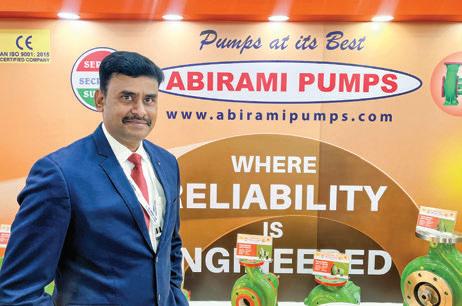
Mr. Gurukrishna, Chief Marketing Officer, Abirami Pumps
Paper Mart: What are you displaying at Paperex 2025? How has your experience been so far? Gurukrishna: At Paperex 2025, Abirami Pumps is showcasing its complete range of pulp and process pumps catering to the paper industry, covering applications from fresh water handling to fan pumps, high-pressure vertical and horizontal pumps, and centrifugal pumps with multi-vane staggered impellers. A key highlight at our stall is the launch of three new products—an inducer pump, a thermic fluid pump, and an eccentric reducer pump— each designed to address critical operational challenges in paper mills. Our experience at this edition has been extremely positive. Despite initial concerns about the venue change, the first day itself witnessed excellent footfall and quality interactions, leading to on-the-spot order finalizations, including a major tissue project from Haryana. Overall, the exhibition has been vibrant and commercially rewarding.
A key highlight at our stall is the launch of three new products—an inducer pump, a thermic fluid pump, and an eccentric reducer pump—each designed to address critical operational challenges in paper mills.
PM: How do Abirami Pumps’ energy-efficient pulp-stock and process pumps help paper mills reduce power consumption and increase process reliability?
GK: Pumps are the heart of a paper mill and account for a significant share of overall power consumption, as they are responsible for transferring liquids across every stage of the process. Abirami Pumps focuses on designing high-efficiency pump systems that directly reduce electricity usage, thereby lowering production costs and improving profitability. Beyond pump design, we emphasize correct system engineering, including proper piping support and suction conditions, to ensure optimal performance. We also conduct free energy audits for paper mills, studying the entire pumping system to identify inefficiencies and recommend improvements. This holistic approach helps mills achieve reliable operations, lower energy bills, and longer equipment life.
PM: What are the new developments or innovations you’re looking at to better cater to the paper and pulp industry?
GK: One of our key innovations is the inducer pump, which improves Net Positive Suction Head (NPSH) availability and ensures smooth liquid flow, especially in low-suction or high-consistency applications common in paper mills. We have
also introduced a thermic fluid pump capable of handling hot oils up to 360°C, addressing growing demand for reliable high-temperature pumping solutions. Additionally, our eccentric reducer pump minimizes cavitation and air entrapment at the suction side, improving flow stability and pump life. These developments are aimed at enhancing efficiency, reliability, and process stability across modern paper manufacturing operations.
PM: What are some of the major trends and challenges we are seeing today in the industry?
GK: The paper industry is currently facing a temporary imbalance between production capacity and demand, creating margin pressure for manufacturers. Since selling prices are largely uniform across regions, mills are increasingly focusing on reducing production costs rather than increasing prices. Power consumption remains one of the biggest cost drivers, making energy
At Abirami Pumps, nearly 90 percent of our manufacturing processes are automated, including casting, molding, pouring, and finishing operations.
efficiency a critical priority. At the same time, there is growing opportunity in specialty papers, tissue products, and export markets, particularly in regions where local production meets only part of the demand. Companies that diversify their product mix and invest in efficient technologies are better positioned to navigate these challenges.
PM: What are some unique AIintegrated processes or practices you see in the industry, or plan to implement in the company?
GK: At Abirami Pumps, nearly 90 percent of our manufacturing processes are automated, including casting, molding, pouring, and finishing operations. Automation and AI integration have significantly improved process consistency, chemical composition control, and product quality, resulting in nearly 40 percent improvement in overall output quality. Manpower dependency has been reduced, especially in finishing operations, as components now come out closer to final specifications. Going forward, AI-driven manufacturing, system monitoring, and databased optimization will play a crucial role in improving efficiency, sustainability, and reliability—not just within our company, but across the pump and paper industries as a whole.
Abirami Pumps focuses on designing high-efficiency pump systems that directly reduce electricity usage, thereby lowering production costs and improving profitability.
In an exclusive interaction with Paper Mart, Mr. Hareram Pandit, Director of Amit Paper Consultants and Engineers, shares valuable insights into the company’s expanding global presence and future growth strategy. With a strong focus on sustainability, export markets, and capacity expansion, he expressed confidence in the paper industry’s long-term prospects and outlined his organization’s vision to double its business in the coming years. During Paperex 2025, the company also showcased several ongoing and upcoming paper plant projects, including significant developments across African markets such as Angola, Kenya, Congo, and Ghana.
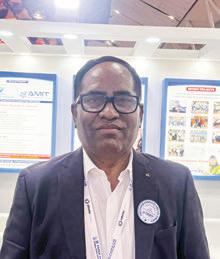
Paper Mart: How has Paperex 2025 been for you, and what are you showcasing at the exhibition?
Hareram Pandit: Paperex 2025 has been an excellent experience for us. The exhibition has been very well organised, and the quality of visitors and overall footfall have been highly encouraging.
At Paperex, we are showcasing our ongoing as well as upcoming paper plant projects, with a strong focus on international markets. We are actively engaging with both existing clients and new prospects to discuss project developments and customised solutions.
One of the key highlights is our new project in Angola, where we are currently working on 100 TPD and 200 TPD paper plant configurations. These projects are under active discussion and are being optimised based on specific client requirements, raw material availability, and product mix.
PM: Can you tell us about your ongoing international projects?
HP: We are currently executing multiple international projects,
primarily across Africa and other emerging markets. Our project in Kenya with the DMC Group has been successfully completed and is now operating smoothly.
In Congo, one project is approximately 50% completed, with the remaining work progressing as planned. In Ghana, we have recently initiated a new project, and the machine manufacturing phase has already commenced, with dispatch scheduled in the next stage.
Additionally, we recently upgraded the paper plant capacity in Sri Lanka from 40 TPD to 80 TPD, which was completed successfully last week. We are also involved in projects in Iran.
Overall, our projects in Ghana, Congo, Kenya, Angola, and Sri Lanka are progressing well, reflecting our strong execution capability and international project management expertise.
PM: Why is your company focusing more on the African market?
HP: Our increased focus on the African market is primarily driven by strong client references and proven
Our focus on Africa is largely driven by strong client references and proven project success in the region. When work quality is good, it naturally generates repeat business and referrals.
project performance in the region. When consistent quality and timely execution are delivered, it naturally leads to repeat business and strong referrals.
African markets show significant growth potential, especially in packaging and recycled paper segments. Clients in these regions are keen to invest, collaborate closely, and adopt efficient technologies. This trust, continuity, and long-term partnership approach are the key reasons for our expanding presence in Africa.
PM: Can you share details about your collaboration with Microfab?
HP: Yes, we have an active collaboration with Microfab, from whom we source specific components and receive technical support. The quality delivered through this partnership has been consistently excellent, and we have received very positive feedback from our clients.
Currently, we are also working together on a larger 200 TPD project, where Microfab’s technical inputs
complement our engineering, manufacturing, and project execution strengths.
PM: How do sustainability trends, such as eco-friendly and packaging paper, impact your business?
HP: Sustainability is becoming a critical focus area in the paper industry. As discussed during the inaugural session at Paperex, sustainable and eco-friendly packaging paper represents a major growth segment.
We are already aligned with this industry shift and see strong opportunities in projects focused on recycled fiber usage, reduced water consumption, and energy-efficient paper machines.
Any project aimed at sustainable paper production aligns well with our long-term strategy, and we are keen to actively support and develop such initiatives.
PM: How do you see the paper industry evolving over the next 5–10 years?
HP: While the industry may face short-term challenges, the long-term outlook remains positive. We are actively engaged in both domestic and export markets, with exports offering particularly strong growth opportunities.
Over the next 5–10 years, demand for packaging, recycled paper, and sustainable paper products is expected to increase steadily.
From our organisation’s perspective, we are confident of doubling our business in the coming years, driven by international projects, sustainable paper demand, and continued investments in paper manufacturing capacity.
One of the highlights is a new project from Angola, where we are working on 100 TPD and 200 TPD paper plants.
Jani Sales installs the sole plate for Tissue Machine 3 (PM3). Now, the combined tissue production capacity across three machines will reach approx 82,000 TPA. Jan 16, 2026
Jani Sales Pvt. Ltd. successfully installed the sole plate for Tissue Machine 3 (PM3). With the addition of PM3, the combined tissue production capacity across three machines will reach approx 82,000 TPA, solidifying Jani’s position as a forward-integrated manufacturer and a reliable long-term partner to the tissue industry. This expansion reflects the company’s commitment to scalable growth, operational excellence, and consistent quality.
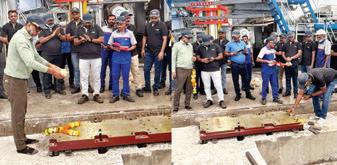
Krofta Engineering Limited showcased its continued focus on innovation, sustainability, and cost-efficient water management for the pulp and paper industry at Paperex 2025. In an exclusive collaborative interaction with Paper Mart, Mr. Raghvendra Khaitan, Managing Director of Krofta Engineering Limited, and Mr. John Barsotti, President & Founder of Heron Innovators, Inc., discussed how their strategic partnership is bringing advanced flotation and decentralized wastewater-treatment solutions to Indian paper mills. From introducing Suspended Air Flotation (SAF) as an upgrade to conventional DAF systems, to addressing challenges around water reuse, operating costs, space constraints, and future AI integration, the discussion highlighted a shared vision.
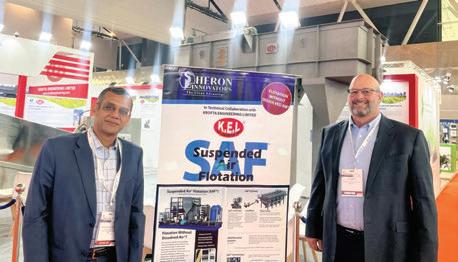
Mr. Raghvendra Khaitan, Managing Director, Krofta Engineering Limited
Mr. John Barsotti, President & Founder of Heron Innovators, Inc.
Paper Mart: What are you displaying here at Paperex 2025? How has your experience been so far?
Raghvendra Khaitan: We are displaying two new products. One is MegaCell, which works on dissolved air flotation (DAF) technology, and the second is the screw press that we launched a couple of years back for handling sludge.
On the DAF side, we have tied up with Heron Innovators, Inc., for a new technology called suspended air flotation (SAF). This is what we want to provide this year to many of our customers, where we can convert a lot of old DAFs into SAFs, which have their own inherent advantages, which John can talk about later. Mr. John Barsotti is the owner of Heron Innovators, Inc., based out of the US.
As far as our experience at Paperex goes, being the first half of the first day, two to three customers have already visited us. We have spoken to them about SAF. I think the response should be good because the industry wants to see new things coming
We compete against something called DAF and we convert them and replace them. We lower the operating costs, increase solids efficiency, reduce the amount of space needed, and along with operating costs, we have much lower horsepower and oftentimes significant chemical reduction as well.
their way and wants to know what is new in the industry. We are looking forward to the next couple of days.
PM: How can decentralized wastewater treatment systems give paper mills greater flexibility in managing water use? How are you working in that direction?
John Barsotti: In general, having treatment capability at the mill, instead of downstream at a central wastewater treatment plant, provides the ability to treat specific water in a specific way. There are generally cost savings for reuse and the ability to capture the resource before it leaves the site. We are one technology in that area.
We compete against something called DAF and we convert them and replace them. We lower the operating costs, increase solids efficiency, reduce the amount of space needed, and along with operating costs, we have much lower horsepower and oftentimes significant chemical reduction as well. Between all of these, it becomes a really cost-efficient solution at the plant that can be tailored to the plant and support a lot of reclamation efforts.
RK: To add here, having a decentralized plant brings a lot of flexibility for the customer because today water is required for many different applications—dilution, pulp
mill, stock washing, and showers. If a mill has its own decentralized plant, it can operate it in such a way that it not only complies with operational requirements but also with environmental discharge standards. That gives the customer flexibility.
PM: The paper industry is often blamed for high water usage. What is your view on this?
RK: Correct, no doubt—it is a very water-centric industry. But at the same time, today technologies are available where water can be treated to the extent possible. I think the environment should look at removing the paper industry from the red category because that classification is no longer required.
PM: Given Krofta Engineering’s full turnkey wastewater and effluent treatment solutions, how do you tailor your systems for pulp and paper mills to maximize fiber recovery and minimize water use while keeping the plant footprint minimal?
RK: Today, cost per ton per day is very important for the industry. We provide a full solution from A to Z, which includes primary, biological, secondary, and tertiary treatment, including filtration, membranes, reuse, and sludge discharge. If sludge is not discharged, it becomes a concern because it cannot be allowed to build up.
As mentioned earlier, we have recently tied up with Heron Innovators, Inc., to add new technologies that reduce OpEx (operating expenses) for paper mills, because operating cost is a major concern today. Secondly, we have tied up with GPS Renewables Private Limited for gas conversion. In many anaerobic treatment plants, methane gas is generated, which can be further treated into CBG and CNG, providing good ROI for customers going forward.
Not many plants may implement this immediately, but with power becoming such a major concern across the country, using gas as a derivative to save fuel cost becomes a strong value proposition. We are joining hands wherever we can fill gaps so that we become a full turnkey solution provider, not only from a solution standpoint but also from a cost-reduction perspective.
PM: What are some of the major trends and challenges you are seeing in the industry today?
RK: A major challenge going forward is cost reduction. The paper industry is under pressure due to imports, which are hitting bottom lines badly. China and Indonesia are dumping paper into the market, and the industry is struggling.
Nobody can shut down their plant, so the idea is how much value we can add for customers—how we can help
We have recently tied up with Heron Innovators, Inc., to add new technologies that reduce OpEx (operating expenses) for paper mills, because operating cost is a major concern today. Secondly, we have tied up with GPS Renewables Private Limited for gas conversion.
them save a few pennies in day-today operations. That is where technologies like SAF from Heron Innovators, Inc., come into the picture.
JB: Globally, the buzzwords today are sustainability and water reclamation, and the third major trend is increasing capacity without expanding footprint. Most plants are space-limited but want to increase capacity, reduce costs, and lower price per unit volume.
Part of that challenge lies in wastewater treatment, because normally you don’t have the ability to double your wastewater treatment capacity. The advantage is that one unit can be expanded to handle much higher capacity, reclaim more water, and operate with lower horsepower. If a customer has an existing system running at X capacity
and the same machine can be used for 3X capacity, that becomes a major saving without additional investment in space or resources.
PM: What unique AI-integrated processes or practices do you see in the industry or plan to implement?
RK: We are working on developing a model from an operating perspective where polymers and chemicals are used. Today, dosage control is done manually by operators monitoring flows. We want to integrate a system where parameter changes automatically adjust dosage through an online monitoring platform. This will improve efficiency and reduce operating expenses for customers. We are working on this, and it is part of our agenda for the current year.
JB: From a global perspective, there
is a lot of AI activity, but much of it is still marketing, development, and literature. AI-aided design is coming, but that will likely be the next step within engineering houses.
PM: Is there anything else you would like to add?
RK: Technology is available today, and industrialists and mill owners must look at upgrading their systems. There is no technology in the world that cannot be implemented in India, either directly or through partnerships.
India is unique, with around 500–600 paper mills still operating, while many plants in Europe and the US are shutting down. There is growth here, and I would request everyone to implement newer technologies that help mills operate longer with lower operating costs.
Technology is available today, and industrialists and mill owners must look at upgrading their systems. There is no technology in the world that cannot be implemented in India, either directly or through partnerships.

In an exclusive interaction with Paper Mart, Mr. Dilip Golani, Sr. Manager – Marketing (Domestic), Lineomatic India Private Limited, shared insights on the company’s latest technological advancements, including the unveiling of a next-generation folio-size ream wrapping machine that enables rapid job changeovers with no manual intervention. He further emphasized that automation has become a necessity to achieve higher productivity, consistent quality, and faster output. According to him, companies must adopt automation to remain competitive.
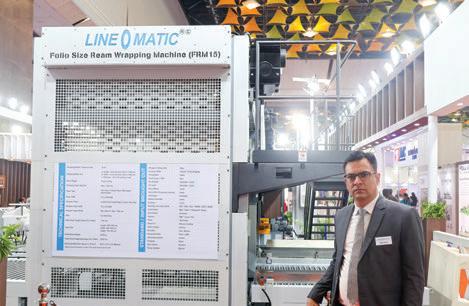
Paper Mart: Lineomatic has unveiled a “Next-Generation Folio Size Ream Wrapping Machine’’ at Paperex. Can you tell us about your new machine? Dilip Golani: This is a folio-size ream wrapping machine that we have launched for the first time in India. The machine is primarily designed for paper and paperboard mills and is fully automatic, specifically developed for folio-size ream wrapping applications.
The machine operates at a speed of 15 packets per minute and can handle a maximum sheet size of 1400 mm × 1200 mm. It is a fully loaded system equipped with automatic gauging, enabling rapid job changeovers in just two minutes. Additionally, the machine is designed for continuous, non-stop operation. With dual pallet arrangements, it ensures uninterrupted production and high operational efficiency.
This is our latest product launch, and Paperex provides an excellent platform to introduce advanced machinery for the paper industry. This is the first machine of its kind to be launched in India.
PM: What are the advantages, features or innovations in this machine compared to its earlier generations?
This is a folio-size ream wrapping machine that we have launched for the first time in India. The machine operates at a speed of 15 packets per minute and can handle a maximum sheet size of 1400 mm × 1200 mm.
DG: This is a fully loaded machine that operates without any manual intervention. Job changeovers, which are typically very timeconsuming and labor-intensive on manual machines, can rapidly be completed on this machine. It is a servo based system designed for fast and efficient job changes. In paper mills, where multiple sheet sizes are processed. With this machine, all such changes can be executed automatically within two minutes, making it one of the biggest advantages for this machine.
PM: Can you tell us about some of the recent orders or the leading mills that have adopted this technology? Have you received any orders at Paperex?
DG: This is a new launch and a large-scale project, so immediate bookings at Paperex are not feasible. However, we are actively engaged in discussions with leading paper mills for this machine, as well as for our folio-size sheeters.
PM: What role does R&D play in Lineomatic’s technological innovations and automation services thereby serving the paper industry?
DG: We have complete in-house capabilities, covering end-toend solutions from R&D to manufacturing. Our dedicated R&D team is continuously working on machine development and upgrades.
In addition, we have separate departments for purchasing, production, and planning to ensure smooth execution at every stage. We also operate a fully equipped in-house tool room with more than 100+ CNC machines.
All mechanical components— including fabrication, machine structures, rollers, and other mechanical components —are manufactured internally. We are not dependent on any outsourced agencies for core mechanical components.
Our automation team is also fully in-house, handling all programming and system integration internally. As a result, the entire machine and its automation is developed within our facilities.
We have a strong service infrastructure with more than 60 engineers dedicated to installation, commissioning, and after-sales support. We have dedicated departments, ensuring quick response and reliable service. Overall, our approach is to keep everything in-house, allowing us to maintain consistent quality and accountability.
PM: Why is automation becoming essential for paper mills today?
DG: Day by day, labor-related
challenges such as reliability, availability, and performance are increasing, making automation a necessity rather than an option. As a result, many companies and leading paper mills are increasingly adopting automation to achieve better productivity, consistent quality, and faster output.
Automation significantly reduces dependence on manual labor. While it requires a one-time investment, it delivers long-term operational benefits by ensuring stable performance and efficiency. In practical terms, a single automated machine can replace manual intervention, while also improving output consistency and overall plant efficiency. Every mill will need to expand and adopt automation to remain competitive.
PM: What are your future plans?
DG: Currently, we are focusing on developing different machinery for the stationery and converting segments. Following this, we plan to introduce additional models related to the paper and packaging industry. We are also planning to launch a new model of flexo printing machine.
To sum it up, as production demands continue to rise, companies increasingly need to adopt automation to achieve faster output, higher efficiency, and consistent quality.
Automation significantly reduces dependence on manual labor. While it requires a one-time investment, it delivers long-term operational benefits by ensuring stable performance and efficiency.
Wolkem India Limited, is India’s largest supplier of ground calcium carbonate, to the paper and board industry, it continues to reinforce its commitment to innovation, sustainability, and customer-centric solutions. Speaking to Paper Mart, Mr. Gaurang Singhal, Director, Wolkem India Limited, highlighted Wolkem’s strong legacy of over 50 years, supported by its 25-year-old subsidiary Fimakem, which specialises in wet ground calcium carbonate FIMCARB slurry. The company has recently launched coating and filler-grade products, designed to improve paper gloss and reduce production costs. With strong ethics, a global - mining and manufacturing footprint, onsite & satellite plant model, and strong sustainability focus, Wolkem continues to play a key role in India’s evolving paper industry growth story.
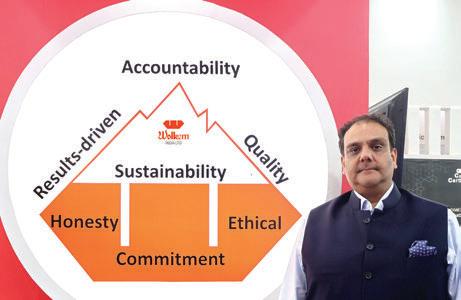
Mr. Gaurang Singhal, Director, Wolkem India Limited
Paper Mart: Could you introduce Wolkem India and Fimakem?
Gaurang Singhal: Wolkem India Limited is the parent company, headquartered in Udaipur and serves as a “mines-to-market” company that prizes its ability to own capital mineral assets, allowing the firm total control of its value chain, while serving 15 diversified customer industries across 4 continents. We are primarily engaged in Industrial Minerals such as Calcium Carbonate, Wollastonite, Dolomite, Talc etc, and provide consultancy in air, water, soil studies and environment management. Our subsidiary, Fimakem, focuses on Wet Ground Calcium Carbonate (WGCC) slurry production, catering mainly to the paper and board industry.
PM: What is new at Fimakem for the paper industry?
GS: We have recently developed, new coating-grade and filler-grade products for the paper and board industry. The coating-grade products are designed to enhance gloss, while the filler-grade products help reduce overall paper production costs. Both concepts address key performance
and cost challenges faced by manufacturers.
PM: Have these products already been launched in the market?
GS: Yes, products have already been launched this year and we have begun supplying them to customers.
PM: How has the market response been so far?
GS: The response has been very positive. We see strong interest from paper and board manufacturers, and there are good opportunities ahead. Fimakem has been associated with the paper industry for over 25 years, and Wolkem for more than 50 years, so customers trust our expertise and long-term commitment.
PM: What is your view on the current state of the Indian paper industry?
GS: India’s per capita paper consumption remains very low, which means the industry has significant growth potential. We are also seeing some level of consolidation across the sector. As one of the Pioneering suppliers of Calcium Carbonate, holding a major market share, we are proud to be part of the industry’s growth journey.
PM: What challenges do you foresee for the industry?
GS: One of the key challenges is imports of raw materials, which put pressure on domestic suppliers. However, innovation and value creation for customers are essential. We believe suppliers must support customers by enhancing efficiency and competitiveness.
PM: Wolkem is known for its
satellite plant concept. Could you explain this model?
GS: 25 years ago, Wet Ground Calcium Carbonate Slurry was new to the Paper industry, we had to explain what it was, its uses. We were also the first to introduce the satellite or onsite plant concept in India. Under this model, we install a dedicated production facility either within or very close to a customer’s paper or board plant. This ensures just-intime supply, lower inventory costs, consistent quality, and improved operational efficiency for customers.
Today, we have the maximum number of satellite plants, serving the largest number of customers in our industry and operate across 5 states of India, ensuring Just-in-Time supply to virtually every major Paper and Board plant in the country.
PM: Sustainability is often debated in the paper industry. How does Wolkem contribute?
GS: Sustainability is central to our philosophy. We focus on environmental protection, water conservation, natural resource preservation, corporate social responsibility, health and safety. Being in the natural resources business, responsible sourcing and green manufacturing practices are integral to how we operate, the awards and certifications we win regularly for our efforts are testimony.
PM: What are Wolkem’s future plans over the next five years?
GS: Our plans include strengthening our raw material base, both within India and internationally, expanding our footprint in the paper and board industry, and introducing new products and services. There
India’s per capita paper consumption remains comparatively low, which means the industry has significant growth potential. We are also seeing consolidation across the sector.
are many growth opportunities ahead, and we are well positioned to capture them.
PM: What is Wolkem’s market presence today?
GS: We are fortunate to be the world’s largest wollastonite and India’s leading Ground Calcium Carbonate producer. Our carbonate slurry business is entirely domestic, as it cannot be transported internationally, where we hold the highest market share in India, supplying to almost all paper and board manufacturers. We operate 12 mining and manufacturing sites, across 6 states of India and in Malaysia, ensuring proximity to customers and Mineral Assets.
PM: Is there anything else you would like to add?
GS: We remain deeply committed to the paper and board industry. Being a family business means we take a long-term approach. Our values, ethics, Sustainability, reliable supply, and long-term value creation are core to our vision. With a workforce of around 1,200 people, we believe India is in a strong position for growth, despite challenges, and we are excited to be part of that journey.
We don’t just invest in minerals, we invest in customers, employees and technology and continuously bring new ideas and concepts to deliver reliable, sustainable Filler, Extender and Pigment solutions to Paper and Board customers, while building on our 50+ year legacy.
Sidhu Engineering Works showcased its flagship product line, RoboCleaner, highlighting advanced fabric cleaning and automation solutions for the pulp and paper industry. With over 20 years of experience, the company is focused on improving machine reliability, reducing water consumption, and addressing long-standing operational challenges faced by mills. In an interaction with Paper Mart, Mr. Rahul Basra, Director, Sidhu Engineering Works discussed Sidhu Engineering’s Indiafirst motorized trim cutter, high-speed-compatible RoboCleaner systems, and a breakthrough dryer screen cleaning solution, offering mills a cost-effective alternative to expensive imported technologies amid tightening margins and rising competition.
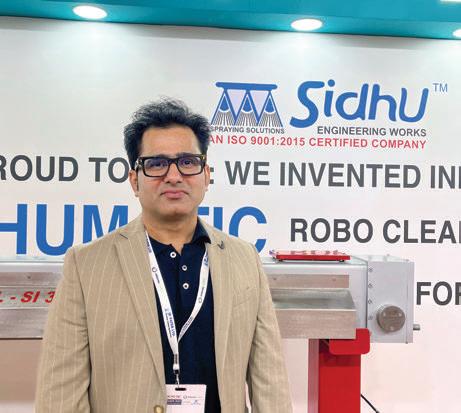
Paper Mart: Tell us about your participation at Paperex 2025?
Rahul Basra: At Paperex 2025, we are displaying our latest RoboCleaner technologies, including RoboCleaner systems for the wire section, press section, and SLDS dryer screens. We have also introduced, for the first time in India this year, our Siddumatic motorized edge trim cutter, which is an automated solution. These four products are the key highlights at our stall.
By God’s grace, we have received a huge response. Many of our existing customers and industry colleagues visited our stall, and both the first and second days were very good. A lot of visitors appreciated our invented products, which is very encouraging.
PM: Could you explain the core concept behind the RoboCleaner system?
RB: RoboCleaner is a product designed for high-speed paper
We have also introduced, for the first time in India this year, our Siddumatic motorized edge trim cutter, which is an automated solution.
machines. Its primary function is to clean fabrics using very low water consumption, as water is a precious resource. Our motto is to save water globally and remain environmentally friendly. With RoboCleaner, mills can reduce fresh water consumption on paper machines by up to 90 percent, which is a major USP.
PM: What trends and challenges do you see in the paper industry today?
RB: The biggest trend in the Indian paper industry right now is technology adoption, including AI-based solutions. The market is extremely competitive, margins are low, and mills are under pressure to improve efficiency and productivity. Those who believe in technology and invest in it will succeed.
As for challenges, paper production in India is currently higher than demand, which has reduced paper prices and margins. However,
demand for kraft and recycled paper is increasing steadily. I believe that within the next two years, demand and supply will balance, leading to better margins.
PM: You mentioned a new development related to dryer screen cleaning. Could you elaborate?
RB: Dryer screen cleaning is one of the most challenging areas for paper mills. For many years, Indian mills depended on European solutions, which were extremely expensive, often costing over one crore rupees, making them unaffordable for most mills. As a result, many mills compromised on machine performance.
This year, Sidhu Engineering Works successfully launched an India-made RoboCleaner for dryer screens. Over the last three months, we have installed this system in some leading paper mills and achieved
100 percent positive results. This is a major breakthrough, and many mills are now approaching us for this solution at an economical price.
PM: Any closing thoughts you would like to share?
RB: People know me as a technology-driven person, and that trust reflects in the response we received at the exhibition. Our focus is to continue developing practical, affordable, and innovative technologies for the paper industry.
With RoboCleaner, mills can reduce fresh water consumption on paper machines by up to 90 percent, which is a major USP.
This year, Sidhu Engineering Works successfully launched an India-made RoboCleaner for dryer screens. Over the last three months, we have installed this system in some leading paper mills and achieved 100 percent positive results.

Roto Pumps reinforces its position as a key solution provider to the pulp and paper industry by showcasing its latest range of progressive cavity pumps and twin-screw pumps designed for high-consistency and heavy-duty applications at Paperex 2025. In an exclusive interaction with Paper Mart, Mr. Gaurav Pandey, Sales Manager, Roto Pumps Limited, shared insights into how Roto’s pump technologies support pulp handling and wastewater treatment with high reliability and efficiency. With a strong focus on lifecycle value, export-grade quality, and innovations such as P-Range and MC pumps, Roto Pumps continues to help mills optimize performance while reducing long-term operating costs.
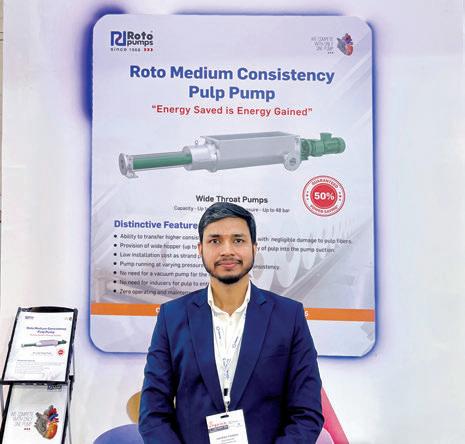
Paper Mart: What are you displaying at Paperex 2025, and how has your experience been so far?
Gaurav Pandey: As a globally trusted progressive cavity pump manufacturer, we are proud to showcase at Paperex 2025 our comprehensive range of pumping solutions—including the largest P-Range Progressive Cavity Pump, Medium-Consistency Paper Pulp Pumps, Twin Screw Pumps, the Roto KWIK with Wear Compensation (WC) Stator, and Aggressive Chemical Dosing Pumps—all specifically engineered for the paper and pulp industry.
The response from visitors has been highly encouraging. Paperex provides an excellent platform to demonstrate our latest technologies and engage directly with customers, helping them better understand the capabilities, reliability, and strengths of Roto Pumps.
PM: How does Roto Pump’s progressive cavity pump technology help paper mills? GP: We cater to a wide range of industries with our progressive cavity
pumping solutions, addressing applications from low to heavy duty across diverse process requirements. However, when it comes specifically to the paper and pulp industry where fluids often contain high solid content and demand consistent, controlled flow, our pumps truly stand out.
Handling high-viscosity and high-consistency pulp requires reliability and precision, and our pumps are engineered to perform seamlessly under these demanding conditions. Designed for smooth, uninterrupted operation, they deliver proven efficiency and durability. Many leading paper and pulp manufacturers already rely on our solutions, with strong positive feedback on performance, reliability, and long-term operational value.
PM: How do Roto Pumps support paper mills in improving reliability and efficiency across pulp and wastewater handling?
GP: Our pumps are extensively used across varied paper applications and pulp processing as well as wastewater and sewage treatment applications, including sludge handling. These processes involve managing slurries and fluids with varying and often high viscosities, making pump efficiency, flow stability, and reliability critical.
Roto pumps are engineered to deliver high volumetric efficiency— up to 98%—ensuring consistent, pulse-free performance even when handling viscous, abrasive, or sludge-laden media. The extended service life of our wear components
significantly reduces maintenance frequency, operational downtime, and overall operating expenditure (OPEX). Our solutions are designed to optimize process efficiency while providing long-term reliability and cost-effective performance for our customers.
PM: What new developments or innovations are you introducing to better cater to the industry?
GP: We have recently expanded our portfolio with advanced product ranges, including the P-Range pumps featuring a unique thrust bush joint design, and MC pumps capable of handling up to 25% solid consistency. In parallel with new product development, we continuously refine and upgrade our existing designs to improve efficiency, reliability, and ease of maintenance.
These ongoing enhancements deliver tangible value to our customers by reducing maintenance requirements and optimizing performance, resulting in lower capital expenditure (CAPEX) and operating expenditure (OPEX) across
PM: What major trends and challenges do you see in the industry today?
GP: A clear shift we see across industries is a stronger emphasis on cost optimization, but true value comes from long-term performance, reliability, and lifecycle efficiency. Low-cost equipment may reduce upfront investment but often leads to higher maintenance, downtime, and reduced process efficiency. At Roto Pumps, our solutions are engineered for sustainable performance: P-Range pumps with a unique thrust bush joint improve load handling and durability, the Roto KWIK system with Wear Compensation (WC) stator restores performance without replacement, and our precision dosing pumps ensure accurate chemical handling with minimal wear. Backed by export-grade quality and dependable service support, Roto Pumps enables customers to optimize total lifecycle costs, achieve consistent efficiency, and maximize operational confidence.
We have recently expanded our portfolio with new product ranges, including the P-Range pumps, featuring a unique thrust bush joint—a compact giant born to dominate. Alongside developing new products, we continuously refine our existing designs to enhance efficiency, reliability, and reduce maintenance costs.
Clyde Industries India Pvt. Ltd. highlighted its advanced boiler on-load cleaning and monitoring solutions aimed at improving energy efficiency and operational reliability in pulp and paper mills at Paperex 2025. In an exclusive interview with Paper Mart, Mr. Samir Patil, Managing Director, Clyde Industries India Pvt. Ltd., discusses the company’s high-tech soot blowing systems, SMART Clean boiler cleaning technology, and the evolving Fitness-toOperate program. He also shares insights on industry challenges, the role of automation and AI, and how Clyde Industries is helping paper mills optimize steam consumption, extend boiler runtime, and reduce downtime.
Paper Mart: What are you showcasing at Paperex 2025, and how has your experience been so far?
Samir Patil: As a world leader in online boiler on-load cleaning systems, we are showcasing our high-tech products at Paperex 2025. These include low-pressure soot blowing, our Fitness-to-Operate (FTO) program, and our heavy duty RSM-H soot blower. The exhibition is a good platform for us to connect with customers and showcase our solutions.
PM: Can you share how the Fitness-to-Operate program is evolving?
SP: Currently, the FTO program is largely manual, where our expert teams visit mills, inspect systems, and prepare reports. We already have automated FTO program using sensors and machine learning. While this is already implemented in other parts of the world, we are working on it to introduce in India.
PM: With the growing focus on energy efficiency in pulp
and paper mills, how does Clyde Industries’ SMART Clean boiler cleaning technology help optimize steam consumption?
SP: Steam is one of the biggest cost drivers in paper mills. Our SMART Clean technology helps customers optimize steam consumption and extend the runtime of recovery boilers, resulting in significant savings for end users.
PM: How does your Boiler Monitoring Diagnostic System help mills improve efficiency and manage maintenance?
SP: Boiler Monitoring Diagnostic System is self-learning and studies boiler behavior to establish effective cleaning strategies. It helps keep
boilers running while reducing downtime, predicting issues in advance, and providing early warnings for corrective actions.
PM: What trends and challenges do you see in the paper industry today?
SP: One of the key challenges for paper mills is the impact of new GST law changes, which end users are currently facing. Despite this, we believe paper has a strong future and will continue to grow in the Asian market.
PM: How is Clyde Industries incorporating automation and AI into its solutions?
SP: Automation has been part of our
solutions for decades through our SMART Line products. Innovation is ongoing, and customers will see more advanced and innovative products being launched in the future.
Steam is one of the biggest cost drivers in paper mills. Our SMART Clean technology helps customers optimize steam consumption and extend the runtime of recovery boilers.
We are showcasing our high-tech products at Paperex 2025. These include low-pressure soot blowing, our Fitness-to-Operate (FTO) program, and our regular RSM-H soot blowing systems.
Saloni Paper Machine Pvt. Ltd. has successfully completed the re-engineering and commissioning of a paper machine for Sillverton Industries in Muzaffarnagar facility.
Feb 03, 2026
Saloni Paper Machine Pvt. Ltd. has completed paper machine re-engineering and commissioning for the Sillverton Industries. The successful execution of critical sections including the headbox, top former, shoe press, Varicon 3rd press, Runtech blower, ropeless tail threading, speed coater, hood, Janus Calender, and Pope Reel clearly reflects the team’s outstanding technical capabilities and commitment.
The Saloni team dismantled the machine in Germany and completed its installation along with re-engineering at the Muzaffarnagar site with exceptional skill and professionalism. Throughout the project, they consistently maintained high quality standards and successfully completed the entire scope within the stipulated timeframe of just one year.
‘’I sincerely appreciate the leadership and guidance of Mr.
Jai Kishan ji and Mr. Shashikant ji, along with the dedication, technical expertise, and strong teamwork demonstrated by the entire Saloni team. Their performance is truly commendable and sets a benchmark for excellence,’’ says Mr. Deepak Bhardawaj, President Sillverton Industries.
KPL International is a professionally managed chemical marketing and distribution company with a strong pan-India presence along with a warehouse in Dhaka, supporting their reach to the paper industry in Bangladesh as well. In an exclusive interaction with Paper Mart, Mr. Rahul Ambardar, Director, KPL International Limited, shared that the company has recently introduced PFAS-free additives under the ‘Daikin’ brand for paper coating applications as well as for pulp-moulded fiber products. The company has also recently entered into new partnerships, adding starch, cellulose and ethers to its portfolio. Looking ahead, KPL International plans to expand its portfolio with innovative and sustainable solutions aligned with the evolving needs of the packaging segment.
Paper Mart: Please tell us about your company, its history, and milestones.
Rahul Ambardar: KPL International is primarily a chemical marketing and distribution company with over three decades of active presence in the Indian market. Paper is one of our key focus segments. Our participation at Paperex has been very consistent over the years, as it provides an opportunity to connect with industry peers and showcase new products and solutions relevant to the Indian paper industry as well as the overseas market.
At Paperex, we represent companies from Asia, America, and Europe. This event allows us to closely align with global developments happening in the paper industry, in terms of latest technologies, chemistries, and solutions available internationally. By bringing these advancements to India, we help Indian paper manufacturers stay competitive and aligned with global best practices.
PM: What is your product portfolio?
RA: We can be described as one
As part of this expansion strategy, we have onboarded new partnerships this year, adding starch, cellulose and ethers to our portfolio. These additions bring a new dimension to our offerings and allow us to serve a wider range of applications within the paper industry.
of the catalysts in the paper manufacturing industry, primarily as a raw material supplier to the pulp and paper industry. Our portfolio is broadly divided into two distinct categories. The first category is commodity products, which are supplied in bulk and are largely price-driven. This includes materials such as minerals, kaolin, and bentonite, which form an essential part of paper manufacturing. The second category comprises specialty products. These are advanced, technology-driven solutions that are introduced in the India market and evaluated by Indian manufacturers for adoption. This segment focuses on innovation and performance enhancement rather than volume alone.
PM: Can you tell us about your market footprint in India and outside India?
RA: We have a strong market presence pan-India, with warehouses strategically located across the North, West, South, and East regions, ensuring comprehensive geographic coverage. Our offices and dedicated sales teams are spread across the
length and breadth of the country, allowing us to respond efficiently to customer needs.
Beyond India, we also have an established presence in Bangladesh, with a sales team and warehouse in Dhaka. Through this setup, we actively cater to the paper industry in Bangladesh as well.
PM: What are the new product developments happening in your company?
RA: We have recently launched a PFAS-free additive that includes non-fluorinated oil and grease repellent chemicals for paper coating as well as for pulp-moulded fiber applications. Earlier, such functionalities were largely achieved using fluorinated compounds. However, this year we have introduced non-fluoro alternatives specifically for the paper industry, addressing both performance requirements and evolving regulatory expectations.
This newly launched product from ‘Daikin’, with grade names XP8001 and XP8802. XP8001 is primarily designed for size press applications, while XP8802 is intended for pulpmoulding applications. These two grades are being showcased at this exhibition and we are actively engaging with paper mills and coating units to conduct trials, and gradually sell and establish these products in the Indian market.
PM: Please tell us about your experience here at Paperex?
RA: There has been a lot of interest from the pulp and paper industry, with very reasonable responses
throughout the exhibition. We have received a decent number of inquiries not only from our customers that we have engaged with or are pre-informed, but also from several walk-in visitors who have shown keen interest in these products. In particular, manufacturers focused on exporting their products to developed markets such as the US and Europe have shown significant interest in our portfolio, as the products are well-aligned with the regulatory and compliance requirements of those regions.
PM: Sustainability has been a key focus area in the paper industry. How is KPL International supporting the paper industry in this domain?
RA: Sustainability has become a key focus area for us, as paper is gradually being used as an alternative to traditional materials derived from plastics. A good example of it is cup stock, which has conventionally relied on polyethylene (PE) lamination. With our new products that we are distributing, we offer solutions that not only support essential properties such as water resistance/retention (WTR) and grease resistance (GR), but also provide heat-seal capability to paper. These advanced additives enable paper-based products to meet performance requirements without relying on plastic-based laminations. Through our product portfolio, we aim to help the paper industry move towards recyclable, more environmentally friendly products, supporting the broader transition to sustainable packaging solutions.
PM: How do you see the paper industry evolving in India
We have a strong market presence pan-India, with warehouses strategically located across the North, West, South, and East regions, ensuring comprehensive geographic coverage. Beyond India, we also have an established presence in Bangladesh, with a sales team and warehouse in Dhaka. Through this setup, we actively cater to the paper industry in Bangladesh as well.’
We have recently launched a PFAS-free additive that provides non-fluorinated oil and grease repellent chemicals for paper coating as well as for pulp-moulded fiber applications.
especially in the packaging segment?
RA: The paper industry today can be divided into two segments: traditional grades (such as writing and printing and newsprint) and the packaging portfolios. The packaging segment is witnessing rapid growth, especially in India. This growth is driven by innovative and specialty products having varied applications. As the packaging sector continues to develop, India increasingly requires support from the paper industry as well as new supply chain partners to meet quality, performance, and sustainability expectations. On the other hand, traditional grades such as writing and printing paper, and newsprint represent relatively mature markets with limited growth momentum. While they remain important, the primary growth driver for the paper industry going forward
will clearly be packaging. This perspective is also reflected in the exhibition, where we see significantly higher interest and demand coming from packaging-related applications.
PM: A lot of expansions are happening in the chemical sector. Are there any product expansion plans in the pipeline for your company ?
RA: As I said earlier, we are a chemical marketing and distribution company and do not have a production base of our own. Expansion, for us, does necessarily mean capacity additions, but to build new partnerships and strengthen our portfolio. As part of this expansion strategy, we have onboarded new partnerships this year, adding starch, cellulose and ethers to our portfolio. These additions bring a new dimension to our offerings and allow us to serve a
wider range of applications within the paper industry.
PM: What are your future plans?
RA: Our future plan is to bring in new innovative and sustainable products that are aligned with the evolving needs of the packaging segment, which we believe will be the primary driver of growth for the paper industry.
We will continue to work proactively to bring new technologies to Indian paper manufacturers. Even if certain innovations are ahead of their time, we remain committed to introducing them, as we believe there is no such thing as bad timing for meaningful innovation. Ultimately, it is about demonstrating the right value to the end user and helping the market recognize its long-term benefits.
The Bioneer roll covers are designed for a wide range of press and suction roll applications on board, paper, tissue and pulp drying machines
Jan 29, 2026
Valmet continues to lead the way towards circularity by introducing Bioneer press roll covers. The new innovative press roll covers are manufactured by applying recycled, renewable and bio-based raw materials, thereby enabling Valmet and its customers to reduce reliance on fossil resources.
The Bioneer roll covers are designed for a wide range of press and suction roll applications on board, paper, tissue and pulp drying machines. These roll covers incorporate recycled, renewable or biobased materials without compromising durability, wear resistance, or dewatering performance.
“Our customers are increasingly looking for solutions that help them improve their machines’ performance while meeting their sustainability targets. With the Bioneer roll covers, we can offer both high-performance technology and
verified climate impact data. This combination strengthens our role as a global roll cover technology leader and as a trusted partner in sustainability,” says Ulla Kanerva, Global Technology Manager, Roll Covers and Maintenance at Valmet.
Valmet’s Bioneer press roll covers are the first covers that are accompanied by product-specific life cycle assessment (LCA), providing customers with transparent and credible climate impact data. Valmet Press Roll Cover PF Bioneer offers up to 12.2 percent lower cradle-to-gate CO₂ emissions compared to standard products. It is reached by using REDcert²-certified renewable and recycled materials through the mass balance approach.
“With the transparent LCA data, we can help our customers compare the climate impact of different products, make informed decisions, and demonstrate measurable progress towards their climate targets,” says Sanna Junttonen, Global Product Manager, Roll Covers and Maintenance at Valmet.
Ashoka Rolls LLP highlighted its focus on next-generation ceramic and high-performance rubber roller coverings designed to meet the evolving demands of modern paper mills. The company is also going to start two manufacturing units- one is South and one in East India, to cater flawless rollers to clients for fast delivery. In an exclusive interview with Paper Mart,
Mr. Manoj Gupta, President, Ashoka Rolls LLP, shares insights into the company’s latest roller innovations, their impact on machine uptime, sheet quality, and maintenance cycles, and how material science and surface engineering are being leveraged to extend roll life. He also offers his perspective on key industry trends, challenges, and the technologies shaping the future of paper manufacturing.
Mr. Manoj Gupta, President, Ashoka Rolls LLP
Paper Mart: What are you displaying here at Paperex 2025? How has your experience been so far?
Manoj Gupta: At Paperex 2025, we are showcasing our new-generation ceramic and high-performance rubber coverings for roller solutions, along with coating technologies for paper mills, with a strong focus on extending the service life of rollers used in paper machines.
The response at the exhibition has been very positive, with strong interest from paper mills and OEMs looking to upgrade from rubber to PU, improve roll life, and address challenges such as premature wear, uneven nip, and surface defects. The technical discussions have been particularly valuable, as many visitors are seeking customized solutions rather than standard coverings, which aligns well with our capabilities.
Overall, Paperex 2025 has served as an excellent platform for technical exchange, generation of new leads, and strengthening relationships within the paper industry.
PM: Your recent innovation focuses on advanced rollers-ceramic and PU. Could you elaborate on how these new roller technologies improve machine uptime, sheet quality, and maintenance cycles compared to conventional rollers? MG: Our recent innovation in advanced roller technologies, including ceramic-coated rollers and high-performance rubber rollers, is aimed squarely at three core mill priorities: machine uptime, sheet quality, and maintenance reduction. Compared to conventional rubber or metal rollers, ceramic rollers offer extremely high wear resistance, with surface life typically three to five times longer than rubber or chrome. Their chemically inert surface resists starch, coating chemicals, fillers, and cleaning agents, preventing swelling or surface degradation, while a stable friction coefficient over time reduces slippage and web breaks. Ceramic rollers also eliminate the need for frequent regrinding or recovering, are
We are showcasing our new-generation ceramic and high-performance rubber coverings for roller solutions, along with coating technologies for paper mills, with a strong focus on extending the service life of rollers used in paper machines.
easier to clean with reduced chemical usage and downtime, and require only periodic inspection. As a result, maintenance cycles are extended by years, not months.
The owners of the company, Mr. Brij Bhushan Gupta (Founder & Chairman) and Mr. Mohit Gupta (Director), bring a great vision and rich experience, and their expertise drives our commitment to quality and innovation through Ashoka Rolls LLP plants in Ahmedabad and Ghaziabad.
PM: Given your expertise in manufacturing rolls for the paper industry, how is Ashoka Rolls LLP leveraging modern material science and surface-treatment technologies to extend roll life and reduce downtime for paper mills?
MG: At Ashoka Rolls LLP, the approach is practical and milloriented, combining modern material science, advanced surface engineering, and application-specific design to directly improve roll life, uptime, and operating stability in paper machines. The focus is
on engineered coverings rather than generic rubber, supported by ceramic surface technologies that extend service life at critical operating points. Advanced surface engineering and finishing, along with strong bonding and thorough core preparation, ensure consistency and reliability. In summary, Ashoka Rolls LLP leverages advanced polymers, ceramic coatings, precision surface engineering, and controlled manufacturing processes to deliver rolls that are long-life, stable, and predictable in performance, helping paper mills run faster, longer, and with fewer interruptions.
PM: How do you envision the future of the paper industry? What are some of the major trends and challenges we are seeing today in the industry?
MG: The paper industry is clearly evolving rather than declining. Its future will be shaped by sustainability, performance-driven materials, and smarter manufacturing, even as mills face increasing pressure on costs, energy consumption, and quality expectations.
The industry’s path forward lies in higher efficiency, greater sustainability, and improved precision. The key challenge is no longer demand, but the ability to operate faster, cleaner, and more reliably under tighter operational constraints. In this context, technologies such as advanced PU and rubber coverings and ceramic rolls are no longer optional upgrades; they have become essential enablers of the next generation of paper manufacturing.
Our recent innovation in advanced roller technologies, including ceramic-coated rollers and high-performance rubber rollers, is aimed squarely at three core mill priorities: machine uptime, sheet quality, and maintenance reduction.
With a strong presence in India, ST Macchine SpA supports mills with advanced headboxes, stock preparation systems, approach flow system solutions that directly impact formation, runnability, and fiber saving. In an exclusive interview with Paper Mart, Mr. Mukesh Kumar, Indian Representative for ST Macchine SpA shares how ST remains focused on continuous product development, helping paper mills improve performance while navigating evolving industry challenges.

Paper Mart: What are you displaying at Paperex 2025? How has your experience been so far? Mukesh Kumar: We are displaying various product lines from ST Macchine, including headboxes, stock preparation systems, approach flow equipment and water treatment plants. ST Macchine has been very successful in India with its headbox solutions, which help customers significantly improve basis weight profile, formation, and overall runnability of the paper machine.
PM: How does ST Macchine help paper mills ensure consistent paper quality?
MK: Our headbox technology plays a key role in improving paper quality. It helps achieve better basis weight control, improved formation, and stable runnability, which are essential for consistent paper production.
PM: What are the new developments or innovations
you’re looking at to better cater to the pulp and paper industry?
MK: We are continuously developing and improving our product line. The latest development in our portfolio is the breast roll shaking unit, which helps improve formation and the mechanical characteristics of paper. We have already made break-through in India market and the first breast roll shaking unit is on the way to India.
PM: What are some of the major trends and challenges we are seeing today in the industry?
MK: A major trend we see across the industry is the growing need for manufacturers to be more open to adopting new technologies. This has been highlighted repeatedly across the sector and is becoming increasingly important for long-term competitiveness. At present, AI and automation are areas where the industry is focusing on.
Prem Engineering is shaping the Indian pulp and paper equipment industry with a focus on affordable, modern solutions. At Paperex 2025, the company highlighted its expertise in agro and wood-based pulp mill equipment, EPC projects, stock preparation for recycled paper, effluent treatment, and recovery systems. In an exclusive interview with Paper Mart, Mr. Pryank Thukral, Managing Director, Prem Engineering, identifies the existing monopoly in technology and EPC solutions as a major challenge for the industry and is determined to offer mid-market alternatives, giving mills more options, breaking monopolistic control, and making advanced technology accessible without compromising quality.

Mr. Pryank Thukral, Managing
Director, Prem Engineering
Paper Mart: Could you please introduce yourself, your role in the company, and tell us in brief about Prem Engineering?
Pryank Thukral: I have been leading the business for the last 7 years. I am the second generation; my father started this company in 1985.
We specialize in pulp mill equipment manufacturing for agro and woodbased mills, which has been our core focus for the past 35 years. Over the last five years, we have expanded into EPC projects, stock preparation for recycled paper, effluent treatment plants (ETPs), and recovery equipment for agro and wood-based mills, including plasticizers and slackers.
Moreover, we are developing new technologies used in Europe, which we are bringing to India. We expect to showcase these innovations by the next financial year.
PM: What are you displaying here today at Paperex, and how has your experience at the exhibition been so far?
PT: I have been associated with Paperex since 2021, so this is my
fourth year. The experience has been very positive, productive, and informative, and a great platform for networking. People visit, interact, and share their thoughts, which helps us understand upcoming technologies in the market. At our booth, we are showcasing equipment and solutions for pulp mills, reflecting our expertise and innovation.
PM: How does Prem Engineering help mills modernize stock preparation and effluent treatment?
PT: Our core business is agro and wood-based pulp mills, with customers across India and exports to over 10 countries. We develop equipment based on customer needs, customizing designs according to their requirements. We focus on ease of operation and maintenance, ensuring that our customers can manage the equipment themselves. Customer perspective is central to our design process.
PM: Are there any innovations in the pipeline that you would like to share?
I want to bring this technology to India at reasonable prices, so mills don’t have to pay excessively for advanced solutions.
PT: Recently, we completed an EPC project for an Indian oil refinery, which included a 22-meter clarifier as a turnkey EPC project. It has been successfully commissioned and is running smoothly.
PM: What are the major trends and challenges that you see in the pulp and paper equipment industry today?
PT: The market is constantly evolving, making it difficult to predict customer requirements. Our equipment primarily generates pulp, and pulp requirements keep changing, so we continually adapt and improve our equipment.
For example, we developed dilution screws that can handle 12–14% material at the inlet and deliver 2–2.5% at the outlet. Previously, such equipment had to be imported from Europe or China, but now we manufacture it in India.
I see challenges as opportunities. Currently, there is a gap in the market– customers seeking EPC projects usually consult only large suppliers. Agro and wood-based mills are highly CAPEX-oriented, and investment decisions often overlook profitability. My goal is to provide affordable alternatives and create more options in the middle market, reducing dependency on a few big vendors.
PM: Being a second-generation leader, younger management often sees things differently from previous generations. Has this been a challenge or opportunity for you?
PT: I wouldn’t call it a challenge. I see it as an opportunity to bring
change. We are willing to work with anyone who is open to innovation. My aim is to break monopolies in the market by giving customers more choices. Technology is concentrated in the hands of a few players globally, but I have been visiting China and Europe to study modern pulp mill technologies. I want to bring this technology to India at reasonable prices, so mills don’t have to pay excessively for advanced solutions.
Our core business is agro and wood-based pulp mills, with customers across India and exports to over 10 countries. We develop equipment based on customer needs, customizing designs according to their requirements.
Currently, there is a gap in the market– customers seeking EPC projects usually consult only large suppliers. Agro and wood-based mills are highly CAPEX-oriented, and investment decisions often overlook profitability. My goal is to provide affordable alternatives and create more options in the middle market, reducing dependency on a few big vendors.
PPI Pumps Pvt. Ltd., a 50-year-old Ahmedabad-based player in liquid and vacuum pump manufacturing, is pushing the boundaries of energy efficiency and process optimization in the paper sector. In an exclusive interview with Paper Mart, Mr. Piyush Pota, Vice President, International Sales, PPI Pumps Pvt. Ltd., shares insights into the company’s latest innovations, including the turbo blower with Indian-made impeller and the 2PE1 and 2PE3 design vacuum pumps.
Paper Mart: What are you showcasing at Paperex 2025?
Piyush Pota: We are showcasing our turbo blower with an Indian-made impeller, as well as the 2PE1 and 2PE3 design vacuum pumps, both being introduced at an exhibition for the first time. These products highlight our focus on innovation, energy efficiency, and process optimization.
By the next Paperex, we aim to have a fully developed turbo blower ready for the market. Currently, we have developed the impeller, but the complete turbo blower will be launched by then.
PM: How do PPI Pumps’ vacuum solutions help paper mills improve process efficiency and reduce energy consumption?
PP: At PPI, we always focus on customer benefit. We design energyefficient vacuum pumps and often combine 4–5 smaller pumps into a single larger unit. This approach reduces power consumption and enhances overall energy efficiency for paper mills.
PM: What trends and challenges do you see in the industry today? PP: Selling turbo blowers comes with technical and commercial challenges.
We face competition from European and Chinese players and need to outperform them both technically and commercially to succeed.
We are showcasing our turbo blower with an Indianmade impeller, as well as the 2PE1 and 2PE3 design vacuum pumps, both being introduced at an exhibition for the first time.
Eintec highlighted its growing role as a supplier of advanced European technologies for the Indian paper industry at Paperex 2025. In an exclusive interaction with Paper Mart, Mr. Meyappan LS and Mr. Vijay Singhal, Business Partners at Eintec, shared insights on the company’s strong evolving product portfolio, and wide regional presence across India, GCC countries, and South Asia. With a focus on energy efficiency, water savings, and quality-driven rebuilds, Eintec continues to align its offerings with the changing needs of modern paper mills.
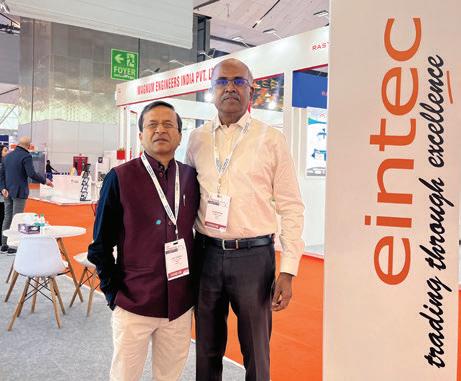
Started in 2006, Eintec supplies a wide range of European equipment for paper mills. Their product range covers the entire paper mill, from stock preparation to paper machines and finishing house products. All products are well accepted by mills, and in one way or another, all of them are being sold in the market. Their principals have mainly developed products focused on energy savings and water savings. They are present in India, GCC countries including the UAE, Saudi Arabia, Kuwait, Oman, Bahrain, and Qatar, as well as Bangladesh, Nepal, and Sri Lanka.
The future looks good. Mills are becoming more qualityconscious and are focusing on rebuilds related to quality improvements. We believe our products fit well with their requirements.
With a strong focus on energy efficiency, sustainability, and digital monitoring, Forbes Marshall continues to support pulp and paper manufacturers in improving operational performance. In an exclusive interview with Paper Mart, Mr. Mahendra Autade, Product Manager, Forbes Marshall, discusses the company’s integrated solutions across boilers, steam and condensate systems, automation, and advanced monitoring. He also shares insights on leveraging IoT-based analytics to enhance reliability and predictive maintenance, the role of steam optimization in boosting productivity, and the key challenges facing the industry, particularly around technology adoption and digital connectivity.
Paper Mart: What are you displaying here at Paperex 2025?
Mahendra Autade: At Paperex 2025, Forbes Marshall is showcasing a comprehensive range of solutions focused on energy efficiency, sustainability, and digital monitoring for the pulp and paper industry. Our display includes boilers, steam and condensate system equipment, automation solutions, metering instruments, and advanced monitoring tools. All the instruments showcased are designed to help paper mills monitor performance, sustain operational efficiency, and achieve long-term energy conservation in a sustainable manner.
PM: How is Forbes Marshall deploying IoT-based monitoring and analytics? How do you plan to leverage that for improving reliability, energy efficiency and predictive maintenance in pulp and paper plants?
MA: Ensuring control over runaway paper making costs requires regular monitoring, uptime and setting up recipes and improving operator expertise. Our EverSense for Paper Machines dashboard provides
Out of more than 800 paper mills in India, we have installations in over 450 plants, primarily involving steam and condensate systems.
an overview of specific steam consumption, condensate recovery factor, production loads, operating steam pressures, paper break, uptime of individual components and where applicable, vacuum system and heat exchangers. Forbes Marshall Digital goes beyond just connectivity with our specialists monitoring the live plant data and providing actionable insights to plant personnel. This saves valuable time and resources for all our customers. EverSense for Paper Machines, a Forbes Marshall Digital solution helps ensure productivity, safety, reliability and sustainability of operations for paper mills.
PM: How does Forbes Marshall help paper mills reduce steam consumption and improve drying efficiency?
MA: Forbes Marshall plays a significant role in helping paper mills optimize steam usage and improve drying efficiency. Out of more than 800 paper mills in India, we have installations in over 450 plants, primarily involving steam and condensate systems. These solutions help reduce maintenance and production costs while increasing
productivity by approximately 3–4% without requiring major additional investments. By improving steam utilization and condensate recovery, we enable better drying efficiency on paper machines, which directly enhances paper quality and overall operational performance.
PM: What solutions do you offer to help pulp and paper plants cut energy costs and improve boiler performance?
MA: Starting at the boiler level, Forbes Marshall offers boiler efficiency monitoring systems that can improve boiler efficiency by 3–4%. For paper machines, we provide complete steam and condensate system solutions that can increase productivity by 5–6%. Additionally, with growing water scarcity concerns, we offer advanced water monitoring and management solutions for ETP and utility systems. These solutions help measure water consumption, identify reuse opportunities, and optimize water treatment. With the right technology, paper mills can save 5–6% energy even in a 100 TPD plant, resulting in substantial cost savings across operations.
PM: What are some of the major trends and challenges we are seeing today in the industry?
MA: One of the major challenges in the pulp and paper industry today is the relatively low acceptance of new technologies, especially digital connectivity and advanced monitoring solutions. While the benefits of IoT, analytics, and automation are well proven, adoption remains gradual due to resistance to change and limited awareness. Increasing technology acceptance and encouraging data-driven decision-making will be critical for the industry to achieve higher efficiency, sustainability, and long-term competitiveness.
One of the major challenges in the pulp and paper industry today is the relatively low acceptance of new technologies, especially digital connectivity and advanced monitoring solutions.
For paper machines, we provide complete steam and condensate system solutions that can increase productivity by 5–6%.
TKM Group provides the Indian paper and board industry with more than just cutting technologies; it delivers local expertise. The company’s partnership with Foresight Tech in India ensures that customers benefit from first-class cutting products and premium services. What matters more than the price, is the path to the correct knife and optimal cut in the world of paper and board converting.

For over a century, the TKM Group has been setting benchmarks in the manufacturing of industrial cutting tools, doctor blades, and saws. As a global market leader headquartered in Remscheid, Germany, the company services a diverse range of industries. Today, the TKM Group, with 13 companies and 950 employees, stands as one of the global leaders for first-class cutting tools and solutions. The TKM sales and service program covers not only first-class machine knives but also various service components along the cutting application.
A key driver of this success in India is the cooperation with its partner Foresight Tech. Through this partnership, TKM provides the Indian paper and board industry with more than just cutting technologies; it delivers local expertise. In one of the world’s most dynamic growth markets, this partnership ensures that customers benefit from first-class cutting products and premium services. Through this network, TKM and Foresight nowadays service almost all key players in the Indian paper and board industry.
The sheeter machine, and therefore the sheeter knife, is one of the most technical and challenging cutting tools in the world of cutting. If the wrong material is used, the knife set-up is incorrect, or the knife does not suit the material to be cut, this can result in higher maintenance costs, longer shutdown times, and inferior cutting results such as dust issues or customer complaints. With the right approach and focus on this tool, operational costs can be reduced and the overall success of the company can be improved. In this complex converting environment, the price of the product becomes a second or third priority. This article serves as a service guide for selecting the right cross-cutting knives and offers practical approaches for achieving an almost perfect cut.
At the end of the paper production process, the cut determines the quality of the finished product. The crosscutter, which trims the paper to its final format, plays a central role in this process. Achieving an optimal cut,
however, requires not only high-quality knives but also the perfect coordination of all involved components and processes. With the correct use and set-up, lifetimes of several months or even up to a year without knife changes are frequently achieved. In such a high-performance environment, the product more than pays for itself.
To achieve reproducible results, circular knives must be mounted in stable guides and holders. All mechanical and pneumatic components should operate without play. In particular, the cross-knife drums must be free of gear or bearing play, and all machine components, both before and after the blade section, must be correctly adjusted.
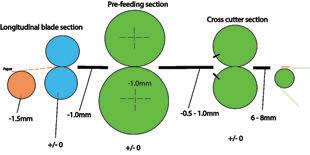
Guide plates that control the paper web should be positioned slightly below the web path, and the reference speeds before and after the pre-feed section must be optimally set. The catch station also plays an important role – it is recommended to use belts from the same manufacturer to ensure consistent results.
The so-called warm-up phase of cross-cutting knives is often underestimated. Follow the OEM recommendations or rely on your own experience. The first eight hours are the most critical period for ensuring a long lifetime and high-quality cutting results of the sheeter knife. Common TKM recommendations for the run-in time after a knife change are: a minimum of 30 minutes at 100 m/min with no material, 50% of the maximum speed for a maximum of 300 gsm for 24 hours, and full speed only after 24 hours.

After three weeks, re-adjust the knives and re-tighten the bolts. By following this simple process, a lifetime of several months is achievable.
As a general rule, the longer the warm-up time, the longer the knife‘s service life will be. Of course, no customer likes to run their machine without material; however, the more time the knives have to be properly adjusted to each other and to the material, the longer the lifetime will be in the end. Fewer knife failures, fewer knife changes, and better cutting quality are the results of this handling. It truly pays to give the knives the time they need.
The choice of blade material and surface finish is crucial. High-quality materials and mirror-polished surfaces improve both the cutting performance and blade lifetime. While carbide knives offer excellent cutting performance and the longest life times, they are more sensitive to vibrations and shaft deflection, especially on wide machines of 2.5 to 3.5 meters. Dust accumulation can also impair surface quality over time.
TKM recommends tungsten carbide (TC) products for board and powder steel grades (PM-steel) knives for fine paper. The better grindability and the mirror-polished surface roughness will ensure better cutting results with an almost dust-free cutting over the entire knife lifetime.
The setting of the cross-cutting knives is often the number one source of errors. Adjustments should only be carried out by trained personnel. Mistakes made during the setup cannot be simply corrected later on – further adjustments shorten the blade life and increase the risk of knife breakage, especially for tungsten carbide (TC) knives.
The longitudinal (slitter) knives must be optimally adjusted as well: angles, pressure, overlap, cutting position, and lead must all be precisely set to achieve the best cutting results.
Regular training and refresher courses for machine operators and maintenance staff are essential. Only well-trained personnel can fully realize the high precision of the cross-cutter. TKM supports the operation with practical on-site training courses to improve cutting skills and get the best out of every TKM knife.
Changes in paper formulation – such as variations in pulp content – must be communicated to operators in advance. Multi-layer cutting reaches physical limits; therefore, cutting pressure and the volume of material must always be considered. Increasing machine capacity must not compromise cut quality: blades cannot work miracles if the machine and material set the limits.
For board – whether folding cartons, binder spines, 100% recycled or virgin fiber, coated or uncoated – each
type requires individual adjustment of knife selection and cutting angle. Higher cutting volumes increase compression in the cut; in such cases, a sharper blade angle is recommended.
The optimal cut on a cross-cutter results from precise coordination, high-quality knives, correct machine settings, and skilled personnel. Consistent quality, long blade life, and efficient production can only be achieved by carefully managing all parameters – from material selection and warm-up time to precise fine-tuning.
Choosing your partner for cutting tools is not only a matter of price and function; an in-depth understanding of the knife application is as important as the knife itself. This is what TKM and Foresight Tech stands for being a partner for the entire cutting process, today and tomorrow, to ensure the best possible cutting.
JMC Paper Tech Pvt. Ltd. has strengthened its technical collaboration with Japanbased Kawanoe Zoki Co., Ltd. through a recent visit by its Chairman & Managing Director, Mr. Rajni Patel, and Chief Operating Officer, Mr. Sneh Patel.
Feb 10, 2026
JMC Paper Tech Pvt. Ltd., a leading Indian supplier of pulp and paper machinery and turnkey solutions, continues to strengthen its technological capabilities through global collaborations. Recently, the Chairman & Managing Director of JMC Paper Tech Pvt. Ltd., Mr. Rajni Patel, along with Mr. Sneh Patel, Chief Operating Officer, visited Kawanoe Zoki Co., Ltd., Japan, with the objective of gaining an in-depth technical understanding and hands-on training on Kawanoe Zoki’s advanced Best Former technology for paper machines.
The visit focused on comprehensive technical discussions, detailed design reviews, and practical training sessions covering Kawanoe Zoki’s proven best former concepts, engineering philosophy, manufacturing standards, and operational best practices. This intensive knowledge-exchange program enabled the JMC leadership team to closely study the performance-oriented design approach and reliability-focused engineering that Kawanoe Zoki is globally recognized for.
The hands-on exposure and structured technical training will significantly enhance JMC Paper Tech Pvt. Ltd.’s capability to engineer, supply, and support world-class best former solutions for the Indian paper industry. By assimilating this advanced knowhow, JMC aims to deliver paper machine solutions with higher efficiency, improved sheet formation, operational stability, and long-term reliability—fully aligned with international standards

Shungo Yokouchi – Sales, Kawanoe Zoki Co, Mr. Masaya Onishi – Sales Manager, Kawanoe Zoki Co, Mr. Masatoshi Sato – Managing Director, Kawanoe Zoki Co, Mr. Rajni Patel – Chairman & Managing Director, JMC Paper Tech, Mr. Takahiro Shinohara – President, Kawanoe Zoki Co, Mr. Sneh Patel – Chief Operating Officer, JMC Paper Tech, Mr. Hideo Ishikawa – Manufacturing Manager, Kawanoe Zoki Co, Mr. Koji Kato – Sub-Manager, Innovation Department, Kawanoe Zoki Co and Mr. Masamichi Sugi – Manager, Design Department, Kawanoe Zoki Co., Ltd
while addressing Indian operating conditions.
With the successful completion of this visit and technology training, JMC Paper Tech Pvt. Ltd. & Kawanoe Zoki Co., Ltd. are now well positioned to jointly serve the Indian paper market on a larger scale. The collaboration reinforces their shared commitment to providing modern, energy-efficient, and performance-driven paper machine solutions that support the evolving needs of Indian paper manufacturers.
Tappicon
26 - 29 Apr, 2026
Columbus, OH www.events.tappi.org/event/tappicon
Latam Paper
13-14 May, 2026
Buenos Aires, Argentina www.latampaper.com/
Paper & Tissue Show
03 - 05 Jun, 2026
Abu Dhabi, UAE www.paperoneshow.net
Paper Vietnam
10-12 Jun, 2026
Ho Chi Minh City, Vietnam www.paper-vietnam.com/
PAPER-ME Egypt
15-17 Sep, 2026
Cairo, Egypt www.papermideast.com/eg/
PAPER-ME Saudi Arabia
16-18 Nov 2026
Jeddah, Saudi Arabia
Editor & Publisher Parveen Kumar Jain – pkj@tulip3pmedia.in
Deputy Editor Geetika Jain – gjain@papermart.in
Consulting Editor Dhananjay Kumar – desk@tulip3pmedia.in
Assistant Editor Kannupriya Mehta – desk5@tulip3pmedia.in
Sub Editor Aakriti Virmani– desk4@tulip3pmedia.in
Sr. Graphic Designer Girish Garg – design@tulip3pmedia.in
Graphic Designer Tajinder Singh – design3@tulip3pmedia.in
Advertising & Marketing Akansha Tiwari – mktg3@tulip3pmedia.in Priya Thapar – mktg2@tulip3pmedia.in
Support Team Kushagra Mehrotra Sandeep Kumar Deepak Kumar admin@tulip3pmedia.in
Chief Executive Officer Priyank Jain pj@tulip3pmedia.in
Editorial & Publisher's Office : Paper Mart, Tulip 3P Media Pvt. Ltd. 218, Sanjay Nagar, Gulabi Bagh, New Delhi-110007, INDIA
Correspondence Address: Tulip 3P Media Pvt. Ltd. 501-502, ABW Tower, MG Road, IFFCO Chowk, Gurugram, Haryana-122003, INDIA, Tel.:0124 447 0798 / 99 Mob.: +91 99999 350 11 / 44, E-mail : info@papermart.in / info@tulip3pmedia.in
International Sales : RNP
Nicolas Pelletier 16, rue Bannier 45000 Orleans, France Tel.: +33 682 25 12 06, Fax: +33 238 422910
Owned, Published & Printed By : Parveen Kumar Jain, Published at 218, Sanjay Nagar, Gulabi Bagh, Delhi-110007, INDIA. Printed at: Pankaj Paper Mart, 218, Sanjay Nagar, Gulabi Bagh, Delhi-110007, INDIA.
All disputes regarding this magazine will be settled in Delhi (India) Jurisdiction Only.
The views expressed in the columns of Paper Mart are not necessarily those of the editor or the publisher & they accept no responsibility for them.
https://www.papermideast.com/ksa/ Vol.: 26 / No.: 06 Feb-Mar, 2026
CAUTION: No part of this magazine including advertisements designs, prepared by us or through us should be copied, reproduced or transmitted by any one without prior written permission of the publisher.
Paperex South India
03 - 05 Dec, 2026
Chennai, India
https://southindia.paperex.in/en-GB