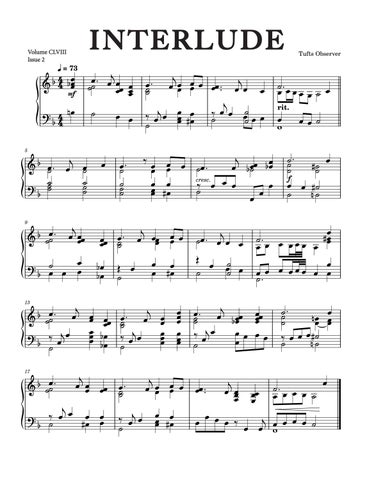
INTERLUDE INTERLUDE from Volume CLVIII Issue 2
Volume CLVIII Issue 2
5
9
= 73
13
17
cresc.
Tufts Observer
rit.
FEATURE
C O N T E N T S
2-4
mon Gray No Funding et al. .............................A
5 .
Triptych on a Train.................................Claire Stromseth 6-7
8-9
Need Some Space?.................Lily Rogers
A Portal of Pixels...............Rhea Shah
10-11 The Art of the Boo k Club............Anya
Bohjwani
12-13 I Ruined Family Dinner Becaus e I Love Music, and You Should To ................ Dylan Shore
14-15
Creative Inset...................Meg Duncan
16-17 Lead Me Not Into Temptation ................B.M. 18-19 The United Nations, Divided....................Grace Lyford
20-21 Pre-professionalists.................. .........Lily Gruber 22-23
Community in Carville, U.S.A.........Leah Glaspey
24-25
So You Think You Can Sing?................Vidhi Golchha
26-27 Navigating the Interlude ..............Emilia Ferreira and Gigi Appelbaum
28 all i can think about is the end of the world.......Abilene Adelman 29 Crossword....Elanor Kinderman
count” “Let’s pick it up from the bridge, on my 4
TUFTS OBSERVER
OCTOBER 5, 2023
PLEASE STAND BY...LOADING MASTHEAD Editor-in-Chief Ela Nalbantoglu Managing Editors Siena Cohen Henry Estes Editors Emeritus Caroline Lloyd-Jones Sofia Valdebenito
Arts & Culture Editors Emilia Ferreira Gigi Appelbaum Opinion Editors Leah Glaspey Wellesley Papagni
Creative Directors Meg Duncan Katie Ogden
Campus Editors Abilene Adelman Lucie Babcock
Art Directors Maria Sokolowski Ruby Marlow
Poetry & Prose Editors Demilade Ajibola Claire Stromseth
Feature Editors Amon Gray Nina Nehra News Editors Jules Zinn Rowthorn Lily Rogers
Voices Editors Devon Chang Elizabeth Chin Crossword Editors Elanor Kinderman Emma Dawson-Webb
Staff Writers Samira Amin Nora Bitar Kate Castleberry Taarini Gupta Ben Maughan Rhea Shah Sundari von Wentzel Rohaan Iyer Ione McKerley-Geier Dylan Shore Sam Stearns Anya Bhojwani Lily Gruber Vidhi Golchha Layla Zaatreh Ella Thompson Audrey Richardson Publicity Director Caroline Choi Publicity Team Simran Allana Sylvia Lidsky Lillian Castilla
Staff Artists Isabel Mahoney Khrystyna Saiko Amalia Hicks Greta Magary Yayla Tur Felix Yu Hana Kopp Leila Toubia Mila VonderHaar Nella Hakobyan Lyla Sowder-Yuson Bella Shmuylovich Daelen Menke Drew Gabron Keira Lavelle Lead Copy Editors Mer Boyle Taryn Morlock Copy Editors Elissa Fan Whitney Turner Simran Allana Radha Bhatia Sam Gould Penelope Logan
Designers Madoka Sho Meera Trujillo Radhika Yeddanapudi Sky Frisch Anastasia Pak Urja Parekh Mila VonderHaar Catherine Ting Ruby Offer Clare Colburn Dora Duan Ripley Foster Lead Website Manager Andie Cabochan Website Managers Madoka Sho Dylan Perkins Contributor Grace Lyford Treasurer Andrea Li
FEATURE
No Funding et al.?:
By Amon Gray
Maneuvering Grants Amidst Cuts to Federal Funding
“
We woke up one day and got a letter corporate backing, or nonprofit grants. In from the Department of State saying, an emailed statement to the Tufts Observer, ‘You’ve been terminated. Your proj- OURI explained that the office helps facect is ended. It’s not in the interest of the ulty identify funding opportunities, deUnited States,’” said J. Hellen Amuguni, velop competitive proposals, and establish professor in the Department of Infectious collaborations, while also overseeing comDisease and Global Health at the Cum- pliance with funding requirements. They mings School. Amuguni had been project reported that Tufts researchers submitted director of STOP Spillover, a $100 mil- 1,484 grant applications to external sponlion USAID-funded project dedicated to sors in FY26, with the university acceptunderstanding the risks posed by zoo- ing 445 new awards. “Our researchers are notic viruses with the potential to become working overtime to secure external suppandemic crises. Amuguni and her col- port for their research, in an increasingly leagues had worked with local partners competitive environment,” OURI wrote. in Bangladesh, Cambodia, Côte d’Ivoire, Klemen Strle is a Research Assistant Liberia, Uganda, Vietnam, and Sierra Le- Professor in the Department of Molecular one to understand their needs in respond- Biology and Microbiology and principal ing to and preventing outbreaks. By 2025, investigator of a human immunology lab the five-year project was almost complete, with a focus on Lyme disease. He has spent with USAID considering extending their years competing for grants and ultimately funding to continue research with some of got funding from the National Institutes its partners. In early February of that year, of Health, the nonprofit Global Lyme Althe project was issued a stop-work order liance, and other private funding. Howand was terminated a month later. ever, obtaining grants and guaranteeing The cuts made to federal funding af- continued financial support requires confected Amuguni, her team, and countless siderable time and effort. Strle estimated other researchers and brought a new ur- that he spends between 30 and 50 percent gency to the existing challenge of financ- of his time preparing proposals, collecting ing academic research. While the depen- preliminary data, and writing progress redence on external funding is familiar for ports to secure grants. Strle’s efforts have researchers, these disruptions in federal so far paid off; his lab secured longer-term grants created additional uncertainty in grants which guarantee greater stability, a system where projects already compete meaning researchers can plan projects and for financial support. Funding determines retain staff without constantly seeking new which ideas can be pursued and is es- awards. “Your grant nowadays, because the sential for sustaining existing projects, funding is so tight, has to really be scored making Tufts’ decisions about how to in the top 5 percent or you’re not getting support its researchers more than just the money,” Strle said. financial assistance. However, even well-funded research While the Tufts Office of Re- such as Strle’s felt the effects of federal fundsearch and Innovation offers direct seed ing cuts, with some grants getting delayed funding awards to winning projects, or reduced in duration. While researchers the vast majority of research grants are work tirelessly to maintain existing grants, sourced externally from federal funding, they also face mounting difficulty in se2 TUFTS OBSERVER OCTOBER 26, 2026
curing new funding. Andreas Mang is an associate professor of mathematics with a research focus in mathematical methods for analyzing data and improving machine learning. Mang recalled working with colleagues earlier this fall on a grant proposal for the National Science Foundation when the submission was abruptly closed two weeks before the deadline. “You have a plan, and that plan, shortly before you submit, goes out the window, causes a bit of unease, and makes it hard to plan,” Mang said. He also described the weighty opportunity cost of finishing grant proposals that he was unable to submit. “The main takeaway from my perspective is uncertainty,” he said. This uncertainty extends beyond the primary investigator. Douglas Blackiston, an assistant professor in the biology department with a research focus in developmental biology and bioengineering, said that he had seen an NSF grant take 14 months from submission to receive the funding. The extended wait complicated research planning, particularly in the area of hiring lab employees. Researchers like Blackiston are put in a difficult position where they need to make staffing commitments long before knowing when grant money would arrive. “That’s been the hardest part for us, is trying to understand how to forecast,” Blackiston said. In order to secure financial support, researchers must consider how to balance their research priorities and interests with those of organizations offering the grant. Strle commented on having “less freedom” on project direction in contract agreements with companies and needing to ensure such contracts are “within the interest of the lab and how you grow the lab.” On
FEATURE
grant writing in general, Strle said, “I write grants for the projects that I believe in, and so far we have been able to do this. That’s a big difference. However, sustaining this long-term is likely going to be a challenge.” Mang agreed with Strle’s sentiment but explained that the priorities of funders were also in consideration. “If I realize nobody cares, I may adapt my strategy and try to move myself a little bit more towards attractive areas, but my research is driven out of interest,” Mang said. He also cautioned against concentrating resources exclusively in fields considered immediately promising. “You never know what is go-
ing to drive science in 20 or 30 years from now,” he said. Compared to 2026, he noted that, in the 80s and 90s, when research began in areas such as artificial intelligence and quantum computing, their significance was not readily apparent, whereas today they are two of the most well funded fields. For junior faculty, the difficulty of securing external grants can carry consequences beyond individual research projects. Blackiston stated that newly hired research professors receive startup funding from Tufts to establish their labs, but are expected to recuperate these costs over time with outside grants. As competition for these grants increases, junior faculty have grown concerned about how this will affect their progress toward tenure. “The model has been challenged in the past five DESIGN BY SKY FRISCH
years because it’s been progressively harder identify funding opportunities. He said to get research dollars,” Blackiston said. that the office connected him with the While most funding for research W.M. Keck Foundation, leading him to at Tufts comes from external sources, the submit an application he otherwise would university also provides direct support not have pursued. through OURI’s internal funding proThe funding needs of research grams. These include Springboard, which varies across disciplines with a specific helps researchers advance projects toward divide between STEM and humanities further external funding; MUSE, which researchers. Adriana Zavala is a profesexclusively supports arts, humanities, and sor and chair of the History of Art and social science research; and Launchpad, Architecture Department. For humanities which helps researchers develop technol- scholars like Zavala, whose work relies on ogy for commercial use. OURI stated that primary sources such as text and archival proposals are evaluated based on their sig- materials rather than laboratory findings, nificance, feasibility, potential impact, col- grants generally provide time away from laborative potential, and plans for future teaching to conduct research and write. development. “These programs recognize “It is very challenging for humanists to that a single funding model will not fit get outside funding because the amount every field,” the office stated. “Scholarship of funding that we can get and the sources comes in many forms, not only through that are willing to fund humanistic reexternal grants.” search are, from my perspective, probably For Amuguni, a Springboard fewer than the kind of funding that’s availgrant gave her the opportunity to further able for people in the STEM fields or mayher One Health research. One Health be even in the social sciences,” Zavala said. is an approach that recognizes the in- Early in her career, a fellowship from the terconnectedness of human, animal, and National Endowment for the Humanities environmental health. Amuguni and her covered a year of her salary, allowing her research team developed a Community to take leave from teaching to complete her One Health Index, which will help com- first book, Becoming Modern, Becoming munities identify their own healthcare Tradition: Women, Gender, and Represenpriorities. Amuguni explained that the interdisciplinary nature of her project and its emphasis on innovation naturally aligned with OURI’s stated funding criteria. “I think about Tufts priorities, but I don’t really…” Amuguni said. “I come into this space with a passion for certain things, with things I want to see happen. When I apply for grants, it’s because I’m really passionate about that area.” Beyond providing direct funding, OURI also helps researchers compete for external grants by facilitating collaboration across departments and schools at Tufts. Tufts’ Research Interest Groups connect faculty working in related fields and help them achieve cross-disciplinary collaboration as well as identify funding opportunities. Amuguni leads the One Health RIG and said that she’s seen a marked improvement in learning about upcoming grants in time to prepare competitive applications. “The whole idea was: how do we help you put together a team that can position you to apply for grants?” she said. Blackiston similarly credited OURI with helping him OCTOBER 26, 2026 TUFTS OBSERVER 3
FEATURE
tation in Mexican Art, which was published not continue without sustained financial in 2010. support. Zavala described the difficulties Despite the differences between faced by researchers whose funding disdepartments, Zavala emphasized that re- appears halfway through their work. search across disciplines is held to the same “How do you just stop what you’re standards of scholarly excellence and inno- doing?” she said, “You can’t just then vation. Nonprofit and federal allocation of write up your findings if you haven’t grants for humanities are decided by a jury completed your research.” of fellow researchers. She explained that the distinction lies in the metrics by which these achievements are evaluated. “I think that as broad principles, [standards] are applied across the board. How you measure the outcome of that is very different,” she said. Humanities proposals, for example, may be evaluated for their contributions to cultural understanding or the discovery of previously overlooked archival materials. This contrasts with experimental feasibility or practical applications often emphasized in STEM-related grant proposals. Tufts’ MUSE program, which provides grants of up to $7,500 for faculty in the arts, humanities, and humanistic social sciences, offers institutional support specifically designed for fields with fewer opportunities for external funding. All departments across all Tufts schools have felt the changes in federal funding. The termination of STOP Spillover was only one of several federal funding disruptions involving Tufts researchers in 2025. According to the university, USAID terminated funding for 12 projects involving Tufts, eight of which were awarded directly to the university. The programs supported 43 faculty members, research staff, postdoctoral scholars, and undergraduate research assistants. Beyond USAID, the National Institute of Health and National Science Foundation terminated hundreds of research grants nationwide. The consequences of losing research funding depend heavily on the nature of the project and the resources necessary to sustain it. For Amuguni, the termination of STOP Spillover meant ending longAnother consideration, both for restanding partnerships with local commu- searchers inside and outside of STEM nities and laying off researchers. However, fields, is the undeniably political nature she remains optimistic, hoping that the lo- of the funding cuts. Zavala described the cal partner communities would continue termination of federal arts and humanithe work they had started together. “Did ties grants supporting projects focused on we build enough capacity for this project subjects such as racial justice and more to continue without us when it ends? You inclusive art histories. Although her own know, are we working ourselves out of jobs funding was not terminated, she expressed basically?” she said. Other projects can- concern about whether similar research 4 TUFTS OBSERVER OCTOBER 26, 2026
would still receive support. She speculated that “[t]he kind of project that I proposed back in 2004, which had to do with an analysis of images of women in Mexican art in the 20s and 30s, I suspect would probably not get funded now.” In response to the disruptions in federal grants in spring 2025, Tufts worked with researchers to assess terminated awards and challenged the proposed NIH indirect-cost cap. OURI stated that award terminations slowed in 2026 and some previously terminated grants had been reinstated following national advocacy efforts. “OURI and other offices across the institution continue to work with our researchers to identify ways to sustain research, including alternwative funding where possible,” the office said. Even researchers whose funding remains intact must consider how long that support will last. Strle explained that longer-term grants provide greater stability for hiring and retaining laboratory personnel, reducing the need to continually pursue replacement funding. “Having a two year grant versus five is a big difference in terms of being able to actually get work done and hire people,” he said. Funding interruptions can also have lasting consequences. Blackiston explained that hiring an entry level research tech costs roughly $100,000 annually including salary, benefits, and insurance. When funding is interrupted, labs are often forced to lay off employees. “Once I lose my staff, it’s not like I can spin back up by snapping my fingers,” Blackiston said. “Those people take other jobs, I now need someone fresh. All of that institutional knowledge is lost.” While Tufts cannot determine the priorities of external funding agencies, its decisions about internal grants and research support can influence which projects are able to move forward. For researchers across disciplines, the challenge remains securing the resources necessary to pursue their work without compromising the questions that motivated it.
POETRY & PROSE
Triptych on a By Claire Stromseth
Gone by Ten
you gripped the steering wheel so tight, I could feel it from the backseat my wet face made those close quarters smaller you told us it was always the plan to leave the pollution behind to trade our grey lungs for pink ones but all I heard was no more sipping chrysanthemum tea or soy milk at the everything plaza, no more rolling marbles down the corridor with ayi I shed tears like a layer of skin and I hated it because dad got a job and this was a good thing but I would not be the same person when I stepped outside the car, so I lived there in the corner of my seat, wrapped in the comfort of my seatbelt I’d always been fond of America, but I liked America as I knew it
Eagle Up Close
I liked America as I knew it— spaghetti and meatballs with a side of summer camp the place where girls kept diaries and got their ears pierced the place where my cousins lived and also Obama and most importantly where we imported our pirated DVDs— I’d been to Minnesota where everyone knew their neighbors and New York where I planted roots, but they put me in Virginia where I dedicated a week to memorizing the pledge of allegiance and learned the country that took in my grandparents only accepted them a certain way I was Chinese until I wore old navy and brought a turkey sandwich to school I loved being American until all I loved was the clothes on my body and the color turquoise my favorite color is green again and I miss the place where I was a baby
Beijing Baby
I want to be from the place where I was a baby I want to be from the playground that left me with scraped knees and the bathtub where my mom helped clean them I want to be from the lobby where the doormen carried me on their shoulders and the sprinklers I ran through without shame I want to be from the walls that I drew on and the spot behind the couch where I played hide and seek and I know that I am but the tag on my shirt and the way I extend my vowels tell me otherwise now that I’m like those all-american girls I begged to be I forget myself in the day I order my dim sum in broken Chinese and at night I hide under my covers and cry I want to be from the place where I was a baby but the place doesn’t remember me like I remember it DESIGN BY ANASTASIA PAK, ART BY GIGI GEYER
OCTOBER 26, 2026 TUFTS OBSERVER 5
NEWS
Need Some Space? A New Era of Cosmic Discovery By Lily Rogers
I
n the Karoo Desert, a dry stretch of scrubland in South Africa’s Northern Cape, 64 white radio dishes tilt toward the same patch of southern sky. Together, they form MeerKAT, a highly sensitive radio telescope. Beta Pictoris b, a planet 63 light years beyond the Solar System, made headlines last month when MeerKAT detected radio signals coming from it. The findings come from a Harvard-led study published in September. At such a distance, the signal would have been traveling for over six decades; when it left, the United States and the Soviet Union were still racing to put people on the moon, and no one on Earth knew of Beta Pictoris b’s existence. The detection is one of two recent space-related milestones. The other: NASA’s newest flagship telescope ran its first successful equipment test on September 22, 2026. But, as landmark achievements, what do they actually show, and what compels the public to pay attention? Beta Pictoris b is an exoplanet, a term denoting a planet that orbits a star beyond our own Solar System. It was first identified in 2008, and today, some of the clearest direct images of it—captured by the Gemini Planet Imager—are still just a few blurry white pixels. Still, much can be learned from these photos. “[An] image of [a] planet tells us that it exists, [roughly] how far away from the [host] star it is, and also how hot it is,” said David Martin, assistant professor of physics and astronomy at Tufts, in a statement to the Observer. For Beta Pictoris b, those pixels represent a planet that orbits approximately 10.07 astronomical units 6 TUFTS OBSERVER OCTOBER 26, 2026
away from its host star, with a temperature of about 1,724 Kelvin (2643.53°F). Beta Pictoris b shares its host star’s youth; both are, comparatively, newborn, at an estimated 21 million years old. With the 2026 MeerKAT study, the Harvard research team did something different: they stopped looking, and started “listening.” Since their work is still under peer review, Martin advised approaching these findings with “cautious optimism.” Whether news like this registers beyond the astronomy community is a different question. “We’ve [domesticated] space to some degree,” said David Ekbladh, a professor of history at Tufts. “Today it’s not ‘wow,’ it’s ‘there’s another rover on Mars: no big deal.’” Catching a planet’s radio signal requires immense technological finesse. Space is full of signals—all celestial bodies give off thermal radiation because their temperatures are above absolute zero. Because planets are cooler objects, their thermal radiation peaks in the infrared, leaving corresponding radio emissions exceptionally weak. But thanks to its extreme sensitivity, MeerKAT detected the Beta Pictoris b emission through interferometry—a process that uses supercomputers to perfectly align the peaks and valleys of incoming signals, so faint radio waves add up instead of getting lost. Given the strong polarization of the signals MeerKAT
picked up, researchers are attributing them to something else entirely: Beta Pictoris b’s magnetic field. Earth has a magnetic field too. It acts as a vital shield against harsh solar radiation. “If we didn’t have a magnetic field to deflect [charged solar particles], our atmosphere would have been long eroded away,” explained Martin. “Mars has a very thin atmosphere for this reason—its magnetic field was too weak to protect it!” Beta Pictoris b’s magnetic field is suspected to be 2,500 times stronger than Earth’s. A strong magnetic field is important because it can trap charged particles and guide them toward the poles, spiraling as they go and generating energy. Under the right conditions, that can boost radio waves into a bright, focused beam—a phenomenon called electron cyclotron maser instability. While this single detection could provide a new blueprint for studying the magnetic field and interior dynamo of an exoplanet like Beta Pictoris b, the problem with looking directly at these systems in the optical spectrum has always been the host star, which is often billions of times brighter than its orbiting planets. NASA’s newest flagship observatory, the Nancy Grace Roman Telescope, takes a different approach to bypass this limitation. Launched on August 30, 2026, the telescope is cruising through space to a stable gravitational “parking spot” 1.5 million kilometers from Earth. Dr. Ami Choi, a research astrophysicist at NASA’s Goddard Space Flight Center and Roman’s Deputy Wide
NEWS Field Instrument Scientist, was there for the liftoff. “It was really amazing,” Choi said, noting her pleasant surprise at how quickly it was over: years of work launched in seconds. “It was [an] incredible team effort by many different teams. Not just NASA, but our partners across the U.S. [and] international[ly].” Named after NASA’s first chief astronomer Nancy Grace Roman, the telescope is built for unprecedented scope and speed. According to Choi, this is achieved through its Wide Field Instrument, which provides a panoramic view of the universe. Its ability to quickly pivot and repoint helps, too. Roman’s survey capacity is predicted to expand the catalog of known exoplanets. “We know [of about] 6,000 exoplanets today,” Choi said. “Roman [could] uncover thousands to 100,000 new, previously undiscovered exoplanets.” Roman’s second major tool, the Coronagraph Instrument, is designed to help astronomers find planets that are up to “100 million times fainter” than their host star. To illustrate the difficulty of spotting a dim object next to a brilliant star, Choi offered a familiar comparison, “We would never try to look for Mercury when the sun is out.” On September 22, mission engineers ran the instrument’s first in-space operational test. The Coronagraph successfully demonstrated its ability to produce a focused image, which is the initial step in allowing scientists to try more complicated tasks. NASA expects Roman’s first images to go public in early 2027. N e w milestones have not been received with the fanfare of the 20th c e n t u r y ’s space missions. So, what actually makes the public pay attention? History suggests that America’s relationship with space exploration has always been complicated. For much of the 20th century, space was a contest. After World War II, the US and the USSR were rival superpowers locked in competition— on Earth and in outer space. The Space Race, as it came to be known, started in 1957, when the USSR launched Sputnik
I, the first artificial satellite to orbit Earth. Thereafter, Ekbladh explained, the US and USSR fought “an ideological battle, [asking:] ‘Who’s got the best system for the world?’” He notes that for the US, beating the USSR to the moon was ultimately about proving that liberal democracy could marshal the capability to reach the next frontier. In 1961, President John F. Kennedy pledged to put a person on the moon before the decade’s end. In July 1969, Apollo 11 did just that. An estimated 650 million people worldwide watched Neil Armstrong make moonfall. Even after the Challenger space shuttle exploded 73 seconds after liftoff in 1986 on a live broadcast, a poll by the Roper Organization found that 75 percent of respondents thought Challenger was “a price [America] must be willing to pay for the exploration and mastery of space.” Recently, political friction has reentered the frame. The New York Times reported on efforts by the US and a RussianChinese team to deploy competing nuclear fission reactors on the moon by the 2030s. While governments compete, popular media also plays a major role in getting people to look up at the sky. Sci-fi stories are especially potent crowd-drawers; in March 2026, the film Project Hail Mary grossed nearly $700 million worldwide. Choi said when she was younger, movies and books gave space phenomena an air of “cool mystery,” but what draws people in, she said, is often curiosity: “People like to explore new [places] we haven’t been,” and to chase “puzzles that haven’t completely been solved yet.” Accessibility may matter, too. Once Roman begins its main operations, Choi said, its data will “almost immediately” go public, so anyone from professional researchers to an amateur astronomer can pull it from the archive. A version of that idea is taking shape on campus. A team from Tufts Students for the Exploration and Development of Space is working on building a three-meter radio telescope dish. Julian Sutaria, a senior studying engineering physics who leads the telescope project for SEDS, said the team plans to install the telescope on the roof of 574 Boston Avenue, and to bring it into introductory astronomy classes and local high schools. “Public data matters,”
DESIGN BY CLARE COLBURN, ART BY KHRYSTYNA SAIKO
he said. “The more people that work on something … the faster you can get things done, the more discoveries you can make.” Working across teams is what Choi hopes people will notice about a project like Roman. “If we can accomplish this sort of project with many different groups [that combine] different backgrounds and interests, that’s really promising in general for other problems.”
As for why people care about space in the first place, well, the reason may be much simpler than rivalry. “Ultimately, I think that science and astronomy are a natural extension of humans as curious beings,” Martin said. “I hope that never stops!”
OCTOBER 26, 2026 TUFTS OBSERVER 7
VOICES
By Rhea Shah I feel constellations and galaxies drawn onto my skin. It’s electric and purple and breathless, like I’m floating in space. This is the all-consuming Art of Video Editing. Music lifts me into the clouds, my eyes tracing the outlines of plumed birds and the bleeding hues of a sunset. With the tap of a finger, I can manipulate matter, bending and transforming it into anything. Images morph into fantastical transitions, blurring into videos. The world explodes with colour, possibility, and dynamism. My fingers desperately scrolled through overlays, effects, and music, possessed by a fervor unique to the teenagers of 2020, when the internet erupted with the vibrancy of idle minds and restless dreams. Everything came to a screeching halt except my creativity. Confined within the walls of my home, I discovered that I could manufacture entire universes within the four corners of a screen. Editing felt like learning the steps to a dance. Except this dance allowed me to fly, twist, and turn through the air, conjure
A Portal of Pixels
color from nothing, and fabricate worlds so ridiculous it was unbelievable that the awkward, uncoordinated girl behind the screen could move with such grace. Every beat was a possibility for illustration, to dance alongside it. There is no editing without feeling the beats in your bones, flowing in synchrony with them, allowing yourself to be swept away by the reverberating rhythm. Before editing, I listened to music. But now, I could see it. Submerging myself into the four corners of my phone, I’d mold my boundless vision, pixel by pixel. I began dissecting songs into their smallest components, anticipating the precise millisecond when the bass would drop, when a melody would swell, when two images could collide so perfectly that they momentarily became one. A sudden crescendo could trigger the deconstruction of a charac-
8 TUFTS OBSERVER OCTOBER 26, 2026
ter’s self-perception, a delicate piano note could bridge the gap between soulmates. I became a translator of music into sketches, sculptures, and stories, moving beyond sound into color, taste, touch. My excitement spilled beyond the confines of my phone onto my balcony as I swayed on my porch swing, imagining myself floating with every beat. I remember listening to Lana Del Rey’s “National Anthem,” watching edits of Shadow and Bone, and feeling my neurons whir. “#BrooklynBloodPop!” by SyKo inspired me to embrace my burgeoning alternative identity, smearing raccoon-like eyeliner around my eyes while its frenetic rhythm rattled through my bedroom. Gazing dreamily at edits to “Dark Red” by Steve Lacy was ritualistic when I’d read fanfiction, butterflies slowly making their home in my ribcage.
VOICES
My phone would broaden into my own galaxy of shapes and colours and sounds. I stayed up until three in the morning, intoxicated by an adrenaline rush when an edit finally looked just as I had imagined it. Every overlay, movement, and transition had fallen into place. Sometimes, I’d marvel at the satisfaction of watching something that had existed exclusively inside my mind materialise before my eyes. Perhaps that was what I loved most: the power to make the intangible tangible. To take a feeling that had no shape, no color, no physical existence, and give it a body, a home. My creativity spilled from my chest no matter where I was. I’d traipse along clumsily through airport lines, hands firmly planted on my phone; I’d zone out staring at winding roads, mind flashing with stories and emotion I could mold. My family would grumble, say that my head was high up in the clouds again, and I’d grin to myself, knowing my imagination had flown me there. How could I walk again when I knew flying was an option? I search for that possibility everywhere, desperate to find other editors whose brains melt into galaxies the way mine does. Whenever I watch a new film or television series, I instinctively find myself searching for edits. Yearning to see someone else transform the same overwhelming affection for a character into something palpable—taking fleet-
ing emotions, fragments of imagination, and stories that exist only on a screen, and fashioning them into art. We might never speak, never know each other’s names, yet for 30 seconds, our brains occupy the same electric universe. I collect universes into tiny folders on my phone, each a constellation of edits meticulously organised by artistic style, characters and visual themes. With every transition, I find myself slipping into another editor’s brain, watching feelings materialise into color, movement and form. The boundaries between what exists and what can be imagined dissolve once more. For a few glorious minutes, the ordinary becomes extraordinary, and I am once again that girl on her balcony, convinced that reality is infinitely malleable. These edits preserve more than the imaginations of their creators. Each one holds a fragment of myself: a particular arrangement of thoughts, feelings, and desires that I wish I could collect in a glass jar and preserve forever. I am attempting to give permanence to something inherently fleeting: the versions of myself that dreamed, consumed and created. But I am dynamic, perpetually evolving, and so are the worlds that captivate me. Edits that once consumed my entire being now sit neglected in folders I haven’t opened in years. And yet, those folders contain Rheas who have been frozen in time. There is the
DESIGN BY RADHIKA YEDDANAPUDI, ART BY MILA VONDERHAAR
13-year-old who discovered that creativity could make isolation feel boundless. The 14-year-old who wanted to dress like the characters she edited, borrowing fragments of their identities while constructing her own. The 15-year-old who found entire universes in fictional romances, and the 16-year-old who began to understand that art could express feelings she didn’t yet possess the language to articulate. They all merge into the version of myself I am right now—stumbling and windswept and more alive than I’ve ever bee n. Each edit represents an invisible thread that ties together these disparate versions of myself, winding around my memories and tethering me to the person I’ve always been. When I need a reminder of who I am, I return to those forgotten folders and open a portal through time. A familiar transition transports me to an old bedroom, an old balcony, an old obsession. Suddenly, I remember what it felt like to be that girl. Perhaps I have forgotten some of the steps to that otherworldly dance. The transitions I once perfected feel unfamiliar, and the characters who inspired them have long since surrendered their place in my imagination. But when I revisit an old edit, I can still feel the rhythm that once moved me. And before I know it, I’m dancing again.
OCTOBER 26, 2026 TUFTS OBSERVER 9
ARTS & CULTURE
The Art of the Book Club
By Anya Bhojwani
I
n 1995, a California book club started reading Finnegans Wake by James Joyce and didn’t finish it until 2023. They read together for 28 years, discussing one page per meeting, and credited their commitment to the book to the strong sense of community created by reading together. While most book clubs do
10
TUFTS OBSERVER
not look like this, they still foster community through reading and reflection. Over the past few years book clubs have made a comeback, becoming a phenomenon in popular culture and booming on social media. Book clubs work by selecting a specific book for a group to read at the same time and breaking it down into smaller chunks of chapters, so that everyone can discuss it with each other throughout the reading process. From having group discussions debating the main message of the book to considering points of view that might not have been considered before, members of book clubs get the
OCTOBER 26, 2026
opportunity to learn from others through engagement. Book clubs are not a new phenomenon; in 1634, minister Anne Hutchinson started a study group that brought together women who were barred from traditional education to gather and discuss the primary book available to them: the Bible. They were able to freely discuss and debate sermons and religious texts, with the book club serving as a community space for members to engage intellectually and socially with each other. Throughout the next few centuries, book clubs steadily grew into the version that we see today. But, they were redefined in 1996 when Oprah Winfrey founded a book club to promote diverse voices and perspectives. Oprah explained that “books have helped me know that I’m not alone, even when I’m at my loneliest.” Whenever Oprah’s Book Club would cover a book, it would quickly become a best seller, with new authors becoming well known and established, and seeing renewed interest in their books. The influence of Oprah’s Book Club was a cultural phenomenon that gave shape to the current literary scene in popular culture. In light of its success, celebrities with social influence and an interest in literature started their own book clubs, such as Dua Lipa’s “Service95 Book Club.” Through these programs, celebrities recommend a book, fans read it on their own, and they discuss it on social media. This
ARTS & CULTURE
created a new era of literary communities characterized by online discussion rather than the in-person communication of traditional book clubs, making the pastime more accessible for anyone. Book clubs originated with women like Hutchinson and continue to be a space predominantly for women, with 88 percent of private book clubs being all-women groups. Moreover, 56 percent of women who read at least one book a month are in a book club. Book clubs are often stereotyped as places filled with elderly women or “wine moms” and tend to be dismissed as illegitimate spaces, focusing on “superficial” books, like romance books or “beach reads.” However, while women live in a society dominated by men and their voices, book clubs allow them to express themselves. Reese Witherspoon promotes this idea by always choosing a book with a woman at the center of the story for her book club, “Reese’s Book Club.” Thus, book clubs have been a large player in the wider movement for women to take up space in intellectual culture. Tufts University has its very own book club, which was started by two students in 2022. They read a variety of books throughout the year and facilitate events like field trips to the annual Boston Book Festival and bookstore crawls in the Cambridge and Somerville areas to cultivate community by sharing a love of books with one another. Amber Gumira, co-president of the Tufts Book Club, stated that the main purpose of the club is to “provide a space where people can come and hang out.” She added, “I think it is a really good place for people to make friends—it’s really easy to get close to people.” The Tufts Book Club provides a space for collaborative discussions and
bonding opportunities, allowing people to find community amongst peers with a similar interest in reading. By providing a space for mindfulness, book clubs provide mental health benefits to their members: they allow people to have an outlet for self-expression and to slow down. Research shows that reading in general helps to reduce anxiety and stress, and it allows people to be present in the moment. Similarly, Gumira explained that the Tufts Book Club’s community is “a safe space to unwind and chill but still be with people.” Another benefit of book clubs is that they encourage people to read books they normally would not reach for. For the Tufts Book Club, Gumira explained that they “try to read books by marginalized authors … [like] women and women authors of color.” Some of their recent reads are Immaculate Conception by Ling Ling Huang and Wild Dark Shore by Charlotte McConaghy. Gumira added that, when discussing these books, “[book clubs] give people a safe space to really just talk about their ideas. People will come in and will connect these books… to things that I personally would not have thought of.” In this way, book clubs allow people to connect with new perspectives and each other. While book clubs have cultivated community for centuries, technology impacts these spaces both by isolating and bringing people together. On the one hand, it has contributed to a rise in the popularity of book clubs. For example, celebrity influencers with book clubs, like Dua Lipa, encourage people to read more by creating a fanbase around viral books. That said, the digital world has also created a landscape of widespread screen-addiction and consumerism that results in a deprivation of intel-
DESIGN BY CATHERINE TING, ART BY BELLA SHMUYLOVICH
lectual engagement. Studies show that there has been a large decline in reading for pleasure over the past 20 years in the United States, with a decrease of 3 percent each year. Dr. Ravi Shankar, a professor of English at Tufts, explained that because of the constant consumption of short-form social media, “we lose some of the ability to have a deeper and more profound connection to one another and to the world, and that is what reading provides to [everyone].” By helping people slow down and engage with longer-form media, book clubs fill the void caused by decline in intellectual stimulation. Book clubs represent a collective effort rather than an individual one to read, reflect, and connect with others. Books themselves create a connection between the reader and author, as entering into the world of a book creates the ability to engage in dialogue with it, situating readers in communities of their own by uniting people in an exchange of thoughts. Readers are able to find connection and unity through the shared experience of engaging with the nuanced messages that books present. Even the process of writing a book itself is a call for connection. Literature strives to bring people together by commenting on the society that we all live in, a mission that the book club takes in stride.
OCTOBER 26, 2026 TUFTS OBSERVER 11
OPINION
I Ruined Family Dinner Because I Love Music, and You Should Too By Dylan Shore
M
y family is not one that fights often. But over winter break last year, when my brother brought up artificial intelligence in music, I made an exception. I am now aware that unintentionally subjecting an entire restaurant to my opinions was avoidable, but, in my defense, the only reason I ruined my family’s first meal together in three months was that I happen to love human creativity a little bit more than I love maintaining the peace. While I feel that my frantic rantings about keeping AI out of music came from a place of love rather than hate, I now realize that I completely failed to prove that to my brother. So, rather than yelling at anyone who will (or will not) listen, I would prefer to explain to you why I am so quick to yell. AI steals music from real artists, takes money from real artists, and most importantly, robs us all—artists or not—of our humanity. In order to fully comprehend the immoralities behind AI music services such as Suno, we first have to understand how exactly they work. Suno works similarly to AI chatbots: a user prompts the generative AI with a description of a song, and the AI pumps one out, complete with instrumentation, lyrics, and vocals. These generation services train on a massive dataset of music—the majority of which is not music generated by AI, but instead is written,
produced, and played by real people. Every time AI generates an “original” song, it is really just a mixture of music made by humans, and despite Suno claiming that they strive to “protect artists,” none of those humans are getting paid for it. In November 2025, Suno settled a $500 million lawsuit from Warner Music Group , starting a partnership between the companies in the process. Importantly, this deal was not between Suno and the artists, but rather Suno and the record label, WMG. The deal details how artists can decide to opt in for their voice, name, and likeness to be used by the AI; however, this aspect of the deal fails to completely protect the artists’ music. Suno’s chief product officer Jack Brody said that “Warner “Warner … figured out which music to hand over as part of … training,” meaning WMG chooses the music that trains the AI. Any other details about the artist’s agency in this matter have been kept confidential from the public. We do know, however, that the artists did not see any of the massive payout check WMG received, regardless of whether their music was used for training. Deals like these fail to fairly compensate the artists who create the content necessary for either company to make such a deal. But AI is not just taking money from these artists—it is after the integrity of all human-made art.
12 TUFTS OBSERVER OCTOBER 26, 2026
In April 2026, Paris-based music streaming platform Deezer revealed that roughly 44 percent of music
uploaded to their service daily was AIgenerated. But this goes beyond Deezer. When asked about these numbers, Spotify’s global head of marketing and policy confirmed that every streaming service has a “pretty much idWentical catalog.” In other words, nearly half of the music uploaded to
OPINION
one of the largest streaming services nowadays is created not by humans, but AI. The large quantity of AI music uploaded to Spotify does not directly imply that a lot of people are listening to it. AI-generated music reportedly makes up less than 3 percent of total actual streams. Compared to music made by humans, people are hardly listening. But the platform of Spotify as a whole averages roughly 13.7 billion streams per day. At the minimum where AI accounts for only 1 percent of streams, AI music receives roughly 137 million streams daily. That is 137 million streams spent listening to AIgenerated music rather than music made by real human beings. Using the 2026 industry standard,
DESIGN BY RUBY OFFER, ART BY DAELEN MENKE
Spotify pays out $0.003–$0.005 per stream, making those 137 million streams worth $411,000 to $685,000. Notably, this money is still sent to real humans, but that’s nearly half a million dollars daily going towards humans who merely prompted an AI music bot and uploaded the result to Spotify, rather than humans who meticulously crafted every word and note of their music. Keep in mind that these hundreds of thousands of dollars and hundreds of millions of streams that artists have lost to AI music are not from across the industry— they’re from Spotify alone. But, what about the music itself? Is there anything about AI music that is actually worse than music made by humans? If it sounds good, and people like it, who cares how it came to be? The truth is, the “how it came to be” is the most important part. One of my favorite songs of all time is a David Bowie song titled “Life on Mars?” Skip to minute 3:35 of the song, and you will hear the faint sound of a phone ringing in the background of Trident Studios in London. The story goes like this: Bowie recorded the full song, and just as they were finishing, the phone in the bathroom began to ring. Naturally, they recorded over that first take, nailed it, and called it a day. It was not until much later that they realized the second time, the band played at a faster pace, causing the second take to end earlier than the first and they hadn’t recorded over the phone ringing at the end. But, producer Ken Scott thought the phone “sounded great” and left it in the song. They never learned who was calling the bathroom phone of Trident Studios, but that small human mistake—that same
human mistake that AI strives to eliminate—is responsible for the final take that made it into one of Bowie’s most famous songs. It may seem perplexing how an unplanned phone call could make a song better. But whenever I revisit “Life on Mars?” and I hear that phone ringing, I am reminded of this story, and I am reminded of the improbable effect that a little humanity had on art. What I love about music is not just the sounds in my ears or the finished product—it’s the stories. A woman is embarrassed by her English proficiency and songwriting abilities, and we get the Cocteau Twins inventing a brand new sound. A man’s former bandmate and best friend publicly states that he only makes “silly love songs,” and Paul McCartney writes one of the most beloved songs in his songwriting career. A song is not beautiful solely due to the chords played on the piano, or the words spoken by the singer;it is beautiful because of the human stories behind it. Every piece of music contains someone’s lived experiences which are condensed into a piece of art for us to experience. From the stories that are told to a poorlytimed phone call that makes its way onto the final cut of a song, every part of the process is incredible, if only because it is so deeply human. Music is a way for us to take all that we have lived and learned and turn it into something to be shared with others. Music is our love, our hate, our joy, our grief, shared with others, experienced with others, lived by others. I love music because it is the most human thing that we can do, and personally, that is not something that I am willing to lose any time soon.
OCTOBER 26, 2026 TUFTS OBSERVER 13
FEATURE
14
TUFTS OBSERVER
OCTOBER 26, 2026
FEATURE
DESIGN BY MEG DUNCAN
OCTOBER 26, 2026
TUFTS OBSERVER
15
VOICES
16 TUFTS OBSERVER OCTOBER 26, 2026
VOICES
By B.M. “What I am doing is bad.” The thought rattles about my skull as I crane my neck to the stars, watching thick, grey smoke rise with Adirondack mist and dance against the constellations. It’s the last summer before high school; everything is about to change, but right now I’m stuck at Camp Treetops, out of my cabin past lights out, and my friends are trying to get high. “It’s easy, watch me,” Asher whispers, snapping my attention back to the task at hand while Lily offers him our makeshift pipe, a hollowed-out apple from the canteen rotting in the moonlight. The top hole of our “pipe” struggles to contain the stolen dregs of Asher’s father’s medical marijuana as he raises the mealy Red Delicious to his lips. Soggy pajama-pant cuffs biting at my ankles, my stomach turns while Asher struggles to spark the lighter (even a selfstyled professional has his work cut out for him on a night this humid, it seems). Every futile attempt illuminates our haggard, adolescent faces for a moment. Finally, a spark catches, painting the embers a deep, crackling orange. A second passes, then another, until Asher’s countenance softens into one of amusement. With a devilish chuckle, he unleashes the contents of his lungs directly into my face. He coats my hair, my pajamas, everything, in putrid haze. “Don’t be a puss; take a hit,” he wheezes, and extends the smoldering apple. “Be good. Behave. Honor God.” The words practically seared into the folds of my brain burn now, far hotter than the embers of our makeshift pipe. Feet bolted in place, bony legs quivering, with an apple bong cupped in both palms, I am still a good, Christian boy. I still DESIGN BY URJA PAREKH, ART BY GRETA MAGARY
understand that I am under observation in perpetuity, my soul hanging in the balance. I still understand that boys who touch boys, and girls who touch girls, and the Buddhists, and the Jews, and the atheists, and of course, the drinkers, and the smokers, those degenerates, are bad bad bad. I still understand that the tumor in my father’s head would have gone away if I had just had more faith. I still understand that I am called to work hard and obey, compelled to not repeat Adam’s failure, to spurn the devil’s hedonistic persuasion. I still spend my mornings, afternoons, and evenings despairing over my tardiness and scoldings, conforming with a fervor. I still spend my nights prostrated at the foot of my bed, clasping my supple hands in prayer, begging forgiveness for my under-the-breath “fuck”s, and for the girls and boys I crush on in my daydreams. I understand that if I forgo the object of sin burning a hole in my hands, if I throw it into the woods and make a run for it now, I could still stand a chance at salvation. Every thread of my soul runs taut, my ears ring and my heart pounds, yet I stay put. Perhaps it’s the looming spectre of high school compelling me to stick around and fulfill some 14-year-old’s conception of cool, or perhaps it’s a deep vulnerability to peer pressure. Perhaps, standing there, deep in the Adirondacks, beneath the thick embrace of weathered evergreens, head wreathed in smoke, I feel that I have finally found a place away from god. Perhaps, as I methodically bring my lips to the apple’s waxy coat, and strike my thumb upon the sparkwheel’s unforgiving ridges, as I try and try and at last succeed in reigniting the embers’ gentle whisper, as I inhale and, for the first time, welcome smoke into my unblemished lungs, as I
feel the hallucinogen gently taking hold of my young mind, I know very well that my god can see me. Perhaps, as I relinquish my exhale upon the sweet mountain air, smoke is not the only thing I release. Lying there, splayed atop the dewy refuse of the forest floor, falling into a wonderful malaise and gazing wide-eyed at the heavens, at the father’s dominion, I do not beg for forgiveness, I do not apologize for tainting my soul. I raise the fruit to my lips once more, and with measured breath rend myself from the lord’s embrace. “This can’t be good for me.” It’s been years since I departed Eden, but the seas of time have spared that truth. These days, I relish my delinquency. I revel in it as I hide behind dumpsters after closing shifts, smelling like bleach, shivering in my apron, pruned fingers holding fast to rolling papers. I gorge myself on it when I escape, ears ringing, from Saturday night basement parties in search of fresh air; stumbling onto porches, shirt plastered to my sweaty flesh as I fumble with my lighter until a spark can catch. The badness stings my throat and burns my lungs and warms my dripping hull. For those interludes during which I accept my cannabinoid eucharist, I do wrong. I forsake my body and mind, I offer up my fragile neurons to an unearned dopamine deluge and char my insides for a moment’s fleeting pleasure. I drench my gentle fabrics in soot and blotch my porcelain teeth; I shed every lesson I have been taught and every notion of obedience. I know what I am doing is bad, and again, I inhale.
OCTOBER 26, 2026 TUFTS OBSERVER 17
NEWS
A Co Cam mplic paig ated n for Peac
O
e The U Natio nited ns, D ivide d
n September 18, 2026, the United Nations kicked off its 81st General Assembly. The slogan? “Restoring trust, managing transformation: A United Nations that delivers for all.” Yet, this year’s General Debate revealed a gap between this advertised ideal and the UN’s fraying reality. The session was defined by divisive global controversies: the Russia-Ukraine war, President Donald Trump’s unyielding stance on the war with Iran, and the mass exodus of delegates in protest of the speech by Israeli Prime Minister Benjamin Netanyahu. But even as the General Assembly hall emptied, a question remained: does the UN live up to its intended principles? At the forefront of the UN are the Permanent Five (P5) nations: China, France, Russia, the United Kingdom, and the United States. This status was granted when the UN was established. These countries are the only members who have veto power over any substantive decision, and they maintain their status as five of 15 member states that make up the UN Security Council. The SC is the UN’s primary organ for facilitating international peace
By G race Lyfor d
and security, working to uphold its objectives of global peacekeeping, promoting respect for human rights, and engaging in dialogue to prevent wars. However, the UN’s effectiveness has been rigorously questioned. This is largely attributed to the P5’s conflicting ideologies and veto power, which can block the passage of resolutions. As global issues tend to require cooperative responses among states, the UN might seem the obvious place to develop them. Yet the conflicts within the chamber suggest that enacting sustainable peacekeeping is fraught with challenges. Domestic interests and alliances shape states’ positions on foreign matters, creating a patchwork of politics that complicates the UN’s ability to act decisively in pursuit of peace. This lack of cohesion among the P5s has frayed public trust in the UN. In a New York Times interview, Richard Gowan of the International Crisis Group compared the UN’s current activity with its most paralyzed periods during the Cold War. “[The UN is] still actually far more active than it was in its darkest hours…
18 TUFTS OBSERVER OCTOBER 26, 2026
:
But every single year it’s a little bit less relevant; it’s a little bit more under restraint.” This near-complete shutdown of the UN during the Cold War, due to intense US and Soviet Union rivalry, foreshadowed the current state the UN faces; rather than serving as a forum for global resolution, the institution has become a monument to diplomatic inertia, consistently failing to negotiate, let alone resolve, the myriad existential threats previously mentioned. International Relations scholars differentiate between hard power, which relies on coercion and force for quicker effects, and soft power, which persuades and attracts through legitimacy, neutrality, and moral authority. The US’ economic and military status in the global system exemplifies how a superpower projects hard power. More broadly, the economic and military status of any superpower state acts as a hard power that helps legitimize the UN. In the case of the US, when its engagement with the UN fluctuates, the repercussions are felt throughout the institution. President Trump has been utilizing hard power, with his withdrawal from
NEWS
organizations like the World Health Organization, his plan to cut $4.9 billion in foreign aid programs, and his aggressive stance towards Iran. This demonstrates a shift in the US approach to global politics. Some scholars argue that the use of hard power can dissuade cooperation between the US and other countries. So, in light of internal division and external pressures from its superpower members, how effect i v e has the UN been in its campaign for “peace”? One of the UN’s first major achievements was establishing the Universal Declaration of Human Rights in 1948, which sought to create a standard for fundamental rights and their protection. According to Amnesty International, the UDHR thus serves as “a global road map for freedom and equality.” Although the UDHR is not legally binding, it is considered the cornerstone of modern human rights and has inspired over 80 legally binding treaties, national constitutions, and regional covenants. One example is the United Nations Children’s Fund, commonly referred to as UNICEF, which has made strides in protecting children’s rights since its founding in 1946. UNICEF has a broad reach, operating in over 190 countries and territories. Results published by UNICEF in 2026 showcase just a few of its many accomplishments: one in every four births globally occur in a UNICEF-supported health center; 178 million more children have gained ac-
DESIGN BYDORA DUAN, ART BY LEILA TOUBIA
cess to education through UNICEF since 2022; 2.1 billion people have gained access to clean water due to UNICEF’s support. According to The Guardian, UNICEF is considered “among the UN’s most highprofile and well-known organizations,” with total brand awareness peaking at 91 percent in 2018. One of the organization’s earliest initiatives is the annual Trick-or-Treat for UNICEF fundraiser, which has raised over $200 million since it began in 1950. The trick-or-treat program is also the longestrunning youth-led engagement campaign in the US, with three separate generations of youth having participated in it so far. “[The UN Youth Office] is very intent and [explicit] about creating platforms for intergenerational dialogue,” said Finlay Batts, a Strategy, Innovation and Design Program Manager at the UN Youth Office. Batts highlighted the upcoming UN Newstown Hall as an example of this, stating that “intergenerational dialogues will [be] a [central] part of the agenda.” Tufts brings the conversation surrounding international affairs to Medford, Massachusetts. The Fletcher School of Law and Diplomacy at Tufts is the oldest graduate school in the US and is dedicated exclusively to International Relations. In 2024, Fletcher ranked in the top ten of master’s programs worldwide. As a result, dialogue about international affairs is relatively common on Tufts’ campus. David McNamara, a sophomore and former Peace Boat US intern majoring in international relations at Tufts, had some comments on the institution. “The UN is dealing [with] a very typical problem, which is the sliding scale between consensus and effectiveness,” McNamara said. He then described how the UN operates at a level that requires high agreement, which ultimately makes it less effective. McNamara’s assessment points to the structural constraints built into multilat-
eral organizations. Because the UN requires broad agreement among member states with competing national interests, finding a baseline consensus often takes priority over aggressive enforcement. In practice, this structural setup means resolutions are frequently watered down or delayed to prevent vetoes from rival superpowers. Among analysts, the tension between maintaining diplomatic agreement and executing rapid humanitarian intervention remains a central critique of the institution. This dynamic demonstrates why critics view the UN as a forum designed more for maintaining diplomatic channels than for taking swift action. Tufts has been impacted by the Trump administration pulling back from organizations like the UN. This past February, the Department of Defense ended the Senior Service College (SSC) fellowship program at Tufts, which provided federal funding for active-duty military personnel. “I think that [goes] to show that, right now, the United States is hampering educational institutions’ ability to educate its leaders on how to move in [the] international [sphere],” said McNamara. “[The] more [people we have in power in America] that don’t understand multilateralism, [the] more likely we are to completely retreat from those dynamics and cause [a] breakdown in the current order.” Today, the UN faces challenges that expose its weakest points. Even the UN’s own UN News writes that cooperative responses are more imperative than ever. The UN reform needs rapid implementation, or trust will fray further, and the patchwork the institution is built on will unravel. To further build its preventative peacekeeping work, rather than focusing on containment and post-conflict reconstruction, the UN will need to act beyond its slogan.
OCTOBER 26, 2026 TUFTS OBSERVER 19
CAMPUS
Pre-professionalists
By Lily Gruber
T
he prospect of post-grad life looms large. Since 2022, the number of salaried jobs available to applicants with no prior work experience has fallen by roughly 73 percent. Finding entry-level positions can be especially challenging for new post-grads; a World Economic Forum study found that globally, entry-level job postings fell by 29 percent between 2024 and 2025. When faced with statistics like these, some students flock to pre-professional clubs as a way to walk the line between career preparation and academics while still bolstering their resumes. Students often begin developing skills in their fields as early as freshman year by seeking networking opportunities and experience through extracurriculars. Pre-professional clubs offer a specialised connection that Avide students with openings to build up their resumes and gain practical skills that they might not be getting in the classroom. While academic classes are sometimes targeted towards the foundational skills needed to enter a career, rapidly changing industries can make them feel “a bit outdated,” explained Subhangi Pal, a junior computer science major and member of the Tufts Society of Women Engineers (SWE). By meeting with mentors through SWE, Pal has gained more confidence about finding a job in computer science as AI is implemented in the field. Pal also feels like she has gotten more insights into what skills she should develop for the job search. “I did not know the worth of elevator pitches,” Pal said, referencing how applicants present themselves to recruiters. She developed the skill through peer mentorship, instead of in the classroom. Aiden Wasserman, a junior international relations major, similarly spoke to the skills he has developed through his role as co-founder and president of the
Boston Risk Group. Wasserman described the leadership, management, organization, and communication skills he’s gained as “critical for the workforce.” When asked about why he started BRG, Wasserman cited his initial excitement over interacting with the International Relations Department and subsequent struggles to do so. “I was a little disappointed by the lack of opportunities to engage with Fletcher as an underclassman, or find research assistantships with professors,” Wasserman said. “There are a lot of discussion groups and ways that you can publish in magazines, but there’s no way you get that really rigorous experience that improves your research, writing, and presentation skills.” BRG provides strategic analysis to embassies and think tanks, among other organizations, free of charge; payment comes in the form of skills developed, and contacts gained through the process. “When we do good work for our clients, they like us and will stay in contact with us, and they’ll pass along opportunities to us,” Wasserman said. “You just get a really good network out of this.” Bo Pilarczyk, president of the Society of Women Engineers, voiced how the club has helped her develop networking skills by leveling interpersonal and industryrelated topics. “Having a sense of balance there has been really helpful when it comes to classes and entering industry,” Pilarczyk said. Similarly, sophomore Linda Tong found that her membership in the Tufts Consulting Collective (TCC), a studentrun consultancy agency, has served as a preview for her future career. “TCC itself is a microcosm of the larger consulting corporate environment,” Tong said. “I’ve definitely learned a lot about the corporate culture here and just random
20 TUFTS OBSERVER OCTOBER 26, 2026
daily things like how you approach someone professionally.” However, membership in preprofessional clubs can be inaccessible for some students. These clubs are highly competitive, with Tufts Consulting Collective only taking 18 new members last fall. “There are simply not enough opportunities for all these students. At BRG, we often have to make hard decisions in our application process in which we truly want to accept applicants but simply don’t have the space,” Wasserman followed up in a written statement to the Tufts Observer. “To prioritize the quality of development of each person, we have to limit the quantity,” he explained. Students’ direct experience in their field can, in some cases, have a greater impact on their job prospects than their schooling itself. In recent years, skillsbased hiring is becoming an increasingly popular trend, often de-emphasizing the importance of an applicant’s GPA and instead focusing on their relevant experience. “Among [survey participants], 70 percent report using skill-based hiring, up from 65 percent last year,” the National Association of Colleges and Employers reported. For some students, this may mean further honing in on extracurriculars, even at the expense of academics. In theory, pre-professional clubs allow students to gain these skills in the calmer, safer atmosphere of college life before they are thrust into the job market. Sheryl Livsey, the associate director of Tufts Career Center, said in a written statement that she believes these clubs are a “wonderful resource within the Tufts student body” which “support exploration by giving students low-stakes opportunities to learn about different fields, discover options they hadn’t considered, and reflect on what aligns with their interests and values.”
CAMPUS
However, participation doesn’t always feel “low-stakes.” Despite their emphasis on pre-professionalism, some clubs have significant time commitments, sometimes equivalent to an additional class. Sabina Cherner spends roughly 6 to 10 hours a week as an analyst for BRG. “The work is rewarding,” Cherner said. “If you get to present it or if you get it to publish, it’s a lot,” she said. “I just think it’s a lot easier to set aside that much time in a week, knowing that it’s going to produce a tangible result.” Tong said that she spends between two and eight hours per week on work for the Tufts Consulting Collective. With her other extracurriculars, such as dance, she needs to set aside extra time. “I normally dedicate like a day of my week [for just extracurriculars],” Tong explained. For analysts and project managers, TCC leaders recommend budgeting as much time for their workload as they would a three-credit class. Paige Mazoff, the
DESIGN BY MADOKA SHO, ART BY FELIX YU
president of TCC and future Bain analyst, considers this intense time commitment just part of what it takes to prepare for a career, especially as a prospective consultant. Tufts isn’t a target school for many larger consulting firms, making a competitive application and connections in the field all the more important. “You want to put in as much time as possible that you can for networking [and] chatting with people at consulting firms, so that you’re getting your resume in the right pile,” Mazoff explained. “When I was recruiting last spring, I did find it to be quite challenging to manage academics with consulting recruiting,” Pilarczyk said. “Luckily, I was able to mitigate that and take a bit of a lighter course load than I usually do, but it is definitely tricky.” However, schedule challenges can pay off, especially when thinking postgrad. Networking is a large part of the draw for pre-professional clubs. Every
year, members of the Society of Women Engineers can connect with other SWE chapters and industry professionals through a Women in Engineering Conference. “Our members can have a really unique experience by being able to get in front of industry professionals in a way that they’re really not able to otherwise,” Pilarczyk described. Through the conference, Pilarczyk landed an internship and a return offer for this upcoming year. From the Society of Women Engineers to Tufts Consulting Collective, preprofessional clubs can serve as a window into professional life post-graduation: something that is changing, and, for some, becoming harder to access without this extracurricular experience. “You still need those foundational learning materials that you learn through class,” Pal explained, “it’s just a matter of taking some time to learn on your own as well.”
OCTOBER 26, 2026 TUFTS OBSERVER 21
OPINION
Community in Carville, U.S.A. By Leah Glaspey
I
grew up exactly 2.2 miles away from the coziest public library, and at age seven, I wanted nothing more than to spend my afternoons reading a fresh Junie B. Jones. My parents, however, had big dreams of me never getting hit by a car, and unfortunately, these two hopes were entirely at odds. Fast cars hurdling down streets with no sidewalks created rigid barriers for nondrivers to access community spaces. I was lucky to have parents who were willing and able to take me to the library on occasion, but nevertheless, I was there far less often than my seven-year-old heart desired. Exactly where I binged early-reader chapter books was trivial, but the inability to get myself to the library was a massive limitation on how many neighbors I knew by name. Ultimately, this is representative of a much bigger issue plaguing nearly every American living outside a major city: the inability to access public spaces without a car. When private transportation is necessary to access collective resources, it negates the potential for interaction between neighbors. Inherently, car-centric areas are more difficult to navigate than localities with diverse transportation infrastructure. A built environment is considered
car-centric when its design is hostile to walking or cycling and lacks reliable public transportation. Building navigable communities demands more than just the presence of bus routes or bike lanes; rather, it requires having alternate transportation options that are more convenient than cars. Car-centricity restricts mobility to those who can consistently access and operate automobiles, which staunchly limits transportation by age and economic status. Cars, quite frankly, are expensive and annoying. Purchasing a vehicle requires a large sum upfront, and associated expenses like insurance and gas can make car ownership regularly financially prohibitive. However, to truly be road-safe, both the vehicle and the driver must meet certain standards. Drivers need the physical and mental fitness to navigate the roads, which situates individuals’ health as another obstruction to mobility, specifically limiting the elderly and people with disabilities. When built environments are designed without a variety of transportation options, public spaces are largely restricted to people who meet the physical and financial requirements for driving. Car-centric urban design extends our private realms to the threshold of public spaces. As a result, in car-centric neighborhoods, residents engage with each other less during their commutes and community spaces overrepresent privileged demographics. As Little Leah knew all too well, car-centricity often restricts community members from utilizing public spaces as much as they would like. Children
22 TUFTS OBSERVER OCTOBER 26, 2026
are the most obvious example of carcentricity as a barrier to entry, but elderly people often face a similar, but more complex dilemma. Symptoms of aging—like a narrowing field of vision or slower reaction time—can be detrimental on the road, but aging adults and their families often struggle to admit when it’s no longer safe for their loved one to drive. Addressing an older adult’s cognitive decline and the subsequent danger they pose on the road is often deeply taboo. It is profoundly disheartening to confront the infantilization associated with needing to arrange a ride with a loved one in order to leave the house. Losing the ability to drive hinders one’s independence, but environments that hinge on private transit already place a heavier onus on individual responsibility. The consistency and timeliness of our appearances at our commitments are reflections of character, and individuals are obliged to coordinate the logistics of their lives or compensate a stranger to do it for them. As such, the concept of having one’s keys taken away is deeply troubling for the elderly people who are a
OPINION
product of these communities. No one wants to be a burden to their loved ones, and the more intensive the process of getting from place to place is, the more burdensome it feels to ask for help. Many elderly people deny themselves the support they need rather than relying on their loved ones, a choice that feels intuitive within our individualistic society. Aside from the physical barriers to safe driving, the continuous expense of owning a car can pose a comparable limitation to easily and confidently navigating the local area for low-income individuals. Many community spaces offer free or low-cost resources that give an alternative to fully relying on interpersonal support. Public libraries, for instance, are often comfortable, open spaces that have a plethora of free resources. Without the ability to physically enter the space, the benefits of both the community and the resources available are left untapped. Systems of transportation should connect people with resources that can make their lives easier. Car-centricism places an added layer of difficulty on accessing what community offers, putting municipal aid directly into tension with the shame of asking for help within an individualistic society. Ultimately, everyone needs help sometimes, and as such, everyone benefits from having public systems of support. Car-centricity maximizes the impacts of individualism by prohibiting cooperation on daily tasks while making them more difficult to complete. In this case, family life makes the perfect example. Caregivers systematically save time when the school, grocery store, and pharmacy, for instance, are all located nearby each other. Walking between storefronts on the same street is far quicker and less logistically complicated than running multiple errands all a 10-minute drive apart, having to load and unload kids from the car at each destination. The faster they can manage the mundanities of daily life, the more time can be allocated to actually being in community. Implementing systems that grant universal parent support normalizes community-mindedness over steadfast individualism and allows us the flexibility to actually connect. Connection is more difficult without defined locations to cultivate it. The
disappearance of public spaces is a persistent issue in popular politics, but we often fail to consider physical accessibility as an aspect of these spaces that determines whether they are able to exist. Little Leah likely would have lived at the library if getting there was not a logistical nightmare, and as such, the library would have been able to report higher usage. Resources like public parks and libraries are often funded municipally, which is to say, they are paid for from a pot of taxpayer dollars that is already often smaller than necessary. Government funding at this level is intentionally earmarked for initiatives that will make a real difference. A food bank located on the side of a freeway likely wouldn’t get as many visitors as one in a city’s center. If people aren’t using the food bank, it doesn’t make sense to keep funding it. In this case, the low usage doesn’t reflect a lack of need, but an inability to access the resources. When a majority of community members are physically able to access municipal resources, their rates of usage increase. Adding layers of difficulty to utilizing these services makes privilege a prerequisite to access. And often, people who have the means to reach the resources are not the same people who could benefit from them the most. If someone can afford to buy books for themselves, libraries have less practical utility. In short, the people who are truly served by public goods are inadvertently denied them. A community where neighbors support each other is a resource in itself. When two neighbors pass by each other on the sidewalk or are seated in the same subway car, they interact with each other as people rather than nonhuman machines. Looking another person in the eyes and occupying
DESIGN BY MILA VONDERHAAR, ART BY AMALIA HICKS
the same physical space is the first step to building real connection. Imagine all the young reader friends Little Leah could’ve made by reading at the library instead of at home! While you might not talk to a neighbor every time you use public transportation, it’s far more likely that you’ll chat on the train than from your own personal cars. It is impossible to foster a neighborhood community where members aren’t willing to have these initial interactions. Car-centricity sows a deep division between the public and the private, isolating neighbors and instilling a stifling sense of self-responsibility. When commuting is an individual endeavor, we normalize choosing exactly when and where we engage with other people, only experiencing the world from our private cars while occupying public spaces. Sharing our daily travels with our neighbors is a small change that opens the door to massive connections. Ultimately, we all need help sometimes, and community doesn’t begin with a big ask. Transitioning from traffic jams to train cars of friendly faces is the first step to recognizing that we don’t have to do it alone.
OCTOBER 26, 2026 TUFTS OBSERVER 23
CAMPUS
So You Think You Can Sing? Exploring the Extracurricular Music Scene
A
the turn of the 20th century, Tufts was of the stuff that we do throughout the year dubbed “the Singing College.” Over is kept secret from the new guys until it 100 years later, music remains woven actually happens, which is really fun. So it’s into campus life. Freshmen are inducted building this environment of fun and surprise.” For Lawton, these traditions reflect into this culture right at the beginning of the welcoming environment the Bubs have their Tufts journey: orientation week. This built around their motto, “fun through song.” year, on day three of freshman orientation, Unlike other a cappella groups at Tufts that a slew of student bands waded through may focus on perfecting a smaller repertoire the signature freshman blend of anxiety, for competitions, the Bubs practice over 25 excitement, and exhaustion as they occupied songs a year to “have fun and have all the shows a corner of the infamously dubbed “Toof.” be fresh and new, ” Lawton said. Despite being Each of the bands performing that night— a skilled group, one that influenced music in Flies for Fly Fishing, Call from Earth, and Glee and Pitch Perfect, most Bubs are not music Tin Fish—charged the atmosphere with the unique warmth that live music conjures. majors. Lawton believes this is “a testament to But that night was only a glimpse how music is integrated at Tufts.” Students are into the music scene at Tufts. The Hill is often able to pursue music seriously outside of classes, teeming with music of all kinds, from historic find a community of musicians, and hone their a cappella groups to student bands that form, skills while still pursuing other academic goals. One year after the formation of the dissolve, and reassemble across campus. For Beelzebubs in 1962, the Jackson Jills emerged. musically inclined freshmen arriving at Tufts, This historically all-fem a cappella group the sheer variety can be both exciting and proudly upholds the ‘Jill mindset,’ which overwhelming. Finding your community in emphasizes the strong-willed sisterhood that this musical landscape often means figuring has carried the group to stages like the Boston out where to start and who to turn to. The Symphony Hall. Since the establishment of the question of how to begin finding your place in Bubs and Jills in the early 1960s, eight additional the music community at Tufts begs a deeper understanding of the atmosphere, organization, a cappella groups have emerged at Tufts. For freshmen hoping to find their and existing leadership of music-related clubs. own place in Tufts’ competitive live music The Beelzebubs and the Jackson scene, the audition process can be nerveJills, two historic Tufts a cappella groups, racking. Auditions often run past midnight; have recruited students for over 60 years. Lawton recalls “staying up all night” waiting Originally named Jumbo’s Disciples, the to hear whether he had made it into the Bubs. Bubs have garnered a reputation on campus, Yet the anticipation of finding where fueled by both their accomplishments and one belongs gives way to a community built bright red pants. Nate Lawton, a freshman around a shared love of music. The relatively in the Bubs, explained that the group has lots of fun traditions like “a new-guy skit. small size of a cappella groups allows members So we have to write up a skit, and all the to develop close relationships, something other people in the group have no idea what that freshman Haley Rivard looked for when we’re doing until we actually do it… A lot she auditioned for the a cappella group 24 TUFTS OBSERVER OCTOBER 26, 2026
By Vidhi Golchha
sQ!. Having met her best friends in high school through music, Rivard sought similar connections in sQ!, which she describes as “a wide array of characters,” none of whom she could imagine the group without. “[We] all just fit together so nicely,” she said. The Tufts live music scene wouldn’t be complete without the wonderfully chaotic world of student bands. With lineups shifting, bands fading away, and new ones emerging, the scene can be difficult to keep track of. Yet, this constant state of flux helps construct a vibrant world of music, some of which remains undiscovered by the wider student body. Senior Applejam production coordinator Luca Lodewick sheds light on how he thinks the freshman experience has changed at Tufts over the past four years. “There were a couple of weeks at the beginning of freshman year where I remember being like: I really want to be in the music scene, I want to go to shows, I want to do all that—and there was that question of, I don’t know how to do this.” Ultimately, Lodewick found that “talking to people you find interesting, finding out they also play instruments or have an interest, that’s kind of what made it happen.” Since then, organizations like Applejam have helped create more avenues for students to join the community. Applejam hosts events featuring student musicians and provides opportunities for aspiring musicians to find collaborators through mixers and open-call group chats. Applejam member Sasha Foster, a sophomore, notes that the mixers hosted by the club “made the transition from [his] high school program into college very smooth.” He said it took him “only about a month” to find bandmates. The Tufts student band scene extends beyond the colloquially called Applejam
CAMPUS
Bands—that is to say, bands associated with the club through membership or regular appearances in their shows. Ana Derby, a sophomore singer/songwriter for the band Lucky You, found her bandmates by pasting fliers across the school. Beyond this initial push, Derby found it “a little hard to find creative collaboration at Tufts.” She feels Tufts’ music scene is “fragmented” and requires more student-built creative spaces. One space that did exist was The Mangrove, “a basement that [a Tufts student] would throw shows in, and it got really popular. They had kind of niche-famous bands that would play down there, and it
DESIGN BY RIPLEY FOSTER, ART BY DREW GABRON
was really fun, and so many people would come. That was a really important part of me feeling welcome at Tufts and feeling like I had something to be excited about… But unfortunately, [the founder’s] roommates got really pissed, and so the Mangrove doesn’t exist anymore. And I just miss that.” Derby goes on to say that consistency would help improve the music world at Tufts. She proposed “Applejam on steroids,” something that might take the shape of a weekly event for bands that could slowly draw people in and encourage more participation from the Tufts community. “I’m sure it would catch on,” said Derby. “It
just needs time, you know what I mean?” There exist numerous evolving avenues for freshmen of all kinds of musical inclinations to find their community. Music at Tufts is as much about finding your people as it is about finding your sound.
OCTOBER 26, 2026 TUFTS OBSERVER 25
ARTS & CULTURE
Navigating the Interlude By Emilia Ferreira and Gigi Appelbaum
Winter break Between classes During a layover Intermission during a play Post-workout, pre-shower
In the Ticketmaster queue Feeling liminal… You just missed your train (or Davis shuttle) and the next one isn’t for 15 minutes Finished a blue book test in a large lecture Watching paint dry Waiting to hear about an internship you’ve applied for
Preparing to fall asleep
Waiting out a storm Coming to terms with post-grad existence Waiting for a text back from a certain someone wink wink
26 TUFTS OBSERVER OCTOBER 26, 2026
Get a good before-bed skincare routine. Doomscroll. Count sheep. Turn listlessly.
ARTS & CULTURE
Time and time again we are faced with the existential question of how to fill the gaps between one action, space, or time, and another. Should we fill the void with noise? Should we unplug and smell the roses? The answer, of course, depends on the situation. We took the pulse of the culture to bring you these kernels of wisdom…
Watch water boil.
Surrender to the universe and relinquish that which you cannot control. What is meant for you will find you in the end. Recall the details others may have missed; the tuning of the instruments, the chit chat between trombones and violas, the pose of the conductor. Brava, brava! Maybe just send one more text. They’ll definitely respond after one more text. Take a typing test to ensure your fingers are ready for the speed and accuracy required for the task ahead… and avoid looking at your bank account.
You should probably call your mom. Find a passion project. Strengthen your mind. Fortify your will. Airport delicacies abound. There’s something for everyone and endless opportunities for exploration. Whenever you can, dance in the rain. Do not miss the opportunity!
Wander. Tip a performer. Feed a pigeon. Loiter in CVS. Enjoy this transitory state of mindlessness—perhaps take the time to meditate in one’s own sweat? It’s almost hot yoga.
We’ll pour one out with you.
Let no one stop you from becoming the first student to look into your professor’s eyes and say “thank you” for administering a test you didn’t study for.
“Well ‘ello new travelah … I ain’t seen you around these parts before. Must be new, where ya coming from? Can’t tell me where you’re coming from, but surely you can tell me where you’re going, travelah. That’s okay. It’s me tavern.” — Trisha Paytas as a tavern wench DESIGN BY KATIE OGDEN
OCTOBER 26, 2026 TUFTS OBSERVER 27
POETRY & PROSE
By Abilene Adelman before we talk about tomorrow— and i have decided that there is nicotine growing inside my veins. please, keep looking at the green in my eyes, my blood used to be made of honey, honey, honey—now, all of me is dangerous. i want you to know me, but it’s better if you know my body, whiskey wild and strong-willed. wait—keep looking where it’s safe, still, my body is real, and it misses you every day— my body is real, and it is not strong enough yet. please, don’t ask me about where we go when the road ends for me: tear-stained and love-ridden and beyond belief, with all of that in mind, how can we talk about tomorrow? please, honey, don’t think about the end of the world— for you: sore and strained and lying backwards in the grass: and maybe i am learning that love is not reanimation after all, just keep thinking about the green in my eyes. keep thinking about soft lips on flaky lips and not what lies beneath but i want to believe it could be enough to bring you back to life— it all. please, don’t ask me what to do with the months we have left. dead ladybug on my windowsill, what do you have to say? i keep coming back to the jagged edges where the rocky mountains “i have decided that the world takes what it wants.” must stop— i haven’t seen them before, but the end of everything exists and there is nothing we can do about it, not while somewhere, god lives—in the creases of your thumb and eyebrows— and it is only 10 pm on a friday night, and i am already thinking it is hard to say there are no words when the sound of grief fits so what if god is a symphony— perfectly, because i know that almost everything can be explained except breathless and guttural, in the space between our mouths where for the deep throb of the bass, there is nothing else, three drinks in when the music convinces us to stay alive and jive except there is so much—left to lose and so little time to lose it all. a little longer. with all of that in mind, how can we talk about tomorrow? outside my window, it is october and the wind is quiet—even the ghosts are dead, please, just keep looking at the green in my eyes.
28 TUFTS OBSERVER OCTOBER 26, 2026
DESIGN BY MILA VONDERHAAR, ART BY NELLA HAKOBYAN
CROSSWORD
Instrumental Break By Elanor Kinderman
ACROSS
54 Wipe clean More or less 55 Female sheep Gloomy rock genre 56 Chew (on) Londoner, for short 57 Monthly payment Palmer from Twin 58 "To Be Young, Gifted Peaks and Black" singer 15 Fencing blade 61 Scandinavian shoe 16 Part in a play brand 17 Something on a work 62 "High Priestess of to-do list ____", an album by 19 Twiddling one's thumbs 58-across 20 Secretly includes on an 63 A foundation or lipstick email 21 "Just ___ suspected!" with no shine 22 County north of San 64 One who colors yarn or Francisco cloth 23 "Now I get it!" 65 Signaled to start 24 A "catch-all" term for 66 Knight's mount genres like trip-hop, DOWN house, or techno 27 Broadway offering 1 It's "Sweet Home", in a 29 Very long time well-known song 30 Band's booking 2 Roman god of wine 3 Ostracized one 31 Lead in to "logy" or 4 Author Leon "nomy" 32 A mighty tree 5 Fundamental principle 33 A popular bag to carry in East Asian philosophy one's stuff, especially 6 Dr. Seuss's true at Tufts surname 34 With 27-across, a brief 7 Related to the eye 8 Casual shirt passage connecting 9 Skirt edge two larger musical 10 "Monty Python's Life of sections, and a thing ___" this puzzle is full of 38 Puts to work 41 Hug, Kiss, Hug 42 A prominent leader of the Mohegan tribe 46 The bill featuring Alexander Hamilton 47 Top 40 genre 48 Surpassed 50 Composer known for The Nutcracker 53 Confidentiality contract, for short 1 6 10 14
CROSSWORD BY ELANOR KINDERMAN, DESIGN BY MEERA TRUJILLO
1
2
3
4
5
6
14
8
9
10
15
17
18
20
21
23
41
45
30
32
40
44
26
29
31
39
13
22 25
35
12
19
28
34
11
16
24
27
38
7
36
33 37 42
43
146 Olivia with big 47 48 49 expectations 51 52 53 250 3 55 56 454 5 57 58 59 60 6 761 62 63 8 65 66 964 10 37 Responsibility 11 Olivia with big 52 Location, as for a 38 Put into words expectations concert 39 "I'm sworn to 12 Not permitted 56 Future MBA's exam ________" 13 Like most high 58 Foreign policy advisory 40 Make better schoolers grp 18 "The Lion King" lioness 43 Suggest, as a meaning 59 Promise to pay 44 Slow movement, in 22 French possessive 60 Online communications, music 24 Supply and demand for short 45 Sushi wrapper subj 47 You might have an 25 Blue-green shade apple or pumpkin one 26 Apple TV alternative for Thanksgiving 28 Colored part of the eye 48 Lee Harvey ___ 32 Gold: Sp 33 Be inclined (to) 49 Luau instruments, for 34 Grabbed short 36 Convention center 51 Mary of "The Maltese event Falcon"
OCTOBER 26, 2026 TUFTS OBSERVER 29
FEATURE
ver tial isten
tigo
th ex d wi e x i m oria euph
4
TUFTS OBSERVER OCTOBER 5, 2023 2 TUFTS OBSERVER OCTOBER 5, 2023