MASTHEAD
Fall 2026 MANAGINg BOARD
Editors Emeritus Caroline Lloyd-Jones Sofia Valdebenito Managing Editors Siena Cohen Henry Estes
Creative Directors Meg Duncan Katie Ogden Art Directors Maria Sokolowski Ruby Marlow
Editor-in-Chief Ela Nalbantoglu
Section Editors
C
PUBLICITY
Feature Editors Amon Gray Nina Nehra
Campus Editors Abilene Adelman Lucie Babcock
Publicity Director Caroline Choi
News Editors Jules Zinn Rowthorn Lily Rogers
Poetry & Prose Editors Demilade Ajibola Claire Stromseth
Publicity Team Simran Allana Sylvia Lidsky Lillian Castilla
Arts & Culture Editors Emilia Ferreira Gigi Appelbaum
Voices Editors Devon Chang Elizabeth Chin
Opinion Editors Leah Glaspey Wellesley Papagni
Crossword Editors Elanor Kinderman Emma Dawson-Webb
O
P
Y
Lead Copy Editors Mer Boyle Taryn Morlock
Website
Copy Editors Elissa Fan Whitney Turner
Simran Allana Radha Bhatia
STAFF ARTISTS
Lead Website Manager Andie Cabochan Website Managers Madoka Sho Dylan Perkins
$ $ Treasurer Andrea Li
Isabel Mahoney Khrystyna Saiko Amalia Hicks Greta Magary Yayla Tur Felix Yu Hana Kopp Leila Toubia
Mila VonderHaar Nella Hakobyan Lyla Sowder-Yuson Bella Shmuylovich Daelen Menke Drew Gabron Keira Lavelle
Designers Madoka Sho Meera Trujillo Radhika Yeddanapudi
Sky Frisch Mila VonderHaar Clare Colburn Anastasia Pak Catherine Ting Dora Duan Urja Parekh Ruby Offer Ripley Foster
Sam Gould Penelope Logan
Staff Writers Samira Amin Nora Bitar Kate Castleberry Taarini Gupta Ben Maughan Rhea Shah Sundari von Wentzel Rohaan Iyer Ione McKerley-Geier Dylan Shore Sam Stearns Anya Bhojwani Lily Gruber Vidhi Golchha Layla Zaatreh Ella Thompson Audrey Richardson
FEATURE
Table of Contents 2. Letters from the Editors & Creative Directors - Ela Nalbantoglu, Siena Cohen, Henry Estes, Meg Duncan, & Katie Ogden 4. A Community on Hold - Ben Maughan 7. Spilling Out - Nora Bitar
8. “High” Stakes Election - Jules Zinn Rowthorn 10. Does Tufts Care About Sports? - Lily Rogers 12. Argos - Sundari von Wentzel
14. Performing Culture - Demilade Ajibola
16. Red-laced Temporal Vessels - Rohaan Iyer
18. A Universe of Empty Connections - Audrey Richardson 20. Just for You, and Everyone Else - Layla Zaatreh
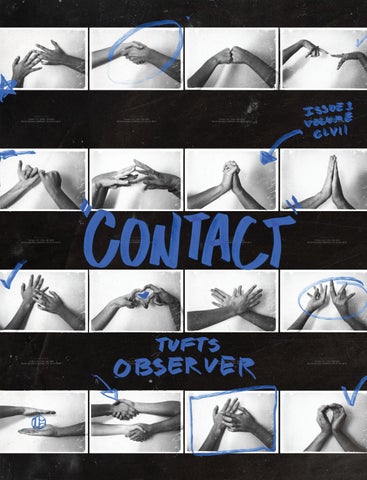
22. Contact the O - Lucie Babcock & Abilene Adelman 24. “Another Pandemic!?” - Anya Bhojwani 26. Hypersocial Media - Sam Stearns 28. Breathing You Out - Rhea Shah
29. Crossword - Emma Dawson-Webb
Before we start, let’s all go around and say our names, pronouns, major, hometown, and how many unread messages you have right now.
4
TUFTS OBSERVER
OCTOBER 5, 2023
Hello dear readers,
LETTERS FROM THE EDITORS
We are so incredibly excited to be back as Creative Directors this fall! We write this letter in the wee hours of the morning; our eyes are blurring and our brains are imprinted with a vision of Adobe Indesign. All this to say, please forgive us for our inability to come up with any more contact puns—but have no fear, our fellow M-board members eloquently employ them in their own letters (far better than we would have anyways). Being Creative Directors means leading a team of amazing, creative, and resilient designers in the creation of the beautiful issue you are making contact with (hey we did it!). Being a designer is a real labour of love: every piece of the layout you see is an intentional and specific choice. So, as you flip through these beautiful pages, we hope you appreciate every color, font, composition and text wrap for the hard work they represent. Enjoy making contact <3 Katie and Meg
Dear reader, You’ve just made contact with something other-worldly, something cosmic, something big: collegiate journalism. This issue, being our first of the semester, explores what it means for us to return to a place that we’re familiar with but is also ever-changing and new. What happens when our bright eyes and languishing summer days collide with the chaos of the Tufts campus? What does it mean to make contact with something that’s in motion? This year I’ve also made contact (is it clear that the theme of this issue is contact) with more responsibility at the Observer (which you can tell because I’m writing this letter you’re reading). As with any new experience, I’m tepid and uncertain. To get here—to the print version of our first issue—I’ve got nothing but gratitude for all of the lovely contacts whose lines I’ve hit many times throughout this process. After contact comes an explosion, a tangible shift. To make sense of this change, I compulsively look around to my friends, observers, and observers past. Thank you to all the hands and brains that touched these pages. And hello to all you beautiful people making contact (ok, enough with that now) with the Observer for the first time! Happy reading <3 –Siena 2 TUFTS OBSERVER OCTOBER 5, 2026
Hi beautiful peOple, The magazine you are holding in your hands right now is our baby. She has come into contact with the outside world, and we’ve set her free. Baby Contact, or Baby C, or BC, is fabulous, and I can’t wait for you to meet her. In these pages you’ll find pieces on globalization, smoking, infectious outbreaks, and perhaps the most dangerous of them all, sapphic love (and also many more). As your favorite publication’s masthead, we all came together and created each and every page just for you. So I’m setting the scene: imagine the alien meme, the one where they’re holding hands and touching foreheads—that’s us right now. And while you’re at it, go see the cult movie Contact, too. I haven’t seen it yet, but I hear it’s good. My point is, a lot of work was put into what you’re reading now. And I am honored to now be serving as the Editor-in-Chief of this family. We are—I am—sharing our—my—deepest, darkest secrets now. The future is scary and ambiguous. But what we have is the present. So, our thoughts are yours, we are here to give you our all. Contact is intimate and we lay bare. Get your tea/coffee/beverage of choice and traverse in the depths of this universe we’ve created. Contact us if you have any questions. With lOve, Ela
O Dearest Observers, Here, it is a two-way street, where you reach out, or I reach out, and there is some meeting in the middle. Your finger extends towards the page, finding it in its place, converging in the in-between, and making contact. I want to ask about what has happened since the last time we saw you. How was your summer? Where did you go between then and now? Have you missed us as much as we have missed you? The typical questions one asks when time and place create distance in such a special relationship like this. All that matters, though, is that you (and I) are back. Closer than ever, might I add. Before this moment, you probably hadn’t noticed my name amongst the many remarkable and irreplaceable names in our pièce de résistance of a masthead—if you haven’t seen it before, “you might want to check again” (see The Social Network for context). Now, as I take off my shoes and slip into newer, larger ones, I prepare to shoulder the responsibility required of the so-called “Managing Editor”—shoes I hope to sink into, exceeding all that is expected of me, despite how unsure I am of exactly what that means. As I endured the thick and sultry heat of the last few months, I developed the same longing I feel every summer: for school’s soon embrace. In weeks to come I will likely complain, if I haven’t already, wishing for days of bygone freedom and warmth. One pines for what they don’t have. Nevertheless, here is what’s important, when me and you return to each other. From my heart, head, and hand to yOurs, Henry DESIGN BY MEG DUNCAN
OCTOBER 5, 2026 TUFTS OBSERVER 3
FEATURE
A Community on Hold: What is lost when Tufts stops a life-changing program in its tracks
F
or many, the start of the school year heralds the return of normalcy. Jumbos came back to a familiar routine, reconnected with old friends, and once again traversed a campus that seemed to undergo little change during the four-month hiatus. For the Tufts University Prison Initiative (TUPIT) community though, Tufts upended this sense of stability long before students poured back onto the hill. On May 11, 2026 former Tufts Education & Reentry Network program (MyTERN) participant Tyler Brown critically injured two students in a Cambridge shooting. In an email addressed to the TUPIT community, Tufts announced a slew of restrictions to the program under the auspices of bolstering student safety and wellbeing, such as shuttering all on-campus TUPIT activities, including MyTERN, and pausing BA admissions to Tufts for all currently unenrolled TUPIT cohorts. In the months following the announcements, TUPIT students, professors, and administrators were left reeling from the sudden loss of contact with each other, and a program that many consider one of the most important aspects of their lives. TUPIT, founded in 2016 by civic studies professor and carceral-justice activist Hilary Binda, offers Tufts classes at Massachusetts correctional facilities such as Massachusetts Correctional InstitutionShirley and MCI-Concord. Binda, who championed the development of the program, maintained considerable administrative control over TUPIT’s operations until her dismissal this summer as part of Tufts’ sweeping reorganization. Prior to May 11, TUPIT offered BA admissions to incarcerated students enrolled in the program, in conjunction with Bunker Hill Community College’s associate’s degree program. Tufts professors teach all TUPIT classes, with teaching assistant and administrative roles filled by Tufts students. MyTERN, the second entity affected by this summer’s administrative turmoil,
is a TUPIT facilitated re-entry program for system-impacted individuals, many of whom are recently released TUPIT students. MyTERN offers extensive support as part of its mission to ensure long-term stability, including housing and employment support, paid fellowships, and an 18-credit MyTERN specific civic studies course load. While MyTERN’s offerings stray from TUPIT’s traditional goal of providing college classes in prison, it remains an integral part of the TUPIT program and community. Also unique to MyTERN, Tufts students can enroll in classes and learn side-by-side with returning citizens, an opportunity many Jumbos have taken throughout the program’s operation. TUPIT and MyTERN’s programming are framed as the ultimate win-win; those experiencing incarceration or re-entry receive a transformative education and access to a kind of community and support that many can only dream of, while Tufts students and faculty have the opportunity to connect with a community that academia traditionally relegates to the margins. “TUPIT was the best thing that could ever have happened to anyone who’s ever been incarcerated,” said Shawn Shea, a former TUPIT student who began his participation while incarcerated at MCI-Concord. Shea, who finished a nearly 20-year sentence in late August, credits TUPIT with changing his life. “I’m happier than I’ve ever been in my life because I have this beautiful community that supports me and helps me with anything that I need.” For Shea, the most instrumental part of the program was being in a community with Tufts TAs, administrators, and professors—people from a world he left behind when he first entered prison at 17. Shea claimed that his TUPIT classes gave
4 TUFTS OBSERVER OCTOBER 5, 2026
By: Ben Maughan him the chance to prepare for re-entering a society he hadn’t seen in two decades, an opportunity he believed expanded his horizons in a way that only a program committed to forging connections could. This transformational experience is not exclusive to Shea; former MyTERN participant,
FEATURE
Benjamin Silva, readily sings the praises of the program he claims changed the course of his life. “The nature of the MyTERN community was empathy and concern for the person next to you, regardless of who they were or what their background was.” Silva, who spent 30 years of his life in prison, saw MyTERN as his first chance to build a community of his own, one that gave him the support he needed as he navigated re-entry. Silva emphasized the impact Tufts students and community members’ participation in MyTERN had on his experience. “They embraced us wholeheartedly,” he said. “They supported us completely. They cared about what was going on in our lives.” For Silva, making deep and genuine connections on the Medford campus was central to his rehabilitation, offering him
hitherto unknown opportunities for reflection and friendship. Silva even credits his time with MyTERN with developing his love for computer coding, a skill he has used to create a website for returning citizens to share vetted re-entry resources. “I say pretty regularly that TUPIT changed my life,” TA and MyTERN participant Addison Samway said, confirming Shea and Silva’s accounts of the TUPIT community’s transformational quality. Samway sees TUPIT’s facilitation of human connections as the program’s most important offering. Samway recalled a specific moment where a peer-editing session with a formerly incarcerated classmate created a life-long bond, a moment she believed illustrates this quality. “We also ended up [chatting], he started telling me about how he had diabetes in prison and how hard it was to receive care, and about the healthcare system in prison, and now we’re really good friends who see each other often, that’s pretty magical,” Samway said. TA Simrin Mehra, a senior, credited the connections she made with incarcerated students with helping shape her perspective on justice. “You don’t always feel how tangible, and traumatic, and painful [incarceration] is,” Mehra said. “When it’s someone who you built a relationship with, and it’s their life experiences, that’s completely different.” Both Mehra and Samway agreed that, community aside, the academic portion of the TUPIT and MyTERN experiences stood alone as the most rigorous and engaging part of their college careers. “Tufts always preaches real civic impact and engagement,” Samway said, noting that even at Tufts, academics are “usually in this sort of ivory tower … where you’re not actually listening to the voices that are impacted by the issues you’re learning about.” She specifically lauded MyTERN’s capacity for genuine engagement, saying, “stepping into a MyTERN classroom unlocked this thing that showed me a blueprint for what education should look like in the real world.” Mehra especially appreciated the extent to which TUPIT’s academic pedagogy
DESIGN BY ANASTASIA PAK, ART BY NELLA HAKOBYAN
remains in line with its community-centered programming, with classes encouraging collaboration and dialogue. “The discussions [in traditional Tufts classes] seem boring and like echo chambers and empty in comparison to how rich and deep the conversations were inside.” Mehra doubled down on her comparison, sharing her admiration for her incarcerated students, “they are more engaged, they are more intellectually interesting, they are smarter, and they are just so passionate about their learning that it is the most productive educational space I’ve been a part of.” While TUPIT and MyTERN’s participants agree that the programs’ propensity for community building and academic strength are its most important aspects, most anyone in the initiative’s orbit would also tell you that any story regarding TUPIT would be incomplete without discussing Hilary Binda. When talking to TUPIT community members, one would be hardpressed to find an individual who does not exalt the program’s heavily involved founder and now former executive director. To hear Shea put it, “Hilary’s like my mom … she saved and changed my life in so many ways. She’s one of my favorite people in the whole world.” It is Binda whom many incarcerated individuals involved with TUPIT point to as the single most important factor in their recovery journey. “[Binda] really opened up my whole world,” Shea said. “[She] showed me that I can really do whatever I choose to.” Shea claimed that Binda’s insistence in his potential has inspired him to do the same for others; he is now working towards opening a personal training clinic for at-risk youth. Silva particularly admired Binda’s commitment to rehabilitation, a commitment he says was especially visible in how she treated incarcerated students. “[Meeting Binda] was the first time since going to prison on a life sentence that I met someone who was willing to … see not only who I was and what I had done,” he said, “but [also] … see the person that I had the potential to become.” For Silva, Binda’s capacity, and by extension the capacity of the entire TUPIT program, to see a future for him that not even he could, inspired him to envision a different future for himself. Two years removed from his incarceration, OCTOBER 5, 2026 TUFTS OBSERVER 5
FEATURE
Silva is now a site manager for three nonprofit housing complexes. The culture of TUPIT, one that simultaneously makes space for care, community and academic intensity, is almost solely attributed to Binda by participants. This culture kept incarcerated and formerly incarcerated individuals coming back, and allowed them to re-enter society with a support network. “Hilary created an environment where matters of race, and sex, and class, and religion generated curiosity and a desire for understanding,” Silva said of his MyTERN classes. Perhaps more importantly to Silva, MyTERN, under Binda’s tenure, was a place that felt like home. “You could come in … having had the worst day, and all of your other classmates would see that you’re in a bad mood, and they would do everything in the world to try and make you feel better,” he said. Shea emphasized that the culture Binda fostered in TUPIT extended beyond his classroom in MCI-Concord, and into the facility at an institutional level. “You could see at Concord where [TUPIT began] originally, the whole environment had changed in the prison because of TUPIT … everything was just different because of the culture,” he said. For Shea, the community he found behind bars with TUPIT was not one he was ready to give up upon re-entry; when it came time for him to parole in July of this year, it was a no brainer: he would parole to Boston (a city he is not from) for the sole purpose of attending Tufts as BA student, participating in MyTERN, and receiving the support and built-in community he was told he would have upon his release. To Shea and other incarcerated students, they and the university had a tacit agreement, that if they worked diligently toward their associate’s degrees, not only would they be granted admission to Tufts, but they would also receive MyTERN’s comprehensive re-entry support. Following May 11, this agreement was quietly shattered. Tufts announced the pausing of BA admissions, but more importantly for the then soon-to-be-released Shea, MyTERN’s operations, and the extensive support therein, were suspended indefinitely. Following these announcements on, essentially all contact has been severed with all released TUPIT students 6
TUFTS OBSERVER
and MyTERN participants alike, with the latter being barred from campus and having their paid summer fellowships prematurely terminated without compensation. Along with these suspensions, it was announced that Hilary Binda would step away from TUPIT, to be replaced by Provost and music professor Joseph Auner. Shortly thereafter, a working group of administrators and faculty, helmed by Auner and Tisch College Dean Dana Cunningham, was convened to determine TUPIT’s future. The decision to install Auner and Cunningham as TUPIT’s de facto leadership team has been maligned by program participants, who claim they have mostly provided lackluster engagement with the TUPIT community. Tufts students involved in discussions with Auner and Cunningham described what they see as a fundamental disconnect between administrators and the TUPIT community, where administrators claim they want to continue the program while participants believe they are dismantling the very structures that allowed TUPIT to thrive in the first place, removing Binda chief among them. “We know the program. You don’t. They don’t really have a depth of understanding about the program, and we do,” said Samway. For their part, the only communications formerly incarcerated participants have received from the University since May 11 have exclusively come in the form of regular fundraising emails that expound on their value to the Tufts community. “[MyTERN’s support] was kind of stolen away from me,” said Shea, two weeks after he was forced to enter a world without the community he was promised and thought he would always have. “My goal was to stay involved with TUPIT for the rest of my life.” When talking to other TUPIT alumni and participants like Silva, Mehra, and Samway, they speak in terms not dissimilar from Shea’s, with words
OCTOBER 5, 2026
tainted by a stinging sense of betrayal. One gets the impression that members of the TUPIT community feel as if they were sold a dream, that win-win idea of prison education at Tufts, only for it to be taken away from them. Samway highlighted what the loss of TUPIT means for those still inside, individuals who she says “are banking the rest of their futures on the opportunity to join MyTERN when they leave prison.” To Samway, “suspending TUPIT means that people in prison are even more at risk when they come out.” Silva shared that what concerns him most is the message TUPIT and MyTERN’s interruption sends specifically to young, system-impacted individuals. To Silva, TUPIT made a point of proclaiming, “‘we believe in making change and including people, and not crucifying people because of their race or anything else, and judging people on their own actions.’” Yet, when talking about a 19-year-old MyTERN peer and friend of his, he bemoaned, “And what [does TUPIT] do? The first sign of trouble, we undermined every lesson we taught [him].” To Mehra, the university’s interruption of TUPIT and MyTERN programming under the auspices of ensuring safety is contradictory. “It is without programs like this that more violence and more harm occurs,” she said. Silva echoed Mehra’s sentiment, “they’re not trying to make people safer.” Silva, Mehra, and other participants said that they believe Tufts is aware of the outsized benefit TUPIT offers Tufts and society at large, yet remains more than willing to disrupt it in the face of what participants see as an isolated incident. To hear Silva put it, “Tufts University understands exactly the harm it’s causing by trying to dismantle a community.”
POETRY & PROSE
Spill in g Ou t
ar Nora Bit
“I have indigestion of the soul.” - Fernando Pessoa, The Book of Disquiet I’m driving down the coast panicked, a dried out, choking stomach, incessant thoughts spilling out of my head like snaky Medusan ringlets— cursed. The Sisyphean contemplations, of my lonely, overused heart follow my brain like the ocean, which runs along the road like it’s trying to beat me. I play a sad song, to make myself sicker. I’m a masochist, a magician who can coax the salty tears out of myself, like water spilling out of an overflowing pitcher that a faucet won’t stop pouring into. My forehead pounds and my fingers shake on the wheel and I think I can feel the cracks in my chest so corporeal, so all-consuming, but the sobs do nothing to stop the fact that I am alone, deeply, totally, and I
am on the floor shattering in a pile of broken glass with bleeding hands, wounded, desperately trying to repiece together my lost memories and to remember the sounds of my friends’ voices, to recapture myself when I was whole, satiated, loved. I wish I could rip Medusa out of a mythbook, and coax her to life. I would force her to look me in the eye, right before I made myself recall it all: my best memories of sacred smiles, the laughter coming from me like a prayer that is holy enough to make me believe in God, in something in me.
DESIGN BY SKY FRISCH, ART BY MILA VONDERHAAR
And when I remembered she would turn me to stone, and I would die inside of my laughter. I would die in the brief respite. But I am here. So please squeeze me into a palm—sweaty, veiny, and shaky —until I am nothing but a fleeting idea. Please let me retreat into myself, skin folding into bones so I never have to feel loved again.
OCTOBER 5, 2026 TUFTS OBSERVER 7
NEWS
M
By Jules Zinn Rowthorn
assachusetts loves to get high. It’s true: people here smoke a lot of weed. A March 2026 report by the Massachusetts Cannabis Control Commission showed that 37 percent of state residents used cannabis in the past year; 61 percent of those residents say they buy their weed at a “store—in other words, a dispensary. But this coming Election Day, November 3, 2026, a statewide ballot initiative, Question 8, might leave these dispensary-denizens out of luck. Ballot Question 8 proposes a repeal of the 2016 Regulation and Taxation of Marijuana Act, which sought to “legalize, tax and regulate” marijuana in a similar manner to alcohol. This law passed by 52.4 percent of the vote. One decade later, voters will be asked to effectively revoke the 2016 decision. If passed, Question 8 will “change the type and amount of marijuana that may legally be possessed in Massachusetts.” Currently, individuals have the right to possess up to two ounces while in public and up to ten ounces inside their residence. Under the new provisions, those possessing between one and two ounces of marijuana could face a $100 fine. Also, adults 21 and up would be able to possess up to one ounce of weed and give small amounts in gifts. For reference, an ounce of weed can be used to roll about 56 standard-sized joints. Question 8 would also maintain current laws that criminalize unauthorized marijuana sale, possession, or use of marijuana beyond the legal possession limit. Evan Horowitz and Zoe Tsai, from the Tisch College of Civic Life Center for State
8
TUFTS OBSERVER
Policy Analysis, explain that Question 8 would eliminate legal recreational marijuana sales and the marijuana sales taxes collected by state and local governments. Current laws impose a rigorous “testing regime” that ensures the safety of recreational marijuana, which would become defunct if Question 8 passes. The right to grow marijuana in the home would be revoked. Other eliminated items include “the plan to allow cannabis bars for on-site consumption” and “social equity programs connected to marijuana tax revenue and licensing rules.” Importantly, Question 8 does not include any restriction for the state’s medical marijuana industry, which was established in 2012 after the Massachusetts Medical Marijuana Initiative came into law. This marked Massachusetts’ first instance of statewide marijuana legalization. Marijuana sales were allowed for those diagnosed with “debilitating medical condition[s]” including cancer, glaucoma, HIV-positive status or AIDS, hepatitis C, Crohn’s disease, Parkinson’s disease, and ALS, among others. If Question 8 becomes law, recreational dispensaries could apply to become Medical
OCTOBER 5, 2026
Marijuana Treatment Centers—licensed medical dispensaries—through a lengthy bureaucratic process. A considerable number of Massachusetts weed-smokers who would be affected by these changes are students. In that aforementioned MCCC report, many selfidentified students reported marijuana use, though frequency varied. 18 percent of students reported having used marijuana over one year ago; only 13 percent reported daily or near-daily use. The National Institutes of Health found that in 2020, 44 percent of college students across the United States reported using marijuana in the last 12 months, a 6 percent increase from 2015. But how have non-government actors reacted to Question 8? Advocacy groups like the Coalition for a Healthy Massachusetts are organizing in favor of Question 8. They argue that legalizing the recreational marijuana industry has had detrimental health effects on the Massachusetts population. Such concerns aren’t baseless. Dr. Jeffrey Morgan, MD (Ret.), retired oncologist, physician, and retired instructor of medicine, wrote in the Massachusetts
NEWS
Information for Voters 2026 Ballot Questions pamphlet, published by the Secretary of the Commonwealth, that Question 8 should be passed because “marijuana is now the most common drug found in fatal car accidents in Massachusetts,” and “85% of marijuana users admit to driving after [marijuana use] and over 50% drive within an hour or less.” Morgan further explains that marijuana has been linked to adverse mental health conditions in young adults. Additionally, a 2025 study by Harvard Medical School Department of Psychiatry and the Massachusetts Cannabis Control Commission in Worcester found that after state-level legalization, marijuana use by individuals with psychosis increased 9.53 percent compared to pre-legalization. The study’s authors report that their findings should be taken into consideration by lawmakers, “given how cannabis can negatively affect illness course and health service utilization in individuals with psychosis.” Conversely, opponents of Question 8 argue that its passage would actually be harmful to the health of Massachusetts residents. In a voter guide distributed by the Secretary of the Commonwealth, Ryan Dominguez, of the Massachusetts Cannabis Coalition and Chair of the “No on 8: Stop the Repeal” campaign, wrote that the passage of Question 8 would lead to “serious public health and safety problems” because current state laws allows for a market of products that are “tested for safety, packaged and labelled properly, and sold in licensed businesses to adults 21 and over.” Dominguez notes that rather than decreasing adult recreational use, marijuana sales would return “to the illicit market where there are no safeguards in place.” The cSPA concurs with this notion, stating that Question 8’s passing would likely cause an increase in illegal marijuana markets. In 2018, the American Civil Liberties Union found that the ratio of Black individuals arrested for marijuana possession in Massachusetts compared to white individuals was four to one. This is in spite of having the lowest rate of drug-possession arrests; Massachusetts has the 18th highest ratio of racial disparity in marijuana arrests among U.S. states.
Legalization can “significantly lower” arrest rates, but some states, including Massachusetts, “have seen an even steeper rise in proportion of Black people whose lives are impacted by a marijuana arrest.” ACLU analysis shows that racial profiling and biased police enforcement of marijuana laws exacerbate this racial disparity, even though use rates among Black and white individuals are similar nationwide. Were Question 8 to pass, Dominguez argues, it would be a “[waste of time] and resources” diverted to risky policing practices while more serious crimes persist. In a statement to the Tufts Observer, Dominguez emphasized that in addition to posing a significant danger to communities of color, Question 8 would damage the profitable recreational marijuana industry that has since developed in Massachusetts. He explains that nearly $2 billion in state revenue has been generated as a result of “thousands of jobs [that] have been created through legalized recreational sales.” If a repeal is passed, Dominguez worries about the negative economic impact on Massachusetts towns “already struggling with budget shortfalls.” How do Tufts students feel about Question 8? Alex Robinson, a senior who is over 21, says he notices that smoking weed is common in small group settings at Tufts. “You smoke around people you feel safe with.” Robinson said that because of the strict laws in place regarding the sale of recreational marijuana, he feels “reassured” that the products he buys at dispensaries are safe. “Having an accessible and safe alternative to alcohol, in a collegiate space where alcohol is used in almost every social setting, [is] important to me, and it’s important to other people.” Like Dominguez, Robinson is concerned that if Question 8 is passed, underage Tufts students—whether seeking out marijuana because of social pressure or mere curiosity—could be pushed to purchase it from untrustworthy sources or end up in unsafe situations. As part of the voting process on ballot initiatives, each initiative is reviewed by a committee of Massachusetts legislators. This process provides the electorate with as much information
DESIGN BY MILA VONDERHAAR, ART BY GRETA MAGARY
about all potential consequences when voting on a question on the ballot. Earlier this year, four state senators and five state representatives formed the Special Joint Committee on Initiative Petitions. They voted to maintain Massachusetts’ current framework of marijuana regulations that has been developed to “balance public health protections, consumer access, and a legal, taxed marketplace for cannabis products.” The committee cited concerns that Question 8 may “undermine efforts to promote responsible use within a legal market.” So, Question 8 was proposed in an attempt to protect the health of Massachusetts residents. But, if passed, it might also lead to the rise of illegal marijuana practices that would instead harm the commonwealth. Legislators, activists, and residents have voiced their opinions, but come November, the fate of the Massachusetts recreational marijuana industry will be decided by an electorate of over five million voters, including Tufts students registered in-state.
OCTOBER 5, 2026
TUFTS OBSERVER
9
CAMPUS
Does Tufts Care About Deconstructing the Tufts Sports? Athlete Bubble
By Lily Rogers
A
discarded paper food boat smears among these schools. As an R1 research mustard across the grass of J-Field, institution with more than 6,000 undertrampled by students hunting for graduates and a campus just a few miles the free T-shirts commemorating Tufts’ from Boston, students’ attention is more 2026 Homecoming block party. “I BLEED easily drawn away from sports. BROWN AND BLUE,” the shirts say in allNevertheless, the university invests caps varsity font. The other commemora- heavily in athletics. Tufts spent over $12.7 tive merch stands—those making custom million on its varsity sports programming pennants, towels, and baseball caps—are during the 2024–2025 academic year, inbled dry of materials within the party’s cluding more than $1.2 million on football’s first hour. operating costs alone. Because Division III This is how Tufts christens every fall schools can’t offer sports scholarships, that semester. Each Homecoming, clusters of money isn’t spent buying recruits the way a students gather in every imaginable com- Division I program might. This investment bination of brown and blue, some even is evinced by the dedicated athletic faciliwearing homemade Tufts memorabilia. ties downhill from the academic quad that Not every student participates in the revel- can feel like a parallel campus altogether. ry, of course. And, despite the HomecomBut that parallel-campus feeling isn’t ing fervor, many of those in attendance rooted only in brick and mortar down the won’t make it to the sidelines of any other hill; it’s maintained by a clock that ticks at game this year. a completely different rhythm than the rest This is the central paradox of athletics of student life. here at Tufts. During the 2025-2026 acaLong before first-year students undemic year, the university brought home pack their suitcases and participate in four national championships and ranked their first, awkward orientation icebreaksecond nationally among 319 other institu- er, select varsity teams arrive on campus tions for the 2026 Learfield Directors’ Cup weeks before for preseason training. A for NCAA Division III. But post-Home- head start, as it turns out, matters more coming, the Ellis Oval bleachers will likely than it might seem. sit quiet for the remainder of the season. “The first few weeks on campus are Tufts competes in the New England when first-year students are most open to Small College Athletic Conference along- forming ties, and they tend to form them side small, rural liberal arts colleges like with whoever they’re around most,” Jill Amherst, Williams, and Bowdoin. How- Weinberg, the chair of the sociology deever, Tufts is somewhat of an anomaly partment, said in a written statement to the 10 TUFTS OBSERVER OCTOBER 5, 2026
Tufts Observer. “Preseason student-athletes get [a] window to themselves. They spend two weeks together in an intense, shared, physically demanding routine, eating together, living near each other.” Once classes begin, varsity schedules only reinforce that initial separation. For Kira Merrell, a sophomore coxswain on the varsity women’s rowing team, a typical weekday starts with a 4:30 or 5 a.m. wakeup, followed by practice on the water from roughly 6 to 7:40 a.m., three weekly lifts at 9 a.m., and lights out by 9:30 p.m. to do it all again. “We have a very unique schedule with rowing,” Merrell said. “I think that common ground definitely brings us together.” This bond goes beyond practicality. “I really love [my teammates],” she continued. “So I think it’s also a conscious choice… to spend time with them.” To non-athletes, that closeness can look like an intentional social wall, or an ‘athlete bubble.’ The phrase implies a presumption of exclusivity: that studentathletes intentionally seek each other out while self-isolating from the rest of campus in designated dining hall corners or off-campus houses. According to Weinberg, it’s not an unreasonable read. The insulation is mostly logistical, at least at first. “[It’s] largely due to structural convenience: practice times, lifts, travel, team meals, and schedules that often cluster teammates into the same class
CAMPUS
sections and possibly living arrangements,” she said. “Over time, though, the pattern can become more deliberate. Groups develop their own norms, inside jokes, and shared experiences, and that can harden into [an] identity boundary.” Weinberg says that the boundary has a gendered shape, too. “Team subcultures generate a lot of social capital,” she said. But that capital isn’t distributed equally. “Men’s teams, especially in higher-profile sports, often control informal social space, like houses and parties, and that gives them outsized influence over campus social life.” Here at Tufts, that influence has a visible form; it’s not uncommon to hear about parties replete with beer—and brawn—being thrown at ‘Lax House’ or ‘Football House.’ Women’s teams, Weinberg said, “build equally strong bonds, but those bonds tend to convert into less campus-wide social power, and women athletes often have to manage a tension between athletic identity and conventional expectations of femininity.” Merrell, for her part, doesn’t see much of a divide. But she also said her team rarely overlaps socially with men’s teams, so she has little basis for comparison. Beyond varsity, though, there’s another model of athletic community on campus: club sports. These non-varsity programs command extensive student participation and deep social investment
without the rigid administrative boundaries, recruited status, or early-arrival privileges of varsity teams. Michela Rowland, a junior biochemistry major, has played club ultimate frisbee since their freshman year. Their team is a serious one. In the spring, they practice up to three times a week plus lifts, and Rowland estimates about twelve hours a week at peak, compared to six in the fall. Rowland says the club frisbee community is close, but wider than they imagine varsity’s to be. “There’s definitely still a super insular culture in some sense, but I think it’s a lot more expansive as well,” they said. “I have friends on the team who are musicians and friends who are artists, and those things are also really big in their lives.” This also changes what the team is for. Rowland described club sports as “uniquely [dissociated] with school pride in a way varsity sports are intentionally linked to school pride.” “I love my team very much, and I love Tufts because I love my team. But my team doesn’t make me love Tufts,” they said. “I’m not playing for the school. I’m playing for my teammates and for myself. I think with varsity, there’s a slightly different expectation that you’re playing for a sense of school pride, and for your schoolmates.” Merrell, after hearing the above quote, agreed with half of it. “It’s very team-based for me, for sure,” she said. “All of the effort that I put in is out of the love for my teammates and the respect for the work they’re putting in.” She added that “there’s also definitely an aspect of pride in the Tufts women’s rowing program and everyone who has come before us.” Merrell, a varsity athlete herself, admitted she rarely goes to games. “It’s not a lack of care. I love how great all the teams are, but I’m much more academically involved on campus.” Rowland describes a similar pattern for club frisbee, where support tends to stay close to home. “[A lot] of the turnout we see is within the program,” they said. “So…[the] men’s teams will show up for our women’s teams and vice versa.” That may be the paradox from J-Field in miniature. Weinberg says it isn’t unique to Tufts. “I’d expect coexisting microcultures, and I’d say that’s true at most schools.”
DESIGN BY MADOKA SHO, ART BY LYLA SOWDER-YUSON
The picture of one unified school spirit comes largely from big Division I programs where a football or basketball team works as a shared ritual for the whole campus. This is something close to what sociologist Émile Durkheim called “collective effervescence.” Even at D1 schools, Weinberg said, this school spirit is episodic. “It shows up on game day and fades the rest of the week.” At an academically elite school like Tufts, where sports carry less symbolic weight for the general student populace, identity attaches to “many things at once: teams, but also a cappella groups, student organizations, [and] theater.” “This is not a failure by any means,” Weinberg concluded. “A campus made of overlapping microcultures can be quite healthy.” That’s the real story of J-Field. Homecoming is a boom: a day when much of the campus rallies together to create a complex mosaic of brown and blue. The bust that follows isn’t necessarily proof that Tufts students don’t care. The bleachers at Ellis Oval don’t need to be full for Tufts to have spirit, not when that spirit can live in the rowing shell at dawn, the frisbee field during a tournament, the rehearsal room, the library, or even the lab.
OCTOBER 5, 2026 TUFTS OBSERVER 11
VOICES
Argos By Sundari von Wentzel Bass rocks the floor, speakers spitting synth onto a sea of glittering bodies. Wideeyed windows throw the glow of amber streetlights low across the dance floor. My sweaty, beat-up sneakers squeak against the grime of beer and rainwater underfoot. From the hallway, I watch partygoers stumble and sway. Wringing my hands nervously, I work a nail back and forth between my teeth until I nearly brush its pink underside. My worst habit. Heaving in deep breaths of humid air, I attempt to coach the last dregs of wine out of my system. Feigning disinterest, and failing, I glance towards the place where the staircase meets the hallway. On the fifth cursory glance, I spot your brown bomber jacket and twist my fingers impossibly tighter. Despite the ample warning I received from a mutual friend, the sight of your face just five feet in front of me, slightly red and glistening in the heat, leaves my _____ galloping. You’re novel piercings and those earrings you bought sophomore year, new smudged eyeliner and the same black flecks of mascara coating your under-eyes. A beat too late, I realize I’m staring, sending a rush of blood to my already-flushed cheeks.
12
TUFTS OBSERVER
I’v e lived this moment a million times in my head and thrice in real life. After months of silence, after the realization that we have hurt each other enough to need distance, suddenly we are jerked back together. I find you on a Beacon Hill side street, or a soccer field cloaked in shade, or my flight to Paris, and the cycle begins once more. Proof that whatever fissures attempt to separate us—new middle school friends, a stolen boyfriend, college four hundred miles away—it’s always us in a crowded room with nothing but our silence separating us. Sweat pricks my hairline. My consciousness, alarm bells ringing, screams at me to rearrange my face. Rehearse my attitude, my story. College is going well, look, my friends and I are matching. No, I don’t feel a pull towards your college neighborhood at night and wonder what we could’ve been there. No bother. All fronts are useless between us. A slight intonation of voice, an unusual color palette, a nervous wor-
OCTOBER 5, 2026
rying of teeth behind tight lips—distinctively unassuming to most—is glaringly obvious to our discerning eyes. You see right through me. Unable to contain its excitement, my smile twitches upwards. My arms fly around you like routine. You bury your nose in my neck, and my world is tipped back onto its axis. Each rotation brings me back where I began. You. The disbelief in your clear eyes is the same expression that erupted on your fourth-grade face when my mother first agreed to let me sleep over. We made solemn oaths of secrecy and ate blueberry pancakes. Once, we vowed to summon Bloody Mary. As we stared at the ceiling, you confided bitterly that your friends would only hang out with the new middle schoolers. You were laughing with them on the T a week later. Separation I. I reel myself back to the present. My already-fuzzy mind dims its focus down to the motion of your lips, half-processing the words. How are you, really? I think. I know the girl you’re describing and the one hiding in your brown leather jacket are not the same person, as much as you try to reconcile my vision. The pretending unravels, and I can _____ you again. In the pause between words, I catch a glimpse of the frayed end of your ring fingernail, an uneven patch marring the surgically precise half-moon. My gaze travels the blue-veined skin behind your palm. Inch your hand two fractions of a second closer and I can practically feel the rough linen of your host parents’ attic couch, uncertainty and bare thighs. I glimpsed, out of the corner of my eye, your fingertips wavering nervously by the edge of my palm. You folded them neatly back before I could react.
VOICES
Unsure, even then, what the slide of your hesitant hand against mine meant. You lean your arm against the wall, casually boxing me in between your jeans and white plaster. Your eyes are beacons that pin me to the wall. I am hyperaware of being on display. Out of the menagerie of bracelets clamoring for attention on your half-covered wrists, I glimpse the tail end of a thick threaded braid. A high school relic, a bit like us. Love and envy and _____ and hate braided into each other, the strands indistinguishable. I taught you to braid when we were six. Before he left me in the parking lot, before you defected to his hallway, before my tears ran quietly into the rough carpet of my bedroom floor as you lied, there were two girls on a brisk and sunny October afternoon slapping cards on a stone bench outside the fifth-grade building. Two heads pressed together on a foggy bus ride from the MFA, you sketching, me scribbling stories in the margins of the page. The very first time I ordered a drink and copied your mojito. Beer sloshes dangerously close to the fringes of my skirt. Instinctively, you grab my hip to pivot me away. Every fingertip pricks my bare hip with heat. My blood is racing now, pumping furiously, instinctively, against my better judgment not to press the bare skin clothing my pelvis harder against the fine lines of your palm. My mind retreats to the purple-red glow of the Spanish bar, to the promise of a small town come alive. The familiar thrill of an unrealized night. Cigarette smoke weaving into the fabric of our sweaters. Every half-drunk walk home, dancing in the roundabout while we share a song or two. You’d pull me back to the sidewalk every time.
DESIGN BY CATHERINE TING, ART BY DAELEN MENKE
Your fingers fall off my hip abruptly. My mind is a rubber band wound too far back. I can’t resist inquiring, morbidly curious what became of the boy that leapfrogged from me to you and onwards. Two years gone, we can laugh and pretend this did not slide glass between my ribs and that I was not your north star and you were not mine. We were not thrown from orbit when you left me, again. Separation II. We stumbled upon a bracelet vendor in Aix once, both gesturing towards color variants of the same half-moon design. I had the necessary 10 euros, exactly, in my palm. As we debated the purchase, I couldn’t shake the feeling that you’d never wear our friendship so publicly. In not wanting to embarrass myself, I feigned disinterest. The note burned a hole in my pocket the whole way home. The DJ shouts something suddenly, prompting us to both snap our necks to the side. When our gazes reconnect, we can’t help but laugh. I melt into the familiarity of the way your smile breaks like dawn on your face, redrawing your expression and crinkling your nose, just like mine. You are my mirror, down to our matching black Converse. They’re worn through now, but I’d never throw it all away. You once said that if you had a twin, it would be me. Confident when I am worrisome, timid when I am sure, _____. You fill in my blanks. Call me for French, and I’ll call you for math. You check for bedbugs, and I’ll chart the way to dinner.
Bodies begin to trickle towards the stairs. You glance at your watch and my heart sinks. Argos. All this time waiting for you, and my heart dies in my chest knowing another separation awaits. But time is circular. We will revisit this moment, with rapidly beating hearts and sweaty palms and a twist in our guts that we can’t quite place. We will intertwine our fingers, feel the familiarity of our skin on skin. Reminisce and repeat. All this to say that you’re an imprint on my heart still. You always will be. We can say goodbye, and my hand will fall out of yours, but I will still feel the warmth it left years later. We can forget what I said and what you didn’t. Either way, I will lie awake and stare at the ceiling and wonder if you love me. Teach me to shave and I’ll teach you something you don’t know. We have all the history we need. It’s impossible to imagine _____ without you. With a start, someone tugs your hand, jerking your body away from mine violently. I lunge towards you instinctively, but I’m left with only air between my fingers. You’re whisked backwards into the crowd. There is no invite, only a shrug of shoulders and an empty promise for coffee tomorrow. It will not materialize. This doesn’t concern me. I know I’ll be seeing you.
O OCTOBER 5, 2026
TUFTS OBSERVER
13
OPINION
Performing Culture On Katseye, identity & the commodification of exotcism
O
ne of my earliest memories consists of me at eight years old, hiding from the heat of the Nigerian sun under an agbalumo tree in my best friend’s compound. We choreographed a dance routine to “Eenie Meenie” by Justin Bieber, our little brothers as our unwilling audience, perched precariously on the lip of the gutter. For Gen Zers across the world, scenes like these are emblematic of our upbringing. The advent of the internet and social media, combined with the US’s immensely successful cultural exports (think the popularity of Taylor Swift or Beyoncé), created the first ‘global’ generation. It was entirely normal for me to text from my bedroom in Lagos to my Twitter group chat with Andrea in Brussels and Tatiana in New York to bond over a Korean boy band; or for my little brother to be able to sing the entire riff-off from Pitch Perfect word for word. As Gen Z grew up, we experienced a huge degree of cultural exchange through social media. With our generation more interconnected than ever, we understood the experiences and intricacies of multitudes of people across the globe. And
with this, older generations believed and presented that we would be the generation to ‘end’ racism. This context has created an interesting phenomenon where the abstract notion of culture is now regarded as cool, with a wholehearted embrace of the things that make us different. The result is many Americans of varying backgrounds exploring the ways in which they can display their cultures in Western contexts. A scroll on TikTok might have you run into a South AsianAmerican child wearing a kurta with jeans, or someone of Ghanaian descent wearing a bubu to a lunch with friends. The pop phenom Katseye is a perfect example of this attitude. K-pop giant HYBE and US-based Geffen Records merged to create the group, aiming to create a girl group forged from the vigorous training regimen of K-pop groups that
14 TUFTS OBSERVER OCTOBER 5, 2026
transcended the genre. Their marketing portrayed the group as a “truly global girl group,” with six original members carefully curated to represent several ethnic groups and cultures: Filipina Sophia Laforteza, Korean Yoonchae Jeung, CubanVenezuelan-American Daniela Avanzini, Chinese-American Megan Skiendiel, Indian-American Lara Raj, and currently on hiatus Swiss-Ghanaian Manon Bannerman. Katseye’s acceptance speech at the 2026 American Music Awards encapsulated their model of multiculturality. The members, one by one, gave short thankyous, mostly in English, reminding viewers of their mission to “represent their cultures” and “celebrate diversity” before finishing with shorter phrases in “their” languages. Yoonchae’s in Korean, Lara’s in Tamil, Daniela’s in Spanish, and so on. At face value, it was a heartwarming speech celebrating their hard work. The internet, however, had other ideas. Reddit users in the subreddit “r/katseyesnark” were quick to highlight grammatical mistakes in Megan’s Cantonese. “She doesn’t even know what the fuck she’s saying,” complains one commenter. Another calls her speech an “abuse of
OPINION
culture.” Further comments prior to the speech anticipate its contents entirely, with one warning users to get ready for Daniela’s “AI Spanish.” The comments highlight criticisms that are often levelled at the group’s members, especially the three born in the US, for their lacklustre cultural representation despite their marketability as a multicultural group. On the surface, it might seem that their representations do feel one-dimen-
sional. Katseye’s globality is extensively advertised, from their brand deals, with an advert with Pandora featuring members translating mini charms into their respective languages, to the stylistic clothing choices of the members themselves. Megan has her signature jade bracelet; Lara wears a bindi while she performs; and Manon is often spotted in Ghanaian waist beads. At times, it seems that the girls lean on cultural objects or rehearsed statements to showcase their global identities, which can come across to many as superficial. But it begs the question—why must every single girl be a bastion of a perfect cultural identity? And what does that even look like? Gen Z’s embracing of so-called culture seems to only apply to culture that is quantifiable, coming to centre around an imagined ideal of a ‘perfect’ minority—someone ‘cool’ and ‘exotic’ and ‘different,’ who they can ask to demonstrate these facets at the drop of a hat. And in the case of Katseye, no one can seem to decide what exactly that looks like. They are picked apart no matter how they try to DESIGN BY CLARE COLBURN
weave their backgrounds into their lives, and it seems like there is no way for them to get cultural representation ‘right.’ Many critics of Katseye fail to see that their constant insistence on the ‘correct’ portrayal of their cultures is racist itself. Requiring minorities to display fetishistic performances of their identities in order for them to be judged as ‘foreign enough’ is a dangerous precedent to set, reducing their multidimensional existences to entertainment. For any international student or child of immigrants on campus, this discourse is not unfamiliar. Questions about what ‘other’ languages we speak, whitewashed accusations, claims that we have no right to claim the cultures that we come from—often from people not in any way related to any of these cultures themselves. I can’t count the number of times people’s faces have fallen in disappointment when I explain that, despite my ‘exotic African background,’ my first and only language is English. Never mind the pressure many face to assimilate into American culture. Never mind the fact that many are children of parents who deliberately withheld anything non-American in bids to help their children fit in. Never mind that for many who grew up or study, or live here, the Americanisms that they are criticised for, whether that be weaker language skills or Western values, are part of their own unique cultural identities too. I find that Gen Z’s overzealous love of all things ‘ethnic’ tends to blind them to situations in which suppressing one’s differences might be necessary. For Katseye, there is no space for nuance. The girls are not allowed to be multifaceted young women navigating the pressures of fame, the burdens of representation for scores of young girls across the globe, and the development of their own senses of personal identity. Instead, they can either be “true” representatives of their cultures, or they are cosplayers, utilising their culture when it suits them and discarding it after. Yes, their global marketing can feel a bit too practised at times. But we must ask ourselves why we feel so comfortable being evaluators of what true culture is.
Why might this kind of marketing be so effective in the first place, and why do we perceive their alleged inability to properly represent a culture as proof of their evident moral bankruptcy? Major labels aren’t strangers to marketing new artists through their cultural identities—likely in direct response to Gen Z’s obsession with culture. It is deeply unsettling that instead of critiquing a marketing scheme (that’s at best ignorant and at worst immensely exploitative), fans instead find fault with the members of the group themselves. Gen Z needs to understand that culture is a living, changing thing that is descriptive rather than prescriptive, a representation of the people residing within it rather than a set of rules they must abide by. While culture is a shared experience, with members of different cultures sharing similarities, the groups are still comprised of scores of individuals with completely unique identities. No two people in one culture will ever look, dress, or act exactly the same, and continuing to perpetuate such an absolute understanding of what we believe culture should be only stands to push people away from authentic and accurate self-expression. The ways in which the members of Katseye or any other minority choose to exist are representation— by virtue of the identities we are born into, we represent the diversities within our cultures, for better or for worse.
OCTOBER 5, 2026 TUFTS OBSERVER 15
VOICES
Re Tem d poral -laced Ve ss
els
16 TUFTS OBSERVER OCTOBER 5, 2026
By Rohaan Iyer
VOICES
Steps in sand across a fleeting landscape. Trees crashing into beach, waves crashing into creeks flowing into trees. Hiking shoes: dark blue, low-cut, rubber soles, laced with skinny yet sturdy red-striped cords. Contained within the shoes were two people, both in the same place. He walked in sand, creating footsteps and ripples in ponds. His backpack weighed him down to the earth, the sand trying to swallow him whole with each movement. But he held his head high; it was 2007—the year I was born. California’s Lost Coast Trail is a 20-mile stretch of mountain and beach that thousands of ambitious backpackers take on each year. My dad was among those, his shoes fresh off the shelf from REI. He broke in the boots hiking weekly, running errands for my post-partum mom, and going to the bar with his friends on the weekends. The rubber undersides contacted gravel trails, pavement, and dirty floors. That Labor Day, he completed the hike in three days, faster than most. His trail group pushed on so they could get back to work by Tuesday morning. Pushed on for the dream of financial stability, of raising a family. He’d worked for years before in India and Abu Dhabi, but in 2000 he decided to move to a country unfamiliar with his college degree, with Mumbai, unfamiliar with him. So, he didn’t ask for a day off. He showed up at 9 a.m. on Tuesday and clocked out at 5 p.m. How he worked to live, how he marveled at the coast—it’s something that would only occur to me 15 years later.
—
Fifteen years later, I found myself on the shores of a familiar place. Familiar, at least, to my shoes. I saw the world through those red cord-laces, facing the vastness of the sky on the good days, the gray-scaled monotony on the less-good ones. The blue of my shoes matched the deep sea, the stormy tint of the waves, all reflected in the decade and a half of wearand-tear they underwent. They saw the sun at times, but usually it was a view of a DESIGN BY RUBY OFFER, ART BY RUBY MARLOW
lanky 15-year-old, unsure of his steps over the gravel and sand, bogged down by the weight of baggage. The soles supported him, gave him stability—the same they had given his father. With each strenuous march, another footprint in black sand, another exertion on his knees and ankles. Beads of sweat rolled down my face as the sun beat down on the second day. Though the heat was good for the shoes, drying the sweat and saltwater mixture that crusted around laces and seeped through the water-resistant but not waterproof fabric. They smelled like sea-soaked socks; cartoon-green tendrils emanated from the insoles. I wondered how they smelled 15 years prior. As time went on and my feet sored and my body grew tired, overwhelming appreciation washed through my soul. I took no pictures, so now, every so often when I close my eyes, images flash in front of the endless black that usually exists there. The Lost Coast never ended. Not for my dad, nor for myself.
—
My father and I made contact with places through shoes, walking through generations of footprints in sand, leaving their mark in space through redlaced temporal vessels. And the places contacted us. They touched those empty parts of us and tried to fill them, one overwhelming image at a time. I’ve heard a million times from my dad that he has no attachment to place. He gave up his childhood home to move to Abu Dhabi, then to New Jersey, and finally to California. He has embarked on expeditions in places as far out as the Himalayas to Patagonia. And he has left me with that same internal tension, a consuming restlessness. Movement for the sake of movement. Travel to see, walk to explore, passage to understand the sanctity of space. The Lost Coast. It exists on the fringe of a country, a horizon between land and ocean. It is a moment of intense conflict and compromise, tides submerging whole beaches
daily, sand making wave-like patterns on earth, mimicking the water. Seemingly untouched by humans. The intensity of natural beauty is eye-watering, though I wouldn’t know if it was me or the rain. Trees crashing into beach, waves crashing into creeks flowing into trees. It’s a place that, after existing in it for long enough, should leave you satisfied with Earth in all her glory.
—
Since I was five years old, much to my mom’s dismay, I would constantly say, “I want to go far away when I grow up.” I didn’t mean anything by it—I loved my home and my parents. I had nothing to want but life. But how could it begin at home when I still had the Lost Coast to see? Now, I live on another side of a continent. Mountain ranges come alive between myself and home. Now, I sit on the East Coast with an urge to feel. I can imagine it was the same urge that made my dad continue to backpack. To feel that moment in space and time that cannot be recreated, when you stand at the lookout point and breathe in and pray time won’t pass you by. The instance of recognition that what you see is passing, it’s moving just like you, but it will never be the same as what you see now. That’s beauty. When my shoes kept walking past the campsite, past the local town, down the coast and all the way back to my house, I never once stopped to think that it was over. The soles of my shoes channeled the souls of the past before me—they rested on my shoulders with the backpack. The souls carried in temporal vessels, they were drawn to see it. To feel it. The backpacking, the walking, later the running and the flying. Why would I want to stop moving when there’s the Lost Coast out there?
OCTOBER 5, 2026 TUFTS OBSERVER 17
OPINION
A Universe of Empty Connections By Audrey Richardson
M
y childhood friend lives farther away than ever before: in Los Angeles, approximately 3,000 miles from Boston. At first, we called each other regularly, taking at least half an hour to catch up, but as the weeks went on, the calls petered out. Instead, messages and reels filled my DMs. Keeping in touch with friends from home can be difficult, especially when the ways we interact change entirely. Hearing her voice, even just over the phone, and listening to her stories still held the same enthusiasm and helped me feel connected to her despite the distance. When we drifted to messaging and a seemingly endless stream of reels, it was harder to remember that it was really her behind the other side of the screen. This half-hearted communication style is part of the reason I avoided social media throughout high school. I found the apps to be a time suck, and all my friends and family lived near me anyway. All the people I wanted to keep in touch with existed in my everyday life, not my iPhone. To my own surprise, within my first week of college, I downloaded Instagram because it became clear I was missing out on something: almost everyone I met, even if we had a short conversation, asked for my Instagram. I realized that this request was a sort of jumping-off point, an indirect way of saying “it was nice to meet you,” and a way to make a digital trace of our interaction. During orientation, among the hordes of eager freshmen, the only way you were ever going to spend time with someone was by exchanging some form of digital information, be it social media or a phone number. It seemed the consensus was that asking for someone’s Instagram felt more passive and widely accepted than
asking for someone’s phone number. People are quick to exchange social media; however, asking for a phone number often comes after a deeper conversation or multiple interactions. Emily Critz, a freshman at Tufts, told me that, “getting someone’s Instagram is like a connection for the sake of a connection, but exchanging numbers shows intention to actually contact each other.” In a conversation with Tufts freshman Kaayna Jain, she noted that she has two Instagram pages: her main and her ‘spam’ account. Her main account serves almost like a resume; it’s highly curated and a piece of content she gives to people she doesn’t really know. She even compared it to LinkedIn, indicating that connection in quantity is more important than quality. She went on to talk about how her spam is more representative of who she really is and is dedicated to closer friends. This raises an interesting dynamic: how we present ourselves on these platforms is expected to be selective. We choose how we want to present to people, rather than building impressions over time and in person. Exchanging Instagrams with someone you’ve just met introduces them to the person you’ve chosen to be. Giving a phone number, on the other hand, invites a new person to figure out who you are in the real world. This requires a greater amount of risk and may seem intimidating after meeting for the first time. Instagram offers an in-between: a tangible way to mark that you have met, but an indirect connection to who the person actually is. I spent an embarrassing amount of time picking out photos for a post the day I downloaded Instagram. While sifting through pictures from my summer adventures, I asked my roommate to help me choose; she said, “You don’t have to show
18 TUFTS OBSERVER OCTOBER 5, 2026
everything, just the best parts.” I couldn’t help but feel like I was formulating a story that wasn’t entirely true. Yes, I was in beautiful places and having fun, but I also was sick for half the trip, and most of my summer was spent working at a restaurant. The second thing I did was ‘stalk’ my friends’ accounts, another relatively normalized but strange part of how we interact with each other on these platforms. I was especially interested in what they chose to post from times when we were all together. Whether it was a concert or photos from a camping trip, the main takeaway was that we had an amazing time. While the pictures were nice enough, they didn’t tell the whole story; they lacked all the wonderfully awkward and vulnerable moments that made these experiences memorable. I never really think about the split second we all paused and smiled for a photo. To get a sense of students’ experiences at different colleges, I spoke with Luke Rand, a freshman at Cornell. He commented that, “For something to be Instagrammable it needs to be digestible in an extremely limited timeframe—something that’s incompatible with the complexity of the human condition.” In other words, Instagram is fake. It’s designed as a sub-reality, one that shares idealized snapshots of our lives. While Instagram might be a convenient way to stay connected with long-distance friends or get a peek into a stranger’s world, we’re simply building a network of people without having to commit to actual relationships that are imperfect and rewarding. Forming my deepest connections required a level of vulnerability. People bond over shared experiences, especially challenging or formative moments. This vulnerability doesn’t exist on someone’s profile. The impact of impersonal connection and curation normalized by these
OPINION
platforms doesn’t stay isolated to social media. According to the global report released by the World Health Organization, one in six people worldwide is affected by loneliness. Beyond these startling realizations, some of the highest rates of loneliness occurred amongst teens. In a lot of ways, we are the guinea pig generation, the “digital natives”. The iPhone came out the year I was born, and we were some of the first to grow up with social media. In a time when the whole world exists at our fingertips, and we can contact millions of people regardless of distance, it doesn’t seem to be satisfying the human desire for connection. In fact, 73 percent of people stated technology was a contributor to loneliness.
John Cacioppo’s Evolutionary Theory of Loneliness describes a positive feedback loop where the individual feels lonely and therefore experiences a heightened sense of self-preservation along with increased drive for social connection. This often causes individuals to interpret ambiguous social interactions as negative, prompting further disconnect from those around them. The inputs we receive from this constant source of digital connection cause us to invest more energy into interactions that aren’t satisfying. Navigating curated versions of people we don’t really know leaves us with more ambiguous social information. If social media were an effective source for connection, loneliness would not be rising across the country,
and the majority of people would not link loneliness to technology. In the transition to college, I have had moments where I’ve felt lonely. I’m in a totally new environment, and I don’t really know anyone. While joining Instagram may have allowed me to participate in the surrounding culture and get a glimpse into the lives of the people I’ve been meeting, it hasn’t made me feel less alone. Looking through someone’s profile didn’t leave me feeling like I really knew them; if anything, it created preconceived notions that may not be true at all. I began to assume aspects of their lifestyle, hobbies, and interests. Even if it was
subconscious, part of my first impression was their profile and what they chose to highlight. My expectations formed from something that is inherently inauthentic. While it may lead to the realization that we have an unexpected mutual friend, it doesn’t contribute to my understanding of our relationship or who they really are in any meaningful way.
credible breadth of information and conThe other day I was discussing this topic with Molly Rosenberg, nection to a multitude of another student here at Tufts. She stated, “I realized all the people people around the globe, but it I’ve connected with most I never got the chance to follow on Inisn’t a replacement for the authenstagram.” I thought about it a bit and realized that I had the tic feedback we receive from spending same experience. We had to figure out if we got along soletime with others. If anything, the energy we ly by spending time together, and because of this, our put into navigating these platforms takes away connection not only felt rewarding but genuine. from developing real relationships, especially with The age we live in has granted us access to an inpeople we’ve just met. When developing relationships, the real work and reward come from vulnerability and authenticity, something that takes energy and time and is impossible to capture through social media.
DESIGN BY DORA DUAN, ART BY DREW GABRON
OCTOBER 5, 2026 TUFTS OBSERVER 19
ARTS & CULTURE
By Layla Zaatreh
A
Just for You, and Everyone Else
t a school like Tufts, people love to express themselves in unique and unconventional ways; whether through curated outfits, colored hair, artistic makeup looks, or piercings, we express ourselves through our physicality. But how much of this expression is born from the individual’s own ingenuity, and how much is instilled in them by the media they intentionally and inadvertently consume? The desire to stand out is natural; it feels good to express the pieces of yourself that you value, and it feels even better when those pieces of yourself are acknowledged by others. Dr. Keith Maddox, a professor of psychology at Tufts and the director of the Tufts University Social Cognition Lab, explained over email that “people don’t uniformly need to be different. There is also a need to fit in and have a sense of belonging with
others. One theory suggests that we seek a state of optimal distinctiveness—that we need to stand out just enough, but not too much so that we don’t belong.” Maddox’s statement complicates the idea that individuality is simply about standing out; instead, it’s a carefully calibrated kind of difference—one that allows you to stand out just enough, without pushing yourself into isolation. In recent years, brands and companies have been exploiting this fragile balance of belonging and isolation to market their products. According to Dr. Maddox, these techniques work because people’s desire to be different is heavily influenced by their environment—both in the physical and the digital world. “We’re potentially affected by advertisements and influencers who either directly or indirectly imply a certain kind of identity associated with
20 TUFTS OBSERVER OCTOBER 5, 2026
various products,” he explained. “These are intentional efforts [by companies] that are introduced into our environment (e.g., social media feed) to shape our behavior, consumer or otherwise.” Social media does not only make advertising more targeted, it attempts to sell personalization itself. Gavin Finn, a professor of the practice at the Tufts Gordon Institute, believes that “advertising has shaped the culture in a very significant way for decades.” Social media acts as a vessel to exacerbate this phenomenon. Companies harness influencers—people paid by brands—to help make certain identities and lifestyles desirable, while attaching a purchasable product to their identities. Finn explains that influencers’ followers “admire [them] in some way… and they want to aspire to be more like [them], or follow their lead.” According to the Harvard Business Review, in 2022, the industry for influencers hit $16.4 billion, and upwards of 75 percent of brands have a budget set for influencer marketing. Finn added, “their advertising is really through a trusted third party rather than directly from the brand.” Social media has also changed the way consumers receive advertisements. Social media platforms today— Tiktok, Instagram, YouTube—function via algorithms, which track a user’s activity to predict which content they might be interested in. Advertisements are folded into this personalized experience, meaning that the products appear on a user’s feed alongside entertaining content. These ads are not generic advertisements, rather, they’re suggestions curated for a user’s specific feed. Finn also shared that we receive advertisements “for something that you already have indicated through your social media or online activity that you’re interested in. You might have searched for sneakers … they know that because they’re using … cookie technology and
ARTS & CULTURE other things to associate those searches with you.” This curation comes with a caveat, however: ads are personalized to the individual, but also to all of the other individuals with parallel algorithms. This begs the question: what does it mean for ads to be both specific to each user, as well as universal to those who share your interests? The appeal seems obvious: if a product is tailored specifically to me, then it is another way to express that I am different. But this appeal is shallow when held up next to a sea of people who share those same “differences.” Your Spotify Daylist, that fidget toy off Tiktok shop, the outfit you should wear based on your major—each product branded with a tag that promises it’s ‘just for you’ is an attempt to make your advertisements feel deeply personal, when in reality, the systems feeding you these advertisements are built to evoke that same feeling in everyone. Eloise Mallié, a freshman at Tufts, said that sometimes, the personalization aspect of social media can feel restrictive. “It’s easy to get clumped in with certain ideas
and push out other ones,” she explained. “Once you find the certain [subcultures] that you think you identify with, it’s hard to be open-minded anymore on social media
because of algorithms. You can keep surrounding yourself with the ideas you already decided that you like because that’s what your social media is going to keep feeding you.” In that sense, algorithmic social media can place users into a sort of cycle, where they see their preferences echoed back to them. In other words, the personalization that makes people feel unique also works to isolate them from exploring new methods of self-expression. So, personalization with the intent to sell individuality becomes paradoxical; falling into a community or subculture can help separate you from the monoculture, but it also places you into a cycle of conformity through consumption within your social community. There’s a flip side to this
DESIGN BY RADHIKA YEDDANAPUDI, ART KEIRA LAVELLE
phenomenon, however: not all aspects of social media exist to sort people, and, more importantly, not all pieces of our identities are curated. In fact, to say that all of our individuality is a simple collage built by brands and algorithms fully erases the agency of the consumer, as well as the pieces of our identities that are not reliant on consumption, such as the connections we build with others and the world around us. When Mallié was asked about how she’s found her own individuality, she explained that “I have surrounded myself with people who I think bring out the best in me, where I feel like I can act without having to think before what I say or do.” For Mallié, individuality is cultivated not through her consumption, but rather through her relationships, and the uninhibited ways in which she can express herself within those relationships. Mallié gets at the central tension of contemporary self-expression. Similar to the balance that humans crave between conforming to the monoculture and separating from it, there’s a careful balance between exploring your own individuality and fitting into an idea of self-expression that is being curated and sold to you for profit. As Mallié explained, “In reality, we’re all just trying to be ourselves.”
OCTOBER 5, 2026 TUFTS OBSERVER 21
CAMPUS
CONTACT THE
By Lucie Babcock and Abilene Adelman
How do I keep hanging out with my ex-girlfriend in a platonic way? Well, well, well. Don’t we all wish that there was an easy answer to this question? Instead, we have more questions: why did you break up? Why are you staying friends? Are you holding on to the ghost of what was, or are you lovingly expanding your friend group while looking towards a healthy romantic future for yourself? The bottom line is, once you love someone, it’s hard to stop. Here's the thing you want to avoid, in our opinion: getting stuck somewhere in the weirdness between love and friendship. If a relationship ends, especially a good one, it ends for a reason. Don’t forget that. Sometimes you need more than time to heal all wounds—sometimes you need space too. If that’s not the answer you were looking for, think about why. Trust yourself.
What is … consulting? It’s what we’re doing right now, for you. We are professional consultants.
Where are the good Tufts men? All my poor, straight women friends seem to endlessly suffer at the hands of all the terrible men on this campus. Where are the good ones hiding?! Here are some places you might find them: 1) living under a rock 2) sitting at Tamper with an iced matcha in hand, Sylvia Plath in his pocket, and wired earbuds in his ears 3) having loud opinions somewhere quiet and secluded 4) perched on the acorn head statue 5) auditioning for the Beelzebubs 6) on the club fencing team quietly talking about how annoyed he is that there is only a women’s varsity fencing team 7) searching for a very specific issue of a newspaper from 1970 in the stacks at Tisch and finally, 8) reading this magazine, also looking for the perfect man.
Favorite Byzantine emperor/empress? There’s only one acceptable answer to this question, as anyone who has ever spoken to Professor David John Proctor knows: Pulcheria. Took over for her younger brother as empress of the Byzantine Empire at the ripe age of 14, swept the palace of incompetence, and vowed to remain a virgin to safeguard her political power—and she did it while winning a war in Persia. Pulcheria knew what she wanted, and not even fifth-century gender roles were going to stop her from getting it. She even got to pick out her brother’s wife, and she kept up a network of spies in the palace when her new sisterin-law tried to oust her from power. And who could forget her subtle intimidation of the bishops in the Third Ecumenical Council? Smart, strong, scornful. It’s no wonder she’s Proctor’s favorite empress (and ours). 22 TUFTS OBSERVER OCTOBER 5, 2026
CAMPUS
How many lesbians are in the Observer? This number changes every day.
Should Carrie have kept on going back to Mr. Big? Also, do you think the four main SATC girls are actually supportive friends to each other? We are not experts, so we called in someone who is. Our guest correspondent has a lot to say on this matter. “I am going to talk about the second part first. Do I think that the four main SATC girls are actually supportive friends to each other… yes. I think people give Carrie a lot of crap. But really, they all have high and low points. Carrie can be very needy in her up-and-down relationships, but the girls are always there to support her. There is one argument that Carrie and Miranda have, I think in season 3. Miranda can be quite judgmental, and she is like, ‘Wake up, Carrie.’ But ultimately, she is always there at the end of the day because that is what you do for your friends. Samantha rarely puts herself in a position where she needs help—but when she does, when she has cancer— the girls are there. At the end of the day, they are there for Charlotte when she is getting married. They are always supportive first, maybe judgmental second. Except for Miranda, who is maybe judgmental first, but supportive second. Now for the first part of your question—” At this point our correspondent was called away on an urgent matter, so you’ll just have to wonder what she would have said next.
How do I deal with seeing an ex on campus? HellO fellow struggling victim of the end of an on-campus relationship. Don’t worry—it happens to the best of us. Remember that no love is wasted. That doesn’t make the awkward eye contact any easier. When you see your ex on campus, take a breath. Remember why you broke up, and remember why you were in love. Maybe don’t run towards or away from them, but just keep going where you were going. Stay strong and stay beautiful. Open up your heart to whatever comes next, and be glad that a chapter of your life has ended, making room for a new one to begin. Also, it’s not a crime to pretend to be really busy finding something in your bag until they walk past.
What’s your favorite type of cheese? Personally, an aged sharp white cheddar. Agree or disagree, it's an opinion. Here’s another opinion: brie with honey straight out of the oven. We are vast; we contain multitudes of cheese opinions.
What is the golden number of people to skinny dip with? How many is too weird and how few is too weird? Our knee-jerk reaction, for those truly wondering, is five people you know at least decently well. Less than five, and there is the opportunity for awkward pairs that develop, or even worse, an awkward threesome. More than five, and you start to question your life decisions. Also, our assumption is that you are going skinny dipping somewhere only accessible by car. Do you really want to bring two cars to go skinny dipping? Do you really want to break traffic laws and squeeze an extra person in the car (because let’s be real, no one brings a minivan to take a naked dip in the Mystic)? And finally: do you really want extra space in the car? If you are getting naked together, thighs should be touching on the way there. Keep this in mind, and hey, if you’re looking for two more, you know how to contact us. DESIGN BY MEG DUNCAN, ART BY MARIA SOKOLOWSKI
OCTOBER 5, 2026 TUFTS OBSERVER 23
NEWS
“Another pandemic!?” Perception of Disease Outbreaks in a Post-Pandemic World By Anya Bhojwani
S
ince the start of 2026, the World Health Organization has reported disease outbreaks spanning six continents. Whether it’s the ongoing Ebola outbreak in the Democratic Republic of the Congo, or cases of avian influenza in Italy, one thing is clear: these illnesses catching the WHO’s attention aren’t exactly common colds. So, how does media coverage determine public reactions to health threats in the years since the COVID-19 pandemic? Of the reported outbreaks, two in particular captured the attention of both the media and the masses: hantavirus and Cyclospora cayetanensis, sparking fear and also memes that spread across both news articles and social media. On May 2, 2026, the WHO was notified of a small Andes virus (ANDV) outbreak on the cruise ship MV Hondius. Departing from Ushuaia, Argentina, on April 1, the Dutch expedition cruise and its passengers embarked on a journey to Antarctica with a plan to sail back up along South America’s Atlantic coast after. But in midApril, by South Africa, several passengers developed acute respiratory symptoms and one died before the ship diverted for emergency evacuations. The ANDV is a strain of hantavirus that results in an illness known as hantavirus pulmonary syndrome. HPS causes fluid build-up in the lungs which can lead to respiratory failure and death; HPS has a fatality rate of about 38 percent. While other hantavirus strains are strictly zoonotic—meaning they only spread from animals to humans—Andes virus is unique
because it’s the only strain capable of limited person-to-person transmission. By May 4, news of the outbreak had infected major media headlines around the world. On social media platforms, users reacted with alarm. “Nuke the boat … we don’t have the time,” wrote one user on X in a post that has garnered over 54,000 likes as of September 29. On July 2, the WHO published its fifth Disease Outbreak News update on the ANDV outbreak. The final impact of the disease was a total of 13 cases and three deaths before the WHO stated that “[the ANDV] outbreak no longer poses a public health risk.” Despite the disease being largely contained, media outlet US News wrote 31 articles on ANDV from May to June, including multiple in a single day, with sensational headlines like, “All Passengers on Hantavirus-Hit Ship Considered High-Risk Contacts, EU Health Agency Says.” Fear spread just as quickly around cyclosporiasis. On May 1, the CDC began its Cyclospora cayetanensis tracking. Known colloquially as cyclospora, this disease is spread from a parasite that infects both food and water. While cyclosporiasis is generally not fatal, it can cause fatigue, nausea, and diarrhea, with an Atlanta doctor saying patients have reported having diarrhea episodes up to 40 times in one day. However, it wasn’t until July 16 that the Food and Drug Administration and the Center for Disease Control notified the public about the multistate outbreak. A subsequent recall was announced on July 24 TUFTS OBSERVER OCTOBER 5, 2026
17 for iceberg lettuce hailing from Taylor Farms de Mexico. Just five days later, on July 22, the FDA and CDC announced an additional 72 cases. The issue: the FDA wasn’t certain what exactly was contaminated. Since May 1, the CDC has reported 19,883 confirmed cases of cyclosporiasis originating from the United States alone. Despite this being more than a thousand times the ANDV case count, the US News only wrote eight articles on it, with measured titles like, “US FDA Says It Is Investigating Another Cyclosporiasis Outbreak.” On social media, the disparity in tone between ANDV and cyclosporiasis was just as stark. “Why is there never an outbreak of something nice,” wrote an X user shortly after the outbreak was announced. Behind the jokes and panic may be the same feeling: a fear that these outbreaks may be the start of something bigger. It’s been less than a decade since the start of the COVID pandemic, and for some, a cruise ship outbreak and produce recall is enough to reawaken pandemic anxiety. Though diseases have been prevalent for much of human history, the COVID pandemic, along with fearmongering from social media, has aided in creating a heightened culture of health anxiety. “A lot of people still seem to be operating from a higher baseline level of stress,” said University of Colorado Anschutz neuroscientist Dr. Tracy Bale in an interview with CU Anschutz Office of Communications. “Socially and professionally, behaviors have changed in ways that have not fully reversed.”
NEWS
Here at Tufts, students have expressed feeling ill at ease, especially since COVID. “There’s been a lot of fearmongering regarding infectious diseases and their lethality,” freshman Avery Washington said. However, health anxiety isn’t just a vague social phenomenon; it’s a diagnosable mental health condition known as illness anxiety disorder, or hypochondriasis. The Diagnostic and Statistical Manual of Mental Disorders, Fifth Edition lists several criteria, including: (1) preoccupation with having or developing a serious illness; (2) absence of bodily symptoms, or bodily symptoms of only mild intensity; (3) having a high level of anxiety about health; (4) performance of excessive health-related behaviors or maladaptive avoidance. But much like diseases outbreaks themselves, anxiety too, is no new phenomenon. So, what has exacerbated health anxiety in the modern era? Michael Siegel, doctor and professor of public health and community medicine at Tufts School of Medicine, comments that various forms of media such as articles, social media, and television, shape “attitudes [and] social norms” as well as news articles and TV programs, though the most influential type evolves with time. “Social media, obviously, has become much more prevalent, but it’s a combination of all media exposure that is really responsible [for health anxiety].” A literature review by the University of California Irvine stated “that both the type and amount of media exposure affect psychological and physical responses to a community-wide traumatic event [such as COVID].” Furthermore, the authors discussed how high levels of media coverage for any event deemed a “threat” to the public create a “cycle of distress,” adding
DESIGN BY SKY FRISCH
that, “these phenomena are particularly relevant to the COVID-2019 outbreak, as people tend to perceive novel viral threats as higher in risk compared to more common threats such as influenza.” Social and print media aren’t the only public-facing sources of information. So, how have government actors influenced these worries? Siegel used recent measles outbreaks as a case study in how government actions have impacted public health in the US specifically. Considered among the world’s
a given population. Herd immunity makes it more difficult for the disease to spread from person-to-person transmission. “You can literally wipe out a disease because there’s just not enough people in the population who are susceptible to it … if [the public] understood that, they [might] be able to see that this [is] a team game.” In the six years since the onset of the COVID pandemic, we’ve ushered in an era of medical skepticism where news about disease outbreaks is easily distorted by online discourse. With so much information at our fingertips—and given the recent outbreaks of cyclosporiasis and Andes virus—being cognizant of social media’s influence on how public health threats are viewed might just be the key to creating an audience more connected with the ever-changing world around them. It is raising awareness about illnesses without fear mongering, calling out sensationalism in reporting, and discerning fact from fiction that might be vital in helping us cruise smoothly through the next global health threat.
most contagious diseases, measles is common in children and can lead to blindness, swelling of the brain, and death. Siegel stated that measles was “largely controlled” by high vaccination rates. Thus far in 2026, the US has recorded its highest number of cases since the disease was declared extinct in 2000. “[This uptick in cases] is a direct result of the [Trump] administration’s antivaccine rhetoric,” said Siegel. “The Department of Health and Human Services Secretary Kennedy has been touting antivaccine rhetoric and there’s also been a lot of anti-vaccine rhetoric around COVID as a backlash.” In the shadow of rising health anxiety and outbreak news, Siegel wants to expand health education, specifically regarding “herd immunity” or the biological state of protection from high vaccination rates in OCTOBER 5, 2026 TUFTS OBSERVER 25
ARTS AND CULTURE
Hypersocial Hypersocial Hypersocial Media Media Hypersocial
Media: Media or, “The surveillance of our intellecMedia Hypersocial tual pursuits, passions, hobbies, and actually, everything else.” Media
By Sam Stearns
I
n 2026, social media is a fraught term. So fraught that I need not even write that down. From its raw and simple origins (the tumultuous blog-straits of Tumblr; the heavily-filtered #casualposting of early 2010s Instagram), over the first three decades of the 21st century, social media has expanded, reaching out into nearly every facet of active life. There are social medias—“forms of electronic communication through which users create online communities to share information, ideas, personal messages, and other content” according to Merriam-Webster—designed around dating, exercising, watching movies, reading books, throwing parties, birdwatching, drinking beer, journalism, dining out, pooping, listening to music, walking around—you can fill in the blanks. These websites and apps convert the activities of our lives into hypersocialized spaces of content and discourse that are (or are not?) surveilled, always, by other people; with regards to this transformation, this article will henceforth refer to them as “hypersocial medias.” These apps are ubiquitous around campus for a variety of reasons. Senior Eric Frankel explained that he uses Strava, an exercise tracker, because “it gamifies running … it’s like a dopamine hit.” He described Letterboxd, a film logging/reviewing app, as primarily a social tool, though still “a pretty chill, low-stakes place.” Soph-
26
TUFTS OBSERVER
omore Ellie Heller uses eBird, a birdwatching database, to record birding activities and tally species with her peers; freshman Max Coe uses Find My, a location-tracking app, to see if his friends are nearby and available to hang out. Yet as a political reckoning grows around modern surveillance (the Wall Street Journal writes about the backlash surrounding Flock cameras as automated license plate readers raise concerns about invasions of privacy; the New York Times examines Meta’s camera (and AI-equipped Ray-Ban glasses, with a documented history of abuse as users record others without their consent), has this same attention and public outspokenness been translated to the waves of hypersocial media? These apps do, after all, surveil—a fact which is readily apparent in their app-store descriptions. Strava “lets you track your running and riding with GPS.” BeerBuddy “instantly notifies your friends whenever you’re grabbing a beer or hanging out.” Letterboxd “is the best social film tracking, discovery and watchlist tool for iOS.” Find My “lets you … share your location with friends and family.” With the guise of helping people connect, these apps, at their core, collect data about your hobbies and habits that you voluntarily provide (note, also, how these descriptions’ sentence structures posit the apps—rather than the people—as the drivers of these actions). In 2016, Life360, another locationsharing app, was found to have sold “data on kids’ and families’ whereabouts” to
OCTOBER 5, 2026
“virtually anyone who want[ed] to buy it.” The Journal of High Technology Law at Suffolk writes further about the stakes of geolocation data exposure posed by fitness tracker apps, explaining that “someone logging a morning run could unknowingly broadcast the location of their home, their workplace, or their daily routines” to anyone with access to the app. In 2023, this risk was realized when professional cyclist Anna Moriah “Mo” Wilson was murdered near her apartment by a woman who tracked her movements via Strava. Whether or not the operators of the apps themselves have malicious intentions with the data they collect, these apps, by definition, carry vulnerable information about their users.
But the degree of physical threat posed by these apps is entirely dependent on the way we interact with them. Regardless of the extent to which these apps feed on dopamine and distort senses of judgement, users of hypersocial media do have agency,
l
ARTS AND CULTURE
and can (if informed) make informed decisions regarding what we share or don’t share, or how we set the privacy controls. These apps are not necessarily inherently dangerous; they are only as dangerous as we make them. When Frankel reflected on his first impressions of Find My, he remembered perceiving it as “Orwellian,” “a police state,” and “a recipe for disaster.” Then he smiled. “Cut to me now.” Frankel shares his location with (we counted, together) exactly one hundred people of varying degrees of closeness to him. Our conversation revolved not around the dangers of the app, but around the way that this new means of communication opened up new possibilities for social interaction. Indeed, when discussing hypersocial medias, these Tufts undergraduates did not speak with fear in their voices. Their tones were casual, unserious, uncommitted—even humorous. When asked if he ever thinks about the fact that people have his location, Coe said “not really,” (except for during Senior Assassin in high school, when people were “overprotective” because they wanted to win the game). Frankel described trying to overcome the jealousy of seeing “all your friends hanging out without you” as one of the key dangers of Find My. Ellie Heller, laughing off the way these apps make us crave the gratification of our peers (or social “proof ”), recalled a recent trip to the Mystic Lakes, when a friend forgot to “start” their Strava activity.. “How will they know if it wasn’t Strava’d?” she joked.
DESIGN BY MEERA TRUJILLO, ART BY AMALIA HICKS
Classifying these apps as potentially unsafe or stressful—even while their users are aware of their dangers, and use them regardless—places most of its emphasis on the sensationalized outlier: the company that mishandles data, the offender that uses tech for evil. Faced with the backlash surrounding Meta Glasses, Meta’s Chief Technology Officer, Andew Bosworth, said, “I don’t want the discourse to be entirely shaped by this kind of relatively small number of bad actors. The majority of people using the glasses are using them in totally normal ways.” Perhaps it is not the bad actor we should be concerned with—but the normal ways in which people use these apps. How might they surveil us in the stereotypical sense (cameras, like eyes, watching our every move)? How might they work to make us surveillable?
Analogies between social media and the concept of the panopticon have been explored before—often in scientific study or anthropological scholarship. To be briefly derivative, then: the panopticon, a concept originated by English philosopher Jeremy Bentham and elaborated on by
French philosopher Michel Foucault, is a prison schema wherein prisoners sit under the watch of a single supervisor. According to Foucault, the “field of visibility” itself is the instrument of control; each person within the field is the “principle of his own subjection.” To Foucault, the “major effect” of the panopticon is “to induce in the inmate a state of conscious and permanent visibility that assures the automatic functioning of power.” With hypersocial medias, more than ever, we the users are intricately designing our lives to be viewed and picked apart by everybody else—with the knowledge that, at any given time, they might or might not be examining us. In other words, we are constructing some kind of a panopticon of our own design around our lives; we are inviting eyes of all kinds into our homes, our bedrooms, our cars, our runs, our conversations, our intimacies and disputes, our pleasures, our confusions, our depressions. Each of us has our own unique relationship to this concept, one that is at once intimately familiar and entirely strange to the rest of us. Strange—yet not necessarily unknowable. As I interviewed Frankel in the dying light of sunset Prez Lawn, we were approached by a silhouette that turned into our friend, Arielle. “Let’s ask if she saw us on FindMy,” Frankel joked. She, of course, had.
OCTOBER 5, 2026
TUFTS OBSERVER
27
POETRY & PROSE
Breathing You Out By Rhea Shah
Raindrops and the smell of smoke. Aquamarine curls and a teasing grin. Fingers that flutter past each other but don’t fit right anymore. A hug that feels foreign yet like home. An essential last meeting, and a cigarette between your smoke-stained lips. Cigarette. C i g a r e t t e. C
i
g
Time seemed to stretch into forever and words disintegrated from my mouth and the sound of my heartbeat blurred into my vision. You began to crumble, right in front of me. The smoke swirled around your lips, dancing and framing the deep brown eyes I dreamed of with my eyes wide open. I was frozen in purgatory, fixated on the way you’d make a ring from your puff, and you said something—I don’t remember what— that made me snap out of it. A promise. A cigarette. Split into two. The girl I was madly in love with did not exist anymore. She had morphed into my greatest fear—You. You who has rot in your chest, left softness behind, and Me who runs after you, chasing after clouds of meaningless promises that dissipated on a crisp spring Tuesday afternoon. A stranger. You are a stranger. My tear ducts are swollen, virulent rainclouds. They burst into my chest and my skin is drowning at three and a half years capsizing like they never mattered. Like I never mattered, because— a cigarette and I feel my bones dissolve beneath me and I remember being a child and begging him to stop, because I was scared he’d die if he continued,
a
r
e
and then I wouldn’t have a father and I’d be all alone and there’s a cigarette dangling from the lips I used to kiss breathless as laughter spilled deep from our chests. There’s a cigarette dangling from the lips that used to whisper me secrets, recite me poetry, worship my skin with sacred, incandescent kisses. There’s a cigarette dangling from the lips I used to trust. And I lose my breath, You steal the air from my lungs and they turn to stone as you breathe out all the faith I put into you. Where is the girl who promised she’d be gentle with my heart? The love of my life was an illusion, a mystery, a memory that grows greyer and greyer as each day passes. My muscles beg to be merged into her again, when no one could tell us apart, and my sole ambition was to be hers, hers, hers. We used to be so bright that I’d struggle looking at us some days, blinded by the intensity. I was swept away by bursts of light and laughter and limbs and love that I hoped would carve us into forever. And now, there is a dissolution of dreams. Of devotion. A loss of a life, a forgotten
28 TUFTS OBSERVER OCTOBER 5, 2026
t
t
e.
future frayed at the ends, losing our magical stream of colours as the days pass. You breathed me in and out and kept me at your mercy. I begged to be enough with every dying plea. You stubbed me out when you were satisfied with stealing my lifeblood, and now I see you reaching for the next. That day, as smoke wafted through the damp monsoon air, you set me free. Even though I could feel the atoms in my blood tremble with grief, I lulled them to safety with promises I made to myself in spite of you. I am whole without you. So, even though you used to look at me with moons in your eyes, I know my body and heart were never truly safe in your contemptuous arms. That my lips could never touch your nicotinesoaked ones again. You flicked my ashes away after I became exhausted, unyielding. Discarded, dismissed with a flick of a hand and a flicker of a flame. Fingertips wrapped around my heart, you knew exactly when and how to squeeze. I knew you were cruel, sweetheart, but you made me want to peel my skin off and set it alight that day. (With the same ease you struck that lighter.)
DESIGN BY URJA PAREKH, ART BY LEILA TOUBIA
9/28/26, 8:36 PM
Contact Contact © 2026
ACROSS 1 "But of course!" in Marseille 8 Steamed bun
Central11 European Enemy to the "best casemore scenario" capital with 9/28/26, 8:36 PM 12 Home for a boat bridges than Venice 16 Is speechless 9/28/26, 8:36 PM 18 Hand in Sevilla a Reaction to seeing 19 "Okay, let's8:36 go!"PM 9/28/26, mouse, perhaps 20 Channel with "Zip-a-Dee-Doo-__" Contact Anderson Cooper © 2026 Ideal score on the Show 21 stoppers?
9/28/26, 8:36 PM
9/28/26, 8:36 PM
1 Central 2 European 3 4 43 capital with more bridges than Venice 11 44 Reaction to seeing a mouse, perhaps 45 © 2026 16 "Zip-a-Dee-Doo-__" 47 Show©stoppers? 2026
Contact Contact
1
2
CROSSWORD
3
4
5
6
By Emma Dawson-Webb
7
8
11 16
12
5
6
7
24
19 21 25
12
221
17 11
2
1 11
3
13
4
2
3
26
27
10
14 Print 15
17
18 20
13
9
14
235 4
6 5 28
8
9
10
15
7
6
8 7 29
12
13 12
14 13
15 14
9 8
15
43 Central European Print 16 17 31 32 33 capital with European more 19 43 Central 16 17 ACROSS 19 bridges than Venice capital with morePrint 18 35 36 37 "But of course!" 49 The1 Flintstones e.g. in 34 18 19 44 Reaction to seeing a bridges than Venice Marseille 1 mount "But of course!" in 52 Sicilian 20 21 perhaps 22 39 Print 23 21 4022 20 23 38 mouse, 44 Reaction to seeing a 8 Steamed bun Marseille 54 Roof-top receivers 20 21 22 23 45 "Zip-a-Dee-Doo-__" 1mouse, 2 perhaps 3 4 5 6 7 8 9 10 11 Enemy to the "best 8 Steamed 24 25 26 27 28 29 58 Women's college inbun 41 42 43 44 47 45 Show stoppers? "Zip-a-Dee-Doo-__" 24 Atlanta 26 27 28 29 27 case scenario" 11 Enemy to the "best 25 24 25 26 28 12 13 14 15 1 47 3 stoppers? 4 5 6 30 7 8 9 10 48 Of2 11 aShow mason variety, 31 32 case 12 Home forscenario" a boat 59 Own 45 46 47 48 green? 9/28/26, 8:36 PM Print perhaps 48 Of a mason variety, 30 31 32 16 Is speechless 12 Home for a boat 60 Lifesaving initials 43 Central European 16 17 Of a mason variety, © 2026 30 31 32 11 1 12 1335 14 15 23 Texting inits. 2 3 4 5 7 8 9 10 3633 34 6 37 ACROSS 49 Theperhaps Flintstones e.g. 50 51 52 53 18 16 Hand incapital Sevillawith more 49 Is speechless 61 Largest UMass 24 Cuban dance when 34 35 36 37 perhaps 52 49 Sicilian The mount Flintstones e.g. 18 19 bridges than Venice 19 "Okay, let's Hand in go!" Sevilla © 2026 43 18 Central European 16 11 17 "But of course!" incampus 12 13 39 14 15 38 40 doubled or1tripled 54 55 56 57 ACROSS 54 Roof-top receivers Sicilian mount 34 20 Channel 36 37 44 Reaction to seeing35 a 52 capital with more with "Okay, let's go!" Marseille The Flintstones 38 39 40 25 Bullfighter e.g. DOWN 19 20college 21 22 23 58 Women's in 54 Roof-top receivers 43 Central European 18 16 19 17 42 mouse, perhaps bridges than Venice 41 43 44 Anderson Cooper 20 Channel with 58 8 Steamed bun 1 "But of course!" in 59 ACROSS Female found in a sty 2 Atlanta 3 4 5 6 8 9 10 Sicilian28 mount capital morea 1 58 Women's college in 7 45 "Zip-a-Dee-Doo-__" 44 counterpart Reaction towith seeing 41 42 43 44 21 Ideal score on the Anderson Cooper 1 Sir's Marseille 11 Enemy to the38 "best 2439 25 26 27 28 29 40 30 Second mo. 20 Atlanta 21 22 23 18 19 59 Own bridges than Venice 45 46 47 48 mouse, perhaps 47 Show 1 "Butcase ofbun course!" in2 Strongly green? 60 11 61 12 scenario" © 2026 Roof-top receivers 21 Ideal scorestoppers? on the connected 8 Steamed 13 14 15 31 Accel. science class Lifesaving Own initials Reaction to seeing a 60 59 45 46 47 48 Marseille 45 44 "Zip-a-Dee-Doo-__" 48 Of a mason variety, green? 30 31 32 33 23 Texting inits. 12 Home a boat with 11 Enemy to the for "best 24 25 26 27 29 20 21 49 22 50 23 2851 52 32 White lie Women's college in mouse, perhaps 16 61 Largest UMassinitials 60 Lifesaving 43 Central European perhaps 8 Steamed bun 17 47 Show stoppers? 41 42 43 44 exclamatory case 24 23 Cuban dance when Texting inits. 16scenario" Is speechless 3 Ramones' ACROSS 50 51 52 celebratory poem campus 45 "Zip-a-Dee-Doo-__" 61 Largest UMass312625 Form 34 35 36 37 capital with more again49 12 e.g. Most thanked person 49 The Flintstones 11 Enemy the "best hit48 Of 49 aCuban mason variety, doubled or dance tripled Atlanta34 A 12 30 24 26 27 Cod or Horn 28 32 24 when Home for atoboat 54 55 29 3356 57 18 Hand in Sevilla 18 19 35 1To"But not forgive and 47 Show stoppers? campus bridges than Venice in speeches case scenario" 4 Athenian 27 Yemeni neighbors perhaps 52 Sicilian mount course!" 50 Humanities formatting wise man 25 Bullfighter doubled or tripled DOWN38 16 Isofspeechless 54 55 56 57 19 "Okay,inlet's go!" Own 39 40 45 46 47The 48 forget 48 OfFlintstones aRoof-top mason Reaction to seeing variety, ae.g. 34 30 352931 36 37 32 59 13 Bruin legend Bobby 33 Marseille 49 The 58 great outdoors 54 receivers Home for a boat 544Gold en España 25 Bullfighter 28 Female found in a sty 51 "Ich bin __ Berliner" DOWN 18 12 Hand in Sevilla 20 Channel with 20 21 22 23 37 8In Steamed the16 style perhaps mouse, perhaps 1 Sir's counterpart 33 What58a dog might do bun 52 Sicilian mount 59 58 Women's Is of speechless Lifesaving 6 Seafaring letters 30 Second mo.foundcollege 28 Female in 14 a styInin38debt 41 42 43 44 53 Helper (abbr.) Anderson 19initials "Okay, let's go!" Cooper 40 37 61 34 35 3960 36 49 TheAtlanta Flintstones e.g. 3811Address abbrs. 45 54 "Zip-a-Dee-Doo-__" 2 Strongly connected 1 Sir's counterpart at the mailman 15 Meanders Roof-top receivers Enemy to the "best 18 Hand in Sevilla in Second TGIF 49 50 5125 53 26 27 28 52 29 31 "i" Accel. science 30 mo.class 24 21 Ideal 20 Channel withscore on7theThe 54 Gov't grp assigning Largest 60home 61 52 Sicilian mount 17 You might Show stoppers? with 39 UMass How a count-in might 2 Strongly connected 36 Fox's get towed case scenario" Own 45if 46 47 48 58 Women's college 19 "Okay, let's go!" 847"___ _White _ 59 ___ flock green? 32 lie 42 43 39 44 40 31 Accel. scienceinclass 38 41 Anderson Cooper digits 54 Roof-top receivers 3 Ramones' 48 Of aAtlanta mason variety, with exclamatory 31 32 33 campus12start? 42 Debussy8 colleague initials Home 23 for aTexting boatwith 1 together" 2 360 Lifesaving 5 6 30 you 7 park in front of one 9 10 Channel 34 A celebratory 32 White4 lie poem 21 20 Ideal score on inits. the 54 55 Antipollution org. 26 Form 52 again 12 Most thanked 55 57 hit 49 50 with 51 56 person 53 49 Cod or Horn perhaps 4016Only POTUS in a 58 Women's college in 3 Ramones' exclamatory 21 Can opener 59 Own 61 Largest UMass 47 "at the" 48 41 45 42 4646 In charge, 43 44 Is speechless Anderson Cooper 9 Samberg of SNL green? 35 To not forgive and 34 A celebratory poem 24 Cuban dance when in speeches 27 Yemeni neighbors 26 Form again 12 Most thanked person 34 35 36 37 Cod or H 56 __ Perignon 11 12 13 14 15 wheelchair 50 49 Humanities 4 Athenian wise man 48 Eisenberg of The Atlanta 49 60 TheLifesaving Flintstones e.g. 22 Esoteric hit wson-Webb campus initials 18 23 Hand inIdeal Sevilla 21 score on 10 "Pioneers" innot 90's doubled or the tripled forget Texting inits. 35 To forgive and 54 55 5629 27 57 Yemeni 13 Bruin legend Bobby in speeches The great outdoors neighbors 59 Own 5 Gold en España 50 51Network47 53 449 Athenian 41 Not 'neathgreen? but... 45 wise man46 Social 48 52slang Sicilian mount 51 50 "IchHumani bin __ (2010) 57 Sorta52kinda 24 Money execs 61 Largest UMass 19 24 "Okay, let'sBullfighter go!" when 58 16 17 25 38 39 40 37 In the style of forget Cuban dance DOWN 14 13 In59 debt Bruin legend Bobby 33 29 What a dog do The greatmight outdoors 60 Lifesaving 54 Roof-top receiversinitials25 Prof's 6 Seafaring 5 Gold enletters España 51 "Ich bin helpers 53 Helper (abb campus 23 Texting inits. 20 Channel with 58 59 doubled or tripled 43 Central European Address In theabbrs. style of 28 Female found in a 38 sty 37 Sir's counterpart 54 56 57 49 51 debt 55 53 do at 52 the mailman Meanders In 33 What a dog might 61 Largest UMass 741 The "i" in 42 TGIFletters 43 155014 college in 6 19Seafaring 1858 Women's 53 Helper ( 1 Sir's counterpart 44 54 Gov't grp as Anderson Cooper 24 Cuban dance when capital with more 25 Bullfighter 39 HowAddress a count-in might 38 abbrs. 30 Second mo. 60 DOWN 17 15 You might get towed if 36 Fox's at home the mailman campus Atlanta 61Meanders 8 "___ _ _"i"___ flock 7 60 The in TGIF 61 Strongly21bridges connected digits 2 Strongly connected doubled or tripled than Venice 54 Gov't gr Ideal score on the 58 59 54 55 56 57 " in start? 28 Female foundscience in a sty 59 How a count-in might 31 Accel. classOwn you park in front of one 42 36 Debussy 20 39 21 22 together" 23 Fox's colleague home 17 45 46 flock 47You might get towed if48 8 "___ _ _ ___ with 1 Sir's counterpart green? digits to seeing a 25 Bullfighter 55 Antipollution with 44 Reaction 40 DOWN Onlystart? POTUS in a 30 Second mo. lie 21 Can opener 32 White you park in front of one 46 In charge, with "at the" 42 Debussy colleague Samberg of SNL together" 60 Lifesaving initials 609 58 61 59 perhaps 3 Ramones' exclamatory Strongly connected 23mouse, Texting inits. found in a24sty 2 40 28 Female 55 Antipollu 25 26 27 28 29 56 __ Perignon wheelchair POTUS in a 31exclamatory Accel. class poem 51 21 52 53The 22 Esoteric CanForm opener 34 science A celebratory 48 46 Eisenberg In charge, with 26 again Mostinthanked 1 Only Sir's 61 Largest UMass 1049 "Pioneers" 90's 9 12 Samberg of SNL 50person Ramones' 49 Codofor Horn"at the" 4524"Well, la-di-__!" hitcounterpart with best Cuban dance when Second mo. 56 __kinda Perig wheelchair 57 Sorta 41 Not 'neath but... Social Network (2010) 24 Money execs 32 30 White lie 22 3227 Esoteric 35 To not forgive30 and campus 48 50 Eisenberg of The 60 slang in speeches Yemeni3361 neighbors 2 Strongly connected 10 "Pioneers" in 90's again 31 wise 47 Show stoppers? Humanities formatting 4 thanked Athenian man 26 Form 12 Most person 3 Ramones' exclamatory doubled or tripled hit 31 Accel. science class 54 55 56 57 49 Cod or Horn 57 Sorta ki 41 Not 'neath but... forget 25 Prof's helpers 34 A celebratory poem Social Network (2010) 24 Money execs 13 Bruin legend slang with thanked personBobby26 Form 29 again The great outdoors49 Cod Hornbin __ Berliner" 4825OfBullfighter a mason variety, 5 Gold en España 12 Most at 51or "Ich DOWN White lie style in hit speeches 27 Yemeni neighbors 35 36 37 In the 35 32 To 37 not forgive and of 34 25 Prof's helpers 50 Humanities formatting Athenianperhaps wise man in speeches 14 In debt 3 Ramones' 27 Yemeni neighbors 33 What a dog might do 50 Humanities formatting 4 Athenian wiseexclamatory man 58 59 6 Seafaring letters 53 Helper (abbr.) 28 Female in a stypoem 34 Afound celebratory Most thanked person 29 26 forget 49 Cod or Horn 38 Address hit 13 12 Bruin legend Bobby at again the mailman 15 Meanders 49 The Flintstones e.g. abbrs. 1 Sir's counterpart 13 Bruin legend Bobby TheForm great outdoors 29 The great outdoors 5 Gold en España 7 The "i" in TGIF 51 "Ich bin __ Berliner" 38 39 40 Gold en30España Second mo. 54 Gov't grp assigning 51 "Ich bin __ Berliner" 35 To not forgive and in speeches Yemeni 37 In mount the 39 style How of a count-in might 50 Humanities formatting 4 Athenian man 60 14 In debt 61 52 Sicilian 36 homedo 17 You might get towed 2 Strongly 33if27 What aFox's dogneighbors might " 6 Seafaring letters 8connected "___ _wise _ ___ flock 53 Helper digits (abbr.) 31 Accel. science class forget 14 In debt 33 What a dog might do 13 Bruin legend Bobby Themailman great outdoors start? 38 Address abbrs. 54 Roof-top receivers Seafaring letters you park in front of one29 5 Gold en España 43 15 Meanders at 44 the with 42 Debussy colleague 41 "Ich bin (abbr.) __ Berliner" 5354 51 Helper 7 The "i" together" in42 TGIF 32 White lie Gov't assigning org. Incollege style 55 grp Antipollution 14 Inmight debt 33 What acharge, dog might do 58 Women's in ofmight15 40 Only POTUS in a3 Ramones' 39 37 How athe count-in 21 Can opener per 6 Seafaring letters exclamatory at the mailman 36 Fox's home Meanders 17 You get towed if 46 In with "at the" 53 Helper (abbr.) of SNL 8 "___9_ Samberg _ ___ flock The "i" in TGIF digits 34Atlanta A celebratory poem 38 Address abbrs. 46 47 48 __grp Perignon at the mailmanof The 15 Meanders wheelchair Form again 12 Most thanked 49 or56 Horn 54Cod54 Gov't assigning start? hit together" you park inperson front of one26 42 he 22 Esoteric 7 45 The"Pioneers" "i" in TGIF Debussy colleague 48 Eisenberg 10 intowed 90's Gov't grp org. assigning 36 Fox's home 17 You might get if 35 To not forgive and 55 Antipollution How a count-in might in speeches 36 Fox's home 17 You might get towed if 27 Yemeni neighbors 57 Sorta kinda 41 Not 'neath 40 39 Only POTUS in a but... "___ _59_ Own ___ flock 50 Humanities formatting 4 Athenian wise man 21 Can opener Social 24 Money execs 8 "___slang _of _ ___ 46 In charge, withNetwork "at the"(2010) digits 9 Samberg SNLflock50 digits 49 51 52 53 forget start? 60 Lifesaving initials you42 park inDebussy front of29 oneThe Bruin legend Bobby __ wheelchair 42 Debussy great outdoors you park in90's front13of22 one 5 10 Gold entogether" España Esoteric 25 Prof's helpers 51 56 "Ich55 binPerignon __ Berliner"org. 48colleague Eisenberg ofcolleague The together" "Pioneers" in Antipollution In the style of 40 Only POTUS 6137Largest 21 Canexecs opener In debt 46 charge, "at the" when aIndog mightwith do Sorta kinda 41 NotUMass 'neath but... in a54 6 Seafaring 5557 Antipollution org. 9 Samberg 55 56 57 33 What Social Network (2010) Money letters of SNL 14 24 slang 53 Helper (abbr.) 21 Can opener 56 __ Perignon 46 In charge, with "at the" wheelchair 38campus Address abbrs. edSamberg 22 Esoteric at the mailman Meanders of SNL 48 Eisenberg of The 7 The10"i" "Pioneers" in TGIF in 90's 15 25 Prof's helpers 54 assigning 56Gov't __grp Perignon 57 Sorta kinda 41a Not 'neath but... 22 58 59 execs 39 How count-in might Social Money 17 You24might get towed if 36 Fox's Esoteric DOWN 48 Eisenberg ofhome TheNetwork (2010) digits 8 "___ _ slang _ ___ flock "Pioneers" in 90's na sty start? you25park in front of one 42 Debussy colleague Prof's helpers together" Sorta kinda 60 (2010) 5557Antipollution 24 Money execs 21 Can opener61 Social46Network org. 1/1 140Sir's counterpart slanghttps://puzzleme.amuselabs.com/pmm/crossword-pdf Only POTUS in a In charge, with "at the" 9 Samberg of SNL 2 Strongly connected 56 __ Perignon class wheelchair 22 Esoteric 48 Eisenberg of The 25 Prof's helpers 10 "Pioneers" in 90's Sorta kinda 41with Not 'neath but... FOSTER12 Most ART & DESIGN BY RIPLEY Social Network 24 Money execs slangthanked person OCTOBER 2026 57 TUFTS OBSERVER 29 26 Form again 49 Cod or Horn 5,(2010) 3 Ramones' exclamatory oem 25 Prof's helpers in speeches 27 Yemeni neighbors 50 Humanities formatting hit nd
OWN
Contact Contact
Contact
48 OfACROSS a mason variety, 18 perhaps
30