Annual Report
2026
Check out the online version.
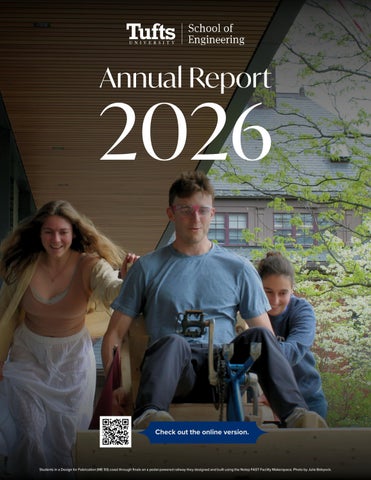
Students in a Design for Fabrication (ME 93) coast through finals on a pedal-powered railway they designed and built using the Nolop FAST Facility Makerspace. Photo by Julie Bobyock.
Table of Contents
1
Dean’s Message
2
Selected Faculty Achievements
3
Faculty Recruitment
6
Selected Alumni and Student Achievements
7
Undergraduate and Graduate Education
9
A Vibrant Engineering Community for All
11
Selected Research Highlights
12
Advancement and Outreach
15
Highlights from Selected Centers and Institutes
17
Infrastructure Development
21
A Blueprint for Career Success
22
Principal photography: Alonso Nicholas, Andy Kwok Inside front cover: Assistant Professor Andrew Stout (left) and M.S. in biomedical engineering student Jordann Powers (right) work together on cellular agriculture research. Note: All information is accurate as of July 2026.
Dean’s Message Dear School of Engineering community and colleagues, As I reflect on the past year at Tufts University’s School of Engineering, one word comes to mind: excellence. Our faculty continued to produce top-tier research and advance solutions to some of the world’s most pressing issues and complex challenges. You can read more about faculty research and accomplishments throughout this report. We welcomed 14 new faculty members to our community this year and grew our number of tenure-stream faculty members to 100. Through our Professorship Initiative, we’re attracting and recognizing exceptional scholars and teachers with named endowed professorships and faculty fellowships, bolstering each of our already-outstanding departments. It is truly inspiring to see all that our students accomplish each year. From hosting hackathons to building robots, our students bring an innovative spirit that is the lifeblood of our vibrant campus community. Facilities such as the Nolop FAST Facility Makerspace help students make their ideas a reality, like the pedal-powered railway that took over the Tsungming Tu Complex patio during the last week of classes this spring. This year we launched a new Biotechnology Industry Seminar Series showcasing different career paths through conversations with leading voices in the field. Our first two speakers in the series, Ted Myles and Atsuko Polzin, shared their experiences in leading their organizations through growth cycles and challenging periods by leaning into ethical decision making and collaborative approaches. The seminars offered a wonderful opportunity for students to learn about an industry that has deep ties to universities in the Greater Boston area and network with technology and business leaders in the field.
to be responsible leaders in a rapidly changing world that is profoundly impacted by technology. Importantly, the AI minors are designed to equip our students with knowledge regarding the limitations and potential uses of AI in areas that matter to them. Like our educational mission, research in the school seeks to advance discovery and innovation that have the potential to broadly benefit society. Whether publishing cancer research or presenting the latest trends in cybersecurity at top venues, Tufts engineers keep the public good at the forefront of their minds. Tufts students and researchers are engaging thoughtfully with emerging technology such as AI to drive innovation for good in the classroom, the lab, and the wider world. Thanks in large part to research and discovery in the School of Engineering, Tufts University was recognized once again by the National Academy of Inventors on their Top 100 list for Faculty Patents in 2025. Gifts from friends and alumni continued to have a Jumbo impact on accelerating research and enhancing the student experience. I am so grateful to our supporters who have generously given their time and expertise by returning to Tufts for career panels and Q&As with students, or by offering to host students for internships or co-ops. It is inspiring to be part of a community that cares deeply about giving back. This report showcases selected highlights from FY26 in the School of Engineering, as it would be impossible to include all our significant student, staff, and faculty accomplishments. I hope you enjoy the report, and feel uplifted, as I do, by the impactful work of our school. Sincerely, Kyongbum Lee Karol Family Professor Dean, School of Engineering
Our academic offerings expanded again this year with new master’s and certificate programs in cybersecurity for graduate students and two new AI minors for undergraduate students. Like our existing programs, these new courses of study are designed to prepare students 2
Selected Faculty Achievements Distinguished Professor and Dean of Graduate Education Karen Panetta was awarded the 2026 Institute of Electrical and Electronics Engineers (IEEE) Mildred Dresselhaus Medal. Professor Jason Rife was named Fellow of the Institute of Navigation. Stern Family Endowed Professor and Distinguished University Professor David Kaplan was selected for the American Institute for Medical and Biological Engineering (AIMBE) Pierre Galletti Award. Professor Douglas Matson was honored with the Founders Award from the American Society for Gravitational and Space Research—the highest honor given by the society. Professor Ayse Asatekin won the Yeoman Innovation Award from the American Institute of Chemical Engineers (AIChE) Separations Division for her impactful research in the field of separations. Professor Shafiqul Islam was named a Harvard Radcliffe Fellow for his work in engineering diplomacy. Professor Chris Swan was elected to the Engineers Without Borders-USA Faculty Leadership Council. Assistant Professor Chunmei Li was named to Clarivate’s 2025 list of the world’s most highly cited researchers. Greses Pérez, McDonnell Family Assistant Professor of Engineering Education, was selected as the 2025 National Academy of Education/Spencer Postdoctoral Fellow for her work in how multilingual and multidialectal communities learn engineering. Assistant Professor Elaine Schaertl Short was recognized with the 2026 Skip Ellis Early Career Award by the Computing Research Association. Assistant Professor Aseema Mohanty and Lin Family Assistant Professor Dan Votipka each received a National Science Foundation (NSF) CAREER Award for their projects improving photonic integrated circuits and human-centered threat modeling, respectively. Associate Professor Paul Simmonds received a grant from the SCALE Capital Program to fund equipment for his ecosystem development project. Associate Professor Valencia Koomson won a Massachusetts Life Sciences Center 2025 Health Equity Accelerator grant to support her work in bias-free pulse oximeter devices. Professor Jeffrey Guasto received an Experimental Physics Investigators award from the Gordon and Betty Moore Foundation for his work in active matter flows.
Scan the QR code to read more faculty achievements on the web.
3
Internal Tufts Awards Assistant Professor Marco Donato SOE Faculty Teaching and Mentoring Award Professor Sergio Fantini Seymour Simches Award for Distinguished Teaching and Advising Assistant Professor Juan Gnecco Engineering Engagement Award Assistant Teaching Professor Milos Kazerounian Lerman-Neubauer Prize for Outstanding Teaching and Advising Associate Professor Nikhil Nair Rising Innovator of the Year Associate Professor Madeleine Oudin Faculty/Staff Diversity, Equity, Inclusion, and Justice (DEIJ) Service Award Professor Matthew Panzer Henry and Madeline Fischer Award Senior Lecturer Jane Seminara SOE Faculty Teaching and Mentoring Award Professor Sameer Sonkusale Distinguished Innovator of the Year Lin Family Assistant Professor Dan Votipka Sunrise Award
Karen Panetta
Jason Rife
David Kaplan
Douglas Matson
Ayse Asatekin
Shafiqul Islam
Chris Swan
Chunmei Li
Greses Pérez
Elaine Schaertl Short
Aseema Mohanty
Dan Votipka
Paul Simmonds
Valencia Koomson
Jeffrey Guasto
Marco Donato
Sergio Fantini
Juan Gnecco
Milos Kazerounian
Nikhil Nair
Madeleine Oudin
Matthew Panzer
Jane Seminara
Sameer Sonkusale 4
Promotions
New and Newly Appointed Named Professorships
Fahad Dogar, Professor Michael Hughes, Associate Professor Valencia Koomson, Professor Nikhil Nair, Professor Markus Nemitz, Associate Professor Raja Sambasivan, Associate Professor Elaine Schaertl Short, Associate Professor Deborah Sunter, Associate Professor Kristen Wendell, Professor Rob White, Professor
Ryan Cosner, Glenn R. Stevens, E49, Assistant Professor
(effective September 1, 2026)
Michael Hughes, Wittich Family Assistant Professor (until Sept. 1, 2026) Nisha Iyer, Tiampo Family Assistant Professor Matthew Panzer, E Ink Professor of Engineering Sameer Sonkusale, Jon A. Levy School of Engineering Professor Deborah Sunter, John A. and Dorothy M. Adams Faculty Development Assistant Professor (until Sept. 1, 2026) Bin Wang, Robert and Marcy Haber Endowed Professor in Energy Sustainability
5
Ryan Cosner
Fahad Dogar
Michael Hughes
Nisha Iyer
Markus Nemitz
Raja Sambasivan
Elaine Schaertl Short
Deborah Sunter
Bin Wang
Kristen Wendell
Rob White
Faculty Recruitment Total faculty: 100 New full-time faculty members include: AraOluwa Adaramola
Daniel Mitropolsky
Assistant Teaching Professor in Chemical and Biological Engineering
Assistant Professor in Computer Science
Ph.D., Purdue University
Research interests: Interfacial and transport phenomena, radiative heat transfer, materials science
Ph.D., Columbia University
Teaching interests: Engineering education, student motivation, assessment, faculty development
Lidia Al-Zogbi
Corey White
Assistant Professor in Electrical and Computer Engineering
Assistant Professor in Electrical and Computer Engineering
Ph.D., Johns Hopkins University
Ph.D., University of Texas at Austin
Research interests: Autonomous medical robotics, surgical robotics, medical devices, image-guided interventions, modeling and simulation, sensing, actuation and control methods, embodied artificial intelligence
Research interests: (Opto)electronics and photonics, compound semiconductors, emerging materials, epitaxial growth, hetero- and nano-structures, applications in sensing, integrated photonics, quantum information systems
Shaanan Cohney Assistant Professor in Computer Science Ph.D., University of Pennsylvania
Learn more about the new faculty members.
Research interests: Computer security; privacy, law, and public policy; real-world technical systems interacting with legal and institutional constraints
150
100
50
0 2015-16
2016-17
2017-18
2018-19
Tenured/Tenure Track Professors
2019-20
2020-21
2021-22
Professors of the Practice
2022-23
2023-24
Full-Time Lecturers
2024-25
2025-26
Teaching Professors
6
Selected Alumni and Student Achievements Alumni Sabih Khan, A88, E88, became Apple’s chief operating officer, transitioning from his previous position as Apple’s senior vice president of operations. The School of Engineering welcomed alumnus Johnson Lee, A98, E Ink CEO, to deliver the Dean’s Lecture. Tufts alumnus Glenn Bell, E74, E06P, E08P, delivered an engaging and timely Gold Medal address at The Institution of Structural Engineers. Alexis Abramson, E95, EG98, delivered remarks at the SOE Graduate Programs Commencement ceremony while David Rosowsky, E85, EG87, shared his wisdom with engineering undergraduates at the Phase II ceremony. Tyler “Ty” Andrews, E13, set a speed record while climbing Mount Everest.
Sabih Khan
Johnson Lee
Glenn Bell
Alexis Abramson
David Rosowsky
Tyler Andrews
Victor Oludare
Jay Kim
Alumni Awards Victor Oludare, EG22 SOE Outstanding Service Award
Jay Kim, EG06 SOE Outstanding Career Achievement Award
Students Reagan Bushok, Maddie Szoo, and Izabela Zmirska were selected for the National Science Foundation Graduate Research Fellowship Program. Avijit Paul was first author on one of the top-cited papers in the Journal of Biophotonics. Bricker Like and Ryan O’Hara were honored with the inaugural Nakho Sung Graduate Student Travel Award. Bergen Kane, E26, received a scholarship from the Environmental Business Council of New England. Dan Choate was named one of two Student Paper Award winners at the Institute of Navigation (ION) GNSS+ Conference. Elias Bilal, E26, was named a Patti Grace Smith Fellow for 2026. Tufts University’s American Society of Civil Engineers student chapter earned second place overall at the 2025 Northeast Regional American Institute of Steel Construction Student Steel Bridge Competition. Students in Tufts Engineers Without Borders completed successful trips to Malawi and Ecuador, where they supported clean water projects. Undergraduate students in JumboCode offered their software skills to support community organizations like Bread & Roses Kitchen. Madison Giles, E27, designed a hyper-realistic hummingbird feeder that earned a United States Patent. Tufts students won this year’s Construction Industries of Massachusetts-Labor Relations Division (CIMLRD) for their unique MBTA stop design. As a Sustainable Solutions Fellow, Saskia Zimmerman, E25, EG26, researched how Tufts dining could choose more sustainable seafood options. 7
Student Awards Ethan Harvey, Azhar Mohammed, Claudia Navarro, and Ronald Thompson SOE Award for Outstanding Academic Scholarship
Amirali Asadian SOE Award for Outstanding Graduate Contributor to Engineering Education
Varun Nair SOE Award for Commitment to the Practice of Engineering
Tanushree Burman
Graduate Student Council Service Award
Izabela Zmirska
Madison Giles
Ethan Harvey
Azhar Mohammed
Claudia Navarro
Ronald Thompson
Amirali Asadian
Varun Nair
Tanushree Burman
Tufts Undergraduates in the Class of 2025
87%
63%
completed at least one internship during their time at Tufts
completed more than one internship
*Based on a 94% knowledge rate
Select Internship Experiences
Tufts Global Education
63
students participated in semester programs
18
participated in summer programs in summer 2026
The top SOE majors represented across those 81 students were:
21
Mechanical Engineering
12
Computer Engineering Computer Science Biomedical Engineering
8 8
Tufts Global Education
Bo Pilarczyk
Research and Development Engineering Intern, Lexington Medical, Inc.
Bo Pilarczyk, E27, (second from right) traveled to Arkansas to observe the engineering behind the company’s stapling technology in action during surgery.
Mason Coleman
Data Analyst, F.L.I.E.S. Arts Project Supported by the Tufts Career Center’s Summer Internship Grant, Mason Coleman, E28, used his technical problem-solving skills to strengthen the organization’s arts education programming.
Korinna Spirko
Research Intern, Human Robot Systems Lab and UMass Integrative Locomotion Lab
Korinna Spirko, E28, left, worked on modifying hip exoskeleton prototypes designed to reduce the metabolic cost of running and improve gait for post-stroke patients.
Oakley Winters
Infrastructure Intern, Washington Metropolitan Area Transit Authority
During an internship with the Washington Metropolitan Area Transit Authority, Oakley Winters, E26, helped improve the transit system they grew up with.
Izzy Kossar
Hardware Engineering Intern, BioSens8 At the med-tech startup BioSens8, Izzy Kossar, E27, immersed herself in the fast-paced world of early-stage product development.
Engineering participation in Tufts Global Education programs has continued its steady growth. This past year, Tufts Programs Abroad sent its first cohorts to new STEMfocused tracks with Tufts in Madrid and Tufts in Hong Kong. Summer opportunities continue to be highly appealing to engineering students. In summer 2025, the non-credited STEM research exchange with National Cheng Kung University in Taiwan ran for the first time. The Global Design in Cartagena, Colombia, course continues to be a popular option for an experiential learning trip in which students collaborate with community members on local design improvements. In 2026, two SOE students participated in the Public Health and Indigenous Communities summer program in Santiago, Chile. 8
Undergraduate and Graduate Education Graduate Education
Undergraduate Education* Get to know the admitted Engineering Class of 2030
3,575
7,673 9%
Number of Acceptance rate applications received
17%
First-generation students
10%
Applicants for graduate programs (Ph.D., M.S., and Certs.) for fall 2025
International students
72
Applicants from
31
States (plus the District of Columbia and Puerto Rico)
21
Graduate students participated in co-ops (fall 2025 and spring 2026 combined)
Countries (outside the United States)
*All numbers accurate as of July 2026. Numbers represent the admitted class, not the enrolling class.
Undergraduate Applications Number of applications
8,000 7,000 6,000 5,000 4,000 3,000
2015–16
2016–17
2017–18
2018–19
2019–20
2020–21
2021–22
2022–23
2023–24
2024–25
2025–26
Academic year
The School of Engineering launched new master’s and certificate programs in cybersecurity this year, complementing the current M.S. in Cybersecurity and Public Policy program. 9
Graduate students continue to build their skills through the graduate co-op program, with students completing co-ops at companies such as Tesla, Johnson & Johnson, and Massachusetts General Hospital.
Number of applications
Graduate Applications 4,000 3,000 2,000 1,000
2015–16
2016–17
2017–18
2018–19
2019–20
2020–21
2021–22
2022–23
2023–24
2024–25
2025–26
Academic year
Enrollment and Degrees Awarded
2024-25 Enrollment
Engineering Program
BS
Architectural Studies
4
Certificate and Postbacc
MS
Engineering Degrees Granted PhD
BS
Certificate and Postbacc
MS
Artificial Intelligence
13
3
Bioengineering
35
13
Biomedical Engineering
193
1
Biophotonics
51
Biotechnology Engineering
1
Cellular Agriculture
7
Chemical Engineering
108
Civil and Environmental Engineering*
117
48
0
503 63
Electrical and Computer Engineering****
193
Engineering
8
98 18
2 2
9
24
18
4
4
21
36
34
10
4
86
17
157
103
190
43
13
34
31
15
148
50
8
2
Engineering Psychology (from School of Arts and Sciences)
66
31
Engineering Science
4
3
Environmental Engineering Policy and Planning**
45
Environmental Management
1 53
55
0
4
12
35 3
13
Human Factors in Medical Devices and Systems, online and on campus
2
4
Engineering Physics
Human-Robot Interaction**
13
Innovation and Management
73
6
8
1
45
1
Manufacturing Engineering Materials Science and Engineering** 374
9
9
45
27
6
4
67
3
1
25
8
1
No Major Offshore Wind Energy Engineering
4 1
1
Product Design and Development 3
2
Software Systems Development
3
Technology Management and Leadership TOTAL (Engineering only):
5
4
71 29
Engineering Management
Public Health Engineering (formerly Environmental Health)
5
1
16
Data Science, online and on campus
Mechanical Engineering
26
4
Cybersecurity and Public Policy**
Human Factors Engineering
1
20
Cognitive Science** Computer Science, online and on campus***
60
1
PhD
1,697
6
9
146
809
2 338
456
3
3
15
373
44
*Civil and Environmental Engineering are two separate B.S. degrees but one combined graduate program. **Students in joint-degree programs are only counted once but are also assigned to a second dept in SOE, A&S, or Fletcher ***For Computer Science B.S. numbers include both SOE and A&S students. ****For B.S. and M.S. programs, Electrical and Computer Engineering are two separate degrees. For Ph.D. Electrical and Computer Engineering is one degree.
10
A Vibrant Engineering Community for All Tufts is committed to providing transformative experiences for students and faculty in an inclusive and collaborative environment where creative scholars generate bold ideas, innovate in the face of complex challenges, and distinguish themselves as active citizens of the world. This year, students, faculty, and staff in the School of Engineering continued to support and celebrate one another and cultivate opportunities for connection.
During the Order of the Engineer induction ceremony, 135 Tufts engineering students took an oath, vowing to use their skills for good.
Tufts celebrated Engineers Week 2026 with egg drops, light-up beetles, and more.
Over the years, students including Rishabh Chaudhary (left) and Tim Cheng (right) designed and built a wind tunnel in Professor Rob White’s lab. 11
Students baked bread and brewed kombucha as they learned about fermentation in an Experimental College class taught by chemical engineering majors David Gillingham and Dylan Patel.
Selected Research Highlights Energy, Water, and the Environment Assistant Professor Lauryn Spearing received an NSF grant to study barriers to rebuilding and remediating homes after wildfires. Louis Berger Chair Farshid Vahedifard devised a scoring system to prioritize cleanup at polluted sites. As part of a larger effort to reduce the chemical industry’s reliance on petroleum, Associate Professor Nikhil Nair is creating a biosynthetic organism for sustainable chemical manufacturing. Professor Shafiqul Islam co-edited the Routledge Handbook of Water Diplomacy. Associate Professor Jeffrey Guasto worked with Wake Forest University to investigate virus-infected microbes in algae. Associate Professor Jonathan Lamontagne explored the benefits of cross-country coordination of the electric grid in South America. Associate Professor Robert Viesca investigated earthquake triggers.
Human Health and Bioengineering Professor Sameer Sonkusale’s specially designed floss pick can easily and accurately measure cortisol, a stress hormone, in real time. Professor Bree Aldridge innovated an AI-assisted method that opens the door to smarter treatment for tuberculosis. The startup Cellens uses Tufts research from Professor Igor Sokolov to non-invasively diagnose bladder cancer. Assistant Professor Andrew Stout and Natalie Rubio, EG22, are pioneering a way to make advances in cellular agriculture more widely available. Associate Professor Nikhil Nair discovered a new way to biosynthetically produce tagatose, a healthier sugar substitute. A study co-authored by Stern Family Distinguished Professor David Kaplan explored how advances in biomaterials and cellular agriculture can help achieve food security.
Lauryn Spearing
Farshid Vahedifard
Nikhil Nair
Shafiqul Islam
Jeffrey Guasto
Jonathan Lamontagne
Robert Viesca
Sameer Sonkusale
Bree Aldridge
Igor Sokolov
Andrew Stout
Natalie Rubio
Approximately
$41 Million 483 in externally-sponsored research expenditures in SOE
new and supplemental funding requests
David Kaplan
12
Selected Research Highlights Human-Technology Interface A new impact-revealing paint by Frank C. Doble Professor Fiorenzo Omenetto could be applied to measure forces like concussion-level impacts to helmets or placed on insoles to analyze an orthopedic patient’s gait. Associate Professor Fahad Dogar created an AI tool to better comprehend how autistic individuals communicate. Lin Family Assistant Professor Dan Votipka is building software that could improve cybersecurity threat response time in hospitals. Markus Nemitz’s next-generation crab-inspired robots could be used for aerial deployment and amphibious operations. Research in the Nemitz group is also paving the way for large-scale 3D-printed soft robots. Associate Professor Robert White is part of a team creating a first-ofits-kind hydrophone built around a simple, commercially available microphone. White is also working on a device to measure different types of hydrogen and helium atoms in Saturn’s atmosphere.
The sole of a shoe coated in impact sensitive paint shows how impact on the foot varies in different areas. Image: Giulia Guidetti, Silklab.
Intelligent Systems With an eye toward policy, Susan Landau published research on the integration of Internet of Things devices in everyday life. Karol Family Applied Technology Professor Matthias Scheutz developed a proof-of-concept for efficient AI systems that could use 100 times less energy than current ones while providing more accurate results on tasks. A team of SOE students and faculty led by Professor Mark Hempstead developed an AI tool to quantify the accuracy of conclusions from privacy-enhanced data in the social and behavioral sciences. Distinguished Professor and Dean of Graduate Education Karen Panetta’s Ph.D. student Laura Kaplan presented her work on the interactions between artificial intelligence and real-world traffic collisions at the New England Instrumentation and Technology Symposium.
Learning Science Researchers in the Center for Engineering Education and Outreach (CEEO) gained new insights into AI-assisted learning using CodeRobots.ai, a generative AI research platform. In fall 2025, the platform was part of a research project with first-year engineering students to study how AI can help bridge disparities in prior programming experience in robotics courses. CEEO researchers also continued work on the NSF-funded Smart Playground project, releasing a new prototype wand that students can use to play games and create their own programming sequences on the playground. The project aims to introduce computational thinking to young children through hands-on, playful experimentation on the playground.
13
An imagined rendition of how multi-legged robots might find and disarm landmines.
A 3D-printed soft robotic hand from Assistant Professor Markus Nemitz’s lab holds a water bottle.
A 3D-printed soft robotic hand from Assistant Professor Markus Nemitz’s lab.
Selected Research Highlights
Professor Nikhil Nair developed a way to biosynthetically produce an otherwise rare sugar called tagatose.
Professor Sameer Sonkusale’s specially designed floss pick can easily and accurately measure cortisol, a stress hormone, in real time.
Engineering Invention Disclosures 125
100
75
50
25
0
16
FY
17
FY
18
FY
SOE invention disclosures
19
FY
20
FY
21
FY
22
FY
23
FY
24
FY
25
FY
26
FY
Tufts invention disclosures
Read more about SOE research news.
14
Advancement and Outreach Development
Alumni Outreach
FY26 was a landmark year for the School of Engineering’s fundraising efforts. In response to the most ambitious goal in the school’s history—$29 million—engineering alumni, parents, and friends came together in extraordinary fashion, helping to raise more than $30 million in support of faculty research, scholarships, BEST, NOLOP, and student experiential learning opportunities. This year, the school received two significant gifts: a major investment to reimagine the Tufts Institute for Artificial Intelligence, including partial support for five faculty positions across four Tufts schools, and a $5 million gift from E Ink to establish the E Ink Endowed Professorship and E Ink Makerspace, a new digital makerspace open to all Tufts students and faculty. As a central pillar of Dean Lee’s long-term strategy to grow the school’s faculty through 25 new endowed professorships, the Professorship Initiative secured support this year for four new endowed professorships and one endowed faculty fellowship. To date, the school has raised more than $23 million toward this priority, advancing support for eight new endowed professorships.
Approximately 100 current students and 60 alumni gathered on campus for the 20th anniversary of the annual StudentAlumni Engineering Industry Networking Night, organized by the Office of Alumni Engagement and Career Center. Karol Family Professor and Dean of the School of Engineering Kyongbum Lee shared key institutional and school-level updates with alumni and parents of current students during visits to Mountain View and San Francisco, California. A total of 120 alumni from all schools, their guests, and current students’ parents based in Asia attended events hosted by Emmanuel Wandi Wanandi, E91, E17P, E19P, and Michael Fung, A79, A12P, in March 2026. Events included School of Engineering receptions in Jakarta and Hong Kong, a reception for Tufts University President Sunil Kumar in Bangkok, and a Tufts community reception in Tokyo. Attendance was strong overall, with particularly high participation in Indonesia and Thailand, reflecting enthusiasm for first-time visits by senior university leaders in these areas.
Corporate and Foundation Relations (CFR) With $5.5 million in corporate and foundation contributions, the School of Engineering continued to build robust, highimpact partnerships throughout FY26.
15
Among this year’s highlights: GE Vernova Advanced Research partnered with CFR to pilot a unique, highly symbiotic industry-academia collaboration. Designed around the corporation’s pressing technical challenges, a tailored RFP yielded deep faculty engagement and resulted in $500,000 in total funding across three awarded research projects spanning clean energy infrastructure and advanced robotics. Amazon Robotics demonstrated the power of corporate agility and rapid turnaround through a partnership with CFR that translated from an initial conversation to an awarded $100,000 unrestricted gift in just two weeks. The funding provides critical, immediate support for student mechanical engineering design, robotics capstones, and fabrication lab resources.
Bárbara Brizuela (left), dean of the School of Arts and Sciences, and Kyongbum Lee (right), dean of the School of Engineering, speak with alumni and parents in California.
SOE Dean Kyongbum Lee (center) visits Indonesia.
Alumni and parent reception in California.
Co-Op and Career Center Fast Facts Career Center With over 700 one-on-one engineering appointments with students and record levels of enrollment in the Professional Preparation for Cooperative Education course, the Career Center had a productive year. The department of Electrical and Computer Engineering launched a co-op for third-year undergraduate students, joining existing undergraduate co-op programs in the departments of Biomedical Engineering, Computer Science, and Mechanical Engineering and a co-op program for graduate students. Robin Kahan and Amory Wakefield worked with Undergraduate Dean and Associate Professor C. Andrew Ramsburg to plan Foundations for Engineering Success, a new required course for engineering first-years.
Sample Graduate Co-Op Locations Pfizer Tesla Johnson & Johnson Merck Intermedia Cloud Communications RISE Robotics and many more
Student Industry Site Visit Locations Cabot Corporation J.P. Morgan Lexington Medical Trillium Trading Wasabi Technologies and many more
Graduate Co-Op Participants
59 13 78 Fall 2025
Spring 2026
Fall 2026
Top 5 Most Highly Attended Career Center Events
215 134 140
Consulting Networking Night
Life Sciences Networking Night 2025
153
20th Annual Engineering Student-Alumni Networking Night
Finance Networking Night
99
Computer Science Networking Night
Annual Student-Alumni Engineering Industry Networking Night. 16
Highlights from Selected Centers and Institutes Center for Applied Brain and Cognitive Sciences (CABCS) CABCS builds interdisciplinary research teams for research and development aimed at measuring, predicting, and enhancing cognitive capabilities and humansystem interactions for individuals/teams in high-stakes environments. CABCS projects involve Tufts faculty, postdocs, students, and staff. This year’s projects focused on neuromodulation, predictive modeling, state classification, large language models (LLMs), and performance enhancement. The team demonstrated that repeated cranial electrotherapy stimulation can improve resilience to stress and explored transcranial electrical stimulation for mitigating high cognitive workload states.
They developed machine learning models and software tools to predict the effects of load carriage, load distribution, and physical activity on cognitive and biomechanical performance. They also showed that movement-based signatures can help classify mental states such as stress, workload, and uncertainty, while advancing multimodal approaches for monitoring performance during demanding multitasking scenarios. In addition, CABCS is developing an LLM that provides leaders with actionable recommendations to optimize readiness under conditions such as stress, fatigue, sleep loss, dehydration, thermal burden, calorie restriction, and load carriage. Finally, they continue to investigate technologies and techniques for acute performance enhancement.
Center for Engineering Education and Outreach (CEEO) Approximately 70 K–12 educators gathered for a full day of sessions focused on making engineering accessible to all students at the Eye on STEAM conference co-hosted by the CEEO and Acera EI. With support from Samsung, CEEO Director Merredith Portsmore traveled to Cambodia to lead a weeklong training program for education faculty. The collaboration will continue online as CEEO faculty and staff support implementation and co-design of Cambodianspecific activities and resources. LearnCEEO.tufts.edu launched this year. The website offers educators of all ages a growing library of STEM education and professional development resources.
Educators discuss ideas at the Eye on STEAM conference.
During the first year of JUMP-IN, a new Tufts program encouraging exploration of possible professional paths through immersive weeklong experiences, the CEEO offered a workshop where students designed and built projects in the Nolop FAST Facility Makerspace and used AI to develop games. Music engineering brought many non-engineers into contact with Tufts CEEO. Staff learned how to make their own speakers at a workshop run in collaboration with Tufts Digital Design Studio and Tisch Library. University College and CEEO launched the first Engineering of Music summer residential program in summer 2025. The music engineering program and CEEO cooperated on a free, one-day music engineering workshop that welcomed 100 local middle and high school students to campus to build speakers and instruments. 17
Students participated in the JUMP-IN program over spring break.
Center for STEM Diversity (CSD) The suite of CSD programs continued to demonstrate strong outcomes for participating students. More than 90 percent of ACE++ students reported increased confidence in their ability to become computer scientists and significant growth in identity, persistence, and sense of belonging. In a post-seminar survey, all 39 RISE participants stated that the program empowered them to access one or more campus resources. In the final year of its initial funding cycle, the DIAMONDS program continued to demonstrate strong research and career outcomes. Students contributed to peer-reviewed publications and conference papers and engaged directly with pathways to graduate study and industry careers. The program’s renewal proposal was successfully awarded in late spring 2026, and the program will resume in summer 2027. The CSD’s industry visit series brought students to four different companies where they met with current employees to learn about available career paths—including a BEST alum at Boston Dynamics.
Annual Boston Security Usability Research Day.
Bridge to Engineering Success (BEST) applications are up 14 percent for the 2026 cohort, with 24 applications and 12 students admitted. Ten students participated in funded research projects through the CSD Scholar program, a one-year internally funded continuation of the canceled NSF Louis Stokes Alliances for Minority Participation program. STEM Ambassadors reached roughly 1,300 high school students through off-campus outreach events and expanded to include an on-campus event in collaboration with Associate Professor James Van Deventer for students from Medford Vocational Technical High School’s biotechnology program.
Cybersecurity Center for the Public Good The Tufts Center for Cybersecurity for the Public Good sponsored graduate student travel, undergraduate research, and a number of workshops during the year. In February, the center was the prime sponsor for the third Annual Boston Security Usability Research Day (ABSURD), which brought together 50 researchers from universities, government, and industry focused on the human factors and societal impacts of cybersecurity and privacy. Academic and industry researchers from across the globe gathered in April for New England Hardware Security Day. In June, the center hosted the fourth Anonymity Day Workshop, bringing together approximately 25 researchers and students to discuss anonymity, privacy, fairness, legal issues, and cryptographic primitives.
Researchers gathered to share the latest ideas at New England Hardware Security Day as shown in the three photos above. 18
Auster Center for Applied Innovation and Research The Auster Center launched two new initiatives: the Civic Innovation Initiative focused on trust in AI and Innovate2Impact in collaboration with Tufts Clinical & Translational Science Institute, with a Food and Nutrition Innovation Initiative coming soon. Through the National Science Foundation’s I-Corps program, the Auster Center supported several venture teams, including SilkMed, which won Best in Show in the National I-Corps fall 2026 cohort.
Derby Entrepreneurship Center 2026 marks five years since the official naming of the Derby Entrepreneurship Center. Two teams from the 2026 Tufts Venture Accelerator cohort made first revenue, demonstrating the high standards for entrepreneurial output at Tufts. Numerous projects won external prizes, including Matcha Luxe, Microvitality, Cellens, and Entocellular. The startup Burwoodland received funding from entrepreneur Mark Cuban. On campus, students prioritized technological literacy and AI fluency.
Members of the Matcha Luxe team pose with SharkNinja CEO Mark Barrocas after winning second place in the SharkNinja Innovation Challenge.
Tufts Gordon Institute (TGI) Over 80 alumni gathered to celebrate 10 years of the M.S. in Innovation and Management program at TGI. Alumni at MathWorks, SharkNinja, Bose, Cellens, and ZwitterCo gave tours to current students and spoke about their career journeys. Students also connected with alumni during a product management panel on campus. Current graduate students have received co-op and internship positions at companies including Bose, SharkNinja, Draper, Texas Instruments, Tesla, and Johnson & Johnson. TGI is planning its first AI-centered Immersive Experience for summer 2026.
Participants in the Civic Innovation Initiative discuss trust in AI.
TGI community members gather to celebrate 10 years of the Master’s in Innovation and Management program. 19
Tufts Epsilon Materials Institute (TEMI) Professor Laurent Pilon joins Tufts from the University of California, Los Angeles as the inaugural director of the Tufts Epsilon Materials Institute (TEMI) and as the Epsilon Energy Materials Innovation Professor within the Department of Mechanical Engineering. Starting fall 2026, he will lead interdisciplinary research, foster collaborations across the university, and strengthen partnerships with government, industry, and the broader materials research community. As part of these efforts, TEMI will be recruiting two tenure-track assistant professors to help expand Tufts’ strengths in materials research and contribute to the institute’s mission and vision.
Tufts Institute for Artificial Intelligence (TIAI) As a university-based institute, TIAI’s research and events brought the entire Tufts community together to advance artificial intelligence. Based on a seed grant proposal cycle, TIAI awarded four projects focused on human health and AI. The projects have made great progress, thanks to TIAI data scientists working closely with interdisciplinary project teams. The Center for Data Foundations in AI hired one data scientist, Anar Amgalan, and the Human-AI Interaction Center (HAII) hired its first two staff members: Thomas Arnold and Priyamvada “Pia” Tripathi. TIAI hosted several successful events, including the second TIAI Big Ideas Day, a Human-AI Interaction Discovery Event with over 100 participants from all campuses, and the Human Interaction and AI Event with nearly 80 faculty participants from all campuses and eight invited faculty presentations.
Other research centers include the Tufts University Center for Cellular Agriculture, the Institute for Research on Learning and Instruction, Tufts Interdisciplinary Advanced Materials (TIAMAT), and the Initiative for Neural Science, Disease & Engineering (INSciDE@Tufts).
Learn more about centers and institutes on the web.
Student presentations and faculty lightning talks at Human-AI Interaction Discovery Event. 20
Infrastructure Development A renovation of approximately 1,000 square feet of lab space in Anderson Hall was completed to house the sensitive instrumentation of Professor Igor Sokolov’s lab. This included extensive electromagnetic radiation shielding to allow Sokolov’s atomic force microscopy to provide the most sensitive and accurate results for his federally funded research. Work was also completed on a 3,000-square-foot shared laboratory suite on the second floor of the Science and Technology Center. The suite includes shared open laboratory space as well as support labs for microscopy and individual tissue culture space, and new research space for three faculty members. Individual lab renovations are underway for two new faculty in the Department of Mechanical Engineering. Construction of Glenn R. Stevens, E49, Assistant Professor Ryan Cosner’s robotics lab is nearly complete, while construction for Assistant Professor Hungtang Ko’s lab, which includes water tanks for his aquatic robots, began in summer 2026. At the university level, work continues on Pachyderm Place, a new 660-bed residence hall for juniors and seniors with ground-floor commercial space at 401–403 Boston Avenue. The building has achieved pre-certification from the Passive House Institute (PHI), a rigorous international standard for high-performance, energy-efficient buildings. Passive House-certified student housing remains relatively uncommon in North America, making the project a notable example of high-performance campus design. The university also announced that it will be submitting plans to the city of Medford for a new aquatics center on College Avenue, with construction expected to be completed by the start of the fall 2028 semester.
Exterior rendering of Pachyderm Place by Elkus Manfredi. 21
Exterior rendering of the Tufts Aquatics Center by Sasaki.
A Blueprint for Career Success A new experiential learning initiative in the School of Engineering establishes a comprehensive, multiyear endeavor of undergraduate career experiences. Tufts alumnus Dan Byrne, E76, knows the value of a college internship. As a Tufts undergraduate, he completed several internships, setting him up for a successful career in entrepreneurship focused on temperature control and refrigeration systems. “My first internship at a Caterpillar Equipment Dealer in Syracuse opened my eyes to what is possible when young people are given meaningful opportunities to learn beyond the classroom. Through hands-on experience and mentorship from accomplished engineers, I developed the confidence, work ethic, and perspective that continue to guide me today,” Byrne said. For many Tufts students, hands-on experiences are where their future begins to take shape. With a bold new initiative that aims to create high-quality experiential learning opportunities for all engineering undergraduates, Engineering Blueprint offers a way for every student to begin drafting their career path. The initiative includes strengthened academic advising, curriculum updates, career center resources, and more. Byrne is the first contributor to Engineering Blueprint. “I am proud to support Blueprint because I believe in the transformative power of opportunity and the impact it can have on a student’s future. My own internships as a Tufts student were pivotal experiences that helped shape the trajectory of my career. Investments in experiential learning create ripple effects that extend far beyond a single student, empowering generations of Tufts graduates to make lasting contributions in their professions and communities,” Byrne said.
Expanding Experiential Learning at Tufts Many early career opportunities are unpaid or underpaid, creating barriers for students who need to earn money over the summer. Engineering Blueprint aims to alleviate these constraints so that every undergraduate engineering student can participate in a formative career experience during their first two years at Tufts. The initiative is backed by a school-wide infrastructure to nurture hands-on learning and career readiness. Students will have access to opportunities across Tufts, as well as internships and co-ops at external organizations, benefiting from the abundance of engineering and technology companies in the Boston area.
To help expand these opportunities, the School of Engineering hired Associate Director of Experiential Partnership Development Mark Almeida to develop pathways for internships, projects, mentored research opportunities, service experiences, and more. Professional development will also be embedded into the curriculum through the required first-year course Foundations for Engineering Success (EN3).
Alumni Support Facilitates Meaningful Career Growth True to its name, Engineering Blueprint doesn’t require students to set their futures in stone but encourages them to gain hands-on experience in their first few years at Tufts to help them feel more prepared for post-graduation life. This ambitious vision is supported by generous donors like Dan Byrne. Philanthropic support expands access to paid opportunities and helps ensure that all students can access dynamic learning experiences while at Tufts. Kelly St. Fort, a second-year engineering student, is one example of how internships can guide a student’s career path. After several clinical-focused internships, she realized she was more interested in medical devices and changed her major from biomedical engineering to mechanical engineering, with a second major in biomedical engineering. “I’ve dabbled in a bunch of smaller type internships where we’ve done more clinical stuff and I just don’t really see myself doing cells and tissues, but more so medical devices,” she said. This summer, St. Fort is helping design an enrichment program for middle schoolers in Everett, MA, through Tufts’ Center for Engineering Education and Outreach. Funded by alumnus George Wilding, A74, E74, her internship is one example of the opportunities Engineering Blueprint plans to foster. “The Blueprint represents an investment in the next generation of leaders, innovators, and changemakers. I hope others will join me in supporting this effort to help ensure that future Tufts students are empowered to realize their full potential. Together, we can create a lasting legacy that extends far beyond campus and into the communities and industries these students will one day lead,” said Byrne. For more information on ways to support the SOE Blueprint, please contact Senior Director of Development Leila Rice at leila.rice@tufts.edu.
Read more on the web.
22
Learn more about the School of Engineering: engineering.tufts.edu Find alumni news and resources: alumniandfriends.tufts.edu Connect for recruiting, education, and research: engineering.tufts.edu/industry Support future Jumbos: giving.tufts.edu Tsungming Tu Complex Anderson Hall, Room 105 200 College Avenue, Medford, MA 02155
Find us on Facebook, X/Twitter, and Instagram: @TuftsEngineer or on LinkedIn at Tufts University School of Engineering