Snow 22/9
THE TUFTS DAILY
TUFTSDAILY.COM
tuesday, february 17, 2015
VOLUME LXVIV, NUMBER 18
Where You Read It First Est. 1980
Professors pursue ways to make up missed classes by Patrick McGrath News Editor
With a total of five snow days this semester thus far, Tufts professors are adopting alternative technologies to make up for lost class time. Lecturer in the Department of History David Proctor explained that he has been exploring different solutions for his different courses, which include both lecture-based and seminarbased classes. He noted that for his classes with large lecture components, he has been recording his lectures remotely and posting them online for students to listen to at their own discretion for the three days that class has been canceled. “I’ve been fortunate that in a way I can record my lectures at home, which is what I’ve been doing, post them on Trunk, ask the students to listen to them on their own time and then try to talk about some of the key pieces during our recitations,” he said. “So in those two courses I haven’t really had to make any significant adjustments to the syllabus — yet, at least.” Proctor added that the recorded lectures allow students to listen wherever and whenever is convenient for them, which is especially in the event of power outages or other complications due to the stormy weather. He further explained that the recorded lectures also allow students
to listen to parts of a lecture more than once if they want. “At least in my experience during a snow day or a hurricane day or something like that, there’s often people who might not have power, students who just for whatever reason might not have kind of on-going access,” he said. “By recording lectures, they can listen to it that day, they can sit at their computer, or they can be out shoveling snow and listen to it on their iPod or whatever, and doing it at the very time we would’ve been in class period. Or, if the day is too bad for them, then they can … take the time and do a little bit of catch-up.” Falling behind in either of those history classes would be very problematic given the amount of material covered in each class, according to Proctor. For a class taught in a seminar format, the snow days have been a little more complicated, Proctor added. “I’ve started to experiment a little bit more with the Forum on Trunk,” he said. “That’s something we’re using or trying to use this week a little bit.” Proctor explained that he asked students to post questions on Trunk based on the assigned readings and then respond to their own or other students’ questions remotely. He noted that he also hosted online office see PROFESSORS, page 2
Federal grant helps fund Green Line Extension by Isha Fahad
Contributing Writer
In a public funding announcement on Jan. 5, former Governor of Massachusetts Deval Patrick announced a $996 million federal grant that will finance more than half the cost of the Green Line Extension (GLX) Project, according to Executive Director of the MBTA Advisory Board Paul Regan. Over the years, the Commonwealth of Massachusetts and the federal government have mutually funded the GLX project, which is an initiative of the Massachusetts Bay Transportation Authority (MBTA) and the Massachusetts Department of Transportation (MassDOT), Regan said. The MBTA and MassDOT, along with other transport departments, greeted the muchawaited news with a sense of relief and assurance. “The recent federal grant makes the GLX a fully funded project; it will only gather speed now,” Regan said. The extension of the MBTA’s Green Line aims to pro-
vide a one-seat transit ride to the residents of Medford and Somerville, who currently have to undertake bus-to-rail transfers due to the lack of stops, according to the Federal Transit Administration (FTA). The $996 million grant will be allocated for the construction of the Green Line from Lechmere in East Cambridge to College Avenue in Medford. Planning, engineering and construction issues over the years have made the GLX a highly intricate project. Therefore, the $996 million endowed by the federal government will be applied in a number of ways on the route from Lechmere to College Avenue, according to Regan. “This money will be used for constructing railbeds, engines, pedestrian paths, carriages — a whole lot of things,” Regan said. The completion of the project has faced multiple delays in the past several years. Some of the proposed deadlines were 2011, 2014, 2015 and now 2020. “The consistent delay in the construction process was due see GREEN LINE, page 2
Nicholas pfosi / the tufts daily
Facilities workers clean up flooding on the fourth floor of Carmichael Hall late last night. According to facilities workers on the scene, the flooding was due to a burst pipe in the women’s bathroom on the fourth floor. Several dorm rooms suffered minor water damage.
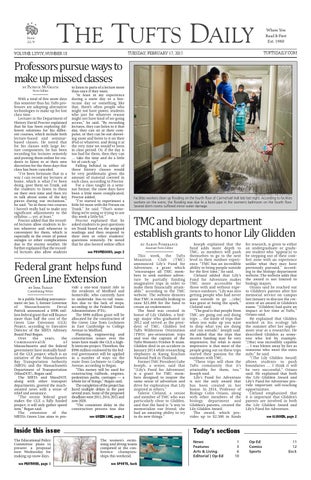
TMC and biology department establish grants to honor Lily Glidden by Aaron Pomerance Assistant News Editor
This week, the Tufts Mountain Club ( TMC) announced Lily’s Fund for Adventure, a grant which “encourages all TMC members to seek outdoor adventure by partially funding imaginative trips in order to make them financially attainable,” according to the TMC website. The website denotes that TMC is initially looking to raise $25,000 for the fund to create an endowment. The fund was created in honor of Lily Glidden, a biology major who graduated in 2012 and served as the president of TMC. Glidden led Tufts Wilderness Orientation (TWO) pre-orientation trips and was the captain of the Tufts Women’s Frisbee B-team. Glidden died in an accident in January 2014 while researching elephants in Kaeng Krachan National Park in Thailand. Former TMC President Gabe Joseph, a senior, said that “[Lily’s Fund for Adventure] is a grant for TMC members designed to inspire the same sense of adventure and drive for exploration that Lily inspired in others.” Valerie Cleland, a senior and member of TMC who was particularly close to Glidden, said that the fund is “a way to memorialize our friend; she had an amazing ability to try to do new things.”
Inside this issue
Joseph explained that the fund adds more depth to TMC, as members will push themselves to go to the next level in their outdoor experience. “TMC has an incredible ability to bring people outside for the first time,” he said. Cleland added that Lily’s Fund for Adventure makes TMC more accessible for those with and without experience outdoors. “Lily was into getting people who had never gone outside to go …[she] was great at being the spark,” Cleland said. “The goal is that people from TMC are going out and doing trips … the kinds of trips that when you wake up you want to drop what you are doing and run outside,” Joseph said. He added that the trips that receive funding may be very impressive, but what is more impressive is that most of the people going out on these trips started their passion for the outdoors with TMC. “These trips will show the Tufts community that it’s attainable for them, too,” Joseph said. Lily’s Fund for Adventure is not the only award that has been created in her honor. In 2014, Professor of Biology Colin Orians, along with other members of the biology department and Glidden’s parents, created the Lily Glidden Award. The award, which provides up to $2,500 in funds
for research, is given to either an undergraduate or graduate student who “appear[s] to be stepping out of their comfort zone with an experience unlike what they may have previously pursued,” according to the biology department website. The website adds that the award is not limited to biology majors. Orians said he reached out to Glidden’s parents after her memorial service on campus last January to discuss the creation of an award in Glidden’s name. “[Glidden] had quite an impact at her time at Tufts,” Orians said. He explained that Glidden worked in his ecology lab the summer after her sophomore year as a researcher. He described Glidden as someone who led by example. “[She] was incredibly capable … I was blown away by her as someone who went the extra mile,” he said. “[The Lily Glidden Award] allows students to push boundaries … I think it will be very successful,” Orians said. He explained that both the Lily Glidden Award and Lily’s Fund for Adventure provide important self-teaching opportunities. Cleland emphasized that it is important that Glidden’s parents are involved in both the Lily Glidden Award and Lily’s Fund for Adventure. see GLIDDEN, page 2
Today’s sections
The Educational Policy Committee plans to present a proposal next Wednesday for making up snow days.
The women’s swimming and diving teams competed at the conference championships this weekend.
see FEATURES, page 3
see SPORTS, back
News 1 Features 3 Arts & Living 6 Editorial | Op-Ed 10
Op-Ed 11 Comics 12 Sports Back
2
The Tufts Daily
Police Briefs Royale-ly Intoxicated At 8:00 p.m. on Feb. 7, the Tufts University Police Department (TUPD) transported an intoxicated female student from Winter Ball at the Royale Boston back to the Tufts campus. Upon arriving on campus, the student was allowed to sign a refusal of treatment form.
Wasted Winter Wonderland Another intoxicated female student on the night of Winter Ball was reported to TUPD at 8:40 p.m. on Feb. 7. The student’s boyfriend had transported her back from the event to her off-campus residence. She was subsequently transported to Somerville Hospital. TUPD further commented that besides the above two incidents, Winter Ball ran smoothly this
Tuesday, February 17, 2015
News
year, especially in comparison to previous years, when the event was known as Winter Bash. For example, there was no evidence of intoxicated students in the lines for the transport buses this year. In previous years, TUPD officers often had to remove drunken students from the lines and arrange for them to be transported to the hospital. —by Daniel Bottino
Former TMC leader memorialized in new award GLIDDEN
continued from page 1
“Each award represents a side of Lily,” she said. “There is the amazing and curious biologist, and the badass that inspired others to go outside their comfort zones.” Cleland and Joseph emphasized Glidden’s unique laugh and caring spirit. Cleland
described Glidden as a “super role model.” Joseph said Glidden was an incredibly inspiring person. “She had this excitement and enthusiasm; she exemplifies why the TMC community is so strong, why it has existed for so long.” “[Lily] would be smiling,” Orians said.
New funding toward Green Line Extension Project increases confidence of timely completion GREEN LINE
continued from page 1
to two reasons: budget deficiency and the absence of maintenance facility,” Eric Bourassa, transportation director at the Metropolitan Area Planning Council (MAPC), said. According to Bourassa, the city of Somerville was not ready for a maintenance site, where carriages, engines and railbeds could be constructed. The site allocation process finally occurred in 2012, he said. In 2013, the GLX project entered its first phase of construction, with the widening of rail bridges and the demolition of MBTA facilities in Cambridge. Construction of new stations on the Green Line is currently underway, according to Regan. “The federal endowment brings us extremely close to achieving our current deadline,” Regan said. “Had the federal government not committed, the project could have taken much longer.” With both issues — lack of monetary aid and lack of maintenance site — resolved, great hope is expressed about the timely finish of the GLX project. “Things have got very exciting,” Bourassa said. “Funding is secure and the entire construction schedule is sorted out.” Bourassa added that while construction costs may increase in the coming years, they will not be dramatic enough to affect the pace of the construction. Justin Hollander, associate professor in the urban and environment policy and planning department, also expressed a positive view on the project’s progress. “The federal grant was part of the initial plan,” he said. “Now that we have received it, there won’t be any delay. Perhaps, closer to the current deadline, but not much.” Hollander noted, however, that desp ite the positive impact the GLX will have in the Medford/Somerville area, other problems could arise from it.
Nicholas pfosi / the tufts daily
A federal grant will help the Green Line Extension Project reach its desired 2020 completion date. “It is always complex to introduce a new amenity to the area,” Hollander said. “Although the new transit will make the neighborhood extremely attractive, it will also generate parking challenges around the terminus planned near the Tufts campus.” The Green Line’s last stop near Tufts will prove to be a major positive for the students and staff by providing them with a one-seat, convenient commute to the university via train, Hollander said.
“The benefits are greater than the predicted problems,” he said. “One concern is that the transit facility can increase the population in the Somerville/Medford neighborhood, and can make it a spacecrunched region, if the issue is not addressed properly.” According to Hollander, the environment will begin to benefit once the GLX project nears completion. He explained that the transit system is known to resolve the air pollution
Snow days result in alternative teaching methods PROFESSORS
continued from page 1
hours using the Chat feature, adding that he found them less effective than inperson meetings. Thus far, Proctor said he has not had to move exams, but he has adjusted the deadlines for some paper responses. Associate Professor in the Department of Political Science Richard Eichenberg explained that he established a Twitter feed for his Introduction to International Relations course to communicate with students quickly. “I don’t use it to actually teach the course, but I wanted to build community in the absence of class time, and it also provides a quick way to share news articles and even scholarly works that I can link,” he told the Daily in an email. Eichenberg said he has considered hosting traditional make-up classes, but this may be difficult given differences in students’ schedules. “I am exploring the alternative of providing “voice over” narrated PowerPoints, as they do in some biology classes,” he said. “However, it takes a little time to learn.” Eichenberg underscored how helpful the Educational Technologies team, a subset of Tufts Technology Services, has been in aiding professors in using technology to make up for lost class time. “These folks have literally been working overtime to help faculty who want to explore technologies for holding class or
discussion online,” he said. “They answer our questions at night and on weekends, and provide the software we need almost immediately. I can’t say enough about the outstanding job that they do.” Adam Grenier, who teaches Microfinance through the Experimental College, explained that he has also had to look for different ways to make up his class, which meets once a week on Monday nights. “I’ve had to be a little bit more creative than usual. It has not been ideal, as you can imagine. My class is very much discussion-oriented … so the first week, the week of the blizzard … I didn’t really react that much — I figured I could make it up, all the content in the weeks ahead, so we didn’t have any kind of contingency plan,” he said. “[Two weeks ago], when classes were canceled for the second time, I decided that the best resource that I had and the best thing I thought I could do was to host a conference call.” Grenier explained that he has access to a conference call dial-in, so he gave students the number with an access code during the normally scheduled class time. He said he posted the class material on Trunk and used the Trunk Chat option to serve as a “hand-raising mechanism” by which students would send messages when they wanted to answer a question Grenier posed. “I would basically call them out and let them un-mute themselves and share
their thoughts with the class,” he said. “And to the extent possible, that was the best that we had … Usually I do a lot group discussion and activity and was not able to do that.” Grenier added that he thought it was an effective way to keep the course on track and discuss assignments with students. He noted that aside from not being able to maintain discussions, the conference call also made it hard for him to conduct the usual weekly quiz. To make this up, he explained that he posted the quiz on Trunk, and then students downloaded it, filled in the answers and re-uploaded the document. According to Grenier, the missed classes have also pushed back visits from scheduled guest speakers. The lost time may also affect whether he will be able to conduct a semester-long project he developed for the first time this semester. “I know the students might not be getting as much out of this medium as they would in the classroom, but this is just the best that we have,” he said. “We’re getting through it, and that’s all we can do. I want to continue the learning experience for them.” Senior Carolyn Peyser, who is a student in Grenier’s class, said that she would rather use the conference call option than make up classes on other days of the week given the difficulty in coordination, but added that this tool has its limitations.
issues caused by the Big Dig, a megaproject that rerouted Interstate-93 and extended Interstate-90 to the Boston Logan International Airport and was completed in 2006. There is an additional commitment made by the state to finance the rail track till Union Route 16, Regan said. “Although the help is contingent upon the funds the state gets, there is no back-stepping from their end,” Regan said. “We are hopeful and awaiting that bit of help as well.”
“It’s been nice to do them because we can catch up with the material I think, but it definitely changes the dynamic of the class,” she said. “I’ve found that on the conference call the same few people participate the entire time, and it’s difficult for [Grenier] to engage more people. I think I’m personally more reluctant to speak over conference call — it’s just more awkward and it’s hard not to see the teacher that you’re talking to.” However, Peyser noted that she has appreciated that the course has not had to give up any material. “I appreciate how structured the class is,” she said. “I appreciate how dedicated [Grenier] is to actually getting through all the material that he intended to at the beginning.” Grenier said that during his six years of teaching, he remembers maybe only one snow day. Proctor, who has been teaching at Tufts since 1996 after completing his undergraduate and graduate degrees at Tufts, added that he has never seen a winter such as this. “Things are a little different,” he said. “There’s a lot more congestion around Tufts. There’s a lot more activity. There’s a lot more cars. There’s a lot more people. And I think it makes it harder sometimes to get things cleaned up as quickly as might have been possible 25 years ago. And something like we’ve had this week or this month is just unprecedented.”
Features
3
tuftsdaily.com
Flaky start to semester proves challenging for students, faculty by Greta Jochem
SNOWMAGEDDON: on the record Assistant Features Editor Most people can appreciate a day off, and usually professors can condense their lectures and adjust their syllabi to compensate for missed class time; however, a total of six inches snowiest season university closings so far this semester — five on record of which were class days — has meant that 2014-2015 this semester has had a particularly slow and seasonal snow ever recorded in sporadic academic start. fall Boston A number of classes have only convened a couple of times so far this semester. Sophomore Jordan Rosenthal-Kay, a student in Associate Professor of Anthropology Stephen Bailey’s course “Extreme snowiest month inches Environments: Human Adaptability to on record Novel Habitats” (ANTH 042), explained that recorded snow because the class is only held on Mondays, fall in Boston in ever recorded in it has met just once so far. Feburary Boston. Record “The class is way behind, and I have yet was broken on to feel what my workload is going to be Feb. 15 like for the semester,” he said. “It’s strange knowing that some classes are having midterms and mine hasn’t moved very far through the syllabus.” If the Medford campus is 150 After so many snow days, students and acres and it’s snowed 95.7 faculty alike are wondering how the uniinches, there is a total of versity will deal with the missed class time. According to Lecturer in the Department of 625, 303, 800 Classics Anne Mahoney, who is also co-chair cubic feet of snow on campus of the Educational Policy Committee (EPC), the EPC is now planning to craft a proposal for makeup days that they will present to the faculty next Wednesday for a vote. Mahoney said that whatever the proAn amount that could fill up the posal will be, the sheer amount of missed Granoff Music Center days will likely make any solution a difficult one to reach. 227 “This has surely never been done before,” times Mahoney said. “Although a couple of ideas have been floated, there are complications and logistical problems with all of them, Shirley Wang / Tufts Daily so we’re going to end up with some sort of The winter of 2014-2015 is the third snowiest season in Boston. The record for snowfall messy compromise.” was set in 1995-1996 at 107.6 inches. Another concern is that a month into the semester, students are still unfamiliar (TCU) Senate President Robert Joseph a semester when we’ve missed more than with some of their classes. American Sign contacted Mahoney and Professor about three days of classes, and certainly not Language and the Deaf Community (CD of Mathematics Montserrat Teixidor all bunched together at the start of term like 124) is split into a Monday culture lecture i Bigas, who are the co-chairs of the this semester.” and a Tuesday language class, each with a Educational Policy Committee (EPC), This unprecedented series of weathdistinct professor and syllabus, according to and proposed an extension, according to er events has repeatedly left Tufts little choice but to close. According to Direct sophomore Amy Bu. Since the professor who Mahoney. teaches on Monday is an adjunct lecturer, Mahoney said that the job of the EPC, or of Emergency Management Geoffrey whose schedule cannot accommodate Tufts’ which is made of up students, faculty and Bartlett, who is also the deputy direcMonday schedule on Thursday, the Monday deans, is to establish teaching policies for the tor of Public and Environmental Safety, section has still not met as of this week, School of Arts, Sciences and Engineering. The the Office Of Emergency Management group looks at an issue and crafts a proposal (OEM) monitors the storm with reports according to Bu. Bu, like many Tufts students, is feeling for the AS&E faculty to vote on at a regular from the National Weather Service (NWS). When the storm is predicted to be severe unenthused about the time off and frustrated meeting. After Joseph’s proposal, the committee enough, the OEM can decide to close camwith the lack of class time this semester. “[I feel] bummed,” Bu said. “I actually quickly decided to support the extension; pus the day before. want to learn things because it’s a high however, since the next faculty meeting is not In cases in which severity is more unclear, demand class and I went out of my way to until Feb. 25, the group bypassed the AS&E a judgment must be made in the early voting process. After consulting with the morning. The OEM coordinates with Tufts sign up for it.” Sophomore Clare Blackwell said that two academic deans, they decided to officially University Police Department (TUPD) and of her classes have only met once this semes- extend the drop deadline to Feb. 25, accord- Facilities Services to evaluate existing conditions, and after information from weather ing to Mahoney. ter, and echoed Bu’s sentiments. “I’m really frustrated, but at the same “It was also not a very controversial pro- reports and statements from civil authoritime there isn’t much I can do about it,” posal. Once the TCU pointed out the prob- ties on developments like school closings Blackwell said. “The university has to close lem, we all agreed that moving the drop and parking bans is taken into account, a in certain circumstances and I understand date was fair and appropriate, and we were decision is made. “When they’re confident in a high-impact winter storm, we may be able to make a decision fairly early, but if there’s uncertainty in the forecast we’ll assess conditions in the early morning hours,” Bartlett said. According to CNN, 95 inches of snow have already been recorded in Boston this winter, and the Tufts OEM has commented that the city is on track for the snowiest winter on record. Preliminary climatological data from the National Weather Service (NWS) has reported that Boston has shattered records for the most snow in four-day, 20-day and 30-day periods. According to professor of Judaic Nicholas pfosi / The Tufts Daily Studies and former University Provost Sol The usually busy Boston Avenue remained empty as shops closed for storm Juno. Gittleman, the university was closed that, but I still feel like I’m wasting a signifi- confident that other faculty members would for an entire week in 1978 under the Massachusetts Governor’s orders after a agree,” Mahoney said. cant part of my semester sitting around.” With some classes only having met once Although Tufts has had its fair share of 27-inch snowfall in the Boston area. or twice, the upperclassman course drop snow days, this is the first time the university “We were going around with skis!” he told deadline originally scheduled for Feb. 18 was has changed the drop deadline, according to the Daily in an email. Since 1978, there have been few times that looking as though it might not give students Mahoney. enough time to become acquainted with their “As far as I know, it hasn’t been done Tufts has been closed for multiple days in a before,” she said. “It probably hasn’t been row, according to Gittleman, an occurrence courses and make informed decisions. In response, Tufts Community Union necessary before. Nobody can remember that OEM calls “unprecedented.”
95.7 58.5
3rd 1st
Kendall Todd | Culture Shock
Coffee
D
ear readers,
Paris is changing me. It’s probably for the better, to be honest — though I’m unsure whether or not I’m eating healthier overall, there is one culinary item on which I have cut back a lot: coffee. At Tufts, I was known to drink three or more Hotung coffees per day, a habit which made me much less healthy and much more poor. I tried to kick the addiction a few times, but then finals week would roll around, and I’d be right back where I started: drinking coffee like water. Not good. In France, there are two notable differences when it comes to coffee. First, the cups are much smaller than they are in the United States; second, they cost way, way less. Both, I think, are good changes for a coffee-addict like me to make. I can still drink three cups a day if I really want to (though I usually don’t), but in the end I’m ingesting less unhealthy stimulants and paying a fraction of what I would back home — at its cheapest, a cup of coffee here costs 50 centimes — half a Euro. Amazing! I am so enthusiastic about this system. Additionally, the coffee machines on campus are popular gathering places for students and professors alike, so you usually end up meeting someone cool on your pre-class coffee run. I also don’t feel like I’m drinking less coffee. It must be psychological, because the small cups don’t seem to have an effect on how caffeinated I am. There’s no small satisfaction that comes from holding a cup of coffee, even a tiny one, and breathing in the aroma, as I’m sure the coffee drinkers who read this column will agree. The satisfaction of knowing I only paid roughly $0.60 for each cup is greater still — that fact alone is something that amazes me every time I hand over a couple of coins. I know you probably don’t believe it’s possible for one tiny coffee to last me the whole afternoon. Well, here’s proof: The other day, I went into a Starbucks for the first time since moving here (I wanted to use the Wi-Fi, okay? Don’t judge me). Not wanting to be that annoying person who sits in the café without buying anything, I ordered my usual: a latte, grande size. And — here’s the kicker — it was too big. I could barely finish it, and throughout the entire process I was mad at myself for paying so much. My wallet and my belly hurt just from looking at it. How was I ever able to drink multiple coffees like that every day? The idea is unthinkable now. I’m simply not cut out for the coffee addict life any longer. I told you Paris was changing me. My budget next semester will thank me for it, though I will miss my daily chats with the Hotung baristas. Sincerely, Kendall
Kendall Todd is a junior majoring in International Relations and French. She can be reached at kendall.todd@ tufts.edu.
4
The Tufts Daily
Advertisement
Tuesday, February 17, 2015
in collaboration with
The Initiative on Mass Atrocities and Genocide (IMAGe) presents a day with
THOMAS de WAAL
Senior Associate, Carnegie Endowment for International Peace Tom de Waal is a Senior Associate in the Russia and Eurasia Program at the Carnegie Endowment for International Peace, specializing primarily in the South Caucasus region, comprising Armenia, Azerbaijan, and Georgia and their breakaway territories, as well as in the wider Black Sea region. De Waal is an acknowledged expert on the unresolved conflicts of the South Caucasus: Abkhazia, Nagorno-Karabakh, and South Ossetia. From 2002 to 2009, he worked as an analyst and project manager on the conflicts in the South Caucasus for the London-based NGOs Conciliation Resources and the Institute for War and Peace Reporting. His latest book is Great Catastrophe: Armenians and Turks in the Shadow of Genocide. He is also the author of the authoritative book on the Karabakh conflict, Black Garden: Armenia and Azerbaijan Through Peace and War, which has been translated into Armenian, Azeri, Russian and Turkish, and of The Caucasus: An Introduction. De Waal has worked extensively as a journalist and writer in the Caucasus and Black Sea region and in Russia. He has twice worked as an analyst and reporter for the BBC World Service in London, from 1991 to 1993 and from 1998 to 1999, and continues to make documentaries for BBC Radio.
Tuesday, February 17
The Caucasus: Security and Insecurity at the Crossroads of Eurasia 3:00pm, Terrace Room, Paige Hall
Great Catastrophe: Armenians, Turks and the Politics of Genocide 7:30pm, Large Chapel, Hillel followed by a Book Signing
For more information: tuftsgloballeadership.org or x73314
Tuesday, February 17, 2015
The Tufts Daily
5
Advertisement
TUFTS UNIVERSITY DEPARTMENT OF DRAMA AND DANCE PRESENTS
A NEW COMEDY
BY
MARK TWAIN
AS ADAPTED BY
DAVID IVES
DIRECTED BY
LAURENCE SENELICK
February 12-14 and 19-21, 2015 at 8:00 pm 617-627-3493 for tickets & information
Tickets
dramadance.tufts.edu
$10 Tufts ID/Seniors
Balch Arena Theater Tufts University
(includes wine and cheese reception after the show)
$10 on February 12
$15 General Public $1 on February 19
Arts & Living
6
tuftsdaily.com
Gallery Review
Daniel Bottino | Frost for you
The Witch of Coös
A
Courtesy Nolan Jimbo
“The Way We Live Now” compensates for modernism’s exclusion of women by featuring eight female artists.
'The Way We Live Now' furthers modernist dialogue, honors master by Nolan Jimbo Contributing Writer
The experience of viewing “The Way We Live Now: Modernist Ideologies at Work” at Harvard’s Carpenter Center for the Visual Arts begins prior to entering the exhibition galleries. Sited within the 1963 modernist structure designed by architectural luminary Le Corbusier, the exhibition commences with the experience of viewing the building itself. Composed of concrete and glass (material hallmarks of early 20th-century modern architecture), the Carpenter Center embodies several of Le Corbusier’s modernist design tenets: the blurred divide between interior and exterior space, the open-plan layout made possible by concrete piers and the use of brises-soleils to create filtered, soft daylight conducive to the creative work occurring in the building’s art and design studios. To enter the exhibition space on the third floor, the viewer must first walk up a curving concrete ramp, which creates both a physical removal from the bustle of Harvard Yard below as well as a metaphorical distance from the practical realities of everyday life. To walk up the ramp, one must leave
behind the imperfections of the real and enter an idealized space of purity, progress and rationality. Contextualized within this beacon of modernist ideals, “The Way We Live Now” simultaneously honors the visions of Le Corbusier and his contemporaries and critiques modern architecture’s perceptual, social and political implications, calling attention to the shortcomings of the utopian movement through the work of 13 contemporary artists. The exhibition begins in the third floor Sert Gallery with Martha Rosler’s photomontage series entitled “House Beautiful: Bringing the War Home” (1967-1972) which immediately confronts the viewer with the disconnect between idealistic modernist design and the brutally imperfect reality in which it exists. Rosler’s work takes the form of collages in which images of home interiors in American magazines of the 1960s and 1970s have been laid over with journalistic photographs of the Vietnam War. This visual juxtaposition of the utopian and quintessentially American suburban home and the bloody savagery of war zones offers a pointed critique of the utopian vision proposed by modern architecture, framing belief in modernist design as an ignorant
obliteration of difference within society: How can one believe in utopia in the midst of a deeply dystopian war? While Rosler problematizes modernism through difference and juxtaposition, Josiah McElheny offers a solution to the movement’s shortcomings through a synthesis of modernist ideologies in “Bruno Taut’s Monument to Socialist Spirituality (After Mies van der Rohe)” (2009), an eight-foottall architectural model made of birch plywood and hand-molded blocks of colored glass. Combining Bruno Taut’s 1914 Glass Pavilion and Ludwig Mies van der Rohe’s maquette for his 1922 Glass Skyscraper Project, “Monument” incorporates Taut’s well-known (and often criticized) colorful palette into Mies’ rigid structural aesthetic, creating an alternative modernity in which the disparate visual and political leanings of the architects are conflated into a single, unified structure. The exhibition continues on the first floor of the Carpenter Center, where the building itself has been integrated into the logic and physical make-up of the site-specific installations on view. Cerith Wyn Evans’ “Untitled see MODERNIST, page 7
Album Review
Drake’s new mixtape paves way to hip hop throne by Nika Korchok Executive Arts Editor
On Feb. 12, Drake released a 17-song mixtape on iTunes and announced it via Twitter with the amount of publici-
If You’re Reading This It’s Too Late Drake Cash Money Records/ Motown Records ty and fanfare that preceded Beyonce’s eponymous 2014 release — namely, none. “If You’re Reading This It’s Too Late,” begins with “Legend” and concludes with “6PM In New York.” In a move that feels both understated and completely in-your-face, Drake is not wedging his toe back in the door of hip-hop, but rather unhinging it from its frame, reminding listeners around the world that not only does he run the game, but he’s just getting started. Self-assuredness in hip-hop is practically ingrained, but Drake’s own selfassuredness is grittier. Balancing topics of his mixed-race identity with
Basilisk4u via Wikimedia Commons
Drake falls back into familiar rhythms and hooks on his new 17-song mixtape, and hints at see DRAKE, page 7 the next level of development for his album scheduled for release this year.
ll is not as it seems behind the innocent façade presented by two citizens of Coös County. Sinister forces and dark secrets wait for their opportunity to burst forth. Coös County encompasses a vast expanse of sparsely inhabited mountainous terrain in the northernmost portion of New Hampshire, posing a formidable stretch of road for any traveler passing through. Such is the case for the narrator of Robert Frost’s “The Witch of Coös” (originally published in 1922), as the poem opens with his discovery of shelter after spending the day traveling: “I stayed the night for shelter at a farm / behind the mountain, with a mother and son.” In the mode of Coleridge’s weddingguest in “The Rime of the Ancient Mariner” (1834), forced to listen to the tale of the Ancient Mariner, Frost’s narrator finds himself transfixed by the story his hosts begin to tell him. The mother and son are “Two old believers. They did all the talking.” Taking this opportunity, perhaps their first in years, to talk to someone other than each other or themselves, the two “old believers” launch into an incredible tale of marital strife, witchcraft and a living skeleton. At first glance, this tale may appear to be a far cry from typical Frost fare. A sense of the supernatural pervades the poem — the mother begins by readily admitting her identity as a witch, while her son proclaims: “Mother can make a common table rear / And kick with two legs like an army mule.” But behind the talk of witchcraft, Frost reveals the mother to be plagued by very human problems. For there is one subject about which the witch has no knowledge: the souls of the dead. She muses, “Yes, there’s something the dead are keeping back.” It is with this topic that Frost segues into a theme familiar to his readers: interpersonal conflict. For in talking about the dead, the mother begins telling the story of two long dead men who once played an important role in her life. One is her late husband, Toffile, and the other is the animated skeleton in the attic. Locked up there in the attic, behind the headboard of her bed, is the physical presence of her darkest secret, banished but never entirely gone. As the son explains: “Mother hears it in the night.” Despite the strangeness of the witch’s predicament, this story reaches far beyond the remote landscape of Coös County. Everyone has their own “skeletons in the closet” (or attic) hidden from public view, but nevertheless burdensome, even debilitating. Often these skeletons are hidden behind a placid exterior; no one would suspect a charming rural farmhouse in Coös County to hold such terrible secrets, just as people often assume an outwardly content and seemingly well-off person to have no major obstacles in life. Personally, I try my best to maintain a calm exterior, disguising my sorrows from my acquaintances and sometimes even my closest friends. Accordingly, I hope you will forgive me for not revealing my “skeletons” in such a public forum as this column. Nevertheless, this seems to be the very remedy that Frost suggests in “The Witch of Coös.” The eponymous witch and her son have kept their (literal) skeleton confined too long, finally finding psychological release in confessing their entire story to an outside audience. It is my belief that this kind of personal confession would be of great benefit to many Tufts students. Often only when a secret is finally revealed do we realize how debilitating it was to keep it hidden. But what of the witch’s secret — who is the skeleton and how did it come to be in the attic? Stay tuned next week for the answer! Daniel Bottino is a senior majoring in psychology and history and minoring in film studies. He can be reached at dbotti01@ tufts.edu.
Tuesday, February 17, 2015
The Tufts Daily
‘The Way We Live Now’ articulates tenants of architecture MODERNIST
continued from page 6
(Column)” (2015), a vertical column comprised of 90 glowing fluorescent bulbs connects floor to ceiling and mimics the concrete pilotis, or pylons, that emblematize Le Corbusier’s designs and allow for the open-plan layout. Although it does not actually behave as a weight-bearing mechanism, “Untitled (Column)” draws attention to the near 200 pilotis that already exist within the Carpenter Center’s architecture while also illuminating the first floor gallery space with cool, white fluorescent light. Also directly integrated into the Carpenter Center’s architecture, albeit in a slightly different manner, is Amy Yoes’ “Re-Make/Re-Model” (2015), a large-scale installation composed of wood forms that were painted gray in order to blend organically into the concrete structure. These sculptural forms, located in a sunken plaza on the exterior of the building, serve as the background for animated digital
projections composed of moving white lines, circles and rectangles. Activating the external space of the Carpenter Center, yet remaining properly visible only from within the building, “Re-Make/Re-Model” fulfills Le Corbusier’s original intention to blur distinctions between interior and exterior space. “The Way We Live Now” is successful in offering contemporary interpretations and critiques of modern architecture, though the diversity of artists represented within the exhibition feels limited — all 13 artists featured are either American or European. However, the exhibition does acknowledge modernism’s historical exclusion of women by featuring the work of eight female artists in the exhibit. “The Way We Live Now” generates insightful dialogue about modern architecture’s contemporary legacy through a cleanly organized, tightly curated presentation, though it does so while showcasing what is ultimately the focal point of the exhibition — the Carpenter Center’s innovative and provocative architecture.
Courtesy Nolan Jimbo
Evans’ “Untitled (Column)” lights up the dim plaza at the base of the Carpenter Center.
7
Arts & Living
Drake’s newest mixtape drops on iTunes unannounced DRAKE
continued from page 6
his struggles of breaking into, and then ruling, the hiphop world, “Nothing Was the Same” (2013) took the bawdiness of “Take Care”(2011) and ground it into a fine dust, sprinkled it over all fifteen tracks on the deluxe edition of the LP and then let it marinate. “If You’re Reading This It’s Too Late” takes this combination of introspection and self-aggrandizement to a new level. The mixtape is the stepping stone to the throne and Drake sounds ready to lead the monarchy of hip-hop. “Legend” holds the lyrics “Oh my god, if I die, I’m a legend” — lines that would feel cocky if they weren’t slowed down to half time. Drake is kicking it in his classic slow rap-talk style, and while his lyrics are slick, they flow with the sweetness of syrup — maple syrup, most likely, since Drake’s Canadian references are so blatant and interspersed in the mixtape that it sounds more like a love letter to T.O. than to the industry which has at turns rejected him and bowed to him. “Legend” sets up the rest of the mixtape as both a throwback and a look forward. “Energy” follows with similar pacing. Although the tempo is harsher and the beat is peppered with loops, the track is a call to slow down and not to speed up. In a music world that constantly crushes the windpipes of artists who aren’t producing content that is fast enough for the internet and for the
ADD-addled brains of listeners, Drake is pumping his foot on the brake hard and forcing listeners to swallow every word. At the heart of the album is Drake’s attempts to rebrand both his hometown and himself. With four explicit references to “the 6” on his album in album titles alone, with other references in “Know Yours” and other tracks, Drake is unrelenting in his love for Toronto. “The 6,” a new nickname for Toronto that Drake has arguably created and been at the forefront of promoting, comes from the blending of two of the city’s phone area codes — 416 and 647. The nickname has been picked up by other rappers of late (see Jimmy Prime’s references on his latest 9-song mixtape, “In God We Trust”(2014)). With the announcement of Drake’s next album — yes, another album in 2015, not including this mixtape — named “Views from the 6,” it’s clear that Drake is making a concerted effort to move towards his past rather than away from it. Collaborations with Lil’ Wayne, Travi$ Scott and PARTYNEXTDOOR show that Drake isn’t afraid to work with other artists, but it’s certain that this mixtape is a precursor for a new generation of Drake — an era where he is unafraid to be completely and entirely alone in his limelight. In “No Tellin’” Drake addresses his evolution as an artist and his development within the industry: “Please
don’t speak to me like I’m that Drake from four years ago/ I’m at a higher place/ Thinkin’ they lions and tigers and bears, they go huntin’.” If what Drake asserts at the beginning of “No Tellin’” — “I took the summer off to get it right” — is true, then “Views from the 6” is set to be his best yet. Drake’s surprise single on the Soundcloud for his label, October’s Very Own, “0 to 100 — The Catch Up” has over 30 million plays and counting. For an artist who takes time off, he isn’t slowing down. The album is certainly slow and for listeners looking for the infectiousness and depth of “Nothing Was the Same,” there is something lacking. Drake’s hooks are strong and his singing is buttery but “If You’re Reading This It’s Too Late” feels like a tease at what’s to come — a coloring book with half the pages still blank. The album’s penultimate track, “Jungle,” features a cinematic 14-minute long video released on the Youtube channel October’s Very Own to only about half a million views so far — a sign that Drake’s hint of what’s to come is flying under the radar. The video is slow, following in the vein of the mixtape and his recent releases, but there’s a brooding undertone — something uncovered — that leaves viewers waiting for Drake to tear off the blindfold so he can unveil the next album. It’s clear that whatever game Drake is playing, he isn’t just running it — he’s making all the rules.
8
The Tufts Daily
Advertisement
our location
our contact (617) 440-7361 or
bostonburgerco.com
our hours
37 davis square somerville, ma 02144
mon - wed:
11 AM to 10 PM
thurs - sat: 11 AM to 11 PM sun: 12 PM to 8 PM
EXPLORE A MAJOR IN POLITICAL SCIENCE! THURSDAY, FEBRUARY 19TH NOON ~ OPEN BLOCK LUNCH WILL BE SERVED PACKARD HALL, SECOND FLOOR Meet Political Science faculty and learn about our subfields. Meet representatives from Pi Sigma Alpha and Tisch Library. Learn about our Honors Thesis Program. Learn about opportunities to publish a Political Science Student Research Briefing and to participate in our Tufts-in-Washington Semester Program and our Alumni-Student Outreach Event. § Learn about internship opportunities and a career in Political Science. § For additional information please email Jeannine Lenehan, Communications Coordinator, jeannine.lenehan@tufts.edu and visit http://ase.tufts.edu/polsci/default.htm.
§ § § §
Tuesday, February 17, 2015
Tuesday, February 17, 2015
2 3 100
Advertisement
DEGREES IN 15 MONTHS — MS IN ACCOUNTING + MBA
Summer Research Experience for Undergraduates Department of Biology at Tufts University May 26 – August 3, 2015 The Department of Biology at Tufts University offers a NSF funded summer research program entitled, “Integrative approaches to studying recognition systems in cells, organisms, and populations” in which 10 students will work closely on a collaborative, interdisciplinary project. Students in this 10-week program will receive a stipend of $5200, a $1000 allotment for food, and on-campus housing.
MONTH PAID RESIDENCY AT A LEADING ACCOUNTING FIRM
Students must be U.S. citizens or permanent residents. Candidates should have a strong academic record. Application target date is March 13 Initial announcements begin April 6
PERCENT JOB PLACEMENT HISTORY
Information and Applications available at: http://ase.tufts.edu/biology/undergraduate/research/reu.htm
— ALL WITH —
0
ACCOUNTING EXPERIENCE NECESSARY
OUR NEXT SCHOLARSHIP DEADLINE IS MARCH 15th APPLY OR LEARN MORE AT
NORT-14-1000-522
t ec’d
The Tufts Daily
northeastern.edu/mymsamba
NORT-14-1000-522.indd Creative Team
Northeastern None 4.9” x 7.7” None 100% 4/4 Thom Donahue
ription
ain — Tufts Daily
Brand Director Creative Director Studio Artist Production Contact Special Instructions None
1-30-2015 4:35 PM Fonts and Images
None None thom pc
Fonts Helvetica Neue (75 Bold, 77 Bold Condensed, 57 Condensed, Condensed Bold) Images MSinAccountingMBA_NEU_logo.ai (97.71%)
Colors in Use Cyan Magenta Yellow Black
9
10
The Tufts Daily
THE TUFTS DAILY Drew Z. Robertson Editor-in-Chief
Editorial
Jacob Indursky Reena Karasin Managing Editors
Audrey Michael Executive News Editor Daniel Bottino News Editors Jenna Buckle Shana Friedman Nina Goldman Stephanie Haven Alexa Horwitz Patrick McGrath Justin Rheingold Kathleen Schmidt Jei-Jei-Tan Denali Tietjen Melissa Wang Meagan Adler Assistant News Editor Marianna Athanassiou Melissa Kain Arin Kerstein Eeman Malik Safiya Nanji Sophie Lehrenbaum Aaron Pomerance Emma Steiner Gabriella Zoia Jake Taber Executive Features Editor Maya Blackstone Features Editors Sophie Dasinger Hannah Fingerhut Jess Mow Mengqi Sun Shannon Vavra Nicole Brooks Greta Jochem Assistant Features Editors Arin Kerstein Becca Leibowitz Yuki Zaninovich Nika Korchok Executive Arts Editor Dana Guth Arts Editors Grace Segers Anjali Nair Assistant Arts Editors Joshua Podolsky Jennifer Straitz Ross Dember Executive Sports Editor Marcus Budline Sports Editors Alex Connors Wil Glavin Sam Gold Steven Hefter Alison Kuah Tyler Maher Jorge Monroy-Palacio Alex Schroeder Maclyn Senear Chris Warren Ray Paul Biron Assistant Sports Editors Phillip Goldberg Josh Slavin
Tuesday, February 17, 2015
editorial | op-ed
Editorial
Fanatics within movements must not be seen as representatives
Last Tuesday, a 46-year-old man named Craig Stephen Hicks murdered three Muslim college students: Yusor Mohammad, age 21, Deah Shaddy Barakat, 23 and Razan Mohammad, 19. The details of what actually occurred leading up to the attack are still foggy, and we are just as far from understanding Hicks’ motives today as we were in the hours following the shooting. However, it is natural to speculate about the motives of such a senseless act of violence, especially given the backgrounds of the perpetrator and the victims and the fact that terrorism from fringe Islamic groups (and responding Islamophobic attacks) constantly fill the news. While there is no way for us to know for sure why Hicks committed these murders, theories abound. Some say it all boiled down to a mentally unstable gun rights fanatic and a dispute over a parking spot. Others have called it a clearcut case of racism and Islamophobia and argued that the media is deliberately ignoring this aspect of the case. One of the most pervasive theories about the murders is that Hicks was motivated by antitheism. This idea comes
largely from his Facebook presence. Prior to the shootings, Hicks posted regularly about New Atheist figures like Richard Dawkins, who contend that all religions are fundamentally irrational and have done immeasurable harm to society over the course of history. While New Atheists claim to be equalopportunity critics of religion, they have faced intense backlash over their disproportionate focus on Islam. Whenever ISIL beheads a hostage or terrorists attack a civilian target, New Atheists like Richard Dawkins take to Twitter to demand answers from Muslims as a whole, as though the entire religion were a homogeneous group of people with a single set of opinions. Dawkins is notorious for taking his criticisms of Islam to absurdly inappropriate levels, and has referred to Muslims as “barbarians” and tweeted irrelevant and unnecessary insults such as “All the world’s Muslims have fewer Nobel Prizes than Trinity College, Cambridge. They did great things in the Middle Ages, though.” In a rare role reversal, Muslims on Twitter have called for Dawkins to address the shootings, perhaps hoping that he
would own up to New Atheism’s tendency toward Islamophobia. In response, atheists argued that calling on Dawkins to comment was absurd, as not all atheists hold the same beliefs and Dawkins has never explicitly called for violence against Muslims or members of any other religion. Dawkins also treated requests for his commentary as nonsensical and tweeted “How could any decent person NOT condemn the vile murder of three young US Muslims in Chapel Hill?” Clearly, the irony of the situation was lost on him. Of course it makes little sense to blame Dawkins for the actions of a murderer like Hicks, in the very same way that it is illogical for people like Dawkins to argue that Islam as a whole is responsible for the actions of terrorists. Today’s polarized media climate does not lend itself to critical analysis of crimes such as these. Ultimately, no matter what Hicks’ motives were, we must keep in mind that blaming the actions of a crazed fanatic on an entire diverse group of people at best oversimplifies the underlying issues and at worst may contribute to additional senseless violence.
Clara Belk
Scott Geldzahler Executive Op-Ed Editor Ray Bernoff Susan Kaufman Olivia Montgomory Ruchira Parikh Keran Chen Cartoonists Ty Enos Jennifer Lien Hannah Hoang Editorialists Katie Matejcak Natasha Khwaja Bailey Werner Nicholas Pfosi Evan Sayles Caroline Ambros Sofie Hecht
Executive Photo Editor Photo Administrator Picture Tufts Editor Section Liaison
Blair Nodelman Executive Jumbo Beat Editor Rachel Sheldon Senior Jumbo Beat Editor Aastha Chadha Jumbo Beat Editors Ethan Chan Jade Chan Kristie Le Tanay Modi Nimarta Narang Grace Segers
PRODUCTION
The new Jumbo statue was there all along!
Jewel Marie Castle Production Director
Molly Harrower Executive Layout Editor Hannah Fingerhut Layout Editors Kathy Lu Montana Miller Reid Spagna David Westby Jonathan Heutmaker Executive Copy Editors Joe Palandrani Arthur Beckel Copy Editors Aastha Chadha Nina Goldman Serena Kassam Claire Mullany Julia Russell Rachel Salzberg Jei-Jei Tan Caroline Watson Yan Zhao Andrew Kager Andrew Stephens Creative Director Nitesh Gupta Executive Online Editor Max Bernstein Executive Tech Manager Qinyue Yu Richard Yuxuan Zhang Caroline Talbert Suhyun Evelyn Kim Vera Masterson
Marketing Director Strategy Manager Media Coordinator Social Media Manager Social Media Manager
BUSINESS
Chris Chininis
Executive Business Director Li Liang Receivables Manager Ariel Gizzi Ad Managers Kristie Le Joshua Morris Amanda Saban Yiran Xu P.O. Box 53018, Medford, MA 02155 617 627 3090 FAX 617 627 3910 daily@tuftsdaily.com
Off the hill | Virginia tech, Blacksburg
Brian Williams' six-month suspension is overkill by Ryan Turk Collegiate Times
Several news outlets announced that NBC Nightly News anchor Brian Williams would be suspended for six months for fabricating or “misremembering” a story he told from his days as a war correspondent in Iraq. He claimed that a helicopter he rode in was under fire, but as of late it was discovered that the aircraft he was in was an hour behind the plane that was actually shot at, according to CNN. Although Brian Williams will be required to earn back the respect of his viewers, there is no way he can do that if he is suspended for that long. The Washington Post reported that his six-month suspension without pay is the longest a reporter has been reprimanded for violating journalistic integrity. Williams stated that he “misremembered” the incident in Iraq, which I don’t believe one bit. But at the same time, suspending him without pay for
The Tufts Daily is a nonprofit, independent newspaper, published Monday through Friday during the academic year, and distributed free to the Tufts community. EDITORIAL POLICY Editorials represent the position of The Tufts Daily. Individual editors are not necessarily responsible for, or in agreement with, the policies and editorials of The Tufts Daily. The content of letters, advertisements, signed columns, cartoons and graphics does not necessarily reflect the opinion of The Tufts Daily editorial board.
six months is an excessive punishment. If we want to hold Williams responsible for his lie, we should hold other journalists liable to the same standard for their fabrications. Williams released a very strong apology after the incident and even stepped away from the program for a while before the announcement of his suspension, obviously recognizing the wrong he had done. This should have been the end of the entire situation, but NBC decided to pile on more by suspending the anchor who brought their nightly news program to No. 1 in its time slot. Sure, his reputation is now tainted by this incident, but you can’t expect Williams to redeem himself by taking him off the air for such a long period of time without releasing him from his contract to work for another news station. Williams has an ethical obligation as a journalist to report the news as it is, but he’s also human – and humans aren’t perfect. No one died from Williams’
reporting, and people in positions of power lie to the American public every single day. Even the president embellishes points during his speeches, and other news programs have told bigger lies than Williams did. Longtime CBS Nightly News and 60 Minutes anchor Dan Rather came under fire numerous times throughout his career for embellishing news stories, including one in the 1960s where he claimed children in Dallas area schools cheered after President John F. Kennedy’s assassination. He was not punished after it was discovered that the children were only excited to get out of school early. Sure, Williams deserves the criticism he received for his fabricated story, but he took responsibility for his actions and looked to move past the incident. Unfortunately, it seems NBC will not allow that to happen, and they are doing more damage to themselves with this decision.
LETTERS TO THE EDITOR Letters must be submitted by 2 p.m. and should be handed into the Daily office or sent to letters@tuftsdaily.com. All letters must be word processed and include the writer’s name and telephone number. There is a 450-word limit and letters must be verified. The editors reserve the right to edit letters for clarity, space and length.
ADVERTISING POLICY All advertising copy is subject to the approval of the Editorin-Chief, Executive Board and Executive Business Director. A publication schedule and rate card are available upon request.
Tuesday, February 17, 2015 Op-Ed
The Tufts Daily
11
Op-Ed
Adam Kaminski | The Cool Column
Remembering the Chapel Hill victims
by Shaan Shaikh
Indifferent. That’s how I would describe my initial reaction to the Chapel Hill shootings, in which three innocent Muslims were shot and killed in their own home. Indifferent – a terrible way to feel about any death. I quickly skimmed through the news on my laptop. “A couple Muslims killed over a parking spot, huh?” I mused, not giving the issue much more thought. I closed the tab and replaced it with a few PowerPoints from my psychology class. I had a midterm to prepare for, and I couldn’t waste my time on this stuff. Completely indifferent. Looking back now, I’m disgusted by my emotionless response to such a tragedy. The only excuse I can come up with is that the past several years have been rough for the Muslim community. Perhaps reading story after story about the deaths of hundreds of thousands of Muslims in Syria, Iraq, Gaza, Pakistan and Afghanistan buried my empathy in a place where I wouldn’t have to feel the pain. Deah Shaddy Barakat. Yusor Mohammad AbuSalha. Razan Mohammad Abu-Salha. These were just three more names added to the spreadsheets. I experienced a much needed attitude adjustment after going to the “Vigil for Love and Remembrance” hosted by a few of my incredibly caring colleagues in the Muslim Students Association and the University Chaplaincy. Sitting in the front row, I was forced to hear people reflecting on the news. They came up, one by one, explaining their insecurities, fears, anger and sadness brought out by the shootings. Their cracked, pained voices and sudden pauses to fight back tears hit me hard. I felt my chest shaking slightly with every breath, accompanied by the occasional shiver. I think it took me some time to recognize that this was real. That these three young American Muslims, all within three years of my own age, were violently taken from us. When the talks finally stopped, I tried to again distance myself from the victims. Indifference, though disgusting, was far more comfortable. We concluded the
night with an interview between Anderson Cooper and Suzanne Barakat, Deah’s sister, a candlelit moment of silence and a poster signing for the family. Once alone in my dorm, I felt every emotion coursing through me, yet anger stood dominant. I raged against the widespread Islamophobia network, an industry filled with hate and bigotry. The Council on American-Islamic Relations published that just in the past few years, anti-Islam groups raised over $119 million through speeches, books and debates concernning the dangers of Islam. Selling fear has become quite profitable. My focus then turned to the “New Atheist” crowd, including men like Sam Harris and Bill Maher, who hide their racist remarks with faux-intellectual and oh-soenlightened attitudes. It’s been reported that they served as great influences for the Chapel Hill murderer, Craig Hicks. My wrath eventually turned into helpless laughter after watching his wife and his wife’s lawyer continue to argue that Hicks, a self-proclaimed “militant atheist,” had simply snapped due to the disputed parking space. Just another white man with mental issues; these brown souls were merely collateral damage. “Unfortunately, these victims were there at the wrong time at the wrong place,” says her lawyer. Three innocent youths in the safety of their home. Wrong time. Wrong place. The following morning, however, a new emotion took center stage. It was a focus, a determination, to start a new chapter in Muslim-American history. In her interview with Cooper, Suzanne Barakat explains that we cannot allow these deaths to go in vain. She argues that we must continue their legacy of charity and hard work. Besides honoring their lives, I believe doing so would strengthen our community and prevent further tragedies like this one. It’s fairly clear that Islam, at least in its current condition, is a young religion in America. Consequently, we still have to deal with some growing pains. It’s for this reason that I find Jewish-American history so inspiring. That community serves as an apt role model for our own. The amount of torture and dis-
crimination they have faced in this country is incredible, but somehow they only grew stronger. Communal resistance against their oppressors brought them together as true brothers and sisters in faith. This is something I hope our Muslim population, heavily divided by sect and ethnicity, can seek to imitate. There’s a very popular verse in the Qur’an addressing struggle: “For indeed, with hardship comes ease” [94:6]. While I appreciate and admire this quote, I find it misinterpreted far too often. A number of Muslims take this verse and close their eyes to hardship, allowing it to overtake them, waiting for the inevitable ease to come. But we cannot treat Islamophobia the same way we treat a brain freeze. Sitting still and waiting in these circumstances means forfeiting the safety we once felt in our homes and in the country at large. We must fight the good fight – through love, patience and understanding. We need Muslims to go out and create impressive works of architecture, like 19-year-old Razan had intended. We need Muslims to travel to Turkey to aid Syrian refugees with dental care, like the newlyweds Deah and Yusor had planned. We need to volunteer in soup kitchens, homeless shelters, nursing homes – to honor the fallen, save those at risk and show the true essence of Islam. It’s an unfortunate truth, but evil deeds have far stronger outreach than good ones. For every thousand Muslim volunteers, it only takes one ISIS militant to ruin our reputation. But that doesn’t mean we should shrug our shoulders, complain about life’s heavy burdens and just carry on with our lives. Rather, it means we need hundreds of thousands of Muslims on the streets, helping their communities in any way possible. I urge you to remember these names: Deah Shaddy Barakat. Yusor Mohammad AbuSalha. Razan Mohammad Abu-Salha. Do not let their deaths go in vain. Shaan is a sophomore majoring in International Relations and Arabic. He can be reached at Shaan.Shaikh@tufts.edu
Op-Ed
Relationships and the power of the BuzzFeed quiz by Alex Dorfman Op-Ed Contributor
There was a point in my life, sometime last year, when I didn’t know what BuzzFeed was. Sometimes, I wish I could go back to that point in my life. I hate BuzzFeed. I think it’s dumb, I think it’s basic and I think it’s useless. But the worst part of Buzzfeed is that when I am trying to write a paper for an English class or study vocabulary for my Spanish test, I instead find myself on it, trying to determine whether it was President Obama or a character from Adventure Time who said, “People make mistakes. It’s part of growing up. And you never really stop growing up.” (It was an Adventure Time character, by the way. I got a 10 out of 10 on the quiz.) In other words, although I hate BuzzFeed, I love BuzzFeed, and as I was scrolling through its labyrinth the other day a quiz popped up entitled “We Know Why You’re Actually Single.” That’s an odd title, I thought, but since it looked more intriguing than my homework, I clicked on it. It was seven questions long, and surprisingly, the outcomes were pretty all right. One was, “you’re too independent to be in a relationship,” and another was “you’re too sexy for everyone.” The ensuing descriptions were positive, ending with the advice to “keep doing you.” At first, I was impressed because this quiz took something that is generally seen as negative — being single — and turned it into something positive. Yet the fact that this quiz is even plausible is still pretty ridiculous because its existence depends on the societal stereotype that single women, not men, must have a reason to be single. Just look at the webpage design. All the pictures are of women, and the questions were created with women in mind.
But there are plenty of single men out there, so why don’t they need an excuse for being single? I don’t know, but this quiz exemplifies society’s expectation that a woman must have a reason for not being in a relationship. In other words, a woman can’t simply be single because she wants to or because she hasn’t found the right person. She must have an excuse, like focusing on her career or being unable to get a boyfriend. Men and their relationship statuses, on the other hand, simply aren’t questioned as much. And, let’s be honest, that’s ridiculous; there are plenty of people in the world who aren’t in relationships not because they can’t be, but because they’re simply not interested. This quiz also identifies the ridiculous idea that a woman’s relationship status is not only her business. One of the questions is labeled “what your mother is always asking you.” The answers range from a meek, “Are you seeing anyone new?” to “When will I have grandchildren?” When I got to this question, I honestly had no idea what to answer. Personally, my mother is definitely more worried about whether or not I’ve done my homework and changed my sheets than my relationship status. After all, this is not the 1800s, and unlike Mrs. Bennet, my mother had more to worry about than marrying off her three children. At first, I was somewhat impressed by the irony in this quiz. It revealed some pretty horrible ideas in our society. Yet the more I picked it apart, the more problematic this quiz became. Though this quiz mocks a societal stereotype of women, it targets a very specific type of woman. For example, the first question of the quiz is to pick an emoji that represents your love life. There are six options, and three of those options make it clear exactly what
kind of woman this quiz is for. One option is an image of nail painting, another is a woman dressed in pink with her hand up — that’s a horrible description, but you know the one — and a third is two dancing ladies. How these represent someone’s love life, I have no idea, but given the amount of pink in these choices, it is clear that the quiz is not for all women, but particularly cisgendered women. Another question is entitled, “pick your celebrity crush,” and all the options are males. That’s a bit odd because I’m pretty sure lesbians can be single too. Now, it’s fine to target a certain audience, but when a quiz is labeled, “We Know Why You’re Single,” and targets women, shouldn’t it target all types of women? Now perhaps I am being nit-picky here. After all, it’s just BuzzFeed. Really, who gives BuzzFeed that much credit? Yet though BuzzFeed might be dumb and ridiculous most of the time, it is a website with more than 200 million viewers. This particular quiz had 136,558 the last time I checked. That’s a substantial number of people looking at this quiz. BuzzFeed may just be a website for time-wasting, but it is powerful, and the content of the website can subtly enforce or work to destroy many of society’s stereotypes out there. I would argue this quiz, in particular, does both. And though it might seem inane to write an article on one internet quiz, this quiz shows just how alive gender stereotypes are. In fact, a quick Google search of the quiz title, “We Know Why You’re Really Single” comes up with 436 million results, and the top sites are certainly geared towards women. In other words, even in 2015, there is still this absurd idea that if you’re a single woman, there is something wrong with you and really, you should be in a relationship.
What I’ve said lately
I
n lieu of a typical column, 600-ish words written by someone who has a genuine interest in a thing that is genuinely interesting, this week I will be sharing something I wrote with a friend. It’s not particularly pertinent, radically relevant or especially excellent, but it was a lot of fun to write and maybe a little fun to read. The catch is that it’s totally comprised of Tom Swifties, sentence-long puns made up of an adverb and a quote. They’re something you may have learned of while reading that book “Sleeping Freshmen Never Lie” (2005). Necessary preamble aside, I present to you “Untitled”: “It’s so early and we have nothing to do,” she said mournfully. “I don’t think we have any boardgames,” he said cluelessly. “We could call Tom,” she said euphoniously. “Eh, I think he’s average,” he said meanly. “Then let’s watch Star Wars!” she said forcefully. “Nah, let’s sing Shenandoah,” he said currently. “I don’t know the words to that one,” she said humbly. “We could just jam,” he said instrumentally. “I’m not that good at guitar,” she said fretfully. “Agreed, I’m really much better,” he said callously. “Hmm, let’s not play music,” she said discordantly. “Fine. We could go to the aquarium downtown,” he said swimmingly. “Or the natural history museum,” she said indignantly. “But the aquarium’s closer. We could walk,” he said stridently. “I guess that’s true. Plus my favorite animal is the blue whale. It’s the largest,” she said superficially. “These trees are so nice,” he said bewilderedly. “Look out! A car!” she said entirely. “HONK HONK,” the car screeched emergently. “Oh no! My legs!” he said defeatedly. “I’ll make you a tourniquet,” she said tightly. “I’m too young to die!” he said unwillingly. “Calm down, calm down. You’ll stop bleeding soon,” she said staunchly. “Okay, but I don’t think I’m up for the trip anymore,” he said lamely. “I could try to carry you home,” she said handily. “Thanks. On the upside, maybe we’ll make the paper,” he said impressively. “Yeah, but I was really looking forward to seeing the lobster,” she said crabbily. “I was looking forward to the ferry ride,” he said sternly. “Forget about it. The past is the past and tomorrow’s the future,” she said tensely. “You’re my favorite conjoined twin,” he said biasedly. The End. The moral (because there should be a moral if I want this to be a killer column) is that electronics and social media portals and other pieces of 21st century matter shouldn’t limit how we waste time. A couple of minds, preferably loopy, are perfectly adequate tools designed to preoccupy their holders for hours. Though, admittedly, Google define helps boatloads. Next week I’ll be on a different track, one with hopefully more genuine things to say, but nonetheless I hope this was a fun excursion into amusing wordplay. And please feel free to write me a Tom Swifty. Adam Kaminski is a sophomore who has not yet declared a major. He can be reached at adam.kaminski@tufts.edu.
Op-ed Policy The Op-Ed section of The Tufts Daily, an open forum for campus editorial commentary, is printed Monday through Thursday. The Daily welcomes submissions from all members of the Tufts community; the opinions expressed in the Op-Ed section do not necessarily represent the opinions of the Daily itself. Opinion articles on campus, national and international issues should be 600 to 1,200 words in length. Op-Ed cartoons are also welcomed for the Campus Canvas feature. All material is subject to editorial discretion and is not guaranteed to appear in the Daily. All material should be submitted to oped@tuftsdaily.com no later than noon on the day prior to the desired day of publication; authors must submit their telephone numbers and day-of availability for editing questions. Submissions may not be published elsewhere prior to their appearance in the Daily, including but not limited to other on- and off-campus newspapers, magazines, blogs and online news websites, as well as Facebook. Republishing of the same piece in a different source is permissible as long as the Daily is credited with originally running the article.
12
The Tufts Daily
FOR RELEASE FEBRUARY 17, 2015
Crossword
Los Angeles Times Daily Crossword Puzzle
Doonesbury
Edited by Rich Norris and Joyce Lewis
ACROSS 1 Command from a bailiff 5 Circle calculation 9 They smell 14 Like Mini Coopers 15 Pond croaker 16 Swine squeals 17 Gave the onceover 18 Particularly welcome casino visitor 20 Alpine song 22 Ear-splitting 23 Court case that generates a media frenzy, say 30 Handsome god 32 Get really angry 33 Granada gold 34 Irritate 37 “CSI” facilities 38 Tee sizes, for short 39 “Nice job!” ... and, in another sense, a hint about the first words of 18-, 23-, 52- and 60Across 42 Geese formation 43 Leafy veggie baked for chips 45 Bitten by bees 46 Angled pipe fitting 47 Handsome god 50 __ Raiders: consumer advocates 52 Abe Lincoln nickname 55 Principal role 56 Diet food phrase 60 Irritate to the breaking point 66 Shredded 67 Construction beam fastener 68 Former South Korean leader Syngman __ 69 Golf club used for chipping 70 Blissful settings 71 Jedi guru 72 Small change DOWN 1 Do as directed 2 Toy with a spool 3 Deleted, with “out”
by Garry Trudeau
Non Sequitur by Wiley
2/17/15
By Gail Grabowski and Bruce Venzke
4 Louisiana music style 5 Olympics fig. 6 French monarch 7 One below birdie 8 Specialized, committee-wise 9 Bit of pasta 10 Frying liquid 11 NBC show since 1975, briefly 12 Barely manage, with “out” 13 Ukr. or Lith., once 19 Feels remorse over 21 Bochco legal series 24 Forearm bone 25 Some DVD players 26 Sinuous swimmer 27 Less cowardly 28 Insurgent group 29 ’50s four-wheeled flop 30 16th-century Spanish fleet 31 Hoi __: the masses 33 Heroic Schindler 35 Giants Hall of Famer Mel 36 Brewers Hall of Famer Robin
Monday’s Puzzle Solved Friday’s Solution
Married to the Sea
©2015 Tribune Content Agency, LLC
40 Pest in a swarm 41 Utah city near the Golden Spike 44 Photo blowup: Abbr. 48 Sea spots? 49 Blueprint detail, for short 51 Sexy 53 Cable Guy of comedy 54 The Gem State
2/17/15
57 Warning from a driver? 58 Elvis __ Presley 59 No-frills shelter 60 Hip-hop Dr. 61 Free (of) 62 “__ changed my mind” 63 Caracas’ country, to the IOC 64 Athens : omega :: London : __ 65 Assenting vote
THAT SCRAMBLED WORD GAME
www.marriedtothesea.com
by David L. Hoyt and Jeff Knurek
Unscramble these four Jumbles, one letter to each square, to form four ordinary words.
©2015 Tribune Content Agency, LLC All Rights Reserved.
RIBTO MUCSAP
SUDOKU Level: Using the cold as an excuse to stay in.
Check out the new, free JUST JUMBLE app
LAKAO
TARTOE
Now arrange the circled letters to form the surprise answer, as suggested by the above cartoon.
-
Answer: Saturday’s
Tuesday, February 17, 2015
Comics
(Answers tomorrow) Jumbles: POISE FINCH TANDEM FEDORA Answer: When the couple went scuba diving on Valentine’s Day, there was — DEEP AFFECTION
Late Night at the Daily
Friday’s Solution
Drew: “Guys [Molly and Reena], get up. You look like little gremlins.”
Please recycle this Daily.
Tuesday, February 17, 2015
The Tufts Daily
Advertisement
13
Want to work for a fun section where you can be creative, explore a rich diversity of cultural experiences AND get free concert tickets? Write for the Arts section of the Daily! Email arts@tuftsdaily.com if interested.
14
The Tufts Daily
Advertisement
Tuesday, February 17, 2015
Tuesday, February 17, 2015
The Tufts Daily
15
Sports
Wanted
$$SPERM DONORS WANTED$$ Earn up to $1,500/month for less than 5 hours’ time. Help families through California Cryobank’s donor program. Apply online: SPERMBANK.com
classifieds policy All Tufts students must submit classifieds in person, prepaid with check, money order or exact cash only. All classifieds submitted by mail must be accompanied by a check. Classifieds are $20 per week or $4 per day with Tufts ID or $30 per week or $8 per day without. The Tufts Daily is not liable for any damages due to typographical errors or misprintings except the cost of the insertion, which is fully refundable. We reserve the right to refuse to print any classifieds which contain obscenity, are of an overly sexual nature or are used expressly to denigrate a person or group. Questions? Email business@tuftsdaily.com.
Jumbos conclude home season on a high note despite loss ICE HOCKEY
continued from back
the third but unfortunately we couldn’t get it done.” First-year forward Brian Brown was able to open a window for Tufts with a power play goal early in the third period — his team leading 12th of the season — off assists from sophomore defenseman Sean Kavanagh and Ouellette. The Lord Jeffs scored again, however, with just under seven minutes to play to seal the win. First-year goaltender Ryan McConnell got his first start of the season against Amherst. “It wasn’t any sort of replacement or change of plan,” Murphy said. “The plan was for Mason [Pulde] to play Friday and Ryan to play Saturday. Ryan has had some great practices and we’ve felt for a while that he’s deserved the chance to get a start.” Murphy thought the loss was more of a result of several mental lapses than of any systemic issues. “I thought yesterday we got a little loosey-goosey at times, made a couple of big mistakes at the end of the game that allowed them to get a tie with us,” Murphy said. “We should have won the game, no question about it.” In its game against Hamilton, Tufts got off to a hot start, scoring the first goal of the game only 38 seconds in on a fast break. Kavanagh found the back of the net on an assist from junior forward Stewart Bell and sophomore forward Conal Lynch. Just under nine minutes later, Continentals senior forward Nick Vassos broke out and scored on a pass from first-year forward T.J. Daigler. True to their gritty mentality, the Jumbos again blitzed the Continentals and scored only 16 seconds into the second period. Tufts sophomore forward Matt Pugh won the face-off against junior forward Kenny Matheson, then passed to Brown who shot, but was blocked. First-year forward Scott Majkowsky scored off the rebound to earn his third goal of the season.
continued from back
Nicholson, who has had a great indoor season so far, PRed by nine seconds in 10:34.21. In the mile, sophomore Alice Wasserman ran a solid time, 5:20.4, while junior Lily Corcoran ran 5:29.82. “This was the first time I’ve ever run on a banked track so the race was different for me.” Nicholson said. “I went out way too fast and overall am not thrilled with how I ran the race but I PRed by nine seconds so I am pleased with my time. Every Tufts runner in the 3K PRed, so it was a good day overall and it prepared us for Div. IIIs this weekend.” In the mid-distance events, the women continued the trend of fast races. Senior Lauren Gormer set a season best in the 800 meters, running 2:17.16 — less than a second off of her PR — to win her heat and take 60th overall. Walton and first-year Sara Stokesbury ran season bests in the same event, as Walton ran 2:23.43 for 114th overall, and Stokesbury ran 2:24.12 for 120th overall. In the 1,000 meters, junior Sydney Smith ran 2:59.41 for 37th overall, becoming just the ninth person in school his-
Consequences of groupthink
I
Ray Bernoff / The Tufts Daily
Sophomore forward Conal Lynch attempts to evade a defender. Tufts scored again at the 5:09 mark in the second when Lynch won a faceoff in the offensive zone, ripped a shot at first-year goalie Tim Nowacki who saved the shot but lost control of the puck. Senior forward Tyler Voigt reacted quickly and put the Jumbos ahead 3-1. Hamilton answered back as firstyear forward Tyler Bruneteau redirected a rebounding shot by sophomore forward Brad Smelstor past Pulde 11 minutes into the second period. Sophomore forward Truman Landowski also had an assist.
Despite leading for the entirety of the game and taking a timeout at 18:26, the Jumbos were unable to preserve their lead and Brelih’s late goal forced overtime. “We have a lot of young guys in the lineup right now, a lot of freshmen and a lot of sophomores, so these things are going to happen but you just have to learn from it,” Ouellette said. “The seniors and the juniors on the team have been great leaders and when we get to the playoffs that will help us a lot.”
Personal records, strong performances for Tufts at BU WOMEN’S TRACK
Sam Gold | The Gold Standard
tory to break three minutes in the event. Junior Marilyn Allen continued her impressive indoor season in the 200 meters, as she ran 25.50 for 51st overall, missing her school record of 25.42 from BU’s Terrier Invite a few weeks ago by the narrowest of margins. Junior Alexis Harrison also fared well, running 25.93 for 83rd overall. Sophomore Rita Donohoe took 127th overall, running 26.66, and senior Christina Harvey took 140th overall in 26.92 seconds. In the longer sprint events, sophomore Hannah Loss took 113th overall in the 400 meters, running 61.45, and Prusaczyk just missed PRing in the 500 meters by 0.02 seconds, running 79.07 seconds for 35th overall. The 4×400-meter relay team of Loss, Allen, Smith and Gormer took 33rd overall, just missing the four minute barrier by running 4:00.08 for a new season best. “We were able to get more qualifiers at BU,” Donohoe said. “Alexis [Harrison] ran an awesome 200, which puts her in a promising position to school at Div. IIIs. Lena [ Walton] also ran a PR in the 800 to qualify. Going to BU always means top-notch competition at a fast facility, so we always look to put up season bests and PRs there.
Personally, I set a season best in the 200 which I was happy with, but its not where I wanted to be at this point unfortunately because of setbacks due to injury. However, I am optimistic about this weekend at Smith and hope to be able to show significant improvements.” The Jumbos were represented by a few individuals in the field events. Sophomore Keren Hendel matched her PR in the pole vault, going over the bar at 11’ 5.75”. First-year Sophie Lattes PRed in the triple jump, leaping 34’ 10.25” to qualify for Div. III New Englands which will be held next weekend next weekend. Firstyear Annalisa DeBari and senior Mary Ellen Caruso also competed in the same event, as DeBari jumped 34’ 3.5” for 34th overall and Caruso launched herself 33’ 7.5” for 40th overall. Next weekend, the Jumbos will travel to Smith College for the Div. III New England Championships, where they hope to secure a top three finish. “At Div. III New Englands, we will be trying to score a lot of points, and for others, we will be looking to qualify for Open New Englands or ECACs,” Nicholson said. “Our 4×800 team has a great chance at placing in the top three.”
n the New York Times last week, writer Jon Ronson chronicled the swift demise of a woman named Justine Sacco at the hands of a ruthless Twitter mob. With each successive tableau, Sacco makes her way gradually from antagonist to victim, her situation reaching a nadir, perhaps, when she is disowned by her South African family — selfstyled progressives (ANC supporters, which I suppose is a primary benchmark for that designation) who simply could not countenance her tactlessness. Her tweet? “Going to Africa. Hope I don’t get AIDS. Just kidding. I’m white!” Hardly invidious in the scheme of things, yet disagreeable enough, apparently, to galvanize legions of Twitter police, unswerving in their devotion to political correctness, to tear her down. Ill-advised, to be sure, but as far as self-incriminatory statements go, about as innocuous as they come. It could easily have been construed as parodying white privilege. It is not lost on Ronson that Sacco, before being sacked, was the director of corporate communications at IAC, but irony is never his point. What Ronson does so well is elucidate the dark, mobbish underbelly of this sort of activism, which, he argues, “wasn’t really about [Sacco] at all,” but rather “our desire for approval.” So it was with Keith Olbermann and future baseball Hall-of-Famer Chipper Jones, the latter of whom, not two weeks ago, tweeted that the Sandy Hook shootings were a hoax. At first glance, I am inclined — we all are — to side with Olbermann, whose magnanimous appeal to Jones to lend his fame and fortune to the cause resonates profoundly in this era of hate-mongering and faceless recrimination. Yet I have reservations, and they are, I think, rooted in my suspicion that his apology was insincere and therefore meaningless. Even if it was not insincere, however, even if Olbermann was right and I am wrong, Jones’ re-admission was always predicated on the transaction of apology for forgiveness made between the two parties (i.e. Jones and everyone else). He has a colorful history of offensive tweets, not one of which should disqualify him from the same respect the rest of us are accorded by virtue of our humanity. By respect, of course, I do not mean tacit support; we interact every day with people with whom we disagree, sometimes fiercely, whom we nevertheless do not assault. And while there are and must be consequences for speaking one’s mind, Sacco-esque lambasting, liable to devolve into death threats and the like, should not be fair game. Which is why I think Olbermann’s request is ultimately misguided, though certainly wellintentioned. His presumes a situation in dire need of rectification when in fact it is merely offense, albeit galling, that Jones has inflicted, a byproduct of his insane ramblings — nothing more. It is both horrific and irresponsible that Jones would employ his soapbox to such devastating effect, but we cannot hold him accountable beyond voicing our own opinions. Imploring him not only to about-face, but also to go the extra mile, is dishonest, truly a means of elevating ourselves. Chipper Jones is far more privileged and secure than Justine Sacco was, is or ever will be. He is exactly the same person he was prior to the incident. Unlike Sacco, he had fans, innumerable after an exceptional career, to rally around him and proclaim his innocence. He apologized, maybe sincerely, and went on his merry way. Although Jones will not suffer, we must still heed Ronson’s warning, for our moralizing is not really about them, but about ourselves.
Sam Gold is a senior majoring in religion. He can be reached at samuel_l.gold@tufts.edu.
Sports
16
tuftsdaily.com
Women’s Swimming and Diving
Tufts finishes seventh in NESCACs by Tyler Maher
For the second year in a row, the women’s swimming and diving team finished seventh out of the conference’s 11 teams at the NESCAC Championships. The Jumbos compiled 795 team points at the three-day event, which was held at Wesleyan University from Feb. 13-15. Williams College won the competition with 2,103.5 points, followed by Bates (1,345) and Middlebury (1,203) in the top three. “Overall, I think the team as a whole really stepped up to the challenge this weekend,” sophomore Amanda Gottschalk said. “I was so impressed by our competitive drive and team unity throughout the weekend. We scored around 50 points more this year than at last year’s conference meet and many more girls this year qualified to swim at finals at night, which is where you can score points.” Tufts ended the meet on a high note Sunday, as first-year Anna Kimura broke the school record in the 200 breaststroke. Her mark of 2:21.94 eclipsed the previous record of 2:22.05 established by Jenny Hu last year. Kimura finished sixth in the conference final and her time made the NCAA B cut — one of four Tufts times that did. Her performance — the only Tufts’ performance to claim a school record — followed a strong 2:22.22 B mark during the preliminaries. “I am very happy with the results of this weekend,” Kimura said. “Throughout my swimming career, I never expected to swim the time that I did in the 200 breaststroke. So when I looked up at the scoreboard, it was hard to believe that was really me. The team also did a phenomenal job this weekend and I know I would not have swum as fast if not for them.” Sports Editor
Gottschalk made the NCAA B cuts in the 400 individual medley (IM) during Saturday’s preliminaries with a 4:34.23 touch, more than two seconds faster than the 4:36.69 B qualifying mark. She finished seventh in the final with a 4:35.03 time. Three Jumbos scored in the top 16 for the 400 IM overall. “I am very honored to have accomplished that,”Gottschalk said of her qualifying time. The Jumbos notched a pair of fifth place finishes on Saturday as well. Senior tri-captain Kathryn Coniglio earned an individual fifth in the 200 freestyle, which she swam in 1:53.60, and also contributed to a team fifth place finish in the 800 freestyle relay. Coniglio, fellow senior tri-captains Amanda Wachenfeld and Scarlett Hao and junior Sarah Mahoney combined for a 7:49.58 time in the final event of the day. Tufts finished the day in seventh with 575 team points. The Jumbos got off to a strong start the day before, earning five top 10 finishes on Friday. Tufts started well with a sixth place finish in the 200 freestyle relay — the first event of the meet — with a 1:37.35 time. Coniglio, in addition to swimming the anchor leg of the 200 relay, also won the consolation final in the individual 50 freestyle with a 24.42 time. She was ninth in the final after swimming a time of 24.40 in the preliminaries for 10th place. “Kathryn was just a rock all weekend and really stepped up and showed our freshman how it should be done,” coach Nancy Bigelow said. “I was pleased with the performances of our seniors, who have been great leaders all year, and our freshmen shook off some first day jitters and did a great job as well.” One of those first-year standouts was Jess Lee, who, in addition to swimming in the sixth place 200 freestyle
Caroline Ambros / The Tufts Daily
Swimming in a tough division, the Jumbos pulled off a seventh place finish at the NESCAC Championships. relay, won the consolation final in the 50 butterfly. She touched in 26.32 for ninth in the final, an improvement on her 26.52 12th place finish in the preliminaries. Sophomore diver Kylie Reiman shined on day one as well, improving upon her 384.55 preliminary onemeter score with a 398 score that placed fourth in the event and made NCAA B cuts. Her finish was even more impressive given that she had missed the previous three weeks due to a sprained foot. “I feel really great about how I did at NESCACs,” said Reiman. “I didn’t even know for certain if I would be able to compete until about a few days before the meet. I just trusted in my previous training and muscle memory and went in trying to do my best and it paid off.” Reiman will next be competing at the NCAA Zone Diving Qualifier at Springfield College from Feb. 27-28.
women’s Track and Field
Jumbos use fast track to put up impressive times by Chris Warren Sports Editor
On Friday and Saturday, the women’s track and field team took its talents to Boston University’s Indoor Track and Tennis Center for the annual David Hemery Valentine Invitational. BU’s banked track has been dubbed one of the fastest indoor tracks in the world, which was on display when 12 runners in the men’s competition broke four minutes for the mile. They led the way to an unprecedented 36 sub-4 minute miles around the nation on Saturday. The women, just like the men, took advantage of the very fast track and many athletes broke into the top 10 in school history in their respective events. On Saturday, the women’s distance medley relay team of first-years Prudence Sax, Julia Prusaczyk, Lena Walton and sophomore Sam Cox ran 12:43.19 for 23rd place overall. The evening before, their teammates took to the track for individual races. Sophomore Kelly Fahey, fresh off a top 10 nationally ranked time for the 5,000 meters (17:29) at Tufts last week, dropped another huge personal record by running 9:56.77 in the 3,000 meters. She took 44th overall and eighth overall in her heat.
Caroline Ambros / The Tufts Daily
Tufts believes that its relay teams can place high in its upcoming championship meets. Fahey’s time qualifies her for the Open New England meet in a few weeks, and is also fourth all-time in Tufts history. Many of her teammates ran personal bests as well.
Senior Megan Gillis set a nine second personal record (PR) in the same event, running 10:26.87, while firstsee WOMEN’S TRACK, page 15
“Kylie really had an outstanding weekend,” Coniglio added. “She had the daunting task of being our team’s only diver, but she had some really impressive finishes that contributed much-needed points to our team.” Tufts closed out the first day on a high note with a strong effort in the 400 medley relay, finishing seventh in 3:59.30. The Jumbos top-eight finishes in all five relays at NESCACs were a testament to their outstanding teamwork and collaborative attitude. “Overall, I thought we swam our hearts out,” Coniglio said. “I thought the team swam really well. From the beginning of the season, this particular 2014-15 team has proven themselves to be a really positive and supportive group, and this positive, supportive team chemistry was a really important factor this weekend. None of the other NESCAC teams are as loud as we are when we cheer for each other.”
ice Hockey
Jumbos let in last-minute goal to Continentals by Phillip Goldberg Assistant Sports Editor
Despite allowing Hamilton (8-8-6) to force a 3-3 tie on Military Appreciation Night and then losing 3-1 to No. 10 Amherst (16-4-2) on Senior Night, Tufts (7-13-2) played stretches of its best hockey this weekend. The Jumbos were up a goal on the Continentals and had led all game before junior defenseman Marko Brelih snuck one past sophomore goaltender Mason Pulde. The goal came with just 27 seconds left in regulation. Overdue for a win after suffering three straight losses, the resulting tie was crushing for the Jumbos. Tufts’ game against Amherst on Saturday was representative of its season as a whole, as it played well but could not finish its chances. “There were just a couple breakdowns that Amherst [was] able to finish their goals on,”junior defenseman Brian Ouellette said. “I thought we actually just outplayed them and they just buried their chances.” The Jumbos held the Lord Jeffs, the second ranked team in the NESCAC, to only two first period shots. For their part, the Jumbos shot six
and controlled the period, as they consistently stopped the Lord Jeffs from breaking out of their defensive zone. In the second period, Amherst senior forward Andrew Fenwick broke the stalemate at 13:05. The Lord Jeffs quickly built their lead when senior defenseman Aaron Deutsch scored a power play goal at 15:37 to go up 2-0. “We’ve talked a lot about goal-setting and what our identity is and what everybody’s role is and doing their job,” coach Brian Murphy said. “You watch Amherst and they’re a team that plays with a lot of skill. You know, we’re not like that. We want to get pucks deep and make teams work to go 200 feet … that’s how we are going to be successful.” A penalty for too many players on the ice towards the end of the second forced the Jumbos back on the defensive but they were able to kill. “We took some penalties and that affected a little bit of the flow of the game,” Murphy said. “They played a little more puck possession and we chased them around and we got a little bit away see ICE HOCKEY, page 15