Tufts alumnus helps Mass. Senate bill fighting campus sexual assault see Features / PAGE 3
TUFTS FOOTBALL
Saturday Night Fight: Football ekes out victory
“The Magnificent Seven” lacking magnificence see ARTS&LIVING / PAGE 7
SEE SPORTS / BACK PAGE
THE
INDEPENDENT
STUDENT
N E W S PA P E R
OF
TUFTS
UNIVERSITY
E S T. 1 9 8 0
T HE T UFTS DAILY
VOLUME LXXII, NUMBER 12
tuftsdaily.com
Monday, September 26, 2016
MEDFORD/SOMERVILLE, MASS.
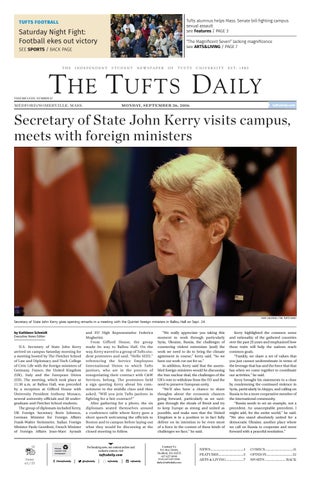
Secretary of State John Kerry visits campus, meets with foreign ministers
MAX LALANNE / THE TUFTS DAILY
Secretary of State John Kerry gives opening remarks in a meeting with the Quintet foreign ministers in Ballou Hall on Sept. 24. by Kathleen Schmidt Executive News Editor
U.S. Secretary of State John Kerry arrived on campus Saturday morning for a meeting hosted by The Fletcher School of Law and Diplomacy and Tisch College of Civic Life with the foreign ministers of Germany, France, the United Kingdom (UK), Italy and the European Union (EU). The meeting, which took place at 11:30 a.m. at Ballou Hall, was preceded by a reception at Gifford House with University President Anthony Monaco, several university officials and 30 undergraduate and Fletcher School students. The group of diplomats included Kerry, UK Foreign Secretary Boris Johnson, German Minister for Foreign Affairs Frank-Walter Steinmeier, Italian Foreign Minister Paolo Gentiloni, French Minister of Foreign Affairs Jean-Marc Ayrault
Please recycle this newspaper
Sunny 65 / 55
/thetuftsdaily
and EU High Representative Federica Mogherini. From Gifford House, the group made its way to Ballou Hall. On the way, Kerry waved to a group of Tufts student protesters and said, “Hello SEIU,” referencing the Service Employees International Union to which Tufts janitors, who are in the process of renegotiating their contract with C&W Services, belong. The protestors held a sign quoting Kerry about his commitment to the middle class and then asked, “Will you join Tufts janitors in fighting for a fair contract?” After gathering for a photo, the six diplomats seated themselves around a conference table where Kerry gave a short speech welcoming the officials to Boston and to campus before laying out what they would be discussing at the closed meeting to follow.
For breaking news, our content archive and exclusive content, visit tuftsdaily.com @tuftsdaily
tuftsdaily
tuftsdaily
“We really appreciate you taking this moment to work through particularly Syria, Ukraine, Russia, the challenges of countering violent extremism [and] the work we need to do to bring the climate agreement in course,” Kerry said. “So we have our work cut out for us.” In addition, Kerry said that the assembled foreign ministers would be discussing the Iran nuclear deal, the challenges of the UK’s vote to withdraw from the EU and the need to preserve European unity. “We’ll also have a chance to share thoughts about the economic chances going forward, particularly as we navigate through the shoals of Brexit and try to keep Europe as strong and united as possible, and make sure that the United Kingdom is in a position to in fact fully deliver on its intention to be even more of a force in the context of these kinds of challenges we face,” he said.
Contact Us P.O. Box 53018, Medford, MA 02155 617 627 3090 FAX 617 627 3910 daily@tuftsdaily.com
Kerry highlighted the common sense and rationality of the gathered countries over the past 25 years and emphasized how these traits will help the nations reach common goals. “Frankly, we share a set of values that you just cannot underestimate in terms of the leverage that has and the force that that has when we come together to coordinate our activities,” he said. Kerry brought his statements to a close by condemning the continued violence in Syria, particularly in Aleppo, and calling on Russia to be a more cooperative member of the international community. “Russia needs to set an example, not a precedent. An unacceptable precedent, I might add, for the entire world,” he said. “We also stand absolutely united for a democratic Ukraine, another place where we call on Russia to cooperate and move forward with a peaceful resolution.”
NEWS............................................1 FEATURES.................................3 ARTS & LIVING....................... 7
COMICS......................................11 OPINION...................................12 SPORTS............................ BACK
2
THE TUFTS DAILY | News | Monday, September 26, 2016
tuftsdaily.com
South Hall renamed Harleston Hall, honoring former dean by Hannah Uebele News Editor
South Hall was officially renamed Harleston Hall during a ceremony held outside of the building on Friday, Sept. 23. The building is named after former Professor of Psychology Bernard Harleston, who was Tufts’ first African-American tenure-track faculty member and a former dean of the faculty of Arts and Sciences, according to a May 2 article in the Daily.
Over 200 members of the Tufts community as well as Harleston’s friends, family and colleagues attended the ceremony, according to event organizers. Provost David Harris kicked off the dedication ceremony. He was followed by a range of speakers including University President Anthony Monaco, current and former Tufts faculty members and Harleston himself. Monaco related Harleston’s achievements, highlighting his commitment to increasing higher education access for students of color as well as his devo-
MAX LALANNE / THE TUFTS DAILY
Dr. Bernard W. Harleston (H ‘98) moves in to embrace Peter R. Dolan, chairman of the board of trustees, after the latter’s remarks during the dedication ceremony outside Harleston Hall, which was renamed in his honor, on Sept. 23.
tion to his students and colleagues. “Bernie’s dedication to increasing diversity, inclusion and access to Tufts more than 50 years ago remains a priority and inspiration for us here today,” Monaco said. “As a fellow professor and university president, I am grateful to you, Bernie, for giving so selflessly yourself on behalf of generations of students and faculty and for the many ways you have helped Tufts become the distinguished university it is today.” Harleston himself spoke about his belief in higher education as a critical path to equality. “I hope Harleston Hall will become the dorm that students will want to live in. Why? They will want to live in it because it becomes a place of inspiration for creative ideas, that creativity will be respected and enjoyed and appreciated in Harleston Hall,” he said. “I hope they will want to live in it because it will become a diverse community of acceptance and mutual respect. I hope they will want to live in Harleston Hall because it supports good and healthy fun and relaxation.” Harris brought the ceremony to a close with another short speech. “Thank you, Bernie, on behalf of everyone in the Tufts community. It’s an honor to dedicate Harleston Hall in recognition of your significant achievements in advancing diversity, inclusion and access to higher education. For 60 years, you’ve been a pioneer, a trailblazer and a dedicated champion of the values that Tufts holds dear,” Harris said. In an interview with the Daily following the ceremony, Harleston expressed his feelings regarding the dedication. “All I can say is, I cannot imagine a nicer day and a warmer response. I was really moved to tears by the reception and the fact that so many former students were a part of this,” he said. Catherine Perloff contributed reporting for this article.
EVENTS ON THE HILL THIS WEEK Monday “It Won’t Stop Until We Talk” Details: Visions of Peace is hosting a discussion with The Parents Circle – Families Forum, an organization of families who have lost loved ones throughout the Israeli-Palestinian conflict. Speakers will focus on how to work through grief by communicating with others who have shared the same experience. When and Where: 7 – 8:15 p.m., Goddard Chapel Sponsors: Office of the Chief Diversity Officer, Peace and Justice Studies Program, Visions of Peace Presidential Debate Watch Party Details: A panel moderated by Political Science Department Chair Deborah Schildkraut will precede a live-stream of the first presidential debate. The panel will include Dean of the School of Arts and Sciences Jim Glaser, Professor of Political Science Jeff Berry, Associate Professor of Sociology Sarah Sobieraj and television journalist David Gregory. Pizza will be provided. When and Where: 7:45 – 11 p.m., Cohen Auditorium Sponsors: Office of the Provost, JumboVote, Departments of Political Science and Sociology, Experimental College, Tisch College of Civic Life, Tufts Democrats
Thursday “Blaq(ueer) Magic: An Evening of Prose, Poetry and Power” Details: Author Tabias Olajuawon Wilson (LA ’13) will share a reading from “Godless Circumcisions: A Recollecting & Remembering of Blackness, Queerness & Flows of Survivance” before opening up the event for a discussion. Local artists will be showcased and students will be able to participate via open mic preceding the reading. When and Where: 7:30 – 9:30 p.m., Granoff Music Center Room 155. Sponsors: LGBT Center, Africana Center
Saturday Homecoming Details: Festivities will be held on J-Field preceding the football team’s game against Bates at 1 p.m.. Activities include carnival games, free food and beverages, a photo booth and free giveaways. The field hockey team will be taking on Amherst on Ounjian Field and women’s soccer will take on Amherts on Kraft Field at 12 p.m. Men’s Soccer will compete against Amherst on Bello Field at 2:30 p.m. When and Where: 11 a.m., J-Field
Friday “After Orlando: A Performance of Reflection and Remembrance on the Pulse Nightclub Shooting” Details: A performance featuring short plays, readings and space for community members to create their own material will honor and reflect upon those killed and wounded in the June 12 shooting at Pulse nightclub in Orlando, Fla. A dance party DJed by projectM will follow. When and Where: 8 p.m, Balch Arena Theater Sponsors: Department of Drama and Dance, Latino Center, LGBT Center, Latino Studies, Department of Community Health, Asian American Center, Africana Center, University Chaplaincy
Sunday Tufts Sunday Concert Series Details: Tufts Music Department faculty will give a concert featuring high-energy chamber music. The concert will feature Emmanuel Feldman on cello and Pascale Delache-Feldman on bass with composers John McDonald and Thomas Stumpf. When and Where: 3:00-5:00 p.m., Distler Hall
Features
Monday, September 26, 2016
Tufts alum assists effort to pass Massachusetts bill surveying campus sexual assault climate by Sean Ong
Contributing Writer
Massachusetts colleges may soon be required to conduct campus sexual assault climate surveys. This is partially due to the work of students and recent graduates from the Boston area such as Katrina Dzyak (LA ’16), who have worked since 2014 to pass a Massachusetts Senate Bill, Resolve Senate Bill 2471. S.2471 is defined as “An Act creating a sexual assault climate survey for Massachusetts colleges and universities.” Sponsored by state Sen. William Brownsberger (D-Belmont), the bill passed through the state Senate in July. The bill calls for the creation of a sexual assault climate survey to be sent to students attending both public and private universities in Massachusetts as well as the establishment of a task force at each school. This task force would include representatives from different state institutions, students and members of community-based sexual assault crisis service centers, among other organizations and individuals, according to the bill’s text. The bill was jointly drafted by members of the Harvard Institute of Politics (IOP) and the office of Brownsberger, according to John Gabrieli, a spring 2016 graduate of Harvard University who led the student campaign for the bill through the IOP. Gabrieli said Brownsberger had commissioned some members of the IOP in 2014 to conduct research on what Massachusetts could do to combat sexual assault on college campuses. “[Brownsberger] has been working on issues around sexual assault in Massachusetts, and he wanted to make sure that college students had their voices represented in that conversa-
tion,” Gabrieli said. “He did a really good job of empowering students to be leaders on this issue.” The IOP worked with the bill sponsors to draw upon ideas from many different colleges, including Tufts, to address issues related to sexual assault on campuses. For Dzyak, working with students at other schools underscored the fact that change can and should be accomplished through collaboration. “It’s very easy to think that your institution is the only institution dealing with this problem,” Dzyak said. “To see that there are other students campaigning the way I did … was inspiring for me and also re-established the reality of this issue.” As part of her efforts, Dzyak spoke on behalf of the Tufts community before the Massachusetts Joint Committee on Higher Education in June 2015, when she explained how the bill was partly inspired by Tufts’ successful implementation of the Tufts Attitudes About Sexual Conduct Survey ( TASCS) in April 2015. “I … touched upon how Tufts had already established a survey and seen really successful results from it,” she said. “Having the opportunity to speak about this issue in such an official way was … very satisfying.” The bill, which Gabrieli said builds upon proposals from Sen. Claire McCaskill (D-MO) in the Campus Accountability and Safety Act, also incorporated ideas from other campus sexual assault prevention activists across Massachusetts. “We [spoke] to almost 20 different colleges and universities across Massachusetts,” Gabrieli said. “It’s an issue that is important for so many college students that we felt that it was really important that our findings reflected [their] views.”
What is The Tufts Daily Semester Scholarship? This scholarship schola aims to provide funds to first-year students with demonstrated financial need so they may be able to pursue their interest in journalism and media through the Daily.
Who qualifies? F irst-year students at Tufts who qualify for federal work study or have demonstrated financial need. Students with serious interest in journalism or media. No prior journalism experience is necessary, but it is preferred.
While drafting the bill, Gabrieli said he struggled with striking a balance between a standardized questionnaire and respecting colleges’ and universities’ autonomy to create their own survey questions. “You don’t want to prevent universities from adding their own questions or modifying the questionnaire in campus-specific ways,” he said. “We have to find a balance between giving colleges flexibility and having a uniform standard that is unbiased and comparable across campuses.” Brownsberger explained the significant impact students had in pushing the legislation forward. “Student energy can be very helpful,” he told the Daily in an email. “[The students] did homework and we finalized the legislation.” Dzyak said she had been interested in addressing campus sexual assault since her first year at Tufts, when she contributed to an April 2013 open letter written by members of Action for Sexual Assault Prevention that called on the Tufts administration to implement new initiatives for preventing and responding to sexual violence on campus. As a result of this involvement, she was later invited to join Tufts’ Sexual Misconduct Prevention Task Force, started by University President Anthony Monaco in May 2013. Having heard through a mutual friend about Dzyak’s involvement with the task force at Tufts, Gabrieli reached out to her about assisting with the bill. Director of the Office of Equal Opportunity (OEO) Jill Zellmer explained that while the bill is important, it will not significantly affect Tufts, seeing as the university is see SEXUAL ASSAULT, page 4
What is expected of me? Complete a set number of projects every month. Meet weekly with your section executive editor to assess your work and discuss opportunities for growth.
H ow am I paid? The scholarship is worth $500. You will receive two installments of $250, one midway through the semester and the second upon completion of the scholarship at the end of the term.
Apply at : tinyurl.com/dailyscholarship
Applications due at noon on September 30th!
3 tuftsdaily.com
Rainbow House 2016 On Queer
On compulsory heterosexuality
W
hen I was 13, I was an adept liar. I could wear straightness as a cloak and walk unnoticed through the halls of middle school. Whenever my friends would ask who I had a crush on, I would either deflect by saying, “Oh, no one at the moment,” or, “Well, (insert name of a reasonably wellliked boy here) is really cute.” I dared not mention that, while I had no particular feelings about kissing or moving up the bases with anyone in particular, I thought Samantha was cute and I would like to go to a movie with her sometime. I knew that I was expected to be heterosexual and that at any given moment, I was expected to be experiencing attraction. For a long time, I thought there was something wrong with me, until I realized that asexuality was a thing and that one could be homoromantic while not experiencing extreme physical desire. Asexuality is when a person does not experience sexual attraction. This is not celibacy or refraining from sex until marriage. Though the exact prevalence of asexuality is difficult to determine, Brock University Researcher Anthony Bogaert approximated in a 2004 study that 1 percent of the British population identifies as asexual. Asexual individuals can choose to have sex. Additionally, there is a difference between sexual and romantic attraction. People can desire to have romantic relationships and date people without experiencing desire to have sex with them. Compulsory heterosexuality is the idea that individuals are pressured and expected to fall into straight relationships. This theory was first published by Adrienne Rich in her 1980 essay titled “Compulsory Heterosexuality and Lesbian Existence.” This explains why many asexual people, along with other queer people, feel the need to invent straight crushes to be read as “normal” in society. The combination of not experiencing attraction, which everyone else perceives as normal, and the expectation that everyone experiences opposite-gender-attraction leads many asexual individuals in society to believe that they are broken. Sexual attraction to people has not appeared for them in the way that it seems to have for those around them. Forcing people to lie about their attraction causes insecurity and maintains the idea that queer people need to be in the closet. Beyond that, queer people feel the need to pretend to be straight because not experiencing attraction is also not acceptable in society. The question now is, what can be done now to make asexual and queer people feel good about themselves? The clear answer is to stop forcing children, teenagers and adults to have crushes all the time, and to normalize the idea that people can be happy without being in a relationship. Have a suggestion for an article, a question, or a topic you’d like us to cover? Email us at rhousecolumn@gmail.com! This article was written by an anonymous member of the Rainbow House.
4
THE TUFTS DAILY | Features | Monday, September 26, 2016
tuftsdaily.com
Tufts alum promotes Massachusetts bill on campus sexual assault SEXUAL ASSAULT
continued from page 3 already planning to conduct a second TASCS in early spring 2017. Zellmer pointed to Dzyak as having played an important role in the development of TASCS. “[Dzyak] was a key figure in supporting our first [TASCS],” she told the Daily in an email. “She helped review the questions … and solicited other support and feedback from students about its implementation and roll out.” Serving as co-chair of the task force’s policy and procedures working group from 2013 to 2016, Dzyak said that she and her team revised the university’s existing sexual misconduct policy and worked to create new online resources about the policy changes for students. She added that being on the task force at Tufts gave her the necessary experience to campaign on the Senate floor for the bill, as it married her passion for sexual assault prevention with the capacity
to achieve real legislative change. “Having an understanding of what is required and what is feasible for institutions allowed me to really support this bill,” she said. Dzyak and Gabrieli both emphasized the importance of having schools survey students about sexual assault, especially as a way to address the under-reporting of sexual assault on campuses throughout the country. According to the results of the TASCS report, 81 percent of respondents who experienced non-consensual sexual intercourse at Tufts did not file an official report with the OEO. Gabrieli said that universities often lack the information they need to create effective tools to tackle this issue. “There are a lot of programs that … different schools have tried and different states have implemented, but because there’s no data being collected systematically about sexual assault on college campuses, no one really knows what’s working and what’s not,” he said.
Dzyak elaborated on the importance of gathering data to create change. “A survey is a very feasible way of beginning to respond to this issue,” she said. “It is easily accomplishable … and [the bill] is going to help institutions get their foot in the door in solving this problem.” According to Gabrieli, after having passed in the Senate, the bill was not put to a vote in the House before its formal legislative sessions ended in July. If it is passed by the House during its informal sessions, which run until January, it will then be signed into law by Governor Charlie Baker, pending a confirmation vote. “We are working right now with [College Democrats of Massachusetts] and other groups to try to get behind an advocacy campaign to get students’ attention on this issue and to urge the House to take action on this,” he said. Challenges notwithstanding, both Dzyak and Gabrieli think the bill is a step in the right direction toward preventing sexual assault
and sexual violence on campus, particularly when it comes to holding higher education institutions accountable for sexual assault prevention and responses. “Sexual assault … tends to get brushed under the rug … because of under-reporting,” Gabrieli said. “Unfortunately, it is advantageous in many cases to downplay the issue because colleges want to maintain their reputation, so it’s important to have transparency for the public, for that information to be available to them.” Dzyak said she feels optimistic that, if the bill passes through the House, it will provide colleges and universities with concrete information upon which they can build and improve. “Universities will have a lot more information to respond to, and that information will help institutions understand where this problem really occurs – in which student groups, which year, which time of the year,” Dzyak said. “This is a wonderful step forward.”
Monday, September 26, 2016 | ADVERTISEMENT | THE TUFTS DAILY
tuftsdaily.com
2020! IMPORTANT
PRE-HEALTH MEETING If you are thinking about medicine, dentistry, public health, or … Come and hear from the health professions advisors and a panel of seniors.
The Ground on Which We Stand A public conversation
between
Ruben
WHEN:
Santiago-
Monday, September 26th from 12-1 pm (open block) WHERE: Dowling 745 Sponsored by Pre-Health Advising
Hudson and
Dr Monica
White
Ndounou Please join us for a conversation between Professor Ndounou from the Tufts Department of Drama & Dance and Tony award winning actor, director, and playwright Ruben Santiago-Hudson; known for his play and teleplay Lackawanna Blues, his film and television roles in Selma and Castle and his work on the plays of August Wilson including Gem of the Ocean
Friday, September 30, 2016 | 5:00 pm Barnum 008 | Tufts University Free and Open to the Public
Sponsored by the American Studies Program with support from the Nat R. and Martha Knaster Charitable Trust; the Department of Drama and Dance; the Africana Studies Program; the Latino Studies Program; the Consortium of Studies in Race, Colonialism, and the Diaspora; the Center for the Humanities at Tufts; and the Film and Media Studies Program
Download the app
FALL
Career Fair Friday, September 30
11:30 AM - 2:30 PM Gantcher Center
TUFTS CAREER FAIR + Prepare for the Fair Tuesday, September 27, 5:30 pm, Dowling Hall 745 A recruiter from Everquote will discuss how to make the most of the Career Fair with tips & advice
Resume Critique Days Dowling Hall Career Center Monday, September 26 (4 pm - 7 pm) Wednesday, September 28 (12 pm - 3 pm) Have your resume reviewed before the fair! Bring print copy of your resume.
Who Should Attend? All class years and all majors.
Sponsored by
Ab Initio Amazon Robotics CB&I Charles River Analytics
Flow Traders Pegasystems Sensata Technologies Tufts Alumni
Meet 180+ organizations to learn about full-time jobs and internships in art, marketing, communications, media, engineering, government, non-profits, law, education, computer science, business, finance, consulting, environmental, social services, health care, and more.
More information go.tufts.edu/careercenter
5
6
THE TUFTS DAILY | ADVERTISEMENT | Monday, September 26, 2016
tuftsdaily.com
VOLUNTEER & PAID POSITIONS
1/4
\
Tufts Community Day is an annual fall event to welcome Medford and Somerville residents to Tufts to learn more about the university and enjoy free food, entertainment and other activities… and we need your help!
1/8
VOLUNTEER
Inquire about shift times, or come for the whole day!
Greeters Information Desk Quad Helpers Decorations/Balloons Face Painting
PAID
11am-1pm; 1-3pm
Stage Managers Jumbo Mascot Jumbo Assistant
1/2
Enjoy the amazing line-up of Tufts student group performances! FREE t-shirt, lunch, and a gift card to a local café.
Get your friends, sign up today! Email Marie Schick: marie.schick@tufts.edu.
ARTS&LIVING
7 tuftsdaily.com
Monday, September 26, 2016
Nikki Margaretos Is this thing on?
TV PREVIEW
New shows to watch in fall 2016
Is this thing on? Waka Flocka 101
by Alison Epstein
Assistant Arts Editor
L
The first day of fall means it’s time for a number of things — sweater weather, apple picking and pumpkin-spice everything. But most importantly, it means it’s time for fall television premieres. The end of September brings a plethora of new shows, some sure to be America’s next obsessions and some so bad that they’re physically difficult to get through (looking at “Man with a Plan”). The following are some shows to consider checking out during what is actually the most wonderful time of the year. “Designated Survivor” — The premise of this show is so good that it’s almost shocking that it’s never been done before. Kiefer Sutherland of “24” (2001-2010) plays Tom Kirkman, the U.S. secretary of housing and urban development, who happens to be the cabinet member selected to stay behind during the president’s State of the Union address. This is customarily done to preserve one person in the order of succession in case disaster strikes the Capitol Building during the speech and everyone there is killed. In “Designated Survivor,” the worstcase scenario happens and Kirkman is thrown into the presidency, left to deal with this crisis. “Designated Survivor” premiered on Sept. 21 and airs on Wednesdays at 10 p.m. on ABC. You should try this show if you like: “The West Wing” (1999-2006), “Homeland” (2011-present), Kiefer Sutherland “The Good Place” — Kristen Bell stars as Eleanor Shellstrop, a woman who spent her life selling fake vitamins to old people, only to die and get sent
IAN WATSON / ABC
Kiefer Sutherland stars as Tom Kirkman, a lower-level cabinet member who is suddenly appointed President of the United States after a catastrophic attack on the U.S. Capitol, in “Designated Survivor”. to a heaven-like afterworld after having been mistaken for a lawyer who freed innocent people from death row. She now has to learn to be good in order to stay in the Good Place and avoid being discovered and sent to the Bad Place, which is much less nice and has much less frozen yogurt. Despite its outlandish premise, “The Good Place” so far appears to be a clever comedy. “The Good Place” premiered on Sept. 19 and airs on Thursdays at 8:30 p.m. on NBC. You should try this show if you like: “Parks and Recreation” (2009-2015), “Community” (2010-2015), pretending to be a good human being
“Insecure” — About to turn 30 and unhappy with both her professional and personal life, Issa Dee (played by Issa Rae) is the center of this deeply relatable and real comedy. The show follows Issa as she tries to take back control of her life. Co-created by Larry Wilmore, the pilot is currently available online through HBO and is already receiving praise from critics. “Insecure” premieres on Oct. 9 and airs on Sundays at 10:30 p.m. on HBO. You should try this show if you like: “Girls” (2012-present), “Broad City” (2014-present), feeling better about your lack of direction see PITCH, page 8
MOVIE REVIEW
‘The Magnificent Seven,’ an uninspired popcorn flick
SAM EMERSON / COLUMBIA PICTURES / TNS
Chris Pratt as Josh Faraday in the movie “The Magnificent Seven” directed by Antoine Fuqua. by Elliot Storey
Assistant Arts Editor
Critics of Hollywood’s reliance on sequels and remakes add another arrow to their quiver with the release of director Antoine Fuqua’s latest collaboration with Denzel Washington, “The Magnificent Seven.” The duo’s previous project, “The Equalizer” (2014), served as a delivery vehicle for Washington to mow down bad guys, and “The Magnificent Seven,”
which was released nationwide on Sept. 23, is no different. It merely substitutes Massachusetts for the Old West and gives Washington a team to lead. That team, with standouts Josh Faraday (Chris Pratt) and Jack Horne (Vincent D’Onofrio), is made up of a solid cast but isn’t given enough room to establish the camaraderie that can make or break a team-up movie. Pratt and D’Onofrio’s one-liners and whispered asides got the audience laughing, but the charm
of the original 1960 John Sturges film, itself a remake of Akira Kurosawa’s “Seven Samurai” (1954), is largely absent, only hinted at by a brief snippet of the 1960 version’s Oscar-nominated score played over the closing credits. The remainder of the dialogue is merely functional. The involvement of “True Detective” (2014-2015) scribe Nic Pizzolatto is only apparent in the occasional philosophical musings of sharpshooter Goodnight Robicheaux (Ethan Hawke). Writer Richard Wenk, who penned “The Equalizer” as well as several other recent action films, seems to simply repeat his process from film to film, creating the distinct feeling that one has seen this movie before even though it just came out. However, the focus here is, of course, on the action, precipitated by the unabashedly evil Bartholomew Bogue (Peter Sarsgaard), who has threatened to slaughter the town of Rose Creek if its people do not make way for his mining operation. Emma Cullen (Haley Bennett), whose husband is killed by Bogue’s men, hires Sam Chisolm (Washington) to save the town and take revenge on Bogue. Once Chisolm and his cobbled-together crew arrive in Rose Creek, the race is see SEVEN, page 8
ooks like it’s Monday again. As you may be aware, on Saturday, Secretary of State John Kerry hosted several of his European counterparts at Tufts for a discussion only open to delegations and the press. Only slightly less exclusive, Waka Flocka Flame will also deliver a speech of sorts to the Tufts community this coming Saturday. On the agenda are topics such as “throwin’ cash,” “sippin’ moscato” and “los[in’] them pants.” Being the wise and experienced upperclassman that I am, I may not have realized that tickets had gone on sale until after they were sold out, so alas, watching people’s Snap stories will have to do. For those attending, are you actually ready to throw down post-hoco? Name one song that isn’t “No Hands” (2012). Yeah, that’s what I thought. But, since no one escaped 2010 without paying $0.99 for this song, let’s discuss. Another relic from the age of iPod nanos, Waka’s “No Hands” features Roscoe Dash and Wale. If you take a look at the verse composition, you may notice that the track is largely dominated by Roscoe, with only one verse by the title artist. But soft, what doth I heareth in the background? It’s Waka laying a sick beat for Roscoe, and it goes something like this: “Bow bow bow bow bow bow bow bow” (repeat x16). You get the picture. Listen to it in the first verse — you won’t be able to un-hear it. I would highly recommend watching a behind-the-scenes look of this classic Waka technique: check Waka Flocka Goes in the Booth. Yes, “No Hands” has all the makings of a hip-hop chart topper: a sexy hook with singable lyrics and a bass-heavy beat peppered with tongue-in-cheek lines like “Look ma, no hands!” It’s like Waka and Roscoe sat down to write this and said, “How are we going to create something teenage girls will scream with their friends?” And thus, we have lines like, “Rain, rain, go away, that’s what all my haters say” and “I be goin’ ham, shawty upgrade from bologna.” Roscoe even tells us, “Your booty got me lost like Nemo.” Love those Pixar references! Lastly, I want to applaud them for painting the picture of Roscoe sipping a fruity wine instead of typical rap-song shot-ripping. It’s almost classy! All right, I’ve been listening to “No Hands” on repeat enough times that my housemates are about to put me on the curb next to the trash. Now that you’ve had a musical warm-up, it’s time to get ready for the big night. Here are a few tips to ensure that you don’t embarrass yourself should you engage in a conversation about and/or with Waka. Do: Try to impress your friends by singing a song or two. If you don’t know the words, you can support the background vocals, which will likely be a mix of “bows,” “woos” and shouts of “FLOCKA.” Just be sure to get the timing right. Don’t: Ask Waka about Gucci Mane. Nikki Margaretos is a junior majoring in economics and international relations. She can be reached at nikoletta.margaretos@tufts.edu.
8
THE TUFTS DAILY | Arts & Living | Monday, September 26, 2016
tuftsdaily.com
Diverse array of TV shows make their fall debut PITCH
continued from page 7 “Pitch” — This is another show with a great concept. Kylie Bunbur plays Ginny Baker, a woman with a killer screwball who becomes the first female pitcher in Major League Baseball. The pilot flips back and forth between the day of her first game as a San Diego Padre and flashbacks that show how she got to this point. The show is very self-aware; it does not shy away from the pushback that Baker would receive from men had this
happened in real life. In general, “Pitch” might overdo it a bit with the melodrama, but, the fact is, breaking any glass ceiling is pretty dramatic. “Pitch” premiered on Sept. 22 and airs on Thursdays at 9 p.m. on Fox. You should try this show if you like: “Friday Night Lights” (2006-2011), “A League of Their Own” (1992), feminism “This Is Us” — This show had a lot of hype before its premiere because it touted a “big twist” at the end
of the pilot, so it might be worth tuning in just to find out what it was, although a quick Google search might also suffice. If people are looking for shows that divisively try to make them cry, then this program is perfect. In actuality, “This Is Us” seems like a nice family drama reminiscent of “Parenthood” (2010-2015). The ensemble itself is clearly a hit, boasting the likes of Mandy Moore, Milo Ventimiglia and recent Emmy winner Sterling K. Brown. The pilot
follows Randall (Brown), a man about to meet his biological father, Kate (Chrissy Metz) and Kevin ( Justin Hartley), twins who are unhappy with different aspects of their lives and Jack ( Ventimiglia) and Rebecca (Moore), a married couple about to have triplets. “This Is Us” premiered on Sept. 20 and airs on Tuesdays at 10 p.m. on NBC until Oct. 11 when it shifts to 9 p.m. You should try this show if you like: “Parenthood,” “My So-Called Life” (19941995), ugly-crying in your pajamas
Another Hollywood remake fails to impress SEVEN
continued from page7 on to prepare the town’s defense before Bogue returns to make good on his threat. Unfortunately, the ensuing violence fails to make up for the uninspired rest of the film. More pitched battle than old-fashioned shootout, the action is incoherent and bloodless. Scores of gunslingers seem to materialize in front of each of the seven heroes everywhere they go, popping up like shooting range targets in hats and cowboy boots. Fuqua makes no effort to establish a clear idea of where things are in the town, making it impossible to tell who’s winning or really what’s happening at all. Not to mention that the strategies of both the attackers and the defenders make little sense. John Refoua’s editing muddies the waters further. Refoua has almost entirely edited films directed by Fuqua since his work on “Avatar” (2009), for which he was nominated for an Academy Award. It would be unfair to Refoua to lay all the blame at his feet because, as with many action films, the decision to obscure violence is usually related to budget and the desire to avoid an R-rating from the MPAA. Or, as when Horne leaps over a railing to tackle a man off a horse, it can be related to the
actor’s lack of parkour skills. Instead of the whole stunt, Horne is only seen leaving the ground and then crashing down with his target. The actual moment of impact is left to our imaginations. But whatever the reason behind the frenetic editing, many of the weightier scenes feel rushed. When Chisolm squares off in the middle of an empty street in the final duel, the shot of the black-clad Washington framed by bodies on the ground and a snowcapped mountain range is held for only the briefest of moments. It’s almost a thumbing of the nose at traditional Westerns, a smug acknowledgment by Fuqua and his veteran cohorts that they know they’re churning out a commercial product rather than making this movie out of artistic inspiration. Perhaps best illustrating this is the final scene, which follows the model of the classic ride off into the sunset. Rather than ending things there, Fuqua has attached a bizarre coda, an entirely CGI scene of some of the defenders’ graves in a field of waving computerized grass. It was clearly tacked on and screams of post-production meddling on account of test audiences or studio involvement — precisely the kind of change that typifies safe commercial filmmaking.
SAM EMERSON/COLUMBIA PICTURES/TNS
Denzel Washington as Chisolm in the movie “The Magnificent Seven,” directed by Antoine Fuqua.
Monday, September 26, 2016 | ADVERTISEMENT | THE TUFTS DAILY
tuftsdaily.com
1/4 AD
1/8 AD
How communication with others in grief born of the same conflict can
1/2 SeptemberAD 26 |
be the beginning of a peaceful future in the Israel/Palestine region.
Featuring speakers from The Parents Circle
The Parents Circle - Families Forum is a joint Palestinian/Israeli organization of over 600 families, all of whom have lost a close family member as a result of the prolonged conflict.
th
Goddard Chapel
with support from:
Office of the Chief Diversity Officer and Associate Provost
Visions of Peace
Peace and Justice Studies
7
00
p.m.
9
10
THE TUFTS DAILY | ADVERTISEMENT | Monday, September 26, 2016
tuftsdaily.com
76948
GET TWICE AS MANY EGGS IN YOUR BASKET. 1
Low fees can mean higher returns for you. Start now at TIAA.org/results
INVESTING
ADVICE
BANKING
RETIREMENT
BUILT TO PERFORM. CREATED TO SERVE. 1
Our assumption of: $100K, with a 6% rate of return, over a 30-year time period, with fees at a constant (.52%), saves an investor $92,523.91 — versus paying fees at the mutual fund industry average (1.25%). This is a hypothetical illustration. These returns are for illustrative purposes only and do not reflect actual (product) performance, which will fluctuate. TIAA-CREF Individual & Institutional Services, LLC. TIAA-CREF products are subject to market and other risk factors. C32769
Monday, September 26, 2016 | Comics | THE TUFTS DAILY
tuftsdaily.com
Comics
LATE NIGHT AT THE DAILY David: “Integrate my integer — that’s how many f---s I give.”
Comics
SUDOKU
DOONESBURY BY GARRY TRUDEAU
NON SEQUITUR BY WILEY MILLER
Difficulty Level: Finding soft serve ice cream in Medford/Somerville.
Friday’s Solution
CROSSWORD
Sophomores:
Study with Tufts Programs Abroad in 2017-18! Learn More @ Our Upcoming Pizza Parties:
Tufts in Japan:
Wednesday, September 28th at 6:00pm Dowling Hall, Room 745A
Tufts in Hong Kong:
Wednesday, October 5th at 6:00pm Dowling Hall, Room 745B
Tufts in Madrid:
Thursday, October 13th at 6:00pm Dowling Hall, Milmore Room Tufts in London: Wed., 10/19 @ 6pm in Dowling Milmore Room Tufts in Oxford: Thurs., 10/20 @ 6pm in Dowling Milmore Room Tufts in Paris: Thurs., 10/27 @ 6pm in Dowling Milmore Room Tufts in Tübingen: Tues., 11/1 @ 6pm in Dowling Milmore Room Tufts in Chile: Wed., 11/2 @ 6pm in Dowling Milmore Room Tufts in China: Tues., 11/8 @ 6pm in Olin Laminan Lounge Tufts in Ghana: TBD
Applications due Feb. 1 (Oxford: Dec. 1) http://go.tufts.edu/studyabroad
Friday’s Solution
11
12 tuftsdaily.com
Aren Torikian The Arena
Round one
W
e’re only 43 days away from Election Day, and tonight is the first of three presidential debates between Republican presidential nominee Donald Trump and Democratic presidential nominee Hillary Clinton. Here’s a quick primer on what to watch for: First, it’s worth mentioning who you won’t see. In order to get on the debate floor, a candidate needs to be averaging 15 percent or better in polls. The last time a third candidate reached a major debate was in 1992 when independent Ross Perot joined George Bush Sr. and Bill Clinton. This year, Libertarian Gary Johnson has been pulling in around eight percent in polls. Johnson, as well as the Green Party’s Jill Stein, will have to sit this one out. As is custom, host NBC released the debate topics beforehand, albeit without revealing too much. Moderator Lester Holt will start by asking about “America’s direction.” Clinton will certainly defend America’s current path under President Barack Obama. She could point to unemployment rates, which are at their lowest point in almost a decade, or social progress. Look for Trump to bring up America “losing” in global trade and foreign policy. We’ll also see debate on “achieving prosperity.” The discussion will probably be one of economics. Clinton may speak to her plan for America’s largest ever infrastructure investment program. Trump has focused on taxes, releasing a plan to cut taxes across businesses and all income brackets. As I alluded to, Trump will probably also go into a diatribe on America’s failing trade deals. Holt will conclude by asking the candidates about “securing America.” From an entertainment perspective, this is the part of the debate I am looking forward to the most. Trump will almost certainly attack Clinton on her use of personal email servers for classified information. He could also mention securing America domestically by keeping refugees out, using the “law and order” motif he has continually called on. One last thing to keep an eye on is the moderator’s actions. Holt’s colleague Matt Lauer was criticized for time management and for failing to hold candidates accountable for their statements during a public forum earlier this month. Trump mentioned being “totally against the War in Iraq,” which is simply untrue, with no evidence that the candidate ever spoke out about the war before if began. Critics are hopeful that Holt will hold candidates to a much greater level of accountability while also ensuring that they respect time limits. We’ll find out soon after the debate who “won.” Winning doesn’t necessarily mean a whole lot, though. Mitt Romney’s poll numbers soared after beating President Obama in their first debate, but this bump didn’t last until Election Day. It hasn’t been a great month for the Clinton campaign. The candidate’s lead in polls nationwide, as well as in key states, has started to disappear. Tonight is an opportunity for Clinton – historically a very solid debater – to halt the Trump surge. Trump, on the other hand, needs to convince more independents (and some Republicans) that he is ready for the Oval Office. To this end, he ought to avoid the immaturity and brashness that turned the Republican debates into an exercise of interrupting and yelling. To quote the great wide receiver Terrell Owens, one of the great bards of our time, “get your popcorn ready.” Aren Torikian is a junior majoring in Economics and International Relations. He can be reached at aren.torikian@tufts.edu.
Opinion
Monday, September 26, 2016
EDITORIAL
NCAA’s anti-discrimination policy still has a ways to go In April, the NCAA released a new requirement for prospective hosts of NCAA official events: They must demonstrate that their site will provide a safe, inclusive environment for fans and players alike. While North Carolina’s now infamous HB2 law, which requires transgender individuals to use the bathroom of the gender identity assigned to them at birth, was not mentioned by name, it has become clear that the NCAA will not condone this type of discrimination, and this isn’t just for show. Earlier this month, seven events were officially relocated from North Carolina thanks to the new policy. This is an important step for the NCAA to take, because while plenty of groups claim zero tolerance toward any type of discrimination, responsibility is often placed on individuals to prove the discrimination is problematic. Now, institutions have to prove that they are actively inclusive, as the NCAA attempts to curb discrimination at its events. None of this is to say that the policy is without its flaws. Many have spoken out, saying that this policy is just in place to make the organization look better without actually taking steps to protect its members. While it may ban events in North Carolina, for example, the NCAA allows schools like Brigham Young University (BYU) to participate,
even though it actively bans homosexuality and discriminates against gay and lesbian student athletes in myriad ways. In addition to disallowing same-sex couples from living together on campus, BYU’s honor code outwardly states, “Homosexuality is inappropriate and violates the honor code.” Even LGBTQ groups supportive of the NCAA’s measure, like Athlete Ally, which called the policy “a wonderful step in the right direction,” still call into question the opaqueness of the regulation. In Athlete Ally’s recommendation to the NCAA, they call on the athletic association to pass more specific ordinances related to inclusiveness, such as implementing LGBTQ-inclusive marketing and outreach programs for NCAA events. Even if this policy were to perfectly address institutionalized discrimination from the hosts, forms of discrimination, like slurs and threats levied against LGBTQ players and fans, still cause barriers to entry for these marginalized groups. Case Western Reserve University’s LGBT Center outlines the many ways LGBTQ discrimination still manifests itself in college sports, including coaches requiring athletes to keep their sexuality under wraps or using anti-gay slurs to criticize performance. The NCAA’s discrimination policy fails to push measures such as sensitivity training for student athletes
— and, more importantly, coaches — to create more inclusive communities within their teams. Others are upset that the NCAA has failed to take action on other pressing issues such as sexual assault controversies. While schools like Baylor University are accosted for not taking action on accusations of sexual assault by student athletes, many posit that the NCAA should also be held accountable for its lack of oversight. This may seem like an unrelated issue, but Title IX, which protects against discrimination in sports on the basis of sex, also requires accurate and timely reporting of any sexual assault or rape. However, the NCAA takes little action when these crimes are handled by athletic departments internally. If the NCAA wants to create an environment free of discrimination — in which every student athlete and spectator feels safe — it must take action against sexual assault in NCAA-affiliated schools as well. None of this is to say that the NCAA anti-discrimination policy is a failure. The fact that the primary college athletic association is outright condemning discriminatory practices and taking actions to ensure that participants and spectators alike feel secure is no small feat. But if the NCAA is truly committed to an inclusive, safe and non-discriminatory community, this small step needs to be one of many more.
CARTOON
BY STEPHEN DENNISON The Tufts Daily is a nonprofit, independent newspaper, published Monday through Friday during the academic year, and distributed free to the Tufts community. The content of letters, advertisements, signed columns, cartoons and graphics does not necessarily reflect the opinion of The Tufts Daily editorial board. EDITORIALS Editorials represent the position of The Tufts Daily. Individual editors are not necessarily responsible for, or in agreement with, the policies and editorials of The Tufts Daily. OP-EDS The Op-Ed section of The Tufts Daily, an open forum for campus editorial commentary, is printed Monday through Thursday. The Daily welcomes submissions from all members of the Tufts community; the opinions expressed in the Op-Ed section do not necessarily represent the opinions of the Daily itself. Opinion articles on campus, national and international issues should be 600 to 1,200 words in length and submitted to oped@tuftsdaily.com. The editors reserve the right to edit letters for clarity, space and length. All material is subject to editorial discretion and is not guaranteed to appear in the Daily. Authors must submit their telephone numbers and day-of availability for editing questions. ADVERTISING All advertising copy is subject to the approval of the Editor-in-Chief, Executive Board and Executive Business Director.
Monday, September 26, 2016 | Opinion | THE TUFTS DAILY
Opinion
13
OP-ED
The dark and surreal world of Israeli apartheid: why I missed the Etgar Keret event at Tufts by Khury Petersen-Smith
Etgar Keret is a brilliant writer. Brilliant. The Israeli writer’s surreal stories inspire out-loud laughter through wicked, playful plots and genuine surprise at those plots’ twists. His complicated characters offer insight into humanity, with all of its light and darkness. And Keret’s endearing and charismatic stage presence no doubt engaged the audience when the writer spoke at Tufts on Thursday afternoon. I admire his talent. So why did I miss the opportunity to see him at my university? The answer lies in the nature of Keret’s appearance. Called “The dark and surreal world of Israeli fiction,” last week’s event with Keret was sponsored by Tufts Students for Two States. That self-described pro-Israel organization is one of several Zionist student groups on campus and is affiliated with Tufts Hillel. As an organization that declares itself to be “deeply committed to supporting Israel,” Hillel promotes Zionism — the defense of the notion of a Jewish state — by a variety of means. One of these is the sponsorship of cultural events on campus. On its website, Tufts Hillel states a commitment to supporting Israel as a “Jewish democratic” state. Unfortunately, those two attributes are in contradiction. A state cannot simultaneously exist for one group of people and have equal rights for all. Indeed, even a Jewish state established on uninhabited land would inevitably pose an existential problem should non-Jews visit or migrate to that state. But Israel was not built on uninhabited land. Palestine, as it was called before the establishment of the State of Israel, was a place where Jews lived in long-standing communities
among Christian and Muslim Arabs. The creation of Israel as a state came not through a vote or another democratic measure but rather through the seizure of land by force. In April 1948, for example, Zionist paramilitaries carried out an infamous massacre at Deir Yassin — a Palestinian village outside of Jerusalem. Using guns and grenades as weapons, paramilitaries slaughtered much of Deir Yassin’s population and terrorized the remainder into fleeing. Just over a month later, Zionists unilaterally announced the establishment of Israel as a Jewish state on land whose majority population was not Jewish. Zionists celebrate this as the Israeli Declaration and subsequent War of Independence, but Palestinians and their supporters call these events Al Nakba, or The Catastrophe. Each such event terrified Palestinians in other villages to flee out of fear of Zionist violence. It was only through this use of war and terror that Zionists forced hundreds of thousands of Palestinians into exile, reducing the once Arab majority to an oppressed minority in the new Jewish state and creating a refugee population scattered across the Middle East and around the globe. Every subsequent act by the Israeli state privileging Jewish citizenship necessarily came at the expense of Palestinians. Israel passed the Law of Return, for example, which offered Jewish people the right to come to Israel and receive citizenship, no matter their country of origin. The state simultaneously denied Palestinians the right to return home, even those who held in their hands the keys to houses from which they were expelled. It is because of these separate legal regimes for Jewish Israelis and Palestinian Arabs that Israel
is compared to Apartheid-era South Africa and the Jim Crow era in the U.S. South. Palestinian activists have called on people around the world to boycott Israeli cultural events. This is because these events obscure the reality that Israel legally and explicitly privileges Jewish identity, using violence to repress Palestinians within the borders it controls and restrict the movement of Palestinians via those borders. Moreover, such events marginalize the voices of Palestinians. Last week’s event at Tufts provides an example of this very problem. The flyer advertising the event with Keret promised a discussion that would discuss “racism on all sides” — among Israelis and Palestinians. Keret, after all, is critical of the Israeli state. But a discussion of Israel on a campus in the United States cannot count as its sole discussants Zionists and Israelis and then honestly consider it a critical conversation. The omission of any Palestinian perspective is blatant and inexcusable. The problem with claiming a balanced discussion at Tufts when its participants at the front of the room are decidedly one-sided goes hand-in-hand with the casting of the struggle between Israel and the Palestinians as a balanced one with flaws on “all sides.” After all, Israel occupies Palestine’s land, but there is no corresponding Palestinian occupation of Israeli land. Israel is building a wall across Palestinian land, but there is no Palestinian wall that Israelis have to negotiate. Through administration of borders and the use of checkpoints across the West Bank, Israel controls the movement of Palestinians. But there is no Palestinian force restricting the travel of Israelis. The list could go on.
This undeniable difference in power leads to another reason to heed the cultural boycott of Israel. Tufts Hillel explains on its website that it does programming on campus to “allow students to explore Israel’s society.” That very society denies Palestinian artists, writers and academics the right to travel the world to engage in cultural and scholarly exchange. Indeed, at the same time as Etgar Keret is traveling to the U.S., Palestinian poet Dareen Tartour is confined to her home in the Arab town of Reineh. Tartour was arrested and imprisoned by Israel last year for performing a poem in a YouTube video — a poem that Israel deemed a security threat. Tartour was released from prison this summer but remains under house arrest. And earlier this month, Israel denied the right of Adam Hanieh, a professor at the School of Oriental and African Studies at the University of London, to enter Palestine and give a series of lectures at Birzeit University in the West Bank. Someday, Israeli apartheid will fall, just like the racist legal regimes in South Africa and the southern United States. When that happens, Palestinian artists and scholars will be able to engage with audiences globally, unfettered by borders and police. Jewish Israeli artists and scholars will be able to offer their talents and insights without their speaking engagements being deployed as weapons in the war for Israel’s legitimacy. When those things happen, I look forward to seeing Etgar Keret speak — as an equal with his Palestinian colleagues. Until then, we boycott. Editor’s note: If you would like to send your response or make an op-ed contribution to the Opinion section, please email us at tuftsdailyoped@gmail. com. The Opinion section looks forward to hearing from you.
14
THE TUFTS DAILY | ADVERTISEMENT | Monday, September 26, 2016
tuftsdaily.com
2016/5777
Rosh Hashanah October 2–4 Yom Kippur October 11–12
1/4
HI GH H O LI D AY S ROSH HASHANAH
YOM KIPPUR
S UN D AY, O C T O B E R 2 , 20 1 6
T U ES D AY, O C TO B E R 1 1 , 2 0 1 6
• Reform Service 6:00 pm | 51 Winthrop Street
• Pre-Fast Dinner 4:15 pm | Hillel Center $15 Online registration required.
1/8
• Conservative Egalitarian Service 6:00 pm | Hillel Center
• Reform Service 6:00 pm | 51 Winthrop Street
• Dinner 7:00 pm | Hillel Center $15 Online registration required.
• Conservative Egalitarian Service 6:00 pm | Hillel Center
M O N D AY, O C T O B E R 3 , 2 0 1 6
W EDNES D AY, O C TO B E R 1 2 , 2 0 1 6
• Conservative Egalitarian Service 9:00 am | Hillel Center
• Reform Services 10:00 am | 51 Winthrop Street
• Reform Service 10:00 am | 51 Winthrop Street
5:45 pm | Yizkor and Neilah 51 Winthrop Street • Conservative Egalitarian Services 9:00 am | Hillel Center
• Lunch 12:30–2:30 pm | Hillel Center $7 Online registration required.
5:00 pm | Yizkor Interfaith Center (58 Winthrop Street)
• Tashlich–Shaping the Year to Come 3:30 pm | Meet at Hillel Center and walk together to the Mystic River
5:15 pm | Neilah Interfaith Center (58 Winthrop Street) • A Jewish Journey: A Walking Discussion with Rabbi Jeffrey Summit 3:00 pm | Meet at Hillel Center Wear comfortable shoes.
• Conservative Egalitarian Service 7:00 pm | Hillel Center • Dinner 7:45 pm | Hillel Center $15 Online registration required.
T UE SD AY, O C T O B E R 4 , 2 0 1 6 • Conservative Egalitarian Service 9:00 am | Hillel Center • Lunch Following Services Approximately 1:30 pm Hillel Center | FREE
• Break-the-Fast Dinner 6:48 pm | Hillel Center $15 Online registration required.
1/2
SUKKOT B E G INS S U N DAY, O CT O BER 16, 2016 • Services and Activities Please visit www.TuftsHillel.org for a complete listing of services and activities.
WA N T A N A LT E RN AT I V E E X PER I ENC E? October 2–12, 2015 Looking for an alternative to services as a way of connecting during the High Holy Days? Students will be creating a third space for yoga, music, writing and learning during the holidays this year. Drop in for as little or as much as you’d like, and make the holidays a meaningful start to your year. Times and locations to be announced. For more information or to be on our email list, email Rabbi Jordan at jordan.braunig@tufts.edu.
See tuftshillel.org for more info and to register!
Monday, September 26, 2016 | Sports | THE TUFTS DAILY
S p o rts
Chance Brady scores game-winning touchdown in fourth quarter FOOTBALL
from deep in his own territory, Fuchs managed just a 23-yard punt that set the Jumbos up with the ball at the Cardinal 45 with over six minutes to go. With Brady in the backfield, the Jumbos made sure the star back got plenty of work, giving him three straight handoffs that culminated in a 31-yard touchdown run that put the hosts up 17-14. The Cardinals got the ball back for what would be their final possession with 5:24 on the clock at their own 32. Wesleyan managed to move the chains once, but then Adickes followed Piccirillo on a rollout and dropped the QB in the backfield for a loss of five yards. A holding penalty pushed the Cardinals back another 10 and pressure from junior linebacker Zach Thomas forced an incompletion on third-and-25. The Cardinals were forced to punt with 2:58 remaining, and after a first down, the Jumbos easily ran out the remainder of the clock to seal the 17-14 win. “From a coverage standpoint, when you’ve got a quarterback who can scramble, you have to always be aware of that and stay on your man a little bit longer because routes start turning into guys who were going deep [coming] back for short balls,” junior defensive back J.P. Garcia said. Brady finished with 151 yards on the ground and two touchdowns. Snyder passed for 111 yards, only connecting on five of 16 pass attempts. Rando racked up 111 receiving yards on the day. While the whole team stepped up in the second half, a lot of the credit for the victory belongs to the defense. In the first half, the defensive line could not maintain its gaps while pressuring the quarterback, allowing Piccirillo to scramble and gain ground with his legs. In the second half, however, the Jumbos bottled up the run game and put constant pressure on Piccirillo, preventing him from setting up for his throws. “I think the whole day the defense played great,” Civetti said. “They kept dealing with short fields, and I thought they really stepped it up.” While the Jumbos eked out a win against a tough Cardinals team, Civetti is certain they won’t get away with a first half like Saturday’s again. “It was the right challenge; it was the necessary challenge,” Civetti said. “That’s a really good football team. It would not surprise me if they win the next seven [games]. Winning at home under the lights in a big game sets you in the right motion, but none of us should be satisfied with that performance. We MAX LALANNE / THE TUFTS DAILY Senior tri-captain running back Chance Brady runs for a touchdown in the season opener against need to put four quarters Wesleyan on Sept. 24. together.” continued from back The Jumbos’ offensive and defensive lines were the story of the game. Brady, the cornerstone of Tufts’ offense, was unable to find holes and was often hit at or behind the line of scrimmage, and Snyder was always on the move due to pressure. Snyder was sacked twice in the first quarter for a total loss of 22 yards. “We knew there was another half of football to play,” Rando said. “We had to get focused during halftime and come out flying in the second half.” On the defensive side of the ball, the Jumbos occasionally over-committed on passing downs, pushing into the backfield and allowing Piccirillo to make plays with his legs. Piccirillo finished the game with 18 rushes for 84 yards to go along with 189 yards through the air. “We were so close [to the sacks],” junior defensive end Micah Adickes said. “We were getting after him but we were just seconds off every time. We just needed to settle in and make sure we maintained our gap integrity and contain him. He wasn’t going to run in the second half.” In the second half, both Jumbo lines significantly improved their play. The Jumbos received the kickoff and Rando fielded the kick, returning it 31 yards to the Tufts 37-yard line. Thanks in large part to Rando, the Jumbos benefited from excellent starting field position all day, and they gained 72 yards on three kickoff returns throughout the game. With McDonald still under center for the Jumbos, the offense suffered fewer negative plays but still failed to convert on third downs, resulting in two straight three-andouts. Holmquist’s soaring punts plus a penalty against Wesleyan on the first punt pinned the visitors deep in their own territory both times. Snyder returned to the game in the third quarter, but the Jumbo offense still struggled and punted on its next two possessions. Wesleyan took over on Tufts’ 34 and
drove to the 18-yard line where Fuchs would once again line up for the field goal. His 35-yard kick sailed wide left at the start of the fourth quarter and the Jumbos took over on their 20. Tufts’ offense came alive behind the much improved blocking of its offensive line. On the first play of the drive, the offensive line opened up a hole for Brady and he hit it hard, shaking off three tackles before being run down. The play went for 33 yards. Snyder set up in the shotgun and launched deep to senior tight end Nik Dean, who made an acrobatic snag for 39 yards. As was often the case in the second half, a questionable penalty against the Jumbos brought the ball back and cost the Jumbos five. The call did not faze Snyder, who found reliable receiver Rando down the sideline for a gain of 39 to the Wesleyan 10-yard line on the next play. A seven-yard run from Brady following an incompletion set up a third-and-goal from the three, a spot Brady thrives in. Winding and weaving through the line, Brady fought forward and crossed the plane for Tufts’ first touchdown of the season. In a tough decision, Civetti chose to line up for the extra point rather than attempt a two-point conversion which would pull the Jumbos within a field goal of the Cardinals. Civetti opted for the added security of a three-point lead if the Jumbos managed to once again find the end zone, a decision that would ultimately pay off. “We’d talked about [that scenario] in practice,” Civetti said. “It’s the kind of thing we do dry runs with all the time. I felt like there was enough time left in the game, we had all our timeouts, and the defense was playing really well. I’d rather take the point we needed, and I just felt confident with where we were.” Tufts’ defense was reliable in the fourth quarter, allowing just 14 yards on the next two Wesleyan possessions. Forced to punt
Jumbos undefeated through 6 games WOMEN'S SOCCER
continued from back “We were [really a] little frustrated with the result because we were unable to finish any of our chances and it’s always tough against Wesleyan,” Capone said. “Especially coming off of last year’s loss, we wanted to avenge that loss and show them that we’re a dominant team. I just think we didn’t connect as well in the game, and we weren’t really settled.”
As the game went into overtime, Tufts pushed more of its players forward in search of the winning goal, leaving them exposed to Wesleyan’s long ball counter attack. Bowers, who was left untroubled in regulation, was called into action to make three saves in overtime. The best of those saves came after 99 minutes, when she recovered from the ground and made a finger-tip save to deny Wesleyan senior forward Sarah Sylla. Tufts’ next game is at home against MIT on Tuesday afternoon before they host
a NESCAC double header against Amherst on Oct. 1 and Hamilton a day later as part of Tufts’ Homecoming Weekend. Despite the two ties, the players remain confident about their system and their prospects going forward. “We’re in a good place right now — we’ve a strong offense and strong defense, and we’re working really well with our 3-5-2 at the moment,” Clark said. “We’ve been working on that since pre-season; now we’re coming into the season strong.”
15
Max Goder-Reiser Out of Left Field
I
Hammerin’ Hanley
f you have been paying attention to baseball for the past few months, you may have noticed that Hanley Ramirez is now worth his $88 million contract. He played a crucial role in the Red Sox’s four-game sweep of the Yankees last weekend, going an electric 9 for 16, driving in 9 runs and hitting four home runs. Following Ramirez’s go-ahead home run late in last Sunday’s game, he ran out of the dugout for a curtain call to the Fenway faithful. But how did we get to this point? A year ago, Ramirez was rehabbing a shoulder injury following an abysmal first season back with the Red Sox, which saw almost every Bostonian turn against the left fielder. In 430 plate appearances, he batted .249/.291/.426. Then spring training rolled around, and Ramirez looked like a new player. He had gotten in shape, switched to a more natural position and improved his attitude. He looked more comfortable playing first base, and his shoulder injury seemed to be an issue of the past. After an inauspicious start to the season, Ramirez has batted .293/.367/.569 for an OPS of .936 with 25 home runs since June 1 — this coming from a player most fans in Boston would have traded for a bucket of baseballs last offseason. This year, Ramirez returned with a change in his swing and his approach at the plate. Earlier this month, he told the Boston Globe that his swing is “shorter — it’s shorter and powerful.” He’s also been looking for more fastballs to hit this year, as he has hit well over half of his home runs on that pitch. Another noticeable difference is Ramirez’s percentage of hard hit balls, up from 31.1% last year to 38.8% this year. This change can be seen in his average exit velocity on batted balls, especially on pitches over the outer third of the plate (97.7 mph), where he has hit 16 of his 29 home runs this season. Ramirez’s BABIP (Batting Average on Balls In Play) has also played a role in his comeback. In 2015, Ramirez had a BABIP of .257, the lowest of his career and well below the .300 league average — this despite having an average exit velocity higher than league average. This demonstrated that although Ramirez was mashing the ball, it just wasn’t finding any holes. Ramirez is getting luckier this year. He continues to hit the ball hard, and this season his BABIP is .326, much closer to his career .327 BABIP. A plausible explanation for why Ramirez is hitting again is that his healthy shoulder, adjusted swing and his tendency to look for fastballs have led to harder hit balls, which, due to some luck, are now falling in more often than last year. What we’re seeing this year is a Hanley Ramirez playing much closer to his true talent level. The Red Sox will need him to stay hot if they are going to make a deep playoff run.
Max Goder-Reiser is a senior majoring in biology. He can be reached at max.goder_ reiser@tufts.edu.
16 tuftsdaily.com
Sports
Monday, September 26, 2016
FOOTBALL
Jumbos come from behind, defeat Cardinals in season opener by Eddie Samuels Sports Editor
In an impressive display of resiliency, the Jumbos battled back under the lights on Saturday night as senior tri-captain running back Chance Brady’s two fourth-quarter touchdowns helped beat the Wesleyan Cardinals 17-14. The Jumbo defense stepped up in the second half, preventing the Cardinals from putting any points on the board. The first half was frightening for Jumbos fans. While the Jumbos benefited from a few Cardinals penalties, they struggled to advance the ball on their first possession and senior kicker Willie Holmquist was unable to hit a long field goal attempt. Tufts had better luck on its second drive, starting at its own nine and driving as far as the Wesleyan 10-yard line. Most of the yardage came on a 55-yard connection between senior quarterback Alex Snyder and senior tri-captain wide receiver Mike Rando. The drive stalled after Snyder was sacked, but this time, Holmquist hit a 36-yard field goal to put the Jumbos on the board. Despite the slow start to the game from both teams, Wesleyan’s offense heated up in the second quarter. The visitors drove down the field 51 yards and Cardinal senior wide receiver Devon Carrillo punched in a two yard touchdown that put his team up 7-3. The Cardinals held the Jumbos to a three-and-out on their next possession and got the ball back around midfield. After
EVAN SAYLES / THE TUFTS DAILY
Senior wide receiver Mike Rando sprints past the 15-yard line in the game against the Wesleyan Cardinals on Sept. 24. driving to the Jumbos’ 23, Wesleyan sophomore quarterback Mark Piccirillo found space outside and ran the ball to the endzone with 6:50 left in the half. Following that Wesleyan touchdown drive, the Tufts offense was back on the
field but without Snyder. Sophomore Ryan McDonald took snaps under center to gain valuable game experience, coach Jay Civetti said. Much of the rest of the first half was uneventful, but the Cardinals started a drive
with 4:25 remaining, winding the clock down all the way to 0:15 before kicker Ike Fuchs missed a 30-yard field goal to end the half. see FOOTBALL, page 15
WOMEN'S SOCCER
Jumbos force tie against No. 9 Brandeis by Yuan Jun Chee Sports Editor
Women’s soccer picked up two ties this week, snapping No. 9 Brandeis’ eight-game winning streak and remaining unbeaten so far this season. The 1-1 tie against Brandeis on Saturday followed a Wednesday 0-0 tie against Wesleyan. The Jumbos moved to 3-0-3 overall and 2-0-1 in NESCAC play. Brandeis carried an eight-game winning streak into Saturday’s match, having scored 24 goals along the way. The Judges’ confidence showed as they started the game pressing with two, three or sometimes even four players, immediately closing down on the Tufts players. That early pressure paid off, as the Judges took the lead 11 minutes in off of senior defender Jessica Morana’s rebound goal. There was confusion in the Tufts defense when senior defender and co-captain Alexa
Pius stayed down after a head-to-head collision. Morana capitalized and was able to bundle the ball home. The visitors continued to pile on the pressure, and though they outshot the Jumbos 12-2 in the first half, they could not find a second goal. “We knew [Brandeis was] a good team and they were going to come out strong, but I felt like we managed that pretty well,” Pius said. “It did take us a little second to adjust to the speed they had on the wings, but with the exception of that one goal, we kept them under wraps for most of the game. I think [our defensive performance] was top-notch, what we did, especially when we had a lot of young players step up into new roles, that should just only give us confidence going forward.” It was a tale of two halves and the Jumbos roared back after the break, equalizing after 54 minutes. Junior midfielder Brooke Fortin’s cross was not
EVAN SAYLES / THE TUFTS DAILY
Senior forward Brooke Fortin prepares to kick the ball to keep it from a Middlebury defender in the homecoming game on Oct. 10, 2015.
cleanly gathered by the Judges’ senior goalkeeper Alexis Grossman and senior forward Jess Capone followed in with a slide to put the ball in the back of the net. Capone is only the second player to score on the Judges’ defense this year. The goal galvanized Tufts, re-energizing the team and flipping the script on Brandeis, who were now on the receiving end of the highpress game. Senior co-captain Robin Estus was a dominant presence in the midfield, directing play and leading by example. “We just got mad; at half time we got each other pumped up, we thought how exciting it would be to go back out to score two goals on them and storm the field, and that was really the visual that got us going,” Estus said. “We scored pretty quickly in the second half, so it worked.” Last year, Brandeis came away with a 1-0 win courtesy of then-junior forward Cidney Moscovitch’s goal. Moscovitch proved to be a thorn in Tufts’ side again this year with her direct runs, but the Jumbos’ defense was able to keep her and the Judges’ top scorer, senior forward Lea McDaniel, quiet. When they did find a way past the Jumbos’ defense, the team recovered quickly. First-year defender Tally Clark blocked crosses and repeatedly won the ball back for her team. Sophomore keeper Emily Bowers also played a big part in keeping Brandeis out, making 10 saves over the course of the match. Other first-years also impressed: Sarah Maloney cleared off the line within seconds after coming on to play outside her natural position as a defender, while Jenna Troccoli added energy and composure in the midfield in the second half. “Sometimes you feel like you’re taking a chance putting a [first-year] on in a very
important game, but [Troccoli] … did really amazingly for the position she was put in and I’m proud of her for that,” coach Martha Whiting said. “She has a really great ability to maintain possession of the ball and settle things down and look for the open player and reset us. She also … is really strong and able to win the ball back when she loses it. Defensively, offensively, all around she had a great game.” Whiting also had high praise for her team’s fighting spirit. “We played some of the best soccer I’ve seen today; we played one and two touch, we played strong, we played hard,” she said. “We had different players contributing but we responded so unbelievably well to the adversity of the first half – it’s the first time we’ve been down all year, and I loved the way we responded. But we can’t be satisfied with responding that way and not coming out with a win.” On Wednesday, Tufts was frustrated by a plucky Wesleyan side that seemed more content to hit Tufts on the break and remain compact at the back. Tufts was dominant, spending the bulk of the first half in Wesleyan territory. The Jumbos took 14 shots in regulation time compared to the Cardinals’ four. The Jumbos were unable to find a way past the Cardinals’ first-year keeper Zoe Cassels-Brown, who repeatedly denied shots on net. CasselsBrown ended the game with nine saves. The closest the Jumbos came to breaking the deadlock was at 69 minutes, when junior midfielder Margaret Zahrah sent the ball from the left side searching out Capone, but Capone’s header flashed wide past the post. see WOMEN'S SOCCER, page 15