Points of connection: Group of Six students work to foster inter-center collaboration see FEATURES / PAGE 3
TUFTS SAILING
Sailing makes waves at fall regattas
New entertainment is not in the Kards: ‘Keeping Up’ hiatus ends but fails to bring fresh excitement to plot line see ARTS & LIVING / PAGE 5
SEE SPORTS / BACK PAGE
THE
INDEPENDENT
STUDENT
N E W S PA P E R
OF
TUFTS
UNIVERSITY
E S T. 1 9 8 0
T HE T UFTS DAILY
VOLUME LXXII, NUMBER 33
tuftsdaily.com
Wednesday, October 26, 2016
MEDFORD/SOMERVILLE, MASS.
Fletcher School hosts Ideas Exchange bridging policy, academic research by Joe Walsh News Editor
The Fletcher School of Law and Diplomacy hosted the Fletcher Ideas Exchange last night in the ASEAN Auditorium. It featured a variety of academics, policy practitioners and students who gave brief speeches in a TED-style format in front of an audience of approximately 200 people. The event, themed “Bridging the Academic-Policy Gap,” opened with brief remarks from Communications Lecturer Mihir Mankad and Professor of Practice of International Conflict Management Eileen Babbitt, who both helped to organize the event. Dean of the Fletcher School James Stavridis spoke first about his transition from the military to academia. He said that as the Supreme Allied Commander of North Atlantic Treaty Organization, he had consulted the academic world on a number of occasions. He warned that the world of policy and the world of academia are frequentsee IDEAS, page 2
by Simran Lala
Contributing Writer
they do some very important things, we can talk about that, but when you talk about neoimperialism, neocolonialism … the institutions perpetuate a certain paradigm, a certain model of development that may not actually be in the interests of poorer nations,” he said. Simon also suggested that the United States is not truly a developed country like some may think. “If we were a true developed country, we wouldn’t have poverty,” he said. Simon went on to explain that the reasons poverty exists globally is an important component of the discussion. “The issues that you’ve raised about what makes an object community-driven, in fact what is sustainable development, are key issues also because we know that a lot of developing fails, a lot of development is not effective development, a lot of development is very top-down … rather than really participatory development,” he said. He then asked the audience members whether poverty exists in India and if
In 2014, the Learning Spaces Planning Committee conducted a study that concluded that Tufts needed to upgrade nearly 200 of its classrooms over the following five years, according to Director of Campus Planning Lois Stanley. This plan, known as the five-year classroom renovation project, includes refurbishing and improving out-of-date teaching labs, auditoria, flat-floor lecture-style rooms and computer labs on campus, Stanley said. According to Stanley, 30 learning spaces have been updated thus far. “We focus on all classrooms in one building at a time, which increases efficiency and is more cost-effective,” she added. Stanley explained that some of the goals of the plan include maximizing writing surfaces, such as black, white and SMART boards, as well as improving physical control over classroom environment conditions through well-functioning window treatments and lights. According to Campus Planner and Project Manager Colin Simmons, the planning committee wanted to increase the functionality of classroom spaces for the benefit of both professors and students, as well as make the technology more user-friendly. “There is a communication process between the [Learning Spaces Planning Committee] and the faculty, so that the improvements and installations in specific classrooms is a reflection of the needs of the professors,” Simmons said. Simmons also mentioned that although no priority is given to any specific building on campus, in the future, the committee plans to target bigger and more frequently-used classrooms so more of the student population and faculty can reap the benefits of these changes sooner. Stanley further explained that the group was not applying the same upgrades to all spaces. “Instead, we are tailoring upgrades to the rooms based on teaching faculty
see BUILD, page 2
see RENOVATIONS, page 2
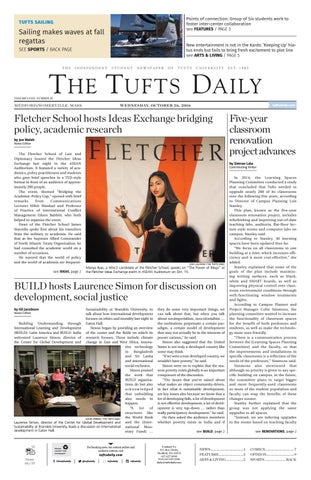
MAX LALANNE / THE TUFTS DAILY
Mariya Ilyas, a MALD candidate at the Fletcher School, speaks on “The Power of Blogs” at the Fletcher Ideas Exchange event in ASEAN Auditorium on Oct. 15.
BUILD hosts Laurence Simon for discussion on development, social justice by Gil Jacobson
Sustainability at Brandeis University, to talk about how international development focuses on ethics and morality last night in Building Understanding through Eaton Hall. International Learning and Development Simon began by providing an overview (BUILD): Latin America and BUILD: India of the center and the fields on which its welcomed Laurence Simon, director of research focuses. These include climate the Center for Global Development and change in East and West Africa, innovative technology in Bangladesh and Sri Lanka and international social exclusion. Simon praised the work that BUILD organizations do but also a c k n ow l e d g e d that unbuilding also needs to happen. “A lot of structures like the World Bank ALEXIS SERINO / THE TUFTS DAILY Laurence Simon, director of the Center for Global Development and and the [InterSustainability at Brandeis University, leads a discussion on international national Mondevelopment in Eaton Hall. etary Fund] … News Editor
Please recycle this newspaper
Sunny 48 / 33
/thetuftsdaily
Five-year classroom renovation project advances
For breaking news, our content archive and exclusive content, visit tuftsdaily.com @tuftsdaily
tuftsdaily
tuftsdaily
Contact Us P.O. Box 53018, Medford, MA 02155 617 627 3090 FAX 617 627 3910 daily@tuftsdaily.com
NEWS............................................1 FEATURES.................................3 ARTS & LIVING.......................5
COMICS....................................... 7 OPINION.....................................9 SPORTS............................ BACK
2
THE TUFTS DAILY | News | Wednesday, October 26, 2016
T HE T UFTS D AILY Arin Kerstein Editor-in-Chief
EDITORIAL
Sophie Lehrenbaum Jake Taber Managing Editors Evan Sayles Associate Editor Kathleen Schmidt Executive News Editor Gil Jacobson News Editors Melissa Kain Robert Katz Liam Knox Catherine Perloff Jei-Jei Tan Hannah Uebele Joe Walsh Juliana Furgala Assistant News Editors Jesse Najarro Danny Nelson
Miranda Willson Executive Features Editor Constantinos Angelakis Features Editors Nina Joung Becca Leibowitz Justin Krakoff Executive Arts Editor John Gallagher Arts Editors Eran Sabaner Isaac Brown Assistant Arts Editors Jocelyn Contreras Alison Epstein Elliot Storey Emma Henderson Executive Op-Ed Editor Shannon Geary Cartoonists Stephen Dennison Allie Merola Miranda Chavez Editorialists Frances DeFreitas Eriko Koide Anita Ramaswamy Noah Weinflash Phillip Goldberg Executive Sports Editor Yuan Jun Chee Sports Editors Maddie Payne Eddie Samuels Maclyn Senear Josh Slavin Brad Schussel Assistant Sports Editor Noah Smith Max Lalanne Mia Lambert Caroline Ambros Ray Bernoff Scott Fitchen Jean Gonzalez Kevin Ho Thaw Htet Lilia Kang Sitara Rao Evan Sayles Zachary Sebek Alexis Serino Seohyun Shim Angelie Xiong Ezgi Yazici
Executive Photo Editor Photo Administrator Picture Tufts Editor Staff Photographers
PRODUCTION David Westby Production Director Allie Merola Executive Layout Editors Sebastian Torrente Lilia Aronoff-Aspatur Layout Editors Jewel Castle Brianna Mignano Emily Sharp Astrid Weng Ezgi Yazici Alice Yoon Petrina Chan Creative Director Allie Merola Executive Graphics Editor Petrina Chan Graphics Editors Peter Lam Juliana Furgala Ashton Stephens Rena Tang Belinda Xian Sebastian Torrente Zach Hertz Executive Copy Editors Jei-Jei Tan Norrie Beach Copy Editors Arthur Beckel Caroline Bollinger Alison Epstein Gil Jacobson Melissa Kain Reena Kerasin Bibi Lichauco Kathleen Martensen Netai Schwartz Nihaal Shah Arielle Sigel Liora Silkes Dan Strauss
Maxwell Bernstein Executive Tech Manager Nitesh Gupta Online Editor Mia Lambert Social Media Editor
BUSINESS Josh Morris Executive Business Director
tuftsdaily.com
Academics, professionals discuss humanitarianism, policy-making IDEAS
continued from page 1 ly divided, with academics becoming increasingly specialized and policymakers constantly focused on moving quickly. Nonetheless, he said that he has found that many policymakers are interested in research. Neil Levine, director of the Center for Excellence on Democracy, Human Rights and Governance at United States Agency for International Development (USAID), discussed how he has worked to pair project teams at USAID with researchers. According to Levine, one place for collaboration is in evaluating the effectiveness of foreign aid interventions. By enabling interactions and training between academics and teams of USAID staff, the USAID workers gain the skills to evaluate their work and the academics frequently get valuable data. Fletcher student Mariya Ilyas followed with a speech about the value of blogging in the academic world. She argued that the catastrophe following Hurricane Katrina could have been controlled better if policymakers were more connected to the immense body of research about New Orleans’ levee system. Ilyas contended that blogging is one
way to bridge the gap between policy and research. She said that academics can use blogs to reach policymakers both through direct exchange of ideas and through citizen activism. Blogging platforms are powerful because they are widely accessible, she added. International Economics Affairs Professor Michael Klein spoke about his experience as Chief Economist at the U.S. Treasury’s Office of International Affairs, a position which he said differed greatly from his position at the Fletcher School. He noted that his exposure to policymaking has been helpful to his career. “A lot of my research that I’ve done since I returned from Treasury I can trace back to my experience there,” he said. Thania Paffenholz, director of the Inclusive Peace and Transition Initiative at the Graduate Institute in Geneva, proposed a few conditions necessary for researchers to influence policy. She said that researchers should seek to understand what is important to the organizations that they are working with. Dyan Mazurana, associate research professor at Fletcher, argued that researchers should strive to establish direct relationships with policy work-
ers and that researchers should strive to make change in critical issues. Rahul Chandran (F ’06), senior policy advisor at the United Nations University Centre for Policy Research, agreed that, in certain cases, researchers have a moral obligation to advocate certain ideas. He said that academics should try to understand individual organizations’ needs and interests. Deborah Avant, professor from the Josef Korbel School of International Studies, spoke about her research into the determinants of violence in conflicts, which naturally includes many actors. Matthew Merighi (F ’16), assistant director of Fletcher’s Maritime Studies Program, spoke about how academics can reach bureaucrats through accessibility, familiarity with the policy process and personal relationships. Maria Stephan, senior policy fellow at the U.S. Institute of Peace, spoke about how academic research helps advance policymakers’ understanding of grassroots political activism; she used the United States’ attempts to support activists in Syria as a template. The event concluded with closing remarks from Mankad and was followed by a reception.
Renovations look toward engineering buildings as next step RENOVATIONS
continued from page 1 requirements,” she said. Stanley said that Braker Hall received upgrades last summer. “The economics department wanted to maintain classrooms with a high seat count, so we stuck to tablet arm chairs,” she said. “We also installed new blackboards, as they were preferred by the faculty.” The Fletcher School of Law and Diplomacy classrooms also received an upgrade, according to Simmons. “It was mainly focused on audio-visual upgrades, because Fletcher, being a professional school, uses technology for Skype and video conferencing,” Simmons said. The group added easily-movable furniture and extra storage space to the rooms in Aidekman Arts Center for classes that require open floorspace, Stanley added. Overhead lights that more closely imitate natural outdoor light were also
installed, Simmons said. Department of Drama and Dance Chair Heather Nathans said she was was pleased with the renovations done in Aidekman. “We were very excited about the Aidekman renovations and particularly appreciated our opportunity to talk with the planning team last spring about some of the special needs for general-use classrooms that also house the arts,” Nathans told the Daily in an email. Installing free-standing storage cabinets and new audio-visual (AV ) equipment, allowing more natural lighting and repainting rooms were all renovations that were made, according to Nathans. “The most significant transformation was removing individual student desks and replacing them with tables and wheeling chairs that can be reconfigured in different teaching patterns or moved to the side to accommodate movement around the classroom,” she said.
Nathans said that the renovations were necessary to help to facilitate learning in Aidekman classes. “We definitely needed renovations in the space — the old equipment and configuration often created challenges for seminar groups or for classes that required movement around the space. And the improved AV quality is a great boon to classes using film or sound clips,” Nathans said. Stanley said that it was time for upgrades to expand and that the Learning Spaces Planning Committee will focus on Anderson Hall, Halligan Hall and Robinson Hall in the summer of 2017. “We were disproportionately focused on Arts and Sciences buildings in the summer of 2016,” Stanley said. According to Stanley, the five-year project has not yet received formal feedback. However, the Center for Enhancement of Learning and Teaching (CELT) is going to seek feedback from the faculty and students for the Learning Spaces Planning Committee, Stanley said.
Simon talks international development, poverty BUILD
continued from page 1 so, why it exists and to what extent it is present. After taking group suggestions, Simon suggested that India is currently in a position where it can decrease its future chances of poverty. He said that while India has a large population, it is comprised of many young people and is smaller than China’s population. He added that if these people’s needs are met and they get ample training, they will obtain employment and therefore avoid poverty. “Now contrast that to most industrialized nations today,” he said. “Do you know what Japan’s population is today, approximately? About 125 million people. Do you know what it’s projected to be in about 30 years? About 85 million. Japan’s population, like almost every industrialized nation in the world, is plummeting.” Simon later pointed out that a major
problem in India as well as in Latin American countries is structural inequality, which is largely influenced by India’s caste system. “If you were born into a caste, then you will die in that caste,” he said. “There is no way out of a caste. If you had a Ph.D., which some Dalits are getting higher education now and can graduate with Ph.Ds, you will always still be a Dalit. In most cases, they suffered the discrimination of being a Dalit.” There is a large amount of fixed and structural discrimination towards Indian lower-class and tribal people, which creates a conflict between contemporary and traditional economies, Simon said. “And I think that is probably one of the greatest drags on Indian development,” he said. Simon used the example of B.R. Ambedkar, who despite attending school, was forced to sit outside and listen in on
lessons rather than be in the classroom. “If by accident [Ambedkar’s] shadow crossed another student, if by accident he touched their food, if by accident he touched them, played with them … this would be pollution,” he said. Simon concluded by taking several questions from the group, including one about whether poverty and social inequality sustain each other. “All development is contextual, so we really need to look at it place to place, where there is great inequality,” Simon responded. “If you look at many developing countries, you will see significant structural inequalities and that perpetuates poverty.” But Simon also acknowledged that it seems easier to reduce poverty in countries that limit freedom of the press, using the examples of India and China. “We often say there are no models, but there’s lots of lessons,” Simon said.
Wednesday, October 26, 2016
Features
Group of Six peer leaders look to facilitate greater communication, solidarity by Nina Joung
tuftsdaily.com
Kevin Lawson The Tufts Daily Show
Clinton’s discarded jokes
O
Features Editor
For Christin Mujica, a peer leader at the Latino Center and a former peer leader at the LGBT Center, the fact that the two centers share Bolles House at 226 College Ave. has been a convenient way for her to find community. However, as someone who identifies as both queer and Latina, Mujica, a senior, recognized that not everyone feels comfortable going up and down the stairs that connect the two centers. “Even within the same building, people still stay in whatever space they’re more comfortable with,” Mujica said. Mujica is one of several former and current peer leaders from the Group of Six centers who wants to change this mentality. During the weeks leading up to the start of the semester, the peer leaders from the Africana, Asian American, Latino, LGBT and Women’s Centers (the International Center, the sixth Group of Six community, does not have a peer leader program, according to Mujica) came together for a group dinner. Mujica said the dinner was the first time that all five peer leader groups shared the same space. Doing so inspired her and other peer leaders to try to maintain the collective community. “We were sitting down talking about what we could do, because we’re like, ‘This is so cool that we’re all here and we can talk to each other, we should have a space where we can all reach out,'” Mujica said. One idea they had was to create a Facebook group for people of color (POC) to share events and support one another. Mujica said that she and Christihanna Morrison, a sophomore and a peer leader for the Africana Center, started the Facebook group in early September. According to Mujica, the Facebook group, which now has over 400 members, has helped students reach out to a broader community and acts as a space to share events that could be relevant to multiple ethnic or racial communities. “Even if people don’t interact with it, just sharing events and having more POC show up [to events] is just more solidarity,” she said. “I think to make anything change at Tufts, that solidarity is important.” Another idea that came out of the dinner was a group of five committee. According to Shreya Bhatia, a senior and program assistant for the Asian American Center’s Peer Leader Program, she and other peer leader advisors thought that having a group of people committed to connecting the different centers could lead to more collaboration and solidarity among them. “We talked about how we could work together more, and one of the things that came out of that is having a representative from each community come, meet and report back to the broader community so that we can have more joint events,” she said. Nick Whitney (LA ’16), the graduate coordinator for the LGBT Center’s peer leader program Team Q, is currently working alongside Bhatia to build the group of five committee. Whitney told the Daily in an email that the committee is still in preliminary planning stages and is currently being worked on at the student level. Whitney hopes that the committee will help integrate the different centers so that students, especially those who identify with multiple centers, can feel
3
MIA LAMBERT / THE TUFTS DAILY
Bolles House at 226 College Ave., which hosts both the LGBT Center and the Latino Center, is pictured on Oct. 3. connected to the different communities without spreading themselves too thin in terms of the amount of work and time they put into the centers. “This student body would speak to and support the various intersections within which many Tufts students are located and work to actively communicate the needs and desires of different students at different Centers,” Whitney said. This committee is a modified version of what existed in Bhatia’s sophomore year, when she was an Asian American Center peer leader. The previous committee was a POC committee that included representatives from the Asian American, Africana and Latino centers and consisted of about six to eight members, according to Bhatia. Yonas Dinkneh, a senior, was a part of the committee during his sophomore year, when he was also an Africana Center peer leader. He said that the idea came from the center directors as a way to build camaraderie between the POC communities. Dinkneh credits some of his friendships today to the POC committee. He is also proud of the open mic night the committee organized at Brown & Brew Coffee House. According to Bhatia, the group also organized a successful field day event. However, Dinkneh remembers the difficulty that members of the committee faced in terms of expanding the feeling of a broader POC community to their respective centers. “Even though we were working on this together, it was like we were a separate group,” he said. “[T]here wasn’t a lot of support from the larger houses that we were coming from.” Latino Center Director Rubén Stern said he recalls how difficult it was for students to maintain the POC community, partly because of its small size. He added that the initiatives for committees, such as the POC committee, cannot be forced on the peer leaders by the directors. Rather, student leaders are in charge of creating and maintaining them. Bhatia agreed that it is often up to the students who experience the specific intersections of different identities to come up with and do the work for these specific events. “A lot of these [events] are like an individual peer leader says, ‘I want to have an event like this,’ and they create it themselves, and peer leaders support them by attending,” she said. “But it has to be planned by them.” Dinkneh noted that the POC committee could not force students to actively invest in building a broader community.
“I think everyone to a degree feels more comfortable with the people they already associate with, so trying to force it, in a sense, was not well received,” he said. “It’s not that people were upset that we were trying to do this. They just weren’t as interested because it was an event with people that they normally wouldn’t hang out with.” Patrick Mahaney, a sophomore and an Asian American Center peer leader who is also involved with the LGBT Center, said that the accessibility of the different centers is key to fostering effective and comfortable intersectionality. On the other hand, they said they find certain spaces physically inaccessible. For example, the Start House, home to the Asian American Center, serves as a residence for students and therefore cannot have an open door policy. Thus, the Asian American Center is not as easily accessible to students who are not living in the house. Mahaney added that intersectional events are another way for the centers to be more accessible and help students who do not identify with the center feel more comfortable entering the space. They pointed to a September 2016 session of Qrunch — a discussion series organized by the LGBT Center — which addressed being queer and Latinx as an example of intersectional work between the Latino and LGBTQ communities. While the centers have put on events that highlight multiple identities and all of the other centers, apart from the Asian American Center, are open to the public, Mahaney believes that building solidarity requires more than forming a committee and opening the centers’ doors. They see solidarity as a laborious task that requires members of each community commit to learning about the other centers’ struggles. “I think it definitely starts with people learning about each other and learning what they do that hurts other people, what they can do to help other people be safer or feel better,” Mahaney said. Bhatia said that she and Whitney are starting to recruit representatives from the five centers. As the group of five committee takes shape, Bhatia hopes it will help students from the different centers feel less isolated in their goals and look at the broader history of oppression that relates them to one another. “They’re different histories and lived experiences but have a shared history of exclusion, and we shouldn’t think we exist alone,” Bhatia said.
n Thursday night, Donald Trump and Hillary Clinton put their differences aside in order to attend the Alfred E. Smith Memorial Foundation Dinner, an annual fundraiser for Catholic charities. As is tradition at the dinner, the two presidential candidates (that matter) each roasted the other. Secretary Clinton went the traditional comedic route, while Trump gave a glimpse into his foreign policy by bombing indiscriminately. Unfortunately, Clinton decided not to go with any of the jokes I pitched to her via email earlier this month. Sad! Since she’s not using the material, I figured I might as well share it with you. Here’s the email: From: Kevin Lawson <Kmasterfresh@ gmail.com> Subject: Donald Trump Roast Date: October 11, 2016 at 7:36:14 PM EDT To: HillaryClinton@homeserver.com Classification Level: Not worth deleting Hi, Hillary! I wrote some jokes for you to use at the Al Smith dinner. Please practice them in front of a mirror and make note of the sorts of pauses and eye contact that humans make while engaging in humor. By the way, The Tufts Daily pays me $450 per joke, and I’m looking for competitive pricing. I have Venmo. Hello, everyone! It is an honor to be here at the Alfred E. Smith Memorial Foundation Dinner, where we are raising money for Catholic charities, which are like agnostic charities, except they can actually make up their minds about whom to help. As I speak, waiters will be coming around with bread and wine — please drink liberally, since these jokes get funnier after two or three glasses of the blood of Christ. To those with celiac disease, we apologize, but Christ’s body contains gluten. There’s plenty of kale in hell though, so look forward to that. There may be many Catholic figures here, but this fundraiser isn’t just about a religion. It’s about certain values and traditions that we hold dear. Ever since our country was founded on the principle of religious freedom for anyone with the same religion as us, these values have been the bedrock of our society and our politics. It’s true that, in past presidential elections, we’ve been unwilling to look beyond traditional Christian candidates, but the times, they are a-changin’! Whereas we used to live in a country where only a married, Christian man with kids could be president, we’ve grown into a wonderfully inclusive country where even a married, Christian woman with kids can be president. Progress! Catholic values are so big in American politics that last September, Pope Francis visited and spoke with certain members of Congress. The next day, Speaker of the House John Boehner announced his resignation. Your Holiness, whatever you said to Boehner, do you think you could come back and say it to Trump? Or would you at least ask the man upstairs what he was thinking when he made him? Are we being punished for something? Is this because “The Big Bang Theory” is TV’s most-watched comedy? Wow, actually, you’re right, we deserve this. All I ask is that when Trump dies, you remind St. Peter of Trump’s favorability toward an “extreme vetting” process that keeps bad people out of places. Yours, Kevin Kevin Lawson is a senior majoring in political science. Kevin can be reached at kevin. lawson@tufts.edu.
4
THE TUFTS DAILY | ADVERTISEMENT | Wednesday, October 26, 2016
1/4
tuftsdaily.com
1/8
1/2
ARTS&LIVING
5 tuftsdaily.com
Wednesday, October 26, 2016
Not much to keep up with on this week’s ‘Kardashians’ episode by Alison Epstein
Assistant Arts Editor
It had been a long, hard seven weeks as dedicated “Keeping Up with the Kardashians” (2007–Present) viewers waited on the edge of their seats for the end of the season 12 hiatus. But finally, on Oct. 23, the anticipation ended, and the Kardashian-Jenner clan was back on the small screen. And what a dud of a return it was. For some reason, the manufactured drama and shenanigans were just not coming together this week. Maybe it was an off week, or maybe the Kardashian family is already so present and discussed ad nauseam in the media that the last thing anyone needs is another hour of them driving around and talking to each other on speakerphone every week. But anyway, let’s dive into this week’s titillating episode, “Khloe’s New Breast Friends.” The episode opens with the unveiling of Kanye West’s “new” music video for “Famous” (2016). That was the music video from the summer in which West put a bunch of nude wax figures of famous and infamous public figures in a bed together. It kind of broke the internet for about a day and a half. This brings up one of the inherent problems with “Keeping Up With the Kardashians.” The episodes were all filmed months ago, and the biggest events, such as this music video release, have already been covered by mainstream media. Now that the episodes are finally being aired, not only is there no new information, but the events are also fairly irrelevant at this point. Kim did try to give some new insight into the video’s meaning, but what she says is fairly incomprehensible and not even worth repeating. The main thing this sequence does is plant a seed for drama later in the episode, because Kris is clearly hurt by the fact that Caitlyn is included in the video. Kris’ underlying feelings come to a head after she finds out Kim had helped Caitlyn pick an outfit for the ESPYs. First, she texts Khloe that Kim was being “#dis-
Ana Antolin and Emily Friedlander Runaway Roundup
Shiny is a color, right?
L BRIAN BOWEN SMITH / E!
The cast of “Keeping Up With the Kardashians,” from left: Khloe Kardashian, Kris Jenner, Kourtney Kardashian, Kim Kardashian, Kylie Jenner and Kendall Jenner. loyal” and then, over speakerphone, calls her a traitor. This actually seemed like a pretty understandable — if not slightly irrational — reaction from Kris, since no doubt her divorce has continued to be straining, and it makes sense that she would want to feel like her children are on her side. But, in true Kardashian fashion, these real feelings were dealt with by going to the suite where “Pretty Woman” (1990) — one of Kris’ favorite movies — was filmed and wondering aloud, “What would Julia Roberts do?” What nice conflict resolution. This week’s other dose of drama revolves around Khloe potentially getting breast implants. She explains that she has been thinking about them for a while, and since her recent weight loss had caused chest shrinkage, she is now seriously considering some artificial enhancement. This is not groundbreaking in any way. Khloe herself says that in Los Angeles, people get breast implants like they fill up their car with gas. The real question is when Khloe is going to confess to getting butt implants. It is not possible for someone to lose more
than 40 pounds but somehow have their butt get larger and perkier. Digression aside, Khloe proceeds to prance around with various gel inserts for Kim as well as Scott, who is bored because Kourtney took the kids on vacation for three weeks. At least looking at Khloe’s fake boobs is better than taking off on a three-week bender and getting photographed with more 20-year-old Instagram models. Wait a second, is Lord Disick exhibiting signs of personal growth? The dumbest moment of the week goes to the one and only Khloe, who reveals to Scott that she does not know the difference between a nectarine and a peach. If only she spent as much time reading up on fruit variations as she does organizing Oreos in her glass cookie jars. This episode was basically just like any other — the show tries to make it seem like real things are happening, but it’s actually just a whole bunch of smoke and mirrors (or rather, contouring and waist trainers). This week barely had any Kourtney, so it was pretty much doomed from the start regardless.
ike the first episode of this season of “Project Runway”(2004–present), this week’s show starts off with a party that — surprise! — isn’t actually a party but an excuse to introduce the week’s challenge. The designers sip cocktails out of Absolut Vodka’s tacky, copper pineapple-shaped “drinking vessels” and chat with the show’s resident judges until Heidi breaks the facade and announces why everyone is actually there: The designers must create a cocktail dress inspired by Absolut’s new Elyx vodka (What’s new about it? We don’t know!) and the bar crafted to represent it. The next day, the designers meet up with mentor Tim Gunn in the morning to visit the fabric store Mood Fabrics. Tim is sporting a brown and blue striped tie, making us the proudest we have ever been to go to Tufts. Equally in love with Tim and his tie are our guest judges, sophomore Paige Spangenthal and junior Sam Weitzman. Sam had never before watched “Project Runway,” but as a dedicated fan of our column, he was already a lover of Tim Gunn (a.k.a “the ideal Machiavelian Statesman”) and was super enthusiastic to join us this week, despite his self-described lack of fashion sense. Paige is a fellow writer for the Arts section of the Daily. If designers won their spots on “Project Runway” based purely on the clothes they wore, she would be there in a heartbeat. Despite being in love with Designer Erin Robertson’s taste in clothing, Paige and the rest of us were simply annoyed by Erin and Dexter Simmons’ bravado this week. The “bigheaded” duo spent the duration of the challenge sauntering around the workroom with a frustrating air of self-importance. We were thankful that both of their looks also left judges unimpressed. Erin’s dress, which was deemed “Priscilla Queen of the Swamp” by judge Zac Posen and “a costume from ‘The Lion King’” by judge Nina García, inspired Ana’s Halloween look. This week’s top three were Jenni Riccetti, Laurence Basse and Rik Villa. Paige, Sam and Emily loved Rik’s sophisticated leather interpretation of the bartenders’ uniform while Ana preferred Laurence’s “Bentley of the little black dress,” as described by Nina. Unfortunately, Jenni was the winner with a look that wasn’t that bad but underwhelmed us. Our dear Tasha Henderson was sent home after struggling to blend her urban streetwear style with the demands of the challenge. Honorable mentions this week go to Brik Allen and Nathalia JMag. Sam aptly described Brik as looking like he wandered onto the set of the wrong reality show, but that doesn’t mean he shouldn’t get airtime, as he deserves to showcase his talent! Nathalia is very talented and has a lot of attitude to boot. We keep trying to mention her every week but, like in the show, she keeps getting edited out. She made a controversial look this week that was loved by some judges and hated by others. We saw great potential in it that will hopefully translate to more time in the spotlight for her as the show progresses. Ana Antolin is a junior studying international relations. Ana can be reached at ana.antolin@tufts.edu. Emily Friedlander is a senior studying international relations. Emily can be reached at emily. friedlander@tufts.edu.
6
THE TUFTS DAILY | ADVERTISEMENT | Wednesday, October 26, 2016
tuftsdaily.com
TUFTS UNIVERSITY DEPARTMENT OF DRAMA AND DANCE PRESENTS
Gem of the Ocean By August Wilson Directed by Monica Ndounou
1/4
1/8
October 27, Preview Night October 28–29 November 3–5 8pm TICKETS PRICES: $10 Tufts ID/Seniors $15 General Public $5 on October 27 (public preview) $10 on October 28 (opening night with wine and cheese reception) $1 on November 3 FOR ONLINE TICKETS tuftsdramadancetickets.com
1/2
FOR TICKETS & INFORMATION 617-627-3493 dramadance.tufts.edu
BALCH ARENA THEATER | TUFTS UNIVERSITY | 2016–2017 SEASON
7
Wednesday, October 26, 2016 | Comics | THE TUFTS DAILY
tuftsdaily.com
Comics
LATE NIGHT AT THE DAILY Jake: “If Moses walks in right now I’m going to s--- my pants.”
Comics
SUDOKU
DOONESBURY BY GARY TRUDEAU
NON SEQUITUR BY WILEY MILLER
Difficulty Level: Creating the spiciest new meme.
Tuesday’s Solution
FOR RELEASE OCTOBER 26, 2016
Los Angeles Times Daily Crossword Puzzle CROSSWORD Edited by Rich Norris and Joyce Lewis ACROSS 1 Wander (about) 4 Fragrant bloom 9 Utter disorder 14 Second person in Eden 15 Kitchen sponge brand 16 Full of moxie 17 Like many a gray day 18 Peanuts 20 Sales meeting aid 22 Feel crummy 23 Coal __ 24 Most populous continent 25 Date night destination 28 One of a gallon’s 16 30 Like a successful business, presumably 32 Stand against 34 Northern California city 37 Birch family tree 38 Peanuts 41 Hardly fresh 42 Bit of photography equipment 43 Southern California team 45 Inside information 49 Copper source 50 Hits the road 53 Albany-to-Buffalo canal 54 Former Air France jet 56 Geologist’s division 57 Tops by a slight margin 58 Peanuts 62 Picnic invader 63 Ready to hit the hay 64 Invalidate 65 Maiden name preceder 66 Used up 67 Pond critters 68 Mexican Mrs. DOWN 1 Gaudy trinket 2 Opposed
By Patti Varol
3 Enlargement advantage 4 Scot’s swimming spot 5 German “I” 6 Welcoming wreath 7 Highway through the Yukon 8 Newswoman Roberts 9 “Erin Burnett OutFront” channel 10 Pick up with effort 11 Geographically based trio 12 Makes trite, in a way 13 Hoff who wrote the “Henrietta” children’s books 19 Red “Sesame Street” puppet 21 Light beer? 25 Biceps exercise 26 Not at all handy 27 “Trainwreck” director Judd 29 Pay-__-view 31 Kings, e.g. 33 Lumbered
10/26/16
Tuesday’s Solution Tuesday’s Puzzle Solved
©2016 Tribune Content Agency, LLC
35 “MASH” setting: Abbr. 36 Lopsided 38 Sci-fi fleet vessel 39 Leave no doubt 40 GI addresses 41 __-mo 44 What a freelancer may work on 46 Hearts, but not minds 47 Ballpark snack
10/26/16
48 Lipton rival 51 Lindsay of “Mean Girls” 52 Foolish 55 Anticounterfeiting agts. 57 Slim swimmers 58 Euro divs. 59 West Coast hrs. 60 Houston-toDallas dir. 61 Belly
8
THE TUFTS DAILY | ADVERTISEMENT | Wednesday, October 26, 2016
1/4
tuftsdaily.com
1/8
1/2
Wednesday, October 26, 2016
Opinion EDITORIAL
Upholding transgender anti-discrimination in Massachusetts This summer, Massachusetts Governor Charlie Baker signed a vital anti-discrimination law intended to protect the rights of transgender individuals in public spaces. The new law, which went into effect on Oct. 1, protects a transgender person’s right to use the public restrooms, locker rooms and changing rooms that are consistent with their gender identity — regardless of what is written on their birth certificate. Though the law was signed in July, its full implementation has caused those in opposition to advocate for a change in policy. Due to these efforts, the 2018 Massachusetts ballot will include a vote to repeal the transgender anti-discrimination law. As part of preserving Massachusetts’ strides toward LGBTQ+equality and ensuring basic freedoms for all, Mass. citizens should push back against this regressive attempt to revoke transgender rights. Equality for transgender folks has been on the civil rights battlefield for quite some time. Notably, in North Carolina, a so-called “bathroom bill” was passed in March to block cities from allowing transgender individuals access to public restrooms that align with their gender identities. Other states such as Illinois, Indiana and South Carolina have proposed bills targeting transgender individuals. The recent Massachusetts law contradicts these movements in that it takes an active role in defending transgender rights instead of handicapping them. A
repeal, however, would eliminate this progress and protection. Though the concept of where people use the bathroom may seem trite, the stigma and intolerance it encourages can be disastrous, especially for young people. According to recent research, more than 60 percent of transgender youth who were denied access to their school’s bathrooms and facilities had attempted suicide, compared to 43 percent among those who had not been denied — a stark and terrifying difference. The repeal of the Massachusetts law therefore would not only jeopardize equal rights, but it could also quite literally put lives in danger. Much of the opposition to transgender equality in Massachusetts has been voiced by religious groups. The Massachusetts Family Institute, one of the law’s most vocal opponents, calls the ballot repeal a “huge answer to prayer.” In response to the passing of the law, the group said that Governor Baker had “fail[ed] to protect [Mass.] women and children,” and denounced the measure as being part of a “radical and aggressive agenda of sexual expression and a denial of basic biological truth.” While the values and opinions of religious groups are both valid and important, we must recall that our nation was founded on the idea of separation of church and state. Though all citizens are entitled to think and believe however they choose, religious ideals should under no circumstances
influence public policy and basic rights of equality. The fact of the matter is that anti-discrimination laws such as Massachusetts’ are pivotal steps toward curtailing incidents of violence. Violence toward transgender individuals is incredibly prevalent, occurring in schools, workplaces and other public spaces. A 2013 report on hate violence demonstrated the particularly severe impact of violence on the transgender community in the United States: It shows that transgender women are 1.8 times as likely to experience sexual violence compared to other survivors, that 72 percent of victims of hate violence homicides in 2013 were transgender women and that transgender individuals are seven times more likely to experience physical violence when interacting with law enforcement, compared to their cisgender peers. The implementation of laws that protect the safety and equality of transgender individuals will help to diminish these horrific rates of violence. Tufts prides itself on being a progressive, socially-conscious institution in the community. Our university has made its home in Massachusetts, and the choices of the state will undoubtably impact campus in some form or other. It is critical that Tufts students are socially responsible, perhaps by informing others or canvassing for continued transgender anti-discrimination, to ensure that Massachusetts is on the right side of history.
TRUMPKIN
BY STEPHEN DENNISON The Tufts Daily is a nonprofit, independent newspaper, published Monday through Friday during the academic year, and distributed free to the Tufts community. The content of letters, advertisements, signed columns, cartoons and graphics does not necessarily reflect the opinion of The Tufts Daily editorial board. EDITORIALS Editorials represent the position of The Tufts Daily. Individual editors are not necessarily responsible for, or in agreement with, the policies and editorials of The Tufts Daily. OP-EDS The Op-Ed section of The Tufts Daily, an open forum for campus editorial commentary, is printed Monday through Thursday. The Daily welcomes submissions from all members of the Tufts community; the opinions expressed in the Op-Ed section do not necessarily represent the opinions of the Daily itself. Opinion articles on campus, national and international issues should be 600 to 1,200 words in length and submitted to oped@tuftsdaily.com. The editors reserve the right to edit letters for clarity, space and length. All material is subject to editorial discretion and is not guaranteed to appear in the Daily. Authors must submit their telephone numbers and day-of availability for editing questions. ADVERTISING All advertising copy is subject to the approval of the Editor-in-Chief, Executive Board and Executive Business Director.
9 tuftsdaily.com
Daniel Lewis The Echo Chamber
Is college worth it?
W
e’ve tackled the costs of college and the merits of a vocational education, but we haven’t yet tackled the big question — is college even worth it in the first place? To find out, let’s take a step outside The Echo Chamber. For many, college has always been the obvious choice — almost 70 percent of U.S. high school graduates receive some post-secondary education, and in the United States, college is considered the de facto path to success. College and success have become so intertwined that people have been flocking to higher education in droves; between 1975 and 2015, the percentage of individuals over 25 with a bachelor’s degree rose from 13.9 percent to 32.5 percent. While college is a yellow brick road for some, for many, not so much. Student debt is a major factor in the devaluation of a college education. In 2015, the average debt for student loan borrowers was $30,100 — a four percent increase from 2014. This debt can pool and fester, even outlasting death. But incurred debt is not the only problem: 40 percent of students who started at a four-year institution in 2008 did not graduate by 2014, and almost the same proportion of those who did graduate found themselves in jobs that didn’t even require a four-year education. After four years, many students end up with degrees for which there are no jobs; in 2013, only 6.5 percent of communications graduates found a job in the same field. The value of any purchase is defined by its return on investment (ROI). College is no different. In a 2013 study, 46 degrees left graduates worse off than if they had made a 20-year investment in treasury bills, with 18 of those being different types of art degrees receiving a negative ROI. But just like a set of Nikes vs. a pair of Dollar General sneakers, what gives something its value is its brand. The percent annual return over 20 years for many name-brand schools, including those in the Ivy League, is usually somewhere in the double digits. Still, for others, like students at Shaw University in North Carolina, the ROI falls into the negative double digits — many lose money by going to college. Not all is bleak for our futures, though. Even with the exorbitant costs — public universities annually cost around $9,410 for in-state residents while private universities cost around $32,405 — the ROI for a college degree is usually positive. On average, as of April 2013, someone with a bachelor’s degree earned $500,000 more over their lifetime than someone who has only graduated high school, and the unemployment rate of college grads over 25 was 3.6 percent — four percent lower than that of high school grads. And as many know, the value of a four-year college experience cannot be boiled down to sheer ROI; for many, college is a life-changing experience that cannot be evaluated in numbers. And for many employers, college is a filter — by simply having a bachelor’s degree, your employment opportunities completely change. But is college really worth it? Are the life experiences and face-to-face class time equal to an annual $50,000 price tag? And what happens when a four-year degree only leads to a five-figure salary? I’ll leave these questions for you to decide. I just hope that you’ve enjoyed some time outside The Echo Chamber. Daniel Lewis is a first-year student who has yet to declare a major. Daniel can be reached at daniel.lewis@tufts.edu.
10
THE TUFTS DAILY | ADVERTISEMENT | Wednesday, October 26, 2016
tuftsdaily.com
VERSATILE Student Value Checking Receive a $ 25* bonus
when you open and use a Student Value Checking account.
NO MONTHLY FEE** • NO MINIMUM BALANCE • NO FEE FOR INCOMING WIRES
Start here to make it happen:
SANTANDERBANK.COM/STUDENT
Student Value Checking is available to students 16 through 25 years of age (legal guardian co-owner required for those between 16-18 years). Once you reach 26, we may convert your Student Value Checking to another checking product. Proof of enrollment may be required. *Get $25 when you open a new Student Value Checking account with a $10 minimum opening deposit between June 15, 2016 and September 30, 2016 and complete 8 debit card transactions that post to your account within 60 days of account opening. Your new account needs to remain open for 90 days in an eligible product type and payment of the bonus will occur within 30 days thereafter. One bonus per customer. Students who currently have a personal checking account or who have had a personal checking account with Santander Bank in the last year are not eligible for this offer. Cannot combine with other personal checking account cash offers. Offer only available to U.S. residents. Santander team members are not eligible. Bonus is considered interest and will be reported to the IRS on Form 1099-INT. **Other fees may apply, including a Paper Statement fee if you elect to receive paper statements. Refer to your fee schedule for details. Santander Bank N.A. is a Member FDIC and a wholly owned subsidiary of Banco Santander, S.A. © 2016 Santander Bank, N.A. All rights reserved. Santander, Santander Bank and the Flame Logo are trademarks of Banco Santander, S.A. or its subsidiaries in the United States or other countries. MasterCard is a registered trademark of MasterCard International Incorporated. All other trademarks are the property of their respective owners.
senior commencement speaker
NOMiNatiONs The Wendell Phillips Award
Each year, one graduating senior is chosen to be the class speaker at Commencement, and the speech takes place during the Baccalaureate Service. Established in 1896 and named for Wendell Phillips, the speech is intended to deliver a social justice message for our time. Faculty, staff, and students may nominate seniors to apply to be the Wendell Phillips Speaker, and seniors many self-nominate. Nominees will be invited to apply by January with a resume of leadership and service activities and a recorded speech. Applications are reviewed by the Committee on Student Life (CSL), who will invite finalists to audition at an open forum in March before selecting the winner. This award also carries a cash prize of approximately $900. Wendell Phillips Nineteenth-century American lawyer, orator, fervent abolitionist, and advocate for women’s and Native People’s rights
Nominate today and learn more: http://chaplaincy.tufts.edu/wendellphillips For more information, please contact University Chaplain The Reverend Greg McGonigle at chaplaincy@tufts.edu or 617.627.3427.
Nomination Deadline: Monday, October 31, 2016 at 5 p.m.
Wednesday, October 26, 2016 | Sports | THE TUFTS DAILY
S
Sailing looks ahead to weekend races SAILING
continued from page back “We have a much bigger team than most people and the sailing program at Tufts doesn’t focus only on the A team,” Amouyal said. “Other schools put a lot of resources in sending an A team to nationals and winning nationals while the rest of the team exists only to train the A team. At Tufts, we put effort into every-
body and try to get everyone as good as they can be and everyone goes to competition, so it means that our resources are spread a lot thinner. Everyone feels that they are valuable to the team.” Looking ahead, Tufts prepares to race this weekend at the Erwin Schell Trophy event for the co-ed team and the Victorian Coffee Urn event for the women’s team. The teams will focus
11
Bradley Schussel The Coin Toss on their starting technique and on adjusting to the unusual currents that are typical of the course at the Coast Guard Academy, where the regattas will be held. The women’s team needs to place in the top seven teams and the co-ed team needs to place in the top eight teams in order to qualify for the Atlantic Coast Championships in Charleston, S.C. on Nov. 16.
Passionate about sports? Have a unique perspective on student athletics? Interested in covering the intersection of sports and the larger Tufts community? Write for us! Contact dailysports@gmail.com!
NBA season predictions
W
elcome to The Coin Toss, where I make some bold, unlikely predictions every week about some of your favorite professional sports. First, a quick recap of last week. I had the Browns topping their season high in total offense. They didn’t perform horribly against the Bengals, but their 352 yards were about 80 short of my prediction. I said the Vikings would record seven sacks on Carson Wentz and this was nowhere close to true, as they didn’t record a single sack. I was, however, right about my last prediction: Matthew Stafford led the Lions to a win over the Redskins. This time, I’m changing it up a bit. Basketball is upon us, so I’m going to make some bold predictions about this NBA Season! Who will win the major awards and the championship? MVP: Kawhi Leonard, San Antonio Spurs Many would pick Stephen Curry here, but he’ll be deferring fairly often to new teammate Kevin Durant. Kawhi Leonard came in second in last year’s MVP voting. He’s the best perimeter defender in the league and his offensive game is improving constantly. I’m betting he’ll have a good enough season to clinch his first MVP award. Defensive Player of the Year: Hassan Whiteside, Miami Heat Whiteside is now the lone star in Miami, so he’ll anchor the defense basically on his own. He will have to average an insane number of blocks to beat out Kawhi for DPOY, but I think he will. Whiteside is one of the NBA’s emerging stars, and he is definitely in the running for this award. Most Improved Player: Dennis Schröder, Atlanta Hawks Schröder is stepping into a starting role in Atlanta after Jeff Teague’s departure and he’s playing in a system that tends toward moving the ball, which allows for plenty of assists. This pick is dependent on Schröder improving his shooting, but he is my candidate for MIP. Rookie of the Year: Brandon Ingram, Los Angeles Lakers Following Ben Simmons’ foot injury, the field is much more open for other players. Ingram has the best shooting stroke in his class by far. The Lakers don’t have many shooters, so Ingram will get plenty of chances to knock down shots from the perimeter and should be the best rookie this season. Sixth Man of the Year: Enes Kanter, Oklahoma City Thunder Kanter probably should have won this award last year, but he placed third. He averaged 13 points and eight rebounds in just 21 minutes per game. Kanter is an efficient player off of the bench and will get another chance at the award this year. Coach of the Year: Tom Thibodeau, Minnesota Timberwolves The Wolves look like a serious contender going into this season, with KarlAnthony Towns and Andrew Wiggins improving and Thibodeau at the helm. If Minnesota makes noise this year, he’ll contend for Coach of the Year. NBA CHAMPION: San Antonio Spurs (def. Cleveland Cavaliers) This is bolder than bold. The Warriors WILL NOT make the NBA finals. Rather, the Spurs will win the Western Conference and beat out the Cavaliers to win the title for the sixth time since 1999. The Coin Toss’ pick is in: the Spurs will win it all in 2017. Bradley Schussel is a sophomore majoring in biomedical engineering. Bradley can be reached at bradley.schussel@tufts.edu.
12 tuftsdaily.com
Sports
Wednesday, October 26, 2016
GOLF
Jumbos finish fourth at New Englands, Elliot receives individual honors by Ryan Schneiderman Staff Writer
Men’s golf placed fourth in its final tournament of the fall season, the 82nd Annual New England Intercollegiate Golf Association (NEIGA) Championships this past weekend. Senior tri-captain Owen Elliot paced the Jumbos for a
third consecutive week, finishing tied for third overall. Elliot’s two-round score of 149 left him one shot shy of the leaders and a potential playoff, but he still walked away with Div. III AllNew England honors. Despite having to play in 20 mph wind, Elliot improved on his Sunday score of 76 to post a 73 on Monday.
COURTESY GEORGE PENDERGAST
Senior tri-captain Owen Elliot, center, poses for a picture with his teammates after winning Division III All-New England honors at the 82nd Annual New England Intercollegiate Golf Association Championships in Brewster, Mass. on the weekend of Oct. 22.
“It was an up and down round,” Elliot told the Daily in an email. “I thought I would need a -2 round of 70 to win so I definitely had a number in my head going out there. I started great, going -2 [through] six with kick in birdies in [holes] 4 and 6. Then a stretch of bad drives got me into trouble and I dropped three shots on the next [four] holes. Bringing [it] back in I got myself back into contention with birdies on [holes] 12 and 15.” Elliot wasn’t the only Jumbo to improve his score across the two days. With an eight shot improvement from round one, sophomore Justin Feldman shot a 75 — three strokes over par — in the final round, finishing the tournament at 14-over. His 158 score tied for 17th place. First-year Ethan Sorkin followed suit, improving by seven strokes and shooting a 77 in the final round. His combined score of 161 ranked 27th overall. Tufts’ second day improvements boosted the team from ninth place to fourth, the fourth time in five events that the Jumbos improved on their day one position. “A lot of times, young golfers kind of lose it in the first four, five holes but not the guys this year,” coach George Pendergast said. “A few times they’d have a bad front side and they really rallied on the backside, and it’s been the same across the two days. The first day, maybe they were a little less focused,
and then the second day, they would post a better score.” A one-hole playoff was necessary to decide the winner of the championship. First-year Chris Bornhorst of Babson College and senior Zachary Temple of Castleton University both finished with a four-over-par combined score of 148, but it was Bornhorst who posted the better score on the playoff hole, earning the Babson player individual honors. Led by Bornhorst’s first-place performance, Babson College took home the team championship, winning by seven strokes and posting a two day score of 617. Husson University finished second with a total of 624. Nichols College placed third with a score of 633, while Tufts and Western New England both finished with 635 points to tie for fourth. Tufts golf is on hiatus for the winter until its season resumes in the spring, but Elliott said that he and his team have no plans to take a break between seasons. Tufts’ string of impressive performances over the past few weeks has produced one of the team’s best fall seasons in recent history. According to Elliot, it will not be a surprise if the Jumbos come out even stronger this spring. “We’re going big,” Elliot said. “Lifts start next week. It’s a great opportunity for team bonding, and hopefully it will help us play better in the spring.”
SAILING
Jumbos net second out of 17 at Oberg Trophy Regatta by Savannah Mastrangelo Staff Writer
Despite strong winds and tumultuous racing conditions, the sailing team competed in five regattas around the Boston area and throughout New England this weekend, earning high rankings in most of its races. The co-ed team sent crews to race in the Midweek Firefly Invite at MIT, the Oberg Trophy at Northeastern, the Central Series at Boston College and the Peak Foliage at Tufts hosted by the University of New Hampshire. The women’s team competed in the Mrs. Hurst Bowl at Dartmouth. The women’s team sent both A and B division boats to the Mrs. Hurst Bowl on Saturday and Sunday, placing sixth out of 17 teams with their combined scores. The racing conditions were windy with a high of 15 knots and a low of seven knots. In the A division, senior captain Julia Fuller crewed and senior MaryClaire Kiernan skippered to tally 113 points. In the B division, junior Molly Pleskus skippered with sophomore Sabrina van Mell as crew, earning 119 points for a 232 team total. Tufts’ 232 score tied with Yale’s team total, though Yale beat out Tufts in the head-to-head tiebreaker to claim the fifth place spot. Fuller noted that the race was a successful one for both of its boats. “In B division, [Pleskus] and [van Mell] did really well in the bigger breeze as they were able to outwork people and sail around them,” Fuller said. She said that the boat in A division also started off particularly strong.
“It was really about connecting the puffs throughout the weekend because the breeze would be patchy, so there would be wind on one side of the course but not the other, and you needed to stay where the breeze was to be in the top of the fleet, and that’s something I think we did pretty well,” she said. Racing on Saturday and Sunday back in Boston, the co-ed team placed second out of 17 teams at the Oberg Trophy Regatta with 240 total points. Seniors Sandy Beatty and Caroline Ambros raced for the A division along with junior Julien Guiot, tallying 101 points. Sophomore Jack Bitney and senior Natalie Danziger raced in the B division on Saturday before sophomore Florian Eenkema Van Dijk and senior Sam Gates took over on Sunday. The two crews combined for a score of 70, second in the division. Sophomores Chris Keller and Taylor Hart raced in the C division on Saturday, with sophomore Cam Holley taking over for Hart on Sunday. Tufts totaled 69 points in the C division for third place — just one point behind Brown University in second. Weather conditions were tamer on Saturday, averaging five knots throughout the day, but on Sunday, winds reached 15 mph and sailors rigged storm jibs, reefed mainsails and sailed with their heavy crews. Closer to campus, the co-ed team raced two entries at the Peak Foliage Invite on Sunday, placing fourth and fifth out of 12 teams. According to Fuller, this regatta served as a great opportunity for new sailors to gain experience.
“Because this was a lower level regatta, it was a good time for our underclassmen to get experience and train,” she said. “It was pretty breezy at this regatta as well, so it was a good experience for younger sailors to learn.” The Central Series at Boston College on Saturday and Sunday did not go as well for the Jumbos as the other races. Their first boat placed 11th and their second boat placed seventh out of 13 teams. However, the trio of junior Aaron Klein, first-year Nihal Pai and sophomore Marisa Permatteo managed a third place finish in the A division with 24 points. The host Boston College Eagles placed first and second in the A division, but their second place score was only one point ahead of the Jumbos’ score.
At last Thursday’s Midweek Firefly Invite, first-years Charlotte Lenz and Grant Tilson placed seventh out of 14 teams with 38 points. Strong winds were also a factor at this regatta, as the team raced with storm sails and a heavy crew. According to first-year Chloe Amouyal, the sailing program at Tufts is unique in that it provides a significant number of opportunities and resources across all divisions and sailing levels, which contribute to the program’s development, the team’s overall success and its consecutive high rankings among the top New England sailing programs. see SAILING, page 11
RAY BERNOFF / THE TUFTS DAILY ARCHIVE
Tufts sailors compete in the Mystic Lake Team Race, where the Jumbos placed first, on April 10.