‘The People v. O.J. Simpson’ retells the O.J. trial with a fresh, energetic angle see ARTS AND LIVING / PAGE 4
MEN’S TENNIS
jumbos defeated top 10 Amherst, the 2014 NESCAC champion
Women’s and co-ed sailing teams gear up for fleet racing, championships with weekly regattas see SPORTS / BACK PAGE
SEE SPORTS / BACK PAGE
THE
INDEPENDENT
STUDENT
N E W S PA P E R
OF
TUFTS
UNIVERSITY
E S T. 1 9 8 0
T HE T UFTS DAILY
VOLUME LXXI, NUMBER 49
Friday, April 8, 2016
MEDFORD/SOMERVILLE, MASS.
tuftsdaily.com
Matt and Kim, Shaggy, BØRNS to perform at Spring Fling by Liam Knox
Assistant News Editor
Concert Board announced that this year’s Spring Fling headliner will be indiepop duo Matt and Kim, with opening acts by rapper Shaggy and indie-pop art-
ist BØRNS. The announcement was made last night at the annual Battle of the Bands event in Hotung Café through a video that was played to a crowd of approximately 50-60 attendees. BØRNS had already inadvertently been announced as one of the acts on March
28 through the advertisement of the artist’s upcoming summer tour on his Facebook page. The lineup was announced shortly after a panel of student judges decided on Water Walk as the winners of this year’s Battle of the Bands, a title which also
comes with the opening slot for Spring Fling, which will take place on Sunday, May 1 on the President’s Lawn. Water Walk was competing for the title against the bands Dirty Nalgene, Space Ink and Korumbus and the hip-hop collective Tarik.
Club sports teams respond to changes in program policies, regulations by Catherine Perloff Assistant News Editor
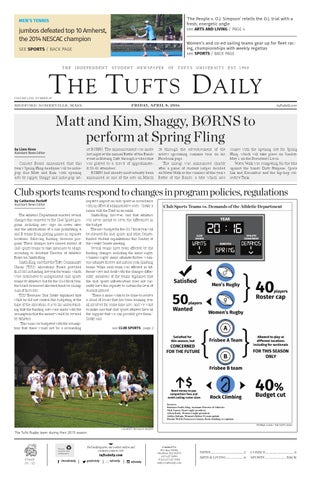
The Athletics Department enacted several changes this semester to the Club Sports program, including new caps on roster sizes and the introduction of a rule prohibiting A and B teams from playing games in separate locations, following funding decrease program. These changes have caused leaders of club sports teams to take measures to adapt, according to Assistant Director of Athletics Branwen Smith-King. Smith-King said that the Tufts Community Union (TCU) Allocations Board provided $115,000 in funding last year for teams, which were distributed to independent club sports teams by Athletics, but for the 2016 fiscal year, the board decreased allocated funds to a lump sum of $100,000. TCU Treasurer Shai Slotky explained that while he did not control this budgeting at the time of the allocation, it is to his understanding that the funding cuts were made with the assumption that the money would be covered by Athletics. “This sum was budgeted with the assumption that there would not be a resounding
negative impact on club sports in accordance with an offset of administrative costs,” Slotky, a junior, told the Daily in an email. Smith-King, however, said that Athletics was never meant to cover the differences in the budget. The new budget for the 2017 fiscal year will be released for club sports and other Senatefunded student organizations this Sunday at the weekly Senate meeting. Several teams have been affected by the funding changes, including the men’s rugby, women’s rugby, men’s ultimate frisbee, women’s ultimate frisbee and indoor rock climbing teams. While each team was affected in different ways and dealt with the changes differently, members of the teams explained that the club sports infrastructure does not currently have the capacity to sustain the level of student interest. “There is more work to be done to resolve a cloud of issues that has been looming over all involved for some time now, and we want to make sure that club sports athletes have all the support that we can possibly give them,” Slotky said. see CLUB SPORTS , page 2
COURTESY NICHOLAS NASSER
The Tufts Rugby team during their 2015 season.
Please recycle this newspaper
Cloudy 53 / 32
/thetuftsdaily
For breaking news, our content archive and exclusive content, visit tuftsdaily.com @tuftsdaily
tuftsdaily
tuftsdaily
Contact Us P.O. Box 53018, Medford, MA 02155 617 627 3090 FAX 617 627 3910 daily@tuftsdaily.com
NEWS............................................1 ARTS & LIVING.......................4
COMICS.......................................6 SPORTS............................ BACK
2
THE TUFTS DAILY | News | Friday, April 8, 2016
T HE T UFTS D AILY Sarah Zheng Editor-in-Chief
EDITORIAL Nicholas Golden Mengqi Sun Managing Editors Nicholas Pfosi Associate Editor Arin Kerstein Executive News Editor Isha Fahad News Editors Abby Feldman Melissa Kain Sophie Lehrenbaum Emma Steiner Ariel Barbieri-Aghib Assistant News Editors Kyle Blacklock Gil Jacobson Robert Katz Liam Knox Catherine Perloff Vibhav Prakasam Hannah Uebele John “Joe” Walsh Kendall Todd Executive Features Editor Nicole Brooks Features Editors Nina Joung Jake Taber Diane Alexander Assistant Features Editors Constantinos Angelakis Emily Cheng Emma R. Rosenthal John Gallagher Executive Arts Editor Lancy Downs Arts Editors Justin Krakoff Josh Podolsky Jonah Allon Assistant Arts Editors Cassidy Olsen Eran Sabaner Hannah Hoang Dorie Campbell Emily Karl Erin Sifre Stephen Dennison Abigail Feldman Shannon Geary Allison Merola Cassie Bardos Miranda Chavez Frances DeFreitas Jake Goldberg Emma Henderson Michael Lefkowtiz Anita Ramaswamy Noah Weinflash
Executive Op-Ed Editor Op-Ed Editor Cartoonists
Editorialists
Maclyn Senear Executive Sports Editor Ray-Paul Biron Sports Editors Ross Dember Phillip Goldberg Alex Schroeder Chris Warren Yuan Jun Chee Assistant Sports Editors Maddie Payne Eddie Samuels Noah Smith Sofie Hecht Executive Photo Editor Alex Knapp Caroline Ambros Picture Tufts Editor Ray Bernoff Staff Photographers Laura DeArmas Maria Ferraz Henry Hintermeister Katlyn Kreie Mia Lambert Jiaxun Li Nora Nord Nicholas Pfosi Julia Press Evan Sayles Angelie Xiong
PRODUCTION Julie Doten
Production Director Astrid Weng Executive Layout Editor Jewel Castle Layout Editors Abbie Gantner Leila Li Allie Merola Brianna Mignano Mandip Pokharel Ellie Powers Annabelle Roberts Emily Sharp Andrew Stephens Sebastian Torrente Shirley Wang Petrina Chan Allison Merola Dana Pek Belinda Xian Jack Ronan Dan Strauss Meagan Adler Alison Beach Arthur Beckel Lancy Downs Alison Epstein Andrew Kager Melissa Kain Sarah Kalinowski Reena Karasin Sophie Lehrenbaum Rachel Salzberg Arielle Sigel Caroline Watson Maxwell Bernstein Nitesh Gupta Evan Sayles
Creative Director Executive Graphics Editor Graphics Editors Executive Copy Editors Copy Editors
Executive Tech Manager Online Editor Social Media Editor
BUSINESS Yiran Xu Executive Business Director Qinyue Yu Receivables Manager Evan Sayles Online Advertising Eva Sachar Ad Managers Jay Hayes
tuftsdaily.com
Athletics Department makes changes to club sports program due to altered budget Roster Changes The Athletics Department enforced limits on roster size because the number of interested club sports players exceeded available resources, including facility space and sports medicine staff, according to Director of Athletics John Morris. “The Club Sports program proposed to return rosters to their typical sizes after certain teams’ rosters grew to a point where their size began to raise safety, facility and administrative concerns,” Morris wrote to the Daily in an email. Roster size constraints particularly affected rugby and ultimate frisbee teams, which require the oversight of sports medicine staff because they are considered contact sports, according to Smith-King.
“For this semester, I am satisfied,” Salvage said. “It definitely sucks so much to tell someone they can’t play with you especially there’s no other way to play frisbee. There’s no intramural team here. I’m definitely scared for the future.” “Sports Medicine provides trainers to the rugby and ultimate frisbee club teams because of the risk and prevalence of injury in those two sports,” Nick Mitropoulos, director of Sports Medicine, said. Club sports share trainers with varsity sports, and ultimately, the large roster sizes of these teams trainers exceeded the staff of Sports Medicine, according to Smith-King. “In recent years, rosters for some club teams grew significantly larger…and created challenges related to the availability of athletic facilities and sports medicine resources, the safe and efficient conduct of practices and the provision of proper administrative oversight,” Mitropoulos said. Due to similar concerns about oversight, the Club Sports program eliminated the practice of B teams playing at different locations than the A teams for relevant teams. “We want a manageable roster,” SmithKing said, referencing what she told club sports team leaders. “If you want to have more players on the team, you can have a second team if you want but only if they’re competing at the same site.” Club sports administrators initially discussed cutting the rosters of men’s and women’s rugby teams to 30 spots, so that teams would only have 30 players available to practice and play, according to Smith-King. This concerned the presidents of rugby and frisbee teams because they felt this would not allow enough spots for alternates when players get injured. “Rugby is a really dangerous sport so usually on average at any point we can have up to 10 injuries,” Nick Nasser, president of the men’s rugby team, said. “People can’t play if they’re injured, and we wouldn’t want them to play. We wanted to have enough wiggle room to account for injuries.” Women’s rugby team president Alison Kuah, who was a former Daily executive sports editor, shared similar concerns about how the roster cap limits the team’s ability to have sufficient players on the bench. Kuah, a junior, said that there are 15 positions in rugby and with a cap of 30, each position would only have one alternate. Additionally, the rugby presidents said that because rugby is a new sport for most college students, players require a lot of time to simply practice the spot before they are a ready for the danger and intensity of a real game. With a roster cap, the presidents argue that new play-
MAX LALANNE/THE TUFTS DAILY
Tufts Climbing Team members Justin Stearns and MP Monks climb during practice on Wednesday night, April 6 at MetroRock in Everett, MA. ers will not receive the experience they need. “People come into college never playing rugby before,” Nasser, a junior, said. “They come in, and rugby is a really dangerous sport, so if you don’t have the right coaching and you don’t have the right experience, throwing you into a game can be a serious risk for your health.” “If you’re worried about our safety we should be focused on….not on the number of people because if you restrict the number of people they have [fewer] opportunities to practice and train so their muscle memory is not there which you need to play in a game,” Kuah said, noting that she spent two years practicing with the rugby team before she was ready to participate in a real game. However, Mitropoulos explained that limiting roster sizes for club sports is the safest option. “In our experience, larger rosters mean that more people, particularly those participating in collision and contact sports, are at risk of injury,” he told the Daily in an email. However, Smith-King said that the program administrators are now planning on raising the roster size limit to 40 players for fall 2016, following NESCAC regulations. Nasser said that while he was satisfied with this change, ideally he believes there should not be a roster cap. Kuah explained that for women’s rugby, the roster cap would ideally be 50. Ashlyn Salvage, captain of the women’s frisbee B team, had similar concerns about the effects of new roster caps for the development of new players. The frisbee team — which this year has 65 players on the women’s combined A and B teams and around 70 or 80 for the men’s combined A and B teams — was originally capped by the Athletics department to 40 people for both the A and B teams, according to Salvage. “People don’t play [frisbee] in high school
“While TCU controls the lump sum that all club sports receive, it is up to the club sports administration to divide how much each team gets. This can sometimes lead to confusion about why cuts are made, Caiazzo said.” so you learn in college and you learn on the B team,” Salvage, a junior, said. “And there’s no way to learn that’s not [that]. The thing about cutting people from playing their freshman year is that even [not having] a B team means
there’s no future for the A teams.” While the rugby teams rely more heavily on their older, more experienced players, they do not have a formally designated B team due to lower participation numbers than frisbee teams. While the frisbee A teams have always had 20 people, Salvage said that the roster for a B team cannot be that small. The commitment levels for A teams requires commitment similar to a varsity sport, unlike B teams. “[The roster cap is] not really sustainable for the B team because B team is less of a commitment so people come when they can. So if 10 people can’t come that day, then we can’t play because you can’t play a tournament with 10 people,” Salvage said. The ultimate frisbee team was also particularly affected by the club sports stipulation that B teams could not play games at different locations than A teams. Salvage explained that every year, the B team trains for developmental sectionals, called B sectionals by the frisbee team. If the team wins, they can qualify to A regionals, which Salvage said they do every year. However, A sectionals and B sectionals are always the same weekend, and following the new rule, the B team could not compete in its sectional tournament, and thus would have no chance at attending A regionals. “It’s hard to be competitive if you don’t have something you’re working for,” Salvage said. However, given that these changes were announced during ultimate frisbee’s season, Athletics was willing to negotiate with the frisbee team and meet some of its demands. For the 2016 season, Athletics agreed to a 50-person cap and allowed the A and B teams could play at different locations for its games, according to Salvage and Smith-King. “For this semester, I am satisfied,” Salvage said. “It definitely sucks so much to tell someone they can’t play with you, especially [when] there’s no other way to play frisbee. There’s no intramural team here. I’m definitely scared for the future.” Men’s and women’s rugby seasons, however, are in the fall, and it is currently unknown whether they will be able to similarly negotiate with the club sports program to more favorable terms. Funding Club sports are funded by TCU Senate, which decreased its overall allocated funds for the 2016 fiscal year, according to SmithKing. Club sports teams can also reach into their own fundraising and into a buffer fund established by Athletics within the $100,000 Senate budget, according to Morris. Decreases in funding have affected several teams, including the indoor rock climbing see CLUB SPORTS , page 3
Friday, April 8, 2016 | News | THE TUFTS DAILY
News
3
Club Sports program lacks resources to sustain student interest team, which had a 40 percent decrease in its budget, according to the team’s co-captain Brooke Weil. This directly impacts the team’s roster size, as the team must pay individual fees for each climber to compete, she said. “We had over 35 people on our roster who wanted to compete,” Weil, a sophomore, said. “We probably could have had more if we phrased it differently, but we phrased it as look guys we’re going to have to make cuts because we have no money.” Weil and co-captain Francesca Caiazzo said that the lack of funding forced the team to compete only in the regional qualifying competition and not compete in lower-level events, which would give them additional practice. While TCU controls the lump sum that all club sports combined receive, it is up to the Club Sports program administration to divide how much each team gets, Smith-King explained. Caiazzo, a junior, explained that this difference can sometimes lead to confusion about why cuts are made. “When our new budget was announced Bran [Smith-King] kind of posed it as, ‘Oh, everyone’s budgets are smaller. It’s likely by a few $100, and then our budget was cut by $1,500,” Caiazzo said. Smith-King wrote in an email that rock climbing’s budget was based on the figures for the 2014-2015 year because the team failed to submit a budget for 2015-2016, which explained the cuts. However, Weil and Caiazzo deny SmithKing’s claim. “Our 2015 Fiscal Year budget was submitted on March 12, 2015 by our previous captain, Emmett Moore, and myself. We submitted it into the Rock Climbing Google Drive folder, which created by the Club Sports assistant at
“So much of the changes are because the club sports department is super overworked,” Salvage said. “It’s not that sports funding gets cut that affects us the most, it’s not the funding club sports is getting, it’s that no one’s getting paid to help us organize things.” time, Jo Clair,” Weil wrote to the Daily in an email. “Protocol last year was that all documents go into this Google Drive folder, which was shared between Jo and our team leaders. If Branwen didn’t receive this document, my only guess could be that some miscommunication [had] occurred between Branwen and Jo.” Moreover, the rock climbing captains said they were surprised that Smith-King explained
their funding cuts in this way, as they said it was never mentioned to them. “We have never…been accused of or confronted for not submitting a 2015-2016 budget, including during our end-of-year meetings last year,” Weil said. Other teams have had to tap into their fundraising budgets to compensate for the cuts, including men’s rugby, who unlike some teams, has to pay for its coaches. “The budget cuts this year have forced us to really rely on our fundraising efforts,” Nasser said. “We’ve been tapping into parents. We’ve been tapping into alumni.” Part of the frustration with club sports funding has to do with the indirect funding process, according to sophomore TCU senator Ariel Barbieri-Aghib, who focused on issues with club sports as her senatorial project earlier in the semester. “The funding is really mismanaged,” Barbieri-Aghib, who is also an assistant news editor at the Daily, said. “It’s hard to access. It’s hard to know how much money you have, and there’s no streamlined process.” Lack of Club Sports Infrastructure One of the main motivators for Athletics’ caps on roster size and the stipulation that A and B teams must play at the same site is that there are not enough people who work in club sports to facilitate the volume of interest. Smith-King is the director of club sports, which is just one of her many roles as assistant director of Athletics. While she does have an assistant, he only works six hours a week on club sports, she explained. The team captains interviewed all said that the program administrators are significantly overburdened, given the minimal staffing in relation to the size of the program. “Club sports at Tufts [do] not have enough support infrastructurally,” Kuah said. “Bran and Mike are severely, severely overworked.” Salvage said that the workload on the club sports administration was ultimately the root of many of the women’s ultimate frisbee team’s recent challenges. “So much of the changes are because the Club Sports department is super overworked,” she said. “It’s not that sports funding gets cut that affects us the most…it’s that no one’s getting paid to help us organize things.” Some, such as Barbieri-Aghib, believe this is because the Athletics department does not prioritize club sports. “Athletics does not want club sports, so they would have to hire an outside person,” she said. Morris explained that the resources provided are determined by what is possible at this point in time. “We continue to discuss and evaluate staffing and the allocation of appropriate human resources in a variety of areas, including club sports, consistent with the availability of resources and overall needs,” Morris said. While Smith-King acknowledges it would be helpful to hire a full-time administrator, she understands that funds might be limited.
SOFIE HECHT / THE TUFTS DAILY
The club frisbee team practices on Fletcher Field on April 6.
MAX LALANNE/THE TUFTS DAILY
Tufts Climbing Team member MP Monks scales a wall during practice on Wednesday night, April 6 at MetroRock in Everett, MA. “There are so many priorities on this campus that I don’t where the money will come from to hire a full-time administrator,” Smith-King said. “Most schools like us have recreation departments [and] have one or two people to engage in recreation. We don’t have that; it’s all incorporated in the athletic department.”
“Our club team is really a privilege it’s not necessarily a right,” she said. “We would love for as many people as possible to participate but we can’t have 200 people playing rugby or 80 people playing Frisbee.” Some club leaders feel that the lack of adequate staffing and oversight can lead to miscommunications. “Branwen has a tough time because club sports was dropped on her desk, and she didn’t ask to run club sports, and she’s kind of come into it knowing nothing,” Weil said. “Because of that she’s kind of had to make up the rules as we go.” Many team leaders have expressed a desire for a rulebook to be created, which can be referred to in order to resolve these types of problems. “There’s no written rulebook out there. There’s a club sports handbook, but it doesn’t cover a lot of things,” Weil said. “So much of it has been verbal, and there isn’t a lot written rules everywhere,” Salvage added.
However, Smith-King said that club sports leaders are given sufficient information to know what the rules are. “The Club Sports program issues a detailed manual to each club at the beginning of the year and provides updates each spring,” she said. “Additionally, club team leaders meet with the club sports program before each season to review rules and expectations.” While the Club Sports administration can barely support the number of teams that already exist, student interest continues to grow. “We have the most offerings, but we also have the least facilities of all of the schools,” Smith-King said. There is a list on the whiteboard in SmithKing’s office with all of the club sports teams that the university would be interested in providing, but which Tufts does not have the resources to support. “It’s not just money, but it’s facility, it’s medicine, it’s oversight — all those things we’ve had a moratorium on [for] our club sports for the past 3 years,” Smith-King said. Five years ago the club sports department added nine sports, which only started receiving funding two years ago, she explained. As students await the proposed TCU Senate budget for the coming year, the men’s and women’s rugby teams are still aiming at negotiating for more favorable terms, and other fall sports may act similarly as they enter their seasons. Meanwhile, many students are still eager to start new club sports organizations. While Smith-King is excited about the strong interest, she thinks that the expectations surrounding club sports need to be adjusted. “Our club team is really a privilege; it’s not necessarily a right,” she said. “We would love for as many people as possible to participate, but we can’t have 200 people playing rugby or 80 people playing Frisbee.”
4 tuftsdaily.com
Arts & Living TV REVIEW
‘The People v. O.J. Simpson’ is a must-watch
Friday, April 8, 2016
Parker Selman Style Spotlight
by Alison Epstein Staff Writer
True crime stories have been extraordinarily popular in the past couple years. With recent true crime hits like “Serial” (2014 – present), “The Jinx” (2015) and “Making a Murderer” (2015), it was only a matter of time before someone tackled one of the most infamous and controversial cases of all time — the trial of O.J. Simpson. FX’s “The People v. O.J. Simpson: American Crime Story” (2015) walks viewers from the moment the bodies of Nicole Brown RAY MICKSHAW VIA TRIBUNE NEWS SERVICE Simpson and Ronald Sarah Paulson as Marcia Clark and Christian Clemenson as Bill Hodgman in "American Crime Story: The People v. O.J. Simpson." Lyle Goldman were found on June 12, 1994, all the way through The most difficult part of making a compelling enough way that makes it a nine-month trial (spoiler alert…?) that true crime show is that at least a large worth another visit, while still including ended with O.J.’s acquittal on October 3, portion of its audience, particularly all the fundamentals for those who are 1995. The miniseries, created by execu- with a case as infamous as O.J.’s, will either too young for the story or lived tive producer Ryan Murphy, is anything already know the outcome of the crime. in a media blackout for all of 1994 and but subtle. It’s soapy and it’s campy — but This knowledge takes away any overall in all the best ways — and it still manages sense of suspense or surprise. The trick see O.J, page 5 to have an edge. to retelling the O.J. trial is to tell it in a
ALBUM REVIEW
Zayn Malik struggles to break through on R&Binspired ‘Mind of Mine’ by Justin Krakoff Arts Editor
For millions of millennials, the date March 25 will forever live in infamy. Exactly this time last year, British singer-songwriter Zayn Malik announced his departure from the boy band sensation One Direction, sending shockwaves through the Twitterverse. Following his surprise exit, Malik took to One Direction’s Facebook page to reiterate that he was leaving “to be a normal 22-year-old who is able to relax and have some private time out of the spotlight.” Yet, in the time since Malik decided to quit one of the successful musical acts of our generation, the real reasons for his departure have become increasingly clear. After numerous allegations of substance abuse and cheating subsided, it was obvious that Malik wanted to focus one thing and only one thing: music. In a recent interview with THE FADER magazine, Malik explained his decision to break out on his own, saying “there was never any room for me to experiment creatively in [One Direction].” “If I would sing a hook or a verse slightly R&B, or slightly myself, it would always be recorded 50 times until there was a straight version that was pop, generic as f*ck, so they could use that version,” he said. “Whenever I would suggest something, it was like it didn’t fit us … I wasn’t 100 percent behind the music.” The result of Malik’s quest to achieve
ROBERT DUYOS VIA TRIBUNE NEWS SERVICE
see ZAYN, page 5
Zayn Malik of One Direction performs at the Bank Atlantic Center in Sunrise, Fla. on Sunday, July 1, 2012.
Constantin Weiß
C
onstantin is a junior at Tufts from Munich, Germany who sat down with me to talk about boarding school fashion and the Kooples. Parker Selman (PS): How would you describe your personal style? Constantin Weiß (CB): That’s a good question. I think I would say smart casual. I try to look somewhat formal while still making it seem like I’m a college student. PS: How does being from Munich change your personal style? CW: I think being from Munich itself didn’t change my personal style that much. It was the fact that I went to a British boarding school. I feel that wearing school uniforms since I was 12 and having to go to school in suits shaped my style. In boarding school, you had to look nice. PS: How do you think European fashion differs from American styles? CW: It’s very difficult to generalize, but I think that it’s a big deal in Europe just to consciously be aware of what you look like when you leave the house. PS: Do you have any favorite designers? CW: I’m a big Kooples guy. I love Kooples and apart from that not really; I go by what looks good. PS: Do you have any fashion inspirations? CW: I look at some blogs now and then. There’s a great one called Violent Movement, and there’s the Classy Issue. PS: Do you ever shop around Boston? CW: I try to keep my shopping to when I go to New York or when I go home. I spent the last two summers in Berlin, and I bought a lot of my clothes there. That was flea markets and the Kooples. In Boston, I usually don’t go shopping. PS: How do you get up the energy to put effort into your daily outfits? CW: I don’t think I put energy into it, to be honest. You never know who you’re going to meet and what kind of setting you’ll be in during your day, so you want to make sure you look presentable. I never leave the house without a belt, for example. At the same time, there are a few things I do. For example, I never mix brown and black, never wear two baggy clothing items, two casual items or two sporty items. PS: Has Tufts changed your personal style? CW: Yes, it has, mainly I’d say it has diversified it. Back in boarding school, I wore a suit, shirt and a tie for the majority of the day, so there wasn’t much need to have much (clothing). When I got to Tufts, I needed to expand my wardrobe, so that’s when I kind of discovered the nuances of fashion outside of suits.
Parker Selman is a first-year who has not yet declared a major. He can be reached at parker.selman@tufts.edu
Friday, April 8, 2016 | Arts & Living | THE TUFTS DAILY
A&L
5
‘People v. O.J.’ manages to bring suspense back to 20-year-old trial O.J
continued from page 4 1995. “People v. O.J.” works because, first of all, it’s been more than 20 years since the trial, so while people likely remember the basics, the more specific behind-the-scenes details will seem fresh. And secondly, the writing and acting are remarkable. The characters are alive on screen and are not just caricatures of the people they’re based on (with maybe the exception of John Travolta, who is basically a caricature of himself these days). Almost every character is fully developed and the series takes into account their complexities as people. Out of the treatment of all the characters, Johnnie Cochran (Courtney B. Vance), a leading member of O.J.’s defense team who helped argue that the accusations against O.J. had racial implications, was probably given the most positive spin. While during the 1995 trial, many saw him simply as an egoist who
was trying to make waves at all costs, “People v. O.J.” treats him more like an anti-hero — a flawed man who at the end of the day was just trying to stand up for something he believed in. Cuba Gooding, Jr. also does a good job capturing the complexities of O.J. In the courtroom, he is always “on,” putting on an act with little smiles and gestures that are clearly all surface level. Only out of the courtroom does Gooding let O.J.’s darker side come out, indicating that this is a man who can lose control. David Schwimmer also impressed as Robert Kardashian, a defense team member for O.J., who is also his best friend. Kardashian’s journey from being completely loyal to O.J. to struggling with some of the facts of the case — including a lack of other suspects — to having a complete breakdown as he realized his friend probably isn’t actually innocent, is a poignant unraveling. While the case clearly was shaped by relations between the police and African-
Americans, particularly in Los Angeles following the Rodney King riots, another aspect of the show heavily focuses on an issue that is also still relevant today. The treatment of lead prosecutor Marcia Clark (Sarah Paulson) is brutal, as the entire nation criticizes everything from her aggressive prosecuting style to her childcare methods, to her hairstyle and clothing. Episode six, “Marcia, Marcia, Marcia,” focuses primarily on her, and along with being Paulson’s Emmy audition, highlights the unacceptable sexism Marcia was subjected to throughout the trial. She received a tremendous amount of abuse, all based on the fact that she was a powerful woman in the courtroom. One particularly heartbreaking sequence shows Marcia trying to soften her look following media scrutiny by getting a haircut. After at first feeling great about her new look, she walks into the courtroom to snickering and teasing looks. Even the judge makes a rude comment to her about her hair. Sitting down, she takes a sip of water as she holds back tears.
Because the series is based on what we know about the trial and the book “The Run of His Life: The People v. O.J. Simpson” by Jeffrey Toobin, not every detail is guaranteed to be the exact truth. But fact checkers online indicate that the series has been staying pretty true to reality, although that probably speaks as much to the already-existing drama of the true story itself as to anything else. Overall, “People v. O.J.” is a fresh, energetic retelling of the O.J. trial that is overthe-top in the best ways (the Bronco chase episode is all you could’ve hoped for) but still tackles the big societal conflicts that molded the trial in a sophisticated way. The series works to give every piece of the story a balanced telling and succeeds in providing an explanation for why the O.J. acquittal may have occurred. The defense team made the right moves at the right times and exposed the prosecution’s mistakes, creating an, at least somewhat realistic, argument for O.J.’s innocence. He definitely did it, though.
Zayn Malik’s debut album is largely uninspired ZAYN
continued from page 4 creative freedom is the inspired “Mind of Mine,” which was boldly released exactly one year after his split with One Direction. Ignoring the ridiculous song titles that are unfortunately written in an early 2000s MySpace typeface, Malik’s debut sees the ex-One Direction member asserting his newfound independence by embracing a more mature, R&B-influenced sound. This is largely in part due to Malik’s decision to collaborate with Malay, the producer responsible for Frank Ocean’s innovative “Channel Orange” (2012). Make no mistake though; “Mind of Mine” maintains its pop sensibilities through and through. Malik opens the record with an appropriately titled interlude, “MiNd Of MiNdd”, and then proceeds to reintroduce himself to the listener as a moody, sexualized
R&B crooner. Lead single “Pillowtalk” is emblematic of Malik’s newfound liberation; however, despite debuting at No. 1 on the Billboard Hot 100 and becoming only the 25th song to do so, the song fails to truly set itself apart from superior songs from other R&B maestros such as Miguel and The Weeknd. “iT’s YoU” continues this rather rough opening as the bland ballad sounds like a Radiohead track that deserves to be lost in the 1990s. However, “Mind of Mine” quickly picks up in quality from this point on with a stunning succession of songs. “BeFoUr” is a subdued anthem that adroitly addresses Malik’s detractors via the track’s tribal beats and his masterful falsetto, which he brings to new highs on the song’s final chorus when he belts “Flashing lights / So say what you wanna say, what you wanna.” Continuing this trend of simply thrilling
music is “sHe,” and while the track is not very lyrically advanced, its groovy synths and immaculate construction more than make up for its faults. “wRoNg” features indie R&B star Kehlani, the album’s only guest artist, and makes for a luscious slow jam as the two woefully sing “You’re looking in the wrong place for my love / Don’t think because you’re with me this is real.” Unfortunately, Malik’s debut sags in its back half, with the album’s overstuffed track list and consistent midtempo nature really detracting from one’s listening experience. When songs such as “FOoL fOr yoU” stand out, it is not for good reason. In that case, the track sounds like a Sam Smith reject, complete with corny lyrics and an overwrought piano sound. Thankfully, the end of the album is not a total waste as “TiO,” the last track, is a pulsating sex jam, as Malik irresistibly
demands his love interest to “Take it off, take it off, baby just take it off.” While “Mind of Mine” is a relatively unexciting debut from start to finish, “Intermission: Flower” is by far the most fascinating track on the album. Despite his Muslim heritage, Malik has always been somewhat reluctant to speak about his background, and this comes through once more in the deliberately apolitical nature of the record. Yet “Intermission: Flower” sees him embracing his heritage in a way that is frankly groundbreaking, as the soft, sweet guitar ballad is sung entirely in Urdu, his father’s native tongue. The track hints that there is something far more interesting underneath the surface of Malik than just another cookie cutter R&B star, and if “Mind of Mine” is any indication, this 23-year-old clearly still has a lot left to say.
6
THE TUFTS DAILY | Comics | Friday, April 8, 2016
Comics
tuftsdaily.com LATE NIGHT AT THE DAILY Nick: “Don’t concern yourself. Do not put pieces of chocolate in my high tower of imprisonment.”
Comics
SUDOKU
JUMBLE
Difficulty Level: Waiting final hours for Spring Fling headliners to come out.
Thursday’s Solution
NON SEQUITUR BY WILEY MILLER
CROSSWORD
Thursday’s Solution
Friday, April 8, 2016 | Sports | THE TUFTS DAILY
Sports
7
Jumbos look to use momentum to score another big upset MEN'S TENNIS
continued from back sophomore Zain Ali claimed an 8-3 victory against the nation’s No. 10 pair from Amherst, senior Ben Fife and firstyear Zach Bessette. Tufts’ other doubles victory came courtesy of senior Nik Telkedzhiev and sophomore Griffin Brockman, who outlasted their Amherst opponents in a 9-7 overtime battle. The team then secured the win by going 5-1 in singles play. The Jumbos got off to a shaky start, losing in the first spot. But in the No. 2 spot, Glickman made a fierce comeback despite losing the first set, eventually winning 5-7, 7-5, 6-1. Cary said he was impressed by Glickman’s resilience. “[Glickman’s] match was actually right next to mine, and it was awesome to see him stay tough the way he did,” Cary said. “He lost five straight games to lose the first 5-7 and was down in the second 5-2 but didn’t waiver at all in his play and ended up winning.” Also battling to three sets in the No. 3 spot, sophomore Rohan Gupte won his match 7-5, 3-6, 6-1, while Cary was up in the fourth spot, claiming a dominant 6-2, 6-1 victory. Cary said
that he had previously played against his opponent Amherst senior Aaron Revzin and felt more prepared this time around. “I just tried to play comfortably and not give him easy points,” Cary said. “I played him last year and got beat pretty bad, but I had a game plan, and sure enough it worked out very well.” Senior tri-captain Rob Jacobson made a nice comeback in the No. 5 spot, winning 4-6, 6-1, 6-4. In the final singles match, Ali was in a harsh back and forth battle against Fife but ultimately claimed victory with scores of 6-2, 5-7, 7-6. “We went into the match with a lot of confidence after a great week of practice, and we believed that if we played our best tennis we would win,” first-year Ross Kamin said. “We were the more energized team and got off to a good start and ran with the momentum.” Cary said that he believes this victory was a return to form its momentum after the tough loss that the team suffered to Redlands on Sunday, March 26 at the end of the Jumbos’ spring break trip to California. “I think at the end of the California trip, we had been playing so well that we
were caught off guard against Redlands and didn’t quite have the same strategic, tough mentality [that] we had against Amherst,” he said. “Every player still fought and competed very well in both, but there was an extra energy and urgency against Amherst. We had four singles matches go to a third set, and we won all of them. We didn’t see that in California, and I think going forward we now know that, even deep into a match, we can still play well.” Cary, speaking before last night’s matches in Connecticut, was confident that the win would serve as a springboard for the rest of the season for more success against tough conference opponents. “I think we will start to play more confidently after this, knowing when we go up against other top-ranked NESCAC teams that we can not only compete with them but beat them similarly to how we played against Amherst,” he said. Sure enough, the team followed up the Amherst win by handling two different schools in New London, Conn. at the same time last night, with 15 of the 18 players on Tufts’ roster getting involved in the action. In the Conn. College matchup, Tufts
got help from more than just its normal contributors, with sophomores Danny Coran and Garret Weinstein pitching in wins in singles play. Coran then teamed up with senior Roy Peleg to contribute another win in doubles. The only matchup Tufts lost was the No. 5 singles position, where sophomore Justin Brogan retired before the first set was over. In a similar storyline across town, junior Kevin Kelly, another infrequent contributor who got to see some playing time against Conn. College, won a singles match and a doubles match alongside partner and classmate Austin Bendetson. Again, the Jumbos dropped just one singles match in the 8-1 win. The Jumbos have built up some serious momentum since coming back from spring break with the three straight impressive victories. They’ll need to carry that momentum into this weekend as they head into their toughest competition of the season so far — a conference matchup against the Middlebury Panthers on Sunday. The Panthers are currently ranked third in Div. III, but then again, the Jumbos have already shown their ability to upset top 10 teams.
Take the pledge at ItsOnUs.org
IOU_AdCouncil_Celeb_Consent_BW_11.5x21.indd 1
9/3/15 9:52 PM
Sports
8 tuftsdaily.com
Friday, April 8, 2016
MEN'S TENNIS
Tufts beats top 10 Amherst program before cruising to wins in Connecticut by Ben Feinberg
Contributing Writer
The men’s tennis team unloaded a 12-year-old burden this weekend when it defeated men’s tennis powerhouse
MEN’S TENNIS Final Score: 7-2 (6-2 Overall, 2-0 NESCAC) Saturday, April 2
Single
1
Amherst 2 Tufts 0 Double
Amherst Tufts
2
3
1 2
1 2 1
8 6
4
0 2
2
7 9
5
1 2
6
2 1 3
3 8
and 2014 NESCAC champion Amherst for the first time since 2004. Though the Amherst Purple and White has been one of the conference’s top teams for many years and was ranked No. 8 in Div. III heading into the match, the Jumbos upset them at Amherst by a solid 7-2 margin. Tufts followed up Saturday’s win with a pair of 8-1 wins in Connecticut last night, splitting up its squad to simultaneously beat Conn. College and the Coast Guard Academy at both schools’ home courts. The Jumbos — ranked No. 17 in the nation and clearly the underdogs against the Amherst Purple and White — improved to 8-2 overall in the season and 3-0 in NESCAC play and are tied for first place in the con-
CAROLINE GEILING / THE TUFTS DAILY ARCHIVE
Rob Jacobson (LA’16) hits the ball in a men’s tennis match against Conn. College on April 10, 2014. ference with the defending NESCAC champions Middlebury, ranked third in the nation. The Purple and White fell to 10-4 overall and 2-1 in NESCAC play, while Conn. College fell to 3-7 overall and 0-1 in conference play. The win over Amherst took center stage this week, though, firing up the
team as they gear up for an April schedule packed with NESCAC matches. “In my three years on the team, I don’t think I’ve seen such collective excitement after a win [as] this one,” senior tri-captain Nick Cary said. “In past matches against Amherst I think we tended to be almost intimidated by
their on-paper talent, but we out-competed them and had a larger team presence then them, which made the win that much more satisfying.” Tufts started the meet well, going 2-1 in doubles play. Senior Jay Glickman and see MEN'S TENNIS, page 7
SAILING
Sailing teams continue to ramp up schedules ahead of championship season by Onat Tarimcilar Contributing Writer
The past three weekends were eventful for women’s and co-ed sailing teams, as they competed in at least one regatta each with the fleet racing season approaching. The women’s team started off its spring break trip in Maryland with an 11th-place finish out of 18 teams at the St. Mary’s Inter Conference regatta. In a race featuring many competitive teams from the East Coast, Tufts took 10th in the B division with a boat that featured senior skipper Kate Shaner and junior crew Julia Fuller. Tufts then took 11th in the A division with junior skipper MaryClaire Kiernan and senior crew Amanda Sommi. Just a week later, the women’s team returned home and hosted the 37th annual Duplin Trophy Regatta. Tufts earned a top five finish, coming in fourth out of eight teams and posting an overall 6-4 mark in head-to-head matchups. After advancing to the final four round, Tufts went 1-2, beating Dartmouth College, the eventual regatta winners, in two matchups, but lost to Yale and Brown. The boats featured the same sailors as the previous weekend, plus a third boat featuring sophomore skipper Molly Pleskus and firstyear crew Sabrina van Mell.
The busy schedule for the women’s team continued as they traveled to Brown for the Dellenbaugh Trophy Regatta this past weekend. In a competition hampered by bad weather, the Jumbos again took 11th place out of 18. The regatta was shortened due to the weather, limiting the event to only five races per division for each of the two divisions. The A and B boat pairs both placed 12th in their divisions, but with the combined scores, Tufts finished 11th, just five points behind St. Mary’s and 10 points in front of the 12th-place Bowdoin. The co-ed sailing team was kept equally busy over the same stretch with regattas at MIT and at Conn. College over spring break, both involving team racing. The team was also able to get valuable practice time in Maryland, sailing against strong teams that it would not have been able to compete against otherwise. “Spring break was a great week for training in general,” senior Casey Gowrie said. “Throughout the week of practice, we learned how some of the plays we ran worked against really good teams and were able to rethink the ones that didn’t.” At the scored regattas, Tufts took sixth out of 10 in the Southern New England Team race at MIT. The event featured a
round robin structure as Tufts finished with a 5-4 record with wins coming against Boston College, Bowdoin, Boston University, Cornell and the University of Rhode Island. The losses came against Harvard, St. Mary’s, Connecticut College and Brown, the latter team being the eventual winners of the event. The Jumbos had four boats competing across the three divisions, featuring junior Griffin Rolander skippering with sophomore Emily ShanleyRoberts as crew and junior skipper Scott Barbano with first-year crew Ian Morgan in two of the boats for all nine races. The third Jumbo dinghy saw time shared between Gowrie skippering with junior tri-captain crew Liz Fletcher (five races) as well as senior James Moody skippering with junior crew Caroline Ambros (four races). In the biggest competition of the break, the Tufts sailors traveled to Conn. College for the Staake Trophy Team Race, which serves as the qualifier for the New England Team Race Championships. The Jumbos finished in third place out of five, unfortunately missing out on qualifying by one spot. “We were all, of course, very disappointed with the outcome, but we know we have some good building blocks to improve performance for next year,”
Gowrie said. “We also are looking forward to the fleet racing portion of the season and an opportunity to qualify for fleet race nationals.” Tufts finished with a 7-5 record across three divisions at Conn. College, with the same crews of sailors as the previous weekend. In its most recent action, the co-ed team placed 12th out of 14 teams this past weekend at the Marchiando Team Race at MIT, struggling in poor weather and winning just three out its 13 races. The women’s team will travel to Connecticut tomorrow to compete for the Emily Wick trophy, which continues through Sunday. They look to keep building on their improving performances as they prepare for the New England Championships on the weekend of April 23 to 24. Meanwhile, the co-ed team gears up to host the Mystic Lake Team Race Invitational tomorrow and Sunday while sending a contingent to the Coast Guard Academy for the New England Team Racing Championship at the same time. The Jumbos were able to get the firstplace finishes in both of the previous two events they hosted on Mystic Lake this season — the Hood Trophy back in September and the Arctic Circle Team Invite on March 12 to 13. They will be looking to keep that streak alive.