Isabella Stewart Gardner’s new exhibit allows visitors to get personal with collected works ee ARTS AND LIVING / PAGE 5
MEN’S LACROSSE
Jumbos suffers NESCAC upset but beats tough teams at home to stay in first place
Women’s track and field team took first place in Sunshine Classic, looks to NESCAC Championships see SPORTS / BACK PAGE
SEE SPORTS / BACK PAGE THE
INDEPENDENT
STUDENT
N E W S PA P E R
OF
TUFTS
UNIVERSITY
E S T. 1 9 8 0
T HE T UFTS DAILY
VOLUME LXXI, NUMBER 60
tuftsdaily.com
Monday, April 25, 2016
MEDFORD/SOMERVILLE, MASS.
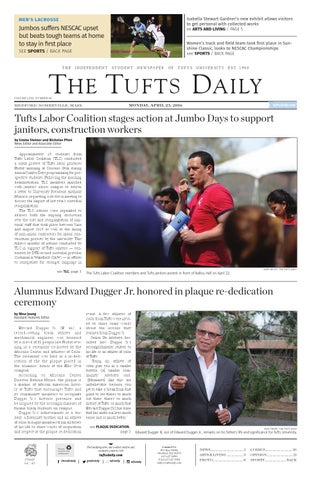
Tufts Labor Coalition stages action at Jumbo Days to support janitors, construction workers by Emma Steiner and Nicholas Pfosi News Editor and Associate Editor
Approximately 15 students from Tufts Labor Coalition (TLC) conducted a silent protest of Tufts labor practices Friday morning at Cousens Gym during annual Jumbo Days programming for prospective students. Following the morning demonstration, TLC members marched with janitors across campus to deliver a letter to University President Anthony Monaco, requesting a sit-down meeting to discuss the impact of last year’s custodial reorganization. The TLC actions were organized to address both the ongoing discussion over the cuts and reorganization of janitorial staff that took place between June and August 2015 as well as the hiring of non-union contractors for major construction projects by the university. This follows months of actions conducted by TLC in support of Tufts janitors — contracted by DTZ-owned custodial provider Cushman & Wakefield (C&W) — in efforts to renegotiate for stronger language in see TLC, page 3
SOFIE HECHT / THE TUFTS DAILY
The Tufts Labor Coalition members and Tufts janitors protest in front of Ballou Hall on April 22.
Alumnus Edward Dugger Jr. honored in plaque re-dedication ceremony by Nina Joung
Assistant Features Editor
Edward Dugger Jr. (E ‘41), a record-setting track athlete and mechanical engineer, was honored by a crowd of 50 people last Friday evening in a ceremony co-hosted by the Africana Center and Athletes of Color. The ceremony was held as a re-dedication of the the plaque placed in the alumnus’ honor at the Ellis Oval complex. According to Africana Center Director Katrina Moore, the plaque is a marker of African American history at Tufts that encourages Tufts and its community members to recognize Dugger Jr.’s historic presence and be inspired by the accomplishments of former black students on campus. Dugger Jr.’s achievements as a student, a fraternity brother and an athlete of color brought members from all facets of his life to share words of inspiration and respect at the plaque re-dedication
Please recycle this newspaper
Cloudy 64 / 43
/thetuftsdaily
event. A few athletes of color from Tufts were invited to share some words about the lessons they learned from Dugger Jr. Senior Ife Adebayo described how Dugger Jr.’s accomplishments related to his life as an athlete of color at Tufts. “Being an athlete of color puts you in a smaller bubble, [a] smaller community,” Adebayo said. “[Moments] like this are unbelievable because you get to take a break from that grind to see there’s so much out there, there’s so much history at Tufts, so much that Edward Dugger [Jr.] has done that has made our lives much easier and so much better.” see PLAQUE DEDICATION , page 2
ALEX KNAPP / THE TUFTS DAILY
Edward Dugger III, son of Edward Dugger Jr., remarks on his father’s life and significance for Tufts University.
For breaking news, our content archive and exclusive content, visit tuftsdaily.com @tuftsdaily
tuftsdaily
tuftsdaily
Contact Us P.O. Box 53018, Medford, MA 02155 617 627 3090 FAX 617 627 3910 daily@tuftsdaily.com
NEWS............................................1 ARTS & LIVING.......................5 PHOTO.........................................8
COMICS.....................................10 OPINION....................................11 SPORTS............................ BACK
2
THE TUFTS DAILY | News | Monday, April 25, 2016
T HE T UFTS D AILY Sarah Zheng Editor-in-Chief
Nicholas Golden Mengqi Sun Managing Editors Nicholas Pfosi Associate Editor Arin Kerstein Executive News Editor Isha Fahad News Editors Abby Feldman Melissa Kain Sophie Lehrenbaum Emma Steiner Ariel Barbieri-Aghib Assistant News Editors Kyle Blacklock Gil Jacobson Robert Katz Liam Knox Catherine Perloff Vibhav Prakasam Hannah Uebele Joe Walsh Kendall Todd Executive Features Editor Nicole Brooks Features Editors Nina Joung Jake Taber Diane Alexander Assistant Features Editors Constantinos Angelakis Emily Cheng Emma R. Rosenthal John Gallagher Executive Arts Editor Lancy Downs Arts Editors Justin Krakoff Josh Podolsky Jonah Allon Assistant Arts Editors Cassidy Olsen Eran Sabaner Hannah Hoang Dorie Campbell Emily Karl Erin Sifre Stephen Dennison Abigail Feldman Shannon Geary Allison Merola Cassie Bardos Miranda Chavez Frances DeFreitas Jake Goldberg Emma Henderson Michael Lefkowtiz Anita Ramaswamy Noah Weinflash
Executive Op-Ed Editor Op-Ed Editor Cartoonists
Editorialists
Maclyn Senear Executive Sports Editor Ray-Paul Biron Sports Editors Ross Dember Phillip Goldberg Alex Schroeder Chris Warren Yuan Jun Chee Assistant Sports Editors Maddie Payne Eddie Samuels Noah Smith Sofie Hecht Executive Photo Editor Alex Knapp Caroline Ambros Picture Tufts Editor Ray Bernoff Staff Photographers Laura DeArmas Maria Ferraz Henry Hintermeister Katlyn Kreie Mia Lambert Jiaxun Li Nora Nord Nicholas Pfosi Julia Press Evan Sayles Angelie Xiong
PRODUCTION Julie Doten
Production Director Astrid Weng Executive Layout Editor Jewel Castle Layout Editors Abbie Gantner Leila Li Allie Merola Brianna Mignano Mandip Pokharel Ellie Powers Annabelle Roberts Emily Sharp Andrew Stephens Sebastian Torrente Shirley Wang Petrina Chan Allison Merola Dana Pek Belinda Xian Jack Ronan Dan Strauss Meagan Adler Alison Beach Arthur Beckel Lancy Downs Alison Epstein Andrew Kager Melissa Kain Sarah Kalinowski Reena Karasin Sophie Lehrenbaum Rachel Salzberg Arielle Sigel Caroline Watson Maxwell Bernstein Nitesh Gupta Evan Sayles
Africana Center, Athletes of Color re-dedicate plaque to alumnus PLAQUE DEDICATION
EDITORIAL
Creative Director Executive Graphics Editor Graphics Editors
tuftsdaily.com
continued from page 1 Dugger Jr. saw several successes during his time as a Tufts student, including winning over 24 New England Intercollegiate wins Eastern Intercollegiate, Amateur Athletic Union, Penn Relays and National Collegiate titles as a sprinter and a hurdler. He also paved the way for nonwhite student athletes through leadership roles, as the first captain of color of the Tufts indoor-track team and the co-captain of the men’s outdoor-track team, according to the website for his fraternity, Omega Psi Phi. Many even considered Dugger Jr. a one-man track team, since he held 49 individual titles during his three-year varsity career, according to a 1990 newspaper clip shared in an April 14 Facebook post on the Africana Center’s page. Additionally, he was an active member of Omega Psi Phi and served as secretary of his senior class, Branwen Smith-King, assistant director of Athletics, said. Members of the history committee of the Gamma Chapter also came to the plaque re-dedication to speak of Edward Dugger Jr’s achievement and impact on Tufts as an institution. According to its website, Omega Psi Phi is the first international fraternal organization founded on the campus of a historically Black college, and the Gamma Chapter is specific to the Boston area. David Carl, a Gamma representative who graduated from Tufts in 1996, highlighted Dugger Jr.’s range of accomplishments as something to aspire to and attested to his quality of character as well. “He stands today as an emblem of what we want to be, those of us who
25
TODAY
“The Locket: Film Screening & Lecture by Prof. David Bordwell” Details: David Bordwell, the Jacques Ledoux Professor Emeritus of Film Studies at the University of Wisconsin–Madison, will give a lecture, “The Switcheroo Tradition: Narrative Innovations in 1940s Hollywood,” following a screening of John Brahm’s film, “The Locket” (1946). When and Where: 4:30 – 7:00 p.m., Room 012, Olin Center Sponsors: Film and Media Studies program “Lyon & Bendheim Alumni Lecture Series feat. Omer Trajman, E ’00” Details: Following a networking reception, Rocana CEO Omer Trajman (E ’00) will be addressing attendees as a part of the Lyon & Bendheim Alumni Lecture Series. Trajman has used his technological background in computer engineering to influence the industry’s modern database man-
consider ourselves athletes, scholars or leaders in our communities,” Carl said. “We’re not going to forget the rock that this track team was built on, that this university was built on–those principles … We’re going to keep this name going because we want to keep these principles going.” According to the honoree’s son Edward Dugger III, who spoke at the event, Tufts first recognized Dugger’s accomplishments and impact on the Tufts community when the plaque was originally made in his honor in 1990. However, in the years afterward, Dugger III said he had difficulty finding the plaque in its original location, and believed it had disappeared. According to Director of Digital Collections and Archives and university archivist Dan Santamaria, Moore reached out to him to find the plaque, and by using documents about the Dugger family, Santamaria was able to find that the plaque was in its original spot by the track, but was hidden by surrounding ivy over the years. Over 25 years later at the ceremony, Dugger III, who graduated from Harvard University and also ran during college, spoke of his father’s accomplishments and encouraged students to find power in his father’s achievements. At the re-dedication ceremony last Friday, Dugger III gave the same speech he gave at the first ceremony celebrating his father. “There have been many times in my life when the odds were heavily against me, and I felt nearly overwhelmed by the prospect of defeat or failure,” he said. “It has been at those moments that I have summoned [my] father — whether he was living or dead — and said to him, ‘Will you run this one with me?’ And he has.”
VISITING the
hill THIS WEEK
agement systems. When and Where: 7:00 – 8:30 p.m., Breed Memorial Hall (51 Winthrop St.) Sponsors: Alumni Relations
28
THURSDAY
“Faith is a Verb: Sister Tess Browne, SCN (Sisters of Charity Nazareth)” Details: Marie-Therese Browne, known as Sister Tess, from the Sisters of Charity Nazareth, will discuss her experiences working on social causes for the past 30 years. She is currently working on campaigns such as the “Fight for Fifteen” minimum wage campaign with the Massachusetts Interfaith Worker Justice. When and Where: 2:00 – 1:30 p.m., Goddard Chapel Sponsors: Tufts Catholic Chaplaincy, Jonathan M. Tisch College of Civic Life, Department of Religion
Kendra Field, the interim director of the Center for the Study of Race and Democracy (CSRD), spoke at the ceremony about the importance of honoring alumni like Edward Dugger Jr., in order to connect students to the African American history at Tufts. Field highlighted the Black Freedom Trail which, according to a March 7 article of the Daily, is an on-campus and off-campus guide created to connect the physical markers of Black presence at Tufts and in the Medford area. She said she finds great value in students knowing and sharing this history during their college years. “One of the things about being in college, for students, is that it’s ephemeral. Four years and you’re gone,” she said. “The importance of institutional memory, of passing down stories, of sharing the names and the contributions of people is sometimes all we have, and [is] very important.” The plaque is now a stop on the Black Freedom Trail, and according to Moore, this list of physical markers will continue to grow as research continues. Moore believes the plaque should honor the work of current student athletes as well as athletic accomplishments. “I’m just happy we’re able to bring the visibility of this plaque back to Tufts, and not only to bring visibility to Edward Dugger and his accomplishments but to give a thanks to student athletes who do what they do, and we don’t recognize that as much as we should,” she said. “We don’t let them know how much we appreciate them for their commitment to their sport and Tufts. And so, I’m happy that we were able to have them recognized as well.”
“Supermassive Black Hole Growth over the Past 12 Billion Years” Details: Meg Urry, director of the Yale Center for Physics and Astrophysics, will present parts of her research as the Kathryn A. McCarthy Lectureship in Physics. When and Where: 4:00-5:30 p.m., Room 401, 574 Boston Avenue Sponsors: Departments of Physics and Astronomy
30
SATURDAY
“An Evening with Kristin Chenoweth” Details: Broadway star Kristin Chenoweth and Mary-Mitchell Campbell, who served as musical director for many of Chenoweth’s shows, will be performing in a special event. When and Where: 8:00 p.m., Distler Performance Hall, Perry and Marty Granoff Music Center Sponsors: Department of Music
Executive Copy Editors Copy Editors
Executive Tech Manager Online Editor Social Media Editor
BUSINESS Yiran Xu Executive Business Director Qinyue Yu Receivables Manager Evan Sayles Online Advertising Eva Sachar Ad Managers Jay Hayes IOU_AdCouncil_Celeb_Consent_BW_11.5x21.indd 1
Take the pledge at ItsOnUs.org
9/3/15 9:52 PM
Monday, April 25, 2016 | News | THE TUFTS DAILY
News
3
NICHOLAS PFOSI / THE TUFTS DAILY
Tufts Labor Coalition members disrupt Jumbo Days on the afternoon of Friday, April 22.
TLC members march with janitors to request meeting with Monaco TLC
continued from page 1 their contract, which expires July 31, as well as continuing to demand that Tufts hire union-only labor. At the morning Jumbo Days event, following an address by Dean of Undergraduate Admissions Lee Coffin, student protesters stood in the aisles and behind the podium, holding banners that read “we demand safe working conditions,” “solidarity with Tufts janitors,” “justice for janitors,” and “people over profit.” Approximately 50 students had planned to participate in the protest, but not all of them were allowed into Cousens Gymnasium by admissions officers, according to students from TLC. TLC member Sofia Adams said that the protest had been planned to take place during a scheduled address by University President Anthony Monaco. However, he ultimately did not address prospective students during the reception. “[Monaco] was supposed to speak at the event, and we know that he was there because some people saw him,” Adams, a senior, said. “We don’t know if he ended
up not speaking because we were there or for some other reason, but I feel like there’s a strong possibility he didn’t speak because TLC was there.” Monaco confirmed in a statement to the Daily via Executive Director of Public Relations Kim Thurler that the withdrawal of his scheduled speech was a reaction to the possibility of a protest. When the presence of TLC protesters at the event was clear, he said he felt that his presence would become a distraction from the student presentations, which were scheduled to follow his speech. “When my schedule permits, I often say a brief hello to prospective students attending Tufts Jumbo Days,” Monaco said in an email. “This morning, when it became evident that TLC was planning to protest actions by the Tufts administration, I was concerned that my presence would distract from the presentations to be given by six current Tufts undergraduates to hundreds of prospective students and their families. I did not want to put those six students in that position or make it difficult for our guests to see or hear the presentations. I decided it was best for me
not to offer any remarks.” Despite this schedule change, TLC members continued their protest, unfurled banners and remained standing throughout two of six student presentations to prospective students before voluntarily leaving the gym. “We wanted to let prospective students know what is actually happening at Tufts because at Jumbo Days and similar events [as well as] the way Tufts markets and advertises itself, it likes to maintain this image that it is all about social justice,” TLC member Zoe Jeka, a junior, said. “The language used is ‘active citizenship’ or ‘civic engagement’…but Tufts doesn’t uphold the values it makes public. We wanted to let prospective students know that Tufts doesn’t actually maintain those practices and let the administration know that we won’t let them maintain that image.” Coffin said that the university had not been expecting the TLC demonstrators, but the protests were courteously conducted. “I mean it is what it is; that wasn’t part of our plan for the morning, but that’s part of the vibe of the campus and part of
NICHOLAS PFOSI / THE TUFTS DAILY
Janitor Paula Castillo hands Tufts administrator a letter to give to President Monaco on April 22.
the student activists here,” he said. “They were respectful.” Adams said she felt that the TLC protest was able to engage admitted students. “[Prospective students] did seem interested, and we definitely got their attention, which was good,” she said. Ari Liloia, a prospective student from New Jersey, said that he was happy to see the TLC action and thought that it was constructive. “You can’t recruit really cool, smart students without expecting this kind of thing to happen, and I like that Tufts students are actually doing stuff… I like that [they] saw a problem and are taking the steps to fix it,” Liloia said. Liloia added that he was at Jumbo Days to “get the full Tufts experience,” which he was glad included the protests against university labor practices. “I’d rather not be lied to … no university is perfect, and I’d rather be told the things that are good or bad so that I don’t regret it when I come here,” he said. At noon the same day, TLC members marched with janitors from the Mayer Campus Center across the President’s Lawn to Ballou Hall to deliver a letter requesting a formal sit-down between TLC members, Monaco and janitors affected by last year’s cuts. “The letter is from workers asking to hold a meeting with Monaco to discuss the impact of the reduction of hours and changes,” junior David Ferrandiz said. The protesters arrived at Ballou, amidst tour groups and prospective students. They stood outside the front doors chanting and speaking about the effects of the cuts on the janitors. Janitorial workers Paula Castillo and Adelaida Colon attempted to deliver the letter to Monaco, who was inside the building, but Castillo and Colon were denied access by Tufts University Police Department (TUPD) officers posted outside the front and back doors of Ballou. However, Communications and Project Administrator Jacklyn Varela stepped outside the building to speak with Castillo and Colon, promising to deliver the letter to an administrative official inside. Colon addressed the crowd of students, emphasizing her commitment to follow-up on the letter. “We want to be affirmed in our rights to exist in this workplace … If we don’t receive a response [to the letter], we’ll be back,” she said in Spanish.
4
THE TUFTS DAILY | ADVERTISEMENT | Monday, April 25, 2016
tuftsdaily.com
RA APPRECIATION WEEK Join the Office of Residential Life & Learning in thanking our Resident Assistants. They work hard for our department and for the residents who live with them and they are an invaluable asset. So, during the week of April 25-29th take the time to thank your RA for all that they do!
1/4
2015-2016 RA Staff
LEANN BEARD
ARI KAZANJIAN
KYLA BOLDEN
SAKI KITADAI
KAVYA BOORGU
ALEX KNAPP
SONIA BOURDAGHS
JOANN KONG
DAN BOWEN
JANITH KULATUNGE
MAURICE BUKENYA
JORDAN LANGE
EDWARD CAI
ANDREW LEIBERT
NIHAARIKA SHARMA
ANNALISA DEBARI
ANN LIN
HALEY SHORT
NII-O DODOO
SAM LITTLE
COLLINS SIRMAH
STACEY FAIR
RUI LIU
ARMAN SMIGIELSKI
OLIVIA FAMILUSI
JESS LUNTE
DAVID STERN
RAY-TING FAN
KATHERINE MACARTHUR
SANGGYU SUH
RAYMOND FASANO
RYAN MAPONGA
RUTH SUN
VERONICA FOSTER
CAM MBAYO
THEO TAN
MUKESH GHIMIRE
PETER MCCAWLEY
VINCENT TRAN
ADAM GRAMY
CHAEWON MOON TOM MORIN
CLAIRE WALTER
JAMES MULLAHOO
TASHI WANGCHUK
ASHLYNNA NG
HANK WEINSTOCK
TONY NGUYEN
JOSH WONG
THOMAS JASIONOWSKI
1/2
CAROLINA VILLALBA
KHANG NGUYEN
JONATHAN YEH
JANETH JEPKOGEI
BEN ORR
JENNIFER YU
CELIA JOHNSTON
ADAM PLUMER
MEGAN ZUPON
NINA JOUNG
MANDIP POKHAREL
ORHUN GURAL BREANDAN HALEY CHARLES HENDERSON VINCENT HWANG
ROSIE QUINN
1/8
MATT REIDY
ALYSSA RIVAS
PATRICIA ROSA NOAH ROSE
JACOB SANTOS-MARQUES
Monday, April 25, 2016
ARTS&LIVING GALLERY REVIEW
Isabella Stewart Gardner’s masterpieces shine in ‘Off the Wall’ by Lancy Downs
For months, the Isabella Stewart Gardner Museum has been touting its new show, “Off the Wall: Gardner and Her Masterpieces,” as a once-in-a-lifetime opportunity to see works from the museum’s collection. But with its dark gray-blue walls and dim lighting, “Off the Wall,” despite its impressive sampling of works by Dutch masters and Italian Renaissance painters hung neatly around the museum’s Hostetter Gallery, hardly appears to be a particularly groundbreaking exhibit. In fact, it seems to be precisely the opposite — the didactic labels, modern lighting techniques and works from the art historical canon seem entirely … normal. The exhibit, which opened March 10 and runs through Aug. 15, does not exactly scream “once-in-a-lifetime opportunity.” In any other museum, “Off the Wall” might not be a particularly unusual show. At the Gardner, however, as anyone who has visited the museum will know, the show represents a rather extraordinary opportunity. Isabella Stewart Gardner, the Boston heiress and art collector who founded the museum, stipulated in her will that nothing in the building — which is modeled after a Venetian palazzo — can be altered. The various arrangements of art and furniture must forever remain as they were during her lifetime. While this means visitors get to enjoy Gardner’s idiosyncratic displays, COURTESY THE ISABELLA STEWART GARDNER MUSEUM
The inside of the “Off the Wall” exhibit at the Isabella Steward Gardner Museum.
‘Cannot Sleep with Snoring Husband’ invites new questions about internet privacy, intimacy by Joe Palandrani Copy Editor
Just under seven years before Edward Snowden made internet privacy a topic of national conversation, AOL found itself embroiled in its own alarming — if less massive — personal data scandal. As part of a research initiative, the company collected search information from over 650,000 of its users for three months, yielding roughly 20 million queries. Each of these searches included information about who conducted them, when they did so and which websites they visited immediately afterward. While the text files that contained all this data were never supposed to leave AOL’s systems, one researcher — out of negligence or insubordination — made them available to the general public. AOL deleted the files quickly, but not quickly enough — they were downloaded and copied by a number of internet users almost immediately, and all of the information remains easily accessible today. The data was anonymized prior to its release; each of the search profiles was mapped onto user numbers rather than names. In some cases, though, it wasn’t
tuftsdaily.com
Isaac Brown Pop Filter
Sum of all fears
I
Arts Editor
see GARDNER, page 7
5
difficult to deduce a person’s identity from their searches. The New York Times was able to identify and locate a user named Thelma Arnold using only the leaked data. “My goodness, it’s my whole personal life,’’ Arnold said to the Times upon learning about her exposure. “I had no idea somebody was looking over my shoulder.’’ A new interactive web page installation by photographer and digital designer Simon Baer is premised on turning the audience into this vague “somebody” who looks over the shoulder of an unsuspecting AOL user as they browse the internet. Baer selected one of the 650,000 individual threemonth logs — the file for “user 711391” — and organized its content into a narrative that plays out in something akin to real time. The story, called “Cannot Sleep with Snoring Husband,” is hosted at the domain cannotsleepwithsnoringhusband.online, where Baer replicated AOL’s search interface as it was in the middle of the last decade. An initial visit to the website reveals the search queries made by user 711391 on March 1, 2006, following a brief introduction: “hello there, stranger,” the search bar displays, as though the message
had been typed remotely. “Let me tell you my story.” The searches then appear in the same manner as the greeting: typed, then backspaced, one at a time at intervals of a few seconds. The user’s March 1 log opens with the saga’s titular query, “can not sleep with snoring husband,” and ends with “online friendships can be very special.” As in any good series pilot, tension and intrigue are established immediately; who might this online friend be, and how might their role in user 711391’s life be related to the frustration of sleeping near a loud partner? But like a series pilot prior to the rise of streaming-enabled binge watching, this tension is only elaborated upon in increments whose releases are carefully timed. After all the day’s searches have been displayed, the visitor must wait 24 hours before the next day’s queries are revealed. “[In] an environment like the internet, where we are used to the intriguing possibility of seeing everything at once and whatever else we’d like — it’s interesting to use a limiting factor, which can, in my opinion, make such a project see AOL, page 6
used to be terrified of singing in front of people. When I was a choir kid in middle school, one of my greatest fears was that I would forget the words to my solo or choke on a high note in front of hundreds of people. After singing solos for audiences for almost a decade, I no longer distinguish between performances for three people and ones in front of 300; every time I get up there, I’m singing for me — not to impress anyone. They’re just along for the ride. Nerves are more than just emotions, of course. They manifest themselves in our behavior and our physiology. Some people pace around and talk endlessly while others get cold sweats and have difficulty holding their bladder. In my case, my legs start twitching uncontrollably. But while these physical reactions are difficult to prevent because they are mostly subconscious, mental stress is something that we can learn to deal with, and different people have their own mechanisms for doing so. Singing all by my lonesome out in front is strangely intoxicating at times. Not as scary as it used to be, certainly. The moments spent performing give you that shot of adrenaline you feel as you reach the climactic peak of a roller coaster ride, the kind of thing you could get addicted to. There’s a moment of serenity that washes over me as I count down the minutes before show time, in which everything that could go wrong, all of those potential universes that lie in front of me along my fourth-dimensional path, shrink into a little box the size of an almond. Then I crush it with a fifth-dimensional hydraulic press. Being on the solo mic is more relaxing than singing harmony, the same way being in a car is more relaxing than riding a plane, despite the car being a steel death trap (statistically). Since I’m the most important voice part for that song, I’m in the driver’s seat, and when it comes to singing, I can get you where you want to go (if you know what I mean). When you’re sitting on a plane, you’re putting a lot of faith in a flight crew way in front behind a reinforced steel door, to make the right choices. The illusion of control or the lack thereof is everything. At some point during my singing career, I learned that worrying about how other people in the choir or vocal ensemble sound is a good way to develop premature gray hair. You can only micromanage their learning of the music and vocal technique so far; eventually, you have to step back and say it’s on them to find the time to fix their issues. Stressing about things beyond your control isn’t good for you or for your performance. Figuring out the difference between the factors you can control and the ones you can’t is the first step we all take.
Isaac Brown is a junior, an English major and a contributing writer at the Tufts Daily. He an be reached at isaac.brown@ tufts.edu.
6
THE TUFTS DAILY | Arts & Living | Monday, April 25, 2016
tuftsdaily.com
Net artist Simon Baer taps search engines’ storytelling potential in threemonth web installation
SCREENSHOT FROM CANNOTSLEEPWITHSNORINGHUSBAND.ONLINE
“Cannot Sleep with Snoring Husband” uses a decade-old AOL search portal to stage a drama using a real person’s search queries, which were exposed in a 2006 data leak.
AOL
continued from page 5 even more alive,” Baer said to digital art site Rhizome. Baer’s sense of rhythm in this regard is brilliantly effective. As one follows the user through their daily engagements with the web, they are given a real sense of how users live. For example, one can follow user 711391 through their concerns about a lesion on their face. Repeated visits to the faux search engine demonstrate how this skin ailment affected 711391 and shaped their daily relationship to their body: “can putting makeup over sores hurt them” is but one query among dozens spanning several weeks that indicate the user’s persistent concerns. Other media have relied rely on deft compressions, dilations and elisions to represent durations beyond the scope of their audience’s engagement (with the exception, perhaps, of “24” (2001 – 2014), but that hardly warrants comparison); Baer, on the other hand, choreographs “Cannot Sleep with Snoring Husband” such that the viewer is forced to inhabit the user’s cycles in all their slow tediousness, outlining new ways for identifying
with or becoming attached to a character. Chains of search terms spread out over a few days clue the viewer into the distrust and infidelity that come to weigh heavily on user 711391’s personal life: the question, “should you plan sex before meeting a cyber lover,” is soon followed by “husband does not think it is good idea for me to meet my online friends” and later “how can I tell if spouse is spying on me while I’m online.” Eventually, these queries move outside the realm of genuine consultation and become desperate pleas: 711391 is worried about divine retribution on May 13, 2006 — “does god punish adultery” — but by May 15, the user is more introspectively concerned with “how to forgive yourself.” Some of these searches almost seem to be crafted with literary intent, as though the user is iteratively grasping for the most evocative way to express themselves in hopes that the search engine can respond to affect as well as bare text. There is, for example, something about the emotional charge of imagining the user type the phrase “affairs can be devastating,” searched on May 5, that pales in comparison
to the more anguished “affairs hurt so bad,” a search query two days later. But each pang of cathartic pain that one draws from this intimate-seeming connection to the user is marked with a proportionally large feeling of guilt; the object of sympathy is still a real person who never consented to having this story told about them. Baer’s daily interventions in the narrative — the fourth wall (or screen) is broken each day as the page is refreshed with a message welcoming the viewer to the next installment — only throw the voyeuristic quality of the project into sharper relief. Baer ventriloquizes user 711391 with phrases like “come back tomorrow to see the next part of my story.” The viewer is meant to understand that these addresses were never written by 711391, a fact that serves as a reminder of the divide between the intentional artist and the unknowing user whose struggles and secrets have become a conceptual experiment. “Users were exposed in terrible ways [by the leak],” Baer said to Rhizome. “But I had the feeling that there’s nothing I can change about that anymore, and neither did I want to.”
Beneath the morally ambiguous terrain on which the story rests, there is a more fundamental ambiguity about the way the profile called “user 711391” describes or maps onto an actual person. Whether “Cannot Sleep with Snoring Husband” is a portrait of the user as a full human being, a mere tally of interests and anxieties, a whole family or something else entirely, is determined by who is looking over 711391’s shoulder. The viewer is led to piece together a life in the same manner that the black-box mechanisms of Google, Facebook, Amazon and the like seek to generate unequivocal knowledge of who we are and what we want based on our online activity. The illusion that more search queries (or other information) will always yield a more complete picture of the individual is shown not only to be a fixation of major web companies, or the many academics who were eager to use the questionable data sets for research in 2006, but of anyone whose curiosity leads them to try to figure someone out by extrapolating from whatever information is available. There are infinite twisted subplots that could be teased out from user 711391’s search log; following their medical and romantic stressors yield only two fairly obvious ones. With each viewer’s attention likely trained on different threads running through the 90 days of 711391’s searches, there’s no guaranteeing the story one reads in “Cannot Sleep with Snoring Husband” is not really a story about oneself.
Monday, April 25, 2016 | Arts & Living | THE TUFTS DAILY
A&L
7
‘Off the Wall’ emphasizes Gardner’s personal history GARDNER
continued from page 5 the aesthetic experience she designed is hardly the stuff of a museum curator’s dreams. Paintings are often hung at odd heights — well above or below eye-level — and they are obstructed by household objects or impaired by poor lighting. It is an exceptional space, one that Gardner has meticulously constructed, but not one that always allows for visitors to examine her impressive and infamous collection in the best viewing conditions. When the second floor of the palace was forced to close due to roof repairs, the Gardner saw an opportunity to show off 25 of the second floor’s best pieces in a more conventional setting, and thus “Off the Wall” was born. The show, located in the museum’s new Renzo Piano-designed wing (opened in 2012), employs modern display techniques, allowing museumgoers to see
the showcased works as they quite literally cannot be seen in the old palace. The result is, unsurprisingly, one that is hard to find fault with. There is, however, one minor drawback: the show’s proximity to the bathrooms, which are unfortunately located across the hall from the exhibit’s entrance to the Hostetter Gallery. Any attempts to gaze at Rembrandt’s “Self-Portrait, Age 23” (1629) are sadly disrupted by the frequent sound of automatically flushing toilets — not quite the ideal atmosphere for contemplating Gardner’s prized masterpieces. While “Off the Wall” certainly does prove an opportunity to see a slice of Gardner’s collection in a new light, it was not just an updated aesthetic experience for visitors that the show’s curators were interested in providing. “Off the Wall” also aims to tell the story of Gardner as a collector and her place in the art world. This is done first and
foremost through labels, which, rather than focusing entirely on the particular painting itself, are devoted in large part to describing Gardner’s relationship with the piece, how it came to her collection and why she wanted it. The palazzo itself, per Gardner’s will, contains no labels of any sort; unless visitors are on a guided tour, they often meander through the space without learning specific information about the art or about Gardner herself. “Off the Wall” works to correct this, often not too subtly. The show, for example, features small reproductions of two works stolen from the museum in the infamous 1990 theft, Johannes Vermeer’s “The Concert” (1665) and Rembrandt’s “The Storm on the Sea of Galilee” (1633) — works that are central to the story of Gardner as collector. “The Concert” is of particular importance; Gardner beat out the Louvre and the National Gallery in London
to acquire the piece, marking her as a preeminent figure in the art world. “Off the Wall” continues into the palazzo itself in a small gallery called the “Vatichino,” where the Gardner-as-collector narrative picks up. The “Vatichino,” a word Gardner invented, boasts material from the museum’s vast archive. Museumgoers can examine, among other things, a sampling of Gardner’s letters, receipts and photographs. With this unmistakable emphasis on history, “Off the Wall” becomes less of an aesthetic experience and more of a historical one. The palazzo, chock-full of sensual and aesthetic experiences, sorely lacks the more educational elements that “Off the Wall” has prioritized. The show’s focus on Gardner’s history allows “Off the Wall” to serve as a much-needed complement to the story Gardner has constructed in the palace itself. Once-in-a-lifetime opportunity? You bet.
COURTESY THE ISABELLA STEWART GARDNER MUSEUM
Want to get campus news the moment it happens? Follow us on Twitter and Facebook! /thetuftsdaily
/tuftsdaily
@tuftsdaily
/tuftsdaily
8
THE TUFTS DAILY | PHOTO | Monday, April 25, 2016
tuftsdaily.com
S
All photos by Courtesy Liam Brady Except bottom right by Sofie Hecht / The Tufts Daily
tudents joined the Tufts Hindu Student Council for their annual Holi celebration last Saturday on the Residential Quad. Holi, the Hindu festival of colors, is a time to celebrate spring and nature’s blessings, and a “symbolic reminder to turn over a new leaf,” according to the Facebook event page.
Monday, April 25, 2016 | ADVERTISEMENT | THE TUFTS DAILY
tuftsdaily.com
1/4 AD
1/8 AD 1/2 AD
9
10
THE TUFTS DAILY | Comics | Monday, April 25, 2016
Comics
tuftsdaily.com LATE NIGHT AT THE DAILY Nick: “I’m much beloved, but I’m quite the catch, you know? chortle...chortle...chortle...”
Comics
SUDOKU
JUMBLE
Difficulty Level: Complaining about the Spring Fling lineup.
Friday’s Solution
NON SEQUITUR BY WILEY MILLER
CROSSWORD
Friday’s Solution
Monday, April 25, 2016
Opinion EDITORIAL
TLC’s protest an admirable effort in standing up to university corporatization The Tufts Labor Coalition (TLC), a group of students working closely with janitorial staff members and advocates, protested Jumbo Days last Friday, earning the group significant criticism on Yik Yak, in line with past criticisms of protesters. Posts on the infamously anonymous app accused the group of crossing the line by attacking the university in front of prospective students, as Tufts Divest has been accused of doing a few times over the years. Posts like “F*ck you TLC don’t protest at commencement #WeAreTheMajority” may or may not actually represent the views of the majority, but the anger is there. Criticism of TLC takes one of two angles: one, that the group’s efforts are self-aggrandizing and fail to help workers, and two, more darkly, that damaging the university’s reputation in front of prospective students may lessen the value of degrees. Neither of these arguments hold water, and in fact speak more to a disturbing tendency among some people in our community to assign self-serving motives to those student groups willing to provoke a little bit of discomfort to try to help people.
There is nothing sacred about Jumbo Days events; prospective students should know what Tufts does right and what it does wrong. The hostility to student activists, however, is not solely tied to the fact that protesters targeted Jumbo Days. If this is because there is a perception of a “politically correct” atmosphere in our community, let’s start by disabusing ourselves of the notion; overall, our university is far less leftist than many of us think. TLC protesters are not the vanguard of some overwhelming majority who want to ruin the university’s image — quite the opposite. They are a dedicated few, part of a group that has worked on behalf of workers for decades. We should be proud of them instead of complaining about them nonsensically. In the last 20 years, tuition has shot up as American universities have shifted from institutions of learning into corporations. Adjunct professors struggle, as janitorial staff and first-generation students do; the priorities among universities are changing, and the signs are not good. Those angry at TLC need a real gut
check: our tuition makes us complicit in whatever this university does, for good or for ill. Its corporatization and role in economic inequality is something that we have to engage with to be “active citizens,” as we purport to want to be by being here. Modern universities compete by doing anything to raise their profiles and reputations, offering more amenities by squeezing workers and enfeebled city governments and profiting from fossil fuels in labyrinthine finance packages. If your gut instinct is to value the reputation of the name on your degree or the relative calm at commencement more than the welfare of others who have struggled because of our collective impact, then it may be time to reassess. While there is merit in critiquing the specificities of the TLC demands, such as its vague push for “stronger language” in janitorial contracts or the economic realities of what they are requesting, the hostility directed toward student activists trying to give a platform to the often-ignored voices of custodial workers is misplaced.
EDITORIAL CARTOON BY SHANNON GEARY
The Tufts Daily is a nonprofit, independent newspaper, published Monday through Friday during the academic year, and distributed free to the Tufts community. The content of letters, advertisements, signed columns, cartoons and graphics does not necessarily reflect the opinion of The Tufts Daily editorial board. EDITORIALS Editorials represent the position of The Tufts Daily. Individual editors are not necessarily responsible for, or in agreement with, the policies and editorials of The Tufts Daily. OP-EDS The Op-Ed section of The Tufts Daily, an open forum for campus editorial commentary, is printed Monday through Thursday. The Daily welcomes submissions from all members of the Tufts community; the opinions expressed in the Op-Ed section do not necessarily represent the opinions of the Daily itself. Opinion articles on campus, national and international issues should be 600 to 1,200 words in length and submitted to oped@tuftsdaily.com. The editors reserve the right to edit letters for clarity, space and length. All material is subject to editorial discretion and is not guaranteed to appear in the Daily. Authors must submit their telephone numbers and day-of availability for editing questions. ADVERTISING All advertising copy is subject to the approval of the Editor-in-Chief, Executive Board and Executive Business Director.
11 tuftsdaily.com
Aren Torikian The Arena
Bulls and Bears
I
recently discovered political markets. Predictit.com is a website that allows users to buy and sell shares in a given political event — occurring or not occurring — with the expectation of a payout. On PredictIt, if an event occurs, like Hillary Clinton winning in New York, “shareholders” get paid $1 per share. At the same time, there are the exact opposite shares — that the given event won’t occur. These function as probabilities of the payouts (and events) occurring. It’s like a stock market for politics. In the meantime, shares trade between one cent and 99 cents, frequently oscillating in value. Users can sell out early to ensure a gain or wait for a payoff. PredictIt was at first just a project by Victoria University in New Zealand. Now it makes money by taking 10 percent off of any profit. Since there’s always both winners and losers, the system funds itself. Users make actual investments with actual money. It is the prototypical “money where your mouth is” scenario. Thus, PredictIt and other political markets offer a unique alternative to polling. It is an insight into how “smart money” views the political landscape. For instance, PredictIt users are still not quite sold on Donald Trump winning the Republican nomination — Trump has traded between 50 percent and 70 percent for three months. The market clearly sees a problem for Trump in the delegate math, a problem I outlined a few weeks ago. His odds have improved though after a dominant win in New York. As of writing, shares of a brokered GOP convention, where Trump does not have enough delegates to clinch the nomination, are trading at exactly 50 cents. Because of this, the market sees a six percent chance of House Speaker Paul Ryan getting the nomination, even though he has publicly announced he would not accept it. Maybe the markets know something we (or Ryan) don’t. It’s also fun to see fluctuations in the market. In February, shares for Marco Rubio winning the nomination went from 50 cents to 20 cents in a week. Rubio had just fluffed the debate in New Hampshire and then finished fifth in the state. I would’ve piled money into the Rubio campaign, so it is probably a good thing I only recently looked into PredictIt. Regardless, PredictIt allows us to see just how quickly and decisively consensus can shift. But PredictIt is not just about American politics. Traders had long soured on Brazilian President Dilma Rousseff’s odds of staying in office through 2016 before legislators announced plans to impeach her. PredictIt can’t exactly replace polling or research, but it’s a pretty cool (and fun) look into public perceptions of where elections are headed around the world. In case you are wondering, PredictIt sees the Republicans lead by Trump and John Kasich up against Clinton and Julian Castro, former mayor of San Antonio and current Secretary of Housing and Urban Development. Traders have Clinton at about 70 percent to win the White House. Seems like a pretty smart buy to me. Aren Torikian is a sophomore who has yet to declare a major. Aren can be reached at aren.torikian@tufts.edu.
12
THE TUFTS DAILY | Opinion | Monday, April 25, 2016
tuftsdaily.com
OP-ED
Bernie Sanders’ single-payer plan doesn’t add up by Jamie Neikrie Thanks to recent primary victories and an enormous shift in momentum, Vermont Senator Bernie Sanders is back in the race for the Democratic presidential nomination. However, Sanders has recently come under attack for one of his most important policy proposals: the implementation of a single-payer healthcare system. According to healthcare experts, Sanders is off on his cost projections for a national Medicare system by over a $1 trillion, a mistake that means the difference between providing aid to millions of Americans and crippling them financially. In debates and speeches, Senator Sanders has described his single-payer plan as a panacea, the end to all of America’s healthcare problems. “Under Bernie’s plan, Americans will benefit from the freedom and security that comes with finally separating health insurance from employment,” the Sanders website explains. This freedom will “help the American people live happier, healthier and more fulfilling lives.” In many ways, the Sanders campaign is correct. A national single-payer system would provide coverage to every American, remove cost barriers to treatment, encourage preventative care and allow workers greater freedom of employment, since they no longer rely on employer-based insurance. Singlepayer would create a more efficient, effective healthcare system, moving the United States toward the model that has worked so well for countries like Canada and the United Kingdom. However, a single-payer system will be very costly, far more costly than the Sanders campaign is advertising. In a recent study, healthcare expert Kenneth
Thorpe of Emory University concluded that Senator Sanders’ plan would cost an average of $2.47 trillion per year from 2017 to 2026, a significant increase from the $1.377 trillion per year estimated by the Sanders campaign. In order to finance a national medicare system, Thorpe projects that the government would need to enact a 14.3 percent payroll tax on employers and a 5.7 percent income-based premium. This combined 20 percent tax dwarfs the combined 8.4 percent projected tax proposed by the Sanders campaign. And this figure makes all the difference. The disparity in numbers calls Thorpe’s credentials into question. Thorpe does not analyze Bernie’s plan from the perspective of a conservative skeptic or a Heritage Foundation economist but rather as a single-payer proponent who was hired by the Vermont legislature in 2006 to analyze and promote the state’s single-payer plan. Thorpe was one of the bill’s biggest proponents — alongside Senator Sanders — arguing that a single-payer healthcare system would save Vermont $1.1 trillion over 10 years. However, Vermont too underestimated the costs of implementing a single-payer system. In order to finance the system, the state would have had to implement an 11.5 percent payroll tax on businesses and sliding individual premiums of up to 9.5 percent of individuals’ income. Governor Peter Shumlin was forced to admit that this financial burden, far close to what Thorpe projects, “might hurt our economy.” In the wake of that failure, Senator Sanders has taken his single-payer proposal to the national stage. But according to Thorpe, there are a number of errors in Sanders’ plan. One of the best arguments for a single-payer system is that
government-operated healthcare boasts lower administrative costs than private healthcare. The United States currently spends twice as much as Canada on administrative costs. Domestically, administrative costs account for about two percent of Medicare spending, compared to 17 percent administrative costs incurred by private insurance companies. This type of efficiency in the public sector factors heavily into Sanders’ plan, which predicts that lower administrative costs will account for $438 billion in savings. However, for a plan that effectively overhauls a century of practice and one of the country’s largest industries, a 16 percent reduction in healthcare spending is incredibly ambitious. Thorpe projects a more measured decline of 4.7 percent in healthcare costs. Senator Sanders also assumes that, since the government will be able to bargain down the costs of prescription drugs, the country will benefit from $324 billion per year in prescription drug savings. However, as Thorpe notes, “in 2014, private health plans paid a total of $132 billion on prescription drugs, and nationally we spent $305 billion.” So Sanders’ campaign would be projecting negative healthcare spending. While the campaign revised its projections down to $241 billion after an article in Vox, this oversight is concerning. However, perhaps the greatest flaw in Senator Sanders’ single-payer projections is that his plan assumes huge healthcare cost savings while creating incentives for people to consume more healthcare, not less. A single-payer plan eliminates cost-sharing and cost-control mechanisms like deductibles, coinsurance and copayments. Doing so will encourage Americans to go see the doctor more regularly, creating the type of
preventative care that catches illnesses before they become more costly and deadly. This saves money. But, according to Thorpe, the Sanders campaign is underestimating how much more care Americans would consume under a single-payer system. Thorpe assumes a 10 percent increase in healthcare consumption, while Sanders estimates a six percent increase, as well as $216 billion per year in savings due to better care. After all costs are incurred, Thorpe sees Sanders’ single-payer system placing a far greater burden on the American people than the senator projects. Sanders believes that savings from reduced healthcare costs will more than offset increased taxes, saving a family of four an average of $5,800 per year. But Thorpe’s estimates find that 71 percent of households would be worse off under Sanders’ single-payer system. 71 percent of working households, 65 percent of young adults and 85 percent of working households on Medicaid would pay more, even after healthcare cost reductions. If Donald Trump has all the best words, Senator Sanders has all the best ideas. Bernie has won seven of the last eight primaries on a platform of smart, evidence-based reforms that build on the successes of the Obama administration and guide our country toward progressive reform. However, throughout the campaign, Sanders has not demonstrated the nuanced policy knowledge and political strategy necessary to implement his platform. It is not Sanders’ ideas that I doubt. It is his execution.
Jamie Neikrie is a sophomore who has not yet declared a major. He can be reached at benjamin.neikrie@tufts.edu.
tuftsdaily.com
Monday, April 25, 2016 | ADVERTISEMENT | THE TUFTS DAILY
Congratulations to the 2016 Student Organization Award Winners Collaboration Award Presented to TuftScope
Community Connection Award
Presented to Strong Women, Strong Girls
Greek Chapter of the Year Award Presented to Pi Delta
Imagination Award
Presented to Another Option
Jumbo Award
1/8 AD
Presented to Ballroom Dance Team
Legacy Award
Presented to Burlesque Troupe
New Organization of the Year Award
Presented to Coalition for Autism Support at Tufts
Program of the Year
Presented to Concert Board
Publicity of the Year
Presented to Film Series
Student Organization of the Year Presented to Jumbocast
Sponsored by the Office for Campus Life - ocl.tufts.edu
The Tufts University Department of Physics and Astronomy invites you to attend
The Kathryn A. McCarthy Lectureship in Physics
“Supermassive Black Hole Growth Over the Past 12 Billion Years�
Presented by Professor Meg Urry Department of Physics and Astronomy, Yale University Thursday, April 28, 2016 4:00 pm Reception immediately following lecture Tufts University Collaborative Learning and Innovation Complex (CLIC) 574 Boston Avenue, Room 401 Medford, MA
13
14
THE TUFTS DAILY | ADVERTISEMENT | Monday, April 25, 2016
tuftsdaily.com
TUFTS SUMMER SESSION 2016 prepare. eXpaND. Develop. school of arts and sciences | school of engineering
Three sessioNs: May 25–July 1 | July 5–augusT 12 | May 25–augusT 12 go.tufts.edu/summer Follow us on facebook:
College & Pre-College Programs Day & Evening Classes Affordable Tuition
Outstanding Tufts Faculty Online Courses
Monday, April 25, 2016 | Sports | THE TUFTS DAILY
Sports
Tufts looks to stay in first place with final NESCAC game on Wednesday MEN'S LACROSSE
continued from back page had a shot off the post. The Jumbos at times seemed desperate on the attack, throwing away many sound opportunities as they favored taking the shot at the first opportunity they had rather than waiting for a solid opening. “I think [forcing the ball in the attack] is the usual reason for our shortcomings on offense,” Andreycak said. “We get outside of what everyone’s simple job is, and we try to do too much when things aren’t clicking. We definitely forced some plays, and there were some lapses in stick skills.” The fourth quarter brought the turnaround that the Jumbos desperately needed to stay in the game. Andreycak, Uppgren, Howard-Johnson, Gillespie and junior Zach Richman contributed to a seven-goal Tufts run to give them their first lead of the game at 13-9, which they preserved until the end. Senior goalkeeper Alex Salazar played a big role in keeping the Jumbos in the game, making 15 total saves, with the crowd and his teammates not failing to acknowledge that. Although the Cardinals managed to score three late goals to come back within one, the Jumbos rode out the clock with 1:22 left to clinch the important win. “I think we pride ourselves on getting those 50/50 balls and playing that hard no-stop style of lacrosse where we’re winning the ground balls and pushing the ball in transition,” Andreycak said. “It was something that we didn’t do a good job of early in the game, but we’re very grateful that we got tough in the fourth quarter.” The Jumbos were not as lucky against the Bobcats last week, with a close game being pushed to double overtime. Bates got an early lead despite good slides from the defense, going up 2-0. Although the Jumbos were able to equalize with goals from Richman and Andreycak, they were playing catch-up again as the Bobcats scored two more. The remainder of the quarter saw the score tied up at 5-5, with Clarke scoring a behind-the-
back goal off a feed from Gillespie, with Uppgren and Gillespie finding the net too. The Bobcats were the first to score in the second quarter too, with a shot from distance putting them up 6-5. However, Howard-Johnson answered with an equally impressive shot to even up the score again. From that point on, the Jumbos began to steadily open up a lead into the second half. A goal from Richman, four from Gillespie and two from Andreycak had the Jumbos up 13-7 in the third quarter and made the game look promising. But the momentum shifted to the Bobcats, who were able come back to tie the score at 15-15 and later take the lead. Senior Conor Bilby kept Tufts in the game, with Richman also netting two to push the game to overtime with the score tied 18-18. It was Salazar once again who shined during overtime, making four saves that gave the Jumbos a fighting chance. But he was eventually overcome, and the Bobcats came away with the 19-18 upset, handing the Jumbos their first conference loss of the season, marking the second consecutive season that they’ve been upset by the Bobcats in the regular season. The victory over the Amherst Purple & White, avenging last season’s regular season loss, was a big win for the Jumbos. Amherst was 6-1 in conference play going into the match-up, but Tufts played an incredible first quarter to put Amherst in a hole that it could not come back from. Howard-Johnson, who favors shooting from distance, managed to net four goals — three of which were unassisted — within the first 10 minutes of the game. Uppgren also had two goals, both of which were crease rolls, highlighting a weak point in Amherst’s defense. To round out an eight-goal quarter, Gillespie and Andreycak each scored to bring the score to 8-1 as the Jumbos dominated the first 15 minutes of play. “We strive for that perfect game, and that first quarter was as close as we’ve been all season to that perfect quarter,”
Richman said. “Playing hard as a team will get us that perfect minute. Not worrying about who is scoring the goals, who’s getting the stops or who’s winning face-offs, just playing as a team for a full 60 minutes and competing hard will get us that full perfect game.” Amherst came back strong, outscoring Tufts in the second and third quarters, but only by one-goal margins as the Jumbos were able to maintain their early lead. The first six minutes of the second quarter were scoreless, but after an Amherst defender was handed a 60-second penalty for an illegal body check, Andreycak made quick use of the man-up opportunity. This was followed by three quick goals from Amherst, but Uppgren and Richman quickly countered this, forcing an Amherst defender to literally slide into his own goal in a desperate attempt to save Richman’s shot after his initial fake left the goal wide open. The quarter ended with another goal from Richman, who slotted the ball in the narrow gap between the goalie and the right post, leaving the score at 12-6 at the half. The rest of the game saw goals from Gillespie, Clarke and Uppgren. Although Amherst netted five in the second half, nothing could overturn the first quarter’s seven-goal deficit. The Jumbos came away with a decisive 16-11 victory. “It’s important to start valuing the ball during the times we have a lead,” Gillespie said. “We weren’t necessarily happy with how we played in the second half because it was sloppy. It’s more important to keep things simpler; we got away from how we usually make that extra, easy pass, not trying to force a shot. That’s something we need to work on.” The team now prepares for its final game of the regular season, a home matchup against Bowdoin, who is currently tied with Amherst for second in the NESCAC at 7-2. The Jumbos look to maintain possession of the first seed in the conference ahead of the NESCAC playoffs, with the action kicking off Wednesday at 7:00 p.m. on Bello Field.
Jumbos dominate dress-rehearsal for next weekend's NESCAC Championships WOMEN'S TRACK
continued from back page PR last weekend, took second in 4:52.43. Her classmates, Margot Rashba and Sara Stokesbury, were fourth and fifth in 4:58.21 and 4:59.85 respectively. In the 3,000-meter steeplechase, senior Olivia Beltrani soloed to a new PR by running 11:29.46, which is currently good enough for seventh in NESCAC. Her classmate Lily Corcoran took second in the 5,000meter, running 18:38.65. “I was aiming to run a bit faster than I ended up running yesterday, and I think the small field was definitely a factor since I ended up running on my own basically from the start since there was no one I could try to match paces with,” first-year Natalie Bettez, who placed third in the 5,000 in 19:10.70, said. “But overall, I have been really happy with my first collegiate outdoor season.” The first-years paved the way for the Jumbos in the field. Ladner was the team’s top scorer in the pole vault with her vault of 9 ft., 6 1/4 in. for third. Senior Julia Rogers grabbed fourth in 9 ft., 1/4 in. while first-year Sharon Kelmar was fifth
at the same height. In the long jump, firstyears Brita Dawson and Kylene DeSmith grabbed third and fourth with leaps of 16 ft., 6 1/2 in. and 16 ft., 6 in., with DeSmith setting a new PR with that leap. “I seem to be stuck at nine feet, six inches for the vault, but I hope that going into next week I will be able to clear 10 feet,” Ladner said. Sophomores Amylee Anyoha and Jennifer Sherwill continued to show why they are a solid one-two punch in the NESCAC throwing circle. Anyoha took second in the hammer throw in 149 ft., 1 in., while Sherwill grabbed third in the shot put with a heave of 36 ft., 6 1/4 in. Both have had solid 2016 campaigns and will look to put the weight of the Tufts throwing program on their shoulders next week at NESCACs. Next weekend, the team will travel to Amherst for the biggest meet of the 2016 season: the NESCAC Championships. Last year, Tufts narrowly lost to Williams, a NESCAC powerhouse, by only 22 points, settling for second place. The Williams Ephs come in as the heavy favorites, but the Jumbos are led by Allen, Harrison,
Caruso and fellow senior quint-captains Sydney Smith and Audrey Gould — all of whom are among the top competitors in their events — and are backed up by the team’s serious depth. With so much talent and cohesion, Tufts has a great shot at pulling off a huge upset. “Next weekend, we plan to really step it up and try to hit those marks that will help bump us up to point-earning territory. Many girls have the potential to score points, so we really just want to get out there and compete like we have been training for,” Ladner said. “If everyone has a great day, then you never know what could happen.” Bettez agreed, highlighting that the synergy in the team would be useful when taking on its opponents. “Middlebury and Williams are going to be tough competitors, but we’ve been training for this weekend all season, and we are going light this week in preparation,” Bettez said. “There’s a lot of hype and energy, and we have a really strong team this year, so it will be an interesting meet.”
15
Yuan Jun Chee On the Spot
The alternative PFA Team of the Year
T
he PFA recently announced its Team of the Year, with Leicester and Spurs players dominating the team. With only 11 spots on the team, a ton of other players who’ve impressed didn’t make the roster, and here’s my list of possible alternatives — and mind you, even these weren’t easy to filter out. Hugo Lloris’ team has got the best defense and offense in the league, and credit must go in part to his shot-stopping and ball distribution abilities, which have been nothing short of superb. Kyle Walker’s defensive discipline has been much improved under Pochettino, and he continues to prove his value to the Spurs’ attacking machinery with his pace and crossing abilities. Robert Huth is the other half of Leicester’s central defensive pairing. The German has impressed with his organizational abilities and willingness to stick his face where the boots are flying. Chris Smalling’s been a changed man ever since he was sent off in last season’s Manchester derby. He’s been United’s most reliable central defender with great positioning and tackling, reminiscent of Rio Ferdinand. Aaron Cresswell has been one of the most underrated players in the Premier League with a mean left foot to boot. He’s great at set pieces and Kasper Schmeichel will still remember his shooting prowess too. Mesut Ozil might have faded away in 2016, but his 18 assists this season are a testament to his ability to pick out passes and make a difference. Even in games that Arsenal lost, his vision and nerve to try the audacious pass never ceases to amaze. James Milner has the most assists in 2016. His engine never seems to stop running, and his versatility is a key asset for Klopp and perhaps even embodies Klopp’s philosophy of determined, relentless pressing. Danny Drinkwater’s place on the team, I thought, might have been under threat from summer signing Swiss international Gökhan Inler. But not many have distributed the ball forward with the same confidence as he has this year. Don’t forget his defensive contributions either. Eric Dier: It’s unfortunate for Dier that N’Golo Kanté has been the League’s best defensive midfielder, because Dier has impressed with his move into the midfield to break up play. He’s also been able to drop into the back, adding defensive security as the fullbacks bomb forward. Anthony Martial: ‘WHO?!’ was my first reaction when he was signed, but he’s been involved in 21 of Manchester United’s goals this season in all competition. His pace, trickery and determination to get past his man have been valuable assets to a United team that has otherwise been content to pass the ball sideways and backwards. Sergio Aguero’s goals have been crucial — he’s scored the most League goals in 2016. He’s second in the Premier League Golden Boot Race despite his injury problems. City just looks that much better with his intelligence and predatory skills on their team. Honorable mentions should include Romelu Lukaku, whose goals have dragged Everton out from bad positions this year, and Kevin de Bruyne, who once again proved that Jose’s transfer market abilities aren’t the best. Yuan Jun Chee is a first-year majoring in History. He can be reached at yuan.chee@ tufts.edu.
Sports
16 tuftsdaily.com
Monday, April 25, 2016
MEN'S LACROSSE
Jumbos suffer first conference loss, stay atop the NESCAC with one game left by Maddie Payne
Assistant Sports Editor
The men’s lacrosse team had an eventful week, playing three conference games against Wesleyan, Bates and Amherst.
MEN’S LACROSSE (12-2 Overall, 8-1 NESCAC) Saturday, April 16 Amherst Tufts
1
Tuesday, April 19 Tufts Bates
1
5 5
Saturday, April 23 Wesleyan Tufts
2
1 8
1
2 2
5 4 2
3
2 4 2
5 3
2 2
FT
11 16
4 2OT FT
3
7 2
4
3 2
4 7 3
2 1
0 1
4
3 7
18 19 FT
12 13
Tufts hosted Amherst, its biggest rival in the NESCAC, on April 16. Tied for second in the conference with Bowdoin at 7-2, Amherst was one of Tufts’ strongest opponents in the season so far, but the hosts held out to win by a solid 16-11 margin. However, the Jumbos lost to the Bates Bobcats in double overtime last Wednesday, 19-18, receiving their first conference loss of the season. Bouncing back on Saturday, the Jumbos managed to overturn an early deficit to defeat the
EVAN SAYLES / THE TUFTS DAILY ARCHIVE
Tufts midfielder Jake Gillespie (LA' 16) tries to evade an opponent in the game against the Bates Bobcats on Tuesday, April 19. Wesleyan Cardinals 13-12. Against Wesleyan, senior Connor Helfrich dominated at the face-off position, winning 24 of 28 face-offs. Despite gaining possession of the ball at the beginning of most face-offs, the Jumbos struggled to convert attack possession into goals for the first 45 minutes. The Cardinals played high pressure throughout, forcing the Jumbos to make avoidable errors in their attack that led to turnover after turnover. Wesleyan went
up a goal early on, but senior Kyle Howard-Johnson was able to respond. A face-off win for Tufts brought the ball into their attack, but Wesleyan goalie senior Ted Bergman, managed to save every shot. Six minutes went by with neither team managing to find the net, but eventually the Cardinals got a man-up opportunity and were able to score. As the first quarter ended, the Jumbos were desperate to equalize the score. Senior Jake Gillespie was their saving grace, as
he found the net from straight down the middle of the field with 44 seconds left in the quarter to tie the game 2-2. The second quarter opened with Helfrich winning yet another face-off, his sixth consecutive win at that point. However, a strong check turned the ball over to the Cardinals, who quickly brought the ball into their attack and scored off a deflection. Wesleyan repeated the feat again, with Helfrich winning the next face-off, Tufts turning over the ball and Wesleyan scoring. With the score 4-2 in Wesleyan’s favor, Gillespie scored a goal identical to his first to bring Tufts within one. Although the Cardinals quickly got one back, a serious defensive mistake allowed senior co-captain Ben Andreycak to score on an easy one-on-one to bring the score to 5-4. Senior co-captain John Uppgren scored again for the Jumbos later in the half, but the Cardinals answered with two more to give them a 7-5 lead going into the second half. The third quarter saw Wesleyan outscore Tufts for the third period in a row, with senior Garrett Clarke scoring Tufts’ only goal while Wesleyan scored two to stay up 9-6. However, this was not for lack of trying; Uppgren had a shot go off a defender’s leg, while Howard-Johnson see MEN'S LACROSSE, page 15
WOMEN'S TRACK
Jumbos post top marks in Sunshine Classic win by Chris Warren Sports Editor
On Saturday, the women’s track and field team hosted the first annual Sunshine Classic at Ellis Oval. Despite the relatively small size of the meet, with just seven teams competing, the women’s team was still able to hit top marks and take first place for the third time this season. The meet served as a dress rehearsal before next weekend’s NESCAC Championships at Amherst and also acted as a de facto “alumnal meet,” as Tufts track and field alumnal were invited to compete. “Our team did pretty well today,” firstyear Sydney Ladner said. “Our goal for the meet was to make the marks and times that would get as many people competing at NESCACs as we could. It was also the last home meet for our seniors, and for a few, their last meet ever. So it was a great day to be out there with them.” The day started out rainy, as all of this season’s Tufts-hosted outdoor track meets have; however, by midday, the rain had stopped. The majority of competitors were from the Tufts squad, but that did not stop senior quint-captain Mary Ellen Caruso from running to a new lifetime best in the 100-meter dash (13.11 seconds in the preliminaries) to take third overall in the race. Caruso has had a career year, making significant improvements in all of her events. She has PR’d in every event she competed in this year, both indoors and out (60-meter, 100-meter, 200-meter, long jump and triple jump), as she’s emerged as a model leader for the team.
Senior quint-captain Marilyn Allen was also in action, in the hurdles. She won the 100-meter hurdles in a time of 15.25 seconds, defeating alumna and former teammate Jana Hieber (LA ’14), who won the 2014 National Championship in the 400meter hurdles and set the second-fastest time in the history of Div. III for the event (58.58 seconds). Allen also had a solid race in the 400 hurdles, running a season’s best 67.95 seconds in a three-person race. Her day did not end there, as she also ran a leg on the 4×100-meter relay team. Her classmate and fellow quint-captain Alexis Harrison was also in action, in the sprints. She ran a season best of 25.83 seconds to take second in the 200 meter, ran a leg on the winning 4×100-meter relay team and, in a fairly rare occurrence, competed in the high jump and took fourth with a leap of 4 ft., 10 1/4 in. Junior Rita Donohoe grabbed a PR in the 400-meters, coming close to the 60-second barrier with her time of 60.11 seconds, a collegiate best for Donohoe by almost a full second and a relatively huge jump by 400meter standards. Junior Samantha Cox had the highlight of the day on the mid-distance and distance side, as she ran to a new PR in the 800-meter, winning in 2:18.78. She has been having a very successful year thus far, getting under the 2:20 barrier twice already. If she can keep the momentum going, she’ll likely be able to score at NESCACs next weekend. In the 1,500-meter, sophomore Eliza Lawless, fresh off a 5,000-meter
SOFIE HECHT / THE TUFTS DAILY
see WOMEN'S TRACK, page 15
Alexis Harrison (LA ’16) competes in the 200-Meter Dash at the Tufts Sunshine Classic at the Dussault Outdoor Track on April 23.