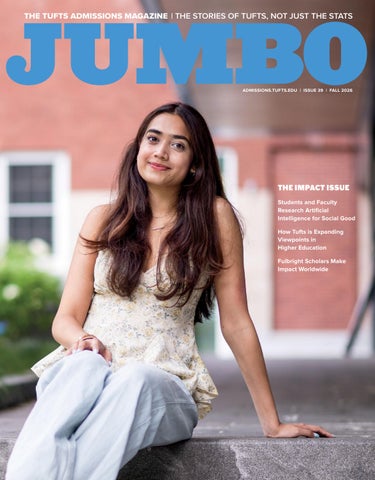
JUMBO THE TUFTS ADMISSIONS MAGAZINE | THE STORIES OF TUFTS, NOT JUST THE STATS
ADMISSIONS.TUFTS.EDU | ISSUE 39 | FALL 2026
THE IMPACT ISSUE Students and Faculty Research Artificial Intelligence for Social Good How Tufts is Expanding Viewpoints in Higher Education Fulbright Scholars Make Impact Worldwide
PHOTO BY ALONSO NICHOLS/TUFTS UNIVERSITY
MEET JUMBO
These pages were written by Tufts students. Flipping through them should feel like taking a stroll through campus. You’ll meet professors and students; they’ll share with you what excites them. You’ll drop into a class on an unfamiliar topic and leave inspired, dig into some fascinating research, or hang out in a residence hall with potential classmates. Along the way, you might decide that Tufts feels like the right place for you. If that happens, this magazine is also for you—flip to the back where we’ve broken down the basics on applying: deadlines, financial aid, and advice. This is Tufts; explore it.
CONTENTS
FEATURES
14 | Learning From Perspectives Across the Ideological Spectrum 30 | The Tufts Cybersecurity Center for Public Good Making a Jumbo Impact
3 INFOGRAPHIC 8 CLASS HIGHLIGHTS 10 AROUND TOWN 24 ATHLETICS 26 LIVING 34 ARTS 38 ADMISSIONS 39 FINANCIAL AID
On the Cover: Shefali Bakre ’28 COVER PHOTOS BY ALONSO NICHOLS/TUFTS UNIVERSITY (FRONT), JOHN MRAKOVCIC/TUFTS UNIVERSITY (BACK)
GREETINGS
FROM THE DEAN 6
3
“As you explore your university options, consider the impact you have already had in your community and what kind of impact you want to have on your next one.”
4
5
2 1
8
7
GREETINGS,
Much of what you’re about to read was written by these Tufts students. Listen for their voices as they introduce you to the Tufts community, page by page.
THE TUFTS ADMISSIONS MAGAZINE
next one. Consider which university communities set you up for the most success in achieving your goals and create the type of environment where you can excel. My hope is that this issue of Jumbo Magazine— alongside a campus visit, a virtual event, a conversation with a Tufts student or alum—gives you a peek into just how much impact you could have here at Tufts.
A JUMBO GUIDE TO TUFTS
Sincerely,
JT Duck Dean of Admissions & Enrollment Management
KAASHVI AHUJA ’26 from Doha, Qatar
MA’AT SMITH ’27 from Philadelphia, PA
SOPHIE AXELROD ’26 from Bethesda, MD
ALEXANDER VANG ’26 from Fresno, CA
LIV JORDAN ’26 from Sammamish, WA AFUA SIAW ’26 from Bronx, NY
OFFICE OF UNDERGRADUATE ADMISSIONS Tufts University / Bendetson Hall 2 The Green / Medford, MA 02155 617.627.3170 / admissions.tufts.edu
Produced by the Office of Undergraduate Admissions Edited by Sean Ashburn, Tahkeya Blake, and Isabelle Charles Design by Lina Kong and Hayley Capodilupo
ILLUSTRATION BY SHAW NIELSEN
MEET THE STUDENT COMMUNICATIONS GROUP
our students to make a meaningful impact on the Hill—and beyond. In this issue of Jumbo Magazine, you’ll hear from students, faculty, and staff who have done just that. From a student who leverages their role in the Tufts Community Union Senate to strengthen student life experiences, to an instructor in Film and Media Studies who is teaching students how to engage with AI in their artistic endeavors, exploring both its limitations and the opportunities for impact. You’ll hear from a faculty member in Civil and Environmental Engineering who teaches about the impact engineering can have on improving public health, as well as from a student who created an app to help consumers track variable pricing across local coffee shops. As you explore your university options, consider the impact you have already had in your community and what kind of impact you want to have on your
PHOTO BY KATHLEEN DOOHER
“Tufts is big enough that you can achieve anything, but small enough that you can try anything.” President Sunil Kumar offered this framing to our newest Jumbos at this year’s Matriculation Ceremony during Orientation Week. It’s a healthy perspective to have here - where the sky is the limit and opportunity for impact is within reach. Tufts is a place where impact can take many forms, from the impact our students have in research labs, to the athletic fields, to the community and the world beyond campus. After all, more than 60% of students participate in research, we won four Division III national championships in 2025–2026, we have more than 350 student organizations, and 89% of Tufts students participate in internships in Boston and around the world. Our medium-size, our metro-Boston location, our transformative educational experiences, and our collaborative community create a powerful environment that allows each of
Tufts’ Medford/Somerville campus has the classic makings of a college setting with vibrant classrooms, interactive makerspaces, state-ofthe-art athletic fields, and charming libraries…but there are other notable places that make the community shine. From historic landmarks to established traditions, there is always something to discover at Tufts. Join us as we light the way and spotlight some favorite campus spots.
1. MBTA Green Line (or “the T”) Located on the Tufts campus, the Medford/Tufts MBTA Green Line station provides easy access to the City of Boston. Students can hop on the “T” to sample new restaurants, attend Boston sports games, commute to internships in government, biotech, and more, and enjoy all the city has to offer. 2. Joyce Cummings Center Right next to the MBTA stop, the Cummings Center houses the Economics, Computer Science, Mathematics, Data Science, and Entrepreneurship programs, serving as a hub for innovation and technology. 3. Memorial Steps Serving as a gateway to the Hill, the steps commemorate the Tufts community members who have served in the armed forces. Surrounding the Memorial Steps are Miner and Paige Halls, home to the Departments of Philosophy and Education. 4. Mayer Campus Center The Mayer Campus Center houses a student-run café, multiple dining options, study spots, gathering spaces, and the Office for Campus Life, which advises our 350+ student organizations. Students spend time with friends on the patio or in the atrium, surrounded by flags designed by each Tufts graduating class.
5. Dewick-MacPhie There are two main dining centers on campus ensuring that all students can enjoy delicious meals. Dewick-MacPhie is located downhill while Fresh at Carmichael is uphill, and students often discover their favorite dishes at each location. 6. Prez Lawn Located just behind the University President’s residence, the expansive and lush President’s Lawn is constantly active with students studying, tossing frisbees, sledding down the snowy hill, and more. 7. Bowen’s Gate This picturesque, ivy-covered landmark is named for Tufts alumnus Eugene Bucklin Bowen (Class of 1876) and comes along with some playful lore. 8. Jumbo Jumbo the Elephant is our beloved mascot and the inspiration for the modern use of the word “jumbo.” He was a world-famous elephant in the 19th century and there is now a life-sized sculpture of Jumbo that stands 12 feet tall on Tufts’ Academic Quad.
3
INSIDE OUT
EXCOLLEGE HIGHLIGHT
A REAL YET RANDOM, PLAYFUL YET SERIOUS SPIN AROUND CAMPUS—AND JUST BEYOND
FOUNDED IN 1964, the Experimental College, or ExCollege, serves as a novel educational program focused on creativity, collaboration, and innovative learning. The ExCollege allows current Tufts students to pitch, plan, and teach their own courses to their peers. Additional ExCollege courses are taught by visiting lecturers and local professionals working in fields like criminal law, product development, and journalism. From student-taught courses like “The Lord of the Rings: History, Language, Culture, and Impact,” to “The Energy Transition: From Power Grids to Politics,” there are a wealth of subjects available that inspire interdisciplinary knowledge through niche, timely topics.
WOMEN IN TECH CONFERENCE FOR THE NINTH YEAR IN A ROW, the Tufts Women in Computer Science organization hosted their Women In Tech Conference. With 300 students in attendance from more than 35 universities, the conference was an inspiring day with insights from keynote speaker, Dr. Kristin Austin, Vice President of Culture and Social Impact at Rewriting the Code. Additionally, the conference included Tufts alumni and speakers from Google, Hubspot, Microsoft, and several startup organizations.
NEW AQUATIC CENTER
BACON HALL UPDATES AFTER UNDERGOING RENOVATIONS, Bacon Hall has reopened with new state-of-the-art teaching and research labs. The building, which houses spaces for the Departments of Earth and Climate Sciences and Biology, now has a coral reef system, a tropical room, and a saltwater room, in addition to a pollinator garden and the P.T. Barnum Mineral Collection. With accessibility and community at the forefront, Bacon Hall is a space that welcomes collaborative learning and teaching with access to the best resources as soon as students walk through the doors.
4
PHOTOS BY SOPHIA ZENGIERSKI / SHUTTERSTOCK.COM; JEFF PERKINS/TUFTS UNIVERSITY
IN ORDER TO SUPPORT our athletes, Tufts has announced plans for the Rachlin Aquatics Center, set to be completed by fall 2028. With an Olympic-sized swimming pool and viewing rooms for spectators, the new aquatic center is not only designed for student swimmers and divers, but also the larger Tufts community, with swim lessons and classrooms available for wellness activities for our Medford/Somerville neighbors.
ATHLETICS UPDATES AFTER A SUCCESSFUL athletic season with four championship wins for the Tufts Men’s Soccer, Women’s Field Hockey, Women’s Rowing, and Men’s Lacrosse teams, Tufts has placed 2nd in the nation in the 2026 Learfield Directors’ Cup for the NCAA Division III category. Out of 319 colleges and universities, Tufts sits at the top of the Division III rankings thanks to the incredible student-athletes and coaches who have competed well and succeeded this year with flying colors.
5
JACK ’26 BURTON
Jack Burton didn’t come to Tufts expecting to think much about Dunkin’, the popular New England based coffee chain. Growing up in Houston, Texas, Dunkin’ locations are few and far between. After arriving on campus and realizing how seriously people take their coffee, he started to notice something unexpected: prices weren’t always the same. With a strong attention to detail and a passion for building independent projects, Jack decided to look deeper. As he explored the issue, he became interested in how difficult it was for users to actually compare prices across locations. “I found out that Dunkin’ charges different prices based on their location. And there’s no easy way to compare pricing in the app without completely changing whatever your store is set to and then going back into the menu and finding the options,” described Jack. Motivated to understand more, in the fall of his junior year, Jack created DunkinScout, a web program designed to help users compare prices across locations and make more informed decisions. The project was later featured in The Boston Globe. Jack has been enthusiastic about coding and computers since middle school. He built on his web programming skills and expanded his technical knowledge throughout high school. Jack connected with Tufts while driving by the campus on a Northeast college tour. Exploring the campus sparked his curiosity about the Computer Engineering program and he reached out to Professor Ming Chow, a Tufts cybersecurity professor, to ask questions and further understand the program. Ultimately, Jack applied Early Decision to Tufts for the opportunity to gain a broad academic perspective and explore courses beyond a purely
Computer Engineering major from Houston, Texas
6
PHOTO BY ALONSO NICHOLS/TUFTS UNIVERSITY
“[My] favorite thing about Tufts is the community and the collaborative mindset of the students and professors.”
technical engineering track. Through Computer Science and Computer Engineering classes in both the School of Arts & Sciences and the School of Engineering, he discovered an appreciation for interdisciplinary learning. Throughout his time at Tufts, Jack was able to learn from Professor Chow. He enjoyed exploring digital safety through CS0116 Introduction to Cybersecurity, as well as CS195 Cybersecurity Clinic through the Cybersecurity Center for the Public Good led by Professor Chow. The clinic is a year-long course where students team up with nonprofit organizations to tackle real cybersecurity challenges with expertise from the School of Engineering, the Tisch College of Civic Life, and the Fletcher School. “We [were] paired with a nonprofit to do probono cybersecurity work,” Jack said. “It was a really neat way to apply what we’d learned and see the challenges smaller organizations face.” Jack learned from many more professors. And, not all of Jack’s favorite classes have been specialized. Although he enjoyed learning about Machine Structure and Assembly Language Programming in CS40, he also enjoyed classes outside of his coding comfort zone. He took Modern Dance I with Professor Jaclyn Waguespack in his junior year to fulfill an arts elective requirement, finding the course surprisingly rewarding. “Even if you’ve never danced before, the dance department makes it really welcoming,” he said. “You can just try something new.” Some of Jack’s most meaningful learning happened outside the classroom. For the past three years, he worked as a cybersecurity intern at Schneider Electric, an industrial automation company, conducting vulnerability assessments on the
company’s products. Balancing the internship with his course load, Jack gained hands-on experience applying cybersecurity skills to real-world systems. Jack said his favorite thing about Tufts has been the community and the collaborative mindset of the students and professors. Jack’s capstone Senior Design Project was completed alongside a multidisciplinary team of electrical engineers, computer scientists, and fellow computer engineering majors. They developed a low-cost, easily deployable earthquake early warning system for regions without existing infrastructure. “It’s about building something that can actually help people,” he said. Jack is an avid cyclist, participating for four years on the Tufts Club Cycling team, where he competed against other schools in the Northeast. Jack also served on the Catholic Chaplaincy executive board and has participated in the Tufts Dance Collective in a dance choreographed by his roommates. Looking back, Jack encourages future Tufts students to embrace the unknown of college and enjoy everything Tufts has to offer. “Come in with an open mind your first year. A lot of the curriculum is designed to let you explore,” Jack said, “I took an audio engineering class that was more hardware-related stuff than I had done previously, so it helped spark my interest in Computer Engineering.” After graduating in May 2026, Jack began a job at MITRE, combining his passion for cybersecurity with the practical and interdisciplinary experiences he gained at Tufts. He is excited to take on projects that have tangible impact, continuing to build solutions that keep communities and organizations safe. BY SOPHIE AXELROD ’26
7
VISUAL ARTS AT TUFTS: BE BRILLIANTLY BOLD BY MA’AT SMITH ’27
8
PHOTOS BY ANDY KWOK/TUFTS UNIVERSITY, ALONSO NICHOLS/TUFTS UNIVERSITY, AND JAKE BELCHER/TUFTS UNIVERSITY
CLASS HIGHLIGHTS
Tufts University is home to a premiere art school partnered with a major museum: the School of the Museum of Fine Arts, or SMFA at Tufts. Along with the intensive studio art education offered to Bachelor of Fine Arts (BFA) and Combined Degree BFA+BA/BS students, non-art majors can take courses at SMFA, fostering connections between students with different fields of study. SMFA offers a broad range of artistic areas that can be applied to many academic disciplines, making them relevant and accessible to students across majors. With access to accomplished faculty, mentors, and studio resources, SMFA courses allow students to explore new perspectives, develop creative skills, and expand their academic experience beyond the traditional classroom. Here are course descriptions from several popular offerings:
Digital Media: Virtual Reality An overview of practice and theory of Virtual Reality as a contemporary fine art form. Uses the software Unity3D to create immersive interactive audio-visual environments to be viewed with VR headsets, mobile phones, or as video art. Build custom VR projects. History of philosophical, aesthetic, and ethical dimensions of mimetic representation. Differentiates and expands on what makes a virtual reality experience a work of art, as opposed to a game or a tool. Fibers: Resistance and Textile Practice Studio and seminar which looks at craft as a political and personal tool. Explore, through historical and contemporary research of community groups, artists, political movements, material studies, and students’ individual practice how fiber/textile practice acts as a form of resistance, protest, and self-empowerment. This course offers an introduction to multiple fiber techniques and the space for other hands-on explorations to aid in the development of personal and collaborative projects.
Graphic Arts: Design for Social Change Explore design as a catalyst for social change. Focus on marrying design to activism and examine established methodologies for developing and fostering a successful call to action. Create and disseminate engaging messages and materials in service of promoting an idea or product. Students will work individually or in groups to design and implement a campaign for a concept of their choosing; final deliverable forms will vary but may include posters, websites, or public art installations. Through lectures, in-class activities, and critiques, students will learn about the role design and designers play in social activism, as well as strategies for research, ideation, prototyping, and testing design solutions. Class demos will cover Photoshop and Illustrator. Media Arts: Storytelling: Radio/Podcasts An intermediate-level studio seminar on audio storytelling as an interdisciplinary field spanning podcasting, radio, literature, music, theater, poetry, journalism, activism, politics, cinema, and contemporary art. Tell stories through sound and words, using narrative structures, audio recording and editing techniques, sound design, collective listening sessions, and seminar discussions. Course includes histories and genres of narrative sound formats.
9
AROUND TOWN
EXPLORING THE MIDDLE GROUND THE TUFTS INSTITUTE FOR ARTIFICIAL INTELLIGENCE Artificial intelligence (AI): some consider it the future of human innovation while others warn its result is a future of diminished agency. Use of generative AI tools might be one of the most talked about and contentious topics on campus, and that’s exactly what makes the Tufts Institute for Artificial Intelligence (TIAI) such a compelling place. Rather than interpreting the impacts of AI as only positive or only negative, the Institute exists to explore the middle ground. Their programs ask the hard questions about what AI does, what it should do, and how we can best use it in service of social good. BY ALEXANDER VANG ’26
What is the Tufts Institute for Artificial Intelligence (TIAI)? TIAI serves as the central hub for AI research, education, and collaboration at Tufts. It supports the university community by connecting faculty, students, and researchers across all ten of Tufts’ schools to pursue AI applications that have a positive impact on learning, health, business, policymaking, conservation, and more. Too often, AI research is siloed in Computer Science departments, detached from questions of ethics, equity, and community needs. Tufts flips that model: here, engineers, policy experts, and artists work together to ensure that research pushes technical boundaries while centering human well-being. Moreover, students and faculty collaborate on a wide range of topics including machine learning, natural language processing, robotics, human-AI interaction, fairness and bias in algorithms, and computational models tied to health care, education, and climate systems. With support from TIAI, there is significant AI research and programming happening across our campuses. One lab is using AI and machine learning to help quickly identify antibiotics to treat lyme disease. Another recent study from the TIAI focuses on comparative machine learning analysis of saliva
10
and plaque microbiomes in patients with type 1 diabetes. An example of AI excitement is also found in the creation of the Tufts AI Society, a student-run organization that offers workshops, panels, and engages in student-led projects. The Institute also hosts events and symposia that bring conversations about AI’s impacts and potential to the full Tufts community and to Boston’s broader tech ecosystem. Recent workshops have brought together infectious disease scientists and AI experts and sparked novel research in humanAI interaction. They offer a variety of internships and programs that provide students with hands-on experience with AI systems and their academic programs further deepen students’ engagement with the field. Academically, there are new opportunities for students to be able to engage with AI, including two minors beginning in fall 2026. The minor in AI Development is available for students who want a foundational knowledge of AI and building new technologies, and the minor in the Application of AI is for students who want to understand how to apply AI within their own disciplinary context, such as computational biology or ethics. In addition to these minors, Tufts offers a fifth-year Master of Science in Artificial Intelligence, designed for students with
a background in computer science, mathematics, or a related technical field and covers AI concepts and techniques. The Master’s degree has students think deeply about the ethical considerations when implementing AI models and participate in workshops, collaborative projects, and applied research experiences that connect technical development with real-world implications. Why It Matters and What’s Next TIAI reflects Tufts’ broader commitment to integrating intellectual discovery and civic engagement. Given AI’s increasing presence in everyday life and industry, whether within health care delivery or criminal justice systems, the Institute works to prepare Tufts students not to be passive users of technology, but active contributors in shaping its development and direction. As artificial intelligence becomes further embedded in business, policy, and daily uses, the demand will continue to grow for professionals and leaders who can navigate its technical complexities and ethical implications. In this way, TIAI fosters a community where the future of AI is shaped through thoughtful and inclusive dialogue.
11
12
also performs with Rangeela, a South Asian fusion dance team, where she’s built close friendships and performed at major campus events like Holi and the annual culture show. “It’s such a fun, original part of the college experience,” she said. “I’d love to choreograph someday.” Even her more unexpected commitments like joining the Tufts Cheese Club on a whim have become meaningful parts of her college life. What started as a casual interest turned into a role in marketing and event planning, including the club’s signature “Cheeseball” event. “I think that’s the beauty of Tufts,” she said. “You can try anything, and it can turn into something bigger than you expected.” Academically, Shefali has been equally exploratory. A course like EN1 Sci-Fi Bioengineering, which bridges science fiction and real-world applications, affirmed her interest in the field. Mentorship from professors—including one who helped her see the possibilities within engineering through discussions ranging from course requirements to film analysis in Jurassic Park—has further shaped her path. Outside the classroom, she’s gained hands-on research experience through a first-year rotational program, eventually continuing into cancer cell research in a new lab. “Faculty here are really accessible,” she confirmed. Still, some of her most formative learning has happened in quieter moments—studying with friends at Kindlevan Café, working in a fourth-floor huddle room in the Joyce Cummings Center, or spending a sunny afternoon on the Tisch Library roof. Looking back, Shefali sees her growth not just in what she’s accomplished, but in how she’s learned to navigate independence while staying grounded in community. “You become more independent, but you’re never alone,” she said. “You learn so much from the people around you.” She’s also developed a deeper appreciation for everyday routines, whether that’s a Saturday morning catching up with friends or a simple dinner at Dewick-MacPhie Dining Center. “It’s about appreciating the small things. That’s something Tufts really teaches you.” As she looks ahead, Shefali is excited to continue expanding her world through meeting new people each semester, growing into new roles, and preparing for life beyond college. For prospective students, her advice reflects the mindset that has guided her own journey: “Come here for the community and take advantage of everything. You really can do whatever you want.” BY ALEXANDER VANG ’26
SHEFALI BAKRE ’28
“Students really do have the power to make meaningful change here.”
Biomedical Engineering major from Burlington, Massachusetts
PHOTO BY ALONSO NICHOLS/TUFTS UNIVERSITY
When Shefali Bakre arrived at Tufts University from Burlington, MA she felt overwhelmed…but in the best way possible. “Everyone comes from such different backgrounds,” she said. “It made me realize how much there was to learn—not just academically, but from the people around me.” Studying Biomedical Engineering with a minor in Computer Science, Shefali quickly found herself drawn to spaces where she could turn that curiosity into action. Now serving as Vice President of the Tufts Community Union (TCU) Senate, she has built her Tufts experience around one core idea: students have the power to shape their campus. “I’ve always wanted to be the change that I see,” she said. That mindset led her to run for TCU Senate during her first year, one of the most competitive class elections. Inspired by student leaders she saw on campus, including then-TCU Senate President, Shefali was blown away by how much passion and possibility the role held. “They were so excited about the work they were doing. It made me realize that students really do have the power to make meaningful change here.” After winning her senator seat, Shefali found not only a platform, but a community of peers who shared that same energy. During her first year, she led initiatives designed to directly support student life. Following in the footsteps of a mentor, who is also her “Big” in the Senate, Shefali has focused on making the committee an open, collaborative space. Even though everyone is around the same age, she views her role as, in her words, “helping guide people through their ideas. It’s very rewarding to see those ideas come to life.” Her work has ranged from large-scale initiatives, like supporting the Senate’s farmer’s market and organizing Mental Health Week programming, to everyday improvements like advocating for vending machines in academic buildings like Tisch Library. “Even the small things can make a difference. It’s about making campus feel better for everyone,” Shefali shared. Beyond the Senate, Shefali has found another avenue for student engagement through her work with Tufts Dining. As part of the marketing team, she helps create content, connect with dining staff, and highlight food resources. From filming dining hall tours for prospective students to showcasing alternative coffee spots on campus, she’s helped make campus resources more accessible and transparent. While much of her involvement centers leadership and service, Shefali has also carved out space for creativity and joy. Through the Tufts Dance Collective, she rediscovered her love for dance in a more relaxed, expressive environment. She
13
LEARNING FROM PERSPECTIVES ACROSS THE
IDEOLOGICAL SPECTRUM
By Afua Siaw ’26
ILLUSTRATION BY DAN PAGE
When we think of a university education, we can see it as an invitation to think more deeply, question assumptions, test ideas, and encounter perspectives that stretch the boundaries of our experiences. At Tufts, this vision is reflected in the launch of the Center for Expanding Viewpoints in Higher Education (CEVIHE).
15
Established in 2025, the Center was created to strengthen a core academic value:
INTELLECTUAL OPENNESS.
PHOTOS BY ALONSO NICHOLS/TUFTS UNIVERSITY AND COURTESY OF THE CENTER FOR EXPANDING VIEWPOINTS IN HIGHER EDUCATION
16
ILLUSTRATION BY DAN PAGE
Its mission is rooted in the belief that students learn not only through their majors, but also by engaging thoughtfully with a broad range of perspectives on complex social, political, and ethical questions. Rather than focusing solely on debate, the initiative emphasizes curiosity, intellectual rigor, and the ability to understand ideas from different angles. Exposure to varied perspectives strengthens reasoning, sharpens judgment, and deepens scholarly engagement. The Center grew out of classroom experiences where students encountered political and philosophical frameworks that extended beyond lecture halls. Conversations sparked in class often continued in dining centers, residence halls, and late-night discussions. Many students wanted a space where engaging across differences was not occasional, but intentional and sustained. The Center for Expanding Viewpoints was created to meet that need. CEVIHE is led by political scientist Dr. Eitan Hersh, whose research focuses on civic engagement and democratic participation. As inaugural Director, Hersh emphasizes structured dialogue and disciplined inquiry, encouraging participants not only to share opinions but to carefully examine the reasoning behind them. He works alongside Associate Director Arik Burakovsky and a board of faculty from disciplines including economics, religion, public health, and more. This interdisciplinary structure reflects the Center’s belief that intellectual openness extends beyond politics into areas such as medicine, technology, and cultural analysis. Among CEVIHE’s most anticipated offerings are its public forums featuring invited speakers. One standout event, the “Headliner Event,” featured Dr. Musa al-Gharbi, whose work explores elite culture, social stratification, and knowledge production. Al-Gharbi and Tufts students discussed media narratives, institutional power, and how expertise is shaped and understood in society. Another program, “Planning for New Towns: An International Symposium on Abundant Housing and Adaptive Zoning,” used housing policy as a starting point for broader discussion. What began as a conversation about zoning quickly expanded into questions of access, mobility, and belonging. Panelists asked who cities are designed for and
CENTER FOR EXPANDING VIEWPOINTS IN HIGHER EDUCATION
how land-use decisions reflect deeper economic and ethical priorities. By incorporating international perspectives, the symposium highlighted how housing policy sits at the intersection of law, ethics, and economics, and how decisions about space shape opportunity. The recurring series “Politics and Culture from All Sides” serves as a central pillar of CEVIHE’s programming. Sessions such as “The Fate of Liberalism” and “Trust in Medicine” move beyond surface-level disagreement, encouraging participants to clarify definitions, examine evidence, and consider alternative frameworks before drawing conclusions. This structure fosters patience, a valuable and increasingly rare academic habit, and reinforces CEVIHE’s broader aim: not to produce consensus, but to improve how disagreement is understood and engaged. Among its initiatives is the Edge Fellowship, a program for incoming first-year students. Fellows participate in programming focused on civic leadership, constructive dialogue, and intellectual openness. Through workshops, reading groups, and collaborative discussions, students practice examining arguments from different perspectives. The goal is not ideological change, but intellectual growth that builds comfort with complexity and uncertainty.
Nicholas Rishi ’26 is an International Relations alumnus committed to building spaces for rigorous, open conversation. Nicholas says, “We are all better off, as individuals and as a democracy, when we can understand and empathize with other perspectives.” Nicholas has supported CEVIHE programming and research on academic and free expression. The Center also works to influence classroom learning. Faculty affiliated with the initiative can develop curricular resources designed to help instructors integrate a broader range of perspectives into their courses. These tools include reading lists, modules, and structured discussion guides that support more inclusive and dynamic classroom dialogue. As universities continue to consider how best to prepare students for leadership in society, the Center for Expanding Viewpoints in Higher Education offers a model that blends curriculum, innovation, and interdisciplinary collaboration. It encourages curiosity without fear, intellectual flexibility, and a stronger sense of connection across differences. Ultimately, the goal is not to challenge personal beliefs for their own sake, but to create the conditions for deeper understanding and more thoughtful engagement with the world.
Top left: Musa al-Gharbi, Assistant Professor of Communication and Journalism at Stony Brook University, lectures during a Center for Expanding Viewpoints in Higher Education event, “The Future of the American Left and Right,” a conversation exploring the ideas and tensions shaping today’s progressive movements. Top right: Students participate in a fictional geopolitical simulation hosted by the undergraduate journal of international affairs and CEVIHE. Bottom left: Students attend Planning for New Towns: An International Symposium on Abundant Housing and Adaptive Zoning, co-sponsored by CEVIHE. Bottom right: Director and Professor Eitan Hersh with students at a CEVIHE event.
17
WHY TUFTS?
THE REWRITE
First-year applicants to Tufts University are asked to respond to two required short answer prompts, which vary depending on the program to which you are applying. Responses offer the Admissions Committee insight into the interests and qualities that make you you and help us better understand your interest in Tufts. We asked Tufts community members to tackle the Tufts short answer questions from their perspective as current Jumbos!
To see the 2026–2027 Tufts short answer questions, visit https:// admissions.tufts.edu/apply/ short-answer-questions/
Applicants to the School of Engineering are required to answer the following question in 100–200 words: Tell us about an engineering or science-related project that you have helped build, design, create, or iterate in the past two years. What was the project and what was your role?
ANO MAPOKOTERA ’29 Mechanical Engineering major
In my first semester at Tufts, I worked on a group project for my introductory engineering course, Patents of the Future: Sci-Fi Tech in the Making. We watched sci-fi movies like Primer and Back to the Future and debated whether the technologies they featured could ever become reality. At the end of the semester, we were tasked with creating and presenting a speculative patent for a technology that could benefit society. My group designed a concept for nanobots that could be injected into the bloodstream to detect and destroy cancer cells with greater precision than traditional treatments. My role focused on designing what the nanobots would look like and thinking
through how their different components could work together, while addressing challenges like biocompatibility. As a group, we also researched how the nanobots could identify cancer cells, how they might be powered and controlled inside the body, and the navigation challenges that would need to be solved before a technology like this could become reality. This project showed me how much engineering depends on creativity. Every innovation starts as an idea, and sometimes all it takes is imagining something impossible before figuring out how to make it possible.
SHORT ANSWER PROMPT #1 Applicants to the Bachelor of Fine Arts (BFA) program are required to answer the following question in 100–200 words: Tell us more about a specific piece in your portfolio. What were the ideas you intended to explore, and how did those ideas inform the process of making the piece?
Please describe how you have learned about and engaged with Tufts during your college search process (75–150 words).
SOPHIE CARTER ’29
Psychology major with minors in Ancient World Archaeology, Dance, and Studies in Race, Colonialism, and Diaspora
I wanted college to feel like my Tufts campus tour, where I found a compassionate and welcoming environment that resonated with me. My tour guide, Kylie, demonstrated that the energy of the student body would be extremely compatible with what I was seeking. We stayed in contact after our tour, even getting coffee with each other last semester, and it was so good to know how one small interaction with a Tufts student could lead to such a supportive relationship.
The virtual information sessions I attended helped me realize how much I align with the values of the university. The interdisciplinary approach of Tufts will continue to encourage me to study many fields, while also finding the overlaps of subjects I’m already interested in. Dance and Psychology have always been my main interests, and Tufts even offers the course Creative Dance for Children that intertwines these studies!
MYTHRI MARGAM ’28 Bachelor of Fine Arts (BFA) program
Exploring the idea of stillness as strength, I created a watercolor piece that depicts a meditating woman with her eyes closed, hands resting open at her sides and surrounded by blooming pink lotus flowers against a golden background. I used-brush strokes radiating from behind her head, so the light reads as something she’s generating, not receiving. Her face is painted with layered glazes built up slowly to keep her features sharp and steady. The sari is the opposite: wet-on-wet washes
where I let the blue spread on its own, so the fabric looks looser and less controlled than her expression. These choices tie into the core idea I wanted to show of: being mentally alert yet physically relaxed. The lotuses draw from Buddhist symbolism—the lotus grows through mud and murky water, yet the flower itself is visually stunning, mirroring how the mind can rise above suffering and attachment. To show gradual awakening, I painted the flowers in various stages, from tighter buds to fully bloomed.
SPECIFIC TO YOUR INTENDED SHORT ANSWER PROMPT #2 ISSCHOOL/PROGRAM AT TUFTS
Applicants to the School of Arts and Sciences are required to answer the following question in 100–200 words: Tell us about one of your favorite school assignments in the past two years. What was the assignment and why did you enjoy it?
ISHAN GICHOHI ’27 Chinese Language and Cultural Studies major with minors in Finance and Entrepreneurship
18
Last fall, I took Entrepreneurial Business Law, an interactive course which featured guest speakers from venture capital, private equity, and investment banking each week. The course explored legal issues and considerations common to businesses as they are formed and throughout their business life cycle. For our final project, my group had to build a hypothetical startup and walk it through its entire legal lifecycle. We created “Zip ‘n Sip,” a matcha company, forming an LLC before converting to a C-corp ahead of
a Series A raise. Then we drafted a founder agreement, negotiated a SAFE, built a cap table, and protected our “secret recipe” as a trade secret, defending it when a hypothetical employee leaked it. I loved the class and this final assignment in particular because it let us grasp the concepts we learned by applying them to a business we’d started ourselves, working through its milestones and challenges from formation and financing to exit, then presenting it creatively to our classmates and professors.
Applicants to the Combined Degree (BFA+BA/BS) program are required to answer the following question in 100–200 words: Tell us more about a specific piece in your portfolio. How did an academic course, project, or interest inspire the ideas that you explored in this piece? Or, how did making this piece influence your academic interests?
DEFNE OLGUN ’27 Combined Degree BFA + BA in International Relations major
When I walked through the film photography district of Eminonu in Istanbul, one of the most popular and cheapest options for film available for purchase was already expired, resulting in a blue hue in photographs. Almost all of the film available was expired. Unless I wanted to deal with heavy import taxes and a molasses-slow postal service to ship my film, this was what was available to me. Blue, color shifted, light-leaked film. By combining my passions for creating art and progressive economic policy, I want to uplift and understand young artists who are held back by their socioeconomic
status or geographic location. Tufts classes like EC 35 Economic Development will help me understand economic disparities through lenses like market structures, externalities, and political factors. In another course, I’ll understand how the law acts as a method of social control in contexts of race, labor laws, and foreign policy. How does the abundance or lack of resources affect our creative process? If Turkish artists weren’t limited by the film available to them, how many more Turkish photographers would we see in museums? In books?
“It is one thing to analyze a problem. It is another thing to know that your decision carries weight.”
20
Then comes the responsibility. Through a partnership supported by former Tufts trustee and alumnus Nathan Gantcher and sustained by his son, Mike Gantcher, the class functions like a grantmaking body. Students review proposals from local nonprofits, conduct site visits, meet the people doing the work, and then decide how to allocate the funding. Professor Pasi does not make those decisions for them. She steps back. “The opportunity that we have to give money away puts the students in the position of having to make decisions,” she says. It is one thing to analyze a problem. It is another thing to know that your decision carries weight. Mike Gantcher understands that weight, and it is part of why he remains so closely connected to the course. He sees the program as a way to offer students something rare before they leave college. Not just exposure, but responsibility. Reflecting on what he hopes students take away from the course, he emphasizes that “first beginnings are always the hardest.” The class gives students a place to begin: a place to make decisions, to wrestle with uncertainty, and to learn what it means to give with intention before they have to do it on their own. But he is clear that this is not casual giving. “In this class, you’re a fiduciary,” he reflects. “You’re responsible for the impact someone else’s money can have.” That changes everything. It raises the stakes. It demands care. By the time students are ready to make a decision on which nonprofits should receive the grant, they have met the organizations, they have listened to their stories, and seen their work up close. There is no easy way to rank need or worth. Every organization that reaches the final round feels deserving. Professor Pasi does not try to soften that reality. She lets it stand. Because that, too, is part of the work.
One of the first things she challenges in the course is the idea that philanthropy belongs to someone else. Students often arrive assuming generosity is about money, or something reserved for people with resources. Professor Pasi dismantles that early. “It’s not only about the money,” she says, “It’s about how you commit yourself. Your time.” Volunteerism, attention, and presence are not secondary to impact. They are foundational to it. She encourages students to think about what actually matters to them, what problem “bothers you so much it keeps you up at night,” and to follow that thread honestly. For prospective students, both Professor Pasi and Mike Gantcher return to the same piece of advice, though they arrive there from different directions. Pasi speaks about engagement. She says, “You will find meaning in asking why and listening closely to the response.” For her, college is not just a time to learn, but also a time to understand one’s place within a larger community. To figure out not only what you care about, but how you want to act on it. Mike Gantcher emphasizes the value of the experience itself, learning by doing. Gantcher says, “Take the class. This is an opportunity to learn alongside your peers without hierarchy.” By the end of the semester, though the funds have been given away, the decisions have been made, and the spreadsheets have closed, many things prevail: a stronger sense of duty, a different way of listening, and a clearer understanding that doing good is not abstract, nor is it reserved for later in life. BY KAASHVI AHUJA ’26
USHA PASI
Lecturer, Derby Entrepreneurship Center and Jonathan M. Tisch College of Civic Life
PHOTO BY ALONSO NICHOLS/TUFTS UNIVERSITY
There is a point in Professor Usha Pasi’s class when everything becomes real. It doesn’t happen on the first day of class, when students begin exploring the syllabus. It happens later, when the class fully understands what is being asked of them. By the end of the semester, they will have to decide how to give away $30,000. Not in theory. Not as a case study. But in real life. Real money will be donated to real communities just beyond the edges of campus. This is when the energy in the room shifts. Professor Pasi, who teaches Nonprofits, Philanthropy, and Impact through the Derby Entrepreneurship Center and the Jonathan M. Tisch College of Civic Life at Tufts, has designed a class that feels less like a traditional course and more like an experiential journey. When I asked her how she found her way into this work, she did not point to a single origin story, instead she described a steady, lifelong curiosity for the world and her community. She realized that shaping society could begin with something as simple as “committing time and energy to people you don’t know.” That belief is what holds this course together. Students learn about the history and structure of the nonprofit sector, but they also sit across from nonprofit leaders, hear from funders, build their own nonprofits, and work through the kinds of decisions that do not come with clean solutions. Professor Pasi often talks about the distinction between knowing how something works and understanding why it exists. She pushes students to sit in that space a little longer to ask deeper questions and to listen more carefully. She describes Tufts students as “curiosity-driven,” but what stands out in her class is the level of collaboration that occurs. Students listen to each other. They take ideas seriously, even when they disagree.
21
GLOBAL IMPACT TUFTS FULBRIGHT SCHOLARS LIGHT THE WAY
SARAH PINTO
Professor, India, 2022–2023 Sarah Pinto is a Professor in Tufts’ Anthropology Department and has served as chair since 2023. She earned her PhD in sociocultural anthropology from Princeton University before serving as an assistant and associate professor at Tufts. In 2022, Professor Pinto received the Fulbright grant to lecture and conduct anthropology research at Presidency University, Kolkata, India. Professor Pinto focuses on social and gender dynamics of medical practice specifically around psychiatric care in India. Her research includes childbirth, infant mortality, and birth-work in Uttar Pradesh, India; women’s movement through psychiatric care in urban north India; and psychiatry and psychoanalysis in women’s lives in South Asia.
ESMA ABIB ’24
Undergraduate Alumna, South Korea, 2025–2026 Esma Abib is a 2024 Tufts graduate who recently pursued a Fulbright English Teaching Assistant grant in South Korea. After receiving a U.S. State Department Critical Language Scholarship and interning in the U.S. Embassy in Seoul while a student, she was excited about the possibility of living and working in South Korea.“I see this as an extension of my desire to live outside of the U.S.,” said Esma. “I hope to gain a deeper understanding of life within a rapidly developing country like South Korea.” Esma plans to work in international development and foreign policy.
22
ADAM LAZARUS ’22
The Fulbright program is a funded international exchange program administered by the U.S. Department of State. Fulbright provides students, scholars, artists, and professionals across sectors with the opportunity to study, teach, and conduct research abroad. Tufts has consistently been named a top producer of Fulbright Scholars, with multiple Tufts students selected for the prestigious opportunity each year, including 13 participating in 2026–2027. The Fulbright Scholars represented among our alumni and faculty serve as testaments to the global engagement, intellectual curiosity, and civic work that are core to a Tufts education.
KIMBERLY THEIDON
Kimberly Theidon is a published author and medical anthropologist with a regional concentration on Latin America and a research background in environmental humanities, political violence, critical security studies, transitional justice, and gender studies. During her Fulbright Scholar program in 2022, Professor Theidon spearheaded research on the implementation of the Colombian Constitutional Court’s decision that the Río Atrato is a victim of armed conflict with rights. She is currently the Henry J. Leir Professor in International Humanitarian Studies at the Fletcher School at Tufts, where she created the “Ecologies of Justice: Environmental Humanities and Civic Activism Initiative,” and she serves as the Director of the Gender and Intersectional Analysis and Inclusive Leadership Program.
Graduate Alumnus, Morocco, 2025–2026 Adam Lazarus is a 2022 graduate of Tufts’ Friedman School of Nutrition Science and Policy. Lazarus was awarded a Fulbright scholarship to conduct research in Morocco at Hassan II University of Casablanca. Drawing on his work in flood resiliency and water management in Denver, Colorado, he focused on nature-based solutions to increase resiliency to flooding and drought in Morocco. Lazarus shared, “I am excited for the chance to both learn and work alongside people from around the world and learn about different cultures and ways of seeing problems and opportunities.”
Associate Professor, Colombia, 2022–2023
ADRIENNE CHAPARRO ’13
Graduate Alumna, United Kingdom, 2024–2025 Adrienne Chaparro, an alumna of Tufts’ Graduate School of Arts and Sciences, has a curiosity about the art and objects of the Middle Ages. She focuses on the diversity of the Middle Ages through art and how its impacts on the current day. In 2013, Adrienne received a Graduate Certificate in Museum Studies from Tufts before working as the Curatorial Assistant for Exhibitions at the Isabella Stewart Gardner Museum in Boston, MA until she started her Fulbright Scholar program for art history. She curated two exhibitions that opened in the summer of 2024 featuring contemporary photography that celebrated LGBTQIA+ experiences and voices through portraiture. Adrienne aims to serve her community through research as a museum curator and developing exhibitions related to Western European medieval art.
LEO DEENER ’25
Undergraduate Alumnus, Jordan, 2025–2026 Leo Deener is a 2025 Tufts graduate who pursued an English Teaching Assistant opportunity in Jordan. While majoring in International Relations, Leo was selected to travel to Jordan to conduct research with an Institute for Global Leadership project. After that experience, Leo knew he wanted to go back to Jordan. He says, “I want to improve my ability to deal with discomfort…At Tufts, I got very comfortable in that environment, and I’m ready to make mistakes, be out of my element, and learn how to handle that. I see this as a huge growth opportunity.” And not just that, he adds. “Ultimately, I want to learn how a society that’s different than the one I’m familiar with works at a deeper level.”
23
ATHLETICS
At Tufts University, athletics are an extension of the institution’s broader educational mission, cultivating joy, excellence, and meaningful connections among teammates. Tufts Athletics has become an even more visible and spirited presence on campus with recent national success among multiple teams.
Behind every helmet and carefully stitched number is a student balancing demanding coursework with the physical and mental commitments of collegiate athletics. Practices, film sessions, weight training, and team meetings are layered onto labs, seminars, research projects, and exams. The schedule is intense, but for many players, it becomes a source of structure rather than stress. The rhythm of the season instills habits that outlast the college experience. Importantly, the influence of Tufts’ athletics teams extends beyond the campus gates into the surrounding communities of Medford, Somerville, and Boston. Guided by the value of community engagement, players participate in volunteer initiatives, youth mentorship programs, and local outreach efforts, recognizing that visibility carries responsibility. Visits to local schools reinforce the message that higher
education is attainable and that leadership takes many forms. In addition, Tufts Athletics has a running 15-year partnership with Team IMPACT, a national nonprofit with a multi-year program matching children facing serious illness or disability with college athletic teams, fostering relationships centered on socialization, empowerment, and resilience. Team IMPACT has been able to pair 33 children across 18 Tufts teams, with Tufts Football signing its fourth new teammate, marking the first time in Team IMPACT history a single team has reached that milestone. Tufts Athletics began working with Team IMPACT in 2011, the same year the organization was co-founded by six Tufts alumni. In 2018, the Team IMPACT Fellowship program was launched, an opportunity for student-athletes to be selected
from a competitive application and interview process as ambassadors for the Team IMPACT cause. As Fellows, they represent Team IMPACT on their campuses and greater community to raise awareness and increase program participation. In collaboration with the Athletics department, the Fellows were able to plan awareness games, table at community events, present at board meetings, and attend donor events. Tufts was named the Team IMPACT Fellowship Campus of the Year in 2024 and the organization continues to provide opportunities for Fellows in the program to build on their skills in community engagement, leadership, public speaking, and career development. Tufts is proud of their leadership within this organization and the ways our athletes use their time to give back to communities at Tufts and beyond.
24
PHOTO BY MICHAEL LAST/TUFTS UNIVERSITY
MORE THAN A GAME: TUFTS & TEAM IMPACT
25
HODGDON FOOD-ON-THE-RUN Hodgdon Food-on-the-Run, also known as “Hodge,” is a grab-and-go food court offering breakfast sandwiches, sushi, noodle bowls, and more. Its quick service makes it a reliable option for students between classes or on the move. The menu is broad, with options that cater to a range of dietary needs, including vegan, vegetarian, halal, and allergy-friendly choices. This variety allows students to find sustenance that fits both their schedule and their preferences without sacrificing convenience.
LIVING
GREAT FOOD BRINGS US TOGETHER
A T T G U N I F T N I S D
THE COMMONS MARKETPLACE Located in the heart of campus, the Commons Marketplace— referred to as the “CC” by students because of its location in the Mayer Campus Center—is one of the most popular and easily accessible dining spots. Like a mini grocery store, Commons serves a variety of sandwiches, hot entrées, salads, snacks, drinks, and spicy fries, a student favorite. Commons operates with JumboCash, a prepaid balance linked to a student’s ID that can be used at retail locations and cafés across campus. Meal “swipes,” which grant entry into dining halls for full meals, are used separately. Students often rely on JumboCash at the Commons for late-night and weekend options. On Fridays and Saturdays, offerings expand to wings, mac and cheese, popcorn chicken, and fried Oreos.
BY AFUA SIAW ’26
PHOTOS BY JODI HILTON/TUFTS UNIVERSITY AND JENNA SCHAD/TUFTS UNIVERSITY
Campus dining is tied to the rhythm of being a student. Whether during rushed mornings or late-night study breaks, these spaces do more than feed students; they foster community, offer comfort, and create campus culture. There are 11 Tufts Dining locations across campus, including Hodgdon Food-on-the-Run, the Commons Marketplace, Hotung Café, and the Sink, among others. Nutrition and inclusivity are equally important. Dining locations offer a range of options to accommodate religious practices, food allergies, and lifestyle preferences, including kosher, halal, vegetarian, vegan, and gluten-free meals. By prioritizing transparency, access, and balance, campus dining supports student health while aligning with broader sustainability goals.
HOTUNG CAFÉ Neighboring the Commons is Hotung Café. It serves bakery items, açaí bowls, pizza, warm sandwiches, and drinks. Here, students can also get Starbucks coffee or bubble tea to accompany their meal or snack.
THE SINK Just upstairs, the Sink offers a different kind of dining experience. This student-run café is known for its cozy, intimate atmosphere, with student art and creative touches covering the walls. The space reflects student voices and personalities, making it feel both welcoming and authentic. One of its biggest draws is the menu, featuring rotating specialty drinks and playful combinations like pairing a chocolate chip muffin with a “Lucy in the Chai.” Whether stopping in to study, hold a club meeting, or catch up with friends, the Sink provides a calm contrast to the busier dining halls. It is open until 6 p.m., and while it can get busy, that is part of its charm. The lines offer a chance to slow down in the middle of a hectic day, pause, chat, and connect.
One of the biggest perks of campus dining is the flexibility built into meal plans. Students can choose from a range of options depending on how often they eat on campus, access to JumboCash for cafés and specialty locations, and meal swipes for dining halls. Traditional dining halls like Fresh at Carmichael and Dewick-MacPhie primarily accept meal swipes, making them ideal for larger meals, while spots like Kindlevan Café, Pax et Lox Kosher Deli, and offerings in the Campus Center often accept JumboCash for more flexible purchases. Beyond convenience and variety, sustainability is also a key aspect of campus dining. Tufts Dining works to reduce waste through composting programs, reusable takeout containers, and waste tracking systems. These initiatives help limit what ends up in landfills. There is also an emphasis on sourcing food from regional producers when possible, which supports local agriculture while reducing the environmental impact of long-distance transportation. Campus dining teaches one of college’s most important lessons: independence. For many students, college is the first time they are fully in charge of their own nourishment—deciding when to eat, what to choose, and how to balance it all. Dining spaces are learning spaces too, where students learn how to navigate convenience and nutrition, routine and spontaneity, indulgence and sustainability. These choices may seem small, but they slowly shape habits that follow students far beyond Tufts.
27
As a professor in the Film and Media Studies (FMS) program at Tufts, Professor Mat Rappaport uses his diverse experiences in design, motion graphics, film, and art to design curriculum around emerging media. With a focus on new technology such as artificial intelligence (AI), his ultimate goal is for students to understand what these new technologies are, who they impact, and how to be ethical consumers and creators. Rappaport received his Bachelor of Fine Arts at the School of the Museum of Fine Arts (SMFA), and initially planned to focus on painting and drawing. He had the opportunity to explore multiple artistic disciplines and found himself drawn to printmaking. He describes his time at the SMFA as “magical” because he discovered what it meant to be an artist. He found a particularly formative experience in the review board process, where students present a portfolio of their work from the semester to faculty and peers. “You learned very quickly how to take criticism, and how to separate critique of work from [the] personal. I think that was incredibly valuable,” said Rappaport. Media is constantly evolving, and because many people receive their news online, Rappaport became interested in exploring filmmaking as a form of emerging media. Now he uses film as a medium to explore complicated topics. For example, in his documentary feature film Touristic Intents, Rappaport discusses the interconnectedness of mass tourism and political ideology. In a time when new technology is challenging the preexisting creative process, Rappaport decided that it’s important to experiment with how and when to use the technology to enhance creativity. Now, Rappaport is interested in artificial intelligence as the newest form of emerging media, and believes
“Within the DNA of Tufts students right now, [there] is a desire to foster multiple interests simultaneously.”
that building knowledge of AI is crucial. When he’s not teaching, Rappaport is working on his own projects where he experiments with integrating AI into the creative process. One of these projects is an AI multi-channel video installation, where Rappaport feeds the AI descriptions based off of stereographic photographs of landscapes. These natural landscapes are then interpreted by the AI and will be displayed on multiple screens. The installation will also have displays of small micro greens, along with large-scale close-up photographs of the micro greens. With this, Rappaport intends to establish a juxtaposition between the organic and the synthetic, and between the scale of large land masses and tiny plants. Additionally, Rappaport is collaborating on a film that centers around the air traffic controller strike in the 1980s. Along with the junior designer and the director, Rappaport creates motion graphic sequences that tell the story with historic photographs. The characters in the photographs are animated using AI, and the paper-based collage aesthetic of the film reflects the hybridized process used to make the film. It is important to Rappaport that his classes incorporate both theory and praxis. He is supported by the Film and Media Studies program, which provides students with a flexible liberal arts education along with practical filmmaking experience. Rappaport ensures his students engage with theory by leading discussions that consider the implications of new forms of emerging media. He wants students to understand the difference between the rhetoric about AI and the actual truth of new technologies. Although the language of “the cloud” makes people think that the internet is a nonmaterial object floating around, using and making technology creates concrete impacts in the material world.
“It’s really important for us to be understanding the material reality of these technologies. So the environmental impact, the labor impact, how these materials are sourced and turned into the raw material of AI,” Rappaport said. Rappaport teaches practical experience by ensuring that students actually interact with new technology such as AI and Virtual Reality. In his course AI in Motion: Ethics and Impact in Media Industries, students complete several experiments with AI as a way to explore the strengths and limitations of the new technology in the creative process. These experiments include using AI to create short films, music, and as a way to streamline systems. Rappaport also teaches a class called Online Videos: Algorithms, Creators and Social Impact, where students use what they learned about how algorithms work to create their own original video series designed to go viral. At Tufts, Rappaport enjoys working with intellectually curious students across various disciplines. Rappaport said, “Within the DNA of Tufts students right now, [there] is the desire to foster multiple interests simultaneously, which can cross-pollinate and that’s pretty exciting.” Rappaport especially enjoys helping students directly with their own projects, which he does through his Media Futures Lab course. In this class, Rappaport works closely with students as they conduct their own research and create projects that intersect with emerging technologies, film, and media. Rappaport said, “The strength of a liberal arts college and a place like the SMFA at Tufts is the community that forms around students and faculty and the ability to work closely.” BY LIV JORDAN ’26
MAT RAPPAPORT
28
PHOTO BY ALONSO NICHOLS/TUFTS UNIVERSITY
Professor of the Practice, Film & Media Studies
29
Established in 2024 and housed in the School of Engineering’s Department of Computer Science, the Tufts Cybersecurity Center for Public Good works at the intersection of civic engagement and technology. Led by Professor Susan Landau, the Center seeks to nurture the next generation of cybersecurity experts while positively benefitting our society. Professor Landau said, “The center capitalizes on our diverse expertise in computer science, specifically our research on how to make security and privacy capabilities directly benefit people.” With a strong focus on public service, collaboration, and impact, one example of the numerous opportunities within the center is the Cybersecurity Clinic, a program directed by Professor Ming Chow, that allows students to work with organizations and nonprofits in need of cybersecurity support on a pro-bono basis. Students use the skills that they learn in the classroom and apply it to real world problems to find creative solutions for outside clients. With the help of the Jonathan M. Tisch College of Civic Life and their vast network and access to many nonprofits in the area, the partnership has remained strong. Across all of the programming the Center has to offer, one thing remains true: the people involved with the Center’s work come from all areas of academia. Each student and faculty member brings computer science expertise while combining other areas of experience, which makes for a rich and interdisciplinary learning environment. In fact, experts across the School of Arts and Sciences, School of Engineering, Fletcher School, and Tisch College of Civic Life are involved in the center’s projects and work. Technical skills are not the only aspects important to know in order to deeply understand the complexities and intricacies of the cybersecurity field. Some of the important research coming out of the Cybersecurity
Center for Public Good is focused on surveillance, communications, and privacy. Another research topic is bridging cybersecurity with law and policy, ethical AI systems, and the risks and aftermath of cybersecurity occurrences. This interdisciplinary approach to cybersecurity with respect to the legal, ethical, and societal implications are a core part of the Center’s research and focus. Professor Landau comments on the research: “Our impact can take many forms. Research ideas can change the way to protect privacy or provide a new security paradigm that simplifies implementation and thus improves privacy or security. Research can reframe an argument about encryption’s central role in security that changes the public discourse and puts fears about the technology’s misuse in an appropriate place, thus removing barriers to cryptography’s wide implementation. Research also can provide insight into why cybersecurity improvements are not being adopted and propose incentives that change that dynamic. And research can introduce new policy ideas for the international setting that encourage cooperation between nations on some aspects of cybersecurity or privacy.” The value of a program such as the Cybersecurity Center for Public Good is in its ability to provide students with opportunities to strengthen their technical expertise in cybersecurity while fostering the professional skills, experience, and interdisciplinary competencies necessary for long-term career development. It emphasizes the importance of collaboration with other disciplines. Students have the flexibility to explore while also honing their skills and reaching a common goal together.
THE TUFTS CYBERSECURITY CENTER FOR PUBLIC GOOD
MAKING A JUMBO IMPACT 30
ILLUSTRATION BY ©2026 MATT CHINWORTH VIA THEISPOT.COM
LIST OF RESEARCH AREAS Anonymous Communications Protocols
Human-Centered Security and Privacy
Communications and Encryption Policy
Privacy-Preserving, Performance, and Query Result Accuracy
Designing and analyzing practical anonymous communications protocols
Integrating technology with law and policy to understand how surveillance tools can actually work
Cybersecurity Policy and Economics of Information Security Examining the costs and lessons of cybersecurity incidents to help shape future policy
Exploring the processes and mental models of professionals who perform tasks
Building secure and private database management systems to balance trade-offs among privacy, performance, and query result accuracy
Problems at the Intersection of Security, AI, and Hardware
Investigating the intersection of artificial intelligence, security, and hardware
31
“Try out everything, college is a chance where you can do what you never imagined you could do.”
Iman Boulouah, class of 2026, double majored in Biology and Biotechnology. Her twin sister also studied at Tufts, but, for the two, their hometown of Cambridge, Massachusetts, is quite separate from their lives in Medford. Iman was an active member of the First-Gen Collective at Tufts, where she spent four years connecting with other first-generation students and built a supportive, welcoming community. The First-Gen Collective hosts many workshops, meetings, and events that help students navigate college life such as: workshops for academic and personal development, panel discussions where first-generation students discuss their experiences and resources they have utilized to achieve success, and bonding activities like game nights. Through the organization, she also accessed influential campus resources and built genuine friendships with people from similar backgrounds. “Tufts really acknowledges the first-generation student experience and offers a lot of resources to support students like me,” she emphasized. “That was a big reason I joined the First-Gen Collective— it’s been great to meet people who share similar experiences and to have spaces where we can connect and relate to each other.” During her time at Tufts, Iman focused on building community—especially within STEM disciplines. Early on, she became involved with the Center for STEM Diversity, now part of the Belonging, Learning, Opportunity, and Mentoring (BLOOM) Center, and participated in the Redefining the Image of Science and Engineering (RISE) program. Designed to support students navigating their first year in STEM fields, RISE offers mentorship, academic coaching, and a weekly seminar that introduces faculty research, networking opportunities, and strategies for success in college. Community building remained central to Iman’s experience. As an active member of the Arab Student Association and African Student Organization, she worked to strengthen connections among students from the Southwest Asian and North African (SWANA) regions. In 2024, she helped establish the SWANA Community Senator position within the Tufts Community Union Senate to encourage
IMAN ’26 BOULOUAH
32
PHOTO BY ALONSO NICHOLS/TUFTS UNIVERSITY
Biology and Biotechnology major from Cambridge, Massachusetts
greater representation for SWANA students on campus. She served in the role herself, advocating for programming and initiatives that celebrate SWANA cultures and create space for students to share their identities. Iman’s commitment to representation extended beyond the Senate into the spaces she was part of every day. Iman spent a lot of time in the Africana Center, where she found a great network of friends and mentors. In our conversation, she emphasized the importance of the centers within Tufts’ Division of Student Diversity and Inclusion (DSDI). These spaces are helpful for students seeking mentorship or support, but they can also be places to unwind, do homework, and hang out while meeting peers with shared identities. Alongside her community-driven work, Iman continued to pursue her interests in science and service. As a Biology and Biotechnology major, she gained hands-on research experience in several labs. In the summer after her first year, Iman worked in the Warman Lab, pursuing rare genetic bone disease research at Boston Children’s Hospital, which helped “kickstart [her] interest in biotech and research.” She was also involved with Timmy Global Health, a student organization where she combined her interests in health and global service by supporting initiatives that expand access to medical care. Iman’s favorite class at Tufts was BIO162 Molecular Biotechnology, where she developed a final project on genetically modified milk and created her own ice cream. On the final presentation day for the class, one of her group members even dressed up in a cow costume. Iman stressed that professors in her majors do a great job of engaging students and working with them to create fun and meaningful projects. As advice to future Jumbos, Iman offered this: “Try out everything. College is a chance for you to do what you never imagined you could do, and it is a great way to learn more about yourself.” Immediately after graduating in May 2026, Boulouah began working with the Lab Science Investigation pre-college program at Tufts, encouraging more young people to explore scientific research. BY SOPHIE AXELROD ’26
33
ARTS HIGHLIGHT
SHINE ON
KINIWE AFRICAN MUSIC AND DANCE ENSEMBLE Taught by Professor Attah Poku, a prominent master drummer, this course introduces students to traditional aspects of Ghanaian performing arts. Song, percussion, and dance are integrated into a single performance ensemble, with no audition required. To celebrate the variety of Ghanaian cultures, the pieces taught by Professor Poku come from all 16 regions of Ghana.
PEP BAND Described as “a marching band without the marching,” Pep Band brings cheerful music to Tufts’ athletic events. Students in the ensemble have created a welcoming sense of family where they share traditions such as preparing pancakes before a game, also known as “pep cakes.” The group is non-audition, making Pep Band a low-pressure environment where students focus on having fun and celebrating school spirit with music.
JUMBOS TAKE CENTER STAGE!
WIND ENSEMBLE In this audition-based ensemble, students meet twice per week to practice a wide variety of advanced symphonic pieces. The Wind Ensemble has several performances throughout the academic year, including a festive holiday concert, and travels to international destinations to perform.
CHAMBER SINGERS
FROM WEST AFRICAN DRUMS TO BRASS INSTRUMENTS,
This small, primarily a cappella vocal ensemble performs everything from Renaissance motets to Broadway tunes. Students who join find community and reconnect with their love of classical music and performing. The pieces performed are engaging for advanced singers, while still accessible for students with less of a background in performance.
MUSIC ENSEMBLES AT TUFTS ARE RICH IN VARIETY AND ABUNDANCE.
34
This audition-based orchestra ensemble also performs a wide variety of music and travels together for both relationship-building and international performance tours. Recently, they traveled to Prague and performed in Smetana Hall. Their traditions include a fall picnic and spring concerto competition, in which members of varying instruments audition for the chance to perform a solo of their choosing at a concert. PHOTO BY ALONSO NICHOLS/TUFTS UNIVERSITY
Tufts students can register for formal ensemble classes for credit or no credit, join student-led groups, or casually play with friends in their free time. Instrumental and vocal ensemble groups are a popular way to connect with classmates, perfect a musical craft, embrace a new experience, and fulfill an Arts distribution requirement. With both audition-based and “walk-on” groups, there are opportunities available for everyone to enjoy. BY LIV JORDAN ’26
SYMPHONY ORCHESTRA
35
ANA FERNANDES
Professor of the Practice, Civil and Environmental Engineering
36
PHOTO BY ALONSO NICHOLS/TUFTS UNIVERSITY
A core part of a Tufts education is learning across academic areas. Professor Fernandes encourages this interdisciplinary thinking in her classroom as a Professor of the Practice in the Civil and Environmental Engineering Department. Professor Fernandes focuses on the intersection of public health and engineering, and she teaches a Water, Sanitation, and Hygiene (WASH) course for undergraduates, encouraging her students to consider the human, environmental, and long-term impacts of public health engineering. Professor Fernandes sat down with Afua Siaw ’26 to discuss her background, her students, and how she designs her courses. INTERVIEWED BY AFUA SIAW ’26 What initially drew you to teach public health engineering (PHE), and how has it shaped your work or perspective? Engineering plays a large role in public health and I love watching undergraduate students make connections between their interest in the field of engineering and the impacts their work will have on public and community health. I also value the interdisciplinary nature of public health and try to emphasize the importance of being able to work with a diverse set of professionals to solve problems. I am a Civil Engineer by training and have been working as a design engineer in the area of water resources planning and management for the past two decades. I work primarily on wastewater and stormwater design projects for local municipal clients. I had originally been drawn to and stayed in civil engineering because I always saw a direct link between the classes I was taking and the very clear benefit to the health and well-being of people and communities. I was especially drawn to water, since it is so central to health and humanity.
engineering) is central to public health. We first review a brief history of the role of engineering in those topics and then one or more related case studies or areas of research. So, for example, when we talk about air pollution, we first consider the human health impacts of chemical and particulate matter air pollutants. We consider the effects of rapid urbanization on air pollution, as well as the historical links between industrial pollution and high heat events. We learn about the history of the interventions (successes and failures) that have been used to alleviate the effects of air pollution on human health. Then we discuss current best practices for air pollution control technologies. We look at the impact of these topics on a range of communities and discuss what populations are particularly vulnerable to their effects. We address the fact that engineering plays a role in reducing the effects of air pollution on human health and also try to understand what other factors contribute to the public health impacts: behavior change, legislation, etc.
How do you design this course to connect technical engineering concepts with real-world public health challenges? In PHE, I present risk assessment and management broadly and then we step through a number of topic areas where engineering (particularly civil
What are some topics or case studies that you choose to cover, and why? There are so many connections to be made between civil engineering and public health. In this class we cover topics like water, sanitation, and hygiene (or WASH), air pollution and control technologies,
emergencies of different kinds and how they impact public health (war and conflict, natural disasters, etc.), malnutrition and food insecurity, food safety, among others. I invite colleagues in the field of engineering and public health to speak in the class to show students the many ways their degree can be used to further public health; in consulting engineering, in research (including Tufts’ research groups), as well as in the municipal sector. The students also complete a group research paper and presentation on a topic of particular interest to them. They go through a similar process of looking at the history of engineering intervention in their topic area, where best practices are, what role engineering plays in the overall solution, and what other factors contribute to the effects on public health. For students who particularly enjoy the lectures on Water, Sanitation and Hygiene (WASH), I teach a design course in the fall where students learn the engineering design process and apply it to a particular context to develop alternative engineering designs related to that WASH problem (sorry for the shameless plug of my other course!) What do you hope students take away from this course? I hope the students find connections between their interests and the many ways that engineers can and do contribute to the health of our communities. I hope the engineering students think about this class as they move through their technical learning, to always consider the real impact that their designs and technologies have on people and communities. I hope students from the School of Arts and Sciences take away an understanding of engineering design and technology that they hadn’t considered before. My hope is that Tufts students who take PHE become professionals in varied fields of study who appreciate and consider how integral engineering is, but that it is one of many factors in addressing complex public health issues.
37
THE REAL DEAL
ADMISSIONS INFORMATION What to submit: Here’s the list. find more details on our website!
1 2 3 4 5 6 7 8
Common Application, Coalition Application on Scoir, or QuestBridge Application
Tufts Short Answer Questions
High School Transcript(s)
Senior Year Grades
Testing (Optional) We accept either the ACT or the SAT; neither is required. Applicants may choose whether they wish to have exam scores considered as one component of their application.
Letters of Recommendation We require one from a school counselor and one from a teacher in a junior or senior year major academic course (math, natural science, social science, English, or a world language). You may send us one additional if you’d like.
Art Portfolio Required only for applicants to the BFA and Combined Degree (BFA + BA/BS) programs.
The Basics
TUFTS MEETS 100% OF DEMONSTRATED NEED FOR ALL ADMITTED STUDENTS, REGARDLESS OF CITIZENSHIP STATUS, FOR ALL FOUR YEARS.
Application Deadlines and Notification Dates* Early Decision I Application Deadline: Early November Notification Date: Mid-December Early Decision II Application Deadline: Early January Notification Date: Early February Regular Decision Application Deadline: Early January Notification Date: By April 1 Transfer Admission Application Deadline: Mid-March Notification Date: Mid-May *Please visit admissions.tufts.edu/apply for the most up-to-date information on deadlines.
Tufts Tuition Pact
Cost of Attendance Tuition and fees Food and housing Books and supplies Personal expenses
)
(
Expected Family Contribution Parent contribution Student contribution
)
(
Financial Need
)
Your award may include: Grant aid* Student loan Work study
Your Expected Family Contribution (EFC) is the amount your family is expected to pay for college for the academic year. It is calculated from the information provided on your Free Application for Federal Student Aid (FAFSA), CSS Profile, and your family’s federal tax returns. Your financial need is the difference between the annual cost of attendance and your calculated family contribution. Your financial aid package will make up the difference, for all four years—even if your family’s situation changes. We generally do not include student loans for students whose families earn less than $60,000 per year. All Tufts financial aid is need-based—we do not offer merit-based scholarships or athletic scholarships.
With this commitment, U.S. undergraduates will attend Tufts tuition-free if their annual family income is under $150,000, with typical assets
*Please review the financial aid website for the most up-to-date information and deadlines: admissions.tufts.edu/tuition-and-aid
How Do I Apply?
Tufts’ Class of 2030 Admissions Process 36,000+ first-year applications 10.7% admitted 100% of demonstrated financial need met for all admitted students Tufts is test-optional. First-year and transfer applicants have a choice about whether or not to submit SAT or ACT scores to be considered for undergraduate admission. In recent years, about 75% of admitted students submitted SAT or ACT scores.
6,900 4.8 20 28 350+ 46% 100+
(
*Grants are need-based gift aid that are not paid back.
COMPLETE THE REQUIRED DOCUMENTS: Free Application for Federal Student Aid (FAFSA)* fafsa.ed.gov Tufts code: 002219 Cost: free *Note: not required of international or undocumented applicants for financial aid
undergraduate enrollment miles from boston average class size varsity sports teams student clubs and organizations women in the School of Engineering countries represented
CSS Profile cssprofile.collegeboard.org Tufts code: 3901 Cost: $25 initial fee plus $16 for each additional college. Fee waivers are available for students who qualify for an SAT fee waiver or whose family incomes are below $100,000. Non-Custodial Profile (NCP): if your parents are divorced or separated. The requirement may be waived by the Tufts Financial Aid Office under very specific circumstances.
Tufts Undergraduate Statistics Financial Aid Documents for US Citizens If you are applying for aid, you will need to submit: 1. FAFSA 2. CSS Profile 3. Federal Income Tax Returns For more information, or for international student requirements, please visit students.tufts.edu/ financial-services-home.
What is Financial Need?
Financial Aid at Tufts
Federal Income Tax Returns Applicants should submit all documentation to IDOC (idoc.collegeboard.org/idoc). Your account will be created at idoc.collegeboard.org once you submit the CSS Profile. Please do not send tax returns directly to Tufts Admissions or Financial Aid.
For International Students International students applying for financial aid must submit the CSS Profile with supporting documents submitted through IDOC. If the CSS Profile cost would cause significant financial hardship for your family, you may instead complete the International Student Financial Aid Application (ISFAA) through your Tufts applicant portal once your application has been submitted. The completed ISFAA supporting documents must be submitted through your Tufts applicant portal.
BY THE DEADLINE*: Application Type Early Decision Round I Early Decision Round II Regular Decision Transfer Admission
FAFSA Mid-November Mid-January Early February Early April
CSS Profile Mid-November Mid-January Early February Early April
Federal Tax Forms Through IDOC Early December Early February Mid-February Mid-April
If you are applying for financial aid at Tufts and have a Social Security number, please make sure to include that information in your application for admission so your materials can be properly matched.
Who Can Help? To estimate the amount of financial aid you might receive if admitted to Tufts:
MyinTuition Quick College Cost Estimator admissions.tufts.edu/myintuition Tufts Net Price Calculator npc.collegeboard.org/student/app/tufts
For questions while applying:
CSS Profile 305-420-3670 FAFSA 800-433-3243 “Chat With Us” Service IDOC 866-897-9881 (US and Canada) 212-299-0096 (International)
As of Fall 2026 38
39
PROGRAMS
Tufts offers 150+ majors, minors, and programs across the School of Arts and Sciences, the School of Engineering, and the School of the Museum of Fine Arts. Be sure to check our website for detailed information on each program.
School of Arts and Sciences Majors
International Literary and Cultural Studies - Comparative
Environmental Engineering
Ancient World Archaeology
Geosystems Engineering2
Ancient World Studies
German
International Literary and Visual Studies
Human Factors Engineering
Africana Studies
Mechanical Engineering
Application of AI
Greek
Public Health Engineering
Applied Computational Science
Hebrew
Arabic
History
Archaeological Anthropology
Human Factors Engineering2
SMFA at Tufts programs offer an interdisciplinary studio art curriculum with access to faculty, classes, and studio support in any medium or combination of mediums students choose.
Architectural Engineering
Indo-European Studies
Architectural Studies
Intellectual Roots of the Modern World
Animation
Biological Anthropology
Book Arts
Biophysical Chemistry
Ceramics
Biotechnology
Latinx Studies
Digital Media
Legal Studies
Drawing
Business, Management, and Leadership
Linguistics
Fibers
Cellular Agriculture
Materials Engineering2
Film
Chemical Mechanism and Structure
Materials and Surface Chemistry
Chemical Physics
Mathematics
Chemistry
Medical Anthropology
Chemistry of Life
Medieval Studies
Child Study and Human Development
Museums, Memory, and Heritage
Chinese
Music, Sound, and Culture
Cognitive and Brain Science
Music Engineering
Colonialism Studies
Native American and Indigenous Studies
Ancient World Studies Anthropology Applied Environmental Studies Applied Mathematics Applied Physics Arabic - International Literary and Cultural Studies Archaeology Architectural Studies Art History Astrophysics Biochemistry Biology Biomedical Sciences1 Biopsychology Biotechnology1 Chemical Physics Chemistry
International Relations Italian Studies Japanese - International Literary and Cultural Studies Judaic Studies Latin Latin American Studies Mathematics Middle Eastern Studies Music, Sound, and Culture Philosophy Physics Political Science Psychology Pure Mathematics Quantitative Economics Race, Colonialism, and Diaspora Studies
SMFA at Tufts Areas of Study
Graphic Arts Illustration
Religion
Installation
Romance Studies
Jewelry
Russian - International Literary and Cultural Studies
Metals
Russian and Eastern European Studies
Papermaking
Clinical Psychology
Science, Technology, and Society1
Photography
Cognitive and Brain Science
Sociology
Community Health
Spanish Cultural Studies
Computer Science
Spanish Literature
Earth Science
Theatre, Dance, and Performance Studies
Child Study and Human Development Chinese - International Literary and Cultural Studies Civic Studies1 Climate Science
Economics Education1 English Environmental Studies1 Film and Media Studies
History Human Factors Psychology Interdisciplinary Studies
40
Computational Chemistry
Printmaking
Computer Engineering
Sculpture
Computer Science
Sound
Cultural Anthropology
Video
Dance
Virtual Reality
Digital Humanities
School of Engineering Majors
Arts & Sciences/SMFA Combined Degree: BA or BS and Bachelor of Fine Arts
Education
Biotechnology1
Hebrew - International Literary and Cultural Studies
Astrophysics
Earth and Climate Sciences
German - International Literary and Cultural Studies
Greek and Latin
Asian American Studies
Five-Year Combined Degree Program
Architectural Studies
Greek
Performance
Arts and Social Justice
Women’s, Gender, and Sexuality Studies
French and Francophone Studies
German Studies
Painting
Art History
Biomedical Engineering
Economics
Pre-Professional Advising
Italian Japanese Judaic Studies Latin
Embedded Systems Engineering Education2 Engineering Management
Pre-Dental
Civil Engineering
Pre-Law
Computer Engineering
Pre-Medicine
Computer Science
Pre-Veterinary Medicine
Entrepreneurship for Social Impact
Data Science
Minors
Electrical Engineering
Africana Studies
Environmental Science and Policy2
Engineering
AI Development
Engineering Physics
Analytical Chemistry
English Entrepreneurship
Film and Media Studies Finance
Peace and Justice Studies Philosophy Physics Political Science Portuguese Public Health Engineering Religion Science, Technology, and Society Sociology
2
WE ARE INTERESTED …in a lot of things. Tufts students don’t limit themselves: they combine biology with philosophy, compete as nationally-ranked D-III athletes, pursue Bachelor of Fine Arts degrees in studio art at our School of the Museum of Fine Arts, and solve problems as engineers. They’re part of a community that embraces the unconventional and the uncategorizable.
WE ARE ACTIVE CITIZENS
WE DON’T TAKE OURSELVES TOO SERIOUSLY
Jumbos use their skills and ideas to better people’s lives, whether they are teaching engineering in local elementary schools, creating sustainable businesses, or spending a semester in Peru or Thailand immersed in social and environmental justice as part of the Tufts Civic Semester. They understand that they are citizens of a global community, and they embrace that responsibility.
This is a place where students are as excited to debate fan theories as they are to apply mathematical theorems—as intellectually playful as they are powerful. We believe that ideas can have a profound impact on the world, and those ideas can be born around the seminar table but also in the residence hall common room.
Sound about right? Read the stories here to learn more. Also check out our website: admissions.tufts.edu
Spanish Studio Art Theatre and Performance Studies Urban Studies Visual and Material Studies Women’s, Gender, and Sexuality Studies
French
Available only as a co-major
WE DO OUR RESEARCH Tufts is a student-centered research university, which means that we like to dig into our passions deeply and figure things out for ourselves—whether that involves using silk to regenerate tissue or spending a fully-funded summer exploring the political implications of Shakespeare’s plays through the Summer Scholars program. Students and professors come together, across disciplines, to ask questions and create meaning.
Social Justice Anthropology
Food Systems and Nutrition
1
JUST STARTING YOUR SEARCH? HERE’S WHAT TUFTS IS ALL ABOUT.
Russian
Electrical Engineering
Chemical Engineering
Engineering Science
. Y E H
Latin American Studies
Available only to students enrolled in the School of Engineering
PHOTO BY JENNA SCHAD/TUFTS UNIVERSITY
American Studies
Non-Discrimination Statement Tufts does not discriminate in admissions, employment, or in any of its educational programs or activities on the basis of race, color, national or ethnic origin, ancestry, age, religion or religious creed, disability or handicap, sex or gender (including pregnancy, sexual harassment and other sexual misconduct including acts of sexual violence such as rape, sexual assault, stalking, sexual exploitation, sexual exploitation and coercion, relationship/intimate partner violence and domestic violence), gender identity and/or expression (including a transgender identity), sexual orientation, military or veteran status, genetic information or any other characteristic protected under applicable federal, state or local law. Retaliation is also prohibited. Tufts will comply with state and federal laws such as M.G.L. c. 151B, Title IX, Title VI and Title VII of the Civil Rights Act, the Americans with Disabilities Act, Section 503 and 504 of the Rehabilitation Act of 1973, the Age Discrimination in Employment Act, the Vietnam Era Veterans Readjustment and Rights Act, Executive Order 11246 and other similar laws that prohibit discrimination, all as amended. Tufts is an equal employment opportunity/affirmative action employer. More detailed Tufts policies and procedures on this topic may be found in the OEO Policies and Procedures page. Any member of the Tufts University community has the right to raise concerns or make a complaint regarding discrimination under this policy without fear of retaliation. Any and all inquiries regarding the application of this statement and related policies may be referred to: Jill Zellmer, MSW, Executive Director of the Office of Equal Opportunity, Title IX and 504 Coordinator, at 617.627.3298 at 196 Boston Avenue, 4th floor, Medford, MA 02155, or at Jill.Zellmer@tufts.edu. Anonymous complaints may also be made by reporting online at: tufts-oeo.ethicspoint.com. As set forth in our policies, individuals may also file complaints with administrative agencies such as the U.S. Department of Education, Office for Civil Rights (“OCR”). The contact information for the local office of OCR is 617.289.0111 at Office for Civil Rights, Boston Office U.S. Department of Education, 8th Floor, 5 Post Office Square, Boston, MA 02109-3921. The email address for OCR is OCR.Boston@ed.gov.
NONPROFIT ORG. U.S. Postage PAID Burlington, VT Permit No. 149
OFFICE OF UNDERGRADUATE ADMISSIONS Tufts University Bendetson Hall 2 The Green Medford, MA 02155-7057 617-627-3170 undergraduate.admissions@tufts.edu admissions.tufts.edu
The Tufts Field Hockey team after winning the 2026 NCAA DIII National Championship