NOVEMBER 2025 P. 32 ‘KEEP THE LEAD IN OFFSHORE WIND’
Tech
P. 42 FROM SHRUB TO BIOFUEL
pioneering
INVEST IN INNOVATION - AND DELFT DELIVERS
2 COVER ILLUSTRATION
CONTENTS
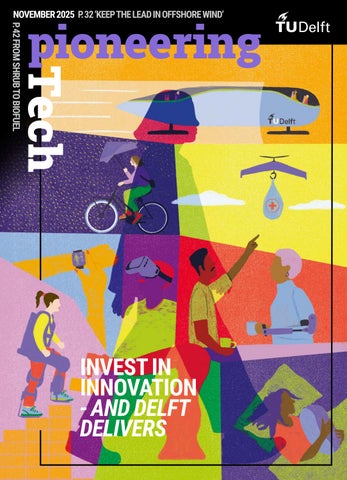
4 When research slows down, so does progress. With the Dutch cabinet’s cuts to research, the innovations that make life more inclusive and sustainable are at risk of slowing too. An exoskeleton can help someone with shaky limbs enjoy a cup of coffee, a drone can deliver medicine to remote areas, a bricklaying robot can make work less physically demanding, and a storm-proof umbrella can reduce waste. The cover illustration shows a collection of such innovations, with the walking woman symbolising society moving forward. The inside illustration focuses on one of these inventions, showing how research can turn barriers into access: a woman climbing stairs with an exoskeleton, and below her, the same woman in a wheelchair facing the same stairs. www.rachelsender.com
Pioneering Tech Magazine
22
‘Europe must maintain its lead in offshore wind’ 32
Production TU Delft | Innovation & Impact Centre
Jurjen Slump (Hoofdredacteur) Sara Broekman (Project manager & Art director) Floortje Koster (Content marketer), Leonie Versteeg (Online marketing strategist) Contributing writers Leendert van der Ent, Elise Spetter, Bruno van Wayenburg Illustrations Rachel Sender, Anne-Roos van Ommen Fotography Roy Borghouts Fotografie, Erno Wientjens, Guus Schoonewille Design Ontwerpwerk Concept De Nieuwe Lijn Print Drukkerij van Deventer Questions, tips and suggestions, or unsubscribe from this magazine? Send an email to pioneeringtech@tudelft.nl Copyright TU Delft | Innovation & Impact Centre November 2025
44
FOREWORD
Keep innovating, especially now
In this issue
4
Research and innovation The best investment for the Netherlands
14 ‘Curiosity is in this city’s DNA’ Marja van Bijsterveldt and Tim van der Hagen look back
Increasing budget cuts are putting pressure on innovation, at a time when it is more important than ever – for our welfare and well-being, our safety, freedom, and autonomy. For cities, regions, and the country as a whole. That’s why we continue to innovate, especially now. Because TU Delft delivers. Someone who has also delivered for the last nine years is Marja van Bijsterveldt, until recently mayor of Delft. In this edition, we reflect on what we have worked on together: quality of life, safety, a good business climate. In short, the prerequisites for a successful city of knowledge. As mayor, she rolled up her sleeves and was not afraid to get her hands dirty. The same as many of our researchers, literally in some cases, as you can read in the article about ‘Made of Mud’. Additionally, in a new section, we turn the spotlights on SMEs, the backbone of the Dutch economy. Joining forces to innovate enables businesses and the university to learn a lot from each other. Also in this edition: what will the nuclear power plant of the future look like? Conventional, or small and modular? That ‘Daring Dilemma’ closes the circle for me in appropriate fashion: it was in nuclear research that I started out at TU Delft 41 years ago. Soon, I will hand over the reins as Rector Magnificus, so this is the last time that I will address you on this forum. But Pioneering Tech will continue to keep you informed in the future. Make sure to visit the Pioneering Tech Platform and register for the newsletter. And most of all, keep on reading. I will be reading with you.
22 Daring Dilemma Nuclear power plant of the future Big and conventional or small and modular?
32 Offshore wind energy in 2050 Karen Vennik (Van Oord) wants to keep the momentum
Also 12
8 Insights Stephan Rutten built an autonomous underwater drone
20
Startup Populytics
28
How SMEs innovate Hordijk on collaborating with TU Delft
36
Explainer The countless applications of mud
40
3
Column Femke Brenninkmeijer (EBZ) No future without courage
42
Meanwhile From shrub to biofuel
44
What if Designing a home on Mars Tim van der Hagen, Rector Magnificus and Chairman of the Executive Board
Art & Technology The man who made the wind walk
VISIT TUDELFT.NL/ PIONEERINGTECH
PHOTO © GUUS SCHOONEWILLE
48
4
IMPACT
ILLUSTRATION © RACHEL SENDER
RESEARCH AND INNOVATION
5
Research and innovation THE BEST INVESTMENT FOR THE NETHERLANDS
B y L e e nde r t va n de r Ent
Universities are places where researchers develop new ideas and students receive an education; everyone knows that. But universities also have a strong role to play in the creation of social value through knowledge. A modern university is a partner with a positive impact for government, other knowledge institutes, and the business community. By collaborating with each other, smart ideas and solutions are brought to the market. In this way, universities are the foundations on which our prosperity is based and help solve the challenges that the Netherlands faces.
IMPACT
PHOTO MAIKEL SCHOUW © ROY BORGHOUTS FOTOGRAFIE
Above Maikel Schouw at the prototype of his pointing robot in RoboHouse. Right The prototype distinguishes between pointing and bricks and features a mortar gun and pointing trowels.
Cutting back on research and innovation will cost the Dutch economy dearly, particularly in the long run. The European Commission’s interim evaluation of the Horizon Europe research programme shows that every euro the EU invests in the programme yields €11 in the long term. A whole €11! So, a cut of €1 actually equates to a loss of €10.
PHOTO © ROY BORGHOUTS FOTOGRAFIE
6
Pointing robot Maikel Schouw’s project is one of the projects that makes it clear how this can be done. Schouw is a self-employed bricklayer and the owner of SMB Geveltechniek in Alkmaar. “With many skilled workers retiring and a lack of new people to replace them, there are almost no pointing professionals left. Like most bricklayers, I don’t like pointing (applying a thin layer of mortar to fill and finish the joints between bricks once they have been laid). A pointing robot could be the solution.” Schouw took his idea to RoboHouse at TU Delft. “Six students set to work on it and developed a prototype in just half a year,” he says. Thanks to the MKBdoet innovation programme, the initial introduction to robotics and AI is free. Bouwend Nederland saw the potential of Schouw’s idea and decided to co-fund its further development. Schouw: “The prototype distinguishes between pointing and bricks and features a mortar gun and pointing trowels. It’s already successfully done some pointing. Over the next half year, we will continue to improve it.”
A world full of opportunities Maikel Schouw “The university and the construction site are two different worlds. But both can come together quite well. I like being involved and seeing scientists translating and developing my ideas. I recommend any SME with a good idea to get in touch to see what’s possible.”
RESEARCH AND INNOVATION
7 Above and below An exoskeleton can improve the quality of life from people with paraplegia.
PH0TO © PROJECT MARCH
There is a market for a pointing robot: by 2030, 216 million square metres of pointing will need to be done, but there will be almost no pointing experts to do it. “It would be great if the robot could handle flush pointing, but beaded pointing would be even better. We could then modernise this age-old skill and guarantee work of a consistently high quality.” The labour-intensive nature of beaded pointing makes it virtually unaffordable, but the pointing robot could bring costs down significantly. Schouw is already thinking ahead: “I’m envisioning a comprehensive pointing renovation system that’s able to chip away old pointing, clean pointing and apply new pointing.”
Eliminating prejudices Maikel Schouw dispels various preconceptions about universities. They develop their own inventions, but also advance the ideas of others. Not all developments are expensive and time-consuming; existing technology can sometimes be used to develop a prototype within half a year. Also, universities are not just for large companies but for SMEs as well. The pointing robot tackles two major challenges in the Netherlands today: a shortage of skilled workers and housing. Major issues exist in defence and security, energy, climate and healthcare too. The Project MARCH student team is working on the last of the above. Hbo (higher professional education) and university students from across the Netherlands have come together at TU Delft to develop an exoskeleton that could improve the quality of life of people with paraplegia. Each year, a new group of students agrees to invest a full academic year to advancing Project MARCH, together with partners like health insurer DSW, Siemens, the Sint Maartenskliniek and Sioux Technologies. Last year, MARCH X’s challenge was for the exoskeleton ‘pilot’ to attend a concert standing upright. This year, 23 MARCH XI students started to work on self-balanced walking without crutches. Team manager
Project MARCH
PHOTO © PROJECT MARCH
In Cybathlons [https://cybathlon.com], the exoskeletons developed by teams across the world come together to compete against each other. The next event is in 2028. The MARCH XI team is set to deliver its design presentation at TU Delft’s Aula Conference Centre on 11 March 2026. The reveal presentation will take place in July. Entry to both events is free.
‘Thanks to the MKBdoet innovation programme, the initial introduction to robotics and AI is free’
IMPACT
Linde de Haan: “It was a big challenge; the shifting centre of gravity while walking is just one of the many complex problems we need to solve. But we are very motivated. If we succeed, we will have come another step closer to people with paraplegia being able to do daily tasks themselves. Our work is open source, which means that everyone is free to use the knowledge we develop. We are as innovative as possible and the learning curve is steep. Both are vital because much remains to be achieved before the exoskeleton can actually be made available to people with paraplegia.”
Hundreds of millions saved As you might expect, Kenneth Heijns, Director of the Innovation & Impact Centre at TU Delft, also has concrete examples of the social and economic added value that TU Delft knowledge provides. “We are at the heart of a rapidly changing society that is facing major challenges. Our mission is to create impact for a better society. This doesn’t stop at developing an idea or knowledge – it has to work in practice too. We have taken very active steps to deliver working solutions, which is why we almost always work with industry partners (in our field labs, for example). We work together on effective practical solutions across the boundaries of disciplines and organisations and it’s an approach that works. This is partly why funding from independent public organisations like the EU and the Dutch Research Council (NWO) and from private organisations and companies has more than doubled in the last 15 years: €275 million in a budget of €1 billion.” One such partner is the City of Amsterdam, with which Wageningen University & Research, the Massachusetts Institute of Technology (MIT) and TU Delft work together in the AMS Institute. This institute develops smart solutions for urban challenges like grid congestion, mobility, food, roads, bridges and quay walls. Heijns: “Amsterdam realised that it needs to invest billions in quay walls to literally keep its head above water. At AMS Institute, we are using TU Delft knowledge to explore how to tackle this problem efficiently and effectively. This has helped reduce costs by hundreds of millions of euros. The solutions for the quay walls alone make AMS Institute worth the investment, and it does much more as well.”
The Netherlands’ earning capacity Professor David Abbink specialises in human-robot interaction: the future for many workplaces. “It’s often practicable to use robots, other technologies and smart organisation to increase the productivity of physically demanding work,” Heijns says. He stresses: “Robotics is by no means always about replacing people with machines. It’s also about enhancing craftsmanship and the quality of work. Employee dignity is key to our approach.” Quantum computing, the quantum internet and qubit research will all at least be equally important as robotics for the Netherlands’ future earning capacity. “Delft is
PHOTO © ALEX SCHRÖDER
8
‘Our mission is to create impact for a better society. This doesn’t stop at developing an idea or knowledge – it has to work in practice too’ Kenneth Heijns, director TU Delft Innovation & Impact Centre Above The stacking robot contributes to both sustainable infrastructure and a new way of working. It is one of the many innovations the AMS Institute is working on, together with a broad consortium of infrastructure partners. Below Amsterdam needs to invest billions in quay walls.
9
PHOTOS © CHEESEWORKS FOR QUTECH
PHOTO © CHEESEWORKS FOR QUTECH
RESEARCH AND INNOVATION
fortunate to have QuTech, one of the world’s leading research institutes in this field”, Heijns says. “Quantum computing is still very much in its development phase, but an ecosystem of new companies is already emerging in Delft’s ‘quantum delta’. For example, companies that are making the cables required or developing test technology for this revolutionary computer technology.” Technology to strengthen the position of the Port of Rotterdam, the development of new, sustainable chemical processes and facilitate the energy transition – TU Delft knowledge underlies all these topics and more. However, it is never used in isolation: the connection between TU Delft, hbo and senior secondary vocational education (mbo) is crucial as part of the collaboration necessary to ensure the Netherlands moves forward.
PHOTO @ ALEX SCHRÖDER
Connectedness and added value
Researchers at work in the QuTech labs.
Edwin van de Hee is very aware of this. He is a lecturer and the developer of the Drone Engineering & Fabrication programme provided at MBO College Airport in Hoofddorp (part of the regional training centre – ROC – in Amsterdam); like quantum computing, it has the potential to contribute to the earning capacity of the Netherlands. There are many similarities between the programme and TU Delft. Both are partners in Unmanned Valley, the field lab for sensor-related technology and applications. Van de Hee: “One of our students did an internship at Drone Catcher, a TU Delft spin-out, while another intern worked on a drone system that can be operated by a single person from a container on a ship.
IMPACT
PHOTO © WILLEM DE KAM
10
Above Testing at Unmanned Valley, the field lab for sensor-based technologies.
This was for Cargo Drone Services at Ampelmann, a former TU Delft startup. Employees from startups – including some from Delft – give guest lectures at Unmanned Valley. Both organisations are also represented in the Dutch Drone Delta.” Van de Hee believes that increased, more intensive collaboration between university education, hbo and mbo will benefit everyone involved: “It will enable our students to develop additional skills. They usually have just limited exposure to the academic conceptual view of the world. This perspective could offer them added value, and open up perspectives on what is possible. It will enable them to translate concepts into practical applications.” Conversely, academics can learn from the pragmatic, practical and targeted working methods of hbo and mbo students, Van de Hee believes. His students have another ace up their sleeves as well: “Scale. We recently spent a week tackling the challenging conditions above the river IJ as part of a large-scale test. Six licensed pilots participated, along with 20 students who monitored safety and surveyed the public. When mbo, hbo and university education come together, we form a chain in which each of us benefits from the tasks the other performs. This is where the added value lies.”
PHOTOS © TU DELFT
Below MBO College Airport students at Unmanned Valley.
RESEARCH AND INNOVATION
MBO College Airport
PHOTO © COPYRIGHT DSM-FIRMENICH
MBO College Airport offers the only dronerelated programme in the Netherlands, at mbo 4 level. “We provide separate flight training and a technical programme at Unmanned Valley in Valkenburg near Katwijk. In 10-week project periods, technical students learn all the essential skills necessary for the cohesive construction and design of a delta quad frame with a flight controller and payload: mechanics, printed circuit boards (PCBs), programming, sensor technology and maintenance. Students have recently developed and built a 60-kilo drone-in-the-box for use by the emergency services.”
Above The new headquarters of dsm-firmenich’s Taste, Texture & Health Business Unit in Delft.
PHOTO © DSM-FIRMENICH
Below Researchers working in a dsm-firmenich lab.
11
The basis of our prosperity Besides SMEs, government agencies and other educational institutions, TU Delft also works with multinationals like dsm-firmenich. “Our collaboration dates back to 1869. Jacques van Marken was the first chemical engineer to graduate from Delft; he established the Nederlandse Gisten Spiritusfabriek (Dutch yeast and spirits factory) here,” says Hans Roubos, responsible for the science and technology strategy for Data Science at dsm-firmenich in Delft. “The collaboration and interaction between the university and the business community have continued ever since. We work together to develop early new discoveries in particular. Experts at TU Delft also advise us on the opportunities that future technologies present for the future. This collaboration contributes to the Netherlands’ position in (industrial) biotechnology. TU Delft is a key partner because of its knowledge of biotechnology, process technology, data science and AI.” On 2 October 2025, dsm-firmenich opened the new headquarters of its Taste, Texture & Health Business Unit in Delft – one of three business units with which it aims to conquer the future. Roubos: “TU Delft and dsm-firmenich are also both involved in Biotech Campus Delft, the ecosystem for industrial biotechnology in the Netherlands. Large enterprises, highly innovative small businesses and university scientists work together there to develop economic activities for the Dutch knowledge economy. Twenty startups are already active in Planet B.io, some of them are from TU Delft. Knowledge and activities like this form the basis for our current and future prosperity.” ■
12
8 INSIGHTS
Stephan Rutten set up Lobster Robotics in partnership with five fellow students. This Delft-based startup develops autonomous underwater drones that independently survey the seabed. Eight insights from an entrepreneur in maritime tech.
Stephan Rutten: “Some problems can only be solved by taking action, rather than endlessly thinking about them.”
LOBSTER ROBOTICS
13
8 INSIGHTS FROM LOBSTER ROBOTICS
By Eli se Sp et t er Photos Er n o W i e n t j e n s
From North Sea to NATO Autonomous underwater drones 1
Start small
2
Seek for strategic relevance
“We thought that we would have to go to the deep sea to do the difficult stuff, but the North Sea turned out to be challenging enough. The deep sea isn’t going anywhere, so we are concentrating on shallower water to start with. In 2021, our prototypes really began to work well, so as interest was coming from within the industry, we decided to make a business out of it.”
“This type of underwater technology is produced by only a few suppliers. There are some in Norway, in America and in other parts of the globe, but we are the only one building underwater drones in the Netherlands. A drone of that kind is often an essential element in work activities such as underwater inspections during construction projects. So it is strategically important for larger offshore companies such as Van Oord and Boskalis to have a specialist supplier in their own country.”
3
Unique due to the right blend
“Not a single part of this drone is unique in itself, but the combination of characteristics makes it special. It is very adaptable and can therefore descend to just above the seabed. It is also able to function in the strong North Sea current and supplies sharp images, even in poor visibility. Furthermore, it is light enough to be carried by two people, so you can launch it easily from a small boat. Minimal training is required and you still get the same results as, or better than, a diver.”
4
Ministry of Defence as catalyst
“In 2023, NATO organised a challenge that aimed to find solutions for underwater surveillance. Coastal areas contain vital installations that need to be protected, but visibility under water is often poor. We pitched our drone – originally designed for the inspection of wind farms – and it proved to be suitable for mine detection. We came in contact with the Ministry of Defence through the NATO DIANA programme. We will soon deliver drones that the navy will start to use in the next year.”
5
You don’t learn entrepreneurship from books alone
6
Embrace setbacks
7
Networking is essential
8
Go and do something
“Many people think that a startup begins with a good idea and lots of money, and that the rest will be easy. In reality, you need different skills in each phase of a business. Initially it’s all about fundraising, pitching and making strong presentations. Later the focus shifts to financial strategy and product development. YES!Delft helped us in that with a basic entrepreneurship course specifically oriented to early-stage tech startups.”
“Two weeks before we were due to go to sea with our drone, it was badly damaged in a fire. We had worked on it day and night for eight months. The damage was considerable. That evening, we drank beer in silence on the balcony of one of the founders. The following day, we started the clean-up process and got down to ordering new components. We were able to implement improvements in the new drone, so in the end it was better than the first one.”
“There’s a saying: it takes a village to raise a startup. We owe a huge debt of gratitude to the people who shared their experience with us or referred us to the right contacts. That goodwill factor was enormously important. You miss out on opportunities if you can’t ask for help. And if you can’t accept help, you make your life unnecessarily difficult.”
“My advice is: just try it. Look for one or two co-founders and see whether you can find common ground in a good idea or complementary skills. YES!Delft organises ‘Meet your co-founder’ events here. If you are still studying, you can also join a student team. It will help you to step away from your textbooks and experience how tough things are in practice. Some problems can only be solved by taking action, rather than endlessly thinking about them.” ■
14
INTERVIEW
THE UNIVERSITY AND THE CITY
“Curiosity is in this city’s DNA” Under their leadership, TU Delft Campus became an innovation ecosystem and Delft and Westland has repeatedly been ranked as the best region for entrepreneurship in the Netherlands. Marja van Bijsterveldt stepped down as the Mayor of Delft at the beginning of September and Tim van der Hagen is set to pass on the baton to his successor at the beginning of 2026. In a farewell interview with Pioneering Tech, both reflect on recent years and conclude: “The university can only flourish if the city is doing well.”
By J u rj e n S l um p Photos Er n o W i e n t j ens
Van Bijsterveldt and Van der Hagen have worked closely together over the past nine years. A wide range of subjects have already been covered in the many farewell interviews they have given: the impact of the COVID-19 pandemic, the problems caused by the presence of so many students in Delft, the creation of an asylum centre on campus and efforts to combat alcohol abuse. But what has been achieved in terms of innovation? Under their leadership, how have the city and university ensured that society benefits from everything that is achieved here? It is true that a lot has been achieved, as anyone who strolls through Delft will clearly see: from new field labs on TU Delft Campus, a building for scale-ups (NEXT Delft), countless new startups and companies, to the development of the Biotech Campus at dsm-firmenich and the most recent ambitious project: the Innovation District Delft (IDD). More about IDD later.
15
16
INTERVIEW
Four innovation trends Looking back, Van der Hagen identifies four major innovation trends. The first is the development of the academic campus into an innovation ecosystem. “That’s been the most important change.” Companies, startups, knowledge institutions and government agencies now work together in a tightly knit network to develop new applications. “This is essential because it accelerates the process and needs are met much better too,” he says. The city is playing a key role in the facilitation of this interconnectedness of companies, labs, research and education. In recent years, the municipality has been involved in the development of Planet B.io at the dsm-firmenich site, as well as various field labs and NEXT Delft – to name just some examples. A second important development is the focus of TU Delft’s innovation policy on delivering solutions to major societal challenges: sustainable healthcare, urbanisation, climate, digitalisation and AI. “But always in context”, Van der Hagen says. “You can only truly harness technology if you develop it together – with researchers from the social sciences, humanities, and medicine, and with citizens. That sense of collaboration is incredibly important.” It’s the reason why the university first entered into a close collaboration with Erasmus University and Erasmus Medical Center, and is now also developing a campus in Rotterdam. “You have to be where the action is. At the port. And at the Erasmus Medical Center.”
The mayor and rector magnificus talking to a resident of Delft. The municipality and university have worked hard to improve safety and the quality of life in the city. The university benefits from this too.
Strategic autonomy A third, more recent development is about strategic autonomy. Geopolitical developments are forcing Europe to reduce its dependencies. “We need to develop new technology ourselves, possess our own raw materials and develop our own cybersecurity.” The innovations necessary to tackle societal challenges are the same as those needed to make the country more resilient. A sustainable energy supply would reduce our dependence on oil-producing countries. And we need drones to be able to inspect and maintain wind turbines. However, the big difference is that this technology is often ‘dual-use’ and could also be used for less noble purposes. That’s why Van der Hagen sees ethics and ‘responsible innovation’ – the fourth and final major trend – increasing significantly in importance. “It’s more vital than ever before for us to carefully consider who we want to work with and how we will ensure that technology is actually used for its intended purpose.” Not so long ago, ‘globalisation and open science’ was the adage. “Now, we’re thinking: wait a minute, is that what we really want?”
THE UNIVERSITY AND THE CITY
17
PHOTO © KABELDISTRICT
Innovation District Delft
Artist’s impression of the Innovation District Delft.
No innovation without a thriving city None of these developments would have been possible without close collaboration with the municipality. “The university can only flourish if conditions in the city are right,” Van Bijsterveldt says. Delft is a ‘city of history, of Delftware and of the history of the House of Orange but also a city of the future and innovation’. “However, as a knowledge city, you have to be very aware – and this is a must – that there are other parts of the city too.” Because as soon as you overlook them and focus too narrowly on TU Delft, support in the city for Delft as a good knowledge city will start to ebb away, the mayor says. Hence why the municipality and university have worked hard to improve safety and the quality of life in the city. The university benefits from this too. When deciding for TU Delft, students and staff place equal importance on the presence of good facilities – museums, schools and housing – and on the fact that Delft is an inclusive city. A favorable business environment is crucial for businesses. Van Bijsterveldt and Van der Hagen both committed themselves to strengthening their lobbying efforts in The Hague, together with other partners in the region. This resulted in additional funding for vulnerable districts in Delft, infrastructure, and housing. The regional lobby also resulted in the proposed doubling of the railway track between Leiden and Dordrecht, which is important for a number of reasons. For example, strengthening connections between the university cities of Leiden, Delft and Rotterdam.
‘The university can only flourish if conditions in the city are right’ Marja van Bijsterveldt
This philosophy, the importance of this connection, is also reflected in the joint development of TU Delft Campus and the adjacent Schieoevers work-residential area into the Innovation District Delft (IDD). The IDD will play a key role in facilitating of innovation and the university’s growth. For example, by creating space for manufacturing, housing and improved accessibility. The aim is for the IDD to also give impetus to collaboration between researchers and the manufacturing companies located in the IDD. “Something else that we want to achieve there, and we already see this happening more and more, is to connect the entire vocational pathway: senior secondary vocational education (mbo), higher professional education (hbo) and university education (wo). We desperately need all three; one can’t exist without the other. Imagine how inspiring it would be if their physical connection with each other was strengthened as well. Mbo, in particular, needs to be positioned far more strongly in the pathway”, Van Bijsterveldt says. “Because innovation isn’t possible without production and manufacturing.” Both Van Bijsterveldt and Van der Hagen believe it makes sense for Rotterdam to become part of the innovation district as well. Van Bijsterveldt: “To be able to achieve sustainable economic growth, Rotterdam needs Delft and Delft can gain even more significance, both nationally and internationally, by joining forces with Rotterdam. Nothing is lost from the system here if it goes to Rotterdam. No, it simply stays in the Rotterdam region.”
The Netherlands’ strongest ecosystem The collaboration between the municipality and the university was established in a unique covenant in 2016, with the aim of maximising the potential of the city and TU Delft. This approach has been successful. In recent years, Delft has consistently been at the top of the Entrepreneurial Ecosystem Index published by Birch and Utrecht University, in which the various innovation ecosystems in the Netherlands are ranked by strength. However, there is still room for improvement. For example, Van Bijsterveldt would like to see the stronger involvement of large businesses. There are still opportunities there – for example, by establishing a “Delft industry forum” for companies. This collaboration between a number of large companies that ally themselves with TU Delft and the city would also increase your influence in The Hague.
Geothermal energy Which innovations are Van Bijsterveldt and Van der Hagen personally passionate about? “We’re really at the forefront of developments in geothermal energy,” the mayor says. In recent years, a geothermal well has been created on campus that provides it and surrounding districts with sustainable energy but also serves as a source of scientific information. “And robotisation is incredibly interesting too.” With a particular focus on supporting employees – which you can see happening at FRAIM – Van der Hagen adds. The mayor also praises the collaboration with the Reinier de Graaf Gasthuis in Delft and the Erasmus Medical Center. “To me, this is the most important aspect of innovation: of course, it also paves the way for more luxury and prosperity. However, its ultimate object should be to help resolve the societal challenges we face.”
18
THE UNIVERSITY AND THE CITY
‘It’s more vital than ever before for us to carefully consider who we want to work with’ Tim van der Hagen
Marja van Bijsterveldt Fund A key driver for Marja van Bijsterveldt was for knowledge and innovations to benefit everyone in the city. She believes that ‘noblesse oblige’ should apply at a local level too: the knowledge that TU Delft has must also be used to improve the city, for everyone. To honour this commitment, TU Delft has established the Marja van Bijsterveldt Fonds. It will support innovative projects that focus specifically on improving the city and also contribute to the local economy. Read more here:
Investments are imperative That’s why Van Bijsterveldt finds it really hard to understand the cuts being made to higher education funding. “The current government wants to solve problems with innovation. But if you don’t invest in science and education, that’s not going to happen.” The message to the coalition parties is clear. “Investment is a must. Today’s problems are only just manageable and technology will need to perform miracles if we want to stay on track.” What are Van Bijsterveldt’s and Van der Hagen’s thoughts on the future? And what advice do they have for their successors? Where innovation is concerned, Van der Hagen believes that the interconnectedness between public and private parties will continue to increase. And ethics will play a much greater role in all areas of research – biotechnology, for example. The university has developed a unique method for ‘responsible innovation’, in which ethics are integrated into the design. Although time-consuming, it will ultimately ensure that the Netherlands stays at the forefront, Van der Hagen says. “Because we are already integrating ethics into our technology now.”
Sharing is multiplying The interconnected approach also extends to administrative collaboration. ‘Sharing is multiplying’ is the most important advice that Van Bijsterveldt has for her successor, Alexander Pechtold. “If you want to keep everything to yourself, it won’t grow.” So, collaborate with others in the region. Ultimately, it all comes down to the societal contribution you make. “Delft isn’t an island.” Science, innovation, technology: it all starts with curiosity. “The remarkable thing about our rich history is that it was often rooted in the same curiosity even back then,” Van Bijsterveldt says at the end of the interview. “The curiosity of Antonie van Leeuwenhoek, Johannes Vermeer and Hugo Grotius, who laid the foundations for international law. That’s truly incredible. It’s in this city’s DNA.” ■
Van Bijsterveldt and Van der Hagen admire the House of Delft, a tribute to the pioneers of the past and present.
19
Let’s innovate with impact for a better society Let your organisation lead the way and collaborate with TU Delft: ■ Discover groundbreaking solutions that are not yet
on the market, in areas such as AI, health, robotics and energy.
■ Join our field labs, where research, technology and
practice come together at specific TRL levels.
■ Keep your organisation innovative with access
to the right knowledge, expertise and training.
Discover what we can achieve together.
➔ Get in touch with us
20
STARTUP
The Delft-based startup Populytics helps policymakers engage local residents in tricky decisions. Through their online platform, citizens step into the shoes of administrators and make choices within the same specific constraints, such as budget or scope. In that way, policy can be better aligned to the community, and local residents experience how complex decision-making is.
Citizens in the shoes of the city councillor
Right From left to right: Niek Mouter, Shira Hollanders en Shannon Spruit. Below The Populytics team includes economists, philosophers, programmers and social scientists.
POPULYTICS
21
By Eli se Sp et t er Photos E r n o W i e n t j e n s
Populytics was founded in 2020 as a result of research by TU Delft into Participatory Value Evaluations (PVEs). It allows citizens to advise on policy dilemmas such as the energy transition, mobility and corona virus measures. Co-founders Shannon Spruit and Niek Mouter, along with managing director Shira Hollanders, decided to make the step from science to startup.
but each phase is accompanied by new challenges. Initially it was winning trust, then it was finding the right people in a tight labour market, and subsequently it was creating structure so that new colleagues knew how to set up a consultation. Nowadays the challenge is assuring quality in a larger team. But, at the same time, that is what we like most about doing business: we are always learning.”
What exactly do you aim to achieve with Populytics? Mouter: “We want policy to align better with the people it affects. Allowing local residents to experience the choices and limits of administrators gives policymakers an insight into their values and preferences, while citizens see that considering pros and cons is often harder than they thought. This enables us to reduce the gap between local government and society.”
How does that work in practice? Hollanders: “Our platform always shows the correlation and consequences of choices, as opposed to conducting a survey with unrelated questions. If you are opposed to wind turbines, for example, you can also see that other measures are needed to achieve climate targets. So it is actually a realistic dilemma.”
What was the trigger that prompted you to turn it into a business? Mouter: “During the COVID-19 pandemic we asked 30,000 people in the Netherlands through our platform to put forward ideas for relaxing the lockdown. This drew a lot of media attention and proved that our method has societal value. Increasingly, municipalities called on us. It was no longer merely academic research; we had to transition into an organisation that can carry it out on a large scale. Delft Enterprises, the organisation through which TU Delft invests in spin-offs, helped us in that respect and gave us the room to further develop the idea.”
How did policymakers and citizens react in that initial phase? Spruit: “For policymakers it was a nervy time: would local residents contribute constructive ideas on such complicated issues? For local residents it was the first time that they could not only give their opinion but also see the dilemmas faced by local government. What surprised us was that people genuinely invested their time in it. Some of them even wrote detailed explanations of their choices.
What role does partnering with knowledge institutions play?
‘We want policy to align better with the people it affects’
Mouter: “It plays a big role. As academics we continue to develop the method, in partnership with parties such as TU Delft, Erasmus University and international universities. That also gives rise to new applications. Pilot schemes have already been carried out in other countries, but not in genuine decision-making processes. The question is whether our method also works in countries where the decision-making culture is very different, such as Germany and Italy. We plan to research that in the years ahead.”
Where do you hope Populytics will be in five years’ time? That shows that there is a real need for meaningful participation.”
What gives you the greatest pride? Mouter: “That after our consultation a broadly accepted decision was taken on issues where there was initially a lot of polarisation. In the Hoeksche Waard, for instance, 18,000 local residents took part in a consultation on Sunday opening. As a result, the municipal council took a decision that had broad support. We were also pleased to see that in SúdwestFryslân, where pressure groups returned to the table with a constructive mindset after our process, our method has made a real difference. And we are proud that we have so far been asked more than 120 times to collaborate on policy, from local issues to nationwide mobility plans.”
What were your greatest challenges up to now? Hollanders: “In the beginning we had to convince policymakers that it works, even though we didn’t have many references at that stage. Then there were growing pains: more assignments than people to carry them out, and processes that were not yet fully formed. Now we have almost 20 employees,
Spruit: “When we started five years ago, we thought we would have three employees. We now have nearly 20, so it’s hard to make plans five years in advance. What we know, however, is that we want to make the greatest possible societal impact, both in the Netherlands and internationally. We are also exploring applications other than in local government, such as in companies that want to involve their employees in strategic choices. Our ambition remains unchanged: helping policymakers gear their decisions better to what people consider important.”
What makes your team special? Spruit: “Our team includes economists, philosophers, programmers and social scientists. That multi-disciplinarity is essential, because developing a PVE involves technology and content as well as process facilitation. You need people who are experts in data analysis but who are also able to hold discussions with pressure groups and municipal officials. That makes our work both intensive and extremely enjoyable. And perhaps the best thing of all is that people want to remain with us. In a tight labour market we get open job applications from very qualified people. That says a lot about the culture we have created.” ■
22
DARING DILEMMA
NUCLEAR POWER PLANT OF THE FUTURE
23
What will the nuclear power plant of the future be like? CONVENTIONAL AND MARKET-READY, OR SMALL AND MODULAR? By B r un o va n Waye nbu rg
Visual O nt we r pwe r k
After decades of opposition and stagnation, nuclear energy is making a comeback. Four conventional nuclear power plants are going to be built in the Netherlands, but startups and the business community are also working on Small Modular Reactors (SMRs), small reactors that will roll off the production line. When they are finally produced, will these SMRs help in the energy transition? Nuclear energy in the Netherlands is back, although it never went away entirely. In the faltering energy transition, the CO₂-free energy from atomic nuclei promises to be a constantly available source of energy that will make climate targets achievable. Along with government bodies, the business community – including dozens of startups – is working on innovative designs for reactors, generally under the label of Small Modular Reactors (SMRs). These are relatively small nuclear reactors that are not constructed on-site as power plants but are produced in a factory as modular units.
24
DARING DILEMMA
The idea is that small modules can be developed and built more quickly, and that the serial and uniform production will provide economies of scale. Such modules can be erected locally at energy-intensive industries, or several of them can be erected alongside each other to form a power plant. They can even be utilised aboard ships. For instance, the Delft-based maritime engineering company Allseas is developing an SMR that in the long run will supply ships with energy. And the Amsterdam startup Thorizon is developing a molten salt reactor, a new reactor technology that enables the relatively abundant element thorium to be used as nuclear fuel and that is able to recycle the plutonium from nuclear waste. The reactor physics research group at TU Delft – the only Dutch university with its own research reactor – is in an excellent position to contribute to the renewed development of nuclear energy. The number of professorships was recently increased to four.
Nuclear Academy TU Delft also takes part in the Nuclear Academy, set up to introduce relevant nuclear tuition into higher professional education (hbo) and senior secondary vocational education (mbo) curricula. Additionally, TU Delft participates in a nuclear knowledge and innovation cluster in Zeeland, alongside businesses and researchers. Solar and wind energy have rapidly made renewable energy cheaper, increasing their role in the energy transition. On the other hand, nuclear energy is not dependent on accessibility to sun and wind, so it is constantly available, contributing to synergy and thereby to a robust energy system. Reactor safety and safe storage of radioactive nuclear waste remain important topics, however. Furthermore, there are a number of differences between reactor types: SMRs promise flexibility, take up little space, can supply quickly and provide potential economies of scale, but those benefits have yet to be realised. Will the focus on SMRs be detrimental to conventional, more rapidly available nuclear power plants, thereby putting the brakes on the energy transition?
PHOTO © EPZ
The nuclear lab of the Borssele nuclear power plant.
PHOTO © TU DELFT
Economies of scale
Jan Leen Kloosterman Professor of Nuclear Reactor Physics at TU Delft “The interest in small reactors has fully returned in recent years. You can erect that kind of small reactor wherever it’s needed, to supply power on site to an industrial consumer. Local installation means that this can take place ‘behind the meter’, so businesses don’t have to pay transmission costs for the electricity. That makes a difference to the price, given the current grid congestion in the Netherlands. The reactor that Allseas plans to build is a high-temperature gas-cooled reactor (HTGR). The fuel consists of TRISO particles, small kernels of enriched uranium oxide of half a millimetre encapsulated in three layers of protective coating to seal in the fission products. There are thousands of these kernels in a pebble, embedded in a matrix of graphite. The finished article is a pebble with a diameter of 6.7 centimetres.”
Inherently safe design “The nuclear fuel pebbles are held in the reactor vessel through which helium gas circulates, removing the generated heat. The design is inherently safe: if the helium circulation stops, the nuclear reaction ceases automatically. The graphite is heatresistant, removes the generated heat efficiently and plays a role in regulating the nuclear reaction. This type of SMR was originally developed in Germany and two medium-sized reactors of this type are now operating in China. The idea behind SMRs is that you build them in a factory and then ship them to the place where they are meant to operate. You gain a scale advantage because everything can be built in a standardized way, using standard components, all in one location. With conventional light-water reactors, the scale advantage lies in the size of a single reactor. But I don’t immediately see a dilemma with regard to the energy transition: we are focusing on large, conventional water reactors, with the possible addition of some smaller modular reactors. The two can operate in parallel. Their role is different too: having a constant high performance, conventional nuclear reactors produce electricity for the grid, and this makes them the most efficient. SMRs on the other hand can be adjusted up and down easily and deliver heat of a higher temperature. That is a different market.”
NUCLEAR POWER PLANT OF THE FUTURE
25 The TU Delft research reactor.
Profitable
Jo-Annes de Bat Member of the Provincial Executive of the province of Zeeland Zeeland is being considered as the location for two new nuclear power plants. That makes sense: for a long time, there has been a nuclear power plant here that runs well, that people are familiar with and that is also a good, socially engaged employer. And we see opportunities too: it could be really helpful in making the industry more sustainable. At the same time, there are some conditions we would like to set.
PHOTO © PROVINCIE ZEELAND
PHOTO © TU DELFT
“Solar and wind energy are making a substantial contribution to the energy transition, and the falling prices influence the energy market. Nevertheless, a report by Machiel Mulder, Professor of Energy Economics at the University of Groningen, shows that nuclear energy can still be profitable. The delivery is more stable and we are also going to use a lot more electricity: in 2050 around three times as much as today. In any case, it’s safer and more robust to deploy several options for reducing CO₂ emissions. One of the clear benefits of SMRs is that the Netherlands could genuinely build up a position in that market. The construction of large reactors is dominated by big countries such as the USA, and we have a lot of maritime and production industries that can contribute to an SMR sector. The manufacture of TRISO fuel is even one of the possibilities. With uranium enricher Urenco we have a good starting position. In fact, the same applies to expanding our knowledge position. If we want to expand nuclear energy in the Netherlands, we need to train a lot of people. We see a lot of students being drawn to this, but they mainly come for innovative projects, such as SMRs.”
26
DARING DILEMMA
Artist’s impression of an HTGR, a high-temperature graphite reactor, aboard an Allseas vessel. The scale of the reactor is clearly visible here.
Stephanie Heerema Offshore energy company Allseas
For instance, the inhabitants of Zeeland don’t want any cooling towers – and anyway there’s no evidence to suggest that they are needed – and we also want the electricity to be transmitted via existing networks. Of course, the construction time will be quite long and will cause disruption. Safety is important, but it is no longer the only consideration: naturally, there are people that are by definition anti-nuclear, but nowadays there is not the same level of tension, especially among young people. There are plenty of places across the globe where nuclear power plants run without problems: France has a large number of them. And our own nuclear power plant is simply performing well too.”
“We are investing 300 million euros in the development of an SMR, which we will build ourselves in a facility in the Netherlands and which will produce energy aboard our ships. It will be a variant of the HTGR, a high-temperature gas-cooled reactor. The technology is proven: several of these reactors have already been built, in Germany and China for instance. Although we are making the design in partnership with the South African company STL Nuclear, it will actually be an Allseas reactor. In the design, we need to take account of issues
“One of the conditions is that we take part in a nuclear knowledge and innovation cluster, so that we can get people’s engagement, but also so that people in Zeeland can be trained and so that companies can make a commitment. Nuclear education has disappeared in recent decades and needs to be built up again. That is already under way: this school year the Zeeland mbo school Scalda has started a course on nuclear topics and the HZ University of Applied Sciences is preparing one. To the surprise of many, the course at HZ University of Applied Sciences was fully booked in no time. It is not up to us to choose whether Small Modular Reactors (SMRs) or a conventional nuclear power plant should be built. In terms of construction time, disruption, footprint and suchlike, an SMR could work out very well.”
PHOTO © ALLESEAS
Nuclear knowledge and innovation cluster
such as ship movements and other conditions that apply at sea. The project is now in the concept phase. Together with the nuclear authority we are working on obtaining a licence. The first reactor is due to be ready in 2030; it will be tested and put into service on land or on a pontoon in a port.”
PHOTO © ALLESEAS
Game changer for container ships “A reactor is scheduled to be installed on a ship for the first time in 2032. That might be a working vessel that uses a lot of energy and visits few ports. Ships that lay pipelines, for example, or that install or remove drilling platforms. In the future, SMRs could become a game changer for container vessels. If captains no longer need to think about fuel stocks or CO₂ emissions, they can sail full speed ahead and can also reduce their fleet without any loss in productivity. That gives them a real competitive edge. But there’s a need for SMRs on land as well,, in the vicinity of energy-intensive industry for instance. Currently there is little or no CO₂-free energy available for that industry. Our SMR will be able to supply electricity and high-temperature heat. We will then offer a cost-effective, compact, clean and reliable energy source. We expect to be able to achieve that goal in five years’ time.”
The Borssele nuclear power plant.
27
Vincent Lagendijk Researcher at the Rathenau Institute “We wrote a report on the decision-making for the storage of long-lived radioactive waste, including waste originating from nuclear power plants. That radioactive waste, some of which remains radioactive for hundreds of thousands of years, is being stored temporarily at COVRA (Central Organisation For Radioactive Waste) in Borssele. But in the long term it will have to be stored more permanently. Underground storage in stable clay layers or salt caverns is currently being investigated. We have studied the best way to make those decisions and how people can join in the discussions – experts and stakeholders as well as citizens. Until recently, Dutch policy was based on waiting until 2100 to make a decision, but that carries the risk of placing unnecessary burdens on future generations. So we advised: just start the decision-making process now, and take the time needed for it.”
Waste ‘incineration’ “The type and volume of the waste depend of course on the type of reactor. For example, the pellet-shaped TRISO fuel elements from certain SMRs generate a larger volume of waste than conventional nuclear power plants. And logically, there will simply be more waste if there is more nuclear energy. The molten salt reactor, technology that is still under development, might be able to ‘incinerate’ some of the existing waste: the lifespan of radioactivity would then be reduced by nuclear reactions. But some radioactive waste with a long lifespan will always remain and will always require storage. Furthermore, this treatment is not possible for vitrified waste (waste that is transformed into glass for chemical and mechanical stability, ed.), which applies to a large proportion of the waste in the Netherlands.” ■
PHOTO © EPZ
PHOTO © RATHENAU INSTITUUT
NUCLEAR POWER PLANT OF THE FUTURE
28
HOW SMEs INNOVATE
HORDIJK TU Delft with
HORDIJK
29
By Eli se Sp et t er Photos E rn o Wien t jen s
In Pioneering Tech, we follow SMEs that have joined forces with TU Delft to innovate. In each story, you will read about the various challenges, the path to contact and the impact that collaboration has created. And also how to take the first step as an SME. This edition is about Hordijk, a family business that makes EPS products. “The collaboration with TU Delft accelerated our plans, even though we initially struggled to find the right point of entry.”
“You just need to find the right person; don’t give up” I’m Sander de Jager and I’ve been the Operations Manager at Hordijk for about seven years now. We have a team of 35 here in Delft. The group itself was founded about 100 years ago: we started with wood and later switched to plastic. Hordijk manufactures products from expanded polystyrene, EPS for short. These light, white foam blocks are often used as packaging material – to protect electronics, fruit and vegetables, etc. during transport – but EPS also makes excellent insulation material for the construction industry and in custom-made building shells, e.g. foundation formwork and floor panels. The material is strong and a good insulator; combined with our new production technology, we are able to process more and more recycled elements and significantly reduce energy consumption. Sustainability has been key at Hordijk for 100 years – we call it stewardship. This involves making every effort to
conserve our resources and constantly looking for ways to make our products more sustainable. Our production technology was the only area left for us to improve in; we had been using it for 50 years: steam production, generated by gas. This brought us into contact with a German machine builder that developed a so-called wavefoamer for us. This machine doesn’t use steam but high-frequency radio waves – it’s essentially a kind of microwave oven. It also fuses granules together but using much less energy and a far higher percentage of recyclable materials. We split the project into two phases. Phase 1: using the new technology to process EPS. The material stays the same, but the technology and the recyclate are new. Phase 2: processing other materials or organic waste streams. That’s the future potential.
30
HOW SMEs INNOVATE
HORDIJK
Hordijk in a nutshell: → Founding year: 1922 → Founders: family business (four generations) → Location: Delft (35 employees) and several sites in the Netherlands → Specialism: the production and processing of EPS (expanded polystyrene) → Applications: packaging (food, electronics), fish boxes, horticultural trays, building insulation and building-shell elements like foundation formwork and floor panels → Technology: wavefoamer - new production technology that uses less energy and is able to process more recyclate and organic waste streams → Customers/partners: various customers in the food, construction and agriculture industries → Collaboration with TU Delft: student projects via YES!Delft, contacts with Aerospace and Mechanical Engineering
Contact established I’d been trying to get through to someone at TU Delft for a while. I sent emails to the sustainability department, but they often replied that the university’s primary focus was on scientific research. I was struggling to find the right point of entry. The breakthrough came when I came into contact with Anske Plante from the Innovation & Impact Centre at TU Delft. She was far more open to collaborating with companies. This was the turning point for us. Thanks to her, we were able to team up with YES!Delft and the Ondernemingsfonds to organise a challenge. Students were asked to come up with application ideas for our new technology. This was hugely inspiring for us. Two groups developed their ideas and then presented them. Their posters are still up on the walls in our office.
Contribution from TU Delft Our contact with TU Delft gave us the energy we needed to persevere with the new technology. Students came up with fresh ideas, like defence applications and the use of agricultural waste streams. It felt like acknowledgement to us. Professors and students were surprised at the innovative work we were doing here at Hordijk. It made our employees proud to show others what we make. And our network benefited too: we connected with new partners via TU Delft, some in markets we would otherwise never have been able to reach.
HORDIJK
31
Impact on company The collaboration brought us new ideas and new markets. Defence is one example. Through TU Delft, we got in touch with people who specifically work in that area. We now maintain that connection through our commercial director. In addition, it broadens our network. We believe that sustainability is not something we can achieve alone, but always together with partners: universities, consultancy firms, machine builders, and customer We want to fully master the new technology in the years ahead. Starting with 100% recycled EPS, followed by bio-based materials. We would like to continue to work with TU Delft as well. Hordijk has offered to give 60 Mechanical Engineering students an onsite tour. We also have contacts in Aerospace Engineering (AE). We can see opportunities to continue the development of innovations with them.
Barriers and lessons learned The collaboration with TU Delft went well, but not everything went as smoothly as we might have liked. It was difficult to recruit students: not everyone who registered actually showed up and we couldn’t give them any credits if they did. But the event still generated a lot of energy and led to follow-up projects as well. For example, students analysed our energy consumption. The resulting report is now helping us move forward. There was also a Master’s student in Aerospace Engineering who was going to research new materials for the wavefoamer but was later prevented from doing this because of schedule issues. We have the contacts we need and that’s the most important thing for us.
What TU Delft can learn
‘Students came up with fresh ideas, like defence applications and the use of agricultural waste streams’
EPS also makes excellent insulation material for the construction industry and in custom-made building shells, e.g. foundation formwork and floor panels.
We are learning a lot from TU Delft, but perhaps the university can learn from us too. Sometimes TU Delft comes across as a closed community. In business, you have to collaborate and be outgoing. Otherwise, it’s impossible to make it. Creativity only really fulfils its full potential via interaction with others. We bring practical experience and a network to the table, in the Netherlands and Germany. Together, you can not only develop technology, but also truly apply it. My advice? Find the right person and don’t give up. It may take a while to find the right person, but it’s worth it when you do. Thanks to TU Delft, we gained new ideas, a larger network and insights into markets we wouldn’t otherwise have considered. ■
32
WORKING TOGETHER
‘Maintaining momentum in offshore wind is crucial’
Van Oord’s offshore wind installation vessel Aeolus insalls monopile foundations for the Sofia offshore wind farm.
GLOBAL MARINE CONTRACTOR VAN OORD
33
By J u r je n S l u m p
Photos Va n Oo rd
It is vital that Europe continues to invest in offshore wind power and its own supply chain. Only then can the offshore wind sector maintain its technological lead, develop scalable innovations and ensure that climate goals are met without adverse effects on marine life. “It is crucial that we maintain the momentum,” says Karen Vennik, Commercial Director Offshore at Van Oord. The rate at which new offshore wind farms are being built is slowing. After a period of robust growth, market conditions have become much less favourable. “Due to all kinds of reasons, we notice that a stable roll-out of offshore wind projects is under pressure”, says Vennik. Costs have increased, energy prices are rising and there is declining demand for electrification. “In fact, in certain regions of the world, development has come to a standstill.” In the US, for example, President Trump has completely scrapped planned investments in wind power.
Electrification of industry At the same time, Vennik also sees a few positive steps. For example, the sector unanimously appealed to the Dutch government to continue building green energy infrastructure in the Netherlands. By encouraging the electrification of industry, households and transport in the Netherlands and simultaneously accelerating the introduction of contracts for difference – through which wind farm developers are compensated in the event of low electricity prices – the development of offshore wind can continue. That’s the idea behind it. This appeal has been heeded. Vennik now sees broad political support for contracts for difference and the Minister has since committed to their adoption. The same applies to tackling congestion, which acts as a brake on electrification in key sectors. It is essential for offshore wind that the government addresses these problems, she says. “But we are not there yet, this support must be transformed into concrete measures during the next government term.”
Slip Joints Van Oord is a key player in the construction of offshore wind farms. The renowned marine contractor became active in the offshore wind sector in 2002 and is now one of the leading global players. The company has invested heavily in offshore wind during the past decade and in recent years put into service various installation vessels for laying marine cables, installing foundations and installing wind turbines. In addition, Van Oord has developed numerous innovations to allow the ever-larger wind turbines to be placed further offshore and in deeper waters. One such innovation is known as the Slip Joint, which is used to slide the middle part of a wind turbine – in jargon, the transition piece – over the monopile. As a result, grout or bolts are no longer needed, which saves time and costs during installation and also requires less maintenance. The ingenious innovation was developed by Van Oord together with knowledge partners within the GROW consortium. This is a partnership in which industry and knowledge partners – including TU Delft – work specifically on innovations for offshore wind.
34
WORKING TOGETHER
European leading position
Oyster tables in wind farm Luchterduinen.
Van Oord is also investing substantially in new applications to protect marine life. The construction of ever larger foundations for ever larger monopiles represents a threat to marine life. For example, the company is working on new pile driving methods to reduce disturbance to marine mammals.
Europe needs to maintain this lead in the coming decades. “If Europe wants to become less dependent on other countries, we need to invest in a European supply chain”, Vennik points out. “The knowledge you have here must be fostered and retained here.” “We still have a lead at the moment, and we should capitalise on that advantage. By maintaining a well-filled order book in Europe, we can continue to create scalable innovations that lead to cost reductions in the wind energy sector.” Vennik emphasises that a company like Van Oord can only invest in these innovations if it has the certainty that it can apply them in a scalable manner. “This is why a stable and predictable deal flow of projects and tenders is so important for the entire industry.” For that reason, it is crucial that the government continues to work on electrifying industry, resolving grid congestion, and steering tenders towards qualitative criteria such as sustainability and innovation – not just price. “All these topics – energy security, strategic autonomy, sustainability and affordable energy – are strongly interrelated and need to be closely orchestrated by the government.”
Oyster reefs Other innovations include tree reefs that create habitats for fish species on the seabed. And oyster reefs, which not only protect the foundations of wind turbines against erosion but also contribute to the restoration of oyster beds. Innovation in these areas is of ‘essential importance’, Vennik says. The North Sea is a heavily used body of water, so we must continue to give close consideration to ‘multi-use’ in the North Sea to keep the energy transition feasible. “This will be crucial for the rollout of wind energy, and designing structures on the seabed holds great potential for underwater marine life.” In that context, Vennik highlights the value of strategic collaborations with knowledge institutions for developing innovations. The boom period has ensured that the Netherlands – and Europe – currently have a technological lead over China, which is also busily developing its own offshore wind industry.
‘We still have a lead at the moment, and we should capitalise on that advantage’
Karen Vennik Karen Vennik holds the position of Commercial Director at Van Oord, where she heads up the offshore wind operations in the Netherlands and Scandinavian countries and oversees the global Subsea Rock Installation activities. She has a master’s degree in law and business administration and completed a management course in economics at the University of Groningen. Karen actively represents Van Oord in sustainability and innovation initiatives. As a member of Van Oord’s Offshore Energy and Sustainability Leadership Teams, she plays a key role in shaping the company’s energy transition and the company’s responsible business strategy.
GLOBAL MARINE CONTRACTOR VAN OORD
35
Upscaling Offshore wind is characterised by upscaling: ever larger wind turbines, assembled in deeper and deeper waters. The vessels Van Oord uses for this purpose are also getting bigger and bigger. This year the Boreas entered service, a vessel equipped for the next generation of wind turbines (see box). Vennik: “This vessel can install turbines that are not yet on the market.”
Multi-purpose parks
Boreas Innovative ships are necessary to speed up the energy transition. The Boreas, the most versatile installation vessel in the offshore wind sector, was christened and put into service this year. This impressive vessel offers everything needed to install the next generation of wind turbines (20 MW, 300 metres high and with a rotor measuring 250 to 300 metres). With its 155-metre boom, the ship can install wind turbines the size of the Eiffel Tower. Thanks to four giant jack-up legs, each extending 126 metres, the vessel can be used in water depths of up to 70 metres. The ship itself is also an example of how Van Oord is trying to reduce its own emissions and become climate neutral. The vessel is the first of its kind capable of running on methanol, reducing its energy footprint by 78 percent.
The wind farms themselves are also getting bigger and include more applications. The expectation is that wind farms will develop into energy parks, where green hydrogen can also be generated and floating solar panels can be installed. By 2050, they may even become ‘multi-purpose parks’, where food is cultivated and where industrial processes take place. They might even be a destination for tourists. Van Oord is ready for this future. “We chose ‘Marine ingenuity’ as our motto for a reason”, Vennik says. “We are a family business with a long-term vision and are eager to continue our efforts to ensure a sustainable energy supply in the Netherlands, the EU and the world.”
Collaboration is essential “We must do everything possible to maintain the strong rate of growth”, Vennik summarises the challenge. Only then can the climate targets be met and will the European offshore sector remain a technological leader. “But we can’t do it alone. We need everyone in the chain: governments, knowledge institutions and wind farm developers who want to invest in the Netherlands. That collaboration will be essential in the coming years. We need each other more than ever.” ■
Van Oord’s offshore wind installation vessel Aeolus at work in wind farm Gemini.
36
EXPLAINER
37
PHOTO © ERNO WIENTJES
MADE OF MUD
Claire Chassange
PHOTO © HARRY WEDZINGA
Mud – it’s hard to imagine anything less glamorous as the subject of your research. If that thought ever crossed Claire Chassagne’s mind, she certainly doesn’t show it. Busily explaining everything and bursting with enthusiasm, the researcher from the Civil Engineering and Geosciences department at TU Delft takes us on a tour of the ‘Maintaining momentum in offshore wind is crucial’.
This laboratory is shared with researchers from TU Delft who study the properties of clay. Clay particles are the smallest components of mud, also known as ‘silt’, and play an important role in the behaviour of mud, for instance where a river flows into the sea. They are, for example, one of the main reasons why mud accumulates in ports. Research on clay and mud is relevant across many fields, from the dredging sector, which keeps ports and waterways navigable, to new applications in construction, future options for CO₂ storage, and even deep-sea mining, where sediment plumes rising from the seabed play a role.
“Research on mud is a wonderful example of interdisciplinarity,” says Chassagne. “The behaviour of mud depends on chemistry, biology, physics, fluid mechanics, and geology, and it’s also socially relevant. Especially here in the Netherlands.’ The Netherlands’ river delta is often called a waterland, but you could just as well call it ‘mudland’”, she observes. Chassagne is a driving force behind Mudnet, a multidisciplinary team of researchers from various departments and faculties at TU Delft, collaborating with a wide range of partners, including Deltares and the port authorities of Rotterdam,
By B r u no va n Waye nbu rg Visual O nt we r pwe r k
Hamburg, and Harwich. “Thanks to Mudnet, we have all the expertise in-house and can study the full spectrum from water to seabed,” says Chassagne. “This way, we systematically build knowledge that is also useful in practice.” The division of roles is clear: the knowledge, new equipment, and methods developed by the scientists are applied in practice and brought to market by Deltares and other partners. Six things you can do with mud, and that you can do even better thanks to mud research.
38
EXPLAINER
In Europe, 200 million cubic metres of dredge sludge, i.e. mud, are dredged every year. Much of that dredging is done in ports, such as those in Rotterdam or Hamburg. Large container ships require a navigable depth of 15 metres, but sand and silt constantly flow into the port. Without dredging, the ports would quickly become impassable. Keeping ports navigable comes at a price however: dredging operations cost hundreds of thousands of euros, and transporting and storing dredged sludge isn’t cheap either. In Rotterdam, sediment traps are being dredged in strategic locations, says Alex Kirichek, a researcher at TU Delft who specialises in dredging technology and port accessibility. These sediment traps are pits in the seabed where sediment can collect, slowing the rate of silt accumulation in the rest of the port. Kirichek advises ports on the position, dimensions, depth and other parameters of the pits.
2 You can make mud particles flocculate In general, the finer the sludge, in other words the smaller the particles, the more slowly it sinks to the bottom to form sediment. Flocculation agents are sometimes useful in this process: they cause the sludge grains to clump together, causing them to sink faster. Research into different agents and their effects is also conducted within Mudnet. Claire Chassagne: “Many flocculation agents, are environmentally unfriendly, but we also conduct research into agents based on biological materials.”
Traditional mud-home in India.
FOTO © YASK KULSHRESHTHA
1 You can dredge mud
PHOTO © JULIA GEBERT
Above Mud can be used as construction material, for example to strengthen dikes.
3 You can build structures with mud Sand is a widely used construction material, but it is becoming increasingly scarce and expensive. By contrast, mud, which is a mixture of sand, silt, clay and water, is available in abundance. After drying, that sludge can be used as a building material, for example to increase the height of dikes, says researcher Julia Gebert from TU Delft and Mudnet, “but, if you go for this solution, you have to know what you’re doing. Mud as a material differs from sand and behaves more complexly.” If you don’t take that into account, there is a risk that the layers you put in place will start slipping and sliding, or otherwise erode. “The complex behaviour of organic material also plays a role,” says Gebert. Together with her Mudnet colleagues, she studies how the biochemical properties of mud change, which in turn affect its mechanical characteristics.
4 You can dry mud (using worms, for example) “Drying dredging sludge is the bottleneck standing in the way of almost all potential practical applications”, says Miguel de Lucas Pardo. Dredging sludge consists largely of water, and due to the huge volumes, it is difficult to store. Depots for the mud take up a lot of space. So, you want the water to evaporate quickly. De Lucas Pardo: “The simplest approach is to deposit the sludge in thin layers so that the water can evaporate more quickly. You can also cover it with a thin layer of sand, which sucks up the water, after which it evaporates more easily.” One method De Lucas Pardo has developed at Deltares is to allow tiny worms to crawl into the sludge: “The water can then escape through the small tunnels that they dig. We use Tubifex tubifex, the small worms that aquarium enthusiasts buy to feed their fish.”
MADE OF MUD
39 Above Hydraulic model test of sailing through fluid mud experiments. Below Samples from the port of Rotterdam that settle (different densities).
PHOTO © HAMBURG PORT AUTHORITY
Standard equipment includes viscometers and rheometers, which measure the mechanical properties of mud, such as viscosity and shear stress. “That is the force required to get something stuck in the mud moving,” says Chassagne. To monitor how sedimenting mud gradually becomes more consolidated, a large perspex column equipped with pressure sensors has been constructed. For calibration, it was initially filled with pure kaolinite particles, which makes the ‘mud’ appear strikingly white, Chassagne explains. “Afterwards, we fill the column with mud from various ports across Europe.” In another room, smaller perspex columns are used for sedimentation experiments with mud from the port of Emden in Germany. The sedimentation rate depends on numerous factors: the size, shape, and density of the particles, and whether the particles clump together to form flocs. Microscopes are used to follow these flocs. Chassagne says, “How do the flocs form, and how do they change? Do they break apart again under the influence of the flow? Questions like these make an apparently simple process such as sedimentation complex.” For clay particles, it is important to measure the electrical surface charge, which determines the formation of flocs. The technological highlight of the mud lab is the impedance meter, an instrument that measures the electrical response of mud at different frequencies, which says something about the particle size, as well as the surface charges. “Only two of these units exist in the world”, says Chassagne, “we lent the other one to the Sorbonne in Paris.” ■
5 You can sail through mud “We are seeing obvious signs of climate change: in summer, the Elbe is lower”, says Nino Ohle, researcher for the Hamburg Port Authority. As a result, more silt flows into Hamburg from the North Sea. That sea silt has a finer grain size and sinks more slowly to the bottom. As a result, dredging is not always as efficient as in the past. “You mostly bring up water”, Ohle says, “and the trenches you dredge quickly fill up again with liquid mud.” But there’s a possibility that ships sailing in the port will not really be affected by a muddy seabed, and can simply sail through it, as is already the practice in some smaller ports. Instead of using traditional dredging methods to increase the navigable depth, you can use special dredgers, called Water Injection Dredgers, that pump water into the seabed at low pressure so that the mud on the bottom rises and remains fluid for a long time. “The advantage is that you don’t have to transport the sludge all the way back to the sea”, says Ohle. In the Nautische Tiefe project, in which Mudnet is participating, research is being conducted to determine whether this is truly feasible. The buoyancy and steering
characteristics of a ship ploughing partly through mud may well change. And if a ship gets stuck, freeing it will involve substantial cost. Extensive computer simulations are being carried out to study the rising and settling behavior of the mud. Ohle explains: “The goal is to establish threshold values for density, viscosity, or shear stress. With these, the harbour master can grant permission based on clear criteria.” If all goes well, a practical trial will follow at the end of 2026.
6 You can study mud Laboratory research forms the foundation of all this, explains Claire Chassagne: “In the field, you can monitor mud and take samples, but the behaviour of mud is best studied in the lab, where we can control the various variables. This allows us to better predict what will happen to the mud when changes occur in the system, and to better explain what we observe in the field.” Custom-built equipment is required to carry out these analyses, for example ‘the wheel’: a hollow, transparent perspex disc about 30 cm in diameter that can slowly rotate in a cloud of sinking mud particles. Due to the slow speed of rotation, particles can sink downward for much longer without ever touching the bottom and can be tracked with a camera the entire time. Chassagne came up with the idea for the instrument when she visited the jellyfish tank at Artis. “Jellyfish also rely on water currents to move around, which got me thinking.”
PHOTO © ERNO WIENTJES
That idea has led to a successful spin-off company Medeina in which De Lucas Pardo is involved. Other research projects are investigating whether worms can play a role in separating and stabilising pollutants in the mud, such as PFAS or heavy metals.
40
COLUMN - FEMKE BRENNINKMEIJER
NO FUTURE WITHOUT COURAGE Zuid-Holland as testing ground for innovation
COLUMN
‘I
If you always do what you’ve always done, you’ll always get what you’ve always got.’ You hear that saying a lot, but rarely is it as appropriate as it is today. While election fever is still lingering and prospective coalition parties are forging their plans, the province of Zuid-Holland is at a crossroads. The region, which accounts for 22% of Dutch GDP, is a driving force of the Dutch economy, but risks grinding to a halt over old structures, grid congestion and a lack of investments in innovation. I see it around me every day: companies that want to become more sustainable but are held back by high energy prices or an overloaded power grid. The port of Rotterdam – Europe’s largest and the beating heart of our economy – is looking for ways of becoming more sustainable and strategically autonomous. But without substantial investments in R&D and a joint regional approach, we miss opportunities and remain stuck in good intentions. What strikes me is that innovation in Zuid-Holland is fragmented. There are countless initiatives, but they lack the strength required for real breakthroughs. There is insufficient direction, and the courage to take the major steps forward is lacking. Especially now, with the energy transition, digitalization, and the need for circular entrepreneurship, collaboration is essential. Local government, the business community, SMEs and knowledge institutions can collectively make the difference. Fortunately, there are bright spots. Take YES!Delft, where startups and scale-ups, along with the business community, knowledge institutions and local government, are working on groundbreaking innovations in the field of AI, sustainability and health. This is where innovations with global impact are born – from smart sensors to sustainable energy solutions. And how about Innovatiedistrict Delft, where businesses, knowledge institutions and local government are literally joining forces and building an ecosystem in which talent, research and entrepreneurship reinforce each other. Then there is Beethoven Zuid-Holland, where the business community, knowledge institutions and local government team up to train talented people to work in the semiconductor industry. These are no ivory tower initiatives but examples of hands-on innovation at the heart of society. Nevertheless, the challenge remains of how we ensure that these initiatives do not operate in isolation but develop into a
Femke Brenninkmeijer Chairman Economic Board Zuid-Holland
powerful movement? That requires direction, bravery and a longterm vision. The message to The Hague and Brussels couldn’t be clearer: cutting back on research while focusing on innovation is an illusion. Without fundamental research there are no breakthroughs, without breakthroughs no future-proof economy. The Netherlands deserves a long-term vision in which knowledge and innovation are at the forefront. The whole region must show courage. Not only by investing in technology, but especially by working in partnership, by effective coordination and by choosing for impact. Zuid-Holland is the ideal testing ground for the major transitions of tomorrow – as long as we dare to invest in R&D and innovation today. There is no future without courage. But with courage, teamwork and vision, Zuid-Holland can become the prime example of how science and innovation can together make a region future-proof. This is not only a message aimed at politicians but also an invitation to everyone who believes in progress. Because in the end it’s not just about policy, investments or technology. It’s about people who have the courage to collaborate, push boundaries and choose the future. Whether you are an entrepreneur, a researcher, a manager or a student, the transitions we face require your contribution, your vision and your bravery. Let’s all make the difference and turn Zuid-Holland into the leading example of how science and innovation move forward. The future starts today – and it calls for courage from all of us. ■
Empowering professionals Enhance your expertise and stay at the forefront of innovation with TU Delft’s lifelong learning offer. Advance your career with cutting-edge courses in: ■ AI, Data & Digitalisation ■ Energy Transition ■ Future of Mobility ■ Medical Technology ■ Quantum Technology ■ Sustainable Cities ■ Skills for Engineers
Explore our courses and continue pioneering in your profession. learningforlife.tudelft.nl
42
MEANWHILE
FROM BUSH ENCROACHMENT TO FUEL:
How a biomass reactor can become a local success In Namibia, dense bush is gradually taking over the country’s grasslands. There is very little land left for livestock to graze on and farmers’ incomes are under pressure. As part of the Clean Shipping Project, Sivaramakrishnan Chandrasekaran and Susan van der Veen are doing research to identify how biomass (organic material like harvest residues, wood waste and invasive plants) can be converted into biofuels. This renewable fuel could replace the fossil diesel currently used to power ships and also significantly reduce CO2 emissions. By Elise Sp et t er Photo’s Siva ram a k ris hn a n Chandra s ek a ran
Both Chandrasekaran and Van der Veen are conducting PhD research in the Section Biotechnology and Society at TU Delft, supported by the Dutch Research Council (NWO) and the TU Delft Global Initiative. The focus of their research is on the development of a sustainable and inclusive bio-based value chain, including a thermochemical biomass reactor, in countries like Spain, Colombia and Namibia. Unlike a conventional oil refinery, which processes just one raw material, a reactor of this nature could utilise various local waste streams and be built on a scale that meets local needs.
Technology “Our work essentially involves the determination of how to use (new or existing) technologies responsibly, in a way that is appropriate for local communities,” Chandrasekaran says. “We are carefully choosing the types of biomass to use. And are avoiding food crops like corn and sugar cane. Instead, we are focusing on streams that are currently problematic: agricultural
residues, forest residues and invasive plants. This makes it possible to gain a valuable fuel from something that would otherwise be lost or cause damage.” Van der Veen is an anthropologist and looks at the same issues from a different perspective. “Biomass producers are often overlooked, despite the crucial role they play. Small farmers and local communities rely on agriculture for their income. If they are left out of the design process, the entire chain – from harvest to fuel – fails.”
TU DELFT GLOBAL INITIATIVE
lost to bush encroachment. “There’s no one raw material that works best everywhere,” Chandrasekaran emphasises. “Each place has its own advantages and challenges. Hence why the design must always be rooted in the local context.”
More than CO2
The idea of a biomass reactor or bio-based value chain may sound complex, but the principle can be broken down into a number of steps. Local communities can do the initial processing work, such as shredding or drying biomass. The material is then transported to a central facility at the port in question, where it is converted into fuel. This approach ensures that logistics costs are manageable and that farmers and villages have a direct role in the chain. An initial analysis of the entire chain showed that emissions can be reduced by up to 80 percent compared to fossil fuels and, better still, that in some cases more CO₂ will be captured than emitted.
Social benefits
From olive pulp to cocoa husks
However, Van der Veen stresses that climate is just one part of the story. “It’s equally important for these chains to benefit
Chandrasekaran and Van der Veen travelled to Spain, Colombia and Namibia to meet farmers, cooperatives and local authorities. “I looked at social structures and land use, while Siva focused on raw materials, infrastructure and logistics,” Van der Veen says. The three case studies show just how different the contexts can be. In Spain, olive residues are already being concentrated in olive mills, making them relatively easy to use. In Colombia, farmers are producing coffee pulp and cocoa husks, but collecting them in mountainous areas is a logistical challenge. In Namibia, acacia forests are overrunning the savannah, which is putting livestock farming under major pressure and forcing farmers to watch their land being
Sivaramakrishnan Chandrasekaran
CLEAN SHIPPING PROJECT
communities as well. For farmers in Colombia, extra income can mean that young people aren’t forced to move to the city but can build a future in their own region. This helps preserve knowledge and strengthen communities.” “In Namibia, land needs to be reclaimed that is currently being choked by bush. And for countries like South Africa, where we are also exploring opportunities for follow-up research, it could mean creating new jobs in the port city of Durban.” Chandrasekaran points to another advantage: energy security. “Namibia currently relies on imports. A domestic biomass supply chain would make the country less vulnerable. Economic development is not just about money; it’s about independence too.”
First pilot However, one major hurdle remains: the construction of the first pilot plant. Namibia and Durban are being considered,
Susan van der Veen with a small-scale farmer practising coffee and cacao farming in Colombia.
43
but investors are still hesitant. “The first step is the most expensive”, Van der Veen says. “This is where governments can play a role: by co-funding and sharing risks.” With support from the TU Delft Global Initiative, the team has now joined forces with a Dutch startup and the German Fraunhofer research institute to develop the business case further. Whether the first reactor will be built in Namibia or Durban is still to be decided. But the researchers are confident it will happen. “We’ve shown that it works technically and socially,” Chandrasekaran says.
Combining disciplines Chandrasekaran and Van der Veen believe that this project is special because of its combined use of the technical and social science disciplines. Van der Veen translates field interviews into design criteria, which Chandrasekaran then incorporates into technical solutions. “Technology is always embedded in society,” Chandrasekaran says. “As an engineer, it’s your responsibility to build solutions that work for everyone, not just a privileged group.”
Van der Veen agrees: “This project demonstrates that you are stronger when you combine disciplines. It helps prevent innovation from failing due to a misunderstanding of the local context.”
Towards cleaner shipping Global shipping is under pressure to become greener. Biofuels can help the sector make rapid strides in this respect. Regulations require ships to reduce their emissions by 2 percent in 2025 compared to 2020, a percentage that will increase in the years ahead. For countries in Africa and Latin America, this is not a threat but an opportunity: they can solve an ecological problem while simultaneously developing a new industry. “It’s not just about cleaner ships,” Chandrasekaran concludes. “It’s about a chain that creates value – from farmer to port. If this is organised properly, emissions will be reduced and economic development will be encouraged.” Van der Veen: And that only works if you involve the people who make it possible from the very beginning.” ■
44
WHAT IF
Designing a base on Mars
By Elise Sp et t er Photos S pa c e O a si s
Designing a habitable base on Mars might sound futuristic, but for the Delft student team Space Oasis it is a concrete design assignment. Twenty students have put their studies on hold for a year to collaborate on a project that brings space travel closer and also generates ideas for solving issues on our own planet, such as food production, circular construction and climate problems.
SPACE OASIS
45
Mark Stout worked in the team as space architect. “Together with my group of architects I focused on the design of the base,” he explains. “In addition, we integrated the systems devised by our engineers and biologists, because they are essential for living on Mars.”
Aesthetic and habitable Space Oasis is a student team: undergraduates from a variety of disciplines who collaborated on an innovation project for a whole year. Their goal was clear. “We wanted to create the most aesthetically pleasing design that was also the most realistic,” says Stout. “The inhabitants had not only to be able to live there, but also to lead a normal social life without psychological problems.” The team dispensed with the classic image of a bleak metal capsule. “We deliberately wanted to create an environment that feels pleasant, rather than a dark, tubular iron structure without any light.”
Extreme circumstances
‘We wanted to create the most aesthetically pleasing design that also was the most realistic’
The purpose of the base is to accommodate researchers for long periods of time. That poses major challenges. “The average temperatures on Mars are well below zero,” Stout explains. “Radiation is also a big problem. Without the protection of roughly three-metre-thick walls you would suffer from severe complications within a week.” Yet, bringing concrete from Earth is prohibitively expensive. “Every kilo costs 100,000 euros to transport. So you have to build with whatever is available. For instance Mars sand, which you can mix with a binder to form a sort of ‘Mars concrete’.” That immediately raises the question of who would be able to carry out such a colossal task. “You can’t get humans to do it because it’s simply too dangerous,” according to Stout. “We are considering autonomous robots and drones that build the domes and walls layer by layer so that it’s safe when the first researchers arrive.”
Relevance for planet Earth The lessons of Mars are useful not only for future astronauts. “We consciously chose the most extreme circumstances,” Stout says. “And there’s no better place to find them than Mars.”
46
WHAT IF - SPACE OASIS
In that context Space Oasis studied how you can cultivate food in conditions where nothing grows. “That gave rise to ideas for more efficient horticulture that are also applicable on earth.” Moreover, circular construction on Mars is not a choice but a necessity. “Those findings can help us live more sustainably on Earth.”
substantiate my ideas. Working together, we arrived at a single collective design.” Additionally, the team laid the basis for the future. They formulated lines of research on subjects such as food production and bioreactors and considered how subsequent student teams could develop them further.
Learning together and collaborating
Stout hopes that future teams will turn their ideas into reality. “We want to focus more on the physical aspect. Hopefully, in a few years there will be a module on campus that would also function on Mars.” And what if he were to live there himself? “I would have breakfast in my cabin, then walk to the green centre for my research, and come back in the evening to socialise with my housemates.” ■
The students learned as much, if not more, from the collaboration itself. “As an architect I had to deal with engineers from other disciplines, who made demands that were totally different from those of my supervisor at the Faculty of Architecture and the Built Environment,” Stout affirms. “It enabled me to learn a lot of things that helped to
Above A bedroom in the Mars base, designed to feel light and spacious despite the thick protective walls.
Next step
Below Prototype for food production on Mars, where plants grow without soil but in water with nutrients.
Collaborating in closed systems Stichting Innovatie Glastuinbouw Nederland (SIGN) was approached by Space Oasis for research into fibres. “It began on a very practical level,” says project coordinator Emile Waterkeyn. ‘They asked for knowledge and materials to experiment with. During the discussions we found out how closely their project aligned with our work on the future of glasshouse horticulture. Then we decided to actually participate in the project.’ The similarity is that, both in a glasshouse and on Mars, it is all about closed loops. “Resources on Mars are scarce and a habitat needs to be totally self-sustained. The food system is at the heart of it. The same principles of efficiency, circularity and sustainability are also key in glasshouse horticulture. The students’ speculative designs for a base on Mars help us to envision applications for the Netherlands.” The collaboration brought a lot of value to SIGN. “We got a glimpse into a multidisciplinary student team, were able to share knowledge and materials that advanced our own research, and we could show our sector how seriously students are engaged with this topic.” Why should other companies do the same? Waterkeyn: “You get fresh, open-minded ideas from students who dedicate themselves fully for an entire year. That’s both inspiring and relevant”.
More news about the latest trends in tech? The leading online platform for disruptors & decision makers ■ Get the latest news, analysis & insights ■ Listen to our podcast: discover
what it takes to roll out innovations in the Netherlands
■ Stay ahead and subscribe to our
newsletter
■ Follow our new LinkedIn channel:
TU Delft | Business & Innovation
➔ Go to tudelft.nl/pioneeringtech
ART & TECHNOLOGY By J u r je n S l u m p Photo ©Th e o J a nsen
The man who made the wind walk
The Strandbeesten (‘beach beasts’) of Theo Jansen – is there anyone who doesn’t know them? Jansen achieved world renown with his impressive structures of PVC tubing and sails, energised by the wind. They are chock-full of innovations, at the heart of which is the revolutionary walking system. Jansen, who studied physics in Delft, developed it in 1990 on a computer with 1 MB of working memory and a ‘genetic algorithm’ that he wrote himself.
This summer, the 14th generation scrambled across the beach. The current resting-place of the fossils of old strandbeests is a Mortuary in Delft. Read an extensive interview with Jansen about his creations, evolution and the role of art in technological innovation on tudelft.nl/ pioneeringtech. ■
READ THE INTERVIEW AT TUDELFT.NL/ PIONEERINGTECH