NOVEMBER 2026 P. 22 DARING DILEMMA: CLIMATE INTERVENTION
Tech
P. 38 READY FOR THE DIGITAL PRODUCT PASSPORT?
pioneering
FROM DELFT TO SATURN
2 COVER ILLUSTRATION
CONTENTS
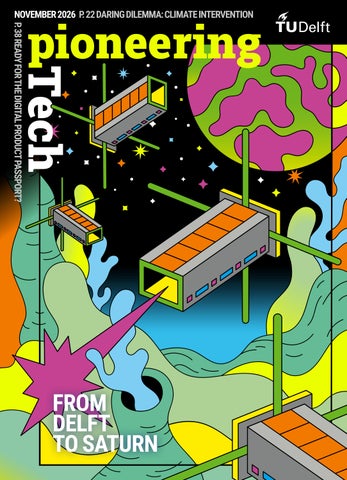
4 12 The Unknown I’ve always been fascinated by the unknown, from strange organisms to the possibility of extraterrestrial life. That fascination provided the starting point for this illustration. I interpreted the subject in my own graphic style, drawing inspiration from the dynamism and energy of classic science-fiction and space comic-book covers. Rather than putting my usual fantastical creatures centre stage, I sent satellites and space probes on an adventure of their own, into a world somewhere between science and science fiction. Saman Dezai a.k.a. Kid KURA
Pioneering Tech Magazine
‘Our gloves make you believe you’re actually holding something’ 28
Production TU Delft | Innovation & Impact Centre
Jurjen Slump (Editor-in-Chief) Sara Broekman (Project manager & Art direction) Floortje Koster (Content marketer), Leonie Versteeg (Online marketing strategist) Contributing writers Leendert van der Ent, Jean-Paul Keulen, Bennie Mols, Elise Spetter Illustrations Saman Dezai, Dimitry de Bruin, Anne-Roos van Ommen Photography Erno Wientjens Design & Art direction Ontwerpwerk Print Drukkerij van Deventer Questions, tips and suggestions, or unsubscribe from this magazine? Send an email to pioneeringtech@tudelft.nl Copyright TU Delft | Innovation & Impact Centre November 2026
34
FOREWORD
Innovation requires collaboration
In this issue
4
3
From Delft to Saturn The Netherlands develops its own space chips
16 When AI understands you better than people do A speech technology app restores independence
In this issue, we introduce you to one of the most promising technological developments of our time: chips in space. Satellites are becoming smaller, smarter and more powerful, while calls for European strategic autonomy grow louder. TU Delft has a unique role to play here. As the only university in the Benelux with a Faculty of Aerospace Engineering, we bring together expertise in space technology, microelectronics and entrepreneurship. But a technological lead alone is not enough. How do we make sure that innovations actually scale up into European success stories? Just as topical is the ‘Daring Dilemma’ on climate intervention, also known as climate engineering. As the effects of climate change become ever clearer, the debate about technological interventions in the climate system is growing. Should we be encouraging research in this area? And if so, where do we draw the line? It is a challenging theme that brings together science, policy and societal responsibility. Innovation never happens in isolation, says Henri Werij, who is happy to share a few pearls of wisdom with us as he steps down as Dean of Aerospace Engineering. Major breakthroughs happen when researchers, entrepreneurs, governments and civil society partners come together. That is essential, now more than ever. Our ambition is to further increase the number of spin-offs built around key technologies, and so strengthen the innovative capacity of the Netherlands and Europe. We cannot do this alone. That is why I am calling on policymakers, investors and partners to work with us to create the conditions in which new technologies and businesses can flourish. I hope you enjoy this issue. You might also like to visit the Pioneering Tech Platform, where you can sign up for the newsletter and listen to the Pioneering Tech Podcast.
22 Daring Dilemma Climate intervention How do we stop the bucket from overflowing?
28 Working Together - Koppert Cress Where new technology takes root
Also 12
8 Insights A sense of touch in virtual reality
14
Column Henri Werij on the power of collaboration
20
Startup Arkintel
34
Fieldlab The Green Village celebrates 12.5 years
38
Explainer The Digital Product Passport
42
Meanwhile Plastic recycling in Ghana
44
What if Student team DARE builds a new rocket
Art & Technology
Ingrid Thijssen President of the Executive Board
A portrait of precision
VISIT TUDELFT.NL/ PIONEERINGTECH
PHOTO © MARCEL KRIJGER
48
4
IMPACT
SATURN AS SEEN FROM ITS ICY MOON ENCELADUS. GEYSERS ERUPT FROM CRACKS IN THE ICE, WHILE THE MOONS RHEA (RIGHT) AND TITAN (LEFT) ORBIT THE GAS GIANT. THIS ARTIST’S IMPRESSION IS INSPIRED BY DISCOVERIES MADE DURING THE CASSINI–HUYGENS MISSION (2004–2017). © NASA
CHIPS IN SPACE
5
The Netherlands develops its own space chips FROM ENSCHEDE TO DELFT: A NEW ECOSYSTEM AIMS TO MAKE EUROPE LESS DEPENDENT ON FOREIGN TECHNOLOGY
B y J ea n-Pa u l Keu l en
Chips that use light instead of electrons, are fully customised, or come with AI on board... Satellites can benefit in all kinds of ways from the latest technologies developed here on Earth. And the Netherlands looks ideally placed to bring the semiconductor and space industries together.
IMPACT
PHOTO © ERNO WIENTJENS
The tiny rectangle is glossy black, wafer-thin and measures just one centimetre by half a centimetre. Granted, this fingerprint-covered specimen will never leave Earth. But one of its siblings will be heading into space in just a few months, to test whether the technology also works as it should up there. And if all goes to plan, a distant descendant of this chip will set off in a few decades’ time for Enceladus, one of Saturn’s moons, to search for signs of life. The project behind this LMCool chip, led by TU Delft researcher Niels Ligterink, is not an isolated case. The Netherlands, long a strong player in both conventional semiconductor chips and the space sector, is now bringing the two together in an emerging chips-in-space ecosystem. What makes this combination so special is that, in principle, a chip for space applications can go all the way from design to integration into a satellite without leaving the country, and without any American or Chinese input. This means the new network could play an important role in safeguarding European strategic autonomy in a changing geopolitical landscape. The companies in this ecosystem each take a slightly different approach. One focuses on chips with AI on board, another on chips designed entirely in-house, along with the control unit they are part of. But they are all betting that the time has come to put technology that has matured here on Earth to work in satellites, and even in probes that will travel hundreds of millions of kilometres across the solar system. Defence applications also come into the picture almost automatically. The question now is whether the Netherlands can genuinely become a market leader in this field. The country certainly has the potential, our interviewees agree, but there is still room for more collaboration, more investment and a faster pace.
Above TU Delft researcher Niels Ligterink Below In 2010, NASA’s Cassini spacecraft captured dramatic plumes, both large and small, spraying water ice from numerous locations along the famed tiger stripes near the south pole of Saturn’s moon Enceladus.
‘We are talking about the next generation of semiconductors’
Next generation One of the players in this field is LioniX International, the company that produces the LMCool chip and the associated sensor systems for Ligterink and his team. “At heart, we are a high-tech chip technology company, not a space company”, says Tushar Goyal, VP Business Development Space & Defense. That said, he did work for a small satellite company in Delft until recently. What lured him to the Enschede-based chip manufacturer was the advanced technology LioniX International is working on, and the prospect of sending a chip to Saturn’s moon Enceladus. LioniX International focuses mainly on photonic integrated chips, or PICs. “In a conventional chip, electrons move through tiny copper wires”, Goyal explains. “Instead, we work with optical waveguides – similar to optical fibre, but on a chip – through which photons travel. This generates far less heat, which in turn means that these chips consume less energy”. Goyal expects chips like these to be around everywhere in the future, working alongside ‘ordinary’ electronics. “We are talking about the next generation of semiconductors”. PICs are also ideally suited for use on board satellites. “Photons make systems smaller, lighter and more efficient, and they can carry huge amounts of data without being affected
Tushar Goyal - LioniX International
PHOTO © NASA/JPL/SPACE SCIENCE INSTITUTE
6
CHIPS IN SPACE
7
Links Xx
PHOTO © TU DELFT
Onder Xx
by electromagnetic interference”, says Goyal. “Those are all important advantages in space”.
PHOTO © ERNO WIENTJENS
PHOTO © TU DELFT
Catching molecules
Above The original, larger Life Marker Chip, initially developed for the ExoMars rover (left), and the new, smaller (Origin of) Life Marker Chip, being developed for future space missions (right). Middle Team members Vidhya Pallichadath and Bavo Vlyminckx unbox the payload Below From left to right: Vidhya Pallichadath, Bavo Vlyminckx, Niels Ligterink, Stefano Speretta, Şevket Uludağ
The LMCool chip puts these advantages to good use too. Another crucial part of the chip is a set of bioreceptors. “Only specific molecules can lodge in them, like a key in a lock”, says Ligterink. The idea is this: when liquid from the oceans beneath the ice of Enceladus one day flows over the chip, the receptors can ‘catch’ any molecules that point to the existence of life. As soon as a molecule locks into place, the way the laser light moves across the chip changes – a shift that the underlying chip detects immediately. A first demonstration mission is already scheduled for January: PRISM. “For that mission, we are essentially launching only the chip”, Ligterink explains, “to demonstrate that the technology also works on a small scale, in space, over an extended period”. The chip will fly on board the team’s own miniature satellite, measuring 5 by 5 by 30 centimetres: Delfi-Contact. Another remarkable thing about this mission is that it came together in less than a year. “The first conversations started around March 2026”, Goyal recalls. “Three to six months later, we had a chip that could be integrated into the satellite”. According to Goyal, this was possible mainly because LioniX International is a fully vertically integrated company: it designs and produces the chips itself, and controls them with its own electronics and software modules.
A European affair Another company that has taken matters into its own hands – albeit in a slightly different way – is Spherical Systems. “I used to work for a satellite company where I would put
IMPACT
PHOTO © UBOTICA
8
Above Ubotica is collaborating with NASA on a project focused on autonomous satellite operations, demonstrating a fundamentally new way of observing the Earth.
microchips together on a circuit board to get them to do a particular job”, says founder and CEO Thomas Parry. “It was frustrating work, because most of the time I could not find the right chip. So I thought: how hard can it be to make exactly the chips we need ourselves?” Spherical now designs and produces exactly these kinds of chips for the space industry, along with the entire Power Conditioning and Distribution Unit that such a chip controls. “What a unit like that does”, Parry explains, “is distribute the power from a satellite’s solar panels across all the subsystems – the computer or the camera, for example – and the battery. And because it is all in space, it all has to work extremely reliably. After all, you cannot send someone up there to repair it”. Parry compares the approach of his Rotterdam-based company – which has now grown to around 25 people – to that of Apple. “They make their own chips for their iPhones, because that gives them far more control over exactly what those chips do – so ultimately they can deliver a better product. We follow the same philosophy, only for satellite electronics rather than consumer electronics”. Spherical does not manufacture its chips entirely in-house – but the process is an exclusively European affair. “We do most of the design work in the Netherlands, production takes place in Germany, and the packaging is currently done in France”.
Which vessel is sailing where? Ubotica started out as an Irish company, but when it decided to focus on space, it soon became clear that it needed a Dutch branch, says Director of Space Engineering David
Bottom right Singapore, February 2025. A single observation detected and classified hundreds of vessels in just minutes – including one sailing ‘in the dark’ (without an AIS signal).
Rijlaarsdam. “Ubotica’s founders, true entrepreneurs from the world of AI and semiconductors, realised that the Netherlands has an enormous amount of space talent and an entire space ecosystem. So it would be very useful for the company to have a presence here in Delft”. As a result, a Dutch subsidiary (BV) has now been set up at TU Delft’s Aerospace Innovation Hub, with Rijlaarsdam as its director. Ubotica focuses on edge AI, meaning artificial intelligence that runs locally on a chip rather than in a data centre, as is the case with chatbots like ChatGPT. Here on Earth, this could be used, for example, in a factory where cameras monitor a production line, Rijlaarsdam explains. “In many cases, you don’t want this data to leave the factory floor, either because it contains sensitive information or because analysing it that way takes too much time. With edge AI, that’s not necessary, because the camera itself can analyse the images it captures”. In space, the approach can be even more useful than here on Earth, Rijlaarsdam continues. “Sending data down to Earth is expensive, and it is not always possible. That makes it very useful to be able to process the data on board the satellite itself”. Ubotica has already supplied the hardware and software for two European Space Agency (ESA) satellites:
CHIPS IN SPACE
9
‘We do most of the design work in the Netherlands, production takes place in Germany, and the packaging is currently done in France’ Thomas Parry - Spherical
Phi-Sat 1 and 2, says Rijlaarsdam. “We are also working on a number of projects with NASA”. However, the company is no longer focused solely on satellite manufacturers; it is also serving customers that rely on satellite data. Its main area of focus is maritime intelligence: using satellite and other data to track which vessels are sailing where. “A very practical example is that we can alert our users: a suspicious ship is approaching, it will reach this critical pipeline in 24 hours, so it might be a useful idea to keep a closer eye on it”.
A SpaceX of our own Each in their own way, these companies are working towards greater European technological sovereignty. “Most of the chips we use today come from Taiwan or the US”, says Parry. “If the United States were to decide at some point that Europe could no longer have access to those chips – and given recent geopolitical developments, that is not an inconceivable scenario – Europe must still be able to design and build satellites. It is therefore vital that we retain control over that capability”. At LioniX International, in fact, virtually all production takes place within the Netherlands. “From chip design through fabrication to packaging the chip into a module that customers can actually use: that entire value chain is located in the Netherlands, as well as at a company we own in Switzerland”, says Goyal. Of course, LioniX International has suppliers, he continues, but the critical chip components are sourced within Europe. Many launches, however, still take place outside Europe. PRISM, for example, will be launched from the US on a SpaceX rocket. “With that in mind, it would be good to back
PHOTO © UBOTICA
PHOTO © ERNO WIENTJENS
The printed circuit board (PCB) of the PRISM payload, which processes the output data from the photonic chip.
IMPACT
PHOTO © TU DELFT
10
companies such as Rocket Factory Augsburg, a German start-up that aims to grow into a kind of European SpaceX”, says Ligterink.
A growing defence arm Anyone venturing into the space chip business cannot escape these geopolitical considerations. “Most satellites can be used for civilian purposes as well as for defence; they are inherently dual-use”, says Parry. “Take a satellite that captures images of Earth. You can use it to map climate change – but also to monitor troop movements, for example. And because of what has been happening in Ukraine in recent years, defence applications are attracting more and more attention”. One step Europe took last summer was to combine what had previously been strictly separate funding streams for civilian research and defence technology. Until then, organisations seeking funding for defence research had to apply to the European Defence Fund, while civilian research projects could turn to the Horizon Europe programme. Now the European Innovation Council – part of Horizon – funds dual-use technology. According to Parry, this is particularly beneficial for smaller players. “Getting a project funded under the European Defence Fund is an administrative nightmare. Large defence companies such as Thales and BAE Systems can find their way through it, but for a start-up it is almost impossible”. The growing defence arms of many chip companies do raise ethical questions. Which applications are you willing to contribute to, and where do you draw the line? “Essentially, we look at two things”, says Rijlaarsdam. “Are our systems being used ethically, for the right applications? And is the organisation using them one that operates in line with European values and standards? Ultimately, we want our
The PRISM payload, featuring the photonic chip (equipped with an asymmetric Mach–Zehnder interferometer), laser and photodiode, alongside the Delfi-Contact satellite platform.
systems to be used to protect the world’s democracies and make them safer, but it is important that this happens in the right way”.
An emerging ecosystem Now suppose that, in the coming years, the Netherlands wants to become the leading international hub for chips in satellites and spacecraft. What would that take? As far as Parry is concerned, everything could move a little faster. “When we work with American customers, decisions in particular are made very quickly. In Europe, we tend to overthink everything”. Rijlaarsdam is all too familiar with this slowness. “Even when we have a verbal agreement with an organisation and it is clear that the money is there, it can easily be another six months before there is actually a contract on the table. And it can easily take six months or even a year to get a particular permit, for example”. Beyond that, Rijlaarsdam believes investment needs to be stepped up substantially. “When it comes to smaller grants of up to a few million euros, we are reasonably well provided for in Europe. But the real ‘winners’ need more growth capital to take the next step”. More funding is also crucial to keep the technology in Europe, Goyal adds. “If Europe does not invest in its core technologies while other countries continue to do so, companies will eventually be compelled to relocate to those countries or operate under their control”. Securing funding is also a challenge for academic research projects such as Ligterink’s. “There are various organisations that can provide funding: the Netherlands Space Agency (NLSA), NWO, ESA, the European Research Council…
CHIPS IN SPACE
11
The Dutch chips-in-space ecosystem consists of universities and research institutes such as TU Delft (where a great deal of space-related work takes place), Eindhoven University of Technology and the University of Twente (both of which specialise in photonic chips, among other things), research institutes such as TNO and NLR (Royal Netherlands Aerospace Centre), and established and new companies such as LioniX International, Spherical Systems and Ubotica. The Netherlands Space Agency (NLSA, formerly NSO) coordinates and provides funding, while ESTEC in Noordwijk, the research centre of the European Space Agency (ESA), offers strong opportunities to set up projects in this field. Give your innovation the best possible launch through our Aerospace Innovation Hub. aerospaceinnovationhub.nl Scan, click, and get ready for take-off!
But finding the right body is often a challenge, because much of our work falls between fundamental and applied research”. Ligterink would also like other disciplines to become more aware of the possibilities offered by space chips. “Research into bioreceptors is quite big in the Netherlands, and there are also scientists doing fundamental research into the origin of life, for example. Not all of them realise yet what kinds of measurements can be made in space”. Finally, Parry believes the companies in the emerging chips-in-space ecosystem could do a little more business with one another. “There is nothing wrong with exporting, but it would be good if we also built up a domestic value chain, in which one Dutch company buys from another Dutch company and, in turn, sells technology to yet another Dutch company. At the moment, for example, Spherical does not have a single domestic customer”. Goyal, who moved to the Netherlands only four years ago, sees above all a great deal of potential. “I am amazed at how much ground-breaking technological work goes on in such a small country. We have everything here: from machines for making chips to the ability to assemble a complete satellite”. Parry: “The Netherlands has a very strong chip industry and a very strong space industry, but historically the two have never overlapped much. That is now changing. We have a great many unique capabilities to offer Europe and the world. It is just that we are not yet making the most of them. But I am seeing promising signs”. ■
ILLUSTRATION © KID KURA
The Dutch chips-inspace ecosystem
12
8 INSIGHTS
From a graduation project at TU Delft to an international technology company supplying haptic gloves to sectors such as aviation and robotics. SenseGlove shows how entrepreneurship and the Delft innovation ecosystem can reinforce each other. CEO and TU Delft alumnus Gijs den Butter shares eight insights into building a deeptech company.
SenseGlove’s gloves provide just the right amount of resistance and vibration to make your brain believe you’re actually holding something.
SENSEGLOVE
13
By Elis e Sp etter Photos E r n o W i e n t j e n s
A sense of touch in virtual reality 1
Start with a problem, not technology
“You can practise any physical task in virtual reality: maintaining an aircraft, preparing for surgery or repairing a wind turbine. But for that to work, the interaction has to feel realistic. In the past, you had controllers or gloves that only tracked your movements. You could see yourself picking something up, but you felt nothing. Our gloves provide just enough resistance and vibration to convince your brain into believing you are really holding something. That makes learning faster and more realistic”.
2
A graduation project can be the start of a company
“SenseGlove grew out of two graduation projects at the Faculty of Industrial Design Engineering. My co-founder Johannes developed a robotic hand for stroke rehabilitation. It worked well technically, but commercially that market proved complicated. I realised that the same technology could also control the movement of a digital hand in virtual reality. If we could measure movement, perhaps we could also let users feel what they were holding in that virtual world. That ultimately turned out to have much greater market potential”.
3
A safe environment makes better entrepreneurs
“YES!Delft was incredibly important to us. You don’t get an answer to every question there, but you are surrounded by other entrepreneurs making exactly the same mistakes. You learn a lot from each other and realise that the challenges you are running into are perfectly normal. In your first two years as a start-up, you are inevitably making plenty of mistakes. In such an environment you are allowed to. That makes it much easier to survive those difficult early years”.
4
Entrepreneurship is all about delivering
“We were at a trade fair with an early prototype when Volkswagen asked whether they could use our gloves to train mechanics. I said straight away: of course, when would you like two? That will be 10,000 euros. In hindsight, we could have asked for much more, but two weeks later we had our first order. That order changed everything. Suddenly we were no longer a student project, but a company”.
8 INSIGHTS FROM SENSEGLOVE
5
Listen to your customers, not your ego
6
Field labs bridge the gap to the market
7
Sometimes the market changes faster than your company
8
Sell before your product is perfect
“Our first product was big and impressive, but nobody wanted to use it every day. Customers wanted something lighter. Then they also wanted to feel virtual objects in the palm of their hand, as if they were really holding them. Every new version came about because customers told us what could be improved”.
“Through Delft Enterprises, RoboHouse and Do IoT Fieldlab, we were able to test our technology in realworld conditions. A good example is a project for technicians working on offshore wind farms. Many people think they can handle such a job, but drop out as soon as they find themselves high above sea level. Virtual reality lets them experience that environment in advance and practise before they ever climb a wind turbine”.
“The huge VR hype has subsided. Many innovation labs have moved on to AI. At the same time, customers discovered that our gloves are also perfect for controlling robots remotely. We developed a completely new product for that. It also led to a new slogan: Training the workforce of the future. And that means not just people, but humanoid robots as well”.
“Many entrepreneurs think technology is the hardest part. It is not. The real challenge is getting your product to the customer reliably and on time. If you cannot deliver, customers will simply choose the next-best alternative. So my advice to TU Delft students is: find your first customer as soon as you can and don’t be afraid to sell something before it is perfect. Only then will you get the feedback that really helps you move forward”. ■
Explore robotics opportunities for your organisation: tudelft.nl/en/business/robotica
14
COLUMN - HENRI WERIJ
THE POWER OF COLLABORATION
COLUMN
PHOTO © MARCEL KRIJGER
‘T
he more you give, the more you receive’. Those words are engraved on the gift (incorporating parts of a space instrument) that I received when I left TNO in 2017. It has stood in my office at the Faculty of Aerospace Engineering for many years. These words, which I often impressed upon my colleagues at TNO, may sound like a cliché, but they really are my guiding principle. Collaboration is crucial, because radical innovation never happens in isolation. Over the past ten years, we have thrown open our doors at the Faculty of Aerospace Engineering. Our ambition was, and still is, to be the faculty that leads the world in accelerating the transition to sustainable aviation. We can only achieve that by working closely with all the parties involved, both inside and outside the university. Thanks to so many passionate and outstanding colleagues, both inside and outside the faculty, we have made great strides. One example was setting up the SAM XL field lab, where we work with industry to develop new production processes using new materials and large-scale robotics. One truly wonderful project was STUNNING, in which we worked with GKN Fokker, NLR and Diehl Aviation to produce a lighter composite aircraft fuselage. The result is substantial fuel savings and therefore lower CO2 emissions. Crucially, we were able to weld composite parts ultrasonically, using a technology developed at the faculty. Another important step, in my view, was creating the Aerospace Innovation Hub. Here, we use start-up vouchers, coaching and workspace to stimulate entrepreneurship in aviation, space and drones. More than 50 start-ups and several international companies, including Airbus, are currently affiliated with the hub, and the number is growing rapidly. Those start-ups now account for some 700 jobs. The AIH has been so successful that, together with our Aeronautical Engineering colleagues at InHolland University of Applied Sciences, we recently opened Terminal 01, which offers manufacturing facilities for our start-ups and scale-ups. As I said, collaboration is crucial for radical change. A case in point is ‘Flying Vision’: a partnership we formed in 2022 with Airbus, KLM, Schiphol and NLR. The aim was to develop an open innovation ecosystem in which the partners share technological breakthroughs and new knowledge with one another. The ecosystem that has grown up over the past few years brings everyone together: start-ups, industry, researchers, students and PhD candidates. This allows us to align scientific research far more closely with real-world innovation challenges. Companies can benefit from our knowledge, while our researchers and students benefit from the insights of industry.
Henri Werij was appointed Dean of the Faculty of Aerospace Engineering in 2017, after a long career at TNO. In his inaugural address, he called for the ‘Clear Sky Revolution’: a rapid transition to sustainable aviation driven by technological innovation and education. He will retire on 22 December 2026.
Does this mean all is well? No. Over the past year, the effects of climate change have become ever more severe, and we are clearly not innovating fast enough. Geopolitical developments are also forcing us to pursue strategic autonomy. In line with the Wennink report, I would like to ask the government to give start-ups the opportunity to grow in the Netherlands. For example, act as a launching customer, as governments in other countries do, to help start-ups through the ‘Valley of Death’. And my advice to industry: get involved in what is happening across the education sector, and invest. Companies that complain they are not attracting any of our students should ask themselves whether they are visible enough. Work with us: it will prove a win-win situation. Finally, I hope we’ll keep our eyes open to what is happening elsewhere. A fine example, in my view, is the work on photonic integrated chips at LioniX International, a company based in Twente. This technology is now being used in a space project led by Niels Ligterink of our faculty. Read more in our cover story. ■
Let’s innovate with impact for a better society Let your organisation lead the way by working with TU Delft: ■ Collaborate with researchers on breakthrough
solutions in areas such as AI, robotics, quantum technology, energy, and aerospace.
■ Develop and test innovations in our field
labs, where we achieve faster results through co-creation and provide access to funding opportunities.
■ Keep your organisation at the forefront of
innovation with access to the right knowledge, expertise, and professional development.
➔ Get in touch with us
to discover what we can achieve together
PHOTO © NAAM ERNO WIENTJENS FOTOGRAAF| VISUAL © ONTWERPWERK
ea
r cl
r
clea
16 INTERVIEW
Cl ea
r
INCLUSIVE SPEECH TECHNOLOGY
17
This app could help people with a speech disorder take part in society again
When AI understands you better than people do Helping the listener
By Elis e Sp etter
What if going shopping, ordering a beer or having a chat becomes increasingly difficult because other people cannot understand you? Professor Odette Scharenborg and PhD candidate Yuanyuan Zhang are developing an app designed to help people with a speech disorder regain some of their independence. A crowdfunding campaign is urgently needed to take the next step.
Going into a store and saying what you need. Ordering a craft beer at the bar and having a chat. For many people, these are everyday activities. For people with dysarthria, they can become difficult or even impossible. Dysarthria is a speech disorder that can result from conditions such as Parkinson’s disease, ALS or multiple sclerosis, or from a stroke or brain injury following an accident. Because of motor impairments, people may start speaking more slowly, more quietly or less clearly. “Around 100 muscles are involved in speech”, says Odette Scharenborg, Professor of Inclusive Speech Communication at TU Delft. “So if you have a motor impairment, it can have major consequences for your speech”. The impact goes far beyond speech itself. When other people have difficulty understanding you, making contact with them also becomes harder. “People are becoming increasingly isolated because they are difficult to understand”, says Scharenborg. “The question is: how can we help them regain their place in their social circle?”
Existing speech recognition systems often do not work well for people with dysarthria. They are primarily trained on speech from people without speech disorders and with relatively little variation in factors such as accent or age. “Systems that perform very well today are actually trained on only a fraction of all that variation”, says Scharenborg. “People with a speech disorder fall well outside that range”. Scharenborg and Zhang are therefore developing an app that converts the speech of people with dysarthria into text in real time during a conversation. Both conversation partners can read along on the screen. Their starting point is that the speaker should not have to adapt; instead, technology should help the listener. “People with dysarthria are generally given speech therapy to make their speech easier to understand. That can help, but speaking already drains their energy. And with progressive conditions, their speech may deteriorate further”, says Scharenborg. The app should not only show listeners what is being said, but potentially also help them become better at understanding the speaker over time. Psycholinguistic research has shown that people recognise speech more easily when they already know what is being said. Whether the same learning effect occurs with dysarthric speech still needs to be investigated further.
People turned out to be worse than AI The project gained momentum thanks to Matthijs Valkering, a lecturer at Vrije Universiteit Amsterdam. He developed dysarthria after a cycling accident. In 2023, he approached Scharenborg to ask whether she could help him become easier to understand. The team recorded hours of his speech and transcribed it manually.
cl
e
INTERVIEW
PHOTO © ERNO WIENTJENS
To train the speech model, the researchers record hours of speech from each participant.
PHOTO © ERNO WIENTJENS
18
Speech technology for everyone Odette Scharenborg is Professor of Inclusive Speech Communication at TU Delft. Her research focuses on speech technology that can be used by everyone, regardless of how they speak or which language they speak. Much existing speech technology works particularly well for so-called ‘standard speakers’: native-speaking adults aged between 18 and 60 with no speech or voice disorders. This is much less the case, or not the case at all, for speakers under 18 or over 60, people with a foreign or regional accent, or people with a speech or voice disorder resulting from, for example, an illness. “Inclusive speech technology focuses on these non-‘standard speakers’, making speech technology accessible to them too”, says Scharenborg.
Zhang, now in the fourth year of her PhD, uses this speech data in her research to train and improve speech models. These models need to become increasingly good at recognising dysarthric speech and form the app’s technological foundation. “Yuanyuan is really a driving force behind this”, says Scharenborg. At Interspeech 2025, a major international conference on speech and speech technology, the team decided to test who could understand Valkering better: humans or AI. Visitors listened to recordings of his speech and wrote down what they thought he had said. The AI model performed about three times better than the human listeners. “That was when a light went on”, says Scharenborg. “This is interesting”. Not long afterwards, Maikel Hendriks got in touch. He too developed dysarthria after an accident and asked Scharenborg whether she could help him. Even if that proved impossible for him personally, he wanted to make his speech available for research so it might benefit others in the future. His question gave Scharenborg more to think about. If AI could understand what someone with a speech disorder was saying better than people could, why not incorporate the speech model into an app that converts spoken words into text?
Ordering a beer without help Future users have been central to the development process from the start. Valkering, for example, helped determine what the app should look like. Because of his motor impairment, he cannot easily reach every part of the screen. So he decided himself where the start button should be placed. Hendriks has visual difficulties, prompting the team to add an option to enlarge the text.
INCLUSIVE SPEECH TECHNOLOGY
19
PHOTO © TU DELFT
PhD candidate Yuanyuan Zhang
‘It’s about regaining a degree of independence’
To train the speech model, the researchers record hours of speech from each participant. They consider what each person is able to do. If, for example, a participant can only produce short sentences, the texts are adapted accordingly. Participants also record 100 sentences of their own choosing about topics they often talk about. For one participant, these might be about a statistics lecture; for another, about football. Ultimately, the goal is much bigger than improving speech recognition. “It is about regaining a degree of independence”, says Scharenborg. “Maikel told us: ‘The first thing I’m going to do is go to the pub, order a beer and chat with people at the bar.’ It really is about being able to take part in society”.
Why crowdfunding is needed To further develop the app, Scharenborg and Zhang have launched a crowdfunding campaign. Conventional research grants do not provide enough support for this project. Researchers can apply for funding for scientific questions, such as how to improve speech models. But according to Scharenborg, hardly any funding is available for collecting and processing the speech data needed to do that. And that is an important and costly part of the project. To enable the model to recognise an increasingly wide range of dysarthric speech, the researchers need much more
speech data. They collect around four to five hours of Dutch speech from each participant. Processing it manually is time-consuming: transcribing one minute of speech can take as much as ten to fifteen minutes. The Delft team needs 100,000 euros in total. This will allow them, among other things, to record and process speech from more people with dysarthria and to further develop the app. Since the crowdfunding campaign began, Scharenborg has seen how much the project resonates with people. The team has received many applications from people with dysarthria and their families. They have also received feedback and donations. Messages from family members and friends have made the biggest impression. “People say: I would so love to be able to communicate better with my partner, my father, my child or my close friend. That really touches me”.
The app’s future Scharenborg is already thinking about the app’s future. It may eventually be housed in a dedicated start-up. This would help ensure that the app can continue to be updated in the long term and that new personalised speech models can be developed. Two parties have already expressed an interest in the technology for live captioning, but not yet in the standalone app. Setting up a start-up therefore remains one possible next step. The positive responses have only made Scharenborg more determined to develop the app further. “I want this to work”, she says. For her, the project will be a success if people actually use the app and find that it makes their daily lives easier. “If we manage to reach a group of people who say, ‘This is useful to me’, then I’ll be absolutely delighted”. ■
Help secure the app’s future To make the app suitable for more people with dysarthria, Odette Scharenborg and Yuanyuan Zhang’s team aims to raise €100,000. The money is needed, among other things, to process hours of recorded speech and further develop the technology.
Would you like to contribute? Support the crowdfunding campaign and help the researchers take the next step.
20
STARTUP
With their start-up Arkintel, Maxim Sachs (32) and Tristan Somé (29) are building a European alternative to American office and AI software. The City of Delft is already testing their technology. “Europe has had a wake-up call: we are increasingly realising that we are far too dependent on American Big Tech”.
Right Maxim Sachs (l) and Tristan Somé Below Arkintel is based in YES!Delft.
A European alternative to American office software
21
ARKINTEL By Eli s e Sp et ter Photos Er n o W i e n t j e n s
What exactly is Arkintel building? Somé: “Our main product is ArkOffice. It is an office suite where familiar programs for documents, presentations and spreadsheets work together with various AI models. What makes it unique is privacy: organisations decide for themselves where their data is kept. We offer an EU-hosted option, but we can also install the entire system locally. At the City of Delft, for example, the AI runs on in-house hardware. So their data never leaves the building”.
Your first AI application was born at TU Delft. How did that come about? Somé: “Maxim and I met while studying Aerospace Engineering at TU Delft. My partner Momo was working there as a teaching assistant at the time and kept getting the same questions from students. We thought: what if we put Momo’s knowledge into an AI? That was the start of Just Ask Momo”. Sachs: “The idea was never for AI to take over students’ work. We wanted to help them study the material in exactly the way their lecturers had intended. So we fed the system the lecturers’ own course materials. In no time, hundreds of students were using the tool and tens of thousands of messages were flying back and forth. That’s when we realised: this has real potential”.
You are now working with the City of Delft too. How did you end up working with them? Sachs: “The municipality was looking for ways to become less dependent on Microsoft. They found us through TU Delft and the YES!Delft incubator. We very deliberately chose not to open with a rehearsed pitch about how incredibly interesting our AI is. Instead, we started by talking to the staff. What problems do they run into in their day-to-day work?” Somé: “In the end, we collected around thirty potential applications. Among the results were DelftGPT and a meeting transcription tool. That approach has changed the way we run our entire business. We used to come up with something
‘In no time, hundreds of students were using the tool’ interesting, build it, and only then check whether anyone actually wanted it. Now we always start with the problem”.
How do you manage to develop applications so quickly? Somé: “We have spent years building what we call AI LEGO blocks: technology building blocks that we can combine again and again. So now, when an organisation comes to us with a problem, we don’t have to start from scratch. We click the right blocks together and then refine the solution based on user feedback”.
Why is your technology of particular interest to government bodies? Somé: “It comes down to privacy and digital sovereignty. The Netherlands and Europe still rely heavily on American technology. For a long time, we did not really see the dangers of that, but geopolitical tensions have given Europe a wake-up call. We are now acutely aware that we are far too dependent on American Big Tech”. Sachs: “DelftGPT uses open-source models
running on the municipality’s own hardware. So if an external AI provider disappeared tomorrow, their system would simply keep working. That kind of control is essential, especially when you are dealing with sensitive information”.
Do you ultimately want to replace companies like Microsoft? Sachs: “If organisations want to become independent, they need more than just an alternative to ChatGPT. They don’t want to lose the features they are used to. That is why ArkOffice offers familiar tools for documents, presentations, files and transcription”. Somé: “Ten years ago, it would have been utterly ridiculous for a small team like ours to say we were going to challenge Microsoft. But today, we genuinely believe it can be done”.
Where do you want to be in five years’ time? Sachs: “I hope we can use this to make European government bodies and organisations more secure and more independent, while making people’s work smoother and more enjoyable. AI does not need to take over our work. It should empower us”. ■
Interested in Arkintel’s technology? Contact the team via contact@arkintel.com or visit arkintel.com
22
DARING DILEMMA
CLIMATE INTERVENTION
23
Could tiny droplets buy us time? By Le en der t van der Ent
Visual Ont werp werk
Curbing global warming by one degree? Researchers in the Atmospheric Remote Sensing group at TU Delft hope that a combination of different climate intervention technologies can achieve exactly that. In theory, that is an attractive prospect, but the technology is still at the modelling stage. In the next stage, which involves small-scale field trials, the Delft scientists also want to identify any potential risks. But some are warning against going down that road, mainly because of the political risks involved. Where do the different sides stand?
DARING DILEMMA
PHOTO © SAM RENTMEESTER
24
Herman Russchenberg Professor of Atmospheric Remote Sensing at TU Delft
The summer of 2026 was the hottest on record. Of course, that is weather, not climate. But the four warmest summers ever recorded in the Netherlands all falling within the last eight years? Around the world, wildfires, low river levels and flooding caused by heavy rainfall are leading to more and more humanitarian disasters and economic problems. It reminds us that we must do everything we can to combat climate change. The most important task by far is decarbonising the energy system. But that is very unlikely to happen quickly enough. “We must use every option available to stop climate change”, says Herman Russchenberg, Professor of Atmospheric Remote Sensing at TU Delft. These additional options mainly involve CO2 storage and climate intervention. Russchenberg’s group is working on the latter, aiming to take this technology from modelling to real-world application. “The guiding principle is that this must never come at the expense of decarbonisation. That is what eliminates emissions as the cause of warming. CO₂ storage and climate interventions treat the symptoms. They are useful and necessary extra tools in the toolbox”.
that a combination of climate intervention techniques could reduce global warming by one degree. That would buy time to complete the necessary decarbonisation.
On the hunt for Goldilocks droplets “But it is not just about the global impact; achieving local effects on polar ice or coral reefs can be especially important too. MCB is well suited to that”, says Russchenberg. Annelot Broerze is a PhD candidate working on MCB in Russchenberg’s research group. She explains: “The technology stems from the discovery that polluting particles from ship engines promote cloud formation. Fortunately, the same can be done with non-polluting salt particles. Areas over the oceans where large cloud decks already exist are particularly suitable. Over the oceans, the clouds already contain a lot of salt, so we are only amplifying a natural effect”. Cees Jansen, Van Breugel’s colleague on the board of the Refreeze the Arctic Foundation: “The desired effect only lasts as long as you keep introducing salt crystals into the clouds; it stops when you stop”. The first successful MCB field trials have already been carried out, led by Daniel Harrison of Southern Cross University in Australia. Since 2020, he has been researching if the technology has the potential to counter further bleaching of the Great Barrier Reef. “He works closely with local communities. That is the model we have in mind”. This technology involves spraying seawater droplets of the right size into existing cloud decks. These aerosol particles evaporate, leaving salt crystals of about 200 nm. According to the models, these produce clouds with many small droplets, known as Goldilocks droplets, which reflect more sunlight and therefore more heat. This is called the Twomey effect. Broerze: “To achieve that, we are working with the University of Cambridge; they are developing the right spray nozzles, and we are doing the modelling using high-resolution weather models.
Climate intervention techniques There are various approaches to climate intervention. Russchenberg’s group focuses on marine cloud brightening (MCB). This involves making existing clouds over the sea whiter so that they reflect more sunlight. Another technology, stratospheric aerosol injection, lifts silica and chalk particles (CaCO₃), which reflect the sun’s heat, to an altitude of twenty to thirty kilometres. Stardust in Silicon Valley is one company focusing on this. Jan van Breugel is a board member of the Refreeze the Arctic Foundation (RAF), which uses private money to fund the Delft MCB research, among other projects. He says: “The drawback of putting things into the stratosphere is that they spread across the entire globe and the effect lingers for a year or two. You cannot simply stop it if adverse effects emerge. In the US, some groups are even using balloons to send highly polluting sulphur dioxide (SO2) up into the sky. That is not what you want. It is bad for the image of climate intervention”. Those looking into using mirrors in space to reflect sunlight back include TU Delft’s Faculty of Aerospace Engineering and, once again, companies in Silicon Valley. Another approach is to thin out ice clouds that trap heat on Earth. The expectation is
Plume rising from a marine cloud brightening seawater sprayer on the Great Barrier Reef during a field campaign conducted by Australia’s Southern Cross University.
25
Brightening clouds over the ocean Marine cloud brightening involves spraying fine droplets of seawater into existing clouds. These aerosol particles evaporate, leaving behind salt crystals around 200 nm in size.
Sea-salt particle Water molecule
Droplet
Water molecules condense around the salt crystals, forming clouds with many small droplets.
More, smaller droplets reflect more sunlight, and therefore more heat.
Clouds with fewer, larger cloud droplets reflect less light.
How many salt crystals reach the cloud? How much of the salt activates to form cloud droplets? Does the cloud become brighter? What cooling effect is achieved? How does a cloud adjust after being perturbed with salt crystals? Does the cloud thin out, or does it actually become thicker?”.
PHOTO © REFREEZE THE ARCTIC FOUNDATION
PHOTO © SOUTHERN CROSS UNIVERSITY
Learning more through a field trial
Jan van Breugel (below) and Cees Jansen Refreeze the Arctic Foundation
Van Breugel notes that the Delft group is very successful at tailoring weather models for MCB applications, which can speed up the modelling: “The microphysics-informed large eddy simulation (MILES) looks particularly promising. It feeds information on how droplets form within a cubic decimetre into the large-scale models, which work with grid cells of 25 by 25 kilometres”. The modelling has now reached the point where Broerze would like to carry out a field trial over a ten-by-ten-kilometre area of ocean in 2028, actively involving local communities and government bodies. “A trial like that would provide a great deal of additional information, for example to verify models. It may turn out that the underlaying physics may not hold up. Then there is the question of public acceptance. How things play out at the (inter)national administrative and political level is also very important. Can it help the government take a more active role in the governance of this issue, or will it create extra complications instead?” Van Breugel hopes that Delft’s MCB efforts can link up with the Horizon Europe projects CERTAINTY and TurPhyCloud. These projects use measurements on the Finnish island of Utö to improve data and knowledge for European climate and weather models. “All the measuring equipment is available there; a field trial of ours would fit in perfectly”.
SOURCE © SRM360.ORG | EDITING © ONTWERPWERK
CLIMATE INTERVENTION
26
DARING DILEMMA
Above Annelot Broerze and her colleagues actively engage in dialogue with younger generations, who will be affected by climate change more than anyone else. At the Lowlands festival, they demonstrated the principle of marine cloud brightening to visitors using a smoke machine to create ‘clouds’.
Government needs to take the lead Russchenberg, too, believes that now is the time to move on to small-scale field trials to map out the practical possibilities, limitations and any potential risks: “That still leaves time to build in checks and balances. To make responsible decisions, you need to set out clearly in advance when you will go ahead and when you will not: an approach based on test cycles, each with an exit point. If that goes well, technologies could be operational within ten years”. Van Breugel: “The main aim is to be able to help bring about a temporary drop in the Earth’s temperature if necessary, buying time to complete the energy transition. That is why it is important for the technology to be deployable should there ever be a need for it. In Australia and the United Kingdom, this research is carried out with government funding; in the Netherlands, it is not.
Van Breugel: “That is a shame, but we do not put our money into lobbying. Our focus is on improving the models and getting field trials off the ground”. That said, government involvement is essential for field trials, as he and Russchenberg both know. Russchenberg is quite concerned that the government is too cautious and too slow. He finds this slowness worrying in light of the commercial approach in Silicon Valley, where the agenda may be geared more towards military applications than climate action: “That is precisely why we also need social science research into the ethical and political risks. The same goes for global governance to regulate these technologies, set up monitoring and prevent misuse. The Netherlands could take the lead on this in Europe. As long as that opportunity goes unused, there is a growing risk that outside parties – over which we have no control – will run off with these technologies. That is why I am calling on the government to seize this opportunity and get things moving”.
PHOTO © TU DELFT
Risk of lock-in
Annelot Broerze PhD candidate Atmospheric Physics & Climate Intervention at TU Delft
Political scientist Jeroen Oomen of Utrecht University is less optimistic than Russchenberg: “As with CO₂ storage, we see a risk of mitigation deterrence – delaying climate action, with some parties embracing a seductive technology as a diversionary tactic. I cannot agree with the suggestion that there is an economic case for climate interventions. But there are also things we agree on. For marine cloud brightening, I see no problems with the physical impact of small-scale field trials.
Some opponents feel that additional measures such as climate intervention are ‘not necessary’. In my view, both sides are too quick to gloss over the question of whether it is necessary. That is primarily a political question”. A second risk Oomen sees is lock-in: “When you build up a socio-technical system, the further it progresses, the greater the stake scientists, investors and lobbyists have in keeping it going, even if it gradually turns out to be less than optimal”. This is why Russchenberg emphasises cycles with an exit strategy, and why Van Breugel says: “We want to be transparent and provide accurate information, not ‘win people over’. If it turns out not to be feasible, we ourselves would not want to carry on”. For now, Oomen remains unconvinced.
PHOTO © ROBÈRT KROONEN
Serious geopolitical concerns The third risk Oomen sees does not concern marine cloud brightening. “But all the other climate intervention technologies have major military potential, are intertwined with the space race or are aimed at making money with no regard for other interests. They are marketed as climate measures, but the product behind them is often less idealistic. Look at Stardust’s stratospheric dust clouds, which have a long-lasting impact on the whole world without anyone having asked for it. Or take the experimental satellite Eärendil-1 from Silicon Valley start-up Reflect Orbital. It is supposed to direct the sun’s rays after dark to illuminate certain areas on Earth. A satellite like that should not be allowed to exist. The primary purpose of this ‘daylight
Left The spraying component of the ARIEL (Aerosol Radiation and their Interactions Experimental Laboratory) Marine Cloud Brightening system, operating on the Great Barrier Reef during the 2023 field trial conducted by Southern Cross University. The system atomises seawater in 1000s of trillions of droplets per second and sprays those seawater droplets into the sky to understand the fundamental concepts behind the marine cloud brightening theory.
27
PHOTO © UNIVERSITEIT UTRECHT
CLIMATE INTERVENTION
Jeroen Oomen Assistant professor at the Urban Futures Studio of Utrecht University
on demand’ has nothing to do with the climate; it clearly has defence applications”. This is where Oomen’s biggest concern lies: “It belongs primarily in the geopolitical domain, not the technical one; I think reducing it to a question of technology is dangerous for the wider debate. Given the state of world politics, there is little reason to expect climate intervention technologies to be used only in good faith. That also applies to marine cloud brightening”. Broerze acknowledges the arguments Oomen puts forward, not least the political and moral risks of the technologies he mentions, but weighs things up slightly differently. “The urgency is growing all the time. If we continue to research our technology carefully and in a socially responsible way now, then we can avoid a situation later in which, as climate disasters continue to pile up, we want to deploy it without a sound scientific basis and with inadequate governance. I am convinced that as the climate crisis intensifies, the way we weigh up the risks will shift”. ■
PHOTO © NASA
PHOTO © SOUTHERN CROSS UNIVERSITY
Right On March 4, 2009, the skies over the northeast Pacific Ocean were streaked with clouds that form around the particles in ship exhaust.
28
WORKING TOGETHER
Where new technology takes root AT KOPPERT CRESS, CRESSES ARE GROWN FOR THE GASTRONOMY SECTOR. AMONG THE PLANTS, A SENSOR DEVELOPED BY QUANTIFIED MEASURES TEMPERATURE, LIGHT AND HUMIDITY. © ERNO WIENTJENS
KOPPERT CRESS
29
By El i s e S pet t er
KOPPERT CRESS AS A LIVING LAB
From drones that track down harmful insects to systems that store energy in greenhouses. Through innovation company Division Q, Koppert Cress is working with TU Delft and start-ups on new technology for greenhouse horticulture. The greenhouses serve as a testing ground, because real-world conditions are needed to validate whether an innovation really works. How did a nursery grow into a living lab for AgTech?
Long tables hold rows of young cresses in blue trays. In about two and a half weeks they will be ready for harvest, making way for a new batch. The cresses are grown over an area of no less than five hectares. But food is not the only thing growing among the plants and the production staff busy packing further along; the greenhouse is also a testing ground for new technology. Division Q, the innovation company within the Koppert Cress Group, uses the greenhouses of its sister company Koppert Cress as a living lab. Start-ups can test their ideas there, first in a trial set-up and then in a working greenhouse. Koppert Cress, which specialises in cresses and microgreens for chefs and restaurants, opens up parts of its eleven hectares of greenhouses for these tests. Many innovations for Dutch greenhouse horticulture emerge at a university, in a laboratory or at a start-up. But only the greenhouse can show whether a new technology really works. Bart van Meurs is director of Division Q, where he focuses on start-ups, innovation projects and investments in young companies. The collaboration with TU Delft goes beyond testing start-up technology. Division Q also works with the university on research projects for greenhouse horticulture. The new SPROUT project, for example, is investigating how different forms of energy generation, storage and use can be combined intelligently in an energy hub. The hub is being tested at full scale at Koppert Cress, with the aim of making the lessons learned applicable to other businesses in greenhouse horticulture.
The real world as a testing ground “As a sector, greenhouse horticulture faces major challenges,” Van Meurs says over a table in Monster. “When it comes to labour, mechanisation, energy and sustainability, we need innovation to address these challenges. That’s why we’re happy to contribute to turning ideas into practice”. Van Meurs, who studied Industrial Design Engineering at TU Delft, sees the collaboration as a logical step. “If you have an institution like TU Delft on your doorstep, with all the knowledge it holds, it makes sense to forge that link”. He regards Koppert Cress as a frontrunner in greenhouse horticulture. “And with that comes a responsibility to accelerate innovation”. The tour makes it clear that this pioneering role is nothing new. LED lighting hangs above the long rows of cresses. When the greenhouse was built some fifteen years ago, large-scale LED
WORKING TOGETHER
lighting was still the exception. Today, Koppert Cress is focusing on new challenges, such as storing renewable energy and applying it in smarter ways.
Hundreds of start-ups Hundreds of start-ups approach Division Q every year, but only a small number are granted access to the greenhouse. Division Q assesses whether real-world testing would add value or whether a research laboratory would be more suitable. In the latter case, the company refers start-ups elsewhere. And a good idea alone is not enough, says Van Meurs. “For us, the single most important criterion is the people. They are the biggest factor in a start-up’s success. Of course, the idea and the business case have to be sound, but if the team behind it does not have the right mix of talent, skill and perseverance, the idea will not make it”. Alongside its production facilities, Koppert Cress has a separate trial greenhouse: the Broeikas. Innovations can be tried out there on a small scale before being tested in a production greenhouse. New technology is also on display beyond the Broeikas. A demonstration model from TU Delft spin-off Thermeleon stands in the corridor; the company develops panels that store heat in the greenhouse and release it later.
Young cresses growing in the greenhouses of Koppert Cress in Monster. A sensor developed by Quantified measures temperature, light and humidity among the plants. The growing facility also serves as a test site for new technologies in greenhouse horticulture.
‘We invest, sometimes become a customer, or simply share our knowledge and help raise a start-up’s profile’ From idea to greenhouse Start-up PATS shows what testing an innovation looks like in practice. The company develops technology for greenhouse horticulture that automatically monitors flying insect pests such as moths and controls them without pesticides. Cameras above the crop detect the flying insects. Software analyses the images and maps which insects are flying around and how many. Small autonomous drones can then hunt down the insect pests and eliminate them with their propellers. There is no sign of the PATS set-up on the tour of the greenhouse. The cresses need little crop protection. The technology is installed elsewhere. Van Meurs clearly remembers sitting down in 2018 with the TU Delft students who founded PATS. There was no lengthy intake interview. The students were given the chance to test their technology among the crops straight away. “I said: as long as you keep my employees and my plants alive, go ahead”.
PHOTO © ERNO WIENTJENS
30
31
PHOTO © ERNO WIENTJENS
KOPPERT CRESS
PHOTO © PATS
PHOTO © ERNO WIENTJENS
Bart van Meurs, director of Division Q, the innovation company within the Koppert Cress Group, which also works with the wider greenhouse horticulture sector.
Above An infrared camera supports the camera system developed by TU Delft spin-off PATS to detect flying insect pests. Below A docked drone. The PATS drones eliminate the detected insects using their propellers.
That fits Division Q’s way of working: accelerating innovation by giving start-ups access to the real-world setting at Koppert Cress. According to Van Meurs, it is unusual for an operational nursery to open its doors like this. “Universities and research institutes have plenty of greenhouses for research, but few commercial growers are willing to say at an early stage: “Come and test your ideas in our greenhouses”.
From pilot to investor If a start-up is a good match, a pilot can grow into a long-term collaboration. Koppert Cress, for example, equipped part of its nursery with PATS technology. The company now uses the systems every day to predict pest outbreaks and make decisions about crop protection. When PATS later went looking for investors, Division Q decided to become a shareholder. “We did not just want to look at spreadsheets; we also wanted to contribute something of substance,” says Van Meurs. Bram Tijmons, co-founder of PATS, describes Koppert Cress as much more than a customer. “It is a true development partner. We can run experiments and validate new ideas there quickly. They also let us work closely and quickly with the people who deal with the practical side every day. Their willingness to test innovative solutions gives us room to develop new technologies under realistic conditions”. One concrete result is the moth prediction model. To validate
32
WORKING TOGETHER
PHOTO © CHRIS TOONEN
‘If you never fail, your are clearly not pushing the boundaries’
Above Koppert Cress uses PATS technology daily to predict pest outbreaks and inform crop protection decisions. Right Voltiris solar modules in the Koppert Cress greenhouse generate electricity while allowing the light plants need to pass through. The technology was tested here before being scaled up further.
the model, PATS compared the data it had collected with what was actually observed in the crop. “Without that freedom, this solution would never have got as far as it has today”, says Tijmons. A successful pilot does not automatically mean that Division Q becomes an investor. Its role varies from one start-up to the next. “We invest, sometimes become a customer, or simply share our knowledge and help raise a start-up’s profile”, Van Meurs explains. But part of innovation is that experiments do not always work out. One example was a project that tried to insulate a greenhouse with soap bubbles. The idea seemed promising: like cavity wall insulation in homes, the air bubbles would reduce heat loss. A trial greenhouse was even fitted with the system. “On paper it sounded fantastic, but in practice it was just not quite good enough”, says Van Meurs. “But if you never fail, you are clearly not pushing the boundaries”.
From greenhouse to energy hub
More innovations PATS is not the only start-up to have been given the space to test technology in real-world conditions at Koppert Cress. In recent years, several start-ups have carried out experiments at Koppert Cress on energy, sustainability and data. • Skytree At Koppert Cress, the start-up tested technology that captures CO₂ directly from the outside air for use in the greenhouse. The technology is now being rolled out more widely in greenhouse horticulture, and a group of thirteen growers is set to start using it. Skytree has previously won a GreenTech Award. • Quantified Quantified grew out of a design assignment that Koppert Cress gave to Delft physicist Warner Venstra. The company develops sensor technology that enables growers to collect accurate data from the greenhouse and use it to grow more efficiently. • Voltiris Division Q field-tested innovative solar panels from Swiss-Dutch start-up Voltiris in the trial greenhouse. The technology has since been scaled up further and is now in use at hectare scale. • Storing heat Koppert Cress also serves as a test site for energy projects. One project involved medium-temperature heat storage, in which heat is stored underground for later use. The first project in South Holland to use this technique later led to a broader follow-up.
A few doors down, it is plain to see how important energy is to a modern greenhouse operation. All the company’s energy systems converge in Koppert Cress’s technical room. Pipes and equipment make sure heat gets to where it is needed. Since February, the company has been using geothermal energy instead of natural gas: water at around 80 degrees is pumped up from a depth of 2.7 kilometres to heat the greenhouses. As part of SPROUT, a new RVO project, Koppert Cress is taking its energy experiments further in an energy hub. This matters both for making greenhouse horticulture more sustainable and for the energy system. Greenhouses play an important role: many businesses use gas-fired units that supply electricity, heat and CO₂ and can respond flexibly to supply and demand on the electricity grid. If the sector moves away from gas, that flexibility risks being lost. SPROUT is therefore investigating how a greenhouse can stay flexible and support the electricity grid without those gas-fired units. According to project coordinator Francesco Lombardi, an assistant professor at TU Delft, Koppert Cress is particularly important to SPROUT because of the scale at which the system can be tested there. SPROUT starts with small-scale tests at The Green Village, a TU Delft’s field lab. These tests examine how the various components of the energy hub, such as solar panels, batteries and hydrogen technology, work together. The system there runs at kilowatt scale. At Koppert Cress, the energy hub is set to operate at megawatt scale. Researchers at Koppert Cress can also factor in the specific electricity, heat and CO₂ needs of a real greenhouse. “You can get a long way scientifically, but you never get the full picture.
KOPPERT CRESS
TU Delft and the Westland The TU Delft AgTech Institute plays a significant role in larger research and innovation projects between TU Delft and Division Q, such as SPROUT. This research institute was founded in 2019 to organise collaboration between engineering researchers and the agriculture and horticulture sector more effectively. The institute combines Delft expertise in areas such as AI, sensor technology, robotics, energy, water and climate with knowledge from the sector: in other words, AgTech. According to Liselotte de Vries, founder and business developer of the AgTech Institute, Division Q has become an important partner in recent years. The collaboration includes joint research projects such as SPROUT, strategic agendasetting for the sector with public and private partners, and supporting Delft start-ups like PATS. Koppert Cress is valuable to the university because it is willing to open its doors to technology that has yet to prove itself. Then there is its location, technical expertise and network in greenhouse horticulture. The company is also willing to engage in research projects that run for several years. “They have the guts to stick their necks out”, says De Vries. “They are interested in new technologies that have yet to be proven anywhere else”. Van Meurs hopes more companies will actively seek to collaborate with universities and research institutions in future. He also wants to attract more technical talent to greenhouse horticulture. “I hope that graduates will soon be saying: I want to work in horticulture, because it is technologically advanced, sustainable and meaningful work”. ■
Strongest enterpreneurial ecosystem According to the latest EE Index, the Delft-Westland region has once again been defined as the strongest entrepreneurial ecosystem in the Netherlands. The collaboration between Koppert Cress, TU Delft and start-ups fits that picture. Van Meurs: “Delft, where I studied, and the Westland used to feel like two completely different worlds to me. Now you see technology, science and entrepreneurship coming together more and more”. The municipalities of Delft and Westland value the collaboration between Koppert Cress and TU Delft as a good illustration of the region’s strength. “The EE Index highlights that the Delft-Westland region has a strong ecosystem. Above all, it is the networks and the excellent collaboration between knowledge institutions, start-ups and scale-ups, established companies, investors and public partners that set us apart from other regions”, says a spokesperson from the City of Delft. Collaborate with TU Delft on new AgriFood technologies: tudelft.nl/en/agtech
PHOTO © ERNO WIENTJENS
Some things only growers know. By experimenting together in the real world, we learn what works, what doesn’t and what needs adjusting”.
33
34
FIELDLAB
By J u rjen Sl u m p
Big changes start small
Photos Th e Green Vi l l a ge
12.5 YEARS THE GREEN VILLAGE
35
The Green Village is 12.5 years old. What began as an ambitious idea has grown into an internationally recognised field lab: of the 619 sustainable innovations tested there in recent years, 225 – more than a third – have found their way into practical use. These can now be found at hundreds of locations in municipalities across the Netherlands. Like a phoenix rising from the ashes: that is how Rector Magnificus Hester Bijl described the past 12.5 years. “The Faculty of Architecture building, which was destroyed by fire in 2008, once stood here”, she said at the anniversary celebration in September. After that dark period, there was room for something new. A place for a “new way of innovating”. At the time, the idea was far from obvious, Bijl said. “I still remember the containers where it all started”. Today, it is hard to imagine the campus without The Green Village and other field labs such as RoboHouse and SAM XL. This shows what TU Delft “truly stands for”, Bijl said. “To have real impact and help build a better society, it is just as important for ground-breaking ideas to make the leap from the laboratory to the real world. In the past, many innovations stalled somewhere between the two”.
A unique approach Whether the impact is visible, such as making a 1970s terraced house more sustainable, or invisible, such as amending the Dutch Heat Act, The Green Village enables companies, public
Above The Green Village is located on TU Delft Campus. Below Minister Van Veldhoven tours the field lab and is shown Ore Energy’s test setup. The company is developing an iron-air battery capable of storing or supplying energy for up to 100 hours.
36
FIELDLAB
T HE GREEN VILLAGE
Energy innovation policy A month after she visited The Green Village, Minister Van Veldhoven announced that the government wants to explore how supportive policy and a strategic investment agenda can help innovations take root in the system “genuinely and more quickly”. “A great deal of technology is already available, but it is not yet sufficiently applied or implemented in the Netherlands”, the minister wrote in a letter to the parliament on energy innovation policy. “Building and expanding innovation ecosystems plays an important role in helping innovations enter the energy system more quickly”.
and semi-public bodies, researchers and students to develop their innovations further and faster on the road to large-scale deployment. This unique approach has now become one of the pillars of TU Delft’s innovation strategy. “The past 12.5 years have shown that this approach works”, said Bijl. This way of working also aligns well with national ambitions for mission-driven innovation. The Green Village aims to test and further develop another 200 sustainable innovations between now and 2030. By then, at least half of these innovations should be in real-world use: in our homes, neighbourhoods, cities and energy systems.
Scaling up faster There is still plenty of room for improvement when it comes to scaling up, according to research by The Green Village commissioned by the Ministry of Economic Affairs and Climate Policy. Stientje van Veldhoven, Minister of Climate and Green Growth, will try to “speed things up”. It is important to make a real effort to achieve a major leap in scale, the minister said at the celebration. “Keep innovating, keep testing, show the results. A lot of what I see here is wonderful. Not everything has to work out, and that is as it should be”.
12.5 YEARS THE GREEN VILLAGE
Left Two innovations that have been scaled up and implemented in practice: Bufferblock (storing large volumes of rainwater, top) and Rain(a)Way (green, permeable parking spaces). Right At DreamHûs, three replicas of 1970s terraced houses with different energy ratings are used to investigate how existing terraced housing can best be made more sustainable.
37
‘A lot of what I see here is wonderful. Not everything has to work out, and that is as it should be’ Stientje van Veldhoven
Agility Making our society sustainable is complex, the challenges are significant, and scaling up and implementing sustainable innovations requires leadership from everyone. For The Green Village, this calls for the agility to respond quickly to new developments, such as grid congestion and heat stress. “I never thought cybersecurity would become part of our field lab. Now it is a major theme, with all kinds of innovations being tested to keep our energy grids (cyber)secure”, said director Marjan Kreijns. That agility is why The Green Village is developing a new field lab: The Blue Village. It focuses on sustainable, climate-adaptive urban development in wetland areas with soft soil. This was prompted in part by the foundation-related problems that have been making headlines recently. “We urgently need to speed things up. The challenges coming our way are enormous”, said Kreijns. “That is why I am calling on governments to use policy and regulation to give radical innovations a chance. I am asking companies to have the courage to choose sustainable alternatives. And I invite academia, entrepreneurs, industry and government to work closely with us to accelerate innovation”. ■
Read the report Accelerating the Impact of Energy Innovations (in Dutch), prepared by The Green Village on behalf of the Ministry of Climate and Green Growth.
38
SOORT EXPLAINER
DIGITAL PRODUCT PASSPORTS FOR A MORE CIRCULAR ECONOMY
Potential of DPP for businesses and authorities
By B en n ie M o ls
VISUAL © ONTWERPWERK | PHOTO © GETTY / EYEEM MOBILE GMBH
Enables circular business models
Enables better logistics and port activities
DIGITAL PRODUCT PASSPORT
Enables compliance monitoring, businessgovernment collaboration and burden reduction
Enables better design and circular strategies
Other product groups such as: furniture, toys, intermediate products of iron and steel
Product groups
Batteries
Textile
Construction products
Enables new insights through responsible and explainable AI
Digital product passports will soon become mandatory for specific product groups in the EU. They make key information available throughout a product’s life cycle. TU Delft researchers are exploring how these passports can contribute to sustainability and circularity, among other things.
DIGITAL PRODUCT PASSPORTS
What is a Digital Product Passport (DPP)? Digital product passports (DPPs) grew out of the European Green Deal and the EU’s push towards a more circular and sustainable economy. The basic idea is simple: important product information should travel digitally with a product throughout its life. Today, such information is often scattered across companies and supply chains, or even missing altogether. But DPPs can do more than support circularity. They can also reduce the reporting burden, boost competitiveness, make e-commerce run more smoothly and lessen dependence on vulnerable raw material supplies. “What is important about the product passport is that data that was previously not shared, or shared only voluntarily, will now have to be shared for the affected product groups”, says Boriana Rukanova of TU Delft’s Innovation and Impact Centre and Faculty of Technology, Policy and Management. TU Delft is involved in several major European and Dutch DPP research initiatives. Rukanova’s own research focuses mainly on collaboration between industry and government. She examines how authorities can use supply-chain and product-passport data to monitor circularity and sustainability and to facilitate trade.
39
Digital product passports will gradually become mandatory for various products placed on the EU market. This means that an increasing number of sectors will be affected. From 18 February 2027, for example, every electric vehicle battery placed on the EU market will need a digital product passport. By scanning a QR code, for instance, users will be able to access information about the battery: what it is made of, where it comes from and even how its condition changes during use. Consumers, businesses and authorities will have access to different data, depending on their role. Under the EU’s Ecodesign for Sustainable Products Regulation (ESPR), DPP requirements are also being developed for a much wider range of products, including textiles, tyres, furniture and mattresses, as well as intermediate products of iron, steel and aluminium. “A massive effort has been ongoing to develop standards, technical infrastructure and pilot projects for DPPs”, says Rukanova. “Many technical challenges remain and will need to be addressed as companies introduce product passports to comply with the new EU rules. Beyond the technical implementation, broader questions remain: how reliable is the data? How can systems across countries and industries work together? And, above all, how can the DPP information be put to useful work?” TU Delft researchers are particularly interested in how DPP data can create practical value for businesses and authorities, for example by supporting circularity and resource resilience, enabling new business models and improving product design. In the European CIRPASS-2 project, TU Delft played a leading role in research into how DPPs can reduce the reporting burden and help authorities handle crossborder e-commerce. The university also investigated how DPPs could facilitate collaboration between business and government. This took place in a pilot project involving a battery passport in the automotive supply chain. Further research into using DPPs for circular business models and compliance monitoring is now under
way in the ‘Growing with Green Steel Growth Fund’ programme. “Legislation and standards are in place or under development, and parties are working hard on technical solutions”, concludes Rukanova. “The next big challenge is how companies, designers, recyclers and authorities can use DPP data to create value beyond regulatory compliance. The journey is just starting”.
What do DPPs mean for businesses and authorities?
1 Circular business models “High-quality data is essential for the circular transition. DPP data enables businesses to demonstrate that recycled and repurposed products are just as valuable as new products. But the reality is challenging: data-sharing systems are fragmented, and businesses need to rethink their position in this ecosystem”. Mark de Reuver, Professor of Digital Platforms at the Faculty of Technology, Policy and Management
40
DIGITAL PRODUCT PASSPORTS
4 Logistics and ports
2 Compliance monitoring “The digital product passport is far more than a record of origin. It becomes the living memory of a product’s life cycle in our economy. By preserving data of the highest quality across the entire life cycle, ‘compliance-by-design’ can be continuously monitored and ensured. At the same time, transparency becomes the basis for circular economies built on trust, and innovation will be fuelled”.
FOTO © JULIA GEBERT
“DPPs lead to improved traceability and trackability of products. They help shippers and logistics service providers reduce costs, set up more circular supply chains and increase their revenue. They also contribute to synchronising public and private port services with global supply chain operations”. Lóri Tavasszy, Professor of Freight Transport & Logistics at the Faculty of Civil Engineering and Geosciences and the Faculty of Technology, Policy and Management
Holly McQuillan, Assistant Professor of Multimorphic Textile Systems at the Faculty of Industrial Design Engineering “One of the main challenges for next-generation batteries is to reduce our dependence on critical raw materials and decrease their environmental footprint. This requires reliable data on current battery technology. Here, DPP data has the potential to provide crucial guidance”.
Marijn Janssen, Professor of ICT & Governance at the Faculty of Technology, Policy and Management
Marnix Wagemaker, Professor of Storage of Electrochemical Energy at the Faculty of Applied Sciences
3 Design “Digital product passports capture material choice, components and their connections in a traceable record. This increases transparency and improves decision-making about product durability and the potential for reuse, repair and remanufacturing”. Ruud Balkenende, Professor of Circular Product Design at the Faculty of Industrial Design Engineering
“Textile DPPs could automatically tell recyclers what fibres are in a garment. This could reduce downcycling, enable cost-effective recycling and improve garment longevity, for example through novel consumer interactions. However, unlike a car part, a garment label can be cut off. That is why DPP data ultimately needs to live in the fibre, yarn or fabric structure itself”.
5 Products “Construction products often remain in buildings for decades and pass through multiple owners, contractors and renovation cycles. We all wish that digital product passports had been around when asbestos-containing materials were installed, because so much effort is now spent tracking them down. DPPs can also enable circularity today by making it easier to maintain, reuse and recover components in buildings rather than treating them as waste at the end of their life”.
6 AI “AI can turn digital product passports into an active source of insight by combining product data with other information, such as images and sensor data. The key challenge is not only to make these systems powerful, but also reliable, explainable and trustworthy enough to support real-world decisions”. Justin Dauwels, Associate Professor at the Faculty of Electrical Engineering, Mathematics and Computer Science ■
Daniel Hall, Associate Professor of Innovative and Industrialised Construction at the Faculty of Architecture and the Built Environment For more information about the product passport and contact details: tudelft.nl/dpp
42
MEANWHILE
RESEARCHING CHEMICAL RECYCLING IN GHANA
TU DELFT GLOBAL INITIATIVE
Plastic recycling without sorting What if you could turn different types of plastic into new raw materials in one go, without separating them first? That is the promise of chemical recycling. Researchers at TU Delft are using plastic waste from Ghana to investigate how to do this better – and why the gap between the lab and the real world is still so wide.
By Eli s e Sp et ter Photos TU D elf t Glo ba l I n i t i a t i ve / Tim B au er
used to make new materials. “That makes it one of several promising ways to close the loop on plastic”.
All in one reactor “There is plastic everywhere: on the streets, in the ocean and in the waterways running through the cities”, says Tim Bauer, a Master’s student in Sustainable Energy Technology at TU Delft. For his Master’s thesis, he carried out field research on the chemical recycling of plastic in Ghana. His supervisor, Luis Cutz, an assistant professor in the Department of Process & Energy, researches technologies that convert plastic waste back into raw materials for new plastic. At present, plastic is mainly recycled mechanically. “Once the plastic has been collected, it is taken to a plant where it is shredded, washed and then melted down again”, explains Cutz. But this method has a limitation: different types of plastic must first be carefully separated from one another. “The recycling company has to pay a lot for that level of sorting and purity”. What is more, plastic cannot be melted down endlessly. “The quality of the polymers deteriorates each time”, says Cutz. Chemical recycling works differently: the polymer is broken down into its chemical building blocks, the monomers. These can then be
In his research, Bauer focused on liquefaction, a form of chemical recycling. The aim is to put different types of plastic into a single reactor together, without separating them first, and recover useful chemical building blocks from the mix. This could be particularly interesting for Ghana. Mechanical recycling already takes place there, Bauer explains. Plastic is sorted, washed and processed into bales or pellets. Because chemical recycling can process different types of plastic at the same time, the technology is also of interest to the Netherlands. For his research, Bauer visited recycling facilities in Ghana. He observed how people handle plastic in their daily lives and interviewed recyclers, NGOs and other stakeholders in the waste chain. He also experimented with mixed plastic waste from Ghana. This plastic was shipped to the Netherlands from a Ghanaian recycling facility. In the lab, the researchers put the mixed plastic waste into a sealed vessel, along with water or another solvent. The vessel is then heated. The researchers hope that, after some time, the broken-down chemical building blocks will end up in the liquid. They then use analytical techniques to determine exactly which substances have
formed. Bauer carried out some of his experiments at the University of Amsterdam, together with Dr Shiju N. Raveendran and Shih-Chieh Chien. The water serves a clear purpose, Cutz emphasises. “We use very hot water under extremely high pressure. Under these special conditions, hydrogen atoms are released as the plastic breaks down. We can fine-tune this process using additives known as catalysts. That way, we can control which hydrocarbons are formed. These can in turn be used as raw materials for new plastic, for example”.
From the lab to real-world deployment On the technical side, there is still plenty to work out. For example, the researchers are looking at the conditions under which different types of plastic can be processed together. The composition of waste also varies from country to country. “People in Ghana consume different products and food than we do Europe”, says Cutz. “The dyes used and the types of polymer in packaging also play a role”. And then there is the step from the laboratory to practical use. At TU Delft, the technology is currently at around Technology Readiness Level 4 (an early testing phase). “At the moment, we have several types of reactor, ranging from microscale to about half a litre”, says Cutz. “The next step is a small unit in the lab that runs continuously”. The research in Ghana was made possible by the TU Delft Global Initiative, which supports research and collaboration on global challenges. It is being carried out with local partners. One of these is Ghana NPAP (National Plastic Action Partnership). The researchers are also working with the Kwame Nkrumah University of Science and
CHEMICAL RECYCLING OF PLASTIC
43
Taking research further with GROW Tim Bauer (left) and Luis Cutz
Technology (KNUST). One of Cutz’s PhD candidates is now continuing Bauer’s work as part of the GROW programme. She is investigating how solvent-based chemical recycling can be improved, and is also looking at scale-up and commercial feasibility.
Technology alone is not enough This is where the next challenge lies. “As long as it remains cheaper to make new plastic from fossil fuels than to recycle plastic, people will not make the switch on their own”, says Bauer. In his view, this problem is not limited to Ghana. “Worldwide, cheap fossil feedstocks make it hard for recycled products to compete”.
Infrastructure, policy and public awareness efforts are also needed. In Ghana, for example, Bauer saw people drinking water from small plastic sachets and then throwing them away in the street. But simply asking people to change their behaviour does not work, he says, if there is no infrastructure to actually process the waste once it has been collected. Even so, private investors are showing considerable interest in chemical recycling. They also attended a stakeholder meeting in Ghana. “From an investment perspective, they see opportunities, precisely because so much waste is available”, says Cutz. That said, a first plant in Ghana could cost anywhere from tens to hundreds of millions. That figure depends heavily on the size of the plant and the exact process steps, he stresses. That is why he believes support from governments and industry is essential. “If governments are not willing to invest in this, it will be very difficult to get these kinds of technologies off the ground”. ■
How do you take a promising technology from the laboratory into the real world? Within the GROW programme, TU Delft researchers are working with international partners on solutions to challenges in the Global South. This includes a follow-up to the research on chemical recycling in Ghana. A PhD candidate is currently investigating how the chemical process can be improved, focusing specifically on scale-up and on financial and commercial feasibility. Curious about how TU Delft, as part of GROW, collaborates with international partners to bridge the gap between research and application? Find out more here: growinresearch.eu
PHOTO © ROBÈRT KROONEN
Tim Bauer gives a presentation at a Delft Global Lunch.
44
WHAT IF
Crossing the Kármán line with a student-built rocket
By El i s e S pet t er Photos DA RE
Building a rocket that flies above the Kármán line, more than 100 kilometres up. That is the goal of DARE’s flagship team. The new rocket needs to be as light and simple as possible. But there is one problem: DARE is increasingly struggling to find places to test its technology. Student rocketry team DARE (Delft Aerospace Rocket Engineering) has no fewer than 230 members. Spread across seventeen teams, they work on rockets, engines, parachutes, electronics and control systems. But according to secretary Sebastien Welters (24), the ultimate goal is bigger than just building a rocket: it is about turning students into the engineers of the future. “Here, you are dealing with complex systems, extreme speeds, high temperatures and enormous pressures”, says Welters. By giving hands-on responsibility, DARE offers them experience they would rarely gain during their studies. “At DARE, you really learn to work with your hands. You learn to build things and you learn to make mistakes”. The most ambitious project right now is HALEX, the High Altitude Launch EXperiment. The flagship team behind it is building a rocket that has to climb above the Kármán line: the edge of space, some 100 kilometres up. “This year, they are building a small model to gain experience. After that, they will get to work on the big rocket”, explains Welters. HALEX runs on solid propellant. Welters: “Rockets usually use liquid, solid or hybrid propellant. The latter combines solid and liquid”.
DARE
45
‘This time, we are trying to make the rocket as light and simple as possible’ Left Test launch of the HALEX team’s first rocket at the European Rocketry Challenge in Portugal, October 2024. Below Testing DARE’s latest engine, a hybrid rocket motor, in August 2026.
Left DARE secretary Sebastien Welters
Light and simple On earlier rockets, DARE often opted for complex designs, adding extra components to improve the system further. For HALEX, the team has deliberately chose a simpler design. “This time, we are doing the opposite and trying to make the rocket as light and simple as possible”, says Welters. “That means using as few components as possible”. But simplicity is complex in its own way. Leaving out components creates a different set of technical challenges. The trick is to make the rocket’s structure as light as possible, so that a large share of its weight can be propellant. The team has achieved
Right Testing a new manufacturing method for wrapping HALEX rocket components in carbon fibre to make them stronger.
this with HALEX: the rocket is light, and most of it is propellant. This means that even a relatively small rocket can reach a great altitude. “We have taken the engineering in a different direction”, says Welters.
Testing is getting harder Yet DARE’s biggest challenge right now is not designing or building. The problem only starts once that is done. In rocketry, you can never be one hundred per cent sure something will work, so the team has to test every system thoroughly. But those very testing opportunities are now under pressure. According to Welters, DARE has lost test sites in recent years, and getting permission for certain tests is becoming increasingly difficult. The culprit? Bureaucracy and paperwork. Welters calls it “a big wall”. Because the team can test so little, it learns little about how safe and reliable its systems are. And that is holding back progress. “It is already setting us back two to three years. We can often build our systems; we just cannot always test them”. And yet testing matters so much for what students learn alongside their studies. At university, they learn how an aircraft, satellite or rocket works in theory. Only at DARE do they really find out whether their own design holds up in practice.
46
WHAT IF - DARE
25 years of expertise
What if?
Welters says students can build such complex rockets mainly thanks to the experience the team has accumulated over the years. DARE has now been around for 25 years and can draw on a large alumni network. Selection is also strict: the students who make it through are extremely motivated. Industry and other external partners also support DARE. Companies help find sponsors, supply components and run courses on working with electronics or hazardous propellants. The companies also benefit. Welters: “Students often go on to work at these companies. Companies can also come to us to have their own components tested”. Because funding is limited, DARE builds much of its technology in-house. “We have to be smart and look for the cheapest ways of doing things”, explains Welters. The team buys individual components and assembles them itself. Sometimes they design something they cannot make themselves, such as the metal components for the rocket engines. They then have them 3D-printed elsewhere. “But the design is still entirely ours”.
What would DARE do if there were no limits on money, time or technology? The answer: even more testing. With a bigger budget, the team could scale up its projects. Right now, they often spend hours adapting systems so they can launch from the most cost-effective site. “If you have the money to launch from whichever site you want, you can dream much bigger”, says Welters. “And with more opportunities, more people get enthusiastic. That is exactly what we want to achieve”. ■
Above A large part of the association at a rocket launch day in the Netherlands, March 2026. Below left Team Stratos V’s previous flagship rocket at the European Rocketry Challenge in Portugal, October 2025. Below right The CanSat Launcher rocket descending by parachute during the Dutch CanSat competition for secondary school students.
Collaboration with Nippon Sanso Nippon Sanso, a supplier of industrial gases, has been sponsoring DARE for six years. The company supplies the gases needed to test the rocket engines. At the time, DARE was a unique experiment for Nippon Sanso. “After our acquisition, we were given room to support innovative projects like this”, says Pascal Meyvaert, who works on sustainable gas solutions at the company. The company mainly supplies liquid oxygen, which allows the rocket engine fuel to ignite. It also supplies nitrogen to pressurise systems and carbon dioxide for extinguishing fires. The collaboration has brought Nippon Sanso far more than it expected, says Meyvaert. “The students’ unbridled creativity is infectious”. He is also impressed by how students from different backgrounds work together. “Their creativity never comes at the expense of professionalism. At times, our own company could learn a thing or two from the discipline they show during testing. So this cross-pollination goes far beyond simply putting a logo on the rocket for brand awareness”.
Interested in collaborating with DARE? Get in touch with the team: dare.tudelft.nl
Want to stay up to date with the latest trends in tech? TU Delft Pioneering Tech is the leading online platform for government and industry, where groundbreaking technologies meet societal impact. ■ Discover the latest news, analyses and insights ■ Listen to our new podcasts exploring how
working with TU Delft can accelerate innovation
■ Stay up to date and subscribe to our newsletter ■ Follow us on LinkedIn:
TU Delft | Business & Innovation
➔ Visit tudelft.nl/pioneeringtech
ART & TECHNOLOGY By Sa ra B ro ekm a n Photo ©L a u rens Fei je a nd Gerben Ti mmer
A portrait of precision
Under the microscope, a familiar face comes into view: Vermeer’s Girl with a Pearl Earring, laser-etched into a small piece of silicon carbide. The artwork is no wider than a human hair. For QuTech researchers Laurens Feije and Gerben Timmer, the miniature portrait is more than an artistic experiment. It shows how precisely they can control a laser, an important step towards creating qubits for future quantum technologies.
By recreating a world-famous painting on a microscopic scale, the researchers put a face to a technology that many people still find abstract. That matters, because quantum technology will soon affect our society, and when it does, the conversation about it should not be confined to the lab. ■
READ THE FULL INTERVIEW AT TUDELFT.NL/ PIONEERINGTECH