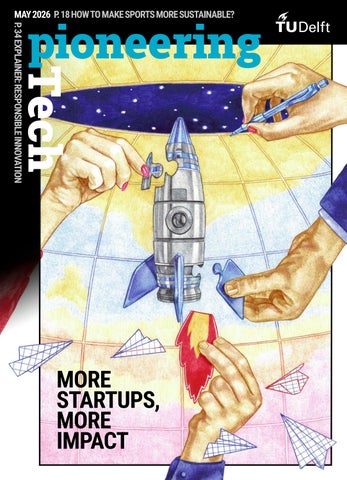
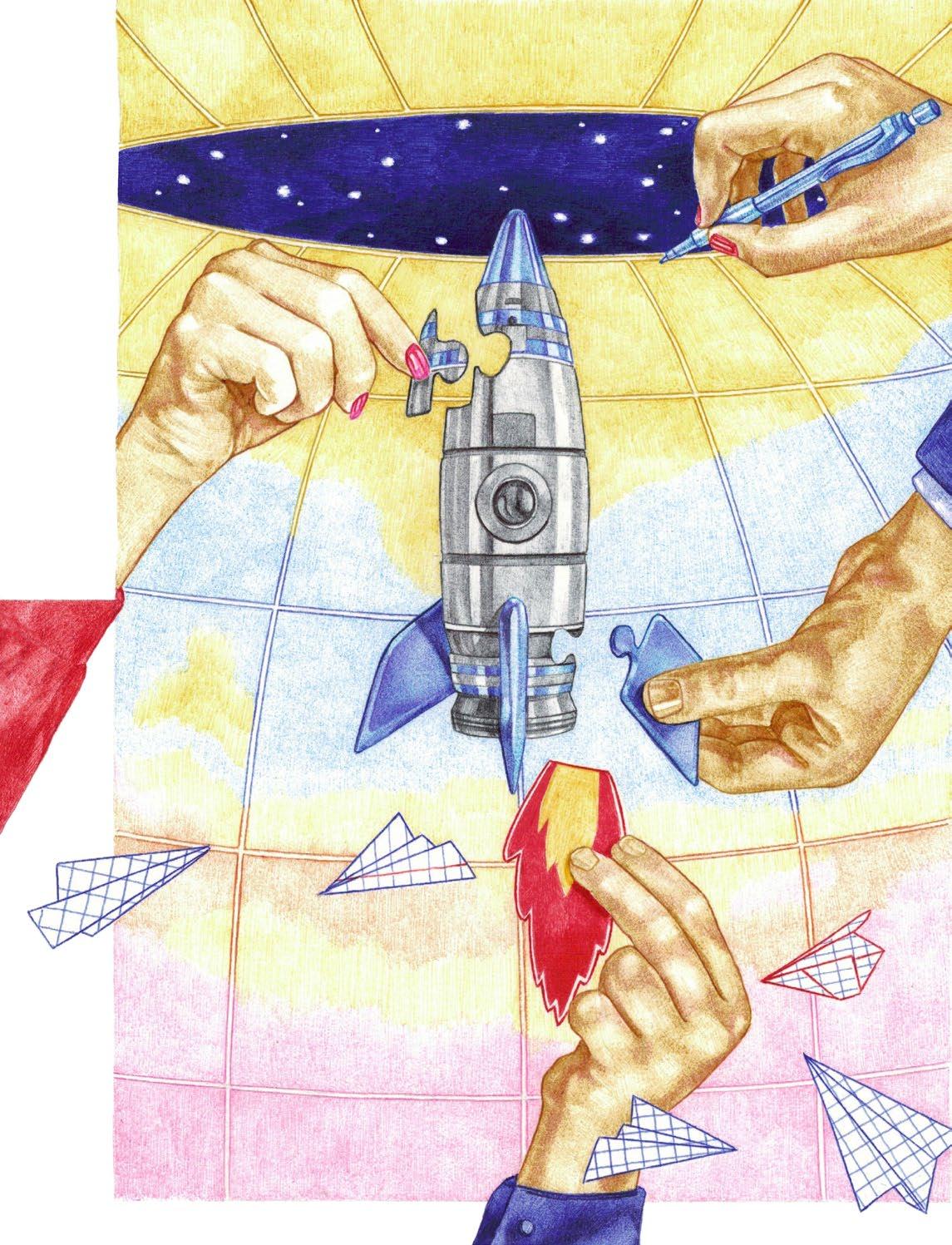
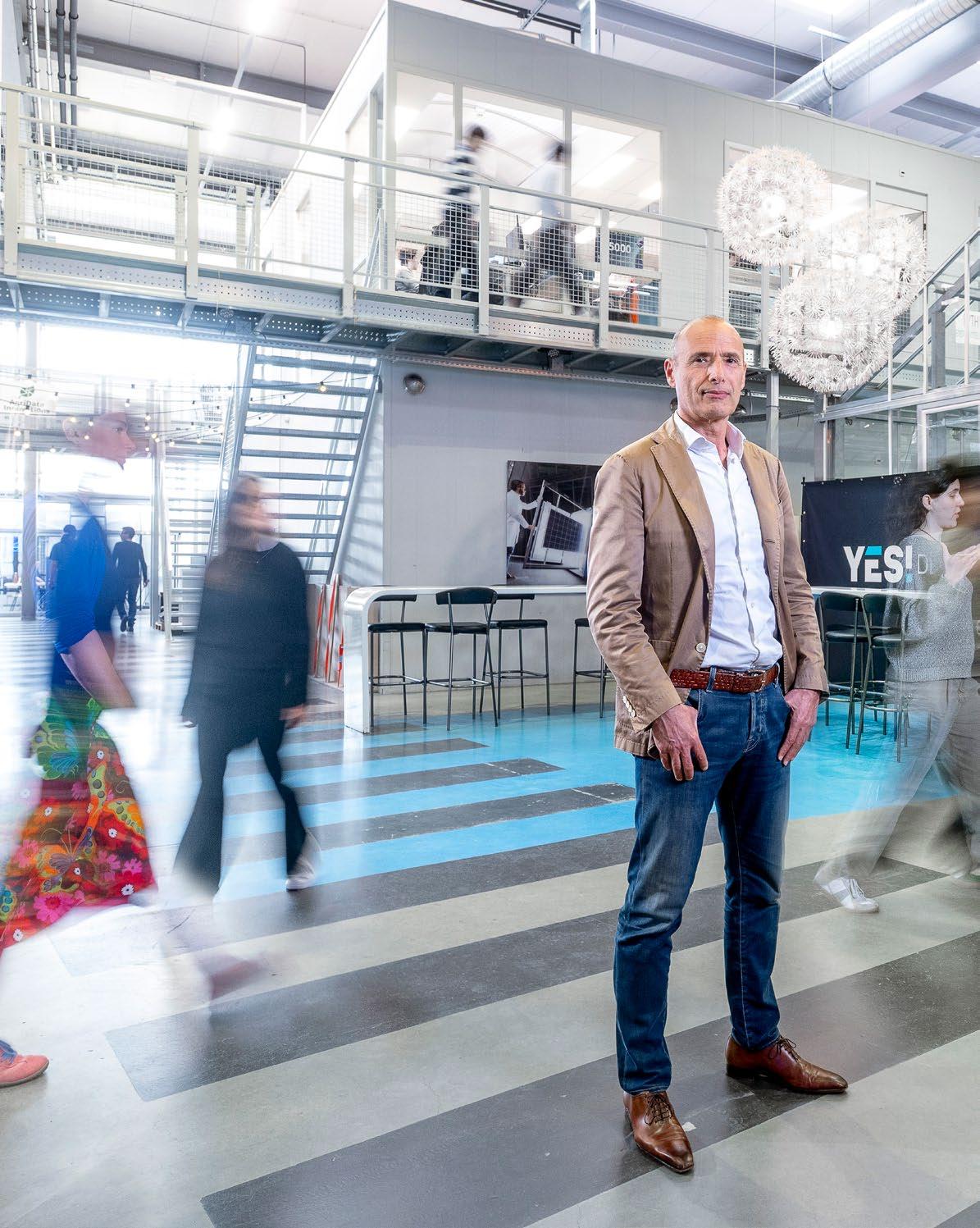
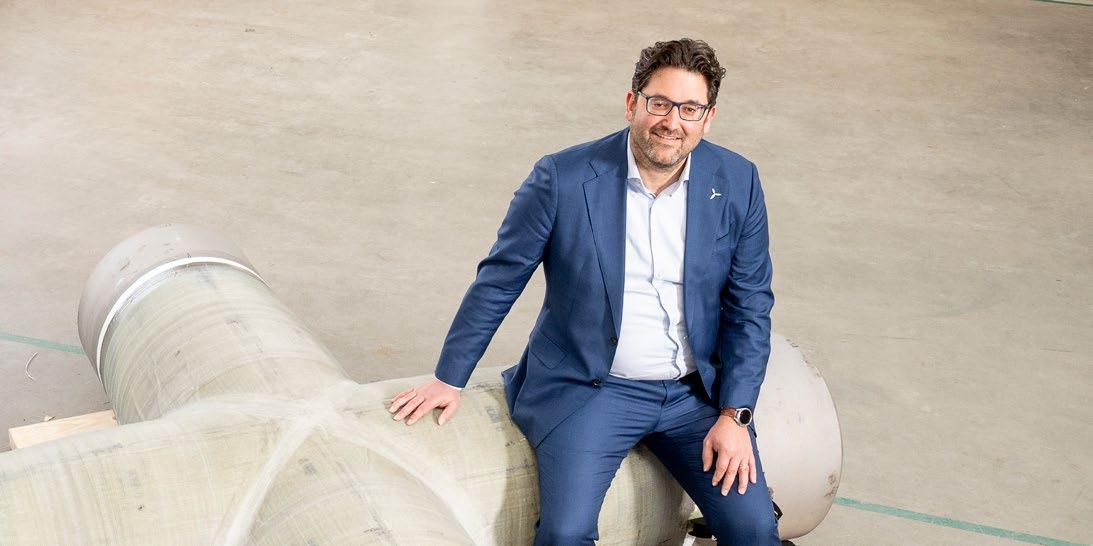
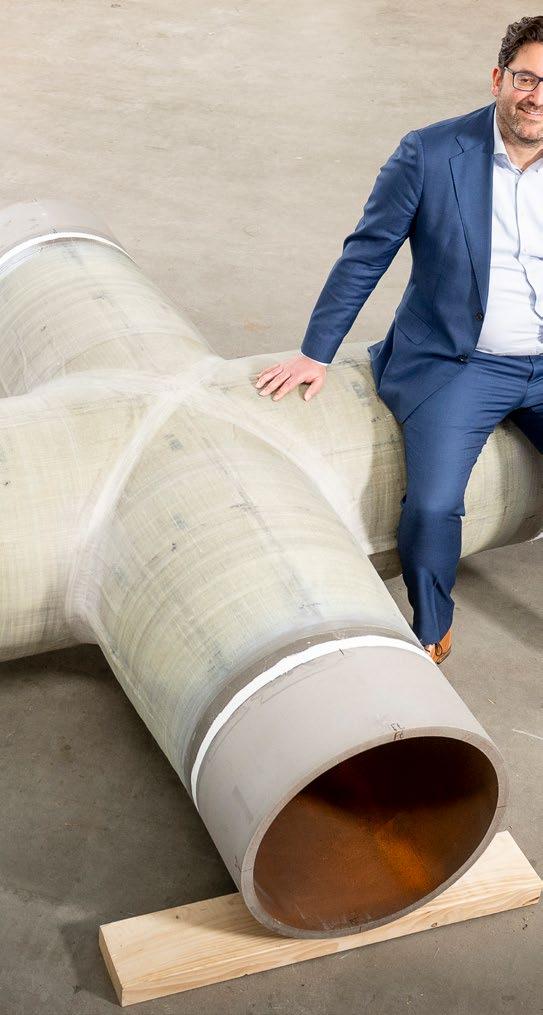
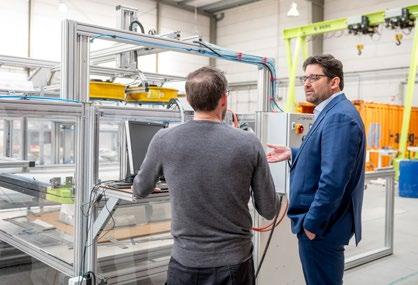
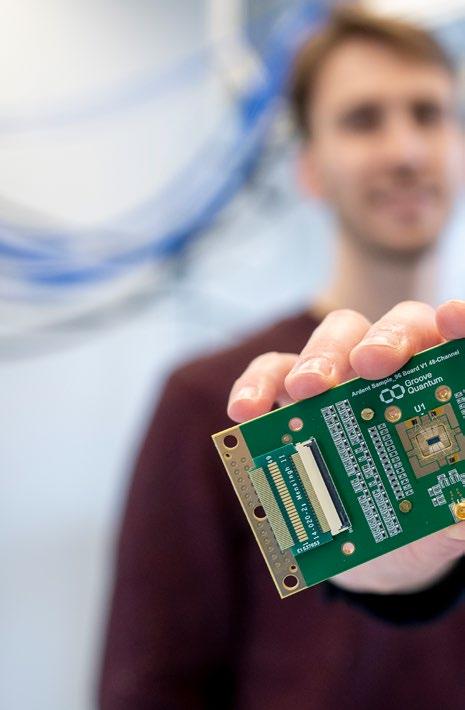
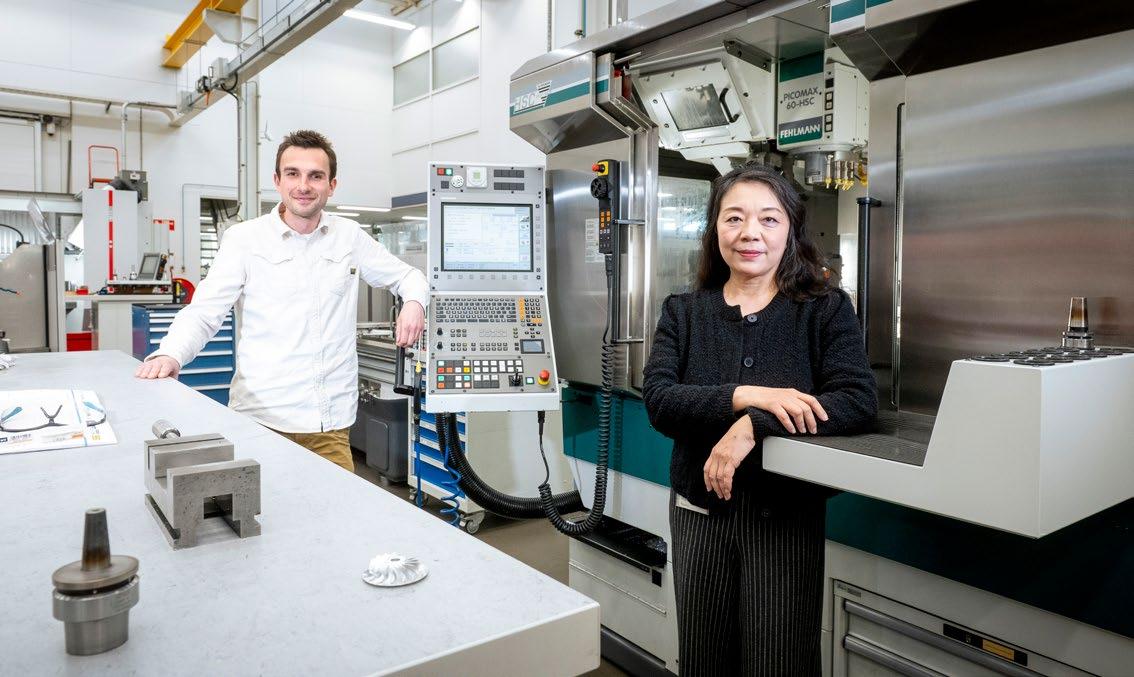
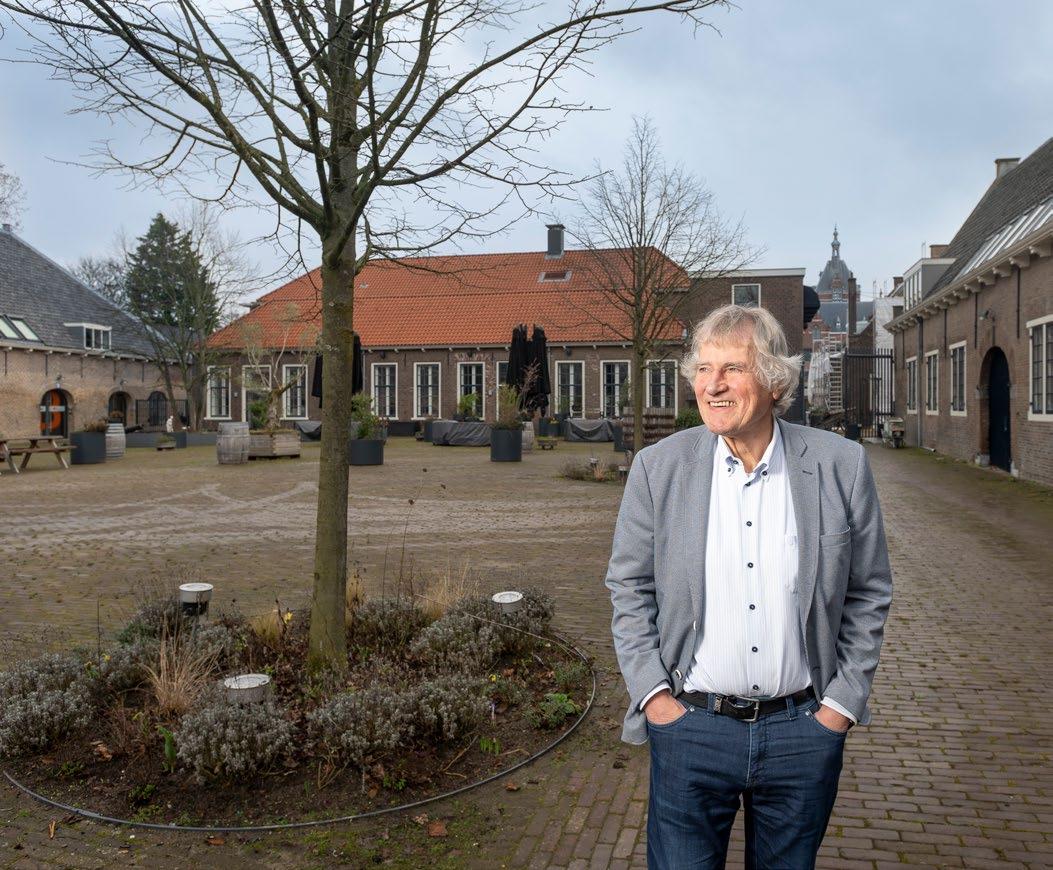
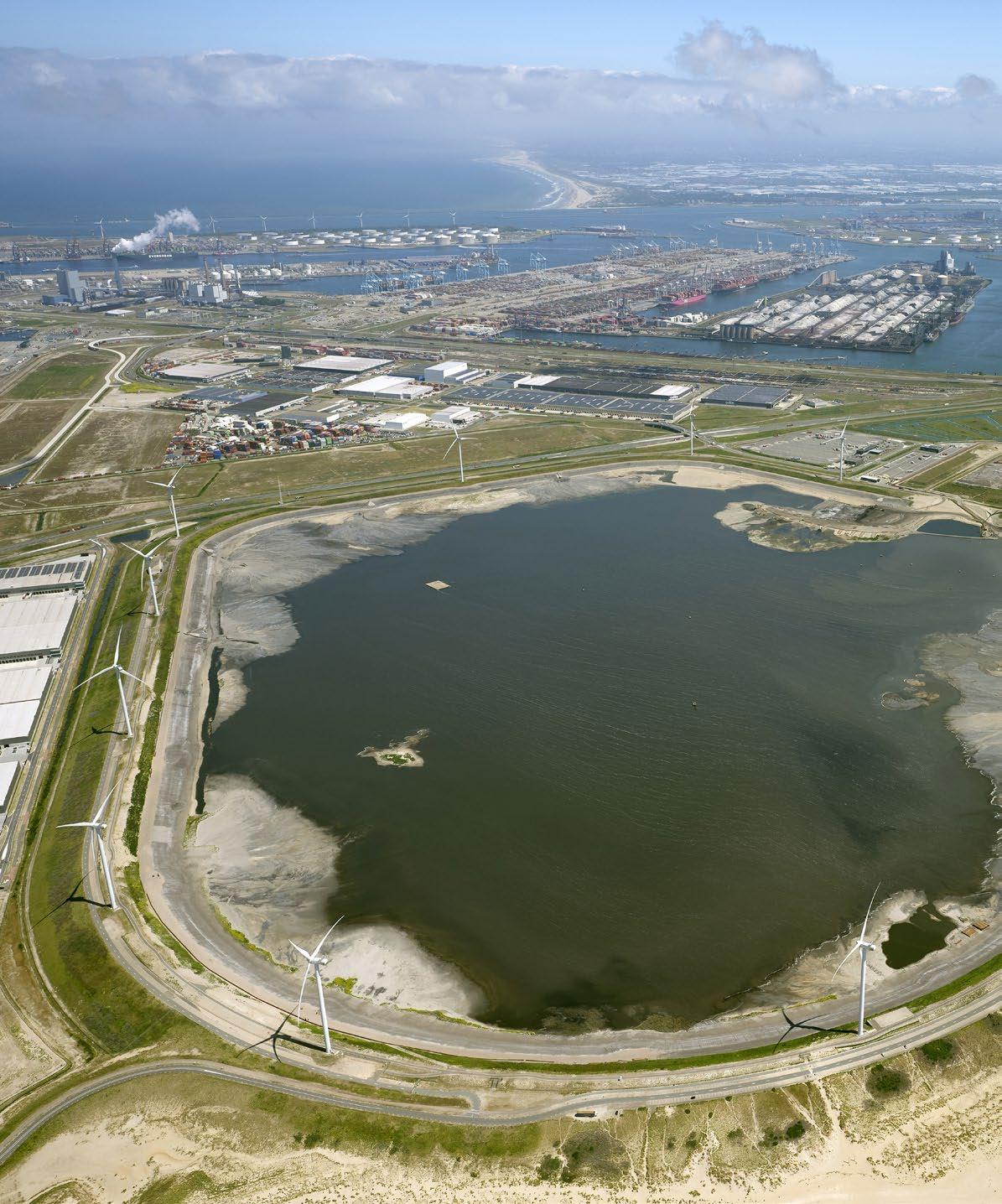
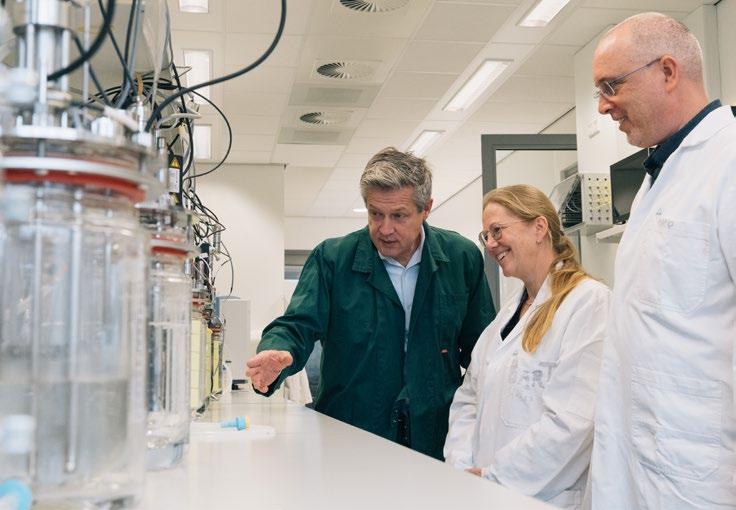
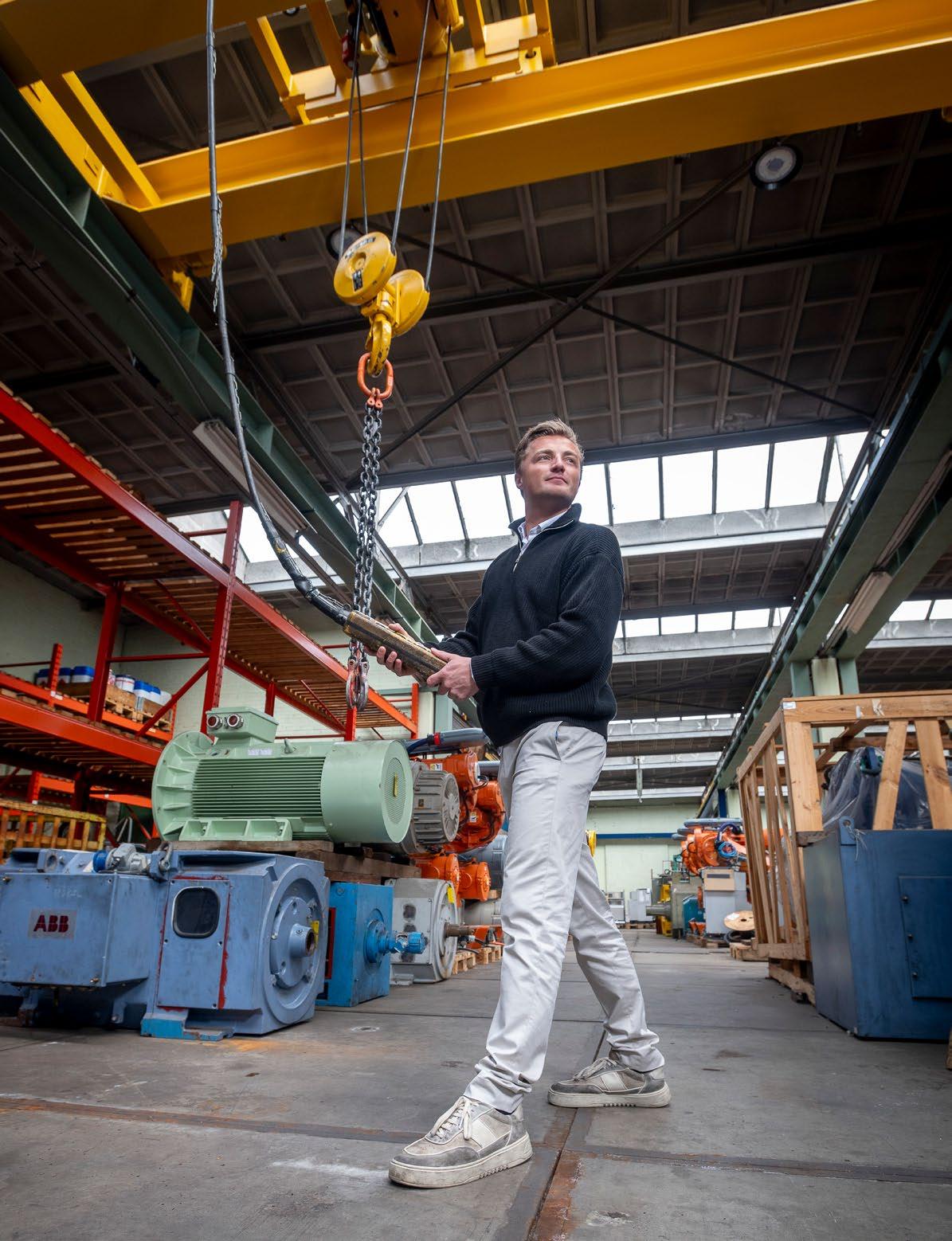
This cover reflects the spirit of entrepreneurship as an inspiring journey fueled by the coordinated effort of diverse teams and entities. I believe that when ideas are clear and powerful, there are no boundaries—as long as they are nurtured with focus, intelligence, and collective care.
By “crafting” these large-scale projects with both passion and strategy, we achieve a shared success that breaks through any barrier. For me, this illustration celebrates the beauty of collaboration and the limitless potential of a well-executed vision.
Contributing writers Leendert van der Ent, Bennie Mols, Elise Spetter, Anne te Velde, Bruno van Wayenburg
Illustrations Itziar Barrios, Anne-Roos van Ommen
Photography Erno Wientjens
Design & Art direction Ontwerpwerk
Concept De Nieuwe Lijn
Print Drukkerij van Deventer
Questions, tips and suggestions, or unsubscribe from this magazine? Send an email to pioneeringtech@tudelft.nl
Copyright TU Delft | Innovation & Impact Centre
May 2026
‘I quickly found myself at the table with the State Secretary for Sport’
4 20 years of YES!Delft
Director Ras Lalmy aims to double startup numbers
18 Sportploeg voor de Eeuw Elite athletes trained as climate ambassadors
22 DEMO: the quiet force behind Delft’s innovations At the edge of what’s possible
26 Working together - Haskoning Innovation & Education Fund Haskoning gift boosts water tech and climate-resilient delta research
8 Insights
Maxim Segeren develops composite joints for offshore structures
16 Startup Groove Quantum
24 The Investor Joop Roodenburg founded the maritime innovation hub Buccanneer
30 How SMEs innovate Van Bodegraven Elektromotoren on collaborating with TU Delft
34 Explainer Desiging technology for societal values
38 Meanwhile A quick new home after an earthquake
40 What if One car could run on any sustainable fuel?
48 Art and technology Life without a foothold
Entrepreneurial university
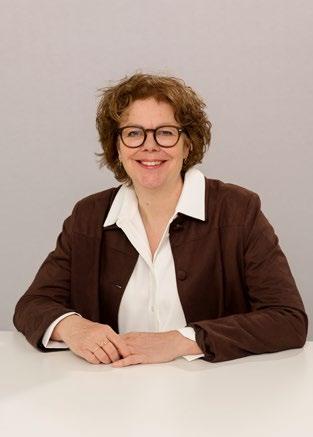
You’re used to finding a foreword by Tim van der Hagen here – and I am pleased to take over this role from him. The latest issue of Pioneering Tech is full of topics that are close to my heart.
The cover story features an interview with YES!Delft director Ras Lalmy. TU Delft has always been an entrepreneurial university, and our incubator for tech startups is the oldest and largest in the Netherlands. Tech entrepreneurs matter not only to the economic strength of the Netherlands and Europe, but also to our strategic autonomy. Ras’s ambition is to grow YES!Delft significantly in the years ahead – but what will be required to achieve this?
Another topic I’m keen to highlight is the Explainer about Responsible Innovation. With the rise of AI and the growth of dual-use applications, developing technology in an ethically responsible way is more important than ever. TU Delft is conducting pioneering research in this area, linking scientific insights with societal responsibility. This is essential at a time when technology’s impact continues to grow.
This edition also features many more inspiring stories. You’ll read about the Haskoning Innovation & Education Fund, established at the end of last year, which supports research into water technology and climate-resilient delta regions. There’s also a profile of startup Groove Quantum, which focuses on the development, operation, and integration of qubits – the data carriers for quantum computers. And in an interview, Joop Roodenburg shares his vision for the role of Buccaneer Delft as the innovation hub for the maritime and energy sectors.
Finally, I warmly invite you to visit the Pioneering Tech Platform, sign up for our newsletter, and listen to our podcast. This issue coincides with the launch of a new podcast series – don’t miss it!
Ingrid Thijssen President of the Executive Board
YES!Delft pushes for rapid growth
‘ENTREPRENEURSHIP NEEDS TO MOVE CENTRE STAGE’
By Elise Spetter
The oldest incubator in the Netherlands aims to help create 250 startups over the next five years. Managing Director Ras Lalmy doesn’t call it an ambition – he says it’s a necessity.
“If we want our own tech champions in twenty years, we need to accelerate now.”
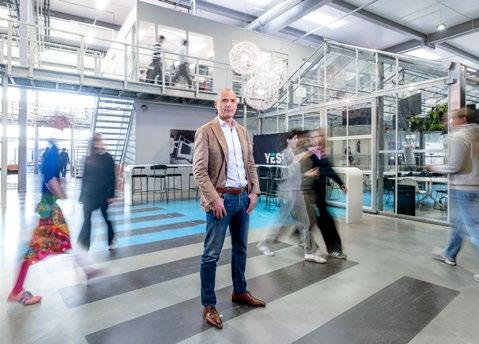
In the YES!Delft building on the TU Delft Campus, surrounded – for now – by empty fields, Ras Lalmy walks past rows of workstations where engineers are writing code, testing motors, and revising business plans. “This is a startup candy store”, he says. Lalmy became managing director three years ago, after selling his own company. He already knew the ecosystem but was surprised by what he found. “The sheer variety of highly driven tech startups. They range from space to quantum, from medical technology to cybersecurity.”
YES!Delft has supported around 500 startups over twenty years. Now, Lalmy wants to help launch another 250 new companies within five years. That’s not only a doubling of the number of startups, but of the impact too, he says. “Everything that starts here ultimately becomes a real-world solution.” This ambition isn’t coming out of nowhere. “Over the past three years, we’ve already almost doubled. We see more and more people wanting to launch a startup. The potential is there. But the system needs to keep up. If it doesn’t, a large part of that potential will remain untapped.”
Why now?
The urgency, according to Lalmy, has everything to do with what’s happening beyond the campus. For years, Europe has relied on American technology and Chinese suppliers. That model is starting to crack. The war in Ukraine, geopolitical tensions, and dependence on critical raw materials have shown how vulnerable that position is. “Governments are grappling with the question of how to safeguard our future economic strength and our autonomy”, says Lalmy. “How do we create the next ASMLs in twenty years? The answer is here. The fundamental breakthrough technologies are being developed at universities like TU Delft.”
Anyone who wants their own tech champions in twenty years needs to start now. That message now runs through in the report by former EU Commissioner Mario Draghi on European competitiveness, the Wennink report, and the Dutch coalition agreement. “The momentum is with us,” says Lalmy. But where Europe excels in science, it lags in translating that into companies. That, in his view, is the heart of the problem. And, according to Lalmy, the time to change that is now: “It’s not only possible –it’s necessary. This is a kind of perfect storm of urgency and opportunity.”
From lab to market
Universities were given a third core task in 2005: valorisation. Knowledge isn’t just to be developed; it must also find its way into society. In practice, this happens partly through academic startups. The problem is: that chain is faltering. Universities and incubators rely on patchwork funding, while the need is structural. The result: potential goes unrealised. Universities’ own estimates suggest that at least a doubling of spin-offs is possible. According to Lalmy, the problem begins right at the start of the chain. “As a university, you’re given an additional task but no structural funding. The vision in the coalition agreement is welcome, but a vision remains a vision unless we actually act on it.”
Culture
A second problem compounds this: culture. Researchers are trained primarily to conduct science, not to build businesses. “If we want more startups, we need to introduce that possibility earlier in the academic career so that creating impact through entrepreneurship becomes the norm.” In the Netherlands, we tend to undersell our ambitions, says investor Arjan Göbel, co-founder of venture capital fund FORWARD.one and former founder of Ampelmann. “Brilliant companies emerge from Delft and we invest in them gladly. But where ‘think big’ is embedded in the American entrepreneurial DNA, that way of thinking is less ingrained here.”
Arjan Göbel, co-founder of venture capital fund FORWARD.one and former founder of Ampelmann.
Dawn Aerospace: from student rocket to reusable spaceflight
Dawn Aerospace began as a project within DARE, TU Delft’s student rocket team. Co-founder Jeroen Wink and his fellow students built rockets, identified a market, and decided to go on as a company. Through YES!Delft’s Ready to Start-Up programme, the team learned about business planning, patents, and subsidies – “things that aren’t in a regular Bachelor’s or Master’s course, but that you do need,” says Wink.
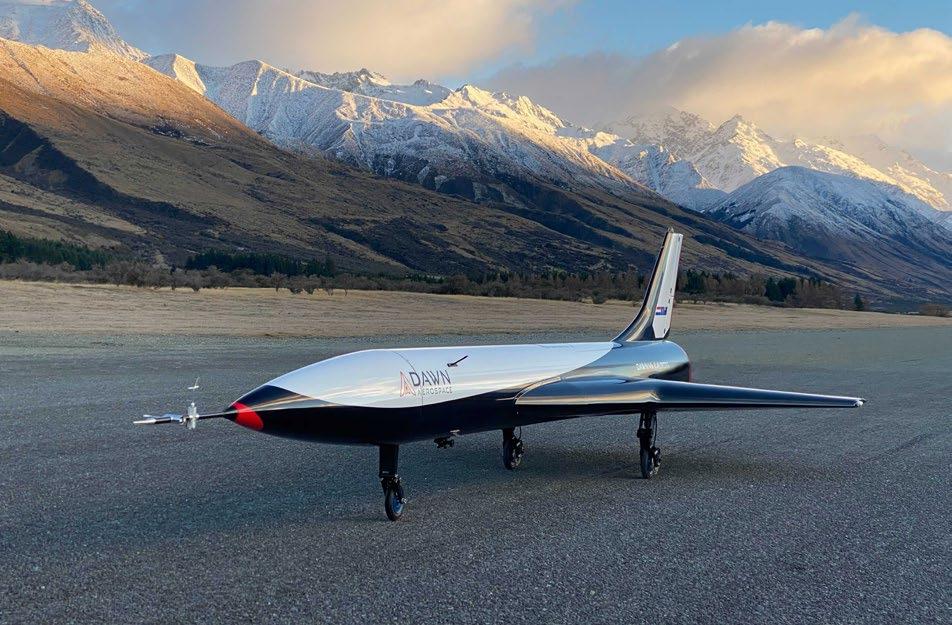
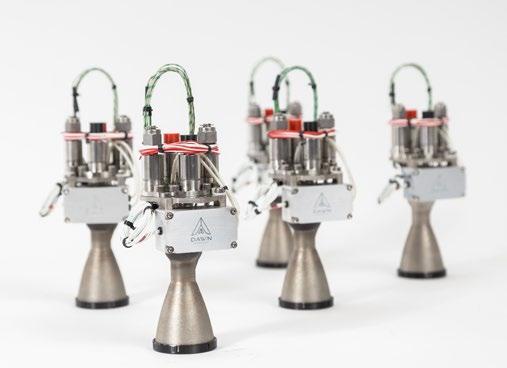
TU Delft provided the first 2,500 euros and, perhaps more importantly, the workspace and the confidence to experiment. Dawn now develops environmentally friendly propulsion systems for satellites as well as a reusable spaceplane. The company has 120 employees in Delft, Christchurch, Toulouse, and New York. The fact that it does part of its testing in New Zealand says something about Europe: in Christchurch, an experimental spacecraft can be certified as a standard aircraft; in Europe, it doesn’t fit within the regulations. Wink advocates a different approach: “Set requirements for safety, leave companies free to decide how they meet them.”
Read online how promising companies like Dawn Aerospace can scale in Europe:
Dawn’s
Below Environmentally friendly propulsion systems for satellites.
All these bottlenecks combined – insufficient funding, a riskaverse culture – come together in what Lalmy calls ‘the train’. At the front is an academic with an idea. This is followed by the step of becoming a startup, the incubation phase at YES!Delft, the scale-up, and ultimately the market. The train currently stalls at several points: too little early-stage support at the university, insufficient capacity, and a structural shortage of growth financing.
Over the past year, awareness has been growing that startups, particularly those working with sensitive technology, need better protection. For that reason, a representative of the Netherlands Enterprise Agency now regularly sits in at YES!Delft to guide startups on questions of economic security, and the Ministry of Defence has established a presence in the incubator.
Capital is not the whole story
For startups themselves, lack of capital is often cited as the greatest obstacle. But according to Göbel, the picture is more nuanced. “For the first phase, there is genuinely enough money in the Netherlands”, he says. “If you have a good team and a good story, you can raise your first million.” The problem, in his view, comes later. “When you need twenty, thirty,
Left
spaceplane: the Mk II Aurora.
TU Delft ecosystem for entrepreneurship
TU Delft has initiated a wide range of initiatives to stimulate entrepreneurship – from students to PhD candidates to professors – and offers targeted instruments to increase the chances of startup success. YES!Delft is the most well-known, but field labs, entrepreneurship education, student teams and targeted funding also play an important role.
Education
Each year, the Delft Centre for Entrepreneurship provides education in technological entrepreneurship to more than 800 students across all faculties.
Within TU Delft’s unique student teams, students gain the opportunity to acquire hands-on experience and develop groundbreaking innovations in practice. Through Executive Education, TU Delft also offers tailor-made programmes for managers from government and industry, aimed at strengthening the innovative capacity of organisations.
Field labs
TU Delft’s field labs are realistic real-world environments in which startups, companies, public authorities and researchers can test and further develop promising innovations (higher Technology Readiness Levels). The unique set-up of these living labs enables new products and services to be deployed in society at an accelerated pace.
The field labs are organised thematically: RoboHouse (robotics), The Green Village (sustainable innovation), SAM XL (robotics for XL constructions), Do IoT Fieldlab (6G and Internet of Things), Mondai | House of AI (AI), Unmanned Valley (unmanned systems), and AMS Institute (innovations for metropolitan regions). DEMO also supports early-stage companies in building prototypes.
Incubators and innovation communities
The various innovation communities offer programmes and support for early-stage entrepreneurs to validate their value proposition and subsequently scale up. They are supported by experts and a network of experienced entrepreneurs who help them explore the market and the commercial potential of the technology.
These communities provide office and laboratory space for startups, fostering cross-pollination and further increasing the chances of success.
The best-known examples are YES!Delft, the Aerospace Innovation Hub (aviation and space), Planet B.io (biotech), Buccaneer Delft (maritime), NEXT Delft (scale-ups), and Impact Studio and Impact Contest (both focused on students).
Investors
Funding is crucial for early-stage companies. Through Delft Enterprises (DE), TU Delft invests in spin-off companies: startups built around TU Delft inventions (intellectual property). DE also provides support in building the company and has an extensive network of private investors, such as FORWARD.one. In the Zuid-Holland region, numerous public investors are also active, including UNIIQ. In addition, startups are supported through European funding schemes, such as the Kansen voor West Innovation Vouchers
‘We need an entrepreneurial government that’s willing to take risks’
or fifty million, that’s very difficult in Europe. That type of capital is simply absent.”
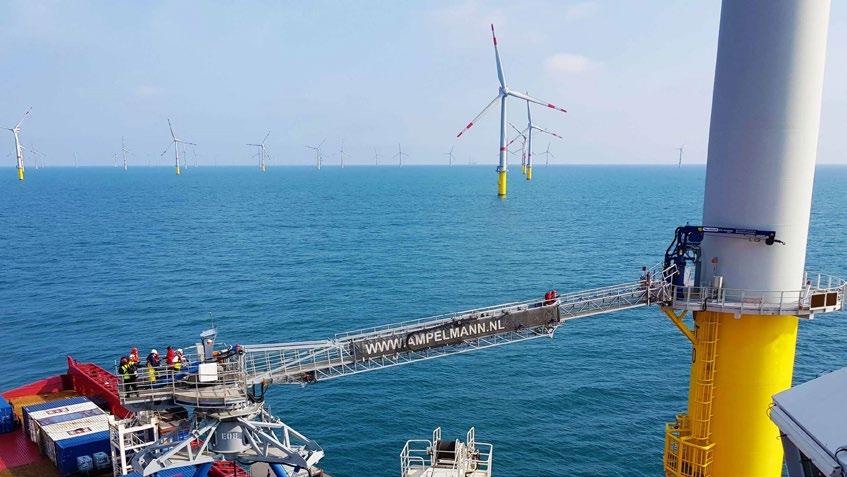
Göbel built Ampelmann in 2007 from within TU Delft –a company that made transferring people to offshore wind turbines safer and more cost-effective. Now, as an investor, he sees every day where other deep tech startups get stuck. Part of the reason is that venture capital in America is thirty to forty years older than in Europe. Investors know one another, build funding pipelines from early to late-stage rounds, and are accustomed to the risks of deep tech.
But money isn’t the only bottleneck. “The biggest difference between a startup that succeeds and one that doesn’t? The team, always the team”, says Göbel. According to him, in the Netherlands things often go wrong because of a familiar pattern: technically strong teams that keep building for too long before going to market. “We tend to think: our product is so good it’ll sell itself. That’s simply never the case.” Where American startups test and sell early, European startups often perfect their technology for too long without customer contact. “Then you’ve burned five years of funding and still have no product-market fit.”
Alongside capital and culture, regulation plays a role too. Europe consists of 27 markets with different rules, whereas the United States is a single internal market. That’s a major disadvantage for deep tech startups. “If a product works in California, you can scale up immediately”, says Göbel. “In Europe, you have to do everything 27 times over.” The exit market is also less developed. “Investors need to be able to exit eventually,” says Lalmy. In his view, these factors reinforce one another. “As long as it’s harder and more expensive to scale up in Europe, the temptation to go to the US will remain strong.”
What it takes to scale up
YES!Delft’s ambition is therefore not merely an internal growth strategy but a systemic issue. From the government, Lalmy asks above all one thing: structural funding for the incubator itself. “We operate at the very beginning of the startup pipeline, before the phase at which private investors come in. This structural task requires structural funding. But our financing is cobbled together from disparate sources. I don’t know what my budget will be for the next three years.” He also calls for a more active government. “We need an entrepreneurial government that’s willing to take risks and can act beyond existing frameworks.” From universities, he asks for greater focus on entrepreneurship. At the moment, this is largely fragmented, with no clear ownership or direction. “It starts with the University Board and the deans. They have to want this.”
YES!Delft in figures
Founded in 2005
More than 500 startups supported
Ambition: 250 startups in the next 5 years
60-70 per cent of startups originate from TU Delft or Erasmus University Rotterdam
More than 10,000 jobs created
3 shareholders: TU Delft, Municipality of Delft, Erasmus University Rotterdam
Non-profit: holds no equity in startups
Arjan Gobel
Part of a European network of university incubators including TU Munich, ETH Zurich, Oxford, Cambridge, and KTH Stockholm
Neollie: automation in neonatal care
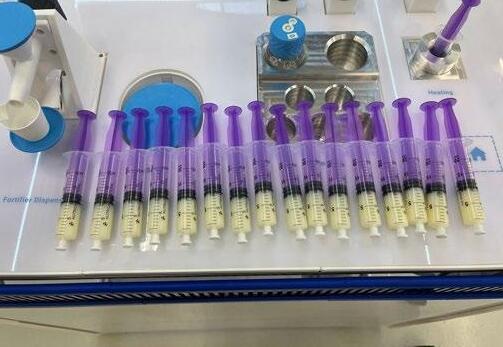
In neonatal intensive care units, nurses prepare dozens of portions of breast milk for premature babies every day – precise, time-consuming work that takes them away from direct patient care.
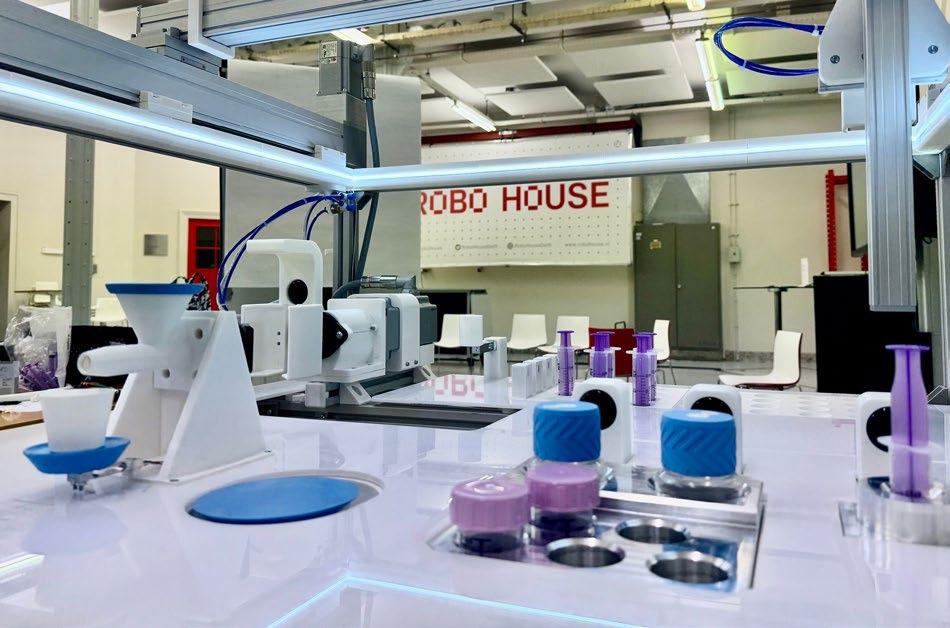
Neollie wants to change that with Neo, an automated system that prepares and dispenses breast milk, allowing nurses to get back to caring for the patient. The company emerged from the Robotics minor programme at TU Delft. Within six months, the team built a first prototype – and then the real work started. Through TU Delft, they qualified for an innovation voucher from Kansen voor West, with which they developed their technology further at the field lab RoboHouse. “We have experienced engineers here,” says co-founder Guus Hak. “You can observe how someone solves a problem. That kind of informal learning-by-watching others makes all the difference.”
A voucher is more than just money, says Hak. “It’s also recognition. A sign that you’re on the right track.”
Read online about the key role RoboHouse played in Neollie:
Lalmy also wants to change this through role models: professors and researchers who have already built multiple companies and inspire younger academics to do the same. This is already happening in countries such as Sweden. “There, every academic wants to work with the professors who’ve already built three amazing businesses.”
In Delft, the role models exist, but not yet in sufficient numbers, says Lalmy. “There should be many more of them. And they deserve full support.” He praises the many initiatives TU Delft has launched in recent years to stimulate entrepreneurship and accelerate innovation (see infographic on pages 8-9), with which YES!Delft works closely. “Over 20 years ago, TU Delft was one of the founding partners of YES!Delft and remains a shareholder to this day, alongside the Municipality of Delft and Erasmus University Rotterdam.” TU Delft is by far the number one university in the Netherlands in terms of spin-off numbers. “So things are going relatively well. But they can and must improve.”
From business, he expects engagement – not only as investors, but as clients and research partners. Large companies sometimes hesitate to work with startups, but Lalmy considers that short-sighted. “Radical innovations don’t emerge within large companies. But they have the expertise and the market reach to help startups grow.”
Neollie test setup at RoboHouse fieldlab on TU Delft Campus.
The flywheel
The system can work and, according to Lalmy, it already does. He points to the ‘flywheel’: successful entrepreneurs returning as investors, mentors, or as founders again. “That’s what makes Silicon Valley strong: founders for founders.” In Delft too, this dynamic is beginning to take shape. Former founders are starting new companies, investing in startups, or mentoring the next generation.
Munich shows that the flywheel can work. There, the technical university built an ecosystem of 1,500 startups together with its incubator, Lalmy explains. “What they’ve created there is a multiple of what we have here now.” He can already picture it: the fields next to YES!Delft fully developed, with researchers and entrepreneurs under one roof, a place where talent comes together and stays. “The potential is there. We have the expertise, the people, and the technology. There’s nothing standing in the way of doing it here too.” ■
Learn more about entrepreneurship at TU Delft:
Groove Quantum: germanium as the foundation for quantum computers
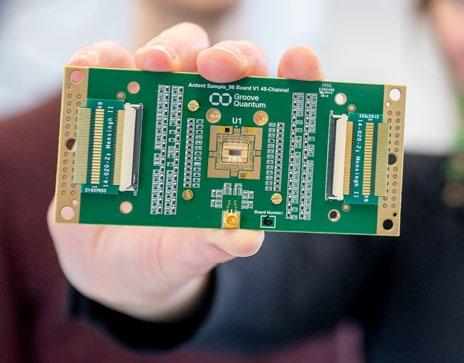
Groove Quantum was founded nearly three years ago by Anne-Marije Zwerver and Nico Hendrickx, both of whom completed doctorates at QuTech at TU Delft. The company develops quantum computers based on semiconductors –specifically germanium, a material that scales more easily to the millions of qubits required for practical applications. This enables calculations that are currently impossible, such as simulating chemical processes or optimising fertiliser production, to be carried out in hours, or even minutes.
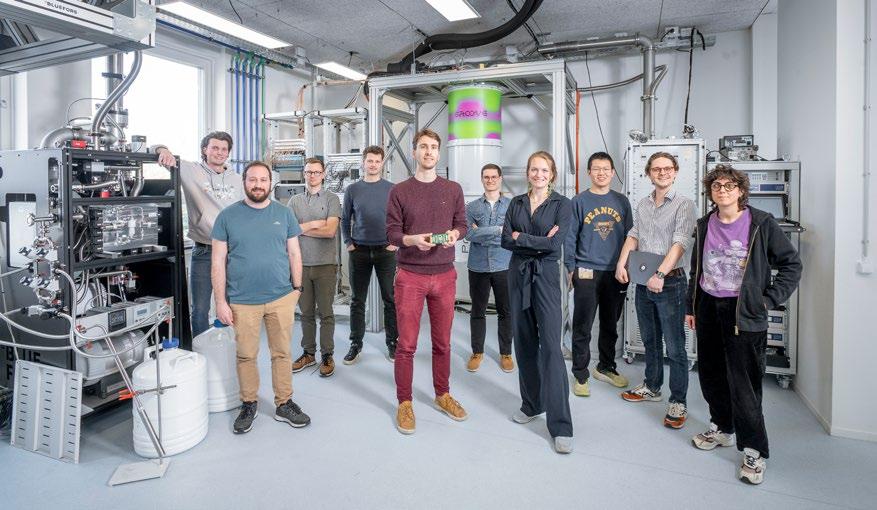
The ten-strong team already has 18 qubits operational, significantly more than other semiconductor companies. The road to a million is long, but the technology is in place. The biggest surprise as an entrepreneur? The bureaucracy. “Everyone is so afraid of state aid that it sometimes feels more like state sabotage. Many institutions don’t dare to make decisions.” At the same time, TU Delft is the breeding ground from which Groove emerged. “The professors who laid the foundations for Groove are deeply involved. TU Delft is where we were born.”
What makes Groove Quantum different from other quantum companies? Read the full interview with Anne-Marije on page 16 or online:
The Groove Quantum team.
Let’s innovate with impact for a better society
Let your organisation lead the way and collaborate with TU Delft:
■ Discover groundbreaking solutions that are not yet on the market, in areas such as AI, health, robotics and energy.
■ Join our field labs, where research, technology and practice come together at specific TRL levels.
■ Keep your organisation innovative with access to the right knowledge, expertise and.
Discover what we can achieve together.
➔ Get in touch with us
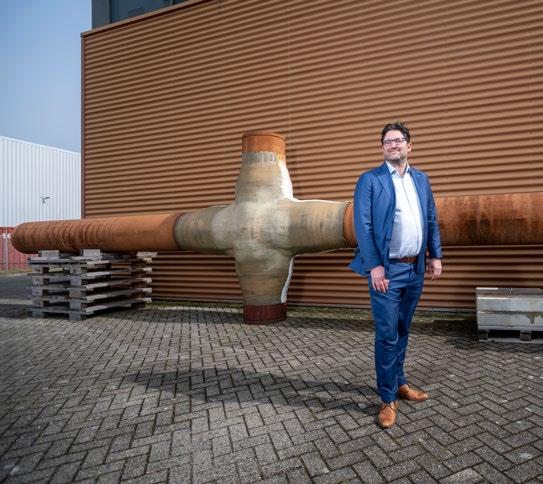
Tree Composites is developing composite joints to replace welding in large offshore steel structures. From Delft, CEO Maxim Segeren has spent five years scaling this technology. He shares eight insights on industry relevance, risk, and why he believes this technology needs to remain in Europe.
By Elise Spetter Photos Erno Wientjens
From welding to composite joints offshore
Solve the real problem
1
“We create structures that are faster to build, lighter, and cost-effective. We achieve this by replacing welded joints with composite joints. Welding steel degrades the material. To ensure the same service life, you have to add extra steel. With certain welded joints, you ultimately need to use two to as many as ten times the amount of steel to achieve that lifespan. Composite connection nodes eliminate all the negative effects of welding, preserving the steel in its optimal condition.”
From 2,000 to 1,000 tonnes
2
“We have carried out calculations showing that steel usage can be reduced by around 60%. This reduction cascades through the entire structure. A so-called jacket – the steel substructure of an offshore wind turbine – usually weighs approximately 2,000 tonnes. With our technology, we are heading towards 1,000 tonnes. We are talking about tubes with diameters of one to three metres and structures eighty metres tall. These are true mega-constructions, involving thousands of tonnes of steel per wind farm, which means every tonne saved per foundation has a significant impact.”
Write your own standard
3
“There are no existing guidelines that describe how to design this. Standards for welding have existed for decades, but not for this application of composites. We are therefore developing and writing the design rules ourselves. Over eight years, we have collected data and, together with our partners, we have drawn up a testing programme that has been aligned with a certifying body. Every source of uncertainty that could affect performance must be addressed: seawater, sunlight, scaling effects, multi-axial loading, temperature, and more. Only after modelling and testing all of these factors, you can demonstrate, with confidence, that the solution is reliable for offshore use. This is precisely what we have been working on.”
Industry involvement from day one
4
“From the outset, I asked myself: is there real market interest? Even before founding the company, we formed a consortium with ten major parties who wanted to develop this together with us. The R&D project partners include TU Delft, Vattenfall, Shell, Parkwind, ArcelorMittal, AOC, HSM Offshore Energy, Siemens Gamesa, Enersea, and GROW. From day one,
the industry provided co-financing. They contributed to the development purely to enable the technology, without influencing the company’s strategic direction. That indicates there was genuine belief in the impact – and that this is far from a minor innovation.”
5
Upscaling is more than just engineering
“For us, upscaling means industrialising production and qualifying the technology. A single wind farm consists of fifty to seventy foundations, and you have to be able to produce at that scale from the outset. Besides that, we have to deal with non-technical risks. If a vessel costing half a million per day is sitting idle because you have delivered late, who bears responsibility? These are questions you have to address as well.”
The first projects are the hardest
6
“Our greatest challenge is deploying full-scale structures at sea. A single foundation with a turbine costs 50 to 60 million. Because this is new technology, financiers carefully scrutinise the risk. Project developers are interested, but their financiers require certainty before committing. That is why space and funding for offshore demonstration projects are so important – to validate new technology in practice and accelerate adoption.”
Keep knowledge in Europe
7
“We enable the continued competitive production of offshore structures in Europe. This keeps knowledge, jobs, and strategic control over energy infrastructure within Europe. It makes sense to retain control of your own energy infrastructure rather than becoming dependent on others. Moreover, it is illogical to produce low-carbon energy using structures built from steel that has been shipped halfway across the world.”
Change the innovation climate
8
“If we were starting today, we would not survive with the instruments currently available. Breakthrough technologies require substantial support in their early stages. There needs to be more room for offshore demonstration and for innovation within tender processes. Major breakthroughs require an acceptance of learning costs. Without that space, innovation is postponed and costs continue to rise. Otherwise, everything simply becomes more and more expensive.” ■
Delft-based startup Groove Quantum is building a quantum computer based on semiconductors – the same technology found in the chips in our phones, applied to an entirely new kind of computer. Co-founder Anne-Marije Zwerver: “A quantum computer can perform calculations in minutes or hours that would take classical computers millions of years to complete.”
Groove Quantum puts semiconductor qubits firmly on the
Right Co-founder Anne-Marije Zwerver
Below
Groove Quantum develops qubits based on germanium semiconductors.
By Elise Spetter Photos Erno Wientjens
What does Groove Quantum do exactly, and what problem are you solving?
“We build quantum computers. They’re needed because there’s a class of problems that classical computers could theoretically solve but would take millions of years in practice. Think of simulating chemical processes – developing medicines or optimising fertiliser production. Fertiliser production alone consumes around two per cent of the world’s energy, even though we know it can be done more efficiently. A quantum computer can perform those kinds of calculations in minutes or hours.”
Quantum sounds abstract. How do you explain it?
“A normal bit is either 0 or 1. A quantum bit – a qubit – can be 0 and 1 simultaneously. That’s impossible to visualise, even for me. But you can still compute with it. If you couple two qubits, you can examine four states at once. With three, you get eight. It scales exponentially.
A quantum computer doesn’t search through all possibilities one by one; it can, in a sense, explore multiple routes simultaneously. That’s what makes it so powerful for certain calculations. It has fascinated me since I was fifteen.”
What makes your approach different from other quantum startups?
“There are various ways to build qubits –using superconductors, photons, or, as we do, semiconductors. We believe semiconductors are the key to scalability, because they’re the same technology that made conventional computers so small and powerful. That industry has built up eighty years of expertise in manufacturing and integrating chips uniformly, reproducibly, and in large numbers – expertise we can apply directly to our qubits. Specifically, we use germanium rather than silicon. Germanium scales better and produces higher-quality qubits. We currently have eighteen operational qubits – more than any other semiconductor qubit company.”
For which applications can a quantum computer make a real difference?
“What fascinates me most compelling is the pharmaceutical angle: developing better
‘Semiconductors are the key to scalability’
medicines that aren’t possible today. But materials optimisation for solar panels and batteries, or more efficient fertiliser production, are equally fascinating. Many companies are starting to explore quantum technology – financial institutions are exploring applications such as portfolio optimisation. Closer to home, grid operator Alliander is looking at ways to optimise the electricity grid. The applications are wide-ranging, and which application takes off first will also depend on who the first customers turn out to be.”
When did the idea for Groove come about?
“It didn’t really start with me. My co-founder Nico Hendrickx was working on germanium qubits during his PhD, while I was working with silicon. The results were so strong that the idea of turning it into a company gradually took shape – partly driven by three professors and a patent lawyer who felt we should do something with it.
I’d previously worked at a startup through YES!Delft, but the quantum world was too compelling to leave behind. When we eventually won a European investment grant, that was the moment we decided to go for it. We both quit our jobs and committed to Groove full-time.”
What
was the biggest surprise as an entrepreneur?
“Two things. On the positive side: our team. We’d never hired anyone before, which was quite daunting – the first employees in a company are crucial. But every one of them has been outstanding, each bringing their own talent. On the negative side: the bureaucracy. Everyone is so afraid of state aid that it sometimes feels more like state sabotage. Institutions tend to pass responsibility around between themselves, unwilling to make decisions. The result is a vicious circle in which we’re sometimes sent from one place to another five times, only to end up back where we started. I accept that oversight is necessary, but that it should take months – that I still can’t get my head around.”
Deep tech requires patience. How do you manage that as an entrepreneur?
“You need investors who understand that too. This isn’t a sprint but a marathon. We were very deliberate in choosing partners with expertise in deep tech and the patience it demands. We also try to be realistic about our timelines. There are quantum companies promising a million qubits within two years. That’s simply not credible.
We say what we’ll do and we do what we say. We’re slowly building that into a track record, and it’s becoming more and more important.”
When will Groove Quantum count as real success to you?
“We’ve put semiconductor qubits on the map as serious technology. The next step is to compete with all other qubit technologies and come out on top. In five years, I want people to say: when the quantum computer arrives, it will be built by Groove.” ■
One per cent of the Netherlands consists of sports fields – land that could contribute to the energy transition. Yet that potential remains largely untapped. According to Daan Bregman and rower Laila Youssifou of the ‘Sportploeg voor de Eeuw’, a programme that trains elite athletes to become climate ambassadors, this needs to change. “If we do nothing, our grandchildren won’t be able to play sport outdoors.”
How rower Laila Youssifou wants to make sport more sustainable with a Delft-based approach ‘You fly across the world for a single competition’
By Elise Spetter
When you open the NOS news app, you will find three sections: Domestic, International, and Sport. Sport is the only section with a permanent place alongside the news. That shows how deeply it resonates with society, according to Daan Bregman, Managing Director of the TU Delft Sports Engineering Institute. “Everyone has an opinion on it,” he says. “That’s what allows you to connect technology and scientific expertise to something people already love.”
That idea is at the heart of the Sportploeg voor de Eeuw (Sports Team for the Century). The programme trains elite athletes to speak knowledgeably and confidently about climate change and sustainability, driven by intrinsic motivation rather than a sponsorship deal. “We build their expertise in climate and teach them how to engage in public debate. But the decision to speak out has to come from within,” says Bregman.
Sport under pressure
Sport’s vulnerability to climate change is already visible. Artificial turf pitches become dangerously hot in summer. The Nijmegen Four Days Marches was cancelled for a day in 2022 because of the heat. Winter sports can be practised in fewer and fewer places. And at the Australian Open, matches had to be suspended due to extreme heat. “If we do nothing, our grandchildren won’t be able to play sport outdoors”, says Bregman.
But sport also presents opportunities. That one per cent of land area taken up by sports fields is owned by municipalities and can be used for the energy transition, climate adaptation, and biodiversity. Bregman cites the collector field as a concrete
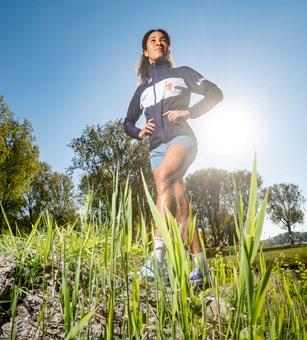
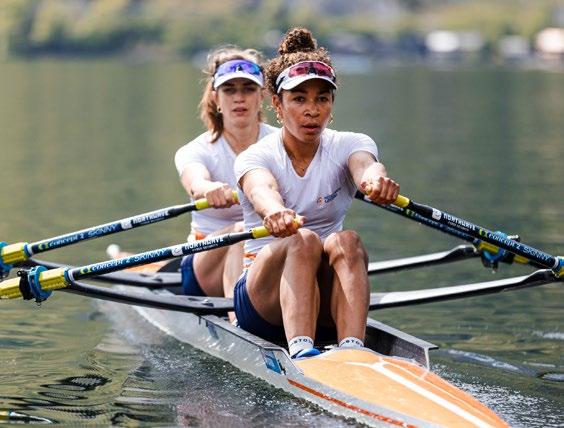
Above Laila Youssef training in Obertraun, Austria.
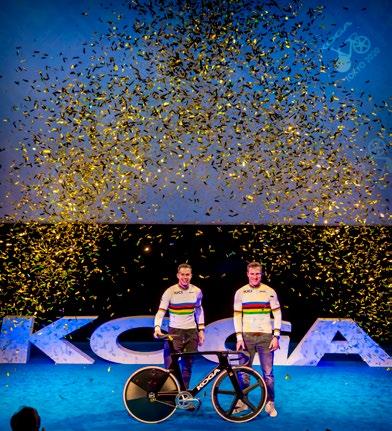
Left TU Delft contributed to the development of KOGA’s Olympic track bicycle.
TU Delft Sports Engineering Institute
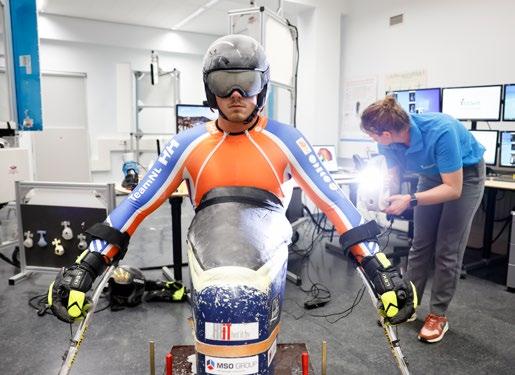
The TU Delft Sports Engineering Institute connects different faculties of the university around the theme of sport. The institute previously worked on the time-trial skinsuit in which Tom Dumoulin won the Giro d’Italia, the track bike for the Dutch Olympic team, and the sit-ski used by Paralympic skier Jeroen Kampschreur. Alongside elite sport projects, the institute is increasingly focusing on societal issues such as climate, mobility, and health. The development of the Sportploeg voor de Eeuw involved close collaboration within TU Delft with the Executive Education department, which develops bespoke training programmes for professionals.
example: pipes beneath a sports pitch capture heat, cool the surface, and store energy that can later be used to heat clubhouses or surrounding neighbourhoods. “You kill two birds with one stone: cooler pitches and reduced fossil fuel use.”
Rowing and travelling
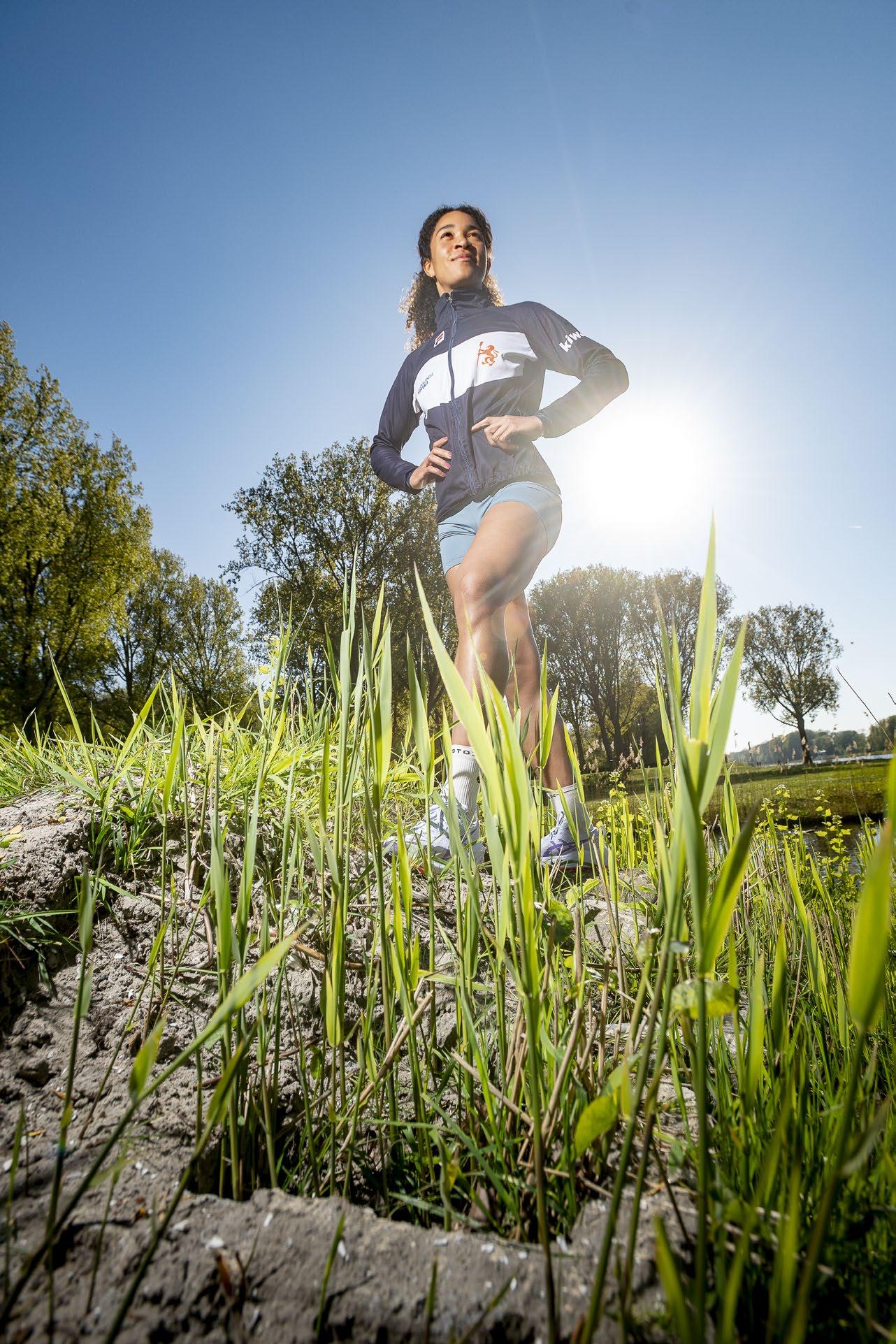
Laila Youssifou (30) knows what it means to lead a highly unsustainable lifestyle as an elite athlete. The former rower – an Olympic medallist in Paris – combined elite rowing with studying Civil Engineering at TU Delft. She always had an interest in nature and sustainability, but during her sporting career she was conscious of a contradiction. “As an elite athlete, you lead a lifestyle that’s not sustainable at all. You fly a great deal and constantly move people and equipment to the other side of the world.”
That sense of hypocrisy held her back from speaking out. Now that she’s retired from elite sport, she feels freer. “Precisely because I’ve stopped competing, I feel less hypocritical about expressing my views. I didn’t really know how to do it in a way that would come across well.”
When the invitation to join the Sportploeg voor de Eeuw arrived, she didn’t need long to decide. “It brought together a lot of things I care about: elite sport, sustainability, and technology. And because it’s organised by the university where I studied, it appealed to me immediately.”
Influence on one’s own terms
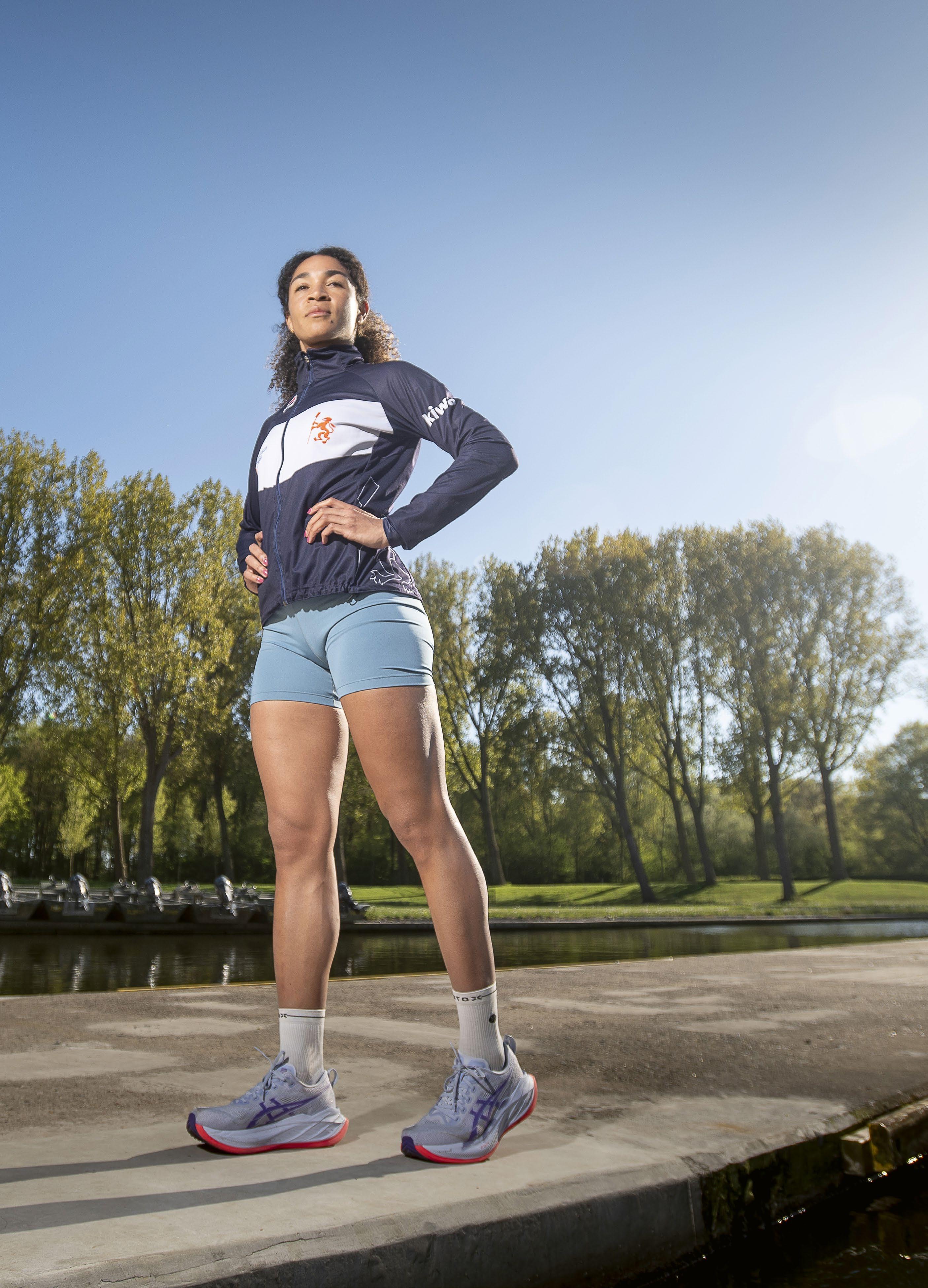
Youssifou doesn’t see herself as a social media activist. She sees more value in engaging directly with decisionmakers. Her first encounter with the Sportploeg was telling. “I quickly found myself sitting at the table with the State Secretary for Sport. That went right to the heart of what I want: to have influence where it truly matters.”
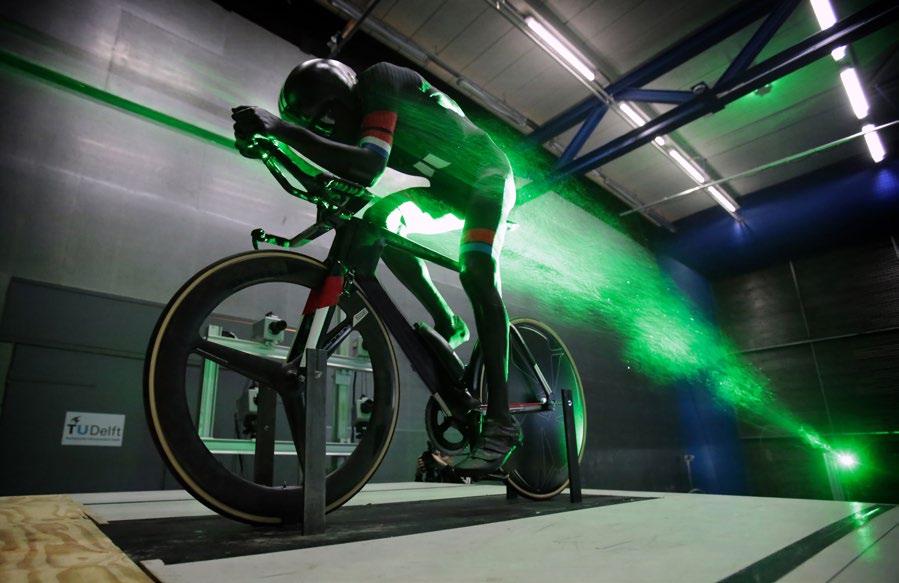
Left Tom Dumoulin in the windtunnel.
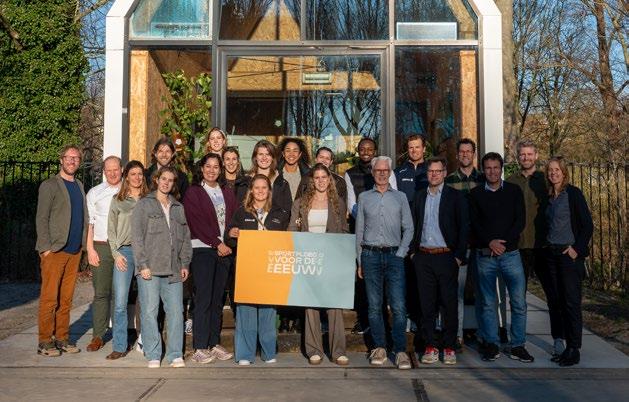
Right (page 21) The Sportploeg voor de Eeuw at The Green Village on TU Delft Campus.
‘Athletes experience first-hand how climate change affects our society’
She sees the greatest opportunities for sustainability in athletes’ travel habits and transport of equipment. Training camps abroad, international competitions, equipment shipped from one side of the world to the other. “That’s true across all sports.” At the same time, she acknowledges the dilemma: a new boat is simply faster than an old one. “When you have to perform in an Olympic final, you choose performance above all else. That’s the contradiction between elite sport and sustainability. But that’s also what makes it interesting.”
Her ideal scenario is that the 2026 World Rowing Championships in Amsterdam become a defining example of sustainable sporting events, and that this approach is adopted by World Rowing, the international rowing federation. “How cool it would be if TU Delft collaborated with World Rowing to make rowing events more sustainable. If rowing can do it, so can canoeing – and open water swimming after that. That’s how you create a snowball effect with the potential to influence society as a whole.”
Bringing things together
The Sportploeg is now on its second cohort. This year, 22 athletes are taking part, including Jacques Brinkman, Jochem Uytdehaage, Noor and Bregje de Brouwer, Maartje Paumen, and Lidewij Welten. By 2028 – a hundred years
after the Olympic Games in Amsterdam – the programme aims to have grown into a network of eighty athletes.
Bregman regards the Sportploeg as more than an education programme. It’s also valorisation: turning scientific knowledge into societal impact. “Valorisation doesn’t always have to take the form of a product or a start-up. This too is a way of bringing expertise to society, through sport’s visibility and broad reach.”
The next step is modelling scenarios: what would it actually achieve if all sports fields in the Netherlands were put to maximum use for the energy transition, climate adaptation, or biodiversity? “So that we not only have inspiring examples, but also know what the real impact could be.”
That requires collaboration – between government, business, science, and sport. Companies identify what they need, researchers model it, and government translates it into policy. “When you work in concert, you can move much faster.” ■
Kees Vendrik, National Climate Platform
Nine million people gather at sports fields every week. This reach makes sport a natural vehicle for climate action, according to Kees Vendrik, chair of the National Climate Platform. “Athletes experience first-hand how climate change affects our society. They also see and feel its effect on their performance.”
He sees sports clubs as partners in the energy transition. “There are already good examples: clubs that have set up an energy cooperative, installed a neighbourhood battery, or use a collector field to supply heat to the surrounding area.” In Vendrik’s view, collaboration with TU Delft is essential. “Anyone with a technical background who visits the Green Village on a sunny day and sees how hot artificial turf becomes immediately sees the opportunity.”
DEMO: the quiet force behind Delft’s innovations
By Bennie Mols Photos Erno Wientjens
With state-of-the-art equipment and creative staff, the Department of Electronic and Mechanical Development (DEMO) produces innovative designs, prototypes, demonstrators and test setups for both TU Delft and external partners.
From a medical needle inspired by the stinger of a parasitic wasp, to a transparent measurement setup for fluid flow, and a full-body exoskeleton that enables patients with spinal cord injuries to walk again – these are just a few examples of innovations made possible in part by TU Delft’s Department of Electronic and Mechanical Development (DEMO).
“DEMO is an innovative partner for TU Delft scientists,” says Zhao Fu, Director of DEMO. The division primarily supports research and education at TU Delft. Fu: “Every day, new projects come in, ranging from aerospace to quantum technology and civil engineering. We support our clients throughout the entire development cycle, from initial idea and grant application to prototype or test setup, and we can step in at any stage of the process. We have an in-depth understanding of research at TU Delft and go beyond standard technical solutions.”
External clients
In addition to its work for TU Delft, DEMO also takes on projects for external clients. Fu: “We collaborate with organisations such as ASML, TNO, the Netherlands Institute for Space Research (SRON), Erasmus MC and a range of startups. What characterises these projects is that they often require an out-of-the-box approach.”
Less widely known is that DEMO also advises TU Delft researchers on their funding applications. The division can assess the feasibility of ideas, estimate development costs or create 3D models. In doing so, DEMO designers strengthen proposals and increase the likelihood of securing research funding.
Pushing the boundaries of what’s possible
Wouter Gregoor works as a design engineer and project manager at DEMO. At DEMO’s EWI site – equipped with advanced computer-controlled manufacturing machines –he showcases several examples of innovative designs.
“Here you can see the needle inspired by the stinger of a parasitic wasp,” Gregoor explains. “The needle consists of tiny, elongated segments that move up and down one by one, gradually propelling it into the body. For designs like this, it is crucial to continuously iterate between design and
DEMO in brief
→ Name
DEMO stands for the Department of Electronic and Mechanical Development. It is a TU Delft support division
→ Mission
DEMO advances experimental technical and scientific education and research at TU Delft by developing and manufacturing unique experimental setups and prototypes
→ Location
Six locations across TU Delft Campus. Main location: EWI, Mekelweg 4, 2628 CD Delft
→ Number of staff 85
→ Collaborating partners
Including TNO, Intel, SRON, Fokker, ProRail, APM Terminals, ASML, Deltares and Erasmus MC
manufacturing. You’re pushing the boundaries of what’s possible. Commercial manufacturers would quickly say: we’re not taking this on—it’s too complex, and the risk of failure is too high. Our strength lies precisely in these kinds of out-of-the-box designs.”
Beyond operating at the cutting edge of what is technically feasible, the wide variety of projects and clients is a major draw for DEMO’s engineers. “For years, I worked on exoskeletons and other active orthoses,” says Gregoor, “but now I’m designing an instrument for a large telescope in Chile.” This instrument,
Above Director Zhao Fu (right) and engineer Wouter Gregoor.
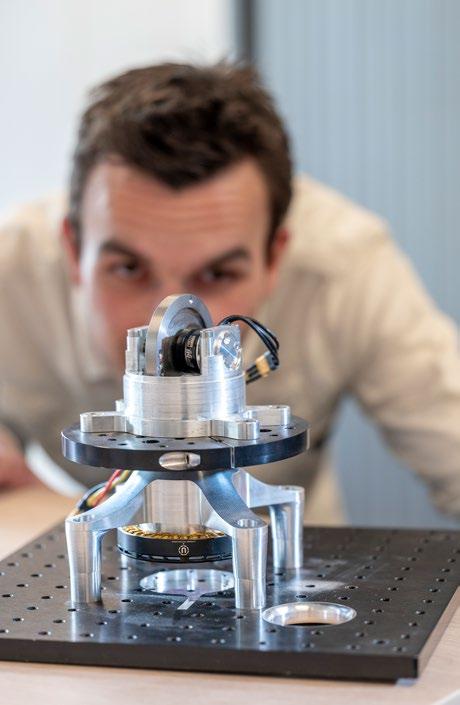
Left A proof-of-principle test setup for a gyroscope with medical applications.
called TIFUUN, will measure far-infrared starlight and help map the early universe as it appeared some 0.6 to 1.2 billion years after the Big Bang.
Multidisciplinary collaboration
DEMO is working on this project together with EWI researcher and experimental astronomer Akira Endo and with SRON. Gregoor: “An earlier version of the instrument, DESHIMA, could measure only a single pixel. TIFUUN will be able to measure dozens of pixels, significantly improving the accuracy of observations. Developing this instrument requires high-level multidisciplinary collaboration with researchers, experts and suppliers – and that is exactly where DEMO excels.”
Societal impact
Director Zhao Fu hopes that DEMO will be involved in research projects as early as possible in the future. Fu: “With our knowledge and experience, we can make an even greater contribution to both research at TU Delft and its impact on society. By taking care of the technical side of innovation, we enable scientists to focus even more on their research. We warmly invite others to collaborate with us on innovation.” ■
The Buccaneer the investor
‘HAPPY BUCCANEER’ JOOP ROODENBURG IS THE DRIVING FORCE BEHIND MARITIME INNOVATION
By Anne te Velde Photos Erno Wientjens
In an old artillery depot in the centre of Delft, Joop Roodenburg, former CEO and President of Huisman, has created a vibrant ecosystem for innovation and entrepreneurship. Now, ten years later, Buccaneer operates as an innovation hub accelerating innovation in the maritime, offshore, and energy sectors, connecting startups directly with businesses, government, and research institutions that can apply these innovations. The focus isn’t on experimentation for its own sake, but on what’s technically, economically, and operationally feasible.
The Buccaneer is housed in the former artillery barracks at Paardenmarkt, in Delft’s city center.
How did the idea for this place come about?
“It happened the same way everything in my career has: seeing opportunities and building on what’s already there. In 2013, I was walking past this complex with my wife. She said, “I’d love to live here.” As it happened, there was a ‘For Sale’ sign. Before I knew it, I was the lucky owner. I organised a barbecue for my network to think about what this place should become. That resulted in 140 ideas, with a common thread: startup entrepreneurs, bringing people together, the energy transition, and the maritime sector.
Now there are innovative startups based here, meeting and event space, a good restaurant – Kruydt – and I live here with my family.”
What drove you to start something like this after a successful career?
“My fascination with technology and entrepreneurship, and my drive to take that further. I grew Huisman from a small company in Schiedam to a large international business with factories in the Czech Republic, China, and Brazil. Huisman is known for its cranes, pipe-laying systems, and drilling equipment for the offshore sector, but also developed products for tidal energy, geothermal energy, and the wind industry. Technology is my passion; I’ve applied it primarily in the offshore energy and maritime sectors. With Buccaneer, I wanted to build on that.”
Where does the name Buccaneer come from, and what happens here?
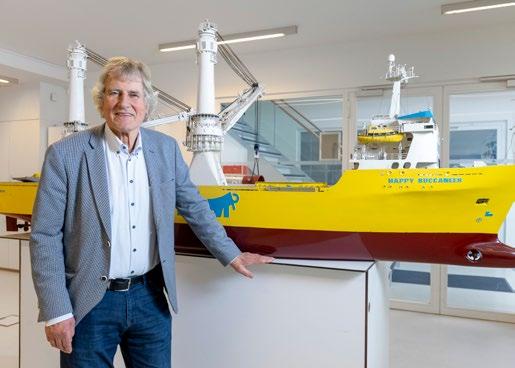
“The first vessel Huisman equipped with high-capacity cranes was called the Happy Buccaneer. We went on to sell more than a hundred worldwide. After ten years, in 1990, we turned a profit for the first time. The name Buccaneer carries very positive associations for me. Buccaneer is currently home to around sixteen startups. Above all, it’s a place where we bring together people from our network who wouldn’t naturally cross paths.”
Buccaneer has now been running for ten years. Can you give some examples of what’s been achieved here?
“A number of innovative companies have been based here and have since flown the nest. A good and successful example is Tree Composites (see page 14-15). Speed isn’t the main goal –we want to build sustainable companies. We do that by offering companies space, helping them sharpen their propositions, and connecting them to a network they’d otherwise struggle to reach.
You’re based in Delft, not far from TU Delft, other knowledge institutions, field labs, and incubators such as YES!Delft. How does Buccaneer collaborate with these players?
“For example, by organising events around current themes, where researchers and entrepreneurs can meet – people who wouldn’t otherwise cross paths. And YES!Delft spinouts in the maritime or offshore sectors can come to Buccaneer. Collaboration could be strengthened further by exploring more actively how innovations can respond to changes in the market. That’s how we reinforce the link between research and entrepreneurship. We make more impact together when everyone involved focuses on their own niche and works well together.”
Joop Roodenburg
(1950) studied Mechanical Engineering at the HTS (a Dutch technical college) followed by a degree in Mechanical Measurement and Control Engineering at TU Delft. He was CEO of Huisman Equipment from 1980 to 2015 and president from 2015 to 2023 – a global player particularly known for its technologically advanced cranes for vessels in the offshore sector. In 2019, TU Delft named him Alumnus of the Year.
In their reports on future economic competitiveness, Draghi and Wennink call for a domestic manufacturing industry to maintain strategic autonomy. Do you agree?
They’re right. To remain relevant, you need your own manufacturing industry – you can’t innovate without making something. But that requires space to produce. The current business climate isn’t favourable. That’s why companies go abroad. And then you’re criticised for producing in China rather than in Europe. But in China there’s space to produce, the technical craftsmanship is there, people work hard, and you can make money. In the Netherlands, housing is built around production sites, and that creates problems.”
What more can the government do to strengthen the manufacturing industry?
“Consistent policy is crucial. And space for companies to produce. Things are going relatively well in Delft – space is being allocated for manufacturing businesses. That’s not the case everywhere. Technical expertise is also essential, including within government, to actually deliver on those ambitions. That expertise is often lacking when it comes to understanding what technical entrepreneurs are working on and what they need.”
What would you like to pass on to Buccaneers for the future?
“Always stay curious and keep an eye on developments in the market. Don’t focus only on grants – focus on what the market is asking for. Make an effort to understand others and know what drives them. To get something off the ground, you need to come together physically: brainstorm, test designs, and ultimately make something. People need each other to move forward. ■
Haskoning finances fundamental research
The greatest return is societal impact
By Leendert van der Ent
The Haskoning Innovation & Education Fund has signed an agreement with TU Delft and the Delft University Fund. TU Delft will receive a donation to advance knowledge in the fields of water technology and climate-resilient delta regions. Ultimately, the climate, society, and the knowledge economy will all benefit, says Lennart Silvis, programme manager and Global Director Strategic Partnerships. “It is the ultimate expression of our mission ‘enhancing society together’.”
Each year, Haskoning allocates 12.5 per cent of its net profit to the Innovation & Education Fund – typically several million euros per year. “If your mission is to improve society together, you have to translate that into concrete action. That is also how we work with our clients,” explains Silvis. Haskoning operates across five themes: climate change, biodiversity and natural systems, raw materials and circularity, societal impact and equality, and safety and well-being. “But we don’t want to limit ourselves to activities that generate revenue, says Silvis. We want to go further.”
A focus on climate
Achieving real impact requires focus, says Silvis. “Within Haskoning’s broad field of expertise, we have chosen water technology and climate-resilient delta regions. On the one hand because of their great societal relevance, and on the other because this domain influences many other areas. The link with energy is obvious, but climate change also strongly affects the uncertainties and measures related to projects in industry, buildings, and mobility. Climate change touches everything.”
On 30 September 2025, Haskoning signed a five-year framework donation agreement with the Delft University Fund for independent research at the intersections of hydraulic engineering and wastewater treatment within the Faculty of Civil Engineering and Geosciences, and biotechnology within the Faculty of Applied Sciences. The research initiative brings together leading TU Delft researchers such as Mario Pronk, Merle de Kreuk, Mark van Loosdrecht, and Bas Jonkman. Because preparatory work was already underway, the first approved research proposal concerning the use of bacteria to produce valuable materials from contaminated sludge (see box on the following page) was approved and signed on 9 December. This marks the beginning of a promising collaboration between faculties that have not previously worked together in this way. The central question: where lie the interdisciplinary connections of greatest value?
An iconic result of collaboration
“The choice of TU Delft as the first partner in this programme was an obvious one, although other partners will be added in due course,” says Silvis. “We have a long shared history. TU Delft conducts a great deal of contract research for us. Many colleagues – including myself – were educated here and began their careers at Haskoning, for example, through internships.”
Below Thanks to Nereda technology, the waste forms granules that settle rapidly.
An iconic outcome of this collaboration is the Nereda technology, which uses bacteria in wastewater treatment plants (WWTPs). The technology causes waste matter to bind into granules that settle rapidly. As a result, this technology requires only 40 per cent of the surface area compared to conventional technology. This, in turn, is a significant advantage for fastgrowing cities where, over time, WWTPs have become surrounded by urban development. Today, more than a hundred Nereda plants operate worldwide, including the largest in Europe, located in Dublin.
Turning commitment into action
It would be encouraging if the new research into contaminated sludge will eventually lead to comparable success. “Because this is fundamental research, it will take time,” says Silvis. But the strength of the programme is that other parties are free to co-invest while maintaining full academic independence. That allows us to create a true leverage effect. TU Delft, for instance, is bringing in an experienced researcher to the sludge project, funded by the Top Knowledge Institute (TKI) ChemistryNL. This research
‘The more other companies this inspires to follow suit, the more effectively that lever operates’
Lennart Silvis
From contaminated sludge to raw material
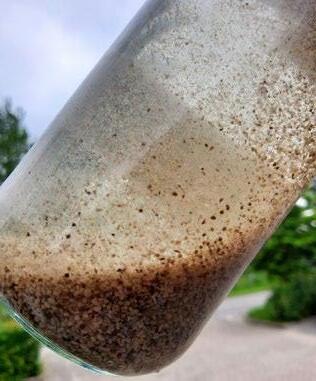
Sludge containing PFAS, PCBs, pesticides, microplastics, and other organic contaminants represents one of the biggest challenges in sustainable waste processing. Such sludge is frequently stored in heavily polluted, anaerobic conditions in dredging depots, such as the Slufter on the Maasvlakte. How can bacteria be used to break down these harmful substances or recover valuable raw materials such as metals or biopolymers? That is the central question a researcher will investigate over the next five years.
This fundamental research (Technology Readiness Levels 1-3) begins with the selection of previously unknown bacterial species that have the potential to break down harmful substances or recover raw materials. Analysis of sludge samples can reveal which bacteria are present – 99 per cent of the world’s microbes have never been studied. DNA and protein analyses of these bacteria can then uncover the unique metabolic superpowers of these organisms. If such capabilities exist, the next challenge is to create optimal conditions for their application: breaking down contaminants. Even if this were to succeed in the laboratory, future work is required to develop an industrial process in which bacteria in bioreactors can clean sludge and recover the valuable raw materials it contains.
Right F.l.t.r. Lennart Silvis, Merle de Kreuk and Mario Pronk.
‘Truly exceptional within the Netherlands’
Jasper Peterich, Director Delft University Fund & Alumni Relations
“Haskoning’s donation enables us to strengthen the source of new knowledge: fundamental research. That is what the future of the planet and the economy depends on. By combining disciplines such as water technology, biotechnology, and delta technology, we contribute to safe, liveable, and climateresilient deltas. This allows us to concentrate on future breakthroughs.” Haskoning, TU Delft, and the University Fund concluded that such breakthroughs are most likely to emerge from collaboration between the Faculty of Applied Sciences (AS) and Civil Engineering and Geosciences (CEG). It is precisely at the boundaries between disciplines that the most exciting innovations arise.
“Contract research delivers excellent applications,” says Peterich. “But this donation gives us the opportunity to lay a bold foundation for future applications. I cannot overstate how exceptional that is for the Netherlands. It enables focus on early-stage science and genuinely pioneering thinking. The collaboration between two faculties that had not previously worked together in this area is a clear example. This benefits the Netherlands, benefits TU Delft, and benefits companies that fund contract research.
Haskoning clearly understands that this approach will, in the long run, best serve its own field of work. We sincerely hope that other companies will follow this example.”
Become a donor:
thus fully meets our programme objectives: it is innovative, sustainability-driven, encourages collaboration and knowledgesharing, and aims for maximum long-term impact.”
Because the research is independent, the results will not belong to Haskoning. “That’s true,” Silvis acknowledges, “but I already notice that our clients actually appreciate this. It demonstrates that sustainability at Haskoning is not a marketing narrative. It’s a genuine commitment backed by action. That matters not only to clients, but certainly also to current and future colleagues – it makes us a more attractive employer. Beyond that, it has a broader, more general effect. The research stems from issues that colleagues observe in the market: which fundamental questions must be solved in the future?
It strengthens TU Delft’s international position as a knowledge institution, supports the Dutch knowledge economy, and enhances our reputation in water and climate expertise. And the more other companies this inspires to follow suit, the more effectively that lever operates. In the end, everyone benefits. That is exactly what ‘enhancing society together’ is about.” ■
Impression of bacteria on a microscopic scale.
TU Delft with
VAN BODEGRAVEN ELEKTROMOTOREN
By Elise Spetter
Photos Erno Wientjens
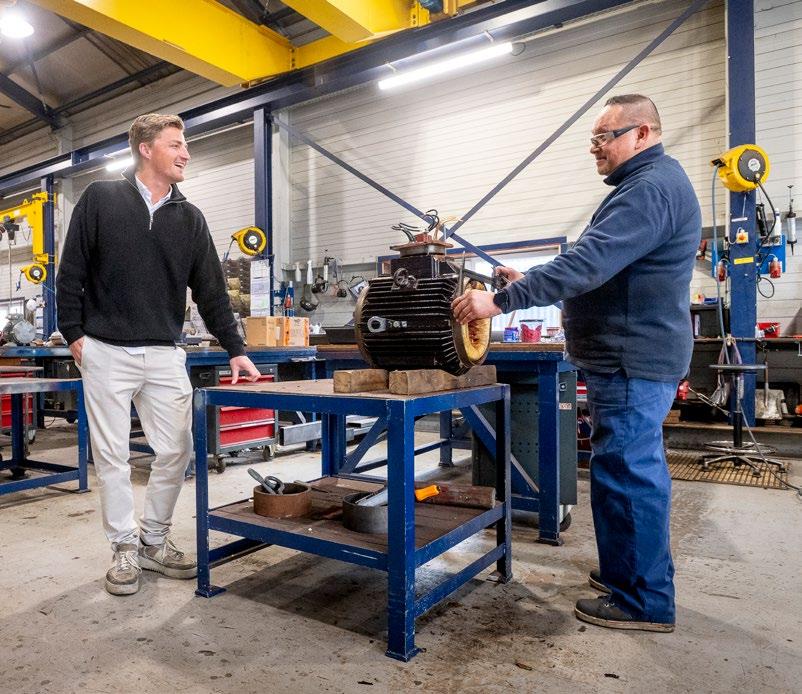
In Pioneering Tech, we follow SMEs innovating in collaboration with TU Delft. Each story explores the challenge, how the connection was made, and the impact of the partnership – and shows how you can take the first step yourself. This edition features Van Bodegraven Elektromotoren, a family-owned business from Dordrecht supplying electric motors to the maritime and industrial markets.
‘We
are sitting on a mountain of data that we’ve barely begun to use’
“We are Van Bodegraven Elektromotoren, a family business that has been around since 1937. I’m Tim van Bodegraven, 28 years old, and I joined the company this year to run it alongside my father and our operations manager, Roberto Costa. A role that I’m very happy to take on.
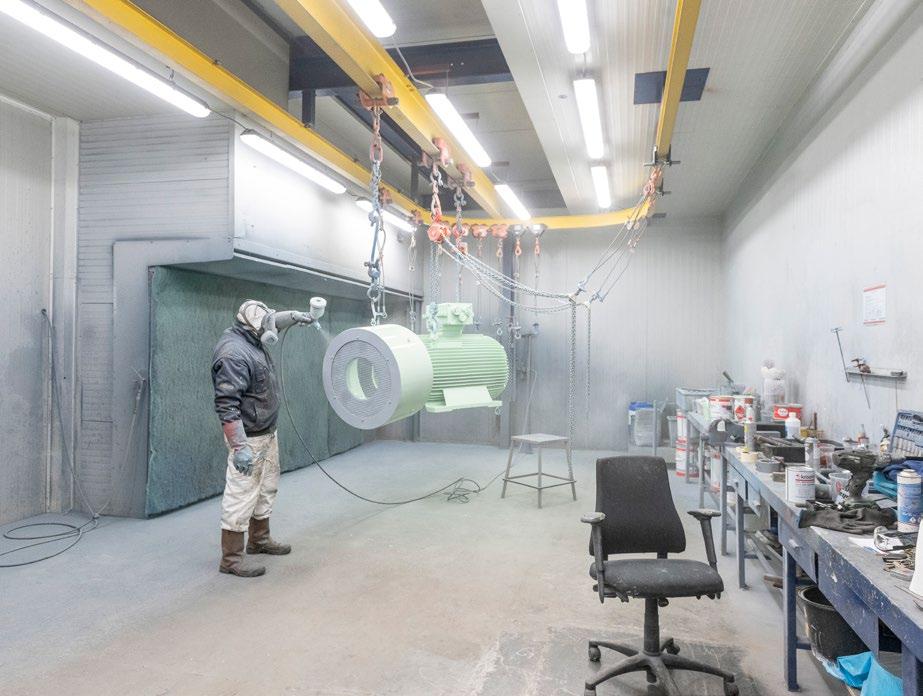
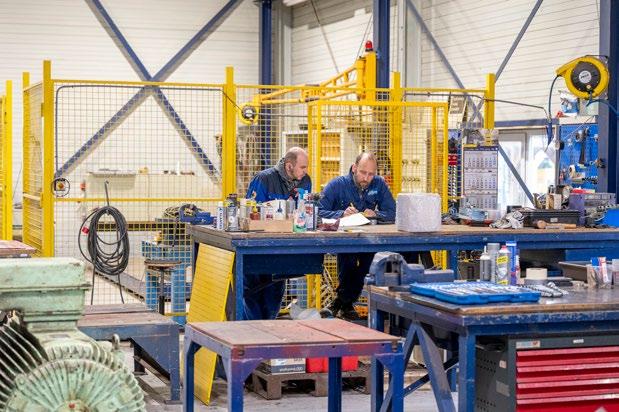
We supply new and used electric motors to the maritime and industrial markets. What sets us apart is our extensive inventory and our workshop in Dordrecht, where we repair, modify, and fully customise motors to client specifications. We specialise in submersible motors for major dredging companies, a niche where fast delivery is critical.”
Time-consuming enquiries
“We receive a large volume of enquiries every day. Customers want to be dealt with personally, and that is exactly how we like to work. But a portion of those enquiries concern standard motors requiring no customisation. These questions take up a great deal of our sales engineers’ time – time they would rather invest in more complex assignments. A complex motor overhaul is far more interesting to us than a standard motor that requires you to go through the entire process.
We wanted to automate that standard process using AI, but did not have the knowledge or capacity to develop it ourselves. That’s when we decided to approach TU Delft.”
VAN BODEGRAVEN ELEKTROMOTOREN
In
a nutshell
→ Founding year 1937
→ Location Dordrecht
→ Management
Frank van Bodegraven, Tim van Bodegraven, Roberto Costa
→ Specialism
Supply, repair and modification of new and used electric motors
→ Applications the maritime and industrial market, including underwater motors for dredging companies and the use of frequency converters (control systems for electric motors)
→ Technology extensive database of motor, pricing, and measurement data, combined with AI for automated classification and quotation generation
→ Collabopration with TU Delft
AI systems developed through the MKB Data Studio to automatically handle standard customer requests, implemented by master’s student Mauritius van Maurik
From network to collaboration
“The initial contact came through a networking club my father is part of. That’s how we got in touch with Dario Turelli, coordinator of the MKB Data Studio at TU Delft’s innovation centre Mondai | House of AI. Dario selected the best-suited student for the project – in our case Mauritius van Maurik, a master’s student at TU Delft. He started work on the project last September and built a system that automatically sorts and classifies incoming enquiries – whether a quotation request, an invoice, or a photograph of a motor nameplate. The result: for more than fifty per cent of standard enquiries, the system can already generate an offer automatically, based on our inventory. The goal is,
‘The MKB Data Studio gives you access to high-level expertise without the cost of an external consultancy agency’
of course, one hundred per cent, and we expect to get there in the coming months.
The collaboration also changes how we look at data. We are sitting on a mountain of data that we have barely begun to use. We have tens of thousands of motors in our system, each with its own price history. That data allows you to identify patterns and predict what a motor should cost, what we need to have in stock, and when. It is only through working with Mauritius that we have truly begun to see the possibilities.”
What other SMEs can learn
“The MKB Data Studio gives you access to high-level expertise without the cost of an external consultancy agency. This is partly made possible by Digitalzh, a subsidy programme for SMEs looking to digitalise. The first ten weeks are exploratory. You quickly find out whether it suits you and what it can deliver. My advice to other SMEs: just go for it. You learn from one another, and you discover opportunities you would never have thought of on your own.” ■
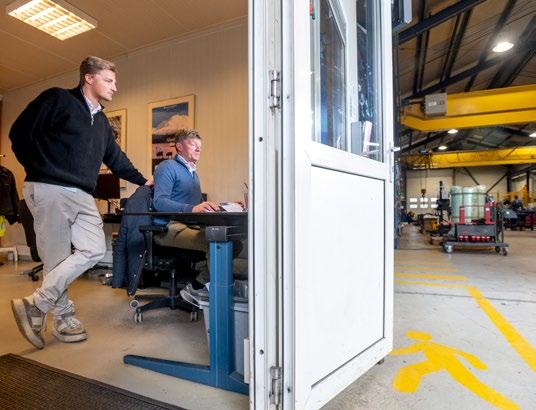
Tim van Bodegraven in the workplace.
MKB Data Studio
“The MKB Data Studio is an initiative led by Mondai | House of AI, part of TU Delft. Within the programme, master’s students help SMEs tackle data and AI challenges by applying their academic knowledge in practice. Students work on real-world problems, while companies gain access to expertise they lack internally. Projects typically run for 8 to 10 weeks, with options for extension.”
Discover the MKB Data Studio offering:
Mauritius van Maurik, master’s student, TU Delft
“I’m Mauritius van Maurik, 23 years old and a master’s student in Aerospace Engineering at TU Delft. I became involved in the MKB Data Studio through an open application. I was looking for something I could do alongside my studies and was referred to Dario Turelli.
At Van Bodegraven Elektromotoren, I started by asking a great many questions about how the company works and how decisions are made. I then broke the problem down into smaller parts and devised a solution for each of them, so that every type of enquiry ultimately follows its own path through the system.
What I have learned is that working with an SME requires a different way of thinking. At TU Delft, we tend to focus on why something works. At Van Bodegraven, the question was what it actually means in practice for Tim and his colleagues. Making that translation, from technology to application, is perhaps the most valuable lesson I am taking away from this project.”
‘INNOVATION INVOLVES MORE CHOICES THAN YOU THINK’
By Bruno van Wayenburg
One interpretation is that you design technology around societal values: you aim for sustainability, privacy, security, or other values we consider important. Another, related, way of looking at it is that you take a societal challenge as the starting point for innovation: sustainable energy, an ageing population, accessible healthcare, or strategic autonomy.
A more process-oriented approach is to structure the innovation around a set of principles: anticipation, reflexivity, inclusivity, and responsiveness. Anticipation means thinking about societal effects already during the design stage. Reflexivity means reflecting on underlying values: what do actually want to achieve with this innovation? Inclusivity means involving not just shareholders or potential customers, but other stakeholders too.
And the fourth principle, responsiveness, means responding to societal reactions and new insights that only emerge along the way.”
2 Is it actually possible to influence innovation?
“A widely held view is that technology develops on its own, beyond our control –so-called ‘technological determinism.’ One example is Moore’s Law, which says that computer chips become more powerful at a steady rate. But it’s simply not true that this is some kind of natural law:
Moore’s Law is, primarily, a social phenomenon. Chip manufacturers believe in it, and believe their competitors do too, and set targets that make the law self-fulfilling.
A similar idea is that innovation is driven purely by economic forces – as with AI, sustainable energy, or social media. Those forces are indeed powerful, but they’re never the only forces at play.
Societal acceptance, regulation, and public perception all influence innovation, as does the way innovation processes themselves are structured.
Take smart meters, for example –the intelligent energy meters that could make the electricity grid more efficient. They face concerns about privacy and fears of hacking, and their roll-out is proceeding slowly as a result. If you look at why, it becomes clear that privacy is a key concern. You could offer people a choice about whether their data are shared, or provide different privacy settings: most people wouldn’t object to that, and it
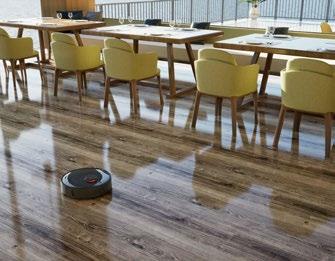
A cleaning robot at work in the Industrial Design Engineering Faculty.
makes an enormous difference to how readily the technology is accepted. In other words: innovators, businesses, and governments do have choices.”
3 How do you go about organising innovation processes?
“As an innovator, you can follow the principles I mentioned and support research into them. Legislation and regulation can also be very powerful: take the European AI Act, which is already having considerable influence on AI development. The resistance from American AI companies and the US government alone makes that clear: if it made no difference, they’d have no reason to oppose it.
Another key factor is how research funding programmes are structured – such as those of the Dutch Research Council (NWO) or the EU’s Horizon programme. An interesting middle ground between binding but abstract legislation and technical practice is technological standards. There is, for instance, the recently introduced IEEE 7000 standard for addressing ethical issues in system design.
For now, it’s still voluntary, but if it eventually becomes clear that adhering to it protects you from legal liability, it can quickly become a de facto requirement –as happened with the ISO 9000 management standard.”
4 What is TU Delft doing in this area?
The Values, Technology and Innovation department within the Faculty of Technology, Policy and Management conducts research at this intersection of technology, economics, ethics, and security. There is also the Delft Design for Values
Institute, an interfaculty collaboration between TPM and four other TU Delft faculties, including Industrial Design Engineering. And TU Delft has the Digital Ethics Centre, conducting research focused specifically on algorithms, AI, and other digital technologies.
5 It all sounds quite academic. How can companies actually put this into
practice?
Van de Poel: “In practice, academic research and practical advice often go hand in hand. Recently, for example, we worked with a cleaning products manufacturer that wanted to introduce a smart digital dosing system. The system has clear cost, environmental, and logistical benefits: it ensures cleaning products are replenished on time.
But as the project went on, it became clear that the data it generates could also be used to monitor individual cleaners – with implications for privacy and responsibility. The company, as a supplier, didn’t want to find itself in the role of supervisor.
So, in the end they decided: we’ll supply the data to our clients, but what they do with it is up to them. In this way, the preliminary research conducted according to Responsible Innovation principles led to a well-considered decision that might otherwise have been different.” ■
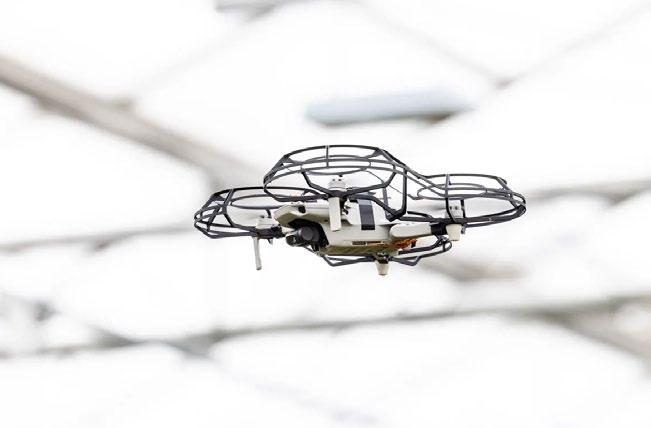
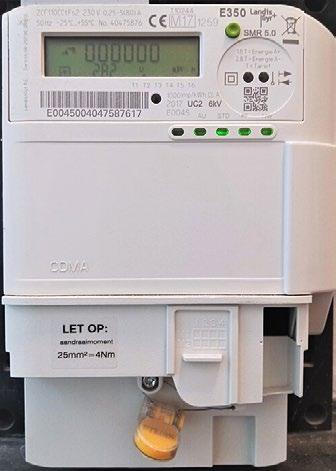
A drone, a smart meter and a robot vacuum cleaner.
FROM IDEA TO SHELTER: Delft students are giving earthquake survivors home with a modular core unit
TU DELFT GLOBAL INITIATIVE
Ten to fifteen years in a container that was intended for one year. That is the reality for many survivors of the earthquakes in Turkey and Syria. Leyla van der Waarde, co-founder of the Architectural Recovery Team (ART), describes their alternative: a modular unit that can be deployed quickly on site and can grow into a permanent home.
By Elise Spetter
Photos ART
Leyla van der Waarde had just completed a course on building for extreme conditions at TU Delft when a devastating earthquake struck Turkey and Syria on 6 February 2023. More than 50,000 people lost their lives. Van der Waarde is half Turkish. Her family lives in the affected region. Her fellow student Meriç Kessaf lost sixteen family members in Antakya.
“We quickly came together to think about what we could do. A fundraiser? Collecting money some other way? But we are architecture students. So let’s just design.”
A month later, Van der Waarde and Kessaf, together with other students, organised a workshop week at TU Delft involving 60 students, 5 companies, 20 experts, and several faculties. In five days, twelve designs took shape, and they decided to build a prototype in Turkey.
ART also shares its experiences with the TU Delft Global Initiative. The team gave a presentation to the Global Initiative about the project and the
lessons learned along the way. “It’s about sharing experiences from projects like this,” Van der Waarde explains.
The problem with emergency aid
Those who lose their home after a natural disaster follow a familiar pattern: first sleeping in tents, then containers, followed by temporary accommodation. People are repeatedly displaced and become increasingly separated from their land and community. “People sometimes spend ten to fifteen years in a tent that was intended for one year,” says Van der Waarde.
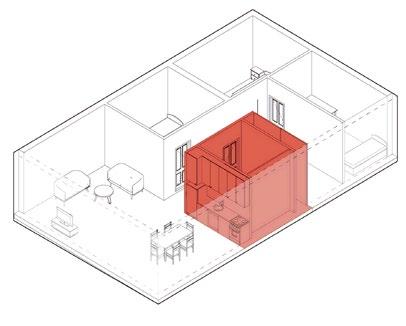
ART wants to break that cycle with a core unit – the heart of a house, containing a bathroom, kitchen, and utility space – that can be in place within a month of a disaster and serve as the foundation for a permanent home. “You also immediately address the hygiene and privacy issues in a disaster zone, and afterwards the family can build the rest of the house around it at their own pace.”
The unit is factory-made and delivered to the family. From there, the family decides how the home will grow: perhaps first an attached tent, then a living room, eventually a complete house with foundations and a garden. ART remains involved throughout the process. “We don’t just build the house
and leave. We stay in contact: does it work? What can be improved?”
Listen before you design
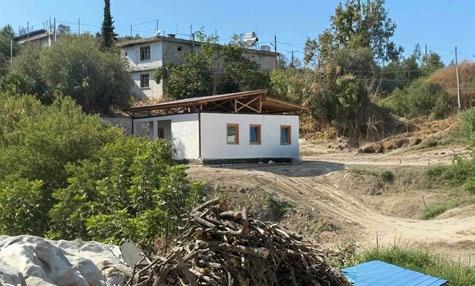
After the workshop week, Van der Waarde, Kessaf and the team travelled to the earthquake region. They visited villages, spoke with mayors and local parties, and eventually arrived in a village some twenty kilometres from Antakya, partly due to existing contacts.
What they learned there shaped the design. Privacy and hygiene proved more important than expected, especially for women and children. The bathroom, initially a secondary consideration, became one of the most critical components of the core unit. “We don’t go to an area saying ‘We’re from Delft and this is the solution’. We understand the culture and speak the language. That helps us to truly listen.”
Timber in a concrete region
For the construction, ART chose CLT –cross-laminated timber, a material increasingly used in the Netherlands for large buildings, but virtually unknown in the Turkish earthquake zone. It was a deliberate decision, explains Van der Waarde. “For a family home, CLT is actually over-engineered; stronger than strictly
ARCHITECTURAL RECOVERY TEAM (ART)
necessary. But that was precisely the point. We wanted to demonstrate that you don’t have to build in concrete. Timber is also an option, and it can be scaled up to three or four storeys in an earthquake zone.”
The construction was made possible through collaboration with Dutch companies, including DE-RIX, CLT manufacturers, and Rothoblaas for the fastenings. It also introduced a new building material to a region unfamiliar with it. “Sharing knowledge while also gaining knowledge. That’s essentially what we’re doing all the time.”
Entirely voluntary, all self-funded
ART operates as a foundation. Everyone involved works on a voluntary basis. The six team members – two in Turkey, four in the Netherlands – all have jobs alongside the project. Van der Waarde
works at an agency specialising in urban planning strategies in post-disaster and post-conflict settings.
The first house was financed through crowdfunding, material sponsorship, and two larger contributions from Corendon and the philanthropic Karsu Foundation. The crowdfunding raised a total of 25,000 euros. “We never thought: let’s turn this into a start-up. It was always about helping people.”
Still, the question remains: how long can you continue as a volunteer? ART is now working on the next phase: developing a model that is financially self-sustaining –not profit-driven, but not operating at a loss either. Three internal teams are focusing on the region, further technical development of the unit, and financial viability.
What is needed now
application; companies that contribute not only funding but also expertise, and governments willing to co-finance.
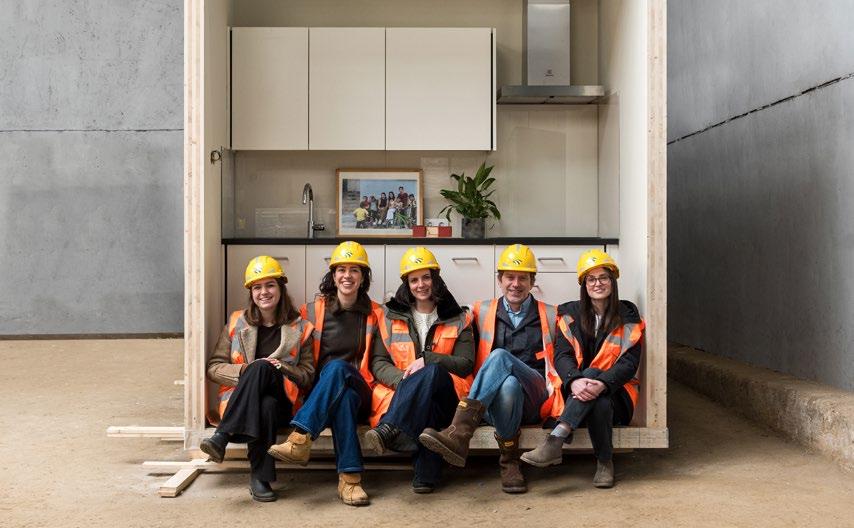
Below Part of the core unit team after construction in the Netherlands (Leyla van der Waarde, Meric Kessaf, Elif Ceylan, Job Schroën, Hatice Gorguluoglu).
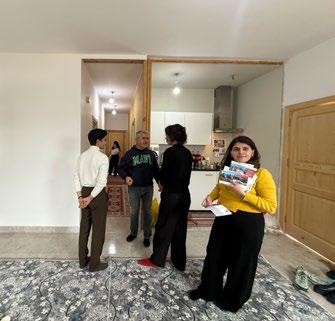
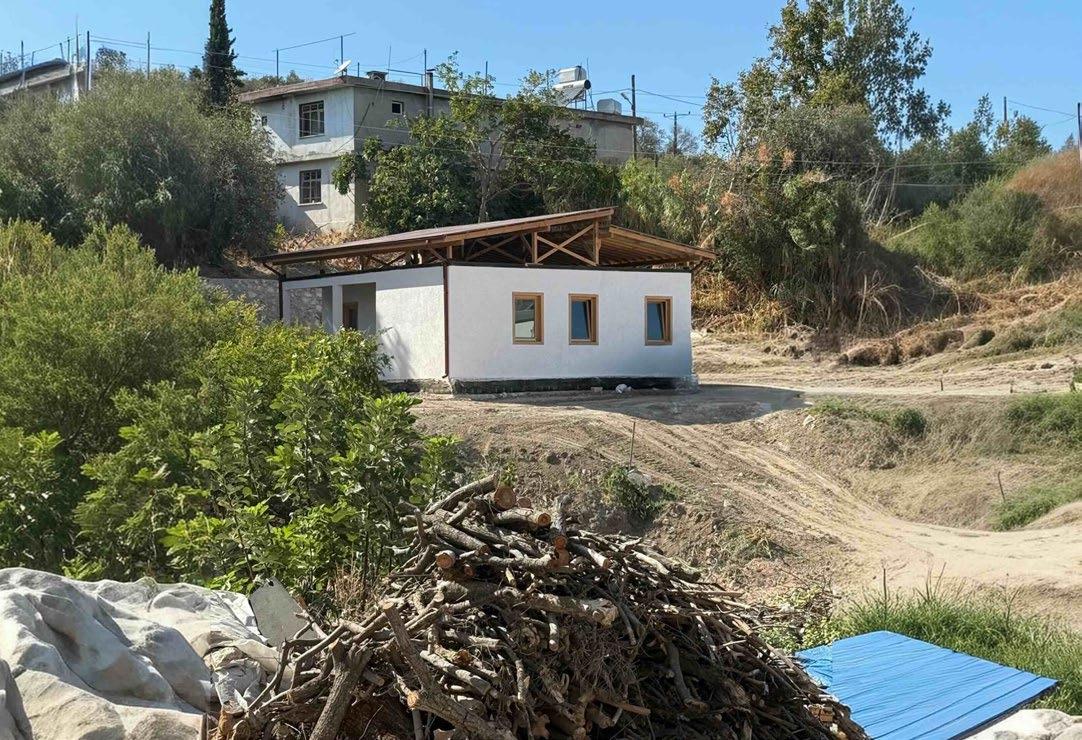
The first unit is standing. A family lives in it. The youngest member, just seven months old at the handover – exactly three years after the earthquake – is now crawling through the house where he will grow up. “We saw him being born. You never forget that.” What is needed is clear: universities to help scale the concept from prototype to broader
Van der Waarde wants to develop a handbook: a reference document enabling others to implement the concept in different disaster zones. “A great many people can build a first prototype. The real challenge is making that knowledge accessible to everyone who needs it.” In Turkey, she hopes to see at least ten units implemented, but ideally many more. “My dream is fifty or sixty homes. But that also means having a factory in the region and people working in it.” ■
Left (page 38) Diagram of the core unit in relation to the room units that can be added at a later stage.
The team in the house after the opening, February 2026.
What if one car could run on any sustainable fuel?
By Elise Spetter Photos Eco-Runner
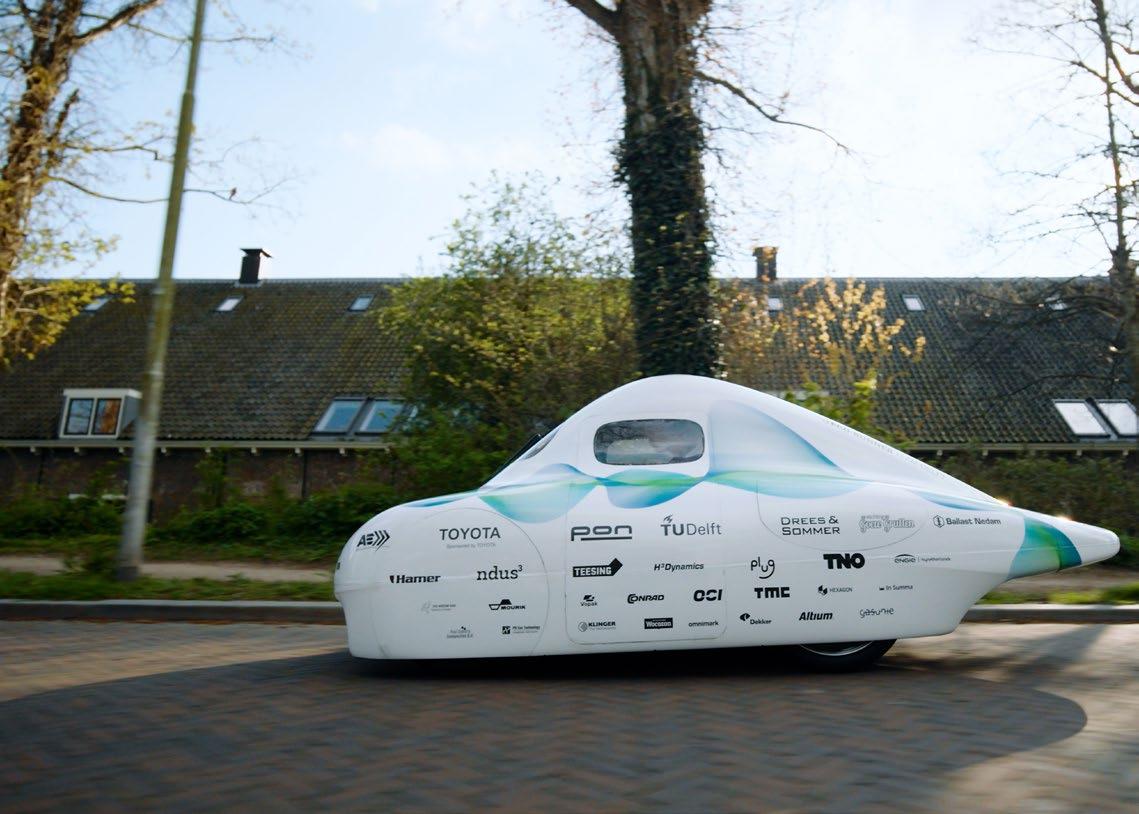
The transport sector is searching for sustainable alternatives to fossil fuels. Eco-Runner, the TU Delft student team celebrating its twentieth anniversary this year, aims to demonstrate that the future does not hinge on a single solution, but on multiple fuels operating in parallel. Their latest challenge: a fuel-flexible car capable of switching between various sustainable liquids and gases.
Eco-Runner has been building experimental vehicles for twenty years. Previous teams focused on hydrogen and won international races, setting two Guinness World Records with their hydrogen-powered cars. This year, however, the team is switching lanes. It aims to build a ‘fuel-flexible’ car capable of running on hydrogen as well as other sustainable liquids and gases. “We believe there is no single fuel that can support the transport sector on its own,” says team manager Luna ten Hagen. “Multiple sustainable fuels are needed.”
Micro gas turbine
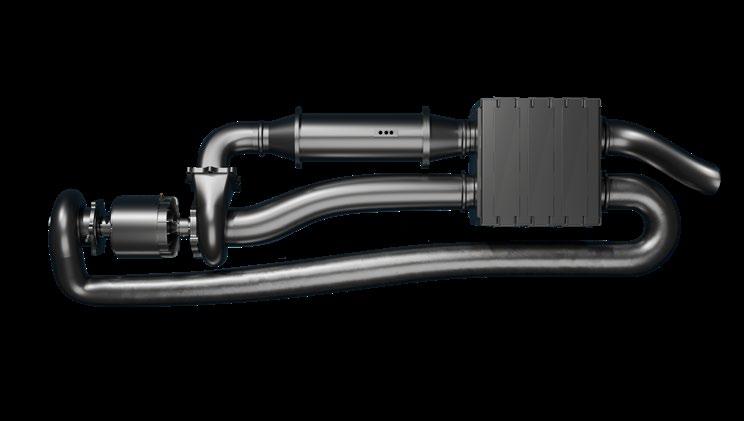
At the heart of the new concept is a micro gas turbine, which converts rotational energy into electricity. In the system, air is drawn in and compressed, heated in a heat exchanger, and mixed with a sustainable fuel in a combustion chamber. The hot mixture powers a turbine, after which a generator converts the rotation into electricity.
“You want a turbine running at around 150,000 revolutions per minute, a generator of approximately 3 kilowatts, and temperatures approaching 1,000 degrees.
All of those specifications have to be precisely matched to one another,” says Ten Hagen.
Switching between fuels works via a fuel tank fitted with a baffle, creating two compartments, each containing a different fuel. To switch fuels, it is simply a matter of turning a valve. “The combustion chamber can handle multiple fuels without modification. The fuel system controls which fuel is supplied.”
Those specifications represent the greatest technical challenge. The team is searching for a compressor, turbine, and generator that can all be mounted on a single shaft and are technically compatible with one another. That component will determine whether the project succeeds or not.
Dream Hall
Eco-Runner consists of 26 students from a range of disciplines. Alongside engineers, the team includes students working on partnerships, finance, operations, and communications. Each week begins with team updates in the Dream Hall on the TU Delft Campus, where the prototype is being built – a single-occupant vehicle that
The core of the new concept is a micro gas turbine that converts rotational energy into electricity.
Left The Eco-Runner XIII Right Teammanager Luna ten Hagen
is smaller than a standard car. A deliberate choice, according to Ten Hagen. “We design, produce, and test everything within the course of a year. A smaller vehicle is feasible for us within that timeframe.” The team also has a scalability manager whose role is to investigate how the system could be more broadly applicable in the future. “For now, we are demonstrating that fuel flexibility works, but our ultimate objective is to increase efficiency to the point where it can compete with what is currently on the road.”
Eco-Runner has previously built and driven a road-legal hydrogen car. While that remains a fine ambition, this year’s focus is on demonstrating the technology. The team wants to show that the future of mobility is not black and white – not hydrogen only or electric only – but multi-fuel. In other words, different sustainable fuels operating alongside one another.
Electrification alone is not sufficient, according to Ten Hagen. “For lighter transport and shorter distances, electrification is a good solution. But for heavy transport and long distances it brings significant challenges. It is neither efficient nor practical. Moreover, the direct
consequences of grid congestion and raw material scarcity are already becoming visible.”
Studies on hold
Ten Hagen put her Mechanical Engineering degree on hold for a year to focus on the project full-time. The experience feels much like working in a small company. “In a short space of time, you learn what professionalism means. We’re constantly talking with major companies and professors.” Recently, part of the team travelled to Barcelona for the Tomorrow Mobility congress, an international conference on the future of mobility.
“We spoke with so many companies there,” says Ten Hagen. “You realise how many people are committed to a green future.”
The coming months will be decisive for the student team. In May, the car will be unveiled at the Koninklijke Schouwburg theatre in The Hague. Until then, the team is working on the final integrations and tests.
“I hope people will see how innovative and impressive the car is. And what a group of students can achieve together.” ■
‘We design, produce, and test everything within a year’
Learning through simulation
For the technical development, Eco-Runner is collaborating with Femto, an engineering consultancy specialising in Computer Aided Engineering and a partner of Siemens. Femto supports the team in applying simulation techniques using Siemens Simcenter software.
“Every year, a new team starts with big ambitions,” a Femto spokesperson notes. “Those students have to quickly learn how to substantiate design choices and predict how their designs will behave. We help them navigate that learning curve efficiently.”
For Femto, today’s students are tomorrow’s engineers. “By supporting them, we’re investing in innovations of ten to twenty years from now.”
The collaboration is clearly two-way, the company emphasises. “Nothing is impossible when you bring the right people together.
Student teams don’t always take the path of least resistance – and that often leads to technically creative solutions.”
Enthusiasm also plays a significant role. “Eco-Runner brings an energy that is contagious. Our colleagues enjoy having the team members around. They ask interesting questions, appreciate the support, and involve us in their entire journey, from concept to final product.” Why should other companies get involved?
“Because you’re investing in the next generation of engineers and becoming part of an ecosystem of innovative parties.”
The Eco-Runner team in front of the Dream Hall.
Stay informed
Pioneering Tech connects groundbreaking technology with societal and economic impact. With stories, case studies, and insights that demonstrate how collaboration with TU Delft accelerates innovation – for both government and industry.
■ Listen to the Pioneering Tech Podcast
■ Stay up to date by subscribing to our newsletter
■ Follow our LinkedIn channel: TU Delft | Business & Innovation
➔ Go to tudelft.nl/pioneeringtech
By
Life without gravity
What happens when gravity suddenly loses its grip? In the art installation MycoGravity, Noor Stenfert Kroese and Amir Bastan explore this question through fungi.
In a bioreactor mounted on a moving robotic arm, pink oyster mushrooms grow while the direction of gravity changes continuously. The result is a series of unpredictable, almost sculptural forms that you would never encounter in mushrooms found in nature.
Advanced sensors and cameras track the growth process at close range, recording how life adapts when an essential reference point is removed.
Read the full interview with Stenfert Kroese and Bastan on art at the intersection of robotics, mycology, and space research at tudelft.nl/pioneeringtech. ■