The
Tuart Times
ISSUE 13: FEBUARY 2017 ISSN: 2204-7646
The Laurie Humphreys Fund
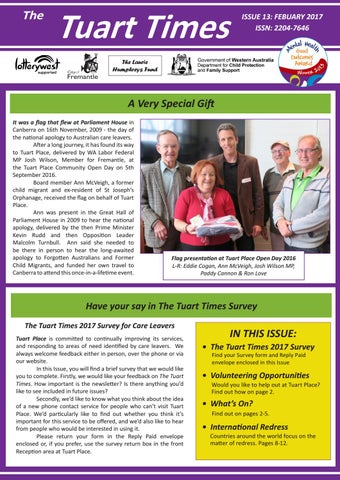
A Very Special Gift It was a flag that flew at Parliament House in Canberra on 16th November, 2009 - the day of the national apology to Australian care leavers. After a long journey, it has found its way to Tuart Place, delivered by WA Labor Federal MP Josh Wilson, Member for Fremantle, at the Tuart Place Community Open Day on 5th September 2016. Board member Ann McVeigh, a former child migrant and ex-resident of St Joseph’s Orphanage, received the flag on behalf of Tuart Place. Ann was present in the Great Hall of Parliament House in 2009 to hear the national apology, delivered by the then Prime Minister Kevin Rudd and then Opposition Leader Malcolm Turnbull. Ann said she needed to be there in person to hear the long-awaited apology to Forgotten Australians and Former Child Migrants, and funded her own travel to Canberra to attend this once-in-a-lifetime event.
Flag presentation at Tuart Place Open Day 2016 L-R: Eddie Cogan, Ann McVeigh, Josh Wilson MP, Paddy Cannon & Ron Love
Have your say in The Tuart Times Survey The Tuart Times 2017 Survey for Care Leavers Tuart Place is committed to continually improving its services, and responding to areas of need identified by care leavers. We always welcome feedback either in person, over the phone or via our website. In this Issue, you will find a brief survey that we would like you to complete. Firstly, we would like your feedback on The Tuart Times. How important is the newsletter? Is there anything you’d like to see included in future issues? Secondly, we’d like to know what you think about the idea of a new phone contact service for people who can’t visit Tuart Place. We’d particularly like to find out whether you think it’s important for this service to be offered, and we’d also like to hear from people who would be interested in using it. Please return your form in the Reply Paid envelope enclosed or, if you prefer, use the survey return box in the front Reception area at Tuart Place.
IN THIS ISSUE:
• The Tuart Times 2017 Survey Find your Survey form and Reply Paid envelope enclosed in this Issue
• Volunteering Opportunities
Would you like to help out at Tuart Place? Find out how on page 2.
• What’s On? Find out on pages 2-5.
• International Redress
Countries around the world focus on the matter of redress. Pages 8-12.
WHAT’S ON? REGULAR EVENTS • Every Monday: Singing group 10.30am-12 noon & the Big Monday Lunch at noon • Every Monday: Counselling sessions available with psychotherapist Gordon Paton, by appointment • Every Wednesday: Susy’s Support Group 10.15am-12 noon • Every Thursday: Computers & mobile phone help with Jo’s team 12 noon-3pm • Every second Thursday: Craft with Vera in the Boardroom. From 1pm. • Every Month: Family history and tracing with WA Genealogical Society experts Marilyn Dimond and Dr Lesley Silvester. 12.304.30pm, by appointment. • Every Month: Free legal advice with lawyer Gary Dean. 1-4pm, by appointment. • Every 5 weeks: Free men’s haircuts with Jacqi. On Mondays from 1pm.
Welcome Jo Hocking Jo Hocking is the Program Coordinator at Tuart Place. Jo’s background is in library and information management and career development, with experience in universities and public libraries. From 2006 to 2016, she coordinated an award-winning career mentoring program for students at The University of WA. Jo has worked with Tuart Place on a casual basis since 2015, coordinating the redesign of the Tuart Place website and doing some preliminary work on a Virtual Museum project. She really enjoyed getting to know Tuart Place and was thrilled to be offered the role of Program Coordinator. Jo looks after the events and activities at Tuart Place, produces the “What’s On” and updates the Tuart Place website and Facebook page. She is also responsible for all the Agendas, Minutes and documentation from the FACT Board and Sub Committee Meetings. A major part of Jo’s role is coordinating our volunteer task force, and she is very keen to expand this area and have a lot more volunteers involved at Tuart Place.
VOLUNTEERS NEEDED at Tuart Place
What happens at Tuart Place? Tuart Place is the State Government funded service for former child migrants, ‘Forgotten Australians’ and members of the Stolen Generations.
Tuart Place provides individual counselling, telephone counselling, support groups, social activities, assistance with historic abuse complaints, volunteering opportunities, computer skills classes, visiting health & legal services, family tracing, assistance to access records, and help in dealing with other agencies.
Free legal advice at Tuart Place Every month with lawyer Gary Dean, by appointment. Call Vicky to book a consultation to discuss any general legal concerns or questions. Phone consults also available. Next sessions: • Monday 27 Feb. 1–4.00pm • Monday 27 March 1–4.00pm 2
Would you like to help someone learn how to use a computer or iPad or understand how their phone works? Or maybe you’d like to come in and chat with participants over a board game or jigsaw puzzle, or be a friendly voice on the end of a phone providing support. We would love to hear from anyone who has a couple of hours a week that they could spend at Tuart Place. You’ll be helping a great bunch of people, and studies have shown that volunteering can have enormous health benefits for the volunteers themselves. We’d love to hear from you if you’d like to be involved or would like more information! Please call us on 6140 2380 or 1800 619 795 or email programs@tuartplace.org
Free men’s haircuts with Jacqi
Every five weeks at Tuart Place Mondays from 1pm Please book with Vicky Dates for 2017: • Monday 20 February • Monday 27 March • Monday 1st May • Monday 12 June • Monday 17 July
TUART PLACE
CONTACT DETAILS & OPENING HOURS 24 High Street Fremantle WA 6160 Phone (08) 6140-2380 Freecall: 1800-619-795 Email admin@tuartplace.org Web: www.tuartplace.org
Opening Hours
Group Getaway to Moore River Friday 31st March to Sunday April 2nd, 2017
9.00am to 4.30pm Monday Wednesday Thursday
at Tuart Place Wednesday 15th February 10.15am – 12.30pm (includes lunch) We’re fortunate to have the popular Jackie McRae back at Tuart Place to deliver another important workshop that promises to be both informative and fun! safeTALK is a half-day workshop that teaches how to identify people at risk of suicide and connect them with outside help and resources. safeTALK’s proven, easy-to-follow steps are used around the world. Most people thinking about suicide don’t actually want to die, but they need help deciding to stay alive. You don’t need any prior training to attend safeTALK—just a willingness to make a difference. Places are limited so book early by ringing Reception on 6140 2380 or email admin@ tuartplace.org
This year’s trip to Moore River is for two nights: from Friday 31st March to Sunday 2nd April 2017, staying at Tuppin House, overlooking the Moore River. The cost per person is only $40! (for food). Accommodation fees are paid by SAG – the Tuart Place Social Activities Group, with funds raised at their very successful Bunnings sausage sizzles. This is your chance to relax and get away from it all while enjoying the company of others. Take time for yourself while you’re there, or join in the group activities. To book, please send a cheque or money order for $40.00 per person to Tuart Place – or book in person with Jo. Places are limited, please pay by Thursday 23 February to confirm your spot.
Celebrate an early St Patrick’s Day! With a lunch and sing-a-long at Tuart Place
12noon–2pm Monday 13th March St Patrick’s Day is on Friday this year, so we’re celebrating early! Fred Rea, musician and highly regarded Perth entertainer will be joining us to sing some great Irish songs– with some humour thrown in for good measure
Don’t forget to wear something green!
Do you receive Ron’s Gazette? Ron’s Gazette is a fantastic monthly newsletter created by Tuart Place participant Ron Love. The Gazette is published in hard copy for inhouse circulation and is sent by e-mail to more than 200 recipients across Australia. Ron’s Gazette is also available on the Tuart Place website. If you would like to receive Ron’s Gazette by e-mail each month, please ask Vicky to add you to the distribution Lesley list. (left) and Marilyn (right) with Philomena, a former child migrant
3
Understanding and Overcoming Procrastination Wednesday 22nd March, 10.30am – 12noon Most of us put things off from time to time, but sometimes we procrastinate so much that we end up feeling guilty or ‘bad’. This interactive and fun workshop with Susy will look at why we sometimes have trouble getting started on the things we need to do, and provide us with some practical tips for overcoming procrastination.
Who wants to fire the cannon at the Round House?! Wednesday 29th March, 12.25 - 1.30pm COST: FREE (meet at Tuart Place) Join us for a visit to the historic Round House - just down the road from Tuart Place. Someone in our group will get to fire the cannon at 1pm and then we will have a short tour of the building. Please book with Vicky, and let her know if you would like to be the person who fires the cannon on the day!
Stroke Prevention Talk Monday 27th February 1.00pm – 2.00pm
Helena Johnstone from the Stroke Foundation will be at Tuart Place to give us important tips that could save your life or the life of someone you know.
Visit to the WA Maritime Museum Wednesday 1st March, 11am
COST: FREE (meet at Tuart Place)
Heal for Life presentation at Tuart Place Monday 20th February, 1.00pm – 2.00pm
Find out more about the Heal for Life five-day residential program, which is designed to help people heal from childhood trauma and abuse. Hear from Gloria Cartmel and Dale Lynch from Heal for Life as well as other Tuart Place participants who have attended this worthwhile program.
Enjoy a leisurely walk to one of Fremantle’s premier attractions. Together, we’ll have a look at the exhibits and learn a bit more about our local history. Tuart Place will contribute to the cost of lunch at the Museum café. There are only 20 places available so bookings are essential. Please contact Vicky.
Crafty Thursdays at Tuart Place
4
Every second Thursday, from 11am
Feeling crafty? Why not come along and join in the every-second-Thursday craft afternoons at Tuart Place. A recent project by Vera’s group was decorating these fun (and useful) carry bags. Bring your own craft ideas or help out with team projects.
Free Dental Checkups at Tuart Place: Monday 3rd April
Family members welcome to attend
The wonderful Kimberley Dental Team returns to Tuart Place for another round of free dental check-ups on the morning of Monday 3rd April 2017. Tuart Place is extremely fortunate to host visits by KDT, which was founded in 2009 by husband and wife team, Dr John
and Jan Owen. Find out more about the great work of KDT at their website: http://www. kimberleydentalteam.com/ Contact Vicky to book your spot or just turn up on the day. This service is open to family members.
Dr John and Jan Owen with Craig the Croc
Gordon Paton takes on a new role at Tuart Place Gordon Paton has kindly agreed to fill the newly-created role of Grievance Liaison Officer at Tuart Place. The new role was developed when we updated the Tuart Place complaints process, which is published on our Policies web page at www.tuartplace.org/about-us/policies. Gordon is a highly experienced counsellor, psychotherapist, organisational consultant and group facilitator, and recently retired from the Harry Hunter Drug & Alcohol Residential Rehabilitation Centre, where he
worked for 14 years. Gordon also has qualifications in Organisational and Clinical Transactional Analysis. Gordon volunteers his time at Tuart Place and in addition to his new role he is available for individual counselling sessions on Mondays. He also runs workshops and training sessions. To book an appointment with Gordon contact Vicky at Reception. Gordon Paton: Psychotherapist and Tuart Place Grievance Liaison Officer
1947 Child Migrants’ 70th Anniversary Reunion Sunday, May 27th 2017
Child migrants arriving in Fremantle in September 1947. Theresa Phillips (nee Mangan) is the child on the far left, wearing glasses and a panama hat.
An event is planned to acknowledge the 70th Anniversary of those child migrants who disembarked in Fremantle in September, November and December 1947, and who attended Catholic orphanages: St Joseph’s in Wembley, Nazareth House in Geraldton, Bindoon, Clontarf, Tardun and Castledare. While we are in the very early stages of planning the occasion, the committee has set the date: Saturday, May 27th, the 70th Anniversary of those who participated in the ‘Sentimental Journey’. If you would like more information please contact Maureen Colgan by email: mcolgan@westnet.com.au or on 9317-2753 and leave a message. I will return your call.
Introducing Sue Leaver Sue Leaver will be at Tuart Place every Thursday from 2nd February to the end of 2017 to provide counselling and support. Sue’s addition to the team is the result of the expansion of our Student Placement program with Notre Dame University. Sue has a Graduate Diploma in counselling and is now studying for her Master of Counselling. She has been working with older people with dementia for the past two years, and previously worked as a high school art teacher, and helped run her family café/restaurant. If you have an issue – big or small – or just want to come in and meet Sue for a chat in our comfy lounge, drop in on a Thursday or call Vicky to arrange a confidential one-on-one conversation. 5
A whole new ball game: Family tracing with DNA The use of new DNA technology in genealogical research and family tracing is rapidly increasing (see Paddy and Bob’s stories below and right). Mike Murray and Dr Lesley Silvester of Time Trackers gave a very interesting presentation on this topic at Tuart Place last year. Time Trackers is a busy genealogical firm that conducts family research and specialises in British and Australian history. Mike is an expert in the use of DNA in genealogy. Thanks to Georgia Leyendekkers for the following write-up of the Time Trackers presentation. Georgia, a Behavioural Sciences student at Notre Dame University, completed an eight-week internship at Tuart Place in 2016.
Time Trackers: Talking DNA On 19th September 2016, Tuart Place participants were joined by Mike from Time Trackers and Lesley from the WA Genealogical Society to talk DNA! A great turnout of Tuart Place heritage-hunters gathered after lunch to learn about the processes of DNA testing, and how it could help with the journey of filling gaps in their ancestral knowledge. Mike talked us through the biology of DNA, and what our DNA can tell us about ourselves and our history. He explained how our DNA is a ‘mixed bag of confetti’, with parts of our DNA coming from our parents, their parents, and so on. We learnt about the range of purposes of DNA testing, like medical and forensic purposes, and ‘deep history’, which looks at mass migration over the centuries. The idea that we
Rooftop Gardening
with Jan Newman
An enthusiastic group of Tuart Place green-thumbs made their way up to the rooftop garden above Fremantle Library on 15th September, to chat about herbs and admire the view. Thanks to the volunteer group and Mayor Brad Pettit who helped convert the space, the rooftop above the Library went from an unused space, to a vibrant little community garden. Volunteers Pat and Asanga talked about the success of the garden, especially with the Over 55s, and invited us to take a small pot of herbs to nurture at home. While the rain held off, sandwiches and cakes were eaten, and gardening tips were shared inside before Ron briefed the volunteers about the function of Tuart Place. The rooftop welcomes gardeners, readers, and everybody else to the space every Friday from 12 noon, and extends a very warm hand to participants of Tuart Place. 6
are all somewhat related was a great way to end the lecture, with everyone calling each other ‘cuz’! With some limitations, Mike maintains that DNA testing can be very helpful for people who have already used traditional tools of genealogy to trace family, and who want to make further connections e.g. often unknown distant cousins whose families migrated to other countries. The presentation was very helpful for all those who wanted to know how they could use DNA testing for their own ancestry journey. Thank you Mike and Lesley! If you would like more information on DNA testing and the work of Time Tracker, visit: http://www.timetrackers. com.au/ , or contact Mike at mike@timetrackers.com.au. Story by Georgia Leyendekkers
Paddy Cannon’s story My search is over. After 60 years of looking, I have found my family. I very much appreciate the work of the Child Migrant Trust, which put my DNA into an international database and found a match - someone from the USA who turned out to be a second cousin, my mother’s sister’s grandchild. I discovered that I was born in Ruthin, North Wales, where my mother worked until 1939. She then went home to County Mayo, Ireland, got married, and had three boys and four girls over the next 18 years. Unfortunately, she did not tell the family about me and so it was a great shock to them to hear that I was their oldest brother. I went to Ireland in September 2016, and my family there greeted me with open arms. I took two sons and one granddaughter. We had a blast over three weeks, meeting up with 67 members of my family! I am 79 years old and to find my family at this late stage has given me a new lease on life. I plan to go back in May 2017 for another reunion. Congratulations Paddy – we are so very pleased for you. It’s been a long time coming, and you found them at last. For the full version of Paddy’s story, see pages 66-68 of Fred Rea’s fantastic quarterly newsletter, The Irish Scene, at http://www.irishscene.com.au/images/pdf/jan_feb_17.pdf
Bob Taylor: A wish come true Bob Taylor is a former child migrant who arrived in Australia in 1950 and lived at Bindoon for six years. Bob’s search for his mother started when he left Bindoon at age 16. From 1962 onwards, he travelled to England at his own expense four times, trying to find any information on his or his mother’s identity. Bob spent all his adult life looking for family in the UK, with no leads, but then DNA genetic matching uncovered a large and very welcoming family in England, who he met this year. Louise Coakley, a genealogist who met Bob and his wife Carol at a Forgotten Australians support group meeting in Cairns in 2015, writes: “Understandably, after such a long search, Bob still can’t believe that he finally knows the real identity of his mother, his birth circumstances, and that he has finally met some blood relatives. Bob’s new family have all
Bob (front row, 4th from right) with his big new family in London. Bob knows all their names!
been very welcoming since he first contacted them… extremely receptive, caring and very thoughtful. They emailed Bob and Carol very frequently, sent him some photos of his mother and information about her life, and couldn’t wait to meet him in person”. During Bob’s visit to London, he finally achieved his lifetime wish, which was to find his mother’s grave. Bob now
knows who his mother is, where she is resting, and he has spent some special time visiting, laying flowers and tending her grave. Bob’s life has now changed forever. His wonderful cousins have welcomed him and his family very warmly, and now they are all part of one much bigger family.
7
Redress Matters
Federal Government announces national redress scheme....
The issue of redress is once again in the spotlight for West Australian care leavers, following the November 2016 announcement of an Australian national redress scheme for survivors of institutional child sexual abuse. There have been mixed reactions to the announcement – for some, there is a sense of excitement, but for others there is anger and disappointment that only sexual abuse will be acknowledged, and frustration over the lack of information and uncertainty of funding - given that this is an
International perspectives on redress Compensating the Past: International approaches to redress schemes for historical child abuse, a workshop held in Norrköping, Sweden in November 2016, brought together care leavers and redress experts from 10 countries around the world to share knowledge and experience of redress schemes for survivors of institutional child abuse. Key questions considered at this workshop included: What lessons can be learned from previous financial redress schemes? Do these schemes achieve what they aim to achieve? What political processes have led to financial redress schemes? and, What have the consequences been for survivors? Conversely, what features characterise the political process in jurisdictions where survivors, so far, have been denied financial redress? International presenters included Professor Stephen Winter of Auckland University, who visited Tuart Place earlier in 2016 to interview Philippa White for his academic research on international best practice for redress. In his presentation at Norrköping, titled Two models of monetary redress: A structural analysis, Steve discussed the pros and cons of ‘Individual Assessment’ and ‘Common Experience’ models of financial redress. Associate Professor Gerald Craddock beamed in from Canada via Skype for his presentation on How the Best of Intentions Can Go Horribly Wrong: Nova Scotia’s Kauffman Review of Compensation for Abuse in Institutions. As we know, it is not uncommon for applicants to be inadvertently harmed during redress processes, and despite good intentions, large bureaucracies are poorly equipped to respond well to some of the issues that arise when people re-visit traumatic memories of abuse. Each presentation at the workshop provided a unique international perspective, as suggested by the following titles: The Scottish Survivor Support Fund: Agreement and dissension in the development of redress for victims/survivors of historic abuse of children in care, by Professor Andy Kendrick of the University of Strathclyde; Investigate and verify historical neglect and abuse, or support and acknowledge survivors, or restore social injustice? Case workers’ experiences of financial redress schemes, by Professor Ingunn Studsrød, University of Stavanger, Norway; Redress under construction: The case 8 of Finland, by Professor Pirjo Markkola and PhD candidate
‘opt in’ scheme. ‘Opt-in’ means that the state governments and responsible institutions can’t be compelled to contribute funding to the federal scheme, so no one is sure how or if the scheme will work. It is a wait-and-see situation for care leavers across Australia, with very little news so far about which state governments and which institutions will opt in - or out - of the scheme.
‘Compensating the Past’: An international workshop in Norrköping, Sweden Johanna Koivisto of the University of Tampere; Financial Redress in Ireland for Institutional Child Abuse: The case of the Residential Institutions Redress Board and the Residential Institutions Statutory Fund, by Professor Eoin O’Sullivan of Trinity College in Dublin; “Times were different back then”: Notions of historical responsibility in policy debates regarding state redress in Sweden and Denmark, by Dr Malin Arvidsson of Sweden’s Örebro University; and In Care, In History. Historic abuse in Denmark, 1945-1980, by Associate Professor Jesper Vaczy Kragh of the University of Copenhagen. Australia was strongly represented at the Norrköping
Presenters at the workshop in Sweden
workshop. Professor Kathleen Daly of Griffith University’s School of Criminology and Criminal Justice presented a paper called What is owed and why? The role of money in redress for historical institutional abuse. Kathy, the author of Redressing Institutional Abuse of Children, is an international expert on the topic of redress and was recently appointed to the Australian Government’s newly-constituted Advisory Council for the proposed Australian national redress scheme. Other Australians at the workshop included CLAN’s Vice-President Frank Golding, and Associate Professor Jacqueline Wilson of Federation University, both care leavers. Frank and Jacqui’s presentation, which had originally focussed on the need for an Australian national redress scheme, had to be revised at very short notice when, just days before the workshop, the Australian government announced its scheme. However, as Frank and Jacqui pointed out, at this
....but is it fair dinkum? Frank Golding- author, care leaver, and Vice-President of CLAN - warns that the newly announced Australian redress scheme may be a ‘Clayton’s scheme’. In his article at http://frankgolding.com/redressclayons-or-fair-dinkum/, Frank explains that, as yet, the Federal Government has been unable to provide any firm committments on the proposed national redress scheme. Watch this space.
A Word from Cevrina There were many highlights of my trip to Norrköping, Sweden, in November of last year for the workshop Compensating the Past: the professionalism of the two-day workshop; our accommodation, which was within walking distance of the venue (in the snow!); the opportunity to work, share and laugh alongside Pip; and the new, helpful contacts for Tuart Place. I was also very pleased to see so many other care leavers at the workshop. Prof. Patricia Lundy’s presentation What Survivors want from Redress was fantastic. You could feel her commitment, passion and how she is not afraid to speak the truth. Patricia is doing action research with people taking part in Northern Ireland’s abuse Inquiry, and her work is giving survivors a powerful voice in processes that will lead to redress for institutional abuse. We’re very excited that Patricia is coming to Tuart Place in May this year. Thanks to all those who made this trip possible, and thanks for believing in me. Cevrina Reed, Vice-Chair, FACT Inc.
Financial redress:
What happened in Sweden?
We were astounded to learn at the workshop in Norrköping that the Swedish Financial Redress Board had rejected 54% of the applications received during Sweden’s redress scheme, which operated between 2013 and 2016. It is hard for us to imagine a scheme in which such a high proportion of care leavers would be allowed to go through the painful process of documenting the details of their childhood abuse, only to have their applications rejected. Swedish care leaver advocates Per-Henrik Bartholdsson and Anna Skånéra spoke at the international workshop about the very negative impacts and outcomes for care leavers whose applications were rejected by the Financial Redress Board during the Swedish scheme. In a presentation called Memories of childhood traumas meet the law, workshop organiser Associate Professor Johanna Sköld of Linköping University reported findings of her research on the Swedish redress scheme, which she undertook with colleagues Professor Bengt Sandin and Professor Johanna Schiratzki. The researchers’ investigations revealed that the criteria established for the redress scheme effectively ruled out more than half of the 5,000 care leavers who applied, and that some applicants faced apparently questionable barriers to participation in the scheme. The presentation of this research project is available at http://www.tema.liu.se/tema-b/medarbetaren/skoldjohanna/compensating-the-past?l=en
stage no one is certain how this ‘opt-in’ redress scheme might for its presentation on redress to WA politicians at Parliament proceed. See Frank’s article on this topic on his website at: House; and we have also had ongoing contact with Prof Patricia http://frankgolding.com/redress-clayons-or-fair-dinkum/ Lundy of Ulster University, resulting in plans for a trip to Perth West Australians Cevrina Reed, in late April, and a presentation by Patricia a care leaver and Vice-Chairperson of at Tuart Place on Monday 1st May 2017 Forgotten Australians Coming Together (see article on page 10) Inc, and Tuart Place Director Dr Philippa In her Norrköping presentation White co-presented a paper called The Redress: What do survivors want? - Patricia Price of Pain: What happens when redress reported findings of an action research schemes go wrong, focussing on lessons project with care leavers participating in to be learned from problems that arose Northern Ireland’s Historical Institutional during the implementation of WA’s redress Abuse Inquiry (HIAI). It is always heartening scheme. to hear of academic research that is Pip and Cevrina in Norrköping Cevrina and Pip were joined by driven by survivors and conveys survivor Perth-based barrister Gary Dean, who perspectives. Patricia’s research is available has considerable experience in dealing with financial redress on the Compensating the Past webpage at http://www.tema. processes involving institutional abuse, and contributed legal liu.se/tema-b/medarbetaren/skold-johanna/compensatingexpertise to the workshop discussions. the-past?l=en To find out more about Patricia’s forthcoming Compensating the Past provided a great opportunity visit to Tuart Place, see the article on page 10. for us to learn about redress in other countries and to share Congratulations to workshop organiser Johanna Sköld knowledge about the experience of redress in Australia. It was on the very successful and worthwhile international gathering also a chance to form ongoing links with other experts in this in Norrköping, and thanks to Linköping University for funding field. Since the workshop, presenters have stayed in touch Cevrina and Pip’s travel and accommodation. Thanks also to both individually and via Johanna Sköld’s Inquiry Network for Dr Benny Jacobsson of Uppsala University, a historian and Institutional Abuse. care leaver advocate for Samhällets Styvbarn (Sweden’s On our return to Australia, fellow presenter and redress Stepchildren of Society), for his wonderful concluding summary 9 expert Prof Kathy Daly gave generous assistance to Tuart Place at the workshop.
Northern Ireland Historical Institutional Abuse Inquiry The Final Report of Northern Ireland’s Historical Institutional Abuse Inquiry (HIAI), published on 20th January 2017, has been welcomed by survivors and their supporters. The HIA Inquiry found widespread systemic failures by the responsible authorities and institutions, and recommended the urgent provision of redress. The Inquiry also recognised the needs of former child migrants from Northern Ireland, who should be included in any forthcoming redress scheme.
Final Report published
Despite the collapse of Northern Ireland’s Parliament, meaning that the HIAI’s recommendations cannot be fully actioned until after an election on 2nd March 2017, there is strong bi-partisan political support for the Report, and it seems likely that redress will be implemented when political stability is restored. The HIAI’s Report is available at https://www.hiainquiry.org/
What survivors in Northern Ireland want from redress Patricia Lundy is Professor of Sociology at Ulster University, and has been working closely with survivor groups in Northern Ireland to develop a model of redress for historical institutional abuse. Patricia was centrally involved in setting up the Panel of Experts on Redress (October 2014). The Panel is a survivordriven process that aims to give survivors a voice and to campaign for effective redress. It is made up of individual survivors, survivor groups, human rights organisations, academics, practitioners, members of the legal profession, and national and international experts. No funding has been received; everyone works on a voluntary basis. The Panel of Experts has published three reports. The first two, What Survivors Want from Redress and A Comprehensive Framework for Historic Institutional Abuse, both draw on extensive consultations and a series of workshops with survivors. The Panel then commissioned and published A Cost Analysis of the Proposed Compensation Framework, which compares the cost of a redress framework with litigation. Each report was launched separately in the Parliament Buildings, Stormont in 2016. So, as you can see, the Panel has been busy! Meanwhile, Patricia has been carrying out academic research
Expert Panel members with Patricia Lundy (far right) on the steps of Parliament
facilitated by survivor groups. This research focuses primarily on survivors’ experiences of engaging with the Historical Institutional Abuse Inquiry (HIAI); and their perspectives on redress. Since the release of the HIAI Report, Patricia and fellow Panel members have been pressing political leaders to take action on the recommendations. Their aim is to strengthen the HIAI’s recommendations and challenge some areas of concern. Patricia is coming to Perth, and will be speaking at Tuart Place at 1.00pm
Facts on child migration
Western Australia received 81% of all children sent to Australia under Catholic migration schemes between 1938 and 1965. • Of the 1,355 children sent to Australia under these schemes, 1,096 came to WA. • Of the 310 Maltese child migrants sent to Australia, 303 were sent to WA. • Of the 793 Catholic child migrants sent from the UK to Australia, an estimated 112 were sent from Northern Ireland to orphanages in WA. • Approximately 12% of the 526 applications received by the Northern Ireland Historical Institutional Abuse Inquiry were from former child migrants living in Australia, mostly in WA. 10
on Monday 1st May, 2017. She will share information about the HIAI Report and any progress with its recommendations. Patricia would also like to meet with former child migrants from Northern Ireland, and to interview individuals as part of her action research. If you would like to meet with Patricia individually, please contact Tuart Place to book an appointment. This is a great opportunity for former child migrants to have input on the development of redress in Northern Ireland.
HAVE YOUR SAY Are you a former child migrant from Northern Ireland? If so, you are invited to book an individual interview with Prof Patricia Lundy after her presentation at Tuart Place at 1pm on Monday, 1st May. Patricia will also hold a limited number of individual interviews on Wednesday 3rd May, 2017. Get in early - contact Vicky to book your place.
LOFA Report Launched The Independent Inquiry into Child Sexual Abuse (IICSA) was established in March 2015 to “investigate whether public bodies and other non-state institutions in England and Wales have taken seriously their responsibility to protect children from sexual abuse, and make meaningful recommendations for change in the future”. Preliminary hearings into the Child Migration Programmes took place in January and the first public hearing for the Child Migration case study is scheduled for 27 February 2017. Tuart Place has submitted a comprehensive Report to the Inquiry on the Impacts and Outcomes of Child Migration, originally prepared for the Northern Ireland Historic Institutional Abuse Inquiry. For further information, visit the IICSA website at https://www.iicsa.org.uk/
WA State Government consultation on civil litigation Following a request from Deputy Premier Liza Harvey MLA, Tuart Place representatives attended a hearing with the Cabinet Sub Committee on Civil Litigation for Child Abuse, held at Parliament House on 6th December 2016. FACT Chairperson Ron Love and Board members Maria Harries and Graham Castledine responded to eight consultation questions raised by the Sub Committee in relation to the proposed reform of civil law limitation periods and child sexual abuse. The WA Government is soon to release its policy on amending the statute of limitations to remove limitation periods for civil litigation for victims of child sexual abuse.
The Long-term Outcomes for Forgotten Australians (LOFA) report on a large-scale research project conducted by the University of NSW, was launched in December 2016. The study confirmed that a range of serious, long term adverse mental health impacts are associated with childhood neglect and abuse in care. The research also found that ex-residents of institutional care suffer much higher levels of physical and mental illness than the general population. The Report, No Child Should Grow Up Like This: Identifying long term outcomes of Forgotten Australians, Child Migrants and the Stolen Generations, can be accessed at http://www. forgottenaustralians.unsw.edu.au/ Thank you to Tuart Place participants and other care leavers who contributed to the LOFA study.
Cybercrime and Cybersecurity workshop Thank you, Tuart Place, for giving us the heads-up on this fantastic workshop at Fremantle Library in September 2016. It was informative, and confronting! After telling us some horror stories of hacking, spam, and cyber-stalking, our highly knowledgeable presenters Krishnun and Katie provided us with practical ways to minimise the risk of falling victim to such crimes, including tips on passwords, virus protectors, etc. For example: • Facebook users, only accept invitations from people you know personally. • When signing up to websites, disclose only the minimum amount of personal information required. • Only open links and attachments in emails if they are from addresses you know and if they don’t appear suspicious. If in doubt, contact the person by phone and confirm that they sent it to you. • Use at least eight characters (mixed letters and symbols) in passwords, do not use personal details (e.g. name, birthdate) within them and change them regularly. Thanks to Kris and Katie for their words of wisdom! With gratitude, Iwona. Contact Tuart Place Program Coordinator Jo Hocking to find out more about how to stay safe and protected while enjoying the benefits of the Internet.
At the Tuart Place Christmas Party…. Peter Bent, winner of the annual Terry Humphreys Award for ‘An outstanding contribution to Tuart Place in 2016’, is standing with The Hon Stephen Dawson MLC, Shadow Minister for Disability Services, Mental Health, and Child Protection. Stephen is showing the box of souvenir coffee mugs he received as a gift from Tuart Place participant John Smith. 11
It’s a matter of record(s)..... Accessing personal records can be fraught for people who experienced out-of-home care during childhood, particularly ‘Forgotten Australians’, members of the Stolen Generations, and former child migrants. Common problems include the absence of records (often only admission and discharge information is available, and sometimes no information at all); inaccurate recording of events; derogatory, critical remarks; and heavy redaction of records (whole sections or pages whited-out). Considerable attention has been given to ‘the problem of records’ in recent years. In November 2015, the Australian Government published the Access to Records Principles and Good Practice Guidelines, which address three recommendations made in the 2004 Forgotten Australians Senate Inquiry report, in particular: • Supporting agencies to agree on how care leavers, upon proof of identity only, can view all information relating to
themselves and receive a full copy of such documents; • Providing records free of charge; and • Compassionate interpretation of legislation to allow information to be released to enable care leavers to identify their family and background. The Guidelines are available at the DSS website https://www.dss.gov.au Personal records were the focus of last year’s Geoffrey Bolton Lecture, delivered by Royal Commissioner Andrew Murray. See Ron Love’s article about this lecture, on page 13. Another project focussing on records is the Setting the Record Straight for the Rights of the Child initiative, which is seeking to transform the way records for out-ofhome care are created, captured, managed, archived and accessed. See the article below by Dr Joanne Evans of Monash University.
by Dr Joanne Evans, Monash University A national Summit - Setting the Record Straight for the Rights of the Child – will take place in Melbourne on 8-9th May 2017, and responds to findings of the Records and Recordkeeping Consultation Paper, produced by the Royal Commission into Institutional Responses to Child Sexual Abuse in September 2016. The Consultation paper joins a long line of inquiry, research and advocacy reports highlighting the role of records in the identity, memory and accountability needs for care leavers. Quality recordkeeping and archiving systems are needed to (a) develop and nurture a sense of identity and
Tuart Place Director Pip White (left) with Joanne at the 2016 Christmas Party. Joanne was presented with a souvenir mug created by participant John Smith
12
Summit Planning Group Meeting (L-R) Frank Golding (CLAN), Sue McKemmish, Viviane Hessami (Monash University), Nicola Laurent, Antonina Lewis (University of Melbourne)
connection to family and community; (b) account for ‘care’ experiences; and (c) prevent, detect, report, investigate, and take action against child neglect and abuse. The Summit will bring together around 200 invited participants from advocacy, community, government, and research organisations from across Australia. It will also give a voice to those whose lives have been affected by past failures of recordkeeping and archiving systems. The aim over two days of facilitated discussions is to build a collaborative community that will commit to and develop a 10year strategic plan for transforming record-keeping and archiving around lifelong rights to access and control of childhood records. Given the systemic failings of protocols currently in place, a key
concern of the Summit will be the readiness of the archival and recordkeeping community to respond to the identified needs. The Setting the Record Straight initiative was established in partnership with CLAN, the Child Migrants Trust, Connecting Home, CREATE Foundation, Federation University’s Collaborative Research Centre in Australian History, Monash University’s Centre for Organisational and Social Informatics, and the University of Melbourne’s eScholarship Research Centre. It is an independent, non-commercial, nongovernment initiative. For further information, or to register for updates about the initiative and the Summit, visit the website at http://rights-records.it.monash.edu/ or contact Joanne Evans at Monash University. Phone (03) 9903 2177. Email joanne.evans@monash.edu
2016 Geoffrey Bolton Lecture: Why records are central to identity and justice Commissioner Andrew Murray of the Royal Commission by Ron Love, Chairperson, FACT Inc. into Institutional Responses to Child Sexual Abuse delivered the 2016 Geoffrey Bolton Lecture on the evening of 24 November 2016 at the Government House Ballroom in St George’s Terrace, Perth. The lecture title was Children in need: Why records are central to identity and justice. I was fortunate to be part of the group representing Forgotten Australians Coming Together (FACT Inc), along with Board member Eddie Cogan, and Advisory member Paddy Cannon. Tuart Place was represented by social worker Jan Newman, who was accompanied by her husband Peter. We all enjoyed this important event and really appreciated the in-depth information provided by Andrew Murray. Andrew began his speech by stating that “My own impression is that the importance of identity is underestimated by many in the general community, perhaps because they have never lost it or been disconnected from it”. He covered the issues related to problems with historical At Government House (L-R): Ron Love, Edward Cogan, Andrew Murray & records, and shared his personal experiences of searching Patrick Cannon. Photo courtesy of WA State Records Office for records as a former child migrant from Fairbridge who are in out-of-home care, have tangible representations children’s home in Rhodesia (now Zimbabwe). Turning to present day record keeping practices, of their childhood - like photographs, mementos, and art Andrew outlined the Royal Commission’s proposed principles work. For the full text of Andrew Murray’s speech, visit for good institutional record keeping. He also spoke of the need for ‘life histories’ and ‘life story books’ so that those http://www.sro.wa.gov.au/events/geoffrey-bolton-lecture
Positive Communication Course by Iwona Another great course run by Susy. I’m sure we all agree that there is always room for improvement in the way that we communicate in various situations! How easy it is to blame, judge, criticise, attack, defend, etc. Susy presented a clear and specific format to make it easier to get our message across. It is a great tool to practice effective communication. Here is the basic outline: (1) What I observe (facts only, no judgement); (2) What I feel about it; (3) What I need or value; and (4) Make a specific request. For example, in the past I would react with criticism and anger to the speed at which Ian, my partner, would drive on the busy freeway. Since doing the workshop I have started practicing communicating in a more constructive way, using the above framework: (1) “When the freeway is busy and you are driving less than two seconds behind the car in front (factual observation); (2) I feel scared; (3) I value my life and I need to feel safe; and (4) Can you please slow down a little and keep the distance”.
Just by expressing how I feel, and what I need, I notice that Ian receives the message differently. Here is his feedback: “I feel less attacked and appreciate the opportunity to help you to reduce your stress levels”. This builds greater trust, respect and understanding between us and the message is better received. Great workshop Susy, very insightful and valuable! Thank you so much. Iwona.
Thank you Marie Waldeck Farewell and thank you to Marie Waldeck, current Director of Corporate Information Services at the Department for Child Protection and Family Support, who is retiring after many years’ great work. Thank you for all you have done for WA care leavers Marie. Marie’s colleague, Louise Simpson, will carry forward Marie’s work in the Release of Information for the Department. 13
Humphreys Park: Laurie Humphreys honoured by City of Cockburn
There was a huge turnout of family members to celebrate the official opening of Humphreys Park at 23 Scholar Terrace, Coolbellup, where a plaque was unveiled by City of Cockburn Mayor Logan Howlett and Laurie’s son Brian Humphreys, on 11th December 2016. The park is named in honour of the late Laurie Humphreys JP, who made major contributions to Fremantle and West Australian community life. Laurie was a foundation member of two branches of the Australian Labor Party, and held a number of positions within the union movement, including 17 years as Vice President of the WA Transport Workers Union.
Congratulations
Cevrina and Sylvia
VALE
14
Laurie also led a dedicated team of volunteers in establishing Forgotten Australians Coming Together (FACT), and founding Tuart Place. As the current Chairperson of the FACT Board and as a friend of Laurie, I was honoured to be invited by Frankie Atkinson, Laurie’s widow, to be present with the family at this important historical event and honouring Laurie at the official opening of Humphreys Park. It was wonderful to see Laurie’s brother Terry there on the day, and fellow FACT member Paddy Cannon. Ron Love
Congratulations to FACT Vice-Chairperson Cevrina Reed on achieving a Certificate IV in Community Services, and to Sylvia Stonehouse, who achieved units of attainment toward a Certificate IV qualification. Cevrina received her Certificate at a function at ConnectGroups on 8th December 2016. Our photo shows Cevrina at the function with Lena from North Metro TAFE, Louise Howe from the Mental Health Commission, and ConnectGroups Patron Professor Lyn Beazley. FACT Chairperson Ron Love accepted a Certificate on behalf of Sylvia, who was unable to attend the function, and presented it to her at the end of year celebration at Kailis Bros, Fremantle Wharf. Cevrina and Sylvia were awarded ConnectGroups scholarships for the initial units, and Cevrina went on to complete the remainder of the qualification herself. Congratulations both on your achievements.
VALE
What a catch!
Spotted in Freo... Our Receptionist Vicky was rather chuffed to bump into members of British rock band UB40 while they were in Fremantle. Here’s Vick with lead singer Ali Campbell.
Tardun Old Boy Eddie Hewitt caught this Golden Trevally off the jetty in Cooktown, Queensland. Thanks to Keith Spencer of TOBA for sending us the photo. It’s a beauty! Ron’s Lotto Group has been going strong since 2011, with winnings distributed and a lunch provided for members each year since then. The 2016 Lotto Lunch was held on 18th November at Quinlan’s Café opposite Tuart Place, and a great time was had by all. An added bonus of being part of this group is the opportunity to support the wonderful work of Lotterywest. Great job Ron!
VALE
15
Calling all former child migrants from Northern Ireland: See page 10.
Thank you to our super volunteers! We really appreciate your help with Tuart Place mailouts
Thank you to Tony Galati of Spudshed Fresh Food Market for your continuing support of the Tuart Place Social Activities Group’s fundraising sausage sizzles. Your contribution is much appreciated Tony! The next sizzle is at Bunnings O’Connor on Saturday 4th February 2017.
Computers: Get in the know with Jo and her team
Program Coordinator Jo Hocking
Whatever your skill level (even if you’ve never turned on a computer before) you can get individual help. Use the computer room, or bring in your iPad, mobile phone or digital camera and learn to browse the internet, send emails, scan photos and shop online. Please call to book in with one of Jo’s computer volunteers on Thursdays between 12 noon and 3.00pm.
Where is Tuart Place?
Tuart Place is located in the old Cleo’s Hotel at 24 High Street, in the West End of Fremantle, near the historic Roundhouse. There is no on-site parking, so some of our visitors park at South Beach and catch the Blue Central Area Transit (CAT) Bus, which stops close by in Phillimore Street, just after Cliff Street. If you are travelling on foot from Fremantle Train Station, Tuart Place is a five minute walk.
Our Eco Policy The Tuart Times is published by PK Print, a West Australian company certified by the Sustainable Green Print and Green Stamp Programs. These programs assist the printing industry to reduce waste and increase recycling. PK Print is certified for Level 2 in both Programs.
Like us on Facebook Have you liked the Tuart Place Facebook page yet? It’s a great way to stay in touch as we post lots of photos from events and also keep you up to date with relevant issues and things that are coming up. Find us at www.facebook.com/TuartPlaceFremantle
To donate to Tuart Place: