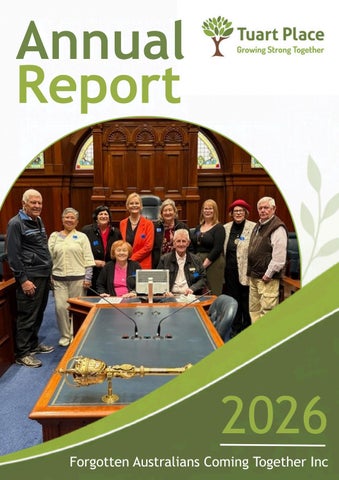
Annual Report
2026 Forgotten Australians Coming Together Inc
Ngala kaaditj Whadjuk Noongar moort keyen kaadak nidja boodja. We acknowledge the Whadjuk Noongar people as the Traditional Custodians of this land. For more than a decade, Tuart Place has been privileged to nurture a vibrant, participant-led community from our home in Fremantle-Walyalup. It is a place where Care Leavers come together to find connection, belonging and support, while sharing their experiences, strengths and wisdom. Together, we continue to build a community that fosters healing, resilience and hope. We acknowledge the Traditional Owners of the land on which we work and gather, the Whadjuk Noongar people, and pay our respects to Elders past and present. We recognise their enduring connection to Country, culture and community, and are grateful to live and work on Whadjuk Noongar boodja.
Contents 2025-2026 Community at a glance......
1
2025-2026 Services at a glance..........
2
Chairperson’s Report......................
3
FACT Inc. Board............................
4
Director’s Report...........................
5
Our participants and services............
7
Our volunteers and staff..................
8
Leadership, advocacy and support......
9
Aged Care Finder...........................
11
Celebrating our tenancy..................
12
A year of social connection...............
13
Financial snapshot.........................
15
Strategic goals.............................
16
Our purpose We walk alongside Care Leavers as they come together to connect with community, find support, and lead their own journey of healing.
Our vision Our vision is for a world where all Care Leavers feel valued, connected and supported to shape their own future.
Our values The following acrostic was developed in 2012 by Tuart Place support group members to reflect the values of our community.
T U A R T
TOGETHER, we build UNDERSTANDING ACCEPTANCE RESPECT TRUST
2025-2026 community at a glance
1,102 Care Leavers received direct services in 2025-26, up from 922 in the previous year
297 new participants welcomed to the Tuart Place community
71 clients aged 18-30 years, up from 41 the previous year – a 73% increase
615 First Nations participants, representing 56% of client group
30% experiencing homelessness or housing insecurity
Support provided to more than 110 incarcerated participants
1
2025-2026 services at a glance
More than 7,000 instances of social connection and drop-in centre support
179 participants accessed over 600 hours of WA Stolen Generations Redress support
596 participants accessed over 2,800 hours of National Redress Support
180 participants accessed over 1,000 hours of Aged Care support
More than 900 hours of counselling support provided in person and over the phone
190 hours of IT and digital literacy support
2
Chairperson’s Report As I write this report, I find myself reflecting on how important Tuart Place continues to be for so many people. As someone who grew up in care, I know the value of belonging to a community that understands your experiences. For many Care Leavers, Tuart Place provides that sense of connection, acceptance and support that can be difficult to find elsewhere. This has been another successful year for Forgotten Australians Coming Together Inc., marked by growth, stability and continued commitment to the people we serve. The highlight of the year was undoubtedly securing a ten-year lease for our home at 24 High Street. This achievement gives our organisation a secure future and allows us to plan confidently for the years ahead. Most importantly, it ensures that Care Leavers will continue to have a welcoming place where they can connect, seek support and build lasting friendships. I urge my peers to connect with each other outside of Tuart Place to give support to each other; and not to let people live in your head rent-free. Our community events remain at the heart of Tuart Place. The annual Christmas Lunch was once again a wonderful occasion, bringing people together to share friendship, laughter and connection. These moments continue to remind us of the importance of community in supporting recovery and well-being. I would like to thank my fellow Board members for their guidance and commitment throughout the year and acknowledge former Vice-Chair Dale Lynch who passed away in November 2025. Thank you to Lyn Sherwood, for stepping in as Vice-Chair. We thank Dr Sue Bailey, who stepped down from her board role in 2026, for her years of service. With her keen sense of social justice,
Sue brought a wealth of skills and knowledge to her time on the Board. My sincere thanks also go to our volunteers, whose generosity enriches our community every day. Whether assisting with lunches, providing IT support, offering services such as haircuts and podiatry, or simply taking the time to listen, your contribution makes a real difference. To our staff, thank you for the compassion, professionalism and dedication you bring to your work. Your commitment ensures that every person who walks through our doors is treated with dignity, respect and care. Finally, I extend my deepest gratitude to Dr Philippa White. Her vision, leadership and unwavering dedication continue to strengthen Tuart Place and help shape a brighter future for Care Leavers. As we look ahead, I am confident that Tuart Place will remain a place where Care Leavers can find support, friendship and community. I am proud to be part of this journey and grateful to everyone who makes it possible. John Ryall, Chairperson
“When you give, you get far more back than you gave.” 3
FACT Inc Board Tuart Place is governed by the Board of Forgotten Australians Coming Together (FACT) Inc. Lived experience leadership is at the heart of our governance model. This approach reflects Tuart Place’s commitment to co-design. Care Leavers actively participate in the design, delivery and governance of Tuart Place services. The FACT Board brings together members with lived experience of out-of-home care and people with professional expertise across areas including law, social work, accounting, service management and research. This combination of lived and professional expertise ensures Care Leaver perspectives are embedded in organisational decision-making, service design, and strategic direction. All Board members are elected as individuals, contribute their time voluntarily, and are valued for the skills, knowledge and life experience they bring.
John Ryall Chairperson
Lyn Sherwood Vice-Chairperson
Ross Stagno Treasurer
Dr Sue Bailey Board Member
Kevin Collins Board Member
Jacques Duvenhage Board Member
Kathleen Gregory OAM Board Member
Mia Lanigan Board Member
Doug McGlade Board Member
Ann McVeigh Board Member
Mary Mogridge Board Member
Margo O’Byrne Board Member
4
Director’s Report Tuart Place has enjoyed a remarkable year of consolidation and growth. Security of tenure at 24 High Street has given us the solid foundation we needed to focus confidently on expansion, development and our long-term future. Recognition of the value of our work by both State and Federal funding partners is reflected in new, longer-term funding arrangements that provide greater certainty and enable Tuart Place to expand its services and offer a range of new opportunities for Care Leavers. Seven new staff members joined our team this year and, with five new aged care specialists among them, we rapidly outgrew our existing space at 24 High Street. We were, quite literally, bursting at the seams! The recent signing of a 10-year lease covering the entire ground floor of the building represents an important milestone for Tuart Place. We are now forging ahead with plans to refurbish the additional space, including a large community-style kitchen, a new craft and activities area, and an open-plan common room where our community can stretch its wings. The additional space will be a tremendous asset as we commence a new funding arrangement with the WA Department of Communities, including expanded support for younger people leaving care. It will give us the flexibility to run a range of social activities, practical supports and therapeutic programs at the same time, while retaining the welcoming and informal environment that is so important to Tuart Place. Participants, staff and volunteers have all been involved in planning the refurbishment, and there is great excitement about finally having a ‘proper’ kitchen after years of making do with a
5
tiny kitchenette. A large, welcoming community kitchen has been a longstanding goal for Tuart Place and was identified as a priority by Care Leavers involved in the original research and planning for our service in 2010. Seeing this goal becoming a reality is particularly meaningful. Together with other priorities identified in Tuart Place’s Strategic Plan, these developments represent real progress towards securing a strong and sustainable future for our organisation and the community we serve. The arrival of so many new staff members has, of course, brought considerable change. There was some understandable concern that rapid growth might affect the familiar, close-knit atmosphere that people value so highly at Tuart Place. We needn’t have worried. Our new staff members quickly settled in, bringing warmth, enthusiasm, skills and great personalities that have further enhanced our team. We were sad to farewell longstanding staff member and social worker Jan Newman, who retired in April 2026. Jan made an enormous contribution to Tuart Place over many years through her compassionate and highly skilled work supporting Care Leavers seeking justice through redress and civil claims. Her extensive knowledge of historical
records, genealogy and social welfare has also been an invaluable asset to Tuart Place. Jan’s wisdom, dedication and generosity will be greatly missed by us all.
Thank you also to our wonderful volunteers. You continue to be an essential part of Tuart Place’s success, and we simply could not do what we do without you.
I extend my sincere thanks to Jo Faulkner and Tuart Place’s extraordinary staff team. I am immensely grateful for your professionalism, good humour, caring, and commitment to the important work we do.
Finally, to our amazing participants: thank you for your care, generosity and contributions to Tuart Place. What you bring to this community is what makes it truly unique.
We are fortunate to be supported by an exceptional board of governance, whose members bring a wealth of experience, compassion and sound judgement to their role. Our board stood firm through the difficult times, and I greatly appreciate their ongoing support and guidance as Tuart Place enters this exciting new phase.
It is a privilege to lead such a collaborative, survivor-led organisation, and to see Tuart Place move into the future with greater security and opportunity while remaining firmly grounded in the mission, values and sense of community that have always defined us. Dr Philippa White, Director
6
Our participants and services Tuart Place is a resource service for people who experienced out-of-home care during childhood in settings such as orphanages, missions, foster care and group homes. Known collectively as Care Leavers, they include Forgotten Australians, former child migrants, members of the Stolen Generations and other Aboriginal people placed in substitute care.
Who are our participants? Age group
Care Leaver cohort
18-30 years
71
6%
Australian Indigenous
615
56%
31-50 years
307
28%
Australian non-Indigenous
336
30%
51-70 years
440
40%
Former child migrants
87
8%
71+ years
241
22%
Other
65
6%
Unspecified
43
4%
1,045
95%
Gender
Geographic location
Female
536
49%
Western Australia
Male
563
51%
Interstate
25
2%
2
>1%
Unspecified
33
3%
Unspecified
What services are they accessing? Service
7
No. Clients
Occasions
Psycho-social support
586
10,065
Social connection
517
7,862
National Redress Scheme
596
5,048
Referral & liason
662
2,249
Records - supported access
510
2,003
Health, legal & financial
373
1,592
Phone counselling & outreach
351
1,378
Aged Care support
186
1,304
Counselling
550
1,241
WA Stolen Generations Redress
179
1,148
Life skills & literacy
144
493
Advocacy
146
339
IT skills and digital literacy
79
271
Support group
39
261
Our volunteers and staff A huge thank you to our volunteers Volunteers are an important part of the Tuart Place community, generously sharing their time, skills and energy to help make Tuart Place a welcoming and connected place. Throughout the year, volunteers have supported our Monday lunches, outings, activities and events; provided digital literacy and practical support; helped with administration; shared creative and specialist skills; and contributed in countless other ways. Our participant volunteers play a particularly valued role, helping shape the everyday life and sense of belonging at Tuart Place. We also thank the members of the FACT Board, who volunteer their time and expertise to provide leadership and governance. To all our volunteers—thank you. Your generosity, kindness and commitment make a genuine difference to Tuart Place and the people who come through our doors. We couldn’t do it without you.
Our skilled and dedicated staff team
2025-2026 Staff members: (L-R, front row) Director Philippa White, Care Finder Practice Lead Jane Hulands, Emma Gregory, Mary-Ann Oliver, Pauline Thomas, Mal Edwards, Jess Edwards, Trina Beeton, Ebru Yildiz, Adam Faulkner, Sadie Holmes, Catherine Carr. (L-R, stairs) Rosalie Grant, Natasha Samuelraj, Rose Fogarty, Linda Olive, Jo Faulkner, Isis Nair. Not pictured: New Care Finder team (see page 11), Jan Newman.
8
Leadership, advocacy and support National Aged & Community Care Roundtable for Forgotten Australians Tuart Place representatives Margo O’Byrne, Jane Hulands and Jo Faulkner attended A New Chapter in Ageing: Listening to Forgotten Australians and Care Leavers in Melbourne in April 2026. The forum brought together people with lived experience, service providers, researchers, and advocates to explore the challenges and barriers Care Leavers face in accessing aged and community care. Jane Hulands gave a presentation on Tuart Place’s innovative Care Finder Service, and Margo O’Byrne co-facilitated the final session with Darcy Orr from Lotus Place, drawing together practice knowledge and ideas for future action.
Margo O’Byrne
As a founding member of the National Roundtable, Tuart Place continues to ensure Western Australian voices contribute to national reform, and to advocate for improvements to aged care services for Care Leavers.
Creating Safer Futures: Advocacy raising awareness
Leading the way with a Care Finder Practice Framework
Tuart Place contributed to Creating Safer Futures, a national project led by Associate Professor Katie Wright of La Trobe University. exploring ways to raise awareness and prevent child sexual abuse. As a member of the Advisory Committee, Tuart Place helped ensure the perspectives of people with lived experience informed research and community awareness resources.
Care Finder Practice Lead Jane Hulands has developed and published a Care Finder Practice Framework to guide our growing team. Grounded in Tuart Place’s values, it provides practical guidance for rights-based, trauma-responsive and relational support.
Project research highlighted the vital role of advocates in providing safe, supportive spaces where victim-survivors feel heard, believed and free from shame. These findings reflect Tuart Place’s longstanding approach to trauma-informed advocacy and support. The project report, Breaking the Silence on Child Sexual Abuse: A Survey of Advocates, is available on the Creating Safer Futures website.
9
The four pillars of Safety, Connection, Opportunity and Hope sit at the heart of the framework, shaping how we build trust and work alongside vulnerable people to connect with aged care services. The framework has been well received by the WA Primary Health Alliance (WAPHA), which commissions Care Finder services in Western Australia. Other Care Finder organisations are also adapting it for their services, extending Tuart Place’s contribution beyond our team.
Leadership, advocacy and support WA Stolen Generations Redress Scheme The WA Stolen Generations Redress Scheme provides recognition, redress and an apology to Aboriginal people who were removed from their families under past government policies and practices. Tuart Place is funded by the Department of Premier and Cabinet to provide practical, trauma-informed assistance to survivors navigating the Scheme. Since the Scheme opened in November 2025, we have helped 97 people to submit applications and provided general advice, information and support to more than 180 others. At the time of writing, we have received outcomes for 29 applicants, with all outcomes to date being positive. This strong early progress indicates the importance of providing accessible, trustworthy support for people engaging with a redress process.
Jenny Dempster (centre) with Jess Edwards (left) and Sadie Holmes (right)
Tuart Place was delighted to be crowned the winner of the Fremantle Chamber of Commerce Purple Freo Showdown in 2026. Participants, staff, and volunteers joined together to transform 24 High Street into a vibrant purple celebration of the Dockers and our beloved Fremantle-Walyalup community. Through yarn bombing, bunting-making and craft sessions, our community created a display that reflected the creativity, loyalty and sense of fun that make Tuart Place special. The award was a great recognition of our community and the power of coming together for a shared purpose.
10
Aged Care Finder Growing our reach The Care Finder program is designed for people who need more than just information or a referral. Some of our clients are isolated, have limited support, face literacy, communication or other practical barriers, or have had traumatic past experiences with services and institutions. A significant funding uplift in April 2026 facilitated the expansion of Tuart Place’s Care Finder service, extending our reach across both North and South Perth Metro areas. Our team grew from one staff member to a team of six, significantly increasing our capacity to support older people who face significant barriers to accessing aged care. Our approach is simple: Start with the person. Take time to listen, build trust and understand what matters most, then provide the practical support needed to navigate the system. This might mean meeting someone at home, attending an assessment, explaining their options, advocating when they are not being heard, or staying alongside them if the process becomes difficult. As the program has grown, we have worked hard to preserve this relational approach. Safety, Connection, Opportunity and Hope remain at the heart of our practice — helping people feel safe, strengthening connections, reducing barriers and keeping possibilities open.
Our Care Finder team, led by Jane Hulands (holding support dog Manni), has welcomed Juliana Borrher and Annegret Renk-Kotzee (Care Finders, North Metro), Ebru Yildiz and Trina Beeton (Care Finders, South Metro), and Adam Faulkner (Intake Coordinator).
Case study: Staying alongside Harry When we first began working with Harry, he was living alone and managing significant health and mobility issues with very little family support. Navigating aged care, health services and housing had become increasingly difficult. When Harry needed to change aged care providers, there was a real risk that his existing services would stop before new ones were ready. His Care Finder worked with both providers to ensure essential supports continued, important information was handed over, and Harry remained involved and informed throughout the change. The transition was completed without any interruption to his care. At the same time, Harry wanted to move to appropriate housing. His Care Finder helped him navigate the transfer process, gather the required information and advocated when health issues made it difficult to meet deadlines. His application remained active and progressed to the waiting list for more suitable seniors accommodation. Once Harry was successfully connected with his new aged care provider and no longer needed intensive Care Finder support, his case was closed. His housing pathway remained in place, and he knew that he could reconnect with Care Finder if he needed support again.
11
Celebrating our tenancy Home safe at 24 High Street Tuart Place held an Open Day in March 2026 to celebrate the securing of a long-term lease at 24 High Street, and to strengthen community connections. Approximately 150 guests attended the event, including the people of Tuart Place, the wider Fremantle community, elected representatives, supporters and partners from the human services sector. The Open Day commenced with a Smoking Ceremony and Welcome to Country by Noongar Elder Nick Abraham, setting a respectful and meaningful tone for the day. Emcee Dr Katrina Stratton MLC introduced speakers including Board Member Margo O’Byrne, Director Philippa White and Patrons Rachel Siewert and Senator Dean Smith, who talked about the importance of “place” for Care Leavers and celebrated Tuart Place achieving stability after years of uncertainty. The Open Day provided opportunities for people to learn about Tuart Place and was a chance to acknowledge and thank the new property owners, Leonie and Tim Baldock, who expressed strong interest in our work and future plans for the site. The Open Day demonstrated the strong sense of belonging our people have to Tuart Place, and the importance of creating opportunities for people to come together, celebrate achievements and strengthen community bonds.
12
A year of Social Connection
13
14
Financial snapshot 2025-2026 Revenue National Redress Scheme - 42% Dept Communities WA - 29% Care Finder Grant - 18% Donations - 6% Small grants - 5% Other revenue - 1%
Financial Summary The 2025–26 financial year marked a significant period of growth and improved financial performance for Forgotten Australians Coming Together Inc., trading as Tuart Place. Total income increased by 53% to $1.71 million, reflecting increased government funding and the expansion of our services, particularly the National Redress Scheme and Aged Care Finder programs. Total expenditure was $1.72 million, with 75% allocated to employee costs, reflecting the peoplecentred nature of our work and our investment in service delivery. Tuart Place recorded a modest operating deficit of $8,946, a substantial improvement on the previous year's deficit of $239,810. These results indicate a strong foundation as Tuart Place enters its next phase of growth, service expansion and investment in long-term sustainability. The full audited financial reports for Forgotten Australians Coming Together Inc are available at www.tuartplace.org.
Tuart Place Open Day March 2026
15
Strategic goals Identified in Tuart Place’s 2026-2030 Strategic Plan
Goal One
Grow and support our strong, connected Care Leaver community
Goal Two
Serve the Care Leaver community with high quality wraparound support
Goal Three
Amplify the voice of the Care Leaver community with strong leadership, advocacy and communications
Goal Four
Secure sustainable funding for our long-term future
Goal Five
Strengthen good governance to grow and champion our organisation
Goal Six
Champion our strong people and culture to support growth, development and belonging
16
Tuart Place Patrons Tuart Place is fortunate to have the support of three Patrons who generously donate their time and expertise in support of our services.
Former Senator Rachel Siewert
Dr Robert Isaacs OAM
Senator Dean Smith
Contact us Tuart Place 24 High Street Fremantle Western Australia 6160 Phone: (08) 6140 2380 Freecall: 1800 619 795 Email: admin@tuartplace.org Web: www.tuartplace.org
The Annual Report is published by Copy Magic, a West Australian by the Sustainable Green Print and Green Stamp programs. These programs assist the printing industry to reduce waste and increase recycling.
Forgotten Australians Coming Together Inc ABN 65 313 893 450
Annual Report - 30 June 2026
Forgotten Australians Coming Together Inc Officers' report 30 June 2026 The officers present their report, together with the financial statements, on the public benevolent association for the year ended 30 June 2026. On behalf of the officers
___________________________
12 October 2026
1
Forgotten Australians Coming Together Inc Contents 30 June 2026 Statement of profit or loss and other comprehensive income Statement of financial position Statement of changes in equity Statement of cash flows Notes to the financial statements Officers' declaration Independent auditor's report to the members of Forgotten Australians Coming Together Inc
3 4 5 6 7 14 15
General information The financial statements cover Forgotten Australians Coming Together Inc as an individual entity. The financial statements are presented in Australian dollars, which is Forgotten Australians Coming Together Inc's functional and presentation currency. Forgotten Australians Coming Together Inc is a not-for-profit incorporated association, incorporated and domiciled in Australia. Its registered office and principal place of business are: Registered office
Principal place of business
24 High Street Fremantle WA, 6160, Australia
24 High Street Fremantle WA, 6160, Australia
A description of the nature of the incorporated association's operations and its principal activities are included in the officers' report, which is not part of the financial statements. The financial statements were authorised for issue on 12 October 2026 .
2
Forgotten Australians Coming Together Inc Statement of profit or loss and other comprehensive income For the year ended 30 June 2026
Revenue Expenses Bookkeeping and auditing Building maintenence Depreciation and amortisation expense Employee benefits expense Events and gatherings Finance costs Food and catering General IT and computer equipment Insurance expense Internet expense Marketing Office expenses Other expenses Program costs and equipment Rent expense Telephone expenses Total expenses Deficit for the year attributable to the members of Forgotten Australians Coming Together Inc Other comprehensive income for the year Total comprehensive income for the year attributable to the members of Forgotten Australians Coming Together Inc
Note
2026 $
2025 $
3
1,713,691
1,117,390
(39,044) (11,885) (95,211) (1,297,808) (25,964) (28,403) (53,016) (41,927) (19,314) (5,108) (1,024) (71,965) (7,170) (12,856) (8,750) (3,192) (1,722,637)
(30,047) (11,952) (47,272) (1,039,739) (21,981) (4,260) (52,994) (31,972) (11,706) (5,631) (36,266) (4,494) (6,074) (50,744) (2,068) (1,357,200)
(8,946)
(239,810)
-
-
(8,946)
(239,810)
The above statement of profit or loss and other comprehensive income should be read in conjunction with the accompanying notes 3
Forgotten Australians Coming Together Inc Statement of financial position As at 30 June 2026 Note
2026 $
2025 $
Assets Current assets Cash and cash equivalents Trade and other receivables Other financial assets Prepayments Total current assets
4 5 6 7
65,920 741,252 36,141 843,313
173,688 49,500 725,858 27,970 977,016
Non-current assets Property, plant and equipment Right-of-use assets Total non-current assets
8 9
51,326 1,028,352 1,079,678
33,939 380,957 414,896
1,922,991
1,391,912
Total assets Liabilities Current liabilities Trade and other payables Lease liabilities Provisions Total current liabilities
10 11 12
63,744 56,857 97,327 217,928
211,393 70,008 77,070 358,471
Non-current liabilities Lease liabilities Provisions Total non-current liabilities
13 14
975,610 81,114 1,056,724
310,949 65,207 376,156
1,274,652
734,627
Net assets
648,339
657,285
Equity Retained surplus
648,339
657,285
Total equity
648,339
657,285
Total liabilities
The above statement of financial position should be read in conjunction with the accompanying notes 4
Forgotten Australians Coming Together Inc Statement of changes in equity For the year ended 30 June 2026 Retained surplus $
Total equity $
Balance at 1 July 2024
897,095
897,095
Deficit for the year Other comprehensive income for the year
(239,810) -
(239,810) -
Total comprehensive income for the year
(239,810)
(239,810)
Balance at 30 June 2025
657,285
657,285
Retained surplus $ Balance at 1 July 2025
Total equity $
657,285
657,285
Deficit for the year Other comprehensive income for the year
(8,946) -
(8,946) -
Total comprehensive income for the year
(8,946)
(8,946)
648,339
648,339
Balance at 30 June 2026
The above statement of changes in equity should be read in conjunction with the accompanying notes 5
Forgotten Australians Coming Together Inc Statement of cash flows For the year ended 30 June 2026 Note
2026 $
2025 $
1,647,952 (1,619,360) 15,920 (657)
1,086,944 (1,106,188) 369 (4,260)
43,855
(23,135)
(26,745) (15,395)
175,000
Net cash from/(used in) investing activities
(42,140)
175,000
Cash flows from financing activities Payment for finance lease
(109,483)
(51,358)
Net cash used in financing activities
(109,483)
(51,358)
Net increase/(decrease) in cash and cash equivalents Cash and cash equivalents at the beginning of the financial year
(107,768) 173,688
100,507 73,181
65,920
173,688
Cash flows from operating activities Receipts from operations Payments to suppliers and employees Interested received Interest and other costs of finance paid Net cash from/(used in) operating activities Cash flows from investing activities Payments for property, plant and equipment (Payments)/proceeds from term deposits
8
Cash and cash equivalents at the end of the financial year
4
The above statement of cash flows should be read in conjunction with the accompanying notes 6
Forgotten Australians Coming Together Inc Notes to the financial statements 30 June 2026 Note 1. Material accounting policy information The accounting policies that are material to the incorporated association are set out either in the respective notes or below. The accounting policies adopted are consistent with those of the previous financial year, unless otherwise stated. New or amended Accounting Standards and Interpretations adopted The incorporated association has adopted all of the new or amended Accounting Standards and Interpretations issued by the Australian Accounting Standards Board ('AASB') that are mandatory for the current reporting period. Any new or amended Accounting Standards or Interpretations that are not yet mandatory have not been early adopted. Basis of preparation These general purpose financial statements have been prepared in accordance with the Australian Accounting Standards Simplified Disclosures issued by the Australian Accounting Standards Board ('AASB'), the Australian Charities and Not-forprofits Commission Act 2012 and Western Australian legislation the Associations Incorporation Act 2015, the Charitable Collections Act 1946 and associated regulations, as appropriate for not-for profit oriented entities. Historical cost convention The financial statements have been prepared under the historical cost convention. Critical accounting estimates The preparation of the financial statements requires the use of certain critical accounting estimates. It also requires management to exercise its judgement in the process of applying the incorporated association's accounting policies. The areas involving a higher degree of judgement or complexity, or areas where assumptions and estimates are significant to the financial statements, are disclosed in note 2. Income tax As the incorporated association is a public benevolent institution in terms of subsection 50-5 of the Income Tax Assessment Act 1997, as amended, it is exempt from paying income tax. Current and non-current classification Assets and liabilities are presented in the statement of financial position based on current and non-current classification. An asset is classified as current when: it is either expected to be realised or intended to be sold or consumed in the incorporated association's normal operating cycle; it is held primarily for the purpose of trading; it is expected to be realised within 12 months after the reporting period; or the asset is cash or cash equivalent unless restricted from being exchanged or used to settle a liability for at least 12 months after the reporting period. All other assets are classified as non-current. A liability is classified as current when: it is either expected to be settled in the incorporated association's normal operating cycle; it is held primarily for the purpose of trading; it is due to be settled within 12 months after the reporting period; or there is no right at the end of the reporting period to defer the settlement of the liability for at least 12 months after the reporting period. All other liabilities are classified as non-current. Impairment of non-financial assets Non-financial assets are reviewed for impairment whenever events or changes in circumstances indicate that the carrying amount may not be recoverable. An impairment loss is recognised for the amount by which the asset's carrying amount exceeds its recoverable amount. Recoverable amount is the higher of an asset's fair value less costs of disposal and value-in-use. The value-in-use is the present value of the estimated future cash flows relating to the asset using a pre-tax discount rate specific to the asset or cash-generating unit to which the asset belongs. Assets that do not have independent cash flows are grouped together to form a cash-generating unit. Goods and Services Tax ('GST') and other similar taxes Revenues, expenses and assets are recognised net of the amount of associated GST, unless the GST incurred is not recoverable from the tax authority. In this case it is recognised as part of the cost of the acquisition of the asset or as part of the expense.
7
Forgotten Australians Coming Together Inc Notes to the financial statements 30 June 2026 Note 1. Material accounting policy information (continued) Receivables and payables are stated inclusive of the amount of GST receivable or payable. The net amount of GST recoverable from, or payable to, the tax authority is included in other receivables or other payables in the statement of financial position. Cash flows are presented on a gross basis. The GST components of cash flows arising from investing or financing activities which are recoverable from, or payable to the tax authority, are presented as operating cash flows. Commitments and contingencies are disclosed net of the amount of GST recoverable from, or payable to, the tax authority. Note 2. Critical accounting judgements, estimates and assumptions The preparation of the financial statements requires management to make judgements, estimates and assumptions that affect the reported amounts in the financial statements. Management continually evaluates its judgements and estimates in relation to assets, liabilities, contingent liabilities, revenue and expenses. Management bases its judgements, estimates and assumptions on historical experience and on other various factors, including expectations of future events, management believes to be reasonable under the circumstances. The resulting accounting judgements and estimates will seldom equal the related actual results. The judgements, estimates and assumptions that have a significant risk of causing a material adjustment to the carrying amounts of assets and liabilities (refer to the respective notes) within the next financial year are discussed below. Allowance for expected credit losses The allowance for expected credit losses assessment requires a degree of estimation and judgement. It is based on the lifetime expected credit loss, grouped based on days overdue, and makes assumptions to allocate an overall expected credit loss rate for each group. These assumptions include recent sales experience and historical collection rates. Estimation of useful lives of assets The incorporated association determines the estimated useful lives and related depreciation and amortisation charges for its property, plant and equipment and finite life intangible assets. The useful lives could change significantly as a result of technical innovations or some other event. The depreciation and amortisation charge will increase where the useful lives are less than previously estimated lives, or technically obsolete or non-strategic assets that have been abandoned or sold will be written off or written down. Employee benefits provision As discussed in note 1, the liability for employee benefits expected to be settled more than 12 months from the reporting date are recognised and measured at the present value of the estimated future cash flows to be made in respect of all employees at the reporting date. In determining the present value of the liability, estimates of attrition rates and pay increases through promotion and inflation have been taken into account. Note 3. Revenue
Revenue from contracts with customers Donations DCPFS Care Finder Grant Small Grant Income National Redress Scheme Other revenue Other revenue Revenue
8
2026 $
2025 $
100,752 495,000 313,770 78,099 705,950 1,693,571
138,300 330,000 148,985 452,500 1,069,785
20,120
47,605
1,713,691
1,117,390
Forgotten Australians Coming Together Inc Notes to the financial statements 30 June 2026 Note 3. Revenue (continued) The incorporated association recognises revenue as follows: Grant revenue Grant revenue is recognised in the statement of profit or loss and other comprehensive income when the association obtains control of the grant, it is probable that the economic benefits gained from the grant will flow to the entity and the amount of the grant can be measured reliably. When grant revneue is received whereby the association incurs an obligation to deliver economic value directly back to the contributor, this is considrered a reciprocal transaction and the grant revenue is recognised in the statement of financial position as a liability until the service has been delivered to the contributor, otherwise the grant is recognised as income on receipt. Forgotten Australians Coming Togther Inc receives non-reciprocal contributions of assets from the government and other parties for zero or a nominal value. These assets are recognised at fair value on the date of acquisition in the statement of financial position, with a corresponding amount of income recognised in the statement of profit or loss and other comprehensive income. Donations Donations and bequests are recognised as revenue when received. Other income Other income is recognised on an accruals basis when the association is entitled to it. Interest Interest revenue is recognised as interest accrues using the effective interest method. This is a method of calculating the amortised cost of a financial asset and allocating the interest income over the relevant period using the effective interest rate, which is the rate that exactly discounts estimated future cash receipts through the expected life of the financial asset to the net carrying amount of the financial asset. Note 4. Current assets - cash and cash equivalents 2026 $ Cash on hand Cash at bank
2025 $
56 65,864
14 173,674
65,920
173,688
Accounting policy for cash and cash equivalents Cash and cash equivalents includes cash on hand, deposits held at call with financial institutions, other short-term, highly liquid investments with original maturities of three months or less that are readily convertible to known amounts of cash and which are subject to an insignificant risk of changes in value. Note 5. Current assets - trade and other receivables 2026 $ Trade receivables
2025 $ -
49,500
Note 6. Current assets - Other financial assets
Term deposits
9
2026 $
2025 $
741,252
725,858
Forgotten Australians Coming Together Inc Notes to the financial statements 30 June 2026 Note 7. Current assets - prepayments 2026 $ Prepayments
36,141
2025 $ 27,970
Note 8. Non-current assets - property, plant and equipment 2026 $
2025 $
Plant and equipment - at cost Less: Accumulated depreciation
40,680 (15,673) 25,007
40,680 (11,344) 29,336
Office equipment - at cost Less: Accumulated depreciation
48,627 (22,308) 26,319
21,881 (17,278) 4,603
51,326
33,939
Reconciliations Reconciliations of the written down values at the beginning and end of the current financial year are set out below: 2026 $
2025 $
Balance at 1 July Additions Depreciation expense
33,939 26,745 (9,358)
38,565 (4,626)
Balance at 30 June
51,326
33,939
Accounting policy for property, plant and equipment Plant and equipment is stated at historical cost less accumulated depreciation and impairment. Historical cost includes expenditure that is directly attributable to the acquisition of the items. Depreciation is calculated on a straight-line basis to write off the net cost of each item of plant and equipment (excluding land) over their expected useful lives as follows: Office equipment Plant and Equipment
20% 10%
The residual values, useful lives and depreciation methods are reviewed, and adjusted if appropriate, at each reporting date. Leasehold improvements are depreciated over the unexpired period of the lease or the estimated useful life of the assets, whichever is shorter. An item of property, plant and equipment is derecognised upon disposal or when there is no future economic benefit to the incorporated association. Gains and losses between the carrying amount and the disposal proceeds are taken to profit or loss.
10
Forgotten Australians Coming Together Inc Notes to the financial statements 30 June 2026 Note 9. Non-current assets - right-of-use assets 2026 $
2025 $
Land and buildings - right-of-use Less: Accumulated depreciation
1,036,994 (8,642) 1,028,352
517,498 (136,541) 380,957
Office equipment - right-of-use Less: Accumulated depreciation
2,540 (2,540) -
2,540 (2,540) -
1,028,352
380,957
Reconciliations Reconciliations of the written down values at the beginning and end of the current financial year are set out below: 2026 $
2025 $
Balance at 1 July Additions Disposals Depreciation expense
380,957 1,036,995 (303,747) (85,853)
29,510 394,093 (42,646)
Balance at 30 June
1,028,352
380,957
Accounting policy for right-of-use assets A right-of-use asset is recognised at the commencement date of a lease. The right-of-use asset is measured at cost, which comprises the initial amount of the lease liability, adjusted for, as applicable, any lease payments made at or before the commencement date net of any lease incentives received, any initial direct costs incurred, and, except where included in the cost of inventories, an estimate of costs expected to be incurred for dismantling and removing the underlying asset, and restoring the site or asset. Right-of-use assets are depreciated on a straight-line basis over the unexpired period of the lease or the estimated useful life of the asset, whichever is the shorter. Where the incorporated association expects to obtain ownership of the leased asset at the end of the lease term, the depreciation is over its estimated useful life. Right-of use assets are subject to impairment or adjusted for any remeasurement of lease liabilities. Note 10. Current liabilities - trade and other payables 2026 $ Trade payables
63,744
2025 $ 211,393
Accounting policy for trade and other payables These amounts represent liabilities for goods and services provided to the incorporated association prior to the end of the financial year and which are unpaid. Due to their short-term nature they are measured at amortised cost and are not discounted. The amounts are unsecured and are usually paid within 30 days of recognition.
11
Forgotten Australians Coming Together Inc Notes to the financial statements 30 June 2026 Note 11. Current liabilities - lease liabilities 2026 $
2025 $
Lease liability
56,857
70,008
Future lease payments Future lease payments are due as follows: Within one year One to five years
56,857 918,753
70,008 310,949
975,610
380,957
2026 $
2025 $
Note 12. Current liabilities - provisions
Annual leave
97,327
77,070
Accounting policy for employee benefits Short-term employee benefits Liabilities for wages and salaries, including non-monetary benefits, annual leave and long service leave expected to be settled wholly within 12 months of the reporting date are measured at the amounts expected to be paid when the liabilities are settled. Note 13. Non-current liabilities - lease liabilities
Lease liability
2026 $
2025 $
975,610
310,949
Accounting policy for lease liabilities A lease liability is recognised at the commencement date of a lease. The lease liability is initially recognised at the present value of the lease payments to be made over the term of the lease, discounted using the interest rate implicit in the lease or, if that rate cannot be readily determined, the incorporated association's incremental borrowing rate. Lease payments comprise of fixed payments less any lease incentives receivable, variable lease payments that depend on an index or a rate, amounts expected to be paid under residual value guarantees, exercise price of a purchase option when the exercise of the option is reasonably certain to occur, and any anticipated termination penalties. The variable lease payments that do not depend on an index or a rate are expensed in the period in which they are incurred. Lease liabilities are measured at amortised cost using the effective interest method. The carrying amounts are remeasured if there is a change in the following: future lease payments arising from a change in an index or a rate used; residual guarantee; lease term; certainty of a purchase option and termination penalties. When a lease liability is remeasured, an adjustment is made to the corresponding right-of use asset, or to profit or loss if the carrying amount of the right-of-use asset is fully written down. Note 14. Non-current liabilities - provisions 2026 $ Long service leave
81,114
12
2025 $ 65,207
Forgotten Australians Coming Together Inc Notes to the financial statements 30 June 2026 Note 14. Non-current liabilities - provisions (continued) Accounting policy for other long-term employee benefits The liability for annual leave and long service leave not expected to be settled within 12 months of the reporting date are measured at the present value of expected future payments to be made in respect of services provided by employees up to the reporting date using the projected unit credit method. Consideration is given to expected future wage and salary levels, experience of employee departures and periods of service. Expected future payments are discounted using market yields at the reporting date on national government bonds with terms to maturity and currency that match, as closely as possible, the estimated future cash outflows. Note 15. Key management personnel disclosures Compensation The aggregate compensation made to officers and other members of key management personnel of the incorporated association is set out below:
Short-term employee benefits Post-employment benefits
2026 $
2025 $
316,676 32,035
246,146 28,057
348,711
274,203
Note 16. Related party transactions Parent entity Forgotten Australians Coming Together Inc is the parent entity. Key management personnel Disclosures relating to key management personnel are set out in note 15. Transactions with related parties There were no transactions with related parties during the current and previous financial year. Receivable from and payable to related parties There were no trade receivables from or trade payables to related parties at the current and previous reporting date. Loans to/from related parties There were no loans to or from related parties at the current and previous reporting date. Note 17. Events after the reporting period No matter or circumstance has arisen since 30 June 2026 that has significantly affected, or may significantly affect the incorporated association's operations, the results of those operations, or the incorporated association's state of affairs in future financial years.
13
Forgotten Australians Coming Together Inc Officers' declaration 30 June 2026 In the officers' opinion: ●
the attached financial statements and notes comply with the Australian Accounting Standards - Simplified Disclosures, the Australian Charities and Not-for-profits Commission Act 2012 and Western Australian legislation the Associations Incorporation Act 2015, the Charitable Collections Act 1946 and associated regulations;
●
the attached financial statements and notes give a true and fair view of the incorporated association's financial position as at 30 June 2026 and of its performance for the financial year ended on that date; and
●
there are reasonable grounds to believe that the incorporated association will be able to pay its debts as and when they become due and payable.
On behalf of the officers
___________________________
12 October 2026
14
Auditor’s Independence Declaration To the Directors of Forgotten Australians Coming Together Inc. As lead auditor for the audit of Forgotten Australians Coming Together for the year ended 30 June 2026, I declare that, to the best of my knowledge and belief, there have been: — no contraventions of the auditor independence requirements as set out in the Australian Charities and Not-for-profits Commission Act 2012 in relation to the audit; and — no contraventions of any applicable code of professional conduct in relation to the audit.
William Buck Audit (WA) Pty Ltd ABN 67 125 012 124
Conley Manifis Director Dated this 12th day of October 2026
Independent auditor’s report to the members of Forgotten Australians Coming Together Inc. Report on the audit of the financial report Opinion on the financial report In our opinion, the accompanying financial report of Forgotten Australians Coming Together Inc. (the Association) has been prepared in accordance with Division 60 of the Australian Charities and Not-forprofits Commission Act 2012, including: — giving a true and fair view of the Association’s financial position as at 30 June 2026 and of its financial performance for the year then ended; and — complying with Australian Accounting Standards – Simplified Disclosures and Division 60 of the Australian Charities and Not-for-profits Commission Regulations 2022.
What was audited? We have audited the financial report of the Association, which comprises — the statement of financial position as at 30 June 2026, — the statement of profit or loss and other comprehensive income for the year then ended, — the statement of changes in equity for the year then ended, — the statement of cash flows for the year then ended, — notes to the financial statements, including material accounting policy information, and — the members of the Board declaration.
Basis for opinion We conducted our audit in accordance with Australian Auditing Standards. Our responsibilities under those standards are further described in the Auditor’s responsibilities for the audit of the financial report section of our report. We are independent of the Association in accordance with the auditor independence requirements of the Australian Charities and Not-for-profits Commission Act 2012 (ACNC Act) and the ethical requirements of the Accounting Professional and Ethical Standards Board’s APES 110 Code of Ethics for Professional Accountants (including Independence Standards) (the Code) that are relevant to our audit of the financial report in Australia. We have also fulfilled our other ethical responsibilities in accordance with the Code. We believe that the audit evidence we have obtained is sufficient and appropriate to provide a basis for our opinion.
4.11 ACNC_GP_Single_Unmodified Audit Report.docx
Other information The members of the Board are responsible for the other information. The other information comprises the information included in the Association’s Annual report for the year ended 30 June 2026, but does not include the financial report and our auditor’s report thereon. Our opinion on the financial report does not cover the other information and accordingly we do not express any form of assurance conclusion thereon. In connection with our audit of the financial report, our responsibility is to read the other information and, in doing so, consider whether the other information is materially inconsistent with the financial report or our knowledge obtained in the audit or otherwise appears to be materially misstated. If, based on the work we have performed, we conclude that there is a material misstatement of this other information, we are required to report that fact. We have nothing to report in this regard.
Responsibilities of the members of the Board for the financial report The members of the Board of the Association are responsible for the preparation of the financial report that gives a true and fair view in accordance with Australian Accounting Standards – Simplified Disclosures and the Australian Charities and Not-for-profits Commission Act 2012. The members of the Board responsibility also includes such internal control as the association determine is necessary to enable the preparation of the financial report that gives a true and fair view and is free from material misstatement, whether due to fraud or error. In preparing the financial report, the members of the Board are responsible for assessing the Association’s ability to continue as a going concern, disclosing, as applicable, matters related to going concern and using the going concern basis of accounting unless the members of the Board either intend to liquidate the Association or to cease operations, or have no realistic alternative but to do so. The members of the Board are responsible for overseeing the Association’s financial reporting process.
Auditor’s responsibilities for the audit of the financial report Our objectives are to obtain reasonable assurance about whether the financial report as a whole is free from material misstatement, whether due to fraud or error, and to issue an auditor’s report that includes our opinion. Reasonable assurance is a high level of assurance, but is not a guarantee that an audit conducted in accordance with Australian Auditing Standards will always detect a material misstatement when it exists. Misstatements can arise from fraud or error and are considered material if, individually or in the aggregate, they could reasonably be expected to influence the economic decisions of users taken on the basis of this financial report. A further description of our responsibilities for the audit of the financial report is located at the Auditing and Assurance Standards Board website at: https://www.auasb.gov.au/auditors_responsibilities/ar4.pdf This description forms part of our auditor’s report.
William Buck Audit (WA) Pty Ltd ABN 67 125 012 124
Conley Manifis Director Dated this 12th day of October 2026