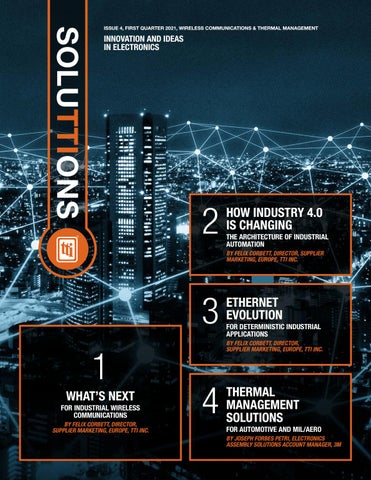
SOLUTTIONS
ISSUE 4, FIRST QUARTER 2021, WIRELESS COMMUNICATIONS & THERMAL MANAGEMENT
INNOVATION AND IDEAS IN ELECTRONICS
2
HOW INDUSTRY 4.0 IS CHANGING THE ARCHITECTURE OF INDUSTRIAL AUTOMATION BY FELIX CORBETT, DIRECTOR, SUPPLIER MARKETING, EUROPE, TTI INC.
3 1 WHAT’S NEXT FOR INDUSTRIAL WIRELESS COMMUNICATIONS BY FELIX CORBETT, DIRECTOR, SUPPLIER MARKETING, EUROPE, TTI INC.
ETHERNET EVOLUTION FOR DETERMINISTIC INDUSTRIAL APPLICATIONS BY FELIX CORBETT, DIRECTOR, SUPPLIER MARKETING, EUROPE, TTI INC.
4
THERMAL MANAGEMENT SOLUTIONS FOR AUTOMOTIVE AND MIL/AERO BY JOSEPH FORBES PETRI, ELECTRONICS ASSEMBLY SOLUTIONS ACCOUNT MANAGER, 3M
Circuit Protection
Optoelectronics
LED Lighting Relays
Power Supplies
Capacitors
Connection Systems Resistors Sensors Inductors Discrete Semiconductors
Switches
The Number to Know for Industry 4.0 is 1.800.CALL.TTI America’s Leading Inventory of Ready-to-Ship Electronic Components TTI Industrial Specialists stock a broad and deep inventory of interconnect, passive and electromechanical components for factory floor applications. From harsh environment rated capacitors and resistors to lighting, sensors, and switches, to connectors, discretes, and wireless communications components for the Industrial Internet of Things, TTI has the components you need, on the shelf and ready to ship from our 800,000 square-foot distribution center in Fort Worth, Texas. From our broad and deep inventory, to your production line, TTI Specialists have the components you need, when you need them at 1.800.CALL.TTI, visit us online at tti.com or connect with us on social media. tti.com 1.800.CALL.TTI A Berkshire Hathaway Company
ISSUE 4 | FIRST QUARTER 2021 | WIRELESS COMMUNICATIONS & THERMAL MANAGEMENT 2
WELCOME TO SOLUTTIONS ISSUE 4, FIRST QUARTER 2021, WIRELESS COMMUNICATIONS & THERMAL MANAGEMENT
CONTENT 1 2 3 4
WHAT’S NEXT FOR INDUSTRIAL WIRELESS COMMUNICATIONS BY FELIX CORBETT, DIRECTOR, SUPPLIER MARKETING, EUROPE, TTI INC.
HOW INDUSTRY 4.0 IS CHANGING THE ARCHITECTURE OF INDUSTRIAL AUTOMATION BY FELIX CORBETT, DIRECTOR, SUPPLIER MARKETING, EUROPE, TTI INC.
ETHERNET EVOLUTION FOR DETERMINISTIC INDUSTRIAL APPLICATIONS BY FELIX CORBETT, DIRECTOR, SUPPLIER MARKETING, EUROPE, TTI INC.
THERMAL MANAGEMENT SOLUTIONS FOR AUTOMOTIVE AND MIL/AERO BY JOSEPH FORBES PETRI, ELECTRONICS ASSEMBLY SOLUTIONS ACCOUNT MANAGER, 3M
SoluTTIons is a regular publication of TTI, designed to bring clear, current information about the rapidly changing world of electronic design to engineers and procurement professionals in the electronics industry. Sourced from industry insiders and thought leaders, these case studies, white papers and marketing intelligence overviews are selected to be informative and thought provoking. Specific focus is given to transportation and industrial market categories.
WHAT’S NEXT
For Industrial Wireless Communications By Felix Corbett, Director, Supplier Marketing, Europe, TTI Inc.
1
Wireless communication is an essential part of modern industrial and commercial products. There are many wireless communication technologies available with differing characteristics. As the IoT market has grown, these have been extended and new standards have emerged to support the requirements such as low power. This paper attempts to bring some structure to this crowded market by considering which systems are best suited for personal, local and wide area networks.
ISSUE 4 | FIRST QUARTER 2021 | WIRELESS COMMUNICATIONS & THERMAL MANAGEMENT 4
STAR
MESH
Network Node
Network Coordinator
Figure 1: Network Topologies
INTRODUCTION Wireless networks can be categorized in various ways. For IoT, the most important characteristics are power, range and data rate. Other properties to consider are the network size and topology. IoT applications have limited power budgets. Power can be reduced if the application only needs to transmit small amounts of data,
such as with sensors that send infrequent updates of their readings. In this case, it can enter a low power mode between messages. The range and the data rate will be determined by the needs of the application. These are complementary: a low-frequency signal can carry less data but can be received over longer distances.
Many networks use a star configuration where all nodes communicate with a central hub. This limits the size of the network, unless further infrastructure is used to communicate between multiple hubs. Other technologies use a mesh where every node can communicate with its neighbors and messages will be passed on to their ultimate destination.
The possible size of a network is determined by the signal range, the maximum number of nodes supported by the protocol and the topology.
Another factor to consider is the choice between open standards and proprietary solutions. This may affect how many vendors support the protocol.
ISSUE 4 | FIRST QUARTER 2021 | WIRELESS COMMUNICATIONS & THERMAL MANAGEMENT 5
WIRELESS STANDARDS 2.4 GHz
There are two standards that form the basis of several wireless communication protocols. The first is IEEE 802.11, better known as Wi-Fi. This has progressed from its initial 1 Mbps target to gigabit speeds by using techniques such as multiple antennas (MIMO) and directional transmission (beamforming). Some of the latest changes are better suited to the IoT with reduced power consumption and greater range. The other standard, IEEE 802.15.4, is the basis of protocols including Zigbee and 6LowPAN. These extend the standard by defining extra high-level protocol layers. For example, 6LowPAN defines how to carry IPv6 over 802.15.4 and is, in turn, the basis for other protocols such as Thread.
NETWORK TYPES
b
g
11 Mbps
ax
n
54 Mbps 600 Mbps
5 GHz
10 Gbps
n
ac
ax
600 Mbps
1.3 - 7 Gbps
10 Gbps
af ("White-Fi")
White Space (54-790 MHz)
569 Mbps ah ("HaLow")
915 MHz
347 Mbps
60 GHz (mm wave) 2000
ad ("Wi-Gig")
ay
6.7 Gbps
100 Gbps
2015
2020
Figure 2: Wi-Fi Timeline
Network Type
Name
Meters
Personal Area Network
Up to 100 Meters
Local Area Network
10s to 100s of Meters
Wide Area Network
100s of Meters Up to Kilometers
PAN
The communication range can be used to group networks into three broad categories: • Personal area network (PAN): up to 10 meters • Local area network (LAN): 10s to 100s of meters • Wide area network (WAN): 100s of meters up to kilometers Most IoT applications fall into either the PAN or WAN categories. PAN applications have sensors and equipment in close proximity, for example wearables and industrial or home automation. WAN applications are where devices may be separated by large distances, such as smart electricity meters or sensors in remote areas. A LAN may be used to link smaller networks together or provide an Internet gateway. This area is dominated by Wi-Fi and wired networks.
LAN
WAN
ISSUE 4 | FIRST QUARTER 2021 | WIRELESS COMMUNICATIONS & THERMAL MANAGEMENT 6
Personal Area Networks (PANs)
PERSONAL AREA NETWORK (PAN) Bluetooth is widely used as a wirereplacement communications protocol, often for handheld and mobile devices. The Bluetooth 4.2 specification introduced new features aimed at IoT applications, the most important being Bluetooth Low Energy (BLE). This provides lower power consumption and cost. It should enable button-cell battery operation for months or, even years. BLE has a data rate of about 1 Mbps and a range of 100 meters. Bluetooth 5 adds options to double the data rate of BLE or increase the range by up to four times at the same power consumption. The range increase is achieved by using forward error correction. This uses a number of bits in the data packet for error detection and correction. This reduces the number of data bits transmitted but allows the data to be correctly decoded at greater distances. There are two different error coding schemes: S2 approximately doubles the range but halves the data rate, while S8 provides roughly four times the range but 1/8th of the data rate. Originally, Bluetooth was conceived as a peer-to-peer or star configuration. BLE now also supports mesh configurations. This uses flood networking, where every packet received by a node is sent out to all connected nodes (this can be disabled for battery-powered nodes to reduce energy consumption). This enables networks of any size and makes BLE more competitive with existing mesh-based systems such as Zigbee.
Figure 3: Ethertronics Ceramic Wi-Fi / Bluetooth Antenna
BLE modules are available from manufacturers such as Panasonic and Murata. Typically, such wireless modules are available with or without integrated antennas. A wide range of suitable antennas, for internal or external mounting, are available from TTI. Thread is a proprietary IPv6-based, lowpower mesh networking technology with AES encryption for security. It has a range of around 100 meters, with a date rate of 250 kbps. The specification is managed by the Thread Group made up of Nest Labs, Samsung, Apple, NXP, ARM and others.
Zigbee is a low-cost wireless mesh network designed for low data rate applications that require long battery life and secure networking. The data rate is fixed at 250 kbps. To pass Zigbee certification, devices must have a battery life of at least two years. The low power means that the transmission distance is limited to less than 100 meters line-of-sight. However, data can be transmitted over longer distances through the mesh-connected network of intermediate devices. It is particularly well suited to intermittent data transmissions from a sensor or input device. ANT is a proprietary protocol, conceptually similar to BLE. It is designed for batterypowered sensors, particularly in health and fitness applications. It provides a data rate of up to 20 kbps at a range of 30 meters. Z-Wave is a proprietary protocol from Sigma Designs. It provides a data rate of up to 100 kbps in a mesh topology. The maximum distance between nodes is about 30 meters but messages can be sent through up to four intermediate devices to their destination. The network size is limited to 232 nodes. WirelessHART is based on 802.15.4 and the Highway Addressable Remote Transducer (HART) protocol, providing a range of around 100 meters with a date rate of 250 kbps. It utilizes a time synchronized, self-organizing and self-healing mesh architecture. It is used for process control, including the measurement of temperature, flow rates and pressure across multiple industries. There are other systems which have limited application or have not yet established their place in the market. These include: • MiWi is proprietary protocol from Microchip Technology based on the 802.15.4 standard. It is designed to provide low data rates (250 kbps) and short distance (100 meters) communication in cost constrained networks. MiWi is integrated into some of Microchip’s microcontrollers. • DECT ULE is a low-energy extension of the DECT protocol widely used by cordless phones. It provides data rates of up to 1 Mbps over a distance of 100 meters.
ISSUE 4 | FIRST QUARTER 2021 | WIRELESS COMMUNICATIONS & THERMAL MANAGEMENT 7
LOCAL AREA NETWORK (LAN) Wi-Fi is the ubiquitous wireless LAN. It is often used in conjunction with other technologies to link hub nodes or provide access to the Internet for remote monitoring and control. 802.11ax is the successor to the current 802.11ac Wi-Fi standard. It uses the same 2.4 and 5 GHz frequencies and is backward-compatible with existing Wi-Fi hardware. It will provide much higher data rates (up to 10 Gbps) and advanced power-saving techniques to provide longer battery life for mobile devices.
WIDE AREA NETWORK (WAN) The specifications for a low-power wireless WAN are typically: • Low data rate: 100 bps to 1 Mbps • Long range: up to 10 km • Low power: as much as 10 years of battery life 802.11ah (HaLow) is a Wi-Fi standard intended for low data rate, longrange sensors and controllers. It uses the unlicensed 900 MHz frequency, which penetrates obstructions better than higher frequency networks and will support mesh networking. This allows a single access point to provide much longer range and support large numbers of remote IoT nodes, hence reducing deployment costs. The maximum data rate is just under 350 Mbps. It can be powered down between communications, further saving energy in the case of infrequent data transmission.
LoRa (Long-Range) is a proprietary LPWAN now owned by Semtech. It uses unlicensed sub-gigahertz radio frequency bands. It provides very longrange transmission (over 10 km in rural areas) at very low power consumption. The data rate is around 50 kbps. LoRa refers to the physical layer and LoRaWAN to the upper communication and management layers. The protocol is designed for low-cost, long-range connectivity for IoT devices in remote and offshore locations. Data is transmitted asynchronously by devices and received by one or more gateway nodes, which forward it to a centralized server. Symphony Link is a proprietary protocol based on the LoRa physical layer. It adds features such as quality of service (QoS) guarantees, variable data rate and over-the-air firmware upgrades. Sigfox uses proprietary ultra-narrowband (UNB) technology on a star or cellular topology. It has a low data rate of 100 bits per second that, combined with a lightweight protocol, enables very low power consumption. The range is up to 10 km.
Mobile IoT refers to two related standards based on the 4G cellular network. These are long-term evolution for machines (LTE-M) and narrowband-Internet of Things (NBIoT). These use secure operator-managed networks in the licensed phone spectrum. They are designed for IoT applications that are low cost, use low data rates, require long battery lives and often operate in remote and hard to reach locations. This offers potential world-wide coverage: the ultimate wide area network. Because they use the cellular network, there will be a recurring access cost. However, as they use relatively little network capacity, carriers will be able to offer lower cost service plans. LTE-M technology is a version of LTE (4G) for IoT. It is compatible with the existing LTE network and so devices can connect directly to the cellular network, without a gateway. It provides data rates of about 1 Mbps. It is suitable for applications such as smart metering, in which only small amounts of data are transmitted. NB-IoT uses the simpler single-carrier frequency division multiple access (SCFDMA) to reduce cost and complexity. This limits the data rate to about 200 kbps.
ISSUE 4 | FIRST QUARTER 2021 | WIRELESS COMMUNICATIONS & THERMAL MANAGEMENT 8
OTHER SPECIALIZED APPLICATIONS There are some new Wi-Fi variants targeted at very high bandwidth applications. 802.11ad (Wi-Gig) is a multi-gigabit protocol designed for wireless connection of high-bandwidth signals such as highdefinition video. It can support data rates up to 6 Gbps but is limited to line of sight communication over a few meters. 802.11ay will offer higher speeds up to 40 Gbps and improved range of up to 300 meters.
CONCLUSION There are a large number of wireless communication solutions available for IoT, depending on the needs of the application. All provide low power, leaving the main deciding factor as the choice between the range required and the data rates. These characteristics are summarized in Table 1.
Typical Data Rate
Approximate Range
ANT
20 kbps
30 m
BLE
1 Mbps
100 – 600 m
DECT-ULE
1 Mbps
100 m
MiWi
250 kbps
100 m
Thread
250 kbps
100 m
WirelessHART
250 kbps
100 m
Z-wave
100 kbps
30 m
Zigbee
250 kbps
100 m
802.11ax
1 – 10 Gbps
300 m
802.11.ah
350 kbps
1 km
802.11af
560 Mbps
1 km
LoRa
50 kbps
10 km
LTE-M
1 Mbps
1 km
NB-IoT
200 kbps
1 km
Sigfox
100 bps
10 km
Symphony Link
50 kbps
10 km
802.11ad
7 Gbps
10 m
802.11ay
40 Gbps
300 m
Network Type
PAN
LAN
WAN
Other
Table 1: Wireless Communications Technologies
ISSUE 4 | FIRST QUARTER 2021 | WIRELESS COMMUNICATIONS & THERMAL MANAGEMENT 9
HOW INDUSTRY 4.0 IS CHANGING
The Architecture of Industrial Automation By Felix Corbett, Director, Supplier Marketing, Europe, TTI Inc.
2
The fourth industrial revolution, also known as “Industry 4.0,” is happening now, enabled by IIoT technologies, fueled by Big Data and adopted by businesses keen to improve performance by connecting their manufacturing equipment, assets and people. Rigid hierarchies and data flows are being transitioned into more pervasive, any-to-any channels that are eliminating the traditional divide between the operational technology (OT) and IT systems domains. The prize is digital transformation, unlocking new and more powerful ways to improve production processes across borders, create extra value for customers and new revenue streams for the business – for example, through new service related business models – and achieve environmental goals. The challenge is to realize these gains without trading the robustness, safety and real-time performance bred into traditional industrial automation over many generations. It calls for a judicious approach to infusing new technology with proven standards and protocols.
ISSUE 4 | FIRST QUARTER 2021 | WIRELESS COMMUNICATIONS & THERMAL MANAGEMENT 10
INDUSTRY 4.0: A DATA-DRIVEN, NETWORKING REVOLUTION Businesses are eagerly embracing the fourth industrial revolution, Industry 4.0, as a necessity to achieve increasingly ambitious goals in relation to growth, efficiency and customer satisfaction, as well as innovation of new products and creating extra value through services to support them. Speed is of the essence: rapid adoption gives firstmover advantage, while failure to react to change has often spelled the end, even for organizations assumed to be too big to fail. Although information technology (IT) systems may be adapting quickly to changing business practices and the Big Data revolution, industrial infrastructures are known to change at a conservative pace. The operational technology (OT) domain is complex, multi-faceted and represents a long-term investment in both expenditure and knowledge.
ISSUE 4 | FIRST QUARTER 2021 | WIRELESS COMMUNICATIONS & THERMAL MANAGEMENT 11
FLATTENING HIERARCHIES, BRIDGING DIVIDES Industry 4.0 is breaking down the traditional IT/OT divide, calling for all equipment, assets and people throughout an organization to become interconnected. The transition will supersede the rigid communication channels and hierarchies that traditionally have dominated industrial automation, defined by the 5-layer Purdue model (Figure 1), also known as the “Automation Pyramid”. Ultimately, connections will extend back into the supply chain, as well as forward to reach equipment deployed at customers’ premises. Historically, the traditional hierarchical model for industrial communication has provided a reliable structure for managing devices on the OT side, particularly at the lower
levels. Those devices, which have little or no on-board intelligence or decision-making authority, simply report information one level upwards through the pyramid, and receive commands from the next higher layer. Now, however, the rigidness of those structures is proving restrictive as cheaper, easier access to compute power and storage enables greater intelligence and responsiveness at the lower levels while also driving a hunger at the higher levels for more and richer data from which to extract insights that can drive further business improvements. The implementation of smart sensors and actuators at the lowest level of the pyramid represents just the beginning of the transformation. As more sensors capture more data in greater resolution and for additional evaluation purposes than “just” controlling processes, limitations in the data-handling capabilities of traditional control systems are exposed, highlighting a bottleneck at the OT/ IT border (Figure 2).
Change is needed to enable IT systems to capture the data they need. With more intelligence embedded in the sensors, actuators and controllers at the lower levels, it makes sense to handle latency-critical tasks in or close to these devices. The concept of edge computing is evolving to address this demand. Only a subset of the data generated at the lower levels is relevant for IT systems and analytics applications. Fog computing describes the processing and filtering this data to pass into the IT domain. The filtered data arriving in the Cloud creates the body of historical data that enables analytics applications to extract valuable business insights throughout the longer term. These applications can themselves be adapted, upgraded or replaced as the needs of the enterprise evolve. Here, of course, the application of artificial intelligence and machine learning presents an exciting opportunity to unlock even greater value from Big Data.
Figure 2: Traditional Control Systems Tend to Restrict the Flow of Data into the IT Domain
Figure 1: Traditional 5-layer Industrial Automation Architecture
Lev Pla el 4 nt
Level 5 Business ERP
L Opeevel 3 rati on
Ethernet MES
SCADA
atio nic
Le Pro vel 2 ces s
mu
Com
Ethernet HMI
ns
L Conevel 1 trol ler
Ethernet PLC
PLC
PLC
Sen Lev sor el 0 /Ac tua to
r
Ethernet Based Fieldbuses
Sensor
Actuator
Device
Device
Communications ISSUE 4 | FIRST QUARTER 2021 | WIRELESS COMMUNICATIONS & THERMAL MANAGEMENT 12
ERP
MES
Cloud
SCADA IOT Connectivity PLC
IOT Connectivity
IOT Enabled IO Module
Sensors
Actuator
Figure 3: New I/O Modules Bypass Data Bottlenecks Associated with the Traditional Rigid Hierarchy
RETAINING ROBUSTNESS, ENSURING INTEROPERABILITY In the Industrial Internet of Things (IIoT), communication infrastructures are reshaping to handle the changing nature of the data exchanges between OT devices, IT systems and the Cloud. The IIoT’s reliance on ubiquitous Internet connectivity technologies enables this to be achieved cost-effectively. Figure 3 shows how new IoT-enabled I/O modules are introduced to handle the large quantities of data coming from smart sensors and actuators to make this available to IT systems quickly and efficiently, but not blocking data mandatory to control any process in real time, i.e. data flow between sensor and PLC. This change toward less hierarchical and regimented data exchanges brings its own challenges. The traditional poll-response mechanism, in which data-gathering terminals repeatedly request data from providing devices, is not easily scalable or adaptable. Communication standards such
as OPC UA (object linking and embedding for process control unified architecture) and MQTT (message queuing telemetry transport) address this issue by making data readily available to any system that needs it through publish/subscribe messaging, which is both scalable and flexible. In publish/subscribe, unlike the traditional poll/response model, each sensor publishes its data immediately, making it available to all devices that are programmed as subscribers. Changing subscriptions or adding or removing sensors can be accomplished quickly and easily, and pressure on network bandwidth is relieved. Both OPC UA and MQTT include security mechanisms for authenticating users and restricting access – security, of course, being arguably more important to IIoT use cases than consumer IoT, as these are typically mission critical and frequently safety or life-critical.
as robust, real-time, performance special profiles for handling equipment, such as drives or I/Os and features for safety in hazardous environments. The transition to Internet-based communication between factory-floor and IT systems for analytic data processing also focuses attention on interoperability and a need to move away from tailor-made approaches to automation based on custom or proprietary data formats. Initiatives to standardize the way data is presented include MTConnect, which specifies standard data-item definitions and leverages XML as a widely supported data format. By eliminating variations between machines, controls, sensors or software from different manufacturers, data exchanges between shop-floor equipment and IT systems should become easier to set up as well as more flexible and cost effective.
At the control level, PLCs are also evolving to address the opportunities of Industry 4.0, for example, by adding more compute power and memory, support for standards like OPC UA, easy Cloud connectivity, and new software tools and libraries. On the other hand, communication with sensors and actuators is likely to enshrine established industrial Ethernet standards – such as Profinet – for some time. These are well adapted to industrial-specific demands such ISSUE 4 | FIRST QUARTER 2021 | WIRELESS COMMUNICATIONS & THERMAL MANAGEMENT 13
ENABLING DIGITAL TRANSFORMATION The adoption of IIoT technologies in the enterprise, transforming the production process, and sharing of manufacturing data is an important enabler for digital transformation, which has the power to improve business performance in numerous respects, including asset management, customer service, new-product creation and consumption of energy and materials. ASSET MANAGEMENT By capturing rich data from each process and each item of equipment on the factory floor, Cloud-based analytics applications can track machine wear trends or other deteriorations to accurately predict equipment maintenance requirements and coordinate condition-based servicing. Maintenance can be scheduled at a time that will cause minimal disruption, and unexpected failures that can halt production can be avoided. NEW PRODUCT CREATION As a further extension, leveraging powerful Cloud computing to combine product CAD data with real-time sensor data to create a live virtual model, or “digital twin,” of new or existing products. A digital twin strategy can be used in various ways, such as virtualizing new-product development to accelerate time to market and reduce prototyping costs while also avoiding costly product redesigns or recalls from the field. CUSTOMER SERVICE Moreover, by collecting data from products already in the field and installed at customer sites, a digital twin strategy can be extended to enhance customer relationships and create new services around products that simultaneously deliver extra value for users and create new revenue streams. Armed with the power of Cloud analytics, equipment suppliers can analyze remotely the ways their customers are using or maintaining equipment and provide value-added services such as how to improve performance or efficiency or how to identify training needs and customize a suitable package. By continuously analyzing sensor data to identify trends, predictive maintenance can also become a reality for products in the field. By combining basic product-design data with individualized customer specifications – captured directly in a standard digitized format and stored in the Cloud to be merged at the correct time – Industry 4.0 makes it possible to personalize production down to the level of a unique individual unit (“lot size = 1”) or short-run batch for a single customer. ENERGY EFFICIENCY The industry 4.0 approach to managing operations also extends to improving the energy efficiency of manufacturing leveraging concepts such as the industrial DC microgrid. Digitalization encompassing intelligent network control and management of integrated energy storage, e.g. in form of battery stacks, is a key enabler for DC microgrids, which simplify integration of renewable energy sources and reuse of recovered energy, as well as reducing energy consumption by eliminating conventional AC-to-DC conversion losses. ISSUE 4 | FIRST QUARTER 2021 | WIRELESS COMMUNICATIONS & THERMAL MANAGEMENT 14
MOVING FORWARD AND FUTURE DEVELOPMENTS The transformation process needs a clear concept and it’s always good advice to get started with small production cells where current processes are “trouble-making.” Moving forward, the differences between IIoT connectivity and that of the ordinary non-industrial IoT could become markedly
different. Whereas consumer or commercial use cases typically involve exchanging small packets of sensor data at infrequent intervals, smart factory IIoT infrastructures are constantly buzzing with rich data sets from large numbers of sources. While the ordinary IoT world is contemplating LPWAN or narrowband GSM for long-range communication, the increasing machineto-machine data rates offered by enhanced mobile broadband (eMBB) could make 5G an exciting prospect for future IIoT deployments. With ultra-low latency and network slicing, 5G is a candidate for intra-machine, factory floor and floor-to-Cloud connections, as well as cable replacement in harsh environments.
CONCLUSION Industry 4.0 is dramatically changing the way manufacturing information is generated, distributed and processed – transforming traditional communication infrastructures and demanding closer integration of OT and IT domains. At the operational levels, however, enthusiasm for revolution must coexist with the need to retain advantages such as safety and real-time performance that are ingrained in existing industrial network technologies and ensure interoperability through standardization of data formats. Successfully managing these changes in the factory data infrastructure is critical to achieve the digital transformation that forward-looking enterprises know they must realize in order to survive.
ISSUE 4 | FIRST QUARTER 2021 | WIRELESS COMMUNICATIONS & THERMAL MANAGEMENT 15
ETHERNET EVOLUTION
For Deterministic Industrial Applications By Felix Corbett, Director, Supplier Marketing, Europe, TTI Inc.
3
IEEE 802.1 Time Sensitive Networking establishes standards for real-time communication over Ethernet, relieving reliance on proprietary extensions and creating the opportunity to enhance the free flow of information between operational (OT) and IT networks, including the Cloud. Moreover, OT networks can take advantage of the scalability and security enjoyed by Ethernet-based IT networks. This white paper examines the historic need for Ethernet extensions to support time-critical and real-time communication and how TSN now standardizes capabilities at OSI network layers 1 and 2 to allow time-critical and best-effort data over a unified network. Although TSN promises to simplify infrastructures to the benefit of end users and equipment providers, ongoing work to ensure interoperability remains important.
ISSUE 4 | FIRST QUARTER 2021 | WIRELESS COMMUNICATIONS & THERMAL MANAGEMENT 16
INDUSTRIAL AND IT CONNECTIVITY IN THE DIGITAL ENTERPRISE The success of Ethernet as a technology for local area networking between IT systems has led to adaptations for operational (OT) purposes such as industrial automation, networked security systems and automotive networking. The need for robustness to withstand harsh environments is satisfied through hardware such as industrial-specific RJ45 connectors. Transformers that provide electrical isolation are also typically employed in industrial applications. In addition to ensuring connected equipment is protected from surges and transients, they also are used for signal conditioning of single-ended to differential signals. An example is the Bourns SM51589PEL transformer. As Ethernet deployment becomes more widespread, the ability to power sensors and other network connected devices through the Ethernet cable can simplify installation and the need for additional power distribution and transformers. Murata, for example, offer the MYBSP range of isolated DC/DC converters specifically for POE applications.
More than robustness, industrial Ethernet applications are characterized by the requirement to deliver data to the receiving device within a timely fashion, often with hard real-time requirements. These include automation such as control of process equipment or conveyor belts, where precision timing is required, or controlling CNC equipment or robotics that rely on real-time position sensing and motor control to ensure perfect coordination. Other time-sensitive applications include distributed monitoring, where measurements from multiple locations – such as from vibration sensors placed throughout a machine or a structure – must be synchronized to allow accurate analysis.
These demands for interoperability, scalability and security strengthen the case for a unified networking technology, standardized within the Ethernet specifications and capable of satisfying the industrial demands for low latency and deterministic real-time response while also supporting conventional Ethernet best-effort traffic.
Several industrial Ethernet implementations are currently in the market, such as Modbus TCP/IP, EtherCAT, Ethernet/IP, Powerlink and Profinet. The differences between them require users to commit to just one, to the exclusion of others. With the advent of the IIoT, enterprise networks must respond to extra demands such as increased bandwidth allowing the operations network to handle the large quantities of data emanating from huge numbers of data channels and direct this towards IT systems and the Cloud for storage and analysis. In addition, assets connected to OT networks now need protection against cyber-attacks that is both strong and able to keep pace with new and evolving threats.
ISSUE 4 | FIRST QUARTER 2021 | WIRELESS COMMUNICATIONS & THERMAL MANAGEMENT 17
RT
RT
RT
RT
RT
RT
RT
RT
RT
RT
RT
RT
RT
RT
RT
RT
Time
Figure 1: IRT Time Slices Ensure Dedicated Bandwidth for Hard Real-Time Traffic.1
STANDARD ETHERNET AND TIME-CRITICAL TRAFFIC In standard Ethernet networks, communication is regulated according to the CSMA/CD - carrier-sense multiple access with collision detection. All devices share a common medium and coordinate sending data by sensing when the network is idle. The Ethernet frame contains the address of the destination device. All devices on the network receive each packet, compare the destination with their own address and discard the packet if there is no match. Because the medium is shared, collision detection enables devices to detect if another device is transmitting at the same time and wait for a random period before retransmitting.
Network switches enable unpredictable delays resulting from collisions to be avoided. The potential for latency to be reduced and delays to become deterministic and thus better suited to industrial applications is clear. However, some problems remain. Typical commercial store-and-forward switches wait for the entire datagram to arrive before forwarding, which can result in delays or even loss of data if there is insufficient buffer capacity for long datagrams, particularly if many switches are cascaded. Industrial Ethernet topologies can use switches that begin forwarding before the full datagram is received. With Quality of Service (QoS), which enables prioritization of Ethernet datagrams, a protocol such as Profinet that uses Ethernet as a shared medium can achieve soft real-time performance with cycle times down to 1ms and jitter in the range 10-100µs. However, this not adequate for the most demanding applications. Different approaches have evolved.
Profinet Isochronous Real-Time (IRT) is an example of a hard real-time industrial Ethernet extension. The available bandwidth is divided into time slices, one of which is reserved for high-priority IRT traffic (Figure 1). A high-accuracy clock is needed to determine when the IRT time slice should begin and end. IRT relies on elements of the IEEE 1588 specification to provide this precision clock. It must also buffer non-IRT data transmitted during the IRT reserved slices. Other proprietary industrial Ethernet specifications take different approaches to achieving low-latency or hard real-time performance. Real-time Ethernet fieldbus protocols such as EtherCAT or SERCOS manage bandwidth and ensure real-time performance, but must control the Ethernet medium themselves.
ISSUE 4 | FIRST QUARTER 2021 | WIRELESS COMMUNICATIONS & THERMAL MANAGEMENT 18
These differing approaches show that there are multiple ways to create the extensions to Ethernet that are needed to support hard real-time networking. Unfortunately, their proprietary nature prevents interoperability and tends to lock customers into certain topologies, equipment types, and vendors. Currently, there are over 40 fieldbus variants and more than 15 different Industrial Ethernet variants. Interoperability and vendor neutrality are not the only casualties of proprietary industrial Ethernet specifications. They also tend to be designed for a specific speed, such as 1Gb or 10Gb. To keep pace with the growing data demands of IIoT, industrial users need to take advantage of the bandwidth scaling associated with the evolution of standard Ethernet, not to mention security provision.
ISO/OSI 7 Application Layer 6 Presentation Layer 5 Session Layer 4 Transport Layer 3 Network Layer 2 Data Link Layer 1 Physical Layer
HTTP
SNMP
SMTP
TCP / UDP IP
PROFINET PROFINET Real-Time
As extensions, industrial Ethernet protocols exist at layers above Ethernet, which defines layers 1 (physical layer) and 2 (data link layer) of the standard OSI network stack (Figure 2). If suitable features could be implemented in the lower layers as part of the standardized Ethernet technology, the need for proprietary extensions to enable real-time communication could be eliminated.
Internet
Ethernet
Figure 2: Ethernet Standardizes Layers 1 and 2. Application-Layer Protocols are Needed for End-to-End Communication.2
1 https://profinetuniversity.com/profinet-basics/isochronous-real-time-irt-communication/ 2 https://profinews.com/2017/07/profinet-and-tsn/ ISSUE 4 | FIRST QUARTER 2021 | WIRELESS COMMUNICATIONS & THERMAL MANAGEMENT 19
TIME FOR TSN? Time Sensitive Networking (TSN) introduces several mechanisms, standardized within the IEEE 802.1 Ethernet specifications at layers 1 and 2, to make this possible. These include IEEE 802.1AS, which covers timing and synchronization for time-sensitive applications, IEEE 802.1Q that integrates several individual standards such as 802.1Qbv for time-aware scheduling, and 802.1Qcc for TSN system configuration. IEEE 802.1AS is based on a profile of IEEE 1588, which defines the precise time protocol (PTP). Although IEEE 1588 was developed for time-sensitive applications, it is not a part of IEEE 802.1 and contains optional profiles that complicate interoperability between equipment from different manufacturers. The standards that comprise TSN enable ordinary Ethernet to handle the actions needed to eliminate congestion for time-critical traffic and provide low and guaranteed worst-case, end-to-end latency – such as reserving resources for time-critical traffic and applying queuing and shaping. In this way, TSN enables deterministic network communication satisfying the timing and control needs of industrial automation without proprietary extensions to Ethernet protocols. The TSN standards also allow for network topologies, such as star, ring or line, and numbers of switches in the network. Redundancy is also catered for. At the same time, TSN enables a single bridged Ethernet network shared by diverse applications with differing QoS needs to carry time-critical traffic and non-TSN best-effort data. By standardizing the provisions for time-sensitive networking, TSN brings several important advantages. One is scalability. Whereas previous realtime extensions have been defined for a specific data rate, TSN can scale with the increasing bandwidth provided by successive generations of the standard Ethernet specification. In addition, the security mechanisms already deployed in IT networks can be applied to OT networks with TSN, potentially enhancing resilience and accelerating access to new updates introduced to tackle emerging cyber threats. Moreover, a common standard for real-time communication has the potential to unify the market and thus enable industrial Ethernet users to benefit from economies of scale similar to those enjoyed in the IT world. Network installation and maintenance can also be streamlined, and TSN equipment can be used in areas other than the factory floor, such as building automation, energy distribution, automotive control networking, and professional audio and video. Indeed, the standardization work that resulted in TSN began as IEEE 802.1 audio video bridging (AVB) to support low-latency, synchronized audio and video. TSN contains a published profile for AVB (802.1BA) as well as cellular fronthaul (802.1CM), and ongoing standardization work should result in a TSN profile for industrial automation based on IEC/IEEE 60802. The profiles simplify selection of various features and options and provide help to build networks for use cases such as AVB and fronthaul, intending to enhance interoperability and ease deployment. It is also worth noting that, in addition to bringing the advantages of standard Ethernet to the industrial space, TSN also allows real-time communication to be extended beyond OT networks, thereby supporting the development of new IT applications.
ISSUE 4 | FIRST QUARTER 2021 | WIRELESS COMMUNICATIONS & THERMAL MANAGEMENT 20
Industrial Ethernet
ONGOING DRIVE FOR INTEROPERABILITY
Other industry initiatives are working to ensure interoperability to maximize the benefits of network convergence leveraging TSN. The Industrial Internet Consortium has created the TSN Testbed as a platform for equipment providers to test implementations and interoperability at plugfest events. The AVNU Alliance is leveraging the work of the IEEE and IEC, such as the 80802 joint working group, to create test plans and procedures that will help manufacturers create TSN products that are interoperable with those of others. Given the strong role anticipated for TSN in enhancing industrial Big Data applications, it is important that a standard solution for communication between industrial controllers and the Cloud is also being sought. A consortium of automation and IT suppliers is promoting OPC UA over OPC UA over TSN as the most suitable solution, leveraging the speed of OPC UA’s publish/ subscribe (pub/sub) technology.
CONCLUSION TSN brings easy interoperability and economies of scale to OT networking use cases such as industrial automation, professional audio/video, building automation and automotive control and infotainment.
OPC UA
Manufacturing Execution System
SCADANetwork System Management
Controller
HMI
Engineering Framework
IPC
Energy Management
Industrial Motion Communication Control
CNC
PROFINET
While TSN has successfully standardized real-time communication capabilities at the lower layers, the opportunity for ongoing use of competing protocols at the application layer remains. This could be seen as a potential barrier to interoperability. However, it is also true that networks currently reliant on industrial Ethernet protocols can continue using these while adopting TSN as desired.
Cloud
Power Supply and Distribution
Industrial Identification
Distributed I/O
Drive Systems
Industrial Controls
Figure 3: A Unified Infrastructure May Mix Industrial Ethernet Application- Layer Protocols with OPC UA.3
Digital enterprise networks can take advantage of the commonality, scalability and security that come with standardized Ethernet, leveraging an industrial Ethernet
application-layer protocol at the field level, using OPC UA for vertical communication to the Cloud (Figure 3).
Moreover, and driven by the emergence of the IIoT – with its demands for greater bandwidth, scalability and security – TSN lets OT communications benefit from the ongoing evolution of the standard Ethernet specifications developed to protect IT networks and enhance performance.
Interoperability initiatives are also live, aiming to ensure that ecosystem players and users of networked automation can enjoy the maximum potential benefits of standardized real-time communication over Ethernet.
TSN standardization work is ongoing, including the development of the 60802 profile for industrial automation.
3 https://assets.new.siemens.com/siemens/assets public.1532340167.2e1b43b59229eba58e69098f26a7c5e4f2461457.dffa-b10293-02-7600-opc-ua-flyer-72dpi.pdf ISSUE 4 | FIRST QUARTER 2021 | WIRELESS COMMUNICATIONS & THERMAL MANAGEMENT 21
THERMAL MANAGEMENT SOLUTIONS
For Automotive and MIL/AERO By Joseph Forbes Petri, Electronics Assembly Solutions Account Manager, 3M
4
IoT technology can be a two-edged sword. On the one hand, as connectivity is integrated into all forms of smart devices, increased performance is a significant benefit, bringing cloud capabilities directly to the users and devices that need them. On the other, this increased performance together with an ever-shrinking PCB footprint results in the need to dissipate greater amounts of excess heat. This buildup of excess heat causes 55% of electronic systems to fail. How can one avoid this trade-off? Enter Thermal Interface Materials (TIMs), a category of products used to aid thermal conduction between mated surfaces such as a semiconductor device and a heat sink. TIMs can increase a component’s life span, reducing the temperature by 10ºC or more.
ISSUE 4 | FIRST QUARTER 2021 | WIRELESS COMMUNICATIONS & THERMAL MANAGEMENT 22
MARKET DRIVERS Among trends that are driving the need for thermal interface solutions is data consumption. As devices get more powerful, to handle the amount of data being transferred over IP networks – megabytes, gigabytes even exabytes – results in generating more heat that must be managed through thermal interface solutions. Heat is an unavoidable byproduct that can be destructive if allowed to build unchecked. With the introduction of sub-10 nm semiconductor fabrication processes, current manufacturing trends have exacerbated the need for effective thermal management.
Another trend is connected devices. Look around inside your car at the number of connected devices within a new vehicle. Then there is the ever-growing use of circuit boards. Flexible printed circuit boards are going to drive the need for additional thermal interface solutions for lighting and display technologies for consumer electronics, as well as wearables with sensors that help monitor our health.
This white paper will cover how thermal interface materials work, review applications in automotive and aerospace, and examine the specific product selection criteria that comes into play when making critical product selection decisions.
These trends in electronics are driving opportunities for thermal management. There are many solutions that can be used as an interface to enhance thermal coupling. These include thermal adhesives, thermal gap fillers (sometimes known as gap pads), thermally conductive tapes, thermal pastes, thermal greases, and thermally conductive epoxies. They all work toward moving heat to increase the performance and reliability of a device.
ISSUE 4 | FIRST QUARTER 2021 | WIRELESS COMMUNICATIONS & THERMAL MANAGEMENT 23
THERMAL INTERFACE MATERIALS (TIMS) Thermal Interface Materials or TIMs play an important role in addressing the thermal limitations of electronic designs. They provide a heat path between heat-generating devices and cooling components. A thermal interface material is any kind of material that can be inserted between components to enhance the thermal coupling between them. For example, an electric vehicle has a battery pack that is generating heat that can be dissipated by placing a thermal interface material between the battery and a cooling plate that will help keep it in its operational temperature range. Thermal conductivity is a measure of the ability of a material to transfer heat. Given two surfaces on either side of a material with a temperature difference between them, thermal conductivity is the heat energy transferred per unit time and per unit surface area, divided by the temperature. Among the primary applications for TIMs are gap filling applications with pads, and bonding applications with tapes. A TIM can be located between the heat sink and heat source – used to transfer heat from the heat source to the heat sink. LEDs, for instance are heat sources. Heat sinks can range from the traditional fin-shaped metal heat sinks to a chassis, a metal shielding can, backlight unit or housing case. 3MTM Thermal Interface Materials portfolio features 3MTM Thermally Conductive Tapes, 3MTM Thermally Conductive Interface Pads, 3MTM Thermally Conductive Grease, 3MTM Thermally Conductive Epoxy Adhesives, as well as 3MTM Thermally Conductive heat Spreading Tape. 3MTM Thermally Conductive Interface Tape solutions come in a variety of thicknesses, thermal conductivities, and bond strengths with different colors and tape constructions. 3M also offers thin 3M pads, with thickness between 0.2 and 2.5 mm at different thermal conductivity and hardness Shore values. In some assemblies where they are leaning toward thinner thermally conductive materials, products such as 3MTM Thermally Conductive Interface Tape 8926 and 3MTM Thermally Conductive Adhesive Transfer Tape 8805 down to 0.2 mm to provide not only
the conductivity, but the high adhesion in an assembly where they may not have the room or space. So, in applications where the assembly itself is relying on the tape for the final assembly, a high adhesion 3MTM Thermally Conductive tape will fill the bill. These tapes provide efficient thermal transfer for a wide range of applications including bonding heat sinks, heat spreaders, IC packages, power transistors, and more. They also offer a highly conformable construction that provides excellent wet-out on surfaces. As a rule of thumb the softer the material the better the wet-out. They also provide excellent handling and can be die-cut to fit most applications. Thermal interface tapes, pads, and epoxies by 3M provide high thermal conductivity by focusing on the two areas that matter most: bulk conductivity and interface conductivity. They all address a crucial problem with today’s electronic devices – the need to dissipate the sizable amounts of heat being generated. Selecting the right thermal interface material is part art, part science. You have to think about a given application’s specific requirements to find the best form, fit, and function that will drive the best solution. It is not just selecting the best thermal conductivity (K-value). There is a lot of factors that come into play: gap thickness, electrical interference, industry requirements, and perhaps the substrates themselves. When choosing a TIM solution, there are three features engineers must properly balance for better thermal performance. The first feature to consider is the TIM thickness. In general, thinner is better. However, if the TIM is too thin, it may have poor wet-out because it will not properly fill the surface roughness. There are applications where designers may have selected a very thick gap pad and had to greatly compress the material with mechanical fasteners to achieve the necessary thermal performance. It is better to match the actual gap thickness pressure and a material’s Shore value (hardness) for the best form, fit, and function. The TIM thermal conductivity (K-value) must also be considered. In general, higher thermal conductivity is used to dissipate greater amounts of heat. It should be noted, however, that as the thermal conductivity increases, the material may be harder because it has more conductive fillers inside. This will negatively impact the wet-out of the
materials. The goal is to find the optimized balance of features to fit the application.. Gap thickness may be a factor: there are custom gaps that need to be filled and having the ability to make custom thicknesses of filler materials can be a keen advantage when trying to select materials that are form fitting and remove air pockets. There could be specific needs due to the roughness of the materials, the heat source, and the heat sink, that require dramatically lower Shore softness, so the material itself wets out better under lower compression. What is more, there could be issues in the assembly process itself. For example, there are 3MTM Thermally Conductive Acrylic Interface Pads available in rolled formats for high volume rotary converting. This allows for lower cost during final assembly, in that the materials can be robotically applied, making it much easier to handle and use in the final assembly processes. The key point is this: time really should be spent understanding the application requirements to drive the best solution for a given application.
3MTM Thermally Conductive Tape
3MTM Thermally Conductive Interface Pad
ISSUE 4 | FIRST QUARTER 2021 | WIRELESS COMMUNICATIONS & THERMAL MANAGEMENT 24
APPLICATION CASES Let us highlight two markets where 3M Electronics Materials Solutions Division provides a wide range of product solutions. In the automotive marketplace, electric vehicles have moved to using thermal interface materials to keep battery packs running cool. Many of the electric vehicles today utilize liquid cooling. And it is this interface between the heat-generating battery pack and the cooling heat sink or cooling plate where you will find thermal interface materials coupling those two surfaces to help keep the vehicle running at an optimal temperature. These drive trains are very energy efficient; they only lose 25% of their energy as heat, compared to internal combustion engines, which lose almost 80% of their energy to heat. However, this heat still needs to be dissipated, and so by coupling the battery pack and cooling plates with a thermal interface material, battery life can be extended, and the driving range of these electronic vehicles increased. In the automotive market, another key driver in hybrid electric and battery electric vehicles is light weighting. Here 3M offers an acrylic chemistry that is significantly lighter in weight than traditional silicone chemistries to help reduce the weight of the battery pack/battery module assembly. There are other needs for thermal interface materials: LED lighting for example, GCUs, ECUs, and other modules within the vehicle. Customer input drives innovation, and one area 3M has been putting a lot of attention and focus is its acrylic interface pad portfolio. The company created and is offering acrylic interface pads that can withstand 130 C continuous temperatures. In many electronics designs this is very attractive for higher temperature applications that, in the past, had only been able to be fulfilled within a silicone portfolio. 3MTM Thermally Conductive Acrylic Interface Pads were developed specifically to manage and conduct heat. They deliver excellent dielectric strength and are suitable for use between heat-generating components and heat sinks as well as cooling plate applications. In this example, an OEM could select 3MTM Acrylic Pad 5571. First, the thermal requirements can be satisfied with the 3M Pad 5571’s high thermal conductivity. At 2.0 W/m-K, this gap pad material can move heat and meet cooling requirements. 3M Pad 5571 is supplied in a rolled format which allows for high-speed rotary converting and lower converting costs. Another example in the automotive marketplace is the electronic control unit (ECU). This device controls a broad number of complex functions within the vehicle, and, once again, involves thermal management. In these types of applications, you must think about things such as what is the gap and how much heat are you trying to move, but also assembly. There are two different types of assembly. The first assembly will end up having a printed circuit board assembled inside the case, but is held in place with mechanical fasteners– perhaps screws, some clips, even an epoxy–or it is formed in place. However, there are some applications where the thermally conductive tape not only has to move the heat but needs to provide high adhesion. The tape itself is going to hold the board into the module to help move the heat to its surrounding case. In automotive, as was mentioned, light weighting the vehicle is always part of a design and is intended to extend the vehicle’s driving range on a single charge. The 3M Pad 5571 is actually 20% lighter in weight than an equivalent silicone option. Thermal runaway is also an industry requirement, and it’s a concern. So selecting materials like the 3M Pad 5571 that have a UL 94-V0 rating for flammability would also be important for an electric vehicle battery pack assembly.
ISSUE 4 | FIRST QUARTER 2021 | WIRELESS COMMUNICATIONS & THERMAL MANAGEMENT 25
WIRELESS STANDARDS This unique combination of heat management, heat conductivity and electrical insulation makes 3M’s thermally conductive solutions a high-performance choice compared to silicone, with no siloxane outgassing. In aerospace applications, siloxane can affect displays and pilot vision by leaving a cloudy film on display surfaces. In the confined space of a cockpit, siloxane can build up on surrounding components or electronics, adversely impacting the pilot’s ability to safely fly the plane. So if you could eliminate the siloxane outgassing within the cockpit area of the thermal interface materials that you’re using, that would be a key benefit and of interest to design engineers. 3M has an extensive portfolio of acrylic-based thermal solutions that do not outgas siloxane, and are a preferred candidate for the confined spaces found in aircraft. There could be an industry requirement for UL ratings for flammability, for outgassing, or the use of acrylic thermal pad chemistry over traditional silicone gap pad chemistry to reduce dramatically the amount of siloxane present in a thermal gap pad assembly. 3MTM Thermally Conductive Acrylic Interface Pads contain up to 1,000 times less detectable volatile siloxane content compared to silicone pads. The material is available in a variety of compression/recovery rates for very high wet-out on uneven substrates.
ISSUE 4 | FIRST QUARTER 2021 | WIRELESS COMMUNICATIONS & THERMAL MANAGEMENT 26
CONCLUSION This paper has discussed electronic trends driving thermal management opportunities, how thermal materials work and how to dissipate unnecessary heat. Then we
reviewed the application requirements of two important markets and some of the selection criteria that come into play to select the best TIM form, fit, and function. But please don’t think that these solutions are just for automotive or aerospace, as they are just as likely to be relevant to the thermal projects that you are working on involving electronic devices and components.
For more information, contact TTI.
ISSUE 4 | FIRST QUARTER 2021 | WIRELESS COMMUNICATIONS & THERMAL MANAGEMENT 27
THANKS FOR JOINING US TTI developed SoluTTIons as an electronically delivered magazine, dedicated to showcasing new ideas and innovations from across the electronics industry. Each issue, will focus on a specific market such as Transportation or Industrial Applications, wherever new concepts and interesting applications of technology take us. We're working with writers and engineers around the world to bring these insights to your screen on a regular basis and hope you find it helpful. If you know of a colleague who might benefit from reading SoluTTIons, we encourage you to pass along this link ttiinc.com/solutions so they can subscribe and have this type of specific engineering content delivered to their desktop. The Specialist in Electronic Component Distribution