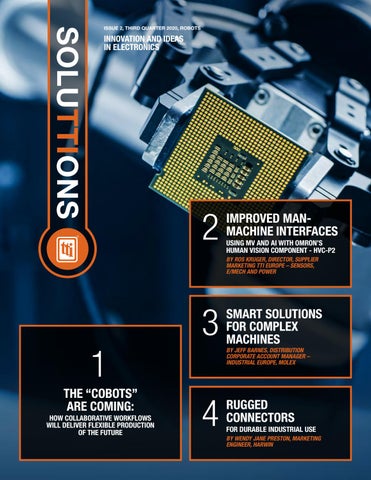
SOLUTTIONS
ISSUE 2, THIRD QUARTER 2020, ROBOTS
INNOVATION AND IDEAS IN ELECTRONICS
2
IMPROVED MANMACHINE INTERFACES USING MV AND AI WITH OMRON’S HUMAN VISION COMPONENT - HVC-P2 BY ROS KRUGER, DIRECTOR, SUPPLIER MARKETING TTI EUROPE – SENSORS, E/MECH AND POWER
3 1 THE “COBOTS” ARE COMING: HOW COLLABORATIVE WORKFLOWS WILL DELIVER FLEXIBLE PRODUCTION OF THE FUTURE
SMART SOLUTIONS FOR COMPLEX MACHINES BY JEFF BARNES, DISTRIBUTION CORPORATE ACCOUNT MANAGER – INDUSTRIAL EUROPE, MOLEX
4
RUGGED CONNECTORS FOR DURABLE INDUSTRIAL USE BY WENDY JANE PRESTON, MARKETING ENGINEER, HARWIN
Choose the Components that Power Tomorrow’s Industrial Systems
Molex Industrial Components From factories to food production, today’s industrial systems run more safely and efficiently with connectors, power components and network solutions designed for agile, evolving work environments. Discover how Molex industrial components take industrial operations to the next level: • Increased Safety and Durability with Heavy-duty and Water-resistant Power Solutions • Better Communications with Durable Industrial Networking Components • Accurate and Rugged Sensors Designed for Challenging Environments
Learn More Molex is a registered trademark of Molex, LLC in the United States of America and may be registered in other countries; all other trademarks listed herein belong to their respective owners.
ISSUE 2 | THIRD QUARTER 2020 | ROBOTS 2
WELCOME TO SOLUTTIONS ISSUE 2, THIRD QUARTER 2020, ROBOTS
CONTENT 1
THE “COBOTS” ARE COMING:
HOW COLLABORATIVE WORKFLOWS WILL DELIVER FLEXIBLE PRODUCTION OF THE FUTURE
2
IMPROVED MANMACHINE INTERFACES USING MV AND AI WITH OMRON’S HUMAN VISION COMPONENT - HVC-P2 BY ROS KRUGER, DIRECTOR, SUPPLIER MARKETING TTI EUROPE – SENSORS, E/MECH AND POWER
3 4
SMART SOLUTIONS FOR COMPLEX MACHINES
BY JEFF BARNES, DISTRIBUTION CORPORATE ACCOUNT MANAGER – INDUSTRIAL EUROPE, MOLEX
RUGGED CONNECTORS FOR DURABLE INDUSTRIAL USE BY WENDY JANE PRESTON, MARKETING ENGINEER, HARWIN
SoluTTIons is a regular publication of TTI, designed to bring clear, current information about the rapidly changing world of electronic design to engineers and procurement professionals in the electronics industry. Sourced from industry insiders and thought leaders, these case studies, white papers and marketing intelligence overviews are selected to be informative and thought provoking. Specific focus is given to transportation and industrial market categories.
THE “COBOTS� ARE COMING: How Collaborative Workflows Will Deliver Flexible Production of the Future
1 Collaborative robots (cobots) represent a rapidly emerging sub-sector of the industrial automation market, and are finding increasing application across various production industries. Characterized by an ability to work closely together with humans, the latest generation of cobots are safe, flexible, and user-friendly, providing companies of any size with a cost-effective means of adopting smart automation. This whitepaper looks at the growth of cobots, while outlining some of their key enabling technologies, such as controllers, arms, end effectors, sensors and drives. It also looks at the nature of the cobot supply base, identifying some of the key distributors of associated electronic components.
ISSUE 2 | THIRD QUARTER 2020 | ROBOTS 4
THE RISE OF THE ROBOTS
BENEFITS AND APPLICATIONS
The rise of the robots is taking place within manufacturing facilities throughout the world. In an ever-growing range of sectors such as automotive, electronics, material handling, food and metal working, surging levels of investment in advanced automation is resulting in smarter and more cost-effective ways of working, freeing up humans to perform more valuable tasks.
In terms of a commonly-used definition, cobots are described as robotic systems that are specifically designed for direct interaction with a human within a defined collaborative workspace. Within these shared environments, safety is obviously paramount. Cobots are therefore fitted with a suite of intelligent sensors which enable them to respond to human movement in a split second by reducing their speed and thus kinetic energy to an extent that prevents any form of injury. In short, when the person acts, the cobot reacts.
Traditionally, robots within manufacturing environments have been physically separated from employees – either behind safety cages in cells or on distinct production lines. But that is starting to change. A new breed of collaborative robots (cobots), which are designed to work hand-in-hand with humans for specific tasks, have started to come to the forefront. These cobots are smaller and are more user-friendly than their fixed-position counterparts, opening up some exciting new applications in any manufacturing process. Indeed, cobots represent by far the fastest growing sector of the industrial automation market, with stellar forward projections. A recent report from research specialists Markets and Markets suggests that sales of cobots will grow from $710 million in 2018 to $12 billion by 2025, at a staggering compound annual growth rate of more than 50 percent during the forecast period. This growth is attributed to a timely confluence of several factors, including the high return on investment and relatively low price of collaborative robots, which result in the growing adoption by small- and mediumsized enterprises. It is also supported by rising investments in automation by industries to support the evolution of Industry 4.0, improving human–machine interfaces, and increasing capability of artificial intelligence to imitate human behavior, says Markets and Markets.
So, what are the primary benefits of cobots? Typically, traditional industrial robots have proved adept at performing simple, repetitive handling tasks. Humans, on the other hand, have unique thinking and response skills that enable them to understand and respond to any changes in tasks. By working hand-inhand as a “team”, humans and robots can greatly improve performance, as long as the work is optimally shared in a safe and efficient manner. That’s where cobots start to find their place within manufacturing settings. The use of such technology can therefore deliver some distinct advantages. First, the removal of safety fences and cages is a huge space-saver on factory floors, encouraging far greater flexibility in terms of production line layouts by reducing the disruption to material flow. But it’s not just about physical space-saving: Cobots can also transform the types of products that can be made. Whereas fixed position industrial robots are largely about consistency of quality and flow – replacing functions in which lesserskilled people had to carry out repetitive, burdensome tasks – cobots are about working side-by-side with highly skilled people to create individualized products in an emerging trend commonly referred to as mass customization.
That could mean workers using the advanced capabilities of cobots to customize certain elements of car interiors, or to perform individual embellishment to highspec watches and jewelery. Or it could mean adding new levels of authenticity to the packaging of premium craft beers and foods. Or cobots can help to perform risky tasks such as packing and unpacking boxes or cartons. It’s only through man and machine working seamlessly together that manufacturers will be able to meet the rising expectation of an increasingly discerning customer base. It is about applying cobots as personal production tools that can be used by members of any workforce to apply creative skills more effectively, thus providing greater human value. At an economic view, cobots can return their investment within a year at an entry level in a range of $33K … $50K. Thus, they can become available also to SME where they can prove their benefits on a large scale.
ISSUE 2 | THIRD QUARTER 2020 | ROBOTS 5
DESIGN CONSIDERATIONS In terms of design, there are major similarities between cobots and traditional industrial robotic arms, with both comprising a combination of controllers, arms, end effectors and drives to perform operational tasks. However, cobots are typically smaller and come with lower payloads, usually between 5 – 40 lbs. They are fitted with additional sensors and safety features including force feedback, vision and motiondetection sensors. The sensors are often installed beneath a padded ‘skin’ that is soft to touch, making them suitable for close operation with humans in what can be ergonomically-tight production environments. The sensors enable the cobot to ‘feel’ external forces and, if the force is too high, to halt its movement. Passive compliance is produced through the use of mechanical components. So, if an external force is felt on a component such as a joint, this joint will submit itself to this force. In the case of a collision, the joint will move in the opposite direction or stop completely to avoid causing injury. In parallel to the progression of cobot technology has been the development of safety standards to support their use. International Organization for Standardization ISO/TS 15066 provides technical specification for collaborative robot system safety, outlining four primary types of collaborative operation which ensure that cobots can be designed for safe use within manufacturing environments. First, there is power and force limitation, which allows the cobot to know how much power and force a person can withstand, and instantly cease activity if an obstacle is encountered. The energy of any collision is kept below maximum levels as defined by the ISO standard. Safety monitored stop, meanwhile, uses a suite of sensors to ensure that the cobot is aware of its human workers within the workspace, and if any body part gets too close, it will stop what it is doing. Effectively, either the robot system or the human operator moves, not both at the same time.
Then there is the use of speed and separation monitoring, which employs sensors to detect human immediacy and reduce operating. In such instance, says ISO, a minimum safety distance between the robot system and the person is maintained to avoid contact. The robot system then ‘dances’ with the worker, meaning that if the individual takes a step towards it, the robot system will move one step back. The ISO/TS 15066 technical specification offers detailed guidance on maximum allowed speeds and minimum separation distances for safe operation. And finally, there is hand guiding, where human operators can program a cobot to learn new paths and positions by manually guiding the cobot arm. Hand-guiding cobots
are particularly suited for use in delicate production line activities, and in other sectors such as healthcare where they can be used to carry out intricate surgical procedures such as needle insertion, drilling and stitching. ISO/TS 15066 specifies wider safety requirements for cobots in industrial settings. This includes guidance on how to perform comprehensive risk assessments to assess not only the robot system itself, but also the environment in which it is placed, considering factors such as ergonomics which have a big impact on worker posture and comfort.
ISSUE 2 | THIRD QUARTER 2020 | ROBOTS 6
EXPANDING SUPPLY BASE As the market for cobots has grown, and new applications have emerged, so the number of cobot suppliers has steadily increased. Initially, the market was dominated by a handful of global players including Universal Robots, Festo, ABB, Fanuc, and Kuka. However, over the past few years, other disruptive start-up companies were established, many of them start-ups from universities. Now, there are more than 30 sizeable companies active in the cobot market, and that number is expected to continue rising. As a result, the increasingly fragmented nature of the cobot market is now supported by an ever-more diverse component supply chain, with electronics distributors offering a wide range of associated products including EMI/EMC/ESD passives, DC/DC power units,
sensors, connectors and interconnects, sockets and wireless modules, to name but a few. At TTI, Inc. for instance, this demand is being met through a range of product suppliers including Murata, TE Connectivity, TDK, Vishay, AVX and Amphenol, enabling cobot manufacturers of all sizes to design and build new models from the ground up, using latest technologies from these leading suppliers. For instance, TTI’s Sensors Resource Center includes details for products such as force sensors, which have been designed for sensing force in input devices and posture control in industrial equipment. The range uses MEMS technology to achieve the industry’s smallest size, making it ideal for use in cobots. These sensors use the effect of piezo resistive bridge circuit formed on a silicon diaphragm, with the piezo resistance changed according to the strain by applying a force to the diaphragm. This yields high sensitivity and a good linearity, and the device can precisely detect micro forces less than 0.01N.
WHAT’S NEXT FOR COBOTS? It’s clear, then, that the market for cobots is developing at a rapid pace, with the number of manufacturers increasing and the component supply chain becoming evermore established. Looking forward, it is likely to be small-to-medium sized businesses that continue to push the sector forward, with cobots providing relatively low-cost solutions that allow for a more customized manufacturing that is not restricted by factors such as volume levels or the kinds of products being created. New applications will continue to emerge, as companies exploit the opportunities of smarter working. In short, the cobots are coming – and in the rapidly-developing world of fully collaborative manufacturing, it seems that humans will be marching with them too.
Rugged & Flexible Connectors for Tough Industrial Environments Archer Kontrol 1.27mm Pitch Board-to-Board Connectors • Stands Up to Misalignments, and Lateral or Twisting Forces • Range of Orientations and Mating Height Options • Supports 1.2 Amps per Contact, up to 3 Gbits/s Data Rate.
In Stock Now at TTI, Your Harwin Industrial Specialist Learn More ISSUE 2 | THIRD QUARTER 2020 | ROBOTS 7
IMPROVED MANMACHINE INTERFACES
Using MV and AI with Omron’s Human Vision Component - HVC-P2 By Ros Kruger, Director, Supplier Marketing TTI Europe – Sensors, E/Mech and Power
2
There is no doubt that we have accepted technology into almost every aspect of our lives. One reason for this is perhaps because it operates transparently in the background. The way we abstract ourselves away from technology allows more people to feel its benefits; it isn’t necessary to understand how the Internet works in order to use an online shopping service, for example. That wasn’t always the case, but technology has a way of changing to meet expectations, particularly when there is a commercial incentive. The recent addition of artificial intelligence (AI) and voice interfaces to create virtual digital assistants is opening up online services to a wider range of users. The latest developments in machine vision (MV) and AI are also going to create many new commercial opportunities for technology, as they increase the level of abstraction and simplify our interactions with technology so we are hardly aware it is there. We are already able to interact with technology using natural language, the addition of MV and AI will improve the user experience, as will the addition of gesture recognition and the ability to read facial expressions. This will help enable a new generation of more human-focused consumer experiences, as well as provide a significant boost to the development and acceptance of collaborative robots, or cobots. This will fundamentally change the shape of many areas where technology is making a difference, from caring for the sick and elderly to factory automation. This white paper will explore the area of machine vision as it applies to user interfaces within the area of industrial/commercial cobots, light industrial applications (vending machines, kiosks) and factory automation, with specific focus on the HVC-P2 sensor.
ISSUE 2 | THIRD QUARTER 2020 | ROBOTS 8
THE MARKET
Although there is already a large market for MV, this is dominated by routine inspection and sensing tasks. Advanced systems are becoming available that support more intelligent image analysis. This is expected to be an increasingly important part of the market in future. The global market for MV systems is estimated to be nearly $10 billion. It is forecast to grow to about $15 billion by 2022 (with a CAGR of around 8 percent).
Hardware makes up the larger part of this, mainly cameras and sensors. The software side is very fragmented and application specific. However, this part of the market is expected to grow significantly as techniques such as machine learning and AI are applied to produce more advanced capabilities that enable new applications. Growth is driven by several factors including the increasing adoption of Industrial IoT technology which uses vision to improve the
productivity of robotic systems and to gather information. In the non-industrial area, novel applications are emerging such as driverless cars, intelligent retail systems, security and access control. Other factors that will contribute to future growth are the increasing capabilities of the technology and the falling cost of both sensors and computer capability. Also, increased ease of use will make it easier for companies to integrate high-level functions into their products.
ISSUE 2 | THIRD QUARTER 2020 | ROBOTS 9
TECHNOLOGY Current MV systems are based on the work done over many decades in multiple areas including optics, mathematics, physics, computer architecture and software. The technologies that have contributed most are solid-state image sensors, embedded processors and image processing algorithms. This has enabled the development of systems that provide more analysis and “understanding” of what the camera sees.
manufacturers of CCD and CMOS image sensors, but their availability and low cost has spawned hundreds of camera companies worldwide, several focused on the machine vision and image processing markets. The use of standardized high-speed, low-cost serial interfaces allows large amounts of image data to be transferred quickly from the camera to the processing system. Some cameras exploit widely available interfaces such as Ethernet, Firewire or USB. This simplifies the task of integrating these into a system. There are
The development of charge-coupled device (CCD) image sensors goes back to the early 1970s. The concept of the CMOS active pixel image sensor was developed around the same time, but semiconductor manufacturing technology did not make mass production practical until the mid90s. There are currently a handful of
also interfaces specifically designed for the needs of cameras, such as CoaXPress (CXP) and Camera Link HS (CLHS), which are used in more specialized applications. Higher data transfer rates, combined with increased computer performance, enables high resolution images and video to be processed in real time. Many of the algorithms in use today were developed in the 1960s. This includes techniques for image enhancement, feature extraction and object identification. The functions available have since been extended to include identifying faces, specific individuals and even expressions. Today, the focus is on machine learning and AI to extend the functionality even further to meet the needs of emerging applications. This is leading to the development of smart cameras that do much of the image processing and object recognition internally. Contrinex Multi-Sensors
APPLICATIONS The largest application areas, currently, are automated inspection, sorting and quality control. The earliest example of this goes back to the 1930s, with a machine made by Electronic Sorting Machines that used cameras with color filters to identify and select items that were within an acceptable range. This was applied to sorting various types of peas, beans and nuts. Modern sorting and inspection systems exceed humans for speed and accuracy in many routine tasks. However, as capabilities have improved, a wider range of applications is able to take advantage of MV technologies. This includes: • Vision-guided robotic systems across the pharmaceutical and chemical, food and beverage, manufacturing and packaging industries
• Agricultural tasks such as planting, tending and harvesting crops • Automated sorting machines and meat-cutting systems • Collaborative robots which operate in a joint work-flow with humans • Advanced driver assistance systems (ADAS) and autonomous vehicles • Interactive advertising and retail systems • Security systems for identification and access control Machine vision now needs to make a step change in capability to support emerging applications and enable new ones, particularly outside the industrial area. This will use machine learning and AI to provide higher level information about the contents of a scene; for example, identifying people and what they are doing. The use of these new technologies will require engineers with new skills.
There will be a need for education and training of existing teams. This can be offset by MV products that include the required high-level functionality. One of the challenges is providing the processing power needed to implement the more advanced algorithms. Many current AI systems rely on being able to offload processing to the cloud. For some embedded systems, this will not be an option, either because the latency is too great or they are not online. These will require sufficient processing in the vision system itself. Some of the key requirements for adoption of MV systems are: • High level function: for example, identifying objects and people • Ease of integration: hardware must be compact, flexible and use standard interfaces • Ease of use: the system designers should not need to understand or implement advanced algorithms to use the system
ISSUE 2 | THIRD QUARTER 2020 | ROBOTS 10
The image sensing ability is based on data gathered from more than one million faces.
1. Face Detection
TECHNOLOGY The Omron Human Vision Components (HVC) sensor is an image recognition system that addresses many of the issues described above. It cannot just identify that there are people in the image but also provide detailed information about their facial expression, direction of gaze, gender, age and other information.
For each attribute, the software provides an estimated value, such as the age, the direction the person is looking (as two or three angles) or the facial expression. It also provides a measure of the confidence level of that estimate, from 0 to 1,000 (a higher value indicating a greater confidence).
2. Body Detection
There are two options for the camera, either a wide angle (90°) or long distance (50°) lens. The choice depends on the detection distance, field of view or other needs of the application. In both cases, the camera has a resolution of 1600 x 1200 pixels.
3. Hand Detection
The latest device, the HVC-P2, is 10 times faster than the previous product. It is able to track a human body four times a second. The new hardware consists of an image sensor attached to the main board, which contains the image processing hardware, via a ribbon cable. This provides flexibility for integrating the HVC-P2 into a system. The interface to the HVC-P2 is via a standard UART of USB interface. The system uses Omron’s proprietary OKAO™ Vision software, a proven set of image recognition algorithms developed over 20 years and used in over 500 million digital cameras, mobile phones and surveillance robots around the world. It is able to determine the sizes and position coordinates of human bodies, faces or hands that are detected in the camera image. The algorithms in OKAO Vision can analyze the facial data gathered from the images to provide information about where each person is looking and estimate information about them. The system can handle up to 35 people in each image. The system is able to recognize 10 different attributes of people in the image. These are:
4. Face Direction Estimation In Three Directions (Pitch, Roll, Yaw
The long-distance version of the HVC-P2 can detect people at up to 17 meters and estimate the facial attributes at a maximum distance of 3 meters. This could be used, for example, to measure the degree of attention people pay to digital signage in a railway station.
5. Gaze estimation in two directions (pitch and yaw)
The wide-angle version is capable of covering an area 100 cm by 75 cm from a distance of 50 cm. This is suitable for monitoring people buying from a vending machine, collecting data to be used later to optimize product refill, product development and marketing activities.
6. Blink Estimation
7. Age Estimation
AGE
HVC-P2 can be used to develop embedded systems that are aware of, and react appropriately to, people nearby. This can be used in various ways, from ensuring the safety of people in a manufacturing environment to understanding how people react to information presented to them.
8. Gender Estimation
9. Facial expressions (neutral, happiness, surprise, anger and sadness)
10. Facial Recognition (matching faces against facial data stored in memory)
ISSUE 2 | THIRD QUARTER 2020 | ROBOTS 11
BST-007001
Host UART connector
UART(3.3V) Reset
Recognition Process Section
Command
Results
DC5V Power supply USB connector
Camera board
USB DC5V Power supply
Main board
Customer circuit
HVC-P2 Block diagram and external interfaces (source Omron)
DESIGN SUPPORT
TARGET APPLICATIONS
The HVC-P2 is supported with source code and drivers on Linux, Windows and Android systems. There is an evaluation system available for Windows which will let you explore the capabilities of the system interactively. To get you started with your application integration, sample code is provided in C, Python and, for Android, Java.
This low-cost technology can be embedded in a wide range of systems to add peoplesensing to products and services.
To help with hardware integration, detailed CAD drawings are available for the main board and camera assembly.
Advertising and vending machines can record information about what people are looking at and for how long. This can provide feedback about how effective signs are, which products they consider before buying, which demographics are interested in each product type, and so on. This enables the information or products offered to be optimized.
There are many applications that can make use of this advanced capability. This includes customer analysis, interactive games, access monitoring, safety systems and many others.
Interactive displays can use information from the sensor to adjust the position and size of information to suit the viewer. The content can also be adjusted based on the estimated age, gender or mood of the viewer.
Security systems can use the HVC-P2 to monitor people entering a building. This can be used to manage crowds around elevators, for example, as well as using facial recognition to control access. Retail stores can count the number of visitors and can use the estimates of age and gender to gather information about their customers. Monitoring the number of people and their locations can also be used to manage heating, lighting and air conditioning in a building more efficiently. Knowing where people are, the environment can be kept comfortable without wasting energy. Another possible use is protecting people in a manufacturing environment by stopping machinery if people stray into a dangerous area. This is particularly important for people working with collaborative robots (or “cobots�) where a robot and a human ISSUE 2 | THIRD QUARTER 2020 | ROBOTS 12
operator work together on a task in a shared workspace, taking advantage of their specific skills and advantages: the robots provide strength, speed and precision, while the human partners bring intelligence and adaptability. To ensure that the work is carried out safely, it is essential for the robot to know the location of the human worker. Being aware of whether they are paying attention to the work or looking elsewhere can increase safety and efficiency. ISO standards define the safety requirements for collaborative robots, including the tools they use, objects they handle and the environment they work in. Intelligent MV systems can play a part in ensuring that these requirements are met.
In the future, robots may also play a larger role in caring for the elderly or infirm. It will be valuable for them to be able to identify individuals and modify their reaction based on the person’s emotions. Vehicles with various types of driver assistance and autonomy are currently being developed. One important function is to monitor the driver and make sure that they are alert. Tiredness or lapses in attention can be detected and a warning sounded. The ability to identify hands in the image opens the way to the use of gesture control of the infotainment system, for example.
CONCLUSION Machine vision has been in use for nearly a century. The applications so far have been dominated by routine industrial inspection and sorting tasks. Improvements in sensors, communications and processing have made these faster and more accurate. Advances in machine learning and AI are now enabling the development of new human-centric applications that use features like facial recognition and mood detection. These will be valuable in many areas from industrial automation, retail, automotive and the care sector. Adoption of these technologies will be enabled by products that provide all the functionality required in a way that makes it easy to integrate and easy to use. The Omron HVC-P2 is an example of such a product.
ISSUE 2 | THIRD QUARTER 2020 | ROBOTS 13
SMART SOLUTIONS FOR COMPLEX MACHINES
By Jeff Barnes, Distribution Corporate Account Manager – Industrial Europe, Molex
3 Advanced modular technologies are instrumental in simplifying and making highly complex industrial machines and robotics more functional, intelligent and connected. Much like the evolution of the human body, modern machines have evolved to comprise a host of sophisticated technologies and processes. A specialized computing device serves as the brain, the machine framework is the skeleton, and machine motors, conveyors and robots are the muscle doing the heavy lifting, propelling, assembling and palletizing. Ubiquitous sensors represent the five senses vigilantly monitoring the environment. At the heart of the machine, the programmable logic controller (PLC) synchronizes motion, provides logic, and functional safety to protect plant personnel, materials and machines.
ISSUE 2 | THIRD QUARTER 2020 | ROBOTS 14
COMPLEXITY
MODULARITY
The plethora of power, signal and data points on a machine might be compared with the human nervous system. Each power, signal and data point (I/O) on a machine requires a reliable and secure connection to a power panel or control cabinet. On a complex machine or assembly line, the I/O may count in the hundreds or more. Traditional hardwiring of a machine can be highly labor intensive, resulting in a virtual maze of point-to-point contacts requiring stripping, soldering and possibly crimping.
Machine builders have a vested interest in streamlining machine commissioning and maintenance. Modular connectivity delivers important advantages.
Before even shipping out, each connection must be fully wired and tested, then disassembled and reassembled again at the customer site. Commissioning typically involves electricians and engineers. Moreover, each iteration of the wiring and unwiring process adds layers of risk for the machine builder. Routine maintenance or troubleshooting in a plant with multiple motors and drives might require disconnecting and reconnecting hundreds of contact points to address an issue.
• Significant reduction in commissioning time • Excellent mechanical stability and performance, IEC standardization • Expedited maintenance and troubleshooting • Less downtime and higher productivity Technicians can quickly disconnect machines using modular assemblies with custom configurations, and plug directly into portable testing equipment. Modularity provides the flexibility and scalability to more quickly configure, modify, or expand machines and lines. The Molex portfolio features an array of modular on-machine and in-cabinet power, signal and data solutions. Figure 1. Figure 1: Ruggedly designed for the manufacturing environment are the Brad Harsh IO module, PAC/ PLC Communication Module, Brad Power Tee and GWconnect Heavy Duty Connector solutions.
ISSUE 2 | THIRD QUARTER 2020 | ROBOTS 15
MOLEX HEAVY DUTY CONNECTORS (HDC) Industrial plants and processes can be tough environments with the risk of liquids, dust, and other contaminants making its way into the connector housing. Specialized modular connectors are designed and constructed to provide secure connections and protect against ingress. Molex HDC solutions deliver reliable performance in demanding applications. A locking mechanism provides a secure seal and coupling stability prevents accidental disconnection due to vibration or impact. Heavy Duty Multi-Wire Power Connector
BRAD CONNECTORS FOR INDUSTRIAL AUTOMATION Robust Brad connectivity solutions are a trusted brand and mainstay in machine design and industrial automation. Brad M23 solutions are used primarily for power applications in automation and material handling. Brad M12 connectors are designed to withstand harsh-industrial and weather environments with superior quality that assures very reliable connections for control elements in automated equipment. These high-quality connectors allow fast and simple replacement of sensors, encoders, switches and other input and output devices in industrial machinery. (Figure 2)
The M12-compatible Brad Ultra-Lock system is designed to bring the ease of a push-pull connector to IP67/IP68/IP69K rated sealed connections in industrial environments. The patented “push-to-lock� technology of this Push-Pull connector provides a safe, reliable connection of sensors, actuators and other control devices. The Ultra-Lock technology provides a seal that surpasses the performance and reliability of traditional threaded connectors.
The Brad Hybrid connector series based on a circular M12 threaded-coupling design, occupy less space in automation control equipment and machine designs, and reduce cabling requirements and installation time by integrating power and data signal lines.
Figure 2: The Brad M12 cordsets and rugged MPIS Safety Box simplify wiring in harsh factory environments.
ISSUE 2 | THIRD QUARTER 2020 | ROBOTS 16
BRAD HarshIO MODULES Machine-mountable Brad HarshIO Modules support all major industrial communications network PLC connections and protocols, including PROFIBUS-DP, DeviceNet, CANopen, Modbus TCP, EtherNet/IP and PROFINET IO. Compatible with M12 connectors, Brad HarshIO Modules come equipped with diagnostic LEDs to provide status information on network, power and I/O. Featuring QuickConnect for EtherNet/IP and fast start-up technology for PROFINET, HarshIO modules bring exceptional speed and precision to automatic tool change robots in repetitive tasks. Brad IO-Link Master Modules on EtherNet/IP and PROFINET combined with IO-Link Digital Hubs meet the needs of machine builders looking for cost-effective, high-density, high performance and seamlessly integrated fieldbus connectivity in harsh environments. The modules support the IO-Link communication standard to extend the digital link down to the sensor and actuator level. The module capabilities are enhanced when used in combination with Brad IO-Link digital IO Hubs and analog adapters. Concentrating machine information into one network functional node, the Brad IO-Link Solution is ideal for conveying line, robotic, filling station, labeling, palletizing, and end-of-arm tools. Modular power and connectivity solutions are designed for rapid commissioning of complex machines and robotic systems. Reduced labor and faster time to commissioning are just the beginning of return on investment. Over time the operational and business benefits grow, including up to an 80 percent reduction in electrical commissioning time of industrial machinery and automation systems, and up to a 50 percent reduction in total installed cost. Brad EtherNetIP HarshIO Analog Module
ISSUE 2 | THIRD QUARTER 2020 | ROBOTS 17
RUGGED CONNECTORS
4
For Durable Industrial Use
By Wendy Jane Preston, Marketing Engineer, Harwin
ISSUE 2 | THIRD QUARTER 2020 | ROBOTS 18
WHAT IS A RUGGED CONNECTOR? A rugged connector is a connector designed to withstand more than a static, stable environment. It might have to contend with a variety of environmental conditions. There is no specific definition of a rugged connection, but typical factors include: • Vibration • Physical Knocks • Exposure to Heat or Cold • Inaccurate and/or Repeated Mating Your application will determine how crucial, and how extreme, these factors are likely to be. Often military and aerospace applications demand more extreme ruggedness. Unfortunately, products designed for these markets come with a price to match their extreme requirements. Industrial applications, such as factory machinery, also require a certain level of ruggedness, but not as extreme – and commercial expectations are also much tighter.
VIBRATION Think of a piece of factory automation – often lots of moving parts, all generating movement within the machinery itself. Vibration is a constant issue for almost all equipment outside of the office area. Vibration is bad for your mated connectors because it can cause the mating surfaces to become temporarily disconnected. Female (socket) connectors with two points of contact are more desirable in these conditions, so that one surface of the contact stays in contact with the male pin. Look for a connector tested to an industry-recognized standard (such as EIA-364-28D, condition IV) which requires the products to show no electrical discontinuity within a 12-hour test period. During the test, the mated products are subjected to vibration frequencies cycling from 10 to 2000Hz, over an amplitude of 1.52mm. The acceleration on the connectors is 196m/s², equivalent to 20G (20 times the force of gravity). Although this is a laboratory test, it is a good indicator of the typical vibration levels found within industrial applications. Rugged Connector
AN EXAMPLE OF AN INDUSTRIAL CONNECTOR When you need an industrial connector, you are looking for a mated pair that is rugged enough for industrial use but also commercially viable. Let’s consider each of the factors highlighted above in more detail to help with your choice of the right connection system.
ISSUE 2 | THIRD QUARTER 2020 | ROBOTS 19
PHYSICAL KNOCKS Accidental damage can happen at any time during the life of an electronic device. It could be on first build, regular maintenance, or even while in service if the electronics are not fully enclosed. Although It’s unlikely for an electronic device to experience a direct hit from a fork-lift, smaller bumps from nearby production and maintenance tooling can occur often. It’s important that connectors in industrial environments are able to stand up to such wear and tear. Look for designs on both male and female connectors that fully shroud the contacts, in both mated and unmated conditions. Consider also contact designs that have the ends of the contacts recessed behind the front face, so anything placed on the top surface does not touch the contacts.
For soldering to the PCB, specify male and female connectors that are fitted with strain relief surface mount hold-downs. These “feet” add to the area of surface mount pads soldered to the PCB, which increases the amount of force required to pull the connector off the PCB. It’s important that the soldering method used gives good strong SMT solder connections to these hold-downs as well as the contacts. What to look for in connectors
EXPOSURE TO HEAT OR COLD Although some countries enjoy temperate climate or air-conditioned factories, this is not always the case and even factory machinery can be subject to higher or lower temperatures. Consider connectors with a wider operating temperature range than standard commercial connectors, for instance between -55°C and +125°C. Thermal shock testing to EIA-364-32C Condition III is also a great choice, with cycling these temperatures 10 times and spending 30 minutes at each extreme. Look also for EIA-364-17B, Method A, which subjects the connectors to 125°C for 96 hours. In all cases, connectors will be visually inspected, and the contact resistance before and after should not exceed 35milliohms. This exceeds the levels normally seen on a basic pin header and socket connection, which is typically rated up to 105°C.
ISSUE 2 | THIRD QUARTER 2020 | ROBOTS 20
MATING TOLERANCE First, let’s address the actual number of mating cycles, called durability. This is the minimum number of times that a connector can be mated and unmated. A good industrial connector will be rated to 500 operations – other non-rugged designs might only achieve 30 to 300. The shrouded design, and the style of contact used, will allow for inaccurate or mis-mating. Connectors can be guided together into the correct mated position by the design of the leading edges on both the male and female connectors. This also makes them suitable for blind mating, when you can’t easily see the connection to line it up accurately. A good accommodation for mis-alignment on mating would be up to 0.7mm in any direction, and the edges will guide the connectors into alignment. If you don’t quite get the mating straight and vertical, this can cause damage to the contacts. Check if the connector will also accommodate angled mis-alignment, for instance up to 5 degrees along the length and 2 degrees along the width. Again, as the connectors are pushed together, the shrouded design will pull them back into alignment.
These considerations are very useful when modules are replaced or maintained in the field, especially if customers are allowed access to these connectors. A bonus feature of an industrial connector design is that the connectors do not need to be fully mated for full performance. Some can be separated by up to 1.5mm, giving more scope in designing board-to-board mating distances. This also compensates for the connectors not being fully mated during servicing or customer intervention.
ARCHER KONTROL FROM HARWIN As with selecting any connector for your design, you first need to understand the important criteria your design must meet – both electrical and environmental. Once you have chosen your specifications, you then face the task of searching through connector offerings to find one that meets your requirements.
3Gbits/second data rate. Designed on a 1.27mm pitch with pin counts ranging from 12 to 80 contacts, and all board-to-board configurations possible (parallel, edge-toedge and right angle), it’s a great choice for industrial applications. Archer Kontrol Connectors
Archer Kontrol is designed with the industrial market in mind, so it’s a good place to start your investigation of rugged and durable connectors. It meets all the specifications listed in this article, and is capable of a ISSUE 2 | THIRD QUARTER 2020 | ROBOTS 21
THANKS FOR JOINING US TTI developed SoluTTIons as an electronically delivered magazine, dedicated to showcasing new ideas and innovations from across the electronics industry. Each issue, will focus on a specific market such as Transportation or Industrial Applications, wherever new concepts and interesting applications of technology take us. We're working with writers and engineers around the world to bring these insights to your screen on a regular basis and hope you find it helpful. If you know of a colleague who might benefit from reading SoluTTIons, we encourage you to pass along this link ttiinc.com/solutions so they can subscribe and have this type of specific engineering content delivered to their desktop. The Electronics Components Specialists at TTI