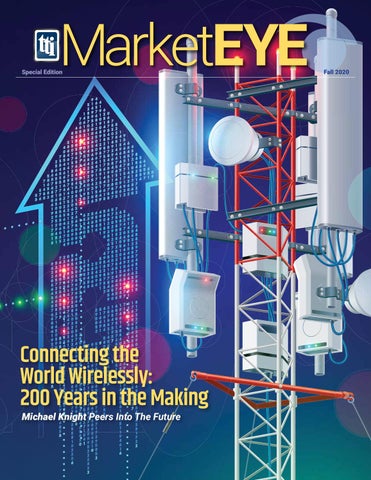
MarketEYE
Special Edition
Connecting the World Wirelessly: 200 Years in the Making Michael Knight Peers Into The Future
Fall 2020
Michael Knight
President, TTI Semiconductor Group Senior VP TTI, Inc.
Throughout my career I’ve witnessed grand
transformations in computing and technology – in my twenties I got my first beeper and tech job working in the IT department of a semi distributor; I was there when the business installed its first multi-user computer system, complete with twin 300MB disk drives – each the size of a washing machine.
Many groundbreaking technologies becoming mainstream today were impossible less than a decade ago: personal video conferencing, virtual reality, accelerated vaccine development and robotic surgery, to name a few. Consider a text I recently received from a friend when I asked how he was doing following a hip replacement: “My hip is excellent. They used an AI in the operating theater to assess my full skeleton and what would be the optimal positioning of my leg. I was having pain issues in both knees and one ankle and one shoulder. All that pain is gone with adjustment of my leg. They tell me by October first I will be 100%. But I feel perfect today. I am swimming an hour a day or more already.”
In my thirties I owned my first PC with its integrated monochrome display and sewing machine-like dimensions, more luggable than portable. Then came my first handheld mobile phone, a Motorola Startac that looked like a prop from an episode of Star Trek, then my first Palm Pilot, we called them Personal Digital Assistants. Over the decades the march toward smaller, more powerful, less power-hungry and increasingly connected personal electronics accelerated. Today we’ve at a point where my phone is infinitely more useful and powerful than the computer systems I relied on then to earn a living. I’ve been following trends in technology for years – accumulating knowledge from research and conversations with tech entrepreneurs, investors, inventors and business leaders. The exponential nature of technology development makes it obvious to me that technological innovation is building up a head of steam that will supercharge life in the 2020s. Wireless communication is one of the twenty technologies that I believe are going to recreate the high times of the roaring 1920s, one hundred years in the future. I’ve settled on a collection of 20 general purpose and application specific areas of technology that I believe are at the center of it all. Each of these advancements has an exponential enablement and acceleration factor, that could transform life on earth in ways that, until recently, were only the stuff of the science fiction. Over the course of this series I will introduce you to these technologies and attempt to paint a picture of the future that they enable. As this series of progresses, I hope to clarify the interconnectedness of it all as I believe with that understanding, the exciting possibilities for our businesses, for our careers, for our lives going forward becomes evident.
“When wireless is perfectly applied, the whole earth will be converted into a huge brain… when the wireless transmission of power is made commercial, transport and transmission will be revolutionized.” Nikola Tesla in a 1926 interview
FA R A D AY
MAXWELL
MARCONI
Global, ubiquitous wireless communication is an idea 200 years in the making. The genesis goes back to 1831 and Michael Faraday’s law of electromagnetic induction,
The Journey From Radio to 5G In this one sentence Tesla captured two major applications of technology that, almost 100 years later, are poised to be major drivers of the electronic component business. Tesla’s notion of the whole earth converting into a huge brain through the wireless connection of all our individual brains is a phenomenon that is well
which set the stage for Scottish scientist James Maxwell’s unifying theory of electromagnetic radiation 30 years later. Toward the end of the 19th century, inventor Gugliemo Marconi established himself as the father of modern radio with his first longrange (i.e., two miles) transmission of a wireless signal. During the 20th century, one-way wireless transmission became common first in the form of the radio; later on, walkie talkies and CB radios introduced two-way wireless communication to the public. From those innovations, the first-generation mobile cellular telephone technology was born.
underway and monumentally transformative. What is perhaps most
The journey from first generation (1G, which was analog) to the fourth generation (4G,
remarkable about Tesla’s statement is that he made it well before
which is digital) that dominates today took about 40 years. Along the way, transmission
the arrival of the internet, at a time when even wired power from a public utility was
rates improved dramatically, as did related power consumption – which then enabled
still a novelty for much of world.
the merger of both data and voice transmission in the form of the modern smart mobile
In this installment, we’ll explore the technology and applications related to
phone. Alongside this, non-cellular wireless protocols developed: Wi-Fi, Bluetooth, NFC,
“wireless perfectly applied.” Later in this series, we will follow the thread of Tesla’s
Zigbee and others. All of these technologies for wireless data transmission have steadily
idea of “wireless transmission of power.”
advanced, to the point that today’s wireless world can seem quite confusing as the choice of which protocol to use for a given application can be complex.
There are many different protocols for wireless data transmission, and within each protocol are numerous generational specifications. The key to organizing and understanding these options is to look at each in terms of transmission range and data rate or transmission speed. At the low end of both spectrums is Near Field Communication, or NFC, a protocol introduced commercially over 10 years ago. NFC has a maximum range of 1.5 inches and a maximum data rate of 424KBps. Its primary use is in secure device-to-device connections for mobile payment applications like Apple PayTM. NFC falls within a collection of wireless protocols commonly known as Body Area
Networks (BAN)
Another common protocol is Zigbee, which was introduced in 2004-5. It has a range of 100 to 325 feet and a data rate of 250KBps, putting it into what is referred to as the Personal Area Network (PAN) space. It is the protocol of choice for
<10 cm
many home automation applications, and due to its
– 3GPP LTE, LTE-MTC – 3GPP GSM, WCDMA, EC-GPRS – 3GPP2 Cdma2000 – WiMAX
Strong Conformance Regimes <5 km
– 3GPP NB-IoT
<100 km
Cellular (Licensed) Terms Not Precise
PROXIMITY
WPAN
– Bluetooth – ANT+ – MiWi
WHAN
WFAN
WNAN WLAN
– ISA 100.11a (6LoWPAN) – ZigBee – WirelessHART – Z-Wave – Thread (6LoWPAN) – Many Others – EnOcean – Many Others
LPWA (Licensed)
WWAN
LPWA (Un-Licensed)
– 802.11a/b/g/n/ac – 802.11ah (1km) – 802.11 (V2X) – 802.11af (Whit Space)
– Wi-SUN (6LoWPAN) – ZigBee NAN (6LoWPAN) – Wireless M-Bus – Many Others
– SIGFOX – LoRa – Telensa – OnRamp – Positive Train Control – Many Others
License-Exempt Spectrum License Spectrum 10 Mbps
LTE Cat-1 LTE Cat-0
DATA RATE
1 Mbps
802.11ah
100 kbps BLE
802.15.4/ ZigBee
20 kbps
LTE Cat-M NB-IoT EC-GSM Weightless-P LoRa
RPMA
100 bps
UNB 1
10
100
1,000
5,000
and data rates and ranges similar to Zigbee, but at a lower price point. Bluetooth 5 ups the range to 800 feet and the data rate to 50MBps. Bluetooth is secure and stable, even for mobile applications, making it the predominant way in which personal electronics are connected to each other. While
Making Sense of Wireless Today – NFC – EMV
BLE has low energy consumption
Range (m)
built-in security and low power requirements, is often
Bluetooth and Zigbee do have some overlap on both the data rate and range scales, the use cases for each are very clear. Among the leading companies innovating in this space are Nordic, Silicon Labs and Telit, alongside Bluetooth wireless modules from Murata and Tayio Uden, as well as devices and gateways from Redpine, MediaTek, Multitech and Lantronix.
the choice for wireless sensor networks. The mesh
Moving into the realm of Local Area Networks (LAN), which use a local hub or
version of Zigbee enables its range to be extended
gateway to make a connection to the internet, in the Zigbee and Bluetooth data-rate
despite the line-of-site nature of the signal.
range are a number of proprietary protocols, including Microchip Technology’s MiWi,
Very similar to Zigbee are a few other protocols like
Z-Wave, Thread (Google’s version of Zigbee) and 6LoWPAN, a lightweight, IP-based, low data rate open
Digi International’s DigiMesh, EnOcean, and mcThings. But the best known and most widely deployed Wireless Local Area Network (WLAN) is Wi-Fi.
IoT network protocol.
First introduced in 1999, Wi-Fi has a data range of
Next up in the PAN range is Bluetooth, a wireless
115 to 230 feet (can be extended through mesh capability) and
protocol named after an ancient Danish king, originally
increases the data rate significantly. Wi-Fi 5, or 802.11ac, is
developed and released in 1999 to replace the standard
now the mainstream technology and uses multiuser MIMO to
RS232 cable. There have been many iterations since
achieve speeds as high as several gigabytes per second when
then; the latest versions are Bluetooth 5.0, 5.1 and
beamforming techniques are used. The Wi-Fi 6, or 802.11ax, spec
5.2, and Bluetooth Low Energy (BLE), all written
is complete and devices are now available that will further increase
specifically with IoT in mind.
data rates and densities. Both Wi-Fi 5 and Wi-Fi 6 are factors in IoT, especially in larger-scale industrial applications. A version known
as Wi-Fi HaLow, or 802.11ah, has a range of up to 3,000 feet, albeit at data rates in
There are also cellular based LPWAN radios, the two
the mid-300MBps range. As with PAN protocols, Skyworks and Qorvo manufacture
most common of which are Narrow Band IoT (NB-
FEMs, LNAs and PAs for Wi-Fi, including Wi-Fi 6, while Qorvo also specializes in
IoT) and LTE Cat-M1. NB-IoT has a battery life of as
diplexers and filters.
much as 10 years and coexists with 2G, 3G, 4G and
Another LAN protocol fast gaining traction is Ultra-Wideband (UWB), which has a
soon 5G cellular networks. It, too, has a 20-mile range
peak data range of 656 feet and a peak rate of 480MBps, with very low power usage. UWB started to get a lot of attention last year when Apple included the technology in the iPhone 11, and has gotten even more visibility this year for its applicability to contact tracing and indoor tracking. UWB penetrates walls and with an algorithm can be used to triangulate location and distance. DecaWave, recently acquired by Qorvo, is a manufacturer of UWB chips in what is a fast-growing business, driven even more quickly recently by the COVID-19 pandemic. This brings us to longer-range wireless protocols falling under the heading of Wide Area Networking (WAN) and specifically targeted at the world of IoT. Some of these work on open spectrum and open networks, others on private networks, and still others on cellular networks. A fast-growing example of the first is LoRa, a low power wide area network (LPWAN) protocol developed and championed by Semtech. LoRa has a range of up to 20 miles and is very low-power, with low data rates of 50KBps. Because it uses unlicensed spectrum, there is no subscription required for connectivity. These things make it ideal for connecting sensors, and sensor modules with built-in LoRa are becoming commonplace. Another company, Radio Bridge, makes a wide range of battery-operated sensor modules with wireless connectivity, including LoRa, for everything from leak and motion detection to air quality monitoring. For LoRa gateways and base stations, MultiTech has the complete range; Signetik provides LoRa gateways and is releasing a LoRa module for sensor nodes; and Murata is shipping LoRa modules. Competing with LoRa is a subscription-based offering called SigFox that was developed in France. It is much more prevalent in Europe than the US at this time.
Ingenu is another proprietary protocol similar to SigFox.
and transmission rate of 100KBps. LTE M is closely related, but with a greater data rate of 1MBps, with up to 4 MBps coming in the next release. The leaders in this fast-growing area of wireless include Nordic Semiconductor for SIP radios; Telit for modules; and MultiTech, Digi International and Lantronix for modems, devices and connectivity solutions that make
4 Cs of LPWA Provide a Large Growth Opportunity in the Cellular IoT Market COST: Low Cost with More Than 50% Reduction Compared to LTE...Think 2G or Bluetooth COVERAGE: Extended Coverage of 5x to 10x Greater Distance Compared to Broadband LTE CONSUMPTION: 10+ Years Battery Life... More Than 75x Lower Power than Broadband LTE CAPACITY: Supports More Than One Million Connected Devices Per Square Kilometer
the IoT ecosystem easier to connect to the cloud. These IoT-focused technologies are fundamental enablers of the smartening of everything: smart meters, smart appliances, smart machines, smart cars, smart buildings, smart cities and much, much more. The amazing applications of the Internet of Things, the value of those markets and the transformative power of that area of technology will be covered in-depth in a future instalment of this series.
Now we come to the part of the wireless ecosystem made up
very rare – you were likely to still have to wait a while for the full download.
of cellular networks – all operating on licensed bands using herds of antennas,
Today’s 4G LTE can theoretically download at 100MBps to a moving device and
repeaters and transmitters, and mounted on towers that pass signals back and forth
1GBps to a stationary device, but (again) most of us will never experience those
to one another (and to the odd satellite).
speeds.
The most widespread use case is that of mobile phones, which were the catalyst for
With the passage of another 10 years, it must be time for the next generation of
the development of, and investment in, all of the technology and infrastructure that
cellular technology to arrive. In fact, it is here and is now commonly known as 5G.
has moved us from the simple two-way radio to today’s smart phones that enable us
The news and company announcements are full of 5G buzz, and for good reason. The
to talk over each other, talk via video conference calls, stream and watch movies, and
ultimate spec for 5G is mind-blowing, and will supercharge devices and applications
search the internet while on the move.
in ways that will literally transform many aspects of life as we know it.
5G and the Transformation on the Horizon The first widespread deployment of mobile connectivity was analog and voice-only. It arrived in the 1980s and is now referred to as 1G. The data rates were very low; not that it was possible to download a movie over the air on these early mobile phones, but if it had been possible, such a download would have taken almost five months. In the 90s, 2G and digital arrived, ushering in texting and some basic data services. The 2G protocols were CDMA, GSM, GPRS and EDGE. The
The Promise of Mobile 5G When fully-formed, the mobile version of 5G is predicted to be able to download that movie in less than a second, but there is so much more to the promise of 5G. The initial spec published in 2015 has continued to evolved; we are now working with release 16 from 3GPP, the association behind the standard. Key attributes are: • Tenfold decrease in signal latency, with as latency as low as 1ms possible; • Threefold improvement in spectrum efficiency and 10X improvement in throughput, enabling all on the network to reach peak data rates;
same movie that would have taken almost five months to download on
• 10X increase in connection density;
1G could be done in 5 days on 2G, if the devices back then would have
• 100X increase in traffic capacity – all of which taken together results in…
supported that.
• Up to 100X improvement in network efficiency
3G arrived in 2000 and enabled the development of the first smartphones and early mobile broadband. Using one’s phone to browse the web, do email, share pictures and actually watch video became possible as 3G evolved. That theoretical movie could now actually be watched, provided you didn’t mind waiting four hours for the download. Moving into the 2010s, 4G brought with it the use of internet protocols, gaming, high resolution mobile TV and video conferencing. A movie could now be downloaded in 30 seconds, but smartphone usage grew so quickly that the amount of traffic on each cell site made such transmission rates
The net result is fiber-like speeds and reliability, reduced buffering, one million possible connections per square kilometer (versus roughly 60,000 in 4G best case) and a dramatically lower cost per bit.
5G
The initial rollout of 5G doesn’t deliver anything like these specs. Think of it more like
Network (RAN) using dynamic spectrum sharing (DSS), designed to work with
enhanced 4G. In fact, much of the infrastructure is shared with 4G LTE, especially as
existing 4G LTE networks. This enables a phased transition to 5G, and it is this aspect
it relates to mobile applications.
that is causing a lot of confusion.
Device-to-Device Communications
Densification
Automobile-to-Automobile Communications Smart Grid
Smart Home Enhanced Mobile Broadband
Mission Critical Services
Fixed Wireless Access Massive Internet of Things
Critical/Emergency Services
Broadcast on Mobile Device Augmented Realoity & Virtual Reality IoT Machine-to-Machine
To understand the pace of
5G isn’t being
adoption, the timeline for full
implemented with a
implementation of the ultimate
big bang that instantly
5G specification and the
obsoletes 4G. In fact,
potential impact of the service,
4G didn’t obsolete 3G,
it is necessary to differentiate
or even 2G. It took the
between the two major use cases:
better part of the 2010s
fixed wireless access and mobile
before 4G subscriptions
connectivity.
outnumbered 3G
At the moment, most of the
subscriptions, of which there are still a great
activity and press is focused on
Smart Cities
many today. In fact, there
mobile connectivity, so let’s start
are 2G devices still in
there.
operation. Long after 5G
The “5G” symbol began appearing on mobile phones more than a year ago, even
is ubiquitous, there will
though phones did not, in fact, have 5G connectivity built into them. The symbol was
be 2G, 3G and 4G devices
meant to show that the phone was in an area where 5G service is available, but many mistakenly thought that their phones had switched over. One must have a mobile phone built for 5G in order to use the service. At this time, Samsung, LG and Motorola are leading with 5G-equipped devices, and Apple is late getting their version to market. Per the Global Mobile Supplier Association (GSA), more than 50 operators are now running 5G mobile networks in 378 cities across 34 countries. 5G is for real, and if you have the right phone you can tap into it, as do about 16 percent of the mobile phone subscribers in South
CITIES 34 COUNTRIES
378
Commercial 5G Network Deployment as of 01/2020
Korea – but in its current incarnation don’t expect anything more than really solid 4G LTE performance. The service today is operating in sub-6Ghz bands on what is called 5G Radio Access
still operating. True 5G mobile service, fully realized, will take an entirely new set of equipment, from base stations to antennas on cell towers. 5G networks require a much greater number of antennas – a need that escalates as we move into the millimeter wave version of 5G, discussed below. For reference, 4G deployed 9.2 million macro cells over the course of ten years; 5G will need at least 50 percent more. With millimeter wave service, demand for small cells (metro, micro, pico and femto) is added to the mix.
This is where things start to get very interesting for the electronic components industry. The component counts in the 5G equipment set is higher; the number of devices needed is higher and the prices of many of the necessary components are higher due to the more demanding product specs of 5G. This translates into carrier capital expenditures growing at a forecasted rate of 20 percent to $34 billion. Components like BAW filters and SAW filters will enjoy CAGRs of 13 percent and 5 percent, respectively.
The related market for power amplifiers is growing even faster, while demand for
This brings us to the fixed wireless use case for 5G, the side of the business focused
antennas, passive components, RF connectors and interconnects of all kinds will
on high-capacity, high-speed data delivery to homes and businesses. Think fiber-like
boost the businesses of many leading electronic component suppliers.
performance without the need for installing fiber optic cables and optical networking equipment.
An additional demand driver for electronic components will be the
5G Mobile Phone Unit Shipments 600
production of 5G phones themselves, each of
525
500
which will have a higher component content than their predecessors. Recent forecasts from
+31% 400
400
Qualcomm, the leading supplier of 5G radios and chipsets for mobile phones, estimates that as many as 450 million 5G smartphones
200
will ship in 2021, and that total will jump to
100
Because of the stationary nature of these applications, the availability
+60%
300
of steady-state power from wall outlets and the use of large arrays of beamforming
250 +100%
antennas, this is where we will first see the implementation of millimeter wave-based
125 37
750 million the following year. This will finally
0
get smartphone production numbers growing again after several years of declines.
2019
5G – which itself is the key ingredient to at last reaching the amazing specs set forth
+238%
2020
Fixed Wireless, Low Latency and Transformational Change by the 3GPP. And, yes, this will require additional infrastructure with equipment that
2021
2022
Source: IHS Markit – Units (Millions)
Whatever the final production numbers, it is
2023
will need even more electronic components. Constant Upload/Download On An All-Day Wearable
widely expected that as many as 60 percent of these handsets will be deployed in
Video Conferencing
Chinese carriers had installed an estimated 200,000 5G base
Downlink/ Consume
stations; projections call for that number to break three leading carriers – China Mobile, China Telecom and China Unicom
• Higher Resolution and Higher Frame Rates • Stereoscopic, High Dynamic Range (HDR) 360˚ Sherical Content, 6 DoF Video 2 Mbps
China, underscoring that country’s focus on this technology. Going into 2020,
500,000 by the end of 2020. China’s
Richer Visual Content
5 to 25 Mbps
2-Way Telepresense
50 to 200 Mbps
Next-Gen 360˚ Video 8K, 90+ FPS, HDR, Stereoscopic
Broadband
Uplink/Share
1 Mbps
Image and Workflow Downloading
2 to 20 Mbps
3D Model and Data Visualization
10 to 50 Mbps
Current-Gen 360˚ Video (4K)
200 to 5,000 Mbps 6 DoF Video or Free-Viewpoint
– will collectively invest more than $25 billion in related infrastructure
Source: ABI Research
Critical for Immersive Experiences
by year’s end. Much of that spend will happen with Huawei, which is one of the reasons why this particular company is getting so much attention, and why so many US component companies were affected when the U.S. government outlawed the shipping of parts to Huawei.
At some point in this decade, 5G will become a growing factor in the Internet of Things, adding massive machine-type communication use case to the mix – and further inflating our infrastructure needs. I will discuss these possibilities further in a future series. For now, I want to briefly touch on a few other exciting use cases that 5G enables, largely as a result of the very low data latency that it delivers.
Signal latency, or lag time, is the amount of time it takes a signal to arrive at its
Here in the United States, only 88 percent of the population has an internet
destination. Signals travel faster through air than through a medium like copper, and
connection of any kind. Many of those people lacked a connection with enough
travel faster still in the vacuum of space. The claim for millimeter wave-based 5G is
bandwidth and speed to adequately support their needs as they worked from home
that latencies as low as one millisecond are possible.
and remotely educated their kids during the COVID-19 pandemic.
This low-latency communication will be the enabler for transformational technological innovations. For instance, fully autonomous cars would benefit from being able to pass and receive data nearly instantaneously to each other and their surroundings, greatly increasing operational safety. This would also make it possible
From Terrestrial Cellular to Outer Space
for surgeons to operate remote surgical robots, which would be great benefit to rural
Meanwhile, globally, just over half the population has any kind of internet connection
communities and to less-developed countries.
at all.
And then there are the advances made possible when 5G is coupled to virtual and
Communication satellites are not new. We have been launching them into orbit
augmented reality, enabling equipment to operate physically untethered from a data
since the early 1960s. There are over 5,000 of them up there right now,
source and providing a close to real-time sensory experience.
though less than half of them are operational. They
All of these examples would be made possible by terrestrial-based wireless communication, but it doesn’t stop here. Off-planet, a new satellite-based communication network is being built out that will quickly bring high-speed, lowlatency broadband service to every point on the globe.
are predominantly used for television, telephone, radio,
weather, GPS and military applications. Most are in geostationary orbits more than
available in many rural areas) at ping rates as low as 31ms. When fully implemented,
22,000 miles above the equator, but among them are a fast-growing number of Low
1GBps speeds at 20 milliseconds are possible – at which point this service begins
Earth Orbit satellites.
to compete with traditional cable- and fiber-based services in households across
These satellites operate 100 to 1,200 miles above the Earth, and their
America. The stakes are huge.
primary task is to provide broadband internet connectivity. The best-known source
What makes this all possible, both economically and technologically, are new, high-
of these is Starlink, a SpaceX affiliate, which is putting thousands of low-cost, high
performance, space-grade components. The Starlink satellites in particular are
performance satellites into service – 60 at a time – using their own rockets. As of
dense with electronics, including the capability to pass signals between themselves
this writing, Starlink has launched around 650 satellites with plans to place a total of
via lasers. This enables them to create a mesh network that takes advantage of the
12,000 to 42,000 into orbit. However,
“There is a lot of money to be made from connecting the other half of the world to the internet”
as few as 800 satellites would enable moderate broadband coverage for most places on earth.
near-speed-of-light transmission rates only possible in a vacuum. It’s nearly impossible to imagine the impact of connecting billions more people to the web and to one another. What will these newly-connected minds discover? What changes and opportunities will e-commerce bring to their lives? What new
Other companies are in on the
companies will they build? What industries will they disrupt? When all is said and
action. There is a lot of money to
done, the world’s population of consumers will have expanded dramatically in a very
be made from connecting the other half of the world to the internet, not to mention
short time, creating a massive boom for businesses of all types.
transitioning those who are already connected from terrestrial networks to satellites.
All of this is quickly developing as you read. The wonder and promise
The FCC has made expanding internet coverage in rural America a priority, with $16 billion available in a competition that Starlink is well-positioned to win. Starlink’s beta tests delivered download speeds from 11 Mbps to 60 Mbps (better than what was
are monumental, which is why the wireless revolution is the perfect technology area to focus on first in this series on transformational technologies, as its impacts will shape everything we discuss in future instalments of this series.
For Further Reading Here are some links to a few including a primer on 5G, a host of eBooks on the Microwave Journal website and industry overviews from McKinsey Consulting and Ericsson. “5G RF for Dummies,” second edition, from Qorvo https://www.qorvo.com/design-hub/ebooks/5g-rf-for-dummies Microwave Journal’s list of 5G and IoT ebooks https://www.microwavejournal.com/articles/33116-g-and-iot-ebooks GSA 5G Reports site https://gsacom.com/technology/5g/ McKinsey & Company, “The 5G Era: New horizons for advanced electronics and industrial companies” https://www.mckinsey.com/~/media/mckinsey/industries/advanced%20 electronics/our%20insights/the%205g%20era%20new%20horizons%20for%20 advanced%20electronics%20and%20industrial%20companies/the-5g-era-newhorizons-for-advanced-electronics-and-industrial-companies.pdf McKinsey & Company, “Connected world: An evolution in connectivity beyond the 5G revolution” https://www.mckinsey.com/~/media/McKinsey/Industries/Technology%20 Media%20and%20Telecommunications/Telecommunications/Our%20Insights/ Connected%20world%20An%20evolution%20in%20connectivity%20beyond%20 the%205G%20revolution/MGI_Connected-World_Discussion-paper_February-2020. pdf Ericsson Corp, “This is 5G” https://www.ericsson.com/4a3114/assets/local/newsroom/media-kits/5g/doc/ ericsson_this-is-5g_pdf_v4.pdf To stay current with all the latest advances in radio frequency communications, I highly recommend subscribing to the Microwave Journal https://www.microwavejournal.com/
1.800.CALL.TTI tti.com