www.specificationonline.co.uk ll www.letstalkspecification.co.uk
September 2026
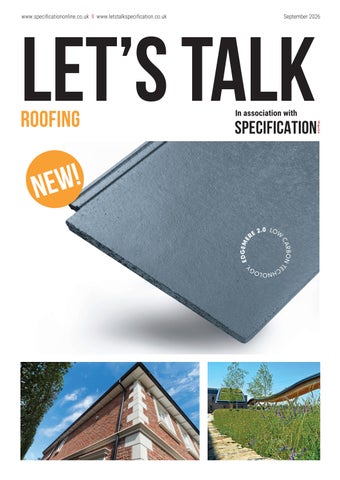
LET’S TALK Edgemere 2.0 Carbon-captured roofing, evidenced.
ROOFING
! W NE
In a first for UK roofing, Edgemere 2.0 is available with carbon-capture technology, and supported by Carbon Bank evidence for every order. A clearer carbon story behind the tile. SCAN TO LEARN MORE.
You can bank on it. marley.co.uk
In association with
Enquiry 1
UK: 029 2048 7954 | Ireland: + 353 91 353 545 | w: fatra.co.uk | e: sales@fatra.co.uk
Welcome
Welcome
Let's Talk Roofing is Sponsored by
Creating the right workforce of the future is key for the industry
T
he Government’s drive to improve technical education is being seen as the perfect opportunity to boost the roofing sector as a whole. With an emphasis on increasing the opportunities for students to take high quality, technically-focused courses, industry bodies regard it as a key moment in boosting the skills of the next generation to enter the construction industry. Trade organisations say the Government's plans to introduce technical education pathways for 14-year-olds are a positive step towards giving young people greater access to careers in roofing and construction. However, turning ambition into action will require meaningful support for schools, SMEs and employers. NFRC (National Federation of Roofing Contractors) welcomes the Prime Minister's announcement of the intention to establish new technical education pathways for 14-year-olds in England, while calling for further detail on how the plans will be delivered on the ground. Allowing students in Year 10 to combine core academic subjects with technical education, work experience and employer contact from September 2028, responds directly to NFRC Member concerns that
students are not given equal opportunity to explore a career in the trades.
tend to have dedicated resource for this kind of engagement.
NFRC's own research underlines the scale of the challenge. The latest State of the UK Roofing Industry report (Winter 2026) found that 47% of roofing contractors said recruiting skilled labour was harder than a year earlier, and 58% said skilled labour shortages were limiting the amount of work their business could take on. Just 2% of contractors thought it was currently easy to attract new workers to the industry.
“Most of our members are SMEs, and they're often the ones best placed to offer a young person a genuine route into the trade in their own community.
Ruth Scarrott, NFRC Head of Careers, said: "Anything that gets roofing and construction in front of young people earlier, and treats technical education as equal to the academic route, is a step in the right direction. Our Members continually tell us that finding skilled people is one of their biggest challenges. "We do need to see more detail on how this will work in practice. There's a real opportunity here to build on established programmes, like Local Skills Improvement Plans, rather than creating something parallel that competes for the same employers' time and attention. "It's also vital that schools are supported to work with smaller, local construction firms, not just the large national employers who
“But a small contractor with a handful of staff can't always give the same time to school visits and work placements that a large employer can, so any new system needs to make it straightforward and low-burden for them to get involved." The opportunity to improve technical education is also regarded as vitally important for manufacturers. As roofing systems and products become more advanced and technology continues to drive innovation, a highly skilled workforce is necessary to ensure the correct installation and maintenance.
Paul Groves || Group Editor
3
NEW
COMMERCIAL RANGE
BUILT FOR PERFORMANCE. DESIGNED TO DELIVER. Our New Commercial Range combines strength, style and versatility for today’s demanding projects. British manufactured and available in a choice of finishes, it’s a complete roofing solution designed to deliver lasting performance across a wide range of commercial applications.
British Manufactured
Choice of Finishes
Anti Condensation
Retail • Warehouses • Petrol Forecourts • Shopping Spaces • Commercial Units
Ecopan
Box Sheet
Box Tile Sheet
Corrugated Sheet
Box XP Sheet
Spacer Bar
Enquiry 2
sales@britmet.co.uk | 01295 250998 | www.britmet.co.uk
6 September 2026 ll www.letstalk specification
LET’S TLAELTK’S TALK .co.uk
specification.co.uk
.co.uk ll www.letstalk
www.specificationonline
Carbon-captured d. roofing, evidence
ROOFING
September 2026
Carbon-captured roofing, evidence d.
ROOFING
In association with
In association with
NEW!
!
NEW
You can bank on
it.
You can bank on
it.
Contents 2 4 6&8 7 7 9 9 10-11 12-13 14 15-16 17 18-19 20
21 22-23 24-25 26-27 28-29 30 30 31
Fatra Britmet National Federation of Roofing Contractors Freefoam Building Products AIRTEK A. Proctor Group United Powered Access Marley Magply Kingspan Insulated Panels Liquid Roofing and Waterproofing Association Alumasc Water Management Systems Polyroof The Rooflight Association and the Liquid Roofing and Waterproofing Association Hambleside Filon Green Roof Organisation Glidevale Protect Chartered Institute of Building A. Proctor Group Catnic Roof Maker
12
17 TSP Media Ltd, Grosvenor House, Central Park, Telford, TF2 9TW T: 01952 234000 E: info@tspmedia.co.uk www.tspmedia.co.uk
20
Follow us @MySpecNews
28 Terms and Conditions - While every effort is made to ensure the accuracy of all articles and information appearing in Let's Talk Heating & Ventilation, the publisher does not accept liability for errors and omissions, printing or otherwise, that may appear in this publication. The journal includes photographs provided and paid for by suppliers. All rights reserved. No part of this publication may be reproduced or transmitted in any form or by any means, electronic or mechanical, including photocopying, recording or any retrieval system without the consent of the publisher.
Let's Talk Roofing Let's Talk Roofing is Sponsored by
Roofing sector confidence falls as conflict and economic uncertainty take toll National Federation of Roofing Contractors (NFRC) has published its latest 2026 State of the Roofing Industry Report, revealing a significant deterioration in business confidence across the UK roofing sector over the winter months.
conomic headwinds driven by overseas conflict, wet weather disruption, and broader market uncertainty have weighed heavily on activity.
E
This will only have increased since the survey was completed earlier this year, and it remains to be seen what a change in leadership will mean for the built environment.
Only 29% of roofing contractors reported an increase in workload over the winter months, down from 37% in autumn 2025 and 48% in Q4 2024, a 20-percentage point fall year-on-year. New enquiries also declined, with just 26% of contractors reporting growth, compared to 34% in the previous quarter.
While the recent peace deal has brought some relief, the roofing sector continues to feel the economic consequences of the conflict. Respondents reported that fuel surcharges and materials price volatility persisted throughout the survey period, with one contractor noting that suppliers were increasing surcharges "virtually on a weekly basis."
The picture remains cautious looking ahead. Only 28% of roofing contractors expect their workload to increase over the next 12 months, a significant drop from 40% in Autumn 2025. Public sector contractors are particularly pessimistic.
The International Monetary Fund revised its UK growth forecast down to 0.8% for 2026, and Barbour ABI revised their residential sector forecast to -4% for the year.
Political uncertainty has also risen and was identified as the second most reported challenge amongst NFRC Member businesses at 54%.
6
Disruption to energy markets is expected to continue throughout 2026 and rising inflation and regulatory pressures will continue to affect construction schemes for the foreseeable future. Continues on page 8 >>
Let's Talk Roofing
Freefoam Building Products’ EPDs enable transparent product specification Freefoam Building Products are delighted to announce the release of three Environmental Product Declaration’s. Summary documents of the full EPD’s are now available covering PVC Downpipes, PVC Gutter and PVC Fascia, Soffit and Window Trim ranges, giving the trade clear, concise access to verified environmental performance information for key roofline and rainwater products.
Three new summary documents are now available online containing key information and high-level data designed to give clear concise information to help building product distributors, installers, housebuilders, specifiers and contractors respond to the growing need for transparent sustainability data across the construction supply chain.
A
idan Harte, CEO, said in-house teams have worked hard over the last 12 months alongside external assessors to measure, calculate and produce this information. “It’s been a long process but vital as our industry works towards the transition towards a net-zero future,” he explained.
Each document presents key assessment results for 1kg of product. These summarise product cradle-to-gate carbon footprint data, along with embodied carbon footprint data for the entire lifecycle of the product. Additional information on programme operator details, standards followed and the manufacturing scope are covered in each of the summary documents.
The products are manufactured in the United Kingdom and assessed using 2024 production data, with the declarations following ISO 14025:2006 and EN 15804:2012+A2:2019/ AC:2021. For Freefoam customers, the release provides an accessible route to product-level environmental information that can support specification decisions, tender responses and conversations around lower-carbon construction. The full Environmental Product Declarations are available through The International EPD System, with additional product information available from Freefoam Building Products. Freefoam Building Products – Enquiry 3
Airtek Designs, Supplies, Installs & Certifies Fall Protection Systems Airtek Safety Netting Services is a leading provider of fall arrest safety netting systems, with over 17 years of experience delivering high-level projects. As a long-standing member of FASET, we specialise in robust safety solutions tailored to meet your specific requirements. Our comprehensive range of services includes safety netting, edge protection, access towers, lifeline systems, and rope access services. Our expert team ensures every project is carried out to the highest standards, with safety and efficiency as our top priorities. For complete safety solutions that meet all your project needs, trust Airtek. Contact us today: enquiries@airteksns.co.uk 01905 767724 www.airteksns.co.uk
Enquiry 4
7
Let's Talk Roofing Let's Talk Roofing is Sponsored by
until their grading, documentation and traceability have been verified. They should not be installed while concerns remain. Substandard roofing battens are more than a product-quality issue. They may create risks for operatives during installation and affect the performance and durability of the completed roof.
>> NFRC CEO James Talman said: "While the full implications of the conflict remain unclear, businesses are struggling, and growth projections for construction are being revised down in line with the wider UK economy." NFRC Policy and External Affairs Manager Gray Gibson added: "The peace deal is welcome but it has not alleviated any pressure for businesses at the delivery end of the supply chain. Materials prices remain elevated, margins are being squeezed, and confidence is fragile.” The Winter report for the first time explores the recruitment channels NFRC members use to bring workers into the industry. The findings reveal a sector that continues to rely heavily on informal networks rather than formal recruitment infrastructure. For experienced and skilled workers, word of mouth and recommendations from existing employees were the most commonly cited methods. The same was true for new entrants to the industry, where informal channels again dominated. While these approaches reflect the close-knit nature of the trade, they also point to a structural challenge: if businesses are not reaching beyond their existing networks, the pool of potential recruits remains narrow. Worth noting also is that NFRC Members generally represent the larger end of the roofing and cladding industry. For smaller businesses, these results are likely even more pronounced. NFRC is supporting members through the current period of uncertainty with guidance on managing inflation, reviewing contract terms, and engaging with suppliers. NFRC is also representing the challenges facing specialist contractors in national supply chain forums and continues to campaign for government action on construction demand, skills investment, and supply chain fairness.
8
False markings prompt warning NFRC is urging roofing contractors, merchants, housebuilders and the wider construction supply chain to remain vigilant after receiving photographs of roofing battens carrying markings that appear inconsistent with the requirements of BS 5534. The origin of the products and the circumstances surrounding their marking have not yet been established. However, the images raise concerns that the battens may have been presented as graded to BS 5534 when their identification markings suggest otherwise. Products carrying questionable markings should be treated as potentially non-compliant
When roofing battens are used as footholds during roof covering, this must form part of a properly planned and supervised safe system of work. HSE guidance states that battens might provide a reasonably secure foothold only where specified requirements for their grade, dimensions, span, length and fixing have been met. Operatives should work on the rafter line and should not deliberately step on battens midspan between supports. Battens containing excessive knots, wane, fissures, decay, insect attack or other unacceptable defects may not provide the strength expected. Substandard dimensions or defects may also make it difficult to secure adequate mechanical fixings and provide the required support to the tiles or slates. Even factory-graded battens can be damaged during transport, storage or installation. All battens should therefore be checked for obvious defects and damage before use.
Let's Talk Roofing
The right pitched roof membrane makes a difference to a guarantee A pitched roof underlay, like any product in a roof build-up, must complement the quality of service and the value of a guarantee that a reputable roofing contractor offers.
T
he right pitched roof membrane gives roofing contractors confidence in the standard of the installation, which translates into comfort for the building owner that a guarantee is meaningful.
Soteria Roofing Specialists was tasked with a substantial roof reconstruction project for a standalone property in Somerset valued at over £1m and put forward Proctor Air® as an alternative to the pitched roof underlay originally specified by the project architects. Ricky Shellard, Director of Soteria Roofing Specialists, said: “We know Proctor Air works, we like working with it. And merchants like a product they don’t get moaned at about!
"It’s about using the best quality products, and Proctor Air fits the bill.”
For example, backing up the experiences of Soteria Roofing Specialists’s team.
Third-party assessment and certification is seen as a vital step in the life of a construction product.
Proctor Air achieves an excellent Mullen burst strength result, which is an assessment of the fabric’s strength. In addition, assessing the slip resistance of Proctor Air shows it has a high coefficient of friction, which increases safety during the installation of the covering as part of normal safe working practices.
Proctor Air is an APLR membrane – it is both air permeable and has a low resistance to the passage of moisture vapour. These qualities combine to reduce condensation risk in roofs and provide a more consistent flow of air than standard roof vent products. Other qualities of the membrane make a significant difference to installers working with it on site.
Please click to view further details: https://proctorgroup.com/projects/ what-difference-does-the-right-pitched-roofmembrane-make-to-a-roof-guarantee A. Proctor Group – Enquiry 5
UPA – on site, on time, national hire UPA, the home of high-quality hire, is expanding with our new depot at Shildon County Durham, and investment in an increasing fleet of equipment, we are even better placed to provide national coverage and service you can count on.
At UPA you can count on: Rapid response same day hire Daily hire periods (no need to hire for a full week) Quick quotation service North East depot at Shildon National coverage Wide range of top-spec equipment Advice, knowledge and training Machine sales and servicing And much, much more...
Contact us today: info@upa-uk.com | 01925 302020 | www.upa-uk.com
Enquiry 6
9
Let's Talk Roofing Let's Talk Roofing is Sponsored by
Marley launches Edgemere 2.0, the first UK roof tile to use carbon-capture cement technology
In a first for UK roofing, Edgemere 2.0 combines Marley’s familiar concrete roof tile specification with carbon-capture cement technology and Carbon Bank evidence supplied for every order.
T
he carbon reduction story behind Edgemere 2.0* begins with the cement. CO2 from cement production is captured at source, before it enters the atmosphere, and permanently stored beneath the seabed.
The carbon reduction is then recorded in the publicly available Carbon Bank, which allocates captured and stored CO2 reductions to specific Edgemere 2.0* orders, with full end-to-end traceability through an Environmental Attribute Certificate (EAC). The launch responds to a market in which embodied-carbon evidence is moving from optional to expected. For the public sector and increasingly housing providers, productlevel carbon evidence is becoming part of the specification process.
Warming Potential (GWP Fossil) of just 1.86kg CO2e per m² from cradle to gate, whilst retaining the familiar thin leading edge, technical performance and dimensions of Edgemere together with a Green Guide A+ rating and BES 6001 Excellent certification. The change is behind the tile: in the cement production process and the addition of verified, order-specific documentation. The Carbon Bank allocates reductions from actual captured and stored CO2, to specific Edgemere 2.0 orders, with ownership of the EAC transferring to the final customer. “Edgemere 2.0 is a significant step forward for Marley and for the roofing industry,” said Stuart Nicholson, Managing Director at Marley.
Sustainability leads, along with quantity surveyors and architects, are frequently asked to produce verifiable, product-level carbon evidence and do so without redrawing details or rewriting specifications.
“By introducing the UK's first concrete roof tile to use carbon-capture cement technology, we’re supporting the industry's transition to lower-carbon construction, with a documented carbon-evidence trail supplied for every Edgemere 2.0 order.”
Edgemere 2.0 expands the Edgemere range by offering a low carbon option with a Global
Edgemere 2.0 is available in Smooth Grey. For more information, or to discuss your next
10
project with one of our specification experts, visit www.marley.co.uk/Edgemere2 About the carbon evidence and end-to-end traceability * Edgemere 2.0 is supported by Heidelberg Materials’ evoZero® carbon captured nearzero cement, enabled through the first carbon capture facility at its cement works in Brevik, Norway. To avoid the transport emissions that would be incurred by shipping from Brevik, Edgemere 2.0 CO2 reduction can be transferred and attributed to locally sourced Heidelberg Materials cement. A Carbon Bank withdrawal is made to reduce the corresponding Global Warming Potential (GWP Fossil) of the locally produced UK cement to zero. The carbon reduction is recorded in Heidelberg Materials’ publicly available Carbon Bank, which allocates captured and stored CO2 reductions to each specific Edgemere 2.0 order, with full endto-end traceability through an Environmental Attribute Certificate (EAC). Marley – Enquiry 7
Edgemere 2.0 Carbon-captured roofing, evidenced.
In a first for UK roofing, Edgemere 2.0 is available with carbon-capture technology, and supported by Carbon Bank evidence for every order. A clearer carbon story behind the tile. SCAN TO LEARN MORE.
You can bank on it. marley.co.uk Enquiry 8
Let's Talk Roofing
Magply boards top a Top 25 university’s new energy centre Building at the heart of Lancaster University’s decarbonisation uses Magply boards.
A
university ranked in the top 25 of sustainable UK universities is using Magply’s fire-resistant roofing boards on its latest project to help it achieve Carbon Net Zero from all energy by 2030 and from all emission scopes by 2035.
Some 1,500m2 of Magply’s 12mm-thick boards, which meet Euroclass EN13501 (A1 Non-Combustible) standards and are BBA approved, were specified by renewable energy company Vital Energi for the roof of Energy Centre 2 at Lancaster University. The magnesium oxysulfate boards were installed by specialist sub-contractor Axis Group to help provide a lightweight, flat surface for the waterproofing of the building at the heart of the university’s investment in further decarbonising its Bailrigg campus. As part of an adhered bituminous roofing system, the Magply boards were installed over metal roof deck sheets with tapered insulation and waterproofing to form a flat non-combustible surface for the roofing system.
12
Situated on the outer edge of its south-east Lancaster campus, Energy Centre 2 is part of a sector-leading renewable energy project to virtually eliminate the use of gas to heat the university’s Bailrigg campus. The new energy centre will house an innovative array of state-of-the-art air and water source heat pumps totaling 7MW, along with four 250kW e-boilers totaling 1MW generating a projected 39 Gigawatt hours (GWh) of low carbon heat - enough to heat 95% of campus buildings. The centre will also include 1,500m3 of thermal stores which will supplement the new heat supply and help ensure consistent heat during peak times of the day.
This will be connected to more than 200 properties from the district heat network to receive low-carbon heat and water. The project is expected to be completed in early 2027. The university has also recently completed a 11.3MW solar farm, on 52 acres of university land east of the M6. Vital Energy’s regional director Scott Lutton said: “The new energy centre, utilising air and water source heat pump technology, will save 2,700 tonnes of carbon annually, making a significant contribution to Lancaster University’s journey towards carbon neutrality.”
A visitor facility will also be incorporated into the design of the new energy centre. This will feature an educational meeting room for visitors from other universities, local schools and community groups with an interest in sustainable energy, specifically heat networks.
Energy Centre 2 is the latest addition to Lancaster University’s extensive portfolio of pioneering sustainability projects, reflecting its long-standing commitment to sustainability. It is home to one of the largest environmental science research centres in Europe.
To carry the heat across campus, 6.5km of district heating pipework is also being installed to increase the network’s coverage from approximately 65% of buildings to 95%.
*
2026 QS World University Rankings: Sustainability Magply – Enquiry 9
Independently BBA Certified for Safe and Reliable Structural Roof Deck Construction
BBA CERTIFIED FOR STRUCTURAL ROOF DECKS
OTHER ROOFING APPLICATIONS
Multi-Purpose Sheathing | Bitumen Felt | Capping Recovery & Protection Board | Liquid Waterproofing Lead & Hard Metals | Single Layer Membranes | Sarking
FOR MORE INFORMATION VISIT
magply.co.uk
+44 (0) 1621 776 252
Enquiry 10
sales@magply.co.uk
Let's Talk Roofing
Designing for resilience with rooftop PV
Photovoltaics represent a crucial step in the drive towards net zero and a more sustainable future. Adding PV to roofs not only helps to cut carbon, it opens up opportunities to increase energy security and reduce energy bills. However, if it is not up to standard it also adds to the risk of issues such as fire, wind damage and water ingress. So, as the volume of installations increases, under the Future Buildings Standard (FBS) we need to look towards how to regulate and ensure a level of quality control in this rapidly expanding market.
W
hat is the opportunity for PV on commercial roofs? Research from the UK Warehousing Association (UKWA) found that the top 20% of the UK’s largest warehouses represents 75 million square metres of roof space with the potential to support rooftop solar capacity. This potential will form an important aspect of the UK Government’s drive to achieve 70GW solar capacity by 2030, and the part that commercial buildings are expected to play in this ambitious target is clearly set out in the Government’s 2025 Solar Roadmap , which highlights the FBS as a driver to achieve this. Published in March 2026, and coming into force from 24 March 2027, the FBS requires solar panel coverage equivalent to 40% of the ground floor area, representing a huge volume of photovoltaics that could be appearing on our warehouse roofs within the next couple of years. So, what kind of assurances can specifiers, building owners and installers look for to ensure that both roof and PV array will be resilient in the face of fire or extreme weather events? The role of FM Approvals Leading provider of independent third-party testing and certification, FM Approvals, has developed FM 4478 for rigid PV modules that are installed
14
with a roof assembly – a standard that examines the performance of roof top assemblies with PV from a property loss prevention perspective. This rigorous standard assesses fire performance, wind uplift, hail damage, seismic performance requirements and gravity load resistance. Using a standard such as FM 4478 provides specifiers, building owners and installers with a clear benchmark of performance for all the component parts and how they perform as a roof system.
As the panels arrive on site with the PV already in situ and checked, this greatly reduces the risk of installation issues on site as well as speeding up the entire roof and PV installation process.
Tested solutions FM Approved insulated panel systems offer a robust, thermally efficient and versatile method of construction for commercial buildings. As a roofing product they also present a highly suitable platform for the installation of photovoltaics. This allows specifiers to create well insulated and resilient buildings that have the capacity to generate renewable energy.
Kingspan Insulated Panels – Enquiry 11
Kingspan PowerPanel is one of the first systems globally to achieve FM 4478 Approval. It combines the benefits of QuadCore insulated panel systems with factory installed PV using state of the art robotics, allowing a high level of quality control.
To find out more, contact: kingspansolar@kingspan.com Watch the PowerPanel test video here: https://www.youtube.com/ watch?v=G1rTPLQOB0A
Let's Talk Roofing Let's Talk Roofing is Sponsored by
Adapting to regulation change and securing award-winning projects The changes to building regulations and adoption of new standards have raised the bar for the roofing industry. But, as the Liquid Roofing and Waterproofing Association (LRWA) explains, it is also helping to create stunning and successful new projects. the ongoing improvement of flat roofing design, installation and performance across the UK. BS 6229:2025 introduces a series of changes designed to enhance best practice, clarify industry expectations and align with the latest developments in construction. The revised standard reflects input from across the sector and is intended to provide greater clarity for all those involved in the flat roofing sector.
T
he new building regulations and sweeping changes and updates to standards the wider construction industry has witnessed in recent years has ensured building safety has improved significantly but also that project quality has risen significantly too. Adapting to change continues to be a characteristic of the roofing sector and the LRWA regularly highlights the changes and updates and provides technical breakdowns on what the new look rules mean. For example, the LRWA welcomed the publication of BS 6229:2025 Flat roofs with continuously supported flexible waterproof coatings. Effective from 31st December 2025, this significant update marks a step forward in
It addresses the following core topics: • Clearer Definitions: Enhanced and updated terminology throughout the standard ensures improved understanding and consistency across the industry. • Roof Falls and Drainage: New guidance sets out expectations for how flat roofs should be designed and constructed to support effective water drainage. • Responsibility for Back Falls: The revised standard clarifies accountability for ensuring flat roofs do not suffer from unintended back falls, promoting better installation practices. • Deck Quality and Surface Regularity: There is a new focus on the importance of deck preparation and surface quality as critical factors in long-term roof performance.
•
•
•
•
Guidance for Blue Roofs: The standard provides up-to-date direction on blue roof systems, reflecting recent innovations in water management for flat roofs. Advice on Inverted Warm Roofs: Enhanced guidance on the design and installation of inverted warm roofs supports improved thermal efficiency and construction quality. Thermal Performance of Roofs: The updated standard refines how thermal performance and insulation requirements should be assessed and delivered. Precision in Roof Falls Design: Further detail is given on prefabricated and siteformed falls, supporting more precise and reliable roof construction.
LRWA Technical Guidance Manager, Mike Bradbury, explained: “BS 6229:2025 provides much needed clarity for the design and installation of flat roofing systems, with a renewed focus on substrate quality, clarity on falls and transparent definitions. I encourage all professionals working with flat roofs to review the new standard and keep up to date with the latest industry practices. At LRWA, we’re here to support the sector through these changes and will continue providing guidance to help ensure quality and compliance across all projects.” Continues on page 16 >>
15
Let's Talk Roofing Let's Talk Roofing is Sponsored by
>> Award-winning project highlights best practice The Christ College Cambridge Lasdun Building project represents a significant achievement in modern roofing and restoration excellence, combining technical precision, architectural sensitivity, and environmental responsibility. This project was part of a three-year, threephase programme led by the main contractor, The Bakers of Danbury. It was also named a winner in the LRWA Awards 2026 - Liquid Roofing Project of the Year over 1,000m². Emperor Roofing was tasked with installing the Sika Decothane Ultra liquid-applied waterproofing system, a low odour solution with verified performance offering a 20-year warranty. This system was chosen for its proven reliability, flexibility, and ability to conform to complex geometries, making it ideally suited to the Lasdun Building’s intricate design. The works formed part of a broader refurbishment and sustainability upgrade, which included the installation of solar photovoltaic (PV) panels. These panels play a vital role in reducing the college’s carbon footprint and supporting its commitment to achieving net zero carbon emissions. The Lasdun Building, often referred to as the “Typewriter” due to its distinctive stepped, linear form, provides student accommodation and academic facilities for Christ College. Designed by the acclaimed architect Sir Denys Lasdun, it is recognised as a Grade II-listed
16
Brutalist structure. As such, the refurbishment demanded a careful balance between modern performance standards and the preservation of the building’s original character. Throughout the project, Emperor Roofing collaborated closely with Sika, The Bakers of Danbury, and the college’s project management team to ensure all aspects of the system installation adhered to the strict
specifications required for both performance and conservation. The works were completed within a tight summer timeframe, during the student holiday period, ensuring minimal disruption to the college’s operations. The end result is a watertight, visually pleasing, and environmentally progressive roof system that safeguards this historically significant structure for decades to come.
Let's Talk Roofing
Alumasc Heritage Cast Aluminium Rainwater Systems: Style and performance for buildings of all ages For more than 90 years, Alumasc has pioneered the efficient use, retention and management of water through high-performance systems designed for the built environment.
T
he Heritage Cast Aluminium Rainwater range from Alumasc Water Management Solutions (AWMS) combines proven durability with architectural sensitivity, for traditional buildings, and new builds wishing to maintain authentic charm. Manufactured in the UK to rigorous industry standards, the Heritage range has been developed to meet the demands of specifiers seeking longterm performance, aesthetic flexibility and ease of installation across a wide variety of building types. Designed to complement traditionally styled architecture, the Heritage Cast Aluminium range brings together classic detailing with the practical advantages of modern materials and manufacturing methods. Suitable for both refurbishment schemes and new-build developments, the system offers a lightweight and cost-effective alternative to traditional cast iron. The Heritage range presents an extensive selection of gutter profiles, fittings and accessories, enabling specifiers to recreate authentic architectural detailing with no compromise on installation efficiency or durability. Profile options include Half Round, Beaded Half Round, Beaded Deep Run, Victorian Ogee and Moulded gutters, together with round, square and rectangular downpipes. Manufactured in accordance with BS EN 8530:2010, the Heritage system uses advanced casting techniques to achieve consistent quality and precision. Factory finishing further supports faster installation programmes, helping contractors meet the requirements of modern construction schedules whilst maintaining the character expected of traditional rainwater systems.
A key advantage of cast aluminium is its inherent light weight compared with traditional cast iron. This simplifies transport, handling and fixing on site, and also reduces structural loading considerations. Despite its lighter weight, the material remains highly durable and non-corrodible, making it suitable for longterm use in challenging external environments. Heritage gutters and fixings are manufactured from LM6 marine grade aluminium alloy which also provides maximum performance in coastal locations. Performance Benefits The Heritage system benefits from the natural durability of aluminium, providing a life expectancy of up to 40 years in rural and suburban environments and up to 25 years in industrial or marine locations. Aluminium’s corrosion resistance helps minimise maintenance requirements over the lifespan of the building, contributing to reduced whole-life costs. BBA accreditation gives specifiers added assurance regarding product quality, performance and suitability for use across a wide range of applications. To support design flexibility, Alumasc’s BBA approved powder coatings are available in 28 standard RAL colours with a 30% gloss finish, while textured finishes can also be specified to closely replicate the appearance of traditional cast iron, providing an authentic solution for conservation projects and heritage-sensitive developments. Bespoke BS and RAL colours, anodic finishes and stone-effect coatings are also available to support individual project requirements.
Aluminium is 100% recyclable, making it a responsible material choice for projects focused on environmental performance and long-term sustainability. Technical Service and Support Alumasc’s Cast Aluminium Rainwater range also benefits from comprehensive technical support. Our nationwide network of technical experts will assist specifiers, contractors and installers through every stage of a project. An extensive library of online resources is also available, including specification data, installation guidance and technical literature. The Alumasc Rainwater Drainage Calculator is easily accessible via the AWMS website, enabling architects, engineers and specifiers to accurately design and quantify rainwater drainage requirements quickly and efficiently, depending on project location. Alumasc Rainwater Gutters & Downpipes sit under the AWMS umbrella alongside; Skyline Architectural Aluminium; Gatic Civil Drainage & Access Covers; Harmer Building Drainage; Wade Building Drainage. All five brands are well known for innovation, quality and longevity. Alumasc Water Management Systems – Enquiry 12
17
Let's Talk Roofing
Polyroof launches PRX range for profiled metal roof refurbishment Polyroof, a brand of Roberts Group, has launched the PRX Range, a new family of refurbishment solutions developed specifically for ageing profiled metal roofs. Designed to address the differing challenges faced by building owners, asset managers and specifiers, the range provides clear and effective options for waterproofing, thermal upgrading and long-term roof protection without the cost and disruption associated with full roof replacement. applied waterproofing membrane creates a seamless, fully bonded protective layer designed to deliver long-term performance and energy efficiency. The system has already demonstrated its benefits on a major refurbishment project at a specialist industrial training facility in Kidlington. Faced with an ageing profiled metal roof that had reached the end of its service life, the client required a solution that would improve building performance while allowing operations to continue uninterrupted.
T
he PRX Range comprises two distinct systems: PRX Enhance, a complete waterproofing solution incorporating a thermal upgrade, and PRX Restore, a protective coating system designed to extend the service life of structurally sound metal roof sheets. Together, the systems offer a practical and sustainable approach to roof refurbishment, helping organisations retain existing assets while improving performance and reducing waste. PRX Enhance has been developed for projects where both waterproofing and improved thermal efficiency are required. The system incorporates precision-cut EPS infill insulation manufactured to match the exact profile of existing metal roof sheets, creating the foundation of a highly effective warm roof solution. Once installed, Polyroof's liquid-
18
Working alongside Lynx Waterproofing, Polyroof specified PRX Enhance to upgrade the roof without the need for costly strip-and-replace works. The completed project delivered significant improvements in thermal performance and weatherproofing, while occupants also reported a noticeable reduction in rain noise within the building. The facility has since remained cooler during the summer months and is expected to provide improved heat retention during winter, creating a more comfortable environment while helping to reduce energy demand. For projects where a thermal upgrade is not required, PRX Restore offers a cost-effective alternative. Formerly known as Roofcoat Elite, the system is applied directly to prepared metal roof sheets to create a durable protective coating that extends the useful life of the existing roof. By retaining the original roof
structure, PRX Restore minimises disruption, avoids unnecessary waste and provides a practical refurbishment option for buildings that remain structurally sound. The PRX Range is further supported by Polyroof's Xtraflex gutter coating system, providing robust waterproofing protection for industrial metal gutters and helping building owners achieve a complete refurbishment solution across the roof envelope. Commenting on the launch, Craig Holden, Director of Polyroof, said "Profiled metal roofs present unique refurbishment challenges. The PRX Range has been developed to provide building owners and specifiers with practical solutions that extend roof life, improve building performance and reduce the need for disruptive replacement projects. The successful installation at Kidlington demonstrates how PRX Enhance can deliver meaningful improvements in thermal efficiency, acoustic comfort and waterproofing while allowing facilities to remain fully operational throughout the works." Backed by more than 40 years of roofing innovation, Polyroof continues to support the construction industry with high-performance waterproofing technologies designed to meet evolving performance, regulatory and sustainability requirements. Polyroof – Enquiry 13
CHOOSE THE RIGHT COLD APPLIED
LIQUID ROOFING SYSTEM
Cold applied solutions suitable for new build construction and refurbishment projects. Polyroof can provide full technical support, from early-stage design through to installation, inspection, and guarantee.
• Warm Roof Systems • Refurbishment Overlay Systems • Inverted Roof Systems • Sustainable Roof Systems • Balcony & Terrace Systems • Profiled Metal Sheet & Gutter Systems Enquiry 14
Need help with selecting a system for your project?
SCAN TO USE OUR SOLUTION FINDER
NBS Source PARTNER
PROTEC SYSTEM ETA (20/0914)
PROTEC EVOLVE SYSTEM ETA (22/0898)
Contact us today for more information:
0800 801 890
specifications@polyroof.co.uk
polyroof.co.uk
Let's Talk Roofing Let's Talk Roofing is Sponsored by
Industry bodies collaborate to boost training across the roofing sector The Rooflight Association and the Liquid Roofing and Waterproofing Association have joined forces in a ground-breaking initiative to deliver training course that will benefit the industry.
T
he Rooflight Association has presented important new training sessions, in collaboration with LRAW, that represents a key step forward in its mission to support good practice and ensure growth in all areas of the roofing sector. Chair of The Rooflight Association, Mark Wilcox delivered the first rooflight training module to candidates on the LRWA’s specialist applied-skills programme (SAP). It was a fully-funded training programme for those who are new to the industry or who have very little experience and is seen as the equivalent to an apprenticeship in specialist sectors. The course, entitled ‘Rooflights, Maintenance and Waterproofing’ covered general rooflight information, including the different types of materials used to make rooflights, non-fragility ratings, plus fire and thermal performance requirements. Candidates were advised on how to handle, install, replace and maintain rooflights. The training also included practicalities such as how to plan work and address health and safety issues. A hands-on session followed with trainees applying a Glass Reinforced Polymer (GRP) roofing system to some sections of rooflight kerb. They were taught how to clean and prepare the surface; apply various coatings; what to do if the weather deteriorates; how to finish the job, and clean-up.
Commenting on the experience and the launch of the association’s inaugural training course, Chair of The Rooflight Association, Mark Wilcox said: “This is an important milestone for The Rooflight Association, and we wish to thank the LRWA not least for the opportunity, but also for their support.
The training programme was produced with the support of Rooflight Association members – Velux Commercial, Brett Martin, Filon Products, Hambleside Danelaw and Glazing Vision. The association also sought expertise from individuals from across the membership.
“Developing a training module has been a longstanding goal for the RA, and while it was hard work, it was a great team effort and I am proud that we, as the UK’s pre-eminent independent provider of rooflighting technical information, now have a viable training course and we can help develop the roofing experts of the future.
20
“With competence an important requirement of the Building Safety Act, training such as this is vital, and whilst this course doesn’t prove it alone, it is a key contributor.” Following the course The Rooflight Association received praise from the Chief Executive Officer of the LRWA, Sarah Spink added: “The trainees found your presentation engaging and informative – we really appreciate the effort that it has taken to get to this point. “It is a great example of how collaboration can really raise the bar in training. You have done your sector proud.”
A flexible, lead-free and 100% recyclable roof flashing.
Enquiry 15
Let's Talk Roofing
Filon lists core roofing and cladding systems on NBS Source Filon has listed a selection of its roofing, rooflight and cladding systems on NBS Source, giving construction specifiers direct access to structured product information during the design and specification process.
T
he NBS Source platform brings together information from more than 1,100 construction product manufacturers, covering over 33,000 products. Specifiers can use the platform to find product specifications, literature, data sheets, images and digital objects at different stages of a project. Supporting informed specification The Building Safety Act 2022 has increased the construction industry’s focus on compliance, accountability and the quality of product information. Filon’s new profile on NBS Source is intended to make relevant product information easier for specifiers to find and assess at an early stage. It also gives Filon a greater presence within the specification environment, helping its team engage with architects and other construction professionals while product decisions are being made. With nearly 70 years of manufacturing experience, Filon is continuing to develop how it creates, manages and shares its product information. Its presence on NBS Source forms part of this work, alongside the company’s progress towards accreditation under the Code for Construction Product Information. Mark Wilcox, Managing Director at Filon, said: “Having a strong presence on NBS is an important step for Filon. As an established manufacturer, it helps us present our product information clearly within the specification environment. Alongside our work towards CCPI accreditation, it also allows us to demonstrate our credentials as a responsible manufacturer.”
22
The Filon products available on NBS Source Specifiers can currently find information on several Filon systems through the platform: Ascend rooflight systems A newly configured range of GRP rooflight systems, structured to help specifiers identify options suited to different roof constructions and project requirements. Citadel GRP cladding panels Profiled GRP sheets for roof and wall cladding applications in corrosive environments, including chemical, coastal and marine settings. Over-Roofing systems Lightweight GRP systems that overlay existing asbestos-cement roof sheets, allowing the original sheets to remain in place. Fixsafe safety fixing systems Systems that allow profiled GRP rooflights and roof sheets to be replaced from inside the building, avoiding the need to access fragile roof areas. Technical support throughout specification Filon’s highly supportive Technical Department is always available to help specifiers in identifying an appropriate system for the conditions and requirements of each project. The team can provide extensive guidance on product selection, profiles, system configurations and technical documentation.
Find out more Visit the Filon Products profile on NBS Source to view its listed systems and supporting product information. Filon – Enquiry 16
From general wellbeing and alertness to concentration and even sleep quality, natural light is incredibly important for us humans. It can be a great way to give your energy bills a bit of ‘light’ relief too.
structured to help identify options best suited to specific roof constructions and project requirements, perhaps it’s time you let us illuminate you on the many benefits of our GRP rooflights.
And with our newly configured Ascend Systems range,
Discover this range, and more, on
+44 (0)1543 687300 | sales@filon.co.uk filon.co.uk Enquiry 17
Let's Talk Roofing Let's Talk Roofing is Sponsored by
Green roofs reaching new heights in the push for sustainability Green roofs and façades are consolidating as key tools for urban restoration, although their impact depends on how they are integrated into policy, governance and planning practices.
T
his year, the Green Roof Organisation (GRO) National Conference was held in Swansea, a city recently awarded Biophilic City Status. The day began with a seated exercise session and a Welsh language primer. Chris Bridgman - Chair of GRO officially opened the conference, followed by a series of lightning talks from guest speakers including Penny Gruffydd (Swansea City Council), Helena Cuciaranu (Swansea University), Kate McCabe (Urban Foundry), and ecologist Gary Grant.
Gedge and GRO Board members. This annual gathering took place just days before World Green Roof Day on 6th June.
Delegates toured Wales’ largest rooftop park and BIOME, a social housing scheme centered on biophilic living. Guests also had the opportunity to plant wildflowers on the roof terraces, view various green walls and sustainable drainage systems, and enjoy the smoothie bike.
24
Members and attendees also participated in an interactive session to explore the vision for GRO over the next three years, selecting individual priorities and writing postcards describing the future of the organisation. The day concluded with a Q&A session with international green roof ambassador Dusty
Key news stories from GRO include the celebration of the 100th member, Hedd Considerate Gardening from Swansea, a new monthly GRO Podcast, the launch of a new GRO Website; and also the Dr Tom Young Travel Bursary to support international green roof research. The conference served to show the growing importance of green roofs and also the increasing recognition from industry. It comes as a recent European Union-backed report highlighted how green roofs and façades are becoming established across Europe as nature-based solutions capable of simultaneously addressing climate, environmental, and social challenges. Continues on page 25 >>
Let's Talk Roofing Let's Talk Roofing is Sponsored by
Evidence gathered from multiple experiences shows that these systems contribute to urban biodiversity, reduce the urban heat island effect, manage rainwater, and improve energy efficiency and human well-being. However, their deployment remains uneven and, in many cases, limited to isolated interventions rather than integrated urban strategies. The real potential of these solutions lies in their integration within coherent planning, regulatory, and financing frameworks. The diversity of approaches observed across Europe - from regulatory mandates to community-led initiatives - highlights the need for hybrid governance models that combine public leadership, private innovation, and citizen participation. Likewise, factors such as maintenance, monitoring, and adaptation to local conditions are decisive in ensuring longterm performance. The shift towards multifunctional systems, combining biodiversity, energy, and water management, reflects a change of paradigm:
green roofs and façades are no longer peripheral elements but are becoming strategic urban infrastructures, essential for advancing towards more resilient, healthy, and inclusive cities. Award-winning schemes highlight improved awareness WildflowerCo, the pioneering developers of the soil-less Wildflower Turf growing system, is was awarded first prize by the Theatro360 Green Roof Competition in partnership with the Green Roof Organisation (GRO) at the end of 2025. The award is in recognition of the innovative living roof solution, which was created at the Leeds Skelton Lake Services. To enhance the biodiversity of the area and minimise the visual impact of the development on the natural landscape and local wildlife, the main 5,277m2 amenity building features an over sailing, undulating green roof. An innovative new concept building design was commissioned by Extra MSA Group for
the services, which included an extensive green roof, complete with wildflower turf and sedum planting to enhance the biodiversity of the area as well as providing a significant expanse of native grassland for invertebrate species. Beyond the ecological benefits, the green roof acts as a key component of the site’s sustainable drainage strategy, by absorbing rainwater and minimising surface water run-off. As much as 95% of rainfall on undeveloped land is naturally absorbed into the vegetated surface. The green roof therefore provides a practical way to attenuate rainfall and limit the development to a similar rainfall response as the natural land, allowing infiltration into the roof build up. To compete the green roof installation, WildflowerCo supplied over 4,600m² of a bespoke grown Green Roof Wildflower Turf as well as all the roof substrate for the project. The roof turf was bespoke grown, specifically developed for the project to adapt to the needs of the local wildlife.
25
Let's Talk Roofing
Glidevale Protect supports roofing refurbishment and installation at Bristol development Building products manufacturer Glidevale Protect has supplied a range of roofing and ventilation solutions as part of the refurbishment of a mixed-use residential scheme in Bristol where it also successfully trialled a new initiative - fixing instructions printed directly onto the roofing underlay to provide a guide for easy installation.
T
he Charlton Hayes development is a large four and five storey mixeduse building with an arcade of shops and businesses at ground level as well as residential dwellings on the upper storeys. Designed in a dogleg shape, its roof is situated at three different levels and has a shallow roof pitch of 17.5°. This unusual roof design, combined with the risk of wind uplift pressure from the nearby Severn Estuary, posed a challenge for the refurbishment works which were carried out by roofing contractor McDonnell Price for Henlie Group. Brandon McDonnell, Director at McDonnell Price commented: “We felt it would be extremely useful to print the fixing instructions on the membrane in order to prompt the operatives when on site. Providing an open and honest reflection of how the product should be fitted helps to drive a high quality of installation. I’m delighted with the end result and the work undertaken with Glidevale Protect on this important initiative is helping make our team’s lives that bit easier. Following the success of this project, we’ll be rolling this co-branded membrane with fixing instructions out on all our roofing schemes with Glidevale Protect going forward.”
Glidevale Protect products including its Protect VP300 vapour permeable pitched roofing underlay were used across all three different levels of the roof at Charlton Hayes. The Protect VP300 supplied to the project was co-branded for McDonnell Price and concise step-by-step fixing instructions were printed directly onto the surface of the membrane and repeated at regular intervals. The aim of this initiative was to ensure that installation was carried out properly and in accordance with both the manufacturer and roofing contractor’s instructions to deliver the expected performance.
26
In addition to the Protect VP300 underlay, Glidevale Protect also provided a range of roofing ventilation solutions for the project including its FV250 FV Fascia ventilators which can be affixed over the fascia, RV900 RV Rafter ventilators, Protect OFV Eaves skirt support trays and Dry Fix Valley troughs.
Completing the project is Glidevale’s Protect Fulmetal UniRoll ventilated roll for dry ridge and hips, a mortar free, dry fixed system which complies with BS 5250 to create a natural ventilation path without raising the ridge and requires no ongoing maintenance. It is suitable for unrestricted use across the UK and Ireland in wind zones 1-5, and is compliant with BS 8612 and BS 5534, making it the ideal solution for the Charlton Hayes development’s exposed location near the Severn Estuary. John Curley, Product Manager at Glidevale Protect commented: “As the roof at Charlton Hayes needed remedial work by the specialist team at McDonnell Price, our new collaboration where fixing instructions are printed directly onto the pitched roofing underlay, is a simple but effective solution to make things easier for roofing contractors working on site. It’s important that underlays are installed as per the relevant guidance if they’re to provide the maximum benefits and comply with appropriate standards. It’s great to see the genuine impact this new initiative will have on our installer customers to improve on site efficiency and deliver reliable outcomes more widely.” To find out more, visit www.glidevaleprotect.com, call +44 (0)161 905 5700, or email info@glidevaleprotect.com. Follow Glidevale Protect on LinkedIn. Glidevale Protect – Enquiry 18
SCAN FOR MORE
The Future Homes Standard is here — and with the growing requirement for in-roof solar PV, installing the right ventilation strategy is essential. Get this wrong, and roof space condensation becomes a real risk. Glidevale Protect offers one of the widest ranges of pitched roofing underlays and ventilation products in the UK and Ireland, with a 15 year product warranty* for complete reassurance on solar applications.
Proud member of
For ventilation guidance to help comply with BS 5250, talk to us and get your roof specification right first time. Visit www.glidevaleprotect.com/roofing Enquiry 19
Talk to us about your ventilation strategy: simply call us on +44 (0)161 905 5700, or email us at info@glidevaleprotect.com
*Ts & Cs apply.
Let's Talk Roofing Let's Talk Roofing is Sponsored by
Construction SMEs face mounting pressures despite continuous growth, report warns
The construction sector is under strain from high numbers of insolvencies, increasing wage bills, in part linked to National Insurance changes and persistent materials price inflation, according to a report from the Chartered Institute of Building (CIOB) and the Federation of Master Builders (FMB).
T
Workloads (+22%), employment (+17%) and enquiries (+18%) all increased in the second half of 2025, although growth slowed compared to the first half of 2025.
More than two in five (42%) firms reported changing contractors during the period, with nearly a quarter (24%) of those changes driven by insolvencies or firms going bust.
Dr Victoria Hills, CEO at CIOB, which now incorporates the Institute of Roofing, said: “While it is encouraging to see key indicators continuing to grow, this survey shows many construction SMEs are still operating under intense pressure.
Meanwhile, over half (57%) of construction SMEs reported rising wages and three-quarters (75%) raised concerns about higher material costs. Despite these challenges, key activity indicators remained in positive territory.
“Rising wages – worsened by increases in National Insurance – alongside persistent materials inflation are significantly impacting profit margins, growth potential and recruitment plans.
hese pressures, coupled with ongoing skills shortages that are delaying projects and limiting business growth, are highlighted in the latest State of Trade Survey covering July to December 2025.
28
“At the same time, ongoing insolvencies within the supply chain are creating further instability, while chronic skills shortages are delaying projects and preventing firms from growing their businesses. If we are to sustain this recovery, it is vital that industry and government work together to address the skills gap, improve payment practices, and support firms facing rising costs from all directions.” Brian Berry, Chief Executive of the Federation of Master Builders, said: “Small building companies continue to face a perfect storm of rising material and labour costs, ongoing shortages of skilled trades, and continued uncertainty in the wider economy. Continues on page 29 >>
Let's Talk Roofing Let's Talk Roofing is Sponsored by
"When you can’t recruit a qualified carpenter or bricklayer, projects grind to a halt. "And for the skilled tradespeople who are available, wage pressures and inflation mean labour costs have risen sharply over the past year. The construction skills shortage continues to put serious pressure on SME builders, making it harder to plan workloads and keep projects moving. “The underlying demand for building work remains strong, which is encouraging, but until we address the skills shortage by bringing more people into the industry and create greater stability around costs and planning, small builders and homeowners alike, will continue to
suffer.” The report highlights how changes to National Insurance contributions are expected to further increase labour cost pressures, with nearly half (47%) of firms anticipating a negative impact from these changes. Cost pressures are already having a significant impact on businesses. Half (51%) of firms reported lower-than-expected profits or losses, while one in five (20%) said they fear their business viability was under threat. As a result, 61% of firms increased the prices they charge clients. There are some signs of improvement in payment practices, with 57% of firms reporting invoices paid within agreed terms. However, 29% still experience variable
payment timelines and 13% report frequent late payments, highlighting ongoing cashflow challenges for SMEs. Skills shortages remain a major barrier preventing companies from growing. Around 72% of firms reported being affected by a lack of skilled tradespeople, with 49% experiencing project delays, 30% forced to halt expansion plans, and 22% reporting job cancellations as a result. Companies reported the most difficult skills to recruit include carpenters (30%), bricklayers (29%) and plumbers (23%), alongside ongoing shortages in specialist areas such as building safety, sustainability and new technologies.
29
Let's Talk Roofing
Compatibility of air permeable pitched roof underlays and solar PV panels The numerous benefits of air permeable membranes for pitched roofs have led them to become a popular choice with specifiers and housebuilders.
H
owever, industry technical guidance around integrated solar PV panels has caused confusion over their compatibility with air permeable membranes, and led people to be unwilling to specify them together. With rooftop solar expected to be made compulsory on new-build housing, the adoption of PV panels will only intensify as specifications adapt to the lower carbon emissions required by the Future Homes Standard. And as those same homes become even better insulated and more airtight, they will rely on the performance of air permeable membranes to help reduce condensation risk in loft spaces. To overcome the confusion, Proctor Group has undertaken industry-leading research to investigate the issue.
Equipped with a more thorough understanding of air and moisture movement through pitched roof coverings, the Group has developed a recommendation to support designers and specifiers. Furthermore, this recommendation has received BBA backing. In order to develop a recommendation that the roofing sector could have full confidence in, Proctor Group asked the renowned Fraunhofer Institute to validate the research findings. They agreed with the conclusions drawn by Glenfeulan Consulting. Backed by the research findings and this additional reassurance, Proctor Group is therefore publishing comprehensive recommendation for installing in-line PV panels on a pitched roof with Proctor Air.
Throughout this process, Proctor Group has consulted with the BBA and they have reviewed all of the research carried out. It is now possible to report that Proctor Air’s BBA certificate has been updated to reflect the above recommendation, and to serve as independent verification that the underlay can be used with in-line PV panels without additional ventilation in either the loft space or the batten space. Please click to view further details: https://proctorgroup.com/articles/ proving-the-compatibility-of-airpermeable-pitched-roof-underlays-andsolar-pv-panels A. Proctor Group – Enquiry 20
Catnic Urban Selected for Sustainable Nottinghamshire Development Catnic Urban standing seam roofing and cladding was extensively used on the Abbey Central housing development in West Bridgford, Nottingham.
A
joint venture between Peveril Homes and Stagfield Group, the 71-home site prioritized sustainability, low-carbon technologies, and a "fabric first" approach. Some properties reduce CO2 emissions and energy use by up to 80% compared to building regulations. Responsibly sourced and locally produced materials were prioritized throughout the build. Installed by specialist sub-contractor Ecoply, Catnic Urban was selected for its strong environmental credentials, durability, and contemporary aesthetic. UK-manufactured from pre-finished steel, the system holds BBA certification, BRE A+ rating, BES 6001 Responsible Sourcing certification, and a 25year Confidex® Home Guarantee. Four of the seven home designs feature Catnic Urban, most notably the three-storey "Madrid" properties, where seven-meter roof panels extend seamlessly down the upper two storeys' exterior walls. The lightweight panels and
30
complete kit-of-parts simplified handling around scaffolding and ensured smooth installation across multiple properties. Furthermore, Catnic Urban accommodates rooftop solar PV panels—which were integrated using mounting clips without invalidating the 25-year product guarantee. Jesse Betts, Director at Ecoply, noted that Catnic Urban achieved the developer's exact sustainability and durability
goals, while Paul Brennan, Production Manager at Peveril Homes, highlighted how the product helped translate the complex architectural vision into reality while satisfying strict planning, quality, and environmental requirements. Catnic’s reliable supply chain and customer service also ensured tight delivery schedules were met seamlessly. Catnic – Enquiry 21
For the ultimate ventilation this summer
25
Rooflight
Years of Expertise
0116 497 1249 sales@roof-maker.co.uk
Hinged Opening Slimline Roof Lantern Minimalistic clean lines without glazing bars Built-in rain sensor for automated closure 700N 24V DC chain actuators with 300mm opening
www.roof-maker.co.uk
Available in popular sizes up to 3000mm × 2000mm Enquiry 22
LET’S TALK
ROOFING
In association with
Let's Talk Roofing is brought to you by