



















Grosvenor House, Central Park, Telford, TF2 9TW T: 01952 234000
E: info@tspmedia.co.uk

Grosvenor House, Central Park, Telford, TF2 9TW T: 01952 234000
E: info@tspmedia.co.uk
Welcome to the first issue of Let’s Talk PG, a new multimedia resource which aims to highlight the global influence that professional groundscare in the UK continues to exert.

Covering grass-roots level through to iconic, world-famous venues, groundscare and greenkeeping in the UK – from the skilled professionals working every day through to the products and services that are manufactured, tested and supplied across the country – is rightly regarded as setting new benchmarks for innovation and excellence.
PUBLISHING DIRECTOR
Martyn Smith martyn@tspmedia.co.uk
EDITOR
Paul Groves paul.groves@tspmedia.co.uk
CIRCULATION MANAGER
Becki Everitt becki@tspmedia.co.uk
HEAD OF LANDSCAPE DIVISION
Colette Clark colette@tspmedia.co.uk
AREA SALES MANAGER
Sunil Kainth sunil@tspmedia.co.uk
DESIGN & ARTWORK
Scarlett Vaughan-Evans scarlett@tspmedia.co.uk
Follow us @letstalkpg
Terms and Conditions -
While every effort is made to ensure the accuracy of all articles and information appearing in Let's Talk Professional Groundscare, the publisher does not accept liability for errors and omissions, printing or otherwise, that may appear in this publication. The journal includes photographs provided and paid for by suppliers. All rights reserved. No part of this publication may be reproduced or transmitted in any form or by any means, electronic or mechanical, including photocopying, recording or any retrieval system without the consent of the publisher.
This new title builds on the successful Professional Groundscare supplement that has featured in Landscape & Amenity Product Update, which celebrated its 30th anniversary last year, for the last six years. It is a sister title to LAPU, which mainly focuses on product specification and information, and extends the supplement by providing a vehicle for detailed, informed and insightful technical articles on the products and services regularly featured every month.
The quarterly Let’s Talk PG will build its coverage around feature-length content produced in-house by our Editor Paul Groves and commissioned exclusively from some of the leading names in the industry. There will be a dedicated website and social media channels and we will also be introducing regular podcasts based around the main themes in the magazine and featuring industry-leading figures. It will give a new insight into professional groundscare, giving the industry a wider spotlight and emphasising the world-leading skills, knowledge, products and services available in the UK. Professional groundscare is one of the unsung heroes of the British economy, exporting its skills, talent and products around the world and pushing the boundaries of surface and turf maintenance and management.
In this opening issue we take a look at a diverse range of sports and look at the myriad challenges and issues that professional groundscare faces and tackles on a daily basis. We look at how the power of partnerships is unlocking new groundscare opportunities for grass roots rugby clubs. There is a feature on how creating sustainable turf care and maintenance solutions is having a positive impact on golf clubs around the country.
We investigate how new technology is proving a literal game-changer for clubs looking to prepare for the new season as they look to work both smarter and safer. There is also a study of how the hybrid surface is helping cricket to meet growing demand from all formats of the game for high quality and world-class pitches.
There is also a look at sports turf renovation and the need to maintain the structural integrity of the soil profile while ensuring maximum surface availability for players.
Over subsequent issues we will build on these feature areas, as well as look at the other key issues and challenges facing professional groundscare in the UK. So, welcome to Issue 1 of Let’s Talk PG and welcome to the UK’s world-leading professional groundscare industry.

















For sports grounds across the UK, maintaining topquality turf is a year-round challenge. The Rugby Football Union has entered a partnership with STIGA that is not only having a positive impact on the home of English rugby but is also being seen on club pitches around the country.

The Turfgrass Growers Association (TGA) is advising its grower members to introduce a temporary “Energy & Production Cost Adjustment” in response to recent increases in key input costs driven by external factors.
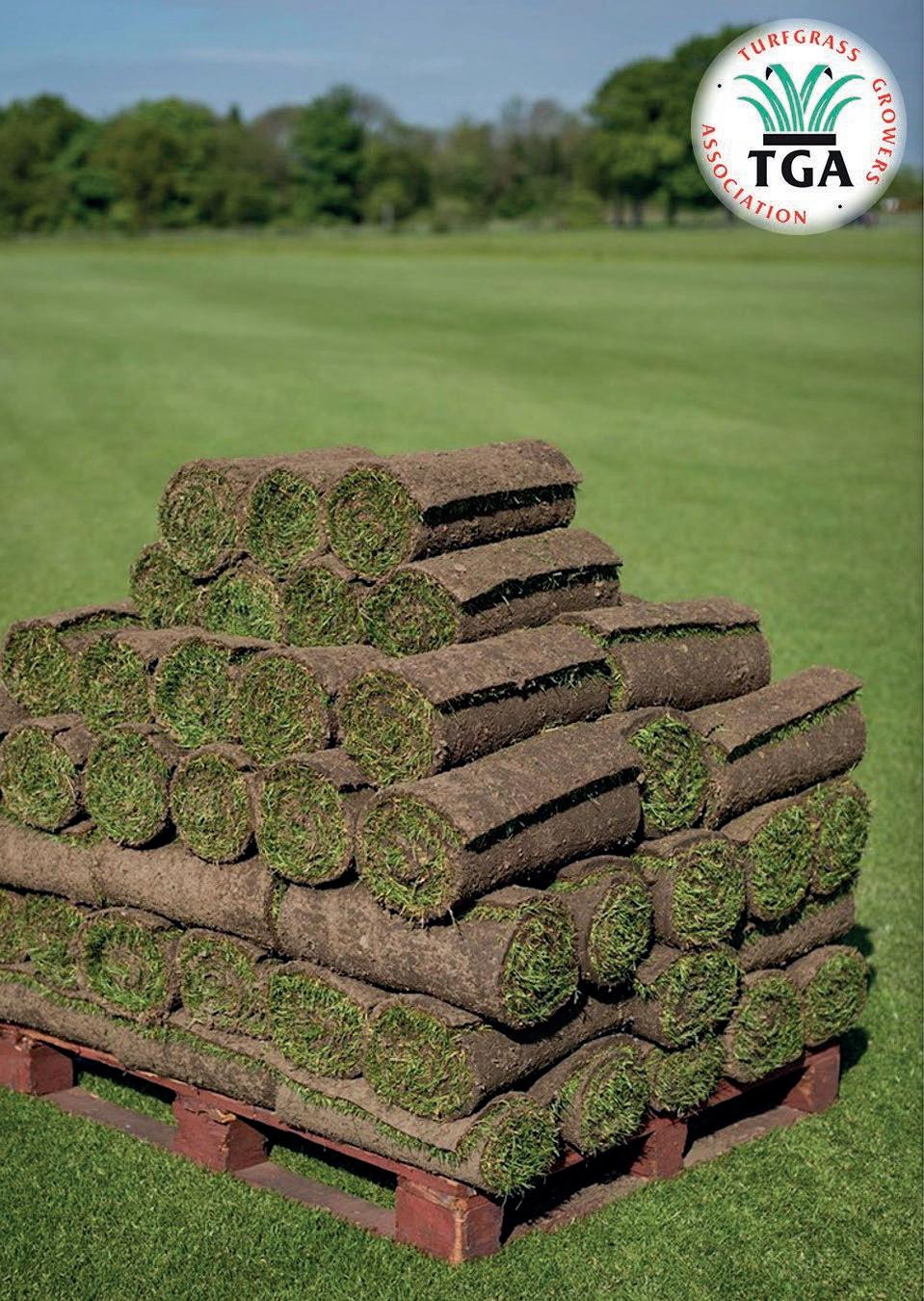
Ongoing geopolitical tensions and continued volatility in global energy markets have led to sharp rises in fuel prices, alongside sustained pressure on fertiliser costs. These inputs are critical to turf production, and the speed and scale of recent increases are creating immediate cost challenges for growers across the UK.
In response, the TGA is encouraging grower members to apply a clearly identified, temporary adjustment to invoices. The proposed “Energy & Production Cost Adjustment” is intended to provide a transparent and proportionate mechanism to reflect these short-term increases in input costs.
This recommendation follows discussions with grower members and is positioned as a shortterm response to exceptional market conditions. The level of the adjustment will be regularly reviewed by the TGA and adjusted or removed as conditions stabilise. Separately, the TGA’s most recent
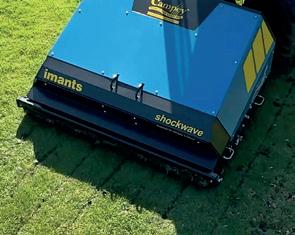
Campey Turf Care Systems celebrates 40 years with open day
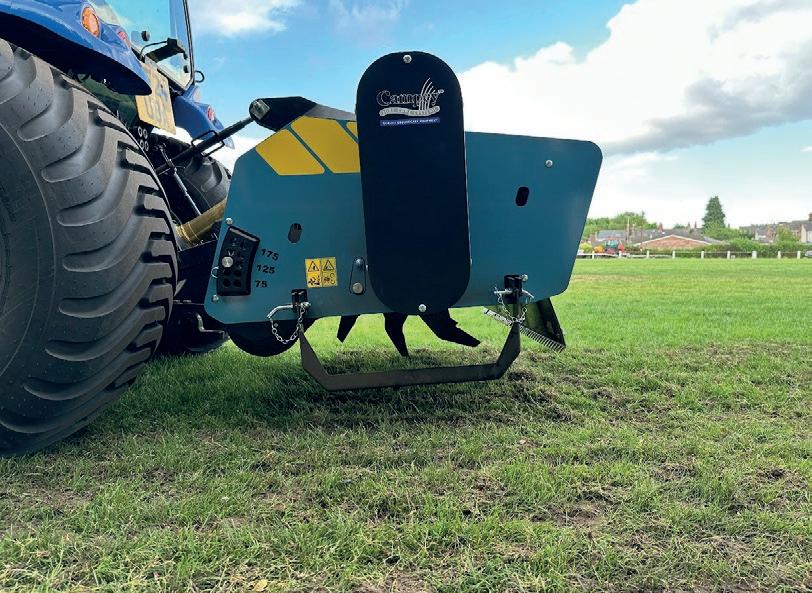
Campey Turf Care Systems is celebrating 40 years of innovation in 2026, marking the milestone with a special Open Day on Thursday 9th July.
Since its inception in 1986, Campey has evolved from a small family business into an internationally respected leading provider of professional turf care equipment and expertise, trusted by sports venues, contractors, and grounds professionals in the UK and around the world.
Established by Richard Campey, the company’s foundation is built on offering practical, inventive solutions tailored to the real needs of turf professionals.
This commitment to innovation remains at the core of Campey’s approach as it continues to design equipment that meets the evolving
demands of modern sports surfaces. Reflecting on the company’s journey, Richard commented: “When we launched in 1986, I started off in the northwest of England carrying out contracting work, over time customers started asking me if they could buy the machines.
Market Survey, conducted at the end of 2025, highlights the longerterm cost pressures facing the sector. Growers reported consistent increases in production costs over recent years, including an average rise of 5.64% in 2025. Importantly, many businesses indicated that selling prices have not kept pace, placing ongoing pressure on margins.
Richard Owens, Chair of the Turfgrass Growers Association, commented: “Growers are facing a combination of sustained long-term cost pressures alongside more immediate increases driven by external factors, particularly fuel and fertiliser. This recommendation provides a clear and transparent way to reflect those short-term increases, while the wider industry continues to address the underlying cost challenges.”
The TGA continues to monitor developments closely and is working with its members and industry partners to support a resilient and sustainable turfgrass industry.
“The initial machine that I brought to market was the Greenline Coremaster, Colin Gregory sold 2 to me but I only wanted 1 and that’s how we started off in sales. Four decades on, our drive for innovation and partnership with the industry is as strong as ever. The Open Day will be a fantastic occasion to share this milestone with everyone who has contributed along the way, and our way of saying thank you with the people who have helped make it possible.”
The 40th Anniversary Open Day will highlight both the company’s heritage and its continued commitment to developing machinery and practices that support the future of sports turf management.
Event Details: Thursday, 9th July 2026 Location: Campey Bosley, The Crossroads, Buxton Road, Bosley, Macclesfield, Cheshire, SK11 0PS, UK
To register your attendance and find out more, visit the website dedicated to the 40th Anniversary www.campey40.com
One of the most notable changes is the transition away from heavy cylinder triple and 5-gang machines, commonly used by councils and contractors, towards rotary and flail machines.
These newer machines are often equipped with grass collection capabilities, offering several advantages over their predecessors.
The lower maintenance costs, resilience to impacts and general wear, and the elimination of the need for cylinder grinding have all contributed to this shift in preference.
Another ongoing major development in the industry is the rise of autonomous machines. Whereas such technology was virtually unheard of two decades ago, autonomous machines have now become among the most prominent options available. Although robotic systems have had limited effect on the sales volumes of heavier machinery so far, they are increasingly capturing market share at the lower end of the ride-on mower segment.
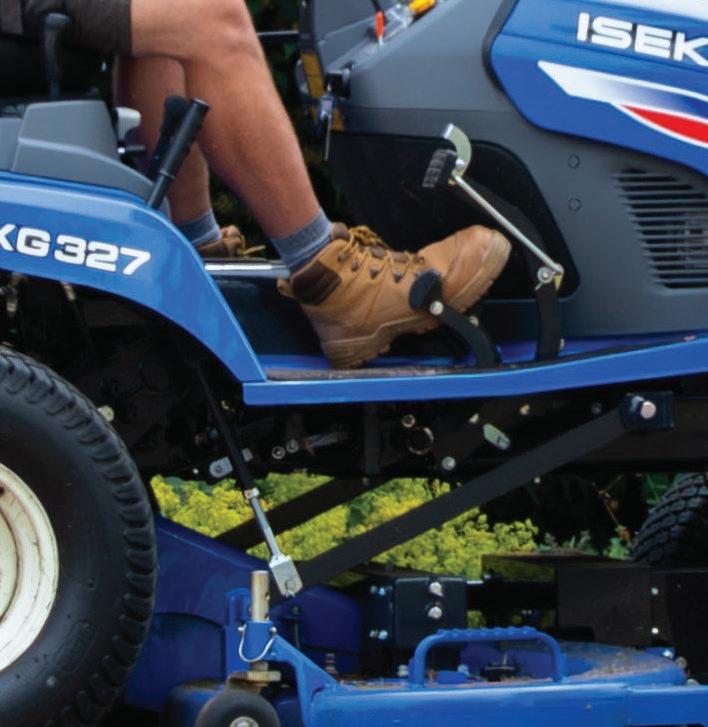
Within ISEKI’s own product lines, the most substantial changes have been driven by new emission controls and machinery safety legislation.
The adoption of EU Stage-V diesel engines has led to increased costs and complexity for larger diesel-powered machines but also produced notable improvements in air quality. Furthermore, ISEKI has modified its
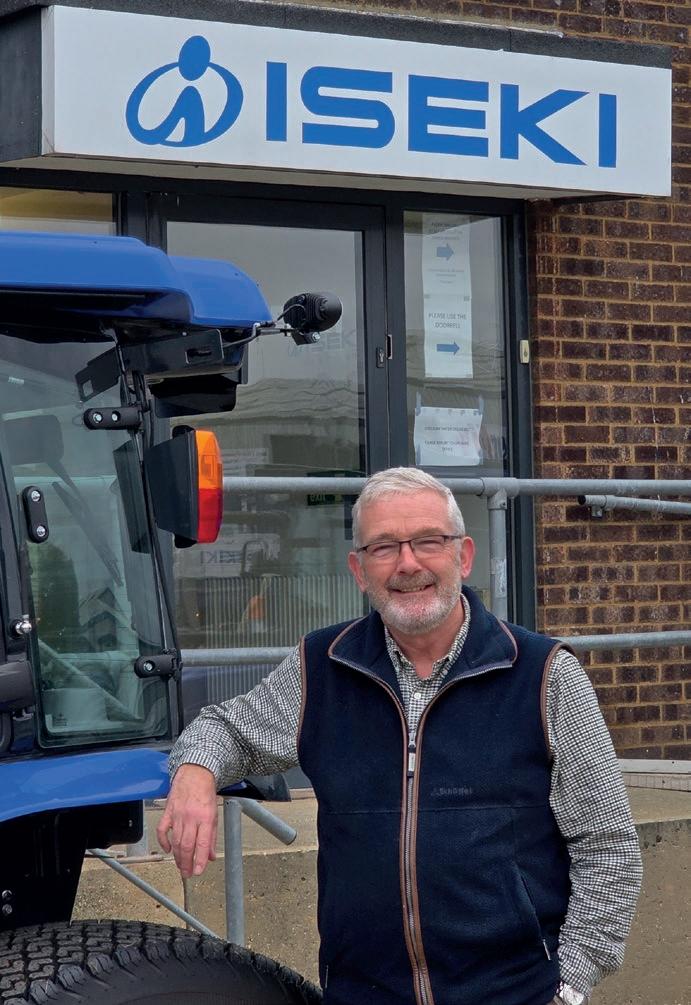
Alan Prickett, Managing Director of ISEKI UK & Ireland, has observed significant transformations in the professional side of the grounds maintenance industry since 2005.
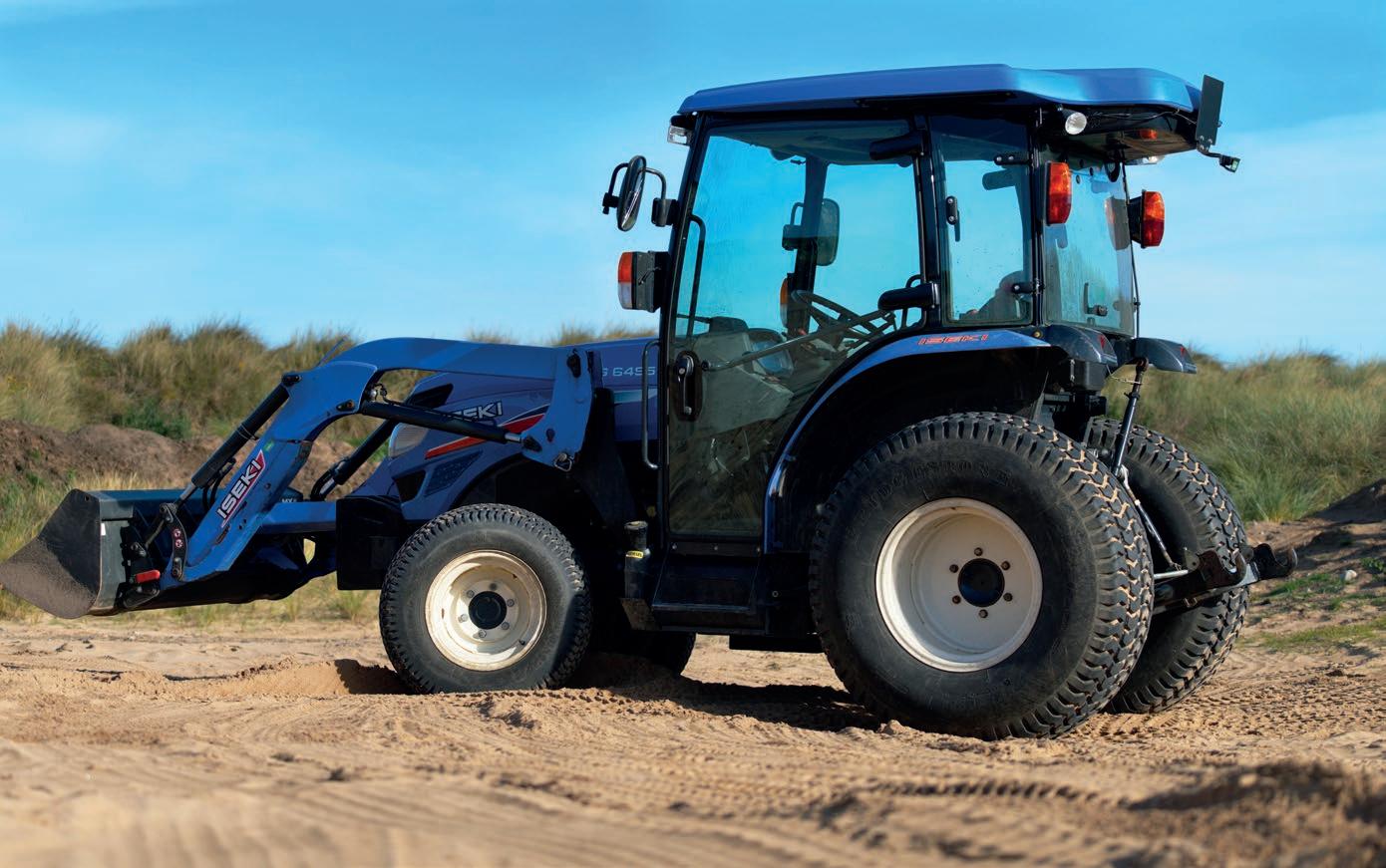
Over the past four seasons, Brora Golf Club has used its ISEKI TG 6495, supplied by ISEKI UK & Ireland through local dealer Fairways, as a platform for sustained growth.
As play has increased and infrastructure has expanded, the tractor has become central to scaling operations, maintaining standards and strengthening the club’s long-term development plans.
For Course Manager James MacBeth, a tractor is a long-term operational investment expected to deliver 10 to 15 years of continuous work. That expectation has been met through versatility and year-round capability. During the main season, the TG 6495
diesel machines to operate with HVO fuels, providing customers with environmentally friendly options. The rising sales of electric Raymo remotecontrol bank mowers further illustrate
supports spraying operations and fills top dressers, helping the team maintain presentation standards as demand rises. In winter, it becomes central to renovation and improvement works.
The tractor’s reliability has underpinned that growth. “The tractor is four years old now, and it’s been very reliable so far. It’s always done everything we need it to do.”
With growth continuing and future development in mind, the TG 6495 provides Brora Golf Club with the power, flexibility and reliability required for the next phase. It is not simply supporting today’s workload, but giving the club the operational confidence to keep evolving in the years ahead.
how environmental, and health and safety considerations are influencing customer purchasing decisions.
ISEKI – Enquiry 3
The GMA has released a Workforce Insight Report, offering the most complete picture yet of the UK grounds management workforce.
The report shows the scale, value and pressures within the sector, and explains why fair and sustainable workforce practices are now essential for the future of the profession. Grounds management is a skilled and important part of the UK’s sporting and recreational system. More than 30,000 people work in the sector, supported by over 13 million volunteer hours each year. These teams help maintain the pitches, parks and playing surfaces that communities and sports rely on.
The report shows that the workforce is committed and proud of its role, but also under strain. Nearly half of grounds staff are aged between 45 and 64, and around 15% plan to retire within three years. Recruitment and
retention continue to be major challenges, and employers report increasing difficulty attracting experienced applicants. Many sites depend on overtime and goodwill to maintain quality.
Job satisfaction is generally high, but the research shows clear concerns around pay, benefits and work life balance. Rising workloads and pay compression linked to the National Living Wage are creating pressure points that could affect motivation and progression, especially for long serving staff. These issues reflect wider pressures across the sector, where budgets are tight and demand is increasing.
To support employers, we have also launched a new public resource, “Working in Grounds Management: Securing the Future of the Profession,” which is a shorter guide including key findings, updated salary information and practical points for employers. Insights from the report will help shape our upcoming Fair Work Strategy. The strategy aims to support employers to strengthen pay structures, improve wellbeing, develop skills and create clearer progression routes, in ways that are practical and financially realistic.
The GMA launched this year’s #GroundsWeek campaign with a striking new video created in partnership with Brighton & Hove Albion and the World Snooker Tour (WST).
The film brings together two expert teams whose work is essential yet often overlooked, showcasing the specialist skills required to prepare both elite football pitches and professional snooker tables. For years, people have often compared high-quality sports surfaces to “snooker tables”.
This video brings that comparison vividly to life by following the Brighton & Hove Albion grounds team and a WST table fitter, to reveal the precision and care that is essential in both roles. But behind this celebration, lies a challenge for the grounds management industry.
Geoff Webb, CEO of the GMA said: “#GroundsWeek is our chance to celebrate the fantastic people who make sport happen. Their expertise ensures pitches, parks and community spaces are in great condition all year round.”

The British & International Golf Greenkeepers Association (BIGGA) will begin delivering its new Professional Leadership Programme from September 2026, marking a significant step forward in the association’s commitment to developing confident, capable leaders across the golf and turf management sector.
Mapped at Level 4, the Professional Leadership Programme has been specifically designed to bridge the gap between Level 3 supervisory and technical, and Level 5 management and agronomic qualifications.
It provides a vital progression route for those who have moved beyond technical competence and are beginning to take on leadership, supervisory and management responsibilities, but who may not yet be ready for, or yet suited to, a full Level 5 apprenticeship or equivalent.
Developed in collaboration with St Andrews Management Centre and Epic Ltd, the programme is tailored to the realities of golf course and club operations. Rather than traditional classroom-based learning, it focuses on applied leadership, real-world management scenarios, reflective practice and practical activities that are directly relevant to participants’ day-to-day roles.
The programme is recognised by the Chartered Management Institute (CMI), ensuring it meets nationally recognised standards for leadership and management excellence. On successful completion, graduates will achieve Foundation Chartered Manager (fCMgr) status, providing formal professional recognition and a strong platform for future progression to higher-level study or apprenticeships.

















































The BASIS Conference returns in 2026 with a bold new format at the iconic National Football Museum in the heart of the Manchester.
Bringing together leaders from across sport, government, business and civil society, the conference has become one of the UK’s leading gathering focused on sustainability in sport. This year’s event will place sport firmly in the national conversation on climate, resilience and environmental leadership – exploring how the sector can accelerate progress while protecting the future of sport.
The 2026 conference will take place across two connected days – June 3 and 4 - each with a distinct purpose.
Hosted at the National Football Museum, the conference day offers the entire sustainable sport community the chance to come together for

a powerful day of insight, debate and inspiration. Through keynote conversations, panels and interviews, it will explore:
• The UK’s energy transition and what it means for sport
• Climate risk and resilience in sport
• The future of energy, nature and resources in sport
• Leadership and governance for sustainability
• Strategy, partnerships and innovation across the sector
This is where the sustainable sport community gathers to take stock of progress, share ideas and set the direction for the years ahead. Tickets purchased by people and organisations outside BASIS membership and Sport England’s network of System Partners are exclusively for use on 3 June. The second day will be a collaborative working space for BASIS members and Sport England system partners.
The President of the Fields in Trust, Jill Scott MBE, headed to Parliament to launch the results of new YouGov polling commissioned by organisation to better understand public mood at a critical moment for the UK’s green spaces.
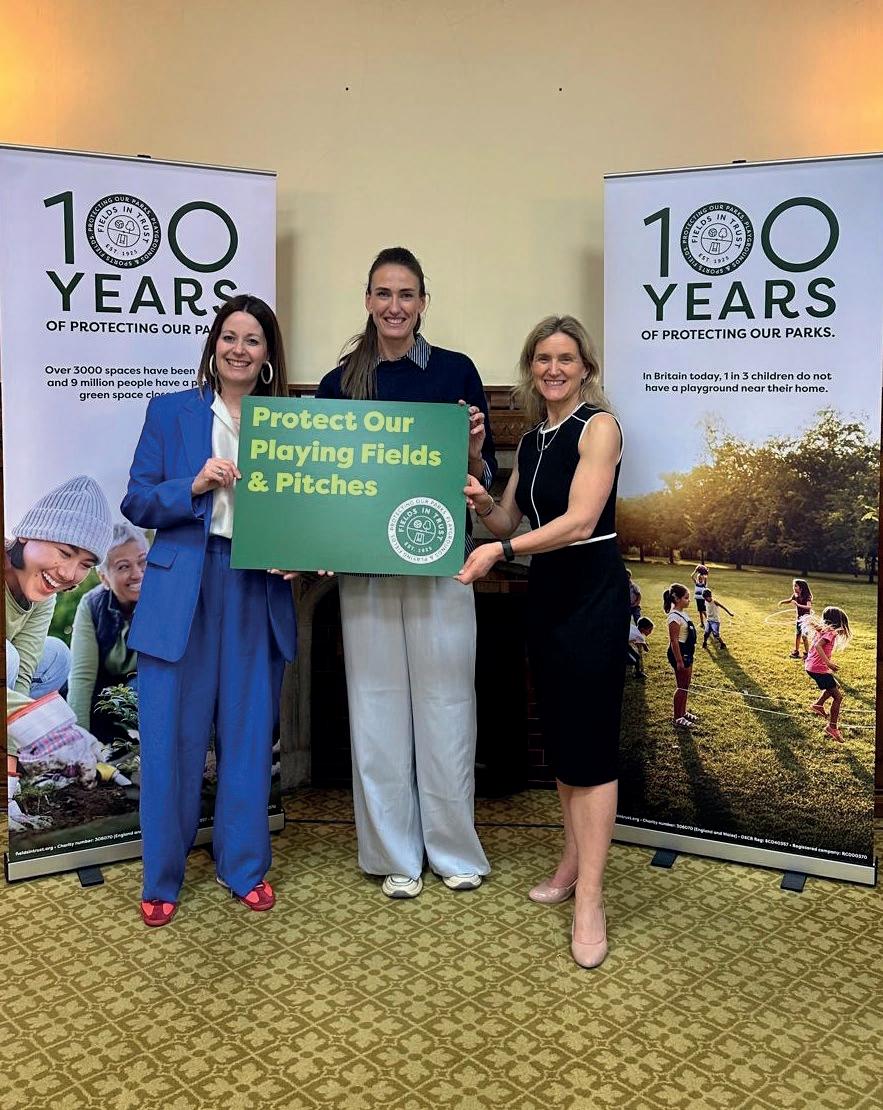
The President met with Parliamentarians to discuss the findings and make the case for stronger green space protections in the UK.
To lose these spaces would not just deny young people access to grassroots sports, but take away their enjoyment of the physical, mental, and social benefits that only time outdoors, away from screens and modern pressures, can provide.
The polling shows that people in Britain almost unanimously believe that green spaces are key in encouraging children to spend less time on digital devices, proving that they are essential tools in tackling the pressures facing young people today.
The results show strong public support for the protection of the UK’s playing fields and green spaces, revealing a stark gap between current Government
Only Members and System Partners will be able to join the Action Forum. Tickets purchased from outside these networks are for the conference day only. Through structured roundtables, workshops, peer-learning sessions and expert-led discussions, participants will build on the themes from the conference and translate ideas into practical action. The focus is on: practical problemsolving; sharing experience across the sector; developing new initiatives and partnerships; and accelerating progress across sport.
Jess Silva is host of the BASIS Conference 2026. Ahigh-energy broadcaster and presenter with a passion for sustainability and sport, she has hosted international sustainability summits including the Sport Positive Summit and is known for her ability to bring energy, insight and connection to complex conversations.
planning proposals and public expectations. Jill Scott said: “I've spent my whole career playing sport outdoors, so I know firsthand how vital these spaces are to communities across the country. I'm alarmed by proposals that would weaken the protections around them and our polling shows the British public are too.
“Grassroots sport needs grass to thrive, but protecting green spaces is about more than sport: it's about ensuring every community has somewhere to go outside, that children have places to play away from digital devices.
“We're not standing in the way of building the homes and infrastructure this country needs. We're just asking that playing fields and green spaces are given proper weight in planning decisions, so that as communities grow, they do so in places where people genuinely want to live.”
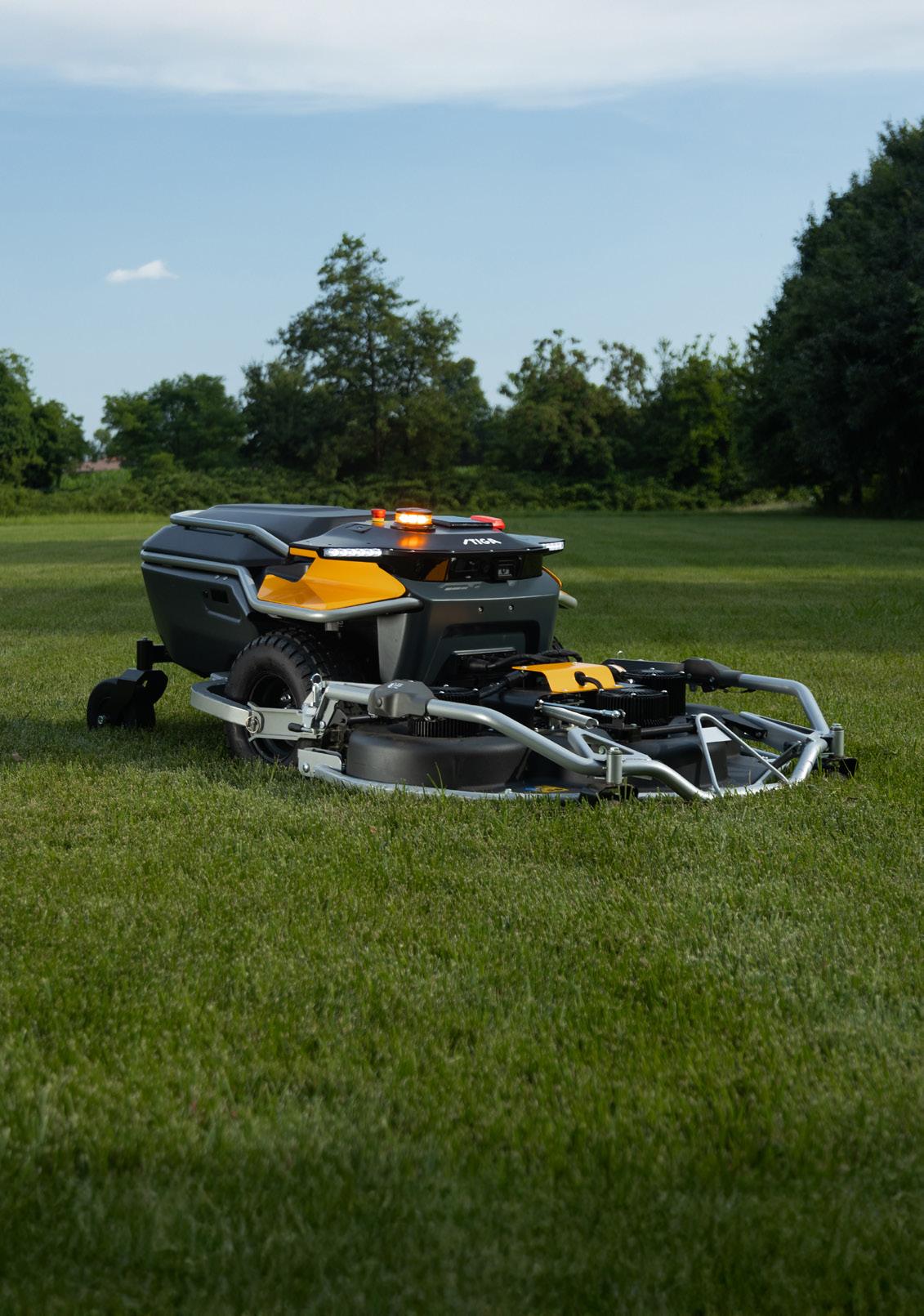
The perfect partner at work!
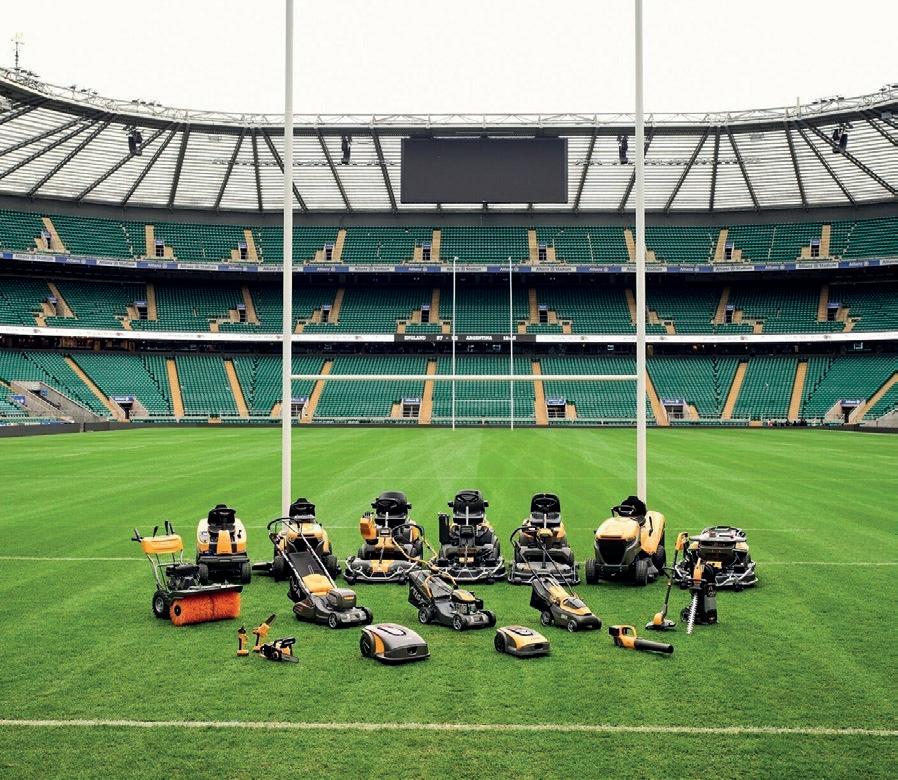
For sports grounds across the UK, maintaining top-quality turf is a year-round challenge. The Rugby Football Union has entered a partnership with STIGA that is not only having a positive impact on the home of English rugby but is also being seen on club pitches around the country.
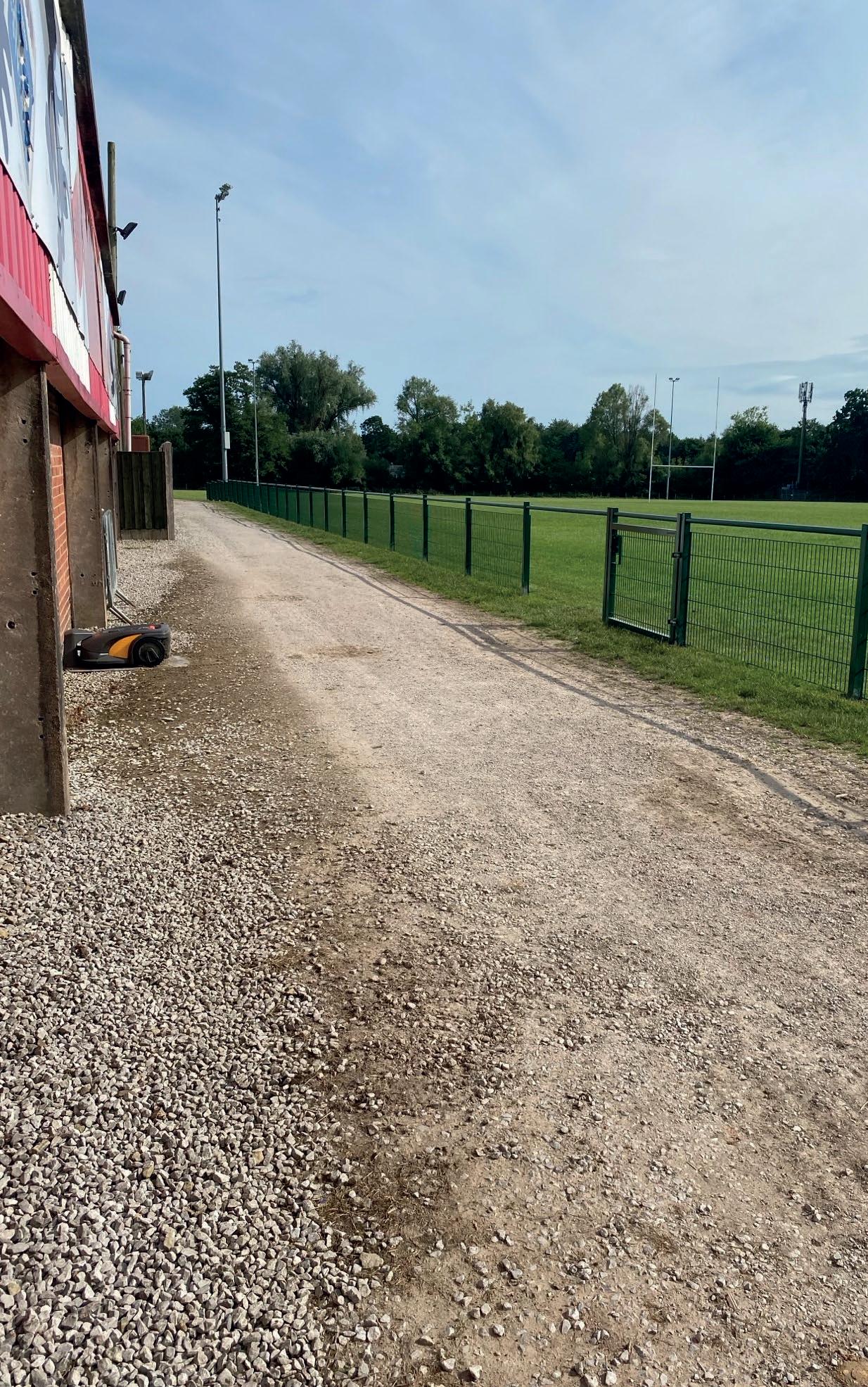
Following on from the success of the We Care, You Care campaign, the STIGA UK team has spent the last six months proudly supporting both professional and grassroots sports clubs across the country.
From community pitches to highprofile arenas, our goal remains the same: to take the pressure off groundskeepers and volunteers by delivering smart, sustainable solutions that keep turf in peak condition.
It all starts at pinnacle of the English game, the Allianz Stadium. Jim Buttar, Head of Grounds and Technical Operations for the RFU, said: “This has been a superb opportunity to see which STIGA lawn care products will be of greatest value, not only to us at Allianz Stadium but to grassroots clubs across the RFU.
“We are really looking forward to this partnership, which will allow clubs to excel both on the pitch and in the care of their grounds.”
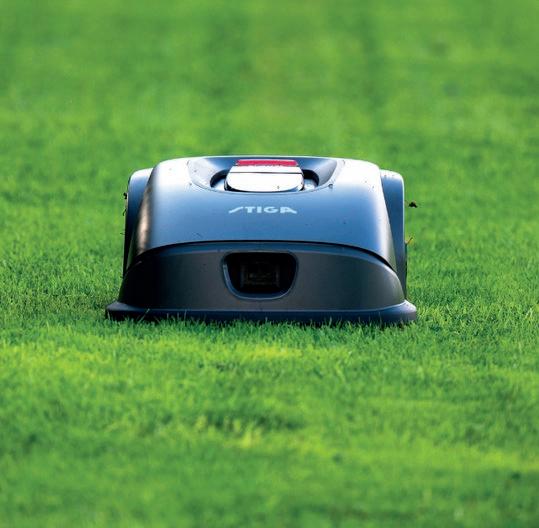
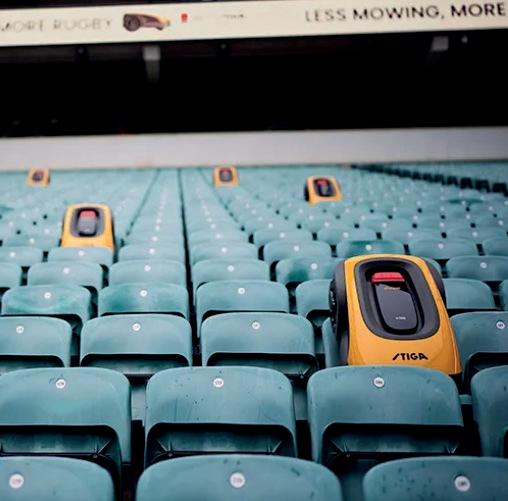
From Manchester Rugby Club to Great Yarmouth Racecourse, an increasing number of clubs are turning to STIGA’s autonomous mowers to take the pressure off volunteers and groundskeepers, without compromising on results.
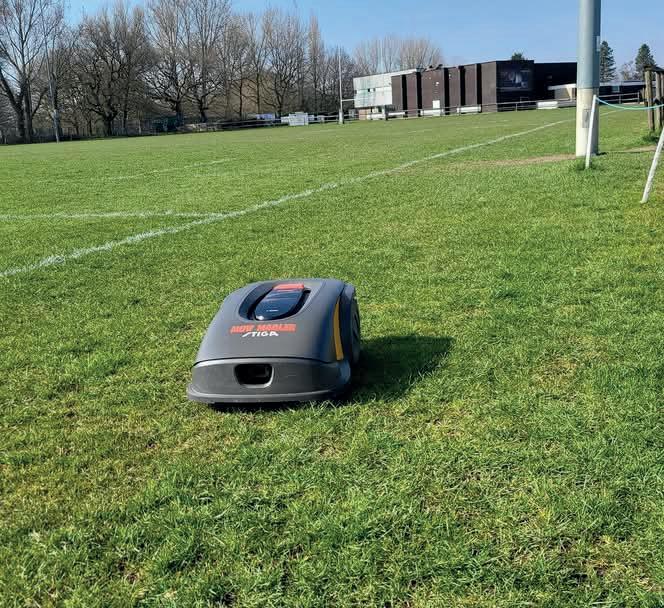
At Manchester Rugby Club, a bustling, volunteer-run organisation serving over 400 players each week, keeping pitches in top condition was a massive task. With the installation of STIGA robots — affectionately named Mow Marler and Cutney Lawns — two of their most heavily used pitches are now autonomously maintained.

The result? Consistently short, healthy turf, clean lines, and no more worrying about last-minute prep before a game or training session. Volunteers are freed up to focus on other priorities, and the club's pitches have never looked better.
Tim Holmes, of Manchester Rugby Club, explained: "Mow Marler and Cutney Lawns joined the Manchester Rugby Club Grounds team back in October 2024, having signed from STIGA.
“As part of the partnership, STIGA provided full training on how to get the most from the mowers, and they made an immediate impact. Their work ethic has been incredible. They operate day and night, seven days a week, and we saw an instant improvement in the quality of the pitches."
We are really looking forward to this partnership, which will allow clubs to excel both on the pitch and in the care of their grounds.
How often do the robots mow each area?
“Chutney and Mow are pretty much out every day from Mid-March to late November. They cut a pitch each in just under 3 days so each pitch is cut twice a week.”
Roughly how much staff time have the robots saved each week?
“Before the mowers, our team would just about have the time to cut the pitches once a week, but this meant there were also cuttings to clear after, especially in the summer. Cutting each pitch would take approx 90 mins, and clearing the cuttings another 90-120 mins. So approx 7.5
hours a week, that is now retained to do other pitch maintenance work, such as slitting and verti-draining.”
Has this reduced overtime or weekend work?
“To be honest, it’s all overtime, but none of it paid, as we have a wonderful team of very hardworking volunteers managing the grounds, but it has greatly reduced the pressure on the team each week.”
Have you noticed improvements in turf density or overall health?
“Yes, very much so. The constant cutting keeps the grass shorter and stronger.”

How does the cut quality compare to traditional mowers?
“The constant cutting means the grass doesn't get long at all, and it's kept at the perfect level.”
Does frequent, light cutting improve presentation?
“Very much so. It keeps everything trim and neat. The biggest difference is when the ground is wet or soft, and we couldn't use the tractor to cut the pitches. The mowers being so light allows for constant cutting without any damage to the surface.”
Have players noticed a difference in surface quality?
“Yes, when the grass used to get longer, it was commented on and more difficult to play and train on.”
Has match-day presentation improved?
“The constant cutting often means we don't have to roll or cut before a match day, meaning the pitch is always in peak condition.”
The multi-year partnership with the RFU underlines STIGA’s commitment to taking the pressure off volunteers and grounds teams, while helping to create world-class playing surfaces.
The roles of groundspeople within the RFU are far-reaching and span both professional and volunteer levels. These experts play a vital role across the RFU, from professional staff at Allianz Stadium, such as the Head Groundsman, to Regional Pitch Advisors who support clubs through the Pitch Advisory Service. At the community level, volunteers help to maintain pitches.
STIGA’s
intelligent, wireless mowing systems help optimise turf care, reduce workload, and ensure consistently highquality playing surfaces across the game.
Designed to deliver outstanding results with minimal effort, STIGA’s intelligent, wireless mowing systems help optimise turf care, reduce workload, and ensure consistently high-quality playing surfaces across the game.
James Gordon, Managing Director of STIGA UK, said: “As Official Groundskeeping Partner of the RFU, it was very important for STIGA to bring our professional mowers and specialist rugby ground equipment to Allianz Stadium for the grounds team to try first-hand.
“2026 will be a superb year for showcasing the quality and innovation of STIGA products, while also supporting clubs as we continue to help elevate standards across the sport.”
Images STIGA
Dennis Mowers has unveiled the newest addition to its range of high-performance professional mowers - the lightweight ES-34SL battery-powered mower, designed for everyday use and flawless finishing.
A dedicated, battery-powered finishing mower using the latest lithium-ion battery technology, the ES-34SL is perfect for use on stadium pitches and training grounds in professional sports like football, rugby, hockey and baseball. It is also ideal for use on squares and outfields in cricket, as well as at schools, universities and other municipal facilities.
On a single charge, the new battery mower can cut for up to 10 hours –equivalent to 40 kilometres – with its rapid, two-hour recharge costing as little as £1.58.
Its ultra-low noise and vibration technology, meanwhile, allows for operation near areas of play without disturbance, improves operator health and safety, and is perfect for schools and universities where noise disturbance is of paramount importance during spring and summer.
At around 50 kg lighter than Dennis’ existing ES-860 battery mower, the ES-34SL is ideal for daily use and minimising soil compaction. The combination of reduced weight, reduced rear roller diameter, click adjustable Weile roller and intermediate grooming brush, allows for greater ease of use and control over the final finish, which serves to produce the flawless stripes that
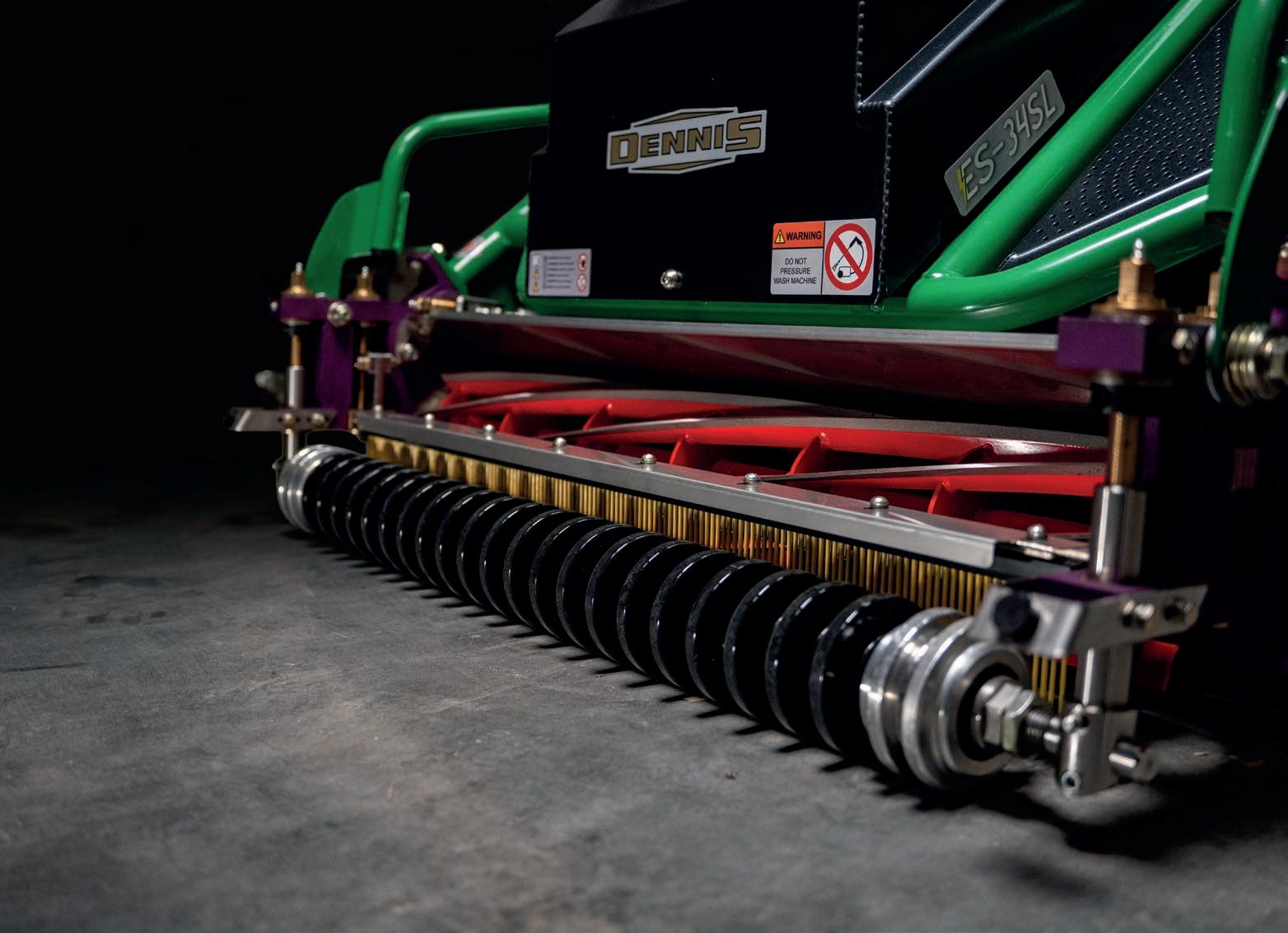
Dennis’ product range is renowned for. The mower’s clip rate can be defined by the user to suit their specific surface and preferences and, once set, remains consistent, even if the machine speed is adjusted or a colleague takes over.
Furthermore, the ES-34SL is fitted with a weatherproof, colour LCD programmable display and keypad that operate the machine and relay
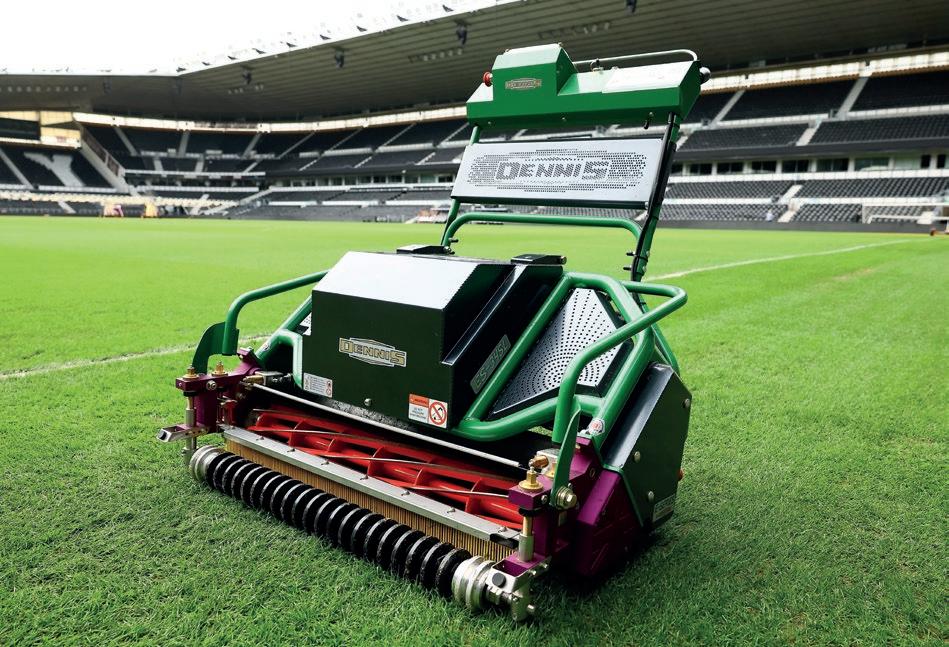
real-time information to the operator, including ground speed, battery charge level and machine settings.
Megan Oliver, managing director at Dennis Mowers, said: “We are delighted to be launching the ES34SL professional battery mower, which we’ve developed in response to direct feedback from grounds professionals.
“In addition to the popular features in our range, our challenge was to design a lightweight machine that helped to reduce soil compaction and was therefore suitable for everyday use, while still delivering the flawless presentation stripes relied upon for match days.
“Designed with day-to-day use in mind and supported by the service and consistency that our customers value, it’s another step forward in professional mowing.”
Dennis Mowers – Enquiry 7
The winners of the 2026 GMA Industry Awards have been announced at a prestigious ceremony at Edgbaston Stadium.
The awards took place alongside the new GMA Conference, which ran throughout the day and brought the industry together for workshops and discussions.
The landmark conference brought together leading experts and experienced practitioners from across the UK and beyond for an immersive programme designed to inform, inspire, and connect.
Attendees were able to build their own agenda to focus on the skills and knowledge most relevant to their career whilst accessing the latest research and emerging best practice - a snapshot of where grounds management is heading.
Networking ran throughout the programme with plenty of time to connect and meet new peers. A guided tour of Edgbaston’s worldclass facilities will offer a rare behind-the-scenes look at excellence in action.
Sarah Hunter, Head of Events at the GMA, said: “Grounds professionals operate in a fast-changing environment, and there’s a real appetite for events that combine practical learning with the chance to connect with others facing similar challenges.
"One of the real strengths of this programme is that delegates can tailor their day by choosing the sessions and speakers that are most relevant to their role. This conference delivers exactly that - flexibility and depth.”
It proved the perfect introduction to the awards. Hosted by renowned broadcaster Kelly Somers, the awards celebrated the people and teams who show outstanding skill across the grounds management sector.
Geoff Webb, GMA CEO said: "The GMA Industry Awards are always a key highlight in our calendar.
They give us the chance to celebrate the hard work that drives our industry forward. We received a record number of entries this year which shows real strength and pride across grounds management. I want to congratulate all our winners and thank them for the great work they do every day."
The GMA would like to extend a special thank you to our platinum sponsor ISEKI UK & Ireland as well as conference & award sponsors Origin Amenity Solutions, ICL, Chappell Enterprises UK, National Governing Bodies of Sport, Barenbrug, Agronomic Services Ltd, MJ Abbott/
The 2026 winners are:
• Young Groundsperson of the Year (Sponsored by Origin Amenity Solutions): Flynn Good
• Newcomer of the Year (Sponsored by ICL): George Legg
• Volunteer Groundsperson/ Team of the Year (Sponsored by Chappell Enterprises UK): Trubshaw Cross
• Community Groundsperson/ Team of the Year (Sponsored by National Governing Bodies of Sport): Stoneham Lane Football Complex
• Best Managed Artificial Surface of the Year: University of Warwick
• Environmental & Sustainability Impact Award: Liverpool F.C
• Bowls & Croquet Groundsperson/Team of the Year: Dean Gibbons
• Professional Cricket Grounds Team of the Year (Sponsored by Barenbrug): Marylebone Cricket Club
• Professional Tennis Courts Grounds Team of the Year (Sponsored by Advanced Turf Technology LTD): The
Premier Pitches, Reesink, SGL, Kubota, DLF Seeds Ltd and Advanced Turf Technology LTD, whose support made this event possible.
This year’s charity partner, MND Association, was at the heart of the evening, with guests generously donating to support its vital work in improving access to care, research and campaigning for people affected by motor neurone disease. Thank you to everyone who contributed, your generosity will make a genuine difference.
The GMA – Enquiry 8
All England Lawn Tennis and Croquet Club
• Professional Horse Racing Grounds Team of the Year: Warwick Racecourse
• Professional Rugby League Grounds Team of the Year (Sponsored by Agronomic Services Ltd): Castleford Tigers
• Professional Rugby Union Grounds Team of the Year (Sponsored by MJ Abbott/ Premier Pitches): Bristol Bears
• Professional Football Grounds Team of the Year (Sponsored by Reesink): Lincoln City F.C
• Professional Football Grounds Team of the Year (Elite) (Sponsored by SGL): Manchester City F.C
• University & College Grounds Team of the Year (Sponsored by Kubota): University of Warwick
• Independent School Grounds Team of the Year (Sponsored by ISEKI): Whitgift School
• GMA Grounds Manager of the Year (Sponsored by DLF Seeds Ltd): Karl McDermott.
Maintaining top-flight playing surfaces across a large, multi-use facility demands more than just quality turfcare equipment – it requires absolute reliability, operational efficiency and a consistently high standard of finish.
For The Vale Resort, Baroness has become an increasingly important part of that equation, with the recent delivery of four LM551 fairway mowers adding to the finesse delivered by four LM331 surrounds mowers already at the venue.
Under the longstanding involvement of Head Greenkeeper Mike Bevan, the golf element has grown from a modest nine-hole layout into two 18-hole championship courses, maintained by a team of 12 greenkeepers. “We purchased four LM331 mowers in 2022 which

are used daily during the main growing season on banks, tee and green surrounds and other peripheral areas,” he explained.
“These mowers tick a lot of boxes – not just the quality of cut they deliver and the fact they stay on cut incredibly well, but from a maintenance and servicing perspective everything is super simple to work on. Their reliable performance is invaluable to us as such a busy

resort where downtime just isn’t an option.” Building on the success of the LM331’s, the club expanded its Baroness fleet further in October 2025 with the purchase of four LM551 mowers for the fairways. While winter conditions have limited their usage to date, expectations are high for the season ahead.
Baroness – Enquiry 9


Lees Hall Golf Club are celebrating the success of their growing wildflower initiative, developed in conjunction with DLF Seeds.
Led by Head Greenkeeper Ian Whitehead and Assistant Greenkeeper Danny Tozzi, the club is now entering its third year of using mixtures from the Colour Boost range which has added areas of high visual impact and a real ‘boost’ to biodiversity around the course.
Established in 1907 as a nine-hole course before expanding to 18 holes in 1921, the picturesque parkland course at Lees Hall is set atop rolling hills with panoramic views across the city of Sheffield. Adding to the visual merit for the past two years are bursts of colour delivered by the club’s newly created wildflower areas.
“I first met with DLF’s Stuart Yarwood at BTME 2024 who suggested we start with a small-scale trial to see how we got on,” explains Ian.
“We opted for Floral Carpet from the Colour Boost range which provided a bold, but low-growing display which all the members enjoyed on their way to the first tee.” Along with something that would not interrupt lines of sight or play, Ian’s other request was slightly more out of the ordinary: “My allegiance to Sheffield Wednesday meant I couldn’t bear the thought of a red floral display on the course – DLF were more than happy to oblige, tweaking the mixture to incorporate more blues and whites.”
There’s no doubt that since we established these wildflower areas we’ve seen an increase in pollinators, birds and wildlife in general enjoying these spaces.
Under the careful management of assistant Danny Tozzi, the success of the trial plot saw the expansion of the programme into new areas in year two.
Danny takes up the story, “We continued with Floral Carpet and then, with the guidance of DLF’s Ben Morgan, introduced the Honey Bee & Butterfly mixture into some new areas.
Despite some slightly challenging weather conditions, we were impressed with not only the way the new sowing performed, but also how much re-growth and self-seeding we saw in the plots from year one.”
As well as visual appeal, boosting ecology has been a major driver for the project. “There’s no doubt that since we established these wildflower areas we’ve seen an increase in pollinators, birds and wildlife in general enjoying these spaces,” Danny adds.
Buoyed by the success, five additional wildflower areas are earmarked for sowing in 2026.
DLF – Enquiry 12
According to Glenigan data, football stadium construction is creating significant opportunities for major project work as professional clubs look to increase spectator capacity and modernise their facilities.
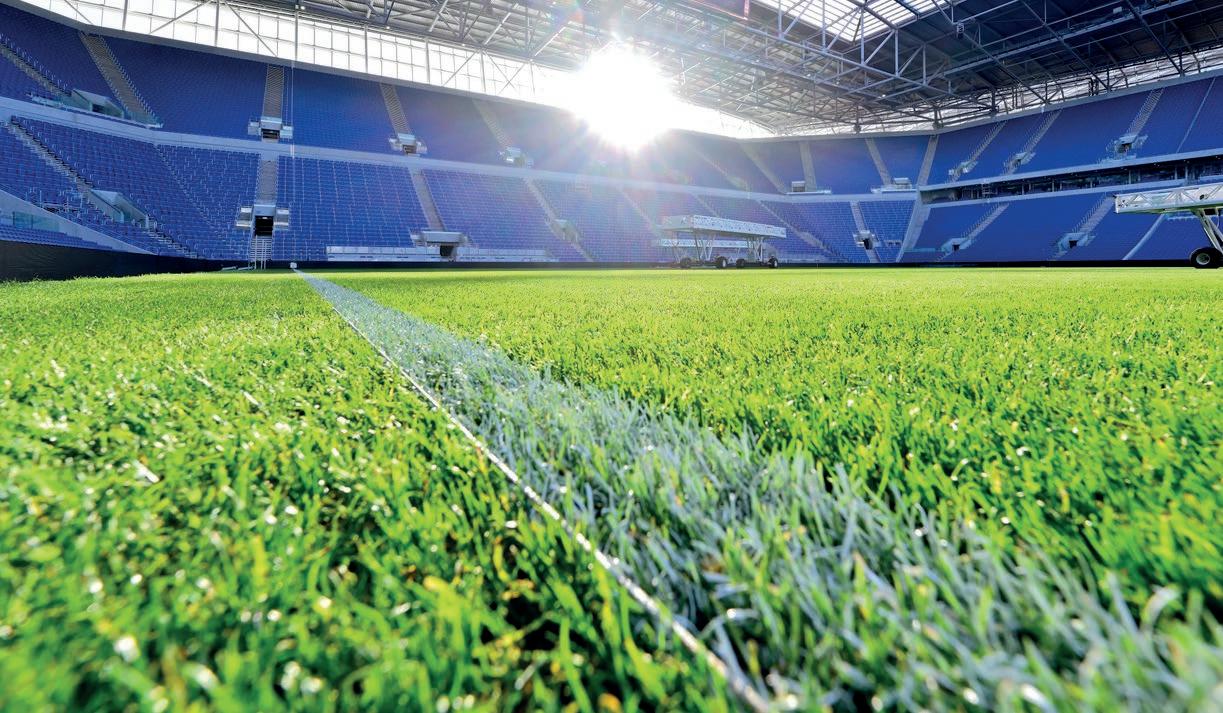
The drive for larger, more efficient, and commercially viable venues is generating a growing pipeline of substantial redevelopment and new build stadium schemes across the UK.
These schemes often involve significant investments – Everton’s new Hill Dickson stadium on Merseyside (pictured) cost £100 million – and are increasingly linked to wider regeneration schemes in local areas.
Today, significant football stadium construction projects are either underway or due to start at Luton FC, Oxford United, AFC Bournemouth, Crystal Palace, and Leeds United.
Indeed, Glenigan data points to rising activity in sports-related schemes is helping to kick off new activity in the hotel & leisure sector. The latest Glenigan Index shows that underlying (under £100m) hotel & leisure starts rose by 28% in the DecemberFebruary period to stand 17% up on the period a year earlier.
Work on Luton FC’s new £84 million Power Court Stadium started at the beginning of this year and is set to run for 26 months. As well as a new 25,000-seat stadium, the mixeduse development will also include
Palace FC, where detailed plans have been approved and Bovis appointed as the contract manager on the Selhurst Park Stadium Main Stand Development. The scheme will create 8,000 extra seats in the main stand and a new corner stand, as well as lengthening the pitch.

conference rooms along with food & beverage and commercial & community facilities involving almost 39,000 sq m of space in all. The Turkish group Limak, which worked on the redevelopment of Spotify Camp Nou in Barcelona, is the main contractor on the scheme.
Meanwhile, tenders have been returned, and work is set to start this autumn on Oxford United’s new £150 million stadium, The Triangle, at Kidlington (pictured). As well as a 16,000-seat stadium, the project includes commercial and community space and facilities for conferences, exhibitions, education, and other events.
On the south coast, further detailed plans have been submitted and a preferred bidder appointed on AFC Bournemouth’s £50 million Vitality Stadium Redevelopment. The project involves the demolition and replacement of the club’s south stand with a new 7,000-seat facility and the phased refurbishment and expansion of its north, east, and west stands.
A major £100 million expansion is set to get underway at Crystal
Leeds United has submitted detailed plans for a £67 million extension to its Elland Road stadium as part of a master project which also involves homes, commercial units, and hotel space.
Glenigan – Enquiry 13
Projects in the pipeline:
• Manchester City’s £300 million North Stand development at the Etihad Stadium – which also involves a new hotel – is due for completion this summer (Project ID: 22361678).
• Manchester United is looking at a huge £2 billion project to create a 100,000-seat capacity venue.
• Newcastle United is also looking at options for increasing its match-day capacity.
• Birmingham City, where a new 62,000-seat Powerhouse Stadium would form part of a new £2.5 billion Sports Quarter project.
• Aberdeen FC could form part of the city’s £100 million Beachfront Revitalisation.
• A new stadium which will be home to Cardiff City FC is expected to form part of the £750 million Cardiff Bay international sports village.
• Detailed plans have been granted for a £2.2 million extension of Maidenhead United FC’s ground in Berkshire.
In the world of professional turf management, the battle against the elements is perpetual. As weather patterns become increasingly volatile, the "shoulder seasons" are no longer defined by light mists, but by high-volume precipitation events that test the limits of even the most sophisticated drainage systems.
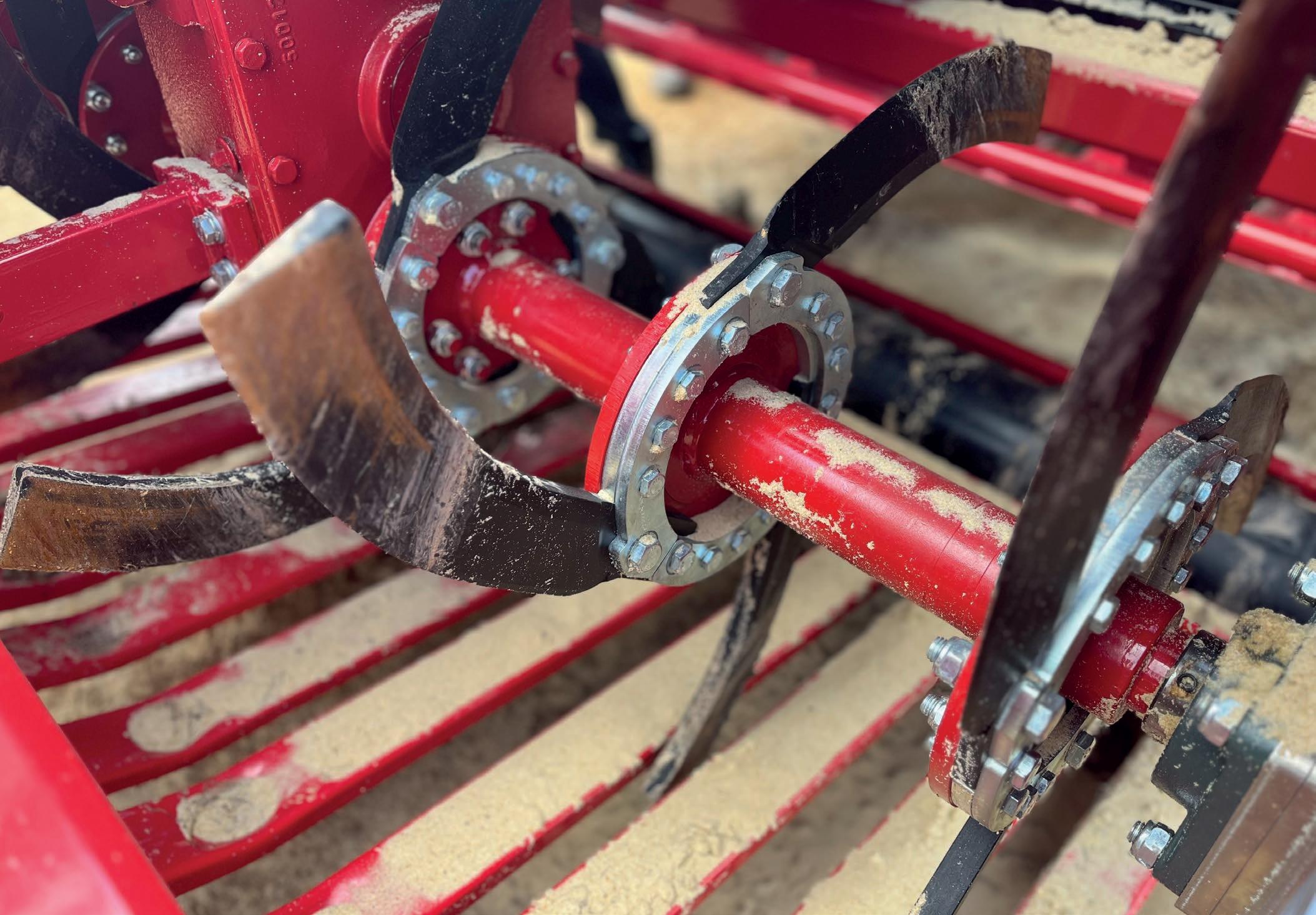
For the modern turf manager, the challenge is twofold: maintaining the structural integrity of the soil profile while ensuring maximum surface availability for players. Paul Langford from Redexim UK discusses more.
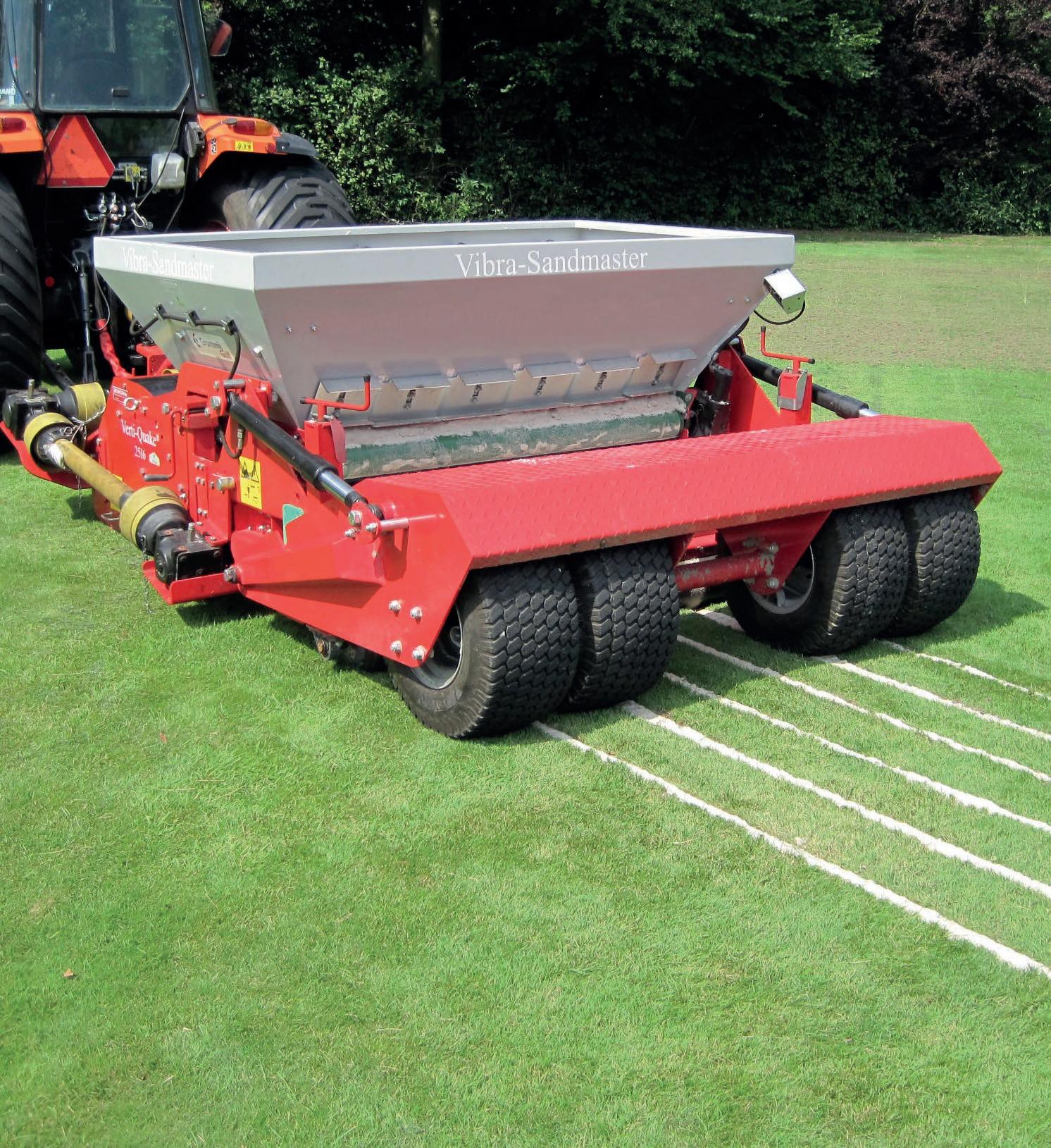
When traditional aeration is no longer enough to move standing water, the focus must shift to secondary drainage. This is where the Redexim Vibra-Sandmaster enters the fraynot merely as a piece of machinery, but as a strategic intervention for long-term turf health.
To understand the value of a machine like the VibraSandmaster, one must first address the "perched water table" and the physics of soil compaction.
In high-traffic areas such as golf fairways, football and rugby pitches, the upper 100 mm to 200 mm of the soil profile often becomes a bottleneck. Even if the underlying subsoil is porous, a capped or compacted surface layer acts as a seal, trapping water and suffocating the root zone.
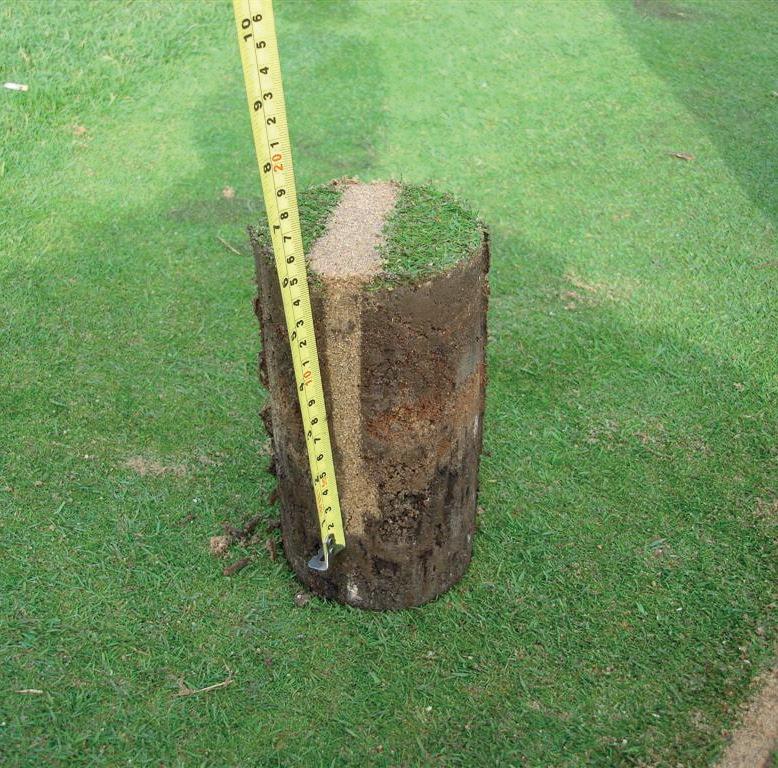
Sand slitting is the surgical answer to this problem. By creating narrow, vertical channels and backfilling them with free-draining aggregates, we can create a direct bypass for surface water.
These slits do more than just move water; they facilitate Gas Exchange. By breaking the surface seal, oxygen can reach the rhizosphere, and carbon dioxide can escape which is a process vital for the microbial activity that prevents thatch build-up and promotes deep rooting.
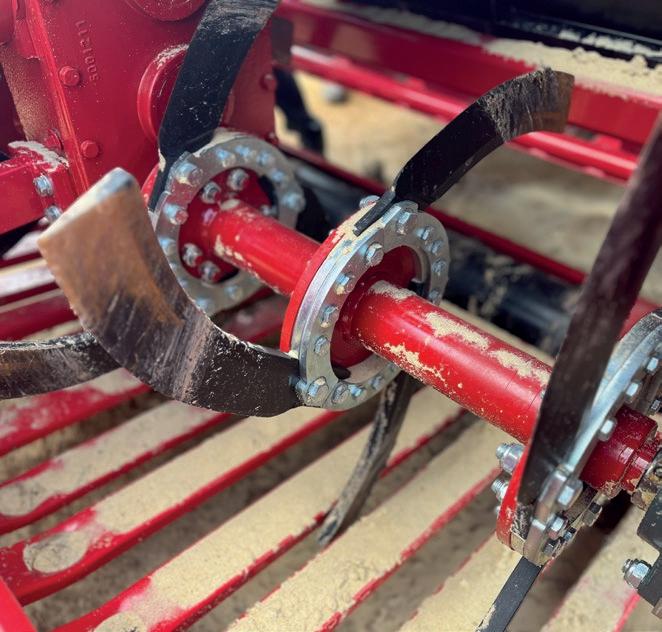
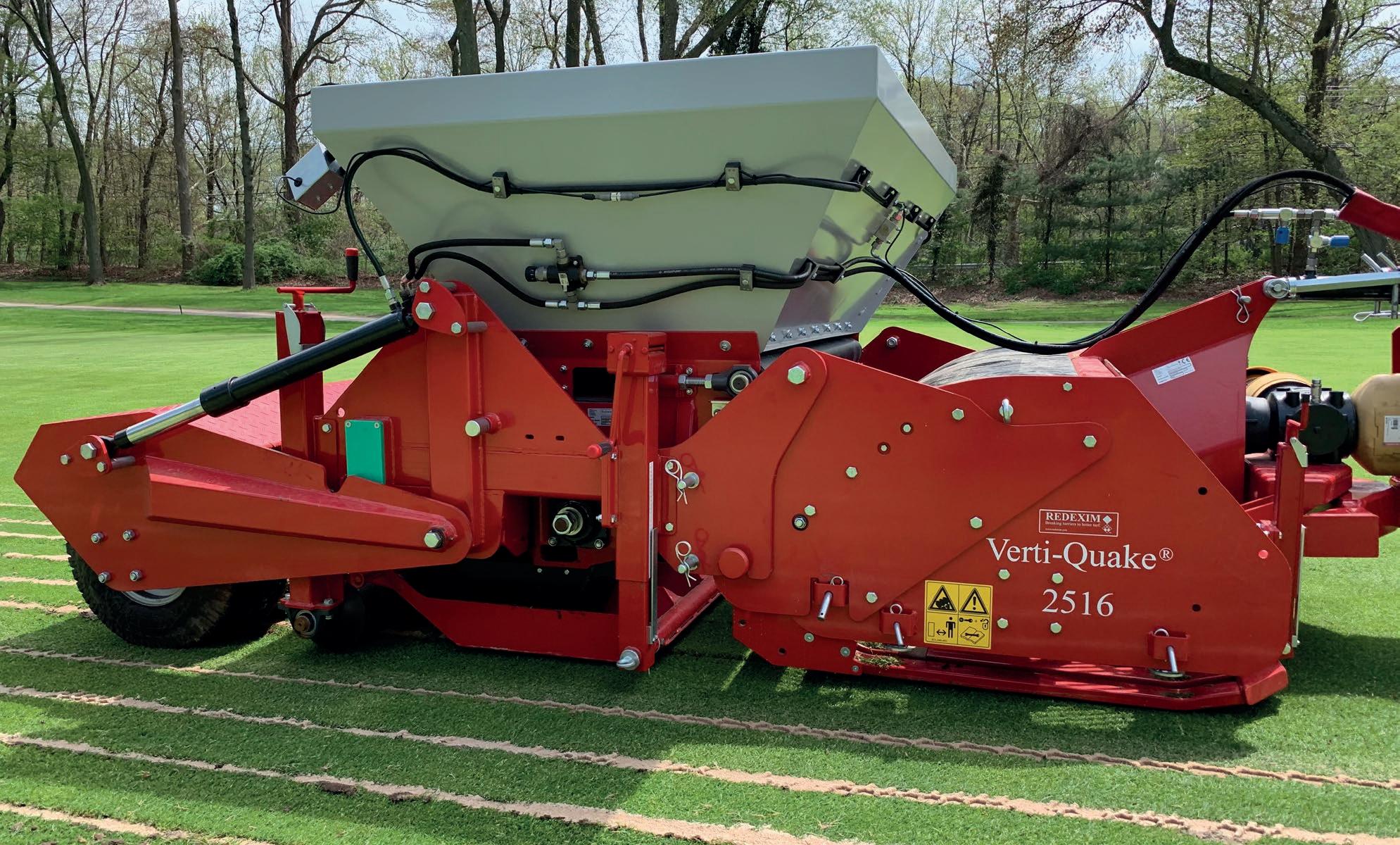
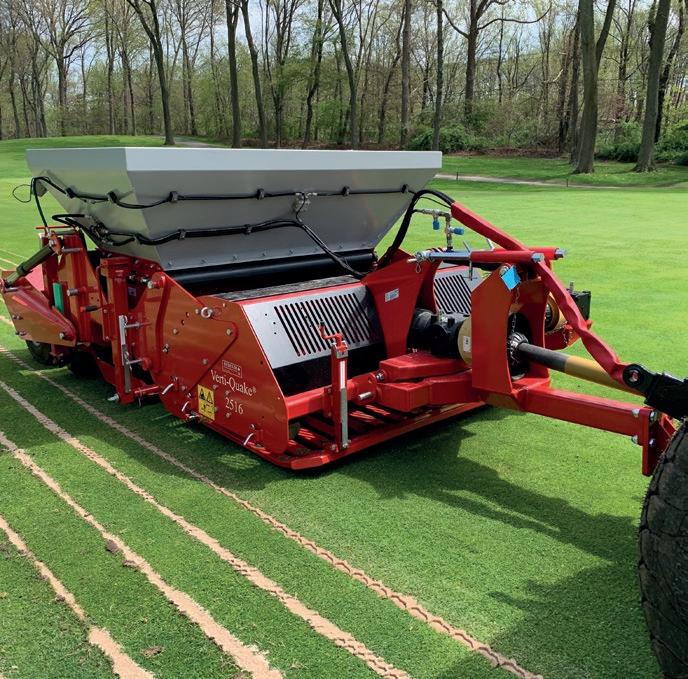
Traditional sand slitting has historically been a multi-stage, labour-intensive process: decompacting, trenching, filling, and brushing. The Vibra-Sandmaster redefines this workflow by integrating the Verti-Quake 2516 into a seamless, one-pass operation.
1. Decompaction via the VertiQuake 2516
At the heart of the system is the Verti-Quake technology. Unlike standard hollow coring or solid tining, the Verti-Quake uses a rotary action with offset blades These blades penetrate up to 250 mm (9.8 inches) deep, creating a "wave" action underground. This lateral movement shatters the soil structure between the slits without the heave associated with traditional deep-tine aerators.
2. Vibrating Coulter Technology
The "Vibra" in the name isn't just marketing. It’s the machine’s most critical mechanical advantage. As the sand is delivered from the hopper into the slits created by the VertiQuake, the coulters vibrate at high frequency. Technical Note: This vibration serves a dual purpose. First, it ensures that the sand (even if slightly damp) flows freely without bridging or clogging the delivery chutes.
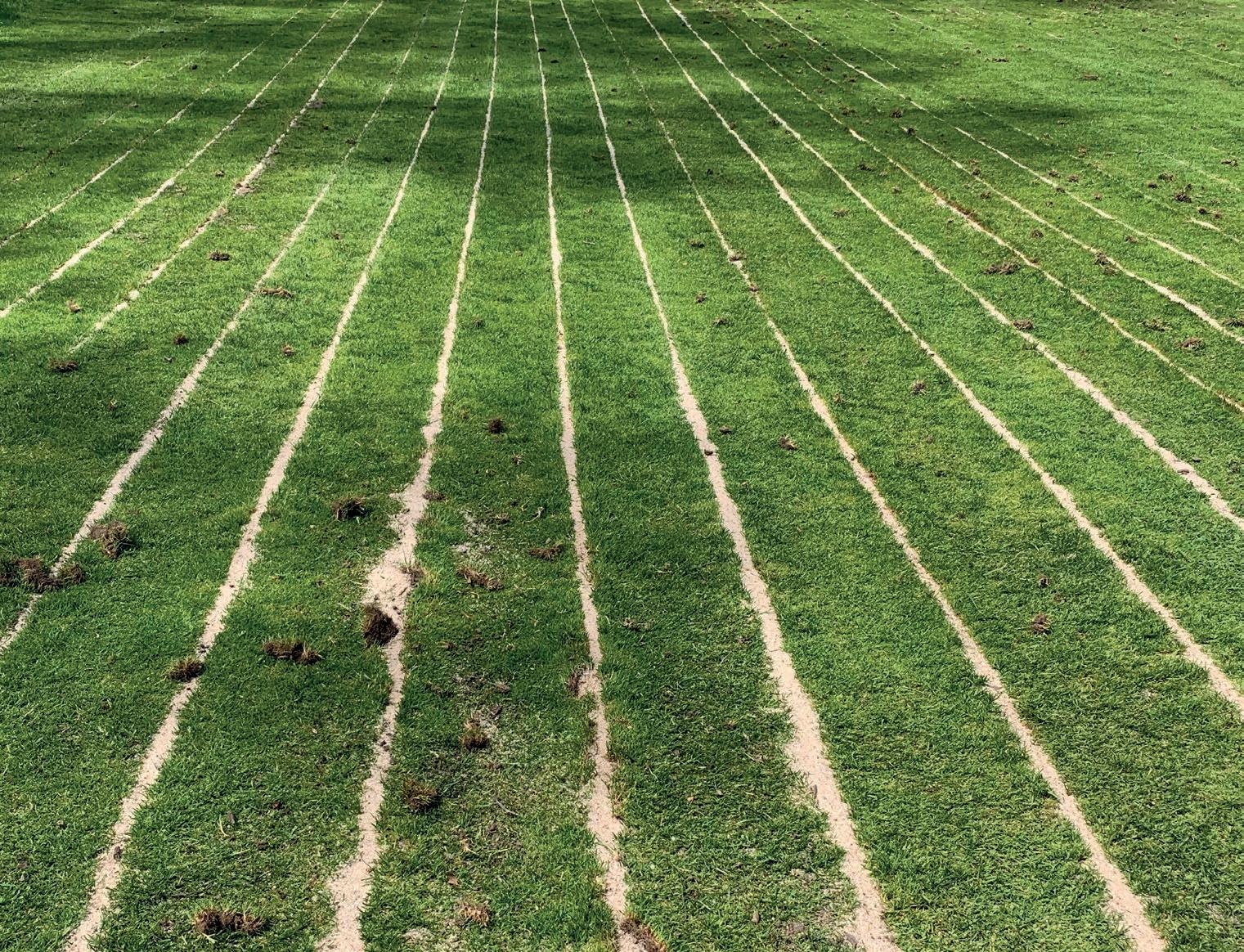
Second, it "settles" the sand into the slit, ensuring there are no air pockets. An improperly filled slit can lead to surface "slumping" later in the season; the vibrating coulters mitigate this risk entirely.
Efficiency as a management tool “Window of opportunity" is a common phrase. With budgets tightening and fixture lists growing, the luxury of closing a pitch for a week of renovation is disappearing. The one-pass capability of the Vibra-Sandmaster is, therefore, a massive logistical win. By combining de-compaction and sand injection into a single pass, grounds teams can:
• Reduce Man-Hours: Complete a fairway or pitch in a fraction of the time required for multimachine setups.
• Minimise Surface Disruption: Because the machine is precisely calibrated, the "clean-up" required post-operation is minimal. Surfaces are often playable within hours of completion.
• Precision Monitoring: The inclusion of an on-board camera system allows the operator to monitor sand flow in real-time. This prevents the "blind spots" that often lead to inconsistent drainage performance across a site.
Max Working Depth
250 mm (9.8")
Working Width 1.6 m (63")
Hopper Capacity 0.8 m³
Tractor Requirement 45hp - 80hp
Infill Compatibility
While the Vibra-Sandmaster is a staple on the links and parkland courses of the UK, its application in the municipal and winter sports sectors is growing. Local authorities managing public parks and multi-use games areas (MUGAs) face extreme compaction from heavy foot traffic.
In these environments, the VibraSandmaster acts as a "reset button."
Wet/Dry Sand & Grit
It allows for the introduction of high-quality silica sand into native soil pitches, gradually amending the soil texture over several seasons without the astronomical cost of a full pitch reconstruction. Whether it is dry sand, damp sand, or even small-diameter gravel, the machine’s ability to handle various media makes it a versatile asset in a facility's fleet.
The long-term ROI Investment in a Vibra-Sandmaster should be viewed through the lens of preventative maintenance. Welldrained turf is more resilient to drought (due to deeper rooting), less prone to fungal pathogens (due to lower surface humidity), and more capable of withstanding the mechanical stress of play.
When a pitch remains playable during a wet November, the revenue generated from fixtures or the satisfaction of golf members provides a direct return on the investment in secondary drainage.
The Redexim Vibra-Sandmaster represents the pinnacle of sandslitting technology.
By marrying the deep-channel decompaction of the Verti-Quake with a sophisticated, vibrationassisted sand delivery system, it solves the most pressing issue in turf management: water movement.
For the professional seeking to elevate their surfaces and futureproof their facility against the climate, this machine is no longer a luxury, it is a necessity.
Images: Redexim























































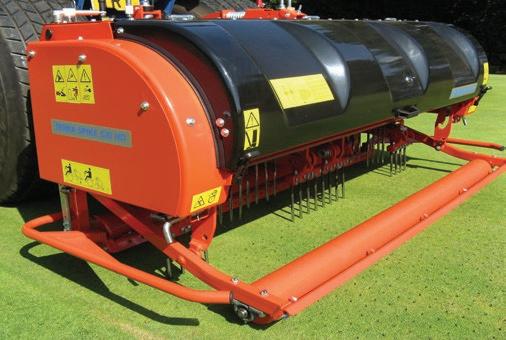
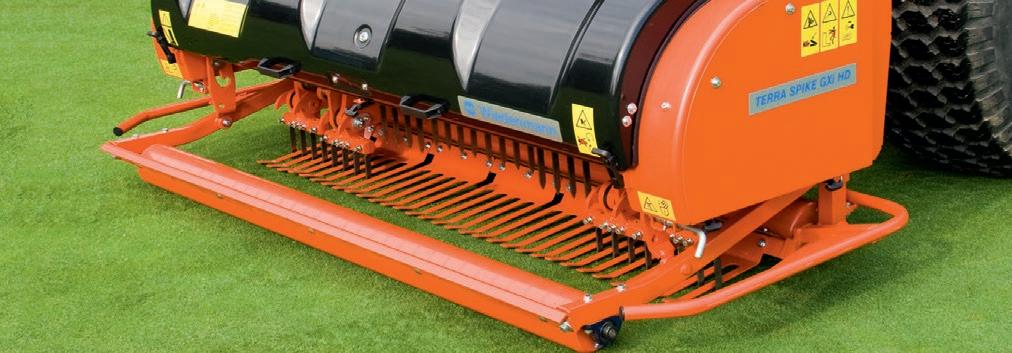
Fife Golf Trust, which maintains seven municipal golf courses across the region, has strengthened its aeration capability with the addition of two further Wiedenmann Terra Spike deep aerators.
Operating on behalf of Fife Council, the Trust looks after Dunnikier Park, Glenrothes, Scoonie, Cowdenbeath, Kinghorn, Auchterderran and Lochore Meadows. The latter two are nine-hole courses, while the other five are full 18-hole layouts. Together the seven venues host more than 160,000 rounds of golf each year, with over 3800 season ticket holders making efficient turf maintenance essential.
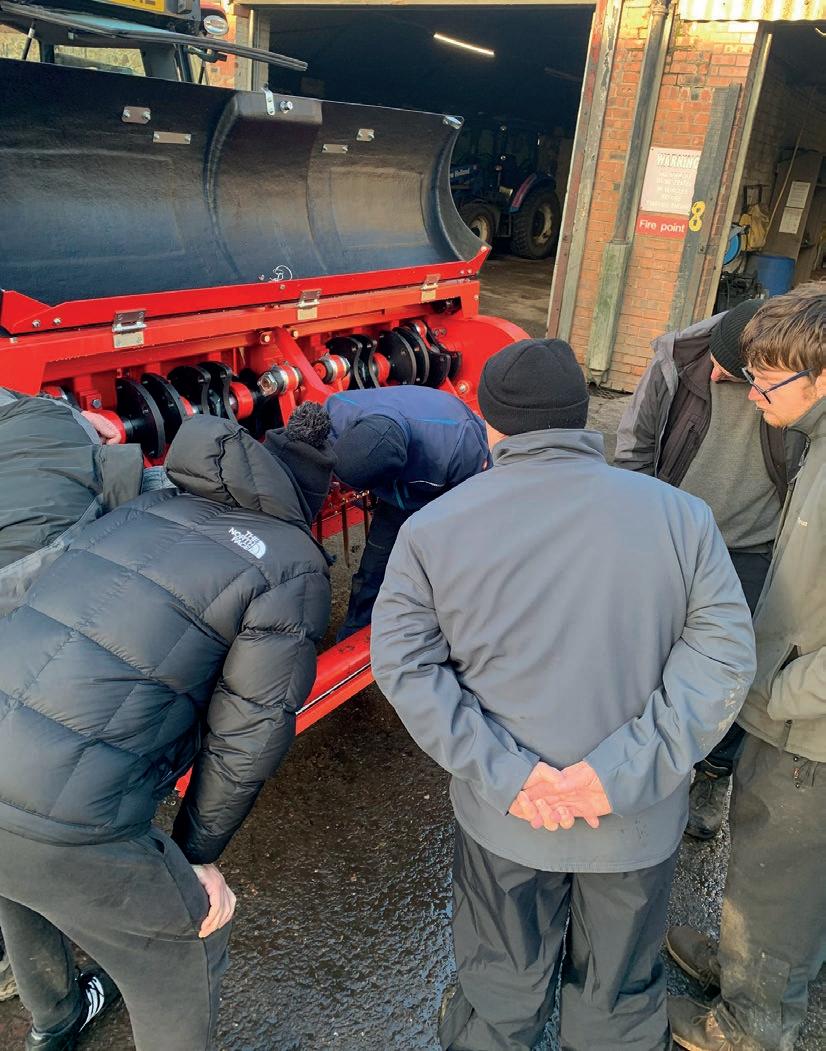
To meet this level of play, the Trust has added a Wiedenmann Terra Spike XD8 and Terra Spike GXi8 HD, supplied by Fairways GM at nearby Kinross. The GXi8 HD is primarily used on greens, while the XD8 is deployed on fairways and walkways, allowing aeration work to be carried out effectively and cleanly across the different playing surfaces. The machines are now working across the seven sites, helping improve soil structure, drainage and playing consistency at the busy venues.

The new aerators are repeat purchases, replacing earlier Terra Spike models that had been in service for more than a decade and had served the Trust very well. They join other Wiedenmann equipment — including a Super 500, Super 600, Terra Rake and Mega Twister blowers — demonstrating the management’s continued confidence in the brand.
The aerators were installed just before Christmas by Wiedenmann UK’s Lead Demonstrator, Andy Kerr, ensuring the greenkeeping team could make a timely acceleration to its aeration programme in January. The installation process included a thorough handover covering machine setup, operating techniques and maintenance, helping staff get the best from the equipment from the outset.
Fife Golf Trust’s Courses Manager, David Gray said: "The Wiedenmann machines have been such reliable performers for us over many years, which is why we chose to directly
replace them with the current models. The installation process was smooth, with great attention to detail meaning all staff gained an understanding of the correct operation.
"With seven different sites we have multiple different operators, so it is vital that everyone understands the controls and set up, as this is how we achieve optimum performance and protect the longevity of the investments.”
The Trust’s greenkeeping operation includes around 23 staff working across the seven venues.
Year on year, the standard of course presentation and playing quality continues to improve, reflecting continued investment in machinery alongside a sustainable maintenance approach complimented by a strong apprenticeship programme developing the next generation of greenkeepers.
Wiedenmann – Enquiry 17


















































Golf course conditions today are a far cry from the early days of the game, with golfer expectations also having shifted over the years. The path to a more economically and environmentally resilient sport requires the collective effort of the golf community, starting with aligning expectations with best agronomic practices, as promoted by The R&A.
The R&A Sustainable Agronomy Service provides agronomy expertise for the effective management of courses and use of best practice in sustainability.
With a team of specialists, who have accumulated extensive knowledge and experience of providing agronomic support, the consultancy service offers tailored advice and guidance to assist with the requirements of golf course management and providing greenkeeping staff with on-going support and advice.
This can relate to particular challenges, such as the best ways to achieve decompaction, to broader
issues like the overall preparation and presentation of a course.
The service is widely used, from venues that stage The Open to courses throughout the UK. Working collaboratively with the golf course management team at the club, the R&A will review the course’s existing agronomy operations in order to identify objectives for the course and establish how these will be achieved.
The service becomes an extension of the course’s own greenkeeping team and provides a resource to advise staff on best practice and the management of the course, tailored to the facility’s own individual requirements.
The advice offered always focuses on best practice and sustainable greenkeeping principles, with facilities encouraged to be proactive in sustainability by fostering nature, conserving resources, supporting communities and demonstrating a commitment to evidencing progress and results.
Images
The R&A











The R&A is committed to investing £200 million over ten years in developing golf and supports the growth of the sport internationally, including the development and management of sustainable golf facilities.
The R&A’s sustainability agenda is focused on ensuring that golf facilities around the world are taking action now to maintain and enhance the playability of golf courses as the industry faces the challenges of resource reduction, climate change and regulatory changes.
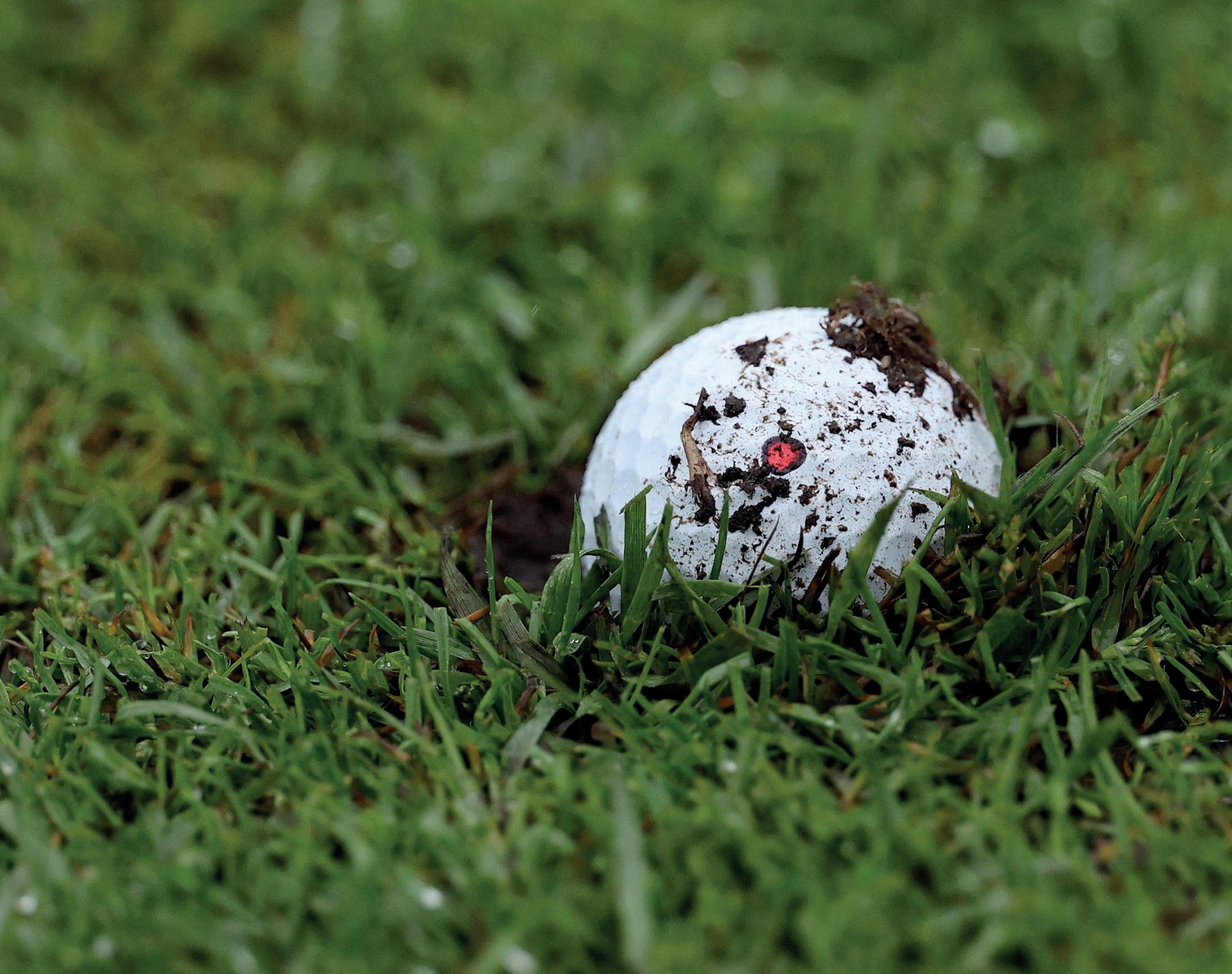
The programme also seeks to raise awareness amongst golfers themselves. The demand for ultrafast putting surfaces is just one example of where expectations clash with sustainability. Maintaining these speeds requires intensive practices that push the turf to its limit.
The R&A and USGA address these issues jointly, working through initiatives like the International Turfgrass Research Initiative and the Distance Insights project to safeguard the game’s future.
Daniel Lightfoot, Director of Sustainable Golf at The R&A, explains the unsustainable nature of this demand: "Faster greens need more mowing, more rolling and lower heights of cut. All of which puts the grass under more pressure. This makes greens less sustainable to maintain and more vulnerable to damage and disease."
The cost and resource dedicated to achieving perfection in bunkers are equally challenging. Jordan Booth, Director of Course Consulting at USGA, said this was a drain on resources "Today, some golf courses spend almost as much money maintaining bunkers as they do greens. Some of that would probably be better spent elsewhere."
The R&A will advise the LET on sustainable golf course maintenance operations and environmentally responsible agronomy practices for 20 venues and three events in 2026. Working collaboratively with the golf courses and the LET, The R&A Sustainable Agronomy Service will provide expertise for the effective management of courses and use of best practice in sustainability to provide high performance playing surfaces in an environmentally responsible way.
This will allow courses to reach their optimal course conditioning for world-class LET tournaments, while adhering to current environmental regulations and taking into consideration factors such as climate change and resource constraints.
It has also been welcomed by players on the LET tour. Marta Martin said: “This partnership with R&A Agronomy Services is a very positive step for the LET. From a player’s perspective, and with my background in turf agronomy, having expert agronomic support across venues helps ensure consistent, high-quality playing conditions week after week, while also supporting sustainable course management. That consistency is crucial for fair competition and for the continued growth and professionalism of women’s golf.”




That consistency is crucial for fair competition and for the continued growth and professionalism of women’s golf.
Putting theory into practice
One of the standout features of the agronomy service is recognition of the importance of practicing what is being preached.
The R&A has linked up with the British and International Golf Greenkeepers Association (BIGGA) and selected 10 ambitious and talented greenkeepers to provide support during five of the biggest championships in 2026.
These greenkeepers will join the teams based at courses hosting upcoming Championships, including The 154 th Open at Royal Birkdale and the AIG Women's Open at Royal Lytham & St Annes, for The R&A Championship Agronomy Programme.
Each member is selected to participate at one of the championships, where they will be
fully embedded in championship preparations.
Adam Newton, Sustainable Championship Agronomy Lead at The R&A, said: "They will gain a truly unique educational experience and a fascinating insight into championship agronomy and greenkeeping at the highest level and at some of the most historic and prestigious championships in the world."
Jim Croxton, BIGGA CEO, added: “Their involvement represents an outstanding professional development opportunity and a chance to gain unique, first-hand experience at the very highest level of championship preparation.
“BIGGA's partnership with The R&A reflects our shared commitment to education, collaboration and excellence in golf course management, and to ensuring that greenkeepers remain central to the future of the game."
The proliferation of battery-powered and robotic machinery and systems has transformed the way the industry works. Professional groundscare has embraced this change and is continually looking at ways of blending new technology with more traditional and established methods of creating world class surfaces.
At various industry trade shows in the last five to ten years there has been a theme running through many of the stands populated by the industry’s leading manufacturers – working smarter.
The advent of battery power, the electrification of familiar machinery and the significant progress made in robotics have undoubtedly transformed the way so many work on a day-to-day basis.
This workplace revolution is not confined to the elite of professional groundscare either, grassroots clubs and organisations have been just as enthusiastic about powering their future with investment in new technology.
This ethos of working smarter, more efficiently and more productively has been transformational for so many in professional groundscare. Not least in the way they have been able to devote more of their professional skills and knowledge on other important aspects of their role, from treating problems patches of turf to implementing new seeding programmes. Rather than being seen as a problem, this new technology has been regarded as a positive revolution by so many throughout the sector.

Working smarter with new technology is almost guaranteed these days, but working safer is proving just as significant and important.
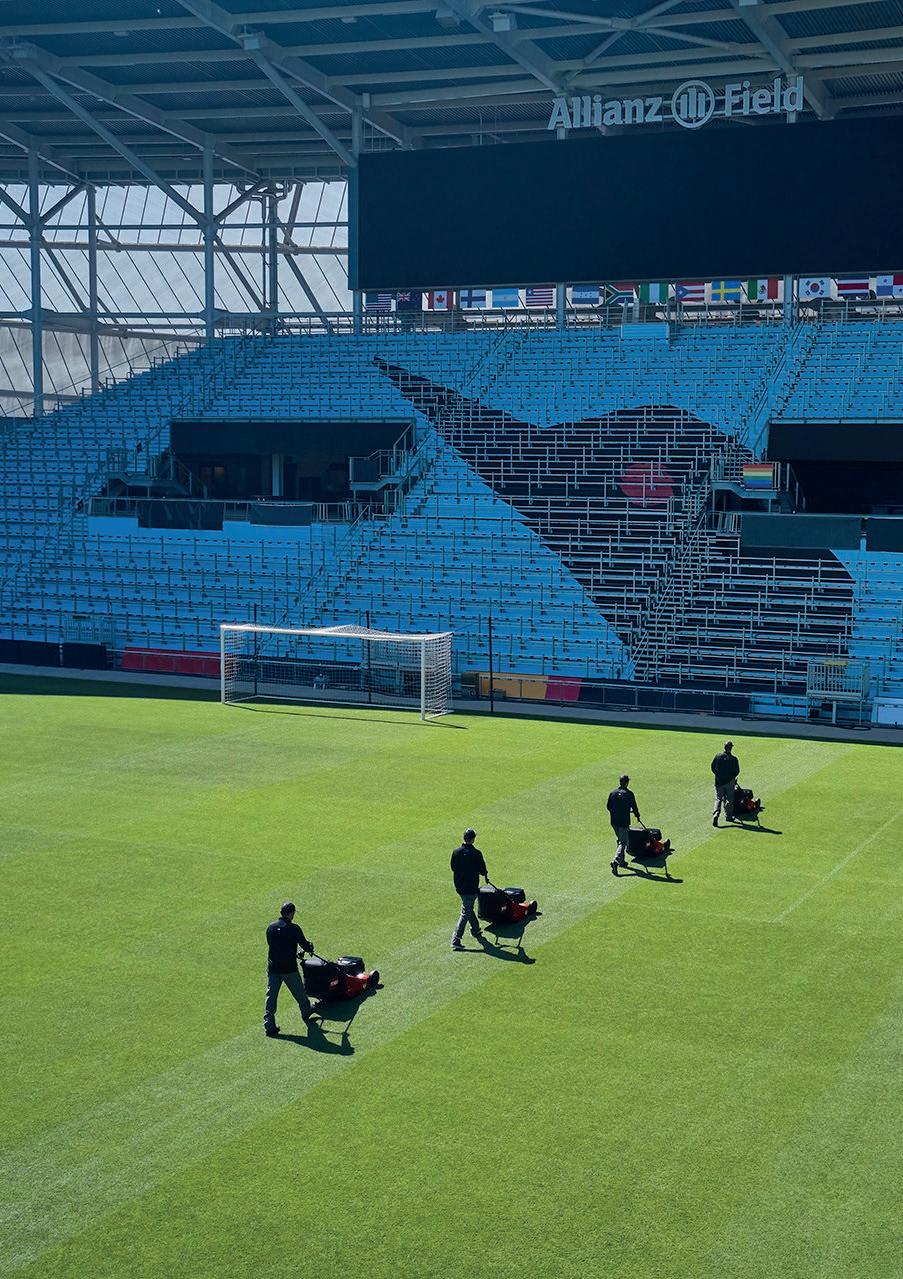
The start of preparations for a new season are often months in the planning and an area that is becoming increasingly important is investing in new machinery and technology.
There are still issues and challenges presented by this technology. Working smarter with new technology is almost guaranteed these days, but working safer is proving just as significant and important.
The new generation of machinery are far more sophisticated and that has knock-on effects, such as the need to ensure new maintenance regimes are up to speed and the operation of these solutions is 100% correct, 100% of the time they are use.
The use of advanced battery systems has also opened up the vitally important area of safe transportation of machinery and above all safe disposal and recycling of these power generating cells.
BAGMA, the British Agricultural and Garden Machinery Association, has taken a lead in raising awareness of this need to work safer and introduced new training opportunities for those working with the new technology on a daily basis.
BAGMA’s EV Safety Training Course is proving very popular. The course is designed to help technicians, sales staff, delivery drivers, and workshop personnel gain a working knowledge of: practical skills for safely working with high-voltage systems; confidence in handling and moving EV battery packs safely; awareness of legal obligations and best practices; and a certificate of attendance recognised for internal compliance and safety audits.
Nick Darking, General Manager of BAGMA, seems only positives with the advance of new technology. But he also stresses the importance of understanding what working with the machinery and power units entails.
“Looking specifically at groundcare, one of the biggest shifts we’re seeing is the use of robotic mowing systems for the likes of fairways and roughs,” he said.
“Not only do robotic mowers bring fantastic consistency to the more monotonous of maintenance tasks, they are battery operated – improving green credentials and reducing noise pollution for players and neighbours. Their lighter footprint also brings agronomic benefit to sports pitches, which appear to be slightly behind golf courses in the adoption of robotic mowing systems.
“With the exception of the disposal issue – which is being assessed and addressed with speed by a number of specialist recycling firms – there’s not many downsides we see to embracing the helping hand technology can provide to any modern-day land management.”
Image 1 BAGMA
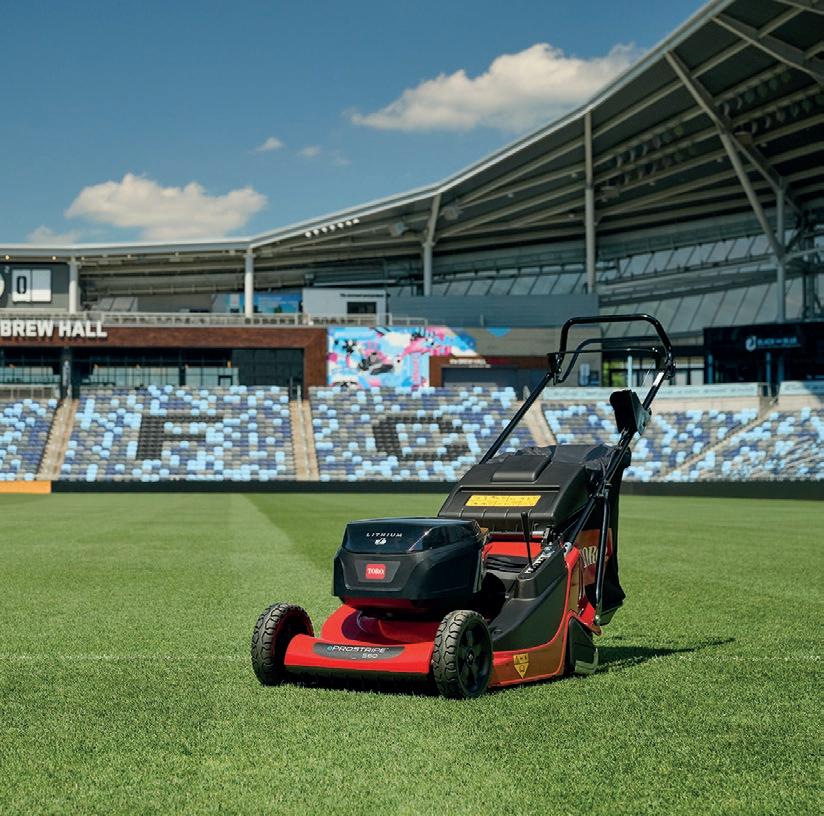
Image 2 Toro UK




Battery-powered becomes equipment of choice
After five years of educating domestic and professional users on the environmental, health and performance benefits of batterypowered outdoor power equipment, EGO Power + has now concluded its Challenge 2025 campaign with the release of a new whitepaper.
Summarising years of research and awareness activity from EGO, the whitepaper also includes research from industry trade body, the European Garden Machinery Federation (EGMF).
The data shows that between 2019 and 2024, the percentage of petrolpowered equipment in use across Europe fell from 36% to 24%. In sharp contrast, electric cordless equipment almost doubled in use, rising from 28% to 48%. This is mirrored exactly in sales of new
equipment, with electric cordless rising from 33% to 58%, and petrol falling from 40% to 26%. Drawing on five years of campaign insights, field data, and market research, the whitepaper also explores results from emissions, noise and vibration testing from independent testing specialists, and evaluates whether EGO’s vision to establish battery power as the principal power source for outdoor power equipment, was reached.
Vince Brauns, Group Product Director, for EGO, said: “Our latest whitepaper shows clearly that our Challenge 2025 vision for battery power had a clear and significant impact on the industry. When we began the campaign, battery power was seen as a compromise.
“Users who had used petrol for decades; could not believe that this new technology could give them

the power, performance or runtime that they were accustomed to, and all without the strong fumes, loud noise or high vibrations. With misconceptions at their highest, we decided that it was time to show users the impact that using petrol tools was having on themselves and the environment around them.”
Challenge 2025 was launched in 2020 with one goal in mind: to educate and empower change in domestic and professional outdoor power equipment users to make battery the principal power source and leave petrol in the past.
The hope was that by educating users about the advantages of using battery-powered outdoor power equipment, EGO could dispel misconceptions, reduce emissions and noise pollution, and increase user comfort and safety.
All these things were achievable with the technology available in 2020; however, a lack of awareness about the harmful nature of petrol, combined with uninformed perceptions of battery power, meant that mindset was a barrier to change.
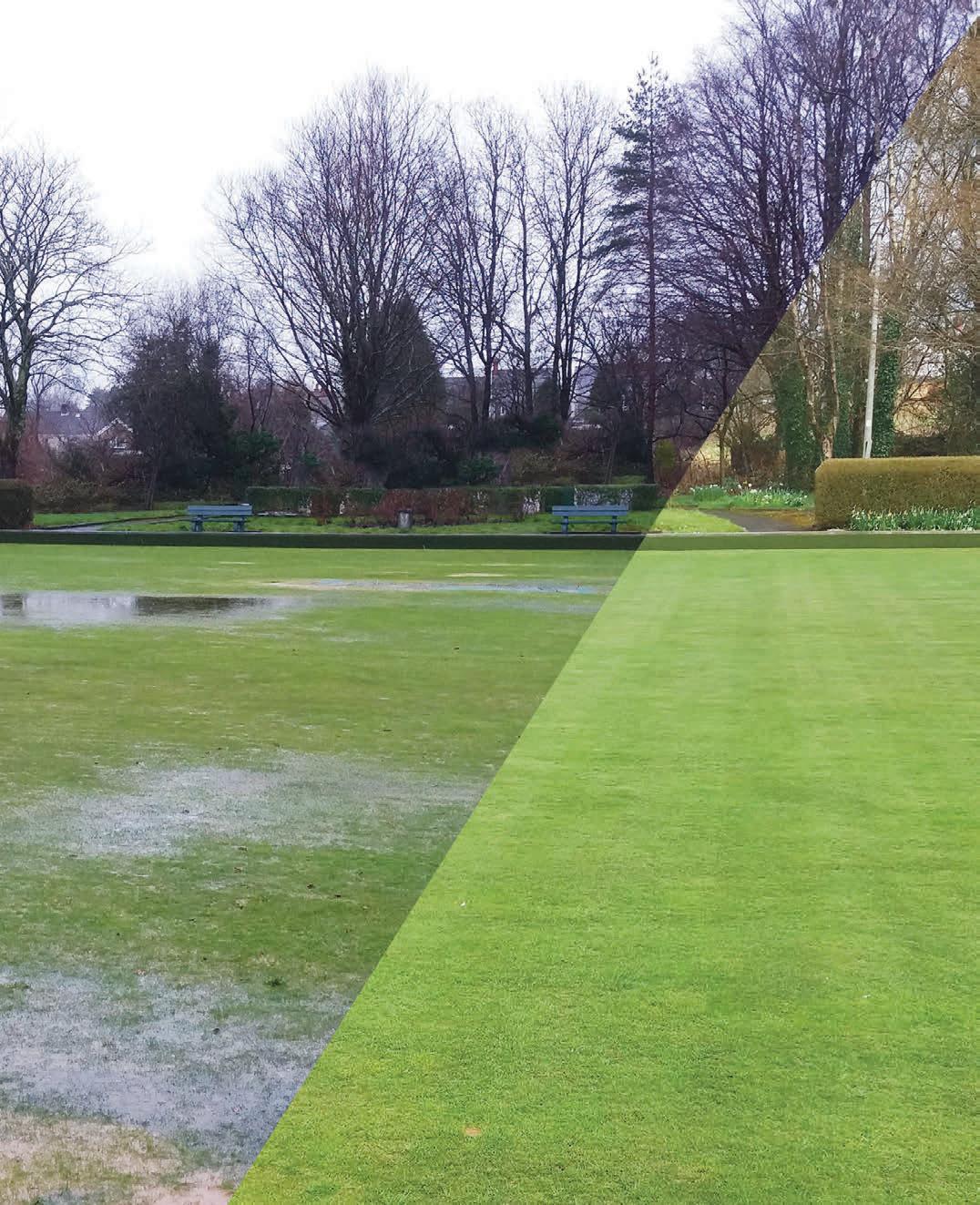

AND WATERLOGGING
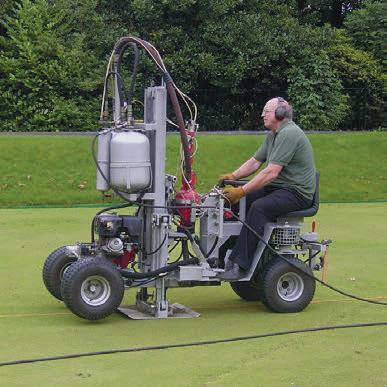

Terrain Aeration’s long-term treatment reaches one metre deep where compressed air blasts the compaction. The soil is opened up for good drainage and a healthy sward with minimum disruption. We have been successfully aerating sports turf, bowling greens, golf courses, parks, trees and gardens for over twenty-five years.



But now, as technology continues to advance, and with calls from industry bodies such as the Climate Change Committee to reduce greenhouse gas emissions, it is clear the market is shifting in favour of cleaner, quieter and safer equipment.
Vince Brauns continues: “The campaign has enabled us to advocate for battery power in both the UK and European markets and has ultimately helped to reposition battery-powered tools from a niche alternative to a staple choice. While there is still a minority who will choose petrol-power over battery-power, due to the data-backed
information we have shared over the past five years, the conversation has fundamentally changed.”
Working with specialist partners, this powerful and thought-provoking campaign commissioned market research to understand the attitudes and perceptions of over 1,200 outdoor power equipment users, evaluated the performance of petrol and battery-powered tools against noise, vibration and emissions, made Freedom of Information requests to understand the use of petrol tools by local authorities in Clean Air Zones and generated extensive
press and social media coverage to heighten awareness.
While Challenge 2025 was successful in bringing battery power to the forefront of the industry, as the principal power source for outdoor power equipment, this is only the beginning of securing a cleaner future for generations to come.
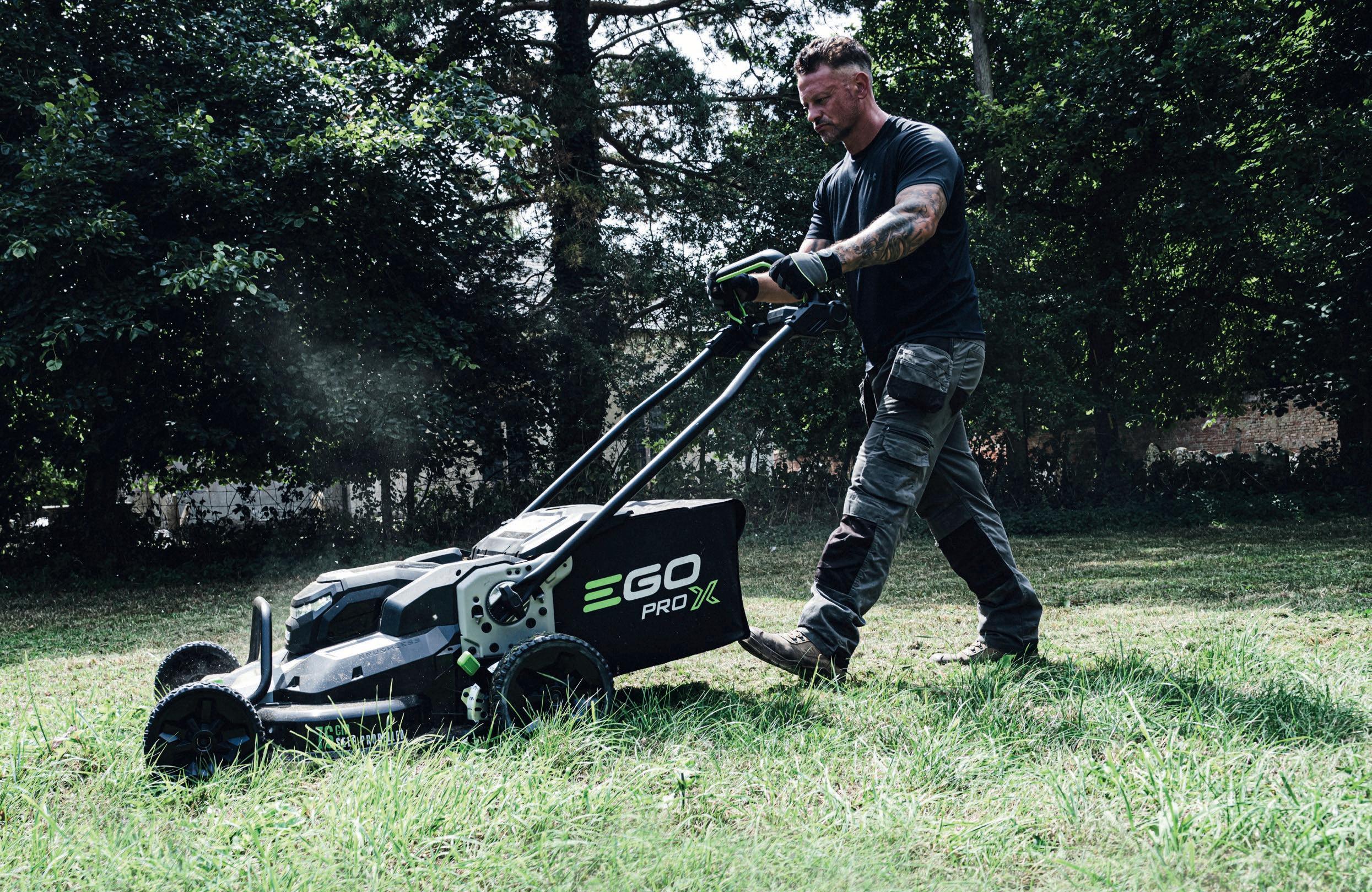
Image 5
EGO Power
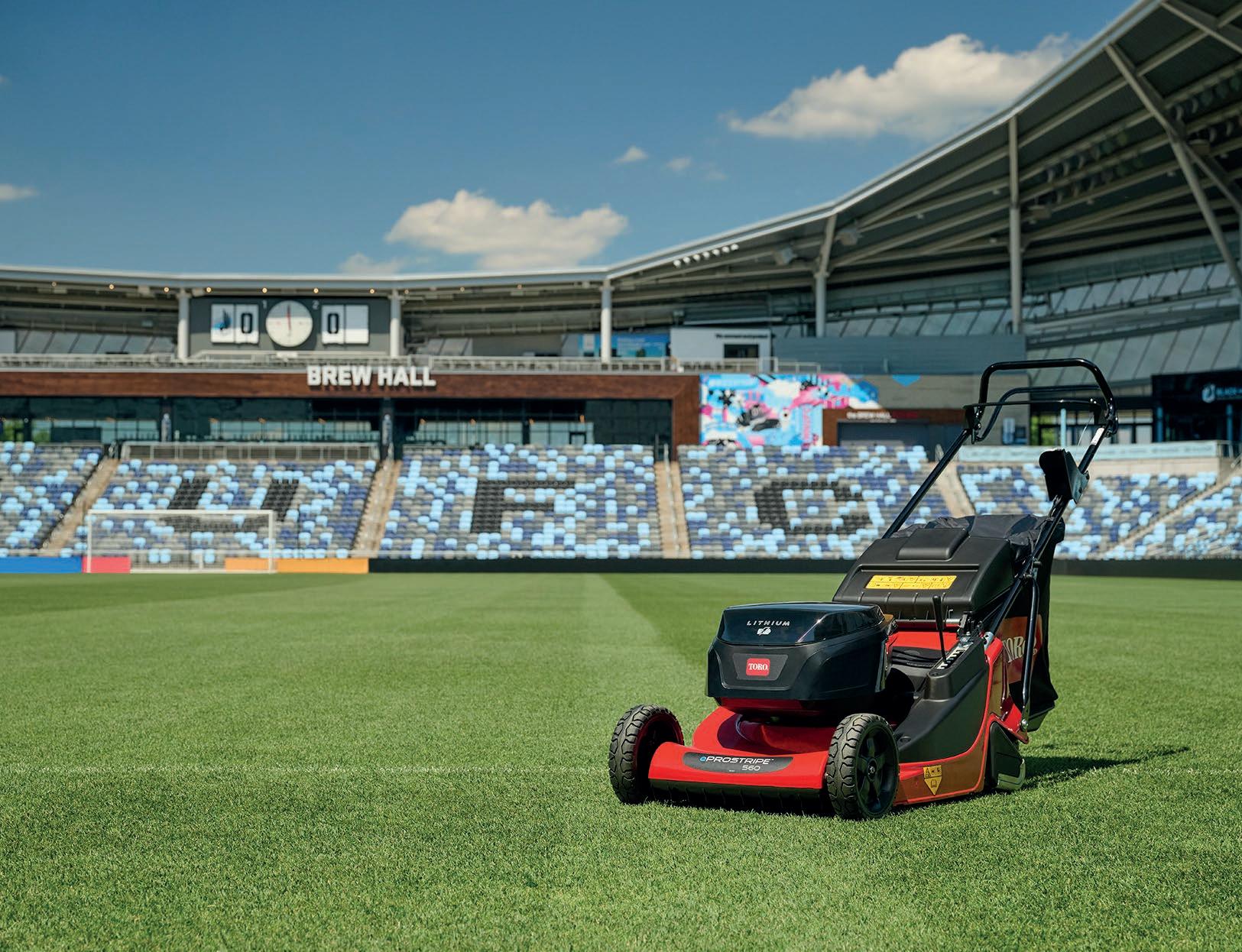
Smarter mowing, faster payback For today’s grounds professionals, Total Cost of Ownership (TCO) is more than a buzzword — it’s a businesscritical metric.
With rising fuel prices, tightening budgets, and growing sustainability goals, Toro UK’s battery-powered Revolution Series offers a smarter way to mow.
Backed by real-world data and a dedicated TCO Calculator, the range helps professionals understand when they’ll breakeven — and how much they’ll save long-term. Key benefits of batterypowered equipment:
• Fuel savings: No petrol or diesel required — just plug in and recharge from the mains.
• Lower maintenance costs: Fewer moving parts and simplified servicing reduce downtime and expenses.
• Longer service life: Built for professional use, with robust engineering and durable components.
• Break-even in around three years: for example, for the GrandStand model that is based on 400 mowing hours/year and the Z Master it is based on 500 mowing hours/year.
• Comfort and productivity: Lightweight design, low noise, and reduced vibration help minimise operator fatigue and maximise output.
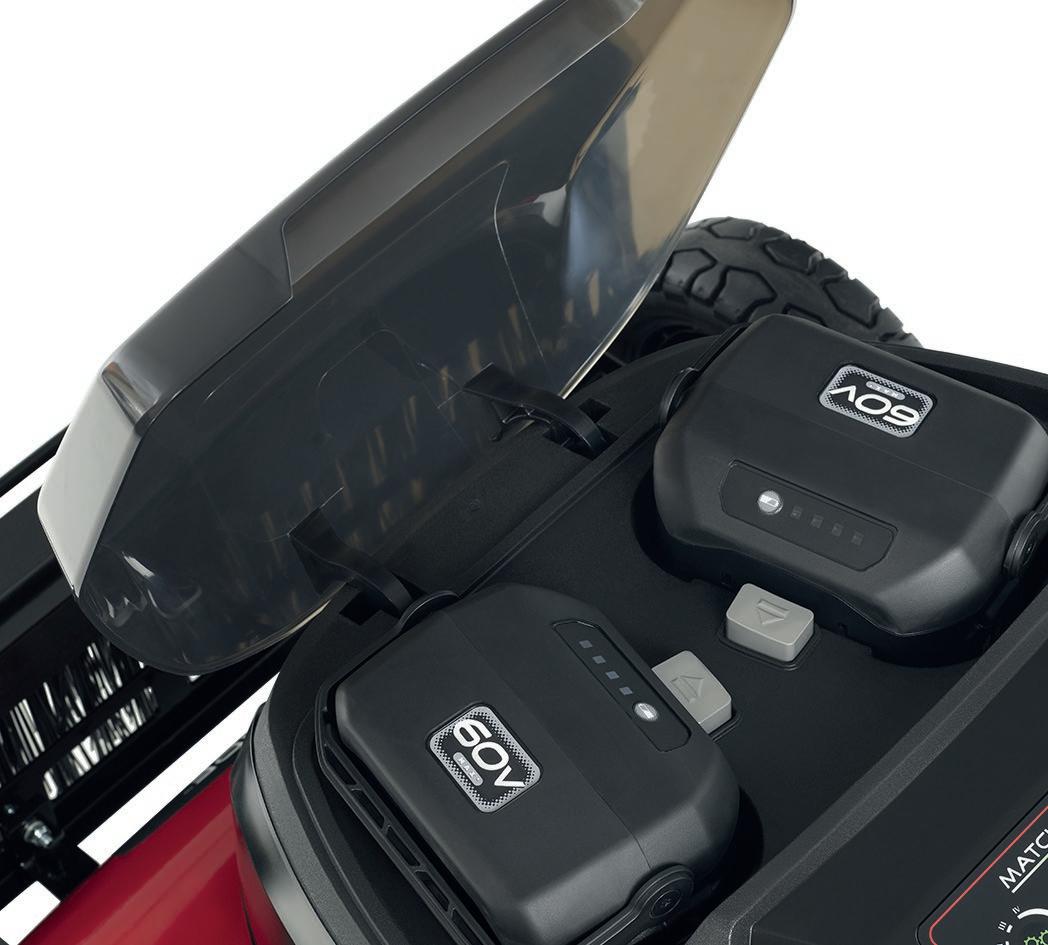

Toro’s Revolution Series isn’t just about going electric — it’s about making a smarter investment.
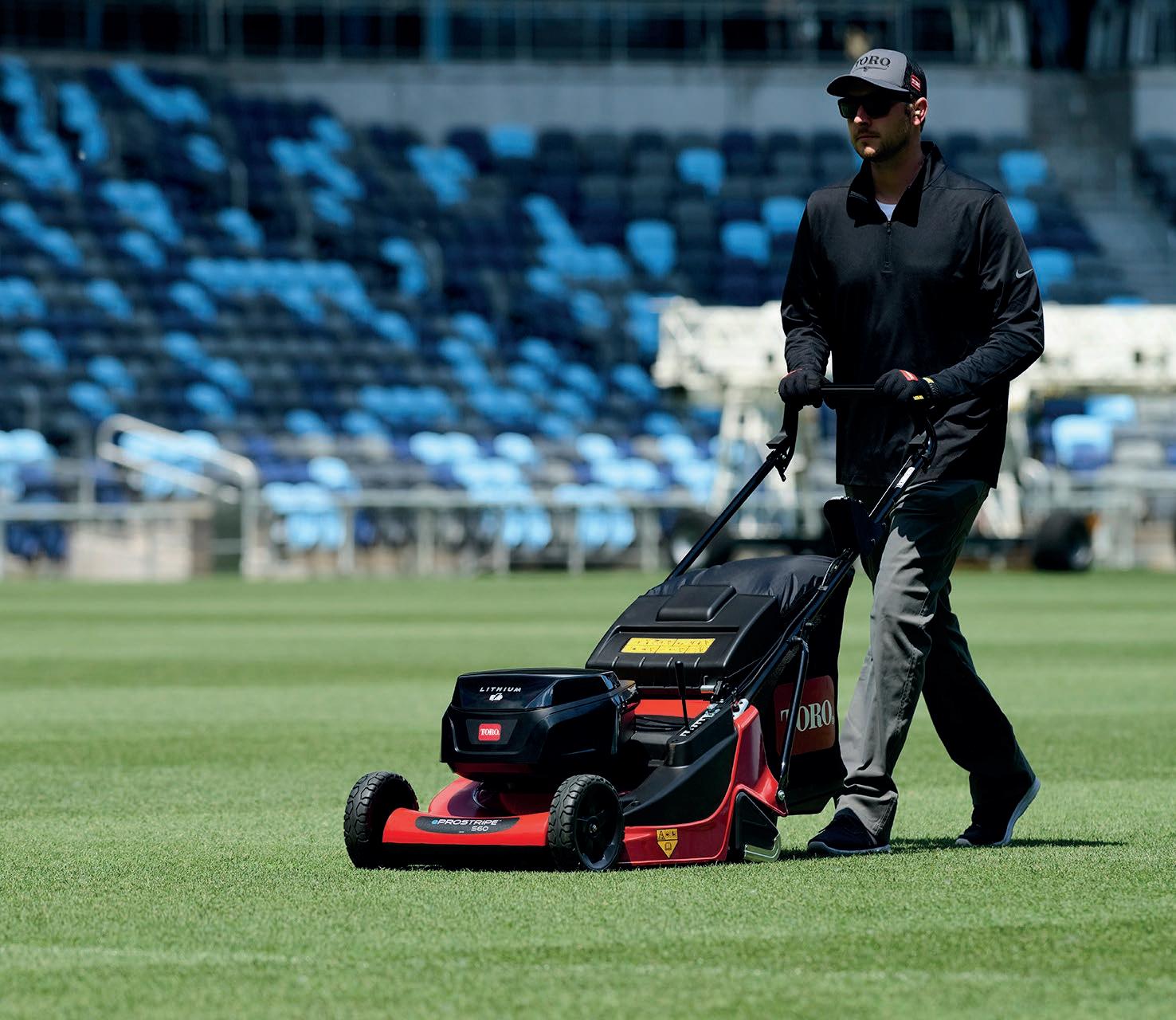
Toro’s Revolution Series is engineered for real-world performance, providing up to nine hours runtime: Depending on cut conditions, operators can work a full day on a single charge.
Compared to Toro’s petrol-powered equivalents — ideal for noisesensitive areas and early starts. The new technology also helps to reduce environmental impact without compromising on power.
The Toro TCO Calculator helps you compare the lifetime cost of battery vs. petrol equipment — factoring in fuel, maintenance, and usage. It’s a powerful tool for
procurement teams and business owners alike. As Matthew Coleman, UK Sales & Marketing Manager at Toro U.K. Limited, explains: “Toro’s Revolution Series isn’t just about going electric — it’s about making a smarter investment.
“With fewer service intervals, no fuel costs, and a typical breakeven point in just a few years, the numbers speak for themselves. We’re helping professionals take control of their costs while delivering the performance they expect from Toro.” Making the right decisions is always a challenge and investing in new technology is one that is never taken lightly.
But increasingly it is apparent that professional groundscare is taking the option to work smarter, safer, more efficiently and continue to create the world-class surfaces that the UK has become renowned for, whether that be lower league clubs or an elite global arena.
















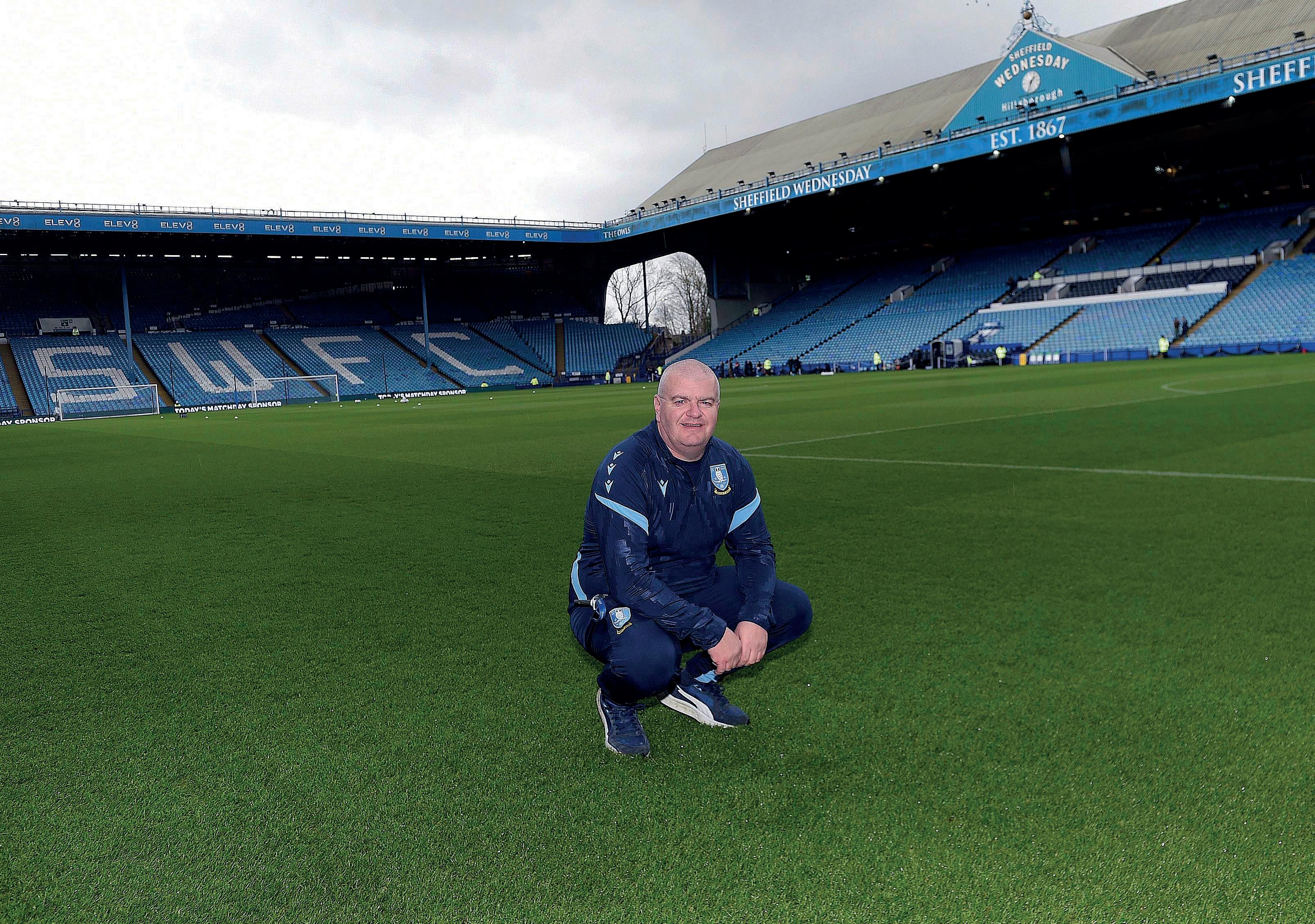
Sheffield Wednesday’s stadium presents a challenging environment for turf, with significant shade and limited use of supplementary lighting. Alongside this, the pitch sees consistent use from first team and under-21 fixtures, as well as training sessions.
“Our biggest challenge is a very old, heavily shaded stadium with limited use of lighting rigs,” says Head Groundsman Lee Jackson. “Maintaining grass cover through the season is never straightforward.”
As part of a partial rebuild ahead of the 2025 season, ProSelect 1 Premium Pitch, a perennial ryegrass mixture designed for high-wear sports pitches, was used for renovation and overseeding.
“I’ve used ProSelect 1 for close to 10 years and have always trusted how it performs, so I had no hesitation using it again, even in a completely different environment,” Lee explains. Establishment proved difficult initially due to high temperatures during
We’ve kept more grass cover than many expected through that period, and recovery after use has been strong, especially considering the environment.
summer 2025 and the nature of the rebuild. “The early grow-in was tough because of the heat, but once it got going the coverage developed faster than I’ve seen for a number of years.” Following establishment, the pitch was subjected to sustained use, particularly between December and February.
“We had eight first team games and ten training sessions on the pitch during that period, and we’re around 10% up on usage compared to last season,” says Lee. Despite this, grass cover has been maintained through the winter months. “We’ve kept more grass cover than many expected through that period, and recovery after use has been strong, especially
considering the environment.” Presentation and surface consistency have also improved across the season, supported by relatively low disease pressure.
“There’s been a noticeable improvement overall, and that’s been recognised by players and staff who have been here a number of years,” Lee adds.
For Lee, performance in this type of environment is the real measure. “If you can get grass growing and maintain it in this kind of stadium, with limited lighting, it shows its value as part of the overall pitch management programme.”
ICL – Enquiry 23
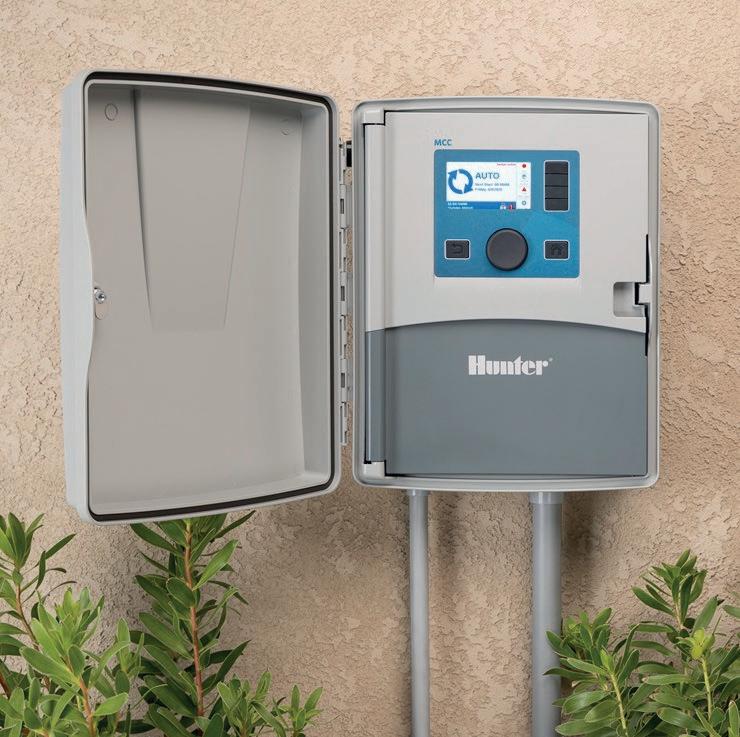
Designed to expand the limits of irrigation control, the MCC delivers wireless, wide-area coverage for large-scale projects while maintaining affordability.
Positioned as a medium commercial controller, it bridges the gap between high-end performance and practical value, making it ideal for expansive landscapes, sports facilities, commercial estates and public-sector sites. At its core, the MCC combines the powerful brain and operating features of the ACC2 Controller with the proven, reliable internal components of the ICC2
The new Hunter MCC controller had launched in UK through KAR UK, bringing wireless, wide-area coverage and advanced flow management to the commercial irrigation market.
Controller. The result is a versatile and cost-effective controller capable of managing between 8 and 108 stations (with up to 54 conventional stations), offering exceptional flexibility across a wide range of site requirements.
One of the MCC’s standout features is its ability to support multiple output types simultaneously. Users can command conventional outputs, EZDS two-wire decoders and Wireless Valve Links all from the same controller. This hybrid capability allows contractors to expand or adapt existing systems without the need for disruptive


infrastructure changes which is a significant advantage on retrofit projects or evolving sites.
Advanced flow management and monitoring are central to the MCC’s design. The controller supports up to three flow sensor inputs, enabling precise monitoring across multiple flow zones. It can operate up to eight stations simultaneously, along with up to three pump or master valve outputs, delivering robust hydraulic control for complex irrigation networks.
KAR UK – Enquiry 24



The all new MOWIT PRO is a highly efficient, battery powered large area mower specifically engineered for demanding commercial application available in remote control or semi-autonomous models.






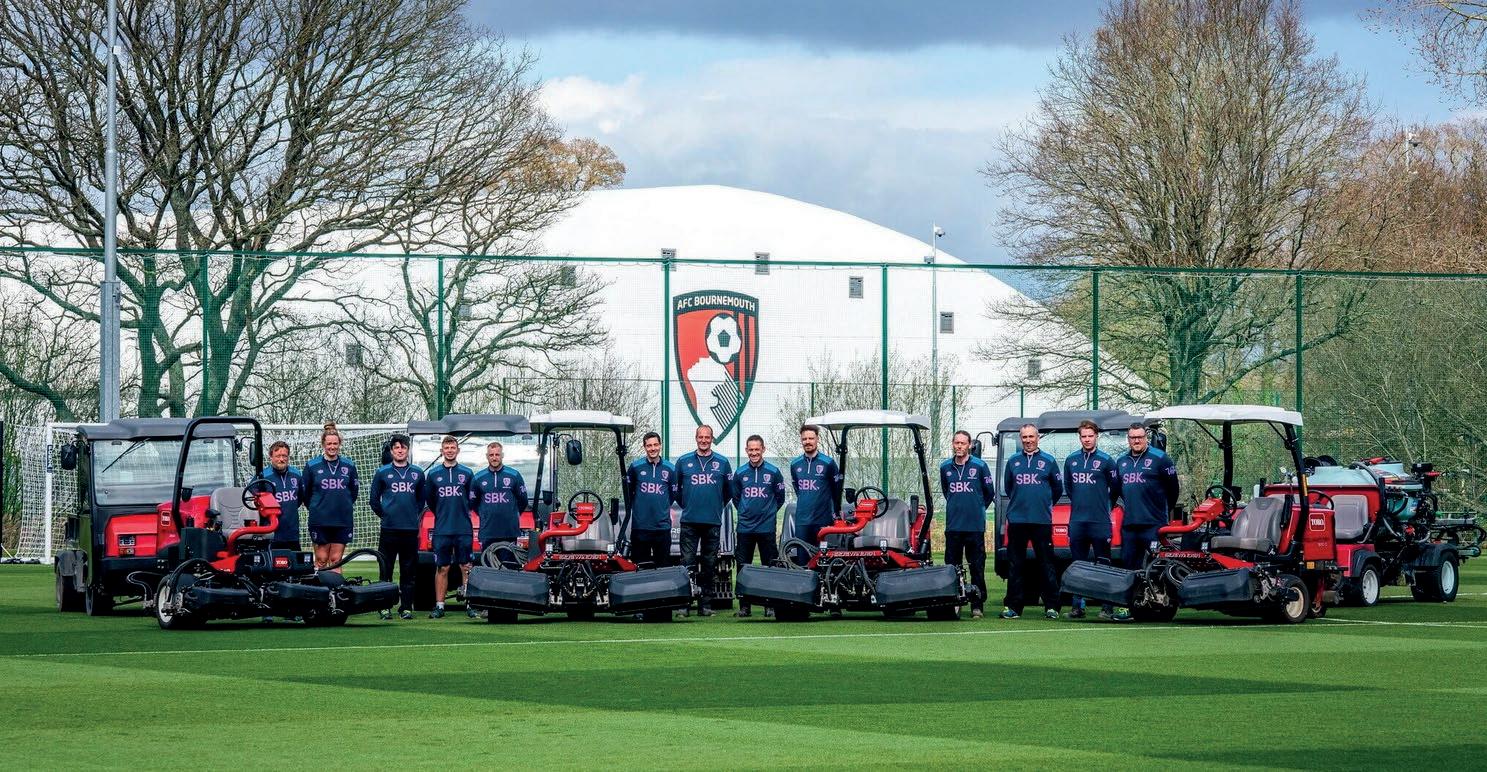
The machinery choices by Head of Grounds Ian Lucas are strategically made on how to cut more efficiently according to European regulations and meet the Premier League standards in place for all pitches.
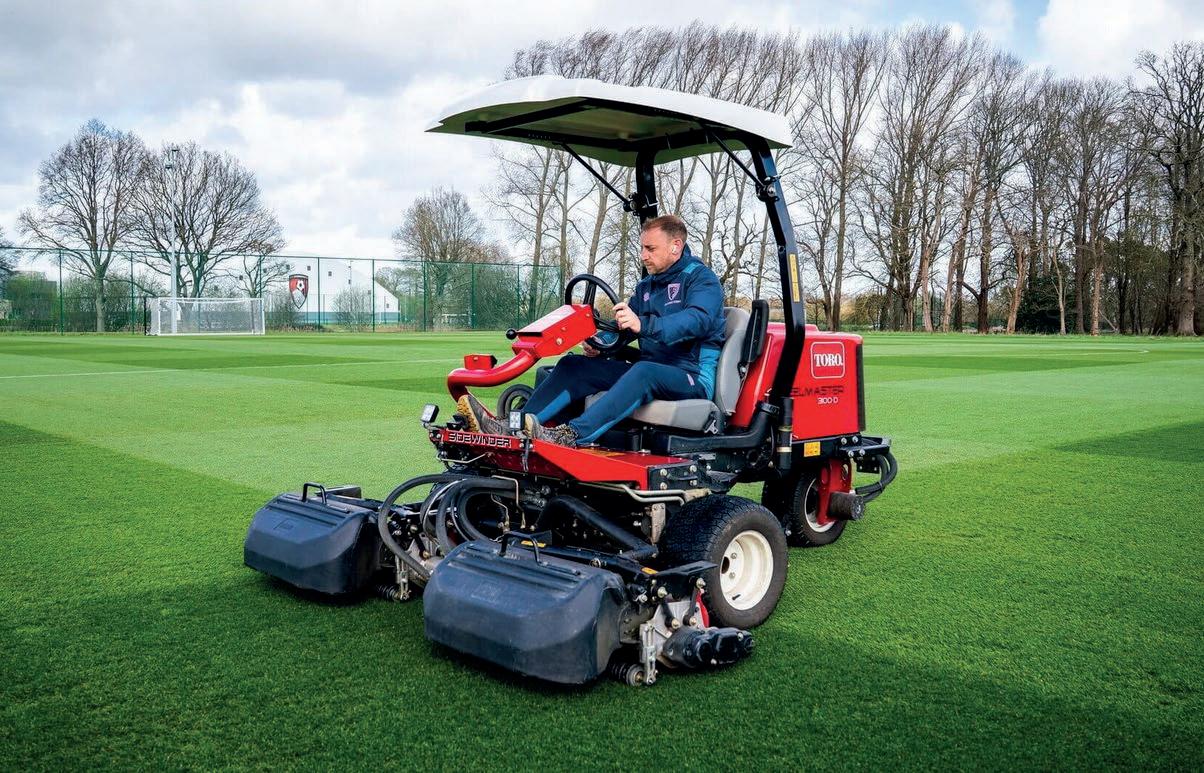
Ian explains, “The products we chose come with adjustments to match the width of cut to the pitches exactly. The Toro Reelmaster 3100 with Sidewinder, which is usually a mower favoured by golf clubs for cutting around bunkers and obstacles, allows us to mow as efficiently as possible with no overlap.”
It’s a machine also favoured by other premier football clubs, says Ian: “I visited other training centres and saw how other clubs had fitted a wider arm kit on the Sidewinder but without the wider front units meaning they could cut 30 inches across instead of 26. That meant they the cutting width worked better with the required striping pattern within the dimensions of the pitch.”
The patented Sidewinder technology brings more benefits than that to the football pitch though as Ian continues: “Being able to use the Sidewinder cutting unit from left to right brings a more even weight distribution eliminating wear marks.” Also ably assisting Ian and his team of 11 looking after the 57-acre training grounds are Toro’s Workman HDX utility vehicles with cabs for improved operator comfort and a Toro Reelmaster 3550 for its light footprint and turf-friendly tyres.
As the first team moves into AFC Bournemouth’s new training complex at Canford Magna, a new fleet of Toro machinery arrives to look after the first four pitches to be built.
Reesink’s focus is on working with Ian and the team to ensure they have the turfcare equipment they need to maintain all the pitches to the highest of standards.
Ian says: “The Workmans have a big cargo bed which is perfect for the development stage of the project we’re in – it can easily cope with the amount of grass we need to move and the attachments we load it up with like the tipper trailer.”
This will be followed up with another machinery order in the new year as the next four pitches for the £36 million Performance Centre open. Ian comments: “We’re ready for that. I’ve already chosen the Toro machines I want and submitted the lists. I’ve been using Toro for around 15 years, so I know how good it is, especially with the back-up and support of Reesink,
our local dealer D J Scott and our mobile mechanic Lee Read.” He concludes: “When it comes to the turfcare machinery entrusted to look after this huge investment in sport, it had to be Toro.”
Mark Winder, Area Sales for Reesink, says: “Just as AFC Bournemouth’s ambition and commitment to excellence is shown with its new state of the art training complex, Reesink’s focus is on working with Ian and the team to ensure they have the turfcare equipment they need to maintain all the pitches to the highest of standards.”
Reesink Turfcare – Enquiry 26







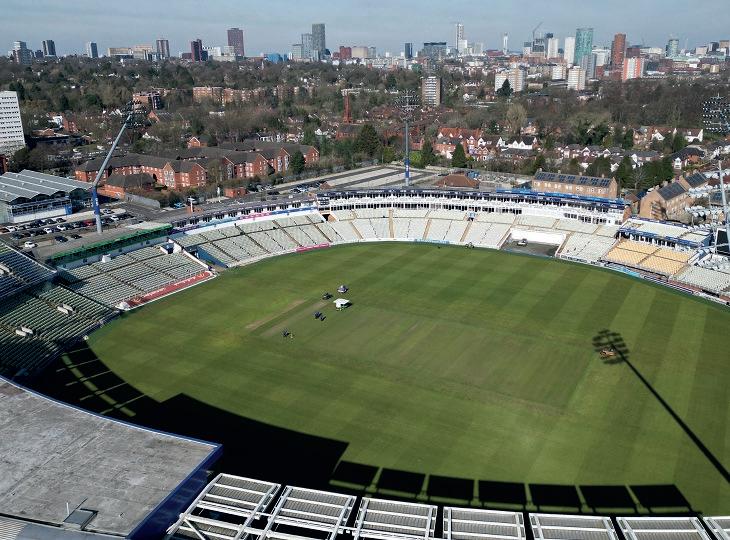
From hybrid pitches to outfield preparation strategies, UK cricket is at the forefront of many exciting new developments as the demands of the different formats of the game are creating innovative new solutions.

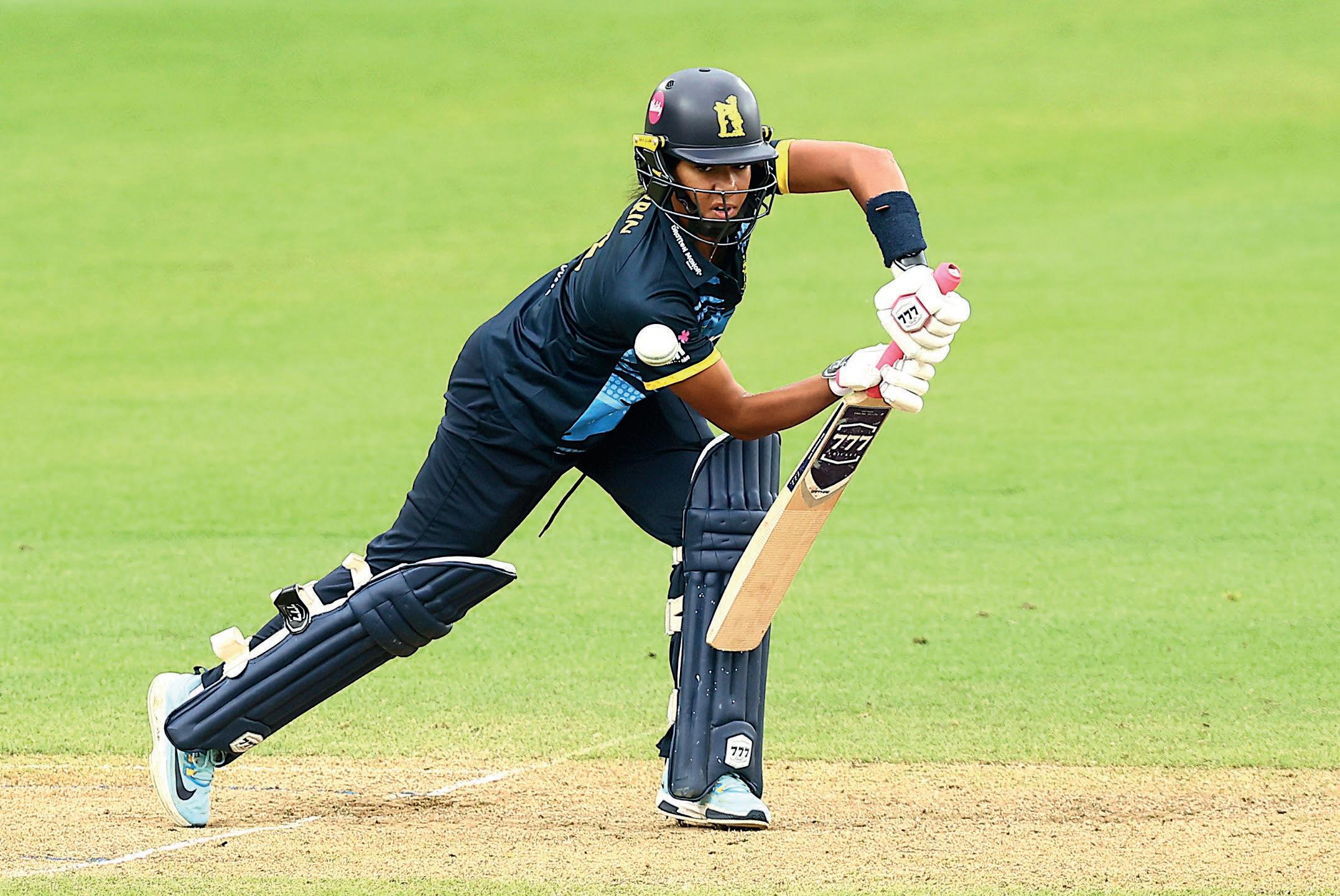
The cricket calendar is growing every year. The popularity of the sport in its various formats has placed huge demands on those charged with preparing pitches and outfields.
Whether it is the flagship five-day test, or the short and sharp 20-over blast, the highest quality pitches and world-leading turf management standards need to be maintained for every single match.
It has led cricket to investigate, trial and instigate new and innovative management and preparation programmes. Research & Development strategies have increased significantly in the last decade and now cricket is pushing the boundaries of professional groundscare.
For grounds teams there is now so much foot traffic across outfields and pitches, that the challenge of maintaining world-leading standards
has never been greater. The need for consistent and even bounce, across all competitions, has prompted one of the country’s leading cricket arenas, Edgbaston, to consider how new surface technology could improve durability and quality.
As the stadium undergoes a significant redevelopment aimed at creating a truly world class sports complex, so the pitch and outfield has seen vital new investment embracing hybrid surfaces and outfield management.
Gary Barwell, Edgbaston’s Head of Sports Turf explains that the SIS Grass Hybrid pitch installed by SIS Pitches on its main playing area has allowed the stadium to better manage cricket’s increasingly busy schedule without compromising performance. It’s also provided parity, allowing the women’s teams to practice and compete on the same pitches as the men.
Edgbaston’s experiments and trials with hybrid surface systems can be traced back almost a decade pitch can be traced back to 2017 and lessons being learned from another sport entirely.
“The hybrid concept emerged as a frontrunner after a visit to St. George’s Park, the FA’s national football centre,” said Gary.
The bowlers had full use of it throughout, sending plenty of deliveries, and initial impressions were very positive.
“Our first trial began with the UK’s first day-night test between England and West Indies. The bowlers had full use of it throughout, sending plenty of deliveries, and initial impressions were very positive. The players said it had a better carry and more consistent bounce, along with much less wear and tear. This was a key moment for us because player feedback really carries in this sport.”
With the ECB sanction and a pause to tournament play due to the pandemic, Edgbaston found itself with a window to install its first two pitches within the main square. “Our main square install got off to a flying start, which was reflected in the high scoring we were seeing,” Gary continues. “If I remember correctly, the first match was 150/1 off 10 overs. That’s the type of action you want to see when fans come down for an evening.”
For Edgbaston, the impact of SIS Grass Hybrid is best seen through
the success of several major competitions, chiefly among them the Commonwealth Games held in 2022.
During the games, the stadium hosted 16 international women’s matches played over a two-week period. With an all-natural pitch, this intense window of competition would typically require a high number of maintenance intervals to keep wickets up to standard. With SIS Grass Hybrid, however, the window was expanded, allowing toplevel performance without major interventions so often from the grounds team.
“On traditional pitches, you see really good performance on day one, but there’s typically a steep decline once you get into days three or four,” said Gary. “We noticed with hybrids you could play on them over 10-12 days and not see a drop off. You only have to prepare one pitch, as opposed to two or three for the same amount of game time. This was massive for us
during the games, with 60,000 people in the stadium and many more watching around the world.”
With hybrids now approved by the ECB for some red-ball competition, there is seemingly more to come at Edgbaston. “We’ll continue to invest in our hybrid surface because it’s proven effective at the highest level,” says Barwell. “For us, it’s about lowering the maintenance requirement while also delivering the best possible performance – for both players and fans. SIS Grass Hybrid has given us that option. Sporting theatre at its best.”
Images 1, 2 & 3 SIS Pitches
Sustainable cricket installation completed It is not just the elite venues that are embracing such significant change. Notts Sport completed the world’s first CocoTurf Cricket match pitch at Bitteswell Cricket Club, a sustainable cricket surface designed to support year-round training and play.
The project - delivered by Notts Sport Cricket North Licensee, Bingham Ground Services – followed consultation with the club to identify a low-maintenance solution capable of meeting increasing demand across both junior and senior cricket.
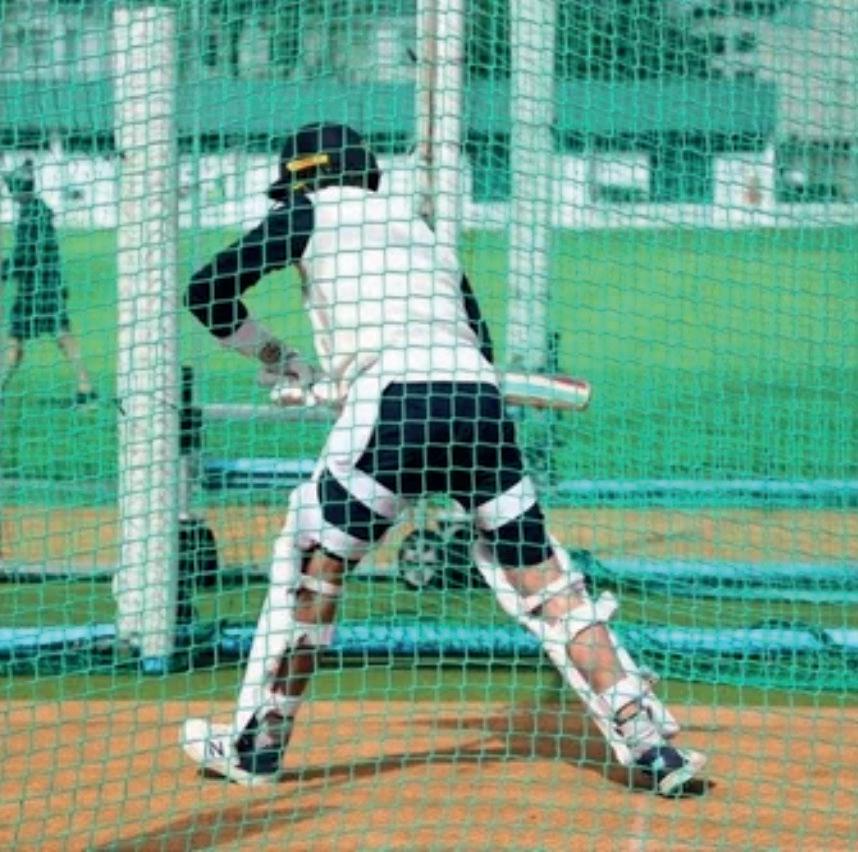
Sustainability was a key driver behind the project, Bitteswell Cricket Club selected CocoTurf Cricket, the world’s first 100% natural, plastic-free artificial cricket surface, engineered to replicate the pace and bounce of natural turf while offering consistent performance and long-term durability and at the heart of the design, sustainability.
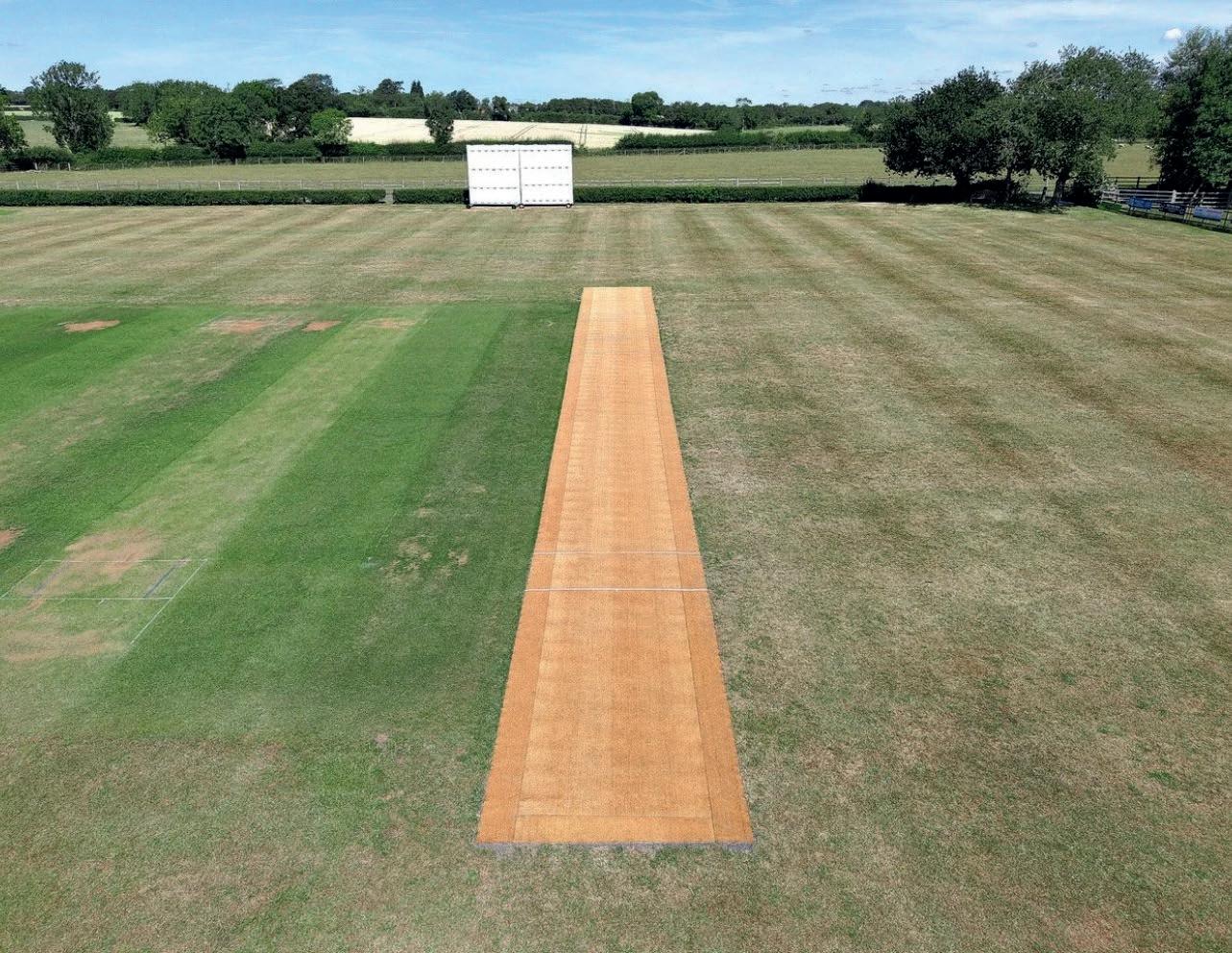
This makes it the world’s first artificial cricket surface of its kind.
The system has undergone full cricket performance testing, including a Ball Pitch Impact Assessment, confirming realistic pace, consistent bounce and durability comparable to professionally prepared non-turf wickets. An ECB application is also currently in process.
By adopting CocoTurf Cricket, Bitteswell Cricket Club has invested in a future-proof facility that supports sustainable sports development without compromising performance.
CocoTurf Cricket builds on Notts Sport’s pioneering CocoTurf technology and has been specifically re-engineered for cricket performance. The surface is constructed entirely from natural coconut fibres, jute backing and certified natural latex, creating a wicket system with zero plastics, zero microplastics and zero PFAS.
Richard Pearson, the club’s Chairman said: “CocoTurf has been installed as an outdoor practice facility at the edge of the square, creating both a junior match pitch and a practice pitch for senior players. It has been extremely well received across the club.
“Our junior teams have already played matches on it and thoroughly enjoyed the experience. The bounce is consistent and at a realistic height — neither too low nor too high.
“Senior players use the mat regularly with a roll-on net cage and report consistent bounce with a small amount of seam movement. The surface also offers enough grip to assist spin bowlers without producing excessive turn.
“Overall, it provides an excellent practice environment with a genuine contest between bat and ball. Unlike many artificial mats, CocoTurf does not lull batters into a false sense of security and better prepares them for match conditions on grass.”
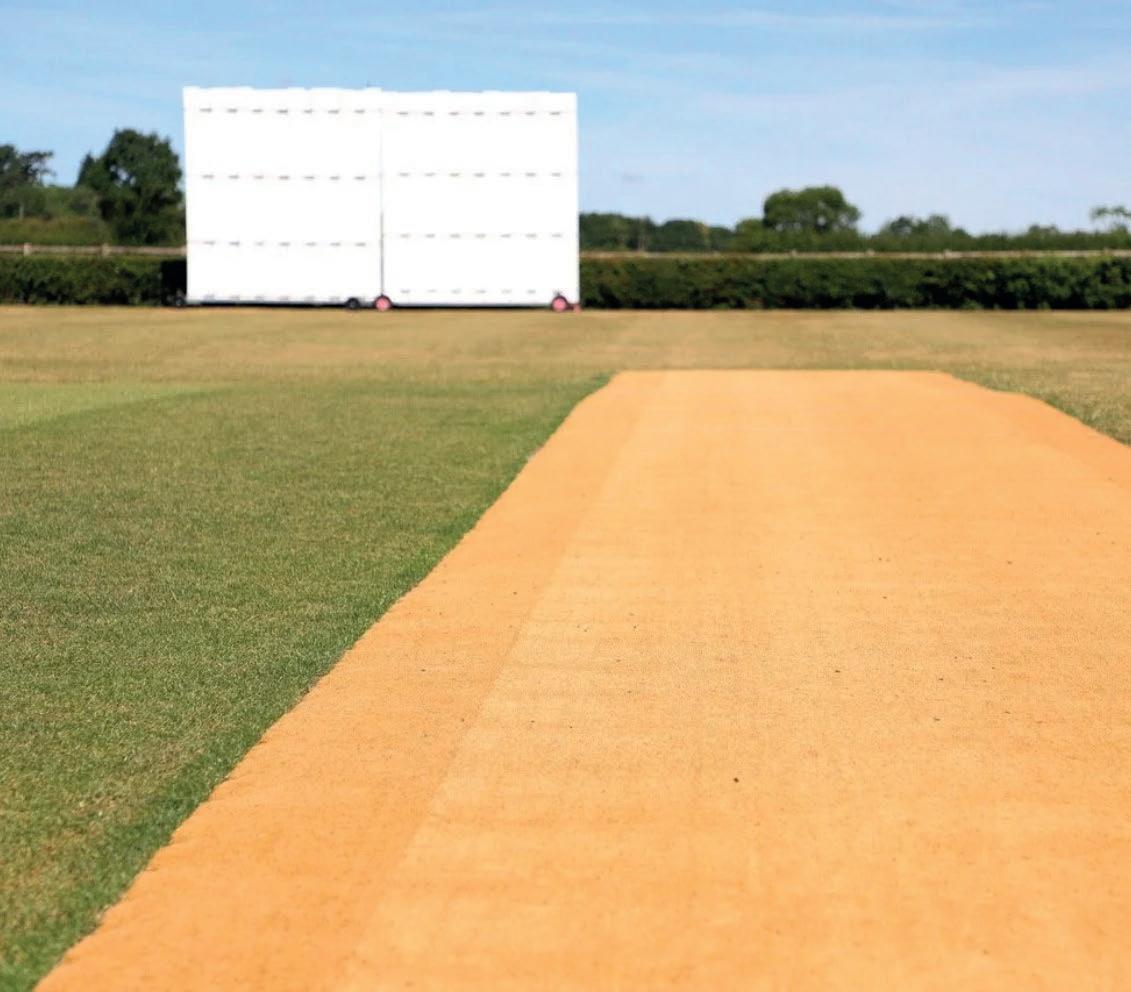
This isn’t just another surface – it’s a revolution in sustainable cricket design.

Notts Sport CEO Duncan Bennett explained: “This isn’t just another surface – it’s a revolution in sustainable cricket design. For the first time, clubs and communities can install an artificial surface that performs like the real thing – and does right by the planet.”
Each square metre of CocoTurf Cricket uses fibres from 6.5 coconuts, totalling around 585 coconuts for a single-lane pitch. By transforming natural byproducts into high performance cricket technology, we’re proving that innovation and sustainability can share the same ground. Notts Sport Technical Manager Adam Walker added: “CocoTurf Cricket is engineered for players – but designed for the planet.”
Creating high quality playing surfaces is no longer the domain of elite venues, as grassroots clubs around the country are now raising turf standards higher with each passing year.
4, 5, 6 & 7
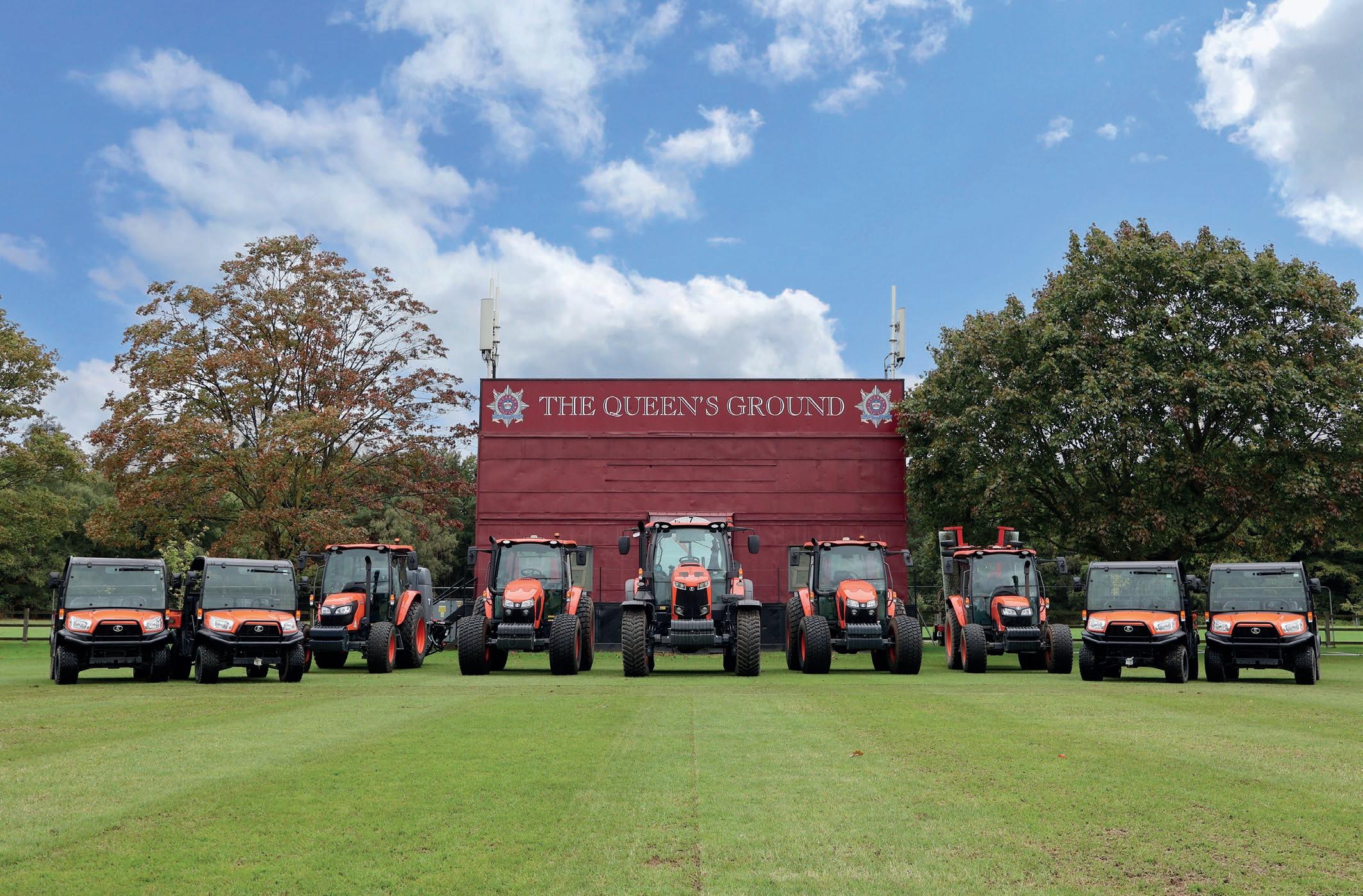
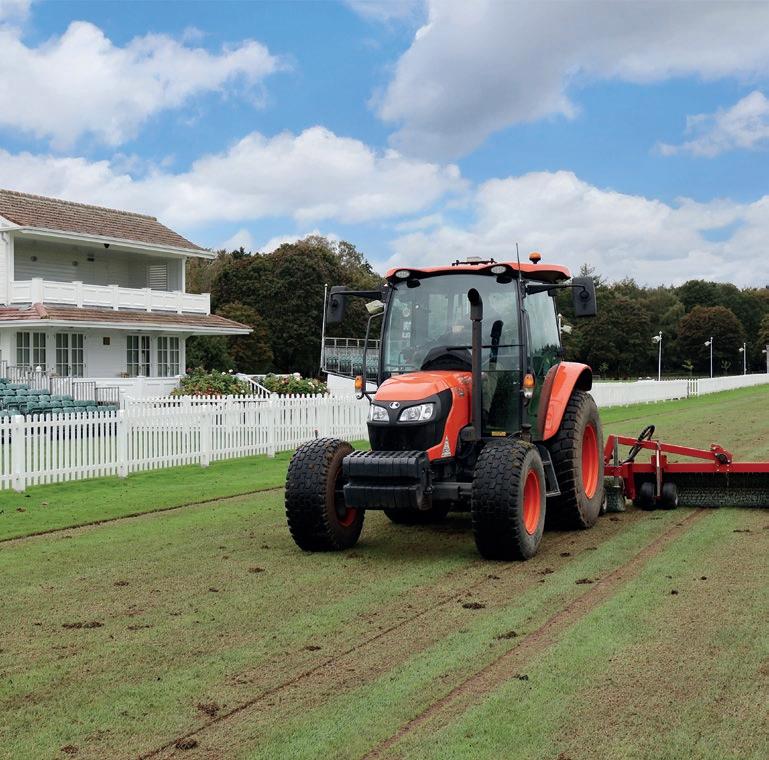
Based in Windsor Great Park, Guards Polo Club hosted more than 750 games in its 2025 season which was only possible thanks to a monumental team effort and the Kubota equipment which is at the heart of every element of polo field preparation.
Guards Polo is comprised of three sites and ten full-size polo fields, playing host to some of the highest levels of polo including frequent high goal tournaments.
Regularly welcoming distinguished and royal players, the packed calendar from mid-April to midSeptember places immense pressure on both the equipment and team of ten. Leading that team since March, is Grounds Manager Paul Brown.
One of the world’s most prestigious polo venues has revealed how it relies on a versatile fleet of M4, M5 and M6 tractors, alongside four RTV-X1110 utility vehicles from Kubota.
“Our Kubota tractors are the heartbeat of our operations” Paul explains. “Whether we’re mowing, verti-draining or moving irrigation from field to field, we depend on these tractors.”
Paul was pleased to see a new suite of tractors, installed and supported by local dealers Lister Wilder on his arrival at Guards – put straight to work on one of the busiest seasons in the club’s history. “The two M4-073’s and two M5112’s are the perfect blend of power and manoeuvrability, while our M6-142 picks up where the others finish, handling the heavier implements and largest-scale tasks across the farm and polo grounds.
“They’ve stood up to every test, providing comfort and simplicity of operation for the team which is crucial given the intensity of our schedule.”
With three separate sites and distances of several mile between them, the road-registered RTV-X1110s have also become indispensable – relied upon daily for transport, movement of tools and materials and general ground support. “The safety, speed and versatility of these four RTV’s is invaluable.”
Kubota’s reputation for reliability and durability was central to the club’s decision to renew its fleet earlier this year. Paul says, “Many of the machines these replaced had clocked up more than 15 years and thousands of hours of service.
“For us, Kubota strikes the perfect balance of dependability, performance and cost-effectiveness.”
Kubota – Enquiry 29























The Kress Mega 600 KR238E represents a significant step forward in robotic mowing for professional sports surfaces.

Developed specifically for large and demanding turf areas, this flagship model from the Kress Master Series delivers consistent, high-quality results while helping grounds teams manage time and resources more effectively.
For many sports turf professionals, maintaining presentation standards across multiple pitches can be a constant challenge. The Mega 600 has been designed to meet that demand head on, offering an autonomous solution capable of working continuously to keep surfaces in peak condition.
At the centre of its performance is a 620 mm cutting deck with an integrated roller. Combined with high-speed blades operating at 3,800 rpm, the mower produces strong, defined striping that mirrors the finish of traditional cylinder machines. The result is a professional look that enhances the visual quality of sports pitches, with stripes ranging from three to six metres wide.
What sets the Mega 600 apart is its ability to achieve this finish without
manual input. Operating overnight, it can cover up to 22,000 m² in just twelve hours, delivering a consistent cut across large areas. Over a 48hour period, this increases to as much as 88,000 m², making it well suited to multi-pitch sites and large sports facilities.
Accuracy is another key strength. Using centimetre-level RTK satellite positioning, the mower follows precise, parallel mowing lines without the need for boundary wires. This ensures a clean, uniform finish across the entire surface while reducing the
time typically spent setting up and adjusting mowing patterns.
For sports pitches, where surface quality directly affects play, this level of precision is essential. The Mega 600 is capable of cutting down to 10 mm with superb accuracy, allowing grounds teams to maintain the tight, consistent finish required for highlevel sport.
Efficiency extends beyond cutting performance. The mower features fast charging cycles of around 30 minutes, along with a nearest-dock return function that keeps downtime to a minimum. Its quiet electric operation means it can work overnight without causing disruption, allowing pitches to be prepared and ready for use each morning.
This flexibility gives grounds teams greater control over their maintenance schedules. Mowing can take place outside of training sessions and match play, freeing up valuable time during the day for other essential tasks. There are also clear environmental and cost benefits. As a fully electric machine, the Mega 600 produces zero emissions during operation and significantly reduces noise compared to traditional equipment.
The removal of fuel use not only lowers running costs but also supports the increasing focus on sustainability across the sports sector.
For facilities managing large areas of sports turf, the Mega 600 offers a practical and forward-thinking solution. By combining precision cutting, autonomous operation and reliable performance, it provides a consistent standard of finish while helping to streamline day-to-day maintenance.
Kress – Enquiry 32
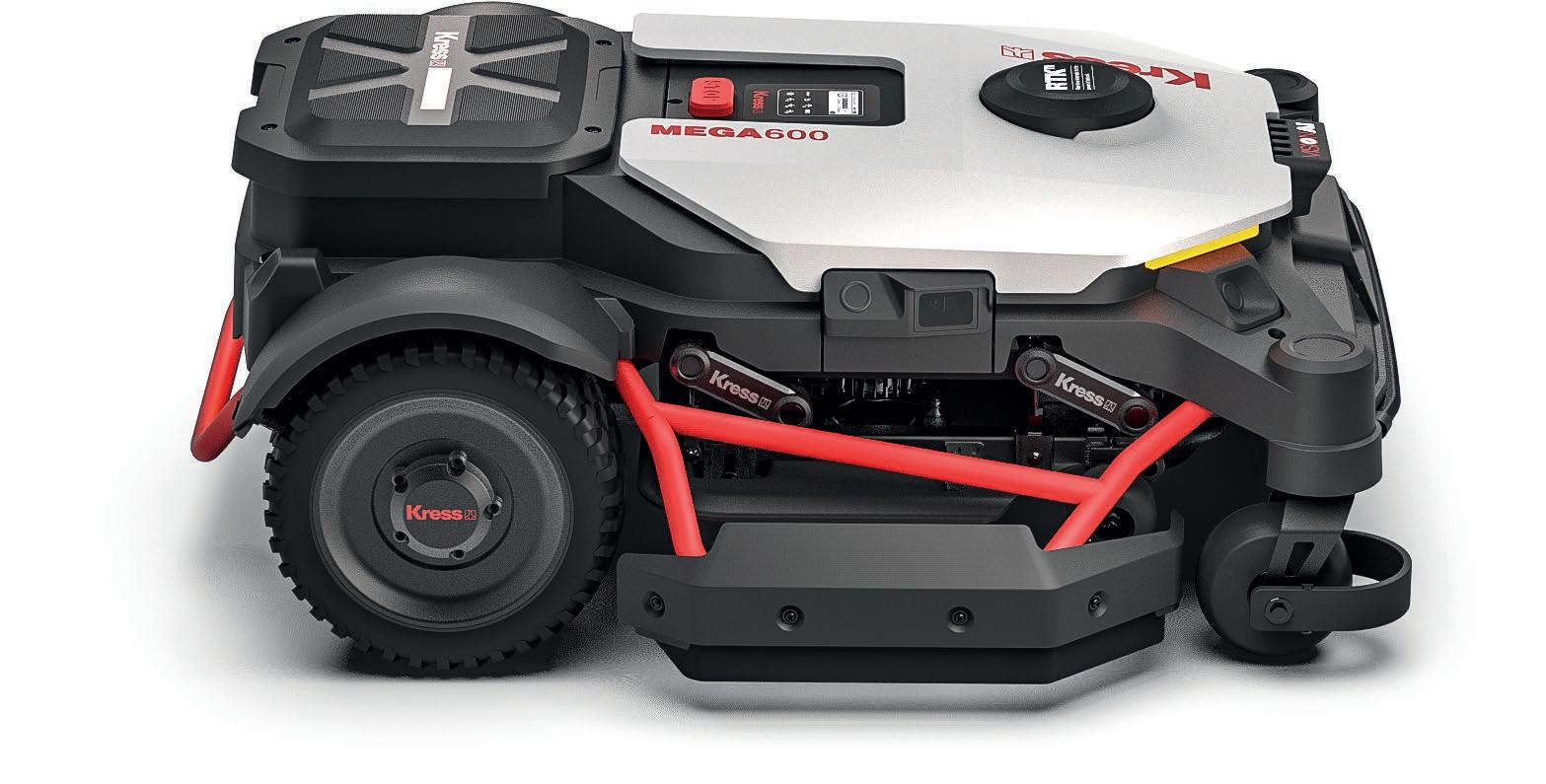
In the world of professional turf management, the ground beneath our feet is shifting. What once seemed like a predictable seasonal cycle has been replaced by a volatile cocktail of environmental and operational pressures.
From the scorching droughts of record-breaking summers to the relentless intensity of equally record-breaking rainfall, the demands placed on a sward have never been higher.
At DSV Eurograss, they recognise that the "business as usual" approach to seed selection is no longer an option. As we navigate 2026, the research into seed and turf development has transcended simple aesthetics; it is now the critical foundation for the industry’s survival and sustainability.
Climate change is no longer a distant threat - it is an everyday operational hurdle. For turf managers, this manifests as extreme temperature fluctuations and increasingly restrictive water usage regulations. The traditional "coolseason" grasses that have long been the backbone of UK and European sports turf are being pushed to their physiological limits.
The research at DSV focuses on genotypic variation - the genetic "blueprint" that allows certain cultivars to thrive where others fail. Their breeding programs are specifically targeting drought tolerance, not just through surface-level survival, but through deep-rooting characteristics. By selecting for "smart roots", plants that can strategically adjust their water uptake from deeper soil profiles during dry spells, they are helping groundstaff maintain highquality surfaces with significantly fewer irrigation inputs.
Resilience against emerging diseases Warmer, more humid autumns and winters have invited a new guest list of pathogens to our pitches and fairways. Diseases like Dollar Spot and Gray Leaf Spot, once considered "continental" problems, are now common in more temperate climates.
The traditional reliance on chemical interventions is under pressure from both a regulatory and environmental standpoint. The DSV development pipeline prioritises genetic disease resistance.
Varieties like the newly ranked Flanell and Euromagic aren't just chosen for their wear tolerance; they are bred to be naturally robust against the fungi that thrive in these changing weather patterns. By building resistance directly into the seed’s DNA, DSV provide the first line of defence, reducing the need for costly and carbon-heavy fungicide applications.
While the climate changes, the expectations of players and spectators remain at an all-time high. Modern multi-use stadia and academic facilities require turf that can withstand "increased usage" from the relentless pounding of feet and equipment, often under low-light conditions or beneath retractable roofs.
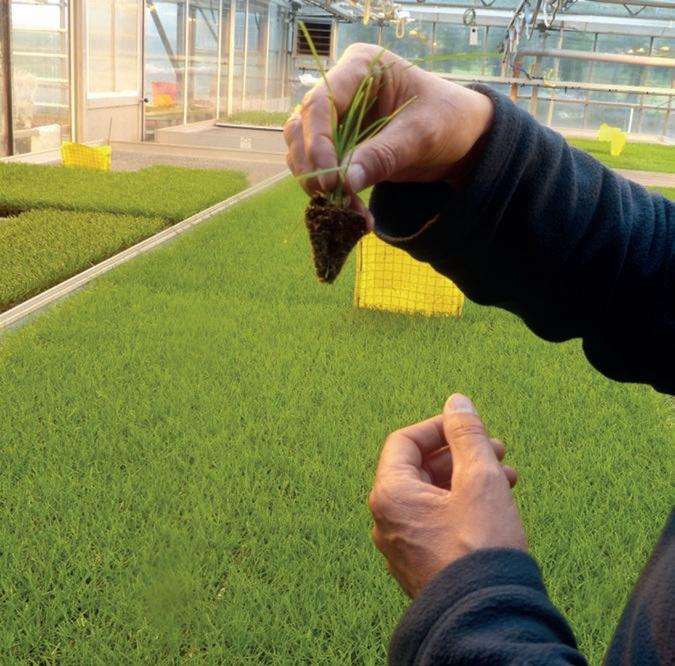
DSV’s PRO range is a testament to this research. It features diploid perennial ryegrasses that offer:
• Rapid Germination: Vital for the tight windows of summer renovations.

• Exceptional Sward Density: Providing the stability required for high-speed play.
• Genetic Colour: Cultivars like Flanell and Eurogala provide a naturally deep green hue that looks exceptional on camera without the need for excessive nitrogen fertilization.
A data-driven future
The importance of independent testing has never been greater. DSV are proud that their varieties now occupy top positions on the BSPB Turfgrass Seed rankings. However, their work doesn't stop at the trial plots.
The company is moving toward a more predictive framework in breeding, using genomic selection to identify the next generation of resilient varieties years faster than traditional methods.
As water becomes more precious and the weather more unpredictable, the turfcare industry must look to the science of the seed.
Investing in advanced seed technology is not just about a better-looking pitch today; it’s about ensuring we have a surface to play on tomorrow.
DSV – Enquiry 33
Replay Maintenance is stepping up its game in the natural turf sector with a new three-year supply agreement with Origin Amenity Solutions (OAS), reinforcing its commitment to delivering high-performance sports surfaces across an expanding portfolio of sites.
The agreement is a key part of Replay’s wider strategy to grow its Natural Turf Division.
Following a structured selection process, the partnership provides both stability and flexibility, giving Replay the confidence to plan for growth while maintaining consistent standards on every pitch. In its first year, the company expects to service over 100 natural turf surfaces, with ambitious expansion anticipated in the years ahead. Under the deal, Replay secures a reliable supply of core OAS products, including perennial ryegrass seed mixtures, controlled-release fertilisers, herbicides, and specialist inputs designed specifically for professional sports turf. But the agreement goes beyond the basics.
Embedded technical and agronomic support means Replay teams have access to soil analysis, laboratory testing, application planning tools, seasonal guidance, and ongoing technical advice, ensuring every decision is backed by data and bestpractice insight. Commenting on the partnership, Phil Dewhurst, Regional Sales Director at Origin Amenity
Solutions, said: “Origin Amenity Solutions are proud to have won the contract with Replay Maintenance and are delighted to be working closely with the team. Together we will build a strong partnership to supply and deliver our trusted products to improve the quality and performance on newly renovated natural turf surfaces.”
Service and performance are central to the partnership. The framework incorporates clear delivery commitments, regular performance monitoring, and annual commercial reviews, helping Replay maintain quality, reliability, and operational accountability as the division grows. The collaboration also opens opportunities for wider industry engagement. Demonstration days, technical seminars, and joint marketing initiatives are all part of the plan, giving Replay the chance to share expertise, showcase innovation, and strengthen its presence in the natural turf sector.
Matt Bartle, Group Head of Commercial Strategy at Replay Maintenance, believes the partnership will play an important role in supporting the company’s ambitions in the natural
turf market. “This partnership with Origin Amenity Solutions marks an important step forward for Replay. At our core, we’re committed to raising standards across all sports pitches, be it synthetic or natural. The opportunity to work alongside a trusted, forwardthinking supplier like Origin strengthens our ability to deliver consistent, highquality outcomes for our clients.
By combining our national delivery capability and technical expertise with Origin’s innovative amenity solutions and product support, we can offer a more integrated approach to pitch performance, sustainability, and long-term asset care. Ultimately, this collaboration is about adding value for clubs, schools, and facility operators thereby ensuring their natural turf pitches are not only match ready, but built to perform week in, week out.
For Replay Maintenance, this agreement is more than a supply contract. It’s a strategic move to build a robust Natural Turf Division capable of delivering consistently high standards across an increasing number of sites.
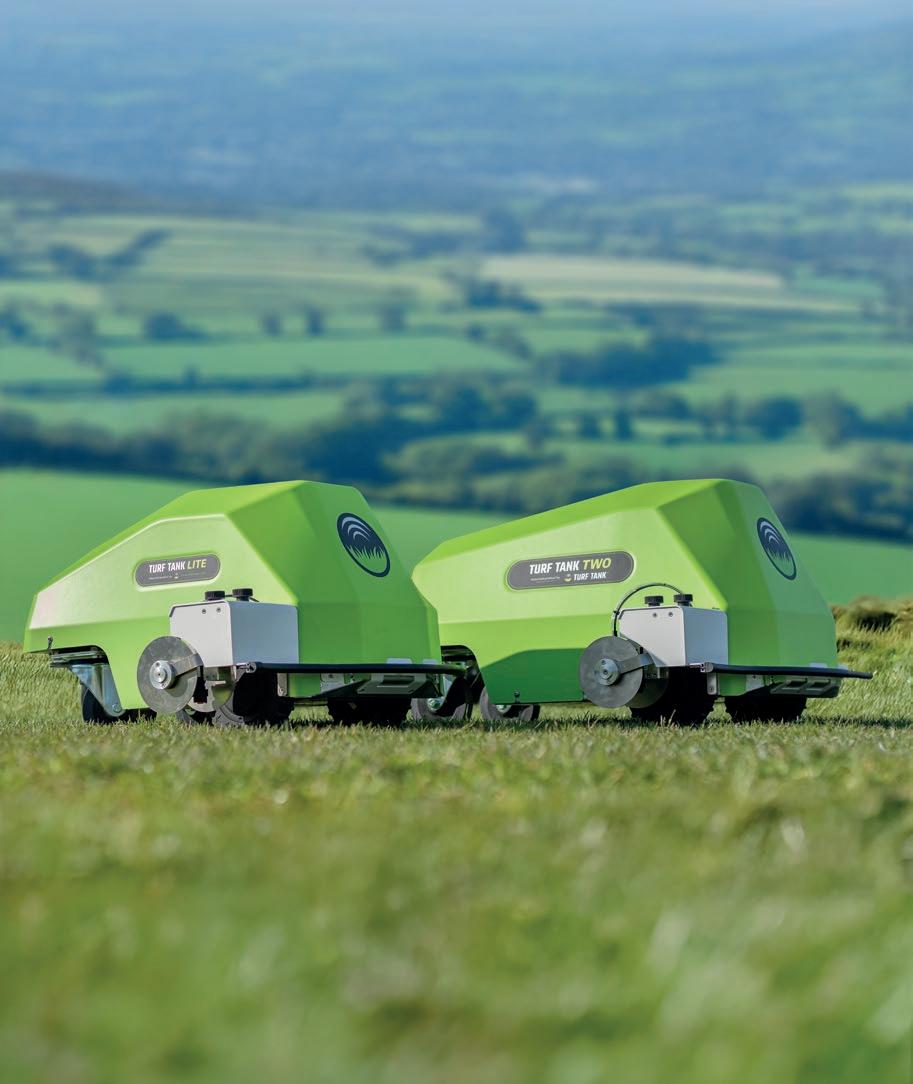
This latest update introduces a series of advanced features designed to optimize operations for groundskeepers, coaches, athletic directors, and facility managers.
As part of Turf Tank's unwavering commitment to enhancing user experience, the latest update brings several key advancements to the linemarking robots, aimed at reducing

Turf Tank, an industry leader in innovative linemarking solutions for sports fields, has introduced the latest software on all its current robots.
downtime and ensuring superior pitch quality. Highlights of the software update include: the Turf Tank Lite & Two robots can now detect low paint levels, pause their operations, and notify operators for refills, minimising time wastage and allowing grounds managers to focus on other tasks; in the event of unexpected signal disruption, the robots will automatically reposition themselves to regain connectivity; managers can now customise the order and direction of pitch and element markings; and real-time updates on job progress are sent


directly to managers' tablets. The Empty Paint Detection feature alone promises to save grounds crews significant downtime weekly. This update also includes enhancements for improved logo detailing, precise paint consumption tracking through nozzle selection, and the ability to resume failed jobs from the last stopped point.
Turf Tank's latest software update reflects the company's dedication to continuous improvement and innovation, driven by user and customer feedback.