
















































































































© The South Florida Community Voice Magazine. All rights reserved. Reproduction in printed or digital form in whole or in part in any form without prior written permission is prohibited. The publisher reserves all right to edit all articles for clarity, space and editorial sensitivities. Submissions cannot be returned to sender. The South Florida Weekly Magazine is not responsible for the cash flow of any advertised product or service that appears in these pages. The South Florida Community Voice Magazine assumes no responsibility for the content of articles or advertisements in this publication, nor for the content of books that are referred to or excerpted herein.
Community Voice magazine is not responsible for the Kashrut or services provided by the advertisements. It is up to the consumer to verify the information.





























Breakstone’s butter delivers rich, creamy flavor for holiday desserts. Tradition starts with quality ingredients— trust Breakstone’s for unforgettable baking.

By Sivan Rahav Meir
Among the Ruins - Unity
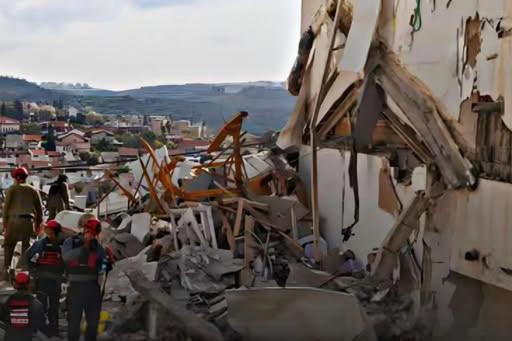
Last week, in a single moment of terror, a missile fell near the home of the parents of the Peretz family in Beit Shemesh. The house that had been filled with memories and warmth was reduced to a pile of rubble.
Yet within the total destruction, a great miracle occurred: their beloved mother had been inside the house and survived. And it happened precisely on the yahrzeit of their father. In the midst of everything, the family felt they had received the greatest gift of all: life.
Here is an excerpt from a letter they sent me:
What happened afterward also felt like a kind of miracle.
The walls of our parents’ house
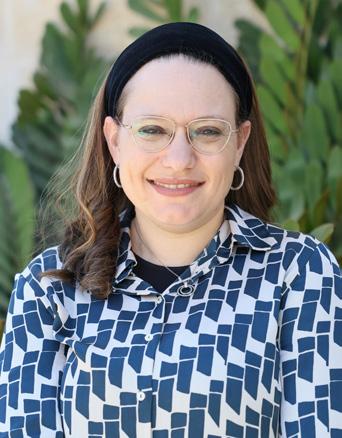
collapsed and the windows shattered. But through those broken openings, something else entered the house: the spirit of the Jewish people.
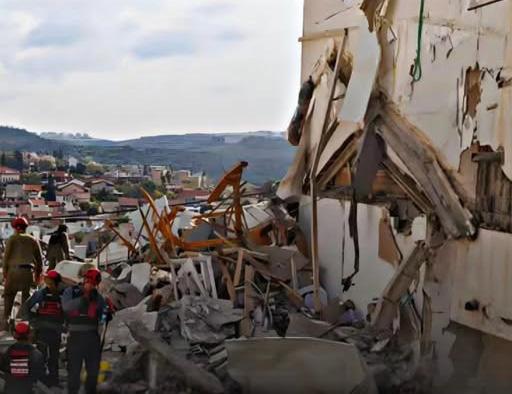
Countless volunteers—complete strangers! — offered to help. Moments of unimaginable pain, of clearing out belongings and dismantling an entire lifetime of memories, became moments of pure kindness, unity, and brotherhood.
Looking around, we saw an extraordinary scene: Uri the kibbutznik was standing next to a “hilltop youth”; beside them a chareidi volunteer, and nearby a group of teenagers from Beit Shemesh. So many good people who worked tirelessly lifting boxes, clearing broken glass, gathering debris. In such painful hours, their presence brought deep comfort.
We felt that we were witnessing what we read in the parashah, how all of Am Yisrael came together in remarkable harmony to build the Mishkan. When everyone accepts a sacred task and joins together to fulfill it, the Shechinah rests among them, and it can be felt!
Thank you to the Creator of the world for the privilege of being part of this extraordinary people.
—The Peretz Family, HaNasi Street, Beit Shemesh
The Driver Is With Us
I received a message from Ilana Steiner of Kfar HaRo’eh. Her daughter, Ora, was traveling south by train to her in-laws to mark her husband Amichai’s release from reserve duty. During the trip, an alert sounded. The train stopped safely, and all the

passengers got off and entered the station’s protected area.
Ora told a woman standing beside her that she was worried the train would leave without her. In the rush to get off, she had taken only her baby in her arms, leaving her stroller and suitcase behind on the train.
At that moment, a man standing nearby joined the conversation and said, “Don’t worry, the train won’t leave. I’m the driver.”
Ilana wrote that this conversation made her realize: the Driver is always present, always close by. In the midst of all our rushing and worrying we do not always notice Him, but in truth we see so much hashgachah pratit these days. The journey is turbulent, but we can be calm in the knowledge that the Driver is always with us.
Every year, in the midst of Pesach cleaning, I’m asked to repeat the following idea (even this year, with all that is happening around us). Dr. Miri Kahane recommends adopting a different approach to Pesach cleaning:
“I would like to share a thought that I keep reminding myself as I prepare for Pesach. The reason that we need to do so much cleaning is because we’ve been blessed with an abundance of everything — I’m not only speaking about me personally, but all of us. Most of us are living in our own home with a separate bedroom for parents, a shower, and a bathroom. Our homes are filled
with furniture, clothes, dishes, and food. Our children are so well fed that they leave whole packages of snacks in their drawers and sandwiches in their school bags which they didn’t feel like eating. Our current reality is so different than that of our ancestors who needed to ask halachic questions about the one communal oven shared by several families, or washing their one item of clothing for Shabbat.
Despite the difficulties and challenges we face today, I’m sure that each one of us has at least one great-grandparent who would be ecstatic to see the prosperity of their great grandchildren. So, every now and then, I stop myself from thinking about all the cleaning and cooking that still needs to get done in order to appreciate how much we have.”
You’re welcome to share this idea with others as we prepare for Pesach.
These are challenging days. Pesach is steadily approaching, and this Shabbat we begin reading a new book of the Torah: Vayikra.
Most of Sefer Vayikra deals with the korbanot, the offerings brought in the Mishkan. It does not have the sweeping drama of Bereishit or Shemot. There is no gripping storyline here.
The Pulitzer Prize-winning American Jewish author Herman Wouk once wrote about this uniquely Jewish quality: our loyalty to every part of the Torah, and to every part of life, even when it
is not easy, exciting, or immediately rewarding; even when it requires effort, patience, and commitment. This is what he wrote:
“One writer decided to publish an easy version of the Bible. He adapted the Five Books of Moses by simply keeping all the stories and omitting all the laws. As a result, the book of Leviticus was reduced to about half a page, and that was that. But the Jews never cut a single word from the Torah. The lengthy plan for building the Tabernacle and the dramatic story of the splitting of the Red Sea were of equal value in their eyes.”
What a powerful idea. It can change the way we live.
Commitment and loyalty are not meant only for the moments that feel inspiring or enjoyable. They are tested specifically in the daily routine, in the effort, in the parts that do not come with instant satisfaction.
And these, after all, are challenging days in Israel. There is so much that wears us down: sirens, Zoom meetings, safe rooms, reserve duty, Pesach cleaning, and the strain on both body and soul.
And yet, year after year, we return with love to the preparations for Pesach. We return to Sefer Vayikra. We keep going.
Because this too deepens the bond. This too is part of the bigger story.
Translated
and Janine
Sherr Want to read more by Sivan Rahav Meir? Google The Daily Thought or visit sivanrahavmeir.com

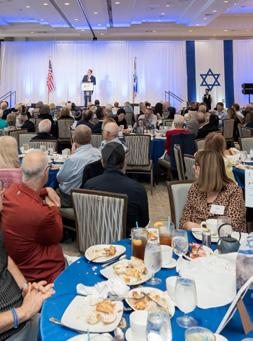
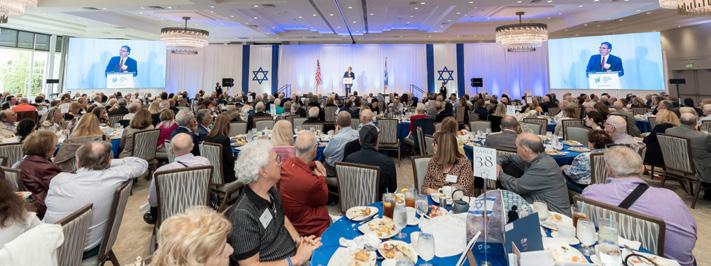
BOCA RATON, Fla., March 12, 2026 — In a powerful display of solidarity, nearly 1,500 philanthropists and community leaders recently attended Jewish National Fund-USA’s annual Winter Connection in Boca Raton to secure Israel’s future and change lives in the country’s North and South.
The organization hosted nearly 50 gatherings and events in February for partners (donors) living and wintering in South Florida, including cocktail receptions, dinner receptions, parlor meetings, and major gift donation opportunities at venues including The Addison and B’nai Torah Congregation, as well as the week’s flagship Winter Connection Brunch which took place at Boca West Country Club with over 600 supporters in attendance.
Co-President of Jewish National Fund-USA’s South Palm Beach Board of Directors Eric Stein welcomed guests alongside National Women for Israel Board member and local Sapphire Society Chair Cantor Elaine Shapiro, emphasizing unwavering support for the people of Israel and gratitude for those protecting and rebuilding the country.
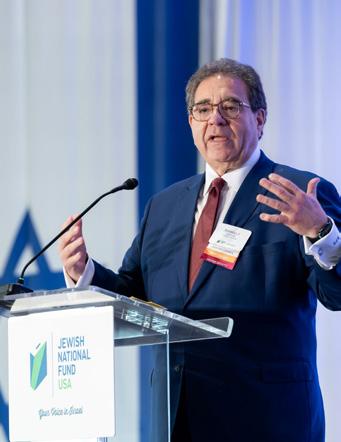
“What we are witnessing is more than generosity—it is a movement of people who refuse to stand on the sidelines and are determined to help rebuild, restore, and strengthen Israel’s frontier communities,” said Jewish National Fund-USA National Board Member Marv Schlanger. “In mo-

ments of challenge, the Jewish people do what we have always done—we come together, we lift one another up, and we build a stronger future for Israel.”
The brunch also featured remarks from Jewish National

Fund-USA leaders including a “state of the organization” update from CEO Russell F. Robinson, highlighting the organization’s progress creating the most livable towns and cities in Israel’s North and South, and President Deb Lust Zaluda, who spoke about setting an example for the next generation by providing them with the tools and knowledge to take the reins and continue the organization’s critical work.
“They are tomorrow’s leaders, investors, and decision makers,” said Zaluda. “This is our greatest challenge, greatest responsibility and greatest privilege – to ensure Israel is strong tomorrow. Thanks to the generosity of our partners like you, we can see the circles of impact in every facet of Israeli life – from strengthening communities in the Gaza Envelope and

Israel’s North, to creating employment opportunities, resilience and therapy, medical care, security and sense of community to tens of thousands of Israelis – these are only possible because of our philanthropic investments.”
Robinson further reflected on these “circles of impact” and how long-term partnerships translate into hope and continuity for Israeli families. He shared stories of communities rebuilding and the urgency of engaging Jewish teens and young adults in meaningful Israel experiences like the organization’s Alexander Muss High School in Israel (Muss).
“The sounds of construction are the sounds of tomorrow,” Robinson said. “When we build— when we show up—we’re not just responding to crisis. We’re making it possible for families to come home, for children to play again, and for the next generation to stand tall, informed, and proud.”
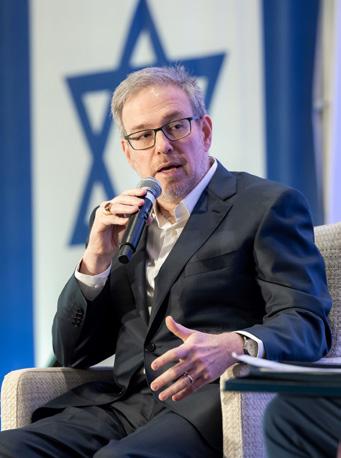
The centerpiece of the program was a moderated conversation with Pulitzer Prize-winning journalist and New York Times columnist Bret Stephens, led by longtime Jewish National FundUSA partner Marv Schlanger, who guided a wide-ranging discussion on Israel, antisemitism, and Jewish identity after October 7.
“There’s no question that on October 7, the state failed—but the people succeeded,” said Stephens. “And the real challenge of the ‘October 8 Jew’ is waking up and asking: ‘Who am I? What do I stand for? And what will I do to ensure Jewish life thrives 100 years from now?’”
Stephens also spoke about his personal connection to Jewish National Fund-USA, and how his family planted a forest in Israel after his father passed away. “I know that everyone at JNF-USA will want to tell you that they’re more than just about trees, which is true,” said Stephens. “But I like the trees and I’m grateful to Jewish National Fund-USA for giving me the opportunity to honor my father in the country that he loved so much.”
Stephens also touched upon critical points including:
The distinction between “thriving Jews” and “Jewish thriving,”
Rejecting framing Jewish identity primarily around victimization,
And how he believes, like Jewish National Fund-USA, that building is the key to securing Israel’s future and the ultimate response to antisemitism.
“We have to stop thinking of ourselves by who hates us and what we’re against and start
thinking about what we love and what we’re going to build,” added Stephens. “And no, that doesn’t mean pretending that antisemitism doesn’t exist...But it means remembering that Israel didn’t come into existence to showcase Jewish victimization. It came into existence to end Jewish victimization. And the American Jewish community needs to think in the same terms.”
Schlanger concluded the program with a call to action, inviting guests to translate inspiration into philanthropic investment and reminding attendees that partnership fuels the work—today and for generations to come.
For more information or to learn about future events in South Florida, contact Laura Sherry, Esq., Jewish National Fund-USA Director, Women’s Philanthropy, Florida, at 561-447-9733 x881 or lsherry@jnf.org.
About Jewish National Fund-USA
Jewish National Fund-USA is building a strong and vibrant future for the land and people of Israel. Through its One Million Voices for Israel campaign, the organization unites supporters nationwide around its holistic approach to supporting individuals, families, communities, and regions in Israel’s North and South, known as circles of impact. Leveraging its 125 years of impact, Jewish National Fund-USA is developing the most livable towns and cities in frontier communities to attract 800,000 new residents; creating a lifelong continuum of Zionist education through travel, learning, and leadership; and establishing the World Zionist Village in Be’er Sheva, a global hub for connection and peoplehood. With donor recognition and legacy giving at its core, supporters ensure their values and impact endure—yesterday, today, and tomorrow. Learn more at jnf.org.

By Dr. Chaim Y. Botwinick
A safe room in Hebrew is called a Mamad which is an acronym for Merkav Mugan Dirati translated to mean an “apartment’s protected space”.
Since the start of the Israel-Iran war which began on Shabbat Zachor, families throughout Israel have been spending more time sleeping in their mamad then in their own homes.
This sad and harsh reality was due to the continuous targeting and indiscriminate barrage of Iranian ballistic missiles on Israeli population centers.
From the moment a warning siren is heard throughout the community, to the time people take safe refuge in a mamad, our hearts pound, and our minds race as we are mitpallel to HaShem that the missiles launched from Iran will be intercepted or land in an open non populated space.
One of the most moving and defining moments one can imagine during this war took place in Israel on Purim.
As millions of Israelis were seeking refuge and safety in mamad facilities, we in the states were hearing and seeing social media feeds of the thousands of Israelis who were listening to the reading of Megillat Esther while crowded together in these safe rooms.

This incredible image was truly an amazing testimony to achienu bnai yisrael and to their unswerving strength, will and resilience. It is also a reflection of our true unwavering commitment to achdut and to our Jewish commitment and obligation.
As if this image was not powerful enough, we also witnessed thousands of Israelis dressed in Purim costumes, dancing and singing together as they stood shoulder to shoulder in the crowded mamad Friends, this juxtaposition of war and simchat Purim is a powerful one which is beyond human comprehension. To be sure, our commitment to celebrate and observe simchat Purim took precedence and primacy over the harsh reality of war or the danger of missile barrages on Israeli population centers.
The numerous reports about the manner in which Israelis celebrated chag Purim despite being under fire, is astonishing and inspiring. Just imagine, young and elderly celebrating Purim together in
shelters and underground parking garages. In fact, in Tel Aviv, a mall’s underground parking lot was transformed into a celebration space, with live music and dancing. There are even stories of families setting up tents in shelters and decorating them with costumes and game/play areas for children.
In Yerushalayim, musicians played their music on balconies and street parties continued into the evening between missile barrages.
These celebrations are a true testimony to the Israelis’ resilience and determination to observe their traditions and mitzvot despite challenging conditions and the harsh reality of war.
This amazing veracity offers a whole new perspective regarding the phrase Mi K’amcha Yirsealwho is like your nation Israel.
Mi K’amcha Yisrael is a declaration of pride and uniqueness. It is often used in our tefillot. The phrase is derived from the Torah (Deuteronomy 33:29 Isaiah 44:7) which emphasizes and highlights HaShem’s special close bond with Am Yisrael.

It emphasizes Israel’s special connection to HaShem and it is also a popular phrase in Israeli culture, symbolizing national pride and identity.
The phrase is part of the song mi kamocha which is sung during the Pesach seder, celebrating HaShem’s mighty acts and protection of the Jewish people.
Friends, as we continue to “dance in the mamad,” (literally, spiritually and metaphorically), we are thankful to HaShem that for his guidance and protection.
Throughout Jewish history, our people have confronted a wide array of challenges which at first blush appeared to me insurmountable. But, as a mamlechet kohanim and am kadosh, we were blessed with resilience, fortitude and a will to overcome adversity.
Although the United States Armed Forces together with the IDF have made significant progress in degrading Iran’s nuclear capacity and missile stockpiles, the hostilities and missile barrages still continue unabated; and the threats towards Israel, the Uited States and Arab Gulf countries continue.
As we respond to the burning fires of vitriol and hatred towards Israel, we remain steadfast in our conviction, belief and commitment that we will prevail.
Just as we all danced in the mamad on Purim, as missiles rained down on us, we hope and pray that amcha will continue to dance and celebrate together in the face of danger and adversity.
Finally, as we move into the fu ture, the concept of “dancing in the mamad” must continue to remind

us that Jewish tradition encourages us to maintain hope, joy, promise, resilience, emunah and observance during times of extreme hardship.
May we continue to “dance in the mamad” and witness the day when the mamad (as we know it today), will no longer be needed or required for our protection.
Am Yisrael Chai
Dr. Chaim Y. Botwinick is a senior executive coach and an educational consultant. He served as president and ceo of the central agency for Jewish education in Baltimore and Miami; in addition to head of school and principal for several Jewish day schools and yeshivot. As an Influencer, he has pub -


CLIPPER & COMB BARBERSHOP 2900 GRIFFIN ROAD FORT LAUDERDALE, FL 33312


Hours S: 10AM - 4PM M-TH: 9:30AM - 7PM F: 9:30AM - 2PM CLOSED ON SHABBOS



The calls come at all hours. A sudden loss. A tragic accident. A devastating diagnosis. A community shaken by the unthinkable.
When crisis strikes, Chai Lifeline’s Crisis Services team responds immediately.
For decades, Chai Lifeline has been known for its compassionate support of families navigating serious illness and loss. Today, through its expanding Crisis and Trauma Services, Chai Lifeline Southeast is reshaping how the South Florida Jewish community responds to trauma, with speed, expertise, and deep sensitivity.
Chai Lifeline Southeast’s Crisis and Trauma Team provides support to children, families, schools, shuls, and entire communities in the aftermath of sudden death, accidents, and other traumatic events. Their approach is simple: show up immediately, provide expert guidance, and ensure no one faces crisis alone.
Unlike traditional mental health services, Chai Lifeline’s response is built for urgency. There are no lengthy intake processes. No insurance barriers. No waiting weeks for help.
When crisis strikes, the team mobilizes.
Support is provided on the ground for children and teens processing devastating news, for parents trying to stay strong while struggling internally, and for schools and synagogues navigating communal trauma. Services
include immediate on-site crisis response and ongoing trauma support tailored to each situation.
“What we do is bring calm, clarity, and stability into moments of chaos,” said Rabbi Dr. Dovid Fox, Director of Crisis Services at Chai Lifeline. “Trauma doesn’t wait, and neither can the response. In those first critical hours, how a child or community is supported can shape how they heal.”
The Southeast Crisis and Trauma Team is made up of highly trained local volunteers, including clinicians, therapists, and community members who are prepared to drop everything and respond when needed. Each team member undergoes extensive training under Rabbi Dr. Fox and leading trauma professionals, ensuring that every response is both clinically sound and culturally sensitive.
“The goal is to support people when their usual coping mechanisms are overwhelmed,” said Dr. Eitan Turk, Crisis and Trauma Team Leader for Chai Lifeline Southeast. “In those moments, trauma can take hold very quickly. Our role is to step in early and help stabilize individuals and communities before that happens.”
The team has responded to a wide range of crises, from sudden losses and accidents to large-scale tragedies impacting entire communities. They work closely with individuals, families, schools, and
community leadership to guide communication, provide emotional support, and help people process what they are experiencing.
At its core, this work is an extension of Chai Lifeline’s mission.
Families who receive support often describe a profound sense of relief, not only from the guidance provided, but from the simple presence of someone who understands.
“We were guided on what to say, how to support our students, and how to communicate with parents,” a local school principal shared after a recent tragedy. “No community should have to face these challenges, but we were grateful to have Chai Lifeline there with us.”
In the most difficult moments, that presence matters.
“This is chesed at its deepest level,” said Esther Leah Sandhaus, director of Chai Lifeline Southeast. “We show up in the darkest moments and help people begin to find their footing again, with support, with dignity, and with hope.”
Chai Lifeline’s 24-hour crisis helpline is available at 855-3-CRISIS.
Chai Lifeline is an international organization providing social, emotional, and practical support to families facing illness, trauma, and loss. Locally, Chai Lifeline Southeast serves thousands of individuals and families across South Florida each year. To learn more, volunteer, or support their work, visit www.chailifeline.org/southeast or call 305-956-9990.

In a time when the Jewish people face growing challenges around the world, moments of unity are no longer symbolic— they are essential.
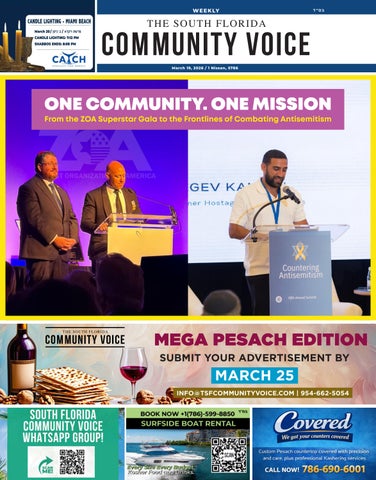
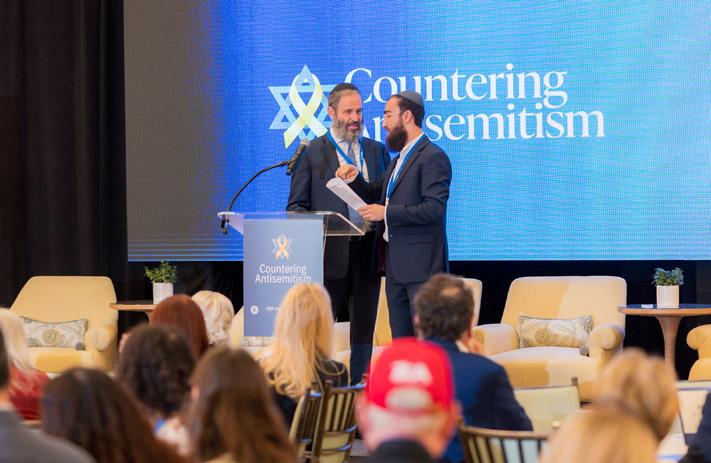
That spirit was on full display across two powerful gatherings in Palm Beach: the ZOA Florida Superstar Gala and the Countering Antisemitism Summit hosted by Palm Beach Synagogue. Together, they brought into focus a single, urgent truth: the fight against antisemitism requires leadership, clarity, and unwavering conviction.
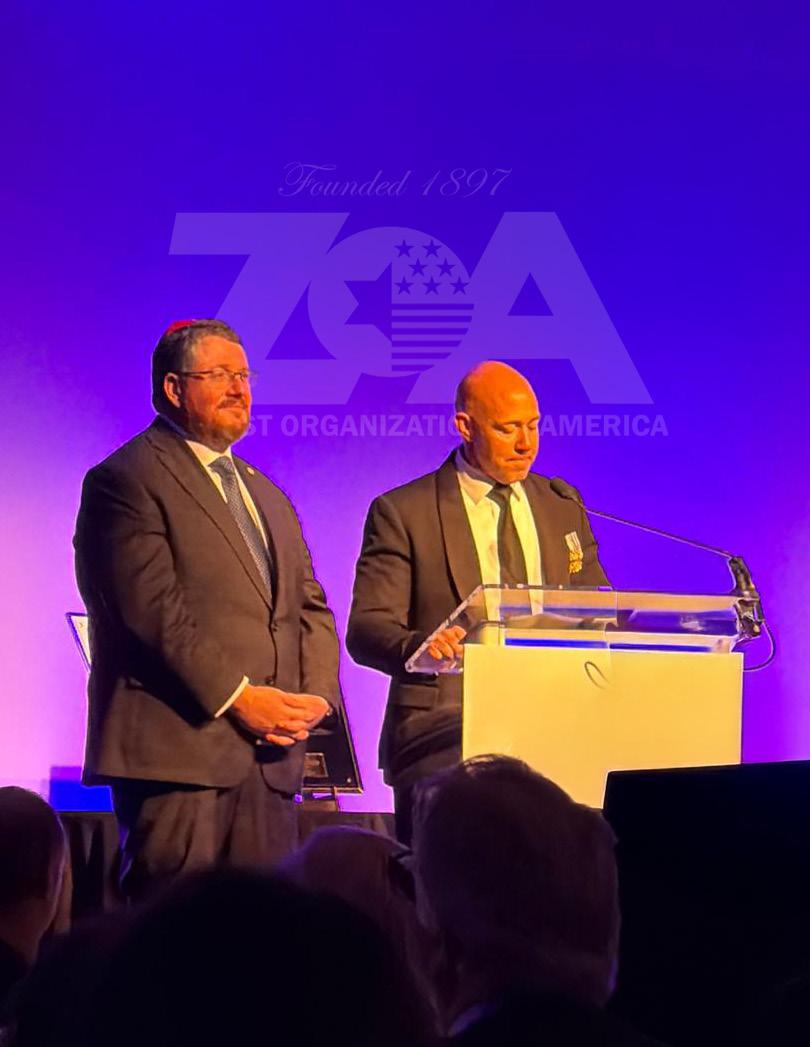
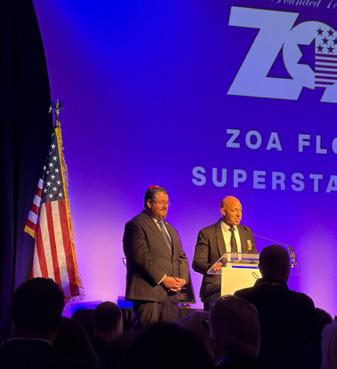
Held at the Kravis Center in downtown West Palm Beach, the ZOA Florida Superstar Gala gathered an influential room of elected officials, philanthropists, and outspoken advocates for Israel. More than a formal evening, it was a declaration.
Among the honorees was Pastor John Hagee, Chairman of Christians United For Israel, who received the Outstanding Christian Zionist Award—symbolizing the powerful and growing alliance between pro-Israel Christian and Jewish communities. Also recognized was Leo Terrell, Sr. Counsel to the Assistant Attorney General of Civil Rights in the US Department of Justice. His presence brought national urgency to the fight against antisemitism, reinforcing that this battle is being waged not only in communities, but at the highest levels of government.
Congressman Randy Fine was honored for his unwavering and
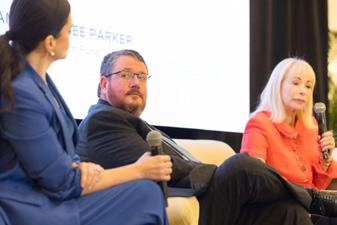
outspoken support for Israel, while Congressman Brian Mast, serving as a presenter, added further weight to the focus of the event. Together with honorees Barbara Feingold (philanthropist and member of the United States Holocaust Memorial Council) and Robert Meyer, Esq, the gala reflected a broad coalition— leaders, donors, and advocates united by a shared mission: to stand strong, publicly and unapologetically, with Israel and the Jewish people.
Just miles away, at the Four Seasons Resort Palm Beach, the
Countering Antisemitism Summit brought together organizations and philanthropists focused not only on recognition—but on action. If the gala represented leadership, the summit represented strategy. It was here that conversations moved beyond headlines—toward coordination, funding, and real solutions to combat rising antisemitism worldwide. But in the midst of














policy discussions and organizational planning, one voice transformed the room.
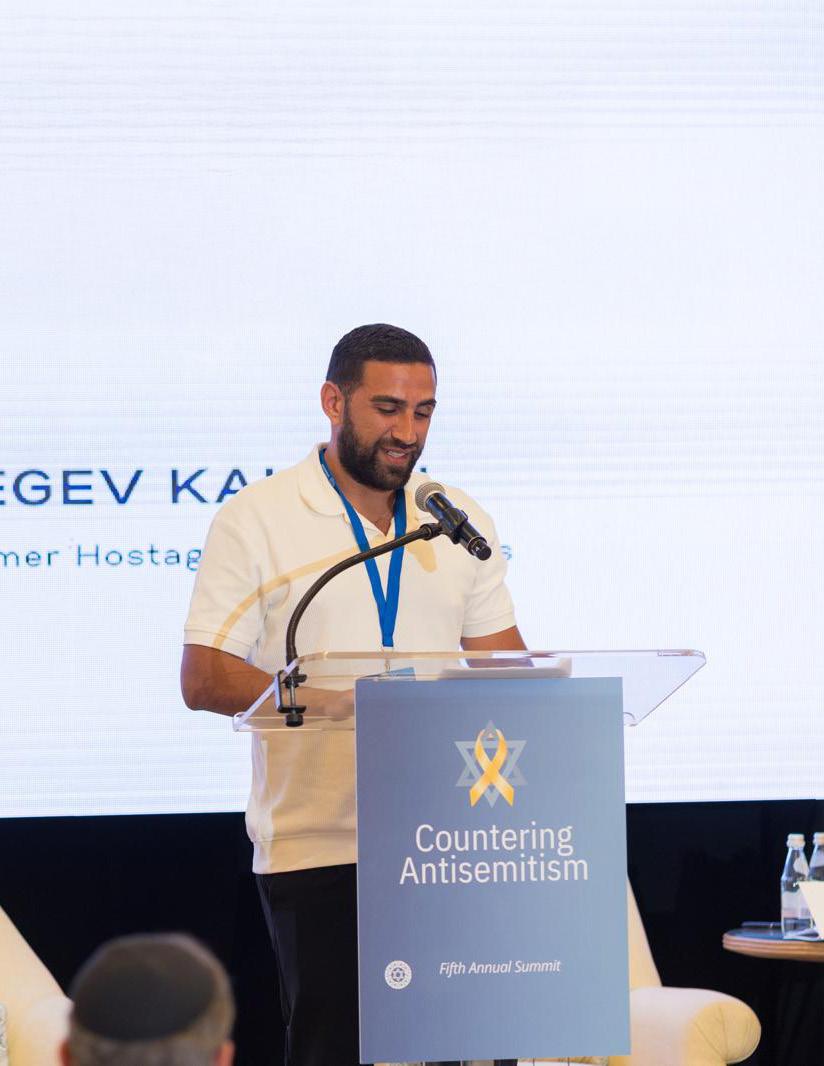
When Segev Kalfon took the stage, the conversation shifted.
For 738 days, he had been held in Gaza: Cut off, isolated and stripped of freedom. And yet, he held onto something no one could take from him—his faith. When he was told he would be released, his first thought was not relief. It was a vision. He imagined standing on a stage in Gaza and declaring the words that carried him through the darkness: “Shema Yisrael, Hashem Elokeinu, Hashem Echad.”
But that moment never came. There was no stage. No ceremo-
ny. No chance to proclaim those words where he had endured so much. And yet—his story did not end there. What he could not fulfill in Gaza, he fulfilled before the world.
In the heart of New York City, at Times Square, surrounded by thousands of young people from across the globe, Segev Kalfon finally stood on a stage. And after 738 days of silence, the words were proclaimed:
“Shema Yisrael, Hashem Elokeinu, Hashem Echad!”
It was more than a prayer – it was resilience. It was identity. And it was victory.
Back in Palm Beach, Segev’s story echoed far beyond the summit because these events—wheth-
er at the Kravis Center or the Four Seasons—were never just about recognition or discussion. They were about something deeper in a commitment to stand together, refusing to stay silent and taking on the responsibility to lead the Jewish community.
In a time often marked by confusion and division, the message coming out of Palm Beach was unmistakable. Together with our allies, we seek clarity and creative vision over compromise, unity as opposed to fear, and speaking out strongly.
And through voices like Segev Kalfon’s, this also became clear— that even when a stage is taken away, the message will always find a way to be heard.







Sunday to Thursday: 12pm - 10pm Friday: 11am - 3:30pm OPENING HOURS Scan the code to order!


By Rabbi Jonathan Gewirtz
I recently wrote about miniatures, like small bottles of liquor or toiletries, and how people have an unusual affinity for them. One of my readers wrote back to me: “Miniatures? Really? How do you come up with these things?”
I thought about it. How do I come up with these things? I mean, I’ve been writing this column for over twenty years, and somehow, I manage to come up with topics. I used to marvel at newspaper columnists who had daily columns for decades and never seemed to run out of ideas. Of course, they probably have more time than I do, as they do nothing else the whole day but write their columns. They don’t daven, learn, work another job, etc.
But the truth is, it’s not just a matter of time. As you see, I wrote the column about miniatures, and the reader was blown away. But she might have as much time as I do, yet not think of it. In truth, the reason I’m able to come up with columns is because I’m constantly paying attention to what goes on around me. It doesn’t have to be big or important. A small thing like bending down to tie your shoe and your pen falling out of your pocket can be food for thought and fodder for a column.
People like to ponder the big philosophical question, “Why do bad things happen to good people?” Well, I don’t care. Not that I don’t feel bad when people experience difficulties, but since
Hashem does everything for our benefit, I can trust that He knows what He’s doing, and I don’t need to understand. I’m not making the calls, so I can mind my own business.
Instead, my question, as the title of this column shows, is: “Why do things happen to people?” Mostly, my question is about me, because if Hashem is sending a message to someone else, I’m not really privy to it because I don’t know what they know in their heart of hearts. I don’t know their dreams, goals, abilities, or challenges. I can’t say, “This happened to you because…” because I honestly would have no way of knowing.
Instead, I pay attention to the world around me. When something enters my periphery, my field of vision, I know it’s because Hashem wants me to take some message from it. When a car in front of me s driving very slowly and annoying me, I don’t chalk it up to the other guy not knowing how to drive. I assume Hashem wanted me to be slowed for some reason, so he sent the guy who doesn’t know how to drive to come
do it.
People often ignore the little things because they think they don’t mean much. But I’ll tell you something; the devil isn’t in the details – That’s G-d. Nothing gets past Hashem, and nothing is by chance. He’s communicating with us all the time through the events He sets into motion and the circumstances He arranges.
If that’s the case, then everything we encounter can inspire a thought or idea about growth, change, or even Divine approval for the path we’re on and what we’re doing. When you pull into a parking lot and someone right near the front pulls out and you get the spot, do you stop and thank Hashem? Do you appreciate that He’s just sent you a love note, saying He thinks you’re really swell and this was a great way for Him to how it?
When you get into the mindset of seeing what’s there, just not visible or obvious, you’ll begin to see the hand of Hashem everywhere. You’ll start to notice Hashem’s involvement in your life more regularly, and you won’t see things as bad. You’ll see them as a perfect fit for you, because Hashem knows you better than you even know yourself, and knows exactly what you need.
Life will be more peaceful and experiences more positive. You’ll feel that Hashem is talking to you throughout the day and you’ll be able to respond appropriately. Plus, the more He knows you’re

listening, the more He will communicate with you.
And guess what? Instead of wondering why bad things happen to good people, you’ll wonder why the sky is blue or the ocean is salty. You’ll consider why people believe they deserve more than they really might, and why we feel we’ll live forever.
You’ll also wonder why the shopping cart you just pulled out of the rack has a shopping list in it, or why you saw a fox crossing the street. You may not be plagued by these questions as long as why children get dreaded diseases, but the answer to all these questions

is the same: Because Hashem is in charge and He’s a lot smarter than I am, so I’ll just trust Him if I can’t figure it out.
2026 – All Rights Reserved
Did you enjoy this column? Feedback is welcome and appreciated. E-mail info@ JewishSpeechWriter.com to share your thoughts. You never know when you may be the lamp that enlightens someone else.



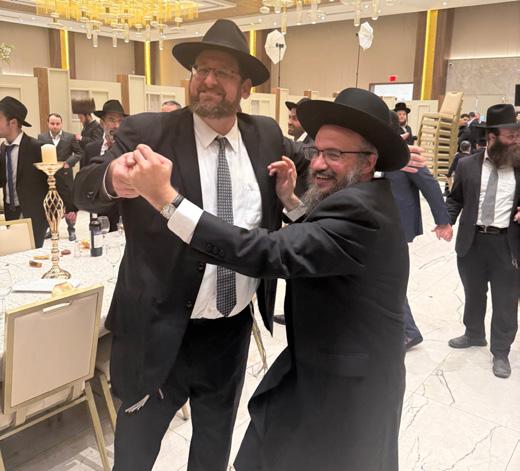
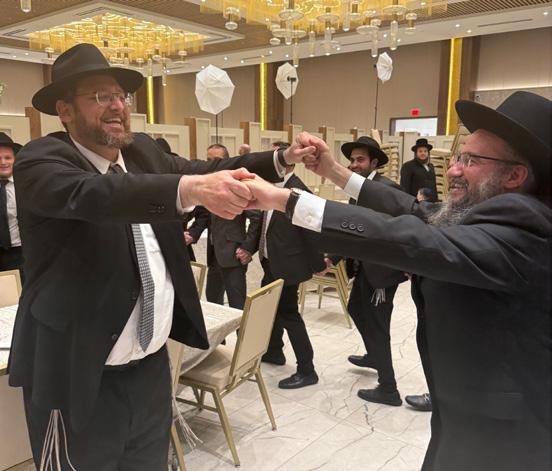
Cheder Miami dancing with the Chassan’s father Rabbi Tzvi Yehuda Smith, Menahel Mosdos Chinuch of Hollywood at the Smith-Sperber Chasana in Monsey February 12th www.kosheroutdooradventures.com

- Stay in Canmore chalets and boutique hotels - Spectacular views of mountains, waterfalls and alpine lakes
- Three walking/ hiking levels with certified local guides - Boat Ride on Lake Minnewanka, Gondola rides, Suspension bridge
- Ra ing on the �ananaskis River
- Fresh, healthy Gla �osher meals daily, daily minyan
- Meet with the elders of the Bu alo Stone Tribe
- Lively Shabbat atmosphere
- Group bonding with challah bake, kumsitz and more - Fun night activities


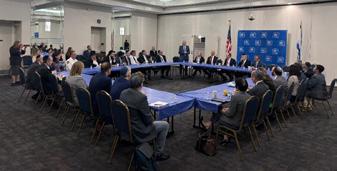
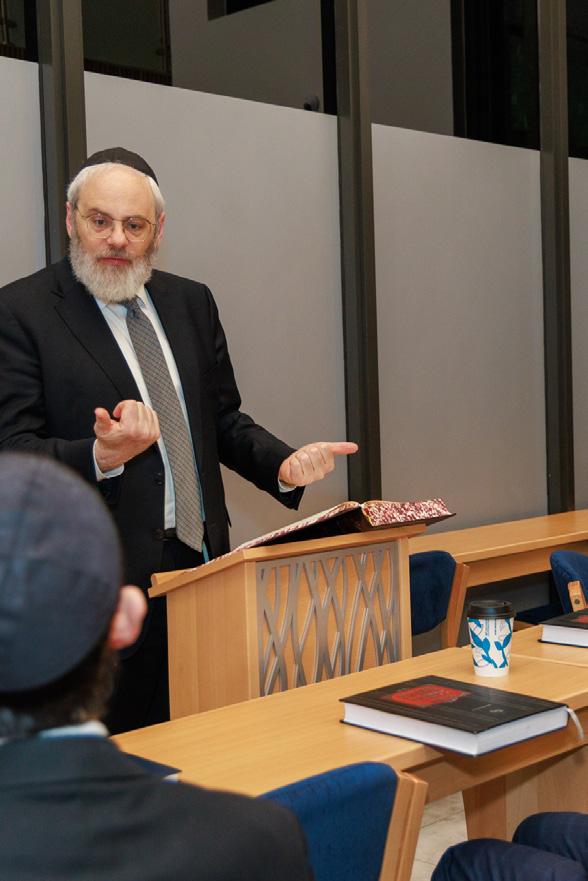
On Thursday morning, February 12th, Boca Raton Synagogue hosted a significant Jewish Civic Roundtable that brought together more than 20 elected officials and 20 prominent rabbinic leaders from across Palm Beach County to discuss issues impacting the county’s vibrant and growing Jewish community.
The gathering reflected the substantial role the Jewish community plays in Palm Beach County — representing anywhere from one-third to as much as half of the population in certain neighborhoods. With that presence comes both opportunity and responsibility, and the roundtable served as a forum for collaboration, dialogue, and partnership between community leaders and government officials.
Among the elected officials in attendance were Palm Beach County Mayor Sara Baxter, County Commissioners Marcy Woodward and Gregg Weiss, County Administrator Joseph Abruzzo, Sheriff Ric Bradshaw, County Clerk Mike Caruso, Boca Raton Mayor Scott Singer, State Attorney Alexcia Cox, Property Appraiser Dorothy Jacks, Representatives of the Fire Department, representatives from the Parks District, and three of the five Palm Beach County School Board members. Their presence underscored the importance of maintaining strong relationships between the Jewish community and local government at every level. Rabbinic leadership from throughout the county also participated, including Rabbi Goldberg,
By Jonathan Rubin
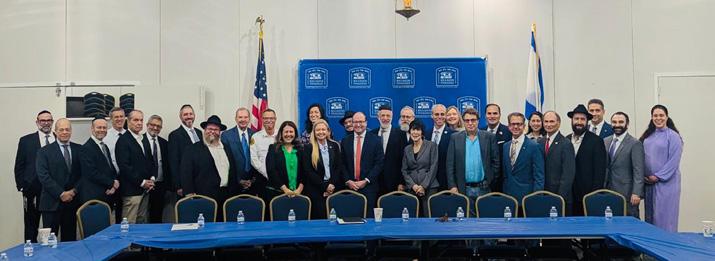
Moskowitz, Rabbi Denburg, Rabbi Rabovsky, Rabbi Alan Bell, Jonathan Rubin and many other respected spiritual leaders representing synagogues and Jewish institutions across the region.
The discussion centered on key issues facing the Jewish community today. Rising antisemitism — both locally and nationally — was a primary topic, with leaders emphasizing the need for continued vigilance, enhanced security measures, and proactive education efforts. Participants spoke about strengthening coordination between law enforcement, schools, and faith-based institutions to ensure that Jewish residents feel safe and protected. Many of these laws addressing antisemitism were drafted by Palm Beach County Clerk Mike Caruso during his time as State Representative.
Another important issue addressed was the county’s longstanding financial bond relationship with Israel, which totals more than $1 billion in investments. Officials and community leaders discussed the economic and symbolic importance of these bonds, reaffirming Palm Beach County’s strong ties to Israel.
Education was also a major
theme of the roundtable. With three School Board members in attendance, conversations focused on curriculum transparency, combating antisemitism in schools, Holocaust education, and ensuring that Jewish students feel supported in public educational settings. Additional topics included security funding for synagogues, the importance of preserving Shabbat observance in community planning, infrastructure matters such as new buildings being constructed, kosher food security, and maintaining and protecting local eruv boundaries that allow observant Jewish families to fully participate in Shabbat life.
“The tone of the morning was collaborative and solutions oriented. Elected officials expressed their commitment to listening and working closely with the Jewish community, while rabbinic leaders and civic advocates emphasized appreciation and the value of continued engagement and regular dialogue,” shared Rabbi Goldberg.
“Palm Beach County is one of the safest and best places to raise a Jewish family today in the United States. This is proven by the rapid growth of ours and neighboring communities.”
“With Palm Beach County approaching two million residents, in many ways, due to the leadership in this room, the county still feels
like a small town. To raise a family takes a village – and in this case a county,” shared Jonathan Rubin who coordinated this event.
The February 12th roundtable demonstrated the strength, influence, and unity of Palm Beach County’s Jewish community — and reinforced the shared commitment between public servants
and community leaders to address challenges together while building an even stronger future. A fellow summary of the event will be shared in the Sun Sentinel in the coming weeks.
If you are interested in getting involved with or have any questions or concerns regarding county issues, please reach out to Rabbi Goldberg or Jonathan Rubin.

A pro-Israel group is urging American Jews to cancel their trips to Spain, in response to the announcement by Spain’s Foreign Ministry that it is ‘permanently’ withdrawing its ambassador to Israel.
Moshe Phillips, National Chairman of Americans For A Safe Israel (AFSI), said:
“Spain’s announcement that it is eliminating its ambassadorial position in Israel, at the very moment Israel is fighting for its life against Iran and Hezbollah, is a moral disgrace. American Jews should respond by immediately canceling all planned trips to Spain.
“During the Holocaust,
Francoist Spain refused to take up arms against the Nazis and what is worse Spain gave Hitler’s SS their infamous Jewish Archive (Archivo Judaico) with records of all Jews who lived in Spain. Israel is trying to ensure that Iran, which for decades has had “Death to Israel” as its slogan and has been the sponsor of Hezbollah and Hamas, cannot continue to be an existential threat. Spain has once again completely lost its moral compass.
Americans For A Safe Israel thanks Senator Lindsey Graham for his condemnation of Spain’s decision. We agree with Senator Lindsey Graham’s statement that

“Spain is a member of NATO, and the United States and Israel are in joint operations against the Iranian regime who openly calls for the destruction of the Jewish State (and) attacks against the West ... (t)he religious Nazi regime in Iran is the problem, not the Jewish State.”
About Americans For A Safe Israel:
Established in 1970, Americans For A Safe Israel (AFSI) is one of the oldest and most influential pro-Israel organizations in the United States. Its advocacy and educational campaigns serve as a potent counterweight to the rising tide of anti-Israel propaganda. AFSI is not affiliated with any political party in the United States or Israel. AFSI’s website is www.afsi.org.
• DINE-IN
• SUSHI PLATTERS
• CATERING SETUP
10% DISCOUNTIF YOU BRING IN THE COMMUNITY VOICE MAGAZINE
• LIVE SUSHI STATION
• DELIVERY & PICKUP



By Dr. Yeshayahu (Yishy) Bick
President Trump has stated that Israel and the United States operate in Iran as allied partners. He also declared that the air forces of both countries are the finest in the world.
Israel has become the strongest military and economic power in the Middle East, and perhaps even a global force.
President Trump praises Israel’s prime minister for his leadership, and around the world Netanyahu is often referred to as “the modern Churchill.” Yet in Israel, his greatness is not fully recognized, and as the well-known saying goes, “A prophet is not honored in his own town” (a phrase taken from the New Testament).
Netanyahu is regarded as a distinguished leader who is guiding Israel to remarkable achievements across all fields. According to President Trump, without Netanyahu, Israel would have collapsed on October 7.
If we recall the starting point of that day, when Hamas invaded Israel and carried out a horrific massacre, the dramatic turnaround that followed will be credited to Netanyahu alone.
Turning back to Iran, fearful and hysterical, it continues attacking neighboring Arab states under the mistaken belief that these countries will pressure the United States to halt a war that could topple the Ayatollah regime. Iran is achieving the opposite: countries have begun responding with attacks of their own. A coalition is forming among states that
once cooperated with Iran, such as Qatar and Turkey, and they are now preparing for the downfall of the murderous Ayatollah regime.
This may even be a religious war between Sunnis and Shiites. Iran is Shiite, while most of the targeted states are Sunni.
Let us not forget that the Gulf states have no shelters, no Iron Dome or Arrow defense systems, and no early-warning systems. The damage is immense.
In my view, once the war ends, a new alliance will emerge between the Arab states and Israel, driven by the desire to align with the stronger side. The Abraham Accords will expand, and many will seek closeness with the United States’ ally.
Even Qatar is shifting direction and reconsidering its position in the new Middle East that Netanyahu is shaping, but that will be the subject of a separate article I will write soon.
Israel is now an ally of the world’s greatest superpower. Who would have believed it? And all thanks to a prime minister who is vilified by a small but vocal segment of the population.
A small and vocal segment, yet deeply rooted in centers of power, the media, the prosecution, and the Supreme Court.
Even the President of Israel, who is aligned with the political left, has delayed for 90 days in granting a pardon to the prime minister (despite having sole authority and not requiring approval from the prosecution). Leaders of
the Kaplan protest warned President Herzog that if he grants a pardon, they will revive the “nonprofit case” from which Herzog narrowly escaped in the past.
These are small-minded people consumed by an inexplicable hatred of the prime minister. People who fail to recognize the magnitude of the moment.
People who, even in critical and fateful hours, call for the prime minister’s removal, as if they have an alternative of equal stature.
One cannot expect much from small-minded people.
These are the same people who called for surrender to Hamas. People who dare to say, “We eliminated Khomeini. When will we eliminate Bibi?” (I heard it with my own ears.).
They are on the wrong side of history!
In previous articles I wrote about IDF generals who showed weakness and even open cowardice, building the false concept that “Hamas is deterred” in order to avoid confronting it. In Lebanon, they were afraid to remove a Hezbollah tent.
The prime minister at the time, Yair Lapid, handed Hezbollah economic maritime territory and promised decades of quiet. But who remembers?
Fortunately for Israel, after October 7, Netanyahu recognized the fear within the IDF General Staff and went directly to the field to speak with division and brigade commanders, who told him they could defeat Hamas if only given



the order.
Netanyahu ordered the entry into Rafah against the Chief of Staff’s position, and he was right.
Netanyahu ordered the entry into the Philadelphi Corridor despite opposition from the General Staff and Egyptian threats to cancel the peace treaty, and he was right.
Netanyahu delayed the attack in Lebanon to destroy Hezbollah until sufficient beeper stockpiles were secured, and he was right.
Netanyahu ordered the destruction of the Syrian army and its weapons before they could fall into rebel hands, and he was right.
Netanyahu ordered the development of an attack plan against Iran, an operation that began a week ago and is now underway to-
gether with the United States, and so far, he is right.
Yet all these remarkable achievements and the widespread admiration Netanyahu receives from leaders around the world, from India to the United States, collide with an Israeli deep state operating in the style of a Sicilian mafia.
The incomprehensible hatred and jealousy of the political left toward Netanyahu, and the legal persecution, harm us Israelis. We are shooting ourselves in the foot.
In my previous article I noted the irresponsible and delusional statements of opposition leaders. Instead of uniting during Israel’s darkest hour, they engage in petty politics.
The people of Israel are not


foolish, and in my view the opposition will weaken further, and some of it may disappear from the political map, because they are on the wrong side of history.
Israel now stands at the threshold of a new era, an era of military, diplomatic, and economic strength, and of being a strategic ally of the United States.
Out of the tragedy of October 7, a Jewish Israeli superpower has emerged, with a bright future ahead.
Am Yisrael Chai!!
Dr. Yeshayahu (Yishy) Bick yishybick@gmail.com


by Rabbi Moishe Kievman | Chabad Chayil
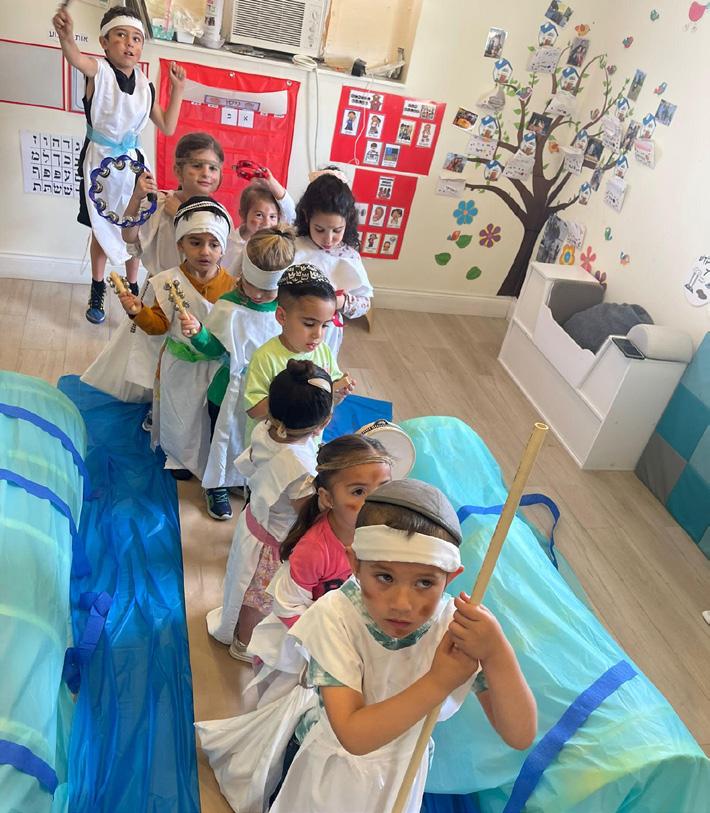
The eight-day festival of Passover is celebrated this year from sundown on Wednesday evening, April 1, 2026, until after nightfall on Thursday, April 9, 2026, with its highlight, the festive “Seder” dinners on the first 2 nights of the holiday. The festival of Passover commemorates the freedom of the Jewish nation from enslavement in Ancient Egypt, some 3338 years ago, in 1313 BCE. After many decades of slavery to the Egyptian pharaohs, Gd sent Moses to Pharaoh with a message to: “Let My People Go.” When Moses’ warnings were dismissed, Gd sent upon Egypt ten plagues, the last one being the killing of the Egyptian firstborn while “passing over” the Jewish homes—hence the name of the holiday.
To commemorate the unleavened bread that we ate when we left Egypt, we don’t eat—or even retain in our possession—any leavened grains known as chametz during the holiday. Chametz includes any food or drink that contains even a trace of wheat, barley, rye, oats, spelt or their derivatives, and which wasn’t guarded from leavening or fermentation. Instead, we eat matzah—flat unleavened bread, at least for the two Seder nights, when it’s a Mitzvah (biblical commandment).
Our Rabbis explain that chametz is symbolic of haughtiness and egotism - traits so harmful that they are at the root of all neg-
Credits: ChabadChayil.org/Preschool
ative traits. This is one of the reasons why even the most miniscule amount of chametz is forbidden - for these negative traits must be completely nullified.
Few Jewish holidays evoke the same warm sentiments as Passover. Memories of family and friends gathered as the four
cups of wine are poured, the four questions asked and the Matzah served, all contribute to Passover’s popularity in the Jewish community. Bringing the warmth and tradition of this festival to every major city in the world, Chabad is inviting all Jewish residents and visitors to participate in Commu-






nity Seders to be held on April 1st and 2nd at locations throughout South Florida.
This year’s observance will be even more celebrated, as is always the case when there’s antisemitism. Since the attacks on Simchat Torah (Oct 7, 2004) in Israel and on college campuses around the world, more and more Jews who were for whatever reason not affiliated, started coming closer to their heritage and began celebrating more. When a Jew is attacked simply because they are Jewish, they want to know more about what it means to actually live like a Jew.
And after the remarks of Tucker Carlson and Candice Owen’s ysv’z, it’s now well established that there’s no better place to celebrate than Chabad.
The Passover Seder is a feast that includes reading the Haggada, drinking wine, telling stories, eating special foods, singing, and other Passover traditions. The central observance of Passover— eating matzah, the unleavened bread—will take center stage at the Seder, with handmade round shmurah matzah, “The Rolls-
Royce of matzah,” available to all.
The Seders take participants through the wondrous liberation of our ancestors from Egyptian bondage, while sharing the relevance and beauty of the age-old festival in our modern lives. Included in the Seder will be a delectable catered dinner paired with a variety of fine imported wines and handmade round ‘Shmurah’ Matzah.
Passover is not simply a celebration of the historic liberation of an ancient people. Passover is about our own personal liberation – physically, emotionally and spiritually, a message that rings true this year perhaps more than ever before in our lifetimes as we still face the challenges of growing antisemitism. Passover inspires us to break free from the shackles restraining us from reaching new heights – in our lives, relationships and connection with G-d.
Chabad’s community seder is part of a global Passover campaign that began in 1954, when The Rebbe launched the Shmurah Matzah initiative. This year, over 770,000 people will participate at Seders at over 4,500 Chabad

Centers throughout the world and an estimated four million handbaked Shmurah Matzahs will be distributed.
We encourage you to contact your local Chabad or Synagogue to join the Seder nearest you. You are of course welcome to join my wife and I at our Seder in West Aventura, together with our family and community. To learn more about the holiday, order a readymade fully-prepared Seder plate, Shmura Matzah, RSVP for the seder or need help selling your Chametz, call (305) 770-1919 or visit ChabadChayil.org/Passover, where you can also download for free a beautiful brand new Haggadah with easy to understand explanations.
About the author:
Rabbi Kievman together with his wife are the ambassadors of The Rebbe to Highland Lakes, FL. They are the founders of Gan Chabad Preschool, your local CTeen & CKids chapters, CHAP - an afterschool program for Jewish children in Public Schools and direct Chabad Chayil. He’s the rabbi at The Family Shul and can be reached at (305) 770-1919 or rabbi@ ChabadChayil.org. You can also support the community with your partnership at ChabadChayil.org/Partner.








1. It Used to Be Part of the Army. Before 1947, the Air Force was actually part of the United States Army and was called the Army Air Forces. After World War II, it became its own military branch.
2. They Operate in Space Too. The Air Force historically handled many military space operations like GPS satellites. In 2019, many of those responsibilities moved to the new branch called the United States Space Force.
3. They Fly Some of the Fastest Aircraft Ever. The experimental North American X‑15 reached Mach 6.7 (over 4,500 mph), making it one of the fastest aircraft ever flown.
4. Their Demonstration Team Is Famous. The Air Force’s aerobatic team, the United States Air Force Thunderbirds, performs incredible air shows with precision flying just a few feet apart.
5. It’s One of the Largest Air Forces in the World. The USAF has over 5,000 aircraft, making it the largest air force on Earth.
6. They Run Area 51 Tests. Many secret aircraft tests happen at the famous Area 51, a highly classified Air Force test site.
7. They Have Their Own University. The United States Air Force Academy in Colorado trains future officers and is known for its extremely competitive admissions.
8. They Control the GPS System. The global GPS navigation system used by your phone, cars, and planes is operated by the U.S. military, historically managed by the Air Force.
9. Many Astronauts Came From the Air Force. A large number of astronauts in NASA were originally Air Force pilots, especially test pilots.

10. The Air Force Has Its Own Song. Every branch of the military has a song. The Air Force song is called “The U.S. Air Force” (often known as “Off We Go Into the Wild Blue Yonder”).
















Editor’s Note: In last week’s issue, the week of March 12th, we erroneously published a recipe that included both fleishig and milchig ingredients. We understand that this may have resulted in confusion and offense. We sincerely apologize for the mistake and will work to ensure that it does not happen again.
By Jamie Geller
This delicious potato kugel is based on my friend Lauren’s recipe and she swears by using red-skin potatoes. The cup idea comes from my husband’s best friend Adam’s mom, Geanie (what a mouthful). Hubby remembers going to their house on Saturday nights and raiding the fridge for these cups. The best part about them is that every piece is a crusty corner piece, so nobody has to fight over that coveted crunch.
Ingredients
• 3/4 cup extra virgin olive oil such as Colavita
• 3 eggs
• 2 teaspoons kosher salt
• ½ teaspoon freshly ground black pepper
• 6 large Idaho potatoes
• 1 large onion quartered
Tip:
To make this as a potato kugel pie, bake at 425°F in a 9-inch round glass baking dish for 1 hour 20 minutes, depending on desired crunchiness.

1. Preheat oven to 425°F.
2. Liberally oil six (4- to 6-ounce) glass dessert dishes or custard cups with 1 to 2 tablespoons of evoo each. Place custard cups on a baking pan.
3. Fill a large bowl with cold water and, as you peel potatoes, place them in cold water to prevent browning.
4. Place the pan of cups in 425°F oven to heat up the evoo (be very careful with glass, extreme temperature changes can cause it to shatter) .
6. Pour ¾ cup of evoo in a small saucepan and place over medium-low heat.
7. Cut potatoes lengthwise into halves or quarters so they fit into food processor feed tube. Process potatoes and onions using the blade that creates thin, shoestring-like strips.
8. Transfer potatoes and onions to a large bowl, add egg mixture and heated oil from stovetop, mix very well. Remove any large pieces of potatoes or onions that weren’t processed properly.
9. Remove heated cups from the oven and spoon potato mixture evenly into hot, oiled cups.
5. Beat eggs in a small bowl. Add salt and pepper, mix well, and set aside.
10. Bake at 425°F for 1 hour. If the sides are still pale, cook for 20 minutes longer until the tops look crunchy and sides look golden and browned. Loosen edges with a knife, unmold and serve on a platter.
Jamie Geller is the Chief Media and Marketing Officer at Aish. She is also a bestselling cookbook author, celebrity chef, television producer, and businesswoman. She’s the author of eight cookbooks and the founder of Kosher Media Network.
UptownGirlHeadwear.com
Sweat In Style!!
Quality Headscarves • Sun Visor Scarves • Cotton Caps • Snoods • Pre Tied Bandanas & Tichels For Fashion • For Frum • For Hair Loss Made in USA (718) 614 9604
Wine News!
The new ‘Noble Wines’ catalog has arrived, featuring our latest selection of premium wines. Request your free copy by mail. Just text or email your address and we’ll deliver it straight to your door. Text: (845) 716-8306 or email: news@noblewinesinc.com
Seeking 5–10k SF warehouse within one hour of Miami port. Must have 1–2 loading docks. Please call Nathan at 845-764-1755.
Top Handyman & Construction
848-318-6976, nikabrmv711@gmail.com
List your local business, services available, real estate opportunities, Help Wanted, & more!
Basic listing: $10/weekName, number and email address
Enhanced listing: $25/weekUp to 25 words (additional words $1/each)
Deadline:
Tuesday at 4pm for next week's issue
Contact: andrea@tsfcommunityvoice.com
In-Home Private Pilates for women to strengthen, realign, and ease pain. Personalized sessions and private events + Kosher Healthy Meal Prep. WellnessRena.com 305-404-3904 | WellnessRena@gmail.com
Computer, Laptop, iPad & iPhone Repair 954-367-3215
Free-Pickup-in-Aventura.FL
Coolstar Air
Service llc A/C Install & Repair (954) 200-1369 | coolstarair@yahoo.com
IT Tech Support & Low Voltage Services 561-331-1680 | barry@navonpro.com
MOVE TO NORTH FLORIDA
Most affordable housing in the entire state Esformes Hebrew Academy of Ormond Beach NOW HIRING
• Elementary teacher • Office manager • School Event Coordinator • Drama & Music, Coach Part-time and full-time positions
Quiet suburb School and shul community EsformesHebrewAcademy.org Email resume to chanidaytona@gmail.com
Bringing Sensitivity To The Mental Health Needs Of The Jewish Community
RAFAEL JAMES LCSW PSYCHOTHERAPIST (561) 903-2950
EMAIL: centerforempathyandhealing@gmail.com Florida Medicare & Florida Blue accepted
To place a Business Directory/Classified Listing contact: andrea@tsfcommunityvoice.com




4 bedrooms, 3 baths, 1,851sf
$7,800/M


The Olympus- 1-2 bdrms, 1.5-2 baths, 1000-1400sf Multiple Units available Starting at $199K
3 bdrms, 2 full baths, Pool, 1,905sf
$4,750/M H O L L Y W O O D
H O L L Y W O O D SOLD
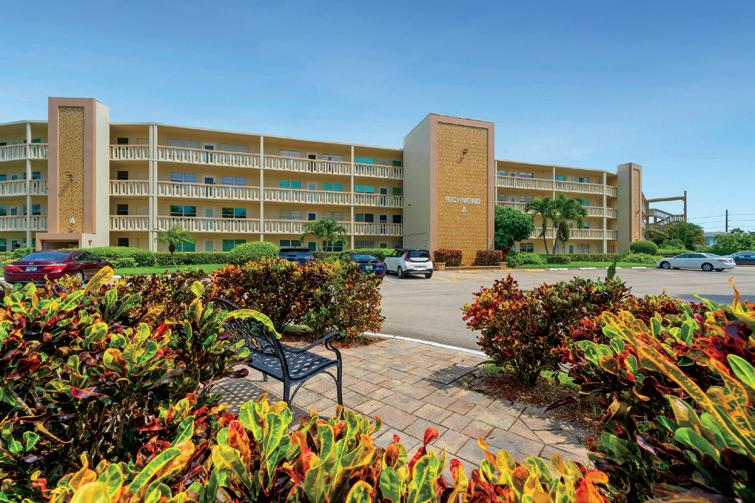
2 bdrms, 2 full baths, 1,000sf $239K
6 bdrms, 3.5 baths, 4,200sf, lot size 14,736sf
$1.995M

RENTED

The Spiaggia- 1 bdrms, 2 full baths, 927sf $3,500/M
There’s something powerful about driving through Israel and realizing that the roads beneath you, the ports along the coast, and even the buildings that shape the skyline didn’t appear overnight. They are the result of decades of vision, sacrifice, and relentless work. Few companies embody that story more clearly than Shikun & Binui.
Founded in 1924—long before the State of Israel was established—the company, through its subsidiary Solel Boneh, didn’t just develop infrastructure. In many ways, it helped make statehood possible.
Today, it’s easy to take infrastructure for granted. Highways, power plants, rail systems—they feel like part of everyday life. But in those early years, none of this existed. Building roads meant connecting isolated communities. Creating ports meant opening the country to trade— and survival. Establishing water systems meant transforming dry land into something that could sustain life.
That’s where Solel Boneh stepped in.
To call Solel Boneh “just” a construction company doesn’t quite capture its impact. It has often been described as the company that “built the country”—and when you look at its work, that statement feels less like a slogan and more like a reality.
From the Knesset and major power plants to the ports of Ash-

dod and Haifa, highways, hospitals, and even the Tel Aviv light rail, the company has been involved in building some of Israel’s most essential and recognizable infrastructure.
These aren’t just projects— they are the backbone of a functioning society.
But what stands out most is not only what was built, but why it was built.
Each project answered a real and urgent need at a defining moment in Israel’s development. Water had to reach communities. Trade routes had to be established. Government institutions needed a physical home. Infrastructure wasn’t a luxury—it was a necessity for survival.
One of the most compelling ideas behind these projects is that buildings carry stories. They are connected to people, to moments in history, and to the shared experience of a nation.
There’s something deeply meaningful about seeing struc-
tures built decades ago still standing—and even more so when you meet the families of those who built them. Parents, grandparents, entire generations who contributed to something far bigger than themselves.
It’s a reminder that behind every road, bridge, or building, there are people—engineers, workers, planners—who invested not just effort, but purpose.
In a place like Israel, where history is constantly unfolding, that connection feels especially strong.
Some infrastructure projects don’t just improve a country— they shape its future.
The National Water Carrier, for example, made it possible to transport water from the Sea of Galilee to other parts of the country, enabling agriculture and population growth on a national scale. Without it, Israel’s development would have been dramatically different.
The Port of Ashdod trans-
formed Israel’s economy by creating a major gateway for imports and exports—fueling growth, industry, and global connectivity.
And then there’s the Knesset. More than a government building, it represents sovereignty, identity, and the reestablishment of Jewish self-governance in the land of Israel.
These projects remind us that infrastructure is not only functional—it’s deeply symbolic.
What makes this story even more remarkable is that it isn’t just history—it’s ongoing.
Shikun & Binui continues to play a key role in shaping Israel’s future, with major projects in transportation, energy, and national infrastructure already underway.
Because the truth is, a country is never “finished.” It grows, evolves, and faces new challenges. Infrastructure must evolve with it.
Today’s projects are more complex, more advanced, and more global in scale. But the mission remains the same: to build what people need in order to live, grow, and thrive.
We often think of nation-building in terms of leadership, politics, or culture. But none of those can exist without the physical systems that support them.
Roads connect communities. Water sustains life. Energy powers progress. Infrastructure is what makes everything else possible.
The story of Shikun & Binui is a reminder that building a country doesn’t happen in a single moment—it happens over time, through consistent, often unseen work.
It happens in concrete poured, roads paved, and systems designed to serve generations.
When you look at Israel today—modern, connected, and constantly growing—it’s worth remembering that none of it happened by chance.
It was built. Piece by piece. Project by project. And behind much of that story stands a company that, for nearly a century, has helped turn vision into reality.

Why didn' t Pharaoh listen to Moshe?
Because he was in de-Nile.
What did the Egyptians say to the Jews by the Yam Suf ? Long time… Hey no sea!
What do you call a stupid frog? A dam tzfardaya .
What type of cheese is always kosher l'pesach? Matza-rella cheese.
ANNOUNCEMENT: Don' t forget every morning between Purim & Pesach to make the brocho HANOISEIN L' WIFE KOACH with big kavono.
Brought to you by Uncle Benjy, author of Laughter is the best medicine: Kosher and Jewish jokes for the whole family, volumes one and two, and Jewish Joke Book for Kids, volumes one and two, available on Amazon; search “Uncle Benjy ” on Amazon.
By Glen R. Golish
Last week we discussed the estate tax challenge that many real estate families face when wealth is heavily concentrated in property. Apartment buildings, commercial properties and development projects may represent tremendous value but without proper liquidity planning, those same assets can create difficult decisions when an estate transitions.
The natural question that follows is simple: what can families do about it?
The answer lies in structuring wealth intentionally long before a transition occurs.
One of the most important steps for real estate families is ensuring that properties are held in the appropriate ownership structure. Many portfolios grow organically over decades, with properties purchased in different entities, partnerships or sometimes even in individual names.
While this may work operationally during life, it can create complications during estate settlement. Clear ownership structures, coordinated with trusts or family entities, can simplify transitions and help ensure that properties remain aligned with long term family goals.
When ownership is organized thoughtfully, heirs are less likely to face confusion, disputes or administrative delays.
Planning for Liquidity Before It Is Needed

The second key element is preparing for liquidity needs before they arise.
After the death of the owner of real estate, estate taxes, debts and administrative costs often must be addressed within a relatively short period of time. Families who have planned ahead can address these obligations without disturbing the real estate portfolio itself.
Without that preparation, heirs may have few options other than selling properties or refinancing under pressure.
Planning early allows families to maintain control and make decisions strategically rather than reactively.
Another common issue for real estate families is that estate doc-
uments are often written without fully considering the operational realities of the property portfolio.
For example, a will may divide assets equally among children, even though some heirs are involved in the business while others are not. In practice, this can create tension around management control, cash flow and long term decision making.
A coordinated estate plan can address these dynamics in advance, balancing fairness with practicality while protecting the stability of the portfolio.
Beyond legal structures and tax considerations, the long-term success of real estate wealth often depends on the preparedness of the next generation.
Managing properties requires understanding financing, tenant relationships, maintenance decisions and market cycles. Families who pass wealth successfully across generations often focus as much on education and mentorship as they do on tax planning.
The goal is not simply to transfer assets but to transfer stewardship.
Real estate remains one of the most powerful tools for building long term wealth. However, portfolios that took decades to assemble can be disrupted quickly if transitions are not planned carefully.
Families who approach estate

planning proactively create stability during moments that might otherwise create uncertainty.
Because the ultimate objective is not simply to own real estate.
It is to ensure that the properties built over a lifetime remain part of the family legacy for generations to come.
About the Author:
Glen R. Golish is the Founder and CEO of G Wealth Strategies and a Forbes-recognized Top Financial Security Professional. He works closely with families on comprehensive financial and estate planning, including cross-border considerations for those navigating U.S. and Israeli planning needs.
Important Disclaimer:
Please seek qualified legal and tax advice before implementing any planning strategies, in conjunction with guidance from G Wealth Strategies.
Contact Information:
3010 N. Military Trail, Suite 318, Boca Raton, FL 33431 Office: 561-869-4600 | Cell: 561-239-9400 www.gwealthstrategies.com
Investment Advisory Contact: Yosef Benson yosef@gwealthstrategies.com, 786-376-3548
Property & Casualty Insurance Contact Rafi Benzaquen rafi@gwealthstrategies.com, 516-476-6742




















Earlier this week, a gentleman called me looking for financing to open a restaurant. He was super excited, very passionate, and had a lot of previous experience. He had a big portion of the funds needed to get it off the ground, but required bridge financing for the rest.
It was very easy to hear the enthusiasm in his voice. But when we started walking through the numbers and the reality of the business, I had to be honest with him. Restaurants have one of the highest failure rates of any industry. That is not a judgment about the person or the dream. It is simply the statistical reality of the business.
After that call, in an effort to try to build a better narrative for him for approval, I spent some time looking deeper into success rates across different industries. The numbers are fascinating. Day trading, for example, has an incredibly high failure rate. Most people who attempt to make a living trading stocks actively end up losing money. The Fashion industry is another tough category where passion often collides with unforgiving economics. Tech startups are also in the classification of high failure rates, and it is highly likely that that sector will continue to underperform.
In the high success group are professional services and consulting, such as mortgage professionals (yes, that’s what the reporting found), insurance agents, and
By Shmuel Shayowitz
business consultants. Electricians, plumbers, and handymen are also in high demand and regard. And not surprisingly, owning real estate has historically produced strong long-term outcomes, with a very high success rate.
A while back, I was interviewed on a podcast, and the host asked me a simple question. He asked if I considered myself “successful.” I told him that it really depends on how you define success. Then he asked what my definition was. My answer was, “To me, success means accomplishing what you set out to achieve.” It’s often as simple as that.
That definition might sound simple, but it carries a lot of weight. Success does not have to be measured only in decades or retirement balances. You can measure it daily, weekly, monthly, or annually. If you set a clear objective and follow through on it, that is success. If you keep doing that consistently, your success rate starts to compound over time.
This is exactly how I look at personal finance and real estate. It is not about chasing the most exciting opportunity. It is about aligning yourself with strategies that have proven success rates and then executing consistently. Real estate has been one of those strategies for generations. It may not be glamorous every day, but the long-term track record speaks for itself. The same can be said for disciplined saving, thoughtful investing, and building assets that
produce income.
The lesson from that restaurant conversation was not that someone should never pursue their dream. It was that we should always understand the odds and structure our financial lives accordingly. There is nothing wrong with ambition. But ambition works best when it is paired with strategy.
So, what is your personal success rate? When you set goals for yourself, do you follow through on them? Do you accomplish what you set out to achieve? Because in the end, success is not defined by headlines, titles, or comparisons to others. Success is defined by whether you do what you said you were going to do. And the more often you do that, the stronger your likelihood of accomplishing them becomes.
Shmuel Shayowitz (NMLS#19871) is a highly regarded Real Estate & Finance Executive, Writer, Speaker, Coach, and Advisor. He is President and Chief Lending Officer of Approved Funding, a privately held national mortgage banker and direct lender that has facilitated over $3 billion in mortgage funding. Shmuel has over twenty years of industry experience and holds numerous licenses and accreditations, including certified mortgage underwriter, licensed real estate agent, residential review appraiser, and accredited investor, to name a few. Shmuel has successfully navigated through many changing markets and business landscapes, making his market insights and experience well-coveted within the real estate industry. He can be reached via email at Shmuel@ approvedfunding.com.




Imagine Pesach is approaching.
The house is busy with preparations. Families are cleaning, shopping, planning the Seder, and looking forward to time together.
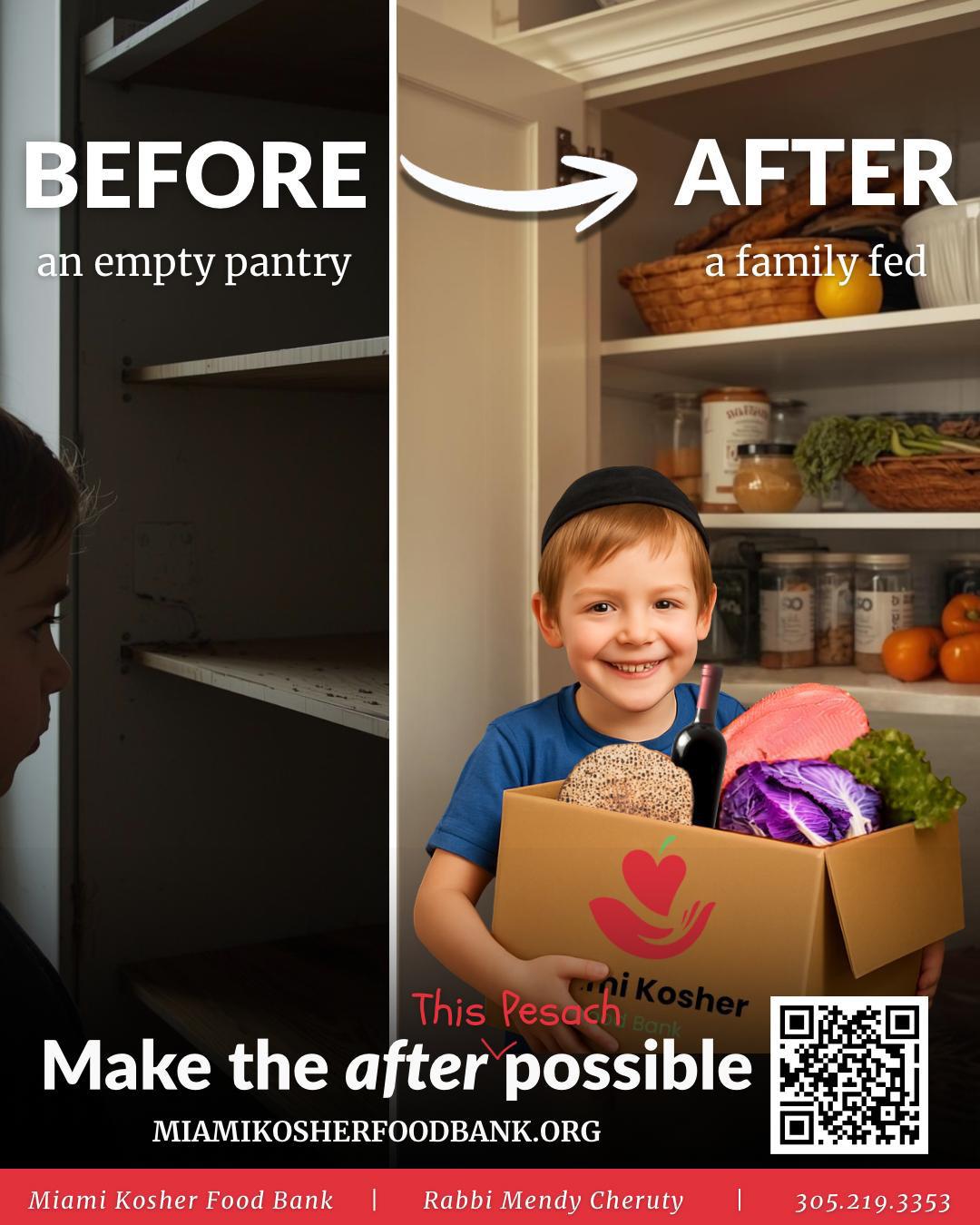
But for some families in our community, the feeling is very different. Instead of excitement, its worry.
Worry about how they will afford the food they need for Pesach.
No parent wants to imagine their family sitting down to an empty Seder table. Yet for many parents in our community, that is the reality.
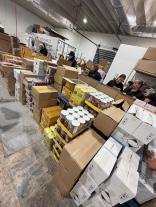
That is what Tomchei Shabbos is working to change.

Through the support of our community, we provide families with the food they need not only for Shabbos each week, but also for Yom Tov, ensuring they can celebrate with dignity.
This Pesach, we are working to help 600 families across South Florida, so they don’t have to worry about how they will have a kosher Pesach.
Instead of worrying about food, families should be able to focus on preparing their homes, spending time together, and planning their Chol Hamoed trips.

With your help, we can make sure every family has what they need for Pesach. Our Pesach campaign is live now.