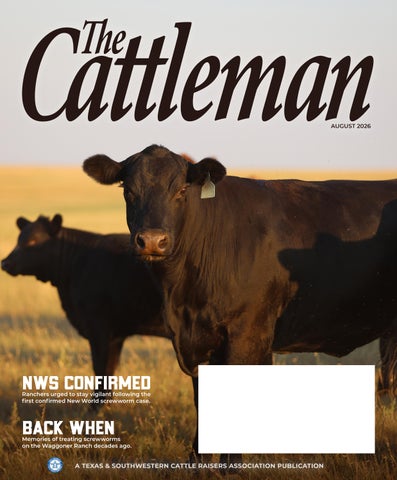
AUGUST 2026
NWS Confirmed Ranchers urged to stay vigilant following the first confirmed New World screwworm case.
Back When
Memories of treating screwworms on the Waggoner Ranch decades ago.
A TEXAS & SOUTHWESTERN CATTLE RAISERS ASSOCIATION PUBLICATION
Harlow Cattle Co. Bonded Livestock Dealer MAGA
Trusted Buyer of Feeder Cattle and Calves - Current or Forward Contracting - Feeder Cattle Basis Trades - Natural Premiums
Jason Griffin
Atoka, OK
(580) 271-1333
Kyle Parrish
Corsicana, TX
(903) 654-8996
Ty Grimsley
Nazareth, TX
(806) 685-5406
Blake Rogers
Collins, MS
(601) 315-0962
Cole Johnson
Dallas, TX
(214) 384-2653
Kade Setzer
Hydro, OK
(405) 929-0379
Don McCauley
Seymour, TX
(940) 256-8353
Tony Setzer
Eakly, OK
(580) 774-7403
Wes Miller
Independence, KS (928) 245-6560
Kevin Shaw
Hart, TX
(806) 346-2039
Huy Nguyen
Dallas, TX Office
Wesley Wood
Stephenville, TX
(254) 485-9781
(972) 672-9040
Proud supporter of TCU Ranch Management, TSCRA and TCFA
FEATURES 10
20
NWS Case Confirmed
Doctorin’ for Screwworms on Waggoner’s
A South Texas ranch manager’s observation led to the first confirmed NWS case in Texas in decades. By Jena McRell
The Elliott brothers recall wild cattle, good horses and daily battles with screwworms. By Ginger Elliott
DEPARTMENTS in the News
theft & LAW Ranching
Beyond Gates
IN EVERY ISSUE From the Editor
6
Where We Stand
28
Director Spotlight
60
TSCRA Directory
62
30 32 37
What’s Happening at TSCRA Industry Briefs MARKETING CALVES AND CULL COWS Ranching 101 webinar set for Aug. 18.
New Members
66
38
OBITUARIES
Auction Markets & Market Inspectors
70
40 42
Special Ranger Activity CRIME WATCH
Breeder’s Bulletin Board
74
Upcoming Events
78
44
Built for the Future
Ad Index
80
48
Supplementing with Intent
A Look Back
82
50
Preventing heat stress
54
Plant of the Month
56
BQA Tip: Understand Repro Rates
58
United in the Federation
Strengthening profitability for the next generation. Be strategic with nutrition when monitoring for NWS. AgriLife Extension experts explain how environment and planning affect herd health. Dutchman’s Breeches (Thamnosma texana)
How state beef councils work together to promote beef.
From the Editor
UNITED AGAINST SCREWWORM T
he past several months have reminded us what defines the cattle industry at its best. Ranchers, landowners, and state and federal agencies have worked hand in hand to ensure the first confirmed U.S. detections of New World screwworm were met with a rapid, coordinated response. In this issue, you’ll read the story of the NWS index case in South Texas. What began as a routine check for Texas & Southwestern Cattle Raisers Association Director Robbie Graff became a defining moment in our industry’s response. His quick actions triggered a series of events that demonstrated exactly how the nation’s NWS response system is designed to work. You’ll also get a glimpse into past struggles with screwworms at Waggoner Ranch, where generations of cowboys battled the pest before eradication became reality. Their stories remind us that vigilance has always been part of ranching. Today’s ranchers have better tools, better science and stronger partnerships, but the responsibility remains the same. As you navigate this time, Texas & Southwestern Cattle Raisers Association is with you. We have resources to
6 |
The Cattleman
support ranchers and landowners as they monitor, prepare and respond should a suspected NWS case arise. Among the tools is the association’s New World Screwworm Producer Guide, which includes treatments, procedures for collecting samples, larval disposal instructions, movement restriction details and other important information. We’re also looking forward to seeing many of you as our local Ranch Gatherings begin across Texas this month. These are opportunities to connect with members and hear what’s happening throughout the association. Learn more on page 61. Any business looking to support and plug in to these events is also encouraged to reach out. CT
Jaclyn Roberts Parrish Executive Director of Communications, Marketing & Partnerships/Editor-in-Chief, The Cattleman jaclyn@tscra.org • 817-916-1794
tscra.org
August 2026
New threats like New World screwworm require a trusted strategy. The only nonprescription product conditionally approved by the FDA for use in cattle to prevent and treat it. •
Dectomax-CA1 is indicated for prevention and treatment of infestations caused by New World screwworm larvae, and prevention of reinfestation for 21 days, with a short, 35-day withdrawal period.
•
Supported by multiple studies and trials1-4 demonstrating the conditional approval of Dectomax-CA1 against New World screwworm larvae.
•
Learn more
Help protect your herd — tackle the problem of New World screwworm with Dectomax/Dectomax-CA1.
Image Source: USDA
Dectomax-CA1 is conditionally approved by FDA pending a full demonstration of effectiveness under NADA 141-616. Important Information: Dectomax/Dectomax-CA1 Injectable for use in cattle have a 35-day pre-slaughter withdrawal period. Do not use in female dairy cattle 20 months of age or older. Do not use in calves to be processed for veal. Use of Dectomax or Dectomax-CA1 in dogs may result in fatalities. Consult your veterinarian for assistance in the diagnosis, treatment, and control of parasitism. 1
Moya-Borja GE, Muniz RA, Umehara O, Goncalves LCB, Silva DSF, McKenzie ME. Protective efficacy of doramectin and ivermectin against Cochliomyia hominivorax. Veterinary Parasitology. 1997;72(2-3):101-109. https://doi.org/10.1016/S0304-4017(97)00082-4
2
Moya-Borja, GE, Oliveira CMB, Muniz RA, Goncalves LCB. (1993). Prophylactic and persistent efficacy of doramectin against Cochliomyia hominivorax in cattle. Veterinary Parasitology, 1993;49(1):95-105. doi:10.1016/0304-4017(93)90228-F
3
Muniz RA, Anziani OS, Ordoñez J, Errecalde J, Moreno J, Rew RS. Efficacy of doramectin in the protection of neonatal calves and post-parturient cows against field strikes of Cochliomyia hominivorax. Vet Parasitol. 1995;58(1-2):155-161. doi:10.1016/0304-4017(94)00702-e
4
Anziani OS, Flores SG, Moltedo H, et al. Persistent activity of doramectin and ivermectin in the prevention of cutaneous myiasis in cattle experimentally infested with Cochliomyia hominivorax. Vet Parasitol. 2000;87(2-3):243-247. doi:10.1016/s0304-4017(99)00167-3
All trademarks are the property of Zoetis Services LLC or a related company or a licensor unless otherwise noted. © 2026 Zoetis Services LLC. All rights reserved. DMX-00242
August 2026 / / Vol. CXIII, No. 3 Published by Texas & Southwestern Cattle Raisers Association P.O. Box 101988, Fort Worth, Texas 76185 Phone: 817.332.7064 • Fax: 817.394.1864 tscra.org EDITORIAL Editor-in-Chief
Jaclyn Roberts Parrish
Managing Editor
Jena McRell
Associate Editor
Shelby Kirton
Copy Editors Graphic Designer
Kayla Jennings, Elyssa Foshee Sanders Ryan Barten
EXECUTIVE DIRECTORS Executive Vice President/CEO
Jason Skaggs
Communications, Marketing & Partnerships
Jaclyn Roberts Parrish
Events, Education & Leadership Development
Emily Lochner
Finance & Human Resources Government Relations Law Enforcement, Brand & Inspection Services Membership & Operations
Megan Wills Peyton Schumann Clay McKinney Lisa Walker
OFFICE LOCATIONS Fort Worth 2813 S. Hulen St., Suite 150 Fort Worth, Texas 76109
ON THE COVER A late summer sunset with a group of cow-calf pairs near the Texas Panhandle. Photo by Crystal Albers
Austin 919 Congress Ave., Suite 750 Austin, Texas 78701 Subscription Inquiries: tscra@tscra.org or 800-242-7820 Advertising Sales: sales@tscra.org or 817-332-7064
Published on the first day of each month by Texas & Southwestern Cattle Raisers Association Inc., P.O. Box 101988, Fort Worth, Texas 76185. The Cattleman (ISSN 0008-8552, USPS 095000), copyright 2026 by Texas & Southwestern Cattle Raisers Association. Title registered U.S. Patent and Trademark Office. Member Alliance for Audited Media. Subscription $50 per year; foreign $70 per year. Correspondence on all phases of the cattle business is invited. Publisher reserves exclusive rights to accept or reject advertising or editorial material submitted for publication in The Cattleman magazine. Periodicals postage paid at Fort Worth, Texas, and additional mailing offices. POSTMASTER: Send address changes to: The Cattleman, P.O. Box 101988, Fort Worth, Texas 76185, 817-332-7064, FAX 817-394-1864. All members of Texas & Southwestern Cattle Raisers Association receive a monthly copy of The Cattleman as a benefit of their membership.
8 |
The Cattleman
tscra.org
August 2026
I Don’t Need Any Surprises...
! n a M l l a h s r a M x I’m Still a Wa “ WAX Genuine Marshall ryegrass is my choice of ryegrass… ryegrass … been planting ryegrass for more than 20 years for grazing and hay. Majority of the time I have used WAX Marshall, but also try some of the new ryegrasses to see how they compare to my standard… WAX Marshall… I am still a WAX Marshall ryegrass man!
I have tried the “Generic Marshall” from my local co-op. In short, it did not come close to production or have the carrying capacity like WAX Marshall… it looked more like Gulf… it did not have the vigor and fast recovery like WAX Marshall. Every year is different and full of unexpected surprises, but from all my years with WAX Marshall, I feel confident in the outcome. The “Generic” just did not produce. Planting 700 acres of ryegrass, I do not need any surprises for myself or my cattle.
EED G U A R A NiTn e
Genu
TM
There has only been one consistent ryegrass for me for over 20 years… WAX Marshall ryegrass. If you want real Marshall ryegrass, make sure you ask for WAX Genuine Marshall… I do! ”
Bud Glasscock Bag Design is a Registered Trademark of The Wax Company LLC
Marshall... America’s #1 Ryegrass! BWI Companies Texarkana 800 442 8443 • Schulenburg 800 460 9713 Dallas 800 752 6632 The Wax Company 888 CALL WAX
*
®
The Wax Company 888 CALL WAX Seeds for Southern Soils
*For grazing. According to university grazing studies - AL AR LA MS ©2026 The Wax Company, LLC
NWS CASE CONFIRMED
U.S. Secretary of Agriculture Brooke Rollins, left, rides alongside J.R. Ramirez and Robbie Graff, Texas & Southwestern Cattle Raisers Association directors, on the Chaparrosa Ranch.
10 |
The Cattleman
tscra.org
August 2026
A South Texas ranch manager’s observation led to the first confirmed NWS case in Texas in decades. Story by Jena McRell Photos courtesy of USDA
A
t first, it looked like nothing more than a late calf.
On Rock Creek Ranch near La Pryor, Robbie Graff spent the morning of Tuesday, June 2, checking cattle, putting out cake and filling cisterns. Around 11:45 a.m., he was riding through a pasture of heifers when a cow appeared with a newborn calf at her side. “That’s funny,” Graff remembers thinking. “We usually don’t have calves on the ground right now. She must’ve been late.” Based on his most recent check, he figured the light-brown baldy calf was about 3 days old. He stepped down from the saddle and walked closer. Then came the flash of red. The calf’s navel was swollen and inflamed, with fresh blood surrounding the wound. Graff’s first thought was that a coyote or feral hog had injured the calf soon after birth. He and another ranch employee roped the calf and got it to the ground for a closer look. The scene triggered a decades-old memory. Graff was about 8 years old during the South Texas screwworm outbreak of the mid-1970s. He often tagged along with his father and grandfather as they doctored cattle, carrying medicine and the test tubes used to collect larvae samples. “I don’t remember much from that age,” Graff says. “But you don’t forget that. You dang sure don’t forget what the larvae looked like in the wound.” They sprayed the calf’s navel with Catron, a wound spray that kills and repels flies and fly maggots. The treatment did not kill the larvae, but did reveal the larger infestation. Graff knew New World screwworm had been moving north through South America throughout the past 18 months, but it still seemed unlikely that it could have reached Zavala County. “In the back of my mind,” Graff says, “I kept hoping, praying it was not the screwworm.”
August 2026
tscra.org
The Cattleman
| 11
Work the plan Within the hour, Graff and the ranch crew moved the calf to a nearby concrete slab for a closer look and immediate treatment. Moving it off the pasture was a precaution to keep any larvae from dropping into the soil and continuing the fly’s life cycle. As they worked, Graff reached out to his friends and fellow ranchers involved in Texas & Southwestern Cattle Raisers Association. He sent a photo of the calf to Wayne Cockrell, Texas & Southwestern Cattle Raisers Association second vice president; Dr. Chris Womack, a veterinarian from San Angelo and vice chair of Texas & Southwestern Cattle Raisers Association’s cattle health and wellbeing committee; and Lew Thompson, of Pearsall, an association director and executive committee member. Everyone immediately agreed to Graff’s NWS suspicions and urged him to act quickly. He already had a clear plan in place for what to do next. They removed about 40 larvae from the wound and treated the calf with antibiotics and topical fly control. Roughly half the larvae samples went into a syringe and were delivered to Dr. Anthony Allen at Pearsall Veterinary Clinic. The remainder were placed in a coffee can and destroyed with gasoline. Allen contacted the Texas Animal Health Commission lab in Beeville, which picked up the sample around 5:30 p.m. and forwarded it overnight to the National Veterinary Services Laboratories in Ames, Iowa. Back at the ranch, the next 24 hours were critical. “We were pretty much in go mode,” Graff says. “Getting everything gathered and ready to go through the routine.” Graff and his team treated the calf’s mother and remaining heifers with Dectomax for parasite control, Cydectin pour-on and StandGuard fly control, and checked each animal for open wounds. No additional cases were found — and none have been detected since. The following day, Wednesday, June 3, the crew ran about 400 head through the chute, applying the same preventative treatment. Texas Animal Health Commission and USDA representatives were on site to document the response and verify protocols. That evening, Graff received a call from Allen confirming what he already suspected — this was the first confirmed NWS case in Texas in decades. Graff believes the infestation began quickly after birth. “I imagine right after the calf was born, that the female screwworm fly had to have hit it immediately,” he says.
12 |
The Cattleman
tscra.org
TSCRA Director Robbie Graff, pictured top, shares his story with U.S. Secretary of Agriculture Brooke Rollins during her June 11 visit to Rock Creek Ranch, where she observed the calf with the first confirmed case of New World screwworm. By that time, the calf, pictured right with its mother, had healed and recovered.
August 2026
“The number one thing is to get that animal contained, check the wound and get it turned in immediately.” — Robbie Graff, Rock Creek Ranch
August 2026
tscra.org
The Cattleman
| 13
A scientist at the Knipling-Bushland U.S. Livestock Insects Research Laboratory in Kerrville inspects screwworm larvae. The lab is also responsible for testing samples and confirming the presence of NWS.
Female screwworm flies lay up to 300 eggs at a time in fresh wounds. Within about seven days of infestation, the larvae drop from the wound and burrow into the soil to pupate. About a week later, depending on weather and environmental conditions, adult flies emerge, mate and begin the cycle again, making early detection critical. Vigilant monitoring, early action and rapid reporting helped slow the threat before it could spread beyond Rock Creek Ranch. Beginning the evening of June 3, aerial drops of sterile flies — the only proven tool to eradicate screwworm — were launched across the property and the established infested zone.
“The first case was textbook with regard to surveillance, reporting and getting sterile flies dispersed within a 24- to 48-hour timeframe,” says Texas & Southwestern Cattle Raisers Association President Stephen Diebel. “Catching it early gives us an opportunity to stay ahead of this issue. The response worked exactly the way we hoped it would.”
Staying ahead
Despite the shock of finding the NWS index case in his herd, Graff says the industry is far better equipped today than it was a generation ago. About a week following treatment, he says the calf’s wound was nearly healed. Graff attributes the rapid healing to improved animal health protocols and faster treatments. Advancements in monitoring, surveillance and communication have also improved response efforts.
For nearly two years, Texas & Southwestern Cattle Raisers Association and partner organizations in the Screwworm Coalition of Texas have worked together
Even with modern tools, the primary method of eradication remains the sterile fly technique introduced in the 1960s. The process involves releasing sterile male
“The number one thing is to get that animal contained, check the wound and get it turned in immediately,” Graff says. “Because the sooner you get it turned in and confirmed, the sooner you’re going to be getting the sterile flies dropped on you. And that’s the main thing — the quicker, the better.”
14 |
to help organize an industry response. Through weekly calls and coordination with state and federal officials, the coalition was responsible for providing feedback and education throughout the planning process. Because of these efforts, industry leaders say they were positioned to respond to a positive detection of NWS.
The Cattleman
tscra.org
August 2026
Status on Sterile Flies Thanks to advocacy efforts by Texas & Southwestern Cattle Raisers Association and other state and national partners, USDA moved quickly to expand sterile fly production capacity. The process of raising and sterilizing NWS flies requires biosecure, highly specialized facilities. Prior to June 2026, the only facility producing sterile flies in North America was the Panama-U.S. Commission for the Eradication and Prevention of Screwworm, commonly known as COPEG, just east of Panama City. Part of eradication efforts for nearly 30 years, the facility produces about 100 million flies per week. A new facility in Metapa, Chiapas, Mexico, opened June 27. USDA invested $21 million to renovate and convert an existing fruit fly facility to increase production capacity. Once fully operational, the plant will produce up to 100 million sterile NWS flies per week. “Every sterile fly produced helps the U.S. get closer to eradicating NWS and establishing a biological and geographical barrier to protect Texas ranchers and landowners,” says Texas & Southwestern Cattle Raisers Association President Stephen Diebel.
3
2 1
Production Facilities
1 COPEG, Panama City, Panama 2 Metapa Facility, Chiapas, Mexico 3 Moore Air Base, Edinburg, Texas
Construction is also underway on a U.S.based production facility at Moore Air Base in Edinburg. The USDA has invested $750 million in the South Texas complex, which is expected to reach an initial production goal of 100 million sterile flies per week by November 2027, with projected long-term capacity of up to 300 million per week. A dispersal center at Moore Air Base, opened Feb. 9, is already active, coordinating the shipment and release of sterile flies. The insects are packaged and shipped frozen to preserve viability before being released by air or ground. “The solution is sterile fly production,” Diebel says. “It’s also surveillance, reporting, understanding treatment and prevention protocols, and doing this at an early stage.” Currently, sterile fly production yields an equal mix of males and females. Emerging technology through NovaFly would enable the release of 100% sterile males, greatly improving the efficiency of production. The long-term goal is to push NWS back to the Darién Gap in Panama, a natural geographic barrier that once prevented its spread northward.
Fall Preparations Dr. Chris Womack, a veterinarian in San Angelo and vice chair of Texas & Southwestern Cattle Raisers Association’s cattle health and well-being committee, says he has received questions from producers about whether routine herd work should be delayed this fall in light of New World screwworm concerns. His advice is to proceed with standard animal health and management practices, including vaccinations and castration, but with added precautions. “I would hate to think you wouldn’t vaccinate your calves,” Womack says. “That’s an important procedure. And if you don’t castrate your calves, are you going to have a bunch of bull calves running around come September?” He recommends using preventative animal health products such as ivermectin or Dectomax, and applying approved wound care products to castration sites, branding wounds and ear-tag locations. “Be aware that you’ve created a wound that’s a potential source of infestation,” he says. “And be more vigilant for a couple weeks afterward.” Texas & Southwestern Cattle Raisers Association President Stephen Diebel, a rancher from Victoria, emphasizes the importance of subscribing to Beef Quality Assurance standards and proper facility maintenance. Look over gates, panels, cattle handling facilities and trailers to ensure there’s no added risk for livestock. “Do your due diligence and make sure we’re not creating unnecessary wounds during these times when you do perform these animal husbandry practices,” Diebel says. Womack also stresses the importance of planning ahead and maintaining a strong veterinarian-client relationship as part of routine herd health management. Texas & Southwestern Cattle Raisers Association has published a New World Screwworm Producer Guide that details important pharmaceutical information, and instructions for how to collect and submit samples. Scan the QR code to the right to download a copy.
16 |
The Cattleman
flies into a population to mate with wild NWS females, preventing reproduction and eventually collapsing the population of the pest. Graff remembers seeing the red-and-white boxes of sterile flies released from airplanes during eradication efforts decades ago. In addition to aerial drops, sterile flies are also being released from ground distribution points. “The main objective is having enough flies to get it done,” Graff says. “It took about 500 million [per week] back in the ’60s to eradicate it, but it was horrible then.”
In it together Since the initial shock of the NWS confirmation and the flurry of interviews, ranch visits and reporting that followed, Graff says daily operations at Rock Creek Ranch have largely returned to normal. “The biggest thing is we started riding every day,” he says. “Checking all the cattle, all of them we can see. It’s an everyday process.” Graff has also emphasized to fellow cattle raisers that NWS is not transmitted directly from animal to animal. If wounds are identified and treated early, survival rates are high and the rest of the herd can be protected. There is no risk to the food supply chain. In the early days following the confirmation, Graff says there was concern about potential livestock movement restrictions. Treated and inspected cattle on Rock Creek Ranch were cleared to move 72 hours after protocols were implemented. Like all ranchers in the 12.5-mile infested zone, livestock movement could occur after receiving a NWS animal movement certificate from Texas Animal Health Commission. If no further cases are confirmed, the infected zone status will be lifted in about 90 days, allowing for multiple NWS lifecycles to occur. Diebel says that outcome reflects how the system is designed to work. Graff quickly recognized the issue, reported it and followed treatment protocols. In doing so, Rock Creek Ranch became a working example of the response system Texas & Southwestern Cattle Raisers Association and partners have been advocating for. “What made everybody nervous is that they were afraid these short-term movement controls were going to impede commerce,” Diebel says. “But now we know that they don’t, and we have a way to work through that.” Looking ahead, Graff says the ranch will remain vigilant, especially as calving season begins in September. “Hopefully by then we can do everything we want to do,” he says. “But if we can’t, we’re probably not going to castrate, earmark, dehorn or brand. We will wait and see
tscra.org
August 2026
Sterile fly ground release chambers contain pupae dyed for identification. The fluorescent color is visible under UV light and helps animal health officials distinguish sterilized NWS flies from wild flies. Green dye is used for U.S. flies while Mexico-originating flies are dyed orange.
Movement Requirements Ranchers operating outside a New World screwworm-infested zone, which is designated in yellow on the interactive Texas Animal Health Commission map, have no restrictions and may move livestock as normal. Animals inside a yellow infested zone require a physical inspection and NWS animal movement certificate. To receive a NWS animal movement certificate from an infested zone:
• The owner must contact a veterinarian, state or
federal animal health official, or authorized NWScertified inspector at least two days prior to the movement date.
• All animals must have official identification and a premises identification number, or PIN.
• Any animal with an open wound or NWS
infestation cannot move until the wound is healed.
Non-slaughter animals:
• Must receive preventative treatment at least 48 hours prior to movement.
• Once inspected and certified, animals have five
days from the date of inspection to move outside of the infested zone.
Slaughter-bound animals:
• Not required to receive preventative treatment. • Once inspected and certified, animals have three days from the date of inspection to the date of slaughter.
Source: Texas & Southwestern Cattle Raisers Association NWS Producer Guide
how calving goes, and hopefully we can get some cold weather.” NWS flies cannot survive in temperatures at or below 54 degrees Fahrenheit, so ranchers across Texas and the Southwest will be hopeful for an early cold snap. Still, Graff says the experience has reinforced confidence in the response system — and in the industry’s ability to handle it again if needed. “Maybe it was a blessing,” he says. “If we hadn’t had the calf, we wouldn’t have seen all this. It could have gone on a month or two, and we’d have a real problem. “There’s a lot of optimism right now because we’ve already been through it and eradicated it, and we know we can do it again.” CT Graff, pictured second from right, says he remains positive despite the NWS challenges facing ranchers and landowners in the Southwest.
Jordan Cattle Auction…
WEEKLY SALES HELD AT 11:00 a.m.
Special Replacement Female Sales
Special Bull Sale
Monday – Mason Thursday – San Saba
Saturday, August 22, 2026 @ 10:00 a.m. – San Saba
Thursday, October 8, 2026 @ 10:00 a.m. – San Saba
Consignments Welcome!
Featuring Dybdal Charolais & RR Ranch Angus Bulls Books are Closed!
Where Cattlemen Come to Buy and Sell! Saturday, September 26, 2026 @ 10:00 a.m. – San Saba Consignments Welcome!
*Wednesday, October 14, 2026 @ 11:00 a.m. – San Saba 13th Annual Hill Country Youth Heifer Sale
Fall “Best of the Best” Replacement Female Sales
Cannon Charolais & Schaefer Farms Angus Bull Sale
For more info on above sales or online viewing and bidding, please call or visit our website.
Thursday, November 5, 2026 @ 10:00 a.m. – San Saba Charolais & Angus Bulls
Saturday, October 24, 2026 @ 10:00 a.m. – San Saba Offering quality pair, bred cows, bred heifers, and open or exposed heifers. Don’t miss your opportunity to buy some of the best females in the country! The seller and buyer of the top-selling females in each of the classes will receive a trophy. All cattle will be five years of age or younger! Consignments Welcome!
18 |
The Cattleman
tscra.org
August 2026
TOOLS OF THE TRADE From garden to back pasture, Henry Repeating Arms builds firearms for the work ranch life demands. From keeping your land pest and predator free, to putting food on the table, and protecting what you hold dear, there’s a Henry built for it.
Tracker Rifle & Carbine Fast-handling rimfire rifles built for small game hunting and keeping varmints in check. .22 S/L/LR | .22 Magnum
Homesteader Carbine What’s Yours Remains Yours with this semi-auto carbine designed for home and property protection. 9mm – Glock/Sig/S&W Magazine Compatibility
Provider Rifle A hard-hitting lever-action rifle made for dependable deer hunting. .30-30 Win | .45-70 Gov’t
Lever Action Supreme Rifle A modern lever-action rifle built for fast follow-up shots and the accuracy needed for predator hunting. .223 Rem/5.56 NATO | .300 BLK
Garden Gun A handy, easy-to-carry smoothbore rimfire built for close-range pest control around the garden, barn, and outbuildings. .22 S/L/LR | .22 Magnum
Explore 250+ Rifles, Shotguns, and Revolvers
SCAN or VISIT
LIFETIME WARRANTY | 100% SATISFACTION GUARANTEE
ORDER YOUR FREE CATALOG AND DECALS
HenryUSA.com/catalog
DOCTORIN’ FOR SCREWWORMS ON
WAGGONER’S
The Elliott brothers recall wild cattle, good horses and daily battles with screwworms. By Ginger Elliott
I
n the early 1960s, a screwworm epidemic was in full force in Texas, devastating many ranches — including the north-central W.T. Waggoner Estate, a 520,000-acre cattle operation that ran 12,000 cows.
During those years, third-generation cowboy Manford Elliott — who later served as a Texas & Southwestern Cattle Raisers Association Special Ranger — and his wife, Ann, were raising their five children at the 40,000acre Fulda Camp in the southeastern part of Waggoner’s. The family moved there in the late ’50s, and Manford was responsible for looking after about 900 cows. Among their children are three brothers — Bob, Bill and Cotton — who carry vivid memories of growing up on the range. The boys learned how to treat screwworms, by roping and doctoring wild cattle, during a time when the pest ran rampant. The landscape was thick and rugged, with vast pastures and miles of brush in every direction. “Prior to the 1920s, there were only a few mesquites on the Waggoner Ranch,” says Bob, Manford’s oldest son. “Through the years, the mesquite trees began to flourish and grow thick, big and tall. Then when World War II broke out in 1939 and all the able-bodied men and boys went to war, that left mostly the old men and the young boys at Waggoner’s to take care of things. “The mesquites got thick on the outfit; the cattle got spoiled and wild because those young boys couldn’t do the job of the grown men. The horses got hard to get along with because they weren’t being ridden and trained by the cowboys. During the war, the cattle began to get hard to handle. “The open range wasn’t open anymore, and it totally changed the way Waggoner’s did things. Even when they eventually got the brush down, it helped, but those cattle were still wild.”
20 | The Cattleman
tscra.org
August 2026
Top: Manford Ellliott rides a palomino while working cattle at Waggoner’s. Photo courtesy of the Elliott family. Bottom: Elliott during his time as a Texas & Southwestern Cattle Raisers Association Special Ranger. Photo by Bob Moorhouse.
August 2026
tscra.org
The Cattleman
| 21
Right and opposite: Scenes from the Waggoner Ranch published in Francis Edward Abernathy’s 1975 book Some Still Do. Courtesy of the Elliott family.
Like hunting deer Bob remembers his father and the other cowboys trying to doctor infested cattle in what he describes as a 50,000-plus acre brush thicket. “The cattle were like deer. So basically, we had to prowl into the wind like we were hunting wild game,” he says. “You couldn’t see the cattle, but you knew where they watered or loafed in the shade. To get close enough before they scattered, you’d get off in the bottom of the draw where the cattle could not see or smell you coming. “You might see an animal with a case of worms, and you could smell those cows. But a lot of times they flushed before you got there, after hearing you coming. Once you got where the cattle had been, you looked around on the ground for blood. Once you found that, the good horses knew where the cattle were.” Bill explains how the horses helped track the infested cattle.
22 |
The Cattleman
“You just had to run toward where those cattle were,” Bill says. “When you got there, you went through them until you came across one with worms. The horses knew the general direction they were going, so it was a horse race until you got close enough to see the ones that needed doctoring. “You had to rely on that horse. Because of the brush, those horses couldn’t always see what they were after, but they could hear them running through the brush, breaking limbs. Horses were ridden a long way every day during fly season when cowboys were doctoring cattle for screwworms. We might put in 20 or 30 miles a day at least. Miles make a lot of good horses.” At the time, the Waggoner remuda consisted of about 200 head of broodmares and another 300400 head of horses throughout the ranch. Based at 15 different camps, a wagon would stay in a location about three months in the spring and four months in the fall. Each man had up to 15 horses in his string.
tscra.org
August 2026
On the Fulda Camp, there were two sets of corrals about 8 miles apart. “That’s all you got,” Bob says. “You can’t just go gather everything and put them in the pen every day. People don’t understand that.”
Don’t leave this tree For the number of horses on Waggoner’s, the brothers say they did not have many that were considered kid-friendly. “Out of the 15 or so horses that Dad had, just a few were gentle enough for a kid to ride,” Bob says. “We had a horse named Shorty, and Shorty was a babysitter. He was the gentlest horse we had because he was around 20 years old. He’d been ridden forever. Our little sisters, Cindy and Becky, rode him when Dad would be prowling. “Dad did his best not to get us in a jam. It was a dangerous occupation. Everything you did was dangerous, really. If you’re raising kids in that situation, you caution them or tell them, ‘Don’t do this’ and ‘Don’t do that,’ and you can’t afford to tell them but once.” Bob recalls an occasion when he was 9, Bill was 8 and their youngest brother, Cotton, was 6. “One time, Bill and I were following Dad bellydeep down a creek where he thought there were some cows. We’d be riding something that was somewhat gentle, but when we were younger, we couldn’t keep up anyway. “So, we would stand up in the seats of our saddles and look out over the creek bank like a prairie dog looking out of a hole. We’d help Dad spot the cows with screwworms by blood on their faces, down on their hocks, feet and ankles, or in the bush of their tail. “We boys might have the medicine, but didn’t carry a rope, so Dad would park us under a tree, saying, ‘Don’t leave this tree. I’ll be back.’ Well, Dad leaves in a dead run, in hot pursuit of something. In about 10 or 15 minutes, he comes back to that tree to get us. His shirt is torn all up and he’s got blood running off him in places. But he always had something caught. “I don’t know how he found us. How many million trees are in a 10,000-acre pasture?” Bill laughs. “But he knew where that tree was, and he’d come back to it.”
August 2026
tscra.org
The Cattleman | 23
Perhaps it was because when their father said to stay, the boys knew they had better stay put. They could also be heard from quite a distance away.
grass rope broke twice before he got that cow tied down. Having to tie a honda on the run before what you’re after gets to the brush takes some doing.
“They may be catching big steers and tying them to a tree somewhere and they’d be gone a long time,” Bob says. “Now here we are in first, third and fourth grade — we were little kids — and we’d get to riding up and down those trails singing. I can remember that vividly. Eventually, they’d find us because we were singing.”
“Later on, nylon ropes were introduced but were not very good to rope with and real stretchy. It was common for men to tie a short piece of nylon rope onto a grass rope to keep it from breaking.”
Doctoring on the run As the boys grew older, they began to keep up. “And then,” Bob says, “we got big enough to pack a rope.” “Dad and I were riding through some cattle and found a cow with a case of screwworms,” Cotton remembers. “Those were the days just before nylon rope became available, and his
“Because screwworms infest live tissue,” Bill explains, “common places to find screwworms were the navels on baby calves, castration sites, puncture wounds including mesquite thorns and scabbed-over brands. “When we’d get them subdued, Dad would take a limb and scrape all the live worms out of the wound, then pour chloroform in the hole. He would put Smear 62 or Franklin’s on the wound, then let the cow up and make a run for it.”
Top: Manford Elliott and his wife, Ann, raised five children at the Fulda Camp on Waggoner Ranch. The children, pictured left to right, are: Bill, Cindy, Becky, Cotton and Bob. Right: A Waggoner cowboy on a rough ride. Photos courtesy of the Elliott family.
24 | The Cattleman
tscra.org
August 2026
BUILT FOR THIS JOB. AND WHATEVER ELSE YOUR DAY BRINGS.
6M Tractors are built to get tougher jobs done, whatever those jobs turn out to be. Baling. Feeding. Hauling. Bedding. And with a fully customizable design, finding the right fit for your operation is easier than ever.
JOHNDEERE.COM/6M
“Everything that Dad roped and doctored was on the fight when it got up.” — Bob Elliott
The Elliott brothers — Cotton, Bill and Bob Elliott, left to right — pictured at Caprock Canyon. Photo by Richard Galle.
“Everything that Dad roped and doctored was on the fight when they got up,” Bob adds, “so you had to be changing real estate when you let it up. You might have to throw your rope down and come back and get your rope later. When they came up, they came up hooking, and you needed to make a quick getaway.” “I was too little to help Dad and my brothers,” Cotton recalls, “but I rode alongside Dad and carried the dope bag. I remember watching him treat those screwworm infections. He’d hold his hand or glove over the hole until the chloroform took effect. When he removed it, the worms just came boiling out.” As ranchers battled against screwworm infestation, Bob remembers the measures taken at the state and federal level, too.
airplanes. When they’d hit the ground, the boxes would bust open and release the flies. We’d find those boxes out in the pastures occasionally. “They did a good job, and it didn’t take but a year or two to pretty much wipe the screwworms out. A few years later, Waggoner’s thought they were having a little outbreak. The state came to Tony Hazelwood, the ranch manager at the time, and told him, ‘We need to gather those cows and spray them.’ And Tony said, ‘Well, I think you’ll have better luck catching that bull fly than you will catching those cows.’” The Elliott brothers say the hardships of the screwworm era had an unexpected payoff: they helped make good rope horses — and good cowboys. CT
“To eliminate screwworms,” he explains, “the state would drop boxes full of sterile flies from
26 |
The Cattleman
tscra.org
Ginger Elliott is a freelance writer based in Quitaque.
August 2026
MAXIMIZE HETEROSIS WITH TRUE BRANGUS Brangus was developed 75 years ago to capture the "hybrid vigor" of two elite breeds. Unlike EPDs, heterosis isn’t naturally inherited; it diminishes over generations unless maintained through a stable, disciplined breeding program—the famed hallmark of Oak Creek Farms (OCF). Heterosis provides the biggest boost to "environmental" traits: adaptability, longevity, fertility, and disease resistance. By utilizing OCF’s True Brangus genetics, you lock in these advantages, ensuring superior performance across diverse climates. Our repeat buyers are the ultimate proof of the OCF difference.
SALE CONTACTS
Owner: John Kopycinski 979-251-2530 Consultants: Gary Bruns 830-391-0766 • Kent Smith 979-540-8338 Mike Arnold 979-732-7679 • Charlie Tiner 713-252-4662 Auctioneer: Troy Robinett 817-995-7509
Where We Stand
ON THE FRONT LINES By Stephen Diebel, Texas & Southwestern Cattle Raisers Association president
T
he first detection of New World screwworm in the U.S. did not reveal a weakness in the livestock industry. It revealed a strength: our ability to come together before a crisis reaches our border. NWS did not catch ranchers and landowners off guard. Even during record drought, low cattle inventory and fluctuating market dynamics, we have worked together to prepare for this moment. Landowners, ranchers, veterinarians, state officials, federal agencies and industry groups found common ground and developed the same playbook. Last summer, Texas & Southwestern Cattle Raisers Association and 13 other trade organizations convened to form the Screwworm Coalition of Texas — an industry platform for state animal health officials to share timely updates. Through weekly meetings, ongoing conversations and collaborative planning, the coalition optimized its response to NWS. Turning to USDA, Texas livestock groups advocated for a domestic sterile fly production facility at Moore Air Base near Mission. Funding was secured in August 2025. Today, with a contract in place and ground officially broken, the U.S. is expected to have the domestic facility completed in spring 2027. According to projection models, NWS could have reached the U.S. as early as last summer had immediate action not been taken. The measures implemented throughout the past 20 months have slowed the pest’s northward spread and provided valuable time to strengthen our defenses, expand response capacity and prepare producers for a possible domestic incursion.
28 | The Cattleman
Texas is in a strong position today because people chose to work together before there was a crisis. USDA, Texas Animal Health Commission, Texas Parks and Wildlife Department, Gov. Greg Abbott and industry partners have increased surveillance, expanded sterile fly production and built additional dispersal capacity to ensure flies can be deployed where they are needed most. But the most important player in the fight against NWS isn’t sitting in an office in Austin or Washington, D.C. It’s the rancher checking livestock daily and the landowner keeping an eye on wildlife. Texas & Southwestern Cattle Raisers Association has supported ranchers and landowners by equipping them with the knowledge and tools to serve as the first line of defense against NWS. In addition to releasing a New World Screwworm Producer Guide, the association has hosted a number of educational programs on how to properly monitor herds, implement best management practices and report suspected NWS cases. This response looks different than it did 50 years ago. While we are deploying the same sterile insect technique that successfully eradicated NWS from the U.S. the first time around, our ability to detect, report and respond to new cases has improved dramatically. Advances in technology, communication and research have strengthened our response, and emerging tools continue to show promise. These strategies include sterile flies, detailed surveillance protocols and predictive computer modeling to refine eradication efforts.
tscra.org
August 2026
Where We Stand The most important message is this: Reporting suspected cases is a responsibility for us all. Reporting a potential detection of NWS will not inhibit commerce. Failing to report is not only negligent, but dangerous, and puts the entire industry at risk.
eyes on their livestock. The key to early detection is monitoring livestock and wildlife, knowing the signs of infestation and reporting suspicious cases immediately. The key to eradication is a proactive community of ranchers and landowners who are willing to report.
Every case we identify helps us deploy sterile flies more strategically, and every mile we push this pest south begins with someone willing to make the call. Treated and inspected cattle can move while sterile flies can be deployed where they are needed most.
While the pest brings inevitable challenges to our industry, our strength lies in recognizing opportunities for improvement and rapid response.
Our lead agencies have set reasonable requirements to clear livestock to move out of an infested zone. This allows continuity of commerce to be minimally interrupted. As the situation continues to evolve, producers should remain vigilant. The best thing a rancher can do is put
Texas cattle raisers may feel the impact of this situation, but they are not facing it alone. Texas & Southwestern Cattle Raisers Association will continue serving as a trusted source of information, connecting producers with resources, advocating for ranchers and landowners and ensuring producer concerns are represented throughout the fight against NWS. CT
STANDING WITH US R
ear Admiral Michael Schmoyer serves as associate administrator for the USDA’s Animal and Plant Health Inspection Service and director of the New World Screwworm Directorate, where he leads national efforts to protect America’s livestock industry, agricultural economy and public health from one of the most significant animal health threats facing ranchers and landowners today.
His international service also includes leadership assignments with the Centers for Disease Control and Prevention in Central America, Panama and Central Asia, as well as serving as the first senior advisor to U.S. Southern Command on global health security and interagency coordination.
As NWS continues to threaten livestock production in the Western Hemisphere, Schmoyer is helping lead USDA’s efforts to strengthen A career officer in the U.S. Public surveillance, preparedness Health Service, Schmoyer has spent and response capabilities. His decades working at the intersection of Rear Admiral work alongside ranchers and agriculture, public health and national Michael Schmoyer landowners, industry organizations security. His experience extends well and government partners plays a beyond Washington, D.C. During the critical role in protecting the U.S. cattle industry 2014-2015 Ebola outbreak, he helped oversee and preserving the health of the nation’s U.S. government coordination efforts, including deployments to Liberia. livestock herd. CT
August 2026
tscra.org
The Cattleman | 29
In the News
WHAT’S HAPPENING
AT TSCRA
at the NWS response. During the visit, Rollins met with the Texas & Southwestern Cattle Raisers Association director and rancher Robbie Graff, who reported Texas’ first confirmed case of NWS. They showed Rollins the affected calf, rode pastures within the response area and attended a ground dispersal demonstration supporting NWS eradication efforts. The visit provided an opportunity for producers, industry leaders and federal officials to discuss response efforts, producer concerns and next steps. Texas & Southwestern Cattle Raisers Association leadership emphasized the importance of early detection, timely reporting and continued vigilance as state and federal partners work to contain and eradicate NWS.
TSCRA leadership with Gov. Greg Abbott and U.S. Secretary of Agriculture Brooke Rollins June 8 in Kerrville.
TSCRA UPDATES ABBOTT, ROLLINS IN KERRVILLE
TSCRA’s policy committee members met for a two-day conference in June.
U.S. Secretary of Agriculture Brooke Rollins received a briefing on the ground from Texas & Southwestern Cattle Raisers Association and other industry groups in Kerrville June 8 at the Knipling-Bushland U.S. Livestock Insects Research Laboratory. Suspected NWS samples are being processed through the USDA-Agricultural Research Services laboratory in Kerrville, allowing for faster confirmation and a more rapid response when potential cases are reported. Joining the press conference were Gov. Greg Abbott, Admiral Michael Schmoyer and Texas State Veterinarian Dr. Bud Dinges. In addition, both ground and aerial sterile fly dispersal operations are underway twice weekly throughout the infested zone to support eradication efforts and help prevent further spread. Stephen Diebel, Texas & Southwestern Cattle Raisers Association president, reminded those in attendance not to panic as there are effective plans in place. Diebel was joined in Kerrville by association directors J.R. Ramirez, Robbie Graff, Donnell Brown and Lew Thompson.
SECRETARY ROLLINS REVIEWS NWS RESPONSE IN SOUTH TEXAS On June 11, U.S. Secretary of Agriculture Brooke Rollins joined Texas & Southwestern Cattle Raisers Association leadership and South Texas ranchers for a firsthand look
30 | The Cattleman
TSCRA HOSTS SUMMER MEETING IN HOUSTON Texas & Southwestern Cattle Raisers Association hosted its annual summer meeting June 4-6 in Houston. The organization’s policy committee members convened to discuss priorities and renew association policy set to expire at the end of the year. Meeting highlights included a question-and-answer session with Texas General Land Office Commissioner Dawn Buckingham and a market outlook from USDA Chief Economist Justin Benevidez.
TSCRA HOSTS 2026 LEADERSHIP LAUNCH Hosted by the Texas & Southwestern Cattle Raisers Association Leadership Development Foundation in late May, the second-annual Leadership Launch event introduced four high school students to government relations and the legislative process. Participants came together at Texas & Southwestern Cattle Raisers Association’s Austin office and had the opportunity to meet with legislative staff and state agencies including Texas Animal Health Commission. Additional highlights included a tour of the Texas Capitol and a lobbyist panel discussion focused on the importance of agricultural advocacy in policymaking and the role of producer associations.
tscra.org
August 2026
In the News Advocacy LLC, where she leads agricultural education and outreach efforts connecting producers, policymakers and consumers around the world. She also serves as host of the YouTube series Ranchworthy in partnership with the Texas A&M Center for Grazinglands and Ranch Management, and works as an agricultural reporter for Nexstar Media Group television stations in Lubbock. A graduate of Texas A&M University, she received the 2024 NCBA Beef Advocate of the Year Award. Herrin manages the Dixon Creek division of the 6666 Ranch in Panhandle. He oversees the ranch’s spring-calving cow-calf operation on native range, calf weaning programs on irrigated wheat, graze-out wheat and summer grazing programs, as well as the horse operation. Raised in West Texas, he developed a passion for ranching and the western way of life at an early age and later earned a master’s degree in ranch management from the King Ranch Institute for Ranch Management. He and his wife, Sarah, have a newborn daughter, Aubrey.
Students joined TSCRA staff for a two-day experience into policy advocacy at the Texas Capitol.
TSCRA REPRESENTATIVES ATTEND NCBA YOUNG CATTLEMEN’S CONFERENCE Three Texas & Southwestern Cattle Raisers Association members — Foster Burchett, Emma Coffman and Zane Herrin — represented the association during the 2026 Young Cattlemen’s Conference May 28-June 4. Hosted by National Cattlemen’s Beef Association, the conference develops emerging leaders and provides participants with an in-depth look at the beef industry. Burchett, of Jourdanton, serves as cattle operations manager for La Babia Cattle Company, overseeing the stocker and feedlot programs, as well as operations in Mexico. Originally from Big Spring, he earned an undergraduate degree from Tarleton State University and a ranch management certificate from Texas Christian University. Burchett serves on Texas & Southwestern Cattle Raisers Association’s marketing and transportation committee, and was recently elected to the board of directors. He and his wife, Jordan, have three children. Coffman is the founder and CEO of Double E Ranch
August 2026
Burchett, Coffman and Herrin joined other young industry professionals from across the U.S. for the eightday program, starting in Denver and traveling to Iowa, Ohio and Washington, D.C.
LONGTIME TSCRA SPECIAL RANGER RETIRES Following 15 years of dedicated service, Steve Martin recently retired from his post as the Texas & Southwestern Cattle Raisers Association Special Ranger for District 30. Martin joined the team of special rangers in May 2011 and served the following counties in South Texas: Bee; Brooks; Jim Wells; Karnes; Kenedy; Kleberg; Nueces and San Patricio. Throughout his career as a special ranger, he consistently demonstrated sharp investigative skills and a deep commitment to the region’s cattle raisers. CT
TSCRA Special Rangers celebrate Steve Martin’s retirement. Pictured left to right are: Kevin Marmor; Duane Cottrell; Clay McKinney, executive director of law enforcement, brand and inspection services; Robert Fields; Martin; Nathan Hale; Brent Mast; and Joe Aguilar.
tscra.org
The Cattleman
| 31
In the News
INDUSTRY
BRIEFS TEXAS A&M AGRILIFE RECEIVES FEDERAL FUNDING FOR NWS RESEARCH Texas A&M AgriLife will receive part of $105 million in research funding announced by USDA to bolster the nation’s defenses against New World screwworm. USDA launched the NWS Grand Challenge in January, calling for innovators from federal and non-federal entities to help prevent the spread of the pest by developing high-impact projects to enhance detection, control and eradication readiness. On June 17, it announced funding for 40 breakthrough research projects. Texas A&M AgriLife was selected to lead seven proposals and contribute to seven additional projects from the 226 applications. Projects were selected based on their innovative approaches, scientific gold standards, and their potential to aid NWS prevention and response. In addition to the 40 projects announced, Texas A&M AgriLife Research is already conducting a separate USDAfunded Grand Challenge project assessing the feasibility, efficacy and operational readiness of electron beam technology as a non-radioactive alternative to cobalt-60 gamma irradiation for sterilizing NWS pupae in sterile insect technique programs. “By uniting innovation with purpose, we’re building the tools that protect livestock, safeguard our food systems and strengthen the resilience of every community that depends on them,” said G. Cliff Lamb, director of AgriLife Research. “This work reflects our commitment to science that serves, providing solutions that defend animal health today while preparing Texas and the nation for the challenges ahead.”
Free NWS INSPECTOR TRAINING Online Gov. Greg Abbott announced the launch of a free online course June 13 to expand the number of certified New World Screwworm inspectors across Texas. This course, created by the Texas A&M AgriLife Extension Service partnering with Texas A&M AgriLife’s Education Development and Engagement unit on its AgriLife Learn platform, will allow more Texans to inspect their animals and certify documentation required to safely move them, which is critical to ensuring cattle and livestock commerce continues uninterrupted. A first-of-its-kind program, “New World Screwworm Preparedness and Response Education” was developed by AgriLife Extension in partnership with USDA’s Animal and Plant Health Inspection Service, Texas Animal Health Commission and Texas Parks and Wildlife Department. “The State of Texas will use every tool to protect our cattle industry and wildlife while we eradicate this pest,” Abbott said. “Texas A&M AgriLife and TAHC moved quickly to launch this training. Now more people, including private industry, will be able to inspect and certify animals for movement. Through this program, Texas will protect our ranchers, ensure the security of our food supply and keep business strong.” Delivered through the AgriLife Learn platform, the online course includes narrated modules, demonstration videos and knowledge checks covering NWS biology and life cycle; surveillance and reporting; species-specific inspection and treatment protocols; state and federal agencies’ roles; and movement permitting requirements. Those who meet Texas Animal Health Commission eligibility standards and pass the final exam may apply to become a commission-certified NWS inspector, authorized to issue official NWS Treatment/Movement Certificates for lawful movement of livestock out of infested zones. Phase 1 immediately opens eligibility to the following groups, in addition to existing authorized personnel, including thousands of Texas veterinarians:
The Grand Challenge focuses on four core priorities:
• Enhance sterile NWS fly production to improve
• Texas Department of Agriculture inspectors; • Texas Department of State Health Services meat
• Develop novel NWS traps and lures to modernize detection and early warning systems;
• Advance NWS therapeutics and treatments to reduce animal health impacts and strengthen response capability; and
• Develop tools that bolster preparedness and response, including repellents, ecological modeling, wildlife surveillance, or other innovative approaches.
The Cattleman
Authorized Personnel Program;
• Veterinary technicians; • AgriLife Extension agents and Disaster Assessment and Recovery agents;
program efficiency and capacity;
32 |
• Licensed veterinarians who are not already in the
safety inspectors;
• Texas Racing Commission inspectors; • Animal control officers; • Livestock deputies; and • Designated personnel from temporary livestock aggregation points.
tscra.org
August 2026
In the News Livestock owners, managers, veterinarians, government personnel and allied industry professionals are encouraged to enroll. To access this free online course, register an account, add the course to your cart and check out. The course is also available to any Texan for educational purposes.
SANDLIN NAMED AMERICAN LIVESTOCK MARKETS AND DEALERS ASSOCIATION CEO American Livestock Markets and Dealers Association named Dale Sandlin as its new CEO, effective July 6. Sandlin succeeds Tim Niedecken, who served as CEO for the past three years. During his tenure, Niedecken helped strengthen the association, expand member services and increase the association’s presence on legislative and regulatory issues affecting the livestock marketing industry. He will continue serving the association as a member of the board of directors. Sandlin brings extensive experience in agricultural association management and livestock industry advocacy. Most recently, he served for six years as executive vice president of the Georgia Cattlemen’s Association after previously serving for four years as managing director of the Hawaii Cattlemen’s Council. He began his career with USDA Animal and Plant Health Inspection Service, working on the Karnal Bunt Plant Protection and Quarantine program in Texas. He also served as an intern for Congressman Stevan Pearce on Capitol Hill in 2006. Before entering association management, Sandlin spent seven years as director of marketing for Oldham Goodwin Group’s commercial real estate portfolio in College Station.
For January through April, beef and beef variety meat exports were 11% below the 2025 pace at 365,138 metric tons, and declined 5% in value to $3.13 billion. Excluding China, however, export volume increased slightly — up 0.3% — while export value rose 7%. “Global demand for U.S. beef has proven very resilient, even in the face of tight supplies and higher prices,” Halstrom said. “But there are certainly significant headwinds, including the impact of weak currencies in Korea, Japan and Southeast Asia, and higher energy prices weighing on consumer confidence and disposable income. And while we were thrilled to see China renew U.S. beef plant registrations following the summit meeting between President Trump and President Xi, additional obstacles must also be addressed before U.S. beef’s presence in China rebounds.”
FROM PIT TO PIZZA BOX Texas barbecue and pizza have come together in a new collaboration designed to put beef in front of consumers in a fresh, craveable way. Funded by producers through the Beef Checkoff, Beef Loving Texans recently partnered with Dion’s to launch a limited-time brisket pizza at restaurant locations in Lubbock and El Paso, with plans for additional expansion later this year. The pizza features chopped smoked brisket paired with onions, peppers, and jalapeños on signature Dion’s crust that brings a Texas barbecue favorite into a format that appeals to families, younger consumers and pizza lovers alike.
In addition to leading the association, Sandlin will also serve as executive director of the Livestock Marketing Association of Texas. A native of Olney, Sandlin now resides with his family on their farm near Forsyth, Georgia. He holds both bachelor’s and master’s degrees from Texas A&M University.
U.S. BEEF EXPORTS BELOW YEAR-AGO LEVELS Beef exports trended lower in April due to the impasse with China, along with year-over-year declines in other major markets. That is according to data released by USDA and compiled by the U.S. Meat Export Federation. April beef exports totaled 89,783 metric tons, down 11% from a year ago, while value fell 5% to $780.6 million. While prospects are brightening for U.S. beef’s return to the China market, April results still reflected a near-total lockout. April shipments were higher than a year ago to Taiwan and Egypt and increased significantly to the Caribbean, ASEAN regions and to Peru, but trended lower to other major markets. Beef variety meats were again a bright spot in April, with exports climbing 20% from a year ago to 25,314 metric tons, led by growth to top volume market Mexico, valued at $114.7 million — up 40%.
August 2026
April beef exports shined on a per-head basis, as export value equated to $415.88 per head of fed slaughter, up 5% from a year ago.
“Our guests love big flavors, and nothing says Texas like brisket,” said Mark Herman, Dion’s CEO. “Partnering with Beef Loving Texans gave us the opportunity to create something that feels authentic and truly Texan.” For Texas beef producers, partnerships like this are about more than creating buzz around a menu item. By collaborating with restaurants and food brands, Beef Loving Texans helps encourage Texans to choose beef meals more often — whether at home or when dining out. “Our mission is to support Texas beef producers by inspiring people to enjoy beef in new and exciting ways,” said Rachel Chou, director of consumer marketing at Texas Beef Council. “Putting brisket on a Dion’s pizza is a fun, delicious way to showcase the versatility and quality of beef.” The promotion also helps showcase brisket beyond traditional barbecue settings, demonstrating how beef can fit into a variety of meal occasions and flavor trends consumers already enjoy. CT
tscra.org
The Cattleman | 33
WE LIVE FOR
THIS LAND AND EVERYTHING ON IT
Join or renew your membership today. Membership supports TSCRA Special Rangers, government relations advocacy, educational programs, member-only discounts, networking and social events, The Cattleman magazine and insurance services. To learn more about membership, scan the code below or visit TSCRA.org.
TSCRA
Business Memberships TSCRA’s new business membership categories are designed for businesses that support ranchers and landowners. Whether operating in one county or across multiple states, TSCRA business memberships help businesses increase visibility, strengthen customer relationships and engage directly with the people shaping the future of the cattle industry.
Small Business Member $750/year
Corporate Member $1,500/year
Annual print or digital advertising credit
$150 credit
$300 credit
Annual event or sponsorship credit
$100 credit
$200 credit
Benefits
Business Directory listing Use of TSCRA business member logo Business member display sign Eligibility for the TSCRA Partner Program Eligibility for the TSCRA Gilly Rojas Memorial Internship Placement Program Eligibility to serve on TSCRA committees Priority booth selection for Cattle Raisers Convention & Expo Enhanced visibility and engagement opportunities with TSCRA leadership Access to aggregated member trends and industry intelligence Ask about our Partner Program, with enrollment Nov. 1 - Jan. 31 annually.
SCAN QR CODE TO LEARN MORE
Thank you to our current TSCRA Business Members for your support of our mission and the future of the beef cattle industry.
* Business members participating in the TSCRA Partner Program
TSCRA Business Members as of June 29
In the News
MARKETING CALVES AND CULL COWS Ranching 101 webinar set for Aug. 18.
J
oin Texas & Southwestern Cattle Raisers Association for the next Ranching 101 session held at 1 p.m., Tuesday, Aug. 18.
The hour-long Zoom webinar will cover practical marketing strategies to help producers maximize the value of their calf crop and make informed decisions when marketing cull cows. Interested members can register by scanning the QR code to the right. Participants will gain valuable insights into market timing, evaluating cattle value, current market trends, and factors to consider when selling calves and cull cows. Whether marketing a few head or a large herd, the webinar will provide practical information to help you make confident marketing decisions and improve profitability.
August 2026
ABOUT RANCHING 101 Ranching 101 webinars provide participants with practical, sound guidance on the tools and equipment needed to get started in ranching or land ownership. The webinars are available online on the third Tuesday of every month. Registration is complimentary for any association member. Visit tscra.org to learn more. CT
Sign up
tscra.org
Ranching 101 is presented by:
The Cattleman | 37
In the News
OBITUARIES DARDEN JACOB, 91, of Victoria, died May 28. A longtime Texas & Southwestern Cattle Raisers Association Special Ranger in South Texas, Jacob developed a love and passion for horses at a young age. He graduated from Patti Welder High School and earned a two-year degree from Victoria College. Jacob spent summers at the Hancock Ranch, where ranch hands would practice calf roping after the day’s work. He also worked for O’Connor Brahman Ranches, showing horses throughout the state. Because of his considerable experience, he was asked to judge horse shows and was named director of the Texas Youth Rodeo Association. When he was commissioned as a Texas & Southwestern Cattle Raisers Association Special Ranger, Jacob served nine counties throughout his region. Long after his retirement, he was still called on for his expertise in the field. He is survived by his wife, Mary Louise Chamberlain Jacob; son, Dennis (Bridget) Jacob; grandchildren, Lacey (Brent) Bengs, Dawson (Emily) Jacob, Bridey Jacob, Payden Jacob and Macey Jacob; great-grandchildren, Bonner and Bennett Bengs; and brother, Staton Jacob. CT
38 | The Cattleman
tscra.org
August 2026
Theft & Law In April 2026, the creditor requested an inspection of the cattle. Cocanougher allegedly refused to cooperate with the creditor and law enforcement regarding the location of the livestock.
DECATUR MAN ARRESTED ON FELONY CHARGE TIED TO CATTLE LOAN COLLATERAL Gabriel P. Cocanougher, 36, of Decatur, was arrested May 28 on one count of hindering a secured creditor, a first-degree felony.
The arrest follows an investigation conducted by Texas & Southwestern Cattle Raisers Association Special Rangers Lynn Mays and Cliff Swofford after they were notified in May by the creditor of a possible cattle theft involving livestock used as collateral for a loan. Investigators learned Cocanougher had secured a loan of more than $5.5 million using more than 3,000 head of cattle and other assets as collateral.
40 | The Cattleman
Following the investigation, the special rangers submitted their findings to the district attorney’s office. After reviewing the case, a warrant was issued by the Moore County Court at Law charging Cocanougher with hindering a secured creditor, a firstdegree felony. Cocanougher was arrested by Mays and Swofford with assistance from the Wise County Sheriff’s Office. The investigation is ongoing.
Lynn Mays TSCRA Special Ranger, District 2
Cliff Swofford TSCRA Special Ranger, District 8
Texas & Southwestern Cattle Raisers Association Special Rangers thank the 69th District Attorney’s Office and Wise County Sheriff’s Office for their assistance during the investigation. CT
tscra.org
August 2026
Keep your hay clean
From the first cut to the last straw. Winter annual weeds compromise hay quality. Now is the time to stop them. A late-summer application of Rezilon® herbicide gives you long-lasting preemergence protection that other products can’t match, helping you control winter annuals before germination. If weeds have already emerged, you’re covered with the postemergence power of Cimarron® Plus and Pastora® herbicides. Using these products ensures your hay stays a cut above. All season long.
Discover a smarter, season-long approach to weed control. ALWAYS READ AND FOLLOW LABEL INSTRUCTIONS. Environmental Science U.S. LLC, 5000 CentreGreen Way, Suite 400, Cary, NC 27513. For additional product information, call toll-free 1-800331-2867. Envu Global . Not all products are registered in all states. Envu®, the Envu logo, Cimarron®, Pastora® and Rezilon® are trademarks owned by Environmental Science U.S. LLC or one of its affiliates. ©2026 Environmental Science U.S. LLC. RP-U-Ha-Re-050726-A-15
Theft & Law DISTRICT 8 — NORTH TEXAS
Black Angus bull missing in Stephens County. Texas & Southwestern Cattle Raisers Association Special Ranger Cliff Swofford reports a registered black Angus bull missing from a property off County Road 2900 in Duncan, Oklahoma. The bull is branded with “226” high on the left hip and has a blue ear tag marked “226.” It was last seen May 11.
Cattle missing in Clay County.
Swofford also reports 10 black cow-calf pairs missing from a property near the northeast corner of Matthews and North Oliver roads in Dean. The calves weigh approximately 300 to 350 pounds. The cows are branded with an “LLR” on the top left side of the back, although many of the brands appear as large scars and are difficult to read. The cattle were last seen Oct. 1, 2025.
DISTRICT 1 — TEXAS PANHANDLE Cattle missing in Moore County.
Texas & Southwestern Cattle Raisers Association Special Ranger Chris Ward reports 12 black and black baldy cowcalf pairs missing from a property west of Lake Meredith in the Big Blue Creek area. The cows are 3-year-old secondcalf heifers branded with a “Flying A” on the lower left hip and a “3” high on the left hip. They also have a red ear tag in the left ear and a Bangs vaccination RFID button. The calves weigh approximately 200 pounds. The cattle were last seen May 15.
Four black calves missing in Parmer County.
Ward also reports four black calves missing from a property off FM 2013 in Friona. The calves are approximately 1 to 2 weeks old and have no brands or ear tags. They were last seen May 11 and were discovered missing May 14. Anyone with information regarding these cases is urged to contact Ward at 806-205-0119.
DISTRICT 2 — TEXAS PANHANDLE
John Deere tractor stolen in Kiowa County, Oklahoma. Texas & Southwestern Cattle Raisers Association Special Ranger Lynn Mays reports a 2007 John Deere 8130 tractor missing from a property near County Road N 2300 in Kiowa County, Oklahoma, northeast of Cooperton. The tractor has PIN No. RW8130PO40703 with a crack on the right side of the hood. It was last seen May 17 and was discovered missing on the morning of May 18. Anyone with information regarding this case is urged to contact Mays at 806-683-8320.
DISTRICT 7 — NORTHWEST TEXAS Cattle missing in Kent County.
Texas & Southwestern Cattle Raisers Association Special Ranger Michael Looney reports a red bull, two Longhorn cows and three Charolais yearling calves missing from a property approximately three miles north of Clairemont and west of State Highway 208 along the Salt Fork Brazos River. The 4-year-old bull is branded with a “K Bar” on his left ribs. The cattle were last seen around Feb. 27. Anyone with information regarding this case is urged to contact Looney at 806-778-2585.
42 | The Cattleman
Cattle missing in Wise County.
The special ranger reports three red cows missing from a property on County Road 1589 near Chico. The cows are branded with “06” high on the left side. They were last seen May 26.
Cattle missing in Clay County.
Swofford also reports three yearlings missing from a property on Highway 79, approximately one-half mile south of the Petrolia Ag Barn in Clay County. The missing cattle include one solid red heifer, one solid black bull and one spotted heifer. The yearlings were last seen May 14.
Cattle missing in Archer County.
The special ranger reports 10 black or black baldy steers and heifers missing from a property approximately 4.5 miles north of Archer City on the west side of Highway 79. The cattle include seven head weighing approximately 400 to 600 pounds branded with “JL” on the left hip. All have a swallow-fork ear notch in the left ear. The cattle were last seen Jan. 5. Anyone with information regarding these cases is urged to contact Swofford at 817-343-8804.
DISTRICT 9 — CENTRAL TEXAS Cows missing in Erath County.
Texas & Southwestern Cattle Raisers Association Special Ranger Zach Havens reports two black Angus cows missing from a property on FM 205 near Rocky Point Church in Stephenville. One cow is solid black and the other is a black baldy. Both are fire-branded with a connected “HA” on the left hip. One cow has ear tag No. 161, and the second has ear tag No. 6. The cattle were last seen March 1. Anyone with information regarding this case is urged to contact Havens at 254-396-1747.
DISTRICT 14 — EAST TEXAS
Brangus cow-calf pair missing in Trinity County.
Texas & Southwestern Cattle Raisers Association Special Ranger Darrel Bobbitt reports a black Brangus cow-calf pair missing from a property on Moore Cemetery Road near Nogalus. The cow has yellow ear tags in both ears.
tscra.org
August 2026
Theft & Law They were last seen May 16 and discovered missing May 21. Anyone with information regarding this case is urged to contact Bobbitt at 936-222-2144.
DISTRICT 21 — EAST TEXAS
Madison-Grimes county line. The bull is branded with a “Rafter N” above a “Rocking B” on the right hip. It was last seen May 16. Anyone with information regarding these cases is urged to contact Mast at 936-714-6619.
DISTRICT 24 — SOUTHEAST TEXAS
Cow missing in Freestone County.
Texas & Southwestern Cattle Raisers Association Special Ranger Chace Fryar reports a heavy-bred F1 white-faced cow missing from a property on County Road 360 near Fairfield. She was last seen April 20. Anyone with information regarding this case is urged to contact Fryar at 281-734-4078.
DISTRICT 22 — EAST TEXAS Cattle missing in Milam County.
Texas & Southwestern Cattle Raisers Association Special Ranger Brent Mast reports 10 heifers stolen from a property near County Road 260 in Cameron. Missing are eight black heifers and two black baldy heifers weighing around 700 pounds each. Eight heifers have yellow ear tags, one has a green ear tag and one has an orange ear tag. All tags are in the left ear. The heifers were last seen about 7 p.m. June 8 and discovered missing about 9:30 a.m. June 9.
Charolais bull missing in Madison County.
Mast also reports a Charolais bull missing from a property off Waller Road in southern Madison County near the
Crossbred heifer missing in Colorado County.
Texas & Southwestern Cattle Raisers Association Special Ranger Nathan Hale reports a red crossbred heifer calf missing from a property on FM 2761 near Cat Spring. The calf weighs approximately 350 pounds and has a heart-shaped patch of white hair on its forehead. It also has an ear notch in the right ear and a yellow tag in the left ear. The calf was last seen May 1.
Black bull missing in Colorado County.
Hale also reports a black bull missing from a property on County Road 159 near Rock Island. The bull has a yellow tag with No. 25 in his left ear and was last seen April 15. Anyone with information regarding these cases is urged to contact Hale at 979-627-5823. CT TSCRA offers a cash reward for information leading to the arrest and/or grand jury indictment of individuals for theft of livestock or related property. Anonymity is guaranteed. To provide information, call the Operation Cow Thief tip line at 817-916-1775.
Lightweight - Strong - Easy to Clean Easy to Install - Extends the Life of Your Trailer
The built-in 3/4” tall cleats provide livestock with stability and will not wear down or break off.
• Cattle Trailers • Scales • Alleys • Utility Trailers • Semi Trailers • Ramps • Chutes
Save 1,000 lbs. of weight in a 24’ trailer On a 24’ x 6’8” trailer, PolyCleat planks weigh only 604 lbs! PolyCleat Flooring - 1 5/8” x 8” Plank = 2.8 lbs/ft (4.2 lbs/sq. ft)
¼” and ¾” tall cleats available www.PolyCleat.com · 979-822-7998
August 2026
tscra.org
The Cattleman | 43
Ranching
BUILT FOR THE FUTURE Strengthening profitability for the next generation. By Addie Brown
L
ike a mature tree, every ranch business grows over time. New enterprises emerge. Additional responsibilities are added. More equipment, livestock, people and moving pieces become part of the operation. But growth alone is not always a sign of health. During a School for Successful Ranching session held March 27 at the 2026 Cattle Raisers Convention & Expo in Fort Worth, Dallas Mount encouraged producers to identify the deadwood within their businesses and focus resources on enterprises generating the greatest value. With key mindset and business strategy shifts, he said ranchers can create margins that allow for growth and consistency year-to-year even during everchanging markets. Mount, who is based near Wheatland, Wyoming, is the owner of Ranch Management Consultants, home of the Ranching for Profit program. Mount couples his experience in cow-calf and grazing operations with his work as a Ranching for Profit instructor to help agricultural producers build stronger businesses. “Ranching for Profit was founded on the idea that knowing how to raise livestock is a very different skill from knowing how to run a business that raises livestock,” Mount said.
44 | The Cattleman
To illustrate that concept, he described a ranch family struggling to understand why years of hard work and multiple enterprises were not translating into greater profitability. The example highlighted a common challenge: staying busy without fully understanding which enterprises are creating value and which are simply consuming time, labor and resources. Industry-wide, the focus is often on weather outlooks, commodity pricing and cattle market projections. While awareness of these variable factors is important, Mount emphasized that long-term profitability is rarely determined by weather or markets alone. “What is the difference between the average ranch and everybody else? That word is management, which I say is good news,” Mount said. “If the difference between being profitable long-term and not being profitable long-term is management, awesome. Because we can do something about it.”
Working on the ranch business Instead of viewing themselves as victims of circumstance, Mount encouraged ranchers in the audience to focus on decisions they can control and adopt an ownership mindset toward their businesses.
tscra.org
August 2026
Ranching To identify the best actions to increase profitability, it is necessary to recognize what profit is for. “Profit is to business as breathing is to life,” Mount said. Breathing is not the purpose of life, but it is necessary to sustain it. In the same way, profit is not the purpose of a business, but it is essential for its survival. Profit can be used to improve infrastructure, build working capital reserves, pay down debt, invest in additional opportunities, support family goals or give back through charitable efforts.
“If we are going to demand competency in ourselves in leading this business, then it is incumbent upon us to know our numbers,” Mount said. “The truth of the matter is very few people running ranches today have a good grasp on the numbers.” Through enterprise-level analysis, Mount demonstrated how different ventures within the same operation can produce varying results. The exercise revealed that some generated strong returns while others consumed resources without contributing meaningful profit.
Mount noted that investing profit back into the ranch can be a strategic move, but only if those investments improve the health and profitability of the business.
The discussion also highlighted another key lesson from Ranching for Profit — productivity and profitability are not always the same thing.
“If I have a business that is historically underperforming, as an owner, I am probably not very smart to put profits back into that,” Mount said. “Maybe profit would have better use somewhere else.”
For decades, ranchers have analyzed weaning weights, production records and other performance measures. While those metrics remain important, Mount argued that margin, not production alone, is what drives profitability.
Practicality is key. Resources and information are valuable tools, but connecting those ideas to real-world decisions is where meaningful change occurs. To help producers better evaluate their operations, Mount encouraged ranchers to move beyond traditional tax accounting records and instead develop profit-and-loss statements by enterprise, paired with balance sheets and key financial ratios.
“The margin is extremely highly correlated with profitability,” he said. Returning to the tree analogy, Mount encouraged ranchers to think beyond minor adjustments and focus on meaningful changes that strengthen the business. “When we talk about fixing a business, we don’t nip twigs,” he said. “We use chainsaws.”
Dallas Mount’s session during the School for Successful Ranching was a window into the tools and lessons that the Ranching for Profit program offers participants. Photo by Addie Brown.
August 2026
tscra.org
The Cattleman | 45
Ranching Identifying and removing deadwood allows managers to redirect resources toward creating the greatest value and longterm opportunity. Ultimately, Mount said the most successful operators learn to spend time working on the business rather than simply working in it. “The easy thing is just to stay busy working in it,” he said. “The hard thing is to learn new skills that allow you to work on it.” By understanding their numbers, evaluating operations strategically and being willing to prune deadwood when necessary, ranchers can build stronger businesses capable of supporting both current and future generations. “If we want to attract the kids who are talented, thoughtful, creative — if we want them to come back and be a part of this, profit is part of the motivation that will bring that talent back into our business,” Mount said. CT Addie Brown is a freelance writer based near Canyon.
THREE QUESTIONS EVERY POTENTIAL INVESTMENT SHOULD ANSWER When evaluating a new enterprise, equipment purchase or business opportunity, Dallas Mount, of Ranch Management Consultants, encouraged producers to think through three issues involving money. The key, he said, is asking the questions in the right order.
1. Is it profitable?
2. Can I afford it?
Economics comes first. Before considering financing options or tax implications, determine whether the idea will create economic value for the business. That means evaluating all costs — not just cash expenses — including labor, capital and opportunity costs.
Finance comes second. Even profitable opportunities require capital. Producers must consider how an investment will affect cash flow, where the money will come from and whether the business can support the additional financial commitment.
3. What are the tax implications? Taxes come last. Mount cautioned against allowing tax avoidance to drive business decisions. While an important consideration, taxes should not drive investment decisions. Instead, producers should first determine whether an investment is profitable and financially feasible before evaluating how it affects their tax situation.
According to Mount, many business owners make decisions in exactly the opposite order — starting with taxes, then finance and never fully evaluating the economics. By approaching decisions through the lens of economics, finance and taxes, producers can make more intentional choices and better position their businesses for long-term success.
46 | The Cattleman
tscra.org
August 2026
TCU RANCH MANAGEMENT
BE A NEW KIND OF LEADER FOR A NEW AGRICULTURAL WORLD. For more than half a century, TCU’s renowned Ranch Management Program has given students an edge in agricultural resource success. This unique nine-month intensive program equips graduates with realworld strategies as producers and land stewards in changing times.
LEAD ON. ®
TOP QUALITY BEEF-TYPE AMERICAN BRAHMAN BULLS AVAILABLE AT J.D. HUDGINS RANCH Thick muscled, good bone, with eye appeal and light birth weights. Give us a call for all your Brahman needs. We invite you to drop by the ranch and inspect these bulls at any time.
Get the maximum hybrid vigor With J.D. Hudgins Brahman Bulls
We welcome you ... our gates are always open. FOR MORE INFORMATION APPLY TODAY ranch.tcu.edu
Hungerford, Texas 77448 Office: 979-532-1352 • FAX: 979-532-2825 email: manso@jdhudgins.com Visit our website at www.jdhudgins.com
August 2026
tscra.org
The Cattleman | 47
Ranching
SUPPLEMENTING WITH INTENT Be strategic with nutrition when monitoring for NWS. By Chris Johnson
W
hile immediate action has been taken to limit the spread of the New World screwworm, producers should remain vigilant and increase monitoring efforts within their herds. As ranchers increase herd checks for new or suspicious lesions, using cubes or supplemental feed to gather cattle in one location can be an effective strategy for improving visibility and making routine observation easier. Bringing cattle in periodically may increase opportunities to identify wounds, abnormal behaviors or lesions that warrant closer evaluation. However, as monitoring efforts increase, supplementation should be approached with intent. While feed can be an effective management tool for gathering cattle, increasing supplementation frequency without considering forage quality and animal nutrient requirements may unintentionally oversupply nutrients and increase production cost. For example, native range conditions in Oklahoma during June are often capable of supplying adequate nutrients for many cow-calf operations.
48 | The Cattleman
Standing native forages may contain approximately 14% crude protein, 70% total digestible nutrients and 30% dry matter. However, nutrient composition varies depending on rainfall, maturity and forage species composition. For many spring-calving herds, cows are currently in late lactation. During this stage, maintaining adequate maternal nutrition is important for fetal development and long-term calf performance. However, when forage quality is sufficient to meet cow requirements, additional supplementation may provide limited benefits while increasing feed costs. Under these conditions, native forage alone may already meet or exceed nutrient requirements for a mid-to-late gestation cow. This does not suggest supplementation should be avoided, but rather that it should match a management objective. If cubes or other supplements are being used primarily to gather cattle for observation, feeding rate and frequency matter. For example, feeding a pound of a high-protein or energy-dense supplement, such as dried distiller’s grains, multiple times per week may significantly exceed animal nutrient requirements if
tscra.org
August 2026
Ranching Table 1. Nutrient requirement of an 1,100-pound mid-to-late lactation beef cow compared to nutrients supplied by native range pasture in June.
CP, lb.
TDN, lb.
Cow requirement
2.51
14.6
Native range supply
29.4 × 8.9% = 2.61
29.4 × 63.3% = 18.6
Deficient/Surplus
2.51 – 2.61 = 0.10
14.6 – 18.6 = 4.0
Table 3. Total nutrients supplied from native range pasture and 1 lb. of DDGS cube supplemented.
CP, lb.
TDN, lb.
Native range
2.61
18.6
DDGS cubes
0.30
0.70
Total supplied
2.91
19.30
Cow requirement
2.51
14.60
Surplus
2.91 – 2.51 = 0.40
14.6 – 19.3 = 4.70
Table 2. Example nutrient composition from a dried distillers’ grains cube supplement.
DDG cubes
CP
TDN
DMI
0.30 lb.
0.70 lb.
1 lb.
forage quality is already adequate. Each pound of a distiller’s grains cube supplement provides 0.3 pounds of crude protein and 0.7 pounds of TDN (Table 2), resulting in a greater surplus in protein and energy over the cow’s needs (Table 3). To the left is a nutrition analysis of a late lactation beef cow grazing mid-summer native range using the Cowculator 2025 ration balancer program. Providing just a single pound of supplement can lead to large increases in average daily gains, increasing the cow’s body condition score by one point every 77 days. Protein will be overfed by 14% if supplementation occurs at this rate. The objective is not to discourage supplementation, particularly when it serves as a practical method for gathering and observing cattle during periods of increased disease monitoring. However, supplementation should be intentional. When forage quality is already meeting cow requirements, producers may consider whether smaller feeding rates, less nutrient-dense supplements, or reduced feeding frequency can accomplish the same management goal without unnecessarily increasing nutrient intake or feed expense. As producers increase herd observations for NWS, maintaining awareness of both herd health and nutritional management can help support cattle performance while protecting operational efficiency. CT
Photo by Jerod Foster
Chris Johnson is a beef nutrition Oakridge Institute for Science and Education fellow at USDA’s Agricultural Research Service.
A tool from Oklahoma State University Extension, the Cowculator 2025 ration balancer program helps optimize herd nutrition.
August 2026
tscra.org
The Cattleman | 49
Ranching
Preventing
HEAT STRESS AgriLife Extension experts explain how environment and planning affect herd health. By Kay Ledbetter
H
eat stress in cattle can negatively affect herd health, growth and reproduction. As temperatures increase, Texas A&M AgriLife Extension Service experts explain what causes heat stress and how to lower the risk. Two AgriLife Extension beef cattle specialists in the Texas A&M University department of animal science — Jason Smith, Ph.D., associate professor at the Texas A&M AgriLife High Plains Research and Extension Center at Canyon, and Ron Gill, Ph.D., professor, Chico — said understanding how environment, genetics and management activities interact can help producers protect their herds and maintain productivity during the hottest months. Smith and Gill share their expertise on managing heat stress.
What causes heat stress? Heat stress occurs when cattle generate and absorb more heat than they can release, affecting their growth, reproduction and overall performance if not managed effectively. Several factors influence heat stress, including:
• Temperature • Humidity • Air movement • Shade availability • Water availability • Management practices • Genetics Humidity is especially impactful because it slows an animal’s ability to release heat.
How heat stress varies by region While parts of Texas regularly experience extreme heat, conditions vary widely across the state, affecting how cattle respond and how producers should prepare.
50 | The Cattleman
tscra.org
Shade and water are critical to help cattle avoid heat stress when temperatures rise. Photos by Ron Gill, top, and Michael Miller, Texas A&M AgriLife, below.
August 2026
Ranching In the Texas Panhandle, cattle often face high daytime temperatures. However, lower humidity, steady airflow and cooler nights help reduce overall stress. In contrast, the southern and eastern parts of the state have higher humidity, making it more difficult for cattle to cool down. Without relief at night, heat stress can build over several days and increase health risks. Cattle benefit from open areas or higher ground where breezes can move through and help them cool down. When cattle are grouped too closely in pens or trailers, they create additional heat and humidity, increasing the risk of heat stress.
Why water and shade are critical Providing plenty of clean, fresh water is one of the best ways to prevent heat stress. During extreme heat, cattle drink more water to regulate body temperature. If water is limited, the risk of severe stress — and even death — rises quickly. Young calves are especially vulnerable. In their first weeks, they may not drink enough water to effectively cool themselves. Shade also helps keep cattle cooler by limiting sun exposure, especially in regions with higher humidity.
Which cattle tolerate heat the best? Some cattle tolerate heat better than others. It’s all in their genetics. Breeds with Brahman influence generally handle heat better because they are adapted to tropical environments. Other breeds more commonly found in temperate climates may need more management during hot weather. Over time, producers can improve herd resilience by selecting cattle that perform well under heat stress. The cattle most at risk for heat stress include young calves, heavier animals and sick cattle. These animals may struggle to release body heat and need closer monitoring during extreme conditions.
Management timing makes a difference When and how cattle are handled can significantly affect heat stress, as well. Producers can reduce risk by planning around weather conditions and avoiding multiple stressors at once. Use the Temperature Humidity Index, or THI, to determine when cattle may be at a greater risk and adjust management activities accordingly. Get localized and real-time THI on the ThermalAid website. The experts also recommend:
• Working cattle early in the morning or later in the evening.
HOW MUCH WATER DO CATTLE NEED? • Cattle will consume around 1 gallon of water per 100 pounds of body weight on cold days.
• Consumption may increase to nearly 2 gallons of water per 100 pounds of body weight during the hottest weather.
• Lactating cows require nearly twice as much water as non-lactating cows.
To prevent heat stress, young calves and their mothers must have plenty of access to fresh drinking water as temperatures rise. Photo by Hannah Harrison, Texas A&M AgriLife.
• Avoiding handling during peak heat hours to limit stress.
• Watching for signs of severe heat stress, such as open-
mouth breathing, which requires immediate attention.
• Providing access to water in holding pens and when moving cattle.
Smith and Gill said these simple steps can make a significant difference in protecting cattle health and maintaining production. CT Kay Ledbetter is a communications coordinator for Texas A&M AgriLife.
Corral Design Service Temple Grandin’s Guide to Working With Farm Animals: Safe, Humane Livestock Handling Practices for the Small Farm Available on Amazon and Storey.com
GRANDIN LIVESTOCK SYSTEMS, INC. 2918 Silver Plume Dr., Unit C3• Fort Collins, CO 80526
970-229-0703 • www.grandin.com
-G ✓ ✓ ✓ ✓ ✓
August 2026
tscra.org
The Cattleman | 53
Ranching
WHAT PLANT IS IMPORTANT FOR THE
MONTH OF AUGUST? Dutchman’s Breeches (Thamnosma texana) By Kent Ferguson Photo by Betty Alex, Lady Bird Johnson Wildflower Center
D
utchman’s Breeches is a native perennial, warm-season, multi-stemmed plant found throughout most of Texas, Oklahoma and New Mexico, except the Piney Woods of East Texas. The plant:
• Grows to about 12 inches tall with simple, alternate and linear leaves roughly one-half to 1 inch long.
• Has four-petaled flowers from March to May, ranging from yellow to creamy white or purple with quarterinch-long petals.
• Produces gland-dotted seed capsules that appear like a pair of britches hanging upside-down.
54 | The Cattleman
tscra.org
• Has a strong aromatic smell if crushed. Rarely sought after by domestic livestock or wildlife, Dutchman’s Breeches is a poor forage but the seed is eaten by many gamebirds and songbirds. The larvae of the swallowtail butterfly will eat the vegetation. Dutchman’s Breeches is most often found growing on poor sandy or limestone soils in open areas without vegetation. CT Kent Ferguson, a retired rangeland management specialist from the USDA Natural Resources Conservation Service, provides plant identification photo stories to help ranchers.
August 2026
RECORDS YOU CAN COUNT ON CattleMax brings all your ranch records together in one trusted place - so when it’s time to make a decision, you’re working from records you can rely on.
P.J. Porter
Fourth Generation Rancher Customer since 2007 Team Member since 2015
Ranchers Helping Ranchers since 1999 Built by ranchers, with U.S.-based support from people who use CattleMax on their own ranches.
See how ranchers use CattleMax
CattleMax.com
1-800-641-2343
Ranching
BQA TIP: UNDERSTAND REPRO RATES M
onitoring reproduction in cow-calf operations by way of metrics, including pregnancy rate and weaned calf-crop percentage, is important for operational success. Weaned calf-crop percentage — the most important figure to analyze — is calculated by dividing the number of calves weaned by the number of cows exposed to a bull during breeding season. The goal is for weaned calf-crop percentage to be at least 85%, preferably higher. Low body condition score at calving is the most common reason for low reproductive rates. Other potential reasons might include disease or bull fertility issues. CT Photo by Jerod Foster
Consigning 2 year old bulls and bred registered Hereford heifers Loyd Whitehead, Owner | Ft. McKavett, Texas | John Tolbert, Manager (325) 396-4911 www.therockingchairranch.com 56 |
The Cattleman
tscra.org
August 2026
At Cactus Feeders The Cattle Come First, and Our Cattle Feeding Customers are the Core of Our Business - Let’s Partner on the Cattle
It just takes concrete and steel to build a feedyard, but it only works when you have the right people running it.
Get to know the individuals who make Cactus Feeders a success.
Stratford Feedyard Trevor Christian, Manager Stratford, TX office: (806) 396-5501 cell: (806) 390-9035
Adam Gerrond, Manager Ulysses, KS office: (620) 356-2010 cell: (806) 390-9034
Cactus Feedyard
Hale Center Feedyard
Wolf Creek Feedyard
Trice Connally, Manager Cactus, TX office: (806) 966-5151 cell: (361) 571-7177
Rusty Jackson, Manager Hale Center, TX office: (806)590-4141 cell: (806) 773-9457
Keith Brinson, Manager Perryton, TX office: (806) 435-5697 cell: (806) 282-7588
Ulysses Feedyard
Burlington Feedyard
Wrangler Feedyard
Adam Gerrond, Manager Ulysses, KS office: (620) 356-1750 cell: (806) 390-9034
Logan Hardin, Manager Burlington, CO office: (719)346-8532 cell: (620) 575-6702
Randy Shields, Manager Tulia, TX office: (806) 583-2131 cell: (806) 290-0559
Frontier Feedyard
Southwest Feedyard
Jon Vanwey, Manager Spearman, TX office: (806) 882-4251 cell: (719) 251-2381
Troy Keller, Manager Hereford, TX office: (806) 364-0693 cell: (806) 679-6330
Syracuse Feedyard Phil Moreman, Manager Syracuse, KS office: (620) 384-7431 cell: (806) 340-4790
Custom Cattle Feeding Retained Ownership Partner on Cattle Call Any of the General Managers Listed Above or Call The Headquarters in Amarillo (806) 371-4715
Sell Us Cattle
Beyond Our Gates
UNITED IN THE FEDERATION How state beef councils work together to promote beef.
I
n 1963, when individual state beef councils saw a need to unify and leverage resources, the Federation of State Beef Councils was established. The tradition of collaboration continues today, and for the last 30 years, National Cattlemen’s Beef Association has been home to the Federation of State Beef Councils. Also a contractor to the Beef Checkoff, the association plays a vital role in helping state beef councils access expertise and extend programming to maximize producers’ investments. Together, the federation and the Beef Checkoff are driving demand for beef by using grassroots producer input during Checkoff committee meetings and the beef promotion operating committee. Here are a few examples of how producers guide this important work and how states benefit from their voluntary investment in the Federation of State Beef Councils.
Health Professional Toolkits Toolkits highlighting beef’s role in health are sent directly to doctors’ offices to help correct outdated perceptions and empower medical professionals to confidently recommend beef. Post-program evaluations consistently indicate that doctors are more likely to recommend beef after receiving these toolkits. In 2025, 26 states invested more than $160,000 to supplement national Checkoff dollars. These additional funds lowered the costs per reach and
expanded national impact, which enabled the program to reach more than 5,000 health professionals and more than 500,000 consumers.
Nutrition Seminar Program The program works in collaboration with state beef councils to provide influential, credentialed health and nutrition experts to speak on cutting-edge issues at State Academy of Nutrition and Dietetics meetings, as well as other statewide meetings and conferences whose audiences include health professionals. A wide range of topics and speakers are available and can be tailored to meet state needs. Twenty-seven states used the program last year.
E-Commerce To ensure beef’s positive message is reaching existing as well as new online buyers, National Cattlemen’s Beef Association and the Beef Checkoff partner with national grocery retailers for e-commerce efforts. Ads inspire consumers to purchase beef throughout the year. Digital ads capture consumers’ attention through attractive beef photography showcasing seasonally relevant cuts and messaging along with the Beef. It’s What’s For Dinner. logo. The ads are placed on the retailers’ websites, apps and social media. State beef councils can also partner with National Cattlemen’s Beef Association to increase digital ad placements within their states or in major media markets. More than 20 states have contributed funds to participate
Participants in the 2025 Partnerships in Action conference, an annual gathering of state beef councils including Texas Beef Council.
58 | The Cattleman
tscra.org
August 2026
Consumer Insights Dashboards
in retail e-commerce efforts over the past year. Overall, e-commerce efforts continue to drive beef sales. Partnerships with national supermarket chains and club stores resulted in $50 million in incremental beef sales.
Advertising National Cattlemen’s Beef Association’s advertising experts worked with 36 state beef councils in the past year, serving as an in-house advertising agency, and helping stretch Checkoff dollars to their maximum potential. The team works with each state to develop goals and objectives, identify potential digital platforms, implement advertising campaigns and report progress. From digital, audio and video ads to display ads and even outdoor billboards, more than 114 million beef ad impressions were served on behalf of state beef councils from Oct. 1, 2025, through April 13, 2026. This advertising has resulted in more than 38 million consumer actions and engagements with the Beef. It’s What’s For Dinner. brand. Detailed performance analytics are delivered following each campaign. Digital ads are tracked, and states know exactly where and when ads are displayed, who sees them, whether they are clicked on and how consumers engage with the information. This is data state beef councils can use to determine effectiveness and plan future campaigns.
State Consumer Insights Dashboards measure and compare consumer behaviors and preferences related to beef and other proteins in different states to a national benchmark. The data is collected through the Consumer Beef Tracker survey, gathered through a representative survey panel that is in-field 365 days a year. The results provide a directional read with historical trends and can be used as one of many tools to help states plan for their respective fiscal year. The service is offered for free to all states through National Cattlemen’s Beef Association’s market research team.
At Your Service In addition to supplementing the integrated state and national plan, state beef council dollars also support services for states and federation governance. A variety of services are available at no additional cost to state beef councils, including creative and design services, communications assistance, IT and website support, human resources, as well as staff and leadership development, training and education. CT Story and photo courtesy of National Cattlemen’s Beef Association.
Got rough stock? Blake does.
Blake Sharp 4X PBR Stock Contractor of the Year
Advertising in The Cattleman for over 40 years! 903.572.5902 • info@coxconcrete.com Mt. Pleasant, TX • coxconcrete.com
August 2026
Concrete feed and water troughs built to last, just ask Blake!
tscra.org
The Cattleman | 59
Director Spotlight
STRENGTH IN
STEWARDSHIP By Ruth Nieto
Dale Smith pictured with his wife, Caroline. Courtesy photo.
F
or Dale Smith, creating a vibrant and profitable cattle industry is not only a goal, but also the foundation of his life’s work. His strong beliefs in animal husbandry, range management and land stewardship are evident in both his day-to-day operations and his character. Smith graduated from the University of Texas at Austin in 1993 with a bachelor’s degree in business before enrolling in Texas Christian University’s ranch management program. He also earned a graduate certificate in fire ecology, management and technology from the University of Idaho. In 1994, he began working for Caprock Industries, the cattle feeding division of Cargill, where he completed the company’s management training program. A few years later, Smith was approached by fellow cattleman Jay O’Brien, who became his business partner in managing several historic ranches in the Texas Panhandle. These operations included the JA Ranch, XL Ranch, Turkey Track Ranch, O’Brien Ranch and Circle Ranch. All of these partnerships have continued for years. In 2021, Smith purchased a ranch in north central Oregon, where he runs a commercial cow-calf and stocker operation. “These families see this land as a real legacy, and we respect that,” Smith says. “We keep these long-term partnerships because of the respect we have for the previous operators, cowboys and families. We try to honor their legacy by making gradual, steady improvements while producing a sustainable profit over a long-term basis.” Smith demonstrates that same respect for the land through his involvement with Texas & Southwestern Cattle Raisers Association. After being a member for many years, he was asked to serve as a director in the early 2000s. Although he is involved with several industry organizations, he says Texas & Southwestern Cattle Raisers Association remains his primary focus. A Texas Panhandle native, Smith is no stranger to both natural and manmade challenges. After witnessing the devastating effects of the 2024 wildfires, he worked with the association to support legislation aimed at protecting landowners from abuses by utility and oil and gas companies failing to properly maintain facilities.
60 | The Cattleman
“My goal for TSCRA is to create an industry that’s vibrant and profitable while still being good environmentalists,” Smith says. This commitment is something he has successfully implemented throughout his operations. He received the 2015 Outstanding Rangeland Stewardship Award from the Texas Section of Society of Range Management and Texas & Southwestern Cattle Raisers Association, and was also named the 2016 Region IV Environmental Stewardship Award Winner. Additionally, he serves on the Texas Prescribed Burn Board and is a past president of CattleFax. “What excites me is being part of a dynamic industry that is growing, attracts young people and rewards producers for the hard work they put in — while at the same time creating a societal benefit through proper range management,” he says. Throughout his leadership with Texas & Southwestern Cattle Raisers Association, Smith says protecting landowners has always been top of mind. His commitment to responsible land management and a thriving ranching community continues to inspire those around him and helps build a promising future for the next generation of cattle producers. Beyond his professional accomplishments, Smith takes great pride in his family. He and his wife, Caroline, who is a retired teacher, have been married for more than 30 years. Together they have three children, Clara, Luke and Henry. Clara works as a real estate capital analyst in New York City. Luke is an incoming junior at the University of Texas at Austin, majoring in geography with a minor in business. The youngest, Henry, is a high school senior and plays an active role in helping Smith manage the ranches near their home. Outside of ranching, Smith is an avid bird hunter and fly fisherman. CT
tscra.org
Ruth Nieto, a Tarleton State University senior studying agricultural communications, is a summer intern for Texas & Southwestern Cattle Raisers Association.
August 2026
TSCRA Directory
BOARD OF DIRECTORS
STEPHEN DIEBEL
WAYNE COCKRELL
First Vice President 213B W. 8th St. Georgetown, Texas 78626
Second Vice President and Secretary/Treasurer 3003 Coronado Dr. College Station, Texas 77845
PAST PRESIDENTS
Bob McCan Victoria, 2003-2005
Richard Thorpe III, MD Winters, 2016-2018
James L. Powell San Angelo, 1988-1990
C.R. “Dick” Sherron, MD Beaumont, 2005-2007
Robert E. McKnight Jr. Fort Davis, 2018-2020
Tom Beard Alpine, 1994-1995
Jon Means Van Horn, 2007-2009
G. Hughes Abell Austin, 2020-2022
C. Coney Burgess Amarillo, 1997-1999
G. Dave Scott Richmond, 2009-2011
Arthur G. Uhl III San Antonio, 2022-2024
J. Mark McLaughlin San Angelo, 1999-2001
Joe J. Parker Jr. Byers, 2011-2013
Carl Ray Polk Jr. Lufkin, 2024-2026
John E. Dudley Comanche, 2001-2003
Pete Bonds Saginaw, 2013-2016
REGION 1
Clayton Henry, Wichita Falls
Joe M. “Jody” Bellah, Throckmorton
Brooks Hodges, Guthrie
Kevin Busher, Winters
Blake Birdwell, Canyon
Joe Leathers, Guthrie
E. S. F. “Swasey” Brainard II, Pampa
Frank McLelland, Tahoka
Charles M. “Charley” Christensen Jr., San Angelo
J. K. “Rooter” Brite Jr., Bowie Donnell Brown, Throckmorton Campbell Burgess, Amarillo Deborah Clark, Henrietta
Jeff Mitchell, Amarillo Gage Moorhouse, Benjamin Diaz W. Murray, Wichita Falls
REGION 2
C.A. “Chili” Cole IV, San Angelo Alan F. Curry, San Angelo James H. Dudley IV, Horseshoe Bay Amanda Dyer, Fort Davis
Dale A. Smith, Amarillo
Johnny Ferguson, Big Lake
Jake Cowen, Benjamin
Jim Thompson, Breckenridge
DA Harral, Fort Stockton
J. B. Daniel, Crowell
Ross Thompson, Iowa Park
Ron Helm, Van Horn
James Henderson, Memphis
Wesley Welch, Lubbock
Heath Hemphill, Coleman
Lynn Cowden, Skellytown
62 |
DAN GATTIS
President 3907 Salem Rd. Victoria, Texas 77904
The Cattleman
tscra.org
August 2026
TSCRA Directory Shelby W. Horn, Fredericksburg
August “Augie” McCan, Victoria
Fay Fitzsimons Walker, Houston
Larry R. Horwood, Sterling City
Federico “Freddy” Nieto, Raymondville
Claudia Scott Wright, Richmond
Grant Jones, Rochelle
T. Michael O’Connor, Victoria
Mark W. Jones, Brady W. Clay Jones, Brady Ty Keeling, Boerne Lorenzo Lasater, San Angelo Brian T. McLaughlin, Midland
REGION 6
Jason Peeler, Floresville
April Bonds, Saginaw
J.R. Ramirez, La Pryor
Missy Bonds, Saginaw
Joey Ramirez, Armstrong
John L. Cantrell, Cresson
Martha Santos, Laredo
David L. Neal, San Angelo
Michael Sasser, Corpus Christi
James Oliver, Ozona
Lew Thompson, Pearsall
Wade Perks, San Angelo
John E. Zacek, Victoria
Jessica Tate, Marfa James Uhl, Fort McKavett
Ian Chapman, Madill, Oklahoma Hunter Crow, Dallas James A. Dangelmayr, Muenster Jared Dangelmayr, Muenster
REGION 5
Seth Denbow, Weatherford
Bill Cawley, Crockett
Crawford Edwards, Fort Worth
Herff Cornelius Jr., Wadsworth
John Greer, Henrietta
Carlos Detering III, Houston
Jason Harlow, Dallas
Gardner H. Dudley, Houston
Pete Hudgins, Sherman
Lloyd French IV, Houston
Tom Johnson, Wortham
Cody Fry, College Station
Ken Leiber, Fort Worth
Kelley Sullivan Georgiades, College Station
Stefan Marchman, Fort Worth
Edward Bordovsky Jr., Riviera Austin Brown III, Beeville
George Harrison, Bay City
Dan Nance, Haslet
Robert Hodgen, Houston
Stephen S. “Steve” Sikes, Fort Worth
Colt Hoffmann, Marlin
Bragg Smith III, Dallas
Cody Webb, Barnhart C. Clark Welder, Fredricksburg Ray W. Willoughby III, Eldorado
REGION 3
Ford Drummond, Pawhuska, Oklahoma
REGION 4
Foster Burchett, Jourdanton W. Christopher Bush, Refugio James Clement lll, Kingsville Matthew Crow, Corpus Christi
Clay Kenley, Crockett
Dustin Dean, Floresville
John Malazzo, Caldwell
David DeLaney, Kingsville
Andrew Polk, Lufkin
Robert “Bobby” Dobson, Birmingham, Alabama
Clive Runnells III, Austin
James L. “Jamie” Donnell Jr., Fowlerton J. David Eppright, Cost Benjamin Eshleman III, Corpus Christi
William H. McCall, Fort Worth
2
John Sumner Runnells III, Bay City
4
1 3
Tony Spears, Rosanky John “Rocky” Sullivan, Galveston
7
Robert “Robbie” Graff, D’Hanis Parke Greeson, Goliad
REGION 1 REGION 2
Heath Grigg, Kingsville
REGION 3
Marty R. Harris, Tilden
REGION 4
William Whitby Jones III, Hebbronville
15 18
19
REGION 5
26
25
Steven J. Mafrige, Tilden Richard Marbach, Victoria
August 2026
22
23
24
27
Leslie Kinsel, Cotulla Claude Koontz, San Antonio
14
21
20
28
REGION 6
12 13
10
9
17
Bret Griffith, Del Rio
Anson Howard, San Antonio
11
8
Sarah Franklin, Pleasanton
Texas & Southwestern Cattle Raisers Association directors represent six geographical regions across Texas and Oklahoma. Reference the special rangers page for a link to an interactive online map.
tscra.org
29 30
The Cattleman | 63
TSCRA Directory
HONORARY DIRECTORS William M. “Buck” Arrington, Pampa
Tom J. Haynie, Navasota
Scott Petty Jr., San Antonio
Van Baize, Nocona
Dr. Joe Pat Hemphill, Coleman
Bill Phinizy, Gail
Bradford S. “Brad” Barnes, Fort Worth
Jack Hunt, San Juan Capistrano, California
Frank Price, Sterling City
Steve G. Beever, Pearsall
Ken Jordan, San Saba
Gary Price, Blooming Grove
George Beggs IV, Fort Worth
Don Keeling, Fredericksburg
Richard H. Bennett, San Antonio
David W. Killam, Laredo
Mary Joe Reynolds-Montgomery, Fort Worth
Emry Birdwell, Henrietta
John Z. Kimberlin Jr., Dallas
Mary Lou Bradley-Henderson, Childress
Dan W. Kinsel III, Cotulla
Chip Briscoe, Carrizo Springs
Chris Lacy, Fort Davis
J.D. Cage, Muleshoe
Harriett Lamm, George West
Presnall Cage, Falfurrias
Steve C. Lewis, San Antonio
John W. Carpenter III, Dallas
James E. “Jim” Link, Crowley
Barrett D. Clark, Breckenridge
Coleman H. Locke, Hungerford
Martin W. Clement II, Kingsville
Ben Love, Marathon
Thurman S. Clements Jr., Victoria
Katharine Armstrong Love, Austin
C.A. “Chip” Cole III, San Angelo
Richard M. Lucas Jr., Houston
Ed Small, Austin
David S. Crow, Corpus Christi
Robert B. Mansfield, Amarillo
Danny B. Stewart, Sterling City
James T. Dangelmayr, Muenster
Jon David Mayfield, Dublin
Gerald Sullivan, Galveston
Nixon Dillard, Pleasanton
Jim McAdams, Seguin
Stephen T. “Steve” Swenson, Dallas
William C. “Billito” Donnell Jr., Alpine
James A. McAllen, Linn
Rick Tate, Marfa
Bob Drake, Davis, Oklahoma
William “Alan” McNeill, Beaumont
Cliff Teinert, Albany
James H. “Jim” Dudley, Comanche
Len P. Mertz, San Angelo
Richard Traylor, Batesville
Jay C. Evans, Dripping Springs
Evalyn Moore, Richmond
Robert J. Underbrink, Houston
Trainor Evans, Mercedes
Raymond E. Moore IV, Richmond
Tom Watson, Muleshoe
Leroy Ezer, Anahuac
Bob Moorhouse, Weatherford
Dennis W. Webb, Barnhart
Joseph B.C. Fitzsimons, Carrizo Springs
Tom Moorhouse, Benjamin
John Welch, Wolfforth
Jim L. Gates, Pearsall
Beth Knolle Naiser, Sandia
Ken Welch, Baird
Richard Gates, Marfa
Russell Noble, Ardmore, Oklahoma
Roger F. Welder, Victoria
Mike Gibson, Paducah
Gerald Nobles Jr., Brady
A.B. Wharton, Vernon
Ronald J. “Ron” Gill, Chico
Les Nunn, Pauls Valley, Oklahoma
W.C. “Billy” Williams, Mertzon
Frank Green, Liberty
Boots O’Neal, Guthrie
David W. Winters, Del Rio
W. H. “Billy” Green III, Albany
James Palmer, Roaring Springs
Dr. M. R. “Mike” Wirtz, Brenham
Milton S. Greeson Jr., Victoria
Rick Peebles, Baytown
Tom Woodward, Decatur
Thomas J. “Tommy” Haegelin, Concan
Tim Pennell, Westhoff
Richard Wortham, Leander
Dr. Philip C. Hardee, Beatrice, Alabama
Tom Perini, Buffalo Gap
Bart Wulff, Dallas
Rafe Hargrove, Rotan
Jim Peters, Quemado
Curtis A. Younts Jr., Belton
64 | The Cattleman
tscra.org
Susan Roach, Fort Worth Tom L. Roach III, Bozeman, Montana Charles R. “Butch” Robinson, Navasota Nolan Ryan, Round Rock M. Stuart Sasser, Corpus Christi Gordon E. Sauer, Fredericksburg Wilson Scaling, Henrietta Chris Scharbauer, Amarillo Frates Seeligson Jr., San Antonio J. Malcolm Shelton IV, Amarillo
August 2026
TSCRA Directory
SPECIAL RANGERS VACANT Clay McKinney
Executive Director, Law Enforcement, Brand and Inspection Services
District 8 Cliff Swofford
District 1 Region 1 supervisor Chris Ward
P.O. Box 88 Clarendon, TX 79226 806-205-0119
District 9 Zach Havens
P.O. Box 11 Montague, TX 76251 817-343-8804
1043 Glen Rose Road Stephenville, TX 76401 254-396-1747
District 14 Darrel Bobbitt
District 15 Marvin Wills
District 3
District 2 Lynn Mays
P.O. Box 451 Pampa, TX 79065 806-683-8320
District 10 Robert Pemberton
District 4 Gavin Gatrell
District 7 Michael Looney
Contact Bo Fox 903-348-9638
P.O. Box 1617 Pawhuska, OK 74056 918-809-3331
District 11 Randolph McGee
District 12 Region 6 supervisor Bo Fox
District 13 Larry Hand
P.O. Box 13 Ector, TX 75439 903-821-7506
P.O. Box 341 Campbell, TX 75422 903-450-3900
P.O. Box 248 Abernathy, TX 79311 806-929-8314
P.O. Box 1482 Chandler, TX 75758 903-571-3488
P.O. Box 521 Sulphur Springs, TX 75482 903-348-9638
VACANT P.O. Box 125 Kennard, TX 75847 936-222-2144
117 Oak Ridge Gatesville, TX 76528 254-223-2330
District 21 Chace Fryar
District 22 Region 5 supervisor Brent Mast
655 FM 2821 W Huntsville, TX 77320 281-734-4078
P.O. Box 301 Richards, TX 77873 936-714-6619
District 18
District 17 Tod Reed
P.O. Box 1 Sterling City, TX 76951 432-230-0151
Contact H.D. Brittain 325-340-2268
District 23 Mike Boone
District 24 Nathan Hale
P.O. Box 31 Industry, TX 78944 979-627-5823
4690 Cherry Hill Road Kountze, TX 77625 409-658-5725
District 19 Region 2 supervisor H.D. Brittain
District 20 Kenny Murchison
District 25 Robert Fields
District 26 Todd Jennings
P.O. Box 66 Giddings, TX 78942 512-705-3226
P.O. Box 65 Christoval, TX 76935 325-340-2268
P.O. Box 734 Cuero, TX 77954 361-207-5207
1601 East Main Fredericksburg, TX 78624 830-997-7585
Locate your
VACANT
VACANT District 27 Duane Cottrell
P.O. Box 592285 San Antonio, TX 78259 956-562-4637
August 2026
District 28 Kevin Marmor 1833 FM 2200 W. Devine, TX 78016 210-215-4168
District 29 Region 4 supervisor Joe Aguilar Jr. P.O. Box 341 Mission, TX 78573 956-513-0297
District 30 Contact Joe Aguilar Jr. 956-513-0297
tscra.org
Special Ranger The Cattleman | 65
New Members 408 Ranch Co. Valley Spring
David Oehler Ranch Kerrville
Jason & Cynthia Heffley Wellington
A-Bar Ranch Claremore, Oklahoma
Brian Dews Bullard
Hinkle Ranchito Seguin
AE Land & Timber LLC Center
Diamond K Land & Cattle Henrietta
Hitch-N-Ride.com Delta, Colorado
Angie E Ranch Fredericksburg
Ava Dora Iowa Park
Ozell Holland Jr. De Berry
ANP Cattle LLC Dale
Ella Dora Iowa Park
Jim Houston Cuero
Bar J Ranch Berclair
Grant Dora Iowa Park
Indian Feather Brahman Knott
Beaty Cattle Co. Wills Point
Colton Dosch Sunset
Joe Jackson Italy
Beetham Farms Lufkin
Double G Ranch Weatherford
Jackson Branch Cattle Co. Fredericksburg
Shannon & Garren Bellis Wills Point
Jackie Downs Kamay
Megan Jenquin College Station
Billings Quarter Horses LLC Lebanon, Oklahoma
Ehler Family Giddings
The Jones Weatherford
Lori Bledsoe Pasadena
Fontana Cattle Co. Lorena
Jones Cattle Co. Lone Oak
Blue Sky Ranch Gainesville
Mackenzie Gardner McAdoo
JP Cattle Co. Troup
Marcelo Borsatto Durant, Oklahoma
Aylin Gonzalez Rio Grande City
Karter Killam San Angelo
David Brewer Shepherd
Miranda Greathouse Lubbock
William Kirchner Fredericksburg
BS Cattle Breckenridge
Joshua Green Caldwell
Greg Kokoski Conroe
Bunch Bucking Bulls Howe
Green Cattle Co. Montgomery
Krawetz-Lang Ranch San Antonio
Burleson-Webster Family Burkburnett
Guevara Ranch LLC San Antonio
L5 Ranch & Cattle Co. Graham
CBRC San Antonio
H-5 Cattle Co. Caldwell
Eric & Shane Laird Hearne
Chance Cattle Co. Shiner
Hanna Farms Cleburne
Lazy Dog Cattle Co. Scurry
Griffin Chastain Fort Worth
Jenna Hardaway Lubbock
Jake Leach Wichita Falls
Concho Grande Rowena
William & Emily Harding Byers
Little Rowdy B & Co. LLC Early
CS Livestock Loop
Harkey Farms Gruver
Jennifer Lloyd Arlington
66 | The Cattleman
tscra.org
August 2026
FUND A TRUCK
. FUEL THE MISSION.
2026 Campaign Goal: Raise $350,000 to place six new trucks into service.
2026 GOAL:
$350,000
HELP FUND THE NEXT GENERATION OF SPECIAL RANGER RESPONSE VEHICLES.
From recovering stolen livestock to responding during wildfires and natural disasters, trucks are a critical part of the special ranger mission.
Your paragraph text
Your support helps put six dependable vehicles in the field where they are needed most.
Donations can be mailed to: TSCRA Special Ranger Foundation PO Box 101988 Fort Worth, TX 76185
The Special Ranger Foundation is a nonprofit 501(c)(3) organization that provides TSCRA Special Rangers with critical training, equipment and investigative tools needed to solve agricultural crimes. Donations are tax deductible to the extent allowed by law.
New Members James Loftis Pryor, Oklahoma
Clint Riley Dallas
Los Sueños McAllen
Rock Creek Ranch Quanah
LR Farms Denton
Sandoval Farms Rio Hondo
Jeff McPeak FOS Checotah, Oklahoma
Laura Sides Cave Creek, Arizona
Miller Kiowa Family Lake Kiowa
Stangl Farms Okarche, Oklahoma
Greg A. Mock Navasota
Stephen Linder Ranch Comfort
Moss Ranch Haslet
Stewart Ranch George West
NJ Ranches Whitesboro
Sweet Cajun Ranch Riesel
Osgood Land & Cattle Kempner
TB Brush Clearing & Ranchwork Beeville
Jack Pardee Cleveland
Texas Forestry Assoc. Lufkin
Bubba Phillips Charlotte
Toby Creek Cattle Co. Blackville, South Carolina
Phillips Mini Farm LLC Cleburne
Triple J Cattle Troup
Lloyd Pierce Arp
Twelve Mile Ranch San Angelo
Kelly Pike Muenster
Two J’s Ranch Chappell Hill
Marlena Poldreck Goliad
Howard W. Vernon Sr. Fort Smith, Arkansas
Spencer Preston Boerne
Walkin W Ranch Fort Worth
Pump Jack Cattle Co. LLC Victoria
Weatherly Livestock Perry, Oklahoma
Reagan Angus Bremond
Keith Weidemann Needville
Hank Reed Galveston
Cecilia Woodworth Adel, Oregon
Reimbold Land & Cattle Ovilla
WSL Ranch Lubbock HelenaAgri.com | Important: Always read and follow label instructions. Some products may not be registered for sale or use in all states and counties. Please check with your Helena representative to ensure registration status. Helena and Resurge are registered trademarks of Helena Holding Company. © 2026 Helena Holding Company. HPG0226S
Sawyer Reneau Amarillo
68 | The Cattleman
Energize your Soil. Elevate your Crops.
tscra.org
August 2026
Charolais & BraNGUs BUlls for sale
GEnTLE • RAnCh RAisEd • RAnGE REAdy REGisTEREd • PROvEn BLOOdLinEs RJ Cattle Co/RamRo llC always stRives to siRe quality guaRanteed bulls. all bulls aRe FeRtility tested. we also Raise and oCCasionally sell heiFeRs.
RAMRO LLC / RJ CATTLE CO
713-204-4903 • 713-253-4804
Auction Markets & Market Inspectors ANDERSON
CALDWELL
DEWITT
Where: Elkhart Phone: 903-764-1495 Sale Day: Saturday Contact: Tiffany Patterson, 903-388-7288
Where: Lockhart Phone: 512-398-3476 Sale Day: Thursday Contact: Nina Nygard, 512-281-6753
Where: Cuero Phone: 361-275-2329 Sale Day: Friday Contact: Kaylee Malatek, 979-942-0323
Elkhart Horse Auction
Lockhart Auction
ATASCOSA
CAMP
Where: Pleasanton Phone: 830-281-2516 Sale Day: Tuesday Contact: Brandon Armstrong, 210-259-1780
Where: Pittsburg Phone: 903-856-3440 Sale Day: Monday Contact: Larry Hand, 903-571-3488
Atascosa Livestock Exchange
AUSTIN
Four County Auction
Where: Industry Phone: 979-357-2545 Sale Day: Tuesday Contact: Lisa Sebastian, 979-270-3041
BAILEY
Muleshoe Livestock Auction
Where: Muleshoe Phone: 806-272-4201 Sale Day: Friday Contact: Leo Aviles, 956-437-3899
BEE
Beeville Livestock Comm.
Where: Beeville Phone: 361-358-1727 Sale Day: Friday Contact: Daniel Keese, 361-449-7942
BOSQUE
Clifton Livestock Comm. LLC Where: Clifton Phone: 254-675-7717 Sale Day: Wednesday Contact: Ray Davis, 254-718-5512
Meridian L/S Comm. Co.
Bruce Overstreet Livestock
CHEROKEE
Tri County Livestock Market
Where: New Summerfield Phone: 903-322-4940 Sale Day: Saturday Contact: Jerry Boulware, 936-465-1597
COLEMAN
Coleman Livestock Auction
Cuero Livestock Comm.
EASTLAND
Texas Cattle Exchange Where: Eastland Phone: 254-629-2288 Sale Day: Tuesday Contact: Shondra Davis, 325-642-5542
ERATH
Dublin Livestock Auction Where: Dublin Phone: 254-445-1734 Sale Day: Friday Contact: Mike Heck, 806-886-6554
Erath County Dairy Sale
Where: Coleman Phone: 325-625-4191 Sale Day: Wednesday Contact: Dave Williams, 325-669-2030
Where: Dublin Phone: 254-968-7253 Sale Day: Friday Contact: Shondra Davis, 325-642-5542
COLORADO
Stephenville Cattle Co.
Cattleman’s Columbus Livestock Auction Where: Columbus Phone: 979-732-2622 Sale Day: Thursday Contact: Wes Martin, 281-782-4412
COMANCHE
Comanche Livestock Exchange
Where: Stephenville Phone: 254-968-4844 Sale Day: Wednesday Contact: Mike Heck, 806-886-6554
FAYETTE
Flatonia Livestock Comm.
Where: Comanche Phone: 325-356-5231 Sale Day: Saturday Contact: Michael Davis, 254-879-3121
Where: Flatonia Phone: 361-865-3538 Sale Day: Monday Contact: Vance Weltner, 210-473-9099
COOKE
Schulenburg Livestock Auction
The New Gainesville Livestock Auction
Where: Schulenburg Phone: 979-743-6566 Sale Day: Saturday Contact: Vance Weltner, 210-473-9099
Where: Meridian Phone: 254-435-2988 Sale Day: Monday Contact: Larry Brown, 254-265-1920
Where: Gainesville Phone: 940-665-4367 Sale Day: Friday Contact: Robin Gibbs, 903-227-0791
BOWIE
CORYELL
Where: Texarkana Phone: 903-832-3576 Sale Day: Saturday Contact: Cheri Beal, 903-280-4554
Where: Gatesville Phone: 254-865-9121 Sale Day: Wednesday Contact: Larry Brown, 254-265-1920
BRAZOS
DALLAM
Where: Bryan Phone: 979-778-0904 Sale Day: Tuesday Contact: Nina Nygard, 512-281-6753
Where: Dalhart Phone: 806-249-5505 Sale Day: Thursday Contact: Clifton Miller, 806-570-7439
Where: Pearsall Phone: 830-334-3653 Sale Day: Wednesday Contact: Clarence Stevens, 210-415-0441
BURLESON
DEAF SMITH
GILLESPIE
Where: Caldwell Phone: 979-567-4119 Sale Day: Wednesday Contact: Mark Nygard, 512-281-6330
Where: Hereford Phone: 806-240-3082 Sale Day: Tuesday Contact: Joe Porter, 806-290-5316
Where: Fredericksburg Phone: 830-997-4394 Sale Day: Wednesday Contact: Larry Bowden, 210-846-0380
J & J Livestock Auction
Brazos Valley Livestock Comm.
Caldwell Livestock Comm.
70 | The Cattleman
Coryell County Comm.
FLOYD
Floydada Livestock Sales Where: Floydada Phone: 806-983-2153 Sale Day: Wednesday Contact: JE Stone, 806-777-4396
FRIO
Cattleman’s Livestock Comm.
Hereford Livestock Auction
tscra.org
Pearsall Livestock Auction
Gillespie Livestock Co.
August 2026
Auction Markets & Market Inspectors GONZALES
HILL
LAMAR
Where: Gonzales Phone: 830-672-2845 Sale Day: Saturday Contact: Doug Brunet, 830-708-6537
Where: Hubbard Phone: 254-576-2584 Sale Day: Monday Contact: Ray Davis, 254-718-5512
Where: Paris Phone: 903-784-2238 Sale Day: Saturday Contact: Karsyn Sallee, 936-204-9780
Gonzales Livestock Market
Nixon Livestock Comm.
Where: Nixon Phone: 830-582-1561 Sale Day: Monday Contact: Landyn Maguglin, 361-492-9484
GREGG
Longview Livestock
Where: Longview Phone: 903-235-6385 Sale Day: Thursday Contact: Paul Pruitt, 903-725-6200
GRIMES
Mid-Tex Livestock Auction
Where: Anderson Phone: 936-825-3970 Sale Day: Thursday Contact: Rick Faught, 936-442-1039
Navasota Livestock Auction
Where: Navasota Phone: 936-825-6545 Sale Day: Saturday Contact: Rick Faught, 936-442-1039
GUADALUPE
Seguin Cattle Co.
Where: Seguin Phone: 830-379-9955 Sale Day: Wednesday Contact: Elizabeth Cortez, 830-857-1945
HAMILTON
Hamilton Livestock Comm.
Where: Hamilton Phone: 254-386-3185 Sale Day: Tuesday Contact: Larry Brown, 254-265-1920
HARDIN
Gore Family Auction Center
Where: Silsbee Phone: 409-782-0612 Sale Day: Saturday Contact: Christy McCoy, 409-782-0612
HENDERSON
Athens Comm. Co.
Where: Athens Phone: 903-675-3333 Sale Day: Friday Contact: Brandy Baughman, 903-440-4382
HIDALGO
Edinburg Livestock Auction
Where: Edinburg Phone: 956-383-5671 Sale Day: Saturday Contact: Coney Alvarez Jr., 956-437-3899
August 2026
Hubbard Livestock Market
Cattlemen’s Livestock Comm.
Paris Livestock Auction
HOPKINS
Sulphur Springs Livestock Comm. Where: Sulphur Springs Phone: 903-885-2455 Sale Day: Monday Contact: Paul Pruitt, 903-725-6200
Where: Paris Phone: 903-739-2575 Sale Day: Wednesday Contact: Robin Gibbs, 903-227-0791
LAVACA
Hallettsville Livestock Comm.
HOUSTON
East Texas Livestock Auction
Where: Crockett Phone: 936-544-2246 Sale Day: Tuesday Contact: Cheyenne London, 936-222-3689
Where: Hallettsville Phone: 361-798-4336 Sale Day: Tuesday Contact: Kaylee Malatek, 979-942-0323
LEE
Giddings Livestock Comm.
HOWARD
Big Spring Livestock Auction
Where: Big Spring Phone: 432-267-5881 Sale Day: Wednesday Contact: Bruce Brandenberger, 254-977-5763
JACKSON
Edna Livestock Auction
Where: Edna Phone: 361-782-7666 Sale Day: Monday Contact: Galynn Mazoch, 979-578-1823
JASPER
Kirbyville Auction Barn
Where: Kirbyville Phone: 409-423-2612 Sale Day: Saturday Contact: Erica Morgan, 409-509-1946
JIM WELLS
Gulf Coast Livestock Market
Where: Alice Phone: 361-664-4395 Sale Day: Tuesday Contact: Ramiro Garcia, 361-460-0008
JOHNSON
Johnson County Cattle Auction
Where: Cleburne Phone: 817-556-9090 Sale Day: Saturday Contact: Reed Durham, 817-723-8220
KARNES
Karnes City Auction
Where: Karnes City Phone: 830-780-3382 Sale Day: Wednesday Contact: Douglas Brunet, 830-708-6537
Karnes County Livestock Exchange Where: Kenedy Phone: 830-583-2574 Sale Day: Thursday Contact: Elizabeth Cortez, 830-857-1945
tscra.org
Where: Giddings Phone: 979-542-2274 Sale Day: Monday Contact: Nina Nygard, 512-281-6753
Lexington Livestock Comm.
Where: Lexington Phone: 979-773-2922 Sale Day: Saturday Contact: Nina Nygard, 512-281-6753
LEON
Buffalo Livestock Comm.
Where: Buffalo Phone: 903-322-4940 Sale Day: Saturday Contact: Cheyenne London, 936-222-3689
LIBERTY
Raywood Livestock Market
Where: Raywood Phone: 936-587-4941 Sale Day: Monday Contact: Harvey Williamson, 936-334-5325
LIMESTONE
Groesbeck Auction & Livestock
Where: Groesbeck Phone: 254-729-3277 Sale Day: Thursday Contact: Mallory Steen, 903-390-0594
LIVE OAK
Live Oak Livestock Auction
Where: Three Rivers Phone: 361-786-2553 Sale Day: Monday Contact: Brandon Armstrong, 210-259-1780
MASON
Jordan Cattle Auction
Where: Mason Phone: 325-347-6361 Sale Day: Monday Contact: Warren Ottmers, 830-669-2262
The Cattleman
| 71
Auction Markets & Market Inspectors MCLENNAN
ROBERTSON
UVALDE
Where: West Phone: 254-826-3725 Sale Day: Thursday Contact: Ray Davis, 254-718-5512
Where: Calvert Phone: 979-364-2829 Sale Day: Friday Contact: Ray Davis, 254-718-5512
Where: Uvalde Phone: 830-278-5621 Sale Day: Thursday Contact: Richard Collins, 210-265-9061
West Auction
Southwest Livestock Exchange
MEDINA
RUSK
VAN ZANDT
Where: Hondo Phone: 830-741-8061 Sale Day: Monday Contact: Clarence Stevens, 210-415-0441
Where: Henderson Phone: 903-657-2690 Sale Day: Monday Contact: Fernando Santiago, 254-285-1724
Where: Canton Phone: 903-880-8075 Sale Day: Thursday Contact: Brandy Baughman, 903-440-4382
Union Comm.
Hunt Livestock Exchange
SAN SABA
Where: Cameron Phone: 254-697-6697 Sale Day: Friday Contact: Rick Faught, 936-442-1039
Where: San Saba Phone: 325-372-5159 Sale Day: Thursday Contact: David Munden, 325-456-7253
NACOGDOCHES
SHELBY
Where: Nacogdoches Phone: 936-564-8661 Sale Day: Thursday Contact: Michael Witcher, 936-556-0992
Where: Center Phone: 936-598-4395 Sale Day: Wednesday Contact: Michael Witcher, 936-556-0992
NAVARRO
STARR
Where: Corsicana Phone: 903-872-1631 Sale Day: Tuesday Contact: Katy Webb, 903-388-4390
Where: Rio Grande City Phone: 956-437-1988 Sale Day: Friday Contact: Coney Alvarez Jr., 956-437-3899
Nacogdoches Livestock Exchange
Corsicana Livestock Market
PANOLA
Carthage Livestock Auction LLC
Where: Carthage Phone: 903-693-6361 Sale Day: Tuesday Contact: Lori Blankenship, 936-234-3441
POLK
Livingston Livestock Exchange
Where: Livingston Phone: 936-327-4917 Sale Day: Saturday Contact: Harvey Williamson, 936-334-5325
POTTER
Lonestar Stockyards
Where: Amarillo Phone: 806-677-0777 Sale Day: Tuesday Contact: Gary McClellan, 806-334-0517
RAINS
Emory Livestock Auction
Where: Emory Phone: 903-473-2512 Sale Days: Tuesday & Saturday Contact: Brandy Baughman, 903-440-4382
The Cattleman
FCCF Stockyards LLC
Mort Livestock Exchange
MILAM
Milam County Livestock Auction
72 |
Calvert Livestock Co.
Jordan Cattle Auction
Where: Canton Phone: 903-287-6386 Sale Day: Special Sales Only Contact: Paul Pruitt, 903-725-6200
WASHINGTON
Brenham Livestock Auction
Center Auction Co.
Where: Brenham Phone: 979-836-3621 Sale Day: Friday Contact: Lisa Sebastian, 979-270-3041
WHARTON
El Campo Livestock Exchange LLC
Triple G Livestock Auction LLC
SWISHER
Tulia Livestock Auction
Where: Tulia Phone: 806-995-4184 Sale Day: Thursday Contact: Tommy Thompson, 806-690-4080
TAYLOR
Abilene Auction
Where: Abilene Phone: 325-673-7865 Sale Day: Tuesday Contact: Dave Williams, 325-669-2030
TITUS
Stone Livestock Comm.
Where: Mount Pleasant Phone: 903-575-9099 Sale Day: Tuesday Contact: Paul Pruitt, 903-725-6200
TOM GREEN
Producers Livestock Auction
Where: San Angelo Phone: 325-653-3371 Sale Day: Thursday Contact: Bruce Halfmann, 325-315-5972
tscra.org
Where: El Campo Phone: 979-543-2703 Sale Day: Tuesday Contact: Galynn Mazoch, 979-578-1823
Wharton Livestock Auction
Where: Wharton Phone: 979-532-3660 Sale Day: Wednesday Contact: Megan Stavena, 979-320-4228
WICHITA
Wichita Livestock Sales
Where: Wichita Falls Phone: 940-541-2222 Sale Day: Wednesday Contact: R.C. Langford, 832-330-7279
WISE
Decatur Livestock Market
Where: Decatur Phone: 940-627-5599 Sale Day: Monday Contact: Rebecca Benson, 940-389-6382
WOOD
Winnsboro Livestock Auction
Where: Winnsboro Phone: 903-365-2201 Sale Day: Friday Contact: Alan Pruitt, 903-725-6200
YOUNG
Graham Livestock Comm. LLC Where: Graham Phone: 940-549-0078 Sale Day: Monday Contact: Ronnie Ober, 817-371-7071
August 2026
ANNUAL CONVENTION OCTOBER 18-20, 2026 | OMNI OKLAHOMA CITY
VISIT WWW.TCFA.ORG/TCFA-CONVENTION TO VIEW THE AGENDA & REGISTER. August 2026
tscra.org
The Cattleman | 73
Breeder’s Bulletin Board www.olsoncattle.com
R AMRO LLC/ C ATTLE C OMPANY
ANGUS
BRAHMAN STEVE & GINGER OLSON
Tracy Woods
405.880.3866
PARTIN & PARTIN HEART BAR RANCH
PRIVATE TREATY ANGUS BULLS AVAILABLE
Janet, Steve and Carlton Partin 3159 FM 837 • Montalba, Texas 75853 903-549-3000 • partin.partin@aol.com Quality Janet Partin: 903-922-3689 Brahman Carlton Partin: 407-709-0297 Cattle www.heartbarranch.com Since 1936
Jarrod Payne
308.870.6348
FEMALES ALSO AVAILABLE PRIVATE TREATY
5th Generation
Our
Visitors are always Welcome
POWERED BY ANGUS Radale Tiner 979-492-2663 rtiner@angus.org
BEEFMASTER
102nd
Year
Sartwelle Brahman Ranch Ltd P O Box 27, Campbellton, Texas USA 78008
Sensibly Bred and Raised Brahman Cattle Sugie Sartwelle J. D. Sartwelle III
979-877-4239 361-500-5792
Email: sartwellej@gmail.com
Double Creek Farms Angus Bulls for Sale – At all Times
Casey Beefmasters Watt M. Casey/Watt Jr. 325-668-1373 Albany, Texas 76430 www.CaseyBeefmasters.com
22nd Annual Fall Production Sale • 9.28.26 24th Annual Profit Proven Com’l Female Sale • 11.23.26 10 th Annual Early Bird Sale • 1.25.27 48th Annual Spring Production Sale • 4.3.27 12th Annual Meating Demand Sale • 5.3.27
Hilltop Ranch Beefmasters
HOGUE CATTLE COMPANY <—>
GAR 1.95x1-The Cattleman.indd 1 5/20/26 Registered Black Angus1:08 PM
Robert L. Hogue M.D. • Judy Hogue 6 Spring Hollow, Brownwood, Texas 76801 Ranch: 10108 CR 237 • Phone: 325-643-2225 Cell: 325-647-9168 • Fax: 326-643-6235 Email: rlhmd@familymedical.us
Littlerobe angus ranch Dale & Brenda Jenkins 806-852-2485, 806-255-8873 www.littlerobeangusranch.com
Home of the Moore Profit Bulls
Pollok, Texas Brian Moore • 936-465-2040
BRANGUS
Bill Carr
Quality Beefmaster Cattle Ranches in Webb, Wilson and Kendall counties Mailing Address: P.O. Box 2947 Laredo, Texas 78044 Phone: 361/586-5067
EVERY DAY IS SALE DAY AT
Farris Ranching Company “West Texas Tough”
Brangus and Ultrablack Bulls
Danny & MB Farris Tuscola, TX 325.669.5727
Cullin Smith (409)779-9872
Private Treaty Welcome!!
www.thicketycreekfarm.com
Caleb Boscamp 830-857-5189 Julie Boscamp 830-857-5129 julieboscamp@yahoo.com 303 County Road 459 • Waelder, TX 78959 www.arrowheadcharolaisranch.com
40 years of selective breeding/performance testing for… Easy Calving… and… Explosive Growth
Eric and Angie Dennis Saint Jo, TX 940/995-2161 940/841-2792 Cell
Proven to Produce Pounds contact us
Curtiss Nipp 580.513.3555
ROLLING O FARMS QUALITY CHAROLAIS BULLS & HEIFERS
REGISTERED + GENTLE
D.P. OWEN + GROESBECK, TEXAS 254-747-2701
THOMAS CHAROLAIS, INC.
JOIN TODAY
P.O. Box 595 • Raymondville, Texas 78580
800-242-7820 TSCRA.ORG
FOLLOW US
Mitch Thomas: 956-535-0936 Tonnyre Thomas Joe: 956-535-0942 thomasra@gte.net www.thomascharolais.com
ON INSTAGRAM
@TSCRA
www.mooreangus.com
74 | The Cattleman
CHAROLAIS
Dennis Charolais Bulls
Since 1948
Matthew Domel Cell: 254-749-3253 Mike & Barbara Domel – Meridian, TX Office: 254-435-2988 • Cell: 254-749-2240 www.mlslivestock.com
Ashland, KS 67831 • (620) 635-2156 Mark • Greg • GAR@GardinerAngus.com www.GardinerAngus.com
713.204.4903 or 713.253.4804 Call about bulls • Cuero, Texas
Hereford, TX | (806) 676-3556 Steve@olsoncattle.com
CAMERON, TEXAS
Registered Brangus & Charolais Bulls
tscra.org
August 2026
Breeder’s Bulletin Board Wesley Theuret Herefords
EQUIPMENT
Horned Bulls and Females
“Registered Herefords Since 1938”
2348 CR 165, Kenedy, TX 78119 theuret@sbcglobal.net 210-315-0103
John 325-642-0745 • Tom 325-642-0748 Comanche, Texas; Ph. 325-356-2284 Email: john@dudleybros.com
NEW & USED FARM EQUIPMENT We can sell your surplus equipment on online auction anywhere in the U.S.
Kaddatz Auctioneering and Farm Equipment Sales We do TERP Tractors, construction equipment, & school buses.
254-582-3000
Lic #TXS6676 • AR Lic #2283 www.kaddatzequipment.com
Order parts online at Farmstore.online
APPRAISALS
GKB CATTLE
GARY BUCHHOLZ 214.537.1285 gary@gkbcattle.com
HORSE
www.gkbcattle.com
RANCH HEADQUARTERS & SALE FACILITY 7440 TX 16, Desdemona, TX 76445
Lee & Jacqui Haygood
923 Hillside Ave. Canadian, TX 79014 806-323-2906 lee@indianmoundranch.com
Gentle Foundation Blue Roan Quarter Horses
325-754-5275
www.indianmoundranch.com
www.MesaTRanch.com
580 FM 1810 Decatur, TX 76234 972-839-6485 Email: doak@doaklambert.com
Operations Manager Tony Martinez
Call: Todd Miller
Founder/Owner Since Year 2000 References provided
J.T. Echols DVM P.O. Box 709 • Breckenridge, TX 76424 Of: (254) 559-9739 • Cell: (254) 559-0156
muleshoeranch@gmail.com
Barnhart, Texas
325.835.2025
AQHA Ranching Heritage Breeder
Mike & Carla Bacica 11707 FM 2868 Flint, TX 75762 Mike: 903-520-0390 mbpga@aol.com Registered Black Herefords Carla: 903-530-8551 bacicafarms.com wtnca@aol.com
PROFESSIONAL SERVICES
75 miles west of Fort Worth
Director of Operations Cody Webb
HEREFORD
Dennis Adams PO Box 1879 Lampasas, TX 76550 (979) 693-1301 Cell: (979) 229-4472 email: outfrontcattle@gmail.com www. outfrontcattle.com
NOACK HEREFORDS 7– “Quality Registered Herefords” Est.1921 – Bulls for sale at all times out of good milking cows
Office: 512-446-6200 Cell: 979-218-0065
www.headhonchosllc.com Phone: (210) 695-1648 Legal Seasonal Ranch Hands — Guestworker Visa Program Hunting Ops / Wildlife Management — Livestock Caregiver Mexico — S. Africa — Guatemala — El Salvador
LIMOUSIN/ JUSTIN Agency LIM-FLEX
INSURANCE
Ranch Property Specialists www.justininsurance.com 800-972-0272
BAR J BAR HEREFORD RANCH
Looking for Angus Genetics, Registered or Commercial, Bulls or Females?
Texas’ Only Hereford Operation West of the Rio Grande Jim Cell 915-479-5299 • Sue Cell 915-549-2534
Jim and Sue Darnell
TEXAS RANCH:
barjbarherefords@aol.com
5 Paseo de Paz Lane El Paso, Texas 79932
GIVE US A CALL!
Parker Friedrich 254-413-2420
OKLAHOMA RANCH:
County Hwy 50 7 miles north of Hwy 64 Freedom, Okla. ABLA SPAÑOL
SE H
E
COATES RANCH COMPANY Ranch located six miles north of Big Lake, Texas on Highway 137. Steve Wayne Coates Box 645 Mertzon, TX 76941 325/835-2531
Registered Polled Herefords McDade, Texas 512.970.1595
Rusk, Texas 512.970.3588
www.DoubleDiamondHerefords.com
August 2026
MARKET
Joey and Susan Skrivanek, owners 407 W. Mustang • Caldwell, TX 77836 • Cell 979-224-4698 Office 979-567-3131• J.SKRiVANEKRANCH@outlook.com Nine miles east of Caldwell on Hwy. 21 or 15 miles west of Bryan-College Station on Hwy. 21
TEXAS HEREFORD ASSOCIATION 4609 Airport Freeway Fort Worth, Texas 76117 817/831-3161
JOHNSON CATTLE MARKETIN G
Tom Johnson 440 FM 246 Wortham, Texas 76693 817-291-5121
tscra.org
REAL ESTATE RANCH SALES AND APPRAISALS SERVING THE RANCHING INDUSTRY SINCE 1920
5016 122nd St. Lubbock, Texas 79424 (806) 763-5331 • www.chassmiddleton.com e-mail: sam@csmandson.com
The Cattleman | 75
Breeder’s Bulletin Board
Mallett
325-655-3555
San Angelo, Texas
SIMMENTALS
Over 1 million acres sold since 1981
c-
Dan Kinsel, Ranch Broker Cotulla, Texas 830-317-0115
DanKinselRanches.com
10602 North Hwy. 281 • Lampasas, TX 76550 Mike 512-556-8548 and Connie Mallett • 512-556-1021 Home: • Cell: 512-556-1021 Lampasas, Texas • mmcmallett@outlook.com www.mallettsimmentals.com
SANTA GERTRUDIS
Y
TEXAS LONGHORN
Borchers Southern Y Ranches, L.P.
Stonewall Valley Ranch
Charla Borchers-Leon • Mary Kay Borchers 2401 N. Wheeler St. • Victoria, Texas 77901 • 361-575-1297 Santa Gertrudis • Braford F-1 Purebred • Star 5 • Crossbred Cattle
SALES AUCTIONS
Steven Boothe 361-575-1297 O • 361-571-9728 M
FINANCE MANAGEMENT APPRAISALS
view our regional property listings online at www . hallandhall . com 817.840.7878 | info@hallandhall.com
WAGYU
San PrivateSaba, Treaty Texas Sales
Mike Mallett tested. Our cattle are perfomance
chipcoleranchbroker.com
SELLING RANCHES in SOUTH TEXAS
Simmental & SimAngus 23rd Annual Bull Sale BULL SALE March 4,8,2027 March 2012
Glen Rose, TX
David Harris
Grade Prime 614-563-1051
texasflavorlady@gmail.com
Nǘ
Every Time!© NuWAGYU.COM
Walker Cattle Company | Valley View, Texas
Wagyu Cattle
- Seed Stock & Bulls - Semen - Pregnancies - Embryos Profitable • LBW • Docile • Delicious
FOLLOW US
Gertrudis
Harris Riverbend Farms
P.O. Box 691 Cleburne, TX 76031
www.stonewallvalleyranch.com
512-970-4676 (HORN) or 512-751-2386 (BEVO)
Performance Tested Beef Type Santa
Texas Longhorn bulls, cows, heifers, roping steers, trophy steers, semen, skull mounts for sale. Overnight accommodations available on the ranch.
100% Wagyu Bulls + Beef for Sale The Ultimate in ... Calving Ease, Price Premium, and Carcass Quality Kevin & Jessica Moore 2929 Oak Hill Rd., Alvarado, TX 76009 Kevin: 817-822-7109 • Jessica: 817-822-7402 Kevin@m6ranch.com • www.m6ranch.com
Home (817) 641-4159 Office (817) 641-4771
#CATTLE RAISERS
BRIGGS RANCHES P.O. Box 1417 Victoria, Texas 77902 361/573-7141
Traylor Division San Roque Division San Carlos Division Bloomington, TX Catarina, TX Rio Grande City, TX
Joe Jones-Manager • 361/897-1337
CRAIG BUFORD
Real Estate Broker, Auctioneer
(405) 833-9499
BufordResources.com
United Country: Buford Resources Real Estate & Auction TX13500
RED BRANGUS American Red Brangus Association 512-858-7285
www.americanredbrangus.org
76 |
The Cattleman
SIMMENTAL/ SIMBRAH
Get Beef Quality Assurance certified today!
ZZ
Black or Red Simbrah • SimAngus HT • SimAngus
FILEGONIA CATTLE COMPANY
Joe & Beth Mercer 327 CR 459, Lott, TX 76656 • 956-802-6995 bethmercer1974@gmail.com • www.filegoniacattle.com Foster Bros. Farms
Lockney, Texas
(806) 983-7225 mbl. / fosterbros@att.net
www.fosterbrosfarms.com
David & DarLee Foster
(806) 652-3824 (806) 983-7221 mbl.
texasbeefquality.com
Jody & Shawnda Foster
(806) 652-2383 (806) 983-7225 mbl.
tscra.org
August 2026
THANK YOU TO OUR CONTRIBUTORS
Jeanette Lombardo
Donor acknowledgements in this publication include contributions processed by July 2, 2026.
Upcoming Events
MARK YOUR CALENDAR AUGUST SATURDAY, AUG. 1
TSCRA Spring Internship Applications Open
MONDAY, AUG. 3 WEDNESDAY, AUG. 15 Texas A&M Beef Cattle Short Course Where: College Station
THURSDAY, AUG. 6
TSCRA Ranch Gathering Where: Lambshead Ranch, Albany When: 5:30 p.m.
WEDNESDAY, AUG. 12 THURSDAY, AUG. 13
Noble Profitability Essentials Where: Huntsville
TUESDAY, AUG. 18
Ranching 101: Marketing Calves and Cull Cows Where: Online When: 1 p.m.
WEDNESDAY, AUG. 19
THURSDAY, AUG. 27
TSCRA Ranch Gathering Where: Jack County Fairgrounds, Jacksboro When: 5:30 p.m.
Where: Bear Creek Country Store, Leonard When: 5:30 p.m.
SEPTEMBER
Where: Live Oak Haven, Damon When: 5:30 p.m.
TUESDAY, SEPT. 1
TSCRA Spring Internship Applications Close
THURSDAY, SEPT. 3
TSCRA Ranch Gathering Where: Sam Houston State University, Huntsville When: 5:30 p.m.
TUESDAY, SEPT. 8
TSCRA Ranch Gathering Where: Dudley Bros., Comanche When: 5:30 p.m.
WEDNESDAY, SEPT. 9 TSCRA Ranch Gathering
Where: Odessa, The Shack in the Back When: 5:30 p.m.
THURSDAY, SEPT. 10
Wichita Falls Luncheon
Congressman Cloud New World Screwworm Educational Event
Where: McBride’s Steakhouse, Wichita Falls When: 11:30 a.m.
Where: Victoria When: 9 a.m.
TSCRA Ranch Gathering
THURSDAY, AUG. 20
TSCRA Ranch Gathering Where: Priefert Headquarters, Mount Pleasant When: 5:30 p.m.
SATURDAY, AUG. 22
Where: Alpine, Hotel Parker When: 5:30 p.m.
SATURDAY, SEPT. 12 Bosque Ranch Live
TSCRA Ranch Gathering
THURSDAY, SEPT. 17 SUNDAY, SEPT. 27 Oklahoma State Fair Where: Oklahoma City
TUESDAY, SEPT. 22
Texas Coastal CattleWomen Luncheon Where: Houston When: 11 a.m.
TSCRA Ranch Gathering
Where: Navasota Livestock Auction, Navasota When: 5:30 p.m.
THURSDAY, SEPT. 24
TSCRA Ranch Gathering
Where: Mashburn Event Center, Childress When: 5:30 p.m.
FRIDAY, SEPT. 25 SUNDAY, OCT. 18 State Fair of Texas Where: Dallas
SATURDAY, SEPT. 26
Jordan Cattle Auction: Special Replacement Female Sale Where: San Saba When: 10 a.m.
MONDAY, SEPT. 28
Where: Bosque Ranch, Weatherford
Gardiner Angus Ranch: Fall Production Sale
TUESDAY, SEPT. 15
Where: Ashland, Kansas
Jordan Cattle Auction: Special Replacement Female Sale
Ranching 101: Managing Hunting Leases
Where: San Saba When: 10 a.m.
Where: Online When: 1 p.m.
78 | The Cattleman
THURSDAY, SEPT. 17
Bear Creek Cattle Raisers Roundup
tscra.org
TUESDAY, SEPT. 29
TSCRA Ranch Gathering
Where: The Pavilion, Mabank When: 5:30 p.m.
August 2026
LET US HELP YOU
BUILD YOUR BRAND
SPECIAL PACKAGES Bronze Package – $1,500 One full-page color ad in the 2026 Bull Buyer's Guide Sale date promotion (Social Media, TSCRA Daily Update)
Silver Package -– $2,500 One full-page color ad in the 2026 Bull Buyer's Guide Sale date promotion (Social Media, TSCRA Daily Update) Bull Buyer’s Guide preview eblast (Mid Sept.)
Gold Packagee -– $ 4,000
Don't miss out on our 2026 Bull Buyer's Guide Our audience of more than 28,000 members offers a powerful group of potential clients and customers for your bulls and females. Claim your spot today to appear in the 2026 October issue of The Cattleman. Contact: Jake Valdez 254-434-3586 jvaldez@tscra.org
One full-page color ad in the 2026 Bull Buyer's Guide Sale date promotion (Social Media, TSCRA Daily Update) Bull Buyer’s Guide preview eblast (Mid Sept.) Pre-event social media promotion 12 months of Classified Breeder’s Bulletin Board ads Stand alone eblast
DETAILS Last day to purchase is Aug. 17 Ad artwork due Aug. 2 6 - artwork must be sent to sales@tscra.org An active TSCRA membership is required Additional page sizes are also available
Ad Index 44 Farms ......................................... 74, Back Cover
A
American Angus Assoc. .................................... 74 American Red Brangus Assoc. ..................... 76 Arrowhead Ranch ................................................ 74
B
Bacica Farms ........................................................... 75 Bar G Feedyard ...................................................... 53 Bar J Bar Hereford Ranch ................................ 75 Boehringer Ingelheim ........................................ 81 Borchers Southern Y Ranches LP ............... 76
C
GKB Cattle .......................................................... 51, 75 Gooseneck Trailer Mfg. ...................................... 37 Grandin Livestock Systems Inc. ................... 53
H
Hall & Hall .................................................................. 76 Harlow Cattle Co. .............. Inside Front Cover Harris Riverbend Farms .................................... 76 Head Honchos LLC .............................................. 75 Heartstone Angus LLC ...................................... 73 Helena Agri-Enterprises LLC .......................... 68 Henry Repeating Arms ...................................... 19 Hilltop Ranch Beefmasters ............................ 74 Hitch-N-Ride ........................................................... 73 Hogue Cattle Co. ................................................... 74
I
Indian Mound Ranch .......................................... 75
Cactus Feeders ...................................................... 57 Casey Beefmasters .............................................. 74 Cattle Raisers PAC ................................................ 77 CattleMax LLC ......................................................... 55 Charles S. Middleton ........................................... 75 Chip Cole & Associates ...................................... 76 Coates Ranch Co. .................................................. 75 Cox Concrete Products ..................................... 59
J.D. Hudgins ............................................................. 47 John Deere ............................................................... 25 Johnson Cattle Marketing ............................... 75 Jordan Cattle Auction ......................................... 18 Justin Insurance .................................................... 75
D
K
Dan W. Kinsel III ..................................................... 76 Dennis Charolais ................................................... 74 Doak Lambert ........................................................ 75 Double Creek Farms ........................................... 74 Double Diamond Herefords ........................... 75 Double Diamond Ranch ................................... 76 Dudley Bros. ....................................................... 3, 75
E
Envu Range & Pasture ........................................ 41 Express Scale Services ...................................... 38
F
Farris Ranching Co. .............................................. 74 Filegonia Cattle Co. ............................................. 76 Foster Bros. Farms ............................................... 76
G
Gardiner Angus Ranch ...................................... 74
80 | The Cattleman
J
Kaddatz Equipment ............................................ 75
L
Lawrence Family Limousin ............................. 75 Lee, Lee & Puckitt ................................................. 76 Littlerobe Angus Ranch .................................... 74 LRB Ranches ........................................................... 76
M
M6 Ranch ................................................................... 76 Mallett Simmentals ............................................. 76 Mesa T Ranch .......................................................... 75 MK Ranch .................................................................. 74 Moore Angus ........................................................... 74 MP Brangus ............................................................. 74 Muleshoe Ranch .................................................... 75
N
Nipp Charolais ........................................................ 74 Noack Herefords ................................................... 75
tscra.org
O
Oak Creek Farms ........................................... 27, 74 Olson Land & Cattle ............................................ 74 Outfront Cattle Service ..................................... 75
P
Parker Friedrich Marketing & Consulting .... 75 Partin & Partin Heart Bar Ranch ................. 74 Peacock Angus Ranch ...................................... 74 PolyCleat Flooring Inc. ...................................... 43 Powell Ranch Herefords .............................39, 75
R
Ramro LLC/RJ Cattle Co. ........................... 69, 74 Rocker b Ranch ...................................................... 75 Rocking Chair Ranch .......................................... 56 Rolling O Farms ..................................................... 74 Rusty’s Weigh ......................................................... 53
S
Sartwelle Brahman Ranch .............................. 74 Skrivanek Ranches .............................................. 75 Southwest Black Hereford Assoc. ............. 40 Stonewall Valley Ranch ..................................... 76
T
Texas Cattle Feeders Assoc............................. 73 Texas Christian University ............................... 47 Texas Hereford Assoc. ........................................ 75 Thickety Creek Farm ........................................... 74 Thomas Charolais Inc. ........................................ 74 TSCRA Advertising ............................................... 79 TSCRA Business Members ...................... 35, 36 TSCRA Events ........................................................... 61 TSCRA Membership ............................................ 34 TSCRA Special Ranger Foundation ........... 67
U
United Country/Buford Resources ............ 76
W
Walker Cattle Co. .................................................. 76 Wax Company ................ 9, Inside Back Cover Wesley Theuret Herefords .............................. 75
Z
Zoetis .............................................................................. 7
August 2026
PUT GREAT IN, GET GREAT OUT. On a beef operation, risk is everywhere. And calf health is everything. Invest in your herd’s future by using a calf vaccine as premier as your calves: PYRAMID® + PRESPONSE® SQ. It’s proven by recent research to defend against the primary viruses and bacteria that lead to bovine respiratory disease — like BVDV Type 1b, BRSV and Mannheimia haemolytica — even in the face of maternal antibodies.1,2
PYRAMIDVaccines.com
MetaStim
®
A D J U VA N T
DIFFEREN T BY DESIGN
THE PYRAMID® ADVANTAGE
1
Perkins-Oines S, Dias N, Krafsur G, et al. The eff ect of neonatal vaccination for bovine respiratory disease in the face of a dual challenge with bovine viral diarrhea virus and Mannheimia haemolytica. Vaccine. 2023;41(19):3080–3091.
2
Kolb EA, Buterbaugh RE, Rinehart CL, et al. Protection against bovine respiratory syncytial virus in calves vaccinated with adjuvanted modified-live virus vaccine administered in the face of maternal antibody. Vaccine 2020;38(2):298–308.
PYRAMID®, the PYRAMID logo® and PRESPONSE® are registered trademarks of Boehringer Ingelheim Animal Health USA Inc. All other trademarks are the property of their respective owner. ©2022 Boehringer Ingelheim Animal Health USA Inc., Duluth, GA. All rights reserved. US-BOV-0293-2022-A-V3
A Look Back
AUGUST 1926 In the late summer issue of The Cattleman a century ago, the magazine reflected on the many developments experienced across cattle country. From the rise of automobiles to the early age of electricity, life was changing fast — even in the region’s remote areas. The following is an excerpt from a poem titled “The Westerner” by Edward Everett Dale, who was a history professor at the University of Oklahoma. “I do not care for your honking cars And the roar of the passing trains, But I love the joys of every noise Of the wide and windswept plains. The ringing spur and jingling bit And the coyote’s mournful wail, And the lowing steer are the things I hear When I think of the old North Trail.” CT
82 | The Cattleman
tscra.org
August 2026
Gulf?NO WAY!
! ! ! N O S L E N g n t n i a l P aft er
“Several years ago I made the switch to Nelson Tetraploid Ryegrass from Gulf ryegrass. NO WAY I’m going back to Gulf... Nelson increases forage production and extends grazing days. With Nelson, the ranch is producing more Beef, and that means more dollars to our bottom line... line ... with only a little extra seed cost. The extra production from this switch to Nelson really helps to reduce our costs. (fertilizer and fuel costs)
I’m staying with Nelson Ryegrass! NO WAY I’m going back... My cattle like it... and so do I!”
Carlos Bonnot - DVM
Bonnot Ranch • La Ward, Texas
BWI Companies Texarkana 800 442 8443 • Schulenburg 800 460 9713 Dallas 800 752 6632 The Wax Company 888 CALL WAX Seeds for Southern Soils ©2026 The Wax Company, LLC
THE STAGE IS SET FALL BULL SALE 650 RANCH-RAISED, PERFORMANCE ANGUS BULLS ANGUS STRONG GENETICS
®
OCTOBER 24, 2026 10:00 AM CAMERON, TEXAS TO RECEIVE A SALE BOOK, PLEASE VISIT 44FARMS.COM
FOR MORE INFORMATION, CONTACT ONE OF OUR TEAM MEMBERS:
KIEFER PECKHAM 512.705.6633
TYLER GRAY
208.590.6167
JEFF CALLAWAY
325.665.2285
Mason Holmes
979.676.6064
Scott Sell
912.682.9590